Optimized Extraction and UFLC-DAD Analysis of Carbonyl Compounds: A Comprehensive Guide from Method Development to Validation
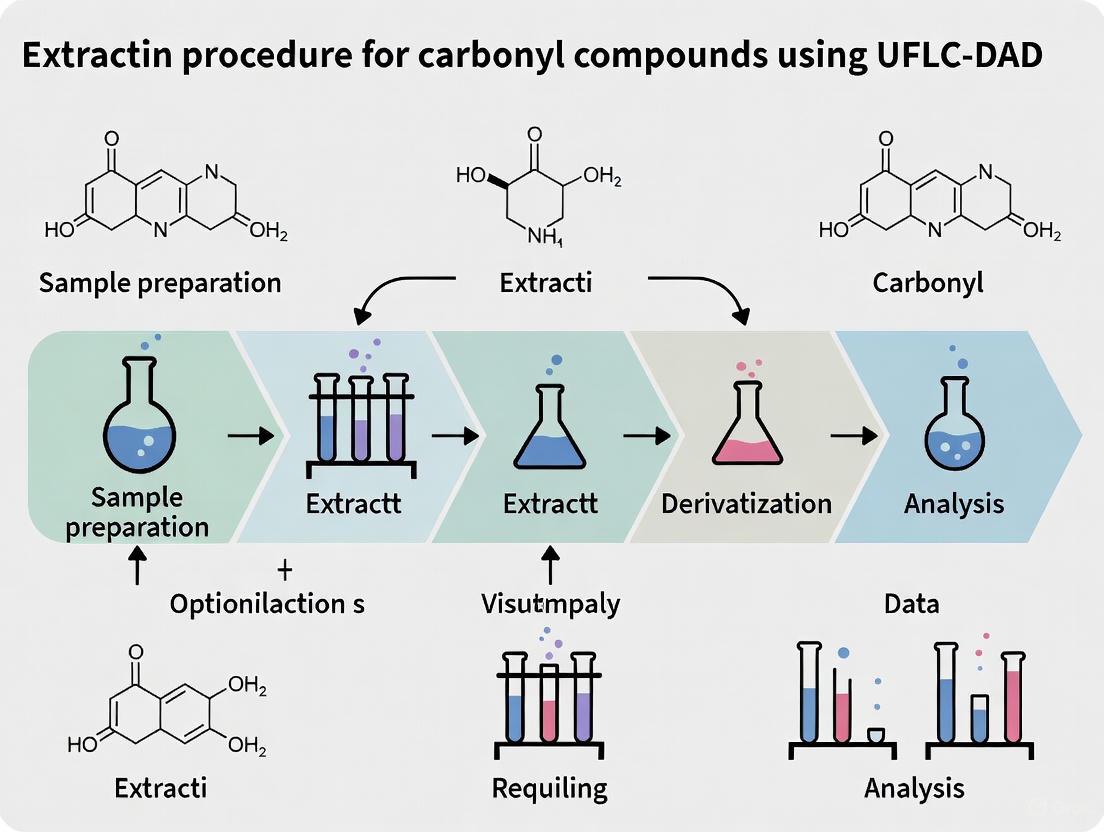
This article provides a systematic guide for the extraction and UFLC-DAD analysis of carbonyl compounds, critical analytes in food, environmental, and biomedical research.
Optimized Extraction and UFLC-DAD Analysis of Carbonyl Compounds: A Comprehensive Guide from Method Development to Validation
Abstract
This article provides a systematic guide for the extraction and UFLC-DAD analysis of carbonyl compounds, critical analytes in food, environmental, and biomedical research. It covers foundational principles of carbonyl compound chemistry and the role of derivatization, details a step-by-step optimized extraction procedure, addresses common troubleshooting and optimization challenges, and presents rigorous method validation protocols. By synthesizing recent methodological advances and comparative detection studies, this resource equips researchers and drug development professionals with the knowledge to implement robust, sensitive, and accurate analytical methods for quantifying these biologically significant compounds.
Understanding Carbonyl Compounds and the UFLC-DAD Analysis Framework
The Significance of Carbonyl Compounds in Food Safety and Human Health
Carbonyl compounds, including aldehydes and ketones, are a class of reactive molecules that significantly impact food quality, safety, and human health. They are generated during food processing, cooking, and storage, primarily through lipid peroxidation and the Maillard reaction [1] [2]. Their presence in food is a major concern as many exhibit cytotoxic, mutagenic, and carcinogenic properties [3]. The International Agency for Research on Cancer (IARC) classifies several carbonyls, such as formaldehyde and acetaldehyde, as known human carcinogens (Group 1) [4] [3]. Understanding their formation, analysis, and health effects is crucial for risk assessment and ensuring food safety. This document, framed within research on Ultra-Fast Liquid Chromatography with Diode Array Detection (UFLC-DAD), provides detailed application notes and protocols for analyzing these critical compounds.
Health Impacts of Carbonyl Compounds in Food
Carbonyl compounds pose health risks through dietary exposure and by forming other hazardous substances in food.
Table 1: Carcinogenicity Classifications of Selected Carbonyl Compounds
| Compound | IARC Classification Group | Carcinogenicity Description |
|---|---|---|
| Formaldehyde | Group 1 | Carcinogenic to humans [3] |
| Acetaldehyde | Group 1 | Carcinogenic to humans [3] |
| Acrolein | Group 2A | Probably carcinogenic to humans [5] |
| Crotonaldehyde | Group 2B | Possibly carcinogenic to humans [5] |
Direct Toxicity and Carcinogenicity
Reactive carbonyls are highly electrophilic and can readily modify DNA and proteins, leading to impaired cellular function [3]. Formaldehyde is a well-known sensory irritant linked to allergies and negative respiratory outcomes, while acetaldehyde can irritate the skin, eyes, and nose [4]. The health risk is particularly elevated for individuals with a genetic variant of the enzyme aldehyde dehydrogenase 2 (ALDH2*2), which has a significantly reduced capacity to metabolize reactive aldehydes [3].
Role as Precursors to Processing Contaminants
Carbonyl compounds are key intermediates in the formation of various toxicants during food processing. Reactive carbonyl species (RCS) can induce the formation of heterocyclic amines, advanced glycation end products (AGEs), acrylamide, and polycyclic aromatic hydrocarbons (PAHs) [2]. For instance, cooking processes like frying and grilling generate large quantities of carbonyls and other harmful products from the thermal degradation of oils and foods [6].
Analytical Methodologies: Extraction and Derivatization
Accurate analysis of carbonyl compounds requires robust extraction and derivatization techniques due to their reactivity and volatility.
Derivatization with DNPH
The most common strategy involves derivatizing carbonyl compounds with 2,4-dinitrophenylhydrazine (DNPH) to form stable 2,4-dinitrophenylhydrazone derivatives. These derivatives are ideal for chromatographic analysis as they enhance detection sensitivity and selectivity [4] [5]. The reaction is widely used in standardized methods for assessing indoor and occupational air quality [4].
Modern Microextraction Techniques
Recent advancements focus on microextraction techniques that minimize solvent use and can be coupled with derivatization.
- Gas-Diffusion Microextraction (GDME): This technique is highly effective for selective extraction of volatile carbonyls from solid and liquid samples. It uses a hydrophobic membrane to separate the sample from an acceptor solution, often containing DNPH, allowing for simultaneous extraction and derivatization [7] [5]. It has been successfully applied to analyze wood-based panels and food products [7].
- Fan-Assisted Extraction: A novel approach based on the full evaporation technique, where a fan inside a closed flask enhances the mass transport of volatiles from the sample to a DNPH-containing acceptor solution. This method has demonstrated high efficiency and minimal matrix effect in complex samples like brewed coffee [8].
- Dispersive Liquid-Liquid Microextraction (DLLME): This method involves dispersing tiny droplets of an extraction solvent in an aqueous sample solution, providing a high surface area for rapid extraction of target analytes [5].
Table 2: Comparison of Microextraction Techniques for Carbonyl Compounds
| Technique | Principle | Key Advantages | Example Application |
|---|---|---|---|
| GDME | Diffusion through a gas phase aided by a membrane | Selective for volatiles, combines extraction/derivatization, low solvent use [7] | Volatile carbonyls in dry-process fibreboard [7] |
| Fan-Assisted Extraction | Convective mass transport in a closed headspace | Rapid (e.g., 10 min), simple setup, minimal matrix effect [8] | Volatile carbonyls in brewed coffee [8] |
| DLLME | Cloudy dispersion of extractant solvent in sample | Fast, high enrichment, low cost [5] | Analysis of various food matrices [5] |
Detailed Experimental Protocols
Protocol 1: GDME for Carbonyl Compounds in Solid Food Samples (e.g., Roasted Coffee)
This protocol is adapted from methods used for roasted coffee beans and fibreboard [8] [7].
Workflow Overview:
Materials and Reagents:
- Samples: Roasted coffee beans, ground to a fine powder.
- Chemicals: DNPH, acetonitrile (HPLC grade), hydrochloric acid, ultrapure water.
- Equipment: GDME apparatus (100 mL flask with PTFE septum and integrated electric fan), PTFE reservoir, heated water bath, HPLC vials, Ultra-Fast Liquid Chromatography system with DAD detector.
- Acceptor Solution: 500 µL of DNPH solution (0.15% w/v) in acetonitrile acidified with HCl [7].
Procedure:
- Sample Preparation: Precisely weigh 0.5 g of ground coffee into the bottom of the clean, dry GDME flask.
- GDME Setup: Place the PTFE reservoir inside the flask. Pipette 500 µL of the acceptor DNPH solution into the cavity of the PTFE reservoir. Ensure no solution spills.
- Extraction/Derivatization: Close the flask tightly with its lid. Place the flask in a water bath set to 45°C. Activate the electric fan and extract for 35 minutes [7].
- Sample Collection: After extraction, carefully open the flask and quantitatively transfer the acceptor solution from the PTFE reservoir to an HPLC vial using a micro-syringe.
- UFLC-DAD Analysis: Inject the sample into the UFLC-DAD system. A suggested C18 column (e.g., 150 mm x 3 mm, 3 µm) with a gradient elution of water/acetonitrile can be used. The DAD should be set to 360 nm for detecting DNPH derivatives [7] [4].
Protocol 2: Fan-Assisted Extraction for Liquid Food Samples (e.g., Brewed Coffee)
This protocol leverages the full evaporation technique for highly efficient analysis of liquid samples [8].
Workflow Overview:
Materials and Reagents:
- Samples: Brewed coffee, filtered.
- Acceptor Solution: 4.0 mmol Lâ»Â¹ DNPH and 1.00 × 10â»âµ mol Lâ»Â¹ 2-nonanone (internal standard) in a 1:1 (v/v) mixture of acetonitrile and 40 mM HCl [8].
- Equipment: Fan-assisted extraction system (as described in [8]), precision micropipettes, HPLC vials.
Procedure:
- Sample Transfer: Pipette 5 µL of the filtered brewed coffee sample directly into the bottom of the extraction flask.
- System Setup: Place a PTFE cylinder inside the flask and add the acceptor solution to its cavity. Close the flask with the fan-equipped lid.
- Extraction: Place the flask in a water bath at 50°C for 10 minutes with the fan operating [8].
- Analysis: After extraction, retrieve the acceptor solution and analyze directly via UFLC-DAD using the chromatographic conditions mentioned in Protocol 1. The use of an internal standard (2-nonanone) corrects for potential instrumental variability.
The Scientist's Toolkit: Key Research Reagents and Materials
Table 3: Essential Reagents and Materials for Carbonyl Compound Analysis
| Item | Function/Description | Application Note |
|---|---|---|
| 2,4-Dinitrophenylhydrazine (DNPH) | Derivatizing agent; reacts with carbonyls to form stable hydrazones detectable by UV and MS [4] [5]. | Purity should be >98%. Acidified solutions are used as acceptor phases in microextraction. |
| DNPH-coated Sorbent Cartridges | Standardized air sampling; derivatizes and traps airborne carbonyls for LC analysis [4]. | Used for ambient or indoor air monitoring in accordance with ISO methods [4]. |
| Acetonitrile (HPLC Grade) | Organic solvent for preparing DNPH solutions, mobile phase in UFLC, and sample dilution. | Ensures low UV background and compatibility with MS detection. |
| C18 Reversed-Phase Column | Stationary phase for chromatographic separation of DNPH-carbonyl derivatives. | A common choice is 150-250 mm length, 3-5 µm particle size, e.g., Acclaim Carbonyl C18 [4]. |
| Stable Isotope-coded DNPH (d₀-/d₃-) | Internal standards for non-targeted carbonylomics; enables accurate quantification and reduces false positives in HRMS [9]. | Critical for advanced research on complex samples like thermally oxidized cooking oils [9]. |
| PTFE Membranes & Septa | Used in GDME and closed-system extraction; provides inert, hydrophobic barriers for gas diffusion and system sealing [7]. | Prevents liquid mixing while allowing volatile carbonyls to pass through. |
| Methyl 3-oxodecanoate | Methyl 3-oxodecanoate|CAS 22348-96-5 | |
| PEG 20 cetostearyl ether | PEG 20 cetostearyl ether, CAS:9004-95-9, MF:C56H114O21, MW:1123.5 g/mol | Chemical Reagent |
Carbonyl compounds represent a critical intersection between food chemistry and public health. Their significance in food safety stems from their inherent toxicity and their role as precursors to a wide range of processing contaminants. The accurate monitoring of these compounds relies on sophisticated analytical methodologies. The protocols and techniques outlined here—particularly those coupling efficient microextraction like GDME and fan-assisted extraction with sensitive UFLC-DAD analysis—provide researchers with powerful tools for surveillance and risk assessment. Future directions will involve the adoption of non-targeted "carbonylomics" approaches using high-resolution mass spectrometry and stable isotope coding to uncover the full spectrum of reactive carbonyl species in our food, ultimately leading to improved safety controls and public health outcomes [9].
Ultra-Fast Liquid Chromatography with Diode Array Detection (UFLC-DAD) represents a significant advancement in analytical separation science, offering enhanced speed, resolution, and detection capabilities compared to conventional High-Performance Liquid Chromatography (HPLC). This sophisticated analytical technique couples the high-separation efficiency of liquid chromatography using columns packed with fine particles (typically sub-2μm fully porous or sub-3μm core-shell particles) with the versatile detection capabilities of a photodiode array detector [10]. The synergy between these components enables researchers to achieve rapid separations without compromising data quality, making UFLC-DAD particularly valuable in applications requiring high-throughput analysis, such as pharmaceutical development, food safety monitoring, and environmental analysis [10] [11].
The fundamental working principle of UFLC-DAD involves two complementary processes: chromatographic separation followed by spectroscopic detection. During the separation phase, analytes are carried by a high-pressure mobile phase through a specialized column containing the stationary phase. Separation occurs based on differential partitioning of compounds between the mobile and stationary phases, with stronger affinity for the stationary phase resulting in longer retention times [11]. The diode array detector then monitors the eluent across a spectrum of wavelengths (typically 190-800 nm), generating three-dimensional data (retention time, absorbance, and wavelength) that provides both qualitative and quantitative information about the separated compounds [11]. This comprehensive detection approach allows for peak purity assessment and spectral library matching, making it indispensable for method development and compound identification in complex matrices.
Core Principles and Technical Foundations
Enhanced Separation Power of UFLC
The separation power of UFLC systems stems from several key technological improvements over conventional HPLC. The most significant advancement involves the use of columns packed with smaller particles (1.7-5 μm) in conjunction with high-pressure pumping systems capable of operating at pressures up to 130 MPa (19,000 PSI) [10] [11]. According to the van Deemter equation, which describes the relationship between linear velocity and plate height, smaller particles provide enhanced efficiency across a wider range of flow rates, resulting in sharper peaks and improved resolution [10]. This relationship allows UFLC systems to maintain separation efficiency while significantly reducing analysis time, enabling 90-120 runs per 8-hour day compared to only 16-24 runs with conventional HPLC [11].
The separation mechanism primarily relies on differential partitioning of analytes between the stationary and mobile phases. In reversed-phase chromatography (the most common mode for UFLC-DAD), the stationary phase is typically non-polar (e.g., C18-bonded silica), while the mobile phase is a polar solvent mixture (e.g., water and acetonitrile or methanol) [11]. Compounds interact with the stationary phase through hydrophobic interactions, with more non-polar compounds exhibiting stronger retention. The introduction of sub-2-micron particles in UFLC columns dramatically increases the surface area for interactions while reducing diffusion paths, resulting in superior separation efficiency [10]. This enhanced efficiency is particularly beneficial when analyzing complex samples containing numerous compounds with similar chemical properties, such as carbonyl derivatives in oxidized oils or pharmaceutical impurities in drug development [12] [13].
Detection Specificity of Diode Array Technology
The diode array detector provides critical detection specificity through its ability to acquire full UV-Vis spectra for each eluting compound during the separation process. Unlike single-wavelength UV detectors that monitor absorbance at a fixed wavelength, DAD systems employ an array of photodiodes (typically 512-1024 elements) to simultaneously measure absorbance across a broad wavelength range [11]. This capability enables the collection of complete spectral profiles for each analyte as it elutes from the column, generating three-dimensional data (retention time, absorbance, and wavelength) that provides a comprehensive chemical fingerprint for compound identification and characterization.
The specificity of DAD detection derives from several key features. Spectral comparison allows analysts to confirm compound identity by matching unknown spectra with reference standards, while peak purity assessment determines whether a chromatographic peak represents a single compound or co-eluting substances by comparing spectra across different regions of the peak [11]. Additionally, the optimal detection wavelength for each analyte can be selected post-acquisition by reviewing the full spectral data, which is particularly valuable during method development. For carbonyl compounds derivatized with DNPH, detection is typically performed at 360 nm, where these derivatives exhibit strong absorption [14] [15]. This multi-wavelength capability makes DAD especially suitable for method development and for analyzing samples with unknown composition, as it provides rich spectroscopic data to support compound identification beyond retention time matching alone.
The analysis of carbonyl compounds (CCs) represents a particularly relevant application of UFLC-DAD technology, especially in food chemistry and environmental science. Carbonyl compounds, including aldehydes and ketones, are generated during the thermal degradation of lipids and are important markers for assessing oil quality and safety [12] [13]. Among these compounds, α,β-unsaturated aldehydes such as 4-hydroxy-2-nonenal (HNE), 4-hydroxy-2-hexenal (HHE), and acrolein have received significant attention due to their biological reactivity and potential toxicity [13]. These compounds can form adducts with biomacromolecules including proteins and DNA, potentially leading to cellular dysfunction and mutagenic effects [13].
The combination of UFLC separation with DAD detection is exceptionally well-suited for carbonyl compound analysis following derivatization with 2,4-dinitrophenylhydrazine (DNPH). This derivatization reaction converts carbonyl compounds into stable hydrazone derivatives that exhibit strong UV absorption and are readily separated by reversed-phase chromatography [13] [14]. The UFLC component provides rapid separation of multiple carbonyl derivatives with similar structures, while the DAD enables specific detection at wavelengths where these derivatives absorb strongly (typically 360 nm) while simultaneously monitoring for potential interferences [14]. This approach has been successfully applied to quantify carbonyl compounds in various matrices, including thermally stressed edible oils, environmental air samples, and biological fluids [12] [13] [14].
Table 1: Key Carbonyl Compounds Analyzed by UFLC-DAD in Thermal Oxidation Studies
| Carbonyl Compound | Abbreviation | Mean Concentration in Heated Soybean Oil (μg/g) | Toxicological Significance |
|---|---|---|---|
| 4-Hydroxy-2-nonenal | HNE | 36.9 | DNA adduct formation, protein modification [12] [13] |
| 2,4-Decadienal | - | 34.8 | Associated with lung and gastrointestinal adenocarcinomas [13] |
| 2,4-Heptadienal | - | 22.6 | Secondary lipid oxidation product [12] |
| 4-Hydroxy-2-hexenal | HHE | Quantified (specific value not reported) | Cytotoxic and genotoxic effects [13] |
| Acrolein | - | Quantified (specific value not reported) | Eye/respiratory irritant, implicated in atherosclerosis and Alzheimer's disease [12] [13] |
Experimental Protocols: Extraction and Analysis of Carbonyl Compounds in Soybean Oil
Sample Preparation and Derivatization
The accurate quantification of carbonyl compounds in complex matrices like edible oils requires careful sample preparation to extract target analytes while minimizing interference from the lipid matrix. For soybean oil analysis, the optimized protocol begins with weighing approximately 1 g of oil sample into a glass vial. The extraction is performed using 1.5 mL of acetonitrile as the extraction solvent, which provides excellent extraction efficiency for carbonyl-DNPH derivatives while maintaining immiscibility with the oil matrix [12] [13]. The mixture is subjected to manual stirring for 3 minutes to ensure thorough contact between the extraction solvent and the oil sample, followed by 30 minutes of sonication to enhance extraction efficiency [12]. The sample is then centrifuged to separate the phases, and the acetonitrile layer containing the extracted carbonyl-DNPH derivatives is carefully collected for analysis.
For carbonyl compound determination, derivatization with 2,4-dinitrophenylhydrazine (DNPH) is typically performed prior to extraction. The derivatization process involves adding an appropriate volume of DNPH solution to the oil sample or standard, allowing the reaction to proceed at room temperature for a specified time [13] [14]. DNPH reacts with carbonyl functional groups to form stable hydrazone derivatives that exhibit strong UV absorption and are more amenable to reversed-phase chromatographic separation than the parent compounds [13]. The derivatives show enhanced detection sensitivity at 360 nm, allowing for quantification at trace levels. For quality control, method validation should include assessment of extraction efficiency using fortified samples, with reported average recoveries ranging from 70.7% to 85.0% at the lowest concentration level and detection limits between 0.03 and 0.1 μg/mL for various carbonyl compounds [12].
UFLC-DAD Analytical Conditions
The chromatographic separation of carbonyl-DNPH derivatives employs specific conditions optimized for resolution and speed. A typical UFLC system is configured with a reversed-phase C18 column (e.g., 2.1 × 100 mm, 1.7-2.1 μm particle size) maintained at a constant temperature (typically 35-40°C) [12] [16]. The mobile phase consists of a binary gradient combining aqueous solvent (water or aqueous buffer) and organic modifier (acetonitrile or methanol). A representative gradient program for carbonyl separation might begin with 40-50% organic phase, increasing to 90-95% over 5-10 minutes, followed by re-equilibration [12] [13]. The flow rate is typically set between 0.2-0.5 mL/min to maintain optimal separation efficiency while operating within system pressure limits [12].
Detection is performed using a diode array detector with the primary monitoring wavelength set at 360 nm for DNPH derivatives, while simultaneously acquiring full spectra (e.g., 190-600 nm) for peak purity assessment and confirmatory identification [14] [17]. The injection volume is typically between 1-10 μL, depending on analyte concentration and detection sensitivity requirements [12] [16]. Under these conditions, target carbonyl compounds including 4-hydroxy-2-nonenal, 2,4-decadienal, 2,4-heptadienal, 4-hydroxy-2-hexenal, and acrolein are successfully separated and quantified in heated soybean oil samples [12]. The complete workflow for carbonyl compound analysis using UFLC-DAD is illustrated in Figure 1.
Figure 1: Workflow for UFLC-DAD Analysis of Carbonyl Compounds in Soybean Oil
Method Validation Parameters
For reliable quantification, the UFLC-DAD method for carbonyl compounds must undergo comprehensive validation to establish key performance characteristics. Linearity is typically demonstrated across concentration ranges relevant to the application (e.g., 0.2-10.0 μg/mL for carbonyl compounds in soybean oil), with correlation coefficients (R²) exceeding 0.995 [12]. Precision is evaluated through both intra-day repeatability (expressed as relative standard deviation, RSD%) and inter-day repeatability, with acceptable values typically below 10% and 16%, respectively [14] [15]. Accuracy is established through recovery studies using spiked samples, with reported average recoveries for carbonyl compounds ranging from 70.7% to 85.0% at the lowest concentration level [12]. The limit of detection (LOD) and limit of quantification (LOQ) for carbonyl compounds in UFLC-DAD analyses have been reported at 0.03-0.1 μg/mL and 0.2 μg/mL, respectively, demonstrating the method's sensitivity for detecting these compounds at trace levels [12].
Table 2: UFLC-DAD Method Validation for Carbonyl Compound Analysis
| Validation Parameter | Experimental Results | Acceptance Criteria |
|---|---|---|
| Linearity | R² = 0.9934-0.999 [12] [17] | R² ≥ 0.990 |
| Precision (Intra-day) | RSD% = 0.7-10 [14] [15] | RSD% ≤ 10 |
| Precision (Inter-day) | RSD% = 5-16 [14] [15] | RSD% ≤ 15 |
| Accuracy (Recovery) | 70.7-105.3% [12] [16] | 70-120% |
| Limit of Detection (LOD) | 0.03-0.1 μg/mL [12] | - |
| Limit of Quantification (LOQ) | 0.2 μg/mL [12] | - |
The Scientist's Toolkit: Essential Research Reagents and Materials
Successful implementation of UFLC-DAD methods for carbonyl compound analysis requires specific reagents and materials optimized for this application. The following table summarizes key components of the research toolkit for this analytical approach.
Table 3: Essential Research Reagent Solutions for Carbonyl Compound Analysis by UFLC-DAD
| Reagent/Material | Specification | Function in Analysis |
|---|---|---|
| 2,4-Dinitrophenylhydrazine (DNPH) | Analytical grade, derivatization reagent [13] [14] | Reacts with carbonyl compounds to form UV-absorbing hydrazone derivatives with enhanced chromatographic properties |
| Acetonitrile | HPLC or UFLC grade, low UV cutoff [12] [13] | Primary extraction solvent and mobile phase component; provides excellent extraction efficiency for carbonyl-DNPH derivatives |
| C18 Chromatographic Column | Sub-2μm particles, 100-150 mm length, 2.1 mm i.d. [12] [16] | Stationary phase for reversed-phase separation of carbonyl-DNPH derivatives; provides high efficiency and resolution |
| Carbonyl-DNPH Standard Solutions | Certified reference materials [14] | Method calibration, quality control, and compound identification through retention time and spectral matching |
| Water | Ultrapure (18.2 MΩ·cm), filtered through 0.20 μm membrane [13] | Mobile phase component; minimizes background interference and system contamination |
| 2-Methylcitric acid trisodium | 2-Methylcitric acid trisodium, MF:C7H7Na3O7, MW:272.10 g/mol | Chemical Reagent |
| Methyl acetylacetate-d3 | Methyl acetylacetate-d3, MF:C5H8O3, MW:119.13 g/mol | Chemical Reagent |
Comparative Analysis: UFLC-DAD Versus Alternative Techniques
When selecting an analytical method for carbonyl compound analysis, understanding the relative advantages and limitations of UFLC-DAD compared to alternative techniques is essential for making informed methodological decisions. UFLC-DAD offers several distinct advantages including universal detection for chromophoric compounds, compatibility with gradient elution, comprehensive spectral information for peak identification and purity assessment, and relatively low operational costs compared to MS-based detection [11]. The technique is particularly well-suited for routine analysis of known carbonyl compounds in quality control laboratories where capital and operational expenses are significant considerations.
However, UFLC-DAD also presents certain limitations that researchers must consider. The technique offers lower sensitivity compared to mass spectrometric detection, with one study reporting successful quantification of only 32% of environmental samples using DAD versus 98% with MS/MS detection [14] [15]. Additionally, DAD provides reduced specificity in complex matrices where co-elution may occur, as it cannot distinguish between compounds with similar spectra but different masses [14]. The dependency on chromophores limits application to compounds with UV-absorbing properties or those that can be derivatized to introduce chromophores [11]. For applications requiring ultimate sensitivity, specificity for trace-level analysis, or identification of unknown compounds, UFLC-MS/MS may be preferable despite higher instrument costs and operational complexity [14] [15]. Similarly, emerging techniques such as supercritical fluid chromatography (SFC) coupled with MS detection offer promising alternatives for carbonyl analysis, with recent studies demonstrating advantages including low solvent consumption and excellent sensitivity for α,β-unsaturated aldehydes in edible oils [18].
Carbonyl compounds, such as aldehydes and ketones, are ubiquitous pollutants and significant oxygenated volatile organic compounds (OVOCs) that play essential roles as precursors and intermediates in photochemical reactions [19]. Accurate measurement of these compounds is critical for atmospheric chemistry studies, occupational health, and drug development. However, their inherent properties—high reactivity, volatility, and polarity—present substantial analytical challenges for direct chromatographic analysis and detection [19]. Derivatization, the chemical modification of compounds to form derivatives with more favorable properties, emerges as an indispensable strategy to overcome these limitations.
This application note details why derivatization is crucial for enhancing detection and chromatography of carbonyl compounds, with specific protocols and data framed within Ultra-Fast Liquid Chromatography with Diode Array Detection (UFLC-DAD) research. The widely adopted derivatization agent 2,4-dinitrophenylhydrazine (DNPH) serves as our primary model, forming stable hydrazone derivatives that significantly improve chromatographic separation, detection sensitivity, and compound stability [20] [14] [21].
The Critical Role of Derivatization
Fundamental Analytical Challenges of Carbonyl Compounds
Carbonyl compounds exhibit a wide range of concentration variability, high reactivity, and instability, with typically short atmospheric lifetimes, placing stringent demands on sampling and analytical techniques [19]. Their high polarity leads to poor retention on reverse-phase chromatographic columns, resulting in co-elution with other polar matrix components and inadequate separation. Furthermore, their volatility causes significant losses during sample concentration steps, while the lack of strong chromophores or fluorophores in many carbonyl compounds renders them virtually invisible to conventional UV-Vis or fluorescence detectors [19] [14]. Without chemical derivatization, accurate quantification of carbonyl compounds at trace levels in complex matrices remains challenging.
How Derivatization Addresses These Challenges
Derivatization with DNPH specifically targets the carbonyl functional group (C=O), forming stable 2,4-dinitrophenylhydrazone derivatives that transform the analytical properties of the original compounds [14]. This reaction significantly increases the molecular weight and hydrophobicity of the derivatives, enhancing their retention on reverse-phase C18 columns and enabling effective separation from interfering matrix components [21]. The introduction of the strong chromophoric 2,4-dinitrophenyl group creates derivatives with high molar absorptivity at around 360 nm, making them highly amenable to UV-DAD detection [14] [22]. Additionally, the hydrazone derivatives exhibit superior stability compared to the parent carbonyl compounds, preventing degradation during sample storage and analysis, which is crucial for obtaining accurate quantitative results [19].
Experimental Protocols: DNPH Derivatization for UFLC-DAD
Reagents and Materials
- Derivatization Reagent: 2,4-Dinitrophenylhydrazine (DNPH), purified by recrystallization [14].
- Sampling Cartridges: Commercially available DNPH-coated silica cartridges (e.g., 270 mg DNPH-coated silica). Dual-bed cartridges containing 130 mg of 1,2-bis(2-pyridyl) ethylene (BPE)-coated silica for ozone scrubbing are recommended for air sampling to prevent ozone interference [14] [4].
- Solvents: Acetonitrile (ACN), HPLC grade. Water, LC-MS grade [14].
- Acid Catalyst: Phosphoric acid or hydrochloric acid for acidifying the derivatization solution to promote the reaction [14].
- Standard Solutions: Carbonyl-DNPH derivative standard mixture (e.g., containing Formaldehyde-DNPH, Acetaldehyde-DNPH, Propionaldehyde-DNPH, etc.) for calibration and identification [14].
Derivatization Procedures
Air Sampling and On-Cartridge Derivatization
This protocol is optimized for workplace and environmental air monitoring [14] [4].
- Cartridge Preparation: Ensure DNPH-coated cartridges are stored in the dark at +4°C before use. Condition if specified by the manufacturer.
- Air Sampling: Connect the cartridge to a calibrated portable sampling pump. The recommended flow rate is 0.14 L/min, with sampling times ranging from 51 to 406 minutes, ensuring the collected carbonyl compounds consume less than 30% of the available DNPH to maintain derivatization efficiency.
- Ozone Removal: When using dual-bed cartridges, the BPE layer effectively scrubs ozone before it can interfere with the DNPH derivatization reaction.
- Post-Sampling Handling: Seal cartridges immediately after sampling and store in the dark at +4°C. Analysis should be performed within two weeks of sampling.
- Extraction of Derivatives: Elute the hydrazone derivatives from the cartridge with 2-3 mL of acetonitrile into a 5 mL volumetric flask. Make up to volume with acetonitrile.
- Filtration: Filter the solution through a 0.22 μm PTFE syringe filter prior to UFLC-DAD analysis.
Liquid-Phase Derivatization for Liquid Samples
For samples in solution (e.g., biological fluids, extracts).
- Reagent Preparation: Dissolve DNPH in acetonitrile acidified with 2-4% phosphoric or hydrochloric acid.
- Derivatization Reaction: Mix the sample solution with the DNPH reagent. A typical molar ratio of DNPH to carbonyl compounds should exceed 10:1 to ensure complete reaction.
- Reaction Conditions: Allow the reaction to proceed for 30-60 minutes at room temperature (25°C) in the dark.
- Dilution and Filtration: Dilute the reaction mixture with the mobile phase to achieve the desired concentration and filter through a 0.22 μm PTFE membrane before injection.
UFLC-DAD Analysis Conditions
The following conditions are adapted from recent methodologies developed for carbonyl-DNPH analysis [14] [21] [22].
- Column: Acclaim Carbonyl C18 RSLC (150 × 3.0 mm, 3 μm) or equivalent C18 column suitable for carbonyl separations.
- Mobile Phase: Isocratic or gradient elution using water (A) and acetonitrile (B).
- Flow Rate: 0.4 - 0.6 mL/min.
- Column Temperature: 30 - 40°C.
- Injection Volume: 10 - 20 μL.
- DAD Detection: 360 nm (primary quantification wavelength); scan from 200-500 nm for peak purity assessment.
The experimental workflow for the analysis of carbonyl compounds via derivatization is summarized below.
Comparative Performance Data
Analytical Performance of DNPH-Derivatization with Different Detection Systems
Table 1: Comparison of LC-UV/DAD and LC-MS/MS methods for determining 12 carbonyl compounds after DNPH derivatization [14].
| Parameter | LC-UV/DAD Method | LC-MS/MS Method |
|---|---|---|
| Linear Range | Not specified | Not specified |
| Linearity (R²) | 0.996 – 0.999 | 0.996 – 0.999 |
| Intra-day Repeatability (RSD%) | 0.7 – 10 | 0.7 – 10 |
| Inter-day Repeatability (RSD%) | 5 – 16 | 5 – 16 |
| Sensitivity (Quantifiable Samples) | 32% of samples | 98% of samples |
| Agreement for Formaldehyde/Acetaldehyde | Good (0.1 – 30% deviation) | Good (0.1 – 30% deviation) |
| Key Advantage | Cost-effective, widely available | High sensitivity and selectivity |
Performance of a Novel Transportable HPLC-UV for Carbonyl Hydrazones
Table 2: Performance characteristics of a transportable HPLC-UV system for the analysis of 13 carbonyl-DNPH derivatives [21] [22].
| Performance Metric | UV Detector | LED Detector |
|---|---|---|
| Limit of Detection (LOD) Range | 0.12 – 0.38 mg Lâ»Â¹ | 0.45 – 1.04 mg Lâ»Â¹ |
| LOD for Formaldehyde-DNPH | < 1 mg Lâ»Â¹ | > 1 mg Lâ»Â¹ |
| Precision (RSD) | < 11.5% | < 14.1% |
| Analysis Time | < 20 minutes (for 11 out of 13 hydrazones) | < 20 minutes |
| Separation Efficiency | Full separation of 11 hydrazones; co-elution of BO-DNPH and BA-DNPH | Same as UV |
| Key Strength | Better sensitivity and precision | Potentially higher robustness |
The Scientist's Toolkit: Essential Research Reagents
Table 3: Key reagents and materials for DNPH derivatization and UFLC-DAD analysis of carbonyl compounds.
| Item | Function / Purpose | Example / Specification |
|---|---|---|
| DNPH-Coated Silica Cartridges | Sampling and simultaneous derivatization of airborne carbonyls. | 270 mg DNPH-coated silica; dual-bed with BPE for ozone removal [14] [4]. |
| DNPH Reagent | Derivatizing agent for carbonyl group, forming hydrazones. | Purified DNPH in acidified acetonitrile [14]. |
| Carbonyl-DNPH Standard Mix | Calibration, identification, and quantification of target analytes. | Certified reference material containing 12+ carbonyl-DNPH derivatives (e.g., Formaldehyde-DNPH to Decanal-DNPH) [14]. |
| Acetonitrile (HPLC Grade) | Mobile phase component; solvent for standard preparation and cartridge elution. | Low UV cutoff, high purity [14] [21]. |
| C18 Analytical Column | Chromatographic separation of hydrazone derivatives. | Reverse-phase, 3-5 µm particle size, 150-250 mm length (e.g., Acclaim Carbonyl C18) [14] [22]. |
| PTFE Syringe Filters | Clarification of final sample solutions before injection. | 0.22 µm pore size, 13 mm diameter [14]. |
| E3 Ligase Ligand-linker Conjugate 54 | E3 Ligase Ligand-linker Conjugate 54, MF:C28H37N5O6, MW:539.6 g/mol | Chemical Reagent |
| 2-Allyl-3-methylpyrazine-d3 | 2-Allyl-3-methylpyrazine-d3, MF:C8H10N2, MW:137.20 g/mol | Chemical Reagent |
Derivatization with DNPH is not merely an optional sample preparation step but a fundamental cornerstone for the reliable analysis of carbonyl compounds by UFLC-DAD. It directly addresses the core analytical challenges posed by these molecules by converting them into derivatives with superior chromatographic behavior, enhanced detection properties, and improved stability. The protocols and data presented herein provide a robust framework for researchers to implement this crucial technique, enabling accurate and sensitive quantification of carbonyl compounds in complex matrices for environmental monitoring, occupational health assessment, and pharmaceutical research.
The analysis of carbonyl compounds is a critical component in environmental, food, and biological research due to their widespread occurrence and significant health implications. Carbonyl compounds, characterized by the presence of an acyl group (R-C=O), including aldehydes and ketones, are prevalent in various samples from airborne particulate matter to biological fluids [20] [23]. Accurate quantification of these compounds is essential as they serve as potential biomarkers for numerous diseases, including diabetes, cardiovascular diseases, neurodegenerative disorders, and cancer [23] [24]. However, the direct analysis of carbonyl compounds using reversed-phase liquid chromatography with diode-array detection (RPLC-DAD) or mass spectrometry (MS) presents substantial challenges due to their poor ionization efficiency, high polarity resulting in inadequate chromatographic retention, and low abundance in complex matrices [24].
To overcome these analytical obstacles, chemical derivatization has emerged as a powerful strategy prior to Ultra-Fast Liquid Chromatography with DAD (UFLC-DAD) analysis. Derivatization enhances detection sensitivity by introducing chromophores or fluorophores that improve UV-Vis absorption characteristics, facilitates better chromatographic separation by reducing polarity, and enables the analysis of thermally unstable compounds that are unsuitable for gas chromatography [24] [25]. Among various derivatizing agents, 2,4-dinitrophenylhydrazine (DNPH) has been historically predominant, but several alternatives have been developed to address specific analytical needs and overcome limitations associated with DNPH [26] [25]. This article provides a comprehensive overview of DNPH and its alternatives, focusing on their application within the context of UFLC-DAD analysis for carbonyl compounds, with detailed protocols for implementation in research settings.
Established Derivatization Agents: Properties and Applications
DNPH (2,4-Dinitrophenylhydrazine)
DNPH remains the most widely used derivatizing agent for carbonyl compounds, with approximately 50% occurrence in published methods according to a literature survey [25]. Its popularity stems from its ability to form stable hydrazone derivatives with both aldehydes and ketones, characterized by strong UV absorption around 360 nm, making it ideal for DAD detection [25] [14]. The DNPH derivatization process involves a nucleophilic addition reaction where the hydrazine group attacks the carbonyl carbon, forming a hydrazone linkage with the elimination of water. The resulting dinitrophenylhydrazone derivatives exhibit enhanced chromophoric properties and improved chromatographic behavior on reversed-phase columns [25].
Despite its widespread use, DNPH methodology faces several challenges. The derivatization kinetics can be slow, particularly for ketones, requiring sufficient time to reach equilibrium [25]. Additionally, the reaction is sensitive to environmental factors such as relative humidity, sampling time, and the presence of interferents like ozone and NO₂, which often necessitates the use of ozone denuders or KI filters during sampling [25]. A recent comparative study highlighted another limitation: while DNPH-based methods showed acceptable linearity (0.996 < R² < 0.999) and repeatability (RSD 0.7-10% intra-day), they demonstrated significantly lower sensitivity compared to MS detection, with only 32% of samples correctly quantifiable by DAD versus 98% by MS/MS [14].
Emerging Alternative Derivatization Agents
While DNPH remains prevalent, several alternative derivatization agents have been developed to address specific analytical needs. The following table summarizes the key characteristics of DNPH and its principal alternatives:
Table 1: Comparison of Derivatization Agents for Carbonyl Compounds
| Derivatization Agent | Abbreviation | Reaction Time | Key Advantages | Detection Methods | Typical Applications |
|---|---|---|---|---|---|
| 2,4-Dinitrophenylhydrazine | DNPH | Slow (up to 24h for some ketones) | Well-established, stable derivatives, strong UV absorption | HPLC-UV/DAD (360 nm) | Air sampling, workplace monitoring [25] [14] |
| O-tert-butylhydroxylamine | TBOX | Fast (shortened reaction time) | Lower MW derivatives, aqueous reactions, faster kinetics | GC/MS, LC-MS | Dicarbonyls, multi-functional compounds [26] |
| 4-Hydrazinobenzoic acid | HBA | Moderate | High water solubility, stable, applicable to HPLC-UV and CE-DAD | HPLC-UV, CE-DAD, LC-MS | Food and beverage analysis, biological fluids [27] |
| Pentalfluorobenzylhydroxylamine | PFBHA | Moderate (faster than DNPH) | Improved volatility for GC, electron-capture properties | GC-ECD, GC-MS | Atmospheric samples, mechanism studies [26] |
| Dansylhydrazine | DNSH | Moderate | Fluorescent detection, high sensitivity | HPLC-FL, LC-MS | Trace analysis, metabolomics [24] |
TBOX represents a significant advancement for analyzing multi-carbonyl compounds, as it generates lower molecular weight oximes compared to DNPH hydrazones, facilitating better separation and detection of complex carbonyl mixtures [26]. This advantage was demonstrated in studies investigating limonene ozonolysis products, where TBOX enabled the detection of 3-acetyl-6-oxoheptanal (3A6O), highlighting the benefit of a smaller molecular weight derivatization agent for multi-carbonyl compounds [26]. HBA has recently gained attention as a derivatizing agent due to its "stability, relatively high solubility in water and other solvents, high selectivity and sensibility, reduced impurities, [and] simple preparation steps" [27]. Its applicability to different separation techniques, including HPLC-UV and CE-DAD, makes it particularly versatile for various analytical scenarios.
Experimental Protocols for Carbonyl Derivatization
Standard DNPH Derivatization Protocol for Liquid Samples
This protocol describes the derivatization of carbonyl compounds in liquid matrices (e.g., water, biological fluids, extracts) using DNPH prior to UFLC-DAD analysis.
Table 2: Reagent Solutions for DNPH Derivatization
| Reagent/Solution | Composition/Preparation | Storage Conditions | Stability |
|---|---|---|---|
| DNPH Derivatization Solution | 2.5 mg/mL DNPH in acetonitrile acidified with 0.1-1% phosphoric acid | Amber vial at 4°C | 1 month |
| Carbonyl-Free Water | Deionized water purified via solid-phase extraction to remove carbonyl impurities | Room temperature | 1 week |
| Calibration Standards | Serial dilutions of target carbonyl-DNPH derivatives in ACN | Amber vial at -20°C | 6 months |
| Mobile Phase A | Water with 0.1% acetic acid or ammonium formate buffer | Room temperature | 1 week |
| Mobile Phase B | Acetonitrile with 0.1% acetic acid or ammonium formate buffer | Room temperature | 1 week |
Procedure:
- Sample Preparation: For liquid samples, filter through a 0.45 μm membrane to remove particulates. For solid samples, perform extraction using carbonyl-free water or acetonitrile via sonication or mechanical shaking.
- Derivatization: Combine 1.0 mL of sample with 1.0 mL of DNPH derivatization solution in a sealed amber vial.
- Reaction Incubation: Heat at 40°C for 60 minutes with occasional vortexing. For ketones or stubborn aldehydes, extend reaction time up to 24 hours at room temperature.
- Quenching and Dilution: Add 2.0 mL of carbonate buffer (pH 8.0) to quench the reaction and adjust to final volume with acetonitrile.
- Chromatographic Analysis: Inject 10-20 μL onto UFLC system with C18 column (e.g., Acclaim Carbonyl C18, 150 × 3 mm, 3 μm) using gradient elution with mobile phases A (water with 0.1% acetic acid) and B (acetonitrile with 0.1% acetic acid). Optimized gradient: 40-95% B over 15 minutes, flow rate 0.4 mL/min.
- Detection: Monitor at 360 nm with DAD. Identify compounds by retention time matching with certified standards and quantify using external calibration curves.
Quality Control:
- Include method blanks (carbonyl-free water processed identically to samples) to monitor contamination.
- Prepare and analyze laboratory control samples with each batch to assess precision and accuracy.
- Check derivatization efficiency by analyzing unreacted DNPH at 360 nm to ensure consumption does not exceed 30% of available reagent [14].
Air Sampling Protocol with DNPH-Coated Cartridges
This protocol describes the active sampling of airborne carbonyl compounds using DNPH-coated cartridges for subsequent UFLC-DAD analysis, particularly relevant for workplace monitoring [14].
Procedure:
- Cartridge Preparation: Use commercial dual-bed sampling cartridges containing 130 mg 2-BPE coated silica (for ozone scrubbing) followed by 270 mg DNPH-coated silica.
- Sampling Setup: Connect cartridge to portable sampling pump (e.g., SKC AirChek TOUCH) with appropriate tubing. Calibrate pump flow rate using a primary flowmeter (e.g., DryCal DC-lite) before and after sampling.
- Air Sampling: Draw air through cartridge at 0.14 L/min for predetermined time (typically 4-8 hours for workplace monitoring). Ensure sampled volume does not consume more than 30% of DNPH coating.
- Sample Extraction: Elute hydrazone derivatives from cartridge with 5 mL acetonitrile into amber volumetric flask.
- Analysis: Inject 10 μL onto UFLC-DAD system using conditions described in Section 3.1.
- Quantification: Calculate airborne concentrations using the formula: Concentration (μg/m³) = (Mass on cartridge [μg] × 1000) / (Sampling rate [L/min] × Time [min])
TBOX Derivatization Protocol for Dicarbonyl Compounds
This protocol describes the use of O-tert-butylhydroxylamine hydrochloride (TBOX) as an alternative derivatization agent, particularly advantageous for dicarbonyl compounds and situations requiring faster reaction times [26].
Procedure:
- Reagent Preparation: Prepare fresh 10 mM TBOX solution in carbonyl-free water.
- Derivatization: Mix 1.0 mL aqueous sample with 1.0 mL TBOX solution in sealed headspace vial.
- Reaction: Incubate at room temperature for 30 minutes (significantly faster than DNPH).
- Analysis: Inject directly onto UFLC system. For GC-MS analysis, extract oxime derivatives with dichloromethane before injection.
- Chromatographic Conditions: Use similar UFLC conditions as for DNPH but optimize gradient for more hydrophilic TBOX-oxime derivatives.
Analytical Workflow and Strategic Implementation
The overall process for carbonyl compound analysis via derivatization and UFLC-DAD follows a systematic workflow:
Carbonyl Analysis Workflow
The Scientist's Toolkit: Essential Research Reagent Solutions
Successful implementation of carbonyl derivatization methods requires careful selection and preparation of research reagents. The following table details essential solutions and materials:
Table 3: Research Reagent Solutions for Carbonyl Derivatization
| Category | Specific Items | Function/Purpose | Considerations for UFLC-DAD |
|---|---|---|---|
| Derivatization Reagents | DNPH, TBOX, HBA, PFBHA | React with carbonyl groups to form detectable derivatives | Select based on target analytes: DNPH for general use, TBOX for dicarbonyls, HBA for hydrophilic aldehydes |
| Chromatographic Columns | Acclaim Carbonyl C18 (150 × 3 mm, 3 µm) | Separation of carbonyl derivatives | Specialized columns enhance resolution of hydrazones/oximes |
| Sampling Media | DNPH-coated silica cartridges with BPE ozone scrubber | Air sampling for workplace monitoring | BPE coating eliminates ozone interference [14] |
| Solvents & Mobile Phases | LC-MS grade acetonitrile, water, acetic acid, ammonium formate | Sample preparation and chromatographic separation | High-purity solvents reduce background interference |
| Calibration Standards | Certified carbonyl-DNPH derivative mixtures | Quantification and method calibration | Commercial standards ensure accuracy for regulated compounds |
| 5-Pentyldihydrofuran-2(3H)-one-d4 | 5-Pentyldihydrofuran-2(3H)-one-d4 | 5-Pentyldihydrofuran-2(3H)-one-d4, a deuterated stable isotope for research. Applications in MS, metabolism, and flavor analysis. For Research Use Only. Not for human use. | Bench Chemicals |
| 3-Dehydroxy Chlorthalidone-D4 | 3-Dehydroxy Chlorthalidone-D4, MF:C14H11ClN2O3S, MW:326.8 g/mol | Chemical Reagent | Bench Chemicals |
The selection of an appropriate derivatizing agent for carbonyl analysis in UFLC-DAD research requires careful consideration of analytical goals, sample matrix, and target compounds. While DNPH remains a robust, well-characterized option for general carbonyl analysis, alternatives like TBOX, HBA, and others offer distinct advantages for specific applications, including faster reaction kinetics, improved sensitivity for dicarbonyls, and enhanced compatibility with various separation techniques. The protocols provided herein offer detailed methodologies for implementing these derivatization strategies in research settings, with particular attention to quality control measures essential for generating reliable data. As analytical demands evolve toward lower detection limits and more complex sample matrices, the continued development and refinement of derivatization agents will remain crucial for advancing carbonyl compound research in environmental, biological, and pharmaceutical contexts.
The accurate analysis of carbonyl compounds is a critical procedure in various scientific fields, including food chemistry, environmental monitoring, and pharmaceutical development. These compounds, such as aldehydes and ketones, are often reactive and present at low concentrations in complex matrices, necessitating robust and sensitive analytical methods. Ultra-Fast Liquid Chromatography (UFLC) coupled with diode-array detection (DAD) and mass spectrometry (MS) has emerged as a powerful technique for the separation, identification, and quantification of these analytes. The core of a successful UFLC-DAD-MS method lies in the careful selection and optimization of the chromatographic system—specifically the solvents, columns, and mobile phase compositions. These components must be compatible with each other, with the detection systems, and with the target carbonyl compounds to ensure optimal extraction, separation, and detection. This application note, framed within a broader thesis on extraction procedures for carbonyl compounds, provides detailed protocols and system compatibility guidelines for researchers, scientists, and drug development professionals engaged in UFLC-DAD research.
The Scientist's Toolkit: Essential Research Reagents and Materials
The following table details key reagents and materials essential for the analysis of carbonyl compounds via UFLC-DAD-MS.
Table 1: Essential Research Reagent Solutions and Materials for Carbonyl Analysis
| Item | Function/Description | Application Note |
|---|---|---|
| Acetonitrile (HPLC Grade) | A common mobile phase component for reversed-phase chromatography; offers low viscosity and high UV transparency [28]. | Preferred for MS detection due to low background noise; excellent for separating basic compounds [28]. |
| Methanol (HPLC Grade) | A polar organic solvent used in mobile phases; strong hydrogen bonding properties enhance separation of polar compounds [28]. | Often used as an extraction solvent; compatible with mass spectrometry [28]. |
| Water (HPLC Grade) | The polar component in reversed-phase mobile phases. | Must be high-purity to minimize baseline noise and interference; often used with buffers for pH control. |
| 2,4-Dinitrophenylhydrazine (DNPH) | A derivatizing agent that reacts with carbonyl compounds to form stable hydrazone derivatives [29] [30]. | Derivatization enhances UV detection sensitivity and improves chromatographic performance of volatile carbonyls [30]. |
| C18 Reversed-Phase Column | A non-polar stationary phase for separating a wide range of organic compounds. | The workhorse column for many carbonyl applications; sub-2 µm particles are used for UHPLC for higher efficiency [29]. |
| Formic Acid / Ammonium Acetate | Mobile phase additives for pH control and buffering. | Volatile buffers are mandatory for LC-MS compatibility to prevent source contamination and ion suppression [28]. |
| Carbonyl Standard Mixtures | Authentic reference materials for method development, calibration, and quantification. | Essential for validating method accuracy, precision, and for identifying compounds in samples [12] [30]. |
| N-Nitroso-N-methyl-N-dodecylamine-d5 | N-Nitroso-N-methyl-N-dodecylamine-d5, MF:C13H28N2O, MW:233.40 g/mol | Chemical Reagent |
| Tetrabromobisphenol A-D6 | Tetrabromobisphenol A-D6, MF:C15H12Br4O2, MW:549.9 g/mol | Chemical Reagent |
System Configuration and Optimization
Mobile Phase Solvent Selection and Pairing
The choice of mobile phase solvents is paramount as it directly influences analyte retention, separation selectivity, and detection compatibility. For reversed-phase chromatography of carbonyl compounds, the primary solvents are water and a water-miscible organic modifier.
- Acetonitrile vs. Methanol: Acetonitrile often is the preferred organic modifier for UFLC-MS applications due to its lower viscosity (reducing system backpressure), higher elution strength in reversed-phase systems, and superior UV transparency at low wavelengths [28]. Methanol, with its stronger hydrogen-bonding properties, can offer different selectivity for polar compounds and is often more cost-effective, but its higher viscosity can result in increased column backpressure [28].
- pH Control and Buffering: For ionizable compounds, mobile phase pH is a critical parameter. The pH should be set at least 1.5 units away from the pKa of the analytes to maintain a consistent ionization state, which ensures reproducible retention times and sharp peak shapes [28]. For MS detection, only volatile buffers such as ammonium formate or ammonium acetate (typically 5-20 mM) should be used. Non-volatile buffers like phosphate can suppress ionization and contaminate the MS source [28].
- Degassing: Mobile phases must be degassed to remove dissolved gases, which can cause baseline noise, pump cavitation, and inconsistent retention times. Helium sparging, vacuum filtration, or using the instrument's built-in degasser are effective methods [28].
Column Selection and Thermodynamics
The analytical column is the heart of the chromatographic separation. For carbonyl compound analysis, a reversed-phase C18 column is most commonly employed.
- Particle Size: Columns packed with sub-2 µm particles are the standard for UHPLC/UFLC systems. They provide higher efficiency, improved resolution, and faster separations under higher operating pressures compared to traditional 3-5 µm particles [29].
- Column Chemistry: While C18 columns are versatile, other stationary phases (e.g., C8, phenyl) can be explored to alter selectivity if C18 does not provide sufficient resolution for critical analyte pairs.
- Temperature Control: Maintaining a stable and optimized column temperature is crucial. Increasing the column temperature can reduce mobile phase viscosity, leading to lower backpressure and faster analysis. A 10°C increase typically reduces retention times by 20-30% and can improve peak shape [28]. Most methods are operated between 30°C and 40°C.
The following diagram illustrates the logical workflow for developing and optimizing a UFLC method for carbonyl analysis.
Application Protocol: Analysis of Carbonyl Compounds in Oils
This protocol is adapted from validated methods for analyzing carbonyl compounds in heated soybean oil and virgin olive oil, detailing the steps from derivatization to quantification [12] [30].
Experimental Workflow
The end-to-end process for sample preparation and analysis is outlined below.
Materials and Reagents
- Samples: Soybean oil, olive oil, or other oil matrices.
- Standard Solutions: Carbonyl compound standards (e.g., hexanal, 2,4-decadienal, 4-hydroxy-2-nonenal, acrolein) and an internal standard (e.g., cyclopentanal) [12] [30].
- Derivatization Reagent: 2,4-Dinitrophenylhydrazine (DNPH) solution.
- Extraction Solvent: HPLC-grade acetonitrile [12].
- Equipment: UFLC system coupled with DAD and ESI-MS, analytical balance, sonicator, centrifuge, vortex mixer, syringe filters (0.22 µm).
Detailed Step-by-Step Procedure
Derivatization (Optional but Recommended):
- For volatile or low-UV-absorbing carbonyls, derivatize the oil sample or standard solution with DNPH to form stable, strongly UV-absorbing hydrazone derivatives [30]. Incubate at room temperature for a specified time (e.g., 60 minutes).
Sample Preparation and Extraction:
- Weigh approximately 1.0 g of oil sample into a glass vial.
- Add 1.5 mL of acetonitrile as the extraction solvent [12].
- Manually stir the mixture vigorously for 3 minutes to ensure thorough mixing and extraction [12].
- Sonicate the mixture for 30 minutes to enhance extraction efficiency [12].
- Centrifuge the sample at high speed (e.g., 10,000 rpm for 10 minutes) to separate phases.
- Filter the supernatant (acetonitrile layer) through a 0.22 µm syringe filter into a clean UFLC vial.
UFLC-DAD-MS Analysis:
- Chromatographic System: UFLC system equipped with a quaternary pump, autosampler, and column oven.
- Column: Reversed-phase C18 column (e.g., 2.1 x 100 mm, 1.9 µm) [29].
- Mobile Phase: Acetonitrile/Water gradient. Example: Start at 5% acetonitrile, ramp to 95% over 13 minutes [29]. For better separation of certain carbonyls, a small percentage of tetrahydrofuran (1-5%) can be added to disrupt π-π interactions [28].
- Flow Rate: 0.8 mL/min [29].
- Column Temperature: 35°C [12].
- Injection Volume: 5-50 µL.
- Detection:
Data Analysis:
- Identify carbonyl compounds by comparing retention times and MS spectra with those of authentic standards.
- Quantify using an external calibration curve or internal standard method.
Method Validation and Performance Data
Robust method validation is required to ensure the reliability of the analytical procedure. The following table summarizes typical validation parameters obtained for carbonyl compound analysis based on the cited literature.
Table 2: Method Validation Data for Carbonyl Compound Analysis by UFLC-DAD-MS
| Validation Parameter | Result / Value | Experimental Details |
|---|---|---|
| Linear Range | 0.2 - 10.0 µg/mL [12] | Calibration curves for spiked soybean oil samples. |
| Correlation Coefficient (R²) | > 0.999 [29] [30] | For carbonyl-DNPH derivatives. |
| Limit of Detection (LOD) | 0.03 - 0.1 µg/mL [12] | In soybean oil. Varies by specific carbonyl compound. |
| Limit of Quantification (LOQ) | 0.2 µg/mL [12] | In soybean oil. |
| Recovery (%) | 70.7% - 115.3% [12] [30] | At the lowest spiked concentration (0.2 µg/mL), recoveries were 70.7-85.0% [12]. |
| Reproducibility (RSD%) | < 7.6% [30] | For retention time and peak area. |
The compatibility of solvents, columns, and mobile phases forms the foundation of a reliable and sensitive UFLC-DAD-MS method for carbonyl compound analysis. This application note has detailed a validated protocol for extracting and analyzing carbonyls in complex oil matrices, demonstrating excellent performance in terms of linearity, sensitivity, and accuracy. The principles of method development and optimization discussed herein—including solvent selection, derivatization, and system configuration—are broadly applicable and can be adapted for the analysis of carbonyl compounds in other complex samples within the scope of pharmaceutical, food, and environmental research. Adherence to these guidelines and rigorous validation will ensure the generation of high-quality, reproducible data essential for advanced scientific research and drug development.
A Step-by-Step Protocol for Carbonyl Compound Extraction and UFLC-DAD Analysis
Within the framework of analytical research utilizing UFLC-DAD, the sample preparation stage is a critical determinant of data quality and reliability. For the analysis of carbonyl compounds—a class of molecules pivotal in food science, environmental monitoring, and pharmaceutical degradation studies—liquid-liquid extraction (LLE) remains a fundamental pre-concentration and clean-up technique. The efficiency of LLE is predominantly governed by the selective partitioning of target analytes between two immiscible phases, a process controlled by precise solvent selection and rigorous optimization of operational parameters. This protocol details a validated method for the extraction of carbonyl compounds from complex matrices, specifically optimized for subsequent identification and quantification via UFLC-DAD-ESI-MS, as employed in thermal oxidation studies of soybean oil [12]. The following sections provide a systematic guide covering theoretical principles, a detailed experimental workflow, and a comprehensive toolkit for researchers.
Theoretical Foundations and Key Parameters
The success of LLE hinges on understanding the physicochemical properties of the target analytes and how they interact with the extraction solvent. The primary goal is to maximize the distribution ratio (D), which is the ratio of the total concentration of a solute in the organic phase to its total concentration in the aqueous phase at equilibrium [31]. For ionizable compounds, the partition coefficient (Log P) and the dissociation constant (pKa) are indispensable for method development.
- Analyte pH Manipulation: The pH of the aqueous sample phase must be controlled to ensure target carbonyl compounds are in their neutral, uncharged form, thereby maximizing their partitioning into the organic solvent. For instance, adjusting the sample solution pH to at least 9.55 ensures a LogD of 1.18 for a model analyte, favoring a 10:1 partition into the organic phase [32].
- Solvent Polarity: The choice of organic solvent should align with the polarity of the target analytes. A solvent with a matching polarity index will yield optimal recovery. For example, dichloromethane (Polarity Index: 3.1) is often suitable for mid-polarity carbonyls like 2-heptenal or 2-octenal [12] [32].
- Back-Extraction for Selectivity: To improve analytical specificity, a back-extraction can be performed. After the initial extraction, the organic phase (containing the neutral target analytes and other neutral interferents) is shaken with a fresh aqueous phase whose pH is adjusted to ionize the target carbonyls. This drives them back into the aqueous phase, leaving many interferents behind in the organic solvent [32].
- Use of Salts: The recovery of hydrophilic analytes can be enhanced by saturating the aqueous phase with salts like sodium sulfate. This "salting-out" effect reduces the solubility of the analytes in the aqueous phase, driving them into the organic extract [32].
Table 1: Optimization Parameters for LLE of Carbonyl Compounds
| Parameter | Objective | Strategic Action | Key Consideration |
|---|---|---|---|
| Sample pH | Maximize neutral species | Adjust aqueous phase pH to ≥2 units above pKa for basic compounds. | For many aldehydes, basic conditions (pH ~9-10) are effective [32]. |
| Extraction Solvent | Maximize partition coefficient (K) | Match solvent polarity to analyte hydrophobicity (LogP) [32]. | Solvents like acetonitrile have been successfully used for carbonyl extraction from oil [12]. |
| Phase Volume Ratio | Maximize analyte mass transfer | Optimize the ratio of organic to aqueous volume; typical is 1:1 to 1:10. | A smaller volume of organic solvent preconcentrates the analyte but can reduce recovery. |
| Salt Addition | Reduce aqueous solubility | Saturate aqueous phase with salts (e.g., NaCl, Naâ‚‚SOâ‚„). | Effective for polar carbonyls; can emulsion formation in some matrices. |
| Number of Extraction Steps | Achieve quantitative recovery | Perform multiple (2-3) sequential extractions with fresh solvent. | The greatest gain is from the first extraction; subsequent steps yield diminishing returns. |
Experimental Protocol: LLE of Carbonyls from Oily Matrices
This protocol is adapted from a validated method for extracting carbonyl compounds from thermally oxidized soybean oil, with recoveries ranging from 70.7% to 85.0% and quantification limits of 0.2 μg mLâ»Â¹ for target analytes [12].
Research Reagent Solutions and Materials
Table 2: Essential Materials and Reagents for LLE
| Item | Specification / Example | Primary Function |
|---|---|---|
| Organic Solvent | Acetonitrile (HPLC grade) | Extraction solvent for mid-to-high polarity carbonyl compounds. |
| Sample Matrix | Soybean oil (heated to 180°C) | Source of target carbonyl analytes (e.g., 4-hydroxy-2-nonenal, 2,4-decadienal) [12]. |
| Derivatization Agent | O-(2,3,4,5,6)-(Pentafluorobenzyl)hydroxylamine (PFBHA) or 2,4-Dinitrophenylhydrazine (DNPH) | Forms stable derivatives with carbonyl groups for improved chromatographic separation and MS detection [33] [8]. |
| Acid/Base for pH Control | Hydrochloric Acid (HCl) or Sodium Hydroxide (NaOH) solutions | Adjusts sample pH to optimize analyte partitioning. |
| Salting-Out Agent | Anhydrous Sodium Sulfate (Naâ‚‚SOâ‚„) | Reduces water content in the organic extract and can aid partitioning. |
| Centrifuge Tubes | Glass, 10-15 mL with PTFE-lined caps | Vessel for LLE, resistant to organic solvents. |
| Ultrasonic Bath | -- | Applies energy to facilitate mass transfer and disrupt the matrix. |
| Centrifuge | -- | Ensures complete and rapid phase separation post-extraction. |
Step-by-Step Procedure
- Sample Preparation: Weigh 1.0 g of the oil sample (e.g., soybean oil heated to 180°C) into a 15 mL glass centrifuge tube.
- Solvent Addition: Add 1.5 mL of acetonitrile to the tube. This solvent has been validated for efficient extraction of carbonyls like acrolein and 4-hydroxy-2-nonenal from oil [12].
- Manual Mixing: Securely cap the tube and mix manually by vigorous shaking or inversion for 3 minutes to ensure intimate contact between the oil and solvent phases.
- Sonication: Place the tube in an ultrasonic bath and sonicate for 30 minutes. This step applies energy to further enhance the extraction efficiency.
- Phase Separation: Centrifuge the tube at 3000 RCF for 5 minutes to achieve clear phase separation. The upper organic (acetonitrile) layer, now containing the extracted carbonyl compounds, is separated from the lower oil layer.
- Concentration (Optional): If necessary, gently evaporate the organic extract under a stream of nitrogen and reconstitute in a smaller volume of a solvent compatible with the UFLC-DAD-MS mobile phase (e.g., acetonitrile) to pre-concentrate the analytes.
- Filtration: Pass the final extract through a 0.22 μm PTFE or nylon syringe filter into a UFLC vial to remove any particulate matter.
The extracted carbonyl compounds are now ready for instrumental analysis. For the UFLC-DAD-ESI-MS method, the identified carbonyls included 4-hydroxy-2-nonenal (36.9 μg gâ»Â¹), 2,4-decadienal (34.8 μg gâ»Â¹), and 2,4-heptadienal (22.6 μg gâ»Â¹) in heated soybean oil samples [12].
Workflow and Signaling Pathways
The following diagram illustrates the logical workflow and decision-making process for developing an optimized LLE protocol, from initial parameter selection to final analysis.
Optimized LLE Development Workflow
The meticulous optimization of liquid-liquid extraction, with a specific focus on solvent selection and efficiency parameters, is a cornerstone for achieving reliable and sensitive quantification of carbonyl compounds in UFLC-DAD research. By systematically applying the principles and protocols outlined herein—leveraging analyte physicochemical properties, strategic pH control, and appropriate solvent systems—researchers can significantly enhance method performance. This structured approach to LLE development ensures robust sample preparation, forming a solid foundation for accurate chromatographic analysis and meaningful data interpretation in complex analytical applications.
The accuracy and sensitivity of Ultra-Fast Liquid Chromatography with Diode-Array Detection (UFLC-DAD) analysis for carbonyl compounds are fundamentally dependent on the efficacy of the initial sample preparation. Extraction parameters, particularly sonication time and stirring, directly influence analyte recovery, reproducibility, and overall method performance. This application note delineates a validated protocol for establishing these critical parameters, providing researchers and drug development professionals with a robust framework for optimizing extraction procedures within UFLC-DAD research workflows. The methodology is contextualized within a broader thesis on developing standardized extraction protocols for carbonyl compounds, which are significant markers of lipid peroxidation in various biological, food, and environmental matrices [5].
Theoretical Background and Significance
Carbonyl compounds, including aldehydes and ketones, are secondary products of lipid peroxidation with significant implications in food quality, consumer health, and oxidative stress biomarkers [5]. Their precise quantification requires efficient extraction from complex matrices. Sonication and stirring are pivotal mechanical aids that enhance extraction efficiency. Sonication utilizes ultrasonic energy to induce cavitation, disrupting cell walls and facilitating the transfer of analytes into the solvent [12]. Stirring promotes constant contact between the sample and solvent, reducing the extraction time by minimizing the static layer around the sample particles and improving mass transfer [8]. Optimizing these parameters is essential for developing a method that is not only efficient but also reproducible and aligned with the principles of green analytical chemistry by potentially reducing solvent consumption [5].
Established Extraction Parameters from Literature
A review of validated methods reveals specific quantitative data for sonication and stirring. The following table summarizes key established parameters from a relevant study for the extraction of carbonyl compounds from an oil matrix.
Table 1: Optimized Extraction Parameters for Carbonyl Compounds from Soybean Oil in UFLC-DAD-ESI-MS Research [12]
| Parameter | Optimized Condition | Experimental Range Assessed | Key Findings |
|---|---|---|---|
| Extraction Solvent | Acetonitrile (1.5 mL) | Not Specified | Provided optimal selectivity and recovery for the target carbonyl compounds. |
| Stirring | Manual Stirring (3 min) | Not Specified | Initial homogenization and facilitated initial analyte-solvent contact. |
| Sonication Time | 30 minutes | Not Specified | Significant impact on extraction efficiency; 30 minutes provided maximum analyte recovery. |
| Overall Recovery | 70.7% to 85.0% (at lowest spike level) | --- | Demonstrates the method's accuracy under optimized stirring and sonication. |
| Quantification Limit | 0.2 µg mLâ»Â¹ for all compounds | --- | Achievable sensitivity with the implemented parameters. |
Detailed Experimental Protocol
This protocol is adapted from a validated method for extracting carbonyl compounds from soybean oil, providing a template for method development in other matrices [12].
Materials and Reagents
- Analytical Standards: Target carbonyl compounds (e.g., 4-hydroxy-2-nonenal, acrolein, 2,4-decadienal).
- Solvent: HPLC-grade acetonitrile.
- Sample: Homogenized sample matrix (e.g., oil, tissue, plant material).
- Equipment: Ultrasonic bath, vortex mixer or magnetic stirrer, calibrated micropipettes, volumetric flasks, UFLC-DAD system.
Step-by-Step Procedure
- Sample Preparation: Precisely weigh 1.0 g of the homogenized sample into a 10 mL glass centrifuge tube.
- Solvent Addition: Add 1.5 mL of HPLC-grade acetonitrile to the tube using a calibrated micropipette [12].
- Initial Stirring: Manually stir the mixture vigorously for 3 minutes to ensure complete homogenization and initial contact between the sample and solvent [12].
- Sonication: Place the tube in an ultrasonic bath and sonicate for 30 minutes at ambient temperature. Ensure the water level in the bath is consistent and the tube is securely positioned for maximum energy transfer.
- Phase Separation: Centrifuge the sample at 5000 rpm for 5 minutes to separate the organic layer from the solid residue.
- Collection: Carefully collect the supernatant acetonitrile layer (extract) using a micropipette.
- Analysis: Filter the extract through a 0.22 µm syringe filter into a vial for subsequent UFLC-DAD analysis.
Optimization Strategy
While the protocol above provides a starting point, method optimization for a new sample matrix is critical.
- Sonication Time: Conduct a univariate experiment by varying sonication time (e.g., 10, 20, 30, 40 minutes) while keeping other parameters constant. Plot the recovery of target analytes against time to identify the plateau region of maximum efficiency [12].
- Stirring Mode and Duration: Compare manual stirring vs. mechanical stirring (e.g., vortex, magnetic stirrer). Evaluate different durations to ensure efficient sample dispersion before sonication.
The Scientist's Toolkit: Essential Research Reagents and Materials
Table 2: Key Reagent Solutions and Materials for Carbonyl Compound Extraction [12] [5]
| Item | Function/Application |
|---|---|
| Acetonitrile (HPLC Grade) | Primary extraction solvent for carbonyl compounds; offers a good balance of polarity and selectivity. |
| 2,4-Dinitrophenylhydrazine (DNPH) | Derivatizing agent for carbonyl compounds, forming stable hydrazone derivatives that enhance chromatographic separation and UV detection. |
| Ultrasonic Bath | Applies ultrasonic energy to disrupt the sample matrix and improve extraction yield. |
| Polytetrafluoroethylene (PTFE) Membranes | Used in microextraction techniques like Gas-Diffusion Microextraction (GDME) for selective isolation of volatile carbonyls from complex matrices. |
| Hydrophobic Membrane (for GDME) | Serves as a barrier in GDME, allowing the passage of volatile carbonyls from the sample to the acceptor solution while excluding non-volatile matrix interferences. |
| (9Z,11Z)-Octadecadienoyl-CoA | (9Z,11Z)-Octadecadienoyl-CoA, MF:C39H66N7O17P3S, MW:1030.0 g/mol |
| 3-Oxo-4(R),8-dimethyl-nonanoyl-CoA | 3-Oxo-4(R),8-dimethyl-nonanoyl-CoA, MF:C32H54N7O18P3S, MW:949.8 g/mol |
Workflow and Parameter Interrelationship
The following diagram illustrates the logical sequence of the extraction process and the critical role of the optimized parameters within the broader analytical workflow.
Concluding Remarks
The meticulous establishment of sonication time and stirring parameters is a cornerstone of a reliable extraction protocol for carbonyl compounds in UFLC-DAD research. The application of the specified conditions—30 minutes of sonication preceded by 3 minutes of manual stirring—has been empirically validated to yield high recovery rates and robust analytical performance. Adherence to this detailed protocol provides a solid foundation for researchers to achieve consistent, accurate, and reproducible results, thereby strengthening the validity of findings in drug development and related scientific fields.
Within the framework of advanced chromatographic analysis, particularly Ultra-Fast Liquid Chromatography coupled with Diode Array Detection (UFLC-DAD), the analysis of carbonyl compounds presents distinct challenges due to their chemical properties and the complexity of sample matrices such as edible oils. Derivatization—the chemical modification of an analyte to a product with more favorable characteristics—is an indispensable strategy to overcome these hurdles. This process enhances chromatographic separation, improves detector response, and increases overall method sensitivity and specificity [24]. The stability of the resulting derivatives is equally critical, as it directly impacts the method's reliability, reproducibility, and the accuracy of quantitative results. This application note provides a detailed examination of derivatization protocols for carbonyl compounds, with a specific focus on reaction conditions and the stability of the formed derivatives, contextualized within UFLC-DAD research for drug development and analytical science professionals.
Key Derivatization Reagents and Their Properties
The selection of an appropriate derivatization reagent is paramount and depends on the target carbonyl compounds, the analytical instrumentation, and the sample matrix. The following table summarizes the most commonly employed reagents in the analysis of carbonyl compounds.
Table 1: Key Derivatization Reagents for Carbonyl Compounds in Chromatographic Analysis
| Reagent | Abbreviation | Target Compounds | Key Reaction Conditions | Derivative Characteristics & Stability |
|---|---|---|---|---|
| 2,4-Dinitrophenylhydrazine [13] | DNPH | Aldehydes, Ketones | Room temperature, fast reaction (minutes) [13]. Acidic catalysis often required. | Forms stable hydrazones with strong UV absorption (~360 nm) [14]. High stability allows for batch processing. |
| 1-Phenyl-3-Methyl-5-Pyrazolone [34] | PMP | Reducing Sugars (Aldehydes) | 70°C, 30 minutes, alkaline medium (0.3 M NaOH) [34]. | Forms bis-PMP-sugar derivatives with strong UV absorption (245 nm). Stable derivatives suitable for C18 column analysis [34]. |
| Dansylhydrazine [24] | Dns-Hz | Aldehydes, Ketones | Requires optimization of temperature and time. | Enhances mass spectrometric detection sensitivity, improving ionization efficiency in ESI-MS [24]. |
Detailed Experimental Protocols
This section provides step-by-step methodologies for derivatizing carbonyl compounds using two of the most prevalent reagents, DNPH and PMP. These protocols are adapted from validated literature methods and can be integrated into UFLC-DAD analytical workflows.
Protocol for Derivatization with 2,4-Dinitrophenylhydrazine (DNPH)
This protocol is optimized for the extraction and derivatization of volatile carbonyl compounds from complex matrices like heated edible oils, leading to stable hydrazone derivatives for UFLC-DAD analysis [13] [35].
Materials:
- Derivatization reagent: 2,4-Dinitrophenylhydrazine (DNPH)
- Extraction/Derivatization solvent: Acetonitrile (ACN)
- Acid catalyst: e.g., Phosphoric acid
- Standard solutions of target carbonyl compounds
Procedure:
- Sample Preparation: Weigh approximately 0.2 g of the oil sample into a glass vial.
- Integrated Extraction/Derivatization: Add 1.5 mL of the derivatization solution, typically ACN containing a defined concentration of DNPH (e.g., 4.0 mmol Lâ»Â¹) and an acid catalyst [13] [35].
- Reaction: Manually stir the mixture for 3 minutes to ensure thorough contact, followed by sonication for 30 minutes. This step simultaneously extracts the carbonyl compounds from the oil matrix and allows the derivatization reaction to proceed.
- Phase Separation: Allow the mixture to stand for phase separation. The derivatized carbonyl compounds (hydrazones) will be in the acetonitrile-rich upper layer.
- Analysis: Recover the acetonitrile phase, which contains the stable DNPH derivatives, and inject it directly into the UFLC-DAD system for analysis [13].
The workflow for this integrated protocol is visualized below.
Protocol for Derivatization with 1-Phenyl-3-Methyl-5-Pyrazolone (PMP)
This protocol is specifically designed for the analysis of reducing sugars and acidic sugars, forming stable UV-detectable derivatives ideal for profiling polysaccharides from agro-industrial wastes [34].
Materials:
- Derivatization reagent: 1-Phenyl-3-methyl-5-pyrazolone (PMP)
- Base catalyst: 0.3 M Sodium hydroxide (NaOH) solution
- Solvent: Methanol
- Neutralization agent: e.g., Hydrochloric acid (HCl)
- Standard solutions of neutral and acidic monosaccharides
Procedure:
- Reaction Mixture: Combine the sugar-containing sample or standard with 0.5 M PMP in methanol and 0.3 M NaOH solution [34].
- Derivatization: Incubate the reaction mixture at 70°C for 30 minutes to form the bis-PMP-sugar derivatives [34].
- Neutralization: After cooling, neutralize the reaction mixture with an appropriate acid like HCl.
- Extraction and Dilution: The resulting solution may require extraction to remove excess reagent and should be diluted with a compatible mobile phase before injection.
- Analysis: Inject the purified PMP-sugar derivatives into the UFLC-DAD system. Separation is typically achieved on a C18 column using a mobile phase buffered at pH ~8.0 with an acetonitrile gradient (e.g., 12-17%), with detection at 245 nm [34].
Critical Factors Influencing Reaction and Stability
The efficiency of the derivatization reaction and the stability of the resulting derivatives are controlled by several critical parameters. A systematic understanding and optimization of these factors are essential for robust method development.
Table 2: Optimization Parameters for Derivatization and Derivative Stability
| Factor | Impact on Derivatization | Impact on Derivative Stability | Optimal Range & Considerations |
|---|---|---|---|
| Temperature | Increases reaction kinetics. High temperatures may degrade sensitive analytes. | Elevated temperatures can accelerate derivative decomposition. | DNPH: Room temp to 50°C [8]. PMP: 70°C [34]. |
| Reaction Time | Must be sufficient for complete reaction. Under- or over-derivatization can occur. | Generally, stable derivatives are less time-sensitive post-reaction. | DNPH: 10-30 min [13] [8]. PMP: 30 min [34]. |
| pH & Catalysis | Critical for reaction mechanism. DNPH requires acid catalysis; PMP requires a base. | Extreme pH levels can hydrolyze or degrade derivatives over time. | Use buffered conditions where possible. Confirm stability in final analysis solvent. |
| Reagent Excess | Drives the reaction to completion for quantitative yield. | A large excess must be removed if it interferes with analysis (e.g., chromatography). | A 2-3 fold molar excess is often sufficient. PMP requires a high excess [34]. |
| Solvent System | Affects solubility of analytes and reagents, influencing reaction rate. | The storage solvent must be compatible with derivative stability. | Acetonitrile and methanol are commonly used for both reaction and storage. |
The Scientist's Toolkit: Essential Research Reagents
Successful derivatization requires a set of key materials and reagents. The following table lists essential components for setting up these experiments.
Table 3: Research Reagent Solutions for Carbonyl Compound Derivatization
| Item Name | Function / Role in the Derivatization Process |
|---|---|
| 2,4-Dinitrophenylhydrazine (DNPH) | Derivatizing agent for aldehydes and ketones; forms strongly UV-absorbing hydrazone derivatives [13] [14]. |
| 1-Phenyl-3-Methyl-5-Pyrazolone (PMP) | Derivatizing agent for reducing sugars; reacts with aldehyde groups to form bis-PMP derivatives for UV detection [34]. |
| Acetonitrile (HPLC Grade) | Common solvent for preparing derivatization reagents and for liquid-liquid extraction of derivatives from oily matrices [13] [35]. |
| Acid Catalyst (e.g., H₃PO₄, HCl) | Provides the acidic medium required for the DNPH derivatization mechanism to proceed efficiently [13]. |
| Base Catalyst (e.g., NaOH) | Provides the alkaline medium necessary to generate the reactive enolate ions for the PMP derivatization reaction [34]. |
| C18 Chromatography Column | Standard stationary phase for the reverse-phase separation of DNPH-hydrazones and PMP-sugar derivatives [34] [14]. |
| Buffered Mobile Phases (e.g., Acetate, Ammonium Formate) | Control the pH of the mobile phase, which is critical for achieving reproducible chromatographic separation of ionizable derivatives like PMP-sugars [34]. |
| Sucrose 4,6-Methyl Orthoester | Sucrose 4,6-Methyl Orthoester, MF:C15H26O12, MW:398.36 g/mol |
| 19-Methylhenicosanoyl-CoA | 19-Methylhenicosanoyl-CoA, MF:C43H78N7O17P3S, MW:1090.1 g/mol |
The derivatization process is a cornerstone of reliable and sensitive UFLC-DAD analysis for carbonyl compounds. The careful selection of a derivatization reagent, coupled with a meticulously optimized protocol that controls reaction conditions, is fundamental to success. Furthermore, an in-depth understanding of the factors that govern the stability of the formed derivatives is crucial for ensuring the long-term robustness and accuracy of the analytical method. The protocols and data summarized in this application note provide a foundational framework for researchers and drug development professionals to implement and adapt these critical techniques in their own laboratories, thereby advancing the study of carbonyl compounds in complex matrices.
Ultra-Fast Liquid Chromatography with Diode Array Detection (UFLC-DAD) represents a significant advancement in analytical separation science, offering improved speed, resolution, and sensitivity compared to conventional HPLC. Within the broader context of research on extraction procedures for carbonyl compounds, the optimization of instrumental parameters—particularly wavelength selection and gradient elution—becomes paramount for achieving accurate, reproducible, and sensitive results. This protocol provides detailed methodologies for researchers, scientists, and drug development professionals working with carbonyl compound analysis, with specific application to the determination of these analytes in complex matrices.
The diode array detector provides critical advantages for carbonyl compound analysis by enabling simultaneous multi-wavelength monitoring and peak purity assessment. When combined with optimized gradient elution protocols, UFLC-DAD delivers a powerful analytical platform for comprehensive carbonyl compound profiling in various research contexts, from environmental monitoring to pharmaceutical analysis [7] [12].
Principles of DAD Detection Optimization
Wavelength Selection Strategy
Acquisition and Reference Wavelengths:
- Acquisition Wavelength: Determine from the 0th order UV spectrum of the target analyte, selecting the maximum absorption wavelength. Figure 4 illustrates this selection process using phenanthrene as an example, where the acquisition wavelength coincides with the maximum absorption [36].
- Bandwidth Setting: Set according to the width of the spectral feature at 50% of the maximum absorbance, typically ranging from 1-4 nm for optimal signal-to-noise balance while preserving spectral features [36].
- Reference Wavelength: Established at 50-60 nm higher than the point where absorbance falls below 1 mAU to minimize baseline drift during gradient elution. As demonstrated in Figure 5, this approach significantly improves baseline stability and quantitative reproducibility [36].
- Reference Bandwidth: Typically set to 100 nm to minimize baseline drift caused by refractive index changes during gradient elution while maintaining low noise levels [36].
Table 1: DAD Spectral Parameter Optimization Guidelines
| Parameter | Quantitative Analysis | Qualitative Analysis | Compromise Setting |
|---|---|---|---|
| Spectral Bandwidth | 8-16 nm (better S/N) | 1-4 nm (preserves spectral features) | 4-8 nm |
| Slit Width | 8-16 nm (reduced noise) | 1-4 nm (better resolution) | 4-8 nm |
| Data Acquisition Rate | ≥25 points across peak | ≥25 points across peak | 10-50 Hz |
| Wavelength Range | Acquisition λ ± 20 nm | 200-400 nm (full spectrum) | Acquisition λ ± 50 nm |
Spectral Configuration Parameters
Spectral Bandwidth and Slit Width:
- Spectral Bandwidth: This parameter averages response over fewer or greater numbers of diodes. Larger bandwidths (8-16 nm) result in improved signal-to-noise ratio but sacrifice spectral resolution, making them ideal for quantitative analysis. Narrower bandwidths (1-4 nm) preserve spectral features for qualitative applications like peak purity assessment [36].
- Slit Width: Functions similarly to bandwidth but controls the amount of light focusing on the diode array. Wider slit widths (8-16 nm) reduce baseline noise for quantitative work, while narrower settings (1-4 nm) enhance spectral resolution for qualitative analysis. A slit width of 4-8 nm often represents an effective compromise [36].
Data Acquisition Rate:
- The acquisition rate must be optimized to capture at least 25 data points across the narrowest chromatographic peak to ensure accurate quantitative data. Higher sampling rates increase baseline noise but improve peak shape modeling, as shown in Figure 8. Most modern UFLC-DAD systems operate effectively with acquisition rates between 10-50 Hz, depending on peak widths [36].
Gradient Elution Optimization for Carbonyl Compounds
Mobile Phase Selection and Optimization
Mobile Phase Composition:
- Aqueous Phase: For carbonyl compound analysis, 10 mmol/L ammonium acetate buffer (pH ~6.25) provides excellent separation efficiency and MS compatibility when needed. Alternative buffers include acetate formulations (0.1% formic acid) for improved ionization in MS-coupled applications [37] [12].
- Organic Phase: Methanol and acetonitrile mixtures (typically 2:8, v/v) offer optimal separation for most carbonyl compounds. The ratio can be adjusted to modify selectivity, with acetonitrile providing stronger elution power for non-polar carbonyls [37].
Gradient Profile Development:
- Initial Conditions: Begin with 5-15% organic phase to ensure proper retention of early-eluting compounds.
- Gradient Slope: Implement linear or multi-linear gradients with slope optimization to balance resolution and analysis time. Steeper gradients reduce analysis time but may compromise resolution of critical compound pairs.
- Column Equilibration: Include sufficient re-equilibration time (5-10 column volumes) between runs to ensure retention time stability.
Table 2: Exemplary Gradient Elution Program for Carbonyl Compound Separation
| Time (min) | Ammonium Acetate (100 mmol/L, pH 6.25) (%) | Methanol:Acetonitrile (2:8, v/v) (%) | Flow Rate (mL/min) | Curve Type |
|---|---|---|---|---|
| 0.0 | 95 | 5 | 0.4 | Initial |
| 3.0 | 95 | 5 | 0.4 | Linear |
| 10.0 | 5 | 95 | 0.4 | Linear |
| 13.0 | 5 | 95 | 0.4 | Hold |
| 13.5 | 95 | 5 | 0.4 | Linear |
| 16.0 | 95 | 5 | 0.4 | Re-equilibrate |
Column Selection and Temperature Control
Stationary Phase Considerations:
- Column Chemistry: BEH C18 columns or equivalent provide excellent separation for most carbonyl compounds. For more polar carbonyls, C8, phenyl, or polar-embedded phases may offer improved retention and selectivity [37].
- Particle Size: Sub-2μm particles deliver enhanced efficiency and resolution for UFLC applications, enabling faster analysis times or improved separation.
- Column Dimensions: Typical configurations include 50-100 mm length × 2.1 mm i.d. for rapid analysis, or 100-150 mm × 2.1 mm i.d. for complex mixtures.
Temperature Optimization:
- Maintain column temperature between 30-40°C for improved reproducibility and efficiency. Higher temperatures reduce mobile phase viscosity, allowing lower backpressures or higher flow rates [38].
Integrated UFLC-DAD Method Development Workflow
The following diagram illustrates the systematic approach to developing and optimizing UFLC-DAD methods for carbonyl compound analysis:
Research Reagent Solutions for Carbonyl Compound Analysis
Table 3: Essential Materials and Reagents for Carbonyl Analysis Using UFLC-DAD
| Reagent/Material | Specification | Function in Analysis | Exemplary Source/Concentration |
|---|---|---|---|
| Derivatization Reagent | DNPH (2,4-dinitrophenylhydrazine) | Selective derivatization of carbonyl compounds to enhance UV detection | 0.15% in acetonitrile [7] |
| Extraction Solvent | Acetonitrile (HPLC grade) | Extraction of carbonyl-DNPH derivatives from complex matrices | 1.5 mL extraction volume [12] |
| Mobile Phase A | Ammonium acetate buffer | Aqueous component providing pH control and ion-pairing | 100 mmol/L, pH 6.25 [37] |
| Mobile Phase B | Methanol:Acetonitrile (2:8) | Organic modifier for gradient elution | HPLC grade [37] |
| UHPLC Column | BEH C18 (1.7 µm) | Stationary phase for high-resolution separation | 100 mm × 2.1 mm [37] |
| Formic Acid | HPLC grade (0.1%) | Mobile phase additive to improve peak shape and MS compatibility | 0.1% in aqueous phase [7] |
| Carbonyl Standards | Certified reference materials | Quantification and method validation | 0.005-10 µg/mL linear range [37] |
Experimental Protocols
Protocol 1: Wavelength Optimization for Carbonyl-DNPH Derivatives
Principle: Carbonyl compounds derivatized with DNPH exhibit strong absorption in the UV range, typically between 330-380 nm. Optimal wavelength selection maximizes sensitivity while minimizing interferences.
Procedure:
- Prepare standard solutions of target carbonyl-DNPH derivatives at 1-10 µg/mL concentration in mobile phase.
- Acquire full UV-Vis spectra (200-500 nm) using DAD in static mode (no flow).
- Identify λmax for each compound from the 0th order spectra.
- Set acquisition wavelength to λmax for each compound or group of compounds with similar λmax.
- Determine bandwidth as the spectral width at 50% of maximum absorbance for each peak.
- Set reference wavelength 50-60 nm higher than the point where absorbance falls below 1 mAU.
- Validate settings by analyzing standards and comparing signal-to-noise ratios.
Validation Parameters:
- Signal-to-noise ratio >10:1 for lowest calibration standard
- Baseline drift <1 mAU during gradient blank run
- Peak symmetry between 0.8-1.2 for all target analytes
Protocol 2: Gradient Elution Optimization for Complex Carbonyl Mixtures
Principle: Gradient elution separates complex mixtures of carbonyl-DNPH derivatives by progressively increasing mobile phase strength, eluting compounds based on their hydrophobicity.
Procedure:
- Establish initial conditions: 95% aqueous (100 mmol/L ammonium acetate, pH 6.25), 5% organic (methanol:acetonitrile, 2:8 v/v).
- Inject carbonyl standard mixture and apply linear gradient to 95% organic over 10 minutes.
- Evaluate separation: resolution >1.5 between critical pairs, peak capacity >100.
- Adjust gradient slope to optimize separation: flatten regions with co-elution, steepen regions with excessive spacing.
- Incorporate isocratic holds if needed to resolve challenging pairs.
- Optimize column temperature (30-40°C) for improved efficiency.
- Validate method with quality control samples and complex matrices.
Performance Criteria:
- Retention factor (k) between 1-20 for all analytes
- Resolution (Rs) >1.5 between all critical pairs
- Total run time including re-equilibration <20 minutes
- Retention time RSD <1% for six replicate injections
Applications in Carbonyl Compound Research
The optimized UFLC-DAD method has been successfully applied to the analysis of carbonyl compounds in various matrices. In soybean oil heating studies, the method identified and quantified 4-hydroxy-2-nonenal, 2,4-decadienal, 2,4-heptadienal, and other carbonyl compounds with detection limits ranging from 0.03 to 0.1 μg/mL [12]. Similarly, in indoor air quality studies focusing on medium-density fiberboard, the technique detected formaldehyde, acetaldehyde, and saturated aldehydes (C3-C9) with high sensitivity [7].
The robustness of the method enables reliable quantification across diverse application areas, with recovery rates typically ranging from 87.8% to 104.5% for spiked samples [37], demonstrating excellent accuracy for both research and quality control applications in pharmaceutical development and environmental monitoring.
Carbonyl compounds (CCs), particularly aldehydes and ketones, are critical analytes in food chemistry and environmental science due to their impact on food quality, flavor, and human health. In the context of edible oils, carbonyl compounds form as secondary oxidation products during thermal processing and storage, serving as key markers for lipid oxidation extent [13]. Specific aldehydes like 4-hydroxy-2-nonenal (HNE) and acrolein have demonstrated toxicological significance, with links to mutagenicity, carcinogenesis, and various diseases including atherosclerosis and Alzheimer's [13]. The accurate quantification of these compounds requires sophisticated analytical approaches due to their low concentrations, structural diversity, and complex matrix interferences.
The analysis of carbonyl compounds presents substantial analytical challenges. These molecules often exist at trace levels within complex matrices like edible oils, requiring both effective extraction and highly sensitive detection. Their chemical reactivity and instability further complicate accurate quantification [19]. To overcome these limitations, modern analytical workflows typically integrate three critical steps: (1) efficient extraction from the sample matrix, (2) chemical derivatization to enhance detection capabilities, and (3) separation and quantification using advanced chromatographic techniques coupled with sensitive detectors [13] [35]. This application note details a specific, validated protocol for analyzing carbonyl compounds in soybean oil using UFLC-DAD, situating this methodology within the broader context of analytical challenges and solutions for carbonyl compound determination across various matrices.
Analytical Methodologies and Principles
Core Analytical Principle: Derivatization of Carbonyl Compounds
The fundamental principle underlying most chromatographic methods for carbonyl compound analysis involves chemical derivatization to convert target analytes into species with more favorable detection characteristics. The most widely employed reagent for this purpose is 2,4-dinitrophenylhydrazine (DNPH), which reacts with carbonyl functional groups to form stable, colored 2,4-dinitrophenylhydrazone derivatives [13] [19]. This reaction proceeds efficiently at room temperature and provides several analytical advantages: enhanced UV absorption for sensitive DAD detection, improved chromatographic behavior, and increased molecular mass for potential MS analysis [13] [35]. The reaction mechanism involves nucleophilic addition of DNPH to the carbonyl carbon, followed by dehydration to form the corresponding hydrazone.
Ultra-Fast Liquid Chromatography (UFLC) coupled with a Diode Array Detector (DAD) represents a significant advancement over conventional HPLC systems, providing improved separation efficiency, reduced analysis time, and lower solvent consumption. The UFLC system utilizes columns packed with smaller particles (typically 1.7-2 μm) and higher operating pressures to achieve superior resolution and faster separations. When combined with DAD detection, which allows simultaneous monitoring of multiple wavelengths, this platform offers robust performance for quantifying DNPH-derivatized carbonyl compounds. The detection of these derivatives is typically performed in the range of 360-400 nm, where they exhibit strong absorption maxima [13]. For complex samples or when confirmatory analysis is required, coupling UFLC to mass spectrometry (ESI-MS) provides additional selectivity and compound identification capability through accurate mass measurement [13] [15].
Experimental Protocols: Carbonyl Compounds in Soybean Oil
Reagent and Standard Preparation
- DNPH Derivatization Solution: Dissolve 50 mg of 2,4-dinitrophenylhydrazine (DNPH) in 50 mL of HPLC-grade acetonitrile. Add 3 mL of 1 N hydrochloric acid to catalyze the derivatization reaction. The solution should be prepared fresh daily or stored in the dark at 4°C for up to one week [39] [35].
- Carbonyl Compound Standard Solutions: Prepare individual stock solutions (1000 μg/mL) of target carbonyl compounds (acrolein, hexanal, 4-HNE, 2,4-decadienal, etc.) in acetonitrile. Prepare working standard mixtures through serial dilution in acetonitrile. Store at -20°C when not in use.
Sample Preparation and Extraction Protocol
- Weighing: Accurately weigh 1.0 g of soybean oil (unheated or heated) into a 10 mL glass centrifuge tube.
- Liquid-Liquid Extraction: Add 1.5 mL of HPLC-grade acetonitrile to the oil sample [13] [12].
- Mixing and Sonication: Manually stir the mixture vigorously for 3 minutes to ensure thorough contact between phases, followed by sonication in an ultrasonic water bath for 30 minutes [13] [12].
- Phase Separation: Centrifuge the mixture at 4000 rpm for 5 minutes to achieve complete phase separation. The upper acetonitrile layer (containing extracted carbonyl compounds) should be carefully transferred to a clean glass vial using a Pasteur pipette.
- Derivatization: Combine 0.5 mL of the acetonitrile extract with 1.5 mL of the prepared DNPH derivatization solution in a 2 mL amber vial [39]. Vortex mix for 30 seconds and allow the reaction to proceed in the dark at room temperature for 2 hours to ensure complete derivatization [39].
UFLC-DAD Analysis Conditions
- Chromatographic System: UFLC system equipped with a DAD detector
- Analytical Column: C18 reversed-phase column (150 × 4.6 mm, 2.5 μm particle size)
- Mobile Phase: Binary gradient consisting of (A) water with 0.1% formic acid and (B) acetonitrile with 0.1% formic acid
- Gradient Program:
- 0-2 min: 60% B
- 2-10 min: 60-95% B (linear gradient)
- 10-12 min: 95% B (hold)
- 12-13 min: 95-60% B
- 13-15 min: 60% B (re-equilibration)
- Flow Rate: 0.8 mL/min
- Injection Volume: 10 μL
- Column Temperature: 35°C
- D Detection Wavelength: 360 nm for DNPH derivatives [13] [35]
Method Validation Parameters
The developed method has been comprehensively validated for the analysis of carbonyl compounds in soybean oil [13] [12]:
- Linearity: Calibration curves showed excellent linearity in the range of 0.2-10.0 μg/mL for all target carbonyl compounds with correlation coefficients (R²) >0.995.
- Accuracy: Average recoveries at the lowest concentration level (0.2 μg/mL) ranged from 70.7% to 85.0%, demonstrating acceptable method accuracy.
- Precision: Both intra-day and inter-day precision studies showed relative standard deviations (RSD) of less than 10%, indicating good method reproducibility.
- Sensitivity: Method detection limits (MDL) ranged from 0.03 to 0.1 μg/mL, while quantification limits (MQL) were established at 0.2 μg/mL for all target compounds.
Comparative Data Analysis
Carbonyl Compound Concentrations in Heated Soybean Oil
Table 1: Concentrations of major carbonyl compounds identified in soybean oil heated at 180°C for different durations [13] [12]
| Carbonyl Compound | Chemical Class | Concentration after 30 min (μg/g oil) | Toxicological Significance |
|---|---|---|---|
| 4-Hydroxy-2-nonenal (HNE) | α,β-Unsaturated hydroxyalkenal | 36.9 | Mutagenic, forms DNA/protein adducts [13] |
| 2,4-Decadienal | α,β-Unsaturated aldehyde | 34.8 | Associated with lung adenocarcinoma [13] |
| 2,4-Heptadienal | α,β-Unsaturated aldehyde | 22.6 | - |
| Acrolein | Unsaturated aldehyde | 12.5 | Irritant, implicated in atherosclerosis and Alzheimer's [13] |
| 4-Hydroxy-2-hexenal (HHE) | α,β-Unsaturated hydroxyalkenal | 8.9 | Cytotoxic and genotoxic effects |
| 2-Heptenal | α,β-Unsaturated aldehyde | 7.4 | - |
| 2-Octenal | α,β-Unsaturated aldehyde | 6.1 | - |
Advanced Extraction Techniques Comparison
Table 2: Comparison of sample preparation techniques for carbonyl compound analysis in edible oils
| Extraction Technique | Principles | Advantages | Limitations |
|---|---|---|---|
| Liquid-Liquid Extraction (LLE) [13] | Partitioning based on solubility differences between immiscible solvents | Simple, minimal equipment requirements, effective for various carbonyl classes | Emulsion formation, large solvent volumes, multiple transfer steps |
| Kapok Fiber-Supported SLE-ISD [35] | Integrated extraction and in-situ derivatization using natural fiber support | Prevents emulsification, minimal solvent/sample consumption, combines extraction and derivatization | Requires specialized fiber preparation, optimization for different matrices |
| Solid Phase Extraction (SPE) | Adsorption onto functionalized silica or polymer sorbents | High selectivity, concentration effect, cleaner extracts | Column conditioning required, additional equipment cost |
| Magnetic Solid Phase Extraction (MSPE) | Magnetic nanoparticles as retrievable sorbents | Rapid separation, high surface area, reusability | Specialized sorbent synthesis, potential nanoparticle contamination |
Advanced Applications and Case Studies
Case Study: Monitoring Carbonyl Compounds During Thermal Oxidation of Soybean Oil
A comprehensive investigation was conducted to monitor the formation of carbonyl compounds during continuous heating of soybean oil at 180°C, simulating industrial processing and frying conditions [13] [12]. The validated UFLC-DAD method identified ten significant carbonyl compounds, with 4-hydroxy-2-nonenal (HNE), 2,4-decadienal, and 2,4-heptadienal presenting the highest concentrations after extended heating. The concentration profiles demonstrated a time-dependent increase for most carbonyl species, with particularly rapid formation observed for α,β-unsaturated aldehydes like acrolein during the initial heating phases. This pattern correlates with the progressive degradation of polyunsaturated fatty acids (linoleic and linolenic acids) in soybean oil through hydroperoxide formation and subsequent β-scission reactions [13]. The study confirmed that the developed UFLC-DAD method effectively monitors these potentially toxic compounds at concentrations relevant to food safety assessment.
Comparative Analysis in Different Matrices
The analytical approach for carbonyl compounds must be adapted to different sample matrices, each presenting unique challenges:
Bulk Oils vs. Oil-in-Water Emulsions: Research indicates significant differences in aldehyde distribution between headspace and inner matrix phases when comparing bulk soybean oil and O/W emulsions [39]. Bulk oil matrices demonstrated a higher portion of inner matrix aldehydes, while O/W emulsions showed better correlation between headspace aldehydes and overall oxidation state. This has important implications for sample collection and preparation strategies depending on the matrix type.
Atmospheric Sampling: For airborne carbonyl compounds, sampling typically involves drawing air through DNPH-coated solid sorbents (such as silica cartridges), followed by solvent extraction of the adsorbed derivatives [19] [15]. This approach presents distinct challenges related to compound volatility, oxygen sensitivity, and typically lower concentrations compared to oil matrices.
Workplace Air Monitoring: A comparative study of LC-UV/DAD and LC-MS/MS for workplace air monitoring demonstrated significant sensitivity advantages for MS/MS detection, which successfully quantified 98% of samples compared to only 32% with UV/DAD [15]. While both techniques showed acceptable linearity (0.996 < R² < 0.999) and precision (RSD < 16%), the enhanced sensitivity of MS/MS proved critical for accurate quantification of less abundant carbonyl congeners in air samples.
Methodological Visualization
Experimental Workflow for Carbonyl Compound Analysis
Aldehyde Formation Pathway in Lipid Oxidation
The Scientist's Toolkit: Essential Research Reagents and Materials
Table 3: Key research reagents and materials for carbonyl compound analysis in soybean oil
| Reagent/Material | Specification | Function in Protocol |
|---|---|---|
| 2,4-Dinitrophenylhydrazine (DNPH) | Analytical grade, purity ≥97% | Derivatizing agent for carbonyl compounds; forms UV-absorbing hydrazones [13] [35] |
| Acetonitrile (HPLC grade) | Low UV absorbance, high purity | Extraction solvent and mobile phase component; provides optimal carbonyl compound solubility [13] [12] |
| Carbonyl Compound Standards | Individual certified standards (acrolein, HNE, hexanal, etc.) | Method development, calibration, and quantification reference [13] [12] |
| C18 Reversed-Phase Column | 150 × 4.6 mm, 2.5 μm particle size | Chromatographic separation of derivatized carbonyl compounds [13] [35] |
| Hydrochloric Acid | 1 N solution in water | Acid catalyst for DNPH derivatization reaction [39] [35] |
| Ultrasonic Water Bath | Frequency 40 kHz, temperature control | Enhances extraction efficiency through ultrasonic agitation [13] [12] |
| beta-Phenylalanoyl-CoA | beta-Phenylalanoyl-CoA, MF:C30H45N8O17P3S, MW:914.7 g/mol | Chemical Reagent |
| 10(Z),13(Z)-Nonadecadienoyl chloride | 10(Z),13(Z)-Nonadecadienoyl chloride, MF:C19H33ClO, MW:312.9 g/mol | Chemical Reagent |
Troubleshooting and Technical Notes
- Poor Extraction Efficiency: If recovery rates fall below validation parameters, consider increasing sonication time to 45 minutes or testing alternative solvent systems such as acetonitrile/dichloromethane mixtures (70:30 v/v) [13].
- Incomplete Derivatization: Ensure DNPH solution is freshly prepared and reaction time is extended to 2.5 hours for complex samples. Verify that the reaction mixture maintains an acidic pH throughout the derivatization process [39] [35].
- Chromatographic Peak Tailing: This may indicate active sites in the chromatographic system. Consider adding 0.1% formic acid to both mobile phases to improve peak shape and ionization efficiency [13] [35].
- Matrix Interferences: For complex oil matrices with high pigment content, implement a pre-cleaning step using solid-phase extraction (C18 or silica cartridges) before derivatization to remove interfering compounds [35].
- Method Transfer to LC-MS: When adapting this method for LC-MS analysis, replace formic acid with ammonium formate (2 mM) in the mobile phase to enhance compatibility with electrospray ionization [13] [15].
The developed and validated UFLC-DAD method provides a robust, sensitive, and reproducible approach for quantifying carbonyl compounds in soybean oil and related matrices. The integration of efficient acetonitrile extraction with selective DNPH derivatization enables accurate monitoring of potentially toxic aldehydes formed during thermal processing. The method's validation parameters confirm its suitability for quality control and research applications where assessment of lipid oxidation products is critical. As analytical technologies advance, emerging techniques such as integrated extraction-derivatization approaches and miniaturized sampling protocols show promise for further enhancing the efficiency and sensitivity of carbonyl compound analysis [35]. The fundamental principles and protocols outlined in this application note provide a foundation for adapting this methodology to various sample matrices and analytical requirements in food chemistry, environmental science, and related fields.
Solving Common Challenges in Carbonyl Compound Extraction and Analysis
The accurate quantification of carbonyl compounds (CCs) is a critical objective in various scientific fields, from assessing food quality and safety to monitoring environmental pollutants. Ultra-Fast Liquid Chromatography with Diode Array Detection (UFLC-DAD) is a powerful technique for such analyses. However, the accuracy and sensitivity of UFLC-DAD methods are frequently compromised by poor analyte recovery, primarily driven by two interconnected challenges: matrix effects and suboptimal solvent selection.
Matrix effects occur when co-extracted components from a complex sample interfere with the extraction, chromatographic separation, or detection of target analytes, leading to signal suppression or enhancement. In the analysis of carbonyl compounds in complex matrices like edible oils or biological samples, these effects are pronounced due to the high concentration of interfering lipids and other organic materials. Concurrently, the choice of extraction solvent is paramount, as it must efficiently partition the target carbonyl compounds from the sample matrix into the analytical phase while minimizing the co-extraction of interferents. This application note details systematic strategies and optimized protocols to overcome these challenges, ensuring reliable and robust quantitative analysis of carbonyl compounds.
Understanding Matrix Effects in Carbonyl Compound Analysis
Matrix effects represent a significant hurdle in quantitative analysis, particularly when using mass spectrometry or DAD detection. In the context of carbonyl compounds, these effects manifest in several ways:
- Ion Suppression in ESI-MS: When analyzing carbonyl compounds derivatized with agents like 2,4-dinitrophenylhydrazine (DNPH) using LC-ESI-MS, co-eluting matrix components can compete for charge during the ionization process, leading to suppressed analyte signals and underestimation of concentrations [13] [24]. This is a predominant issue in complex matrices like thermally stressed soybean oil, which contains a multitude of degradation products [13].
- Chromatographic Interference: Non-volatile matrix components can accumulate in the chromatographic system, leading to peak broadening, shifting retention times, and reduced column efficiency. This is especially problematic in UFLC-DAD analyses where precise peak identification and integration are crucial.
- Chemical Interactions: Carbonyl compounds, especially reactive aldehydes like acrolein and 4-hydroxy-2-nonenal (HNE), can interact with other matrix components, leading to the formation of adducts or further degradation, which affects recovery [13].
The Role of Solvent Selection in Recovery
The efficiency of liquid-liquid extraction (LLE) is governed by the solvent's ability to dissolve the target analytes while being immiscible with the sample matrix. Key solvent properties to consider include:
- Polarity and Selectivity: The solvent must have a polarity suitable for the target carbonyl compounds. For instance, acetonitrile has been demonstrated to offer superior extraction efficiency for carbonyls from soybean oil compared to methanol, as it more effectively partitions the hydrazone derivatives while minimizing the co-extraction of non-polar triglycerides [13].
- Density and Immiscibility: The solvent should readily separate from the sample matrix to facilitate phase separation. Solvents with densities significantly different from the matrix allow for clean and efficient phase separation.
- Compatibility with Derivatization: For carbonyl analysis, the extraction solvent should not inhibit the derivatization reaction, typically with DNPH, and should be compatible with the subsequent UFLC-DAD analysis.
Case Studies & Experimental Protocols
Case Study 1: Optimization of Solvent for Carbonyl Extraction from Edible Oils
A foundational study on soybean oil under continuous heating developed a UFLC-DAD-ESI-MS method for carbonyl compounds, with a key focus on optimizing the liquid-liquid extraction solvent [13].
Protocol: Solvent Selection for Liquid-Liquid Extraction from Oils
- Sample Preparation: Subject soybean oil to continuous heating at 180°C for varying time intervals (e.g., 0, 2, 4, 6, 8 hours) to generate carbonyl compounds.
- Extraction Procedure:
- Weigh 1.0 g of heated oil into a centrifuge tube.
- Add 2.0 mL of the candidate extraction solvent (e.g., acetonitrile or methanol).
- Vortex the mixture vigorously for 2 minutes to ensure complete contact.
- Centrifuge at 4000 rpm for 10 minutes to achieve clear phase separation.
- Carefully collect the lower solvent layer (acetonitrile layer) using a glass syringe.
- Filter the extract through a 0.20 µm membrane filter prior to UFLC-DAD analysis.
- Analysis: Analyze the extracts using UFLC-DAD-ESI-MS. Monitor the sum of peak areas for all identified carbonyl compounds to compare the extraction efficiency.
Table 1: Comparison of Solvent Extraction Efficiency for Carbonyl Compounds from Soybean Oil [13]
| Solvent | Density (g/mL) | Polarity Index | Relative Extraction Efficiency (Sum of Peak Areas) | Remarks |
|---|---|---|---|---|
| Acetonitrile | 0.786 | 5.8 | High | Superior selectivity, clean phase separation from oil, minimal co-extraction of triglycerides. |
| Methanol | 0.791 | 5.1 | Moderate | Higher co-extraction of interfering matrix components, leading to potential matrix effects. |
Conclusion: The data demonstrated that acetonitrile was the optimal solvent, providing higher extraction efficiency for carbonyl compounds and a cleaner extract, thereby mitigating matrix effects compared to methanol [13].
Case Study 2: Integrated Extraction and Derivatization to Minimize Matrix Effects
A recent, innovative approach for analyzing aldehydes in edible oils involves miniaturized kapok fiber-supported liquid-phase extraction coupled with in-situ derivatization (mini-KF-SLE-ISD) [35]. This method integrates extraction and derivatization into a single step, significantly simplifying the process and reducing analyte loss.
Protocol: Mini-KF-SLE-ISD for Aldehydes in Edible Oils
- Kapok Fiber Preparation: Pack a pipette tip (1 mL) with a small amount of purified natural kapok fiber, which serves as a support for the liquid-phase extraction.
- Sample Loading: Load the heated oil sample (approximately 0.2 g) directly onto the kapok fiber-packed tip.
- Integrated Extraction/Derivatization: Slowly pass a mixture of acetonitrile (as the extraction solvent) and DNPH (as the derivatizing agent) through the oil-saturated kapok fiber. The aldehydes are simultaneously extracted from the oil and derivatized to their stable hydrazones upon contact with DNPH in the acetonitrile medium.
- Elution: Collect the eluent, which contains the derivatized carbonyl compounds. The extract is now ready for direct analysis by LC-MS/MS without further cleanup.
- Analysis: Perform analysis using LC-MS/MS. The method showed excellent linearity, precision, and recovery for a range of saturated and unsaturated aldehydes [35].
Table 2: Performance Data of the Mini-KF-SLE-ISD Method for Aldehydes in Oil [35]
| Analyte | Spiked Level (μg/g) | Average Recovery (%) | RSD (%, n=6) | Remarks |
|---|---|---|---|---|
| trans-2-Hexenal | 10 | 92.5 | 4.8 | Integrated process minimizes steps and potential for poor recovery. |
| trans-2-Heptenal | 10 | 89.7 | 5.3 | Effective for both saturated and unsaturated aldehydes. |
| Octanal | 10 | 95.1 | 3.9 | Simplified workflow reduces manual errors. |
| trans-2-Nonenal | 10 | 90.3 | 6.1 |
Conclusion: The mini-KF-SLE-ISD protocol effectively overcomes poor recovery by integrating extraction and derivatization, which streamlines the workflow and reduces the potential for analyte loss or degradation during transfer between steps. The use of acetonitrile ensures efficient extraction and is compatible with the in-situ derivatization chemistry [35].
Case Study 3: Comparing Detection Methods to Assess Quantification Accuracy
A comprehensive study comparing LC-UV/DAD and LC-MS/MS for determining carbonyl compounds in workplace air highlighted the impact of detection choice on reliable quantification in the presence of matrix effects [4] [14].
Protocol: Air Sampling and Analysis for Carbonyl Compounds
- Sampling: Draw air from the workplace environment through a dual-bed silica cartridge coated with DNPH at a flow rate of 0.14 L/min for several hours.
- Extraction and Derivatization: Carbonyl compounds are derivatized on the cartridge during sampling to form stable hydrazone derivatives.
- Elution: Elute the derivatives from the cartridge with acetonitrile.
- Analysis: Analyze the same sample extract using both LC-UV/DAD (at 360 nm) and LC-MS/MS.
Table 3: Method Performance Comparison for Carbonyl Compound Analysis [4] [14]
| Parameter | LC-UV/DAD | LC-MS/MS |
|---|---|---|
| Linearity (R²) | 0.996 < R² < 0.999 | 0.996 < R² < 0.999 |
| Intra-day Repeatability (RSD%) | 0.7 < RSD% < 10 | 0.7 < RSD% < 10 |
| Inter-day Repeatability (RSD%) | 5 < RSD% < 16 | 5 < RSD% < 16 |
| Sensitivity (Ability to Quantify Real Samples) | 32% | 98% |
| Agreement for Formaldehyde/Acetaldehyde | Good (0.1-30% deviation) | Good (0.1-30% deviation) |
| Agreement for Less Abundant Congeners | Poor | Good |
Conclusion: While both methods showed acceptable linearity and repeatability, the superior sensitivity and specificity of LC-MS/MS allowed for the accurate quantification of 98% of the samples, compared to only 32% for LC-UV/DAD. This underscores that for complex matrices, more selective detection techniques can effectively overcome limitations related to low analyte recovery and matrix interference that are challenging for DAD alone [4] [14].
The Scientist's Toolkit: Research Reagent Solutions
Table 4: Essential Reagents and Materials for Carbonyl Compound Analysis
| Item | Function/Application | Example from Literature |
|---|---|---|
| 2,4-Dinitrophenylhydrazine (DNPH) | Derivatizing agent for carbonyl compounds; forms stable hydrazones with enhanced detection (UV, MS). | Standard derivatization protocol for carbonyls in air, oils, and wood-based panels [13] [4] [7]. |
| Acetonitrile (HPLC Grade) | Preferred extraction solvent and LC mobile phase component; offers high efficiency for carbonyl-DNPH derivatives and clean separation from oily matrices. | Optimized solvent for LLE from soybean oil [13] and acceptor solution in fan-assisted extraction [8]. |
| Stable Isotope-Labeled Internal Standards | Corrects for matrix effects and losses during sample preparation; provides highest quantification accuracy. | Use of ¹³C- and ¹âµN-labeled analogs to correct for ESI-MS signal suppression [24] [40]. |
| Kapok Fiber | Natural, hydrophobic support for liquid-phase extraction; prevents emulsification in oil analysis. | Support material for mini-KF-SLE-ISD method for integrated extraction/derivatization in oils [35]. |
| DNPH-Coated Silica Cartridges | Solid-phase analytical derivatization; simultaneous sampling, derivatization, and cleanup of airborne carbonyls. | Standard method for occupational and indoor air monitoring of carbonyl compounds [4] [14]. |
| C18 Reversed-Phase HPLC Column | Standard stationary phase for separation of DNPH-carbonyl hydrazone derivatives. | Used in all cited LC-DAD and LC-MS methods for carbonyl separation [13] [4] [35]. |
Workflow Diagram: Integrated Strategy for Optimal Recovery
The following diagram synthesizes the key strategies discussed into a coherent workflow for overcoming poor recovery in the analysis of carbonyl compounds.
In the analysis of carbonyl compounds using Ultra-Fast Liquid Chromatography with Diode Array Detection (UFLC-DAD), peak tailing and co-elution represent two of the most significant challenges to data accuracy and reliability. These issues are particularly prevalent in complex matrices, such as those encountered during the analysis of extracted samples, and can compromise quantification, method validation, and the overall integrity of research findings. Peak tailing, characterized by an asymmetry factor (As) greater than 1.2 to 1.5, leads to inaccurate integration and quantification [41] [42]. Co-elution, where two or more compounds elute simultaneously, prevents the correct identification and individual quantification of analytes [43]. Within the specific context of carbonyl compound research, where samples often involve complex derivatization products like hydrazones, ensuring peak purity and symmetric shape is paramount for generating valid scientific data [8] [44]. This application note provides a structured framework for diagnosing and resolving these chromatographic issues to uphold the quality of UFLC-DAD analyses.
Detection and Diagnosis
Accurately identifying the root cause of a chromatographic anomaly is the first critical step toward its resolution.
Detecting Co-elution
Co-elution can be obvious, presenting as a shoulder or a broad, misshapen peak. However, it can also be latent, where a peak appears symmetrical but contains multiple compounds [43]. The diode array detector (DAD) is an indispensable tool for uncovering these hidden co-eluters.
- Peak Purity Analysis: Modern chromatography software can collect approximately 100 UV spectra across a single peak [43]. If all these spectra are identical, the peak is considered pure. Significant spectral variation across the peak is a strong indicator of co-elution [45] [43].
- Spectral Overlay and Ratios: A simpler, yet effective, technique is to overlay the spectra obtained at the upslope, apex, and downslope of the peak. A changing spectral profile indicates multiple components. Similarly, monitoring the absorbance ratio at two different wavelengths across the peak should remain constant for a pure compound; fluctuations suggest a co-eluting interferent [45].
- Spike Testing: A definitive confirmatory test involves spiking the sample with a known standard of the suspected analyte. If the target peak increases in area or height without developing a shoulder or changing shape, it is likely pure. A change in peak shape or the emergence of a shoulder confirms co-elution [45] [46].
Diagnosing Peak Tailing
Peak tailing is quantitatively assessed by the asymmetry factor (As), calculated as As = B/A, where B is the peak width after the peak centre at 10% of peak height, and A is the peak width before the peak centre at the same height [41]. An As value greater than 1.2 is generally considered tailing, though values up to 1.5 may be acceptable for some assays [41].
The primary cause of tailing for basic compounds in reversed-phase chromatography is secondary interaction with ionized residual silanol groups (Si-Oâ») on the surface of the silica stationary phase [41]. These acidic silanols can strongly interact with basic functional groups on analytes, creating multiple retention mechanisms and resulting in a tailing peak. Other common causes include column overload (mass or volume), a voided column bed, or a partially blocked inlet frit [41].
Table 1: Troubleshooting Guide for Peak Tailing and Co-elution
| Symptom | Suspected Issue | Diagnostic Action | Corrective Action |
|---|---|---|---|
| Low retention (k' < 1) & co-elution | Low Capacity Factor | Check retention times of early eluting peaks. | Weaken the mobile phase (reduce organic modifier) to increase retention [43]. |
| Broad, tailing peaks | Low Column Efficiency / Secondary Interactions | Inject a standards mix. If all peaks tail, suspect column issues or mass overload [41]. | Test for mass overload via sample dilution. If unresolved, replace column or use a highly deactivated, end-capped column [41]. |
| Good k' & efficiency, but co-elution persists | Selectivity Problem | Use DAD peak purity or spiking to confirm co-elution [45]. | Change column chemistry (e.g., C8, C18, biphenyl, amide) or adjust mobile phase pH/solvent [43]. |
| Tailing primarily for basic compounds | Silanol Interaction | Observe if tailing reduces at lower pH. | Operate at low pH (<3) to suppress silanol ionization, or use a sterically protected column for high-pH analysis [41]. |
Experimental Protocols
Protocol 1: Systematic Approach to Resolving Peak Tailing
This protocol provides a step-by-step method for diagnosing and correcting tailing peaks in the analysis of carbonyl derivatives.
1. Initial Assessment and Dilution Test
- Inject the sample and calculate the asymmetry factor (As) for the target peak.
- Dilute the sample 10-fold and re-inject using the same method [41].
- Interpretation: If tailing is reduced or eliminated, the original issue was mass overload. Proceed with the diluted sample or consider a higher capacity stationary phase. If tailing persists, proceed to step 2.
2. Mobile Phase pH Adjustment
- Prepare a new mobile phase, adjusting the pH to 3.0 or lower using an acid like acetic acid or formic acid [47] [41].
- Note: Ensure the column is stable at low pH. Use columns like Agilent ZORBAX Stable Bond (SB) for this purpose [41].
- Interpretation: A significant improvement in peak symmetry indicates interactions with ionized silanols were the cause. If improvement is insufficient, proceed to step 3.
3. Column Chemistry Evaluation
- Replace the current column with a highly deactivated, end-capped column (e.g., Agilent ZORBAX Eclipse Plus) or a column designed for basic compounds [41].
- Interpretation: Improved peak shape confirms secondary interactions with the stationary phase. This column should be selected for future method development.
Protocol 2: Comprehensive Strategy for Overcoming Co-elution
This protocol leverages DAD and method modification to achieve baseline resolution of co-eluting peaks.
1. Confirm Co-elution with DAD
- Analyze the sample and the pure standard(s) if available.
- Using the software, run a peak purity assessment on the suspect peak [43].
- Alternatively, manually compare UV spectra from the peak's front, apex, and tail. A match indicates purity; differences confirm co-elution [45].
2. Modify Chromatographic Conditions to Enhance Resolution Resolution (Rs) is governed by the equation Rs = 1/4 √N (α-1) k'/(k'+1), where N is efficiency, α is selectivity, and k' is the capacity factor.
- Adjust Capacity Factor (k'): If peaks elute with low k' (e.g., near the void volume), weaken the mobile phase to increase retention. Aim for k' between 1 and 5 [43].
- Optimize Selectivity (α): This is the most powerful approach.
- Change Mobile Phase pH: Altering pH can significantly change the ionization state of ionizable analytes and their interaction with the stationary phase [41].
- Change Organic Modifier: Switch from acetonitrile to methanol or vice versa to modify selectivity.
- Change Stationary Phase: If a C18 column does not provide selectivity, switch to a different chemistry such as phenyl, cyano, or pentafluorophenyl (PFP) [43].
3. Spike Recovery for Identity Confirmation
- Once resolution is achieved, confirm the identity of the analyte peak using the standard addition method.
- Add a known concentration of the authentic standard to the sample and re-analyze.
- Interpretation: A proportional increase in the area of the target peak, without the appearance of a new peak or shoulder, confirms correct peak assignment [45] [46].
Workflow for Troubleshooting
The following diagram illustrates the integrated decision-making process for addressing both peak tailing and co-elution.
Research Reagent Solutions
The following table details key materials and reagents essential for developing robust UFLC-DAD methods for carbonyl compound analysis, based on cited research.
Table 2: Essential Research Reagents and Materials
| Item | Function/Description | Application Example |
|---|---|---|
| End-capped C18 Columns | Stationary phase where residual silanols are treated (e.g., with TMCS or HMDS) to reduce polar interactions and minimize tailing of basic compounds [41]. | General purpose analysis of carbonyl derivatives to ensure symmetric peak shapes. |
| Stable Bond (SB) C18 Columns | Columns designed with a bonded phase stable at low pH (<3), allowing for suppression of silanol ionization without damaging the column [41]. | Analysis of basic compounds when low pH mobile phase is required to control tailing. |
| 2,4-Dinitrophenylhydrazine (2,4-DNPH) | Derivatizing agent that reacts with carbonyl compounds to form hydrazones, which are more easily detected by UV/Vis [8]. | Sample preparation for the analysis of volatile carbonyl compounds in various matrices. |
| Acetic Acid / Formic Acid | Acidic modifiers used to adjust the pH of the mobile phase. Lowering pH suppresses ionization of silanols and some acidic/basic analytes, altering selectivity and reducing tailing [47] [41]. | Mobile phase component for improving peak shape and resolving co-elutions. |
| In-line Filters / Guard Columns | Devices placed before the analytical column to remove particulate matter from samples and mobile phases, protecting the column from blockage and frit damage [41]. | Essential for all analyses, especially for complex sample matrices like extracts, to prolong column life. |
Data Presentation and Validation
When developing or troubleshooting a method, it is critical to validate the final conditions to ensure they are fit for purpose. The following table summarizes key validation parameters, with exemplary data adapted from a study on guanylhydrazones, which are relevant carbonyl-derived compounds [47].
Table 3: Exemplary Method Validation Data for Carbonyl Compound Analysis (e.g., Guanylhydrazones)
| Validation Parameter | HPLC Method Performance | UHPLC Method Performance |
|---|---|---|
| Linearity (R²) | 0.9994 - 0.9999 [47] | 0.9994 - 0.9997 [47] |
| Accuracy (% Recovery) | 98.69 - 101.47% [47] | 99.07 - 101.62% [47] |
| Precision (% RSD) | Intra-day: 1.24 - 2.00% [47] | Intra-day: 0.53 - 1.27% [47] |
| Specificity (Similarity Index) | 959 - 979 [47] | 999 - 1000 [47] |
| Robustness | Acceptable variation with flow (±0.05 mL/min) and pH (±0.05) [47] | Not explicitly stated, but method developed via DoE [47] |
Peak tailing and co-elution are formidable yet surmountable obstacles in UFLC-DAD analysis of carbonyl compounds. A systematic approach to diagnosis—leveraging DAD capabilities for peak purity assessment and spiking experiments for confirmation—is crucial. Resolution hinges on a solid understanding of chromatographic principles to strategically manipulate capacity factor (k'), selectivity (α), and efficiency (N). By adhering to the detailed protocols and utilizing the recommended reagent solutions outlined in this document, researchers and drug development professionals can develop robust, reliable, and validated chromatographic methods. This ensures the generation of high-quality data essential for rigorous scientific research and regulatory compliance.
In the field of analytical chemistry, particularly within Ultra-Fast Liquid Chromatography (UFLC) coupled with Diode Array Detection (DAD), sensitivity challenges frequently arise, especially when analyzing complex matrices or compounds with low native UV-Vis absorbance. This is a common scenario in the analysis of carbonyl compounds, which are crucial markers in food science, environmental monitoring, and pharmaceutical development. The broader thesis context focuses on optimizing extraction procedures for these compounds specifically within UFLC-DAD research frameworks. Sensitivity limitations in DAD detection primarily stem from two sources: the inherent detectability of the target analytes and the significant matrix effects that interfere with accurate quantification. This article details practical, evidence-based strategies to overcome these limitations, ensuring reliable detection at trace levels.
Core Strategies for Sensitivity Enhancement
Enhancing DAD sensitivity is a multi-faceted endeavor. The most effective approaches involve a combination of sample preparation techniques, chemical derivatization, and systematic instrumental optimization. The table below summarizes the primary strategies explored in this protocol.
Table 1: Core Strategies for Enhancing DAD Sensitivity
| Strategy Category | Specific Technique | Key Mechanism | Typical Sensitivity Gain |
|---|---|---|---|
| Chemical Derivatization | Pre-column derivatization with 2,4-DNPH | Converts carbonyls into strongly-absorbing hydrazones [13] | High (10-100x) |
| Sample Pre-concentration | Solid-Phase Extraction (SPE) | Enriches analyte concentration and purifies sample [48] | High (10-50x) |
| Sample Pre-concentration | Solid-Phase Microextraction (SPME) | Solventless extraction and pre-concentration [48] | Moderate to High |
| Advanced Extraction | Gas-Diffusion Microextraction (GDME) | Selective extraction & derivatization in one step [7] | High |
| Advanced Extraction | Fan-Assisted Extraction (FAE) | Convective mass transport for efficient volatile capture [8] | High |
| Instrumental Optimization | Large-Volume Injection | Introduces more analyte onto the column [48] | Moderate (5-20x) |
Detailed Application Notes & Protocols
Protocol 1: Pre-Column Derivatization with 2,4-DNPH for Carbonyl Compounds
Principle: Carbonyl compounds (aldehydes, ketones) are reacted with 2,4-Dinitrophenylhydrazine (2,4-DNPH) to form 2,4-dinitrophenylhydrazone derivatives, which exhibit strong absorbance in the UV-Vis region (~360 nm), significantly enhancing detection sensitivity [13].
Reagents:
- Derivatization reagent: 2,4-DNPH (4.0 mmol Lâ»Â¹) in acetonitrile acidified with 40 mM HCl [8].
- Internal standard solution: 2-Nonanone (1.00 × 10â»Â² mol Lâ»Â¹ in acetonitrile) [8].
- Acetonitrile (HPLC gradient grade).
- Carbonyl compound standard mix.
Procedure:
- Solution Preparation: Prepare a stock solution of the target carbonyl compounds in acetonitrile.
- Derivatization: In a sealed vial, mix 100 µL of the standard or sample extract with 200 µL of the 2,4-DNPH derivatization reagent.
- Reaction: Allow the reaction to proceed for 30 minutes at room temperature (25°C). The formation of hydrazones is typically fast and efficient at room temperature [13].
- Dilution and Injection: Dilute the reaction mixture with the HPLC mobile phase as needed and inject into the UFLC-DAD system.
Chromatographic Conditions (Example):
- Column: C18 reversed-phase column (e.g., 150 mm x 4.6 mm, 5 µm).
- Mobile Phase: Acetonitrile (A) and water (B), both optionally modified with 0.1% formic acid.
- Gradient: 60% A to 95% A over 15 minutes, hold at 95% A for 5 minutes.
- DAD Detection: 360 nm.
- Flow Rate: 1.0 mL/min.
- Injection Volume: 10-20 µL (can be increased via large-volume injection techniques).
Protocol 2: Online Solid-Phase Enrichment (SPEn) Coupled with UFLC-DAD
Principle: This online approach uses a pre-column for trapping and pre-concentrating analytes from large-volume injections, thereby improving the loading on the analytical column and boosting sensitivity while minimizing peak distortion [48].
Diagram: Online Solid-Phase Enrichment Workflow
Setup Configuration:
- Switching Valve: A 6-port or 10-port high-pressure switching valve.
- Pre-column (Trapping Column): A cartridge column with a suitable sorbent (e.g., C18, mixed-mode).
- Analytical Column: Standard UFLC analytical column (e.g., C18).
Procedure:
- Loading & Washing (Valve in Load Position): A large volume of sample (e.g., 500 µL to 1 mL) is loaded onto the pre-column using a loading pump or the analytical pump with a weak mobile phase. Matrix interferences are washed to waste [48].
- Elution to Analytical Column (Valve in Inject Position): The valve is switched, placing the pre-column in-line with the analytical column. The strong mobile phase from the gradient elution back-flushes the trapped analytes from the pre-column onto the analytical column for separation and DAD detection.
Key Advantages:
- Automation: Fully online process reduces manual handling.
- Matrix Clean-up: Effectively removes interfering compounds.
- Improved Peak Shape: Pre-concentration on a dedicated cartridge prevents peak broadening on the analytical column.
Protocol 3: Gas-Diffusion Microextraction (GDME) for Volatile Carbonyls
Principle: GDME is a sample preparation technique that selectively extracts volatile carbonyl compounds from complex solid or liquid samples. It can be directly coupled with derivatization by placing an acceptor solution containing 2,4-DNPH in a sealed system, allowing for simultaneous extraction and derivatization [7].
Apparatus:
- A sealed extraction flask (e.g., 100 mL).
- A PTFE reservoir to hold the acceptor solution.
- Optional: An electric fan attached to the flask's lid to enhance convective mass transfer [8].
Procedure:
- Setup: Place the solid sample (e.g., 1 g of fiberboard) or liquid sample in the bottom of the flask. Add 500 µL of DNPH acceptor solution (0.15%) to the PTFE reservoir [7].
- Extraction/Derivatization: Seal the flask. If using a fan-assisted system, turn the fan on. Place the flask in a water bath at 45°C for 35 minutes [7].
- Analysis: Retrieve the acceptor solution, which now contains the carbonyl-DNPH derivatives, and inject it directly into the UFLC-DAD system for analysis.
Diagram: Gas-Diffusion Microextraction Setup
The Scientist's Toolkit: Essential Research Reagents & Materials
The successful implementation of these sensitivity enhancement protocols relies on a set of key reagents and materials.
Table 2: Essential Research Reagent Solutions and Materials
| Item Name | Function / Purpose | Exemplary Specification / Notes |
|---|---|---|
| 2,4-Dinitrophenylhydrazine (2,4-DNPH) | Derivatizing agent for carbonyl compounds, forming strong UV-absorbing hydrazones [13] | Purity >98%; Prepare in acetonitrile acidified with HCl (e.g., 4.0 mmol Lâ»Â¹) [8] |
| C18 Solid-Phase Extraction (SPE) Cartridge | Offline sample clean-up and pre-concentration of analytes from liquid samples [48] | 100-500 mg sorbent mass; Condition with acetonitrile followed by water |
| Trapping/Pre-column | For online solid-phase enrichment (SPEn); traps analytes from large-volume injections [48] | Compatible with switching valve; Packing material should match analytical chemistry (e.g., C18) |
| GDME/FAE Extraction Flask | Closed-system apparatus for volatile compound extraction, enabling simultaneous derivatization [8] [7] | 100 mL flask with PTFE septum lid; Optional integrated fan for assisted extraction [8] |
| Acetonitrile (HPLC Grade) | Primary solvent for preparing derivatization reagent, standards, and mobile phase | HPLC gradient grade; Low UV cutoff |
| Internal Standards (e.g., 2-Nonanone) | For correcting for analyte loss during sample preparation and injection variability [8] | Should not be present in original sample; Stable and well-resolved from other analytes |
Mitigating the low sensitivity of DAD detection is an achievable goal through a strategic combination of chemical and mechanical enhancements. The protocols detailed herein—pre-column derivatization with 2,4-DNPH, online solid-phase enrichment, and advanced microextraction techniques like GDME—provide robust, validated pathways to significantly lower detection limits for carbonyl compounds and other challenging analytes. By integrating these methods into the UFLC-DAD workflow, researchers and drug development professionals can achieve the requisite sensitivity for accurate trace analysis, thereby strengthening the analytical core of their thesis work and broader research objectives.
Within the context of UFLC-DAD research for carbonyl compounds (CCs) in complex matrices like soybean oil, the integrity of analytical data is profoundly dependent on the stability of the derived samples from the moment of preparation until instrumental analysis. Derivatives, such as those formed with 2,4-dinitrophenylhydrazine (DNPH), are essential for detecting and quantifying otherwise volatile or reactive carbonyls. However, these hydrazone derivatives are susceptible to degradation from environmental factors. This application note details validated handling and storage protocols to ensure derivative stability, thereby guaranteeing the accuracy, reproducibility, and reliability of results in support of a broader thesis on extraction procedures.
Critical Stability Parameters and Data
The stability of DNPH derivatives is influenced by a combination of controllable factors. The following table summarizes the key parameters and the quantitative evidence supporting the recommended practices.
Table 1: Critical Parameters for Carbonyl-DNPH Derivative Stability
| Parameter | Recommended Condition | Supporting Evidence / Impact |
|---|---|---|
| Storage Temperature | +4 °C (Refrigeration) | Standard practice for storing sampled DNPH-cartridges prior to analysis [4]. |
| Extraction Solvent | Acetonitrile | Demonstrated superior extraction capacity for carbonyl compounds from soybean oil compared to methanol [13]. |
| Analysis Timeframe | Within 2 weeks of derivation | Sampled DNPH-cartridges were analyzed within this period to ensure integrity [4]. |
| Light Exposure | Protection from light (Amber vials/darkness) | Working standards were kept in amber vials at +4°C; stress studies were conducted "in the dark" [4] [49]. |
| Solvent Quality | HPLC-grade, fresh mobile phases | Fresh solvents are essential to prevent baseline drift and noise in HPLC, which can interfere with accurate quantification [50]. |
Experimental Protocols
Derivatization and Extraction of Carbonyl Compounds from Oils
This protocol is adapted from a validated method for the determination of carbonyl compounds in soybean oil during continuous heating [13] [12].
1. Reagents and Materials:
- Derivatization Reagent: 2,4-Dinitrophenylhydrazine (DNPH) [13].
- Extraction Solvent: Acetonitrile, HPLC grade [13].
- Sample: Soybean oil (or other edible oil) subjected to heating regimes.
- Equipment: Ultrasonic bath, centrifuge, vortex mixer, and amber vials.
2. Procedure: 1. Weighing: Accurately weigh approximately 1.0 g of the heated oil sample into a suitable amber vial. 2. Extraction: Add 1.5 mL of acetonitrile to the vial [12]. 3. Mixing: Manually stir the mixture for 3 minutes to ensure thorough contact [13]. 4. Sonication: Place the vial in an ultrasonic bath and sonicate for 30 minutes [13]. 5. Phase Separation: Centrifuge the mixture to achieve complete phase separation between the oil and the acetonitrile extract. 6. Collection: Carefully collect the acetonitrile layer (lower phase), which contains the carbonyl-DNPH derivatives, using a syringe. 7. Storage: Transfer the extract into an amber HPLC vial and store at +4°C until UFLC-DAD-ESI-MS analysis, which should be performed promptly [4].
Stability-Indicating Assay via Stressed Degradation
Forced degradation studies are a regulatory requirement to demonstrate the specificity of an analytical method and the inherent stability of the analyte [49]. This protocol assesses the stability of carbonyl-DNPH derivatives under various stress conditions.
1. Reagents and Materials:
- Standard Solution: Carbonyl-DNPH derivative standard (e.g., Formaldehyde-DNPH, Acetaldehyde-DNPH).
- Stress Reagents: 0.1-1.0 N HCl, 0.1-0.5 N NaOH, 3-30% v/v Hydrogen Peroxide (Hâ‚‚Oâ‚‚).
- Equipment: Thermostated water bath, photostability chamber, HPLC system with DAD.
2. Procedure: 1. Sample Preparation: Prepare a solution of the target carbonyl-DNPH standard in acetonitrile. 2. Stress Application: Subject aliquots of the standard solution to the following conditions [49]: * Acidic Hydrolysis: Treat with 0.1 N and 1.0 N HCl at room temperature for 12 hours, then neutralize. * Alkaline Hydrolysis: Treat with 0.1 N and 0.5 N NaOH at room temperature for 6 hours, then neutralize. * Oxidative Degradation: Treat with 3% and 30% H₂O₂ at room temperature for 8 hours in the dark. * Thermal Degradation: Expose the solid standard or solution to 60°C for 48 hours. * Photolytic Degradation: Expose the solid standard to white fluorescent light (1.2 million lux hours) and near UV light (200-watt hours/m²) for up to 10 days. 3. Analysis: After the stress period, filter the solutions (0.22 µm), dilute to a known concentration with methanol, and analyze using the validated UFLC-DAD method. 4. Data Interpretation: Monitor for the appearance of new peaks (degradants) and a decrease in the peak area of the parent derivative. The method is considered stability-indicating if it can successfully separate the analyte peak from its degradation products.
The Scientist's Toolkit: Essential Research Reagents
Table 2: Key Reagent Solutions for Carbonyl Compound Derivatization and Analysis
| Research Reagent | Function / Explanation |
|---|---|
| 2,4-Dinitrophenylhydrazine (DNPH) | Derivatization reagent that reacts with carbonyl compounds (aldehydes, ketones) to form stable, UV-absorbing hydrazones, enabling their detection and quantification [13] [4]. |
| DNPH-coated Silica Cartridges | Used for airborne sampling; CCs are derivatized in situ as air is drawn through the cartridge, ensuring stable collection and preventing loss of volatile compounds [4]. |
| Acetonitrile (HPLC grade) | The preferred solvent for extracting carbonyl-DNPH derivatives from oil matrices due to its optimal density, polarity, and immiscibility with oil, leading to high recovery rates [13] [12]. |
| Carbonyl-DNPH Mix Standards | A ready-made mixture of hydrazone standards used to identify and quantify specific carbonyl compounds in samples by comparing their retention times and spectral data [51]. |
| Phosphate & Ammonium Formate Buffers | Mobile phase additives used in LC to control pH and ionic strength, which improves peak shape and separation efficiency of derivatives during chromatographic analysis [4]. |
Workflow and Stability Risk Assessment
The following diagrams illustrate the complete experimental workflow and the critical control points for managing risks to derivative stability.
Figure 1: Experimental Workflow for Carbonyl Compound Analysis.
Figure 2: Stability Risk Assessment for Derived Samples.
This application note provides a comprehensive troubleshooting guide for researchers analyzing carbonyl compounds (CCs) using Ultra-Fast Liquid Chromatography with Diode Array Detection (UFLC-DAD). With the increasing recognition of CC toxicity in various matrices—from food products to indoor air—robust analytical protocols are essential for reliable data acquisition in pharmaceutical, environmental, and food research.
Carbonyl compounds, including aldehydes and ketones, are significant analytes in multiple research domains. In food chemistry, they form as lipid oxidation products during thermal processes like oil heating, with compounds such as 4-hydroxy-2-nonenal (HNE) and acrolein posing health risks due to their biological activity [13]. In environmental and material sciences, CCs like formaldehyde and acetaldehyde are emitted from wood-based panels and building materials, raising indoor air quality concerns [7]. Their accurate analysis is methodologically challenging due to their volatility, reactivity, and presence in complex matrices.
The UFLC-DAD platform is widely employed for CC determination due to its separation efficiency, speed, and detection capabilities for DNPH-derivatized compounds. This guide addresses the entire analytical workflow, from optimal sample preparation through to data acquisition and system suitability tests, providing a structured approach to resolving common methodological problems.
Experimental Protocols for Carbonyl Compound Analysis
Sample Preparation and Derivatization
Liquid-Liquid Extraction for Oils
- Procedure: Weigh 1.0 g of oil sample (e.g., soybean oil) into a glass vial. Add 1.5 mL of acetonitrile as the extraction solvent [13] [12].
- Manual Stirring: Stir the mixture vigorously for 3 minutes to ensure sufficient contact between the phases [12].
- Sonication: Subject the vial to ultrasonic agitation for 30 minutes to enhance extraction efficiency [12].
- Centrifugation: Centrifuge the mixture at 3500 rpm for 5 minutes to achieve complete phase separation.
- Collection: Carefully collect the acetonitrile (upper) layer containing the extracted carbonyl compounds using a micro-syringe.
- Derivatization: The acetonitrile extract is ready for direct analysis if CCs are pre-derivatized. Otherwise, mix with a derivatizing reagent (e.g., DNPH solution) according to specific method requirements.
Fan-Assisted Extraction for Liquid Samples
- Procedure: This approach is suitable for liquid samples like coffee brews and is based on the full evaporation technique (FET) [8].
- Setup: Place a 5 µL sample aliquot into a 100 mL extraction flask. Position a PTFE reservoir containing 500 µL of DNPH solution (the acceptor solution) inside the flask [8].
- Extraction: Close the flask with a lid equipped with an integrated electric fan. Place the flask in a water bath at 50 °C and activate the fan for 10 minutes [8].
- Analysis: The convective motion transports volatile CCs to the acceptor solution, where they derivatize. The resulting hydrazones in the acceptor solution are directly analyzed by UFLC-DAD.
Gas-Diffusion Microextraction (GDME) for Solid Samples
- Procedure: This technique is ideal for volatile CCs from solids like wood-based panels (MDF) [7].
- Setup: Place a solid sample (e.g., 1.0 g of crushed MDF) in a 100 mL flask. Add a donor solution (e.g., 10 mL of 10 mM H₂SO₄) to liberate volatiles. Suspend a PTFE membrane cell containing 500 µL of 0.15% DNPH solution (acceptor solution) in the flask's headspace [7].
- Extraction and Derivatization: Seal the flask and incubate at 45 °C for 35 minutes. Volatile CCs diffuse across the membrane and are simultaneously trapped and derivatized in the acceptor solution [7].
- Analysis: Retrieve the acceptor solution for direct injection into the UFLC-DAD system.
UFLC-DAD Instrumental Analysis
A standardized UFLC-DAD method provides a foundation for analysis, which can be optimized for specific applications.
- Column: C18 reversed-phase column (e.g., 150 mm x 3.0 mm, 3 µm particle size) [4].
- Mobile Phase: Binary gradient system.
- Solvent A: Deionized water or 40 mM ammonium acetate buffer.
- Solvent B: Acetonitrile.
- Gradient Program:
Time (min) % A % B Flow Rate (mL/min) 0 70 30 0.5 5 50 50 0.5 10 30 70 0.5 15 10 90 0.5 18 70 30 0.5 20 70 30 0.5 - Detection: DAD acquisition with primary quantification at 360 nm [4] [7].
- Injection Volume: 10-20 µL.
Troubleshooting Common Workflow Issues
Common challenges in the analysis of carbonyl compounds and their recommended solutions are summarized in the table below.
Table 1: Troubleshooting Guide for CC Analysis by UFLC-DAD
| Problem Area | Specific Issue | Potential Cause | Recommended Solution |
|---|---|---|---|
| Sample Preparation | Low recovery of target CCs. | Inefficient extraction from a complex matrix. | Optimize solvent type (acetonitrile is often superior to methanol [13]); increase stirring/sonication time. |
| Poor derivatization yield. | Incorrect DNPH pH or concentration; insufficient reaction time. | Ensure DNPH solution is prepared in acidified acetonitrile; verify concentration (e.g., 0.15% [7]); allow adequate reaction time. | |
| High background noise in chromatogram. | Matrix interference from sample. | Implement a cleanup step (e.g., filtration through a 0.22 µm PTFE filter [4]); use selective extraction (e.g., GDME [7]). | |
| Chromatography | Peak tailing or broadening. | Column degradation or inappropriate mobile phase pH. | Flush and regenerate the column; adjust the buffer pH in the mobile phase. |
| Co-elution of critical pairs. | Inadequate chromatographic resolution. | Flatten or adjust the gradient profile; consider using a column with a different selectivity (e.g., Acclaim Carbonyl C18 [4]). | |
| Retention time drift. | Mobile phase composition or temperature fluctuation. | Prepare fresh mobile phase daily; use a column oven to maintain constant temperature. | |
| Detection | Low sensitivity for quantification. | Detector lamp failure; suboptimal detection wavelength. | Check DAD lamp hours and replace if necessary; confirm detection at 360 nm [4]. |
| Signal saturation for abundant analytes. | Sample concentration too high. | Dilute the sample extract and re-inject. | |
| System Performance | High backpressure. | Blocked in-line filter or column frit. | Replace the in-line filter; flush the column or reverse it according to manufacturer's instructions. |
| Poor reproducibility (retention time/area). | Inadequate column equilibration; injection volume issues. | Ensure sufficient equilibration time between runs; check the autosampler syringe for leaks or carryover. |
Workflow Visualization
The following diagram illustrates the logical workflow and decision points in the analytical method.
The Scientist's Toolkit: Key Reagents and Materials
The table below lists essential materials and reagents required for the analysis of carbonyl compounds.
Table 2: Essential Research Reagents and Materials
| Item | Function/Application | Example/Specification |
|---|---|---|
| 2,4-Dinitrophenylhydrazine (DNPH) | Derivatizing agent for carbonyl compounds, forming stable hydrazones for UV detection. | Purity >98%; typically used as 0.15% (w/v) in acidified acetonitrile [7]. |
| Acetonitrile (ACN) | Extraction solvent for liquid-liquid extraction; mobile phase component. | HPLC gradient grade [13] [7]. |
| C18 Chromatographic Column | Stationary phase for reversed-phase separation of DNPH-hydrazones. | e.g., 150-250 mm length, 3-5 µm particle size; Acclaim Carbonyl C18 is specialized for this application [4]. |
| Formic Acid / Ammonium Acetate | Mobile phase additives to control pH and improve chromatographic peak shape. | e.g., 0.1% Formic acid or 10 mM Ammonium acetate buffer [7]. |
| PTFE Membranes & Filters | For gas-diffusion in GDME; filtration of final extracts before injection. | 0.22 µm pore size for syringe filters [4]. |
| Carbonyl-DNPH Standard Mix | Qualitative and quantitative calibration for target carbonyl compounds. | Commercial standard solution containing hydrazone derivatives of formaldehyde, acetaldehyde, etc. [4]. |
Ensuring Method Reliability: Validation, Comparison with MS Detection, and Quality Control
The rigorous validation of analytical methods is a cornerstone of reliable scientific research, ensuring that generated data is accurate, precise, and reproducible. For the quantification of carbonyl compounds—a class of molecules critically important in food science, environmental monitoring, and pharmaceutical development—using Ultra-Fast Liquid Chromatography with Diode Array Detection (UFLC-DAD), a comprehensive validation protocol is indispensable. This document provides detailed application notes and protocols for the full validation of analytical methods, specifically framed within the context of a broader thesis on extraction procedures for carbonyl compounds. The protocols are designed to meet the requirements of researchers, scientists, and drug development professionals, providing a clear framework for assessing the key validation parameters of linearity, limits of detection and quantification, precision, and accuracy.
Experimental Protocols for Key Validation Experiments
Protocol for Sample Preparation and Derivatization
The accurate quantification of volatile carbonyl compounds often requires a derivatization step to enhance their detection properties.
- Materials: Acceptor solution containing 2,4-dinitrophenylhydrazine (DNPH) at a concentration of 4.0 mmol Lâ»Â¹ in 40 mM HCl and acetonitrile [8]. Internal standard solution (e.g., 2-nonanone, 1.00 × 10â»âµ mol Lâ»Â¹) [8].
- Equipment: Fan-assisted extraction system consisting of a 100 mL flask with an integrated electric fan and a PTFE reservoir [8]. Ultra-Fast Liquid Chromatography (UFLC) system equipped with a DAD detector [52] [12] [53]. A Poroshell 120 Hilic column (4.6 × 150 mm, 2.7 µm) or a Luna Omega C18 column are typical stationary phases [52] [54].
- Procedure:
- Transfer the acceptor solution (approx. 500 µL) into the cavity of the PTFE cylinder [8].
- Place the liquid or solid sample (e.g., 5 µL of liquid or a segment of wood-based panel) into the bottom of the extraction flask [7] [8].
- Assemble the flask, ensuring it is closed tightly with the lid containing the integrated fan.
- Place the flask in a water bath, heating it to the optimized temperature (e.g., 45-50°C) for a defined period (e.g., 10-35 minutes) with the fan operational [7] [8].
- After extraction, turn off the fan, remove the flask from the water bath, and retrieve the derivatized acceptor solution.
- The solution is now ready for direct injection into the UFLC-DAD system for analysis.
Protocol for Forced Degradation Studies (Stability-Indicating Methods)
For pharmaceutical applications, validating that a method can accurately quantify the analyte in the presence of its degradation products is crucial.
- Materials: Standard solution of the analyte (e.g., perindopril l-arginine, 10.0 mg dissolved in 25.0 mL of ultrapure water). Stress agents: 1 M hydrochloric acid, 1 M sodium hydroxide, 10% hydrogen peroxide [54].
- Equipment: UHPLC-DAD system, appropriate column (e.g., Poroshell 120 Hilic).
- Procedure:
- Acidic/Basic Hydrolysis: Treat the analyte solution with 1 M HCl or 1 M NaOH. Heat the solution to 80°C (353 K) for a defined period to accelerate degradation [54].
- Oxidative Degradation: Treat the analyte solution with 10% H₂O₂ and heat to 80°C (353 K) [54].
- Thermal Degradation: Expose the solid analyte to conditions of increased relative air humidity (e.g., 76.4% RH at 80°C) and dry air (e.g., 0% RH at 100°C) [54].
- After the stress period, analyze the degraded samples alongside a non-degraded control using the developed chromatographic method.
- The method is considered stability-indicating if the analyte peak is well-resolved from degradation product peaks, and the peak purity is confirmed via DAD [54].
Comprehensive Validation Parameters and Data Presentation
The following section outlines the core validation parameters, complete with experimental data extracted from relevant literature to serve as a benchmark.
Linearity
Linearity is assessed by preparing and analyzing the analyte at a minimum of five concentration levels across a specified range. The peak area is plotted against concentration, and the resulting calibration curve is evaluated using the correlation coefficient (r) or the coefficient of determination (r²), and the y-intercept [47] [54].
Table 1: Exemplary Linearity Data from Validated Methods
| Analyte / Study | Concentration Range | Regression Equation | Determination Coefficient (r²) |
|---|---|---|---|
| Guanylhydrazone LQM10 [47] | Not Specified | y = 42.04453x + 6.54327 | 0.9995 |
| Guanylhydrazone LQM14 [47] | Not Specified | y = 74.20108x + 0.66868 | 0.9999 |
| Guanylhydrazone LQM17 [47] | Not Specified | y = 62.60385x + 0.43507 | 0.9994 |
| Perindopril Isomer I [54] | 0.40–1.40 µg mLâ»Â¹ | Not Specified | > 0.999 |
| Perindopril Isomer II [54] | 0.40–2.40 µg mLâ»Â¹ | Not Specified | > 0.999 |
| Tocopherols/Tocotrienols [52] | Not Specified | Not Specified | Not Specified |
Limits of Detection (LOD) and Quantification (LOQ)
The LOD and LOQ represent the lowest concentration of an analyte that can be reliably detected and quantified, respectively. They are determined from the calibration curve data using the formulas LOD = 3.3S_y/a and LOQ = 10Sy/a, where Sy is the standard error of the regression and a is the slope of the calibration curve [54].
Table 2: Exemplary LOD and LOQ Data from Validated Methods
| Analyte / Study | Limit of Detection (LOD) | Limit of Quantification (LOQ) |
|---|---|---|
| Carbonyl Compounds [12] | 0.03 - 0.1 µg mLâ»Â¹ | 0.2 µg mLâ»Â¹ |
| Perindopril Isomer I [54] | 0.1503 µg mLâ»Â¹ | 0.4555 µg mLâ»Â¹ |
| Perindopril Isomer II [54] | 0.0356 µg mLâ»Â¹ | 0.1078 µg mLâ»Â¹ |
| Tocopherols/Tocotrienols [52] | < 10 ng mLâ»Â¹ | < 27 ng mLâ»Â¹ |
| Guanylhydrazones [47] | Not Specified | Not Specified |
Precision
Precision, the closeness of agreement between independent test results, is evaluated at repeatability (intra-day) and intermediate precision (inter-day) levels. It is expressed as the Relative Standard Deviation (RSD%) of a series of measurements.
Table 3: Exemplary Precision Data (Intra-day and Inter-day) for a Guanylhydrazone Assay (Concentration: 10 µg·mLâ»Â¹) [47]
| Analyte | Intra-day Precision (Mean Area ± RSD%) | Inter-day Precision (Mean Area ± RSD%) |
|---|---|---|
| LQM10 | 58046 ± 1.48% | 56976 ± 2.81% |
| LQM14 | 101134 ± 2.00% | 101459 ± 1.56% |
| LQM17 | 79412 ± 1.24% | 78202 ± 2.20% |
Accuracy
Accuracy, the closeness of agreement between the measured value and a known reference value, is typically assessed through recovery experiments. A known amount of standard is spiked into a sample matrix, and the measured concentration is compared to the theoretical one.
Table 4: Exemplary Accuracy (Recovery) Data for a Guanylhydrazone Assay [47]
| Analyte | Spiked Concentration (µg·mLâ»Â¹) | Recovery (%) ± RSD |
|---|---|---|
| LQM10 | 8 | 99.71 ± 1.67% |
| 10 | 100.46 ± 1.34% | |
| 12 | 99.49 ± 1.79% | |
| LQM14 | 8 | 98.69 ± 1.85% |
| 10 | 101.47 ± 0.24% | |
| 12 | 98.71 ± 1.50% | |
| LQM17 | 8 | 100.22 ± 1.86% |
| 10 | 99.71 ± 1.36% | |
| 12 | 100.15 ± 1.25% |
Visualization of Workflows and Relationships
Analytical Method Validation Workflow
The following diagram illustrates the logical sequence and key decision points in a comprehensive analytical method validation workflow.
Analytical Method Validation Workflow
Carbonyl Compound Analysis via GDME-UFLC-DAD
This diagram outlines the specific experimental workflow for the extraction and analysis of volatile carbonyl compounds using Gas-Diffusion Microextraction coupled with UFLC-DAD.
Carbonyl Compound Analysis via GDME-UFLC-DAD
The Scientist's Toolkit: Essential Research Reagents and Materials
This table details key reagents and materials essential for conducting the extraction and analysis of carbonyl compounds using the described methodologies.
Table 5: Essential Research Reagents and Materials for Carbonyl Compound Analysis
| Item | Function / Application | Exemplary Specification / Notes |
|---|---|---|
| 2,4-Dinitrophenylhydrazine (DNPH) | Derivatizing agent for carbonyl compounds. Forms stable hydrazone derivatives with aldehydes and ketones, enabling UV detection [7] [8]. | Purity >98%. Prepared in acetonitrile with acid (e.g., 40 mM HCl) [8]. |
| Acetonitrile (HPLC Grade) | Mobile phase component and solvent for preparing standards and reagents [52] [47] [54]. | HPLC gradient grade. Low UV absorbance is critical for DAD detection. |
| Formic Acid / Acetic Acid | Mobile phase modifier. Improves chromatographic peak shape and resolution by controlling pH and suppressing silanol interactions [47] [54]. | Typically used at 0.1% concentration. |
| Carbonyl Compound Standards | Used for preparation of calibration standards for method validation and quantification [52] [8]. | e.g., Formaldehyde, acetaldehyde, hexanal, furfural. Purity ≥95%. |
| C18 Chromatographic Column | Stationary phase for the reverse-phase separation of analytes. A core component of the UFLC system [52]. | e.g., Luna Omega C18. Particle sizes of 2.7 µm for UHPLC [54]. |
| Fan-Assisted Extraction System | Apparatus for the non-exhaustive extraction of volatile analytes from solid or liquid samples, allowing for simultaneous extraction and derivatization [7] [8]. | Consists of a closed flask with an integrated electric fan and a PTFE reservoir for the acceptor solution. |
| Internal Standard (e.g., 2-Nonanone) | Added in a fixed amount to samples and standards to correct for variations in sample processing, injection volume, and instrument response [8]. | Should be a compound not found in the native sample and well-separated from analytes. |
The accurate quantification of carbonyl compounds (CCs) is critical in diverse fields, including environmental health, food chemistry, and metabolomics, due to their widespread presence and impact on human health [15] [12] [24]. The analysis of these compounds presents significant challenges, including poor chromatographic retention, low natural abundance in complex matrices, and inadequate ionization efficiency in mass spectrometry [24]. The choice of analytical instrumentation is paramount to overcoming these hurdles. This application note provides a comparative analysis of two prominent liquid chromatography (LC) platforms—Ultra-Fast Liquid Chromatography with Diode Array Detection (UFLC-DAD) and Liquid Chromatography with Tandem Mass Spectrometry (LC-MS/MS)—evaluating their sensitivity, applicability, and suitability within research workflows focused on carbonyl compounds.
Comparative Performance Data: UFLC-DAD vs. LC-MS/MS
A direct comparison of UFLC-DAD and LC-MS/MS for determining 12 carbonyl compounds in workplace air samples reveals a stark contrast in performance, particularly regarding sensitivity and success rate in quantifying real-world samples.
Table 1: Quantitative Performance Metrics of DAD and MS/MS Detection for Carbonyl Compounds
| Performance Parameter | LC-UV/DAD Method | LC-MS/MS Method |
|---|---|---|
| Linear Range (R²) | 0.996 – 0.999 [15] | 0.996 – 0.999 [15] |
| Intra-day Repeatability (RSD%) | 0.7 – 10 [15] | 0.7 – 10 [15] |
| Inter-day Repeatability (RSD%) | 5 – 16 [15] | 5 – 16 [15] |
| Samples Successfully Quantified | 32% [15] | 98% [15] |
| Agreement for Formaldehyde & Acetaldehyde | Good (0.1 – 30% deviation) [15] | Good (0.1 – 30% deviation) [15] |
| Agreement for Less Abundant Congeners | Poor (High % deviation) [15] | Good [15] |
The core advantage of LC-MS/MS is its superior sensitivity, which stems from the selectivity of mass spectrometry. While both methods showed excellent linearity and precision under controlled conditions, the LC-MS/MS method could accurately quantify 98% of the real samples collected from various workplaces. In contrast, the DAD method could only reliably quantify the same samples 32% of the time [15]. This demonstrates that for trace-level analysis in complex matrices, the sensitivity of DAD is often insufficient.
Essential Methodologies and Protocols
Standard Sampling and Derivatization Protocol for Carbonyl Compounds
A common and robust sample preparation method for carbonyl analysis involves derivatization with 2,4-dinitrophenylhydrazine (DNPH), which converts carbonyls into stable hydrazone derivatives amenable to chromatographic analysis [14] [4].
Workflow Overview:
Diagram 1: Carbonyl analysis workflow
Detailed Procedure:
- Sample Collection: Air samples are drawn through dual-bed sampling cartridges coated with DNPH and a ozone scrubber (e.g., 1,2-bis(2-pyridyl) ethylene or BPE) using portable sampling pumps. A flow rate of 0.14 L/min is typical for indoor air monitoring [14] [4].
- Storage: Exposed cartridges should be stored in a refrigerator at +4 °C and analyzed within two weeks of collection [4].
- Elution and Derivatization: The carbonyl-DNPH derivatives are eluted from the cartridge using a suitable solvent, typically acetonitrile (ACN). No additional derivatization is required, as it occurs during sampling [14].
- Filtration: The eluent is filtered through a PTFE syringe filter (0.22 µm) prior to injection into the LC system [4].
Chromatographic Separation Conditions
Both UFLC-DAD and LC-MS/MS methods can utilize similar chromatographic conditions for separation.
- Analytical Column: Acclaim Carbonyl C18 RSLC (150 x 3.0 mm, 3 µm) or equivalent [4].
- Mobile Phase: Varies by application. For UFLC-DAD of wine CCs, a gradient of 15 mM HClOâ‚„ (A) and 90% ACN (B) can be used [55]. For LC-MS/MS, mobile phases often consist of water and ACN, both modified with ammonium formate or acetic acid [4].
- Flow Rate: 0.6 mL/min [55].
- Column Temperature: 60 °C [55].
- Injection Volume: 20 µL [55].
Detection Configurations
UFLC-DAD Protocol:
- Detection Wavelength: 360 nm is standard for DNPH derivatives [4] [55].
- Data Acquisition: Record data in the range of 200–520 nm for peak identification and purity assessment [55].
LC-MS/MS Protocol:
- Ionization Source: Electrospray Ionization (ESI), typically operating in negative ionization mode for DNPH derivatives [15] [4].
- Scan Mode: Multiple Reaction Monitoring (MRM) is essential for high selectivity and sensitivity. The mass spectrometer is tuned to monitor specific precursor ion > product ion transitions for each carbonyl-DNPH derivative [15] [4].
The Scientist's Toolkit: Key Research Reagent Solutions
Table 2: Essential Materials and Reagents for Carbonyl Compound Analysis
| Item | Function / Role | Example / Specification |
|---|---|---|
| DNPH Cartridges | Sampling & derivatization; collects airborne carbonyls and converts them to stable hydrazones. | Dual-bed cartridges (e.g., DNPH-coated silica + BPE-coated ozone scrubber) [4]. |
| DNPH Derivatization Reagent | Core chemistry for converting carbonyl group to a detectable chromophore and mass tag. | 2,4-dinitrophenylhydrazine (DNPH) [14] [19]. |
| Solvents | Mobile phase preparation and sample elution/dilution. | LC-MS grade Acetonitrile, Water [4]. |
| Mobile Phase Additives | Improve chromatographic peak shape and ionization efficiency in MS. | Ammonium formate, Acetic acid [4]. |
| Carbonyl-DNPH Standard Mix | Method calibration and quantification. | Certified reference material for target carbonyls (e.g., Formaldehyde-DNPH, Acetaldehyde-DNPH, etc.) [4]. |
| Syringe Filters | Clarification of sample solutions prior to injection. | PTFE, 0.22 µm pore size [4]. |
Application Contexts and Selection Guidelines
The choice between UFLC-DAD and LC-MS/MS is dictated by the application requirements, sample complexity, and available resources.
Ideal Applications for UFLC-DAD: UFLC-DAD is a robust and cost-effective solution for analyzing samples where carbonyl compounds are present at relatively high concentrations (µg/mL to mg/L). Its applicability is excellent for:
- Quality Control in Food Chemistry: Monitoring carbonyls like 2,4-decadienal and 4-hydroxy-2-nonenal in thermally processed soybean oil, where concentrations can reach tens of µg per gram of oil [12].
- Routine Environmental Analysis: On-site or field-deployable HPLC systems with UV detection have been developed for the rapid analysis (under 20 minutes) of carbonyls in air, providing sufficient sensitivity for initial screening [22].
When LC-MS/MS is Necessary: LC-MS/MS is indispensable for applications demanding high sensitivity and selectivity. Its superior performance is required for:
- Trace-Level Analysis in Complex Matrices: Quantifying low-abundance carbonyls in workplace air, where DAD fails to quantify over two-thirds of samples [15].
- Biomedical and Metabolomic Research: Detecting and quantifying low-concentration carbonyl-containing metabolites (e.g., ketosteroids, saccharides) in biological fluids like plasma and urine, where concentrations can be in the nanomolar range [24] [56].
- Unambiguous Identification: Differentiating between isomeric compounds and confirming analyte identity based on mass fragmentation patterns [24].
UFLC-DAD and LC-MS/MS are complementary techniques in the analysis of carbonyl compounds. UFLC-DAD offers a reliable, more accessible, and cost-effective platform for targeted analysis in contexts where analyte concentrations are sufficiently high. However, for the expanding frontiers of research that involve trace-level quantification, complex matrices, and the need for definitive analyte confirmation, LC-MS/MS is the unequivocal technique of choice. Its enhanced sensitivity and selectivity, as demonstrated by a threefold higher sample quantification rate in direct comparisons, make it essential for advanced applications in environmental monitoring, food safety, and biomarker discovery.
Robust quality control (QC) is the cornerstone of reliable bioanalytical results in UFLC-DAD research, particularly for complex matrices. Recovery studies and the judicious use of internal standards (IS) are two pivotal techniques that together ensure the accuracy and precision of quantitative analyses. Recovery studies measure the efficiency of an analytical method to extract an analyte from a sample, accounting for losses during preparation [12]. Internal standards correct for variability in instrument response and sample processing, enhancing data reliability [57]. Within the specific context of developing an extraction procedure for carbonyl compounds in soybean oil using UFLC-DAD, this document provides detailed protocols for implementing these essential QC practices, framed within a broader thesis on analytical method development.
Recovery Studies: Protocol and Application
A recovery study validates the extraction process by spiking a pre-analyzed sample with a known quantity of the target analyte.
Experimental Protocol for Recovery Studies
The following protocol is adapted from a validated method for determining carbonyl compounds in soybean oil [12].
Materials:
- UFLC-DAD System: Configured with appropriate column (e.g., C18).
- Standard Solutions: Certified reference standards of target carbonyl compounds (e.g., acrolein, 4-hydroxy-2-nonenal) prepared in a suitable solvent.
- Pre-analyzed Sample: Soybean oil sample confirmed to have low or known baseline levels of the target analytes.
- Extraction Solvent: Acetonitrile, or another solvent optimized for the application.
Procedure:
- Sample Preparation: Aliquot three portions of the pre-analyzed soybean oil sample.
- Set A (Unspiked): Analyze as-is to determine the endogenous concentration (C_initial).
- Set B (Spiked): Spike with a known, moderate concentration of the target analyte standard.
- Set C (Solvent Control): Process alongside with only extraction solvent to monitor for interference.
- Extraction: For the spiked and unspiked samples, add 1.5 mL of acetonitrile as the extraction solvent. Employ manual stirring for 3 minutes, followed by sonication for 30 minutes to facilitate efficient analyte transfer [12].
- Analysis: Inject the extracted samples into the UFLC-DAD system using the validated chromatographic method.
- Calculation: Calculate the percentage recovery using the formula:
Recovery (%) = [(C_spiked - C_initial) / C_added] × 100
where
C_spikedis the concentration found in the spiked sample,C_initialis the concentration in the unspiked sample, andC_addedis the concentration of the standard added to the sample.
Data Interpretation and Acceptance Criteria
Recovery data from the analysis of carbonyl compounds in thermally oxidized soybean oil demonstrates acceptable performance [12]. The following table summarizes expected outcomes for a validated method:
Table 1: Expected Recovery Ranges for Carbonyl Compounds in Spiked Soybean Oil
| Analyte Class | Spike Concentration Level | Average Recovery (%) | Acceptance Criteria (Typical) |
|---|---|---|---|
| Carbonyl Compounds | Low (e.g., 0.2 µg/mL) | 70.7 - 85.0 [12] | 70-120% |
| Carbonyl Compounds | Medium to High | Data not specified in search results | 80-110% with RSD <10% |
The recovery workflow, from sample preparation to data analysis, is summarized below.
Figure 1: Recovery study workflow for UFLC-DAD analysis.
Internal Standards: Selection and Use
Internal Standards are chemically analogous compounds added to the sample at a known concentration and stage to correct for losses and variability.
Protocol for Internal Standard Application
Selection of an Appropriate Internal Standard:
- The IS should be a compound not present in the original sample but with chemical structure and properties similar to the target analytes.
- It should elute near the target analytes but be fully resolvable in the chromatogram.
- For carbonyl compound analysis, a stable, deuterated analog of a target carbonyl (e.g., d5-acrolein) would be ideal. If unavailable, a structurally similar carbonyl not found in soybean oil can be used.
Procedure:
- Addition of IS: Add a fixed, precise volume of the IS stock solution to the sample before the extraction process begins. This ensures the IS corrects for losses during sample preparation [57].
- Sample Processing: Proceed with the extraction and analysis protocol as normal (e.g., as described in Section 2.1).
- Data Calculation: For each analyte, calculate the response ratio (Area{Analyte} / Area{IS}). Plot the response ratio against the analyte concentration for calibration. The use of an IS significantly improves the reliability of quantitative results by accounting for injection volume inconsistencies and signal drift.
Decision Framework for Internal Standard Use
The decision to use an IS in HPLC-DAD is context-dependent. The following table outlines key considerations based on analytical goals and practical constraints.
Table 2: Internal Standard Application in UFLC-DAD
| Scenario | Recommended IS Use? | Justification and Notes |
|---|---|---|
| Quantitative analysis demanding high precision | Yes | Corrects for variability in sample prep (e.g., volume losses, adsorption) and instrument response [57]. |
| Analysis with complex, multi-step sample preparation | Yes | Essential to correct for analyte losses during extraction, centrifugation, and other steps [57]. |
| Routine analysis with simple, robust sample prep | Optional | Modern autosamplers have good precision; IS may not be necessary if sample prep is minimal [58]. |
| Correcting for matrix effects | Limited utility with DAD | Unlike with MS-detection, an IS cannot reliably correct for matrix effects unless it co-elutes with the analyte, which is impractical with DAD [58]. |
The logical process for deciding on and implementing an internal standard is visualized below.
Figure 2: Decision pathway for internal standard use in UFLC-DAD.
The Scientist's Toolkit: Key Research Reagent Solutions
The following reagents are essential for implementing quality control in UFLC-DAD analysis of carbonyl compounds.
Table 3: Essential Reagents for QC in Carbonyl Compound Analysis
| Reagent / Material | Function / Purpose | Example & Notes |
|---|---|---|
| Certified Carbonyl Standards | To prepare calibration curves and spiking solutions for recovery studies. | e.g., Acrolein, 4-Hydroxy-2-nonenal, 2,4-Decadienal. Must be of high purity (>95%) [12]. |
| Stable Isotope-Labeled IS | Ideal internal standard to correct for matrix effects and preparation losses. | e.g., Deuterated analogs of target carbonyls. Co-elute with analytes but are distinguished by MS; less critical for DAD-only. |
| HPLC-Grade Acetonitrile | Primary extraction solvent and mobile phase component. | Low UV cutoff, high purity to minimize background interference. Used for extraction of carbonyls from oil [12]. |
| Acid/Buffer for Mobile Phase | Modifies mobile phase pH to control ionization and improve chromatographic separation. | e.g., Phosphoric acid used to adjust pH to 2.2 for orotic acid analysis [59]. |
| Solid-Phase Extraction (SPE) Cartridges | For sample clean-up and pre-concentration of analytes, reducing matrix complexity. | C18 cartridges are commonly used for pre-concentration in bioanalysis [57]. |
The accurate quantification of carbonyl compounds (CCs) is critical in numerous fields, from assessing food safety and quality to monitoring environmental pollutants. The molecular diversity of CCs and the complexity of sample matrices present a significant analytical challenge. This application note details the demonstration of robustness for an Ultra-Fast Liquid Chromatography with Diode Array Detection (UFLC-DAD) method for determining carbonyl compounds across a variety of real-world samples. The ability of a method to perform accurately and reliably when applied to different sample types—a property known as cross-matrix robustness—is a cornerstone of a validated analytical procedure. Framed within broader thesis research on extraction procedures for carbonyl compounds, this document provides detailed protocols and data showcasing method performance in complex matrices such as heated oils, air, and wine.
Experimental Protocols
This protocol describes the extraction and analysis of toxic aldehydes formed during the thermal oxidation of edible oils.
Materials:
- Samples: Refined soybean oil.
- Chemicals: Acetonitrile (HPLC grade), 2,4-dinitrophenylhydrazine (DNPH), reference standards for target carbonyl compounds.
- Equipment: UFLC-DAD system, sonicator, analytical balance, vortex mixer.
Procedure:
- Heating Procedure: Heat soybean oil samples at 180°C in a temperature-controlled heating plate for different time intervals (e.g., 0, 30, 60, 120 minutes) to induce thermal oxidation.
- Extraction:
- Weigh 1.0 g of heated oil into a glass vial.
- Add 1.5 mL of acetonitrile as the extraction solvent.
- Manually stir the mixture for 3 minutes.
- Sonicate the mixture for 30 minutes.
- Centrifuge the sample to separate the acetonitrile (upper) layer.
- Collect the acetonitrile phase and filter it through a 0.20 µm membrane before UFLC analysis.
- UFLC-DAD Analysis:
- Column: Reverse-phase C18 column.
- Mobile Phase: Gradient elution using water and acetonitrile.
- Detection: DAD set to 360-370 nm for detecting DNPH-derivatized carbonyls.
- Identification & Quantification: Identify compounds by comparing retention times and UV spectra with those of authentic standards. Quantify using external calibration curves.
This protocol is for sampling and analyzing airborne carbonyl compounds in occupational settings.
Materials:
- Sampling: Dual-bed sampling cartridges (coated with DNPH and 1,2-bis(2-pyridyl)ethylene (BPE) to remove ozone interference), portable air sampling pumps, calibrated flowmeter.
- Chemicals: Acetonitrile (LC-MS grade), standard solution of 12 Carbonyl-DNPH derivatives.
- Equipment: LC-UV/DAD system, Acclaim Carbonyl C18 RSLC column.
Procedure:
- Air Sampling:
- Connect a DNPH-cartridge to a portable sampling pump using Tygon tubing.
- Calibrate the pump flow rate before and after sampling using a primary flowmeter. A typical flow rate is 0.14 L minâ»Â¹.
- Conduct sampling during working hours for a duration sufficient to capture analytes without exceeding 30% of the DNPH capacity on the cartridge.
- Sample Elution:
- After sampling, seal the cartridge and store it at 4°C until analysis.
- Elute the derivatized carbonyls from the cartridge by passing 2-3 mL of acetonitrile through it into a dark vial.
- LC-DAD Analysis:
- Column: Acclaim Carbonyl C18 (150 x 3.0 mm, 3 µm).
- Mobile Phase: Gradient of water and acetonitrile, possibly with a buffer like ammonium formate.
- Detection: DAD set at 360 nm.
- Quantification: Compare peak areas of samples against a daily-prepared calibration curve of carbonyl-DNPH standard solutions.
This protocol uses Salting-Out Assisted Liquid-Liquid Extraction (SALLE) for a simpler and more efficient sample preparation for wines.
Materials:
- Samples: Red or white wine.
- Chemicals: o-Phenylenediamine (OPDA), HPLC-grade acetonitrile, sodium chloride (analytical grade), acetate buffer, reference standards for α-dicarbonyls.
- Equipment: HPLC-UV system, centrifuge, vortex mixer.
Procedure:
- Sample Preparation:
- Dilute the wine sample 2:5 (v/v) with 0.2 mol/L acetate buffer (pH 4.0).
- Add the internal standard to the diluted sample.
- Simultaneous Extraction and Derivatization:
- In a 10-mL tube, mix 2 mL of the diluted sample with 2 mL of OPDA solution (0.5% m/v in acetonitrile).
- Add 0.13 g of sodium chloride.
- Shake vigorously until the salt is nearly dissolved.
- Keep the mixture in the dark at room temperature for 1 hour to allow derivatization into quinoxalines and phase separation.
- Phase Separation:
- Centrifuge the tubes at 6000 rpm for 2 minutes.
- Collect the upper organic (acetonitrile) phase for analysis.
- HPLC-UV Analysis:
- Column: C18 column.
- Mobile Phase: Gradient of acetonitrile and acetate buffer.
- Detection: UV detector set at 315 nm.
- Quantification: Use internal standard calibration for accurate results.
Data Presentation: Quantitative Results Across Matrices
The following tables summarize the quantitative performance of chromatographic methods when applied to various real samples, demonstrating their robustness and applicability.
Table 1: Carbonyl Compounds Identified in Thermally Stressed Soybean Oil (180°C) [12] [13]
| Carbonyl Compound | Mean Concentration (μg/g of oil) |
|---|---|
| 4-Hydroxy-2-nonenal (HNE) | 36.9 |
| 2,4-Decadienal | 34.8 |
| 2,4-Heptadienal | 22.6 |
| 4-Hydroxy-2-hexenal (HHE) | Detected |
| Acrolein | Detected |
| 2-Heptenal | Detected |
| 2-Octenal | Detected |
Table 2: Concentrations of Major Carbonyl Compounds in Different Work Environments (LC-UV/DAD) [14]
| Work Environment | Formaldehyde (μg mâ»Â³) | Acetaldehyde (μg mâ»Â³) | Butyraldehyde (μg mâ»Â³) |
|---|---|---|---|
| Hospital Wards | 2.7 - 77.0 | 1.5 - 17.5 | 0.4 - 4.1 |
| Beauty Salon | 6.5 - 17.5 | 19.0 - 79.0 | 1.7 - 13.0 |
| Copy Shop | 23.0 - 29.0 | 3.4 - 5.5 | 1.0 - 1.6 |
| Chemistry Laboratory | 9.4 | 2.9 | 0.7 |
Table 3: Method Validation Parameters from Cross-Matrix Applications
| Parameter | Soybean Oil (UFLC-DAD-ESI-MS) [12] | Workplace Air (LC-UV/DAD) [14] | Synthetic Guanylhydrazones (UHPLC-DAD) [47] |
|---|---|---|---|
| Linear Range | 0.2 - 10.0 μg mLâ»Â¹ | Not specified | Not specified |
| Recovery (%) | 70.7 - 85.0 (at LQL) | Not specified | 99.1 - 101.6 |
| Precision (RSD%) | Not specified | Intra-day: 0.7 - 10.0 | Intra-day: 0.53 - 1.27 |
| LOD | 0.03 - 0.1 μg mLâ»Â¹ | Not specified | Not specified |
| LOQ | 0.2 μg mLâ»Â¹ | Not specified | Not specified |
Workflow Visualization
The following diagram illustrates the generalized logical workflow for the cross-matrix analysis of carbonyl compounds, from sample preparation to data analysis, as demonstrated in the cited protocols.
The Scientist's Toolkit: Essential Research Reagent Solutions
Table 4: Key Reagents and Materials for Carbonyl Compound Analysis
| Item | Function | Example Application |
|---|---|---|
| 2,4-Dinitrophenylhydrazine (DNPH) | Derivatizing agent for aldehydes and ketones to form stable, UV-absorbing hydrazones. | Derivatization of carbonyls in heated oils [13] and workplace air [14]. |
| o-Phenylenediamine (OPDA) | Derivatizing agent for α-dicarbonyls to form stable, UV-absorbing quinoxalines. | Analysis of diacetyl, methylglyoxal in wines [60]. |
| Acetonitrile (HPLC Grade) | Polar organic solvent used for extraction, as a mobile phase component, and for preparing derivatization solutions. | Extraction solvent for carbonyls from oil [12]; mobile phase in LC analysis [61]. |
| Dual-Bed DNPH-Cartridges | Sampling media for airborne carbonyls; DNPH derivatizes compounds, while a second bed removes ozone interference. | Active sampling of formaldehyde and acetaldehyde in workplace air [14]. |
| Reverse-Phase C18 Column | The stationary phase for chromatographic separation, separating compounds based on hydrophobicity. | Core component for separating derivatized carbonyls in all cited methods [12] [14] [60]. |
| Salting-Out Agents (e.g., NaCl) | Salts used in SALLE to separate water-miscible organic solvents from aqueous phases, partitioning analytes into the organic layer. | Enhancing the extraction of α-dicarbonyls from wine into an ACN phase [60]. |
Inter-laboratory Validation and Standard Method Compliance
Within the framework of thesis research focusing on the development of robust extraction procedures for carbonyl compounds (CCs) in Ultra-Fast Liquid Chromatography with Diode Array Detection (UFLC-DAD) analyses, inter-laboratory validation and compliance with standard methods are paramount. This application note details a validated protocol for determining carbonyl compounds, emphasizing its alignment with established international standards such as ISO 16000-3 [7] and its suitability for multi-laboratory application. The method leverages 2,4-dinitrophenylhydrazine (DNPH) derivatization followed by LC-DAD analysis, a well-established approach for quantifying aldehydes and ketones in complex matrices [13] [7]. The data and procedures herein provide a foundation for reliable, reproducible, and standards-compliant analysis, crucial for drug development and environmental health research.
Experimental Protocols
Key Reagents and Materials
The success of the method hinges on the use of specific, high-purity reagents and standardized materials. The following toolkit is essential for implementation.
Table 1: Research Reagent Solutions and Essential Materials
| Item | Function/Description | Source/Example |
|---|---|---|
| DNPH-Coated Cartridges | Adsorbing and derivatizing carbonyl compounds from air or vapor samples into stable hydrazone derivatives. | Supelco dual-bed cartridges (270 mg DNPH-coated silica) [14] [4]. |
| Carbonyl-DNPH Standard Mix | Certified reference material for calibration and quantification of target carbonyl compounds. | Agilent Technologies 12 Carbonyl-DNPH Derivatives standard solution [14] [4]. |
| Acetonitrile (ACN) | HPLC-grade solvent for mobile phase preparation and sample extraction/elution. | Carlo Erba or J.T. Baker [14] [13]. |
| Acclaim Carbonyl C18 Column | Specialized reverse-phase column optimized for the separation of carbonyl-DNPH hydrazones. | Thermo Scientific (150 x 3 mm, 3 µm) [14] [4]. |
| Portable Sampling Pump | For active, volumetric sampling of airborne carbonyl compounds onto DNPH cartridges. | SKC AirChek TOUCH pump, calibrated with a primary flowmeter [14] [4]. |
Detailed Sample Preparation and Derivatization Protocol
For Air Sampling (Workplace or Indoor Air Monitoring)
- Sampling Setup: Connect a DNPH-coated silica cartridge to a calibrated portable sampling pump using appropriate tubing [14] [4].
- Air Sampling: Draw air through the cartridge at a flow rate of 0.14 L minâ»Â¹ for a duration ranging from 50 to 400 minutes, ensuring the total sampled volume is recorded. To prevent overloading, verify that the consumed DNPH does not exceed 30% of the total coating [14] [4].
- Post-Sampling Handling: Seal the cartridge and store it at +4 °C in the dark. Analysis should be performed within two weeks of sampling [14] [4].
- Extraction and Analysis: Elute the derivatives from the cartridge using HPLC-grade acetonitrile. Filter the eluent through a 0.22 µm PTFE syringe filter prior to LC analysis [14].
For Liquid/Solid Matrices (e.g., Edible Oils)
- Extraction and In-Situ Derivatization: Weigh 1.0 g of the oil sample. Employ a liquid-liquid extraction with 1.5 mL of acetonitrile containing DNPH [12] [13].
- Derivatization Reaction: Manually stir the mixture for 3 minutes, followed by sonication for 30 minutes to complete the derivatization and extraction process [12] [13].
- Phase Separation: Allow the phases to separate. The lower acetonitrile layer, containing the carbonyl-DNPH derivatives, is collected.
- Clean-up and Analysis: The extract may be diluted or filtered (0.22 µm PTFE filter) before injection into the LC system [12].
Chromatographic Analysis Parameters
- LC System: UFLC or HPLC system equipped with a DAD detector [12] [22].
- Detection Wavelength: 360 nm [14] [4].
- Column: C18 reverse-phase column, maintained at ambient temperature [14] [4].
- Mobile Phase: Isocratic or gradient elution using a mixture of water and acetonitrile [22] [7].
- Injection Volume: Typically 5-20 µL [22].
The following workflow diagram illustrates the complete analytical procedure from sample preparation to final validation.
Method Validation and Standard Compliance
The method was rigorously validated according to standard analytical procedures. The table below summarizes key performance metrics, demonstrating its robustness for inter-laboratory use.
Table 2: Method Validation Parameters for Carbonyl Compound Analysis
| Validation Parameter | Performance Data | Reference Method/Standard |
|---|---|---|
| Linearity (R²) | 0.996 – 0.999 | LC-MS/MS and LC-UV/DAD [14] [15] |
| Intra-day Repeatability (RSD%) | 0.7 – 10 | LC-MS/MS and LC-UV/DAD [14] [15] |
| Inter-day Repeatability (RSD%) | 5 – 16 | LC-MS/MS and LC-UV/DAD [14] [15] |
| Recovery (%) | 70.7 – 85.0 (at LQL) | UFLC-DAD-ESI-MS (Soybean Oil) [12] [13] |
| Limit of Quantification (LQL) | 0.2 µg mLâ»Â¹ (for all compounds) | UFLC-DAD-ESI-MS [12] [13] |
| Limit of Detection (LOD) | 0.03 – 0.1 µg mLâ»Â¹ | UFLC-DAD-ESI-MS [12] |
| Applicability | Air, heated edible oils, wood-based panels | ISO 16000-3, Published research [12] [7] |
Compliance with ISO 16000-3
The described protocol for airborne carbonyl compounds is designed for compliance with ISO 16000-3, which specifies active sampling on DNPH cartridges followed by HPLC-DAD analysis [7]. The use of standardized cartridges, controlled sampling flow rates, and chromatographic conditions ensures that data generated is consistent with international norms for indoor air quality assessment [14] [4].
This application note provides a detailed and validated protocol for the extraction, derivatization, and UFLC-DAD analysis of carbonyl compounds. The method demonstrates excellent linearity, repeatability, and sensitivity, fulfilling key criteria for inter-laboratory validation. Its alignment with ISO 16000-3 and successful application in diverse matrices makes it a reliable tool for researchers and scientists in pharmaceutical development and environmental health, ensuring data quality and regulatory compliance.
Conclusion
The reliable extraction and UFLC-DAD analysis of carbonyl compounds is achievable through a meticulously optimized and validated methodology. This synthesis demonstrates that success hinges on a deep understanding of carbonyl chemistry, a robust extraction and derivatization protocol, proactive troubleshooting, and rigorous validation against established benchmarks. While UFLC-DAD provides a highly accessible and selective platform, understanding its performance relative to more sensitive MS-based methods is crucial for selecting the appropriate tool for a given application. Future directions point toward the adoption of stable isotope-coded derivatization for absolute quantification, the development of rapid, in-situ detection techniques, and the expanded application of these methods in clinical metabolomics to discover novel carbonyl-based biomarkers for disease diagnosis and monitoring.
References
- 1. Protein carbonylation in food and nutrition: a concise update [https://pmc.ncbi.nlm.nih.gov/articles/PMC9117389/]
- 2. An Update on Reactive Carbonyl Species and Their Effects ... [https://www.sciopen.com/article/10.7506/spkx1002-6630-20231219-157]
- 3. Environmental Aldehyde Sources and the Health ... [https://pmc.ncbi.nlm.nih.gov/articles/PMC7326653/]
- 4. Determination of Carbonyl Compounds in Different Work ... [https://pmc.ncbi.nlm.nih.gov/articles/PMC9565147/]
- 5. Innovative Solutions for Food Analysis: Microextraction ... [https://www.mdpi.com/2297-8739/10/10/531]
- 6. Characteristics and health impacts of VOCs and carbonyls ... [https://www.sciencedirect.com/science/article/abs/pii/S0304389410014019]
- 7. Volatile Carbonyl Compounds Emission in Dry-Process ... [https://www.mdpi.com/2297-8739/11/4/92]
- 8. Fan Assisted Extraction of Volatile Carbonyl Compounds ... [https://pmc.ncbi.nlm.nih.gov/articles/PMC10528458/]
- 9. Novel carbonylomics with stable isotope-coded ... [https://pubmed.ncbi.nlm.nih.gov/40339366/]
- 10. Ultra High Performance Liquid Chromatography [https://www.sciencedirect.com/topics/chemistry/ultra-high-performance-liquid-chromatography]
- 11. Fundamentals Of High Performance Liquid Chromatography [https://www.shimadzu.com.sg/an/resources/shimadzu-blog/high-performance-liquid-chromatography.html]
- 12. Development, validation and application of an UFLC-DAD ... [https://pubmed.ncbi.nlm.nih.gov/27719944/]
- 13. Development, validation and application of an UFLC-DAD ... [https://www.sciencedirect.com/science/article/abs/pii/S0308814616314200]
- 14. Determination of Carbonyl Compounds in Different Work ... [https://www.mdpi.com/1660-4601/19/19/12052]
- 15. Comparison between LC-UV/DAD and LC-MS/ ... [https://pubmed.ncbi.nlm.nih.gov/36231348/]
- 16. The Improved Method for Determination of Orotic Acid in Milk by... [https://pubmed.ncbi.nlm.nih.gov/34827928/]
- 17. (PDF) An UFLC - DAD Method for the Quantification of... [https://www.academia.edu/112516405/An_UFLC_DAD_Method_for_the_Quantification_of_Menaquinone_4_in_Spiked_Rabbit_Plasma]
- 18. Development, validation and application of an SFC-ESI ... [https://www.sciencedirect.com/science/article/abs/pii/S0308814625040476]
- 19. Analytical Methods for Atmospheric Carbonyl Compounds [https://www.mdpi.com/2073-4433/16/1/107]
- 20. Carbonyl compounds responsive 2,4 ... [https://www.sciencedirect.com/science/article/pii/S0021967324009671]
- 21. Development of a transportable High-Performance Liquid ... [https://www.sciencedirect.com/science/article/pii/S2772391724000884]
- 22. Rapidly Analyzing Carbonyl Compounds Using HPLC [https://www.chromatographyonline.com/view/rapidly-analyzing-carbonyl-compounds-using-hplc]
- 23. Bioanalytical and Mass Spectrometric Methods for ... [https://pmc.ncbi.nlm.nih.gov/articles/PMC6630274/]
- 24. Progress and Challenges in Quantifying Carbonyl ... [https://pmc.ncbi.nlm.nih.gov/articles/PMC8541004/]
- 25. Derivatization techniques for determination of carbonyls in air [https://www.sciencedirect.com/science/article/abs/pii/S0165993614002167]
- 26. A new agent for derivatizing carbonyl species used to ... [https://pmc.ncbi.nlm.nih.gov/articles/PMC6084802/]
- 27. 4-hydrazinobenzoic acid as a derivatizing for aldehyde analysis... agent [https://pubmed.ncbi.nlm.nih.gov/29853022/]
- 28. Mobile Phase Solvent Pairing for HPLC [https://allanchem.com/mobile-phase-solvent-pairing-for-hplc/]
- 29. Quantitative Analysis of Carbonyl-DNPH Derivatives by ... [https://www.chromatographyonline.com/view/quantitative-analysis-carbonyl-dnph-derivatives-uhplc-uv]
- 30. Ultrahigh Performance Liquid Chromatography Analysis of ... [https://pubmed.ncbi.nlm.nih.gov/24279346/]
- 31. Liquid–liquid extraction - Wikipedia [https://en.wikipedia.org/wiki/Liquid%E2%80%93liquid_extraction]
- 32. Liquid-Liquid Extraction Techniques Principles and Optimisation [https://www.elementlabsolutions.com/uk/chromatography-blog/post/liquid-liquid-extraction-techniques-principles-and-optimisation]
- 33. Development of a fiber derivatization method for the ... [https://pubmed.ncbi.nlm.nih.gov/40138836/]
- 34. Development and Validation of HPLC-DAD Method with ... [https://pmc.ncbi.nlm.nih.gov/articles/PMC8838364/]
- 35. Conveniently monitoring aldehyde changes in heated ... [https://www.sciencedirect.com/science/article/abs/pii/S0308814623027176]
- 36. The LCGC Blog: Diode Array Detector Settings [https://www.chromatographyonline.com/view/lcgc-blog-diode-array-detector-settings-five-minutes-change-your-chromatography-forever]
- 37. Accurate Determination of 24 Water-Soluble Synthetic ... [https://www.mdpi.com/2306-5710/11/3/91]
- 38. è¯ç‰©åˆ†æžæ‚å¿—- ä¸å›½é£Ÿå“è¯å“æ£€å®šç ”ç©¶é™¢ [https://ywfx.nifdc.org.cn/CN/Y2019/V39/I6]
- 39. Distribution of aldehydes compared to other oxidation ... [https://pmc.ncbi.nlm.nih.gov/articles/PMC8423876/]
- 40. Important Considerations Regarding Matrix Effects When ... [https://www.chromatographyonline.com/view/important-considerations-regarding-matrix-effects-when-developing-reliable-analytical-residue-method]
- 41. Peak Tailing in HPLC [https://www.elementlabsolutions.com/uk/chromatography-blog/post/peak-tailing-in-hplc]
- 42. Pinning Down Tailing Peaks, Part II: Quantitative ... [https://www.chromatographyonline.com/view/pinning-down-tailing-peaks-part-ii-quantitative-measurement]
- 43. Co-Elution: How to Detect and Fix Overlapping Peaks. [https://axionlabs.com/chromatography-training/co-elution-in-chromatography/]
- 44. Gas-diffusion microextraction combined with HPLC-DAD ... [https://www.sciencedirect.com/science/article/pii/S0039914024001978]
- 45. Possible Co-Eluter Issues - DAD [http://www.chromforum.org/viewtopic.php?t=79684]
- 46. How to Identify Peaks in a Chromatogram, Assign Correct ... [https://www.sorbtech.com/2025/07/how-to-identify-peaks-in-a-chromatogram/]
- 47. Development and Validation of HPLC-DAD and UHPLC ... [https://pmc.ncbi.nlm.nih.gov/articles/PMC6151785/]
- 48. Sensitivity Enhancement for Separation-Based Analytical ... [https://www.mdpi.com/2297-8739/10/6/351]
- 49. Validation of HPLC-DAD Based Stability Indicating Assay ... [https://www.chromatographyonline.com/view/validation-of-hplc-dad-based-stability-indicating-assay-method-for-ornidazole-in-periodontal-polymeric-hydrogel-robustness-study-using-quality-by-design-qbd-approach]
- 50. Why Your HPLC Baseline Drifts—And How to Stop It [https://www.sepscience.com/why-your-hplc-baseline-drifts-and-how-to-stop-it-11018]
- 51. 2.3.4. HPLC-DAD [https://bio-protocol.org/exchange/minidetail?id=18157577&type=30]
- 52. Research Assistant - Bohrium | AI for Science with Global Scientists [https://www.bohrium.com/paper-details/optimization-of-high-efficient-pre-column-sample-treatments-and-c18-uflc-method-for-selective-quantification-of-selected-chemical-forms-of-tocopherol-and-tocotrienol-in-diverse-foods/949074592251510834-1325]
- 53. Antinociceptive and anti-inflammatory activities of the Jatropha isabellei... [https://pmc.ncbi.nlm.nih.gov/articles/PMC6130469/]
- 54. The Development and Validation of a Stability-Indicating UHPLC- DAD ... [https://link.springer.com/article/10.1007/s10337-014-2724-7]
- 55. 2.3. Determination of concentration of carbonyl compounds [https://bio-protocol.org/exchange/minidetail?id=7290807&type=30]
- 56. A novel UHPLC-MS/MS method for the determination of ... [https://www.sciencedirect.com/science/article/abs/pii/S0963996922012285]
- 57. An UFLC-DAD Method for the Quantification of ... [https://archives.jyoungpharm.org/article/1327]
- 58. To use Internal Standard (IS) for HPLC-DAD? [http://www.chromforum.org/viewtopic.php?t=122255]
- 59. The Improved Method for Determination of Orotic Acid in ... [https://www.mdpi.com/2076-2615/11/11/3196]
- 60. Determination of α-Dicarbonyls in Wines Using Salting-Out Assisted Liquid–Liquid Extraction | LCGC International [https://www.chromatographyonline.com/view/determination-dicarbonyls-wines-using-salting-out-assisted-liquid-liquid-extraction-1]
- 61. Rapid Determination of DNPH Derivatized Carbonyl Compounds by UHPLC [https://www.chromatographyonline.com/view/rapid-determination-dnph-derivatized-carbonyl-compounds-uhplc]