UV-Vis Spectrophotometry in Dissolution Testing: A Modern Guide for Robust and Sustainable Pharmaceutical Analysis
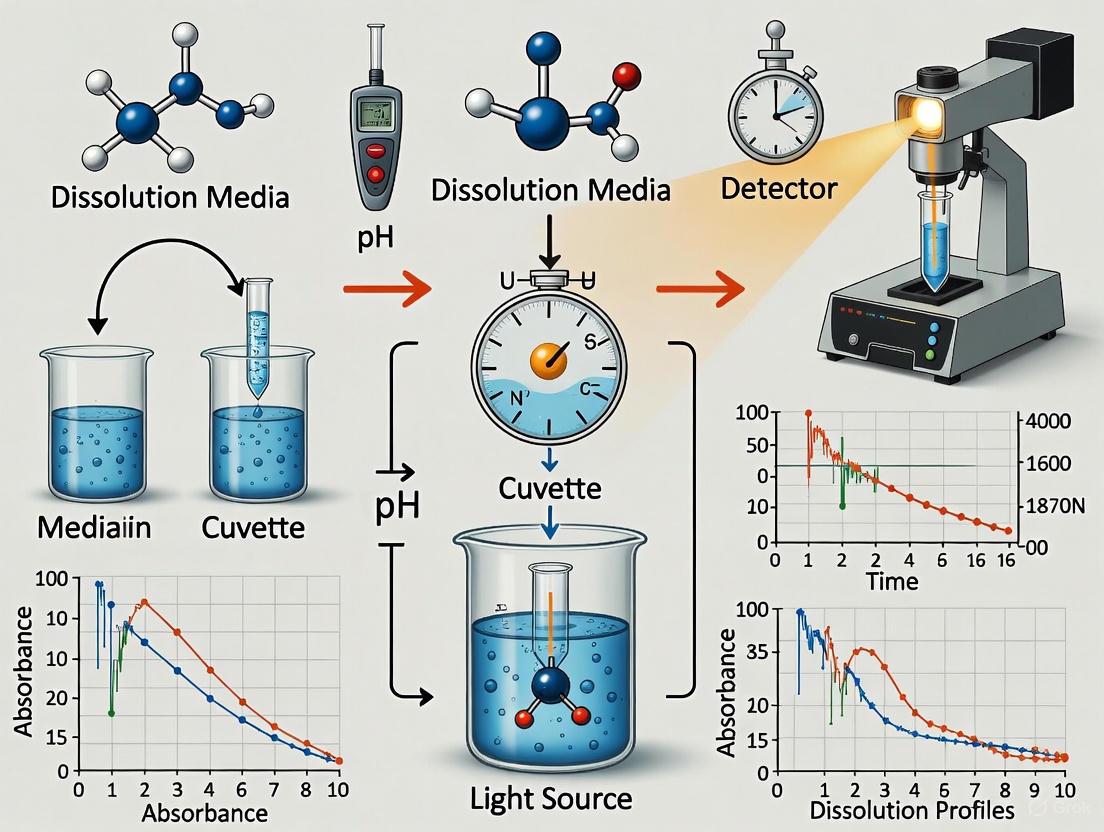
This article provides a comprehensive resource for researchers and drug development professionals on the application of UV-Vis spectrophotometry in dissolution testing.
UV-Vis Spectrophotometry in Dissolution Testing: A Modern Guide for Robust and Sustainable Pharmaceutical Analysis
Abstract
This article provides a comprehensive resource for researchers and drug development professionals on the application of UV-Vis spectrophotometry in dissolution testing. It explores the foundational principles and regulatory framework governing dissolution testing for solid oral dosage forms, detailing the selection of apparatus and media. The content delves into advanced methodological applications, including chemometric techniques for analyzing complex drug mixtures, and addresses common troubleshooting and optimization challenges. Furthermore, it outlines the critical process of method validation against international standards and provides a comparative analysis with HPLC, highlighting the cost-effectiveness, speed, and growing sustainability advantages of modern UV-Vis methods in a quality control environment.
UV-Vis Spectrophotometry Fundamentals and Regulatory Framework for Dissolution Testing
Dissolution testing is an essential analytical procedure in the pharmaceutical sciences, defined as the process in which a substance forms a solution. Specifically, dissolution testing measures the extent and rate of solution formation from a dosage form, such as a tablet, capsule, or ointment, with the terms "dissolution" and "drug release" often used interchangeably [1]. This testing methodology serves as a critical bridge between the physical formulation of a drug product and its biological performance, providing vital insights into drug release characteristics that directly influence bioavailability and therapeutic effectiveness [1] [2].
The integration of UV-Vis spectrophotometry into dissolution testing protocols represents a significant advancement for researchers and drug development professionals seeking robust, efficient analytical techniques. This application note delineates the core principles of dissolution testing, emphasizing its tripartite role in formulation development, quality control (QC), and predicting in-vivo performance, while establishing its relevance within a broader research context focused on UV-Vis spectrophotometric methodologies.
The Fundamental Purposes of Dissolution Testing
Role in Formulation Development
During drug development, dissolution testing functions as a formulation optimization tool that guides scientists in selecting the most appropriate excipients, manufacturing processes, and dosage form designs. It provides critical data on how formulation variables affect the drug release rate, enabling researchers to identify optimal product characteristics prior to clinical evaluation [2] [3]. For poorly soluble Active Pharmaceutical Ingredients (APIs), which represent an increasing proportion of development pipelines, dissolution testing helps classify compounds according to the Developability Classification System (DCS), thereby informing formulation strategy [2]. By employing biorelevant dissolution methods that utilize media such as fasted simulated gastric fluid (FaSSGF) and fasted simulated intestinal fluid (FaSSIF), scientists can predict how a formulation will behave within the human body and ensure only the most promising candidates advance to clinical trials [2].
Function in Quality Control and Assurance
In a commercial manufacturing environment, dissolution testing transitions to a vital quality control tool that ensures batch-to-batch consistency, stability, and overall product quality [1] [2] [3]. The United States Pharmacopeia (USP) and other regulatory bodies mandate dissolution testing as part of the final release investigation for solid oral dosage forms [1] [2]. When employed for QC purposes, the dissolution method must demonstrate adequate discriminatory power to distinguish between acceptable and unacceptable batches, particularly those with meaningful variations in critical manufacturing variables [4]. Establishing and adhering to appropriate dissolution specifications – such as the requirement for immediate-release products to release at least 80% of the drug within a specified time frame (often 45 minutes) – forms the foundation of this quality assurance process [3].
Predicting In-Vivo Performance
Perhaps the most sophisticated application of dissolution testing lies in its ability to predict in-vivo performance and establish in-vitro-in-vivo correlations (IVIVC). For drugs where dissolution represents the rate-limiting step in absorption (particularly Biopharmaceutics Classification System (BCS) Class II and IV compounds and modified-release formulations), dissolution testing can serve as a reliable predictor of bioavailability [5] [6] [3]. Through careful method development that incorporates physiologically relevant conditions, researchers can create biopredictive dissolution methods that correlate with pharmacokinetic data from clinical trials [2]. This application is particularly valuable for generic drug development, where demonstrating similar dissolution profiles to the reference product using discriminatory, biorelevant methods can establish bioequivalence and potentially support biowaiver requests for highly soluble and highly permeable (BCS Class I) drugs [5] [3].
Table 1: Key Applications of Dissolution Testing in the Drug Development Lifecycle
| Development Stage | Primary Purpose | Typical Methods | Key Outcomes |
|---|---|---|---|
| Early Formulation Development | Formulation optimization, API characterization | Biorelevant media (FaSSGF, FaSSIF), USP Apparatus 1 & 2 | DCS classification, optimal formulation selection |
| Clinical Development | In-vivo performance prediction, IVIVC development | Biopredictive media, pharmacokinetic correlation | Bioavailability prediction, formulation refinement |
| Commercial Manufacturing | Quality control, batch release | Compendial methods (USP/FDA), validated QC methods | Batch consistency, stability assessment, specification compliance |
| Post-Approval Changes | Equivalence demonstration | Comparative dissolution profiling | SUPAC compliance, manufacturing change validation |
Experimental Protocols for Dissolution Testing
Standardized Apparatus and Conditions
Dissolution testing employs rigorously standardized apparatus to ensure reproducible and meaningful results. The United States Pharmacopeia describes seven different dissolution apparatuses, with Apparatus I (basket) and Apparatus II (paddle) being most common for solid oral dosage forms [1] [4]. The test conditions are carefully controlled to simulate physiological environments, with dissolution media maintained at 37±0.5°C to correspond to human body temperature [4]. Agitation speeds are standardized according to apparatus type, typically ranging from 50-100 rpm for baskets and 25-75 rpm for paddles, with appropriate speeds determined during method development to ensure discriminatory power without excessive agitation that could cause foaming or lack of discrimination [4].
Dissolution Media Selection
The selection of appropriate dissolution media is paramount to developing a physiologically relevant and discriminatory dissolution method. Key considerations include:
- pH: For weak acids, dissolution rate increases with pH, while for weak bases, dissolution rate increases with decreasing pH. The selected pH should maintain sink conditions and minimize the need for surfactants when possible [4].
- Sink Conditions: Defined as the volume of fluid needed to fully dissolve three times the targeted amount of drug substance in the dosage form, sink conditions ensure the dissolution profile shape is influenced primarily by formulation rather than drug solubility [4].
- Surfactants: When sink conditions cannot be achieved through pH adjustment alone, surfactants such as sodium lauryl sulfate (SLS) may be added to improve solubility, with appropriate selection based on drug substance characteristics (e.g., avoiding anionic surfactants with cationic drugs) [4].
- Buffer Capacity: The selected buffer must maintain constant pH throughout the dissolution test, particularly for ionizable drug substances whose dissolution may alter local pH [4].
Table 2: Dissolution Media Selection Guidelines Based on Drug Properties
| Drug Substance Characteristic | Recommended Media | Additional Considerations |
|---|---|---|
| Highly Soluble (BCS I/III) | Aqueous buffers (pH 1.2, 4.5, 6.8) | Volume: 500-1000 mL; Prioritize physiologically relevant pH |
| Weak Acid | Higher pH buffers (≥pKa) | pH selection should enhance solubility while maintaining physiological relevance |
| Weak Base | Lower pH buffers (≤pKa) | Acidic media (pH 1.2-3.0) typically provide optimal dissolution |
| Poorly Soluble (BCS II/IV) | Surfactant-containing media | Surfactant type and concentration must be justified; non-ionic surfactants often preferred |
| Ionizable | Adequate buffer capacity | Ensure buffer capacity sufficient to prevent pH shift during dissolution |
| Fed/Fasted State Evaluation | Biorelevant media (FaSSIF/FeSSIF) | Requires justification for inclusion in regulatory submissions |
UV-Vis Spectrophotometric Analysis in Dissolution Testing
UV-Vis spectrophotometry provides a rapid, cost-effective analytical finish for dissolution testing, particularly suitable for compounds with distinct chromophores and minimal interference from formulation excipients. The experimental protocol encompasses:
Instrument Calibration and Validation:
- Perform wavelength calibration using appropriate standards (e.g., holmium oxide filter)
- Verify photometric accuracy using potassium dichromate solutions
- Establish linearity across the expected concentration range (typically 0.001-0.1 absorbance units)
- Determine precision through replicate measurements of standard solutions
Sample Analysis Protocol:
- Withdraw dissolution samples at predetermined time points (e.g., 5, 10, 15, 30, 45, 60 minutes for immediate-release products)
- Filter samples immediately using compatible membranes (e.g., 0.45μm PVDF or nylon)
- Dilute samples if necessary to remain within the linear range of the calibration curve
- Measure absorbance at the predetermined λmax for the API
- Calculate concentration using the established calibration curve
- Apply appropriate correction for sample volume removal and media replacement
Case Study: Andrographolide Dispersible Tablets A recent study demonstrated the successful application of UV-Vis spectrophotometry for dissolution testing of andrographolide dispersible tablets. The optimized protocol utilized:
- Apparatus: USP Apparatus II (paddle) at 75 rpm
- Media: 900 mL citrate buffer (pH 3.1)
- Temperature: 37±0.5°C
- Detection: Complexation with Cu(II) and Alizarin Red S reagents at mole ratio 6:1:1.8
- Analysis: UV-Vis detection at 518 nm after 15-minute complexation time The method demonstrated appropriate validation parameters including specificity, linearity, precision, and accuracy, establishing UV-Vis spectrophotometry as a viable alternative to HPLC for this compound [7].
Advanced Applications and Correlation with In-Vivo Performance
In-Vitro In-Vivo Correlations (IVIVC)
The development of meaningful IVIVC represents the pinnacle of dissolution method sophistication, creating a predictive relationship between in-vitro dissolution and in-vivo bioavailability. For BCS Class II and IV drugs and modified-release formulations where dissolution is the rate-limiting step in absorption, dissolution tests are expected to ensure adequate in-vivo product performance [6]. A novel approach to IVIVC development involves estimating in-vivo dissolution profiles through deconvolution using a "synthetic solution method" that incorporates human permeability predictions derived from preclinical models (e.g., Caco-2 cells) [6]. This methodology is particularly valuable when administration of an oral solution is not feasible, allowing researchers to estimate in-vivo dissolution profiles during early development phases and refine dissolution methods to better reflect physiological conditions [6].
Regulatory Applications and Biowaivers
Dissolution testing plays a pivotal role in regulatory decision-making, particularly for generic drug products. The FDA's Biopharmaceutics Classification System (BCS) guidance permits biowaivers for BCS Class I drug products (high solubility, high permeability) that demonstrate rapid dissolution (no less than 85% dissolution within 30 minutes using USP Apparatus 1 at 100 rpm or Apparatus 2 at 50 rpm in 900 mL volume) [5]. For generic products, comparative dissolution testing using at least 12 dosage units each of test and reference products is required across multiple pH conditions (typically pH 1.2, 4.5, and 6.8 buffers) to demonstrate similarity throughout the gastrointestinal transit range [5]. Additionally, dissolution testing provides the scientific foundation for Scale-Up and Post-Approval Changes (SUPAC), where significant alterations to formulation, manufacturing process, or equipment require demonstration of equivalent dissolution profiles to the approved product [5] [3].
The Scientist's Toolkit: Essential Materials and Reagents
Successful dissolution testing requires carefully selected apparatus, reagents, and analytical tools. The following table outlines essential components of a comprehensive dissolution testing laboratory with emphasis on UV-Vis spectrophotometric analysis.
Table 3: Essential Research Reagent Solutions and Materials for Dissolution Testing
| Item | Function/Application | Key Considerations |
|---|---|---|
| USP Apparatus 1 (Basket) | Dissolution testing of tablets, capsules | Standard for floating products; mesh size critical |
| USP Apparatus 2 (Paddle) | Dissolution testing of tablets, capsules | Most common apparatus; sinkers may be needed for floating products |
| UV-Vis Spectrophotometer | Quantitative analysis of drug concentration | Requires appropriate flow cells for automation; validation essential |
| Dissolution Media Buffers | Simulate gastrointestinal environments | pH 1.2 (gastric), 4.5 (jejunal), 6.8 (intestinal); buffer capacity critical |
| Surfactants (SLS, Polysorbates) | Enhance solubility of hydrophobic drugs | Concentration optimization required; potential for foaming |
| Deaeration System | Remove dissolved gases that interfere with dissolution | Vacuum filtration with heating standard; not for surfactant-containing media |
| Membrane Filters (0.45μm) | Clarify samples for spectrophotometric analysis | Compatibility with API (non-adsorbing); minimal extractables |
| Reference Standards | Calibration curve generation | Certified purity; appropriate storage conditions |
| Sinkers | Immerse floating dosage forms | Standardized mesh size and configuration; can affect dissolution rate |
| Amine-PEG-CH2COOH (MW 3400) | Amine-PEG-CH2COOH (MW 3400), CAS:10366-71-9, MF:C4H9NO3, MW:119.12 g/mol | Chemical Reagent |
| MAPTAM | MAPTAM, CAS:147504-94-7, MF:C36H44N2O18, MW:792.7 g/mol | Chemical Reagent |
Workflow and Decision Pathways
The dissolution testing workflow encompasses method development, validation, and application across the product lifecycle. The following diagram illustrates the integrated relationship between dissolution testing and UV-Vis spectrophotometric analysis:
Dissolution Testing Workflow with UV-Vis Analysis
For regulatory compliance, particularly in generic drug development, a systematic approach to dissolution method selection is required:
Dissolution Method Selection Pathway for Generic Drugs
Dissolution testing serves as an indispensable tool throughout the pharmaceutical development lifecycle, providing critical insights that inform formulation optimization, ensure product quality, and predict biological performance. The integration of UV-Vis spectrophotometric methods enhances the efficiency and accessibility of dissolution analysis while maintaining scientific rigor when appropriately validated. As pharmaceutical scientists face increasing challenges with poorly soluble compounds and complex dosage forms, the continuing evolution of dissolution apparatus, media, and analytical techniques will be essential to maintaining the relevance and predictive power of this fundamental pharmaceutical test. By adhering to standardized methodologies while incorporating advances in biorelevant testing and in-vitro-in-vivo correlation, researchers can fully leverage dissolution testing to develop safe, effective, and reliable pharmaceutical products.
In pharmaceutical development, dissolution testing serves as a critical quality control tool, providing essential data on drug release from solid oral dosage forms. UV-Vis spectrophotometry has formed a natural bond with dissolution testing due to its simplicity, specificity, and cost-effectiveness for quantifying active pharmaceutical ingredient (API) release [8]. This application note examines the current regulatory framework governing dissolution methodology, with specific focus on the application of UV-Vis spectrophotometry within the context of FDA guidance documents and USP standards.
The landscape of dissolution testing is evolving beyond traditional USP Apparatus 1 and 2 methods toward more informative, mechanistic approaches. Advanced spectroscopic imaging techniques now enable researchers to observe dynamic dissolution processes with high spatial and temporal resolution [9]. Among these technologies, UV dissolution imaging has emerged as a powerful tool for visualizing API behavior at the solid-liquid interface while simultaneously obtaining concentration measurements [9] [8]. Understanding the regulatory expectations for method validation and application is paramount for successfully implementing these technologies in drug development.
Current FDA Regulatory Framework and Recent Guidance Documents
The FDA's guidance documents represent the Agency's current thinking on regulatory issues, though they do not establish legally enforceable responsibilities unless they cite specific statutory requirements [10]. The table below summarizes recent FDA guidance documents relevant to pharmaceutical development and analytical method validation:
Table 1: Selected Recently Issued FDA Guidance Documents (2024-2025)
| Topic Area | Guidance Title | Status | Issue Date | Relevance to Dissolution Testing |
|---|---|---|---|---|
| Pharmaceutical Quality | Alternative Tools: Assessing Drug Manufacturing Facilities Identified in Pending Applications | Final | 09/12/2025 | Facility assessment for drug applications |
| Pharmaceutical Quality | Control of Nitrosamine Impurities in Human Drugs | Final | 09/05/2024 | Impurity control in drug products |
| Biopharmaceutics | M13A Bioequivalence for Immediate-Release Solid Oral Dosage Forms | Final | 10/30/2024 | Bioequivalence standards |
| Clinical Pharmacology | Drug Interaction Information in Human Prescription Drug and Biological Product Labeling | Draft | 10/21/2024 | Drug interaction labeling |
| Real World Evidence | Real-World Data: Assessing Electronic Health Records and Medical Claims Data | Final | 07/25/2024 | Use of real-world data |
While these documents provide broad regulatory context, specific analytical method validation for UV-Vis spectrophotometry in dissolution testing falls under the umbrella of ICH guidelines and USP chapters, which establish standardized approaches for method development and validation.
UV-Vis Spectrophotometry in Dissolution Testing: Method Development and Validation
Fundamental Principles and Applications
UV-Vis spectrophotometry operates on the principle that most pharmaceutically active compounds absorb light in the ultraviolet or visible range (190-800 nm) [9]. The absorption occurs when an electron is promoted to a higher energy state by the energy of an incident photon, with the extent of light absorption following the Beer-Lambert law, which establishes a linear relationship between concentration and absorbance at a specific wavelength [9]. This fundamental principle enables quantitative determination of API concentration in dissolution media.
Traditional dissolution testing methodologies have relied on offline UV measurements of withdrawn aliquots, but technological advancements now enable continuous monitoring through fiber-optic UV systems and advanced UV imaging techniques [8]. UV dissolution imaging, sometimes referred to as UV/Vis imaging or surface dissolution imaging, has emerged as a valuable approach for determining intrinsic dissolution rates (IDRs) and understanding API release mechanisms [9].
Method Validation Parameters and Acceptance Criteria
UV-Vis spectrophotometric methods for dissolution testing must be validated according to ICH guidelines to ensure reliability and reproducibility. The following experimental protocol outlines the key validation parameters and procedures:
Table 2: Method Validation Protocol for UV-Vis Spectrophotometric Analysis of APIs in Dissolution Testing
| Validation Parameter | Experimental Procedure | Acceptance Criteria | Example Results (Terbinafine HCl [11]) |
|---|---|---|---|
| Linearity & Range | Prepare standard solutions at 5-30 μg/ml in dissolution medium; measure absorbance at λmax | Correlation coefficient (r²) ≥ 0.999 | r² = 0.999; Range: 5-30 μg/ml |
| Accuracy | Spike pre-analyzed samples with standard at 80%, 100%, 120% levels; calculate recovery | Recovery: 98-102% | Recovery range: 98.54-99.98% |
| Precision (Repeatability) | Analyze six replicates of 20 μg/ml concentration; calculate %RSD | %RSD ≤ 2% | %RSD < 2% |
| Intermediate Precision | Analyze 10, 15, 20 μg/ml solutions on different days by different analysts | %RSD ≤ 2% | %RSD < 2% |
| Specificity | Compare absorbance spectra of pure API vs. formulation in dissolution medium | No interference from excipients | Demonstrated specificity |
| LOD/LOQ | Calculate using LOD = 3.3×N/B and LOQ = 10×N/B, where N=noise, B=slope | LOD: 0.42 μg, LOQ: 1.30 μg | LOD: 0.42 μg, LOQ: 1.30 μg |
The validation protocol for terbinafine hydrochloride analysis demonstrates compliance with ICH guidelines, establishing a robust framework for UV-Vis method validation in dissolution testing [11]. Similar approaches have been successfully applied to other APIs, including oxytetracycline, where methods demonstrated absolute and relative bias within a tolerable interval of [-2%, +2%] with repeatability RSD values lower than 2% [12].
Advanced Applications: UV Dissolution Imaging in Pharmaceutical Development
UV dissolution imaging represents a significant advancement over traditional dissolution testing by providing visualization of the dissolution process at the solid-liquid interface while simultaneously quantifying API concentration [9]. The technology utilizes a flow cell system where a compacted API sample or dosage form portion is mounted and exposed to flowing dissolution medium. A selected wavelength of UV light is directed through the flow cell, and a CMOS array detector captures images of the concentration gradients near the solid-liquid interface [8].
Diagram 1: UV dissolution imaging workflow
Research Applications and Case Studies
UV dissolution imaging has enabled significant advances in multiple areas of pharmaceutical development:
Form Selection and API Characterization: UV imaging allows direct visualization and quantification of dissolution behavior for different solid forms (polymorphs, hydrates, salts) under various hydrodynamic conditions. This capability is particularly valuable for understanding form transformations during dissolution and their impact on dissolution rates [9] [8].
Drug-Excipient Compatibility: The technology enables real-time assessment of excipient effects on API dissolution, including polymer barrier formation, surfactant effects, and disintegration behavior. This application provides crucial insights during formulation development, especially for controlled-release systems [9].
Whole Dosage Form Imaging: With the introduction of larger area imaging systems, UV dissolution imaging can now be applied to entire tablets and capsules. This advancement bridges the gap between intrinsic dissolution studies and conventional dissolution testing of final dosage forms [9].
Case Study: Co-processed API Screening During development of a potent BCS Class II drug, researchers employed UV surface dissolution imaging to screen co-processed API formulations. Samples were prepared by compacting 3-5 mg of co-processed slurry into a sample cup, with dissolution testing in 0.1 N HCl. UV imaging enabled comparison of drug release from formulations with three different carriers (MCC/HPC blend, Neusilin US2, and calcium silicate), providing crucial data for carrier selection based on release profiles and mechanism understanding [8].
The Scientist's Toolkit: Essential Research Reagent Solutions
Table 3: Essential Materials and Reagents for UV-Vis Dissolution Method Development and Validation
| Item Category | Specific Examples | Function/Application | Quality/Regulatory Standards |
|---|---|---|---|
| Reference Standards | USP/EP API Reference Standards; Oxytetracycline RS [12] | Method calibration and qualification | Certified purity with documentation |
| Dissolution Media | 0.1N HCl; pH 4.5-7.4 buffer solutions; biorelevant media | Simulating physiological conditions | Prepared per USP specifications |
| Chemical Reagents | Hydrochloric acid; sodium hydroxide; buffer salts | Media preparation and pH adjustment | Analytical grade or higher |
| Quality Control Samples | System suitability samples; validated reference formulations | Method performance verification | Well-characterized and stable |
| UV-Vis Calibration Standards | Holmium oxide; potassium dichromate filter sets | Instrument wavelength verification | Traceable to national standards |
| N-Methyl lactam | N-Methyl lactam, CAS:116212-46-5, MF:C8H8N2O, MW:148.16 g/mol | Chemical Reagent | Bench Chemicals |
| Piazthiole | Piazthiole, CAS:273-13-2, MF:C6H4N2S, MW:136.18 g/mol | Chemical Reagent | Bench Chemicals |
The successful application of UV-Vis spectrophotometry in dissolution testing requires careful navigation of regulatory expectations while leveraging technological advancements. FDA guidance documents establish the current regulatory thinking, while USP standards and ICH guidelines provide the methodological framework for validation and implementation. The emergence of UV dissolution imaging represents a significant innovation that bridges traditional quality control testing with mechanistic understanding of dissolution processes.
As pharmaceutical development continues to evolve toward more predictive and mechanistic approaches, UV-Vis spectrophotometry and its advanced applications will play an increasingly important role in ensuring drug product quality and performance. By integrating regulatory compliance with scientific innovation, researchers can maximize the value of dissolution testing throughout the drug development lifecycle.
Within pharmaceutical development, in vitro dissolution testing is a critical quality control tool that provides vital data on the performance of solid oral dosage forms (OSDs) [13]. The test determines the rate and extent of active pharmaceutical ingredient (API) release from its dosage form, which directly influences bioavailability and therapeutic effectiveness [14]. For researchers employing UV-Vis spectrophotometric methods, selecting the appropriate dissolution apparatus is paramount for generating reliable, reproducible data that can predict in vivo performance. The U.S. Pharmacopeia (USP) describes several dissolution apparatuses, with USP Apparatus 1 (Basket) and USP Apparatus 2 (Paddle) being the most prevalent for OSD testing [15] [4]. This application note provides a detailed comparative analysis of these two apparatuses, supported by structured protocols and data, specifically framed within research utilizing UV-Vis spectrophotometry as the analytical finish.
USP Apparatus 1 and 2 share several core components and operating principles but differ fundamentally in how the dosage form is presented to the dissolution medium. Both systems consist of a set of vessels maintained at 37 ± 0.5 °C to simulate physiological conditions, a metallic drive shaft, and a motor for controlled agitation [15]. The selection between them is a decisive step in method development, as an inappropriate choice can lead to poor discrimination, high variability, and data that does not reflect the product's true performance.
The following table summarizes the fundamental characteristics and recommended applications of each apparatus.
Table 1: Key Characteristics of USP Apparatus 1 and 2
| Feature | USP Apparatus 1 (Basket) | USP Apparatus 2 (Paddle) |
|---|---|---|
| Agitation Mechanism | Rotating cylindrical basket (mesh) | Rotating single-piece paddle |
| Typical Rotation Speed | 50 - 100 rpm [4] | 25 - 75 rpm [4] |
| Ideal Dosage Form Applications | Capsules, floating tablets, chewables, extended-release formulations, encapsulated beads [15] | Immediate-release tablets, suspensions, powder-filled capsules, tablets made by direct compression [15] |
| Key Advantages | Prevents floating dosage forms; contains the sample, minimizing particle escape [15] | Simulates GI hydrodynamics; avoids potential clogging of basket mesh; versatile for many forms [15] |
| Common Challenges | Potential for clogged mesh from gelling excipients; "cone" formation of insoluble excipients below basket [15] [16] | Risk of "coning" (mounding of insoluble excipients under paddle); requires sinkers for floating dosage forms [15] [16] |
The Scientist's Toolkit: Essential Materials for Dissolution Testing
The following table details key reagents and materials essential for conducting dissolution studies, particularly when coupled with UV-Vis spectrophotometric analysis.
Table 2: Essential Research Reagents and Materials for Dissolution Testing
| Item | Function & Importance |
|---|---|
| Dissolution Medium (e.g., 0.1 N HCl, buffers) | Simulates gastrointestinal fluid to provide biologically relevant release data. Composition is critical for maintaining sink conditions [4] [16]. |
| Surfactants (e.g., SLS) | Enhances solubility of poorly soluble drugs in the medium to achieve sink conditions and discriminate formulation changes [4] [17]. |
| Enzymes (e.g., Pepsin) | Added to dissolution medium to digest cross-linked gelatin in capsules that may form during stability studies, ensuring proper drug release [18] [17]. |
| Deaerated Medium | Removal of dissolved air prevents bubble formation on dosage form or apparatus, which can alter hydrodynamic conditions and cause variability [4] [16]. |
| UV-Vis Spectrophotometer | Provides a simple, cost-effective, and replicable analytical finish for quantifying API concentration in dissolution samples [19]. |
| Performance Verification Tablets (e.g., Prednisone) | Certified reference standards used to mechanically and chemically calibrate the dissolution apparatus, ensuring compliance with USP specifications [16] [18]. |
| Qualitative Filter Paper (pore size ~11 µm) | Used in filter compatibility studies to remove undissolved particles from sampled aliquots, preventing ongoing dissolution and analytical interference [19]. |
| Levamlodipine besylate | Levamlodipine besylate, CAS:150566-71-5, MF:C26H31ClN2O8S, MW:567.1 g/mol |
| 1,2-DLPC | Dilaurylphosphatidylcholine (DLPC) |
Integration with UV-Vis Spectrophotometric Analysis
UV-Vis spectrophotometry serves as a widely used analytical technique for quantifying drug release in dissolution testing due to its simplicity, cost-effectiveness, and replicability [19]. The bosutinib case study demonstrates a complete validation using UV-Vis, where the API showed a specified maximum absorbance at 266 nm using a quartz cell and 0.1 N HCl as the dissolution medium and blank [19]. This direct analysis simplifies method development compared to more complex techniques like HPLC.
The workflow for a combined dissolution and UV-Vis method involves several key stages, from apparatus selection to data analysis, as illustrated below.
Detailed Experimental Protocols
Protocol: Apparatus Selection and Mechanical Calibration
Objective: To select the appropriate dissolution apparatus and verify its mechanical and chemical performance prior to analysis.
Apparatus Selection Decision Tree:
- Use USP Apparatus 1 (Basket) if: Testing capsules, dosage forms that tend to float, or modified-release products where physical containment is beneficial [15] [20].
- Use USP Apparatus 2 (Paddle) if: Testing immediate-release tablets, suspensions, or products that may produce fine powders. This apparatus is generally preferred for its simplicity and wider usage for standard tablets [15] [4].
- Sinker Usage: For capsules or tablets that float in Apparatus 2, a few turns of inert, helical wire sinker may be used to hold the dosage form at the bottom of the vessel. The type of sinker must be justified and documented [16].
Mechanical Calibration:
Performance Verification Test (PVT):
- Use USP-certified prednisone or salicylic acid calibrator tablets.
- Execute the PVT according to USP procedures, ensuring the results for geometric mean and %CV fall within the specified acceptance ranges [18] [17].
- All vessels and individual stirring elements (shafts, baskets, paddles) should be uniquely identified and their positions documented for all dissolution runs to facilitate investigation of aberrant results [17].
Protocol: Developing a Validated Dissolution Method with UV-Vis Analysis
Objective: To establish and validate a discriminative dissolution method for an immediate-release tablet using USP Apparatus 2 and UV-Vis spectrophotometry, based on the bosutinib model [19].
Table 3: Exemplary Dissolution Test Conditions and Validation Parameters (Bosutinib Model)
| Parameter | Established Conditions | Validation Results & Acceptance Criteria |
|---|---|---|
| Apparatus | USP Apparatus 2 (Paddle) | - |
| Medium | 900 mL of 0.1 N HCl, deaerated | - |
| Speed | 50 rpm | - |
| Temperature | 37 ± 0.5 °C | - |
| Sampling Times | 10, 15, 20, 30, 45 minutes | - |
| Analytical Method | UV-Vis Spectrophotometry | - |
| Wavelength (λ_max) | 266 nm | - |
| Linearity & Range | 2.8 - 8.3 µg/mL | R² = 0.999 [19] |
| Accuracy (Recovery) | - | Mean = 100.0%; %RSD = 0.8% [19] |
| Repeatability (Precision) | - | Average = 96.2%; %RSD = 1.6% [19] |
| Intermediate Precision | - | Analyst 1: 96.2%, Analyst 2: 91.91%; %RSD = 2.8% [19] |
Dissolution Medium Preparation: Prepare 0.1 N HCl. Deaerate by heating to approximately 41°C, filtering through a 0.45-µm membrane filter under vacuum, with vigorous stirring for a short period, or by sonication [4] [16].
Standard Solution Preparation: Accurately weigh the drug substance working standard. Dissolve and dilute with the dissolution medium to obtain a stock solution. Further dilute to the target concentration within the linear range (e.g., 5.5 µg/mL for bosutinib). Filter a portion through filter paper (pore size ~11 µm) if necessary [19].
Dissolution Test Procedure:
- Place 900 mL of deaerated 0.1 N HCl into each vessel and allow temperature to equilibrate to 37 ± 0.5 °C.
- Carefully drop one tablet into each vessel, ensuring it settles at the base. Immediately start the paddles at 50 rpm and the timer.
- At specified time intervals (e.g., 10, 15, 20, 30, 45 min), withdraw a predetermined volume (e.g., 5-10 mL) from each vessel from a zone midway between the vessel wall and the shaft, not less than 1 cm below the medium surface.
- Immediately replace the withdrawn volume with fresh, pre-warmed medium to maintain a constant volume.
- Filter the samples through a compatible filter (e.g., Whatman qualitative filter paper, ~11 µm).
UV-Vis Spectrophotometric Analysis:
- Use the dissolution medium as the blank.
- Measure the absorbance of the standard and filtered test samples at the λ_max of the API (e.g., 266 nm).
Calculate the percentage of drug dissolved at each time point using the formula below, where Au and As are the absorbances of the test sample and standard solution, respectively; C_s is the concentration of the standard; D is the dilution factor; and L is the label claim of the dosage form.
% Dissolved = (A_u / A_s) * C_s * D * (Media Volume / 1000) * (100 / L)
Method Validation: The dissolution method, including the analytical finish, must be validated as per ICH guidelines [19] [18]. Key parameters are summarized in Table 3.
Data Interpretation and Regulatory Considerations
Interpreting Dissolution Profiles
The percentage of drug dissolved at each time point is plotted to generate a dissolution profile curve. For the bosutinib example, the mean dissolution was 96.20% at 45 minutes, well above the typical tolerance (Q) value of 70% [19]. Key metrics for interpretation include:
- Q Value: The minimum amount of drug dissolved at a specified time, expressed as a percentage of the label claim. It is a key quality control specification for batch release [13].
- Similarity Factor (f2): A statistical tool for comparing two dissolution profiles. An f2 value between 50 and 100 suggests similarity, which is critical for demonstrating bioequivalence or assessing product changes [13].
Critical Regulatory Aspects
Adherence to regulatory guidance from the FDA and USP is non-negotiable [4]. The developed method must demonstrate:
- Discriminatory Power: The ability to detect changes in critical manufacturing variables (e.g., ±10-20% change in excipient ranges). Altered batches should have an f2 value of <50 compared to the clinical batch [4].
- Robustness: The method's reliability should be proven when deliberate small changes are made to parameters like wavelength (±2 nm) [19].
- Stability-Indicating Property: For gelatin capsules, if cross-linking is observed during stability studies, the dissolution test should be performed with the addition of an appropriate enzyme (e.g., pepsin) to the medium [18] [17].
In the development of a UV-Vis spectrophotometric method for dissolution testing, the design of the dissolution medium is a critical determinant of the method's predictive power and reliability. The medium must not only facilitate the accurate quantification of drug release but also serve as a meaningful surrogate for the physiological environment the drug product will encounter in vivo. This application note details the strategic formulation of the dissolution medium, focusing on the interplay of three pivotal factors: pH, sink conditions, and buffer capacity. A scientifically robust medium ensures that the dissolution test is a discriminatory tool, capable of detecting critical changes in formulation and manufacturing processes, thereby supporting quality control and biopharmaceutical assessments [21] [5].
Critical Factor 1: pH of the Dissolution Medium
Physiological and Chemical Rationale
The pH of the dissolution medium is paramount as it directly influences the drug's solubility and dissolution rate, particularly for ionizable compounds. The gastrointestinal (GI) tract exhibits a dynamic pH range, from highly acidic in the fasted stomach (pH ~1.2–3.0) to near-neutral in the small intestine (pH > 6.0) [22]. A dissolution method intended to be predictive of in vivo performance must account for this variability. For instance, a recent study on diclofenac sodium (an acidic drug, pKa 4.0) demonstrated that small differences in acidic pH conditions (e.g., between pH 1.2 and 2.0) can cause significant variations in dissolution profiles and the supersaturation behavior of drug products, despite the pH being well below the API's pKa [22]. This finding challenges the assumption that a single, highly acidic pH condition is sufficient for dissolution testing of acidic drug salts and underscores the need for a more nuanced approach.
Strategic Selection of pH
The selection of pH should be guided by the drug's pKa and its Biopharmaceutics Classification System (BCS) category. A multimedia approach is often necessary to fully characterize the drug product.
- For BCS Class II Weak Acids: Testing in neutral to alkaline media (e.g., pH 6.8 phosphate buffer) is often most discriminatory, as it promotes ionization and dissolution, helping to differentiate between formulations based on their dissolution rates [21].
- For BCS Class II Weak Bases: Testing in acidic media (e.g., 0.1N HCl, pH 1.2) is critical to ensure adequate solubility and to identify potential dissolution-rate limited absorption.
- For Enteric-Coated (Delayed-Release) Products: A sequential pH method is mandatory. This involves exposing the product to an acidic medium (e.g., pH 1.2 for 2 hours) to demonstrate acid resistance, followed by transfer to a neutral buffer (e.g., pH 6.8) to assess drug release in simulated intestinal conditions [5].
Table 1: Recommended pH Conditions for Dissolution Testing Based on Drug Properties
| Drug Substance Property | Recommended Dissolution Media (pH) | Scientific Rationale |
|---|---|---|
| Weak Acid (pKa 3-5) | pH 1.2, pH 4.5, pH 6.8 | To assess dissolution across the physiological range; small differences in acidic pH can be critical for salt forms [22]. |
| Weak Base (pKa 6-8) | pH 1.2, pH 4.5, pH 6.8 | To ensure solubility in gastric conditions and assess precipitation risk upon entry into the intestine. |
| Immediate-Release (BCS II) | pH 6.8 Phosphate Buffer | Often provides the most discriminatory power for poorly soluble drugs [21]. |
| Delayed-Release | pH 1.2 (2 hrs) → pH 6.8 | To confirm gastric resistance and subsequent release in the intestine [5]. |
Critical Factor 2: Sink Conditions
Definition and Importance
Sink condition is a fundamental principle in dissolution testing, defined as the ability of the dissolution medium to dissolve at least three times the amount of drug present in the dosage form [23]. Maintaining sink conditions is vital for ensuring robustness and biological relevance. In vivo, the continuous absorption of a drug across the intestinal membrane prevents the dissolved drug from accumulating and saturating the GI fluids. In an in vitro test, a lack of sink conditions leads to an artificially reduced dissolution rate as the concentration in the vessel approaches saturation (Cs), violating the (Cs - Ct) term in the Noyes-Whitney equation [23]. This can mask true differences between formulations and reduce the method's ability to predict in vivo performance, especially for controlled-release formulations of poorly soluble drugs [24].
Achieving and Maintaining Sink Conditions
When the saturation solubility of the drug in a simple aqueous medium is insufficient, several strategies can be employed to achieve sink conditions, each with its own considerations:
- pH Adjustment: For ionizable compounds, setting the pH to ensure the drug is in its ionized form is the most physiologically relevant method to enhance solubility.
- Addition of Surfactants: Surfactants like sodium lauryl sulfate (SLS) can solubilize poorly soluble drugs via micelle formation. While effective, the type and concentration must be justified, as they can sometimes over-solubilize and lose discriminatory power [23] [5].
- Increased Volume: The use of larger volume vessels (e.g., 2-liter) is a direct way to increase the capacity of the medium, though it may deviate from physiological volumes [23].
- Use of Biorelevant Media: Incorporating surfactants and bile salts at concentrations mimicking human intestinal fluids can create sink conditions while maintaining physiological relevance.
Table 2: Strategies to Achieve Sink Conditions for Poorly Soluble Drugs
| Strategy | Typical Implementation | Advantages | Limitations / Considerations |
|---|---|---|---|
| pH Adjustment | Use of buffers at a pH where the drug is ionized. | Physiologically relevant; simple. | Only applicable to ionizable compounds. |
| Surfactants | Addition of SLS, Tween, CTAB, or Triton X. | Highly effective for many hydrophobic drugs. | Can be overly aggressive; may reduce method discrimination; requires validation. |
| Increased Volume | Using a 2-liter vessel instead of the standard 1-liter. | Simple and direct increase in solvent capacity. | Not physiologically representative. |
| Biorelevant Media | Use of media containing bile salts and phospholipids. | Enhances predictability for in vivo performance (IVIVC). | Can be complex and costly to prepare. |
Critical Factor 3: Buffer Capacity
Role in Dissolution Testing
Buffer capacity, defined as the resistance of a solution to pH change upon addition of an acid or base, is a critical yet often overlooked parameter. A dissolution medium with sufficient buffer capacity maintains a stable pH throughout the test, which is essential for obtaining consistent and reproducible dissolution profiles. This is particularly important for APIs or excipients that are inherently acidic or basic, as they can locally alter the pH at the solid-liquid interface (the diffusion layer), thereby affecting the dissolution rate. A medium with low buffer capacity can experience significant pH shifts, leading to unpredictable dissolution behavior that does not reflect the drug's performance in vivo.
Designing Media with Robust Buffer Capacity
The buffer capacity (β) of a medium is determined by the concentration and pKa of the buffering species. For a monoprotic acid, the approximate buffer capacity is given by β = 2.3 * C * (Ka [H+] / (Ka + [H+])^2), where C is the total buffer concentration. To ensure robustness:
- Use Adequate Buffer Molarity: Higher concentrations of the buffering species provide greater resistance to pH change. A common practice is to use buffer concentrations between 0.05 M and 0.1 M.
- Match Buffer pKa to Target pH: The most effective buffering occurs when the pKa of the buffer is within ±1 unit of the desired medium pH.
- Consider Ionic Strength: The ionic strength of the medium, which can vary with food intake (e.g., higher in the fed state), can influence drug solubility and polymer behavior. As demonstrated in a 2023 study, changes in ionic strength (from 0.2 M to 0.4 M) can significantly alter the dissolution efficiency of formulations, particularly those containing hydrophilic polymers like HPC [25]. Therefore, controlling ionic strength is part of designing a medium with consistent performance.
Integrated Experimental Protocols
Protocol: Development of a Discriminatory Dissolution Method for an Immediate-Release Tablet
Objective: To develop and validate a discriminatory dissolution method for a BCS Class II drug (weak base) tablet using UV-Vis spectrophotometry.
Materials:
- Apparatus: USP Apparatus II (Paddle), UV-Vis spectrophotometer with flow-through cells or fiber optic probes.
- Reagents: Hydrochloric acid, potassium dihydrogen phosphate, sodium hydroxide, surfactants (e.g., SLS).
- Chemicals: The following reagents are essential for this protocol [21]:
- Hydrochloric Acid (HCl): Used to prepare 0.1N HCl and simulate gastric pH.
- Potassium Dihydrogen Phosphate (KHâ‚‚POâ‚„): The primary buffering agent for pH 6.8 phosphate buffer.
- Sodium Hydroxide (NaOH): Used to adjust the pH of the phosphate buffer to 6.8.
- Sodium Lauryl Sulfate (SLS): A surfactant used to achieve sink conditions for poorly soluble drugs.
Procedure:
- Solubility Profiling:
- Determine the saturation solubility of the API in a range of media: 0.1N HCl (pH ~1.2), acetate buffer (pH 4.5), and phosphate buffer (pH 6.8). Shake an excess of API in each medium for 24 hours at 37°C, filter, and analyze the concentration using UV-Vis [21].
- Sink Condition Assessment:
- Calculate the required volume for sink condition (3x the dose solubility). If the standard 900 mL volume does not provide sink, consider strategies from Table 2, such as adding a justified concentration of SLS.
- Preliminary Method Scouting:
- Perform dissolution tests on the reference listed drug (RLD) using 900 mL of each medium from step 1. Use Apparatus II at 50 and 75 rpm. Withdraw samples at 5, 10, 15, 30, 45, and 60 minutes, filter, and analyze by UV-Vis.
- Buffer Capacity and Ionic Strength Confirmation:
- For the selected medium, confirm its buffer capacity by adding a small volume of 1N HCl or NaOH to the medium at 37°C and measuring the pH change. A robust medium should not shift by more than ±0.05 pH units.
- If relevant, investigate the impact of ionic strength by comparing dissolution profiles in media with 0.2 M and 0.4 M added NaCl [25].
- Method Discrimination:
- Challenge the selected method with tablets containing the API of different particle sizes or with minor formulation changes. A discriminatory method should be able to detect these differences in the dissolution profiles [21].
- Validation:
- Validate the final method for specificity, accuracy, precision, and linearity according to ICH and FDA guidelines [21].
Protocol: pH-Shift Dissolution Test for an Acidic Drug Salt
Objective: To simulate the dynamic gastric-to-intestinal transition and assess the dissolution and supersaturation behavior of an acidic drug salt (e.g., Diclofenac Sodium) [22].
Materials:
- Apparatus: USP Apparatus II (Paddle), pH meter, and probe.
- Reagents: HCl, NaOH, phosphate buffer.
Procedure:
- Gastric Phase: Initiate the dissolution test in 500 mL of a low-pH medium (e.g., pH 1.6 or 2.0, precisely adjusted with HCl) for 30-45 minutes. The specific pH should be selected based on preliminary data showing its discriminatory power [22].
- Intestinal Phase: Rapidly add a pre-warmed, concentrated solution of phosphate buffer (e.g., 400 mL of 0.2 M Naâ‚‚HPOâ‚„) to the vessel to shift the pH to 6.8. The total volume is now 900 mL.
- Monitoring: Continue the test for a further 45-90 minutes, sampling frequently. Use UV-Vis spectrophotometry to monitor the concentration, paying close attention to any supersaturation and precipitation events upon pH shift.
- Data Analysis: Compare the dissolution profiles of test and reference products. The use of a more biorelevant pH-shift method can reveal differences in performance that are not apparent in single-pH tests [22].
The Scientist's Toolkit: Research Reagent Solutions
Table 3: Essential Reagents for Dissolution Medium Design
| Reagent / Solution | Function in Dissolution Testing |
|---|---|
| 0.1 N Hydrochloric Acid (HCl) | Simulates the acidic environment of the fasted stomach; critical for testing weak bases and enteric-coated products. |
| Phosphate Buffer (pH 6.8) | Simulates the intestinal environment; a widely used medium for immediate-release products and for demonstrating sink conditions. |
| Acetate Buffer (pH 4.5) | Represents the pH of the fed stomach or the proximal small intestine; useful for intermediate pH testing. |
| Surfactants (e.g., SLS) | Added to dissolution media to achieve sink conditions for poorly soluble drugs by increasing solubility via micellization. |
| Sodium Chloride (NaCl) | Used to adjust the ionic strength of the dissolution medium, simulating the variable ionic environment of the GI tract. |
| 3,5-Dinitro-p-toluic acid | 3,5-Dinitro-p-toluic acid, CAS:16533-71-4, MF:C8H6N2O6, MW:226.14 g/mol |
| 1-(2,3-Dichlorphenyl)piperazine | 1-(2,3-Dichlorphenyl)piperazine, CAS:41202-77-1, MF:C10H12Cl2N2, MW:231.12 g/mol |
Workflow and Decision Pathways
The following diagram illustrates the integrated decision-making process for designing a dissolution medium, incorporating the critical factors of pH, sink conditions, and buffer capacity.
Dissolution Medium Design Workflow
The systematic design of the dissolution medium, grounded in a deep understanding of pH, sink conditions, and buffer capacity, is fundamental to the success of any UV-Vis spectrophotometric dissolution method. By treating the medium not as a mere solvent but as a dynamic, physiologically-relevant environment, researchers can develop highly discriminatory and predictive tests. This approach ensures that dissolution data is reliable for formulation development, quality control, and the establishment of meaningful in vitro-in vivo correlations, ultimately contributing to the delivery of safe and effective drug products to the market.
In vitro dissolution testing is a critical quality control tool and a pivotal predictor of the in vivo performance of solid oral dosage forms [26] [16]. For poorly water-soluble drugs, which constitute a significant proportion of new drug candidates, the development of a discriminatory and biologically relevant dissolution method presents a substantial scientific challenge [27]. The composition of the dissolution medium is a primary factor influencing the test's ability to accurately reflect the drug product's behavior, moving beyond simple quality control to become a surrogate for bioavailability [26] [28]. This document outlines a structured, evidence-based approach to justify dissolution media composition, framed within the context of a UV-Vis spectrophotometric dissolution testing research program. The principles and protocols herein are designed to equip scientists with the methodologies needed to develop robust, fit-for-purpose dissolution tests.
Scientific Rationale for Media Selection
The fundamental goal of dissolution media development is to balance sink conditions with physiological relevance and discriminatory power. Sink condition, where the volume of medium is at least three times that required to form a saturated solution of the drug substance, ensures that dissolution results reflect the properties of the dosage form itself rather than being limited by saturation solubility [16]. However, the pursuit of sink conditions must be tempered by the need for the test to discriminate between formulations with meaningful differences in performance.
Poorly water-soluble drugs are often classified as either 'brick-dust' molecules, whose solubility is limited by high crystal lattice energy, or 'grease-ball' molecules, whose solubility is limited by high lipophilicity [27]. This distinction is crucial for media selection, as 'grease-ball' molecules often benefit from surfactant-containing media that mimic the solubilizing capacity of intestinal fluids, while 'brick-dust' molecules may require pH adjustment or solid-state modification.
The following diagram illustrates the logical decision pathway for justifying dissolution media composition.
Quantitative Foundations for Media Design
Surfactant Selection and Concentration
The choice and concentration of surfactant are critical for modulating the dissolution rate and achieving sink conditions. The table below summarizes effective surfactant types and concentrations documented for various poorly soluble drugs.
Table 1: Surfactant-Mediated Dissolution of Poorly Soluble Drugs
| Drug | Drug Class | Surfactant | Concentration (% w/v) | Key Finding | Source |
|---|---|---|---|---|---|
| Olmesartan medoxomil | Antihypertensive (BCS Class IV) | Sodium Lauryl Sulfate (SLS) | 0.5% | Provided adequate sink condition and discriminating profiles at pH 6.8. | [26] |
| Posaconazole, Ritonavir, Griseofulvin | Antifungal, Antiretroviral, Antifungal | Polysorbate 80 (PS80) | Not Specified | Significantly increased dissolution compared to buffer; dissolution was successfully predicted with a film model. | [29] |
| Bicalutamide | Antiandrogen (BCS Class II) | Sodium Lauryl Sulfate (SLS) | 1% | Used in single-phase dissolution test to maintain sink conditions. | [28] |
| Ketamine HCl | Anesthetic/Antidepressant | Sodium Lauryl Sulfate (SLS) | 1% | Most effective surfactant for enhancing solubility in acidic pH (pH 3.5). | [30] |
pH and Solubility Optimization
For ionizable drugs, pH is a powerful lever for controlling solubility. The following table provides examples of pH optimization for solubility enhancement.
Table 2: pH-Dependent Solubility Optimization for Ionizable Drugs
| Drug | pKa | Optimal pH for Solubility | Justification | Source |
|---|---|---|---|---|
| Olmesartan medoxomil | 4.3 | pH 6.8 (with 0.5% SLS) | The drug has low solubility in the pH 4.0-6.0 range; a higher pH with a surfactant was chosen. | [26] |
| Ketamine HCl | 7.5 | pH 3.5 | As a weak base, its protonated form is favored in acidic conditions, leading to higher solubility. | [30] |
Experimental Protocols for Media Justification
Protocol 1: Determination of Sink Conditions
This foundational protocol is used to determine the saturation solubility of a drug in a candidate medium, which is essential for justifying the medium volume and composition [26] [30].
Research Reagent Solutions:
- Test Article: Drug substance (e.g., Olmesartan medoxomil reference standard).
- Media: A range of physiologically relevant buffers (e.g., 0.1 M HCl, pH 4.5 acetate buffer, pH 6.8 phosphate buffer, pH 7.5 phosphate buffer).
- Surfactant Solutions: Stock solutions of surfactants like Sodium Lauryl Sulfate (SLS), Polysorbate 80, etc., for preparing media with varying concentrations (e.g., 0.5%, 1.0%, 1.5% SLS).
Procedure:
- Prepare 250 mL of each candidate dissolution medium in a volumetric flask. Deaerate the medium by heating, filtration, or applying vacuum [16].
- Pre-warm the media in a thermostatically controlled water bath at 37 ± 0.5°C.
- Add an excess of the drug substance (approximately 40 mg for a 40 mg tablet strength) to each vessel.
- Gently agitate the suspensions for a predetermined period (e.g., 1-2 hours).
- Withdraw aliquots (e.g., 10 mL) from each vessel and filter immediately using a suitable membrane (e.g., 0.45 µm nylon).
- Dilute the filtrate appropriately and analyze the drug concentration using a validated UV-Vis spectrophotometric method.
- Calculation: Calculate the saturation solubility (Cs) in µg/mL. A medium volume is considered to provide sink conditions if it is at least three times the volume required to form a saturated solution of the drug dose [16]. For a 40 mg tablet, this means the saturated concentration (Cs) should be greater than (40,000 µg / Medium Volume) * 3.
Protocol 2: Developing a Surfactant-Containing Medium
This protocol details the steps for incorporating surfactants to achieve sink conditions when aqueous buffers are insufficient [26] [29].
Procedure:
- Select Surfactant Candidates: Based on the drug's lipophilicity (log P) and literature, select non-ionic (e.g., Polysorbate 80), anionic (e.g., SLS), or endogenous (e.g., bile salts) surfactants.
- Prepare Media: Prepare dissolution media (e.g., pH 6.8 phosphate buffer) containing increasing concentrations of the selected surfactants (e.g., 0.1%, 0.5%, 1.0%).
- Determine Solubility: Follow Protocol 1 to determine the saturation solubility in each surfactant-containing medium.
- Profile Dissolution: Conduct a full dissolution profile (using USP Apparatus 2 at 50 rpm, 900 mL medium, 37°C) on the drug product using the media from the previous step [26].
- Assess Discrimination: Test the ability of each medium to discriminate between different formulation prototypes or products with known manufacturing differences.
- Select Optimal Concentration: Choose the lowest surfactant concentration that provides adequate sink conditions and maintains discriminatory power.
The UV-Vis Spectrophotometer in Dissolution Research
The UV-Vis spectrophotometer is a cornerstone instrument for rapid, cost-effective analysis in dissolution research. Its utility extends beyond quantitative analysis to include foundational physico-chemical characterization.
Research Reagent Solutions for UV-Vis Method:
- Blank Solution: The dissolution medium without the drug, for background subtraction.
- Standard Solutions: Known concentrations of the drug substance in the dissolution medium, for constructing a calibration curve.
- Cuvette: 1.0 cm quartz cells for UV range analysis.
Key Applications:
- Method Validation: As demonstrated with Ketamine HCl, UV-Vis methods must be validated for parameters including linearity (e.g., R² > 0.999 over a specified range), selectivity (confirming the blank medium does not interfere at the analytical wavelength), and precision [30].
- Diffusivity Studies: A modified UV-Vis method using a cuvette with a slit cover can be applied to investigate the diffusion coefficients of drugs, which is critical for understanding dissolution kinetics. Studies show this method can accurately measure diffusion coefficients with high reproducibility [31].
Advanced Systems and Correlation with In Vivo Performance
For drugs whose absorption is dissolution-rate limited, advanced dissolution models can provide a more predictive assessment of in vivo performance.
Biphasic Dissolution Systems: This system incorporates an organic phase (e.g., octanol) immiscible with the aqueous buffer. As the drug dissolves in the aqueous phase, it partitions into the organic phase, which acts as an absorptive sink. This setup simultaneously models dissolution and absorption, making it highly suitable for establishing an In Vitro-In Vivo Correlation (IVIVC) for BCS Class II drugs [28] [32]. A Level A IVIVC has been successfully established for Bicalutamide using this system [28].
Dissolution-Permeation Systems: These are more complex apparatuses that incorporate a cellular monolayer or artificial membrane to directly measure drug permeation in addition to dissolution, providing a direct link between in vitro testing and the in vivo absorption process [32].
Justifying dissolution media composition is a multi-faceted process that requires a systematic investigation of a drug's physicochemical properties. The journey begins with simple aqueous buffers and progresses to surfactant-modified and even advanced biphasic systems. A scientifically rigorous approach, grounded in the determination of sink conditions and supported by a discriminatory dissolution profile, is paramount. The UV-Vis spectrophotometer serves as an invaluable tool throughout this process, from initial solubility screening and method validation to specialized diffusion studies. By adhering to the structured protocols and decision-making frameworks outlined in this document, scientists can develop and justify dissolution media that not only ensure product quality but also meaningfully predict a drug's performance in vivo.
Advanced UV-Vis Method Development and Chemometric Applications for Complex Formulations
Ultraviolet-Visible (UV-Vis) spectrophotometry remains a cornerstone technique in pharmaceutical analysis, particularly for dissolution testing of solid oral dosage forms. Its simplicity, cost-effectiveness, and robustness make it an attractive choice for routine quality control and research settings where high-throughput analysis is required [33]. This Application Note provides a detailed protocol for developing, implementing, and validating a single-analyte UV-Vis spectrophotometric method tailored for dissolution testing research. The framework aligns with regulatory guidelines and emphasizes practical considerations for ensuring method reliability, accuracy, and compliance in drug development workflows [34].
Method Development Workflow
The development of a robust UV-Vis method requires a systematic approach to optimize analytical conditions and ensure selective quantification of the target analyte. The following workflow outlines the critical stages from initial setup to validation.
Diagram 1: Systematic workflow for developing and validating a single-analyte UV-Vis method for dissolution testing.
Critical Development Parameters
Wavelength Selection: Identify the wavelength of maximum absorbance (λmax) for the target analyte using a full spectrum scan (190-400 nm for UV, 400-800 nm for Vis). Ensure the selected wavelength provides sufficient absorbance intensity while avoiding interference from excipients, degradation products, or dissolution medium components [34] [35].
Specificity Verification: Demonstrate that the analytical procedure can accurately measure the analyte response in the presence of potential interferents. For dissolution testing, this includes filter compatibility, deaeration effects, and excipient interference [34].
Solution Stability: Evaluate standard and sample solution stability under analytical conditions (e.g., ambient temperature, refrigerated). Instabilities may arise from photodegradation, oxidation, or hydrolysis, particularly during extended dissolution runs [34].
Method Validation
Method validation provides documented evidence that the analytical procedure is suitable for its intended purpose. The International Council for Harmonisation (ICH) guidelines define key parameters for validation, with acceptance criteria dependent on the method's application [34].
Table 1: Validation Parameters and Acceptance Criteria for a UV-Vis Spectrophotometric Method
| Validation Parameter | Protocol Description | Acceptance Criteria |
|---|---|---|
| Specificity [34] | Compare analyte response in presence of potential interferents (excipients, filters, degradation products). | No interference ≥ ±2% from nominal analyte response. |
| Linearity [34] | Prepare and analyze standard solutions at 5-6 concentration levels across the working range. | Correlation coefficient (R²) ≥ 0.999 |
| Accuracy [34] | Spike known analyte quantities into dissolution medium (n=3 per level). Calculate % recovery. | Recovery: 98-102% |
| Precision(Repeatability) [34] | Analyze multiple preparations (n=6) of a single sample at 100% test concentration. | Relative Standard Deviation (RSD) ≤ 2.0% |
| Range [34] | Established from linearity, accuracy, and precision data. | Typically 80-120% of test concentration. |
| Robustness [34] | Deliberately vary method parameters (e.g., wavelength ±2 nm, dilution volume). | Method performance remains within specified limits. |
Essential Research Reagent Solutions
Successful implementation requires carefully selected reagents and materials that meet quality standards and ensure method consistency.
Table 2: Essential Materials and Reagents for UV-Vis Dissolution Analysis
| Item | Function/Purpose | Key Considerations |
|---|---|---|
| High-Purity Analytical Standards | Calibration and method validation. | Certified ≥95% purity; well-characterized storage stability [34]. |
| Biorelevant Dissolution Media | Simulate gastrointestinal conditions for predictive release profiles. | pH-buffered solutions (e.g., phosphate buffers); surfactants (SLS) for poorly soluble drugs [35]. |
| Spectrophotometric Grade Solvents | Prepare standards/samples and as mobile phase in HPLC-cross validation. | Low UV absorbance; appropriate for analyte stability and solubility [34]. |
| Chemical Reference Standards | System suitability and qualification of instrumentation. | Known absorbance characteristics for wavelength verification [34]. |
| Syringe Filters | Clarify dissolution samples prior to analysis. | Compatibility with analyte (non-binding) and dissolution medium; typically 0.45 µm pore size [35]. |
Detailed Experimental Protocols
Protocol: Wavelength Selection and Specificity Assessment
Objective: To determine the optimal analytical wavelength and confirm absence of interference.
Materials: UV-Vis spectrophotometer with scanning capability, quartz cuvettes (1 cm pathlength), analyte stock solution (e.g., 100 µg/mL in dissolution medium), filtered dissolution medium (blank), and placebo solution (dissolution medium with all excipients except API).
Procedure:
- Blank Scan: Place filtered dissolution medium in cuvette and scan from 400 nm to 200 nm. Save as baseline.
- Analyte Scan: Scan analyte stock solution (diluted to mid-range concentration) against air. Identify the wavelength of maximum absorbance (λmax).
- Placebo Interference: Scan placebo solution using the established baseline. The placebo spectrum should show no significant absorbance at the selected λmax.
- Specificity Confirmation: Measure absorbance of the placebo solution at the selected λmax. The absorbance should not exceed 2% of the absorbance of a standard solution at the target concentration.
Protocol: Construction of Calibration Curve
Objective: To establish a linear relationship between analyte concentration and absorbance.
Materials: Analytical balance, volumetric flasks, UV-Vis spectrophotometer, stock standard solution.
Procedure:
- Stock Solution: Accurately weigh and dissolve reference standard to prepare a primary stock solution (e.g., 1 mg/mL).
- Standard Dilutions: Precisely dilute stock solution with dissolution medium to prepare at least five standard solutions covering the range (e.g., 50%, 80%, 100%, 120%, 150% of target test concentration).
- Absorbance Measurement: Measure absorbance of each standard solution in triplicate against a medium blank.
- Linear Regression: Plot mean absorbance versus concentration. Calculate the regression equation (y = mx + c) and correlation coefficient (R²). The R² must be ≥ 0.999 [34].
Protocol: Dissolution Testing with UV-Vis Analysis
Objective: To determine the dissolution profile of a solid oral dosage form using a validated UV-Vis method.
Materials: USP Apparatus I (baskets) or II (paddles), dissolution bath maintained at 37.0°C ± 0.5°C, dissolution medium (e.g., 900 mL phosphate buffer pH 6.8), vacuum pump, syringe filters (0.45 µm), and UV-Vis spectrophotometer.
Procedure:
- Medium Preparation: Add deaerated dissolution medium to vessels and equilibrate to 37.0°C.
- Dosage Form Introduction: Place one dosage unit in each vessel and start the apparatus immediately at the specified rotation speed (e.g., 50 rpm for paddles).
- Sampling: At predetermined time intervals (e.g., 10, 15, 20, 30, 45, 60 min), withdraw aliquots (e.g., 5-10 mL) from each vessel without replacing the medium, ensuring a zone midway between vessel wall and paddle/basket.
- Sample Filtration: Immediately filter samples using 0.45 µm syringe filters, discarding the first 1 mL of filtrate.
- Absorbance Measurement: Dilute filtrate if necessary and measure absorbance at the validated λmax against a fresh dissolution medium blank.
- Calculation: Using the regression equation, calculate the concentration of drug dissolved at each time point and express it as a cumulative percentage of the label claim.
This Application Note provides a comprehensive framework for implementing and validating a robust single-analyte UV-Vis spectrophotometric method for dissolution testing. By adhering to the detailed protocols for method development and validation, researchers can generate reliable, high-quality data that supports formulation development and ensures product quality. The systematic approach outlined here, emphasizing specificity, linearity, and precision, aligns with regulatory expectations and provides a solid foundation for a thesis investigating UV-Vis applications in dissolution science.
In the pharmaceutical industry, dissolution testing serves as a critical quality control tool, ensuring that solid oral dosage forms release their active pharmaceutical ingredients (APIs) in a consistent and predictable manner. UV-Vis spectrophotometry has long been favored for dissolution testing due to its simplicity, cost-effectiveness, and speed [16]. However, a significant challenge arises when analyzing multi-component dosage forms, where the absorption spectra of active ingredients extensively overlap, preventing accurate quantification of individual components through conventional spectrophotometric methods [36].
This application note addresses this challenge by detailing the implementation of chemometric techniques—mathematical procedures for extracting chemical information from complex spectral data [37]. These techniques enable researchers to perform simultaneous quantification of multiple drugs in dissolution samples without prior separation, even when their spectra severely overlap. By integrating these methods into dissolution testing protocols, pharmaceutical scientists can maintain the efficiency of UV-Vis spectrophotometry while overcoming its primary limitation for combination products, thereby supporting robust pharmaceutical analysis and quality assurance processes [36] [38].
Key Chemometric Techniques and Applications
Chemometrics applies mathematical and statistical methods to chemical data to resolve complex analytical challenges. For dissolution testing of multi-component formulations, several techniques have demonstrated particular efficacy.
Derivative Spectroscopy
Derivative spectroscopy eliminates constant background interference and resolves overlapping spectral bands by converting normal zero-order absorption spectra into first or higher-order derivative spectra [36]. This transformation effectively removes baseline shifts and enhances minor spectral features, enabling quantification of individual components at wavelengths where the derivative spectrum of one analyte shows a distinct feature while the contributions from other components are zero [38].
In practice, the third derivative (D3) spectrophotometry has been successfully applied to resolve severely overlapping spectra of terbinafine HCl and ketoconazole in combined tablet formulations. For example, Terbinafine HCl was quantified at 214.7 nm and Ketoconazole at 208.6 nm using third-order derivatives, despite significant spectral overlap in their zero-order spectra [38].
Ratio-Based Methods
Ratio-based chemometric techniques involve mathematical manipulation of ratio spectra to isolate the contribution of individual analytes:
Ratio Difference Method: This approach involves dividing the absorption spectrum of a mixture by a standard spectrum of one component (divisor), then calculating the difference in amplitudes at two selected wavelengths in the ratio spectrum [36] [38]. This difference is proportional to the concentration of the analyte of interest, independent of the other components. For Terbinafine and Ketoconazole mixtures, the ratio difference was measured at 222.7 nm and 204.3 nm for Terbinafine, and at 209.8 nm and 233.2 nm for Ketoconazole [38].
First Derivative of Ratio Spectra (DD1): After obtaining ratio spectra, the first derivative is computed to further enhance spectral resolution [36]. This method was effectively implemented for Amlodipine besylate and Telmisartan combinations, with Amlodipine measured at 214.3 nm and Telmisartan at 211.5 nm in their derivative ratio spectra [36].
Advanced Resolution Techniques
For particularly challenging analytical scenarios, more sophisticated chemometric approaches have been developed:
Induced Dual Wavelength (IDW) Method: This technique selects two wavelengths where the ratio of absorbances for the interfering component is constant, allowing mathematical cancellation of its contribution while maintaining a linear response for the analyte of interest [38].
Dual Wavelength Resolution (DWR) Technique: DWR involves subtracting the computed spectrum of one component (based on its normalized absorptivity) from the total mixture spectrum to isolate the absorption profile of the second component, which can then be quantified using derivative spectroscopy [38].
Table 1: Performance Characteristics of Chemometric Methods for Drug Combinations
| Drug Combination | Technique | Linear Range (µg/mL) | LOD (µg/mL) | LOQ (µg/mL) | Reference |
|---|---|---|---|---|---|
| Amlodipine-Telmisartan | First Derivative | 0.1211-0.4304 (AMLB)0.0773-0.5640 (TEL) | 0.1211 (AMLB)0.0773 (TEL) | 0.4304 (AMLB)0.5640 (TEL) | [36] |
| Terbinafine-Ketoconazole | Third Derivative (D3) | 0.6-12.0 (TFH)1.0-10.0 (KTZ) | Not specified | Not specified | [38] |
| Terbinafine-Ketoconazole | Ratio Difference | 0.6-12.0 (TFH)1.0-10.0 (KTZ) | Not specified | Not specified | [38] |
Experimental Protocols
Sample Preparation for Dissolution Testing
The following protocol outlines the standard procedure for preparing dissolution samples of multi-component dosage forms for chemometric analysis:
Dissolution Media Preparation: Select appropriate dissolution media based on drug solubility and discriminatory capability. Common media include dilute hydrochloric acid, buffers in the physiological pH range (1.2-7.5), simulated gastric or intestinal fluids, water, or surfactants such as polysorbate 80 or sodium lauryl sulfate [16]. Maintain sink conditions (volume at least three times that required to form a saturated solution) to ensure accurate dissolution profiling [16].
Dissolution Test Execution: Place the dosage form in the dissolution vessel containing 500-1000 mL (typically 900 mL) of deaerated medium maintained at 37±0.5°C. Use USP Apparatus 1 (basket) at 100 rpm or Apparatus 2 (paddle) at 50-75 rpm, unless justified otherwise [16].
Sample Collection: Withdraw aliquots at predetermined time points (e.g., every 2 minutes for immediate-release formulations) from a zone midway between the top of the paddle/basket and the media surface, not less than 1 cm from the vessel wall [16].
Filtration: Immediately filter samples through a suitable membrane filter (e.g., 0.45 μm pore size) to remove undissolved drug particles and excipients that could cause turbidity or background interference [16].
Dilution (if necessary): Dilute filtered samples with the same dissolution medium or an appropriate solvent to ensure absorbance values fall within the linear range of the instrument [36] [38].
Implementation of First Derivative Spectrophotometry
This protocol details the application of first derivative spectrophotometry for resolving two-component mixtures:
Instrument Setup: Configure a dual-beam UV-Vis spectrophotometer with a spectral bandwidth of 1 nm and resolution of 1 nm. Utilize instrument software capable of recording and manipulating spectral data, such as Shimadzu UV-Probe or equivalent [36] [38].
Standard Solution Preparation: Prepare separate stock solutions of each analyte (typically 200 μg/mL) using an appropriate solvent that demonstrates good solubility and minimal spectral interference [36]. Propylene glycol has been identified as a green solvent alternative with a sustainability score of 7.8, providing adequate solubility for many poorly soluble drugs while reducing environmental impact [36].
Calibration Standards: Prepare a series of mixed standard solutions covering the expected concentration range of both analytes in dissolution samples. For example, for Amlodipine-Telmisartan combinations, prepare mixtures with Amlodipine concentrations ranging from 0.1211 to 0.4304 μg/mL and Telmisartan from 0.0773 to 0.5640 μg/mL [36].
Spectral Acquisition: Scan all standard and sample solutions across the appropriate wavelength range (typically 200-400 nm) using the same solvent system as a blank [36].
Derivative Transformation: Convert zero-order absorption spectra to first-derivative spectra using the instrument software. Set Δλ = 8-10 nm and scaling factor = 10 to optimize signal-to-noise ratio while maintaining sufficient resolution enhancement [36] [38].
Quantitative Analysis: Measure the derivative amplitudes at predetermined wavelengths where each analyte shows a distinct feature while the contribution from other components is zero. For Amlodipine and Telmisartan, these wavelengths were 214.3 nm and 211.5 nm, respectively [36].
Calibration Curve Construction: Plot derivative amplitudes versus concentrations for each analyte and establish linear regression equations. Verify correlation coefficients (typically R² > 0.995), precision (%RSD < 2%), and accuracy (90-110% recovery) according to ICH guidelines [36].
Implementation of Ratio Difference Method
This protocol describes the application of the ratio difference method for simultaneous determination of two-component mixtures:
Divisor Selection: Select an appropriate divisor concentration that provides optimal signal-to-noise ratio in the resulting ratio spectra. Typically, a mid-range concentration of one pure component (e.g., 3.0 μg/mL for Ketoconazole or 4.0 μg/mL for Terbinafine) serves as an effective divisor [38].
Ratio Spectra Generation: Divide the absorption spectra of standard mixtures and samples by the spectrum of the divisor solution using spectrophotometer software [38].
Wavelength Selection: Identify two wavelengths in the ratio spectrum where the difference in amplitudes is proportional to the concentration of the analyte of interest but independent of the concentration of the second component. For Terbinafine in Terbinafine-Ketoconazole mixtures, these wavelengths were 222.7 nm and 204.3 nm [38].
Measurement and Calculation: Measure the amplitudes at the two selected wavelengths for all standard and sample ratio spectra. Calculate the difference in amplitudes (ΔP) between these wavelengths [38].
Calibration: Plot the amplitude differences (ΔP) against corresponding concentrations of the analyte to establish a calibration curve. Verify linearity across the working range [38].
Quantification: Calculate sample concentrations using the regression equation derived from the calibration curve [38].
The Scientist's Toolkit: Essential Research Reagents and Materials
Table 2: Key Research Reagent Solutions for Chemometric Dissolution Testing
| Item | Function | Application Notes |
|---|---|---|
| Dual-beam UV-Vis Spectrophotometer | Measures light absorption across UV and visible wavelengths | Should have spectral bandwidth ≤1 nm, digital data output, and derivative capability [36] [38] |
| Spectrophotometer Software | Spectral acquisition, storage, and mathematical manipulation | Must support derivative transformation, ratio calculations, and multicomponent analysis [36] [39] |
| Propylene Glycol | Green solvent for standard and sample preparation | Sustainable alternative to methanol with greenness score of 7.8; provides good solubility for many poorly soluble drugs [36] |
| USP Dissolution Apparatus | Simulates drug release under standardized conditions | Apparatus 1 (basket) or 2 (paddle) most common; selection based on dosage form characteristics [16] |
| Membrane Filters | Clarifies dissolution samples by removing particulates | 0.45 μm pore size typically used; material should not adsorb drug components [16] |
| Reference Standards | Provides known purity materials for calibration | Certified reference materials of each active component required for accurate quantification [36] |
| Gly6 | Gly6, CAS:3887-13-6, MF:C12H20N6O7, MW:360.32 g/mol | Chemical Reagent |
| Z-D-Chg-OH | Z-D-Chg-OH, CAS:69901-85-5, MF:C16H21NO4, MW:291.34 g/mol | Chemical Reagent |
Workflow and Decision Pathway
The following diagram illustrates the systematic workflow for selecting and implementing appropriate chemometric methods to overcome spectral overlap challenges in dissolution testing:
Chemometric Method Selection Workflow
This workflow guides analysts through a systematic approach for addressing spectral overlap, beginning with comprehensive spectral acquisition and proceeding through method selection based on the complexity of the spectral interference, ultimately leading to validated implementation for routine dissolution testing.
Chemometric techniques represent powerful tools for overcoming the challenge of spectral overlap in dissolution testing of multi-component pharmaceutical formulations. The methods detailed in this application note—including derivative spectroscopy, ratio-based methods, and advanced resolution techniques—enable accurate quantification of individual components without costly separation procedures or sophisticated instrumentation [36] [38].
By implementing these protocols, pharmaceutical researchers and quality control professionals can enhance their analytical capabilities while maintaining the practical advantages of UV-Vis spectrophotometry. The integration of chemometrics with dissolution testing not only addresses a fundamental analytical challenge but also supports the pharmaceutical industry's growing emphasis on green chemistry principles through reduced solvent consumption and minimized waste generation [36]. As such, these approaches represent both practical solutions for current analytical challenges and strategic advancements toward more sustainable pharmaceutical analysis.
The analysis of multi-component antihypertensive drug formulations presents significant analytical challenges due to extensive spectral overlap, where active ingredients exhibit overlapping ultraviolet (UV) absorption spectra. Derivative and ratio spectrophotometry provide powerful solutions for resolving these complex mixtures without requiring prior separation steps, offering distinct advantages in pharmaceutical quality control and dissolution testing [40] [41]. These techniques enable precise quantification of individual components in combined dosage forms through mathematical transformations of conventional absorption spectra, effectively deconvolving the contributions of each drug substance even when their spectra severely overlap [42].
The pharmaceutical industry's increasing focus on sustainable analytical practices has further driven the adoption of these spectrophotometric methods, which align with Green Analytical Chemistry principles by minimizing organic solvent consumption and reducing hazardous waste generation compared to traditional chromatographic techniques [42] [41]. This case study examines the application of derivative and ratio spectrophotometry for analyzing binary and ternary antihypertensive mixtures within the broader context of UV-Vis spectrophotometric method development for dissolution testing research.
Theoretical Foundations
Derivative Spectrophotometry
Derivative spectrophotometry employs first or higher-order derivatives of absorbance with respect to wavelength to enhance spectral resolution and eliminate interference from overlapping spectra or turbidity in samples [40]. The fundamental principle involves converting a normal zero-order absorption spectrum into its derivative form, which offers two primary advantages: (1) increased selectivity through resolution of overlapping bands, and (2) elimination of matrix interference from sample turbity or background absorption [41].
The zero-crossing technique represents a specific application of derivative spectrophotometry where measurements are taken at wavelengths where the derivative signal of the interferent compound equals zero, thereby isolating the analyte of interest [40]. This approach is particularly valuable in dissolution testing where excipients or multiple active components may interfere with quantification.
Ratio Spectra Derivative Spectrophotometry
Ratio spectra derivative spectrophotometry involves dividing the absorption spectrum of a mixture by a standardized spectrum of one component (divisor), then calculating the first derivative of the resulting ratio spectrum [40] [43]. This technique effectively isolates the contribution of each component in a mixture, with the amplitude of the derivative ratio spectrum at specific wavelengths being directly proportional to the concentration of the target analyte [44].
The method's mathematical foundation allows for simultaneous determination of multiple drugs in combination products, making it particularly suitable for quality control laboratories analyzing fixed-dose combination antihypertensive medications [43] [45]. The selection of appropriate divisor concentrations and wavelengths is critical for method optimization and achieving accurate quantification.
Experimental Protocols
Apparatus and Software Specifications
- Double-beam UV-Vis spectrophotometer with 1.0 nm spectral bandwidth and matched 1.0 cm quartz cells is recommended for all measurements [40] [42].
- Spectra manager software should be employed for spectral acquisition, storage, and mathematical processing of derivative and ratio transformations [42].
- Instrument validation should be performed according to pharmacopeial standards (USP <857>, Ph. Eur. 2.2.5) to ensure regulatory compliance [46].
Reagent Preparation
Standard Solution Preparation
Primary stock solutions (500 µg/mL) are prepared by accurately weighing 50.0 mg of each reference standard into separate 100-mL volumetric flasks, dissolving in the selected solvent (ethanol, 0.1N NaOH, or propylene glycol), and diluting to volume [40] [42] [41]. Working standard solutions (100 µg/mL) are prepared by diluting 20.0 mL aliquots of stock solutions to 100 mL with the same solvent [42]. All solutions should be protected from light and stored at 2-8°C when not in use.
Ratio Spectra Derivative Method Protocol
- Record reference spectra: Scan and store the zero-order absorption spectra (200-400 nm) of standard solutions for each pure component [40].
- Prepare calibration series: Transfer appropriate aliquots from working standards to 10-mL volumetric flasks to create concentration series (e.g., 5-40 µg/mL for telmisartan, 10-100 µg/mL for chlorthalidone, 5-25 µg/mL for amlodipine) [42].
- Generate ratio spectra: Divide the absorption spectrum of the mixture by the stored spectrum of one component (divisor) using an appropriate scaling factor [40].
- Calculate derivative spectra: Compute the first derivative of the ratio spectra (Δλ = 4 nm) [40].
- Measure analytical signals: Record the amplitudes at predetermined wavelengths where the component of interest shows maximum response while interferents exhibit minimal contribution [43].
Zero-Crossing Difference Spectrophotometry Protocol
- Prepare equimolar solutions: Prepare two series of sample solutions in chloride buffer (pH 2) and phosphate buffer (pH 9) [40].
- Record difference spectra: Measure absorbance differences (ΔA) induced by pH change between phosphate buffer (pH 9) solutions against chloride buffer (pH 2) solutions as blank [40].
- Select zero-crossing points: Identify wavelengths where the contribution of interfering components is zero [40].
- Quantify analytes: Measure ΔA at zero-crossing wavelengths (e.g., 257.8 nm for olmesartan medoxomil, 240.2 nm for hydrochlorothiazide) for quantification [40].
Case Study: Ternary Antihypertensive Mixture Analysis
Application to Telmisartan, Chlorthalidone, and Amlodipine
A recent study demonstrated the simultaneous determination of telmisartan (TEL), chlorthalidone (CHT), and amlodipine (AML) in fixed-dose combination tablets using successive spectrophotometric resolution methods [42]. The protocol employed two complementary approaches: successive ratio subtraction coupled with constant multiplication (SRS-CM) and successive derivative subtraction coupled with constant multiplication (SDS-CM).
For the SRS-CM method, the zero-order absorption spectra of TEL, CHT, and AML were scanned separately from 200-400 nm. The calibration curves demonstrated linearity between absorption at 295.7 nm for TEL, 275.0 nm for CHT, and 359.5 nm for AML versus their corresponding concentrations [42]. The SDS-CM method enabled determination using first-derivative spectra, with TEL identified at P282.5-313 nm, CHT at 287.0 nm, and AML at P231-246 nm [42].
Method Validation Parameters
Table 1: Validation Parameters for Spectrophotometric Methods in Antihypertensive Drug Analysis
| Validation Parameter | Ratio Spectra Derivative Method | Zero-Crossing Difference Method | SRS-CM Method |
|---|---|---|---|
| Linearity Range (OLM) | 08-24 µg/mL [40] | 05-30 µg/mL [40] | 5-40 µg/mL [42] |
| Linearity Range (HCT) | 05-15 µg/mL [40] | 05-30 µg/mL [40] | 10-100 µg/mL [42] |
| Accuracy (% Recovery) | 100.46 ± 0.95 (OLM) [40] | 99.06 ± 1.14 (OLM) [40] | 98-102% [42] |
| Precision (% RSD) | <1% [40] | <1.5% [40] | <2% [42] |
| LOD/LOQ | Not specified | Not specified | Meets ICH guidelines [42] |
Analysis of Commercial Formulations
The developed methods were successfully applied to commercially available antihypertensive combinations including Olmesar H tablets (olmesartan medoxomil 20 mg + hydrochlorothiazide 12.5 mg) and Telma-ACT tablets (telmisartan 40 mg + chlorthalidone 12.5 mg + amlodipine 5 mg) [40] [42]. The assay results demonstrated excellent agreement with labeled claims, confirming method applicability for routine quality control of pharmaceutical dosage forms.
The Scientist's Toolkit
Essential Research Reagent Solutions
Table 2: Key Reagents and Materials for Spectrophotometric Analysis of Antihypertensive Mixtures
| Reagent/Material | Specification | Function in Analysis |
|---|---|---|
| Phosphate Buffer (pH 9) | 1.74 g potassium dihydrogen orthophosphate in 80 mL water, adjust pH with KOH, dilute to 1000 mL [40] | Creates alkaline environment for difference spectrophotometry |
| Chloride Buffer (pH 2) | 6.57 g potassium chloride + 119.0 mL 0.1M hydrochloric acid, dilute to 1000 mL [40] | Creates acidic environment for difference spectrophotometry |
| 0.1N Sodium Hydroxide | Analytical grade reagent in purified water [40] | Solvent for ratio spectra derivative method |
| Ethanol | HPLC grade [42] | Green solvent for standard preparation |
| Propylene Glycol | Analytical grade [41] | Alternative green solvent with high solubility for hydrophobic drugs |
| Quartz Cuvettes | 1.0 cm pathlength, matched pair | Sample containment for UV-Vis measurement |
| N-(4-Carboxycyclohexylmethyl)maleimide | trans-4-(Maleimidomethyl)cyclohexanecarboxylic Acid | High-purity trans-4-(Maleimidomethyl)cyclohexanecarboxylic acid for research use only (RUO). A key intermediate for cross-linking reagents like SMCC. Not for human or veterinary use. |
Instrumentation and Computational Tools
- UV-Vis Spectrophotometer: Double-beam configuration with deuterium and tungsten lamps for UV-Vis range, capable of recording derivative spectra and ratio transformations [40] [42].
- Spectral Processing Software: Capable of performing mathematical transformations including derivative calculations, ratio operations, and multi-component analysis [42].
- Chemometrics Software: MATLAB with PLS Toolbox for implementing multivariate calibration methods such as interval partial least squares (iPLS) and genetic algorithm partial least squares (GA-PLS) [42].
Integration with Dissolution Testing
The application of derivative and ratio spectrophotometry extends significantly into dissolution testing, where real-time monitoring of drug release profiles is essential for predicting in vivo performance [47] [48]. Advanced UV imaging systems like the SDi2 apparatus enable multidimensional dissolution data capture, providing comprehensive insights into dosage form behavior including drug dissolution, polymer swelling, and precipitation phenomena [47].
The integration of artificial intelligence with spectrophotometric dissolution testing represents a cutting-edge advancement. Convolutional Neural Networks (CNNs) can analyze dissolution images to predict in vivo plasma concentrations, potentially revealing complex patterns not captured by traditional numerical data extraction methods [47]. This approach demonstrates the evolving role of spectrophotometry in establishing robust in vitro-in vivo relationships (IVIVR).
Green Analytical Chemistry Considerations
The shift toward environmentally sustainable analytical methods has positioned derivative and ratio spectrophotometry as favorable alternatives to traditional chromatography-based techniques [42] [41]. These methods align with multiple United Nations Sustainable Development Goals (UN-SDGs), particularly responsible consumption and production (Goal 12) [42].
Recent studies have employed greenness assessment tools including the Analytical Greenness Metric (AGREE), Blue Applicability Grade Index (BAGI), and White Analytical Chemistry (RGB12) to evaluate the environmental sustainability of spectrophotometric methods [42] [41]. The selection of green solvents like ethanol and propylene glycol further enhances the ecological profile of these methods while maintaining analytical performance [42] [41].
Derivative and ratio spectrophotometry provide robust, cost-effective solutions for the simultaneous analysis of antihypertensive drug mixtures, effectively addressing the challenge of spectral overlap through mathematical transformations of conventional absorption data. The comprehensive protocols outlined in this case study demonstrate their successful application to both binary and ternary drug combinations with accuracy, precision, and compliance with pharmacopeial standards.
The integration of these techniques with dissolution testing and the adoption of green chemistry principles further enhances their value in pharmaceutical development and quality control. As the field advances, the incorporation of artificial intelligence and machine learning approaches promises to unlock even greater capabilities in predicting in vivo performance from spectrophotometric dissolution data, solidifying the role of these methods in modern pharmaceutical analysis.
The integration of fully automated dissolution testing systems, such as the dissoBOT, represents a significant advancement in pharmaceutical analysis. These systems, which often incorporate automated sampling stations (sippers), streamline the entire dissolution workflow from sample withdrawal to analysis. When coupled with UV-Vis spectrophotometry, they provide a robust platform for high-throughput and precise dissolution testing. This automation is crucial for enhancing efficiency, improving data reliability, and meeting regulatory standards for drug product quality control [49] [50]. Framed within UV-Vis spectrophotometric method development research, this application note details protocols and data for effectively implementing and validating such automated systems.
Key Research Reagent Solutions and Materials
The table below outlines the essential materials and reagents critical for conducting automated dissolution studies, particularly when validating the system for new compounds.
Table 1: Essential Materials and Reagents for Automated Dissolution Testing
| Item | Function in Automated Dissolution | Key Considerations |
|---|---|---|
| Washing Medium (e.g., Tap Water) | Cleans the automated sampling lines (sippers) between samples to prevent carry-over [49]. | Cost-effective and sufficient for many applications. Compatibility with API and system should be verified. |
| Dissolution Media Buffers | Simulates gastrointestinal fluids to provide physiologically relevant drug release conditions [51]. | pH stability and molarity can influence drug solubility and dissolution results. |
| Surfactants (e.g., SDS, Polysorbate 80) | Enhances solubility of poorly soluble drugs to maintain sink conditions [51]. | Grade and purity must be controlled; different sources can affect analytical results and solubility. |
| Filter Membranes | Removes undissolved particles from sampled solution prior to analysis, ensuring accurate spectrophotometric reading [51]. | Material, pore size (e.g., 0.20-70 µm), and potential for drug adsorption must be experimentally justified. |
| Standard & QC Solutions | Validates the accuracy and precision of the analytical method and system performance [49]. | Should be prepared in dissolution media and bracket the expected concentration range. |
Quantitative Performance Data of an Automated System
A study optimizing the carry-over for an automated dissolution system (dissoBOT) provides critical quantitative data on its performance. The following table summarizes the key validation parameters for the UV-Vis method and the carry-over results for two model APIs, Paracetamol (PA) and Diclofenac Sodium (DS) [49].
Table 2: UV-Vis Method Validation and Carry-over Optimization Data for dissoBOT
| Parameter | Paracetamol (PA) | Diclofenac Sodium (DS) |
|---|---|---|
| Linearity Range | 1.00 - 30.00 mg/L | 0.50 - 3.50 mg/L |
| Correlation (R²) | > 0.9990 | > 0.9990 |
| Accuracy (Avg. Recovery) | 99.81% | 101.43% |
| Precision (RSD) | 0.13% | 0.38% |
| System Carry-over (General) | < 1.00% (with tap water) | < 1.00% (with tap water) |
| Carry-over (1 cycle, 2 mL wash) | 1.24 - 1.54% | 1.24 - 1.54% |
| Carry-over (1 cycle, 5 mL wash) | 0.78 - 0.93% | 0.78 - 0.93% |
| Carry-over (1 cycle, 10 mL wash) | 0.27 - 0.36% | 0.27 - 0.36% |
| Carry-over (2 cycles, 10 mL each) | < 0.20% | < 0.20% |
Detailed Experimental Protocols
Protocol: Partial Validation of the UV-Vis Spectrophotometric Method
Before integrating with the automated system, the analytical method itself must be validated.
- Objective: To ensure the UV-Vis method is sensitive, accurate, and precise for the quantification of the API in the dissolution medium.
- Materials: API reference standard, dissolution media, volumetric flasks, UV-Vis spectrophotometer.
- Procedure:
- Linearity and Range: Prepare standard solutions at a minimum of five concentrations across the expected range (e.g., from LOQ to 120% of the expected maximum concentration). Plot absorbance versus concentration and calculate the correlation coefficient (R²) and quality coefficient [49].
- Limit of Detection (LOD) and Quantification (LOQ): Determine these based on the standard deviation of the response and the slope of the calibration curve. For the dissoBOT study, LOD and LOQ were below 0.01 mg/L for both APIs [49].
- Accuracy (Recovery): Prepare standard solutions of known concentrations (e.g., 80%, 100%, 120% of the target concentration) in dissolution medium. Analyze these solutions and calculate the percentage recovery of the known amount [49].
- Precision: Analyze six replicates of a standard solution at 100% of the target concentration. Calculate the Relative Standard Deviation (RSD). The method is deemed precise if RSD is ≤ 2% [49].
Protocol: Determining and Minimizing System Carry-over
Carry-over is a critical performance parameter for automated sipper systems.
- Objective: To quantify and optimize the washing procedure to minimize carry-over from one sample to the next to an acceptable level (< 1%).
- Materials: Automated dissolution system (e.g., dissoBOT), concentrated API solution, dissolution media, washing medium (e.g., tap water).
- Procedure:
- System Setup: Prime the automated system's sampling lines with the dissolution medium.
- High Concentration Sample: Draw a sample from a vessel containing a high-concentration API solution (e.g., near the upper end of the linear range).
- Washing Cycle: Activate the washing procedure. This involves the system aspirating a defined volume of washing medium (e.g., 2 mL, 5 mL, 10 mL) through the sipper into a waste container [49].
- Low Concentration Sample: Following the wash, immediately sample from a vessel containing dissolution medium only or a very low API concentration.
- Analysis: Analyze the "low concentration" sample via the UV-Vis method. The measured concentration in this sample is attributed to carry-over from the previous high-concentration sample.
- Calculation: Calculate the percentage carry-over as (Concentration in Low Sample / Concentration in High Sample) × 100% [49].
- Optimization: Repeat the procedure with increasing wash volumes or multiple wash cycles until carry-over is consistently below the acceptance criterion (e.g., < 0.20% with two 10 mL cycles) [49].
Protocol: Dissolution Profile Comparison using the f2 Similarity Factor
Once the automated system is validated, it can be used to generate and compare dissolution profiles.
- Objective: To quantitatively compare the dissolution profile of a test product (T) to a reference product (R).
- Materials: Automated dissolution system, test and reference drug products, dissolution media.
- Procedure:
- Run Dissolution Test: Use the automated system to test a minimum of 12 units each of the (T) and (R) products under the same conditions [52].
- Data Collection: Collect samples at identical time points for both products (e.g., 15, 30, 45, 60 minutes). No more than one mean value should be above 85% dissolved [52].
- Calculate f2 Factor: Use the following formula, where
nis the number of time points, andR_tandT_tare the mean percentage dissolved at timetfor reference and test, respectively [52]:f2 = 50 * log(100 * (1 + (Σ(R_t - T_t)²/n)^-0.5) - Interpretation: An f2 value between 50 and 100 suggests the dissolution profiles are similar. A value of 100 indicates identical profiles [52].
Workflow and Regulatory Integration
The following diagram illustrates the integrated workflow of an automated dissolution system, from setup to data interpretation, highlighting critical validation and regulatory checkpoints.
Integrated Automated Dissolution Workflow
Regulatory Considerations for Profile Comparison
The use of the f2 similarity factor is the model-independent method of choice by both the EMA and FDA for comparing dissolution profiles [52]. However, its application requires strict adherence to prerequisites:
- A minimum of 12 units per product.
- The coefficient of variation (CV) should be less than 20% at the first time point and less than 10% at subsequent points.
- Only one time point can have a mean dissolution greater than 85% [52].
If these conditions are not met, alternative statistical methods, such as the bootstrap confidence interval for f2 or model-dependent approaches, may be required as per regulatory guidelines [52].
Advanced Applications and Case Study
Automated dissolution systems are particularly valuable for testing complex dosage forms. Recent research has developed novel sample-holding adapters for use with USP Apparatus 2 (paddles) and 4 (flow-through cell) to test long-acting injectable (LAI) suspensions and in-situ forming implants [53]. These adapters hold the formulation in a localized depot, better mimicking the in vivo injection site and preventing erratic dispersion in the media, thereby yielding more clinically relevant and reproducible dissolution profiles [53]. This showcases how automation and innovative hardware design can address historical challenges in dissolution testing.
The adoption of Green Analytical Chemistry (GAC) principles has become a critical objective in modern pharmaceutical development, driving the replacement of hazardous solvents with safer, sustainable alternatives. Within dissolution testing and UV-Vis spectrophotometric analysis, solvent selection represents a significant opportunity to reduce environmental impact while maintaining analytical efficacy. Propylene glycol (PG) has emerged as a promising green solvent for pharmaceutical applications due to its favorable toxicological profile, biodegradability, and compatibility with spectroscopic methods [36] [54]. This application note examines the strategic integration of propylene glycol into dissolution research methodologies, providing validated protocols and sustainability assessments aligned with the 12 Principles of Green Analytical Chemistry. The transition to solvents like propylene glycol addresses growing regulatory and environmental concerns while offering practical advantages in solubility enhancement and waste reduction for analytical scientists developing UV-Vis spectrophotometric methods.
Green Solvent Selection Framework
Propylene Glycol as a Sustainable Alternative
Propylene glycol represents a strategically selected green solvent that balances analytical performance with environmental and safety considerations. According to the Green Solvent Selection Tool, propylene glycol achieves a high sustainability score of 7.8 out of 10, reflecting its superior environmental, health, and safety profile compared to conventional solvents like methanol or dimethylformamide (DMF) [36]. Its Generally Recognized As Safe (GRAS) status by the U.S. Food and Drug Administration further supports its application in pharmaceutical contexts [54]. The molecular structure of propylene glycol, featuring two hydroxyl groups, enables excellent solvation capabilities for a wide range of pharmaceutical compounds through hydrogen bonding and dipole-dipole interactions, while its low volatility reduces inhalation hazards compared to many organic solvents.
The environmental advantages of propylene glycol are multifaceted. As a readily biodegradable compound with low human toxicity via oral, dermal, and inhalation routes, it presents minimal risk to operators and ecosystems [55]. When used in analytical methodologies, propylene glycol demonstrates compatibility with sustainable development goal (SDG) 12, which promotes responsible consumption and production patterns [36]. Furthermore, its ability to enhance drug solubility without requiring specialized containment or disposal procedures positions it as a practical alternative for high-throughput analytical laboratories seeking to improve their green chemistry metrics.
Quantitative Sustainability Assessment
Table 1: Comparative Greenness Assessment of Analytical Solvents
| Solvent | Safety Profile | Health Hazards | Environmental Impact | Green Score (G) | Best Use Cases |
|---|---|---|---|---|---|
| Propylene Glycol | High, low flammability | Low toxicity, GRAS status | Readily biodegradable | 7.8 [36] | Dissolution testing, UV-Vis spectroscopy |
| Methanol | Moderate flammability | High toxicity | Moderate biodegradability | ~3.0 [36] | HPLC mobile phases |
| Acetonitrile | Moderate flammability | Moderate toxicity | Slow degradation | ~3.5 [36] | HPLC separations |
| Dimethylformamide (DMF) | Low flammability | Reproductive toxicity | Poor biodegradability | ~2.5 [55] | Peptide synthesis |
The greenness profile of propylene glycol can be visually represented using a spider diagram based on Material Safety Data Sheet (MSDS) parameters, evaluating factors including health effects, flammability, environmental fate, and waste generation [36]. This comprehensive assessment tool enables researchers to make informed solvent selections that align with both analytical requirements and sustainability objectives. The diagram typically reveals balanced, favorable ratings across all assessed categories for propylene glycol, contrasting sharply with traditional solvents that show significant deficits in one or more areas.
Application in Spectrophotometric Analysis of Pharmaceuticals
Resolution of Spectral Overlap in Fixed-Dose Combinations
UV-Vis spectrophotometry faces significant challenges when analyzing fixed-dose combination drugs due to spectral overlap, which complicates individual quantification of active ingredients. Research demonstrates that propylene glycol serves as an effective solvent medium for the simultaneous analysis of amlodipine besylate (AMLB) and telmisartan (TEL), two antihypertensive agents with overlapping absorption spectra [36]. Through chemometric techniques including first-derivative spectrophotometry, ratio difference method, and amplitude factor method, propylene glycol enables accurate quantification without requiring chromatographic separation.
The application of propylene glycol in this context facilitates several green chemistry advantages. The solvent supports direct analysis without derivatization, reduces consumption of organic solvents by approximately 60-70% compared to HPLC methods, and eliminates the need for specialized columns or expensive instrumentation [36]. Method validation studies confirm that these propylene glycol-based approaches demonstrate excellent linearity (R² > 0.995), precision (RSD < 2%), and detection limits ranging from 0.0773 to 0.5640 µg/mL for the target analytes, complying with International Council for Harmonization (ICH) guidelines [36].
Solubility Enhancement for Poorly Soluble Active Compounds
Propylene glycol significantly improves the dissolution characteristics of poorly water-soluble active pharmaceutical ingredients (APIs), a critical challenge in pharmaceutical analysis. Studies across multiple drug classes confirm that propylene glycol-containing solvent systems enhance API solubility through mechanisms including reduced interfacial tension, disruption of crystalline lattice energy, and improved wetting characteristics [56] [57] [58].
Table 2: Solubility Enhancement of Pharmaceuticals in Propylene Glycol Systems
| API | Solvent System | Temperature Range | Solubility Enhancement | Application in Analysis |
|---|---|---|---|---|
| Deferiprone [56] | PG + 2-propanol mixtures | 293.2-313.2 K | Positive correlation with PG fraction & temperature | Thermodynamic solubility studies |
| Salicylic Acid [57] | PG + 2-propanol mixtures | 293.2-313.2 K | Maximum in binary mixtures | Preformulation solubility screening |
| Naproxen [58] | PG with 1-propanol/2-propanol | 293.15-313.15 K | Higher in 1-PrOH vs 2-PrOH mixtures | Formulation development studies |
The solubility-enhancing properties of propylene glycol directly benefit dissolution testing and spectroscopic analysis by enabling higher drug concentrations in solution, thereby improving spectroscopic signal intensity and analytical sensitivity. For thermolabile compounds, propylene glycol provides additional advantages through its high boiling point (188.2°C), allowing for elevated temperature studies without significant solvent loss or degradation concerns.
Experimental Protocols
Protocol 1: Chemometric Spectrophotometric Analysis of Drug Combinations Using Propylene Glycol
This protocol details a green analytical method for the simultaneous determination of amlodipine besylate and telmisartan in combined dosage forms using propylene glycol as the primary solvent [36].
Materials and Reagents
- Propylene glycol (analytical grade, ≥99.5% purity)
- Certified reference standards: Amlodipine besylate and telmisartan
- Millipore water or equivalent purified water
- Combined dosage form tablets containing amlodipine besylate and telmisartan
- Volumetric flasks (10 mL, 25 mL, 50 mL)
- Ultrasonic bath
- Analytical balance (precision ±0.1 mg)
Standard Solution Preparation
Stock Solutions: Accurately weigh 10 mg each of amlodipine besylate and telmisartan reference standards. Transfer to separate 10 mL volumetric flasks, dissolve in 5 mL propylene glycol, and sonicate for 10 minutes. Dilute to volume with propylene glycol to obtain 1000 µg/mL stock solutions. Store refrigerated at 4°C when not in use.
Working Solutions: Pipette appropriate aliquots from stock solutions (typically 0.1-0.5 mL for amlodipine besylate and 0.5-2.0 mL for telmisartan) into 10 mL volumetric flasks. Dilute to volume with Millipore water to obtain working standards in the analytical range.
Sample Preparation: Weigh and powder not less than 20 tablets. Transfer an accurately weighed portion of the powder equivalent to one tablet dose into a 25 mL volumetric flask. Add 15 mL propylene glycol, sonicate for 20 minutes with intermittent shaking, dilute to volume with propylene glycol, and filter. Dilute the filtrate appropriately with Millipore water to obtain sample solutions within the working range.
Spectrophotometric Analysis and Chemometric Methods
Instrument Parameters:
- Spectrophotometer: UV-Vis double-beam with 1 nm spectral bandwidth
- Wavelength range: 200-400 nm
- Scan speed: Medium
- Quartz cells: 1 cm pathlength
First Derivative Method:
- Record zero-order spectra of standard and sample solutions
- Transform to first-derivative spectra (Δλ = 4 nm)
- Measure amplitudes at 242.5 nm for telmisartan and 363.5 nm for amlodipine besylate
- Construct calibration curves by plotting amplitude vs concentration
Ratio Difference Method:
- Obtain ratio spectra by dividing the absorption spectrum of the mixture by the spectrum of a standard solution of one component
- Calculate the difference between peak and trough values in the ratio spectrum
- Derive concentrations from calibration curves based on these differences
Method Validation:
- Perform linearity studies (5 concentration levels, n=3)
- Determine precision (repeatability and intermediate precision)
- Assess accuracy through standard addition and recovery studies
Figure 1: Experimental workflow for chemometric analysis of drug combinations using propylene glycol as a green solvent.
Protocol 2: Solubility Determination and Thermodynamic Analysis
This protocol describes the measurement of drug solubility in propylene glycol-based solvent systems using the shake-flask method, with subsequent thermodynamic analysis [57] [58].
Materials and Equipment
- API of interest (high purity, well-characterized crystal form)
- Propylene glycol (high purity, dried if necessary)
- Co-solvents (2-propanol, 1-propanol, ethylene glycol as required)
- Shaking incubator with temperature control (±0.1°C)
- Centrifuge with temperature control
- UV-Vis spectrophotometer with temperature-controlled cell holder
- Analytical balance (±0.01 mg sensitivity)
- Pycnometer (2 mL capacity for density measurements)
Saturation and Equilibrium Procedures
Solvent Preparation: Prepare binary solvent mixtures of propylene glycol with co-solvents in mass fractions ranging from 0.1 to 0.9 at 0.1 intervals. Accurately weigh each component to achieve the desired composition.
Saturation Procedure: Add an excess amount of API (approximately 1.5-2 times the expected solubility) to 5-10 mL of each solvent mixture in sealed glass vials. Perform all preparations in triplicate.
Equilibrium Attainment: Place the sealed vials in a shaking incubator at the desired temperature (typically 293.15-313.15 K). Maintain constant agitation (200 rpm) for 48-72 hours based on preliminary dissolution rate studies.
Equilibrium Confirmation: Sample at 24-hour intervals until consecutive measurements show less than 2% variation in concentration (±0.5% for precise thermodynamic studies).
Sampling and Analytical Procedures
Phase Separation: After equilibrium is achieved, allow undissolved solute to settle or separate using temperature-controlled centrifugation (10 minutes at 4000 rpm).
Sample Withdrawal: Carefully withdraw aliquots of the saturated solution using pre-warmed syringes or pipettes to prevent precipitation. Filter through pre-heated membrane filters (0.45 μm) if necessary.
Dilution and Analysis: Dilute samples appropriately with a compatible solvent (e.g., ethanol:water 50:50 v/v) and analyze by UV-Vis spectrophotometry at predetermined λmax with validation of Beer-Lambert law compliance.
Density Measurement: Determine the density of saturated solutions using a calibrated pycnometer at the equilibrium temperature.
Data Analysis and Thermodynamic Calculations
Solubility Calculation: Calculate mole fraction solubility (x) using:
- x = (m/MW) / [(m/MW) + (msolvent/MWsolvent)] Where m is mass of solute, MW is molecular weight of solute, msolvent is mass of solvent, MWsolvent is molecular weight of solvent.
Thermodynamic Modeling: Correlate solubility data using mathematical models:
- van't Hoff: ln(x) = A + B/T
- Jouyban-Acree: ln(xm,T) = x1ln(x1,T) + x2ln(x2,T) + [x1x2/T]ΣJi(x1-x2)^i
- Modified Wilson: -ln(xm) = 1 - [x1(1+ln(x1)) + x2(1+ln(x2))] / [x1(1+ln(γ1)) + x2(1+ln(γ2))]
Thermodynamic Parameters: Calculate apparent thermodynamic functions of dissolution using van't Hoff and Gibbs equations:
- ΔG°sol = -RTln(x)
- ΔH°sol = -R(dln(x)/d(1/T))
- ΔS°sol = (ΔH°sol - ΔG°sol)/T
The Scientist's Toolkit: Essential Research Reagents and Materials
Table 3: Key Research Reagents and Materials for Green Solvent-Based Analysis
| Item | Specifications | Function in Analysis | Sustainability Considerations |
|---|---|---|---|
| Propylene Glycol | Pharmaceutical grade, ≥99.5% purity | Primary green solvent for dissolution and spectral analysis | GRAS status, readily biodegradable, low toxicity [54] |
| 2-Propanol (Isopropanol) | Analytical grade, low water content | Cosolvent in binary systems for solubility enhancement | Less flammable than other alcohols, low toxicity [57] [54] |
| Ethylene Glycol | Anhydrous, ≥99% purity | Cosolvent for specific solubility profiles | Requires careful handling despite green credentials [58] |
| UV-Vis Spectrophotometer | Double-beam, 1 nm bandwidth, Peltier temperature control | Spectral acquisition and chemometric analysis | Enables reduced solvent use through micro-volume capabilities |
| Shaking Incubator | Temperature range: 4-80°C, ±0.1°C control | Equilibrium solubility studies | Energy-efficient models available with reduced power consumption |
| Analytical Balance | Precision ±0.01 mg, calibrated regularly | Accurate mass measurements for solution preparation | Supports minimal material usage through precise quantification |
Environmental Impact Assessment and Sustainability Metrics
The implementation of propylene glycol-based methodologies should include comprehensive assessment using established green chemistry metrics to quantify environmental benefits.
Greenness Evaluation Tools
- Blue Applicability Grade Index (BAGI): Assesses practical applicability considering green chemistry principles [36]
- Green Analytical Procedure Index (GAPI): Evaluates environmental impact across the entire analytical procedure [36]
- RGB Model: Scores method sustainability with respect to White and Green Analytical Chemistry principles [36]
- Process Mass Intensity (PMI): Calculates total mass used in process per mass of product [55]
Propylene glycol-based methods typically achieve 30-50% improvement in green metrics compared to traditional solvent systems, with particular advantages in waste reduction and operator safety [36]. The solvent's high boiling point enables potential recovery and reuse through distillation, further enhancing lifecycle sustainability. When applied to UV-Vis spectrophotometric dissolution testing, these methods demonstrate that rigorous analytical science can successfully align with environmental stewardship objectives without compromising data quality or regulatory compliance.
Figure 2: Green assessment workflow for solvent-based analytical methods, featuring multiple evaluation tools.
The strategic implementation of propylene glycol as a sustainable solvent in UV-Vis spectrophotometric dissolution testing represents a significant advancement in green analytical chemistry. Through the protocols and assessment frameworks presented in this application note, researchers can successfully transition from conventional solvents to propylene glycol-based systems while maintaining analytical performance and regulatory compliance. The documented capabilities of propylene glycol in resolving spectral overlaps, enhancing API solubility, and reducing environmental impact position it as a versatile tool for the modern analytical laboratory. As pharmaceutical development continues to emphasize sustainability alongside technical excellence, propylene glycol and similarly principled green solvents will play an increasingly central role in shaping eco-friendly analytical methodologies.
Troubleshooting Common UV-Vis Dissolution Challenges and Method Optimization Strategies
For researchers developing UV-Vis spectrophotometric methods for dissolution testing, achieving and maintaining sink conditions is a fundamental prerequisite for generating meaningful and predictive dissolution profiles. This is particularly critical for Biopharmaceutical Classification System (BCS) Class II drugs, characterized by low solubility and high permeability, where dissolution is the rate-limiting step for absorption [59]. Sink conditions ensure that the dissolution drive is maximized, allowing the method to accurately reflect the dissolution properties of the formulation rather than being limited by the saturation capacity of the medium.
The concept of sink conditions is defined as the volume of medium that is at least three to five times greater than the volume required to form a saturated solution of the drug substance [60]. In practice, this provides a concentration gradient that drives efficient dissolution. For poorly soluble drugs, this often requires careful calculation and potential medium modification to avoid non-sink conditions, where the dissolved drug concentration approaches saturation solubility, thereby slowing further dissolution and compromising the discriminatory power of the test [61]. This application note provides detailed protocols and calculations to ensure sink conditions for accurate dissolution testing of BCS Class II drugs using UV-Vis spectrophotometry.
Theoretical Background and Key Calculations
The Sink Index (SI): A Quantitative Measure
The Sink Index (SI) is a dimensionless number that provides a quantitative measure of the sink condition in a dissolution test. It is defined by the following equation:
SI = Câ‚› / (Dose / Volume)
Where:
- Câ‚› is the crystalline saturation solubility of the drug in the dissolution medium (e.g., in mg/mL)
- Dose is the mass of the drug substance in the dosage form (e.g., in mg)
- Volume is the volume of the dissolution medium (e.g., in mL)
An SI > 1 indicates that the medium volume is sufficient to dissolve the entire dose without reaching saturation, thus representing a proper sink condition. Conversely, an SI ≤ 1 indicates non-sink conditions, where the medium lacks the capacity to fully dissolve the drug dose, which can lead to an underestimation of the dissolution rate and poor discrimination between formulations [60].
Table 1: Interpretation of the Sink Index (SI)
| Sink Index (SI) Value | Condition | Implication for Dissolution Testing |
|---|---|---|
| > 3 | Strong Sink | Ideal conditions; dissolution drive is maximized. |
| 1 to 3 | Sink | Acceptable conditions; full dissolution is possible. |
| ≤ 1 | Non-Sink | Unacceptable; dissolution rate is impaired, and the test lacks discriminatory power. |
The Role of the Unstirred Water Layer (UWL)
Under non-sink conditions, another critical factor comes into play: the unstirred water layer (UWL). This is a quasi-stagnant layer of fluid adjacent to the solid drug particle or the membrane surface. The permeability of the UWL (P_UWL) can become the rate-limiting step for dissolution, especially for high-permeability drugs, and its effective thickness may be reduced in the presence of undissolved drug particles, unexpectedly increasing the permeation rate [62]. This phenomenon underscores the importance of maintaining sink conditions to simplify the dissolution model and ensure consistent results.
Practical Adjustments to Achieve Sink Conditions
When the initial calculations show an SI ≤ 1, several adjustments to the dissolution method can be implemented. The following table summarizes the most common strategies.
Table 2: Strategies for Achieving Sink Conditions for Poorly Soluble Drugs
| Strategy | Typical Implementation | Key Considerations for UV-Vis Method |
|---|---|---|
| Surfactants | Addition of SLS (Sodium Lauryl Sulfate) at low concentrations (e.g., 0.1-2% w/v) [62]. | Can increase apparent solubility (Câ‚›) dramatically. Must ensure surfactant does not absorb significantly at the analyte wavelength or cause light scattering. |
| Cosolvents | Addition of water-miscible solvents like ethanol, methanol, or PEG. | Can significantly increase Câ‚›. Alters medium polarity, which may affect drug form. Can increase UV background absorbance; requires careful blank correction. |
| pH Adjustment | Use of buffers (e.g., phosphate) to shift pH for ionizable drugs, exploiting pH-solubility relationships. | A highly effective and physiologically relevant strategy for ionizable compounds. UV spectrum and molar absorptivity (ε) may be pH-dependent and must be verified. |
| Increased Volume | Using apparatus with larger volumes (e.g., USP IV flow-through cell). | Directly increases the "Volume" in the SI equation. Compatible with UV-Vis if using a flow-cell. USP II is typically limited to 1-4 L. |
Experimental Protocol: Establishing a UV-Vis Dissolution Method with Verified Sink Conditions
Materials and Reagents
Table 3: Research Reagent Solutions for Dissolution Testing
| Item | Function/Explanation |
|---|---|
| Sodium Lauryl Sulfate (SLS) | Anionic surfactant used to increase the apparent solubility (Câ‚›) of poorly soluble drugs by forming micelles that solubilize the drug molecules [62]. |
| Biorelevant Buffers (e.g., Phosphate) | To adjust the pH of the dissolution medium to a physiologically relevant value (e.g., 1.2, 4.5, 6.8) to exploit the pH-solubility profile of ionizable drugs [60]. |
| Hydrophilic Polymers (e.g., HPMC) | Viscosity-enhancing agents used in some controlled-release formulations; can slow drug release and must be accounted for in method development [60]. |
Step-by-Step Workflow
The following diagram illustrates the logical workflow for developing and validating a dissolution method with verified sink conditions.
Protocol Details
Step 1: Determine Drug Properties and Initial Solubility
- Action: Determine the dose of the drug product. Prepare a saturated solution of the pure drug substance in the proposed dissolution medium (e.g., 0.1 N HCl or pH 6.8 phosphate buffer) by adding an excess of the drug to the medium and agitating for a sufficient time (e.g., 24 hours) at 37 ± 0.5 °C. Filter the solution through a 0.45 μm or smaller pore size filter, and analyze the concentration of the filtrate using a validated UV-Vis method.
- UV-Vis Specifics: The wavelength (λ_max) and molar absorptivity (ε) for the drug must be established in the chosen medium. A linear (R² > 0.995) and specific calibration curve across the expected concentration range (e.g., 5-80% of Cₛ) must be generated.
Step 2: Calculate Sink Index and Plan Adjustments
- Action: Calculate the SI using the formula in Section 2.1. For a standard 900 mL USP Apparatus II volume, if the SI is ≤ 1, plan an adjustment. The most common and effective first step is the addition of a surfactant like SLS [62].
- UV-Vis Specifics: If adding SLS, scan the medium containing SLS (without drug) from 200 nm to 400 nm to ensure no significant absorbance interference at the chosen analytical wavelength.
Step 3: Verify Sink Conditions with Adjustment
- Action: Repeat the solubility measurement (Step 1) in the modified medium containing, for example, 1-2% w/v SLS. Recalculate the SI. The goal is to achieve an SI > 3.
- UV-Vis Specifics: Generate a new calibration curve in the modified medium, as the solubility enhancer may slightly shift the UV spectrum or absorptivity.
Step 4: Perform Discriminatory Dissolution Testing
- Action: Once sink conditions are verified, proceed with the dissolution test on the formulation. Use the UV-Vis spectrophotometer (with flow cells or manual sampling) to monitor the concentration of drug in solution at predetermined time points.
- UV-Vis Specifics: For automated systems, ensure the flow cell pathlength is known and that the system is adequately flushed between measurements. For manual sampling, specify filter compatibility (e.g., PVDF filters) to prevent adsorption of the drug or surfactant.
For dissolution testing of BCS Class II drugs, the rigorous application of sink condition principles is non-negotiable for obtaining biorelevant and discriminatory data. The quantitative framework provided by the Sink Index, combined with practical adjustment strategies like surfactant addition, allows scientists to develop robust UV-Vis spectrophotometric dissolution methods. By systematically verifying sink conditions before formal method validation, researchers can ensure that their in vitro tests accurately reflect the dissolution performance of the drug product, thereby strengthening predictions of in vivo behavior.
In the development and validation of UV-Vis spectrophotometric methods for dissolution testing, controlling variables that can interfere with analytical accuracy is paramount. Two significant sources of error include the presence of dissolved gases in the dissolution medium and the adsorption of analytes onto filtration apparatus. Undetected, these factors can compromise data integrity, leading to inaccurate dissolution profiles and potentially flawed bioequivalence assessments. This application note provides detailed protocols for mitigating these analytical errors, enabling researchers to produce more reliable and reproducible dissolution data. The procedures are framed within the context of a rigorous analytical method development workflow, emphasizing the importance of robust experimental design in pharmaceutical research.
The Critical Role of Deaeration in Dissolution Testing
The Impact of Dissolved Gases on Dissolution Hydrodynamics
Dissolved gases, primarily air, in the dissolution medium can lead to the formation of microbubbles that significantly alter the hydrodynamics of the dissolution vessel and interact physically with the dosage form. The specific effects vary depending on the apparatus and dosage form characteristics [63] [64]:
- For USP Apparatus 1 (Baskets): Bubbles can form on the basket mesh, potentially blocking holes and leading to insufficient or inconsistent product interaction with the dissolution medium. This typically results in artificially low dissolution results [64].
- For USP Apparatus 2 (Paddles):
- In disintegrating dosage forms, air bubbles can attach to drug particles, causing them to float or agglomerate. This increases the effective surface area and can artificially inflate dissolution rates [63].
- For non-disintegrating dosage forms, bubbles may adhere to the tablet surface, creating a barrier that reduces the available surface area and leads to lower dissolution values [63].
- Bubbles accumulating on the paddle blade can effectively "inflate" its dimensions, changing the hydrodynamics and increasing the dissolution rate [64].
The United States Pharmacopeia (USP) General Chapter <711> states that "if dissolved gasses influence the dissolution results, dissolved gases should be removed prior to testing" [64] [4]. The USP Prednisone Performance Verification Test (PVT) requires deaeration, using a calibrated tablet to demonstrate the adequacy of the deaeration method [63].
Established Deaeration Techniques
The following table summarizes the primary deaeration methods used in pharmaceutical dissolution testing:
Table 1: Comparison of Dissolution Media Deaeration Techniques
| Method | Procedure Overview | Advantages | Limitations | Validation Approach |
|---|---|---|---|---|
| USP Method [64] | Heat media to 41-45°C, pull through a filter under vacuum, maintain under vacuum for 5 minutes. | Considered the gold standard; well-documented. | Labor-intensive and time-consuming. | Benchmark for comparative testing. |
| Helium Sparging [63] [64] | Sparge helium gas through the medium to displace dissolved oxygen. | Effective at removing oxygen. | Expensive, supply chain issues; may not reduce total gas content significantly [63]. | f2 comparison vs. USP method or dissolved gas meter (<6 ppm Oâ‚‚). |
| Sonication [63] [64] | Use ultrasonic energy, often combined with heating or vacuum. | Can be effective for aqueous solutions. | Less effective on its own; often requires combination with other methods. | f2 comparison vs. USP method. |
| Automated Degassing Stations [64] | Stationary or portable units that typically combine heat and vacuum. | Improves consistency and saves time. | Requires initial capital investment and validation. | f2 comparison vs. USP method or dissolved gas meter. |
| Superheating [64] | Heat media to a higher temperature without vacuum. | Does not require specialized vacuum equipment. | Requires extended cool-down period before test initiation. | f2 comparison vs. USP method. |
Note: Nitrogen (Nâ‚‚) sparging is considered an unacceptable method as it super-aerates the media [64].
Protocol: Validation of a Deaeration Method
This protocol outlines the experimental steps to validate an alternative deaeration method against the USP standard, ensuring it is fit for purpose.
1. Objective: To demonstrate that an alternative deaeration method produces dissolution profiles equivalent to those obtained using the USP deaeration method.
2. Materials:
- Dissolution apparatus (USP Apparatus 1 or 2)
- Dissolution media (as per product method)
- Reference standard and test product (≥ 12 dosage units each)
- Equipment for alternative deaeration method (e.g., degassing station)
- Total dissolved gas meter or oxygen meter (optional)
3. Procedure: 1. Prepare a sufficient volume of dissolution medium. Split it into two equal parts. 2. Deaerate one part using the USP method [64]: - Heat the media to 41 - 45°C. - Pull it through a 0.45-μm filter under vacuum. - Maintain under vacuum for an additional 5 minutes. 3. Deaerate the second part using the alternative method according to the manufacturer's instructions or developed procedure. 4. Perform dissolution testing on 12 units of the product using the USP-deaerated medium and another 12 units using the alternatively-deaerated medium. All other test conditions (apparatus, speed, temperature, sampling intervals) must remain identical. 5. Collect dissolution profile data across multiple time points.
4. Data Analysis: - Calculate the similarity factor (f2) to compare the two profiles [64]. - An f2 value between 50 and 100 suggests the two dissolution profiles are similar. - Optional Quantitative Check: Use a dissolved gas meter to confirm that the alternative method reduces dissolved oxygen to less than 6 ppm [64].
5. Acceptance Criteria: The alternative deaeration method is considered equivalent if the f2 value is ≥ 50 when compared to the USP method.
Mitigating Filter-Related Analytical Errors
Understanding Carry-Over and Filter Adsorption
In automated or semi-automated dissolution systems, two key filtration-related errors can compromise analytical results:
- Carry-Over (CO): The contamination of a subsequent sample by residual analyte from a previous, high-concentration sample within the automated sampling system [49]. This can lead to falsely elevated results for low-concentration samples.
- Filter Adsorption: The loss of analyte due to its binding or adsorption onto the filter material itself. This results in a lower concentration of analyte in the filtered sample than is actually present in the dissolution vessel, producing falsely low results.
These errors are particularly critical in UV-Vis spectrophotometry, as the technique directly measures the concentration of analyte in the filtered sample. Uncorrected, they directly bias the dissolution profile.
Quantitative Assessment of Carry-Over
A recent study quantified carry-over in an automated dissolution system (dissoBOT) for two APIs, Paracetamol (PA) and Diclofenac Sodium (DS) [49]. The results provide a model for testing and mitigating this error.
Table 2: Effect of Cleaning Protocol on Sampling Station Carry-Over [49]
| Washing Medium Volume per Cycle | Number of Cleaning Cycles | Observed Carry-Over (%) |
|---|---|---|
| 2 mL | 1 | 1.24% - 1.54% |
| 5 mL | 1 | 0.78% - 0.93% |
| 10 mL | 1 | 0.27% - 0.36% |
| 10 mL | 2 | < 0.20% |
Key Findings: The study demonstrated that carry-over could be reduced to a negligible level (< 1.00%) with optimized washing procedures. A single cycle with a larger volume (10 mL) was effective, but employing two cleaning cycles with 10 mL each further reduced carry-over to <0.20% [49]. The use of tap water as a washing medium was found to be sufficient for these APIs.
Protocol: Testing for Filter Adsorption and Carry-Over
This protocol describes a combined experimental approach to validate that a chosen filtration system does not significantly adsorb the analyte and that the automated sampling system does not exhibit meaningful carry-over.
1. Objective: To quantify filter adsorption and sampling system carry-over for a specific analyte and filter combination.
2. Materials:
- Standard solution of the analyte at 100% of the target concentration (Q).
- Dissolution medium.
- Proposed filter type and apparatus (e.g., syringe filters, cannula filters).
- Automated or manual dissolution sampling system.
- UV-Vis spectrophotometer.
3. Part A: Filter Adsorption Testing 1. Prepare a standard solution at the 100% Q concentration in dissolution medium. 2. Split the solution into two parts. - Test Solution: Pass the first part through the proposed filter, discarding an appropriate pre-volume (e.g., 2-3 mL) as is standard practice. - Reference Solution: Do not filter the second part. 3. Dilute both solutions appropriately if needed and analyze them using the validated UV-Vis method. 4. Calculate the percentage recovery for the filtered solution relative to the unfiltered reference solution. % Recovery = (Concentration of Filtered Solution / Concentration of Reference Solution) × 100%
4. Part B: Carry-Over Testing 1. Program the automated dissolution system to perform its sampling routine. 2. First, sample from a vessel containing a high-concentration standard solution (e.g., 150% of Q concentration). 3. Immediately after, direct the system to sample from a vessel containing pure dissolution medium (blank). 4. Analyze the "blank" sample using the UV-Vis method. 5. Calculate the percentage carry-over. % Carry-Over = (Concentration in Blank Sample / High Concentration) × 100%
5. Acceptance Criteria:
- Filter Adsorption: The mean recovery of the filtered solution should be 98.0% - 102.0% compared to the unfiltered reference standard. Recovery outside this range indicates significant adsorption, requiring a change of filter material [49].
- Carry-Over: Should be ≤ 1.0% and justified based on the analytical needs. For critical applications, a more stringent limit of < 0.2% may be targeted, as demonstrated in [49].
The Scientist's Toolkit: Essential Reagent Solutions
Table 3: Key Reagents and Materials for Deaeration and Filtration Studies
| Item | Function/Application | Key Considerations |
|---|---|---|
| Dissolution Media Buffers | Provides a stable pH environment to simulate physiological conditions or meet sink conditions. | Buffer capacity must be sufficient to maintain pH throughout the test; avoid common-ion effects [4]. |
| Surfactants (e.g., SLS) | Improves wettability and solubility of poorly soluble drugs to maintain sink conditions. | Selection is critical; anionic surfactants like SLS are not suitable for cationic drugs [4]. |
| Prednisone PVT Tablets | Calibrated dosage forms used to verify the performance of the dissolution apparatus, including deaeration efficiency. | Tablets should be dropped directly from blister packaging into the vessel to avoid moisture absorption [18]. |
| Oxygen Scavengers (e.g., Sulfites) | Chemical method for removing trace dissolved oxygen from boiler feedwater in industrial deaerators. | Used as a polishing step after mechanical deaeration; not a substitute for physical deaeration in dissolution testing [65]. |
| Validated Filter Membranes | To remove particulate matter from dissolution samples prior to UV-Vis analysis, ensuring clear solutions and protecting instrumentation. | Material (e.g., Nylon, PVDF, Cellulose Acetate) must be validated for non-adsorption of the specific API [49]. |
Workflow and Relationship Diagrams
Validated Method Workflow
Integrating rigorous deaeration and filtration control procedures is fundamental to developing a reliable UV-Vis spectrophotometric method for dissolution testing. The protocols outlined herein provide a systematic approach to quantifying and mitigating these often-overlooked analytical errors. By validating the deaeration process against the USP standard and rigorously testing for filter adsorption and system carry-over, researchers can significantly enhance the accuracy, precision, and discriminatory power of their dissolution methods. This, in turn, strengthens the scientific basis for formulation development, bioequivalence assessments, and quality control in pharmaceutical drug development.
In the field of pharmaceutical development, the accuracy of dissolution testing is paramount for assessing drug release from solid oral dosage forms. The integration of automated dissolution systems, such as the dissoBOT, and advanced analytical techniques like UV-Vis spectrophotometry has significantly enhanced testing efficiency [49] [8]. However, this automation introduces the risk of carry-over, a phenomenon where residual analyte from a high-concentration sample contaminates subsequent samples, compromising data integrity and leading to false positives or inaccurate dissolution profiles [49] [66]. Within the context of UV-Vis spectrophotometric method development for dissolution testing, preventing carry-over is critical to ensure the validity of the concentration determinations for Active Pharmaceutical Ingredients (APIs) such as paracetamol and diclofenac sodium [49]. This document outlines detailed protocols and application notes for optimizing cleaning cycles to minimize carry-over in automated systems, thereby upholding the stringent requirements of pharmaceutical development and quality control.
Key Concepts and Quantitative Data
Carry-over is quantified as the percentage of analyte signal detected in a blank injection following a high-concentration sample. In regulated environments, a carry-over of less than 0.1% is generally considered acceptable for robust methods, though this threshold can be method-dependent [66].
Optimization primarily focuses on the sampling station's cleaning efficacy. A study on an automated dissolution system (dissoBOT) demonstrated that the volume of the washing medium and the number of cleaning cycles are directly correlated with carry-over reduction [49]. The following table summarizes the quantitative relationship between wash volume, cleaning cycles, and resultant carry-over for APIs like paracetamol and diclofenac sodium.
Table 1: Impact of Wash Volume and Cleaning Cycles on Carry-Over in an Automated Dissolution System
| Washing Medium Volume (per cycle) | Number of Cleaning Cycles | Resulting Carry-Over (%) | Key Observation |
|---|---|---|---|
| 2 mL | 1 | 1.24% - 1.54% | Basic cleaning, significant residual contamination. |
| 5 mL | 1 | 0.78% - 0.93% | Improved cleaning, may not meet stringent criteria. |
| 10 mL | 1 | 0.27% - 0.36% | Good cleaning, suitable for many standard methods. |
| 10 mL | 2 | < 0.20% | Excellent cleaning, meets rigorous regulatory standards. |
The data shows that employing two cleaning cycles with a 10 mL wash volume can reduce carry-over to a level below 0.20%, a significant enhancement for trace analysis [49].
Experimental Protocols
Protocol for Determining System Carry-Over
This protocol is designed to quantitatively assess the level of carry-over in an automated dissolution system coupled with UV-Vis spectrophotometry.
3.1.1 Research Reagent Solutions and Essential Materials
Table 2: Key Research Reagents and Materials for Carry-Over Testing
| Item | Function/Description |
|---|---|
| High-Purity API Standard | A high-concentration stock solution of the target API (e.g., Paracetamol, Diclofenac Sodium) to challenge the system. |
| Dissolution Medium | The appropriate buffer or aqueous solution, as per the validated dissolution method, used as the blank. |
| Automated Dissolution System | e.g., dissoBOT or equivalent, with programmable sampling and washing stations. |
| UV-Vis Spectrophotometer | Validated instrument for quantifying API concentration, equipped with a flow cell for online monitoring or cuvettes for offline analysis [8]. |
| Suitable Washing Solvent | A dual-solvent system is often optimal. Typically includes a strong organic solvent (e.g., Acetonitrile) and an aqueous phase (e.g., Water, or a buffered solution) [49] [66]. |
| Low-Adsorption Vials and Caps | Silanized or deactivated glass vials with PTFE/silicone septa to minimize analyte adsorption and leachables [66]. |
3.1.2 Procedure
- System Preparation: Ensure the automated dissolution system and UV-Vis spectrophotometer are clean and calibrated. Prime the system with the dissolution medium.
- High-Concentration Sample Injection: Inject a standard solution of the API at a concentration near the upper end of the calibration curve (e.g., 80-100% of the method range) into the dissolution vessel or through the sampling system.
- Sample Processing: Allow the system to process this sample as per the standard dissolution method, including the standard single cleaning cycle.
- Blank Injection: Immediately following the high-concentration sample, introduce a pure dissolution medium (blank) into the system.
- Analysis: Analyze the blank sample using the UV-Vis spectrophotometric method. Record the analyte concentration detected in the blank.
- Calculation: Calculate the percentage carry-over using the formula:
- Carry-Over (%) = (Concentration in Blank / Concentration of High Standard) × 100%
Protocol for Optimizing Cleaning Cycle Parameters
This protocol provides a systematic approach to optimizing wash conditions to minimize carry-over.
3.2.1 Procedure
- Baseline Assessment: First, execute the carry-over determination protocol (Section 3.1) using the system's default wash settings to establish a baseline.
- Wash Solvent Selection: Investigate different wash solvent compositions. A dual-solvent approach (e.g., alternating between acetonitrile and water) is highly effective for dissolving a wide range of polar and non-polar residues [66]. The solvents should be compatible with the system components and the API.
- Wash Volume Optimization: Using the most effective solvent(s), test a series of increasing wash volumes (e.g., 2 mL, 5 mL, 10 mL) as shown in Table 1. Perform the carry-over test for each volume.
- Cleaning Cycle Optimization: With the optimal wash volume, investigate the effect of increasing the number of cleaning cycles (e.g., one cycle vs. two cycles). As demonstrated in Table 1, multiple cycles can drastically reduce residual carry-over [49].
- Validation: Once optimal parameters (solvent, volume, cycles) are identified, perform a series of replicate carry-over tests to validate that carry-over is consistently reduced to an acceptable level (e.g., <0.1-0.2%).
Workflow and System Optimization Diagrams
The following diagrams illustrate the logical workflow for carry-over testing and the key components of an automated dissolution system where optimization is critical.
Carry-Over Test and Optimization Workflow
Key Components for Cleaning Optimization
Discriminatory power in dissolution testing is the ability of an analytical method to detect changes in the performance of a drug product resulting from deliberate, high-risk variations in its formulation and manufacturing process. For UV-Vis spectrophotometric methods, achieving this requires a scientifically rigorous and carefully controlled development process. A well-designed discriminatory method is not merely a quality control tool; it is a critical component of a robust Quality by Design (QbD) framework, providing essential data for regulatory submissions and ensuring consistent drug product quality and performance [5] [2]. This application note details the experimental protocols and strategic approaches for developing and validating such methods, specifically within the context of UV-Vis spectrophotometry.
In vitro dissolution testing is a cornerstone in the development and quality assessment of solid oral dosage forms. Its primary functions span from guiding formulation development to ensuring batch-to-batch consistency and predicting in vivo performance [2]. A dissolution method with appropriate discriminatory power is sensitive enough to distinguish between acceptable batches and those whose critical manufacturing variables (e.g., particle size of the Active Pharmaceutical Ingredient (API), binder level, lubricant blending time, or compression force) have changed in a way that could adversely affect the drug's bioavailability [5] [2].
The Biopharmaceutics Classification System (BCS) framework further underscores the importance of dissolution, as it can be used to waive in vivo bioequivalence studies for highly soluble and highly permeable drugs (BCS Class I) formulated in rapidly dissolving products [5]. For extended-release (ER) and delayed-release (DR) formulations, the role of a discriminatory method is even more critical for predicting performance and preventing issues like dose-dumping [5]. Integrating UV-Vis spectrophotometry with dissolution testing provides a powerful, automated, and real-time analytical solution for these challenges.
Scientific Principles and Method Development Strategy
Key Elements of a Discriminatory Method
A discriminatory dissolution method must be both rugged and reproducible for daily quality control operations, yet sufficiently sensitive to detect meaningful changes in the drug product's critical quality attributes. The following elements are fundamental to its design [5]:
- Apparatus Selection: The United States Pharmacopeia (USP) describes seven dissolution apparatuses. For solid oral dosage forms, the basket (Apparatus I) and paddle (Apparatus II) are most commonly used. The choice depends on the dosage form characteristics, with the goal of establishing sink conditions and achieving hydrodynamics that can detect changes [5] [2].
- Dissolution Medium: The medium must be selected to achieve sink conditions (a volume 3 to 10 times the saturation volume) while being physiologically relevant. For poorly soluble drugs, the addition of surfactants (e.g., sodium lauryl sulfate) at an appropriate concentration may be necessary to achieve meaningful dissolution profiles and prevent overestimation of in vivo performance [5] [2].
- Rotation Speed: The rotational speed of the paddle or basket (e.g., 50, 75, or 100 rpm) directly influences the hydrodynamics and the dissolution rate. This parameter must be optimized to be discriminating without being overly aggressive [2].
The Strategic Approach to Method Development
The development process should be iterative, beginning with a thorough review of existing methods. As outlined by the FDA's perspective, the following decision logic is recommended [5]:
Experimental Protocol: Developing a Discriminatory UV-Vis Spectrophotometric Dissolution Method
This protocol provides a step-by-step guide for developing and validating a discriminatory dissolution method for an immediate-release (IR) solid oral dosage form, with integrated UV-Vis analysis.
Research Reagent Solutions and Materials
The following table details the essential materials and reagents required for the execution of this protocol.
Table 1: Key Research Reagent Solutions and Materials
| Item | Function / Explanation |
|---|---|
| UV-Vis Spectrophotometer with Flow-Through Cell | Enables online, real-time monitoring of drug concentration in the dissolution vessel without manual sampling. Agilent and other manufacturers provide specialized flow cells for this purpose [67]. |
| USP-Compliant Dissolution Apparatus (I or II) | Provides standardized and harmonized hydrodynamics for testing, ensuring results are reproducible and comparable across laboratories [2]. |
| Dissolution Media (e.g., pH 1.2, 4.5, 6.8 buffers) | Mimics gastrointestinal pH conditions. Testing in multiple media is crucial for establishing the method's discriminatory power over a range of physiological pH values [5]. |
| Surfactants (e.g., SLS) | Added to the dissolution medium to achieve sink conditions for poorly water-soluble drugs, ensuring the test reflects the true dissolution characteristics [5] [2]. |
| Appropriate Filters (e.g., nylon, PVDF) | Used in online sampling systems to remove undissolved particles that could cause light scattering in the UV-Vis flow cell. Filter adsorption studies must be conducted to ensure the filter does not adsorb the analyte [68]. |
| Standard and Sample Weighing Solutions | High-precision balances and volumetric flasks for accurate preparation of standard solutions, which may require ≤5% organic solvent to dissolve the pure material prior to dilution with the dissolution medium [68]. |
Step-by-Step Procedure
Step 1: Preliminary Solubility and Compatibility Analysis
- Objective: To select a suitable dissolution medium and assess potential UV interference.
- Procedure:
- Determine the pH-solubility profile of the API in buffers ranging from pH 1.2 to 6.8.
- If solubility is less than 1 mg/mL in any medium, consider adding surfactants to achieve sink conditions.
- Prepare a placebo formulation (without API) and expose it to the proposed dissolution media. Use the UV-Vis spectrophotometer to scan the placebo solution. Placebo interference should not exceed 2% of the target analyte's absorbance; if it does, switch to a more specific technique like HPLC for analysis [68].
Step 2: Apparatus and Medium Selection
- Objective: To establish initial dissolution conditions.
- Procedure:
- Begin with a USP Apparatus II (paddle) at 50 rpm and 900 mL of a physiologically relevant medium (e.g., pH 6.8 phosphate buffer) at 37±0.5°C.
- If the dosage form floats, use a sinker. Note that the mesh size of the sinker can directly impact the release rate and must be specified and controlled in the final method [2].
Step 3: Method Optimization and Discrimination Testing
- Objective: To refine the method and challenge its ability to detect changes.
- Procedure:
- Test the drug product against deliberately altered batches. These batches should include variations in critical process parameters (CPPs), such as:
- API particle size distribution (coarse vs. milled).
- Disintegrant level (low vs. high).
- Compression force (low vs. high).
- Generate dissolution profiles by sampling at multiple time points (e.g., 10, 15, 20, 30, and 45 minutes) using the online UV-Vis system.
- Calculate the difference factor (f1) and similarity factor (f2) to quantitatively compare the profiles of the optimal batch versus the altered batches. A method that cannot distinguish between the optimal and a critically altered batch (i.e., yields a high f2 value) lacks discriminatory power and must be further optimized by adjusting rotation speed or medium composition.
- Test the drug product against deliberately altered batches. These batches should include variations in critical process parameters (CPPs), such as:
Step 4: Analytical Method Validation for UV-Vis System
- Objective: To ensure the UV-Vis analytical finish is accurate and precise.
- Procedure:
- Linearity & Range: Prepare standard solutions of the API in the dissolution medium over a range of 50-150% of the expected concentration. The correlation coefficient (r²) should be >0.999.
- Accuracy/Recovery: Spike the placebo with known amounts of API at three concentration levels (e.g., 50%, 100%, 150%). Mean recovery should be within 98-102%.
- Filter Validation: Pass the dissolution sample solution through the proposed filter, collecting filtrate in milliliter increments. Measure the analyte response in each increment and compare it with an unfiltered, centrifuged sample. Determine the specific discard volume required to ensure subsequent filtrate concentration is representative [68].
Table 2: Key Experimental Parameters for Discriminatory Method Development
| Parameter | Immediate-Release (IR) Consideration | Extended-Release (ER) Consideration |
|---|---|---|
| Sampling Time Points | 3-4 time points, equally spaced, to characterize the profile (e.g., 10, 20, 30, 45 min) [5]. | More time points to fully characterize the profile (e.g., 1, 2, 4, 8, 12, 16, 20, 24 h) [5]. |
| Number of Dosage Units | Minimum of 12 units each for test and reference products [5]. | Minimum of 12 units each for test and reference products [5]. |
| Dissolution Media | Single medium may suffice; multimedia testing for robustness [5]. | Multimedia testing (pH 1.2, 4.5, 6.8) is often required, especially for multiple strengths not from a "common blend" [5]. |
| Acceptance Criteria | Q-similarity based on f2 factor or stage-wise acceptance criteria as per USP <711>. | Model-independent multivariate confidence interval or profile comparison via f2 factor. |
Advanced Applications and Visualization Techniques
Emerging technologies are enhancing the discriminatory power and insight provided by traditional dissolution testing. UV Dissolution Imaging is one such technique that moves beyond bulk solution measurement to visualize the dissolution phenomenon at the solid-liquid interface.
This technology involves attaching a cover with an open slit to a standard UV-Vis cuvette. The incident UV light passes only through this slit, allowing measurement of the local drug concentration as it diffuses. This setup enables the direct observation of surface phenomena and the calculation of key parameters like intrinsic dissolution rates (IDRs) and diffusion coefficients based on Fick's law of diffusion [31] [9]. It is particularly useful in early development for form selection and understanding drug-excipient interactions.
The workflow and value of this advanced technique are summarized below:
Designing a dissolution method with demonstrated discriminatory power is a regulatory expectation for ensuring the quality and performance of generic and innovator drug products alike. By following a systematic, QbD-based approach that includes challenging the method with intentionally varied batches, scientists can develop robust UV-Vis spectrophotometric dissolution methods. These methods are not only capable of sensitive quality control but also play a pivotal role in reducing the regulatory burden by supporting biowaivers and ensuring that only high-quality, bioequivalent products reach the patient. The integration of advanced visualization techniques like UV dissolution imaging further strengthens our understanding of dissolution mechanisms, paving the way for more predictive in vitro models.
In the development and validation of dissolution procedures for solid oral dosage forms, ensuring that in vitro tests are discriminative and reproducible is paramount. Physical challenges such as coning (the formation of a stationary mound of insoluble excipients or drug substance at the vessel bottom) and mounding can significantly compromise dissolution results by altering hydrodynamic conditions and drug release rates [16] [69]. These phenomena introduce variability, reduce the discriminatory power of the test, and can lead to formulations being incorrectly accepted or rejected [69].
The context of UV-Vis spectrophotometric methods adds a layer of complexity and opportunity. While these methods are workhorses for quantifying dissolved active pharmaceutical ingredient (API) concentration in the bulk medium, they are traditionally blind to the localized physical phenomena occurring at the solid-liquid interface [8]. Technological advancements, particularly UV dissolution imaging, are now bridging this gap by visualizing concentration gradients and solid-phase transformations in real-time [9] [8]. This application note details protocols to identify, address, and validate solutions for coning and mounding, with a specific focus on integrating physical observations with robust analytical data.
Understanding the Challenges: Coning and Mounding
Mechanisms and Impact on Dissolution
Coning and mounding occur due to weak hydrodynamics at the center of the hemispherical bottom of a standard USP Apparatus 2 (paddle) vessel [70]. When a disintegrating tablet or its insoluble components settle in this low-flow zone, they form a stagnant mound or "cone." This creates a physical barrier that reduces the effective surface area for dissolution and acts as a diffusion layer, thereby slowing the release of the API into the bulk medium [16] [70]. The result is an artificially slowed and more variable dissolution profile that does not reflect the true performance of the dosage form or its in vivo behavior [70].
Visual observation during testing is a critical first diagnostic step. Aberrant results should be investigated by visually checking if the dosage form contents "disperse freely throughout the vessel in a uniform fashion" [69].
The Role of UV-Vis Spectrophotometry and Its Limitations
UV-Vis spectrophotometry is a cornerstone of dissolution testing due to its simplicity, speed, and compliance with Beer's Law for direct concentration quantification [8] [71]. It is extensively used in offline, online, and fiber-optic probe-based configurations to generate dissolution profiles [8].
However, conventional UV-Vis methods primarily measure the bulk concentration of the API. They cannot directly detect the physical formation of a cone or mound at the vessel bottom. A poorly dissolving formulation due to coning and a formulation with inherently slow release kinetics can yield identical bulk concentration profiles, leading to misinterpretation [9]. This underscores the necessity of coupling spectrophotometric data with an understanding of the physical test environment.
Table 1: Traditional vs. Advanced UV-Based Methods in Dissolution Testing
| Method | Key Principle | Advantages | Limitations regarding Coning/Mounding |
|---|---|---|---|
| Offline UV-Vis | Manual sampling, filtration, and cuvette measurement [8] | Widely accessible, simple data analysis | Provides no information on physical phenomena; discrete data points |
| Fiber-Optic UV | In-situ probe measures concentration in the vessel [8] | Real-time, continuous data; no sampling | Measures bulk concentration; blind to localized coning |
| UV Dissolution Imaging | Spatially resolves API concentration gradients near solid surface [9] [8] | Visualizes coning/mounding effects; provides insights into release mechanisms | Specialized equipment; data analysis more complex than univariate spectroscopy |
Mitigation Strategies: Sinkers and Apparatus Modifications
The Use of Sinkers
Sinkers are devices used to prevent buoyant dosage forms, like capsules, from floating and to mitigate coning by ensuring the dosage form remains in a more dynamic region of the dissolution vessel [16] [72]. The ICH M9 guideline acknowledges their use for this purpose [72].
Mechanism of Action: Sinkers work by physically disrupting the stagnant layer at the bottom of the vessel. A recent study demonstrated that the shape of the sinker is a critical factor in its effectiveness. For instance, the CLIPS sinker was found to be particularly effective in facilitating the dispersion of a cone and obtaining in vivo relevant dissolution profiles for amlodipine tablets [72]. The study further concluded that the effect of sinkers varies depending on their shapes and the characteristics of the particles constituting the cone [72].
Protocol 1: Evaluation and Validation of Sinkers
- Identify Need: Suspect coning if RSD is high (>10% at later time points) or the dissolution profile is unexpectedly slow. Visually confirm cone formation.
- Sinker Selection: Procure different sinker types (e.g., CLIPS, coil, basket-type). Justify the selection based on the dosage form's size, shape, and density [16] [72].
- Experimental Design:
- Run dissolution tests (n=6-12) using the standard method with and without the candidate sinkers.
- Use UV-Vis spectrophotometry (e.g., fiber-optic probes at a validated wavelength like 365 nm for amlodipine [71]) to generate continuous or frequent-interval dissolution profiles [8].
- Record visual observations or videos to correlate hydrodynamics with dissolution data.
- Data Analysis:
- Compare mean dissolution profiles and variability (RSD) between conditions.
- Calculate the similarity factor (f2) to ensure the sinker does not drastically alter the profile of a reference batch. An f2 value >50 suggests similarity [70].
- Statistically analyze the results to confirm that the sinker reduces variability without compromising the test's discriminatory power.
Table 2: Common Sinker Types and Their Applications
| Sinker Type | Typical Construction | Proposed Mechanism | Reported Effectiveness |
|---|---|---|---|
| CLIPS Sinker | Not specified in detail | Facilitates dispersion of coning particles | Effective in obtaining in vivo relevant profiles for amlodipine tablets [72] |
| Coil Sinker | Wire coil | Restricts dosage form movement, disrupts mound formation | Effectiveness varies with particle characteristics [72] |
| Basket-type Sinker | Enclosed mesh | Contains the dosage form, promotes exposure to medium flow | Commonly used for floating capsules; effect on coning depends on design [16] |
Apparatus and Hydrodynamic Modifications
Beyond sinkers, modifications to the apparatus itself can resolve coning by fundamentally improving hydrodynamics.
Apex Vessels: These are USP Apparatus 2 vessels with a small, conical apex at the bottom instead of a perfect hemisphere. This shape disrupts the low-flow zone, preventing particle accumulation. Studies show apex vessels have a "dramatic mount-resolving effect," leading to faster dissolution rates and reduced variability [70]. The effectiveness is apex height-dependent; vessels with lower apex heights can resolve coning at lower paddle speeds [70].
Agitation Speed: Increasing the paddle agitation speed (e.g., from 50 rpm to 75 rpm) is a common approach to resolve coning by increasing fluid motion [16] [70]. However, this must be done cautiously, as excessive speed can over-accelerate dissolution and reduce the test's ability to discriminate between different formulations [70]. The ICH M9 guideline does not endorse 75 rpm for BCS-based biowaiver studies due to this reduced discriminatory power [70].
Protocol 2: Implementing and Validating Apex Vessels
- Vessel Selection: Procure apex vessels of varying apex sizes (heights) if possible. Compendial apex vessels are also acceptable [70].
- Method Transfer: The basic dissolution parameters (medium, volume, temperature) remain unchanged from the standard method.
- Optimization of Agitation: Conduct tests at the standard speed (e.g., 50 rpm) and potentially at a lower speed (e.g., 30 or 40 rpm) to find the condition that resolves coning while maintaining discriminatory power [70].
- Profiling and Analysis:
- Use UV-Vis spectrophotometry to generate dissolution profiles for the test and reference formulations.
- Compare profiles from the apex vessel and the standard vessel using the f2 similarity factor.
- The goal is to achieve a similar or more biologically relevant profile with lower variability, not simply a faster dissolution rate.
Diagram 1: A logical workflow for diagnosing and addressing coning and mounding in dissolution testing, integrating physical observations with UV-Vis spectrophotometric data analysis.
Advanced UV-Based Imaging for Mechanistic Insights
While increasing agitation or using an apex vessel can solve the coning problem, understanding why it occurs is crucial for robust formulation design. UV dissolution imaging is an emerging technology that provides this insight.
Principle: This technique uses a UV light source and a CMOS array detector to spatially resolve the concentration of API at or near the solid-liquid interface of a dissolving sample [9] [8]. It visualizes the API concentration gradient in real-time.
Application to Coning/Mounding: UV imaging can directly visualize how a polymer gel layer or a mound of insoluble particles creates a thick diffusion barrier, manifesting as a steep, persistent concentration gradient in the image [9] [8]. This provides direct visual evidence of the coning phenomenon and its impact on dissolution rate, which is not possible with standard UV-Vis spectrophotometry.
Protocol 3: Investigating Coning Mechanisms with UV Dissolution Imaging
- Sample Preparation: A small, compacted pellet of the formulation (or a cored-out piece of a tablet) is mounted in a flow-through cell, with the surface flush with the cell bottom [8].
- Imaging Setup: The dissolution medium (e.g., 0.01 M HCl) is pumped over the sample surface at a controlled rate. A UV filter is selected at the λmax of the API (e.g., 242 nm for prednisone [70]).
- Data Acquisition: UV images are captured at high frequency over the dissolution test duration.
- Data Analysis:
- Qualitative: Observe the formation and evolution of concentration gradients. A dense, non-dispersing gradient indicates a diffusion barrier consistent with coning.
- Quantitative: Software converts absorbance to concentration, allowing quantification of the intrinsic dissolution rate (IDR) and visualization of how excipients or particle properties affect API release [9].
The Scientist's Toolkit: Essential Research Reagents and Materials
Table 3: Key Materials for Investigating Coning and Mounding
| Item | Function/Application | Example/Specification |
|---|---|---|
| USP Apparatus 2 (Paddle) | Standard dissolution apparatus for solid oral dosage forms. | Must be qualified with calibration tablets (e.g., prednisone) before use [16]. |
| Apex Vessels | Vessels with a conical bottom to disrupt weak hydrodynamics and prevent coning [70]. | Available in different apex heights; AV-C, AV-D etc. [70]. |
| Sinkers | Devices to mitigate coning or prevent flotation. | CLIPS, coil, or basket-type sinkers; selection is formulation-dependent [16] [72]. |
| UV-Vis Spectrophotometer | Workhorse for quantifying API concentration in dissolution samples. | Can be offline (cuvette), online (flow cell), or fiber-optic probe systems [8] [71]. |
| Dissolution Media | Aqueous solution to simulate gastrointestinal conditions. | 0.01 M HCl, phosphate buffers (pH 6.8), or surfactants (e.g., SLS) [16] [69] [71]. |
| Standard Particles | For quantitatively evaluating coning resistance of vessels. | Polyethylene microspheres of defined density and size [70]. |
| UV Dissolution Imager | For visualizing API concentration gradients and solid-phase changes during dissolution. | Commercially available systems (e.g., ActiPix SDI 300) [9] [8]. |
Diagram 2: A generalized experimental workflow for conducting a UV dissolution imaging experiment to study intrinsic dissolution or excipient effects.
Addressing coning and mounding is critical for developing meaningful dissolution methods that accurately reflect formulation performance and ensure product quality. A systematic approach involving visual observation, strategic use of sinkers, and apparatus modifications like apex vessels can effectively mitigate these issues. Integrating these strategies with robust UV-Vis spectrophotometric analysis ensures that the dissolution profile is both accurate and precise. Furthermore, advanced tools like UV dissolution imaging provide deep mechanistic insights, moving beyond simply solving the problem to understanding its root cause. This comprehensive approach, combining traditional spectrophotometry with physical hydrodynamics and cutting-edge imaging, is essential for modern, efficient pharmaceutical development.
Validation Protocols and Comparative Analysis: UV-Vis vs. HPLC for Dissolution Testing
Within pharmaceutical development, the validation of analytical methods is a critical prerequisite for generating reliable and trustworthy data. For a thesis focusing on UV-Vis spectrophotometric methods for dissolution testing, a comprehensive validation study is not merely a procedural formality but a fundamental scientific undertaking. It provides documented evidence that the analytical procedure is suitable for its intended purpose—accurately quantifying the drug substance released from a solid oral dosage form over time. This document outlines a detailed protocol for establishing key validation parameters—Specificity, Limit of Detection (LOD), Limit of Quantitation (LOQ), Linearity, Accuracy, and Precision—within the specific context of a UV-Vis spectrophotometric method for dissolution testing, providing a robust framework for thesis research.
Theoretical Background of Key Validation Parameters
A thorough understanding of the core validation parameters is essential for their correct implementation and interpretation. The following parameters form the bedrock of a validated analytical method.
Specificity is the ability of the method to unequivocally assess the analyte in the presence of components that may be expected to be present, such as excipients, degradation products, or dissolution medium components. For a UV-Vis method, this typically involves demonstrating that the absorbance measured at the chosen wavelength is due solely to the active pharmaceutical ingredient (API) and is free from interference [16].
Limit of Blank (LoB), Limit of Detection (LOD), and Limit of Quantitation (LOQ) describe the smallest concentrations of an analyte that can be reliably measured [73]. The LoB is the highest apparent analyte concentration expected to be found when replicates of a blank sample (containing no analyte) are tested. The LOD is the lowest analyte concentration that can be reliably distinguished from the LoB. The LOQ is the lowest concentration at which the analyte can not only be detected but also quantified with acceptable levels of precision (impression) and accuracy (bias) [73]. These are distinct concepts, and the LOQ is typically equal to or higher than the LOD.
Linearity evaluates the ability of the method to elicit test results that are directly proportional to the concentration of the analyte in a sample within a specified range. For UV-Vis spectrophotometry, this is demonstrated by a calibration curve of absorbance versus concentration [74] [75].
Accuracy expresses the closeness of agreement between the value found by the method and the value accepted as a true or reference value. It is typically assessed using recovery studies, where known amounts of the API are added to the dissolution medium or a placebo formulation [11].
Precision refers to the closeness of agreement between a series of measurements obtained from multiple sampling of the same homogeneous sample under prescribed conditions. It is investigated at three levels: repeatability (intra-day precision), intermediate precision (inter-day precision, often involving a different analyst or instrument), and reproducibility [11].
Experimental Protocols
Reagent and Instrumentation Setup
Research Reagent Solutions and Essential Materials
Table 1: Essential materials and reagents for method validation.
| Item Category | Specific Examples | Function in Experiment |
|---|---|---|
| API & Standards | Drug Substance Standard, Placebo (excipient blend) | Provides the analyte of known purity for calibration and the matrix for interference studies. |
| Dissolution Media | Dilute HCl, Buffers (pH 1.2-7.5), Simulated Gastric/Intestinal Fluid (with/without enzymes), Surfactant Solutions | Mimics the physiological environment for drug release; chosen based on drug solubility and stability [16]. |
| Solvents & Chemicals | Deionized Water, Analytical Grade Reagents | Used for preparing dissolution media, standard solutions, and for dilution. |
| Volumetric Equipment | Volumetric Flasks, Precision Pipettes and Tips, Microtubes | Ensures accurate and precise preparation of standard and sample solutions [75]. |
| UV-Vis Instrumentation | UV-Vis Spectrophotometer, Quartz or Glass Cuvettes | Measures the absorbance of light by the analyte at a specific wavelength to determine concentration [74]. |
| Software | Statistical Software (e.g., Excel, Origin) | Used for data analysis, linear regression, and calculation of validation parameters. |
Instrumental Conditions:
- Apparatus: UV-Vis Spectrophotometer.
- Wavelength: The wavelength of maximum absorbance (λmax) for the API, determined from a preliminary scan (e.g., 283 nm for Terbinafine HCl) [11].
- Bandwidth: 1.5 nm [76].
- Pathlength: 10 mm standard cuvette (or alternative pathlengths for specialized applications) [76].
Detailed Validation Procedures
Specificity and Interference Testing
- Prepare Solutions: Prepare a blank solution (dissolution medium only), a placebo solution (dissolution medium with dissolved placebo formulation at the expected concentration), and a standard solution of the API at a known concentration within the linear range (e.g., 15 µg/mL).
- Scan Spectra: Using the spectrophotometer, scan each solution over a suitable wavelength range (e.g., 200-400 nm).
- Analyze Data: The method is considered specific if the blank and placebo solutions do not show any significant absorbance at the λmax of the API. The spectrum of the standard should be unobstructed by interference from the placebo.
Linearity and Range
- Stock Solution: Prepare a concentrated stock solution of the API standard [75].
- Standard Dilutions: Perform a serial dilution of the stock solution to prepare at least five standard solutions covering the expected range of concentrations in the dissolution samples (e.g., 5, 10, 15, 20, 25, 30 µg/mL) [11] [75].
- Measure Absorbance: Measure the absorbance of each standard solution in triplicate.
- Plot Calibration Curve: Plot the average absorbance (y-axis) against the corresponding concentration (x-axis). Use statistical software to fit the data to a linear regression model (y = mx + b) and calculate the coefficient of determination (R²). A value of R² ≥ 0.995 is typically expected for a linear relationship [11] [77].
The workflow for this experiment is as follows:
Limit of Detection (LOD) and Limit of Quantitation (LOQ)
Approach 1 (Based on Calibration Curve): This approach is recommended for its simplicity and widespread acceptance [11] [77].
- From the linearity experiment, obtain the standard deviation (SD) of the y-intercept of the regression line (or the residual standard deviation of the regression).
- Use the slope (S) of the calibration curve.
- Calculate LOD and LOQ using the formulas:
- LOD = 3.3 × (SD / S)
- LOQ = 10 × (SD / S)
Approach 2 (Based on Signal-to-Noise): This is applicable to instrumental analysis.
- Compare measured signals from low concentration samples with known signals from blank samples.
- An LOD is typically defined as a concentration that produces a signal-to-noise ratio of 3:1.
- An LOQ is typically defined as a concentration that produces a signal-to-noise ratio of 10:1.
Accuracy (Recovery)
- Prepare Samples: Prepare a minimum of nine determinations over a minimum of three concentration levels covering the specified range (e.g., 80%, 100%, and 120% of the target test concentration), with three replicates per level [11]. This can be done by spiking known amounts of the API into the dissolution medium or a placebo formulation.
- Analyze Samples: Analyze each sample using the validated UV-Vis method.
- Calculate Recovery: Calculate the percentage recovery for each sample using the formula:
- % Recovery = (Measured Concentration / Theoretical Concentration) × 100
Precision
Repeatability (Intra-day Precision):
- Prepare six independent sample preparations of the same homogeneous sample at 100% of the test concentration.
- Analyze all six samples on the same day, by the same analyst, using the same instrument.
- Calculate the mean, standard deviation (SD), and relative standard deviation (%RSD) of the results. An %RSD of less than 2% is generally acceptable [11].
Intermediate Precision (Inter-day Precision):
- Analyze the same sample preparation (as in repeatability) on three different days, or by a different analyst using a different instrument on the same day.
- Calculate the mean, SD, and %RSD for the results from each day/analyst. The overall %RSD should meet predefined criteria.
Data Analysis and Acceptance Criteria
The quantitative data generated from the experimental protocols must be evaluated against predefined acceptance criteria to confirm the method's validity.
Table 2: Summary of validation parameters, data analysis, and acceptance criteria.
| Validation Parameter | Experimental Data & Calculations | Typical Acceptance Criteria |
|---|---|---|
| Linearity & Range | - Calibration Curve- Regression equation (y = mx + b)- Coefficient of Determination (R²) | - R² ≥ 0.995 [11] [77] |
| Accuracy | - % Recovery at 80%, 100%, 120% levels- Mean % Recovery | - Mean recovery: 98–102% [11] |
| Precision | - Repeatability: %RSD of 6 measurements- Intermediate Precision: %RSD across days/analysts | - %RSD < 2.0% [11] |
| LOD / LOQ | - LOD = 3.3 × (SD/S)- LOQ = 10 × (SD/S)- Or from Signal-to-Noise | - S/N ≥ 3 for LOD- S/N ≥ 10 for LOQ |
| Specificity | - Overlay spectra of blank, placebo, and standard | - No interference at the λmax of the API [16] |
The overall workflow for the complete method validation process is summarized below:
Application in Dissolution Testing Research
For a thesis centered on UV-Vis spectrophotometric method for dissolution testing, this validated method becomes the core analytical tool. Once validated, the method is applied to analyze samples withdrawn from the dissolution apparatus at predetermined time points [16]. The concentration of the API in each sample is determined using the calibration curve, allowing for the construction of a dissolution profile—a plot of the cumulative percentage of drug released versus time. This profile is critical for assessing batch-to-batch consistency, evaluating the impact of formulation changes, and predicting the in-vivo performance of the drug product. The entire process, from sample drawing to quantification, must adhere to the validated parameters to ensure the dissolution data is reliable and meaningful for scientific and regulatory decision-making.
Within pharmaceutical development, the reliability of analytical data is paramount. For dissolution testing using UV-Vis spectrophotometry, this reliability is established through a rigorous process of instrument qualification and ongoing system verification. A common point of confusion in laboratories is the distinct yet complementary roles of mechanical calibration and system suitability tests (SSTs) [78]. This document outlines detailed protocols to ensure that dissolution apparatuses and their associated UV-Vis spectrophotometers are qualified appropriately for their intended use within a research context focused on dissolution method development.
Instrument qualification is a foundational process that verifies an instrument is designed, installed, and operates correctly, while SSTs are run-specific checks to confirm that the total system—instrument, method, and materials—is performing adequately at the time of analysis [78]. Understanding that an SST is not a substitute for analytical instrument qualification is critical, as using it as such leaves a laboratory exposed to regulatory risk [78]. The following sections provide a structured approach, from initial instrument qualification to daily verification, framed within the context of UV-Vis spectrophotometric dissolution testing.
The Qualification Lifecycle: IQ, OQ, PQ
The qualification of analytical instruments is a formalized process, often described in stages such as those defined in USP general chapter <1058> on Analytical Instrument Qualification (AIQ) [79] [80]. This lifecycle ensures an instrument is suitable before use and remains in a state of control throughout its operational life.
- Design Qualification (DQ): Performed at the vendor prior to purchase, DQ verifies the instrument's design specifications will meet the user's requirements [79].
- Installation Qualification (IQ): The documented verification that the instrument has been delivered as specified and is properly installed in an appropriate environment [79] [80]. This includes documenting system components, assembly, and initial diagnostics.
- Operational Qualification (OQ): The documented collection of activities that demonstrate the instrument will function according to its operational specification in the selected environment [79] [80]. For a dissolution system, this involves mechanical calibration of the apparatus and verification of the UV-Vis spectrophotometer's key parameters (e.g., wavelength accuracy, photometric linearity).
- Performance Qualification (PQ): The ongoing, documented demonstration that the instrument consistently performs according to specifications defined by the user and is appropriate for its intended application [79]. This involves routine performance checks, which can include the use of chemical reference standards or a well-characterized in-house product.
The relationship between these stages and the role of System Suitability Testing can be visualized as a continuous process.
Mechanical Calibration of Dissolution Apparatus
Mechanical calibration is a critical component of the OQ for a dissolution apparatus. It involves physically measuring and verifying that the apparatus's components meet the stringent specifications required for reproducible hydrodynamics and reliable results [81].
Key Calibration Parameters and Specifications
The following parameters must be checked periodically according to harmonized pharmacopeial standards and the more rigorous FDA/ASTM recommendations [81].
Table 1: Mechanical Calibration Parameters for USP Apparatus 1 (Basket) and 2 (Paddle)
| Calibration Parameter | PDG Harmonized Specifications (USP, EP, JP) | FDA/ASTM Recommendations | Protocol Summary |
|---|---|---|---|
| Shaft Wobble | Rotates smoothly without "significant wobble" [81] | ≤ 1.0 mm total runout [81] | Measure total lateral movement at the tip of the rotating shaft using a dial indicator. |
| Shaft Verticality | Not Addressed (N/A) [81] | ≤ 0.5° from vertical [81] | Use a calibrated bubble level attached to the shaft. The bubble must remain within the marked lines. |
| Vessel/Shaft Centering | ≤ 2.0 mm from centerline [81] | ≤ 1.0 mm from centerline [81] | Measure the distance between the shaft and the vessel wall at the top and bottom using a centering gauge. |
| Vessel Verticality | N/A [81] | ≤ 1.0° from vertical [81] | Place a bubble level on the rim of the vessel in multiple orientations. |
| Basket Wobble | ± 1 mm runout [81] | ≤ 1.0 mm total runout [81] | Attach a dial indicator to contact the bottom of the rotating basket. |
| Height Check / Depth | 25 ± 2 mm [81] | 25 ± 2 mm [81] | Use a depth gauge to measure the distance from the inside bottom of the vessel to the bottom of the basket or paddle. |
| Rotational Speed | ± 4% from target [81] | ± 2 rpm from target [81] | Use a calibrated tachometer to measure the RPM over a set period. |
Detailed Experimental Protocol: Mechanical Calibration
Title: Semi-Annual Mechanical Calibration of USP Dissolution Apparatus 1 and 2.
Objective: To verify that all mechanical components of the dissolution apparatus comply with FDA/ASTM specifications to ensure minimal instrument-related variability.
Materials and Equipment:
- Dissolution Test Apparatus (Paddle/Basket)
- Calibrated Dial Indicator (0.01 mm resolution)
- Calibrated Tachometer (non-contact)
- Calibrated Bubble Level (0.5° sensitivity)
- Vessel Centering Gauge
- Depth Gauge
- Thermometer (NIST-traceable, 0.1°C resolution)
Procedure:
- Environment Setup: Ensure the dissolution apparatus is placed on a stable, vibration-free surface and is level.
- Shaft Verticality:
- Attach the calibrated bubble level directly to the shaft.
- Rotate the shaft 360 degrees. The bubble must remain within the marked lines on the level at all positions. Record the finding.
- Shaft and Basket Wobble:
- Mount the dial indicator on a stable stand so its probe contacts the shaft just above the basket/paddle connection.
- Rotate the shaft slowly by hand. Observe the total runout (max-min value) on the dial indicator.
- Repeat the measurement with the probe contacting the bottom surface of a mounted basket to check basket wobble.
- Record the total runout for both. Values must be ≤ 1.0 mm.
- Vessel Verticality and Centering:
- Place the bubble level on the rim of an empty vessel. Check verticality in at least two perpendicular orientations. Record the maximum deviation.
- Place a vessel in each position and install the centering gauge. Measure the gap between the shaft and gauge at the top and bottom. The shaft must be centered within 1.0 mm.
- Basket/Paddle Depth:
- Using the depth gauge, measure the distance from the inside bottom of the vessel to the bottom of the basket or paddle blade. Ensure it is 25 ± 2 mm. Record the value for each vessel position.
- Rotational Speed:
- Set the apparatus to a common speed (e.g., 50 RPM). Use the non-contact tachometer to measure the actual RPM. Repeat for 75 RPM and 100 RPM.
- Record the measured speed for each setting. It must be within ± 2 RPM of the target.
Documentation: All measurements, instruments used (with calibration dates), and final pass/fail determination must be documented in a formal report.
Performance Verification and System Suitability
Performance Verification Test (PVT)
Following successful mechanical calibration, a Performance Verification Test (PVT) using a certified reference material provides a holistic check of the entire system's performance, including the dissolution apparatus and the analytical instrument [16] [81]. While the FDA draft guidance states that rigorous mechanical calibration satisfies CGMP requirements, a PVT can offer additional assurance [81].
Protocol: USP PVT with Prednisone Tablets
- Objective: To verify the integrated performance of the dissolution system.
- Materials: USP Prednisone Reference Standard Tablets, dissolution medium (deaerated water), and qualified UV-Vis spectrophotometer.
- Procedure: Follow the method detailed in USP <711>. Typically, six tablets are tested in deaerated water using Apparatus 2 (Paddle) at 50 RPM. Samples are withdrawn at 30 minutes and analyzed by UV-Vis at 242 nm.
- Acceptance Criteria: The amount dissolved for each individual unit (Q) must fall within the certificate-defined range provided with the reference standard tablets [81].
System Suitability Tests (SSTs)
An SST is a run-specific test, not an instrument qualification check [78]. It is performed immediately before sample analysis to confirm that the chromatographic (or spectroscopic) system is capable of performing the specific analysis required [78].
Detailed SST Protocol for a UV-Vis Spectrophotometric Dissolution Method
Title: System Suitability Test for Dissolution Analysis of Immediate-Release Tablets via UV-Vis.
Objective: To ensure the analytical procedure (UV-Vis spectrophotometry) is performing as expected for the specific method and day of analysis.
Materials:
- Standard Solution of API (from certified reference material)
- Dissolution Medium (as specified in the method)
- Qualified UV-Vis Spectrophotometer
Procedure:
- Preparation of Standard: Accurately prepare a standard solution of the API at a known concentration, typically near 100% of the test concentration, using the dissolution medium.
- Repeatability Check: Measure the absorbance of the standard solution six times.
- Wavelength Verification: Scan the standard solution to confirm the absorbance maximum (λmax) is within ± 1 nm of the method-specified wavelength.
- Stray Light Check: For the selected pathlength, verify stray light is acceptable using a suitable cutoff filter (e.g., potassium chloride or sodium iodide solution).
Acceptance Criteria (Example):
- Absorbance Repeatability: The relative standard deviation (RSD) of the six absorbance measurements should be ≤ 2.0%.
- Wavelength Accuracy: The observed λmax must be within ± 1 nm of the specified wavelength.
- Stray Light: Absorbance of the cutoff filter should be > 2.0 AU.
If the SST fails, the samples cannot be assayed, and the system must be investigated and corrected [78].
Application in UV-Vis Spectrophotometric Dissolution Testing
UV-Vis spectrophotometry is a widely used technique for the analysis of dissolution samples due to its simplicity, speed, and cost-effectiveness [71] [16]. Proper qualification of the UV-Vis spectrophotometer is therefore integral to the dissolution research workflow.
Qualification of the UV-Vis Spectrophotometer
The OQ for a UV-Vis spectrophotometer used in dissolution testing should include, but is not limited to, the following tests [80]:
- Wavelength Accuracy: Verified using holmium oxide or didymium glass filters. The recorded peaks must fall within established tolerances (e.g., ± 1 nm) of their certified wavelengths.
- Photometric Accuracy: Checked using neutral density filters or standard solutions (e.g., potassium dichromate) traceable to a national metrology institute. The measured absorbance must be within a specified percentage (e.g., ± 1%) of the certified value.
- Stray Light: Assessed using suitable cutoff filters. The measured absorbance must exceed a minimum value (e.g., > 2.0 AU).
- Resolution: Checked using a toluene or holmium oxide filter in hexane to ensure the instrument can resolve fine spectral features.
The Scientist's Toolkit: Key Reagent Solutions
Table 2: Essential Research Reagents for Qualification and Testing
| Reagent / Material | Function | Application Note |
|---|---|---|
| USP Prednisone RS | Performance Verification Test (PVT) tablet [16] [81] | Used for holistic system performance check of Apparatus 1 and 2. |
| Certified Reference Material (CRM) e.g., Bromide or Potassium Dichromate | Calibration and verification of UV-Vis spectrophotometer accuracy and linearity [80]. | Provides traceability to national standards. Essential for OQ/PQ. |
| Holmium Oxide Filter | Verification of UV-Vis spectrophotometer wavelength accuracy [80]. | A stable solid-state standard for quick wavelength checks. |
| Potassium Chloride Solution | Stray light verification for UV-Vis spectrophotometer in the UV range [80]. | A 1.2% w/v solution is used to check for stray light at 200 nm. |
| Deaerated Dissolution Medium | Standard medium for dissolution testing to prevent bubble formation on dosage forms [4] [16]. | Deaeration (e.g., by heating, filtering, vacuum) is critical for result reproducibility. |
A rigorous, multi-layered approach is essential for generating reliable and meaningful dissolution data. Mechanical calibration qualifies the dissolution apparatus itself, ensuring the physical environment for dissolution is controlled and reproducible. Instrument qualification (IQ/OQ/PQ) of both the apparatus and the UV-Vis spectrophotometer provides documented evidence that the entire system is fit for its intended purpose. Finally, System Suitability Tests serve as a final, run-specific check to validate the performance of the analytical method immediately before use. Understanding and implementing these distinct but interconnected processes is fundamental for any researcher or scientist engaged in dissolution method development and drug product quality assessment.
Within pharmaceutical dissolution testing research, selecting the appropriate analytical technique is paramount for efficient and cost-effective method development and quality control. This application note provides a direct, structured comparison between Ultraviolet-Visible (UV-Vis) spectrophotometry and High-Performance Liquid Chromatography (HPLC), two foundational techniques with distinct advantages and operational profiles. The data and protocols herein are framed to support informed decision-making for researchers, scientists, and drug development professionals, particularly in the context of dissolution testing where speed, cost, and reliability are critical.
The core of this analysis juxtaposes the operational simplicity and low cost of UV-Vis spectroscopy against the superior selectivity and resolving power of HPLC. We present quantitative comparisons, detailed experimental protocols, and workflow visualizations to guide the selection of the most fit-for-purpose analytical tool for specific dissolution testing scenarios.
Quantitative Comparison: UV-Vis vs. HPLC
The choice between UV-Vis and HPLC often involves a trade-off between cost/speed and specificity/complexity. The following tables summarize the key differentiating factors.
Table 1: Direct Comparison of Core Technical and Operational Parameters
| Parameter | UV-Vis Spectrophotometry | High-Performance Liquid Chromatography (HPLC) |
|---|---|---|
| Capital Cost (New) | Lower cost; systems are generally more affordable [46]. | Significantly higher; basic HPLC starts around \$10,000, with high-end systems exceeding \$500,000 [82]. |
| Operational Complexity | Low; minimal training required, simple setup [83] [31]. | High; requires expertise in pump operation, column chemistry, and detector maintenance [82] [84]. |
| Analysis Speed | Very fast (seconds to minutes per sample) [83] [85]. | Slower (minutes to hours per sample); method times include column equilibration and elution [86] [85]. |
| Solvent Consumption | Low; typically requires only the solvent for sample dissolution [83]. | High; consumes significant volumes of high-purity solvents for the mobile phase [82] [83]. |
| Selectivity | Low; measures total absorbance at a wavelength, susceptible to interference from other chromophores [85]. | High; separates components physically, allowing for specific quantification of individual analytes in a mixture [84] [85]. |
| Sample Preparation | Can be minimal for simple solutions [31]. | Often more complex; may require filtration or extraction to protect the column [84]. |
| Greenness (AGREE Score) | Higher, as demonstrated in a study of Fosravuconazole analysis [83]. | Lower, due to higher solvent and energy consumption [83]. |
Table 2: Cost Breakdown and Throughput Analysis
| Aspect | UV-Vis Spectrophotometry | High-Performance Liquid Chromatography (HPLC) |
|---|---|---|
| Instrument Cost (Approximate) | Not fully detailed in search results, but consistently noted as "lower cost" and "affordable" [46] [83]. | Entry-level: \$10,000 - \$40,000Mid-range: \$40,000 - \$100,000High-end: \$100,000 - \$500,000+ [82] |
| Annual Maintenance Cost | Not specified in search results, but generally low. | \$5,000 - \$20,000 for preventive maintenance contracts [82]. |
| Consumables Cost | Low (cuvettes, standard solvents) [83]. | High (HPLC-grade solvents, columns, replacement seals/lamps) [82]. |
| Typical Sample Analysis Time | Seconds to a few minutes [31]. | 10 to 60 minutes, depending on method complexity [86]. |
| Throughput | Very high; suitable for real-time monitoring and rapid analysis of many samples [31]. | Moderate; limited by chromatographic run time, though autosamplers enable unattended operation [84]. |
Experimental Protocols for Dissolution Testing
The following protocols provide standardized methodologies for quantifying a small molecule API (Active Pharmaceutical Ingredient) using both UV-Vis and HPLC, tailored for dissolution research.
UV-Vis Spectrophotometry Protocol
This protocol is designed for the rapid quantification of an API in simple dissolution media where no interfering chromophores are present [31].
3.1.1 Research Reagent Solutions
Table 3: Essential Materials for UV-Vis Protocol
| Item | Function |
|---|---|
| UV-Vis Spectrophotometer | Instrument for measuring light absorption by the sample at specific wavelengths [46]. |
| Quartz Cuvettes | Holds the sample solution; quartz is used for UV range measurements. |
| Reference Standard (API) | Highly pure substance used to prepare calibration standards [83]. |
| Dissolution Media | Aqueous buffer (e.g., pH 1.2 HCl, pH 6.8 phosphate) simulating gastrointestinal conditions. |
| Volumetric Flasks & Pipettes | For accurate preparation and dilution of standard and sample solutions. |
3.1.2 Method Details
- Instrument Parameters: Wavelength: (\lambda_{\text{max}}) of API (e.g., 262 nm [85]); Mode: Absorbance; Scan Speed: Fast.
- Standard Solution Preparation: Accurately weigh ~10 mg of API reference standard. Dissolve and dilute with dissolution media to a known volume (e.g., 100 mL) to create a primary stock solution. Serially dilute this stock to prepare at least five standard solutions covering the expected concentration range.
- Sample Preparation: Withdraw an aliquot from the dissolution vessel at a specified time point. Filter through a 0.45 µm PVDF syringe filter to remove undissolved particles. The filtrate may require dilution with dissolution media to fall within the calibration curve's range.
- Data Acquisition and Analysis: Measure the absorbance of each standard and sample solution against a blank of pure dissolution media. Generate a calibration curve by plotting the average absorbance of each standard versus its concentration. Determine the concentration of the API in the sample solutions using the linear regression equation from the calibration curve.
The workflow for this protocol is streamlined, as shown below.
HPLC-UV Protocol
This protocol is suitable for the specific quantification of an API in complex dissolution media or in the presence of interferents and degradation products [86] [83] [85].
3.2.1 Research Reagent Solutions
Table 4: Essential Materials for HPLC Protocol
| Item | Function |
|---|---|
| HPLC System | Instrument comprising pump, autosampler, column oven, and UV/Vis detector (e.g., DAD) [87] [84]. |
| HPLC Column | Stationary phase (e.g., C18, 4.6 x 150 mm, 5 µm) for chromatographic separation of components [83]. |
| HPLC-Grade Solvents | High-purity water, acetonitrile, and methanol for mobile phase preparation to ensure low background noise. |
| Reference Standard (API) | For identification and calibration. |
| Volumetric Flasks & Pipettes | For accurate preparation of mobile phase, standards, and samples. |
3.2.2 Method Details
- Instrument Parameters: Column: C18 (4.6 x 150 mm, 5 µm); Mobile Phase: e.g., Acetonitrile:10mM Ammonium Acetate Buffer pH 4.5 (40:60) [83]; Flow Rate: 0.9 - 1.0 mL/min; Detection: UV at (\lambda_{\text{max}}) of API; Injection Volume: 10-20 µL; Column Temperature: 30-40°C.
- Mobile Phase and Standard Preparation: Prepare the mobile phase by mixing the stated volumes of solvents, and filter through a 0.45 µm membrane filter. Degas by sonication or sparging with helium. Prepare standard solutions similarly to the UV-Vis protocol, using the mobile phase or a compatible solvent as the diluent.
- Sample Preparation: Withdraw an aliquot from the dissolution vessel. Filter through a 0.45 µm syringe filter (compatible with HPLC). The filtrate can be injected directly or diluted with mobile phase if necessary.
- Data Acquisition and Analysis: Inject each standard and sample solution. Identify the API peak by its retention time, confirmed by the standard. Generate a calibration curve by plotting the peak area of the API standard against its concentration. Use the regression equation to quantify the API in the sample injections.
The HPLC process is more complex, involving a separation step, as illustrated in the workflow below.
The data and protocols presented clearly delineate the application boundaries for UV-Vis and HPLC in dissolution testing research. UV-Vis spectrophotometry is the unequivocal choice for high-throughput, cost-sensitive applications where the analyte is a strong chromophore and the matrix is simple and non-interfering. Its superior speed, lower operational cost, and simpler workflow make it ideal for real-time release testing and rapid screening [83] [31].
Conversely, HPLC is indispensable when method selectivity is the primary requirement. It is the preferred technique for analyzing complex mixtures, such as dissolution samples containing multiple active ingredients, excipients with overlapping UV signals, or degradation products [84] [85]. This capability to isolate and quantify the specific analyte of interest justifies its higher capital expense, operational complexity, and longer analysis times.
In conclusion, the decision between these two techniques is not a question of which is universally better, but which is more appropriate for the specific analytical challenge. For dissolution testing of a single, stable API in a clean medium, UV-Vis offers unparalleled efficiency. For methods requiring specificity to monitor stability-indicating profiles or to analyze complex formulations, HPLC remains the gold standard. A thorough understanding of the drug substance, formulation composition, and project goals is essential for selecting the optimal tool.
Assessing Method Greenness and Sustainability Using GAPI, BAGI, and RGB Models
The integration of Green Analytical Chemistry (GAC) and White Analytical Chemistry (WAC) principles into pharmaceutical analysis represents a transformative shift toward sustainable and holistic method evaluation [88] [89]. While GAC focuses primarily on reducing environmental impact through minimized solvent use, waste reduction, and safer chemicals, WAC expands this perspective by balancing ecological concerns with analytical performance and practical applicability [90] [91]. This paradigm is particularly relevant for UV-Vis spectrophotometric methods in dissolution testing, where traditional approaches may involve environmentally detrimental practices [41] [92].
The assessment toolbox has evolved significantly beyond simple solvent selection to include comprehensive metrics such as the Green Analytical Procedure Index (GAPI), Blue Applicability Grade Index (BAGI), and the RGB model [88] [93]. These tools provide structured frameworks for quantifying method sustainability across multiple dimensions. For instance, GAPI offers a detailed evaluation of environmental impacts throughout the analytical lifecycle [89], while BAGI assesses practical methodological aspects [94], and the RGB model integrates greenness with functionality and operational efficiency to generate a "whiteness" score [90]. Within dissolution testing research, these metrics enable objective comparison between conventional HPLC methods and alternative UV-Vis approaches, facilitating adoption of greener methodologies without compromising analytical validity [92].
Greenness and Sustainability Assessment Tools
The Green Analytical Procedure Index (GAPI)
GAPI provides a comprehensive visual assessment tool for evaluating the environmental impact of analytical methods across their entire lifecycle [88] [89]. The index employs a pictogram with five distinct pentagrams, each color-coded to represent different stages of the analytical process: sample collection, preservation, transportation, preparation, and analysis [89]. Each pentagram is further divided to evaluate specific aspects such as energy consumption, waste generation, and safety hazards [91].
The strength of GAPI lies in its ability to provide a semi-quantitative assessment that highlights specific areas for improvement in method greenness. For UV-Vis spectrophotometric methods in dissolution testing, GAPI can demonstrate advantages over chromatographic techniques through reduced organic solvent consumption, lower energy requirements, and minimized waste generation [41] [92]. The tool effectively complements other metrics by providing a detailed breakdown of where environmental impacts occur throughout the analytical procedure.
Blue Applicability Grade Index (BAGI)
BAGI has emerged as a novel metric specifically designed to evaluate the practical applicability and operational efficiency of analytical methods [94] [89]. Unlike greenness-focused tools, BAGI assesses "blueness" factors including methodological robustness, cost-effectiveness, sample throughput, and practical feasibility for implementation in routine laboratory settings [95] [90].
The BAGI scoring system typically evaluates ten key practical parameters: performance characteristics, sample preparation simplicity, analysis time, cost, safety, operational complexity, environmental impact, energy consumption, waste management, and methodological versatility [94]. Scores are calculated on a scale from 0 to 100, with higher values indicating superior applicability for routine use [91]. For dissolution testing applications, BAGI helps demonstrate how UV-Vis methods can offer advantages in terms of simpler instrumentation, faster analysis times, and lower operational costs compared to reference chromatographic methods [41] [92].
RGB Model and Whiteness Assessment
The RGB model represents the most holistic approach to method evaluation by integrating three critical dimensions: Red (analytical performance), Green (environmental impact), and Blue (practical applicability) [90] [89]. This model produces a composite "whiteness" score that balances all three aspects, acknowledging that truly sustainable methods must excel across multiple domains rather than optimizing for environmental concerns alone [95].
In the RGB framework, each dimension is evaluated against specific criteria. The Red component assesses analytical performance parameters including accuracy, precision, sensitivity, linearity, and robustness [90]. The Green component evaluates environmental factors such as solvent toxicity, waste generation, energy consumption, and operator safety [41]. The Blue component examines practical considerations including cost, time efficiency, instrumental requirements, and ease of implementation [94]. The combination of these three evaluations generates an overall whiteness score, with higher values indicating methods that successfully balance all three aspects [90].
Figure 1: RGB Model for Whiteness Assessment. This diagram illustrates the three core dimensions of the RGB model and their contributing factors that combine to generate an overall whiteness score.
Complementary Assessment Tools
Several additional tools provide valuable perspectives for comprehensive method evaluation. The Analytical Eco-Scale offers a semi-quantitative assessment by assigning penalty points for environmentally harmful practices, with scores ≥75 considered excellent, 50-74 acceptable, and <50 inadequate [91]. The National Environmental Methods Index (NEMI) uses a simple pictogram with four quadrants to indicate whether a method meets basic greenness criteria [91]. The recently introduced Greenness Evaluation Metric for Analytical Methods (GEMAM) provides a comprehensive assessment based on 12 principles of GAC and 10 factors of green sample preparation, presenting results on a 0-10 scale with both numerical and color-coded output [93].
Table 1: Comparison of Major Greenness and Sustainability Assessment Tools
| Tool Name | Assessment Focus | Scoring System | Key Strengths | Common Applications |
|---|---|---|---|---|
| GAPI | Environmental impact across analytical lifecycle | Qualitative (color-coded pictogram) | Comprehensive lifecycle assessment, visual interpretation | HPLC, UV-Vis, sample preparation [88] [89] |
| BAGI | Practical applicability and operational efficiency | Quantitative (0-100 scale) | Evaluates practical implementation factors, complements green metrics | Method comparison, feasibility studies [94] [95] |
| RGB Model | Holistic whiteness (performance, greenness, practicality) | Quantitative (whiteness score 0-100) | Balanced multi-criteria assessment, integrated approach | Sustainable method development [90] [89] |
| Analytical Eco-Scale | Environmental impact of reagents and waste | Semi-quantitative (penalty points from 100) | Simple calculation, clear thresholds | Quick greenness evaluation [91] |
| GEMAM | Comprehensive GAC and sample preparation principles | Quantitative (0-10 scale with pictogram) | Detailed criteria coverage, flexible weighting | Complete method evaluation [93] |
Application to UV-Vis Spectrophotometric Methods in Dissolution Testing
Greenness Advantages of UV-Vis in Dissolution Testing
UV-Vis spectrophotometry offers significant inherent green advantages for dissolution testing applications compared to chromatographic reference methods [41] [92]. The technique typically consumes substantially less organic solvent—particularly when employing green solvent alternatives such as propylene glycol or hydrotropic agents—and generates correspondingly less hazardous waste [41]. A recent study demonstrated that substituting methanol with propylene glycol in UV-Vis analysis of antihypertensive mixtures achieved a greenness score of 7.8 using solvent selection tools while maintaining analytical performance [41].
The miniaturization potential of UV-Vis methods using microplate readers further enhances their greenness profile by reducing reagent consumption and waste generation per analysis [92]. This approach aligns with GAC principles of waste prevention and safer chemical design [88]. Additionally, the lower energy requirements of UV-Vis instrumentation compared to HPLC systems contribute to reduced environmental impact across the method lifecycle [41] [92].
Case Study: Green UV-Vis Method for Antihypertensive Drug Analysis
A recent application of these assessment tools demonstrated the successful development of a green UV-Vis spectrophotometric method for the simultaneous determination of amlodipine besylate and telmisartan in combined dosage forms [41]. The method employed chemometric techniques including first derivative spectrophotometry, ratio difference method, first derivative ratio method, and amplitude factor method to resolve overlapping spectra without chromatographic separation [41].
Sustainability assessment revealed significant advantages over reported HPLC methods. The method utilized propylene glycol as a green solvent alternative selected through a green solvent selection tool, achieving a score of 7.8 [41]. Comprehensive evaluation using GAPI, BAGI, and RGB models demonstrated superior greenness and practicality profiles while maintaining analytical performance comparable to established HPLC methods [41]. The method successfully applied student t-test and F-test comparisons with reference HPLC methods, showing no significant difference in results while offering clear environmental benefits [41].
Case Study: UV-Vis Spectrophotometry for Surfactant-Containing Dissolution Media
Another relevant application addressed the challenge of analyzing hydrophobic drugs in surfactant-containing dissolution media used for drug-eluting stents [92]. The method combined 96-well solid-phase extraction with UV-Vis microplate reader detection to accurately quantify everolimus in media containing Triton X-405 [92].
This approach demonstrated equivalence to HPLC methodology while reducing solvent consumption and labor requirements [92]. The greenness advantages included significantly reduced organic solvent consumption through miniaturization and elimination of chromatographic separation, with statistical analysis confirming equivalent performance to HPLC (p=0.42) [92]. The method provided an excellent example of how UV-Vis techniques can be adapted to challenging dissolution testing scenarios while maintaining sustainability benefits [92].
Table 2: Comparison of UV-Vis and HPLC Methods for Pharmaceutical Analysis
| Parameter | UV-Vis Spectrophotometry | HPLC with Organic Mobile Phases |
|---|---|---|
| Solvent Consumption | Low (μL to mL range) | High (hundreds of mL per day) |
| Solvent Greenness | Can use water, propylene glycol, or other green solvents | Often requires toxic organic solvents (acetonitrile, methanol) |
| Energy Consumption | Low (minimal instrumental requirements) | High (pumps, column heating, detection systems) |
| Waste Generation | Minimal (primarily sample solutions) | Significant (organic solvent waste requiring special disposal) |
| Analysis Time | Fast (minutes per sample) | Longer (typically 10-30 minutes per sample) |
| Sample Throughput | High (potential for parallel analysis) | Limited by sequential analysis |
| Operational Cost | Low | High (solvent purchase, disposal, maintenance) |
| Multi-component Analysis | Requires chemometric approaches for overlapping spectra | Innate separation capability |
Experimental Protocols
Protocol 1: Green UV-Vis Method Development for Dissolution Testing
Principle: This protocol describes the development of environmentally sustainable UV-Vis spectrophotometric methods for dissolution testing applications, incorporating greenness assessment from initial development stages [41] [92].
Materials and Reagents:
- API standards (certified purity >99%)
- Green solvents (propylene glycol, ethanol, water)
- Hydrotropic agents (sodium acetate, sodium citrate, urea) if needed
- Dissolution media components
- Standard volumetric glassware
- UV-Vis spectrophotometer with 1-cm quartz cells
Table 3: Research Reagent Solutions for Green UV-Vis Methods
| Reagent | Function | Greenness Considerations | Application Notes |
|---|---|---|---|
| Propylene Glycol | Green solvent for standard and sample preparation | Biodegradable, low toxicity, renewable origin | Suitable for poorly water-soluble drugs [41] |
| Ethanol | Green organic solvent | Biodegradable, renewable origin | Preferred over methanol or acetonitrile [89] |
| Water | Primary solvent | Nontoxic, environmentally benign | Ideal solvent where solubility permits [41] |
| Hydrotropic Agents | Enhance water solubility of poorly soluble drugs | Reduce need for organic solvents | 4M sodium acetate tested for antihypertensive drugs [41] |
| Buffer Solutions | pH control in dissolution media | Minimal environmental impact | Phosphate buffers at appropriate concentrations |
Instrumentation:
- Dual-beam UV-Vis spectrophotometer with spectral bandwidth of 1 nm
- Silicone photodiode detector
- UV-Probe software or equivalent for spectral acquisition and processing
- Thermostatted cell holders for temperature control
- Optional: microplate reader for high-throughput analysis [92]
Procedure:
- Green Solvent Selection: Evaluate potential solvents using green solvent selection tools based on safety, health, waste management, and environmental impact criteria [41]. Prioritize water, propylene glycol, or ethanol over traditional organic solvents.
- Standard Solution Preparation: Prepare stock solutions of APIs in selected green solvent. For poorly water-soluble drugs, employ hydrotropic agents (e.g., 4M sodium acetate) or mixed hydrotropy approaches to enhance solubility [41].
- Spectral Acquisition: Record UV-Vis spectra of individual components and mixtures over appropriate wavelength ranges (typically 200-400 nm). Identify regions of spectral overlap requiring chemometric resolution [41].
- Chemometric Method Development: Implement appropriate signal processing techniques for resolving overlapping spectra:
- First Derivative Spectrophotometry: Apply derivative transformations to enhance spectral resolution and eliminate background interference [41] [95].
- Ratio Difference Method: Utilize ratio spectra and difference measurements at selected wavelengths to quantify individual components in mixtures [41].
- Amplitude Factor Method: Employ amplitude factors at characteristic wavelengths for component quantification [41].
- Method Validation: Validate according to ICH guidelines for linearity, accuracy, precision, specificity, LOD, LOQ, and robustness [41].
- Greenness Assessment: Apply GAPI, BAGI, and RGB models to evaluate method sustainability and compare against reference methods [41] [90].
Figure 2: Green UV-Vis Method Development Workflow. This diagram outlines the key stages in developing sustainable UV-Vis methods with integrated greenness assessment.
Protocol 2: Comprehensive Sustainability Assessment Using Multiple Metrics
Principle: This protocol provides a standardized approach for evaluating the greenness and sustainability of analytical methods using complementary assessment tools (GAPI, BAGI, RGB) to generate comprehensive sustainability profiles [41] [90] [89].
Materials:
- Complete method description including reagents, instrumentation, and procedures
- Safety Data Sheets for all chemicals
- Method validation data
- Operational parameters (analysis time, cost, throughput)
GAPI Assessment Procedure:
- Data Collection: Compile information for each stage of the analytical process: sample collection, preservation, transportation, preparation, and instrumental analysis.
- Pictogram Generation: For each of the five pentagrams in the GAPI template, assign color codes (green, yellow, red) based on environmental impact:
- Evaluate energy consumption per sample
- Quantify waste generation and toxicity
- Assess reagent toxicity and quantity
- Consider operator safety factors
- Impact Identification: Use the completed GAPI pictogram to identify specific areas of high environmental impact for potential improvement [89].
BAGI Assessment Procedure:
- Parameter Evaluation: Score the method across ten practical applicability parameters:
- Analytical performance (accuracy, precision, sensitivity)
- Sample preparation complexity
- Analysis time
- Cost per analysis
- Safety considerations
- Operational steps
- Environmental impact
- Energy requirements
- Waste production
- Method versatility
- Score Calculation: Assign scores (0-10) for each parameter and calculate overall BAGI score using the specified algorithm [94].
- Practicality Assessment: Use the BAGI score to evaluate methodological robustness and implementation feasibility for routine testing environments [95].
RGB Model Assessment Procedure:
- Red Dimension (Analytical Performance): Evaluate method against validation parameters including accuracy, precision, sensitivity (LOD, LOQ), linearity, and robustness. Assign scores for each parameter [90].
- Green Dimension (Environmental Impact): Assess environmental factors including solvent greenness, waste generation, energy consumption, and operator safety using GAPI or other green metrics [41].
- Blue Dimension (Practical Applicability): Evaluate practical aspects including cost, time efficiency, instrumental requirements, and ease of implementation using BAGI criteria [94].
- Whiteness Calculation: Combine the three dimension scores using the RGB model algorithm to generate an overall whiteness score (0-100) [90].
- Interpretation: Higher whiteness scores indicate methods that successfully balance analytical performance, environmental sustainability, and practical applicability.
The integration of GAPI, BAGI, and RGB models provides a powerful framework for developing and evaluating sustainable UV-Vis spectrophotometric methods in dissolution testing research. These tools enable objective assessment of method greenness, practical applicability, and overall sustainability while maintaining analytical performance standards [41] [90]. The case studies demonstrate that UV-Vis methods can offer significant environmental advantages over traditional chromatographic approaches through reduced solvent consumption, minimized waste generation, and lower energy requirements [41] [92].
Future directions in sustainable dissolution testing methodology should focus on further miniaturization, development of alternative green solvents, and implementation of in-line monitoring approaches to reduce analytical workflow environmental footprints. The continuing evolution of assessment metrics will likely provide even more sophisticated tools for quantifying and improving method sustainability across the pharmaceutical analysis lifecycle.
Within the broader scope of research on UV-Vis spectrophotometric methods for dissolution testing, this case study addresses a critical analytical challenge: the development and validation of a precise, accurate, and cost-effective UV-Vis spectroscopic method for analyzing ibuprofen in both suspension and tablet dosage forms. Ibuprofen, a Biopharmaceutical Classification System (BCS) Class II drug (low solubility, high permeability), presents particular difficulties for dissolution testing, as its dissolution rate can be a limiting step for absorption [96]. The objective of this work is to establish a validated, discriminative method that can be widely implemented in pharmaceutical quality control laboratories, leveraging the ubiquity of UV-Vis instrumentation while ensuring reliability and compliance with regulatory standards.
Background and Significance
The Role of Dissolution Testing
In vitro dissolution testing serves multiple essential functions throughout the pharmaceutical industry. It is crucial for quality control immediately after production to confirm critical quality parameters, ensure batch-to-batch uniformity, and facilitate batch release [48]. Furthermore, dissolution testing supports formulation development and enables the establishment of potential in vitro-in-vivo correlations (IVIVCs), as it is the only test that measures active pharmaceutical ingredient (API) availability after ingestion [48]. For BCS Class II drugs like ibuprofen, discriminative dissolution methods operating under physiological gastrointestinal conditions are particularly important for identifying factors that may compromise bioavailability [96].
Advantages of UV-Vis Spectroscopy
UV-Vis spectroscopy remains a fundamental technique for analyzing dissolution samples due to several distinct advantages. It is significantly more cost-effective than chromatographic methods, eliminating expenses associated with organic solvents for mobile phases, solvent disposal, and higher equipment acquisition and maintenance costs [48]. The technique offers speed and efficiency, as a single absorbance value determines concentration, avoiding extensive preparation time and enabling rapid analysis, especially when coupled with sipper functions [48]. Additionally, data interpretation for trending or troubleshooting is typically more straightforward than with chromatographic methods [48].
Experimental Design and Methodology
Instrumentation and Materials
- UV-Vis Spectrophotometer: Shimadzu UV 2401 PC or equivalent, with photometric mode at 221 nm using a 10 mm pathlength quartz cell [96] [97].
- Dissolution Apparatus: USP Paddle apparatus (e.g., Vankel VK7010) [96].
- Dissolution Media: To ensure discriminative capability, multiple media should be employed: 0.1 M HCl (pH ~1.0), phosphate buffers at pH 4.5 and 6.8, and pH 7.2 phosphate buffer prepared per USP [96]. The volume is standardized at 900 mL, maintained at 37.0 ± 0.5°C.
- Filters: Polyethylene filters (1.0 μm) and 0.2 μm nylon membrane syringe filters for sample filtration prior to analysis [96].
- Chemicals and Reagents: Ibuprofen reference standard, potassium or sodium phosphate salts, hydrochloric acid, and sodium hydroxide for pH adjustment. All reagents should be of analytical grade.
Sample Preparation
- Standard Solutions: Prepare ibuprofen standard solutions in the concentration range of 5-30 μg/mL in each dissolution medium for calibration curve construction [96].
- Suspension Formulation: Accurately weigh and introduce an amount of suspension equivalent to 100 mg of ibuprofen into the dissolution vessel [96]. The density of the suspension (e.g., 1.24 g/mL) should be predetermined for precise volumetric calculations [96].
- Tablet Formulation: For tablets, follow pharmacopoeial methods. Typically, one tablet is placed in each dissolution vessel [97].
Analytical Procedure
The overall workflow for the dissolution testing and analysis is summarized below:
Method Validation Parameters
The method was rigorously validated according to International Council for Harmonisation (ICH) and regulatory guidelines [96] [97], with the following parameters and acceptance criteria:
Table 1: Method Validation Parameters and Acceptance Criteria
| Validation Parameter | Experimental Procedure | Acceptance Criteria |
|---|---|---|
| Specificity | Verify no interference from excipients at λmax = 221 nm using a blank formulation [96]. | Absorbance from blank < 5% of target concentration absorbance. |
| Linearity & Range | Analyze 6 concentrations of ibuprofen (5-30 μg/mL) in triplicate [96]. | Correlation coefficient (r) ≥ 0.999. |
| Accuracy | Recovery studies using standard addition at multiple levels [96]. | Mean recovery 97.0 - 103.0%. |
| Precision (Repeatability) | Relative Standard Deviation (RSD) of response factors from linearity data [96]. | RSD ≤ 2.0%. |
| Limit of Detection (LOD) | Estimated based on analytical curve parameters [96]. | Signal-to-noise ratio ≈ 3:1. |
| Limit of Quantification (LOQ) | Estimated based on analytical curve parameters [96]. | Signal-to-noise ratio ≈ 10:1. |
| Filter Adsorption | Compare concentration of standard solutions (5, 15, 30 μg/mL) before and after filtration [96]. | Recovery post-filtration ≥ 98.0%. |
Results and Discussion
Method Validation Outcomes
The validation results confirmed the robustness of the UV-Vis method for ibuprofen quantification. The method demonstrated excellent linearity across the 5-30 μg/mL range in all dissolution media, with correlation coefficients consistently exceeding 0.999 [96]. Accuracy, as determined by recovery studies, fell within the stringent acceptance criteria of 97.0-103.0% [96]. Precision, expressed as RSD, was found to be ≤2.0%, indicating high repeatability [96]. These validation parameters ensure that the method is suitable for its intended purpose in pharmaceutical analysis.
Discriminative Power of the Dissolution Method
A key finding of this study was the identification of appropriate hydrodynamic conditions for discriminating between formulations. Agitation speed significantly impacted the dissolution profiles. A stirring rate of 50 rpm was established as the adequate condition to discriminate the dissolution behavior of different ibuprofen formulations, whereas 25 rpm provided less discriminative power [96]. This underscores the importance of optimizing dissolution parameters to detect potential variations in product performance.
Impact of Dissolution Medium pH
The pH of the dissolution medium profoundly influenced the ibuprofen release rate due to the drug's pKa of approximately 4.5 [96]. The solubility study revealed a direct correlation between pH and solubility, with the highest solubility observed at pH 7.2 (5.86 μg/mL) and the lowest in 0.1 M HCl (2.18 μg/mL) [96]. Consequently, the drug release was slowest at pH 1.0, where the drug is predominantly in its unionized form, limiting its solubility [96]. The release kinetics were found to be pH-dependent and differed significantly between suspension and tablet formulations under the same experimental conditions [96].
Table 2: Ibuprofen Solubility and Release Characteristics in Different Media
| Dissolution Medium | Apparent Solubility (μg/mL) | Release Kinetics | Formulation Comparison |
|---|---|---|---|
| 0.1 M HCl (pH ~1.0) | 2.18 | Slowest release | Different for suspension vs. tablet |
| Phosphate Buffer (pH 4.5) | Data not specified in source, but higher than at pH 1.0 | Moderate release | Different for suspension vs. tablet |
| Phosphate Buffer (pH 6.8) | Data not specified in source | Faster release | Different for suspension vs. tablet |
| Phosphate Buffer (pH 7.2) | 5.86 | Fastest release | Different for suspension vs. tablet |
Comparison with HPLC Reference Method
The UV-Vis method demonstrated comparable performance to HPLC, a widely used reference method. A pharmaceutical equivalence study of marketed ibuprofen tablets successfully utilized both UV-spectrophotometry (per USP-NF) and a validated RP-HPLC method for dissolution profiling [97]. The similarity factors (fâ‚‚) calculated from profiles generated by both methods were used to conclude on pharmaceutical equivalence, confirming the reliability of the UV-Vis method [97]. This establishes UV-Vis as a viable and cost-effective alternative for routine quality control, particularly for single-analyte analysis.
Advanced Applications and Protocol for Fixed-Dose Combinations
Addressing Spectral Overlap with Chemometrics
While this case study focuses on a single-component formulation, the principles of UV-Vis method validation can be extended to fixed-dose combinations (FDCs), such as ibuprofen and paracetamol, despite the challenge of overlapping spectra. In such cases, chemometric modeling of spectroscopic data enables selective quantification without physical separation [98].
Protocol for Chemometric Analysis of Ibuprofen/Paracetamol FDCs:
- Data Collection: Scan UV spectra of calibration mixtures of ibuprofen and paracetamol across the 210-280 nm range at 2 nm intervals [98].
- Data Preprocessing: Preprocess the raw spectral data by mean centering (subtracting the training set's mean absorbance at each wavelength) to remove systematic differences [98].
- Model Building: Construct either a Principal Component Regression (PCR) or Partial Least Squares (PLS) model using the preprocessed data. These projection methods utilize all embedded spectral data, extracting relevant chemical information while handling multicollinearity and overfitting [98].
- Model Validation: Validate the final model according to regulatory principles (e.g., ICH Q2, European Pharmacopoeia) for parameters including accuracy, precision, and linearity across the intended range (e.g., 40-140% of the declared content) [98].
This approach provides a simple, reliable, and more sustainable alternative to chromatography, requiring only standard software like Microsoft Excel with a Chemometrics Add-in, and avoids complex data transformations [98].
The Scientist's Toolkit: Essential Materials and Reagents
Table 3: Key Research Reagent Solutions and Materials
| Item | Specification/Function |
|---|---|
| UV-Vis Spectrophotometer | Double-beam instrument with quartz cuvette (e.g., Shimadzu UV-2401 PC, Agilent Cary 60). Measures analyte absorption at λmax = 221 nm [96] [98]. |
| USP Paddle Apparatus | Dissolution testing apparatus (e.g., Vankel VK7010) providing controlled agitation (25-50 rpm) and temperature (37°C) [96]. |
| Ibuprofen Reference Standard | Certified standard material of known purity and identity for preparing calibration solutions [97]. |
| Phosphate Buffer Salts | Monobasic potassium/sodium phosphate for preparing physiologically relevant dissolution media across pH range (1.2 - 7.2) [96]. |
| Membrane Filters | Polyethylene (1.0 μm) and nylon (0.2 μm) filters for clarification of dissolution samples prior to UV analysis to remove undissolved particles [96]. |
| Chemometric Software | Software (e.g., PCR/PLS in Microsoft Excel Add-in) for deconvoluting overlapping UV spectra in multi-component analyses [98]. |
This case study successfully demonstrates the validation of a discriminative, robust, and cost-effective UV-Vis spectrophotometric method for the dissolution testing of ibuprofen in both suspension and tablet formulations. The validated method complies with regulatory requirements for specificity, linearity, accuracy, and precision. The study highlights the significant effects of medium pH and agitation speed on dissolution profiles, providing critical insights for formulation scientists. Furthermore, the protocol outlines how advanced chemometric techniques can expand the application of UV-Vis spectroscopy to complex fixed-dose combination products. Consequently, this validated UV-Vis method stands as a scientifically sound and economically advantageous tool for routine quality control and formulation development in pharmaceutical laboratories, contributing meaningfully to the overarching thesis of advancing UV-Vis applications in dissolution science.
Conclusion
UV-Vis spectrophotometry remains a cornerstone of dissolution testing, offering a unique blend of speed, cost-efficiency, and analytical robustness that is vital for pharmaceutical quality control and development. The technique has evolved significantly, with advanced chemometric methods now enabling the accurate analysis of complex multi-drug formulations, once a key limitation. When properly developed, optimized, and validated against regulatory standards, a UV-Vis method provides exceptional discriminatory power to ensure consistent drug product quality and performance. The future of dissolution analysis points toward greater automation, integration with green chemistry principles to reduce environmental impact, and the continued development of sophisticated, sustainable spectrophotometric techniques that uphold the highest standards of pharmaceutical analysis while offering a practical and economical alternative to more complex separation methods.
References
- 1. Dissolution and Drug Release Tests [https://www.usp.org/small-molecules/dissolution]
- 2. The Fundamentals of Dissolution Testing [https://www.pharmtech.com/view/fundamentals-dissolution-testing]
- 3. Dissolution Testing in Pharmaceutical Industry [https://vicihealthsciences.com/fda-dissolution-method/]
- 4. Resources for Dissolution Testing of IR Solid Oral Dosage ... [https://www.fda.gov/animal-veterinary/new-animal-drug-applications/compilation-fda-guidance-and-resources-in-vitro-dissolution-testing-immediate-release-solid-oral-dosage]
- 5. Dissolution Testing for Generic Drugs: An FDA Perspective [https://pmc.ncbi.nlm.nih.gov/articles/PMC3160163/]
- 6. A Technique to Estimate In Vivo Dissolution Profiles ... [https://pmc.ncbi.nlm.nih.gov/articles/PMC3385817/]
- 7. Development and validation of a dissolution test for ... [https://pharmacyeducation.fip.org/pharmacyeducation/article/view/2713]
- 8. From Detection to Imaging: UV Spectroscopy for ... [https://www.americanpharmaceuticalreview.com/Featured-Articles/177714-From-Detection-to-Imaging-UV-Spectroscopy-for-Dissolution-in-Pharmaceutical-Development/]
- 9. Application of UV dissolution imaging to pharmaceutical ... [https://www.sciencedirect.com/science/article/abs/pii/S0169409X21003422]
- 10. Guidances [https://www.fda.gov/regulatory-information/search-fda-guidance-documents/guidances]
- 11. Development and validation of the UV-spectrophotometric ... [https://pmc.ncbi.nlm.nih.gov/articles/PMC3658052/]
- 12. Development and validation of an ultraviolet-visible ... [https://www.frontiersin.org/journals/analytical-science/articles/10.3389/frans.2023.1066348/full]
- 13. Dissolution Testing of Pharmaceuticals: Techniques, ... [https://contractlaboratory.com/dissolution-testing-of-pharmaceuticals-techniques-equipment-and-regulatory-standards/]
- 14. Dissolution Testers [https://www.teledynelabs.com/products/dissolution]
- 15. Choosing the Right Dissolution Apparatus for Oral Solid ... [https://www.copleyscientific.com/blogs/choosing-the-right-dissolution-apparatus-for-oral-solid-dosage-forms/]
- 16. Developing and Validating Dissolution Procedures [https://www.chromatographyonline.com/view/developing-and-validating-dissolution-procedures-0]
- 17. Questions and Answers August 2019 [https://dissolutiontech.com/issues/201908/201908qa.php]
- 18. Questions and Answers February 2025 [https://dissolutiontech.com/issues/202502/202502qa.php]
- 19. Development of a Dissolution Method Validation ... [https://www.orientjchem.org/vol38no6/development-of-a-dissolution-method-validation-technique-using-uv-spectrophotometry-for-bosutinib-500mg-tablet/]
- 20. What is the distinction between a paddle and a basket ... [https://pharmatimesofficial.com/project/what-is-the-distinction-between-a-paddle-and-a-basket-dissolution-apparatus/]
- 21. Development and Validation of New Discriminative ... [https://pmc.ncbi.nlm.nih.gov/articles/PMC3425064/]
- 22. Small differences in acidic pH condition significantly affect ... [https://www.sciencedirect.com/science/article/abs/pii/S1773224721002264]
- 23. What Is Sink Condition in Dissolution Testing? - Blog [https://community.agilent.com/technical/dissolution/b/blog/posts/what-is-sink-condition-in-dissolution-testing]
- 24. Impact of sink conditions on drug release behavior ... [https://pubmed.ncbi.nlm.nih.gov/39481474/]
- 25. Effect of pH, Ionic Strength and Agitation Rate on ... [https://pmc.ncbi.nlm.nih.gov/articles/PMC9953207/]
- 26. Development and Validation of a Discriminating In Vitro ... [https://pmc.ncbi.nlm.nih.gov/articles/PMC2902315/]
- 27. Novel Strategies for the Formulation of Poorly Water-Soluble ... [https://pmc.ncbi.nlm.nih.gov/articles/PMC12388907/]
- 28. Developing In Vitro–In Vivo Correlation for Bicalutamide ... [https://pmc.ncbi.nlm.nih.gov/articles/PMC12473495/]
- 29. Prediction of surfactant-mediated dissolution of poorly ... [https://www.sciencedirect.com/science/article/pii/S092809872500051X]
- 30. Investigating Strategies to Enhance the Aqueous Solubility ... [https://www.mdpi.com/1999-4923/16/12/1502]
- 31. Application of a UV-vis spectrometer to investigate the ... [https://www.sciencedirect.com/science/article/pii/S0022354924004131]
- 32. Dissolution-permeation systems in biopharmaceutical ... [https://www.sciencedirect.com/science/article/pii/S1773224725002175]
- 33. Development and validation of a green/blue UHPLC-MS ... [https://www.nature.com/articles/s41598-025-15614-4]
- 34. Introduction to Analytical Method Development and ... [https://www.labmanager.com/introduction-to-analytical-method-development-and-validation-33922]
- 35. Developing In Vitro–In Vivo Correlation for Bicalutamide ... [https://www.mdpi.com/1999-4923/17/9/1126]
- 36. Spectrophotometric approach for deconvolving overlapped ... [https://pmc.ncbi.nlm.nih.gov/articles/PMC12257698/]
- 37. Chemometrics [https://en.wikipedia.org/wiki/Chemometrics]
- 38. Innovative spectrophotometric methods for the analysis of ... [https://www.nature.com/articles/s41598-025-25067-4]
- 39. New Tutorial Highlights Power of Chemometrics in Data ... [https://www.spectroscopyonline.com/view/new-tutorial-highlights-power-of-chemometrics-in-data-analysis]
- 40. Ratio Spectra Derivative and Zero-Crossing Difference ... [https://pmc.ncbi.nlm.nih.gov/articles/PMC2799584/]
- 41. Spectrophotometric approach for deconvolving overlapped ... [https://bmcchem.biomedcentral.com/articles/10.1186/s13065-025-01565-4]
- 42. Univariate and multivariate signal processing ... [https://www.nature.com/articles/s41598-025-22700-0]
- 43. Simultaneous determination and validation of some binary ... [https://link.springer.com/article/10.1134/S1061934814100116]
- 44. New simple spectrophotometric method for determination ... [https://www.sciencedirect.com/science/article/pii/S2095177912001207]
- 45. Abstract [https://ujpronline.com/index.php/journal/article/view/924]
- 46. Pharma-Compliant Analysis with Flexible UV-Vis [https://www.spectroscopyonline.com/view/pharma-compliant-analysis-with-flexible-uv-vis]
- 47. Harnessing Real-Time UV Imaging and Convolutional ... [https://pmc.ncbi.nlm.nih.gov/articles/PMC12196273/]
- 48. UV Spectroscopy Gains Use in Dissolution Testing [https://www.pharmtech.com/view/uv-spectroscopy-gains-use-dissolution-testing]
- 49. Optimizing carry-over in automated dissolution system ... [https://www.sciencedirect.com/science/article/pii/S2472630324000529]
- 50. Dissolution online [https://www.erweka.com/news/automate-your-dissolution/]
- 51. Dissolution Method Development & Validation | PPTX [https://www.slideshare.net/slideshow/dissolution-33496242/33496242]
- 52. A Critical Overview of FDA and EMA Statistical Methods to ... [https://pmc.ncbi.nlm.nih.gov/articles/PMC8539859/]
- 53. Novel dissolution methods for drug release testing of Long- ... [https://www.sciencedirect.com/science/article/abs/pii/S0378517324008688]
- 54. Green Extraction of Antioxidant Compounds from Adiantum ... [https://www.ajgreenchem.com/article_185436.html]
- 55. Dipropyleneglycol Dimethylether, New Green Solvent for ... [https://www.mdpi.com/1999-4923/15/6/1773]
- 56. Measurement and correlation of solubility data for ... [https://www.sciencedirect.com/science/article/pii/S2405844023046108]
- 57. Investigation of the solubility and thermodynamics ... [https://pmc.ncbi.nlm.nih.gov/articles/PMC11080246/]
- 58. Solubility determination, mathematical modeling, and ... [https://bmcchem.biomedcentral.com/articles/10.1186/s13065-024-01291-3]
- 59. Solubilization techniques used for poorly water-soluble drugs [https://www.sciencedirect.com/science/article/pii/S2211383524003484]
- 60. Impact of sink conditions on drug release behavior ... [https://www.sciencedirect.com/science/article/abs/pii/S0022354924004830]
- 61. Dissolution Studies of Poorly Soluble Drug ... [https://pmc.ncbi.nlm.nih.gov/articles/PMC3666001/]
- 62. Dose-Dependent Solubility–Permeability Interplay for ... [https://pmc.ncbi.nlm.nih.gov/articles/PMC7998705/]
- 63. Impact of Deaeration on Dissolution [https://qla-llc.com/blogs/news/impact-of-deaeration-on-dissolution]
- 64. What You Need to Know About Deaeration of Dissolution ... [https://community.agilent.com/technical/dissolution/b/blog/posts/what-you-need-to-know-about-deaeration-of-dissolution-media]
- 65. Deaerator Maintenance: The Complete Guide [https://www.rasmech.com/blog/deaerator-maintenance-the-complete-guide/?srsltid=AfmBOoreUQgIhZRT62N5FR8ejsuS7nJfHZWUkbhh4Adawwfk0BS7CqkQ]
- 66. How to Reduce Carryover in HPLC: Best Practices for Cleaner ... [https://www.mastelf.com/how-to-reduce-carryover-in-hplc-best-practices-for-cleaner-runs/]
- 67. Dissolution Spectroscopy UV Flow Cells [https://www.agilent.com/en/product/dissolution-testing/dissolution-accessories-supplies/dissolution-sampling-uv-accessories/dissolution-flow-cells?srsltid=AfmBOoqN2w0lk0MJBEq2FQFvbj0uyqriT2PeIg1EhPkp0iTXuVMODKBk]
- 68. The Dissolution Procedure: Development and Validation [https://www.usp.org/frequently-asked-questions/dissolution-procedure-development-and-validation]
- 69. THE DISSOLUTION PROCEDURE [https://www.drugfuture.com/pharmacopoeia/usp32/pub/data/v32270/usp32nf27s0_c1092.html]
- 70. Effects of Apex Size on Dissolution Profiles in the USP II ... [https://link.springer.com/article/10.1208/s12249-023-02722-5]
- 71. Application of spectrophotometry in novel simultaneous ... [https://pmc.ncbi.nlm.nih.gov/articles/PMC11806599/]
- 72. The impact of sinkers on coning issues exhibited by tablets ... [https://pubmed.ncbi.nlm.nih.gov/38768693/]
- 73. Limit of Blank, Limit of Detection and Limit of Quantitation [https://pmc.ncbi.nlm.nih.gov/articles/PMC2556583/]
- 74. What Is a Calibration Curve in a Spectrophotometer? [https://www.hunterlab.com/blog/what-is-a-calibration-curve-in-a-spectrophotometer/]
- 75. How to Make a Calibration Curve: A Step-by-Step Guide [https://www.labmanager.com/how-to-make-a-calibration-curve-28411]
- 76. Reproducibility of a UV-Visible Spectrophotometer - JASCO [https://jascoinc.com/applications/reproducibility-uv-visible-spectrophotometer/]
- 77. Validation of the UV-Vis Spectrophotometric Method for ... [https://oahsj.org/index.php/oahsj/article/view/101]
- 78. Why System Suitability Tests Are Not a Substitute for ... [https://www.chromatographyonline.com/view/why-system-suitability-tests-are-not-substitute-analytical-instrument-qualification-or-calibration-0]
- 79. Instrument Qualification in Today's Laboratory [https://www.clinicallab.com/instrument-qualification-in-todays-laboratory-272]
- 80. Ion Chromatography Instrument Qualification using IQ/OQ/ ... [https://www.sigmaaldrich.com/US/en/technical-documents/technical-article/analytical-chemistry/calibration-qualification-and-validation/tips-n-tricks-for-ic?srsltid=AfmBOoohukskqIM0pzRI3_xbYvSn_IqOS7-PvADfEovEB2jagxsazJo1]
- 81. FIP Position Paper on Qualification of Paddle and Basket ... [https://pmc.ncbi.nlm.nih.gov/articles/PMC2802143/]
- 82. Chromatography System Costs: Factors & Pricing Breakdown [https://www.excedr.com/blog/chromatography-system-pricing-guide]
- 83. Green chemistry approaches in the analytical validation of ... [https://www.sciencedirect.com/science/article/pii/S2772577425000126]
- 84. The Best HPLC Systems: A Buyer's Review of Price and ... [https://www.labx.com/resources/the-best-hplc-systems-a-buyers-review-of-price-and-features/4819]
- 85. Comparison of Quantification Using UV-Vis, NMR, and ... [https://www.mdpi.com/1422-0067/26/14/6638]
- 86. Rapid High Performance Liquid Chromatography ... [https://www.sciencedirect.com/science/article/pii/S2772391725000702]
- 87. New HPLC, MS, and CDS Products from 2024–2025 [https://www.chromatographyonline.com/view/new-hplc-ms-and-cds-products-from-2024-2025-a-brief-review]
- 88. Green metrics and green analytical applications [https://www.sciencedirect.com/science/article/pii/S2772577424000685]
- 89. Assessment of greenness, blueness, and whiteness profiles of ... [https://bmcchem.biomedcentral.com/articles/10.1186/s13065-024-01377-y]
- 90. Green and white analytical approach for parallel ... [https://www.nature.com/articles/s41598-025-07056-9]
- 91. greenness assessment of HPLC methods for paclitaxel [https://link.springer.com/article/10.1007/s44371-025-00166-3]
- 92. -visible spectroscopy as an alternative to liquid chromatography for... UV [https://pubmed.ncbi.nlm.nih.gov/22726455/]
- 93. Greenness evaluation metric for analytical methods and ... [https://pmc.ncbi.nlm.nih.gov/articles/PMC12318332/]
- 94. Sustainability assessment of the micellar optimized HPLC ... [https://pubs.rsc.org/en/content/articlelanding/2025/ay/d4ay02210f]
- 95. Green Chemometric—assisted UV spectrophotometric ... [https://pmc.ncbi.nlm.nih.gov/articles/PMC11841278/]
- 96. Comparative Studies on the Dissolution Profiles of Oral ... [https://pmc.ncbi.nlm.nih.gov/articles/PMC3630726/]
- 97. Pharmaceutical equivalence study of marketed ibuprofen ... [https://japsonline.com/abstract.php?article_id=3500&sts=2]
- 98. Simultaneous quantification of Ibuprofen and Paracetamol ... [https://www.sciencedirect.com/science/article/abs/pii/S3050475925004294]