A Practical Guide to Method Comparison Sample Size Calculation: Principles, Formulas, and Best Practices for Researchers
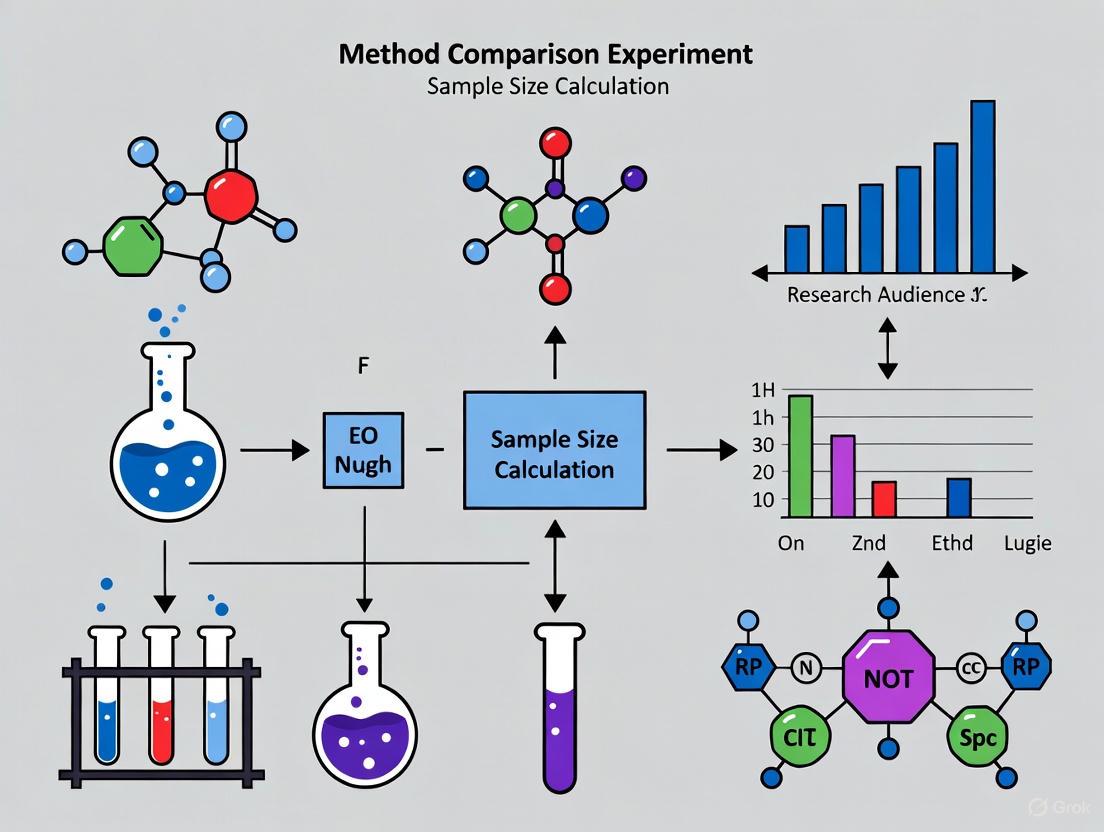
This article provides a comprehensive guide for researchers and drug development professionals on calculating sample sizes for method comparison and agreement studies.
A Practical Guide to Method Comparison Sample Size Calculation: Principles, Formulas, and Best Practices for Researchers
Abstract
This article provides a comprehensive guide for researchers and drug development professionals on calculating sample sizes for method comparison and agreement studies. Covering foundational statistical principles from hypothesis testing to error types, it details specific formulas for continuous and categorical outcomes across superiority, equivalence, and non-inferiority trial designs. The content addresses common pitfalls, optimization strategies for complex designs like repeated measures, and validation techniques to ensure statistical conclusions are both scientifically and clinically meaningful. Practical examples and software recommendations are included to facilitate immediate application in biomedical research.
Core Principles: Why Sample Size Matters in Method Comparison
In clinical research and method comparison studies, defining the primary research objective is a critical first step that determines the entire experimental design, statistical analysis, and sample size calculation. The three primary frameworks for trial objectives are superiority, equivalence, and non-inferiority designs [1]. Each approach answers a distinct scientific question and requires specific methodological considerations.
Superiority trials represent the traditional approach in clinical research, where the goal is to demonstrate that one intervention is statistically better than another [2] [1]. In contrast, equivalence trials aim to show that two treatments differ by no more than a clinically acceptable margin, meaning their effects are sufficiently similar to be considered interchangeable [2] [3]. Non-inferiority trials occupy a middle ground, seeking to prove that a new intervention is not clinically worse than an existing standard by more than a pre-specified margin [4] [1]. This design is particularly valuable when a new treatment offers secondary advantages such as reduced cost, improved safety profile, or easier administration [2].
The choice between these designs must be guided by the fundamental scientific question, as each requires different statistical testing procedures and sample size calculations [3]. This guide provides an in-depth technical examination of these three trial designs within the context of method comparison experiments, with particular emphasis on implications for sample size determination.
Key Concepts and Statistical Foundations
The Role of the Margin (Δ)
A fundamental concept unifying equivalence and non-inferiority designs is the margin (Δ), which represents the largest clinically acceptable difference between interventions that would still be considered unimportant in practice [2]. This margin must be specified a priori and justified through both clinical reasoning and empirical evidence [2].
The equivalence or non-inferiority margin, usually denoted Δ, represents the largest difference in effect between two interventions that would be acceptable. The choice of an equivalence or non-inferiority margin should be informed both by empirical evidence and clinical judgement [2]. This margin can be informed by estimates of the minimal clinically important difference (MCID), which represents the smallest difference that patients or clinicians would consider meaningful [2].
Proper specification of Δ is crucial, as it directly impacts sample size requirements and trial interpretation. An overly large margin may allow clinically important differences to be deemed "non-inferior," while an excessively small margin may make the trial infeasibly large [2].
Hypothesis Testing Frameworks
Each trial design employs distinct null and alternative hypotheses, as summarized in Table 1.
Table 1: Statistical Hypotheses by Trial Design
| Trial Design | Null Hypothesis (H₀) | Alternative Hypothesis (H₁) | Interpretation of Results |
|---|---|---|---|
| Superiority | Treatments do not differ (Δ = 0) | New treatment is superior | Demonstrates new treatment is statistically better |
| Non-Inferiority | New treatment is worse by at least Δ | New treatment is not worse by more than Δ | Shows new treatment is not clinically inferior |
| Equivalence | Absolute difference between treatments is at least Δ | Absolute difference is less than Δ | Confirms treatments are clinically similar |
In superiority testing, rejecting the null hypothesis provides evidence that one treatment is statistically better than the other [1]. For equivalence trials, researchers determine whether the confidence interval for the difference between treatments lies entirely within the equivalence margin (-Δ to +Δ) [2]. In non-inferiority testing, the focus is on whether the upper confidence bound lies within the non-inferiority margin [2].
Trial Design Specifications and Applications
Comparative Characteristics
The three designs differ significantly in their applications, statistical power, and typical sample size requirements, as detailed in Table 2.
Table 2: Design Specifications and Applications
| Design Aspect | Superiority | Non-Inferiority | Equivalence |
|---|---|---|---|
| Primary Question | Is A better than B? | Is A not worse than B by more than Δ? | Is A similar to B within ±Δ? |
| Common Applications | New drug vs. placebo; comparative effectiveness | New treatment with practical advantages over standard | Generic vs. branded drugs; therapeutic interchange |
| Statistical Power | Typically 80-90% | Typically 80-90% | Typically 80-90% |
| Relative Sample Size | Variable (often largest for small expected effects) | Generally smaller than equivalence | Generally largest of the three designs |
| Regulatory Considerations | Standard for new drug approval | Requires careful justification of margin | Required for generic drug approval |
Non-inferiority trials have the largest range of successful trial outcomes (equivalence or superiority), making their calculated sample size usually the smallest of the three hypotheses [3]. Superiority trials can have sample sizes similar to non-inferiority or much larger, particularly as the expected difference between treatments decreases [3]. Equivalence trials (sometimes called bioequivalence trials) typically require the largest sample sizes as they demand that treatments be identical within a strict acceptable range [3].
Interpreting Trial Outcomes
The relationship between confidence intervals and the margin Δ determines the interpretation of results across different trial designs. The following diagram illustrates how various confidence interval scenarios correspond to different conclusions in superiority, non-inferiority, and equivalence testing:
This visualization demonstrates how confidence intervals positioned relative to the margin Δ and the line of no difference (zero) lead to different trial conclusions. For example, in a non-inferiority trial, if the entire confidence interval lies above -Δ, non-inferiority is demonstrated [2] [1]. If that same interval also excludes zero, superiority is simultaneously concluded [2].
Methodological Considerations for Experimentation
Prerequisites for Valid Non-Inferiority and Equivalence Designs
Non-inferiority and equivalence trials require specific preconditions to yield scientifically valid results. The most fundamental requirement is the existence of a credible criterion standard with well-established efficacy [2]. Without this, demonstrating similarity to the comparator provides little evidence of the new treatment's effectiveness.
The premise of an equivalence or non-inferiority trial is that the effect of a new intervention is compared with that of a criterion standard. It is important to recognise that this logic presupposes that there exists a meaningful criterion standard, such that should equivalence or non-inferiority be established, there is rich evidence in support of the criterion standard that is now also in indirect support for the newer intervention [2].
Another significant threat is "biocreep" or "technocreep," wherein sequential non-inferiority trials with slightly different margins can gradually lead to acceptance of increasingly less effective treatments [2]. This occurs when treatment C is shown non-inferior to B, and B to A, but the difference between C and A may exceed what would be clinically acceptable [2].
Method Comparison Studies
In laboratory medicine and diagnostic testing, method comparison studies share similar design considerations with clinical trials [5]. These studies assess the agreement between a new measurement procedure and an established standard, evaluating both constant bias (systematic differences) and proportional bias (differences that vary with the magnitude of measurement) [5].
The question to be answered by the method comparison is whether two methods could be used interchangeably without affecting patient results and patient outcome [5]. In other words, by comparing two methods we are looking for a potential bias between methods [5].
Proper methodological approach is crucial, as common statistical mistakes in method comparison studies include relying solely on correlation coefficients or t-tests, which are inadequate for assessing agreement between methods [5]. Correlation measures association but not agreement, while t-tests may fail to detect clinically important differences in small samples or detect trivial differences in large samples [5].
Sample Size Calculation Framework
Fundamental Parameters for Sample Size Determination
Sample size calculation requires specification of several key statistical parameters regardless of trial design [6]. Researchers must determine (1) the statistical analysis to be applied, (2) acceptable precision levels, (3) study power, (4) confidence level, and (5) the magnitude of practical significance differences (effect size) [6].
The effect size is particularly critical, defined as the minimum effect an intervention must have to be considered clinically or practically significant [6]. This represents the most challenging step in sample size calculation for many researchers [6]. When the effect is small, identifying it with adequate power requires a large sample; when the effect is large, a smaller sample suffices [6].
For binary outcomes in non-inferiority trials, the sample size calculation formula incorporates these key parameters [7]:
n = f(α, β) × [πₛ × (100 − πₛ) + πₑ × (100 − πₑ)] / (πₛ − πₑ − d)²
Where πₛ and πₑ represent the percentage of success in the standard and experimental groups, d is the non-inferiority margin, and f(α, β) is a function of the specified Type I and Type II error rates [7].
Practical Considerations and Tools
Several specialized software tools are available to assist researchers with sample size calculations, including OpenEpi, G*Power, PS Power, and Sample Size Calculation, among others [6]. These tools vary in their interfaces and underlying statistical assumptions but can greatly facilitate proper sample size determination [6].
When calculating sample sizes for descriptive studies (such as those estimating prevalence), different parameters take precedence, including the desired confidence level, margin of error, and estimated proportion or standard deviation [6]. For comparative studies, the sample size should always be determined based on the planned statistical analysis [6].
The following workflow illustrates the key decision points and methodological sequence for designing a method comparison study:
For method comparison studies specifically, recommended sampling protocols include using at least 40 and preferably 100 patient samples, covering the entire clinically meaningful measurement range, performing duplicate measurements, randomizing sample sequence, and analyzing samples within their stability period [5].
Essential Research Reagents and Tools
Table 3: Key Research Reagents and Methodological Tools
| Tool/Reagent | Function/Purpose | Application Context |
|---|---|---|
| Statistical Software (G*Power, OpenEpi) | Sample size calculation and power analysis | All trial designs during planning phase |
| Standard/Reference Method | Established measurement procedure serving as benchmark | Method comparison studies |
| Clinical Samples | Biological specimens representing measurement range | Method comparison and validation studies |
| Randomization Scheme | Ensures unbiased allocation to treatment groups | All clinical trial designs |
| Blinded Assessment Protocol | Prevents measurement bias in outcome assessment | All trial designs, especially those with subjective endpoints |
| Predefined Statistical Analysis Plan | Specifies primary analysis method before data collection | All trial designs to minimize bias |
The research reagents and tools listed in Table 3 represent essential components for conducting method comparison studies and clinical trials across different designs. Statistical software tools are particularly crucial for appropriate sample size calculation, with options including OpenEpi (an open-source online calculator) and G*Power (a statistical software package) among others [6]. For method comparison studies specifically, the standard/reference method serves as the benchmark against which new methods are evaluated [5]. Clinical samples must be carefully selected to cover the entire clinically meaningful measurement range [5].
The choice between superiority, equivalence, and non-inferiority designs represents a fundamental decision point in clinical research and method comparison studies. Each design addresses a distinct research question and carries specific implications for study planning, implementation, and interpretation. The non-inferiority margin (Δ) serves as a critical bridge between statistical significance and clinical relevance in both equivalence and non-inferiority trials, requiring careful justification based on clinical and empirical evidence. Proper sample size calculation remains essential across all designs, with specific parameters varying according to the chosen framework. By aligning research objectives with the appropriate trial design and implementing rigorous methodological standards, researchers can generate scientifically valid and clinically meaningful evidence to advance medical practice and diagnostic capabilities.
In statistical hypothesis testing, the null hypothesis (H₀) and alternative hypothesis (H₁ or Hₐ) are competing, mutually exclusive statements about a population parameter [8] [9]. They form the foundational framework for statistical inference, enabling researchers to make data-driven decisions about the validity of their theories. In the context of method comparison experiments—a critical component of pharmaceutical and clinical research—these hypotheses provide the structure for determining whether two measurement methods agree sufficiently to be used interchangeably [10].
The null hypothesis (H₀) typically represents a default position of "no effect," "no difference," or "no change" [8]. In method comparison studies, this often translates to the assumption that there is no discrepancy between measurements obtained from two different instruments, techniques, or assays. The alternative hypothesis (H₁), conversely, represents the researcher's substantive theory—that a statistically significant effect, difference, or relationship does exist in the population [11]. This hypothesis framework is particularly crucial in drug development, where accurate measurement methods are essential for demonstrating therapeutic efficacy and safety.
Theoretical Foundations of Hypothesis Testing
Definitions and Conceptual Framework
Null Hypothesis (H₀): A statement that there is no effect, difference, or relationship in the population [8]. It is the hypothesis that researchers typically aim to disprove or reject through data analysis. The null hypothesis is always stated with an equality symbol (=, ≥, or ≤) [8].
Alternative Hypothesis (H₁ or Hₐ): A statement that directly contradicts the null hypothesis by proposing that there is an effect, difference, or relationship in the population [8] [9]. This hypothesis represents the researcher's actual prediction or what they hope to demonstrate empirically.
In method comparison studies, hypotheses are always statements about population parameters rather than sample statistics [8]. This distinction is crucial because the goal of hypothesis testing is to draw inferences about broader populations based on sample data.
Error Types in Hypothesis Testing
Statistical hypothesis testing inherently involves risk of incorrect conclusions due to sampling variability. Two types of errors can occur:
Type I Error (α): Rejecting a true null hypothesis (false positive) [11]. In method comparison, this would be concluding that two methods differ when they are actually equivalent. The probability of Type I error (α) is typically set at 0.05, indicating a 5% risk tolerance for false positives.
Type II Error (β): Failing to reject a false null hypothesis (false negative) [11]. This would occur when researchers conclude methods are equivalent when they actually differ. The power of a statistical test (1-β) represents the probability of correctly rejecting a false null hypothesis, with 80% power (β=0.20) being conventional in scientific research.
The relationship between these error types and hypothesis testing decisions can be visualized as follows:
Figure 1: Hypothesis Testing Error Matrix. This diagram illustrates the relationship between statistical decisions and potential error types in hypothesis testing.
Hypothesis Formulation in Method Comparison Studies
General Template for Hypothesis Construction
For method comparison studies, hypotheses can be constructed using general template sentences that specify the relationship between the measurement methods (independent variable) and the measured outcome (dependent variable) [8]:
- Research Question: Does the measurement method affect the measured values?
- Null Hypothesis (H₀): The measurement method does not affect the measured values.
- Alternative Hypothesis (H₁): The measurement method affects the measured values.
These general templates can be adapted to specific statistical tests used in method comparison studies, as shown in the table below.
Specific Hypothesis Formulations for Common Statistical Tests
Table 1: Hypothesis Formulations for Common Statistical Tests in Method Comparison Research
| Statistical Test | Null Hypothesis (H₀) | Alternative Hypothesis (H₁) |
|---|---|---|
| Two-sample t-test [8] | The mean measured value does not differ between method 1 (µ₁) and method 2 (µ₂) in the population; µ₁ = µ₂. | The mean measured value differs between method 1 (µ₁) and method 2 (µ₂) in the population; µ₁ ≠ µ₂. |
| Paired t-test [12] | The mean difference between paired measurements is zero in the population; µd = 0. | The mean difference between paired measurements is not zero in the population; µd ≠ 0. |
| Linear Regression [8] | There is no relationship between measurements from method 1 and method 2 in the population; β₁ = 0. | There is a relationship between measurements from method 1 and method 2 in the population; β₁ ≠ 0. |
| Bland-Altman Analysis [10] | The limits of agreement between the two methods are within the pre-defined clinical agreement limit. | The limits of agreement between the two methods exceed the pre-defined clinical agreement limit. |
| Two-proportions z-test [8] | The proportion of measurements exceeding a threshold does not differ between methods (p₁ = p₂). | The proportion of measurements exceeding a threshold differs between methods (p₁ ≠ p₂). |
Directional vs. Non-Directional Hypotheses
The formulation of alternative hypotheses can be either non-directional (two-tailed) or directional (one-tailed), depending on the research question and established literature:
Non-Directional (Two-Tailed) Tests: Used when researchers are interested in any difference between methods, without specifying the direction. These are most common in exploratory method comparison studies [8]. The alternative hypothesis uses the ≠ symbol.
Directional (One-Tailed) Tests: Used when researchers have a specific prediction about the direction of the difference based on theoretical considerations or prior evidence [11]. For example, if developing a more sensitive assay, researchers might hypothesize that the new method will yield systematically higher values (µ₁ > µ₂) or lower values (µ₁ < µ₂) than the reference method.
Sample Size Calculation in Method Comparison Experiments
Fundamental Parameters for Sample Size Determination
Adequate sample size is critical in method comparison studies to ensure sufficient statistical power while minimizing resource utilization [13]. The following parameters must be considered when calculating sample size:
Table 2: Key Parameters for Sample Size Calculation in Method Comparison Studies
| Parameter | Symbol | Description | Typical Values |
|---|---|---|---|
| Significance Level | α | Probability of Type I error (false positive) | 0.05 (5%) [13] |
| Statistical Power | 1-β | Probability of correctly detecting a true difference | 0.80 or 0.90 (80% or 90%) [13] |
| Effect Size | d | Minimum clinically meaningful difference between methods | Domain-specific; must be defined a priori |
| Standard Deviation | σ | Expected variability in measurements | Based on pilot studies or literature |
| Allocation Ratio | k | Ratio of sample sizes between methods | 1:1 for balanced designs |
Sample Size Calculation for Paired Designs
In method comparison studies where each subject is measured with both methods (paired design), the sample size calculation must account for the correlation between paired measurements [14] [12]. The required sample size for a paired t-test depends on:
- The expected mean of differences between methods
- The expected standard deviation of differences
- The pre-defined clinical agreement limit (maximum allowed difference) [10]
The workflow for determining appropriate sample size in method comparison studies follows a systematic process:
Figure 2: Sample Size Determination Workflow. This diagram outlines the sequential process for calculating appropriate sample size in method comparison studies.
Bland-Altman Sample Size Calculation
For method comparison studies utilizing Bland-Altman analysis to assess agreement between two measurement methods, sample size calculation incorporates specific parameters [10]:
- Expected mean of differences: The anticipated systematic bias between methods
- Expected standard deviation of differences: The anticipated random variation around the mean difference
- Maximum allowed difference (Δ): The pre-defined clinical agreement limit that represents the maximum acceptable difference between methods
The sample size must be sufficient to demonstrate with high probability that the limits of agreement (mean difference ± 1.96 × standard deviation) fall within the clinical agreement limit, taking into account the confidence intervals around the limits of agreement [10]. With smaller sample sizes, confidence intervals widen, increasing the probability that Δ will fall within the confidence interval rather than outside it, thereby reducing the ability to conclude agreement.
Experimental Protocols for Method Comparison Studies
Paired Measurement Protocol
The paired measurement design, where each subject is measured by both methods, is the gold standard for method comparison studies [12]. The detailed protocol includes:
Subject Selection: Recruit a representative sample from the target population, ensuring the sample covers the entire range of values expected in clinical practice.
Randomization: Randomize the order of method administration to minimize order effects and systematic bias.
Measurement Process: Perform measurements with both methods under standardized conditions, with minimal time between measurements to reduce biological variability.
Blinding: Ensure operators are blinded to previous measurements and the study hypotheses to prevent conscious or unconscious bias.
Data Collection: Record paired measurements along with relevant covariates that might affect measurement agreement.
For paired designs, the paired t-test is commonly used to test whether the mean difference between paired measurements is zero [12]. The test assumes that the differences between pairs are normally distributed and that subjects are independent.
Bland-Altman Agreement Assessment Protocol
The Bland-Altman method provides a comprehensive approach to assessing agreement between two quantitative measurement methods [10]:
Calculate Differences: For each subject, compute the difference between measurements from the two methods.
Calculate Mean Difference: Determine the average of all differences, representing the systematic bias between methods.
Calculate Standard Deviation: Compute the standard deviation of the differences, representing random variation around the bias.
Compute Limits of Agreement: Calculate the 95% limits of agreement as mean difference ± 1.96 × standard deviation of differences.
Assessment of Clinical Agreement: Compare the limits of agreement to pre-defined clinical agreement limits to determine whether the methods agree sufficiently for interchangeable use.
The sample size for Bland-Altman studies must be sufficient to provide precise estimates of the limits of agreement, typically requiring at least 50-100 subjects for reliable results [10].
Essential Research Reagents and Materials
Table 3: Essential Research Reagents and Materials for Method Comparison Experiments
| Item | Function | Application Context |
|---|---|---|
| Reference Standard | Provides known values for method calibration and accuracy assessment | Essential for establishing measurement traceability |
| Quality Control Materials | Monitors assay performance and detects systematic drift | Used to verify method stability throughout study |
| Clinical Samples | Represents actual biological matrix for realistic performance assessment | Should cover entire measuring range of clinical interest |
| Statistical Software | Performs hypothesis tests and sample size calculations | Enables Bland-Altman analysis, paired t-tests, and power calculations |
| Data Collection Forms | Standardizes recording of paired measurements | Ensures consistent data capture across multiple operators |
| Calibration Verification Materials | Confirms continued proper calibration of instruments | Critical for maintaining measurement accuracy throughout study |
Advanced Considerations in Hypothesis Testing
Multiple Comparison Adjustments
In complex method comparison studies involving multiple endpoints or subgroup analyses, the risk of Type I errors increases with each additional hypothesis test. Adjustments such as the Bonferroni correction can control the family-wise error rate by dividing the significance level (α) by the number of comparisons [15]. However, this approach increases the sample size requirements and may be overly conservative in exploratory analyses.
Adaptive Designs
Adaptive designs allow for modifications to the study based on interim results without compromising the statistical integrity [14]. In method comparison studies, this might include:
- Sample size re-estimation: Adjusting the planned sample size based on interim variability estimates
- Stopping rules: Pre-defined criteria for early termination if sufficient evidence of agreement or disagreement is obtained
These approaches can enhance research efficiency while maintaining rigorous hypothesis testing standards.
Proper formulation of null and alternative hypotheses is fundamental to rigorous method comparison studies in pharmaceutical research and drug development. The hypotheses provide the framework for designing efficient experiments, calculating appropriate sample sizes, and drawing valid conclusions about measurement method agreement. By integrating sound statistical principles with domain-specific knowledge, researchers can optimize their experimental protocols to generate reliable evidence regarding the comparability of measurement methods, ultimately supporting the development of safe and effective therapeutic products.
In method comparison experiments, which are foundational to diagnostic medicine, pharmaceutical development, and analytical science, validating a new test or procedure against an existing standard is a critical endeavor. The reliability of conclusions drawn from these comparisons hinges on the appropriate management of statistical decision errors and the power of the test employed. This technical guide provides an in-depth examination of Type I error (α), Type II error (β), and Statistical Power (1-β), framing them within the specific context of designing and interpreting method comparison studies. We elucidate the theoretical underpinnings of these concepts, detail their practical implications for sample size calculation, and provide protocols for ensuring that comparative experiments are both statistically sound and scientifically valid.
In statistical hypothesis testing, particularly within method comparison experiments, a researcher decides between two competing propositions: the null hypothesis (H0), which typically states that there is no difference between the methods, and the alternative hypothesis (H1), which states that a significant difference exists [16] [17]. The outcomes of this decision process can be categorized into four possible scenarios, two of which represent correct decisions and two which represent errors [18] [17].
Table 1: Decision Matrix in Hypothesis Testing
| Null Hypothesis (H0) is TRUE (Methods are equivalent) | Null Hypothesis (H0) is FALSE (Methods are different) | |
|---|---|---|
| Do NOT Reject H0 | Correct Decision (True Negative) | Type II Error (β) (False Negative) |
| Reject H0 | Type I Error (α) (False Positive) | Correct Decision (True Positive) |
The following diagram illustrates the logical flow and outcomes of statistical hypothesis testing, connecting the states of truth with the decisions a researcher makes and the resulting errors or correct conclusions.
Diagram 1: Hypothesis Testing Outcomes
Type I Error (α)
- Definition: A Type I error (α) is the probability of incorrectly rejecting the null hypothesis when it is, in fact, true [16] [18] [17]. This is known as a false positive, where the researcher concludes that a difference exists between two methods when, in reality, there is none.
- Significance Level (α): The maximum tolerated risk of a Type I error is pre-specified by the researcher as the significance level, denoted by α (alpha) [18]. In scientific literature, the most common choice is α = 0.05 (5%), meaning the researcher accepts a 5% chance of falsely declaring a significant difference [16] [17]. For contexts where the consequences of a false positive are severe (e.g., drug safety studies), a more stringent level such as α = 0.01 or lower may be adopted [16] [18].
Type II Error (β)
- Definition: A Type II error (β) is the probability of failing to reject the null hypothesis when it is actually false [16] [19]. This is a false negative, where the researcher fails to detect an existing, true difference between the methods.
- Power (1-β):
- Statistical Power is the complement of the Type II error (1-β) [20] [19]. It is defined as the probability of correctly rejecting a false null hypothesis—that is, the chance of detecting a true difference when one exists [16] [19].
- An ideal power for a study is conventionally set at 0.8 (or 80%) or higher, corresponding to a β of 0.2 (20%) [16] [20]. This means the study has an 80% chance of successfully identifying a true effect of the specified size.
Consequences and Trade-offs in Method Comparison
The implications of statistical errors are profoundly practical in research and development. A Type I error in a method comparison could lead to adopting a new diagnostic test that is no better than the existing standard, wasting resources and potentially causing unnecessary patient anxiety [18]. Conversely, a Type II error might result in discarding a genuinely superior new method, halting progress and foregoing potential improvements in accuracy or efficiency [18].
There is an inherent trade-off between Type I and Type II errors [17] [19]. For a given sample size, decreasing the risk of a Type I error (by setting a lower α) inevitably increases the risk of a Type II error (β), and vice versa. The only way to reduce both errors simultaneously is to increase the sample size [17] [19].
The Interplay with Sample Size and Effect Size
The calculation of an appropriate sample size is a critical step in planning a method comparison experiment. It ensures the study has a high probability of detecting a clinically or scientifically meaningful difference while controlling the risk of false positives [16] [21] [20].
Key Factors in Sample Size Calculation
The sample size (N) required for a method comparison study is a function of several interconnected parameters [16] [20]:
- Significance Level (α): The threshold for Type I error (e.g., 0.05).
- Power (1-β): The desired probability of detecting an effect (e.g., 0.80 or 0.90).
- Effect Size (d): The magnitude of the difference the study aims to detect.
- Population Variability (σ): The standard deviation of the measurements.
Table 2: Factors Influencing Sample Size Requirements
| Factor | Impact on Required Sample Size | Rationale |
|---|---|---|
| Smaller α (e.g., 0.01 vs. 0.05) | Increases | A more stringent false-positive rate requires stronger evidence, necessitating a larger sample. |
| Higher Power (e.g., 0.90 vs. 0.80) | Increases | A lower tolerance for false negatives requires a larger sample to increase the chance of detecting a true effect. |
| Smaller Effect Size (d) | Increases | Detecting a finer, more subtle difference between methods requires more precise estimates, which comes from a larger sample. |
| Greater Variability (σ) | Increases | Higher data scatter makes it harder to distinguish a true signal from noise, requiring more data points to achieve certainty. |
Effect Size
The Effect Size is a standardized measure of the magnitude of the phenomenon being studied [16] [20]. In a method comparison study focusing on the difference between two means, a common effect size metric is Cohen's d, calculated as the difference between two means divided by the pooled standard deviation: d = (μ₁ - μ₂) / σ [20].
This concept is visualized below, showing how the ability to detect a difference (power) changes with the magnitude of the effect size and the chosen critical value.
Diagram 2: Effect Size and Power Relationship
Sample Size Calculation Formulas
The required sample size can be calculated manually using established formulas for different study designs [16] [21]. For a study comparing the means of two independent groups with equal allocation (e.g., a new method vs. a standard method), the formula is:
Comparison of Two Means:
n = [ (Z₁₋α/₂ + Z₁₋β)² * 2 * σ² ] / d² [16] [21]
Where:
nis the sample size per group.Z₁₋α/₂is the Z-value for the desired significance level (1.96 for α=0.05).Z₁₋βis the Z-value for the desired power (0.84 for 80% power).σis the pooled standard deviation.dis the effect size (the difference in means deemed clinically important).
Experimental Protocol for a Method Comparison Study
A robust method comparison experiment, such as one validating a new analytical technique against a reference method, follows a structured protocol to yield reliable estimates of systematic error (bias) [22].
Sample Selection and Preparation
- Number of Specimens: A minimum of 40 different patient specimens is recommended, though 100-200 may be needed to thoroughly assess specificity [22].
- Concentration Range: Specimens should be carefully selected to cover the entire analytical range of the method, rather than being chosen at random [22].
- Stability and Handling: Analyze test and comparative method specimens within two hours of each other to prevent handling differences from being misinterpreted as analytical error. Define and systematize specimen handling procedures prior to the study [22].
Data Collection and Analysis
- Measurement: Analyze each specimen by both the test and comparative methods. Performing duplicate measurements is ideal to identify sample mix-ups or transposition errors [22].
- Timeframe: Conduct analyses over a minimum of 5 different days to capture between-run variability and minimize bias from a single run [22].
- Graphical Analysis: Begin with a difference plot (test result minus comparative result vs. comparative result) to visually inspect for systematic patterns and outliers [22].
- Statistical Analysis:
- For data covering a wide range, use linear regression to obtain the line of best fit (
Y = a + bX). The systematic error (SE) at a critical medical decision concentration (Xc) is calculated asSE = Yc - Xc, whereYc = a + b*Xc[22]. - The correlation coefficient (r) is more useful for verifying a sufficiently wide data range (r ≥ 0.99) than for judging method acceptability [22].
- For a narrow analytical range, calculate the mean difference ("bias") between methods using a paired t-test [22].
- For data covering a wide range, use linear regression to obtain the line of best fit (
Table 3: Key Resources for Method Comparison Experiments
| Tool / Reagent | Function / Purpose |
|---|---|
| Gold Standard / Reference Method | A method with well-documented correctness, serving as the benchmark for comparison. Differences are attributed to the test method [22]. |
| Stable Patient Specimens | Covering the full analytical range and disease spectrum. They are the substrate for evaluating method performance under realistic conditions [22]. |
| Statistical Software (e.g., R, G*Power) | Used for a priori sample size calculation and subsequent data analysis (e.g., regression, t-tests) [21] [20]. |
| Standard Operating Procedure (SOP) | A pre-defined protocol for specimen handling, storage, and analysis to ensure consistency and prevent introduced variability [22]. |
The concepts of Type I error, Type II error, and statistical power form a critical triad that underpins the validity of method comparison experiments. A sophisticated understanding of their definitions, consequences, and interrelationships is not merely an academic exercise but a practical necessity for researchers and drug development professionals. By strategically setting acceptable levels for α and β, defining a clinically relevant effect size, and calculating the requisite sample size, scientists can design robust studies that efficiently use resources, uphold ethical standards, and produce conclusive, reliable evidence regarding the performance of new analytical methods.
Determining the Clinically Meaningful Effect Size (Δ) and Its Impact
In the realm of clinical research and drug development, the determination of a clinically meaningful effect size (Δ) is a critical step that bridges statistical significance and patient relevance. While statistical tests can identify whether a treatment effect exists, the clinically meaningful effect size quantifies whether that effect is substantial enough to justify clinical use, considering factors such as costs, risks, and patient preferences [23]. This distinction is particularly crucial in method comparison experiments and clinical trial design, where an underpowered study may fail to detect a truly meaningful effect, and an overpowered study may detect statistically significant but clinically irrelevant differences [24] [23].
The establishment of an appropriate Δ is fundamental to sample size calculation, as it directly influences the required number of participants to achieve adequate statistical power. Selecting an arbitrarily small Δ to reduce sample size or an unrealistically large one to make results appear more compelling can both lead to flawed research conclusions and wasted resources [24]. This technical guide examines the methodologies for determining clinically meaningful effect sizes, their integration into study design, and their profound impact on research validity and clinical application, with particular emphasis on the context of method comparison experiments.
Defining Clinically Meaningful Effect Size
Conceptual Foundations and Distinctions
The clinically meaningful effect size (Δ) represents the minimum treatment effect magnitude that would justify changing clinical practice considering all associated benefits, risks, and costs [23]. This differs fundamentally from statistical significance, which merely indicates whether an observed effect is likely not due to chance. A clinically meaningful effect should be patient-centered, reflecting improvements that patients can perceive and value in their daily lives [24].
The Smallest Worthwhile Effect is an emerging concept that explicitly defines the minimum benefit of an intervention that patients consider worthwhile given the costs, risks, and inconveniences involved [23]. This approach requires value judgments that integrate clinical expertise, patient perspectives, and health economic considerations, moving beyond purely statistical determinations.
Statistical Measures of Effect Size
Different statistical measures are used to quantify effect sizes depending on the type of data and research context:
- Cohen's d (standardized mean difference): Used for continuous outcomes, with conventional thresholds of 0.2, 0.5, and 0.8 for small, medium, and large effects, though these are arbitrary and require contextual interpretation [23]
- Hazard Ratios (HR): Common in survival analysis, with HR ≤ 0.8 often suggested as clinically meaningful for overall survival in oncology [24]
- Risk Ratios and Odds Ratios: Used for binary outcomes
- Correlation Coefficients and Regression Coefficients: Provide alternative effect size measures for different research designs
Table 1: Common Effect Size Measures and Their Applications
| Effect Size Measure | Data Type | Research Context | Common Thresholds |
|---|---|---|---|
| Cohen's d | Continuous | Comparative studies | 0.2 (small), 0.5 (medium), 0.8 (large) |
| Hazard Ratio (HR) | Time-to-event | Survival analysis | ≤0.8 for overall survival [24] |
| Risk Ratio (RR) | Binary | Clinical trials | Context-dependent |
| Correlation Coefficient (r) | Continuous | Method comparison | ≥0.99 for adequate range assessment [22] |
Methodologies for Determining Clinically Meaningful Effect Size
Anchor-Based Methods
Anchor-based methods establish clinical meaningfulness by relating changes in the outcome measure to an independent, clinically interpretable "anchor." In method comparison experiments, this often involves:
- Comparison with Reference Methods: Using a well-established reference method as a benchmark for acceptable performance [22]
- Clinical Outcome Correlation: Relating methodological differences to actual patient outcomes
- Expert Consensus: Establishing thresholds through structured input from clinical experts
The process involves analyzing patient specimens by both the test and comparative methods, then estimating systematic errors at critical medical decision concentrations [22]. For example, in a cholesterol comparison study, if the regression line is Y = 2.0 + 1.03X, the systematic error at a critical decision level of 200 mg/dL would be 8 mg/dL (Y = 2.0 + 1.03 × 200 = 208; 208 - 200 = 8) [22].
Distribution-Based Methods
Distribution-based methods interpret effect sizes relative to the variability in the measurement:
- Standard Error of Measurement: Relating changes to measurement precision
- Minimally Important Difference: Often set at 0.5 times the standard deviation for continuous outcomes
- Reliable Change Index: Accounting for measurement reliability
These methods are particularly valuable in method comparison studies where the standard deviation of differences between methods provides crucial information about measurement agreement [22].
Benefit-Harm Trade-Off Approaches
The "Smallest Worthwhile Effect" framework explicitly balances benefits against harms, costs, and inconveniences [23]. This approach involves:
- Systematic assessment of treatment burdens including side effects, administration route, frequency, and duration
- Quantitative trade-off studies asking patients what minimum benefit would justify these burdens
- Economic evaluations considering healthcare system costs and resource implications
Figure 1: Benefit-Harm Trade-Off Analysis Workflow for Determining Smallest Worthwhile Effect
Integration with Sample Size Calculation
Fundamental Relationships
The relationship between effect size and sample size is mathematically defined in power analysis. For a two-group comparison with continuous outcomes, the sample size per group (n) can be calculated as:
$$n = \frac{2(Z{1-\alpha/2} + Z{1-\beta})^2}{\Delta^2}$$
Where Δ is the standardized effect size, α is the Type I error rate, and β is the Type II error rate [13]. This formula demonstrates the inverse square relationship between effect size and sample size requirements – halving the detectable effect size quadruples the required sample size.
Consequences of Misspecification
Incorrect specification of the effect size has serious implications for research validity:
- Over-sampling: When trials recruit more participants than needed, they may detect statistically significant but clinically meaningless effects [24]. Approximately 21% of endpoints in cancer drug approval trials were found to be over-sampled [24]
- Under-powering: Selecting an unrealistically large effect size leads to under-powered studies that may miss clinically important effects
Table 2: Consequences of Effect Size Misspecification in Study Design
| Effect Size Specification | Sample Size Impact | Consequences | Prevalence in Research |
|---|---|---|---|
| Too small (over-optimistic) | Inadequate | False negatives, missed discoveries | Common in exploratory research |
| Too large (over-conservative) | Excessive | Detection of clinically irrelevant effects, wasted resources | 21% of oncology trial endpoints [24] |
| Appropriately contextualized | Balanced | Optimal balance of precision and practicality | Ideal for confirmatory research |
Regulatory Perspectives and Trial Design
Regulatory agencies emphasize the importance of justified sample sizes in clinical trials supporting drug approval [24]. The Model-Informed Drug Development (MIDD) framework employs quantitative tools like clinical trial simulation and adaptive designs to optimize sample size based on justified effect sizes [25]. Over-sampling has been associated with specific trial characteristics:
- Immunotherapy trials (OR: 5.5; p = 0.04)
- Targeted therapy (OR: 3.0)
- Open-label trials (OR: 2.5)
- Specific cancer types (melanoma OR: 4.6; lung cancer OR: 2.17) [24]
Trials with justified sample sizes and substantial effect sizes are more likely to translate to improved real-world outcomes, bridging the efficacy-effectiveness gap between controlled trials and clinical practice [24].
Special Considerations for Method Comparison Experiments
Experimental Design Parameters
Method comparison studies require specialized approaches to determine meaningful effect sizes:
- Sample Size: A minimum of 40 different patient specimens is recommended, carefully selected to cover the entire working range of the method [22]
- Specimen Selection: Quality over quantity – 20 well-selected specimens covering the analytical range often provide better information than 100 randomly selected specimens [22]
- Replication: Duplicate measurements are preferred to identify outliers and ensure result validity [22]
- Time Frame: Multiple analytical runs over a minimum of 5 different days to account for run-to-run variability [22]
Statistical Analysis Approaches
Different statistical methods are appropriate depending on the data range and research question:
- Linear Regression: Preferred for wide analytical ranges (e.g., glucose, cholesterol) allowing estimation of systematic error at multiple decision levels [22]
- Bland-Altman Analysis: Difference plots to visualize agreement between methods
- Correlation Analysis: Correlation coefficients (r) ≥ 0.99 indicate adequate range for reliable regression estimates [22]
- Paired t-tests: Appropriate for narrow analytical ranges (e.g., sodium, calcium) to calculate average differences (bias) [22]
Figure 2: Statistical Analysis Selection for Method Comparison Studies
The Scientist's Toolkit: Research Reagent Solutions
Table 3: Essential Methodologies and Tools for Effect Size Determination
| Tool/Methodology | Function | Application Context |
|---|---|---|
| Reference Methods | Provide benchmark for acceptable performance | Method comparison studies requiring high-quality comparator [22] |
| Patient Specimens | Represent real-world biological variability | Method comparison, covering analytical range and disease spectrum [22] |
| Linear Regression | Quantifies constant and proportional systematic error | Wide-range analytical comparisons [22] |
| Anchor Instruments | Independent standard for clinical meaningfulness | Patient-centered outcome measurement |
| Power Analysis Software | Calculates sample requirements for target effect size | Study design phase for clinical trials [13] |
| Model-Informed Drug Development (MIDD) | Quantitative framework for optimizing trial design | Drug development programs [25] |
Determining the clinically meaningful effect size (Δ) represents a critical juncture where statistical methodology meets clinical relevance. Rather than relying on arbitrary conventions or statistical conventions alone, researchers should adopt systematic, context-sensitive approaches that integrate clinical expertise, patient perspectives, and practical considerations. The impact of this determination extends throughout the research lifecycle – from appropriate sample size calculation to valid interpretation and eventual clinical application.
In an era of increasing research complexity and heightened emphasis on value-based healthcare, the rigorous establishment of clinically meaningful effect sizes becomes not merely a methodological nicety but an ethical imperative. By adopting the frameworks and methodologies outlined in this technical guide, researchers can ensure their work generates not only statistically significant findings but genuinely meaningful advancements for patients and clinical practice.
The Role of Outcome Variability and Baseline Event Rates in Sample Size
In method comparison and clinical research, robust sample size calculation is a cornerstone of scientific validity. It ensures that studies are adequately powered to detect clinically meaningful differences, thereby safeguarding against erroneous conclusions. Within this framework, outcome variability and baseline event rates are two pivotal parameters that directly influence the precision and reliability of study outcomes [26] [27]. This technical guide explores the profound role these factors play in determining sample size, framed within the context of method comparison experiment sample size calculation research. The guidance is tailored for researchers, scientists, and drug development professionals who require in-depth methodological rigor.
Failure to accurately account for these parameters can lead to two critical scenarios. Under-estimation of sample size results in a statistically non-significant outcome even when a clinically important effect exists, causing potentially effective treatments to be erroneously dismissed [27]. Conversely, over-estimation of sample size raises ethical concerns by exposing an excessive number of subjects to experimental conditions and may produce results that are statistically significant yet clinically meaningless [27]. Therefore, a precise justification for sample size, grounded in realistic assumptions about variability and baseline rates, is a scientific and ethical imperative for all clinical studies and method comparison experiments [26] [28].
Core Concepts and Definitions
Outcome Variability
Outcome variability refers to the natural dispersion or spread of measurements for a particular outcome within a study population. It is a defining factor in the calculation of sample size, as greater variability necessitates a larger sample to detect a specific treatment effect with confidence [26] [29].
- Standard Deviation (σ or s): For continuous data, the standard deviation is the most common measure of variability. It quantifies the average deviation of individual observations from the mean value of the group [29]. A larger standard deviation indicates greater variability.
- Variance (σ² or s²): The square of the standard deviation. Sample size formulas for continuous outcomes often incorporate the variance directly [26].
- Effect Size (Cohen's d): To render the treatment effect independent of the measurement unit, the effect size is used. For comparing two means, it is defined as the difference between the means (µ₁ - µ₂) divided by the common standard deviation (σ) [26]. A smaller, clinically relevant effect size requires a larger sample size to detect.
Baseline Event Rates
Baseline Event Rate is the proportion of subjects in the control or reference group expected to experience the event of interest. It is a critical determinant of sample size for studies with binary outcomes (e.g., success/failure, cure/no cure) [27].
- Clinically Important Difference: The minimal difference in event rates between the test and control groups that is considered clinically meaningful. This is not a statistical construct but a clinical one, representing the threshold that would change practice [27].
- Influence on Power: The baseline event rate directly impacts the statistical power of a study. For a fixed clinically important difference, power is maximized when the baseline rate is near 50%, and a larger sample is required to detect the same absolute difference when baseline rates are very high or very low.
Quantitative Impact on Sample Size Calculations
The relationship between outcome variability, baseline rates, and sample size can be quantified through standard formulas. The following tables illustrate how changes in these parameters impact the required number of participants.
For Continuous Outcomes (Comparing Two Means)
The sample size n per group for a two-sided test is calculated as: [ n = \frac{2\sigma^2 (Z{1-\alpha/2} + Z{1-\beta})^2}{(\mu1 - \mu2)^2} ] Where σ is the common standard deviation, μ₁ - μ₂ is the difference to detect, α is the Type I error rate, and β is the Type II error rate [26].
Table 1: Sample Size per Group for Various Effect Sizes and Standard Deviations (α=0.05, Power=80%)
| Standard Deviation (σ) | Effect Size (µ₁ - µ₂) | Sample Size (n) per Group |
|---|---|---|
| 1.0 | 0.2 | 394 |
| 1.0 | 0.5 | 64 |
| 1.0 | 0.8 | 25 |
| 1.5 | 0.5 | 142 |
| 1.5 | 0.8 | 56 |
| 2.0 | 0.5 | 252 |
| 2.0 | 0.8 | 100 |
For Binary Outcomes (Comparing Two Proportions)
The sample size n per group is calculated as: [ n = \frac{ [Z{1-\alpha/2} \sqrt{2\bar{p}(1-\bar{p})} + Z{1-\beta} \sqrt{p1(1-p1) + p2(1-p2)} ]^2}{(p1 - p2)^2} ] Where p₁ and p₂ are the event rates in the two groups, and (\bar{p}) is the average of p₁ and p₂ [27].
Table 2: Sample Size per Group for Various Baseline Rates and Clinically Important Differences (α=0.05, Power=80%)
| Baseline Rate (p₁) | Clinically Important Difference | New Rate (p₂) | Sample Size (n) per Group |
|---|---|---|---|
| 0.20 | 0.05 | 0.25 | 1,168 |
| 0.20 | 0.10 | 0.30 | 309 |
| 0.20 | 0.15 | 0.35 | 142 |
| 0.50 | 0.05 | 0.55 | 1,553 |
| 0.50 | 0.10 | 0.60 | 388 |
| 0.50 | 0.15 | 0.65 | 172 |
Advanced Considerations in Method Comparison Studies
Method comparison studies, which assess the agreement between two measurement techniques, have specific considerations for variability and sample size. The Bland-Altman Limits of Agreement (LOA) is a cornerstone analysis for such studies [30].
The Bland-Altman Framework and Variability
The LOA are calculated as the mean difference between methods ± 1.96 times the standard deviation of the differences. This standard deviation is a direct measure of outcome variability in the context of agreement. A narrower LOA indicates better agreement. Sample size planning in this context focuses on precisely estimating these limits.
- Precision of Limits of Agreement: The goal is to ensure the confidence intervals around the LOA are sufficiently narrow. Higher variability in the differences leads to wider LOA and less precise confidence intervals, necessitating a larger sample size to achieve a desired precision [30].
- Sample Size Based on Confidence Interval Width: Jan and Shieh [30] proposed methods where the sample size is determined so that the expected width of an exact 95% confidence interval for the LOA does not exceed a predefined benchmark value Δ. A more conservative approach ensures the observed width will not exceed Δ with a high assurance probability (e.g., 90%).
Protocols for Agreement Studies
For studies involving repeated measurements to assess within-subject variance, an equivalence test for agreement can be used [30]. The hypothesis tests H₀: σw² ≥ σU² against H₁: σw² < σU², where σw² is the within-subject variance and σU² is an unacceptable variance threshold. The sample size is derived iteratively based on the degrees of freedom, significance level (α), and power (1-β). For a study with k repeated measurements per subject, the number of subjects is derived from the degrees of freedom (df) as df/(k - 1) [30].
Diagram 1: Sample Size for Agreement with Replicates
The Scientist's Toolkit: Research Reagent Solutions
Table 3: Essential Methodological Components for Sample Size Calculation
| Component | Function & Rationale |
|---|---|
| Pilot Study Data | Provides initial estimates for outcome variability (standard deviation) and baseline event rates, which are critical inputs for formal sample size calculation [27]. |
| Published Literature | Serves as a source for estimating parameters when preliminary data is unavailable. Systematic reviews are a high-quality source for baseline rates and variability [27]. |
| Effect Size Calculator | Tools (e.g., G*Power, R packages) that compute Cohen's d or other effect size measures from summary statistics, standardizing the treatment effect for sample size formulas [26]. |
| Sample Size Software | Statistical software (e.g., SAS, R, PASS, nQuery) that implements complex sample size formulas for a wide range of designs, including Bland-Altman and equivalence tests [26] [30]. |
| Bland-Altman Specific R Packages | R scripts and packages are available for the exact interval procedures and LOAM-based sample size calculations for method comparison studies [30]. |
Diagram 2: Sample Size Calculation Workflow
Outcome variability and baseline event rates are not mere statistical inputs but fundamental drivers of a study's feasibility, ethical integrity, and scientific value. Accurate preliminary estimation of these parameters is essential for calculating a sample size that ensures the study is neither under-powered nor wastefully over-powered. As research methodologies evolve, particularly in the realm of method comparison and agreement studies, so too do the sophisticated techniques for incorporating variability into sample size planning, such as those based on the precision of Limits of Agreement. Adherence to established reporting guidelines like SPIRIT 2025 [28] and GRRAS [30] ensures transparency and reinforces the critical role of a well-justified sample size in the generation of reliable evidence.
Calculation in Action: Formulas and Procedures for Different Outcomes
Sample Size for Continuous Outcomes (e.g., Blood Pressure, Biomarkers)
Determining an appropriate sample size is a critical step in the design of any scientific study involving continuous outcomes, such as blood pressure, biomarker levels, or walking distance. An inadequately powered study can lead to false-negative results (Type II errors), where a genuine effect is missed, while an excessively large study wastes resources and may raise ethical concerns by exposing more participants than necessary to experimental procedures [16]. Within the broader thesis on method comparison experiments, sample size calculation is the cornerstone that ensures the research question is addressed with scientific rigor. The fundamental goal of sample size planning is to determine the minimum number of participants required to detect a clinically important difference with a specified degree of confidence, should such a difference truly exist [31] [32].
This process hinges on the balance between several key statistical concepts, primarily Type I error (α), Type II error (β), and statistical power. A Type I error occurs when the study incorrectly rejects the null hypothesis, finding a difference where none exists (a false positive). The probability of this error is denoted by alpha (α), and it is conventionally set at 0.05 (5%) [16]. A Type II error occurs when the study fails to reject a false null hypothesis, missing a true effect (a false negative). The probability of this error is denoted by beta (β). Statistical power, defined as 1 - β, is the probability that the study will correctly reject the null hypothesis when a true effect exists. For most studies, a power of 80% or 90% (β = 0.2 or 0.1) is considered acceptable [16] [31]. The relationship between these concepts, the effect size, and the sample size is intimate: to detect a smaller effect size with a lower α and a higher power, a larger sample size is required.
Key Parameters and Calculation Formulas
Defining the Input Parameters
For continuous outcomes, the sample size calculation requires the precise definition of several parameters. The minimal detectable difference is the smallest difference between group means that is considered clinically or scientifically important. This is not a statistical abstraction but a biologically plausible value that would justify a change in practice [32]. The standard deviation (SD) quantifies the variability of the continuous outcome measure within the population being studied. An accurate estimate of variability is crucial, as greater variability necessitates a larger sample size to detect a given effect. The effect size (ES), often expressed as the difference in means divided by the standard deviation (e.g., Cohen's d), is a standardized measure of the magnitude of the experimental effect. Finally, the alpha (α) and beta (β) levels must be chosen, with the standard values being α=0.05 and β=0.2 (for 80% power) [16].
The following table summarizes these core parameters and their typical values:
Table 1: Core Parameters for Sample Size Calculation for Continuous Outcomes
| Parameter | Symbol | Description | Commonly Used Values |
|---|---|---|---|
| Significance Level | α (Alpha) | Probability of a Type I error (false positive) | 0.05 (5%) [16] |
| Statistical Power | 1 - β | Probability of correctly detecting a true effect | 0.8 or 0.9 (80% or 90%) [31] |
| Minimal Detectable Difference | δ or Δ | The smallest clinically important difference to detect | Study-specific (e.g., 3 mm Hg in blood pressure) [33] |
| Standard Deviation | σ (Sigma) | Measure of variability in the outcome data | Estimated from prior literature or pilot studies [33] |
| Effect Size | ES | Standardized difference (e.g., Δ/σ) | Small (~0.2), Medium (~0.5), Large (~0.8) |
The Calculation Formula for Two Independent Groups
The sample size calculation for a continuous outcome in a parallel group superiority trial, where the goal is to detect a difference between two independent group means, is based on a standard formula [31]. For a study with an equal number of participants in each group, the required sample size per group (n) is calculated as:
n = f(α, β) × 2 × σ² / (μ₁ - μ₂)²
Where:
- μ₁ and μ₂ are the mean outcomes in the two groups.
- σ is the common standard deviation.
- f(α, β) is a constant derived from the chosen alpha and beta levels. For the standard values of α=0.05 and β=0.2 (power=80%), f(α, β) is approximately 7.85. For 90% power, it is approximately 10.5 [31].
This formula highlights the powerful influence of the standardized effect size, Δ/σ. Halving the effect size you wish to detect will quadruple the required sample size. The following diagram illustrates the logical workflow and key parameters involved in determining the sample size for a study with a continuous outcome.
Advanced Considerations and Complex Designs
Accounting for Clustering and Repeated Measures
Many modern clinical trials and observational studies employ complex designs that extend beyond the simple two-group parallel model. Two common features that profoundly impact sample size requirements are clustering and repeated measures [34]. In cluster-randomized trials, where interventions are assigned to groups of individuals (e.g., clinics, classrooms, families), the outcomes of individuals within the same cluster are correlated. This intra-class correlation reduces the effective sample size and must be accounted for, often by inflating the sample size calculated for an individually randomized trial [34]. Furthermore, statistical power in such trials depends more strongly on the number of clusters than on the number of subjects within each cluster.
Longitudinal studies, which collect repeated measurements of the outcome from the same individuals over time, offer a powerful means to track changes. These designs can lead to important gains in statistical power compared to studies with a single measurement because they control for within-subject variability [34]. However, the sample size determination must consider the number of measurement occasions, the correlation between these repeated measures, and the potential for attrition (dropouts) over time. Specialized software and methodologies, such as mixed-effects regression models, are required to correctly calculate sample sizes for these complex designs [34].
Adjustment for Practical Contingencies
A purely statistical sample size calculation often requires adjustment for real-world practicalities. Attrition, where participants drop out before study completion, is a common challenge, particularly in long-term trials. The final sample size must be inflated to ensure sufficient power at the study's end. For example, if a 20% dropout rate is anticipated, the calculated sample size (n) should be divided by (1 - 0.20) to determine the number of participants that need to be enrolled at baseline [34].
Another consideration is non-compliance or cross-over, where participants in one group inadvertently receive the intervention intended for the other group. This contamination dilutes the observed treatment effect. Sample size can be adjusted to account for this using a specific formula that incorporates the expected percent of cross-over in both the control (c1) and experimental (c2) groups: n_adj = n × 10,000 / (100 - c1 - c2)² [31]. These adjustments ensure the study remains adequately powered despite predictable deviations from the ideal protocol.
Experimental Protocols and Researcher Toolkit
Detailed Methodology for a Superiority Trial
The following protocol outlines the key steps for designing a study with a continuous primary outcome, such as a randomized controlled trial (RCT) comparing a new antihypertensive drug against a standard treatment.
- Protocol Development and Registration: Develop a detailed study protocol adhering to guidelines like SPIRIT 2013/2025, which mandates items like sample size justification, primary outcomes, and statistical methods [35]. Register the trial in a publicly accessible clinical trials registry before participant enrollment begins.
- Defining Objectives and Eligibility: Precisely define the primary objective as a superiority question. Establish clear eligibility criteria (inclusion/exclusion) for the participant population to ensure homogeneity and relevance [35].
- Randomization and Blinding: Implement a robust randomization procedure, with sequence generation and allocation concealment detailed in the protocol [35]. Use blinding (single, double, or triple) where feasible to minimize performance and detection bias.
- Intervention and Follow-up: Describe the interventions for all groups with sufficient detail to allow replication. Define the schedule of participant assessments, visits, and the timing of outcome measurements using a schematic diagram, as recommended by SPIRIT [35].
- Sample Size Calculation and Justification: Justify the sample size in the protocol, stating all parameters used: the primary outcome, the minimal clinically important difference (Δ), the standard deviation (σ), the alpha (α) level, the statistical power (1-β), and the test (one/two-sided). Reference the formula or software used [35]. For example: "To detect a difference of 3 mm Hg in systolic blood pressure, assuming a standard deviation of 15.6 mm Hg [33], with 95% power and a one-sided 5% significance level, we require 878 participants per group. This was calculated using the standard formula for continuous outcomes in a superiority trial [31]."
- Data Analysis Plan: Pre-specify the statistical methods for comparing groups for the primary continuous outcome (e.g., t-test, mixed-model repeated measures). Define the analysis population (e.g., intention-to-treat) and how missing data will be handled [35].
Successful execution of a study requires more than statistical planning; it relies on a suite of methodological and practical resources.
Table 2: Essential Research Reagent Solutions for Clinical Studies
| Tool / Resource | Category | Function / Application |
|---|---|---|
| Sample Size Calculators | Software Tool | Online platforms (e.g., Clincalc.com, Sealed Envelope) provide accessible interfaces for performing basic sample size calculations for various designs [13] [31]. |
| Specialized Software (e.g., RMASS) | Software Tool | Advanced software is required for complex designs involving repeated measures and clustering, as it accounts for correlation structures and attrition [34]. |
| Mixed-Effects Regression Models | Statistical Method | The analytical framework for handling repeated measures and clustered data, allowing for subject-specific changes over time and the nesting of data [34]. |
| Standard Protocol (SPIRIT 2025) | Guidelines | Provides a checklist of minimum items to include in a clinical trial protocol, ensuring comprehensive planning and transparent reporting [35]. |
| Data Monitoring Committee (DMC) | Governance | An independent group that monitors participant safety and treatment efficacy data during the trial, especially important in large, multi-center studies [35]. |
The determination of sample size for studies with continuous outcomes is a fundamental and non-negotiable component of rigorous scientific research, particularly in the context of method comparison experiments. It moves a study from a mere data collection exercise to a scientifically valid test of a hypothesis. The process requires careful consideration of the clinically meaningful effect, the natural variability of the outcome, and the acceptable levels of statistical risk. While the formulas for standard two-group comparisons are well-established, researchers must be vigilant in applying more sophisticated methods for complex designs involving clustering, repeated measures, and anticipated attrition. By transparently reporting the justification for the sample size in study protocols and subsequent publications, researchers uphold a key standard of scientific integrity and ensure that their findings contribute meaningfully to the advancement of knowledge.
Sample Size for Dichotomous/Categorical Outcomes (e.g., Response Rates)
Determining an appropriate sample size is a critical step in the design of any clinical trial or experimental study, ensuring that the research has a high probability of detecting a true effect if one exists. When the primary outcome is dichotomous—such as response versus non-response, survival versus mortality, or success versus failure—the sample size calculation relies on specific methodologies tailored to binomial data [36] [37]. Within the broader context of method comparison experiment sample size calculation research, the principles governing dichotomous outcomes are foundational, as these endpoints are extremely common in clinical drug development, particularly in oncology, psychiatry, and infectious disease trials [38] [39]. The primary challenge researchers face is accurately estimating the sample size required to distinguish a true treatment effect from random noise, a process that balances statistical rigor with practical constraints like patient availability, cost, and time [36] [40].
A study's sample size is directly linked to its statistical power, which is the probability that the test will correctly reject a false null hypothesis (i.e., find a difference when one truly exists) [36] [41]. An under-powered study with too small a sample size may fail to detect a clinically meaningful effect, rendering the research inconclusive and potentially wasting resources. Conversely, an excessively large sample may be unethical, as it exposes more participants than necessary to potential risks, and is inefficient with respect to time and cost [36]. For dichotomous outcomes, this balance is particularly sensitive to the anticipated response rates in the compared groups, as the variability of a proportion is intrinsically linked to its magnitude [13] [41].
The following workflow diagram outlines the key stages and decision points involved in determining sample size for a study with a dichotomous primary endpoint.
Core Statistical Parameters and Their Influence
The calculation of sample size for dichotomous outcomes hinges on several interconnected statistical parameters. A precise understanding of each is required to build a robust study design [36] [13].
- Null and Alternative Hypotheses: The null hypothesis (H₀) for a two-arm trial typically states that there is no difference in the response rates between the treatment and control groups (p₁ = p₂). The alternative hypothesis (H₁) states that a difference exists (p₁ ≠ p₂ for a two-sided test) [36].
- Type I Error (α): The probability of incorrectly rejecting the null hypothesis (i.e., concluding a difference exists when it does not). This is also known as the false-positive rate. It is conventionally set at 0.05, which corresponds to a 95% confidence level [36] [42] [13].
- Type II Error (β): The probability of failing to reject the null hypothesis when it is false (i.e., missing a true effect). This is the false-negative rate. It is often set at 0.10 or 0.20 [36] [13].
- Statistical Power (1 - β): The probability of correctly rejecting the null hypothesis when it is false. A power of 80% or 90% is standard, meaning the study has an 80% or 90% chance of detecting a specified effect size if it is real [36] [41].
- Effect Size: For dichotomous outcomes, this is the anticipated clinically relevant difference between the response rates of the two groups. This can be expressed as a risk difference (p₁ - p₂), relative risk (p₁/p₂), or odds ratio ([p₁/(1-p₁)] / [p₂/(1-p₂)]) [37]. The sample size is inversely related to the square of the effect size; detecting a smaller difference requires a much larger sample [36].
- Response Rates (p₁ and p₂): The anticipated or expected response proportion in the control group (p₂) and the treatment group (p₁). These are often gleaned from previous pilot studies, published literature, or clinical judgment [36] [40].
Table 1: Key Statistical Parameters for Sample Size Calculation
| Parameter | Symbol | Standard Value(s) | Impact on Sample Size |
|---|---|---|---|
| Type I Error Rate | α | 0.05, 0.01 | Lower α requires larger sample size. |
| Statistical Power | 1 - β | 0.80, 0.90 | Higher power requires larger sample size. |
| Effect Size | δ = |p₁ - p₂| | Varies by clinical context | Smaller effect size requires larger sample size. |
| Control Group Response Rate | p₂ | Based on historical data | Sample size is largest when p₂ is near 0.5. |
| Test Sidedness | - | One-sided, Two-sided | Two-sided tests require a larger sample size. |
Standard Calculation Methods and Formulas
The primary goal of sample size calculation for dichotomous outcomes is to ensure the study has a high probability of distinguishing between the response rates of two independent groups. The most common approach is based on a normal approximation for the difference between two binomial proportions [41].
Formula for Two Independent Proportions
For a study designed to compare two independent groups (e.g., treatment vs. control) with a binary endpoint, the following formula calculates the required sample size per group [41]:
Where:
- ( n ) = required sample size per group
- ( Z_{1-\alpha/2} ) = Z-value for the desired confidence level (e.g., 1.96 for 95% confidence / α=0.05)
- ( Z_{1-\beta} ) = Z-value for the desired power (e.g., 0.84 for 80% power)
- ( p_1 ) = anticipated response rate in Group 1 (treatment)
- ( p_2 ) = anticipated response rate in Group 2 (control)
- ( \bar{p} ) = average response rate = ( (p1 + p2)/2 )
This formula provides the sample size needed for a hypothesis test comparing two proportions, typically using a chi-squared test or a two-sample Z-test [13] [41].
Worked Example
Suppose a new drug is tested against a standard of care. Historical data suggests the response rate for the standard therapy (p₂) is 30%. Researchers believe the new drug could achieve a response rate (p₁) of 45%. They design a two-arm randomized trial with a two-sided significance level (α) of 0.05 and a desired power (1-β) of 80%.
- ( p_1 = 0.45 )
- ( p_2 = 0.30 )
- ( \bar{p} = (0.45 + 0.30)/2 = 0.375 )
- ( Z_{1-\alpha/2} = 1.96 )
- ( Z_{1-\beta} = 0.84 )
Plugging these values into the formula:
After rounding up, the calculation indicates that approximately 163 participants per group (326 total) are needed to detect an absolute difference of 15% in response rates with 80% power at a 5% significance level.
Table 2: Sample Size Requirements per Group for Different Effect Sizes and Power (α=0.05, two-sided)
| Control Rate (p₂) | Treatment Rate (p₁) | Absolute Difference | Sample Size (80% Power) | Sample Size (90% Power) |
|---|---|---|---|---|
| 0.30 | 0.40 | 0.10 | ~352 | ~471 |
| 0.30 | 0.45 | 0.15 | ~163 | ~218 |
| 0.30 | 0.50 | 0.20 | ~95 | ~127 |
| 0.50 | 0.60 | 0.10 | ~389 | ~521 |
| 0.50 | 0.65 | 0.15 | ~177 | ~237 |
| 0.50 | 0.70 | 0.20 | ~102 | ~136 |
Advanced Experimental Designs and Protocols
Beyond the standard parallel group design, advanced trial protocols have been developed to address specific methodological challenges, such as high placebo response rates, which are common in certain therapeutic areas like psychiatry [38].
The Sequential Parallel Comparison Design (SPCD)
The SPCD is a two-phase design developed to mitigate the impact of high and variable placebo response, which can reduce the effective treatment signal and lead to the failure of promising drugs [38].
Experimental Protocol for SPCD:
- Phase I: All participants are randomized, typically in a 1:1 ratio, to receive either the active drug or a placebo. This phase functions as a traditional randomized controlled trial (RCT).
- Identification of Placebo Non-Responders: At the end of Phase I, participants are assessed. Those in the placebo group who did not respond to the intervention (placebo non-responders) are identified.
- Phase II: The placebo non-responders from Phase I are re-randomized into two groups. One group continues to receive the placebo, while the other group receives the active drug. Participants who initially received the active drug typically continue their treatment.
- Analysis: The data from both phases are combined in a weighted analysis. A common test statistic is the weighted linear combination of the treatment effect from Phase I and Phase II [38]. The test statistic is:
Δ̂ = w(p̂₁ - q̂₁) + (1 - w)(p̂₂ - q̂₂)wherewis a pre-specified weight,p̂₁andq̂₁are the estimated response rates for drug and placebo in Phase I, andp̂₂andq̂₂are the corresponding rates in Phase II [38].
This design offers sample size savings compared to a standard parallel design because it re-uses placebo non-responders in the second phase, thereby increasing the probability of detecting a drug effect by enriching the study population with participants less likely to exhibit a high placebo response [38].
Essential Research Reagent Solutions
Successful execution of a study with a dichotomous endpoint requires more than just a statistical plan; it relies on a suite of methodological "reagents" — the essential tools and frameworks that ensure the integrity and validity of the research.
Table 3: Essential Research Reagent Solutions for Dichotomous Outcome Studies
| Research Reagent | Function & Purpose | Example Tools / Methods |
|---|---|---|
| Sample Size Calculators | Software tools that implement statistical formulas to compute the minimum number of subjects required. | ClinCalc Sample Size Calculator [13], R (SPCDAnalyze package for advanced designs) [38], Epitools [43], commercial software (PASS, nQuery). |
| Randomization Module | A system for allocating participants to intervention groups without bias, ensuring groups are comparable at baseline. | Computer-generated random number sequences, web-based randomization services, stratified or block randomization methods. |
| Blinding (Masking) Protocol | Procedures to prevent participants, investigators, and outcome assessors from knowing treatment assignments, minimizing assessment bias. | Use of identical placebo pills, centralized outcome adjudication committees, coded data files. |
| Standardized Outcome Definitions | A precise, unambiguous definition of what constitutes an "event" or "response," applied consistently to all participants. | FDA/EMA guidance documents, standardized clinical criteria (e.g., RECIST for tumor response), validated patient-reported outcome (PRO) instruments with defined cut-offs. |
| Data Monitoring & Adjudication Committee | An independent group that reviews accumulating outcome data, particularly for safety and efficacy, in blinded fashion. | Charter defining interim analysis plans, stopping rules for safety or overwhelming efficacy. |
The accurate determination of sample size for studies with dichotomous outcomes is a cornerstone of rigorous clinical and experimental research. It requires a deep understanding of statistical principles—including hypothesis testing, error rates, power, and effect size—and their careful application through established formulas or specialized software [36] [13]. For researchers engaged in method comparison experiments, appreciating the nuances of different designs, such as the SPCD for challenging high-placebo-response settings, is crucial for optimizing resource allocation and enhancing the probability of trial success [38]. Ultimately, a well-justified sample size, grounded in a clear research question and a realistic assessment of anticipated effects and constraints, is not merely a statistical formality but an ethical and scientific imperative that underpins the validity and interpretability of study findings in drug development and beyond [36] [40].
Step-by-Step Sample Size Calculation for Parallel-Group RCTs
Determining an appropriate sample size is a critical methodological step in the design of parallel-group randomized controlled trials (RCTs). This technical guide provides researchers, scientists, and drug development professionals with a comprehensive framework for calculating sample sizes within the context of method comparison experiments. Sample size calculation ensures that a study has sufficient statistical power to detect a clinically meaningful treatment effect while minimizing the risks of Type I and Type II errors [16]. Inadequate sample sizes can lead to inconclusive or misleading results, whereas excessively large samples raise ethical concerns and inefficiently utilize resources [44]. This paper elucidates the fundamental statistical principles, parameters, and practical methodologies required for robust sample size determination in parallel-group RCTs, supported by structured protocols, computational tools, and visual workflows.
The planning of any parallel-group RCT must incorporate a statistically sound sample size estimation grounded in hypothesis testing principles. A parallel-group design compares the results of a treatment on two separate groups of patients, where the sample size calculated can be used for any study where two groups are being compared [32]. The calculation procedure requires researchers to define a null hypothesis (H0), which typically states no difference exists between treatment groups, and an alternative hypothesis (H1), which posits that a specific, meaningful difference exists [16].
The validity of this determination hinges on managing two potential statistical errors. A Type I error (α) occurs when the null hypothesis is incorrectly rejected (false positive), while a Type II error (β) happens when the null hypothesis is incorrectly retained (false negative) [16]. The probability of correctly rejecting a false null hypothesis—that is, detecting a real treatment effect—is known as statistical power, calculated as 1-β [16] [45]. The conventional thresholds for these parameters in clinical research are α = 0.05 (5% significance level) and β = 0.20 (80% statistical power), though adjustments may be warranted based on the study's specific context and objectives [16].
Beyond error control, sample size calculation requires specification of the effect size, which represents the minimum clinically important difference that the trial should be able to detect [16]. For continuous outcomes, this might be a difference in means, while for binary outcomes, it could be a difference in proportions, risk ratio, or odds ratio. Finally, the variability of the outcome measure, expressed as standard deviation for continuous endpoints, directly influences the sample size requirement [16] [45].
Statistical Parameters and Their Relationships
Core Parameters in Sample Size Calculation
Table 1: Key Parameters for Sample Size Calculation in Parallel-Group RCTs
| Parameter | Symbol | Definition | Commonly Used Values | Influence on Sample Size |
|---|---|---|---|---|
| Significance Level | α | Probability of Type I error (false positive) | 0.05, 0.01, 0.001 | Lower α requires larger sample size |
| Statistical Power | 1-β | Probability of correctly detecting a true effect | 0.8, 0.85, 0.9 | Higher power requires larger sample size |
| Effect Size | δ, OR, HR, RR | Minimal clinically important difference to detect | Study-specific | Smaller effect size requires larger sample size |
| Variability | σ, P | Standard deviation (continuous) or proportion (binary) | From prior studies or pilot data | Higher variability requires larger sample size |
| Allocation Ratio | k | Ratio of participants between groups (n2/n1) | 1 (equal allocation) | Deviations from 1 may increase total sample size |
Mathematical Formulations for Different Endpoint Types
Table 2: Sample Size Formulas for Different Types of Primary Endpoints
| Endpoint Type | Formula | Variables Explanation |
|---|---|---|
| Two Means [16] | n = (1 + 1/k) * σ² * (Z₁₋α/₂ + Z₁₋β)² / δ² |
n = sample size per group; k = allocation ratio; σ = pooled standard deviation; δ = difference in means; Z = critical value from normal distribution |
| Two Proportions [16] | n = [P₁(1-P₁) + P₂(1-P₂)/k] * [(Z₁₋α/₂ + Z₁₋β)² / (P₁ - P₂)²] |
P₁, P₂ = event proportions in groups 1 and 2; k = allocation ratio |
| Odds Ratio [16] | n = [Z₁₋α/₂√(2P(1-P)) + Z₁₋β√(P₁(1-P₁) + P₂(1-P₂))]² / (P₁ - P₂)² |
P = (P₁ + P₂)/2; P₂ = P₁OR/[1 + P₁(OR - 1)] |
| Time-to-Event [33] | Complex, based on hazard ratios and accrual period | Requires specialized software; depends on hazard ratio, baseline event rate, and follow-up duration |
The relationship between these parameters follows a precise mathematical logic. Sample size increases when researchers require higher power, lower significance levels, smaller detectable effect sizes, or when dealing with more variable outcomes [45]. This interplay necessitates careful consideration during trial design to balance scientific rigor with practical feasibility.
Experimental Protocols for Sample Size Calculation
Protocol for Continuous Outcome Measures
For RCTs with continuous primary endpoints (e.g., blood pressure reduction, cholesterol level change), researchers should implement the following step-by-step protocol:
Define the Clinically Meaningful Difference: Establish the minimum difference (δ) between group means that would be considered clinically important based on literature review or expert consensus. For example, a study comparing cholesterol means might target a difference of 0.5 mmol/L [33].
Estimate Outcome Variability: Obtain the standard deviation (σ) of the continuous measure from previous studies, pilot data, or published literature. For instance, the standard deviation of serum cholesterol in humans might be assumed to be 1.4 mmol/L based on existing research [33].
Set Statistical Parameters: Determine alpha (typically 0.05) and power (typically 0.8-0.9). A two-sided test is conventional unless there's strong justification for a one-sided approach.
Determine Allocation Ratio: Decide on the ratio of participants between groups (typically 1:1 for equal allocation).
Calculate Sample Size: Apply the formula for comparing two means or use statistical software. As illustrated in one example, detecting a cholesterol difference of 0.5 mmol/L with 95% power and standard deviation of 1.4 mmol/L requires 170 participants per group [33].
Account for Anticipated Attrition: Increase the calculated sample size by 10-15% to accommodate potential dropouts or missing data.
Protocol for Binary Outcome Measures
For RCTs with binary primary endpoints (e.g., mortality, success/failure), researchers should implement this protocol:
Establish Control Group Event Rate: Determine the expected event proportion (p₁) in the control group from literature or pilot data. For example, the prevalence of smoking in a control population might be 40% [33].
Define Treatment Effect: Specify the expected event proportion in the treatment group (p₂) or the target odds ratio (OR). An odds ratio of 1.5 might correspond to changing the event rate from 40% to 50% [33].
Set Statistical Parameters: Select alpha (typically 0.05) and power (typically 0.8-0.9).
Determine Allocation Ratio: Typically 1:1 for equal allocation between groups.
Calculate Sample Size: Apply the formula for comparing two proportions. To detect an odds ratio of 1.5 with 90% power when the control event rate is 40%, a study would need 519 cases and 519 controls [33].
Adjust for Expected Loss to Follow-up: Inflate the sample size by an appropriate percentage based on anticipated dropout rates.
Protocol for Survival Analysis Outcomes
For time-to-event data (e.g., survival analysis, time to recurrence), the protocol differs:
Estimate Baseline Hazard Rate: Determine the expected event rate in the control group (λ₀).
Define Target Hazard Ratio: Establish the clinically important hazard ratio (HR) to detect.
Specify Study Duration: Define the accrual period (Tₐ) during which patients enter the study and additional follow-up time (T_b) after accrual completion.
Set Statistical Parameters: Determine alpha and power levels.
Use Specialized Software: Employ statistical packages specifically designed for survival analysis sample size calculations. For example, detecting a hazard ratio of 2.0 with 80% power might require 53 participants per group [33].
Workflow Visualization
Sample Size Determination Workflow for Parallel-Group RCTs
Table 3: Essential Tools for Sample Size Calculation in Clinical Research
| Tool Category | Specific Tools/Resources | Primary Function | Application Context |
|---|---|---|---|
| Online Calculators | ClinCalc Sample Size Calculator [13], MGH Hedwig Calculator [32] | User-friendly web interfaces for common designs | Preliminary calculations and verification |
| Specialized Software | R (powerTOST) [46], G*Power, Python statistical packages | Advanced calculations for complex designs | Regulatory submissions, complex designs |
| Statistical References | Chow et al. "Sample Size Calculations in Clinical Research" [33] | Formula reference and methodological guidance | Protocol development and justification |
| Reporting Guidelines | CONSORT Statement [44] | Reporting standards for clinical trials | Ensuring transparent reporting of sample size determination |
Methodological Considerations and Reporting Standards
Proper reporting of sample size calculations enhances the credibility and reproducibility of clinical trial results. The CONSORT Statement mandates that publications include detailed information about sample size determination, including: (1) expected outcomes in each group defining a clinically meaningful difference, (2) the alpha (type I error) level, (3) statistical power, and (4) the standard deviation of the outcome for continuous variables [44].
Despite these guidelines, studies across various medical disciplines show that sample size calculations are frequently underreported, inadequately justified, or based on questionable assumptions. An analysis of emergency medicine journals found that although 81.3% of RCTs reported sample size calculations, only 65.1% provided all parameters required by CONSORT guidelines [44]. This transparency gap undermines the ability to assess trial validity and reproduce methodological decisions.
Researchers must also consider ethical dimensions of sample size determination. Inadequately powered studies expose participants to potential risks without a reasonable probability of generating meaningful knowledge [16]. Conversely, excessively large samples waste resources and unnecessarily expose additional participants to experimental interventions. The concept of "cost-effective sample size" has gained importance in recent years, emphasizing efficient resource utilization while maintaining scientific integrity [16].
Robust sample size calculation constitutes a fundamental methodological imperative in parallel-group RCT design, ensuring adequate statistical power to detect clinically meaningful treatment effects while respecting ethical and resource constraints. This technical guide has systematized the conceptual framework, parameters, and practical protocols required for rigorous sample size determination across different endpoint types. By adhering to established statistical principles, utilizing appropriate computational tools, and maintaining transparency in reporting, researchers can enhance the scientific validity and practical impact of their clinical investigations. The integration of these methodological standards within broader thesis research on method comparison experiments strengthens both the design and interpretation of comparative effectiveness studies in drug development and clinical science.
Adapting Calculations for Repeated Measures and Longitudinal Data
Selecting an appropriate sample size is a critical step in designing successful repeated measures and longitudinal studies, which are common in biomedical and clinical research. These designs, where the same experimental unit is measured multiple times, offer advantages in detecting within-person change but introduce complexity in sample size calculation due to the correlated nature of observations. This technical guide provides researchers with a comprehensive framework for adapting sample size calculations for repeated measures designs, addressing core considerations including correlation structures, variance patterns, analytical method alignment, and practical implementation strategies. Within the broader context of method comparison experiment sample size calculation research, this paper establishes standardized methodologies for determining adequately powered sample sizes while accounting for the specialized requirements of correlated data.
Repeated measures designs involve collecting multiple measurements of the same outcome variable from the same experimental units (e.g., patients, animals) over time or under different conditions [47]. These longitudinal study designs are particularly valuable for investigating within-subject change over time and comparing these changes among treatment groups [47]. From a statistical perspective, longitudinal studies typically increase the precision of estimated treatment effects, thus enhancing statistical power to detect such effects compared to cross-sectional designs with independent observations [48].
The fundamental challenge in analyzing repeated measures data stems from the non-independence of observations. Values repeatedly measured in the same individual are typically more similar to each other than values from different individuals, creating correlation within clusters of measurements [47]. Ignoring this positive correlation between repeated measurements can result in biased estimates, incorrect standard errors, invalid P values, and inaccurate confidence intervals [47] [49]. Consequently, appropriate sample size planning and analysis of repeated measures data require specific statistical techniques that properly account for within-subject correlation [47].
Key Concepts in Sample Size Calculation
Fundamental Statistical Parameters
Sample size calculations for any study design, including repeated measures, involve several interconnected statistical parameters that must be specified a priori:
Type I Error (α): The probability of rejecting the null hypothesis when it is actually true (false positive) [16]. Typically set at 0.05 or 0.01, this represents the threshold for statistical significance [50].
Type II Error (β): The probability of failing to reject the null hypothesis when it is false (false negative) [16]. Commonly set at 0.1 or 0.2, though lower values may be appropriate for high-stakes research [50].
Power (1-β): The probability of correctly rejecting a false null hypothesis [16] [50]. A target power between 80-95% is generally considered acceptable, balancing risk of false negatives with practical constraints [50].
Effect Size: The minimum biologically or clinically relevant difference that the study should be able to detect [48] [50]. This should reflect a scientifically important difference rather than an expected or observed effect from previous data [50].
Variability (σ): The residual variance of the outcome measure not explained by predictors in the model [48]. This can be estimated from previous studies, pilot data, or based on educated speculation from experience [48].
Table 1: Fundamental Parameters for Sample Size Calculation
| Parameter | Description | Common Values | Considerations |
|---|---|---|---|
| Type I Error (α) | Probability of false positive | 0.05, 0.01, or 0.001 | Lower for higher stakes research |
| Power (1-β) | Probability of detecting true effect | 0.8-0.95 | Higher power requires larger sample size |
| Effect Size | Minimum important difference | Study-specific | Should reflect biological importance |
| Variability (σ) | Unexplained variance | From prior studies or pilot data | Residual variance after accounting for predictors |
Special Considerations for Repeated Measures
In repeated measures designs, sample size calculation requires additional parameters specific to correlated data:
Within-Subject Correlation (ρ): The degree of similarity between repeated measurements from the same subject [47]. This correlation is typically positive, meaning measurements closer in time are more highly correlated [49].
Number of Repeated Measurements (p): The total observations per subject across timepoints or conditions [48]. More measurements generally increase power but may increase participant burden and study complexity.
Correlation Pattern: The structure describing how correlations between measurements change over time [48]. Common structures include compound symmetry (constant correlation), autoregressive (declining with time interval), and unstructured patterns [47] [48].
Variance Pattern: How outcome variability changes across measurement occasions [48]. Variance may be constant, increasing, decreasing, or following more complex patterns over time.
Table 2: Additional Parameters for Repeated Measures Sample Size Calculation
| Parameter | Description | Common Patterns | Impact on Sample Size |
|---|---|---|---|
| Within-Subject Correlation | Similarity of repeated measurements | Typically positive (0.1-0.9) | Higher correlation often reduces required sample size |
| Number of Measurements | Observations per subject | 2-10+ in typical studies | More measurements increase power |
| Correlation Pattern | How correlations change over time | Compound symmetry, autoregressive, unstructured | Mis-specification can inflate Type I error |
| Variance Pattern | Change in variability over time | Constant, increasing, decreasing | Affects precision of estimates at different timepoints |
Statistical Approaches for Repeated Measures
Three primary classes of statistical approaches are commonly used for analyzing repeated measures data [47]:
Summary Statistic Approach: This method condenses each subject's repeated measurements into a single value (e.g., mean, slope, area under curve), then uses standard statistical tests to compare these summary measures between groups [47]. While simple and intuitive, this approach discards information about within-subject change patterns [47].
Repeated Measures ANOVA: This traditional approach extends ANOVA to accommodate correlated data by partitioning variance into between-subject and within-subject components [47] [49]. However, it requires stringent assumptions including sphericity (constant variance of differences between all timepoint pairs) and balanced complete data [47] [49]. Violations of sphericity increase false positive rates, though corrections like Greenhouse-Geisser can adjust for some violations [47].
Regression-Based Methods: Modern approaches including mixed-effects models and generalized estimating equations (GEE) provide flexible frameworks for handling correlated data [47]. These can accommodate various correlation structures, missing data, unbalanced designs, and continuous or discrete outcomes [47] [49].
Alignment Between Analysis and Sample Size Methods
A critical principle in sample size planning is ensuring alignment between the planned data analysis method and the power calculation approach [48]. Using an inappropriate sample size method (e.g., based on independent observations for a repeated measures analysis) can lead to underpowered or overpowered studies [48]. For studies planning to use mixed models for analysis, power methods developed for multivariate models often provide the best available approach for sample size calculation [48].
Diagram 1: Sample Size Calculation Workflow for Repeated Measures
Implementing Sample Size Calculations
Specifying Correlation and Variance Patterns
Properly characterizing the expected correlation structure is perhaps the most distinctive aspect of sample size calculation for repeated measures. The correlation pattern significantly impacts the required sample size and power [48]. Four primary correlation patterns are commonly considered:
Zero Correlations: Assumes independence of observations, which is generally inappropriate for repeated measures but may serve as a conservative default when no information is available [48].
Equal Correlations (Compound Symmetry): Assumes constant correlation between all pairs of measurements, regardless of time interval [47] [48]. This pattern is implied by repeated measures ANOVA but often unrealistic in practice, particularly for longer time series [47].
Rule-Based Patterns: Models where correlations follow a mathematical relationship, such as autoregressive (AR1) patterns where correlations decline exponentially with increasing time between measurements [48]. The linear exponent first-order autoregressive (LEAR) family provides particularly flexible structures for many longitudinal studies [48].
Unstructured Correlations: Allows unique correlations between each pair of measurement occasions without imposing any pattern [48]. While flexible, this approach requires estimating many parameters (p×(p-1)/2 distinct correlations) and may be impractical with limited preliminary data [48].
Variance patterns must also be specified, with options including constant variance, increasing or decreasing variance over time, or more complex patterns [48]. The variance pattern should be informed by prior research or understanding of the outcome measurement.
Practical Steps for Calculation
Implementing sample size calculations for repeated measures involves these methodical steps:
Define the Research Question and Primary Hypothesis: Clearly specify the key comparison of interest, particularly whether the focus is on overall group differences, time trends, or group-by-time interactions [47] [48].
Select the Data Analysis Method: Choose an appropriate statistical method (e.g., mixed models, GEE, repeated measures ANOVA) that aligns with the research question and data structure [48].
Identify the Target Hypothesis: Determine the specific effect to be tested (e.g., main effect of treatment, time × treatment interaction) as this affects power calculations [48].
Specify the Scientifically Important Effect Size: Define the minimum difference in the pattern of means that would be biologically or clinically meaningful [48] [50]. For example, in pain studies using a 0-5 scale, a 1.0 point change might be considered important while a 0.5 point change might not [48].
Estimate Variances and Correlations: Obtain estimates of residual variances and within-subject correlations from previous studies, pilot data, or literature [48]. The residual variance (variance not explained by predictors) is the appropriate measure for sample size calculations [48].
Choose Software and Perform Calculation: Utilize specialized software (e.g., GLIMMPSE, PASS, R packages) that can handle repeated measures designs [48] [51]. General power calculators for independent designs are inappropriate.
Address Practical Considerations: Adjust for anticipated missing data, multiple aims, continuous covariates, and other design complexities [48]. Sample size should often be inflated to account for expected dropout or missing observations.
Experimental Protocols and Implementation
Detailed Methodology for Sample Size Determination
Based on established methodologies from the literature, the following protocol provides a systematic approach to sample size determination for repeated measures studies:
Preliminary Data Collection and Assessment
- Conduct a systematic literature review to identify effect sizes, variance estimates, and correlation patterns from previous similar studies
- If available, analyze pilot data (minimum n=10 per group recommended) to estimate variances and correlations [50]
- Document the source of all parameter estimates for transparency and reproducibility
Parameter Specification Protocol
- Convene a multidisciplinary team including subject-matter experts, statisticians, and clinical researchers to define the biologically important effect size
- For standardized effect sizes, use Cohen's d with benchmarks: 0.5 (small), 1.0 (medium), 1.5 (large) for animal studies; though study-specific definitions are preferable [50]
- Specify both the primary correlation pattern and plausible alternatives for sensitivity analysis
Software-Supported Calculation
- For complex designs, use validated software such as GLIMMPSE, which supports up to 10 observations per cluster and multiple correlation structures [48] [51]
- Perform sensitivity analyses across a range of effect sizes, correlation values, and variance patterns
- For studies using generalized estimating equations (GEE), consider the method by Liu and Liang for sample size calculation [48]
Adjustment for Practical Design Elements
- Inflate the calculated sample size to account for anticipated missing data using the formula: Nfinal = Ncalculated / (1 - proportionmissing) [48]
- For multiple primary outcomes, calculate sample sizes for each and choose the largest
- For studies with multiple treatment groups, consider whether balanced groups are optimal or whether larger control groups improve efficiency for planned comparisons [50]
Research Reagent Solutions
Table 3: Essential Methodological Components for Repeated Measures Studies
| Component | Function | Implementation Considerations |
|---|---|---|
| Statistical Software | Perform complex power calculations | GLIMMPSE, PASS, R (powerSim, simr), SAS PROC POWER |
| Pilot Data | Estimate variances and correlations | Minimum n=10 per group recommended; systematic literature review as alternative |
| Correlation Structure Library | Model within-subject dependencies | Compound symmetry, autoregressive, unstructured, Toeplitz, spatial |
| Effect Size Justification | Define biologically important differences | Based on clinical importance, not just statistical significance |
| Missing Data Handling Protocol | Account for anticipated missingness | Multiple imputation, complete case analysis, pattern mixture models |
Advanced Considerations
Handling Complex Design Elements
Real-world repeated measures studies often involve complexities that require special attention in sample size planning:
Missing Data: Repeated measures studies are particularly vulnerable to missing data from participant dropout, missed visits, or technical failures [49]. While mixed models can handle some missingness, substantial missing data reduces power [49]. The type of missingness (completely at random, at random, or not at random) influences the appropriate handling method [49].
Multiple Timepoints and Variable Spacing: Studies with many measurement occasions or irregular timing between measurements require special correlation structures [48]. The LEAR correlation family can accommodate varying time intervals while maintaining a parsimonious structure [48].
Small Sample Sizes: Basic science research often involves small samples, which complicates both analysis and sample size planning [49]. With small samples, distributional assumptions are harder to verify, and small changes in data can substantially impact results [49].
Multiple Aims and Outcomes: Studies addressing multiple questions or measuring multiple outcomes require careful prioritization [48]. Sample size should be sufficient for the primary aim, with recognition that secondary aims may be underpowered.
Comparison of Statistical Approaches
The choice of analytical method significantly impacts both the required sample size and the interpretation of results:
Mixed-Effects Models offer maximum flexibility for handling unbalanced data, complex correlation structures, and both time-varying and time-invariant covariates [49]. These models can accommodate continuous, categorical, or count outcomes through generalized linear mixed models [49]. Sample size calculations for mixed models often use multivariate methods as the best available approach [48].
Repeated Measures ANOVA requires complete balanced data and makes strong assumptions about correlation patterns (sphericity) [47] [49]. Violations of these assumptions increase false positive rates, though corrections like Greenhouse-Geisser can help [47]. When assumptions are met, this approach can be powerful and straightforward.
Summary Measures simplify analysis by reducing repeated measurements to a single value but discard information about within-subject change patterns [47]. This approach may be adequate for simple questions where a specific summary (e.g., area under curve) captures the relevant biological effect.
Diagram 2: Comparison of Statistical Approaches for Repeated Measures
Appropriate sample size calculation is essential for designing informative repeated measures studies that can efficiently detect biologically important effects. The correlated nature of repeated measurements introduces both challenges and opportunities for sample size planning. By properly specifying correlation structures, variance patterns, and effect sizes of scientific interest, researchers can determine sample sizes that provide adequate power while conserving resources. Alignment between the planned data analysis method and sample size calculation approach is critical for valid results. As methodological research advances, more sophisticated tools for sample size determination continue to emerge, enabling more efficient and informative repeated measures studies across basic science, translational research, and clinical investigation.
The determination of an appropriate sample size is a critical pillar of statistical methodology in scientific research, ensuring studies are powered to detect meaningful effects while optimizing resource allocation. This paper chronicles the evolution from manual, formula-based calculations to the integration of sophisticated online calculators, framed within the specific context of method comparison experiments. Such experiments, which are central to the validation of new analytical methods in fields like clinical chemistry and pharmaceutical development, have unique requirements for precision and accuracy. By examining established experimental protocols, detailing the statistical parameters involved, and presenting modern computational tools, this technical guide provides researchers and drug development professionals with a comprehensive framework for robust sample size determination, thereby enhancing the reliability and regulatory acceptance of new method validations.
In research and development, particularly when introducing a new measurement technique, a method comparison experiment is fundamental for assessing systematic error, or inaccuracy, relative to an established comparative method [22]. The objective is to quantify the differences between the new (test) method and the comparator, which could be a reference method or a routine laboratory method. The integrity of this comparison is entirely dependent on a well-designed experiment, the cornerstone of which is an appropriate sample size.
An underpowered study, with a sample size that is too small, risks type II errors (failing to detect a true difference that exists), leading to the potential acceptance of an inaccurate method [13]. Conversely, an excessively large sample size is an inefficient use of costly resources and time [13]. The evolution from manual statistical calculations to online sample size calculators represents a significant advancement in making complex power analyses more accessible and less error-prone, thereby strengthening the foundation of method validation research.
Foundational Concepts in Sample Size Calculation
The calculation of sample size, whether performed manually or via software, is governed by a set of core statistical parameters. Understanding these concepts is essential for both interpreting legacy manual protocols and effectively utilizing modern tools.
Core Statistical Parameters
The following parameters must be defined a priori to determine the minimum number of subjects required for a study [13]:
- Alpha (α): The probability of a type-I error—rejecting the null hypothesis when it is true (i.e., finding a difference when none exists). It is typically set at 0.05, corresponding to a 5% significance level [13].
- Beta (β): The probability of a type-II error—failing to reject the null hypothesis when it is false (i.e., missing a true difference). Beta is directly related to study power [13].
- Power (1-β): The probability that the study will correctly detect a true effect of a specified size. Most studies aim for a power of 80% (β=0.2) or 90% (β=0.1) [33] [13].
- Effect Size: The magnitude of the difference or relationship the study is designed to detect. This can be expressed as a difference in means, a ratio of proportions (e.g., an odds ratio or relative risk), or a hazard ratio [33]. A smaller effect size requires a larger sample size to detect.
- Baseline Incidence or Population Variance: For studies with binary outcomes, the anticipated incidence or proportion in the control group is required. For continuous outcomes, the expected variance (or standard deviation) of the data must be estimated [13].
Sample Size in Method Comparison Experiments
Method comparison studies have specific sample size considerations. While a general minimum of 40 different patient specimens is often recommended, the quality and range of these specimens are paramount [22]. Specimens should cover the entire working range of the method, and the use of 100 to 200 specimens is advised to thoroughly investigate differences in method specificity, especially if the test method employs a different chemical principle [22]. Furthermore, the experiment should be conducted over multiple days (a minimum of 5 is recommended) to capture day-to-day analytical variation, making the experiment more robust [22].
The Manual Calculation Era: Protocols and Formulae
Before the proliferation of computers, researchers relied on statistical textbooks and formulae to perform sample size calculations manually. This process required a deep understanding of the underlying statistical tests and the correct application of often complex equations.
Detailed Experimental Protocol
A standard method comparison experiment, as guided by sources like the CLSI protocols, involves a rigorous multi-step process [52] [22]:
- Selection of Comparative Method: The choice of comparator is critical. A "reference method" with documented accuracy is ideal, as any differences can be attributed to the test method. When using a routine method, large discrepancies require further investigation to determine which method is at fault [22].
- Specimen Collection and Handling: A minimum of 40 patient specimens should be selected to cover the entire analytical range and expected disease spectrum. Specimens must be analyzed by both methods within a short timeframe (e.g., two hours) to ensure stability, unless preserved appropriately [22].
- Experimental Execution: Specimens are analyzed by both the test and comparative methods. While single measurements are common, performing duplicate measurements on different runs or in different orders is recommended to identify sample mix-ups or transposition errors. The study should be extended over a minimum of 5 days to account for run-to-run variability [22].
- Data Analysis and Graphing: Results are plotted on a difference plot (test result minus comparative result vs. comparative result) or a comparison plot (test result vs. comparative result). This visual inspection helps identify discrepant results and systematic error patterns [22].
- Statistical Calculation: For data covering a wide range, linear regression (Y = a + bX) is used to estimate systematic error at critical medical decision concentrations. The systematic error (SE) at a decision level Xc is calculated as SE = (a + bXc) - Xc. For a narrow range of data, the mean difference (bias) and standard deviation of the differences are calculated via a paired t-test [22].
Illustrative Manual Calculation Examples
The following examples, drawn from the literature, illustrate the application of manual sample size formulae for different study designs.
Table 1: Examples of Manual Sample Size Calculations from Literature
| Study Design | Objective | Key Parameters | Calculated Sample Size | Citation |
|---|---|---|---|---|
| Case-Control Study | Detect association between smoking and CHD | α=0.05, Power=0.9, OR=1.5, p₀=0.4 | 519 cases & 519 controls | [33] |
| Cohort Study | Compare cholesterol means between two years | α=0.05, Power=0.95, Δ=0.5 mmol/L, SD=1.4 | 170 per group | [33] |
| Matched Case-Control | Assess bladder cancer and smoking | α=0.05, Power=0.9, OR=2, p₀=0.2, r=0.01 | 16 cases & 16 controls | [33] |
| Cross-Sectional Survey | Test prevalence of male smoking | α=0.05, Power=0.9, p₀=0.32, p₁=0.3 | 9,158 per group | [33] |
Figure 1: The traditional workflow for manual sample size calculation, a process reliant on statistical textbooks and formulae.
The Shift to Online Sample Size Calculators
The advent of online calculators has democratized access to complex statistical power analyses, reducing the potential for mathematical error and streamlining the study design process.
Online sample size calculators provide user-friendly web interfaces for a wide array of study designs, including randomized controlled trials, cohort studies, case-control studies, and surveys [33] [13]. These tools, such as the one provided by ClinCalc, automate the underlying statistical equations, allowing researchers to focus on the input parameters rather than the computational mechanics [13].
Advantages of Computational Tools
- Accessibility and Efficiency: Researchers without deep expertise in mathematical statistics can perform robust sample size calculations [13].
- Reduction of Errors: Automation eliminates computational errors that can occur during manual calculation.
- Flexibility and Iteration: Users can easily adjust input parameters to see the immediate impact on the required sample size, facilitating scenario planning.
- Comprehensive Design Support: Many calculators support a broad range of statistical tests and study designs in one platform [33].
Protocol for Using an Online Calculator
The use of online calculators follows a logical sequence that mirrors the conceptual steps of manual calculation.
- Select Study Design: Choose the appropriate calculator for your study type (e.g., two independent groups, matched pairs, cross-sectional survey) [33] [13].
- Input Statistical Parameters: Enter the values for alpha, power, and the primary endpoint type (e.g., binomial, continuous). Then, provide the anticipated means, incidences, or effect size based on prior knowledge or literature [13].
- Specify Group Allocation: Define the enrollment ratio between study groups (e.g., 1:1 for equal allocation) [33].
- Calculate and Interpret: The tool computes and displays the minimum number of subjects required for each group. The results should be interpreted as the minimum needed to achieve the stated power.
Figure 2: The modern workflow utilizing online calculators, which abstracts away the underlying mathematical complexity.
The Scientist's Toolkit: Research Reagent Solutions
A robust method comparison experiment relies on more than just statistical planning. The following table details essential materials and their functions in ensuring a successful study.
Table 2: Essential Research Reagents and Materials for Method Comparison Experiments
| Item | Function in the Experiment |
|---|---|
| Patient-Derived Specimens | The core reagent for the experiment; should be a mix of fresh, frozen, or preserved samples that cover the entire analytical range and disease spectrum to challenge both methods realistically [22]. |
| Stable Control Materials | Used for quality control and verifying the performance of both the test and comparator methods throughout the duration of the experiment [22]. |
| Reference Method / Comparator | The established, validated method against which the new test method is compared. Its quality dictates the interpretation of observed differences [52] [22]. |
| Specimen Preservation Reagents | Preservatives, anticoagulants, or equipment for refrigeration/freezing to maintain specimen stability from collection through analysis by both methods [22]. |
| Statistical Software / Calculator | The tool for data analysis, from basic 2x2 contingency tables for qualitative tests to linear regression and paired t-tests for quantitative assays [52] [33] [13]. |
The journey from manual calculation to online sample size calculators marks a significant technological evolution in the field of research methodology. For method comparison experiments—a critical component of analytical method validation in drug development and clinical science—this transition has profound implications. While the foundational statistical principles of power, alpha, and effect size remain unchanged, the accessibility, accuracy, and efficiency of determining the appropriate sample size have been vastly improved. By leveraging modern computational tools alongside rigorous experimental protocols, such as the analysis of 40-200 patient specimens over multiple days, researchers can ensure their studies are both statistically sound and resource-efficient. This synergy between classical experimental design and modern software tools empowers scientists to generate more reliable and defensible data, accelerating the development and approval of new diagnostic and therapeutic methods.
Beyond the Basics: Addressing Real-World Challenges and Optimizing Design
Accounting for Missing Data, Dropouts, and Protocol Deviations
In method comparison experiment sample size calculation research, managing missing data, participant dropouts, and protocol deviations presents substantial methodological challenges that directly impact statistical power, validity, and regulatory acceptance. The increasing emphasis on patient-reported outcomes (PROs) in clinical endpoints has further amplified these challenges, as PRO data suffers from missing values for various reasons [53]. Missing data rates often exceed 30% in many clinical trials, potentially jeopardizing the scientific integrity of conclusions and introducing bias in treatment effect estimates [53] [54]. This technical guide examines current methodologies for preventing, handling, and analyzing incomplete data within the context of methodological research, with particular emphasis on implications for sample size calculations and statistical power.
The fundamental challenge resides in the fact that missing data not only reduces the effective sample size but can systematically distort treatment effect estimates if the missing mechanism is related to the outcome. Within method comparison studies, this can lead to invalid conclusions regarding equivalence, superiority, or non-inferiority of analytical methods. Researchers must therefore implement robust strategies during both trial design and analysis phases to mitigate these risks and preserve the validity of their findings.
Classifying Missing Data Mechanisms
Understanding the mechanisms generating missing data is essential for selecting appropriate analytical methods. The following table summarizes the three primary missing data mechanisms and their implications for method comparison studies:
Table 1: Classification of Missing Data Mechanisms
| Mechanism | Definition | Impact on Analysis | Example in Method Comparison Studies |
|---|---|---|---|
| Missing Completely at Random (MCAR) | Probability of missingness is unrelated to both observed and unobserved data | Analysis remains unbiased, but with reduced power | Laboratory equipment failure causing random loss of measurements |
| Missing at Random (MAR) | Probability of missingness depends on observed data but not unobserved data after accounting for observed variables | Methods utilizing auxiliary variables can produce unbiased estimates | Participants with higher baseline values are more likely to drop out, but this relationship is fully explained by recorded baseline characteristics |
| Missing Not at Random (MNAR) | Probability of missingness depends on unobserved data, even after accounting for observed variables | High risk of biased estimates; sensitivity analyses required | Participants experiencing adverse effects from a measurement procedure discontinue due to those unrecorded effects |
The distinction between these mechanisms has profound implications for sample size planning in method comparison experiments. While MCAR primarily affects statistical power through sample reduction, MAR and MNAR scenarios can substantially bias parameter estimates, requiring both larger sample sizes and more sophisticated analytical approaches to maintain validity.
Prevention Strategies During Trial Design and Conduct
Proactive Trial Design and Management
Implementing preventive strategies during trial design and conduct represents the most effective approach to managing missing data. The National Research Council recommends multiple strategies to reduce missing data frequency [54]:
Minimizing Participant Burden: Design teams can reduce response burden by limiting the number of visits and assessments, collecting only essential information at each visit, using user-friendly case report forms, implementing direct data capture that doesn't require clinic visits, and allowing flexible time windows for follow-up assessments [54].
Strategic Investigator Selection and Training: Selecting investigators with proven track records of complete data collection and providing comprehensive training emphasizing the distinction between discontinuing study treatment and discontinuing data collection is crucial. Training should stress the continued importance of collecting outcome data even after participants discontinue study treatment [54].
Incentive Structures: Implementing appropriate compensation structures that reward follow-up activities rather than solely enrollment creates alignment with data completeness goals. Similarly, providing ethical incentives to participants for continued engagement, particularly after treatment discontinuation, can improve retention [54].
Protocol Deviation Management
Protocol deviations represent another significant challenge in clinical trials. Standardized management approaches include three primary action types once important deviations occur [55]:
STOP Actions: Discontinuing the affected participant from the trial while maintaining safety monitoring, stopping investigational product administration, and ceasing additional data collection.
CONTINUE Actions: Proceeding with trial procedures as planned, potentially repeating affected visits or readministering interventions.
REASSESS Actions: Evaluating additional parameters related to participant safety and desire to continue before determining appropriate actions.
Informed consent deviations require special attention, with recommendations to re-consent participants appropriately when possible. If participants decline re-consent, discontinuation from the trial is typically recommended, with decisions about previously collected data referred to institutional review boards [55].
Statistical Methods for Handling Missing Data
Performance Comparison of Modern Methods
Recent simulation studies comparing missing data handling methods for PRO data have yielded important insights for methodological research. The following table summarizes performance characteristics of common approaches:
Table 2: Performance Comparison of Missing Data Methods in PRO Studies
| Method | Best Suited For | Advantages | Limitations |
|---|---|---|---|
| Mixed Model for Repeated Measures (MMRM) | MAR mechanisms with low monotonic missing data | Lowest bias and highest power in most scenarios; uses all available data | Requires correct model specification |
| Multiple Imputation by Chained Equations (MICE) | MAR mechanisms, non-monotonic missing data | Flexibility in handling different variable types; good performance with item-level imputation | Computational intensity; requires careful implementation |
| Pattern Mixture Models (PMMs) | MNAR mechanisms | Provides unbiased estimates under MNAR; recommended for sensitivity analyses | Conservative estimates; complex implementation |
| Full Information Maximum Likelihood (FIML) | MAR mechanisms | Uses all available data without imputation; produces unbiased estimates | Limited software implementation for complex models |
| Last Observation Carried Forward (LOCF) | Not recommended for primary analysis | Simple implementation; historically common | Well-documented bias; underestimates variability; increases Type I error |
Simulation evidence indicates that item-level imputation consistently outperforms composite score-level imputation, yielding smaller bias and less reduction in statistical power [53]. For method comparison studies, this suggests that collecting and analyzing data at the most granular level possible provides advantages for handling missing data.
For alcohol clinical trials and other substance abuse research, multiple imputation and full information maximum likelihood have demonstrated superior performance in estimating treatment effects with continuous outcomes, producing effect size estimates most similar to true effects observed in complete datasets [56].
Control-Based Pattern Mixture Models for MNAR Data
Under missing not at random mechanisms, control-based pattern mixture models offer robust approaches for sensitivity analyses. Three variants are commonly implemented in clinical trials for drug development [53]:
Jump-to-Reference (J2R): Missing values in the treatment group are imputed using reference group models after discontinuation, providing conservative treatment effect estimates.
Copy Reference (CR): Incorporates carry-over treatment effects by using prior observed values in the active treatment group as predictors while still utilizing reference group data for imputation.
Copy Increment from Reference (CIR): Adapts reference group responses using individual patient's pre-discontinuation trends from the treatment group.
These methods are particularly valuable in method comparison studies where the assumption of MAR may be questionable, as they provide bounds for treatment effect estimates under different MNAR scenarios.
Implementation Workflows and Decision Frameworks
Missing Data Handling Decision Pathway
The following diagram illustrates a systematic approach for selecting appropriate missing data methods based on study context and missing data characteristics:
Protocol Deviation Resolution Workflow
For managing protocol deviations, the following workflow implements standardized resolution approaches:
Implications for Sample Size Calculation
The presence of missing data directly impacts sample size calculations through two primary mechanisms: reduced statistical power due to decreased effective sample size, and potential bias in parameter estimates. Researchers should incorporate anticipated missing data rates into their sample size planning using the following approach:
Direct Inflation Method: Multiply the complete-case sample size (N_cc) by 1/(1 - proportion missing) to account for anticipated missing data.
Sensitivity Analysis Approach: Calculate sample sizes under multiple missing data scenarios (e.g., 5%, 10%, 15% missing) to understand how missing data affects power.
Method-Specific Adjustments: For methods like multiple imputation, the effective sample size depends on both the proportion of missing data and the number of imputations, requiring more sophisticated calculations.
For method comparison studies specifically, researchers should consider the impact of missing data on both precision (confidence interval width) and bias in equivalence margins or difference estimates. Simulation-based sample size calculations are particularly valuable in these contexts, as they can incorporate the planned missing data handling methods directly into power calculations.
Table 3: Research Reagent Solutions for Missing Data Analysis
| Tool Category | Specific Solutions | Primary Function | Implementation Considerations |
|---|---|---|---|
| Statistical Software | R (mice, mitml packages) | Multiple imputation implementation | Open-source; highly customizable but requires programming expertise |
| Statistical Software | SAS (PROC MI, PROC MIANALYZE) | Multiple imputation and analysis | Industry standard; validated for regulatory submissions |
| Statistical Software | Mplus | FIML and advanced missing data models | Specialized for structural equation modeling frameworks |
| Methodological Approaches | Control-Based Pattern Mixture Models (PMMs) | Handling MNAR data in clinical trials | Recommended by FDA and EMA for sensitivity analyses |
| Methodological Approaches | Item-Level Imputation | Handling missing PRO data | Superior to composite score imputation for bias reduction |
| Prevention Frameworks | NRC Missing Data Guidelines | Comprehensive trial design strategies | Evidence-based recommendations for reducing missing data |
Effectively accounting for missing data, dropouts, and protocol deviations requires integrated strategies spanning trial design, conduct, and analysis. For method comparison experiment sample size calculation research, selecting appropriate methods depends critically on the missing data mechanism, with MMRM and multiple imputation preferred under MAR assumptions, and pattern mixture models recommended for MNAR scenarios. Item-level imputation generally outperforms composite-level approaches, and proactive prevention strategies during trial design significantly reduce missing data impacts. Sample size calculations must explicitly incorporate anticipated missing data rates and the statistical properties of the chosen missing data methods to ensure adequate power and minimize bias in study conclusions.
Strategies for Managing Multiple Comparisons and Controlling Family-Wise Error Rate
In the realm of statistical inference for method comparison experiments, the challenge of multiple comparisons emerges when researchers evaluate several hypotheses simultaneously within a single study. Each additional hypothesis test increases the probability of obtaining at least one false positive result, a phenomenon known as Type I error inflation [57] [58]. The Family-Wise Error Rate (FWER) represents the probability of making one or more false discoveries among the entire set, or family, of hypotheses tests being performed [57]. Controlling the FWER is particularly crucial in high-stakes research domains such as pharmaceutical development and clinical trials, where false discoveries can lead to misallocated resources, ineffective treatments, or patient harm [59] [60].
This technical guide provides an in-depth examination of FWER control strategies, with specific application to method comparison experiments and sample size calculation research. We explore the mathematical foundations of various correction procedures, their impact on statistical power, and practical implementation guidelines for researchers designing studies involving multiple comparisons.
Understanding Family-Wise Error Rate
Theoretical Foundation
The FWER is formally defined as the probability of rejecting at least one true null hypothesis (making a Type I error) across a family of multiple statistical tests. For a family of m hypotheses, of which m0 are truly null, the FWER can be expressed as:
FWER = Pr(V ≥ 1)
where V represents the number of false positives among the m0 true null hypotheses [57]. In practical terms, if a researcher conducts 20 independent hypothesis tests, each at a significance level of α = 0.05, the probability of at least one false positive rises dramatically to approximately 1 - (1 - 0.05)20 ≈ 0.64, far exceeding the nominal 5% error rate [58].
Defining the Family of Tests
A critical conceptual challenge in FWER control lies in appropriately defining what constitutes a "family" of tests. Statisticians generally define a family as "any collection of inferences for which it is meaningful to take into account some combined measure of error" [57]. In experimental contexts, this often translates to:
- All comparisons conducted within a single experiment (experimentwise error rate)
- Theoretically related sets of comparisons within a broader experiment (familywise error rate)
- The smallest set of items of inference interchangeable about their meaning for the goal of research [57]
The appropriate definition depends on the research context and claims being made. As Lakens (2020) emphasizes, specifying hypotheses unambiguously before data collection is essential for determining the proper family for error rate control [61].
FWER Control Procedures
Single-Step Procedures
Single-step procedures adjust significance thresholds simultaneously for all tests in the family.
Bonferroni Correction
The Bonferroni correction represents the simplest and most conservative FWER control method. It adjusts the significance level by dividing the desired α-level by the number of tests (m):
αadjusted = α/m
Thus, for a family of m tests and desired FWER of α, a hypothesis is rejected when its p-value ≤ α/m [57] [62]. Alternatively, researchers can report Bonferroni-adjusted p-values as pb = min(mp, 1), which are then compared against the original α level [62].
Šidák Correction
The Šidák correction offers a slightly less conservative alternative when test statistics are independent:
αSID = 1 - (1 - α)1/m
This procedure provides exact FWER control when tests are independent, though it fails to control FWER when tests are negatively dependent [57].
Sequential Procedures
Sequential (or stepwise) procedures order p-values and apply progressively less stringent corrections, offering improved power while maintaining FWER control.
Holm's Step-Down Procedure
Holm's procedure improves power over Bonferroni while maintaining strong FWER control [57] [63]. The algorithm operates as follows:
- Order the p-values: p(1) ≤ p(2) ≤ ... ≤ p(m) with corresponding hypotheses H(1), H(2), ..., H(m)
- Find the smallest index k such that p(k) > α/(m + 1 - k)
- Reject all null hypotheses H(1), ..., H(k-1) and do not reject H(k), ..., H(m) [57]
Holm's procedure is uniformly more powerful than the Bonferroni procedure and does not require assumptions about the dependence structure of p-values [57].
Hochberg's Step-Up Procedure
Hochberg's procedure offers greater power than Holm's method but relies on the assumption of independent or positively correlated test statistics:
- Order p-values: p(1) ≤ p(2) ≤ ... ≤ p(m)
- Start with the largest p-value (p(m)) and identify the largest index k such that p(k) ≤ α/(m + 1 - k)
- Reject all hypotheses H(1), ..., H(k) [57]
A modified version of Hochberg's procedure has been suggested to maintain validity under general negative dependence [57].
Specialized Testing Procedures
Tukey's Honestly Significant Difference (HSD)
Tukey's HSD is specifically designed for all pairwise comparisons between group means. It assumes independence and equal variance across observations (homoscedasticity) and calculates the studentized range statistic for each pair [57].
Dunnett's Test
Dunnett's test provides an efficient approach for comparing multiple treatment groups against a common control group. It is less conservative than Bonferroni adjustment for this specific scenario [57].
Resampling Procedures
Resampling-based methods like the Westfall-Young permutation method estimate the joint distribution of test statistics through data-based permutations, potentially offering substantial power improvements when tests are positively dependent [57] [58]. These procedures account for the underlying dependence structure without resulting in overly conservative corrections [57].
Table 1: Comparison of Major FWER Control Procedures
| Procedure | Type | Key Assumptions | Power Characteristics | Implementation Complexity |
|---|---|---|---|---|
| Bonferroni | Single-step | None (general validity) | Most conservative, lowest power | Low |
| Šidák | Single-step | Independent tests | Slightly more powerful than Bonferroni | Low |
| Holm | Step-down | None (general validity) | Uniformly more powerful than Bonferroni | Medium |
| Hochberg | Step-up | Independent or positive dependence | More powerful than Holm | Medium |
| Tukey's HSD | Specific application | Independence, homoscedasticity | Powerful for all pairwise comparisons | Medium |
| Dunnett's | Specific application | Comparison to common control | Powerful for treatment vs. control | Medium |
| Westfall-Young | Resampling | Subset pivotality | Potentially high with positive dependence | High |
FWER Control in Experimental Design
Sample Size Considerations
Adequate sample size calculation is fundamental to designing method comparison experiments with sufficient statistical power while controlling FWER. As highlighted by Campelo and Takahashi (2020), the standard approach of maximizing instances limited only by computational budget fails to address important questions of statistical power and sensitivity [63].
When planning experiments involving multiple comparisons, researchers must consider:
- The minimally relevant effect size (MRES) - the smallest difference between methods considered practically important
- The desired statistical power to detect differences larger than the MRES threshold
- The number of hypotheses to be tested simultaneously
- The specific FWER control procedure to be employed [63]
Proper sample size calculation requires modulating the risk of error when multiple primary endpoints exist, potentially calculating sample sizes for each endpoint and selecting the maximum size obtained [60].
Multi-Arm, Multi-Stage Designs
Multi-arm, multi-stage trials evaluate multiple treatments simultaneously against a common control, with interim analyses to drop poorly performing arms. These designs improve efficiency but introduce substantial multiplicity concerns [59].
Without appropriate correction, such designs can exhibit significant FWER inflation. For example, a design with 10 treatment arms, 3 stages, and continuation thresholds of Z > 0 yields a simulated FWER of 0.0477, nearly double the nominal 0.025 [59]. Control strategies may include:
- α-spending approaches that allocate Type I error across stages
- Combination tests that combine evidence across stages
- Closed testing procedures that control FWER in the strong sense [59]
Table 2: FWER Inflation in Multi-Arm, Multi-Stage Designs (Nominal α = 0.025)
| Number of Arms | Number of Stages | Threshold Z > -0.5 | Threshold Z > 0 | Threshold Z > 0.5 |
|---|---|---|---|---|
| m = 2 | J = 1 | 0.0243 | 0.0260 | 0.0299 |
| J = 2 | 0.0262 | 0.0289 | 0.0328 | |
| J = 3 | 0.0271 | 0.0297 | 0.0311 | |
| m = 5 | J = 1 | 0.0218 | 0.0237 | 0.0297 |
| J = 2 | 0.0238 | 0.0295 | 0.0405 | |
| J = 3 | 0.0254 | 0.0333 | 0.0458 | |
| m = 10 | J = 1 | 0.0197 | 0.0224 | 0.0305 |
| J = 2 | 0.0226 | 0.0337 | 0.0560 | |
| J = 3 | 0.0249 | 0.0477 | 0.0795 |
Adapted from Pallmann and Jaki (2017) [59]
Implementation Workflows
FWER Control Decision Framework
The following diagram illustrates a systematic approach for selecting and applying FWER control procedures in method comparison experiments:
Sample Size Determination Process
For method comparison experiments, determining adequate sample size while accounting for multiple testing requires careful consideration of multiple factors:
Research Reagent Solutions
Table 3: Essential Methodological Tools for Multiple Comparison Experiments
| Tool Category | Specific Solutions | Function in Experimental Design |
|---|---|---|
| Statistical Software | R packages: multcomp, pwr, CAISEr [63] |
Implementation of FWER control procedures and power analysis |
| Sample Size Tools | PASS, SAS Power and Sample Size, R pwr package [60] |
Calculation of required sample sizes accounting for multiple testing |
| Multiple Testing Corrections | Bonferroni, Holm, Hochberg, Dunnett, Tukey HSD procedures [57] | Control of Type I error inflation across multiple hypothesis tests |
| Resampling Methods | Westfall-Young permutation, bootstrap procedures [57] | Account for dependence structure without conservative corrections |
| Specialized Designs | Multi-arm multi-stage trial methodologies [59] | Efficient evaluation of multiple treatments with controlled error rates |
Effective strategies for managing multiple comparisons and controlling family-wise error rate are essential components of rigorous methodological research. The selection of appropriate FWER control procedures involves careful consideration of the research context, hypothesis family structure, and trade-offs between Type I and Type II error control. For method comparison experiments, integrating FWER control into sample size calculations during the design phase ensures adequate power to detect meaningful differences while maintaining controlled error rates. As methodological research advances, continued development of efficient multiple testing procedures promises enhanced capability for extracting valid insights from complex comparative studies.
Balancing Ethical Considerations, Cost, and Statistical Requirements
Determining appropriate sample size represents one of the most critical challenges in clinical research methodology, standing at the intersection of statistical rigor, ethical responsibility, and financial practicality. Sample size calculation answers the fundamental question: "How many participants or observations need to be included in this study?" [6] This calculation must balance competing demands: sufficient statistical power to detect genuine treatment effects, ethical obligations to minimize patient exposure to experimental treatments, and practical constraints of research budgets. An improperly sized study—whether too small or too large—carries significant consequences. Underpowered studies may fail to detect true effects (Type II errors), wasting resources and potentially overlooking beneficial treatments, while excessively large studies expose more participants than necessary to experimental interventions and incur unnecessary costs [16] [6].
The importance of this balance has grown amid increasing scrutiny of research practices. Funding agencies and institutional review boards now routinely demand explicit justifications for sample size decisions, and academic journals increasingly require documentation of these calculations in manuscripts [6]. For drug development professionals operating in an environment where clinical trials can cost hundreds of millions of dollars [64] [65], mastering these calculations becomes essential for both scientific integrity and resource allocation. This technical guide examines the methodological framework for balancing these competing considerations within method comparison experiments and clinical trials.
Statistical Foundations of Sample Size Determination
Core Statistical Parameters
Sample size calculation relies on several interconnected statistical parameters that researchers must specify based on their research questions, prior evidence, and practical constraints. Understanding these parameters and their relationships is essential for appropriate study design:
Type I Error (α): The probability of rejecting a true null hypothesis (false positive). Typically set at 0.05 (5%) in clinical research, though more stringent levels (0.01 or 0.001) may be used when the consequences of false positives are severe, such as in drug safety studies [16].
Statistical Power (1-β): The probability of correctly rejecting a false null hypothesis (true positive). Conventionally set at 0.8 (80%) or higher, though the ideal balance between Type I and Type II errors depends on the research context [16].
Effect Size (ES): The magnitude of the difference or relationship that the study aims to detect. This represents the minimum effect considered clinically or practically significant. Determining appropriate effect size is often the most challenging aspect of sample size calculation [16] [6].
Variability: The standard deviation or variance of the outcome measure, which influences how readily an effect can be detected. Higher variability typically requires larger sample sizes [6].
The relationship between these parameters is mathematically defined, such that specifying any three determines the fourth. This interdependence creates the fundamental tension in sample size planning: detecting smaller effects with greater certainty requires larger samples, which increases costs and ethical concerns [16].
Effect Size Specification Approaches
Effect size specification presents particular challenges, with several approaches available to researchers:
Clinical Significance: Establishing the minimum difference that would change clinical practice or patient outcomes. This approach is ideal but requires substantial domain expertise and prior evidence [6].
Pilot Studies: Conducting small-scale preliminary studies to estimate effect sizes and variability for the main study. This approach provides study-specific data but requires additional resources [6].
Literature Review: Deriving effect size estimates from previously published studies on similar interventions, populations, and outcomes. Systematic reviews and meta-analyses provide the most reliable estimates [6].
Standardized Effect Sizes: Using conventional values (small = 0.2, medium = 0.5, large = 0.8) when no other information is available. While arbitrary, these values provide benchmarks when preliminary data are lacking [6].
Table 1: Sample Size Requirements for Different Effect Sizes and Power Levels (Two-Group Comparison, α=0.05)
| Effect Size | Power 80% | Power 90% | Power 95% |
|---|---|---|---|
| Small (0.2) | 394 per group | 527 per group | 651 per group |
| Medium (0.5) | 64 per group | 86 per group | 105 per group |
| Large (0.8) | 26 per group | 34 per group | 42 per group |
Cost Considerations in Clinical Trial Design
Clinical Trial Cost Components
Clinical trials represent substantial financial investments, with costs varying significantly by phase, therapeutic area, and geographic location. Understanding these cost components is essential for realistic study planning and resource allocation [64]:
Study Design and Planning: Protocol development, regulatory submissions, and Institutional Review Board (IRB) approvals establish the trial foundation [64].
Site Management: Site selection, training, monitoring, and investigator compensation constitute major expense categories [64].
Patient Recruitment and Retention: Recruitment campaigns, advertisements, travel reimbursements, and retention strategies represent significant costs, particularly for rare diseases or specific demographics [64].
Clinical Supplies: Manufacturing, packaging, and distributing investigational products under strict regulatory guidelines [64].
Data Management and Analysis: Electronic data capture systems, database management, statistical analysis, and regulatory compliance reporting [64].
Regulatory Compliance and Oversight: Costs associated with FDA, EMA, and other regulatory authorities, including audits, inspections, and safety reporting [64].
Table 2: Average Clinical Trial Costs by Phase (United States)
| Trial Phase | Participant Range | Cost Range (Millions USD) | Primary Focus |
|---|---|---|---|
| Phase I | 20-100 | $1 - $4 | Safety and dosage |
| Phase II | 100-500 | $7 - $20 | Efficacy and side effects |
| Phase III | 1,000+ | $20 - $100+ | Confirm efficacy and monitor reactions |
| Phase IV | Variable | $1 - $50+ | Long-term effects post-approval |
Geographic Cost Variations
Clinical trial costs exhibit significant geographic variation, creating potential trade-offs between cost savings and operational complexity. The United States represents the most expensive location globally due to high labor costs, regulatory complexity, and infrastructure expenses [64]. Western Europe typically costs less than the U.S. while maintaining robust regulatory frameworks, while Eastern Europe, Asia, and Latin America often offer substantial cost savings [64]. These regional differences must be balanced against potential challenges in data quality, regulatory harmonization, and patient follow-up.
Ethical Framework for Sample Size Determination
Ethical Implications of Underpowered and Overpowered Studies
Ethical considerations in sample size planning extend beyond individual participant protection to encompass the broader societal value of research:
Underpowered Studies: Expose participants to research risks without reasonable potential to answer the research question, wasting limited resources and potentially delaying effective treatments [16] [6].
Overpowered Studies: Expose excessive participants to experimental interventions beyond what is necessary to detect clinically meaningful effects, raising concerns about unnecessary risk and resource allocation [6].
Optimal Design: Seeks to establish the minimum sample size necessary to address the research question with sufficient certainty, minimizing participant exposure while maximizing scientific value [6].
The Declaration of Helsinki explicitly addresses this balance, stating that "medical research involving human subjects may only be conducted if the importance of the objective outweighs the inherent risks and burdens to the research subjects" [16]. This principle extends to statistical planning, requiring that studies be adequately powered to justify their implementation.
Special Ethical Considerations in Method Comparison Studies
Method comparison studies present unique ethical challenges, particularly regarding participant burden and specimen usage. These studies often require additional testing or sample collection beyond standard clinical care, creating potential discomfort, inconvenience, or risk for participants [22]. Researchers should:
- Minimize additional procedures and specimen volumes whenever possible
- Ensure clear communication about the purpose and requirements of participation
- Implement efficient experimental designs that maximize information from each sample
- Consider staggered enrollment or adaptive designs that may reduce overall participant numbers [22]
For method comparison experiments specifically, guidelines recommend testing a minimum of 40 patient specimens carefully selected to cover the entire working range of the method, with 100-200 specimens recommended when assessing specificity with different measurement principles [22].
Practical Implementation Framework
Integrated Sample Size Determination Workflow
The following workflow diagram illustrates the iterative process of balancing statistical, ethical, and cost considerations in sample size determination:
Cost Management Strategies for Clinical Trials
Several strategies can help optimize clinical trial costs while maintaining scientific integrity:
Efficient Protocol Design: Avoid unnecessary procedures or overly complex protocols that increase costs without scientific benefit [64].
Adaptive Trial Designs: Enable modifications based on interim results, potentially reducing required sample sizes or stopping ineffective treatments earlier [64].
Decentralized Clinical Trials: Utilize remote monitoring, telemedicine, and local healthcare providers to reduce site-related costs and participant burden [64].
Strategic Site Selection: Balance cost savings from international sites against potential operational complexities and data quality concerns [64].
Collaborative Partnerships: Work with contract research organizations (CROs), academic institutions, or other sponsors to share infrastructure and resources [64].
Research Reagent Solutions and Computational Tools
Statistical Software and Calculators
Table 3: Essential Tools for Sample Size Calculation and Statistical Analysis
| Tool Name | Type | Key Features | Access |
|---|---|---|---|
| G*Power | Software | Broad range of calculations for proportions, means, and regression | Free download |
| PS Power and Sample Size | Software | Calculations for dichotomous, continuous, and survival outcomes | Free download |
| OpenEpi | Online tool | Sample size calculation for various study designs | Free web access |
| ClinCalc Sample Size Calculator | Online tool | User-friendly interface for common clinical designs | Free web access |
| nQuery | Software | Extensive library of statistical tests and scenarios | Commercial |
| PASS | Software | Over 1,000 statistical tests and confidence intervals | Commercial |
| SAS Power and Sample Size | Software | Sample size calculation within SAS statistical environment | Commercial |
For researchers conducting method comparison studies, several specialized resources enhance methodological rigor:
Standard Reference Materials: Certified materials with known properties for establishing method accuracy [22]
Quality Control Materials: Stable materials for monitoring method performance over time [22]
Data Analysis Templates: Standardized spreadsheets or scripts for calculating correlation, regression, and difference analyses [22]
Electronic Data Capture Systems: Specialized software for managing comparison data and ensuring regulatory compliance [64]
Balancing ethical considerations, cost constraints, and statistical requirements in sample size determination represents both a methodological challenge and an ethical imperative for clinical researchers. This balance requires careful consideration of statistical parameters, realistic assessment of resource constraints, and unwavering commitment to ethical principles. The framework presented in this guide provides a structured approach to navigating these complex decisions, emphasizing iterative evaluation of competing priorities.
As clinical research evolves toward more complex interventions and targeted therapies, the importance of appropriate sample size planning will only increase. Adaptive designs, Bayesian methods, and sophisticated cost-modeling approaches offer promising avenues for optimizing this balance. However, the fundamental principle remains: ethically and scientifically valid research requires sample sizes large enough to provide meaningful answers to important questions, but small enough to minimize unnecessary risk and resource expenditure. By embracing this balanced approach, researchers can advance scientific knowledge while fulfilling their ethical obligations to research participants and society.
Optimizing Allocation Ratios and Handling Unequal Group Sizes
In the realm of method comparison experiments and clinical trial design, determining an appropriate sample size is a fundamental prerequisite for generating reliable, interpretable, and scientifically valid results. A crucial aspect of this process involves deciding on the allocation ratio of participants or samples between comparative groups. While a 1:1 allocation is often the default due to its statistical efficiency, there are numerous scientifically justified scenarios where unequal allocation ratios, such as 2:1 or 3:2, are either necessary or advantageous. This guide, framed within a broader thesis on methodological rigor in comparative research, provides an in-depth examination of the statistical underpinnings, practical considerations, and implementation protocols for optimizing allocation ratios and handling unequal group sizes in the context of sample size calculation. The guidance is tailored for researchers, scientists, and drug development professionals who strive to balance statistical power with ethical and practical constraints in their experimental designs.
Rationale for Unequal Allocation
Deviating from a balanced design requires clear justification. Several factors can motivate the choice of an unequal allocation ratio.
- Economic and Practical Constraints: When the cost of recruiting or treating a participant is significantly higher in one group than the other, an unequal allocation that assigns more participants to the less costly group can enhance the trial's overall efficiency. Similarly, if one intervention is more readily available than another, a larger proportion of participants can be allocated to it.
- Ethical Considerations: In trials testing a new, promising therapy against a standard of care, it may be ethically preferable to give more patients access to the experimental treatment. Conversely, if there are significant safety concerns about a new intervention, a smaller group might be exposed until preliminary safety is established.
- Subject Recruitment and Enhancing Participation: An allocation strategy that favors the experimental group can sometimes boost recruitment, as participants may have a higher chance of receiving the new intervention. Furthermore, in trials adding a new treatment to standard care, a 2:1 or 3:1 ratio can make the study more appealing compared to a 1:1 ratio where a control group receives only standard care.
- Specific Research Objectives: If a trial has secondary goals that require more precise information about one group (e.g., long-term safety data or response variability in the experimental arm), a larger sample size for that group may be necessary.
Statistical Implications and Adjustments
The primary statistical impact of unequal allocation is a reduction in power relative to a balanced design with the same total sample size. The power of a study is the probability of correctly identifying a genuine difference between groups [66].
The Power Penalty and Design Effect
Unequal allocation introduces a "power penalty." The total sample size must be increased to maintain the same level of statistical power as a 1:1 design. This adjustment is often quantified by a design effect. For a continuous outcome comparing two means, the sample size required per group in a balanced design is inflated for an unbalanced design. The required total sample size for an unequal allocation is approximately equal to the total sample size for a balanced design multiplied by a factor of ( \frac{(1+r)^2}{4r} ), where ( r ) is the ratio of the larger to the smaller group size (e.g., ( r = 1.5 ) for a 3:2 ratio).
Table 1: Design Effect and Power Penalty for Common Allocation Ratios
| Allocation Ratio (Treatment : Control) | Ratio (r) | Design Effect Multiplier | Approximate Power Penalty |
|---|---|---|---|
| 1:1 | 1.0 | 1.00 | Baseline |
| 2:1 | 2.0 | 1.125 | ~12% increase in total N required |
| 3:1 | 3.0 | 1.333 | ~33% increase in total N required |
| 3:2 | 1.5 | 1.042 | ~4% increase in total N required |
As illustrated in Table 1, the inefficiency grows substantially as the allocation becomes more extreme. A 3:1 ratio requires about one-third more total participants than a 1:1 design for the same power. This highlights the statistical cost of severe imbalance.
Impact on Precision and Confidence Intervals
Unequal allocation affects the precision of the estimated treatment effect. The variance of the difference between two means is minimized when groups are equal in size. With unequal allocation, the overall variance increases, leading to wider confidence intervals for the same total sample size. This reduces the precision with which the treatment effect is estimated.
Practical Calculation Methods and Protocols
Calculating sample size for unequal groups follows the same principles as for balanced designs but incorporates the specified allocation ratio into the formula or statistical software command.
Formula-Based Calculation
For a comparison of two proportions, the sample size formula adapted for unequal allocation is:
[ n{total} = \frac{(Z{1-\alpha/2} + Z{1-\beta})^2 \times [p1(1-p1)/w1 + p2(1-p2)/w2]}{(p1 - p_2)^2} ]
Where:
- ( Z{1-\alpha/2} ) and ( Z{1-\beta} ) are the critical values from the standard normal distribution for the chosen significance level (α) and power (1-β).
- ( p1 ) and ( p2 ) are the expected proportions in the two groups.
- ( w1 ) and ( w2 ) are the proportions of the total sample allocated to each group (e.g., ( w1 = 0.6 ) and ( w2 = 0.4 ) for a 60:40 split) [67].
Software Implementation (SAS PROC POWER Example)
Statistical software packages simplify these calculations. The following SAS PROC POWER example demonstrates how to compute sample size for a comparison of two means with a 60:40 allocation ratio, as might be used in drug development [68].
In this protocol:
- The
groupweightsoption directly specifies the unequal allocation (3:2, equivalent to 60:40). - The
meandiffandstddevparameters must be based on prior knowledge or pilot studies. - The output (
ntotal = .) will be the total number of subjects required across both groups. This total must then be distributed according to the 3:2 ratio.
Special Case: Cluster Randomized Trials
In trials where clusters (e.g., hospitals, clinics) rather than individuals are randomized, the sample size calculation must account for within-cluster correlation using the intracluster correlation coefficient (ICC). The design effect (DE) for a cluster randomized trial is ( DE = 1 + (n - 1)ρ ), where ( n ) is the average cluster size and ( ρ ) is the ICC [69]. This design effect is applied to the sample size calculated for an individually randomized trial. If the clusters are to be allocated unequally to intervention arms, the principles discussed above for the number of clusters required must then be applied, often using software capable of handling these complex designs.
Implementation and Reporting Guidelines
Justification and Documentation
When an unequal allocation ratio is used, the study protocol and final report must provide a clear scientific justification for the chosen ratio. This should detail the ethical, practical, or statistical reasons behind the decision, as recommended by reporting guidelines like the CONSORT statement [70].
Sample Size Calculation Reporting
The sample size section of a protocol or paper should explicitly state:
- The allocation ratio used in the calculation.
- The parameters (e.g., expected means/proportions, standard deviation, ICC for cluster trials) and their sources.
- The target power, alpha level, and whether the test is one- or two-sided.
- The statistical software or formula used, including the specific procedure (e.g.,
PROC POWERin SAS).
Randomization and Concealment
It is critical that the unequal allocation is implemented through a proper randomization process with adequate allocation concealment to prevent selection bias. Common techniques include using variable-block randomization stratified by important prognostic factors to maintain balance within the constraints of the desired overall ratio.
Essential Research Reagent Solutions
The following table details key methodological "reagents" essential for designing experiments with unequal group sizes.
Table 2: Key Reagents for Sample Size Calculation and Experimental Design
| Reagent / Methodological Tool | Primary Function | Application Notes |
|---|---|---|
Power Analysis Software (e.g., SAS PROC POWER, PASS, G*Power) |
Calculates sample size or power for a given design and effect size. | Critical for incorporating allocation ratios (groupweights in SAS) and other complex design features. |
| Intracluster Correlation Coefficient (ICC) | Quantifies the relatedness of data within clusters (e.g., patients within a clinic). | A key parameter for designing cluster randomized trials; its estimate inflates the sample size via the design effect [69]. |
| Standardized Difference | Expresses the target difference in units of the standard deviation (e.g., ( (μ₁ - μ₂)/σ )). | Allows for sample size calculation using universal tables or nomograms, independent of the original measurement scale [66]. |
| Randomization Algorithm with Blocks | Ensures the desired allocation ratio is maintained throughout the recruitment period. | Prevents temporal bias and imbalances; especially important for smaller trials or those with multiple strata. |
| Reporting Guideline Checklist (e.g., CONSORT) | Ensures transparent and complete reporting of trial methods and results. | Mandatory for publication; requires explicit description of sample size justification and allocation ratio [70]. |
Experimental Workflow for Sample Size Determination
The following diagram visualizes the logical workflow and key decision points involved in determining the sample size for a study with potentially unequal allocation.
Navigating Small Sample Sizes and Pilot Studies
Pilot studies serve as a critical preliminary step in the research workflow, particularly within drug development and method comparison experiments. The primary goal of a pilot study is not to provide definitive answers to research questions but to assess the feasibility of methods and procedures intended for a larger, more conclusive study [71]. This shift in focus—from estimating efficacy to evaluating practical logistics—represents a significant evolution in the design and interpretation of pilot work. For researchers and scientists, understanding this distinction is paramount to designing pilot studies that yield useful, actionable information without overinterpreting limited data.
The central challenge addressed in this guide is the appropriate planning and interpretation of studies with small sample sizes. When navigating small samples, the objective moves away from achieving high statistical power for hypothesis testing and toward gathering sufficient information to make informed decisions about the viability of a future large-scale study [71]. This involves field-testing logistical aspects, from data collection protocols to intervention fidelity, and incorporating these findings into the refined design of the subsequent main investigation [71].
The Feasibility-Focused Paradigm for Pilot Studies
Defining Feasibility and Acceptability
The contemporary paradigm for pilot studies, as endorsed by institutions like the National Center for Complementary and Integrative Health (NCCIH), defines them as "a small-scale test of methods and procedures to assess the feasibility/acceptability of an approach to be used in a larger scale study" [71]. This definition explicitly prioritizes logistical testing over preliminary efficacy testing. The key questions a feasibility pilot study should answer revolve around whether the planned research design can be successfully executed in a real-world setting. This includes evaluating recruitment strategies, assessment procedures, data management systems, and the acceptability of the intervention or measurement methods to the target population [71].
A crucial, and often misunderstood, limitation of pilot studies is their unsuitability for estimating effect sizes to plan sample sizes for subsequent randomized controlled trials (RCTs) [71]. Because pilot samples are typically small and may not be fully representative, estimates of parameters and their standard errors can be inaccurate and unstable, leading to potentially misleading power calculations for the main trial [71]. The appropriate use of pilot data is to inform feasibility, not to provide a preliminary look at outcomes.
Key Feasibility Indicators and Assessment Methods
A robust pilot study should quantitatively and qualitatively assess specific, pre-defined feasibility indicators. The table below summarizes the core aspects of feasibility, their definitions, and strategies for their evaluation.
Table 1: Core Feasibility Indicators and Assessment Strategies for Pilot Studies
| Feasibility Aspect | Definition & Key Indicators | Quantitative Assessment Methods | Qualitative Assessment Methods |
|---|---|---|---|
| Recruitment & Retention [71] | Ability to identify, enroll, and retain participants. • Recruitment rate • Eligibility rate • Retention/Dropout rate | • Number recruited vs. target • Percentage of eligible individuals • Percentage of participants completing the study | • Interviews on recruitment challenges • Feedback on reasons for refusal or dropout |
| Data Collection & Assessments [71] | Participant and staff ability to comply with data collection protocols. • Completion rates for measures • Time to complete assessments • Amount of missing data | • Percentage of fully completed questionnaires/tests • Average completion time • Extent of missing data per variable | • Cognitive interviews on question understanding • Perceived burden surveys • Focus groups on protocol intrusiveness |
| Intervention Fidelity [71] | The degree to which an intervention is delivered as intended by interventionists. | • Number of interventionists completing training • Adherence to intervention session protocols (checklist) • Post-training knowledge tests | • Semi-structured interviews with interventionists on training usefulness • Observer ratings and notes |
| Acceptability & Adherence [71] | The perception among participants and interventionists that the treatment is agreeable. • Participant adherence/engagement rates • Session attendance | • Percentage of prescribed intervention components completed • Attendance logs • Structured satisfaction surveys | • Open-ended interviews on satisfaction, perceived benefits, and difficulties • Suggestions for improvement |
Statistical Considerations for Small Sample Sizes
Confidence Intervals Over Point Estimates
With the small sample sizes inherent to pilot studies, confidence intervals (CIs) are a more appropriate and informative statistical tool than single point estimates [71]. A confidence interval provides a range of plausible values for a population parameter (e.g., a mean, a proportion, a rate), and its width conveys information about the precision of the estimate. With small samples, CIs will be inherently large, correctly reflecting the uncertainty in the estimates [71]. This practice visually demonstrates the instability of estimates from small studies and discourages over-interpretation.
For example, a pilot study might find an adherence rate of 75%. However, with a small sample size of 20 participants, the 95% CI could range from 51% to 91%. Reporting this wide CI (51% - 91%) is more truthful and informative for planning than simply reporting the point estimate of 75%, as it explicitly shows that the true adherence rate in the broader population could be unacceptably low. This approach should be applied to key feasibility parameters like recruitment rates, completion rates, and adherence rates [71].
Sample Size Calculation for Method Comparison Studies
For research focused on method comparison, a specific statistical approach is required. The Bland-Altman plot is a standard tool for assessing agreement between two measurement methods [10]. In this method, limits of agreement (LoA) are calculated as the mean of the differences between the two methods ± 1.96 times the standard deviation of the differences. The goal of the sample size calculation is to ensure the study has a high probability (power) of demonstrating that pre-defined clinical agreement limits fall outside the 95% confidence interval of the LoA [10].
Table 2: Parameters for Sample Size Calculation in Bland-Altman Method Comparison Studies
| Parameter | Description | Example Input |
|---|---|---|
| Type I Error (Alpha) [10] | The probability of a false positive (two-sided). Typically set at 0.05. | 0.05 |
| Type II Error (Beta) [10] | The probability of a false negative. Beta-level is used, with 0.20 common (equating to 80% power). | 0.20 |
| Expected Mean of Differences [10] | The anticipated average difference between measurements from the two methods. | 0.001167 units |
| Expected Standard Deviation of Differences [10] | The anticipated standard deviation of the differences between the two methods. | 0.001129 units |
| Maximum Allowed Difference (Δ) [10] | The pre-defined clinical agreement limit. Differences smaller than this are considered clinically irrelevant. This value must be larger than the expected mean + 1.96 × expected standard deviation. | 0.004 units |
Using the example parameters in Table 2, a sample size calculation for a Bland-Altman analysis would determine that a total of 83 cases are required to have 80% power to show that the methods agree, given the pre-specified criteria [10]. The following workflow diagram visualizes this process.
Sample Size & Analysis Workflow for Method Comparison
Practical Experimental Protocols
Protocol for Assessing Data Collection Feasibility
A detailed protocol is essential for testing the feasibility of data collection, whether through questionnaires, performance tests, lab tests, or biospecimens [71]. The protocol should be meticulously documented and tested during the pilot phase.
- Pre-Protocol Development: Identify all data sources (e.g., self-report, administrative records, lab instruments). For administrative data, secure permissions and assess variable definitions and scoring for accuracy and completeness [71].
- Protocol Drafting: Create a step-by-step manual covering every aspect of data collection: scheduling, location (clinic, community, remote via telehealth), equipment setup, measurement procedures, data entry, and secure storage/transfer (especially for sensitive data or biospecimens requiring refrigeration) [71].
- Staff Training and Testing: Train all staff on the protocol. Establish and test inter-rater reliability for interviewer-administered measures. Use a certification form to ensure standardized administration [71].
- Pilot Implementation: Execute the protocol with the pilot sample. Systematically track quantitative metrics such as completion rates, completion times, and reasons for non-completion [71].
- Evaluation and Refinement: Analyze quantitative feasibility indicators alongside qualitative feedback from participants and staff regarding perceived burden, convenience, and understanding of instructions. Use this mixed-methods data to refine the protocol for the main study [71].
Protocol for Evaluating Intervention Implementation
When piloting an intervention, feasibility assessment must cover both the interventionists delivering the program and the participants receiving it.
Table 3: Research Reagent Solutions for Intervention Feasibility Testing
| Research 'Reagent' | Function in Feasibility Assessment |
|---|---|
| Standardized Training Manual [71] | Ensizes consistent training of all interventionists, serving as a benchmark for evaluating training completeness and quality. |
| Training Observation Checklist [71] | A tool for observers to quantitatively rate an interventionist's adherence to the training protocol during sessions. |
| Post-Training Knowledge Test [71] | Assesses interventionist competence and the outcomes of the training, identifying areas needing reinforcement. |
| Participant Program Manual [71] | Provides standardized materials to participants. Its clarity and usability can be qualitatively assessed for acceptability. |
| Adherence/Engagement Log [71] | A structured form to quantitatively track participant attendance and completion of prescribed intervention components. |
| Structured Acceptability Survey [71] | Collects standardized quantitative data from participants and interventionists on satisfaction and perceived burden. |
The following diagram illustrates the integrated protocol for assessing these components, from setup to the go/no-go decision for a main trial.
Intervention Feasibility Assessment Workflow
Successfully navigating small sample sizes and pilot studies requires a disciplined focus on feasibility as the primary outcome. By shifting away from underpowered tests of efficacy and toward a systematic evaluation of recruitment, retention, data collection, and implementation, researchers can generate the robust evidence needed to design high-quality, large-scale studies. The strategic use of confidence intervals, appropriate sample size calculations for specific aims like method comparison, and mixed-methods assessment creates a solid foundation for future research. For drug development professionals and scientists, adhering to this framework maximizes resource efficiency and significantly increases the likelihood of success in definitive clinical trials.
Ensuring Rigor: Validating Your Calculation and Comparing Methodologies
In the realm of scientific research, particularly within clinical trials and method comparison studies, sample size justification remains a critical yet often underdeveloped component of study design. Current practices reveal a heavy reliance on rules of thumb and pragmatic considerations rather than formal statistical operating characteristics, leading to studies that may be either underpowered or inefficiently oversized. This comprehensive review synthesizes evidence from recent literature to illuminate the pervasive gaps in sample size justification across various research domains, including feasibility studies, agreement studies, and drug development trials. By examining current justification rates, popular but potentially flawed methodologies, and emerging solutions, this article provides researchers with a structured framework for enhancing sample size transparency and robustness, ultimately strengthening the validity and reproducibility of scientific findings.
Sample size determination constitutes a fundamental pillar of rigorous research design, directly influencing a study's ability to draw valid conclusions and efficiently utilize resources. Despite its critical importance, sample size justification often receives insufficient attention compared to other methodological considerations, creating a significant methodological gap in many scientific publications. Within the specific context of method comparison experiments, proper sample size calculation becomes particularly crucial as these studies aim to establish agreement between measurement techniques or raters, often serving as foundation for subsequent clinical decisions [72]. The consequences of inadequate sample size are twofold: excessively small samples produce imprecise estimates with wide confidence intervals, while overly large samples waste resources and potentially expose participants to unnecessary burden [72]. This technical review examines current practices, identifies persistent gaps, and proposes structured methodologies for enhancing sample size justification, with particular emphasis on method comparison research and its application in drug development.
Current State of Sample Size Justification
Prevalence of Unjustified Sample Sizes
Empirical evidence consistently reveals that a substantial proportion of scientific studies lack transparent sample size justification. A descriptive study of agreement studies published in the PubMed repository between 2018-2020 found that only 33% (27/82) provided any rationale for their chosen sample size, with even fewer (22 studies) demonstrating formal sample size calculations [72]. This justification gap persists despite clear methodological guidance emphasizing its importance.
The median sample sizes observed in agreement studies varied considerably based on endpoint type and statistical methodology, as summarized in Table 1, highlighting the absence of standardized approaches [72].
Table 1: Sample Sizes in Agreement Studies by Methodology (2018-2020)
| Statistical Method | Endpoint Type | Median Sample Size | Interquartile Range | Number of Studies |
|---|---|---|---|---|
| Bland-Altman LoA | Continuous | 65 | 35-124 | 41 |
| ICC | Continuous | 42 | 27-65 | 14 |
| Kappa Coefficients | Categorical | 71 | 50-233 | 35 |
| Overall (All Methods) | Continuous | 50 | 25-100 | 46 |
| Overall (All Methods) | Categorical | 119 | 50-271 | 28 |
Similarly, in feasibility studies, which are crucial for determining whether follow-up trials should be conducted, sample size justification remains notably less rigorous compared to definitive randomized controlled trials [73]. A review of recent feasibility studies found that only 10% justified sample sizes based on feasibility outcomes, while 40% relied on various rules of thumb [73].
Common Justification Methods and Their Limitations
Researchers typically employ several approaches for sample size determination, each with distinct limitations:
Rules of Thumb: Many researchers default to published guidance suggesting specific sample sizes per arm (e.g., 12, 35, or 60) without considering whether these recommendations align with their specific study objectives [73]. These rules often focus on a single parameter (e.g., standard deviation estimation) while ignoring the multiple interconnected outcomes typically assessed in feasibility studies [73].
Pragmatic Considerations: Sample sizes are frequently based on logistical constraints such as recruitment capacity, time limitations, or available resources rather than statistical principles [73]. While practical considerations are unavoidable, exclusively pragmatic justifications provide no assurance that the study will achieve its scientific objectives.
Power Analysis for Hypothesis Tests: Some studies justify sample sizes based on traditional power calculations for efficacy outcomes, which may not align with feasibility objectives [73]. This approach is particularly problematic when feasibility parameters rather than efficacy outcomes serve as primary endpoints.
Percent of Planned RCT Sample: Some researchers select sample sizes corresponding to a fixed percentage (e.g., 10%) of the anticipated definitive trial sample, despite lacking methodological foundation for this approach [73].
Sample Size Determination in Specific Research Contexts
Feasibility and Pilot Studies
Feasibility studies require careful consideration as they typically assess multiple interconnected outcomes including recruitment rates, retention, protocol adherence, and acceptability—each requiring adequate precision for informed decision-making about proceeding to definitive trials [73]. The conventional approach of powering for a single parameter (e.g., standard deviation) often provides unsatisfactory performance for all study objectives [73]. For instance, a simulation demonstrated that with N=24 (suggested by some rules of thumb for estimating standard deviation), the estimation of monthly recruitment rate would be highly variable, with a 21% chance that the estimated rate would differ from the true rate of 20 per month by 5 or more [73]. Increasing the sample size to N=50 reduced this probability to 9%, illustrating how rules of thumb may yield insufficient samples for precise estimation of feasibility parameters [73].
Table 2: Sample Size Justifications in Recent Feasibility Studies (n=20)
| Justification Method | Frequency | Percentage |
|---|---|---|
| Rule of Thumb | 8 | 40% |
| No Justification Given | 3 | 15% |
| Unclear Justification | 2 | 10% |
| Based on Feasibility Outcomes | 2 | 10% |
| Power for Hypothesis Test | 2 | 10% |
| Percent of RCT Sample | 1 | 5% |
| Previous Studies | 1 | 5% |
| Pragmatic Considerations | 1 | 5% |
Agreement and Method Comparison Studies
Method comparison studies, which assess the agreement between different measurement techniques or raters, present unique sample size challenges. These studies commonly employ statistical methods such as Bland-Altman limits of agreement for continuous endpoints or Kappa coefficients for categorical endpoints [72]. The appropriate sample size depends on the specific agreement metric, the required precision, and the anticipated level of agreement. Despite this, as previously noted, the majority of these studies provide no sample size justification [72]. The consistent use of underpowered agreement studies threatens the validity of method comparison conclusions across multiple research domains including medicine, surgery, radiology, and allied health.
Drug Development Trials
In the drug development landscape, sample size justification practices vary considerably across development phases. An examination of trials supporting FDA anti-cancer drug approvals from 2015-2019 found that 21% (20/94) of endpoints were potentially "over-sampled"—where statistical significance was maintained despite effect sizes smaller than anticipated, potentially due to excessive sample sizes [24]. Over-sampling was particularly associated with immunotherapy trials (OR: 5.5) and quantitatively (though not statistically) associated with targeted therapy, open-label trials, and specific cancer types [24]. This suggests that a portion of cancer drug approvals are supported by trials where statistical significance may not translate to clinically meaningful real-world outcomes.
Advanced approaches in drug development include Sample Size Re-Estimation (SSR), which allows for sample size adjustments based on interim data using established statistical methods like CHW (Cui, Hung, and Wang) and CDL (Chen, DeMets, and Lan) [74]. These adaptive methods address variability in observed treatment effects while preserving Type I error, creating more ethical trials by limiting patient exposure until sufficient efficacy evidence is collected [74].
Prediction Model Evaluation
The evaluation of prediction models requires specialized sample size considerations, particularly when models are used with classification thresholds. Recent methodological extensions provide formulae for calculating sample sizes needed to precisely estimate threshold-based performance measures including sensitivity, specificity, positive predictive value (PPV), negative predictive value (NPV), and F1-score [75]. These approaches require researchers to pre-specify target standard errors, expected values for each performance measure, and outcome prevalence [75]. The availability of corresponding code in R, Stata, and Python (through the pmvalsampsize command) has improved accessibility to these methodologies [75].
Conceptual Framework for Sample Size Justification
A robust framework for sample size justification should align the chosen sample with the primary study objectives, acknowledging that different goals demand different methodological approaches. The following diagram illustrates the decision process for selecting an appropriate justification strategy:
Figure 1: Decision Framework for Sample Size Justification Strategy Selection
Experimental Protocols for Sample Size Determination
Precision-Based Calculation for Agreement Studies
For agreement studies aiming to estimate differences in proportions with a specified precision, the following protocol provides a rigorous approach:
Define Target Parameters: Specify the two proportions (p1 and p2) to be compared and the desired confidence interval width for their difference.
Calculate Margin of Error: Divide the target confidence interval width by 2 to obtain the margin of error (ε).
Apply Sample Size Formula: Use the formula for sample size per group:
n = [z²_(α/2) × (p1(1-p1) + p2(1-p2))] / ε²where z_(α/2) is the critical value from the standard normal distribution (approximately 1.96 for 95% confidence).Implement Conservative Estimate: If preliminary estimates of p1 and p2 are unavailable, use the conservative approach setting both proportions to 0.5, which maximizes the required sample size:
n = z²_(α/2) / (2ε²)Validation: For the calculated sample size, simulate data to verify that the resulting confidence interval width meets the target precision [76].
This precision-based approach typically yields larger sample sizes than traditional power calculations but provides more informative estimates of the effect magnitude and direction [76].
Operating Characteristic Framework for Feasibility Studies
For feasibility studies with multiple outcomes, the following methodology ensures appropriate operating characteristics:
Identify Primary Feasibility Parameters: Clearly specify all feasibility outcomes (e.g., recruitment rate, retention, protocol adherence) that will inform the decision about proceeding to a definitive trial.
Define Progression Criteria: Establish thresholds for each parameter that would determine whether a future trial is deemed feasible.
Specify Target Operating Characteristics: Determine acceptable probabilities for correct decision-making:
- Probability of proceeding when future trial is feasible (sensitivity)
- Probability of not proceeding when future trial is not feasible (specificity)
Simulate Operating Characteristics: Conduct simulation studies to estimate how these decision error rates vary with sample size, using realistic assumptions about parameter values.
Select Sample Size: Choose the smallest sample size that provides acceptable operating characteristics across all feasibility parameters of interest [73].
This approach moves beyond rules of thumb to explicitly consider the decision-making consequences of sample size choices in feasibility assessment.
Adaptive Sample Size Re-Estimation
For clinical trials where key parameters are uncertain, adaptive designs with sample size re-estimation provide a flexible approach:
Initial Sample Size Calculation: Perform conventional sample size calculation based on initial assumptions about effect size and variability.
Interim Analysis Plan: Pre-specify the timing and methodology for interim analysis (e.g., after 50% recruitment).
Effect Size Assessment: At the interim analysis, assess the observed effect size while maintaining blinding as appropriate.
Sample Size Adjustment: Apply pre-specified statistical methods (e.g., CHW or CDL) to adjust the total sample size based on the observed effect size, while preserving Type I error control [74].
Final Analysis: Conduct the final analysis incorporating the adaptive design elements.
This approach creates more efficient trials by addressing uncertainty in initial assumptions while maintaining statistical integrity [74].
Essential Methodological Tools
Statistical Software and Packages
The following table summarizes key computational tools for sample size determination across various study types:
Table 3: Essential Tools for Sample Size Determination
| Tool/Package | Application Context | Key Features | Access |
|---|---|---|---|
pmvalsampsize |
Prediction model evaluation | Calculates sample size for calibration, discrimination, and threshold-based performance measures | R, Stata, Python [75] |
prec_riskdiff() from presize package |
Precision-based calculation for risk differences | Estimates sample size needed for confidence intervals of specified width around risk difference | R [76] |
power.prop.test() |
Traditional power calculation for proportions | Determines sample size for detecting differences in proportions with specified power | Base R |
drugdevelopR |
Phase II/III drug development programs | Optimal sample sizes and go/no-go decision rules within utility-based framework | R package [77] |
| East Horizon platform | Adaptive trial designs | Models sample size re-estimation and population enrichment strategies | Commercial platform [74] |
The justification of sample size remains a critical methodological challenge across multiple research domains, with current practices often relying on suboptimal heuristics rather than principled statistical reasoning. The pervasive gaps in sample size justification—evidenced by the fact that approximately two-thirds of agreement studies and many feasibility studies provide no rationale for their sample sizes—threaten the validity and reproducibility of scientific research. Moving forward, researchers should embrace frameworks that align sample size with specific study objectives, whether through precision-based approaches for estimation studies, operating characteristic considerations for feasibility studies, or adaptive methods when key parameters are uncertain. By adopting these more rigorous approaches and transparently reporting their sample size justifications, researchers can significantly strengthen the methodological foundation of their work and enhance the credibility of scientific evidence, particularly in method comparison experiments and drug development applications where precise estimation and decision-making are paramount.
In method comparison and observer variability studies, selecting the appropriate statistical technique to assess agreement is a fundamental step that directly influences the validity and interpretability of research findings. This technical guide provides an in-depth examination of three cornerstone methodologies: the Bland-Altman plot for continuous data, the Intraclass Correlation Coefficient (ICC) for quantitative measurements, and Cohen's Kappa for categorical variables. Within the broader context of method comparison experiment sample size calculation research, understanding the specific applications, assumptions, and limitations of each method is crucial for robust study design. This review synthesizes current methodological frameworks, provides detailed experimental protocols, and integrates sample size considerations to equip researchers with a comprehensive toolkit for rigorous agreement assessment in biomedical and pharmaceutical research.
Agreement between measurements refers to the degree of concordance between two or more sets of measurements of the same variable [78]. Statistical methods to test agreement are used to assess inter-rater variability or to decide whether one measurement technique can substitute for another [78]. It is critical to distinguish between agreement and correlation: correlation measures the strength of a relationship between two different variables, while agreement quantifies how well two measurements of the same variable coincide [78] [79].
A common misconception in research is that a high correlation coefficient or a non-significant paired t-test indicates good agreement between methods. However, two sets of observations can be highly correlated yet have poor agreement [78] [79]. For instance, if one measurement is consistently 1 mm larger than the other, the correlation may be perfect, but the two measurements never actually agree [79]. This distinction forms the foundational principle for selecting specialized agreement statistics covered in this guide.
The selection of an appropriate agreement statistic depends primarily on the measurement scale of the variable and the study design. The table below summarizes the core characteristics and applications of the three primary methods discussed in this guide.
Table 1: Core Characteristics of Primary Agreement Assessment Methods
| Method | Data Type | Number of Raters/Methods | Key Interpretation | Primary Use Case |
|---|---|---|---|---|
| Bland-Altman Plot | Continuous | Typically 2 [80] | Estimates bias (mean difference) and 95% limits of agreement [78] | Method comparison studies [30] |
| Intraclass Correlation Coefficient (ICC) | Quantitative or Qualitative [80] | 2 or more [78] [80] | Proportion of total variance due to between-subject variability (0-1 scale) [78] | Measuring reliability and consistency [79] |
| Cohen's Kappa (κ) | Categorical (Binary/Nominal) | 2 [78] | Agreement corrected for chance (-1 to 1 scale) [78] [79] | Inter-rater reliability for categorical assessments |
Advanced and Specialized Methods
Beyond these core methods, several specialized techniques exist for specific research scenarios:
- Weighted Kappa: Used for ordinal data where categories have a meaningful order, and the magnitude of disagreement is important. It assigns less weight to larger discrepancies between ratings [78].
- Fleiss' Kappa: Extends Cohen's Kappa for use with more than two raters assessing either binary or ordinal data [78].
- Krippendorff's Alpha and Gwet's AC1/AC2: Alternative reliability coefficients that can handle multiple raters and various data types, often considered more robust in certain conditions [80].
- Svensson Method: A non-parametric approach specifically designed for analyzing systematic and random disagreements in ordinal data [80].
Detailed Methodologies and Experimental Protocols
The Bland-Altman Method
The Bland-Altman plot is a graphical method used to assess agreement between two measurement techniques for continuous variables [78] [79]. Its strength lies in visualizing the magnitude of disagreement across the range of measurements and identifying any systematic bias.
Experimental Protocol:
- Data Collection: Obtain paired measurements from the same subjects using two different methods or devices. The sample should ideally cover the entire clinical range of interest [30].
- Calculation: For each pair of measurements (A and B), calculate the difference (A - B) and the average ((A + B)/2).
- Plotting: Create a scatter plot with the average of the two measurements on the x-axis and the difference between them on the y-axis [78] [79].
- Analysis:
- Plot the mean difference (the "bias") as a solid horizontal line.
- Calculate the 95% Limits of Agreement (LOA) as the mean difference ± 1.96 times the standard deviation of the differences. Plot these as dashed horizontal lines [78].
- Visually inspect the plot for any relationship between the difference and the average. If observed, the variability may not be constant across the measurement range.
- Interpretation: The clinical acceptability of the agreement is judged by whether the 95% LOA are sufficiently narrow, based on clinical rather than statistical criteria [78].
Diagram 1: Bland-Altman Analysis Workflow
Intraclass Correlation Coefficient (ICC)
The ICC is used to assess the reliability of measurements for quantitative data when there are two or more observers or repeated measurements [78] [80]. It estimates the proportion of the total variance in the measurements that is attributable to the differences between subjects.
Experimental Protocol:
- Study Design: Ensure a minimum of 30 heterogeneous observations and at least three raters are included for a stable analysis [80].
- Model Selection: Determine the appropriate ICC model by answering key questions about the experimental design [80]:
- Will the same raters score all subjects?
- Are raters considered a random or fixed sample?
- Is the focus on single rater reliability or the mean of multiple raters?
- Is the design one-way or two-way?
- Data Analysis: Use statistical software to perform a variance component analysis, typically via an ANOVA framework.
- Interpretation: ICC values range from 0 to 1, with higher values indicating better reliability. While interpretation scales vary, a common guideline is: <0.50 poor, 0.50-0.75 moderate, 0.75-0.90 good, and >0.90 excellent reliability.
Cohen's Kappa
Cohen's Kappa (κ) is a statistic that measures inter-rater agreement for categorical items, correcting for the amount of agreement that would be expected to occur by chance alone [78] [79].
Experimental Protocol:
- Data Collection: Two raters independently classify the same set of items (e.g., subjects, images) into categorical outcomes.
- Create Contingency Table: Tabulate the ratings in a cross-tabulation to show the agreement and disagreement between raters.
- Calculation:
- Interpretation: Kappa values can range from -1 (perfect disagreement) to +1 (perfect agreement). A common interpretation scale is: ≤0 = no agreement, 0.01–0.20 = slight, 0.21–0.40 = fair, 0.41–0.60 = moderate, 0.61–0.80 = substantial, 0.81–1.00 = almost perfect agreement [78].
Diagram 2: Cohen's Kappa Analysis Workflow
Sample Size Considerations in Agreement Studies
Sample size determination is a critical component of method comparison and observer variability studies, ensuring that the estimated agreement parameters have sufficient precision.
General Recommendations
- Bland-Altman Analysis: For studies with single measurements by each method, sample size can be based on the expected width of an exact 95% confidence interval for the central 95% proportion of differences. A more conservative approach uses an assurance probability that the observed width will not exceed a pre-defined benchmark [30]. Carstensen roughly recommends 50 subjects with three repeated measurements each for stable variance estimates [30].
- Observer Variability: In studies involving multiple observers, increasing the number of observers improves the precision of confidence intervals for the Limits of Agreement with the Mean (LOAM) more effectively than increasing only the number of subjects [30].
- ICC: A heterogeneous sample of at least 30 observations and at least three raters is suggested for a stable analysis [80].
Formal Sample Size Calculations
Table 2: Sample Size Approaches for Agreement Studies
| Method/Context | Key Formula / Principle | Parameters Required |
|---|---|---|
| Bland-Altman (Single Measure) | Based on expected width of CI for the 95% range of differences [30] | Desired confidence interval width (Δ), assumed mean difference and SD |
| Bland-Altman (Repeated Measures) | Equivalence test for within-subject variance: H₀: σw² ≥ σU² vs. H₁: σw² < σU² [30] | Unacceptable within-subject variance (σ_U²), assumed population variance (σ²), significance (α), power (1-β) |
| Observer Variability (LOAM) | Based on width of CI for LOAM in a two-way random effects model [30] | Number of observers, number of subjects, desired CI precision |
For the repeated measures Bland-Altman design, the sample size (number of subjects, n) is derived from the degrees of freedom (df) in the equivalence test. For k=2 repeated measurements, n = df; for k>2, n = df/(k-1) [30].
The Scientist's Toolkit: Essential Materials and Reagents
Table 3: Key Reagent Solutions for Method Comparison Experiments
| Reagent / Material | Function in Experiment |
|---|---|
| Standardized Phantoms | Serve as physical test objects with known properties for imaging or measurement device calibration. |
| Bioanalytical Reference Standards | Highly characterized substances used to validate analytical methods (e.g., HPLC, MS) for drug dissolution or pharmacokinetic studies [81]. |
| Dissolution Apparatus | Standardized equipment (e.g., USP Type I, II) used to assess drug release profiles from formulations in bioequivalence studies [81]. |
| Validated Bioanalytical Method | A precise and accurate analytical procedure (e.g., LC-MS/MS) for quantifying drug concentrations in biological matrices, requiring rigorous validation including incurred sample reanalysis (ISR) [82]. |
Selecting the appropriate statistical method for assessing agreement is a critical decision that depends fundamentally on the type of data (continuous, ordinal, categorical), the number of raters or methods, and the specific research question. The Bland-Altman method is ideal for visualizing bias and limits of agreement between two continuous measurement methods. The ICC provides a robust measure of reliability for quantitative data across multiple raters. Cohen's Kappa and its variants are essential for categorical data, correcting for chance agreement.
Within the framework of method comparison experiment sample size calculation research, careful planning is paramount. Sample size justifications should be integrated early in the study design phase, considering the desired precision of agreement estimates (e.g., confidence interval width for limits of agreement) rather than relying solely on power for hypothesis testing. By applying these principles and methodologies, researchers in drug development and biomedical sciences can ensure their agreement studies are statistically sound, clinically interpretable, and contribute valuable evidence to the field.
In method comparison and observer variability studies, the interpretation of results hinges on two distinct concepts: statistical significance and clinical relevance. Statistical significance indicates whether an observed effect is likely due to chance, while clinical relevance determines whether the magnitude of this effect is meaningful in practical healthcare settings [83]. This distinction is particularly crucial when determining sample sizes for studies comparing measurement methods, where an overemphasis on statistical significance can lead to clinically misleading conclusions [84].
The foundation of method comparison studies often rests on agreement analyses, such as Bland-Altman Limits of Agreement, which quantify the difference between two measurement methods [30]. Proper sample size calculation ensures that these studies are adequately powered to detect differences that are both statistically significant and clinically relevant, thereby bridging the gap between statistical theory and practical application.
Theoretical Foundations
Defining Statistical Significance
Statistical significance is a mathematical assessment of whether research results are likely due to chance variation. In quantitative health research, it serves as an initial filter for identifying genuine effects [83].
- Probability Basis: Statistical significance relies on probability calculations to quantify the likelihood of observing specific results if no true effect exists [83].
- Null Hypothesis: Researchers begin with a null hypothesis (H₀) that typically states no difference exists between methods or groups. The alternative hypothesis (H₁) proposes that a difference does exist [83].
- P-value Interpretation: The P-value represents the probability of obtaining the observed results, or more extreme ones, if the null hypothesis were true. A P-value less than 0.05 (the conventional threshold) suggests that the observed effect is unlikely to have occurred by chance alone, leading to rejection of the null hypothesis [83].
Defining Clinical Relevance
Clinical relevance (also termed clinical significance) focuses on the practical importance of research findings in real-world clinical practice [83]. It answers the critical question of whether a detected effect is substantial enough to influence patient management, treatment decisions, or clinical outcomes.
- Practical Impact Assessment: Unlike statistical significance, clinical relevance considers whether the magnitude of an observed difference or relationship warrants changes in clinical practice [83].
- Multidimensional Considerations: Clinical relevance extends beyond effect size to include factors such as durability of effects, patient acceptance, cost-effectiveness, and implementation feasibility [83].
- Context Dependence: The threshold for what constitutes a clinically relevant effect varies across medical specialties, clinical scenarios, and patient populations, requiring domain-specific expertise for proper interpretation [84].
The Relationship and Distinction
Statistical significance and clinical relevance represent complementary but distinct aspects of result interpretation. Research findings can fall into one of four categories, creating a critical interpretive matrix for method comparison studies:
Table 1: Interrelationship Between Statistical Significance and Clinical Relevance
| Clinically Relevant | Not Clinically Relevant | |
|---|---|---|
| Statistically Significant | Ideal scenario: Findings are both reliable and meaningful | Statistically detectable effect is too small to matter in practice |
| Not Statistically Significant | Potentially important finding requiring further study with larger sample | Trivial effect that is both unreliable and unimportant |
The distinction becomes particularly important in method comparison studies, where a statistically significant difference between two measurement methods may be too small to affect clinical decision-making [83]. Conversely, a clinically meaningful difference might fail to reach statistical significance due to insufficient sample size or excessive variability [83].
Statistical Framework for Method Comparison Studies
Foundational Concepts in Agreement Statistics
Method comparison studies in health research frequently utilize agreement analyses rather than traditional difference testing. The Bland-Altman Limits of Agreement (LOA) approach has emerged as the standard methodology for assessing measurement agreement [30].
The LOA are calculated as the mean difference between two measurement methods ± 1.96 times the standard deviation of the differences. This interval is expected to contain approximately 95% of the differences between the two methods [30]. In studies involving repeated measurements, the repeatability coefficient (RC) provides a related metric derived from within-subject variance (σ²w), calculated as 1.96√2·σ̂²w [30].
Sample Size Determination Strategies
Appropriate sample size calculation is essential for producing reliable results in method comparison studies. Different approaches have been developed for various study designs:
Table 2: Sample Size Determination Methods for Different Study Types
| Study Type | Statistical Approach | Sample Size Considerations |
|---|---|---|
| Method Comparison (single measurements) | Bland-Altman Limits of Agreement | Based on expected width of exact 95% CI for central 95% of differences [30] |
| Method Comparison (repeated measurements) | Repeatability Coefficient (RC) | Equivalence test for agreement using ANOVA; sample size derived from degrees of freedom [30] |
| Observer Variability Studies | Limits of Agreement with the Mean (LOAM) | Precision of confidence intervals improved more by increasing observers than subjects [30] |
| Descriptive Studies | Proportion/Prevalence Estimation | Based on confidence level, margin of error, and estimate variability [6] |
For Bland-Altman analysis with single measurements per method, sample size can be determined either by ensuring the expected width of the confidence interval for the agreement range does not exceed a predefined benchmark Δ, or by requiring that the observed width will not exceed Δ with a specified assurance probability [30]. The latter approach is more conservative and results in larger sample sizes.
For studies with repeated measurements (k ≥ 2), an equivalence test for agreement can be formulated as testing H₀: σ²w ≥ σ²U against H₁: σ²w < σ²U, where σ²U represents a predefined unacceptable within-subject variance [30]. The sample size is derived from determining the degrees of freedom that satisfy the equation:
$$ \frac{\chi^2{df,1-\beta}}{\chi^2{df,\alpha}} = \frac{\sigma^2U}{\sigma^2U - \Delta} $$
where Δ = σ²U - σ² represents the difference between the unacceptable and assumed population within-subject variances, α is the significance level, and 1-β is the power [30].
Practical Implementation
Calculating Effect Size for Sample Size Determination
The effect size represents the magnitude of the difference that is considered clinically relevant and directly impacts sample size calculations [6]. In method comparison studies, determining the effect size requires both statistical reasoning and clinical judgment.
- Standardized Effect Size: For continuous outcomes, the standardized effect size is calculated as the difference between means divided by the standard deviation of the response [6].
- Cohen's Conventions: When specific effect sizes cannot be determined from prior research, researchers may use conventional values (small = 0.2, medium = 0.5, large = 0.8) as starting points for calculations [6].
- Clinical Input: The magnitude of a clinically relevant difference should reflect the smallest effect considered worthwhile, accounting for benefits, harms, costs, and potential side effects of both interventions [84].
Experimental Protocols for Method Comparison
Implementing robust method comparison studies requires careful attention to experimental design and procedural details:
Protocol 1: Basic Bland-Altman Agreement Study
- Subject Selection: Recruit subjects representing the entire measurement range of clinical interest [30]
- Measurement Procedure: Apply both measurement methods to each subject in random order
- Data Collection: Record paired measurements for all subjects
- Analysis: Calculate mean difference, standard deviation of differences, and 95% Limits of Agreement
- Sample Size: Base on expected width of confidence interval for agreement range [30]
Protocol 2: Repeated Measures Agreement Study
- Study Design: Each subject measured multiple times by each method
- Randomization: Counterbalance order of methods and timing of measurements
- Data Collection: Record all measurements with identifiers for subjects and sessions
- Analysis: Calculate within-subject variance and repeatability coefficient using variance component analysis [30]
- Sample Size: Determine using equivalence test approach with specified unacceptable variance [30]
Software and Computational Tools
Several software tools facilitate sample size calculation and agreement analysis:
Table 3: Software Tools for Sample Size Calculation and Agreement Analysis
| Tool Name | Application | Access |
|---|---|---|
| OpenEpi | Sample size calculation for various study designs | Free online calculator [6] |
| G*Power | Statistical power analysis | Free software package [6] |
| R with Specialized Packages | Advanced agreement analyses and sample size determination | Open-source with scripts available [30] |
| PS Power and Sample Size | Power and sample size for dichotomous, continuous, or survival outcomes | Free software [6] |
The Scientist's Toolkit
Essential Research Reagents and Materials
Table 4: Key Reagent Solutions for Method Comparison Studies
| Item | Function | Application Notes |
|---|---|---|
| Standardized Measurement Devices | Provide reference measurements for method validation | Should be calibrated traceable to international standards |
| Stable Control Materials | Assess measurement precision over time | Materials should mimic patient samples and demonstrate long-term stability |
| Data Collection Forms/Software | Standardized recording of measurements | Electronic data capture preferred to minimize transcription errors |
| Statistical Analysis Software | Implement agreement statistics and sample size calculations | R, SAS, or specialized packages recommended for advanced analyses [30] |
| Blinding Protocols | Minimize observer bias | Cruicial for subjective measurements where observer expectation may influence results |
Distinguishing between statistical significance and clinical relevance is fundamental to appropriate interpretation of method comparison studies. Statistical significance addresses whether an observed effect is real, while clinical relevance determines whether it matters in practice. This distinction should inform sample size calculations from the earliest stages of study design, ensuring that research is adequately powered to detect differences that are meaningful in clinical contexts. By integrating clinical expertise with statistical rigor, researchers can design method comparison studies that produce both scientifically valid and practically useful results, ultimately advancing measurement science in healthcare.
Within the broader context of method comparison experiment sample size calculation research, the appropriate determination of sample size remains a critical yet often overlooked component of study design. Sample size justification ensures that a study is sufficiently powered to detect clinically meaningful differences between measurement methods while avoiding the ethical and resource concerns associated with underpowered or excessively large studies [6] [16]. Despite its importance, evidence suggests that a significant majority of agreement studies—approximately two-thirds—fail to provide any justification for their chosen sample size [72]. This case study examines the application of sample size principles in published method comparison research, providing both a critical review of current practices and detailed experimental protocols for proper implementation.
The determination of an adequate sample size in method comparison studies balances statistical requirements with practical constraints. An inadequately small sample size challenges the reproducibility of results and increases the likelihood of false negatives, thereby undermining the study's scientific impact. Conversely, an excessively large sample size may be ethically unacceptable, particularly in studies involving human subjects, and can produce statistically significant P-values for effects that lack clinical or practical importance (false positives) [6]. This case study explores these considerations within the framework of modern methodological requirements.
Literature Review: Current Practices in Method Comparison Studies
A descriptive study of sample sizes used in agreement studies published in the PubMed repository offers valuable insights into current practices. This review analyzed 82 eligible agreement studies published between 2018 and 2020, revealing a wide variation in sample sizes across different study designs and analytical methods [72].
Table 1: Sample Sizes in Agreement Studies by Endpoint Type and Statistical Method
| Category | Number of Studies | Median Sample Size | Interquartile Range (IQR) |
|---|---|---|---|
| Overall | 82 | 62.5 | 35 to 159 |
| By Endpoint Type | |||
| Continuous Endpoints | 46 | 50 | 25 to 100 |
| Categorical Endpoints | 28 | 119 | 50 to 271 |
| By Statistical Method | |||
| Bland-Altman Limits of Agreement | 41 | 65 | 35 to 124 |
| Intraclass Correlation Coefficient (ICC) | 18 | 42 | 27 to 65 |
| Kappa Coefficients | 35 | 71 | 50 to 233 |
Alarmingly, only 27 of the 82 studies (33%) provided any form of sample size justification. Of these, only 22 studies demonstrated evidence of a formal sample size calculation, including parameter estimates and references to formulae or software packages. The remaining studies provided rationales such as being nested within another study, having a fixed calendar time, or using the sample sizes of similar studies as a benchmark [72].
The data indicates that studies focusing on categorical endpoints generally require and use larger sample sizes than those with continuous endpoints. Furthermore, the choice of statistical method of agreement influences the typical sample size, with studies using Kappa coefficients or Bland-Altman Limits of Agreement employing larger samples than those using the Intraclass Correlation Coefficient [72].
Key Statistical Concepts and Parameters
Fundamental Principles
Sample size calculation for method comparison studies involves balancing several interconnected statistical parameters [6] [16]:
- Significance Level (Alpha, α): The probability of rejecting the null hypothesis when it is true (Type I error or false positive). It is typically set at 0.05, meaning a 5% risk of concluding a difference exists when it does not [16] [85].
- Statistical Power (1-β): The probability of correctly rejecting the null hypothesis when it is false. Power is typically set at 80% or 90%, corresponding to a β (Type II error) of 0.20 or 0.10 respectively [6] [85].
- Effect Size (ES): The magnitude of the difference or relationship that the study aims to detect. Effect size represents the minimum clinically or practically significant difference [6] [16].
- Precision (Margin of Error): In descriptive studies, the sample size determines the width of the confidence interval, with a smaller margin of error requiring a larger sample [6].
The Effect Size Challenge
Determining the appropriate effect size is often the most challenging step in sample size calculation [6]. The effect size quantifies the minimum difference between methods that would be considered clinically or practically significant. When the true effect is small, identifying it with acceptable power requires a large sample. Conversely, large effects are more easily identifiable with smaller samples [6].
When specific effect sizes cannot be determined from prior research or pilot studies, researchers sometimes use conventional values suggested by Cohen: 0.2 (small), 0.5 (medium), and 0.8 (large) for standardized effect sizes [6]. However, these are arbitrary values, and researchers must exercise judgment to assess whether they are acceptable in their specific field of research.
Sample Size Determination Methods for Agreement Studies
Method Comparison Studies
For method comparison studies involving single measurements by each method, sample size calculations can be based on the expected width of an exact 95% confidence interval to cover the central 95% proportion of the differences between methods [30]. This approach, proposed by Jan and Shieh, can be implemented using available SAS/IML and R scripts [30].
A more conservative approach, resulting in larger sample sizes, requires that the observed width of the exact 95% confidence interval will not exceed a predefined benchmark value (Δ) with a specific assurance probability (e.g., 90%) [30]. When repeated measurements are taken from each subject (k ≥ 2), an equivalence test for agreement proposed by Yi and colleagues can be used. This test aims to confirm that the repeatability coefficient is sufficiently small to be clinically acceptable [30].
For studies employing Bland-Altman Limits of Agreement, Carstensen has recommended approximately 50 subjects with three repeated measurements each based on assessments of the stability of variance estimates, though this is a general guideline rather than a formally calculated sample size [30].
Observer Variability Studies
While Bland-Altman Limits of Agreement can be applied in observer variability studies, these studies differ fundamentally from method comparisons as they aim to generalize clinical readings independent of the specific set of raters employed [30]. For such studies employing Limits of Agreement with the mean for multiple observers, Christensen and colleagues have provided sample size motivations based on the width of confidence intervals [30].
Their work indicates that higher precision for confidence intervals is obtained primarily by increasing the number of observers rather than the number of subjects. This underscores the inherent difference between method and observer comparisons and highlights the importance of adequate observer numbers in multicenter studies investigating interrater variability [30].
Experimental Protocols for Sample Size Application
Protocol 1: Sample Size Calculation for a Bland-Altman Method Comparison Study
Objective: To determine the sample size required for a method comparison study assessing the agreement between a new point-of-care glucose meter and the standard laboratory analyzer using Bland-Altman Limits of Agreement.
Methodology:
- Define Clinical Acceptability Limits: Based on clinical input, define the maximum acceptable difference between methods (Δ). For glucose measurements, this might be ±5 mg/dL.
- Estimate Expected Variability: Obtain estimates of the standard deviation of differences from pilot data or previous similar studies. Assume a standard deviation of differences of 4 mg/dL.
- Set Statistical Parameters:
- Confidence level: 95%
- Assurance probability: 90% (probability that the observed width will not exceed Δ)
- Calculate Sample Size: Use the method by Jan and Shieh [30] implemented in R or SAS/IML to determine the sample size required to ensure the 95% confidence interval for the central 95% of differences does not exceed the predefined Δ with the specified assurance probability.
- Account for Practical Considerations: Increase the calculated sample size by approximately 10-15% to account for potential dropouts or technical failures.
Expected Outcome: A sample size of approximately 50-100 subjects is typically sufficient for such method comparison studies based on general recommendations [30], though the exact calculation will depend on the specific parameters.
Protocol 2: Sample Size Calculation for an Inter-Rater Reliability Study
Objective: To determine the number of subjects and raters needed for a study assessing inter-rater reliability of ultrasound measurements among multiple sonographers.
Methodology:
- Define Primary Agreement Measure: Specify the agreement measure of interest, such as the Limits of Agreement with the mean or the Intraclass Correlation Coefficient.
- Set Precision Requirements: Determine the acceptable width of the confidence interval for the agreement measure. For example, requiring the 95% confidence interval for the ICC to be within 0.2 units.
- Estimate Expected Reliability: Based on previous literature or expert opinion, estimate the expected ICC value (e.g., 0.8).
- Determine Number of Raters: Decide on the number of raters who will assess each subject. Christensen et al. demonstrated that increasing the number of raters improves precision more effectively than increasing the number of subjects [30].
- Calculate Sample Size: Use specialized sample size calculations for reliability studies, such as those based on the width of confidence intervals for ICC or LOAM.
- Consider Study Design: Account for whether the study design is fully crossed (all raters assess all subjects) or partially nested.
Expected Outcome: The sample size calculation will yield both the number of subjects and the number of raters needed to achieve the desired precision in the reliability estimate.
Table 2: Key Research Reagent Solutions for Sample Size Determination
| Tool Category | Specific Tools | Function | Application Context |
|---|---|---|---|
| Statistical Software Packages | R (with BlandAltmanLeh, irr, pwr packages) [30] |
Open-source environment for statistical computing and graphics, with dedicated packages for agreement studies | General sample size calculation and agreement analysis |
| SAS/IML [30] | Commercial statistical software with interactive matrix language for custom algorithms | Advanced custom sample size calculations | |
| Specialized Sample Size Software | nQuery, PASS [85] | Commercial software dedicated to sample size and power calculations | Clinical trials and experimental studies |
| G*Power [6] | Free software for power analysis | General power analysis for common statistical tests | |
| Online Calculators | OpenEpi [6] | Web-based open-source calculator for common epidemiological statistics | Quick sample size estimates for descriptive studies |
| PS Power and Sample Size Calculation [6] | Free software for power and sample size calculations | Studies with dichotomous, continuous, or survival outcomes | |
| Reporting Guidelines | GRRAS (Guidelines for Reporting Reliability and Agreement Studies) [30] | Checklist of 15 items for transparent reporting of agreement studies | Ensuring comprehensive reporting of study methods and results |
This case study demonstrates that appropriate sample size application in method comparison studies requires careful consideration of study objectives, statistical parameters, and analytical methods. The review of current literature reveals significant room for improvement in sample size reporting practices, with only one-third of agreement studies providing any form of sample size justification [72]. Researchers should engage in open dialog regarding the appropriateness of calculated sample sizes for their research questions, available data records, research timeline, and cost considerations [6].
Future research in this field should focus on developing more accessible sample size determination tools specifically designed for agreement studies, educating researchers on the importance of sample size justification, and promoting the use of reporting guidelines such as GRRAS to enhance methodological transparency. As the field evolves, simulation-based approaches may offer more flexible solutions for complex study designs involving repeated measurements or multiple observers [30]. By adopting rigorous approaches to sample size determination and transparent reporting, researchers can significantly enhance the scientific validity and practical utility of method comparison studies.
Regulatory and Reporting Standards for Clinical Trials (e.g., ICH E9)
The integrity of clinical trial outcomes hinges on rigorous methodological planning, with sample size determination standing as a cornerstone of this process. Regulatory frameworks, primarily the International Council for Harmonisation (ICH) E9 guideline, establish the statistical principles for clinical trial design, conduct, analysis, and evaluation [86]. This document emphasizes that appropriate statistical methodology, including sample size calculation, is fundamental to producing reliable evidence of efficacy and safety, particularly in later-phase development [86]. The more recent ICH E9(R1) addendum refines these concepts by introducing the estimand framework, which provides a structured approach to linking trial objectives to the statistical analysis, ensuring that the chosen sample size is aligned with the precise clinical question being asked [86] [87].
Within the context of method comparison experiments—a critical activity in diagnostics, biomarker validation, and medical device development—these regulatory principles ensure that studies are designed to yield robust and interpretable results. A well-justified sample size protects against false conclusions, manages resource allocation, and is a prerequisite for regulatory acceptance of the resulting data.
Core Regulatory Guidelines and Their Impact
ICH E9 and the Estimand Framework (ICH E9(R1))
The ICH E9 guideline, "Statistical Principles for Clinical Trials," provides the foundational framework for ensuring the scientific validity of clinical trial results. Its core principle is that the trial design and analysis must be precisely aligned with its objective. The estimand framework, introduced in the E9(R1) addendum, forces a precise definition of what is to be estimated in relation to the trial objective, accounting for specific clinical settings and handling of intercurrent events (e.g., treatment discontinuation). This clarity directly impacts sample size calculation by ensuring the chosen effect size and statistical model are relevant to the defined estimand [86]. Health Canada and Australia's TGA have now adopted ICH E9(R1), underscoring its global importance [87].
Reporting Guidelines and Feasibility Studies
Beyond formal regulatory guidelines, reporting standards play a crucial role in promoting transparency and completeness. The Guidelines for Reporting Reliability and Agreement Studies (GRRAS) were proposed to improve the quality of publications in method comparison and observer variability studies [30]. Adherence to such guidelines ensures that all necessary information on sample size justification is available for peer review and assessment.
For early-stage research, the CONSORT extension for pilot and feasibility studies guides the reporting of trials that often inform the sample size calculations for larger, definitive studies [73]. A common weakness in feasibility studies is the use of arbitrary sample sizes (e.g., "rule of thumb" or pragmatic numbers) without consideration of the probability of correctly determining feasibility. A proper feasibility study should be designed with its own operating characteristics in mind to reliably inform the sample size of a future trial [73].
Table 1: Key Regulatory and Reporting Guidelines
| Guideline | Issuing Body | Primary Focus | Relevance to Sample Size |
|---|---|---|---|
| ICH E9 (R3) [87] | ICH / FDA | Good Clinical Practice (GCP) | Modernizes trial design principles, supporting a broader range of designs while maintaining data quality. |
| ICH E9(R1) [86] [87] | ICH / TGA | Estimands & Sensitivity Analysis | Ensures the sample size calculation is aligned with a precisely defined clinical question. |
| GRRAS [30] | Academic Consortium | Reporting Reliability & Agreement | Provides a checklist for transparent reporting of sample size justification in method comparison studies. |
| CONSORT for Feasibility [73] | CONSORT Group | Reporting Pilot/Feasibility Trials | Improves justification of sample size in studies used to plan definitive trials. |
Sample Size Methodologies for Method Comparison
Method comparison studies, which assess the agreement between two measurement techniques, require specialized sample size methodologies. The Bland-Altman Limits of Agreement (LOA) analysis is a seminal approach, and recent advancements have provided more formal sample size determination techniques.
Bland-Altman Limits of Agreement
The Bland-Altman method estimates the range within which most differences between two measurement methods are expected to lie. The sample size can be determined based on the precision of the confidence intervals for these limits [30].
- Parameter of Interest: The central 95% proportion of differences between two methods.
- Sample Size Basis: The calculation can be based on ensuring the expected width of an exact 95% confidence interval for the LOA does not exceed a predefined benchmark value (Δ). A more conservative approach uses an assurance probability (e.g., 90%) that the observed width will not exceed Δ [30].
- Formula/Rationale: For single measurements per method per subject, Jan and Shieh provide an exact interval procedure implemented in SAS/IML and R [30]. The sample size is derived from the variability of the differences and the desired precision of the LOA.
Variance Component Analysis and Equivalence Testing
When repeated measurements are taken from each subject, more complex models that separate different sources of variability are required.
- Parameter of Interest: The within-subject variance (( \sigmaw^2 )) or the repeatability coefficient (RC), where ( RC = 1.96 \sqrt{2 \cdot \sigmaw^2} ) [30].
- Sample Size Basis: An equivalence test can be formulated to confirm that the within-subject variance is smaller than a pre-specified unacceptable variance (( \sigmaU^2 )). The hypothesis is tested as ( H0: \sigmaw^2 \ge \sigmaU^2 ) vs. ( H1: \sigmaw^2 < \sigma_U^2 ) [30].
- Formula/Rationale: The sample size is derived iteratively from the degrees of freedom (df) in an analysis of variance. For ( k ) repeated measurements, the number of subjects ( n ) is related to df by ( n = df / (k - 1) ) for ( k > 2 ) [30]. The formula is based on: [ \frac{\chi^2{df, 1-\beta}}{\chi^2{df, \alpha}} = \frac{\sigmaU^2}{\sigmaU^2 - \Delta} ] where ( \Delta = \sigma_U^2 - \sigma^2 ) is the difference between the unacceptable and assumed population variance [30].
Observer Variability Studies
Studies assessing variability between multiple observers (raters) have a different focus than method comparison, as they aim to generalize beyond the specific set of observers used.
- Parameter of Interest: The Limits of Agreement with the mean (LOAM) for multiple observers, based on a two-way random effects model [30].
- Sample Size Basis: The precision of the confidence intervals for the LOAM. A key finding is that precision is improved more effectively by increasing the number of observers than by increasing the number of subjects [30].
Table 2: Sample Size Methodologies for Agreement Studies
| Methodology | Study Type | Key Parameter | Sample Size Determination |
|---|---|---|---|
| Bland-Altman LOA [30] | Method Comparison (2 methods) | Central 95% of differences | Precision (width) of confidence intervals for the limits of agreement. |
| Variance Component Analysis [30] | Method Comparison (Repeated measures) | Within-subject variance (( \sigma_w^2 )) | Equivalence test comparing ( \sigma_w^2 ) to an unacceptable threshold. |
| LOAM for Multiple Observers [30] | Observer Variability | Limits of Agreement with the Mean | Width of confidence intervals, prioritizing the number of observers. |
| Effective Sample Size (ESS) [88] | Population-adjusted analyses | Precision of weighted estimates | Size of an unweighted sample that gives the same estimate precision. |
Advanced Considerations and Novel Methods
Effective Sample Size in Population Adjustment
Weighting approaches are increasingly used to adjust for non-representative samples. The Effective Sample Size (ESS) is a key metric in this context.
- Concept: The ESS estimates the sample size an unweighted analysis would require to achieve the same statistical precision as the weighted analysis. A smaller ESS indicates a greater loss of information due to weighting [88].
- Conventional Formula & Limitations: The conventional ESS formula is ( ESS = \frac{(\sum wj)^2}{\sum wj^2} ). However, this derivation assumes a homoscedastic outcome (constant variance) and is based on the sample mean, limiting its generalizability [88].
- Novel Methodologies: New methods have been proposed to overcome these limitations:
- Variance Comparison Method: Compares the variance of the weighted estimate to that of an unweighted estimate, using valid methods for any data type (e.g., robust standard errors) [88].
- Resampling Method: Sequentially reduces the size of an unweighted sample via simulation until its estimate variance matches that of the weighted analysis. This method is computationally intensive but conceptually straightforward [88].
- Closed-Form Formula Method: Applied when a closed-form variance formula exists for the unweighted analysis; the formula's parameters are scaled to find the sample size that equates variances [88].
Multiplicity and Graphical Approaches
Clinical trials often assess multiple endpoints, which introduces the problem of multiplicity and can inflate the Type I error rate. Graphical approaches provide a framework for adjusting significance levels while managing power.
- Challenge: When multiple endpoints are tested, the chance of falsely declaring at least one significant finding increases. Standard adjustments (e.g., Bonferroni) can be overly conservative, reducing power [89].
- Graphical Approach: This method allocates pre-specified weights and transition rules to control the overall error rate. It allows for a more flexible and powerful allocation of the alpha level across endpoints than simple corrections [89].
- Sample Size Optimization: Recent research demonstrates that the initial weight and transition probability assignments in a graphical approach can be optimized to minimize the total sample size while meeting clinical preferences and power requirements. It has been shown that putting all initial weight on a single endpoint is often suboptimal [89].
Table 3: Key Research Reagent Solutions for Method Comparison Studies
| Item / Resource | Function / Application | Implementation Notes |
|---|---|---|
| R / SAS Statistical Packages | Implementation of advanced sample size calculations (e.g., for LOA, variance components). | R scripts are available for methods by Jan & Shieh, Yi et al., and Christensen et al. [30]. |
| GRRAS Checklist [30] | A 15-item checklist for transparent reporting of reliability and agreement studies. | Should be consulted during the study planning phase to ensure all key features are addressed [30]. |
| Preiss-Fisher Procedure [30] | A graphical tool for visually assessing if the sample covers the entire clinical range of measurement. | Ensures the study population is representative of the intended use case, supporting external validity. |
| Simulation-Based Power Analysis | Determining sample size for complex designs where closed-form formulas are not available. | Particularly useful for studies with repeated measurements and multiple variance components [30]. |
| Standardized Effect Size (Cohen's d) | Used in sample size calculation when a biologically relevant effect size is difficult to specify. | For animal/lab studies, small, medium, and large effects are often set at d=0.5, 1.0, and 1.5, respectively [50]. |
Experimental Protocol and Workflow
A robust protocol for a method comparison study with sample size calculation should follow a structured workflow. The diagram below outlines the key stages from defining the objective to the final analysis, integrating regulatory standards and methodological best practices.
Diagram 1: Workflow for Designing a Method Comparison Experiment.
The logical relationship between the core methodological and regulatory concepts in sample size determination can be visualized as a network, highlighting how different guidelines and statistical approaches interrelate.
Diagram 2: Logical Framework Linking Regulation, Methodology, and Reporting.
Adherence to regulatory and reporting standards like ICH E9 is not merely a bureaucratic hurdle but a fundamental component of scientifically valid and regulatorily acceptable clinical research. For method comparison experiments, this translates into a rigorous approach to sample size determination that moves beyond simplistic rules of thumb. By leveraging modern methodologies for agreement studies—such as precise confidence intervals for Limits of Agreement, equivalence tests for variance components, and robust calculations for Effective Sample Size—researchers can ensure their studies are adequately powered, efficient, and capable of producing reliable evidence. As regulatory science evolves with the adoption of the estimand framework and innovative trial designs, the integration of these principles into the planning stage becomes ever more critical for successful drug and device development.
Conclusion
A well-justified sample size is the cornerstone of a rigorous and ethical method comparison study, ensuring that research is neither underpowered to detect meaningful effects nor wasteful of resources. This guide has synthesized the journey from foundational statistical concepts through practical calculation and optimization, emphasizing that the chosen sample size must align precisely with the study's objective, whether superiority, equivalence, or non-inferiority. Crucially, the chosen effect size must be clinically relevant, not just statistically convenient. Future directions point toward the increased use of adaptive designs that allow for sample size re-estimation and the broader adoption of Bayesian methods, offering more flexibility. Ultimately, transparent reporting and justification of sample size calculations, as mandated by regulatory bodies, will continue to elevate the quality and credibility of biomedical research, ensuring that conclusions about method agreement are both reliable and impactful for clinical practice.
References
- 1. What is the difference between Superiority vs. Equivalence ... [https://www.statsols.com/articles/what-is-the-difference-between-superiority-vs.-equivalence-vs.-non-inferiority-in-clinical-trial-design]
- 2. Equivalence and non-inferiority trials in the evaluation of ... [https://pmc.ncbi.nlm.nih.gov/articles/PMC12406809/]
- 3. Trial Designs—Non-inferiority vs. Superiority vs. Equivalence [https://www.certara.com/blog/trial-designs-non-inferiority-vs-superiority-vs-equivalence/]
- 4. Power and sample size calculation for non-inferiority trials with ... [https://pubmed.ncbi.nlm.nih.gov/40483399/]
- 5. Statistical analysis in method comparison studies part one [https://acutecaretesting.org/en/articles/statistical-analysis-in-method-comparison-studies-part-one]
- 6. Sample size determination: A practical guide for health ... [https://pmc.ncbi.nlm.nih.gov/articles/PMC10000262/]
- 7. Power calculator for binary outcome non-inferiority trial [https://www.sealedenvelope.com/power/binary-noninferior/]
- 8. Null and Alternative Hypotheses | Definitions & Examples [https://www.scribbr.com/statistics/null-and-alternative-hypotheses/]
- 9. Null & Alternative Hypotheses - Statistics Resources [https://resources.nu.edu/statsresources/hypothesis]
- 10. Sample size calculation: Bland-Altman plot [https://www.medcalc.org/en/manual/sample-size-bland-altman.php]
- 11. Null vs. Alternative Hypothesis [Overview] - Outlier Articles [https://articles.outlier.org/null-vs-alternative-hypothesis]
- 12. Paired t-Test | Introduction to Statistics [https://www.jmp.com/en/statistics-knowledge-portal/t-test/paired-t-test]
- 13. Sample Size Calculator [https://clincalc.com/stats/samplesize.aspx]
- 14. Comparing different ways of calculating sample size for two ... [https://www.sciencedirect.com/science/article/pii/S2451865418301285]
- 15. paired t test sample size calculator [https://homepage.univie.ac.at/robin.ristl/samplesize.php?test=pairedttest]
- 16. Sample size, power and effect size revisited: simplified and ... [https://pmc.ncbi.nlm.nih.gov/articles/PMC7745163/]
- 17. Type I and type II errors [https://en.wikipedia.org/wiki/Type_I_and_type_II_errors]
- 18. Type I and II Errors and Significance Levels [https://web.ma.utexas.edu/users/mks/statmistakes/errortypes.html]
- 19. 10.7: Type II Error and Statistical Power [https://stats.libretexts.org/Bookshelves/Introductory_Statistics/Inferential_Statistics_and_Probability_-_A_Holistic_Approach_(Geraghty)/10%3A_One_Population_Hypothesis_Testing/10.07%3A_Type_II_Error_and_Statistical_Power]
- 20. How to calculate in animal and human studies - PMC sample size [https://pmc.ncbi.nlm.nih.gov/articles/PMC10469945/]
- 21. How to Calculate Sample Size for Different Study Designs ... [https://pmc.ncbi.nlm.nih.gov/articles/PMC3775042/]
- 22. The Comparison of Methods Experiment [https://www.westgard.com/lessons/basic-method-validation/lesson23.html]
- 23. Gawda, P. Analysis of the Use of Sample Size and Effect ... [https://pmc.ncbi.nlm.nih.gov/articles/PMC11943038/]
- 24. Magnitude of effect and sample size justification in trials ... [https://www.nature.com/articles/s41598-023-50694-0]
- 25. Advancing drug development with “Fit-for-Purpose” modeling ... [https://pmc.ncbi.nlm.nih.gov/articles/PMC12436579/]
- 26. Sample Size Calculations for Comparing Groups with ... [https://pmc.ncbi.nlm.nih.gov/articles/PMC5609001/]
- 27. Sample Size Estimation in Clinical Trial - PMC [https://pmc.ncbi.nlm.nih.gov/articles/PMC3148614/]
- 28. SPIRIT 2025 statement: Updated guideline for protocols of ... [https://pmc.ncbi.nlm.nih.gov/articles/PMC12037212/]
- 29. Summarising quantitative data [https://www.healthknowledge.org.uk/e-learning/statistical-methods/practitioners/summarising-quantitative-data]
- 30. Sample size determination in method comparison and ... [https://link.springer.com/article/10.1007/s10877-022-00853-x]
- 31. Power calculator for continuous outcome superiority trial [https://www.sealedenvelope.com/power/continuous-superiority/]
- 32. Sample Size Calculators [https://hedwig.mgh.harvard.edu/sample_size/size.html]
- 33. Sample size calculator [https://riskcalc.org/samplesize/]
- 34. Sample Size Determination for Studies with Repeated ... [https://pmc.ncbi.nlm.nih.gov/articles/PMC2743342/]
- 35. SPIRIT 2025 explanation and elaboration: updated guideline ... [https://pmc.ncbi.nlm.nih.gov/articles/PMC12128891/]
- 36. Sample size calculation: Basic principles - PubMed Central [https://pmc.ncbi.nlm.nih.gov/articles/PMC5037946/]
- 37. Chapter 6: Choosing effect measures and computing ... [https://www.cochrane.org/authors/handbooks-and-manuals/handbook/current/chapter-06]
- 38. Sample size calculation for the sequential parallel ... [https://pmc.ncbi.nlm.nih.gov/articles/PMC11816656/]
- 39. Larger sample sizes are needed when developing a ... [https://www.sciencedirect.com/science/article/pii/S0895435625000083]
- 40. How to Calculate Sample Size [https://www.qualtrics.com/en-au/experience-management/research/determine-sample-size/]
- 41. Sample size determination [https://en.wikipedia.org/wiki/Sample_size_determination]
- 42. Sample Size Calculator [https://www.calculator.net/sample-size-calculator.html]
- 43. Sample size calculations - Epitools - Ausvet [https://epitools.ausvet.com.au/samplesize]
- 44. An analysis of sample size calculations in randomized ... [https://www.sciencedirect.com/science/article/abs/pii/S0735675725003419]
- 45. How to calculate statistical power for experiments [https://www.statsig.com/perspectives/calculate-statistical-power-experiments]
- 46. Online Bioequivalence Study Sample Size Calculator [https://www.biostatistics.ca/online-bioequivalence-study-sample-size-calculator/]
- 47. Repeated Measures Designs and Analysis of Longitudinal ... [https://pmc.ncbi.nlm.nih.gov/articles/PMC6072386/]
- 48. Selecting a sample size for studies with repeated measures [https://bmcmedresmethodol.biomedcentral.com/articles/10.1186/1471-2288-13-100]
- 49. Guidelines for repeated measures statistical analysis ... [https://www.jci.org/articles/view/171058]
- 50. Group and sample size | NC3Rs EDA [https://eda.nc3rs.org.uk/experimental-design-group]
- 51. Calculating a sample size for a study with repeated measures [https://www.sciencedirect.com/science/article/abs/pii/S0022282818310307]
- 52. A Central Requirement for New Test Methods [https://dcndx.com/insights/method-comparison-experiment-central-requirement-new-test-methods/]
- 53. Comparison of different approaches in handling missing ... [https://pmc.ncbi.nlm.nih.gov/articles/PMC11972534/]
- 54. 3 Trial Strategies to Reduce the Frequency of Missing Data [https://nap.nationalacademies.org/read/12955/chapter/5]
- 55. Practical Guidelines for Standardised Resolution of Important ... [https://pmc.ncbi.nlm.nih.gov/articles/PMC11043146/]
- 56. Methods to Analyze Treatment Effects in the Presence of ... [https://pmc.ncbi.nlm.nih.gov/articles/PMC4244651/]
- 57. Family-wise error rate [https://en.wikipedia.org/wiki/Family-wise_error_rate]
- 58. Navigating the Family-Wise Error Rate (FWER) [https://www.linkedin.com/pulse/navigating-family-wise-error-rate-fwer-insights-methods-debasish-deb-9xzlf]
- 59. Controlling the family-wise error rate in multi-arm, ... [https://pmc.ncbi.nlm.nih.gov/articles/PMC5448294/]
- 60. Why is it important to precisely calculate sample sizes ... [https://efor-group.com/en/why-is-it-important-to-precisely-calculate-sample-sizes-before-carrying-out-studies/]
- 61. What's a family in family-wise error control? [http://daniellakens.blogspot.com/2020/03/whats-family-in-family-wise-error.html]
- 62. 4.2 - Controlling Family-wise Error Rate | STAT 555 [https://online.stat.psu.edu/stat555/node/58/]
- 63. Sample size calculations for the experimental comparison ... [https://link.springer.com/article/10.1007/s10732-020-09454-w]
- 64. The Ultimate Guide to Clinical Trial Costs in 2025 [https://www.sofpromed.com/ultimate-guide-clinical-trial-costs]
- 65. Typical Cost of Developing a New Drug Is Skewed by Few ... [https://www.rand.org/news/press/2025/01/07.html]
- 66. Statistics review 4: Sample size calculations - PMC [https://pmc.ncbi.nlm.nih.gov/articles/PMC137461/]
- 67. Comparing Two Proportions - Sample Size [https://select-statistics.co.uk/calculators/sample-size-calculator-two-proportions/]
- 68. Sample size calculation for two unequal groups [https://communities.sas.com/t5/Statistical-Procedures/Sample-size-calculation-for-two-unequal-groups/td-p/621876]
- 69. Methods for sample size determination in cluster randomized ... [https://pmc.ncbi.nlm.nih.gov/articles/PMC4521133/]
- 70. CONSORT 2025 statement: Updated guideline for reporting ... [https://pmc.ncbi.nlm.nih.gov/articles/PMC11996237/]
- 71. Guidelines for Designing and Evaluating Feasibility Pilot ... [https://pmc.ncbi.nlm.nih.gov/articles/PMC8849521/]
- 72. A descriptive study of samples sizes used in agreement ... [https://bmcmedresmethodol.biomedcentral.com/articles/10.1186/s12874-022-01723-5]
- 73. Sample size justification in feasibility studies [https://pmc.ncbi.nlm.nih.gov/articles/PMC12186404/]
- 74. A Focus on Sample Size Re-Estimation and Population ... [https://cytel.com/perspectives/interim-decision-making-in-clinical-trials-a-focus-on-sample-size-re-estimation-and-population-enrichment/]
- 75. Extended sample size calculations for evaluation of prediction ... [https://bmcmedresmethodol.biomedcentral.com/articles/10.1186/s12874-025-02592-4]
- 76. Understanding Precision-Based Sample Size Calculations [http://library.virginia.edu/data/articles/understanding-precision-based-sample-size-calculations]
- 77. drugdevelopR: Planning of phase II/III drug development ... [https://www.sciencedirect.com/science/article/pii/S2352711025000330]
- 78. Common pitfalls in statistical analysis: Measures of ... [https://pmc.ncbi.nlm.nih.gov/articles/PMC5654219/]
- 79. Evaluation of measurement error 2: Dahlberg's error, Bland ... [https://rde.ac/journal/view.php?doi=10.5395/rde.2013.38.3.182]
- 80. Some common statistical methods for assessing rater ... [https://pmc.ncbi.nlm.nih.gov/articles/PMC12163189/]
- 81. A Critical Overview of FDA and EMA Statistical Methods to ... [https://pmc.ncbi.nlm.nih.gov/articles/PMC8539859/]
- 82. Clinical pharmacology and pharmacokinetics: questions and ... [https://www.ema.europa.eu/en/human-regulatory-overview/research-development/scientific-guidelines/clinical-pharmacology-pharmacokinetics/clinical-pharmacology-pharmacokinetics-questions-answers]
- 83. Statistical Significance versus Clinical Relevance [https://pmc.ncbi.nlm.nih.gov/articles/PMC11633268/]
- 84. The difference between statistical significance and clinical ... [https://www.sciencedirect.com/science/article/pii/S0020138323003935]
- 85. How to Write the Sample Size Justification Section in Your ... [https://diogoribeiro7.github.io/clinical%20research/biostatistics/sample_size_clinical/]
- 86. ICH E9 statistical principles for clinical trials - Scientific guideline [https://www.ema.europa.eu/en/ich-e9-statistical-principles-clinical-trials-scientific-guideline]
- 87. Regulatory Updates, September 2025 [https://www.caidya.com/resources/regulatory-updates-sept-2025/]
- 88. Three new methodologies for calculating the effective sample ... [https://bmcmedresmethodol.biomedcentral.com/articles/10.1186/s12874-024-02412-1]
- 89. Sample size optimization for clinical trials using graphical ... [https://pubmed.ncbi.nlm.nih.gov/37727983/]