Adduct Formation in Electrospray Mass Spectrometry: A Comprehensive Guide from Fundamentals to Advanced Applications
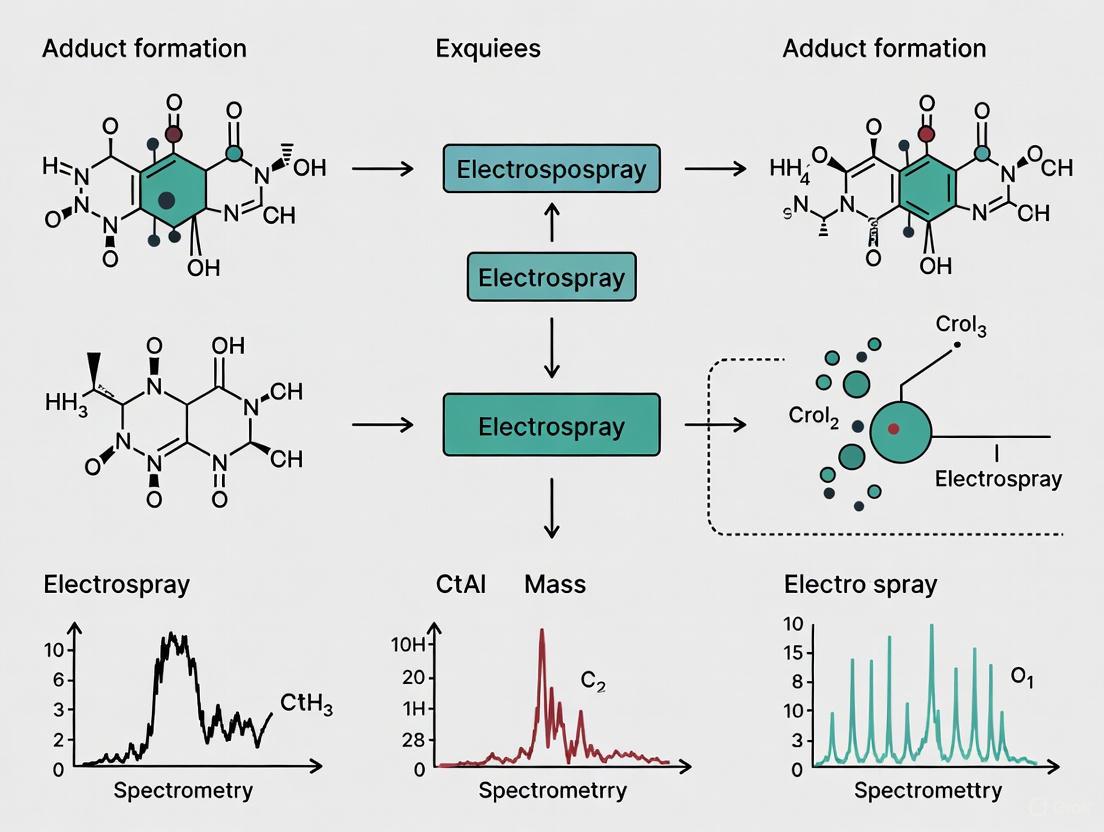
This article provides a thorough examination of adduct formation in Electrospray Ionization Mass Spectrometry (ESI-MS), a critical phenomenon for researchers, scientists, and drug development professionals.
Adduct Formation in Electrospray Mass Spectrometry: A Comprehensive Guide from Fundamentals to Advanced Applications
Abstract
This article provides a thorough examination of adduct formation in Electrospray Ionization Mass Spectrometry (ESI-MS), a critical phenomenon for researchers, scientists, and drug development professionals. It explores fundamental mechanisms and common adduct species, details methodological applications for enhancing analytical capabilities, offers practical troubleshooting strategies for sensitivity and contamination issues, and presents validation techniques through comparative analysis with other ionization methods. By synthesizing current research and practical guidelines, this resource aims to empower professionals to strategically control, exploit, and troubleshoot adduct formation to improve data quality and analytical outcomes in biomedical and clinical research.
The What and Why of ESI Adducts: Core Mechanisms and Common Species
In electrospray ionization mass spectrometry (ESI-MS), the ionized species observed extend far beyond the simple protonated molecule [M+H]+ or deprotonated molecule [M-H]-. According to IUPAC recommendations, adduct ions are defined as "ions formed by the interaction of a precursor ion with one or more atoms or molecules to form an ion containing all the constituent atoms for the precursor ion as well as the additional atoms from the associated atoms or molecules" [1]. These adducts form through the association of the analyte (M) with various cations, anions, or neutral molecules present in the sample solution or mobile phase. In the context of electrospray research, understanding adduct formation is crucial as these species represent a fundamental aspect of the ionization mechanism, influencing everything from detection sensitivity to spectral interpretation [1] [2]. The formation of adducts is not merely an artifact but a complex process governed by equilibria in charged nanodroplets, which can be manipulated to analytical advantage but is often difficult to control [3] [2]. This technical guide delves into the nature, formation, and implications of adduct ions, providing researchers and drug development professionals with a comprehensive framework for leveraging these species in analytical methodologies.
Adduct Ion Formation Mechanisms and Electrospray Fundamentals
The Electrospray Ionization Process and Droplet Chemistry
Electrospray ionization operates by applying a high voltage to a liquid sample, dispersing it into a mist of highly charged droplets at atmospheric pressure [4] [5]. As these droplets travel towards the mass spectrometer inlet, solvent evaporation leads to droplet shrinkage and an increasing surface charge density. Eventually, the electric field strength within the charged droplet reaches a critical point where ions at the surface are ejected into the gaseous phase [5]. This soft ionization technique is particularly effective for polar, nonvolatile, and thermally labile molecules, including large biomolecules, as it produces gas-phase ions with minimal fragmentation [4]. The process preserves very weak noncovalent interactions in the gas phase and enables the analysis of high molecular weight compounds through the generation of multiply charged ions, which reduces their mass-to-charge ratio (m/z) to within the measurable range of common mass analyzers [4].
Competitive Equilibria Governing Adduct Formation
The specific ions observed in an ESI mass spectrum result from several competing equilibria established within the charged droplets. These equilibria involve the analyte and various cationic or anionic species present in the solution. The following diagram illustrates the key pathways leading to the formation of protonated molecules and common adduct ions.
The dominant pathway for a given analyte depends on multiple factors, including the proton affinity of the analyte relative to the solvent, the concentration and binding constants of available cations, and the surface activity of the resulting charged species [2]. The final observed mass spectrum reflects the sum of these competitive processes, with the relative abundance of each ion species providing insights into the underlying equilibria.
Comprehensive Taxonomy of Common Adduct Ions
Positive Ion Mode Adducts
In positive ion mode ESI-MS, analytes typically form adducts with cations. The most prevalent adducts arise from ubiquitous species such as protons, sodium, potassium, and ammonium ions, but many other adduct types are possible depending on the solution composition.
Table 1: Common Adduct Ions in Positive Ion Mode ESI-MS
| Adduct Ion | Nominal Mass Shift | Exact Mass Shift (Da) | Notes |
|---|---|---|---|
[M+H]+ |
M+1 | M+1.007276 | Most common ion in positive mode |
[M+NH4]+ |
M+18 | M+18.03382 | Common with ammonium additives |
[M+Na]+ |
M+23 | M+22.989218 | From glassware or salts |
[M+CH3OH+H]+ |
M+33 | M+33.033489 | Solvent-mediated adduct |
[M+K]+ |
M+39 | M+38.9632 | From buffers or impurities |
[M+CH3CN+H]+ |
M+42 | M+42.033823 | Solvent-mediated adduct |
[M+iPr+H]+ |
M+61 | M+61.06534 | With isopropanol solvent |
[M+DMSO+H]+ |
M+79 | M+79.02122 | With DMSO solvent |
[M+2Na]2+ |
M/2+23 | M/2+22.989218 | Doubly charged |
[M+H+Na]2+ |
M/2+12 | M/2+11.998247 | Doubly charged |
[M+2H]2+ |
M/2+1 | M/2+1.007276 | Common for peptides/proteins |
Negative Ion Mode Adducts
In negative ion mode, analytes typically form adducts with anions or undergo deprotonation. The specific adducts observed depend on the anions present in the mobile phase or sample.
Table 2: Common Adduct Ions in Negative Ion Mode ESI-MS
| Adduct Ion | Nominal Mass Shift | Exact Mass Shift (Da) | Notes |
|---|---|---|---|
[M-H]- |
M-1 | M-1.007276 | Most common ion in negative mode |
[M+Cl]- |
M+35 | M+34.969402 | Note M+37 isotope peak with ~1/4 intensity |
[M+CHO2]- |
M+45 | M+44.998201 | Formate adduct |
[M+CH3CO2]- |
M+59 | M+59.013851 | Acetate adduct |
[M+Br]- |
M+79 | M+78.918885 | Note M+81 isotope peak with ~equal intensity |
[M+CF3CO2]- |
M+113 | M+112.985586 | Trifluoroacetate adduct |
Analytical Implications of Adduct Formation in Research and Development
Challenges in Spectral Interpretation and Quantification
The formation of multiple adduct species presents both challenges and opportunities in analytical method development. From an interpretive standpoint, adduct formation complicates mass spectral analysis by producing multiple peaks for a single analyte, potentially leading to misinterpretation of results [1] [3]. This spectral complexity is particularly problematic in the analysis of complex mixtures, such as biological samples or herbal extracts, where peak capacity is already limited [6]. From a quantitative perspective, the distribution of an analyte's signal across multiple ionic forms can significantly reduce the sensitivity for any single species, potentially elevating limits of detection [2]. Furthermore, the reproducibility of adduct formation can be problematic, as minor variations in solvent composition, pH, or additive concentration can shift the equilibrium between different adduct forms, leading to inconsistent results between analyses [3] [2]. This is especially critical in regulated environments like pharmaceutical development, where method robustness is paramount.
Strategic exploitation of Adduct Formation
Despite these challenges, informed researchers can strategically exploit adduct formation to enhance analytical capabilities. For compounds with poor proton affinity or that are difficult to ionize via proton transfer, adduct formation with alternative cations can provide a sensitive detection pathway [2]. This approach has been successfully applied to diverse analyte classes, including sugars, steroids, and various explosives [2]. In structural elucidation studies, the controlled formation of specific adducts can produce informative fragmentation patterns that reveal molecular structure. For instance, sodium and ammonium adduct-targeted product ion scans have been used to profile polyoxypregnanes and their glycosides (POPs) in herbal and biological specimens [6]. The diagnostic fragmentation of these adduct ions provided structural information that complemented data from protonated molecules.
Methodological Control of Adduct Formation
Experimental Design for Adduct Manipulation
Controlling adduct formation requires careful consideration of mobile phase composition and additives. The selection of appropriate additives represents one of the most effective strategies for directing adduct formation toward a single dominant species, thereby simplifying spectral interpretation and improving quantitative performance.
Table 3: Mobile Phase Additives for Controlling Adduct Formation
| Additive | Typical Concentration | Effect on Adduct Formation | Application Notes |
|---|---|---|---|
| Formic Acid | 0.1% | Promotes [M+H]+ formation |
Common for positive mode; can sometimes enhance [M+Na]+ |
| Acetic Acid | 0.1% | Promotes [M+H]+ formation |
Less acidic alternative to formic acid |
| Ammonium Acetate | 5-10 mM | Promotes [M+NH4]+ or [M+H]+ |
Can suppress sodium adducts; volatile for LC-MS |
| Ammonium Formate | 5-10 mM | Promotes [M+NH4]+ or [M+H]+ |
Alternative to ammonium acetate |
| Methylamine | 1 mM | Promotes [M+CH3NH3]+ adducts |
Can enhance sensitivity for certain compounds |
| Trifluoroacetic Acid (TFA) | 0.1% | Strong [M+H]+ promotion |
Can cause ion suppression in ESI; use with caution |
| Alkylamines (C1-C12) | Variable | Forms [M+RNH3]+ adducts |
Chain length affects sensitivity; C6 often optimal |
Practical Workflow for Adduct Optimization
Developing a robust ESI-MS method requires a systematic approach to adduct optimization. The following diagram outlines a decision workflow for controlling adduct formation through mobile phase selection.
This workflow emphasizes an iterative approach to method development, where the initial screening with neutral mobile phases (e.g., water/acetonitrile without additives) provides a baseline understanding of the inherent adduction tendencies of the analyte [2]. Subsequent refinement through additive selection and concentration optimization allows researchers to steer the equilibrium toward the desired ionic form. The choice of additive should align with the analytical objectives—acidic modifiers generally promote [M+H]+ formation, ammonium salts can facilitate [M+NH4]+ adducts or [M+H]+, and alkylamines can create alternative adduction pathways for challenging analytes [2].
Case Studies in Pharmaceutical and Bioanalytical Applications
Adduct Formation in Selective Androgen Receptor Modulator (SARM) Analysis
Recent research on Selective Androgen Receptor Modulators (SARMs) containing nitrile functional groups revealed extensive adduct formation in ESI-MS, significantly impacting detection sensitivity and potentially leading to misinterpretation of analytical results [3]. This study systematically investigated mobile phase additives as a means to control adduct formation, identifying for the first time the formation of chloride adducts in SARM analysis [3]. Through a series of method development experiments, researchers evaluated various mobile phase combinations to achieve optimal HPLC-MS conditions, comparing adduct formation across different grades of water used for mobile phase preparation. The findings demonstrated that appropriate additive selection could dramatically reduce spectral complexity and improve quantitative reliability, essential for investigating the illicit use of these compounds in horse racing [3].
Covalent Protein-Drug Adduct Detection in Targeted Covalent Inhibitor Development
In pharmaceutical development, particularly for Targeted Covalent Inhibitors (TCIs), the direct detection of covalent protein-drug adducts provides critical evidence of the intended mechanism of action [7]. Mass spectrometric analysis has become an indispensable tool for confirming covalent adduct formation between electrophilic warheads in drug candidates and nucleophilic amino acid residues in protein targets [7]. The shift from considering covalent inhibition as a liability to actively designing TCIs has necessitated robust analytical methods for verifying covalent adduct formation. These methods must distinguish covalent adducts from noncovalent complexes, often requiring analysis under denaturing conditions that disrupt noncovalent interactions while preserving covalent bonds [7]. For reversible covalent inhibitors—an emerging class with compounds like nirmatrelvir (Paxlovid) and rilzabrutinib—detection presents additional challenges as standard sample preparation conditions may induce dissociation of the reversible covalent ligand [7].
The Scientist's Toolkit: Essential Reagents for Adduct Research
Table 4: Key Research Reagent Solutions for Adduct Studies
| Reagent / Solution | Function in Adduct Research | Application Context |
|---|---|---|
| Ammonium Acetate/Formate | Volatile buffer that promotes [M+NH4]+ adducts or [M+H]+ |
LC-MS mobile phase additive to suppress sodium adducts |
| Alkylamine Additives | Forms alternative [M+RNH3]+ adducts for difficult-to-ionize compounds |
Enhancing sensitivity for analytes with low proton affinity |
| Acid Modifiers (Formic, Acetic) | Promotes [M+H]+ formation through solution acidification |
Positive ion mode ESI for basic compounds |
| High-Purity Solvents/Water | Minimizes unintentional adduct formation from ionic impurities | Essential for reproducible adduct formation across experiments |
| Metal Salts (Na, K) | Intentional formation of specific metal adducts for structural studies | Method development for adduct-targeted fragmentation |
| Collision-Induced Dissociation (CID) Gases | Fragmentation of adduct ions for structural characterization | Tandem MS experiments for structural elucidation |
Adduct ions represent a fundamental aspect of electrospray ionization mass spectrometry that extends far beyond the conventional protonated molecule. Within electrospray research, understanding the mechanisms governing adduct formation—the competitive equilibria in charged droplets, the influence of mobile phase composition, and the structural factors affecting adduct stability—provides researchers with powerful levers for analytical method control. Rather than viewing adduct formation as an inconvenient artifact, scientists can strategically exploit these phenomena to address challenging analytical problems, from detecting poorly ionizable compounds to elucidating molecular structures through diagnostic fragmentation patterns. As ESI-MS continues to evolve as a cornerstone technique in pharmaceutical and bioanalytical research, mastery of adduct ion behavior will remain essential for developing robust, sensitive, and informative analytical methods. The experimental frameworks and methodological principles outlined in this technical guide provide a foundation for advancing this understanding and applying it to cutting-edge research in drug development and beyond.
Electrospray Ionization (ESI) is a cornerstone soft ionization technique in modern mass spectrometry, renowned for its ability to produce gas-phase ions of thermally labile and large supramolecules without significant fragmentation [4]. This preservation of molecular integrity is crucial for analyzing biological macromolecules such as proteins and nucleic acids, which would be destroyed by more traditional, harsher ionization methods. The "soft" nature of ESI results from the gentle process of ion formation, where a very little amount of residual energy is retained by the analyte, allowing even very weak noncovalent interactions to be preserved in the gas phase [4].
A defining feature of ESI, especially for large biomolecules, is its propensity to generate multiply charged ions [4]. Instead of producing a single ion by removing one electron or proton, ESI can add multiple protons to a single large molecule. This multiple charging has a profound effect: it reduces the mass-to-charge ratio (m/z) of the resulting ions, thereby bringing them within the detectable mass range of common mass analyzers. This capability was groundbreaking, transforming mass spectrometry from a tool for small molecules into an essential technology for proteomics and the study of other biological macromolecules [4]. Within this specific ESI environment—characterized by minimal fragmentation and the presence of multiple charges—the phenomenon of adduct formation readily occurs. Adducts are species formed by the non-covalent attachment of ions or molecules from the solvent or mobile phase (e.g., sodium, potassium, ammonium, or chloride) to the analyte ion. While sometimes problematic for interpretation, the study of these adducts also provides a window into the ionization mechanism and the chemical properties of the analyte.
The ESI Process and the Mechanism of Multiple Charging
The Three-Stage Mechanism of ESI
The formation of ions in ESI is not an instantaneous event but a multi-stage process that transforms ions from solution into gas-phase ions suitable for mass analysis [8]. This process can be broken down into three critical stages, as illustrated in the diagram below.
- Droplet Formation: A dilute analyte solution is injected through a metal capillary (needle) at a low flow rate. A high voltage (typically 2-6 kV) applied to the capillary tip, relative to a nearby counter-electrode, disperses the liquid into a fine aerosol of charged droplets [4] [8]. A coaxial flow of dry nitrogen gas (nebulizing gas) is often used to assist in directing the spray and initiating solvent evaporation.
- Droplet Desolvation: As the charged droplets travel towards the mass spectrometer inlet, the solvent continuously evaporates, assisted by a flow of heated dry gas (drying gas) [4]. This evaporation reduces the droplet's size while its charge remains constant, leading to a dramatic increase in the droplet's surface charge density.
- Gas Phase Ion Formation: When the electrostatic repulsion within the droplet (Rayleigh limit) overcomes its surface tension, it undergoes Coulombic fission, splitting into smaller, offspring droplets [8]. This cycle of evaporation and fission repeats until the droplets are exceedingly small. Ultimately, the mechanism by which the final bare ion is released into the gas phase is theorized to be through one of two models: the Charge Residue Model (CRM), which posits that repeated fission events eventually leave a single, multiply charged analyte ion where the droplet once was, or the Ion Evaporation Model (IEM), which suggests that individual ions are desorbed or "evaporated" directly from the highly charged surface of the nanodroplet [4].
The Origin and Impact of Multiple Charging
The multiple charging observed in ESI, particularly for large molecules like proteins, is a direct consequence of the ionization mechanism. In positive ion mode, protons from the acidic solution can readily add to basic sites on the analyte molecule (e.g., amino groups in lysine, arginine, and the N-terminus of peptides). Because a single large biomolecule can have many such sites, it can accommodate multiple protons, becoming a multiply charged cation, [M+nH]ⁿ⁺ [4]. The distribution of these charge states in the mass spectrum is not random; it is influenced by the molecule's three-dimensional structure, with more unfolded, denatured states typically yielding higher charge states due to greater exposure of basic sites.
The primary benefit of multiple charging is the reduction of the m/z ratio. For example, a 50,000 Da protein acquiring 50 protons has an m/z of approximately 1,000, well within the range of most commercial mass analyzers. This allows for the accurate mass determination of very large molecules using instruments with limited m/z ranges [4].
Adduct Formation in the ESI Environment
The Nature and Challenge of Adducts
In the context of ESI-MS, an adduct is an ion formed by the non-covalent association of the analyte ion (e.g., [M+H]⁺) with another ion or neutral molecule present in the spray solution, such as a mobile phase additive or a buffer component. Common examples include sodium ([M+Na]⁺), potassium ([M+K]⁺), ammonium ([M+NH₄]⁺), and formate ([M+HCOO]⁻) adducts. The formation of these adducts is a widespread phenomenon that can complicate mass spectral interpretation by dispersing the signal for a single analyte across multiple m/z values, thereby adversely impacting sensitivity and potentially causing misinterpretation of results [3].
The stability and prevalence of an adduct are not arbitrary; they are governed by specific physicochemical principles. A key model for understanding adduct stability, particularly for multiply charged ions, is the proton-bound mixed dimer model. This model suggests that an adduct, such as [M – H + Anion]⁻, can be conceptualized as [M – H]⁻···H⁺···[Anion]⁻, where the proton is shared between the deprotonated analyte and the attaching anion. The maximum stability for such a structure is achieved when the two anions have approximately equivalent gas-phase basicities (GB) [9]. If their GBs are too dissimilar, the proton will preferentially reside with the more basic species, leading to the dissociation of the adduct.
A Model for Multiply Charged Adduct Formation
Research has shown that the formation of multiply charged adducts in negative ion ESI follows a predictable pattern based on the relationship between the charge state of the peptide and the gas-phase basicity of the attaching anion. A seminal study using [Glu] Fibrinopeptide B demonstrated this relationship systematically [9].
The peptide was introduced via ESI with various ammonium salts (NH₄X, where X = HSO₄⁻, I⁻, CF₃COO⁻, NO₃⁻, Br⁻, Cl⁻, etc.). The observed adduct formation revealed a clear trend:
- Lower GB anions (e.g., HSO₄⁻, GB = 1265.0 kJ/mol) formed stable adducts predominantly at lower charge states (-1 and -2).
- Medium GB anions (e.g., NO₃⁻ and Br⁻, GB ~1330 kJ/mol) formed adducts only at the -2 charge state.
- Higher GB anions (e.g., Cl⁻, GB = 1373.6 kJ/mol) could form adducts at higher charge states, including the -3 charge state.
- Anions with very high GBs (e.g., CH₃COO⁻) formed no observable adducts at any charge state [9].
This behavior can be explained by considering the "apparent gas-phase basicity" (GBapp) of the proton-bearing sites on the peptide at different charge states. As the charge state of the peptide increases (becomes more negative), the Coulombic repulsion between sites makes it more difficult to remove a proton, effectively lowering the GBapp of the remaining sites. Therefore, a higher charge state peptide can only stabilize an adduct with a higher GB anion that can effectively match the lowered GBapp of its sites [9]. The inverse is true for lower charge states. This charge-state-dependent matching of GBapp is summarized in the diagram below.
Table 1: Quantitative Data on Anion Adduct Formation with [Glu] Fibrinopeptide B [9]
| Anion | Gas-Phase Basicity (GB, kJ/mol) | Observed Adduct Charge States | Relative Adduct Stability |
|---|---|---|---|
| HSO₄⁻ | 1265.0 ± 10.0 | -1, -2 | Forms adducts at lower charge states; can also form adducts with neutral H₂SO₄. |
| I⁻ | 1293.7 ± 0.84 | -1, -2 | Singly charged adduct decreases relative to HSO₄⁻. |
| NO₃⁻ | 1329.7 ± 0.84 | -2 | Adducts form only at the -2 charge state. |
| Br⁻ | 1331.4 ± 4.6 | -2 | Adducts form only at the -2 charge state. |
| Cl⁻ | 1373.6 ± 8.4 | -2, -3 | Can form adducts at the -3 charge state, unlike lower GB anions. |
| CH₃COO⁻ | ~1420 (est.) | None | Too high GB; no observable adducts formed. |
This model has been corroborated by other studies. For instance, research on Selective Androgen Receptor Modulators (SARMs) containing nitrile functional groups reported significant and complicated adduct formation, including the first evidence of chloride adduct formation in ESI-MS. This study further highlighted that the choice of mobile phase additives and even the grade of water used could drastically influence the type and extent of adducts observed, underscoring the need for careful control of the ESI environment [3].
Experimental Protocols for Studying ESI Adducts
To provide a concrete example of how adduct formation is investigated, the following section details a key experimental methodology from the literature.
Detailed Protocol: Investigating Peptide-Anion Adducts
This protocol is adapted from a fundamental study on multiply charged adduct formation between peptides and anions in negative ion ESI-MS [9].
Objective: To elucidate the mechanism of multiple adduct formation and characterize the stability of peptide-anion complexes based on anion gas-phase basicity and peptide charge state.
Materials and Reagents:
- Model Peptides: [Glu] Fibrinopeptide B (sequence: EGVNDNEEGFFSAR) and ACTH 22–39 (sequence: VYPNGAEDESAEAFPLEF). These hydrophilic peptides were chosen for their known sequences and mix of acidic/basic sites.
- Anion Sources: A series of ammonium salts (NH₄X), including X = HSO₄⁻, I⁻, CF₃COO⁻, NO₃⁻, Br⁻, Cl⁻.
- Solvent: Pure methanol solution.
- Instrumentation: A Fourier Transform Ion Cyclotron Resonance (FT-ICR) mass spectrometer, chosen for its high mass resolution and accuracy, which is essential for confidently identifying the composition of multiply charged adducts.
Sample Preparation:
- Prepare a stock solution of the model peptide (e.g., 3.2 μM [Glu] Fibrinopeptide B) in pure methanol.
- Prepare stock solutions of the ammonium salts (e.g., 64 μM) in methanol.
- Mix the peptide solution with the ammonium salt solutions to achieve the desired final concentrations for analysis. A control sample with no added salt is essential.
ESI-MS Analysis Conditions:
- Ion Mode: Negative ion ESI.
- Capillary Exit/Skimmer Voltages: Set to soft conditions (e.g., -35 V and -1.7 V, respectively) to promote adduct formation and minimize collisional-induced dissociation in the source region.
- Other Parameters: Follow standard instrument tuning procedures for optimal signal for the peptides of interest.
Data Interpretation:
- Identify the charge state distribution of the "bare" peptide (without added salts) from the control sample.
- For each ammonium salt addition, identify all new peaks corresponding to peptide-anion adducts (e.g., [Peptide + nX]ⁿ⁻) and note their charge states.
- Correlate the observed adduct charge states with the known gas-phase basicity of the anion (see Table 1).
- The key finding to validate is whether higher GB anions form stable adducts predominantly at higher negative charge states of the peptide.
The Scientist's Toolkit: Key Reagents for ESI Adduct Research
Table 2: Essential Research Reagents for ESI Adduct Studies
| Reagent / Material | Function in Experiment | Example & Notes |
|---|---|---|
| Ammonium Salts (NH₄X) | Source of anions (X⁻) for adduction studies. Allows systematic variation of anion identity. | NH₄Cl, NH₄Br, NH₄H₂PO₄, NH₄HSO₄. Ammonium is volatile and avoids persistent salt contamination [9]. |
| Model Peptides | Well-characterized analytes with known sequences and protonation/deprotonation sites. | [Glu] Fibrinopeptide B, ACTH fragments. Their defined structure allows mechanistic insights [9]. |
| High-Purity Solvents | Mobile phase for ESI; impurities can cause unintended adducts. | HPLC-grade methanol, acetonitrile, water. High-grade water is critical, as chloride impurities are common [3]. |
| Mobile Phase Additives | Modify the ESI environment to control or suppress adduct formation. | Acids, bases, volatile buffers (ammonium formate/acetate). Concentration and type are critical variables [3]. |
| FT-ICR or High-Resolution Mass Spectrometer | Analyzer for accurately identifying the composition of multiply charged adducts. | Provides the high mass resolution needed to distinguish between closely related adduct species [9]. |
Electrospray Ionization creates a unique environment defined by its soft ionization character and the production of multiply charged ions. Within this environment, adduct formation is not a random artifact but a chemically governed process. The stability of these adducts, particularly for multiply charged analytes, is determined by a matching of the apparent gas-phase basicity of the analyte's charge sites with the gas-phase basicity of the attaching ion. This understanding, derived from systematic studies, provides researchers with a predictive framework. By carefully controlling experimental conditions—such as the choice of mobile phase additives, solvent purity, and instrument parameters—scientists can mitigate the confounding effects of adducts or strategically exploit them to glean information about analyte properties and ionization mechanisms. As ESI-MS continues to be a pivotal tool in drug development, proteomics, and metabolomics, a deep understanding of adduct formation remains essential for accurate data interpretation and method development.
In electrospray ionization mass spectrometry (ESI-MS), the formation of adduct ions is a fundamental ionization mechanism rather than an anomaly. Adduct ions are defined as ions formed by the interaction of a precursor ion with one or more atoms or molecules to form an ion containing all the constituent atoms of the precursor ion as well as the additional atoms from the associated atoms or molecules [1]. Within the context of electrospray research, understanding adduct formation is crucial for accurate molecular identification, sensitivity optimization, and methodological development. The controlled formation of adducts can significantly enhance detection capabilities for compounds that are otherwise challenging to analyze, such as those lacking easily ionizable functional groups [2]. This technical guide provides a comprehensive catalog of the most prevalent adducts observed in ESI-MS analyses, along with experimental frameworks for their predictable generation and application in pharmaceutical and biochemical research.
Core Principles of Adduct Formation in ESI
Electrospray ionization operates through the generation of charged droplets from a liquid sample, followed by droplet desolvation and gas-phase ion release. The specific ions observed in the mass spectrum result from a series of equilibria occurring within the ESI droplets and at their surfaces [2]. The process can be summarized by several key equilibria, combining both liquid-phase and gas-phase processes:
- M ⇄ [M + H]⁺ (Protonation)
- M ⇄ [M + Na]⁺ (Sodium Adduct Formation)
- M ⇄ [M + NH₄]⁺ (Ammonium Adduct Formation)
These equilibria coexist, and the dominant species observed depends on factors including the chemical properties of the analyte, the composition of the mobile phase, and the presence of various cationic species in the solution [2]. The surface activity of the resulting ion and its hydrophobicity also play significant roles in determining which adducts are preferentially observed in the mass spectrum [2]. While adduct formation is a powerful tool for ionization, the formation of multiple adducts for a single analyte can split the ion signal, potentially reducing sensitivity and complicating spectral interpretation [2].
Catalog of Common Adducts
The following sections provide a detailed catalog of the most frequently encountered adducts in ESI-MS, organized by ionization mode. The tables include both nominal mass shifts and exact mass additions, the latter being critical for high-resolution mass spectrometry applications.
Common Adducts in Positive Ion Mode
Table 1: Singly Charged Positive Ion Mode Adducts
| Adduct Ion | Nominal Mass Change | Exact Mass Change (Da) |
|---|---|---|
| [M + H]⁺ | M + 1 | M + 1.007276 |
| [M + NH₄]⁺ | M + 18 | M + 18.033823 |
| [M + Na]⁺ | M + 23 | M + 22.989218 |
| [M + CH₃OH + H]⁺ | M + 33 | M + 33.033489 |
| [M + K]⁺ | M + 39 | M + 38.963158 |
| [M + ACN + H]⁺ | M + 42 | M + 42.033823 |
| [M + 2Na - H]⁺ | M + 45 | M + 44.971160 |
Table 2: Multiply Charged and Dimer Adducts in Positive Mode
| Adduct Ion | Formula for m/z Calculation | Charge |
|---|---|---|
| [M + 2H]²⁺ | M/2 + 1.007276 | 2+ |
| [M + H + Na]²⁺ | M/2 + 11.998247 | 2+ |
| [M + 2Na]²⁺ | M/2 + 22.989218 | 2+ |
| [2M + H]⁺ | 2M + 1.007276 | 1+ |
| [2M + Na]⁺ | 2M + 22.989218 | 1+ |
| [2M + K]⁺ | 2M + 38.963158 | 1+ |
Common Adducts in Negative Ion Mode
Table 3: Common Negative Ion Mode Adducts
| Adduct Ion | Nominal Mass Change | Exact Mass Change (Da) | Notes |
|---|---|---|---|
| [M - H]⁻ | M - 1 | M - 1.007276 | |
| [M + Cl]⁻ | M + 35 | M + 34.969402 | Look for M+37 isotope peak at ~1/4 intensity |
| [M + CHO₂]⁻ (Formate) | M + 45 | M + 44.998201 | |
| [M + CH₃CO₂]⁻ (Acetate) | M + 59 | M + 59.013851 | |
| [M + Br]⁻ | M + 79 | M + 78.918885 | Look for M+81 isotope peak at similar intensity |
Statistical analysis of mass spectral libraries reveals that the hydrogen adduct is the most predominant across databases. In positive mode, [M + H]⁺ accounts for approximately 74.0% of observed adducts, while in negative mode, [M - H]⁻ accounts for about 80.7% [10].
Experimental Protocols for Controlling Adduct Formation
The ability to manipulate adduct formation is a powerful tool for optimizing ESI-MS analyses. The following experimental parameters are key levers for controlling the observed ion species.
The Role of Mobile Phase Additives
Mobile phase additives are a highly effective measure for manipulating adduct formation efficiencies. An appropriate choice of additive can increase sensitivity by up to three orders of magnitude [2]. The additives influence the equilibria in the ESI droplets by providing specific cations or anions, or by modifying the solution pH.
Table 4: Common Mobile Phase Additives and Their Effects
| Additive | Typical Concentration | Primary Effect on Adduct Formation |
|---|---|---|
| Formic Acid | 0.1% | Promotes [M+H]+ formation; common for positive mode. |
| Acetic Acid | 0.1% | Similar to formic acid, slightly less acidic. |
| Ammonium Acetate | 1-10 mM | Can promote [M+NH4]+ in positive mode; [M+CH3CO2]- in negative mode. |
| Ammonia | 0.1% | Creates basic conditions, can suppress positive ionization and promote [M-H]-. |
| Trifluoroacetic Acid (TFA) | 0.1% | Strong ion-pairing agent; can suppress ionization but useful for separation. |
| Lithium Chloride | Post-column infusion | Promotes formation of lithium adducts [M+Li]+ for specific applications like lipidomics [11]. |
| Alkylamines (e.g., Methylamine) | 1 mM | Can suppress multiple adduct formation, promoting a single [M+RNH3]+ species [2]. |
Protocol: Systematic Optimization of Mobile Phase for Adduct Control
- Initial Scouting: Begin with a standard mobile phase of water/acetonitrile without additives to observe the native adduct formation pattern of your analyte.
- Additive Selection for [M+H]⁺ Enhancement: To favor the formation of [M+H]⁺, add a volatile acid such as 0.1% formic acid or acetic acid to the aqueous phase. This increases the proton availability in the droplets.
- Additive Selection for Specific Cationic Adducts: To promote adducts like [M+Na]⁺ or [M+NH₄]⁺, consider additives that provide a source of the desired cation. For example, ammonium acetate can be a source for NH₄⁺. Note that sodium is often ubiquitous from glassware or solvent impurities, but its formation can be significantly influenced by mobile phase properties [2].
- Evaluation and Repeatability Assessment: Analyze the sample with the modified mobile phase. Monitor the signal intensity of the desired adduct and the overall signal-to-noise ratio. The use of additives has been shown to improve the repeatability of adduct formation efficiencies compared to additive-free mobile phases [2].
- Troubleshooting Multiple Adducts: If the formation of multiple adducts (e.g., simultaneous [M+H]⁺, [M+Na]⁺, and [M+K]⁺) splits the signal and reduces sensitivity, consider testing alkylamine additives like methylamine. These can form a single dominant [M+RNH₃]⁺ adduct, concentrating the signal into one species [2].
Addressing Unwanted Adducts and Contamination
Adduct formation is not always desirable and can stem from contamination.
- Source Investigation: Common sources of metal cations like Na⁺ and K⁺ include solvent impurities, leachates from glassware, and mobile phase additives [1] [2]. Contaminants from plasticizers (e.g., n-butyl benzenesulfonamide) or gases from nitrogen generators can also create persistent background ions and unexpected adducts [12].
- Mitigation Strategies: Using high-purity solvents and additives, periodic cleaning of the fluidic path, and installing appropriate filters on gas lines can help minimize contamination-related adducts.
Visualization of Adduct Formation and Control Pathways
The following diagram summarizes the key factors influencing adduct formation and the decision-making process for experimental control.
The Scientist's Toolkit: Research Reagent Solutions
Successful management of adduct formation relies on the use of specific reagents and computational tools.
Table 5: Essential Reagents and Tools for Adduct Research
| Tool or Reagent | Function/Description | Application in Adduct Research |
|---|---|---|
| Volatile Acids (Formic, Acetic) | Mobile phase additives to lower pH and increase proton concentration. | Promotes the formation of [M+H]+ in positive ion mode. |
| Ammonium Salts (e.g., Acetate, Formate) | Volatile salts used as mobile phase additives. | Source of ammonium ions for [M+NH4]+ formation; can also provide anions for negative mode. |
| Alkylamines (e.g., Methylamine) | Basic mobile phase additives. | Can consolidate signal into a single [M+RNH3]+ species, improving sensitivity and repeatability. |
| Lithium Salts (e.g., LiCl) | Post-column infusion reagents. | Promotes the formation of lithium adducts [M+Li]+, useful for analyzing neutral lipids like triglycerides [11]. |
| High-Purity Solvents | Water and organic solvents (ACN, MeOH) with minimal ionic contamination. | Reduces the formation of unpredictable metal adducts (e.g., [M+Na]+, [M+K]+) from impurities. |
| Mass Spectrometry Adduct Calculator (MSAC) | A Python-based tool for calculating expected m/z for a wide range of adducts. | Automates the prediction of potential adduct masses for compound identification, supporting custom adduct lists [10]. |
| ESI Adduct Calculator (Fiehn Lab) | An Excel-based tool for calculating adduct masses. | Provides a user-friendly interface for predicting common and less common adduct m/z values [13]. |
The predictable formation and interpretation of common adducts such as [M+H]⁺, [M+Na]⁺, [M+NH₄]⁺, and [M+K]⁺, along with their negative mode counterparts, are foundational skills in electrospray ionization research. By leveraging the detailed quantitative data, experimental protocols, and tools outlined in this guide, researchers and drug development professionals can transform adduct formation from an unpredictable variable into a controlled parameter. This control enables enhanced detection sensitivity, improved compound identification confidence, and more robust analytical methods. Mastery of adduct behavior is not merely about spectral interpretation; it is about actively designing mass spectrometric analyses to yield the most chemically informative and analytically precise results possible.
This technical guide explores the fundamental processes within electrospray ionization (ESI) that fundamentally influence the formation and detection of analyte adducts. The journey of a charged droplet—from its generation at the capillary tip to the release of gas-phase ions—is governed by the intertwined dynamics of solvent evaporation and Coulombic fission. These processes not only determine ionization efficiency but also directly promote chemical interactions that lead to adduction, a critical phenomenon in drug development and proteomic research. This paper synthesizes current experimental evidence and theoretical models to provide researchers with a mechanistic understanding of adduct formation, supported by quantitative data, detailed protocols, and analytical workflows for its study.
Electrospray Ionization (ESI) is a soft ionization technique that has revolutionized the analysis of macromolecules, particularly in the fields of proteomics and pharmaceutical science [4]. Its operation hinges on the production of a fine aerosol of charged droplets from an analyte solution, followed by sequential solvent evaporation and droplet disintegration until gas-phase ions are liberated. A pivotal, yet often complicating, feature of ESI is the propensity of analytes to form adducts—complexes where the analyte of interest is non-covalently or covalently bound to solvent molecules, salts, or other buffer components, or undergoes specific chemical modifications. These adducts manifest in the mass spectrum as additional peaks, which can be misinterpreted without a deep understanding of their origin.
Within the context of drug development, adduct formation takes on a more serious tone. Certain drugs can form reactive metabolites that covalently bind to proteins, a process linked to time-dependent enzyme inhibition and adverse drug reactions [14] [15]. Understanding the droplet lifecycle is therefore not merely an analytical exercise but a necessity for accurately interpreting mass spectrometric data, quantifying drug-protein interactions, and mitigating the risk of drug-induced toxicities.
The Core Mechanisms of the Droplet Lifecycle
The pathway from a liquid sample to a gas-phase ion is a cyclic process of evaporation and fission, culminating in ion release. The following diagram illustrates this core lifecycle.
Stage 1: Droplet Formation and Initial Evaporation
The ESI process begins when a high voltage (typically 2-6 kV) is applied to a metal capillary through which a dilute analyte solution is pumped. This strong electric field disperses the liquid into a fine aerosol of highly charged droplets [4]. These initial droplets are often larger and longer-lived than traditionally assumed, with documented sizes ranging from 2 μm to over 100 μm depending on the solvent, flow rate, and spray mode [16]. As these droplets travel towards the mass spectrometer inlet, the neutral solvent (e.g., methanol, water, acetonitrile) begins to evaporate, a process often assisted by a coaxial flow of heated drying gas [17] [4].
Stage 2: Coulombic Fission and the Rayleigh Limit
Solvent evaporation causes the droplet to shrink while its charge remains relatively constant. This leads to an increase in charge density on the droplet surface. Lord Rayleigh theoretically determined the maximum charge a droplet can sustain—the Rayleigh limit—where the electrostatic repulsion of the like charges equals the surface tension holding the droplet together [17]. Upon reaching this limit, the droplet becomes unstable and undergoes Coulomb fission [18] [17]. This fission event is not an explosion but a controlled disintegration where the parent droplet ejects smaller, progeny droplets.
Table 1: Characteristics of Coulombic Fission Events in Different Systems
| Droplet Type | Observed Fission Characteristics | Mass Loss per Fission | Charge Loss per Fission | Source |
|---|---|---|---|---|
| Pure Solvents (e.g., Water) | Successive fissions at similar normalized diameters; repeatable over droplet lifetime. | ~1.0 - 2.3% | ~10 - 18% | [18] [17] |
| Methanol | Average of 13.2 (±4.4) progeny droplets detected per fission event. | ~81% of net charge released via progeny droplets. | [19] | |
| Nanofluids (Water/Alumina) | Damped deformations; larger mass expelled; can split in half in extreme cases. | Larger than pure water | N/A | [18] |
Stage 3: Pathways to Gas-Phase Ions and Adducts
After multiple cycles of evaporation and fission, two primary models explain the final release of gas-phase ions, which directly informs adduct observation:
- Charge Residue Model (CRM): Proposed by Dole, this model suggests that the evaporating droplet undergoes fission cycles until a progeny droplet containing a single analyte molecule is formed. The final solvent molecules evaporate, leaving the analyte with the droplet's residual charge. This mechanism is generally accepted for large, folded proteins and can lead to the observation of multiple-charged ions and adducts with any non-volatile species present in the final droplet [17] [4].
- Ion Evaporation Model (IEM): This model posits that when the droplet radius becomes very small (e.g., ~10 nm), the electric field at its surface is strong enough to field-desorb solvated ions directly into the gas phase. This mechanism is thought to dominate for smaller ions and can also promote adduction if the desorbed ion is a complex rather than a bare analyte [17].
The journey of these droplets is remarkably robust; evidence shows that large, charged droplets can survive to penetrate deep into the vacuum stages of mass spectrometers, where their sudden disintegration can contribute to spectral noise and contamination [16].
Linking the Droplet Lifecycle to Adduct Formation
The conditions within an evaporating charged droplet create a unique microenvironment that actively promotes adduct formation through several mechanisms.
Concentration and Context Factors
As solvent evaporates, all non-volatile species in the droplet—including the analyte, buffers, salts, and drug metabolites—become increasingly concentrated. This elevated concentration dramatically increases the probability of interactions. For non-covalent adducts, this can mean the stabilization of quasi-molecular ions like [M+H]+ or [M+Na]+ [17]. For covalent chemistry, it provides the conditions necessary for reactive, short-lived species to encounter and modify proteins. This "context factor," driven by the physical chemistry of the droplet, is a critical element in drug hypersensitivity reactions, where a drug's metabolite forms a covalent adduct with a protein, haptenating it and triggering an immune response [15].
The Role of Coulombic Fissions in Partitioning
Coulombic fission events are not merely a means of droplet size reduction; they are active partitioning steps. During fission, the distribution of chemical species between the parent and progeny droplets is not necessarily even. A study on raloxifene, a drug that forms a reactive diquinone methide metabolite, highlights this. Researchers found that specific peptides in enzymes like CYP3A4 were modified on nucleophilic amino acids like cysteine. The use of stable isotope-labeled raloxifene (raloxifene-d4) allowed for precise quantification of these adducts, revealing significant interindividual variability in their formation in human liver microsomes [14]. This variability can be influenced by the fission process, which selectively concentrates certain ions in progeny droplets, thereby influencing which analytes are ultimately observed and the extent of their modification.
The following diagram outlines the pathway from drug incubation to the detection of a protein adduct, a key process in understanding drug-induced toxicities.
Experimental Protocols for Investigating Droplet Processes and Adduction
To study the phenomena described, researchers employ a range of techniques from direct droplet observation to proteomic analysis of adducts.
Protocol: High-Speed Imagery for Coulombic Fission Dynamics
This method directly characterizes the fission events of evaporating droplets [18].
- Objective: To measure droplet diameter and deformation dynamics during Coulombic fission for pure liquids and nanofluids.
- Materials:
- Electrodynamic balance or similar levitation apparatus.
- High-speed camera (capable of >10,000 fps).
- Syringe pump for controlled droplet generation.
- Laser light source for illumination and scatter measurement.
- Test solutions: pure water, methanol, or nanofluids (e.g., water/alumina).
- Procedure:
- A single droplet is levitated within the electrodynamic balance.
- The droplet is allowed to evaporate freely while being illuminated by a laser.
- The high-speed camera records the droplet's scatter signal and physical shape.
- The recording continues until the droplet reaches its Rayleigh limit and undergoes Coulomb fission.
- The video is analyzed to determine the normalized diameter at fission, the number of progeny droplets, and the deformation characteristics (e.g., axis ratio oscillations).
- Key Measurements: Time-resolved droplet size, fission diameter, progeny droplet count, and deformation damping (for nanofluids).
Protocol: Quantifying Drug-Protein Adducts via DIA Proteomics
This protocol details the methodology for identifying and quantifying covalent drug-protein adducts, as demonstrated in studies on raloxifene [14].
- Objective: To quantify the amount of covalent adducts formed between reactive drug metabolites and specific amino acid residues on target proteins.
- Materials:
- Enzyme source: Human Liver Microsomes (HLMs) or recombinant P450 supersomes.
- Model drug: e.g., Raloxifene or stable isotope-labeled variant (raloxifene-d4).
- LC-MS/MS system with ESI source.
- Proteomic software: Skyline for data analysis.
- Trypsin for protein digestion.
- Procedure:
- Incubation: HLMs or supersomes are incubated with the drug (and its isotope label) to allow for metabolic activation and adduct formation.
- Digestion: The protein mixture is denatured and digested with trypsin into peptides.
- LC-ESI-MS Analysis: The peptide mixture is separated by liquid chromatography and introduced into the mass spectrometer via an ESI source.
- Data Acquisition: Mass spectra are acquired using Data-Independent Acquisition (DIA) to fragment all ions within selected m/z windows.
- Data Analysis:
- Skyline is used to quantify modified and unmodified peptides.
- A clear retention time shift is used to identify adducted peptides.
- "Non-modifiable" peptides from the target protein are used to normalize and quantify the total protein amount across samples.
- The relative quantity of adducted peptides is compared to enzyme activity data to correlate adduct formation with functional inactivation.
The Scientist's Toolkit: Essential Reagents and Materials
Table 2: Key Research Reagents and Materials for ESI Droplet and Adduct Studies
| Item | Function/Application | Example Use Case |
|---|---|---|
| Electrodynamic Balance | Levitates a single droplet for isolated observation. | Studying Coulomb fission dynamics of isolated methanol droplets [19]. |
| High-Speed Camera | Captures rapid, time-resolved images of droplet deformation and fission. | Measuring progeny droplet production and deformation damping in nanofluids [18]. |
| Nanoelectrospray Emitter | A fine capillary tip for producing very small initial droplets at low flow rates. | Improving ionization efficiency and reducing initial droplet size in ESI-MS [17]. |
| Stable Isotope-Labeled Drug | Serves as an internal standard for precise quantification. | Differentiating and quantifying raloxifene vs. raloxifene-d4 protein adducts [14]. |
| Data Analysis Software (Skyline) | Open-source software for quantitative proteomic data analysis. | Quantifying drug-adducted peptides from DIA LC-MS/MS runs [14]. |
| Human Liver Microsomes (HLMs) | A complex enzyme source containing human drug-metabolizing enzymes. | Studying metabolic activation of drugs and subsequent protein adduction in a physiologically relevant system [14]. |
The lifecycle of a charged droplet in ESI—from formation through evaporation to Coulombic fission—is far from a simple desolvation process. It is a dynamic sequence of events that creates a unique reaction vessel where concentration, charge, and physical instability converge to promote the formation of both non-covalent and covalent adducts. For researchers in drug development, a mechanistic understanding of this lifecycle is paramount. It provides the framework for explaining why adducts form, predicting their impact on analytical results, and ultimately, for designing better drugs and analytical methods to minimize undesirable reactions. As ESI continues to be a cornerstone of modern analytical chemistry, appreciating the intricate journey of the droplet remains essential for accurate data interpretation and innovation in biomedical research.
Electrospray Ionization (ESI) has established itself as a cornerstone technique in modern mass spectrometry, particularly for the analysis of large, non-volatile, and thermally labile molecules. A fundamental aspect of the ESI process is the formation of adduct ions, which are defined as ions formed by the interaction of a precursor ion (the analyte) with one or more atoms or molecules, containing all the constituent atoms of the original analyte plus the adducted species [1]. In the context of ESI, this phenomenon is not merely a side effect but is often the very mechanism by gas-phase ions are produced from solution. The formation and behavior of these adducts can be strategically categorized into two distinct classes: intended adducts, which are deliberately promoted through method development to enhance ionization efficiency, spectral quality, and quantitative accuracy; and unintended adducts, which arise from ubiquitous contaminants in solvents, samples, and laboratoryware, often leading to spectral complexity and analytical inaccuracies. This guide delves into the core principles, strategies, and practical methodologies for mastering adduct formation, framing it within the broader thesis that a deep understanding of this process is not optional but essential for robust electrospray research and development.
The following diagram outlines the core strategic decision-making process for managing adduct formation, helping researchers navigate between intentional and unintentional adduct scenarios.
Fundamental Mechanisms and Types of Adduct Ions
The formation of adduct ions in ESI is primarily governed by the interactions between the analyte and various species present in the electrospray droplet. The charged-residue mechanism (CRM) is particularly relevant for larger molecules and complexes, where the evaporation of solvent from a charged droplet culminates in a gas-phase ion that incorporates adducted species from the original solution [20]. The nature of the adduct is heavily influenced by the ionization mode.
Table 1: Common Adduct Ions in Electrospray Mass Spectrometry
| Ion Mode | Adduct Ion | Nominal Mass Change | Exact Mass Change (Da) | Primary Use Case |
|---|---|---|---|---|
| Positive | [M+H]⁺ | M + 1 | M + 1.007276 | Default for basic analytes |
| [M+NH₄]⁺ | M + 18 | M + 18.03382 | Alternative for non-basic polar analytes | |
| [M+Na]⁺ | M + 23 | M + 22.989218 | Common unintended adduct; also intentional | |
| [M+K]⁺ | M + 39 | M + 38.9632 | Common unintended adduct; also intentional | |
| [M+Li]⁺ | M + 7 | M + 6.941 | Intentional for lipids in normal-phase LC | |
| Negative | [M-H]⁻ | M - 1 | M - 1.007276 | Default for acidic analytes |
| [M+Cl]⁻ | M + 35 | M + 34.969402 | Intentional or from buffer | |
| [M+CHO₂]⁻ | M + 45 | M + 44.998201 | Formate adduct from buffer | |
| [M+CH₃CO₂]⁻ | M + 59 | M + 59.013851 | Acetate adduct from buffer | |
| [M+Br]⁻ | M + 79 | M + 78.918885 | Intentional additive |
In positive ion mode, the most common adduct is the protonated molecule [M+H]⁺. However, cations such as ammonium (NH₄⁺), sodium (Na⁺), and potassium (K⁺) readily form [M+Na]⁺, [M+K]⁺, and [M+NH₄]⁺ adducts [1]. As demonstrated in the penicillin G case study, more complex adducts like [M+2K-H]⁺ can also form, where one metal cation displaces an acidic proton and another adducts to a basic site [21]. In negative ion mode, deprotonation to form [M-H]⁻ is typical, but adducts with anions like chloride ([M+Cl]⁻) or formate ([M+CHO₂]⁻) are also frequently observed [1]. The strategic use of anions with low proton affinity, such as bromide (Br⁻) or iodide (I⁻), has been shown to mitigate ionization suppression in complex matrices by facilitating the removal of excess sodium ions, thereby reducing chemical noise [20].
Strategic Intentional Adduct Formation for Analytical Enhancement
Enhancing Ionization Efficiency and Signal Response
Intentional adduct formation is a powerful tool for analytes with poor proton affinity or that are challenging to ionize via traditional pathways. A prominent example is the analysis of lipids under normal-phase liquid chromatography (NPLC) conditions, where the non-polar solvents are incompatible with standard ESI. A validated solution is the post-column addition of lithium chloride (LiCl) in water-isopropanol, which promotes the formation of lithium adducts [M+Li]⁺ [11]. This approach provides access to molecular ion information for neutral lipids like triacylglycerols (TG) and sterol esters (SE), which otherwise fragment heavily or ionize poorly under APCI. The lithium adducts also yield structurally informative fragmentation patterns in MS² and MS³ experiments [11].
Another powerful strategy is ammonium salt doping, particularly with ammonium fluoride (NH₄F). Studies across multiple MSI techniques, including IR-MALDESI, MALDI, and nano-DESI, have reported significant increases in ion abundance for a range of biomolecules. The proposed mechanism involves the highly electronegative fluoride ion capturing protons to facilitate the formation of [M-H]⁻ ions in negative mode [22]. The effect is pronounced; nano-DESI-MSI observed a 10–110-fold signal increase for various lipid classes using a 500 µM NH₄F dopant [22]. The atomic properties of the halide play a critical role, with the smaller, more electronegative fluoride (compared to Cl⁻, Br⁻, I⁻) resulting in the largest signal enhancement, likely due to its positioning in the ESI droplet interior and its stronger interactions with water clusters [22].
Controlling Adduct Distribution for Quantitative Accuracy
Perhaps the most critical application of intentional adduction is to force the analyte signal into a single, dominant ion species, thereby improving quantitative accuracy and reliability. The case study of penicillin G, a potassium salt, is a quintessential example. Initial analysis in acetonitrile/water without additives showed no [M+H]⁺ signal (m/z 335) but a dominant [M+K]⁺ peak (m/z 373) and a second intense peak at m/z 411, identified as the [M+2K-H]⁺ adduct [21]. This distribution is problematic for quantification, as the efficiency of ion formation could vary with the sample's inherent potassium content.
The research team systematically tested two additive strategies, summarized in the workflow below.
The results, summarized in the table below, demonstrate that while acidification successfully produced the protonated molecule, the addition of potassium acetate to drive the formation of a single, intense metal adduct provided the best quantitative ion [21].
Table 2: Optimization Results for Penicillin G Analysis via ESI-MS
| Ion Species | Theoretical m/z | Relative Intensity (No Additive) | Relative Intensity (0.2% Formic Acid) | Relative Intensity (50 µM Potassium Acetate) |
|---|---|---|---|---|
| [M+H]⁺ | 335 | 0% | 100% | 0% |
| [M+K]⁺ | 373 | 100% | 5% | 2% |
| [M+2K-H]⁺ | 411 | 80% | 10% | 100% (Highest Intensity) |
Managing Unintended and Problematic Adduct Formation
Unintended adducts predominantly manifest as metal ion adducts, notably with sodium ([M+Na]⁺) and potassium ([M+K]⁺), which can suppress the desired protonated or deprotonated molecules and complicate mass spectra. Key contamination sources include:
- Glassware: The glass manufacturing process introduces metal salts that can leach into aqueous solutions. A primary mitigation strategy is to use plastic vials instead of glass for LC-MS analyses, though one must be aware of potential plasticizer leaching [23].
- Solvents and Additives: HPLC-grade solvents, particularly acetonitrile, can contain surprising amounts of sodium and other metal ions. Selecting high-purity MS-grade solvents is crucial [23].
- Biological Samples: These contain high concentrations of various salts that lead to adduct formation and matrix suppression. Rigorous sample preparation protocols like solid-phase extraction (SPE) or liquid-liquid extraction are often necessary to clean up samples prior to ESI-MS analysis [23].
- Laboratory Hygiene: Soaps, detergents, and residues from previous users of shared instrumentation are insidious sources of salts. A best practice is to flush the instrument thoroughly after each run [23].
Advanced Strategies for Complex Matrices
For samples that cannot be thoroughly desalted without losing the analyte or altering its native state, advanced ionization strategies are required. The use of submicron or theta emitters (with internal diameters < 1 µm) has been shown to significantly reduce metal ion adduction. The principle is that smaller initial droplets contain fewer metal ions, leading to cleaner spectra [20]. Theta emitters, which feature a septum dividing the capillary into two channels, allow for the rapid mixing of a sample containing non-volatile salts with a volatile ammonium acetate stream just prior to ionization. This promotes a population of droplets relatively depleted of salts, enabling the mass analysis of proteins and complexes directly from physiologically relevant buffers [20].
Furthermore, gas-phase activation techniques can be employed to decluster heavily adducted ions after they are formed. Applying collisional activation in the interface region (using the cone voltage or declustering potential) or in a subsequent collision cell can energize the ions, causing the weakly bound adducts (like solvent molecules or salts) to dissociate, thereby reducing spectral complexity and baseline noise [23] [20].
Essential Experimental Protocols and Toolkit
Detailed Protocol: Intentional Lithium Adduction for Lipid Analysis
This protocol enables the coupling of normal-phase LC (NPLC) with ESI-MS for the analysis of neutral lipids, adapted from a study analyzing wheat and soya lipid extracts [11].
- Chromatographic Separation: Perform NPLC separation using non-polar solvents (e.g., hexane, toluene, dichloromethane) on a suitable NPLC column.
- Post-Column Addition Setup: Connect a syringe or auxiliary pump containing the doping solution to the LC effluent via a low-dead-volume T-connector. Ensure all tubing is chemically resistant.
- Doping Solution Preparation: Prepare a solution of lithium chloride (LiCl) in water-isopropanol. The exact concentration must be optimized but is typically in the low mM range.
- Infusion and Mixing: Infuse the LiCl solution at a precise, controlled flow rate to mix with the column effluent post-separation. The combined flow is then directed into the ESI source.
- MS Detection: Operate the mass spectrometer in positive ESI mode. Monitor for [M+Li]⁺ adducts of target lipid classes (e.g., triacylglycerols, sterol esters). Utilize MS² and MS³ fragmentation of these adducts to obtain structural information on fatty acid chains and sterol nuclei.
The Scientist's Toolkit: Key Reagents and Materials
Table 3: Essential Research Reagent Solutions for Adduct Management
| Reagent/Material | Function & Application | Key Consideration |
|---|---|---|
| Ammonium Acetate (Volatile) | MS-compatible buffer for exchange of non-volatile salts; promotes [M+NH₄]⁺ or [M+H]⁺/[M-H]⁻. | Standard concentration: 10-200 mM. Maintains protein conformation in "native" MS [20]. |
| Ammonium Fluoride (NH₄F) | ESI dopant for significant signal enhancement in negative mode, particularly for lipids and metabolites. | Optimal concentration is critical (e.g., ~70 µM for IR-MALDESI); enhances [M-H]⁻ formation [22]. |
| Lithium Chloride (LiCl) | Additive for forming [M+Li]⁺ adducts of low-/medium-polarity lipids in NPLC-ESI-MS. | Post-column addition is required for NPLC compatibility [11]. |
| Potassium Acetate | Additive to control and drive formation of a single, dominant metal adduct species (e.g., [M+2K-H]⁺). | Used to force ion current into one channel for improved quantitative accuracy [21]. |
| Formic Acid | Common mobile phase additive for positive mode to promote [M+H]⁺ formation via solution acidification. | Typical concentration 0.1-0.2%. Avoid with sodium-sensitive analytes [21]. |
| Plastic Vials | Sample vials to minimize leaching of sodium and potassium ions from glass. | Potential for plasticizer contamination; use high-quality, MS-certified vials [23]. |
| Theta Emitters / Submicron Emitters | Specialized emitters to analyze samples directly from high-salt, physiologically relevant buffers. | Reduces adduction via smaller droplet formation; requires specialized pullers [20]. |
The dichotomy between intended and unintended adduct formation represents a central paradigm in electrospray ionization mass spectrometry. Unintended adducts from contamination introduce analytical chaos, complicating spectra and jeopardizing quantification. In contrast, the strategic, intentional promotion of specific adducts is a sophisticated tool that can unlock ionization for stubborn analytes, boost signal intensity, and impose order on the ionization process for superior quantitative results. The journey from viewing adducts as a nuisance to wielding them as a deliberate instrument of analysis is a hallmark of advanced ESI-MS practice. By applying the principles, strategies, and practical methods outlined in this guide—from simple solvent additives to advanced emitter technology—researchers and drug development professionals can transform their understanding of adduct formation from a problem to be solved into a powerful parameter for method optimization.
Strategic Control and Exploitation of Adducts for Enhanced Analysis
The direct coupling of normal-phase liquid chromatography (NP-LC) with electrospray ionization mass spectrometry (ESI-MS) presents significant technical challenges that have limited its widespread adoption in analytical chemistry. Unlike reversed-phase chromatography, which predominantly uses MS-compatible solvents like water, methanol, and acetonitrile, normal-phase separation relies on hydrophobic organic solvents such as hexane, chloroform, and ethyl acetate that are fundamentally incompatible with stable electrospray ionization [24]. These solvents exhibit poor conductivity, low polarity, and rapid evaporation characteristics that disrupt the electrostatic spraying process essential for ESI operation. Additionally, the inherent incompatibility of these normal-phase solvents with the ionization process results in unstable spray formation, significantly reduced sensitivity, and potentially complete ionization failure [24].
Within the broader context of electrospray ionization research, understanding and controlling adduct formation is crucial for successful MS analysis. The formation of mass adducts represents a common phenomenon in ESI-MS that is poorly understood yet profoundly impacts analytical sensitivity and accuracy [3]. As research by Schug, McNair, and others has demonstrated, adduct formation can be influenced by numerous factors including mobile phase composition, inorganic ion concentration, and the presence of specific functional groups in analytes [3]. When considering normal-phase LC-ESI-MS, these challenges are exacerbated by the solvent systems employed, creating a dual problem of both ionization efficiency and unpredictable adduct formation that can complicate spectral interpretation and quantitative analysis.
The fundamental solvent limitations of normal-phase chromatography with ESI-MS have prompted researchers to investigate alternative approaches, with post-column additive introduction emerging as a promising solution to bridge this compatibility gap. This technique allows the analytical benefits of normal-phase separations – particularly for non-polar compounds, chiral separations, and compounds that retain poorly in reversed-phase systems – to be maintained while overcoming the ionization barriers presented by traditional normal-phase solvents [24] [25].
The Science of Post-Column Modification for ESI Compatibility
Fundamental Principles of ESI Incompatibility with NP Solvents
Electrospray ionization operates through the formation of a stable Taylor cone and subsequent Coulombic explosion of charged droplets, a process fundamentally dependent on the physicochemical properties of the solvent system. Normal-phase solvents typically exhibit low dielectric constants and poor conductivity, which directly impede the efficient formation of charged droplets necessary for successful ion generation [24]. The non-polar nature of solvents like hexane and chloroform significantly reduces their ability to stabilize charges, while their rapid evaporation characteristics can lead to premature aerosol formation or incomplete desolvation in the ESI source. These factors collectively contribute to the well-documented ionization suppression observed when attempting direct coupling of NP-LC with ESI-MS [24].
The ionization mechanism in electrospray involves multiple complex processes including droplet formation, solvent evaporation, and ion emission, each sensitive to solvent properties. Methanol and acetonitrile, the workhorse solvents of reversed-phase LC-MS, possess ideal properties for ESI including appropriate surface tension, boiling point, and dielectric constant. In contrast, normal-phase solvents disrupt the delicate charge separation process, leading to inefficient ion production. Research findings indicate that the signal suppression encountered with NP solvents can be so severe that alternative ionization techniques, particularly atmospheric pressure chemical ionization (APCI), are often recommended for normal-phase applications [24]. APCI operates through a different mechanism involving gas-phase chemical ionization that proves more tolerant to the organic solvents used in normal-phase chromatography, though it may not be suitable for all analyte classes [24].
Post-column additive introduction addresses NP-LC/ESI-MS incompatibility by modifying the mobile phase composition after chromatographic separation but prior to ionization. This technique introduces a MS-compatible solvent containing ionization-enhancing agents that transform the physicochemical properties of the eluent stream, creating an environment conducive to stable electrospray formation [25]. The approach preserves the chromatographic integrity achieved through normal-phase separation while overcoming the ionization barriers presented by the original mobile phase.
The effectiveness of this strategy was demonstrated in a method developed for analyzing acid herbicides and their degradation products, where post-column addition of ammonia in methanol significantly enhanced ionization in negative ESI mode [25]. In this application, the researchers utilized a normal-phase separation with a water-methanol mobile phase containing 2 mM ammonium acetate. The post-column introduction of 0.8 M ammonia in methanol at a flow rate of 0.05 mL/min into the primary chromatographic flow of 0.15 mL/min resulted in substantially improved sensitivity for the target compounds, particularly the degradation products that exhibited poor ionization efficiency without this modification [25].
Table 1: Common MS-Compatible Additives for Post-Column Introduction
| Additive Type | Specific Examples | Primary Function | Compatibility |
|---|---|---|---|
| Volatile Bases | Ammonia, Trimethylamine | Enhance negative mode ionization for acidic compounds | ESI, APCI |
| Volatile Acids | Formic acid, Acetic acid | Promote positive mode ionization for basic compounds | ESI, APCI |
| Volatile Salts | Ammonium acetate, Ammonium formate | Facilitate adduct formation and charge stabilization | ESI |
| Polar Solvents | Methanol, Isopropanol, Methanol-water mixtures | Improve solvent polarity and droplet formation | ESI |
The mechanistic role of these additives extends beyond simply adjusting polarity. They function by multiple complementary actions: modifying the surface tension and conductivity of the final solution, providing readily ionizable species that facilitate charge transfer to analytes, and in some cases, promoting specific adduct formation that enhances detection of target compounds [25] [1]. For instance, the introduction of ammonium salts can promote the formation of [M+NH₄]⁺ adducts in positive ion mode, while acetate addition can generate [M+CH₃COO]⁻ adducts in negative ion mode, providing alternative ionization pathways for compounds that exhibit poor protonation or deprotonation efficiency [1].
Experimental Protocols and Methodologies
Systematic Workflow for Post-Column Additive Methods
The implementation of successful post-column additive introduction for NP-LC/ESI-MS requires careful method development and optimization. The following workflow diagram illustrates the key decision points and procedural steps in establishing a robust analytical method using this approach:
Figure 1: Method development workflow for post-column additive introduction in NP-LC-ESI-MS.
Detailed Experimental Protocol for Acidic Compound Analysis
Based on the research examining acid herbicides and their degradation products [25], the following specific protocol demonstrates the successful application of post-column additive introduction:
Chromatographic Conditions:
- Column: Zorbax Eclipse XDB-C18 (50 × 4.6 mm i.d., 1.8 μm)
- Mobile Phase: Water-methanol gradient with 2 mM ammonium acetate
- Flow Rate: 0.15 mL/min
- Gradient Program: Methanol content varying from 65% to 90% over the separation
- Injection Volume: Typically 10-20 μL
Post-Column Modification Setup:
- Additive Solution: 0.8 M ammonia in methanol
- Preparation: 6.5 mL of ammonium hydroxide (21% w/w) added to 93.5 mL methanol
- Additive Flow Rate: 0.05 mL/min
- Mixing Tee: Use a low-dead-volume PEEK mixing tee
- Connection: Capillary tubing (approximately 100 μm i.d.) of minimal length
Mass Spectrometric Parameters:
- Ionization Mode: Negative ion electrospray (ESI-)
- Source Temperature: Optimized between 300-350°C
- Ion Spray Voltage: Typically -3500 to -4500 V
- Nebulizer Gas: Optimized for stable spray formation
- Detection: Selected reaction monitoring (SRM) with two transitions per compound
This methodology enabled low nanogram-per-liter determination of acid herbicides and their degradation products in surface water samples, demonstrating the sensitivity achievable with properly optimized post-column introduction [25]. The addition of ammonia significantly enhanced ionization efficiency for the degradation products, which traditionally exhibited poor response in conventional LC-ESI-MS methods.
Practical Implementation Considerations
Successful implementation of post-column additive methods requires attention to several practical considerations. The flow rate ratio between the chromatographic mobile phase and the additive stream must be carefully optimized to balance sufficient modification of eluent properties against potential dilution effects. In the cited method [25], a 3:1 ratio (0.15 mL/min analytical flow vs. 0.05 mL/min additive flow) provided optimal enhancement without significant peak broadening.
The mixing efficiency between the chromatographic effluent and the additive stream critically impacts method performance. Inadequate mixing can result in heterogeneous ionization conditions and consequently, signal instability. The use of specially designed mixing tees with appropriate internal volumes and capillary dimensions following the tee promotes complete mixing before the ESI source.
System compatibility represents another crucial consideration. As noted in forum discussions on NP-HPLC/MS compatibility, HPLC systems may require modification for normal-phase eluents, including seal changes and thorough flushing to eliminate buffer salts when switching between reversed-phase and normal-phase modes [24]. These precautions prevent system damage and maintain chromatographic integrity.
Essential Research Reagents and Materials
The successful implementation of post-column additive introduction for NP-LC/ESI-MS requires specific reagents and instrumentation designed to address the unique challenges of this technique. The following table summarizes the key components of the "research toolkit" for this application:
Table 2: Essential Research Reagent Solutions for Post-Column Additive Methods
| Reagent/Material | Function/Purpose | Example Specifications | Technical Notes |
|---|---|---|---|
| Ammonium Hydroxide | Provides basic medium for negative ion ESI enhancement | 0.8 M in methanol [25] | Use high purity (e.g., OmniTrace Ultra, >99%) |
| Formic Acid | Acidic additive for positive ion ESI enhancement | 0.1-1.0% in methanol or isopropanol | Volatile; compatible with ESI-MS |
| Ammonium Acetate | Provides ammonium ions for adduct formation | 2-50 mM in mobile phase [25] | Volatile salt; avoid precipitation |
| Methanol (HPLC-MS Grade) | Polar organic solvent for additive preparation | HPLC-MS grade with low residue | Maintains ESI compatibility |
| Isopropanol | Organic solvent for less polar compound dissolution | HPLC-MS grade | Miscible with NP solvents |
| Mixing Tee | Post-column fluidic connection | Low dead-volume (<5 μL) PEEK | Minimizes peak broadening |
| Syringe Pump | Additive delivery system | Precise flow control (0.01-0.5 mL/min) | Stable flow essential for reproducibility |
The selection of high-purity reagents proves critical for minimizing chemical background noise and preventing instrumental contamination. As emphasized in guidelines for LC-MS solvents, mobile phase components must be compatible with both the ionization method and the mass spectrometer itself [26]. Specifically, mineral acids, inorganic salts, and non-volatile buffers should be strictly avoided in favor of volatile alternatives such as formic acid, acetic acid, and ammonium acetate [26].
The physical configuration of the post-column addition system requires careful consideration. The additive delivery pump must provide highly stable flow to maintain consistent ionization conditions, while the connection point should be positioned as close as practical to the ESI source to minimize delay volumes and subsequent peak broadening. The use of appropriate inert materials (e.g., PEEK) throughout the fluidic path prevents unwanted adsorption and chemical interactions that could compromise analytical performance.
Data Interpretation and Adduct Formation in Modified NP-LC-ESI-MS
Recognizing and Interpreting Adduct Formation in Modified Systems
The intentional modification of mobile phase composition through post-column additive introduction significantly influences the adduct formation patterns observed in mass spectra. Understanding and correctly interpreting these patterns is essential for accurate compound identification and quantification. In the context of a broader thesis on electrospray adduct formation, post-column modification represents a controlled approach to manipulating this phenomenon for analytical advantage.
Research has demonstrated that chloride adduct formation can occur unexpectedly in ESI-MS analyses, particularly when certain mobile phase additives or specific sample matrices are present [3]. Similarly, the use of ammonium acetate in the mobile phase can lead to the formation of [M+CH₃COO]⁻ adducts in negative ion mode, while basic additives like ammonia may promote [M-H]⁻ formation through enhanced deprotonation [25] [1]. The table below summarizes common adducts observed in ESI-MS analyses employing post-column modification strategies:
Table 3: Common Adduct Ions in ESI-MS with Post-Column Additive Introduction
| Adduct Ion | Nominal Mass Change | Exact Mass Change | Typical Additive Source |
|---|---|---|---|
| [M+H]⁺ | M+1 | M+1.007276 | Formic acid, inherent |
| [M+NH₄]⁺ | M+18 | M+18.03382 | Ammonium salts, ammonia |
| [M+Na]⁺ | M+23 | M+22.989218 | Glassware, contaminants |
| [M+K]⁺ | M+39 | M+38.9632 | Salts, contaminants |
| [M-H]⁻ | M-1 | M-1.007276 | Basic additives (e.g., ammonia) |
| [M+Cl]⁻ | M+35 | M+34.969402 | Chloride contaminants |
| [M+CHO₂]⁻ | M+45 | M+44.998201 | Formate additives |
| [M+CH₃CO₂]⁻ | M+59 | M+59.013851 | Acetate buffers |
The controlled formation of specific adducts through post-column introduction represents a strategic approach to enhancing detection of target compounds. For instance, the post-column addition of ammonia in methanol has been shown to significantly improve sensitivity for chlorophenol degradation products that exhibit poor response under conventional ESI conditions [25]. This enhancement likely results from both improved ionization efficiency and the promotion of specific adduct formations that are more readily detected than the protonated or deprotonated molecules.
Troubleshooting and Optimization Strategies
The development of robust NP-LC/ESI-MS methods with post-column additive introduction requires systematic troubleshooting approaches to address common challenges:
Signal Instability: Fluctuating signal intensity often results from inadequate mixing between the chromatographic effluent and the additive stream. This can be addressed by ensuring appropriate mixing tee geometry, optimizing flow rates to achieve turbulent flow conditions, and minimizing the length of capillary between the mixing point and ESI source.
Unexpected Adduct Dominance: When unwanted adduct species dominate the mass spectrum, potential solutions include modifying additive concentration, adjusting the additive flow rate, or changing the additive type. For example, if sodium adducts [M+Na]⁺ overshadow the desired [M+H]⁺ signal, reducing potential sodium sources or introducing competitive ammonium ions may help rebalance adduct formation [1].
Reduced Sensitivity: Suboptimal sensitivity despite post-column modification may indicate inappropriate additive selection or concentration. Basic compounds typically respond better to acidic additives that promote protonation, while acidic compounds benefit from basic additives that enhance deprotonation. Neutral compounds may require additives that promote adduct formation, such as ammonium acetate for [M+NH₄]⁺ generation.
Chromatographic Peak Broadening: Excessive peak broadening after post-column modification often stems from excessive mixing volume or inappropriate connection geometry. Using low-dead-volume connections, minimizing capillary internal diameter and length, and optimizing overall fluidic path geometry can help preserve chromatographic resolution.
Post-column additive introduction represents a powerful strategy for overcoming the fundamental incompatibility between normal-phase liquid chromatography and electrospray ionization mass spectrometry. This approach enables researchers to leverage the superior separation capabilities of normal-phase systems for non-polar and poorly retained compounds while maintaining the detection sensitivity and specificity of ESI-MS. The methodology proves particularly valuable for chiral separations, lipid analyses, and compound classes that exhibit poor retention in reversed-phase systems.
Within the broader context of electrospray ionization research, controlled modification of mobile phase composition through post-column introduction provides a valuable tool for manipulating adduct formation patterns, potentially enhancing detection of specific compound classes. As understanding of adduct formation mechanisms advances, more sophisticated approaches to post-column modification will likely emerge, enabling increasingly precise control over ionization processes.
Future developments in this field may include more specialized additive formulations designed for specific compound classes, miniaturized fluidic systems for improved compatibility with low-flow chromatographic techniques, and intelligent feedback systems that dynamically adjust additive composition based on real-time monitoring of MS response. Such advances will further expand the application range of normal-phase separations in mass spectrometric analysis, providing analytical chemists with enhanced capabilities for addressing challenging separation and detection problems.
The integration of post-column modification strategies with contemporary chromatographic and mass spectrometric platforms represents a continuing evolution in coupled techniques, demonstrating how fundamental understanding of ionization processes can drive practical solutions to analytical challenges. As this field advances, the deliberate application of post-column additive introduction will undoubtedly play an increasingly important role in expanding the capabilities of modern analytical chemistry.
Electrospray Ionization (ESI) research has fundamentally transformed mass spectrometry-based lipidomics by enabling the analysis of complex biological samples. A central theme in this field involves understanding and controlling the mechanisms of adduct formation, which occurs when ions or molecules attach to analyte species during the ionization process. In the charged residue mechanism (CRM) of ESI, the final stages involve the binding of excess charge onto analyte species, which can include metal ions, acids, or salts from the solvent system [27]. While often considered a source of spectral complexity, deliberate manipulation of this process through lithium adduct consolidation has emerged as a powerful strategy for simplifying spectral interpretation and enhancing detection capabilities for challenging lipid classes.
This technical guide explores lithium adduct consolidation as a case study within the broader context of adduct formation in electrospray research. By examining fundamental principles, detailed methodologies, and practical applications, we provide researchers with a comprehensive framework for implementing this approach to overcome significant limitations in traditional lipidomics workflows, particularly for low- and medium-polarity lipids that prove problematic with conventional ionization techniques [11].
Theoretical Foundations: Lithium Adduction in Mass Spectrometry
The Charged Residue Mechanism and Adduct Formation
In electrospray ionization, the charged residue mechanism (CRM) describes how large biomolecules and complexes become ionized. As solvent evaporates from charged droplets formed during the electrospray process, excess charge (including metal ions) ultimately binds to the analyte [27]. Traditional ESI workflows often struggle with sodium and potassium adduction, which create complex spectral patterns due to multiple adduct formations for a single lipid species. Lithium adduct consolidation addresses this by promoting the predominance of a single, predictable adduct type.
The fundamental advantage of lithium lies in its unique chemical properties. Compared to sodium and potassium, lithium has a smaller ionic radius and higher charge density, leading to different coordination chemistry with lipid molecules. This results in more consistent adduct formation and often provides superior fragmentation characteristics in tandem MS experiments, yielding more informative structural data [11].
Comparative Analytical Properties of Metal Adducts
Table 1: Comparison of Metal Ion Adduct Properties in Lipidomics Analysis
| Metal Ion | Adduct Stability | Spectral Complexity | Fragmentation Efficiency | Key Applications |
|---|---|---|---|---|
| Lithium (Li⁺) | High | Low (consolidated) | High, provides structural information | Comprehensive lipid class analysis, sphingolipids |
| Sodium (Na⁺) | Moderate | High (multiple adducts) | Moderate | General lipidomics |
| Potassium (K⁺) | Moderate | High (multiple adducts) | Low | Limited specialized applications |
| Ammonium (NH₄⁺) | Variable | Moderate | High for headgroup fragments | Phospholipid analysis |
Experimental Design and Methodological Frameworks
Lithium Adduct Consolidation Workflow
The following diagram illustrates the comprehensive workflow for implementing lithium adduct consolidation in lipidomics analysis:
Core Methodological Components
Post-Column Lithium Modification for LC-ESI-MS
Normal-phase liquid chromatography (NPLC) traditionally couples with APCI-MS or APPI-MS ionization sources, which cause significant fragmentation and poor observation of pseudo-molecular ions for certain lipid classes. By hyphenating NPLC with an ESI source via post-column addition of lithium chloride in water-isopropanol, researchers can significantly improve ionization characteristics [11].
Optimization Protocol:
- Prepare lithium chloride solution in water-isopropanol (typically 1-10 mM)
- Implement post-column mixing using a low-dead-volume T-connector
- Optimize flow rate ratio to achieve approximately 30% lithium solution to column effluent
- Adjust concentration based on signal intensity and adduct consolidation efficiency
This approach significantly improves intensities for free fatty acids, monoacylglycerols (MG), and lysophosphatidylcholines (LPC). For low- and medium-polarity lipids, lithium adduct formation provides access to molecular species information that might otherwise be lost [11].
AP-MALDI with Lithium-Enhanced Matrix
Atmospheric pressure matrix-assisted laser desorption/ionization (AP-MALDI) combined with lithium consolidation reduces dependency on dedicated MALDI instrumentation and allows interfacing with high-resolution mass spectrometers. The optimized matrix system features 2′,4′,6′-trihydroxyacetophenone (THAP) spiked with lithium salt, creating a robust platform particularly geared toward sphingolipid detection [28].
Matrix Preparation Protocol:
- Prepare 10 mg/mL THAP matrix solution in n-propanol/methanol (1:1, v/v)
- Add lithium chloride to achieve 10 mM final concentration
- Mix sample and matrix in 1:1 ratio (v/v)
- Spot 0.5 μL mixture using dried-droplet technique
- Analyze using AP-MALDI HRMS with optimized laser and voltage parameters
This workflow has demonstrated capability to detect over 130 lipid structures from complex biological samples like Influenza A virions, with particular effectiveness for sphingolipids [28].
Essential Research Reagent Solutions
Table 2: Key Reagents for Lithium Adduct Consolidation Experiments
| Reagent/Material | Specifications | Function in Workflow |
|---|---|---|
| Lithium Chloride (LiCl) | High purity (>99%), MS-grade | Primary source of lithium ions for adduct formation |
| 2′,4′,6′-Trihydroxyacetophenone (THAP) | MALDI MS grade | Matrix for AP-MALDI with lithium enhancement |
| n-Propanol | HPLC or LC-MS grade | Solvent for matrix preparation |
| Isopropanol | HPLC or LC-MS grade | Component of post-column addition solution |
| Water | Optima HPLC grade or equivalent | Aqueous component for mobile phases |
| Lipid Internal Standards | EquiSPLASH LIPIDOMIX or equivalent | Quantification and quality control |
| MTBE (tert-butyl methyl ether) | HPLC grade | Lipid extraction solvent |
| Chloroform | HPLC grade | Lipid extraction and reconstitution |
Analytical Performance and Applications
Lipid Class Coverage and Performance Metrics
Lithium adduct consolidation significantly expands lipid class coverage, particularly for challenging molecular species that exhibit poor ionization efficiency with conventional approaches.
Performance Characteristics by Lipid Category:
Enhanced Sensitivity Lipid Classes:
Structural Elucidation Applications:
Technical Limitations:
Complementary Ionization Approaches
The analytical strategy of lithium adduct consolidation works most effectively when understood as part of a complementary approach rather than a universal solution. Research demonstrates that NPLC-ESI+-MS with lithium adduct formation and NPLC-APCI+-MS provide complementary information, with each approach detecting distinct subsets of the lipidome [11].
Data Processing and Structural Elucidation
MS² and MS³ Fragmentation for Lipid Structure Determination
Fragmentation of lithium adducts provides distinctive patterns that enable detailed structural characterization:
Fatty Acid Determination:
- MS² fragmentation cleaves fatty acyl chains, revealing their composition
- Fragment ions correspond to neutral losses of fatty acids as lithium salts
- Relative intensities help distinguish sn-1 and sn-2 positions in glycerolipids
Sterol Nucleus Identification:
- MS³ fragmentation pathways provide information on sterol masses
- Characteristic fragmentation patterns help identify sterol subclasses
- Comparison with authentic standards validates structural assignments
Data Processing Considerations
The implementation of lithium adduct consolidation requires specific data processing approaches:
Spectral Interpretation:
- Predominant [M+Li]⁺ ions simplify spectral interpretation compared to mixed [M+H]⁺, [M+Na]⁺, and [M+K]⁺ distributions
- Isotopic pattern recognition algorithms must account for lithium adduction
- Library matching should incorporate lithium-adducted spectra
Software Solutions:
- MS-DIAL provides support for multiple adducts in untargeted lipidomics [29]
- Hybrid scoring systems combine classical spectral matching with fragmentation rules [29]
- Open-source platforms like MZmine 2 enable processing of lithium-adducted data [30]
Lithium adduct consolidation represents a sophisticated application of fundamental principles in electrospray ionization research. By deliberately manipulating adduction chemistry, this approach addresses significant limitations in traditional lipidomics workflows, particularly for challenging lipid classes that exhibit poor ionization efficiency or complex fragmentation patterns.
The methodology demonstrates how strategic understanding and application of adduct formation principles can transform a potential analytical challenge—metal ion adduction—into a powerful tool for enhancing lipid detection and characterization. As mass spectrometry technology continues to advance, with improvements in instrument sensitivity, resolution, and fragmentation techniques, the strategic implementation of lithium adduct consolidation is poised to remain an essential component of comprehensive lipidomics workflows, particularly for specialized applications requiring enhanced sphingolipid detection or improved structural characterization of low-abundance lipid species.
Future developments will likely focus on integrating lithium adduction with emerging separation technologies, such as C30 reversed-phase chromatography and ion mobility spectrometry, to further enhance isomer separation and identification. Additionally, automated optimization of lithium concentration and integration with computational approaches for spectral prediction will make this powerful technique more accessible to the broader lipidomics community.
Electrospray Ionisation Mass Spectrometry (ESI-MS) has become a cornerstone technique for the analysis of a wide range of compounds, from small molecules to large biological macromolecules [31]. However, the formation of mass adducts—where analyte ions (M) combine with other ions present in the solution—remains a fundamental characteristic of ESI that significantly complicates spectral interpretation and quantification [3] [32]. Common adducts include protonated [M+H]⁺ and deprotonated [M-H]⁻ species, as well as adducts with sodium [M+Na]⁺, potassium [M+K]⁺, ammonium [M+NH₄]⁺, acetate [M+OAc]⁻, and chloride [M+Cl]⁻ [33] [3] [34]. The unpredictable nature of adduct formation can lead to misinterpretation of results, reduced sensitivity, and complicated spectra where the quantitative signal intensity of an analyte is distributed across multiple species [32].
Mobile phase engineering represents a powerful strategy to manipulate these ionization processes deliberately. By controlling parameters such as pH, additive type, and additive concentration, researchers can promote the formation of desired adducts while suppressing interfering species, thereby enhancing sensitivity, reproducibility, and analytical accuracy [34]. This technical guide explores the critical role of mobile phase composition in controlling adduct behavior, providing a framework for systematic method development within broader electrospray research.
Fundamental Mechanisms of Adduct Formation
The formation of ions in ESI is generally described by several theoretical models, including the Ion Evaporation Model (IEM) for smaller ions and the Charge Residue Model (CRM) for larger macromolecules [35]. In the electrospray process, a liquid flow is led through a charged needle, producing charged droplets that undergo solvent evaporation and repeated disintegration through Coulomb fission until gas-phase ions are released [35]. The specific adducts formed depend on a complex interplay of factors including the physicochemical properties of the analyte (proton affinity, surface activity, molecular volume, and chelating ability), solution conditions (pH, solvent composition, and ionic strength), and the presence of competing ions [34] [32] [35].
The propensity for sodium adduct formation, for instance, has been linked to the chelating ability of the analyte—often associated with oxygen species that can donate electron pairs (Lewis bases)—and the polar surface area [32]. Conversely, the formation of [M+H]⁺ ions correlates more strongly with the proton affinity and hydrophobicity of the analyte [32]. The availability of adduct-forming ions such as sodium, potassium, ammonium, or chloride is another crucial factor. Sodium ions are nearly ubiquitous in LC-ESI-MS analyses due to impurities in solvents, LC lines, bottles, vials, and their presence in all biological matrices [32]. Without proper mobile phase control, adduct formation can be strongly affected by these variable and often unpredictable sodium and potassium concentrations, leading to poor reproducibility [32].
Table 1: Common Adducts in ESI-MS and Their Typical Origins
| Adduct Type | Formula | Common Sources in Mobile Phase |
|---|---|---|
| Protonated | [M+H]⁺ | Acidic additives (e.g., formic acid, acetic acid) |
| Deprotonated | [M-H]⁻ | Basic additives (e.g., ammonium hydroxide) |
| Sodium | [M+Na]⁺ | Glassware, solvent impurities, sodium salts |
| Ammonium | [M+NH₄]⁺ | Ammonium salts (e.g., ammonium acetate, formate) |
| Potassium | [M+K]⁺ | Sample matrix, buffer impurities |
| Acetate | [M+OAc]⁻ | Ammonium acetate, acetic acid |
| Chloride | [M+Cl]⁻ | Hydrochloric acid, chloride salts |
Controlling Adducts Through Mobile Phase pH
The pH of the mobile phase is a critical parameter that directly influences the ionization state of analytes in solution and consequently their adduct formation behavior. The fundamental principle suggests that the best ESI sensitivities are typically observed when the analyte is already ionized in the liquid phase [36]. For instance, in positive ion mode, acidic mobile phases (e.g., with formic or acetic acid) generally promote the formation of [M+H]⁺ ions for basic compounds, while basic mobile phases (e.g., with ammonium hydroxide) favor [M-H]⁻ formation in negative ion mode for acidic compounds [33] [36].
However, the relationship between pH and ionization efficiency is not always straightforward. A comprehensive study on 28 compounds revealed that neither pKₐ nor the solution-phase ionization degree alone sufficiently describes how aqueous phase pH affects analyte ionization efficiency [36]. The study identified that compounds can be categorized as either pH-dependent or pH-independent based on their ionization efficiency response to pH changes. The distinction between these groups was achievable using parameters such as the number of potential charge centers, hydrogen bonding acceptor capacity, polarity of the neutral form of the analyte, and pKₐ [36]. Notably, decreasing pH was observed to increase the ionization efficiency of some compounds by more than two orders of magnitude [36].
Furthermore, the "wrong-way-round ionization" phenomenon demonstrates that analytes can provide high responses under conditions where they are not expected to be ionized based on solution-phase chemistry (pKₐ and pH), likely due to gas-phase reactions [36]. This complexity is compounded by pH changes that occur during the ESI process itself, where electrochemistry at the needle tip can decrease pH by up to 1.8 units in positive ion mode, and droplet pH can decrease by approximately 0.6 units along the ESI plume [36].
Table 2: Optimizing Mobile Phase pH for Different Analyte Classes
| Analyte Class | Recommended pH Condition | Primary Adduct Formed | Key Findings |
|---|---|---|---|
| Purine Nucleoside Antiviral Agents | Acidic (e.g., with 1% acetic acid) | [M+H]⁺ | Greatest sensitivity observed for [M+H]⁺ ions in positive mode [33]. |
| Pyrimidine Antiviral Agents & Vidarabine Monophosphate | Basic (e.g., with 50 mM ammonium hydroxide) | [M-H]⁻ | Showed comparable or greater sensitivities as [M-H]⁻ ions [33]. |
| Basic Pharmaceuticals | High pH (e.g., pH 10) | [M+H]⁺ | High pH ionized more molecules and gave higher signal in ESI+ mode; ammonium ion acted as better proton donor than hydronium in acid [37]. |
| Nitrogen/Oxygen Bases (Diverse Set) | Varies by compound | [M+H]⁺ vs. [M+Na]⁺ | Sensitivity as [M+H]⁺ showed no systematic variation with pH, unlike [M-H]⁻ which increased with pH [33] [36]. |
The Role of Mobile Phase Additives
Mobile phase additives are a highly effective tool for manipulating adduct formation efficiencies, with the appropriate choice capable of increasing sensitivity by up to three orders of magnitude [34]. These additives work by controlling the chemical environment, providing a consistent source of specific ions, and suppressing the interference from unpredictable impurities.
Additives for Positive Ion Mode ESI
Acids: Volatile acids like formic acid and acetic acid are commonly used to promote [M+H]⁺ formation in positive ion mode. For example, the use of 1% acetic acid provided good HPLC separation and the greatest sensitivity for [M+H]⁺ ions in a study on nucleoside antiviral agents [33]. In contrast, trifluoroacetic acid (TFA) is known to have a significant suppressive effect on the ESI signal and is generally avoided unless necessary for chromatographic separation [36].
Ammonium Salts: Ammonium acetate and ammonium formate are versatile additives that can promote the formation of [M+NH₄]⁺ adducts, particularly for less basic compounds like pyrimidine derivatives where [M+NH₄]⁺ ions become the major peaks in the spectra [33]. These buffers also help improve the repeatability of adduct formation and reduce the undesirable influence of sodium and potassium ions from the sample matrix [32].
Specialty Additives: Deliberate addition of small amounts of sodium acetate can force the predominant formation of [M+Na]⁺ adducts, while dodecylamine can promote [M+dodecylammonium]⁺ formation, both leading to high reproducibility and sensitivity for specific applications [32].
Additives for Negative Ion Mode ESI
Bases: Ammonium hydroxide is a common additive for negative ion mode. A concentration of 50 mM ammonium hydroxide provided the greatest sensitivity for [M-H]⁻ ions in the analysis of nucleoside antiviral agents [33]. The sensitivity as [M-H]⁻ generally increases with increasing pH [33].
Acid Salts: Abundant [M+OAc]⁻ ions have been observed from solutions with added acetic acid, sodium acetate, and ammonium acetate for most antiviral agents except vidarabine monophosphate [33].
Addressing Chloride Adducts
Recent research on Selective Androgen Receptor Modulators (SARMs) containing nitrile functional groups reported the first evidence of chloride adduct formation in ESI-MS [3]. This study highlighted that the type and grade of water used for mobile phase preparation significantly influenced chloride adduct formation, underscoring the importance of controlling water quality and mobile phase composition to achieve accurate identification [3].
Table 3: Common Mobile Phase Additives and Their Effects on Adduct Formation
| Additive | Typical Concentration | Primary Adduct(s) Promoted | Key Effects and Considerations |
|---|---|---|---|
| Formic Acid | 0.1% | [M+H]⁺ | Common additive for positive mode; enhances protonation. |
| Acetic Acid | 0.1 - 1% | [M+H]⁺, [M+OAc]⁻ | Can promote both [M+H]⁺ in positive mode and acetate adducts in negative mode. |
| Ammonium Hydroxide | 50 mM | [M-H]⁻ | Greatest sensitivity for [M-H]⁻ in negative mode for some analytes [33]. |
| Ammonium Acetate/Formate | 5 - 20 mM | [M+NH₄]⁺, [M+H]⁺, [M-H]⁻ | Versatile buffer; reduces variability from Na+/K+; promotes ammonium adducts [32]. |
| Sodium Acetate | Small amounts | [M+Na]⁺ | Can be added to force sodium adduct formation as the major species [32]. |
| Trifluoroacetic Acid (TFA) | 0.1% | [M+H]⁺ (but suppressing) | Known to cause significant ion suppression; should be avoided if possible [36]. |
| Dodecylamine | Small amounts | [M+dodecylammonium]⁺ | Can force formation of a single, predictable adduct for improved reproducibility [32]. |
Experimental Protocols for Adduct Control
Systematic Optimization of Mobile Phase pH and Additives
Materials and Equipment:
- LC-MS system with ESI source
- Standard solutions of target analytes
- Mobile phase components: LC-MS grade water, acetonitrile, methanol
- Additives: formic acid, acetic acid, ammonium hydroxide, ammonium acetate, ammonium formate, etc.
- pH meter and buffer standards
Procedure:
- Prepare mobile phase series: Create a series of mobile phases with constant organic modifier concentration (e.g., 80% or 20% acetonitrile) but varying pH.
- Vary pH systematically: Adjust aqueous phase pH across a relevant range (e.g., 2.1 to 7.0 for positive mode) using different additives [36]. Use 0.1% TFA (pH ≈ 2.1), 0.1% formic acid (pH ≈ 2.7), and buffers with pH 3.0, 3.5, 4.0, 4.5, 5.0, 5.5, 6.0, 6.5, and 7.0 prepared by adjusting 5 mM ammonium acetate with formic acid or ammonia [36].
- Analyze standards: Inject analyte standards using flow injection analysis or LC-MS with each mobile phase condition.
- Monitor multiple species: Acquire data in full-scan mode to monitor [M+H]⁺, [M+Na]⁺, [M+NH₄]⁺, [M-H]⁻, and other relevant adducts simultaneously.
- Quantify responses: Measure peak areas or heights for each adduct species under each condition.
- Evaluate reproducibility: Perform replicate injections to assess repeatability of adduct formation.
Data Interpretation:
- Identify the pH and additive combination that maximizes signal for the desired adduct while minimizing competing adducts.
- Determine whether your analytes exhibit pH-dependent or pH-independent behavior [36].
- For compounds showing "wrong-way-round" ionization, consider gas-phase ionization mechanisms [36].
Controlling Sodium and Potassium Adducts in HILIC-MS
Background: In hydrophilic interaction liquid chromatography (HILIC), small inorganic ions (Na⁺, K⁺) are retained and may co-elute with analytes, causing unpredictable adduct formation and signal suppression [32].
Procedure:
- Prepare samples with varying salt concentrations: Spike sample sets with different known concentrations of NaCl and KCl (e.g., 0-500 μM).
- Analyze by HILIC-ESI-MS: Use typical HILIC conditions with ammonium formate or ammonium acetate buffers.
- Monitor adduct distribution: Track how [M+H]⁺, [M+Na]⁺, and [M+K]⁺ signals change with increasing inorganic ion concentration.
- Add competing ammonium ions: Introduce 5-20 mM ammonium formate or ammonium acetate to the mobile phase [32].
- Evaluate effectiveness: Assess the reduction in sodium and potassium adduct variability and the stabilization of [M+H]⁺ or [M+NH₄]⁺ signals.
The following workflow diagram summarizes the systematic approach to mobile phase engineering for adduct control:
Diagram 1: Systematic Workflow for Mobile Phase Engineering
Advanced Considerations and Troubleshooting
Matrix Effects and Co-eluting Ions
In complex matrices, co-eluting ions can significantly impact adduct formation. In HILIC-ESI-MS, the co-elution of analytes with small inorganic ions (Na⁺, K⁺) can suppress the [M+H]⁺ signal and cause sodium and potassium adduct formation to become concentration-dependent, leading to reproducibility issues [32]. To mitigate this:
- Use ammonium-containing mobile phase additives (5-20 mM) to provide a consistent, competing cation source [32].
- Improve sample cleanup to remove excess inorganic ions.
- Consider employing post-acquisition filtering algorithms to identify and manage salt cluster artifacts in untargeted studies [32].
Mobile Phase Aging and Stability
The stability of mobile phases over time, particularly those containing ion-pairing agents like alkylamines with fluoroalcohols for oligonucleotide analysis, can significantly impact ESI sensitivity—a phenomenon known as "mobile phase aging" [38]. Sensitivities can decrease by over 50% within 24 hours due to alkylamine oxidation and aggregate formation [38].
Mitigation strategies:
- Prepare mobile phases fresh daily for critical applications.
- Use methanol-containing mobile phases instead of aqueous-only phases to extend lifetime [38].
- Minimize headspace oxygen in mobile phase bottles using specialized caps.
- For binary systems, avoid storing ion-pairing agents in purely aqueous solutions for extended periods [38].
Normal Phase LC-MS Compatibility
Normal phase liquid chromatography (NPLC) using non-polar solvents (hexane, heptane with small percentages of isopropanol) presents challenges for ESI-MS due to low solvent polarity, conductivity, and dielectric constant [31]. Two primary approaches enable NPLC-ESI-MS coupling:
Make-up Solvent Addition: A post-column T-union or coaxial flow introduces an ESI-compatible solvent (e.g., methanol/water with acidic or basic additives) to enable electrospray formation [31]. Optimization of make-up solvent flow rate relative to eluent flow is critical.
Ambient Ionization Techniques: Continuous flow-extractive desorption electrospray ionization (CF-EDESI) uses a charged solvent spray to desorb and ionize analytes from a continuous flow of non-polar eluent, providing improved compatibility with NPLC solvents [31].
The Scientist's Toolkit: Essential Research Reagents
Table 4: Key Reagents for Mobile Phase Engineering in Adduct Control
| Reagent Category | Specific Examples | Primary Function in Adduct Control |
|---|---|---|
| Acidic Additives | Formic acid, Acetic acid | Promote [M+H]⁺ formation in positive ion mode; suppress sodium adducts. |
| Basic Additives | Ammonium hydroxide, Ammonia solution | Promote [M-H]⁻ formation in negative ion mode; increase pH. |
| Volatile Salts | Ammonium acetate, Ammonium formate | Buffer capacity; promote [M+NH₄]⁺ adducts; reduce Na+/K+ variability. |
| Ion-Pairing Reagents | Alkylamines (e.g., triethylamine), Fluoroalcohols (e.g., HFIP) | Improve separation of oligonucleotides; balance MS sensitivity [38]. |
| Metal Chelators | EDTA, Dodecylamine | Suppress metal adduct formation; force specific adduct patterns [32]. |
| Make-up Solvents | Methanol/water mixtures, Isopropanol with additives | Enable ESI with non-ESI-friendly solvents (e.g., in NPLC-MS) [31]. |
Mobile phase engineering through deliberate control of pH and additives represents a powerful strategy for manipulating adduct formation in ESI-MS. By understanding the fundamental mechanisms governing adduct behavior and implementing systematic optimization protocols, researchers can significantly enhance method sensitivity, reproducibility, and analytical accuracy. The approaches outlined in this guide—from basic pH adjustment to specialized additive selection—provide a framework for developing robust ESI-MS methods tailored to specific analytical needs. As ESI-MS continues to evolve as a cornerstone analytical technique, deliberate control of adduct formation through mobile phase engineering will remain an essential skill for mass spectrometry practitioners across diverse application fields.
In the broader context of electrospray ionization (ESI) research, the formation of adducts is often considered an analytical challenge that can complicate mass spectra and suppress target analyte signals [20] [3] [39]. However, a paradigm shift is underway, recognizing that metal adduct formation can be systematically leveraged as a powerful tool for structural elucidation of complex molecules. When a molecule (M) interacts with metal cations (e.g., Li⁺, Na⁺, K⁺) or other ionic species during the ionization process, it forms a metal adduct (e.g., [M+Li]⁺, [M+Na]⁺, [M+K]⁺) [1]. These adducts exhibit distinct and often more informative fragmentation pathways compared to their protonated counterparts [40] [11]. This technical guide explores how the deliberate formation and fragmentation of metal adducts provides crucial insights into molecular structure, particularly for challenging analytes such as lipids, peptides, and other biologically relevant compounds.
Fundamental Principles of Adduct Formation
Types of Adducts in Mass Spectrometry
In mass spectrometry, adduct ions form through the interaction of a precursor ion with one or more atoms or molecules, resulting in an ion containing all atoms from the precursor plus the additional atoms from the associated species [1]. The ionization source plays a critical role in the propensity for adduct formation. Soft ionization sources, including electrospray ionization (ESI), atmospheric pressure chemical ionization (APCI), and matrix-assisted laser desorption/ionization (MALDI), typically generate significant adduct formation with minimal fragmentation, while hard ionization sources like electron impact (EI) primarily cause fragmentation [1].
Metal adduct formation is particularly common with alkali metals such as lithium, sodium, and potassium, which are frequently present in solvents, glassware, or buffers [1] [40]. According to the IUPAC definition, "Adduct ions are formed by the interaction of a precursor ion with one or more atoms or molecules to form an ion containing all the constituent atoms for the precursor ion as well as the additional atoms from the associated atoms or molecules" [1].
Mechanisms of Metal Adduct Formation
Metal adduct formation primarily occurs through the Charged-Residue Mechanism (CRM) in ESI, where non-volatile salts in solution can condense onto analyte molecules during the final stages of droplet desolvation [20]. The likelihood of adduct formation depends on several factors:
- Lone pair availability: Molecules with atoms possessing lone electron pairs (e.g., oxygen, nitrogen) more readily coordinate with metal cations [1]
- Solution chemistry: The presence and concentration of metal ions and competing proton sources in the mobile phase significantly influence adduct distribution [3] [39]
- Functional group affinity: Specific functional groups exhibit varying affinities for different metal ions; ester and amide groups, for example, strongly interact with lithium cations [11]
Table 1: Common Metal Adducts in Positive Ion Mode ESI-MS
| Adduct Ion | Nominal Mass Shift | Exact Mass Shift (Da) | Typical Formation Conditions |
|---|---|---|---|
| [M+Li]⁺ | M+6 | M+6.015 | Lithium salt additives [11] |
| [M+Na]⁺ | M+23 | M+22.989218 | Sodium contaminants, glassware [1] |
| [M+K]⁺ | M+39 | M+38.9632 | Potassium salt additives [1] |
| [M+NH₄]⁺ | M+18 | M+18.03382 | Ammonium buffer systems [1] |
Strategic Advantages of Metal Adducts for Structural Analysis
Stabilization of Labile Compounds
Metal adducts provide exceptional utility for analyzing compounds that prove unstable in protonated forms. Sulfopeptides exemplify this advantage, as they typically undergo neutral loss of SO₃ under conventional collision-induced dissociation (CID) when protonated, obscuring sequence information [40]. However, when complexed with potassium ions, sulfopeptides demonstrate significantly enhanced stability during fragmentation, enabling clear sequencing and modification localization [40]. This stabilization effect allows researchers to obtain crucial structural information that would otherwise be lost through conventional approaches.
Controlled Fragmentation Pathways
Metal cations coordinate with specific functional groups within molecules, directing fragmentation along predictable pathways that reveal structural details. Lithium adducts of lipids, for instance, undergo fragmentation that provides comprehensive structural information about fatty acyl chain composition and positional distribution on the glycerol backbone [11]. This controlled fragmentation is particularly valuable for distinguishing between isomeric compounds that yield identical spectra when protonated but exhibit distinctive fragmentation patterns as metal adducts.
Enhanced Ionization Efficiency
For certain analyte classes, metal adduction can significantly improve ionization efficiency and signal response. In normal-phase liquid chromatography (NPLC) separations of lipids, the post-column addition of lithium salts enables effective ionization in solvent systems typically incompatible with ESI [11]. This "lithium adduct consolidation" strategy, where lithium displaces other alkali metal adducts to form predominantly [M+Li]⁺ ions, increases sensitivity and simplifies spectral interpretation by reducing chemical noise [11] [20].
Experimental Methodologies
Adduct Formation Strategies
Deliberate metal adduct formation requires strategic introduction of metal cations into the analytical system. The following table outlines key reagent solutions and their applications:
Table 2: Research Reagent Solutions for Metal Adduct Formation
| Reagent | Typical Concentration | Function | Application Example |
|---|---|---|---|
| Lithium acetate | 0.10-0.50 mM | Lithium adduct formation for enhanced structural elucidation | Lipid analysis in NPLC-ESI-MS [11] |
| Lithium chloride | 0.10-0.50 mM | Cationizing agent for comprehensive lipid profiling | Analysis of sterol esters, triacylglycerols [11] |
| Ammonium acetate | 10-200 mM | Volatile buffer for controlling sodium/potassium adduction | Standard ESI-MS compatible buffer [20] |
| Dodecylamine/acetic acid | Variable (method-dependent) | Additive system to promote single ion formation | Reduction of multiple adducts for quantitation [39] |
Several technical approaches enable controlled adduct formation:
- Post-column infusion: Introducing metal salt solutions after chromatographic separation but prior to ionization ensures consistent adduct formation without compromising separation efficiency [11]
- Theta emitters: Dual-channel emitters allow separate introduction of sample and metal salt solutions, mixing immediately before electrospray, particularly useful for samples in incompatible buffers [20]
- Mobile phase additives: Incorporating low concentrations of metal salts directly into mobile phases provides a straightforward approach to adduct formation, though this may require optimization to avoid source contamination [3]
Fragmentation Techniques for Metal Adducts
Different fragmentation techniques yield complementary structural information when applied to metal adducts:
- Collision-Induced Dissociation (CID) / Higher-Energy Collisional Dissociation (HCD): These beam-type collision methods often cleave the weakest bonds in metal adducts, providing information about functional groups and labile modifications [40]
- Electron-Transfer Dissociation (ETD): Preserves labile modifications and provides extensive sequence coverage for peptides, particularly when combined with metal adduct stabilization [40]
- Hybrid Methods (EThcD, ETciD): Combine electron-transfer with collisional activation to balance modification retention with sufficient backbone fragmentation for sequencing [40]
The following workflow diagram illustrates a comprehensive approach to leveraging metal adducts for structural elucidation:
Application Case Studies
Sulfopeptide Analysis Using Potassium Adducts
The analysis of tyrosine sulfation represents a significant challenge in proteomics due to the lability of the sulfate group and the near-isobaric mass difference with phosphorylation (9.5 mDa) [40]. Conventional CID of protonated sulfopeptides typically yields only neutral loss of SO₃ (80 Da), providing little sequence information [40]. However, when complexed with potassium ions, sulfopeptides demonstrate remarkable stability during ETD fragmentation, enabling complete sequencing and unambiguous modification localization [40].
Experimental Protocol:
- Prepare sulfopeptide standards in 0.1% formic acid
- Add potassium chloride to final concentration of 0.1-1.0 mM
- Infuse via nanoESI source with spray voltage of 2.0 kV
- Apply ETD fragmentation with reaction time of 50 ms
- Detect fragment ions in high-resolution Orbitrap mass analyzer
This methodology capitalizes on the gas-phase stabilization provided by potassium coordination, which reduces the tendency for sulfate loss and promotes backbone cleavages necessary for sequence determination [40].
Lipidomics Using Lithium Adducts
Lithium adduct formation has revolutionized lipid analysis by providing predictable fragmentation patterns that elucidate both lipid class and molecular structure [11]. Lithium cations interact strongly with ester functional groups in lipids, enabling comprehensive characterization of fatty acyl chains and their positional distribution.
Experimental Protocol for NPLC-ESI-MS Lipid Analysis:
- Perform normal-phase LC separation using hexane/ethyl acetate/acetone gradient
- Post-column infusion of 0.10 mM lithium chloride in isopropanol at 3-5 μL/min
- Employ ESI positive mode with source temperature of 275°C and spray voltage of 2.5 kV
- Apply CID with normalized collision energy optimized for each lipid class (20-35%)
- Analyze fragment patterns to determine lipid class and fatty acyl composition
This approach enables the analysis of challenging lipid classes including sterol esters (SE), triacylglycerols (TG), and acylated steryl glucosides (ASGs), which often suffer from in-source fragmentation in APCI [11]. The "[M+Li]⁺" ions fragment to yield informative ions such as [M+Li-HFa]⁺ and [M+Li-HFb]⁺, allowing positional assignment of fatty acyl chains [11].
Differentiation of Isobaric Modifications
Metal adduct fragmentation provides a powerful approach for distinguishing isobaric modifications that are challenging to differentiate by mass alone. The minimal mass difference between sulfation (+79.9568 Da) and phosphorylation (+79.9663 Da) requires high mass resolution instruments for direct distinction [40]. However, their distinct fragmentation behaviors as metal adducts enable unambiguous identification even on instruments with more modest mass resolution.
When analyzed as potassium adducts, sulfated peptides retain the modification through multiple fragmentation cycles in ETD, while phosphorylated peptides typically display characteristic phosphate-related neutral losses [40]. This differential stability provides a diagnostic indicator for modification identity complementary to accurate mass measurement.
Data Interpretation Strategies
Characteristic Fragmentation Patterns
Interpreting fragmentation spectra of metal adducts requires recognition of characteristic patterns that differ from protonated species:
- Lithium adducts of lipids: Often undergo elimination of fatty acids as α,β-unsaturated acids, providing information on fatty acyl composition [11]
- Potassium adducts of sulfopeptides: Exhibit maintained sulfate group with prominent c- and z-type ions in ETD, enabling sequence determination and modification localization [40]
- Sodium adducts of carbohydrates: Frequently show cross-ring cleavages that provide linkage information, complemented by glycosidic bond cleavages
Spectral Libraries and Bioinformatics
The growing adoption of metal adduct strategies necessitates development of specialized spectral libraries and bioinformatic tools. While commercial software can predict fragmentation patterns for protonated molecules, interpretation of metal adduct spectra often requires custom libraries and manual validation, particularly for novel compound classes. Key considerations include:
- Adduct-specific fragmentation rules: Implement predictive algorithms that account for metal coordination preferences
- Retention time correlation: Combine spectral data with chromatographic behavior to increase confidence in identifications
- Multi-adduct comparison: Analyze the same compound with different metals (Li, Na, K) to obtain complementary structural information
The strategic formation and fragmentation of metal adducts represents a powerful methodology in the mass spectrometry toolbox, transforming what is often considered an analytical challenge into a robust approach for structural elucidation. By stabilizing labile compounds, directing fragmentation along informative pathways, and enhancing ionization efficiency, metal adducts provide crucial structural insights for challenging analytes across diverse fields including lipidomics, proteomics, and metabolomics. As ESI research continues to evolve, the deliberate application of metal adduction will undoubtedly play an increasingly important role in deciphering complex molecular structures and understanding their biological functions.
The analysis of low-response analytes presents a significant challenge in liquid chromatography-mass spectrometry (LC-MS), particularly within electrospray ionization (ESI) where ionization efficiency dictates detection capability. This guide provides a structured approach to enhancing analyte response through the strategic selection of mobile phase additives. Within electrospray research, additives are not merely sensitivity enhancers; they are integral to understanding and controlling gas-phase ion chemistry, particularly adduct formation. The formation of stable adducts, as opposed to the desired protonated or deprotonated molecules, can suppress signal and complicate spectra interpretation [41]. By systematically selecting additives, researchers can steer ionization pathways toward optimal charge states and consistent ion formation, thereby improving both sensitivity and data quality for low-abundance compounds [42].
Fundamentals of Electrospray Ionization and Adduct Formation
Electrospray Ionization (ESI) is a soft ionization technique crucial for coupling liquid chromatography with mass spectrometry. In positive ion mode, the process involves the formation of a Taylor cone at the capillary tip, from which charged droplets are emitted. As these droplets desolvate, aided by nebulizing and drying gases, Coulombic fission occurs repeatedly until gas-phase ions are released into the mass spectrometer [41].
Adduct formation is a critical phenomenon within this process. Analytes in the charged droplet can form stable, non-covalent complexes with cations (e.g., Na+, K+, NH4+) or other species present in the mobile phase. While sometimes beneficial, uncontrolled adduct formation often splits the analyte signal across multiple species (e.g., [M+H]+, [M+Na]+, [M+NH4]+), thereby reducing the intensity of any single ion and lowering overall sensitivity [41] [42]. The primary mechanisms through which additives influence this landscape include:
- Charge Competition: Additives can outcompete analytes for available charges or adduction sites on the droplet surface.
- Solution Chemistry Alteration: Modifying pH and ionic strength can shift the equilibrium between protonated ions and various adducts.
- Droplet Physicochemical Effects: Altering surface tension, boiling point, and conductivity impacts the droplet fission process and final ion yield [42].
A Systematic Approach to Additive Selection
Selecting the right additive requires a balance between enhancing the target ion's signal and suppressing undesirable adducts. The following systematic approach is recommended.
Classification and Selection of Additives
Additives can be broadly categorized by their primary function. The table below summarizes common types and their roles in sensitivity enhancement.
Table 1: Classification of Common LC-MS Additives and Their Functions
| Additive Type | Example Additives | Primary Function | Typical Concentration | Considerations |
|---|---|---|---|---|
| Volatile Acids | Formic Acid, Acetic Acid | Lowers pH to promote [M+H]+ formation in positive mode | 0.1% (v/v) | Formic acid generally provides stronger ionization than acetic acid for most applications [41] [43]. |
| Volatile Bases | Ammonium Hydroxide, Triethylamine | Raises pH to promote [M-H]- formation in negative mode | 0.1% (v/v) | Triethylamine can cause significant ion suppression and source contamination if not used judiciously [43]. |
| Volatile Buffers | Ammonium Acetate, Ammonium Formate | Provides controlled pH and a source of NH4+ for adduct formation | 2-10 mM | Useful for stabilizing pH during gradients. Can form [M+NH4]+ adducts, which may be desirable for some neutral compounds [41]. |
| Supercharging Reagents | Sulfolane, m-Nitrobenzyl alcohol (m-NBA) | Increases analyte charge state, shifting signal to lower m/z | <0.5% (v/v) | Can significantly improve signal intensity but may induce conformational changes in proteins or precipitation [42]. |
| Ion Pairing Agents | Trifluoroacetic Acid (TFA), Heptafluorobutyric Acid (HFBA) | Improves retention of very polar analytes | 0.01-0.05% (v/v) | TFA can cause severe ion suppression in ESI; use at minimal concentrations or replace with HFBA [43]. |
Optimizing Additive Use with Physicochemical Properties
The effectiveness of an additive is highly dependent on the physicochemical properties of the analyte and the LC conditions.
- Analyte pKa and Mobile Phase pH: The mobile phase pH should be adjusted to ensure the analyte is in its ionized form. For basic analytes, a pH 2 units below the pKa favors [M+H]+ formation. For acidic analytes, a pH 2 units above the pKa favors [M-H]- formation. Volatile buffers like ammonium acetate (pH ~6.8) or ammonium formate (pH ~3.8) are ideal for maintaining a stable pH [41] [43].
- Flow Rate and Source Geometry: The impact of additives is interconnected with source parameters. At lower flow rates (e.g., in micro-LC or nano-LC), ionization efficiency is inherently higher, and the effect of additives can be more pronounced. The position of the ESI capillary should be optimized for the flow rate and additive composition to ensure efficient ion transmission into the MS orifice [41].
- Supercharging Reagents: These compounds, such as sulfolane and m-NBA, work by increasing the surface tension and boiling point of the charged droplets. This leads to a greater number of fission events before gas-phase ion emission, ultimately resulting in more complete desolvation and the production of ions in higher charge states [42]. This is particularly useful for large molecules like proteins, as it shifts the signal to a lower m/z range where many mass analyzers have higher sensitivity.
Table 2: Properties of Selected Supercharging Reagents [42]
| Reagent Name | Average Mass (Da) | Boiling Point (°C) | Surface Tension (mN/m at 25°C) | Reported Effect |
|---|---|---|---|---|
| Sulfolane | 120.17 | 285 | 35.5 | Effective for proteins and peptides; increases charge state distribution. |
| m-Nitrobenzyl alcohol (m-NBA) | 153.14 | ~275 (dec.) | ~50 (est.) | One of the most common supercharging reagents; can significantly boost signal. |
| Glycerol | 92.09 | 182 | 72.6 | An early supercharging reagent, but high viscosity can clog interfaces. |
| Dimethyl sulfoxide (DMSO) | 78.13 | 189 | 43.5 | Can enhance ionization but may be difficult to remove from the source. |
Experimental Protocols for Additive Evaluation
A rigorous, step-by-step methodology is essential for objectively evaluating the performance of different additives for a specific analytical method.
Protocol: Systematic Screening of Additives
Objective: To identify the optimal additive and its concentration for maximizing the signal-to-noise (S/N) ratio of a low-response analyte while minimizing adduct formation.
Materials:
- Standard Solution: Target analyte at a concentration near the anticipated limit of quantification (LOQ).
- Mobile Phase: High-purity LC-MS grade water and organic solvent (e.g., methanol, acetonitrile).
- Additive Stock Solutions: Prepare concentrated stocks of all additives to be screened (e.g., 1% formic acid, 1M ammonium acetate, 5% sulfolane).
- LC-MS System: A system with ESI source, capable of performing the intended chromatographic separation.
Method:
- Baseline Establishment: First, run the analyte using a plain mobile phase (e.g., water/acetonitrile) to establish a baseline response and observe native adduct formation.
- Additive Screening: Prepare a series of mobile phases, each containing a single candidate additive at a standard concentration (e.g., 0.1% for acids, 5 mM for buffers). Keep the chromatographic gradient identical.
- Data Acquisition: Inject the standard solution in triplicate for each mobile phase condition. Monitor the following:
- Intensity of the target ion (e.g., [M+H]+).
- Intensity of major adduct ions (e.g., [M+Na]+, [M+NH4]+).
- Signal-to-noise ratio (S/N).
- Chromatographic peak shape and width.
- Concentration Optimization: For the top 1-2 performing additives from the initial screen, perform a concentration gradient experiment. For example, test a volatile acid at 0.05%, 0.1%, and 0.2%.
- Combination Testing: If a single additive is insufficient, test combinations (e.g., 0.1% formic acid with 2 mM ammonium acetate). Be aware that combinations can have synergistic or antagonistic effects.
- Matrix Evaluation: Finally, validate the performance of the selected additive(s) in the presence of the sample matrix to check for matrix-effect suppression or enhancement.
Data Analysis:
- The optimal condition is the one that yields the highest S/N for the target ion, with minimal adduct interference and acceptable chromatographic performance.
- Calculate the percent reduction in predominant adducts (e.g., [M+Na]+) compared to the baseline run.
Workflow Visualization
The following diagram illustrates the logical decision-making process for selecting and optimizing additives, from initial screening to final validation.
The Scientist's Toolkit: Essential Research Reagent Solutions
A well-prepared laboratory should have the following reagents on hand for method development aimed at enhancing sensitivity for low-response analytes.
Table 3: Essential Reagents for Additive Optimization
| Reagent Category | Specific Examples | Primary Function in ESI Optimization |
|---|---|---|
| Volatile Acids | Formic Acid, Acetic Acid, Trifluoroacetic Acid (TFA) | Promote protonation for positive ion mode; TFA improves peak shape for very basic analytes but use sparingly. |
| Volatile Bases | Ammonium Hydroxide, Triethylamine | Promote deprotonation for negative ion mode. |
| Volatile Buffers | Ammonium Acetate, Ammonium Formate, Ammonium Bicarbonate | Maintain a stable pH during LC gradients, controlling ionization state and adduct formation. |
| Supercharging Reagents | Sulfolane, m-Nitrobenzyl alcohol (m-NBA) | Increase charge states of large molecules (proteins, peptides) to boost signal intensity in lower m/z regions. |
| High-Purity Solvents | LC-MS Grade Water, Methanol, Acetonitrile | Minimize chemical noise and background interference, which is crucial for low-level detection. |
| Alternative Ion Sources | APCI, APPI Probes | Provide orthogonal ionization mechanisms for compounds that ionize poorly by ESI (e.g., non-polar compounds). |
The strategic selection of mobile phase additives is a powerful and often essential technique for enhancing the sensitivity of low-response analytes in LC-ESI-MS. Moving beyond a trial-and-error approach to a fundamental understanding of how additives influence droplet chemistry, gas-phase ion formation, and adduct equilibria is key to successful method development. By systematically screening volatile acids, bases, buffers, and specialized supercharging reagents, scientists can significantly improve signal-to-noise ratios, suppress undesirable adducts, and achieve lower detection limits. This rigorous approach to additive selection not only solves immediate analytical challenges but also contributes to the broader thesis of understanding and controlling ion formation in electrospray ionization, ultimately leading to more robust and reliable quantitative methods.
Solving Real-World Problems: Sensitivity Loss, Contamination, and Spectral Complexity
Electrospray Ionization (ESI) is a soft ionization technique that has revolutionized the analysis of non-volatile and thermally labile compounds, enabling the study of a wide range of biomolecules and synthetic chemicals [44] [45]. Despite its widespread use, the formation of unwanted mass adducts remains a significant challenge in ESI mass spectrometry. These adducts appear when analyte molecules form associations with ions other than the intended protonated ([M+H]⁺) or deprotonated ([M-H]⁻) species, leading to spectral complexity, reduced sensitivity, and potential misinterpretation of results [3] [46]. Common adducts include metal ion associations (e.g., [M+Na]⁺, [M+K]⁺) and adducts formed with mobile phase components [23] [47]. This technical guide examines the sources of unwanted adduct formation and presents evidence-based mitigation strategies within the broader context of electrospray research, providing scientists with practical methodologies to improve data quality and analytical accuracy.
The formation of adducts is not merely an analytical nuisance but reflects fundamental processes occurring during electrospray ionization. The phenomenon is intrinsically linked to the ionization mechanism, whether explained by the Charge Residue Model (CRM) or Ion Evaporation Model (IEM) [44]. In CRM, ions are generated after solvent evaporation from droplets containing a single analyte molecule, inheriting charge from the droplet surface. In IEM, solvated ions are directly expelled from the droplet surface due to high electric field strength [44]. Both mechanisms involve competitive processes at the droplet surface and/or in the final charged residue, where analyte molecules compete with other solution components for available charges. Understanding these fundamental principles provides the foundation for developing effective adduct mitigation strategies.
Fundamental ESI Processes Leading to Adduct Formation
The electrospray ionization process begins with the formation of a Taylor cone at the capillary tip when a high voltage is applied to the liquid [44] [48]. This leads to the emission of a fine spray of charged droplets that undergo solvent evaporation and Coulombic fissions until they eventually produce gas-phase ions [5]. Throughout this process, analytes compete with other chemical species for limited available charges, creating opportunities for adduct formation through several mechanisms:
- Cationization: Alkali metal ions (Na⁺, K⁺) replace protons as the charging species, forming [M+Na]⁺ or [M+K]⁺ adducts [23] [47]
- Anion Attachment: Anions such as chloride or acetate form adducts in negative ion mode [3]
- Ion Pairing: Additives with high ion-pairing propensity (e.g., trifluoroacetic acid) can form stable adducts that resist declustering [46]
- Cluster Formation: Analytes may form adducts with solvent molecules or other matrix components that persist into the gas phase [5]
The following diagram illustrates the key pathways leading to adduct formation throughout the ESI process:
Multiple contamination sources can introduce adduct-forming species into the ESI process. Understanding and controlling these sources is fundamental to mitigating unwanted adduct formation:
Metal Ions: Sodium and potassium are ubiquitous contaminants that readily form cationic adducts. Sources include glassware (through leaching by aqueous solvents), chemical impurities in solvents and reagents, and biological samples themselves [23] [47] [49]. Even high-purity acetonitrile can contain surprising sodium concentrations [23]. A case study on Selective Androgen Receptor Modulators (SARMs) demonstrated significant chloride adduct formation, highlighting how specific functional groups (e.g., nitrile groups) may be particularly prone to certain adduct types [3].
Mobile Phase Additives: Buffers and modifiers significantly influence adduct formation. Ammonium acetate and ammonium formate generally produce fewer persistent adducts compared to sodium or potassium salts [5] [49]. However, concentration effects are crucial; higher additive concentrations increase adduct probability [3] [46]. Trifluoroacetic acid (TFA), while effective for separation, strongly promotes ion pairing and adduct formation through its trifluoroacetate anion [46].
Matrix Components: Biological samples (plasma, urine, tissue extracts) contain salts, lipids, and metabolites that compete for charge and form adducts [46] [23]. Detergents and surfactants (e.g., SDS, Triton X) are particularly problematic as they are highly surface-active and efficiently form adducts that can completely suppress analyte signals [49].
Table 1: Common ESI Adducts and Their Typical Sources
| Adduct Type | Mass Shift | Common Sources | Analytes Most Affected |
|---|---|---|---|
| [M+Na]⁺ | +22 Da | Glassware, solvents, salts | Oxygen-rich molecules, pharmaceuticals |
| [M+K]⁺ | +38 Da | Biological matrices, salts | Peptides, carbohydrate-containing compounds |
| [M+NH₄]⁺ | +17 Da | Ammonium buffers | Compounds with proton affinity similar to ammonia |
| [M+Cl]⁻ | +34, +36 Da | HCl, chloride salts | Compounds with nitrile groups [3] |
| [M+TFA]⁻ | +114 Da | Trifluoroacetic acid additives | Basic analytes in negative mode |
| [M+Acetate]⁻ | +59 Da | Ammonium acetate buffers | Acidic compounds |
Experimental Strategies for Adduct Mitigation
Solvent Purity and Selection Protocols
The careful selection and purification of solvents and mobile phases represents the first line of defense against unwanted adduct formation. The following protocols are essential:
Water Purity Standards: Use deionized water with resistivity >18 MΩ·cm to minimize ionic contaminants [49]. Water quality should be verified regularly, as even trace ions can cause significant adduct formation at the sensitivity levels typical of ESI-MS analysis.
Solvent Grade Selection: Employ MS-grade or LC-MS-grade solvents that are specifically certified for low metal ion content [23] [47]. Avoid HPLC-grade solvents that may contain preservatives or higher metal ion concentrations unsuitable for sensitive ESI-MS analysis.
Additive Optimization: Apply the principle "if a little bit works, a little bit less probably works better" when using mobile phase additives [46] [23]. When possible, use volatile additives that produce less persistent adducts:
- For positive mode: Formic acid (0.05-0.1%) or acetic acid (0.1-1%) generally produce fewer adducts than TFA [46] [49]
- For negative mode: Ammonium hydroxide or ammonium acetate are preferred [49]
- Buffer concentrations: Keep below 20 mM when possible to minimize adduct formation while maintaining adequate buffering capacity [5]
Surface Tension Considerations: Solvents with lower surface tension (e.g., methanol, isopropanol, acetonitrile) facilitate stable Taylor cone formation at lower voltages, promoting more efficient ionization and potentially reducing certain adduct pathways [23] [47]. Adding small amounts (1-2%) of these solvents to highly aqueous mobile phases can improve spray stability and reduce electrical discharge, particularly in negative ion mode [23].
Source Optimization and Parameter Tuning
Instrument parameter optimization provides powerful control over adduct formation. The following methodologies are supported by experimental evidence:
Capillary Voltage Optimization: Systematically optimize sprayer voltage for each application rather than using a single fixed value. While a "set-and-forget" approach may work for open-access instruments, targeted methods benefit significantly from voltage optimization [46] [23]. Higher voltages increase the risk of corona discharge (particularly in negative mode) and may promote redox side reactions that contribute to adduct formation. Lower voltages within the stable spray region typically reduce these effects [23].
Declustering Potential Tuning: The cone voltage (also known as declustering potential or orifice voltage) can be optimized to dissociate weakly bound adducts while preserving the analyte signal [23] [47]. This parameter accelerates ions through a region of higher pressure, causing collisions with gas molecules that can break apart adduct complexes. Typical values range from 10-60 V, with optimal settings depending on the analyte and adduct stability [23].
Gas Flow and Temperature Optimization: Proper desolvation is critical for complete separation of analytes from solvent and salt clusters. Increasing the desolvation gas temperature and flow rate can improve the breakdown of persistent adducts, but must be balanced against the potential for thermal degradation of analytes [23] [47].
Table 2: ESI Source Parameter Effects on Adduct Formation
| Parameter | Effect on Adducts | Optimization Strategy | Typical Values |
|---|---|---|---|
| Capillary Voltage | Higher voltages may increase certain adduct pathways | Use lowest voltage providing stable spray | 2.0-3.5 kV (positive mode), 1.5-2.5 kV (negative mode) [23] |
| Cone Voltage/Declustering Potential | Higher values disrupt weakly-bound adducts | Incrementally increase until adducts diminish without fragmenting analyte | 10-60 V [23] [47] |
| Source Temperature | Higher temperatures reduce solvent clusters | Balance between adduct reduction and analyte stability | 100-400°C depending on analyte [23] |
| Desolvation Gas Flow | Higher flows improve desolvation, reducing solvent adducts | Increase until signal stabilizes | Instrument-specific (arbitrary units 2-20) [23] |
| Nebulizer Gas Flow | Affects initial droplet size and charging | Optimize for smallest stable droplets | Instrument-specific [23] |
The following workflow diagram illustrates a systematic approach to optimizing ESI parameters to minimize adduct formation:
Sample Preparation and Container Selection
Rigorous sample preparation protocols are essential for minimizing matrix-derived adducts:
Container Selection: Use high-quality plastic vials instead of glass to reduce metal ion leaching [23] [47]. If glass is necessary, use borosilicate glass with low metal impurity and consider acid washing followed by thorough rinsing with high-purity water.
Sample Cleanup: Implement solid-phase extraction (SPE) or liquid-liquid extraction tailored to remove specific matrix interferents [46] [23]. These techniques efficiently remove salts, phospholipids, and other matrix components that contribute to adduct formation and ion suppression.
Detergent Elimination: Completely avoid detergents and surfactants in samples for ESI-MS analysis [46] [49]. Even trace amounts from cleaning procedures can persist and cause significant interference. Never use detergent-based soaps on glassware destined for ESI-MS analysis [46].
Instrument Hygiene: Flush the LC-MS system thoroughly between analyses, particularly when switching from high-concentration samples or different matrix types [23] [47]. Memory effects from previous injections are a common source of metal ions and other contaminants.
The Scientist's Toolkit: Essential Research Reagents and Materials
Table 3: Research Reagent Solutions for Adduct Mitigation
| Reagent/Material | Function | Usage Notes | Evidence |
|---|---|---|---|
| MS-grade solvents | Minimize metal ion and chemical impurities | Certified for low metal ion content; use throughout sample preparation | [23] [47] |
| High-purity water (>18 MΩ·cm) | Reduce ionic contaminants | Use for all aqueous solutions and mobile phases | [49] |
| Volatile ammonium buffers | Replace non-volatile salts | Ammonium acetate, ammonium formate, ammonium hydroxide | [5] [49] |
| Plastic sample vials | Prevent glass leaching | Use high-quality PP or PET vials; watch for plasticizers | [23] [47] |
| Deuterated internal standards | Correct for ionization suppression | Particularly for complex matrices; enables pseudoquantitation | [50] |
| Solid-phase extraction cartridges | Remove matrix interferents | Select chemistry appropriate for analyte and matrix | [46] [23] |
| Formic acid (MS-grade) | Positive ion mode additive | Preferred over TFA (0.05-0.1% typical) | [46] [49] |
Unwanted adduct formation in ESI-MS represents a significant challenge that impacts data quality, sensitivity, and quantitative accuracy. However, through systematic implementation of the strategies outlined in this guide—focusing on solvent purity, source parameter optimization, and rigorous sample preparation—researchers can significantly mitigate these effects. The fundamental approach involves understanding the multiple potential sources of adduct-forming species and implementing a comprehensive strategy that addresses both chemical (solvents, additives) and instrumental (source parameters) factors. As ESI-MS continues to evolve, with increasing demands for sensitivity and application to more complex matrices, these adduct mitigation strategies will remain essential for generating high-quality, interpretable mass spectrometric data.
Within electrospray ionization mass spectrometry (ESI-MS) research, uncontrolled adduct formation and in-source fragmentation present significant challenges for accurate compound identification and quantification. These phenomena are directly influenced by the ionization conditions at the source. This technical guide provides a structured framework for optimizing key ESI source parameters—sprayer voltage, gas flow rates, and temperature—to suppress artifact formation and generate cleaner, more reliable mass spectra. By systematically addressing these parameters within the context of a broader strategy to understand adduction, researchers can achieve significant improvements in data quality for drug development and complex mixture analysis.
Electrospray ionization (ESI) is a soft ionization technique pivotal to modern liquid chromatography-mass spectrometry (LC-MS), but the spectra it produces are often complicated by analytical artifacts. Two of the most prevalent issues are:
- Unintentional Adduct Formation: Analyte molecules (M) can form stable gas-phase ions with cations other than protons, most commonly sodium ([M+Na]⁺) or potassium ([M+K]⁺) [23] [47] [2]. These adducts split the ion current for a single analyte across multiple m/z values, reducing sensitivity and complicating spectral interpretation.
- In-Source Fragmentation (ISF): When voltages in the source region are too high, ions can gain excess internal energy and undergo collision-induced dissociation before reaching the mass analyzer [51]. This unintended fragmentation generates ions that can be misannotated as genuine compounds, leading to false positives in non-targeted analyses.
Critically, the formation of both adducts and in-source fragments is not an immutable property of the analyte but is heavily influenced by source parameter settings. The following sections detail a systematic experimental approach to tuning these parameters to minimize these artifacts.
Core Parameter Optimization for Cleaner Spectra
Sprayer Voltage (Capillary Voltage)
The voltage applied to the ESI capillary is fundamental to the electrospray process itself. Its optimization is crucial for stabilizing the spray and controlling charging mechanisms [23] [47].
Experimental Protocol for Optimization:
- Begin with a lower voltage setting (e.g., 2.0-2.5 kV in positive ion mode) to avoid electrical discharge and rim emission.
- Continuously infuse a solution of your analyte (e.g., 1 µM in a solvent matching the initial LC mobile phase) into the MS.
- Incrementally increase the sprayer voltage in steps of 0.1-0.2 kV while monitoring the total ion count (TIC) and the signal intensity of the target ion (e.g., [M+H]⁺).
- Identify the voltage that provides a stable and maximum signal for the target ion. Be alert for a sudden signal drop or instability, which indicates the onset of corona discharge.
- In negative ion mode, use the lowest possible voltage that sustains a stable spray to minimize the risk of electrical discharge [23].
Table 1: Effects and Guidelines for Sprayer Voltage Optimization
| Parameter | Recommended Starting Range | Key Effects | Indicator of Poor Optimization |
|---|---|---|---|
| Sprayer Voltage | 2.0 - 3.5 kV (Positive Mode) [23] | Governs Taylor cone stability and initial droplet charging [23]. | Signal instability, appearance of solvent clusters (e.g., H₃O⁺(H₂O)ₙ) [23]. |
| Lower for Negative Mode [23] | High voltages promote side reactions and discharge [23]. | Reduced sensitivity for the target protonated or deprotonated ion. |
Gas Flow Rates and Temperatures
The nebulizing, desolvation, and cone gases work in concert to evaporate solvent and shuttle ions into the high-vacuum region. Their flows and temperatures are critical for complete desolvation without inducing thermal degradation [23] [51].
Experimental Protocol for Optimization:
- Set the source temperature to a standard starting point (e.g., 100°C) [23].
- With the sprayer voltage fixed at the previously optimized value, vary the nebulizing gas flow rate to achieve a stable spray plume and maximize the target ion signal.
- Next, optimize the desolvation gas (or auxiliary gas) flow rate and temperature. Higher temperatures and flows improve solvent evaporation but may increase the risk of thermal degradation for labile compounds.
- Use a mixture of volatile analytes to find a balance that minimizes solvent-related cluster ions without reducing the signal of the target analytes.
Table 2: Effects and Guidelines for Gas and Temperature Optimization
| Parameter | Recommended Starting Range | Key Effects | Indicator of Poor Optimization |
|---|---|---|---|
| Nebulizing Gas | Instrument-specific (e.g., ~0.2 mL/min flow for pneumatically-assisted ESI) [23] | Breaks up liquid into smaller droplets [23]. | Unstable spray, large droplet formation, low sensitivity. |
| Desolvation Gas Temp. | 100 - 500°C (highly instrument-dependent) [51] | Evaporates solvent from charged droplets. | Solvent cluster ions (incomplete desolvation) or thermal degradation (too high). |
| Cone Gas Flow | Instrument-specific | Guides ions into the vacuum system. | Loss of sensitivity if too low or high. |
Cone Voltage / Declustering Potential
This voltage, applied in the intermediate pressure region, is one of the most powerful tools for controlling spectral cleanliness. It serves to decluster solvated ions and can be tuned to intentionally induce or, more importantly for this guide, suppress in-source fragmentation [23] [51].
Experimental Protocol for Optimization:
- Infuse a standard solution of your analyte and a compound known to be prone to ISF (e.g., a lysophosphatidylcholine or a peptide).
- Start with a low cone voltage/declustering potential (e.g., 10-20 V) and record the spectrum.
- Gradually increase the voltage in steps of 10-20 V, recording a spectrum at each step.
- Monitor the intensity ratio of the precursor ion ([M+H]⁺) to a known in-source fragment ion. The optimal voltage is the highest value that can be applied without causing significant fragmentation of the precursor ion.
- As demonstrated in lipidomics, reducing the declustering potential can drastically reduce misannotation; for example, lowering skimmer voltages from 50V to 20V can suppress LPC fragmentation that mimics LPE signals [51].
Table 3: Effects of Cone Voltage / Declustering Potential
| Parameter | Typical Range | Low Setting Effect | High Setting Effect |
|---|---|---|---|
| Cone Voltage / Declustering Potential | 10 - 60 V [23] | Incomplete declustering; high baseline noise from solvent clusters [23]. | Unintentional in-source fragmentation (ISF), leading to spectral artifacts and misannotation [51]. |
The following workflow diagram summarizes the strategic approach to parameter optimization for the goal of achieving cleaner spectra.
The Scientist's Toolkit: Key Reagents and Materials
The selection of solvents and additives is a critical part of the experimental design that works synergistically with hardware parameter tuning to control adduct formation [23] [2].
Table 4: Essential Research Reagent Solutions for ESI-MS
| Reagent / Material | Function / Purpose | Technical Notes |
|---|---|---|
| Ammonium Acetate/Formate | A volatile mobile phase additive that supplies ammonium ions (NH₄⁺). Promotes the formation of [M+NH₄]⁺ adducts and can suppress sodium adduct formation, improving repeatability [2]. | Typically used at 1-10 mM concentration. Suitable for both positive and negative ion modes. |
| Acetic Acid / Formic Acid | Acidic mobile phase additives (0.05-0.1%) that promote protonation ([M+H]⁺) for basic analytes [2]. | Can sometimes enhance sodium adduction for certain compounds; requires empirical testing [2]. |
| High-Purity Solvents | Water, methanol, acetonitrile of LC-MS grade. | Minimizes introduction of sodium, potassium, and other metal ions that form adducts [23]. |
| Plastic Vials | Sample containers for aqueous solutions. | Prevents leaching of metal ions from glass, reducing [M+Na]⁺ and [M+K]⁺ formation [23] [47]. |
Integrated Workflow and Case Study
Putting It All Together: A Coherent Workflow
To effectively minimize adducts and in-source fragments, a logical sequence should be followed:
- Sample and Mobile Phase Preparation: Begin by using high-purity solvents and strategic mobile phase additives (e.g., ammonium acetate) to influence solution-phase equilibria toward the desired ion species [2].
- Hardware Parameter Tuning: Systematically optimize the source parameters as outlined in Sections 2.1-2.3. This step controls the gas-phase processes that lead to artifacts.
- Chromatographic Separation: Implement effective LC separation to resolve analytes from matrix components that cause ion suppression and to separate in-source fragments from their precursors, which have different retention times [51].
Case Study: Differentiating LPE from LPC In-Source Fragment
A clear example of this optimization in practice comes from lipidomics [51]. Lysophosphatidylcholines (LPCs) can fragment in-source, losing a charged moiety that results in an ion with the same m/z as a lysophosphatidylethanolamine (LPE). This can lead to severe misannotation.
- Problem: A signal at the m/z of LPE(18:1) is detected in a plasma sample.
- Investigation: The skimmer voltage (a type of declustering potential) was reduced from 50V to 20V.
- Result: The signal at the LPE m/z dramatically decreased, while the signal for the precursor LPC(18:1) increased, confirming the LPE signal was an artifact of ISF.
- Conclusion: Chromatographic separation confirmed the artifact, as the signal co-eluted with the LPC standard, not an LPE standard [51]. This case underscores the necessity of coupling parameter optimization with chromatographic data.
Optimizing ESI source parameters is not merely an exercise in signal maximization. It is a critical step in managing the fundamental physicochemical processes that lead to spectral complexity through adduct formation and in-source fragmentation. By adopting the systematic, experimental approach detailed in this guide—integrating careful parameter tuning with judicious choice of mobile phase chemistry—researchers can significantly enhance the quality and reliability of their LC-MS data. This is especially vital in fields like drug development, where accurate compound identification and quantification are paramount. A deep understanding and control of these parameters provides a solid foundation for any thesis research aiming to deconvolute the complex nature of adduct formation in electrospray ionization.
Identifying and Eliminating Salt Cluster Ions in HILIC-MS Metabolomics
Salt cluster ions represent a pervasive class of analytical artefacts in hydrophilic interaction liquid chromatography-mass spectrometry (HILIC-MS) that significantly compromise data quality in untargeted metabolomics. These non-covalent complexes form during electrospray ionization and manifest as high-intensity chromatographic peaks with characteristic mass defect patterns, leading to ion suppression, spectral complexity, and false positives. This technical guide examines the mechanistic origins of salt cluster formation within the context of electrospray adduct chemistry and provides validated experimental protocols for their identification and removal. We present comprehensive strategies encompassing mobile phase optimization, sample preparation techniques, and post-acquisition data filtering algorithms to mitigate cluster ion interference, enabling researchers to improve metabolite coverage and analytical accuracy in HILIC-MS applications.
The Nature of Salt Cluster Ions
Salt cluster ions are non-covalent complexes formed through the coordination of ionic species during the electrospray ionization process in liquid chromatography-mass spectrometry [52] [53]. These artefacts predominantly consist of combinations of small cations (Na+, K+, NH4+) with anions (Cl-, formate, acetate) present in LC buffers or biological samples, which aggregate through electrostatic interactions during droplet fission in the ESI source [53]. In HILIC-MS applications, these clusters present a particularly significant challenge due to the retention mechanism of HILIC chromatography, which effectively retains small ionic species that elute rapidly in reversed-phase systems [54]. The resulting cluster ions appear as intense chromatographic peaks with characteristic repeating mass differences corresponding to neutral losses of salt units (e.g., 82 Da for CH3COONa, 68 Da for HCOONa) [53].
Impact on Metabolomics Data Quality
The presence of salt cluster ions negatively impacts multiple analytical figures of merit in untargeted metabolomics. Studies report that up to 28.5% of detected features in LC-MS metabolomics data may originate from salt clusters, substantially inflating feature lists with non-biological signals [52]. These clusters co-elute with metabolites of interest, causing ion suppression through competition for ionization efficiency and charge availability in the ESI source [55] [56]. This suppression effect reduces detection capability for true metabolites, potentially leading to false negatives in differential analysis [55]. Furthermore, the presence of multiple cluster-related features complicates spectral interpretation, increases false positive rates in statistical analyses, and ultimately impedes accurate biological interpretation of metabolomics data [52] [53].
Mechanisms of Formation and Analytical Identification
Electrospray Ionization Dynamics and Cluster Formation
The formation of salt cluster ions in electrospray ionization represents a specific manifestation of adduct formation phenomena inherent to the ESI process. As charged droplets undergo evaporation and fission in the ESI source, incomplete electrophoretic separation of ionic salts occurs, resulting in residual ion pairs being retained within the droplets [53]. When these droplets contain excess cations (e.g., Na+) and anions (e.g., CH3COO-) from mobile phase additives or biological matrices, they form coordinated complexes with the general formula Na+(CH3COO-Na+)n in positive mode or Cl-(Na+Cl-)n in negative mode [53]. The propensity for cluster formation increases significantly with higher salt concentrations in samples and mobile phases, and is particularly pronounced in HILIC separations where small ions experience substantial retention compared to reversed-phase chromatography [54].
Chromatographic and Mass Spectral Signatures
Salt cluster ions exhibit distinctive analytical characteristics that facilitate their identification in HILIC-MS datasets. Chromatographically, they often elute as intense, broad peaks in the mid-retention time range (typically 6-8 minutes in standard HILIC gradients), though their exact retention varies with stationary phase and mobile phase composition [53]. Mass spectrometrically, they display characteristic in-source fragmentation patterns with regular mass differences between consecutive ions (Table 1). In positive ionization mode, sodium acetate clusters show sequential neutral losses of 82.0031 Da (CH3COONa), while sodium formate clusters show losses of 67.9874 Da (HCOONa) [53]. These patterns produce distinctive mass defect profiles that deviate significantly from those of endogenous metabolites, enabling their discrimination via computational approaches.
Table 1: Characteristic Mass Differences in Common Salt Cluster Ions
| Cluster Type | Positive Mode Pattern | Negative Mode Pattern | Neutral Loss | Mass Error (ppm) |
|---|---|---|---|---|
| Sodium Acetate | Na+(CH3COO-Na+)n | Cl-(Na+Cl-)n | 82.0031 Da | <5 ppm |
| Sodium Formate | Na+(HCOO-Na+)n | Cl-(Na+Cl-)n | 67.9874 Da | <5 ppm |
| Potassium Acetate | K+(CH3COO-K+)n | Cl-(K+Cl-)n | 96.0000 Da | <5 ppm |
Experimental Workflow for Cluster Ion Identification
The systematic identification of salt cluster ions requires a multifaceted approach combining chromatographic evaluation, mass spectral analysis, and diagnostic experiments. A critical first step involves analyzing blank samples (extraction blanks, solvent blanks) and comparing these to biological samples to identify features originating from the sample matrix itself [53]. Post-column infusion experiments during blank injections can map regions of ion suppression caused by cluster elution [55] [56]. Deliberate salt spiking experiments (e.g., addition of NaCl solutions to blank matrices) promote cluster formation and confirm their identity through characteristic mass patterns [53]. Finally, mass defect analysis provides a computational approach to identify features with mass deviations characteristic of salt clusters rather than endogenous metabolites [52].
Identification Workflow for Salt Cluster Ions
Experimental Strategies for Minimization and Elimination
Sample Preparation and Matrix Cleanup
Effective sample preparation represents the first line of defense against salt cluster formation in HILIC-MS metabolomics. The selection of anticoagulants for blood collection significantly influences cluster composition; EDTA tubes increase potassium clusters, while citrate tubes promote sodium clusters [52]. Protein precipitation methods should be optimized to maximize salt removal without significant metabolite loss. For complex matrices, incorporating additional cleanup steps such as solid-phase extraction (SPE) with mixed-mode chemistries or liquid-liquid extraction (LLE) can substantially reduce salt content [56]. For biological fluids with high inherent salt loads (e.g., urine, plasma), careful dilution prior to analysis can mitigate cluster formation, though this must be balanced against potential losses in sensitivity for low-abundance metabolites [56].
Chromatographic and Mobile Phase Optimization
Chromatographic method development offers powerful approaches to minimize salt cluster interference in HILIC-MS. While HILIC columns inherently retain ionic species more strongly than reversed-phase columns, stationary phase selection influences cluster formation; BEH amide columns demonstrate different cluster profiles compared to silica-based HILIC chemistries [54]. Mobile phase composition critically affects cluster intensity; reducing buffer concentration (e.g., ammonium acetate/formate below 10 mM) decreases cluster formation, though this may compromise chromatographic performance for polar metabolites [53]. Gradient optimization can strategically elute cluster ions in regions away from metabolites of interest, while longer column re-equilibration times improve retention time stability and separate clusters from early-eluting metabolites [52] [54]. Incorporating a "curtain" of higher organic solvent at the ESI source can also reduce sodium adduction without chromatographic modifications [53].
Ion Source and Instrument Parameter Adjustment
Instrument parameter optimization provides additional control over salt cluster formation. Alternative ionization sources such as atmospheric pressure chemical ionization (APCI) typically exhibit reduced susceptibility to salt cluster formation compared to ESI due to different ionization mechanisms occurring in the gas phase rather than solution [55] [56]. For ESI sources, parameter adjustments including higher source temperatures, optimized nebulizer gas flows, and careful positioning of the ESI needle can promote more complete droplet desolvation and reduce cluster stability [53]. Sweep gas optimization may offer modest reductions in cluster intensity, though studies show this approach also decreases overall sensitivity [52]. In instruments allowing independent control of cone voltage and collision energy, increasing fragmentor voltages can promote in-source dissociation of weakly-bound clusters, though this must be carefully optimized to avoid excessive fragmentation of labile metabolites [53].
Table 2: Comparative Performance of Cluster Reduction Strategies
| Strategy | Effectiveness | Implementation Complexity | Impact on Metabolite Coverage | Key Considerations |
|---|---|---|---|---|
| Sample Dilution | Moderate | Low | Potential sensitivity loss | Simple but compromises detection limits |
| SPE Cleanup | High | Medium | Selective metabolite loss | Effective but requires method development |
| Buffer Concentration Reduction | High | Low | Possible chromatographic impairment | Balance between cluster reduction and separation |
| Ion Source Switching (APCI) | High | Medium | Different ionization preferences | Not suitable for all metabolite classes |
| Gradient Optimization | Moderate | Medium | Minimal | Strategic elution of clusters |
| Mass Defect Filtering | High | High (computational) | Retention of true metabolites | Post-acquisition approach |
Post-Acquisition Data Processing Approaches
Mass Defect Filtering Principles and Implementation
Mass defect filtering represents a powerful computational approach for identifying and removing salt cluster artefacts from untargeted metabolomics data. The mass defect (defined as the decimal component of the exact mass) of salt clusters differs systematically from that of endogenous metabolites due to the distinct nuclear binding energies of their constituent atoms [52]. Chlorine (34.96885 Da), sodium (22.98976 Da), and potassium (38.96370 Da) have characteristically high mass defects compared to carbon (12.00000 Da), hydrogen (1.00782 Da), and nitrogen (14.00307 Da) that dominate biological metabolites [52]. This property enables the development of filtering algorithms that target features with mass defects outside the range of true metabolites. Implementation requires a reference list of endogenous metabolites (e.g., Human Metabolome Database) to establish valid mass defect boundaries, with linear regression models (e.g., y = 0.00112x + 0.01953) defining the upper mass defect limit for biological compounds [52].
Retention Time Integrated Filtering
While mass defect filtering effectively identifies most salt cluster features, certain endogenous compounds (e.g., multiply-charged peptides, halogenated metabolites) may occupy similar mass defect space and risk false positive removal [52]. Incorporating retention time as a secondary filter significantly improves specificity by leveraging the characteristic elution profiles of salt clusters. In HILIC separations, salt clusters typically elute in specific regions of the chromatogram (often 6-8 minutes in standard gradients), while true metabolites with high mass defects show different retention behavior [52] [53]. Implementing a combined mass defect and retention time filter requires establishing valid retention time thresholds through analysis of spiked samples and known metabolites. This two-dimensional filtering approach has demonstrated excellent performance, removing up to 28.5% of features as salt clusters while retaining >99% of validated metabolites in complex biological samples [52].
Inclusion Lists and Validation Procedures
To prevent accidental removal of true metabolites with atypical mass defects, mass defect filters should incorporate inclusion lists containing known high mass defect metabolites (e.g., thyroid hormones, sulfated compounds, phosphorylated metabolites) [52]. These inclusion lists ensure biologically relevant features are preserved during the filtering process. Validation of filtering efficiency should include manual inspection of filtered features to confirm characteristic salt cluster patterns, comparison of pre- and post-filtering multivariate models to assess data quality improvements, and evaluation of statistical results to ensure genuine biological signals are not compromised [52]. The application of these post-acquisition filters significantly enhances data quality by reducing feature inflation, improving multivariate model performance, and decreasing the proportion of unknown features in downstream analyses [52].
Post-Acquisition Data Filtering Workflow
The Scientist's Toolkit: Essential Reagents and Materials
Table 3: Research Reagent Solutions for Salt Cluster Management
| Reagent/Material | Function | Application Notes | Impact on Cluster Formation |
|---|---|---|---|
| Ammonium Acetate | Mobile phase buffer | Volatile salt alternative | Reduces sodium/potassium clusters |
| Ammonium Formate | Mobile phase buffer | Volatile salt alternative | Reduces sodium/potassium clusters |
| HILIC Columns | Stationary phase | BEH amide, silica, zwitterionic | Different retention of salts |
| SPE Cartridges | Sample cleanup | Mixed-mode, C18, polymer-based | Removes salts pre-analysis |
| * isotope Standards* | Quality control | Monitor ion suppression | Assess matrix effects |
| Mass Defect Filter | Computational tool | R/Python scripts | Post-acquisition cluster removal |
Salt cluster ions represent a significant analytical challenge in HILIC-MS based metabolomics, with the potential to compromise data quality and biological interpretation through ion suppression, feature inflation, and spectral complexity. Their formation originates from fundamental electrospray ionization processes and is particularly pronounced in HILIC separations due to the retention of ionic species. Effective management requires an integrated approach spanning sample preparation, chromatographic method development, instrument parameter optimization, and computational filtering. Implementation of the strategies outlined in this technical guide - including careful matrix cleanup, mobile phase optimization, and mass defect filtering - enables researchers to significantly reduce salt cluster interference, thereby improving metabolite coverage, analytical accuracy, and biological insight in untargeted metabolomics studies. As the field continues to advance, further development of standardized protocols and computational tools for artefact removal will enhance the reliability and reproducibility of HILIC-MS applications in metabolomics research.
In electrospray ionization mass spectrometry (ESI-MS), the presence of high-salt matrices is a major analytical challenge that induces ion suppression and complicates spectral interpretation. Salts, such as sodium chloride, are frequently present in biological buffers to stabilize native protein structures or are inherent components of sample matrices. During the ESI process, these non-volatile salts can non-specifically adduct to analyte ions, distributing the signal for a single charge state across multiple ion species bearing different numbers of salt ions [57]. This signal distribution lowers sensitivity and, for large proteins and non-covalent complexes, can cause peak broadening so severe that individual adducts cannot be resolved, thereby reducing mass measurement accuracy and obscuring important post-translational modifications or ligand-binding events [57] [27]. Understanding and mitigating this phenomenon is therefore critical for advancing research in proteomics, drug development, and structural biology where ESI-MS is a cornerstone analytical technique.
Mechanisms of Adduct Formation and Its Consequences
The process of adduct formation is intrinsically linked to the mechanism of ion generation in ESI, particularly the Charged Residue Mechanism (CRM). The CRM is considered the predominant pathway for the ionization of large biomolecules and complexes [27]. As the charged ESI droplet undergoes solvent evaporation and Rayleigh fission, the analyte molecule becomes the charged residue. The final step involves the binding of excess charge carriers from the droplet to this residue. In a salty solution, these charge carriers can be the desired protons (H+) but also include prevalent metal ions like Na+ or K+, leading to the formation of mixed [M + nH + mNa]^(n+) ions [27].
The extent of sodium ion adduction has been empirically observed to correlate with several factors, including protein isoelectric point (pI), solution pH, and charge state [57]. The practical consequences are twofold. First, signal-to-noise ratio (S/N) is reduced because the signal for a single molecular entity is distributed over numerous adducted species, effectively diluting the signal [57]. Second, for large molecules, the inability to resolve individual adducts results in broad, unresolved peaks, which hinders precise mass determination and can mask the presence of different glycoforms or the binding of small molecules and cofactors [57]. In quantitative applications, such as lipidomics, variations in the ratios of different adducts (e.g., [M+NH4]+, [M+Na]+) within and between sample matrices can lead to dramatic inaccuracies, with errors in absolute concentration estimates reaching up to 70% if only a single adduct ion is monitored instead of all major adducts combined [58].
Quantitative Data on Adduct Reduction Strategies
Research has systematically evaluated various strategies to mitigate salt adduction. The table below summarizes quantitative data on the effectiveness of different solution additives for reducing sodium ion (Na+) adduction to proteins.
Table 1: Effectiveness of Solution Additives in Reducing Sodium Ion Adduction to Proteins
| Additive | Concentration | Average Reduction in Na+ Adduction | Key Observations and Trade-offs |
|---|---|---|---|
| Sulfolane | 2.5% | 80% [57] | More effective than m-NBA at reducing Na+ adduction; better at preserving non-covalent protein-ligand and protein-protein interactions [57]. |
| m-NBA | 1.5% | 58% [57] | Reduces salt clusters at high m/z; can increase protein ion S/N by up to 7-fold by reducing chemical noise [57]. |
| Ammonium Bromide | 25 mM | ~93% (Reduction from 6.0 to 0.4 Na+ ions on average) [57] | Effective at much lower concentrations than volatile buffer salts; part of the "buffer loading" strategy [57]. |
| Ammonium Acetate | 7 M | S/N increase of >6-fold (Cytochrome c) and >11-fold (Ubiquitin) [57] | A "buffer loading" technique; adding high concentrations of volatile buffer to displace non-volatile salts. |
The effectiveness of an additive can also depend on the anion's proton affinity (PA). Studies involving gas-phase ion/ion reactions with salt clusters of the form [Na10X11]- have shown that the anion identity influences the number of Na+ ions incorporated into peptide ions. Acetate (PA: 348.2 kcal/mol) transfers significantly more Na+ ions than chloride (PA: 333.4 kcal/mol) or nitrate (PA: 324.5 kcal/mol) [27]. This insight is crucial for selecting buffer components in native MS experiments.
Detailed Experimental Protocols for Mitigating Adduction
Protocol 1: Using Supercharging Reagents for Desalting
This protocol is adapted from studies demonstrating the efficacy of sulfolane and m-NBA in reducing sodium adduction in native MS experiments [57].
Sample Preparation:
- Prepare the protein or protein complex in a volatile buffer, ideally aqueous ammonium acetate (e.g., 50-200 mM), to maintain native-like conditions.
- If the sample is in a high-salt buffer, consider performing a buffer exchange using centrifugal filters or dialysis, though this may disrupt salt-sensitive complexes.
- Add the supercharging reagent directly to the sample solution to a final concentration of 1.5% for m-NBA or 2.5% for sulfolane.
- The final protein concentration should be in the low micromolar range (e.g., 5-20 µM) to optimize signal while minimizing aggregation.
Nano-ESI and MS Analysis:
- Load the sample into a borosilicate nano-ESI capillary pulled to a tip inner diameter of ~1 µm.
- Initiate nano-electrospray by applying a voltage of approximately +0.8 to +1.2 kV to a platinum wire inserted into the capillary.
- Use soft ion source conditions to preserve non-covalent interactions: lower source temperatures and declustering potentials can be beneficial, though a balance must be struck with the need for sufficient desolvation.
- Acquire mass spectra and compare the peak width and S/N with and without the supercharging reagent.
Protocol 2: Buffer Loading with Volatile Salts
This classic approach uses high concentrations of a volatile salt to displace non-volatile metal ions [57] [59].
Sample Preparation:
- To the aqueous protein sample, add a high concentration of a volatile salt. Ammonium acetate is most common, used at concentrations up to 7 M for extreme buffer loading. Ammonium bromide can be highly effective at much lower concentrations (e.g., 25 mM).
- The high ionic strength itself may destabilize some complexes, so the concentration must be optimized for the specific system under investigation.
- Ensure the pH of the solution is compatible with protein stability.
MS Analysis:
- Analyze the sample using standard ESI or nano-ESI conditions.
- The key indicators of success are a dramatic simplification of the isotope or adduct pattern, a shift from
[M + nH + mNa]^(n+)to[M + nH]^(n+)ions, and a significant increase in the S/N of the base peak.
Diagram 1: Experimental workflow for addressing salt adduction.
The Scientist's Toolkit: Essential Research Reagents
Successful analysis of samples in high-salt matrices requires a toolkit of specialized reagents and materials. The following table details key items and their functions.
Table 2: Essential Reagents and Materials for Managing Salt Adduction
| Item | Function/Description | Key Application Notes |
|---|---|---|
| Sulfolane | A high-boiling point, polar aprotic solvent used as a supercharging reagent. | Highly effective at reducing Na+ adduction (80% reduction at 2.5%) while preserving non-covalent interactions [57]. |
| meta-Nitrobenzyl Alcohol (m-NBA) | A high-boiling point aromatic alcohol used as a supercharging reagent. | Reduces Na+ adduction (58% reduction at 1.5%) and suppresses chemical noise, boosting S/N [57]. |
| Ammonium Acetate | A volatile salt that decomposes to acetic acid and ammonia in the gas phase. | The cornerstone of "buffer loading"; high concentrations (e.g., 7 M) displace non-volatile salts. Also the standard buffer for native MS [57] [59]. |
| Nano-ESI Capillaries | Borosilicate glass capillaries pulled to a fine tip (∼1 µm i.d.). | Produces smaller initial droplets, minimizing the number of non-volatile species per droplet and reducing adduction [57] [27]. |
| Centrifugal Filters | Devices for rapid buffer exchange and desalting via spin-column centrifugation. | Useful for pre-MS sample cleanup; caution is needed as the process may disrupt labile complexes or remove essential metal cofactors [57]. |
Diagram 2: Logical relationship between salt adduction problems and solutions.
The interference caused by high-salt matrices through ion suppression and adduct distribution presents a significant but manageable challenge in ESI-MS. The strategies outlined here—employing supercharging reagents like sulfolane and m-NBA, or leveraging the principle of buffer loading with volatile salts—provide robust, experimentally validated methods to recover spectral quality and quantitative accuracy. The choice of method depends on the specific analytical goals, such as the imperative to preserve non-covalent complexes in native MS or to achieve maximum signal intensity for quantitative assays. As ESI-MS continues to be pivotal in drug development, proteomics, and complex mixture analysis, mastering these mitigation techniques is fundamental for generating reliable and interpretable data.
In electrospray ionization mass spectrometry (ESI-MS), the pursuit of consistent and accurate quantification is often complicated by two interconnected phenomena: non-specific analyte adsorption and unpredictable adduct formation. Analyte adsorption onto active metal surfaces within the liquid chromatography (LC) system and column hardware represents a significant source of analyte loss, peak distortion, and irreproducibility [60]. These deleterious effects directly impact the reliability of quantitative data in pharmaceutical research, biomarker discovery, and metabolomics studies. Molecules containing phosphate groups, carboxylates, or other Lewis basic functionalities are particularly susceptible to interactions with the metal oxide layers present on stainless steel, titanium, and other common LC hardware materials [60] [61]. These interactions not only reduce analytical sensitivity through adsorptive losses but can also catalyze degradation reactions such as oxidation, epimerization, and dimerization of sensitive pharmaceutical compounds [60].
The practice of system priming and conditioning has emerged as a fundamental strategy to mitigate these surface interactions temporarily by saturating active binding sites on metal surfaces. When properly executed, conditioning methods significantly improve analyte recovery, peak shape, and quantitative precision. This technical guide examines systematic approaches to conditioning within the broader context of understanding and controlling adduct formation in electrospray research, providing drug development professionals with practical methodologies to enhance data quality and reliability in quantitative bioanalysis.
Fundamental Mechanisms: Analyte Adsorption and Its Impact on Quantification
Materials Prone to Surface Interactions
The propensity for analyte adsorption depends largely on molecular structure and surface chemistry. Specific functional groups interact strongly with metal oxide surfaces, leading to significant analytical challenges:
- Phosphate-containing compounds: Nucleotides (AMP, ADP, ATP), phosphorylated peptides and proteins, phospholipids [60]
- Carboxylates: Acidic pharmaceuticals, carboxylic acids, tricarboxylic acid cycle metabolites [60]
- Oligonucleotides: Particularly phosphorothioate-modified sequences such as Trecovirsen (GEM91) [61]
- Proteins and peptides: Especially those with acidic residues or metal-binding capabilities [62]
Consequences of Analyte Adsorption
The effects of uncontrolled analyte adsorption manifest throughout the chromatographic process:
- Reduced peak areas and poor sensitivity due to irreversible adsorption [60]
- Peak tailing and broadening caused by slow secondary interactions [60] [62]
- High carryover from residual analyte slowly desorbing from surfaces [60]
- Formation of new peaks resulting from metal-catalyzed degradation products [60]
- Poor injection-to-injection and column-to-column reproducibility [60]
- Metal ion adduct formation in MS detection complicates spectral interpretation [60]
Table 1: Quantitative Impact of Analyte Adsorption on Chromatographic Performance
| Analytical Parameter | Without Conditioning | With Proper Conditioning | Improvement Factor |
|---|---|---|---|
| Peak Area (ATP) | <5% recovery | >95% recovery [61] | >19x |
| Peak Symmetry | Significant tailing | Improved symmetry [60] | Qualitative improvement |
| Injection Precision | High variability (%RSD >15%) | Improved reproducibility (%RSD <5%) [60] | >3x precision gain |
| Column-to-Column Reproducibility | High variability between columns | Consistent performance [60] | Qualitative improvement |
Conditioning Methodologies: Practical Approaches for System Preparation
Sample-Mediated Conditioning
The most straightforward conditioning approach utilizes the analyte itself to saturate active metal sites:
Protocol: Sample-Mediated Conditioning for Acidic Analytics
- Prepare a concentrated solution of the target analyte at 10-100x typical working concentration
- Make 5-10 consecutive injections of the concentrated solution
- Monitor peak area increase until consistent response indicates surface saturation
- Verify conditioning by injecting quality control samples at analytical concentration
- Note: Conditioning effect is temporary and must be maintained through regular analysis [61]
This approach demonstrated nearly complete recovery of adenosine 5'-(α,β-methylene)diphosphate and a 25-mer phosphorothioate oligonucleotide after conditioning metal frits through sequential saturation [61]. The primary limitation is the consumption of significant analyte quantities and the temporary nature of the conditioning effect.
Mobile Phase Additives and Chelators
The strategic incorporation of additives that competitively bind to metal surfaces represents a more controlled conditioning approach:
Protocol: Phosphoric Acid Conditioning for Stainless Steel Systems
- Prepare 10-50 mM phosphoric acid in mobile phase
- Recirculate through the entire LC system (including column) for 30-60 minutes at low flow rate (0.2-0.5 mL/min)
- Flush system with standard mobile phase to remove excess conditioning agent
- Condition must be maintained with regular re-conditioning between analytical batches [61]
Alternative conditioning agents include citric acid, etidronic acid, and medronic acid, which effectively chelate metal ions and passivate surfaces [60] [61]. While effective, these approaches may introduce compatibility issues with MS detection and require careful method optimization.
Proteinaceous Blocking Agents
For biomolecular analyses, protein-based blocking agents provide effective surface passivation:
Protocol: BSA Conditioning for Protein Analyses
- Prepare 1-5 mg/mL bovine serum albumin (BSA) in appropriate buffer
- Make 10-20 sequential injections of BSA solution to saturate binding sites
- Alternatively, recirculate BSA solution through the system for 30-60 minutes
- Verify passivation by analyzing standard protein solutions and monitoring recovery improvement [62]
Other effective blocking proteins include casein and milk proteins, which provide a sacrificial layer that minimizes adsorption of target analytes [62] [63]. This approach is particularly valuable in microfluidic biosensors and HPLC analyses of therapeutic proteins.
Advanced Surface Technologies: Permanent Solutions to Adsorption Challenges
While conditioning methods provide temporary solutions, recent technological advances offer more permanent approaches to surface-related analytical challenges.
Hybrid Surface Technology (HST)
A novel surface modification approach applies a hybrid organic/inorganic barrier based on ethylene-bridged siloxane chemistry to metal components in HPLC systems and columns [60]. This technology:
- Creates a stable barrier covering the metal oxide layer [60]
- Demonstrates stability across a wide pH range (pH 1-12) [60]
- Eliminates the need for mobile phase chelators [60]
- Improves recovery of metal-sensitive analytes including oligonucleotides, phosphorylated peptides, and acidic small molecules [60]
Table 2: Performance Comparison of Conventional vs. HST Systems
| Analytical Metric | Conventional System | HST System | Study Conditions |
|---|---|---|---|
| ATP Recovery | <5% | >95% [61] | Titanium frits, adenosine triphosphate |
| Peak Area Reproducibility | High variability (%RSD >15%) | Improved precision (%RSD <5%) [60] | Fructose 1,6-bisphosphate, 10 injections |
| Column-to-Column Reproducibility | Significant variability between columns | Consistent performance across 6 columns [60] | Same batch of stationary phase |
| Oxidation Mitigation | Observable degradation | Reduced oxidation products [60] | Metal-catalyzed reaction prevention |
Bioinert System Components
For specialized biomolecular applications, bioinert systems incorporating PEEK, titanium, MP35N, or surface-modified components minimize surface interactions:
- PEEK components: Reduce metal interactions but have pressure and solvent compatibility limitations [60] [62]
- Titanium systems: Offer corrosion resistance but still adsorb phosphate-containing compounds [60]
- MP35N alloy: Improved corrosion resistance but similar adsorption issues to stainless steel [60]
Each material presents trade-offs between adsorption minimization, pressure tolerance, and chemical compatibility that must be evaluated for specific applications.
The Adduct Formation Connection: Connecting Surface Interactions to MS Detection
Surface interactions directly impact adduct formation in ESI-MS through two primary mechanisms: metal ion release and surface-catalyzed reactions. Understanding this connection is essential for comprehensive method development.
Metal Ion Release and Adduct Formation
Conventional HPLC systems and columns may release metal ions (Fe³⁺, Ti⁴⁺, Cr³⁺) into the mobile phase [60]. These ions form chelation complexes with analytes containing Lewis base groups (amino, hydroxyl, carbonyl), leading to:
- Mixed adduct formation: [M+H]⁺, [M+Na]⁺, [M+K]⁺, and metal-adducted species [M+Fe]⁺ [60]
- Sensitivity reduction by distributing signal across multiple species [64] [32]
- Spectral complexity complicating data interpretation [3] [32]
- Quantification inaccuracies when monitoring only a single adduct form [64]
Controlling Adduct Formation Through Surface Management
Strategic approaches to surface management directly influence adduct formation patterns:
Mobile Phase Additives for Adduct Control
- Ammonium salts (formate, acetate): Promote [M+NH₄]⁺ or [M+H]⁺ formation [32] [2]
- Alkylamines (dodecylamine): Force [M+RNH₃]⁺ adduct formation [39] [2]
- Acidic modifiers (formic, acetic acid): Influence protonation efficiency [2]
- Volatile buffers: Provide adduct control without MS incompatibility [60]
System Conditioning for Consistent Adduct Patterns
- Regular passivation reduces metal ion leaching
- Consistent surface chemistry promotes reproducible adduct formation
- Minimized metal interactions reduce metal-catalyzed degradation
Diagram: The interconnected relationship between analyte adsorption, adduct formation, and quantification accuracy, with mitigation strategies.
Experimental Protocols: Systematic Approaches to System Conditioning
Protocol 1: Quantitative Evaluation of Analyte Adsorption
Objective: Determine the extent of analyte adsorption on LC system components [61].
Materials:
- Test analytes representative of target chemical space (e.g., nucleotides, phosphorylated compounds, acidic molecules)
- LC system with suspected adsorption issues
- Appropriate mobile phase and column
Methodology:
- Prepare analyte solutions at multiple concentrations (1-100 μg/mL)
- Make triplicate injections at each concentration level
- Calculate peak areas and determine recovery relative to theoretical response
- Plot peak area versus mass load to identify nonlinearity indicative of adsorption
- Compare symmetry factors to identify tailing associated with secondary interactions
Interpretation: Nonlinear response curves at low concentrations and peak tailing indicate significant adsorption issues requiring conditioning.
Protocol 2: Comparative Evaluation of Conditioning Approaches
Objective: Systematically compare conditioning methods for effectiveness [61].
Materials:
- Phosphoric acid (10-50 mM)
- Citric acid (10-50 mM)
- Analyte concentrate (10-100x working concentration)
- BSA solution (1-5 mg/mL for biomolecules)
Methodology:
- Establish baseline performance with unconditioned system
- Apply each conditioning method sequentially with system cleaning between approaches
- Evaluate conditioning effectiveness through:
- Analytic recovery calculations
- Peak symmetry measurements
- Injection-to-injection precision (%RSD)
- Carryover assessment
- Document conditioning duration and stability
Interpretation: The optimal conditioning approach provides consistent recovery >90%, peak symmetry >0.9, and RSD <5% with practical maintenance requirements.
Protocol 3: Adduct Formation Monitoring Before and After Conditioning
Objective: Evaluate the impact of system conditioning on adduct formation patterns [32].
Materials:
- Standard compounds prone to multiple adduct formation
- LC-ESI-MS system
- Data processing software capable of monitoring multiple ion species
Methodology:
- Analyze standard mixture in unconditioned system
- Monitor intensity ratios of [M+H]⁺, [M+Na]⁺, [M+K]⁺, and other adducts
- Implement appropriate conditioning protocol
- Reanalyze standard mixture under identical conditions
- Compare adduct distribution patterns and total response (sum of all adducts)
Interpretation: Effective conditioning should reduce metal adduct formation and improve signal consistency while maintaining total response.
The Scientist's Toolkit: Essential Reagents and Materials
Table 3: Research Reagent Solutions for System Conditioning and Adsorption Prevention
| Reagent/Material | Function & Application | Key Considerations |
|---|---|---|
| Phosphoric Acid | Conditions metal surfaces through strong coordination; effective for stainless steel systems [61] | Non-volatile; not MS-compatible; requires thorough flushing after application |
| Citric Acid | Chelates metal ions; passivates surfaces through formation of stable complexes [61] | Mild chelator; compatible with various systems; limited pH range |
| Ethylenediaminetetraacetic acid (EDTA) | Strong chelation of metal ions; prevents metal-adduct formation [60] | Non-volatile; MS-incompatible; may increase corrosion of stainless steel [60] |
| Trifluoroacetic Acid (TFA) | Ion-pairing reagent; improves peak shape for proteins and peptides; reduces ionic interactions [62] | Can cause ion suppression in MS; typically used at 0.05-0.1% concentration |
| Bovine Serum Albumin (BSA) | Proteinaceous blocking agent; saturates binding sites for biomolecular analyses [62] | Effective for proteins; may introduce contamination; requires careful cleaning between uses |
| Ammonium Formate/Acetate | Volatile mobile phase additive; promotes consistent [M+H]+ or [M+NH4]+ formation [32] | MS-compatible; provides adduct control; typical concentration 5-20 mM |
| Hybrid Surface Technology | Permanent surface modification; hybrid organic/inorganic barrier [60] | No ongoing conditioning required; stable across wide pH range (1-12) |
| PEEK Components | Alternative flow path material; reduces metal interactions [60] [62] | Pressure and solvent limitations; not suitable for all applications |
System priming and conditioning represent essential practices for achieving consistent quantification in modern LC-MS analyses, particularly when investigating adduct formation phenomena in electrospray research. The strategic implementation of conditioning protocols—whether through mobile phase additives, surface-passivating agents, or permanent technological solutions like hybrid surface technology—directly addresses the fundamental challenges of analyte adsorption and metal-mediated adduct formation. For drug development professionals and researchers, a systematic approach to evaluating, implementing, and maintaining system conditioning provides substantial benefits in data quality, method reliability, and analytical throughput. By understanding the interconnected nature of surface interactions and ionization behavior, scientists can develop more robust analytical methods that generate reproducible, accurate quantitative data essential for informed decision-making in pharmaceutical development.
Assessing Analytical Performance: ESI vs. APCI/APPI and Adduct Verification
Within electrospray ionization (ESI) research, a comprehensive understanding of adduct formation is paramount for developing robust and reliable quantitative methods. Adducts and in-source fragmentation are not merely analytical artifacts; they are intrinsic properties of the ionization process that can significantly influence signal intensity, detection limits, and quantitative accuracy. This whitepaper provides an in-depth technical comparison of three prevalent atmospheric pressure ionization techniques—Electrospray Ionization (ESI), Atmospheric Pressure Chemical Ionization (APCI), and Atmospheric Pressure Photoionization (APPI)—with a specific focus on their characteristic fragmentation patterns and adduct propensities. The objective is to furnish researchers and drug development professionals with a detailed framework for selecting the optimal ionization source based on the physicochemical properties of their analytes and their specific analytical goals, thereby enabling better control over the ion formation process.
Fundamental Ionization Mechanisms and Their Impact on Spectral Data
The mechanism by which a molecule is ionized fundamentally dictates the nature of the ions observed in the mass spectrum. ESI is a liquid-phase process where ionization occurs directly from solution. The effluent is sprayed through a charged capillary to create a fine aerosol of charged droplets. Following solvent evaporation and Coulomb fission, gas-phase ions are produced predominantly via the charged residue model (CRM) for large biomolecules or the ion evaporation model (IEM) for smaller ions [5] [17]. In contrast, APCI and APPI are gas-phase ionization techniques that require the initial vaporization of the LC eluent. In APCI, a corona discharge needle initiates a series of ion-molecule reactions, typically using solvent clusters as reagents to protonate or deprotonate the analyte [65]. APPI utilizes photons from a vacuum ultraviolet (VUV) lamp to ionize molecules. The photon can directly ionize the analyte (direct APPI) or, more commonly, ionize a dopant molecule which then indirectly ionizes the analyte through charge or proton transfer reactions (dopant-assisted APPI) [66] [67].
The following diagram illustrates the core ionization pathways for ESI, APCI, and APPI in positive ion mode, highlighting the genesis of different ion types.
Ionization Pathways and Resulting Ions
The primary ionization pathways differ significantly, leading to distinct spectral characteristics. ESI typically produces even-electron ions like [M+H]+ or [M+Na]+ and is unique in its ability to generate multiply charged ions for large biomolecules, which extends the effective mass range of the mass analyzer [5] [17]. APCI spectra are dominated by [M+H]+ in positive mode and [M-H]- in negative mode, but can also produce molecular radical cations M⁺• for certain compounds [68] [65]. APPI often produces the molecular radical cation M⁺• as a primary ion via direct photoionization. However, this ion can subsequently react with protic solvents (e.g., methanol or water) to form [M+H]+ [66] [67]. The propensity for adduct formation is highest in ESI, high in APCI, and variable but generally lower in APPI, which is less susceptible to ion suppression effects caused by competitive ionization [67].
Comparative Analysis of Fragmentation and Adduct Formation
Fragmentation and adduct formation are two critical phenomena that directly impact spectrum complexity and method performance.
In-Source Fragmentation
In-source fragmentation occurs before mass analysis and is distinct from tandem MS fragmentation.
- ESI: Generally a very soft technique, resulting in minimal in-source fragmentation. Observed fragmentation is often due to the application of high declustering or cone voltages, which accelerate ions, causing collisions and Collision-Induced Dissociation (CID) in the source region. For instance, nitrosamines (NDSRIs) are prone to in-source fragmentation, losing a 30 Da NO radical when source energy parameters are not optimized [69].
- APCI: As a gas-phase process, APCI can induce more in-source fragmentation than ESI, often through logical neutral losses reminiscent of the analyte's structure, such as the loss of H₂O from alcohols or CO from aldehydes [68]. The thermal vaporization step can also lead to thermal degradation of labile compounds prior to ionization [68] [65].
- APPI: Similar to APCI, APPI can cause fragmentation of labile analytes during the vaporization or ionization steps. The resulting spectra can be a mixture of the intact molecular ion and fragments, which may complicate qualitative analysis [66].
Adduct Propensity
Adduct formation can be both a benefit and a complication.
- ESI: Highest propensity for adduct formation. Common adducts include
[M+H]+,[M+Na]+,[M+NH4]+,[M+K]+, and[M+CH3OH+H]+in positive mode, and[M-H]-,[M+Cl]-,[M+CH3COO]-in negative mode. The formation of multiple adducts for a single analyte can split the signal, reducing sensitivity, but can also be exploited for confirmation [5] [17] [70]. The use of lithium salts, for example, creates[M+Li]+adducts for lipids, providing access to molecular species and specific fragmentation patterns [70]. - APCI: Lower adduct propensity compared to ESI. The primary ions are
[M+H]+and[M-H]-, but adducts like[M+Cl]-in negative ion mode have been reported [68]. Charge competition and ion suppression can still occur but are generally less severe than in ESI [67]. - APPI: Lowest adduct propensity among the three. The primary ion is often the radical cation
M⁺•. While[M+H]+is common due to secondary reactions, other adducts are less frequent. This technique is less susceptible to ion suppression from matrix effects because photon interaction is not a competitive process in the same way charge distribution is in ESI and APCI [67].
Table 1: Direct Comparison of ESI, APCI, and APPI Characteristics
| Characteristic | Electrospray (ESI) | APCI | APPI |
|---|---|---|---|
| Ionization Phase | Liquid phase [17] | Gas phase [65] | Gas phase [66] |
| Typical Ions | [M+H]+, [M+Na]+, [M-H]-Multiply charged ions [17] |
[M+H]+, M⁺•, [M-H]- [68] |
M⁺•, [M+H]+, [M-H]- [66] [67] |
| Adduct Propensity | High [70] | Medium | Low [67] |
| Ion Suppression | High susceptibility [67] | Medium susceptibility [67] | Low susceptibility [67] |
| In-Source Fragmentation | Minimal (voltage-induced) [69] | Moderate (thermal/CI-induced) [68] | Moderate (thermal/PI-induced) [66] |
| Analyte Polarity | Polar to ionic compounds [71] | Medium to low polarity [65] [71] | Non-polar to medium polarity [66] [71] |
| Molecular Weight Range | Up to MDa (proteins) [17] | < 1,500 Da [68] [65] | < 1,500 Da [66] |
Experimental Considerations and Methodologies
Selecting and optimizing an ionization source requires a structured approach. The following workflow outlines a general strategy for method development, from analyte assessment to data acquisition.
Experimental Protocol for Ionization Comparison
A standardized protocol for comparing ionization sources, as demonstrated in studies of low molecular weight analytes and lipids, involves the following steps [68] [70]:
- Sample Preparation: Prepare solutions of reference standards (e.g., 1 mg/mL) in a suitable solvent. For broad applicability, a 50:50 mixture of methanol and dichloromethane (DCM) is often used, as it encompasses a broad range of analyte polarities [68]. For lipid analysis using ESI, prepare a post-column addition of lithium chloride (e.g., 0.5 mM LiCl in water-isopropanol) to promote
[M+Li]+adduct formation [70]. - Instrumentation Setup:
- ESI: Set source voltage (e.g., 3-4 kV), source temperature (e.g., 350°C), and capillary temperature (e.g., 275°C) [68].
- APCI: Set vaporizer temperature (e.g., 400°C), capillary temperature (e.g., 275°C), and corona discharge current (e.g., 5 μA) [68].
- APPI: Set vaporizer temperature, capillary temperature, and configure the VUV lamp (e.g., Krypton lamp emitting 10.0/10.6 eV photons). For dopant-assisted APPI, introduce a dopant like toluene or acetone [66] [72].
- Parameter Optimization:
- To minimize in-source fragmentation, systematically reduce the declustering potential (DP, also known as fragmentor or cone voltage) and lower the ion source temperature [69].
- To promote specific adducts in ESI, modify the solvent composition. Add volatile acids (e.g., formic acid) to promote
[M+H]+, or ammonium acetate to promote[M+NH4]+. For lipid analysis, lithium salts promote[M+Li]+formation [70].
- Data Acquisition and Analysis: Acquire data in full-scan mode over a suitable m/z range (e.g., 50-800) at high resolution (e.g., 120,000) to accurately identify ions and adducts [68]. Manually sum scans containing the most intense analyte signals and subtract background. Compare the resulting spectra for the presence of molecular ions, fragments, and adducts across the different sources.
The Scientist's Toolkit: Essential Reagents and Materials
Table 2: Key Research Reagents and Solutions for Ionization Studies
| Reagent/Solution | Function/Purpose | Example Application/Note |
|---|---|---|
| HPLC Gradient Grade Solvents (Methanol, Acetonitrile, Water, DCM) | Mobile phase and sample preparation; ensures low UV absorbance and minimal MS background. | A 50:50 MeOH/DCM mixture is a common standard solvent for analyzing a broad polarity range [68]. |
| Volatile Additives (Formic Acid, Acetic Acid, Ammonium Acetate/Formate) | Modifies pH and conductivity in ESI to enhance [M+H]+/[M-H]- formation or promote ammonium adducts. |
Typically used at 0.1-1% concentration in the mobile phase. |
| Lithium Chloride (LiCl) Solution | Post-column addition to form [M+Li]+ adducts for enhanced detection of low- and medium-polarity lipids in NPLC-ESI-MS. |
Prepared in water-isopropanol; allows molecular species observation for lipids like sterol esters [70]. |
| APCI/APPI Dopants (Toluene, Acetone) | High-photoionizability compound added to mobile phase to act as a charge carrier in dopant-assisted APPI. | Enhances analyte ionization by generating primary reagent ions via photoionization [66] [67]. |
| Calibration Solution (e.g., Pierce LTQ ESI Calibration Solution) | Tuning and mass accuracy calibration of the mass spectrometer. | Essential for maintaining high mass accuracy, especially in high-resolution MS [68]. |
The selection of an ionization source is a fundamental decision that directly influences the qualitative and quantitative outcomes of an LC-MS analysis. ESI excels for polar and ionic compounds, including large biomolecules, but its high propensity for adduct formation and susceptibility to ion suppression require careful method optimization. APCI serves as a robust technique for medium- and low-polarity, thermally stable compounds, offering a balance between soft ionization and manageable adduct formation. APPI is the most effective source for non-polar compounds and is distinguished by its lower susceptibility to ion suppression, making it invaluable for complex matrices. Within the context of adduct research, understanding these techniques' inherent tendencies for fragmentation and adduct formation is not merely an exercise in characterization but a critical step toward achieving precise and accurate quantification. The complementary nature of these ionization sources means that a holistic analytical strategy for challenging samples, particularly in drug development, should consider access to multiple ionization techniques to ensure comprehensive coverage and reliable data.
Lipidomics faces significant analytical challenges due to the immense structural diversity and complexity of lipid species present in biological systems. This technical guide explores the synergistic combination of electrospray ionization with lithium adduction (ESI-Li+) and atmospheric pressure chemical ionization mass spectrometry (APCI-MS) to achieve comprehensive lipid coverage. Within the broader context of adduct formation research in electrospray ionization, we demonstrate how controlled lithium adduct formation stabilizes specific lipid classes and enables detailed structural analysis, while APCI-MS provides complementary data through different ionization mechanisms. This dual approach effectively overcomes limitations inherent in either technique alone, particularly for analyzing low- to medium-polarity lipids that prove problematic with conventional ESI. We present detailed methodologies, experimental protocols, and analytical frameworks to implement this powerful combination in lipidomics research, supported by comparative data and practical implementation tools.
Cellular lipids represent a wide range of organic compounds, most of which are soluble in non-polar solvents but not in water. The lipidome is extraordinarily complex, potentially comprising hundreds of thousands of molecular species when considering all possible combinations of building blocks and modifications [73]. This diversity presents formidable analytical challenges for comprehensive lipid analysis, as no single analytical technique can adequately cover the entire lipidome.
Mass spectrometry has emerged as the cornerstone technology for lipid analysis due to its sensitivity, specificity, and ability to handle complex mixtures [74]. However, different ionization techniques exhibit distinct advantages and limitations for various lipid classes. Electrospray ionization (ESI) is exceptionally soft, typically producing intact molecular ions or adducts with minimal fragmentation, but struggles with non-polar lipids and can be affected by adduct formation [4] [73]. Atmospheric pressure chemical ionization (APCI), while effective for many lipid classes, often causes significant fragmentation, particularly for sterol esters (SE), triacylglycerols (TG), and acylsterol glucosides (ASG) [70] [75].
The strategic combination of ESI with lithium adduction and APCI-MS represents a powerful solution to these limitations, leveraging the complementary strengths of both ionization techniques while mitigating their respective weaknesses through controlled adduct chemistry.
Theoretical Foundations: Ionization Mechanisms and Adduct Chemistry
Electrospray Ionization with Lithium Adduction
Electrospray ionization operates by dispersing a sample solution into a fine aerosol of charged droplets under a strong electric field. As solvent evaporates, charged analyte molecules are released into the gas phase [4]. For lipids lacking easily ionizable functional groups, ESI efficiency is substantially reduced. Lithium adduction addresses this limitation through a deliberate coordination chemistry approach.
The lithium ion (Li+) has a high affinity for carbonyl groups and other Lewis basic sites present in many lipid structures [76]. When introduced via post-column addition of lithium salts (typically LiCl or LiOAc), Li+ coordinates with these functional groups to form stable [M+Li]+ adducts. This coordination stabilizes molecular structures during ionization, particularly for 3-hydroxyl steroids that would otherwise undergo dehydration in protonated form [76]. The lithiated adducts not only improve ionization efficiency but also undergo predictable fragmentation patterns that provide valuable structural information about fatty acyl chains and sterol nuclei through MS² and MS³ experiments [70].
Atmospheric Pressure Chemical Ionization
APCI employs a fundamentally different mechanism where the LC effluent is nebulized and vaporized in a heated tube (typically 350-500°C), creating a gas-phase mixture of solvent and analyte molecules. A corona discharge needle (2-5 kV) ionizes the solvent vapor, which subsequently transfers charge to analyte molecules through chemical reactions [75] [77]. This process generates protonated molecules [M+H]+ or molecular adducts, but with substantially more internal energy than ESI, resulting in more extensive fragmentation.
While this fragmentation complicates molecular ion detection, it provides valuable structural information. For triacylglycerols, APCI typically produces diacylglycerol-like fragment ions ([DAG]+) whose ratios indicate regioisomer composition—information difficult to obtain from ESI spectra [77]. The degree of fragmentation depends strongly on lipid structure; polyunsaturated TAGs often yield [M+H]+ as the base peak, while saturated TAGs may show little to no molecular ion [77].
Technical Implementation: Methodologies and Protocols
ESI-Lithium Adduct Formation Protocol
The implementation of robust ESI-lithium adduction requires careful optimization of several critical parameters:
Lithium Solution Preparation:
- Prepare a 0.25-25 mM solution of lithium chloride (LiCl) or lithium acetate (LiOAc) in water-isopropanol (typically 1:1 v/v) [76]
- Higher concentrations (up to 25 mM) may be required for analytes with lower affinity for lithium [76]
- Use high-purity salts (99.95-99.998% trace metals basis) to minimize contamination [76]
Post-Column Addition System:
- Implement a post-column tee or mixing chamber for lithium solution introduction
- Use a high-precision syringe pump for consistent delivery (typically 0.1-0.5 mL/min)
- Maintain a mixing ratio of 1:3 to 1:5 (lithium solution:column effluent) [70]
- Ensure minimal dead volume to maintain chromatographic resolution
Mass Spectrometer Parameters:
- ESI source temperature: 200-350°C
- Nebulizing gas pressure: 30-50 psi
- Drying gas flow rate: 8-12 L/min
- Capillary voltage: 2-4 kV
- Cone voltage: 20-40 V (optimized to minimize in-source fragmentation)
Data Acquisition:
- Full scan MS (m/z 300-1200) for [M+Li]+ detection
- Data-dependent MS² and MS³ for structural elucidation
- Collision energy: 25-40 eV for lithium adduct fragmentation [70]
APCI-MS Methodology
APCI Source Configuration:
- Vaporizer temperature: 350-500°C (optimized for mobile phase composition)
- Corona discharge current: 4-6 μA
- Nebulizing gas pressure: 30-60 psi
- Drying gas temperature: 250-350°C
- Drying gas flow rate: 5-7 L/min
Data Acquisition Modes:
- Full scan MS (m/z 200-1000) for general profiling
- Selected ion monitoring (SIM) for targeted analysis
- Polarity switching (positive/negative) for comprehensive coverage
Parallel MS Acquisition Strategy
For optimal efficiency, implement a parallel mass spectrometry approach using either:
- Dual-source instrumentation with split flow to both ESI and APCI sources
- Sequential analysis of the same sample extract using both techniques
- Supplementary detectors (corona CAD, ELSD) for complementary data [77]
Table 1: Optimal LC Conditions for Combined ESI-Li+ and APCI-MS Lipid Analysis
| Parameter | Normal Phase Conditions | Reversed Phase Conditions |
|---|---|---|
| Column | Silica (250 × 2.1 mm, 5 μm) | C18 (100 × 2.1 mm, 1.8 μm) |
| Mobile Phase A | Chloroform:Hexane (1:1) | Water with 0.1% Formic Acid |
| Mobile Phase B | Methanol:Water (9:1) | Acetonitrile:Isopropanol (1:1) with 0.1% Formic Acid |
| Gradient | 0-100% B over 30 min | 50-100% B over 20 min, hold 10 min |
| Flow Rate | 0.3 mL/min | 0.4 mL/min |
| Temperature | 30°C | 40°C |
Comparative Performance: Analytical Capabilities
The complementary nature of ESI-Li+ and APCI-MS becomes evident when examining their performance across different lipid classes. The following table summarizes their comparative analytical capabilities based on experimental data:
Table 2: Lipid Class Coverage and Performance Comparison Between ESI-Li+ and APCI-MS
| Lipid Class | ESI-Li+ Performance | APCI-MS Performance | Complementary Advantages |
|---|---|---|---|
| Triacylglycerols (TG) | Excellent as [M+Li]+, enables MSⁿ structural analysis | Good for unsaturated, poor for saturated; provides [DAG]+ fragments | ESI: Molecular species; APCI: Regioisomer information |
| Phospholipids (PL) | Good, but multiple adducts complicate spectra [70] | Simple spectra with [M+H]+ dominance | ESI: Sensitivity; APCI: Simplified spectral interpretation |
| Free Fatty Acids | Significant intensity improvement [70] | Good detection as [M+H-H₂O]+ | Both effective; ESI provides better quantitative response |
| Monoacylglycerols (MG) | Significantly improved ionization [70] | Low ionization efficiency | ESI-Li+ strongly preferred |
| Sterol Esters (SE) | Access to molecular species via lithiation | Significant fragmentation, molecular ions not always observed [70] | ESI-Li+ provides molecular species data |
| Squalene, Cholesterol | Not observed [70] | Good detection | APCI essential for these compounds |
| 3-OH Steroids | Prevents dehydration, enables precise MRM | Multiple dehydration products decrease sensitivity [76] | ESI-Li+ provides superior sensitivity and reliability |
Quantitative data demonstrates the significant sensitivity enhancements possible with lithium adduction. For 3-OH steroids, ESI-Li+ provides 1.53-188 times enhanced detection sensitivity compared to conventional approaches, particularly for steroids containing at least one keto and two hydroxyl groups or one keto and one 5-olefinic double bond [76].
Practical Implementation: Workflow and Visualization
Integrated Lipid Analysis Workflow
The following workflow diagram illustrates the comprehensive lipid analysis approach combining both techniques:
Lithium Adduction Mechanism
The coordination chemistry underlying lithium adduct formation is crucial for understanding its analytical advantages:
Research Reagent Solutions
Successful implementation of this combined approach requires specific high-quality reagents and materials:
Table 3: Essential Research Reagents for Combined ESI-Li+ and APCI-MS Lipid Analysis
| Reagent/Material | Specification | Function | Application Notes |
|---|---|---|---|
| Lithium Chloride | 99.95-99.998% trace metals basis | Formation of [M+Li]+ adducts | Minimizes sodium contamination that competes with Li+ |
| Lithium Acetate | 99.95% trace metals basis | Alternative lithium source | Particularly effective for steroid analysis [76] |
| HPLC Solvents | LC-MS grade (MeOH, ACN, Chloroform) | Mobile phase components | Minimize background and signal suppression |
| Ammonium Formate/Acetate | LC-MS grade | Mobile phase additive | Promotes [M+NH4]+ formation as alternative adduct |
| Formic Acid | LC-MS grade (0.1%) | Mobile phase acidification | Promotes [M+H]+ formation in APCI-MS |
| Solid Phase Extraction | C18, Silica, Diol phases | Sample clean-up | Removes interfering compounds and salts |
| Internal Standards | Deuterated lipid standards | Quantitation control | Correct for matrix effects and recovery |
Application Case Study: Wheat and Soya Lipid Extracts
A recent comparative study applied both NPLC-ESI+-MS with lithium adduct formation and NPLC-APCI+-MS to wheat and soya lipid extracts [70]. The results demonstrated clear complementarity between the techniques:
ESI-Li+ Advantages:
- Intensities for free fatty acids, monoacylglycerols (MG), and lysophosphatidylcholines (LPC) were significantly improved
- Low- and medium-polarity lipids showed well-defined molecular species as lithium adducts
- MS² and MS³ fragmentation provided structural information on fatty acids and sterol nuclei
APCI-MS Advantages:
- Detection of squalene and cholesterol, which were not observed by ESI-MS
- Simplified spectra for phospholipids without multiple adduct formation
- Direct fragmentation patterns providing regioisomer information for triacylglycerols
This practical application confirms that the combined approach provides more comprehensive lipid coverage than either technique alone, enabling both molecular species identification and structural characterization across diverse lipid classes.
The strategic combination of ESI with lithium adduction and APCI-MS represents a powerful solution to the challenge of comprehensive lipid analysis. By leveraging the complementary strengths of these techniques—specifically, the stabilized molecular ion formation of ESI-Li+ and the informative fragmentation patterns of APCI-MS—researchers can overcome the limitations inherent in either method alone. The controlled adduct formation central to this approach not only enhances analytical performance but also represents a significant advancement in understanding and applying adduct chemistry in mass spectrometry.
This dual approach provides the lipidomics community with a robust methodological framework capable of addressing the complex analytical demands of modern biological and pharmaceutical research. As mass spectrometry technology continues to evolve, the fundamental principles of complementary ionization mechanisms and strategic adduct formation outlined here will remain essential for comprehensive lipid characterization.
In electrospray ionization mass spectrometry (ESI-MS), the formation of adduct ions—species created by the interaction of a precursor ion with one or more atoms or molecules—is a common phenomenon [1]. While this process is fundamental to the soft ionization technique, the unpredictable and complex nature of adduct formation presents significant challenges for researchers across fields from drug development to metabolomics. The presence of multiple adduct species can complicate spectral interpretation, reduce analytical sensitivity, and potentially lead to misinterpretation of experimental results [3]. Within the broader context of understanding adduct formation in electrospray research, manual identification of these species has become increasingly impractical with modern high-resolution instruments generating massive, complex datasets. This whitepaper examines how emerging software tools are revolutionizing adduct identification, enabling researchers to deconvolute complex spectra with unprecedented speed and accuracy, thereby unlocking deeper insights from their MS data.
The Software Landscape: Specialized Tools for Adduct Identification
The growing recognition of adduct complexity has spurred the development of specialized computational tools designed to automate and enhance the identification process. These solutions range from general-purpose MS software with adduct-handling capabilities to highly specialized platforms targeting specific analytical challenges.
Table 1: Software Tools for Adduct Identification in Mass Spectrometry
| Software Tool | Primary Application Focus | Key Methodology | Adduct Types Identified |
|---|---|---|---|
| AdductHunter | Protein-metal complex interactions | Constraint integer optimization with dynamic time warping for isotope patterns | Protein-metal complex adducts [78] |
| FeatureHunter | Nucleic acid adductomics | Automated extraction based on MS/MS features with classification | DNA/RNA modifications, crosslinks, nucleic acid-protein adducts [79] |
| PGFinder | Bacterial peptidoglycan analysis | Custom language (PGLang) for muropeptide structure representation | Peptidoglycan modifications and crosslinks [80] |
| ACD/Labs MS Tools | General small molecule analysis | Fragment prediction and adduct ion labeling | Common ESI adducts (e.g., [M+H]+, [M+Na]+, [M+NH4]+) [1] |
The specialization of these tools reflects the diverse nature of adduct formation across different research domains. AdductHunter addresses the specific challenge of characterizing interactions between proteins and metal-based species, such as metallodrugs, using a sophisticated algorithm that combines constraint integer optimization to find feasible combinations of protein and fragments with dynamic time warping to calculate dissimilarity between theoretical and experimental isotope patterns [78]. Similarly, FeatureHunter provides an automated workflow for the emerging field of nucleic acid adductomics, enabling comprehensive profiling of various DNA and RNA modifications, including challenging cross-linked species [79]. For researchers working with bacterial systems, PGFinder offers specialized capabilities for analyzing peptidoglycan structures through a custom formal language (PGLang) that concisely represents complex muropeptide structures [80].
Table 2: Common ESI Adducts and Their Mass Shifts
| Adduct Ion | Mode | Nominal Mass Change | Exact Mass Change |
|---|---|---|---|
| [M+H]+ | Positive | M+1 | M+1.007276 |
| [M+NH4]+ | Positive | M+18 | M+18.03382 |
| [M+Na]+ | Positive | M+23 | M+22.989218 |
| [M+CH3OH+H]+ | Positive | M+33 | M+33.033489 |
| [M+K]+ | Positive | M+39 | M+38.9632 |
| [M-H]- | Negative | M-1 | M-1.007276 |
| [M+Cl]- | Negative | M+35 | M+34.969402 |
| [M+CHO2]- | Negative | M+45 | M+44.998201 |
| [M+CH3CO2]- | Negative | M+59 | M+59.013851 |
For general analytical applications, tools such as those from ACD/Labs provide robust adduct identification capabilities, helping researchers recognize common ESI adducts based on characteristic mass differences [1]. The ability to automatically identify these expected adducts significantly streamlines data interpretation and helps prevent misassignment of spectral peaks.
Experimental Protocols: Implementing Software-Assisted Adduct Identification
Protocol 1: Identifying Protein-Metal Complex Adducts with AdductHunter
Application Context: Characterizing interactions between proteins and metallodrugs or metal complexes, crucial for understanding pharmacological properties [78].
Sample Preparation:
- Incubate target protein (e.g., ubiquitin) with metal complex (e.g., cisplatin)
- Purify using appropriate buffer exchange or dialysis
- Prepare samples in compatible solvents for ESI-MS analysis
Instrumentation and Data Acquisition:
- Acquire MS data using ESI source with appropriate settings
- Perform maximum entropy deconvolution using instrument software to produce charge-neutral mass spectrum
- Export deconvoluted spectrum in compatible format (.xlsx or .csv)
Software Analysis with AdductHunter:
- Input Preparation:
- Provide deconvoluted mass spectrum
- Prepare compound constraint file listing protein, atoms, ions, and solvents with corresponding constraints
- Create standard adduct description file with expected adducts and constraints
Parameter Optimization:
- Set noise threshold (minimum peak height)
- Define minimum distance between adjacent peaks
- Specify peak tolerance for feasible species matching
- Determine whether linear re-calibration is needed
Peak Identification and Speciation:
- Software normalizes spectrum intensities
- Identifies peaks exceeding minimum height threshold
- Filters peaks using minimum distance criterion
- Formulates optimization problem at each peak
- Returns list of feasible species sorted by similarity score
Data Interpretation:
- Examine output list of feasible species with similarity scores
- Validate results against expected chemistry and controls
- Consider manual verification of key identifications [78]
Protocol 2: Comprehensive Nucleic Acid Adductomics with FeatureHunter
Application Context: Identifying diverse nucleic acid modifications induced by environmental toxicants, pharmaceuticals, or endogenous processes [79].
Sample Preparation:
- Extract DNA/RNA from biological matrix (cells, tissue, urine)
- Optional: Expose to toxicant (e.g., formaldehyde, chlorambucil) under controlled conditions
- Digest using nuclease P1, alkaline phosphatase, snake venom phosphodiesterase I, RNase A, and protease to release crosslinked products
- Purify using solid-phase extraction or other appropriate methods
Instrumentation and Data Acquisition:
- Employ LC-HR-MS/MS system with reversed-phase chromatography
- Use data-dependent acquisition (DDA) mode for comprehensive screening
- Operate in positive ESI mode with optimized source parameters
- Include appropriate standards for quality control
Software Analysis with FeatureHunter:
- Data Input and Parameter Setting:
- Import raw HR-MS/MS data
- Define user-specific feature list based on expected modifications
- Set mass tolerance and intensity thresholds
Automated Feature Extraction:
- Software extracts potential adduct features from MS and MS/MS spectra
- Annotations based on precise neutral loss masses and fragmentation patterns
- Classifies different types of NA modifications (mono-adducts, crosslinks, etc.)
Data Filtering and Validation:
- Apply mass defect filtering to reduce false positives
- Use diagnostic product ions and neutral loss filtering for structural confirmation
- Leverage stable isotope labeling when available for confident identification
Data Interpretation:
- Review automatically classified NA modifications
- Perform statistical comparison between sample groups
- Correlate specific adducts with exposure conditions or disease states [79]
Workflow for Protein-Metal Adduct Identification
The Scientist's Toolkit: Essential Research Reagents and Materials
Successful implementation of software-assisted adduct identification requires appropriate experimental design and carefully selected reagents. The following table outlines key materials and their functions in adduct analysis workflows.
Table 3: Research Reagent Solutions for Adduct Identification Studies
| Reagent/Material | Function in Adduct Analysis | Application Examples |
|---|---|---|
| Ion-Pairing Reagents | Enhance separation of nucleic acids and their adducts in LC-MS | Mobile phase additives for mRNA-lipid adduct separation [81] |
| Stable Isotope-Labeled Compounds | Internal standards for identification and quantification | d8-chlorambucil, 13C,d2-paraformaldehyde for NA adduct confirmation [79] |
| Supercharging Reagents | Increase charge states in ESI to improve adduct detection | m-nitrobenzyl alcohol, sulfolane, glycerol [42] |
| Matrix Buffers | Control pH and ionic strength to minimize artifactual adducts | Histidine buffers for siRNA-LNPs to reduce lipid-RNA adducts [82] |
| Enzyme Cocktails | Release crosslinked adducts from macromolecular complexes | Nuclease P1, alkaline phosphatase, phosphodiesterase I for NA adductomics [79] |
| Chromatographic Columns | Separate complex adduct mixtures prior to MS detection | C18 reversed-phase columns for muropeptide separation [80] |
The strategic selection of reagents is critical for obtaining meaningful results. For example, the use of histidine-containing buffers in siRNA-lipid nanoparticle formulations has been shown to mitigate oxidative degradation mechanisms that lead to siRNA-lipid adduct formation, significantly improving room temperature stability [82]. Similarly, stable isotope-labeled toxicants enable confident identification of exposure-related adducts through characteristic mass shifts in NA adductomics studies [79].
Nucleic Acid Adductomics Workflow
Case Studies: Software Tools in Action
Characterizing Cisplatin-Protein Interactions
The well-studied system of ubiquitin incubated with cisplatin demonstrates the power of AdductHunter in identifying protein-metal complex adducts. The software successfully characterizes species such as Ub-Pt(NH3)2, representing the monofunctional adduct formation, by applying its constraint optimization approach to match theoretical and experimental isotope distributions [78]. This capability provides crucial insights into the binding stoichiometry and composition of metallodrug-protein adducts, information essential for understanding pharmacological properties and guiding clinical development of metal-based therapeutics.
Comprehensive Nucleic Acid Adduct Profiling
In NA adductomics, FeatureHunter has enabled the identification of over 250 distinct muropeptides in Rhizobium leguminosarum, revealing subtle remodeling between growth conditions that would be impossible to detect through manual analysis [80]. The software's ability to automatically extract, annotate, and classify diverse types of NA modifications—including mono-2'-dN adducts, ribonucleoside adducts, nucleobase adducts, and various crosslinked species—has transformed our capacity to monitor nucleic acid damage and repair in biological systems [79]. This comprehensive profiling is particularly valuable in exposome research, where understanding the biological impact of environmental exposures requires detection of both expected and unexpected NA modifications.
Mitigating siRNA-Lipid Adduct Formation in LNPs
Software-assisted identification of siRNA-lipid adducts in lipid nanoparticles has revealed critical degradation mechanisms involving oxidation of unsaturated hydrocarbon tails in ionizable lipids. These studies have shown that oxidized lipid species generate electrophilic degradants that react with nucleophilic residues in siRNA cargo, resulting in covalent siRNA-lipid adducts [82]. This insight has directly informed buffer optimization strategies, demonstrating that revised drug product matrixes—including mildly acidic, histidine-containing formulations—can significantly improve room temperature stability of siRNA-LNPs by mitigating oxidative degradation mechanisms.
The integration of specialized software tools represents a paradigm shift in how researchers approach adduct identification in mass spectrometry. Tools like AdductHunter, FeatureHunter, and PGFinder are transforming previously intractable analytical challenges into routine, automated processes, enabling comprehensive characterization of adduct profiles across diverse research domains. As these tools continue to evolve, we anticipate several key developments: increased integration of machine learning approaches for improved prediction of novel adducts, enhanced visualization capabilities for complex adduct structures, and greater interoperability between specialized tools and general-purpose MS platforms. Furthermore, the growing recognition of adduct formation as both an analytical challenge and a biologically significant phenomenon ensures that software-assisted adduct identification will remain a critical capability in the mass spectrometrist's toolkit. By embracing these computational approaches, researchers can not only deconvolute complex spectra more effectively but also uncover new biological insights hidden within the adductome.
Tandem mass spectrometry (MS/MS or MS²) represents a powerful analytical technique that enables researchers to determine the molecular identity of complex samples with high specificity and confidence. This technology operates on the principle of performing multiple stages of mass analysis, with a fragmentation step in between, to generate detailed structural information about target analytes [83]. Within the context of electrospray ionization (ESI) research, where adduct formation presents a significant challenge to accurate compound identification, tandem MS provides a critical pathway for verification and validation. The process begins with the selection of precursor ions of a specific mass-to-charge ratio (m/z), which are then fragmented to produce product ions that are subsequently analyzed in a second mass spectrometry stage [84]. This selection-fragmentation-detection sequence can be extended further to MS³ and beyond, providing even greater analytical specificity for challenging identifications [84].
The fundamental power of tandem MS lies in its ability to correlate precursor ions with their characteristic fragmentation patterns, creating a unique "molecular fingerprint" that can confirm structural identity even in complex matrices. For researchers investigating adduct formation in electrospray processes, this capability is particularly valuable, as it allows differentiation between true molecular ions and various adduct species that commonly form during ESI, such as sodium [M+Na]⁺ or potassium [M+K]⁺ adducts [23]. By systematically examining fragmentation pathways, researchers can not only confirm molecular identity but also gain insights into the fundamental processes driving adduct formation in their specific experimental systems.
Instrumentation and Operational Modes
Instrumental Configurations for Tandem MS
Tandem mass spectrometry implementations can be broadly categorized into two fundamental approaches: tandem-in-space and tandem-in-time instruments, each with distinct advantages for specific applications [85]. Tandem-in-space instruments employ physically separate mass analyzers arranged in sequence, while tandem-in-time instruments utilize the same physical analyzer to perform sequential separation steps over time [83].
Table 1: Common Tandem MS Instrument Configurations
| Instrument Type | Mass Analyzers | Key Characteristics | Best Applications |
|---|---|---|---|
| Triple Quadrupole (QqQ) | Quadrupole 1 (Q1), Collision Cell (q), Quadrupole 2 (Q2) | High sensitivity and robustness for targeted analysis; excellent for quantitative work [83] | Selected reaction monitoring (SRM), precursor and neutral loss scans [85] |
| Quadrupole Time-of-Flight (Q-TOF) | Quadrupole (Q), Collision Cell, Time-of-Flight (TOF) | High mass accuracy and resolution for product ions; fast acquisition speeds [83] | Untargeted screening, unknown identification, metabolomics [84] |
| Ion Trap | Radiofrequency fields with specific waveforms | Capable of MSⁿ experiments (multiple stages of fragmentation); compact design [84] | Structural elucidation, peptide sequencing, fragmentation studies [85] |
| Hybrid Instruments | Various combinations (e.g., Ion Trap/FTMS) | Combines strengths of different technologies; high flexibility [83] [84] | Complex structural analysis, high-resolution MSⁿ experiments |
Tandem-in-space configurations, such as triple quadrupoles and Q-TOF instruments, utilize distinct mass analyzers separated by a collision cell where fragmentation occurs [83]. In a triple quadrupole system, the first quadrupole (Q1) serves as a mass filter to select precursor ions of interest, which are then directed into a collision cell (q) where they undergo fragmentation through collisions with inert gas molecules. The resulting product ions are then mass-analyzed by the second quadrupole (Q2) [85]. This configuration supports several operational modes including product ion scanning, precursor ion scanning, neutral loss scanning, and selected reaction monitoring (SRM) [83].
Tandem-in-time instruments, primarily ion traps and Fourier transform ion cyclotron resonance (FT-ICR) mass spectrometers, perform sequential mass analysis stages within the same physical space by manipulating ion trajectories over time [84]. This approach enables multiple stages of fragmentation (MSⁿ), where product ions from one fragmentation stage can be selected for further fragmentation in subsequent stages [83]. This capability is particularly valuable for detailed structural elucidation and for deciphering complex fragmentation pathways relevant to adduct formation studies.
Figure 1: Tandem MS Workflow for Structural Validation. This diagram illustrates the sequential process of precursor ion selection, fragmentation, and product ion analysis that can be extended to MS³ when additional confirmation is required.
Operational Modes for Analytical Validation
The various operational modes of tandem MS instruments provide complementary approaches for structural validation, each with specific strengths for addressing different analytical challenges in adduct identification:
Product Ion Scanning: In this mode, the first mass analyzer selects a specific precursor ion, which is fragmented in the collision cell, and the second analyzer scans the entire mass range to detect all resulting product ions [83]. This generates a comprehensive fragmentation profile that serves as a characteristic "fingerprint" for the selected precursor, enabling direct structural validation and differentiation between isobaric compounds and adduct species.
Precursor Ion Scanning: The second mass analyzer is set to monitor a specific product ion while the first analyzer scans through a range of precursor masses [83]. This mode is particularly useful for identifying all precursor ions that fragment to produce a characteristic product ion, such as those indicative of specific adduct families or structural motifs commonly observed in electrospray ionization.
Neutral Loss Scanning: Both mass analyzers are scanned simultaneously with a constant mass offset corresponding to the loss of a specific neutral fragment [83]. This approach efficiently identifies all ions undergoing a characteristic fragmentation, such as the loss of water, phosphate groups, or other neutral molecules that might be associated with adduct decomposition pathways.
Selected Reaction Monitoring (SRM): Also known as Multiple Reaction Monitoring (MRM), this mode monitors specific precursor-to-product ion transitions [85]. While primarily used for quantitative analysis, SRM provides exceptional specificity for confirmatory analysis by verifying the presence of expected fragmentation pathways unique to the target compound and its potential adducts.
Fragmentation Techniques and Mechanisms
Collision-Based Fragmentation Methods
Fragmentation techniques represent the core of tandem MS capability, with different methods providing complementary information about molecular structure. The most widely employed approach is collision-induced dissociation (CID), also referred to as collisionally activated dissociation (CAD) [85]. In CID, precursor ions are accelerated and collide with neutral gas atoms or molecules (typically nitrogen, argon, or helium), converting a portion of their kinetic energy into internal energy, which subsequently leads to bond cleavage and fragmentation [83]. This process can be implemented with different collision energies, resulting in distinct fragmentation patterns:
Low-energy CID: Typically performed in quadrupole or ion trap instruments with collision energies below 100 eV, producing more controlled fragmentation patterns dominated by the cleavages of the most labile bonds [85].
High-energy CID: Traditionally associated with sector instruments employing kilovolt collision energies, often resulting in more extensive fragmentation including cross-ring cleavages and other high-energy processes [85].
Higher-energy collisional dissociation (HCD), a term specific to Orbitrap instruments, represents a variation in which fragmentation occurs in a dedicated collision cell outside the ion trap, generating fragmentation patterns with characteristics of both low and high-energy CID [83]. HCD typically provides more uniform fragmentation across different mass ranges and can produce diagnostic low-mass fragments that might be lost in ion trap instruments [86].
Table 2: Comparison of Major Fragmentation Techniques
| Fragmentation Method | Energy Transfer Mechanism | Typical Fragmentation Patterns | Advantages for Adduct Studies |
|---|---|---|---|
| Collision-Induced Dissociation (CID) | Collisions with neutral gas atoms; "slow heating" method [84] | Primarily b and y ions for peptides; cleaves weakest bonds [84] | Familiar, well-characterized spectra; good for comparative studies |
| Higher-Energy C-trap Dissociation (HCD) | Collisions in external cell; beam-type characteristics [83] | Comprehensive fragment ion series including low-mass ions [86] | Improved detection of low-mass diagnostic ions for adduct identification |
| Electron Transfer Dissociation (ETD) | Ion-ion reaction transferring electrons to multiply charged cations [83] | Primarily c and z ions for peptides; preserves labile modifications [84] | Maintains labile adducts for direct identification; complementary to CID |
| Electron Capture Dissociation (ECD) | Capture of thermal electrons by multiply charged ions [83] | c and z ions; retains post-translational modifications [84] | Excellent for localization of adduction sites on proteins and peptides |
Electron-Based Fragmentation Methods
Electron-based fragmentation techniques, including electron-capture dissociation (ECD) and electron-transfer dissociation (ETD), operate through fundamentally different mechanisms compared to collision-based methods and offer complementary capabilities for structural validation [83]. In ECD, multiply charged positive ions capture low-energy thermal electrons, leading to fragmentation through rapid exothermic processes [83]. ETD employs a similar fragmentation mechanism but utilizes gas-phase radical anions to transfer electrons to the precursor cations [83] [86].
These electron-based techniques are particularly valuable for studying adduct formation and other labile modifications because they tend to preserve labile post-translational modifications and non-covalent interactions that would be disrupted by collision-based methods [84]. For example, when investigating metal adducts in electrospray research, ETD can maintain the adduct linkage while still providing backbone fragmentation that enables sequence verification, thereby confirming both the molecular identity and the adduction site [86].
Characteristic Fragmentation Patterns and Pathways
Understanding characteristic fragmentation pathways is essential for interpreting tandem MS data and validating molecular identity. Different compound classes exhibit distinct fragmentation behaviors that can be leveraged for identification:
Peptides: Follow predictable cleavage patterns along the amide backbone, producing primarily b-ions (N-terminal fragments) and y-ions (C-terminal fragments) in CID, or c-ions and z-ions in ETD/ECD [84]. The specific fragment series provides sequence information that enables definitive identification.
Oligosaccharides: Fragment through glycosidic bond cleavages (producing B, C, Y, and Z ions) or cross-ring cleavages (A and X ions), with the latter providing crucial information about linkage positions [84].
Small Molecules: Often follow predictable neutral losses and functional group-specific fragmentations, such as the loss of water from alcohols, CO from carbonyls, or specific substituents that indicate the presence of particular structural motifs [87].
Common fragmentation mechanisms include alpha-cleavage (common adjacent to heteroatoms), inductive cleavage (charge-driven bond heterolysis), sigma-cleavage (single bond cleavage in aliphatic systems), and rearrangement processes such as the McLafferty rearrangement [87]. Recognition of these characteristic patterns enables researchers to distinguish between isomeric structures and confirm molecular identity even when analyzing unknown adduct species.
Experimental Design for Method Validation
Optimizing Ionization Conditions to Minimize Ambiguity
Successful validation with tandem MS begins with careful optimization of ionization conditions to maximize target analyte signal while minimizing ambiguous adduct formation. In electrospray ionization research, several parameters critically impact adduct formation and should be systematically optimized:
Spray Voltage: Higher voltages can increase sensitivity but may promote unwanted electrochemical reactions and adduct formation. Lower voltages (closer to the electrospray onset potential) often provide cleaner spectra with reduced adduction [23].
Solvent Composition: Mobile phases with high aqueous content generally require higher spray voltages, which can increase adduct formation. The addition of small amounts of organic modifiers (1-2% methanol or isopropanol) can reduce surface tension and improve spray stability while potentially reducing salt adduction [23].
Source Temperature and Gas Flow: Proper optimization of desolvation gas flow rates and temperatures is essential for efficient ion liberation into the gas phase. Incomplete desolvation can promote cluster and adduct formation, while excessive temperatures may cause thermal degradation [23].
Mobile Phase Additives: Volatile buffers (ammonium acetate or formate) are generally preferred over non-volatile salts, which promote metal adduct formation [23]. Acid modifiers can influence protonation efficiency and should be optimized for specific analyte classes.
Figure 2: Experimental Strategy for Adduct Management and Molecular Validation. This diagram outlines a comprehensive approach to address adduct formation challenges in ESI-MS through coordinated optimization of source conditions, mobile phase composition, and fragmentation techniques.
Multi-Method Fragmentation Approaches
For comprehensive structural validation, employing multiple fragmentation techniques provides orthogonal information that significantly increases confidence in identification. Recent research demonstrates that combining CID, HCD, and ETD fragmentation delivers more complete structural information than any single method alone [86]. This multi-technique approach is particularly valuable for distinguishing between isobaric compounds and confirming the identity of unknown adduct species:
CID/HCD for Fragmentation Patterns: Collision-based methods provide familiar fragmentation patterns that can be compared to reference standards or library spectra, offering initial structural insights and revealing labile modifications through characteristic neutral losses [86].
ETD for Labile Adduct Preservation: Electron-transfer dissociation maintains labile adduct linkages during fragmentation, enabling direct identification of adduction sites and preserving non-covalent interactions that might be informative about molecular structure [86].
High-Resolution Mass Analysis: Accurate mass measurement of both precursor and product ions provides elemental composition information that dramatically increases identification confidence, particularly when analyzing unknown adduct species [84].
When implementing multi-technique approaches, researchers should consider the sequential application of fragmentation methods, either through separate analyses or within a single automated method. For particularly challenging identifications, MS³ approaches can be employed, where a product ion from the initial fragmentation is selected for a second round of fragmentation, providing additional structural evidence [84].
The Scientist's Toolkit: Essential Reagents and Materials
Table 3: Key Research Reagents and Materials for Tandem MS Validation
| Reagent/Material | Function in Tandem MS Validation | Application Notes |
|---|---|---|
| HPLC-grade solvents (methanol, acetonitrile, water) | Mobile phase components with minimal interference | Low metal ion content reduces sodium/potassium adduct formation [23] |
| Volatile buffers (ammonium acetate, ammonium formate) | pH adjustment and ionic strength control without residue | Preferred over non-volatile salts; compatible with ESI process [23] |
| Inert collision gases (nitrogen, argon) | Fragmentation promotion in collision cell | High purity gases ensure reproducible CID fragmentation patterns [83] |
| Reference standards | Method development and fragmentation pattern verification | Essential for creating spectral libraries and validating identification [87] |
| Plastic vials and containers | Sample storage and introduction | Reduce metal leaching compared to glass; minimize sodium adducts [23] |
| High-purity water (MS-grade) | Mobile phase and sample preparation | Minimizes background interference and adduct formation [23] |
| Instrument calibration solutions | Mass accuracy verification | Critical for confident fragment ion assignment in structural validation |
Data Interpretation and Validation Criteria
Establishing Confidence in Molecular Identification
Robust validation of molecular identity through tandem MS requires systematic interpretation of fragmentation data against established criteria. Several complementary approaches provide escalating levels of confidence:
Fragment Pattern Matching: The most fundamental validation approach involves comparing experimental MS/MS spectra to reference standards analyzed under identical conditions. High similarity in both m/z values and relative intensities of fragment ions provides strong evidence for identity confirmation [87]. For novel compounds without available standards, comparison to in-silico predicted fragmentation patterns or literature spectra may be employed, though with lower confidence.
Diagnostic Ions and Neutral Losses: Identification of characteristic fragment ions or neutral losses associated with specific compound classes provides supporting structural evidence. For example, immonium ions in peptide analysis, saccharide-specific cross-ring fragments, or class-specific neutral losses (e.g., phosphate groups, water, or CO₂) can confirm structural features [86] [87].
Fragmentation Consistency Across Methods: When multiple fragmentation techniques (CID, HCD, ETD) produce complementary data that support the same structural assignment, confidence in identification increases significantly. The observation of consistent structural information across orthogonal fragmentation methods provides powerful validation evidence [86].
Spectral Library Searching: For compounds with available reference spectra in databases such as METLIN (which contains over 850,000 molecular standards with experimental CID MS/MS data), spectral similarity matching provides a robust identification metric [83]. High-resolution instruments enable more confident library matching due to improved mass accuracy.
Advanced Validation Through MS³ Strategies
For particularly challenging identifications, such as distinguishing between isomeric compounds or confirming novel adduct structures, MS³ provides an additional layer of validation by isolating and fragmenting product ions from the initial MS² experiment [84]. This approach delivers more specific fragmentation information that can resolve ambiguities in the initial MS² spectrum:
Isomer Differentiation: Isomeric compounds often produce nearly identical MS² spectra but may yield distinct fragmentation patterns in MS³ when specific product ions are selected for further analysis.
Adduct Structure Elucidation: MS³ enables stepwise investigation of adduct decomposition pathways, potentially revealing the specific attachment site and nature of adduct formation.
Complex Mixture Analysis: In samples with significant isobaric interference, MS³ provides an additional dimension of selectivity by focusing on specific fragmentation pathways unique to the target compound.
Implementation of MS³ strategies requires appropriate instrumentation, typically ion trap or hybrid instruments capable of multiple stages of sequential fragmentation [84]. While providing enhanced specificity, MS³ experiments generally exhibit reduced sensitivity compared to MS² due to ion losses during the additional manipulation stages.
Applications in Electrospray Adduct Research
Investigating Adduct Formation Mechanisms
Tandem mass spectrometry provides powerful capabilities for investigating the fundamental mechanisms of adduct formation in electrospray ionization, a critical consideration in method development and validation. By systematically analyzing fragmentation patterns of suspected adduct species, researchers can:
Identify Adduct Composition: Precise mass measurement of precursor ions and their associated fragment ions enables determination of elemental composition, revealing the specific nature of adducting species (e.g., sodium, potassium, ammonium, or solvent clusters) [23].
Elucidate Formation Pathways: MSⁿ experiments can trace the stepwise decomposition of adduct species, potentially revealing intermediate structures and formation mechanisms that inform strategies for adduct minimization.
Quantity Relative Abundance: By monitoring specific precursor-product ion transitions unique to different adduct species, researchers can quantify relative adduct formation under various experimental conditions, enabling systematic optimization of ionization parameters to minimize undesirable adduction [23].
Recent research has demonstrated that alternative ionization sources, such as flexible microtube plasma (FμTP), can exhibit different adduct formation behaviors compared to conventional ESI, with studies showing that 70% of pesticides had higher sensitivity with FμTP than with ESI, and between 76-86% of pesticides showed negligible matrix effects compared to 35-67% for ESI [88]. These findings highlight the importance of source selection and optimization in managing adduct-related challenges.
Case Study: Multi-technique Fragmentation for Cross-linking Studies
A compelling example of advanced tandem MS validation comes from cross-linking mass spectrometry studies, where researchers have implemented multiple ion fragmentation methods to improve confidence in cross-link identifications [86]. In this application:
CID/HCD provides comprehensive peptide backbone fragmentation that identifies cross-linked peptides through characteristic mass shifts.
ETD cleaves at different bond positions while preserving the labile cross-linker linkage, providing complementary sequence information.
Very High Energy HCD enhances production of immonium ions that identify residues involved in the cross-link.
This multi-technique approach significantly increases the scoring gap between target and decoy matches, reducing false discovery rates and increasing confidence in structural assignments [86]. Similar strategies can be applied to adduct research, where complementary fragmentation techniques provide orthogonal information about adduct structure and stability.
Tandem mass spectrometry provides an exceptionally powerful platform for validating molecular identity through systematic fragmentation analysis. By leveraging the complementary capabilities of different instrument configurations, fragmentation techniques, and data interpretation strategies, researchers can achieve high-confidence identification even in the presence of challenging phenomena such as adduct formation in electrospray ionization. The implementation of multi-technique approaches, combining CID, HCD, and ETD fragmentation, provides particularly robust validation by generating orthogonal structural information that confirms identification through consistent fragmentation patterns across different activation methods. As mass spectrometry technology continues to advance, with improvements in sensitivity, resolution, and fragmentation efficiency, the capabilities for structural validation will further expand, enabling even more confident molecular characterization in complex analytical scenarios.
Adduct formation, the non-covalent association of an analyte ion with other molecules or ions, is a ubiquitous phenomenon in electrospray ionization mass spectrometry (ESI-MS) [1]. Within electrospray research, this process presents a dualistic character: it can be a significant source of spectral complexity and suppressed signal, yet it also can be deliberately harnessed to enhance ionization efficiency and detection sensitivity for specific analytes [9] [89]. This technical guide examines the critical trade-offs between the potential sensitivity gains offered by adduct-enhanced methods and the spectral complexity they introduce. A foundational understanding of this balance is essential for researchers and drug development professionals who rely on ESI-MS for applications ranging from metabolomics and proteomics to the analysis of therapeutic oligonucleotides and small molecules [90] [91]. The strategic management of adduct formation is not merely a technical nuisance but a core aspect of robust method development in modern analytical chemistry.
Fundamental Mechanisms of Adduct Formation in ESI
Electrospray ionization operates by generating charged droplets from a liquid sample followed by solvent evaporation and ion release into the gas phase. Adduct formation occurs when analyte ions incorporate other species present in the solution, such as solvent molecules, mobile phase additives, or inorganic salts [1]. The stability of the resulting adduct ion is governed by the physicochemical properties of both the analyte and the adducting species.
In ESI, the process can be conceptually summarized in a simplified workflow:
A key mechanistic model for multiple adduct formation, particularly in negative ion mode, suggests that for a stable adduct to form, the apparent gas-phase basicity (GBapp) of a proton-bearing site on the peptide must approximately match the gas-phase basicity (GB) of the anion attaching to that site [9]. This model explains the experimentally observed phenomenon where higher GB anions (e.g., Cl-) dominate in adducts observed at higher negative charge states, whereas lower GB anions (e.g., HSO4-, I-) appear predominantly in lower charge state adducts [9].
The composition of the sample matrix and mobile phase critically influences adduct formation. Trace alkali metal salts (e.g., Na+, K+) in mobile phases and reagents are a major source of metal adducts [91]. These salts can leach from glassware, solvent preparation components, and the chromatography system itself, adsorbing non-specifically to surfaces throughout the fluidic path [91]. In hydrophilic interaction liquid chromatography (HILIC), which retains small inorganic ions, the co-elution of sodium or potassium ions with analytes significantly affects adduct formation and can lead to cluster formation with buffer salts, creating extremely complicated spectra [90].
Quantitative Trade-offs: Sensitivity vs. Complexity
The core trade-off in adduct-enhanced methods lies in the distribution of the analyte signal across multiple ionic species. The following table summarizes key quantitative findings from recent research:
Table 1: Quantitative Effects of Adduct Formation on MS Analysis
| Analysis Type | Impact on Spectral Abundance | Experimental Conditions | Citation |
|---|---|---|---|
| Oligonucleotide IP-RPLC/ESI-MS | Up to 57% loss of spectral abundance to adduct formation | Ion-pairing mobile phases at neutral/basic pH | [91] |
| Oligonucleotide IP-RPLC/ESI-MS (with mitigation) | Maintained ≥94% spectral abundance (RSD 0.8%) | Implementation of a short, low-pH reconditioning step | [91] |
| Lipid Analysis using DTIMS (Demultiplexed Mode) | 6-fold sensitivity increase and resolution boost (35 to 210) for PC 38:6 | 4-bit multiplexing with HRdm processing | [92] |
| Peptide-Anion Adducts ([Glu] Fibrinopeptide B) | Adduct type and charge state depend on anion GB; signal dispersion across multiple species | Negative ion ESI-MS with various ammonium salts | [9] |
The data demonstrates that uncontrolled adduct formation can drastically reduce the effective sensitivity of an ESI-MS method by dispersing the analyte signal. However, when strategically managed, adduct formation can be leveraged for significant analytical benefits.
In the case of lipid analysis using high-resolution ion mobility spectrometry (IMS), the strategic formation of metal ion adducts (e.g., with sodium) can amplify drift time differences between isomers, improving their separation and effective detection sensitivity [92]. The deliberate use of adducts thus becomes a tool for enhancing resolution in orthogonal separation techniques.
Experimental Protocols for Managing Adducts
Protocol for Mitigating Metal Adducts in Oligonucleotide Analysis
This protocol is adapted from a systematic study of metal adduct contributions from LC instrumentation [91].
- Principle: Trace alkali metal salts non-specifically adsorbed to surfaces in the LC fluidic path are displaced via a low-pH wash, reducing adduct formation in subsequent runs.
- Materials:
- Mobile Phase: 15 mM triethylamine (TEA) and 400 mM hexafluoro-2-propanol (HFIP) in water, pH ~7-8.
- Reconditioning Solvent: 0.1% Formic Acid in water (pH ~2.5).
- Column: Oligonucleotide separation C18 column (e.g., 2.1 mm × 50 mm).
- Instrumentation: UPLC system coupled to single quadrupole MS detector.
- Method:
- Equilibrate the column and fluidic path with the initial ion-pairing mobile phase.
- Perform the analytical separation of the oligonucleotide sample using a 10-minute gradient method.
- Following the analytical run, introduce the low-pH reconditioning solvent.
- Flush the entire fluidic path, including the mixer, tubing, and column, for 2-3 column volumes.
- Re-equilibrate the system with the initial mobile phase before the next injection.
- Key Findings: This reconditioning step maintained an average MS spectral abundance ≥94% with high repeatability (RSD 0.8%) over an extended time, compared to a 57% loss of abundance to adducts without it [91].
Protocol for Investigating Anion Adduct Formation with Peptides
This protocol is based on a study that developed a new model for multiply charged adduct formation [9].
- Principle: The formation and stability of peptide-anion adducts in negative ion ESI-MS are governed by the matching of gas-phase basicities, which is influenced by the peptide's charge state.
- Materials:
- Peptides: [Glu] Fibrinopeptide B (EGVNDNEEGFFSAR) or ACTH 22-39.
- Anion Sources: Ammonium salts (e.g., NH4HSO4, NH4I, NH4NO3, NH4Br, NH4Cl).
- Solvent: Pure methanol.
- Instrumentation: FT-ICR mass spectrometer or other high-resolution MS.
- Method:
- Prepare a 3.2 μM solution of the peptide in methanol.
- Add varying concentrations (e.g., 0-64 μM) of the selected ammonium salt to the peptide solution.
- Acquire spectra in negative ion ESI mode using soft ionization conditions (e.g., capillary exit: -35 V, skimmer: -1.7 V).
- Analyze the charge state distribution and the extent of adduct formation for different anions.
- Key Findings: Lower GB anions (e.g., HSO4-, I-) formed adducts predominantly at lower charge states (-1, -2), while higher GB anions (e.g., Cl-) formed adducts at higher charge states (-3). Anions with very high GBs (e.g., CH3COO-) produced no observable adducts [9].
The Scientist's Toolkit: Essential Reagents and Materials
Successful management of adducts requires careful selection of reagents and materials. The following table details key solutions used in the featured experiments.
Table 2: Research Reagent Solutions for Adduct Management
| Reagent/Material | Function in Experiment | Key Consideration |
|---|---|---|
| Ammonium Salts (e.g., CH3COONH4) | A common volatile mobile phase additive; ammonium adducts [M+NH4]+ are common in positive ion mode and often easily fragmented. | Volatile, MS-compatible. Concentration affects adduct formation extent [41]. |
| Ion-Pairing Reagents (TEA/HFIP) | Essential for the reversed-phase separation of oligonucleotides; TEA pairs with the phosphodiester backbone. | The quality and pH of the preparation significantly impact metal adduct formation [91]. |
| Low-pH Reconditioning Solvent (0.1% FA) | Used in a post-run flush to displace alkali metal ions adsorbed to the LC fluidic path. | Critical for maintaining high spectral abundance in oligonucleotide analysis; minimizes downtime [91]. |
| Alkali Metal Salts (e.g., NaCl) | Often an unintended contaminant, but can be used deliberately to form [M+Na]+ or [M+K]+ adducts for improved separation in IMS. | Pervasive in solvents and labware; requires control. Deliberate use can enhance isomer separation [90] [92]. |
| High-Purity Solvents & Water | The foundation of all mobile phases and sample solutions. | Lower-grade water and solvents are a major source of variable alkali metal ion contamination, directly impacting adduct formation reproducibility [90] [89]. |
Strategic Workflow for Adduct Management
Navigating the sensitivity-complexity trade-off requires a systematic approach. The following decision pathway outlines a logical strategy for method development:
The interplay between sensitivity gains and spectral complexity in adduct-enhanced methods is a central consideration in electrospray ionization research. Uncontrolled adduct formation is a pervasive problem that can suppress signal and complicate spectral interpretation, as evidenced by the >50% spectral abundance loss possible in oligonucleotide analysis [91]. Conversely, a deep understanding of the mechanisms underlying adduct formation—such as the matching of gas-phase basicities in peptide-anion complexes [9]—allows the strategic promotion of specific adducts to enhance sensitivity, improve isomer separation in ion mobility, or stabilize certain charge states. The choice between suppression and promotion is not arbitrary but must be driven by the specific analytical goal. As ESI-MS continues to be a cornerstone technology in drug development and biomedical research, the conscious management of adducts, guided by the quantitative trade-offs and experimental strategies outlined in this guide, will be paramount in developing robust, sensitive, and reliable analytical methods.
Conclusion
Adduct formation in ESI-MS is a double-edged sword that, when mastered, transitions from a source of spectral confusion to a powerful analytical tool. The foundational understanding of adduction mechanisms empowers researchers to strategically exploit this phenomenon, as demonstrated by the targeted use of lithium adducts to solve specific lipid analysis challenges. The complementary nature of different ionization sources, particularly ESI and APCI, highlights that a multi-faceted approach is often required for comprehensive molecular characterization. Looking forward, the integration of advanced software tools for automated adduct identification and the continued development of robust, adduct-based quantification methods will further solidify the role of controlled adduct formation in pushing the boundaries of biomarker discovery, drug development, and clinical diagnostics. Future research should focus on standardizing these practices and expanding predictive models for adduct behavior across diverse compound classes.
References
- 1. Common Adduct and Fragment Ions in Mass Spectrometry [https://www.acdlabs.com/blog/common-adduct-and-fragment-ions-in-mass-spectrometry/]
- 2. Adduct Formation in ESI/MS by Mobile Phase Additives [https://link.springer.com/article/10.1007/s13361-017-1626-y]
- 3. Electrospray ionization mass spectrometry adduct ... [https://pubmed.ncbi.nlm.nih.gov/37125537/]
- 4. Electrospray Ionization Mass Spectrometry: A Technique to ... [https://pmc.ncbi.nlm.nih.gov/articles/PMC3348530/]
- 5. Electrospray Ionisation Mass Spectrometry: Principles and ... [https://pmc.ncbi.nlm.nih.gov/articles/PMC1853331/]
- 6. Adduct ion-targeted qualitative and quantitative analysis of ... [https://www.sciencedirect.com/science/article/abs/pii/S0731708517302455]
- 7. Technologies for Direct Detection of Covalent Protein ... [https://pmc.ncbi.nlm.nih.gov/articles/PMC10146396/]
- 8. A Beginner's Guide to Mass : Types of Spectrometry ... Ionization [https://www.acdlabs.com/blog/a-beginners-guide-to-mass-spectrometry-types-of-ionization-techniques/]
- 9. A New Model for Multiply Charged Adduct Formation ... [https://link.springer.com/article/10.1007/s13361-011-0255-0]
- 10. Mass Spectrometry Adduct Calculator - PMC [https://pmc.ncbi.nlm.nih.gov/articles/PMC9529534/]
- 11. Comparison of electrospray ionization-lithium adduct ... [https://www.sciencedirect.com/science/article/abs/pii/S0021967325004066]
- 12. ESI adducts etc [http://www.chromforum.org/viewtopic.php?t=10933]
- 13. Mass Spectrometry Adduct Calculator [https://fiehnlab.ucdavis.edu/staff/kind/metabolomics/ms-adduct-calculator/]
- 14. Development of Novel DIA Based Proteomics Tools for ... [https://www.sciencedirect.com/science/article/abs/pii/S0022356524168267]
- 15. Adduct Formation and Context Factors in Drug ... [https://pubmed.ncbi.nlm.nih.gov/27779087/]
- 16. Observation of charged droplets from electrospray ionization ... [https://pmc.ncbi.nlm.nih.gov/articles/PMC8410725/]
- 17. Electrospray ionization [https://en.wikipedia.org/wiki/Electrospray_ionization]
- 18. Dynamics of Coulombic Fissions on Evaporating Droplets ... [https://archive.aps.org/dfd/2023/zc19/3/]
- 19. Coulomb fission event resolved progeny droplet production ... [https://pubmed.ncbi.nlm.nih.gov/11575799/]
- 20. Improved Mass Analysis of Proteins and ... [https://pmc.ncbi.nlm.nih.gov/articles/PMC12453605/]
- 21. Dealing with Metal Adduct Ions in Electrospray: Part 2 [https://www.sepscience.com/ms-solutions-4-dealing-with-metal-adduct-ions-in-electrospray-part-2-7667]
- 22. Exploring ammonium salt doping to enhance ion ... [https://link.springer.com/article/10.1007/s00216-025-06198-z]
- 23. 10 Great Tips for Electrospray Ionization LC–MS [https://www.chromatographyonline.com/view/the-lcgc-blog-10-great-tips-for-electrospray-ionization-lc-ms]
- 24. NP-HPLC compatibility with ESI-MS [http://www.chromforum.org/viewtopic.php?t=22492]
- 25. Liquid Chromatography with Post-Column Reagent ... [https://pmc.ncbi.nlm.nih.gov/articles/PMC2832344/]
- 26. Rules for LC Solvents - Mass Spectrometry Facility - Mizzou [https://msfacility.missouri.edu/lc_solvents.html]
- 27. Probing Metal Ion Adduction in the ESI Charged Residue ... [https://pmc.ncbi.nlm.nih.gov/articles/PMC11756706/]
- 28. Rapid Detection of Viral Envelope Lipids Using Lithium ... [https://pmc.ncbi.nlm.nih.gov/articles/PMC8995026/]
- 29. MS-DIAL [https://www.lipidmaps.org/resources/tools/16?task=4.2]
- 30. Ultrahigh-Performance Liquid Chromatography–Mass ... [https://www.spectroscopyonline.com/view/ultrahigh-performance-liquid-chromatography-mass-spectrometry-lipidomics]
- 31. Enhancement of ionization efficiency of mass spectrometric ... [https://www.sciencedirect.com/science/article/abs/pii/S0003267015011939]
- 32. Adduct formation in electrospray ionisation-mass ... [https://www.sciencedirect.com/science/article/abs/pii/S0021967319304339]
- 33. Effects of mobile-phase additives, solution pH, ionization ... [https://pubmed.ncbi.nlm.nih.gov/10624156/]
- 34. Adduct Formation in ESI/MS by Mobile Phase Additives [https://pubmed.ncbi.nlm.nih.gov/28299714/]
- 35. Physicochemical Parameters Affecting the Electrospray ... [https://pmc.ncbi.nlm.nih.gov/articles/PMC5588090/]
- 36. pH Effects on Electrospray Ionization Efficiency [https://link.springer.com/article/10.1007/s13361-016-1563-1]
- 37. Effect of Mobile Phase pH on the Electrospray Ionization ... [https://pubmed.ncbi.nlm.nih.gov/31512731/]
- 38. Mobile Phase Aging and Its Impact on Electrospray ... [https://pmc.ncbi.nlm.nih.gov/articles/PMC10704597/]
- 39. Adduct formation in quantitative bioanalysis [https://www.sciencedirect.com/science/article/pii/S1044030504000042]
- 40. The Key Role of Metal Adducts in the Differentiation ... [https://pmc.ncbi.nlm.nih.gov/articles/PMC9260711/]
- 41. LC–MS Sensitivity: Practical Strategies to Boost Your ... [https://www.chromatographyonline.com/view/lc-ms-sensitivity-practical-strategies-boost-your-signal-and-lower-your-noise]
- 42. Current perspectives on supercharging reagents in ... [https://pmc.ncbi.nlm.nih.gov/articles/PMC9033978/]
- 43. Advanced Strategies to Improve Detection Limits in ... [https://www.organomation.com/advanced-strategies-to-improve-detection-limits-in-chromatography-mass-spectrometry]
- 44. Principles of Electrospray Ionization - PMC - PubMed Central [https://pmc.ncbi.nlm.nih.gov/articles/PMC3134074/]
- 45. Mass spectrometry using electrospray ionization | Nature Reviews Methods Primers [https://www.nature.com/articles/s43586-023-00203-4]
- 46. The Secrets of Electrospray Ionization: Why Less is More [https://www.chromatographyonline.com/view/secrets-electrospray-ionization-why-less-more-2]
- 47. 10 Tips for Electrospray Ionisation LC-MS [https://www.elementlabsolutions.com/uk/chromatography-blog/post/10-tips-for-electrospray-ionisation-lc-ms]
- 48. Electrospray ionization source geometry for mass ... [https://www.sciencedirect.com/science/article/abs/pii/S0165993605002050]
- 49. ESI instructions - Rutgers-Newark Chemistry [http://react.rutgers.edu/~rbrukh/esiinstructions.html]
- 50. Improvement of Electrospray Ionization Response Linearity ... [https://pmc.ncbi.nlm.nih.gov/articles/PMC12409698/]
- 51. Optimization of Electrospray Ionization Source Parameters ... [https://pmc.ncbi.nlm.nih.gov/articles/PMC6297073/]
- 52. Post-acquisition filtering of salt cluster artefacts for LC-MS ... [https://pmc.ncbi.nlm.nih.gov/articles/PMC5013591/]
- 53. Formation of Sodium Cluster Ions Complicates LC-MS ... [https://pmc.ncbi.nlm.nih.gov/articles/PMC8429085/]
- 54. Method selectivity evaluation using the co-feature ratio in ... [https://www.sciencedirect.com/science/article/abs/pii/S002196731830565X]
- 55. Ion Suppression: A Major Concern in Mass Spectrometry [https://www.chromatographyonline.com/view/ion-suppression-major-concern-mass-spectrometry]
- 56. Ion suppression in liquid chromatography–mass ... [https://en.wikipedia.org/wiki/Ion_suppression_in_liquid_chromatography%E2%80%93mass_spectrometry]
- 57. Desalting Protein Ions in Native Mass Spectrometry Using Supercharging Reagents - PMC [https://pmc.ncbi.nlm.nih.gov/articles/PMC4245020/]
- 58. Improving Quantitative Accuracy in Nontargeted Lipidomics by ... [https://pubmed.ncbi.nlm.nih.gov/37582244/]
- 59. Modern Electrospray Ionization Mass Spectrometry ... [https://pmc.ncbi.nlm.nih.gov/articles/PMC11099892/]
- 60. Modifying the Metal Surfaces in HPLC Systems and ... [https://www.chromatographyonline.com/view/modifying-the-metal-surfaces-in-hplc-systems-and-columns-to-prevent-analyte-adsorption-and-other-deleterious-effects]
- 61. Mitigation of analyte loss on metal surfaces in liquid ... [https://www.sciencedirect.com/science/article/pii/S002196732100371X]
- 62. Reducing non-specific protein binding in HPLC [https://www.elementlabsolutions.com/uk/chromatography-blog/post/reducing-non-specific-protein-binding-in-hplc]
- 63. Non-Specific Adsorption Reduction Methods in Biosensing [https://pmc.ncbi.nlm.nih.gov/articles/PMC6603772/]
- 64. Improving Quantitative Accuracy in Nontargeted Lipidomics ... [https://pmc.ncbi.nlm.nih.gov/articles/PMC11639661/]
- 65. Atmospheric-pressure chemical ionization [https://en.wikipedia.org/wiki/Atmospheric-pressure_chemical_ionization]
- 66. State-of-the-art in atmospheric pressure photoionization for ... [https://www.sciencedirect.com/science/article/abs/pii/S0003267008010507]
- 67. Atmospheric Pressure Photoionization — The Second ... [https://www.chromatographyonline.com/view/atmospheric-pressure-photoionization-second-source-lc-ms]
- 68. Atmospheric pressure chemical ionisation mass ... [https://pmc.ncbi.nlm.nih.gov/articles/PMC8054169/]
- 69. Strategies for Mitigating In-Source Fragmentation in NDSRI ... [https://nitrosamines.usp.org/t/strategies-for-mitigating-in-source-fragmentation-in-ndsri-analysis-using-lc-ms/6680]
- 70. Comparison of electrospray ionization-lithium adduct ... [https://pubmed.ncbi.nlm.nih.gov/40446413/]
- 71. Top 6 Ion Sources in Mass Spectrometry: EI, CI, ESI, APCI, ... [https://www.metwarebio.com/top-6-ion-sources-mass-spectrometry/]
- 72. APPI-MS: Effects of mobile phases and VUV lamps on the ... [https://pmc.ncbi.nlm.nih.gov/articles/PMC2709839/]
- 73. Applications of Mass Spectrometry for Cellular Lipid Analysis [https://pmc.ncbi.nlm.nih.gov/articles/PMC4376555/]
- 74. Mass Spectrometry Methodology in Lipid Analysis [https://www.mdpi.com/1422-0067/15/6/10492]
- 75. Atmospheric pressure chemical ionization mass ... [https://pubmed.ncbi.nlm.nih.gov/11383683/]
- 76. Lithium ion adduction enables UPLC-MS/MS-based analysis ... [https://pmc.ncbi.nlm.nih.gov/articles/PMC7112144/]
- 77. Parallel Mass Spectrometry (APCI-MS and ESI-MS) for ... [https://www.aocs.org/resource/parallel-mass-spectrometry-apci-ms-and-esi-ms-for-lipid-analysis/]
- 78. identifying protein-metal complex adducts in mass spectra [https://jcheminf.biomedcentral.com/articles/10.1186/s13321-023-00797-7]
- 79. A Novel Adductomics Workflow Incorporating ... [https://pmc.ncbi.nlm.nih.gov/articles/PMC11915021/]
- 80. A software tool and strategy for peptidoglycomics, the high- ... [https://www.nature.com/articles/s42004-025-01490-6]
- 81. Analytical approach for identification and mechanistic ... [https://www.sciencedirect.com/science/article/pii/S2162253125002380]
- 82. Buffer optimization of siRNA-lipid nanoparticles mitigates ... [https://www.nature.com/articles/s41467-025-63651-4]
- 83. Tandem mass spectrometry [https://en.wikipedia.org/wiki/Tandem_mass_spectrometry]
- 84. Tandem Mass Spectrometry (MS/MS) [https://nationalmaglab.org/user-facilities/icr/techniques/fragmentation-techniques/tandem-ms]
- 85. Tandem Mass Spectrometry - an overview [https://www.sciencedirect.com/topics/materials-science/tandem-mass-spectrometry]
- 86. Use of Multiple Ion Fragmentation Methods to Identify ... [https://pmc.ncbi.nlm.nih.gov/articles/PMC7369150/]
- 87. Ion Types and Fragmentation Patterns in Mass Spectrometry [https://www.creative-proteomics.com/resource/mass-spectrometry-ion-types-fragmentation-patterns.htm]
- 88. Efficient and Wide Chemical-Space Ionization of Organic ... [https://pmc.ncbi.nlm.nih.gov/articles/PMC12489893/]
- 89. ionisation mass spectrometry (ESI‐MS) Electrospray ... | CoLab adduct [https://colab.ws/articles/10.1002%2Frcm.9530]
- 90. in Adduct ionisation-mass spectrometry with... formation electrospray [https://pubmed.ncbi.nlm.nih.gov/31047661/]
- 91. Reduction of metal adducts in oligonucleotide mass ... [https://pmc.ncbi.nlm.nih.gov/articles/PMC5094505/]
- 92. Enhancing Lipidomics With High-Resolution Ion Mobility ... [https://pmc.ncbi.nlm.nih.gov/articles/PMC12445972/]