Advanced Strategies to Improve Detection Limits in Micellar Extraction: A Guide for Analytical Scientists
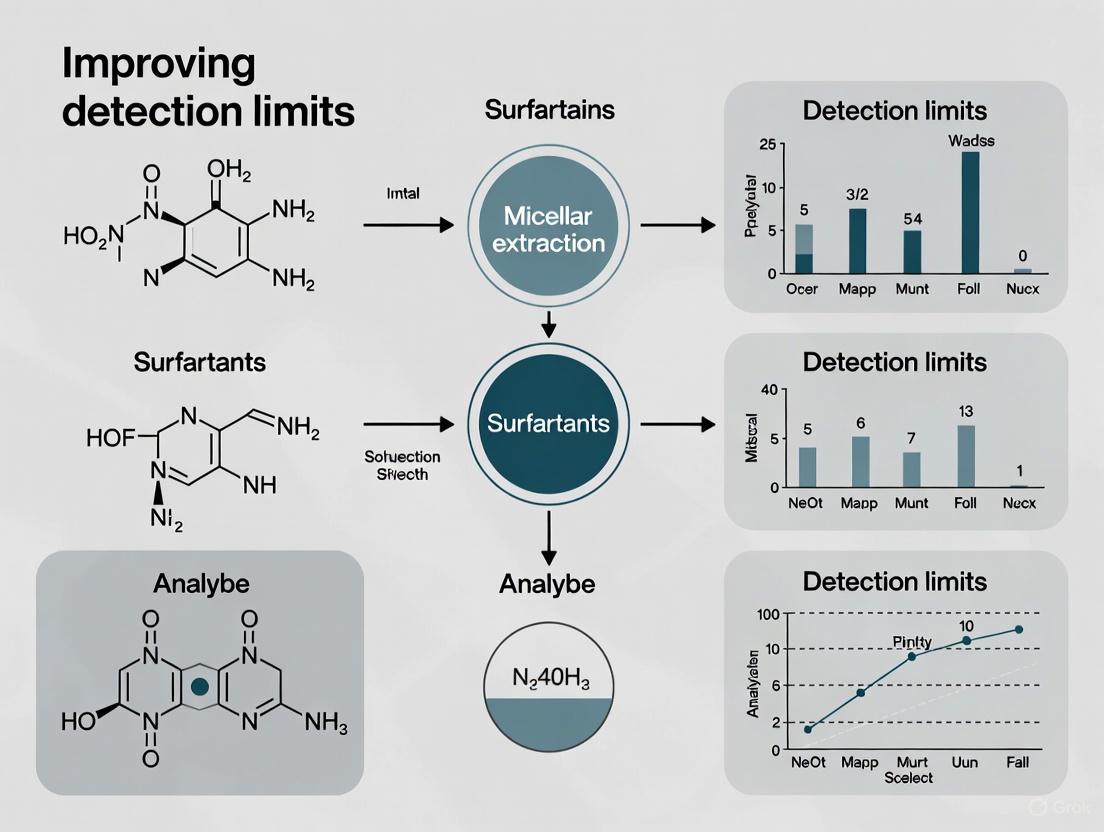
This article provides a comprehensive overview of advanced strategies to enhance the sensitivity and lower the detection limits of micellar extraction methods, crucial for analyzing trace-level compounds in complex matrices.
Advanced Strategies to Improve Detection Limits in Micellar Extraction: A Guide for Analytical Scientists
Abstract
This article provides a comprehensive overview of advanced strategies to enhance the sensitivity and lower the detection limits of micellar extraction methods, crucial for analyzing trace-level compounds in complex matrices. Tailored for researchers, scientists, and drug development professionals, it explores the fundamental principles of micelle-mediated extraction, details cutting-edge methodological workflows and their applications in biomedical and environmental analysis, discusses systematic optimization and troubleshooting of key parameters, and validates these techniques through comparative analysis with conventional methods. The scope is firmly grounded in the latest research, offering practical insights for implementing these efficient and sustainable sample preparation techniques.
Micellar Fundamentals: Unlocking the Core Principles for Enhanced Sensitivity
FAQs on Micelle Fundamentals and CMC
What is the Critical Micelle Concentration (CMC)? The Critical Micelle Concentration (CMC) is the specific concentration of a surfactant in a solution above which the formation of micelles becomes appreciable. Below the CMC, surfactant molecules primarily exist as monomers. Once the concentration surpasses the CMC, any additional surfactant molecules spontaneously aggregate to form micelles, which are self-assembled structures where hydrophobic chains are shielded from the aqueous environment by hydrophilic head groups [1] [2].
Why is determining the CMC critical for improving detection limits in analytical methods like micellar extraction? The CMC is a fundamental parameter for optimizing micellar extraction methods. Operating at or above the CMC ensures a sufficient population of micelles to solubilize target analytes, directly impacting the method's extraction efficiency and recovery rate [3]. Furthermore, understanding the CMC of natural surfactants, like tea saponin, is key to developing greener analytical methods that can offer high selectivity and lower toxicity without compromising performance, thereby potentially improving practical detection limits by reducing background interference [3] [4].
My solution properties show a gradual change instead of a sharp break at the CMC. What does this indicate? A gradual transition, rather than a sharp break in properties like surface tension or conductivity, often indicates a low aggregation number or a less cooperative assembly process [1]. The steepness of the transition at the CMC is highly dependent on the aggregation number (n). For surfactants that form large micelles (high n), the transition is very sharp and cooperative, resembling a two-state system. For aggregates with smaller n, the transition from monomers to aggregates will be more gradual [1].
How can I distinguish between a protein-detergent complex and an empty detergent micelle in structural biology? This is a common challenge, especially with small membrane proteins. A protein embedded in a detergent micelle will typically yield a particle of a different size and potentially more structural heterogeneity compared to an empty micelle. Strategies to confirm you are looking at the protein complex include:
- Multiple Ab Initio Models: Generate several independent initial models; consistent features across models are more likely to be protein-derived.
- 2D Classification Refinement: Carefully sort your particles through multiple rounds of 2D classification to separate classes that show defined secondary structure features (like alpha-helices) from those that are featureless, which are likely empty micelles [5].
Troubleshooting Common Experimental Issues
Problem: Inconsistent CMC values obtained from different measurement techniques.
| Technique | Principle | Advantages | Disadvantages/Limitations |
|---|---|---|---|
| Surface Tension | Measures the reduction of surface tension with increasing surfactant concentration. A break point marks the CMC. | Widely used; provides information on surface activity [2]. | Can be affected by impurities and equilibrium time [6]. |
| Conductivity | Measures the change in specific conductance with concentration. A slope change is observed for ionic surfactants at the CMC. | Simple and straightforward for ionic surfactants [6]. | Not suitable for non-ionic surfactants [6]. |
| Fluorescent Probing | Uses a hydrophobic dye (e.g., pyrene) whose fluorescence spectrum shifts upon incorporation into a micelle. | Highly sensitive; very low sample consumption; suitable for low CMC values [2]. | Requires specific dye and instrumentation; can be influenced by dye-micelle interactions. |
Recommended Protocol: Conductivity Measurement for Ionic Surfactants
- Preparation: Prepare a concentrated stock solution of the ionic surfactant (e.g., SDS).
- Dilution Series: Create a series of dilutions covering a concentration range below and above the expected CMC.
- Measurement: Measure the specific conductance of each solution at a constant temperature using a calibrated conductivity meter.
- Data Analysis: Plot conductivity (y-axis) versus surfactant concentration (x-axis). Fit linear trendlines to the data points below and above the break point. The CMC is determined as the concentration at the intersection of these two linear regions [6].
Problem: Low extraction recovery during micellar extraction of analytes from a complex matrix.
- Cause 1: Surfactant concentration is below or too close to the CMC.
- Solution: Ensure the surfactant concentration is sufficiently above the CMC to maximize the number of micelles available for solubilizing target analytes. For instance, in the extraction of flavonoids from Ginkgo nuts using tea saponin, the concentration was optimized to 3% (w/v) to achieve high recovery [3].
- Cause 2: The micelle structure is not suitable for the target analyte.
- Cause 3: Instability of the micellar system under experimental conditions (e.g., temperature, pH).
- Solution: Perform stability studies, including freeze/thaw cycles and storage at elevated temperatures, to ensure the microemulsion remains stable. Remember that these systems are lyotropic and can be temperature-sensitive [7].
Problem: Difficulty in forming a stable microemulsion for solubilizing high amounts of oil-soluble actives.
- Cause: Incorrect ratio of surfactant to co-surfactant, or an unsuitable co-surfactant.
- Solution: Utilize ternary phase diagrams to map out the precise ratios of water, surfactant, and co-surfactant (e.g., a C5–C6 linear alcohol) that yield a stable, transparent microemulsion phase. This is an empirical but systematic approach to identify the optimal formulation window [7].
The Scientist's Toolkit: Essential Reagents and Materials
| Reagent/Material | Function/Description | Application Example |
|---|---|---|
| Sodium Dodecyl Sulfate (SDS) | A synthetic anionic surfactant. Known for its strong solubilizing power and well-characterized CMC [1]. | Commonly used in model studies of micelle formation and protein denaturation. |
| Tea Saponin | A natural, non-ionic biosurfactant derived from Camellia plants. Amphiphilic, with a hydrophobic triterpenoid core and hydrophilic sugar chains [3]. | Used as a green alternative for micellar extraction of flavonoids and lactones from Ginkgo nuts [3] [4]. |
| DDM (n-Dodecyl-β-D-Maltoside) | A non-ionic detergent frequently used in membrane protein biochemistry for solubilizing and stabilizing membrane proteins. | Purification of a small membrane-anchored protein with three transmembrane helices for structural studies [5]. |
| Polyethylene Glycol (PEG) 6000 | A polymer used in aqueous two-phase systems (ATPS). | Combined with salts like (NH₄)₂SO₄ for the in-situ enrichment of target compounds after micellar extraction [3]. |
| Pyrene | A fluorescent probe. Its fluorescence spectrum is sensitive to the polarity of its environment, making it ideal for CMC determination. | Used in the fluorescent probe method to determine the CMC of amphiphilic polymers and surfactants [2]. |
Workflow and Pathway Visualizations
Micelle Formation and CMC Determination
Green Micellar Extraction Workflow
Core Principles: The Micellar Solubilization Powerhouse
Micelles are nanoscale aggregates formed by surfactant molecules in aqueous solutions. When the surfactant concentration exceeds the critical micelle concentration (CMC), these molecules spontaneously self-assemble into organized structures with a hydrophobic core and a hydrophilic shell [8]. This unique architecture is the foundation of their solubilizing power.
The hydrophobic core provides a compatible microenvironment for non-polar analytes, effectively shielding them from the aqueous surroundings. Simultaneously, the interactive shell, composed of the surfactants' polar head groups, stabilizes the entire structure in water and can engage in electrostatic or other specific interactions with analytes [8]. Solubilization occurs when poorly water-soluble compounds become incorporated into the micelles—either within the hydrophobic core, at the core-shell interface, or within the palisade layer of the shell—significantly increasing their apparent solubility in the aqueous phase [8].
This solubilization capability is harnessed in micelle-mediated extraction (MME), a green alternative to conventional solvent extraction. MME uses aqueous surfactant solutions instead of harmful organic solvents to efficiently isolate target substances from complex matrices [8]. The selectivity and efficiency of the extraction are governed by the interactions between the analyte and the specific surfactant used.
Troubleshooting Common Micellar Extraction Experiments
This section addresses frequent challenges researchers face when working with micellar extraction techniques.
Table 1: Troubleshooting Guide for Micellar Extraction
| Problem | Possible Cause | Proposed Solution |
|---|---|---|
| Low Extraction Efficiency | Surfactant concentration below CMC [8] | Confirm surfactant concentration is well above the CMC. Ensure stock solutions are fresh and properly prepared. |
| Incorrect surfactant type for target analyte [9] | Match surfactant character to analyte: ionic surfactants for charged species, non-ionic for non-polar compounds [9]. | |
| Inefficient mass transfer | Incorporate ultrasound (UAMME) or microwave (MAMME) to enhance analyte transfer into micelles [8]. | |
| Phase Separation Issues (Cloud Point Extraction) | No phase separation upon heating | Verify temperature is above the cloud point of the specific non-ionic surfactant being used [9]. |
| Surfactant-rich phase volume is too small | Increase the initial sample volume or surfactant concentration to obtain a larger volume of the coacervate phase for easy handling [9]. | |
| Formation of Stable Emulsions | Presence of surfactant-like compounds (e.g., phospholipids, proteins) in the sample [10] | - Gently swirl instead of shaking the vessel [10].- Add brine to increase ionic strength and "salt out" the emulsion [10].- Centrifuge the sample to break the emulsion [10]. |
| Poor Detection Limits | Insufficient preconcentration factor | Increase the sample-to-surfactant ratio in CPE to maximize the concentration of analyte in the small surfactant-rich phase [9]. |
| Interference from surfactant in detection | For HPLC, use surfactants compatible with detection (e.g., Brij-35 for UV). For MS detection, consider supported liquid extraction to avoid introducing surfactant into the instrument [10]. |
Frequently Asked Questions (FAQs)
Q1: How can I increase the selectivity of my micellar extraction for a specific analyte? Selectivity can be fine-tuned by manipulating the chemical environment. You can adjust the pH of the solution to control the charge state of ionizable analytes, which affects their interaction with ionic micelles. Adding salts (salting-out effect) can enhance the extraction efficiency of hydrophobic compounds into the micellar phase. Furthermore, selecting a surfactant with a specific head group (e.g., cationic CTAB for anionic analytes) can leverage electrostatic interactions for improved selectivity [9].
Q2: Why is my micellar solution viscous or turbid, and is this a problem? A slight increase in viscosity is normal for concentrated surfactant solutions. However, turbidity can indicate that the solution is at or near its cloud point. For standard MME, this is undesirable. Ensure you are working at a temperature sufficiently below the cloud point. If you are intentionally performing cloud point extraction, turbidity is the expected first step before phase separation upon heating [9].
Q3: Can I use micellar extraction for metal ion analysis? Yes. This typically involves a two-step process. First, metal ions are chelated with a hydrophobic organic ligand to form a neutral complex. Subsequently, this complex is solubilized and extracted into the hydrophobic core of the micelles, often followed by cloud point extraction to preconcentrate the metals for trace analysis [9].
Protocols for Key Micellar Extraction Methodologies
Protocol: Cloud Point Extraction (CPE) for Preconcentration of Organic Analytes
Principle: This method uses a thermo-reversible phase separation of a non-ionic surfactant solution to isolate and pre-concentrate analytes into a small volume of a surfactant-rich phase [9].
Materials:
- Non-ionic surfactant (e.g., Triton X-114)
- Water bath or thermostat
- Centrifuge
- Sample solution containing target analytes
Procedure:
- Surfactant Addition: To an aqueous sample (e.g., 10 mL), add a calculated volume of a concentrated surfactant stock solution to achieve a final concentration of 0.5-2% (w/v) [9].
- Equilibration: Incubate the sample in a water bath at a temperature 10-20°C above the cloud point of the surfactant (e.g., 4°C for Triton X-114 is ~23°C, so incubate at ~40°C) for 10-15 minutes [9].
- Phase Separation: The solution will become turbid and separate into two distinct phases: a small, dense surfactant-rich phase and a larger aqueous phase. To accelerate separation, centrifuge the sample for 5-10 minutes [9].
- Phase Recovery: Carefully remove the bulk aqueous phase by pipette. The surfactant-rich phase (typically 50-500 μL), now containing the preconcentrated analytes, can be dissolved in a compatible solvent (e.g., methanol or acetonitrile) for direct analysis via HPLC or other techniques [9].
Protocol: Green Extraction of Flavonoids using a Biosurfactant
Principle: This protocol uses tea saponin, a natural and biodegradable biosurfactant, for the ultrasonic-assisted micellar extraction of medium- and low-polarity compounds like flavonoids, combining high efficiency with environmental friendliness [3].
Materials:
- Tea saponin (purity ≥98%)
- Ultrasonic bath
- Polyethylene Glycol 6000 (PEG-6000) and (NH₄)₂SO₄ for in-situ ATPE
- Centrifuge
- Ginkgo nut powder or other plant material
Procedure:
- Micellar Extraction: Weigh 0.5 g of Ginkgo nut powder into a tube. Add 10 mL of a 2-3% (w/v) aqueous tea saponin solution. Subject the mixture to ultrasonic extraction for 20 minutes [3].
- In-situ Aqueous Two-Phase Enrichment: To the extraction mixture, add 0.6 g of PEG-6000 and 1.4 g of (NH₄)₂SO₄. Shake vigorously until the salts and polymer are completely dissolved. A two-phase system will form spontaneously [3].
- Phase Separation & Analysis: Centrifuge the mixture to complete phase separation. The target flavonoids (e.g., kaempferol) and lactones (e.g., ginkgolides) will partition into the upper PEG-rich phase. This phase can be collected directly for analysis by HPLC [3].
The Scientist's Toolkit: Essential Research Reagents
Table 2: Key Reagents for Micellar Extraction Research
| Reagent / Material | Type/Function | Key Characteristics & Application Notes |
|---|---|---|
| Sodium Dodecyl Sulfate (SDS) | Anionic Surfactant | Common in CPE and MLC. Krafft point ~15-18°C; avoid use in cold labs and with potassium salts to prevent precipitation [11]. |
| Triton X-114 | Non-ionic Surfactant | The benchmark surfactant for Cloud Point Extraction. Low cloud point (~23°C), forms a surfactant-rich phase of small volume [9]. |
| Pluronic F127 | Polymeric Surfactant (Triblock Copolymer) | Forms stable micelles with a large core for solubilizing highly hydrophobic drugs (e.g., Cannabidiol). Biocompatible for drug delivery applications [12]. |
| Cetyltrimethylammonium Bromide (CTAB) | Cationic Surfactant | Used for extracting anionic analytes via electrostatic attraction. Krafft point 20-25°C; requires warm lab environment [11]. |
| Tea Saponin | Biosurfactant | Natural, biodegradable, low-toxicity non-ionic surfactant. Ideal for green extraction of active ingredients from functional foods and herbs [3]. |
| Brij-35 | Non-ionic Surfactant | Often used in Micellar Liquid Chromatography (MLC). High cloud point (~100°C), suitable for separations at room temperature [11]. |
FAQs: Core Concepts of Micellar Systems
Q1: What are the fundamental structural differences between normal, reverse, and polymeric micelles?
A1: The core structural difference lies in the organization of the amphiphilic molecules in response to the solvent environment.
- Normal Micelles: These form in polar solvents like water. The hydrophilic "head" regions face outward into the solvent, while the hydrophobic single-tail regions are sequestered in the micelle centre, creating an oil-in-water structure [13].
- Reverse Micelles: These form in non-polar solvents. Here, the hydrophilic head groups are sequestered in the micelle core, and the hydrophobic tails extend out into the solvent, creating a water-in-oil system [13].
- Polymeric Micelles: These are formed from amphiphilic block copolymers and possess a core-shell structure, often with a hydrophobic core and a hydrophilic corona, similar to normal micelles but with much higher molecular weight building blocks [14] [13]. They are known for their remarkably low critical micellar concentration (CMC) and high kinetic stability, which can make them "kinetically frozen," meaning they do not readily disassemble upon dilution [13].
Q2: How does the concept of Critical Micelle Concentration (CMC) apply to these different systems, and why is it critical for extraction efficiency?
A2: The CMC is the minimum concentration of surfactant required for micelle formation. It is pivotal because micelles are the active agents responsible for solubilizing and extracting target compounds.
- For Normal & Reverse Micelles: Extraction efficiency is highly dependent on operating above the CMC to ensure a sufficient population of micelles is present to host the analytes [13]. Factors like temperature, pH, and ionic strength can affect the CMC.
- For Polymeric Micelles: They have a much lower CMC (typically 0.0001 to 0.001 mol/L) compared to surfactant micelles [13]. This low CMC is a significant advantage for extractions and drug delivery, as the micellar structures remain stable even under high dilution, preventing premature disassembly and loss of encapsulated cargo [14] [13].
Q3: What are "stimuli-responsive" or "intelligent" polymeric micelles, and how can they improve targeted extraction or drug delivery?
A3: Stimuli-responsive polymeric micelles are designed to rupture their structure and release encapsulated drugs or compounds in response to specific "environmental" triggers [14]. This enhances target-specific delivery and controls the release rate. Key triggers include:
- pH: Micelles can be engineered to destabilize in the acidic microenvironment of tumors (e.g., using poly(l-histidine)) or within cellular endosomes, leading to rapid drug release at the target site [14] [15].
- Redox Potential: Gemini polymeric micelles containing disulfide bonds can be cleaved by intracellular glutathione, a reducing agent, leading to controlled drug release [15].
- Enzymes: Micelles can be broken apart by enzymes that are overexpressed in diseased tissues. For instance, amphiphilic block copolymers have been designed where an enzyme-responsive dendron triggers disassembly and cargo release [15].
- Light: Light-responsive moieties like spiropyran can be incorporated into polymers, allowing for extremely high spatial and temporal control over drug release [15].
Troubleshooting Guides
Table 1: Troubleshooting Common Issues in Micellar Extraction
| Problem | Possible Cause | Solution |
|---|---|---|
| Low Extraction Yield | Surfactant concentration below the Critical Micelle Concentration (CMC) [13]. | Ensure surfactant concentration is sufficiently above the CMC. Determine CMC via surface tension or conductivity measurements [16]. |
| Incorrect micelle type for the target analyte polarity. | Use normal micelles for hydrophobic compounds in aqueous samples. Use reverse micelles for hydrophilic compounds in non-polar matrices [13]. | |
| Insufficient interaction time for solubilization. | Optimize the incubation/equilibration time during the extraction step. | |
| Formation of Stable Emulsions | Sample contains high amounts of surfactant-like compounds (e.g., phospholipids, proteins) [10]. | - Gently swirl the mixture instead of vigorous shaking [10].- Use supported liquid extraction (SLE) to avoid emulsion formation [10].- Disrupt emulsions by adding brine ("salting out"), centrifugation, or filtration through glass wool [10]. |
| Poor Detection Limits in Analysis | High background interference from the surfactant itself. | Use high-purity surfactants. Employ biosurfactants (e.g., Tea saponin) which can be less interfering than synthetic ones [3]. |
| Inefficient transfer or recovery of analytes from the micellar phase. | Couple micellar extraction with an enrichment step, such as in-situ aqueous two-phase separation, to concentrate analytes before analysis [3]. | |
| Instability of Polymeric Micelles | Operation below the CMC, leading to disassembly. | Use polymeric micelles with an ultra-low CMC to ensure stability upon dilution [13]. |
| Degradation of polymer or incompatible storage conditions. | Understand the polymer's stability profile (e.g., susceptibility to hydrolysis) and store formulations under recommended conditions. |
Table 2: Troubleshooting for Kinetically Frozen vs. Dynamic Polymeric Micelles
| Aspect | Dynamic Micelles (e.g., some Poloxamers) | Kinetically Frozen Micelles (e.g., PS-PEO) |
|---|---|---|
| Key Characteristic | Surfactant-like; exist in equilibrium with unimers [13]. | No equilibrium with unimers; morphologically fixed upon formation [13]. |
| Stability upon Dilution | Can disassemble if diluted below the CMC [13]. | Highly stable against dilution due to frozen state [13]. |
| Common Issue: Drug Leakage | Cause: Constant exchange of unimers can lead to premature release during circulation [13]. | Cause: Typically not due to unimer exchange. Could be related to slow diffusion or matrix degradation. |
| Mitigation Strategy | Design systems with very low CMC or use cross-linking strategies. | The frozen state inherently prevents leakage via disassembly, making them ideal for long-circulating nanocarriers [13]. |
| Morphological Flexibility | Limited to equilibrium shapes (e.g., spheres) [13]. | Can access a vast range of non-equilibrium shapes (e.g., cylinders, vesicles) [13]. |
Key Experimental Protocols
This green and efficient method uses a biosurfactant for extraction and an in-situ formed aqueous two-phase system for enrichment.
1. Reagents and Materials:
- Plant Material: Ginkgo nut powder (or other functional food material).
- Surfactant Solution: Tea saponin solution (1-4% w/v in water).
- Phase Forming Agents: Polyethylene Glycol 6000 (PEG-6000) and Ammonium Sulfate ((NH₄)₂SO₄).
- Standards: Analytical standards for target compounds (e.g., protocatechuic acid, kaempferol).
2. Equipment:
- Ultrasonic bath
- Centrifuge
- HPLC system with appropriate detector (e.g., UV, MS)
3. Step-by-Step Procedure:
- Step 1: Weighing. Weigh 0.5 g of Ginkgo nut powder into a suitable tube.
- Step 2: Micellar Extraction. Add a low-concentration tea saponin solution (e.g., 3% w/v) to the powder. Subject the mixture to ultrasound-assisted extraction for a predetermined time (e.g., 20 minutes).
- Step 3: In-Situ Aqueous Two-Phase Formation. To the extract, add PEG-6000 (e.g., 0.6 g) and (NH₄)₂SO₄ (e.g., 1.4 g). Vortex or shake the mixture thoroughly. An aqueous two-phase system will form, typically with the target compounds (flavonoids, lactones) partitioning into the PEG-rich upper phase.
- Step 4: Phase Separation and Analysis. Centrifuge the mixture to facilitate complete phase separation. Collect the upper phase, which contains the enriched analytes. Dilute or reconstitute as necessary for analysis via HPLC-MS/MS.
4. Optimization Notes:
- Key factors to optimize via Response Surface Methodology (RSM) include tea saponin concentration, salt dosage, and ultrasonic extraction time [3].
This protocol outlines the general methodology for creating and testing smart micellar systems.
1. Reagents and Materials:
- Polymers: Amphiphilic block copolymers (e.g., PEG--b--PLA, or polymers with pH-sensitive blocks like poly(l-histidine) or redox-sensitive disulfide bonds in the spacer).
- Drug: A model poorly soluble drug (e.g., Paclitaxel, Doxorubicin).
- Buffers: Buffers at different pH levels (e.g., pH 7.4 to simulate physiological conditions, and pH 5.0-6.0 to simulate tumoral or endosomal environments).
2. Equipment:
- Dialysis tubing
- Dynamic Light Scattering (DLS) instrument
- Fluorescence spectrophotometer
3. Step-by-Step Procedure:
- Step 1: Micelle Preparation. The micelles are often prepared by a dialysis method. The amphiphilic copolymer and drug are dissolved in a water-miscible organic solvent (e.g., DMSO, acetone). This solution is then dialyzed extensively against water or a buffer. During dialysis, the organic solvent is replaced by water, driving the self-assembly of the polymers into micelles with the drug encapsulated in the hydrophobic core.
- Step 2: Characterization.
- Size and Polydispersity: Measure the hydrodynamic diameter and size distribution of the micelles using Dynamic Light Scattering (DLS).
- Critical Micelle Concentration (CMC): Determine the CMC using a fluorescent probe like pyrene. A shift in the vibronic band intensities of pyrene's emission spectrum indicates its transfer from a aqueous to a hydrophobic environment (the micelle core), allowing for CMC calculation [16].
- Step 3: In-Vitro Drug Release Study. Place the drug-loaded micellar solution in a dialysis bag. Immerse the bag in a release medium (buffer) at the desired pH (e.g., 7.4 and 5.0) and under sink conditions. Agitate the system at a constant temperature. At predetermined time intervals, withdraw samples from the external release medium and analyze the drug concentration using HPLC or UV-Vis spectroscopy. Replace the medium to maintain sink conditions.
4. Optimization Notes:
- The release profile can be tuned by altering the polymer composition, the block lengths, and the specific stimuli-responsive moiety incorporated.
Visualization of Micellar Systems and Workflows
Micelle Types and Stimuli-Responsive Release
Advanced Micellar Extraction and Enrichment Workflow
The Scientist's Toolkit: Research Reagent Solutions
Table 3: Key Reagents for Micellar System Development and Analysis
| Reagent / Material | Function / Application | Notes |
|---|---|---|
| Tea Saponin | A natural, non-ionic biosurfactant for green micellar extraction [3]. | Biodegradable, low toxicity. Used to extract flavonoids and lactones from plant materials. |
| Pluronic (Poloxamer) | Triblock copolymers (PEO-PPO-PEO) forming dynamic micelles [15]. | Used in drug delivery; some mixtures (e.g., L61/F127) can target cancer stem cells. |
| PEG--b--PLA | A common amphiphilic block copolymer for forming polymeric micelles [14]. | PEG is the hydrophilic shell; PLA forms the biodegradable hydrophobic core. Basis for products like Genexol-PM. |
| Poly(l-histidine) | A pH-sensitive polymer used in the core of "intelligent" micelles [15]. | Becomes membrane-destabilizing at low pH (endosomal pH), facilitating drug release. |
| Disulfide-linked Gemini Surfactants | Form redox-responsive micelles for controlled drug release [15]. | Cleaved by intracellular glutathione, triggering micelle destabilization and drug release. |
| Pyrene | A fluorescent probe for determining the Critical Micelle Concentration (CMC) [16]. | Its fluorescence spectrum changes upon partitioning into the hydrophobic micelle core. |
Scientific FAQs: Surfactant Selection and Mechanism
Q1: What is the fundamental mechanism by which surfactants enhance extraction efficiency?
Surfactants are amphiphilic molecules, meaning they consist of a hydrophobic (water-repelling) tail and a hydrophilic (water-attracting) head. In aqueous solutions, when their concentration exceeds the critical micelle concentration (CMC), they spontaneously self-assemble into colloidal-sized clusters called micelles [17] [18]. The hydrophobic cores of these micelles act as a pseudo-organic phase capable of solubilizing poorly water-soluble (hydrophobic) target compounds, effectively pulling them out of the sample matrix and into the solution [17] [19]. This process reduces surface tension, facilitates cell wall and membrane disruption in plant or microbial tissues, and enhances mass transfer rates, leading to higher extraction yields [20].
Q2: How does the choice between ionic and non-ionic surfactants impact an extraction method?
The selection is critical and depends on the target analyte, sample matrix, and the specific extraction technique employed. The key differences are summarized in the table below.
Table 1: Comparison of Ionic vs. Non-Ionic Surfactants in Extraction
| Feature | Ionic Surfactants | Non-Ionic Surfactants |
|---|---|---|
| Head Group Charge | Anionic (e.g., SDS, SLES) or Cationic (e.g., CTAB) [20] | No charge (e.g., Tween series, Triton X-114) [20] |
| Primary Extraction Techniques | Micellar Extraction, Micellar Electrokinetic Chromatography (MEKC) [20] [21] | Cloud-Point Extraction (CPE), Micellar Extraction [17] |
| Typical Mechanism | Solubilization via electrostatic and hydrophobic interactions [20] | Solubilization and temperature-induced phase separation (CPE) [17] |
| Advantages | Effective solubilization; can be tailored for charged analytes [20] | Generally less denaturing; enable Cloud-Point Extraction for easy pre-concentration [20] [17] |
| Disadvantages/Limitations | Cationic surfactants can be more toxic; may interact undesirably with charged biomolecules [20] | Mostly derived from chemical synthesis, raising environmental concerns [3] |
Q3: What are the advantages of using a natural surfactant like tea saponin over synthetic ones?
Tea saponin, a natural non-ionic surfactant derived from Camellia plants, offers several distinct advantages, particularly from a green chemistry perspective [3] [22]:
- Biodegradability and Low Toxicity: It is naturally derived, biodegradable, and environmentally friendly, unlike many persistent synthetic surfactants [3].
- High Performance: Despite its natural origin, it exhibits superior surface activity, including low critical micelle concentration (CMC), good foam stability, and excellent salt and hard water resistance [22].
- Green Extraction Credentials: Its use aligns with the principles of sustainable development, reducing the environmental footprint of the analytical process [3]. Studies have successfully used it for the efficient micellar extraction of flavonoids and lactones from Ginkgo nuts [3] [4].
Troubleshooting Guides
Issue 1: Poor Extraction Recovery
Potential Causes and Solutions:
- Surfactant concentration is below the Critical Micelle Concentration (CMC): Below the CMC, micelles do not form, and extraction efficiency is drastically reduced.
- Solution: Ensure the surfactant concentration is well above its documented CMC. For example, the CMC of tea saponin was found to be 0.5 g/L [22].
- Incorrect surfactant type for the target analyte: A surfactant with low affinity for your analyte will not solubilize it effectively.
- Solution: For hydrophobic compounds, select surfactants with larger hydrophobic cores. Consider the potential for electrostatic interactions if using ionic surfactants. Experiment with different surfactant classes.
- Inefficient cell lysis or mass transfer:
Issue 2: Low Pre-concentration Factor in Cloud-Point Extraction
Potential Causes and Solutions:
- Incorrect cloud-point temperature: The temperature must be adequately above the Cloud-Point Temperature (CPT) to induce complete phase separation.
- Solution: Optimize the incubation temperature. Temperatures 15–20 °C greater than the CPT are often needed for quantitative recovery [17].
- Volume of the surfactant-rich coacervative phase is too large: A large phase volume dilutes the analyte.
Issue 3: Interference with Downstream Analysis
Potential Causes and Solutions:
- Surfactant co-elutes or interferes with detection: High surfactant concentrations can foul chromatographic columns or create high background signals in spectroscopic detection.
- Solution:
- Dilute the extract before injection.
- Choose a compatible surfactant: For HPLC-UV, ensure the surfactant has low UV absorbance at the detection wavelength. In MEKC, this is less of an issue as the surfactant is part of the running buffer [21].
- Employ a separation technique that accommodates surfactants, such as Micellar Electrokinetic Chromatography (MEKC), where the micellar phase is an integral part of the separation system [21].
- Solution:
Experimental Protocols
Protocol 1: Tea Saponin-Assisted Micellar Extraction Combined with In-Situ Aqueous Two-Phase Enrichment
This protocol details a green method for extracting and pre-concentrating flavonoids and lactones from functional foods like Ginkgo nuts [3].
Research Reagent Solutions:
| Reagent/Material | Function/Explanation |
|---|---|
| Tea Saponin (≥98% purity) | The core green, natural non-ionic surfactant that forms micelles to solubilize and extract target compounds [3]. |
| Polyethylene Glycol 6000 (PEG-6000) | A polymer used to form an aqueous two-phase system with salts, enabling the enrichment of target analytes from the micellar solution [3]. |
| Ammonium Sulfate ((NH₄)₂SO₄) | A salt used to induce phase separation in the aqueous two-phase system, driving targets into one phase [3]. |
| Ultrasonication Bath | Applies ultrasonic energy to assist in disrupting the sample matrix and enhancing extraction efficiency [3]. |
Workflow Diagram: Tea Saponin Extraction & Enrichment
Step-by-Step Procedure:
- Sample Preparation: Grind the plant material (e.g., Ginkgo nuts) into a fine powder. Accurately weigh 0.5 g of the powder into an extraction vessel [3].
- Micellar Extraction: Add 10 mL of a 2-3% (w/v) aqueous tea saponin solution to the sample. Securely close the vessel and place it in an ultrasonic bath. Extract for 20 minutes at room temperature [3].
- In-Situ Aqueous Two-Phase Formation: Transfer the extract to a centrifuge tube. Add 0.6 g of PEG-6000 and 1.4 g of ammonium sulfate ((NH₄)₂SO₄). Vortex the mixture vigorously until the salts and polymer are completely dissolved [3].
- Phase Separation and Enrichment: Centrifuge the mixture at 5000 rpm for 10 minutes. This will induce the formation of two immiscible aqueous phases: a PEG-rich phase and a salt-rich phase. The target flavonoids and lactones will partition into one of these phases, achieving enrichment [3].
- Collection: Carefully collect the analyte-rich phase using a pipette. The sample is now ready for analysis via techniques like UPLC-MS/MS [3] [4].
Protocol 2: Cloud-Point Extraction (CPE) for Organic Analytes
This is a general protocol for pre-concentrating organic compounds from aqueous solutions using a non-ionic surfactant [17].
Workflow Diagram: Cloud-Point Extraction
Step-by-Step Procedure:
- Surfactant Addition: To an aqueous sample (e.g., 10 mL of water), add a non-ionic surfactant like Triton X-114 to a final concentration well above its CMC (e.g., 0.5-2% v/v) [17].
- Analyte Incorporation: Mix the solution thoroughly and allow it to stand for a short period to let the analytes incorporate into the micelles.
- Phase Separation: Place the sample in a water bath and heat it to a temperature 15-20°C above the surfactant's cloud-point (CPT for Triton X-114 is ~25°C, so heat to ~40-45°C) for 20-30 minutes. A cloudy solution will form, leading to the separation of two distinct phases: a small, viscous surfactant-rich phase and a larger aqueous phase [17].
- Centrifugation: Centrifuge the heated sample at 3000-5000 rpm for 5-15 minutes to accelerate and complete phase separation. Cool the tube in an ice bath or cold water to increase the viscosity of the surfactant-rich phase, making it easier to handle [17].
- Phase Collection: Carefully decant or remove the bulk aqueous phase by pipette. The remaining surfactant-rich phase, containing the pre-concentrated analytes, can be dissolved in a suitable solvent (e.g., methanol or the mobile phase) for subsequent chromatographic analysis [17] [19].
Quantitative Data for Surfactant Selection
Table 2: Performance Characteristics of Select Surfactants
| Surfactant | Type | Critical Micelle Concentration (CMC) | Key Performance Metrics | Application Notes |
|---|---|---|---|---|
| Tea Saponin | Natural Non-ionic | 0.5 g/L (at 30°C) [22] | Low surface tension: 39.61 mN/m; Excellent foam stability (half-life 2350 s) [22] | Biodegradable; effective for bioactive compounds from plants [3]. |
| Triton X-114 | Synthetic Non-ionic | ~0.2 mM [17] | Cloud-Point Temperature: ~25°C [17] | Ideal for CPE due to low CPT; requires careful temperature control [17]. |
| Sodium Dodecyl Sulfate (SDS) | Synthetic Anionic | ~8.2 mM [20] | High solubilizing power for hydrophobic compounds [20]. | Common in MEKC; can interfere with MS detection; not suitable for CPE [20] [21]. |
Technical Support Center: Troubleshooting Micellar Extraction Methods
This technical support center provides troubleshooting guides and FAQs for researchers working to improve detection limits in micellar extraction methods. The content focuses on resolving specific, experimentally-observed issues related to the core physicochemical interactions in these systems.
Frequently Asked Questions & Troubleshooting Guides
FAQ 1: Why is my micellar extraction efficiency lower than expected for my target analyte?
Observed Problem: Poor recovery of the analyte during Cloud Point Extraction (CPE) or other micellar extraction techniques.
Potential Causes and Solutions:
- Cause 1: Incorrect Critical Micelle Concentration (CMC). If the surfactant concentration is not sufficiently above the CMC, micelles will not form properly, leading to poor solubilization of the analyte [23].
- Cause 2: Mismatch between Analyte Hydrophobicity and Micelle Core. Highly hydrophobic analytes require a suitably hydrophobic micellar core for effective encapsulation via hydrophobic interactions [16] [15].
- Cause 3: Unfavorable Electrostatic Interactions. Repulsive forces between the micelle surface and the analyte can prevent encapsulation.
- Solution: Manipulate the charge of the micelle and the analyte. Use cationic surfactants (e.g., CTAB) for neutral or anionic analytes, and anionic surfactants (e.g., SDS) for neutral or cationic analytes [25]. Adjusting the solution pH to neutralize the analyte's charge can also enhance incorporation [15].
FAQ 2: How can I improve the selectivity of my micellar extraction to reduce matrix interference?
Observed Problem: Co-extraction of interfering compounds from complex sample matrices, leading to high background noise.
Potential Causes and Solutions:
- Cause 1: Lack of Selective Binding Interactions. Reliance solely on hydrophobic interactions, which are non-specific.
- Solution: Engineer specific hydrogen bonding or electrostatic interactions. Use hydrotropes or additives with specific functional groups. For instance, the position of a hydroxyl group on a sodium benzoate derivative can dramatically alter its interaction with a cationic surfactant (e.g., R16HTAB), enabling selective viscosity changes and extraction behaviors [25].
- Cause 2: Suboptimal Cloud Point Extraction Conditions. The temperature, time, and centrifugation steps are critical for clean phase separation [23] [19].
- Solution: Systematically optimize the equilibration temperature and time. Ensure slow heating above the cloud point temperature and sufficient centrifugation time to achieve a compact, surfactant-rich phase. Adding salts (e.g., NaCl, Na₂SO₄) can promote salting-out and improve phase separation [23] [26].
FAQ 3: Why is my micellar system unstable or precipitating during the experiment?
Observed Problem: Solution becomes turbid, or a precipitate forms, leading to loss of the micellar carrier and analyte.
Potential Causes and Solutions:
- Cause 1: Instability of Wormlike Micelles (WLMs). Long, flexible WLMs, which are highly effective for solubilization, can be sensitive to counterion structure and concentration [25].
- Solution: If using cationic WLMs, carefully select the structure and concentration of aromatic counterions (e.g., salicylate vs. hydroxybenzoate). Small changes in substituent position on the counterion's benzene ring can drastically alter micellar length, flexibility, and stability [25].
- Cause 2: Compromised Micellar Integrity. Extreme pH, high ionic strength, or organic solvents can disrupt micelle structure.
Detailed Experimental Protocols
Protocol 1: Determining Critical Micelle Concentration (CMC) via Electrical Conductivity
This protocol is fundamental for characterizing any micellar system and ensuring surfactant concentration is optimal for extraction [16] [24].
- Principle: The mobility of ions changes upon micelle formation, causing a distinct change in the slope of a conductivity vs. concentration plot.
- Materials:
- Surfactant stock solution of known concentration.
- Deionized water (specific conductance < 1 µS·cm⁻¹).
- Thermostatted water bath.
- Calibrated digital conductivity meter with a platinized electrode cell.
- Volumetric flasks or beakers for serial dilution.
- Step-by-Step Method:
- Calibrate the conductivity meter with a standard 0.01 M KCl solution.
- Prepare a series of surfactant solutions (at least 10-15) with concentrations spanning a range below and above the suspected CMC.
- Place each solution in a thermostatted water bath to maintain a constant temperature (e.g., 298 K).
- Immerse the clean, dry electrode into each solution and record the specific conductivity once the reading stabilizes.
- Plot the specific conductivity (κ) against the surfactant concentration.
- Identify the CMC as the intersection point of the two linear regressions fitted to the data points below and above the breakpoint.
- Troubleshooting Tip: If the breakpoint is not sharp, it may indicate impurities in the surfactant or the presence of premicellar aggregates. Purify the surfactant and ensure the temperature is rigorously controlled.
Protocol 2: Cloud Point Extraction (CPE) for Analyte Pre-concentration
This protocol is a direct application for improving detection limits by concentrating analytes from a large volume of aqueous sample into a small surfactant-rich phase [23] [19].
- Principle: A non-ionic surfactant solution becomes turbid when heated above its cloud point temperature, separating into a surfactant-rich phase and an aqueous phase, thereby concentrating hydrophobic analytes.
- Materials:
- Non-ionic surfactant (e.g., Triton X-114).
- Sample solution containing the target analyte(s).
- Thermostatted water bath or heating block.
- Centrifuge.
- Micropipettes.
- Salting-out agent (e.g., NaCl, if required).
- Step-by-Step Method:
- To a known volume of the aqueous sample, add a specific amount of surfactant (e.g., 1-5% w/v Triton X-114) and a salting-out agent if needed.
- Mix the solution thoroughly and incubate in a water bath at a temperature 15-20°C above the cloud point of the surfactant for a fixed time (e.g., 10-20 min) to achieve complete phase separation.
- Centrifuge the mixture at a moderate speed (e.g., 3000 rpm for 5-10 min) to compact the viscous surfactant-rich phase.
- Carefully separate the two phases. The small volume surfactant-rich phase (often at the bottom of the tube) now contains the pre-concentrated analytes.
- Dilute the surfactant-rich phase with a compatible solvent (e.g., methanol or water) if necessary, prior to instrumental analysis (e.g., HPLC, GC).
- Troubleshooting Tip: If the volume of the surfactant-rich phase is too large, optimize the concentration of the salting-out agent, which can dehydrate the micelles and reduce the volume of the coacervate phase [26].
Table 1: Critical Micelle Concentration (CMC) of Surfactants in Drug Solutions at 298 K [24]
| Surface-Active Ionic Liquid (SAIL) | CMC in Water (mol·kg⁻¹) | CMC in 0.05 mol·kg⁻¹ Aspirin (mol·kg⁻¹) | Key Interaction with Drug |
|---|---|---|---|
| [2-HEA][Ole] | 0.24 | 0.16 | Hydrophobic, Hydrogen Bonding |
| [BHEA][Ole] | 0.20 | 0.12 | Hydrophobic, Hydrogen Bonding |
| [THEA][Ole] | 0.16 | 0.09 | Hydrophobic, Hydrogen Bonding |
Table 2: Effect of Hydrotrope Isomer on Zero-Shear Viscosity (η₀) of Wormlike Micelles [25] (System: 40 mM R16HTAB + 40 mM Benzoate Derivative)
| Hydrotrope (Sodium Salt of) | Substituent Position | Zero-Shear Viscosity, η₀ (Pa·s) | Primary Interaction Mechanism |
|---|---|---|---|
| Hydroxybenzoate | Ortho (SoHB) | 645.16 | Hydrogen Bonding, Hydrophobic Insertion |
| Hydroxybenzoate | Meta (SmHB) | 5.99 | Moderate Hydrogen Bonding |
| Hydroxybenzoate | Para (SpHB) | 0.119 | Weak Electrostatic |
| Methylbenzoate | Para (SpMB) | 15.92 | Steric/Hydrophobic |
Research Reagent Solutions
Table 3: Essential Reagents for Micellar Extraction Research
| Reagent / Material | Function / Role | Example in Context |
|---|---|---|
| Non-Ionic Surfactants (Triton X-114) | Forms micelles for Cloud Point Extraction; hydrophobic core enables analyte solubilization via hydrophobic interactions [23] [19]. | Primary extractant for pre-concentrating organic pollutants from water samples [19]. |
| Cationic Surfactants (CTAB, R16HTAB) | Forms positively charged micelles; structure allows growth into wormlike micelles (WLMs) with additives, enhancing viscosity and solubilization capacity [25]. | Host surfactant for constructing viscoelastic WLMs with sodium salicylate for analytical and material applications [25]. |
| Aromatic Hydrotropes (Sodium Salicylate, Benzoate Derivatives) | Binds to cationic micelle surfaces; alters the packing parameter to induce micellar growth into rods or worms via electrostatic and hydrogen bonding interactions [25]. | Additive to transform spherical CTAB or R16HTAB micelles into long, entangled WLMs, dramatically increasing solution viscosity [25]. |
| Surface-Active Ionic Liquids (SAILs) | Tunable surfactants with low CMC; functional groups (e.g., -OH) can engage in specific hydrogen bonding with target drug molecules, improving solubility and bioavailability [24]. | Solubilizing agent for poorly water-soluble drugs like aspirin; the CMC decreases in the drug's presence, indicating strong interactions [24]. |
| Salting-Out Agents (NaCl, Na₂SO₄) | Electrolytes that reduce the solubility of surfactants in water, promoting phase separation in CPE; can also screen headgroup repulsions, affecting micelle size and shape [25] [26]. | Used to optimize the phase separation time and volume of the surfactant-rich phase in Cloud Point Extraction protocols [26]. |
Experimental Workflow and Interaction Diagrams
Micellar Extraction Workflow
Analyte-Micelle Interaction Mechanisms
Advanced Micellar Workflows: From Cloud Point to Combined Microextraction Techniques
Cloud-point extraction (CPE) represents a green, efficient methodology for preconcentrating analytes from complex matrices prior to analysis. As a micelle-mediated separation technique, CPE leverages the unique property of non-ionic surfactants in aqueous solution to form micelles that undergo phase separation when heated above a specific temperature known as the cloud point temperature (Tc) [27] [17]. This process results in two distinct phases: a surfactant-rich coacervate phase containing the preconcentrated analytes and a diluted aqueous phase [17] [28]. The technique was first introduced in 1976 by Watanabe and colleagues for metal extraction and has since evolved to encompass diverse applications including nanoparticle enrichment, drug analysis, and environmental pollutant detection [27] [28].
Within the context of thesis research focused on improving detection limits in micellar extraction methods, CPE offers significant advantages over traditional liquid-liquid extraction. The procedure is rapid, inexpensive, precise, and minimizes consumption of toxic organic solvents, aligning with green chemistry principles [29] [28]. For researchers and drug development professionals, CPE provides a valuable tool for enhancing analytical sensitivity while simplifying sample preparation workflows across various sample types including biological fluids, environmental waters, and pharmaceutical formulations.
Technical Foundations: Mechanisms and Reagents
Mechanism of Phase Separation
The fundamental mechanism driving CPE involves temperature-induced dehydration of non-ionic surfactant micelles. Below the cloud point temperature, surfactant molecules exist as monomers or small aggregates in aqueous solution. As the temperature increases above Tc, the dielectric constant of water decreases, reducing interactions between water molecules and the hydrophilic chains of the surfactant [27]. This breakdown of hydrogen bonds causes surfactant micelles to become increasingly hydrophobic, eventually leading to visible phase separation characterized by solution clouding [27].
The phase separation process occurs through several stages. Initially, surfactant molecules self-assemble into spherical micelles with hydrophobic cores and hydrophilic exteriors when their concentration exceeds the critical micelle concentration (CMC) [17]. Upon heating above Tc, intermicellar attractions intensify, prompting micelle aggregation and growth. This leads to the formation of a surfactant-rich coacervate phase that separates from the bulk aqueous phase, either as an upper or lower layer depending on surfactant density [27] [17]. Hydrophobic analytes or appropriately complexed species partition into the surfactant-rich phase, achieving significant preconcentration factors [28].
Research Reagent Solutions
Successful implementation of CPE requires careful selection of surfactants and auxiliary reagents tailored to specific analytical targets. The table below summarizes essential reagents and their functions in CPE protocols:
Table 1: Essential Reagents for Cloud-Point Extraction
| Reagent Category | Specific Examples | Function in CPE | Application Notes |
|---|---|---|---|
| Non-ionic Surfactants | Triton X-114 (Tc = 25°C), Triton X-100 (Tc = 66°C), Brij 30 (Tc = 2°C), Brij 35 (Tc > 100°C), Tween 80 (Tc = 65°C) [17] | Forms micelles that encapsulate hydrophobic analytes; undergoes temperature-induced phase separation | Selection depends on desired cloud point; Triton X-114 popular for room-temperature separation |
| Chelating Agents | Dithizone, 1-(2-Thiazolylazo)-2-naphthol (TAN), 8-Hydroxyquinoline [28] [30] | Converts hydrophilic metal ions into hydrophobic complexes for extraction | Essential for metal ion preconcentration; must form stable, hydrophobic complexes |
| Salt Additives | Sodium sulfate, ammonium sulfate, sodium chloride [28] | Salting-out effect enhances phase separation efficiency; modifies cloud point temperature | Concentration optimization required to avoid excessive viscosity |
| pH Adjusters | Acetate buffer, phosphate buffer, sulfuric acid, sodium hydroxide [27] [30] | Optimizes chelation efficiency and analyte speciation | Critical for metal complex stability and extraction yield |
| Viscosity Reducers | Ethanol, methanol, acetonitrile [30] | Reduces viscosity of surfactant-rich phase for easier handling | Facilitates subsequent analytical measurements |
Experimental Protocols: Key Methodologies
Standard CPE Workflow for Metal Ion Preconcentration
The following protocol details the CPE procedure for cadmium determination using electroanalytical detection, adaptable for other metal ions with appropriate chelating agents [30]:
Sample Preparation: Transfer 25 mL of aqueous sample containing target analytes (e.g., 0.04–4.0 μM Cd2+) to a 50 mL centrifuge tube.
Complexation and Surfactant Addition:
- Add appropriate complexing agents (e.g., 1 mL of 1 M KI and 0.5 mL of 1 M H2SO4 for Cd2+ to form extractable ion pairs) [30].
- Add surfactant solution (e.g., 1 mL of 10% w/w Triton X-114, pre-warmed to 60°C to reduce viscosity) [30].
- Adjust pH if necessary using buffer solutions.
- Dilute to 25 mL with deionized water and vortex for 10-30 seconds until homogeneous.
Incubation and Phase Separation:
- Place tubes in a water bath at 55°C for 30-45 minutes until clear phase separation is visible [30].
- Centrifuge at 3500 rpm for 12 minutes to enhance phase separation.
- Cool in an ice bath for 5 minutes to increase surfactant-rich phase viscosity.
Phase Collection:
- Carefully decant or remove the aqueous phase.
- The remaining surfactant-rich phase (typically 0.5-1 mL) contains preconcentrated analytes.
Analysis Preparation:
- For electrochemical analysis: Add 2.5 mL ethanol and 3.5 mL pH 4.65 acetate buffer to the surfactant-rich phase (final volume ~6.5 mL) to reduce viscosity and provide appropriate electrolyte [30].
- For spectroscopic techniques: Dilute with appropriate solvents compatible with the detection method.
This protocol typically achieves enrichment factors of 20-100x, significantly lowering detection limits for trace analysis [30].
CPE Workflow for Nanoparticle Enrichment
For nanoparticle (NP) enrichment from environmental matrices, Hartmann and colleagues developed this optimized protocol [27]:
Sample Treatment: Mix 40 mL of NP-containing aqueous sample with:
- 1.0 mL saturated ethylenediaminetetraacetic acid disodium salt solution
- 400 μL of 1 M sodium acetate
- 100 μL of 1.25 M acetic acid
- 1 mL of 10% (w/w) Triton X-114
Incubation: Heat at 40°C for 30 minutes to achieve phase separation.
Centrifugation: Centrifuge for 12 minutes at 4427 g to enhance phase separation.
Cooling: Cool samples in an ice bath for 5 minutes to increase phase separation efficiency.
Analysis: Remove aqueous supernatant by decanting. Dissolve the surfactant-rich phase containing enriched NPs in 100 μL ethanol for subsequent analysis techniques such as electrothermal atomic absorption spectrometry (ET-AAS) or transmission electron microscopy (TEM) [27].
This method has demonstrated extraction efficiencies ranging from 52% for 150 nm AuNPs to 101% for 2 nm AuNPs, highlighting the size-dependent nature of CPE efficiency for nanomaterials [27].
CPE Workflow Visualization
Figure 1: CPE Experimental Workflow
Troubleshooting Guide: Common Experimental Challenges
Table 2: CPE Troubleshooting Guide
| Problem | Potential Causes | Solutions | Preventive Measures |
|---|---|---|---|
| No phase separation observed | Surfactant concentration below CMC, Temperature below cloud point, Inappropriate surfactant selection | Verify surfactant concentration exceeds CMC, Increase temperature 15-20°C above stated Tc, Select surfactant with appropriate Tc for application [17] | Pre-determine CMC and Tc for specific surfactant lot, Use temperature-controlled water bath |
| Low extraction efficiency | Incomplete complexation, Incorrect pH, Surfactant-analyte incompatibility | Optimize chelating agent concentration, Adjust pH for optimal complex formation, Test different surfactant types [28] | Perform extraction yield experiments with standard solutions, Validate method with known concentrations |
| High viscosity in surfactant-rich phase | Excessive surfactant concentration, Inadequate salt content, Temperature too low during collection | Dilute surfactant concentration, Add salt modifiers to improve separation, Maintain elevated temperature during phase collection [30] | Optimize surfactant:analyte ratio, Add ethanol to reduce viscosity post-extraction [30] |
| Poor analytical reproducibility | Inconsistent temperature control, Variable centrifugation parameters, Incomplete mixing | Standardize incubation time and temperature, Control centrifugation speed and time, Implement consistent mixing protocols [27] [30] | Implement standard operating procedures, Use calibrated equipment |
| Matrix interference | Competing complexation, Surface-active matrix components, High ionic strength | Add masking agents, Implement pre-extraction clean-up, Dilute sample to reduce interference [27] | Characterize matrix effects during method development, Use standard addition for quantification |
Frequently Asked Questions (FAQs)
Q1: What are the key advantages of CPE over traditional liquid-liquid extraction?
CPE offers multiple advantages including minimal use of toxic organic solvents, lower cost, higher preconcentration factors, safety (non-flammable reagents), and simplicity (requires basic laboratory equipment) [29] [28]. The technique provides quantitative recovery for many analytes with extraction efficiencies often exceeding 90% while maintaining the chemical integrity of target species [27] [28].
Q2: How does temperature affect the cloud point extraction process?
Temperature is the critical parameter in CPE. Below the cloud point temperature (Tc), the surfactant solution remains homogeneous. Heating above Tc induces dehydration of the surfactant's hydrophilic groups, reducing solubility and causing phase separation [27] [17]. Most protocols recommend operating 15-20°C above the stated Tc to ensure complete and efficient phase separation [17].
Q3: Can CPE be applied to hydrophilic analytes?
Yes, hydrophilic analytes including metal ions can be extracted via CPE after conversion to hydrophobic complexes using appropriate chelating agents [28] [30]. For instance, cadmium can be extracted using iodide and sulfuric acid to form an extractable ion pair [30], while other metals may require specific chelating agents like dithizone or 8-hydroxyquinoline [28].
Q4: What factors influence the selection of surfactant for CPE applications?
Surfactant selection depends on several factors including cloud point temperature (should be above but close to ambient for energy efficiency), compatibility with analytical detection methods, cost, and environmental considerations [17]. Triton X-114 is widely used due to its low cloud point (22-25°C) and well-characterized extraction properties [27] [30].
Q5: How can I improve the selectivity of CPE for specific analytes?
Selectivity can be enhanced through pH adjustment, use of selective chelating agents, incorporation of masking agents to interfere with competing species, and optimization of incubation conditions [28]. For complex matrices, sequential extraction protocols or combination with other separation techniques may be necessary [27].
Q6: What are typical preconcentration factors achievable with CPE?
Preconcentration factors vary depending on the phase volume ratio but typically range from 10 to 100-fold [27] [30]. For example, CPE protocols for AuNPs and AgNPs achieve enrichment factors of approximately 80 from initial 40-mL samples concentrated to 0.5 mL [27], while methods for cadmium detection demonstrate 20-fold improvement in detection limits [30].
Quantitative Performance Data
Table 3: CPE Performance Metrics for Various Analytes
| Analyte | Matrix | Surfactant | Extraction Efficiency | Enrichment Factor | Detection Method |
|---|---|---|---|---|---|
| AuNPs (2 nm) | Aqueous samples | Triton X-114 | 101% | 80 | TEM/ET-AAS [27] |
| AuNPs (150 nm) | Aqueous samples | Triton X-114 | 52% | 80 | TEM/ET-AAS [27] |
| Cd2+ | Water samples | Triton X-114 | >90% | 20 | ASV [30] |
| CuO NPs | Aqueous samples | Triton X-114 | ~90% | 100 | Spectrometry [27] |
| ZnO NPs | Aqueous samples | Triton X-114 | 64-123% | 220 | Spectrometry [27] |
| Ag, Au, Fe3O4 NPs | Environmental matrices | Triton X-114 | 74-114% | Variable | Sequential analysis [27] |
| Triazine herbicides | Milk | Triton X-100 | 70.5-96.9% | Not specified | HPLC-UV [17] |
The Scientist's Toolkit: Key Research Reagent Solutions
The following table details essential reagents and materials used in Reverse Micellar Extraction, along with their specific functions in the process.
| Reagent/Material | Function in Reverse Micellar Extraction |
|---|---|
| Surfactants (e.g., AOT) | Forms the structure of reverse micelles; the polar head groups create a hydrophilic core to encapsulate biomolecules. [31] |
| Organic Solvent (e.g., Isooctane) | Forms the bulk continuous phase in which the reverse micelles are dispersed. [31] |
| Counterionic Surfactants (e.g., TOMAC, DTAB) | Facilitates backward extraction by interacting with the primary surfactant, causing micelle collapse and releasing the encapsulated protein. [32] |
| Salt Solutions (e.g., KCl) | Used to adjust ionic strength, which influences the electrostatic interactions critical for extraction efficiency. [31] |
| Buffers (e.g., Phosphate Buffer) | Used to maintain specific pH levels during the forward and backward extraction steps, controlling protein charge and solubility. [31] |
Experimental Protocols & Workflows
Standard RME Workflow for Protein Extraction
The diagram below illustrates the two key stages of Reverse Micellar Extraction.
Protocol: Hempseed Protein Isolation via RME [31]
This protocol is adapted from a recent study on extracting hempseed protein isolates (HPI).
1. Forward Extraction (Transfer from aqueous feed to organic micellar phase)
- Reverse Micelle Preparation: Prepare a solution of the anionic surfactant AOT (Bis(2-ethylhexyl) sulfosuccinate sodium salt) in isooctane at a concentration of 0.09 g/mL. Add 100 mM phosphate buffer (pH 6.54) containing 0.05 M KCl to the AOT/isooctane solution at a volume ratio of 0.106 mL/mL.
- Ultrasonication: Subject the mixture to ultrasonic treatment at 30°C for 30 minutes. Incubate overnight to form a clear, transparent reverse micelle solution.
- Extraction: Mix the defatted protein source (e.g., hempseed meal) with the reverse micelle solution at a ratio of 1:15 (w/v). Stir the mixture at 150 rpm for 80 minutes at 50°C.
- Separation: Centrifuge the mixture. The protein-loaded reverse micelles will be contained in the separated organic phase.
2. Backward Extraction (Transfer from organic phase to aqueous stripping solution)
- Counterionic Surfactant Method: Add a counterionic surfactant (e.g., the cationic TOMAC) to the protein-loaded organic phase. This disrupts the micelle structure via electrostatic interaction.
- Phase Separation: The protein is released and transfers into a fresh aqueous stripping solution. This process is very fast and yields a protein solution with near-neutral pH and low salt concentration.
- Recovery: Separate the aqueous phase containing the purified, encapsulated protein.
Advanced Backward Extraction Protocol
The following workflow details the enhanced back-extraction method using a counterionic surfactant.
Protocol: Enhanced Back-Extraction with Counterionic Surfactant [32]
This method offers significant advantages over conventional high-salt/high-pH back-extraction.
- Procedure: After forward extraction, add a counterionic surfactant (e.g., TOMAC or DTAB) directly to the organic phase containing the protein-encapsulated reverse micelles.
- Mechanism: The oppositely charged surfactant molecules interact electrostatically, forming hydrophobic complexes (e.g., a 1:1 AOT-TOMAC complex). This disrupts the micellar structure, causing it to collapse and release the encapsulated protein into a fresh aqueous stripping solution.
- Advantages:
- Speed: The process is very fast—over 100 times faster than conventional back-extraction and 3 times faster than forward extraction.
- Protein Activity: Maintains protein activity as the resulting aqueous phase has a near-neutral pH and low salt concentration.
- Solvent Reuse: The surfactant complexes can be removed by adsorption onto materials like Montmorillonite, allowing the organic solvent to be recycled.
Troubleshooting Guides
Low Extraction Efficiency
This table addresses common issues related to poor recovery of the target biomolecule.
| Problem | Possible Cause | Solution |
|---|---|---|
| Low Forward Transfer | Incorrect pH, leading to weak electrostatic attraction. | Adjust the pH of the aqueous feed to ensure the protein charge is opposite to the surfactant head group. [33] |
| Ionic strength too high, shielding electrostatic interactions. | Reduce the salt concentration (e.g., KCl) in the aqueous feed. [33] | |
| Surfactant concentration too low. | Increase the surfactant concentration above the Critical Micelle Concentration (CMC) to ensure sufficient micelles are present. [33] | |
| Low Backward Transfer | Inefficient micelle disruption with conventional methods. | Switch to a counterionic surfactant for back-extraction. Adding TOMAC or DTAB can significantly improve yield. [32] |
| Entrapment in surfactant complex. | For counterionic methods, adsorb the formed surfactant complexes (e.g., AOT-TOMAC) onto Montmorillonite to remove them from the organic phase. [32] |
Protein Activity & Sample Quality
This table focuses on problems that affect the integrity and function of the purified biomolecule.
| Problem | Possible Cause | Solution |
|---|---|---|
| Loss of Protein Activity | Harsh pH conditions during extraction. | Use the counterionic surfactant back-extraction method, which maintains a near-neutral pH in the stripping solution, preserving activity. [32] |
| Poor Color or Co-extraction of Impurities | Co-extraction of pigments, polyphenols, or lipids. | The RME method itself can improve product color. Ensure the protein source is properly defatted prior to extraction. [31] |
| Protein Denaturation | Aggregation at the isoelectric point or interface. | RME is known to help maintain native protein conformation. Optimize contact time and avoid excessive shear stress. [31] |
Frequently Asked Questions (FAQs)
Q1: How does Reverse Micellar Extraction improve detection limits in analytical research?
RME serves as a highly efficient pre-concentration step. By extracting a target analyte from a large volume of a complex matrix (like plasma) into a much smaller volume of organic solvent or a clean aqueous solution, it significantly increases the analyte concentration. This enriched sample then allows for more sensitive detection and quantification by analytical instruments like HPLC, effectively lowering the method's detection limit. [34]
Q2: Why is my protein not transferring back into the fresh aqueous solution during back-extraction?
The most common reason is insufficient disruption of the reverse micelles. The electrostatic forces holding the micelle together and encapsulating the protein are strong. Instead of relying only on high salt concentrations, introduce a counterionic surfactant. This surfactant, with a charge opposite to that of the primary one, will interact with it, destabilizing the micelle structure and forcing the release of its contents, thereby enabling a much more efficient back-transfer. [32]
Q3: What are the key advantages of RME over traditional methods like alkaline extraction-isoelectric precipitation?
RME offers several key advantages for biomolecule purification, especially when high-quality, functional products are desired. As demonstrated in a study on hempseed protein, RME can:
- Preserve Native Structure: Proteins extracted via RME can remain in their natural state, unlike those subjected to harsh alkaline conditions which can cause dissociation. [31]
- Improve Functionality: RME-extracted proteins can demonstrate higher solubility, foaming ability, and emulsification ability. [31]
- Enhance Product Quality: The process can result in a whiter protein color and a better nutritional profile (e.g., superior amino acid composition). [31]
- Environmental Benefits: It reduces or eliminates the need for strong acids and alkalis, minimizing waste and allowing for solvent recycling. [32] [31]
Q4: Can RME be applied to molecules other than proteins?
Yes, the principle of RME is versatile. While excellent for proteins, it has been successfully adapted for the extraction and pre-concentration of various small molecules, including pharmaceutical drugs like antidepressants from plasma and organic dyes from wastewater. [34] [33] The core requirement is that the target molecule can be solubilized within the micelle's core or at its interface.
Detailed Experimental Protocols
Tea Saponin-Assisted Micellar Extraction (ME) Combined with In-Situ Aqueous Two-Phase Enrichment
This protocol outlines a green and efficient method for the extraction of active compounds from plant matrices, utilizing tea saponin as a natural biosurfactant to form micelles, followed by enrichment via an in-situ formed aqueous two-phase system (ATPS) [3].
Materials:
- Biosurfactant: Tea saponin (purity ≥98%)
- Phase Formers: Polyethylene Glycol 6000 (PEG-6000) and Ammonium sulfate ((NH₄)₂SO₄)
- Sample: Ginkgo nut powder (or other plant material of interest)
- Equipment: Ultrasonic bath, centrifuge, analytical balance
Step-by-Step Procedure:
- Weighing: Accurately weigh 0.5 g of the target plant matrix powder (e.g., Ginkgo nut).
- Micellar Extraction: Add a low-concentration tea saponin solution (optimally 3% w/v) to the powder. The volume should be sufficient to submerge the material.
- Ultrasonic Assistance: Subject the mixture to ultrasound for a defined period (optimally 20 minutes) to enhance extraction efficiency.
- ATPS Formation: To the extracted mixture, add 0.6 g of PEG-6000 and 1.4 g of (NH₄)₂SO₄. Vortex vigorously to dissolve the salts and form the in-situ aqueous two-phase system.
- Centrifugation: Centrifuge the mixture to accelerate phase separation.
- Collection: The target analytes (e.g., flavonoids and lactones) will partition into the upper PEG-rich phase. Carefully collect this phase for subsequent analysis [3].
Ionic Liquid-Based Vortex-Assisted Dispersive Liquid-Liquid Microextraction (DLLME)
This protocol describes a method for the extraction of trace organophosphorus pesticides (OPPs) from fruit samples using an ionic liquid as the extraction solvent and vortex mixing for dispersion [35].
Materials:
- Extraction Solvent: 1-Octyl-3-methylimidazolium hexafluorophosphate ([C₈MIM][PF₆])
- Disperser Solvent: Acetonitrile
- Sample: Homogenized apple or pear tissue
- Chemicals: Sodium chloride (NaCl)
- Equipment: Vortex mixer, centrifuge, HPLC system for analysis
Step-by-Step Procedure:
- Sample Preparation: Homogenize the fruit sample (apple or pear). A representative portion should be weighed or a liquid extract prepared.
- DLLME Setup: To the sample or sample extract, add a mixture containing 347 µL of chloroform (extraction solvent) and 1614 µL of acetonitrile (disperser solvent). Note: While the original method uses [C₈MIM][PF₆] as the extraction solvent, optimal volume ratios were defined using the chloroform/acetonitrile system [36].
- Vortex Mixing: Vigorously mix the solution using a vortex mixer. This creates a fine dispersion of the extraction solvent throughout the aqueous sample, creating a large surface area for analyte transfer.
- Centrifugation: Centrifuge the mixture to break the emulsion and sediment the dense extraction solvent (ionic liquid or chloroform) phase at the bottom of the tube.
- Collection: The sedimented droplet, now enriched with the target OPPs, is collected with a micro-syringe.
- Analysis: The extract is diluted if necessary and injected into an HPLC or UPLC-MS/MS system for quantification. This method can achieve enrichment factors greater than 300 [35].
Troubleshooting Guides & FAQs
FAQ 1: Why is the recovery of my target analytes low after the ME-ATPS step?
- Possible Cause: The concentration of the biosurfactant (e.g., tea saponin) is suboptimal for efficiently solubilizing the target compounds.
Solution: Systematically optimize the surfactant concentration. Test a range (e.g., 1-4%) to find the critical micelle concentration (CMC) that provides the best yield, as this plays a pivotal role in micelle formation and solubilization capacity [23] [3].
Possible Cause: The salt concentration in the ATPS is not optimal, leading to inefficient phase separation and partitioning of analytes.
- Solution: Re-optimize the mass of salt (e.g., (NH₄)₂SO₄) added. An insufficient amount may not induce proper phase separation, while an excess can alter the partition coefficient of your analytes [3].
FAQ 2: The sedimented droplet is difficult to locate or retrieve after Vortex-Assisted DLLME. What can I do?
- Possible Cause: The volume of the extraction solvent is too small.
Solution: Ensure the extraction solvent volume is precisely measured and appropriate for the sample volume. Using a conical-bottom centrifuge tube can help collect the droplet more easily [36].
Possible Cause: The dispersion is too stable, and the emulsion does not break completely during centrifugation.
- Solution: Increase the centrifugation time or speed. Alternatively, the addition of a small amount of salt (NaCl) can promote the breaking of the emulsion by salting out the organic phase [36] [35].
FAQ 3: Can I use any Ionic Liquid for pesticide extraction?
- Answer: No, the structure of the ionic liquid significantly impacts its extraction efficiency. The hydrophobicity of the cation (e.g., the length of the alkyl chain in imidazolium-based ILs) and the nature of the anion must be tailored to the target pesticides. For OPPs in fruit, [C₈MIM][PF₆] has been shown to be an effective extraction solvent, but others may be more suitable for different compound classes [37] [35].
The Scientist's Toolkit: Essential Research Reagents & Materials
The following table details key reagents used in the described hybrid extraction methods and their primary functions.
Table 1: Key Reagent Solutions for Hybrid Extraction Methods
| Reagent/Material | Function in the Protocol | Key Characteristics |
|---|---|---|
| Tea Saponin [3] | Natural, non-ionic biosurfactant for micelle formation. | Amphiphilic structure, low toxicity, biodegradable, superior surface activity. |
| Ionic Liquids (e.g., [C₈MIM][PF₆]) [37] [35] | "Designer solvent" for extraction in DLLME; can be tuned for specific analytes. | Low vapor pressure, high thermal stability, tunable solubility, and selectivity. |
| Polyethylene Glycol (PEG) [3] | Polymer used to form the polymer-rich phase in an aqueous two-phase system (ATPS). | Water-soluble, non-toxic, used for partitioning and enriching compounds. |
| Ammonium Sulfate ((NH₄)₂SO₄) [3] | Salt used to induce phase separation in ATPS via the "salting-out" effect. | Alters the partition coefficient of analytes, driving them into the PEG phase. |
Workflow Visualization
Diagram 1: Hybrid ME and IL-DLLME workflow.
What is Micellar-Enhanced Ultrafiltration (MEUF)?
Micellar-Enhanced Ultrafiltration (MEUF) is an advanced separation process that combines the use of surfactant molecules with ultrafiltration membrane technology to remove trace organic and inorganic contaminants from water and wastewater [38]. In this process, surfactant is added to the contaminated aqueous stream at a concentration higher than its Critical Micelle Concentration (CMC), forming large aggregates called micelles [38] [39]. These micelles solubilize organic pollutants and bind metal ions through electrostatic interactions, creating larger complexes that can be effectively rejected by ultrafiltration membranes with larger pore sizes than would otherwise be required [38].
How does MEUF improve detection limits in micellar extraction methods research?
MEUF significantly enhances detection limits in analytical chemistry by concentrating target analytes prior to determination. The preconcentration factor achieved through MEUF allows researchers to detect compounds at trace levels that would otherwise fall below the detection limits of standard analytical instruments [40]. For instance, in the determination of explosive compounds in water samples, MEUF achieved preconcentration factors of 40, with detection limits as low as 0.08-0.40 μg L⁻¹ for various explosives [40]. This improvement enables more accurate environmental monitoring and analysis of trace contaminants in complex matrices.
Research Reagent Solutions
Table 1: Essential Research Reagents for MEUF Experiments
| Reagent Category | Specific Examples | Function & Application |
|---|---|---|
| Synthetic Surfactants | Triton X-114 (non-ionic), CTAB (cationic), SDS (anionic), CPC (cationic) [40] [38] [39] | Form micelles to solubilize/electrostatically bind contaminants; choice depends on pollutant characteristics |
| Natural Surfactants | Saponin from Sapindus rarak, Reetha soapnut [39] | Biodegradable alternative to synthetic surfactants; reduces secondary pollution |
| Ultrafiltration Membranes | Polyethersulfone (PES), Polyvinylidene fluoride (PVDF), Regenerated cellulose [38] [39] | Separation barrier; typically 1-100 kDa MWCO; different materials offer varying chemical resistance and fouling propensity |
| Target Contaminants | Heavy metals (Cd²⁺, Ni²⁺, Cu²⁺), Explosives (HMX, RDX, TNT), Dyes (Methylene Blue, Remazol), Phenolic compounds [40] [38] | Model pollutants for method validation and process optimization |
| Salts & Additives | Na₂SO₄, Other electrolytes [40] [41] | Adjust ionic strength; improve extraction efficiency; salting-out effect |
Detailed Experimental Protocols
Protocol: MEUF for Dye Removal Using Natural Surfactants
This protocol describes the removal of Remazol dyes using saponin extract from Sapindus rarak as a natural surfactant [39].
Materials Preparation:
- Prepare Sapindus rarak extract via ultrasonic-assisted extraction at 30°C with solid-to-liquid ratio of 1:10 (w/v) for 40 minutes
- Determine Critical Micelle Concentration (CMC) using surface tension method (CMC = 3.075 mM for Sapindus rarak)
- Prepare dye solutions (Remazol Red RB and Turquoise Blue) at 300 ppm in distilled water
- Use polyethersulfone ultrafiltration membrane with 10 kDa molecular weight cut-off
Experimental Procedure:
- Add saponin extract to dye wastewater at concentrations of 0, 0.5, 1, 1.5, and 2 times CMC
- Agitate solution using magnetic stirrer at 200 rpm for 30 minutes at 26±1°C to reach equilibrium
- Compact membrane with distilled water at 3 bars for 1 hour before experimentation
- Perform filtration in cross-flow mode with total recycle system (both permeate and retentate recycled to feed tank)
- Collect permeate samples at 0, 30, 60, 90, and 120 minutes for analysis
- Measure dye concentration spectrophotometrically at λmax = 521 nm (Red RB) and 663 nm (Turquoise Blue)
Performance Calculation:
- Calculate permeate flux using: J = V/(A·t) where V is permeate volume, A is membrane area, t is time
- Determine dye rejection percentage: %R = (1-Cp/Cf)×100% where Cp is permeate concentration, Cf is feed concentration
- Evaluate micelle loading (Lm) = 0.002-0.068 mM dyes/mM saponin
Protocol: Cloud Point Extraction of Explosive Compounds
This method details the extraction, preconcentration, and determination of explosive compounds in water samples prior to HPLC-UV analysis [40] [41].
Materials:
- Target analytes: HMX, RDX, TNT, PETN
- Surfactants: Triton X-114 and CTAB
- Salt: Na₂SO₄
- Mobile phase: Methanol:water (75:25)
- Equipment: HPLC-UV system
Optimized Extraction Procedure:
- Prepare standard solutions of explosives (1000 mg L⁻¹) in acetonitrile, dilute with water as needed
- Add Triton X-114 and CTAB to water samples to form mixed micelles
- Add appropriate amount of Na₂SO₄ to enhance extraction efficiency
- Incubate at optimized temperature and time for phase separation
- Centrifuge to complete phase separation
- Analyze surfactant-rich phase using HPLC-UV with flow rate of 1.2 mL min⁻¹
- Measure at detection wavelengths specific to each explosive compound
Optimized Conditions:
- Preconcentration factor: 40
- Improvement factors: HMX (34), RDX (29), TNT (61), PETN (42)
- Detection limits: HMX (0.09 μg L⁻¹), RDX (0.14 μg L⁻¹), TNT (0.08 μg L⁻¹), PETN (0.40 μg L⁻¹)
- Recovery: 97-102% with RSD 2.13-4.92%
Troubleshooting Guides
Frequently Asked Questions
Q: What is the fundamental principle behind MEUF's ability to remove small dissolved contaminants? A: MEUF relies on the ability of surfactant molecules to form micelles at concentrations above their Critical Micelle Concentration (CMC). These micelles act as nano-scale containers that solubilize organic compounds within their hydrophobic cores or bind ionic contaminants to their charged surfaces. The resulting micelle-contaminant complexes are significantly larger than the original dissolved contaminants, enabling their retention by ultrafiltration membranes that would otherwise allow these small molecules to pass through [38].
Q: How do I select the appropriate surfactant for my MEUF application? A: Surfactant selection depends on the characteristics of your target contaminants. For organic pollutants, non-ionic surfactants like Triton X-114 are often effective. For cationic metals, anionic surfactants like SDS are preferred due to electrostatic attraction. For anionic species, cationic surfactants like CTAB or CPC are suitable. Recently, natural surfactants like saponin from Sapindus rarak have emerged as biodegradable alternatives, particularly beneficial for reducing secondary pollution in the retentate stream [38] [39].
Q: Why does permeate flux decrease during MEUF operation, and how can I mitigate this? A: Permeate flux decline occurs primarily due to concentration polarization and membrane fouling. As filtration proceeds, rejected micelles accumulate near the membrane surface, creating a resistant layer that reduces flux. This can be mitigated by optimizing surfactant concentration, operating at appropriate transmembrane pressures, implementing cross-flow filtration, and periodically cleaning membranes. Research indicates that different blocking mechanisms occur: standard blocking (no surfactant), cake formation (surfactant below CMC), and complete blocking (surfactant above CMC) [39].
Q: What are the main challenges in MEUF and potential future research directions? A: The primary challenges include permeate flux reduction over time, surfactant monomer permeation, and the need for surfactant recovery from concentrate streams to avoid secondary pollution. Future research focuses on developing more efficient biosurfactants, hybrid processes combining MEUF with other separation techniques, and improved surfactant recovery methods to enhance economic viability and environmental sustainability [38].
Troubleshooting Common Experimental Problems
Table 2: MEUF Troubleshooting Guide
| Problem | Potential Causes | Solutions | Preventive Measures |
|---|---|---|---|
| Low contaminant rejection | Surfactant concentration below CMC; Incorrect surfactant type; Membrane pore size too large | Verify surfactant concentration > CMC; Match surfactant charge to contaminant; Use smaller MWCO membrane | Determine exact CMC for surfactant; Conduct surfactant-contaminant compatibility tests |
| Rapid flux decline | Concentration polarization; Membrane fouling; Surfactant concentration too high | Implement cross-flow filtration; Optimize surfactant:contaminant ratio; Regular membrane cleaning | Pre-filter feed solution; Use appropriate hydrodynamic conditions; Add turbulence promoters |
| Surfactant in permeate | Monomer permeation; Membrane damage; Concentration above CMC too high | Adjust surfactant concentration; Check membrane integrity; Use charged membranes to reject similarly charged surfactants | Select surfactants with lower CMC; Use mixed surfactants; Employ tighter membranes |
| Poor reproducibility | Uncontrolled operating parameters; Variable water quality; Inconsistent surfactant quality | Standardize temperature, pH, ionic strength; Characterize feed water composition; Use high-purity surfactants | Control all operating parameters; Use synthetic feeds for method development |
| Low recovery in analytical applications | Inefficient micellar solubilization; Losses during phase separation; Incompatible with analysis | Optimize salt addition; Adjust incubation temperature/time; Modify mobile phase for HPLC compatibility | Validate with model compounds; Use internal standards; Confirm compatibility with analytical method |
MEUF Process Workflows
Technical Support Center: Troubleshooting Guides and FAQs for Micellar Extraction Methods
This technical support center provides targeted troubleshooting guidance for researchers working to improve detection limits in micellar extraction methodologies. The FAQs and protocols below address common experimental challenges in applying micellar systems across pharmaceutical, food, and environmental monitoring contexts.
Frequently Asked Questions (FAQs)
Q1: How can I improve the separation efficiency of positional isomers in my micellar liquid chromatography (MLC) method? A: Poor isomer separation often stems from insufficiently optimized mobile phase composition. To resolve this:
- Implement Micellar Liquid Chromatography (MLC): Transition from conventional reversed-phase HPLC to MLC using a hybrid mobile phase of water, surfactants (e.g., SDS), and short-chain alcohols (e.g., 1-propanol, 1-butanol) [42]. The variety of interactions between solutes, micelles, and the stationary phase enhances separation versatility.
- Optimize Mobile Phase: Systematically adjust the type and concentration of the surfactant and organic modifier. A validated MLC-PDA method has successfully separated challenging compounds like hydroquinone, resorcinol, p-phenylenediamine, and m-aminophenol in a single run [42].
Q2: My micellar extraction for bioactive compounds yields low recovery of polar polyphenols. What can I do? A: Low recovery of polar compounds often indicates suboptimal surfactant selection or process parameters.
- Select Non-Ionic Surfactants: For polar compounds like polyphenols, use non-ionic surfactants. They have excellent solubilizing properties, low critical micellar concentration (CMC), and are generally non-toxic, making them ideal for food and cosmetic applications [8].
- Employ Ultrasound/Microwave Assistance: Enhance extraction efficiency by integrating an ultrasonic (UAMME) or microwave (MAMME) field. This significantly reduces extraction time and improves the yield of polar bioactive substances [8].
- Utilize Cloud Point Extraction (CPE): For further preconcentration, heat the non-ionic surfactant solution above its cloud point. This forms two phases, concentrating the target analytes in the surfactant-rich phase for high-efficiency isolation [8].
Q3: What are the critical factors for maintaining protein native conformation during reverse micelle extraction from plant sources? A: Denaturation during extraction is typically caused by harsh chemical environments.
- Control the Water Pool: The structure and size of the reverse micelle's water core are critical. Precisely control the
W0value (molar ratio of water to surfactant), buffer pH, and ionic strength to create an environment that preserves the protein's native state [31]. - Avoid Strong Acids/Bases: The reverse micelle method is advantageous as it eliminates the need for the strong alkaline conditions used in traditional alkaline extraction-isoelectric precipitation (AE-IEP), which can cause protein denaturation and reduced digestibility [31].
Troubleshooting Common Experimental Issues
| Problem | Potential Cause | Solution |
|---|---|---|
| Low detection sensitivity | Solubilized analytes are not efficiently reaching the detector. | Above the CMC, analyte solubility increases linearly with surfactant concentration. Increase surfactant concentration to enhance solubilization capacity [8]. |
| Poor chromatographic peak shape | Mobile phase viscosity or undesirable interactions with the stationary phase. | Incorporate a short-chain alcohol (e.g., 1-propanol) into the micellar mobile phase. This reduces viscosity and can modify interaction kinetics [42]. |
| Low extraction yield for proteins | Inefficient forward or backward transfer in reverse micelle systems. | Optimize forward extraction parameters (pH, ionic strength, contact time). For backward extraction, use an aqueous solution with an appropriate stripping agent (e.g., KCl) and a pH that shifts the protein's charge to facilitate transfer out of the micelle [31]. |
| High background noise in analysis | Sample matrix interference or contamination from reagents. | Simplify sample prep; MLC often allows for direct injection of samples after only centrifugation and filtration, avoiding complex, contamination-prone extraction procedures [42]. |
Detailed Experimental Protocols
Protocol 1: Micellar Liquid Chromatography (MLC) for Analysis of Compounds in Complex Matrices
This protocol is adapted from a method for detecting allergens in hair dye and is applicable to other complex samples [42].
1. Objective: To separate and simultaneously determine multiple target compounds (e.g., hydroquinone, resorcinol, p-phenylenediamine, m-aminophenol) in a complex matrix using MLC-PDA.
2. Materials and Reagents:
- Surfactant Solution: Sodium dodecyl sulfate (SDS) in purified water.
- Organic Modifier: HPLC-grade 1-propanol.
- Buffer: Sodium dihydrogen phosphate buffer.
- Mobile Phase: A hybrid mixture of the above, typically 0.15 M SDS, 12% v/v 1-propanol, 0.01 M NaH₂PO₄, pH 7.
- Chromatography System: HPLC system equipped with a Photodiode Array (PDA) detector and a C18 column.
3. Procedure:
- Mobile Phase Preparation: Precisely weigh and dissolve SDS in water. Add the required volume of 1-propanol and phosphate buffer. Adjust pH to 7.0. Filter and degas the solution.
- Sample Preparation: For solid or semi-solid formulations, weigh accurately and dissolve in a suitable solvent. For swab samples, extract the swab with the solvent. Centrifuge the resulting solution and filter through a 0.45 μm membrane before injection.
- Chromatographic Analysis:
- Flow Rate: 1 mL/min.
- Injection Volume: 20 μL.
- Detection: Use PDA detection with wavelengths optimized for each analyte (e.g., 280 nm).
- Key Advantage: This method often allows for the direct injection of prepared samples, bypassing lengthy and potentially lossy solid-phase extraction steps [42].
4. Expected Outcomes: A chromatogram with baseline separation of all four target analytes within a specific runtime, enabling accurate identification and quantification.
Protocol 2: Reverse Micelle Extraction (RME) for Plant-Based Proteins
This protocol outlines the extraction of hempseed protein using AOT reverse micelles, preserving its native structure [31].
1. Objective: To extract protein from plant sources (e.g., hempseed) using reverse micelles to obtain a product with high purity, native conformation, and improved functional properties.
2. Materials and Reagents:
- Surfactant: Bis(2-ethylhexyl) sulfosuccinate sodium salt (AOT).
- Organic Solvent: Isooctane.
- Aqueous Buffer: 100 mM Phosphate buffer (pH ~6.5) containing 0.05 M KCl.
- Source Material: Defatted hempseed meal.
3. Procedure:
- Forward Extraction (Protein Transfer to Micelles):
- Prepare a 0.09 g/mL solution of AOT in isooctane.
- Add a specific volume of phosphate buffer to the AOT/isooctane solution to form the reverse micelle solution. Ultrasonicate at 30°C for 30 minutes.
- Mix the defatted hempseed meal with the reverse micelle solution at a ratio of 1:15 (w/v). Stir the mixture at 50°C for 80 minutes.
- Centrifuge the mixture to separate the micelle-containing supernatant from the solid residue.
- Backward Extraction (Protein Recovery from Micelles):
- Combine the supernatant from the previous step with a stripping solution (e.g., 0.5 M KCl in acetate buffer, pH 4.8).
- Stir this mixture to facilitate the transfer of protein from the micelles into the fresh aqueous phase.
- Centrifuge to separate the two phases. The protein is now in the aqueous phase, which can be collected and lyophilized to obtain the protein isolate powder.
4. Expected Outcomes: The resulting protein isolate (RMS-HPI) is expected to have a higher protein content, better solubility, foaming ability, and oil holding capacity compared to protein extracted via traditional alkaline methods [31].
Visualization of Workflows
Micellar Extraction & Analysis Workflow
Key Interactions in a Micellar System
The Scientist's Toolkit: Essential Research Reagents
Table: Key Reagents for Micellar Extraction Research
| Reagent / Material | Function / Role in Research | Example & Notes |
|---|---|---|
| Sodium Dodecyl Sulfate (SDS) | An ionic surfactant used to form micelles in aqueous solutions for MLC. | Used at 0.15 M in MLC mobile phases for separating dyes and allergens [42]. |
| AOT (Dioctyl sulfosuccinate) | A common surfactant for forming reverse micelles in organic solvents for protein extraction. | Used in isooctane for extracting hempseed protein; helps maintain native conformation [31]. |
| Non-Ionic Surfactants (e.g., Triton X-114) | Used in cloud point extraction (CPE) for pre-concentrating analytes; low toxicity. | Ideal for extracting bioactive polyphenols; phase separates when heated for easy recovery [8]. |
| Short-Chain Alcohols (1-Propanol) | Organic modifier in MLC mobile phases to reduce viscosity and modify selectivity. | At 12% v/v, it improves peak shape and separation efficiency in MLC [42]. |
| Isooctane | Common organic solvent used as the continuous phase for forming reverse micelles. | Serves as the bulk solvent in AOT-based reverse micelle systems for protein extraction [31]. |
Parameter Optimization and Troubleshooting for Maximum Recovery and Precision
Frequently Asked Questions (FAQs)
Q1: What are the most critical parameters to optimize in a micellar extraction procedure? The most critical parameters are the type and concentration of the surfactant, as they directly determine the formation of micelles and their capacity to solubilize target analytes. This is followed by pH, which controls the charge state of ionizable analytes and their interaction with charged surfactants; ionic strength, which can induce phase separation and alter micellar properties; and temperature, which is crucial for techniques like cloud-point extraction to trigger phase separation [43] [20].
Q2: How does surfactant concentration impact extraction efficiency and the preconcentration factor? Surfactant concentration must exceed the Critical Micelle Concentration (CMC) to form micelles that can encapsulate analytes. The preconcentration factor is often dictated by the volume ratio of the original aqueous phase to the small volume of the surfactant-rich phase obtained after extraction. Using a surfactant concentration too high above the CMC can unnecessarily increase the volume of the surfactant-rich phase, thereby reducing the preconcentration factor. Optimization is required to balance high extraction efficiency with a high preconcentration factor [43].
Q3: Why is pH a critical parameter, especially when extracting ionic compounds? pH determines the ionization state of both the analyte and the surfactant head group (for ionic surfactants). For instance, to extract an anionic compound like penicillin, using a cationic surfactant (e.g., CTAB) at a pH where the analyte is charged allows for the formation of an ion-pair. This ion-pair is more hydrophobic and can be efficiently transferred into the micelles of a non-ionic surfactant like Triton X-114, significantly boosting extraction efficiency [43].
Q4: My surfactant-rich phase is too viscous to handle or analyze. What can I do? This is a common issue. The viscous surfactant-rich phase can be diluted with a small volume of a compatible organic solvent, such as methanol or acetonitrile, to reduce its viscosity before injection into an HPLC or other analytical instrument. This dilution step is a standard part of many cloud-point extraction protocols [43] [44].
Q5: What is the role of salts or electrolytes in micellar extraction? Adding salts, such as NaCl or CaCl₂, increases the ionic strength of the solution, which has two primary effects:
- Salting-out: For ionic surfactants, high salt concentrations can lower solubility and induce phase separation, similar to the temperature effect in cloud-point extraction [43].
- Enhanced Extraction: Salts can decrease the solubility of organic analytes in the aqueous phase, driving them into the micelles. They can also reduce the hydration of surfactant head groups, facilitating phase separation and improving the extraction efficiency of target compounds like lovastatin [44].
Troubleshooting Guides
Problem: Low Extraction Efficiency or Poor Recovery
This issue arises when the target analytes are not effectively transferring from the sample matrix into the micellar phase.
| Potential Cause | Investigation & Verification | Corrective Action |
|---|---|---|
| Incorrect Surfactant Type | Review analyte hydrophobicity/charge. Check if surfactant charge complements analyte charge for ion-pairing. | - For neutral compounds: Use non-ionic surfactants (Triton X-114).- For ionic compounds: Use mixed micelles (e.g., CTAB with Triton X-114 for anions) [43]. |
| Surfactant Below CMC | Confirm literature CMC value. Ensure final concentration is 2-5 times above CMC. | Increase surfactant concentration to ensure robust micelle formation [43]. |
| Sub-optimal pH | Check pKa of analyte. The pH should favor a neutral or ion-paired form of the analyte. | Adjust pH to suppress ionization or to enable ion-pair formation with an oppositely charged surfactant [43]. |
| Insufficient Ionic Strength | Experiment lacks salt. Phase separation is weak or does not occur. | Add electrolytes like NaCl or CaCl₂ to "salt out" the micelles and induce a sharper phase separation [43] [44]. |
Problem: Incomplete or Slow Phase Separation
After conditioning, the solution fails to separate into two distinct liquid layers within a reasonable time.
| Potential Cause | Investigation & Verification | Corrective Action |
|---|---|---|
| Temperature Too Low | Verify that the temperature is accurately controlled and is above the cloud-point temperature for non-ionic surfactants. | Increase the equilibration temperature above the cloud-point temperature. Use a water bath for precise control [43]. |
| Surfactant Concentration Too Low | Recalculate surfactant concentration; it may be near or below the CMC. | Increase surfactant concentration to provide a sufficient mass of surfactant to form a separate phase [43]. |
| Inadequate Centrifugation | The mixture is only left to settle by gravity. | Employ centrifugation (e.g., 3000-5000 rpm for 5-15 minutes) to accelerate phase separation [44]. |
| Ineffective Salt Additive | The type or concentration of salt may be incorrect. | Optimize the type and concentration of salt. For example, CaCl₂ was more effective than NaCl for lovastatin extraction with SDS [44]. |
Problem: Low Preconcentration Factor
The analyte is detected, but the concentration in the surfactant-rich phase is not significantly higher than in the original sample.
| Potential Cause | Investigation & Verification | Corrective Action |
|---|---|---|
| Excessive Surfactant Volume | The volume of the surfactant-rich phase is too large. | Reduce the initial amount of surfactant. The goal is to minimize the volume of the surfactant-rich phase while maintaining high extraction efficiency [43]. |
| High Viscosity of Rich Phase | The rich phase is too viscous, making accurate sampling and analysis difficult. | Dilute the surfactant-rich phase with a minimal amount of methanol or acetonitrile before analysis [43] [44]. |
| Non-optimal Phase Ratio | The volume of the aqueous sample is too small relative to the surfactant-rich phase volume. | Increase the volume of the aqueous sample to improve the overall preconcentration factor, provided the surfactant amount is sufficient. |
The following table consolidates key quantitative data and optimal ranges for critical parameters from the literature to serve as a starting point for experimental design.
Table 1: Optimal Ranges for Critical Parameters in Micellar Extraction
| Parameter | Key Considerations | Example from Literature |
|---|---|---|
| Surfactant Type & Concentration | Must exceed CMC. Typical working range is 0.5-5% w/v or 1-10x CMC. | - Triton X-114 (non-ionic): Common for CPE [43].- SDS (anionic): 0.05 M used for lovastatin extraction [44].- Mixed Micelles (CTAB/Triton X-114): For polar, ionic analytes [43]. |
| pH | Critical for ionizable compounds. Adjust to favor neutral or ion-pair species. | Extraction of penicillin antibiotics required pH control for effective ion-pairing with CTAB [43]. |
| Ionic Strength | Salt concentration typically 0.1-5% w/v. Optimize type and concentration. | - NaCl: Commonly used for salting-out [43].- CaCl₂: 0.1 M provided higher efficiency than NaCl for SDS-mediated lovastatin extraction [44]. |
| Temperature | For CPE, must be above Cloud-Point Temperature (CPT). | Equilibration temperature for Triton X-114 is typically 40-60°C [43]. |
| Equilibration Time | Time for solubilization and phase separation at target temperature. | Typically 5-30 minutes, often followed by centrifugation for 5-15 minutes [44]. |
Experimental Workflow for Method Optimization
The following diagram outlines a general workflow for developing and optimizing a micellar extraction method, incorporating checks for the common problems discussed.
Micellar Extraction Optimization Workflow
The Scientist's Toolkit: Key Research Reagent Solutions
Table 2: Essential Reagents and Materials for Micellar Extraction
| Item | Function & Application |
|---|---|
| Non-ionic Surfactants (Triton X-114, Tween 20) | Primary surfactants for cloud-point extraction of neutral, hydrophobic compounds. Form micelles that dehydrate and separate upon heating [43] [20]. |
| Ionic Surfactants (SDS, CTAB) | Used for ionic analytes or in mixed micelle systems. SDS (anionic) is effective for various organic compounds. CTAB (cationic) is used as an ion-pairing agent [43] [44]. |
| Electrolytes (NaCl, CaCl₂) | Used to adjust ionic strength, inducing phase separation ("salting-out") and improving extraction efficiency by reducing analyte solubility in the aqueous phase [43] [44]. |
| pH Buffers | Critical for maintaining the solution at an optimal pH to control the charge state of ionizable analytes and surfactants, ensuring efficient transfer into the micellar phase [43]. |
| Organic Solvents (Methanol, Acetonitrile) | Used to dilute the viscous surfactant-rich phase after extraction to reduce viscosity for easier handling and analysis via HPLC or other instrumental methods [43] [44]. |
| Centrifuge | Essential equipment for accelerating the separation of the surfactant-rich phase from the bulk aqueous phase, especially for systems with slow gravity-based separation [44]. |
Frequently Asked Questions (FAQs)
Q1: What is Response Surface Methodology (RSM) and why is it used for optimizing micellar extraction methods? Response Surface Methodology (RSM) is a collection of mathematical and statistical techniques used to model and optimize systems influenced by multiple variables [45] [46]. It is particularly useful for:
- Quantifying Joint Effects: Understanding how input variables (e.g., surfactant concentration, pH, temperature) jointly affect a response, such as extraction yield or detection limit [46].
- Identifying Optimal Conditions: Determining the optimal factor settings that result in the maximum or minimum value of a response [47] [45].
- Efficient Experimentation: Achieving optimization with a reduced number of experimental runs through carefully designed experiments [45].
In the context of micellar extraction, RSM helps in systematically improving the process efficiency, which can directly lead to enhanced analyte solubility and lower detection limits [23].
Q2: What are the common experimental designs used in RSM? The most common experimental designs in RSM are:
- Central Composite Design (CCD): This design combines factorial points (from a two-level factorial design), center points, and axial (star) points. This structure allows for the estimation of curvature in the response surface and the fitting of a second-order model [47] [46]. CCDs can be arranged to be rotatable, ensuring uniform precision of prediction across the experimental region [47].
- Box-Behnken Design (BBD): This is an alternative, spherical design that treats factors at three levels. A key advantage is that it often requires fewer runs than a CCD for a similar number of factors, as it does not include a full factorial points [46]. For example, a 3-factor BBD requires only 13 experiments [46].
Q3: My RSM model shows a lack of fit. What should I do? A significant lack of fit indicates that your model is not adequately describing the relationship between your factors and the response [45]. This is a common challenge. The solution involves:
- Model Validation: Perform rigorous validation through lack-of-fit testing and residual analysis to confirm the issue [45].
- Check for Curvature: A lack of fit often means you are operating in a region with significant curvature, and a first-order model is no longer sufficient [47]. You may need to move to a more elaborate second-order model, for which RSM designs like CCD or BBD are required [47].
- Iterate the Process: If the current experimental region is unsatisfactory, plan additional experiments in an updated region to refine and improve the model [45].
Q4: During micellar extraction, an emulsion forms, preventing phase separation. How can I troubleshoot this? Emulsion formation is a very common problem when samples contain surfactant-like compounds (e.g., phospholipids, proteins) [10]. Here are several strategies to prevent or break an emulsion:
- Prevention: Gently swirl the separatory funnel instead of shaking it vigorously during the extraction [10].
- Salting Out: Add brine (salt water) to increase the ionic strength of the aqueous layer, which can force the surfactant-like molecules to separate into one phase [10].
- Centrifugation: Centrifuge the mixture to isolate the emulsion material in the residue [10].
- Filtration: Filter the contents through a glass wool plug or a specialized phase separation filter paper [10].
- Solvent Adjustment: Add a small amount of a different organic solvent to adjust the solvent properties and break the emulsion [10].
- Alternative Techniques: If emulsions persist, consider using Supported Liquid Extraction (SLE), a technique that uses a solid support (e.g., diatomaceous earth) to create an interface for extraction and is less prone to emulsion formation [10].
Troubleshooting Guides
Guide 1: Navigating the Path of Steepest Ascent to Reach the Optimum Region
The method of steepest ascent is a sequential procedure used to move quickly from a current operating condition to the vicinity of the optimum region [47].
- Objective: To find the direction that increases (or decreases) the response most rapidly.
- When to Use: When you are in an experimental region far from the optimum and a first-order model is adequate (no significant curvature) [47].
Protocol:
- Initial Experiment: Conduct a first-order experiment (e.g., a two-level factorial design) at your current operating conditions.
- Fit a Model: Fit a first-order regression model to the data. The model will be of the form:
Y = β₀ + β₁X₁ + β₂X₂[47]. - Determine the Path: The path of steepest ascent is perpendicular to the contour lines of the fitted model. The step size along this path is proportional to the regression coefficients (β₁, β₂, ...) of the model [47].
- Conduct Experiments along the Path: Conduct experiments at points along the determined path until the response no longer improves.
- New Experiment: Once the response stops improving, fit a new first-order model in this new region. If it shows a lack of fit, you have likely reached the optimum region and should proceed with a second-order RSM design [47].
Troubleshooting:
- Problem: The response does not improve after several steps.
- Solution: A new first-order model should be fit in the region of the maximum response. If this new model shows a lack of fit, it indicates you are near the optimum and should switch to a second-order RSM design to fully explore the region [47].
The workflow below illustrates this sequential process:
Guide 2: Designing and Executing a Central Composite Design (CCD)
CCD is a highly efficient design for fitting a second-order (quadratic) response surface model [47] [46].
Protocol:
- Define Factors and Ranges: Clearly identify your independent variables and the experimental range you wish to explore for each.
- Choose a CCD Type:
- Create the Design Matrix: The design consists of three parts [47] [46]:
- Factorial Points: A full or fractional factorial design (2^k points).
- Center Points: Several replicates at the center of the design to estimate pure error.
- Axial Points: Points on the axis of each factor at a distance ±α from the center (2k points).
- Run Experiments: Conduct the experiments in a randomized order to avoid confounding with unknown nuisance variables.
- Model Fitting and Analysis: Fit a second-order polynomial model to the data and analyze it using Analysis of Variance (ANOVA) to check for model significance and lack of fit.
Troubleshooting:
- Problem: The model has a high p-value for lack of fit.
- Solution: Ensure you have included an adequate number of center points. Consider if there are other influential variables not included in the model or if the experimental ranges need adjustment [45].
Guide 3: Overcoming Emulsion Formation in Micellar Extractions
Emulsions can halt progress and lead to quantitative errors. This guide provides a systematic approach to resolving them.
Protocol for Breaking Emulsions:
- Let it Stand: Allow the separatory funnel to stand undisturbed for an extended period. Gravity can sometimes cause the phases to separate [48].
- Salt Addition (Salting Out): Add a saturated brine solution. This increases the ionic strength and can break the emulsion by forcing surfactant-like molecules into one phase [10] [48].
- Gentle Stirring: Stir the emulsion slowly and carefully with a glass rod [48].
- Centrifugation: Transfer the mixture to centrifuge tubes and spin them. This will pack the emulsion into a tight band or pellet, allowing for clean phase separation [10].
- Filtration: Filter the mixture through a plug of glass wool or a phase separation filter paper [10].
- Solvent Adjustment: Add a few drops of a different solvent, such as ethanol or ethyl acetate, to modify the solubility and break the emulsion [10] [48].
Preventive Measures:
- Alternative Technique: For samples known to be problematic, use Supported Liquid Extraction (SLE) from the start, as it is much less prone to emulsion formation [10].
- Gentle Mixing: Avoid vigorous shaking. Prefer gentle swirling or inversion of the extraction vessel [10].
- Remove Water-Miscible Solvents: If the reaction mixture contains solvents like ethanol, consider pre-concentrating the mixture by removing the solvent before the work-up is attempted [48].
The following flowchart summarizes the decision process for tackling emulsions:
Research Reagent Solutions for Micellar Extraction & RSM
The following table details key materials used in developing and optimizing micellar extraction methods.
| Reagent/Material | Function in Micellar Extraction/RSM | Example / Key Property |
|---|---|---|
| Amphiphilic Block Copolymers (e.g., Pluronic series) | Forms the core-shell structure of polymeric micelles. The hydrophobic core solubilizes poorly soluble analytes, while the hydrophilic shell stabilizes the micelle in aqueous solution [14]. | Used in clinical trials for anticancer drug delivery (e.g., SP1049C) [14]. |
| Polyethylene Glycol (PEG) | A common hydrophilic polymer used to form the micelle's outer shell ("corona"). It improves systemic circulation time and stability of the micellar system [14]. | Used in clinically approved nanoformulations like Genexol PM [14]. |
| Anionic Surfactants (e.g., Alfoterra sulfates) | Used in surfactant-enhanced extraction processes. Their choice can minimize losses due to sorption and mitigate side effects in various applications [49]. | Effective for solubilizing high equivalent alkane carbon number (EACN) contaminants [49]. |
| Natural Surfactant Blends (e.g., Polyglyceryl-4 laurate/sebacate and polyglyceryl-6 caprylate/caprate) | Used in modern, sustainable micellar extraction systems to create the extraction medium. These can be part of a "loan chemical extraction" where the extraction medium is also part of the final product [50]. | Certified by COSMOS/ECOCERT for natural cosmetics [50]. |
| 1,3-Propanediol | Serves as a natural, plant-derived solvent in solvent loan chemical extraction, providing an alternative to traditional organic solvents [50]. | Used as a base solvent for extracting bioactive compounds from plant materials [50]. |
| Salts (NaCl, CaCl₂) | Used to adjust the ionic strength (salinity) of the aqueous phase. This is critical for controlling phase behavior in micellar systems and can be used to break emulsions ("salting out") [49] [10]. | Used in "salinity scans" to find the optimum for reverse-micellar extraction [49]. |
Frequently Asked Questions (FAQs)
Q1: Why is my back-extraction yield low even when using conditions that should prevent protein uptake? A low back-extraction yield is a common challenge, often resulting from strong electrostatic and hydrophobic interactions between the analyte and the surfactant, as well as micelle-micelle interactions that can lead to the formation of stable micellar clusters. For instance, in AOT reverse micelles, papain could not be completely back-extracted using standard conditions like high ionic strength (0.5–1.0 M KCl) or a pH above its isoelectric point (pI). The strong interaction between the solubilized protein and the micelles was identified as a key factor hindering release [51].
Q2: What practical strategies can improve the recovery of analytes during back-extraction? Two primary strategies have proven effective for improving back-extraction yield:
- Use of Counter-Ionic Surfactants: Adding a small percentage (7-8%) of a counter-ionic surfactant, such as tri-n-octylmethylammonium chloride (TOMAC), to the reverse micellar system can significantly improve yield. This approach successfully provided both excellent back-extraction and activity recovery for papain [51].
- Addition of Short-Chain Alcohols: Incorporating 8-10% of alcohols like ethanol, n-propanol, or isopropyl alcohol can disrupt micelle-micelle interactions and facilitate analyte release. However, a notable drawback is that this can sometimes lead to a considerable loss of protein activity [51].
Q3: How can I disrupt emulsions that form during liquid-liquid extraction? Emulsions, a frequent issue in LLE, can be addressed with several techniques:
- Salting Out: Adding brine or salt water increases the ionic strength of the aqueous layer, forcing surfactant-like molecules to separate into one phase [10].
- Centrifugation: This separates the emulsion material into a residue [10].
- Filtration: Passing the mixture through a glass wool plug or a specialized phase separation filter paper can isolate the emulsion or a specific layer [10].
- Solvent Adjustment: Adding a small amount of a different organic solvent can alter the solvent properties and break the emulsion [10].
- Alternative Techniques: For samples prone to emulsions, Supported Liquid Extraction (SLE) is a robust alternative that avoids emulsion formation [10].
Troubleshooting Guide: Common Back-Extraction Issues and Solutions
| Symptom | Possible Cause | Recommended Solution |
|---|---|---|
| Low back-extraction yield | Strong electrostatic/hydrophobic interactions with surfactant; Micelle-micelle clustering | Introduce a counter-ionic surfactant (e.g., 7-8% TOMAC) [51]; Add 8-10% short-chain alcohol (e.g., ethanol) [51]; Optimize pH and ionic strength of the stripping aqueous phase [51]. |
| Poor analyte activity after recovery | Denaturing conditions from alcohol additives | Switch from alcohol additives to a counter-ionic surfactant like TOMAC, which was shown to preserve papain activity better [51]. |
| Formation of emulsions | Surfactant-like compounds in the sample (e.g., phospholipids, proteins) | Gently swirl the separatory funnel instead of shaking to prevent formation; Add brine to "salt out" the phases; Centrifuge the mixture; Filter through glass wool or a phase separation filter paper [10]. |
| Incomplete protein release in CTAB systems | Suboptimal conditions in the stripping aqueous phase | For a CTAB/isooctane system, optimize the back-extraction solution to contain 1.5 M KCl, a pH of 6.5, and 10% ethanol, with an extraction time of 60 minutes [52]. |
Optimized Experimental Protocols
Protocol 1: Back-Extraction from AOT Reverse Micelles using TOMAC
This protocol is adapted from research on the back extraction of papain from AOT/isooctane reverse micelles [51].
1. Forward Extraction:
- Prepare the organic phase with AOT surfactant in isooctane.
- Set the aqueous phase pH below the pI of the target protein (e.g., pH < 9.6 for papain) to facilitate forward transfer via electrostatic attraction.
- Mix the aqueous and organic phases at a 1:1 volume ratio and agitate for a set time (e.g., 30 minutes).
- Centrifuge the mixture to separate the phases. The target analyte will be in the organic micellar phase.
2. Back Extraction with TOMAC:
- To the organic micellar phase from the forward extraction, add 7-8% (v/v) tri-n-octylmethylammonium chloride (TOMAC).
- Use a fresh aqueous stripping solution with a high ionic strength (e.g., 0.5-1.0 M KCl) and a pH selected to promote release.
- Mix the modified organic phase and the new aqueous phase at a 1:1 volume ratio.
- Agitate for the desired back-extraction time.
- Centrifuge to achieve phase separation. The analyte should now be recovered in the aqueous phase.
Protocol 2: Back-Extraction from CTAB Reverse Micelles using Ethanol
This protocol is derived from the purification of a sn-1,3 extracellular lipase from Aspergillus niger [52].
1. Forward Extraction:
- Prepare the organic phase with 125 mM CTAB in a mixed organic solvent (e.g., isooctane with 10% n-hexanol as a cosolvent).
- Adjust the aqueous phase to pH 9.0 with 0.075 M NaCl.
- Mix the aqueous and organic phases and agitate for 30 minutes.
- Centrifuge to separate the phases.
2. Back Extraction with Ethanol:
- Prepare a stripping aqueous phase with 1.5 M KCl, adjusted to pH 6.5, and containing 10% (v/v) ethanol.
- Mix this aqueous phase with the organic phase from the forward extraction at a 1:1 ratio.
- Agitate the mixture for 60 minutes.
- Centrifuge to separate the phases. The lipase is recovered in the aqueous phase with high yield and purity.
Workflow and Strategy Diagrams
Troubleshooting Logic for Back-Extraction
Experimental Strategy Workflow
Research Reagent Solutions
The following table lists key reagents used to overcome back-extraction challenges, as cited in the research literature.
| Reagent | Function in Back-Extraction | Example Usage |
|---|---|---|
| TOMAC (Tri-n-octylmethylammonium chloride) | Counter-ionic surfactant that disrupts electrostatic interactions between the analyte and the primary surfactant, facilitating release. | Added at 7-8% to AOT reverse micelles for complete back-extraction of papain with good activity recovery [51]. |
| Ethanol | Short-chain alcohol that disrupts micelle-micelle interactions and modifies the properties of the aqueous phase. | Used at 10% in the stripping aqueous phase (with 1.5 M KCl, pH 6.5) to back-extract lipase from CTAB micelles [52]. |
| n-Hexanol | Co-solvent that helps form and stabilize reverse micelles during forward extraction, influencing the initial encapsulation. | Used at 10% with CTAB in isooctane for the forward extraction of lipase [52]. |
| KCl (Potassium Chloride) | Used at high concentrations in the stripping aqueous phase to screen electrostatic charges and promote the transfer of the analyte out of the micelle. | A concentration of 1.5 M KCl was optimal for back-extracting lipase in a CTAB system [52]. Standard concentrations of 0.5-1.0 M are also common [51]. |
Frequently Asked Questions (FAQs)
FAQ 1: What are the most common issues when performing extractions from complex matrices like food or biological tissues?
The most frequent challenges include:
- Emulsion Formation: This is very common in samples high in surfactant-like compounds such as phospholipids, free fatty acids, triglycerides, and proteins. These compounds have mutual solubility in aqueous and organic solvents, forming a stable intermediate layer that traps analytes and prevents clean phase separation [10].
- Analyte Binding: Analytes can strongly adsorb to particulates or bind to high-molecular-weight compounds like proteins, reducing extraction efficiency [10].
- Matrix Interference: Co-extracted compounds from the sample matrix can interfere with the subsequent detection and quantification of the target analytes, suppressing or enhancing signals [53].
FAQ 2: How can I prevent or break emulsions during liquid-liquid extraction?
Several practical techniques can address emulsions:
- Gentle Agitation: Swirl the separatory funnel gently instead of shaking it vigorously to reduce agitation that causes emulsion formation [10].
- Salting Out: Add brine or salt water to increase the ionic strength of the aqueous layer. This forces surfactant-like molecules to separate into one phase or the other, breaking the emulsion [10].
- Filtration or Centrifugation: Pass the mixture through a glass wool plug or a phase separation filter paper, or use centrifugation to isolate the emulsion material [10].
- Solvent Adjustment: Adding a small amount of a different organic solvent can adjust the solvent properties, breaking the emulsion by solubilizing the surfactant-like compounds into one phase [10].
- Alternative Techniques: If emulsions persist, consider using Supported Liquid Extraction (SLE). In SLE, the aqueous sample is applied to a solid support (e.g., diatomaceous earth), which provides an interface for extraction that is much less prone to emulsion formation [10].
FAQ 3: My detection limits are too high for trace analysis in complex samples. What strategies can help?
To lower detection limits, combine preconcentration with advanced detection:
- Micellar Microextraction: Utilize a combination of surfactants to achieve both catalysis and preconcentration. For instance, non-ionic surfactants like Triton X-114 can be used for preconcentration, while anionic surfactants like Sodium Dodecyl Sulfate (SDS) can provide a "micellar catalysis" effect. Optimizing conditions with salting-out agents (e.g., NaCl, Na₂SO₄) can enhance the phase separation and concentration of analytes into a small-volume micellar phase, achieving detection at nanogram levels [54] [55].
- Combined Extraction Techniques: Pair micellar extraction with other methods. One study successfully combined tea saponin-assisted micellar extraction with an in-situ aqueous two-phase system to simultaneously extract and enrich flavonoids and lactones from Ginkgo nuts, resulting in low detection limits and high recovery rates [4].
FAQ 4: Are there eco-friendly alternatives for sample preparation in tissue engineering?
Yes, decellularized plant and algal scaffolds are emerging as cost-effective and eco-friendly options.
- Seaweed-Based Scaffolds: Macroalgae like Ecklonia radiata (brown seaweed) and Ulva lactuca (green seaweed) can be decellularized using mild chemical treatments to retain their native cellulose structure. These matrices are biocompatible, abundant, and can support the growth of human cells (e.g., dermal fibroblasts, cardiac muscle cells), offering a sustainable alternative to synthetic materials or mammalian tissues [56] [57].
- Decellularization Protocol: A typical protocol involves using SDS to remove hydrophobic barriers, Triton X-100 to wash away cellular material, and a low-concentration bleach treatment to remove pigments [57].
Troubleshooting Guides
Emulsion Formation in Liquid-Liquid Extraction
Problem: An emulsion forms, preventing clear separation of the organic and aqueous phases.
Solutions:
| Solution | Procedure | Applicable Sample Types |
|---|---|---|
| Salting Out | Add a saturated salt solution (e.g., NaCl) to increase ionic strength and break the emulsion [10]. | Universal, especially for samples with high fat content [10]. |
| Gentle Agitation | Swirl the separatory funnel gently instead of shaking it [10]. | All sample types, as a preventive measure. |
| Filtration | Filter the mixture through a plug of glass wool or a specialized phase separation filter paper [10]. | Samples with moderate emulsion formation. |
| Centrifugation | Centrifuge the sample-container to pellet the emulsion material [10]. | Small-volume samples. |
| Alternative Technique | Switch to Supported Liquid Extraction (SLE) to avoid emulsion formation entirely [10]. | Samples consistently prone to severe emulsions. |
High Background Noise/Matrix Interference
Problem: Co-extracted compounds from the sample matrix cause high background noise, interfering with the detection and quantification of the target analyte.
Solutions:
| Solution | Procedure | Key Considerations |
|---|---|---|
| Selective Sorbents | Use solid-phase extraction (SPE) with selective sorbents. Bioinorganic imprinted protein sorbents can be designed for specific template molecules, offering high selectivity [55]. | Effective for isolating specific analytes like mycotoxins or proteins from complex mixtures [55]. |
| Optimized Micellar Systems | Introduce anionic surfactants (e.g., SDS) to a non-ionic surfactant system (e.g., Triton X-114). This can enhance selectivity via "micellar catalysis" and improve preconcentration [54] [55]. | Requires optimization of surfactant concentrations and salting-out agents. |
| Extractive Freezing-Out | Freeze the sample in the presence of a hydrophilic solvent. Target components redistribute into the non-freezing solvent phase, separating from the aqueous matrix as ice forms [55]. | A low-temperature technique useful for organic substances in aqueous matrices [55]. |
Detailed Experimental Protocols
Protocol: Micellar-Extraction for Aromatic Amines in Biological Models
This protocol is adapted from a method for the rapid determination of medicinal arylamines like p-aminobenzoic acid, achieving detection limits of ~n × 10–⁸ M [54] [55].
1. Reagents and Materials:
- Surfactants: Triton X-114 (non-ionic), Sodium Dodecyl Sulfate (SDS, anionic).
- Salting-Out Agents: Sodium Chloride (NaCl), Sodium Sulfate (Na₂SO₄), or Trisodium Citrate (Na₃C₆H₅O₇).
- Derivatization Agent: p-Dimethylaminobenzaldehyde (for Schiff base formation).
- Sample: Model blood plasma or pharmaceutical formulation.
2. Procedure:
- Step 1: Condensation Reaction. Mix the sample containing the target arylamine with p-dimethylaminobenzaldehyde to form the colored Schiff base derivative [54] [55].
- Step 2: Micellar System Setup. Add the optimized concentrations of Triton X-114 and SDS to the reaction mixture. The SDS acts as a micellar catalyst, while the Triton X-114 enables the preconcentration step [54] [55].
- Step 3: Phase Separation. Introduce a salting-out agent (e.g., NaCl) to the system. Incubate the mixture in a thermostated water bath to induce cloud point separation. This will form a micelle-rich phase of small volume and a diluted aqueous phase [54].
- Step 4: Analysis. The micelle-saturated phase, now enriched with the concentrated analytical form of the analyte, can be directly analyzed by colorimetric methods. Using digital imaging technologies can further enhance sensitivity [54] [55].
3. Workflow Diagram:
Protocol: Decellularization of Seaweed for Scaffold Preparation
This protocol describes the preparation of cellulose-based scaffolds from brown seaweed (Ecklonia radiata) for potential use in tissue engineering, which has shown support for human dermal fibroblast attachment and maturation [56].
1. Reagents and Materials:
- Seaweed Species: Ecklonia radiata (preferred for its fibrous inner layer), Durvillaea poha, or Ulva lactuca.
- Chemical Reagents: Sodium Dodecyl Sulfate (SDS), Triton X-100, Sodium Hypochlorite (NaClO, bleach).
- Buffers: Neutral Buffered Formaldehyde, 0.1 M Sodium Cacodylate Buffer.
- Equipment: Rotary microtome, Scanning Electron Microscope (SEM).
2. Procedure:
- Step 1: Sample Preparation. Clean and cut the seaweed into approximately 1 cm² pieces. For dried seaweed, rehydrate in distilled water first [56].
- Step 2: SDS Treatment. Treat the seaweed with SDS to disrupt hydrophobic barriers and lyse the cell walls, allowing water and other chemicals to penetrate the structure [56] [57].
- Step 3: Triton X-100 Wash. Wash the sample with Triton X-100 (a non-ionic detergent) to remove cellular material and clear the DNA [56] [57].
- Step 4: Bleach Treatment. Treat with a low concentration of bleach to remove pigments and any remaining cellular debris [57].
- Step 5: Validation. Validate the decellularization efficiency by checking for DNA clearance and pigment removal. Assess the scaffold's structure using histological analysis (H&E staining) and Scanning Electron Microscopy (SEM) [56].
- Step 6: Biocompatibility Testing. Seed human dermal fibroblasts onto the scaffold and monitor cell attachment, viability, and maturation over a culture period (e.g., 7 days) [56].
3. Workflow Diagram:
The Scientist's Toolkit: Essential Research Reagents
This table lists key reagents used in the advanced extraction and scaffolding techniques discussed above.
Table: Essential Reagents for Micellar Extraction and Seaweed Scaffolding
| Reagent Name | Type/Function | Specific Application |
|---|---|---|
| Triton X-114 | Non-ionic Surfactant | Forms micelles for preconcentration in cloud point extraction; used to wash away cellular material in decellularization [54] [57]. |
| Sodium Dodecyl Sulfate (SDS) | Anionic Surfactant | Acts as a micellar catalyst; disrupts cell walls and hydrophobic barriers during seaweed decellularization [54] [57]. |
| Salting-Out Agents (NaCl, Na₂SO₄) | Inorganic Salts | Increases ionic strength to induce phase separation in micellar extraction and to break emulsions in LLE [54] [10]. |
| Tea Saponin | Natural Surfactant | Used in eco-friendly micellar extraction systems for the simultaneous extraction of compounds like flavonoids and lactones from complex food matrices [4]. |
| p-Dimethylaminobenzaldehyde | Derivatization Agent | Reacts with primary arylamines to form colored Schiff bases, enabling their sensitive colorimetric detection [54] [55]. |
| Triton X-100 | Non-ionic Detergent | Efficiently removes cellular material and DNA from plant and algal tissues during decellularization protocols [56] [57]. |
Troubleshooting Guides
1. Problem: A persistent emulsion forms during extraction, preventing clear phase separation.
- Possible Cause & Solution: Emulsions are more likely to form with chlorinated organic solvents and strongly basic aqueous solutions [48].
- Allow more time: Let the separatory funnel stand undisturbed for an extended period [48].
- Add brine: Introduce a saturated brine (saltwater) solution to improve phase separation [48].
- Gentle stirring: Slowly stir the emulsion with a clean glass rod [48].
- Add ethanol: A few drops of ethanol can help break the emulsion [48].
- Filter: If the emulsion persists, filter the contents by suction and then re-attempt the extraction [48].
2. Problem: Only a single phase is observed after adding two immiscible solvents.
- Possible Cause & Solution: The reaction mixture likely contains a water-miscible solvent (like ethanol) that dissolves both the aqueous and organic phases [48].
3. Problem: Alcohol additives are shifting the expected phase boundaries.
- Possible Cause & Solution: The addition of alcohols like ethanol (EtOH) is a well-documented method to manipulate micellar properties. The impact depends on the concentration and the specific system, as shown in the table below [58] [59].
FAQs
How does mechanical agitation contribute to emulsion formation? While not explicitly detailed in the search results, the solutions for breaking emulsions imply that vigorous agitation can create a fine dispersion of one liquid in another, leading to a stable emulsion that is slow to separate. The recommended gentle stirring with a glass rod to break an emulsion suggests that aggressive mixing is a contributing factor [48].
What is the functional role of alcohol in micellar systems? Alcohols can act as cosolvents or cosurfactants [58]. At low concentrations, short-chain alcohols like ethanol can act as cosurfactants, situating themselves at the micellar interface and reducing strain. At higher concentrations, they tend to act as cosolvents, which can mediate the hydrophilic interactions that drive surfactant aggregation and thereby shift the critical micelle concentration (cmc) [58]. The effect on the cmc can be an increase or a decrease, depending on the system [58].
Can additives other than alcohol improve phase separation? Yes. Salt, in the form of a saturated brine solution, is a commonly used additive to break emulsions and improve the separation of aqueous and organic phases [48]. The ionic strength provided by salt can help coalesce small droplets into distinct layers.
Quantitative Data on Alcohol's Impact
The following table summarizes experimental data on the effect of Ethyl Alcohol (EtOH) on phase boundaries in a Toluenic Triton X-100 system. The phase boundary (ω0,T) represents the molar ratio of water to surfactant where the solution transitions from clear to turbid [58].
Table 1: Effect of EtOH on Phase Boundary in a Toluene/TX-100/Water System
| EtOH Mass Fraction in Master Solution | Approximate Phase Boundary (ω0,T) | Observed Effect |
|---|---|---|
| 0% (Control) | ~0.7 | Onset of a turbid phase [58]. |
| 0.3% | Shifted to a higher value | EtOH shifts the boundary separating the first clear phase from the first turbid phase to a higher water:surfactant ratio [58]. |
| 2.5% | Shifted to a higher value | A greater shift in the phase boundary is observed with increased EtOH concentration [58]. |
In a different system, the commercial scintillant Ultima Gold AB, the critical micelle concentration (cmc) was found to be unaffected by the addition of small amounts of EtOH, highlighting that the effect is system-specific [58].
Experimental Protocol: Monitoring Phase Boundaries with Compton Spectrum Quenching
This protocol is adapted from research investigating the effect of EtOH on micellar phase boundaries [58].
Objective: To determine the effect of an additive (e.g., EtOH) on the phase boundary of a reverse micellar system.
Materials:
- Nonionic surfactant (e.g., Triton X-100)
- Organic solvent (e.g., Toluene)
- Additive of interest (e.g., Ethyl Alcohol)
- Deionized distilled water
- Scintillation vials (20 mL)
- Liquid scintillation counter (e.g., Beckman Coulter LS6500) with an internal Compton source (e.g., ¹³⁷Cs)
Method:
- Sample Preparation:
- Prepare a gravimetrically calibrated master solution of surfactant in an organic solvent (e.g., 26.1% TX-100 in toluene).
- For the control series, aliquot a fixed volume (e.g., 10 mL) of the master solution into multiple vials.
- For test series, add different volumes of the additive (e.g., 0.030 mL, 0.105 mL, 0.280 mL of EtOH) to the aliquots of the master solution.
- To all vials, add a range of water volumes (e.g., from 0.013 mL to 0.732 mL) to create a series with varying water-to-surfactant molar ratios (ω0,T).
- Agitation and Visual Inspection: Agitate all samples and visually inspect for turbidity or phase separation.
- QIP Measurement:
- Count each sample in the liquid scintillation counter.
- The instrument uses an internal source to produce Compton electrons in the sample, generating a Compton spectrum.
- The system software analyzes this spectrum and reports a Quench Indicating Parameter (QIP), such as the Horrock's number (H#).
- Data Analysis:
- Plot the QIP (H#) against the aqueous fraction (f) or the water-to-surfactant ratio (ω0,T).
- The curve will typically show a change in slope at the phase boundary.
- Calculate the intersection point of two linear fits to the data above and below this slope change to determine the precise location of the phase boundary for each series.
- Compare the phase boundaries of the control series with the EtOH-added series to quantify the additive's effect [58].
Visualization of the Experimental Workflow
The following diagram illustrates the logical workflow for the phase boundary monitoring experiment.
The Scientist's Toolkit: Research Reagent Solutions
Table 2: Essential Materials for Micellar Phase Separation Experiments
| Reagent / Material | Function / Explanation |
|---|---|
| Triton X-100 | A common nonionic surfactant used to create reverse micelles in organic solvents for hosting aqueous samples [58]. |
| Ultima Gold AB | A commercial liquid scintillation cocktail that forms a reverse micellar system, often used as a model system for phase studies [58]. |
| Ethyl Alcohol (EtOH) | Used as a cosolvent or cosurfactant additive to investigate and manipulate micellar phase boundaries and water loading capacity [58]. |
| Saturated Brine | An aqueous salt solution used to break emulsions and improve the separation of organic and aqueous phases during extraction [48]. |
| Low-Binding Tubes | Essential for storing and handling phase-separating proteins or surfactants, as these molecules are notoriously sticky and can bind to surfaces, affecting concentration and results [60]. |
Method Validation and Comparative Analysis: Benchmarking Micellar Performance
This technical support guide provides a foundational understanding of key Analytical Figures of Merit (AFOMs)—Limit of Detection (LOD), Limit of Quantification (LOQ), Linearity, Recovery, and Relative Standard Deviation (RSD). These parameters are critical for validating any analytical method, ensuring that your results are not only detectable and quantifiable but also precise, accurate, and reliable. Within the context of research focused on improving detection limits in micellar extraction methods, a robust grasp of these figures is indispensable for demonstrating the enhanced performance of novel protocols against traditional techniques. The following FAQs and guides are designed to help you troubleshoot common issues during method development and validation.
Core Definitions and Calculations
What are LOD and LOQ, and how are they calculated?
Answer: The Limit of Detection (LOD) and Limit of Quantification (LOQ) are fundamental parameters that define the sensitivity of an analytical method.
- LOD is the lowest concentration of an analyte that can be reliably detected, but not necessarily quantified, under the stated method conditions. It represents a concentration where you can be confident the analyte is present, distinguishing its signal from background noise [61].
- LOQ is the lowest concentration of an analyte that can be quantified with acceptable levels of precision and accuracy. It is the limit for precise quantitative measurements [61].
A widely accepted method for calculating LOD and LOQ, as per ICH Q2(R1) guidelines, is based on the standard deviation of the response and the slope of the calibration curve [62] [63].
- LOD = 3.3σ / S
- LOQ = 10σ / S
Where:
- σ is the standard deviation of the response. This can be estimated from the standard error of the regression (y-intercept), the standard deviation of the blank, or the residual standard deviation of the calibration curve [62].
- S is the slope of the analyte's calibration curve [62].
Table: Methods for Calculating LOD and LOQ
| Method | Description | Key Advantage |
|---|---|---|
| Signal-to-Noise Ratio | LOD requires a ratio of 3:1; LOQ requires 10:1 [61]. | Quick and instrument-specific. |
| Standard Deviation of the Blank | Measures the background response; LOD = 3.3σ, LOQ = 10σ [61]. | Directly measures method noise. |
| Calibration Curve (ICH) | Uses statistical parameters from linear regression (slope and standard error) [62]. | Robust and widely accepted for method validation. |
What is RSD and how is it interpreted in method validation?
Answer: Relative Standard Deviation (RSD), also known as the coefficient of variation (CV), is a statistical measure used to express the precision of a set of data points. It is calculated as the standard deviation divided by the mean, multiplied by 100 to express it as a percentage [64] [65].
Formula: RSD = (Standard Deviation / Mean) × 100%
RSD normalizes the standard deviation to the mean of the data, allowing for a meaningful comparison of variability between datasets with different units or vastly different average values [65]. In method validation:
- A low RSD value indicates high precision and good repeatability of your measurements. For many analytical methods, an RSD of < 5% is considered excellent, though acceptable limits depend on the method's stage (e.g., repeatability vs. intermediate precision) and application [63].
- A high RSD value suggests greater variability and less consistency in your analytical process, signaling a need for investigation and troubleshooting [64].
How are linearity and recovery assessed?
Answer: Linearity assesses the ability of your method to produce results that are directly proportional to the concentration of the analyte in the sample. It is typically evaluated by analyzing a series of standard solutions across a specified range and plotting the instrumental response against concentration [63]. The relationship is often summarized by the coefficient of determination (R²), with a value of ≥0.995 indicating excellent linearity in many quantitative applications [63].
Recovery evaluates the accuracy of the method by measuring how close the measured concentration of an analyte is to its true concentration. It is determined by analyzing a sample with a known amount of analyte added (a spiked sample) [63].
Formula: Recovery (%) = (Measured Concentration / Known Concentration) × 100%
Acceptable recovery rates are highly matrix- and analyte-dependent. For instance, in a vortex-assisted microextraction method for amines, recovery rates between 85% and 107% were reported, demonstrating good method accuracy [66].
Troubleshooting Guides
Guide 1: High LOD/LOQ Values
Problem: The limits of detection and quantification for your method are too high, indicating insufficient sensitivity.
Troubleshooting Steps:
Check Sample Pre-concentration:
- Issue: The extraction or pre-concentration step is inefficient.
- Solution: Optimize your microextraction technique. For example, in micellar or vortex-assisted extraction, parameters such as the type and volume of extraction solvent, derivatization agent amount, vortexing time, and pH should be carefully optimized to enhance analyte transfer and enrichment [66]. A study on amine extraction achieved high enrichment factors (440-515) through such optimization, directly lowering the practical LOD [66].
Optimize Instrumental Parameters:
- Issue: The instrument is not configured for maximum analyte response.
- Solution: For chromatographic methods, verify detector settings (e.g., FID, MS), inlet temperature, and gas flows. Switching to a more sensitive detector or adjusting integration parameters can lead to immediate sensitivity enhancements [61].
Reduce Background Noise:
- Issue: High baseline noise obscures the analyte signal.
- Solution: Ensure the use of high-purity solvents and reagents. Perform thorough cleaning and maintenance of the instrument, especially the detector and inlet, to reduce chemical noise [61].
Guide 2: Poor Recovery Rates
Problem: Analyte recovery is consistently outside the acceptable range (e.g., <80% or >120%), indicating issues with accuracy or extraction efficiency.
Troubleshooting Steps:
Investigate Extraction Efficiency:
- Issue: The analyte is not being fully extracted from the sample matrix.
- Solution: Re-optimize the extraction protocol. This includes the choice of extraction solvent, solvent volume, and the duration and intensity of mixing (e.g., vortexing) [66]. For solid-phase extractions, ensure the sorbent and elution solvent are appropriate for your analyte.
Assess for Analyte Loss:
- Issue: The analyte is being lost during sample preparation through adsorption, degradation, or incomplete phase separation.
- Solution: Use inert labware. Check for stability issues and consider using protective agents (e.g., antioxidants, EDTA to chelate interfering cations [66]). In dispersive liquid-liquid microextraction (DLLME), ensure centrifugation time and speed are sufficient for complete phase separation [67].
Evaluate Matrix Effects:
Guide 3: High RSD (Poor Precision)
Problem: The relative standard deviation of replicate measurements is unacceptably high, indicating poor method precision.
Troubleshooting Steps:
Verify Sample Homogeneity and Introduction:
- Issue: Inconsistent sampling or injection.
- Solution: Ensure samples are thoroughly mixed before analysis. For manual injections, practice consistent technique; if available, use an autosampler for better reproducibility.
Check Instrument Stability:
- Issue: Drifting baselines or fluctuating instrument responses.
- Solution: Allow sufficient time for the instrument to stabilize before analysis. Regularly maintain and calibrate the equipment. Monitor key parameters like column temperature and mobile phase flow rate in chromatographic systems [67].
Review Sample Preparation Steps:
- Issue: Inconsistencies in volumetric measurements, timing, or operator technique during sample prep.
- Solution: Use calibrated pipettes and glassware. Standardize the timing for each step of the protocol (e.g., exact derivatization reaction time, vortexing time [66]). Automated sample preparation steps can significantly improve precision.
Essential Research Reagent Solutions
Table: Key Reagents for Micellar Extraction and Chromatographic Methods
| Reagent / Material | Function / Application | Example from Literature |
|---|---|---|
| Sodium Dodecyl Sulfate (SDS) | A surfactant used to form micelles in Micellar Liquid Chromatography (MLC) mobile phases [42]. | Used as the micellar agent in the separation of hazardous chemicals from hair dyes [42]. |
| Butyl Chloroformate (BCF) | A derivatization agent that reacts with amines to form less polar carbamate derivatives, improving their chromatographic behavior and extraction efficiency [66]. | Used for the simultaneous derivatization and extraction of primary aliphatic amines in water samples [66]. |
| 1,1,2-Trichloroethane | A dense, low-water-solubility organic solvent suitable for use as an extraction solvent in liquid-liquid microextraction [66]. | Served as the extraction solvent in a vortex-assisted microextraction method for amines [66]. |
| C18 Chromatographic Column | A reverse-phase stationary phase used for the separation of a wide range of non-polar and moderately polar compounds in HPLC and MLC [42] [68]. | Used for the separation of dicaffeoylquinic acids (DCQAs) and hair dye components [42] [68]. |
| RTX-5MS GC Column | A (5% diphenyl / 95% dimethyl polysiloxane) stationary phase used for general-purpose separations in Gas Chromatography-Mass Spectrometry (GC-MS) [66] [67]. | Used for the separation of organochlorine pesticides [67] and derivatized amine carbamates [66]. |
Workflow and Relationship Diagrams
Analytical Method Validation Workflow
This diagram outlines the key stages in establishing and validating a method like micellar extraction, from defining the goal to final implementation.
Relationship Between Key Figures of Merit
This diagram illustrates how the core Analytical Figures of Merit interrelate to define the overall quality and performance of an analytical method.
In the pursuit of improving detection limits in micellar extraction research, selecting an appropriate green metric is crucial for quantitatively assessing and validating the environmental benefits of these advanced methods over conventional solvent-based techniques. Green metrics provide a standardized framework for researchers and drug development professionals to evaluate the sustainability of their sample preparation processes, focusing on parameters such as solvent toxicity, energy consumption, and waste generation. The integration of these metrics is particularly vital for micellar extraction methods, which offer promising alternatives to traditional organic solvents by using surfactant-based systems to enhance extraction efficiency and reduce ecological impact. This technical support center outlines the key green assessment tools, provides detailed experimental protocols, and offers troubleshooting guidance to ensure your research not only achieves superior analytical performance but also adheres to the principles of green chemistry.
Various green metric tools have been developed to evaluate the environmental impact of extraction processes. The table below summarizes the most relevant tools for assessing micellar and conventional extraction methods.
Table 1: Comparison of Green Metric Tools for Extraction Methods
| Metric Tool | Full Name | Primary Focus | Scoring/Output | Key Advantages for Extraction Research |
|---|---|---|---|---|
| GET [69] | Green Extraction Tree | Green extraction of natural products | Pictogram (tree) with color codes (green/yellow/red); Quantitative score (0-2 per criterion) | Specifically designed for natural product extraction; Integrates 14 criteria across 6 aspects; Excellent for visual comparison. |
| %G [70] | %Greenness | Solvent greenness in reactions | Percentage score (%Greenness) | Provides a direct, quantitative measure of solvent greenness; Useful for comparing individual solvents. |
| AES [69] | Analytical Eco-Scale | Overall analytical method greenness | Total score out of 100 (penalty points deducted) | Simple semiquantitative assessment; Ideal for a quick, holistic overview of a method's greenness. |
| GAPI [69] | Green Analytical Procedure Index | Entire analytical method from sample to result | Pictogram with 5 colored sections | Visualizes environmental impact across each step of the analytical process. |
| AGREEprep [69] | N/A | Sample preparation specifically | Weighted scoring and visual pictograms | Sample preparation-specific metric; Uses weighted scoring for different parameters. |
Detailed Experimental Protocols
Protocol 1: Assessing an Extraction Method using the Green Extraction Tree (GET)
The GET tool is highly recommended for a comprehensive assessment as it integrates the principles of Green Extraction of Natural Products (GENP) and Green Sample Preparation (GSP) [69].
- Define Assessment Scope: Clearly outline the extraction method to be evaluated, including the target analyte, sample matrix, and all process steps from sample preparation to extract collection.
- Gather Data for Each Criterion: For each of the 14 criteria within GET's six aspects, collect quantitative and qualitative data [69]:
- Sample: Type of raw material (renewable vs. endangered), sample stability, and sample amount used.
- Solvents & Reagents: Type (safer, bio-based), amount, and number of preparation steps.
- Energy Consumption: Total energy consumed (kWh per sample) and sample throughput.
- Byproducts & Waste: Volume of waste generated and extraction efficiency of the target compound.
- Process Risk: Health hazard (e.g., NFPA scores) and operational safety risks of reagents.
- Extract Quality: Greenness of analytical detection technique and industrial production prospects.
- Assign Color Codes and Scores: For each criterion, assign a color based on the GET standard [69]:
- Green (2 points): Low environmental impact (e.g., using renewable solvents like ethanol from sugar cane).
- Yellow (1 point): Medium environmental impact.
- Red (0 points): High environmental impact (e.g., using less than 50% sustainable materials).
- Calculate Final Score and Generate Pictogram: Sum the scores for all criteria. Use the open-access GET toolkit to generate the "tree" pictogram, which provides an immediate visual representation of the method's greenness profile [69].
- Interpretation and Horizontal Comparison: Compare the final scores and pictograms of different extraction methods (e.g., micellar vs. conventional Soxhlet) to identify which is greener and pinpoint specific areas for improvement.
Protocol 2: Cloud Point Extraction (CPE) for Metal Preconcentration
Micelle-mediated extraction, such as Cloud Point Extraction (CPE), is a powerful technique for separating and preconcentrating analytes to improve detection limits [23] [9].
- Sample and Solution Preparation: Prepare the aqueous sample solution containing the target metal ions. Adjust the pH to an optimal value for complex formation.
- Complexation and Micelle Formation: Add a suitable chelating agent to the sample to form hydrophobic complexes with the target metal ions. Then, add a non-ionic or zwitterionic surfactant (e.g., Triton X-114) to the solution at a concentration above its critical micelle concentration (CMC). The metallic chelates will solubilize into the hydrophobic core of the micelles [9].
- Phase Separation: Heat the solution above its cloud point temperature. The solution will separate into two distinct phases: a small-volume, surfactant-rich phase containing the preconcentrated micelles with the target metal complexes, and a bulk aqueous phase [9].
- Phase Separation and Analysis: Cool the system to increase the viscosity of the surfactant-rich phase. Decant the aqueous phase. The remaining surfactant-rich phase can be diluted with a suitable solvent (e.g., acidified methanol) to reduce its viscosity and then introduced to an analytical detector such as an atomic absorption spectrometer (AAS) or inductively coupled plasma mass spectrometer (ICP-MS) [9].
The following workflow diagram illustrates the CPE process:
Diagram 1: Cloud Point Extraction Workflow
Troubleshooting Common Extraction Problems
Liquid-Liquid Extraction (LLE) & Emulsion Formation
- Problem: Formation of a stable emulsion, preventing clean phase separation.
- Causes: Common in samples high in surfactant-like compounds (e.g., phospholipids, proteins, fats) [10].
- Solutions [10]:
- Prevention: Gently swirl the separatory funnel instead of shaking vigorously.
- Salting Out: Add brine (salt water) to increase the ionic strength of the aqueous layer and break the emulsion.
- Filtration: Pass the mixture through a glass wool plug or a specialized phase separation filter paper.
- Centrifugation: Use centrifugation to isolate the emulsion material in the residue.
- Solvent Adjustment: Add a small amount of a different organic solvent to adjust solvent properties and break the emulsion.
- Alternative Technique: Switch to Supported Liquid Extraction (SLE), which is less prone to emulsions [10].
Solid-Phase Extraction (SPE)
- Problem 1: Low Recovery
- Causes & Fixes [71]:
- Sorbent Mismatch: Choose a sorbent with the appropriate retention mechanism (e.g., reversed-phase for nonpolar analytes).
- Weak Elution Solvent: Increase the organic percentage or use a stronger eluent. For ionizable analytes, adjust the pH to neutralize the analyte.
- Insufficient Elution Volume: Increase the volume of elution solvent.
- Causes & Fixes [71]:
- Problem 2: Poor Reproducibility
- Causes & Fixes [71]:
- Dried-Out Cartridge: Ensure the sorbent bed does not run dry before sample loading; re-activate and re-equilibrate if necessary.
- High Flow Rate: Lower the sample loading flow rate to allow sufficient contact time.
- Overloaded Cartridge: Reduce the sample amount or use a cartridge with higher capacity.
- Causes & Fixes [71]:
General Solvent Extraction Issues
- Problem: High solvent toxicity and waste generation in conventional methods like Soxhlet and maceration.
- Green Solutions [72]:
- Use Alternative Green Solvents: Replace toxic solvents (e.g., hexane, dichloromethane) with greener alternatives like ethanol, ethyl acetate, or dimethyl carbonate [70] [72].
- Adopt Green Extraction Technologies: Implement techniques such as Microwave-Assisted Extraction (MAE), Ultrasound-Assisted Extraction (UAE), or Supercritical Fluid Extraction (SFE), which typically use less solvent and energy [73] [72].
Frequently Asked Questions (FAQs)
Q1: How can I quantitatively prove that my micellar extraction method is greener than a conventional liquid-liquid extraction? A1: Apply a structured green metric like the Green Extraction Tree (GET). By scoring both methods against GET's 14 criteria (e.g., solvent safety, energy consumption, waste generation), you can generate a quantitative score and a visual pictogram that provides undeniable, comparative evidence of improved greenness [69]. The %Greenness (%G) metric can also be used specifically to compare the greenness profiles of the solvents involved [70].
Q2: My research focuses on metal analysis. Can micellar extraction really help improve detection limits? A2: Yes, absolutely. Cloud Point Extraction (CPE) is a well-established micelle-mediated pre-concentration technique. It allows you to extract and concentrate metal chelates from a large volume of aqueous sample into a very small volume of surfactant-rich phase. This pre-concentration step directly enhances the concentration of the analyte introduced into the detector (e.g., AAS, ICP-MS), thereby significantly lowering your practical detection limits [9].
Q3: What is the single most important factor in choosing a green metric for my extraction process? A3: There is no single factor, but the primary consideration should be the scope and specificity of the metric relative to your work. If your focus is specifically on the sample preparation and extraction of natural products, the GET tool is the most tailored option [69]. For a broader assessment of an entire analytical method, GAPI or Analytical Eco-Scale may be more appropriate [69]. The choice depends on whether you need a general overview or a detailed, process-specific evaluation.
Q4: Are there any common pitfalls when switching from organic solvents to micellar systems? A4: Two key areas require attention:
- Optimization is Critical: Simply replacing a solvent with a surfactant is not sufficient. Parameters such as pH, surfactant concentration (CMC), temperature (for CPE), and ionic strength must be carefully optimized for efficient extraction and phase separation [9].
- Compatibility with Detection Systems: The surfactant-rich phase from methods like CPE may have a different viscosity or matrix compared to organic solvents. You must ensure it is compatible with your analytical instrument (e.g., by diluting it) to avoid clogging nebulizers or suppressing signals [9].
Research Reagent Solutions
The following table lists key reagents and materials essential for implementing and assessing green extraction methods, particularly micellar techniques.
Table 2: Essential Reagents for Green and Micellar Extraction Research
| Reagent/Material | Function/Application | Green & Practical Considerations |
|---|---|---|
| Non-Ionic Surfactants (e.g., Triton X-114) | Form micelles for Cloud Point Extraction (CPE); used to solubilize and preconcentrate hydrophobic analytes [9]. | Biodegradability and toxicity of the surfactant should be considered for a holistic green assessment [69]. |
| Bio-Based Solvents (e.g., Ethanol, Ethyl Acetate) | Green alternatives to petroleum-based solvents in classical and modern extraction techniques [72]. | Derived from renewable resources (e.g., sugarcane); generally less toxic and biodegradable [69] [70]. |
| AOT (Dioctyl sulfosuccinate sodium salt) | Surfactant used to form reverse micelles in non-polar organic solvents for extracting hydrophilic compounds like proteins [31]. | Allows for extraction in non-polar solvents; can be recovered and reused, reducing waste [31]. |
| Ionic Liquids | Designer solvents with low volatility used in modern green extraction methods [73]. | High tunability; can replace volatile organic solvents. Their full life-cycle environmental impact should be evaluated. |
| Solid Sorbents (e.g., C18, HLB, Ion-Exchange) | Used in Solid-Phase Extraction (SPE) for sample cleanup and concentration [71]. | Reduce solvent consumption compared to LLE. Choose sorbents with appropriate capacity and selectivity to avoid cartridge overload and ensure high recovery [71]. |
Workflow for Greenness Assessment & Method Selection
The following diagram outlines a logical decision process for selecting an extraction method and validating its greenness, aligning with the goal of improving detection limits sustainably.
Diagram 2: Method Selection & Validation
Troubleshooting Guides
QuEChERS Method Troubleshooting
Problem: Low or Inconsistent Analyte Recovery
Recovery issues are among the most common problems encountered with the QuEChERS method. The following table summarizes the primary causes and their solutions:
| Cause | Solution |
|---|---|
| Insufficient sample hydration | Ensure samples are at least 80% hydrated for effective extraction [74]. |
| Incorrect salt addition order | Mix the sample with the solvent (e.g., acetonitrile) before adding the extraction salts to prevent reduced recovery [74]. |
| Use of Graphitized Carbon Black (GCB) for planar analytes | GCB can strongly bind and reduce the recovery of planar compounds. Use less GCB, employ a two-phase (GCB/PSA) column, or elute with a 3:1 acetone/toluene mixture [74]. |
| Degradation of base-sensitive compounds | For base-sensitive pesticides, add a dilute formic acid to the final extract prior to LC analysis to prevent degradation [74]. |
| Lack of buffering for sensitive compounds | Implement buffering during the extraction process to stabilize base-sensitive compounds [74]. |
Problem: Chromatography Issues After QuEChERS Clean-up
| Cause | Solution |
|---|---|
| Use of acetic acid | Acetic acid can interfere with the clean-up effectiveness of PSA sorbents and cause peak fronting or tailing in GC chromatograms. Choose a QuEChERS method that does not use acetic acid [74]. |
| Matrix interference | For a cleaner extract, consider using cartridge-based clean-up as an additional purification step [74]. |
Solid-Phase Extraction (SPE) Method Troubleshooting
Problem: Low Recovery [75] [71]
Low recovery indicates that the target analytes are not being effectively retained or eluted from the SPE sorbent.
| Cause | Solution |
|---|---|
| Sorbent/analyte polarity mismatch | Select a sorbent with an appropriate retention mechanism: Reversed-phase for non-polar analytes, normal-phase for polar analytes, and ion-exchange for charged compounds [71]. |
| Insufficient elution strength or volume | Increase the organic percentage of the elution solvent or use a stronger solvent. For ionizable analytes, adjust the pH to convert the analyte to its neutral form. Increase the elution volume to ensure complete desorption [75] [71]. |
| Column drying out | The sorbent bed must not be allowed to dry out before the sample is loaded. If this occurs, the column must be re-conditioned [75] [71]. |
| Sample loading flow rate is too high | A high flow rate during sample loading reduces interaction time between analytes and the sorbent, leading to breakthrough. Reduce the flow rate or use a cartridge with more sorbent [75]. |
Problem: Poor Reproducibility [75] [71]
High variability between replicate samples undermines the reliability of the data.
| Cause | Solution |
|---|---|
| Inconsistent flow rates | Use a vacuum manifold or a pump to control and reproduce flow rates across samples. As a general guide, keep flows below 5 mL/min for critical steps [71]. |
| Wash solvent is too strong | A wash solvent that is too strong can partially elute analytes, leading to variable results. Weaken the wash solvent and control the flow rate at ~1-2 mL/min [71]. |
| Sorbent bed overloaded | If the mass of the analyte or interference exceeds the cartridge capacity, recovery becomes inconsistent. Reduce the sample load or use a cartridge with a higher capacity [71]. |
Problem: Unsatisfactory Clean-up [71]
If the final extract contains significant matrix interference, the clean-up step has not been effective.
| Cause | Solution |
|---|---|
| Incorrect purification strategy | For targeted analysis, it is generally more effective to retain the analyte and selectively wash away impurities, rather than the reverse. Choose the most selective sorbent available for your analyte [71]. |
| Poorly chosen wash/elution solvents | Re-optimize the composition, pH, and ionic strength of the wash and elution solvents. Even small changes can have a significant impact on selectivity [71]. |
| Contaminated cartridge or improper conditioning | Always condition cartridges according to the manufacturer's instructions (wetting solvent followed by equilibration solvent) to ensure consistent performance [71]. |
Frequently Asked Questions (FAQs)
Q1: In the context of improving detection limits for micellar extraction, why should I benchmark against QuEChERS and SPE?
Benchmarking against these well-established methods is crucial for validating the performance of any new extraction technique. QuEChERS and SPE represent gold standards in different categories: QuEChERS for its high throughput and simplicity, and SPE for its high selectivity and clean-up efficiency [76] [77]. A direct comparison provides quantitative evidence of your method's advantages, such as superior recovery, lower matrix effects, or improved detection limits, thereby establishing its credibility and potential for application.
Q2: Based on published data, how do QuEChERS and SPE typically compare in performance?
A side-by-side study extracting triazine herbicides from fruits and vegetables found that both methods are highly applicable but have distinct performance characteristics [76]. The quantitative data from this study is summarized below:
| Parameter | QuEChERS | Solid-Phase Extraction (SPE) |
|---|---|---|
| Limit of Detection (LOD) Range | 0.4 - 1.4 µg/kg | 0.3 - 1.8 µg/kg |
| Limit of Quantification (LOQ) Range | 1.5 - 4.5 µg/kg | 1.4 - 4.9 µg/kg |
| Recovery Range | 84 - 102% | 76 - 119% |
| Relative Standard Deviation (RSD) | < 20% | < 20% |
| Key Practical Consideration | Fewer extraction steps, faster turn-around time | More extraction steps, potentially higher variability in recovery |
Q3: For a high-throughput laboratory, which method is generally more recommended?
For routine analysis where speed and simplicity are priorities, QuEChERS is often recommended. A key reason is that it involves fewer extraction steps compared to SPE, which directly improves laboratory turn-around time [76]. Furthermore, a study on cephalosporins in beef muscle found that while SPE had slightly better Limits of Quantification (LOQ), QuEChERS provided better precision and recoveries above 85% for most analytes [78].
Q4: What are the estimated sorbent capacity limits for different types of SPE cartridges?
Knowing the approximate capacity of your SPE sorbent is critical to prevent overloading, which leads to analyte breakthrough and low recovery [71].
| Sorbent Type | Typical Capacity | Example Calculation (for a 100 mg cartridge) |
|---|---|---|
| Silica-Based (e.g., C18) | ≤ 5% of sorbent mass | 100 mg × 0.05 = 5 mg of analyte |
| Polymeric (e.g., HLB) | ≤ 15% of sorbent mass | 100 mg × 0.15 = 15 mg of analyte |
| Ion-Exchange | 0.25 - 1.0 mmol/g | 1.0 mmol/g = 1 mmol of monovalent analyte per 1 g sorbent |
Q5: How can I reduce matrix effects in my analysis when using these methods?
Matrix effects are a common challenge and can be compensated for by using matrix-matched calibration standards [74] [79]. This involves preparing your calibration standards in a blank sample extract that is free of the target analytes. This helps to ensure that the signal you measure from your real samples is not enhanced or suppressed by the sample matrix, leading to more accurate quantification.
The Scientist's Toolkit: Research Reagent Solutions
The following table details key materials used in QuEChERS and SPE protocols.
| Reagent / Material | Function |
|---|---|
| Acetonitrile | A versatile organic solvent used for the initial extraction of a wide range of analytes in both QuEChERS and some SPE methods [74] [77]. |
| MgSO₄ (Magnesium Sulfate) | A key salt in the QuEChERS "salting-out" step. It binds water, forcing the separation of the aqueous and organic (acetonitrile) phases and driving non-polar analytes into the organic layer [74] [77]. |
| NaCl (Sodium Chloride) | Often used alongside MgSO₄ to further aid in phase separation by adjusting the ionic strength of the solution [77]. |
| PSA (Primary Secondary Amine) Sorbent | A dispersive SPE sorbent used in QuEChERS clean-up. It effectively removes various matrix interferences, including fatty acids, organic acids, and some pigments [74] [77]. |
| C18 Sorbent | A reversed-phase sorbent used in both d-SPE (QuEChERS) and cartridge SPE. It is hydrophobic and is used to remove non-polar interferences like lipids and sterols from the sample extract [74] [77]. |
| Graphitized Carbon Black (GCB) | A powerful sorbent used in d-SPE to remove planar molecules such as chlorophyll and other pigments. It should be used cautiously as it can also strongly bind planar target analytes, reducing their recovery [74]. |
Experimental Workflows
To visualize the core procedures, the following diagrams outline the standard workflows for the QuEChERS and SPE methods.
QuEChERS Workflow
Solid-Phase Extraction (SPE) Workflow
Frequently Asked Questions (FAQs)
1. What are the primary advantages of coupling micellar extraction with UHPLC-Q-TOF-MS? The primary advantage is the significant enhancement of metabolome coverage in a single run due to the high sensitivity and specificity of the Q-TOF-MS analyzer [80]. The mass accuracy and resolution of this system are crucial for identifying unknown metabolites in complex samples. Furthermore, micellar extraction serves as a green, non-toxic sample preparation method that can preconcentrate analytes and improve detection limits.
2. My HPLC-UV baseline is noisy. What are the most common causes? A noisy baseline can stem from several issues. Common culprits include leaks at fittings, air bubbles in the system, a contaminated detector flow cell, or a detector lamp that is near the end of its life and has low energy [81]. Degassing the mobile phase, checking and tightening fittings, and cleaning or replacing the flow cell are standard troubleshooting steps.
3. How can I improve the peak shape for my basic compounds in reversed-phase HPLC? Peak tailing for basic compounds often occurs due to interactions with silanol groups on the stationary phase [82]. Solutions include using high-purity silica (Type B) columns, polar-embedded phase columns, or polymeric columns. Modifying the mobile phase by adding a competing base like triethylamine (TEA) or using a buffer with higher ionic strength can also shield these interactions and improve peak symmetry.
4. Why is the pressure in my UHPLC system so high? High system pressure is frequently caused by a blockage somewhere in the flow path [81]. The most common location is the column itself, but blockages can also occur in the injector, tubing frits, or in-line filters. Using a lower flow rate, flushing the system with a strong solvent, or replacing the guard column/analytical column can resolve this issue.
5. What is the role of quality control (QC) samples in large-scale LC-MS studies? In large-scale studies where samples are analyzed in multiple batches, QC samples (typically a pool of all samples) are essential for monitoring instrument performance and correcting for systematic errors [80]. The response of these QCs is used in post-acquisition data normalization to correct for intra- and inter-batch instrumental drift, ensuring data can be integrated and compared reliably across the entire study.
Troubleshooting Guides
The following tables summarize common issues, their potential causes, and solutions for the featured detection systems.
Table 1: UHPLC-Q-TOF-MS Troubleshooting Guide
| Symptom | Possible Cause | Solution |
|---|---|---|
| Signal Drift/Drop | Contamination of ionization source | Clean MS ionization source between batches [80]. |
| Inconsistent mobile phase | Prepare large volumes of mobile phase for entire study [80]. | |
| Poor Mass Accuracy | Inadequate calibration | Recalibrate the mass spectrometer before batch analysis [80]. |
| Communication Error/Stoppage | Software/connection failure | Reboot the computer and restart the analysis [80]. |
| Broad Peaks (UHPLC) | Extra-column volume too large | Use short, narrow-i.d. capillaries (e.g., 0.13 mm) [82]. |
| Detector time constant too long | Set response time <1/4 of narrowest peak width [82]. |
Table 2: HPLC-UV Troubleshooting Guide
| Symptom | Possible Cause | Solution |
|---|---|---|
| Peak Tailing | Silanol interactions (basic compounds) | Use high-purity silica column; add competing base to mobile phase [82]. |
| Column void | Replace column; avoid pressure shocks [82]. | |
| Broad Peaks | Large detector cell volume | Use micro flow cell for UHPLC/microbore columns (<1/10 peak volume) [82] [83]. |
| High extra-column volume | Check capillary i.d. and length; use 0.18mm i.d. for HPLC [82]. | |
| Baseline Noise | Air bubbles in detector cell | Degas mobile phase; apply back-pressure to cell outlet [83]. |
| Leak | Check and tighten fittings; replace pump seals if worn [81]. | |
| Retention Time Drift | Poor temperature control | Use a thermostat column oven [81]. |
| Incorrect mobile phase composition | Prepare fresh mobile phase; check mixer operation [81]. | |
| No or Low Pressure | Leak | Identify and fix source of leak [81]. |
| Air in pump | Purge and prime pump with mobile phase [81]. |
Table 3: Capillary Electrophoresis (CE) Troubleshooting Guide
Note: While specific CE issues were not covered in the search results, the principles of micellar extraction, such as Cloud Point Extraction (CPE), are directly applicable to Micellar Electrokinetic Chromatography (MEKC).
| Symptom | Possible Cause | Solution |
|---|---|---|
| Poor Detection Limits | Low sample loading capacity | Use CPE for analyte preconcentration [8] [84]. |
| Matrix Interferences | Complex sample background | Use CPE for selective separation of analytes from matrix [84]. |
Experimental Protocol: Cloud Point Extraction Coupled with HPLC-UV for Selenium Speciation
This protocol is adapted from a method for quantifying trace levels of selenium in food and beverages [84].
1. Principle Selenium(IV) forms an ion-pair complex with Pyronine B in the presence of the surfactant Ponpe 7.5. Upon heating, the solution reaches its cloud point, separating into a surfactant-rich phase containing the preconcentrated complex and an aqueous phase. The surfactant-rich phase is then analyzed by HPLC-UV.
2. Reagents and Solutions
- Surfactant Solution: 2.5% (v/v) Ponpe 7.5.
- Chelating Agent: 2.0 x 10⁻⁴ M Pyronine B.
- Buffer Solution: Acetate buffer, pH 4.0.
- Standard Solution: Se(IV) standard solution.
- Acid: 2.0 M HCl.
- Reducing Agent: 2.0 M KI.
3. Procedure
- Sample Preparation: Transfer a 15 mL aqueous sample or sample digest into a 50 mL centrifuge tube.
- Complex Formation: Add 2.0 mL of acetate buffer (pH 4.0), 1.0 mL of Pyronine B solution, and 2.5 mL of Ponpe 7.5 surfactant solution to the tube.
- Equilibration: Incubate the mixture in a thermostated water bath at 50°C for 15 minutes to achieve cloud point separation.
- Phase Separation: Centrifuge the tube at 3500 rpm for 10 minutes to facilitate the complete separation of the dense surfactant-rich phase.
- Sample Reconstitution: After decanting the aqueous phase, dissolve the viscous surfactant-rich phase in 0.5 mL of methanol containing 1% (v/v) HCl.
- Analysis: Inject a suitable aliquot (e.g., 20 µL) of the reconstituted solution into the HPLC-UV system for separation and quantification.
4. HPLC-UV Conditions (Example)
- Column: C18 column (e.g., 150 mm x 4.6 mm, 5 µm).
- Mobile Phase: Methanol/Water mixture (ratio to be optimized, e.g., 70:30 v/v).
- Flow Rate: 1.0 mL/min.
- Detection: UV-Vis Detector at 550 nm (or λₘₐₓ for the Se-Pyronine B complex).
- Injection Volume: 20 µL.
Workflow and Relationship Diagrams
Cloud Point Extraction Workflow
Detector Selection Logic
Research Reagent Solutions
Table 4: Essential Reagents for Micellar Extraction and Analysis
| Reagent | Function/Description | Example Application |
|---|---|---|
| Non-Ionic Surfactants (e.g., Ponpe 7.5) | Forms micelles to solubilize and extract compounds; undergoes cloud point separation [8] [84]. | Preconcentration of Se(IV) from food/beverage samples [84]. |
| Ionic Surfactants (e.g., SDS) | Can modify micellar properties; used as ion-pairing agents [84]. | Enhancement of Se(IV)-Pyronine B complex formation [84]. |
| Biosurfactants | Environmentally friendly, biodegradable surfactants for green chemistry applications [8]. | Extraction of polyphenols from plant material [8]. |
| Pyronine B | Chelating agent that forms a complex with target metal ions for spectrophotometric detection [84]. | Complexation and detection of Se(IV) ions [84]. |
| Deuterated Internal Standards | Accounts for instrument variability and matrix effects in LC-MS [80]. | Normalization of signal drift in large-scale metabolomics [80]. |
| Type B Silica Column | High-purity silica with reduced silanol activity to minimize peak tailing for basic compounds [82]. | Improving peak shape in reversed-phase HPLC separations [82]. |
Within the ongoing research to improve detection limits in analytical chemistry, micelle-mediated extraction methods have emerged as a powerful tool for the separation and preconcentration of target analytes. The core principle leverages the unique properties of surfactant-based solutions, where amphiphilic molecules self-assemble into micelles that can solubilize, extract, and pre-concentrate various compounds from complex matrices in a single step [9] [19]. This case study is framed within a broader thesis aimed at systematically enhancing the sensitivity of analytical methods. It directly compares the performance of several micellar extraction techniques, as documented in the literature, by evaluating their achieved enrichment factors and detection limits. The objective is to provide a consolidated technical resource that aids researchers in selecting and troubleshooting the most effective method for their specific application, thereby contributing to the overarching goal of pushing the boundaries of detectability in chemical analysis.
Core Concepts: Micellar Extraction
Basic Principles
Micellar extraction utilizes surfactants, which are amphiphilic molecules consisting of a hydrophilic head and a hydrophobic tail. In an aqueous solution, when the surfactant concentration exceeds a critical level known as the Critical Micelle Concentration (CMC), these molecules spontaneously aggregate to form micelles [19]. These organized structures create unique microenvironments: a hydrophobic core capable of solubilizing non-polar compounds, and a hydrophilic surface that can interact with polar species. This dual nature allows micelles to effectively encapsulate a wide range of target analytes, facilitating their extraction from the sample matrix [9].
Key Techniques
Several micellar techniques are employed for preconcentration, with Cloud-Point Extraction (CPE) being one of the most prominent.
- Cloud-Point Extraction (CPE): This technique is primarily used with non-ionic and zwitterionic surfactants. When a solution containing these surfactants is heated above a specific temperature (its "cloud point"), it separates into two distinct phases: a small-volume surfactant-rich phase that contains the preconcentrated analytes, and a larger aqueous phase where the surfactant concentration is near the CMC [9]. This process provides a high pre-concentration factor in a single step.
- Micellar-Enhanced Ultrafiltration (MEUF): This technique separates the micellar pseudo-phase from the aqueous phase using ultrafiltration membranes with pore diameters smaller than the micelles themselves [9].
- Loan Chemical Extraction (LCE): A novel approach where the extraction medium is formulated exclusively from ingredients that will also be part of the final product (e.g., a cosmetic formulation). This eliminates the need for additional substances and integrates the extraction directly into the manufacturing process [50].
The following workflow illustrates the general procedure for Cloud-Point Extraction, one of the most common micellar methods:
Comparative Data: Enrichment Factors & Detection Limits
The efficacy of an extraction and preconcentration method is quantitatively judged by its Enrichment Factor (EF) and the resulting Detection Limit (DL) it affords for the target analytes. The table below summarizes these performance metrics from various published studies employing micelle-mediated methods.
Table 1: Comparison of Enrichment Factors and Detection Limits in Published Micellar Extraction Methods
| Application / Analytes | Matrix | Extraction Method | Key Surfactant(s) | Detection Technique | Enrichment Factor (EF) | Detection Limit (DL) | Citation (Source) |
|---|---|---|---|---|---|---|---|
| Explosives (e.g., TNT, RDX) | Water | Cloud-Point Extraction (CPE) | Triton X-114, CTAB | HPLC-UV | Not explicitly stated | 0.08 - 0.32 µg/L | [41] |
| Flavonoids & Lactones | Ginkgo Nuts | Tea Saponin Micellar Extraction | Tea Saponin (Biosurfactant) | UHPLC-Q-TOF-MS | Implied by high recovery | 0.009 - 0.075 µg/mL | [3] [4] |
| Metal Ions (e.g., Chromium) | Water | Cloud-Point Extraction (CPE) | PONPE 7.5 | Spectrophotometry | ~10-20 (from phase volume ratio) | Low µg/L range | [9] |
| Organic Pollutants (PAHs, PCBs) | Environmental Water | Cloud-Point Extraction (CPE) | Various Non-ionic | Chromatography | High (single-step extraction/preconcentration) | - | [19] |
| Bioactive Compounds (Flavonoids) | Grapevine Buds | Loan Chemical Extraction (LCE) | Polyglyceryl-4 Laurate/Sebacate | UPLC-MS/MS | - | - | [50] |
Analysis of Comparative Data
- Detection Limits: The combination of micellar extraction with sophisticated detection techniques like UHPLC-Q-TOF-MS and HPLC-UV enables the determination of analytes at trace (µg/L or ng/mL) levels. The biosurfactant-based method for Ginkgo nuts achieved notably low detection limits, down to 0.009 µg/mL for some compounds [3] [4].
- Enrichment Factors: While not always explicitly calculated, the enrichment factor in CPE is inherently high due to the substantial volume reduction between the initial sample and the small volume of the surfactant-rich phase obtained after phase separation [9] [19]. This single-step extraction and preconcentration is a key advantage over traditional methods.
- Green Chemistry: The use of natural biosurfactants like tea saponin highlights a growing trend towards developing methods that are not only efficient but also environmentally friendly, biodegradable, and less toxic compared to those using synthetic surfactants [3].
Detailed Experimental Protocols
Protocol: Cloud-Point Extraction of Explosives from Water
This protocol is adapted from the method used for the determination of HMX, RDX, TNT, and PETN in water samples [41].
1. Reagents and Solutions:
- Surfactant Solution: Triton X-114 (2.5% w/v) and the cationic surfactant CTAB (0.1 M) are used as the extraction mixture.
- Salt Solution: Sodium sulfate (Na₂SO₄, 1 M).
- Standard Solutions: Stock solutions of individual explosives (1000 mg/L) in acetonitrile, working standards prepared by dilution with water.
2. Equipment:
- Thermostatic water bath
- Centrifuge
- HPLC-UV system with a C18 column
3. Step-by-Step Procedure:
- Step 1: To a 15 mL centrifuge tube, add 10 mL of the water sample.
- Step 2: Introduce 0.5 mL of the CTAB solution and 1 mL of the Triton X-114 solution (2.5% w/v) to the sample.
- Step 3: Add 1.5 g of solid Na₂SO₄ to the mixture.
- Step 4: Incubate the tube in a thermostatic water bath at 50°C for 15 minutes to achieve cloud-point phase separation. During this time, the solution will become turbid and separate into two phases.
- Step 5: Centrifuge the tube at 3500 rpm for 10 minutes to complete phase separation and facilitate the coalescence of the surfactant-rich phase.
- Step 6: After centrifugation, carefully remove the aqueous phase using a pipette or by decanting. The viscous surfactant-rich phase, containing the preconcentrated explosives, will remain at the bottom of the tube.
- Step 7: Reconstitute the surfactant-rich phase with 100 µL of methanol and vortex to ensure complete dissolution and a homogeneous solution suitable for injection.
- Step 8: Analyze a 20 µL aliquot of the reconstituted extract using HPLC-UV with a mobile phase of methanol:water (75:25, v/v) at a flow rate of 1.2 mL/min.
Protocol: Green Extraction of Flavonoids from Ginkgo Nuts using Tea Saponin
This protocol details the green micellar extraction combined with in-situ aqueous two-phase enrichment for the simultaneous extraction of flavonoids and lactones [3].
1. Reagents and Materials:
- Biosurfactant: Tea saponin (≥98% purity).
- Aqueous Two-Phase System (ATPS) Components: Polyethylene Glycol 6000 (PEG-6000) and Ammonium sulfate ((NH₄)₂SO₄).
- Plant Material: Ginkgo nut powder.
- Equipment: Ultrasonic bath, Centrifuge, UHPLC-Q-TOF-MS system.
2. Step-by-Step Procedure:
- Step 1: Weigh 0.5 g of Ginkgo nut powder into an extraction vessel.
- Step 2: Add 10 mL of a 3% (w/v) aqueous tea saponin solution as the extraction medium.
- Step 3: Subject the mixture to ultrasonic-assisted extraction for 20 minutes.
- Step 4: To the extracted mixture, add 0.6 g of PEG-6000 and 1.4 g of (NH₄)₂SO₄ to induce in-situ formation of an aqueous two-phase system.
- Step 5: Centrifuge the mixture to achieve clear phase separation. The target flavonoids and lactones will partition into the PEG-rich upper phase.
- Step 6: Collect the upper phase, which contains the preconcentrated analytes.
- Step 7: Dilute and analyze the extract using UHPLC-Q-TOF-MS.
Optimization Note: The key parameters—tea saponin concentration (optimized at 3%), salt dosage, and ultrasonic time—were systematically investigated and optimized using response surface methodology (RSM) to maximize the extraction yield of the seven target analytes [3].
The Scientist's Toolkit: Research Reagent Solutions
Table 2: Key Reagents and Materials in Micellar Extraction
| Reagent/Material | Function / Role in Extraction | Example Uses |
|---|---|---|
| Triton X-114 | Non-ionic surfactant for Cloud-Point Extraction; forms a surfactant-rich phase upon heating. | Preconcentration of explosives [41], metal chelates [9]. |
| Tea Saponin | Natural, biodegradable non-ionic biosurfactant; forms micelles for green extraction. | Extraction of flavonoids and lactones from plant materials [3] [4]. |
| CTAB (Cetyltrimethylammonium bromide) | Cationic surfactant; often used as an additive to improve extraction efficiency for certain analytes. | Binary surfactant system for explosive compounds [41]. |
| Polyglyceryl-4 Laurate/Sebacate | Non-ionic surfactant used in "Loan Chemical Extraction" for cosmetics. | Extraction of bioactive compounds from grapevine buds for direct use in serums [50]. |
| Sodium Sulfate (Na₂SO₄) | Inorganic salt; used for "salting-out" effect to decrease analyte solubility and enhance partitioning into the micellar phase. | Improving extraction efficiency in CPE [41]. |
| PEG 6000 & (NH₄)₂SO₄ | Components of an Aqueous Two-Phase System (ATPS); used for in-situ enrichment after initial micellar extraction. | Combined with tea saponin extraction for partitioning and further preconcentration [3]. |
Troubleshooting Guides & FAQs
Frequently Asked Questions (FAQs)
Q1: What is the primary advantage of using micellar extraction over traditional liquid-liquid extraction (LLE)? A1: The primary advantages are the reduction or elimination of toxic, flammable, and expensive organic solvents, enhanced safety, and the combination of extraction and pre-concentration into a single step, which often leads to higher enrichment factors and lower detection limits [19] [41].
Q2: Can micellar extraction be applied to solid samples, not just liquids? A2: Yes. Techniques like Microwave-Assisted Micellar Extraction (MAME) have been developed to extract organic pollutants from solid matrices such as soils and sediments. The micellar media, combined with microwave energy, effectively releases and solubilizes analytes from the solid matrix [19].
Q3: Are there "greener" alternatives to synthetic surfactants like Triton X-114? A3: Yes, the field is moving towards the use of biosurfactants. Tea saponin, a natural non-ionic surfactant derived from camellia plants, has been successfully applied. It offers advantages such as low toxicity, biodegradability, and environmental friendliness while maintaining high extraction efficiency [3].
Troubleshooting Guide
Problem: Low Extraction Recovery or Poor Pre-concentration
- Potential Cause 1: Surfactant concentration is below or too close to the Critical Micelle Concentration (CMC).
- Solution: Ensure the surfactant concentration is sufficiently above its CMC to form a stable micellar phase. Consult literature for the CMC of your surfactant under the experimental conditions [9].
- Potential Cause 2: Incubation temperature or time is insufficient for complete phase separation.
- Potential Cause 3: Inefficient partitioning of the analyte into the micelles.
Problem: Formation of a Stable Emulsion or a Problematic "Third Phase"
- Potential Cause: The presence of surfactant-like compounds in the sample or the self-assembly of amphiphilic extractants into complex aggregates can lead to emulsion or a third, intermediate phase [85] [10].
- Solution: For emulsions, try gentle swirling instead of vigorous shaking during mixing. Centrifugation is often the most effective way to break emulsions and achieve phase separation. The addition of a small amount of salt (brine) can also help by increasing the ionic strength [10]. For the "third phase" in metal extraction systems, it may be necessary to adjust the concentration of the extractant or modify the molecular structure of the extractant/diluent to regulate reverse micelle formation and interaction [85].
Problem: Inconsistent Results Upon Method Transfer
- Potential Cause: Manual processing steps in techniques like CPE can be sensitive to small variations in operation.
- Solution: Strictly control and document all parameters, including heating time, temperature stability, centrifugation speed and time, and the technique for collecting the viscous surfactant-rich phase. Automation or the use of flow injection analysis (FIA) for on-line coupling can improve robustness [9].
Conclusion
Micellar extraction has firmly established itself as a powerful, green, and highly efficient approach for improving detection limits in analytical chemistry. By mastering the foundational principles, leveraging advanced hybrid methodologies, and systematically optimizing operational parameters, researchers can achieve significant analyte enrichment and detection sensitivity comparable to or surpassing traditional techniques. The future of this field points toward the increased use of natural surfactants, the on-line coupling of extraction with analytical detectors for full automation, and the tailored design of smart, stimulus-responsive micellar systems. These advancements promise to further revolutionize sample preparation, enabling more precise, sensitive, and sustainable analyses in critical areas like drug development, clinical diagnostics, and environmental monitoring.
References
- 1. 19.1: Micelle Formation [https://chem.libretexts.org/Bookshelves/Biological_Chemistry/Concepts_in_Biophysical_Chemistry_(Tokmakoff)/05%3A_Cooperativity/19%3A_Self-Assembly/19.01%3A_Micelle_Formation]
- 2. Critical Micelle Concentration - an overview [https://www.sciencedirect.com/topics/chemical-engineering/critical-micelle-concentration]
- 3. Tea saponin assisted micellar extraction combined with in- ... [https://www.sciencedirect.com/science/article/abs/pii/S0963996925015273]
- 4. Tea saponin assisted micellar extraction combined with in- ... [https://pubmed.ncbi.nlm.nih.gov/41074355/]
- 5. Protein or detergent micelle - Troubleshooting [https://discuss.cryosparc.com/t/protein-or-detergent-micelle/8965]
- 6. Micelle formation, structures, and metrology of functional ... [https://www.aimspress.com/article/doi/10.3934/matersci.2021035?viewType=HTML]
- 7. Troubleshooting Microemulsion Systems [https://www.cosmeticsandtoiletries.com/cosmetic-ingredients/blog/21837742/troubleshooting-microemulsion-systems]
- 8. Nanomicellar Extraction of Polyphenols—Methodology and ... [https://pmc.ncbi.nlm.nih.gov/articles/PMC8584012/]
- 9. Micelle-mediated extraction as a tool for separation and ... [https://www.sciencedirect.com/science/article/abs/pii/S0165993602005022]
- 10. Tips for Troubleshooting Liquid–Liquid Extractions [https://www.chromatographyonline.com/view/tips-troubleshooting-liquid-liquid-extractions]
- 11. Micellar Liquid Chromatography: How to Start [https://www.chromatographyonline.com/view/micellar-liquid-chromatography-how-start-1]
- 12. Natural Powerhouse Duo: Hierarchical Levan Hydrogels ... [https://link.springer.com/article/10.1007/s11095-025-03935-y]
- 13. Micelle [https://en.wikipedia.org/wiki/Micelle]
- 14. Polymeric Micellar Systems—A Special Emphasis on “ ... [https://pmc.ncbi.nlm.nih.gov/articles/PMC10056703/]
- 15. Micellar System - an overview [https://www.sciencedirect.com/topics/biochemistry-genetics-and-molecular-biology/micellar-system]
- 16. Micelles transforming modern medicine [https://link.springer.com/article/10.1007/s44371-025-00292-y]
- 17. Surfactant-Mediated Extractions, Part 1: Cloud-Point ... [https://www.chromatographyonline.com/view/surfactant-mediated-extractions-part-1-cloud-point-extraction]
- 18. 2.1.3. Surfactants [https://bio-protocol.org/exchange/minidetail?id=18272195&type=30]
- 19. The use of micellar systems in the extraction and pre ... [https://www.sciencedirect.com/science/article/abs/pii/S0165993604007320]
- 20. The use of surfactants in the extraction of active ingredients ... [https://pmc.ncbi.nlm.nih.gov/articles/PMC12236305/]
- 21. Use of Mixed Micelles in Micellar Electrokinetic ... [https://www.mdpi.com/2297-8739/12/6/154]
- 22. Optimized Extraction of Saponins from Camelia Oleifera ... [https://www.mdpi.com/2227-9717/13/4/1063]
- 23. The Role of Micelles in Modern Sample Preparation ... [https://pubmed.ncbi.nlm.nih.gov/41178267/]
- 24. The surface and micellar properties of ethanolamine based ... [https://www.nature.com/articles/s41598-025-20946-2]
- 25. Interactions Between Cationic Micellar Solution and ... [https://pmc.ncbi.nlm.nih.gov/articles/PMC11597856/]
- 26. Vol 80, No 10 (2025) - Journal of Analytical Chemistry [https://medbiosci.ru/0044-4502/issue/view/21419]
- 27. Can cloud -based enrichment, preservation, and detection... point [https://pmc.ncbi.nlm.nih.gov/articles/PMC5061829/]
- 28. Recent developments and applications of cloud point ... [https://www.sciencedirect.com/science/article/abs/pii/S0026265X20313114]
- 29. Cloud Point Extraction in the Determination of Drugs ... [https://pubmed.ncbi.nlm.nih.gov/31681960/]
- 30. Cloud Point Extraction for Electroanalysis: Anodic Stripping ... [https://pmc.ncbi.nlm.nih.gov/articles/PMC4889431/]
- 31. Differences in hempseed protein separated from AOT ... [https://www.nature.com/articles/s41598-025-18526-5]
- 32. Backward extraction of reverse micellar encapsulated ... [https://pubmed.ncbi.nlm.nih.gov/10099568/]
- 33. Removal of organic dyes from water by liquid ... [https://pubmed.ncbi.nlm.nih.gov/16290352/]
- 34. A reverse micelle-mediated dispersive liquid ... [https://www.sciencedirect.com/science/article/abs/pii/S0021967323006660]
- 35. Ionic liquid-based vortex-assisted dispersive ... [https://pubmed.ncbi.nlm.nih.gov/22997036/]
- 36. A Vortex-Assisted Dispersive Liquid-Liquid Microextraction ... [https://pmc.ncbi.nlm.nih.gov/articles/PMC6472212/]
- 37. Applications of Ionic Liquids in the Field of Agriculture [https://www.mdpi.com/2077-0472/13/12/2279]
- 38. Water and wastewater treatment by micellar enhanced ... [https://www.sciencedirect.com/science/article/abs/pii/S2214714422000174]
- 39. Micellar-Enhanced Ultrafiltration Using a Plant-Derived ... [https://pmc.ncbi.nlm.nih.gov/articles/PMC7557959/]
- 40. Micellar extraction and high performance liquid ... [https://pubmed.ncbi.nlm.nih.gov/20152259/]
- 41. Micellar extraction and high performance liquid ... [https://www.sciencedirect.com/science/article/abs/pii/S0003267009017437]
- 42. Micellar enhanced chromatographic separation of selected ... [https://www.sciencedirect.com/science/article/abs/pii/S0021967323004314]
- 43. Surfactant-based extraction methods [https://www.sciencedirect.com/science/article/abs/pii/S0165993611000951]
- 44. Micellar extractions with anionic surfactant SDS and the ... [https://www.sciencedirect.com/science/article/abs/pii/S0167732213002754]
- 45. Response Surface Methodology (RSM) in Design of ... [https://www.6sigma.us/six-sigma-in-focus/response-surface-methodology-rsm/]
- 46. Response Surface Methodology - Overview & Applications [https://www.neuralconcept.com/post/response-surface-methodology-overview-applications]
- 47. Response Surface Methods for Optimization [https://help.reliasoft.com/reference/experiment_design_and_analysis/doe/response_surface_methods_for_optimization.html]
- 48. Problems with extractions - Chemistry Teaching Labs [https://chemtl.york.ac.uk/techniques/reaction-techniques/workup/problems-with-extractions]
- 49. Reverse-micellar extraction for micellar-solubilized ... [https://www.sciencedirect.com/science/article/pii/S1383586601001447]
- 50. Micellar and Solvent Loan Chemical Extraction as a Tool ... [https://www.mdpi.com/2076-3417/14/4/1420]
- 51. Improved back extraction of papain from AOT reverse ... [https://www.sciencedirect.com/science/article/abs/pii/S1369703X05001634]
- 52. Influence of different parameters on reverse micelle ... [https://pmc.ncbi.nlm.nih.gov/articles/PMC6542905/]
- 53. A Complete Guide to Extraction Methods of Microplastics ... [https://www.mdpi.com/1420-3049/28/15/5710]
- 54. Rapid Determination of Some Medicinal Arylamines by Micellar ... [https://link.springer.com/article/10.1134/S1061934825700881]
- 55. Vol 80, No 10 ( ) - Journal of Analytical Chemistry [https://journals.rcsi.science/0044-4502/issue/view/21419]
- 56. Decellularized Green and Brown Macroalgae as Cellulose ... [https://pmc.ncbi.nlm.nih.gov/articles/PMC11677820/]
- 57. Cost-effective and eco-friendly tissue scaffolds from seaweed [https://cen.acs.org/materials/biomaterials/Cost-effective-eco-friendly-tissue/103/web/2025/10]
- 58. Micellar phase boundaries under the influence of ethyl ... [https://pmc.ncbi.nlm.nih.gov/articles/PMC4937795/]
- 59. Effect of alcohol on the properties of micellar systems. Part ... [https://www.osti.gov/biblio/6827443]
- 60. A User's Guide for Phase Separation Assays with Purified ... [https://pmc.ncbi.nlm.nih.gov/articles/PMC6215329/]
- 61. What Is LOD and LOQ Determination in Analytical ... [https://altabrisagroup.com/lod-and-loq-determination/]
- 62. Determining LOD and LOQ Based on the Calibration Curve [https://www.sepscience.com/hplc-solutions-126-chromatographic-measurements-part-5-determining-lod-and-loq-based-on-the-calibration-curve-6959]
- 63. The Red Component of Analytical Chemistry: Assessing ... [https://www.chromatographyonline.com/view/the-red-component-of-analytical-chemistry-assessing-the-performance-of-analytical-methods]
- 64. Relative Standard Deviation: A Complete Guide to Process ... [https://www.6sigma.us/six-sigma-in-focus/relative-standard-deviation/]
- 65. Relative Standard Deviation (RSD): All You Need to Know [https://sixsigmadsi.com/relative-standard-deviation/]
- 66. Vortex-assisted liquid–liquid microextraction for the ... [https://www.nature.com/articles/s41598-025-04155-5]
- 67. Multivariate optimization of dispersive liquid ... [https://www.sciencedirect.com/science/article/pii/S0019452225005898]
- 68. Validation and standardization of the content of three di- ... [https://pmc.ncbi.nlm.nih.gov/articles/PMC12370918/]
- 69. Green Extraction Tree: A Novel Tool to Greenness Metric ... [https://pmc.ncbi.nlm.nih.gov/articles/PMC12593995/]
- 70. %Greenness, a new metric to assess solvents [https://www.sciencedirect.com/science/article/abs/pii/S2352554125000506]
- 71. Common Problems in Solid-Phase Extraction: A Practical ... [https://www.welch-us.com/blogs/knowleage-base/common-problems-in-solid-phase-extraction-a-practical-troubleshooting-guide]
- 72. Comparative analysis of extraction technologies for plant ... [https://www.frontiersin.org/journals/chemistry/articles/10.3389/fchem.2025.1536590/full]
- 73. A comprehensive review of modern green analytical methods [https://www.sciencedirect.com/science/article/pii/S2772826924000178]
- 74. The Highlights of QuEChERS and Troubleshooting Tips [https://www.hawach.com/news/the-highlights-of-hawach-quechers-products-and-troubleshooting-tips.html]
- 75. Chromatography Troubleshooting Guides-Solid Phase ... [https://www.thermofisher.com/us/en/home/industrial/chromatography/chromatography-learning-center/chromatography-consumables-resources/chromatography-troubleshooting-guides/chromatography-troubleshooting-guides-spe.html]
- 76. Optimization and application of QuEChERS and SPE methods followed... [https://pubmed.ncbi.nlm.nih.gov/33964653/]
- 77. QuEChERS Method Simplified: Key Steps and Applications [https://www.sepscience.com/quechers-method-simplified-key-steps-and-applications-11014]
- 78. methodologies as an alternative to Quechers ... solid phase extraction [https://pubmed.ncbi.nlm.nih.gov/22658467/]
- 79. (PDF) Comparison of matrix solid - phase dispersion and modified... [https://www.academia.edu/129433249/Comparison_of_matrix_solid_phase_dispersion_and_modified_QuEChERS_methods_for_extraction_of_pesticide_residues_from_onion]
- 80. Troubleshooting in Large-Scale LC-ToF-MS Metabolomics ... [https://pmc.ncbi.nlm.nih.gov/articles/PMC6918290/]
- 81. HPLC Troubleshooting Guide [https://scioninstruments.com/us/blog/hplc-troubleshooting-guide-2/]
- 82. HPLC Troubleshooting Guide [https://www.thermofisher.com/us/en/home/industrial/chromatography/chromatography-learning-center/high-performance-liquid-chromatography-hplc-support/hplc-troubleshooting.html]
- 83. UV Detector Problems [https://www.chromatographyonline.com/view/uv-detector-problems]
- 84. A micellar improved method for trace levels selenium ... [https://www.sciencedirect.com/science/article/abs/pii/S0308814613001222]
- 85. Solving the problem of the 'third phase' in the extraction ... [https://www.sciencedirect.com/science/article/abs/pii/S2213343724013198]