Expert HPLC Troubleshooting Guide: From Diagnosis to Validation for Scientists
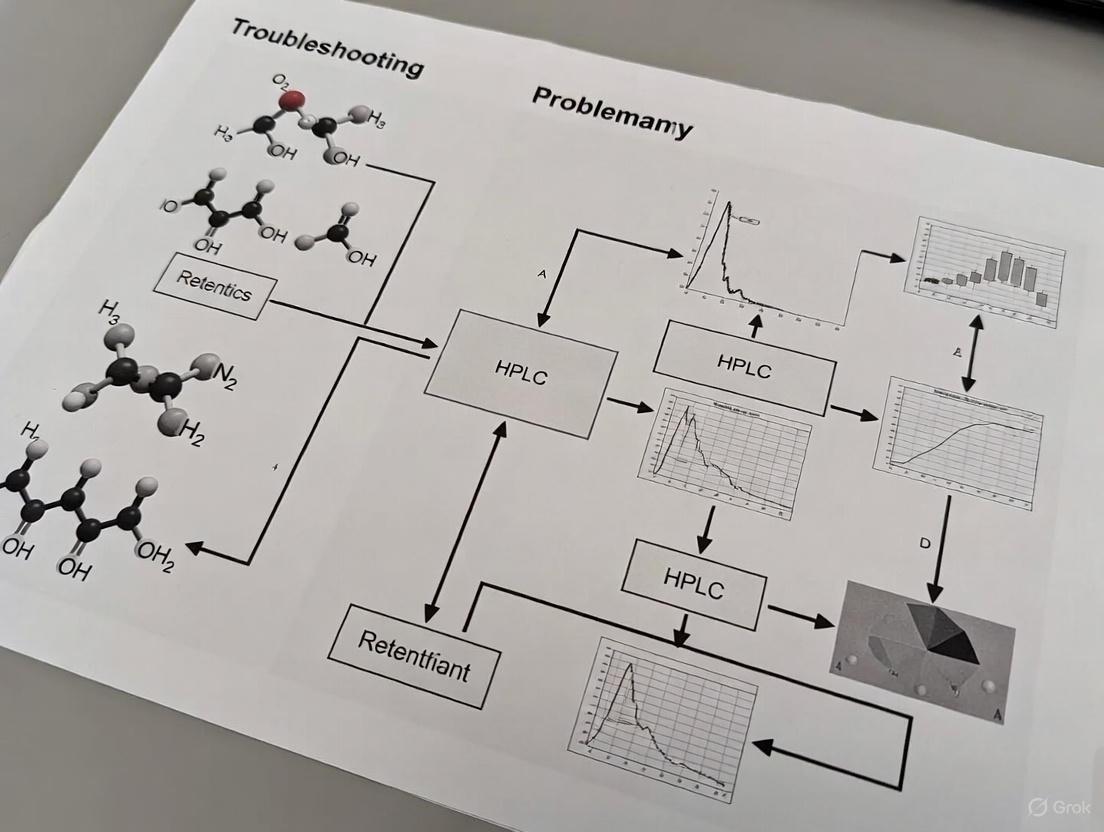
This comprehensive guide provides researchers and drug development professionals with a systematic approach to diagnosing, solving, and preventing High-Performance Liquid Chromatography (HPLC) issues.
Expert HPLC Troubleshooting Guide: From Diagnosis to Validation for Scientists
Abstract
This comprehensive guide provides researchers and drug development professionals with a systematic approach to diagnosing, solving, and preventing High-Performance Liquid Chromatography (HPLC) issues. Covering foundational principles, practical methodologies, advanced troubleshooting for common problems like pressure fluctuations, peak anomalies, and baseline noise, and the critical integration of Quality by Design (QbD) for robust method validation, this article serves as an essential resource. It synthesizes expert knowledge and current best practices to enhance analytical accuracy, ensure regulatory compliance, and minimize instrument downtime in pharmaceutical and biomedical research.
Understanding HPLC Fundamentals: The Science Behind the Separation
Core HPLC System Components and Their Role in System Performance
Troubleshooting Common HPLC Performance Issues
This section provides a systematic guide to diagnosing and resolving frequent HPLC problems, helping researchers maintain data integrity and instrument performance.
Pressure Abnormalities
Table: Troubleshooting HPLC Pressure Issues
| Symptom | Possible Causes | Recommended Solutions |
|---|---|---|
| High Pressure | Clogged column, salt precipitation, blocked inlet frit, contaminated sample [1] [2]. | Flush column with pure water at 40–50°C, followed by methanol or other organic solvents; backflush if applicable; reduce flow rate temporarily [1]. |
| Low Pressure | Leaks in tubing/fittings, worn pump seals, air bubbles, low flow rate [1] [2]. | Inspect and tighten connections; replace damaged seals; purge air from the pump; increase flow rate [1]. |
| Pressure Fluctuations | Trapped air bubbles, insufficient degassing, malfunctioning pump or check valves [1] [2]. | Degas mobile phases thoroughly; purge air from pump; clean or replace check valves [1] [2]. |
Peak Shape and Resolution Problems
Table: Troubleshooting Peak Anomalies
| Symptom | Possible Causes | Recommended Solutions |
|---|---|---|
| Peak Tailing | Column degradation, interaction of basic compounds with silanol groups, column void, inappropriate stationary phase [3] [2]. | Use high-purity silica columns; add competing base to mobile phase; replace degraded column; ensure proper capillary connections [3]. |
| Peak Fronting | Blocked frit, channels in column, column overload, sample dissolved in strong eluent [3]. | Replace pre-column frit; reduce sample amount; dissolve sample in starting mobile phase [3]. |
| Poor Resolution | Unsuitable column, overloaded sample, non-optimized method, extra-column volume too large [3] [1]. | Optimize mobile phase composition and flow rate; improve sample preparation; use shorter, narrower capillary connections [3] [1]. |
Baseline and Signal Anomalies
Table: Troubleshooting Baseline and Signal Issues
| Symptom | Possible Causes | Recommended Solutions |
|---|---|---|
| Baseline Noise & Drift | Contaminated solvents, detector lamp issues, mobile phase impurities, temperature instability [1] [4]. | Use high-purity solvents; degas thoroughly; replace detector lamp; clean flow cell; stabilize lab temperature [1] [2]. |
| Retention Time Shifts | Mobile phase composition variations, column aging, inconsistent pump flow [1] [2]. | Prepare mobile phases consistently; equilibrate column before runs; service pump regularly [1] [2]. |
| Low Signal Intensity | Poor sample extraction, high system noise, low method sensitivity, detector-specific issues [3] [2]. | Optimize sample preparation; maintain instrument cleanliness; refine method parameters; check detector settings [3] [2]. |
| Ghost Peaks | Mobile phase impurities, contamination on column or in injector [4]. | Use high-purity mobile phase components; flush sampler and column; replace contaminated components [4]. |
Systematic Troubleshooting Workflow
The following diagram outlines a logical, step-by-step approach to diagnosing HPLC problems, helping researchers efficiently isolate the root cause of instrument issues.
Essential Preventive Maintenance for HPLC Systems
Proactive maintenance is crucial for preventing instrument downtime and ensuring consistent, high-quality analytical results [2] [5].
Routine Maintenance Schedule
Table: HPLC Preventive Maintenance Checklist
| Frequency | Maintenance Tasks |
|---|---|
| Daily | Flush system with appropriate solvents; check mobile phase volume/degassing; inspect for leaks; monitor and record baseline pressure, temperature, and noise [5]. |
| Weekly | Run reference standards for performance verification; empty waste containers; perform baseline and noise level checks [5]. |
| Monthly | Perform deep system cleaning; conduct comprehensive performance verification; review maintenance logs [5]. |
| As Needed | Replace pump seals and check valves; replace detector lamp; change needle seal; clean or replace guard column and inline filters [2] [5]. |
Mobile Phase and Column Management Best Practices
- Mobile Phase: Use HPLC-grade solvents, filter through 0.45μm filters, and degas properly. Replace buffer solutions every 48-72 hours to prevent microbial growth [5].
- Column Care: Store columns according to manufacturer guidelines, use guard columns, track column pressure and peak shape for early problem detection, and implement regular cleaning protocols [2] [5].
Advanced Techniques and Future Directions in HPLC
Innovative approaches are enhancing the separation power and automation of liquid chromatography, particularly for complex samples.
Two-Dimensional Liquid Chromatography (LC×LC)
LC×LC significantly improves separation performance for complex samples by using two different separation mechanisms. Recent advances include multi-2D LC×LC, where a six-way valve selects between different phases (e.g., HILIC or RP) as the second dimension depending on the analysis time in the first dimension [6]. Methods like multi-task Bayesian optimization are being developed to simplify the complex method optimization required for LC×LC, aiming to increase its adoption [6].
Laboratory Automation and AI Integration
Automation is transforming HPLC workflows to meet demands for higher throughput, accuracy, and cost-efficiency. The laboratory automation market is projected to grow from $5.2 billion in 2022 to $8.4 billion by 2027 [7]. Key developments include:
- AI-Powered Optimization: Systems that use machine learning to autonomously optimize LC gradients and streamline method development [7].
- Integrated Workflows: Robotic systems linking multiple chemistry labs to centralized LC-MS and NMR platforms, supporting high-throughput synthesis and characterization [7].
Frequently Asked Questions (FAQs)
Q1: What is the basic working principle of HPLC? HPLC separates components in a sample by pumping a liquid mobile phase at high pressure through a column packed with a stationary phase. Compounds interact differently with the stationary phase, causing them to elute at different times and be detected individually [1].
Q2: My peaks are tailing. What is the most common cause and how can I fix it? Peak tailing for basic compounds is often caused by interaction with silanol groups on the stationary phase. Solutions include using high-purity silica columns, adding a competing base like triethylamine to the mobile phase, or using a different column chemistry like a polar-embedded phase [3].
Q3: How can I prevent air bubbles from affecting my baseline and pressure? Air bubbles can cause baseline noise and unstable flow. To prevent this, always degas mobile phases properly before use. Soak and ultrasonically clean filter heads, and use exhaust valves to vent the system if bubbles are suspected [1].
Q4: Why do I see ghost peaks in my blank injections? Ghost peaks are typically caused by mobile phase impurities or contamination in the system. Use high-purity solvents and additives. Flush the sampler and column thoroughly. If the problem persists, try mobile phase components from a different manufacturer [4].
Q5: What are the most critical daily maintenance tasks for my HPLC? The most critical daily tasks are: flushing the system with appropriate solvents, ensuring sufficient and properly degassed mobile phase, checking for leaks at all connections, and monitoring baseline pressure readings. Maintaining a daily log helps establish a history for spotting trends [5].
Technical Support Center: FAQs & Troubleshooting Guides
Core Principles: Adsorption in Chromatography
FAQ: How do adsorption kinetics and thermodynamics relate to my HPLC separations?
Adsorption is the physical process by which molecules (adsorbate) in your sample adhere to the surface of the stationary phase (adsorbent) within your HPLC column. The kinetics of this process—how fast equilibrium is reached—directly impact peak broadening. The thermodynamics—the energy changes and spontaneity of the process—govern retention time and stability. A method robust in both aspects yields sharp, well-separated, and reproducible peaks [8].
FAQ: What do common kinetic and thermodynamic models tell me about my separation?
Experimental adsorption data is fitted to established models to understand the underlying mechanism. The table below summarizes key models and their interpretations [8] [9].
Table 1: Key Adsorption Models and Their Significance
| Model Type | Model Name | What it Reveals | Typical Application |
|---|---|---|---|
| Kinetic | Pseudo-First Order | Assumes adsorption capacity is constant; often a poor fit for chromatographic systems. | Initial data assessment. |
| Kinetic | Pseudo-Second Order | Suggests a chemisorption mechanism, where the rate depends on adsorbent-adsorbate capacity. Indicates a strong, specific interaction [8]. | Confirming strong analyte-stationary phase binding. |
| Isotherm | Langmuir | Assumes a homogeneous surface with monolayer adsorption. A good fit suggests specific, identical sites. | Characterizing column binding capacity. |
| Isotherm | Freundlich | Assumes a heterogeneous surface with multilayer adsorption. A good fit is common for complex, real-world samples [10]. | Modeling adsorption from complex matrices. |
| Thermodynamic | Gibbs Free Energy (ΔG°) | Negative Value: Process is spontaneous. Positive Value: Process is non-spontaneous. | Determining the favorability of the adsorption process. |
| Thermodynamic | Enthalpy (ΔH°) | Negative Value: Exothermic process (common in physisorption). Positive Value: Endothermic process (may indicate chemisorption) [9]. | Identifying the heat exchange of adsorption. |
| Thermodynamic | Entropy (ΔS°) | Positive Value: Increased disorder at the solid-liquid interface. Negative Value: Increased order. | Understanding molecular rearrangements during adsorption. |
Troubleshooting Common Experimental Issues
The following workflow provides a logical sequence for diagnosing common problems related to adsorption and separation performance in HPLC.
Troubleshooting Guide: Addressing Specific Symptoms
Table 2: Troubleshooting Common HPLC Problems Related to Adsorption
| Symptom | Potential Root Cause | Corrective Action |
|---|---|---|
| Retention Time Shifts [2] [11] | - Changes in mobile phase composition/pH.- Column aging/degradation altering adsorption sites.- Insufficient column equilibration. | - Prepare mobile phase consistently and degas.- Use a column oven for stable temperature.- Ensure full column equilibration before runs. |
| Peak Tailing [2] [1] [11] | - Active sites on the stationary phase (e.g., residual silanols) causing secondary interactions.- Column contamination. | - Use end-capped columns to deactivate silanols.- Flush column with strong solvents to remove contaminants.- Use a guard column. |
| Peak Fronting [11] | - Column overload: Sample mass exceeds column adsorption capacity.- Column damage creating uneven flow paths. | - Reduce sample injection volume or concentration.- Verify sample solvent is compatible with mobile phase.- Replace damaged column. |
| Low Signal Intensity [2] [1] | - Inefficient sample preparation or extraction, leading to poor analyte adsorption during pre-concentration. | - Optimize and validate sample preparation/extraction steps.- Ensure the sample is dissolved in a solvent weaker than the mobile phase. |
| High Back Pressure [1] [11] | - Particulate matter or strongly retained compounds adsorbed and clogging the column frit. | - Filter all samples and mobile phases (0.2-0.45 µm).- Flush column according to manufacturer's protocol.- Use in-line filters and guard columns. |
Detailed Experimental Protocols
Protocol 1: Investigating Adsorption Kinetics for Method Development
This protocol outlines how to use HPLC to generate data for kinetic modeling, helping you understand the speed of analyte-stationary phase interactions [8].
- Column Preparation: Use a standard C18 column (e.g., 150 x 4.6 mm, 5 µm). Equilibrate with your initial mobile phase (e.g., a buffer/acetonitrile mix) at a constant flow rate (e.g., 1.0 mL/min).
- Sample Preparation: Prepare a standard solution of your analyte at a known concentration (e.g., 100 mg/L).
- Data Collection: Inject the sample and analyze it over a series of short, sequential time intervals (e.g., every 5 minutes for 60 minutes). Monitor the concentration of the analyte remaining in solution or the amount adsorbed at each time point.
- Kinetic Modeling: Fit the experimental data (amount adsorbed, q_t, vs. time, t) to the following linearized kinetic models:
- Pseudo-First-Order:
log(q_e - q_t) = log(q_e) - (k₁ * t / 2.303) - Pseudo-Second-Order:
t / q_t = 1/(k₂ * q_e²) + (1 / q_e) * tWhere qe and qt are the amounts adsorbed at equilibrium and time t, and k₁ & k₂ are the rate constants.
- Pseudo-First-Order:
- Interpretation: The model with a correlation coefficient (R²) closest to 1 is considered the best fit. A strong fit to the Pseudo-Second-Order model suggests the adsorption process is controlled by chemisorption [8].
Protocol 2: Determining Thermodynamic Parameters
This protocol allows you to calculate key thermodynamic parameters to assess the favorability and nature of the adsorption process [8] [9].
- Equilibrium Experiments: Perform your HPLC analysis at multiple constant temperatures (e.g., 30°C, 40°C, 50°C) while keeping other parameters constant.
- Calculate Distribution Constant (KD): For each temperature, determine
K_D = q_e / C_e, where *qe* is the amount adsorbed per gram of stationary phase at equilibrium, and C_e is the equilibrium concentration in solution. - Calculate Thermodynamic Parameters:
- Gibbs Free Energy (ΔG°):
ΔG° = -RT ln(K_D)where R is the gas constant and T is temperature in Kelvin. - Enthalpy (ΔH°) and Entropy (ΔS°): Use the van't Hoff equation:
ln(K_D) = -ΔH°/RT + ΔS°/R. Plotln(K_D)versus1/T. The slope is-ΔH°/Rand the intercept isΔS°/R.
- Gibbs Free Energy (ΔG°):
- Interpretation:
- A negative ΔG° indicates a spontaneous adsorption process.
- A negative ΔH° suggests an exothermic process (common in physisorption or weak chemical bonds).
- A positive ΔH° suggests an endothermic process, often associated with chemisorption [9].
- A positive ΔS° suggests increased randomness at the solid-solution interface during adsorption.
The Scientist's Toolkit: Essential Research Reagents & Materials
Table 3: Key Reagents and Materials for Adsorption Studies
| Item | Function / Explanation |
|---|---|
| C18 Chromatography Column | The standard reversed-phase stationary phase; the adsorbent for non-polar/polar analyte separation. |
| Peerless C-8 Column [8] | A specific type of stationary phase used in bile acid adsorption studies; provides different selectivity than C18. |
| HPLC-Grade Solvents | High-purity water, acetonitrile, and methanol are used as mobile phase components to prevent baseline noise and column contamination [2]. |
| Buffer Salts | (e.g., Ammonium acetate, phosphate salts) Used to control mobile phase pH and ionic strength, critically influencing analyte ionization and adsorption thermodynamics. |
| Standard Compounds | (e.g., Bile acids like glycocholic acid [8], Bisphenol A [10]) High-purity analytes of known concentration for method calibration and validation. |
| Guard Column | A short cartridge placed before the main analytical column to adsorb impurities and particulate matter, protecting the more expensive main column [11]. |
| Syringe Filters | (0.2 µm or 0.45 µm) For removing particulates from samples prior to injection, preventing column clogging and high back pressure [1]. |
The Impact of Surface Heterogeneity on Chromatographic Behavior
FAQs: Understanding Surface Heterogeneity
FAQ 1: What is surface heterogeneity in chromatography and how does it impact my results?
Surface heterogeneity refers to the non-uniform chemical nature of the stationary phase surface. Even in high-quality, modern reversed-phase columns, the silica support contains a population of silanol groups (Si-OH) that can exist in either an ionized or an unionized state. These groups create secondary interaction sites alongside the intended primary hydrophobic interactions with the C18 or other bonded phases. This heterogeneity causes some analyte molecules to be retained slightly longer than others on their journey through the column, leading to peak tailing, broadening, and in severe cases, changes in retention time. This degrades resolution, makes integration less accurate, and can raise detection limits by reducing peak height.
FAQ 2: Which compounds are most susceptible to problems caused by surface heterogeneity?
Basic compounds are the most significantly affected. At typical reversed-phase pH (e.g., 2-7), basic analytes are positively charged and can undergo strong ionic interactions with negatively charged, ionized silanol groups on the silica surface. This creates a mixed-mode retention mechanism: the desired hydrophobic partitioning and an undesired ionic interaction. The ionic interaction often equilibrates more slowly, leading to characteristic tailing peaks. Acidic and neutral compounds are generally less affected by this specific issue.
FAQ 3: I have a new column, but my peaks are tailing. Is this a surface heterogeneity problem?
It could be, but other factors must be ruled out first. A new column should have a tailing factor (Tf) typically between 0.9 and 1.2. If tailing is observed immediately, it may indicate a method-related issue, such as:
- Incompatible sample solvent: The sample dissolved in a solvent stronger than the starting mobile phase.
- Insufficient buffer capacity: The mobile phase buffer concentration is too low to effectively control pH and mask silanol interactions.
- Chemical overload: The mass of analyte injected is too high for the column's capacity. If these are eliminated, the column itself, even if new, might have a high level of acidic silanols, making a different column chemistry necessary.
FAQ 4: My method was working, but peak shape has degraded over hundreds of injections. Is this due to surface heterogeneity?
Yes, this is a common failure mode. With extensive use, especially at high pH (>7) and elevated temperature, the stationary phase can hydrolyze. This process strips away the bonded phase and, crucially, the endcapping, which is a secondary silanization step designed to cover residual silanols. The loss of these protective layers exposes more silanol groups, increasing surface heterogeneity and leading to progressively worse peak tailing for susceptible compounds, particularly bases.
Troubleshooting Guides
Diagnosing Peak Tailing and Shape Issues
Peak tailing is a primary symptom of surface heterogeneity. The following table helps diagnose the root cause based on the pattern of tailing in your chromatogram.
Table 1: Diagnostic Guide for Peak Tailing Patterns
| Symptom | Most Likely Cause | Supporting Evidence & Immediate Actions |
|---|---|---|
| One or a few peaks tail, others are sharp. | Chemical Interaction (e.g., basic analytes with silanols, column overload). | - Tailing peaks are often basic compounds.- Check if tailing decreases with a lower injection mass (suggests overload) [12].- Verify mobile phase pH and buffer concentration. |
| All peaks in the chromatogram tail or are distorted. | Extra-column Effects or Column Inlet Problem (e.g., void in column bed, excessive connection tubing volume, contaminated guard column). | - A visual void may be seen at the column inlet.- Replacing the guard cartridge restores performance (points to matrix contamination) [13].- Check for loose or overly long capillary connections. |
| Peak fronting occurs. | Column Overload or Physical Column Damage. | - Fronting is often accompanied by a reduction in retention time [12].- Reducing the injection volume improves peak shape.- Sudden onset of fronting in consecutive injections can indicate column collapse [12]. |
Systematic Troubleshooting Flowchart
The following workflow provides a logical sequence for identifying and resolving issues related to surface heterogeneity and other common problems.
Quantitative Data and Tolerances
For a method to be robust, system suitability tests must include acceptable limits for peak shape. The following table summarizes key quantitative metrics and their implications.
Table 2: Quantitative Metrics for Peak Shape Assessment
| Parameter | Calculation | Acceptable Range | Impact of Surface Heterogeneity |
|---|---|---|---|
| USP Tailing Factor (Tf) | Tf = (a + b) / 2a(at 5% peak height) [12] | Ideal: 0.9 - 1.2 [12]Typically Acceptable: ≤ 1.5 [12]Action Required: ≥ 2.0 [12] | Increases Tf significantly. Values >1.5 for basic compounds often indicate silanol activity. |
| Asymmetry Factor (As) | As = b / a(at 10% peak height) [12] | Ideal: 1.0Acceptable: < 1.5 | Increases As. The value grows faster than Tf for the same tailing peak. |
| Theoretical Plates (N) | N = 16 (tᵣ / w)² | Method specific; higher is better. | A gradual decrease in plate count over a column's lifetime indicates increasing heterogeneity and loss of efficiency. |
Experimental Protocols for Mitigation and Restoration
Protocol 1: Mitigating Silanol Interactions during Method Development
This protocol outlines steps to proactively minimize the effects of surface heterogeneity when developing a new method.
Objective: To develop a robust HPLC method for the separation of basic analytes that is resistant to peak tailing caused by surface heterogeneity.
Materials:
- Test analytes and sample matrix.
- HPLC system with binary or quaternary pump and DAD.
- Columns with different surface chemistries (e.g., high-purity silica, polar-embedded, charged surface hybrid).
- HPLC-grade water, acetonitrile, methanol.
- Buffer salts (e.g., ammonium formate, phosphate) and additives (e.g., triethylamine).
Methodology:
- Initial Scouting: Begin with a standard C18 column made from high-purity silica (Type B). Use a mobile phase of water/acetonitrile with a 10-20 mM buffer at a pH where the basic analyte is fully protonated (typically pH 3.0 or below for most bases).
- Optimize Buffer: If tailing is observed, double the buffer concentration (e.g., from 10 mM to 20 mM) to improve its capacity to mask silanols. Ensure the buffer is prepared correctly with accurate pH adjustment [12].
- Evaluate Additives: If tailing persists, introduce a competing base like triethylamine (TEA) at 0.1-0.5% v/v. TEA will preferentially bind to silanol sites, blocking them from the analyte [3].
- Switch Stationary Phase: If the above steps are insufficient, test a column specifically designed for basic compounds. This could be a charged surface hybrid (CSH) column, a column with polar-embedded groups, or a sterically protected column [13] [3].
Protocol 2: Restoring Column Performance
This procedure can be used to clean and restore a column that has suffered from matrix contamination, which can exacerbate surface heterogeneity by creating new, active sites.
Objective: To remove contamination from the column frit and inlet that is causing high backpressure, peak tailing, or ghost peaks.
Materials:
- HPLC system with capable of reversed flow.
- Strong organic solvents: Acetonitrile, Isopropyl Alcohol.
- Wash solution: 40:40:20 (ACN:IPA:H₂O) [14].
- Waste container.
Methodology:
- Disconnect and Reverse: Disconnect the column from the detector. Reconnect the inlet tubing to the outlet of the column. Direct the column's new outlet (the original inlet) to a waste container. Do not connect to the detector.
- Flush with Restoration Solvent: At a slow flow rate (e.g., 0.2-0.5 mL/min), flush the column in this reverse direction with 5-10 column volumes of the 40:40:20 ACN:IPA:H₂O wash solution [14]. This helps dissolve and expel strongly retained contaminants from the inlet frit.
- Reconnect and Equilibrate: Reconnect the column in the normal flow direction (or continue to run in reverse, noting the change). Flush the column with at least 150 column volumes of the starting mobile phase or until a stable baseline is achieved [14].
- Evaluate Performance: Inject a system suitability test mixture and compare peak shape, retention time, and pressure against the column's original performance report.
The Scientist's Toolkit: Essential Research Reagents and Materials
Selecting the right tools is critical for managing surface heterogeneity.
Table 3: Key Reagents and Materials for Troubleshooting Surface Heterogeneity
| Item | Function & Rationale |
|---|---|
| High-Purity Silica (Type B) Columns | Base material with low metal impurity content, leading to fewer acidic silanols and inherently less peak tailing for basic compounds [13] [3]. |
| Specialty Base-Deactivated Columns | Columns with advanced bonding and endcapping technologies (e.g., CSH, polar-embedded) designed to minimize ionic interactions with basic analytes [13]. |
| Guard Column/ Cartridge | A small, disposable column placed before the analytical column. It sacrificially captures contaminants and particulate matter that would otherwise foul the more expensive analytical column and create heterogeneous active sites [13] [14]. |
| Competing Amines (e.g., Triethylamine) | Mobile phase additive that competitively blocks access of basic analytes to residual silanol groups on the stationary phase surface, thereby reducing tailing [3]. |
| Buffers (Ammonium Formate/Acetate, Phosphates) | Essential for controlling mobile phase pH, ensuring analytes are in a consistent ionization state, and providing ionic strength to shield unwanted secondary interactions [12] [15]. |
Fundamental AED Concepts & FAQs
What is Adsorption Energy Distribution (AED) and why is it important in chromatography?
Adsorption Energy Distribution (AED) is a framework that models adsorption as a sum of independent homogeneous sites, each with a specific energy, to offer a realistic representation of heterogeneous adsorption on stationary phases [16]. In liquid chromatography (LC), adsorption heterogeneity arises from the distribution of adsorption sites with varying interaction energies, which affects retention and separation performance [16]. This heterogeneity can cause peak tailing, reduced resolution, and unpredictable retention times in analytical chromatography, as well as broad, asymmetric elution profiles in preparative systems [16]. Traditional adsorption isotherms often fail to fully describe these complex interactions because they assume uniform adsorption energies, whereas AED provides a powerful alternative for characterizing the chromatographic system and elucidating retention mechanisms [16].
How does AED analysis explain peak tailing in my chromatograms?
AED analysis directly links peak tailing to adsorption heterogeneity. A heterogeneous surface has a wide distribution of adsorption sites with different energies. Sites with higher adsorption energies strongly retain analyte molecules, causing them to elute later and leading to the characteristic tailing of the peak [16]. The AED plot visualizes this heterogeneity; a broad or multi-peaked distribution indicates a heterogeneous surface, which is the fundamental cause of peak tailing [16].
What are the key inputs required for an AED analysis?
The primary input for AED analysis is accurate adsorption isotherm data [16]. Key practical considerations for obtaining useful results include:
- Concentration Range: The range of concentration data in the adsorption isotherm must be sufficiently wide to reflect the energy distribution [16].
- Kernel Function: The selection of a suitable local adsorption model (kernel function) significantly impacts the AED plot and calculations [16].
- Computational Parameters: The number of iterations and grid points used in the AED analysis must be carefully assessed to ensure a reliable result [16].
AED Troubleshooting Guide for Common HPLC Issues
| Problem | Traditional Interpretation | AED-Based Interpretation | Recommended AED Action |
|---|---|---|---|
| Peak Tailing | Column degradation, secondary interactions [17] | Underlying surface energy heterogeneity [16] | Calculate AED; a broad distribution confirms heterogeneity. |
| Reduced Resolution | General loss of column efficiency [17] | Overlap of adsorption energy profiles for multiple compounds [16] | Use AED to deconvolute contributions and optimize mobile phase. |
| Unpredictable Retention Times | Changes in mobile phase composition or temperature [17] | Shifts in active adsorption site populations [16] | Monitor AED changes under different conditions to identify instability. |
| Broad Elution Profiles | Preparative-scale overloading [17] | Heterogeneity manifesting at high sample loading [16] | Apply AED to model multi-site adsorption and inform scaling strategies. |
Experimental Protocol: Determining an Adsorption Energy Distribution
This protocol outlines the methodology for characterizing surface heterogeneity using AED analysis, based on procedures established in chromatographic research [16] [18].
Step 1: Adsorption Isotherm Measurement
- Objective: Measure the amount of analyte adsorbed onto the stationary phase ((q(c))) at varying equilibrium concentrations ((c))
- Procedure:
- Pack the stationary phase into a suitable column.
- Equilibrate the column with a mobile phase of known composition.
- Inject a series of analyte solutions with concentrations spanning from below to above the expected saturation capacity. The concentration range is critical for accurate AED calculation [16].
- Use a suitable detection method (e.g., UV-Vis) to determine the amount adsorbed at each concentration point.
Step 2: Numerical Processing and AED Calculation
- Objective: Solve the integral equation to obtain the distribution function (f(\epsilon)).
- Procedure:
- Formulate the Integral Equation: The total adsorption is described by (q(c) = \int{\min}^{\max} f(\epsilon) \, \Theta(c, \epsilon) \, d\epsilon), where (\Theta(c, \epsilon)) is the local adsorption model (kernel function) [18].
- Discretize the Equation: Convert the integral into a discrete sum for numerical computation: (q(c) \approx \sum{i} f(\epsiloni) \, \Theta(c, \epsiloni) \, \Delta\epsilon) [18].
- Select a Kernel: Choose an appropriate local isotherm model (e.g., Langmuir).
- Apply an Inversion Algorithm: Use a computational algorithm like the Expectation-Maximization (EM) with maximum likelihood estimation to solve for (f(\epsilon)). Assume a uniform initial distribution for (f(\epsilon)) and iterate until convergence [18].
Step 3: Interpretation of Results
- Objective: Relate the computed AED plot to surface properties.
- Procedure:
- A single, sharp peak in the AED indicates a homogeneous surface.
- Multiple or broad peaks indicate surface heterogeneity, with each peak corresponding to a distinct type of adsorption site with a characteristic energy [16].
- Use the number and location of these peaks to select an appropriate adsorption model for further analysis [16].
Workflow Visualization
The following diagram illustrates the core workflow for AED analysis.
The Scientist's Toolkit: Essential Reagents and Materials for AED Studies
| Item | Function / Role in AED Analysis |
|---|---|
| Characterized Stationary Phase | The solid adsorbent under investigation (e.g., HPLC column packing). Its surface properties are the primary target of the AED analysis. |
| Analytes of High Purity | Probe molecules used to characterize the surface. Their adsorption behavior is measured to generate the isotherm data. |
| Appropriate Kernel Function | The mathematical model for local adsorption (e.g., Langmuir isotherm). It is a critical choice that impacts the calculated energy distribution [16] [18]. |
| Computational Software | Tools for performing the numerical inversion of the adsorption integral equation, such as implementations of the Expectation-Maximization (EM) algorithm [18]. |
HPLC Method Development and Robust Operational Practices
Quality by Design (QbD) represents a systematic, risk-based approach to analytical method development that builds quality into methods from the outset, rather than relying on retrospective testing [19]. Developed by the International Council for Harmonisation (ICH), this framework ensures methods are robust, reproducible, and comply with regulatory requirements for pharmaceutical quality control [19]. Unlike traditional one-factor-at-a-time (OFAT) approaches, which can overlook critical interactions between variables, QbD examines how factors like pH, buffer concentration, flow rate, and temperature interact to define a robust 'design space' where methods consistently meet quality standards [19] [20]. This proactive methodology transforms HPLC from a mere analytical tool into a well-characterized "product" designed for consistent performance throughout its lifecycle, providing greater confidence in method reliability and regulatory flexibility [19] [20].
The QbD Framework: A Systematic Approach
Implementing QbD for HPLC method development follows a defined sequence that emphasizes prior understanding and risk management. The systematic framework ensures all critical aspects of method performance are considered and optimized.
Figure 1: QbD Systematic Approach to HPLC Method Development
Define Quality Target Product Profile (QTPP) and Analytical Target Profile (ATP)
The foundation of analytical QbD begins with defining the Quality Target Product Profile (QTPP), which outlines the method's performance standards, including accuracy, sensitivity, precision, and robustness [19]. This is complemented by the Analytical Target Profile (ATP), which focuses on specific analytical requirements to ensure the method meets regulatory, pharmacopeia, and Good Manufacturing Practice (GMP) expectations [19]. For HPLC methods, the QTPP typically includes parameters such as retention time, theoretical plates, and peak asymmetry, which serve as critical benchmarks throughout method development [20].
Determine Critical Quality Attributes (CQAs)
Critical Quality Attributes (CQAs) are method parameters that directly affect the QTPP and represent the key responses that must be monitored and controlled [20]. For HPLC method development, CQAs include chromatographic characteristics such as:
- Retention time: Consistency indicates stable separation conditions
- Theoretical plates: Measure of column efficiency
- Peak asymmetry/tailing: Indicator of peak shape and potential secondary interactions
- Resolution: Ability to separate adjacent peaks [20]
These CQAs are influenced by method parameters and must remain within predefined limits to ensure method validity.
Risk Assessment: Identifying Critical Method Parameters
Risk assessment systematically evaluates each factor's potential impact on method performance. Tools such as Failure Mode and Effects Analysis (FMEA) and fishbone diagrams help identify Critical Method Parameters (CMPs) - variables most likely to affect CQAs [19] [20]. For HPLC, typical CMPs include:
- Mobile phase composition and pH
- Buffer concentration
- Flow rate
- Column temperature
- Stationary phase characteristics [19] [20]
This risk-based prioritization enables developers to focus experimental efforts on high-impact factors, reducing variability and ensuring more consistent method performance.
Experimental Design: Establishing the Design Space
Design of Experiments (DoE) represents the core of QbD implementation, enabling efficient exploration of multiple factors and their interactions simultaneously [19]. Through structured experimental designs such as Central Composite Design (CCD), researchers can model the relationship between CMPs and CQAs to establish a "design space" - the multidimensional combination of analytical parameters where method performance consistently meets standards [20]. For example, in developing an HPLC method for ceftriaxone sodium, researchers applied CCD to optimize mobile phase composition and pH at three different levels, analyzing their effects on retention time, theoretical plates, and peak asymmetry [20]. This approach generates predictive models that define robust operational ranges rather than single points, providing flexibility while maintaining quality.
Control Strategy and Continuous Improvement
A control strategy implements planned controls derived from risk management understanding to ensure method performance remains within the ATP [20]. For HPLC methods, this includes system suitability tests (SST) conducted before each analysis to verify equipment and method performance, along with defined procedures for sample preparation, measurement, and data interpretation [19] [20]. Continuous monitoring through periodic evaluations tracks long-term performance trends, identifying gradual shifts that could affect accuracy or precision, and drives ongoing improvements to maintain method alignment with evolving requirements and regulatory standards [19].
Troubleshooting Guides: QbD-Based Solutions
Pressure-Related Issues
Table 1: HPLC Pressure Abnormalities and QbD-Based Solutions
| Problem | Potential Causes | QbD-Informed Investigation & Resolution |
|---|---|---|
| High Pressure | Column blockage [21] [1], salt precipitation [1], blocked inlet frits [1] [22], inappropriate flow rate [1] | Flush column with pure water at 40-50°C followed by methanol or other organic solvents [1]; backflush if applicable [21] [1]; replace blocked frits [22]; implement preventative flushing protocols in control strategy [22] |
| Low Pressure | Leaks in tubing, fittings, or pump seals [21] [1] [22], low flow rate [21] [1] | Inspect and tighten fittings (avoid overtightening) [21] [1]; replace damaged seals [21] [1] [22]; check for salt buildup at connections as leak indicator [22] |
| Pressure Fluctuations | Air bubbles from insufficient degassing [21] [1], malfunctioning pump/check valves [1], contaminated mobile phase [22] | Degas mobile phases thoroughly (preferably online degassing) [1]; purge air from pump [21] [1]; clean or replace check valves [1]; incorporate degassing verification in method control strategy |
Peak Shape Anomalies
Table 2: HPLC Peak Shape Issues and QbD-Based Solutions
| Problem | Potential Causes | QbD-Informed Investigation & Resolution |
|---|---|---|
| Peak Tailing | Secondary interactions with silanol groups [21] [3], insufficient buffer capacity [3], column voiding [3] [22], wrong mobile phase pH [21] | Use high-purity silica or shielded phases [3]; add competing bases like triethylamine [3]; increase buffer concentration [3]; operate at lower pH to minimize silanol interactions [22]; reverse-flush column or replace if voided [21] [22] |
| Peak Fronting | Column overload [21] [3] [22], column bed deformation [21] [22], solvent incompatibility [21] | Reduce injection volume or dilute sample [21] [22]; use higher-capacity stationary phase [22]; ensure sample dissolved in starting mobile phase [21] [3] |
| Broad Peaks | Mobile phase composition change [21], low flow rate [21], column contamination [21] [22], detector time constant too large [21] [3] | Prepare fresh mobile phase [21]; adjust flow rate [21]; replace guard column/column [21]; decrease detector time constant [21] [3]; ensure extra-column volume minimized [3] |
| Split Peaks | Column contamination [21], blocked frit [3] [22], channels in column [3] | Flush system with strong organic solvent [21]; replace guard column [21]; replace blocked frit [3] [22]; replace column if channeling confirmed [3] |
Baseline and Retention Issues
Table 3: HPLC Baseline and Retention Problems and QbD-Based Solutions
| Problem | Potential Causes | QbD-Informed Investigation & Resolution |
|---|---|---|
| Baseline Noise | Leaks [21] [1], air bubbles in system [21] [1], contaminated mobile phase [21] [1], detector lamp issues [21] [1] | Check for loose fittings and tighten gently [21]; purge system to remove air bubbles [21] [1]; use high-purity solvents [1]; replace detector lamp if approaching end of life [21] |
| Baseline Drift | Column temperature fluctuation [21], mobile phase composition change [21], contaminated detector flow cell [21], UV-absorbing mobile phase [21] | Use thermostat column oven [21]; prepare fresh mobile phase [21]; flush flow cell with strong organic solvent [21]; use non-UV absorbing HPLC grade solvent [21] |
| Retention Time Drift | Poor temperature control [21], incorrect mobile phase composition [21], poor column equilibration [21], change in flow rate [21] | Use thermostat column oven [21]; prepare fresh mobile phase and verify mixer function for gradients [21]; increase column equilibration time [21]; verify flow rate with flow meter [21] |
| Retention Time Shifts | Variations in mobile phase composition/preparation [1], column aging [1], inconsistent pump flow [1], contamination buildup [22] | Prepare mobile phases consistently [1]; equilibrate columns before runs [1]; service pumps regularly [1]; flush column with strong solvent to remove contamination [22] |
Additional Chromatographic Issues
Table 4: Other Common HPLC Issues and QbD-Based Solutions
| Problem | Potential Causes | QbD-Informed Investigation & Resolution |
|---|---|---|
| Extra Peaks/Ghost Peaks | Contamination [21] [22], carryover [21] [22], late-eluting peaks from previous injections [3] | Flush system with strong organic solvent [21]; increase run time or gradient [21]; implement final wash step in gradient analysis [22]; use guard column/trap to remove contaminants [22] |
| Loss of Sensitivity | Injection volume too low [21], blocked needle [21], contaminated guard column/column [21], air bubbles in system [21] | Verify correct injection volume [21]; flush or replace needle [21]; replace guard column/column [21]; degas mobile phase and purge system [21] |
| No Peaks | Instrument failure [3], no injection [3], insufficient sample volume [3], detector set incorrectly [21] | Verify detector response with test substance [3]; ensure sample drawn into sample loop [3]; check detector settings and wavelength [21]; verify sample stability [3] |
Frequently Asked Questions (FAQs)
QbD Methodology FAQs
Q1: How does QbD differ from traditional HPLC method development? Traditional method development often uses a one-factor-at-a-time (OFAT) approach, which adjusts individual variables independently and can miss critical interactions between parameters. QbD employs systematic, multivariate approaches like Design of Experiments (DoE) to understand how factors interact and define a robust 'design space' where the method consistently performs within specifications. This proactive approach builds quality in from the beginning rather than testing it retrospectively [19].
Q2: What are the key elements of an Analytical Target Profile (ATP) for an HPLC method? The ATP should define the method's intended purpose and include performance standards such as accuracy, sensitivity, precision, robustness, and specific separation requirements. For HPLC, this typically translates to targets for resolution between critical pairs, tailing factor, theoretical plates, retention time stability, and detection limits, ensuring the method meets regulatory and quality control expectations [19] [20].
Q3: How is risk assessment conducted in analytical QbD? Risk assessment systematically evaluates potential failure modes and their impact on method performance. Tools like Failure Mode and Effects Analysis (FMEA) and fishbone diagrams help identify which variables (Critical Method Parameters) most affect Critical Quality Attributes (CQAs). This prioritization guides experimental design to focus on high-impact factors, reducing variability and ensuring robustness [19] [20].
Q4: What is the "design space" in QbD for HPLC methods? The design space is the multidimensional combination of analytical parameters (e.g., mobile phase composition, pH, temperature) within which method performance consistently meets quality standards. Operating within this established design space provides flexibility while maintaining quality, as changes within this region are not considered method modifications from a regulatory perspective [19] [20].
Q5: How does QbD support continuous improvement throughout a method's lifecycle? QbD incorporates ongoing monitoring through system suitability tests, periodic performance evaluations, and data tracking from routine use. This information drives continual refinement as methods are applied, ensuring they remain aligned with evolving requirements, regulatory standards, and process understanding throughout the product lifecycle [19] [20].
Technical Troubleshooting FAQs
Q6: What are the most common causes of peak tailing in reversed-phase HPLC, and how can they be addressed? Peak tailing frequently results from secondary interactions with uncapped silanol groups on the stationary phase, especially for basic compounds. Solutions include using high-purity silica columns, adding competing bases like triethylamine to the mobile phase, operating at lower pH to suppress silanol ionization, or using alternative stationary phases such as polar-embedded groups or polymeric columns [3] [22].
Q7: Why do retention times shift between runs, and how can this be minimized? Retention time shifts can stem from mobile phase composition variations, column temperature fluctuations, insufficient column equilibration (especially after gradient runs), or pump flow rate inconsistencies. To minimize shifts: prepare mobile phases consistently, use thermostat column ovens, ensure adequate equilibration (typically 10+ column volumes for gradient methods), and maintain pumps regularly [21] [1] [22].
Q8: How can I troubleshoot high backpressure in my HPLC system? High pressure often indicates obstruction in the flow path. Begin by checking for column blockage (flush with appropriate solvents), blocked inlet frits (replace if necessary), or salt precipitation (flush with warm water). Isolate system components to identify the pressure location. Implement preventative measures including mobile phase filtration, sample cleanup, and regular system flushing [21] [1] [22].
Q9: What causes ghost peaks in chromatograms, and how can they be eliminated? Ghost peaks typically originate from contamination in the injector or column, carryover from previous injections, or contaminants in the mobile phase. Solutions include: thorough system flushing with strong solvents, implementing gradient final wash steps, using guard columns/traps to remove strongly retained compounds, and ensuring mobile phase purity and stability [21] [22].
Q10: Why is baseline noise occurring, and how can I reduce it? Baseline noise can result from leaks, air bubbles in the system, contaminated mobile phase, or detector issues (e.g., aging lamps). Check fittings for leaks, degas mobile phases thoroughly, use high-purity solvents, and replace detector components as needed. For persistent noise, isolate the detector from the column to determine if the source is before or after the detector [21] [1].
Experimental Protocols & Methodologies
QbD-Based Method Development Protocol
The following workflow outlines a systematic approach to developing an HPLC method using QbD principles, based on successful applications documented in the literature [20]:
Step 1: Define Method Requirements
- Establish ATP based on intended method purpose (e.g., assay, impurity testing, dissolution)
- Identify specific separation goals (critical pairs, resolution requirements)
- Define validation parameters appropriate for intended use
Step 2: Conduct Initial Scouting Experiments
- Screen different column chemistries (C18, C8, phenyl, etc.)
- Evaluate various mobile phase compositions (acetonitrile vs. methanol)
- Test different pH conditions (typically 2-3 units from pKa of analytes)
- Identify promising conditions for further optimization
Step 3: Risk Assessment and CMP Identification
- Use FMEA to rank potential factors affecting CQAs
- Identify high-risk parameters for experimental design
- Document rationale for factor selection
Step 4: Design of Experiments (DoE)
- Select appropriate experimental design (e.g., Central Composite Design)
- Define factor ranges based on scouting experiments
- Establish response targets for CQAs
- Execute randomized experimental runs
Step 5: Data Analysis and Model Building
- Analyze results using statistical software
- Develop mathematical models relating CMPs to CQAs
- Evaluate model adequacy (R², Q², lack of fit)
- Identify significant factors and interactions
Step 6: Design Space Establishment
- Define operable region where CQAs meet specifications
- Verify design space boundaries experimentally
- Establish system suitability criteria based on design space
Step 7: Control Strategy Implementation
- Define system suitability tests to verify method performance
- Establish monitoring procedures for method lifecycle management
- Document method robustness within design space
Case Study: QbD Development of Ceftriaxone Sodium HPLC Method
A practical implementation of QbD for HPLC method development was demonstrated for ceftriaxone sodium, utilizing a Central Composite Design to optimize separation conditions [20]:
Experimental Design:
- Factors: Mobile phase composition and pH at three different levels
- Responses: Retention time, theoretical plates, peak asymmetry
- Software: Design Expert 11.0 for experimental design and optimization
Optimized Chromatographic Conditions:
- Column: Phenomenex ODS C18 (250 mm × 4.6 mm, 5.0 μm)
- Mobile Phase: Acetonitrile to water (0.01% triethylamine with pH 6.5) (70:30, v/v)
- Flow Rate: 1 ml/min
- Detection: UV at 270 nm
- Retention Time: 4.15 minutes
Method Performance:
- Linearity: r² = 0.991 over 10-200 μg/ml range
- System Suitability: Tailing factor = 1.49, theoretical plates = 5236
- Precision: Intraday %RSD = 0.70-0.94, Interday %RSD = 0.55-0.95
- Robustness: All values <2% deviation
This systematic approach provided greater understanding of factor interactions and higher confidence in method robustness compared to traditional development approaches [20].
The Scientist's Toolkit: Essential Research Reagents & Materials
Table 5: Essential HPLC Research Reagents and Materials
| Item/Category | Function & Importance in QbD | QbD Considerations |
|---|---|---|
| HPLC Columns (C18, C8, phenyl, HILIC) [20] [23] | Stationary phase for compound separation; primary determinant of selectivity | Column-to-column variability is a critical method parameter; supplier qualification essential; document column batch information; consider high-purity silica for basic compounds to reduce tailing [3] [23] |
| Mobile Phase Solvents (HPLC-grade acetonitrile, methanol, water) [20] [23] | Liquid medium transporting samples through system; impacts retention, selectivity, and pressure | Quality and purity are critical for reproducibility; degassing prevents baseline noise; UV cutoff important for detection; document supplier and grade in method control strategy [21] [1] |
| Buffer Salts & Additives (phosphate, acetate, ammonium formate, TFA, triethylamine) [20] [3] | Control pH and ionic strength; modify selectivity; suppress silanol interactions | Buffer capacity critical for pH control; concentration affects retention and peak shape; purity impacts baseline and column life; volatile buffers preferred for LC-MS [3] [22] |
| Reference Standards [20] | Method development, calibration, and system suitability testing | Purity and stability are essential for accurate method development and validation; document source, purity, and storage conditions; use qualified standards [20] |
| Column Care Products (guard columns, in-line filters) [21] [22] | Protect analytical column from contamination and extend lifespan | Essential for method robustness; replace regularly as part of preventative maintenance; select compatible with column dimensions and chemistry [21] [22] |
Method Transfer and Lifecycle Management
The QbD approach extends beyond initial method development to encompass successful method transfer and ongoing lifecycle management. A well-developed method using QbD principles should demonstrate robustness across different instruments, operators, and laboratories [19] [20]. The design space concept provides regulatory flexibility, allowing adjustments within the defined operating ranges without requiring formal method revalidation [20]. Continuous monitoring through system suitability tests and periodic performance reviews ensures the method remains fit-for-purpose throughout its lifecycle, with data-driven decisions guiding any necessary adjustments or improvements [19] [20]. This comprehensive approach to method lifecycle management represents a significant advancement over traditional methods, providing greater confidence in analytical results while reducing the need for frequent method remediation [24].
Best Practices for Mobile Phase Preparation and Degassing
Within the broader context of troubleshooting High-Performance Liquid Chromatography (HPLC) problems, the preparation and degassing of the mobile phase are foundational steps that critically impact the reliability, reproducibility, and sensitivity of chromatographic analyses. Inadequate practices in this initial stage can manifest as a wide range of issues downstream, including baseline instability, erratic retention times, and reduced detector sensitivity [25] [26]. This guide provides detailed, actionable protocols and troubleshooting advice to help researchers and drug development professionals eliminate these common variables, thereby ensuring the integrity of their experimental data.
Troubleshooting Common Mobile Phase and Degassing Issues
The table below summarizes frequent problems, their likely causes, and recommended solutions.
| Symptom | Possible Causes Related to Mobile Phase/Degassing | Solutions & Troubleshooting Steps |
|---|---|---|
| Pressure Fluctuations or Cycling [2] [27] | Air bubbles in the pump due to insufficient degassing; improper tube connections to/from the degasser introducing air [27]. | Degas mobile phase thoroughly; purge the pump; check and secure all tubing connections to the degasser [2] [27]. |
| Baseline Noise & Drift [2] [1] | Contaminated solvents; insufficient degassing leading to bubble formation in the detector flow cell; high gas load in the mobile phase [28] [27]. | Use fresh, high-purity solvents; ensure proper degassing; clean the detector flow cell; for high gas load, consider a second degassing chamber or helium sparging [28] [27] [1]. |
| Retention Time Shifts [2] | Inconsistent mobile phase composition between runs; evaporation of volatile components from the mobile phase [28]. | Prepare mobile phases consistently and accurately; use tight-sealing solvent bottles; for volatile organics, avoid aggressive helium sparging and use inline degassing [28]. |
| Poor Peak Shape (Tailing/Broadening) [2] | Contaminated mobile phase or sample; microbial growth in aqueous buffers. | Use high-purity reagents; filter mobile phases and samples; regularly flush the system to prevent contamination [2] [29]. |
| Low Signal Intensity (e.g., Fluorescence) [26] | Dissolved oxygen in the mobile phase quenching fluorescence. | For oxygen-sensitive detection (fluorescence, low-wavelength UV, electrochemical), use rigorous degassing such as a combination of helium sparging and inline degassing [26]. |
Frequently Asked Questions (FAQs)
1. Why is mobile phase degassing necessary in HPLC? When solvents contact the atmosphere, gases like nitrogen and oxygen dissolve into them. When these solvents are mixed for HPLC, the combined dissolved gas can exceed the mixture's solubility, creating a supersaturated solution. This leads to outgassing and bubble formation within the HPLC system [28] [26]. These bubbles can cause pump cavitation, erratic flow rates, unstable baselines, retention time shifts, and noise spikes in optical detectors [28] [26].
2. What is the most effective degassing method? Helium sparging is the most effective offline method, removing up to 80% of dissolved air [28] [26]. However, inline vacuum degassing is the standard in modern HPLC systems and is highly effective for most routine applications. It provides continuous degassing during the run, preventing air reabsorption and avoiding the ongoing cost and availability issues of helium [28]. For the most oxygen-sensitive applications (e.g., fluorescence or electrochemical detection), a combination of both methods offers the highest reliability [28] [26].
3. Can sonication alone be used to degas the mobile phase? No. Sonication (ultrasonic bath) alone is not sufficient, as it removes only 20-30% of dissolved gases, which is below the approximately 50% removal required to prevent outgassing in HPLC systems [28] [26]. Sonication is best used as a complementary technique to other methods like vacuum filtration or helium sparging [28].
4. How does improper mobile phase preparation affect my results? Inconsistencies in preparation are a major source of irreproducibility. Common pitfalls include:
- Incorrect buffer salt form: Using anhydrous vs. hydrated salts without adjusting the weight will alter buffer concentration and pH [25].
- Contaminated glassware: Residues can introduce contaminants that interfere with analysis or cause peak tailing [25].
- Incorrect order of mixing: Adding organic solvent to aqueous buffer can sometimes lead to precipitation or inconsistent pH [25].
- Improper pH adjustment: Not calibrating the pH meter or adjusting pH after final mixing can lead to significant errors [25].
5. What are the best practices for storing prepared mobile phases? To prevent contamination and degradation:
- Prevent microbial growth: Do not store aqueous or buffer mobile phases for extended periods. For short-term storage, use sealed containers [28] [27].
- Avoid crystallization: Do not leave buffers in the HPLC system during shutdowns. Always flush the entire system, including the degasser, with water and then a high-percentage organic solvent (e.g., 75% methanol or acetonitrile) for storage [28] [29].
- Label clearly: Include the date of preparation, composition, and pH.
Experimental Protocols for Mobile Phase Preparation and Degassing
Protocol 1: Standard Preparation of an Aqueous Buffer for Reversed-Phase HPLC
Objective: To reproducibly prepare a 1 L, 20 mM potassium phosphate buffer at pH 7.0.
Materials:
- HPLC-grade water
- High-purity potassium phosphate monobasic and dibasic salts
- Volumetric flask (1 L)
- Calibrated pH meter
- Magnetic stirrer and stir bar
- Filtration apparatus and 0.45 µm or 0.22 µm membrane filter
Method:
- Glassware Cleaning: Ensure all glassware is meticulously clean and rinsed with HPLC-grade water to prevent contamination [25].
- Calculation: Calculate the exact masses of the potassium phosphate salts required to make 1 L of 20 mM buffer at the desired pH. Confirm you are using the correct hydrated or anhydrous salt form [25].
- Weighing: Accurately weigh the salts using a calibrated balance and transfer them to a beaker.
- Dissolution: Dissolve the salts in approximately 800 mL of HPLC-grade water with stirring.
- pH Adjustment: Under continuous stirring, carefully adjust the pH to 7.0 using a concentrated solution of KOH or H₃PO₄ as needed.
- Final Volume: Quantitatively transfer the solution to a 1 L volumetric flask and bring to volume with HPLC-grade water.
- Filtration: Filter the solution through a 0.45 µm or 0.22 µm membrane filter into a clean solvent bottle. This step also serves as an initial vacuum degassing step [28].
Protocol 2: Inline Degasser Maintenance and Performance Verification
Objective: To maintain and verify the proper functioning of an inline vacuum degasser.
Materials:
- HPLC system with an inline degasser
- Degassed and non-degassed solvents (e.g., water, water/acetonitrile mixtures)
- 30% phosphoric acid solution (for cleaning)
Method:
- Preventative Maintenance:
- When shutting down the system for extended periods (e.g., over a weekend), flush the degasser channels with pure water followed by at least 50% organic solvent (e.g., methanol) to prevent microbial growth and buffer crystallization [28] [27].
- Never store the degasser with pure aqueous buffer in the lines.
Cleaning for Contamination:
Performance Verification:
- Baseline Stability Test: Run a gradient method (e.g., 5-95% organic) with both degassed and intentionally non-degassed mobile phases. A stable baseline with the degassed solvent versus a noisy, drifting baseline with the non-degassed solvent confirms the degasser is functioning properly [28].
- Pressure Monitoring: Observe the system pressure for rapid cycling or fluctuations, which can indicate the pump is pulling in air due to insufficient degassing performance [27].
Degassing Methodologies: A Quantitative Comparison
The following table provides a structured overview of common degassing techniques, allowing for direct comparison of their efficiency and suitability.
| Degassing Method | Typical Efficiency (% Air Removed) | Key Principle | Pros | Cons |
|---|---|---|---|---|
| Inline Vacuum Degassing [28] [26] | Removes most gas (prevents bubble formation) | Mobile phase passes a gas-permeable membrane under vacuum; continuous process. | Highly reliable; standard on modern HPLCs; low maintenance; prevents air reabsorption. | Higher initial cost; does not remove 100% of gas; membranes can be damaged by certain solvents (e.g., THF). |
| Helium Sparging (Offline) [28] [26] | ~80% | Bubbling helium gas through the solvent; helium displaces dissolved air and does not cause issues. | Most effective offline method. | Manual, time-consuming; mobile phase can reabsorb air; ongoing cost and availability of helium; can evaporate volatile components. |
| Vacuum Filtration (Offline) [28] [26] | ~60% | Applying a vacuum during or after filtration. | Combines filtration and degassing; relatively effective. | Batch process; solvent can reabsorb air after vacuum is released. |
| Sonication (Offline) [28] [26] | 20-30% | Using ultrasound to agitate the solution, encouraging gas to come out of solution. | Easy; uses common lab equipment. | Insufficient for use alone; best used as an adjunct to other methods. |
The Scientist's Toolkit: Essential Research Reagent Solutions
The table below lists key materials and reagents critical for proper mobile phase preparation and degassing.
| Item | Function & Importance | Key Considerations |
|---|---|---|
| HPLC-Grade Solvents | High-purity solvents minimize UV absorbance background noise and prevent column contamination [1] [29]. | Use specifically designated HPLC-grade water, acetonitrile, and methanol. |
| High-Purity Buffer Salts | Ensures accurate buffer concentration and pH, which directly control retention time and selectivity [25]. | Use high-purity (>99%) salts. Note and use the correct hydrated or anhydrous form for calculations. |
| Membrane Filters (0.2µm/0.45µm) | Removes particulate matter that could clog HPLC tubing, frits, or the column [29]. | Filter all aqueous buffers and samples. Use solvent-compatible membranes (e.g., Nylon, PVDF). |
| Guard Column | A sacrificial column that protects the expensive analytical column by trapping contaminants and particulates [29]. | Should contain similar packing to the analytical column. Replace regularly. |
| In-line Degasser | Standard component on modern HPLCs that continuously removes dissolved gases, ensuring pump and detector stability [28] [26]. | Perform regular maintenance flushes. Avoid storing with buffers. |
| Calibrated pH Meter | Essential for accurate and reproducible pH adjustment, a critical parameter in reversed-phase and ion-exchange chromatography [25]. | Calibrate daily with fresh standard buffers. Use electrodes compatible with aqueous/organic mixtures. |
| Helium Gas Cylinder & Sparging Kit | Provides highly effective degassing for oxygen-sensitive applications or when an inline degasser is not available [28] [26]. | Consider cost and helium availability. Use a fine-frit sparging stone for efficient gas dispersion. |
Workflow and Logical Relationship Diagrams
Mobile Phase Preparation and Troubleshooting Workflow
This diagram outlines the critical steps in mobile phase preparation and links common symptoms to their potential causes within this process.
HPLC Degassing Method Selection Logic
This decision tree guides the selection of an appropriate degassing method based on application requirements and available equipment.
Column Selection, Care, and Maintenance for Longevity
Within the broader context of research on troubleshooting HPLC chromatography problems, the analytical column is a critical focus. It is often the primary source of issues such as poor resolution, irregular peak shape, and pressure fluctuations. A systematic approach to column selection, coupled with disciplined care and maintenance, is fundamental to ensuring data reproducibility, minimizing costly downtime, and extending the operational lifespan of this essential component [30] [31]. This guide provides a structured framework for researchers and drug development professionals to optimize column performance and integrate robust troubleshooting protocols into their experimental workflows.
HPLC Column Selection Guide
Selecting the appropriate column is the first and most critical step in developing a robust HPLC method. The choice of stationary phase directly dictates the separation mechanism and, consequently, the success of the analysis.
Separation Mechanisms and Column Chemistry
The following table outlines the primary types of HPLC columns and their typical applications, which are essential for troubleshooting separation problems.
Table 1: Common HPLC Column Types and Their Applications
| Column Type | Separation Mechanism | Common Applications |
|---|---|---|
| Reversed-Phase (C18, C8) | Hydrophobic interactions between analytes and non-polar stationary phase [30]. | Analysis of non-polar to moderately polar compounds; most widely used in pharmaceutical analysis [30] [6]. |
| Normal-Phase | Polar interactions (hydrogen bonding, dipole-dipole) with a polar stationary phase (e.g., silica) [30]. | Separation of polar compounds, isomers, and for class separations [30]. |
| Hydrophilic Interaction Liquid Chromatography (HILIC) | Partitioning between a water-rich layer on a polar stationary phase and a organic-rich mobile phase [30] [6]. | Retention and separation of polar, hydrophilic compounds that are poorly retained in reversed-phase HPLC [30]. |
| Ion-Exchange | Electrostatic attraction between charged analytes and oppositely charged functional groups on the stationary phase [30]. | Separation of inorganic anions and cations, proteins, nucleotides, and other charged biomolecules [30]. |
| Size-Exclusion | Sieving of analytes based on molecular size as they travel through pores of the packing material [30]. | Molecular weight determination of polymers and proteins; desalting of biomolecules [30]. |
The Scientist's Toolkit: Essential Research Reagent Solutions
Proper maintenance and troubleshooting require the use of specific, high-quality reagents and materials. The following table details essential items for column care.
Table 2: Essential Reagents and Materials for HPLC Column Care and Maintenance
| Item | Function & Importance |
|---|---|
| HPLC-Grade Solvents | High-purity solvents (e.g., acetonitrile, methanol, water) prevent the introduction of particulates and contaminants that can clog column frits or coat the stationary phase [30] [2]. |
| Guard Column | A small cartridge containing similar packing to the analytical column. It acts as a sacrificial component, trapping particulates and strongly retained compounds, thereby protecting the more expensive analytical column [30] [32] [33]. |
| In-line Filter | Installed before the column to filter out particulate matter from the mobile phase or sample, preventing clogging of the column inlet frit [30] [33]. |
| High-Purity Buffering Salts | Salts such as ammonium formate/acetate or potassium phosphate are used to control mobile phase pH and ionic strength. High purity prevents contamination and precipitation [30] [2]. |
| 0.2 µm or 0.45 µm Syringe Filters | Used for filtering samples prior to injection to remove insoluble particulates that could clog the column [31] [2] [34]. |
HPLC Column Maintenance and Storage Protocols
Consistent maintenance is the most effective strategy for preventing chromatography problems and extending column lifetime.
Routine Cleaning and Equilibration
- Post-Analysis Flushing: After each use, especially with buffer solutions or "dirty" samples, flush the column with a strong solvent to remove residual compounds. A general protocol for reversed-phase columns is to flush with 20-30 mL of a solvent like 100% acetonitrile or methanol [31].
- Gravent Elution Strength: When changing solvent systems, gradually transition between miscible solvents to avoid precipitation. For example, when moving from a buffer to an organic solvent, use a step gradient (e.g., 10% organic per 2 column volumes) to reach the final wash solvent [33].
- Adequate Equilibration: Before starting a new analysis, equilibrate the column with the starting mobile phase until the baseline and retention times stabilize. A rule of thumb is to flush with at least 10-20 column volumes of the new mobile phase [31] [32].
Proper Storage Procedures
Improper storage is a common source of irreversible column damage. The following workflow outlines the correct procedure for storing a column after use.
Key Storage Guidelines:
- Remove Buffers: Always flush out buffer salts with water before introducing an organic storage solvent. Precipitated salts can clog frits and increase backpressure [30] [32] [35].
- Use Appropriate Solvents: For long-term storage of reversed-phase columns, use a manufacturer-recommended solvent such as 100% acetonitrile or methanol, or a mixture high in organic content (e.g., 80% organic) to inhibit microbial growth [30] [32] [35].
- Prevent Drying Out: Ensure column ends are tightly sealed with the provided end plugs. Allowing the stationary phase to dry out can cause irreversible damage and loss of performance [30] [33].
Troubleshooting Common HPLC Column Problems
A systematic approach to troubleshooting is vital for diagnosing and resolving column-related issues efficiently.
Systematic Troubleshooting Workflow
When performance issues arise, follow this logical diagnostic workflow to isolate the cause. The process begins with the most easily addressable system issues before focusing on the column itself.
Quantitative Pressure Ranges and Indicators
System pressure is a key indicator of column health. The table below outlines common pressure-related issues and their solutions.
Table 3: HPLC Pressure Troubleshooting Guide
| Symptom | Possible Causes | Corrective Actions |
|---|---|---|
| Sudden Pressure Increase | - Clogged inlet frit or tubing [31] [34].- Precipitation of buffer salts [30] [32].- Particulates from unfiltered sample/mobile phase [30] [34]. | - Flush with strong solvent (e.g., 100% ACN) [31].- Reverse-flush the column (if manufacturer-approved) to dislodge the clog [32].- Filter samples and mobile phases [34]. |
| Pressure Fluctuations | - Air bubbles in the pump [2] [34].- Worn pump seals or check valves [2] [34].- Leaks in the system [2]. | - Purge the pump to remove air [2] [34].- Inspect and replace worn pump components [2] [34].- Check and tighten all fittings [2]. |
| Gradual Pressure Increase Over Time | - Normal accumulation of contaminants on the frit and column head [31]. | - Perform routine cleaning with a strong solvent [30] [31].- Use a guard column to trap contaminants [30] [33]. |
| Sudden Pressure Drop | - Leak in the system (most common) [2] [34].- Air in the pump [34].- Failed check valve [34]. | - Inspect all connections for leaks [2].- Purge pump [34].- Clean or replace check valves [34]. |
Column Restoration and Performance Recovery
When troubleshooting identifies a column issue, several restoration techniques can be attempted before replacement is necessary.
Column Restoration Procedures by Chemistry
The appropriate restoration protocol depends on the column's chemistry and the nature of the contamination.
Table 4: Column-Specific Restoration Procedures
| Column Chemistry | Restoration Procedure | Notes & Precautions |
|---|---|---|
| Reversed-Phase (C18, C8) | Flush with 40:40:20 (ACN:IPA:Water) for 5-10 column volumes [32]. | Isopropanol (IPA) is a stronger eluent than methanol or ACN and can remove strongly retained hydrophobic compounds [32]. |
| Ion-Exchange (e.g., PRP-X100) | Pump ~50 mL of methanol with 1% 6 N nitric acid. Equilibrate with ~200 CV of starting mobile phase [32]. | Caution: Strong acids can damage silica-based columns. Only use on appropriate polymer-based or pH-stable phases. |
| For General Contamination | Flush with a large volume (50-100 mL) of a strong, compatible organic solvent like 100% acetonitrile, methanol, or isopropanol [31]. | A general-purpose cleaning step for reversed-phase columns suffering from a buildup of various contaminants. |
Addressing Hydrophobic Collapse ("De-wetting")
A specific issue for reversed-phase columns, particularly C18, is hydrophobic collapse. This occurs when the column is exposed to 100% aqueous mobile phases for extended periods, causing the hydrophobic ligands inside the pores to collapse and become inaccessible [31].
- Prevention: Always maintain at least 5-10% organic solvent in the mobile phase when running high-aqueous methods. Never store a reversed-phase column in pure water [31] [33].
- Recovery: If de-wetting is suspected, flush the column with a high concentration (e.g., 95-100%) of a strong organic solvent like acetonitrile or isopropanol for several column volumes. This re-wets the stationary phase. Then, gradually transition back to the desired mobile phase [31] [33].
Frequently Asked Questions (FAQs)
Q1: How do I know when it's time to replace my HPLC column? A column typically needs replacement when, despite thorough cleaning and reconditioning attempts, it continues to exhibit poor efficiency (broad peaks), irreproducible retention times, high backpressure that cannot be cleared, or peak tailing that cannot be resolved by mobile phase optimization [30] [31].
Q2: What is the number one mistake to avoid in column maintenance? Storing a column with buffer salts inside. Residual salts can crystallize, clogging the frits and pores, leading to permanently high backpressure and often irreversible damage. Always flush buffers out with water before switching to an organic storage solvent [30] [35].
Q3: Can I use the same column for completely different methods? It is generally not recommended to switch between drastically different sample matrices or solvent chemistries on the same column. Residual compounds from a previous application may leach out and interfere with new analyses, leading to ghost peaks and baseline issues [30].
Q4: My peaks are tailing. Is this always a column problem? Not necessarily. While peak tailing can be caused by a column void or contaminated stationary phase, it is also commonly caused by secondary interactions of basic analytes with residual silanols on silica-based columns. Using a mobile phase modifier (like triethylamine) or a column with higher end-capping can mitigate this [36]. Always rule out sample overloading and incorrect mobile phase pH as potential causes first [36].
Frequently Asked Questions (FAQs)
1. How does flow rate directly affect my HPLC separation? Flow rate primarily impacts retention time, analysis speed, and peak resolution. Increasing the flow rate shortens retention times and analysis duration but can compromise resolution by reducing the time for analytes to interact with the stationary phase, potentially widening peaks. Lower flow rates generally enhance resolution by improving mass transfer but extend analysis time [37] [38]. The optimal flow rate balances resolution requirements with analysis time constraints.
2. What is the recommended injection volume for my column? A general rule is to use an injection volume between 1% and 5% of the total column volume [39] [40]. For a sample concentration of 1 µg/µL, a good starting point is 1-2% of the column volume [37]. Exceeding this range can lead to peak broadening and fronting due to volume or mass overload [36] [40].
3. Why is temperature control critical in HPLC methods? Temperature significantly influences retention time, selectivity, efficiency, and system backpressure [41] [38]. Elevated temperatures lower mobile phase viscosity, reducing backpressure and allowing for higher flow rates or use of longer columns packed with smaller particles. Temperature also affects analyte interaction kinetics, with higher temperatures typically sharpening peaks but potentially risking sample degradation [37] [41]. As a guideline, retention time changes by 1-2% for each °C change in temperature in isocratic methods [38].
4. How does the injection solvent affect my chromatogram? The injection solvent's strength relative to the initial mobile phase is crucial. If the sample solvent is stronger than the mobile phase, it can cause severe peak distortion and fronting, as the analyte is not focused at the column head [40]. For optimal peak shape, dissolve your sample in the starting mobile phase composition or a slightly weaker solvent whenever possible [39] [38].
Troubleshooting Guides
Table 1: Flow Rate-Related Issues and Solutions
| Symptom | Possible Cause | Experimental Protocol for Diagnosis & Solution |
|---|---|---|
| High Backpressure | Flow rate too high for column dimensions or particle size. | 1. Note the operating pressure at the current flow rate.2. Gradually decrease the flow rate in 0.1 mL/min increments while monitoring pressure.3. If pressure remains high at recommended flows, check for column blockages or mobile phase viscosity [34] [3]. |
| Poor Resolution | Flow rate too high, reducing efficiency. | 1. Inject a standard mixture at the current flow rate.2. Reduce the flow rate by 0.1-0.2 mL/min and re-inject the standard.3. Compare resolution and peak width. Use a van Deemter plot if possible to find the optimal flow rate for your column [37] [42]. |
| Retention Time Shifts | Inconsistent or inaccurate flow delivery. | 1. Check the system for leaks.2. Calibrate the pump flow rate using a graduated cylinder and stopwatch.3. Purge the pump to remove any trapped air bubbles [3] [43]. |
Table 2: Temperature-Related Issues and Solutions
| Symptom | Possible Cause | Experimental Protocol for Diagnosis & Solution |
|---|---|---|
| Retention Time Instability | Unstable or fluctuating column temperature. | 1. Ensure the column oven is set correctly and is properly equilibrated.2. Verify the temperature reading using a calibrated thermometer.3. Insulate all connecting capillaries and use a pre-heater if available to minimize thermal mismatch [41] [43]. |
| Poor Resolution/Peak Broadening | Temperature too low, leading to slow mass transfer. | 1. Perform the separation at the current temperature.2. Increase the column temperature in 5°C increments (within the stability limits of the column and analyte).3. Observe the effect on peak width and resolution. Higher temperatures often sharpen peaks [41] [38]. |
| Unexpected Selectivity Changes | Temperature-sensitive interactions between analyte and stationary phase. | 1. Run a series of isocratic or shallow gradient analyses at different temperatures.2. Construct van't Hoff plots (ln(k) vs. 1/T) to study the retention mechanism.3. Optimize temperature to maximize resolution of critical peak pairs [41]. |
Table 3: Injection Volume-Related Issues and Solutions
| Symptom | Possible Cause | Experimental Protocol for Diagnosis & Solution |
|---|---|---|
| Peak Fronting | Injection volume too high (volume overload) or sample solvent too strong. | 1. Halve the injection volume and re-inject the sample.2. If peak shape improves, recalibrate the linear range of injection volumes for your method.3. If fronting persists, dilute the sample in a solvent that matches the initial mobile phase strength [36] [39] [40]. |
| Peak Tailing or Broadening | Mass overload or injection solvent mismatch. | 1. Dilute the sample 2-5 fold and re-inject.2. If peak shape improves, the original concentration was too high (mass overload).3. Change the sample solvent to match the initial mobile phase composition and re-inject the original concentration [37] [3]. |
| Retention Time Changes with Volume | Sample solvent strength mismatch. | 1. Prepare the sample in a solvent that is weaker than or identical to the starting mobile phase.2. Inject the same volume and compare retention times to the original chromatogram.3. The retention times should stabilize with a properly matched solvent [40] [38]. |
Experimental Optimization Workflow
The following diagram illustrates a systematic workflow for optimizing these three critical parameters.
Systematic HPLC Parameter Optimization Workflow
Research Reagent Solutions
Table 4: Essential Materials for HPLC Parameter Optimization
| Item | Function in Optimization |
|---|---|
| Guard Column | Protects the expensive analytical column from particulates and irreversibly absorbing compounds, extending its life during method scouting [3] [43]. |
| HPLC-Grade Solvents | High-purity solvents are essential for a stable baseline, reproducible retention times, and preventing system clogging [34] [36]. |
| In-Line Degasser | Removes dissolved air from the mobile phase to prevent baseline noise and erratic flow rates, which is critical for accurate parameter assessment [34] [36]. |
| Certified Standard Mixture | A mixture of known analytes is used to systematically test the impact of parameter changes on resolution, efficiency, and peak shape [40] [38]. |
| 0.22 µm or 0.45 µm Filters | Used to filter mobile phases and samples to remove particulates that could clog the system or column frit, causing pressure issues [36] [3]. |
| Particle-Specific Columns | Columns with different particle sizes (e.g., 5 µm, 3 µm, sub-2 µm) allow evaluation of the trade-off between efficiency, pressure, and the potential for faster flow rates [34] [37]. |
Preventive Maintenance Schedules for Pumps, Autosamplers, and Detectors
Why is a Preventive Maintenance Schedule Critical for HPLC?
A structured preventive maintenance program is a cost-effective strategy that minimizes unplanned downtime, extends component lifetime, and ensures consistent data quality and laboratory productivity [44]. For researchers and scientists in drug development, unexpected instrument failure can compromise experimental timelines and data integrity. Investing in routine maintenance protects your analytical results and supports the rigorous standards required for pharmaceutical research [44] [5].
HPLC Preventive Maintenance Schedules
Preventive maintenance should be tailored to your specific instrument, sample load, and method conditions. Instruments used for high-throughput testing or with "dirty" sample matrices require more frequent service [44]. The following tables provide a general guideline.
Pump Maintenance Schedule
The pump is the heart of the HPLC system, and its consistent performance is non-negotiable for accurate retention times and stable baselines.
| Frequency | Maintenance Task | Key Details |
|---|---|---|
| Daily | Flush system to remove buffers [5] | Use 90% water for 15 minutes, followed by 100% organic solvent [44]. |
| Check for leaks and pressure stability [5] | Trace fittings with a dry tissue; document pressure trends [44]. | |
| Weekly | Check seal wash reservoir [44] | Ensure an adequate supply of fresh seal rinse solution (e.g., 90:10 water:isopropanol) [44]. |
| Quarterly | Replace piston seals [44] | Worn seals cause leaks and unstable pressure; frequency increases with high-buffer use [44]. |
| Replace purge valve frit [44] | Becomes dirty from pump seal debris; often replaced with piston seals [44]. | |
| Every 6-12 Months | Inspect/inlet outlet check valves [44] | Wipe with 50:50 water:methanol and inspect for wear; replace if needed [44]. |
| Replace pistons [44] | Inspect for scratches during seal changes; replace if worn [44]. |
Autosampler Maintenance Schedule
The autosampler is critical for injection precision and preventing sample carryover.
| Frequency | Maintenance Task | Key Details |
|---|---|---|
| Daily | Clean the injection needle [5] | Wipe externally or flush to prevent blockages and carryover. |
| Check for loose fittings and leaks [21] | ||
| Weekly | Empty and clear the waste container and lines [5] | |
| Every 6-12 Months | Replace needle and needle seat as a pair [45] | A damaged needle will ruin a new seat, and vice versa [45]. |
| Replace injection valve rotor seal [45] | Inspect the stator face for scratches during replacement [45]. | |
| Every 2 Years | Replace metering device seal [45] |
Detector Maintenance Schedule
Detector maintenance focuses on preserving sensitivity and minimizing baseline noise.
| Frequency | Maintenance Task | Key Details |
|---|---|---|
| Daily | Monitor baseline noise and drift [5] | Keep a log to spot early signs of lamp failure or contamination [21] [5]. |
| Weekly | Run reference standards [5] | Verify sensitivity and wavelength accuracy. |
| As Needed | Clean the flow cell [21] [5] | Flush with a strong organic solvent if contaminated or noisy [21]. |
| Replace UV/Vis lamp [21] | Monitor lamp energy and hours; keep a spare lamp on hand [21] [5]. |
The following workflow provides a logical overview of the maintenance process for an HPLC system.
Troubleshooting FAQs
Pump FAQs
Q1: My pump pressure is fluctuating wildly. What should I check? This is a common symptom of air in the system, a failing check valve, or worn pump seals [21].
- Solution: First, degas your mobile phases thoroughly and purge the pump to remove air [21]. If the problem persists, inspect the inlet and outlet check valves for sticking or damage. Cleaning or replacing them often resolves the issue. Finally, check your piston seals for wear and replace them if necessary [44].
Q2: I've noticed a small leak coming from the pump head. What is the most likely cause? A leak at the pump head is typically due to a failed piston seal [21] [44].
- Solution: Replace the piston seals. When you do this, it is good practice to also wipe the pistons with a 50:50 water:methanol solution and inspect them for scratches. Replace the pistons if any damage is found [44].
Autosampler FAQs
Q1: My consecutive injections are showing high carryover. How can I resolve this? Carryover occurs when analyte from a previous injection is present in the current chromatogram. It is often due to contamination in the injection pathway [45].
- Solution: Flush the entire autosampler fluidics with a strong organic solvent [21] [45]. Key components to inspect and replace as a matched set are the injection needle and the needle seat, as a worn needle will damage a new seat [45]. Also, check and replace the injection valve rotor seal if it is scratched or worn [45].
Q2: The peak area precision for my injections is poor (high %RSD). What could be wrong? This indicates a problem with the autosampler's ability to deliver a consistent sample volume [3].
- Solution:
- Check that the autosampler is not drawing air from the vial; ensure vials are sufficiently filled [3].
- Reduce the draw speed if the sample has high gas content [3].
- Check for a partially clogged or deformed needle tip, which would require replacement [3].
- Purge the autosampler syringe and fluidics to remove air bubbles [3].
Detector FAQs
Q1: My baseline is unusually noisy. What are the primary culprits?
- Solution: Follow a systematic approach:
- Leak: Check all fittings for leaks, especially between the column and detector [21].
- Air Bubbles: Degas the mobile phase and purge the system [21].
- Lamp Energy: If it's a UV/Vis detector, the lamp may be near the end of its life. Check the lamp energy and replace the lamp if it is low [21].
- Contaminated Flow Cell: Flush the flow cell with a strong organic solvent. If cleaning doesn't work, it may need replacement [21].
Q2: I have lost sensitivity in my detection. What steps can I take to restore it?
- Solution:
- Verify the injection volume is correct and check for a blocked needle [21].
- For UV/Vis detectors, ensure you are operating at the absorbance maximum for your analyte and that the mobile phase has low UV absorption [21].
- A contaminated guard or analytical column can also trap analyte, leading to low response; replace them if needed [21].
The Scientist's Toolkit: Essential Research Reagents & Materials
Using high-quality materials is fundamental for reproducible and reliable HPLC results.
| Item | Function & Importance |
|---|---|
| HPLC-Grade Solvents | Minimize UV background noise and prevent system contamination and blockages [44] [5]. |
| Freshly Prepared Buffers | Prevent microbial growth and salt precipitation that can damage pumps and columns; replace every 48-72 hours [5]. |
| Certified Reference Standards | Essential for system suitability testing (SST), performance qualification (PQ), and method validation [44]. |
| Guard Column | Protects the expensive analytical column from particulates and chemical contaminants, greatly extending its life [44]. |
| 0.45 µm or 0.2 µm Filters | For filtering mobile phases and samples to remove particulates that could block the system [5]. |
| Seal Wash Solution | Typically 90:10 Water:Isopropanol; reduces crystallized buffer wear on pump seals, extending their lifetime [44]. |
Experimental Protocol: Post-Maintenance Performance Qualification (PQ)
After performing any maintenance, it is essential to verify that the instrument is performing to specification before returning it to analytical service. This process, known as Performance Qualification (PQ), is mandatory in regulated labs and highly recommended for all others [44].
1. Objective: To empirically prove that the HPLC system (hardware and software) performs according to predetermined specifications relevant to its intended use after a maintenance event.
2. Materials:
- Certified reference standard (e.g., caffeine, phenol, or a proprietary mixture)
- Appropriate mobile phase (HPLC-grade)
- Analytical column in good condition
3. Methodology:
- System Setup: Install the column and equilibrate the system with the mobile phase as per the standard operating procedure (SOP).
- Test Injection: Make a minimum of five consecutive injections of the reference standard solution.
- Data Acquisition: Run the chromatographic method and record key parameters.
4. Data Analysis & Acceptance Criteria: Evaluate the following parameters from the replicate injections. While specific criteria depend on the application, typical benchmarks are:
| Parameter | Acceptance Criterion |
|---|---|
| Retention Time Precision | %RSD < 1% |
| Peak Area Precision | %RSD < 2% |
| Theoretical Plates (N) | As per column/application specification |
| Tailing Factor (Tf) | Tf < 2.0 |
| Signal-to-Noise Ratio (S/N) | Exceeds minimum required for detection (e.g., S/N > 10 for LOQ) |
The system can be released for use only if all parameters meet the acceptance criteria. If they fail, further investigation and corrective action are required [44].
Diagnosing and Solving Common HPLC Problems: A Symptom-Based Approach
In High-Performance Liquid Chromatography (HPLC), system pressure is a critical diagnostic parameter. Monitoring pressure is essential for maintaining stable flow rates, preventing leaks, and ensuring consistent separation efficiency and reliable results [46]. Unexpected pressure readings—whether too high, too low, or fluctuating—are among the most common issues encountered in the laboratory and are often the first sign of an underlying problem [47] [48]. This guide provides a systematic approach to diagnosing and resolving these pressure-related issues, which is fundamental to any research on troubleshooting HPLC chromatography problems.
Understanding Normal HPLC Pressure
Before diagnosing abnormal pressure, it is crucial to understand the expected normal pressure for your specific system and method.
Factors Influencing Normal Pressure
System pressure is not a single fixed value but depends on several interacting factors [46] [49] [48]:
- Column Characteristics: Particle size (
dp), length (L), and internal diameter. Pressure is inversely proportional to the square of the particle size (1/dp²). - Mobile Phase: Composition and viscosity (
η). Mixtures with water often have higher viscosity than pure solvents. - Flow Rate (
F): Higher flow rates linearly increase pressure. - Temperature: Higher temperatures lower mobile phase viscosity, reducing pressure.
Estimating and Establishing Reference Pressures
Pressure Estimation Formula
A useful rule of thumb for estimating the pressure drop across a column packed with spherical particles is given by [48]:
P (psi) ≈ 250 * L (mm) * F (mL/min) * η (cP) / dc (mm)^2 / dp (µm)^2
For pressure in bar, divide the result by 14.5.
Typical Operating Ranges
Table: Typical HPLC Operating Pressure Ranges
| System Type | Typical Pressure Range | Common Mobile Phase Viscosities (cP) at 25°C |
|---|---|---|
| Standard HPLC | 500 - 4,000 psi (35 - 275 bar) [46] | Water: ~1.0 [48] |
| UHPLC | 4,000 - 15,000+ psi (275 - 1,034+ bar) [46] | Acetonitrile: ~0.35 [48] |
| Method Reference Pressure | Varies with method conditions | 50/50 Methanol/Water: ~1.7 [48] |
It is highly recommended to establish two reference pressure values for your system [48]:
- System Reference Pressure: Measured with a new, standard column (e.g., 150 mm x 4.6 mm, 5 µm C18) and a simple, replicable mobile phase (e.g., 50:50 methanol-water) at a standard flow rate and temperature.
- Method Reference Pressure: Measured at the start of a new batch of samples using your specific method's initial conditions. Tracking this value over time helps anticipate problems.
Systematic Pressure Troubleshooting
When a pressure problem occurs, a logical, step-by-step approach is the most efficient way to identify the root cause. The following diagram outlines this systematic diagnostic procedure.
Diagram: Systematic Workflow for Diagnosing HPLC Pressure Problems
High Pressure Problems and Resolutions
A pressure reading significantly (e.g., >30%) above the expected normal or method reference pressure indicates a flow path restriction [46] [48].
Causes and Solutions for High Pressure
Table: Troubleshooting Guide for High Pressure
| Cause | Underlying Reason | Resolution Protocol |
|---|---|---|
| Column Blockage | Particulates, sample precipitates, or buffer salts clogging the column frit [46] [3]. | 1. Back-flush the column: Reverse the column direction and flush with 20-30 mL of a strong solvent (e.g., 50:50 methanol/water) to waste [46] [48]. 2. Use guard columns to prevent future contamination [46]. |
| Clogged In-line Filter or Frit | The in-line filter (frit) before the column is designed to trap debris and is a common clogging site [48]. | 1. Isolate the filter: Loosen the fitting downstream of the filter. If pressure drops, the filter is clogged [50]. 2. Clean or replace: Remove and sonicate the frit or, more effectively, replace it with a new one [46] [48]. |
| Pump Check Valve Blockage | Salt precipitation or buffer crystals restricting flow in the pump's check valves [46] [50]. | 1. Flush the pump with 50:50 water/methanol to dissolve residue [46]. 2. If pressure remains high, replace worn-out check valves [46]. |
| Obstructed Tubing | A kink or a blockage in the system tubing [50]. | Visually inspect all tubing for kinks. Replace any blocked or damaged tubing sections. |
| Mobile Phase Viscosity | Using a highly viscous solvent (e.g., pure methanol or high-water content) at a high flow rate [46] [49]. | Use lower flow rates, a less viscous organic modifier (e.g., acetonitrile over methanol), or ensure solvents are fully degassed [46] [48]. |
Low Pressure Problems and Resolutions
A sudden pressure drop typically indicates a leak, air in the system, or a pump failure [46] [47].
Causes and Solutions for Low Pressure
Table: Troubleshooting Guide for Low Pressure
| Cause | Underlying Reason | Resolution Protocol |
|---|---|---|
| Leaking Connections | Mobile phase escaping from tubing connections, pump seals, or injector seals [46] [51]. | 1. Check all fittings: Inspect all unions and tubing for leaks or mobile phase residue. Tighten or replace worn-out fittings [46] [50]. 2. Inspect pump seals: If liquid is visible on the pump head, replace the seals [47]. |
| Air in the Pump | Air bubbles in the pump head interrupting solvent flow and causing poor flow delivery [46] [50]. | 1. Purge the pump: Open the purge valve and run degassed mobile phase at a high flow rate (e.g., 5 mL/min) for 5-10 minutes to remove trapped air [46] [1]. |
| Worn Pump Seals or Check Valves | Degraded seals or faulty check valves cause inconsistent flow and pressure [46] [50]. | Replace pump seals and clean or replace check valves every 6-12 months as part of routine maintenance [46]. |
| Clogged Solvent Inlet Filter | Particulates or bacterial growth on the filter in the solvent bottle can starve the pump of mobile phase [47]. | Remove the inlet filter from the solvent line. If pressure returns to normal, clean or replace the filter [47]. |
| Empty Solvent Reservoir | The mobile phase bottle is empty [46]. | Refill the mobile phase bottle. |
Fluctuating and Cycling Pressure
Pressure that fluctuates rhythmically, often in time with the pump's piston stroke, is a classic symptom of specific pump-related issues [50] [34].
Primary Causes and Fixes
- Air Bubbles in the Pump Head: This is the most common cause. Air is compressible, leading to pulsations as the pump tries to maintain a constant flow [50] [34].
- Failing or Contaminated Check Valves: Dirty, sticky, or damaged check valves (both inlet and outlet) do not open and close properly, causing pressure pulsations [50] [34].
- Solution: Clean the check valves by placing them in a beaker with solvent and sonicating. If cleaning fails, replace the valves [50].
- Worn Pump Seals: Degraded piston seals can introduce small amounts of air or cause minor internal leaks, leading to instability [50] [34].
- Solution: Inspect and replace worn piston seals according to the manufacturer's schedule or if leakage is observed [50].
The Scientist's Toolkit: Essential Research Reagents and Materials
Preventing pressure problems is more efficient than fixing them. The following reagents and materials are essential for maintaining a healthy HPLC system.
Table: Essential Toolkit for HPLC Pressure Management
| Item | Function / Purpose | Practical Application Notes |
|---|---|---|
| Guard Column | Protects the expensive analytical column by trapping particulates and strongly retained compounds [46] [3]. | Should contain the same stationary phase as the analytical column. Replace when backpressure increases significantly. |
| In-line Filter (0.5 µm or 0.2 µm) | Placed between the injector and column, it acts as a first line of defense, catching particles from the sample or system [48]. | Use a 0.5 µm porosity for columns with particles >2 µm and a 0.2 µm porosity for ≤2 µm columns. Easily replaced when clogged [48]. |
| HPLC-Grade Solvents & Water | High-purity solvents prevent the introduction of particulates and contaminants that can block frits or column pores [1] [3]. | Always use quality solvents. Prepare mobile phases fresh and filter through a 0.45 µm or 0.2 µm membrane filter before use. |
| Seal Wash Kit | Flushes the pump seal with a weak solvent (e.g., 10% isopropanol) to prevent buffer crystal formation when using high-salt mobile phases [3]. | Crucial for extending pump seal life when running methods with buffers. |
| Spare Pump Seals & Check Valves | Allows for immediate replacement of these common wear-and-tear items, minimizing system downtime [46] [50]. | Replace seals every 6-12 months, or as per usage. Have spare check valves on hand for cleaning or replacement. |
| Syringe Filters (0.45 µm or 0.2 µm) | For filtering all samples before injection to remove particulates that could clog the column inlet frit [46] [34]. | An essential step in sample preparation. Choose a filter membrane compatible with your sample solvent. |
Frequently Asked Questions (FAQs)
Q1: My pressure is consistently high, but not triggering a shutdown. Should I be concerned? Yes. Operating under consistently high pressure increases strain on the system, potentially damaging the pump, tubing, and column. It often leads to poor peak shape and retention time shifts, compromising data integrity. It is best to diagnose and resolve the cause promptly [46].
Q2: I've tightened all the fittings, but pressure is still low and I see no visible leaks. What could be wrong? The leak might be internal or at the pump seals where it's not immediately visible. Inspect the pump heads for any signs of moisture. Another common, yet less obvious, cause is a partially clogged solvent inlet filter in the mobile phase bottle, which starves the pump and causes low pressure [47].
Q3: How often should I replace my pump seals and check valves as a preventative measure? A good rule of thumb is to replace pump seals every 6 to 12 months, depending on usage and the nature of your mobile phases (buffers are more abrasive). Check valves should be inspected and cleaned regularly, and replaced if they show signs of sticking or failure [46] [50].
Q4: Can a gradual increase in pressure over time be considered normal? A very gradual increase over the lifetime of a column is normal due to gradual compaction and contamination. However, a sudden or steep rise in pressure indicates a problem that needs investigation, such as a clogged frit or buffer precipitation [48]. Using an in-line filter and guard column can mitigate this.
Q5: What is the best solvent for flushing my HPLC system to resolve pressure issues? A sequence of solvents is often most effective. For general cleaning and to remove buffer salts, start by flushing with water. To remove organic contaminants, follow with a strong solvent like methanol or acetonitrile. A 50:50 mix of water and methanol is a common starting point for many issues [46] [1]. Always ensure the flushing solvent is compatible with your column.
FAQs: Understanding Peak Shape Anomalies
What are the primary causes of peak tailing in HPLC for basic compounds? Peak tailing, where the peak's second half is broader than the front (asymmetry factor, As > 1.2), is often caused by secondary interactions of the analyte with the stationary phase [52] [53]. For basic compounds, the primary mechanism is polar interaction with ionized residual silanol groups on the silica support, especially at a mobile phase pH > 3.0 [52]. Other causes include column bed deformation (such as a void or blocked inlet frit) and mass overload of the column, where the sample amount exceeds the column's capacity [52] [53].
How can I distinguish between peak fronting caused by sample overload versus a strong sample solvent? Both causes result in an asymmetrical peak that is broader in the front half, but the context can help distinguish them [53] [54]. Sample overload typically occurs with highly concentrated samples, and diluting the sample or reducing the injection volume should improve the peak shape [55] [53]. A strong sample solvent (one with higher elution strength than the starting mobile phase) causes the analyte to move too quickly through the initial part of the column [56] [3]. This can be resolved by dissolving the sample in the starting mobile phase or a solvent of weaker strength [3] [54].
Why are all peaks in my chromatogram splitting, and what should I check first? When all peaks are splitting, the issue is likely systemic, affecting the entire flow path before or within the column [56] [57]. The most common causes and first checks are:
- System Connections: Check for a void or dead volume caused by improper capillary connections (e.g., tubing slippage, improper ferrule depth) between the injector and the detector [56].
- Blocked Frit: Particulates from the sample or mobile phase can lodge in the column's inlet frit, disrupting the uniform flow path and causing splitting [56] [57].
- Column Void: A void or channel in the packing material at the head of the column can cause multiple flow paths for the analyte [57] [53].
What are "ghost peaks" and how can I confirm their source? Ghost peaks (or system peaks) are extraneous peaks that appear in blank injections when no sample is present [58] [59]. They are typically caused by contaminants from the mobile phase, the HPLC system itself (e.g., carryover, degraded seals), or the column [59]. To confirm the source, perform a systematic elimination [58] [59]:
- Run a gradient blank without any injection. A peak indicates contaminants in the mobile phase or the system.
- Replace the column with a zero-dead-volume union and inject. A peak now points to a system issue, such as a contaminated autosampler or injector valve.
- Compare blank injection chromatograms before and after sample analysis. If the ghost peak is present only with the sample, it may be a real sample component or an impurity from the sample preparation process [58].
Troubleshooting Guide: Quantitative Metrics and Solutions
The following table summarizes the key quantitative metrics and initial corrective actions for each peak anomaly.
Table 1: Summary of Peak Shape Anomalies, Metrics, and Initial Solutions
| Anomaly | Definition & Metric | Common Causes | Immediate Solutions |
|---|---|---|---|
| Peak Tailing [52] [53] | Asymmetry Factor (As) = B/A Measured at 10% peak height. As > 1.2 indicates tailing. | Secondary interactions with silanols (for basic compounds), column void, mass overload [52] [53]. | For basic compounds: Lower mobile phase pH (<3), use a highly deactivated/end-capped column, add buffer [52] [3]. For all peaks: Dilute sample, check for column void [52]. |
| Peak Fronting [53] [54] | Asymmetry Factor (As) = B/A As < 1 indicates fronting. | Column overload (mass or volume), sample dissolved in too-strong solvent, column collapse [55] [3] [53]. | Dilute sample or reduce injection volume, dissolve sample in starting mobile phase, replace column [55] [3]. |
| Peak Splitting [56] [57] | A single analyte appears as a doublet or "twin" peaks. | Blocked inlet frit, void in column packing, improper capillary connection, co-elution of two compounds [56] [57] [53]. | Check/tighten connections, reverse-flush or replace column, use in-line filters, for a single split peak: try a smaller injection volume to check for co-elution [56] [57]. |
| Ghost Peaks [58] [59] | Peaks appearing in blank injections. | Mobile phase contamination, system carryover, contaminated autosampler components, column bleeding [59]. | Prepare fresh, high-purity mobile phase, perform system cleaning and maintenance, use guard columns, run diagnostic blanks [59]. |
Experimental Protocols for Diagnosis and Resolution
Protocol 1: Diagnosing and Resolving Peak Tailing for Basic Compounds
Objective: To identify and correct the cause of tailing peaks, specifically for basic analytes.
Materials:
- HPLC system with variable wavelength UV detector
- Mobile phase components (water, organic modifier, buffers)
- Standard solution of the analyte
- Current analytical column and a highly deactivated/end-capped column (e.g., Agilent ZORBAX Eclipse Plus) [52]
Methodology:
- Initial Assessment: Inject the standard and calculate the asymmetry factor (As) for the tailing peak at 10% of its height [52].
- Test for Mass Overload: Dilute the standard solution by a factor of 10 and re-inject. If peak shape improves significantly, the original concentration was too high [52] [53].
- Modify Mobile Phase pH: If overload is not confirmed, prepare a new mobile phase buffered at a low pH (e.g., pH 2.0-3.0). This suppresses the ionization of residual silanol groups. Re-inject the original standard and assess peak shape [52].
- Change Stationary Phase: If low pH does not resolve the issue, replace the current column with a highly deactivated, end-capped column designed for basic compounds. Re-equilibrate the system and re-inject the standard [52] [3].
Expected Outcome: A successful intervention will reduce the As value to接近 1.0 (ideal) or at least below 1.5, which is often acceptable for assays [52].
Protocol 2: Systematic Identification of Ghost Peak Source
Objective: To trace and eliminate the origin of ghost peaks in a chromatographic method.
Materials:
- HPLC system configured for the method in question
- Fresh, high-purity mobile phase components
- Clean vials
- A zero-dead-volume union connector
Methodology:
- Blank Injection: Run a complete method cycle (including gradient) with an injection of the pure sample diluent (e.g., mobile phase). Note the retention times and sizes of any ghost peaks [59].
- Isolate the Column: Remove the analytical column and replace it with a zero-dead-volume union. Run the method again. The appearance of ghost peaks now indicates contamination within the HPLC system itself (e.g., autosampler, pump, tubing) [59].
- Isolate the Mobile Phase: If no peaks appear with the union, the column is likely the source. If peaks do appear, prepare a fresh batch of mobile phase using new bottles of solvents and high-purity water. Repeat the blank injection. If peaks disappear, the original mobile phase was contaminated [59].
- System Cleaning: If contamination is within the system, perform a thorough cleaning of the autosampler (needle, injection port, seal), flush the entire system with strong solvents, and replace worn pump seals if necessary [59].
Expected Outcome: By process of elimination, this protocol will identify whether the ghost peaks originate from the mobile phase, the column, or the HPLC system hardware, allowing for targeted corrective action.
Diagnostic Pathway for Peak Anomalies
The following diagram outlines a logical troubleshooting workflow to diagnose common peak shape problems.
The Scientist's Toolkit: Essential Research Reagent Solutions
This table lists key materials and tools cited for resolving HPLC peak shape issues.
Table 2: Essential Reagents and Tools for Resolving Peak Anomalies
| Item | Function / Purpose | Example Application |
|---|---|---|
| Highly Deactivated Columns [52] [3] | "End-capped" columns with reduced residual silanol groups to minimize secondary interactions with basic analytes. | Eliminating peak tailing for basic compounds. |
| Stable Bond (SB) Columns [52] | Columns designed with a bonded phase that is stable at low pH (<3), preventing silica dissolution. | Operating at low pH to suppress silanol ionization and reduce tailing. |
| Extended pH Columns [52] | Columns (e.g., ZORBAX Extend) with a protected silica surface that is stable at high pH (>8). | Analyzing basic compounds at high pH where they are uncharged. |
| Guard Columns [52] [59] | A small cartridge placed before the analytical column to trap contaminants and particulates. | Protecting the analytical column from contamination that causes peak tailing, fronting, or splitting; can also help reduce ghost peaks. |
| In-line Filters [52] [57] | A filter installed between the injector and the column to remove particulates. | Preventing a blocked column frit, which is a common cause of peak splitting for all peaks. |
| Mobile Phase Buffers [52] [53] | Substances (e.g., phosphate, acetate) added to control pH and mask ionic interactions. | Reducing peak tailing by controlling ionization of analytes and silanol groups. |
| Viper or Fingertight Fitting Capillaries [3] | Connection systems designed to minimize dead volume and ensure proper sealing. | Eliminating peak tailing and splitting caused by dead volumes in system connections. |
Troubleshooting Guides
Why is my HPLC baseline so noisy, and how can I fix it?
Answer: Baseline noise refers to continuous or periodic electrical fluctuations or "micro-peaks" observed when no sample has been injected, arising from random disturbances [60]. The table below outlines common causes and systematic fixes.
Table: Troubleshooting HPLC Baseline Noise
| Observed Symptom | Probable Cause | Recommended Solution |
|---|---|---|
| High, random noise | Contaminated mobile phase (water is a common source) or solvents [61] [60]. | Use fresh, HPLC-grade solvents. Always use inlet filters on solvent reservoir lines [61]. |
| Pulsations or sawtooth pattern | 1. Air in the pump or dissolved air in solvents [61] [60].2. Faulty check valve or worn pump seals [61] [21]. | 1. Ensure the degasser is functioning. Prime lines thoroughly [61].2. Replace faulty check valves. Change pump seals (typically annually) [61] [21]. |
| Noise at low wavelengths | Use of solvents/buffers with high UV absorbance at low wavelengths (e.g., MeOH below 210 nm). Buffers decrease light on photodiodes, increasing noise [61] [62]. | Use acetonitrile instead of methanol. Avoid highly absorbing buffers. Select a higher wavelength if possible [62]. |
| Erratic, chaotic noise | Contaminated detector flow cell or dirty optics [61] [21] [60]. | Flush the detector flow cell with a strong organic solvent (e.g., methanol for several hours). If needed, replace the flow cell or clean the optics [21] [60]. |
| Increased noise after changes | Detector response time (time constant) set too long, or inappropriate data acquisition rate [63] [62]. | Set the detector response time to be less than 1/4 of the narrowest peak's width. Optimize the data acquisition rate [63] [3]. |
| Sawtooth pattern | Air in the pump head, faulty check valves, or insufficient mixer volume [60]. | Degas and re-prime the pump. Clean or replace check valves. Install a larger-volume mixer [60]. |
What causes HPLC baseline drift, and how can it be stabilized?
Answer: Baseline drift is a gradual, directional change in baseline level over time [60]. It is particularly disruptive in gradient elution methods. The following workflow diagram illustrates a logical diagnostic path for resolving baseline drift.
Detailed Protocols:
For Gradient Drift:
- Cause: Refractive index imbalances and changing UV absorbance as the mobile phase composition changes [64]. Buffers like phosphate can precipitate at high organic concentration [64].
- Solution: Balance the UV absorbance of your aqueous and organic mobile phases at your detection wavelength. Run a blank gradient to characterize the drift, which can sometimes be subtracted during data processing [64].
For General Drift:
- Cause: Temperature fluctuations, especially for sensitive detectors (e.g., RID, CD, high-sensitivity UV) [60].
- Solution: Use a thermostatted column oven. Control the mobile-phase temperature and ensure the lab environment is stable, insulating any exposed tubing [64] [60].
- Cause: Mobile phase contamination or evaporation leading to inhomogeneity [21] [60].
- Solution: Prepare fresh mobile phase daily. Use high-purity solvents and salts. Ensure mobile phase containers are sealed to prevent evaporation [64] [60].
- Cause: Insufficient column equilibration, especially after a change in mobile phase [21] [60].
- Solution: Follow the manufacturer's recommended equilibration protocol. Flush the system with 20 column volumes of the new mobile phase before analysis [21].
What do irregular baseline patterns (like pulsations or spikes) indicate?
Answer: Irregular patterns are often periodic and can frequently be traced to specific components in the pump or detector.
Table: Diagnosing Irregular Baseline Patterns
| Pattern | Probable Cause | Recommended Solution |
|---|---|---|
| Pronounced Pulsation | Compromised piston-rod seals or faulty check valves within the pump [60]. | Clean or replace the piston seals, rods, or check valve assemblies [61] [60]. |
| Sharp Spikes | 1. Ageing UV lamp arcing near the end of its life [62].2. Electrical noise from a poorly shielded power supply [62]. | 1. Replace the UV lamp [62].2. Ensure proper grounding of all system components [60]. |
| Sinusoidal Ripple | Improper mixing of the mobile phase by the gradient pump, or failing proportioning valves [62]. | Install a post-market static mixer. Check and clean or replace the gradient proportioning valves [62]. |
| "Ghost" Peaks | Contamination from the mobile phase, sample, or carryover in the injector [21] [65]. | Use fresh, high-purity mobile phase. Improve sample pretreatment. Flush the injector and system with a strong organic solvent between injections [21] [65]. |
Frequently Asked Questions (FAQs)
My baseline is noisy, but I've checked the mobile phase and detector. What is an often-overlooked cause?
A frequently overlooked cause is electrical grounding or static charge interference. Ensure all system components are properly grounded to prevent electrical noise from being picked up by the detector's sensitive electronics [60]. Additionally, check the detector acquisition settings. A data acquisition rate that is too high can increase the observed noise. Optimizing the response time (time constant) and slit width settings can significantly reduce noise, though this must be balanced with the need for sufficient data points across a peak [62].
How can I distinguish between column-related baseline issues and detector-related issues?
Perform a simple column bypass test.
- Turn off the pump and carefully remove the column from the system.
- Connect a zero-dead-volume union (or a very short piece of tubing) in place of the column, linking the injector directly to the detector.
- Start the pump and run your method's gradient or isocratic conditions while observing the baseline.
If the noise or drift persists without the column, the problem is almost certainly in the instrument (e.g., pump, detector, mobile phase). If the baseline becomes smooth and stable, the issue is likely with the column itself, such as contamination or phase dewetting [61].
Why does my baseline drift upwards at the start of every run, even after equilibration?
This is often related to temperature mismatch or slow equilibration. The column and mobile phase may not have fully reached a stable thermal and chemical equilibrium. Ensure you are allowing a sufficient equilibration time with the mobile phase flowing—this can sometimes take longer than expected, especially after a major change in solvent composition. Additionally, if the mobile phase is prepared cold and the column oven is warm, the temperature gradient can cause drift until the entire system is thermally homogeneous [64] [60].
The Scientist's Toolkit: Research Reagent Solutions
Table: Essential Materials for Resolving HPLC Baseline Issues
| Item | Function in Troubleshooting |
|---|---|
| HPLC-Grade Solvents | High-purity solvents are fundamental to minimizing contamination-related noise and drift. Always use HPLC-grade water and organic modifiers [61] [64]. |
| In-line Degasser / Helium Sparging | Removes dissolved air from the mobile phase to prevent bubble formation, which is a primary source of pulsating baseline noise and pressure fluctuations [61] [64]. |
| Guard Column | Protects the expensive analytical column by trapping contaminants and particulates from the sample and mobile phase, preventing column degradation that causes noise and peak shape issues [63] [3]. |
| Seal & Check Valve Kit | A stock of replacement pump seals and check valves allows for quick resolution of common pump-related issues that cause pulsations and pressure instability [61] [21]. |
| Static Mixer | Installed after the pump's mixing chamber, it ensures complete and homogeneous mixing of mobile phase components, reducing noise and ripple in gradient methods [64] [62]. |
| Zero-Dead-Volume Unions & Fittings | Used for capillary reconnections and the column bypass test. Essential for eliminating "dead volume" at connections, which can cause peak broadening and baseline disturbances [63] [3]. |
| Certified Spare UV Lamp | Having a spare lamp on hand allows for a quick test and replacement of a common source of high noise, low sensitivity, and spiking baselines [61] [62]. |
Retention Time Shifts and Precision Errors in Quantitation
Troubleshooting Guide: Resolving Retention Time Shifts
Retention time shifts are a common challenge in HPLC that directly impact the reliability of quantitative results. The table below summarizes the primary symptoms, their causes, and recommended solutions.
| Symptom Pattern | Potential Causes | Recommended Solutions |
|---|---|---|
| Gradually Decreasing Retention Times [66] | Column temperature increasing [66]; Mobile phase evaporation (loss of volatile organic solvent or acid) [66] [67]; Increasing flow rate due to pump issues [66] | Use a column thermostat [66] [68]; Cover mobile phase reservoirs to prevent evaporation [66] [67]; Verify flow rate accuracy and check for pump leaks [66] [69] |
| Gradually Increasing Retention Times [66] | Column temperature decreasing [66]; Loss of bonded stationary phase [66]; Decreasing flow rate [66] | Use a column thermostat [66] [68]; Replace the column [66]; Perform a system pressure test to check for leaks [66] |
| Fluctuating Retention Times (Run-to-Run) [66] | Insufficient mobile phase mixing or degassing [66]; Inadequate buffer capacity [66]; Fluctuating column temperature or flow rate [66] | Ensure mobile phase is freshly prepared, well-mixed, and degassed [66] [70]; Use sufficient buffer concentration (>20 mM) [66]; Use a column thermostat and check for pump issues [66] [68] |
| Sudden Shift in All Retention Times | Change in mobile phase composition (wrong preparation or "co-suction" in quaternary pumps) [66]; Significant temperature change [68] | Prepare a fresh, correct mobile phase [66]; For quaternary pumps, check the Multi-Channel Gradient Valve (MCGV) for cross-port leaks [66]; Insulate the column or use an oven [68] |
| Changes for Early Peaks in Gradient Elution | Insufficient column re-equilibration [66] | Increase equilibration time with initial mobile phase; pass at least 10 column volumes through the column [66] |
Diagnostic Workflow for Retention Time Shifts
The following diagram outlines a systematic approach to diagnose the root cause of retention time shifts.
Experimental Protocol: Manual Flow Rate Verification
An inaccurate flow rate is a common cause of retention time shifts. This simple test can verify the pump's performance [67].
- Purpose: To volumetrically confirm that the HPLC pump is delivering the correct and stable flow rate.
- Items Required: A calibrated measuring cylinder (e.g., 10 mL) and a stopwatch.
- Procedure:
- Disconnect the tubing from the column inlet (or detector outlet).
- Place the end of the tubing into the dry measuring cylinder.
- Start the pump at the specified method flow rate (e.g., 1.0 mL/min) and simultaneously start the stopwatch.
- Collect the eluent for a precisely measured time (e.g., 10 minutes).
- Measure the volume delivered accurately.
- Calculation & Interpretation:
Troubleshooting Guide: Addressing Precision Errors
Precision errors in quantitation manifest as high variability in peak areas or concentrations for replicate injections. The following table outlines common causes and fixes.
| Symptom | Potential Causes | Recommended Solutions |
|---|---|---|
| High Variability in Peak Area | Inconsistent injection volume [71]; Air bubbles in sample or syringe; Unstable detector lamp; Sample adsorption or instability [71] | Use a well-maintained autosampler; Employ solution stability tests [71]; Ensure proper sample mixing and degassing; Replace old lamp |
| Poor System Suitability Precision | Column overloading [66] [69]; Inadequate buffer capacity [66]; Low signal-to-noise ratio [72] | Reduce injection volume or sample concentration [66] [69]; Increase buffer concentration (>20 mM) [66]; Ensure system sensitivity (S/N ≥ 10 for quantitation) [72] |
| Failing Signal-to-Noise (S/N) Ratio | Contaminated flow cell; Unstable light source; Inappropriate detector settings; Low analyte concentration | Use high-purity solvents and flush the system; Replace deuterium lamp if old or unstable; Optimize detector parameters; Confirm method meets required LOD/LOQ [71] |
The Scientist's Toolkit: Essential Reagents and Materials
| Item | Function | Key Considerations |
|---|---|---|
| HPLC Grade Solvents | Mobile phase components | High purity to minimize baseline noise and ghost peaks; degassed before use [70] |
| High-Purity Buffer Salts | Control pH and ionic strength | Use buffers with capacity in the desired pH range; prepare fresh regularly [66] [70] |
| Guard Column | Protect the analytical column | Packed with the same stationary phase; extends column life and retains contaminants [67] |
| AQbD Software (e.g., MODDE) | Method development and optimization | Uses experimental design to define a robust Method Operable Design Region (MODR) [73] |
| pH Meter (Calibrated) | Accurate mobile phase pH adjustment | Measure pH before adding organic solvents for accurate reading [70] |
| Syringe Filters (0.45 µm or 0.2 µm) | Sample cleanup | Remove particulates that can clog the column; check for analyte adsorption [34] [71] |
Experimental Protocol: Solution Stability Testing
Unstable sample solutions are a frequent, hidden cause of poor precision. This protocol validates solution stability for an analytical run [71].
- Purpose: To determine the maximum time period for which a standard or sample solution can be stored at specific conditions (e.g., in an autosampler) without significant change in assay results.
- Procedure:
- Prepare a single, homogeneous sample solution.
- Inject this solution repeatedly at predefined time intervals (e.g., 0, 2, 4, 6, 8, 12, 18, and 24 hours).
- Store the solution in the autosampler at the specified temperature (e.g., 4°C or ambient) between injections.
- Use a freshly prepared reference standard solution for the initial (0-hour) injection to ensure a baseline comparison.
- Data Analysis and Acceptance Criteria:
- Plot the peak area (or assay result) against time.
- Calculate the Relative Standard Deviation (RSD) of the peak areas across all time points.
- The solution is considered stable if the RSD of the peak areas is less than 2.0% over the desired timeframe (e.g., 24 hours) [71].
Frequently Asked Questions (FAQs)
Q1: My laboratory temperature fluctuates daily. How much can this affect my retention times? A: Temperature has a significant effect. A rule of thumb for reversed-phase HPLC is that a 1°C change in temperature can alter retention time by approximately 2% [68]. In an uncontrolled environment, daily lab temperature swings can easily cause noticeable and unpredictable retention time shifts, directly impacting quantitative precision. Using a thermostatted column oven is the most effective solution [66] [68].
Q2: I've prepared a fresh mobile phase, but my retention times are still off. What else should I check on a quaternary pump system? A: On quaternary pumps, a common but less obvious issue is a failure of the Multi-Channel Gradient Valve (MCGV). A cross-port leak in this valve can cause mobile phases from different channels to mix unintentionally, a phenomenon known as "co-suction." This leads to an incorrect final mobile phase composition and resultant retention time shifts. Consult your instrument documentation for a "bubble test" to diagnose MCGV issues [66].
Q3: According to the updated USP <621>, what is the new requirement for system sensitivity, and why is it important for quantitation? A: The updated USP <621> (effective May 1, 2025) introduces a more defined requirement for system sensitivity. It states that for the quantitation of impurities, the signal-to-noise ratio (S/N) must be at least 10 [72]. This ensures the system has adequate sensitivity on the day of analysis to reliably quantify impurities at low levels. It is a key system suitability parameter that guards against poor precision and inaccuracy in impurity quantitation.
Q4: How can I quickly "prime" a new column to stabilize retention times before method validation? A: New columns can have active surface sites that cause initial retention time drift. To accelerate equilibration, consider injecting a sample at 10 times the usual concentration to quickly cover these active sites [67]. Always follow the manufacturer's recommended conditioning procedure. Starting method development with a new column is also a good practice to establish a stable baseline for the method [67].
Five Key Rules for Effective and Efficient Troubleshooting
Within the context of research on troubleshooting High-Performance Liquid Chromatography (HPLC) problems, a systematic and disciplined approach is paramount. For researchers, scientists, and drug development professionals, haphazard troubleshooting can lead to extensive downtime, wasted resources, and unreliable data. This guide establishes a core framework of five fundamental rules, developed by chromatography expert John W. Dolan, to effectively and efficiently diagnose and resolve HPLC system failures [38]. By adhering to these principles, you can streamline the troubleshooting process, minimize experimental variables, and ensure the integrity of your chromatographic data.
The Five Key Troubleshooting Rules
The following rules provide a strategic methodology for addressing chromatographic issues. They are designed to prevent the introduction of additional variables and to create a reproducible, documented history of system performance and maintenance.
The Rule of One (KISS Method): Change or modify only one item at a time [38]. This is the most critical rule in troubleshooting. By altering a single variable—such as a column, a solvent bottle, or a piece of tubing—you can directly attribute any change in system behavior, whether an improvement or a deterioration, to that specific action. Simultaneously changing multiple components makes it impossible to identify the true source of a problem.
The Rule of Two: A "problem" doesn't exist until it occurs at least twice [38]. A single anomalous result, such as a spike in pressure or a strange peak, could be a random event. Before initiating a full troubleshooting procedure, replicate the experiment to confirm that the issue is persistent and reproducible.
Put It Back: If you change a part and it does not resolve the problem, put the original part back [38]. This rule prevents the unnecessary consumption of spare parts and avoids creating new, unforeseen problems by introducing a component that may itself be faulty or not optimal for the method.
Throw It Away: If a part is expired or broken, dispose of it [38]. Do not attempt to reuse consumables that have reached the end of their operational life, such as expired columns, worn-out seals, or degraded lamps. Using compromised parts will undermine the troubleshooting process and lead to further issues.
Write It Down: Every system should have a notebook for logging any service and/or maintenance action [38]. Meticulous documentation creates a historical record for the instrument. Logging all actions, parts replacements, and performance changes provides invaluable context for diagnosing recurring problems and understanding the system's long-term behavior.
HPLC Troubleshooting Guides and FAQs
Common HPLC Problems and Solutions
The following table summarizes frequent HPLC issues, their potential causes, and recommended solutions based on the five rules.
| Symptom | Likely Culprit | Investigation & Solution Based on Troubleshooting Rules |
|---|---|---|
| Shifting Retention Time [38] [21] | Pump, Mobile Phase, Temperature |
|
| Peak Tailing [38] [3] [21] | Column, Fittings, Tubing |
|
| Broad Peaks [3] [21] | Extra-column Volume, Detector, Column Temperature | |
| High Backpressure [21] | Blockage in System (Column, Tubing, Filter) |
|
| Peak Fronting [3] [21] | Column, Sample Solvent, Overload | |
| Jagged or Noisy Baseline [38] [21] | Air Bubbles, Contamination, Lamp |
|
Logical Troubleshooting Workflow
The following diagram illustrates a systematic decision-making process for diagnosing common HPLC problems, applying the five key rules.
Experimental Protocols for Method Optimization
Protocol for Isocratic Method Optimization
This protocol outlines a stepwise approach to optimize an isocratic separation for the highest plate count within a specified analysis time, which is critical for applications like dissolution testing [74].
- Define Goal and Constraints: Establish the target column dead time (t₀) and the maximum operating pressure (Pₘₐₓ) of the system [74].
- One-Parameter Optimization (Fixed Particle Size and Column Length):
- Using a preselected column, calculate the linear velocity (flow rate) required to achieve the target t₀ using the equation: Velocity = L / t₀, where L is the column length [74].
- The resulting plate count at this velocity provides a realistic baseline for performance.
- Two-Parameter Optimization (Fixed Particle Size):
- If the plate count from step 2 is insufficient, optimize both column length (Lₒₚₜ) and velocity (uₒₚₜ) using the equations [74]:
- Lₒₚₜ = (Pₘₐₓ * Dₘ * t₀) / (Φ * η)
- uₒₚₜ = Lₒₚₜ / t₀
- (Where Dₘ is the solute diffusion coefficient, η is viscosity, and Φ is the flow resistance.)
- Select a commercially available column length closest to the calculated Lₒₚₜ [74].
- If the plate count from step 2 is insufficient, optimize both column length (Lₒₚₜ) and velocity (uₒₚₜ) using the equations [74]:
- Verify and Document: Run the method and record the plate count, retention time, and pressure. Adhere to the rule of "Write It Down" to log all parameters and outcomes.
Example: Ultrafast Separation for Dissolution Testing
A study aiming for an ultrafast isocratic separation (t₀ ~4 s) for a dissolution test demonstrated this optimization [74]. A one-parameter optimization using a 30-mm, 1.8-µm particle column yielded a certain plate count. A two-parameter optimization indicated that a longer 53-mm column of the same particle size could achieve a 29% higher plate count. This systematic approach ensured the fastest analysis without sacrificing necessary efficiency [74].
The Scientist's Toolkit: Key Research Reagent Solutions
The following table details essential materials and their functions in HPLC method development and troubleshooting.
| Item | Function & Application |
|---|---|
| Guard Column | A short cartridge placed before the analytical column to protect it from particulate matter and chemically irreversibly adsorbed sample components, thereby extending the analytical column's life [38] [21]. |
| Type B (High-Purity) Silica Columns | Columns made from high-purity silica to minimize interaction of basic compounds with acidic silanol groups, reducing peak tailing and improving peak shape [3]. |
| Viper or nanoViper Fingertight Fitting System | Capillary connection systems designed to minimize extra-column volume and provide reliable, leak-free connections, which is crucial for maintaining peak efficiency, especially in UHPLC and with narrow-bore columns [3]. |
| Sodium Octanesulfonate | An ion-pairing reagent used in the mobile phase to modify the retention of ionic or ionizable compounds, such as in the optimized analysis of paracetamol and related substances [75]. |
| Competing Bases (e.g., Triethylamine) | Added to the mobile phase to compete with basic analytes for active silanol sites on the stationary phase, thereby reducing peak tailing [3]. |
| In-line Filters | Placed between the pump and autosampler to prevent particles from the mobile phase or sample from reaching and clogging the column [21]. |
Ensuring Data Integrity: Method Validation and Regulatory Compliance
Phase-Appropriate Analytical Method Validation for Drug Development
In the field of pharmaceutical development, analytical method validation provides the foundation for generating reliable data to support product quality, safety, and efficacy. The concept of phase-appropriate validation recognizes that validation requirements evolve throughout the drug development lifecycle. This approach ensures that methods are sufficiently rigorous for their current decision-making context while avoiding unnecessary resource expenditure early in development. This technical support center article provides troubleshooting guidance and expert insights to help researchers navigate the challenges of phase-appropriate method validation, particularly when employing High-Performance Liquid Chromatography (HPLC) for impurity analysis and other critical quality assessments.
FAQs on Phase-Appropriate Method Validation
1. What is phase-appropriate method validation and why is it important?
Phase-appropriate validation applies the right level of validation rigor at each stage of drug development. According to industry experts, methods should be "properly validated even to support Phase I studies" with "appropriate approaches considered to validate analytical methods to support different clinical phases" [76]. This strategic approach ensures scientific rigor while optimizing resource allocation throughout the extended drug development timeline [76].
2. When should analytical methods be fully validated during drug development?
Method validation timing correlates with product development stage and novelty. For most products, "method validation is typically executed against the to-be-commercial specifications prior to process validation, which is typically initiated during the pivotal clinical phase" [76]. Full validation is generally completed 1-2 years prior to commercial license application to ensure sufficient stability data [76].
3. Can analytical methods be changed mid-development and what are the regulatory considerations?
Yes, methods can be modified during development when scientifically justified. As one expert notes: "Methods can be changed any time during and/or after product development. The change to faster, more sensitive, accurate, and/or reliable test methods is encouraged by the regulators" [76]. Changes require method comparability studies and potentially specification adjustments. Regulatory submissions may be necessary for approved products [76].
4. How does Quality by Design (QbD) benefit analytical method development and validation?
QbD principles applied to analytical methods involve "establishing method performance expectations at each product development stage" [76]. This includes defining Analytical Target Profiles early and using systematic approaches for robustness studies. As one expert explains: "The QbD concept is often narrowly interpreted in literature for analytical method development, and the method robustness study is often used as an example" [76].
5. What are the key regulatory guidelines governing method validation for biopharmaceuticals?
The International Conference on Harmonization (ICH) Q2(R1) provides general validation guidance, while FDA's draft guidance on "Analytical Procedures and Method Validation for Drugs and Biologics" covers both small-molecule drugs and biologics [76]. For biopharmaceuticals specifically, PDA Technical Report 57 offers comprehensive practical guidance [76].
Phase-Appropriate Validation Parameters
Table 1: Validation Requirements Across Development Phases
| Validation Parameter | Phase I (Early Development) | Phase II (Clinical Proof of Concept) | Phase III (Pivotal Trials) | Commercial (Marketing Application) |
|---|---|---|---|---|
| Specificity | Demonstrate discrimination from placebo and known impurities | Quantitative discrimination from forced degradation products | Full demonstration under actual storage conditions | Complete validation per ICH guidelines |
| Accuracy | Range established with minimum 3 concentrations | Expanded recovery studies with sample matrix | Comprehensive assessment across specification range | Full validation per ICH Q2(R1) |
| Precision | Repeatability with minimum 3 injections | Intermediate precision with different analysts/days | Full intermediate precision and reproducibility | Complete precision per ICH guidelines |
| Detection Limit (LOD) | Estimate based on signal-to-noise | Established with specific data points | Confirmed under actual conditions | Fully validated per ICH Q2(R1) |
| Quantitation Limit (LOQ) | Preliminary estimate | Established with precision and accuracy at LOQ | Confirmed under actual conditions | Fully validated per ICH Q2(R1) |
| Linearity | Minimum 3 concentrations across expected range | Expanded to 5 concentrations | Comprehensive across specification range | Full validation per ICH Q2(R1) |
| Range | Established based on expected levels | Expanded based on stability data | Confirmed across specification range | Fully validated per ICH Q2(R1) |
| Robustness | Preliminary assessment if method is sensitive | Key parameters evaluated systematically | Full robustness study using DoE | Documented in method protocol |
HPLC Method Development: Challenges and Solutions
HPLC method development faces several challenges throughout the validation lifecycle, particularly for impurity identification and quantification [77]:
Key Challenges in HPLC Method Development
- Column and Mobile Phase Selection: Different impurities exhibit varying chemical properties, requiring different separation mechanisms [77]
- Coelution Issues: Impurities eluting at same retention time as matrix components complicate identification [77]
- Sensitivity and Selectivity: Impurities at low levels require high sensitivity while minimizing false results [77]
- Method Robustness: Consistent performance under varying conditions is essential for reliable analysis [77]
Strategic Solutions
- Chromatographic Optimization: Thorough optimization of columns, mobile phases, gradient profiles, and temperature improves separation efficiency [77]
- Sample Preparation Techniques: Solid-phase extraction (SPE), liquid-liquid extraction (LLE), or derivatization enhance impurity recovery [77]
- Advanced Detection: Mass spectrometry (MS) or tandem mass spectrometry (MS/MS) enhance selectivity and sensitivity [77]
- Systematic Validation: Following regulatory guidelines ensures method reliability and accuracy [77]
HPLC Troubleshooting Guide
Table 2: Common HPLC Problems and Solutions
| Problem Symptom | Possible Causes | Recommended Solutions |
|---|---|---|
| Retention Time Drift | Poor temperature control, incorrect mobile phase composition, poor column equilibration, change in flow rate [21] | Use thermostat column oven, prepare fresh mobile phase, increase equilibration time, reset flow rate [21] |
| Peak Tailing | Flow path too long, prolonged analyte retention, blocked column, interfering peak, wrong mobile phase pH [21] | Use narrower/shorten tubing, modify mobile phase, reverse-flush column, adjust pH [21] |
| Broad Peaks | Mobile phase composition changed, leak between column and detector, flow rate too low, column temperature too low [21] | Prepare new mobile phase, check for loose fittings, increase flow rate, increase column temperature [21] |
| Baseline Noise | Leak, incorrect mobile phase, air bubbles in system, contaminated detector cell, low detector lamp energy [21] | Check/tighten fittings, use correct mobile phase preparation, degas mobile phase, clean flow cell, replace lamp [21] |
| Pressure Fluctuations | Air in system, check valve fault, leak, pump seal failure, blocked flow cell or column [21] | Degas solvents, replace check valves, identify/tighten leaks, replace seals, clean/replace blocked components [21] |
| Peak Splitting | Contamination, void volume at column head, improper tubing connections, column bed deformation [3] [38] | Flush system, check/replace fittings, ensure proper column connections, replace column if damaged [3] |
Experimental Protocol: Stability-Indicating HPLC Method
This protocol adapts the approach used for betamethasone dipropionate analysis [78] to illustrate key validation experiments.
Materials and Equipment
- HPLC system with PDA detector (e.g., Waters Alliance system)
- Analytical column (e.g., Altima C18, 250×4.6 mm, 5 μm)
- Mobile phase components (HPLC-grade water, acetonitrile, tetrahydrofuran, methanol)
- Standard reference compounds and potential impurities
- Volumetric glassware, syringes, and PVDF filters (0.2 μm)
Chromatographic Conditions
- Column Temperature: 50°C
- Flow Rate: 1.0 mL/min
- Injection Volume: 20 μL
- Detection Wavelength: 240 nm
- Mobile Phase A: Water:tetrahydrofuran:acetonitrile (90:4:6 v/v/v)
- Mobile Phase B: Acetonitrile:tetrahydrofuran:water:methanol (74:2:4:20 v/v/v/v)
- Gradient Program: Linear gradient from 40% B to 100% B over 60 minutes
Sample Preparation
- Standard Solution: Prepare stock solution at 100 μg/mL in diluent (water:acetonitrile, 20:80 v/v)
- Sample Solution: Accurately weigh sample equivalent to 2.0 mg API into 20 mL volumetric flask
- Extraction: Add 15 mL diluent, mix using cyclo-mixer, sonicate for 30 minutes with intermittent shaking
- Clarification: Centrifuge at 10,000 rpm for 15 minutes, filter supernatant through 0.2 μm PVDF filter
Forced Degradation Studies
- Acid Degradation: Expose to 1N HCl at 40°C for 1 hour (neutralize after treatment)
- Base Degradation: Expose to 0.2N NaOH at room temperature for 15 minutes
- Oxidative Degradation: Treat with 50% v/v H₂O₂ at room temperature for 20 minutes
- Thermal Degradation: Heat at 105°C for 6 hours
- Photodegradation: Expose to UV light (200 watt h/m²) and visible light (1.2 million Lux h)
Validation Experiments
- Specificity: Inject individual impurities and stressed samples to demonstrate separation
- Linearity: Prepare series of solutions from LOQ to 200% of specification limit
- Accuracy: Spike placebo with known impurities at multiple levels (50%, 100%, 150%)
- Precision: Perform six replicate injections of standard solution
- Robustness: Deliberately vary parameters (temperature ±2°C, flow rate ±0.1 mL/min)
Method Validation Strategy
The Scientist's Toolkit: Essential Research Reagents
Table 3: Key Reagents for HPLC Method Development and Validation
| Reagent/ Material | Function/Purpose | Technical Considerations |
|---|---|---|
| HPLC-Grade Solvents | Mobile phase components | Low UV absorbance, minimal particulate matter; degas before use [78] |
| Buffer Salts | Mobile phase modifiers for pH control | Use high-purity salts; prepare fresh daily; flush from system after use [22] |
| Reference Standards | Method qualification and quantification | Use certified reference materials; establish tiered system [76] |
| Column Stationary Phases | Separation media | Select based on analyte properties; consider pH stability and surface chemistry [77] [23] |
| Forced Degradation Reagents | Stress testing studies | Use appropriate concentrations to generate meaningful degradation [78] |
| SPE Cartridges | Sample cleanup | Select chemistry compatible with analytes; precondition before use [77] |
HPLC Troubleshooting Workflow
Phase-appropriate analytical method validation represents a strategic approach to ensuring data quality throughout the drug development lifecycle. By implementing tiered validation protocols that match the stage of development, pharmaceutical scientists can generate reliable data while efficiently allocating resources. The troubleshooting guides and FAQs presented in this technical support center provide practical solutions to common HPLC challenges, enabling researchers to maintain robust analytical methods. As emphasized by industry experts, effective collaboration between R&D, quality control, and manufacturing teams remains essential for developing methods that are scientifically sound and practically implementable across the organization [76] [23].
FAQs on Regulatory Guidelines & Troubleshooting
Q1: How are Limit of Detection (LOD) and Limit of Quantitation (LOQ) defined in ICH Q2(R1)?
The ICH Q2(R1) guideline defines the Limit of Detection (LOD) and Limit of Quantitation (LOQ) based on the signal-to-noise ratio (SNR) [79].
- LOD: The minimum concentration at which an analyte can be detected. An SNR between 2:1 and 3:1 is generally considered acceptable. The upcoming ICH Q2(R2) revision will specify a 3:1 SNR [79].
- LOQ: The minimum concentration at which an analyte can be quantified with acceptable accuracy and precision. A typical SNR of 10:1 is used [79].
In practice, for robust methods with real-life samples, stricter values are often applied, such as an SNR of 3:1 to 10:1 for LOD and 10:1 to 20:1 for LOQ [79].
Q2: What is the relationship between Signal-to-Noise Ratio and chromatographic performance?
Signal-to-Noise Ratio (SNR) is a fundamental parameter for determining the sensitivity of a chromatographic method [79].
- Fundamental Role: If a substance's signal is not sufficiently distinguishable from the baseline noise, the substance may not be detected at all. SNR thus directly determines the Limit of Detection [79].
- Data Integrity: Excessive smoothing of data (e.g., using high time constants or aggressive filters) can reduce the height of small peaks, potentially causing them to disappear into the baseline and fail LOD criteria. Preserving raw data is crucial for re-evaluation with different filters [79].
- Robust Methods: A well-developed method has a sufficiently high SNR for target analytes (especially impurities) so that minimal-to-no data filtering is needed, ensuring reliable and reproducible results [79].
Q3: My baseline is noisy, affecting my SNR. What are the common causes and solutions?
Baseline noise can stem from various sources within the HPLC system. The table below summarizes common causes and solutions [21] [3].
| Symptom | Potential Causes | Recommended Solutions |
|---|---|---|
| Baseline Noise | Air bubbles in system [21] | Degas mobile phase thoroughly; purge the system [21]. |
| Contaminated detector flow cell [21] | Flush the cell with a strong organic solvent; if no improvement, replace the cell [21]. | |
| Leaks [21] | Check and gently tighten loose fittings; check and replace worn pump seals [21]. | |
| Detector lamp energy low [21] | Replace the UV/Vis detector lamp [21]. | |
| Baseline Drift | Poor column temperature control [21] | Use a thermostat-controlled column oven; check temperature accuracy [21]. |
| Column not equilibrated [21] | Increase column equilibration time; use 20 column volumes for flushing after mobile phase change [21]. | |
| Contaminated detector flow cell [21] | Flush or replace the flow cell [21]. | |
| Change in mobile phase composition [21] | Prepare fresh mobile phase; check mixer function for gradient methods [21]. | |
| Peak Tailing | Active silanol sites on column (for basic compounds) [3] | Use high-purity silica columns; add competing bases to mobile phase; use longer columns [21] [3]. |
| Inadequate buffer capacity [3] | Increase buffer concentration [3]. | |
| Column voiding or degradation [3] | Replace the column; avoid pressure shocks and aggressive pH conditions [3]. |
Q4: How can I improve the Signal-to-Noise Ratio for my impurity peaks without violating data integrity principles?
Improving SNR should first be attempted through instrumental and methodological optimization before data processing.
Increase the Signal:
- Detector Settings: For UV detection, ensure the wavelength is set at the maximum absorbance of the target compound. Optimize slit widths and response time per the instrument manual [3].
- Sample Concentration: If possible, increase the injection volume or concentrate the sample, being mindful of potential column overloading [21].
Reduce the Noise:
Data Processing (Post-Acquisition):
- Use Reversible Methods: Apply mathematical smoothing functions like Savitsky-Golay or Gaussian convolution to the raw data without overwriting it. This allows you to revert changes or try different filters [79].
- Avoid "Over-Smoothing": Excessive smoothing can flatten small peaks, making them undetectable. The goal is to use minimal smoothing on data that is already of good quality [79].
Experimental Protocol: Determining LOD and LOQ via Signal-to-Noise Ratio
This protocol outlines the procedure for determining the Limit of Detection (LOD) and Limit of Quantitation (LOQ) for an analyte in an HPLC method, as per ICH Q2(R1) recommendations [79].
Materials and Equipment
- HPLC system with a UV-Vis or DAD detector
- Data acquisition system (Chromatography Data System, CDS)
- Certified reference standard of the analyte
- Appropriate mobile phase and diluents (HPLC grade)
Procedure
Step 1: Prepare Solutions
- Blank Solution: Prepare the sample matrix without the analyte.
- Stock Solution: Prepare a stock solution of the analyte at a known concentration.
- Test Solution: Serially dilute the stock solution to prepare a test solution expected to be near the estimated LOD/LOQ.
Step 2: Chromatographic Analysis
- Inject the blank solution and run the chromatographic method.
- In the CDS, select a peak-free region of the blank chromatogram, typically at least 20 times the expected peak width.
- The CDS will calculate the baseline noise (N) as the difference between the maximum and minimum amplitudes in this region.
- Inject the low-concentration test solution.
- Measure the height of the analyte peak (signal, S) from the same chromatogram.
Step 3: Calculation Calculate the Signal-to-Noise Ratio using the formula: S/N = H / h Where:
- H = Height of the analyte peak
- h = Peak-to-peak noise of the baseline from the blank injection
Step 4: Determine LOD and LOQ
- The LOD is the lowest concentration of the analyte that yields an S/N ≥ 3.
- The LOQ is the lowest concentration of the analyte that yields an S/N ≥ 10 [79].
Logical Workflow for HPLC Troubleshooting
The diagram below outlines a systematic approach for diagnosing and resolving common HPLC issues, integrating both technical and regulatory considerations.
Research Reagent Solutions for Robust HPLC Method Development
The following table lists key materials and their functions essential for developing and maintaining robust HPLC methods compliant with regulatory standards [21] [3].
| Item | Function & Rationale |
|---|---|
| High-Purity Silica-Based Columns (Type B) | Minimizes peak tailing for basic compounds by reducing interactions with acidic silanol groups, improving peak shape and quantification accuracy [3]. |
| Guard Column | Protects the expensive analytical column from particulates and irreversibly adsorbed compounds from the sample, extending column life and maintaining performance [3]. |
| HPLC-Grade Solvents and Water | Reduces baseline noise and UV background absorption caused by impurities in lower-grade solvents, which is critical for achieving low LOD/LOQ [3]. |
| Appropriate Buffering Agents | Provides consistent mobile phase pH, which is critical for reproducible retention times and peak shapes of ionizable compounds [3]. |
| Viper or nanoViper Fingertight Fitting Capillaries | Minimizes extra-column volume (which can cause peak broadening) and ensures leak-free connections, which is especially critical for UHPLC and high-resolution applications [3]. |
Leveraging Biosensor Data for Enhanced Chromatographic Modeling
The integration of biosensor data into chromatographic modeling represents a significant advancement in process analytical technology (PAT) for pharmaceutical development and biomanufacturing. Modern optical biosensors, such as fiber optical localized surface plasmon resonance (LSPR) systems, are now being implemented directly into chromatography workflows to provide real-time monitoring of critical parameters during purification processes. This integration enables unprecedented precision in detecting target analytes like monoclonal antibodies (mAbs) in complex matrices at concentrations below 2.5 μg mL−1, facilitating more efficient column loading and optimization of chromatography systems [80]. The synergy between biosensors and chromatographic modeling is particularly valuable for automated affinity purification, where real-time data enables forward prediction of column saturation points before they are reached, thereby minimizing product loss while improving column utilization efficiency [81].
The emergence of artificial intelligence (AI) and machine learning (ML) further enhances this integration, with models like convolutional neural networks (CNNs) achieving up to 99.85% accuracy in identifying adulterants and optimizing separation parameters [82]. This technological convergence allows researchers to transition from traditional endpoint analysis to dynamic process control, creating more robust and efficient chromatographic processes for drug development [83] [84].
Frequently Asked Questions (FAQs)
Table 1: Common Questions on Biosensor-Chromatography Integration
| Question Category | Specific Question | Evidence-Based Answer |
|---|---|---|
| Implementation Benefits | What are the primary advantages of integrating biosensors with chromatography? | Enables real-time monitoring of protein products during affinity chromatography; provides rapid data (30-second assay turnaround) on loading, breakthrough, and elution; allows forward prediction of column saturation [81]. |
| Technical Performance | How sensitive are process-integrated biosensors for detection? | Specific LSPR biosensors can detect monoclonal antibodies in complex sample matrices at concentrations below 2.5 μg mL−1, facilitating efficient column loading and optimization [80]. |
| Operational Practicalities | Can the biosensor be regenerated for multiple chromatography cycles? | Yes, in-place regeneration of sensor chips allows for continuous monitoring of multiple consecutive chromatographic separation cycles without performance degradation [80]. |
| Data Integration | How does AI enhance biosensor-assisted chromatography? | AI/ML models revolutionize quality assessment, with convolutional neural networks reaching up to 99.85% accuracy in identifying adulterants and optimizing separation parameters [82]. |
| Process Control | How does real-time biosensor data improve purification control? | Enables detection of process deviations and anomalies through multivariate statistical process monitoring (MSPM), allowing early fault detection with scope for preventative intervention [84]. |
Troubleshooting Guides
HPLC System Troubleshooting
Table 2: Common HPLC Problems and Solutions
| Symptom | Possible Causes | Recommended Solutions |
|---|---|---|
| Peak Tailing | - Basic compounds interacting with silanol groups- Column degradation or voiding- Blocked frit or particles on column head | - Use type B (high-purity) silica or shield phases- Replace column; avoid pressure shocks and aggressive pH- Replace pre-column frit; locate source of particles [3] |
| Retention Time Drift | - Poor temperature control- Incorrect mobile phase composition- Poor column equilibration- Change in flow rate | - Use thermostat column oven- Prepare fresh mobile phase; check mixer for gradient methods- Increase column equilibration time- Reset flow rate; test using liquid flow meter [21] |
| Baseline Noise | - System leak- Air bubbles in system- Detector cell contaminated- Detector lamp low energy | - Check for loose fittings; tighten gently; check pump seals- Degas mobile phase; purge system- Clean cell flow- Replace lamp [21] |
| Broad Peaks | - Mobile phase composition changed- Large detector cell volume- Flow rate too low- Column overloading | - Prepare fresh mobile phase; add buffer- Use smaller volume flow cell for UHPLC or microbore columns- Increase flow rate- Decrease injection volume [3] [21] |
| Pressure Fluctuations | - Air in system- Check valve fault- Leak- Pump seal failure- Blocked column or flow cell | - Degas all solvents; purge pump- Replace check valves- Identify leak; tighten/replace fittings- Replace seal- Reverse flush column; clean or replace flow cell [21] |
Biosensor Integration Issues
Problem: Inconsistent Biosensor Readings During Chromatography
Possible Cause 1: Fouling of biosensor surface from complex sample matrices.
- Solution: Implement more frequent regeneration cycles between samples. For LSPR sensors, functionalize with robust biorecognition elements that maintain specificity despite matrix effects [80].
Possible Cause 2: Mismatch between biosensor response time and chromatographic flow rates.
- Solution: Optimize flow injection analysis (FIA) system parameters. Research demonstrates that properly configured FIA-biosensor systems can achieve analysis within 30 seconds, sufficient for most chromatographic monitoring applications [81].
Possible Cause 3: Signal drift due to temperature fluctuations or reference wavelength issues.
- Solution: Ensure adequate temperature control and verify appropriate reference wavelength settings that differ from target compounds' absorbance profiles [21].
Problem: Poor Correlation Between Biosensor Data and HPLC Analysis
Possible Cause 1: Differences in detection specificity between methods.
- Solution: Validate biosensor specificity against HPLC using standardized samples. Studies show excellent correlation (R² > 0.98) between optical biosensors and ELISA for antibody fragments, confirming reliability when properly calibrated [81].
Possible Cause 2: Time lag between sample collection and analysis.
- Solution: Implement direct in-line monitoring where possible. Process-integrated fiber optical LSPR sensors have demonstrated excellent performance at flow rates up to 200 mL min−1, enabling real-time correlation [80].
Possible Cause 3: Sample degradation during transfer between systems.
- Solution: Minimize transfer lines and implement temperature control. Use automated sampling systems that maintain sample integrity [81].
Experimental Protocols
Protocol: Real-Time Monitoring of Affinity Chromatography Using Optical Biosensors
Purpose: To implement biosensor technology for real-time monitoring of protein purification during affinity chromatography, enabling breakthrough determination and efficient fraction collection [81] [80].
Materials Required:
- Optical biosensor system (e.g., LSPR sensor with flow cell and replaceable chip)
- Affinity chromatography system
- Appropriate ligands for sensor functionalization
- Mobile phases and regeneration buffers
- Protein samples for analysis
Table 3: Research Reagent Solutions for Biosensor-Enhanced Chromatography
| Reagent/Material | Function/Application | Technical Specifications |
|---|---|---|
| LSPR Sensor Chips | Detection interface for specific analyte binding | Functionalized with biorecognition elements; regenerable for multiple cycles [80] |
| Chromatography Ligands | Immobilized recognition elements | Antibodies, aptamers, or Molecularly Imprinted Polymers (MIPs) specific to target analytes [85] |
| Regeneration Buffers | Sensor surface regeneration between analyses | Maintains binding capacity over multiple cycles; composition target-dependent [80] |
| Microfluidic Devices | Fluid handling for biosensor integration | PDMS, PMMA, or paper-based (μPADs) platforms; enable precise control of small fluid volumes (10⁻⁶–10⁻¹⁵ L) [85] |
| AI/ML Algorithms | Data analysis and pattern recognition | Convolutional Neural Networks (CNNs) for adulterant identification; multivariate statistical process monitoring (MSPM) [82] [84] |
Methodology:
- Biosensor Preparation: Functionalize the biosensor surface with an appropriate ligand specific to the target protein. For antibody detection, use protein A or specific antigens.
- System Integration: Connect the biosensor flow cell to the effluent line of the chromatography system using appropriate tubing and fittings to minimize dead volume.
- Calibration: Establish a correlation between the initial rate of biosensor response and protein concentration using standard solutions.
- Chromatography Monitoring:
- Initiate chromatography run with sample loading.
- Monitor biosensor response in real-time (data points every 10-30 seconds).
- Use response rate to determine breakthrough profile and column saturation.
- Elution Monitoring:
- Continue monitoring during elution phase.
- Use biosensor data to identify fractions with the highest product concentration and binding activity.
- Sensor Regeneration: Implement in-place regeneration of the biosensor surface between chromatographic cycles to enable continuous monitoring.
Data Analysis:
- Plot biosensor response rate against time to create elution profiles.
- Correlate biosensor data with offline analytics (e.g., HPLC) for validation.
- Use forward prediction models to anticipate column saturation before it occurs, optimizing switching times.
(Biosensor-Chromatography Integration Workflow)
Protocol: Machine Learning-Enhanced Biosensor Development for Metabolic Engineering
Purpose: To develop and implement a specialized biosensor for monitoring key metabolites during chromatographic process development, using directed evolution and machine learning approaches [86].
Materials Required:
- Plasmid system for biosensor expression (e.g., pReg-RamR for regulatory element, Pramr-GFP for reporter)
- Library generation reagents for directed evolution
- Flow cytometry equipment for high-throughput screening
- HPLC system for validation
- Target metabolites for specificity testing
Methodology:
- Biosensor Identification: Select a malleable transcription factor (e.g., RamR from Salmonella typhimurium) with native responsiveness to target metabolite classes.
- Directed Evolution:
- Generate site-saturated libraries targeting residues in the ligand-binding cavity.
- Employ growth-based selection to filter non-functional variants.
- Implement fluorescence-based screens to isolate highly responsive variants.
- Specificity Optimization:
- Introduce counter-selections against structurally similar compounds to enhance specificity.
- Iterate through multiple rounds of evolution to achieve desired sensitivity (e.g., limit of detection of 2.5 μM).
- ML-Guided Engineering:
- Develop structure-based residual neural networks (e.g., MutComputeX) to generate activity-enriched enzyme designs.
- Screen ML-generated designs using the evolved biosensor.
- Validation: Correlate biosensor response with HPLC analysis to establish reliability across the concentration range of interest.
Advanced Technical Reference
Multivariate Statistical Process Monitoring (MSPM) with Integrated Biosensor Data
The implementation of multivariate statistical process monitoring (MSPM) represents a powerful approach for leveraging biosensor data in chromatographic process control. MSPM utilizes principal component analysis (PCA) and related techniques to understand correlations between multiple process variables and detect deviations that may indicate abnormalities in the manufacturing process [84].
For chromatographic processes augmented with biosensor data, MSPM enables:
- Early fault detection in purification processes before product quality is compromised
- Predictive maintenance by analyzing equipment sensor correlations
- Reduced process waste through timely detection of variations
- Enhanced operational efficiency by identifying atypical process conditions
(Multivariate Statistical Process Monitoring Implementation)
Addressing Low-N Scenarios in Process Modeling
A significant challenge in developing robust MSPM models for chromatographic processes is the limited availability of at-scale manufacturing data ("low-N" scenarios). This occurs when introducing new products with limited production history or during process transfers between facilities [84].
Solution Approach:
- Leverage in silico data generation to augment limited real datasets
- Combine real and synthetic data to improve coverage across normal operations
- Enhance statistical reliability of control limits for Hotelling's T² and residuals Q statistics
- Enable comprehensive MSPM model development despite limited batch data
This approach is particularly valuable for chromatographic process modeling where biosensor data can be simulated under various operating conditions to create robust models before extensive real-world data collection.
Method Transfer Protocols and Managing Changes Mid-Stream
Method transfer is a critical process in pharmaceutical analysis where a validated High-Performance Liquid Chromatography (HPLC) method is moved from one laboratory or instrument to another. This process ensures the method's reliability and reproducibility across different environments, instruments, and operators. However, challenges often arise mid-stream due to variations in equipment specifications and operational parameters. This technical support center provides targeted troubleshooting guides and FAQs to help researchers, scientists, and drug development professionals navigate these challenges effectively, maintaining data integrity and regulatory compliance throughout the method transfer lifecycle.
Troubleshooting Guides
Systematic Troubleshooting for Common Method Transfer Issues
When transferring HPLC methods between different instruments or laboratories, several chromatographic performance issues may emerge. The table below summarizes frequent problems, their potential causes, and recommended solutions.
Table 1: Common Method Transfer Issues and Solutions
| Problem | Potential Causes | Recommended Solutions |
|---|---|---|
| Retention Time Drift [21] | Poor temperature control, incorrect mobile phase composition, poor column equilibration, flow rate changes, air bubbles in system | Use thermostat column oven, prepare fresh mobile phase, increase column equilibration time, reset flow rate, degas mobile phase and purge system [21] |
| Peak Tailing [21] [3] | Flow path too long, blocked column, active sites on column, interfering peak, wrong mobile phase pH | Use narrower/shorter PEEK tubing, reverse-phase flush or replace column, change column, adjust mobile phase composition or pH [21] [3] |
| Baseline Noise [21] | System leak, contaminated mobile phase, air bubbles in system, contaminated detector cell, low detector lamp energy | Check and tighten loose fittings, replace pump seals if worn, use correct mobile phase preparation, degas mobile phase, clean or replace detector cell/flow, replace lamp [21] |
| Peak Fronting [21] [3] | Column temperature too low, sample overload, wrong mobile phase composition, solvent incompatibility, depleted stationary phase | Increase column temperature, reduce injection volume/dilute sample, prepare fresh mobile phase, dilute sample in mobile phase, replace column [21] [3] |
| Pressure Fluctuations/High Pressure [21] | Air in system, check valve fault, leak, pump seal failure, blocked flow cell or column | Degas solvents/purge pump, replace check valves, identify and fix leak (tighten/replace fittings), replace seal, clean/replace flow cell, backflush or replace column [21] |
| Extra Peaks [21] [38] | Contamination, carryover from previous injections, ghost peaks | Flush system with strong organic solvent, use/replace guard column, filter sample, increase run time/gradient, prepare fresh mobile phase, reduce injection volume [21] [38] |
Method Transfer Troubleshooting Workflow
The following diagram outlines a systematic approach to diagnosing and resolving method transfer problems, emphasizing the "Rule of One" (change only one parameter at a time) to effectively isolate the root cause [38].
Frequently Asked Questions (FAQs)
What are the most critical system parameters to match during HPLC method transfer?
The most critical parameters are gradient delay volume (GDV), extra-column volume, and column temperature control [87]. The GDV is particularly crucial as it affects retention time reproducibility and gradient profile accuracy. Mismatches in these parameters can alter analyte selectivity, retention time, and peak shapes, compromising the transferred method's suitability. Modern systems address this with features like tunable GDV, which physically mimics the delay volume of the original system to avoid these issues [87].
Can I adjust my HPLC method if it fails system suitability after transfer? What changes are allowed?
Yes, pharmacopeias (such as USP, BP, EP, JP) allow specific adjustments to monograph methods under USP General Chapter <621> without full revalidation, provided system suitability criteria are ultimately met [88]. Allowable changes include:
- Column Dimensions: Length (L) and particle size (dp) can be adjusted, keeping the L/dp ratio within -25% to +50% of the original value [88].
- Flow Rate: Adjustments proportional to the change in column diameter are permitted [88].
- Gradient Time: Can be adjusted inversely proportional to the flow rate change [88].
- Injection Volume: May be adjusted proportional to the column volume change, keeping the concentration constant [88].
- Stationary Phase: Changes are allowed within the same USP classification (e.g., L1), but selectivity differences between vendors must be verified [88].
Why do my peaks look different (tailing, broadening, fronting) on the new system?
Peak shape anomalies are common during transfer and stem from several factors:
- Peak Tailing: Often caused by a long flow path, blocked column, or active sites on the column [21] [3]. For basic compounds, it can indicate interaction with silanol groups; using high-purity silica or shielded phases is recommended [3].
- Peak Broadening: Can result from a detector cell volume that is too large for the peak volume, an extra-column volume that is too large, or a detector response time that is too long [3].
- Peak Fronting: Typically indicates column overload (reduce injection volume), a channeled column, or the sample being dissolved in a solvent stronger than the mobile phase [21] [3].
How can I manage method changes when transferring to a system with a different dwell volume?
A system's dwell volume (or gradient delay volume) significantly impacts gradient methods. To manage this [87]:
- Measure and Compare: Determine the GDV of both the original and new systems.
- Tune the GDV: If the new system allows it, physically adjust its GDV to match the original system. Some systems feature a tunable GDV from 0-430 µL without re-plumbing [87].
- Modify the Gradient Program: If physical adjustment is insufficient, incorporate an isocratic hold at the beginning of the gradient or adjust the gradient timetable to account for the volume difference and ensure elution profiles match.
What is the best way to document method transfer and any mid-stream adjustments?
Thorough documentation is essential for regulatory compliance. The process should include [88]:
- A clear record of the original method parameters and the adjusted parameters.
- Justification for all changes made, referencing the allowable adjustments in pharmacopeial chapters like USP <621>.
- Full system suitability data demonstrating that the adjusted method meets all required criteria.
- Data verifying that critical method attributes (e.g., specificity, precision) remain valid after adjustments. The industry is moving towards digital method transfer using standardized, machine-readable formats to reduce human error and improve traceability [89].
Experimental Protocols
Protocol 1: Transferring and Adjusting a Compendial Gradient Method
This protocol details the steps to transfer a gradient HPLC method from an old to a new system, including allowable adjustments per USP <621> [88], using the determination of organic impurities in Olanzapine as an example.
Original Method Parameters [88]:
- Column: 4.6 mm x 25 cm, 5-µm packing L7 (C8)
- Flow Rate: 1.5 mL/min
- Injection Volume: 20 µL
- Gradient: As defined in the monograph
Step-by-Step Adjustment Calculation:
- Select New Column Dimensions: Choose a column with an L/dp ratio within the allowable range (37,500 to 75,000 for this example). A 75 mm x 2.1 mm, 1.9-µm column has an L/dp ratio of 39,473, which is acceptable [88].
- Adjust Flow Rate: Calculate the new flow rate to maintain equivalent linear velocity.
- Formula: F₂ = F₁ x (dc₂² / dc₁²)
- Where F is flow rate and d_c is column diameter.
- Calculation: F₂ = 1.5 mL/min x ( (2.1 mm)² / (4.6 mm)² ) ≈ 0.31 mL/min [88].
- Adjust Gradient Timetable: Scale each gradient segment time inversely proportional to the flow rate change.
- Formula: t₂ = t₁ x (F₁ / F₂)
- Calculation: t₂ = t₁ x (1.5 / 0.31) ≈ t₁ x 4.84 [88].
- Adjust Injection Volume: Scale the injection volume proportional to the column volume change.
- Formula: Vinj₂ = Vinj₁ x (L₂ x dc₂²) / (L₁ x dc₁²)
- Calculation: V_inj₂ = 20 µL x (75 mm x (2.1 mm)²) / (250 mm x (4.6 mm)²) ≈ 2.5 µL [88].
Table 2: Method Parameter Adjustment Summary
| Parameter | Original Method | Adjusted Method |
|---|---|---|
| Column Dimensions | 4.6 x 250 mm, 5 µm | 2.1 x 75 mm, 1.9 µm |
| Flow Rate | 1.5 mL/min | 0.31 mL/min |
| Injection Volume | 20 µL | 2.5 µL |
| Gradient Time | Original time T | ~4.84 x T |
Protocol 2: Systematic Verification of a Transferred Method
After making adjustments, verification against the original method is critical.
- Execute the Method: Perform a minimum of six injections of a system suitability standard on the new system using the adjusted parameters.
- Assess System Suitability: Confirm the results meet all monograph requirements (e.g., Resolution NLT 3.0, Tailing Factor NMT 1.5, RSD NMT 2.0%) [88].
- Verify Critical Attributes: Check that the first peaks are sufficiently retained and the last peaks are fully eluted. For isocratic methods where the column hasn't changed, principal peaks should elute within ±15% of their original retention times [88].
- Perform Method Verification: Depending on the method's purpose (e.g., assay, impurity testing), verify critical performance characteristics such as specificity, precision, and sensitivity. This may approach a full revalidation for extensive changes [88].
The Scientist's Toolkit
Research Reagent Solutions for Method Transfer
This table lists key equipment, consumables, and digital tools essential for successful HPLC method transfer.
Table 3: Essential Tools for HPLC Method Transfer
| Tool / Solution | Function in Method Transfer |
|---|---|
| UHPLC System with Tunable GDV [87] | Physically adjusts the gradient delay volume to mimic the original system, conserving retention times and gradient profiles. |
| Chromatography Data System (CDS) [87] [3] | Software for controlling instruments, acquiring data, and processing results. Some have built-in troubleshooting tools for connected instruments. |
| Viper or Fingertight Fitting Capillaries [3] | Low-dead-volume fingertight fittings that minimize extra-column volume and ensure proper, leak-free connections. |
| Guard Column [21] [3] | Protects the expensive analytical column from contamination, extending its life and maintaining peak shape. |
| Characterized Column Selectivity Tools [88] | Databases or tools that help identify chromatographic columns with similar selectivity from different manufacturers, justifying stationary phase changes under USP <621>. |
| Digital Method Transfer Platforms [89] | Creates machine-readable "digital twin" methods that can be automatically normalized for different instruments, eliminating manual transcription errors. |
| Method Transfer Kit [87] | An optional hardware kit that extends the range of adjustable gradient delay volume on a system. |
Method Transfer and Adjustment Workflow
The following diagram illustrates the end-to-end process for transferring a method and managing necessary adjustments, incorporating both traditional and modern digital approaches.
Comparative Analysis of Techniques for Complex Biopharmaceuticals
HPLC Troubleshooting Guide: Common Problems and Solutions
Why Are My Peaks Tailing and How Can I Fix Them?
Peak tailing is a common issue that can compromise resolution, integration, and reproducibility in HPLC analysis, particularly for basic compounds [90].
- Primary Causes and Solutions:
- Analyte-Stationary Phase Interactions: Secondary interactions between basic analytes and uncapped silanol groups on silica stationary phases are a leading cause [90].
- Solutions: Use high-purity silica columns (Type B), polar-embedded phases, or polymeric columns. Adjust mobile phase pH to ~2.5 to suppress silanol ionization. Increase buffer concentration (>20 mM) or add a competing base like triethylamine (TEA) [90].
- Column Voids: A void at the column inlet, caused by pressure shock or silica collapse at high pH, leads to peak tailing and fronting [90].
- Solutions: Avoid pressure shock by gradually increasing flow rates. Operate at pH < 7.5 unless using a specialized column. Replacing the column is often the definitive solution [3].
- Extra Column Volume: Excessive volume in tubing, fittings, or detectors causes band broadening and tailing [90].
- Chelation with Trace Metals: Analytes can chelate with metal impurities in the silica, causing tailing [90].
- Solutions: Use high-purity silica columns with low metal content or add a chelating agent like EDTA to the mobile phase [90].
- Analyte-Stationary Phase Interactions: Secondary interactions between basic analytes and uncapped silanol groups on silica stationary phases are a leading cause [90].
My Peaks Are Splitting. What Is Happening?
Peak splitting, where a single component appears as two or more conjoined peaks, often indicates a hardware or column issue rather than a co-elution problem [57] [91].
- Primary Causes and Solutions:
- Blocked Frit or Column Void: A blockage or void disrupts the uniform flow path, causing the analyte to take multiple paths with different retention times [57]. This typically affects all peaks in the chromatogram.
- Method Parameters: Sample solvent that is stronger than the mobile phase can cause peak splitting or distortion [3]. Temperature mismatches between the sample solvent and mobile phase can also be a factor [57].
- Solutions: Prepare the sample in a solvent that is weaker than or matches the mobile phase. Use an eluent pre-heater to ensure consistent temperature [3].
- Large Dead Volume: A large system dead volume can lead to peak splitting and broadening [91].
- Solutions: Use low-dead-volume fittings and ensure all connections are tight [91].
How Can I Improve the Speed of My HPLC Analysis Without Sacrificing Resolution?
The demand for faster separations in biopharmaceutical analysis has led to advancements in rapid HPLC methodologies [92]. Optimization is key to achieving higher efficiency (plate count) in a given analysis time [74].
- Optimization Strategies:
- One-Parameter Optimization: If the column (particle size and length) is fixed, the only variable is eluent velocity. The van Deemter equation is used to find the velocity that gives the minimal plate height [74].
- Two-Parameter Optimization: Here, the particle size is fixed, but both column length and velocity are optimized. Techniques like the Poppe plot are used to find the optimal combination that delivers the maximum plate count for a given analysis time and pressure limit [74].
- Three-Parameter Optimization: This is the most comprehensive approach, simultaneously optimizing particle size, column length, and velocity. This leads to the highest possible plate count, often requiring the use of very small particles (e.g., 1.0 µm) and high pressures [74].
The following workflow outlines a systematic approach to performance optimization in HPLC:
Table 1: Key Parameters for Ultrafast HPLC Optimization (t₀ = 4 s) [74]
| Optimization Scheme | Particle Size (µm) | Column Length (mm) | Linear Velocity (mm/s) | Theoretical Plates (N) | Operating Pressure (bar) |
|---|---|---|---|---|---|
| One-Parameter | 1.8 (fixed) | 30 (fixed) | 7.5 | 7,500 | ~400 |
| Two-Parameter | 1.8 (fixed) | 53 | 13.3 | 10,600 | 1000 |
| Three-Parameter | 1.0 | 29 | 24.1 | 14,900 | 1000 |
What Are the Critical Steps in Analytical Method Development and Validation for Biopharmaceuticals?
The complexity and inherent variability of biopharmaceuticals demand a rigorous approach to analytical method development and validation to ensure product quality and patient safety [76].
- Method Development:
- Challenges: Developing methods for new molecule types (e.g., antibody-drug conjugates, vaccines) is particularly challenging. Compressed development timelines require close collaboration between analytical and cross-functional teams [76].
- Quality by Design (QbD): Implementing a QbD approach involves establishing an Analytical Target Profile (ATP) early on, which defines the desired method performance. Using analytical platform technologies for common products (e.g., mAbs) can significantly reduce development risk and effort [76].
- Method Validation: The International Conference on Harmonisation (ICH) Q2(R1) guideline is the general standard for validation [76]. A phase-appropriate validation strategy is often employed.
- When to Validate: Methods should be validated for any GMP activity. While full validation is expected prior to commercial license application, a level of validation is required even for Phase I clinical studies [76].
- Changing Methods: Methods can be changed mid-stream to adopt improved technology, but this requires full validation of the new method and a comparability study between the old and new methods [76].
How Do I Select the Right HPLC Technique for My Biopharmaceutical Analysis?
Biopharmaceuticals require a suite of orthogonal HPLC techniques to fully characterize their critical quality attributes (CQAs) at different levels [93].
Table 2: HPLC Techniques for Biopharmaceutical Characterization [94] [93]
| Technique | Acronym | Separation Principle | Primary Application in Biopharma |
|---|---|---|---|
| Reversed-Phase | RPLC | Hydrophobicity | Peptide mapping, purity, titer analysis |
| Size-Exclusion | SEC | Molecular size/shape | Aggregation, fragmentation, molecular weight |
| Ion-Exchange | IEX | Charge | Charge variant analysis (deamidation, glycosylation) |
| Hydrophilic Interaction | HILIC | Polarity | Glycan analysis |
| Affinity | AC | Specific biological interaction | Purification, titer analysis |
The selection of the appropriate HPLC mode depends on the specific attribute being measured. The following diagram illustrates a multi-technique workflow for comprehensive analysis:
The Scientist's Toolkit: Essential Research Reagents & Materials
Table 3: Key Reagent Solutions for HPLC Troubleshooting and Analysis
| Item | Function / Purpose | Example Use Case |
|---|---|---|
| Triethylamine (TEA) | Competing base that passifies active silanol sites on silica stationary phases [90]. | Reduces peak tailing for basic analytes when added to the mobile phase at low concentrations (e.g., 0.05 M) [90]. |
| EDTA | Sacrificial chelating agent that binds to trace metals in the stationary phase [90]. | Mitigates peak tailing caused by analytes that chelate with metal impurities [90]. |
| High-Purity (Type B) Silica Columns | Silica with low metal content and reduced silanol activity [90]. | Provides improved peak shape for a wide range of analytes, especially bases and chelating compounds. |
| Polymeric Columns | Stationary phase with no silanol groups, stable across a wide pH range [90] [3]. | Alternative to silica-based columns for analyzing basic compounds or for methods requiring high pH. |
| UHPLC Systems with Sub-2µm Particles | Provides high pressure (≥ 1000 bar) for fast, high-resolution separations [92] [74]. | Enables ultrafast analysis and method transfer from HPLC to UHPLC, reducing run times from hours to minutes [92]. |
| Ghost Peak Trapping Column | Traps contaminants from the mobile phase and system that cause ghost peaks or baseline issues [91]. | Placed between the mixer and injector to eliminate interference during method validation and trace analysis [91]. |
Conclusion
Mastering HPLC troubleshooting requires a deep understanding of fundamental separation science, disciplined application of methodological best practices, a systematic approach to diagnosing symptoms, and a commitment to rigorous validation. By integrating a Quality by Design (QbD) mindset from method development through validation, scientists can create more robust and reliable analytical procedures. The future of HPLC in biomedical research lies in leveraging advanced diagnostic tools like Adsorption Energy Distribution (AED) and cross-technique validation with biosensors to build predictive models. This holistic approach ensures data integrity, accelerates drug development timelines, and ultimately supports the delivery of safe and effective therapeutics.
References
- 1. Expert Guide to Troubleshooting Common HPLC Issues [https://aelabgroup.com/expert-guide-to-troubleshooting-common-hplc-issues/]
- 2. Troubleshooting Common HPLC Issues [https://www.labcompare.com/10-Featured-Articles/617988-Troubleshooting-Common-HPLC-Issues/]
- 3. HPLC Troubleshooting Guide [https://www.thermofisher.com/us/en/home/industrial/chromatography/chromatography-learning-center/high-performance-liquid-chromatography-hplc-support/hplc-troubleshooting.html]
- 4. Essentials of LC Troubleshooting, Part IV: What Is Going ... [https://www.chromatographyonline.com/view/essentials-of-lc-troubleshooting-part-iv-what-is-going-on-with-the-baseline-]
- 5. Top 10 HPLC Equipment Maintenance Tips for Optimal ... [https://raxcon.co.ke/top-10-hplc-equipment-maintenance-tips-for-optimal-performance-in-2025/]
- 6. HPLC 2025 Preview: Boosting the Separation Power of LC ... [https://www.chromatographyonline.com/view/boosting-the-separation-power-of-lc-lc]
- 7. HPLC 2025 Day 1: Automating The Analytical Laboratory [https://www.chromatographyonline.com/view/hplc-2025-day-1-automation]
- 8. High- performance liquid chromatography method applied ... [https://pubmed.ncbi.nlm.nih.gov/31107115/]
- 9. Insights into isotherms, kinetics, and thermodynamics of ... [https://www.nature.com/articles/s41598-023-49471-w]
- 10. Adsorption kinetics, thermodynamics, modeling and ... [https://www.sciencedirect.com/science/article/pii/S2666016424002974]
- 11. Top 10 Common HPLC Problems and How to Fix Them [https://uhplcs.com/top-10-common-hplc-problems-and-how-to-fix-them/]
- 12. Troubleshooting Basics, Part IV: Peak Shape Problems [https://www.chromatographyonline.com/view/troubleshooting-basics-part-iv-peak-shape-problems]
- 13. Troubleshooting Peak Shape Problems in HPLC [https://www.waters.com/nextgen/us/en/education/primers/troubleshooting-guide-for-hplc.html?srsltid=AfmBOoqH3FVcHg7IkSRftG4xNInJFh96BdfT_jbOI0uaaKCSW94iSS70]
- 14. HPLC Column Care, Troubleshooting, Restoration, and ... [https://www.hamiltoncompany.com/knowledge-base/article/hplc-column-care-troubleshooting-restoration-and-storage?srsltid=AfmBOooCz8f3uIGW0C-8nwdNPXSTPtgPRKvFzL2mnpzyixPBVoy3PO92]
- 15. Why is my LC Retention Time Shifting? [https://www.restek.com/chromablography/why-is-my-lc-retention-time-shifting?srsltid=AfmBOopKUIBAYaZ6bOi-ie85GnrDNouylT9YPzMNt53q36YVKwi6s69v]
- 16. Adsorption Energy Distributions: Theory and Applications ... [https://www.sciencedirect.com/science/article/pii/S2772391725000507]
- 17. HPLC Troubleshooting: Conquering Common Challenges [https://www.chromatographyonline.com/view/hplc-troubleshooting-conquering-common-challenges]
- 18. Using Adsorption Energy Distribution for Parameter ... [https://www.mdpi.com/2227-9717/11/9/2686]
- 19. A Beginner's Guide to Quality by Design (QbD) for HPLC ... [https://www.sepscience.com/a-beginners-guide-to-quality-by-design-qbd-for-hplc-method-development-11307]
- 20. QbD approach to HPLC method development and validation ... [https://fjps.springeropen.com/articles/10.1186/s43094-021-00286-4]
- 21. HPLC Troubleshooting Guide [https://scioninstruments.com/us/blog/hplc-troubleshooting-guide-2/]
- 22. Troubleshooting and Performance Improvement for HPLC [https://www.aurigeneservices.com/blogs/troubleshooting-and-performance-improvement-for-hplc]
- 23. Navigating HPLC Method Development: Tips for Success [https://www.pharmasalmanac.com/articles/navigating-hplc-method-development-tips-for-success]
- 24. Quality by design (QbD) based development of a stability ... [https://pubmed.ncbi.nlm.nih.gov/21682993/]
- 25. The Rights and Wrongs of Mobile Phase Preparation (July ... [https://www.chromatographyonline.com/view/the-rights-and-wrongs-of-mobile-phase-preparation-july-2025]
- 26. Mobile-Phase Degassing: What, Why, and How [https://www.chromatographyonline.com/view/mobile-phase-degassing-what-why-and-how]
- 27. Troubleshooting HPLC degassers - Wiki - Consumables [https://community.agilent.com/technical/consumables/w/wiki/4871/hplc---troubleshooting-hplc-degassers]
- 28. Degassing Techniques in HPLC: Inline vs Offline [https://www.phenomenex.com/knowledge-center/hplc-knowledge-center/degassing-techniques-in-hplc-inline-vs-offline?srsltid=AfmBOorDP5wT2FmQ5dISsLmK4V4XPxTa64n-vT1kbRL4qUC3KeXxg3ok]
- 29. Clogged Systems in HPLC: Causes, Troubleshooting, and ... [https://uhplcs.com/clogged-systems-in-hplc-causes-troubleshooting-and-prevention/]
- 30. Maintenance and Care of HPLC Columns ... [https://www.phenomenex.com/knowledge-center/hplc-knowledge-center/maintenance-and-care-hplc-columns?srsltid=AfmBOoou6Y8ZIjh5j8thga2p9IuMGUhnOZeaKd0eFXUog9hVKuBqDOhT]
- 31. HPLC Column Troubleshooting: Restore Performance & ... [https://www.labx.com/resources/hplc-column-troubleshooting-restore-performance-optimize-your-chromatography/26]
- 32. HPLC Column Care, Troubleshooting, Restoration, and ... [https://www.hamiltoncompany.com/knowledge-base/article/hplc-column-care-troubleshooting-restoration-and-storage?srsltid=AfmBOopgVhiZSEurPhmniKT4cEhAn5dj4lRSpGJMpJGEvrNA05CIhUH8]
- 33. HPLC Column Maintenance: Tips for Extending ... [https://www.chromatographyonline.com/view/hplc-column-maintenance-tips-extending-hplc-column-lifetime]
- 34. Optimizing HPLC Pressure: Real Solutions for Better ... [https://www.sepscience.com/optimizing-hplc-pressure-real-solutions-for-better-performance-10610]
- 35. Tips to maintain your HPLC & UHPLC systems and columns [https://www.waters.com/blog/tips-to-maintain-your-hplc-uhplc-systems-and-columns/?srsltid=AfmBOopDOZczp_cA0hcvTIoyVm1lETZLBq1lSg0C2Zbp0N0P9enZvjix]
- 36. Advanced Guide to HPLC Troubleshooting: Solve common ... [https://pharmacores.com/advanced-guide-to-hplc-troubleshooting/]
- 37. Real Solutions to Improve Your HPLC Peak Resolution [https://www.thermofisher.com/blog/analyteguru/real-solutions-to-improve-your-hplc-peak-resolution/]
- 38. Diagnosing Chromatography Problems & Troubleshooting [https://www.ssi.shimadzu.com/service-support/faq/liquid-chromatography/knowledge-base/diagnosing-chromatography-problems-troubleshooting/index.html]
- 39. LC Troubleshooting—Optimizing Your Injection to Improve ... [https://www.restek.com/videos/lc-troubleshooting-optimizing-your-injection-to-improve-peak-shape?srsltid=AfmBOoqYK1kwJCTNX7Bzy90Z6Bgc202R9KWlLmAi9qfWRuKhT5Hij-uw]
- 40. Peak Shape Changes with Increased Injection Volume [https://www.waters.com/nextgen/us/en/education/primers/troubleshooting-guide-for-hplc/peak-shape-changes-with-increased-injection-volume.html?srsltid=AfmBOopkYkqxEPbXJW5K-YJCwA3puvG57TzMrrOsa4rULrGp7LZRXJdP]
- 41. High-Temperature Liquid Chromatography [https://www.chromatographyonline.com/view/high-temperature-liquid-chromatography]
- 42. How to Optimize HPLC Analysis and Improve Laboratory ... [https://www.mxchromasir.com/news/how-to-optimize-hplc-analysis-and-improve-laboratory-efficiency/]
- 43. HPLC Troubleshooting: 5+ Common Problems and Their ... [https://pharmaguru.co/hplc-troubleshooting/]
- 44. Routine LC Maintenance [https://www.restek.com/articles/routine-lc-maintenance?srsltid=AfmBOoqYbo312sMSGWBTzEA2b9qkotKVXLjPLyF2-1-_863NRzBNZvhK]
- 45. Troubleshooting HPLC Autosamplers - Wiki - Consumables [https://community.agilent.com/technical/consumables/w/wiki/3497/hplc---troubleshooting-hplc-autosamplers]
- 46. HPLC Pressure Problems? Here's How to Diagnose and Fix ... [https://www.mastelf.com/hplc-pressure-problems-heres-how-to-diagnose-and-fix-them/]
- 47. Essentials of LC Troubleshooting, Part I: Pressure Problems [https://www.chromatographyonline.com/view/essentials-of-lc-troubleshooting-part-i-pressure-problems]
- 48. Troubleshooting Basics, Part II: Pressure Problems [https://www.chromatographyonline.com/view/troubleshooting-basics-part-ii-pressure-problems]
- 49. Column Pressure Considerations in Analytical HPLC [https://www.chromatographyonline.com/view/column-pressure-considerations-analytical-hplc-0]
- 50. HPLC Pump Troubleshooting: Resolve Pressure & ... [https://www.labx.com/resources/hplc-pump-troubleshooting-resolve-pressure-performance-issues-in-hplc-systems/27]
- 51. Common HPLC Problems & How to Deal With Them [https://www.phenomenex.com/our-company/phenomenex-blog/technique-blogs/liquid-chromatography/hplcproblems?srsltid=AfmBOoo1Ad4l2R0iwpDGQ9mYauL64TOHV9N_h8zHWGaHqcqT183-w33K]
- 52. Peak Tailing in HPLC [https://www.elementlabsolutions.com/uk/chromatography-blog/post/peak-tailing-in-hplc]
- 53. An Introduction to Peak Tailing, Fronting and Splitting in ... [https://www.acdlabs.com/blog/an-introduction-to-peak-tailing-fronting-and-splitting-in-chromatography/]
- 54. symmetry, asymmetry and their Peak in causes HPLC [https://mpl.loesungsfabrik.de/en/english-blog/high-performance-liquid-chromatography/hplc-peak-symmetry]
- 55. Analysis and HPLC -uHPLCs Fronting Peak Solutions [https://uhplcs.com/hplc-fronting-peak-analysis-and-solutions/]
- 56. What are common causes of peak splitting when running an ... [https://support.waters.com/KB_Chem/Columns/WKB194672_What_are_common_cause_of_peak_splitting_when_running_an_LC_column]
- 57. Peak Splitting in HPLC: Causes and Solutions [https://www.sepscience.com/peak-splitting-in-hplc-causes-and-solutions-9379]
- 58. What causes a “ghost” peak and what can I do to prevent ... [https://www.wyatt.com/ask-the-expert/ask-the-expert-what-causes-a-ghost-peak-and-what-can-i-do-to-prevent-this.html]
- 59. Conquer Ghost Peaks in HPLC: Identification and Elimination [https://www.sepscience.com/conquer-ghost-peaks-in-hplc-identification-and-elimination-10277]
- 60. Uncovering Overlooked Factors Behind Abnormal Baselines [https://www.welch-us.com/blogs/knowleage-base/investigating-case-6-uncovering-overlooked-factors-behind-a-poor-baseline]
- 61. HPLC Repair Services: Common Causes of Baseline Noise [https://www.theoverbrookgroup.com/blog/hplc-repair-services-common-causes-of-baseline-noise]
- 62. The LCGC Blog: HPLC Diagnostic Skills–Noisy Baselines [https://www.chromatographyonline.com/view/lcgc-blog-hplc-diagnostic-skills-noisy-baselines]
- 63. Abnormal Peak Shapes [https://www.shimadzu.com/an/service-support/technical-support/analysis-basics/tips/abnormalpeakshapes.html]
- 64. Why Your HPLC Baseline Drifts—And How to Stop It [https://www.sepscience.com/why-your-hplc-baseline-drifts-and-how-to-stop-it-11018]
- 65. Common Abnormal Peak Patterns in HPLC - Hawach [https://www.hawachhplccolumn.com/news/common-abnormal-peak-patterns-in-hplc-and-relationships-with-hplc-column/]
- 66. Troubleshooting Peak Retention Time Shifts and Non- ... [https://community.agilent.com/knowledge/lc-portal/kmp/lc-articles/kp1561.troubleshooting-peak-retention-time-shifts-and-non-reproducibility-in-lc-systems]
- 67. Causes of Retention Time Drift in HPLC [https://www.elementlabsolutions.com/uk/chromatography-blog/post/causes-of-retention-time-drift-in-hplc]
- 68. Retention Shifts [https://www.sepscience.com/retention-shifts-7166]
- 69. LC Troubleshooting—Retention Time Shift [https://www.restek.com/videos/lc-troubleshooting-retention-time-shift?srsltid=AfmBOoqsqN_lDNcJHrgZlO3GkfGp1sNwjvjYZnZItms8HUWM1xjjBRe2]
- 70. Mobile Phase Optimization: A Critical Factor in HPLC [https://www.phenomenex.com/knowledge-center/hplc-knowledge-center/mobile-phase-in-chromatography?srsltid=AfmBOoqHmi6YF6hQgm6mBI_8nTzme9wdsccnfjavgQE01idk_BRXZwtn]
- 71. HPLC Content Determination Method Validation [https://www.welch-us.com/blogs/knowleage-base/hplc-content-determination-method-validation-a-comprehensive-guide]
- 72. Are You Sure You Understand USP <621>? [https://www.chromatographyonline.com/view/are-you-sure-you-understand-usp-621-]
- 73. Development and validation of a novel isocratic RP-HPLC ... [https://www.sciencedirect.com/science/article/pii/S092809872500274X]
- 74. A Simple Approach to Performance Optimization in HPLC ... [https://www.chromatographyonline.com/view/simple-approach-performance-optimization-hplc-and-its-application-ultrafast-separation-development]
- 75. Optimization of HPLC methods for the development ... [https://pmc.ncbi.nlm.nih.gov/articles/PMC12105191/]
- 76. Challenges in Analytical Method Development and ... [https://www.biopharminternational.com/view/challenges-analytical-method-development-and-validation]
- 77. Overcoming HPLC Challenges for Impurity Identification [https://synthinkchemicals.com/challenges-in-hplc-method-development-for-impurity-identification/]
- 78. Development and Validation of Stability-indicating HPLC ... [https://pmc.ncbi.nlm.nih.gov/articles/PMC3546326/]
- 79. Why Signal-to-Noise Ratio Determines Limit of Detection [https://www.thermofisher.com/blog/analyteguru/hplc-troubleshooting-tips-why-signal-to-noise-ratio-determines/]
- 80. Process integrated biosensors for real-time monitoring ... [https://pubs.rsc.org/en/content/articlelanding/2022/ay/d2ay01567f]
- 81. An optical biosensor for real-time chromatography monitoring [https://www.sciencedirect.com/science/article/abs/pii/S0956566398000517]
- 82. Integrating AI and advanced spectroscopic techniques for ... [https://www.sciencedirect.com/science/article/pii/S0924224424005260]
- 83. AI-Assisted Detection of Biomarkers by Sensors and ... [https://pmc.ncbi.nlm.nih.gov/articles/PMC11274923/]
- 84. Leveraging In Silico Data for the Development and ... [https://www.mdpi.com/2813-9380/2/4/17]
- 85. a promising analytical tool for on-site detection of mycotoxins [https://www.nature.com/articles/s41538-025-00444-5]
- 86. Biosensor and machine learning-aided engineering of an ... [https://www.nature.com/articles/s41467-024-46356-y]
- 87. Simplified HPLC Method Transfer [https://www.thermofisher.com/us/en/home/products-and-services/promotions/industrial/simplified-hplc-method-transfer.html]
- 88. Allowable Changes to Chromatography Methods for HPLC [https://www.chromatographyonline.com/view/allowable-changes-to-chromatography-methods-for-hplc-more-freedom-for-chromatographers-granted-by-the-pharmacopoeias-]
- 89. Modernizing Method Transfer: How Digital Transformation ... [https://www.sciy.com/en/blog/modernizing-method-transfer.html]
- 90. The LCGC Blog: HPLC Diagnostic Skills II – Tailing Peaks [https://www.chromatographyonline.com/view/lcgc-blog-hplc-diagnostic-skills-ii-tailing-peaks]
- 91. How to Deal With Peak Splitting in HPLC? [https://uhplcs.com/how-to-deal-with-peak-splitting-in-hplc/]
- 92. Rapid High Performance Liquid Chromatography ... [https://www.sciencedirect.com/science/article/pii/S2772391725000702]
- 93. HPLC Techniques in Biopharmaceutical Analysis [https://www.chromatographyonline.com/view/hplc-techniques-in-biopharmaceutical-analysis]
- 94. Biopharmaceutical Analysis by HPLC: Practices and ... [https://pubmed.ncbi.nlm.nih.gov/39958269/]