Extraction and Analysis of Metoprolol Tartrate from Solid Dosage Forms: Principles and Methodologies for Pharmaceutical Scientists
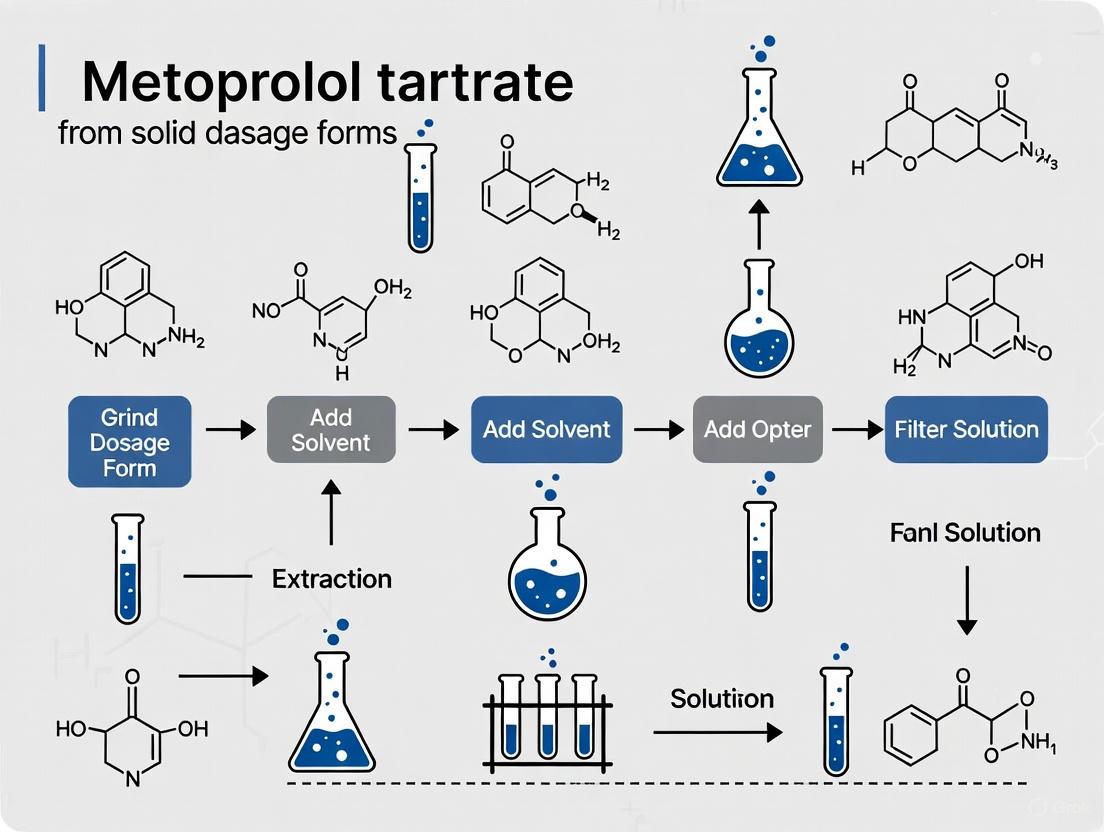
This article provides a comprehensive guide for researchers and drug development professionals on the principles and practical methodologies for extracting and quantifying metoprolol tartrate from various solid dosage forms.
Extraction and Analysis of Metoprolol Tartrate from Solid Dosage Forms: Principles and Methodologies for Pharmaceutical Scientists
Abstract
This article provides a comprehensive guide for researchers and drug development professionals on the principles and practical methodologies for extracting and quantifying metoprolol tartrate from various solid dosage forms. It covers foundational concepts, including the drug's physicochemical properties and formulation excipient interactions, and details established and emerging extraction techniques such as solvent extraction, complexation, and sample preparation for chromatographic analysis. The content further addresses critical troubleshooting aspects related to stability, polymer interference, and method optimization. Finally, it outlines validation protocols and comparative analyses of different analytical techniques, ensuring robust, accurate, and reliable quantification for quality control, formulation development, and bioequivalence studies.
Fundamental Principles: Physicochemical Properties and Formulation Challenges of Metoprolol Tartrate
Metoprolol tartrate is a selective β1-adrenoceptor antagonist widely used in clinical practice for managing cardiovascular conditions such as hypertension, angina, and arrhythmias [1]. As a moderately lipophilic compound with molecular weight of 684.824 g/mol (for the tartrate salt), its physicochemical properties significantly influence formulation design, stability profile, and extraction efficiency from pharmaceutical dosage forms [2] [3]. Understanding these fundamental characteristics is particularly crucial for researchers developing analytical methods for drug quantification, reformulating generic products, or extracting the active pharmaceutical ingredient from solid dosage forms for research purposes. This technical guide provides a comprehensive examination of metoprolol tartrate's key properties, with special emphasis on implications for extraction methodology within solid dosage form research.
Fundamental Physicochemical Properties
The core physicochemical parameters of metoprolol tartrate establish its behavior in pharmaceutical systems and extraction processes. Table 1 summarizes the quantitative data essential for researchers working with this compound.
Table 1: Fundamental Physicochemical Properties of Metoprolol Tartrate
| Property | Value / Description | Reference |
|---|---|---|
| Molecular Weight | 684.824 g/mol (salt) | [2] |
| Chemical Formula | C₃₄H₅₆N₂O₁₂ | [2] |
| CAS Number | 56392-17-7 | [2] [3] |
| Purity | ≥98% (HPLC) | [4] [3] |
| pKa | 9.7 | [1] |
| Melting Point | 120°C | [3] |
| Appearance | White powder | [3] |
The pKa value of 9.7 indicates that metoprolol exists predominantly in its ionized, water-soluble form under acidic and neutral pH conditions, transitioning to its non-ionized base form in alkaline environments [1]. This property is critically important for designing extraction protocols, as pH adjustment can significantly enhance extraction efficiency by controlling the drug's ionization state and subsequent partitioning behavior.
Solubility Profile
Metoprolol tartrate demonstrates high solubility in aqueous environments and several organic solvents, a characteristic that provides flexibility in choosing extraction media. The solubility profile across different solvents is detailed in Table 2.
Table 2: Solubility of Metoprolol Tartrate in Various Solvents
| Solvent | Solubility | Reference |
|---|---|---|
| Water | >1000 mg/mL (at 25°C) | [3] |
| Methanol | >500 mg/mL | [3] |
| Chloroform | 496 mg/mL | [3] |
| Dimethyl Sulfoxide (DMSO) | 100 mg/mL (at 25°C) | [4] [3] |
| Ethanol | 31 mg/mL (at 25°C) | [3] |
The exceptional aqueous solubility (>1000 mg/mL) makes metoprolol tartrate highly amenable to extraction using water or aqueous buffers [3]. For formulations with complex excipient profiles, mixed-solvent systems utilizing methanol-water or ethanol-water combinations often prove effective for achieving complete drug extraction while maintaining compatibility with subsequent analytical techniques such as high-performance liquid chromatography (HPLC).
Stability Characteristics
Stability represents a critical factor influencing the success of extraction processes and the accurate quantification of metoprolol tartrate. The drug's stability profile is significantly affected by environmental factors, particularly moisture and packaging conditions.
Solid-State Stability
Metoprolol tartrate in solid dosage forms exhibits sensitivity to moisture, which can profoundly affect its physicochemical properties. Accelerated stability studies comparing tablets in original high-density polyethylene (HDPE) containers versus repackaged USP Class A unit-dose blister packs revealed significant moisture uptake under stressed conditions (40°C/75% relative humidity) [5] [6].
- Moisture Uptake: Repackaged tablets showed a substantial increase in water content from initial 3.5% to 10.5% after 13 weeks at 40°C/75% RH [5]
- Physical Changes: Moisture uptake correlated with decreased tablet hardness (from 6.5 kp to 0 kp) and increased dissolution rate (from 51% to 92% in 5 minutes) [6]
- Potency Retention: Despite physical changes, drug potency remained within USP specifications (90-110%) under both controlled and accelerated conditions [5] [6]
These findings underscore the importance of controlling environmental humidity during storage of metoprolol tartrate dosage forms prior to extraction, as moisture-induced changes can alter the drug's extractability from the dosage form matrix.
Implications for Extraction Research
The stability profile of metoprolol tartrate suggests several important considerations for extraction methodology:
- Sample Storage: Store solid dosage forms in tightly sealed containers with desiccants to prevent moisture uptake that could complicate extraction
- Extraction Medium Selection: Aqueous extraction media should be prepared fresh to prevent microbial growth or pH shifts
- Processing Conditions: For extended extraction procedures, protect solutions from light and excessive heat to maintain stability
- Analysis Timeline: Process extracts promptly after preparation to ensure analytical accuracy
Experimental Protocols for Extraction and Analysis
This section details established methodologies for extracting and analyzing metoprolol tartrate from solid dosage forms, based on published research protocols.
Drug Content Determination in Granules
This protocol is adapted from sustained-release formulation development research [7]:
- Sample Preparation: Accurately weigh approximately 100 mg of powdered granules
- Extraction Procedure: Transfer to a volumetric flask and add appropriate volume of extraction solvent (water or aqueous buffer)
- Agitation: Mix thoroughly using vortex mixing or sonication to ensure complete drug extraction
- Filtration: Pass the solution through a 0.45-μm membrane filter to remove particulate matter
- Dilution: Perform suitable dilution with the same solvent to achieve concentration within analytical method range
- Spectrophotometric Analysis: Measure absorbance at 274 nm using UV-Vis spectrophotometry [7]
For complex matrices, multiple extraction steps may be necessary to achieve complete recovery. Method validation should include determination of extraction efficiency through standard addition techniques.
Stability Monitoring in Solid Dosage Forms
This protocol is derived from comparative stability studies of repackaged metoprolol tablets [5] [6]:
- Storage Conditions: Expose samples to controlled stability conditions (e.g., 25°C/60% RH and 40°C/75% RH)
- Sampling Intervals: Remove samples at predetermined time points (e.g., 0, 4, 8, 13, 26, 39, 52 weeks)
- Water Content Determination: Analyze tablet samples using loss on drying method or Karl Fischer titration
- Physical Testing: Measure tablet hardness using pharmaceutical hardness tester
- Dissolution Testing: Perform dissolution studies using USP apparatus with appropriate dissolution medium
- Potency Assessment: Employ validated HPLC method to quantify drug content
This comprehensive approach allows researchers to correlate changes in physicochemical properties with extraction efficiency over time.
Research Reagent Solutions
Table 3 lists essential reagents and materials required for experimental work with metoprolol tartrate, particularly for extraction and analysis from solid dosage forms.
Table 3: Essential Research Reagents for Metoprolol Tartrate Extraction and Analysis
| Reagent/Material | Function/Application | Research Context |
|---|---|---|
| Metoprolol Tartrate Reference Standard | Analytical quantification and method calibration | [5] |
| High-Density Polyethylene (HDPE) Containers | Standard packaging for stability studies | [5] [6] |
| USP Class A Unit-Dose Blister Packs | Repackaging material for stability assessment | [5] |
| Hydroxypropyl Methyl Cellulose (HPMC K100M) | Hydrophilic matrix polymer in sustained-release formulations | [7] |
| Ethyl Cellulose (EC) | Hydrophobic polymer for release modification | [7] |
| Eudragit RS/RL | Coating polymers for extended release profiles | [7] |
| Dicalcium Phosphate | Excipient in granule formulations | [7] |
| Methanol (HPLC Grade) | Extraction solvent and mobile phase component | [7] |
| Water (HPLC Grade) | Extraction solvent and mobile phase component | [7] |
| Membrane Filters (0.45 μm) | Clarification of extraction solutions | [7] |
Workflow Visualization
The following diagrams illustrate key experimental workflows and conceptual relationships in metoprolol tartrate extraction and stability assessment.
Extraction and Analysis Workflow
Stability Relationship Pathways
The physicochemical properties of metoprolol tartrate—particularly its high aqueous solubility, pKa of 9.7, and moisture sensitivity—directly influence strategies for its extraction from solid dosage forms. Researchers should leverage the high solubility in water and polar organic solvents when designing extraction systems while implementing appropriate controls for moisture protection during sample storage and processing. The experimental protocols and stability considerations outlined in this technical guide provide a foundation for reliable extraction and analysis of metoprolol tartrate in pharmaceutical research settings. Understanding these fundamental properties enables the development of robust methodologies for drug quantification, formulation reverse engineering, and extraction process optimization.
In pharmaceutical sciences, the design of a drug's dosage form is as critical as its active ingredient. Immediate-Release (IR) and Sustained-Release (SR) formulations represent two fundamental approaches to drug delivery, each with distinct pharmacokinetic profiles and therapeutic applications. Within the broader context of research on extracting metoprolol tartrate from solid dosage forms, understanding these release mechanisms is paramount. Metoprolol tartrate, a β₁-adrenergic receptor blocker used for cardiovascular diseases, serves as an excellent model compound for exploring formulation principles due to its diverse available formulations, including conventional tablets, sustained-release tablets, and capsules [8]. This technical guide provides an in-depth comparison of IR and SR formulations, examining their pharmacokinetic foundations, experimental assessment methodologies, and practical implications for drug development professionals.
Fundamental Principles of Drug Release
Immediate-Release (IR) Formulations
Immediate-release formulations are designed to dissolve rapidly after administration without intentionally delaying or prolonging the release of the active pharmaceutical ingredient [9]. These conventional dosage forms typically release their entire drug load within minutes of ingestion, resulting in complete absorption within 2-3 hours and rapid peaking of plasma drug concentrations [9]. The primary advantages of IR formulations include rapid onset of action—particularly beneficial for acute symptom management—simpler manufacturing processes, and typically lower production costs [10]. However, these formulations produce significant fluctuations in plasma drug levels across the dosing interval, potentially leading to side effects at peak concentrations and subtherapeutic effects at trough concentrations [9].
Sustained-Release Formulations
Sustained-release formulations (also termed extended-release, controlled-release, or timed-release) encompass technologies designed to release their active ingredient gradually over an extended period [9]. These sophisticated delivery systems aim to maintain therapeutic drug levels within a narrower range by providing a slow, controlled release of medication, typically lasting 8-12 hours or longer [9]. The nomenclature for these formulations includes various suffixes: SR (sustained-release), ER/XR/XL (extended-release), and CR (controlled release), with CR indicating a specifically predetermined release pattern [9].
The development of SR formulations addresses several therapeutic needs: minimizing peak-related adverse effects, improving patient compliance through reduced dosing frequency, and maintaining consistent drug effects throughout the day [9]. For drugs with short half-lives, SR formulations artificially extend their duration of action, making once-daily dosing possible for medications that would otherwise require multiple daily administrations [9].
Table 1: Comparison of Immediate-Release and Sustained-Release Formulation Characteristics
| Characteristic | Immediate-Release (IR) | Sustained-Release (SR) |
|---|---|---|
| Release Mechanism | Rapid dissolution without delay | Gradual release over extended period |
| Dosing Frequency | Multiple times daily (e.g., 2-4 times) | Once or twice daily |
| Peak-Trough Fluctuation | Significant fluctuations | Reduced fluctuations |
| Onset of Action | Rapid | Slower onset |
| Manufacturing Complexity | Lower | Higher |
| Cost Considerations | Generally lower cost | Typically more expensive |
| Plasma Concentration Profile | Sharp peaks and valleys | Smoother, more consistent levels |
| Local GI Adverse Effects | Potentially higher risk | Reduced risk |
Pharmacokinetic Comparisons
Understanding the pharmacokinetic differences between IR and SR formulations is essential for optimizing therapeutic outcomes. Direct comparative studies across different drug classes demonstrate consistent patterns in how these formulations behave in vivo.
A crossover study comparing cilostazol formulations in healthy subjects found that while both IR (100mg twice daily) and SR (200mg once daily) formulations provided equivalent total drug exposure (AUCₜ of 27,860.3 ng·h/mL vs. 27,378.0 ng·h/mL), the SR formulation demonstrated a higher peak concentration (Cmax,ss 2,741.4 ng/mL vs. 2,051.0 ng/mL) and longer time to peak concentration (tmax,ss 8.0 hours vs. 4.0 hours) [11]. The SR formulation showed significantly lower peak-to-trough fluctuation—a key advantage for maintaining consistent therapeutic effects [11].
Similar findings emerged from a study of indapamide formulations, where a 1.5mg SR formulation was compared to a 2.5mg IR formulation [12]. The SR formulation demonstrated superior sustained release characteristics, with a much longer time to maximum concentration (12.3 hours vs. 0.8 hours) and significantly lower peak concentration (17.6 ng/mL vs. 39.3 ng/mL) despite equivalent dose-normalized AUC values [12]. After repeated administration, the 24-hour peak-to-trough fluctuation was fourfold lower with the SR formulation compared to the IR version [12].
For metoprolol, controlled-release formulations like metoprolol CR/ZOK and metoprolol OROS were specifically designed to overcome the drug delivery limitations of matrix-based sustained-release forms by releasing the drug at a relatively constant rate over a 24-hour period [13]. These advanced systems produce sustained and consistent metoprolol plasma concentrations and beta-blockade while retaining the convenience of once-daily administration [13].
Table 2: Pharmacokinetic Parameters of IR versus SR Formulations from Comparative Studies
| Drug & Formulation | AUC (ng·h/mL) | Cmax (ng/mL) | Tmax (h) | Fluctuation Ratio |
|---|---|---|---|---|
| Cilostazol IR (100mg twice daily) | 27,860.3 ± 7,152.3 | 2,051.0 ± 433.2 | 4.0 | Higher |
| Cilostazol SR (200mg once daily) | 27,378.0 ± 10,301.6 | 2,741.4 ± 836.0 | 8.0 | Lower |
| Indapamide IR (2.5mg once daily) | 564 ± 146 | 39.3 ± 11.0 | 0.8 ± 0.3 | 4-fold higher |
| Indapamide SR (1.5mg once daily) | 559 ± 125 | 17.6 ± 6.3 | 12.3 ± 0.4 | 4-fold lower |
| Metoprolol IR (50mg tablet) | 919.88 ± 195.67 μg/L·h | 349.12 ± 78.04 | 0.96 ± 0.33 | Higher |
| Metoprolol CR (Once daily) | Sustained over 24h | Lower peak | Delayed | Significantly reduced |
Experimental Assessment Methodologies
In Vitro Release Testing
The development and quality control of both IR and SR formulations require robust in vitro dissolution testing to predict in vivo performance. For IR formulations, dissolution testing typically demonstrates rapid and complete release, such as the case with metoprolol IR tablets where more than 85% of the drug content releases within 10 minutes, reaching 100% within 60 minutes [14]. SR formulations show more gradual release profiles, with methodologies varying based on the specific delivery technology employed.
Advanced delivery systems include pulsatile capsules designed to release two drug doses at different time points, with the first dose immediately released after administration and the second dose released after a predetermined time lag due to an osmotic system [14]. Such systems are particularly valuable for drugs requiring repeated drug administration during a day due to factors such as high metabolism, short half-life, or limited absorption window [14].
Bioanalytical Methods for Metoprolol Quantification
Accurate quantification of drug release from dosage forms requires sensitive and specific analytical methods. For metoprolol tartrate, a rapid LC-MS/MS method has been developed and validated for pharmacokinetic studies [8]. This method offers significant advantages for researchers investigating extraction efficiency from various formulation types.
Key Method Parameters:
- Sample Preparation: Simple protein precipitation with methanol, using four-time volume of methanol for complete protein precipitation [8]
- Chromatographic Separation: Ultimate XB-C18 column (150 × 2.1 mm ID, 5 μm) with methanol-water containing 0.2% formic acid (65:35, v/v) as mobile phase at 0.2 mL/min flow rate [8]
- Detection: Positive ion mode ESI with monitoring ions m/z 268.1→115.6 for metoprolol and m/z 373.1→150.2 for internal standard (hydroxypioglitazone) [8]
- Linearity Range: 3.03–416.35 ng/mL with average correlation coefficient of 0.9996 [8]
- Precision and Accuracy: Intra- and inter-day precision <15%; accuracy 85–115% [8]
Spectrophotometric Determination via Complex Formation
An alternative spectrophotometric method based on complex formation with Cu(II) provides another approach for metoprolol quantification in pharmaceutical dosage forms [15]. This method involves forming a blue adduct between metoprolol tartrate and copper(II) at pH 6.0 using Britton-Robinson buffer solution, with maximum absorbance at 675 nm [15]. The complex has been characterized as a binuclear copper(II) complex (Cu₂MPT₂Cl₂) with a molar mass of 730.71 g/mol [15].
Optimal Complex Formation Conditions:
- pH: 6.0 using Britton-Robinson buffer
- Temperature: 35°C with 20 minutes heating
- Detection Range: 8.5-70 μg/mL
- Molar Absorptivity: High molar absorptivity at 675 nm
The following diagram illustrates the complete experimental workflow for assessing drug release and quantifying metoprolol from solid dosage forms:
The Scientist's Toolkit: Essential Research Reagents and Materials
Successful investigation of IR and SR formulations requires specific reagents and materials designed to assess drug release characteristics and quantify active ingredients. The following table details essential research tools for metoprolol tartrate formulation research:
Table 3: Essential Research Reagents and Materials for Metoprolol Formulation Analysis
| Reagent/Material | Function/Application | Specifications/Notes |
|---|---|---|
| Metoprolol Tartrate Standard | Analytical reference standard for quantification | High purity (>98%) for calibration curves [8] |
| Chromatography Column | LC-MS/MS separation of metoprolol | Ultimate XB-C18 (150 × 2.1 mm ID, 5 μm) [8] |
| Mass Spectrometry Solvents | Mobile phase components | Methanol with 0.2% formic acid; water with 0.2% formic acid [8] |
| Internal Standard | Quantification normalization | Hydroxypioglitazone (monitoring ions m/z 373.1→150.2) [8] |
| Protein Precipitation Solvent | Plasma sample preparation | HPLC-grade methanol (4:1 solvent:plasma ratio) [8] |
| Copper(II) Chloride Dihydrate | Spectrophotometric complex formation | 0.5% (w/v) aqueous solution for metoprolol detection at 675 nm [15] |
| Britton-Robinson Buffer | pH control for complexation | pH 6.0 for optimal Cu(II)-metoprolol complex formation [15] |
| Dissolution Media | In vitro release assessment | Simulated gastric and intestinal fluids, pH-specific buffers [14] |
The selection between immediate-release and sustained-release formulations represents a critical decision point in pharmaceutical development that significantly impacts therapeutic outcomes. IR formulations provide rapid drug release suitable for acute conditions, while SR formulations offer controlled release profiles that maintain consistent plasma concentrations, reduce dosing frequency, and potentially minimize side effects. The comparative pharmacokinetic data consistently demonstrate that SR formulations provide equivalent AUC values with lower Cmax and longer Tmax compared to their IR counterparts, resulting in reduced peak-trough fluctuation. For metoprolol tartrate specifically, controlled-release formulations maintain effective beta-blockade over 24 hours with once-daily dosing, offering significant clinical advantages in the management of cardiovascular diseases. The methodological approaches outlined—including advanced LC-MS/MS quantification, spectrophotometric complexation techniques, and standardized dissolution testing—provide researchers with robust tools for evaluating drug release from both formulation types. As pharmaceutical technology continues to evolve, the principles governing IR and SR formulations remain fundamental to optimizing drug delivery for enhanced therapeutic efficacy and patient compliance.
The efficacy of a solid oral dosage form is not solely dependent on the active pharmaceutical ingredient (API) but is profoundly influenced by the excipients and the complex interactions between them. Within the context of research on metoprolol tartrate extraction from solid dosage forms, understanding these interactions is paramount. Metoprolol tartrate, a beta-blocker used for cardiovascular conditions, is often formulated in modified-release dosage forms to align with circadian rhythms of blood pressure, which typically requires complex delivery systems [16]. Excipients, particularly polymers, are far from inert; they are functional components that dictate critical performance parameters such as drug release profiles, stability, and bioavailability. This technical guide delves into the critical roles and interactions of polymers in two fundamental delivery systems: matrix systems and coated granules. It provides a detailed examination of the mechanisms governing drug release, supported by experimental data and protocols, to equip researchers with the knowledge to design, analyze, and optimize these systems, with a specific lens on applications relevant to metoprolol tartrate research.
Polymer Fundamentals and Classification
Polymers serve as the backbone of controlled-release dosage forms. Their selection and combination are guided by the desired drug release mechanism and the physicochemical properties of the API.
Polymer Blend Interactions and Classification: Polymer-polymer interactions, ranging from weak van der Waals forces to stronger hydrogen bonding and ionic interactions, are crucial in determining the properties of the final dosage form [17]. These interactions are influenced by polymer chemistry, blend composition, manufacturing process, and the presence of other ingredients. From a pharmaceutical processing perspective, polymer blends can be classified based on the dimensional scale of interaction:
- Particulate Level Blends: Involve the mixing of polymer powders (tens to hundreds of microns), with interactions confined largely to particle surfaces. Examples include direct compression blends for tableting.
- Colloidal Level Blends: Involve at least one polymer existing in a submicron size range, such as in latex dispersions or co-processed excipients like microcrystalline cellulose and sodium carboxymethyl cellulose (Avicel RC 591). This leads to a significantly increased interfacial area and stronger interactions [17].
- Molecular Level Blends: Achieved when polymers mix homogeneously at a molecular level, as seen in certain amorphous solid dispersions. These blends require careful evaluation to prevent phase separation over time [17].
Polymer Types and Roles:
- Natural Polymers: e.g., Chitosan, a linear biopolyaminosaccharide known for its bioadhesive properties and use in floating drug delivery systems. Its performance is affected by its molecular weight and degree of deacetylation [18].
- Semi-Synthetic Polymers: e.g., Ethylcellulose (EC), a hydrophobic, water-insoluble polymer used for retarding drug release, and Hydroxypropyl Methylcellulose (HPMC), a hydrophilic polymer that forms a gel layer upon hydration, controlling drug release via diffusion and erosion [19] [16].
- Synthetic Polymers: e.g., Eudragit derivatives (RS and RL), which are poly(meth)acrylates used as semi-permeable or pH-dependent membranes in coated systems [16].
Polymer Interactions in Matrix Systems
Matrix systems are among the most common approaches for achieving controlled drug release. In these systems, the drug is uniformly dispersed or dissolved within a polymer network, and the release rate is controlled by the nature of the polymer and its interaction with the dissolution medium.
Mechanisms of Drug Release
The release of an API from a matrix system is primarily governed by two mechanisms:
- Diffusion: The drug dissolves and diffuses through the polymer network or through water-filled pores within the matrix.
- Erosion/Erosion: The polymer matrix gradually erodes or dissolves at the surface, releasing the drug.
The dominant mechanism depends on the solubility of the drug and the hydrophilicity of the polymer. Hydrophilic polymers like HPMC swell upon contact with water, forming a viscous gel layer through which the drug must diffuse. In contrast, hydrophobic polymers like Ethylcellulose retard drug release by creating a barrier that the drug must diffuse through, with release often being dependent on the porosity of the matrix [19].
Experimental Investigation: Captopril Matrix Tablets
A study on developing a controlled-release matrix for captopril, an antihypertensive drug, provides a clear protocol for evaluating polymer functionality in matrix systems [19].
Objective: To develop a controlled-release matrix tablet for captopril using granulated excipients (lactose or dicalcium phosphate) with Ethylcellulose, enabling direct compression and overcoming the need for extensive granulation of HPMC [19].
Materials: Captopril, Lactose, Dicalcium Phosphate, Surelease (aqueous dispersion of Ethylcellulose), Hydroxypropylmethylcellulose (HPMC, Metolose 60-SH, 50cps).
Methodology:
- Preparation of Granulated Excipients: Lactose or dicalcium phosphate (400 g) was mixed with or without HPMC in a planetary mixer. Surelease (Ethylcellulose dispersion) was added as a granulating agent. The wet mass was passed through a 20-mesh screen, dried at 60°C for 24 hours, and the dried granules were sized through a 20-mesh screen [19].
- Tablet Compression: Captopril was mixed with the granulated excipients and compressed directly into tablets using a single-punch tablet machine.
- In-Vitro Release Study: The release rate of captopril from the matrix tablets was tested using a dissolution apparatus. Samples were analyzed via HPLC to determine the drug concentration [19].
Key Findings and Data: The study demonstrated that granulating common excipients like lactose with a hydrophobic polymer (Ethylcellulose) could transform them into functional matrix materials capable of sustaining drug release. The release rate was found to be dependent on the solubility of the drug and the composition of the matrix [19].
Table 1: Key Findings from Captopril Matrix Tablet Study
| Parameter | Observation | Implication |
|---|---|---|
| Matrix Material | Lactose or dicalcium phosphate granulated with Ethylcellulose. | Common excipients can be engineered into controlled-release matrices via polymer coating. |
| Process | Direct compression of the granulated excipients with the API. | Simplified, cost-effective manufacturing process. |
| Release Mechanism | Drug release controlled by diffusion through the hydrophobic Ethylcellulose network. | A less soluble drug would be released more slowly from the same matrix. |
| Effect of Drug Solubility | Faster in-vitro release rate was attributed to the high solubility of captopril in water. | Drug physicochemical properties are critical in formulation design. |
Workflow for Matrix System Development
The following diagram outlines a generalized experimental workflow for developing and evaluating a polymer-based matrix system, synthesizing the protocol from the captopril study.
Diagram 1: Workflow for Matrix System Development
Polymer Interactions in Coated Granule Systems
Coating applied to granules or tablets provides a precise barrier for controlling drug release. The properties of the polymer coating, its thickness, and its interactions with other excipients determine the release profile.
Coating Technologies and Release Mechanisms
- Film Coating (FC): Solvent- or solvent-free processes where a thin polymer film is applied to a dosage form. FC can mask taste, improve stability, and enable modified release (e.g., extended, delayed, or pulsatile release) [20]. The shift from sugar coating to film coating has significantly reduced processing time and operator skill requirements [20].
- Functional Coatings:
- Enteric Coatings: Polymers that resist gastric fluid but dissolve in the intestinal environment (e.g., Eudragit L/S, hypromellose acetate succinate).
- Semi-Permeable Membranes: Used in osmotic pump systems, often composed of blends of polymers like Eudragit RS (low permeability) and RL (high permeability) to fine-tune drug release [16].
- Swelling Layers: Used in pulsatile systems, where a layer of a hydrophilic polymer like HPMC swells and ruptures an outer membrane after a specific lag time [16].
Experimental Investigation: Metoprolol Tartrate Chronotherapeutic Formulation
A study designing a novel controlled-onset extended-release (COER) formulation of metoprolol tartrate for hypertension management provides an excellent model for complex coating interactions [16].
Objective: To develop a pulsatile-release formulation of metoprolol tartrate that releases the drug after a predetermined lag time (e.g., for nighttime dosing with morning release) followed by sustained release [16].
Materials: Metoprolol tartrate, Lactose, Avicel PH101, Sodium Chloride, Starch, HPMC (Methocel E5), Eudragit RS/RL.
Methodology:
- Core Tablet Preparation: Core tablets containing metoprolol tartrate, lactose, Avicel, sodium chloride (osmogen), and starch were directly compressed.
- Swelling Layer Coating: Core tablets were coated with a swelling layer of HPMC (5% or 10% weight gain) using a conventional coating pan.
- Outer Membrane Coating: The HPMC-coated tablets were further coated with a semi-permeable membrane of Eudragit RS/RL mixtures at different ratios (e.g., 100:0, 50:50, 0:100) and coating levels (5%, 10%, 15%).
- In-Vitro Drug Release: Dissolution studies were conducted in distilled water using USP Apparatus II (paddle method) at 100 rpm [16].
Key Findings and Data: The study demonstrated that both the lag time and the subsequent release rate could be precisely controlled by adjusting the coating parameters. The lag time prolonged with an increase in the outer Eudragit coating level. The ratio of Eudragit RS to RL was critical, as RL is more permeable due to its higher content of quaternary ammonium groups. The mechanism involved water ingress through the semi-permeable membrane, swelling of the HPMC layer, and eventual rupture or formation of pores in the outer coat, leading to drug release via a combination of osmotic pumping and diffusion [16].
Table 2: Formulation and Release Characteristics of Metoprolol Tartrate COER Tablets
| Formulation Variable | Effect on Lag Time | Effect on Release Rate | Underlying Mechanism |
|---|---|---|---|
| HPMC Coating Level | Moderate influence as the swelling force generator. | Influences the rate and force of membrane rupture. | Higher HPMC levels may generate greater swelling pressure. |
| Eudragit Coating Level | Significant positive correlation; higher levels prolong lag time. | Higher levels can slow the release rate post rupture. | Thicker membrane delays water ingress and HPMC swelling. |
| Eudragit RS:RL Ratio | Higher RS content (less permeable) can prolong lag time. | Higher RL content (more permeable) increases release rate. | Permeability of the membrane governs water influx and drug efflux. |
| Osmogen (NaCl) | Not a direct effect on lag time. | Increases release rate post rupture. | Generates osmotic pressure, driving drug release via osmotic pumping. |
Workflow for Coated Granule System Development
The diagram below illustrates the multi-step coating process used to develop a chronotherapeutic formulation, as described for metoprolol tartrate.
Diagram 2: Coating Process for Pulsatile Release Systems
The Scientist's Toolkit: Key Research Reagents and Materials
Table 3: Essential Materials for Studying Polymer-Based Dosage Forms
| Reagent/Material | Function in Research | Example in Context |
|---|---|---|
| Hydroxypropyl Methylcellulose (HPMC) | Hydrophilic matrix former; swelling agent in coated systems. | Used as a swelling layer in metoprolol tartrate COER tablets [16]. |
| Eudragit RS & RL | Water-insoluble, pH-independent polymers for forming semi-permeable membranes. | Blended to control permeability and lag time in metoprolol coating [16]. |
| Ethylcellulose | Hydrophobic polymer used for retardation of drug release in matrices and as an impermeable coat. | Used as a granulating agent (Surelease) to create a controlled-release matrix for captopril [19]. |
| Chitosan | Natural, bioadhesive polymer used in floating and mucoadhesive systems. | Used in floating microspheres; properties vary with molecular weight and deacetylation degree [18]. |
| Copovidone (Kollidon VA 64) | Binder and matrix polymer in solid dispersions for solubility enhancement. | Used in solid dispersions to improve bioavailability of poorly soluble drugs [21]. |
| Soluplus | Polymeric solubilizer for amorphous solid dispersions via Hot-Melt Extrusion or Spray Drying. | Used to increase solubility and bioavailability of BCS Class II/IV drugs [21]. |
| Sodium Bicarbonate / Citric Acid | Effervescent agents in floating drug delivery systems. | Generate CO₂ to reduce density and promote buoyancy in gastroretentive systems [18]. |
| Plasticizers (e.g., Glycerol, TPM) | Additives that increase the flexibility and workability of polymer films. | Critical for preventing brittleness in film coatings; choice affects long-term stability [22]. |
The strategic selection and combination of polymers in matrix and coated granule systems are fundamental to achieving precise and predictable drug release profiles. As demonstrated in the case studies of captopril and metoprolol tartrate, the interaction between polymers, and between polymers and the API, governs the mechanism and kinetics of drug release. For researchers focused on extracting and analyzing metoprolol tartrate from solid dosage forms, a deep understanding of these excipient interactions is not merely academic; it is a practical necessity. It allows for the reverse-engineering of release mechanisms, informs the development of robust analytical methods, and ensures that the integrity of the dosage form is accounted for during analysis. The ongoing development of novel polymers and more sophisticated blending techniques promises to further enhance our ability to tailor drug delivery to specific clinical needs, solidifying the role of excipients as active enablers of modern pharmacotherapy.
The extraction and subsequent analysis of metoprolol tartrate from solid dosage forms represent a critical phase in pharmaceutical research and development, impacting areas from bioavailability studies to quality control. This process is complicated by the drug's physicochemical properties and the complex matrix of excipients designed to protect it from environmental factors like moisture. Within the context of a broader thesis on extraction principles, this guide details the primary interferences and challenges, supported by current analytical techniques and experimental data. A thorough understanding of these factors is essential for researchers and drug development professionals to develop robust, accurate, and efficient analytical methods, thereby ensuring the drug's stability, efficacy, and safety from the production line to the patient.
Key Interferences in Analysis
The accurate quantification of metoprolol tartrate is susceptible to several sources of interference that can compromise analytical results.
- Formulation Excipients: Solid dosage forms contain various inert ingredients that can co-extract with the active pharmaceutical ingredient (API). For metoprolol analysis using potentiometric sensors, the presence of other positively charged drugs, such as felodipine in combination products like Logimax, can significantly interfere with the measurement. The implementation of a molecularly imprinted polymer (MIP) in the sensing membrane has been shown to enhance selectivity by creating tailored binding sites that discriminate against such structurally similar compounds [23].
- Degradation Products: Metoprolol can undergo radiolytic degradation when exposed to gamma-irradiation or high-energy electron beams, a process sometimes used for sterilization. These degradation products can interfere with analytical methods. Stability-indicating methods, such as those employing potentiometric sensors, are designed to quantify the intact drug without interference from these radiodegradation products [23] [24].
- Biological Matrix Components: In bioanalysis, such as the determination of metoprolol in human urine, endogenous compounds present a major interference challenge. Methods like flow-injection chemiluminescence must be carefully optimized to ensure these matrix components do not produce false positive or negative signals. The selectivity of the Ce(IV)/SO₃²⁻ chemiluminescence system for metoprolol has been successfully demonstrated in human urine, indicating its ability to overcome these interferences [25].
Table 1: Summary of Key Interferences and Mitigation Strategies
| Interference Category | Specific Examples | Impact on Analysis | Mitigation Strategy |
|---|---|---|---|
| Formulation Excipients | Polymers (e.g., PVAc-PVP, HPMC), fillers, disintegrants [26] | Co-extraction, altered viscosity, matrix effects in detection | Selective sample preparation (e.g., SPE), use of MIP-based sensors [23] |
| Other APIs | Felodipine (in combination products) [23] | False positive signal in non-selective assays | Chromatographic separation, highly selective detection (e.g., MIP-electrodes) [23] |
| Degradation Products | Radiolytic byproducts [24] | Overestimation of API content, presence of impurities | Stability-indicating methods (e.g., HPLC, potentiometric sensing) [23] [24] |
| Biological Matrix | Endogenous compounds in human urine [25] | Signal suppression or enhancement | Dilution, sample clean-up, method validation in biological fluids [25] |
Primary Extraction Challenges
The journey to isolate metoprolol tartrate from its solid dosage form is fraught with challenges rooted in both the drug's innate properties and the formulation's design.
- Drug-Excipient Interactions and Matrix Effects: The very purpose of many excipients is to form a stable, protective matrix around the API. For instance, tablets manufactured via semisolid extrusion (SSE) use polymers like polyvinyl acetate/polyvinylpyrrolidone (PVAc-PVP) and hydroxypropyl methylcellulose (HPMC) to achieve prolonged release [26]. These polymers can form a gel-like structure upon contact with solvents, thereby significantly hindering the complete and rapid extraction of metoprolol tartrate. The choice of solvent, extraction time, and mechanical agitation must be powerful enough to break this matrix without degrading the API.
- Hygroscopicity and Moisture Sensitivity: Although not explicitly stated for metoprolol tartrate in the provided results, hygroscopicity is a widespread challenge in pharmaceutical solids [27]. Moisture absorption can lead to chemical degradation (e.g., hydrolysis) or solid-state phase transitions during storage or sample preparation. This can alter the extraction efficiency and the analytical results. Formulation strategies like film coating are often employed as a moisture-barrier, but the coating itself becomes an additional component that must be dealt with during the initial sample preparation steps [27].
- Achieving Homogeneity in Low-Dose Formulations: The production of customized doses, such as 5 mg pediatric tablets via SSE, highlights a significant challenge [26]. Ensuring a homogenous distribution of the API within the powder mixture or semisolid paste is critical. Any inhomogeneity in the initial formulation translates directly into irreproducible extraction yields, making it difficult to obtain accurate and precise analytical results, especially when the sample size is small.
The following diagram illustrates the core challenges and their interrelationships in the extraction workflow:
Advanced Analytical Techniques & Protocols
To overcome these challenges, researchers employ a suite of sophisticated analytical techniques. The selection of an appropriate method depends on the required sensitivity, selectivity, and the nature of the sample matrix.
Potentiometric Sensor with Molecularly Imprinted Polymer
This method is highly selective and suitable for direct measurement in both pharmaceutical formulations and complex biological matrices like human plasma.
- Objective: To selectively determine metoprolol tartrate in the presence of interferents like felodipine and degradation products [23].
- Materials & Reagents:
- Multi-walled Carbon Nanotubes (MWCNTs): Served as a transducing layer in the solid-contact ion-selective electrode (SC-ISE) to enhance stability and prevent water layer formation [23].
- Molecularly Imprinted Polymer (MIP): Synthesized using methacrylic acid (MAA) as a functional monomer and ethylene glycol dimethacrylate (EGDMA) as a cross-linker. This creates selective cavities for metoprolol, drastically improving sensor selectivity [23].
- Ion-Exchanger: Potassium tetrakis(4-chlorophenyl) borate (TpClPB) [23].
- Plasticizer: 2-Nitrophenyl octyl ether (NPOE) [23].
- Experimental Protocol:
- MIP Synthesis: Prepare a pre-polymerization complex by mixing metoprolol (template), MAA (monomer), EGDMA (cross-linker), and an initiator (AIBN) in a porogenic solvent (DMSO). Incubate at 60°C for 24 hours to polymerize.
- Template Removal: Wash the resulting polymer extensively with a methanol-acetic acid mixture in a Soxhlet apparatus to remove the template molecules, leaving behind specific binding sites.
- Electrode Preparation: Modify a carbon paste electrode with a layer of MWCNTs. Coat the electrode with a sensing membrane containing the synthesized MIP, PVC, plasticizer (NPOE), and ion-exchanger (TpClPB).
- Measurement & Calibration: Measure the potential response of the electrode against a standard Ag/AgCl reference electrode in metoprolol solutions of known concentration. Construct a calibration curve to determine the unknown concentration in samples [23].
Table 2: Performance Data of Analytical Methods for Metoprolol Tartrate
| Analytical Method | Linear Range | Limit of Detection (LOD) | Key Advantage | Application Demonstrated In |
|---|---|---|---|---|
| Potentiometric Sensor (MIP-based) [23] | 1.0 × 10⁻⁷ to 1.0 × 10⁻² mol L⁻¹ | < 8.0 × 10⁻⁸ mol L⁻¹ | High selectivity in presence of degradants & other drugs | Pharmaceutical tablets & human plasma |
| Flow-Injection Chemiluminescence [25] | 4.0 × 10⁻⁸ to 1.0 × 10⁻⁵ g/mL | 1.0 × 10⁻⁸ g/mL | High sensitivity and rapid analysis | Pharmaceutical tablets & human urine |
| UV/PDS Process [28] | N/A (Transformation study) | N/A | Polymerization allows carbon recovery from wastewater | Environmental remediation |
Flow-Injection Chemiluminescence (FI-CL)
This method is prized for its simplicity, high throughput, and exceptional sensitivity.
- Objective: To rapidly determine metoprolol tartrate in tablets and human urine with minimal sample pretreatment [25].
- Materials & Reagents:
- Experimental Protocol:
- Sample Preparation: Powder and dissolve tablets in water. Centrifuge or filter to remove insoluble excipients. Dilute urine samples appropriately [25].
- Flow-Injection System Setup: Use a system comprising a peristaltic pump, an injection valve, and PTFE tubing. Merge streams of the sample, Ce(IV) solution, and Na₂SO₃ solution in a flow cell.
- Detection & Quantification: The chemiluminescence signal, greatly enhanced by the presence of metoprolol, is detected by a photomultiplier tube. The intensity is proportional to the concentration of metoprolol in the sample [25].
The Scientist's Toolkit: Essential Research Reagents
The following table catalogues key reagents and materials essential for the analysis and handling of metoprolol tartrate, as identified in the research.
Table 3: Key Research Reagent Solutions for Metoprolol Tartrate Analysis
| Reagent/Material | Function and Role in Research |
|---|---|
| Multi-walled Carbon Nanotubes (MWCNTs) [23] | Enhances electrode conductivity and stability in potentiometric sensors by preventing water layer formation. |
| Molecularly Imprinted Polymer (MIP) [23] | Provides highly selective binding sites for metoprolol, enabling accurate analysis in complex matrices. |
| Cerium(IV) / Sulfite System [25] | Generates a strong, metoprolol-enhanced chemiluminescence signal for highly sensitive flow-injection analysis. |
| Polyvinyl Acetate/Polyvinylpyrrolidone (PVAc-PVP) [26] | A common matrix polymer in prolonged-release tablets that can pose a challenge for complete API extraction. |
| Hydroxypropyl Methylcellulose (HPMC) [26] | A release-modifying polymer and gel-forming agent that can hinder drug extraction from solid dosage forms. |
| Persulfate (PDS) [28] | An oxidizing agent used in advanced oxidation processes to study the transformation and polymerization of metoprolol. |
The extraction and analysis of metoprolol tartrate from solid dosage forms is a sophisticated process that demands a strategic approach to overcome inherent challenges. The primary interferences stem from the formulation matrix itself, including functional polymers and, in some cases, co-formulated drugs. The key challenges involve breaking down the robust dosage form without compromising the API, dealing with potential moisture sensitivity, and ensuring representative sampling, especially in low-dose formulations. As demonstrated, advanced techniques like MIP-based potentiometric sensors and flow-injection chemiluminescence offer powerful solutions, providing the selectivity and sensitivity required for accurate determination in both pharmaceutical and biological matrices. A deep understanding of these analytical targets and their interconnectedness is fundamental to advancing research and ensuring the quality and performance of metoprolol tartrate-based therapeutics.
Extraction and Analytical Techniques: From Classical to Modern Methods
Solvent Extraction Protocols for Different Formulation Types
The extraction of an Active Pharmaceutical Ingredient (API) from its dosage form is a critical first step in many analytical and research procedures. For drugs like metoprolol tartrate, a selective β1-adrenergic receptor blocker, efficient extraction is fundamental to activities ranging from pharmaceutical development and quality control to bioequivalence studies and forensic analysis. The challenge lies in the fact that the optimal extraction protocol is highly dependent on the formulation type. Excipients used in solid dosage forms, such as matrix builders, coatings, and binders, are designed to control drug release and can significantly impede solvent access to the API. This guide provides an in-depth technical overview of solvent extraction strategies for metoprolol tartrate, framed within the broader principles of analytical chemistry and pharmaceutical analysis. It is intended to equip researchers and drug development professionals with the knowledge to select, optimize, and validate extraction methods for a variety of common formulation types.
Metoprolol Tartrate: Physicochemical and Analytical Considerations
Key Properties Influencing Extraction
Metoprolol tartrate (MPT) is a polar, water-soluble salt form of the metoprolol base [29]. Its molecular structure features secondary amine and hydroxyl functional groups, contributing to its high solubility in water and alcohols. This inherent solubility is a primary advantage in designing extraction protocols. The tartrate salt is typically used in immediate-release formulations, whereas the succinate salt is reserved for extended-release products [29] [30]. From an analytical perspective, MPT contains a chromophore that absorbs in the UV region, allowing for convenient detection and quantification via techniques like UV-Vis spectroscopy and High-Performance Liquid Chromatography (HPLC) with UV detection, often around 274 nm [7] [31].
The Role of Formulation Excipients
A successful extraction protocol must not only dissolve the API but also overcome the barriers posed by the formulation matrix. Common excipients and their challenges include:
- Hydrophilic Polymers (e.g., HPMC): Swell in water to form a gel layer, potentially trapping the API and reducing diffusion into the bulk solvent [7].
- Hydrophobic Polymers (e.g., Ethyl Cellulose): Act as insoluble barriers, requiring the use of more aggressive solvents or surfactants to penetrate the matrix [7].
- Coating Systems (e.g., Eudragit): Designed to resist dissolution in certain pH environments, necessitating a preliminary mechanical disruption or pH adjustment of the solvent [7].
Table 1: Key Physicochemical Properties of Metoprolol Tartrate
| Property | Description | Implication for Extraction |
|---|---|---|
| Chemical Nature | Synthetic β1-blocker, tartrate salt of a racemic mixture [32] | Extraction conditions must be compatible with the salt form. |
| Solubility | Highly soluble in water; soluble in alcohols like methanol and ethanol [32] [33] | Water and alcohols are primary solvent choices. |
| UV Absorbance | Exhibits strong UV absorption (e.g., ~275 nm) [31] [7] | Enables straightforward quantification post-extraction. |
| pKa | Basic amine (pKa ~9.7) | Retention and solubility can be manipulated by pH control. |
General Principles and Reagents for Solvent Extraction
The core objective of solvent extraction from solid dosage forms is to achieve complete dissolution of the API while minimizing the co-extraction of excipients that could interfere with subsequent analysis.
Solvent Selection
The choice of solvent is the most critical parameter.
- Aqueous Solvents: Deionized water is often the first choice for immediate-release tablets of MPT due to the drug's high solubility. Buffered solutions (e.g., pH 6.8 phosphate buffer) are used to simulate intestinal fluid or to control the ionization state of the drug and excipients [7].
- Organic Solvents: Methanol and ethanol are frequently employed, particularly when dealing with coated formulations or when a higher solvent strength is needed to penetrate matrices. Methanol is effective in dissolving MPT and breaking down some polymeric structures [32].
- Mixed Solvent Systems: Blends of water with water-miscible organic solvents (e.g., water-methanol) can offer a balance between strong dissolving power and compatibility with the analytical instrumentation (e.g., HPLC).
The Scientist's Toolkit: Key Research Reagent Solutions
Table 2: Essential Reagents for Metoprolol Tartrate Extraction and Analysis
| Reagent/Solution | Typical Composition | Primary Function |
|---|---|---|
| Deionized Water | H₂O (Purified) | Primary solvent for extracting the water-soluble tartrate salt. |
| Methanol / Ethanol | CH₃OH / C₂H₅OH | Organic solvent for dissolving the API and disrupting polymeric matrices. |
| Phosphate Buffer (pH 6.8) | Potassium/sodium phosphate salts in water | Simulates intestinal pH for dissolution testing; provides a stable pH environment. |
| Hydrochloric Acid (HCl) Solution | 0.1 N HCl or similar | Simulates gastric pH; can be used for acid hydrolysis of certain excipients. |
| Copper(II) Chloride Solution | 0.5% (w/v) CuCl₂ in water [31] | Used in complexation-based spectrophotometric analysis of MPT. |
Extraction Protocols for Specific Formulation Types
Immediate-Release Tablets and Powder Blends
For simple formulations, extraction is often straightforward.
- Protocol 1: Aqueous Extraction for UV Analysis
- Weigh and Commute: Accurately weigh and finely powder not less than 20 tablets [32].
- Extract: Transfer an aliquot of the powder equivalent to the dose of MPT into a volumetric flask. Add a portion of the solvent (deionized water or a suitable buffer) and vortex or sonicate to disperse.
- Dilute and Mix: Make up to volume with the solvent and shake vigorously for 15-30 minutes using a mechanical shaker.
- Separate: Filter the solution or centrifuge to remove insoluble excipients. Use a syringe filter (e.g., 0.45 µm) before injection into an HPLC system or before spectrophotometric analysis [31].
- Protocol 2: Organic Solvent Extraction for IR Identification
This USP method for identity testing involves a liquid-liquid extraction of the free base:
- Dissolve a ground tablet sample in water with ammonium hydroxide to make the solution alkaline.
- Extract the liberated metoprolol free base with chloroform.
- Dry the organic layer over anhydrous sodium sulfate, evaporate to dryness, and use the residue for IR spectroscopy [32].
Sustained-Release Matrix Tablets and Granules
These formulations require more aggressive techniques to break down the rate-controlling polymer matrix.
- Protocol 3: Extraction from HPMC/EC Matrix Granules
- Mechanical Disruption: Accurately weigh a sample of sustained-release granules. Gently crush them with a mortar and pestle to increase the surface area.
- Solvent Selection: Use a heated solvent (e.g., water or water-methanol mixture at 40-50°C) to enhance polymer swelling and drug diffusion. Sonication can be highly effective.
- Extended Agitation: Shake the mixture for several hours (potentially up to 12-24 hours) to ensure the solvent penetrates the entire matrix. Monitor extraction efficiency over time [7].
- Clarification: Due to the high polymer content, centrifugation at high speed (e.g., 10,000 rpm) is often more effective than filtration for obtaining a clear supernatant.
Coated Formulations
The primary step is to disrupt the integrity of the coating film.
- Protocol 4: Extraction from Film-Coated or Pelletized Formulations
- Mechanical Removal: For tablets, carefully scrape off the coating if possible. For coated pellets or granules, the coating can be cracked by gentle crushing or grinding.
- Solvent Penetration: Proceed with extraction using a solvent like methanol, which can permeate and dissolve many polymeric coatings (e.g., Eudragit types) [7]. The use of a surfactant (e.g., Poloxamer) in the solvent can also aid in wetting and penetrating the coating.
- Sonication-Assisted Extraction: Sonicate the sample in a bath or with a probe sonicator. The ultrasonic energy helps in breaking the coating and accelerating the dissolution of the API.
The following workflow diagram illustrates the decision-making process for selecting and executing an extraction protocol based on formulation type.
Advanced and Alternative Extraction Methodologies
Deep Eutectic Solvent-Based Aqueous Two-Phase Systems (DES-ATPS)
DES-ATPS is an emerging green and efficient alternative to traditional liquid-liquid extraction. A study demonstrated the use of a DES composed of Tetra-n-butylammonium Bromide (TBAB) and Polyethylene Glycol 200 (PEG200) in a 1:3 molar ratio to partition MPT from an aqueous solution [34]. In this system:
- The DES and a salt (e.g., K₂HPO₄) form two immiscible aqueous-rich phases.
- The partition coefficient of MPT was found to increase with the concentration of DES in the system, allowing for high extraction yields (85–95%) [34].
- This method is particularly promising for purifying APIs from complex mixtures or for analytical-scale separations with minimal environmental impact.
Complexation-Based Extraction for Spectrophotometry
This method involves the chemical derivatization of MPT to enable analysis.
- Protocol 5: Copper(II) Complexation for UV-Vis Detection [31]
- Prepare Sample: Extract MPT from tablets into water as in Protocol 1.
- Form Complex: Mix an aliquot of the extract with Britton-Robinson buffer (pH 6.0) and a 0.5% CuCl₂ solution.
- Heat and Cool: Heat the mixture at 35°C for 20 minutes to form the blue-colored MPT-Cu(II) complex, then cool.
- Measure Absorbance: Determine the concentration by measuring the absorbance of the complex at 675 nm. This method provides a simple and sensitive alternative to HPLC for quantification.
Analysis and Validation of Extraction Efficiency
Quantification of Extracted Metoprolol
Following extraction, MPT is typically quantified using instrumental techniques.
- UV-Vis Spectrophotometry: A direct, cost-effective method suitable for relatively pure extracts. MPT can be measured at ~275 nm, or at 675 nm when complexed with Cu(II) [31].
- High-Performance Liquid Chromatography (HPLC): The gold standard for specificity and accuracy. It separates MPT from potential degradation products and excipient interferences. Methods typically use a C18 column, a mobile phase of acetonitrile and buffer, and UV detection [32] [7].
Validating the Extraction Method
A robust extraction protocol must be validated to ensure its reliability.
- Accuracy (Recovery): Spiking a pre-analyzed sample with a known amount of pure MPT and subjecting it to the full extraction process. Recovery should be close to 100%.
- Precision: Repeating the extraction and analysis multiple times (n=6) to determine the relative standard deviation (RSD). For a validated method, RSD is typically ≤2%.
- Specificity: Demonstrating that the excipients and any potential impurities do not interfere with the detection and quantification of MPT, often confirmed via HPLC.
- Extraction Efficiency Profile: Performing the extraction repeatedly on the same sample residue until no more API is detected, confirming that the initial protocol is exhaustive.
Table 3: Summary of Extraction Protocols for Different Formulation Types
| Formulation Type | Recommended Protocol | Key Solvents | Critical Steps | Primary Analysis |
|---|---|---|---|---|
| Immediate-Release Tablets | Protocol 1 (Aqueous) | Deionized Water, Buffer | Powdering, Vigorous Shaking | HPLC, UV-Vis |
| Sustained-Release Matrix | Protocol 3 (Matrix Disruption) | Water-Methanol Mix, Buffer | Crushing, Heating, Sonication, Extended Agitation | HPLC |
| Coated Pellets/Granules | Protocol 4 (Coating Removal) | Methanol, Ethanol | Mechanical Disruption of Coating, Sonication | HPLC |
| Analytical/Separation | DES-ATPS [34] | TBAB:PEG200 DES, K₂HPO₄ | Phase Separation, Partition Coefficient Optimization | Spectrophotometry |
| Derivatization Assay | Protocol 5 (Complexation) | Water, CuCl₂ Solution, Buffer | pH Control, Heating for Complex Formation | UV-Vis at 675 nm |
The extraction of metoprolol tartrate from solid dosage forms is a foundational technique in pharmaceutical research that requires a methodical, formulation-specific approach. While simple immediate-release tablets may yield to straightforward aqueous extraction, the complexity of modern sustained-release and coated formulations demands more sophisticated strategies involving mechanical disruption, solvent optimization, and energy-assisted techniques like sonication. The ongoing development of green methods, such as Deep Eutectic Solvent-based systems, points toward a future where extraction protocols are not only efficient but also environmentally sustainable. Regardless of the method chosen, rigorous validation is paramount to ensure that the extracted analyte truly represents the drug content in the formulation, thereby guaranteeing the integrity and reliability of all subsequent research and analytical data.
Metoprolol tartrate (MPT) is a selective β-adrenergic blocking agent extensively used in managing cardiovascular disorders such as hypertension, angina pectoris, cardiac arrhythmias, and myocardial infarction [31] [15]. The drug's sensitivity and potential for misuse as a doping agent have necessitated developing reliable analytical methods for its quantification [35]. Spectrophotometric methods based on complexation reactions offer simplicity, sensitivity, and cost-effectiveness, making them particularly valuable for pharmaceutical analysis [36].
The complexation of metoprolol tartrate with copper(II) ions represents a significant advancement in spectrophotometric drug analysis. This method provides a robust approach for determining MPT in bulk and dosage forms without requiring expensive instrumentation or extensive sample preparation [31]. This technical guide comprehensively examines the copper(II) complexation method for MPT determination, detailing experimental protocols, analytical parameters, and applications within pharmaceutical research contexts, particularly in extracting and analyzing MPT from solid dosage forms.
Theoretical Foundations
Spectrophotometric Principles in Pharmaceutical Analysis
Spectrophotometry operates on the fundamental principle of Beer-Lambert's Law, which states that a substance's absorbance (A) is directly proportional to its concentration (c), the path length of the sample cell (l), and the molar absorptivity (ε) [36]. This relationship provides the basis for quantitative analysis of pharmaceutical compounds [36].
Complexing agents play a crucial role in spectrophotometric methods by forming stable, colored complexes with pharmaceutical analytes, thereby enhancing absorbance at specific wavelengths and increasing methodological sensitivity [36]. For drugs like metoprolol that lack strong inherent chromophores, complexation with metal ions such as copper(II) provides a reliable means for accurate quantification [31] [15].
Chemistry of Copper(II)-Metoprolol Complexation
Metoprolol tartrate contains secondary amine and hydroxyl functional groups that can coordinate with metal ions [31]. The complexation with copper(II) ions occurs through the nitrogen atom of the amine group and the oxygen atom of the deprotonated hydroxyl group, forming a binuclear complex with the formula Cu~2~MPT~2~Cl~2~ [31] [15]. This blue-colored complex exhibits maximum absorbance at 675 nm, providing the basis for spectrophotometric determination [31].
Table 1: Key Characteristics of the Copper(II)-Metoprolol Tartrate Complex
| Parameter | Specification | Experimental Basis |
|---|---|---|
| Complex Stoichiometry | Binuclear (Cu~2~MPT~2~Cl~2~) | Elemental analysis, Job's method [31] |
| Optimal pH | 6.0 | Investigation of pH effect using Britton-Robinson buffer [31] |
| λ~max~ | 675 nm | Electronic absorption spectra [31] [15] |
| Reaction Temperature | 35°C | Investigation of temperature effect on complex formation [31] |
| Reaction Time | 20 minutes | Investigation of reaction time intervals [31] |
Experimental Methodology
Reagents and Materials
The following reagents are required for the copper(II) complexation method for metoprolol tartrate determination [31]:
- Metoprolol tartrate standard (provided by AstraZeneca in original research)
- Copper(II) chloride dihydrate (CuCl~2~·2H~2~O) from E. Merck or Carlo Erba
- Britton-Robinson buffer (pH 6.0)
- Deionized water to ensure absence of interfering ions
- Pharmaceutical formulations containing metoprolol tartrate (e.g., Beloc Durules tablets)
Table 2: Research Reagent Solutions for Copper(II) Complexation Method
| Reagent Solution | Composition/Preparation | Function in Analysis |
|---|---|---|
| MPT Stock Solution | 0.2 mg/mL in water; stable for 1 week when refrigerated | Primary standard for calibration curve [31] |
| Copper(II) Solution | 0.5% (w/v) CuCl~2~·2H~2~O in water | Complexing agent for chromophore formation [31] |
| Britton-Robinson Buffer | pH 6.0 | Maintains optimal pH for complex formation [31] |
| Tablet Extraction Solvent | Deionized water | Extracts active ingredient from pharmaceutical dosage forms [31] |
Instrumentation and Equipment
The analytical procedure requires the following equipment [31]:
- UV-Visible Spectrophotometer (e.g., Perkin Elmer Lambda 45) for absorbance measurements
- Thermostatically Controlled Water Bath for maintaining optimal reaction temperature
- Analytical Balance for precise weighing of standards and samples
- Volumetric Flasks (10 mL and 100 mL) for solution preparation
- Conical Flasks for tablet extraction
- Filtration Apparatus for clarifying sample solutions
Calibration Procedure
Preparation of Standard Solutions: Transfer aliquot volumes of MPT stock solution (0.2 mg/mL) containing 8.5-70 μg of MPT into a series of 10 mL volumetric flasks [31].
Complex Formation: To each flask, add 1 mL of Britton-Robinson buffer (pH 6.0) and 1 mL of CuCl~2~·2H~2~O solution (0.5% w/v) [31].
Optimal Reaction Conditions: Mix well for 20 minutes while heating in a thermostatically controlled water bath at 35°C, then cool rapidly [31].
Absorbance Measurement: Dilute to mark with distilled water and measure absorbance at 675 nm against a reagent blank [31].
Calibration Curve: Plot absorbance versus concentration and derive the regression equation [31].
Analysis of Pharmaceutical Dosage Forms
Sample Preparation: Weigh and pulverize ten tablets. Transfer a quantity of powder equivalent to 40 mg MPT to a conical flask [31].
Drug Extraction: Extract with 4 × 20 mL of water, filter into a 100 mL volumetric flask, and dilute to volume with water [31].
Analysis: Transfer aliquots to 10 mL volumetric flasks and follow the calibration procedure described in section 3.3 [31].
Calculation: Determine the nominal tablet content using the regression equation or calibration graph [31].
Diagram 1: Experimental Workflow for MPT Analysis
Analytical Performance and Validation
Method Validation Parameters
The copper(II) complexation method for MPT determination has been rigorously validated with the following performance characteristics [31]:
- Beer's Law Range: 8.5-70 μg/mL [31]
- Correlation Coefficient (r): 0.998 [31]
- Limit of Detection (LOD): 5.56 μg/mL [31]
- Molar Absorptivity: High molar absorptivity at 675 nm [31]
The method demonstrates excellent linearity within the specified concentration range, with a correlation coefficient indicating strong relationship between concentration and absorbance [31]. The detection limit of 5.56 μg/mL provides sufficient sensitivity for pharmaceutical analysis [31].
Complex Characterization
The binuclear copper(II) complex (Cu~2~MPT~2~Cl~2~) has been comprehensively characterized using multiple analytical techniques [31]:
- Elemental Analysis: Results consistent with theoretical calculations (C%: 49.26/49.31, H%: 6.50/6.62, N%: 3.40/3.83, Cu%: 17.01/17.39) [31]
- Infrared Spectroscopy: Shows coordination through nitrogen (M-N vibration at 487 cm⁻¹) and oxygen (M-O vibration at 430 cm⁻¹) atoms [31]
- Molar Conductance: Λ~M~ value of 21.42 in DMSO suggests a 1:2 electrolytic complex [31]
- Electronic Absorption Spectra: Shows characteristic d-d transitions in square planar configuration and a high molar absorptivity band at 675 nm [31]
- Magnetic Susceptibility: Consistent with binuclear copper(II) complex formation [31]
Diagram 2: Copper(II)-MPT Complexation Mechanism
Applications in Pharmaceutical Research
Analysis of Solid Dosage Forms
The copper(II) complexation method has been successfully applied to determine metoprolol tartrate in tablet formulations [31]. The extraction procedure efficiently recovers the active ingredient from solid dosage forms with minimal interference from excipients [31]. This application demonstrates the method's practical utility in pharmaceutical quality control, particularly for assessing content uniformity in solid dosage forms [31].
Advantages Over Alternative Methods
Compared to other analytical techniques for MPT determination, the copper(II) complexation method offers several advantages [31] [37]:
- Simplicity: Does not require sophisticated instrumentation or complex separation steps
- Cost-Effectiveness: Utilizes readily available reagents and standard spectrophotometric equipment
- Sensitivity: Appropriate detection limits for pharmaceutical analysis
- Reproducibility: Good correlation coefficient and precision
- Selectivity: Minimal interference from common pharmaceutical excipients
While HPLC methods offer higher sensitivity for biological samples [31], and alternative spectrophotometric methods using carbon disulfide exist [37], the direct copper(II) complexation method provides an optimal balance of simplicity, cost, and reliability for routine pharmaceutical analysis.
The spectrophotometric determination of metoprolol tartrate based on complexation with copper(II) ions represents a robust, simple, and cost-effective analytical method suitable for pharmaceutical quality control. The formation of a stable blue complex with maximum absorbance at 675 nm enables accurate quantification of MPT in bulk and solid dosage forms.
The method's validation parameters, including linear range (8.5-70 μg/mL), detection limit (5.56 μg/mL), and correlation coefficient (0.998), demonstrate its reliability for pharmaceutical applications [31]. Furthermore, the comprehensive characterization of the binuclear copper(II) complex provides insight into the coordination chemistry underlying the analytical methodology.
Within the broader context of metoprolol tartrate extraction from solid dosage forms research, this method offers a practical approach for drug content determination, formulation development, and quality assurance in pharmaceutical manufacturing.
Sample preparation is a critical and often rate-limiting step in Reversed-Phase High-Performance Liquid Chromatography (RP-HPLC) analysis, particularly in pharmaceutical research involving compounds like metoprolol tartrate. Proper sample preparation ensures the accuracy, precision, and reproducibility of analytical results while protecting the integrity of the chromatographic system. In the context of extracting metoprolol tartrate from solid dosage forms, sample preparation involves a series of meticulously optimized steps to isolate the active pharmaceutical ingredient from excipients and potential interferents. The process transforms the solid tablet matrix into a purified liquid sample compatible with the RP-HPLC mobile phase, enabling precise quantification of the target analyte. The significance of this process is underscored by research indicating that approximately two-thirds of total analysis time is typically devoted to sample preparation, and this step accounts for at least one-third of the error generated during analytical method performance [38].
Metoprolol tartrate, a cardioselective β-adrenergic blocking agent used in treating hypertension and angina, requires robust analytical methods for quality control and bioavailability studies. The sample preparation strategies employed must address challenges specific to solid dosage forms, including complete extraction of the drug from the formulation matrix, removal of interfering compounds, and preparation of a stable sample solution that maintains the integrity of both the analyte and the chromatographic system. This technical guide provides comprehensive methodologies and protocols for sample preparation focused specifically on metoprolol tartrate extraction from tablet formulations, framed within the broader principles of pharmaceutical analysis for reliable RP-HPLC determination.
Fundamental Principles of Sample Preparation
Core Objectives in Sample Preparation
The primary objectives of sample preparation for RP-HPLC analysis of metoprolol tartrate from solid dosage forms extend beyond mere dissolution. The fundamental goals include complete extraction of the analyte from the tablet matrix, effective removal of potential interferents that could co-elute with the target compound or damage the chromatographic column, concentration of the analyte to levels within the detector's linear range, and stabilization of the sample to prevent degradation before analysis. Additionally, the process must render the sample compatible with the RP-HPLC mobile phase to prevent precipitation, baseline disturbances, or altered retention times. For metoprolol tartrate, which contains both hydrophilic and hydrophobic functional groups, the extraction process must efficiently solubilize the compound while minimizing extraction of tablet excipients that might interfere with chromatographic separation or detection [37] [31].
The overarching principle involves transferring the analyte of interest from the sample matrix into the most concentrated form possible within a homogeneous solution compatible with the chromatographic system. This often necessitates solvent exchange when the initial extraction solvent is incompatible with the RP-HPLC column or mobile phase. For instance, when a buffered aqueous solution cannot be directly injected, or when a strong solvent from solid-phase extraction could cause premature analyte movement in the column, solvent exchange becomes essential [38]. Furthermore, concentration is frequently required when analyzing trace amounts of analytes or metabolites, though for tablet analysis of active ingredients, dilution is often more common than concentration.
Error Reduction and Quality Considerations
Sample preparation significantly influences the overall quality and reliability of analytical results. Approximately one-third of the error in an analytical method originates from sample processing, with operator-generated error contributing an additional 20% [38]. Therefore, optimizing and automating sample preparation protocols can substantially decrease the total error of an analytical method. For metoprolol tartrate analysis, this translates to implementing standardized procedures with appropriate controls, including internal standards where necessary, to account for variability in extraction efficiency and sample handling. Quality considerations also encompass the use of high-purity reagents, calibrated equipment, and validated methods to ensure that the prepared samples accurately represent the drug content in the original dosage form while maintaining stability throughout the analytical process.
Sample Preparation Methodologies for Metoprolol Tartrate
Direct Extraction and Dilution for Tablet Analysis
The most straightforward approach for preparing solid dosage forms containing metoprolol tartrate involves direct extraction through dissolution and dilution. This method is particularly effective for immediate-release formulations where the drug is readily accessible to the extraction solvent. A validated protocol for simultaneous determination of metoprolol tartrate and hydrochlorothiazide illustrates this process: twenty tablets are weighed and averaged, then crushed to a fine powder. A quantity equivalent to approximately half the average tablet weight is transferred to a volumetric flask, to which 50 mL of methanol is added. The mixture undergoes sonication with intermittent shaking to ensure complete drug solubility, followed by dilution to volume with methanol and filtration through a 0.45 μm nylon membrane filter [39]. This approach effectively extracts metoprolol tartrate while leaving many insoluble excipients behind, providing a clean sample for RP-HPLC analysis.
For metoprolol tartrate single-component tablets, research demonstrates a similar approach: ten tablets are pulverized, and a powder quantity equivalent to 40 mg of metoprolol tartrate is transferred to a conical flask and extracted with four 20 mL aliquots of water. The combined extracts are filtered into a 100 mL volumetric flask and diluted to volume with water [31]. Aliquots of this solution are then further processed according to the specific analytical requirements. The choice between organic solvents like methanol and aqueous solvents depends on the specific formulation characteristics and the intended analytical method. Methanol generally provides more efficient extraction but may dissolve more excipients, potentially requiring additional clean-up steps.
Solid-Phase Extraction (SPE) for Complex Matrices
For more complex matrices or when analyzing multiple compounds with different chemical properties, Solid-Phase Extraction (SPE) offers superior clean-up capabilities. SPE isolates and concentrates analytes from complex matrices by passing the sample through a solid adsorbent material, retaining the compounds of interest while allowing interferents to pass through. The retained analytes are subsequently eluted with a stronger solvent, producing a purified and concentrated sample. This technique is particularly valuable in permeability studies where metoprolol tartrate is used as a high-permeability reference standard alongside other compounds like phenol red and cimetidine [40].
The general SPE workflow involves four key steps: column conditioning with a solvent to wet the sorbent and create the appropriate chemical environment, sample loading where the analyte is retained on the sorbent, washing with a solvent that removes interferents without eluting the analyte, and elution with a strong solvent that quantitatively recovers the analyte. For metoprolol tartrate, which possesses both hydrophilic and moderate hydrophobic characteristics, C18 sorbents are typically effective. The efficiency of SPE has been demonstrated in various pharmaceutical applications, providing better recovery and precision than classical liquid-liquid extraction while requiring less solvent and reducing overall labor and material costs [38].
Derivatization for Enhanced Detection
Although not always necessary for UV detection in routine analysis, derivatization can enhance detectability for metoprolol tartrate in specific applications. Derivatization involves chemically modifying the analyte to improve its chromatographic behavior or detection properties. For metoprolol tartrate, one reported approach involves complexation with copper(II) ions. In this method, the drug's secondary amino group reacts with carbon disulfide in the presence of ammonia to form a dithiocarbamate derivative, which subsequently forms a colored complex with copper(II) ions [37]. This complex can be extracted into chloroform for spectrophotometric determination or measured indirectly by atomic absorption spectrometry of the copper content.
Another study demonstrates a direct complexation approach where metoprolol tartrate forms a blue adduct with copper(II) at pH 6.0 using Britton-Robinson buffer solution [31]. The reaction mixture is heated at 35°C for 20 minutes, then cooled rapidly before analysis. While these derivatization approaches are more commonly employed in spectrophotometric methods, they highlight the chemical reactivity of metoprolol tartrate that could potentially be exploited in RP-HPLC with specific detection schemes, particularly for applications requiring enhanced sensitivity or selectivity in complex biological matrices.
Experimental Protocols and Methodologies
Protocol 1: Direct Extraction from Tablet Formulation
This protocol describes a standardized method for extracting metoprolol tartrate from immediate-release tablet formulations for RP-HPLC analysis, adapted from validated literature methods [31] [39].
Materials and Equipment:
- Analytical balance (precision ±0.1 mg)
- Mortar and pestle
- Volumetric flasks (100 mL, 50 mL)
- Sonicator or mechanical shaker
- Syringe filters (nylon, 0.45 μm)
- HPLC vials
- Methanol (HPLC grade)
- Deionized water
Procedure:
- Tablet Pulverization: Weigh twenty tablets collectively and calculate the average weight. Using a mortar and pestle, thoroughly crush the tablets to a fine, homogeneous powder.
Sample Weighing: Accurately weigh a portion of the powder equivalent to approximately 40 mg of metoprolol tartrate into a 100 mL conical flask.
Initial Extraction: Add 50 mL of methanol to the flask. Sonicate for 15 minutes with occasional swirling to ensure complete drug extraction.
Dilution and Filtration: Transfer the solution quantitatively to a 100 mL volumetric flask using additional methanol to complete the transfer. Dilute to volume with methanol and mix thoroughly.
Clarification: Filter a portion of the solution through a 0.45 μm nylon syringe filter, discarding the first 2-3 mL of filtrate.
Further Dilution (if required): Prepare appropriate dilutions with mobile phase or diluent as needed to match the calibration range of the RP-HPLC method.
Validation Parameters: This method should be validated for specificity, accuracy, precision, and linearity according to ICH guidelines. Recovery studies typically demonstrate 98-102% recovery for metoprolol tartrate from tablet formulations [39].
Protocol 2: Solid-Phase Extraction for Complex Samples
This protocol outlines an SPE procedure for purifying metoprolol tartrate from complex matrices, particularly useful for intestinal perfusion studies or biological samples [40] [38].
Materials and Equipment:
- C18 SPE cartridges (100-500 mg sorbent)
- Vacuum manifold for SPE
- Appropriate collection tubes
- Methanol (HPLC grade)
- Water (HPLC grade)
- Dilute acid or buffer solution (if needed for ion suppression)
Procedure:
- Conditioning: Condition the SPE cartridge with 5-10 mL of methanol followed by 5-10 mL of water or buffer. Do not allow the sorbent to dry completely.
Sample Loading: Load the sample solution (preferably in aqueous or weak solvent) onto the cartridge at a controlled flow rate of 1-2 mL/min.
Washing: Wash the cartridge with 5-10 mL of water or a weak aqueous solvent (e.g., 5% methanol in water) to remove interfering compounds.
Drying (optional): Apply vacuum for 1-2 minutes to dry the sorbent if necessary for complete analyte elution.
Elution: Elute metoprolol tartrate with 2-5 mL of a stronger solvent (e.g., methanol, acetonitrile, or mixtures with buffer). Collect the eluate in a clean vial.
Reconstitution: If necessary, evaporate the eluate under a gentle stream of nitrogen and reconstitute in the RP-HPLC mobile phase to the desired volume.
Method Optimization: The specific solvent composition, volumes, and flow rates should be optimized for the particular matrix and analytical requirements. For intestinal perfusion samples containing metoprolol tartrate alongside phenol red and other compounds, specific RP-HPLC methods have been developed and validated [40] [41].
Quantitative Data Presentation
Calibration Ranges and Detection Limits for Metoprolol Tartrate
Table 1: Analytical Performance Characteristics of RP-HPLC Methods for Metoprolol Tartrate
| Analytical Context | Linear Range (μg/mL) | Correlation Coefficient (r) | Limit of Detection | Limit of Quantification | Reference |
|---|---|---|---|---|---|
| Tablet analysis (with HCTZ) | 100-600 | >0.999 | - | - | [39] |
| Intestinal perfusion studies | 1.14-50 | 0.9994 | - | - | [41] |
| Spectrophotometric method | 8.5-70 | 0.998 | 5.56 μg/mL | - | [31] |
| Simultaneous determination with CIM and PR | Validated per ICH | - | - | - | [40] |
Method Validation Parameters for Metoprolol Tartrate Assay
Table 2: Validation Parameters for RP-HPLC Methods of Metoprolol Tartrate
| Validation Parameter | Acceptance Criteria | Experimental Results | Reference |
|---|---|---|---|
| Accuracy (% Recovery) | 98-102% | 99.27-100.83% | [39] |
| Precision (% RSD) | <2% | 0.33-0.44% | [39] |
| Specificity | No interference from excipients | No interference observed | [39] |
| Linearity | r > 0.999 | 0.9994-0.9999 | [41] [39] |
| Robustness | System suitability parameters within limits | Meet ICH guidelines | [40] [41] |
Essential Research Reagent Solutions
Table 3: Key Research Reagents for Metoprolol Tartrate Sample Preparation
| Reagent/Material | Function/Purpose | Technical Specifications | Example Application |
|---|---|---|---|
| Methanol (HPLC grade) | Extraction solvent | High purity, low UV cutoff | Primary solvent for drug extraction from tablets [39] |
| Acetonitrile (HPLC grade) | Mobile phase component | High purity, low UV cutoff | Organic modifier in RP-HPLC mobile phase [40] |
| Phosphate buffer | Mobile phase component | pH control, typically pH 7.0 | Aqueous component in mobile phase for separation [41] |
| C18 SPE cartridges | Sample clean-up | 100-500 mg sorbent mass | Purification of metoprolol from complex matrices [38] |
| Nylon membrane filters | Sample clarification | 0.45 μm pore size | Removal of particulate matter before HPLC injection [39] |
| Carbon disulfide | Derivatization reagent | Reaction with secondary amine | Formation of dithiocarbamate derivative for detection [37] |
| Copper(II) chloride | Complexing agent | Forms colored complex | Spectrophotometric detection of metoprolol [31] |
| Ammonia solution | Alkalinizing agent | 25% concentration | Facilitates derivatization reaction [37] |
Workflow Visualization
Sample Preparation Workflow for Metoprolol Tartrate Tablets
The diagram above illustrates the comprehensive workflow for preparing metoprolol tartrate samples from solid dosage forms for RP-HPLC analysis. The process begins with tablet pulverization to increase surface area and ensure homogeneity, followed by solvent extraction using appropriate solvents like methanol or water to dissolve the active ingredient. Filtration removes insoluble excipients and particulate matter that could compromise the chromatographic system. For complex matrices requiring additional clean-up, Solid-Phase Extraction provides selective purification before the final RP-HPLC analysis, which separates and quantifies metoprolol tartrate based on its chemical properties [38] [39].
Proper sample preparation is fundamental to successful RP-HPLC analysis of metoprolol tartrate from solid dosage forms. The methodologies outlined in this guide—from direct extraction and dilution to more sophisticated approaches like solid-phase extraction and derivatization—provide researchers with robust protocols for obtaining accurate and reproducible results. The integration of appropriate quality control measures, adherence to validated procedures, and understanding of the underlying principles ensure that the prepared samples truly represent the drug product while maintaining compatibility with the chromatographic system. As analytical technologies advance, sample preparation techniques continue to evolve toward greater efficiency, automation, and environmental sustainability, yet the core principles of complete extraction, effective clean-up, and sample integrity remain paramount for reliable metoprolol tartrate quantification in pharmaceutical research and quality control.
Dissolution testing measures the extent and rate of solution formation from a dosage form, such as a tablet, capsule, or ointment. This process is critical for predicting a drug's bioavailability and therapeutic effectiveness, as dissolution represents the first step in drug liberation before absorption can occur [42]. The United States Pharmacopeia (USP) standardizes dissolution procedures to ensure consistent quality control during production and provide a predictive measure of efficacy [42].
The USP defines four standardized apparatus for dissolution testing, with the USP IV apparatus, also known as the flow-through cell, gaining increased acceptance in pharmaceutical research due to its versatility and discriminating power [43]. Unlike closed-loop systems (USP I Basket and USP II Paddle apparatus), the USP IV apparatus can operate in both open-loop and closed-loop configurations, offering researchers greater flexibility in designing biorelevant dissolution methods [43]. The system's laminar flow hydrodynamics provide a more discriminatory environment that can reveal subtle differences in drug release rates that might be masked in other apparatuses, potentially leading to improved in vitro-in vivo correlations (IVIVC) [43].
Within the context of metoprolol tartrate research, the USP IV apparatus offers particular advantages for comparing formulation strategies and establishing bioequivalence, especially for immediate-release dosage forms where rapid and complete dissolution is critical for therapeutic performance [43].
Fundamental Principles of the USP IV Apparatus
Design and Configuration
The USP IV apparatus consists of a dissolution cell through which fresh dissolution medium is continuously pumped. The core component is the flow-through cell, which typically has a standard diameter of 22.6 mm or 12 mm, and is designed to hold the dosage form in a compact bed of glass beads that ensure uniform flow distribution [43]. A 5 mm diameter ruby bead is placed at the base of the cell, followed by 3 grams of 3 mm diameter glass beads and a glass microfiber filter (typically 2.7 μm) to retain the dosage form and prevent particulate matter from entering the flow system [43].
The apparatus can be configured in two primary operational modes:
- Open-loop configuration: Fresh dissolution medium continuously flows through the cell and is collected as waste after analysis. This maintains sink conditions throughout the experiment by always providing fresh medium to the dissolving drug [43].
- Closed-loop configuration: The dissolution medium is recirculated through the cell, which uses less volume but does not maintain perfect sink conditions [43].
Hydrodynamic Advantages
The hydrodynamic conditions within the USP IV apparatus create a laminar flow profile that more closely mimics the gentle mixing patterns found in the gastrointestinal tract compared to the more turbulent conditions in USP I and II apparatuses [43]. This laminar flow creates a predictable concentration gradient and boundary layer at the solid-liquid interface, allowing for better discrimination between formulations with subtle differences in dissolution characteristics [43].
The continuous flow of fresh medium in the open-loop configuration prevents saturation of the dissolution medium, which is particularly advantageous for drugs with low solubility [43]. This feature enables researchers to simulate various physiological conditions by changing the composition of the dissolution medium during the experiment, creating a more biorelevant environment for evaluating drug release [44].
Experimental Design for Metoprolol Tartrate Dissolution Testing
USP IV Method Development Protocol
For metoprolol tartrate immediate-release tablets, the following detailed protocol can be implemented using the USP IV apparatus in open-loop configuration:
Apparatus Setup: Utilize a flow-through dissolution apparatus (e.g., Sotax CE 7smart) equipped with 22.6 mm diameter cells [43]. The system should include a calibrated pump capable of maintaining a constant flow rate, typically 8 mL/min for immediate-release formulations [43].
Cell Preparation:
- Place a 5 mm diameter ruby bead at the base of the 22.6 mm cell
- Add 3 grams of 3 mm diameter glass beads
- Position a 2.7 μm Whatman glass microfiber filter (GF/D) on top of the glass beads
- Carefully place the metoprolol tartrate tablet on the filter bed
- Complete the cell assembly according to manufacturer specifications [43]
Dissolution Parameters:
- Dissolution medium: Degassed simulated gastric fluid without enzyme [43]
- Temperature: Maintain at 37°C ± 0.5°C using a calibrated heating system [43]
- Flow rate: 8 mL/min (or as optimized for discrimination) [43]
- Sample collection: Manually or automatically at predetermined intervals (every minute for the first 8 minutes, then every 2 minutes until 20 minutes, then every 5 minutes until 40 minutes) [43]
Analytical Procedure:
- Filter samples through 0.45 μm Nylon Acrodiscs
- Analyze spectrophotometrically at 273 nm using a validated UV-Vis method [43]
- Calculate concentration against a standard curve of metoprolol tartrate reference standard
- Report results as percentage of label claim dissolved at each time point [43]
The Scientist's Toolkit: Essential Materials for USP IV Dissolution Testing
Table 1: Essential Research Reagents and Materials for USP IV Dissolution Testing of Metoprolol Tartrate
| Item | Specification | Function |
|---|---|---|
| Flow-Through Cell | 22.6 mm diameter | Housing for dosage form during dissolution testing |
| Glass Beads | 3 mm diameter | Creating uniform flow distribution around dosage form |
| Ruby Bead | 5 mm diameter | Base support for glass bead bed |
| Glass Microfiber Filter | 2.7 μm (Whatman GF/D) | Retention of dosage form and particulate matter |
| Dissolution Medium | Degassed simulated gastric fluid (without enzyme) | Simulating gastric environment for dissolution |
| Metoprolol Tartrate Reference Standard | USP grade, 99.7% purity | Quantitative calibration and method validation |
| Nylon Filters | 0.45 μm pore size (Acrodisc) | Sample clarification before spectrophotometric analysis |
| Spectrophotometer | UV-Vis with 273 nm capability | Quantification of dissolved metoprolol tartrate |
Experimental Workflow Visualization
Diagram 1: USP IV dissolution testing workflow for metoprolol tartrate tablets
Data Analysis and Interpretation
Quantitative Dissolution Profile Comparison
In the open-loop configuration of the USP IV apparatus, dissolution profiles are initially obtained as non-cumulative data points, representing the concentration of drug eluting from the cell at each specific time interval [43]. These non-cumulative profiles can be transformed into cumulative profiles for comparison using model-independent approaches such as the similarity factor (f2) [43]. However, research on metoprolol tartrate immediate-release tablets has demonstrated the effectiveness of directly comparing non-cumulative profiles using kinetic parameters adapted from pharmacokinetic analysis [43].
Table 2: Kinetic Parameters for Non-Cumulative Dissolution Profile Comparison
| Parameter | Description | Calculation Method | Acceptance Criteria for Similarity |
|---|---|---|---|
| Cmax | Maximum dissolution rate | Highest concentration in non-cumulative profile | 90% CI of generic/reference ratio within 80.00-125.00% |
| Tmax | Time to reach maximum dissolution rate | Time at which Cmax occurs | 90% CI of generic/reference ratio within 80.00-125.00% |
| AUC0-∞ | Total amount dissolved | Area under the non-cumulative curve from zero to infinity | 90% CI of generic/reference ratio within 80.00-125.00% |
| AUC0-Cmax | Early dissolution profile | Area under the curve until Tmax | 90% CI of generic/reference ratio within 80.00-125.00% |
For metoprolol tartrate immediate-release tablets, studies comparing reference (Lopresor 100) and generic formulations (Kenaprol, Proken, Nipresol, Metobest) found that generic drugs "C" and "D" demonstrated the highest probability of similarity, with their 90% confidence intervals for kinetic parameter ratios included within or very close to the acceptance interval of 80.00-125.00% [43]. These results were consistent with traditional comparison methods including the f2 similarity factor, bootstrap f2, and dissolution efficiency approaches [43].
Kinetic Parameter Relationships in Dissolution Testing
Diagram 2: Relationship between kinetic parameters in dissolution profile comparison
Applications in Metoprolol Tartrate Formulation Research
Discriminatory Power for Bioequivalence Assessment
Metoprolol tartrate, a cardioselective beta-blocker used in hypertension treatment, belongs to BCS Class I with high solubility (>1000 mg/mL in water) and moderate permeability (LogP: 1.88) [43]. According to FDA requirements, metoprolol tartrate formulations require bioequivalence studies to establish similarity, particularly for doses ranging from 20-100 mg daily [43]. The USP IV apparatus has demonstrated superior discriminatory power in detecting formulation differences that might not be apparent using traditional USP II (Paddle) apparatus methods [43].
In comparative studies, dissolution profiles generated using the USP IV apparatus in open-loop configuration showed clearer differentiation between reference and generic metoprolol tartrate products than those obtained with USP II apparatus [43]. The method successfully discriminated between formulations with different manufacturing processes or minor compositional variations, providing a more sensitive tool for formulation screening and quality control [43].
Advantages for Immediate-Release Formulations
For immediate-release formulations like metoprolol tartrate tablets, the USP IV apparatus offers several distinct advantages:
Enhanced Discrimination: The laminar flow conditions are more sensitive to differences in disintegration and dissolution rates, potentially detecting variations in manufacturing processes or excipient composition [43].
Bio-relevance: The continuous flow of fresh medium better simulates the gastrointestinal environment where dissolved drug is constantly removed by absorption and peristalsis [43].
Sink Condition Maintenance: The open-loop configuration maintains perfect sink conditions throughout the experiment, preventing saturation effects that could mask true dissolution performance [43].
Method Flexibility: The dissolution medium can be changed during the experiment to simulate the transition from gastric to intestinal environments, providing additional biopredictive capability [44].
The kinetic parameter approach to dissolution profile comparison (Cmax, Tmax, AUC0-∞) aligns with pharmacokinetic evaluation methods, potentially strengthening the correlation between in vitro dissolution data and in vivo performance [43]. For metoprolol tartrate, this approach has shown consistency with independent comparison methods (f2 similarity factor) while providing additional insight into the dissolution process dynamics [43].
The USP IV apparatus represents a sophisticated tool for dissolution testing that offers significant advantages over traditional apparatuses, particularly for discriminating between formulations and predicting in vivo performance. For metoprolol tartrate immediate-release tablets, the open-loop configuration provides a biorelevant environment that maintains sink conditions and enables sensitive detection of formulation differences. The kinetic parameter approach to dissolution profile comparison—measuring Cmax, Tmax, and AUC parameters from non-cumulative dissolution data—offers a scientifically rigorous method for establishing similarity between reference and generic products. As pharmaceutical research continues to advance, the USP IV apparatus will play an increasingly important role in formulation development and bioequivalence assessment, particularly for drugs where precise dissolution characteristics are critical to therapeutic performance.
Troubleshooting and Optimization: Overcoming Common Extraction and Analytical Hurdles
Optimizing pH and Complexation Conditions for Maximum Yield
The extraction and analysis of Active Pharmaceutical Ingredients (APIs) from solid dosage forms is a critical step in pharmaceutical research and development, particularly for quality control, bioequivalence studies, and regulatory submissions. For metoprolol tartrate—a selective β-adrenergic antagonist widely used for cardiovascular disorders—efficient extraction is fundamental to obtaining reliable analytical results [31] [45]. This process is governed by core principles that ensure the complete recovery of the API without degradation, thereby guaranteeing accurate determination of dosage form uniformity, stability, and performance. The optimization of extraction parameters, specifically pH and complexation conditions, directly influences the extraction efficiency and analytical accuracy, forming the basis for valid and defensible scientific data.
This technical guide details advanced strategies for maximizing the yield of metoprolol tartrate from solid dosage forms, framed within the rigorous context of pharmaceutical analysis. We will explore the systematic optimization of pH and complexation reactions, providing detailed protocols and data presentation suitable for drug development professionals.
Fundamental Principles of Metoprolol Tartrate Extraction
Physicochemical and Biopharmaceutical Properties
Metoprolol tartrate is the tartrate salt of metoprolol, chosen for its favorable solubility profile compared to the succinate salt [46]. It is a highly soluble, high-permeability drug, classifying it as BCS Class I [47]. Its molecular structure features key functional groups—a secondary amine and a hydroxyl group—that are pivotal for its complexation behavior [31]. The solubility of the salt form is a primary reason for its selection in immediate-release formulations, but this property must be carefully managed during extraction to prevent precipitation or incomplete dissolution.
Core Extraction Mechanisms
The extraction of metoprolol tartrate from a solid dosage form involves liberating the API from the excipient matrix into a solution. The two primary mechanisms are:
- pH-Controlled Solubilization: The ionization state of the metoprolol molecule is pH-dependent. Manipulating the pH of the extraction solvent ensures the molecule is in its ionized, highly soluble form, maximizing dissolution from the matrix.
- Analytical Complexation: For certain analytical techniques, metoprolol can be reacted with specific agents to form a stable, measurable complex. This process, often used in spectrophotometry, requires precise optimization of the complexation environment to achieve maximum yield and detection sensitivity [31].
Optimizing pH for Maximum Extraction Yield
The Role of pH in Solubilization and Stability
pH is a critical parameter because it directly affects the ionization state and chemical stability of metoprolol tartrate. The drug's amine group can be protonated, enhancing its solubility in aqueous solutions. An optimal pH maintains the drug in a stable, dissolved state throughout the analysis, preventing degradation or interaction with excipients.
Experimental Protocol: pH Profiling for Extraction
Objective: To determine the optimal pH for the maximum extraction yield of metoprolol tartrate from a tablet formulation.
Materials:
- Pulverized tablet powder containing metoprolol tartrate.
- A series of buffered solutions covering a pH range (e.g., pH 2.0, 4.0, 6.0, 8.0).
- Ultrasonic bath.
- Mechanical shaker.
- Syringe filters (0.45 µm).
- HPLC system with UV detection.
Method:
- Sample Preparation: Accurately weigh equal quantities of the homogenized tablet powder into a series of volumetric flasks.
- Extraction: To each flask, add a specific buffered solution to volume. The recommended buffer for the mobile phase is ACN—0.15% NH4H2PO4 (50:50, v/v) [45].
- Agitation: Subject the flasks to ultrasonication for 10 minutes, followed by mechanical shaking for 30 minutes.
- Clarification: Centrifuge or filter the solutions using a 0.45 µm syringe filter.
- Analysis: Quantify the metoprolol tartrate concentration in each filtrate using a validated HPLC method. The recommended wavelength for analysis is between 190–205 nm [45].
Data Interpretation: The pH condition yielding the highest concentration of metoprolol tartrate, with minimal interference peaks in the chromatogram, represents the optimum for extraction.
Table 1: Summary of Key Optimization Parameters for Metoprolol Tartrate Complexation
| Parameter | Optimal Condition | Experimental Range | Impact on Yield |
|---|---|---|---|
| pH | 6.0 (for complexation) | 4.0 - 8.0 | Maximum complex formation at pH 6.0 [31]. |
| Complexing Agent | Copper(II) Chloride | N/A | Forms a 1:1 molar ratio blue adduct [31]. |
| Reagent Concentration | 0.5% (w/v) CuCl₂·2H₂O | 0.1% - 1.0% | Sufficient for complete complexation without waste [31]. |
| Reaction Temperature | 35°C | 0°C to boiling point | Accelerates reaction without degrading the complex [31]. |
| Reaction Time | 20 minutes | 10 min - 48 hours | Ensures reaction completion under optimal conditions [31]. |
Advanced Complexation Strategies for Analysis
Complexation is not only an extraction tool but also a powerful analytical method for quantifying metoprolol tartrate via spectrophotometry.
Mechanism of Complex Formation
Metoprolol tartrate can form a binuclear complex with copper (II) ions, described as Cu₂MPT₂Cl₂ [31]. In this complex, the drug molecule acts as a ligand, coordinating with the metal ion through its deprotonated alcohol oxygen and secondary amine nitrogen atoms [31]. This coordination results in a colored adduct with a distinct absorption maximum at 675 nm, which is the basis for sensitive spectrophotometric detection.
Experimental Protocol: Complexation for Spectrophotometric Determination
Objective: To determine metoprolol tartrate by forming a complex with copper(II) for spectrophotometric analysis.
Materials:
- Metoprolol tartrate standard or extracted sample solution.
- Copper(II) chloride dihydrate (CuCl₂·2H₂O).
- Britton-Robinson buffer (pH 6.0).
- Thermostatically controlled water bath.
- UV-Vis Spectrophotometer.
Method:
- Reaction Mixture: Transfer an aliquot of the sample solution (containing 8.5-70 µg of metoprolol tartrate) to a 10 mL volumetric flask.
- Buffering and Complexation: Add 1 mL of Britton-Robinson buffer (pH 6.0) and 1 mL of 0.5% (w/v) CuCl₂·2H₂O solution.
- Incubation: Mix well and heat in a water bath at 35°C for 20 minutes to facilitate complex formation [31].
- Cooling and Dilution: Cool the solution rapidly and dilute to the mark with distilled water.
- Measurement: Measure the absorbance of the solution at 675 nm against a reagent blank.
Validation: The method obeys Beer's law in the concentration range of 8.5-70 µg/mL, with a good correlation coefficient (r = 0.998) and a limit of detection of 5.56 µg/mL [31].
Diagram 1: Sample Extraction Workflow
The Scientist's Toolkit: Essential Research Reagents
A successful experiment relies on the precise selection and use of high-quality materials. The following table details key reagents and their functions in the extraction and analysis of metoprolol tartrate.
Table 2: Research Reagent Solutions for Extraction and Analysis
| Reagent/Material | Function / Rationale | Key Considerations |
|---|---|---|
| Metoprolol Tartrate Standard | Primary reference standard for quantification and method calibration. | Purity ≥98% (HPLC grade); used for constructing calibration curves [45]. |
| Britton-Robinson Buffer (pH 6.0) | Maintains optimal pH for the copper complexation reaction. | Critical for consistent and maximum yield of the blue Cu(II)-MPT adduct [31]. |
| Copper(II) Chloride Dihydrate | Complexing agent for spectrophotometric determination. | A 0.5% (w/v) solution is optimal; forms a 1:1 molar complex with the drug [31]. |
| Ammonium Dihydrogen Phosphate | Buffer component for HPLC mobile phase. | Provides a stable pH for chromatographic separation; used with ACN [45]. |
| Acetonitrile (ACN) | Organic solvent for HPLC mobile phase. | Chosen for its low UV cutoff (190 nm), enabling low-wavelength detection [45]. |
| Syringe Filters (0.2 µm - 0.45 µm) | Clarification of samples before HPLC or spectrophotometric analysis. | Removes particulate matter that could damage instrumentation or cause light scattering. |
Integrated Workflow and Analytical Verification
From Dosage Form to Quantitative Result
The entire process, from sample preparation to final analysis, must be a seamless and validated workflow. For HPLC analysis, which is a benchmark for comparison, the recommended chromatographic conditions include a Zorbax CN SB column (4.6 mm x 250 mm, 5 µm) with an isocratic mobile phase of ACN and 0.15% NH4H2PO4 (50:50, v/v) [45]. Sample preparation should be performed with the mobile phase as the solvent to ensure the best baseline and recovery.
Diagram 2: Parallel Analytical Verification Pathways
Troubleshooting and Data Quality Control
Common challenges during optimization include low yield, precipitation, or high analytical background noise. To mitigate these:
- Low Yield: Verify the pH of the extraction buffer and ensure sufficient agitation time. For complexation, confirm the temperature and reaction time are strictly adhered to.
- Precipitation: Ensure the sample is fully dissolved and filtered immediately before analysis. Compatibility between the sample solvent and the mobile phase is crucial for HPLC.
- High Background Noise: In HPLC, use high-purity solvents and salts. In spectrophotometry, ensure the reagent blank is correctly prepared and the cuvettes are clean.
Consistent application of these optimized protocols ensures that the extraction and analysis of metoprolol tartrate are robust, reproducible, and capable of generating high-quality data for pharmaceutical research and regulatory assessments.
Addressing Stability Issues During Sample Preparation and Storage
The quantitative analysis of metoprolol tartrate from solid dosage forms is a critical procedure in pharmaceutical research and development, directly impacting the accuracy of potency and stability assessments. Sample preparation and subsequent storage are not mere preliminary steps but are integral to data integrity. Instability during these phases can lead to inaccurate quantification, potentially masking degradation profiles or altering bioavailability predictions. Within the broader thesis on the principles of extracting metoprolol tartrate, this guide addresses the fundamental stability challenges encountered post-manufacture. The hygroscopic nature of metoprolol tartrate, its susceptibility to hydrolytic degradation, and potential for solid-state transformation necessitate rigorously controlled procedures [5] [48]. Ensuring stability from the laboratory bench to final analysis is therefore paramount for generating reliable, reproducible, and regulatory-compliant data.
Fundamental Stability Challenges with Metoprolol Tartrate
Metoprolol tartrate presents specific physicochemical challenges that must be managed to ensure analytical accuracy. Understanding these inherent properties is the first step in designing robust sample preparation and storage protocols.
Hygroscopicity: Metoprolol tartrate can absorb significant moisture from the atmosphere when exposed to high humidity conditions. A key stability study demonstrated that tablets repackaged in unit-dose blister packs showed a dramatic increase in water content, from an initial 3.5% to 10.5% after 13 weeks when stored at 40°C/75% relative humidity (RH). This moisture uptake can lead to physical changes, such as a decrease in tablet hardness, and potentially facilitate chemical degradation [5].
Polymorphism and Solid-State Form: The solid form of a drug, such as polymorphs, hydrates, or salts, can directly affect its physicochemical properties and stability. Different salt forms of metoprolol (tartrate, succinate, fumarate) exhibit distinct release properties and solid-state behavior. For instance, studies using injection-moulded sustained-release matrices have shown that high drug loadings of metoprolol succinate (MPS) and fumarate (MPF) have a tendency to recrystallize during storage, which could alter dissolution rates and analytical response [49] [48].
Solution-State Stability: In solution, metoprolol tartrate is susceptible to hydrolytic degradation. The stability of the analyte in the prepared sample solution (the "final analyte solution") is critical. Factors such as diluent composition, pH, and exposure to light can significantly impact stability, leading to the formation of degradation products that can interfere with analysis [50].
Table 1: Key Stability Challenges and Their Impacts on Metoprolol Tartrate Analysis
| Stability Challenge | Root Cause | Potential Impact on Analysis |
|---|---|---|
| Moisture Uptake | Hygroscopic nature of the API; inadequate packaging or storage conditions. | Altered tablet hardness & mass; potential for hydrolytic degradation; compromised dose uniformity [5]. |
| Solid-State Transformation | Exposure to heat and humidity during processing or storage. | Changes in dissolution rate & bioavailability; shifting analytical signals in techniques like PXRD and DSC [49]. |
| Hydrolytic Degradation | Presence of water in the matrix or diluent; non-optimal pH. | Formation of degradation impurities; lower measured potency of the API [50]. |
Stability-Centered Sample Preparation Protocols
The sample preparation process itself can introduce instability. Adopting the following detailed, stability-focused protocols for metoprolol tartrate is essential.
Sample Preparation for Drug Product (Tablets)
For metoprolol tartrate tablets, the "grind, extract, and filter" approach is commonly employed. Each step must be optimized for stability [50].
Step 1: Particle Size Reduction
- Procedure: For a composite assay, crush 10-20 tablets in a porcelain mortar and pestle until a fine, homogeneous powder is achieved. For content uniformity testing, a single tablet can be wrapped in weighing paper and crushed with a pestle.
- Stability Consideration: Speedy handling is critical to minimize exposure to ambient humidity, especially for hygroscopic materials like metoprolol tartrate. The crushing process should be performed efficiently to prevent moisture absorption [50].
Step 2: Weighing and Transfer
- Procedure: Accurately weigh an amount of powder equivalent to the average tablet weight (predetermined) and quantitatively transfer it to an appropriately sized Class A volumetric flask using a funnel. Use the selected diluent to rinse any residual powder from the weighing paper or boat into the flask.
- Stability Consideration: The use of a folded weighing paper or a weighing boat minimizes spillage and facilitates rapid, quantitative transfer, reducing the time the sample is exposed [50].
Step 3: Extraction and Solubilization
- Procedure: Add the diluent to the volumetric flask. The choice of diluent is critical and is determined during method development. For drugs like metoprolol tartrate, an acidified aqueous solution or a buffer is often used to maintain stability and solubility.
- Stability Consideration: Two primary techniques are used, each with specific stability implications:
- Sonication: Place the flask in an ultrasonic bath with 0.5–1 inch of water for a predetermined, optimized time. Prolonged sonication can generate heat, potentially causing thermal degradation. This can be mitigated by adding ice to the bath or controlling sonication time [50].
- Mechanical Shaking/Vortexing: Using a wrist-action shaker or vortex mixer is often preferred as it provides a more defined and reproducible extraction process without significant heat generation, offering a more stable environment for the analyte [50].
Step 4: Filtration and Vialing
- Procedure: Filter the extract directly into an HPLC vial through a 0.45 µm disposable syringe membrane filter (e.g., nylon or PTFE). Discard the first 0.5 mL of the filtrate to saturate the filter and avoid analyte adsorption. Use amber HPLC vials if the solution is light-sensitive.
- Stability Consideration: Filtration removes insoluble excipients that could otherwise slowly dissolve or change the composition of the solution. Using a filter resistant to clogging (e.g., Whatman GD-X) ensures a clear filtrate and prevents the need for re-processing, which can compromise stability [50].
Sample Preparation for Drug Substance (API)
The analysis of the pure metoprolol tartrate drug substance follows a "dilute and shoot" approach, but stability remains a concern [50].
Key Steps and Considerations:
- Weighing: Accurately weigh 25–50 mg of the API reference standard and sample using a five-place analytical balance. For hygroscopic APIs, speedy handling is paramount to prevent moisture absorption. If the API requires refrigerated storage, allow the sample to warm to room temperature before opening the container to avoid condensation [50].
- Solubilization: Transfer the powder to a volumetric flask and dissolve using the validated diluent. Similar to the drug product procedure, use sonication or shaking with caution to avoid heat-induced degradation.
- Final Solution Handling: An aliquot (e.g., 1.5 mL) of the final solution is transferred into an HPLC vial for analysis. Filtration of the DS solution is generally discouraged as regulatory agencies may question the presence of particulate matter in a pure substance [50].
Storage Stability and Beyond-Use Dating
Stability after sample preparation is a critical link in the chain of data integrity. The conditions under which sample solutions are stored before analysis must be validated.
Stability Assessment Principles: According to global bioanalysis best practices, stability must be assessed under conditions that mimic actual sample handling [51]. This includes:
- Bench-top stability (for the sample solution at room temperature).
- Frozen stability (for long-term storage of stock solutions).
- Freeze-thaw stability (if samples will be subjected to multiple cycles).
To conclude that an analyte is stable, the deviation of the result for a stored sample from the reference value should not exceed ±15% for chromatographic assays [51]. Stability is typically assessed at two concentration levels (low and high) in triplicate, for a duration at least equal to the maximum expected storage time of study samples.
Regulatory Context for Repackaged Products: The stability of the solid dosage form itself prior to analysis is also critical. For metoprolol tartrate tablets repackaged into unit-dose containers, the USP generally assigns a beyond-use date of one year from the repackaging date, provided the unit-dose container complies with USP Class A standards and other conditions are met [5]. However, studies show that even in USP Class A materials, metoprolol tartrate tablets can experience significant moisture uptake under accelerated storage conditions (40°C/75% RH), highlighting that packaging and storage environment are vital for maintaining sample integrity long before the analysis begins [5].
Table 2: Stability Assessment Criteria and Best Practices
| Stability Type | Recommended Assessment Practice | Acceptance Criteria |
|---|---|---|
| Bench-Top & Frozen Stability | Test at low and high QC levels in triplicate; storage duration should cover maximum study sample storage time [51]. | Mean result within ±15% of the reference value [51]. |
| Stock Solution Stability | Test at lowest and highest concentrations used in practice for both long-term and bench-top conditions [51]. | Mean result within ±10% of the reference value [51]. |
| Extract Stability | Assess relative stability against stored extracts of calibrators [51]. | Consistency with calibration, within method precision limits. |
| Incurred Sample Stability | Assess when differences in stability between spiked and incurred samples are suspected [51]. | Mean result within ±15% of the fresh sample value [51]. |
The Scientist's Toolkit: Essential Reagents and Materials
A robust analytical procedure relies on the consistent use of high-quality, fit-for-purpose materials. The following table details key reagents and solutions critical for the stable preparation and analysis of metoprolol tartrate samples.
Table 3: Key Research Reagent Solutions for Sample Preparation
| Reagent/Material | Function & Importance in Stability | Specific Examples / Notes |
|---|---|---|
| Diluent (Acidified Water/Buffer) | Dissolves the API; maintaining a non-neutral pH can suppress hydrolysis of metoprolol tartrate and enhance stability in solution [50]. | 0.1% v/v ortho-phosphoric acid; pH-adjusted acetate or phosphate buffers. |
| Organic Solvent (for low solubility APIs) | Aids in initial solubilization of APIs with low aqueous solubility. The final eluotropic strength must be compatible with the HPLC method to prevent peak anomalies [50]. | Acetonitrile, Methanol, Dimethyl Sulfoxide (DMSO). |
| HPLC Mobile Phase Components | Creates the chromatographic environment for separation. The pH and ionic strength can influence the stability of the analyte during the analysis itself. | Buffers (e.g., ammonium formate, phosphate) and organic modifiers (ACN, MeOH). |
| Syringe Filters | Clarifies the sample solution by removing particulate matter from tablet extracts, ensuring column integrity and a stable baseline. | 0.45 µm Nylon or PTFE; Whatman GD-X filters for clog-resistant applications [50]. |
| Class A Volumetric Flasks | Provides high-accuracy volumetric measurements for both standard and sample preparation, which is fundamental for accurate and reproducible quantitation. | -- |
| Amber HPLC Vials | Protects light-sensitive analyte solutions from photodegradation during storage in the autosampler [50]. | -- |
Workflow and Stability Decision Framework
The following diagram synthesizes the sample preparation workflow with integrated stability checkpoints and mitigation strategies. This provides a logical pathway for ensuring stability from sample receipt to analysis.
Sample Preparation Workflow with Stability Controls
Addressing stability issues during the sample preparation and storage of metoprolol tartrate is a multifaceted endeavor that requires diligent execution at every stage. From understanding the inherent hygroscopicity and solution-state lability of the API to implementing grinding, extraction, and filtration protocols designed to minimize stress, each step must be optimized for stability. Furthermore, defining and validating appropriate storage conditions for both solid dosage forms and prepared solutions, guided by regulatory frameworks and science-based best practices, is essential. By integrating the protocols, materials, and decision frameworks outlined in this guide, scientists can ensure that the analytical data generated for metoprolol tartrate truly reflects the quality and stability of the product, thereby supporting robust drug development and regulatory compliance.
Dealing with Polymer Interference from HPMC and Ethyl Cellulose
The development and quality control of metoprolol tartrate solid dosage forms often utilize hydrophilic and hydrophobic polymers like Hydroxypropyl Methylcellulose (HPMC) and Ethyl Cellulose (EC) to achieve modified drug release profiles [16] [52]. While these polymers are crucial for controlling drug release, they present significant challenges during the extraction and analysis of the active pharmaceutical ingredient (API). HPMC, a hydrophilic polymer, can form viscous gels in aqueous solvents, potentially trapping the API and hindering complete extraction [52]. Conversely, the water-insoluble EC forms a permeable membrane or matrix that controls drug diffusion, but can also act as a physical barrier, requiring robust extraction methods to ensure complete API recovery [16] [53]. This guide details the principles and practical methodologies for overcoming these interferences, ensuring accurate quantification of metoprolol tartrate in complex solid dosage forms for research and development purposes.
Mechanisms of Polymer Interference in API Extraction
Understanding the physicochemical interactions between metoprolol tartrate, polymeric excipients, and the extraction solvent is fundamental to developing effective analytical methods. The interference mechanisms are primarily physical and chemical in nature.
Physical Barrier Mechanisms
- Gel Layer Formation: Upon contact with aqueous media, HPMC hydrates and swells, forming a viscous gel layer around the dosage form. This gel can significantly increase the diffusion path length and create a physical barrier that impedes the migration of metoprolol molecules into the bulk extraction solvent [52]. The viscosity of this gel is concentration-dependent, meaning higher polymer loads exacerbate the interference.
- Semi-Permeable Membranes: Coatings composed of EC or blends of EC and HPMC act as selective barriers [53]. Drug release, and by extension extraction, is governed by the permeability of this film, which can be influenced by the ratio of permeable (HPMC) to impermeable (EC) polymers, the coating thickness, and the presence of plasticizers [16] [53] [54].
Chemical and Interaction-Based Mechanisms
- Osmotic Control: Some systems are designed with an osmotic core containing the drug and an osmogen (e.g., sodium chloride). The release, and thus extraction, is controlled by osmotic pressure, which can be independent of the external solvent's agitation or pH to a certain extent [16].
- Drug-Excipient Incompatibility: Although not a direct interference with extraction, it is critical to note that metoprolol (a secondary amine) can undergo a Maillard reaction with reducing sugars like lactose, a common excipient, leading to impurity formation during storage [55]. This underscores the need for extraction methods that do not promote such degradation.
Table 1: Summary of Polymer Interference Mechanisms and Analytical Impacts
| Polymer | Primary Function | Interference Mechanism | Impact on Metoprolol Tartrate Extraction |
|---|---|---|---|
| HPMC | Swelling agent; gel-forming matrix [16] [52] | Forms a viscous gel layer that retards API diffusion | Reduced extraction efficiency and rate; potential for incomplete recovery |
| Ethyl Cellulose | Insoluble membrane former; diffusion barrier [16] [53] | Creates a semi-permeable physical barrier | Slows extraction kinetics; recovery depends on membrane permeability and integrity |
| EC/HPMC Blends | Modulated release membrane [53] | Combines diffusion barrier with pore formation via HPMC | Complex extraction profile; requires solvents that can penetrate the composite structure |
Analytical Strategies for Overcoming Polymer Interference
A multi-faceted approach is required to mitigate polymer interference, focusing on solvent selection, mechanical enhancement, and analytical technique selection.
Solvent Selection and Optimization
The choice of extraction medium is critical to disrupt polymeric barriers without degrading the API.
- Solvent pH: The release of metoprolol tartrate from EC/HPMC-based systems has been shown to be largely independent of the pH of the dissolution medium [16]. However, for quantitative extraction, using a buffer at physiological pH (e.g., phosphate buffer pH 6.8 or 7.4) is recommended to simulate in-vivo conditions and ensure solubility of the ionized drug.
- Use of Enzymes: For cellulose-based polymers like HPMC and EC, incorporating cellulase enzymes into the extraction medium can help enzymatically break down the polymer chains, reducing viscosity and disrupting the gel layer or membrane. This can significantly improve extraction yield and speed.
- Surfactants: Adding a small percentage of anionic surfactants like Sodium Lauryl Sulfate (SLS) can reduce surface tension and help penetrate hydrophobic EC membranes. It can also disrupt gel networks formed by HPMC.
Mechanical and Physical Enhancement Techniques
Physical forces can be employed to compromise the structural integrity of polymeric barriers.
- Agitation and Sonication: While standard dissolution tests use agitation at 50-100 rpm [16] [52], for exhaustive extraction, higher agitation speeds can be used to erode the gel layer more effectively. Bath or probe sonication is highly effective in breaking apart swollen matrices and disrupting polymeric films, facilitating solvent penetration and API diffusion.
- Grinding and Particle Size Reduction: Prior to extraction, pulverizing the dosage form is a common and effective practice [52] [55]. This mechanically disrupts the polymer network, dramatically increasing the surface area and minimizing the diffusion path length for the API.
- Temperature Control: Elevated temperatures (e.g., 37°C as used in dissolution testing [16]) can increase the kinetic energy of molecules and reduce solvent viscosity, thereby enhancing diffusion rates. However, temperature must be controlled to avoid accelerating potential degradation reactions.
Diagram 1: Strategic workflow for dealing with polymer interference
Method Validation and Recovery Studies
Any developed extraction method must be rigorously validated to prove its effectiveness in the presence of interferents.
- Specificity: Demonstrate that the analytical technique (e.g., HPLC) can separate metoprolol tartrate from any potential degradants or polymer leachates. Forced degradation studies can be helpful [55].
- Standard Addition and Recovery: This is the gold standard for assessing extraction efficiency. A known quantity of pure metoprolol tartrate standard is spiked into a pre-analyzed sample or a placebo formulation (containing all polymers and excipients). The mixture is then put through the extraction process. The percentage recovery is calculated as (Measured Amount / Spiked Amount) * 100. Recoveries should consistently be between 98-102%.
- Use of an Internal Standard: In HPLC analysis, using an internal standard (a compound similar to the drug but with a different retention time) can correct for minor variations in sample preparation and injection volume, improving the accuracy and precision of the results [55].
Detailed Experimental Protocols
Protocol 1: Exhaustive Extraction for Assay and Content Uniformity
This protocol is designed for the complete extraction of metoprolol tartrate from HPMC/EC matrices for quantitative analysis.
Materials:
- Metoprolol Tartrate Standard (High Purity)
- Sample Tablets or formulation units
- Solvent: Phosphate Buffer (pH 6.8 or 7.4) with 1% SLS
- Equipment: Analytical balance, volumetric flasks, ultrasonic bath, syringe filters (0.45 µm), HPLC system with UV detection [52] [55]
Procedure:
- Standard Solution Preparation: Accurately weigh about 25 mg of metoprolol tartrate standard into a 25 mL volumetric flask. Dissolve and dilute to volume with solvent to make a 1 mg/mL stock solution. Further dilute as needed to obtain working standards.
- Sample Preparation:
- Weigh and finely powder not less than 20 tablets [55].
- Accurately weigh a portion of the powder equivalent to about 50 mg of metoprolol tartrate and transfer to a 100 mL volumetric flask.
- Add approximately 70 mL of the extraction solvent (pH 6.8 buffer with 1% SLS).
- Enhanced Extraction:
- Sonicate the flask in an ultrasonic water bath for 30 minutes, maintaining the temperature at 37±2°C.
- Alternatively, shake vigorously using a mechanical shaker for 45-60 minutes.
- Final Preparation:
- Allow the solution to cool to room temperature, and dilute to volume with the solvent.
- Mix well and filter a portion through a 0.45µm membrane filter, discarding the first few mL of the filtrate.
- HPLC Analysis: Inject the standard and sample solutions into the HPLC system. Calculate the drug content by comparing the sample peak area with that of the standard [55]. Method parameters may include a C18 column and UV detection at 222 nm or 275 nm [16] [52].
Protocol 2: Investigating Drug Release Kinetics
This protocol is adapted from USP dissolution methods to study the release profile, which is intrinsically linked to extractability.
Materials:
- Apparatus: USP Type II (Paddle) Dissolution Apparatus [16] [52]
- Dissolution Medium: 900 mL of Phosphate Buffer, pH 6.8 or 7.4, deaerated
- Temperature: 37.0 ± 0.5 °C
- Agitation Speed: 50-100 rpm [16] [52]
Procedure:
- Place 900 mL of the dissolution medium into each vessel of the apparatus and allow it to equilibrate to 37°C.
- Carefully place one dosage unit into each vessel, ensuring it sinks to the bottom.
- Operate the apparatus at a specified rotational speed (e.g., 100 rpm).
- At predetermined time intervals (e.g., 1, 2, 4, 6, 8, 12, 24 hours), withdraw a sample aliquot (e.g., 5-10 mL) from a zone midway between the surface of the medium and the top of the rotating paddle, not less than 1 cm from the vessel wall.
- Immediately replace the withdrawn volume with fresh pre-warmed medium to maintain sink conditions.
- Filter the withdrawn samples through a 0.45 µm filter and analyze the concentration of metoprolol tartrate using a validated HPLC or UV spectrophotometric method [16] [52].
- Plot the cumulative percentage of drug released versus time to characterize the release kinetics.
Table 2: Key Research Reagents and Materials for Extraction Studies
| Reagent/Material | Function/Application | Technical Notes |
|---|---|---|
| Hydroxypropyl Methylcellulose (HPMC) | Swellable polymer in matrix tablets & coating layers [16] [52] | Viscosity grade (e.g., E5, E4M) critically influences gel strength and interference. |
| Ethyl Cellulose (EC) | Water-insoluble polymer for controlled-release membranes [16] [53] | Often used blended with HPMC (e.g., Eudragit RS/RL) to modulate permeability [53] [54]. |
| Phosphate Buffer (pH 6.8/7.4) | Simulates intestinal fluid; extraction solvent | Maintains physiological pH for consistent drug ionization and solubility. |
| Sodium Lauryl Sulfate (SLS) | Anionic surfactant | Disrupts hydrophobic barriers (EC) and improves wetting. Use at 0.1-1% w/v. |
| Cellulase Enzyme | Biocatalyst | Degrades cellulose ethers (HPMC/EC). Optimal activity at specific pH and temperature. |
| Methanol / Acetonitrile (HPLC Grade) | HPLC mobile phase components | Ensures high sensitivity and low background noise in chromatographic analysis [55]. |
The accurate extraction and analysis of metoprolol tartrate from solid dosage forms employing HPMC and Ethyl Cellulose is a non-trivial task that demands a systematic understanding of polymer science and analytical chemistry. The interference posed by these polymers is a direct consequence of their intended functional roles as release-modifying agents. Success hinges on selecting appropriate solvents, often augmented with surfactants or enzymes, and applying sufficient mechanical energy via sonication or grinding to overcome physical barriers. Crucially, the analytical method must be validated through rigorous recovery studies to ensure that the quantified result truly reflects the drug content, thereby upholding the principles of accuracy and reliability in pharmaceutical research. This structured approach provides researchers with a definitive toolkit to navigate and overcome the complexities of polymer interference.
Method Scalability and Robustness for Quality Control Environments
This technical guide examines the critical principles of method scalability and robustness within quality control environments, specifically contextualized for research involving the extraction of metoprolol tartrate from solid dosage forms. For researchers and drug development professionals, ensuring that analytical methods remain reliable, reproducible, and compliant when scaled from development to production or transferred between laboratories is paramount. This document provides a detailed examination of key concepts, supported by experimental protocols, quantitative data summaries, and visual workflows, to establish a foundational framework for implementing robust and scalable analytical procedures.
In pharmaceutical analysis, the journey from method development to routine quality control requires that analytical procedures be both robust and scalable. Robustness is formally defined as "a measure of [the method's] capacity to remain unaffected by small, deliberate variations in method parameters" [56]. For a metoprolol tartrate extraction assay, this translates to consistency in results despite minor, inevitable fluctuations in conditions such as mobile phase pH or temperature.
Scalability, meanwhile, ensures that a method validated in a research setting performs with equivalent reliability and accuracy when adapted for higher throughput in a quality control laboratory or transferred to a different site. The stability of metoprolol in aqueous solutions—demonstrated to be at least 10 days at 25°C—can be compromised by factors like adsorption to excipients, which can cause up to a 10% loss in availability [57]. This underscores the necessity of building mitigation strategies for such phenomena into the method design from the outset. A failure to address these pillars can lead to costly delays, regulatory non-compliance, and unreliable data.
Core Principles of Robustness and Scalability
Defining Robustness in Analytical Methods
Robustness is an intrinsic property of a well-developed analytical method. It is investigated through deliberate variations of method parameters to identify those that require tight control and to establish system suitability criteria [56]. For a metoprolol tartrate HPLC assay, critical parameters likely include:
- Mobile phase composition: The ratio of organic solvent to aqueous buffer.
- pH of the mobile phase: Small variations can significantly alter the ionization and retention of metoprolol.
- Column temperature: Affects retention time and peak efficiency.
- Flow rate: Impacts backpressure and retention time.
A method is considered robust when these parameters can vary within a predefined, realistic range without significantly affecting critical performance attributes such as retention time, peak area, resolution, or tailing factor.
Understanding Scalability and Method Transfer
Scalability ensures that an analytical method remains valid and reliable when operational parameters are adjusted to accommodate different needs. This is distinct from ruggedness, which refers to the reproducibility of results under varied external conditions such as different analysts, instruments, or laboratories [56]. Scalability might involve:
- Increasing sample processing throughput.
- Adapting a method from HPLC to UHPLC instrumentation.
- Transferring a method from an R&D laboratory to a QC facility for routine release testing.
Successful scalability requires upfront planning during method development to anticipate future needs and potential transfer challenges.
Experimental Frameworks and Protocols
Designing a Robustness Study
A systematic, multivariate approach is the industry best practice for evaluating robustness. The univariate approach (changing one factor at a time) is inefficient and can miss interactions between parameters [56]. Screening designs are particularly efficient for identifying critical factors among the many parameters in a chromatographic method.
Table 1: Common Multivariate Experimental Designs for Robustness Studies [56]
| Design Type | Description | Number of Runs for k Factors | Best Use Case |
|---|---|---|---|
| Full Factorial | Measures all possible combinations of factors at high/low levels. | 2^k (e.g., 16 runs for 4 factors) | Ideal for investigating a small number of factors (≤5) in detail. |
| Fractional Factorial | A carefully selected subset of the full factorial combinations. | 2^(k-p) (e.g., 16 runs for 7 factors) | Efficiently investigates a larger number of factors; some interactions may be confounded. |
| Plackett-Burman | Very efficient designs for screening, in multiples of four runs. | As few as 12 runs for up to 11 factors | Ideal for identifying the few critical factors from a large set; only evaluates main effects. |
Protocol: A Plackett-Burman Robustness Study for a Metoprolol Tartrate HPLC Assay
Objective: To identify which of six HPLC parameters significantly affect the assay of metoprolol tartrate.
Experimental Design:
- Select Factors and Ranges: Choose method parameters and set a nominal (target) value, as well as a high (+) and low (-) value representing realistic, expected variations [56]. Example factors are shown in Table 2.
- Execute the Design: Use a pre-defined Plackett-Burman design matrix (e.g., 12 experimental runs) [56]. For each run, prepare a standard solution of metoprolol tartrate and inject it, using the parameter combinations specified by the design.
- Measure Responses: For each injection, record critical quality attributes: Retention Time (RT), Peak Area, and Tailing Factor.
- Analyze Data: Use statistical software to perform an analysis of variance (ANOVA). Factors with a p-value less than 0.05 are considered to have a statistically significant effect on the response.
Table 2: Example Factors and Ranges for a Robustness Study
| Factor | Nominal Value | Low Level (-) | High Level (+) |
|---|---|---|---|
| A: % Acetonitrile | 40% | 38% | 42% |
| B: Buffer pH | 3.0 | 2.8 | 3.2 |
| C: Flow Rate (mL/min) | 1.0 | 0.9 | 1.1 |
| D: Column Temp. (°C) | 30 | 28 | 32 |
| E: Wavelength (nm) | 275 | 273 | 277 |
| F: Injection Volume (µL) | 10 | 9 | 11 |
The following workflow diagram illustrates the procedural steps for conducting this robustness study.
Workflow for a Robustness Study
Assessing and Ensuring Method Scalability
Scalability assessment is a proactive exercise that evaluates a method's performance under modified conditions that simulate the target environment.
Protocol: Scalability Assessment for Transfer to a High-Throughput QC Lab
Objective: To ensure a metoprolol tartrate extraction HPLC method maintains performance when adapted for faster analysis.
Experimental Procedure:
- Define Scalability Parameters: Identify the parameters to be modified for increased throughput. Common examples include:
- Reduced Run Time: Shortening the chromatographic gradient.
- Increased Flow Rate: To compensate for a shorter column or run time.
- Smaller Particle Size Columns: Migrating from a 5µm HPLC column to a 3µm or sub-2µm UHPLC column.
- System Suitability Test: Execute the modified method and compare its system suitability results against the predefined acceptance criteria derived from the original validation.
- Sample Analysis: Analyze a set of pre-defined samples (e.g., placebo, spiked placebo, and actual dosage forms) using both the original and scaled methods. Perform a quantitative comparison of the results.
Data Analysis: Use statistical tools for a quantitative comparison. The "DIFFENERGY" method, a frequency-domain comparison technique, can objectively compare the "standard" and "scaled" data outputs to quantify any loss of information or introduction of artifacts [58]. The results should demonstrate that the scaled method is not inferior to the original method.
The Scientist's Toolkit: Essential Reagents and Materials
Successful method development and execution depend on high-quality, well-characterized materials. The following table details key reagents and their functions specific to metoprolol tartrate analysis.
Table 3: Key Research Reagent Solutions for Metoprolol Tartrate Analysis [57] [32]
| Reagent/Material | Function/Explanation | Example Use in Analysis |
|---|---|---|
| Metoprolol Tartrate Reference Standard | Provides the known benchmark for identifying the analyte and constructing calibration curves. The tartrate is a 2:1 salt of racemic metoprolol and dextrotartaric acid. | Quantification of drug content via peak area comparison in HPLC. |
| High-Purity Organic Solvents (e.g., Acetonitrile, Methanol) | Act as the organic modifier in the mobile phase, controlling the retention and separation of metoprolol from excipients and degradation products. | Mobile phase component in reversed-phase HPLC. |
| Buffer Salts (e.g., Potassium Phosphate) | Used to prepare the aqueous component of the mobile phase, controlling pH to ensure consistent ionization and chromatographic retention. | Creating a phosphate buffer at pH 3.0 for the mobile phase. |
| Chromatography Columns (C18 Silica-Based) | The stationary phase where the separation of metoprolol from other components occurs based on hydrophobicity. | A 150mm x 4.6mm, 5µm C18 column is a common starting point. |
| Extraction Solvents (e.g., Chloroform, Acetone) | Used to isolate metoprolol from the solid dosage form matrix during sample preparation. | Extracting metoprolol from powdered tablets for IR identification [32]. |
| Visualization Reagents (e.g., 4-Amino-antipyrine) | Chemical sprays used in TLC to react with specific functional groups, making otherwise invisible spots visible. | Detecting phenol-containing compounds or related substances on a TLC plate [32]. |
Data Presentation and Quantitative Analysis
Quantitative data from robustness and scalability studies must be presented clearly to facilitate decision-making.
Table 4: Example Quantitative Results from a Robustness Study (Peak Area Response)
| Experiment Run | % Organic (A) | pH (B) | Flow Rate (C) | Peak Area | % RSD vs Nominal |
|---|---|---|---|---|---|
| 1 | - | - | - | 1,025,450 | -0.8% |
| 2 | + | - | + | 1,048,110 | +1.4% |
| 3 | - | + | + | 1,030,580 | -0.3% |
| 4 | + | + | - | 1,042,330 | +1.0% |
| ... | ... | ... | ... | ... | ... |
| Nominal | 0 | 0 | 0 | 1,032,150 | -- |
| p-Value (ANOVA) | 0.12 | 0.45 | 0.04 |
RSD: Relative Standard Deviation. A p-value < 0.05 indicates a statistically significant effect.
The data analysis process for evaluating an entire optimized system, from raw data to final implementation decision, is summarized below.
Data Analysis for System Control
The rigorous application of robustness and scalability principles is not merely a regulatory hurdle but a fundamental component of efficient and reliable pharmaceutical research and quality control. By integrating systematic experimental designs, like Plackett-Burman screening, and quantitative comparison techniques, researchers can develop analytical methods for metoprolol tartrate that are inherently resilient to minor variations and adaptable to changing operational needs. This proactive approach mitigates the risk of method failure during transfer or scale-up, ensuring the consistent quality and safety of the pharmaceutical product throughout its lifecycle.
Validation and Comparative Analysis: Ensuring Accuracy and Selecting the Right Method
Within pharmaceutical research and development, the reliability of analytical data is paramount. The validation of analytical procedures demonstrates that a method is suitable for its intended purpose and provides results with a high degree of confidence. For researchers focused on complex tasks such as extracting metoprolol tartrate from solid dosage forms, a rigorous validation framework is essential to ensure that the analytical results accurately reflect the efficiency of the extraction process and the quality of the final product.
The International Council for Harmonisation (ICH) provides the harmonized guideline Q2(R2) on the validation of analytical procedures, which serves as the global standard for the pharmaceutical industry [59]. This guideline outlines the key validation characteristics that must be established, with specificity, linearity, and precision representing three fundamental pillars for quantitative methods. Adherence to these principles ensures that methods are specific, proportional, and reproducible, which is critical for supporting a broader research thesis on extraction methodology and its impact on drug product quality.
Core Principles of ICH Q2(R2)
The ICH Q2(R2) guideline applies to analytical procedures used for the release and stability testing of commercial drug substances and products, including both chemical and biological entities [59]. The core philosophy is that the validation should demonstrate the suitability of the procedure for its intended purpose. The scope encompasses the most common purposes of analytical procedures, such as assay/potency, purity, impurity, and identity testing.
A successful validation strategy requires a science- and risk-based approach [60]. This means that the experimental design, the choice of validation parameters, and the acceptance criteria should be driven by the method's criticality and the nature of the analyte. For instance, a method designed to quantify the extracted amount of metoprolol tartrate from a tablet would require a more stringent validation of accuracy and precision than a simple identification test.
Deep Dive into Validation Parameters
Specificity
Definition and Relevance: Specificity is the ability of an analytical procedure to assess the analyte unequivocally in the presence of components that may be expected to be present, such as impurities, degradants, excipients, or the sample matrix [60] [61]. For research on extracting metoprolol tartrate, demonstrating specificity is crucial to prove that the measured signal originates solely from the drug substance and is not interfered with by excipients from the solid dosage form or any potential degradation products formed during the extraction process.
Methodology and Experimental Protocol: The typical approach to demonstrate specificity involves analyzing the following solutions independently and comparing the chromatograms or signals [39] [61]:
- Blank/Placebo: The sample matrix without the analyte (e.g., tablet excipients).
- Analyte Standard: A pure reference standard of metoprolol tartrate.
- Stressed Sample: The sample solution that has been subjected to stress conditions (e.g., heat, light, acid/base) to force degradation.
- Spiked Sample: The placebo or sample spiked with known impurities or the analyte at the level of interest.
The method is considered specific if the blank shows no interference at the retention time of the analyte, and the analyte peak is resolved from all other potential peaks, such as those from impurities or excipients. In the case of an RP-HPLC method for metoprolol tartrate and hydrochlorothiazide, specificity was confirmed by checking that no peak from the placebo interfered with the main peaks of interest and by demonstrating clear separation, with retention times of 4.13 and 10.81 minutes for the two drugs, respectively [39].
Table 1: Experimental Protocol for Assessing Specificity in an Extraction Study
| Solution to be Analyzed | Preparation Method | Acceptance Criteria |
|---|---|---|
| Blank/Placebo | Prepare the tablet excipients without the API using the same extraction solvent and procedure. | No interference at the retention time of metoprolol tartrate. |
| Standard Solution | Dissolve pure metoprolol tartrate reference standard in the extraction solvent. | A single, well-defined peak for the analyte. |
| Extracted Sample | A sample from the extraction process of the solid dosage form. | The analyte peak is pure, and no co-elution with matrix components occurs. |
| Forced Degradation Sample | Subject the extracted sample to stress (e.g., heat, acid) and analyze. | The analyte peak is resolved from degradation product peaks. |
Linearity and Range
Definition and Relevance: Linearity is the ability of the analytical procedure to obtain test results that are directly proportional to the concentration of the analyte in a given range [62] [61]. The range is the interval between the upper and lower concentrations of the analyte for which it has been demonstrated that the analytical procedure has a suitable level of precision, accuracy, and linearity [61]. Establishing linearity is fundamental for constructing a reliable calibration curve, which is used to quantify the amount of metoprolol tartrate successfully extracted from the dosage form.
Methodology and Experimental Protocol: To demonstrate linearity, a minimum of five concentrations should be prepared, covering the intended range of the procedure (e.g., 50% to 150% of the expected test concentration) [62] [61]. Each concentration level is typically injected in duplicate or triplicate. The data is then evaluated by linear regression analysis, which calculates the correlation coefficient (r), y-intercept, slope of the regression line, and residual sum of squares.
A high correlation coefficient (e.g., r > 0.999) is a common, though not sole, indicator of linearity. The y-intercept should be statistically indistinguishable from zero. In a validated method for simultaneous estimation, the linearity for metoprolol tartrate was established over a range of 100 to 600 ppm, demonstrating excellent correlation [39]. The range for the procedure must encompass the entire scope of expected concentrations from the extraction experiments.
Table 2: Linearity Data from a Validated Method for Metoprolol Tartrate
| Concentration Level | Concentration (ppm) | Mean Peak Area | Residual Analysis |
|---|---|---|---|
| Level 1 | 100 | [Value from study] | [Value from study] |
| Level 2 | 200 | [Value from study] | [Value from study] |
| Level 3 | 300 | [Value from study] | [Value from study] |
| Level 4 | 400 | [Value from study] | [Value from study] |
| Level 5 | 500 | [Value from study] | [Value from study] |
| Level 6 | 600 | [Value from study] | [Value from study] |
| Regression Statistics | Value | ||
| Correlation Coefficient (r) | >0.999 | ||
| Slope | [Value from study] | ||
| Y-Intercept | [Value from study] |
Precision
Definition and Relevance: Precision expresses the closeness of agreement between a series of measurements obtained from multiple sampling of the same homogeneous sample under the prescribed conditions [59] [62]. It is a measure of the method's reproducibility and is commonly broken down into three levels: repeatability, intermediate precision, and reproducibility.
For extraction research, precision confirms that the entire analytical process, from sample preparation to final quantification, produces consistent results. This is vital for making reliable comparisons between different extraction techniques or parameters.
Methodology and Experimental Protocol:
- Repeatability (Intra-assay Precision): This is assessed by analyzing a minimum of six independent preparations of the same homogeneous sample at 100% of the test concentration, under the same operating conditions (same analyst, same instrument, same day) [61]. Results are expressed as the percent Relative Standard Deviation (%RSD) of the measured content. In the cited study, the %RSD for metoprolol tartrate assay was 0.44%, indicating high repeatability [39].
- Intermediate Precision: This demonstrates the reliability of the method within a single laboratory under normal variations, such as different days, different analysts, or different equipment [62] [61]. A typical design involves having two analysts perform the analysis on two different days, each performing three repetitions at three concentration levels. The combined variance from all these factors is calculated, often using analysis of variance (ANOVA) to partition the different sources of variation [62].
- Reproducibility: This represents precision between laboratories and is typically assessed during method transfer studies [62] [61].
Table 3: Experimental Design for Assessing Precision in an Extraction Study
| Precision Level | Experimental Approach | Recommended Replicates | Acceptance Criteria (Example) |
|---|---|---|---|
| Repeatability | One analyst, one equipment, one day. Six independent sample preparations from the same extraction batch. | 6 | %RSD ≤ 2.0% |
| Intermediate Precision | Two analysts, on two different days, using the same or different equipment. Each analyst prepares and analyzes three samples. | 3 per analyst per day | Overall %RSD ≤ 2.5% |
The Scientist's Toolkit: Essential Reagents and Materials
The following table details key materials used in the development and validation of an RP-HPLC method for the analysis of metoprolol tartrate, as derived from a research study. These items form the foundation for reliable experimentation [39].
Table 4: Key Research Reagent Solutions for RP-HPLC Analysis
| Item | Function / Role in the Analysis |
|---|---|
| Metoprolol Tartrate Reference Standard | Serves as the primary benchmark for identifying the analyte and constructing the calibration curve for quantification. |
| Hydrochlorothiazide (in combination studies) | Used as a co-analyte in this specific method to develop a simultaneous estimation procedure for a combination tablet. |
| Methanol (HPLC Grade) | Acts as the primary organic solvent for dissolving standards and samples and as a component of the mobile phase. |
| Dibasic Potassium Phosphate (AR Grade) | Used to prepare the aqueous buffer component of the mobile phase, which helps control pH and improve separation. |
| Water (HPLC Grade) | Used for preparing aqueous solutions and buffers to prevent contamination of the HPLC system and background noise. |
| C18 Reverse-Phase Column | The stationary phase for chromatographic separation, where analytes interact based on their hydrophobicity. |
| 0.45 μm Nylon Membrane Filter | Essential for filtering the mobile phase and sample solutions to remove particulate matter that could damage the HPLC system. |
Method Validation Workflow and Relationships
The following diagram illustrates the logical workflow and relationships between the key validation parameters discussed, providing a visual guide to the overall process.
Validation Parameter Workflow
The rigorous application of ICH Q2(R2) guidelines for specificity, linearity, and precision provides the necessary foundation for generating trustworthy analytical data. In the context of research on extracting metoprolol tartrate from solid dosage forms, this validation framework ensures that the analytical method itself is a robust and reliable tool. A properly validated method guarantees that the results obtained are a true reflection of the extraction process's efficiency, thereby lending credibility and scientific rigor to the broader research thesis. By adhering to these principles, researchers and drug development professionals can advance their work with a high degree of confidence in their analytical findings.
Comparative Analysis of Spectrophotometry vs. Chromatography
The quantitative analysis of active pharmaceutical ingredients (APIs) in solid dosage forms is a critical requirement in pharmaceutical research and development, ensuring drug efficacy, quality, and regulatory compliance. This whitepaper provides an in-depth technical comparison of two foundational analytical techniques—spectrophotometry and chromatography—within the specific context of extracting and quantifying metoprolol tartrate, a selective β₁-adrenergic blocker used for cardiovascular disorders [31] [35]. The selection of an appropriate analytical method directly influences the accuracy, speed, and cost of pharmaceutical analysis, a concept often described as the "golden triangle" of analytical chemistry, where these three factors are frequently mutually exclusive [63]. The principles governing these techniques, namely Beer-Lambert Law for spectrophotometry and differential partitioning for chromatography, form the bedrock of their application in quantifying drugs like metoprolol tartrate from complex matrices such as tablets [64] [63].
Theoretical Foundations and Principles
Principle of Spectrophotometry
Spectrophotometry is a technique that measures the interaction of light with matter, specifically the amount of light a sample absorbs or transmits at specific wavelengths [64] [65]. Its quantitative application is governed by the Beer-Lambert Law (or Beer's Law), which states that the absorbance (A) of a solution is directly proportional to the concentration (c) of the absorbing species and the path length (l) the light traverses through the sample [63] [64] [65]. The law is expressed as:
A = εlc
where ε is the molar absorptivity or extinction coefficient, a characteristic constant for a given substance at a specific wavelength [64]. This linear relationship allows researchers to construct a calibration curve by measuring the absorbance of standard solutions of known concentration, which is then used to determine the concentration of unknown samples [31] [35]. For metoprolol tartrate, which lacks strong native chromophores, quantitative analysis often involves derivatization—forming a colored complex with reagents like copper(II) ions or bromocresol green—to produce a species with a measurable absorbance [31] [66].
Principle of Chromatography
Chromatography, in contrast, is primarily a separation technique before it is a quantitative one. It separates the components of a mixture based on their differential distribution between a stationary phase and a mobile phase [63] [67]. Components with a stronger affinity for the stationary phase move more slowly, while those with a stronger affinity for the mobile phase move more rapidly, effectively causing the mixture to separate into its individual constituents as it traverses the chromatographic system [63]. In High-Performance Liquid Chromatography (HPLC), a pump forces the liquid mobile phase and sample through a column packed with a stationary phase. As separated components like metoprolol tartrate elute from the column at characteristic retention times, they pass through a detector (often a UV-vis spectrophotometer, demonstrating the synergy of the techniques) which generates a signal proportional to their concentration [63] [68]. This makes chromatography a primary method, as it can be calibrated with pure standard materials [63].
Methodologies for Metoprolol Tartrate Analysis
Spectrophotometric Method with Complex Formation
One robust and published spectrophotometric method for metoprolol tartrate (MPT) quantification in tablets is based on its complexation with copper(II) ions [31] [35].
- Procedure:
- Sample Preparation: Ten tablets are weighed and pulverized. A quantity of powder equivalent to 40 mg of MPT is transferred to a conical flask and extracted with multiple portions of water. The extract is filtered into a 100 mL volumetric flask and diluted to the mark with water [31] [35].
- Complex Formation: Aliquots of the stock solution containing 8.5-70 μg of MPT are transferred to a series of 10 mL volumetric flasks. Then, 1 mL of Britton-Robinson buffer (to maintain pH at 6.0) and 1 mL of 0.5% CuCl₂·2H₂O solution are added [31] [35].
- Reaction Incubation: The mixtures are heated in a water bath at 35°C for 20 minutes to promote the formation of a blue-colored binuclear complex (Cu₂MPT₂Cl₂) and then cooled rapidly [31] [35].
- Absorbance Measurement: The solutions are diluted to the final volume with distilled water, and the absorbance is measured at 675 nm against a reagent blank [31] [35].
- Calibration: A calibration curve is plotted from the absorbance of the standard solutions, which exhibits a linear range of 8.5-70 μg/mL. Regression analysis typically shows a good correlation coefficient (r = 0.998), and the limit of detection (LOD) for this method is reported as 5.56 μg/mL [31] [35].
Chromatographic Method (HPLC)
While the search results confirm that HPLC is a common and reference method for quantifying MPT in plasma and formulations [31] [35], a specific detailed protocol for tablet extraction is not fully elaborated. However, the general workflow for an HPLC analysis of a solid dosage form like MPT tablets can be described based on standard practices and the principles outlined in the search results [63].
- Sample Preparation: Tablet powder containing MPT is typically dissolved and sonicated in a suitable solvent (e.g., methanol, mobile phase). The solution is then centrifuged or filtered to remove insoluble excipients, and the supernatant is often diluted to a concentration within the instrument's linear range [63].
- Separation and Detection: The prepared sample solution is injected into an HPLC system. The method employs a reversed-phase C18 column as the stationary phase and a pumped mobile phase (e.g., a mixture of buffer and acetonitrile). MPT is separated from other tablet components and detected using a UV detector, frequently at a wavelength around 220-275 nm [31] [35].
- Quantification: The concentration of MPT in the unknown sample is determined by comparing its peak area (or height) to a calibration curve generated from MPT standard solutions of known concentration [63].
The following diagram illustrates the core logical workflow that underpins the comparative analysis of these two techniques.
Comparative Analysis: Performance and Applications
Direct Comparison of Key Parameters
The following table summarizes the critical differences between the two techniques when applied to the analysis of metoprolol tartrate.
Table 1: Technical Comparison: Spectrophotometry vs. Chromatography for Metoprolol Tartrate Analysis
| Parameter | Spectrophotometry | Chromatography (HPLC) |
|---|---|---|
| Primary Function | Detection and quantification [67] | Separation of mixture components [67] |
| Quantitative Principle | Beer-Lambert Law [63] [64] | Calibration with pure standards [63] |
| Analysis Speed | Fast (~2-5 minutes per sample) [63] [69] | Slower (several minutes per sample) [63] |
| Sample Preparation | Relatively simple (grinding, extraction, complexation) [31] [35] | More complex (extraction, filtration, dilution) [63] |
| Specificity/Selectivity | Lower; susceptible to interference from other absorbing compounds [69] | High; can separate and quantify metoprolol from impurities and degradants [68] |
| Sensitivity (LOD) | Moderate (e.g., ~5.56 μg/mL for Cu complex) [31] | High; can reach ng/mL or lower with advanced detectors [69] |
| Cost of Operation | Lower; less solvent consumption, simpler instrumentation [63] [69] | Higher; expensive instrumentation, high-purity solvent consumption [63] [69] |
| Method Classification | Secondary method (often relies on standards from primary methods) [63] | Primary method (directly calibrated with pure standards) [63] |
Advantages and Limitations in Context
Spectrophotometry offers significant advantages in speed and cost-effectiveness. The methodology is straightforward, requires less sophisticated equipment, and is operable by a wider range of technical staff [63] [69]. Its non-destructive nature (in many configurations) also allows for sample recovery [64]. However, its principal limitation in analyzing metoprolol tartrate from tablets is its lack of inherent selectivity. Without prior separation, other formulation components (excipients, degradants, or other APIs in combination drugs) that absorb light at or near 675 nm can cause significant interference, leading to overestimation of the API content [69]. This makes its standalone application best suited for relatively pure samples or well-understood formulations where potential interferents are known to be absent.
Chromatography, particularly HPLC, excels in selectivity and accuracy. Its ability to physically separate metoprolol tartrate from all other components in the tablet matrix before detection makes it the gold standard for quantitative analysis, especially for regulatory submissions and quality control in complex scenarios [63] [68]. This makes it a primary method of analysis [63]. The trade-offs, however, are its higher operational cost, more complex maintenance requirements, longer analysis times, and the need for skilled technicians [63] [69]. It is also worth noting that Gas Chromatography (GC) is less suitable for certain analytes because the heating process can cause decomposition, such as the decarboxylation of acid-form cannabinoids, a challenge not typically faced with HPLC [63].
Essential Research Reagent Solutions
The successful application of these analytical techniques relies on a suite of specific reagents and materials.
Table 2: Key Research Reagents and Materials for Metoprolol Tartrate Analysis
| Reagent/Material | Function in Analysis |
|---|---|
| Metoprolol Tartrate Standard | A pure certified reference material used to create the calibration curve for accurate quantification in both methods [31] [66]. |
| Copper(II) Chloride (CuCl₂·2H₂O) | Used in the spectrophotometric method to form a colored coordination complex with metoprolol, enabling measurement in the visible region [31] [35]. |
| Britton-Robinson Buffer | Maintains the reaction medium at an optimal pH of 6.0 for the consistent and efficient formation of the MPT-Cu(II) complex [31] [35]. |
| Bromocresol Green (BCG) | An alternative dye used in other spectrophotometric methods to form an ion-pair complex with MPT, measurable at 624 nm [66]. |
| HPLC-Grade Solvents (e.g., Methanol, Acetonitrile) | High-purity solvents used to prepare the mobile phase and sample solutions for chromatography, ensuring minimal background interference and consistent performance [63]. |
| Solid-Phase Extraction (SPE) Cartridges | Used in complex sample preparation (e.g., from plasma) to clean up and pre-concentrate the analyte before HPLC analysis, improving sensitivity and accuracy [68]. |
The choice between spectrophotometry and chromatography for the analysis of metoprolol tartrate in solid dosage forms is not a matter of declaring one superior to the other, but of selecting the right tool for the specific research or quality control objective. Spectrophotometry, particularly with derivatization, is an excellent choice for rapid, cost-effective analysis in environments where high specificity is not a primary concern and the sample matrix is simple. In contrast, chromatography is the indispensable technique for high-specificity, accurate quantification in complex matrices, for stability-indicating methods, and for regulatory compliance, albeit at a higher cost and with slower throughput [63] [69].
The future of analytical chemistry in pharmaceutical development lies not in the isolation of these techniques but in their intelligent integration. The concept of hyphenated techniques, such as Liquid Chromatography-Mass Spectrometry (LC-MS) and LC-MS/MS, represents the pinnacle of this synergy [68]. In these systems, chromatography performs the critical separation function, while a spectroscopic technique like mass spectrometry provides unparalleled identification and quantification capabilities [68] [67]. This combination offers enhanced sensitivity and specificity, making it ideal for advanced applications like metabolite identification, trace impurity analysis, and pharmacokinetic studies of drugs like metoprolol tartrate [68]. Furthermore, trends toward automation, miniaturization, and the development of portable spectrophotometers promise to further enhance efficiency and expand the applications of these fundamental analytical tools into field testing and point-of-care diagnostics [64].
In the realm of pharmaceutical development, particularly for solid oral dosage forms containing drugs like metoprolol tartrate, dissolution testing serves as a critical analytical tool for assessing product quality, performance, and consistency. Dissolution testing determines the rate at which an active pharmaceutical ingredient (API) dissolves in a specific medium, providing vital insight into in vivo performance [70] [71]. For metoprolol tartrate, a β1-selective adrenoceptor blocker used to treat cardiovascular conditions, ensuring consistent dissolution behavior is essential for predictable therapeutic effects [72].
The comparison of dissolution profiles plays a pivotal role throughout the drug product lifecycle, from formulation development to quality control and regulatory submissions. During the development of metoprolol tartrate formulations, dissolution profile comparison helps researchers optimize drug release characteristics and identify suitable release mechanisms [71]. Furthermore, it ensures batch-to-batch consistency and helps establish that commercial batches maintain quality equivalent to those used in pivotal clinical studies [70].
Two fundamental approaches exist for comparing dissolution profiles: model-independent and model-dependent methods. Model-independent methods compare dissolution profiles directly without assuming a specific mathematical function, while model-dependent methods fit dissolution data to predetermined mathematical models to describe drug release kinetics and mechanisms [71]. Understanding the principles, applications, and limitations of these approaches is essential for pharmaceutical scientists engaged in metoprolol tartrate formulation research and development.
The Role of Dissolution Testing in Pharmaceutical Development
Fundamental Principles and Importance
Dissolution is a process where a solute in a solid phase dissolves in a solvent to form a solution, distinguishing itself from solubility, which represents the maximum concentration at which a solute can dissolve [70]. While solubility is a thermodynamic phenomenon, dissolution is a rate phenomenon. For oral dosage forms, dissolution is necessary for the API to exert its pharmacological effect after administration [70]. The dosage form first disintegrates, followed by dissolution, with only the dissolved portion of API available for permeation into systemic circulation.
Dissolution testing serves dual purposes in pharmaceutical development. First, it provides critical insight into in vivo performance, ensuring clinical quality of the dosage form. Second, it represents a Critical Quality Attribute (CQA) that ensures batch-to-batch consistency, manufacturing process reproducibility, and dosage form stability throughout the drug product lifecycle [70] [73].
Applications in Metoprolol Tartrate Research
For metoprolol tartrate formulations, dissolution testing finds numerous applications across development stages:
- Formulation Development: Optimizing drug release characteristics and identifying suitable release mechanisms for metoprolol tartrate tablets [71].
- Quality Control: Ensuring batch-to-batch consistency and monitoring stability of metoprolol tartrate drug products over time [71].
- Biowaiver Considerations: Supporting biowaivers for lower strengths or additional strengths of metoprolol tartrate formulations, potentially avoiding unnecessary human studies [70].
- Scale-up and Post-approval Changes: Assessing the impact of manufacturing changes on dissolution performance and, consequently, bioavailability [71].
Recent advancements in metoprolol tartrate formulation include using Semisolid Extrusion (SSE) additive manufacturing to produce specialized medications in hospital settings, where dissolution testing ensures appropriate release characteristics [26].
Regulatory Framework for Dissolution Profile Comparison
Various regulatory agencies, including the USFDA and EMA, have established guidelines for dissolution profile comparison, with general consensus on model-independent and model-dependent approaches [70]. These guidelines specify cases where dissolution testing is required and recommend methodologies for comparing profiles.
Table 1: Regulatory Overview of Dissolution Profile Comparison Methods
| Regulatory Agency | Model-Independent Approaches | Model-Dependent Approaches | Key Requirements |
|---|---|---|---|
| USFDA | Similarity factor (f2), Difference factor (f1) | Various models (e.g., zero-order, first-order, Weibull) | 12 units per product, CV <20% at first time point, <10% at subsequent points |
| EMA | f2, f2 bootstrap, Difference factor (f1) | Weibull function mentioned as example | Pre-defined similarity limits not greater than 10% difference |
| ASEAN | Similarity factor (f2) | Weibull function mentioned as example | Minimum 3 time points, one point >85% dissolution |
Regulatory agencies generally recommend using at least 12 units of both test (T) and reference (R) products for dissolution profile similarity testing [74]. When more than 85% of the drug dissolves within 15 minutes, dissolution profiles may be accepted as similar without further mathematical evaluation [74]. For cases where the f2 statistic is unsuitable, EMA guidelines suggest using model-dependent methods or other model-independent methods, provided they are statistically valid and justified [74].
Model-Independent Methods
Model-independent methods compare dissolution profiles directly without assuming a specific mathematical function, offering flexibility in analyzing dissolution data [71].
Similarity Factor (f2)
The similarity factor (f2) is the most widely used model-independent approach, introduced by Moore and Flanner in 1996 [74] [71]. It represents a logarithmic reciprocal square root transformation of the sum of squared differences between test (T) and reference (R) profiles:
f2 = 50 · log {[1 + (1/n) Σⁿₜ₌₁ (Rₜ - Tₜ)²]⁻⁰·⁵ × 100} [74]
Where:
- n = number of time points
- Rₜ and Tₜ = mean percentages of drug released from reference and test products at time t
The f2 value ranges from 0 to 100, where 100 indicates identical dissolution profiles [74]. According to FDA and EMA guidelines, f2 values between 50 and 100 suggest similarity between dissolution profiles [74]. The f2 value cannot be used on arbitrary dissolution data and has specific prerequisites [74]:
- Dissolution measurements must be made under the same conditions for both products
- Minimum of three time points (zero excluded) must be considered
- Time points must be identical for both products
- At least 12 individual dosage units per product
- Not more than one mean value >85% for any product
- Coefficient of variation (CV) should be <20% at the first time point and <10% at subsequent points
Difference Factor (f1)
The difference factor (f1) provides a complementary measure to f2, calculating the sum of absolute differences between test and reference products relative to the sum of reference product dissolution [74]. f1 values range from 0 to 15, with values less than 15 indicating similarity [70].
Alternative Model-Independent Approaches
When f2 prerequisites are not met, several alternative model-independent approaches may be employed:
f2 Bootstrap: Applied when high variability exists in dissolution profiles, this method involves constructing a confidence interval (CI) for f2 using bootstrap techniques [70] [74]. EMA guidelines prefer this approach over multivariate statistical distance methods [70].
Multivariate Statistical Distance (MSD): Based on measuring the statistical distance between dissolution profiles, with a similarity limit typically set at 10% [70] [74]. The Mahalanobis distance is a common example of this approach [74].
Confidence Interval Derivation: Estimating CI for the difference between reference and test products at each time point, where all CIs should lie entirely within pre-defined similarity acceptance limits [74].
Model-Dependent Methods
Model-dependent methods fit dissolution data to specific mathematical functions to describe drug release kinetics and mechanisms [71]. These approaches have roots in pharmacokinetics and pharmacodynamics established since the early 20th century [71].
Common Mathematical Models
Table 2: Common Mathematical Models Used in Model-Dependent Approaches
| Model | Equation | Release Mechanism | Application Context |
|---|---|---|---|
| Zero-Order | Qₜ = Q₀ + K₀t | Constant drug release | Controlled release systems |
| First-Order | ln(100-Qₜ) = ln(100) - K₁t | Concentration-dependent release | Immediate release forms |
| Higuchi | Qₜ = Kₕ√t | Diffusion-controlled release | Matrix systems |
| Korsmeyer-Peppas | Qₜ/Q∞ = Kₖₚtⁿ | Diffusion and swelling mechanisms | Polymeric systems |
| Weibull | Qₜ = 100[1-e^(-(t-Tᵢ)ᵇ/a)] | Empirical description | Broad applicability |
| Hill | fdis(t) = (tⁿ)/(t₅₀ⁿ + tⁿ) | Sigmoidal release behavior | Complex release profiles |
Statistical Analysis of Model-Dependent Methods
The statistical analysis of model-dependent methods involves fitting dissolution data to predetermined mathematical functions and estimating model parameters [71]. The goodness-of-fit is typically evaluated using statistical measures such as:
- Correlation coefficient (R²): Measures the proportion of variance explained by the model
- Root mean square error (RMSE): Quantifies the differences between observed and predicted values
- Akaike's information criterion (AIC): Balances model fit and complexity for model selection
The objective is to identify the model that best describes the dissolution behavior of a specific drug and accurately predicts its release kinetics [71].
Experimental Protocols and Methodologies
Standard Dissolution Testing Protocol for Metoprolol Tartrate
For metoprolol tartrate tablets, a comprehensive dissolution testing protocol includes the following steps:
Apparatus Setup: Use USP Apparatus 1 (baskets) or 2 (paddles) at specified rotational speeds (typically 50-75 rpm) [70].
Dissolution Medium: Select appropriate medium (e.g., pH 6.8 phosphate buffer) with volume typically 500-1000 mL, maintained at 37±0.5°C [70].
Sample Collection: Withdraw aliquots at predetermined time points (e.g., 5, 10, 15, 20, 30, 45, 60 minutes for immediate-release formulations) [70] [74].
Filtration and Analysis: Filter samples through appropriate membrane filters (e.g., 0.45μm) and analyze using validated UV-Vis spectroscopy or HPLC methods [72].
Data Processing: Calculate cumulative percentage drug release at each time point and generate dissolution profiles.
Sample Preparation for Metoprolol Tartrate Analysis
For identification and analysis of metoprolol tartrate in tablet formulations:
Sample Extraction: Dissolve approximately 136 mg of finely ground tablets in 25 mL of water with 4 mL of ammonium hydroxide (1:3) [72].
Partitioning: Extract with chloroform, dry the organic layer over anhydrous sodium sulfate, and evaporate [72].
Crystallization: Place in a freezer to congeal crystals, then triturate with potassium bromide for IR analysis [72].
Alternative Techniques: Capillary electrophoresis with tris(2,2'-bipyridyl)-ruthenium(II) electrochemiluminescence detection can achieve detection limits of 1.9×10⁻⁸ mol/L for metoprolol tartrate [72].
Workflow for Dissolution Profile Comparison
The following diagram illustrates the decision-making workflow for selecting appropriate dissolution profile comparison methods:
Decision Workflow for Dissolution Profile Comparison Methods
Advanced Methodologies: Semisolid Extrusion 3D Printing
Recent studies have explored innovative manufacturing techniques for metoprolol tartrate formulations:
Formulation Preparation: Combine metoprolol tartrate from commercial tablets (e.g., Seloken 50 mg) with matrix agents like PVAc-PVP (Kollidon SR) and release modifiers such as HPMC (Benecel K100 LV PH PRM) [26].
Printing Process: Utilize Semisolid Extrusion (SSE) 3D printing to fabricate tablets with desired geometry and drug content [26].
Characterization: Evaluate mass and size uniformity, drug content, in-vitro drug release, disintegration properties, and microbial quality [26].
Comparison: Compare SSE-produced tablets with conventionally compounded capsules to assess advantages in size, release properties, and content uniformity [26].
The Scientist's Toolkit: Essential Research Reagents and Materials
Table 3: Essential Research Reagents and Materials for Metoprolol Tartrate Dissolution Studies
| Reagent/Material | Function/Application | Example Specifications |
|---|---|---|
| Metoprolol Tartrate API | Active pharmaceutical ingredient | Reference standard for identification and quantification |
| PVAc-PVP Copolymer | Matrix-forming agent for modified release | Kollidon SR (BASF) [26] |
| HPMC (Hypromellose) | Release-modifying polymer | Benecel K100 LV PH PRM (Ashland) [26] |
| Ammonium Hydroxide | Alkalizing agent for extraction | 1:3 dilution for sample preparation [72] |
| Chloroform | Organic solvent for extraction | HPLC grade for partitioning steps [72] |
| Potassium Bromide | IR spectroscopy matrix | FT-IR grade for pellet preparation [72] |
| pH Buffer Solutions | Dissolution media | pH 1.2, 4.5, 6.8 per regulatory requirements [75] |
| Membrane Filters | Sample filtration | 0.45μm porosity for dissolution samples [70] |
Recent Advances and Future Perspectives
Technological Innovations
The pharmaceutical dissolution market is undergoing rapid innovation, with several technological advancements shaping dissolution testing methodologies:
Automation and High-Throughput Systems: Recent systems incorporate automated sample handling, reducing manual intervention and improving reproducibility [76]. Examples include Logan Instrument's "EPVT-1200 system" for USP apparatus validation [76].
Real-time Monitoring: Advanced sensors enable real-time monitoring of parameters like temperature, pH, and agitation speed during dissolution testing [76].
Microsphere Release Testing: Specialized systems like the Microsphere Release Testing System address advanced drug delivery solutions [76].
Integration of AI and Machine Learning
Artificial intelligence (AI) and machine learning (ML) are transforming pharmaceutical dissolution testing through:
Formulation Optimization: AI algorithms can analyze interactions between formulation components and their impact on dissolution rates, enabling optimization of drug formulations to achieve desired dissolution properties [76].
Predictive Modeling: ML models can determine optimal combinations of ingredients and processing parameters to enhance drug release rates, improving both efficacy and stability [76].
Process Optimization: AI-powered algorithms analyze large datasets to uncover patterns that might be overlooked by humans, leading to improved efficiency and cost reductions in drug manufacturing [76].
IVIVC and Biorelevant Dissolution
Advances in developing biorelevant dissolution methodologies represent a priority area for dissolution testing [75]. Establishing in vitro-in vivo correlation (IVIVC) models enables prediction of in vivo performance from dissolution data, potentially supporting biowaivers for certain formulation changes [75]. For metoprolol tartrate ER formulations, recent research has explored the development of drug-specific dissolution profile comparison tests that can detect differences in release profiles representing lack of bioequivalence [75].
The global pharmaceutical dissolution market reflects these advancements, projected to reach $1.31 billion by 2033, with a compound annual growth rate of 8.1% [73]. This growth is driven by expanding pharmaceutical manufacturing, stringent regulatory standards, and the increasing complexity of drug formulations [73] [76].
Dissolution profile comparison through model-dependent and model-independent methods represents a critical component of pharmaceutical development for metoprolol tartrate and other solid oral dosage forms. While model-independent approaches like the similarity factor f2 offer simplicity and regulatory acceptance for standard cases, model-dependent methods provide deeper insight into release mechanisms and kinetics. The choice between these approaches depends on study objectives, data characteristics, and regulatory requirements.
Recent advancements in dissolution testing technology, including automation, real-time monitoring, and AI integration, are enhancing the efficiency, accuracy, and predictive capability of dissolution profile comparisons. For metoprolol tartrate formulations specifically, innovations in manufacturing techniques like SSE 3D printing present new opportunities for personalized dosing and optimized release profiles, further emphasizing the importance of robust dissolution profile comparison methodologies.
As the pharmaceutical industry continues to evolve toward more complex drug delivery systems and personalized medicine approaches, dissolution profile comparison methods will remain essential tools for ensuring product quality, performance, and patient safety throughout the drug product lifecycle.
Application in Formulation Development and Bioequivalence Studies
Metoprolol tartrate (MPT) is a selective β-1 adrenergic receptor antagonist widely used in the treatment of cardiovascular diseases including hypertension, angina pectoris, and heart failure [77]. Its favorable physicochemical and biopharmaceutical properties make it an excellent model compound for formulation development and bioequivalence studies. As a high-solubility, high-permeability drug falling into Class I of the Biopharmaceutical Classification System (BCS), metoprolol tartrate exhibits predictable in vivo absorption patterns that facilitate the development of in vitro-in vivo correlations [43]. The molecular structure of metoprolol tartrate, comprising a substituted phenylpropanolamine with a tartrate counterion, provides specific challenges and opportunities in analytical method development and formulation design [77]. Within the broader context of extracting active pharmaceutical ingredients from solid dosage forms, metoprolol tartrate serves as an ideal candidate for studying extraction efficiency, release mechanisms, and bioavailability assessment across different formulation platforms.
Formulation Development Strategies
Conventional and Modified Release Systems
The development of metoprolol tartrate formulations encompasses diverse technological approaches designed to achieve specific release profiles and therapeutic outcomes. Conventional immediate-release tablets provide rapid drug release for prompt therapeutic effect, while modified-release systems offer extended or timed drug delivery to align with circadian rhythms or improve patient compliance.
Multiple-unit lipid matrix systems represent an advanced approach to extended drug delivery. These systems, produced using different technologies including hot-melt extrusion (HME), prilling, and compression of melt-granulated material, utilize lipid excipients such as glyceryl behenate (Compritol 888 ATO) and glyceryl palmitostearate (Precirol ATO 5) to control drug release rates [78]. HME and tableting of milled extrudates have proven to be the most reliable and robust techniques for producing extended-release mini-matrices across various drug-lipid ratios, while direct compression of powder mixtures demonstrated limitations due to inadequate powder flow properties [78]. The lipid-based matrices maintain controlled release through their hydrophobic nature, with drug dissolution behavior remaining independent of the specific glyceride type and production process.
Chronotherapeutic formulations represent another innovative approach specifically designed for time-dependent drug release. One developed system utilizes a core tablet containing metoprolol tartrate (100 mg), sodium chloride as an osmagent, lactose, Avicel, and starch, which is subsequently coated with a swelling layer of hydroxypropyl methylcellulose (HPMC E5) and an outer semi-permeable membrane composed of Eudragit RS and RL mixtures [16]. This sophisticated design enables a controlled onset of drug release with a distinct lag time followed by extended release, making it ideal for nighttime dosing with maximum drug effect during the critical morning hours when cardiovascular events peak [16].
Table 1: Composition of Metoprolol Tartrate Core Tablet for Chronotherapeutic Formulation
| Component | Function | Quantity (mg) |
|---|---|---|
| Metoprolol tartrate | Active pharmaceutical ingredient | 100 |
| Sodium chloride | Osmagent | 100 |
| Lactose (Fast Flo) | Filler/Diluent | 75 |
| Microcrystalline cellulose (Avicel pH 101) | Filler/Binder | 150 |
| Starch | Disintegrant | 70 |
| Magnesium stearate | Lubricant | 5 |
| Total weight | 500 |
Orodispersible Tablet Formulations
Patient-centric formulation approaches have led to the development of orodispersible tablets (ODTs) of metoprolol tartrate using Isabgol (psyllium husk) as a co-processed excipient [79]. This technology addresses the needs of patients with swallowing difficulties and enhances compliance through rapid disintegration in the oral cavity without water. Optimized formulations demonstrate excellent powder flow properties, compressibility, and uniformity, with satisfactory hardness and low friability. The most promising formulations disintegrate within 32 seconds and release 99.02% of the drug within 300 seconds, while maintaining stability under different temperature conditions over four weeks [79].
Analytical Methods for Extraction and Quantification
Spectrophotometric Techniques
Complexation-based UV-Vis Spectrophotometry provides a simple, sensitive, and accurate method for quantifying metoprolol tartrate. This approach is based on the complexation of the drug with copper(II) ions at pH 6.0 (using Britton-Robinson buffer solution) to produce a blue adduct with maximum absorbance at 675 nm [31]. The method obeys Beer's law within the concentration range of 8.5-70 μg/mL, with a correlation coefficient (r) of 0.998 and a limit of detection of 5.56 μg/mL. The complex formation involves a binuclear copper(II) structure (MPT₂Cu₂Cl₂) with a 1:1 molar ratio of metal to ligand, as confirmed by Job's continuous variation method [31].
The experimental protocol involves:
- Preparing a stock solution of metoprolol tartrate (0.2 mg/mL) in water
- Transferring aliquot volumes containing 8.5-70 μg of MPT to 10 mL volumetric flasks
- Adding 1 mL of Britton-Robinson buffer (pH 6.0) and 1 mL of CuCl₂·2H₂O solution (0.5% w/v)
- Mixing well for 20 minutes while heating at 35°C in a thermostatically controlled water bath
- Rapid cooling and diluting to volume with distilled water
- Measuring absorbance at 675 nm against a reagent blank [31]
For tablet analysis, ten tablets are weighed and pulverized, with a quantity equivalent to 40 mg MPT extracted with 4 × 20 mL of water, filtered into a 100 mL volumetric flask, and diluted to volume. Aliquots are then processed as described above.
Chromatographic and Electrophoretic Methods
Capillary electrophoresis coupled with tris(2,2'-bipyridyl)-ruthenium(II) electrochemiluminescence detection offers high sensitivity for separation and estimation of metoprolol tartrate, with a limit of detection of 1.9 × 10⁻⁸ mol/L [72]. This method has been successfully applied to determine metoprolol tartrate in human urine samples and for interaction studies between the drug and human serum albumin.
High-performance liquid chromatography (HPLC) remains a standard technique for metoprolol quantification in various matrices, including plasma and formulated products. While specific HPLC methodologies for metoprolol tartrate were not detailed in the search results, their widespread use in pharmaceutical analysis is well-established for assessing drug stability, purity, and degradation products.
Bioequivalence Assessment and Discriminatory Dissolution Methods
Dissolution Profile Comparison Strategies
Bioequivalence studies for metoprolol tartrate formulations employ sophisticated dissolution methods capable of discriminating between different product quality attributes. The USP IV apparatus (flow-through cell system) with open-loop configuration has demonstrated superior discriminatory power compared to conventional USP II (paddle) apparatus due to its laminar flow conditions and maintenance of sink conditions throughout the study [43].
A recent comparative study of five commercial immediate-release metoprolol tartrate tablets (one reference and four generics) established a discriminative dissolution method using the USP IV apparatus with open-loop configuration at a flow rate of 8 mL/min and degassed simulated gastric fluid (without enzyme) as the dissolution medium [43]. The method collected samples manually every minute for 8 minutes, then every 2 minutes until 20 minutes, and subsequently every 5 minutes until completing 40 minutes.
Table 2: Kinetic Parameters for Dissolution Profile Comparison in Open-Loop System
| Parameter | Definition | Application in Similarity Assessment |
|---|---|---|
| Cₘₐₓ | Maximum concentration in dissolution profile | Geometric ratio of generic/reference |
| Tₘₐₓ | Time to reach maximum concentration | Comparison of release rates |
| AUC₀-∞ | Area under the curve from zero to infinity | Measure of total drug release |
| AUC₀-Cₘₐₓ | Area under the curve until maximum concentration | Assessment of early release phase |
The comparison of non-accumulated dissolution profiles utilized the geometric ratio of kinetic parameters (Cₘₐₓ, AUC₀-∞, AUC₀-Cₘₐₓ, and Tₘₐₓ) between generic and reference products, with 90% confidence intervals falling within 80.00-125.00% indicating similarity [43]. These results showed consistency with traditional similarity assessment methods including the f₂ factor, bootstrap f₂, and dissolution efficiency approaches.
Experimental Protocol for Discriminatory Dissolution Testing
The detailed methodology for conducting discriminative dissolution studies using the USP IV apparatus includes:
- Apparatus Setup: Flow-through dissolution apparatus (Sotax CH-4008) equipped with 22.6 mm diameter cells
- Cell Preparation:
- Place a 5 mm diameter ruby bead at the base of the 22.6 mm cell
- Add 3 g of 3 mm diameter glass beads
- Position a 2.7 μm Whatman glass microfiber filter (GF/D)
- Dissolution Parameters:
- Dissolution medium: degassed simulated gastric fluid without enzyme
- Temperature: 37°C ± 0.5°C
- Flow rate: 8 mL/min
- Configuration: open-loop
- Sample Collection:
- Every minute for 8 minutes
- Every 2 minutes until 20 minutes
- Every 5 minutes until 40 minutes
- Sample Analysis:
- Filtration through 0.45 μm Nylon Acrodiscs
- Spectrophotometric analysis at 273 nm [43]
This method has proven particularly effective for establishing in vitro-in vivo correlations (IVIVC) due to its ability to maintain sink conditions and provide an environment potentially closer to the gastrointestinal tract compared to closed-loop systems.
Advanced Research Reagents and Materials
The development and analysis of metoprolol tartrate formulations require specialized reagents and materials with specific functions in the experimental workflows.
Table 3: Essential Research Reagent Solutions for Metoprolol Tartrate Studies
| Reagent/Material | Function | Application Example |
|---|---|---|
| Glyceryl behenate (Compritol 888 ATO) | Lipid matrix former | Extended release matrix systems [78] |
| Glyceryl palmitostearate (Precirol ATO 5) | Lipid matrix former | Controlled release formulations [78] |
| Eudragit RS/RL | Water-insoluble polymer membrane | Chronotherapeutic coatings [16] |
| HPMC (Methocel E5) | Swelling agent | Controlled-onset systems [16] |
| Copper(II) chloride dihydrate | Complexing agent | Spectrophotometric quantification [31] |
| Britton-Robinson buffer | pH control | Optimal complex formation at pH 6.0 [31] |
| Simulated gastric fluid (without enzyme) | Dissolution medium | Bio-relevant dissolution testing [43] |
| Isabgol (Psyllium husk) | Co-processed excipient | Orodispersible tablet formulations [79] |
Visualization of Experimental Workflows
Formulation Development Pathway
Diagram 1: Formulation Development Pathway for Metoprolol Tartrate
Bioequivalence Assessment Workflow
Diagram 2: Bioequivalence Assessment Workflow
The formulation development and bioequivalence assessment of metoprolol tartrate represent a sophisticated field integrating pharmaceutical technology, analytical chemistry, and regulatory science. The diverse formulation strategies—from lipid-based matrix systems and chronotherapeutic formulations to orodispersible tablets—demonstrate the versatility of this BCS Class I drug in addressing varied therapeutic needs and patient populations. The advancement in discriminatory dissolution methods, particularly the USP IV apparatus with open-loop configuration, provides robust tools for predicting in vivo performance and establishing bioequivalence. Within the broader context of extracting active ingredients from solid dosage forms, metoprolol tartrate serves as an excellent model for understanding drug release mechanisms, optimizing formulation strategies, and ensuring therapeutic equivalence between pharmaceutical products. The continued refinement of these approaches contributes significantly to the development of safe, effective, and patient-centric cardiovascular therapies.
Conclusion
The effective extraction and analysis of metoprolol tartrate from solid dosage forms require a deep understanding of its physicochemical properties and the complex nature of its formulations. By applying a systematic approach—from foundational principles and optimized methodologies to rigorous troubleshooting and validation—researchers can ensure accurate and reliable quantification. The future of this field points towards the adoption of more discriminatory dissolution methods, such as the USP IV apparatus, and the development of robust analytical techniques that can keep pace with innovative sustained-release delivery systems. These advancements are crucial for accelerating formulation development, ensuring product quality, and demonstrating therapeutic equivalence, ultimately benefiting clinical research and patient care.
References
- 1. Metoprolol - an overview [https://www.sciencedirect.com/topics/pharmacology-toxicology-and-pharmaceutical-science/metoprolol]
- 2. Metoprolol tartrate [https://go.drugbank.com/salts/DBSALT000862]
- 3. Metoprolol tartrate, 98+% 5 g | Buy Online [https://www.fishersci.com/shop/products/metoprolol-tartrate-98-thermo-scientific/AAJ6192006]
- 4. Metoprolol tartrate | Adrenergic β1 Receptors [https://www.tocris.com/products/metoprolol-tartrate_3256]
- 5. Comparative stability of repackaged metoprolol tartrate ... [https://www.sciencedirect.com/science/article/abs/pii/S0378517309007662]
- 6. Comparative stability of repackaged metoprolol tartrate ... [https://pubmed.ncbi.nlm.nih.gov/19879937/]
- 7. Development of Sustained Release Capsules Containing ... [https://pmc.ncbi.nlm.nih.gov/articles/PMC2974111/]
- 8. Rapid and Sensitive LC-MS/MS Method for the ... [https://pmc.ncbi.nlm.nih.gov/articles/PMC6268535/]
- 9. Sustained-Release, Extended-Release, and Other Time ... [https://www.psychiatrist.com/jcp/sustained-release-extended-release-release-formulations/]
- 10. Extended release vs Immediate release: Making informed ... [https://purensm.com/extended-release-vs-immediate-release-making-informed-medication-choices/]
- 11. Pharmacokinetic comparison of sustained- and immediate- ... [https://www.dovepress.com/pharmacokinetic-comparison-of-sustained--andnbspimmediate-release-form-peer-reviewed-fulltext-article-DDDT]
- 12. Pharmacokinetics of sustained and immediate release ... [https://pubmed.ncbi.nlm.nih.gov/10796061/]
- 13. Controlled release metoprolol formulations. A review of ... [https://pubmed.ncbi.nlm.nih.gov/1374320/]
- 14. Pharmacokinetics of an immediate release, a controlled ... [https://www.sciencedirect.com/science/article/abs/pii/S0939641104003261]
- 15. Spectrophotometric Determination of Metoprolol Tartrate in ... [https://www.mdpi.com/1424-8247/4/7/964]
- 16. Design and in vitro evaluation of a novel controlled onset ... [https://pmc.ncbi.nlm.nih.gov/articles/PMC4794941/]
- 17. Applications of polymer blends in drug delivery [https://fjps.springeropen.com/articles/10.1186/s43094-020-00167-2]
- 18. Role of excipients and polymeric advancements in ... [https://pmc.ncbi.nlm.nih.gov/articles/PMC4286829/]
- 19. The evaluation of granulated excipients as matrix material ... [https://www.sciencedirect.com/science/article/abs/pii/S016836599700093X]
- 20. Pharmaceutical Coating and Its Different Approaches, a ... [https://pmc.ncbi.nlm.nih.gov/articles/PMC9415771/]
- 21. Excipients: Enhancing the New, Poorly Soluble APIs [https://drug-dev.com/special-feature-excipients-enhancing-the-new-poorly-soluble-apis/]
- 22. Excipient-Excipient Interactions in Pharmaceutical Systems ... [https://www.pharmtech.com/view/excipient-excipient-interactions-pharmaceutical-systems-intended-topical-application]
- 23. A stability-indicating potentiometric platform for assaying ... [https://pmc.ncbi.nlm.nih.gov/articles/PMC11924619/]
- 24. Modeling of the irradiation effect on some physicochemical ... [https://www.nature.com/articles/s41598-019-56805-0]
- 25. Determination of metoprolol tartrate in tablets and human ... [https://www.sciencedirect.com/science/article/abs/pii/S0731708506003153]
- 26. Custom-dosed metoprolol tartrate tablets via semisolid ... [https://pmc.ncbi.nlm.nih.gov/articles/PMC11388020/]
- 27. Formulation Strategies to Improve the Stability and ... [https://pmc.ncbi.nlm.nih.gov/articles/PMC9611293/]
- 28. Transformation of metoprolol in UV/PDS process: Role and ... [https://www.sciencedirect.com/science/article/abs/pii/S030438942401077X]
- 29. The solid-state structure of the β-blocker metoprolol [https://pmc.ncbi.nlm.nih.gov/articles/PMC6363042/]
- 30. EP1499295A1 - Sustained release metoprolol formulations [https://patents.google.com/patent/EP1499295A1/en]
- 31. Spectrophotometric Determination of Metoprolol Tartrate in ... [https://pmc.ncbi.nlm.nih.gov/articles/PMC4058672/]
- 32. Metoprolol Tartrate - an overview [https://www.sciencedirect.com/topics/pharmacology-toxicology-and-pharmaceutical-science/metoprolol-tartrate]
- 33. WO2010058407A2 - Process of making salts of metoprolol [https://patents.google.com/patent/WO2010058407A2/en]
- 34. Partitioning of metoprolol tartrate and mebeverine drugs ... [https://www.sciencedirect.com/science/article/abs/pii/S0167732225014710]
- 35. Spectrophotometric Determination of Metoprolol Tartrate in ... [http://article.sapub.org/10.5923.j.chemistry.20110101.02.html]
- 36. Spectrophotometric Methods in Pharmaceutical Analysis [https://juniperpublishers.com/ijesnr/IJESNR.MS.ID.556391.php]
- 37. AAS and spectrophotometric methods for the determination ... [https://www.sciencedirect.com/science/article/pii/S1386142599001213]
- 38. Overview of Sample Preparation [https://www.chromatographyonline.com/view/overview-sample-preparation]
- 39. Analytical Method for the Simultaneous Estimation of ... [https://pmc.ncbi.nlm.nih.gov/articles/PMC3267308/]
- 40. Development and validation of a RP-HPLC method for ... [https://www.sciencedirect.com/science/article/pii/S1570023225000017]
- 41. Development of a RP-HPLC method for simultaneous ... [https://pubmed.ncbi.nlm.nih.gov/38781808/]
- 42. Dissolution and Drug Release Tests [https://www.usp.org/small-molecules/dissolution]
- 43. Discriminative Dissolution Method Using the Open-Loop ... [https://pmc.ncbi.nlm.nih.gov/articles/PMC10537472/]
- 44. Intrinsic Dissolution Modeling: Interdependence Between ... [https://pmc.ncbi.nlm.nih.gov/articles/PMC12114800/]
- 45. Concepts for a New Rapid and Simple HPLC Method ... [https://www.mdpi.com/2218-0532/90/4/65]
- 46. Development of metoprolol tartrate extended-release ... [https://www.sciencedirect.com/science/article/pii/S0168365997001417#!]
- 47. Pharmaceutical approaches for enhancing solubility and ... [https://www.sciencedirect.com/science/article/abs/pii/S0939641124003394]
- 48. Preparation and Evaluation of Sustained-Release Matrix ... [https://pmc.ncbi.nlm.nih.gov/articles/PMC3513464/]
- 49. Advances in Quantitative Analytical Methods for Solid Drugs [https://www.mdpi.com/2073-4352/15/1/38]
- 50. Sample Preparation of Drug Substances and Products in ... [https://www.chromatographyonline.com/view/sample-preparation-of-drug-substances-and-products-in-regulated-testing-a-primer]
- 51. Stability: Recommendation for Best Practices and ... [https://pmc.ncbi.nlm.nih.gov/articles/PMC4012051/]
- 52. A Design and Evaluation of Layered Matrix Tablet ... [https://pmc.ncbi.nlm.nih.gov/articles/PMC2902323/]
- 53. Correlation between the permeability of metoprolol through... tartrate [https://pubmed.ncbi.nlm.nih.gov/17383166/]
- 54. Preparation and characterization of metoprolol controlled ... [https://pubmed.ncbi.nlm.nih.gov/16766471/]
- 55. Identification, synthesis, isolation and characterization of ... [https://www.sciencedirect.com/science/article/abs/pii/S0731708515301357]
- 56. Method Validation and Robustness [https://www.chromatographyonline.com/view/method-validation-and-robustness]
- 57. stability of metoprolol in aqueous mixture [https://pubmed.ncbi.nlm.nih.gov/23995971/]
- 58. Quantitative Comparison - an overview [https://www.sciencedirect.com/topics/computer-science/quantitative-comparison]
- 59. ICH Q2(R2) Validation of analytical procedures [https://www.ema.europa.eu/en/ich-q2r2-validation-analytical-procedures-scientific-guideline]
- 60. ICH Guidelines for Analytical Method Validation Explained [https://amsbiopharma.com/ich-guidelines-analytical-method/]
- 61. Validation of analytical procedures according to the ICH ... [https://efor-group.com/en/validation-of-analytical-procedures-according-to-the-ich-guidelines/]
- 62. Analytical Methods: A Statistical Perspective on the ICH ... [https://www.biopharminternational.com/view/analytical-methods-statistical-perspective-ich-q2a-and-q2b-guidelines-validation-analytical-methods]
- 63. Spectroscopy Versus Chromatography for Potency Analysis [https://www.cannabissciencetech.com/view/spectroscopy-versus-chromatography-potency-analysis]
- 64. Spectrophotometry: Uses, Advantages & Applications [https://lifesciences.danaher.com/us/en/library/spectrophotometry.html]
- 65. 2.1.5: Spectrophotometry [https://chem.libretexts.org/Bookshelves/Physical_and_Theoretical_Chemistry_Textbook_Maps/Supplemental_Modules_(Physical_and_Theoretical_Chemistry)/Kinetics/02%3A_Reaction_Rates/2.01%3A_Experimental_Determination_of_Kinetics/2.1.05%3A_Spectrophotometry]
- 66. Development of the spectrophotometric method for ... [https://zenodo.org/record/7292899]
- 67. Chromatography vs Spectroscopy: Key Differences in ... [https://www.linkedin.com/posts/dhruv-jayswal-b40243264_chromatography-spectroscopy-pharma-activity-7370861801858760704-eUP7]
- 68. Chromatography and Spectrometry - The Perfect ... [https://blog.organomation.com/blog/chromatography-and-spectrometry-the-perfect-combination]
- 69. What exactly is the difference between chromatography ... [https://www.utstesters.com/blog/what-exactly-is-the-difference-between-chromatography-spectroscopy-and-mass-spectrometry-_b185]
- 70. Model Independent and Dependent Methods for Dissolution ... [https://www.pharmascigroup.us/articles/IJPSDR-10-153.php]
- 71. Model-Dependent and Model-Independent Dissolution ... [https://www.linkedin.com/pulse/model-dependent-model-independent-dissolution-models-origins-r]
- 72. Metoprolol Tartrate - an overview [https://www.sciencedirect.com/topics/chemistry/metoprolol-tartrate]
- 73. $1.31 Billion Pharmaceutical Dissolution Market Analysis ... [https://www.businesswire.com/news/home/20251112686793/en/%241.31-Billion-Pharmaceutical-Dissolution-Market-Analysis-and-Forecast-2033-AI-Integration-Creates-New-Opportunities-for-Market-Expansion---ResearchAndMarkets.com]
- 74. A Critical Overview of FDA and EMA Statistical Methods to ... [https://pmc.ncbi.nlm.nih.gov/articles/PMC8539859/]
- 75. Statistical Comparison of Dissolution Profiles to Predict the ... [https://pmc.ncbi.nlm.nih.gov/articles/PMC4070268/]
- 76. Pharmaceutical Dissolution Market - A Global and Regional [https://www.globenewswire.com/news-release/2025/10/29/3176772/0/en/Pharmaceutical-Dissolution-Market-A-Global-and-Regional-Analysis-Focus-on-Type-End-User-and-Region-Analysis-and-Forecast-2024-2033.html]
- 77. Metoprolol - StatPearls - NCBI Bookshelf [https://www.ncbi.nlm.nih.gov/books/NBK532923/]
- 78. Comparison of metoprolol tartrate multiple-unit lipid matrix ... [https://www.sciencedirect.com/science/article/abs/pii/S0928098716300641]
- 79. FORMULATIONS AND EVALUATION OF METOPROLOL ... [https://jptcp.com/index.php/jptcp/article/view/8178]