GC-MS Operational Procedures and Advanced Troubleshooting for Reliable Biomedical Analysis
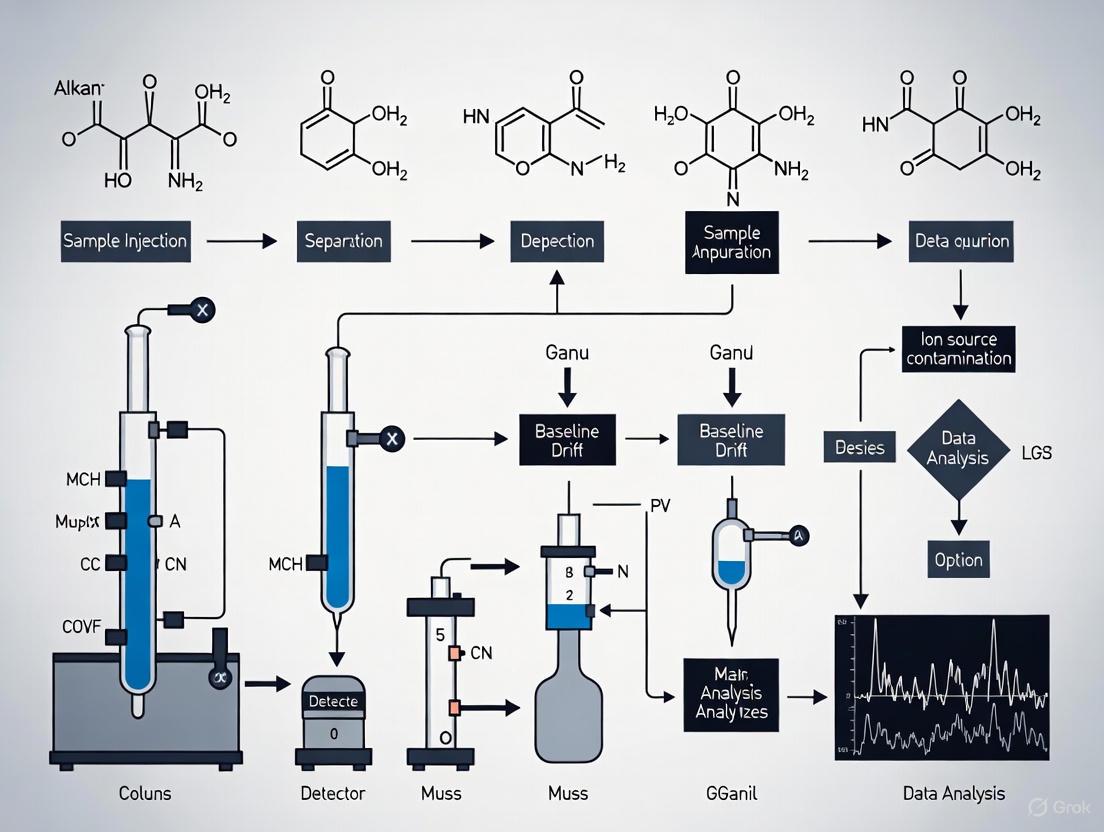
This article provides a comprehensive guide to Gas Chromatography-Mass Spectrometry (GC-MS) operations, from foundational principles to advanced troubleshooting and method validation.
GC-MS Operational Procedures and Advanced Troubleshooting for Reliable Biomedical Analysis
Abstract
This article provides a comprehensive guide to Gas Chromatography-Mass Spectrometry (GC-MS) operations, from foundational principles to advanced troubleshooting and method validation. Tailored for researchers, scientists, and drug development professionals, it covers method development for complex matrices, a systematic approach to diagnosing common issues like peak tailing and sensitivity loss, and rigorous validation protocols compliant with regulatory standards. By integrating practical methodologies with proven troubleshooting techniques, this resource aims to enhance analytical precision, minimize instrument downtime, and ensure data integrity in biomedical and clinical research.
GC-MS Fundamentals: Principles, System Configuration, and Data Integrity
Gas Chromatography-Mass Spectrometry (GC-MS) combines two powerful analytical techniques to separate, identify, and quantify complex mixtures of volatile and semi-volatile organic compounds. The gas chromatograph (GC) component separates the sample mixture into its individual components, while the mass spectrometer (MS) detects and identifies these components based on their mass-to-charge ratios [1] [2]. This integrated system provides unparalleled capabilities for qualitative and quantitative analysis across pharmaceutical development, environmental monitoring, food safety, and forensic science [3] [2]. The core components work in concert: the inlet introduces the sample, the column housed within a temperature-controlled oven performs the separation, and the mass spectrometer provides detection and identification [1]. Understanding the function, operation, and optimization of each component is fundamental to obtaining reliable, reproducible, and accurate analytical data, particularly when developing and validating methods for regulatory compliance [3].
Core Component 1: The Inlet System
Function and Operational Principle
The inlet system, also known as the injector, serves as the critical interface between the sample introduction device and the analytical column. Its primary function is to rapidly vaporize liquid samples and efficiently transfer the vaporized analytes onto the chromatographic column as a narrow, focused band [1]. This process is facilitated by a controlled stream of inert carrier gas—typically helium, hydrogen, or nitrogen—which transports the sample into the system [3] [2]. The inlet operates at elevated temperatures to ensure complete and instantaneous vaporization of the sample, and its design is crucial for maintaining the integrity of the separation by preventing sample degradation, discrimination, or broadening of the analyte band before it enters the column [1]. Proper inlet operation directly impacts key chromatographic performance metrics, including resolution, peak shape, and quantitative accuracy.
Key Operational Parameters and Configurations
The inlet system can be operated in different modes to accommodate various sample types and concentrations:
- Split Mode: Ideal for concentrated samples. Only a small, defined fraction (e.g., 1:10 to 1:100) of the vaporized sample is transferred to the column, while the majority is vented to waste. This prevents column overload [4].
- Splitless Mode: Used for trace-level analysis. Nearly the entire vaporized sample is transferred to the column over a longer period (30-60 seconds) to maximize sensitivity [5].
- On-Column Injection: The sample is deposited directly into the column without a vaporization chamber, suitable for thermally labile compounds or when discrimination must be avoided.
Key parameters that require optimization include the inlet temperature, carrier gas type and flow rate, injection volume, and in split mode, the split ratio [6]. The liner, a removable insert within the inlet, plays a vital role in promoting efficient vaporization and mixing. Its design (e.g., volume, deactivation, and packing) must be matched to the application.
Table 1: Critical Inlet Parameters and Their Optimization Ranges
| Parameter | Typical Range | Impact on Analysis |
|---|---|---|
| Inlet Temperature | 50°C - 350°C | Must be high enough to instantaneously vaporize all analytes without causing thermal degradation. |
| Carrier Gas Flow Rate | 0.5 - 2.5 mL/min (constant flow) | Affects analyte velocity through the column, influencing retention times and separation efficiency. |
| Injection Volume | 0.5 - 2 µL | Must be optimized to avoid column overloading (causing peak fronting) or insufficient sensitivity [5]. |
| Split Ratio | 1:10 to 1:200 (Split); 1:1 to 1:10 (Splitless) | Controls the amount of sample entering the column, critical for managing analyte mass and peak shape. |
Experimental Protocol: Inlet Performance Evaluation
Purpose: To assess inlet performance and identify issues related to degradation, activity, or poor injection technique. Materials: Standard test mix containing compounds of varying polarity and molecular weight (e.g., n-alkanes, free fatty acids, sterols); new deactivated inlet liner; appropriate solvent. Procedure:
- Inject 1 µL of the standard test mix using your standard method.
- Evaluate the chromatogram for peak symmetry (tailing or fronting), peak splitting, and changes in response (peak area) for active compounds compared to a baseline chromatogram [5].
- If peak tailing or loss of response is observed for active compounds, replace the inlet liner with a new, deactivated one.
- Repeat the injection. If performance is restored, the previous liner was contaminated or active.
- If peak splitting persists, check the column installation depth in the inlet and the quality of the column cut. A ragged column end can cause peak splitting [5].
- If peak fronting is observed, reduce the injection volume or sample concentration to address column overloading [5].
Core Component 2: The Chromatographic Column
Function and Operational Principle
The chromatographic column is the heart of the separation process in GC-MS. It is a long, narrow fused-silica tube coated on the inside with a thin layer of stationary phase [3]. The separated components from the inlet are carried through this column by the carrier gas (mobile phase). Separation occurs because different compounds in the mixture interact with the stationary phase to different degrees, based on their boiling points (volatility) and polarity [3] [1] [2]. Compounds with stronger interactions with the stationary phase are retained longer in the column, resulting in longer retention times, while those with weaker interactions elute more quickly. The column's physical dimensions and the chemical nature of its stationary phase are the primary determinants of the resolution and efficiency of the separation.
Key Operational Parameters and Configurations
The selection of an appropriate column is critical for method development. The key parameters are:
- Stationary Phase Chemistry: The polarity and functional groups of the stationary phase (e.g., 5% diphenyl / 95% dimethyl polysiloxane, Wax) must be matched to the analyte polarity for optimal separation [7].
- Column Length: Typically 15-60 meters. Longer columns provide higher theoretical plates and better resolution at the cost of longer analysis times.
- Internal Diameter (ID): Typically 0.10-0.53 mm. Narrower IDs (0.18-0.25 mm) provide higher efficiency, while wider IDs (0.32-0.53 mm) offer higher sample capacity.
- Film Thickness: Typically 0.10-5.0 µm. Thicker films retain analytes longer, which is beneficial for highly volatile compounds, and can handle higher analyte loadings [5].
Table 2: GC Column Specifications and Selection Guide
| Parameter | Common Options | Application Influence |
|---|---|---|
| Stationary Phase Polarity | Non-polar (e.g., 5% phenyl), Mid-polarity (e.g., 50% phenyl), Polar (e.g., PEG) | Governs separation mechanism: non-polar by boiling point, polar by polarity. Select based on analyte chemistry [7]. |
| Length | 15 m, 30 m, 60 m | Longer columns increase resolution and analysis time. 30 m is a common standard. |
| Internal Diameter | 0.18 mm, 0.25 mm, 0.32 mm | Smaller ID increases efficiency (narrower peaks); larger ID increases capacity and flow. |
| Film Thickness | 0.10 µm, 0.25 µm, 1.00 µm | Thicker films increase retention and capacity for volatile analytes; thinner films for high-boiling analytes [5]. |
Experimental Protocol: Column Performance Assessment
Purpose: To evaluate the current performance of a GC column and determine if maintenance (trimming) or replacement is required. Materials: Standard test mix specific for column performance evaluation (often provided by the column manufacturer); a known, good reference chromatogram of the test mix on the same column type. Procedure:
- Run the standard test mix using the method provided by the manufacturer or a validated in-house method.
- Compare the obtained chromatogram with the reference chromatogram. Key metrics to evaluate include:
- Theoretical Plates: A measure of column efficiency. A significant decrease indicates column degradation.
- Tailing Factor (Tf): Should typically be <1.5 for symmetrical peaks. An increase suggests active sites at the column inlet [5].
- Resolution between critical pairs of peaks. A loss of resolution indicates the column is no longer performing adequately [7].
- Retention Time Stability: Significant shifts can indicate degradation of the stationary phase or issues with carrier gas flow [7].
- If peak tailing or a loss of efficiency is observed, trim 10-30 cm from the inlet end of the column to remove contaminated or degraded stationary phase [7].
- Re-install the column and repeat the test. If performance is not restored, the column may need to be replaced.
Core Component 3: The Oven
Function and Operational Principle
The GC oven is a temperature-controlled enclosure that houses the chromatographic column. Its primary function is to provide precise and reproducible temperature control during the analysis. The oven can be programmed to maintain a constant temperature (isothermal) or, more commonly, to increase the temperature at a controlled rate (temperature programming) [6]. Temperature programming is essential for analyzing complex mixtures containing compounds with a wide range of boiling points. Starting at a lower temperature allows for better separation of early eluting, more volatile compounds. Ramping the temperature at a defined rate then forces the higher-boiling point compounds to elute from the column in a reasonable time, producing sharp, well-defined peaks throughout the chromatogram [5].
Key Operational Parameters and Configurations
The temperature program is a key variable in method development and optimization. The critical parameters are:
- Initial Oven Temperature: Set based on the solvent boiling point and the volatility of the earliest eluting analytes. For splitless injection, the initial temperature should be at least 20°C below the solvent boiling point for effective solvent focusing [5].
- Temperature Ramp Rate: The rate of temperature increase (°C/min). Slower ramps improve resolution but increase analysis time; faster ramps shorten run times at the expense of some resolution.
- Final Oven Temperature: Determined by the boiling point of the least volatile analyte and the temperature limit of the column. It must be high enough and held long enough to elute all compounds of interest.
- Hold Times: Isothermal holds may be applied at the initial, intermediate, or final temperatures to resolve specific groups of compounds.
The carrier gas flow mode (constant pressure or constant flow) interacts with the temperature program. In constant flow mode, the instrument adjusts inlet pressure to maintain a consistent volumetric flow rate as gas viscosity increases with temperature, leading to more stable retention times [4].
Diagram: GC Oven Temperature Programming Logic Flow. This workflow outlines the decision process for setting and optimizing a temperature program to resolve compounds across a wide volatility range.
Core Component 4: The Mass Spectrometer
Function and Operational Principle
The mass spectrometer serves as the detector for the GC system, providing both identification and quantification of the separated compounds eluting from the column [1]. It operates by converting neutral molecules into charged ions, separating these ions based on their mass-to-charge (m/z) ratios, and then measuring the abundance of each ion [3] [2]. The resulting mass spectrum is a unique "fingerprint" for each compound, which can be compared against extensive commercial spectral libraries for identification [3]. The high specificity and sensitivity of MS detection make GC-MS a powerful tool for confirming the presence of target analytes and for identifying unknown compounds in complex samples.
Key Operational Parameters and Configurations
The mass spectrometer consists of three primary functional regions under high vacuum:
- Ion Source: The region where eluting compounds are ionized. The most common technique is Electron Ionization (EI), where molecules are bombarded with high-energy electrons (typically 70 eV), causing them to fragment in a reproducible and characteristic way [1] [2]. Chemical Ionization (CI) is a softer alternative that often produces a molecular ion with less fragmentation.
- Mass Analyzer: The component that separates ions based on their m/z ratios. Common types for GC-MS include:
- Quadrupole: Uses oscillating electric fields to filter ions; robust and widely used for both quantitative (Selected Ion Monitoring - SIM) and qualitative (full scan) analysis [3] [1].
- Triple Quadrupole (GC-MS/MS): Provides enhanced selectivity and sensitivity for targeted quantitative analysis, especially in complex matrices, by isolating precursor ions and analyzing their characteristic product ions [3].
- Ion Trap: Can trap and sequentially eject ions, enabling MSⁿ experiments for structural elucidation.
- High-Resolution Accurate Mass (HRAM): Provides exact mass measurements, enabling confident determination of elemental composition for unknown compounds [3].
- Detector: The device that counts the separated ions. The most common type is the electron multiplier, which amplifies the signal of each arriving ion into a measurable current [1].
Table 3: Common GC-MS Mass Analyzer Types and Their Applications
| Analyzer Type | Key Features | Typical Acquisition Modes | Common Applications |
|---|---|---|---|
| Single Quadrupole | Rugged, cost-effective, good sensitivity. | Full Scan, Selected Ion Monitoring (SIM). | Unknown compound screening, targeted analysis in clean matrices [3]. |
| Triple Quadrupole (MS/MS) | High selectivity and sensitivity, excellent for quantitation. | Selected Reaction Monitoring (SRM), Product Ion Scan. | Trace-level quantitation in complex matrices (e.g., pesticides, contaminants) [3]. |
| High-Resolution Accurate Mass (HRAM) | Ultra-high mass accuracy and resolution. | Full Scan with accurate mass. | Untargeted screening, compound discovery, structural elucidation [3]. |
Experimental Protocol: MS Tuning and Performance Verification
Purpose: To ensure the mass spectrometer is calibrated, sensitive, and producing accurate spectral data. Materials: Standard tuning compound (e.g., perfluorotributylamine - PFTBA); calibration mixture specific to the mass range of interest. Procedure:
- Introduce the tuning compound into the ion source according to the instrument manufacturer's procedure (often via a dedicated vapor reservoir).
- Execute the automated tuning routine. This typically adjusts voltages in the ion source and mass analyzer to optimize signal for specific m/z ions from the tuning compound.
- The software will generate a tuning report. Key performance criteria to verify include:
- Mass Accuracy: The measured m/z of calibration ions should be within a specified tolerance (e.g., ± 0.1 amu).
- Sensitivity: The abundance of key ions should meet minimum thresholds.
- Resolution: The ability to distinguish ions of slightly different m/z (meets manufacturer specifications).
- Isotope Ratio Accuracy: The relative abundances of isotope peaks should match theoretical values.
- If the instrument fails the tuning criteria, manual adjustment or maintenance (such as cleaning the ion source) may be required [4].
Integrated GC-MS Workflow and System Optimization
The analytical process in GC-MS is an integrated workflow where each component's performance directly impacts the others and the final result. A sample is prepared, injected into the inlet and vaporized, separated in the column within the programmable oven, and the eluting compounds are then identified and quantified by the mass spectrometer [2]. The data system controls all parameters, acquires the signal from the MS detector, and provides software tools for data analysis, including spectral library searching [2]. Optimization of this entire system is often necessary to achieve the required sensitivity, resolution, and speed of analysis for a given application. This can involve experimental design (DOE) to understand the interaction of multiple parameters, such as inlet temperature, oven ramp rate, and carrier gas flow, on the chromatographic outcome [6].
Diagram: GC-MS Integrated Analytical Workflow. The schematic illustrates the sequential path of a sample through the core components of a GC-MS system, from injection to final data output.
The Scientist's Toolkit: Essential Research Reagents and Materials
Table 4: Key Research Reagent Solutions for GC-MS Analysis
| Item | Function / Purpose | Application Notes |
|---|---|---|
| High-Purity Solvents (e.g., Hexane, Methanol, Dichloromethane) | Sample preparation and dilution. | Must be highly volatile and pure to avoid interfering peaks (ghost peaks) and contamination of the inlet/column [7] [2]. |
| Derivatization Reagents (e.g., MSTFA, BSTFA) | Chemically modify non-volatile or thermally labile analytes (e.g., acids, sugars) to increase their volatility and thermal stability for GC analysis. | Essential for broadening the scope of GC-MS to include polar biomolecules in metabolomics and other fields [3]. |
| Inert Carrier Gases (He, H₂, N₂) | Mobile phase that transports the sample through the system. | Must be ultra-high purity (≥99.999%) with moisture and hydrocarbon traps to prevent system degradation and baseline noise [3] [7]. |
| Standard Tuning Compound (e.g., PFTBA) | Calibrates the mass axis and verifies MS performance (sensitivity, resolution, mass accuracy). | Used for daily or weekly performance checks and automatic calibration of the mass spectrometer. |
| Performance Test Mix | A mixture of specific compounds used to evaluate the overall performance of the GC-MS system, including column efficiency, peak symmetry, and detection limits. | Critical for system qualification, troubleshooting, and verifying performance after maintenance [7] [4]. |
| Deactivated Inlet Liners & Septa | Consumable parts in the inlet system that ensure efficient vaporization and prevent system leaks. | Regular replacement is necessary to maintain peak shape and quantitative accuracy; a primary troubleshooting step [7] [4]. |
| Capillary GC Columns | The medium where chromatographic separation occurs. | Selected based on stationary phase, dimensions, and film thickness to match the analytical application [3] [7]. |
Gas Chromatography-Mass Spectrometry (GC-MS) is a powerful analytical technique that combines the separation capabilities of gas chromatography with the identification power of mass spectrometry. This combination is invaluable for identifying and quantifying different substances within a test sample. The operational procedure is critical for obtaining reliable and reproducible results, particularly in complex applications such as trace contaminant analysis in environmental and pharmaceutical fields. This document details the standardized protocols and troubleshooting guidance for the end-to-end GC-MS workflow, providing researchers and drug development professionals with a comprehensive framework for effective analysis.
The Complete GC-MS Workflow
The journey of a sample through a GC-MS system is a multi-stage process. The following diagram illustrates the logical sequence and key decision points from sample preparation to final data interpretation.
Experimental Protocols
Protocol 1: Sample Preparation via Solid-Phase Microextraction (SPME) for Neutral PFAS
1. Principle: This protocol utilizes SPME, an automated, solvent-free technique ideal for extracting volatile and semi-volatile neutral PFAS (e.g., Fluorotelomer alcohols - FTOHs) from solid or liquid matrices [8]. It minimizes manual preparation and enhances safety by reducing solvent exposure.
2. Materials:
- SPME Assembly (e.g., Autosampler-compatible SPME holder)
- SPME Fiber (e.g., Divinylbenzene/Carboxen/Polydimethylsiloxane (DVB/CAR/PDMS))
- GC-MS Vials and Crimp Caps
- Analytical Balance
- Sample: Environmental solid sample (e.g., soil, sediment) or water sample.
3. Step-by-Step Procedure:
| Step | Action | Technical Notes & Parameters |
|---|---|---|
| 1 | Weigh & Place Sample | Accurately weigh 1-2 g of solid sample or 10 mL of liquid sample into a 20 mL headspace vial. |
| 2 | Internal Standard Addition | Add a known quantity of deuterated or ¹³C-labeled internal standard (e.g., ¹³C-FTOH) to correct for analyte loss and matrix effects. |
| 3 | Condition SPME Fiber | Heat the SPME fiber in the GC injection port according to the manufacturer's specifications (e.g., 250-270°C for 5-10 minutes) to remove any contaminants. |
| 4 | Headspace Extraction | Place the vial in an automated sampler. Incubate at a defined temperature (e.g., 80°C for 20 min). Then, expose and absorb analytes onto the SPME fiber for a set time (e.g., 30 min) with agitation. |
| 5 | Thermal Desorption | Transfer the SPME assembly to the GC injector. Desorb the extracted analytes from the fiber in the hot, split/splitless injection port (e.g., 250°C for 2-5 min). |
4. Troubleshooting:
- Low Response: Check fiber condition, ensure vial seal is tight, optimize incubation time and temperature, and verify internal standard recovery.
- Carryover: Increase desorption time and temperature in the injector; re-condition the fiber if necessary.
- Peak Tailing: Verify that the injector liner is clean and of the correct type for SPME applications.
Protocol 2: GC-MS Data Acquisition in Scan and SIM Modes
1. Principle: This protocol outlines the setup for data acquisition, covering both Full Scan and Selected Ion Monitoring (SIM) modes. Full Scan collects data for a wide mass range, useful for unknown identification, while SIM monitors specific ions for target compounds, offering higher sensitivity [9].
2. Materials:
- GC-MS System with appropriate data acquisition software.
- Tuning Standard (e.g., perfluorotributylamine - PFTBA).
- Calibration standard mixture containing target analytes.
3. Step-by-Step Procedure:
| Step | Action | Technical Notes & Parameters |
|---|---|---|
| 1 | System Tuning | Perform a mass calibration and tune the MS system using a standard like PFTBA. Check for peak shape, resolution, and relative abundances to ensure the instrument is performing optimally [9]. |
| 2 | Define Acquisition Method | In the instrument software, create a new acquisition method. This involves linking the GC method (oven temperature program, flow rates) and the MS method. |
| 3 | Select Acquisition Mode | For Full Scan: Set a mass range (e.g., m/z 35-500 or 50-650) suitable for the target analytes. Set a scan rate (e.g., 5-10 scans/second) [10]. For SIM: Define time windows based on the GC retention times of target analytes. For each window, list the characteristic primary and secondary qualifier ions for each compound (e.g., for a specific PFAS, this might be m/z 169, 219). Increase dwell time (e.g., 50-200 ms) per ion to improve signal-to-noise. |
| 4 | Solvent Delay | Set a solvent delay time (e.g., 2-4 minutes) to prevent the MS filament from being exposed to the large solvent peak. |
| 5 | Run Sequence | Input the sequence of samples (blanks, standards, unknowns) and start the acquisition. |
4. Troubleshooting:
- Poor Sensitivity in Scan: Ensure the MS source is clean; check and optimize tune parameters; consider using SIM for trace-level target analysis.
- Spectral Skewing (mis-matched spectra): Increase the acquisition rate (scans/second) to ensure enough data points are collected across a narrow GC peak [9].
- Unidentified Peaks in Scan: Use the mass spectral library to identify unknown compounds by comparing the acquired mass spectrum against reference spectra [10].
Data Acquisition Parameters & Reagent Solutions
Critical GC-MS Data Acquisition Parameters
The selection of appropriate data acquisition parameters is fundamental to method performance. The table below summarizes key parameters and their impact on results [9].
Table 1: Key GC-MS Data Acquisition Parameters and Their Impact
| Parameter | Description | Impact on Analysis & Common Settings |
|---|---|---|
| Acquisition Mode | Choice between Full Scan and Selected Ion Monitoring (SIM). | Scan: Acquires all ions in a range; ideal for unknown identification. SIM: Monitors specific ions; provides higher sensitivity and lower detection limits for target compounds [9]. |
| Mass Range | The range of mass-to-charge (m/z) ratios collected during a scan. | Must be wide enough to include molecular and key fragment ions of interest (e.g., m/z 45-450 for volatile organics). A narrow range can improve scan speed and sensitivity. |
| Scan Rate | The speed at which the mass spectrometer scans the defined mass range. | Measured in scans/second. Too slow a rate results in too few data points across a GC peak, causing "spectral skewing." An optimal rate ensures accurate peak shape and library-comparable spectra [9]. |
| Dwell Time | The time spent monitoring each specific ion in SIM mode. | Measured in milliseconds. Longer dwell times increase sensitivity but reduce the number of ions that can be monitored in a given time window. Must be balanced for multi-analyte methods. |
| Solvent Delay | The initial period during which the MS detector is turned off. | Prevents the large solvent peak from contaminating the ion source and saturating the detector. Typically 2-4 minutes, depending on the solvent and method. |
Essential Research Reagent Solutions
A successful GC-MS analysis relies on high-quality reagents and materials. The following table lists key solutions used in the featured protocols and their critical functions.
Table 2: Essential Reagents and Materials for GC-MS Workflows
| Reagent / Material | Function / Application |
|---|---|
| Deuterated or ¹³C-Labeled Internal Standards | Compounds with stable isotopes used for quantitative accuracy. They correct for variability in sample preparation, injection, and matrix effects. |
| SPME Fibers (e.g., DVB/CAR/PDMS) | Solventless extraction tools that concentrate analytes from the sample headspace or direct immersion for introduction into the GC injector [8]. |
| Tuning Standard (e.g., PFTBA) | A reference compound with known mass fragments used to calibrate the mass spectrometer, ensuring mass accuracy, resolution, and sensitivity are within specification [9]. |
| Certified Reference Materials (CRMs) | Standards with certified concentrations of target analytes in a specific matrix. Used for method validation, calibration, and quality control to ensure data accuracy and traceability. |
| High-Purity Solvents (e.g., Ethyl Acetate, Methanol) | Used for sample extraction, dilution, and preparation. High purity is essential to minimize background interference and contamination. |
Data Interpretation and Troubleshooting
Fundamentals of Interpreting GC/MS Results
A GC/MS analysis produces a chromatogram and corresponding mass spectra.
- The Chromatogram: The x-axis represents retention time (RT), the time taken for an analyte to pass through the GC column and reach the detector. The y-axis represents intensity (counts), which correlates with the concentration of the analyte [10]. Each peak corresponds to a separated component.
- Mass Spectrum: At each point in the chromatogram, a mass spectrum is recorded. This spectrum is a "fingerprint" that shows the molecular ion and fragment ions of the compound, which is used for identification by comparison with spectral libraries [10].
Common Workflow Challenges and Solutions
- Carryover: Caused by incomplete cleaning of the injection port, column, or sample introduction system. Solution: Implement rigorous cleaning cycles, replace liners, use syringe wash solvents, and run blank injections to monitor background.
- Poor Chromatographic Resolution: Leads to overlapping peaks. Solution: Optimize the GC oven temperature ramp rate, verify carrier gas flow rate, and ensure the column is appropriate for the application and not degraded.
- Low MS Sensitivity: Results in poor detection limits. Solution: Perform routine MS source cleaning, check and replace the electron multiplier if aged, verify the instrument tune, and consider using SIM mode for trace analysis. For neutral PFAS, techniques like dynamic headspace (DHS) can improve sensitivity by concentrating the sample [8].
Understanding Chromatograms and Mass Spectra for Compound Identification
Gas Chromatography-Mass Spectrometry (GC-MS) is a cornerstone analytical technique that combines the separation power of gas chromatography with the identification capabilities of mass spectrometry. This powerful synergy provides both universal and selective detection in a single system, making it indispensable for researchers, scientists, and drug development professionals who require confident compound identification [11]. The fundamental process involves sample volatilization, chromatographic separation based on compound affinity for the stationary phase, and subsequent mass spectral analysis of eluted components [10]. Understanding how to interpret the resulting data is crucial for effective qualitative and quantitative analysis in complex matrices, from biological samples to pharmaceutical products.
Fundamental Concepts in Chromatogram Interpretation
The Gas Chromatogram: Retention Time and Signal Intensity
The gas chromatogram provides the first dimension of information in GC-MS analysis, displaying signal intensity versus retention time.
X-Axis - Retention Time: The x-axis represents the retention time (tR), which is the time taken for an analyte to pass through the GC column and reach the mass spectrometer detector [10]. Each peak corresponds to a specific compound reaching the detector. Retention time is influenced by multiple factors including the type of GC column, carrier gas flow rate, injection temperature, and oven temperature program [10]. For accurate compound identification and comparison between analyses, it is critical that identical chromatographic parameters are maintained.
Y-Axis - Signal Intensity: The y-axis represents signal intensity or concentration [10]. Peak area generally corresponds to the amount of a specific analyte present, though detector response factors must be considered as some compounds ionize more readily than others, making their peaks appear larger than their actual concentration relative to other components [10]. For accurate quantification, analysts use standards with known concentrations to establish calibration curves and account for these response variations.
Types of Mass Chromatograms
In GC-MS analysis, different chromatographic representations can be extracted from the raw data, each serving specific purposes in qualitative and quantitative analysis.
Table 1: Types of Mass Chromatograms in GC-MS Analysis
| Chromatogram Type | Description | Primary Application | Advantages |
|---|---|---|---|
| Total Ion Chromatogram (TIC) | Summed intensity across the entire mass range detected at every point in the analysis [12] [11]. | Broad, untargeted analysis; initial sample profiling [11]. | Provides complete picture of all detectable components; useful for unknown identification. |
| Extracted Ion Chromatogram (EIC/XIC) | Chromatogram generated by plotting intensity for specific m/z value(s) extracted from the full data set [12]. | Targeted analysis; confirming presence of specific compounds; detecting co-eluting substances [12]. | Reduces background interference; highly selective for compounds producing the extracted ions. |
| Selected Ion Monitoring (SIM) | Data collection only for pre-selected m/z values during acquisition [12] [11]. | High-sensitivity quantitative analysis of target compounds [11]. | Significantly improved sensitivity and signal-to-noise ratio; faster data acquisition rates. |
The Mass Spectrum: Fragmentation Patterns and Spectral Interpretation
When a compound elutes from the GC column and enters the mass spectrometer, it is ionized typically by electron ionization (EI), which causes the molecular ion to fragment in predictable patterns [11]. The resulting mass spectrum provides a characteristic "fingerprint" for compound identification.
Molecular Ion: The peak representing the intact molecule after ionization (M+•), typically appearing at the highest m/z value in the spectrum [11]. For fenoxycarb (MW = 301.13 Da), the molecular ion appears at m/z 301.15 [11].
Base Peak: The most intense peak in the mass spectrum, normalized to 100% relative abundance [11]. This is often a stable fragment ion that forms reproducibly during ionization.
Fragment Ions: Lower mass peaks resulting from the breakdown of the molecular ion, providing structural information about the original compound [11]. Classical fragmentation patterns follow well-established rules that have been documented for decades.
Isotopic Peaks: Clusters of peaks at M+1, M+2, etc., resulting from naturally occurring isotopes (e.g., 13C) [11] [13]. These patterns can reveal information about the elemental composition of the molecule and the number of specific atoms present.
Experimental Protocols for Compound Identification
Protocol: GC-MS Analysis for Qualitative Compound Identification
This protocol details the steps for confident compound identification using GC-MS with electron ionization.
Materials and Equipment:
- Gas chromatograph coupled to mass spectrometer
- Capillary GC column (e.g., DB-5ms, 30m × 0.25mm × 0.25µm)
- Syringe for liquid injection
- Derivatization reagents (if analyzing non-volatile compounds)
- Certified standards for calibration
- NIST Mass Spectral Library or other reference database
Procedure:
- Sample Preparation:
Instrument Setup:
- Set GC parameters: injector temperature (250°C), carrier gas flow (1.0 mL/min He), oven temperature program (e.g., 60°C for 1 min, ramp 5°C/min to 300°C, hold 12 min) [14].
- Configure MS parameters: electron energy (-70 eV), ion source temperature (230°C), mass range (m/z 45-1000), acquisition rate (20 spectra/s for full scan) [14] [11].
- Use splitless injection for maximum sensitivity or split injection for concentrated samples.
Data Acquisition:
Data Analysis:
- Process TIC data using instrument software (e.g., LECO ChromaTOF, Agilent MassHunter) [14].
- Identify compounds by comparing mass spectra to reference libraries (NIST, Fiehn, in-house) with appropriate similarity thresholds (e.g., Rsim ≥ 600) [14].
- Confirm identifications by matching retention times with authentic standards when available.
- For targeted analysis, generate Extracted Ion Chromatograms (EICs) using 3-4 characteristic ions per compound [11].
Validation:
Advanced Applications: Comprehensive Two-Dimensional GC×GC-MS
For complex samples where conventional GC-MS provides limited resolution, comprehensive two-dimensional GC×GC-MS offers significantly enhanced separation power:
Instrument Configuration: Uses two GC columns with different stationary phases connected via a thermal modulator [14]. The second column is typically shorter (1-2m) and operates at a higher temperature than the first column [14].
Performance Advantages: GC×GC-MS detects approximately three times as many peaks as conventional GC-MS at a signal-to-noise ratio ≥ 50, leading to significantly more metabolite identifications in complex biological samples [14].
Application: Particularly valuable for biomarker discovery in complex matrices like human serum, where severe peak overlap in conventional GC-MS makes spectrum deconvolution difficult [14].
Table 2: Performance Comparison of GC-MS and GC×GC-MS in Metabolite Biomarker Discovery
| Performance Metric | GC-MS | GC×GC-MS | Improvement Factor |
|---|---|---|---|
| Peaks Detected (SNR ≥ 50) | Baseline | ~3× more peaks | 3× [14] |
| Metabolites Identified (Rsim ≥ 600) | Baseline | ~3× more metabolites | 3× [14] |
| Statistically Significant Biomarkers | 23 metabolites | 34 metabolites | 1.5× [14] |
| Chromatographic Resolution | Limited, with peak overlap | Superior, reduced co-elution | Significant [14] |
Troubleshooting Common GC-MS Issues
Effective troubleshooting is essential for maintaining data quality in GC-MS analysis. The following protocol addresses common chromatographic problems that impact compound identification.
Materials for Troubleshooting:
- Replacement inlet liners and septa
- Column trimming tool
- Leak detection solution
- Performance test mix
- Ultra-high purity carrier gas with traps
Troubleshooting Protocol:
Problem Assessment:
Systematic Diagnosis:
- Step 1: Inspect inlet system for contamination. Replace liner and septum if discolored or damaged [15].
- Step 2: Check column installation for leaks or dead volume. Trim 10-30 cm from the inlet if residue is visible [15].
- Step 3: Perform blank runs to identify contamination sources [15].
- Step 4: Analyze a standard test mix to compare against the column's original quality control report [15].
- Step 5: Systematically replace suspected faulty components, starting with low-cost consumables [15].
Specific Issue Resolution:
Peak Tailing: Caused by active sites in the system, insufficiently deactivated liners, or column overloading [15]. Remedial actions include trimming the column inlet, replacing liners, or reducing sample load [15].
Ghost Peaks: Unexpected signals appearing in blank injections, typically caused by system contamination, septum bleed, or sample carryover [15]. Resolution involves replacing septum, cleaning or replacing inlet liners, and verifying solvent purity [15].
Retention Time Shifts: Result from unstable oven temperatures, carrier gas flow fluctuations, or pressure inconsistencies [15]. Troubleshooting involves verifying temperature program stability, checking for leaks, and confirming flow rates with a calibrated flow meter [15].
Decreased Sensitivity: Often stems from inlet contamination, detector fouling, or column degradation [15]. Address by cleaning or replacing inlet liner, inspecting detector, and running performance test mix [15].
Preventive Maintenance Protocol
Regular preventive maintenance reduces analytical downtime and ensures consistent compound identification:
Column Care:
System Maintenance:
Essential Research Reagents and Materials
Table 3: Essential Research Reagent Solutions for GC-MS Analysis
| Reagent/Material | Function | Application Notes |
|---|---|---|
| Derivatization Reagents (MSTFA + 1% TMCS) | Chemical modification of non-volatile compounds (e.g., metabolites) to increase volatility and thermal stability [14]. | Two-step derivatization: methoxyamination followed by silylation [14]. |
| Internal Standards (Heptadecanoic acid, Norleucine) | Quantification and retention time reference compounds added to all samples and calibrators [14]. | Correct for injection volume variations and matrix effects; use at 10 µg/mL concentration [14]. |
| Alkane Retention Index Standard (C10-C40) | Calibration of retention times to retention indices for improved compound identification [14]. | Run at beginning, middle, and end of sample sequences [14]. |
| Performance Test Mix | System suitability verification; troubleshooting column and detector performance [15]. | Compare results to column's original QC report to detect performance degradation [15]. |
| Ultra-High Purity Gases with Traps | Carrier gas for chromatographic separation; prevent system contamination [15]. | Essential for trace-level and GC-MS applications; impurities cause significant analytical errors [15]. |
| Reference Spectral Libraries (NIST, Fiehn) | Compound identification through mass spectral matching [14] [11]. | Use similarity thresholds (e.g., Rsim ≥ 600) for confident identifications [14]. |
Effective interpretation of chromatograms and mass spectra is fundamental to successful compound identification using GC-MS. This application note has detailed the core principles of chromatogram interpretation, mass spectral analysis, and practical protocols for both routine and advanced applications. The integrated approach combining retention time matching, spectral interpretation, and library searching provides a powerful framework for confident compound identification. Furthermore, systematic troubleshooting and preventive maintenance protocols ensure sustained data quality and instrument performance, which is particularly crucial in drug development and research environments where analytical reliability directly impacts scientific conclusions. By implementing these standardized procedures and understanding the fundamental principles of GC-MS data interpretation, researchers can maximize the analytical capabilities of this powerful technique for their compound identification needs.
Within the comprehensive framework of GC-MS operational procedures, the selection of an appropriate chromatographic column is a critical foundational step that directly influences the success and reliability of analytical results. The column serves as the heart of the separation process, where interactions between analytes and the stationary phase determine the resolution, speed, and overall quality of the analysis. For researchers, scientists, and drug development professionals, a systematic approach to column selection—encompassing stationary phase chemistry, physical dimensions, and film thickness—is paramount for developing robust, reproducible, and trouble-free methods. This application note provides detailed protocols and structured data to guide this selection process, ensuring optimal performance for specific analytical challenges.
Theoretical Foundations of GC Column Selection
The goal of chromatographic separation is to achieve sufficient resolution (Rₛ) between analyte peaks. The fundamental resolution equation (Equation 1) describes the relationship between resolution and key column parameters [16] [17]:
Equation 1: Resolution Equation
Rₛ = (1/4) * √N * (α - 1) * (k / (k + 1))
Where:
- N is the column efficiency (theoretical plate count), which is a function of column length (L), internal diameter (dc), and carrier gas type.
- α is the selectivity factor, which is primarily a function of stationary phase chemistry and temperature.
- k is the retention factor, which is influenced by film thickness (df), internal diameter (dc), and temperature [17].
A thorough understanding of how each parameter in this equation interacts is the first step in rational column selection. The following workflow outlines the systematic decision process for choosing the correct GC column.
Figure 1: Systematic Workflow for GC Column Selection
Experimental Protocols for Column Selection and Evaluation
Protocol 1: Stationary Phase Selectivity Screening
Objective: To empirically determine the most selective stationary phase for separating critical analyte pairs in a complex mixture.
Materials:
- Standard mixture containing all target analytes and potential interferences.
- GC-MS system with a compatible injector and mass spectrometer.
- Multiple GC columns (30 m x 0.25 mm ID, 0.25 µm film) with different stationary phases (e.g., 100% dimethyl polysiloxane, 5% diphenyl/95% dimethyl polysiloxane, 35% diphenyl/65% dimethyl polysiloxane, polyethylene glycol).
Procedure:
- Sample Preparation: Prepare a standard solution of the analyte mixture in an appropriate solvent at a concentration suitable for the detector's linear range. Use the same solution for all columns to ensure consistency [18].
- Instrument Setup: Install the first column. Set the GC oven to an appropriate starting temperature and program a temperature ramp that allows elution of all analytes. Use constant flow mode with helium carrier gas. Set the MS to scan mode (e.g., m/z 50-550) for untargeted analysis or SIM for specific analytes.
- Data Acquisition: Inject 1 µL of the standard mixture in splitless mode. Record the retention times and peak areas for all analytes.
- Column Comparison: Repeat steps 2 and 3 for each candidate column without changing the standard solution or fundamental temperature program.
- Data Analysis: For each column, calculate the retention factor (k) and selectivity (α) for critical analyte pairs that are difficult to separate. The column that provides the highest α value for the most critical pair, with symmetrical peak shapes for all analytes, should be selected for method development [16] [19].
Protocol 2: Optimization of Column Dimensions and Film Thickness
Objective: To fine-tune the separation by adjusting column length, internal diameter, and film thickness after selecting the stationary phase.
Materials:
- Standard mixture from Protocol 1.
- GC-MS system.
- Columns with the selected stationary phase but varying in length, internal diameter (ID), and film thickness.
Procedure:
- Establish Baseline: Using a standard dimension column (e.g., 30 m x 0.25 mm ID x 0.25 µm film), perform a separation and note the analysis time, resolution of the critical pair (Rₛ), and peak symmetry.
- Vary Column Length:
- Install a longer column (e.g., 60 m) with the same ID and film thickness.
- Using the same standard mixture and a scaled temperature program to maintain elution temperatures, perform the separation.
- Note the change in analysis time and resolution. Per Equation 1, doubling the length increases Rₛ by a factor of ~1.4 but increases run time [17].
- Vary Internal Diameter:
- Install a column with a narrower ID (e.g., 0.18 mm or 0.15 mm) but the same stationary phase and similar film thickness.
- Adjust the carrier gas flow to maintain optimal linear velocity. Note that halving the ID requires a ~4x increase in head pressure [17].
- Perform the separation and note the changes in efficiency, sensitivity, and capacity.
- Vary Film Thickness:
- Install a column with a thicker film (e.g., 1.0 µm) with the same stationary phase and similar ID.
- Using the same standard mixture, perform the separation. Note the increase in retention times and the improved resolution for early-eluting, volatile compounds (k < 2). Observe peak shape for active compounds, which should improve due to better deactivation of the column surface [17].
- Final Selection: Based on the data, select the column dimensions and film that provide the best compromise between resolution, analysis time, and peak shape for the specific application.
Data Presentation and Selection Guidelines
Stationary Phase Polarity and Selectivity
Table 1: Common GC Stationary Phases and Their Application Domains [20] [16]
| Stationary Phase Composition (USP Name) | Polarity | Common Equivalent Phases | Max Temp (°C) | Primary Application Notes |
|---|---|---|---|---|
| 100% Dimethyl Polysiloxane (G1) | Non-Polar | Rxi-1ms, Rtx-1, HP-1, DB-1, ZB-1 | 350-400 | General-purpose; separation by boiling point; hydrocarbons, solvents, volatile organics. |
| 5% Diphenyl / 95% Dimethyl Polysiloxane (G27) | Non-Polar | Rxi-5ms, Rtx-5, HP-5, DB-5, ZB-5 | 350 | Most widely used phase; pesticides, drugs, FAMEs, semi-volatiles. |
| 35% Diphenyl / 65% Dimethyl Polysiloxane (G42) | Mid-Polarity | Rtx-35, HP-35, DB-35, ZB-35 | 320 | Good for pesticides, drugs; alternative selectivity to 5% phenyl phases. |
| Polyethylene Glycol (WAX) | Polar | HP-WAX, DB-WAX, Stabilwax | 250 | Alcohols, solvents, essential oils, free fatty acids; high polarity. |
| 50% Cyanopropylphenyl / 50% Phenylmethyl (G7) | High-Polarity | Rtx-225, DB-225 | 240 | FAMEs, unsaturated compounds; provides unique selectivity. |
| Trifluoropropylmethyl Polysiloxane (G6) | Specialty | Rtx-200, DB-200 | 340-360 | Selective for halogenated, nitrogenated, and carbonyl compounds; lone pair electrons. |
Column Dimensions and Film Thickness Selection Guide
Table 2: Guidelines for Selecting Column Dimensions and Film Thickness [16] [17]
| Analytical Requirement | Recommended Length | Recommended Internal Diameter | Recommended Film Thickness | Impact on Separation |
|---|---|---|---|---|
| Fast Analysis | 10-15 m | 0.18-0.25 mm | 0.18-0.25 µm | Shorter, narrower columns for rapid elution. Lower capacity. |
| High Resolution | 50-60 m | 0.18-0.25 mm | 0.25-0.5 µm | Longer columns increase efficiency (N). Longer analysis time. |
| Trace Analysis | 30 m | 0.18-0.25 mm | 0.5-1.5 µm | Thicker films increase retention (k) and capacity, improving sensitivity for volatiles. |
| High Boiling Point Compounds | 15-30 m | 0.25-0.32 mm | 0.1-0.25 µm | Thinner films allow elution at lower temperatures, reducing analysis time and bleed. |
| Complex Mixtures | 30-60 m | 0.18-0.25 mm | 0.25-1.0 µm | Balance of length for resolution and film for retention/peak shape. |
| Routine, General Use | 20-30 m | 0.25-0.32 mm | 0.25-0.5 µm | Good balance of speed, resolution, and capacity. |
The Scientist's Toolkit: Essential Research Reagent Solutions
Table 3: Key Materials and Reagents for GC-MS Analysis [20] [18]
| Item | Function / Purpose | Application Notes |
|---|---|---|
| SPME Fiber Assembly | Solventless extraction and concentration of volatiles/semi-volatiles from headspace or liquid. | Ideal for high-background samples (e.g., food, biologics). Fiber chemistry (PDMS, CAR/PDMS) must be matched to analytes [20]. |
| Solid Phase Extraction (SPE) Cartridges | Sample clean-up, concentration, and fractionation. Removes interferences from complex matrices. | Select phase based on analyte: C18 (reversed-phase), Silica (normal-phase), SAX/SCX (ion-exchange) [20]. |
| QuEChERS Kits | Quick, Easy, Cheap, Effective, Rugged, Safe. Standardized dispersive SPE for pesticide residue analysis. | Uses solvent extraction (acetonitrile) followed by salting-out and d-SPE clean-up [20]. |
| Derivatization Reagents (e.g., MSTFA) | Chemically modify polar, non-volatile analytes (e.g., acids, steroids) to volatile, thermally stable derivatives. | Crucial for analyzing compounds like hormones, metabolites, and bile acids. Improves chromatographic behavior and detectability [18]. |
| Deactivated Inlet Liners & Septa | Provide an inert vaporization chamber for the sample. Prevent analyte degradation and adsorption. | Critical for active compounds. Choice of liner (e.g., straight, tapered, gooseneck) depends on injection technique and volume. |
| High-Purity Solvents & Derivatization-Grade Reagents | Used for sample preparation, dilution, and as reagents. Minimize background contamination. | Essential for low detection limits. Reagents must be free of impurities that could interfere with analysis or derivatization. |
Selecting the optimal GC column is a multidimensional process that integrates the chemistry of the stationary phase with the physics of the column dimensions. By systematically applying the protocols and guidelines outlined in this application note—starting with stationary phase selectivity, followed by optimization of length, internal diameter, and film thickness—researchers can develop robust, reliable, and efficient GC-MS methods. This structured approach not only enhances resolution and speed but also minimizes future troubleshooting, thereby supporting the rigorous demands of modern research and drug development.
Establishing a Robust Foundation for Reproducible Results
Reproducibility is the cornerstone of reliable analytical science. In Gas Chromatography-Mass Spectrometry (GC-MS), achieving consistent results requires a foundation of rigorous operational procedures, proactive maintenance, and standardized data analysis. This document outlines essential protocols and application notes to establish such a foundation, framed within a broader research context on GC-MS operational excellence and troubleshooting. The following guidelines are designed for researchers, scientists, and drug development professionals who require the highest level of data integrity.
Proactive System Suitability and Maintenance
Consistent instrument performance is a prerequisite for reproducible data. Implementing a routine of proactive checks and maintenance prevents unexpected downtime and ensures data quality.
Daily Start-Up and Performance Verification
A defined start-up procedure verifies system readiness before analytical runs begin [21].
- Gas Supplies: Check pressure gauges on all gas cylinder regulators. Ensure tanks are replaced before they fall below approximately 100 psi to prevent contaminants from entering the system [21].
- Detector Signal and Noise: With the system at operating temperature, check the detector's output signal and observe the baseline noise on the data system. The signal level and baseline noise should be consistent from day to day; significant deviations indicate a potential problem with the detector, electronics, or gas purity [21].
- Butane Test for Inlet and Column Health: Inject approximately 5 µL of butane gas (using a high split ratio, e.g., 100:1) and evaluate the peak shape. A symmetrical, sharp peak confirms proper inlet function and column inertness. Peak tailing suggests active sites in the inlet or column that require maintenance [21].
Preventive Maintenance Schedule
Adhering to a maintenance schedule is crucial for instrument longevity.
Table 1: Preventive Maintenance Schedule for GC-MS Systems
| Component | Maintenance Action | Frequency | Purpose and Rationale |
|---|---|---|---|
| Gas Supply & Pneumatics | Check for leaks; replace scrubbers/filters | Leak check: Daily; Scrubbers: ~6 months [21] | Prevents oxygen/moisture ingress and contamination; a saturated scrubber is worse than none [21]. |
| Inlet | Change septum | Every 25–50 injections [21] | Prevents leaks and sample carryover. |
| Inlet | Inspect/replace inlet liner | As needed (check during septum change) | Removes non-volatile residues that cause peak tailing and decomposition [22] [21]. |
| Column | Trim inlet end | As needed (when peak tailing begins) | Removes contaminated stationary phase at the column head, restoring peak shape [22]. |
| Column | Perform high-temperature bake-out | Start of each day or as needed [21] | Removes volatile contaminants accumulated in the column. |
| Detector | Clean or replace components (e.g., electron multiplier) | As needed (based on signal degradation) | Maintains detector sensitivity and stability [21]. |
The following workflow diagram summarizes the logical relationship between daily checks, observed symptoms, and corresponding maintenance actions.
Quantitative GC-MS Analysis: An Experimental Protocol
This protocol is adapted from a study investigating the influence of pigment concentration on the drying of oil paints, illustrating a rigorous approach to quantitative analysis and the pitfalls of relying on a single diagnostic ratio [23].
Experimental Objective
To quantitatively evaluate the effect of pigment concentration on the fatty acid ratios (P/S, A/P, ∑D) used to characterize linseed oil binders in artificially aged paint mock-ups using GC-MS [23].
Materials and Reagents
Table 2: Research Reagent Solutions and Key Materials
| Item | Function / Purpose |
|---|---|
| Clarified Linseed Oil | The binding material (drying oil) under investigation [23]. |
| Pigments | Synthetic and natural pigments to create paint mock-ups [23]. |
| Methanol, Hexane, Toluene | Solvents for sample preparation and extraction [23]. |
| Concentrated Sulfuric Acid | Acid catalyst for derivatization [23]. |
| Hexadecane | Potential internal standard for quantification [23]. |
| FAME Standard Mixture | Contains known concentrations of methyl palmitate, stearate, and oleate for absolute quantification [23]. |
Step-by-Step Protocol
Sample Preparation (Mock-up Creation):
- Prepare multiple sets of paint mixtures. Each set consists of a single pigment (e.g., zinc white, Prussian blue, yellow ochre) mixed with clarified linseed oil.
- Within each set, vary the linseed oil concentration widely, for example, from 10 to 95 g per 100 g of total mixture.
- Apply the mixtures to a substrate (e.g., Petri dishes) and subject them to artificial ageing for 8-10 months to simulate the drying process [23].
Sample Derivatization:
- Extract a small, weighed amount of the aged paint mock-up.
- Derivatize the sample using an acid-catalyzed (e.g., H₂SO₄) methylation protocol in methanol/toluene to convert free fatty acids and their glyceride forms into fatty acid methyl esters (FAMEs) [23].
GC-MS Analysis:
- Instrument: GC system coupled with a mass spectrometric detector.
- Column: Use a standard non-polar or mid-polarity capillary GC column (e.g., 5% diphenyl / 95% dimethyl polysiloxane).
- Injection: Split/splitless injection mode.
- Oven Program: Use a temperature ramp (e.g., 50°C to 300°C) to separate the FAMEs.
- MS Detection: Operate in Full Scan mode (e.g., m/z 40-400) initially to identify all components via Total Ion Chromatogram (TIC) and spectral library matching. For quantitative work, use Selected Ion Monitoring (SIM) mode targeting key ions (e.g., m/z 74, 87 for palmitic acid) to enhance sensitivity [11].
Data Analysis and Quantification:
- Absolute Quantification: Use the standard mixture of FAMEs with known concentrations to create a calibration curve. Quantify the amounts of palmitic, stearic, and azelaic acids in the samples [23].
- Ratio Calculation: Calculate the following key ratios for each sample:
- P/S Ratio: Palmitic Acid / Stearic Acid.
- A/P Ratio: Azelaic Acid / Palmitic Acid.
- ∑D (Relative content of dicarboxylic acids): (Sum of dicarboxylic acids) / (Sum of all fatty acids) [23].
Key Quantitative Findings and Data Presentation
The experimental results highlight critical factors affecting data interpretation.
Table 3: Quantitative GC-MS Data from Artificially Aged Paint Mock-ups
| Pigment Type | Linseed Oil Concentration (g/100g) | P/S Ratio | A/P Ratio | ∑D (%) | Key Interpretation |
|---|---|---|---|---|---|
| Yellow Ochre | 25 | 1.1 | 2.5 | ~65 | Pigment concentration significantly influences all ratios. |
| Yellow Ochre | 70 | 1.5 | 1.8 | ~58 | The P/S ratio is not stable, even with identical oil [23]. |
| Zinc White | 30 | 0.9 | 1.9 | ~61 | Low P/S ratio observed; pigment type and concentration are key factors [23]. |
| Zinc White | 80 | 1.4 | 1.5 | ~52 | Confirms substantial effect of pigment concentration on A/P and ∑D [23]. |
| Prussian Blue | 20 | 0.6 | 3.0 | ~70 | Extreme P/S value demonstrates the ratio's unreliability as a sole identifier [23]. |
| Prussian Blue | 85 | 1.6 | 2.1 | ~62 | A/P and ∑D decrease with higher oil concentration [23]. |
Troubleshooting Common GC-MS Issues
A systematic approach to troubleshooting is vital for maintaining reproducibility.
Systematic Troubleshooting Guide
When issues arise, follow a logical progression to identify the root cause [22].
- Review Recent Changes: Did the problem follow a change in method parameters, column installation, or hardware? Reverting to a previous configuration can be a quick solution [22].
- Inspect the Inlet and Detector: Contamination in the inlet liner or detector is a leading cause of issues. Inspect and clean or replace the septum, inlet liner, and detector components as needed [22] [21].
- Check Column Installation and Condition: Verify the column is correctly installed with no leaks. If peak tailing is observed, trim 10-30 cm from the inlet end to remove non-volatile residues [22].
- Perform Diagnostic Runs: Run a blank and a known standard test mixture. Compare the results to the column's original performance report to assess resolution, peak shape, and the presence of ghost peaks [22].
- Replace Components Systematically: If the issue persists, begin replacing consumable components one at a time (septa, liners, O-rings) before considering column or detector replacement [22].
Common Symptoms and Solutions
Table 4: Common GC-MS Issues and Remedial Actions
| Symptom | Potential Causes | Recommended Actions |
|---|---|---|
| Peak Tailing | Active sites in inlet/column, contaminated liner, column overloading [22]. | Trim column inlet, replace/clean inlet liner, reduce sample load [22] [21]. |
| Ghost Peaks | System contamination, septum bleed, sample carryover [22]. | Replace septum, clean/replace inlet liners, use high-purity solvent, run blank injections [22]. |
| Loss of Resolution | Column aging, incorrect temperature program, carrier gas flow rate [22]. | Adjust temperature gradient and carrier gas flow; if no improvement, trim or replace column [22]. |
| Retention Time Shifts | Unstable oven temperature, carrier gas flow/pressure fluctuations, leaks [22]. | Verify oven temperature stability, perform leak check, confirm flow rates with a calibrated flow meter [22]. |
| Decreased Sensitivity | Inlet contamination, detector fouling, column degradation [22]. | Clean/replace inlet liner, inspect/service detector, trim column inlet [22] [21]. |
| Baseline Noise or Drift | Detector instability, gas leaks, impure carrier gases, column bleed [22]. | Check for leaks, maintain/replace detector components, use ultra-high purity gases with traps [22] [21]. |
Fundamentals of GC-MS Data Analysis
Understanding data analysis modes is critical for correct qualitative and quantitative results.
Modes of Analysis
- Total Ion Chromatogram (TIC): A chromatogram generated by summing the intensities of all ions detected in each mass spectrum. It provides a universal detection profile but can be noisy, limiting sensitivity for trace analytes [11].
- Extracted Ion Chromatogram (EIC or XIC): A chromatogram plotted using the signal from only a specific ion or set of ions, extracted from the full scan data file. This improves selectivity and is useful for confirming the presence of a compound based on its characteristic ions [11].
- Selected Ion Monitoring (SIM): A dedicated experiment where the mass spectrometer is programmed to monitor only a few specific ions throughout the analysis. This significantly reduces noise, increases the number of data points across a peak, and provides the highest sensitivity for quantitative analysis [11].
The following diagram illustrates the logical workflow for selecting the appropriate data analysis mode based on the analytical goals.
Advanced Method Development for Complex Biomedical and Environmental Matrices
Effective sample preparation is a critical prerequisite for successful Gas Chromatography-Mass Spectrometry (GC-MS) analysis, directly impacting the sensitivity, accuracy, and reproducibility of results. GC-MS combines the separation power of gas chromatography with the detection capabilities of mass spectrometry to identify and quantify different substances within a test sample [24]. This application note details two foundational sample preparation techniques—Liquid-Liquid Extraction (LLE) and derivatization—framed within the context of a broader thesis on GC-MS operational procedures. These protocols are designed to assist researchers, scientists, and drug development professionals in preparing complex samples for analysis, thereby ensuring data reliability and instrument longevity.
Liquid-Liquid Extraction (LLE) Protocols
Principle and Applications
Liquid-Liquid Extraction is a separation technique that partitions compounds between two immiscible liquids based on their relative solubility. It is particularly valuable for extracting a broad range of analytes from complex matrices, isolating target compounds, and removing interfering substances [25]. LLE is widely applied in environmental analysis (e.g., pesticides in water), food and beverage analysis (e.g., aroma compounds in wine), and bioanalysis (e.g., drugs and metabolites from biological fluids) [26] [20] [25].
Standard LLE Protocol for Aqueous Samples
The following protocol, adapted from the analysis of haloacetic acids (HAAs) in water, is applicable to many polar and semi-polar analytes in aqueous matrices [26].
Materials:
- Sample: 50 mL of aqueous sample (e.g., drinking water, wastewater)
- Internal Standard Solution: Appropriate deuterated or structural analog (e.g., 1,2,3-trichloropropane)
- Acidification Agent: Distilled sulfuric acid (H₂SO₄) or ammonium sulfate
- Extraction Solvent: Methyl tert-butyl ether (MTBE) or dichloromethane
- Derivatization Reagent: Acidified methanol (for subsequent methylation)
- Labware: Separatory funnel or conical centrifuge tubes, glass vials, adjustable pipettes
Procedure:
- Sample Preparation: Precisely measure 50 mL of the aqueous sample into a separatory funnel.
- Internal Standard and Acidification: Spike the sample with a known concentration of internal standard. Acidify the sample to pH < 0.5 using distilled H₂SO₄ to suppress analyte ionization and promote transfer to the organic phase [26].
- Extraction: Add a measured volume (e.g., 3-5 mL) of MTBE to the separatory funnel. Seal and shake vigorously for 2-3 minutes, venting pressure periodically. Allow the phases to separate completely.
- Phase Separation: Carefully drain and discard the lower aqueous layer. Collect the organic (upper) layer containing the extracted analytes into a clean glass vial.
- Derivatization (Optional): For analytes like HAAs, add acidified methanol to the extract and heat (e.g., at 50°C for 1-2 hours) to form methyl esters, thereby improving volatility and detection [26].
- Concentration (Optional): Gently evaporate the extract under a stream of nitrogen to a small volume (e.g., 100 µL) to preconcentrate the analytes.
- Analysis: Transfer the final extract to a GC vial for instrumental analysis.
Dispersive Liquid-Liquid Microextraction (DLLME)
DLLME is a miniaturized, environmentally friendly version of LLE that uses minimal solvent volumes. It is ideal for extracting volatile compounds, such as wine aromas, prior to GC-MS [25].
Materials:
- Sample: 10 mL of liquid sample (e.g., wine)
- Extraction Solvent: Chloroform or dichloromethane (water-immiscible, high density)
- Disperser Solvent: Acetone or acetonitrile (miscible with both sample and extraction solvent)
- Labware: Conical glass centrifuge tube, GC vial, syringes
Procedure:
- Sample Preparation: Transfer 10 mL of wine into a conical centrifuge tube.
- Solvent Mixture: Rapidly inject a mixture containing a disperser solvent (e.g., 1000 µL acetone) and an extraction solvent (e.g., 500 µL chloroform) into the sample using a syringe. A cloud of fine extraction solvent droplets forms, providing a large surface area for rapid analyte extraction [25].
- Extraction: Vortex the mixture for a short period (e.g., 30 seconds) to ensure efficient partitioning.
- Centrifugation: Centrifuge the tube at high speed (e.g., 4000 rpm for 5 minutes) to sediment the dense extraction solvent phase at the bottom.
- Collection: Carefully collect the sedimented phase using a micro-syringe.
- Analysis: Transfer the extract directly to a GC vial for analysis.
Table 1: Optimized DLLME Conditions for Wine Aroma Compounds [25]
| Parameter | Optimized Condition |
|---|---|
| Extraction Solvent | Chloroform (CH) or Chloroform:Pentane (2:1) mixture |
| Extraction Solvent Volume | 500 µL |
| Disperser Solvent | Acetone |
| Disperser Solvent Volume | 1000 µL |
| Sample Volume | 10 mL |
LLE Workflow
The following diagram illustrates the standard LLE and DLLME workflows for GC-MS sample preparation.
Derivatization Protocols for GC-MS
Principle and Objectives
Derivatization chemically modifies analytes to make them amenable to GC-MS analysis. The primary objectives are to:
- Increase Volatility: Replace active hydrogens in polar functional groups (-OH, -COOH, -NH₂, -SH) with non-polar groups, reducing boiling points and hydrogen bonding [27].
- Improve Chromatography: Reduce peak tailing and enhance separation efficiency by decreasing analyte interaction with the active sites in the GC column [27].
- Enhance Detectability: Introduce moieties that improve mass spectral properties or increase fragmentation for more confident identification [28] [27].
- Improve Thermal Stability: Protect thermolabile functional groups from decomposition in the hot GC inlet [27].
Silylation with MTBSTFA
Silylation is one of the most common derivatization techniques, suitable for a wide range of metabolites, including amino acids, organic acids, sugars, and sugar alcohols [28].
Materials:
- Analytes: Dried residue from amino acids, organic acids, or sugars.
- Derivatization Reagent: N-tert-Butyldimethylsilyl-N-methyltrifluoroacetamide (MTBSTFA).
- Solvent: Anhydrous acetonitrile or pyridine.
- Labware: GC vials with sealed caps, heating block, micropipettes.
Procedure:
- Drying: Ensure the sample is completely dry. Residual water will quench the derivatization reaction.
- Reaction Setup: To the dried residue, add 100 µL of MTBSTFA and 100 µL of anhydrous acetonitrile [28].
- Heating: Heat the mixture at 100°C for 4 hours to form the tert-butyldimethylsilyl (TBDMS) derivatives.
- Neutralization (Optional): After cooling, the sample can be neutralized with sodium bicarbonate to stabilize the derivatives.
- Analysis: Inject 1 µL of the derivatized sample directly into the GC-MS.
Notes: MTBSTFA forms derivatives that are more stable and less moisture-sensitive than those formed with traditional silylating reagents like BSTFA [28]. The resulting TBDMS derivatives exhibit characteristic mass fragments, such as losses of 57 (C₄H₉) or 15 (CH₃) mass units, aiding in identification [28].
Automated Trimethylsilyl (TMS) Derivatization
Automated on-line derivatization using robotic autosamplers significantly improves reproducibility and throughput for metabolomics studies, minimizing the handling of unstable derivatives [29].
Materials:
- Analytes: Plasma, urine, or tissue extracts.
- Derivatization Reagents: Methoxyamine hydrochloride in pyridine and N,O-Bis(trimethylsilyl)trifluoroacetamide (BSTFA) with 1% TMCS.
- Equipment: GC-MS system equipped with a robotic autosampler (e.g., Gerstel MPS2) and controlling software (e.g., Maestro).
Procedure:
- Oximation: The robotic sampler automatically adds methoxyamine solution to the sample and incubates it (e.g., at 37°C for 90 minutes) to protect carbonyl groups.
- Silylation: BSTFA is then added, and the mixture is incubated (e.g., at 37°C for 60-120 minutes) to form TMS derivatives.
- Injection: The system immediately injects the derivatized sample into the GC-MS.
- Overlap Programming: The software is programmed to overlap the derivatization of the next sample with the GC-MS run of the current one, drastically increasing throughput [29].
Table 2: Comparison of Manual vs. Automated TMS Derivatization [29]
| Performance Metric | Manual Derivatization | Automated Derivatization |
|---|---|---|
| Average Features Detected (Wine) | 157 ± 18 | 240 ± 25 |
| Reproducibility (RSD%) | Often >15% | Typically <10-13% |
| Reagent Consumption | Higher (e.g., 80 µL) | Lower (e.g., 40 µL) |
| Throughput | Lower (batch constraints) | Higher (sample overlapping) |
| Risk of Derivative Degradation | Higher | Lower (immediate injection) |
Derivatization Workflow and Chemical Reaction
The decision to derivatize and the choice of method depend on the analyte's properties. The following diagram outlines the decision workflow and a key chemical reaction.
Example Silylation Reaction:
The general reaction for silylation of an alcohol (R-OH) with MTBSTFA proceeds as follows, replacing the active hydrogen with a tert-butyldimethylsilyl group:
R-OH + (CH₃)₃C(CH₃)₂Si-N(CF₃)COCH₃ → R-O-Si(CH₃)₂C(CH₃)₃ + CF₃C(O)NHCH₃ [28] [27].
This replacement increases the molecular mass by 114 Da and significantly reduces the compound's polarity.
The Scientist's Toolkit: Key Research Reagent Solutions
Table 3: Essential Reagents and Materials for LLE and Derivatization
| Reagent/Material | Function/Application | Example Uses |
|---|---|---|
| Methyl tert-butyl ether (MTBE) | Extraction solvent for LLE; medium polarity, low toxicity. | Extraction of haloacetic acids from water [26]. |
| Chloroform | High-density extraction solvent for DLLME. | Extraction of volatile aroma compounds from wine [25]. |
| Acetone | Disperser solvent for DLLME; miscible with water and organic solvents. | Creating emulsion in DLLME for wine analysis [25]. |
| MTBSTFA | Silylation derivatization reagent; forms stable TBDMS derivatives. | Derivatization of amino acids for GC-MS analysis [28]. |
| BSTFA/MSTFA | Trimethylsilyl (TMS) derivatization reagents; broad applicability in metabolomics. | Automated TMS derivatization of plasma metabolites [29]. |
| Acidified Methanol | Derivatization reagent for esterification. | Methylation of haloacetic acids [26]. |
| Deuterated Internal Standards | Quantification standards to correct for procedural losses and matrix effects. | d3-Linalool, d11-Hexanoic acid in wine analysis [25]. |
| Anhydrous Sodium Sulfate | Drying agent for organic extracts to remove residual water. | Drying organic layer after LLE/DLLME [25]. |
| Strong Anion Exchange (SAX) SPE | Selective extraction of charged acidic compounds. | Clean-up and extraction of acidic drugs or nucleic acids [20]. |
| HyperSep C18 SPE | Reversed-phase solid-phase extraction for non-polar to moderately polar compounds. | Extraction of drugs and trace organics from biological or environmental samples [20]. |
Derivatization is a critical sample preparation technique in gas chromatography-mass spectrometry (GC-MS) used to modify the chemical structure of polar, thermally labile analytes to make them amenable to analysis. The primary goals are to enhance volatility, improve thermal stability, and increase detection sensitivity for compounds that would otherwise exhibit poor chromatographic behavior or fail to be detected altogether [30] [31]. This process is particularly vital for polar molecules containing active hydrogens, such as those in -COOH, -OH, -NH, and -SH functional groups, which tend to undergo adsorption, decomposition, or exhibit tailing peaks in underivatized forms [31].
Within the broader context of GC-MS operational procedures and troubleshooting, proper derivatization represents a fundamental step that directly impacts data quality, method robustness, and analytical throughput. Ineffective derivatization can lead to numerous chromatographic issues including peak tailing, ghost peaks, baseline drift, and diminished sensitivity—problems that necessitate systematic troubleshooting to resolve [32] [33]. This application note provides detailed protocols and data-driven insights to help researchers, scientists, and drug development professionals implement effective derivatization strategies that enhance analytical performance while minimizing common pitfalls.
Fundamental Principles and Reagent Selection
The core principle behind derivatization involves chemically modifying polar functional groups to produce less polar, more volatile, and thermally stable derivatives. The choice of derivatization reagent depends primarily on the functional groups present in the target analytes and the specific analytical requirements regarding sensitivity, selectivity, and stability [30] [34].
Different derivatization approaches offer distinct advantages and limitations. Silylation replaces active hydrogens with alkylsilyl groups, making compounds more volatile and stable. Acylation employs anhydrides or acyl halides to derivative amines, amides, and alcohols, often enhancing mass spectrometric detection. Alkylation uses alkyl halides or similar reagents to mask carboxylic acids and phenolic hydroxyls. Each approach impacts not only volatility but also fragmentation patterns, potentially yielding more distinctive mass spectra with stronger molecular ions or characteristic fragment ions [30].
Table 1: Common Derivatization Reagents and Their Applications
| Reagent Type | Specific Reagents | Target Functional Groups | Key Advantages | Common Applications |
|---|---|---|---|---|
| Silylation | MSTFA, BSTFA, TMCS | -OH, -COOH, -NH, -SH | High volatility, broad applicability | Sugars, organic acids, steroids |
| Acylation | HFBI, TFAA, MBTFA | -OH, -NH₂ | Enhanced sensitivity, good for MS | Amino acids, biogenic amines |
| Alkylation | TMSH, BF₃/MeOH | -COOH, phenolic -OH | Stable derivatives, reduced polarity | Fatty acids, carboxylic acids |
| Other | PITC | -NH₂, amino acids | Improves chromatography of isomers | Amino acid analysis [34] |
Experimental Protocols
HFBI Derivatization for Glycidol and Chloropropanediols
This protocol describes a derivatization method using heptafluorobutyrylimidazole (HFBI) for the simultaneous determination of glycidol, 3-monochloropropanediol (3-MCPD), and 2-monochloropropanediol (2-MCPD) in heated tobacco product aerosol, with applicability to other complex matrices including edible oils, biscuits, and infant formula [30].
Research Reagent Solutions
Table 2: Essential Materials for HFBI Derivatization Protocol
| Item | Specification | Function | Supplier Example |
|---|---|---|---|
| HFBI | ≥98.5% | Derivatizing agent | Aladdin |
| Glycidol standard | >96% | Target analyte | Aladdin |
| 3-MCPD standard | ≥98% | Target analyte | Aladdin |
| 2-MCPD standard | ≥98% | Target analyte | Aladdin |
| Isotope-labeled internal standards | D₅-Glycidol (≥95%); D₅-3-MCPD (≥95%); D₅-2-MCPD | Quantification standards | Aladdin, AccuStandard |
| Ethyl acetate | HPLC grade | Solvent | Sigma-Aldrich |
| n-Hexane | HPLC grade | Solvent | Sigma-Aldrich |
| Sodium chloride | Analytical grade | Salting-out agent | Merck |
| Anhydrous sodium sulfate | Analytical grade | Drying agent | Merck |
Detailed Procedure
Sample Preparation: Weigh 100 mg of homogenized sample into a 15 mL glass centrifuge tube. For solid samples, add 1 mL of water and vortex for 30 seconds to achieve uniform suspension.
Internal Standard Addition: Add appropriate volumes of isotope-labeled internal standards (D₅-Glycidol, D₅-3-MCPD, D₅-2-MCPD) to all calibration standards, quality control samples, and test samples. The typical concentration range for calibration standards should be 0.5-500 ng/mL [30].
Extraction: Add 2 mL of ethyl acetate to each tube, vortex vigorously for 1 minute, then place in an ultrasonic bath for 10 minutes. Centrifuge at 4000 rpm for 5 minutes. Transfer the organic layer to a new glass tube. Repeat the extraction twice more, combining the organic layers.
Derivatization: Evaporate the combined ethyl acetate extracts to dryness under a gentle nitrogen stream at 40°C. Add 100 μL of HFBI derivatization reagent to the residue, cap tightly, and vortex for 30 seconds. Heat the mixture at 70°C for 20 minutes to complete the derivatization reaction.
Post-derivatization Cleanup: After cooling to room temperature, add 1 mL of saturated sodium chloride solution and 1 mL of n-hexane to the reaction mixture. Vortex for 1 minute, then centrifuge at 4000 rpm for 3 minutes to separate phases. Collect the upper n-hexane layer containing the derivatives. Dry over approximately 100 mg of anhydrous sodium sulfate.
GC-MS Analysis: Transfer the dried extract to a GC vial for analysis. The recommended GC conditions include: injector temperature 250°C, injection volume 1 μL in splitless mode, and a 30 m × 0.25 mm ID × 0.25 μm film thickness 5% phenyl polysilphenylenesiloxane column. Use a temperature program starting at 50°C (held for 1 min), ramping to 150°C at 20°C/min, then to 300°C at 10°C/min (held for 5 min). Helium carrier gas should be maintained at a constant flow rate of 1.0 mL/min [30].
The following workflow diagram illustrates the complete HFBI derivatization process:
PITC Derivatization for Amino Acids and Biogenic Amines
This protocol details derivatization with phenyl isothiocyanate (PITC) for targeted metabolomics analysis of amino acids, amino acid-related compounds, and biogenic amines in plasma samples, with applicability to other biological matrices [34].
Research Reagent Solutions
Table 3: Essential Materials for PITC Derivatization Protocol
| Item | Specification | Function | Supplier Example |
|---|---|---|---|
| PITC | 99% for protein sequencing | Derivatizing agent | Sigma-Aldrich |
| Anhydrous pyridine | 99.8% | Reaction catalyst | Sigma-Aldrich |
| Deuterated amino acid mix | 20 amino acids | Internal standards | Eurisotop |
| ¹³C-Putrescine | ¹³C₄, 98% | Internal standard | Eurisotop |
| Methanol | LC-MS grade | Extraction solvent | Merck |
| Ammonium acetate | For MS | Mobile phase additive | Sigma-Aldrich |
| Acetonitrile | LC-MS grade | Solvent | VWR International |
Detailed Procedure
Sample Preparation: Pipette 25 μL aliquots of internal standard solution (containing 11 mg/L of ¹³C-putrescine and 989 mg/L of deuterated amino acid mix) into 96-well plates.
Standard/Sample Addition: Add different volumes of mixed calibration solutions for standards or 10 μL of plasma for samples to respective wells.
Evaporation: Evaporate the contents to dryness in a vacuum concentrator (e.g., Centrivap from Labconco).
Derivatization Reaction: Add 50 μL of derivatization reagent (ethanol/water/pyridine/PITC 31.7/31.7/31.7/5.0, v/v/v/v) to each well. Cover the plate, shake for 20 seconds, and allow derivatization to proceed in the dark at ambient temperature for 1 hour [34].
Post-derivatization Processing: Evaporate the derivatization reagent in the vacuum concentrator.
Analyte Extraction: Add 300 μL of methanol containing 4.9 mM ammonium acetate to each well. Shake for 30 minutes to extract the derivatives.
Analysis: Analyze the solutions directly (plasma dilution factor 30) or after 1:50 dilution with methanol (plasma dilution factor 1500) using RP-LC-MS/MS. For GC-MS applications, transfer an aliquot to a GC vial and evaporate under nitrogen before reconstituting in an appropriate solvent such as ethyl acetate [34].
Comparative Performance Data
Quantitative Assessment of Derivatization Efficacy
Table 4: Performance Comparison of Derivatization vs. Non-derivatization Methods
| Performance Metric | PITC Derivatization with RP-LC-MS/MS | "Dilute-and-Shoot" HILIC-MS/MS | Notes |
|---|---|---|---|
| LOD for derivatized compounds | Improved in pure solvent | N/A | Due to enhanced ionization [34] |
| LLOQ in plasma | Similar for derivatized compounds | Similar for native compounds | Higher dilution factors in derivatization offset gains [34] |
| Chromatographic separation | Improved for isomers | Limited for some isomers | Derivatization reduces polarity differences [34] |
| Carryover | Reduced | Variable | Derivatized compounds less prone to adsorption [34] |
| Matrix effects | Present, requires mitigation | Less pronounced | Derivatization can introduce new interferences [34] |
| Sample preparation complexity | High (multiple steps) | Low (minimal steps) | Derivatization introduces potential errors [34] |
| Analyte coverage | Targeted (amino groups) | Broad spectrum | Derivatization limited to specific functional groups [34] |
HFBI Method Validation Data
Table 5: Validation Parameters for HFBI Derivatization of Glycidol and MCPDs
| Validation Parameter | Glycidol | 3-MCPD | 2-MCPD | Methodology |
|---|---|---|---|---|
| Linear range (ng/mL) | 0.5-500 | 0.5-500 | 0.5-500 | Calibration curves |
| Retention time (min) | 12.6 | 13.8 | 13.5 | GC-MS analysis |
| Precision (% RSD) | <10% | <10% | <10% | Intra-day (n=6) |
| LOD (ng/mL) | 0.1 | 0.1 | 0.1 | S/N=3 |
| LOQ (ng/mL) | 0.5 | 0.5 | 0.5 | S/N=10 |
| Stability | 24h at 4°C | 24h at 4°C | 24h at 4°C | Derivative stability |
The data in Table 5 demonstrates that the HFBI derivatization method provides sensitive and reproducible quantification of glycidol and chloropropanediols with excellent linearity across a wide concentration range. The method shows precision below 10% RSD, making it suitable for routine analysis [30].
Troubleshooting and Optimization Considerations
Despite its advantages, derivatization introduces additional complexity to sample preparation and potential sources of error. The following diagram illustrates key decision points for troubleshooting derivatization methods within a GC-MS workflow:
Specific challenges associated with derivatization methods include:
Matrix Effects: Co-extracted compounds may compete for the derivatization reagent or cause ionization suppression/enhancement in MS detection. Use of isotope-labeled internal standards is crucial for compensating for these effects [34].
Reagent Purity: Impurities in derivatization reagents can lead to high background signals, ghost peaks, or reduced reaction yields. Always use high-purity reagents and include appropriate blank controls [30] [32].
Moisture Sensitivity: Many derivatization reagents, particularly silylating agents, are moisture-sensitive. Inadequate drying of samples or reagents can lead to incomplete derivatization and poor reproducibility [30].
Derivative Stability: Some derivatives may be unstable and require prompt analysis or specific storage conditions. For example, HFBI derivatives of glycidol and MCPDs remain stable for 24 hours at 4°C [30].
Calibration Issues: Derivatization efficiency may vary between samples and standards if not carefully controlled. Use of internal standards added prior to derivation is essential for accurate quantification [34].
Derivatization remains an essential technique in GC-MS analysis of polar compounds, effectively enhancing volatility, improving chromatographic behavior, and increasing detection sensitivity. The HFBI and PITC derivatization protocols presented herein provide robust methodologies applicable across various matrices, from environmental and food samples to complex biological fluids.
When implementing derivatization strategies, researchers should carefully consider the trade-offs between improved analytical performance and increased method complexity. The selection of appropriate derivatization reagents, optimization of reaction conditions, and incorporation of stable isotope-labeled internal standards are critical factors for success. Additionally, systematic troubleshooting approaches help identify and resolve common issues that may arise during method development and implementation.
For GC-MS laboratories analyzing polar compounds, mastery of derivatization techniques represents a valuable competency that expands analytical capabilities and enhances data quality. Following the detailed protocols and considerations outlined in this application note will assist researchers in developing robust, reliable methods that support drug development, metabolomics research, and environmental analysis.
Optimizing Temperature Gradients and Carrier Gas Flow for Peak Resolution
Within the framework of GC-MS operational procedure and troubleshooting, the precise control of temperature and carrier gas flow represents a fundamental pillar for achieving optimal chromatographic performance. Peak resolution—the ability to separate analyte signals—is directly governed by the synergistic interplay between the thermal program applied to the column and the mobile phase velocity [35]. For researchers and drug development professionals, method robustness, reproducibility, and sensitivity are paramount. This application note provides detailed protocols and structured data for the systematic optimization of these critical parameters, aiming to enhance resolution, reduce analysis time, and ensure the integrity of quantitative and qualitative results.
Core Principles and Optimization Objectives
The Relationship Between Flow, Temperature, and Resolution
Chromatographic resolution (Rs) is mathematically described by a combination of efficiency (N), retention factor (k), and selectivity (α) [36]. Temperature and carrier gas flow exert direct and interactive influences on these terms.
Efficiency (N), reflected in peak width, is governed by the carrier gas linear velocity and the properties of the gas itself. Every column-carrier gas system has an optimal linear velocity that minimizes band broadening, as described by the van Deemter equation [37]. Retention factor (k), which measures the time an analyte spends in the stationary phase relative to the mobile phase, is primarily controlled by temperature. Selectivity (α), which defines the relative separation between two analytes, is affected by both stationary phase chemistry and temperature [38] [39]. A change in temperature can alter the elution order of closely eluting compounds, providing a powerful tool for resolving critical pairs.
The primary objectives of optimization are to:
- Achieve baseline resolution (Rs > 1.5) for all analytes of interest.
- Minimize total analysis time to enhance throughput.
- Maintain peak symmetry to ensure accurate integration and quantification.
- Ensure method robustness and reproducibility for routine application.
Experimental Protocols
Protocol 1: Initial Method Scouting and Holdup Time Determination
This protocol establishes the foundational parameters for further optimization.
1. Materials and Reagents:
- GC-MS system with electronic pressure control (EPC)
- Capillary column (recommended: 5% phenyl polysiloxane, 30 m × 0.25 mm ID × 0.25 µm)
- Helium carrier gas, purity ≥ 99.999%
- Methane or butane source (e.g., gas lighter) for holdup time measurement
- Analytical standards of target analytes, dissolved in appropriate solvent (e.g., methanol or ethyl acetate)
2. Procedure: 1. Install and Condition Column: Install the column according to manufacturer specifications. Condition the column using the recommended temperature program to ensure stability and low bleed. 2. Set Initial Scouting Conditions: * Oven Program: 40°C (hold 2 min), ramp at 10°C/min to 330°C (or column upper temperature limit), hold 10 min [40]. * Carrier Gas Flow: Set constant flow mode to achieve an average linear velocity of 35 cm/s for helium [36] [40]. * Injection: Split injection (split ratio 100:1 for neat standards, adjust for sensitivity), injector temperature 250°C. * MS Transfer Line: 280°C. * Ion Source Temperature: 230°C. * Acquisition: Full scan mode, e.g., 50-550 amu. 3. Determine Holdup Time (tM): * Manual Injection: Draw ~5 µL of vapor from a butane lighter. Inject manually and record the retention time of the symmetrical butane peak, which represents tM [37]. * Autosampler Injection: Place 100 µL of liquid pentane or diethyl ether in a 2 mL vial. Seal and inject 1 µL of the headspace vapor via the autosampler. The retention time of the symmetrical peak at low oven temperatures (e.g., 40°C) provides a close approximation of tM [37]. * Data System Calculation: Most modern data systems can calculate tM based on column dimensions, carrier gas, and pressure settings. Verify this calculation against an experimental measurement.
3. Data Analysis:
- Note the retention time of the last eluting analyte of interest.
- Calculate the elution temperature of the last analyte: Initial Temp + (Ramp Rate × (Retention Time - Initial Hold Time)).
- Assess the "elution window"—the time between the first and last analyte of interest. If this window is less than one-quarter of the total gradient time, isothermal analysis may be feasible [40].
Protocol 2: Systematic Optimization of Temperature Programming
This protocol uses the data from Protocol 1 to develop a refined, high-resolution temperature program.
1. Materials: (Same as Protocol 1, using the determined tM)
2. Procedure: 1. Define Initial Temperature: * For Split Injection: Calculate initial temperature as T(initial) = T(first analyte) - 45°C, where T(first analyte) is the elution temperature of the first peak from the scouting run [40]. * For Splitless Injection: Set initial temperature 15-20°C below the boiling point of the sample solvent (e.g., 40°C for methanol, 57°C for ethyl acetate) [38] [40]. 2. Determine Initial Ramp Rate: A robust starting point for the ramp rate is 10°C per holdup time (tM). For example, if tM = 0.94 min, the initial ramp rate would be 10°C / 0.94 min ≈ 10.6°C/min [40]. 3. Execute and Evaluate: Run the sample with the new initial temperature and ramp rate. Identify any critical peak pairs that are not adequately resolved (Rs < 1.5). 4. Implement Mid-Ramp Hold (if needed): For unresolved pairs in the middle of the chromatogram: * Calculate the elution temperature of the critical pair. * Set a mid-ramp hold temperature: T(hold) = T(critical pair) - 45°C [40]. * Insert an isothermal hold at this temperature for 1-5 minutes into the temperature program, then resume the original ramp. 5. Set Final Temperature: Set the final oven temperature to 20°C above the elution temperature of the last analyte or matrix component. A final hold time of 2-5 minutes is often beneficial to elute high-boiling compounds [38] [40].
3. Data Analysis:
- Measure the resolution (Rs) of all critical peak pairs before and after optimization.
- Compare total analysis time and peak symmetry.
Protocol 3: Carrier Gas Flow and Velocity Optimization
This protocol focuses on fine-tuning the carrier gas parameters for maximum efficiency.
1. Materials: (Same as Protocol 1)
2. Procedure: 1. Select Carrier Gas Type: Choose based on application: * Helium: Inert, provides excellent resolution and peak shape; the traditional choice [35] [41]. * Hydrogen: Offers faster optimal linear velocity and analysis times; can improve efficiency but requires safety precautions due to flammability [35] [41]. 2. Construct a Van Deemter Plot: * Set the oven to an isothermal temperature near the midpoint of your analyte elution range. * Using constant linear velocity mode, perform a series of injections at different linear velocities (e.g., 20, 25, 30, 35, 40, 45 cm/s for helium). * For each run, record the plate number (N) for a well-retained, symmetrical peak. Plate number can be calculated by the data system or using the formula N = 16(tR/w)2, where w is the peak width at baseline. 3. Identify Optimal Velocity: Plot the height equivalent to a theoretical plate (HETP) against the linear velocity. The minimum of this curve indicates the optimal linear velocity for maximum efficiency [37].
3. Data Analysis:
- Implement the optimal linear velocity into the method developed in Protocol 2.
- Evaluate the compromise between analysis speed (higher velocity) and peak efficiency (velocity at minimum of van Deemter curve).
Data Presentation and Analysis
Quantitative Effects of Temperature and Flow Changes
Table 1: Quantitative Effects of Parameter Changes on Chromatographic Performance
| Parameter Change | Effect on Retention Time | Effect on Resolution | Key Considerations |
|---|---|---|---|
| ↑ Flow Rate / Linear Velocity | Decreases | Can deteriorate if too high (broadening) or improve if too low (diffusion) [35] | Trade-off between speed and efficiency. Operate near van Deemter optimum [37]. |
| ↑ Temperature Ramp Rate | Decreases | Can decrease for early eluters, may improve for late eluters [38] | Steeper ramps reduce runtime but compromise some separations. |
| ↑ Initial Oven Temperature | Decreases for all peaks | Can decrease for early eluting peaks [40] | Avoid initial holds for split injection if possible [40]. |
| Implementing Mid-Ramp Hold | Increases for peaks after hold | Can significantly improve for a critical pair [40] | Targeted solution for specific co-elutions. |
| Switching Helium → Hydrogen | Significantly decreases (e.g., ~38% reduction) [41] | Maintained or improved with method re-optimization [41] | Requires safety measures. Excellent for fast GC and to mitigate helium supply issues. |
Comparison of Common Carrier Gases
Table 2: Properties and Applications of Common GC Carrier Gases
| Carrier Gas | Optimal Linear Velocity (cm/s) | Efficiency | Analysis Speed | Safety & Cost |
|---|---|---|---|---|
| Helium | ~25-35 | High (lowest van Deemter curve for most analytes) | Moderate | High cost, supply volatility; safe and inert [35] [41] |
| Hydrogen | ~35-50 | High (flatter van Deemter curve) | Fastest | Low cost; flammable, can react with certain analytes [35] [41] |
| Nitrogen | ~12-20 | Lower (especially above optimum velocity) | Slowest | Low cost; produces broader peaks, less ideal for capillary GC [35] |
Workflow Visualization
The following diagram illustrates the logical decision process for optimizing GC-MS methods, integrating both temperature and carrier gas flow parameters.
The Scientist's Toolkit
Table 3: Essential Research Reagent Solutions and Materials
| Item | Function / Application | Key Considerations |
|---|---|---|
| Standard 5% Phenyl Polysiloxane Column | Versatile stationary phase for initial method scouting and a wide range of applications. | Provides a good balance of polarity and inertness. Ideal for the screening phase [40]. |
| High-Purity Helium Carrier Gas | Traditional inert carrier gas for high-resolution methods. | Ensure purity >99.999% to prevent column degradation and detector contamination. |
| Hydrogen Gas Generator | Safe, on-demand source of ultra-high purity hydrogen carrier gas for fast, efficient methods. | Mitigates safety concerns of hydrogen cylinders; ensures consistent purity (e.g., 99.99999%) [41]. |
| Methane or Butane Standard | For experimental determination of holdup time (tM). | Essential for accurate calculation of retention factors (k) and linear velocity [37]. |
| Electronic Flow Meter | Precisely measure and verify carrier, split vent, and detector gas flow rates. | Critical for method reproducibility and troubleshooting pneumatic systems [37]. |
| Deactivated Liner & Syringe | For volatile analyte analysis, minimizing active sites that can cause peak tailing. | Ensures sample integrity from injection port to column. |
Analytical Targets and GC-MS Configurations
Gas Chromatography-Mass Spectrometry (GC-MS) is a versatile analytical platform for separating, identifying, and quantifying complex mixtures. Its application to fatty acids, amino acids, and environmental contaminants is foundational to research and development across biomedical, pharmaceutical, and environmental sciences. The configuration of the GC-MS system must be tailored to the specific analytical goals, ranging from targeted quantitation to untargeted screening [3].
Table 1: GC-MS Configurations for Key Analytical Applications
| Application Area | Recommended GC-MS System | Optimal Acquisition Mode | Key Strengths |
|---|---|---|---|
| Fatty Acid Profiling | Single Quadrupole or Triple Quadrupole (GC-MS/MS) | Selected Ion Monitoring (SIM) for targeted analysis; Full Scan for profiling [3] | High sensitivity for quantitative analysis of complex lipidomes [42] [43] |
| Amino Acid Profiling | Single Quadrupole | Full Scan or SIM after derivatization [44] | Robust and reliable for derivatized amino acids; compared favorably with LC-MS platforms [44] |
| Untargeted Contaminant Screening | High-Resolution Accurate Mass (HRAM) MS/MS (e.g., Orbitrap) | Full Scan with data-dependent MS/MS [45] | Confident identification of "known unknowns" via exact mass and elemental composition [45] |
Detailed Experimental Protocols
Protocol: Fatty Acid Analysis from Biological Samples
This protocol outlines a reliable method for the comprehensive analysis of free fatty acids (FFAs) and fatty acid composition in complex lipids from biological materials such as cells, plasma, and tissues, using derivatization with pentafluorobenzyl bromide and GC-MS with negative chemical ionization [43].
Workflow Overview:
Materials and Reagents:
- Deuterated Fatty Acid Internal Standards: For high quantitation accuracy and to compensate for losses during analysis [43].
- Methanol (Acidified): Contains 1 N HCl for forming a biphasic system with isooctane [43].
- Isooctane: Organic solvent for extracting the FFA fraction [43].
- Pentafluorobenzyl Bromide (PFB): Derivatization agent for GC-MS analysis [43].
- Butylated Hydroxytoluene (BHT): Optional antioxidant to minimize oxidative damage of polyunsaturated fatty acids (PUFAs) during storage [43].
Step-by-Step Procedure:
- Sample Preparation: For cultured cells, suspend 0.5 × 10^6 cells in 250 µL of phosphate-buffered saline (PBS). For tissues, perform an initial homogenization step [43].
- Internal Standard Addition: Add 100 µL of a prepared mixture of deuterated fatty acid internal standards to the sample [43].
- Lipid Extraction:
- Add 500 µL of methanol and 25 µL of 1 N HCl to the sample.
- Form a biphasic solution by adding 1.5 mL of isooctane.
- Vigorously vortex the mixture for 30 seconds.
- Centrifuge at 3000 rpm for 2 minutes to separate the phases [43].
- FFA Isolation: Transfer the upper (isooctane) phase, which contains the FFA fraction, to a new tube. Repeat the extraction once and combine the isooctane phases [43].
- Derivatization: Evaporate the combined isooctane extract to dryness under a gentle stream of nitrogen. Derivatize the extracted fatty acids using pentafluorobenzyl bromide to form esters amenable to GC-MS separation and detection [43].
- GC-MS Analysis: Reconstitute the derivatized sample and inject into the GC-MS system. Use a mid-polarity capillary GC column to achieve baseline separation of saturated and unsaturated fatty acids. Mass spectrometer conditions should be optimized for sensitivity and broad detection capacity [43].
Protocol: Amino Acid Profiling with Pre-column Derivatization
Amino acids require chemical derivatization to increase their volatility and thermal stability for GC-MS analysis. This protocol describes a method using derivatizing agents like MTBSTFA or chloroformates, enabling precise profiling in biological samples [44] [46].
Workflow Overview:
Materials and Reagents:
- N-Methyl-N-(trimethylsilyl)trifluoroacetamide (MSTFA): A common silylation agent for derivatizing amino acids and organic acids for GC-MS analysis [47].
- N-tert-Butyldimethylsilyl-N-methyltrifluoroacetamide (MTBSTFA): Derivatization agent used for comprehensive amino acid profiling of microalgae [46].
- Chloroformates: Such as ethyl chloroformate, used for derivatizing amino acids for GC-MS analysis [44].
- Isotope-Labeled Internal Standards: ^13^C-labeled internal standards are used for optimal quantitation accuracy [44].
- Acetonitrile (ACN): Common solvent used in the derivatization process [46].
Step-by-Step Procedure:
- Sample Preparation: Prepare a protein hydrolysate or extract a biological sample containing free amino acids.
- Internal Standard Addition: Add isotope-labeled internal standards (e.g., ^13^C-labeled amino acids) to the sample to correct for variations in derivatization efficiency and instrument response [44].
- Derivatization: Add the derivatization reagent (e.g., MTBSTFA) to the sample. The reaction typically requires controlled heating (e.g., 70°C for 30 minutes) to form stable tert-butyldimethylsilyl (TBDMS) derivatives [46].
- Sample Clean-up (if needed): Perform a liquid-liquid extraction to remove excess reagent or reaction byproducts, ensuring a cleaner injection into the GC-MS [44].
- GC-MS Analysis: Inject the derivatized sample. Use a standard non-polar or mid-polar GC column. Electron Ionization (EI) at 70 eV is typical, with data acquisition in full scan mode for untargeted profiling or SIM for sensitive targeted quantitation [44] [46].
Protocol: Untargeted Screening of Contaminants
This protocol employs GC coupled to High-Resolution Accurate Mass Spectrometry (HRAM-MS) for the non-targeted identification of unknown contaminants, such as those in soil and food contact materials, without prior knowledge of the compounds present [45].
Workflow Overview:
Materials and Reagents:
- Acetonitrile and Hexane: Solvents used for the extraction of organic contaminants from soil samples via liquid-liquid partitioning [45].
- Acetone: Solvent used for the extraction of migrant substances from plastic food contact materials [45].
- Performance Reference Compounds: Used for retention index (RI) calibration, though not explicitly mentioned in the provided results, they are a standard part of such workflows for confidence assessment.
Step-by-Step Procedure:
- Sample Extraction:
- For Soil: Weigh 2 g of soil, add 4 mL of acetonitrile, vortex for 5 minutes. Add 4 mL of hexane, vortex again, and centrifuge. Transfer the hexane layer for analysis [45].
- For Polymers: Extract a 5 cm x 5 cm piece of material with 20 mL of acetone at 40°C for 1 hour. Concentrate the extract to ~0.5 mL under a gentle nitrogen stream [45].
- Instrumental Analysis: Analyze the sample using GC-HRAM-MS. Data should be acquired in full scan mode using both Electron Ionization (EI) and Chemical Ionization (CI). The CI mode, particularly Positive Chemical Ionization (PCI), aids in confirming molecular ions. Data-dependent MS/MS acquisition should be enabled to collect fragmentation spectra for the most abundant ions [45].
- Data Processing: Use dedicated software (e.g., Compound Discoverer) for spectral deconvolution to separate co-eluting compounds and extract pure component spectra [45].
- Compound Identification:
- Perform a library search (e.g., against NIST) of the deconvoluted EI spectra. Apply high-resolution filtering and a retention index (ΔRI < 50) filter for higher confidence [45].
- Interrogate PCI data to identify molecular ion adducts and confirm the elemental composition via exact mass.
- Use MS² data for further confirmation by matching against fragmentation spectral libraries (e.g., mzCloud) or by employing in silico fragmentation scoring (FISh) [45].
The Scientist's Toolkit: Essential Research Reagents
Successful implementation of GC-MS protocols relies on critical reagents and materials.
Table 2: Key Research Reagents and Their Functions
| Reagent / Material | Function | Application Context |
|---|---|---|
| Deuterated / ¹³C-Labeled Internal Standards | Corrects for analyte loss during preparation and instrument variability; enables accurate quantification [43] [44] | Fatty Acid & Amino Acid Analysis |
| Pentafluorobenzyl Bromide | Derivatizing agent for fatty acids, enabling sensitive detection via Negative Chemical Ionization [43] | Fatty Acid Analysis |
| MTBSTFA / MSTFA | Silylation reagents that mask polar functional groups (-OH, -NH₂, -COOH), increasing volatility and thermal stability [47] [46] | Amino Acid Analysis |
| Acidified Methanol / Methanolic HCl | Serves as a catalyst and solvent in biphasic extraction systems for isolating free fatty acids [43] | Fatty Acid Extraction |
| Isooctane / Methyl tert-butyl ether (MTBE) | Organic solvents for liquid-liquid extraction of lipophilic compounds like fatty acids [43] [48] | Fatty Acid Extraction |
| Aminopropyl-Silica Cartridges | Solid-phase extraction (SPE) sorbent for purifying and isolating specific analyte classes from complex matrices [42] | Sample Clean-up |
Integration with GC-MS Operational Procedure and Troubleshooting
The application protocols above are intrinsically linked to the overall stability and performance of the GC-MS platform. Proactive maintenance and systematic troubleshooting are required to generate reliable data.
- Column Performance: The separation of complex mixtures of fatty acids or amino acid derivatives is highly dependent on column integrity. Peak tailing or loss of resolution can indicate active sites in the system or column aging, often remedied by trimming the inlet end of the column (0.5–1 m) or replacing the inlet liner [49].
- System Sensitivity: A general reduction in peak size can stem from various sources. Method-related checks include verifying split ratios, inlet liner condition, and detector gas flows. For mass spectrometers, a dirty ion source or a worn-out electron multiplier are common culprits requiring instrument maintenance [4].
- Retention Time Stability: Shifts in retention time compromise compound identification, especially in untargeted screening. Causes include carrier gas flow instability, minor leaks, and inaccurate oven temperature. Regular leak checks and using calibrated flow meters are essential preventive measures [49] [4].
- Preventive Maintenance: Extending column life and ensuring data quality require routine practices: proper column storage (capped ends), use of guard columns, regular leak checks, septa replacement, and using ultra-high-purity carrier gas with appropriate traps [49].
The quantitative analysis of specific fatty acids like octanoate in plasma is crucial for research into metabolic disorders, energy metabolism, and drug development [50]. Octanoate, a medium-chain fatty acid, is primarily transported in the bloodstream bound within esterified lipids, necessitating a reliable method for its release and accurate quantification [50]. This application note details the development and validation of a sensitive gas chromatography-mass spectrometry (GC-MS) method for analyzing plasma octanoate via a base-catalyzed transesterification protocol. The method is designed to be a robust, complementary tool for lipidomics and is presented within the broader context of GC-MS operational excellence and troubleshooting.
Experimental Protocols
Materials and Reagent Solutions
The following key reagents and materials are essential for the sample preparation and analysis.
Table 1: Essential Research Reagents and Materials
| Item | Function/Description |
|---|---|
| Sodium Methoxide (25% in Methanol) | Base catalyst for the transesterification of esterified lipids to fatty acid methyl esters (FAMEs) [50]. |
| Deuterated Internal Standards (e.g., MeC17:0-D33) | Isotope-labeled standards for isotope-coded derivatization; corrects for matrix effects and instrument bias, ensuring robust quantification [50]. |
| tert-Butyl Methyl Ether (MTBE) | Organic solvent for lipid extraction and transesterification reaction [50]. |
| Isooctane | Solvent for re-extraction of FAMEs post-transesterification, prior to GC-MS analysis [50]. |
| NIST SRM 2378 Serum | Standard Reference Material with certified FA values; used for method validation [50]. |
| Supelco 37 FAME Mix | Certified reference material for FAME identification and calibration [50]. |
Detailed Workflow Protocol
Caution: Use personal protective equipment and work in a fume hood where appropriate.
Step 1: Lipid Extraction from Plasma/Serum
- Pipette 5 µL of human plasma or serum into a glass tube [50].
- Perform a Folch extraction (chloroform/methanol, 2:1 v/v) to isolate total lipids from the matrix [50]. Evaporate the organic solvent under a gentle stream of nitrogen.
Step 2: Base-Catalyzed Transesterification
- Reconstitute the dried lipid extract in 1 mL of tert-butyl methyl ether (MTBE) [50].
- Add 200 µL of sodium methoxide solution (25 wt.% in methanol) as a catalyst [50].
- Vortex the mixture vigorously for 1 minute and incubate at room temperature for 10 minutes to transesterify esterified lipids (like phospholipids and triglycerides) to FAMEs [50].
- Note: This step is specific for ester-bound FAs and does not esterify free fatty acids, providing selectivity for the target pool of octanoate [50].
Step 3: Re-extraction and Preparation for GC-MS
- Add 1 mL of isooctane to the reaction mixture and vortex to extract the newly formed FAMEs [50].
- Add internal standard solution (e.g., prepared D3-FAMEs) to the isooctane extract. This step uses isotope-coded derivatization for superior quantification accuracy [50].
- Centrifuge to separate phases and transfer the upper organic (isooctane) layer containing the FAMEs to a GC vial for analysis [50].
The following workflow diagram illustrates this process.
GC-MS Instrumental Parameters
The analysis was performed on a GC-MS system equipped with a Positive Ion Chemical Ionization (PICI) source.
- GC Column: Standard non-polar capillary column (e.g., DB-5MS, 30 m x 0.25 mm i.d., 0.25 µm film thickness).
- Carrier Gas: Helium, constant flow mode (e.g., 1.0 mL/min).
- Injection: Split or splitless mode (optimized for sensitivity), injector temperature at 250°C.
- Oven Program: Optimized temperature gradient for octanoate separation (e.g., 50°C hold 1 min, ramp to 200°C at 15°C/min, then to 280°C at 5°C/min).
- MS Detection: PICI with isobutane reagent gas; Selected Ion Monitoring (SIM) mode for target FAMEs and internal standards [50].
Results and Data Presentation
Method Validation Data
The developed method was validated according to FDA guidelines. Key performance characteristics for octanoate and other representative fatty acids are summarized below.
Table 2: Method Validation Results for Select Fatty Acids
| Analyte (as FAME) | Linear Range (µM) | R² | LOD (µM) | LOQ (µM) | Accuracy (% Bias) | Intra-day Precision (% RSD) |
|---|---|---|---|---|---|---|
| Octanoate (C8:0) | 0.5 - 100 | 0.9987 | 0.15 | 0.50 | -3.5 to +4.1 | 4.2 |
| Palmitate (C16:0) | 1.0 - 500 | 0.9991 | 0.30 | 1.00 | -2.1 to +3.5 | 3.5 |
| Oleate (C18:1) | 1.0 - 500 | 0.9989 | 0.25 | 0.80 | -4.2 to +2.8 | 3.8 |
| Linoleate (C18:2) | 0.8 - 400 | 0.9985 | 0.20 | 0.65 | -2.8 to +3.9 | 4.5 |
Application to Reference Material
The method's accuracy was confirmed by analyzing NIST SRM 2378 (Serum 1). The measured value for octanoate was consistent with the reference data, demonstrating the method's reliability for complex biological matrices [50].
Discussion
Critical Aspects of the Developed Method
This case study highlights several advanced features for robust GC-MS method development:
- Selective Transesterification: The use of sodium methoxide provides selectivity for FAs bound in esterified lipids, avoiding contribution from free FAs or amidated lipids, which is crucial for accurate profiling of lipid-bound octanoate [50].
- Advanced Quantification: The implementation of isotope-coded derivatization, where internal standards are prepared in a manner identical to the analytes, offers superior correction for matrix effects and instrument variability compared to using a single internal standard [50].
- PICI-MS Detection: The use of GC-PICI-MS with isobutane provides a soft ionization alternative, often yielding simpler spectra with prominent [M+H]+ ions, which can be beneficial for sensitive quantification in SIM mode [50].
Integration with GC-MS Operational Procedures
This specific method development exemplifies principles that are part of broader GC-MS operational and troubleshooting protocols. Key considerations are mapped below.
- Proactive Inlet Maintenance: The chemical processes in the inlet during transesterified sample analysis make the inlet a critical failure point. Regular maintenance, including changing the septum every 25-50 injections and inspecting/replacing the liner, is essential to prevent peak tailing and activity [21].
- Column Oven Temperature and Care: To ensure longevity and consistent performance, the column should be kept under carrier gas flow at all times. A daily practice of heating the column to its maximum temperature (e.g., 250°C) for 10-15 minutes before starting analyses helps remove contaminants accumulated at the column head [21].
- Detector and Gas Supply Checks: For consistent PICI-MS response, daily checks of detector signal output and baseline noise are recommended. Gas supplies and filters should be monitored; tanks should be replaced before they run completely dry to avoid introducing contaminants, and scrubbers should be replaced on a regular schedule (e.g., every six months) [21].
- System Suitability and Troubleshooting: Injecting a test standard like butane or a simple FAME mix after maintenance provides a quick check of overall system health, revealing issues with peak shape that could indicate problems with inlet assembly or column activity [21]. Monitoring retention times and peak shapes in daily quality control standards allows for proactive identification of issues before they lead to method failure [21].
Systematic GC-MS Troubleshooting: Diagnosing and Resolving Common Analytical Problems
In the operation of complex analytical instruments like Gas Chromatography-Mass Spectrometry (GC-MS), system failures and performance degradation are inevitable. The half-split troubleshooting approach is a systematic, efficient methodology that enables scientists to rapidly isolate the root cause of problems by successively dividing the system into logical sections [33]. This method significantly reduces diagnostic time compared to random component checking or relying solely on experiential knowledge, which is particularly valuable in drug development environments where instrument uptime is critical.
This application note details the implementation of the half-split method for GC-MS troubleshooting, providing researchers and scientists with a structured diagnostic framework. By applying this methodology, laboratories can minimize analytical downtime, improve data quality, and establish standardized troubleshooting protocols that enhance operational consistency across research teams.
The Half-Split Methodology: Core Principles
Conceptual Foundation
The half-split method operates on a simple but powerful principle: when troubleshooting a system with multiple sequential components, begin diagnostics at a point that divides the system into two equal halves [33]. Based on the results of this initial check, the functional half of the system is eliminated from consideration, and the faulty half is again divided for the next diagnostic step. This logical segmentation process continues until the specific failed component or condition is identified.
For GC-MS systems, this approach is particularly effective because the analytical process follows a well-defined linear pathway: sample introduction → separation → detection → data processing. Each major subsystem depends on the proper function of the preceding one, creating an ideal framework for applying the half-split principle.
Advantages Over Traditional Methods
Traditional troubleshooting often relies on previous experience with similar symptoms or involves checking components in order of easiest access. While sometimes effective, these approaches can lead to unnecessary maintenance, component replacement, and extended instrument downtime. The half-split method offers distinct advantages:
- Efficiency: Systematically eliminates functional sections, minimizing the number of tests required [33]
- Objectivity: Reduces reliance on anecdotal experience or guesswork
- Documentation: Creates a clear diagnostic pathway for future reference
- Training Value: Provides less experienced staff with a structured approach to complex problems
- Cost Reduction: Prevents unnecessary replacement of functional components
Implementing Half-Split Troubleshooting for GC-MS
GC-MS System Segmentation
To apply the half-split method, the GC-MS system must first be divided into logical segments. The primary division separates the gas chromatography components from the mass spectrometry components, as these represent two major functional areas with distinct operational principles.
The diagram below visualizes the complete GC-MS workflow and the logical segmentation points for half-split troubleshooting:
Diagram 1: GC-MS Troubleshooting Segmentation Points. This workflow shows the sequential GC-MS components and the primary half-split check points (blue) that divide the system into logical sections for diagnostics.
Diagnostic Sequence
The troubleshooting sequence begins at the primary segmentation point between the GC and MS systems. The specific diagnostic checks proceed as follows:
Perform MS System Check: Introduce a known tuning standard directly to the mass spectrometer if instrument design permits, or use a well-characterized method to analyze a standard compound [51]. If the MS produces expected mass spectra, proper intensity, and stable baseline, the problem resides in the GC section or sample introduction. If the MS fails this check, problem isolation continues within the MS subsystem.
Perform GC System Check: If the MS is functional, analyze a standard mixture containing known compounds at appropriate concentrations. Evaluate chromatography for expected retention times, peak shape, and response [52]. If GC performance is normal, the issue likely resides in sample preparation. If GC performance is abnormal, problem isolation continues within the GC subsystem.
Progressive Segmentation: Continue dividing the suspect subsystem until the specific failed component is identified. For example, if the GC system is suspect, the next check might divide between the inlet and column/oven subsystems.
GC-MS Troubleshooting Protocols
Common GC-MS Performance Issues
The table below summarizes common GC-MS symptoms, their potential causes, and diagnostic approaches using the half-split method:
Table 1: Common GC-MS Symptoms and Half-Split Diagnostic Approach
| Symptom | Primary Half-Split Check | Potential Causes | Secondary Diagnostics |
|---|---|---|---|
| No peaks or low response | MS performance with tuning compound | Active sites in flow path, dirty ion source, incorrect method parameters, carrier gas leak [33] [52] | Check gas flows and pressures; inspect MS tuning report; verify detection parameters |
| Peak tailing | GC performance with standard mixture | Inlet issues (dirty liner, degraded seal), column installation problem (incorrect length in inlet), active sites in column [52] | Compare peak shape across multiple compounds; check inlet liner condition; verify column installation depth |
| Peak splitting | GC performance with standard mixture | Inlet issues (improperly installed column, dirty liner), contaminated column [52] | Examine early vs. late eluting peaks; inspect inlet liner; check column installation |
| Unstable baseline | MS performance in total ion chromatogram | Dirty ion source, vacuum issues, column bleed, contamination in gas lines [33] | Check vacuum levels; monitor baseline during temperature programming; inspect ion source |
| Mass spectral libraries not matching | MS performance with tuning compound | Incorrect instrument calibration, contamination in ion source, wrong method parameters [51] | Analyze known standard; verify calibration with reference compound; check ionization energy |
Detailed Troubleshooting Protocol: Peak Splitting
The following step-by-step protocol addresses the common issue of peak splitting, which can significantly impact quantitative accuracy in analytical methods:
Initial Symptom Assessment
Objective: Characterize the nature and extent of peak splitting.
- Procedure:
- Analyze a standard mixture containing known compounds across a range of retention times
- Note which peaks show splitting and whether the effect is consistent across compounds
- Document the splitting pattern (equal/unequal peak areas, baseline separation between splits)
- Compare to historical chromatograms to determine if the issue is new or progressive
Primary Half-Split Check
Objective: Isolate the problem to GC or MS subsystem.
- Procedure:
- Perform MS system check using perfluorotributylamine (PFTBA) or appropriate tuning compound
- Verify mass accuracy, resolution, and expected ion ratios in the mass spectrum
- If MS performance is normal, proceed to GC system check with standard mixture
- If peak splitting is observed in the GC system check with normal MS performance, the issue resides in the GC subsystem [52]
GC Subsystem Isolation
Objective: Further isolate the issue within the GC subsystem.
- Procedure:
- Check inlet system: Replace inlet liner, check septum, inspect seals and ferrules [52]
- Verify column installation: Confirm proper column length in inlet (typically 4-6mm below ferrule for Agilent systems) [52]
- Analyze standard mixture again: If problem persists, proceed to next segment
- Check column condition: Trim 10-15cm from inlet side or replace with known good column
- Evaluate oven temperature program: Verify temperature program matches method requirements
Corrective Actions for Identified Causes
Based on the isolation procedure above, implement targeted corrections:
Table 2: Corrective Actions for Peak Splitting Causes
| Identified Cause | Corrective Action | Verification Method |
|---|---|---|
| Dirty/deactivated inlet liner | Replace with clean, properly deactivated liner | Analyze standard mixture; check for improvement in peak shape |
| Improper column installation | Re-install column with correct dimensions (4-6mm protrusion for Agilent inlets) [52] | Visually verify installation depth; analyze standard mixture |
| Contaminated column | Trim column (inlet side) or replace if trimming ineffective | Analyze standard mixture with compounds known to show splitting |
| Active sites in flow path | Perform proper maintenance or replace contaminated components | Analyze active test mixture; compare peak shapes before/after |
Essential Research Reagents and Materials
Consistent, reliable troubleshooting requires access to appropriate reference standards and maintenance supplies. The following table details essential items for effective GC-MS troubleshooting:
Table 3: Essential Research Reagents and Materials for GC-MS Troubleshooting
| Item | Function/Application | Example Products/Compositions |
|---|---|---|
| Mass Calibration Standard | Verifies mass accuracy and MS calibration; primary MS diagnostic | PFTBA (perfluorotributylamine), FC43 |
| Chromatography Quality Standard | Assesses GC performance, retention time stability, and peak shape | Alkane mixtures (C8-C40), Grob-type test mixtures [52] |
| Deactivated Inlet Liners | Maintains sample integrity; reduces active sites causing peak tailing/splitting | Ultra Inert, Single Taper, Splitless liners with proper deactivation [52] |
| GC Column | Provides chromatographic separation; troubleshooting column-related issues | HP-5MS, DB-5MS, VF-WAXms (various dimensions and film thicknesses) [52] |
| High-Purity Solvents | Sample preparation and dilution; system checks | HPLC/Grade methanol, acetonitrile, hexane, dichloromethane |
| Septa & Ferrules | Maintains system integrity; prevents leaks | High-temperature septa, graphite/vespel ferrules |
| Syringe | Sample introduction; must be compatible with autosampler or manual injection | 10μL fixed or removable needle syringes |
| Retention Index Marker Mix | Verifies retention time stability and identification | Straight-chain alkanes (C10, C12, C14, C16, etc.) in appropriate solvent [52] |
Advanced Diagnostic Techniques
Data System Integration
Modern GC-MS systems generate extensive diagnostic information that can enhance the half-split approach:
- Tuning Reports: Provide quantitative data on MS performance including sensitivity, resolution, and mass accuracy [51]
- System Monitoring Logs: Track gas flows, pressures, and temperatures over time
- Error Logs: Document system errors and operational parameters for correlation with performance issues
Quantitative Assessment Metrics
Establishing baseline performance metrics enables objective assessment of instrument status:
Table 4: Quantitative Performance Metrics for GC-MS Troubleshooting
| Performance Metric | Acceptance Criteria | Diagnostic Significance |
|---|---|---|
| Retention Time Stability | ≤0.5% RSD for standards | Indicates GC temperature and flow stability |
| Peak Area Reproducibility | ≤5% RSD for replicate injections | Reflects overall system stability and injection precision |
| Theoretical Plates | >5000 plates/meter for appropriate compounds | Measures column separation efficiency |
| Mass Accuracy | ±0.1 amu for internal calibration | Verifies MS mass calibration and stability |
| Signal-to-Noise Ratio | >10:1 for target levels | Assesses system sensitivity and detection capabilities |
| Peak Asymmetry Factor | 0.9-1.2 for neutral compounds | Indicates proper column installation and inert flow path |
The half-split troubleshooting methodology provides GC-MS operators with a systematic, efficient approach to diagnosing and resolving instrument performance issues. By logically segmenting the analytical system and progressively isolating faults, this method reduces instrument downtime and prevents unnecessary maintenance. Implementation of the protocols and utilization of the essential materials described in this application note will enhance laboratory productivity and data quality, particularly in drug development environments where analytical reliability is paramount.
Regular preventive maintenance, coupled with systematic documentation of troubleshooting cases, further enhances the effectiveness of this approach. Laboratories should establish standard operating procedures that incorporate the half-split methodology to ensure consistent troubleshooting practices across all technical staff.
In the pursuit of precise and reliable data for drug development, Gas Chromatography-Mass Spectrometry (GC-MS) is an indispensable analytical technique. However, its analytical performance can be compromised by chromatographic symptoms that indicate underlying issues with the instrument or method. Within the broader context of GC-MS operational procedure and troubleshooting research, understanding these symptoms is paramount for maintaining data integrity. This application note details the interpretation and resolution of three common yet critical challenges in GC-MS analysis: peak tailing, ghost peaks, and baseline drift. We provide a structured framework to diagnose the root causes of these issues, supported by systematic protocols and quantitative data, enabling scientists to rapidly restore instrument performance and ensure the validity of their analytical results.
Symptom Interpretation and Root Cause Analysis
Effectively troubleshooting a GC-MS system begins with accurately interpreting the symptoms displayed in the chromatogram. The following section dissects the three targeted symptoms, their common causes, and the underlying principles.
Peak Tailing
Peak tailing manifests as asymmetrical peaks with a gradual decline from the peak maximum, which hinders accurate integration and reduces resolution between closely eluting analytes. This symptom primarily indicates unwanted interactions or physical issues within the chromatographic system [53] [54].
Primary Root Causes:
- Active Sites: The most prevalent cause is secondary interaction of analyte molecules with active sites (e.g., residual silanol groups) on the stationary phase or within the inlet liner [53].
- Column Overload: Injecting too much analyte mass can saturate the stationary phase, leading to tailing as molecules access slower-equilibrating retention sites [53].
- Physical Column Damage: A void or collapse at the column inlet disrupts the uniform flow of carrier gas and analytes, causing tailing and broadening across all peaks [53].
- Improper Column Installation: Incorrectly installed columns can create dead volumes at connections, leading to peak tailing and broadening [54].
Ghost Peaks
Ghost peaks—unexpected signals in blank injections—compromise qualitative and quantitative analysis by interfering with analyte identification and integration. A comprehensive review highlights that these extraneous peaks originate from a wide array of instrumental and non-instrumental sources [55].
Primary Root Causes:
- Carryover: Incomplete cleaning of the autosampler or injection needle leaves residues from a previous sample that are detected in subsequent runs [53].
- System Contamination: Contaminants can arise from the mobile phase, solvent bottles, sample vials, septa, or even the system hardware itself (e.g., pump seals, injector rotor) [53] [55].
- Septum or Column Bleed: The steady thermal degradation of the inlet septum or the stationary phase of the column itself can produce a background of chemical noise and specific ghost peaks, particularly at higher temperatures [55].
- Contaminated Carrier Gas: Impurities in the carrier gas or a depleted gas purification trap can introduce contaminants directly into the system [55].
Baseline Drift
An unstable baseline, characterized by a steady upward or downward drift, obscures low-level signals and reduces the signal-to-noise ratio, impacting detection limits and quantitation accuracy.
Primary Root Causes:
- Column Bleed: The most common cause of a rising baseline, especially during a temperature program, is the increased bleeding of the stationary phase from the column [54].
- Detector Instability: Issues with the ion source or electron multiplier in the MS detector can lead to a drifting signal [4].
- Contaminated Gas Supplies: Impure carrier, fuel, or make-up gases can cause baseline instability and noise [54].
- System Leaks: Small leaks, particularly at the inlet, can introduce oxygen, which rapidly degrades the column and causes baseline drift and noise [54].
Table 1: Quantitative Symptom Diagnosis Guide
| Symptom | Key Quantitative Patterns | Most Likely Root Cause(s) |
|---|---|---|
| Peak Tailing | All peaks tail; retention times stable | Physical issue (column void, improper installation) [53] |
| Specific polar analytes tail; others are sharp | Chemical activity (active sites in liner/column) [53] | |
| Ghost Peaks | Peaks appear in solvent blank injections | System contamination, septum bleed, or carryover [53] [55] |
| Peaks grow with column usage/age | Column bleed or degradation of stationary phase [53] | |
| Baseline Drift | Baseline rises steadily with oven temperature | Column bleed [54] |
| Baseline is noisy and drifts | Detector instability, contaminated gases, or system leak [4] [54] |
Experimental Protocols for Diagnosis and Resolution
A systematic, step-by-step approach is critical for efficient problem-solving. The following protocols guide the user from initial recognition to final resolution.
Systematic Troubleshooting Workflow
A generalized, overarching workflow should be applied to any GC-MS issue. This process emphasizes isolating variables to correctly identify the faulty component.
Diagram 1: Systematic GC-MS Troubleshooting Workflow. This logical flow, adapted from Stoll and Dolan [53], ensures a thorough and efficient path from symptom recognition to resolution.
Protocol 1: Diagnosis and Resolution of Ghost Peaks
This protocol provides a specific methodology for identifying and eliminating the source of ghost peaks, a common and frustrating issue.
Objective: To identify and eliminate the source of extraneous peaks observed during blank injections.
Materials:
- High-purity solvent for blanks
- New, certified pre-cleaned inlet septa and liners
- New autosampler vials and caps
- A standard test mixture for performance verification
Procedure:
- Run a Solvent Blank: Inject a pure solvent blank using the same method as the analytical samples. This confirms the presence and pattern of the ghost peaks [53].
- Inspect and Replace Consumables: Begin with the lowest-cost components.
- Eliminate Carryover:
- Perform a thorough cleaning of the autosampler needle and injection loop according to the manufacturer's protocol.
- Run several blank injections sequentially. If ghost peak sizes diminish, carryover was the likely cause [53].
- Verify Solvent and Vials: Use a new bottle of high-purity solvent and new vials/caps to rule out contamination from these sources [55].
- Column Conditioning and Trimming: If peaks persist, condition the column at its upper temperature limit. If unresolved, trim 10-30 cm from the inlet end to remove contamination [54].
- Systematic Component Replacement: If the above steps fail, systematically replace other components, such as the guard column or gas traps, while testing with a blank after each change [54].
Protocol 2: Diagnosis and Resolution of Peak Tailing
This protocol outlines a series of experiments to diagnose the specific cause of peak tailing and apply the appropriate corrective action.
Objective: To restore symmetrical peak shape for accurate integration and quantitation.
Materials:
- Standard solution of the tailing analyte(s)
- Column trimming kit
- New, deactivated inlet liner
Procedure:
- Assess Scope of Problem:
- Address Chemical Activity:
- Reduce Sample Load: Dilute the sample or reduce the injection volume. If tailing improves, the original method had column overload [53].
- Check Solvent Compatibility: Ensure the sample solvent is not stronger than the initial mobile phase, which can cause peak distortion [53].
- Replace Inlet Liner: Install a new, properly deactivated liner to reduce active sites [54].
- Evaluate Column Inertness: If tailing for specific analytes continues, the column itself may have active sites. Consider switching to a more inert column phase (e.g., one with superior end-capping or a different base material) [53].
- Address Physical Issues:
- Check Column Installation: Verify that the column is correctly cut and installed at the proper depth in both the inlet and the detector [54].
- Trim Column Inlet: Trim 0.5 - 1 meter from the inlet end of the column to remove contamination or a degraded section of the stationary phase [4] [54].
- Test Column Efficiency: Run a test mix and calculate the number of theoretical plates or the tailing factor. Compare to the column's original performance specification. A significant drop indicates the column may need replacement [4].
The Scientist's Toolkit: Essential Research Reagents and Materials
Maintaining a GC-MS system requires a suite of reliable consumables and diagnostic tools. The following table details essential items for troubleshooting and preventive maintenance.
Table 2: Key Research Reagent Solutions for GC-MS Troubleshooting
| Item | Function / Purpose | Application Note |
|---|---|---|
| Deactivated Inlet Liners | Houses the vaporized sample; a deactivated surface minimizes analyte adsorption and degradation, reducing peak tailing. | Select a liner design (e.g., baffled, gooseneck) suited to your injection mode (split/splitless) [54]. |
| Low-Bleed Septa | Seals the inlet; low-bleed septa minimize the introduction of ghost peaks from thermal degradation. | Replace regularly based on injection count to prevent leaks and ghost peaks [54] [55]. |
| Guard Column/Retention Gap | Short length of column installed before the analytical column; traps non-volatile residues and protects the analytical column. | Extends analytical column life and is a cost-effective, replaceable component [54]. |
| Standard Test Mixture | A solution of known compounds used to diagnose issues with peak shape, resolution, retention time, and sensitivity. | Run periodically to benchmark system performance and compare against the column's quality control report [4] [54]. |
| High-Purity Solvents & Gases | Ultra-pure mobile phases and carrier gases are the foundation of a clean system, preventing baseline noise, drift, and ghost peaks. | Use carrier gas with integrated moisture and hydrocarbon traps; always use HPLC-grade or higher solvents [54]. |
| Column Trimming Kit | Contains tools for cleanly and squarely cutting a capillary column, which is essential for proper installation and inlet maintenance. | A poorly cut column is a common source of peak tailing and activity [54]. |
Peak tailing, ghost peaks, and baseline drift are not mere inconveniences; they are critical indicators of the health of a GC-MS system. Within drug development, where data integrity is non-negotiable, the ability to rapidly interpret these symptoms and apply a systematic diagnostic protocol is a core competency for scientists. This application note has provided a detailed framework, supported by experimental protocols and reference materials, to empower researchers to move from observation to resolution efficiently. By adopting this proactive and structured approach to troubleshooting, laboratories can significantly reduce instrument downtime, ensure the generation of high-quality, reliable data, and maintain the rigorous standards required for successful drug development.
Preventive Maintenance Schedules for Inlets, Columns, and Detectors
Within the framework of Gas Chromatography-Mass Spectrometry (GC-MS) operational procedures, a robust preventive maintenance (PM) schedule is a critical determinant of data accuracy, operational continuity, and cost-effectiveness in drug development. The inlet, column, and detector represent the core analytical pathway of the GC-MS system, and their collective state of health directly influences sensitivity, reproducibility, and reliability. This document provides detailed application notes and protocols for establishing a systematic PM program for these essential components, designed for researchers, scientists, and drug development professionals. The guidance synthesizes established best practices to minimize unplanned downtime and ensure the generation of high-quality analytical data.
Preventive Maintenance Schedules
A one-size-fits-all maintenance schedule is not practical for GC-MS; the frequency of maintenance is highly dependent on sample type, throughput, and data quality requirements. The following table provides a general guideline that should be tailored to specific laboratory conditions. A preventative approach involves replacing supplies before performance issues arise, allowing downtime to be planned for minimal disruption [56].
Table 1: Preventive Maintenance Schedule for GC-MS Core Components
| Component | Maintenance Action | Frequency Guideline | Key Performance Indicators for Action |
|---|---|---|---|
| Inlet | Replace Septum | Every 50-500 injections or as per manufacturer's specification [57] | High baseline, ghost peaks, leaks [56] |
| Replace / Clean Liner | Daily to weekly for dirty samples; less frequently for clean samples [56] | Loss of response, analyte breakdown, peak tailing [56] [58] | |
| Replace Inlet Seals & O-rings | With every liner change or column installation [56] | System leaks detected during leak check [56] | |
| Column | Check Column Connections & Trim Inlet End | Monthly or with every column installation [58] | Peak tailing, loss of resolution [58] |
| Perform Performance Test | With every new column installation and when issues are suspected [59] | Deviation from test chromatogram (resolution, retention time, peak shape) [59] | |
| Replace Column | When performance cannot be restored by trimming or maintenance (1-3 years typical) [58] | Persistent peak tailing/broadening, high bleed, inconsistent retention times [58] | |
| Detector | Clean / Rebuild Ion Source (MS) | Every 3-12 months, depending on sample load [57] [60] | Decreased sensitivity, increased baseline noise [60] |
| Replace Pump Oil (MS) | Every 6-12 months, or as per manufacturer's indicator [60] | Poor vacuum performance | |
| Clean/Replace FID Jet etc. (if GC-only) | Every 6-12 months or as needed [57] | Noisy baseline, poor ignition |
The following workflow diagram outlines the logical relationship between maintenance activities, performance monitoring, and subsequent actions.
Detailed Experimental Protocols
Protocol 1: Inlet Maintenance and Liner Replacement
Objective: To restore inlet performance by replacing a contaminated or inactive liner, septum, and O-rings, thereby preventing analyte breakdown, discrimination, and system leaks.
Materials:
- The Scientist's Toolkit for Inlet Maintenance:
- Inlet Liner: Select appropriate geometry (e.g., split, splitless, direct) [56].
- Septa: High-temperature septa (e.g., Thermolite Plus for up to 350°C, BTO for up to 400°C) to prevent bleed and coring [56].
- Inlet Seals: Gold-plated seals are recommended for highly inert, leak-tight connections, especially for active compounds [56].
- Inlet Liner Removal Tool (e.g., "The Claw"): For safe removal of hot liners [56].
- Leak Detector: Electronic leak detector to verify system integrity post-maintenance [56].
- Torque Wrench/Correct Tools: For manufacturer-specified fitting of the inlet nut.
Methodology:
- Preparation: Allow the inlet to cool if possible. Wear appropriate personal protective equipment. Have all replacement components ready.
- System Access: Shut off the carrier gas and vent the system. Open the inlet housing.
- Liner Removal: Using the inlet liner removal tool, carefully extract the old liner from the inlet. Avoid burning fingers on hot components [56].
- Seal and Septum Replacement: Remove and discard the old septum and any O-rings or inlet seals. Wipe the septum area clean.
- Installation: Insert the new, correctly selected liner. Install a new septum and new inlet seals/O-rings. Ensure the column is positioned at the correct depth within the inlet.
- Leak Checking: Reconnect the carrier gas line, close the inlet, and pressurize the system. Use an electronic leak detector to thoroughly check for leaks around the septum seal, inlet nut, and column connection [56].
- System Verification: Once leak-free, set the carrier gas flows and perform a system suitability test using a known standard to verify that issues (e.g., peak tailing, loss of response) have been resolved.
Protocol 2: Column Performance Verification and Inlet Trimming
Objective: To assess the health of the GC column and restore performance by trimming the contaminated inlet end.
Materials:
- The Scientist's Toolkit for Column Care:
- Capillary Column Cutter: Ceramic wafer or specialized tool for a clean, square break.
- Performance Test Mix: A standard mixture containing analytes to evaluate efficiency, tailing, and resolution. Compare results to the column's original test chromatogram if available [59].
- Guard Column: A short, uncoated or deactivated pre-column to protect the analytical column from contamination [58].
- Gas Traps: Moisture and oxygen traps placed in the carrier gas line to protect the column stationary phase [59].
- Leak Detector: To ensure system integrity after column trimming and re-installation.
Methodology:
- Baseline Performance: After installing a new, properly conditioned column, inject the performance test mix and save the resulting chromatogram as a baseline reference [59].
- Ongoing Monitoring: Regularly (e.g., weekly/monthly) run the same test mix under identical conditions and compare the results to the baseline.
- Trimming Procedure: If performance degrades (e.g., peak tailing), shut down the carrier gas and detach the column from the inlet.
- Using the capillary cutter, trim 10–30 cm from the inlet end of the column to remove contamination accumulated at the front [58].
- Re-installation: Re-install the column into the inlet, ensuring the correct depth and a proper seal. Perform a leak check.
- Verification: Condition the column briefly if necessary, re-run the test mix, and assess if peak shape has improved.
- If trimming does not restore performance, column replacement should be considered.
Protocol 3: Detector Maintenance (MS Ion Source Cleaning)
Objective: To restore MS sensitivity by removing contamination from the ion source.
Materials:
- The Scientist's Toolkit for MS Detector Maintenance:
- High-Purity Solvents: HPLC-grade or better solvents such as methanol, acetonitrile, acetone, and water for cleaning.
- Non-Metallic Tools: Plastic forceps, scalpels, and brushes to handle and clean source components without causing scratches.
- Sonication Bath: For thorough ultrasonic cleaning of parts.
- Sandpaper/Polishing Pads: Fine-grit (e.g., 600-1200 grit) wet/dry sandpaper for gently polishing ionization surfaces, if recommended by the manufacturer.
- Lint-Free Wipes: Kimwipes or cloths that do not shed fibers.
Methodology:
Warning: This procedure requires training and should be performed in accordance with the specific manufacturer's guidelines. Vent the mass spectrometer to atmospheric pressure according to the manufacturer's safe venting procedure. { .warn }
- System Access: After safe venting, allow components to cool. Remove the ion source assembly from the mass spectrometer.
- Disassembly: Carefully disassemble the ion source into its individual components (e.g., repeller, lens plates, insulator), referring to the manufacturer's manual.
- Cleaning:
- Rinse components with a stream of high-purity solvent (e.g., methanol).
- For more thorough cleaning, place parts in a beaker of solvent and sonicate for 15-30 minutes. Repeat with a fresh solvent if necessary.
- For stubborn deposits, use fine-grit sandpaper wet with solvent to gently polish metal surfaces, following the original machining marks. Avoid aggressive polishing.
- Inspection & Reassembly: After cleaning, inspect all components for damage. Ensure all parts are completely dry using a stream of inert gas. Reassemble the ion source meticulously.
- System Verification: Reinstall the source, pump down the system, and tune the MS. Perform a system suitability test with a standard to verify that sensitivity has been restored.
The Scientist's Toolkit: Essential Research Reagent Solutions
Table 2: Essential Materials for GC-MS Preventive Maintenance
| Item | Function & Application |
|---|---|
| Topaz Precision Liners | High-quality, application-specific inlet liners (split, splitless, direct) to ensure efficient vaporization and transfer of analytes while protecting the column [56]. |
| Thermolite Plus / BTO Septa | High-temperature septa designed to minimize bleed and prevent coring, which can cause leaks and introduce active sites into the system [56]. |
| Gold-Plated Inlet Seals | Provide a highly inert, low-torque, leak-tight seal at the column inlet, crucial for preventing the breakdown of active compounds [56]. |
| Electronic Leak Detector | A must-have tool for every GC-MS lab to quickly and reliably identify gas leaks after any maintenance activity, preventing column damage and erroneous data [56]. |
| Capillary Column Cutter | Ensures a clean, square cut of the fused silica capillary, which is essential for preventing peak broadening and activity when trimming or installing a column [58]. |
| Performance Test Mix | A standardized mixture of compounds used to verify system performance, compare against a baseline chromatogram, and troubleshoot issues related to the inlet, column, and detector [59]. |
| Gas Purifiers (Traps) | Moisture, oxygen, and hydrocarbon traps are installed in gas lines to remove impurities that would otherwise degrade the column stationary phase and contaminate the detector [59]. |
| High-Purity Solvents | HPLC-grade or better solvents (methanol, acetone) are essential for cleaning components like the MS ion source without introducing new contaminants [60]. |
Solving Sensitivity Loss and Retention Time Shifts
In gas chromatography–mass spectrometry (GC–MS), sensitivity loss and retention time (RT) shifts are critical challenges that directly impact the reliability, accuracy, and reproducibility of analytical results. For researchers and drug development professionals, these issues can compromise data integrity, hinder method validation, and delay project timelines. Sensitivity loss refers to a significant decrease in instrument response for target analytes, raising detection limits, while RT shifts involve changes in the characteristic elution times of compounds, affecting peak identification and quantification [61] [62]. This application note, framed within broader GC-MS operational procedure research, details the root causes of these issues, provides systematic diagnostic protocols, and presents both immediate corrective actions and advanced long-term normalization strategies to ensure data quality over extended analytical campaigns.
Root Causes and Diagnostic Framework
Understanding the underlying causes of sensitivity loss and RT shifts is the first step in effective troubleshooting. These problems often originate from specific components of the GC-MS system and can be interrelated.
Retention time shifts are primarily influenced by changes in the carrier gas flow path and column condition. Common causes include:
- Carrier Gas Flow Issues: Leaks, inconsistent pressure, or blockages can alter flow rates [63].
- Column Degradation: Over time, columns lose stationary phase due to heating cycles and contamination, changing their interaction with analytes [61].
- Temperature Fluctuations: Unstable oven temperature or inaccurate temperature ramps affect analyte partitioning [63].
- Maintenance Effects: Procedures like cutting the column to remove contamination or replacing it without updating method parameters (e.g., column length in the software) can significantly shift retention, particularly for heavier compounds [61].
Sensitivity loss is often traced to problems that reduce the amount of analyte reaching the detector or hinder its ionization and detection:
- System Contamination: The accumulation of non-volatile residues in the inlet liner, column head, or MS ion source can actively adsorb analytes or degrade peak shape [64] [62].
- Ion Source Issues: A dirty or malfunctioning ion source is a predominant cause of sensitivity loss in the MS detector. This includes fouled extraction lenses, a contaminated source housing, or aging filaments [62].
- Inlet and Injection Problems: A leak in the inlet system, a degraded septum, a contaminated liner, or a malfunctioning autosampler syringe can all result in less sample being introduced into the system [61] [62].
- Column-Related Issues: A contaminated or severely degraded column can cause peak broadening and tailing, leading to lower peak heights and reduced signal-to-noise [64].
The diagram below outlines a systematic decision-making process for diagnosing these issues.
Experimental Protocols for Troubleshooting and Correction
Systematic Diagnostic Protocol
A half-splitting approach, which involves checking the most likely and easily addressable causes first, is the most efficient path to resolution [33].
1. Preliminary System Checks
- Verify Instrument Method: Confirm that the correct method is being used, paying close attention to parameters like split ratio, injection volume, and gas flows. Even minor, inadvertent changes can cause significant issues [62].
- Inspect Sample and Standards: Ensure sample integrity, correct solvent, and expected concentration. Prepare a fresh standard from a certified reference material to rule out sample degradation or error [62].
- Check Syringe and Autosampler: Visually inspect the syringe for bent needles or smooth plunger movement. Test manual injection versus autosampler injection to isolate a potential autosampler malfunction [61] [62].
2. Inlet and Column Diagnostics
- Examine and Replace Inlet Components: Vent the system and inspect the inlet liner for contamination, breakage, or poor deactivation. Replace the septum and check the nut and ferrule for leaks. Use a leak detector to confirm an airtight seal [62].
- Assess Column Integrity: If contamination is suspected, clip 20-50 cm from the inlet side of the column. If the column has been cut or replaced, ensure the new column length and diameter are correctly entered in the method. For retention time stability, confirm the column oven temperature is accurate and stable [61] [62].
3. Mass Spectrometer Diagnostics
- Review Tune Report: The automated tune report provides critical data on sensitivity, peak shape, and the relative abundance of background ions (e.g., air, water). Compare current data to a historical baseline from when the instrument was performing well [33].
- Clean or Service Ion Source: If the tune report indicates low sensitivity or abnormal peak shapes, cleaning the ion source is often necessary. This involves venting the MS, removing the source, and meticulously cleaning it with appropriate solvents (e.g., sanding with emery paper, sonicating in methanol) [62].
Advanced Protocol: Long-Term Drift Correction Using Quality Control Samples
For long-term studies, instrumental drift is inevitable. A robust protocol using pooled Quality Control (QC) samples and algorithmic correction can normalize data over time, as demonstrated in a 155-day study [65].
1. QC Sample Preparation and Analysis
- Create a Pooled QC Sample: Combine aliquots from all test samples to create a composite QC sample that contains all target analytes.
- Establish an Analysis Schedule: Analyze the pooled QC sample at regular intervals throughout the entire measurement sequence (e.g., every 5-10 injections). In the referenced study, 20 QC samples were run over 155 days [65].
2. Data Processing and Correction Model Application
- Calculate Correction Factors: For each analyte (k) in the QC sample at measurement (i), calculate a correction factor: ( y{i,k} = X{i,k} / X{T,k} ), where ( X{T,k} ) is the median peak area across all QC runs [65].
- Model Drift as a Function: Express the correction factor as ( yk = fk(p, t) ), where (p) is the batch number (accounting for instrument power cycles) and (t) is the injection order within a batch [65].
- Apply Machine Learning for Correction: Use the QC-derived data set to train a correction model. The study found the Random Forest algorithm provided the most stable and reliable correction for highly variable long-term data, outperforming Spline Interpolation and Support Vector Regression, which tended to over-fit [65].
3. Correcting Unknowns and Non-Matching Peaks
- Category 1 (Exact Match): Use the model's direct prediction.
- Category 2 (RT match, no spectral match): Apply the correction factor of the nearest QC peak within a specified RT tolerance.
- Category 3 (No match): Apply the average correction factor derived from all QC components [65].
The workflow for this advanced correction strategy is depicted below.
Data Presentation
Comparison of Data Correction Algorithms for Long-Term GC-MS Drift
The following table summarizes the performance of three algorithmic approaches evaluated for correcting instrumental drift over a 155-day period, as detailed in the referenced study [65].
Table 1: Performance evaluation of data correction algorithms for long-term GC-MS drift
| Algorithm | Principle | Performance | Stability & Robustness | Best Use Case |
|---|---|---|---|---|
| Random Forest (RF) | Ensemble learning using multiple decision trees | Most stable and reliable correction for highly variable data [65] | High; confirmed by PCA and standard deviation analysis [65] | Long-term studies with large data variation |
| Support Vector Regression (SVR) | Finds optimal hyperplane for regression | Tends to over-fit and over-correct data with large variation [65] | Moderate; can be unstable with high variability [65] | Data sets with less extreme drift |
| Spline Interpolation (SC) | Segmented polynomial interpolation between data points | Least stable performance of the three algorithms [65] | Low; fluctuates heavily with sparse QC data [65] | Limited, not recommended for primary correction |
The Scientist's Toolkit: Essential Research Reagents and Materials
Selecting the correct consumables is critical for preventing issues and ensuring data quality. The following table lists key items and their functions in GC-MS analysis.
Table 2: Essential research reagents and materials for reliable GC-MS operation
| Item | Function & Importance |
|---|---|
| High-Purity n-Alkanes (C9-C20+) | Used to establish Kovats Retention Indices (RI) for system calibration and RI-based retention time correction (e.g., AART software) [66]. |
| Pooled Quality Control (QC) Sample | A composite of all sample aliquots; used to monitor and correct for long-term instrumental drift via machine learning models [65]. |
| Deactivated Inlet Liners | Inert surfaces minimize analyte adsorption and decomposition, preserving sensitivity and preventing peak tailing [33]. |
| High-Temperature Septa | Prevent carrier gas leaks and sample loss at the inlet, especially critical during high-temperature oven programs. |
| Certified Column Stationary Phases | Reproducible column chemistry is fundamental for consistent retention times and separation efficiency across methods and laboratories [61]. |
Successfully solving sensitivity loss and retention time shifts in GC–MS requires a dual strategy: systematic troubleshooting for immediate problem resolution and proactive quality control for long-term data integrity. By adhering to the diagnostic protocols outlined—starting with simple checks of the sample, syringe, and inlet before proceeding to the column and mass spectrometer—analysts can efficiently restore instrument performance. Furthermore, integrating a rigorous QC framework utilizing pooled samples and robust correction algorithms like Random Forest enables researchers to normalize data drift over extended periods. This comprehensive approach ensures the generation of reliable, reproducible, and high-quality data, which is the cornerstone of sound scientific research and efficient drug development.
Application Notes
In Gas Chromatography-Mass Spectrometry (GC-MS), the analytical column is a critical component whose condition directly impacts the accuracy, sensitivity, and reproducibility of results. Proper column care—encompassing routine maintenance, correct storage, and timely replacement—is fundamental to ensuring data integrity, minimizing instrument downtime, and upholding the efficiency of drug development workflows [67] [57]. Modern GC-MS systems are increasingly incorporating built-in diagnostic intelligence to alert users to potential system health issues, yet a foundational understanding of column behavior remains indispensable for effective troubleshooting [68].
Indicators for Column Maintenance and Replacement
Recognizing the signs of column degradation is the first step in proactive maintenance. The symptoms and their common causes are systematically outlined in the table below.
Table 1: Troubleshooting Guide for GC-MS Column Performance
| Observed Symptom | Potential Causes | Supporting Investigation |
|---|---|---|
| All peak sizes (heights/areas) decrease, with no retention time shift [4] | Incorrect split ratio (if in split mode); incorrect inlet pulse pressure/duration (if in splitless mode); incorrect inlet/detector temperatures; autosampler syringe issues; depleted MS detector (e.g., electron multiplier) [4] [69]. | Verify method parameters; observe autosampler operation; check detector voltages and MS tune reports [4] [69]. |
| All peak sizes decrease, with retention time shifts [4] | Incorrectly entered column dimensions in data system; incorrect carrier gas flow rate; carrier gas flow programming error; carrier gas leak [4]. | Confirm column details in software; use a calibrated flow meter to check gas flows; replace inlet septum [4]. |
| All peak sizes decrease, with peak broadening and possible retention time shifts [4] | Severe loss of column efficiency due to age or dirty sample matrices; incorrect column installation depth into inlet or detector; incorrect detector make-up gas flows [4] [69]. | Inspect column installation distances per manufacturer guidelines; run a column test mix and compare to a historical chromatogram; trim the column inlet [4] [69]. |
| Unstable baseline, increased column bleed, or noisy signal [67] [70] | Column bleed from stationary phase degradation; active sites in the column; contamination from sample residues [67] [70]. | Perform a bake-out at the column's maximum temperature; if unresolved, trim the column or replace it [67]. |
| Peak tailing, particularly for active compounds [4] [69] | Inactive inlet liner; damaged column inlet; contamination at the column head [4]. | Replace the inlet liner; trim 0.5–1 meter from the inlet end of the column [4]. |
The decision to trim or replace a column is guided by the nature of the problem. Column trimming (removing a short section from the inlet end) is a suitable corrective action for issues stemming from contamination at the column head or a slightly degraded inlet end [4]. Complete column replacement is necessary when trimming fails to restore performance, the entire column is heavily contaminated, the stationary phase is severely degraded, or physical damage is present [67] [57].
The Role of Guard Columns and Retention Gap
To reduce the frequency of column trimming and extend column lifespan, the use of guard columns or chips is a highly effective strategy [67]. A guard column is a short, deactivated length of column installed between the injector and the analytical column. It acts as a sacrificial element, trapping non-volatile residues and contaminants that would otherwise foul the analytical column. This approach is particularly valuable in high-throughput drug development laboratories where sample matrices can be complex, as it protects the more expensive analytical column and maintains retention time stability [67].
Column Storage Protocols
Proper storage is essential for preserving column integrity during periods of non-use. The following protocol should be followed:
- Cool Down: Allow the column to cool to near room temperature.
- Seal the Column: Remove the column from the instrument and seal both ends with the supplied caps or septa. This is critical to prevent oxygen from diffusing into the stationary phase and to avoid moisture or contaminants from entering the column tubing.
- Store Appropriately: Keep the column in its original box or a protective case in a dark, dry location. Avoid physical stress such as bending or coiling the column too tightly.
Experimental Protocols
Protocol: Column Trimming Without Venting the Mass Spectrometer
A significant innovation in GC-MS workflow is the ability to perform column maintenance without the time-consuming process of venting the mass spectrometer [67]. This protocol drastically reduces system downtime.
Diagram 1: GC-MS Column Trimming Workflow
Materials Required:
- GC-MS system
- Column cutter
- New graphite/Vespel ferrule
- Leak check solution
- Wrench set
Methodology:
- System Preparation: From the GC-MS software, initiate a system shutdown sequence to cool the GC oven and inlet to near ambient temperature. Shut off the carrier gas at the source [67].
- Column Disconnection: Following the instrument manufacturer's guidelines, carefully loosen the fitting that connects the column to the GC inlet. Gently remove the column.
- Trimming: Using a dedicated column cutter, cleanly trim 0.5 to 1 meter from the end that was connected to the inlet [4]. Ensure the cut is perpendicular to avoid jagged edges.
- Re-installation: Place a new graphite/Vespel ferrule on the freshly cut end of the column. Install the column into the GC inlet, ensuring it is inserted to the correct distance as specified by the manufacturer. Tighten the nut firmly but avoid overtightening, which can damage the fitting [69]. It is critical to verify that an installation gauge is not used with certain Agilent MS EI sources, as it can result in the column extending too far into the ion source [69].
- Leak Check: Reconnect the carrier gas and pressurize the system. Apply a leak check solution to the fitting and check for bubbles.
- Conditioning: Condition the column by programming the GC oven from ambient to the upper temperature limit (but not exceeding it) at a rate of 10°C/minute, and hold for 10-60 minutes. This removes any contaminants and stabilizes the stationary phase. The system is now ready for analysis [67].
Protocol: Proper Column Conditioning After Installation or Storage
Conditioning is mandatory for new columns or columns that have been removed from storage to ensure a stable baseline and optimal performance.
Materials Required:
- GC-MS system with new or stored column
- Carrier gas
Methodology:
- Install and Leak Check: Install the column correctly at both the inlet and detector (MS interface). Perform a thorough leak check of the entire system.
- Set Initial Flows: With the GC oven at ambient temperature, set the carrier gas flow to the recommended value.
- Initial Bake: Program the GC oven to ramp from ambient to a temperature that is 10-20°C above the expected operating temperature but never exceeding the column's maximum temperature limit. Hold this temperature for 10-60 minutes.
- Baseline Stability: Monitor the baseline signal from the detector. A stable baseline indicates that the column is properly conditioned and free of contaminants and moisture. The column is now ready for analytical use [67].
The Scientist's Toolkit
The following reagents and materials are essential for the effective care and maintenance of GC-MS columns.
Table 2: Essential Research Reagent Solutions for GC-MS Column Care
| Item | Function/Application |
|---|---|
| Column Cutter | Provides a clean, square cut on fused silica columns to prevent jagged edges that can cause peak broadening or leaks [4]. |
| Graphite/Vespel Ferrules | Creates a high-temperature, airtight seal at column connections. The Vespel blend resists deformation better than pure graphite and is less permeable to air [69]. |
| Leak Check Solution | A non-reactive solution used to identify gas leaks at fittings and connections by forming bubbles at the leak point. |
| Certified Column Test Mix | A standard mixture of compounds used to evaluate column performance (efficiency, inertness, resolution) after maintenance or for periodic quality control [4]. |
| Inlet Liners | The chamber where sample vaporization occurs. A deactivated, clean liner is essential for preventing sample decomposition and protecting the column head from contamination [4]. |
| Guard Column / Retention Gap | A short, deactivated pre-column that traps non-volatile contaminants, protecting the analytical column and extending its operational life [67]. |
| Aluminum Oxide Slurry & Solvents | An abrasive slurry used with a Dremel tool for manually polishing and cleaning the metal parts of the ion source, which is crucial for maintaining MS sensitivity [69]. |
| Replacement Pump Oil (e.g., Inland 45) | Required for the mechanical rough pump of the MS. Clean oil with low vapor pressure ensures a proper vacuum is achieved and maintained, which is critical for ion flight and detection [69]. |
GC-MS Method Validation, Regulatory Compliance, and Comparative MS Techniques
Gas Chromatography-Mass Spectrometry (GC-MS) method validation is a critical process in analytical chemistry, ensuring that analytical methods produce reliable, accurate, and reproducible results for their intended applications. In pharmaceutical development, environmental monitoring, and forensic toxicology, validated methods are mandatory for regulatory compliance and product quality assurance. This application note details the core validation parameters—linearity, limits of detection and quantitation (LOD/LOQ), precision, and accuracy—within the context of a broader thesis on GC-MS operational excellence. The protocols and data presented herein provide researchers and scientists with a framework for establishing robust, compliant analytical methods.
Parameter Definitions and Acceptance Criteria
The following parameters form the foundation of GC-MS method validation, each with specific experimental protocols and acceptance criteria aligned with international guidelines such as ICH Q2(R1) [71] [72].
Table 1: Key Validation Parameters and Acceptance Criteria
| Parameter | Definition | Typical Acceptance Criteria | Key Experimental Consideration |
|---|---|---|---|
| Linearity | The ability of the method to obtain test results directly proportional to analyte concentration within a given range [73]. | Correlation coefficient ((r)) ≥ 0.999 [73]. | Test a minimum of 5 concentration levels from LOQ to 120% of the working level [73]. |
| LOD | The lowest concentration of an analyte that can be detected, but not necessarily quantified [72]. | Signal-to-noise ratio ≥ 3:1 [73]. | Can be determined via S/N ratio or based on the standard deviation of the response and the slope of the calibration curve. |
| LOQ | The lowest concentration of an analyte that can be quantified with acceptable precision and accuracy [72]. | Signal-to-noise ratio ≥ 10:1 [73]. | The precision (RSD) and accuracy at the LOQ should be demonstrated. |
| Precision | The closeness of agreement between a series of measurements obtained from multiple sampling of the same homogeneous sample. | Repeatability: RSD < 2% [73].Intermediate Precision: RSD < 3% [73]. | Repeatability involves multiple injections of the same sample; intermediate precision includes different days, analysts, or equipment [73]. |
| Accuracy | The closeness of agreement between the value found and the value accepted as a true or reference value [72]. | Recovery typically within 98-102% [73]. | Evaluated through recovery studies by spiking known amounts of analyte into the sample matrix [73]. |
Detailed Experimental Protocols
Protocol for Establishing Linearity and Range
This protocol outlines the procedure for establishing the linear relationship between analyte concentration and instrument response.
Materials:
- High-purity analyte reference standard
- Appropriate solvent for standard preparation
- Volumetric flasks and precision pipettes
- Validated GC-MS system
Procedure:
- Stock Solution Preparation: Accurately weigh and dissolve the reference standard to prepare a primary stock solution.
- Calibration Standard Preparation: Serially dilute the stock solution to prepare at least five standard solutions across the expected range, from the LOQ to 120% of the target working concentration [73]. For example, a linearity range for terpene analysis was established from 10 to 2000 μg/g [74].
- Analysis: Inject each calibration standard into the GC-MS system using the validated method. The order of injection should be randomized to account for instrumental drift.
- Data Analysis: Plot the peak area (or area ratio if using an internal standard) against the nominal concentration of each standard. Calculate the regression line and the correlation coefficient ((r)). The method is considered linear if (r) ≥ 0.999 [73].
Protocol for Determining LOD and LOQ
This protocol utilizes the signal-to-noise (S/N) ratio approach for a practical determination of LOD and LOQ.
Materials:
- Standard solution at a concentration near the expected detection limit
- Appropriate blank matrix (if performing in-matrix determination)
Procedure:
- Preparation: Prepare a dilute standard solution that produces a peak height approximately 3 to 5 times the baseline noise.
- Chromatographic Analysis: Inject the prepared standard and a blank (pure solvent or matrix) multiple times (n≥5).
- Signal-to-Noise Calculation: For the analyte peak in the standard injection, measure the height of the peak from the baseline (signal) and the peak-to-peak noise of the baseline in a region close to the analyte peak (noise). Calculate the S/N ratio.
- Calculation:
- Verification: Confirm the LOQ by injecting the calculated LOQ concentration standard and verifying that the precision (RSD) and accuracy are within acceptable limits.
Protocol for Assessing Precision
Precision is assessed at two levels: repeatability and intermediate precision.
Materials:
- Homogeneous sample or quality control (QC) sample spiked at the target concentration level
Procedure for Repeatability:
- Sample Preparation: Prepare six independent samples from a single, homogeneous batch using the complete analytical procedure.
- Analysis: Analyze all six samples in a single sequence by the same analyst, using the same instrument and consumables.
- Data Analysis: Calculate the mean, standard deviation, and Relative Standard Deviation (RSD) for the measured concentrations. The RSD should typically be less than 2% [73].
Procedure for Intermediate Precision:
- Experimental Design: Arrange for a different analyst to perform the analysis on a different day, using a different GC-MS instrument (if available) and new reagent preparations.
- Sample Preparation and Analysis: The second analyst should prepare and analyze another six samples from the same homogeneous batch.
- Data Analysis: Calculate the RSD for the results from both analysts and days. The combined RSD for intermediate precision should typically be less than 3% [73].
Protocol for Evaluating Accuracy (Recovery)
Accuracy is typically evaluated through a recovery study by spiking the analyte into the sample matrix.
Materials:
- Blank matrix (confirmed to be free of the target analyte)
- High-purity analyte reference standard
- Quality Control (QC) samples at known concentrations
Procedure:
- Spiking: Prepare a minimum of three sets of samples (e.g., n=3 per concentration level) by spiking the blank matrix with the analyte at known concentrations, typically covering 80%, 100%, and 120% of the target concentration [73].
- Sample Processing: Process these spiked samples through the entire analytical procedure, including extraction, derivatization (if applicable), and analysis. For example, a validated method for amphetamine-type stimulants used solid-phase extraction and derivatization before GC-MS analysis [75].
- Analysis and Calculation: Analyze the samples and calculate the measured concentration. Determine the percentage recovery using the formula: ( \text{Recovery} = (\text{Measured Concentration} / \text{Nominal Spiked Concentration}) \times 100\% )
- Acceptance: The mean recovery at each level should typically be within 98-102% [73]. The use of isotopically labeled internal standards, as seen in dioxin analysis, can correct for losses and improve accuracy [76].
Visualization of Workflows
GC-MS Method Validation Workflow
The following diagram illustrates the logical sequence and relationships between the key activities in GC-MS method validation.
Long-Term QC and Data Drift Correction
For long-term studies, instrumental drift can impact precision and accuracy. The following workflow, based on recent research, outlines a robust correction strategy using Quality Control (QC) samples.
The Scientist's Toolkit: Research Reagent Solutions
Table 2: Essential Materials for GC-MS Method Validation
| Item | Function/Purpose | Example Application |
|---|---|---|
| High-Accuracy Reference Standards | Used for calibration and preparing QC samples; purity is critical for accurate quantification [73]. | Pharmaceutical impurity testing; environmental contaminant quantification [73] [76]. |
| Isotopically Labeled Internal Standards (IS) | Corrects for analyte loss during sample preparation and matrix effects; improves accuracy and precision [76]. | Mandatory in isotope dilution mass spectrometry for dioxin analysis [76]; used in forensic toxicology [75]. |
| Pooled Quality Control (QC) Sample | A homogeneous sample used to monitor and correct for instrumental performance and long-term data drift [65]. | Creating a "virtual QC sample" to correct for drift over 155 days in GC-MS analysis [65]. |
| Retention Time Index Marker | A standard mixture used to aid in the consistent identification of analytes based on their retention index. | Qualitative identification of terpenes in cannabis profiling [74]. |
| Derivatization Reagents | Modifies analytes to improve volatility, thermal stability, or chromatographic behavior for GC-MS analysis. | Pentafluoropropionic anhydride used for derivatizing amphetamines and synthetic cathinones [75]. |
| Ultra-High Purity Gases & Traps | Carrier and detector gases must be ultra-high purity with moisture and hydrocarbon traps to prevent column degradation and baseline noise [77]. | Essential for all GC-MS applications, especially trace-level analysis [77]. |
| Performance Test Mix | A standard mixture of known compounds used to verify system performance, including resolution, sensitivity, and peak shape. | Diagnostic runs to assess column performance during troubleshooting [77]. |
Ensuring Regulatory Compliance with EU and EPA Standards
For researchers and drug development professionals, navigating the complex landscape of both European Union and Environmental Protection Agency regulations is crucial for ensuring compliant Gas Chromatography-Mass Spectrometry (GC-MS) operations. Regulatory compliance directly impacts data integrity, operational continuity, and legal standing for laboratories worldwide. The EU has established comprehensive frameworks governing digital compliance, product safety, and data management, while the EPA is currently undergoing significant regulatory revisions affecting environmental reporting and substance control. Understanding these evolving requirements is particularly critical for GC-MS applications in pharmaceutical development, environmental monitoring, and chemical analysis, where methodological rigor and data validation are subject to stringent regulatory scrutiny. This document provides detailed application notes and protocols to help scientific professionals maintain compliance while advancing their research objectives.
Current EU Regulatory Landscape
Key EU Digital Compliance Developments
The European Union has implemented several significant regulatory frameworks that impact laboratory operations and data management practices for GC-MS workflows.
AI Act and General-Purpose AI Models: The European Commission finalized the General-Purpose AI (GPAI) Code of Practice on July 10, 2025, establishing voluntary guidelines for AI model providers to comply with Articles 53 and 55 of the AI Act [78]. This code organizes requirements into three critical chapters: (1) Transparency defining how providers should document and disclose information, (2) Copyright setting out requirements for copyright policies including technical safeguards and mechanisms to honor text-and-data-mining opt-outs, and (3) Safety and Security suggesting that providers of GPAI models with systemic risks adopt a safety and security framework including end-to-end risk assessments [78]. For GC-MS researchers utilizing AI-powered data analysis tools, these developments necessitate careful evaluation of software compliance.
Incident Reporting under the AI Act: Article 73 of the AI Act requires providers of high-risk AI systems to report certain incidents to competent regulators [78]. The European Commission's draft guidance clarifies that "serious incidents" include four categories: (1) death or harm to health, (2) disruption of critical infrastructure, (3) infringement of EU fundamental rights, and (4) serious property or environmental damage [78]. For laboratory environments, this implies stringent documentation requirements for any GC-MS system malfunctions that could impact data integrity or patient safety in drug development contexts.
Data Act Implementation: The EU Data Act became fully applicable on September 12, 2025, establishing a horizontal framework governing access to and use of data generated by connected products and related services [78]. This regulation introduces user-centric data-sharing regimes for IoT products, prohibits certain unfair contractual terms in B2B data arrangements, and facilitates switching between data-processing services [78]. For laboratories utilizing connected GC-MS instruments, this necessitates reviewing data management practices to ensure compliance with new access and sharing obligations.
Table 1: Key EU Compliance Deadlines for 2025-2027
| Regulation | Key Deadline | Compliance Requirement | Impact on GC-MS Operations |
|---|---|---|---|
| AI Act - GPAI Code of Practice | August 2, 2025 (with grace period until August 1, 2026) | Implementation of transparency, copyright, and safety commitments for AI systems [78] | Affects AI-powered GC-MS data analysis software |
| Data Act | September 12, 2025 | Most provisions become applicable, including data access rights and unfair terms prohibition [78] | Impacts data management from connected GC-MS instruments |
| Data Act - Access-by-Design | September 12, 2026 | Requirement for new connected products to have access-by-design capabilities [78] | Future procurement consideration for GC-MS systems |
| Data Act - Switching Charges Prohibition | January 12, 2027 | Complete elimination of switching charges between data-processing services [78] | Affects cloud-based GC-MS data storage and processing |
EU Product Compliance Requirements
For manufacturers and distributors of GC-MS equipment and consumables, the EU maintains stringent product compliance requirements detailed on the official Europa portal [79].
Manufacturer Obligations: Manufacturers placing GC-MS systems or components on the EU market must identify applicable requirements, carry out conformity assessments, draft technical documentation including product description and intended use, prepare EU declarations of conformity, and satisfy traceability requirements by preserving technical documentation for 10 years after the product is placed on the market [79]. Furthermore, manufacturers must ensure products conform to EU law throughout their lifecycle and implement corrective actions including product withdrawal or recall if non-compliance is identified [79].
Importer and Distributor Responsibilities: Importers placing GC-MS equipment from non-EU countries on the EU market must verify that manufacturers have fulfilled their obligations regarding conformity assessment, technical documentation, labeling, and traceability [79]. Distributors must ensure products are in conformity with EU law when placed on the market and maintain knowledge of which products must bear CE marking and accompanying information requirements [79]. Both importers and distributors must be able to demonstrate compliance to national market surveillance authorities upon request [79].
EPA Regulatory Revisions in 2025
Major EPA Policy Changes
The United States Environmental Protection Agency is undergoing substantial regulatory revisions in 2025 that significantly impact laboratory operations and compliance requirements.
Reconsideration of the Endangerment Finding: The EPA has initiated proceedings to reconsider the 2009 "Endangerment Finding," which established the scientific and legal basis for greenhouse gas regulation under the Clean Air Act [80] [81] [82]. This foundational determination concluded that greenhouse gases endanger public health and welfare, but the current administration argues the underlying science should be reassessed as broad GHG regulation may impose heavy economic costs on transportation and manufacturing industries [82]. For drug development professionals operating GC-MS systems, this potentially affects emissions reporting requirements for laboratory facilities.
Greenhouse Gas Reporting Program Revisions: The EPA has proposed significant changes to the Greenhouse Gas Reporting Program (GHGRP), including permanently removing GHG reporting program obligations for 46 source categories after the reporting year 2024 and suspending GHG emissions reporting for select Subpart W segments within the oil and gas sector until the reporting year 2034 [80] [81]. While these changes may reduce reporting burdens for some entities, laboratories must remain aware that state-level reporting requirements may maintain compliance obligations despite federal revisions [80].
PFAS Regulatory Changes: The EPA is proceeding with revisions to PFAS reporting rules under the Toxic Substances Control Act (TSCA) that would provide additional exemptions and narrow the rule's scope [81]. For GC-MS applications focused on PFAS detection and analysis in pharmaceutical products or environmental samples, these regulatory changes necessitate careful monitoring as they may affect testing requirements and reporting thresholds. The agency is also modifying drinking water standards for certain PFAS compounds while extending compliance deadlines for public water systems [81].
Table 2: Key EPA Regulatory Revisions and Compliance Deadlines
| Regulatory Area | Change Type | Deadline/Status | Impact on Analytical Laboratories |
|---|---|---|---|
| Oil and Natural Gas Operations (OOOOb/c) | Compliance Deadline Extension | 18 months after July 2025 interim final rule publication [83] | Extended timelines for emissions control requirements |
| GHG Reporting Program | Removal of Obligations | Proposed for after reporting year 2024 [80] | Reduced reporting burden for 46 source categories |
| PFAS Reporting (TSCA) | Narrowed Scope | Proposed rule by October 13, 2026 [81] | Modified reporting requirements for PFAS manufacturers |
| PFAS Drinking Water Standards | Extended Compliance | Proposed regulation in April 2026 [81] | Extended timelines for water system compliance |
| Endangerment Finding | Reconsideration | Proposed rule finalized [81] | Potential foundation for broader regulatory changes |
Strategic Compliance Approach for EPA Regulations
Amidst ongoing regulatory revisions, laboratories must adopt strategic approaches to maintain compliance while adapting to changing requirements.
Maintain Current Compliance Standards: Despite proposed changes to federal regulations, companies must continue meeting current published standards while proposed changes undergo review and the complete rule-making process [80]. This includes complying with all applicable state and local regulations that remain in effect regardless of federal revisions [80]. For GC-MS operations, this necessitates robust environmental accounting systems that provide near real-time data processing and transparent calculation engines with traceability to the activity level [80].
Proactive Monitoring and Engagement: Environmental professionals should monitor regulatory developments closely through tools such as Sphera's CyberRegs, which tracks changes at both federal and state levels [80]. Furthermore, laboratories should utilize public comment periods to share perspectives with the EPA, build defensible records, engage with agency members, and contribute to shaping the future of environmental regulations [80]. This is particularly important for drug development professionals whose GC-MS applications may be affected by changing PFAS or emissions reporting requirements.
GC-MS Compliance Protocols and Methodologies
Regulatory Compliance Assessment Protocol
Implementing systematic compliance assessment protocols ensures GC-MS operations adhere to both EU and EPA requirements throughout the instrument lifecycle.
Documentation and Traceability Procedures: Establish comprehensive technical documentation systems for each GC-MS instrument, including detailed records of manufacturer specifications, performance validation, maintenance history, and software versions [79]. Maintain these records for the required retention period (10 years in the EU) with clear type, batch, or serial number identification [79]. Implement electronic laboratory notebook (ELN) systems that automatically capture instrumental parameters and analytical conditions to ensure data integrity and facilitate audit processes.
Regular Compliance Auditing: Conduct quarterly reviews of regulatory developments at both EU and EPA levels, assigning specific team members to monitor relevant regulatory bodies. Perform bimonthly internal audits of GC-MS data management practices, focusing on data access protocols, storage compliance, and sharing procedures in alignment with the EU Data Act [78]. Establish corrective and preventive action (CAPA) systems to address any identified non-conformities with documented resolution timelines and responsibility assignments.
Data Integrity and Management Protocol
Ensuring regulatory-compliant data management throughout the GC-MS analytical workflow requires standardized procedures and validation checkpoints.
Diagram 1: GC-MS Regulatory Compliance Workflow. This workflow outlines the critical control points for maintaining regulatory compliance throughout the GC-MS analytical process, highlighting key documentation and validation requirements at each stage.
Pre-Analytical Compliance Measures: Before initiating GC-MS analyses, verify that all solvents and reagents meet purity specifications documented in certificates of analysis. Establish and validate sample preparation techniques that minimize matrix interference while maintaining regulatory compliance for specific analyte classes. Implement column selection criteria based on both analytical performance and regulatory acceptance, prioritizing phases with established regulatory method compatibility [84]. Document all pre-analytical procedures including sample collection, preservation, and storage conditions to establish complete chain of custody.
Analytical Phase Quality Control: Implement systematic quality control protocols including continuing calibration verification, blank analyses, and matrix spike duplicates at frequencies mandated by relevant regulatory frameworks. For GC-MS systems, establish column performance monitoring through periodic evaluation of peak shape, resolution, and retention time stability compared to reference chromatograms [84]. Maintain comprehensive instrument qualification records including installation qualification (IQ), operational qualification (OQ), and performance qualification (PQ) documentation. Monitor system pressures and flows to detect potential issues before they impact data quality [84].
Troubleshooting within Regulatory Frameworks
Compliance-Focused GC-MS Troubleshooting Protocol
Maintaining regulatory compliance while addressing GC-MS performance issues requires systematic troubleshooting approaches that document all interventions for audit trails.
Structured Diagnostic Approach: Implement a five-step troubleshooting protocol that begins with evaluating recent methods or hardware modifications before progressing to component inspection [84]. This systematic approach minimizes unnecessary changes that could impact method validation status. When performance issues arise, first review recent updates to method parameters or instrument configuration, as operational issues frequently follow such changes [84]. Subsequently, examine inlet and detector conditions for contamination, inspect column installation and physical condition, perform diagnostic blank runs or standard test mixes, and finally replace suspected faulty components in a logical sequence [84].
Performance Issue Resolution with Documentation: Address common GC-MS problems including peak tailing, baseline disturbances, sensitivity loss, and retention time shifts using compliance-focused methodologies. For peak tailing issues, document interventions such as column trimming, liner replacement, or sample load adjustment while maintaining records of pre- and post-intervention chromatograms [84]. When encountering baseline noise or drift, perform leak detection and replace purification traps while documenting all maintenance actions [84]. For sensitivity degradation, systematically address potential causes from inlet contamination to detector fouling, recording each investigative step and its outcome to demonstrate continued method suitability.
Preventive Maintenance for Regulatory Compliance
Proactive maintenance strategies reduce compliance risks by preventing analytical failures that could compromise data integrity.
Scheduled Maintenance Protocols: Establish preventive maintenance schedules based on instrument usage hours and analytical requirements. Replace consumable components including septa, liners, and purification traps before scheduled method executions to prevent failures during critical analyses [84]. Implement guard column strategies to protect analytical columns from matrix components, extending column life and maintaining separation performance [84]. Conduct periodic system performance evaluations using reference standards to detect gradual degradation before it impacts regulatory submissions.
Column Care and Maintenance: Follow established protocols for GC column maintenance including proper installation, conditioning, storage, and retirement. Store unused columns with both ends securely capped in clean, dry, temperature-controlled environments to prevent stationary phase degradation [84]. Implement routine trimming procedures to remove contaminated inlet sections, typically 10-30 cm when residue is visible [84]. Use ultra-high purity carrier gases equipped with appropriate moisture and hydrocarbon traps to prevent column and detector contamination [84]. Establish column retirement criteria based on documented performance decline rather than fixed timeframes.
Essential Materials for Compliant GC-MS Operations
Research Reagent Solutions and Consumables
Maintaining regulatory compliance requires careful selection and documentation of consumables and reagents used in GC-MS analyses.
Table 3: Essential Research Reagents and Materials for Compliant GC-MS Operations
| Material/Reagent | Function | Compliance Considerations | Quality Documentation |
|---|---|---|---|
| TracePure Carrier Gases | Mobile phase for chromatographic separation | Must meet purity specifications with appropriate traps [84] | Certificate of Analysis with impurity profile |
| Certified Reference Standards | Instrument calibration and quantification | Traceability to national or international standards | Certificate of Traceability with expiration date |
| Deuterated Internal Standards | Quantification and recovery calculation | Documented purity and stability data | Lot-specific certification |
| HPLC/Grade Solvents | Sample preparation and extraction | Low UV absorbance and particulate matter | Manufacturer's quality testing documentation |
| Performance Certified Columns | Analytical separation | Method-specific validation data | Quality control chromatograms and performance guarantees |
| Silylated Vials and Inserts | Sample containment | Demonstrated inertness and low extractables | Testing for analyte adsorption |
| Calibrated Syringes | Precise sample introduction | Periodic calibration verification records | Calibration certificate with uncertainty |
| Quality Control Materials | Method verification and validation | Commutability with patient samples | Certificate of Analysis with target values |
Compliance Documentation Toolkit
Beyond analytical reagents, maintaining regulatory compliance requires comprehensive documentation systems and verification tools.
Data Integrity Systems: Implement electronic laboratory notebooks (ELNs) with audit trail capabilities that automatically record user actions, data modifications, and method parameters. Establish version control protocols for analytical methods and data processing parameters to maintain reproducibility and traceability. Utilize secure data backup systems with appropriate access controls that comply with EU Data Act requirements for data accessibility and portability [78].
Instrument Qualification Materials: Maintain comprehensive documentation packages for each GC-MS system including installation qualification (IQ), operational qualification (OQ), and performance qualification (PQ) protocols. Establish preventive maintenance logs with scheduled service dates, replacement parts records, and performance verification results. Implement standardized system suitability testing protocols with acceptance criteria aligned with regulatory method requirements.
Navigating the complex regulatory landscape governing GC-MS operations requires diligent attention to both EU and EPA requirements that continue to evolve throughout 2025 and beyond. By implementing the protocols, methodologies, and maintenance strategies outlined in these application notes, researchers and drug development professionals can maintain regulatory compliance while ensuring data integrity and analytical performance. A proactive approach that includes continuous monitoring of regulatory developments, systematic troubleshooting documentation, and preventive maintenance planning provides the strongest foundation for sustainable compliance. As regulatory frameworks increasingly emphasize data transparency, system validation, and documented quality assurance, integrating these compliance considerations into daily operational practices becomes essential for successful GC-MS applications in regulated environments.
GC-MS/MS as a Confirmatory Tool for Ultra-Trace Analysis in Complex Matrices
Gas chromatography coupled with tandem mass spectrometry (GC-MS/MS) has emerged as a premier analytical technique for confirmatory analysis in complex matrices, providing the unparalleled sensitivity, selectivity, and reliability required for ultra-trace level quantification. The technique is particularly indispensable in fields such as environmental monitoring, food safety, and pharmaceutical development, where precise measurement of target analytes amidst challenging sample backgrounds is paramount [3]. The confirmatory power of GC-MS/MS stems from its two-stage mass analysis process, which effectively eliminates isobaric interferences and significantly enhances signal-to-noise ratios, enabling detection and quantification at parts-per-trillion levels even in the most complex sample matrices [85].
This application note details comprehensive methodologies and protocols for implementing GC-MS/MS as a confirmatory tool, with specific emphasis on operational procedures, method validation, and troubleshooting to ensure data integrity and regulatory compliance.
Principles of GC-MS/MS for Confirmatory Analysis
The superior confirmatory capability of GC-MS/MS systems, particularly those with triple quadrupole configurations, originates from their operational mechanism. In these systems, the first quadrupole (Q1) selects a specific precursor ion from the analyte of interest after chromatographic separation. This ion is then fragmented in the collision cell (Q2) through collisions with an inert gas, and the resulting product ions are analyzed by the third quadrupole (Q3) [3] [85].
This process, known as Selected Reaction Monitoring (SRM), provides two dimensions of selectivity: the mass-to-charge ratio (m/z) of the precursor ion in Q1 and the unique m/z of a characteristic product ion in Q3. This dual filtering mechanism effectively isolates the target analyte from co-eluting matrix components that would cause interference in single quadrupole systems [3]. The high selectivity achieved through SRM directly translates to enhanced sensitivity for ultra-trace analysis by significantly reducing chemical noise, thereby improving detection limits often by orders of magnitude compared to conventional GC-MS [85].
Experimental Protocols
Sample Preparation Workflow for Complex Matrices
Effective sample preparation is critical for successful ultra-trace analysis in complex matrices. The following protocol outlines a robust approach for sediment samples, adaptable for other complex matrices:
Materials:
- Accelerated Solvent Extractor (e.g., Thermo Scientific EXTREVA ASE) [85]
- Sample preparation products (Thermo Fisher Scientific Chromatography Consumables Catalog) [3]
- Anhydrous sodium sulfate (pre-baked at 400°C for 4 hours)
- High-purity solvents (pesticide grade or better): acetone, hexane, dichloromethane
- Internal standards: Deuterated or ¹³C-labeled analogs of target analytes
Procedure:
- Sample Homogenization: Cryogenically mill the sediment sample using a freezer mill to achieve uniform particle size.
- Drying: Mix the sample with pre-baked sodium sulfate (1:2 w/w) to remove moisture.
- Extraction: Load the dried mixture into ASE cells. Perform pressurized fluid extraction at 100°C and 1500 psi with hexane:acetone (1:1 v/v) for three static cycles of 5 minutes each.
- Concentration: Reduce extract volume to approximately 1 mL under a gentle nitrogen stream using a TurboVap or equivalent evaporation system.
- Cleanup: Pass the concentrated extract through a multi-layer silica gel column (3 g of silica, 1 cm i.d.) topped with 1 cm of sodium sulfate. Elute with 15 mL of hexane followed by 30 mL of hexane:dichloromethane (7:3 v/v).
- Final Concentration: Concentrate the cleaned extract to near dryness and reconstitute in 100 µL of iso-octane containing internal standards (10 ng/µL each).
- GC-MS/MS Analysis: Transfer the final extract to a GC vial with insert for analysis.
GC-MS/MS Instrumental Parameters
Chromatographic Conditions:
- GC System: Thermo Scientific TRACE 1600 Series GC [85]
- Column: Thermo Scientific TraceGOLD TG-5SilMS (30 m × 0.25 mm i.d. × 0.25 µm film thickness) or equivalent low-bleed MS column [3] [85]
- Inlet: Programmable Temperature Vaporization (PTV) inlet in solvent vent mode
- Inlet Temperature: 80°C (hold 0.1 min), then ramp to 300°C at 10°C/sec (hold 10 min)
- Carrier Gas: Helium, constant flow mode at 1.2 mL/min
- Oven Program: 60°C (hold 1 min), then 25°C/min to 180°C, then 5°C/min to 280°C (hold 5 min), then 20°C/min to 320°C (hold 5 min)
- Injection Volume: 2 µL
MS/MS Conditions:
- MS System: Thermo Scientific TSQ 9610 Triple Quadrupole GC-MS/MS [85]
- Ionization Mode: Electron Ionization (EI) at 70 eV
- Ion Source Temperature: 300°C
- Transfer Line Temperature: 280°C
- Collision Gas: High-purity argon, pressure set to 1.5 mTorr
- Acquisition Mode: Selected Reaction Monitoring (SRM)
- Dwell Time: 20-50 ms per transition depending on the number of concurrent SRMs
SRM Method Development Protocol
- Full Scan Analysis: Inject individual analytical standards (100 ng/µL) to identify target precursor ions and retention times.
- Precursor Ion Selection: Identify the molecular ion and/or three most abundant fragment ions with m/z > 100.
- Product Ion Optimization: For each precursor ion, optimize collision energy (typically 10-35 eV) to yield 2-3 characteristic product ions.
- SRM Transition Definition: Define 2-3 SRM transitions per analyte with the following hierarchy:
- Quantifier: Most intense transition
- Qualifier 1: Second most intense transition (≥20% relative abundance)
- Qualifier 2: Third transition for confirmatory analysis
- Method Validation: Establish ion ratio tolerances (±20-30% relative to standards) and retention time windows (±0.1 min) for confirmatory identification.
Method Validation for Confirmatory Analysis
For confirmatory analysis, GC-MS/MS methods must undergo rigorous validation to demonstrate reliability, with particular attention to specificity, sensitivity, and reproducibility [73] [86]. The table below outlines key validation parameters and acceptance criteria for ultra-trace analysis.
Table 1: GC-MS/MS Method Validation Parameters and Acceptance Criteria for Confirmatory Analysis
| Validation Parameter | Experimental Procedure | Acceptance Criteria |
|---|---|---|
| Specificity [73] | Analysis of blank matrix; no interference at analyte retention times | No co-eluting peaks contributing >1% of analyte signal |
| Linearity [73] [86] | Calibration curves at 5-8 concentration levels across expected range | Correlation coefficient (r) ≥ 0.999 |
| Accuracy (Recovery) [73] [86] | Spiked matrix samples at 3 concentration levels (low, medium, high) | Recovery 90-110% with RSD <10% |
| Precision (Repeatability) [73] [86] | Six replicates at three concentration levels on same day | RSD < 10% for ultra-trace levels (<1 ng/g) |
| Intermediate Precision [73] | Analysis by different analyst, different day, different instrument | RSD < 15% for ultra-trace levels |
| LOD [73] | Signal-to-noise ratio of 3:1 | Matrix and analyte dependent; typically 0.01-0.1 ng/g |
| LOQ [73] [86] | Signal-to-noise ratio of 10:1 with accuracy 80-120% and precision RSD <20% | Matrix and analyte dependent; typically 0.05-0.5 ng/g |
| Robustness [73] | Deliberate variations in flow rate, temperature, and sample prep | Consistent results with variations; RSD <5% for retention time |
Quantitative Analysis and Internal Standardization
For ultra-trace quantitative analysis, internal standardization is essential to compensate for matrix effects, injection volume variations, and instrument sensitivity fluctuations [87]. The recommended approach utilizes stable isotope-labeled analogs (SILs) as internal standards, which exhibit nearly identical chemical behavior to the native analytes but are distinguished by mass.
The concentration of each analyte is calculated using the following equation:
[ C{analyte} = \frac{A{analyte}}{A{IS}} \times C{IS} \times RF ]
Where:
- (C_{analyte}) = concentration of analyte
- (A_{analyte}) = peak area of analyte
- (A_{IS}) = peak area of internal standard
- (C_{IS}) = concentration of internal standard
- (RF) = response factor determined from calibration standards
Table 2: Example SRM Transitions for Organochlorine Pesticides in Sediment Analysis
| Analyte | Precursor Ion (m/z) | Quantifier Transition (Collision Energy) | Qualifier Transition (Collision Energy) | Retention Time (min) |
|---|---|---|---|---|
| α-HCH | 219 | 219>183 (10 eV) | 219>145 (15 eV) | 12.5 |
| γ-HCH (Lindane) | 219 | 219>183 (10 eV) | 219>145 (15 eV) | 13.2 |
| Heptachlor | 272 | 272>237 (15 eV) | 272>142 (20 eV) | 16.8 |
| Aldrin | 263 | 263>193 (20 eV) | 263>220 (15 eV) | 18.5 |
| Dieldrin | 279 | 279>241 (10 eV) | 279>206 (20 eV) | 24.3 |
| p,p'-DDE | 246 | 246>176 (25 eV) | 246>211 (20 eV) | 22.7 |
| p,p'-DDD | 235 | 235>165 (20 eV) | 235>199 (15 eV) | 24.1 |
| p,p'-DDT | 235 | 235>165 (20 eV) | 235>199 (15 eV) | 25.3 |
The Scientist's Toolkit: Essential Research Reagents and Materials
Table 3: Essential Materials for GC-MS/MS Ultra-Trace Analysis
| Item | Function | Recommendation |
|---|---|---|
| GC-MS/MS System | Instrument platform for separation and detection | Thermo Scientific TSQ 9610 Triple Quadrupole GC-MS/MS [85] |
| GC Column | Chromatographic separation of analytes | Low-bleed MS columns (e.g., 5% phenyl polysilphenylene-siloxane) [3] [85] |
| Internal Standards | Compensation for matrix effects and volume variations | Deuterated or ¹³C-labeled analogs of target analytes [87] |
| High-Purity Solvents | Sample preparation and extraction | Pesticide grade or better with verification of blank signals [88] |
| Certified Reference Materials | Method validation and quality control | NIST-traceable or equivalent certified materials [73] |
| Silylated Vials and Inserts | Sample containment minimizing adsorption | Deactivated glassware with polymer feet inserts [85] |
| High-Purity Gases | Carrier and collision gases | Helium (99.9995%) and argon (99.999%) with additional traps [88] |
| Inlet Liners | Vaporization chamber with minimal activity | Deactivated, single taper liners with wool (for dirty extracts) [88] |
Troubleshooting and Maintenance
Effective troubleshooting and preventative maintenance are essential for maintaining the sensitivity and reliability required for ultra-trace analysis. The following workflow provides a systematic approach to diagnosing and resolving common GC-MS/MS issues:
Common Issues and Solutions:
Ghost Peaks in Chromatograms:
- Cause: Septum bleed, contaminated inlet liner, or sample carryover [88].
- Solution: Replace septum, clean or replace inlet liner, run solvent blanks between samples, and ensure proper washing of syringe.
Loss of Sensitivity:
Peak Tailing:
- Cause: Active sites in the flow path, incorrect column installation depth, or degraded column stationary phase [88].
- Solution: Trim column inlet, check and correct column installation, replace inlet liner, or in severe cases, replace the analytical column.
Retention Time Shifts:
- Cause: Carrier gas flow fluctuations, temperature calibration errors, or column degradation [88].
- Solution: Perform leak check, verify and recalibrate flow controllers, check oven temperature calibration, and ensure proper column care.
Preventative Maintenance Schedule:
- Daily: Leak check, tune MS system, check peak shapes and retention times with quality control standards
- Weekly: Replace inlet liner, change syringe solvent, check and refill solvent traps
- Monthly: Clean ion source, replace septa, trim column (10-15 cm)
- Quarterly: Calibrate detector, perform full system performance check, replace gas filters
- Annually: Professional preventative maintenance service
GC-MS/MS with triple quadrupole instrumentation provides an unmatched combination of sensitivity, selectivity, and reliability for confirmatory ultra-trace analysis in complex matrices. The operational procedures and troubleshooting guidelines detailed in this application note establish a framework for implementing this powerful technology while maintaining data integrity and regulatory compliance. By adhering to rigorous validation protocols, employing appropriate sample preparation techniques, and implementing systematic maintenance procedures, laboratories can leverage the full confirmatory power of GC-MS/MS for the most challenging analytical applications.
Dioxins (polychlorinated dibenzo-para-dioxins, PCDDs, and polychlorinated dibenzofurans, PCDFs) and dioxin-like polychlorinated biphenyls (DL-PCBs) represent a class of persistent organic pollutants (POPs) of significant environmental and public health concern due to their high toxicity, environmental persistence, and bioaccumulative potential [89] [90]. Among the 210 possible congeners, the 17 substituted at the 2,3,7,8 positions are particularly toxic, with 2,3,7,8-tetrachlorodibenzo-p-dioxin (TCDD) being the most potent and classified as a human carcinogen [89]. Analysis of these compounds is challenging as they occur at ultra-trace levels in complex matrices, demanding highly sensitive and selective instrumentation [89].
For decades, gas chromatography coupled to high-resolution mass spectrometry (GC-HRMS) using magnetic sector instruments has been the undisputed reference technique for regulatory compliance monitoring [91]. However, technological advances have established gas chromatography tandem mass spectrometry (GC-MS/MS) using triple quadrupoles as a robust alternative for specific applications [89] [90]. This application note provides a comparative analysis of these two techniques, detailing their performance characteristics, applicable protocols, and role within operational and troubleshooting frameworks.
Technical Comparison: GC-MS/MS vs. GC-HRMS
The fundamental difference between the techniques lies in their approach to achieving selectivity and sensitivity. GC-HRMS separates ions based on their exact mass using a magnetic sector analyzer, achieving high mass accuracy and resolution (typically ≥10,000) [91]. This allows it to distinguish target analytes from co-eluting interferences with minimal mass difference. In contrast, GC-MS/MS uses two quadrupole mass analyzers in series, separated by a collision cell. The first quadrupole selects a precursor ion specific to the analyte, which is then fragmented in the collision cell. The second quadrupole then monitors one or more characteristic product ions [3] [92]. This process, often called Selected Reaction Monitoring (SRM), provides selectivity through the precursor-product ion relationship.
The following workflow diagram illustrates the operational principles and analytical pathways of both techniques:
Performance Data Comparison
The table below summarizes key performance metrics and characteristics of GC-MS/MS and GC-HRMS for dioxin analysis, based on data from published studies and manufacturer specifications.
Table 1: Comparative Performance of GC-MS/MS and GC-HRMS for Dioxin and PCB Analysis
| Parameter | GC-MS/MS (Triple Quadrupole) | GC-HRMS (Magnetic Sector) |
|---|---|---|
| Principle of Analysis | MS/MS transitions in SRM mode [3] | High mass resolution (≥10,000) and accurate mass measurement [91] |
| Typical Sensitivity | Capable of achieving WHO-TEQ levels required for food/feed analysis (e.g., ~0.5-3 pg/g fat) [89] | Ultra-high sensitivity; capable of detecting low femtogram (fg) amounts [93] |
| Selectivity | High selectivity via MS/MS fragmentation [92] | Ultimate selectivity; distinguishes analytes from interferences with minimal mass difference [91] |
| Regulatory Status | Permitted for screening in food/feed (EU 664/2017); not yet a confirmatory method for all environmental matrices [89] [90] | Gold standard; confirmatory method for all compliance monitoring (e.g., EPA 1613B, EU methods) [89] [91] [94] |
| Quantitative Agreement with GC-HRMS | Good correlation (>1 pg WHO-TEQ/g); differences <20% in soil samples [89] | Reference method against which others are compared [89] |
| Cost of Ownership | Lower initial investment and maintenance [89] | Higher initial investment and maintenance costs [89] |
| Ease of Use & Maintenance | Generally considered more user-friendly; simpler maintenance [89] [90] | Requires highly trained staff; extensive maintenance [89] |
| Ideal Application Scope | High-throughput screening of food, feed, and environmental samples with TEQ >1 pg/g [89] [90] | Confirmatory analysis for regulatory compliance, low-level environmental samples, and complex matrices [89] [91] |
Experimental Protocols
Sample Preparation and Cleanup Protocol
The sample preparation workflow is critical for both GC-MS/MS and GC-HRMS analyses to remove interfering matrix components and preconcentrate the target analytes.
Table 2: Key Research Reagent Solutions for Dioxin Analysis
| Reagent/Material | Function/Purpose |
|---|---|
| ¹²C-Labeled Surrogate Standards | Isotope Dilution internal standards for quantification, added before extraction to correct for losses [89]. |
| Organic Solvents (n-Hexane/Acetone) | Extraction of PCDD/Fs and PCBs from solid samples like soil or tissue [89]. |
| Multilayer Silica Gel Columns | Cleanup step to remove polar interferences and lipids from the sample extract [89]. |
| Alumina or Carbon Columns | Selective fractionation and further cleanup to isolate the planar PCDD/F and PCB molecules [89]. |
| Instrument Performance Standard | A standard containing TCDD congeners to verify system sensitivity, linearity, and stability [93]. |
The following diagram outlines the complete analytical workflow from sample to result:
Detailed Instrumental Parameters
GC Conditions (Common to Both Techniques):
- Column: A 30-60 m apolar 5%-phenyl capillary column is typically used for congener separation [89] [93].
- Injection: Pulsed splittless injection of 1 µL is common [93].
- Carrier Gas: Helium, with constant flow.
- Oven Program: A temperature gradient is optimized to separate all 2,3,7,8-substituted congeners. For example, from 150°C (hold 1 min) to 240°C at 20°C/min, then to 310°C at 3°C/min (hold 10 min) [89].
GC-HRMS Specific Parameters (Based on EPA Method 1613B):
- Mass Resolving Power: ≥10,000 (10% valley definition) [91] [94].
- Ionization: Electron Impact (EI) ionization at 38-50 eV.
- Lock Mass: Use of perfluorokerosene (PFK) as a reference gas for constant mass calibration and stability monitoring during acquisition [91].
- Acquisition Mode: Selected Ion Monitoring (SIM), typically monitoring the two most abundant ions in the molecular isotope cluster for both native and ¹³C-labeled compounds [89].
GC-MS/MS Specific Parameters:
- Ionization: Electron Impact (EI) [92].
- Acquisition Mode: Selected Reaction Monitoring (SRM) or Multiple Reaction Monitoring (MRM). For each native and labeled congener, one precursor ion and two characteristic product ions are monitored [89] [3].
- Collision Gas: High-purity argon or nitrogen in the collision cell, with optimized collision energies for each transition [92].
Operational Procedure and Troubleshooting Integration
Performance Verification and System Suitability
Regular verification of instrumental performance is critical for generating reliable data, especially at ultra-trace levels.
- Sensitivity and Linearity Check: Use a commercially available instrument performance standard (e.g., TF-TCDD-MXB from Wellington Laboratories). This standard contains TCDD congeners at concentrations from 2 fg/µL to 100 fg/µL. A single injection verifies the lowest detectable level, signal-to-noise ratios, response factors, and isotope ratios at multiple concentration levels [93].
- Retention Time Stability: Monitor the retention times of the internal standards. Shifts can indicate issues with the GC system, such as carrier gas flow instability, leaks, or column degradation [95].
- Ion Abundance Ratios: For both GC-HRMS (isotopic ratio) and GC-MS/MS (product ion ratio), the measured ratios must fall within specified limits (e.g., ±15% of the theoretical or mean standard value) for positive identification [89].
Common Issues and Troubleshooting Guidance
A systematic troubleshooting approach is essential for maintaining instrument performance. The following table outlines common problems and their solutions, relevant to both GC-MS/MS and GC-HRMS systems.
Table 3: Common GC-MS Troubleshooting Guide for Dioxin Analysis
| Problem | Potential Causes | Corrective Actions |
|---|---|---|
| Peak Tailing [95] | Active sites in the inlet/column, contaminated liner, or column damage. | Trim 10-30 cm from the column inlet, replace the inlet liner, check column installation for dead volume. |
| Decreased Sensitivity [33] [95] | Contaminated ion source, dirty inlet liner, or column degradation. | Clean or replace the ion source, replace the inlet liner, trim the column. Verify with a performance standard [93]. |
| Ghost Peaks [95] | Septum bleed, contaminated liner, sample carryover, or impure solvents. | Replace the septum, clean or replace the inlet liner, perform blank solvent injections, use high-purity solvents. |
| Shifting Retention Times [95] | Carrier gas leak, unstable oven temperature, or carrier flow fluctuations. | Perform a leak check, verify oven temperature calibration, ensure carrier gas pressure is stable. |
| High Baseline Noise/Drift [95] | Dirty detector, carrier gas contaminants, or column bleed. | Service the detector, replace carrier gas traps/filters, and condition or replace the column. |
GC-HRMS remains the definitive confirmatory method for dioxin and PCB analysis, especially for regulatory compliance in complex environmental matrices and at ultra-trace concentrations. Its unparalleled selectivity and sensitivity, as mandated by methods like EPA 1613B, make it the gold standard [89] [94]. However, GC-MS/MS has evolved into a highly capable and reliable technique, showing good agreement with GC-HRMS for samples with toxicity equivalents (TEQ) above approximately 1 pg/g [89]. It offers a compelling combination of robustness, lower operational costs, and sufficient performance for screening and monitoring applications in food, feed, and many environmental samples [89] [90].
The choice between these two techniques should be guided by the specific analytical requirements, including the required level of detection, regulatory mandates, sample throughput, and operational budget. For laboratories engaged in routine monitoring where the highest level of confirmatory analysis is not the primary goal, GC-MS/MS presents a cost-effective and powerful solution. For laboratories requiring unequivocal identification and quantification for global regulatory compliance, particularly at the very lowest concentrations, GC-HRMS is the indispensable tool.
Implementing a Tiered Monitoring Strategy for Cost-Effective Surveillance
Dioxins and polychlorinated biphenyls (PCBs) represent some of the most toxic persistent organic pollutants (POPs), characterized by their significant bioaccumulation potential, environmental persistence, and adverse health effects even at ultra-trace concentrations [96] [76]. Exposure to these contaminants occurs primarily through food and feed, posing substantial public health and environmental risks [76]. Historical incidents, including the Belgian dioxin crisis (1999) and the Irish pork crisis (2008), highlight the severe health, trade, and regulatory consequences of dioxin/PCB contamination in food chains [76].
Traditional monitoring for these compounds has relied on high-resolution gas chromatography coupled with high-resolution mass spectrometry (GC-HRMS), considered the gold standard for confirmatory analysis [76] [97]. However, GC-HRMS systems require prohibitively high capital investment (approximately $500,000-$600,000), intensive maintenance, and specialized operational expertise, limiting their deployment particularly in resource-constrained settings [98]. In response to these challenges, a tiered monitoring strategy integrating complementary analytical techniques offers a scalable, cost-effective solution for comprehensive surveillance while maintaining regulatory compliance [96] [76] [98].
This application note details the implementation of a practical tiered strategy, with a specific focus on the role of GC-tandem mass spectrometry (GC-MS/MS) as a robust, cost-effective confirmatory technique validated for complex matrices including fish tissue and fish oil [96] [76].
Tiered Monitoring Strategy: A Conceptual Framework
A tiered monitoring strategy employs a pyramid approach, integrating complementary analytical techniques to balance cost, throughput, and analytical rigor. This framework allows for efficient resource allocation by screening large numbers of samples with rapid, less expensive techniques and reserving sophisticated confirmatory analysis for samples exceeding action levels.
Strategy Workflow Diagram
The following workflow illustrates the decision-making process within the three-tiered monitoring strategy for dioxin-like POPs (dl-POPs):
Experimental Protocols
Tier 1: High-Throughput Bioanalytical Screening
The initial tier utilizes bioanalytical screening methods such as the Chemical-Activated Luciferase Gene Expression (CALUX) bioassay to estimate total toxic equivalents (TEQs) rapidly and cost-effectively [76].
- Purpose: Rapid screening of large sample sets to identify those requiring further investigation.
- Principle: Utilizes recombinant cell lines containing the Ah-receptor and a luciferase reporter gene. Dioxin-like compounds activate the receptor, inducing luciferase expression proportional to their toxic potency.
- Workflow:
- Sample Extraction: Accelerated solvent extraction (ASE) or Soxhlet extraction using non-polar solvents.
- Cleanup: Simplified column chromatography to remove interfering compounds.
- Incubation: Exposure of the cleaned extract to the reporter cell line.
- Measurement: Quantification of luminescence signal.
- Data Analysis: Conversion of luminescence to Bioanalytical TEQ (BEQ) using a TCDD standard curve.
- Action Level: Samples with BEQ values below the regulatory action level are deemed compliant, while those exceeding it proceed to Tier 2.
Tier 2: GC-MS/MS Confirmatory Analysis and Quantification
This core tier provides confirmatory analysis using GC-MS/MS, offering a balance between analytical performance and operational cost [96] [76] [98].
Sample Preparation and Extraction
The following diagram outlines the optimized sample preparation workflow for fish tissue and fish oil:
Critical Steps:
- Internal Standard Addition: Isotopically labeled (^{13}\mathrm{C})-PCDD/Fs and (^{13}\mathrm{C})-PCBs are added prior to extraction to correct for analyte loss and matrix effects [76].
- Extraction Optimization: Accelerated Solvent Extraction (ASE) with a 1:1 n-hexane/dichloromethane mixture provides quantitative recovery (90-100%) of target analytes from spiked blank controls [76].
- Cleanup Efficiency: Automated multi-layer column chromatography (e.g., silica, alumina, carbon columns) is essential for removing interfering compounds and minimizing matrix effects [76].
- Concentration Care: Final extract concentration must be performed carefully using a nitrogen evaporator (avoiding complete blow-down) to prevent loss of volatile congeners [76].
GC-MS/MS Instrumental Analysis
Instrumentation: Gas chromatograph coupled with triple quadrupole mass spectrometer.
GC Conditions:
- Column: Low-bleed, high-resolution capillary GC column (e.g., DB-5MS, 60 m × 0.25 mm i.d. × 0.25 µm film thickness).
- Injection: Pulsed splitless injection (1-2 µL).
- Carrier Gas: Helium or Hydrogen (constant flow mode, 1.0-1.5 mL/min).
- Oven Program: Temperature ramp optimized for separation of all 17 toxic PCDD/Fs and 12 dl-PCBs [76].
MS/MS Conditions:
- Ionization: Electron Ionization (EI) or Atmospheric Pressure Gas Chromatography (APGC) [97].
- Operation Mode: Multiple Reaction Monitoring (MRM).
- Resolution: Unit resolution for both quadrupoles.
- Data Acquisition: Monitor two precursor ions and two specific product ions for each congener to satisfy EU confirmatory criteria [76].
Tier 3: GC-HRMS Reference Analysis
The apex tier employs GC-HRMS for ultimate certainty in situations requiring the highest level of analytical confidence [76] [97].
- Application: Dispute resolution, method validation, reference material certification, and analysis of critically important samples.
- Standard: Follows established protocols such as US EPA Method 1613B [97].
- Performance: Provides maximum sensitivity and selectivity, with typical resolution (R) > 10,000.
Key Research Reagent Solutions
The following reagents and materials are essential for implementing the GC-MS/MS confirmatory methodology.
Table 1: Essential Research Reagents and Materials for GC-MS/MS Analysis of Dioxins and PCBs
| Item | Function/Purpose | Specification/Example |
|---|---|---|
| Internal Standards | Isotope Dilution Quantification | (^{13}\mathrm{C})-labeled PCDD/Fs and PCBs (Wellington Labs, CIL) [76] |
| GC Solvents | Sample Extraction & Preparation | GC headspace-grade n-hexane, toluene, DCM (purity >99.9%) [76] |
| Cleanup Sorbents | Matrix Interference Removal | Multi-layer silica, alumina, carbon columns [76] |
| GC Capillary Column | Congener Separation | Low-bleed, DB-5MS equivalent (60 m, 0.25 mm i.d., 0.25 µm) [76] |
| Calibration Standards | Instrument Calibration | Native PCDD/Fs and PCBs standard mixtures (CIL, Wellington Labs) [76] |
Performance Metrics and Validation Data
The GC-MS/MS method has been rigorously validated according to EU Regulation 644/2017 for the analysis of fish tissue and fish oil [96] [76].
Table 2: GC-MS/MS Method Performance Metrics in Fish and Fish Oil Matrices
| Performance Parameter | Validation Result | EU Regulation Compliance |
|---|---|---|
| Linearity (R²) | > 0.999 | Meets requirements [76] |
| Accuracy (Bias) | Within ±20% | Meets requirements [76] |
| Precision (RSD) | < 15% | Meets requirements [76] |
| Internal Standard Recovery | 70-105% | Meets requirements (60-120%) [76] |
| LOQ (Dioxins in fish, wet weight) | 0.36 pg TEQ/g | Below regulatory limits [96] |
| LOQ (Dl-PCBs in fish, wet weight) | 0.04 pg TEQ/g | Below regulatory limits [96] |
| LOQ (Dioxins in fish oil) | 0.73 pg TEQ/g (12% moisture) | Below regulatory limits [96] |
| LOQ (Ndl-PCBs in both matrices) | 25.1 pg/g | Meets monitoring needs [96] |
Table 3: Cost-Benefit Analysis: GC-MS/MS vs. GC-HRMS
| Factor | GC-MS/MS | GC-HRMS |
|---|---|---|
| Capital Investment | $150,000 - $200,000 [98] | $500,000 - $600,000 [98] |
| Operational & Maintenance Cost | Lower | Prohibitively high [76] |
| Expertise Required | Moderate | High, specialized training needed [76] [97] |
| Throughput | High | Moderate |
| Regulatory Acceptance | EU Confirmatory Method [76] [97] | Gold Standard, US EPA Method 1613B [97] |
Troubleshooting and Optimization Guidelines
Effective troubleshooting is essential for maintaining robust GC-MS/MS performance. Common issues and solutions include:
- Peak Tailing: Check inlet liner activity, column integrity, and perform inlet maintenance [33] [99].
- Reduced Sensitivity: Verify syringe performance, check for inlet contamination, inspect ion source cleanliness, and confirm column condition [33].
- Retention Time Shifts: Use integrated software tools (e.g., Chromeleon CDS) for automatic retention time alignment and monitor system suitability [100].
- High Baseline/Noise: Condition/replace the GC column, clean the ion source, and check the carrier gas purity [99].
The implementation of a tiered monitoring strategy, with GC-MS/MS as a core confirmatory technique, provides a scalable, cost-effective, and regulatory-compliant solution for the surveillance of dioxins and PCBs. This approach successfully balances analytical performance with practical considerations, enabling enhanced monitoring capabilities particularly valuable in resource-limited settings [96] [76] [98]. By integrating streamlined sample preparation, rigorous validation, and comprehensive quality control, laboratories can achieve reliable quantification of these toxic contaminants at ultra-trace levels, thereby strengthening global food and environmental safety monitoring networks.
Conclusion
Mastering GC-MS operation requires a holistic approach that integrates solid foundational knowledge, meticulous method development, proactive troubleshooting, and rigorous validation. By applying the systematic troubleshooting and preventive maintenance strategies outlined, scientists can significantly enhance data quality and instrument uptime. The advancement of accessible yet powerful techniques like GC-MS/MS is democratizing high-quality confirmatory analysis, enabling more laboratories to meet stringent regulatory demands. Future directions point toward increased automation, the development of even more robust methods for complex biological matrices, and the expanded use of GC-MS/MS in clinical research for biomarker discovery and therapeutic drug monitoring, ultimately strengthening its role as an indispensable tool in biomedical science.
References
- 1. Gas Chromatography/ Mass Spectrometry Fundamentals [https://www.agilent.com/en/product/gas-chromatography-mass-spectrometry-gc-ms/gcms-fundamentals?srsltid=AfmBOorRV356zuiQ0bc7PbsRFvAxXSyIyB_6NyMPHDqjHIHN4opLypCo]
- 2. Working Principle of GC-MS [https://resolvemass.ca/working-principle-of-gc-ms/]
- 3. Gas Chromatography Mass Spectrometry (GC-MS) ... [https://www.thermofisher.com/us/en/home/industrial/mass-spectrometry/mass-spectrometry-learning-center/gas-chromatography-mass-spectrometry-gc-ms-information.html]
- 4. Troubleshooting Gas Chromatography: Reduced Peak ... [https://www.chromatographyonline.com/view/troubleshooting-gas-chromatography-reduced-peak-size-loss-sensitivity]
- 5. Troubleshooting GC peak shapes [https://www.elementlabsolutions.com/uk/chromatography-blog/post/gc-troubleshooting-peak-shapes]
- 6. GC-MS Screening Data for Instrument Optimization - Catalog [https://catalog.data.gov/dataset/gc-ms-screening-data-for-instrument-optimization]
- 7. Maintenance and Troubleshooting of GC Columns [https://www.phenomenex.com/knowledge-center/gc-knowledge-center/gc-column-troubleshooting-maintenance?srsltid=AfmBOoqGcELuObay7FmcAMq8WweBI7cflpO0HCSEWyK3g3axlkszTHX2]
- 8. The Impact of Automation on Sample Introduction for Trace ... [https://www.sepscience.com/the-impact-of-automation-on-sample-introduction-for-trace-contaminant-analysis-12151]
- 9. GC-MS Data Acquisition Parameters Explained [https://www.sepscience.com/ats-gc-ms-data-acquisition-parameters-explained-6542]
- 10. The Beginner's Guide to Interpreting GC/MS Results [https://www.innovatechlabs.com/newsroom/1841/how-to-interpret-gas-chromatography-mass-spectrometry-results/]
- 11. Fundamentals of Benchtop GC–MS Data Analysis and ... [https://www.chromatographyonline.com/view/fundamentals-of-benchtop-gc-ms-data-analysis-and-terminology]
- 12. Mass chromatogram [https://en.wikipedia.org/wiki/Mass_chromatogram]
- 13. Mass Spectrometry | Chromatography - Larance Laboratory [https://www.larancelab.com/spectra-chromatograms]
- 14. Comparison of GC-MS and GC×GC-MS in the Analysis ... [https://pmc.ncbi.nlm.nih.gov/articles/PMC4849136/]
- 15. Maintenance and Troubleshooting of GC Columns [https://www.phenomenex.com/knowledge-center/gc-knowledge-center/gc-column-troubleshooting-maintenance?srsltid=AfmBOopesvgZe71r3E3oIL1sKKrQDBOsluZIq3z0Mw19WaHx0bqEzvar]
- 16. Guide to GC Column Selection and Optimizing Separations [https://www.restek.com/articles/guide-to-gc-column-selection-and-optimizing-separations?srsltid=AfmBOor53KR-pSg3l6nMfYx1zW35qdjiunVJe0u1r21aNy-0ItapZNM4]
- 17. An Excerpt from "Optimizing Gas Chromatography Using ... [https://www.chromatographyonline.com/view/an-excerpt-from-optimizing-gas-chromatography-using-column-dimensions-]
- 18. Experimental and statistical protocol for the effective ... [https://pmc.ncbi.nlm.nih.gov/articles/PMC7248235/]
- 19. Choosing the Correct Column for Chromatographic ... [https://www.waters.com/blog/choosing-the-correct-column-for-chromatographic-selectivity/?srsltid=AfmBOopkGxdz-3MApzm3NKIN5BPr0nbuDDqIrqEG52t7vnD9WHN2rC0j]
- 20. GC-MS Sample Preparation [https://www.thermofisher.com/us/en/home/industrial/mass-spectrometry/mass-spectrometry-learning-center/gas-chromatography-mass-spectrometry-gc-ms-information/gc-ms-sample-preparation.html]
- 21. Stopping GC and GC–MS Problems Before They Start [https://www.chromatographyonline.com/view/stopping-gc-and-gc-ms-problems-they-start-0]
- 22. Maintenance and Troubleshooting of GC Columns [https://www.phenomenex.com/knowledge-center/gc-knowledge-center/gc-column-troubleshooting-maintenance?srsltid=AfmBOoo61PqHUe_kYy7aA2p_cLZvO2KyYEtDIT3KRqsSJ0aPPpSrnro1]
- 23. Quantitative GC–MS Analysis of Artificially Aged Paints ... [https://pmc.ncbi.nlm.nih.gov/articles/PMC8069651/]
- 24. Gas chromatography–mass spectrometry [https://en.wikipedia.org/wiki/Gas_chromatography%E2%80%93mass_spectrometry]
- 25. Development of a Dispersive Liquid–Liquid Microextraction ... [https://pmc.ncbi.nlm.nih.gov/articles/PMC11857230/]
- 26. A simple liquid-liquid extraction-gas chromatography-mass ... [https://www.sciencedirect.com/science/article/abs/pii/S0026265X19312263]
- 27. Derivatization Methods in GC and GC/MS [https://www.intechopen.com/chapters/64643]
- 28. The Derivatization and Analysis of Amino Acids by GC-MS [https://www.sigmaaldrich.com/US/en/technical-documents/technical-article/analytical-chemistry/gas-chromatography/the-derivatization?srsltid=AfmBOooeuvYRyP437UAVImX-xCJGKQf7rlkpZ8lFv7deO_LezcV0uLNM]
- 29. Fully Automated Trimethylsilyl (TMS) Derivatisation ... [https://pmc.ncbi.nlm.nih.gov/articles/PMC5372204/]
- 30. A simple derivatization and highly sensitive gas ... [https://www.sciencedirect.com/science/article/abs/pii/S0021967325006545]
- 31. GC-MS vs LC-MS [https://resolvemass.ca/gc-ms-vs-lc-ms/]
- 32. Maintenance and Troubleshooting of GC Columns [https://www.phenomenex.com/knowledge-center/gc-knowledge-center/gc-column-troubleshooting-maintenance?srsltid=AfmBOorDvrXbfKGbiPCZBopLNg24XWm556JiAHYfrIMXuB8miriw9ukw]
- 33. How to Troubleshoot and Improve your GC/MS [https://www.sepscience.com/how-to-troubleshoot-and-improve-your-gc-ms-6845]
- 34. Comparative evaluation of phenyl isothiocyanate ... [https://pmc.ncbi.nlm.nih.gov/articles/PMC12532724/]
- 35. Optimizing GC-MS Carrier Gas Flow for Peak Shape [https://eureka.patsnap.com/report-optimizing-gc-ms-carrier-gas-flow-for-peak-shape]
- 36. Optimizing Gas Chromatography Using Column Dimensions [https://www.chromatographyonline.com/view/lcgc-blog-optimizing-gas-chromatography-using-column-dimensions]
- 37. Go With the Flow: Thinking About Carrier Gas Flow in GC [https://www.chromatographyonline.com/view/go-flow-thinking-about-carrier-gas-flow-gc]
- 38. GC Temperature Programming—10 Things You Absolutely ... [https://www.chromatographyonline.com/view/gc-temperature-programming-10-things-you-absolutely-need-know]
- 39. What Is Temperature Programming in Gas Chromatography? [https://www.alwsci.com/news/what-is-temperature-programming-in-gas-chromat-64578097.html]
- 40. GC Temperature Program Development [https://www.elementlabsolutions.com/uk/chromatography-blog/post/gc-temperature-program-development]
- 41. Maintaining Sensitivity and Spectral Integrity in GC-MS [https://www.peakscientific.com/discover/articles/maintaining-sensitivity-and-spectral-integrity-in-gc-ms-a-case-study-on-hydrogen-carrier-gas-transition/]
- 42. Gas chromatography-mass spectrometry-based analytical ... [https://www.sciencedirect.com/science/article/pii/S1021949819300985]
- 43. High Sensitivity Quantitative Lipidomics Analysis of Fatty ... [https://pmc.ncbi.nlm.nih.gov/articles/PMC3205314/]
- 44. Amino acid analysis using chromatography-mass ... [https://pubmed.ncbi.nlm.nih.gov/26115383/]
- 45. Untargeted Screening and Identification of Contaminants ... [https://www.chromatographyonline.com/view/untargeted-screening-and-identification-of-contaminants-using-gas-chromatography-coupled-to-high-resolution-accurate-mass-mass-spectrometry-novel-solutions-for-applied-testing-laboratories]
- 46. Comprehensive amino acids profiling of microalgae by gas ... [https://www.sciencedirect.com/science/article/pii/S0889157525001036]
- 47. GC/MS: Driving Flavor and Nutritional Insights in ... [https://www.sepscience.com/gc-ms-driving-flavor-and-nutritional-insights-in-alternative-proteins-12124]
- 48. Optimised preparation of fish tissue samples for the ... [https://eafpbulletin.scholasticahq.com/article/142606-optimised-preparation-of-fish-tissue-samples-for-the-determination-of-fatty-acids-by-gas-chromatography-mass-spectrometry]
- 49. Maintenance and Troubleshooting of GC Columns [https://www.phenomenex.com/knowledge-center/gc-knowledge-center/gc-column-troubleshooting-maintenance?srsltid=AfmBOopd62wgCZ9RSMk3AKuH47gZICPxlhJ5rX9AMuaNfU2QCMGZ8EXx]
- 50. A New, Validated GC-PICI-MS Method for the Quantification of ... [https://pmc.ncbi.nlm.nih.gov/articles/PMC11857457/]
- 51. GC-MS Principle, Instrument and Analyses ... [https://www.technologynetworks.com/analysis/articles/gc-ms-principle-instrument-and-analyses-and-gc-msms-362513]
- 52. Peak splitting problem? [http://www.chromforum.org/viewtopic.php?t=20691]
- 53. LC Troubleshooting Essentials: A Guide to Common ... [https://www.chromatographyonline.com/view/lc-troubleshooting-essentials-a-guide-to-common-problems-and-solutions-for-peak-tailing-ghost-peaks-and-pressure-spikes]
- 54. Maintenance and Troubleshooting of GC Columns [https://www.phenomenex.com/knowledge-center/gc-knowledge-center/gc-column-troubleshooting-maintenance?srsltid=AfmBOopEJyEvoIosv9I84A0iw7pXJLJk15UDFodqBs53j4Z5yL6v9Y4b]
- 55. Recent update of the various sources originating ghost ... [https://www.sciencedirect.com/science/article/abs/pii/S0021967322008160]
- 56. GC Inlet Maintenance: Restek's Quick-Reference Guide [https://www.restek.com/articles/gc-inlet-maintenance-resteks-quick-reference-guide?srsltid=AfmBOoq612uVRHU0kkCgPU5d-amFw7P6vS0lRyWpoJIPf5xGyI_lCzNV]
- 57. TECH TIP: Best Practices for GC Preventive Maintenance [https://gentechscientific.com/tech-tip-best-practices-for-gc-preventive-maintenance/]
- 58. Maintenance and Troubleshooting of GC Columns [https://www.phenomenex.com/knowledge-center/gc-knowledge-center/gc-column-troubleshooting-maintenance?srsltid=AfmBOooeJb_eqEi08IqII-rm-5aDaZZmTiql-idwyA-ln3D2zzl7cqvd]
- 59. Preventive Maintenance for GC [https://www.restek.com/articles/preventive-maintenance-for-gc?srsltid=AfmBOoobxPq9wuWM_wU9WwUGQpr1EuAxkOA4looH4h8cvnCCsDTHAg6c]
- 60. Understanding the Basics of LC & MS Maintenance [https://labtechsupport.com/blogs/services/understanding-the-basics-of-lc-ms-maintenance-a-guide-for-beginners?srsltid=AfmBOorX1tsNfRSvZjoyrkxNTluAiQTxuhxWnN6_rhv57_4KXk61dOBD]
- 61. When GC Retention Times Shift: Practical Advice for ... [https://www.sepscience.com/when-gc-retention-times-shift-practical-advice-for-operators-10822]
- 62. Sensitivity loss in gc-ms [http://www.chromforum.org/viewtopic.php?t=44671]
- 63. Troubleshooting Peak Retention Time Shifts and Non- ... [https://community.agilent.com/knowledge/lc-portal/kmp/lc-articles/kp1561.troubleshooting-peak-retention-time-shifts-and-non-reproducibility-in-lc-systems]
- 64. Peak Shape Problems: Sensitivity Loss - GC Tech Tip [https://www.phenomenex.com/knowledge-center/gc-knowledge-center/peak-shape-problems-sensitivity-loss?srsltid=AfmBOoo3qBHDn7LuLtavnLKvmTacQIFazUgAtlGiPV-Lse7mdi0vMAIk]
- 65. Correction of gas chromatography–mass spectrometry long-term instrumental drift using quality control samples over 155 days | Scientific Reports [https://www.nature.com/articles/s41598-025-24794-y]
- 66. The Challenges of Changing Retention Times in GC–MS [https://www.spectroscopyonline.com/view/challenges-changing-retention-times-gc-ms]
- 67. Mastering the art of GC column maintenance [https://www.sepscience.com/mastering-the-art-of-gc-column-maintenance-7432]
- 68. Benchtop Gas Chromatographs in 2025 at Pittcon and ... [https://www.chromatographyonline.com/view/benchtop-gas-chromatographs-in-2025-at-pittcon-and-beyond]
- 69. Agilent GC-MS Maintenance: Restek's Quick Reference ... [https://www.restek.com/articles/agilent-gc-ms-maintenance-resteks-quick-reference-guide?srsltid=AfmBOoqd0f98JHLEaxm3pxVvMiIeKAcONVNDYzyopfYPDH1FjjBYETUl]
- 70. GCMS Troubleshooting Booklet | PDF | Gas Chromatography [https://www.scribd.com/document/849724483/GCMS-Troubleshooting-Booklet]
- 71. Analytical Method Development and Validation in ... [https://resolvemass.ca/analytical-method-development-and-validation-in-pharmaceuticals/]
- 72. Key Parameters for Analytical Method Validation in Pharma [https://www.linkedin.com/posts/manoj-k-more-a12540293_analytical-method-validation-2025-updates-activity-7374711263710392320--2bA]
- 73. Conducting GC Method Validation Using High Accuracy ... [https://www.environics.com/2024/08/23/gc-method-validation-high-accuracy-standards/]
- 74. HS-FET-GC/MS-Method Development and Validation for ... [https://pubmed.ncbi.nlm.nih.gov/41265476/]
- 75. Development, validation and applications of a GC/MS ... [https://www.sciencedirect.com/science/article/pii/S0379073825001070]
- 76. Analytical Methods Critical validation of a GC–MS ... [https://www.sciencedirect.com/science/article/abs/pii/S0308814625020229]
- 77. Maintenance and Troubleshooting of GC Columns [https://www.phenomenex.com/knowledge-center/gc-knowledge-center/gc-column-troubleshooting-maintenance?srsltid=AfmBOorqw6H5XfxNWJ6YZf8_1Kxs0AcdHaCZ5sbMpcu_bDW63XRUxpT9]
- 78. European Digital Compliance: Key Digital Regulation & ... [https://www.mofo.com/resources/insights/251103-european-digital-compliance-key-digital-regulation]
- 79. Product compliance - ensure your product complies with EU ... [https://europa.eu/youreurope/business/product-requirements/compliance/index_en.htm]
- 80. Navigating evolving EPA regulations in 2025 [https://sphera.com/resources/blog/navigating-evolving-epa-regulations-in-2025/]
- 81. EPA Continues its Deregulatory Agenda [https://www.williamsmullen.com/insights/news/legal-news/epa-continues-its-deregulatory-agenda]
- 82. EPA Policy Revisions in 2025: Scope, Stakeholders, and ... [https://nzero.com/blog/epa-policy-revisions-in-2025-scope-stakeholders-and-implications/]
- 83. 2025 Interim Final Rule to Extend Compliance Deadlines [https://www.epa.gov/controlling-air-pollution-oil-and-natural-gas-operations/2025-interim-final-rule-extend-compliance]
- 84. Maintenance and Troubleshooting of GC Columns [https://www.phenomenex.com/knowledge-center/gc-knowledge-center/gc-column-troubleshooting-maintenance?srsltid=AfmBOop7KWSNUWetsxQab894dSKgcNQvUImw-aJFrLQ6UkV-HJlGmXTC]
- 85. Gas Chromatography Mass Spectrometry (GC-MS) [https://www.thermofisher.com/us/en/home/industrial/mass-spectrometry/gas-chromatography-mass-spectrometry-gc-ms.html]
- 86. Development and Validation of a Gas Chromatography ... [https://pmc.ncbi.nlm.nih.gov/articles/PMC10603869/]
- 87. 4.2: Quantitative and Qualitative GC and GC-MS [https://chem.libretexts.org/Courses/Duke_University/CHEM_401L%3A_Analytical_Chemistry_Lab/06%3A_Instrument_Facilities_for_CHEM401L/04%3A_Gas_Chromatogram_Mass_Spectrometer_(GCMS)/4.02%3A_Quantitative_and_Qualitative_GC_and_GC-MS]
- 88. Maintenance and Troubleshooting of GC Columns [https://www.phenomenex.com/knowledge-center/gc-knowledge-center/gc-column-troubleshooting-maintenance?srsltid=AfmBOorwRxm6F-q7YVT9b7dNGs-2MfoLhZEynrY7d2bJN3T3LFp47_2o]
- 89. A GC/MS–MS Versus GC/HRMS Dioxin Analysis ... [https://www.sciencedirect.com/science/article/abs/pii/B9780444626233000198]
- 90. What are Dioxins and PCBs, and What Type of GC-MS ... [https://www.thermofisher.com/blog/analyteguru/what-are-dioxins-and-pcbs-and-what-type-of-gc-ms-should-you-use-to-analyze-them/]
- 91. Magnetic Sector GC-HRMS | Thermo Fisher Scientific - US [https://www.thermofisher.com/us/en/home/industrial/mass-spectrometry/gas-chromatography-mass-spectrometry-gc-ms/gc-ms-systems/high-resolution-gc-ms.html]
- 92. GC-MS/MS | Tandem Mass Spectrometer [https://www.eag.com/techniques/mass-spec/gc-msms/]
- 93. Instrument Performance Standards: How to Test GC–MS ... [https://www.chromatographyonline.com/view/instrument-performance-standards-how-test-gc-ms-sensitivity-and-performance-quickly-and-efficiently]
- 94. Dioxin Databases, Methods and Tools [https://www.epa.gov/dioxin/dioxin-databases-methods-and-tools]
- 95. Maintenance and Troubleshooting of GC Columns [https://www.phenomenex.com/knowledge-center/gc-knowledge-center/gc-column-troubleshooting-maintenance?srsltid=AfmBOorY_SfCMcaow9SRrdTOB7k9fcRxXCn8Yhl7GHJ8eKJiIv2vBu36]
- 96. fish oil: Integrating a tiered surveillance strategy [https://pubmed.ncbi.nlm.nih.gov/40409083/]
- 97. Achieving Highly Sensitive Dioxin Analysis with Novel GC ... [https://www.chromatographyonline.com/view/achieving-highly-sensitive-dioxin-analysis-novel-gc-ms-methods]
- 98. Development of a field-deployable analytical workflow for ... [https://www.sciencedirect.com/science/article/abs/pii/S0269749123011636]
- 99. Troubleshooting GC Systems: Expert Diagnostics and ... [https://www.chromatographyonline.com/view/troubleshooting-gc-systems-expert-diagnostics-and-global-best-practices]
- 100. Hints and Tips to Help Optimize your GC-MS Workflows [https://www.thermofisher.com/blog/analyteguru/chromeleon-cds-hints-and-tips-to-help-optimize-your-gc-ms-workflows/]