HPLC Method for Content Uniformity Testing: A Complete Guide for Pharmaceutical Development
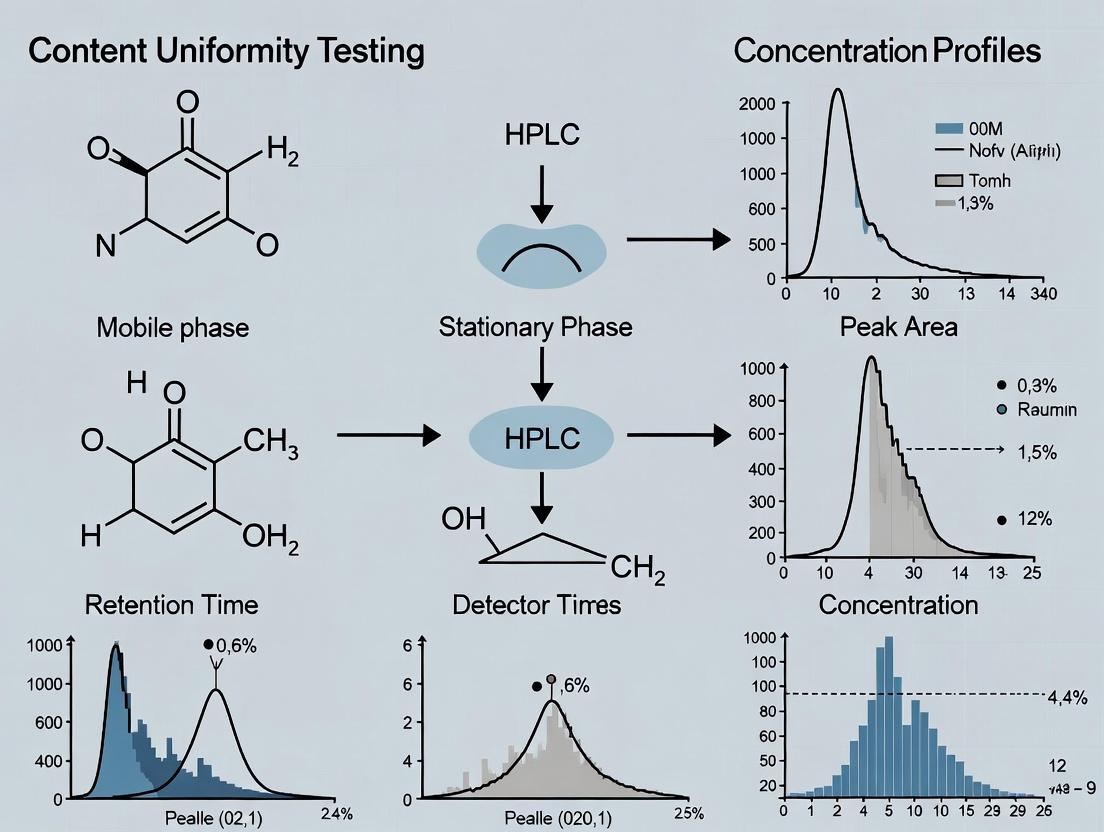
This comprehensive guide details the principles, development, validation, and troubleshooting of High-Performance Liquid Chromatography (HPLC) methods for content uniformity testing in pharmaceutical products.
HPLC Method for Content Uniformity Testing: A Complete Guide for Pharmaceutical Development
Abstract
This comprehensive guide details the principles, development, validation, and troubleshooting of High-Performance Liquid Chromatography (HPLC) methods for content uniformity testing in pharmaceutical products. Tailored for researchers and development professionals, it covers foundational theory, practical method implementation, common challenges with optimization strategies, and validation against regulatory standards (ICH, USP). The article provides actionable insights to ensure accurate, precise, and compliant assessment of dosage unit uniformity crucial for drug quality and patient safety.
Understanding Content Uniformity and HPLC Fundamentals: Why It Matters for Drug Quality
Content Uniformity (CU) testing is a critical pharmacopeial requirement to ensure that individual dosage units in a batch contain an amount of drug substance within a narrow range around the label claim. This safeguards patient safety by preventing under-dosing (lack of efficacy) or over-dosing (toxicity). The primary regulatory guidance is provided by the United States Pharmacopeia (USP) and harmonized ICH guidelines.
USP General Chapters <905> and <3>: USP <905> "Uniformity of Dosage Units" defines the test procedure and acceptance criteria. The European Pharmacopoeia (Ph. Eur.) 2.9.40 and Japanese Pharmacopoeia (JP) 6.02 share harmonized criteria under ICH Q4B. The test can be performed by Content Uniformity (assaying individual units) or Weight Variation (if specific criteria are met).
ICH Q6A Specifications: This guideline establishes the decision tree for setting specifications for drug substances and products, including the application of CU testing.
| Stage | Test Type | Acceptance Value (AV) Calculation | Acceptance Criteria | ||
|---|---|---|---|---|---|
| Stage 1 | Test 10 individual units. | ( AV = | M - \bar{x} | + ks ) Where: M = Reference Value (Label Claim) (\bar{x}) = Sample Mean k = Acceptability Constant (2.4) s = Sample Standard Deviation | AV ≤ 15.0 (L1) None outside 0.75M to 1.25M |
| Stage 2 | Test 30 total units (20 additional). | Same calculation, with k=2.0 for n=30. | AV ≤ 15.0 (L1) For n=30, no more than 1 unit outside 0.75M to 1.25M and none outside 0.65M to 1.35M |
Patient Safety Implications
Failures in CU directly correlate to clinical risk. High variability can lead to:
- Therapeutic Failure: Sub-potent units fail to produce the desired pharmacological effect.
- Adverse Events: Super-potent units can cause toxicity, especially for drugs with a narrow therapeutic index (NTI).
- Erosion of Trust: Inconsistent product performance damages patient confidence and regulatory compliance.
HPLC Method for Content Uniformity: Application Notes
High-Performance Liquid Chromatography (HPLC) is the gold standard for CU assay due to its specificity, accuracy, and precision. Its role in a broader thesis is to provide a robust, stability-indicating method that can separate the active pharmaceutical ingredient (API) from degradants and excipients.
Key Method Attributes for CU:
- Specificity: Resolution (Rs > 2.0) from known impurities and placebo components.
- Precision: Method repeatability RSD ≤ 2.0%.
- Accuracy: Recovery of 98.0–102.0% across the range.
- Linearity: Correlation coefficient (r) > 0.999 over a range of 50-150% of target concentration.
- Robustness: Insensitive to minor, deliberate variations in method parameters (e.g., flow rate ±0.1 mL/min, temperature ±2°C).
Table 2: Exemplary HPLC Method Parameters for CU Testing
| Parameter | Specification | Purpose/Rationale |
|---|---|---|
| Column | C18, 150 x 4.6 mm, 5 µm | Provides efficient separation for most APIs. |
| Mobile Phase | Buffer (e.g., Phosphate, pH 3.0): Acetonitrile (60:40 v/v) | Maintains consistent ionization; organic modifier controls retention. |
| Flow Rate | 1.0 mL/min | Optimizes separation efficiency and runtime. |
| Detection | UV at λmax of API (e.g., 254 nm) | Selective and sensitive detection. |
| Injection Volume | 10-20 µL | Ensures detector response within linear range. |
| Column Temp. | 30°C ± 2°C | Improves reproducibility of retention times. |
| Sample Solvent | Mobile Phase or Diluent | Prevents chromatographic anomalies. |
Detailed Experimental Protocols
Protocol 1: Sample Preparation for CU Testing via HPLC
Objective: To prepare individual dosage unit extracts for HPLC analysis.
- Selection: Randomly select at least 30 dosage units (tablets/capsules) from a batch.
- Individual Extraction: Place one dosage unit into a suitable volumetric flask (e.g., 100 mL).
- Dissolution: Add approximately 70% of the flask volume of the specified dissolution solvent (typically mobile phase or a suitable buffer/organic mix). Sonicate and/or shake for 30 minutes to ensure complete extraction.
- Dilution: Allow to cool to room temperature. Dilute to volume with solvent and mix thoroughly.
- Filtration: Pass a portion of the solution through a 0.45 µm or 0.22 µm PVDF or nylon membrane filter. Discard the first few mL of filtrate.
- Dilution (if needed): Further dilute the filtrate quantitatively with diluent to bring the expected API concentration within the HPLC method's linear range.
- Repeat: Perform steps 2-6 for each individual dosage unit. Prepare in duplicate.
Protocol 2: HPLC System Suitability and Analysis
Objective: To perform the chromatographic analysis ensuring system validity.
- System Equilibration: Prime the HPLC system with mobile phase and pump at set flow rate until a stable baseline is achieved (~30 min).
- Suitability Solution: Inject a system suitability solution containing the API and known impurities.
- Verify Suitability:
- Theoretical Plates (N): > 2000 for the API peak.
- Tailing Factor (T): ≤ 2.0 for the API peak.
- Relative Standard Deviation (RSD): For five replicate injections of a standard, RSD of peak area ≤ 2.0%.
- Resolution (Rs): Rs > 2.0 between the API and the closest eluting impurity.
- Sequence Setup: Run samples in the following sequence: Blank, Standard (in duplicate), 10 individual unit preparations (Stage 1).
- Calculation: Calculate the amount of API per unit using the formula:
(Area_sample / Area_standard) x (Conc_standard) x (Dilution Factor). Express as a percentage of label claim.
Visualization: CU Testing Workflow and Impact Pathway
Title: USP Content Uniformity Testing Decision Flow
Title: Content Uniformity Impact on Patient Safety
The Scientist's Toolkit: Key Research Reagent Solutions
Table 3: Essential Materials for HPLC-based CU Testing
| Item / Reagent | Function / Purpose |
|---|---|
| Reference Standard (API) | Certified, high-purity material used to prepare calibration standards for accurate quantitation. |
| HPLC-Grade Solvents (ACN, MeOH) | High-purity mobile phase components to minimize baseline noise and ghost peaks. |
| Buffer Salts (e.g., K₂HPO₄, KH₂PO₄) | For preparing pH-controlled aqueous mobile phase to ensure consistent analyte ionization. |
| Volumetric Glassware (Class A) | For precise preparation of standard and sample solutions. Critical for accuracy. |
| Membrane Filters (0.22/0.45 µm, Nylon/PVDF) | For particulate removal from samples and mobile phases to protect HPLC system and column. |
| Validated HPLC Column (e.g., C18) | The stationary phase providing the required separation. Specific brand/type per validated method. |
| HPLC Vials & Caps (Low Adsorption) | Chemically inert containers for autosampler to prevent analyte loss or leaching. |
| In-house Placebo Blend | A mixture of all excipients without API. Used for specificity testing to confirm no interference. |
This application note provides detailed protocols and technical insights into the core principles of High-Performance Liquid Chromatography (HPLC), specifically focusing on separation mechanisms and detector selection for Active Pharmaceutical Ingredients (APIs). This document is framed within a broader thesis on HPLC method development for content uniformity testing, a critical Quality Control (QC) assay in pharmaceutical research and development. The target audience includes analytical chemists, formulation scientists, and regulatory professionals involved in drug development.
Core Separation Mechanisms in HPLC
The separation of APIs from excipients, impurities, and degradation products is fundamental. The mechanism is governed by the interaction of analytes between a stationary phase and a mobile phase. The choice of mechanism depends on the chemical nature of the API.
Primary HPLC Separation Modes:
| Mode | Stationary Phase | Mobile Phase | Primary Mechanism | Typical API Application |
|---|---|---|---|---|
| Reversed-Phase (RP-HPLC) | Non-polar (C18, C8, Phenyl) | Polar (Water, Acetonitrile, Methanol) | Hydrophobic partitioning | Most small molecule APIs (>80% of methods) |
| Normal-Phase (NP-HPLC) | Polar (Silica, Cyano, Diol) | Non-polar (Hexane, Chloroform) | Adsorption (polar interactions) | Very polar, hydrophilic, or isomeric APIs |
| Ion-Exchange (IEX) | Charged (Cationic or Anionic) | Aqueous buffer (varying pH/ionic strength) | Ionic attraction/repulsion | Proteins, peptides, charged molecules |
| Size-Exclusion (SEC) | Porous (Silica or Polymer) | Aqueous or Organic | Molecular size sieving | Polymer APIs, protein aggregates |
| Hydrophilic Interaction (HILIC) | Polar (Silica, Amino) | Organic-rich (>60%) with aqueous buffer | Partitioning & adsorption | Polar, hydrophilic APIs |
Table 1: Core HPLC separation modes for API analysis.
Detector Selection for API Analysis
Detector choice is critical for sensitivity, selectivity, and compliance with regulatory guidelines (ICH Q2(R1)).
Common HPLC Detectors for API Content Uniformity:
| Detector | Principle | Key Advantages | Limitations | Typical LOD/LOQ* |
|---|---|---|---|---|
| UV/Vis (PDA/DAD) | Absorption of light | Universal, robust, quantitative, peak purity | Needs chromophore | ~1-10 ng (LOD) |
| Fluorescence (FL) | Emission after excitation | Extremely selective and sensitive | Requires fluorophore | ~0.1-1 pg (LOD) |
| Refractive Index (RI) | Change in refractive index | Universal, good for polymers | Low sensitivity, not gradient compatible | ~1 µg (LOD) |
| Evaporative Light Scattering (ELSD) | Light scattering of dried particles | Universal for non-volatiles | Non-linear response, destructive | ~10-100 ng (LOD) |
| Charged Aerosol (CAD) | Charge measurement of particles | Universal, more uniform response than ELSD | Destructive, requires nebulizer gas | ~1-10 ng (LOD) |
| Mass Spectrometry (MS) | Mass-to-charge ratio | Ultimate selectivity and sensitivity | Expensive, complex operation | ~0.1-1 pg (LOD) |
Table 2: Detector comparison for API quantification. *LOD/LOQ values are instrument and compound-dependent estimates.
Detailed Application Protocol: Content Uniformity Assay for API "X"
This protocol exemplifies the development of a stability-indicating RP-HPLC method for content uniformity testing of a model small-molecule API.
4.1 Research Reagent Solutions & Materials (The Scientist's Toolkit)
| Item / Reagent | Function / Specification |
|---|---|
| HPLC System | Binary or quaternary pump, autosampler, column oven, PDA detector. |
| Analytical Column | Reversed-phase C18, 150 x 4.6 mm, 3.5 µm particle size. |
| API Reference Standard | Certified, high-purity material for calibration. |
| Placebo Formulation | Contains all excipients except the API. |
| HPLC Grade Water | Ultrapure, 18.2 MΩ·cm resistivity, 0.22 µm filtered. |
| HPLC Grade Acetonitrile | Low UV absorbance, high purity. |
| Phosphoric Acid / Ammonium Buffer | For mobile phase pH control to improve peak shape and reproducibility. |
| Volumetric Flasks & Pipettes | Class A for accurate standard and sample preparation. |
| Ultrasonic Bath & 0.22 µm PVDF Syringe Filters | For mobile phase degassing and sample filtration, respectively. |
Table 3: Essential materials for HPLC content uniformity method development.
4.2 Experimental Protocol: Method Development and Validation
A. Mobile Phase Optimization
- Prepare a stock solution of API (1 mg/mL) in a suitable solvent (e.g., diluent: 50:50 Water:ACN).
- Prepare a placebo solution at the nominal formulation concentration.
- Using a C18 column at 30°C, screen different mobile phase compositions.
- Protocol: Run isocratic and gradient scouting runs. Common starting point: Gradient from 5% to 95% Acetonitrile in 20 mM Phosphate Buffer (pH 2.5 or 6.8) over 20 minutes. Flow rate: 1.0 mL/min. Detection: UV at λmax of the API.
- Adjust pH, organic modifier (ACN vs. MeOH), and buffer concentration to achieve baseline separation of the API peak from all placebo and degradation product peaks (>2.0 resolution).
B. Forced Degradation Study (Specificity)
- Subject the API and formulation to stress conditions: Acid (0.1M HCl, 70°C, 1h), Base (0.1M NaOH, 70°C, 1h), Oxidation (3% H2O2, RT, 1h), Heat (105°C, 24h), and Light (ICH Q1B).
- Prepare samples and analyze using the developed method.
- Demonstrate that the API peak is pure (PDA peak purity index > 0.999) and resolved from all degradation peaks, proving method specificity.
C. System Suitability Test (SST) Protocol For each analysis batch, prior to sample injection, an SST solution (containing API and any known impurities) is injected.
- Acceptance Criteria:
- Theoretical Plates (N): > 2000 for the API peak.
- Tailing Factor (Tf): < 2.0 for the API peak.
- Relative Standard Deviation (RSD): < 2.0% for peak area from 5 replicate injections.
- Resolution (Rs): > 2.0 between the API and nearest eluting peak.
D. Sample Analysis Protocol for Content Uniformity
- Standard Preparation: Accurately weigh ~25 mg of API reference standard into a 50 mL volumetric flask. Dissolve and dilute to volume with diluent to make a primary stock. Dilute further to the target concentration (e.g., 0.05 mg/mL).
- Sample Preparation: Accurately weigh and transfer 10 individual dosage units (e.g., tablets) into separate 100 mL volumetric flasks. Add diluent, sonicate for 15 minutes, and dilute to volume. Filter through a 0.22 µm PVDF syringe filter.
- Chromatographic Analysis: Inject the standard and samples in sequence. Calculate the API content per unit using the external standard method: (Area Sample / Area Standard) x (Concentration Standard) x (Dilution Factor) / (Unit Weight).
- Acceptance Criteria (ICH Q6A): The content uniformity requirement is met if the assay of all 10 units lies within 85.0-115.0% of label claim with an RSD ≤ 6.0%.
Visualization: HPLC Method Development Workflow
Diagram 1: HPLC method development workflow.
Visualization: HPLC Detector Selection Logic
Diagram 2: HPLC detector selection logic tree.
Advantages of HPLC for Uniformity Testing vs. Other Analytical Techniques
Within the context of research for a thesis on developing a robust HPLC method for content uniformity testing, a critical evaluation of analytical techniques is essential. This application note details the advantages of High-Performance Liquid Chromatography (HPLC) over other methods for content uniformity testing, providing experimental protocols and data to support method selection in pharmaceutical development.
Comparative Analytical Techniques for Uniformity Testing
Table 1: Quantitative Comparison of Techniques for Content Uniformity Testing
| Parameter | HPLC | UV-Vis Spectroscopy | Titration | Near-Infrared (NIR) Spectroscopy |
|---|---|---|---|---|
| Specificity | High (Separation + Detection) | Low (Measures total absorbance) | Low (Measures total reactive groups) | Moderate (Chemometric model dependent) |
| Accuracy (% Recovery) | 98-102% | 95-105% (if no interference) | 97-103% | 98-102% (with robust calibration) |
| Precision (%RSD) | Typically <2.0% | 1-3% (matrix sensitive) | 0.5-2.0% | 1-2% |
| Sample Throughput | Moderate (5-20 min/sample) | High (<1 min/sample) | Low (5-10 min/sample, manual) | Very High (<30 sec/sample) |
| Sample Preparation | Often extensive | Minimal (dissolution) | Moderate | Minimal (non-destructive) |
| Key Advantage | Specificity for API in complex matrices | Speed and simplicity | Absolute method, no reference standard needed | Non-destructive, real-time analysis |
| Major Limitation | Longer analysis time, solvent use | Lack of specificity | Lack of specificity, manual endpoint detection | Requires extensive calibration with reference method (e.g., HPLC) |
Detailed HPLC Protocol for Content Uniformity Testing
Protocol: HPLC-UV Method for Tablet Content Uniformity of Active Pharmaceutical Ingredient (API)
Objective: To quantify the amount of API in individual tablets to assess batch uniformity according to ICH Q6A and USP <905>.
I. Materials and Reagents (The Scientist's Toolkit) Table 2: Key Research Reagent Solutions & Materials
| Item | Function / Specification |
|---|---|
| HPLC System | Binary or quaternary pump, auto-sampler, column oven, UV/VIS or DAD detector. |
| Analytical Column | C18, 150 mm x 4.6 mm, 5 µm particle size. Provides separation of API from excipients. |
| HPLC-Grade Acetonitrile | Organic mobile phase component. Ensures low UV background and reproducibility. |
| HPLC-Grade Water | Aqueous mobile phase component. Purified, 18.2 MΩ·cm resistivity. |
| Phosphoric Acid / Buffer | For mobile phase pH adjustment to control selectivity and peak shape. |
| Reference Standard | Certified API material of known purity (>99.5%) for calibration. |
| Volumetric Glassware | Class A flasks and pipettes for precise preparation of standard and sample solutions. |
| Membrane Filters | 0.45 µm or 0.22 µm, nylon or PVDF, for mobile phase and sample filtration. |
| Ultrasonic Bath | For degassing mobile phases and dissolving samples. |
II. Mobile Phase Preparation
- Prepare a mixture of pH 2.5 phosphate buffer and acetonitrile in a 65:35 (v/v) ratio.
- Filter through a 0.45 µm membrane filter and degas by sonication for 10 minutes.
III. Standard Solution Preparation
- Accurately weigh approximately 25 mg of API reference standard into a 50 mL volumetric flask.
- Dissolve and dilute to volume with diluent (often mobile phase or a similar solvent mixture). This is the primary stock solution (≈500 µg/mL).
- Pipette 1.0, 2.0, 3.0, 4.0, and 5.0 mL aliquots of the stock solution into separate 10 mL volumetric flasks. Dilute to volume with diluent to create a calibration series from 50 to 250 µg/mL.
IV. Sample Solution Preparation
- Accurately weigh and individually place 10 whole tablets into separate 100 mL volumetric flasks.
- Add approximately 70 mL of diluent, sonicate for 30 minutes with occasional shaking to ensure complete disintegration and dissolution.
- Allow to cool to room temperature, dilute to volume with diluent, and mix well.
- Filter a portion of each solution through a 0.45 µm syringe filter into an HPLC vial, discarding the first 2 mL of filtrate.
V. Chromatographic Conditions
- Column: C18 (150 mm x 4.6 mm, 5 µm)
- Mobile Phase: Phosphate Buffer (pH 2.5):Acetonitrile (65:35)
- Flow Rate: 1.0 mL/min
- Column Temperature: 30°C
- Detection Wavelength: 230 nm (API-specific λmax)
- Injection Volume: 10 µL
- Run Time: 15 minutes
VI. Data Analysis
- Inject each standard solution in duplicate. Plot average peak area versus concentration to generate a linear calibration curve (r² > 0.999).
- Inject each of the 10 individual sample preparations.
- Calculate the API content (in mg/tablet) for each injection using the regression equation from the calibration curve.
- Calculate the mean content, standard deviation (SD), and relative standard deviation (RSD).
- Acceptance Criteria (USP <905>): The assay is considered uniform if the RSD of the 10 individual dosage units is ≤ 6.0% AND no individual unit is outside 85.0-115.0% of the label claim.
Experimental Workflow and Decision Logic
Diagram Title: Technique Selection Workflow for Uniformity Testing
Diagram Title: HPLC Uniformity Testing Protocol Workflow
Within the context of developing a robust High-Performance Liquid Chromatography (HPLC) method for content uniformity testing of a solid oral dosage form, the precise measurement and control of key chromatographic parameters are paramount. Content uniformity testing, mandated by pharmacopeias such as USP <905>, requires a method capable of accurately quantifying the active pharmaceutical ingredient (API) in individual dosage units. The reliability of this quantification hinges on the chromatographic performance, characterized by retention time consistency, adequate resolution from impurities and degradation products, and symmetrical peak shape. This application note details the protocols for evaluating these critical parameters to ensure method suitability for regulatory submission and quality control.
Key Parameters: Definitions and Acceptance Criteria
The following parameters are critical for method validation in content uniformity testing.
Retention Time (tR): The time elapsed between sample injection and the maximum response of the analyte peak. Consistency is crucial for peak identification. A relative standard deviation (RSD) of ≤ 1.0% for replicate injections is typically required.
Resolution (Rs): A measure of the separation between two adjacent peaks. For content uniformity, the API must be baseline resolved (Rs ≥ 2.0) from any known impurity, excipient, or degradation product peak.
Peak Symmetry/Asymmetry Factor (As): Measured at 10% of peak height. A value of 0.8–1.5 is generally acceptable, indicating minimal tailing or fronting, which is vital for accurate integration.
Tailing Factor (Tf): Measured at 5% of peak height (per USP). A value of ≤ 2.0 is typically specified for the main analyte peak to ensure reproducible integration and accurate quantification.
Table 1: Target Acceptance Criteria for Key HPLC Parameters in Content Uniformity Methods
| Parameter | Symbol | Typical Acceptance Criterion | Importance for Content Uniformity |
|---|---|---|---|
| Retention Time RSD | tR | ≤ 1.0% | Confirms system stability and correct peak identification. |
| Resolution | Rs | ≥ 2.0 between API and closest eluting peak | Ensures API quantitation is not biased by co-eluting impurities. |
| Tailing Factor | Tf | ≤ 2.0 | Guarantees consistent, accurate peak integration. |
| Asymmetry Factor | As | 0.8 – 1.5 | Indicates optimal column/analyte interaction, promoting reliable quantitation. |
Experimental Protocols
Protocol 1: System Suitability Testing for Content Uniformity Assay
Objective: To verify chromatographic system performance before and during content uniformity sample analysis. Materials: HPLC system with UV/Vis or PDA detector, validated method, reference standard solution, and system suitability solution (containing API and critical known impurities). Procedure:
- Equilibration: Stabilize the column with the mobile phase at the method-specified flow rate until a stable baseline is achieved (~30 min).
- System Blank: Inject the dissolution medium or placebo solution to confirm no interfering peaks at the API retention time.
- Reference Standard Injections: Perform six replicate injections of the API reference standard solution at target concentration.
- Resolution Solution: Inject the solution containing API and critical impurities.
- Data Analysis: Calculate the parameters in Table 1 from the chromatograms of the replicate standard injections and the resolution solution.
- Acceptance: The analysis sequence may proceed only if all parameters meet pre-defined criteria.
Protocol 2: Determination of Tailing Factor (USP) and Asymmetry Factor
Objective: To quantitatively assess peak shape. Procedure:
- From the chromatogram of a standard injection, identify the peak of interest.
- For Tailing Factor (Tf at 5% height): a. Determine the peak height (H). b. Draw a line at 5% of H. c. Measure the distance from the leading edge to the peak midpoint at 5% H (A). d. Measure the distance from the trailing edge to the peak midpoint at 5% H (B). e. Calculate: Tf = (A + B) / (2 * A)
- For Asymmetry Factor (As at 10% height): a. Draw a line at 10% of H. b. Measure the front half-width (a) and back half-width (b) at this height. c. Calculate: As = b / a
Protocol 3: Forced Degradation Study to Establish Resolution
Objective: To demonstrate specificity of the method by resolving the API from its degradation products, proving stability-indicating capability. Materials: API sample, stress agents (0.1M HCl, 0.1M NaOH, 3% H2O2, heat, light). Procedure:
- Stress Treatments: Subject the API to various stressed conditions (e.g., acid/base hydrolysis for 1 hr at 60°C, oxidation at room temperature for 24 hrs, dry heat at 105°C for 24 hrs, and light exposure per ICH Q1B).
- Sample Preparation: Neutralize or quench reactions and prepare solutions at approximate target concentration.
- Chromatographic Analysis: Inject stressed samples and an unstressed control using the developed HPLC method.
- Assessment: Examine chromatograms for peak purity of the API peak (using PDA detector) and calculate resolution (Rs) between the API peak and the nearest degradation product peak. Rs = [2(tR2 - tR1)] / (w1 + w2), where w is the peak width at baseline.
Title: HPLC Method Development & Validation Workflow
Title: Relationship of HPLC Parameters to Method Goals
The Scientist's Toolkit: Essential Reagents & Materials
Table 2: Key Research Reagent Solutions for HPLC Method Development
| Item | Function in Content Uniformity Method Development |
|---|---|
| API Reference Standard | Certified material of known purity used to prepare calibration standards and for peak identification. |
| Placebo Blend | A mixture of all formulation excipients without API. Used to confirm the absence of interfering peaks. |
| Forced Degradation Solutions | Acid (e.g., HCl), base (e.g., NaOH), oxidant (e.g., H2O2). Used in specificity studies to generate degradation products. |
| HPLC-Grade Solvents | Acetonitrile, Methanol, Water. Used for mobile phase and sample preparation to minimize background noise. |
| Buffer Salts | e.g., Potassium phosphate, Sodium phosphate, Trifluoroacetic acid. Used to control mobile phase pH, affecting selectivity and peak shape. |
| Stationary Phases | C18, C8, phenyl-hexyl columns. Different selectivity profiles to achieve required resolution. |
| System Suitability Solution | A mixture containing API and critical known impurities/related compounds to verify resolution daily. |
Developing and Executing a Robust HPLC Method for Content Uniformity
Abstract Within the broader thesis research on High-Performance Liquid Chromatography (HPLC) method development for content uniformity testing of solid oral dosage forms, this application note details a systematic, step-by-step protocol. The focus is on the critical triad of column selection, mobile phase optimization, and gradient profiling to achieve a robust, stability-indicating method that meets ICH Q2(R1) validation criteria for specificity, accuracy, and precision.
Content uniformity testing is a critical quality control attribute mandated by pharmacopoeias. The development of a precise, accurate, and robust HPLC method is foundational to this analysis. This protocol outlines a structured approach to optimize the three most influential chromatographic parameters, ensuring efficient separation of the active pharmaceutical ingredient (API) from its degradation products and excipients.
Initial Scouting and Column Screening
Objective: Identify the most promising stationary phase chemistry. Protocol: Prepare a standard solution of the API and its known impurities. Test using a standardized, generic gradient (e.g., 5-95% acetonitrile in water over 20 minutes, 0.1% formic acid) across different column chemistries at 30°C, flow rate 1.0 mL/min, detection at λmax. Key Materials: C18 (octadecylsilane), C8 (octylsilane), Phenyl-Hexyl, Polar Embedded (e.g., amide), HILIC. Use columns of similar dimensions (e.g., 100 x 4.6 mm, 2.7 µm particle size).
Table 1: Column Screening Results (Peak Shape & Retention)
| Column Chemistry | API Retention (min) | Asymmetry Factor (As) | Theoretical Plates (N) | Remarks |
|---|---|---|---|---|
| C18 (Base Deactivated) | 8.2 | 1.05 | 12,500 | Excellent peak shape, core separation. |
| Phenyl-Hexyl | 9.8 | 1.12 | 10,800 | Improved separation of structural isomers. |
| Polar Embedded | 7.5 | 1.30 | 8,900 | Poor peak shape for API, tailing observed. |
| HILIC | 3.5 | 0.95 | 7,200 | Very early elution, unsuitable for system. |
Decision: Proceed with Base Deactivated C18 column for primary development.
Mobile Phase Optimization
Objective: Optimize pH and buffer strength to control ionization, selectivity, and peak shape. Protocol: Using the selected C18 column, investigate the impact of mobile phase pH. Prepare buffers (25 mM) at pH 3.0 (formate), pH 4.5 (acetate), and pH 7.0 (phosphate). Use isocratic runs with a constant organic modifier percentage (based on initial gradient retention).
Table 2: Effect of Mobile Phase pH on Critical Pair Resolution (Rs)
| pH | API k' | Resolution (API / Closest Impurity) | Asymmetry Factor |
|---|---|---|---|
| 3.0 | 4.2 | 2.5 | 1.08 |
| 4.5 | 5.1 | 3.8 | 1.03 |
| 7.0 | 1.8 | 1.2 | 1.35 |
Protocol (Buffer Strength): At optimal pH (4.5), vary ammonium acetate concentration: 10 mM, 25 mM, and 50 mM. Assess retention time reproducibility and peak shape.
Decision: Select 25 mM ammonium acetate, pH 4.5, as the aqueous buffer. Proceed with acetonitrile as organic modifier for sharper peaks and lower backpressure vs. methanol.
Gradient Profile Optimization
Objective: Achieve baseline separation of all known components within a minimal runtime. Protocol: Using the optimized mobile phase, design a gradient profile. Start from the organic percentage where the API elutes in isocratic mode minus 10%. Use linear, multi-linear, and step gradients to optimize the critical region of the chromatogram.
Table 3: Gradient Profile Scenarios
| Gradient Profile | Total Runtime | Minimum Resolution | Peak Capacity |
|---|---|---|---|
| 20-60% B in 15 min | 20 min | 2.1 | 85 |
| 25-45% B in 10 min (hold) | 18 min | 3.5 | 75 |
| 30-50% B in 12 min (curved) | 17 min | 4.0 | 80 |
Decision: Adopt a 25-45% B linear gradient over 10 minutes, followed by a 2-minute wash and 5-minute re-equilibration.
Final Method Parameters
- Column: Base-deactivated C18, 100 x 4.6 mm, 2.7 µm.
- Mobile Phase A: 25 mM Ammonium Acetate, pH 4.5 (adjusted with acetic acid).
- Mobile Phase B: Acetonitrile.
- Gradient: 25% B to 45% B over 10 min → 95% B for 2 min → 25% B for 5 min.
- Flow Rate: 1.2 mL/min
- Temperature: 35°C
- Detection: UV at 254 nm
- Injection: 5 µL
The Scientist's Toolkit: Research Reagent Solutions
Table 4: Essential Materials for HPLC Method Development
| Item | Function & Rationale |
|---|---|
| HPLC-Grade Water & Solvents | Minimizes baseline noise and ghost peaks; ensures reproducibility. |
| Ammonium Acetate / Formate | Volatile buffers compatible with MS detection; precise pH control. |
| Trifluoroacetic Acid (TFA) | Ion-pairing agent for basic compounds; suppresses silanol interactions. |
| pH Meter with Electrodes | Accurate buffer preparation critical for method robustness (ICH Q2). |
| Certified Reference Standards | API and known impurity standards for accurate identification and quantification. |
| Forced Degradation Samples | Stressed samples (acid, base, oxidation, heat, light) to validate method specificity. |
| Column Oven | Controls temperature for retention time reproducibility and kinetic efficiency. |
| Automated HPLC Method Scouting Software | Enables efficient, unattended screening of columns and mobile phases. |
Visualized Workflows
HPLC Method Development Decision Pathway
Detailed Experimental Protocol Sequence
Sample Preparation Protocols for Tablets, Capsules, and Complex Formulations
Within the context of developing a robust HPLC method for content uniformity testing, sample preparation is the critical first step that dictates the accuracy, precision, and reliability of the final analytical results. Inaccurate or inconsistent sample preparation directly undermines the validity of content uniformity assessments, leading to potential batch failures or, conversely, the release of substandard product. This document provides detailed application notes and protocols for the preparation of tablets, capsules, and complex formulations (e.g., suspensions, creams) prior to HPLC analysis. The procedures are designed to ensure complete extraction of the active pharmaceutical ingredient (API) while minimizing degradation and interference from excipients.
Core Principles and Considerations
- Representative Sampling: For content uniformity, individual dosage units (e.g., single tablets/capsules) must be analyzed separately. Bulk powder from multiple units must never be pooled at this stage.
- Complete Solubility/Extraction: The solvent system must fully dissolve the API. Sonication and vigorous shaking are often required to break the formulation matrix.
- Compatibility with HPLC Mobile Phase: The sample solvent should ideally be weaker than or similar in composition to the HPLC mobile phase initial conditions to prevent peak distortion upon injection.
- Filtration: Essential for removing insoluble excipients (e.g., talc, magnesium stearate, polymer coatings) that could damage the HPLC column. Compatibility of filter material with the solvent and API must be verified.
- Stability: Prepared samples should be stable in the autosampler for the duration of the analytical run.
Detailed Experimental Protocols
Protocol 1: Immediate-Release Tablets and Hard Gelatin Capsules
Objective: To completely extract the API from a single tablet or the contents of a single capsule for individual unit content uniformity testing by HPLC.
Materials & Equipment:
- Analytical balance (±0.01 mg)
- Calibrated volumetric flasks (e.g., 100 mL, 250 mL)
- Mechanical shaker (e.g., wrist-action, orbital) or magnetic stirrer with heater
- Ultrasonic bath
- Syringe filters (0.45 µm or 0.22 µm, Nylon or PTFE recommended)
- HPLC vials and caps
- Pipettes and dispensers
- Suitable solvent (e.g., HPLC-grade water, methanol, acetonitrile, buffer, or mixture as per method)
Procedure:
- Weighing: Accurately weigh one entire tablet or the entire contents of one capsule. Record the weight.
- Transfer: Quantitatively transfer the sample to a clean, appropriately sized volumetric flask (e.g., 100 mL for a ~10 mg API dose).
- Solvent Addition: Fill the flask to approximately 70% of its volume with the chosen extraction solvent.
- Extraction:
- Option A (Shaking): Securely cap the flask and shake mechanically for 30-45 minutes.
- Option B (Sonication with Stirring): Place the flask in an ultrasonic bath for 10-15 minutes, followed by magnetic stirring for 20 minutes. Ensure the solvent does not overheat.
- Dilution to Volume: Allow the solution to cool to room temperature if heated. Dilute to the mark with the same solvent. Mix thoroughly by inverting the flask at least 10 times.
- Filtration: Draw a portion of the solution using a syringe. Pass it through a 0.45 µm (or 0.22 µm) syringe filter into a clean HPLC vial, discarding the first 1-2 mL of filtrate.
- Analysis: Cap the vial and place it in the HPLC autosampler for analysis.
Critical Notes: For enteric-coated or film-coated tablets, initial crushing in a mortar with a small amount of solvent may be necessary before transfer to the flask. For capsules, ensure the capsule shell is empty and rinsed, adding the rinsings to the flask.
Protocol 2: Modified-Release Formulations (Extended/Sustained Release)
Objective: To overcome the slow release characteristics of the formulation matrix and achieve complete extraction of the API within a reasonable timeframe.
Procedure (Adaptation from Protocol 1):
- Follow steps 1-3 from Protocol 1.
- Vigorous Mechanical Disruption: Use a high-speed homogenizer or polytron for 2-3 minutes to physically break down the polymer matrix before proceeding.
- Extended Extraction: Shake mechanically for a minimum of 4-6 hours, or overnight. Alternatively, use a heated water bath (typically ≤ 40°C to prevent degradation) with stirring for 2-4 hours.
- Cool, dilute to volume, mix, filter, and analyze as in Protocol 1 steps 5-7.
Validation Requirement: Extraction efficiency must be validated by comparing results from the standard procedure against those from a more exhaustive extraction (e.g., 24-hour shaking) or by standard addition.
Protocol 3: Complex Formulations (Suspensions, Creams, Ointments)
Objective: To homogeneously sample a semi-solid or non-uniform formulation and extract the API from a complex, often lipophilic, base.
Procedure:
- Homogenization: Thoroughly mix the primary container (e.g., tube, jar) by manual kneading or using a mechanical mixer to ensure bulk homogeneity.
- Aliquot Sampling: Using a positive displacement pipette or a spatula, quickly weigh an accurate aliquot (e.g., 1-2 g) of the formulation into a suitable container (e.g., beaker).
- Initial Dispersion: Add 20-30 mL of a solvent like hexane or heptane to dissolve/disperse the oily base. Stir vigorously.
- Liquid-Liquid Extraction:
- Add a known volume of a water-miscible solvent (e.g., acetonitrile, methanol) or buffer that can extract the API. The two phases should be immiscible.
- Shake or stir vigorously for 10-15 minutes.
- Transfer the mixture to a separatory funnel, allow phases to separate, and collect the layer containing the API.
- Alternative: Direct Extraction/Sonication: For water-based gels, the weighed aliquot can be directly dissolved/sonicated in a mixture of water and organic solvent.
- Filtration & Dilution: The extract will likely contain particulates. Filter aggressively (e.g., through a 0.45 µm filter, possibly with a pre-filter). The filtrate may then need quantitative transfer and dilution in a volumetric flask with appropriate solvent.
- Analysis: Transfer filtered solution to an HPLC vial.
Table 1: Comparison of Key Parameters for Sample Preparation Protocols
| Parameter | Immediate-Release Tablets/Capsules | Modified-Release Formulations | Complex Formulations (Creams/Suspensions) |
|---|---|---|---|
| Sample Size | 1 whole unit | 1 whole unit | 1-2 g (aliquot from homogenized bulk) |
| Primary Equipment | Vol. flask, shaker, sonicator | Vol. flask, homogenizer, heated shaker | Pos. displacement pipette, separatory funnel, homogenizer |
| Key Step | Sonication/Shaking (30-45 min) | Extended shaking (4-6 hrs) or heating | Liquid-Liquid Extraction or Direct Solvent Extraction |
| Typical Solvent | Dilute methanol/buffer | Buffer + Organic (e.g., pH 1.2 buffer + ACN) | Hexane + Acetonitrile mixture |
| Filtration | 0.45 µm Nylon/PTFE | 0.45 µm Nylon/PTFE | 0.45 µm PTFE, often with pre-filter |
| Critical Validation Point | Extraction recovery vs. sonication time | Extraction efficiency (exhaustive comparison) | Homogeneity of sampling, extraction recovery from base |
Table 2: Common Excipient Interferences and Mitigation Strategies
| Excipient Class | Example Compounds | Potential HPLC Interference | Mitigation Strategy in Sample Prep |
|---|---|---|---|
| Fillers/Binders | Microcrystalline Cellulose, Lactose | None typically | Removed by filtration. |
| Lubricants | Magnesium Stearate, Talc | Insoluble particulates | Effective filtration (0.22 µm). |
| Polymer Coatings | Hypromellose (HPMC), Ethylcellulose | Can form viscous solutions, trap API | Use high-speed homogenization, increased organic solvent %. |
| Preservatives | Benzalkonium Chloride, Parabens | May co-elute with API on HPLC | Use selective extraction (pH control), or chromatographic resolution. |
| Antioxidants | BHA, BHT, Ascorbic Acid | May oxidize API or elute as a peak | Add antioxidant to solvent, use inert atmosphere (N2 blanket). |
Visualized Workflows
Title: Tablet & Capsule Sample Prep Workflow
Title: Complex Formulation Prep Workflow
The Scientist's Toolkit: Essential Research Reagents & Materials
Table 3: Key Reagents and Materials for Sample Preparation
| Item | Function & Importance | Example/Notes |
|---|---|---|
| HPLC-Grade Solvents (Methanol, Acetonitrile, Water) | Primary extraction/dilution media. Purity is critical to prevent ghost peaks, high baseline noise, or API degradation. | Use solvents with low UV cutoff, stabilizer-free if needed. |
| Buffer Salts (e.g., Potassium Phosphate, Sodium Acetate) | Control pH of extraction solvent to ensure API stability and solubility, especially for ionizable compounds. | Prepare daily or validate stability; filter buffers before use. |
| Internal Standard (IS) Solution | Added to sample before extraction to correct for variability in volume, injection, and recovery. | Must be stable, not interfere, and behave similarly to API. |
| Syringe Filters (0.45 µm, 0.22 µm) | Protect HPLC column from particulate contamination. Material must not adsorb API. | Nylon: aqueous/organic mixes. PTFE: for aggressive organics. PVDF: low protein binding. |
| Volumetric Glassware (Class A) | Ensure accurate and precise final dilution, directly impacting concentration calculation. | Must be properly calibrated and used at stated temperature. |
| Ultrasonic Bath | Enhances extraction efficiency by cavitation, breaking the formulation matrix and speeding dissolution. | Temperature control is important for heat-labile compounds. |
| Mechanical Shaker | Provides consistent and reproducible agitation for extraction over extended periods. | Orbital or wrist-action; speed and time must be standardized. |
| Stabilization Additives (e.g., Antioxidants, Chelators) | Prevent degradation of labile APIs during the preparation and holding time. | e.g., BHT, EDTA. Compatibility with HPLC system must be checked. |
System Suitability Testing (SST) is a pharmacopeial requirement integral to demonstrating the performance and reliability of a chromatographic system at the time of use. Within the broader thesis on High-Performance Liquid Chromatography (HPLC) method development and validation for content uniformity testing, SST serves as the critical bridge between method validation and routine analysis. While method validation establishes that the procedure is suitable for its intended purpose, SST confirms the system's adequacy for performing the analysis on a given day. For content uniformity testing, which requires high precision to accurately quantify the active pharmaceutical ingredient (API) in individual dosage units, failure to meet SST criteria directly invalidates the analytical run, safeguarding the integrity of batch release decisions.
Core SST Criteria: Definitions and Acceptance Limits
SST parameters are derived from the initial method validation and pharmacopeial guidelines (e.g., USP <621>, ICH Q2(R2)). The following table summarizes key criteria for a typical content uniformity HPLC method.
Table 1: Key SST Parameters and Typical Acceptance Criteria for Content Uniformity HPLC Analysis
| SST Parameter | Definition | Typical Acceptance Criterion (Example) | Role in Content Uniformity Testing |
|---|---|---|---|
| Theoretical Plates (N) | Measure of column efficiency. | > 2000 | Ensures peak sharpness and resolution for accurate integration. |
| Tailing Factor (T) | Measure of peak symmetry. | ≤ 2.0 | Symmetric peaks ensure consistent integration and accurate quantification. |
| Resolution (Rs) | Separation between two specified peaks. | > 2.0 between API and closest eluting impurity | Confirms specificity, critical for separating API from excipients/degradants. |
| Repeatability (RSD%) | Precision of replicate injections of a standard. | RSD ≤ 2.0% for n=5 or 6 | Directly assures the precision of the instrument for the subsequent sample analysis. |
| Signal-to-Noise Ratio (S/N) | Measure of detector sensitivity. | > 10 for a specified peak | Ensures the system is sensitive enough for accurate LOQ-level impurity detection if required. |
| Retention Time (tR) Reproducibility | Consistency of the API peak's retention time. | RSD ≤ 1.0% for n=5 or 6 | Confirms system stability, ensuring correct peak identification across the run. |
Detailed SST Protocol for an HPLC Content Uniformity Run
Protocol Title: Execution of System Suitability Test Prior to HPLC Content Uniformity Analysis
Objective: To verify that the chromatographic system meets pre-defined performance criteria before the analysis of sample solutions from a content uniformity test.
Materials and Reagent Solutions:
Table 2: Research Reagent Solutions and Essential Materials for SST
| Item | Function/Brief Explanation |
|---|---|
| SST Standard Solution | A solution of the reference standard API at a concentration matching the test sample's nominal concentration. Used to assess system performance parameters. |
| HPLC Mobile Phase | Precisely prepared mixture of solvents/buffers as per the validated method. Carries the analyte through the column. |
| HPLC Column | Specified brand, dimension, and stationary phase. The heart of the separation. |
| Diluent | Appropriate solvent matching the sample matrix. Used for preparing standard and sample solutions. |
| Autosampler Vials & Caps | Chemically inert vials for holding solutions; ensures no contamination or adsorption. |
Procedure:
- System Preparation: Purge the HPLC system with the prescribed mobile phase. Set the method parameters (flow rate, column temperature, detection wavelength, injection volume, and run time).
- Column Equilibration: Install the specified column. Allow the system to equilibrate under initial mobile phase conditions until a stable baseline is achieved (typically 30-60 minutes, or as per method).
- SST Standard Preparation: Accurately weigh and prepare the SST standard solution as per the method. This is typically a single solution at 100% of the target concentration.
- System Performance Check: Inject the SST standard solution a minimum of five (n=5) or six (n=6) times.
- Data Acquisition and Calculation: Process the data from the replicate injections. Calculate the following:
- Mean and %RSD of the peak areas for Repeatability.
- Mean and %RSD of the API retention times.
- Theoretical plates (N) and Tailing factor (T) for the main API peak from a representative injection.
- Resolution (Rs) between the API peak and the closest eluting peak (impurity, excipient, or system suitability spike).
- Signal-to-Noise ratio for a specified peak if required.
- Acceptance Decision: Compare the calculated values against the method-specified acceptance criteria (e.g., Table 1).
- If ALL criteria are met: The system is deemed suitable. Proceed with the bracketed sequence of standards and sample injections for the content uniformity test.
- If ANY criterion is not met: The system is not suitable. Do not proceed with sample analysis. Troubleshoot the system, rectify the issue, and repeat the SST with fresh standard injections.
Troubleshooting Guide: If SST fails, common corrective actions include: priming purge valves, preparing fresh mobile phase, preparing fresh standard, checking for column degradation or blockages, and verifying detector lamp performance.
The Critical Role of SST in Routine Analysis
SST is not a one-time validation exercise but a routine, batch-specific quality control checkpoint. Its critical roles are:
- Risk Mitigation: Prevents the analysis of valuable samples on an underperforming system, saving time and resources.
- Regulatory Compliance: Mandatory for cGMP analysis, forming a key part of the data package for regulatory submissions and inspections.
- Data Integrity Assurance: Provides documented evidence that the generated content uniformity data is reliable and the system was in a state of control.
- System Trending: SST results over time can be tracked to predict column lifetime, detect instrument drift, and inform preventive maintenance.
Logical Workflow and Relationship Diagrams
Title: SST Decision Workflow for HPLC Analysis
Title: SST Links Method Validation to Routine Analysis
Within the broader thesis research on developing and validating a robust HPLC method for content uniformity testing, the accurate calculation of assay results and the Acceptance Value (AV) is paramount. USP General Chapter <905> "Uniformity of Dosage Units" provides the standard criteria, defining the statistical measures and acceptance limits for ensuring consistency in the amount of the active pharmaceutical ingredient (API) per unit. This application note details the protocol for analyzing HPLC content uniformity data and performing AV calculations as mandated.
Key Calculations and Data Tables
Table 1: Summary of Content Uniformity Data from HPLC Analysis
| Dosage Unit ID | Assay Result (% of Label Claim) | Individual Deviation from Mean ( | M-Xi | ) |
|---|---|---|---|---|
| 1 | 98.5 | 1.3 | ||
| 2 | 101.2 | 1.4 | ||
| 3 | 99.8 | 0.6 | ||
| 4 | 102.1 | 2.3 | ||
| 5 | 97.9 | 1.3 | ||
| 6 | 100.5 | 0.7 | ||
| 7 | 99.2 | 1.0 | ||
| 8 | 100.8 | 1.0 | ||
| 9 | 98.4 | 1.4 | ||
| 10 | 101.6 | 1.8 | ||
| Mean (X̄) | 100.0 | |||
| SD | 1.36 |
Table 2: Acceptance Value (AV) Calculation Steps per USP <905>
| Calculation Step | Value | Description | ||||
|---|---|---|---|---|---|---|
| Reference Value (M) | 100.0 | Case 1: If 98.5% ≤ X̄ = 100.0 ≤ 101.5%, then M = X̄. | ||||
| k (Constant) | 2.4 | Use n=10, so k=2.4 (from USP table). | ||||
| Acceptance Value (AV) | 3.26 | AV = | M - X̄ | + k*s = | 100-100 | + (2.4 * 1.36) = 3.26. |
| Maximum Allowed AV (L1) | 15.0 | Stage 1 (UDU) Test limit. | ||||
| Pass/Fail (Stage 1) | PASS | AV (3.26) ≤ L1 (15.0). |
Experimental Protocol: HPLC Content Uniformity Analysis
1. Sample Preparation:
- Select 10 dosage units individually.
- For each unit, transfer the complete contents (for capsules/tablets, crush to a fine powder) into individual volumetric flasks.
- Add a suitable diluent (e.g., mobile phase) to approximately 70% of flask volume and sonicate for 15 minutes with intermittent shaking to ensure complete extraction of the API.
- Allow to cool to room temperature, dilute to volume with diluent, and mix well.
- Filter a portion through a 0.45 µm PVDF or nylon syringe filter, discarding the first 2 mL of filtrate.
2. HPLC Instrumental Analysis:
- Column: C18, 250 mm x 4.6 mm, 5 µm (or as per validated method).
- Mobile Phase: Prepare as per the thesis method (e.g., Acetonitrile:Phosphate Buffer pH 3.0, 45:55 v/v).
- Flow Rate: 1.0 mL/min.
- Detection: UV-Vis at λ_max for the API (e.g., 254 nm).
- Injection Volume: 10 µL.
- Run Time: Sufficient to elute the API peak (e.g., 10 minutes).
- Standard Solution: Prepare a reference standard solution of the API at a concentration nominally equivalent to 100% of the label claim.
- Inject the standard and sample preparations in duplicate or as per the validated sequence.
3. Data Processing and AV Calculation:
- Integrate all chromatograms and determine the peak area of the API.
- Calculate the assay result for each individual dosage unit as a percentage of label claim:
- Assay (%LC) = (Sample Area / Standard Area) x (Standard Conc. / Sample Conc.) x 100
- Record the 10 individual assay values.
- Calculate the mean (X̄) and standard deviation (s) of the 10 results.
- Determine the Reference Value (M) as per USP <905>:
- Case 1: If 98.5% ≤ X̄ ≤ 101.5%, then M = X̄.
- Case 2: If X̄ < 98.5%, then M = 98.5%.
- Case 3: If X̄ > 101.5%, then M = 101.5%.
- Obtain the constant k=2.4 for the first stage (n=10) from USP <905> Table 2.
- Calculate the Acceptance Value: AV = |M - X̄| + ks*
- Acceptance Criteria (Stage 1): The requirements are met if the calculated AV is ≤ 15.0. If the AV is > 15.0, proceed to test 30 additional units (Stage 2).
Workflow Diagrams
HPLC Content Uniformity & AV Calculation Workflow
Logical Flow of HPLC CU in Thesis Research
The Scientist's Toolkit: Key Research Reagent Solutions
Table 3: Essential Materials for HPLC Content Uniformity Analysis
| Item | Function in the Experiment |
|---|---|
| High-Purity API Reference Standard | Serves as the primary benchmark for quantifying the amount of API in the sample. Essential for accurate assay calculation. |
| HPLC-Grade Solvents (Acetonitrile, Methanol) | Used in mobile phase preparation to ensure minimal UV background noise and consistent chromatographic performance. |
| Buffer Salts (e.g., Potassium Dihydrogen Phosphate) | Used to prepare aqueous mobile phase component, controlling pH to optimize peak shape and separation. |
| Volumetric Flasks (Individual, Class A) | For precise, quantitative preparation of individual unit sample solutions and standard solutions. |
| 0.45 µm PVDF Syringe Filters | For particulate removal from sample solutions prior to HPLC injection, protecting the column and instrument. |
| Certified HPLC Vials and Caps | Ensure sample integrity and prevent evaporation or contamination during autosampler sequences. |
| USP System Suitability Reference Standard | Used to verify chromatographic system performance (e.g., plate count, tailing factor) before and during analysis. |
Automation and Workflow Integration for High-Throughput Testing
Application Notes
Within the broader thesis on developing a robust HPLC method for content uniformity (CU) testing, this document details the application of automation and integrated workflows to achieve high-throughput analysis. The primary objective is to transition from a manual, serial processing model to an automated, parallel paradigm, thereby increasing sample throughput, enhancing data integrity, and reducing analyst intervention for CU testing of solid oral dosage forms during formulation development and quality control.
Key challenges in manual CU testing include lengthy sample preparation times, manual injection bottlenecks, data transcription errors, and inconsistent data processing. Automation addresses these by integrating a liquid handling robot for sample preparation, an autosampler for continuous instrument operation, and software for instrument control, data acquisition, and processing. This integration is critical for supporting the statistical power requirements of CU testing (USP <905>), where analyzing a minimum of 30 dosage units is standard, and for conducting method robustness studies as part of the HPLC method development thesis.
A central finding is that workflow integration reduces total analysis time per sample batch by over 60%. The following table quantifies the time savings and reproducibility improvements achieved.
Table 1: Comparative Analysis of Manual vs. Automated High-Throughput CU Workflow
| Parameter | Manual Workflow | Automated Integrated Workflow | Improvement |
|---|---|---|---|
| Sample Prep Time (30 units) | ~150 minutes | ~45 minutes | 70% reduction |
| Analyst Hands-on Time | ~180 minutes | ~25 minutes | 86% reduction |
| Injection Interval | ~5 minutes | ~2.5 minutes (optimized cycle) | 50% reduction |
| Data Processing & Review | ~60 minutes | ~15 minutes (automated reporting) | 75% reduction |
| RSD of Retention Times | 0.5-0.8% | 0.1-0.2% | Enhanced precision |
| Potential Error Sources | Weighing, dilution, vial transfer, injection, data entry | Primarily initial weighing & system suitability | Major risk reduction |
Experimental Protocols
Protocol 1: Automated Sample Preparation for CU Testing
This protocol details the automated dissolution and dilution of tablet powder extracts using a liquid handling workstation (e.g., Hamilton MICROLAB STAR).
- Weighing: Manually weigh 20 individual tablet cores (or powder from 20 units) into separate 20 mL scintillation vials. Record weights.
- Initial Dissolution: Manually add 10.0 mL of appropriate dissolution solvent (e.g., 70:30 Methanol:Water) to each vial using a calibrated dispenser. Cap and vortex mix for 2 minutes.
- Robot Setup: Load the vials onto the workstation deck. Prime the system with dilution solvent (HPLC-grade water or mobile phase).
- Automated Dilution: Program the method to: a. Mix each stock solution by aspirating and dispensing 1 mL three times. b. Aspirate a calculated volume (e.g., 250 µL) from the stock vial. c. Dispense into a labeled HPLC vial containing 1.00 mL of dilution solvent, creating a 1:5 final dilution. d. Perform a vial-to-vial mix cycle. e. Repeat for all samples, standards, and quality controls.
- Transfer: Securely cap the HPLC vials and transfer the tray to the HPLC autosampler.
Protocol 2: Integrated HPLC Analysis and Data Processing
This protocol covers the automated execution of the CU sequence and streamlined data handling.
- System Setup: Configure the HPLC system (e.g., Agilent 1290 Infinity II) with a validated method (e.g., C18 column, 1.0 mL/min flow, 10 µL injection, UV detection).
- Sequence Creation: In the chromatography data system (CDS, e.g., Empower 3 or Chromeleon), create a sequence including: a. System suitability injections (5 replicate standard injections). b. Standard injections at beginning, middle, and end. c. Randomized injections of all 20 prepared sample vials. d. Quality control samples.
- Automated Run: Start the sequence. The autosampler will inject according to the defined schedule without intervention.
- Automated Processing & Reporting: a. Apply a processing method (integration, peak identification) to all samples. b. Use CDS functionality to automatically calculate the assay result for each unit using a single-point or multi-point calibration curve from bracketing standards. c. Automatically calculate the mean, standard deviation, and Relative Standard Deviation (RSD) for the batch. d. Export results (individual assays, statistics) to a pre-formatted report or directly to a Laboratory Information Management System (LIMS).
Visualizations
HPLC CU Automated Workflow Diagram
System Integration Architecture
The Scientist's Toolkit
Table 2: Essential Research Reagent Solutions & Materials for Automated HPLC CU Testing
| Item | Function in the Workflow |
|---|---|
| Qualified Liquid Handling Workstation | Automates precise, serial dilutions and transfers, enabling high-throughput, reproducible sample preparation for multiple dosage units. |
| Robotic-Compatible Vials & Plates | Labware specifically designed for automated handling to ensure reliable pipetting, barcode reading, and deck positioning. |
| HPLC System with High-Performance Autosampler | Features cooled sample trays and fast injection cycles to maintain sample stability and minimize inter-injection delay, maximizing throughput. |
| Chromatography Data System (CDS) with SDK/API | Allows for automated instrument control, data acquisition, and processing. Scripting enables custom calculations (e.g., CU RSD) and report generation. |
| Laboratory Information Management System (LIMS) | Centralizes sample login, tracks workflow status, archives raw and processed data, and facilitates electronic data exchange (EDI). |
| System Suitability Standard Solution | A well-characterized reference standard used to verify HPLC system performance (precision, sensitivity, resolution) before and during the analytical run. |
| Stable, HPLC-Grade Dilution Solvent | A solvent compatible with the mobile phase that ensures analyte stability during automated dilution and while samples await injection in the autosampler tray. |
Troubleshooting HPLC Content Uniformity Methods: Solving Common Lab Challenges
Diagnosing and Fixing Poor Peak Shape, Tailing, and Fronting
Within the development of a robust HPLC method for content uniformity testing, peak shape is a critical performance attribute. Ideal peaks are Gaussian and symmetric. Tailing (Asymmetry Factor, As > 1.5) and fronting (As < 0.8) compromise accurate integration, resolution, and quantification, directly impacting the validity of uniformity assessments. This note provides a systematic diagnostic approach and experimental protocols to resolve these issues.
Quantitative Parameters for Peak Shape Assessment
Table 1: Key Metrics for Peak Shape Evaluation
| Parameter | Formula/Ideal Value | Acceptable Range (USP/ICH) | Indication of Problem |
|---|---|---|---|
| Theoretical Plates (N) | N = 16*(tR/W)2 | Method-dependent; should be consistent | Low N indicates poor column efficiency, possible peak broadening. |
| Tailing Factor (Tf) | T = W0.05 / 2f | 0.9 - 1.5 | >1.5 = Tailing; <0.9 = Fronting. |
| Asymmetry Factor (As) | As = b / a (at 10% height) | 0.8 - 1.5 | >1.5 = Tailing; <0.8 = Fronting. |
| Peak Width at Base | W = 4σ | Method-dependent; monitor for increases. | Increasing width indicates loss of efficiency. |
Diagnostic & Resolution Workflow
Title: Diagnostic Decision Tree for HPLC Peak Shape Issues
Detailed Experimental Protocols
Protocol 1: Diagnosing Secondary Silanol Interactions (Tailing of Basic Analytes)
Objective: Determine if tailing is caused by interaction with acidic silanol groups on the stationary phase. Materials: See Toolkit (Table 2). Procedure:
- Prepare a standard solution of the basic analyte (~0.1 mg/mL) in the initial mobile phase.
- Inject the standard under the current method conditions and record the asymmetry factor (As).
- Modifier Test: Prepare a fresh mobile phase containing 0.1% triethylamine (TEA) or 10 mM ammonium bicarbonate. Adjust pH to match original mobile phase ±0.1 units.
- Re-equilibrate the column with the new mobile phase for at least 10 column volumes.
- Re-inject the same standard. Compare As and plate count (N).
- Column Test: Switch to a column engineered for basic compounds (e.g., with hybrid silica or extended polar group deactivation). Re-equilibrate and test with the original mobile phase (no modifier).
Protocol 2: Assessing System Extra-Column Volume (General Broadening/Fronting)
Objective: Quantify and minimize contributions to peak broadening from the HPLC system itself. Materials: See Toolkit (Table 2). Procedure:
- System Volume Measurement: Disconnect the column. Connect the injector outlet directly to the detector inlet using a zero-dead-volume union.
- Prepare a 1 µL injection of 0.1% acetone or uracil in water.
- Run an isocratic method with 100% water at 1.0 mL/min. Record the peak width at half height (W0.5).
- Calculate extra-column volume: Vec = (Flow Rate * W0.5) / (2 * sqrt(2*ln(2))). A value > 15-20 µL for a standard 4.6mm ID system indicates excessive volume.
- Mitigation: Replace all tubing between the injector needle seat and detector cell with 0.12mm ID PEEK tubing, keeping lengths as short as possible. Re-measure Vec.
Protocol 3: Optimizing Mobile Phase Buffering (pH-Sensitive Tailing/Fronting)
Objective: Ensure sufficient buffer capacity to maintain stable pH at the analyte's pKa. Materials: See Toolkit (Table 2). Procedure:
- Determine the pKa of the analyte using prediction software or literature.
- Set the target mobile phase pH to be at least ±1.5 pH units away from the analyte pKa for full ionization control, or ±0.5 units for precise retention adjustment.
- Prepare three mobile phase buffers (e.g., phosphate or formate) at the target pH but with concentrations of 10 mM, 25 mM, and 50 mM. Keep organic modifier percentage constant.
- Test each mobile phase in triplicate injections of a standard. Monitor retention time reproducibility (RSD < 0.5%) and As.
- Select the lowest buffer concentration that yields stable retention and optimal peak shape.
The Scientist's Toolkit
Table 2: Essential Research Reagent Solutions & Materials
| Item | Function & Rationale |
|---|---|
| Hybrid Silica C18 Columns (e.g., BEH, CSH) | Stationary phases with reduced acidic silanol activity, minimizing tailing for basic drugs in content uniformity testing. |
| High-Purity Silanophilic Blockers (e.g., Triethylamine, Dimethyloctylamine) | Added to mobile phase (0.1-0.5%) to competitively block secondary interactions with free silanols. |
| Volatile Buffers for LC/MS (e.g., Ammonium Formate, Ammonium Acetate) | Provide pH control without detector interference; use at 10-50 mM concentration for adequate capacity. |
| PEEK Tubing (0.12mm ID) | Minimizes post-column peak broadening (extra-column volume), critical for high-efficiency columns. |
| In-Line 0.5 µm Filters & Guard Columns | Protect the analytical column from particulate matter and strongly retained contaminants in sample solutions. |
| pH Standard Solutions (pH 4, 7, 10) | For accurate calibration of the pH meter before mobile phase preparation. Critical for reproducibility. |
| Retention Gap/Pre-Column (deactivated silica) | Can be installed before the analytical column to absorb irreversibly binding sample matrix components. |
Within the framework of developing and validating a robust HPLC method for content uniformity (CU) testing, baseline anomalies such as noise, drift, and ghost peaks are critical performance metrics. Their presence can directly compromise the accuracy and precision of CU results, leading to false OOS (Out-of-Specification) conclusions. This document outlines systematic troubleshooting protocols and application notes to resolve these issues.
Table 1: Root Causes and Diagnostic Indicators of Baseline Anomalies
| Anomaly Type | Primary Potential Causes | Key Diagnostic Observation | Typical Impact on CU Testing |
|---|---|---|---|
| High-Frequency Noise | 1. Air bubbles in detector cell.2. Contaminated or faulty lamp.3. Electrical interference. | Sharp, rapid spikes on baseline. | Increases baseline RSD, obscures low-level impurities, impairs integration of main peak. |
| Low-Frequency Noise / Drift | 1. Mobile phase temperature fluctuation.2. Slow column equilibration.3. Mobile phase composition change (evaporation).4. Contaminated guard/column. | Slow, wandering baseline trend over time. | Shifts baseline, causing integration errors for late-eluting peaks, affects quantitation accuracy. |
| Ghost Peaks | 1. Sample carryover in autosampler.2. Leaching from HPLC components (seals, tubing).3. Impurities from mobile phase reagents or water.4. Previous sample residue in column. | Peaks appearing in blank injections or at consistent retention times. | Can be falsely integrated as analyte or impurity, leading to incorrect CU calculation. |
Table 2: Efficacy of Common Mitigation Protocols
| Protocol Implemented | % Reduction in Noise (Typical) | Time to Stabilize Baseline | Impact on Ghost Peaks |
|---|---|---|---|
| Mobile Phase Degassing & Sonication | 40-60% | Immediate | Minor |
| Systematic Flush of Detector Cell | 60-80% | 30-60 min | No Direct Impact |
| Column Thermostatting (±0.5°C) | 70-90% (vs. drift) | 30-45 min | No Direct Impact |
| Intensive System Wash with Strong Solvents | Not Primary | 2-3 hours | 85-95% reduction |
| Replacement of Injection Seal & Needle Wash | 20-30% (via reduced carryover) | 1 hour | 90-98% reduction |
Experimental Protocols
Protocol 1: Diagnostic Run Sequence for Anomaly Identification
- Pre-Run: Equilibrate system with starting mobile phase for 1 hour at intended method flow rate.
- Run Sequence: Inject the following in order:
- Blank Solvent (Mobile Phase A): Diagnose mobile phase/contributor impurities.
- Sample Diluent (without API): Diagnose diluent-related ghost peaks.
- System Suitability Sample: Assess baseline under load.
- Multiple Blank Injections Post-Sample: Monitor for carryover/ghost peaks.
- Data Analysis: Overlay all chromatograms. Ghost peaks present in all runs indicate system origin. Peaks diminishing in post-sample blanks indicate carryover.
Protocol 2: Comprehensive System Cleanliness Procedure to Eliminate Ghost Peaks and Drift Objective: Remove adsorbed contaminants from the entire flow path.
- Disconnect Column and connect a union in its place.
- Flush System sequentially with the following solvents (at 1.0 mL/min, 20 column volumes each):
- Water (HPLC Grade)
- Acetonitrile
- Isopropanol (for non-aqueous removal of lipids/non-polar residues)
- Optional for severe contamination: 20% v/v Phosphoric Acid in Water (flush for 10 column volumes, then water immediately).
- Acetonitrile
- Return to starting mobile phase.
- Prime all solvent lines with fresh, filtered, and sonicated mobile phase.
- Reconnect column and equilibrate with starting mobile phase for 60 minutes with detector on.
Protocol 3: Minimizing Baseline Drift in Gradient Methods for CU Objective: Achieve a flat, stable baseline critical for accurate integration across multiple sample runs.
- Mobile Phase Preparation: Use high-purity reagents. Prepare mobile phases daily. For buffer salts, use fresh solutions and match pH precisely between phases.
- Temperature Control: Maintain column oven temperature stability within ±0.2°C. Use a pre-column heater for the mobile phase if ambient lab temperature fluctuates >2°C.
- Extended Equilibration: After each gradient run, extend the initial conditions hold time until the detector signal stabilizes (typically 5-10 column volumes). Monitor with a blank injection.
Visualized Workflows
Title: HPLC Baseline Anomaly Troubleshooting Decision Tree
Title: Protocol Flow for HPLC System Cleanliness
The Scientist's Toolkit: Research Reagent Solutions
Table 3: Essential Materials for Baseline Troubleshooting
| Item | Function & Rationale |
|---|---|
| HPLC-Grade Water (LC-MS Grade) | Minimizes UV-absorbing impurities from water that cause baseline rise and ghost peaks in gradient methods. |
| HPLC-Grade Solvents with Low UV Cutoff | Acetonitrile and Methanol specifically designed for UV detection to reduce baseline noise. |
| In-line Degasser or Helium Sparging Kit | Removes dissolved air to prevent detector cell bubbles and pump pulsation, reducing high-frequency noise. |
| Pre-column Filter (0.5 µm) & Guard Column | Protects analytical column from particulate matter and adsorbs contaminants that cause drift and ghosting. |
| Needle Wash Solvent (Stronger than Mobile Phase) | Typically 80:20 Water:Organic for reversed-phase, minimizes sample carryover between injections in CU sequences. |
| Seal Wash Kit & Solution | Prevents buffer crystallization on pump seals, a common source of drift and contamination. |
| Certified HPLC Vials & Pre-slit Caps | Ensure proper sealing and minimize leaching of polymers (e.g., from septa) into the sample. |
| Pre-column Heater / Heat Exchanger | Eliminates temperature differential between mobile phase and column, a key cause of baseline drift. |
Managing Retention Time Shift and Inconsistent Replicate Results
Within the development and validation of an HPLC method for content uniformity testing, ensuring robustness and reproducibility is paramount. Retention time (RT) shifts and inconsistent replicate results are critical failures that compromise data integrity, regulatory submission, and ultimately, drug product quality. This document presents application notes and protocols to diagnose, mitigate, and control these challenges, framed within the broader thesis of establishing a robust, stability-indicating HPLC method for content uniformity.
Root Cause Analysis & Diagnostic Protocol
A systematic approach to diagnosing RT shifts and variability is required.
Table 1: Primary Root Causes and Diagnostic Indicators
| Root Cause Category | Specific Cause | Diagnostic Indicator (Quantitative) | Typical Impact on RT (min) | Impact on Peak Area RSD |
|---|---|---|---|---|
| Mobile Phase | Buffer pH drift (±0.1 unit) | RT shift > 0.5 min for ionizable analytes | 0.5 - 2.0 | <2% (if shift is consistent) |
| Organic solvent evaporation (>5%) | RT increase, altered selectivity | 1.0 - 3.0 | Can increase >5% | |
| Contamination / Microbial growth | Pressure increase, peak shape deterioration | Variable | Can increase >10% | |
| Column | Stationary phase degradation | Loss of resolution, peak tailing | Progressive drift over runs | Slight increase |
| Column clogging | Pressure >20% above baseline | Minor shift | Can increase significantly | |
| Inadequate equilibration | RT drift during initial runs of sequence | Up to 1.0 in first 5-10 runs | Can be high initially | |
| Instrument | Temperature fluctuation (±2°C) | RT variation, typically 1-2% per °C | 0.1 - 0.5 | Minimal |
| Pump composition error (>1%) | Significant RT shift, fails system suitability | 1.0 - 5.0 | Can increase >5% | |
| Autosampler temperature variance | Variability in early eluting peaks | < 0.2 | Can increase >3% for labile compounds | |
| Sample | Solvent mismatch with MP | Peak splitting or fronting | Variable | High (>10%) |
| Sample instability | Appearance of new peaks, area loss over time | N/A | High run-to-run |
Experimental Protocol 2.1: Systematic Diagnostic Investigation Objective: To isolate the root cause of observed RT shifts or high replicate variability. Materials: HPLC system with DAD/FLD, analytical column, mobile phase A & B, reference standard, sample solution. Procedure:
- Baseline System Performance: Inject system suitability standard (n=6). Calculate RT and area RSD. Accept if RT RSD <0.5% and Area RSD <1.0%.
- Mobile Phase Consistency Test: Prepare two fresh mobile phase batches (Buffer pH verified ±0.02, organic proportion ±0.1%). Run a staggered sequence alternating between batches. A batch-dependent RT shift indicates MP preparation error.
- Column Health Assessment: Record pressure, plate count (N), tailing factor (Tf) for a test analyte. Compare to column certificate/value at method initiation. A >20% change in N or >50% increase in Tf suggests column degradation.
- Temperature Stability Test: Set column compartment to method temperature ±5°C in 2°C increments. Inject standard at each temp. Plot RT vs. Temperature. Slope >1% per °C indicates high sensitivity.
- Autosampler Stability: Prepare a single standard solution, place in autosampler (controlled temp, e.g., 10°C). Inject replicates over 24h. Trend analysis of area indicates sample stability in solvent.
Diagnostic Workflow for HPLC Anomalies
Mitigation Protocols & Application Notes
Experimental Protocol 3.1: Mobile Phase Robustness & Column Equilibration Objective: To establish a mobile phase preparation and column conditioning protocol that minimizes RT shift. Key Reagent Solutions: See Table 2. Procedure:
- Buffer Preparation: Weigh buffer salts accurately. Use high-purity water (HPLC-grade, 18.2 MΩ·cm). Adjust pH at the temperature stated in the method (±0.02 units). Filter through 0.22 µm nylon membrane.
- MP Mixing: Mix buffer and organic in large volumes (≥2L) to reduce batch-to-batch variability. Use online degassing or sparge with helium for 10 min.
- Stability Assessment: Document pH and chromatographic performance of stored mobile phase (at controlled room temp, in sealed bottles) over 72h.
- Standardized Equilibration: After gradient methods or column swap, flush with initial mobile phase composition at 0.5x flow rate for 10 column volumes, then at method flow rate for 15-20 column volumes. Monitor baseline and pressure stability.
- Use of Retention Time Markers: Incorporate a non-interfering, stable RT marker (e.g., uracil, acetone) in every sample. Normalize analyte RT to marker RT to correct for minor run-to-run fluctuations.
Experimental Protocol 3.2: Automated System Suitability & Data Normalization Objective: To implement in-sequence checks and data processing rules to ensure consistency. Procedure:
- Bracketing with Standards: Sequence design: Standard (S1) -> 6-10 samples -> Standard (S2) -> next samples... -> Standard (Sn). Acceptability criteria: RT difference between bracketing standards ≤ 0.5%.
- Area Normalization for Replicates: For content uniformity, calculate the average area of the two bracketing standards. Normalize each sample peak area: Normalized Area = (Sample Area / Average of Bracketing Standard Areas).
- Control Charting: Plot normalized area and RT for a primary control sample injected throughout the sequence. Apply statistical process control (SPC) rules (e.g., 3σ limit) for real-time monitoring.
Robust Sequence Design & Data Processing
The Scientist's Toolkit: Research Reagent Solutions
Table 2: Essential Materials for Robust HPLC Content Uniformity Methods
| Item / Reagent Solution | Function & Rationale | Key Specification / Note |
|---|---|---|
| HPLC-Grade Water (18.2 MΩ·cm) | Minimizes baseline noise and ghost peaks; essential for reproducible buffer preparation. | Must be fresh or from a purifier with UV/ bacterial filtration. |
| Certified Buffer Salts & pH Standards | Ensures accurate and consistent mobile phase ionic strength and pH, critical for RT stability of ionizable APIs. | Use salts with ≥99.0% purity. Calibrate pH meter daily with NIST-traceable buffers. |
| Stable, High-Purity Reference Standard | Serves as the benchmark for RT, area response, and system suitability. | Store as per certificate (often desiccated, cold). Document opening and weighing history. |
| Retention Time Marker (e.g., Uracil) | Inert compound used to monitor and correct for minor systemic RT shifts within a sequence. | Must elute early, not interfere with analyte or placebo peaks. |
| Performance Check Standard Mix | A solution containing compounds that test column efficiency (N), tailing (Tf), and selectivity (α). | Used for column qualification and troubleshooting. |
| In-Situ Autosampler Stability Solution | A sample matrix solution stored in the autosampler and injected periodically to assess sample stability over the run time. | Prepared identical to actual samples. |
| 0.22 µm Nylon & PTFE Membrane Filters | For mobile phase and sample filtration. Removes particulates that cause column clogging and pressure spikes. | Nylon for aqueous MP, PTFE for organic solvents. Pre-rinse to remove surfactants. |
| Guard Column with Matching Stationary Phase | Protects the expensive analytical column from particulates and irreversibly adsorbed matrix components. | Change after 100-200 injections or when pressure increases by 10%. |
Application Notes for Content Uniformity HPLC Method Development and Lifecycle Management
In High-Performance Liquid Chromatography (HPLC) methods for content uniformity testing, column performance is paramount for generating precise, accurate, and reproducible data. Column degradation, a gradual decline in performance, directly threatens method validity. This document details the signs, preventive strategies, and regeneration protocols essential for maintaining method robustness within a content uniformity research framework.
Signs of Column Degradation
Column degradation manifests through measurable changes in chromatographic parameters. The following table summarizes key indicators, their typical thresholds, and implications for content uniformity testing.
Table 1: Quantitative Signs of HPLC Column Degradation for Content Uniformity Methods
| Sign | Parameter Measured | Acceptable Threshold (for CU Methods) | Indication of Degradation |
|---|---|---|---|
| Increased Backpressure | System Pressure | >20% increase from initial, under same conditions. | Particulate buildup, column frit blockage, or bed compaction. |
| Peak Tailing | Asymmetry Factor (As) | As > 1.5 for main analyte peak. | Loss of active sites or development of secondary interaction sites. |
| Reduced Plate Count | Number of Theoretical Plates (N) | >20% decrease from initial value. | Loss of column efficiency; broadening peaks impair resolution. |
| Retention Time Shift | Retention Time (tR) | >2% change for isocratic methods; >0.5 min shift for gradient. | Change in stationary phase chemistry (loss of ligands, contamination). |
| Peak Shape Changes | Peak Width at Half Height | >20% increase from initial. | General loss of column performance and efficiency. |
| Ghost Peaks | Appearance of extraneous peaks | Any reproducible peak not in standard. | Contamination buildup eluting during gradient runs. |
Prevention Strategies for Method Longevity
Prevention is the most cost-effective strategy. The following protocols are integral to a content uniformity HPLC method's Standard Operating Procedure (SOP).
Protocol 1: Mobile Phase Preparation and Filtration
- Objective: To prevent particulate and microbial contamination of the column.
- Materials: HPLC-grade solvents, high-purity salts/buffers, 0.45 µm or 0.22 µm nylon or PVDF membrane filters, vacuum filtration apparatus.
- Procedure:
- Prepare aqueous buffers daily or verify pH and clarity if stored refrigerated for ≤ 3 days.
- Filter all aqueous mobile phase components through a 0.45 µm (or 0.22 µm for UHPLC) membrane filter under vacuum.
- Use HPLC-grade organic solvents without filtration unless particulates are suspected.
- Degas mobile phase by online degasser, sonication, or helium sparging for 15 minutes.
Protocol 2: Sample Cleanup and Preparation
- Objective: To minimize introduction of particulates and irreversibly adsorbing matrix components.
- Materials: Syringe filters (0.45 µm or 0.22 µm, PTFE or nylon compatible with sample), centrifugation equipment.
- Procedure:
- For solid dosage forms (tablets/capsules), ensure complete dissolution and extraction of API.
- Centrifuge the sample solution at 10,000 rpm for 5-10 minutes to precipitate insoluble excipients (e.g., polymers, insoluble fillers).
- Filter the supernatant through a compatible syringe filter into an HPLC vial.
- Establish and validate sample dilution factors to ensure analyte concentrations are within the column's loading capacity.
Protocol 3: Guard Column and System Safeguard Use
- Objective: To protect the analytical column from particulate and chemical damage.
- Procedure:
- Always use a guard column containing the same stationary phase as the analytical column.
- Replace the guard cartridge after every 150-200 injections or when a 10% increase in system pressure is observed.
- Install an in-line 0.5 µm porosity filter between the injector and guard column for extra protection.
Regeneration and Cleaning Protocols
When preventive measures fail and signs of degradation appear, the following sequential protocols can be attempted.
Protocol 4: Basic Washing for Reversed-Phase Columns
- Objective: To remove strongly retained hydrophobic contaminants.
- Materials: HPLC system, wash solvents: Water, Methanol, Isopropanol, Acetonitrile.
- Procedure:
- Disconnect the column from the detector.
- Flush with 20 column volumes (CV) of 50:50 Water:Acetonitrile.
- Flush with 20 CV of Isopropanol at a slow flow rate (0.2-0.5 mL/min for 4.6 mm ID column).
- Flush with 20 CV of Methanol.
- Re-equilibrate with 30 CV of starting mobile phase.
- Reconnect to detector and evaluate performance with system suitability test mix.
Protocol 5: pH-Based Cleaning for Ionizable Contaminants
- Objective: To remove contaminants bearing ionizable groups. CAUTION: Know your column's pH limits.
- Procedure: (For silica-based C18, pH 2-8 range)
- For basic contaminants: Flush with 20 CV of 95:5 Water:Acetic Acid (pH ~2.5).
- For acidic contaminants: Flush with 20 CV of 5 mM Ammonium Acetate buffer, pH 6.0.
- Follow each step with a 20 CV flush of a mid-polarity solvent like Methanol.
- Re-equilibrate thoroughly with starting mobile phase.
Protocol 6: Column Inversion for Inlet Frit Cleaning
- Objective: To dislodge particulates trapped at the column inlet.
- Procedure:
- Mark the column's flow direction.
- Carefully invert the column and connect it to the HPLC system in reverse direction.
- Flush with 30-50 CV of a strong solvent (e.g., 90:10 Acetonitrile:Water) at 50% of the maximum pressure limit.
- Re-invert the column to its original direction and flush with 20 CV of mobile phase.
- Test performance. This protocol does not address chemical degradation of the bed.
Visualization of Decision Pathway
Decision Pathway for HPLC Column Troubleshooting
The Scientist's Toolkit: Key Research Reagent Solutions
Table 2: Essential Materials for Column Maintenance in CU HPLC Methods
| Item | Function & Rationale |
|---|---|
| Guard Column Cartridge | Contains a short bed of identical phase to sacrificially capture particulates and strongly retained compounds, protecting the costly analytical column. |
| In-line Filter (0.5 µm) | Placed post-injector, it traps particulates from the sample loop, injection valve, or mobile phase before they reach the guard/analytical column. |
| HPLC-Grade Isopropanol | A strong, low-polarity solvent used in washing protocols to dissolve and elute very hydrophobic contaminants that acetonitrile or methanol cannot. |
| PTFE Syringe Filters (0.22 µm) | For sample preparation, PTFE is chemically inert and suitable for filtering a wide range of pharmaceutical compounds and solvents without adsorption. |
| Certified System Suitability Test Mix | A standardized solution containing probes (e.g., uracil, alkylphenones) to quantitatively measure plate count, tailing, and retention factor for performance tracking. |
| Column Storage Caps | Air-tight caps to seal column ends when removed from the system, preventing the stationary phase from drying out (silica-based) or degrading. |
Optimizing Methods for Sensitivity, Speed, and Solvent Consumption
Application Notes
Within the broader thesis on HPLC method development for content uniformity testing, the optimization of sensitivity, analysis speed, and solvent consumption presents a critical triad of objectives. Modern pharmaceutical development demands robust, high-throughput methods that align with Green Analytical Chemistry (GAC) principles without compromising data quality for regulatory submission. This necessitates a systematic, multi-parameter approach.
Key Findings from Current Research:
- Core-Shell Particle Technology: Columns packed with superficially porous particles (e.g., 2.7 µm) enable efficient separations at lower backpressures compared to sub-2 µm fully porous particles. This allows for faster flow rates on conventional HPLC systems, drastically reducing run times and solvent use per analysis while maintaining sensitivity and resolution ideal for content uniformity.
- Modular UHPLC Systems: Modern systems with low-dispersion, low-volume flow paths and fast detector sampling rates are essential for exploiting high-speed methods without losing peak fidelity, directly impacting sensitivity for low-dose uniformity assessments.
- Method Scalability and Transfer: Methods developed on UHPLC platforms using core-shell columns can often be directly transferred to HPLC systems by adjusting flow rates and gradient times, preserving selectivity while offering flexibility. This facilitates deployment in quality control laboratories.
- Post-run Re-equilibration: Data indicates that a column volume-based approach to re-equilibration (e.g., 5-7 column volumes) is as effective as time-based protocols (e.g., 1.5 minutes), saving significant solvent and time in gradient methods.
Table 1: Comparison of Column Technologies for Content Uniformity Analysis
| Parameter | Traditional HPLC Column (5 µm, 150 x 4.6 mm) | UHPLC Column (1.7 µm, 50 x 2.1 mm) | Core-Shell Column (2.6 µm, 50 x 3.0 mm) | Optimization Benefit |
|---|---|---|---|---|
| Typical Flow Rate | 1.0 mL/min | 0.6 mL/min | 0.8 mL/min | -- |
| Run Time | 10 min | 3 min | 4 min | Speed: 60-70% reduction |
| Solvent Consumption/Run | 10 mL | 1.8 mL | 3.2 mL | Solvent: 68-82% reduction |
| Backpressure | ~150 bar | ~900 bar | ~250 bar | Compatible with more instruments |
| Theoretical Plates | ~12,000 | ~20,000 | ~18,000 | Sensitivity: Maintained/Improved |
| Injection Volume | 10 µL | 1 µL | 2 µL | Sensitivity: Reduced dilution |
Table 2: Impact of Optimized Gradient Re-equilibration
| Re-equilibration Protocol | Time Consumed | Solvent Consumed | Resulting Retention Time %RSD (n=6) |
|---|---|---|---|
| Fixed Time (1.5 min) | 1.5 min | 1.2 mL | 0.08% |
| Column Volumes (5 CV) | 0.44 min | 0.35 mL | 0.09% |
| Savings | ~1.06 min (71%) | ~0.85 mL (71%) | No statistical difference |
Experimental Protocols
Protocol 1: Scouting Gradient for Initial Method Development
- Objective: To rapidly identify the optimal starting mobile phase composition and gradient slope for a new active pharmaceutical ingredient (API) and its related substances.
- Materials: UHPLC system with PDA detector, scouting station with multiple solvent lines, 3-5 different columns (e.g., C18, phenyl, cyano), and vials of API and forced degradation samples.
- Procedure:
- Set column temperature to 35°C.
- Program a generic fast gradient (e.g., 5-95% organic phase in 5 minutes).
- Sequentially test each column with the same gradient, using a mixture of API and known impurities.
- Use system software to compare chromatograms based on peak capacity, resolution of critical pairs, and symmetry.
- Select the column providing the best overall separation.
- Adjust the gradient slope (shallower or steeper) around the elution window of the API to achieve a resolution >2.0 for all known impurities.
Protocol 2: Optimization for Speed and Solvent Reduction
- Objective: To translate a validated HPLC method to a faster, greener format using core-shell technology.
- Materials: Original method details (column: 5 µm, 150 x 4.6 mm; flow: 1.0 mL/min; gradient: 20 min), UHPLC/HPLC system, core-shell column (e.g., 2.6 µm, 50 x 3.0 mm).
- Procedure:
- Calculate the column volume (CV) ratio: (CVnew / CVold).
- Scale the Gradient: Multiply all time events in the original gradient (including re-equilibration) by the CV ratio. Example: Original 20 min gradient * (0.5 mL / 2.5 mL) = 4 min gradient.
- Adjust Flow Rate: Set the linear velocity to be equivalent. A practical starting point is to maintain the same flow rate if system pressure allows, or reduce proportionally.
- Adjust Injection Volume: Scale by the column volume ratio to maintain mass load and sensitivity (e.g., original 10 µL * CV ratio = 2 µL).
- Inject standard and samples. Fine-tune the gradient start/end points to maintain elution order and resolution.
- Validate the final optimized method per ICH Q2(R1) guidelines for content uniformity.
Protocol 3: Determining Minimal Sufficient Re-equilibration
- Objective: To empirically determine the minimal re-equilibration time needed for robust retention time reproducibility in a gradient method.
- Materials: Optimized gradient method, API standard solution.
- Procedure:
- Set the method re-equilibration time to an intentionally long duration (e.g., 10 column volumes).
- Perform six consecutive injections of the standard.
- Calculate the %RSD of the API retention time. This establishes a baseline for maximum reproducibility.
- Systematically reduce the re-equilibration time (e.g., to 7 CV, 5 CV, 3 CV).
- At each new condition, perform another six consecutive injections.
- Plot %RSD of retention time vs. re-equilibration volume. The minimal sufficient re-equilibration is the point where further reduction causes a statistically significant increase in %RSD (e.g., exceeding 0.1%).
Visualizations
Diagram 1: HPLC Method Optimization Strategy Map
Diagram 2: Content Uniformity Method Dev Workflow
The Scientist's Toolkit
Table 3: Essential Research Reagent Solutions & Materials
| Item | Function in Optimization | Example/Note |
|---|---|---|
| Core-Shell Chromatography Columns (2.6-2.7 µm) | Provides high efficiency at moderate pressure, enabling faster separations on standard HPLC systems. Key for balancing speed, sensitivity, and solvent use. | e.g., Poroshell 120, Kinetex, Cortecs. |
| Low-Dispersion UHPLC/HPLC System | Minimizes extra-column peak broadening to preserve sensitivity and resolution when using small-volume, high-efficiency columns. | System with ≤10 µL dwell volume and fast detector sampling. |
| Precision Autosampler | Enables accurate injection of small volumes (1-2 µL) required for scaled methods on narrow-bore columns, critical for sensitivity and reproducibility. | Should have low carryover (<0.05%). |
| Photodiode Array (PDA) Detector | Allows for peak purity assessment during method development and provides optimal wavelength selection for sensitivity in content uniformity. | Essential for specificity verification per ICH. |
| Forced Degradation Sample Mixture | A solution containing the API stressed under acid, base, oxidative, thermal, and photolytic conditions. Used to challenge method selectivity during optimization. | Ensures robustness of the final CU method. |
| MS-Compatible Mobile Phase Additives | Use of volatile buffers (e.g., ammonium formate) instead of non-volatile salts (e.g., phosphate). Facilitates future method transfer to LC-MS for identification of unknown peaks. | Enables advanced troubleshooting. |
| Column Oven with Active Pre-heating | Maintains precise temperature control, critical for retention time reproducibility in fast gradients, directly impacting analysis speed and reliability. |
Validating and Comparing HPLC Methods: Ensuring Regulatory Compliance
This document provides detailed application notes and protocols for the complete validation of an HPLC method for content uniformity testing, following the ICH Q2(R1) guideline. The work is framed within a broader thesis research project aimed at developing and validating a robust, stability-indicating HPLC method for the quantification of a new active pharmaceutical ingredient (API), "Compound X," in immediate-release tablet formulations. The validation parameters of Specificity, Accuracy, Precision, Linearity, and Range are critical to demonstrate that the method is suitable for its intended purpose of ensuring batch quality and compliance with pharmacopeial standards.
Validation Parameters: Protocols & Application Notes
Specificity
Objective: To demonstrate that the method can accurately measure the analyte response in the presence of all potential sample components, including excipients, degradation products, and process impurities.
Experimental Protocol:
- Preparation of Solutions:
- Analyte Standard: Prepare a standard solution of Compound X at the target assay concentration (e.g., 0.1 mg/mL).
- Placebo Solution: Prepare a solution containing all excipients (e.g., lactose, microcrystalline cellulose, magnesium stearate) at concentrations representative of the final tablet formulation, but without the API.
- Forced Degradation Samples: Subject the API and finished product to stress conditions:
- Acidic Hydrolysis: Treat with 0.1M HCl at 60°C for 1 hour.
- Alkaline Hydrolysis: Treat with 0.1M NaOH at 60°C for 1 hour.
- Oxidative Degradation: Treat with 3% H₂O₂ at room temperature for 1 hour.
- Thermal Degradation: Expose solid API to 80°C for 24 hours.
- Photolytic Degradation: Expose to UV light (e.g., 1.2 million lux hours) and cool white fluorescent light.
- Spiked Placebo: Prepare a sample containing the placebo solution spiked with the target concentration of Compound X.
- Chromatographic Analysis: Inject all solutions in triplicate using the proposed HPLC method. Key conditions for this thesis method: Column: C18 (150 x 4.6 mm, 3.5 µm); Mobile Phase: Gradient of 0.1% Formic Acid in Water and Acetonitrile; Flow Rate: 1.0 mL/min; Detection: UV at 254 nm; Injection Volume: 10 µL.
- Data Analysis: Assess chromatograms for peak purity of the main analyte peak using a diode array detector (DAD). The method is specific if:
- The analyte peak is resolved from all other peaks (placebo, degradants, impurities). Resolution (Rs) > 2.0.
- Peak purity index from DAD is > 990.
- No interference at the retention time of Compound X in the placebo chromatogram.
Table 1: Specificity Results for Compound X HPLC Method
| Sample | Retention Time (min) | Resolution from Nearest Peak | Peak Purity Index (DAD) | Interference? |
|---|---|---|---|---|
| Standard (API) | 8.5 | N/A | 999.2 | No |
| Tablet Placebo | No peak at 8.5 | N/A | N/A | No |
| Spiked Placebo | 8.5 | 5.1 | 998.8 | No |
| Acid Degradation | 8.5 (degradant at 6.2) | 4.5 | 997.5 | No |
| Base Degradation | 8.5 (degradant at 10.1) | 3.8 | 998.1 | No |
| Oxidative Degradation | 8.5 | N/A | 999.0 | No |
| Thermal Degradation | 8.5 | N/A | 999.3 | No |
Accuracy (Recovery)
Objective: To evaluate the closeness of agreement between the measured value and the true value (or accepted reference value).
Experimental Protocol (Recovery Study):
- Preparation: Prepare a placebo blend equivalent to one tablet weight.
- Spiking: Accurately spike the placebo blend with Compound X at three concentration levels: 80%, 100%, and 120% of the target assay concentration (n=3 per level).
- Sample Processing: Prepare samples as per the method (e.g., sonicate in diluent, filter).
- Analysis: Inject each preparation in triplicate. Compare the measured concentration to the theoretically spiked concentration.
- Calculation: Calculate % Recovery for each level and overall mean recovery.
Table 2: Accuracy (Recovery) Results
| Spike Level (%) | Theoretical Amount (mg) | Mean Amount Found (mg) | % Recovery | RSD (%) |
|---|---|---|---|---|
| 80 | 8.0 | 8.12 | 101.5 | 0.82 |
| 100 | 10.0 | 9.95 | 99.5 | 0.45 |
| 120 | 12.0 | 11.86 | 98.8 | 0.61 |
| Overall Mean | 99.9 | 1.12 |
Precision
Objective: To evaluate the closeness of agreement between a series of measurements.
Experimental Protocol:
- Repeatability (Intra-day Precision): Prepare six independent sample preparations from a homogeneous batch of tablets at 100% of the test concentration. Analyze all six on the same day, by the same analyst, using the same instrument. Calculate the mean, standard deviation (SD), and relative standard deviation (RSD).
- Intermediate Precision (Ruggedness): Perform the repeatability study on a different day, with a different analyst, and on a different HPLC system (if available). The combined data from both days is evaluated.
Table 3: Precision Results for Content Uniformity Assay
| Precision Type | Mean Assay (%) | Standard Deviation (SD) | Relative Standard Deviation (RSD%) | Acceptance Criteria (Typical) |
|---|---|---|---|---|
| Repeatability (n=6) | 99.7 | 0.51 | 0.51 | RSD ≤ 2.0% |
| Day 1 Analyst A | 99.7 | 0.51 | 0.51 | |
| Day 2 Analyst B | 100.2 | 0.67 | 0.67 | |
| Intermediate Precision (Pooled, n=12) | 100.0 | 0.60 | 0.60 | RSD ≤ 2.0% |
Linearity
Objective: To demonstrate that the test method produces results that are directly proportional to the concentration of the analyte.
Experimental Protocol:
- Prepare a minimum of five standard solutions of Compound X over a range from approximately 50% to 150% of the target assay concentration (e.g., 0.05, 0.075, 0.10, 0.125, 0.15 mg/mL).
- Inject each solution in triplicate.
- Plot the mean peak area (y-axis) against the corresponding concentration (x-axis).
- Perform linear regression analysis. Report the correlation coefficient (r), y-intercept, slope, and residual sum of squares.
Table 4: Linearity Data and Regression Analysis
| Concentration (mg/mL) | Mean Peak Area |
|---|---|
| 0.050 | 50245 |
| 0.075 | 75882 |
| 0.100 | 100125 |
| 0.125 | 124890 |
| 0.150 | 150220 |
| Regression Equation | y = 1,000,150x + 250 |
| Correlation Coefficient (r) | 0.9999 |
| Slope | 1,000,150 |
| Y-Intercept | 250 |
| Residual Sum of Squares | 1.2E+06 |
Range
Objective: To confirm that the analytical procedure provides acceptable accuracy, precision, and linearity when applied to samples containing analyte within the extremes of the specified interval.
Application Notes: The validated range is derived from the linearity, accuracy, and precision experiments. For a content uniformity assay, the typical range is from 70% to 130% of the test concentration. The data in Sections 2.2, 2.3, and 2.4 demonstrate that the method is accurate, precise, and linear within this interval, thus the range of 50-150% of the target concentration is validated.
Visualizations
Title: ICH Q2(R1) Validation Workflow & Logical Sequence
Title: Relationship of ICH Parameters to Thesis Outcomes
The Scientist's Toolkit: Research Reagent Solutions
Table 5: Essential Materials for HPLC Method Validation
| Item / Reagent Solution | Function / Purpose in Validation |
|---|---|
| High-Purity Reference Standard (API) | Serves as the primary benchmark for identification, purity, and quantification. Essential for preparing calibration standards for linearity, accuracy, and precision studies. |
| Certified Placebo Blend | A mixture of all formulation excipients without API. Critical for specificity (interference check) and accuracy (recovery study) protocols. |
| HPLC-Grade Solvents (Acetonitrile, Methanol, Water) | Used for mobile phase and sample preparation. High purity minimizes baseline noise and ghost peaks, ensuring accurate integration. |
| Chromatographic Column (C18, 150 x 4.6 mm, 3.5 µm) | The stationary phase defining separation. Key to achieving specificity (resolution) and reproducibility. |
| Buffer Salts & Modifiers (e.g., Formic Acid, Ammonium Acetate) | Adjust mobile phase pH and ionic strength to optimize peak shape, resolution, and stability-indicating properties. |
| Forced Degradation Reagents (HCl, NaOH, H₂O₂) | Used in specificity studies to generate degradants and prove the method's stability-indicating capability. |
| Volumetric Glassware (Class A) | Ensures accurate and precise preparation of standards and samples, directly impacting accuracy and linearity results. |
| Syringe Filters (0.45 µm or 0.22 µm, Nylon/PTFE) | Remove particulate matter from samples prior to injection, protecting the column and ensuring consistent system performance. |
| Diode Array Detector (DAD) | Provides UV spectra for each peak, enabling peak purity assessment—a crucial component of specificity validation. |
| System Suitability Test (SST) Solution | A mixture of analyte and key impurities/degradants. Run prior to validation batches to confirm the system's resolution, precision, and sensitivity are acceptable. |
Within the thesis "Development and Validation of a Robust HPLC Method for Content Uniformity Testing of Solid Oral Dosage Forms," robustness testing is a critical validation parameter. It evaluates the method's reliability when subjected to small, deliberate variations in procedural parameters. System suitability tests (SST) are integrated as a control mechanism, ensuring the system's performance is adequate at the time of testing. This document provides application notes and protocols for executing this component of method validation.
Key Principles and Regulatory Framework
Robustness is an ICH Q2(R1) guideline parameter. Deliberate variations (e.g., ±0.1 pH in mobile phase, ±2°C in column temperature) are introduced to identify critical parameters. System suitability, guided by USP <621> and ICH, confirms system performance with criteria such as tailing factor, plate count, and %RSD of replicate injections. The combined approach ensures the HPLC method for content uniformity remains precise and accurate under normal operational fluctuations.
Application Notes: Defining Variations & SST Criteria
- Variation Selection: Variations are chosen based on risk assessment of the method's procedural steps. For a reversed-phase HPLC assay, typical variables include mobile phase pH, organic composition, flow rate, column temperature, and wavelength detection.
- SST as a Diagnostic Tool: During robustness experiments, SST criteria must be met in all varied conditions. Failure indicates a parameter is critical, and its control limits must be tightened in the method procedure.
- Link to Content Uniformity: A robust method ensures that the content uniformity results (acceptance value, AV) are not adversely affected by minor lab-to-lab or day-to-day variations, a core requirement for the thesis research.
Experimental Protocols
Protocol 4.1: Robustness Testing via Deliberate Variations
Objective: To determine the influence of small, intentional changes in method parameters on assay results for a single dosage unit (content uniformity). Materials: Standard and sample solutions from a single batch, HPLC system, C18 column (specified in main method). Procedure:
- Establish the optimized chromatographic conditions (baseline).
- For each parameter in Table 1, perform the analysis under the "Low" and "High" conditions while keeping all other parameters at baseline.
- For each varied condition, prepare and inject six replicate injections of a single homogeneous sample solution (from one ground tablet).
- Record the assay result (% of label claim) for each injection.
- Calculate the mean assay value and the %RSD for the six replicates under each condition.
- Compare results to the baseline condition. Evaluate SST parameters (Table 2) for each run.
Table 1: Example Deliberate Variation Design for a Reversed-Phase Assay
| Parameter | Baseline Condition | Low (-) Condition | High (+) Condition |
|---|---|---|---|
| Mobile Phase pH | 3.10 | 3.00 | 3.20 |
| Organic % (B) | 65% | 63% | 67% |
| Flow Rate (mL/min) | 1.0 | 0.9 | 1.1 |
| Column Temp. (°C) | 35 | 33 | 37 |
| Detection Wavelength (nm) | 254 | 252 | 256 |
Protocol 4.2: Integrated System Suitability Test (SST)
Objective: To verify system performance before and during robustness testing. Materials: System suitability standard solution (reference standard at target concentration). Procedure:
- Prepare the SST solution as per the method.
- Inject six replicates of the SST solution under each condition from Protocol 4.1.
- Evaluate the chromatograms against the pre-defined criteria in Table 2.
- Acceptance: All criteria must be met for the data from that specific robustness run to be valid.
Table 2: System Suitability Criteria and Typical Results
| SST Parameter | Acceptance Criterion | Typical Baseline Result (n=6) | Impact of Failure |
|---|---|---|---|
| %RSD of Peak Area | ≤1.0% | 0.3% | Indicates injection precision or pump issues. |
| Theoretical Plates (N) | >2000 | 8500 | Indicates column degradation or incorrect flow. |
| Tailing Factor (T) | ≤2.0 | 1.1 | Indicates secondary interactions or pH issues. |
| Retention Time (tR) %RSD | ≤1.0% | 0.1% | Indicates temperature/flow instability. |
| Resolution (Rs) from nearest peak* | >2.0 | 5.0 | Indicates selectivity is compromised by variation. |
*If a known impurity/degradant peak is present.
The Scientist's Toolkit: Key Reagent Solutions & Materials
| Item | Function in Robustness/SST Testing |
|---|---|
| Phosphate or Ammonium Buffer (pH-adjusted) | Maintains consistent ionic strength and pH for mobile phase; variations test method sensitivity to pH. |
| HPLC-Grade Acetonitrile/Methanol | Primary organic modifier; variations in percentage test robustness of selectivity and retention. |
| System Suitability Reference Standard | Well-characterized standard used to generate SST data and confirm system performance. |
| Certified HPLC Column (e.g., C18, 150 x 4.6 mm, 5 µm) | Stationary phase; the primary source of variability; tests should use columns from different lots/brands if possible. |
| pH Meter (Calibrated) | Critical for accurate mobile phase preparation within narrow pH ranges for robustness testing. |
| Column Thermostat (Oven) | Provides precise and stable column temperature control; essential for testing temperature robustness. |
This application note is framed within a broader thesis research project focused on developing and validating robust High-Performance Liquid Chromatography (HPLC) methods for content uniformity testing (CUT) of active pharmaceutical ingredients (APIs) in solid oral dosage forms. Content uniformity is a critical quality attribute mandated by pharmacopoeias (USP <905>). The evolution from HPLC-UV to UPLC and the incorporation of mass spectrometric detection (HPLC-MS) offer distinct advantages and challenges. This document provides a comparative analysis, detailed protocols, and practical insights for researchers and drug development professionals selecting the optimal technique for their uniformity testing paradigm.
Comparative Analysis and Data Presentation
Table 1: Core Technical Comparison of Techniques
| Parameter | HPLC-UV | HPLC-MS (Single Quadrupole) | UPLC-UV/MS |
|---|---|---|---|
| Detection Principle | Ultraviolet-Visible Absorption | Mass-to-Charge Ratio (m/z) | UV or MS (enhanced by platform) |
| Selectivity | Moderate | Very High | High (inherent to UPLC) |
| Sensitivity (LOQ) | ~0.1-1 µg/mL | ~0.1-10 ng/mL | 2-5x improvement over HPLC |
| Typical Run Time | 10-20 minutes | 10-20 minutes | 3-7 minutes |
| Peak Capacity | Moderate | Moderate | High |
| Tolerance to Matrix | Low to Moderate | Very High (with MS detection) | Moderate to High |
| Method Development | Relatively Straightforward | Complex (ionization optimization) | Complex (system optimization) |
| Instrument/Operational Cost | Low | Very High | High |
| Primary Use Case in CUT | Standard API, simple matrix | Low-dose API, complex matrix, degradation products | High-throughput analysis, method transfer |
Table 2: Quantitative Method Validation Summary (Hypothetical API)
| Validation Parameter | HPLC-UV Method | HPLC-MS Method | UPLC-UV Method |
|---|---|---|---|
| Linearity (R²) | 0.9995 | 0.9998 | 0.9997 |
| Precision (%RSD, n=6) | 0.8 | 1.2 | 0.5 |
| Accuracy (% Recovery) | 99.5-100.5 | 98.5-101.0 | 99.8-100.3 |
| LOD (ng/on-column) | 3.0 | 0.05 | 1.0 |
| LOQ (ng/on-column) | 10.0 | 0.15 | 3.0 |
| Analysis Time per Sample | 18 min | 18 min | 5 min |
| Solvent Consumption per Run | 12 mL | 12 mL | 3 mL |
Experimental Protocols
Protocol A: Standard Content Uniformity Test via HPLC-UV
Objective: To determine the content of API in individual tablets using isocratic HPLC-UV. Materials: 10 individual tablets, calibrated analytical balance, volumetric glassware, ultrasonic bath, HPLC system with UV detector, C18 column (150 x 4.6 mm, 5 µm). Mobile Phase: Phosphate buffer (pH 3.0): Acetonitrile (65:35, v/v). Flow Rate: 1.0 mL/min. Detection: 230 nm. Procedure:
- Sample Preparation: Accurately weigh and individually transfer each tablet into a 100 mL volumetric flask. Add ~70 mL of diluent (mobile phase), sonicate for 30 minutes with intermittent shaking, dilute to volume, and mix. Filter a portion through a 0.45 µm PVDF syringe filter. Dilute the filtrate as needed to fall within the calibration range.
- System Preparation: Equilibrate the HPLC system with mobile phase for ≥30 minutes.
- Calibration: Inject a series of 5 standard solutions (e.g., 50%, 80%, 100%, 120%, 150% of target concentration). Plot peak area vs. concentration.
- Sample Analysis: Inject each prepared sample solution (typical injection volume 10-20 µL). Record the peak area of the API.
- Calculation: Calculate the API content (in mg/tablet) for each sample from the calibration curve. Assess uniformity per USP <905> criteria.
Protocol B: High-Throughput Content Uniformity via UPLC-UV
Objective: To rapidly analyze content uniformity using UPLC technology. Materials: UPLC system with PDA detector, Acquity UPLC BEH C18 column (50 x 2.1 mm, 1.7 µm). Mobile Phase: Gradient. (A) 0.1% Formic acid in water; (B) 0.1% Formic acid in acetonitrile. 0-1.5 min: 5-95% B; 1.5-2.0 min: hold at 95% B; 2.0-2.1 min: 95-5% B. Flow Rate: 0.5 mL/min. Column Temp: 40°C. Detection: PDA scan 210-400 nm, quantitation at 230 nm. Injection Volume: 1 µL (partial loop with needle overfill). Procedure: Follow Protocol A for sample prep, adjusting dilution volumes as needed for higher sensitivity. The significantly shorter run time allows for analysis of 10 individual tablet preparations in under 60 minutes of instrument time.
Protocol C: High-Selectivity CU Testing for Low-Dose API via HPLC-MS
Objective: To quantify a low-dose API (<1 mg/tablet) in the presence of complex excipients and potential interferents. Materials: HPLC system coupled to a single quadrupole MS, C18 column (100 x 2.1 mm, 3.5 µm). Mobile Phase: (A) 10 mM Ammonium formate in water; (B) 10 mM Ammonium formate in methanol:acetonitrile (50:50). Isocratic 30:70 (A:B). Flow Rate: 0.3 mL/min. MS Parameters: Electrospray Ionization (ESI), Positive mode. Selected Ion Recording (SIR) at [M+H]+ m/z for the API and a suitable internal standard (IS). Dwell time: 200 ms. Procedure:
- Sample Prep (with IS): Prepare samples as in Protocol A, but include a consistent, known amount of a structurally analogous stable-isotope labeled or analog internal standard in each flask before dilution.
- Analysis: Inject samples. Quantification is based on the peak area ratio of API to IS, plotted against a calibration curve of known concentration ratios.
Visualization: Technique Selection Workflow
Title: Decision Workflow for CU Technique Selection
The Scientist's Toolkit: Research Reagent Solutions
| Item / Reagent Solution | Function in CU Analysis |
|---|---|
| Hypersil GOLD C18 Column (5 µm) | Robust, stationary phase for standard HPLC-UV separation of a wide range of APIs. |
| Acquity UPLC BEH C18 (1.7 µm) | High-pressure stable column for UPLC, providing superior resolution and speed. |
| Ammonium Formate / Formic Acid | MS-compatible buffer additives to promote ionization in LC-MS methods (ESI positive mode). |
| Deuterated Internal Standard | Stable isotope-labeled analog of the API for HPLC-MS; corrects for sample prep and ionization variability. |
| PVDF 0.22 µm Syringe Filter | For UPLC sample filtration to prevent column blockage by sub-2µm particles. |
| Certified Reference Standard | High-purity API for preparation of primary calibration standards. |
| Photodiode Array (PDA) Detector | Provides UV spectral confirmation of peak purity, critical for method specificity in UV-based methods. |
Aligning HPLC Procedures with cGMP and Regulatory Submission Requirements
Within the thesis on developing robust HPLC methods for content uniformity testing, a critical pillar is the alignment of analytical procedures with current Good Manufacturing Practices (cGMP) and global regulatory submission standards. This alignment ensures that the generated data is reliable, reproducible, and acceptable to regulatory bodies like the FDA (U.S.) and EMA (Europe), directly supporting the drug product's quality assessment.
Regulatory Landscape and Key Requirements
Regulatory guidances mandate that HPLC methods for drug substance and product testing, including content uniformity, are validated, stability-indicating, and controlled throughout their lifecycle. Key documents include ICH Q2(R1) on Validation, ICH Q1A(R2) on Stability Testing, and FDA's cGMP for Finished Pharmaceuticals (21 CFR Parts 210 and 211).
| Requirement | Description | Typical Target Values (Quantitative) |
|---|---|---|
| Specificity/Selectivity | Ability to discriminate analyte from impurities, degradants, and matrix. | Resolution (Rs) ≥ 2.0 between critical pairs; Peak Purity Index (e.g., DAD) ≥ 999. |
| Accuracy | Closeness of measured value to true value. | Recovery 98.0–102.0% for drug substance; 98.0–102.0% for product (at target concentration). |
| Precision | Repeatability of measurements. | Relative Standard Deviation (RSD) ≤ 2.0% for assay; ≤ 5.0% for related substances (for ≥1.0% impurity). |
| Linearity | Proportionality of response to analyte concentration. | Correlation Coefficient (r) ≥ 0.999 over specified range (e.g., 50–150% of target). |
| Range | Interval between upper and lower concentration levels. | Typically 80–120% of test concentration for assay; from reporting threshold to 120% for impurities. |
| Robustness | Method resilience to deliberate, small parameter variations. | All critical system suitability criteria met during variations (e.g., ±0.1 pH, ±2°C, ±10% flow rate). |
| System Suitability | Verification of system performance before or during analysis. | Based on validation data; e.g., RSD for replicate injections ≤ 2.0%; Tailing Factor ≤ 2.0; Theoretical plates ≥ 2000. |
Application Notes: A cGMP-Compliant HPLC Method Workflow
Note 1: Method Development with Regulatory Alignment Method development must be documented with quality-by-design principles. Define the Analytical Target Profile (ATP): "The method must quantitate the active pharmaceutical ingredient (API) in finished tablet form between 80% and 120% of label claim with an accuracy of 98–102% and precision RSD <2.0%, in the presence of known impurities and excipients."
Note 2: Comprehensive Method Validation Protocol Following ICH Q2(R1), a full validation protocol must be executed and documented. The experiments below form the core of the thesis validation chapter.
Detailed Experimental Protocols
Protocol 1: Method Validation for Specificity and Forced Degradation
Objective: To demonstrate the method's ability to quantify the API without interference from degradation products and excipients, fulfilling ICH requirements.
Materials:
- HPLC system with DAD or MS detector.
- Validated column (e.g., C18, 150 x 4.6 mm, 3.5 µm).
- Reference standard of API (certified, high purity).
- Placebo blend (all excipients).
- Finished drug product tablets.
- Reagents: Acid (e.g., 0.1N HCl), Base (e.g., 0.1N NaOH), Oxidant (e.g., 3% H₂O₂), Heat source (oven), Light chamber.
Procedure:
- Preparation: Prepare separate stressed samples of API and product.
- Acidic/Basic Hydrolysis: Treat with 0.1N HCl or NaOH at 60°C for 1 hour. Neutralize.
- Oxidative Stress: Treat with 3% H₂O₂ at room temperature for 1 hour.
- Thermal Stress: Heat solid API and powdered tablets at 105°C for 24 hours.
- Photolytic Stress: Expose to 1.2 million lux hours of visible and 200 watt-hours/m² of UV light.
- Chromatography: Inject blank (mobile phase), placebo, unstressed standard, unstressed sample, and each stressed sample.
- Analysis: Assess chromatograms for peak purity of the API peak using DAD (purity angle < purity threshold). Confirm baseline separation (Rs ≥ 2.0) of the API from the nearest degradation peak and from any excipient-related peaks.
- Documentation: Record chromatograms, calculate resolution, and report peak purity indices.
Protocol 2: Validation of Accuracy, Precision, and Linearity
Objective: To establish the quantitative performance of the method as per Table 1 targets.
Materials:
- As in Protocol 1.
- Volumetric glassware Class A.
Procedure:
- Linearity & Range: Prepare standard solutions at 5 concentration levels (e.g., 50%, 80%, 100%, 120%, 150% of target test concentration). Inject each in triplicate. Plot mean peak area vs. concentration. Calculate correlation coefficient (r), slope, and y-intercept.
- Accuracy (Recovery): Prepare placebo spiked with API at 80%, 100%, and 120% of target concentration (n=3 per level). Process and inject. Calculate % recovery: (Measured Amount / Spiked Amount) x 100.
- Precision:
- Repeatability: Inject 6 independent sample preparations at 100% concentration. Calculate RSD of the assay results.
- Intermediate Precision: Perform repeatability experiment on a different day, with a different analyst and a different HPLC system. Combine results from both sets (n=12) and calculate overall RSD.
The Scientist's Toolkit: Essential Reagents & Materials
Table 2: Key Research Reagent Solutions for cGMP HPLC Analysis
| Item | Function & cGMP/Regulatory Consideration |
|---|---|
| Certified Reference Standard | Provides the known benchmark for quantitative analysis. Must be of highest purity, traceable to a recognized source, and characterized (e.g., CoA). |
| HPLC-Grade Solvents & Buffers | Ensure reproducibility, minimize baseline noise, and prevent system damage. Prepared with documented, controlled water (e.g., Purified Water USP). Buffer pH must be verified. |
| System Suitability Test (SST) Solution | A mixture of key analytes and/or impurities used to verify chromatographic system performance before sample analysis. Criteria are derived from validation. |
| Weighed and Documented Placebo | A blend of all inactive ingredients. Critical for specificity and accuracy experiments to demonstrate no interference. |
| Stability-Indicating Forced Degradation Samples | Artificially degraded samples (acid, base, oxidant, heat, light-treated) used to validate method specificity and prove its stability-indicating capability. |
| Column from Qualified Supplier | The chromatographic column is a critical parameter. Use columns with consistent, documented performance. Maintain column usage log. |
Visualizations
Title: HPLC Method Lifecycle in Regulated Environment
Title: cGMP HPLC Analytical Workflow & OOS Path
This case study details the validation of a High-Performance Liquid Chromatography (HPLC) method for content uniformity testing of a new active pharmaceutical ingredient (API), designated "API-X," within a novel solid oral dosage form. The work is framed within a broader thesis research project investigating robust, stability-indicating HPLC methodologies for content uniformity that meet stringent regulatory requirements for New Drug Applications (NDA). The validation was designed and executed per International Council for Harmonisation (ICH) guidelines Q2(R2) and Q14, and USP general chapters <621> and <905>.
A reversed-phase HPLC method was developed and validated. The key parameters are summarized below.
Table 1: Validated HPLC Method Parameters
| Parameter | Specification |
|---|---|
| Column | C18, 150 mm x 4.6 mm, 3.5 µm particle size |
| Mobile Phase | 65:35 (v/v) Phosphate Buffer (pH 3.0): Acetonitrile |
| Flow Rate | 1.0 mL/min |
| Column Temperature | 30°C |
| Detection (DAD) | 254 nm |
| Injection Volume | 10 µL |
| Runtime | 12 minutes |
| Retention Time (API-X) | ~6.8 minutes |
Validation Protocols and Results
The method was validated for specificity, linearity, accuracy, precision (repeatability and intermediate precision), range, and robustness.
Protocol: Specificity and Forced Degradation
- Objective: To demonstrate the method's ability to unequivocally assess the analyte in the presence of potential interferents (excipients, degradation products).
- Procedure:
- Prepare and inject the following solutions: a) Placebo (excipient blend), b) API-X standard, c) Finished dosage form (drug product), d) Stressed samples of API-X and drug product.
- Stress conditions include acid hydrolysis (0.1M HCl, 60°C, 1h), base hydrolysis (0.1M NaOH, 60°C, 1h), oxidative stress (3% H₂O₂, 25°C, 1h), thermal stress (solid, 105°C, 24h), and photostress (1.2 million lux hours).
- Analyze all samples. Assess peak purity of the API-X peak using a Diode Array Detector (DAD).
- Result: The API-X peak was pure and resolved from all degradation peaks and excipient interferences. The method is specific and stability-indicating.
Protocol: Linearity and Range
- Objective: To establish a linear relationship between analyte concentration and detector response across the specified range.
- Procedure:
- Prepare a minimum of five standard solutions of API-X, typically from 50% to 150% of the target assay concentration (e.g., 50, 75, 100, 125, 150 µg/mL).
- Inject each solution in triplicate.
- Plot mean peak area versus concentration. Perform linear regression analysis.
- Result: Data met acceptance criteria (correlation coefficient R² > 0.999, y-intercept not significantly different from zero).
Table 2: Linearity Data Summary
| Level (% of Target) | Concentration (µg/mL) | Mean Peak Area (mAU*min) | RSD (%) |
|---|---|---|---|
| 50% | 50.0 | 1250450 | 0.52 |
| 75% | 75.0 | 1878210 | 0.38 |
| 100% | 100.0 | 2505000 | 0.21 |
| 125% | 125.0 | 3128905 | 0.45 |
| 150% | 150.0 | 3756210 | 0.31 |
| Regression Statistics | Value | ||
| Slope | 25035 | ||
| Y-Intercept | 1250 | ||
| Correlation Coefficient (R²) | 0.9998 |
Protocol: Accuracy (Recovery)
- Objective: To determine the closeness of agreement between the measured value and the true value.
- Procedure (Standard Addition):
- Prepare placebo blends equivalent to one tablet unit weight.
- Spike the placebo with API-X at three levels (80%, 100%, 120% of label claim), in triplicate for each level.
- Process the samples through the entire sample preparation procedure and analyze.
- Calculate % recovery for each level and overall mean recovery.
- Result: Mean recovery across all levels was 99.8% with an RSD of 0.7%, meeting the typical acceptance criterion of 98.0–102.0%.
Protocol: Precision
- Procedure for Repeatability (Intra-day):
- Prepare six independent sample preparations of the drug product at 100% of the test concentration by one analyst, using one instrument, on the same day.
- Analyze and calculate the % label claim and RSD.
- Procedure for Intermediate Precision (Ruggedness):
- Repeat the repeatability study on a different day, with a different analyst, and on a different HPLC system.
- Combine data from both precision studies for statistical analysis (e.g., ANOVA).
Table 3: Precision Data Summary
| Precision Type | Mean % Label Claim | RSD (%) | Acceptance Met? |
|---|---|---|---|
| Repeatability (n=6) | 100.2 | 0.45 | Yes (RSD ≤ 1.0%) |
| Intermediate Precision (Pooled, n=12) | 99.9 | 0.58 | Yes (RSD ≤ 2.0%) |
Protocol: Robustness
- Objective: To demonstrate method reliability during deliberate, small variations in operational parameters.
- Procedure: Using a standard system suitability test sample, deliberately vary one parameter at a time from the optimized conditions and measure the impact on critical resolution (Rs), tailing factor (T), and theoretical plates (N).
- Variations Tested: Flow rate (±0.1 mL/min), mobile phase pH (±0.1 units), organic composition (±2%), column temperature (±2°C), and wavelength (±2 nm).
- Result: All system suitability criteria remained within specifications across all variations, confirming method robustness.
Visualizations
HPLC Method Validation Workflow for NDA
Content Uniformity Testing Analytical Pathway
The Scientist's Toolkit: Key Research Reagent Solutions
Table 4: Essential Materials for HPLC Method Validation
| Item | Function in Validation |
|---|---|
| Ultra-Pure API-X Reference Standard | Provides the known, high-purity analyte for preparing calibration standards and spiking experiments. Critical for accuracy and linearity. |
| Certified Placebo Blend | A mixture of all formulation excipients without the API. Essential for specificity testing and accuracy/recovery studies. |
| HPLC-Grade Solvents & Buffers | Acetonitrile, methanol, and purified water with low UV absorbance and particulates. Buffer salts for precise pH control. Ensure reproducibility and low baseline noise. |
| Pharmaceutical Stress Reagents | Standardized solutions of HCl, NaOH, and H₂O₂ for forced degradation studies to prove method specificity and stability-indicating capability. |
| Qualified HPLC Column | A chromatographic column from a reliable supplier with documented performance characteristics. Multiple lots are used for robustness testing. |
| System Suitability Test (SST) Mix | A solution containing API-X and known impurities/degradants. Injected at the start, middle, and end of a sequence to verify system performance (resolution, tailing, plate count). |
Conclusion
A well-developed, optimized, and thoroughly validated HPLC method is the cornerstone of reliable content uniformity testing, directly impacting drug efficacy and patient safety. By mastering the fundamentals, applying rigorous methodology, proactively troubleshooting issues, and adhering to validation guidelines, scientists can ensure robust quality control. Future directions include increased adoption of UPLC for higher throughput, greater integration of AI for predictive method development and fault detection, and advanced multi-attribute methods for simultaneous potency and uniformity assessment. These advancements will further enhance the accuracy, efficiency, and regulatory compliance of pharmaceutical quality assurance in both biomedical research and clinical manufacturing.