Ion Suppression in ESI-MS: Fundamentals, Modern Correction Strategies, and Impact on Biomarker Research
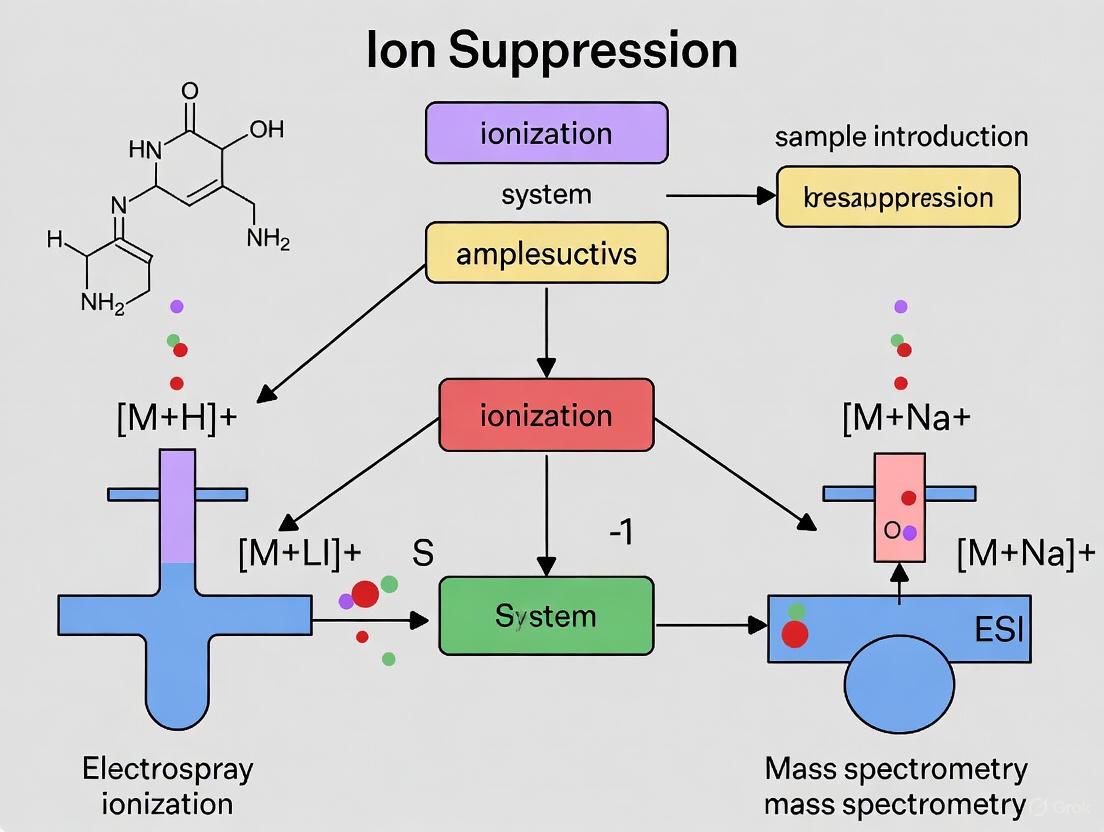
Ion suppression remains a critical challenge in electrospray ionization mass spectrometry (ESI-MS), dramatically impacting the accuracy, precision, and sensitivity of analyses in drug development and clinical research.
Ion Suppression in ESI-MS: Fundamentals, Modern Correction Strategies, and Impact on Biomarker Research
Abstract
Ion suppression remains a critical challenge in electrospray ionization mass spectrometry (ESI-MS), dramatically impacting the accuracy, precision, and sensitivity of analyses in drug development and clinical research. This article provides a comprehensive overview for scientists and researchers, covering the foundational mechanisms of ion suppression, from competition for charge to the effects of non-volatile solutes. It explores innovative methodological solutions like the IROA TruQuant workflow and stable isotope-assisted strategies for correction and normalization. The content also details practical troubleshooting and optimization techniques for the LC-MS system and sample preparation, and concludes with robust validation protocols to ensure data reliability. By synthesizing the latest 2025 research, this guide aims to empower professionals to overcome ion suppression and produce more reproducible and quantitatively accurate metabolomic data.
What is Ion Suppression? Unraveling the Core Mechanisms in ESI-MS
Ion suppression represents a significant challenge in liquid chromatography-mass spectrometry (LC-MS), particularly for electrospray ionization (ESI), where it manifests as a reduction in analyte signal due to the presence of co-eluting matrix components [1] [2]. This phenomenon adversely affects key analytical figures of merit including detection capability, precision, and accuracy, making it a critical concern for researchers, scientists, and drug development professionals working with complex matrices [1] [3]. Despite the high selectivity of LC-MS and tandem mass spectrometry (LC-MS-MS), these techniques remain susceptible to ion suppression effects, which can lead to false negatives, inaccurate quantification, and compromised data integrity [1] [2]. This technical guide explores the fundamental mechanisms, detection methodologies, and advanced strategies for mitigating ion suppression within the broader context of ESI research fundamentals.
Mechanisms and Origins of Ion Suppression
Ion suppression occurs in the early stages of the ionization process in the LC-MS interface when co-eluting compounds influence the ionization efficiency of target analytes [1]. The term was formally introduced by Buhrman and colleagues, who quantitatively defined it as (100 - B)/(A × 100), where A and B represent unsuppressed and suppressed signals, respectively [1]. The complexity of ion suppression stems from its diverse origins and mechanisms, which vary depending on the ionization technique employed.
Ion Suppression in Electrospray Ionization (ESI)
ESI exhibits particular susceptibility to ion suppression through multiple proposed mechanisms. The competitive ionization theory suggests that in multicomponent samples at high concentrations, compounds compete for limited charge or space on the surface of electrospray droplets [1]. Surface activity and basicity determine a compound's ability to outcompete others for these limited resources [1]. Biological matrices contain abundant endogenous compounds with high basicities and surface activities, quickly reaching concentration thresholds (approximately >10⁻⁵ M) where ion suppression becomes significant [1].
Alternative mechanisms propose that physical droplet properties contribute to suppression. High concentrations of interfering components can increase droplet viscosity and surface tension, reducing solvent evaporation rates and the efficiency of analyte transfer to the gas phase [1] [2]. Additionally, the presence of nonvolatile materials may cause co-precipitation of analyte or prevent droplets from reaching the critical radius required for gas-phase ion emission [1] [2] [4]. Gas-phase neutralization reactions, where analyte ions are deprotonated by compounds with high gas-phase basicity, provide another suppression pathway [1].
Ion Suppression in Atmospheric Pressure Chemical Ionization (APCI)
APCI generally demonstrates less pronounced ion suppression compared to ESI, attributed to fundamental differences in their ionization mechanisms [1] [2]. Unlike ESI, APCI does not involve competition between analytes to enter the gas phase, as neutral analytes are vaporized in a heated gas stream [1]. Ion suppression in APCI has been linked to changes in colligative properties during evaporation and the effect of sample composition on charge transfer efficiency from the corona discharge needle [2]. Solid formation, either as pure analyte or coprecipitate with other nonvolatile components, represents another suppression mechanism in APCI [1].
Table 1: Comparison of Ion Suppression Mechanisms in ESI and APCI
| Factor | Electrospray Ionization (ESI) | Atmospheric Pressure Chemical Ionization (APCI) |
|---|---|---|
| Primary Mechanism | Competition for charge & droplet space [1] | Change in colligative properties [2] |
| Phase of Suppression | Solution & droplet processes [1] [4] | Primarily solution phase [1] |
| Susceptibility | High [1] [2] | Moderate [1] [2] |
| Key Influencing Factors | Surface activity, basicity, concentration [1] | Volatility, gas-phase basicity [1] |
Detection and Evaluation Methods
The U.S. Food and Drug Administration's Guidance for Industry on Bioanalytical Method Validation explicitly requires assessment of matrix effects to ensure analytical quality [1] [3]. Two established experimental protocols enable researchers to validate the presence and characterize the impact of ion suppression.
Post-Column Infusion Assay
This comprehensive method enables visualization of ion suppression regions throughout the chromatographic run [1] [2]. The experimental workflow involves continuous infusion of a standard analyte solution post-column via a syringe pump while injecting a blank matrix extract [1]. The chromatographic profile reveals ion suppression as decreases in the constant baseline signal corresponding to the elution of matrix interferents [1]. Figure 1 illustrates this experimental setup and the resulting output, which maps suppression zones by retention time.
Figure 1: Workflow for Post-Column Infusion Ion Suppression Assay - This diagram illustrates the experimental setup where analyte is infused post-column while blank matrix is injected, enabling detection of ion suppression zones in the chromatogram.
Post-Extraction Spike Method
This alternative approach compares the detector response of analytes spiked into blank matrix extracts after preparation versus the response in pure solvent [1] [2] [3]. A significant reduction in signal from the matrix sample indicates ion suppression [1]. While this method effectively quantifies the extent of suppression, it does not provide chromatographic profiling of interfering regions [1]. This approach can be extended to compare signals from matrix extracts spiked before and after sample preparation to differentiate signal loss from recovery issues versus true ion suppression [2].
Quantitative Assessment of Ion Suppression
Recent advances in metabolomics research have provided comprehensive quantitative data on ion suppression across various analytical conditions. A 2025 study systematically evaluated ion suppression using the IROA TruQuant workflow across different chromatographic systems, ionization modes, and source conditions [5]. The results demonstrated that ion suppression affects virtually all analytes to varying degrees, with significant implications for method development and validation.
Table 2: Quantitative Assessment of Ion Suppression Across LC-MS Conditions
| Chromatographic System | Ionization Mode | Source Condition | Ion Suppression Range | Affected Metabolites |
|---|---|---|---|---|
| Ion Chromatography (IC) | Negative | Clean | 1% to >90% [5] | 539 different metabolites detected [5] |
| Reversed-Phase (RPLC) | Positive | Clean | 8.3% (e.g., Phenylalanine) [5] | 422 metabolites/sample (average) [5] |
| HILIC | Positive | Unclean | Significantly greater [5] | 216 common across all samples [5] |
| All Systems | Both | Unclean | Up to nearly 100% [5] | Extensive suppression [5] |
The data reveal several critical patterns: negative ionization mode typically detects fewer ions but still experiences extensive suppression, unclean ionization sources demonstrate significantly greater suppression than cleaned sources, and ion suppression affects virtually all metabolites to varying degrees [5]. Specific examples include phenylalanine (M+H) exhibiting 8.3% suppression in RPLC positive mode with a cleaned source, while pyroglutamylglycine (M-H) showed up to 97% suppression in ICMS negative mode [5].
Advanced Strategies for Mitigation and Correction
Chromatographic and Sample Preparation Approaches
Effective management of ion suppression requires multifaceted strategies beginning with chromatographic optimization and sample clean-up. Modified chromatographic separation to prevent co-elution of suppressing species with target analytes represents the most straightforward approach [2]. When separation alone proves insufficient, comprehensive sample preparation techniques including solid-phase extraction (SPE), liquid-liquid extraction (LLE), and protein precipitation can remove interfering matrix components [2] [3] [6]. Research demonstrates that SPE provides superior selectivity for removing ion-suppressing compounds compared to less selective techniques like LLE or protein precipitation [6].
Innovative Chemical and Computational Workflows
Recent methodological advances offer promising approaches for correcting ion suppression effects, particularly in non-targeted analyses. The IROA TruQuant Workflow utilizes a stable isotope-labeled internal standard (IROA-IS) library with companion algorithms to measure and correct for ion suppression while performing Dual MSTUS normalization of MS metabolomic data [5]. This method identifies molecules based on unique, formula-specific isotopolog ladders, enabling precise suppression correction across diverse analytical conditions [5].
Chemical Isotope Labeling (CIL) LC-MS provides another innovative approach, where metabolites are chemically labeled with optimized reagents before LC-MS analysis to enhance detection sensitivity and improve quantification accuracy [7]. The recent development of a two-channel mixing strategy combines amine/phenol and hydroxyl submetabolomes after labeling but prior to LC-MS analysis, significantly improving throughput while maintaining metabolite coverage [7].
Anion-Exchange Chromatography Mass Spectrometry (AEC-MS) with electrolytic ion-suppression addresses long-standing challenges in analyzing highly polar and ionic metabolites that drive primary metabolic pathways [8]. This innovation links high-performance ion-exchange chromatography directly with mass spectrometry, improving molecular specificity and selectivity for metabolomic applications [8].
Research Reagent Solutions
Table 3: Essential Research Reagents for Ion Suppression Management
| Reagent / Solution | Function / Application | Considerations |
|---|---|---|
| IROA Internal Standard (IROA-IS) | Measures and corrects for ion suppression; enables normalization [5] | Contains clearly identifiable isotopolog patterns [5] |
| Stable Isotope-Labeled Internal Standards | Normalizes response; compensates for variability [2] | Should be chemically matched to analyte [2] |
| Chemical Isotope Labeling Kits (e.g., DnsCl) | Enhances detection sensitivity & quantification accuracy [7] | Targets specific submetabolomes (amine/phenol, hydroxyl) [7] |
| Formic Acid (0.1%) | Common mobile phase additive for positive ion mode [9] [7] | Higher concentrations can cause ion pairing [6] |
| Triethylamine (TEA) | Mobile phase additive for negative ion mode | Use <0.1% v/v; high gas-phase proton affinity [6] |
Ion suppression remains a complex yet manageable phenomenon in LC-MS analysis that significantly impacts analytical performance in pharmaceutical research and drug development. Understanding its mechanisms through both ESI and APCI ionization pathways provides the foundation for effective mitigation. Comprehensive assessment using post-column infusion or post-extraction spike methods enables researchers to identify and characterize suppression effects during method validation. The quantitative data presented in this guide demonstrates the pervasive nature of ion suppression across analytical conditions while highlighting advanced correction methodologies including the IROA TruQuant workflow, chemical isotope labeling techniques, and novel chromatographic approaches such as AEC-MS. By implementing these sophisticated strategies and reagent solutions, researchers can effectively nullify suppression effects, thereby ensuring the precision, accuracy, and sensitivity essential for rigorous bioanalytical applications.
The Electrospray Ionization Process and Where Suppression Occurs
Electrospray Ionization (ESI) is a soft ionization technique that has become a cornerstone of modern mass spectrometry, particularly for the analysis of biologically relevant macromolecules and thermally labile compounds [10] [11]. Its capacity to transfer ions directly from a liquid solution into the gas phase without significant fragmentation has revolutionized fields such as proteomics, metabolomics, and pharmaceutical analysis [11]. The electrospray process generates multiply charged ions, effectively extending the mass range of mass analyzers to accommodate the kiloDalton to MegaDalton molecular weights typical of proteins and their associated polypeptide fragments [12]. Understanding the fundamental principles of the ESI process is crucial for comprehending how and where ion suppression occurs, a phenomenon that significantly impacts the sensitivity, accuracy, and precision of liquid chromatography-mass spectrometry (LC-MS) analyses [3].
The Step-by-Step Electrospray Ionization Process
The transformation of analyte molecules from solution into gas-phase ions in ESI is a multi-stage process involving electrical energy, solvent evaporation, and droplet fission [10].
Nebulization and Charged Droplet Formation
The ESI process begins when a sample solution containing the analytes of interest is introduced through a fine metal capillary or needle (maintained at a high voltage typically between 2.5–6 kV) relative to a surrounding counter electrode [10] [11]. This strong electric field (typically 2-6 kV) charges the surface of the liquid emerging from the capillary tip, dispersing it into a fine aerosol of highly charged droplets with the same polarity as the capillary voltage [10] [13]. The application of a coaxial nebulizing gas (such as nitrogen) shears the eluted sample solution, enabling higher flow rates and stabilizing the spray formation [10] [14]. The physical properties of the solvent, particularly surface tension, play a critical role in this initial step, as lower surface tension solvents require lower onset voltages for stable electrospray formation [14].
Solvent Evaporation and Droplet Shrinking
The cloud of charged droplets travels toward the mass spectrometer inlet under atmospheric pressure, guided by potential and pressure gradients [10]. With the aid of an elevated ESI-source temperature and a concurrent stream of nitrogen drying gas, the charged droplets continuously decrease in size through solvent evaporation [10] [11]. As the solvent evaporates, the droplet radius decreases while the charge density on its surface increases significantly. This continuous reduction in droplet size without a corresponding loss of charge leads to a steady increase in the electrostatic repulsion forces between like charges within the droplet [13].
Ion Ejection via Coulombic Fission and Desolvation
When the charged droplet reaches its Rayleigh limit, the point at which electrostatic repulsion forces equal the surface tension holding the droplet together, it becomes unstable and undergoes Coulombic fission [13] [12]. At this critical point, the droplet deforms and "explodes," ejecting smaller, progeny droplets while typically losing 1.0–2.3% of its mass and 10–18% of its charge [12]. These smaller droplets continue the process of solvent evaporation and repeated Coulombic fissions until ultimately leading to the formation of completely desolvated gas-phase ions [10].
Two primary models explain the final production of gas-phase ions:
- Ion Evaporation Model (IEM): This model suggests that as the droplet radius becomes sufficiently small (typically < 10 nm), the electric field strength at the droplet surface becomes intense enough to directly field-desorb solvated ions into the gas phase [12]. The IEM is generally considered the dominant mechanism for smaller ions.
- Charge Residue Model (CRM): This model proposes that electrospray droplets undergo successive evaporation and fission cycles until they form progeny droplets containing on average one analyte ion or less. Gas-phase ions form after the remaining solvent molecules evaporate, leaving the analyte with the charges that the droplet carried [12]. The CRM is thought to be the predominant mechanism for large macromolecules such as folded proteins.
The entire ESI process is visualized in the following workflow:
The Phenomenon of Ion Suppression in ESI
Definition and Fundamental Causes
Ion suppression refers to the reduction in ionization efficiency of a target analyte due to the presence of co-eluting substances in the mass spectrometer ion source [3] [1]. This matrix effect occurs when interfering components affect the ability of the analyte to become effectively ionized, subsequently leading to diminished signal intensity and potentially compromising quantitative accuracy [3]. The term was quantitatively defined by Buhrman and colleagues as (100 - B)/(A × 100), where A and B represent the unsuppressed and suppressed signals, respectively [1].
The origins of ion suppression are multifaceted, primarily occurring during the early stages of the ionization process within the LC-MS interface [1]. Both endogenous compounds from the sample matrix and exogenous substances introduced during sample preparation can contribute to this phenomenon [3]. The fundamental causes include:
- Competition for Charge: In ESI, the number of excess charges available on droplets is limited. At high concentrations (>10⁻⁵ M), the approximate linearity of the ESI response is often lost as analytes compete for limited charge. Compounds with higher surface activity or gas-phase basicity can out-compete the target analyte for this limited charge, leading to suppressed ionization of less competitive species [1].
- Altered Solution Properties: Co-eluting matrix components can increase the viscosity and surface tension of the ESI droplets, thereby reducing the efficiency of solvent evaporation and the subsequent release of gas-phase analyte ions [1].
- Nonvolatile Material Interference: The presence of nonvolatile materials (e.g., salts, phospholipids, proteins) can coprecipitate with the analyte or prevent droplets from reaching the critical radius required for gas-phase ion emission [1].
- Gas-Phase Proton Transfer: Even after ions are formed in the gas phase, analyte ions can be neutralized via deprotonation reactions with substances possessing higher gas-phase basicity [1].
Location of Ion Suppression in the ESI Process
Ion suppression predominantly occurs at specific stages of the electrospray process, primarily within the ion source before mass analysis begins. The following diagram illustrates the critical points where suppression manifests:
The three primary suppression zones are:
- Suppression Zone 1 (Competition for Limited Surface Charges): During initial droplet formation and subsequent Coulomb fissions, analytes compete for limited surface charges. More surface-active compounds will preferentially occupy droplet surfaces, excluding less competitive analytes and preventing their efficient release as gas-phase ions [1].
- Suppression Zone 2 (Altered Droplet Properties): Matrix components can increase the viscosity and surface tension of ESI droplets, hindering solvent evaporation and delaying the achievement of the critical droplet radius necessary for ion release [1].
- Suppression Zone 3 (Gas-Phase Proton Transfer): After ion formation, gas-phase reactions can occur where protonated analyte ions transfer their protons to matrix components with higher gas-phase basicity, effectively neutralizing the analyte ions before detection [1].
Experimental Protocols for Evaluating Ion Suppression
Post-Extraction Spike-In Method
This quantitative approach evaluates the extent of ion suppression by comparing analyte response in a clean matrix to response in the presence of matrix components [3] [1].
Protocol:
- Prepare a calibration standard in pure mobile phase or solvent (Solution A).
- Process a blank biological matrix (e.g., plasma, urine) through the entire sample preparation procedure.
- Spike the analyte of interest into the prepared blank matrix extract at a concentration identical to Solution A (Solution B).
- Inject and analyze both solutions using the developed LC-MS method.
- Calculate the matrix effect (ME) using the formula: ME (%) = (Peak Area of Solution B / Peak Area of Solution A) × 100 A value of 100% indicates no matrix effects, values <100% indicate suppression, and values >100% indicate ionization enhancement [3].
Continuous Post-Column Infusion Method
This qualitative method identifies the chromatographic regions affected by ion suppression, providing a temporal profile of matrix effects [3] [1].
Protocol:
- Prepare a solution of the analyte of interest at a suitable concentration.
- Connect a syringe pump or secondary LC pump to introduce this solution via a T-connector into the column effluent flowing to the MS, establishing a constant baseline signal.
- Inject a blank matrix extract processed through the sample preparation protocol.
- Monitor the analyte signal throughout the chromatographic run.
- Observe and record regions where the constant baseline signal decreases, indicating the elution of matrix components that cause ion suppression [1].
Table 1: Comparison of Ion Suppression Evaluation Methods
| Method Characteristic | Post-Extraction Spike-In | Continuous Post-Column Infusion |
|---|---|---|
| Primary Information | Quantitative extent of suppression | Chromatographic location of suppression |
| Throughput | Medium (multiple preparations needed) | Low (single injection per matrix) |
| Sample Consumption | Higher | Lower |
| Ease of Interpretation | Straightforward numerical result | Requires interpretation of signal dips |
| Regulatory Acceptance | Widely accepted in validated methods | Used primarily in method development |
Critical Factors and Solutions for Ion Suppression
Factors Contributing to Ion Suppression
Several analytical and matrix-related factors influence the degree of ion suppression observed in ESI-MS analyses:
- Sample Matrix Complexity: Biological fluids such as plasma, urine, and tissue homogenates contain numerous endogenous compounds (e.g., phospholipids, bile salts, organic acids) that are prime candidates for causing ion suppression, particularly when they elute in the same retention window as the analyte [3] [1].
- Sample Preparation Minimalism: Approaches that use minimal sample clean-up (e.g., protein precipitation only) retain more matrix components, increasing the potential for ion suppression compared to more selective techniques like solid-phase extraction or liquid-liquid extraction [3].
- Chromatographic Separation: Short, non-resolving chromatographic methods that fail to separate analytes from matrix components significantly increase the risk of co-elution and subsequent ion suppression [3].
- Mobile Phase Composition: The use of ion-pairing agents and non-volatile buffers can exacerbate ion suppression effects [3].
Strategies for Overcoming Ion Suppression
Multiple strategies exist to mitigate the effects of ion suppression, which can be implemented individually or in combination:
- Enhanced Sample Cleanup: Implement more selective sample preparation techniques such as solid-phase extraction (SPE), liquid-liquid extraction (LLE), or phospholipid removal plates to specifically remove classes of compounds known to cause suppression [3].
- Chromatographic Optimization: Extend chromatographic run times, modify gradient profiles, or employ alternative stationary phases to achieve better separation of analytes from suppressing matrix components [3].
- Modified Ionization Techniques: Switch from ESI to atmospheric pressure chemical ionization (APCI) or atmospheric pressure photoionization (APPI), which are generally less susceptible to ion suppression because the ionization mechanism occurs predominantly in the gas phase rather than in the liquid droplet [1].
- Effective Internal Standardization: Use stable isotope-labeled internal standards (SIL-IS) that co-elute with the analyte and experience identical suppression effects, thereby compensating for these effects during quantification [3].
- Lower Sample Injection Volumes: Reduce the absolute amount of matrix introduced into the system, thereby decreasing the concentration of suppressing components [3].
Table 2: Key Reagent Solutions for ESI-MS and Ion Suppression Management
| Reagent Category | Specific Examples | Function/Purpose | Suppression Considerations |
|---|---|---|---|
| Volatile Buffers | Ammonium acetate, ammonium formate, acetic acid, formic acid | Provide pH control and protons for ionization without residue accumulation | Non-volatile phosphate buffers cause severe suppression |
| SPE Sorbents | C18, mixed-mode, hydrophilic-lipophilic balance (HLB), phospholipid removal | Selective extraction of analytes and removal of matrix components | Proper sorbent selection critical for removing specific suppressors |
| Organic Solvents | LC-MS grade methanol, acetonitrile, isopropanol | Mobile phase components with low surface tension for stable spray formation | Low-grade solvents may contain impurities that cause suppression |
| Ion-Pairing Agents | Trifluoroacetic acid (TFA), heptafluorobutyric acid (HFBA) | Improve chromatographic separation of ionic compounds | Can cause significant ion suppression; use at minimal concentrations |
| Stable Isotope-Labeled Standards | Deuterated, ¹³C, ¹⁵N-labeled versions of analytes | Internal standards that compensate for suppression via identical behavior | Must be chromatographically inseparable from analyte for effective compensation |
The electrospray ionization process represents a sophisticated yet vulnerable interface between liquid separation techniques and mass spectrometric detection. A comprehensive understanding of the mechanisms underlying both ESI and the ion suppression that can occur at multiple points within this process is fundamental to developing robust, sensitive, and accurate LC-MS methods. The physical processes of charged droplet formation, solvent evaporation, Coulombic fission, and final ion release each present opportunities for competitive processes that may suppress analyte ionization. Through systematic evaluation using established experimental protocols and implementation of appropriate mitigation strategies—including enhanced sample preparation, chromatographic optimization, and effective internal standardization—the detrimental effects of ion suppression can be significantly reduced or eliminated. As ESI-MS continues to be a pivotal technology in drug development, proteomics, and metabolomics, mastery of ion suppression fundamentals remains an essential competency for researchers and scientists seeking to generate reliable analytical data.
Ion suppression represents a fundamental challenge in electrospray ionization mass spectrometry (ESI-MS), directly impacting the accuracy and sensitivity of analyses across pharmaceutical development, clinical diagnostics, and basic research. This phenomenon occurs when the ionization efficiency of an analyte is reduced by the presence of competing species in the ESI process. Within the context of a broader thesis on ESI fundamentals, this whitepaper examines the core mechanistic theories underpinning ion suppression, focusing specifically on the competition for limited charge and droplet surface area. Understanding these mechanisms is paramount for developing effective strategies to mitigate suppression effects, thereby improving data quality and analytical reliability in drug development workflows.
Theoretical Foundations of Ion Suppression
The observed reduction in analyte signal during ESI-MS analysis stems from physical and chemical competitions occurring within the evolving electrospray droplet. Two primary, interconnected mechanistic theories explain this phenomenon: competition for limited available charge and competition for limited droplet surface area.
Competition for Charge
This theory posits that the number of excess charges (ions) available in a droplet is finite. During the droplet fission and solvent evaporation processes that characterize ESI, these charges are ultimately transferred to gas-phase ions. Co-present chemical species, including the analyte of interest, matrix components, and solvents, compete for this limited charge pool.
- Gas-Phase Ion-Molecule Reactions: In Secondary Electrospray Ionization (SESI), ion suppression is dominated by gas-phase processes. Studies have demonstrated that compounds with high gas-phase basicity, such as pyridine, can exert a significant suppressive effect on the ionization of other analytes. This occurs through mechanisms like proton transfer, where the suppressing agent effectively "scavenges" available protons, thereby reducing the protonation of target analytes [9].
- Charge Depletion by Non-Volatile Salts: The presence of non-volatile salts (e.g., NaCl) at physiologically relevant concentrations can severely suppress the signal of biological ions. This is attributed to the removal of excess droplet charge via the ion evaporation mechanism, where salt ions compete with and surpass analyte molecules for the limited charges available during droplet fission [15].
Competition for Droplet Surface Area
The electrospray process generates microdroplets with a high surface-to-volume ratio. A strong intrinsic electric field exists at the air/water interface of these droplets, making the surface a critical region for ionization and chemical reactions [16]. The surface area available for analyte presentation is finite, leading to competitive effects.
- Interfacial Phenomenon: Reaction acceleration and ionization in microdroplets are established as interfacial phenomena. The strong interfacial electric field facilitates unique chemistry, but the limited spatial area means that analytes and matrix components must compete for a position at this reactive interface [16].
- Surface Activity and Partitioning: The propensity of a molecule to occupy the droplet surface depends on its surface activity. More surface-active species will preferentially partition to the droplet interface, gaining preferential access to the strong electric field and charge carriers, thereby excluding less surface-active analytes and suppressing their ionization.
Quantitative Evidence and Experimental Data
The following table summarizes key experimental findings that quantify the impacts of these competitive processes.
Table 1: Quantitative Evidence of Ion Suppression Mechanisms
| Suppressing Agent / Condition | Experimental System | Observed Effect | Postulated Primary Mechanism |
|---|---|---|---|
| Pyridine [9] | Secondary Electrospray Ionization (SESI) | Significant suppressive effect on other analytes | Competition for Charge (High gas-phase basicity) |
| Acetone (at 1 ppm) [9] | SESI with Humid Conditions | ~30% intensity decrease for several breath analytes | Competition for Charge (Gas-phase processes) |
| Non-volatile Salts (e.g., NaCl) [15] | Native ESI-MS of Proteins | Signal suppression up to ~1950x; peak broadening & mass shift | Competition for Charge & Charged-Residue Mechanism |
| Concentrated Sample Matrix [5] | Non-targeted Metabolomics (various LC-MS systems) | Ion suppression ranging from 1% to >90% for detected metabolites | Competition for Charge and Droplet Surface Area |
Detailed Experimental Protocols
To provide context for the data, key methodologies from cited studies are outlined below.
Protocol for Investigating Gas-Phase Ion Suppression in SESI
This protocol is adapted from studies characterizing ion suppression in Secondary Electrospray Ionization Mass Spectrometry (SESI-MS) [9].
- Objective: To assess the susceptibility and suppression potential of volatile organic compounds (VOCs) like acetone and pyridine in a gas-phase ionization system.
- Gas Standard Generation: Gaseous analytes are generated using an evaporation-based system. A dilution gas (flow rate of 8 L min⁻¹) is passed through a bubbler to achieve either dry (0%) or humid (95%) conditions. The system is maintained at 60°C to prevent condensation.
- SESI-MS Analysis: A SESI ion source is coupled to a high-resolution mass spectrometer (e.g., Orbitrap). The electrolyte (e.g., 0.1% formic acid) is electrosprayed using a nanoelectrospray capillary. The ionization chamber is typically held at 90°C, and the sampling inlet at 130°C.
- Crossover Experiment: To isolate suppression effects, the concentration of one compound (e.g., acetone) is systematically increased in half-logarithmic steps (covering a 1000x concentration range), while the concentration of a competing compound (e.g., deuterated acetone, D6-acetone) is held constant. The signals of both compounds are monitored via selected ion monitoring.
- Data Analysis: Ion suppression is quantified by the reduction in signal intensity of the constant-concentration analyte as the concentration of the competing analyte is increased.
Protocol for Analyzing Proteins from High-Salt Solutions using Theta Emitters
This protocol describes a method to mitigate ion suppression for proteins in physiologically relevant buffers [15].
- Objective: To enable mass analysis of proteins and protein complexes directly from solutions containing biological buffers and non-volatile salts.
- Emitter Preparation: Theta emitters are produced from borosilicate glass capillaries using a micropipette puller to create a tip with an inner diameter of ~1.4 μm. The emitter features a septum dividing the capillary into two independent channels.
- Sample Loading: The protein sample, dissolved in a biological buffer (e.g., PBS), is loaded into one channel of the theta emitter. A solution of 200 mM ammonium acetate, potentially supplemented with an additive like sodium iodide or bromide, is loaded into the second channel.
- nESI-MS Operation: Dual platinum wires are inserted into the open ends of the theta emitter, with each wire contacting one solution. A voltage of 0.8–2.0 kV is applied to generate the electrospray. The emitter is positioned 1–2 mm from the MS orifice.
- Gas-Phase Activation: Two sequential collisional heating methods are employed to remove salt adducts:
- Beam-type Collision-Induced Dissociation (BTCID): Ions are accelerated into a collision cell filled with N₂ bath gas (6–10 mTorr).
- Dipolar Direct Current (DDC) Offset: An offset potential is applied in a linear ion trap to displace ions into regions of higher RF field strength, increasing collisional heating.
- Data Acquisition: Mass spectra are acquired and processed using appropriate software. Signal-to-noise (S/N) ratios and spectral quality are compared against controls without biological buffers.
Visualizing the Ion Suppression Pathways
The following diagrams illustrate the logical relationships and mechanistic pathways governing ion suppression in ESI.
Diagram 1: Core Ion Suppression Pathways. This diagram outlines the two primary competitive mechanisms leading to ion suppression in ESI.
Diagram 2: Theta Emitter Workflow for Salt Mitigation. This workflow shows how specialized emitters and gas-phase activation enable analysis of samples in high-salt buffers.
The Scientist's Toolkit: Research Reagent Solutions
The following table details key reagents and materials used in the featured experiments to study and mitigate ion suppression.
Table 2: Essential Research Reagents and Materials for Ion Suppression Studies
| Item | Function / Rationale | Example Usage |
|---|---|---|
| Theta Emitters [15] | Glass emitters with a septum dividing the capillary into two channels; enable analysis of samples in high-salt buffers via incomplete mixing at the tip. | Loading sample in one channel and ammonium acetate/additive in the other to create salt-depleted droplets for native protein MS. |
| Anions with Low Proton Affinity (I⁻, Br⁻) [15] | Added to the ESI solution to compete with sodium adduction; facilitates the removal of Na⁺ from protein ions, reducing chemical noise and adduct formation. | Supplementing ammonium acetate in the theta emitter to improve S/N ratios for proteins in biological buffers. |
| IROA Internal Standard (IROA-IS) [5] | A stable isotope-labeled standard library used to directly measure and computationally correct for ion suppression in non-targeted metabolomics. | Spiked into samples at a constant concentration to quantify and correct for metabolite-specific ion suppression across different LC-MS systems. |
| Formic Acid (0.1% v/v) [9] | A common volatile electrolyte added to the ESI solvent to promote protonation and stable electrospray formation in positive ion mode. | Used as the sprayed electrolyte solution in SESI experiments to ionize gas-phase analytes. |
| Deuterated Volatiles (e.g., D6-Acetone) [9] | Used as internal tracers in crossover experiments; their identical chemistry but distinct mass allows precise tracking of suppression effects. | Holding D6-acetone concentration constant while increasing non-deuterated acetone to study gas-phase suppression without thermodynamic variables. |
The Impact of Non-Volatile Solutes on Droplet Formation and Evaporation
In electrospray ionization (ESI) mass spectrometry, the presence of non-volatile solutes represents a significant challenge, directly influencing the fundamental processes of droplet formation and evaporation, and leading to the pervasive issue of ion suppression. This phenomenon adversely affects key analytical figures of merit, including detection capability, precision, and accuracy [3] [1]. Non-volatile salts, such as sodium chloride, and biological buffer components are ubiquitous in the analysis of real-world samples, especially in pharmaceutical and biological applications. Their interference stems from their ability to modify the physical properties of the electrospray solution and compete for available charge during the ionization process [15] [17]. Understanding the impact of these solutes is not merely an academic exercise; it is a prerequisite for developing robust and sensitive analytical methods in ESI-based research and drug development. This guide provides an in-depth examination of the core mechanisms, experimental strategies, and practical methodologies for mitigating the detrimental effects of non-volatile solutes, framed within the critical context of ion suppression.
Core Mechanisms: How Non-Volatile Solutes Interface with the ESI Process
The journey of an analyte from a solution to a gas-phase ion in ESI is a multi-stage process, and non-volatile solutes can disrupt it at several points. The primary mechanism of ion formation for large biomolecules, the Charged-Residue Mechanism (CRM), is particularly susceptible [15]. In CRM, solvent evaporation from a charged droplet continues until the droplet's surface charge density is sufficient to overcome its surface tension, leading to Coulombic fission or complete solvent evaporation and leaving behind a gas-phase analyte ion. The presence of non-volatile solutes complicates this process through several interconnected pathways.
Physical and Chemical Interference Pathways
- Altered Solution Properties: Non-volatile solutes can increase the viscosity and surface tension of the solution. This reduces the efficiency of droplet formation and subsequent solvent evaporation, thereby inhibiting the liberation of gas-phase analyte ions [1].
- Salt Adduction and Condensation: Via the CRM, non-volatile salts can condense onto analyte molecules during the final stages of droplet evaporation. This leads to peak broadening, shifting of signals to higher mass-to-charge ratios, and complicating mass spectral interpretation [15].
- Competition for Charge: In the electrospray plume, there is a finite amount of excess charge available. Highly concentrated non-volatile species and matrix components compete with the analyte for this charge, often suppressing the ionization of the target analyte [1]. This competition can occur both in the condensed phase within the droplet and in the gas phase.
- Elevated Boiling Point: The presence of high concentrations of non-volatile material can raise the boiling point of the solution, leading to lower efficiency in solvent evaporation and the formation of fewer gas-phase ions [17].
The following diagram illustrates the logical progression of how non-volatile solutes impact droplet formation and evaporation, ultimately leading to ion suppression.
Quantitative Data: Experimental Findings on Solute-Induced Effects
The theoretical mechanisms are supported by concrete experimental data quantifying the impact of non-volatile solutes. The following table summarizes key findings from recent investigations, highlighting the effects on signal quality and the efficacy of various mitigation strategies.
Table 1: Quantitative Impacts of Non-Volatile Solutes and Mitigation Efficacy
| Analyte / System | Non-Volatile Solute Conditions | Observed Impact | Mitigation Strategy | Result after Mitigation | Source |
|---|---|---|---|---|---|
| Proteins & Protein Complexes | Biological buffers, physiologically relevant salts | Signal suppression up to ~1950x lower than control; peak broadening | Theta emitters with anions of low proton affinity (Br⁻, I⁻) | Significant increase in S/N ratio; improved reproducibility & robustness | [15] |
| General ESI Mechanism | Sodium Chloride (NaCl) | Loss of linearity in total ion current above ~10⁻⁵ M concentration | Not specified in study | (Fundamental mechanistic observation) | [1] |
| Metabolites (Phenylalanine) | Complex biological matrix (plasma) | 8.3% ion suppression (in RPLC-positive mode, clean source) | IROA TruQuant Workflow (isotope standards) | Restoration of linear signal increase with sample input | [5] |
| Metabolites (Pyroglutamylglycine) | Complex biological matrix (plasma) | Up to >97% ion suppression (in ICMS-negative mode) | IROA TruQuant Workflow (isotope standards) | Effective correction of extreme suppression | [5] |
| Biogenic Amines in Cheese | Complex food matrix | Severe signal suppression for all analytes | Switch from ESI to APCI source; HILIC chromatography | Signal enhancement observed (100–1000 fold) | [17] |
The data confirms that ion suppression can range from mild to nearly complete, severely compromising detection. Furthermore, it demonstrates that the degree of suppression is highly context-dependent, varying with the analyte, matrix, and chromatographic-MS conditions [17] [5].
Experimental Approaches and Methodologies
To overcome the challenges posed by non-volatile solutes, several advanced experimental strategies have been developed. These methodologies focus on either modifying the electrospray process itself or applying post-ionization techniques to remove adducts.
Theta Emitters with Anion Additives
This approach uses specialized theta emitters—glass capillaries with an internal septum dividing them into two channels [15].
- Protocol:
- Sample Loading: The protein or protein complex sample, dissolved in a biological buffer containing non-volatile salts (e.g., PBS), is loaded into one channel of the theta emitter.
- Additive Loading: The other channel is loaded with a solution of 200 mM ammonium acetate supplemented with an additive salt containing an anion of low proton affinity, such as sodium bromide (NaBr) or sodium iodide (NaI) [15].
- ESI-MS Analysis: A voltage is applied via dual platinum wires. The solutions mix at the emitter tip, promoting the formation of a population of droplets relatively depleted of non-volatile salts. The low-proton-affinity anions (Br⁻, I⁻) facilitate the removal of sodium ions over protons, reducing chemical noise and ionization suppression.
- Gas-Phase Activation: Transmitted ions are subjected to two stages of collisional activation: beam-type collision-induced dissociation (BTCID) and dipolar direct current (DDC) excitation in a linear ion trap. This removes residual solvent and salt adducts without causing significant dissociation of the biomolecular complex [15].
Subambient Pressure Ionization with Nanoelectrospray (SPIN)
The SPIN interface addresses ion transmission losses, a major bottleneck in sensitivity.
- Protocol:
- Emitter Placement: The nanoelectrospray emitter is placed inside the first vacuum stage of the mass spectrometer (~20 Torr), eliminating the conventional atmospheric-pressure inlet capillary [18].
- Desolvation: A flow of heated CO₂ gas (~160°C) is directed at the electrospray plume to achieve efficient droplet desolvation.
- Ion Funneling: The resulting gas-phase ions are immediately captured and focused by an electrodynamic ion funnel, which operates at high efficiency in this pressure regime.
- Efficiency Measurement: The ion utilization efficiency is evaluated by measuring the total transmitted gas phase ion current through the interface and correlating it with the observed analyte ion intensity in the mass spectrum [18]. This configuration has been shown to exhibit greater overall ion utilization efficiency than conventional ESI-MS interfaces.
The workflow for the theta emitter method, which integrates both sample introduction and gas-phase processing, is depicted below.
The Scientist's Toolkit: Essential Research Reagents and Materials
Successful experimentation in this field requires a specific set of tools and reagents. The following table details key materials and their functions in managing non-volatile solute effects.
Table 2: Essential Research Reagent Solutions and Materials
| Item | Function / Application | Key Characteristics |
|---|---|---|
| Theta Emitters | Sample introduction for problematic matrices | Dual-channel glass capillary (~1.4 µm i.d.) enabling rapid mixing of sample and additive streams at the ESI tip [15]. |
| Ammonium Acetate (AmAc) | A volatile MS-compatible salt | Used to replace or supplement non-volatile biological buffers (e.g., PBS) during electrospray [15]. |
| Anions of Low Proton Affinity (Br⁻, I⁻) | Solution additive to reduce ionization suppression | Competes effectively with Na⁺, mitigating condensation and chemical noise; proton affinity: I⁻ < Br⁻ < Acetate [15]. |
| IROA Internal Standard (IROA-IS) | Isotopic standard for ion suppression correction in metabolomics | A stable isotope-labeled (¹³C) library of metabolites used to measure and computationally correct for ion suppression in each sample [5]. |
| Ion Funnels | ESI-MS interface component | Electrodynamic device that focuses and transmits ions with high efficiency through regions of elevated pressure, increasing sensitivity [18]. |
| Collision Gas (N₂) | Gas-phase activation | Inert bath gas used in collision cells (q2) and traps for collisional excitation to remove solvent and salt adducts from ions [15]. |
The interference of non-volatile solutes with droplet formation and evaporation is a central pillar of the ion suppression problem in ESI research. The consequences—ranging from total signal loss to degraded data quality—are too significant to ignore in quantitative and trace analysis. As demonstrated, the underlying mechanisms are multifaceted, involving physical chemistry of solutions, competition phenomena, and ion transmission physics. Fortunately, the field has moved beyond simple desalting and now offers sophisticated strategies. The use of specialized emitter geometries like theta tips, strategic solution additives, advanced interface designs such as SPIN, and innovative data correction workflows like IROA provide researchers and drug development professionals with a powerful arsenal to combat these effects. Embracing these methodologies is essential for achieving the high levels of sensitivity, robustness, and reproducibility required in modern mass spectrometry.
How Physicochemical Properties of Analytes Influence Suppression Susceptibility
Ion suppression represents a major challenge in liquid chromatography–mass spectrometry (LC–MS), particularly when using electrospray ionization (ESI). This phenomenon manifests as a reduction in detector response for target analytes due to the presence of co-eluting compounds that interfere with the ionization process [2] [1]. In complex biological matrices, numerous endogenous and exogenous compounds compete for available charge and access to the droplet surface, ultimately affecting analytical accuracy, precision, and sensitivity [19] [20]. The susceptibility of an analyte to ion suppression is not random; rather, it is profoundly influenced by specific physicochemical properties that determine how the molecule behaves during the critical ionization process. Understanding these property-suppression relationships is fundamental for developing robust analytical methods, particularly in pharmaceutical research and drug development where quantitative accuracy is paramount.
Fundamental Mechanisms of Ion Suppression
The ionization process in ESI involves multiple stages where competition between analytes can occur. The prevailing mechanisms point to both solution-phase and gas-phase processes that contribute to signal suppression.
Solution-Phase Competition
In the electrospray process, charged droplets are formed at the capillary tip. As solvent evaporation occurs, the droplet shrinks until it reaches the Rayleigh limit, leading to Coulomb fission and the production of smaller droplets [21]. During these processes, analytes compete for limited charge and for access to the droplet surface, which is crucial for transfer into the gas phase [1]. Compounds with higher surface activity or basicity can dominate this competition, effectively suppressing the ionization of less competitive analytes [2] [1]. The presence of nonvolatile compounds can further exacerbate suppression by increasing droplet viscosity and surface tension, or by causing co-precipitation of analytes, thereby preventing efficient ion formation [1] [4].
Gas-Phase Processes
While early research suggested solution-phase processes were dominant [4], recent studies indicate gas-phase reactions also contribute significantly to ion suppression, particularly in secondary electrospray ionization (SESI) [9]. In the gas phase, charge can be transferred between species based on their relative gas-phase basicities or acidities. A compound with higher gas-phase basicity can effectively protonate from another ion, leading to suppression of the less basic compound's signal [9]. This mechanism is particularly relevant for online analysis techniques where chromatographic separation is absent.
The following diagram illustrates the sequential processes in electrospray ionization where competition between analytes leads to ion suppression:
Physicochemical Properties Governing Suppression Susceptibility
Extensive research has identified several key physicochemical properties that significantly influence an analyte's susceptibility to ion suppression. These properties determine how efficiently a compound competes for charge and accesses the droplet surface during the ionization process.
Molecular Size and Surface Activity
Molecular volume and surface activity are among the most critical factors affecting ionization efficiency. Larger molecules with greater molecular volumes generally exhibit higher ESI responses, as demonstrated in a systematic study of acylated amino acids [21]. The correlation between molecular volume and ESI response was found to be stronger than with hydrophobicity (log P) or pKa [21]. Surface-active compounds preferentially migrate to the droplet surface, where they have better access to charge transfer and evaporation processes. These compounds will typically suppress less surface-active analytes by monopolizing the limited droplet surface area [1].
Polarity and Hydrophobicity
Hydrophobicity, commonly measured as log P, influences an analyte's positioning within the electrospray droplet and its ability to reach the gas phase. More hydrophobic compounds often demonstrate greater surface activity, allowing them to concentrate at the droplet-air interface and more efficiently undergo desolvation and ion emission [21]. However, extremely hydrophobic compounds may face challenges in the initial charging process. The relationship between hydrophobicity and ionization efficiency is complex and not always linear, with other factors like functional groups playing significant roles [21].
Basicity and Gas-Phase Proton Affinity
Solution basicity (pKa) and gas-phase proton affinity are crucial determinants in ionization competition. Compounds with higher gas-phase basicity can effectively strip protons from other ions in gas-phase charge transfer reactions, leading to suppression of less basic compounds [9]. For example, pyridine exhibits a significant suppressive effect on other analytes, which researchers have linked to its high gas-phase basicity [9]. In the solution phase, compounds with favorable pKa values for protonation (in positive ion mode) or deprotonation (in negative ion mode) under the LC-MS conditions will ionize more efficiently.
Concentration Effects
The relative concentration of an analyte compared to potential suppressors dramatically impacts the degree of suppression experienced. An analyte present at high concentration relative to matrix components is less susceptible to suppression, as it can effectively compete for available charge [2] [1]. However, at high concentrations (>10⁻⁵ M), ESI response linearity is often lost due to saturation effects at the droplet surface [1]. This creates a complex relationship where both absolute concentration and relative abundance compared to matrix components influence suppression susceptibility.
Table 1: Physicochemical Properties Affecting Ion Suppression Susceptibility
| Property | Mechanism of Influence | Impact on Suppression Susceptibility | Experimental Evidence |
|---|---|---|---|
| Molecular Size/Volume | Affects mobility to droplet surface and evaporation efficiency | Larger molecules generally less susceptible | Strong correlation between molecular volume and ESI response [21] |
| Surface Activity | Determines positioning at droplet-air interface | High surface activity decreases susceptibility | Surface-active compounds dominate droplet surface [1] |
| Hydrophobicity (log P) | Influences partitioning to droplet surface | Moderate to high log P decreases susceptibility | Systematic study of acylated amino acids [21] |
| Basicity (pKa) | Affects protonation/deprotonation efficiency | Optimal pKa for ionization conditions decreases susceptibility | More basic compounds suppress others in gas phase [9] |
| Gas-Phase Basicity | Determines success in gas-phase charge transfer | High gas-phase basicity decreases susceptibility | Pyridine shows strong suppressive effect [9] |
| Relative Concentration | Impacts competition for limited charge | High concentration relative to matrix decreases susceptibility | Analytic/matrix ratio affects suppression degree [2] |
Quantitative Assessment of Property-Suppression Relationships
Rigorous experimental studies have quantified the relationship between specific physicochemical properties and ionization suppression, enabling more predictive approaches to method development.
Systematic Studies on Molecular Properties
A comprehensive investigation employing amino acids and their derivatives revealed clear trends in ionization efficiency relative to molecular properties [21]. Researchers acylated 14 amino acids with organic acid anhydrides of increasing chain length and with poly(ethylene glycol), systematically altering physicochemical properties. When comparing the ESI response of 70 derivatives, they found the strongest correlation between calculated molecular volume and ESI response (R² > 0.9 for a test set of 43 compounds) [21]. Correlation with hydrophobicity (log P values) was significant but lower, while pKa showed variable influence depending on the specific compound series.
Gas-Phase Suppression Studies
Recent research on secondary electrospray ionization (SESI) has quantified gas-phase suppression effects, demonstrating that acetone at concentrations of 1 ppm can cause approximately 30% signal reduction for numerous features in humid conditions [9]. Crossover experiments with deuterated compounds revealed that suppression intensity depends strongly on the gas-phase basicity of the interfering compound, with pyridine exhibiting the most significant suppressive effect among tested compounds [9].
Chromaticgraphic Influences on Property-Effects Relationships
The chromatographic system employed significantly modulates how physicochemical properties affect suppression susceptibility. Studies comparing reversed-phase liquid chromatography (RPLC), hydrophilic interaction liquid chromatography (HILIC), and ion chromatography (IC) systems demonstrate that the same analyte may experience different degrees of suppression depending on the separation mechanism [22]. For example, phospholipids—known suppressors in RPLC—elute differently in supercritical fluid chromatography (SFC), changing their suppressive impact on co-eluting analytes [20].
Table 2: Quantitative Impact of Physicochemical Properties on Ion Suppression
| Property Modification | Experimental System | Impact on ESI Response | Suppression Change |
|---|---|---|---|
| Acylation of amino acids | RPLC-MS, positive mode | Up to 10-fold increase with PEGylation | Significant reduction in susceptibility [21] |
| Increasing chain length | Amino acid derivatives | Progressive improvement with molecular volume | Gradual reduction in susceptibility [21] |
| Gas-phase basicity increase | SESI-MS with pyridine | 30% suppression of other features at 1 ppm | High suppressive effect on others [9] |
| Phospholipid removal | TAG analysis in krill oil | 5-10 fold improvement in TAG signals | Near elimination of phospholipid suppression [23] |
| IROA normalization | Multi-chromatography system | Correction of 1% to >90% ion suppression | Effective nullification of suppression [22] |
Experimental Protocols for Investigating Property-Suppression Relationships
Post-Column Infusion for Suppression Profiling
The post-column infusion method is a widely used technique for identifying chromatographic regions affected by ion suppression [1] [20].
Protocol:
- Prepare a standard solution containing the analyte of interest at a concentration that produces a consistent signal.
- Use a syringe pump and a 'tee union' to continuously infuse this standard post-column into the mobile phase flow.
- Inject a blank matrix extract onto the LC system under analytical conditions.
- Monitor the detector response throughout the chromatographic run.
- Observe decreases in the otherwise constant signal; these dips indicate retention times where matrix components cause ion suppression [1].
- Repeat with different chromatographic conditions to identify separation approaches that minimize co-elution of suppressors with target analytes.
Quantitative Structure-Property Relationship (QSPR) Modeling
Advanced modeling approaches can predict ionization efficiency based on molecular structure [21].
Protocol:
- Select a diverse set of compounds representing structural variability.
- Derivatize compounds systematically to alter specific physicochemical properties (e.g., acylation to increase hydrophobicity).
- Measure ESI response for all compounds under identical instrumental conditions.
- Calculate molecular descriptors (volume, log P, pKa, surface tension) using computational chemistry software.
- Develop a multivariate model correlating descriptors with observed ESI response.
- Validate the model with a test set of compounds not included in model development.
- Apply the validated model to predict ionization efficiency and suppression susceptibility for new compounds [21].
Stable Isotope-Labeled Internal Standard Methods
The IROA TruQuant workflow uses isotopic labeling to directly measure and correct for ion suppression [22].
Protocol:
- Spike samples with a stable isotope-labeled internal standard (IROA-IS) library at constant concentration.
- Prepare a long-term reference standard (IROA-LTRS) as a 1:1 mixture of chemically equivalent standards at 95% ¹³C and 5% ¹³C.
- Analyze samples using LC-MS under standardized conditions.
- Identify true metabolites based on their characteristic IROA isotopolog ladder pattern.
- Calculate ion suppression for each metabolite using the formula comparing ¹²C and ¹³C channels.
- Apply suppression correction algorithms to generate accurate quantitative data [22].
The following workflow diagram illustrates the experimental approach for systematic investigation of property-suppression relationships:
The Scientist's Toolkit: Essential Research Reagents and Materials
Table 3: Essential Research Reagents and Materials for Ion Suppression Studies
| Reagent/Material | Function in Suppression Research | Application Examples |
|---|---|---|
| IROA Internal Standard Library | Stable isotope-labeled standards for suppression measurement and correction | Quantifying ion suppression across 1% to >90% range in diverse matrices [22] |
| Poly(ethylene glycol) (PEG) derivatives | Systematically increasing molecular volume and altering properties | Demonstrating correlation between molecular size and ESI response [21] |
| Organic acid anhydrides | Acylation reagents for modifying hydrophobicity and surface activity | Creating amino acid derivatives with progressively increasing chain length [21] |
| Stable isotope-labeled analogs | Internal standards for compensation of suppression effects | Correcting for variable ionization efficiency across samples [2] [20] |
| Phospholipid removal cartridges | Selective removal of major suppression-causing matrix components | Overcoming suppression of triacylglycerols by phospholipids [23] |
| Post-column infusion kit | Experimental setup for suppression mapping | Identifying chromatographic regions affected by ion suppression [1] |
The susceptibility of an analyte to ion suppression in ESI-MS is not a random occurrence but a predictable consequence of its physicochemical properties. Molecular volume, surface activity, hydrophobicity, basicity, and gas-phase proton affinity collectively determine how effectively a compound competes throughout the ionization process. Understanding these relationships enables researchers to develop more robust analytical methods through strategic property modification, appropriate internal standard selection, and optimized chromatographic separation. For drug development professionals, this knowledge is crucial for achieving reliable quantification in complex biological matrices, ultimately supporting critical decisions in pharmacokinetic studies and therapeutic monitoring. Future research will likely focus on developing more comprehensive predictive models that integrate multiple physicochemical parameters to forecast suppression susceptibility prior to method development.
Ion suppression in Electrospray Ionization (ESI) mass spectrometry represents a fundamental challenge that directly compromises data quality across pharmaceutical development and bioanalytical research. This whitepaper examines the mechanistic origins of ion suppression in ESI interfaces and details its profound consequences on analytical outcomes, including false negatives, compromised accuracy, and degraded precision. Furthermore, we present validated experimental protocols for detecting and quantifying these effects, alongside emerging strategies for their mitigation. Within the broader context of ion suppression fundamentals, understanding these data quality impacts is essential for developing robust, reliable LC-MS methods.
Ion suppression describes the phenomenon where the presence of co-eluting compounds in the LC-MS interface reduces the ionization efficiency of an analyte of interest [2] [1]. This matrix effect occurs prior to mass analysis and results from competition for limited charge or space within ESI droplets, fundamentally altering detector response [1]. Unlike isobaric interference, ion suppression affects ionization efficiency itself, making its effects particularly insidious because they can escape detection in seemingly clean chromatograms [2]. In drug development, where accurate quantification is paramount, uncontrolled ion suppression can invalidate method validity, leading to incorrect decisions based on flawed data.
Core Mechanisms Leading to Data Quality Impacts
The primary mechanisms of ion suppression in ESI revolve around competition in the condensed phase before ions enter the gas phase.
- Charge Competition: ESI droplets have a limited excess charge available. In multicomponent samples, compounds with superior surface activity or basicity can dominate the droplet surface, effectively "out-competing" analytes of interest for this charge, thereby suppressing their ionization [1].
- Physical Interference: High concentrations of non-volatile or matrix components can increase droplet viscosity and surface tension, thereby reducing the efficiency of solvent evaporation and droplet fission. This physically impedes the transfer of analyte ions into the gas phase [2] [1].
- Saturation Effects: At high analyte concentrations (>10⁻⁵ M), the linearity of the ESI response is often lost. This saturation, caused by limited charge or droplet surface area, inhibits the ejection of ions from within the droplets [1].
Quantitative Impact on Data Quality
The mechanisms of ion suppression directly manifest in three critical, quantifiable impairments of data quality.
False Negatives
Ion suppression can depress an analyte's signal below the method's limit of detection, leading to a false negative reporting outcome [1]. The severity of this effect is concentration-dependent; a higher analyte/matrix ratio can yield a reduced suppression effect [2]. In practice, an analyte present at a clinically or pharmacologically relevant concentration may go unreported if severe ion suppression from co-eluting matrix components diminishes its signal to an undetectable level.
Reduced Accuracy
Analytical accuracy—the closeness of a measured value to a true value—is severely compromised by ion suppression. The extent of inaccuracy can be quantitatively described as (100 - B)/(A × 100), where A and B are the unsuppressed and suppressed signals, respectively [1]. Recent research in non-targeted metabolomics has documented that ion suppression can reduce signal accuracy for individual metabolites by anywhere from 1% to over 90%, depending on the chromatographic system, ionization mode, and sample cleanliness [5]. This introduces significant and variable bias into quantitative results.
Poor Precision
The natural variation of endogenous compounds in biological samples causes varying levels of ion suppression between sample runs [1]. This variation introduces both systematic and random error, adversely affecting the precision of the signal response and intensity ratios [1]. Coefficients of variation (CV) for suppressed analytes can range from 1% to 20% due to these fluctuating matrix effects [5].
Table 1: Quantitative Impacts of Ion Suppression on Data Quality
| Data Quality Parameter | Manifestation | Quantitative Range | Primary Cause |
|---|---|---|---|
| False Negatives | Signal falls below LOD | Concentration-dependent [2] | Severe signal suppression from co-eluting interferents [1] |
| Reduced Accuracy | Biased quantification | 1% to >90% signal loss [5] | Variable ionization efficiency across samples [1] |
| Poor Precision | High run-to-run variability | CVs of 1% to 20% [5] | Fluctuating matrix component concentrations [1] |
Experimental Protocols for Detection and Assessment
Robust method validation requires specific experimental protocols to characterize the presence and extent of ion suppression.
Post-Column Infusion Assay
This method provides a chromatographic profile of ion suppression [1] [5].
Detailed Protocol:
- Setup: Connect a syringe pump containing a solution of the analyte at an appropriate concentration to the LC effluent post-column via a tee union.
- Infusion: Initiate a constant infusion of the analyte, creating a stable background signal in the mass spectrometer.
- Injection: Inject a blank, prepared sample matrix (e.g., plasma extract) into the LC system and run the chromatographic method.
- Detection: Monitor the detector response. A drop in the otherwise constant baseline indicates the retention time windows where co-eluting matrix components are causing ion suppression of the infused analyte (see Figure 1) [1].
Figure 1: Workflow for the post-column infusion assay to identify ion suppression zones.
Post-Extraction Spiking Assay
This method quantifies the absolute extent of ion suppression for a given analyte [1].
Detailed Protocol:
- Prepare Samples:
- Sample A: Pure analyte in neat mobile phase.
- Sample B: Blank sample matrix extract, spiked with the same amount of analyte post-extraction.
- Sample C: Blank sample matrix put through the entire sample preparation protocol and then spiked with the analyte.
- Analysis: Analyze all three samples using the developed LC-MS method.
- Calculation: Compare the peak responses (area or height).
- The comparison between A and B reveals the total ion suppression effect.
- The comparison between B and C helps differentiate ion suppression from signal loss caused by inefficient recovery during sample preparation [2].
Strategies for Mitigating Data Quality Impacts
A multi-pronged approach is necessary to counteract the effects of ion suppression on data quality.
Chromatographic and Sample Preparation Solutions
- Improved Chromatographic Separation: Modifying the LC method to shift the retention time of the analyte away from the major region of ion-suppressing components is a primary defense [2].
- Advanced Sample Cleanup: Replacing simple protein precipitation with techniques like Solid-Phase Extraction (SPE) or Liquid-Liquid Extraction (LLE) can effectively remove ion-suppressing species from the sample matrix prior to analysis [2] [1].
- Source Selection: Switching from ESI to Atmospheric Pressure Chemical Ionization (APCI), which is generally less prone to ion suppression, can be a viable strategy for some analytes [1].
Internal Standardization and Normalization
The use of internal standards (IS) is critical for compensating for variability in ionization efficiency.
- Stable Isotope-Labeled Internal Standards (SIL-IS): These are the gold standard. The SIL-IS is chemically identical to the analyte and behaves identically during sample preparation and ionization, but is distinguished by mass. Any ion suppression affecting the analyte will equally affect the IS, allowing the analyte/IS response ratio to correct for the suppression [2] [5].
- IROA Workflow: For non-targeted metabolomics, the Isotopic Ratio Outlier Analysis (IROA) workflow uses a ¹³C-labeled internal standard library. It measures the ion suppression of each metabolite in the library using a defined algorithm and corrects for it, thereby restoring quantitative accuracy and precision [5].
Table 2: The Scientist's Toolkit: Key Reagent Solutions for Ion Suppression Mitigation
| Tool/Reagent | Function | Application Context |
|---|---|---|
| Stable Isotope-Labeled Internal Standard (SIL-IS) | Normalizes for analyte loss during prep and ion suppression during analysis; enables accurate quantification [2]. | Targeted analysis of specific drugs or metabolites. |
| IROA Internal Standard (IROA-IS) | A library of ¹³C-labeled metabolites used to measure and correct for ion suppression across many analytes simultaneously in a non-targeted workflow [5]. | Non-targeted metabolomics, biomarker discovery. |
| Matrix-Matched Calibration Standards | Calibrators prepared in the same biological matrix as samples to mimic suppression effects and compensate for accuracy loss [2]. | Targeted bioanalysis when analyte-free matrix is available. |
| High-Purity Mobile Phase Additives | Reduce background noise and unintended chemical interactions that can exacerbate ionization instability and suppression. | General LC-MS method development. |
Figure 2: A multi-faceted strategy is required to effectively mitigate the impacts of ion suppression on data quality.
Ion suppression in ESI-MS is not a mere theoretical concern but a pervasive phenomenon with severe, quantifiable consequences for data quality. It directly generates false negatives, reduces analytical accuracy, and degrades measurement precision, thereby threatening the validity of decisions in drug development and clinical research. The post-column infusion and post-extraction spiking assays provide robust experimental means to characterize this threat during method validation. Ultimately, a comprehensive strategy combining superior chromatography, effective sample cleanup, and—most crucially—the application of stable isotope-labeled internal standards or advanced workflows like IROA, is essential to nullify the effects of ion suppression and ensure the generation of reliable, high-quality data.
Advanced Strategies to Measure and Correct for Ion Suppression
Ion suppression represents a fundamental challenge in electrospray ionization mass spectrometry (ESI-MS), particularly when analyzing complex biological samples. This phenomenon occurs when matrix components co-eluting with analytes of interest interfere with the ionization process, leading to reduced detector response and compromising data accuracy [1] [2]. In liquid chromatography-mass spectrometry (LC-MS), ion suppression manifests as reduced ionization efficiency for target analytes due to competition for charge between the analyte and co-eluting species present in the sample matrix [17] [2].
The mechanisms of ion suppression vary depending on ionization technique. In ESI, proposed mechanisms include competition for limited charge available on ESI droplets, increased solution viscosity and surface tension reducing solvent evaporation efficiency, and the presence of non-volatile materials that prevent droplets from reaching the critical radius required for gas phase ion emission [1] [2]. The extent of suppression is influenced by multiple factors including the physicochemical properties of interfering compounds, their concentration relative to the analyte, chromatographic conditions, and ionization source parameters [17] [1].
The consequences of unchecked ion suppression are severe across analytical applications, leading to reduced detection capability (potentially yielding false negatives), impaired precision and accuracy, and nonlinear response curves [1] [2]. Until recently, strategies to mitigate ion suppression have included extensive sample cleanup, chromatographic method optimization, sample dilution, and the use of internal standards [17] [1]. However, these approaches have proven insufficient for non-targeted metabolomics, where the diverse chemical properties of hundreds to thousands of metabolites preclude finding a universal solution [22] [22].
The IROA Approach: Fundamental Principles
The IROA TruQuant Workflow introduces a paradigm shift in addressing ion suppression through the innovative application of stable isotope-labeled standards [22] [24]. This approach leverages the unique properties of isotopic patterning to both identify and computationally correct for ion suppression effects across the entire metabolome.
At the core of the IROA methodology are two specialized standards: the IROA Internal Standard (IROA-IS) and the IROA Long-Term Reference Standard (IROA-LTRS) [22]. The IROA-IS is spiked into all experimental samples at constant concentration, while the IROA-LTRS serves as a consistent reference across multiple experiments. The power of this system lies in the distinctive isotopic labeling pattern: the IROA-IS incorporates 95% ^13C, creating a recognizable mass spectrometric signature that differentiates it from natural abundance compounds (approximately 99% ^12C) [22] [24].
The fundamental correction principle rests on the fact that while both endogenous ^12C metabolites and the ^13C-labeled standards experience identical suppression during ionization, their characteristic isotopolog patterns remain detectable [24]. As stated in the IROA technical approach: "The ratio of the C-12 envelope to the C-13 envelope is unaffected by suppression even though both the C-12 and C-13 isotopomeric sets may be strongly suppressed" [24]. This consistent ratio, maintained across varying suppression conditions, provides the mathematical foundation for accurate correction.
The IROA isotopic pattern creates a recognizable "ladder" where ^12C metabolites show decreasing amplitude from low to high mass, while the ^13C IROA-IS shows the inverse pattern [22]. This distinctive signature enables the companion software to differentiate true biological metabolites from artifacts and provides the data necessary for sophisticated suppression correction algorithms.
Workflow Components and Experimental Design
Research Reagent Solutions
Successful implementation of the IROA TruQuant Workflow requires several key reagents and materials, each serving a specific function in the experimental pipeline.
Table 1: Essential Research Reagents for the IROA TruQuant Workflow
| Reagent/Material | Function | Application Notes |
|---|---|---|
| IROA Internal Standard (IROA-IS) | Stable isotope-labeled standard spiked into all experimental samples at constant concentration; provides reference for suppression correction [22] [24] | 95% ^13C labeling creates distinctive mass spectral pattern; enables quantification despite suppression |
| IROA Long-Term Reference Standard (IROA-LTRS) | 1:1 mixture of chemically equivalent standards at 95% ^13C and 5% ^13C; provides consistent reference across experiments [22] |
Creates characteristic "M-1" peak pattern; used for peak identification and cross-experiment normalization |
| ClusterFinder Software | Proprietary algorithm for automated peak detection, identification, and ion suppression correction [22] [24] | Identifies IROA signature patterns; differentiates true metabolites from artifacts; implements suppression correction equation |
| Compatible LC-MS Systems | Chromatographic and mass spectrometric platforms validated with the IROA workflow [22] | Successfully tested with IC-MS, HILIC-MS, and RPLC-MS systems in both positive and negative ionization modes |
Sample Preparation Protocol
The initial phase of the IROA workflow centers on proper sample preparation to ensure accurate and reproducible results:
Standard Integration: Spike a constant amount of IROA-IS into all experimental samples, including quality controls and blanks, during the initial preparation phase [22] [25]. The consistent concentration across all samples provides the reference point for subsequent suppression correction.
Extraction Procedure: Perform metabolite extraction using appropriate solvents (typically methanol or methanol/water mixtures) optimized for the specific biological matrix being studied [22] [25]. The IROA-IS is present throughout extraction, accounting for potential variability in recovery efficiency.
Reconstitution Strategy: After drying samples under nitrogen or vacuum, reconstitute extracts in a fixed volume of solvent compatible with the intended LC-MS analysis [22]. Maintaining consistent volumes across samples is critical for quantitative comparisons.
Quality Control Preparation: Include appropriate quality control samples, such as pooled quality control samples, process blanks, and IROA-LTRS injections, throughout the sequence to monitor system performance [22] [24].
Data Acquisition Parameters
The IROA TruQuant Workflow has been validated across multiple chromatographic and mass spectrometric platforms:
Chromatographic Systems: The method has been demonstrated effective with ion chromatography (IC), hydrophilic interaction liquid chromatography (HILIC), and reversed-phase liquid chromatography (RPLC) systems, making it adaptable to diverse analytical needs [22].
Mass Spectrometric Detection: Full-scan high-resolution mass spectrometry is recommended to capture the complete isotopic patterns of both endogenous metabolites and IROA standards [22] [24]. Both positive and negative ionization modes have been successfully implemented.
Source Condition Considerations: Experiments should include monitoring of source cleanliness, as uncleaned ionization sources demonstrate significantly greater levels of ion suppression than cleaned sources [22].
Figure 1: IROA TruQuant Workflow Overview. The complete analytical process from sample preparation to normalized data output.
Ion Suppression Correction Mechanism
Mathematical Foundation
The IROA suppression correction operates on a robust mathematical principle that leverages the consistent behavior of isotopic pairs under suppression conditions. The correction algorithm utilizes the fundamental relationship between the ^12C and ^13C isotopologs, which experience identical suppression effects despite their mass differences [22] [24].
The core correction equation (Eq. 1 in the original publication) calculates suppression-corrected values for each metabolite based on the ratio between the observed ^12C signal and the ^13C IROA-IS signal, multiplied by a reference value representing the unsuppressed signal intensity [22]. This relationship can be conceptually represented as:
Where AUC represents the peak area for the ^12C endogenous metabolite (AUC-12C) and the ^13C internal standard (AUC-13C) [22].
The "unsuppressed value" for the IROA-IS can be determined through several approaches, each with specific applications:
Experimental Determination: Analyzing the IROA-IS in a blank sample (lacking biological matrix) to establish the maximum achievable signal [24]
Serial Dilution Approach: Creating a dilution series of the IROA-IS in the absence of sample matrix to determine the response under minimal suppression conditions [24]
Cross-Sample Comparison: Using the largest
^13C value observed within an experiment as the reference point for all samples [24]Absolute Quantification: Employing a pre-determined, accurate concentration of the internal standard for each metabolite [24]
Algorithm Implementation
The ClusterFinder software (version 4.2.21, 64-bit, IROA Technologies) automates the detection and correction process through several sophisticated steps [22]:
Peak Detection and Deisotoping: The algorithm identifies all mass spectral features and reconstructs the isotopic envelopes for both
^12C and^13C channels [22] [24].IROA Pattern Recognition: The software identifies genuine metabolites by recognizing the characteristic IROA isotopic pattern - a ladder of signals with regular M+1 spacing, decreasing amplitude in the
^12C channel, and increasing amplitude in the^13C channel from low to high mass [22].Artifact Exclusion: Features lacking the IROA signature pattern are excluded as non-biological artifacts or background interference, significantly reducing false positives [22] [24].
Suppression Calculation: For each genuine metabolite, the algorithm calculates the degree of ion suppression based on the deviation of the
^13C IROA-IS signal from its expected unsuppressed value [22].Correction Application: The mathematical correction is applied to both the
^12C endogenous metabolite signals and the^13C internal standard signals, effectively nulling out the suppression effects [22].
Figure 2: Ion Suppression Correction Mechanism. The algorithmic process for detecting and correcting ion suppression effects.
Performance Validation and Experimental Data
Quantitative Assessment Across Platforms
The IROA TruQuant Workflow has been rigorously validated across multiple analytical platforms and conditions, demonstrating remarkable effectiveness in correcting ion suppression. The following table summarizes key performance metrics extracted from comprehensive validation studies.
Table 2: IROA Performance Across Chromatographic and Ionization Conditions [22]
| Chromatographic System | Ionization Mode | Source Condition | Ion Suppression Range (%) | CV Range (%) | Correction Effectiveness |
|---|---|---|---|---|---|
| Ion Chromatography (IC) | Negative | Clean | 5 - 97% | 3 - 18% | Full correction to linearity |
| Ion Chromatography (IC) | Negative | Unclean | 15 - >99% | 5 - 20% | Full correction where detectable |
| Reversed-Phase (RPLC) | Positive | Clean | 1 - 85% | 1 - 15% | Full correction to linearity |
| Reversed-Phase (RPLC) | Positive | Unclean | 10 - 95% | 3 - 18% | Full correction where detectable |
| HILIC | Positive | Clean | 3 - 90% | 2 - 16% | Full correction to linearity |
| HILIC | Positive | Unclean | 12 - 98% | 4 - 19% | Full correction where detectable |
The validation data reveals several critical insights. First, ion suppression is ubiquitous across all common chromatographic platforms, with suppression magnitudes ranging from 1% to over 99% depending on analytical conditions [22]. Second, source cleanliness significantly impacts suppression levels, with unclean sources exhibiting substantially greater suppression effects. Most importantly, the IROA workflow effectively corrected for suppression across this broad range of conditions, restoring the expected linear relationship between sample input and detector response [22].
Case Study: Extreme Suppression Correction
The capability of the IROA workflow is particularly evident in cases of extreme ion suppression. In one documented example using IC-MS in negative ionization mode, the metabolite pyroglutamylglycine exhibited up to 97% ion suppression in concentrated samples [22]. Despite this near-complete loss of signal, the IROA correction algorithm successfully restored linear response across sample concentrations.
Similarly, for phenylalanine analyzed by RPLC in positive mode with a cleaned ionization source, observed suppression was 8.3% [22]. While this represents a more moderate suppression level, the correction nonetheless proved essential for accurate quantification, particularly in studies requiring precise measurement of fold-changes in metabolite abundance.
The consistency of correction across the suppression spectrum - from minimal to extreme - demonstrates the robustness of the IROA approach. This performance is maintained across different biological matrices including plasma, urine, cell culture, and tissue extracts, highlighting its utility for diverse research applications [22].
Normalization via Dual-MSTUS Algorithm
Beyond ion suppression correction, the IROA TruQuant Workflow incorporates a sophisticated normalization strategy termed Dual-MSTUS (MS Total Useful Signal) [22]. This approach addresses the critical need for robust normalization in non-targeted metabolomics, where traditional methods often fail to account for global suppression effects.
The Dual-MSTUS algorithm operates on both the ^12C and ^13C data channels simultaneously, using the stable isotope-labeled standards as internal references for technical variability [22]. Unlike conventional total ion count or total useful signal normalization methods, which can be skewed by ion suppression effects, the Dual-MSTUS approach corrects for suppression before normalization, ensuring that normalized values accurately reflect biological variation rather than analytical artifacts.
The normalization process follows a sequential procedure:
Ion Suppression Correction: The algorithm first applies the suppression correction to all detected metabolites as described in Section 4 [22].
Signal Summation: The corrected intensities of all genuine metabolites are summed separately for the
^12C and^13C channels, creating two total useful signal values for each sample [22].Normalization Factor Calculation: The
^13C sum (derived from the IROA-IS) provides the primary normalization factor, as it represents a constant amount of material across all samples [22].Data Scaling: All
^12C metabolite abundances are scaled by the normalization factor, creating datasets where biological differences can be accurately compared across samples [22].
This dual-channel normalization approach provides exceptional stability, particularly in cases where extensive ion suppression would otherwise compromise standard normalization methods. By leveraging the constant input of the IROA-IS, the Dual-MSTUS algorithm effectively differentiates technical variation from biological variation, significantly enhancing data quality and reproducibility [22] [25].
Application in Biological Research
The practical utility of the IROA TruQuant Workflow is exemplified by its application in investigating ovarian cancer cell response to the enzyme-drug L-asparaginase (ASNase) [22]. In this study, the workflow enabled researchers to uncover significant alterations in peptide metabolism that had not been previously reported using conventional metabolomic approaches.
The IROA-normalized data revealed subtle but biologically important metabolic changes that would likely have been obscured by ion suppression effects in standard LC-MS analyses [22]. This demonstrates how the correction of analytical artifacts can expose previously hidden biological insights, particularly for low-abundance metabolites that are especially vulnerable to suppression.
The workflow has been successfully applied across diverse biological matrices including plasma, urine, cell cultures, and tissue biopsies, demonstrating its broad applicability in biomedical research [22] [24]. The ability to obtain accurate quantitative data regardless of matrix complexity makes it particularly valuable for:
- Drug mechanism studies: Uncovering subtle metabolic changes in response to pharmaceutical interventions [22]
- Biomarker discovery: Identifying true biological markers rather than analytical artifacts [22]
- Toxicology assessments: Accurately quantifying metabolite changes in response to toxic insults [22]
- Systems biology: Providing reliable data for metabolic network modeling and analysis [25]
For researchers studying complex biological systems, the IROA workflow provides confidence that observed metabolic differences reflect genuine biology rather than analytical variability or matrix effects [22] [25].
Comparative Advantages and Limitations
Advantages Over Traditional Methods
The IROA TruQuant Workflow offers several distinct advantages compared to traditional approaches for managing ion suppression:
Comprehensive Correction: Unlike analyte-specific internal standard methods, IROA provides correction across the entire detected metabolome without requiring prior knowledge of metabolite identities [22] [24]
Artifact Exclusion: The characteristic IROA pattern automatically differentiates biological metabolites from non-biological artifacts and background interference [22] [24]
Reduced Sample Preparation: The workflow enables analysis of more concentrated samples without concern for suppression effects, improving sensitivity for low-abundance metabolites [22]
Platform Flexibility: The method works across diverse chromatographic and mass spectrometric platforms, making it adaptable to existing laboratory infrastructure [22]
Dual Functionality: The approach simultaneously addresses both ion suppression correction and sample-to-sample normalization through the integrated algorithm [22] [25]
Current Limitations and Future Directions
Despite its significant advantages, the current implementation of the IROA workflow has certain limitations:
Detection Requirement: The method can only correct metabolites that are detected in both the
^12C and^13C channels, meaning completely suppressed metabolites (100% suppression) cannot be recovered [22]Library Dependence: The comprehensiveness of the correction is somewhat dependent on the coverage of the IROA internal standard library [22] [24]
Software Dependency: The approach requires specialized software (ClusterFinder) for data processing, which may present a learning curve for new users [22] [24]
Future developments are expected to address these limitations. The IROA team has indicated that upcoming versions of ClusterFinder will incorporate enhanced algorithms for identifying fully suppressed analytes and expanding the metabolite coverage [22]. Additionally, as the library of IROA standards grows, the comprehensiveness of the method will continue to improve.
For the field of ESI-MS research, the IROA approach represents a significant advancement in addressing the fundamental challenge of ion suppression. By providing a robust mathematical and experimental framework for nulling out suppression effects, it enables researchers to focus on biological questions rather than analytical artifacts, potentially accelerating discovery across multiple domains of metabolic research.
Stable Isotope-Labeled Internal Standards for Universal Correction
Ion suppression represents a fundamental challenge in electrospray ionization mass spectrometry (ESI-MS), often described as the "Achilles' heel" of quantitative LC-MS methods [26]. This phenomenon occurs when matrix components co-eluting with analytes of interest interfere with the ionization process, leading to reduced sensitivity, inaccurate quantification, and compromised data quality [1]. In ESI, ionization is capacity-limited, with an excess of competing ions inside the droplet reducing ionization efficiency for target analytes [1] [26]. The mechanisms include competition for charge, changes in droplet surface tension, and precipitation of analytes with non-volatile materials [1].
Stable isotope-labeled internal standards (SIL-IS) have emerged as the most effective approach for correcting ion suppression effects. These standards are chemically identical to the target analytes but differ in mass due to isotopic enrichment (e.g., with ²H, ¹³C, ¹⁵N), allowing them to experience nearly identical matrix effects while remaining distinguishable by the mass spectrometer [27] [26]. This technical guide explores the fundamental principles, implementation methodologies, and experimental validation of SIL-IS for universal correction of ion suppression effects in pharmaceutical and biomedical research.
Fundamental Principles of Internal Standardization
Types of Internal Standards
The selection of appropriate internal standards depends on the specific analytical challenges and required accuracy. The hierarchy of internal standard effectiveness is as follows:
Isotope Dilution Mass Spectrometry (IDMS): This gold-standard approach uses stable isotope-labeled analogues of the exact target analytes, typically with ³⁴S, ¹³C, or ¹⁵N labeling to minimize chromatographic resolution [28] [27]. The isotopologs co-elute with native compounds and experience nearly identical suppression effects, enabling precise correction [29].
Surrogate Internal Standards: These are structurally similar but not identical compounds used when isotope-labeled standards are unavailable [27]. While they can monitor extraction efficiency, they frequently lead to inaccurate correction due to differential ionization behavior and matrix effects [29].
Non-Analog Internal Standards: These unrelated compounds, often added post-extraction, primarily correct for instrument drift rather than matrix effects [27].
Table 1: Comparison of Internal Standard Types for Ion Suppression Correction
| Standard Type | Chemical Similarity | Extraction Correction | Ion Suppression Correction | Limitations |
|---|---|---|---|---|
| Isotope-Labeled Analog | Identical | Excellent | Excellent | Cost, availability for novel compounds |
| Surrogate Standard | Similar | Good | Variable | Potential differential ionization |
| Non-Analog Standard | Different | Limited | Limited | Only corrects for instrument drift |
Mechanisms of Ion Suppression in ESI
Understanding ion suppression mechanisms is essential for developing effective correction strategies. In ESI, the primary mechanisms include:
- Charge Competition: Electrospray droplets have limited excess charge available, and high concentrations of matrix components can outcompete analytes for this charge, particularly compounds with high basicity and surface activity [1].
- Surface Tension Effects: Matrix components can increase droplet viscosity and surface tension, reducing solvent evaporation and analyte transfer to the gas phase [1].
- Precipitation Effects: Non-volatile materials can coprecipitate with analytes or prevent droplets from reaching the critical radius required for ion emission [1].
The extent of ion suppression varies significantly across different chromatographic systems and ionization modes, with studies demonstrating suppression ranging from 1% to >90% across various analytical conditions [5].
Implementation Strategies for Universal Correction
Isotopic Ratio Outlier Analysis (IROA) Workflow
The IROA TruQuant workflow represents an advanced approach for comprehensive ion suppression correction in non-targeted analyses [5]. This method utilizes a stable isotope-labeled internal standard (IROA-IS) library with companion algorithms to measure and correct for ion suppression across all detected metabolites.
IROA Workflow for Ion Suppression Correction
The key components of this workflow include:
- IROA Internal Standard (IROA-IS): A comprehensive library of stable isotope-labeled metabolites spiked into samples at constant concentrations before extraction [5].
- IROA Long-Term Reference Standard (IROA-LTRS): A 1:1 mixture of chemically equivalent standards at 95% ¹³C and 5% ¹³C that produces a signature isotopic pattern for identification [5].
Suppression Calculation: Ion suppression is calculated using the equation:
AUC₁₂Csuppression-corrected = AUC₁₂Csample × (AUC₁₃CLTRS / AUC₁₃Csample)
where AUC represents the area under the curve for each chromatographic peak [5].
Dual MSTUS Normalization: An algorithm that normalizes MS data based on the total useful signal, accounting for variation in sample concentration and matrix effects [5].
Experimental Design for Method Development
Parameter Optimization using Design of Experiments (DoE):
Effective implementation of SIL-IS methods requires systematic optimization of ESI and chromatographic parameters. The Design of Experiments (DoE) approach provides a multivariate strategy for evaluating multiple factors simultaneously [30]. Critical parameters include:
- Capillary voltage (2000-4000 V)
- Nebulizer pressure (10-50 psi)
- Drying gas flow rate (4-12 L/min)
- Gas temperature (200-340°C) [30]
DoE approaches such as fractional factorial design (FFD) for screening and face-centered central composite design (CCD) for optimization enable efficient mapping of parameter responses while considering interaction effects [30].
Table 2: Key Experimental Parameters for SIL-IS Method Development
| Parameter Category | Specific Factors | Optimization Approach | Impact on Ion Suppression |
|---|---|---|---|
| ESI Source | Capillary voltage, nebulizer pressure, gas flow/temperature | Multivariate DoE | Directly affects ionization efficiency and competition |
| Chromatography | Column chemistry, mobile phase, gradient | Scouting gradients and column screening | Determines degree of matrix co-elution |
| Sample Preparation | Extraction efficiency, cleanup | Recovery studies | Reduces overall matrix burden |
Experimental Protocols and Validation
Protocol: Evaluation of Ion Suppression Using Stable Isotope-Labeled Internal Standards
Materials and Reagents:
- Stable isotope-labeled internal standards (preferably ¹³C-labeled for minimal chromatographic shift)
- LC-MS grade solvents and additives
- Analytical columns appropriate for target analytes
- Quality control samples in appropriate matrix
Procedure:
Standard Preparation: Prepare stable isotope-labeled internal standards at concentrations appropriate for the expected analyte levels. Spike into samples before any preparation steps to correct for extraction losses [27].
Sample Preparation: Process samples using appropriate extraction methods (protein precipitation, liquid-liquid extraction, solid-phase extraction). Maintain consistent sample-to-internal standard ratios [26].
LC-MS Analysis: Perform chromatographic separation optimized to resolve analytes from major matrix interferences while maintaining practical run times [26].
Data Acquisition: Monitor both native analytes and their stable isotope-labeled counterparts using specific mass transitions (MRM) or high-resolution mass detection.
Ion Suppression Assessment: Compare the response of internal standards in matrix to that in pure solvent to quantify suppression [1] [5].
Quantification: Calculate analyte concentrations using the response ratio of native analyte to stable isotope-labeled internal standard, applying appropriate calibration models [27].
Protocol: Mitigation of Drug-Mediated Ion Suppression
Drug-mediated ion suppression presents particular challenges in bioanalysis, where co-administered medications can cause unexpected suppression effects [26].
Procedure:
Interference Screening: Test common co-medications during method development to identify potential suppressors [26].
Chromatographic Resolution: Where possible, adjust chromatographic conditions to separate analytes from interfering drugs while maintaining reasonable run times [26].
Source Condition Optimization: Reduce sample and injection volumes to minimize the number of competing species in ESI droplets [26].
SIL-IS Implementation: Use stable isotope-labeled internal standards with a minimum of three ¹³C atoms to ensure co-elution with native analytes while avoiding unwanted chromatographic resolution [26].
Validation Data and Performance Metrics
The effectiveness of SIL-IS for ion suppression correction has been demonstrated across multiple studies:
- In lipidomics, SIL-IS methods enabled accurate quantification of hundreds of lipid species with accuracy >90%, meeting biochemical accuracy standards [31].
- The IROA workflow corrected ion suppression ranging from 1% to >97% across different chromatographic systems (IC-MS, HILIC-MS, RPLC-MS) and ionization modes [5].
- For melatonin quantification in cell cultures, isotope dilution MS provided quantitative recoveries (99±1%), while surrogate internal standards yielded highly variable results (9±2% to 186±38%) [29].
Table 3: Quantitative Performance of SIL-IS Correction in Various Applications
| Application | Analytical Challenge | SIL-IS Approach | Result |
|---|---|---|---|
| Lipidomics | Accurate quantification of complex lipid species | Multiple class-specific SIL-IS | >90% accuracy for hundreds of species [31] |
| Metabolomics | Variable ion suppression across metabolites | IROA workflow with ¹³C-labeled library | Correction of 1% to >97% suppression [5] |
| Pharmaceutical Analysis | Drug-mediated ion suppression | Analyte-specific deuterated standards | Elimination of quantitative bias from co-eluting drugs [26] |
The Scientist's Toolkit: Essential Research Reagents
Table 4: Key Research Reagent Solutions for SIL-IS Methods
| Reagent Category | Specific Examples | Function | Considerations |
|---|---|---|---|
| Stable Isotope-Labeled Standards | ¹³C-labeled metabolites, ²H-labeled pharmaceuticals | Compensation for extraction losses and ion suppression | ¹³C preferred over ²H for minimal chromatographic shift [26] |
| IROA Reference Standards | IROA-IS, IROA-LTRS [5] | Comprehensive ion suppression correction in non-targeted studies | Requires specialized algorithms for data processing |
| Chromatographic Materials | HILIC, RPLC (C18), ion chromatography columns | Separation of analytes from matrix interferences | Different systems exhibit varying degrees of ion suppression [5] |
| Mobile Phase Additives | Trifluoroacetic acid (TFA), acetic acid, ammonium salts | Modulation of chromatographic separation and ionization | TFA improves separation but causes ion suppression [29] |
Stable isotope-labeled internal standards represent the most effective approach for universal correction of ion suppression in ESI-MS-based analyses. Through mechanisms that mirror the behavior of native analytes throughout sample preparation, chromatography, and ionization, SIL-IS provide a robust foundation for accurate quantification in complex matrices. Advanced implementations such as the IROA workflow extend this correction to non-targeted analyses, enabling comprehensive metabolomic profiling with minimized matrix effects. As MS-based analyses continue to advance in sensitivity and application scope, the strategic implementation of SIL-IS will remain essential for generating reliable quantitative data in pharmaceutical research and development.
Mass spectrometry-based metabolomics provides a powerful platform for studying biological systems, but its quantitative accuracy is severely compromised by ion suppression, a matrix effect prevalent in Electrospray Ionization (ESI) where co-eluting compounds interfere with analyte ionization [5] [3]. This technical whitepaper details the Dual MSTUS (MS Total Usable Signal) normalization algorithm, a robust data processing method designed to correct these variances. The algorithm leverages a unique stable isotope-labeled internal standard to measure and correct for ion suppression, then applies a dual-channel normalization strategy, setting a new standard for reproducible and accurate quantitation in non-targeted metabolomics for research and drug development [32] [5].
Electrospray Ionization (ESI) is a soft ionization technique that uses a high-voltage electric field to produce charged droplets from a liquid sample, eventually generating gas-phase ions for mass analysis [10] [33]. Despite its widespread use, ESI is highly susceptible to ion suppression, a phenomenon where the ionization efficiency of an analyte is reduced by the presence of competing, co-eluting compounds from the sample matrix [3].
The consequences of ion suppression are profound:
- Reduced Sensitivity and Higher Limits of Detection: Analyte signal is decreased, impairing the detection of low-abundance metabolites [3].
- Compromised Precision and Accuracy: The degree of suppression can vary unpredictably from sample to sample, affecting reproducibility and quantitative accuracy [5] [3].
- Impaired Linear Dynamic Range: Signal response becomes non-linear, hindering reliable quantitation [3].
Traditional approaches to mitigate ion suppression, such as extensive sample clean-up or chromatographic optimization, are often insufficient for non-targeted metabolomics, where the entire chemical space is of interest [5]. The Dual MSTUS algorithm, combined with a specific isotopic labeling strategy, provides a systematic solution to this pervasive problem.
The IROA Framework: Prerequisite for Dual MSTUS
The Dual MSTUS normalization algorithm operates within the *Isotopic Ratio Outlier Analysis (IROA) * Workflow. This framework relies on two key standards [32] [5]:
- IROA Internal Standard (IROA-IS): A library of metabolites uniformly labeled with 95% ¹³C, spiked at a constant concentration into every experimental sample.
- IROA Long-Term Reference Standard (IROA-LTRS): A 1:1 mixture of the same metabolites in their 95% ¹³C and natural abundance (5% ¹³C) forms.
This labeling strategy generates a unique, formula-specific isotopolog ladder for each metabolite. The "12C channel" (lower mass isotopologs) represents the endogenous metabolites from the biological sample, while the "13C channel" (higher mass isotopologs) represents the internal standard. Because ions from the same metabolite in both channels co-elute chromatographically, they experience identical ion suppression, providing a direct means to measure and correct for it [5].
The Dual MSTUS Normalization Algorithm: A Two-Stage Process
Stage 1: Ion Suppression Correction
The first stage corrects the ion suppression effect for each individual metabolite. The algorithm capitalizes on the fact that the IROA-IS in the 13C channel is spiked at a known, constant concentration. Any loss of signal in this channel is attributable to ion suppression. A correction factor is derived and applied to the paired 12C channel signal [32] [5].
The core calculation for suppression correction is defined in the IROA Workflow as [5]: $$AUC\text{-}12C\text{suppression-corrected} = \frac{AUC\text{-}12C\text{observed} \times Conc\text{-}13C\text{IS}}{AUC\text{-}13C\text{observed}}$$
Where:
- AUC-12Cobserved is the raw peak area of the endogenous metabolite.
- AUC-13Cobserved is the raw peak area of the internal standard.
- Conc-13CIS is the known concentration of the 13C-labeled internal standard.
This correction restores the expected linear relationship between sample input and instrument response, even for metabolites experiencing severe suppression (e.g., >90%) [5].
Stage 2: Dual-Channel Normalization
Following suppression correction, the Dual MSTUS algorithm normalizes the entire dataset to correct for sample-to-sample variances (e.g., pipetting errors, sample dilution). It enhances the classic MSTUS method, which assumes the total chemical composition of comparable samples is similar [32] [34].
The Dual MSTUS process involves [32] [34]:
- Calculate MSTUS Values: For each sample, sum the peak areas of all verified compounds to compute two MSTUS values:
- C12 MSTUS: The sum of all suppression-corrected 12C envelopes (endogenous metabolites).
- C13 MSTUS: The sum of all 13C envelopes (constant internal standard).
- Determine Normalization Factor (NF): The NF is calculated to make the C12 MSTUS equal to the C13 MSTUS. Since the C13 MSTUS is constant across all samples, this removes the arbitrary selection of a "common value" used in traditional MSTUS.
- Apply the Factor: The NF is multiplied against each individual peak in the sample.
This ensures that every suppression-corrected and normalized sample is directly comparable, as they all contain the same effective amount of internal standard [34].
Experimental Protocol & Validation
Essential Reagents and Materials
Table 1: Key Research Reagent Solutions for the IROA/Dual MSTUS Workflow
| Item Name | Function/Description | Critical Role in Workflow |
|---|---|---|
| IROA Internal Standard (IROA-IS) | A library of metabolites uniformly labeled with 95% ¹³C [5]. | Serves as the basis for ion suppression correction; the constant 13C channel provides a reference for signal loss. |
| IROA Long-Term Reference Standard (IROA-LTRS) | A 1:1 mixture of 95% ¹³C and 5% ¹³C (natural abundance) metabolite standards [5]. | Used for peak verification; authentic metabolites must appear with the signature IROA pattern in the LTRS. |
| ClusterFinder Software | Proprietary data analysis software (IROA Technologies) [32]. | Automates the detection of IROA patterns, performs suppression correction using Eq. 1, and executes the Dual MSTUS normalization algorithm. |
| Dual MSTUS R-Code | An open-source R program [34]. | Processes the ClusterFinder output to create two-dimensional datasets ready for statistical analysis. |
Detailed Methodology
Step 1: Sample Preparation with IROA Standards
- Spike a constant, precise aliquot of the IROA-IS into each experimental sample (e.g., plasma, cell culture extract) [5].
- Include the IROA-LTRS in the analytical batch for quality control and metabolite verification [5].
Step 2: Liquid Chromatography-Mass Spectrometry Analysis
- Analyze samples using standard LC-MS platforms (e.g., RPLC-MS, HILIC-MS, ICMS) in both positive and negative ionization modes.
- The protocol is robust across different chromatographic systems and states of ESI source cleanliness [5].
- Example MS Parameters (adjustable per instrument):
Step 3: Data Processing with ClusterFinder
- Process raw LC-MS files using ClusterFinder software.
- The software identifies true biological metabolites based on the presence of the signature IROA isotopolog ladder [32].
- It automatically applies the ion suppression correction (Eq. 1) to each detected metabolite [5].
Step 4: Dual MSTUS Normalization
- Use ClusterFinder or the supplemental Dual MSTUS R-code to perform the final normalization [34].
- The output includes raw, suppression-corrected, and fully normalized values for each metabolite in every sample [32].
Validation and Performance Metrics
The IROA Workflow with Dual MSTUS normalization was rigorously validated across multiple analytical conditions. The method demonstrated effective correction of ion suppression, restoring linearity of signal response even with increasing sample concentration [5].
Table 2: Performance Metrics of the IROA Workflow with Dual MSTUS Normalization
| Validation Parameter | Experimental Conditions | Key Finding |
|---|---|---|
| Chromatographic System Robustness | IC-MS, HILIC-MS, RPLC-MS (C18) [5]. | Workflow effectively corrected ion suppression across all common chromatographic methods. |
| Ionization Mode Performance | Positive and Negative ESI Mode [5]. | Ion suppression was prevalent in both modes and was effectively corrected by the workflow. |
| Ion Suppression Linearity | Sample aliquots from 50 to 1500 µL [5]. | Suppression-corrected 12C values increased linearly with sample input; corrected 13C values remained constant. |
| Magnitude of Correction | Metabolites with 1% to >90% ion suppression [5]. | The algorithm successfully restored accurate quantitation even for severely suppressed metabolites (e.g., >97%). |
| Metabolite Identification | Non-targeted profiling across a plasma sample set [5]. | The workflow facilitated the identification and measurement of 539 different metabolites. |
The figure below illustrates the logical relationship between the experimental challenge, the core innovation, and the final output of the workflow.
Application in Drug Development: A Case Study
The power of this methodology was demonstrated in a study investigating the response of ovarian cancer cells to the enzyme-drug L-asparaginase (ASNase). The IROA TruQuant Workflow with Dual MSTUS normalization revealed significant alterations in peptide metabolism that had not been reported in previous studies using conventional data processing methods [5]. This highlights the algorithm's ability to generate robust, normalized data that uncovers subtle but biologically significant metabolic changes, accelerating the identification of novel drug response mechanisms and potential biomarkers.
Ion suppression remains a fundamental challenge compromising data quality in ESI-based metabolomics. The Dual MSTUS normalization algorithm, embedded within the IROA Workflow, provides a comprehensive solution. By leveraging a stable isotope internal standard to directly measure and correct for ion suppression, followed by a rational dual-channel normalization strategy, it ensures quantitative accuracy and enhances reproducibility. For researchers and drug development professionals, this robust data processing pipeline enables more reliable biological insights and fosters confidence in metabolomic findings.
Ion suppression remains one of the most significant challenges in electrospray ionization (ESI) mass spectrometry, particularly in the analysis of complex biological and environmental samples [1]. This phenomenon occurs when matrix components co-eluting with analytes of interest interfere with the ionization process, leading to reduced sensitivity, inaccurate quantification, and compromised analytical precision [22] [36]. Despite the widespread adoption of LC-MS across pharmaceutical, clinical, and environmental applications, ion suppression effects continue to limit the reliability of quantitative analyses, especially in untargeted omics studies where the complete chemical composition of samples is unknown [22].
The susceptibility to ion suppression varies considerably across different liquid chromatography separation mechanisms, including reversed-phase (RPLC), hydrophilic interaction (HILIC), and ion chromatography (IC) [22]. Each technique presents distinct matrix compositions at the point of ionization, resulting in system-specific suppression profiles. This technical evaluation provides a systematic assessment of ion suppression across these three chromatographic systems, quantifying suppression effects, identifying their sources, and presenting validated methodologies for their correction. The findings presented herein aim to equip researchers with practical strategies to enhance data quality in ESI-based analyses, with particular relevance for drug development applications where quantification accuracy is paramount.
Fundamentals of Ion Suppression in ESI
Mechanisms and Causes
Electrospray ionization operates through a complex process involving charged droplet formation, solvent evaporation, and Coulombic fission leading to gas-phase ion release [33]. Ion suppression disrupts this process through multiple mechanisms, primarily occurring in the initial ionization stages before mass analysis [1]. The limited excess charge available on ESI droplets creates competition between co-eluting compounds for access to this charge, with surface-active and highly basic species typically dominating the ionization process [1]. This competition results in the suppression of less competitive analytes, even when they are present at detectable concentrations.
Non-volatile matrix components can further exacerbate suppression by increasing droplet viscosity and surface tension, thereby reducing solvent evaporation rates and ion release efficiency [1]. Additionally, these components can coprecipitate with analytes or prevent droplets from reaching the critical radius required for gas-phase ion emission [1]. In the gas phase, proton transfer reactions can neutralize pre-formed ions when compounds with high gas-phase basicity co-elute with target analytes [1]. The specific mechanisms and their relative contributions vary significantly across different chromatographic separation techniques, sample matrices, and instrument parameters.
Comparative Susceptibility Across Ionization Techniques
While ESI demonstrates particular vulnerability to ion suppression effects due to its ionization mechanism, alternative techniques exhibit different susceptibility profiles. Atmospheric pressure chemical ionization (APCI) frequently experiences less ion suppression than ESI because it vaporizes neutral analytes in a heated gas stream before gas-phase ionization, eliminating competition for droplet space and charge [1]. However, APCI remains susceptible to suppression through alternative mechanisms, particularly when non-volatile components form solids that coprecipitate with analytes [1].
Emerging plasma-based ionization techniques show promising reduction in matrix effects. Recent evaluations of flexible microtube plasma (FμTP) ionization demonstrated negligible matrix effects for 76-86% of pesticides tested across various food matrices, compared to only 35-67% for ESI and 55-75% for APCI [37]. This suggests that the ionization mechanism in FμTP, which resembles gas-phase chemical ionization rather than droplet-based processes, may offer advantages for complex sample analysis.
Systematic Evaluation of Ion Suppression Across Chromatographic Systems
Experimental Design and Methodology
The comparative data presented in this evaluation were derived from a comprehensive study examining ion suppression across IC-MS, HILIC-MS, and RPLC-MS systems in both positive and negative ionization modes [22]. The experimental design incorporated a standardized sample set consisting of plasma extracts aliquoted across a concentration range (50-1500 µL) to systematically modulate matrix effects. Each aliquot was reconstituted with a fixed volume and concentration of Isotopic Ratio Outlier Analysis Internal Standard (IROA-IS), enabling precise quantification of suppression effects [22].
The IROA workflow utilized a stable isotope-labeled internal standard library and companion algorithms to measure and correct for ion suppression [22]. This approach leverages a unique, formula-specific isotopolog ladder created by natural abundance (12C) signals and 95% 13C-enriched signals, allowing clear distinction between biological signals and artifacts [22]. The experimental conditions were controlled for source contamination state, with separate evaluations conducted using cleaned and uncleaned ESI sources to isolate contamination-related suppression effects [22].
Table 1: Chromatographic Systems and Conditions for Ion Suppression Evaluation
| Parameter | Ion Chromatography (IC) | HILIC | Reversed-Phase (RPLC) |
|---|---|---|---|
| Stationary Phase | Ion-exchange resin | Polar functionalized silica | C18 bonded phase |
| Separation Mechanism | Ionic strength/affinity | Hydrophilic partitioning | Hydrophobic interaction |
| Mobile Phase | Aqueous salts/buffers | High organic content (>60%) | Water/organic gradient |
| Optimal pH Range | 2-11 | 3-8 | 2-12 (depending on column) |
| Compound Focus | Ionic/polar metabolites | Polar hydrophilic compounds | Moderate to non-polar compounds |
Source: Methodology adapted from [22]
Quantitative Comparison of Suppression Effects
The evaluation revealed significant ion suppression across all chromatographic systems and ionization modes, with suppression levels ranging from 1% to over 90% for detected metabolites [22]. The coefficients of variation for these measurements spanned 1-20%, highlighting the substantial variability introduced by matrix effects [22]. Negative ionization mode consistently detected fewer ions than positive mode across all chromatographic systems, though both polarities exhibited extensive suppression [22].
Table 2: Ion Suppression Severity Across LC-MS Systems
| Chromatographic System | Ionization Mode | Source Condition | Average Suppression Range | Representative Example |
|---|---|---|---|---|
| IC-MS | Negative | Cleaned | 15-97% | Pyroglutamylglycine: 97% suppression |
| HILIC-MS | Positive | Cleaned | 10-85% | Not specified |
| HILIC-MS | Negative | Cleaned | 12-90% | Not specified |
| RPLC-MS (C18) | Positive | Cleaned | 8-80% | Phenylalanine: 8.3% suppression |
| RPLC-MS (C18) | Negative | Cleaned | 10-75% | Not specified |
| All Systems | Both | Uncleaned | 25-100% | Significantly higher vs. cleaned |
Source: Data compiled from [22]
Uncleaned ionization sources demonstrated significantly greater ion suppression across all chromatographic systems compared to cleaned sources [22]. This finding underscores the critical importance of source maintenance in minimizing matrix effects. The IROA workflow effectively corrected for the observed suppression across all conditions, restoring the expected linear increase in signal with increasing sample input, even for severely suppressed compounds like pyroglutamylglycine (97% suppression in IC-MS negative mode) [22].
Methodologies for Ion Suppression Correction
IROA Workflow for Comprehensive Suppression Correction
The IROA TruQuant workflow represents a significant advancement for addressing ion suppression in non-targeted metabolomic studies [22]. This method utilizes a stable isotope-labeled internal standard (IROA-IS) library and a chemically identical but isotopically different Long-Term Reference Standard (IROA-LTRS) to quantify and correct suppression effects [22]. The approach generates a unique isotopolog ladder for each molecule, with decreasing amplitude in the 12C channel and increasing amplitude in the 13C channel (from low to high mass), enabling clear identification of true metabolites versus artifacts [22].
The workflow employs a specific equation to calculate suppression-corrected values:
[ \text{AUC-12C}{\text{suppression-corrected}} = \frac{\text{AUC-12C}{\text{raw}} \times \text{Concentration}{IS}}{\text{AUC-13C}{\text{raw}}} ]
Where AUC-12Craw and AUC-13Craw represent the raw peak areas for the endogenous and internal standard isotopologs, respectively, and ConcentrationIS is the known concentration of the internal standard [22]. This correction method successfully restored linear response across sample input volumes, effectively nulling out suppression effects even in highly concentrated samples [22].
The IROA approach further facilitates Dual MSTUS (MS Total Useful Signal) normalization, which improves quantitative accuracy, precision, and sensitivity of metabolomic data across diverse analytical conditions [22]. A key advantage of this methodology is its ability to differentiate between endogenous metabolites and exogenous compounds through adjustment of IROA concentration and data analysis parameters, making it applicable to exposomics and pharmacometabolomics studies where both biological and non-biological molecules are of interest [22].
Chromatographic and Sample Preparation Strategies
Beyond computational correction, several practical approaches can minimize ion suppression during method development. Sample cleanup procedures represent the first line of defense against matrix effects. Solid-phase extraction (SPE), liquid-liquid extraction, and protein precipitation effectively remove interfering compounds that contribute to suppression [1]. The QuEChERS (Quick, Easy, Cheap, Effective, Rugged, and Safe) method, particularly valuable for food matrices like fruits and vegetables, has demonstrated effectiveness in reducing matrix effects in pesticide analysis [37].
Chromatographic optimization can significantly reduce co-elution of analytes with matrix components. Extended run times, optimized gradient profiles, and improved peak capacity through ultra-high-performance liquid chromatography (UHPLC) enhance separation efficiency, physically separating analytes from suppressive compounds [33] [38]. Recent innovations in column technology further support these efforts. Inert hardware columns with passivated surfaces minimize adsorption of metal-sensitive compounds like phosphopeptides, improving recovery and reducing suppression for these vulnerable analytes [39]. The development of superficially porous particles with alternative stationary phases (such as phenyl-hexyl or biphenyl) provides complementary selectivity to conventional C18 phases, potentially separating analytes from matrix interferences that cause suppression [39].
Diagram: Comprehensive workflow for managing ion suppression in LC-MS analyses, incorporating sample preparation, chromatographic separation, and data correction strategies.
Research Reagent Solutions and Essential Materials
Table 3: Essential Research Tools for Ion Suppression Management
| Tool/Category | Specific Examples | Function/Application | Reference |
|---|---|---|---|
| Internal Standards | IROA Internal Standard (IROA-IS) | Quantification and correction of ion suppression across all detected metabolites | [22] |
| Chromatography Columns | Halo 90 Å PCS Phenyl-Hexyl | Alternative selectivity for improved separation from matrix interferences | [39] |
| Fortis Evosphere C18/AR | Oligonucleotide separation without ion-pairing reagents | [39] | |
| Halo Inert Columns | Metal-free hardware for improved recovery of metal-sensitive analytes | [39] | |
| Sample Preparation | QuEChERS kits | Matrix removal for food and environmental samples | [37] |
| Primary-Secondary Amine (PSA) | Removal of fatty acids and other polar matrix components | [37] | |
| Enhanced Matrix Removal-Lipid (EMR) | Selective lipid removal from complex samples | [37] | |
| Mobile Phase Additives | Volatile buffers (ammonium acetate/formate) | MS-compatible mobile phases with reduced ion suppression | [40] |
| Instrumentation | Flexible microtube plasma (FμTP) | Alternative ionization source with reduced matrix effects | [37] |
Implications for Drug Development and Pharmaceutical Analysis
The systematic evaluation of ion suppression across chromatographic systems carries significant implications for pharmaceutical research and development. In drug discovery, where lead compounds are increasingly optimized for specific physicochemical properties, understanding system-specific suppression patterns enables more accurate pharmacokinetic profiling and metabolite identification [38]. The demonstrated variability in suppression across IC, HILIC, and RPLC systems underscores the importance of orthogonal method development during bioanalytical method validation, particularly for regulated studies supporting drug approval [1].
The application of advanced correction methodologies like the IROA workflow addresses critical gaps in metabolite quantification accuracy, potentially revealing previously obscured metabolic pathways relevant to drug mechanism of action or toxicity [22]. This capability was demonstrated in a study of ovarian cancer cell response to L-asparaginase, where IROA-normalized data revealed significant alterations in peptide metabolism that had not been reported previously [22]. Such findings highlight the potential for improved suppression correction to advance therapeutic understanding and development.
For biopharmaceutical quality control, the availability of specialized LC systems with bio-inert components (such as the Waters Alliance iS Bio HPLC and Agilent Infinity III Bio LC Solutions) provides hardware-based solutions to complement computational suppression correction [41]. These systems, constructed with MP35N, gold, ceramic, and polymer materials, enhance resistance to high-salt mobile phases and extreme pH conditions commonly encountered in pharmaceutical analysis, thereby reducing one source of matrix effects [41].
This systematic evaluation demonstrates that ion suppression significantly affects all major chromatographic systems employed in LC-MS analyses, with suppression levels ranging from 1% to over 90% depending on the chromatographic technique, ionization mode, and source condition [22]. The comprehensive assessment reveals that while all systems experience substantial matrix effects, the specific patterns and severity of suppression vary considerably across IC, HILIC, and RPLC platforms. This variability underscores the necessity of system-specific suppression management strategies in quantitative analyses.
The IROA workflow represents a significant advancement in suppression correction, effectively restoring linear response across diverse analytical conditions [22]. When combined with optimized sample preparation, chromatographic separation, and source maintenance, this approach enables researchers to overcome the fundamental challenge of ion suppression in ESI-MS. For drug development professionals, these methodologies offer improved accuracy in biomarker quantification, metabolic pathway analysis, and pharmacokinetic studies, ultimately enhancing the reliability of data supporting therapeutic development. As LC-MS technology continues to evolve with new ionization sources, column chemistries, and computational approaches, the systematic understanding and management of ion suppression will remain essential for extracting maximum analytical value from complex biological samples.
The study of altered peptide metabolism in ovarian cancer represents a critical frontier in understanding tumor progression and developing novel therapeutic strategies. Ovarian cancer features a unique tumor microenvironment (TME) characterized by lipid-rich ascites and omental metastasis, creating a complex ecosystem that promotes metabolic reprogramming of cancer cells [42]. Within this environment, peptide hormones serve as fundamental regulators of numerous biological functions, acting as signaling molecules that coordinate cellular processes including metabolism, immune response, and neuroendocrine regulation [43]. The crosstalk between stromal, immune, and ovarian cancer cells in this lipid-rich TME results in tumor proliferation, metastasis, and escape of immune surveillance, with peptide-mediated pathways playing a crucial role in these processes [42].
Advances in mass spectrometry (MS)-based peptidomics and proteomics have significantly expanded our ability to identify novel peptides and characterize their functions [43]. However, the accurate quantification of peptides in complex biological matrices like ovarian cancer TME presents substantial analytical challenges, particularly due to phenomena such as ion suppression in electrospray ionization (ESI) mass spectrometry [3]. This technical guide explores the current methodologies, challenges, and applications for revealing altered peptide metabolism in ovarian cancer, with particular emphasis on navigating ion suppression effects in ESI-based analyses.
Fundamentals of Ion Suppression in ESI-MS and Implications for Peptide Analysis
Mechanisms and Causes of Ion Suppression
Ion suppression represents a significant obstacle in LC-MS analyses, particularly when measuring trace analytes in complex matrices like ovarian cancer tissue or ascites fluid. Ion suppression occurs through reactions between the analyte(s) and matrix constituents resulting in a species that can either suppress or enhance signal response in the MS [3]. The primary mechanisms include:
- Competitive Ionization: Co-eluting matrix components compete with target analytes for available charges during the electrospray process
- Viscosity Effects: Matrix components alter solution properties, affecting droplet formation and evaporation rates
- Space-Charge Effects: Excessive ion populations in the source region prevent efficient transmission of target ions
In the context of ovarian cancer peptide studies, the lipid-rich nature of the TME is particularly problematic [42]. Lipid components can cause severe ion suppression, interfering with the detection and quantification of clinically relevant peptides. The risk of ion suppression increases substantially when target analytes are present at trace amounts in complex matrices, when minimal sample clean-up is performed, and when using short non-resolving chromatographic runs [3].
Impact on Peptide Quantification Accuracy
The consequences of ion suppression on analytical results are numerous and particularly relevant for peptide biomarker studies [3]:
- Reduced detection capability due to decreased analyte signal
- Higher limits of detection and poorer signal-to-noise ratios
- Compromised precision as suppression varies between samples
- Affected linearity and quantitation due to variability of matrix effects
- Potential complete absence of signal in cases of severe suppression
For ovarian cancer research, these effects can lead to inaccurate quantification of peptide biomarkers, potentially obscuring biologically significant alterations in peptide metabolism that could serve as diagnostic or prognostic indicators.
Methodological Framework for Studying Peptide Metabolism in Ovarian Cancer
Sample Preparation Strategies to Mitigate Ion Suppression
Effective sample preparation is crucial for reliable peptide analysis in ovarian cancer specimens. Several strategies have been developed specifically to address ion suppression:
- Selective Extraction: Employing immunoaffinity techniques or solid-phase extraction to selectively isolate target peptides from complex matrices [3]
- Enhanced Clean-up Protocols: Implementing additional purification steps to remove lipids and other interfering compounds abundant in ovarian cancer samples [42] [3]
- Protein Depletion: Removing high-abundance proteins that can contribute to matrix effects
- Fractionation Techniques: Separating samples into multiple fractions to reduce complexity
For ovarian cancer studies specifically, additional considerations include the unique composition of ascites fluid and omental tissue, which contain elevated levels of lipids and various cellular components that can interfere with analysis [42].
Chromatographic and MS Approaches
Table 1: Chromatographic and Mass Spectrometric Techniques for Peptide Analysis
| Technique | Application in Ovarian Cancer | Advantages | Limitations |
|---|---|---|---|
| LC-ESI-MS/MS | Targeted peptide quantification | High sensitivity and specificity | Susceptible to ion suppression |
| 2D-LC-MS/MS | Complex sample analysis | Reduced matrix interference | Longer analysis time |
| SWATH-MS | Untargeted peptide discovery | Comprehensive data acquisition | Complex data processing |
| Nano-LC-MS | Limited sample amounts | Enhanced sensitivity | Increased clogging risk |
| Ion Mobility-MS | Isomeric separation | Additional separation dimension | Specialized equipment needed |
Chromatographic optimization represents one of the most effective approaches for mitigating ion suppression. Key strategies include [3]:
- Extended Gradient Programs: Increasing separation efficiency to resolve target peptides from interfering compounds
- Alternative Stationary Phases: Utilizing specialized chemistries to improve separation of peptides from matrix components
- Mobile Phase Modifications: Adjusting pH and solvent composition to alter selectivity
- Column Geometry Optimization: Using longer columns or smaller particle sizes for enhanced resolution
Experimental Protocol for Peptide Analysis in Ovarian Cancer Specimens
Protocol 1: Comprehensive Peptide Extraction and Analysis from Ovarian Cancer Ascites
Sample Collection and Preparation
- Collect ascites fluid during standard therapeutic paracentesis
- Centrifuge at 2,000 × g for 10 minutes to remove cellular components
- Aliquot supernatant and store at -80°C until analysis
Peptide Extraction and Enrichment
- Acidify sample with 0.1% formic acid
- Process using C18 solid-phase extraction cartridges
- Elute peptides with 50% acetonitrile/0.1% formic acid
- Concentrate using vacuum centrifugation
LC-MS/MS Analysis
- Reconstitute in 0.1% formic acid
- Separate using nano-flow LC system with 75μm × 150mm C18 column
- Employ 60-minute linear gradient from 2% to 35% acetonitrile
- Analyze using Q-TOF mass spectrometer in DDA mode
- Acquire MS1 scans (m/z 350-1250) followed by MS2 of top 50 ions
Data Processing
- Process raw files using appropriate software (e.g., MaxQuant, Skyline)
- Search against human protein database
- Apply false discovery rate threshold of 1%
- Perform statistical analysis of peptide abundances
Key Signaling Pathways Involving Peptide Regulation in Ovarian Cancer
Diagram 1: Key Pathways Linking Peptide Signaling and Metabolic Reprogramming in Ovarian Cancer
The interaction between peptide signaling and metabolic reprogramming in ovarian cancer involves several key pathways that represent potential therapeutic targets. As illustrated in Diagram 1, the lipid-rich tumor microenvironment stimulates peptide hormone secretion and activates multiple signaling cascades that promote cancer progression [42]. Notably, CD36-mediated activation of SRC/MAPK and AKT/GSK3β/β-catenin signaling axes induces epithelial-mesenchymal transition (EMT) and promotes proliferation, cancer stemness, metastasis, and drug resistance [42].
The SREBP-FASN axis plays a crucial role in regulating lipid metabolism in response to peptide signaling. This axis is regulated by the PI3K-AKT signaling pathway and various proteins including membrane-bound transcription factor protease site 2 (MBTPS2), CD36, and spindle protein 1 (SPIN1) [42]. Pharmacological inhibition of FASN using compounds like orlistat, C75, and TVB-2640 has shown significant effects in ovarian cancer treatment and reversing chemotherapy resistance.
Analytical Workflow for Peptide Biomarker Discovery
Diagram 2: Comprehensive Workflow for Peptide Biomarker Discovery with Integrated Ion Suppression Assessment
Diagram 2 outlines a comprehensive workflow for peptide biomarker discovery that incorporates specific steps to address ion suppression challenges. This integrated approach is essential for generating reliable data in ovarian cancer studies. The ion suppression assessment phase includes three critical evaluation methods [3]:
- Post-column Infusion Tests: Continuously infuse target peptides while injecting extracted blank matrix to identify regions of ion suppression
- Post-extraction Spike Experiments: Compare peptide responses in neat solution versus matrix extracts to quantify suppression effects
- Matrix Factor Calculations: Determine the ratio of analyte response in matrix versus neat solution to objectively measure suppression
This rigorous assessment is particularly important for ovarian cancer studies due to the variable composition of ascites fluid between patients, which can lead to inconsistent matrix effects and compromised data quality if not properly addressed.
Research Reagent Solutions for Ovarian Cancer Peptide Studies
Table 2: Essential Research Reagents for Ovarian Cancer Peptide Metabolism Studies
| Reagent Category | Specific Examples | Function in Research | Application Notes |
|---|---|---|---|
| Protease Inhibitors | PMSF, Aprotinin, Leupeptin | Prevent peptide degradation during processing | Critical for preserving native peptide profiles |
| Protein Assay Kits | BCA, Bradford Assays | Sample quantification | Normalization for sample input |
| SPE Cartridges | C18, Mixed-mode, HLB | Peptide extraction and clean-up | Essential for reducing matrix effects |
| LC Columns | C18, C8, Polar Embedded | Peptide separation | Different selectivities for various peptide classes |
| Internal Standards | Stable isotope-labeled peptides | Quantification normalization | Correct for ion suppression variability |
| Enrichment Reagents | TiO2, Fe-NTA, Antibody Beads | Phosphopeptide/enrichment | Specific peptide population studies |
| Enzyme Inhibitors | Orlistat, C75, TVB-2640 | FASN inhibition | Functional studies of lipid metabolism |
The selection of appropriate research reagents is crucial for successful investigation of altered peptide metabolism in ovarian cancer. As highlighted in Table 2, several categories of reagents play essential roles in different aspects of the research workflow. Particularly important are stable isotope-labeled peptides as internal standards, which help correct for variability introduced by ion suppression effects [3]. For functional studies, enzyme inhibitors such as orlistat, C75, and TVB-2640 enable investigation of the relationship between lipid metabolism and peptide signaling [42].
Recent advances in reagent development have significantly improved our ability to study peptide metabolism in ovarian cancer. Notably, DNA affinity reagents like catTFRE can effectively enrich endogenous transcription factors and co-regulators, facilitating the study of nuclear peptides and transcription factors that are often present at low abundances but play crucial regulatory roles [44].
Case Study: Peptide Biomarker Discovery in Ovarian Cancer Ascites
Experimental Design and Analytical Approach
A comprehensive case study illustrates the practical application of previously discussed principles for peptide biomarker discovery in ovarian cancer ascites fluid. The experimental design incorporates specific strategies to address ion suppression challenges while enabling robust peptide quantification:
Protocol 2: SWATH-MS Based Peptide Quantification with Ion Suppression Monitoring
Sample Preparation with Isotope-Labeled Standards
- Spike stable isotope-labeled standard (SIL) peptides early in protocol
- Process patient and control samples in parallel
- Include quality control pools from all sample groups
Two-Dimensional Liquid Chromatography
- Implement first-dimension separation at high pH (pH 10)
- Collect 24 fractions across elution profile
- Perform second-dimension separation at low pH (pH 2.5)
- Utilize extended 75-minute gradient for enhanced separation
SWATH-MS Data Acquisition
- Operate TripleTOF 5600+ mass spectrometer
- Acquire data in swath acquisition mode
- Set up 100 variable windows across m/z 350-1250
- Accumulate 50 ms per fragment ion scan
Data Processing and Ion Suppression Assessment
- Process using Skyline or similar software
- Extract peak areas for target peptides and SIL standards
- Calculate matrix factors for each peptide
- Apply correction based on SIL standard responses
Key Findings and Analytical Insights
Application of this comprehensive workflow to ovarian cancer ascites samples has revealed several important classes of altered peptides:
- Peptide Hormones: Several gastrointestinal and hypothalamic peptide hormones show altered abundance in ovarian cancer ascites compared to controls [43]
- Signaling Peptides: Peptides involved in stress response, appetite regulation, and metabolic control demonstrate significant changes
- Novel Peptide Sequences: Previously uncharacterized peptides derived from unannotated genomic regions
The integration of ion suppression monitoring throughout the analytical process proved essential for data quality. Calculations of matrix factors revealed suppression ranging from 15-65% for various target peptides, with the most significant effects observed for early-eluting hydrophilic peptides in regions with high matrix interference [3]. Without appropriate correction, these suppression effects would have led to both inaccurate quantification and failure to detect statistically significant alterations for several important peptide biomarkers.
Future Perspectives and Concluding Remarks
The study of altered peptide metabolism in ovarian cancer continues to evolve with emerging technologies and methodologies. Several promising directions represent the future of this field:
Advanced Ion Suppression Mitigation Strategies
- 3D-LC Systems: Implementing three-dimensional separation for unprecedented resolution of peptides from matrix components
- Affinity Depletion Cartridges: Developing targeted removal of specific interfering compounds abundant in ovarian cancer samples
- Microfluidic LC Platforms: Enhancing separation efficiency while reducing sample requirements
Integrated Multi-omics Approaches
- Parallel Peptide and Lipid Analysis: Simultaneous quantification of peptide and lipid species to better understand metabolic crosstalk
- Single-Cell Peptidomics: Application of emerging single-cell mass spectrometry approaches to resolve cellular heterogeneity within ovarian cancer TME
- Spatially Resolved Peptide Imaging: Implementation of MALDI imaging and related techniques to map peptide distributions within tumor sections
Computational and AI-Driven Advancements
- Machine Learning for Ion Suppression Prediction: Developing models to predict ion suppression based on peptide sequence and matrix composition
- Integrated Data Analysis Platforms: Creating comprehensive tools that simultaneously address quantification, ion suppression correction, and biological interpretation
In conclusion, the accurate revelation of altered peptide metabolism in ovarian cancer requires careful attention to analytical challenges, particularly ion suppression in ESI-MS. By implementing comprehensive sample preparation strategies, optimized chromatographic separations, rigorous ion suppression assessment, and appropriate data correction approaches, researchers can generate reliable and biologically meaningful data. These technical advances, combined with growing biological insights into peptide signaling in the ovarian cancer microenvironment, promise to accelerate the discovery of novel biomarkers and therapeutic targets for this devastating disease.
Liquid chromatography-mass spectrometry (LC-MS) and tandem mass spectrometry (LC-MS-MS) have established themselves as the most sensitive and selective analytical techniques for analyzing complex biological samples in modern metabolomics. However, these techniques suffer from a fundamental analytical constraint known as ion suppression, a matrix effect that negatively affects detection capability, precision, and accuracy regardless of the mass analyzer's sensitivity or selectivity [1]. This phenomenon occurs in the early stages of ionization in the LC-MS interface when co-eluting matrix components interfere with the ionization efficiency of target analytes [1].
The critical challenge presented by ion suppression is particularly acute in exposomics and pharmacometabolomics, where researchers must detect and quantify subtle metabolic changes against complex biological backgrounds. As this technical guide will demonstrate, understanding and mitigating ion suppression is not merely a methodological concern but a foundational requirement for generating reliable data in these advanced fields. The limited knowledge of the origin and mechanism of ion suppression makes this problem difficult to solve in many cases, necessitating specialized approaches for different applications [1].
Fundamental Mechanisms of Ion Suppression in ESI
Ion suppression represents a specific manifestation of matrix effects associated with influencing the extent of analyte ionization, often observed as a loss in response (thus termed "ionization suppression") though it can sometimes increase analyte response depending on the sample composition [1]. The phenomenon was quantitatively defined by Buhrman and colleagues as (100 - B)/(A × 100), where A and B are the unsuppressed and suppressed signals, respectively [1].
Competition-Based Mechanisms in Electrospray Ionization (ESI)
In electrospray ionization (ESI), which is particularly susceptible to ion suppression, several mechanisms explain the phenomenon:
- Charge Competition: At high concentrations (>10⁻⁵ M), the approximate linearity of the ESI response is often lost due to limited excess charge available on ESI droplets or saturation of ESI droplets with analyte at their surfaces, inhibiting ejection of ions trapped inside the droplets [1]. In multicomponent samples of high concentrations, competition for either space or charge occurs, leading to signal suppression.
- Physicochemical Interference: The presence of high concentrations of interfering compounds can increase droplet viscosity and surface tension, reducing solvent evaporation and the ability of the analyte to reach the gas phase [1].
- Nonvolatile Material Effects: Nonvolatile materials can decrease the efficiency of droplet formation through coprecipitation of analyte or preventing droplets from reaching their critical radius required for gas phase ions to be emitted [1].
Ion Suppression in Atmospheric-Pressure Chemical Ionization (APCI)
While APCI frequently experiences less ion suppression than ESI due to different ionization mechanisms, it remains susceptible through alternative pathways. In APCI, neutral analytes are transferred into the gas phase by vaporizing the liquid in a heated gas stream, eliminating competition for droplet space or charge. However, ion suppression in APCI has been explained by considering the effect of sample composition on the efficiency of charge transfer from the corona discharge needle, and through solid formation, either as pure analyte or as a coprecipitate with other nonvolatile sample components [1].
Table 1: Key Differences in Ion Suppression Mechanisms Between ESI and APCI
| Aspect | Electrospray Ionization (ESI) | Atmospheric-Pressure Chemical Ionization (APCI) |
|---|---|---|
| Primary Mechanism | Competition for limited charge or space on droplet surfaces | Effects on charge transfer efficiency from corona discharge needle |
| Phase of Interference | Predominantly in condensed phase during droplet formation | Both in ionization region and through solid formation |
| Susceptibility to Nonvolatiles | High - affects droplet formation and evaporation | Moderate - can lead to solid coprecipitate formation |
| Relative Suppression | Typically higher | Typically lower |
| Concentration Dependence | Loss of linearity above ~10⁻⁵ M | Less pronounced concentration dependence |
Detection and Quantification of Ion Suppression
Experimental Protocols for Ion Suppression Assessment
The U.S. Food and Drug Administration's Guidance for Industry on Bioanalytical Method Validation clearly indicates the need to consider ion suppression to ensure that analysis quality is not compromised [1]. Two primary experimental protocols have been developed for evaluating the presence of ion suppression:
1. Post-Extraction Addition Method: This protocol involves comparing the multiple reaction monitoring (MRM) response (peak areas or peak heights) of an analyte spiked into a blank sample extract after extraction to that of the analyte injected directly into the neat mobile phase [1]. If the analyte signal in the matrix is low compared to the signal in pure solvent or undetectable, this indicates that interfering agents are causing ion suppression. While this experiment usefully indicates the presence and extent of interference, it provides no information about the chromatographic profile or location of the interference.
2. Continuous Infusion Experiment: This method involves the continuous introduction of a standard solution containing the analyte of interest and its internal standard via a syringe pump connected to the column effluent [1]. After injecting a blank sample extract into the LC system, a drop in the constant baseline indicates suppression in ionization of the analyte due to interfering material. This approach provides a chromatographic profile of ionization suppression, identifying specific regions in the chromatogram where suppression occurs.
Diagram 1: Experimental Protocols for Ion Suppression Assessment
Exposomics: Comprehensive Exposure Assessment Amidst Matrix Effects
Exposomics Fundamentals and Methodological Approaches
Exposomics is defined as the cumulative measure of environmental influences and associated biological responses throughout the lifespan, including exposures from the environment, diet, behavior, and endogenous processes [45]. This emerging field aims to bridge the gap left by traditional environmental health studies that focused on one or a class of environmental exposures at a few time points, failing to account for complex interactions of exposures across the lifespan [45].
The field employs two complementary approaches for characterizing the total exposome:
- Top-Down Approach: Measures important exposure-related biomarkers within biospecimens that are biologically relevant and mediate health effects, using untargeted omics methods to measure both exogenous and endogenous exposures [45].
- Bottom-Up Approach: Comprehensively measures environmental exposures including chemical, physical, and social factors through geospatial monitoring, surveys, census data, wearable devices, and social media platforms [45].
Ion Suppression Challenges in Exposomic Studies
Exposomic studies present exceptional challenges for ion suppression management due to:
- Extreme Sample Complexity: Exposomic analyses encounter diverse exogenous compounds (pesticides, pollutants, dietary components) alongside endogenous metabolites, creating unprecedented opportunities for ionization interference [45].
- Wide Concentration Ranges: Target analytes may exist at trace levels against high concentrations of matrix components, maximizing susceptibility to suppression effects.
- Unknown Matrix Composition: The "top-down" approach to exposomics means many matrix components are uncharacterized, making targeted suppression mitigation difficult.
The metabolome reflects the intricate interplay between genetic factors, nutrition, gut microflora, inheritance, lifestyle, and environmental exposures, with the cumulative phenotypic expression of these influences referred to as the metabotype [46]. Studying alterations in the metabotype in response to various stimuli can reveal how these influences affect biochemical processes, but requires suppression-free measurement.
Pharmacometabolomics: Personalizing Therapeutic Strategies
Defining Pharmacometabolomics and Its Applications
Pharmacometabolomics is an emerging branch of metabolomics that integrates metabotype data with drug exposure information to better understand and predict treatment outcomes [46]. This field leverages the pre-treatment metabolome to interpret post-treatment metabolic changes in response to drug interventions, offering insights into drug efficacy, metabolism, pharmacokinetics, and adverse drug reactions [46].
The applications of pharmacometabolomics in precision medicine include:
- Predicting Drug Response: Using pre-treatment metabolic profiles to stratify patients likely to respond to specific therapies.
- Understanding ADR Mechanisms: Identifying metabolic pathways associated with adverse drug reactions.
- Optimizing Dosing Strategies: Personalizing dosage based on individual metabolic phenotypes.
- Drug Repurposing: Discovering new therapeutic applications for existing drugs based on metabolic impact.
Ion Suppression Implications for Pharmacometabolomics
In pharmacometabolomics, ion suppression presents particular challenges for accurate assessment of:
- Drug Metabolites: Often present at low concentrations alongside abundant endogenous compounds.
- Therapeutic Drug Monitoring: Requires precise quantification for dose optimization.
- Biomarker Discovery: Suppression can obscure crucial low-abundance biomarkers predictive of treatment response.
Table 2: Impact of Ion Suppression Across Advanced Metabolomics Applications
| Application | Primary Ion Suppression Risk | Potential Consequences | Recommended Mitigation Strategies |
|---|---|---|---|
| Exposomics | Suppression of low-abundance environmental chemicals by high-abundance endogenous compounds | False negatives for important exposures; inaccurate exposure assessment | Extensive sample cleanup; isotope-labeled internal standards; LC method optimization |
| Pharmacometabolomics | Competition between drug metabolites/ biomarkers and matrix components | Incorrect drug response prediction; missed efficacy biomarkers | APCI as alternative to ESI; standard addition methods; careful internal standard selection |
| Therapeutic Drug Monitoring | Variable suppression between patients due to different matrix compositions | Inaccurate drug level measurements; improper dosing recommendations | Stable isotope-labeled analogs as internal standards; post-column infusion monitoring |
| Biomarker Discovery | Suppression of potential biomarker ions | Failure to identify significant biomarkers; reduced predictive power | Multi-platform validation; sample dilution studies; IROA workflows |
Advanced Solutions: The IROA Workflow for Ion Suppression Correction
Principles of the IROA Approach
A recent methodological advancement addressing ion suppression in non-targeted metabolomics is the IROA TruQuant Workflow, which uses a stable isotope-labeled internal standard (IROA-IS) library plus companion algorithms to measure and correct for ion suppression and perform Dual MSTUS normalization of MS metabolomic data [22].
The workflow is based on an IROA Internal Standard (IROA-IS) and a chemically identical but isotopically different Long-Term Reference Standard (IROA-LTRS) [22]. The method identifies each molecule based on a unique, formula-specific isotopolog ladder created by a low ¹³C (natural abundance or 5%) signal at the low mass end and a 95% ¹³C signal at the high mass end [22].
Implementation and Efficacy
Since metabolites in the Internal Standard are spiked into samples at constant concentrations, the loss of ¹³C signals due to ion suppression in each sample can be determined and used to correct for the loss of corresponding ¹²C signals [22]. The IROA-based suppression correction follows this equation:
Where:
- AUC-12Cˢᵃᵐᵖˡᵉ = Area under the curve for the endogenous ¹²C metabolite
- AUC-13Cˢᵃᵐᵖˡᵉ = Area under the curve for the spiked ¹³C internal standard
- AUC-13Cᴸᵀᴿˢ = Area under the curve for the long-term reference standard [22]
This approach has demonstrated effectiveness across diverse analytical conditions, with studies showing it can correct for ion suppression ranging from 1% to >90% [22].
Diagram 2: IROA Workflow for Ion Suppression Correction
Integrated Experimental Strategies for Ion Suppression Management
Chromatographic and Sample Preparation Solutions
Several integrated strategies can reduce or eliminate ion suppression in exposomics and pharmacometabolomics:
- Chromatographic Optimization: Improving separation to minimize co-elution of analytes with matrix components.
- Sample Cleanup: Implementing solid-phase extraction, protein precipitation, or other cleanup techniques to remove interfering compounds.
- Ionization Source Switching: APCI frequently experiences less ion suppression than ESI and can be employed when appropriate for target analytes [1].
- Sample Dilution: Reducing matrix effects when analyte sensitivity permits.
The Scientist's Toolkit: Essential Research Reagents and Materials
Table 3: Key Research Reagent Solutions for Ion Suppression Management
| Reagent/Material | Function | Application Context |
|---|---|---|
| IROA Internal Standards | Correction of ion suppression via isotopolog patterns | Non-targeted metabolomics; exposomics |
| Stable Isotope-Labeled Analogs | Internal standards for specific analyte classes | Targeted pharmacometabolomics; drug monitoring |
| SPE Cartridges (C18, HLB, Ion Exchange) | Sample cleanup to remove interfering matrix components | All complex matrix applications |
| HILIC/RP Chromatography Columns | Alternative separation mechanisms to resolve analytes from interferents | Method development for problematic analytes |
| Matrix-Matched Calibrators | Compensation of matrix effects in quantification | Targeted analysis when IS not available |
Ion suppression remains a fundamental challenge in mass spectrometry-based analyses, with particular significance for the advancing fields of exposomics and pharmacometabolomics. These disciplines push the boundaries of analytical sensitivity and specificity by seeking to quantify subtle metabolic changes against complex biological backgrounds. Understanding the mechanisms of ion suppression—whether through competition for charge in ESI, interference with charge transfer in APCI, or physicochemical effects—enables researchers to implement appropriate mitigation strategies.
The progression from basic metabolomics to advanced applications in exposomics and pharmacometabolomics represents an exciting frontier in precision medicine and environmental health. However, this progression demands increasingly sophisticated approaches to quality control and data validation. Methods such as the IROA TruQuant Workflow and other isotope-based correction strategies provide powerful tools to overcome ionization suppression limitations. As these fields continue to evolve, the fundamental understanding of ion suppression mechanisms will remain essential for generating reliable, reproducible data that can translate into meaningful biological insights and clinical applications.
Practical Solutions: Minimizing Ion Suppression in Your LC-MS Workflow
In electrospray ionization mass spectrometry (ESI-MS), the journey to reliable data begins not at the instrument, but at the laboratory bench with meticulous sample preparation. Ion suppression stands as a paramount challenge, a phenomenon where co-eluting matrix components suppress or enhance analyte ionization, drastically compromising detection capability, precision, and accuracy [1]. This matrix effect originates from the complex chemistry of the electrospray process, where competition for charge and space on evaporating droplets can be dominated by non-analyte compounds [22] [1]. The consequences are severe: suppressed signals can lead to false negatives, inaccurate quantification, and poor reproducibility, ultimately undermining research conclusions and drug development outcomes.
The fundamental sources of ion suppression are predictable and must be systematically addressed: inorganic salts, phospholipids, and a vast array of endogenous compounds present in biological matrices. This guide provides an in-depth, technical framework for mastering sample clean-up, offering proven strategies to neutralize these interferents and ensure the integrity of your ESI-MS data.
Inorganic Salts and Non-Volatile Buffers
Inorganic salts (e.g., phosphate-buffered saline) and non-volatile buffers (e.g., sodium phosphate) are profoundly incompatible with ESI. Their presence leads to two primary issues:
- Source Clogging and Contamination: Non-volatile materials accumulate in the ion source, requiring frequent maintenance and causing instrument downtime [47] [48].
- Ion Suppression: These compounds can precipitate with analytes or prevent ESI droplets from reaching the critical radius required for ion emission, severely suppressing signals [1].
Phospholipids
Phospholipids, such as phosphatidylcholines and lysophosphatidylcholines, are ubiquitous in biological samples and are a major contributor to matrix effects [49]. They are inherently surface-active and readily out-compete many analytes for position and charge on the surface of ESI droplets. Their accumulation on LC columns and ionization sources also reduces column lifetime and increases the need for MS maintenance [49].
Endogenous Compounds
Biological matrices like plasma, urine, and tissue homogenates contain a complex mixture of endogenous compounds—including proteins, lipids, and metabolites—that vary in concentration between samples. These components can co-elute with analytes, leading to unpredictable and variable ion suppression that is particularly detrimental for quantitative analysis [22] [1].
Table 1: Major Sources of Ion Suppression in ESI-MS and Their Impacts
| Interferent Category | Example Compounds | Primary Mechanism of Interference | Impact on Analysis |
|---|---|---|---|
| Inorganic Salts & Buffers | PBS, Sodium Phosphate | Source clogging; disruption of droplet formation | Increased background noise, signal suppression, instrument damage [47] [48] |
| Pholipids | Phosphatidylcholines, Sphingomyelins | Competition for charge and droplet surface area [49] | Severe and variable signal suppression; reduced column lifetime [49] |
| Endogenous Compounds | Proteins, Bile Acids, Metabolites | Gas-phase proton transfer; competition during ionization [1] | Reduced sensitivity, inaccurate quantification, poor precision [22] |
Mastering Sample Clean-Up: Strategies and Protocols
Fundamental Principles for All Samples
Before delving into specific techniques, adhere to these core principles:
- Solvent Compatibility: Use only volatile solvents and additives. Appropriate solvents include methanol (MeOH), acetonitrile (MeCN), and water. Volatile modifiers like formic acid, acetic acid, or ammonium acetate (at ≤1% concentration) are acceptable. Never use mineral acids (e.g., HCl, H2SO4) or non-volatile buffers [47] [48].
- Analyte Concentration: Aim for a final concentration of approximately 10 µg/mL. Overly concentrated samples lead to increased chemical noise and source contamination [47].
- Sample Clarity: Ensure your final solution is particle-free. Filter or centrifuge samples if any cloudiness or precipitate is observed [47] [48].
- Container Selection: Use only standard 2 mL mass spec vials with pre-slit septa. Do not reuse vials or use limited volume vial inserts, as this causes instrumental damage [48].
Protein Precipitation (PPT)
PPT is a simple, fast technique for removing proteins from biological fluids.
Detailed Protocol:
- Sample Volume: Use 100-150 µL of plasma, serum, or whole blood.
- Precipitation: Add 3-4 volumes of a precipitant like cold acetonitrile or methanol (e.g., 300-600 µL).
- Vortex and Centrifuge: Mix vigorously for 30-60 seconds, then centrifuge at >10,000 rpm for 10 minutes.
- Collection and Dilution: Collect the supernatant and dilute it with water (if necessary) to reduce the organic content before LC-MS analysis. A 1:1 dilution is often effective.
Limitations: While PPT effectively removes proteins, it is a "dirty" preparation as many phospholipids and endogenous salts remain in the supernatant, potentially causing significant ion suppression [49].
Solid-Phase Extraction (SPE) for Comprehensive Clean-Up
SPE provides a superior clean-up by selectively retaining analytes and washing away interferents.
Detailed Protocol for Reversed-Phase SPE:
- Conditioning: Load the SPE cartridge (e.g., C18 or polymeric sorbent) with 1-2 column volumes of MeOH, then equilibrate with 2-3 volumes of water or a weak aqueous buffer.
- Sample Loading: Dilute your sample in a primarily aqueous solution (e.g., <5% organic solvent) and load it onto the cartridge.
- Washing: Wash with 2-3 volumes of 5-25% MeOH or MeCN in water to remove salts, polar matrix compounds, and some phospholipids.
- Elution: Elute your analytes with 2-3 volumes of a strong organic solvent (e.g., 70-100% MeOH or MeCN, often acidified).
- Reconstitution: Evaporate the eluent under a gentle stream of nitrogen and reconstitute the dried sample in a mobile phase-compatible solvent [49].
Advanced Strategy: Phospholipid Removal SPE (PRP)
Novel SPE sorbents like Oasis PRiME HLB are specifically designed to retain phospholipids while allowing many analytes to pass through ("pass-through" cleanup), simplifying the workflow.
Detailed Protocol for Pass-Through Clean-Up:
- Sample Pre-treatment: Precipitate proteins from your biological sample (e.g., plasma, whole blood, milk) with an organic solvent like acetonitrile.
- Dilution: Dilute the supernatant with water to reduce the organic solvent strength.
- Loading: Directly load the diluted supernatant onto the PRP cartridge. No conditioning step is required, simplifying the process.
- Collection: Collect the flow-through, which now contains your analytes but is depleted of >95% of phospholipids [49].
- Analysis: The flow-through can often be injected directly or after minor dilution/filtration.
Table 2: Comparison of Sample Preparation Techniques for ESI-MS
| Technique | Key Advantage | Key Disadvantage | Effectiveness vs. Salts | Effectiveness vs. Phospholipids |
|---|---|---|---|---|
| Protein Precipitation | Rapid, simple, high recovery for many analytes [49] | Incomplete clean-up; phospholipids remain [49] | Moderate | Poor |
| Traditional Reversed-Phase SPE | Selective; removes many interferents; can concentrate analytes [49] | Requires method development; multiple steps | High | Good (with optimized washes) |
| Phospholipid Removal SPE (PRP) | Excellent phospholipid removal (>95%); no conditioning [49] | May not be suitable for all analyte classes | High | Excellent |
The Scientist's Toolkit: Essential Research Reagents
Table 3: Key Reagent Solutions for Sample Preparation
| Reagent / Material | Function / Purpose | Critical Considerations |
|---|---|---|
| Methanol, Acetonitrile (HPLC-MS Grade) | Volatile solvent for dissolution, precipitation, and SPE elution [47] [48] | Ensure high purity to avoid contaminant signals. |
| Ammonium Acetate (Volatile Buffer) | Provides pH control and ionic strength without ESI suppression [48] | Use at concentrations ≤ 20 mM. |
| Formic Acid, Acetic Acid (Volatile Modifiers) | Modifies pH to promote analyte protonation/deprotonation in ESI [47] [48] | Use at 0.1-1.0% (v/v). Avoid TFA as it can suppress ionization. |
| Oasis PRiME HLB or equivalent | SPE sorbent for specific and efficient phospholipid removal [49] | Enables "pass-through" cleanup without conditioning. |
| Standard 2 mL MS Vials (with PTFE/silicone septa) | Safe sample containment compatible with autosamplers [48] | Prevents septa coring and sample contamination. Never reuse vials. |
An Advanced Workflow: The IROA Method for Ion Suppression Correction
For the highest level of quantitative accuracy, particularly in non-targeted metabolomics, innovative workflows like the IROA TruQuant (Isotopic Ratio Outlier Analysis) can measure and correct for ion suppression computationally.
This method uses a stable isotope-labeled internal standard (IROA-IS) spiked into every sample at a constant concentration. The IROA-IS contains metabolites in a specific isotopic pattern (e.g., 95% ¹³C), creating a recognizable "ladder" of peaks. Since the degree of ion suppression is identical for the endogenous analyte (¹²C channel) and its isotopically labeled counterpart (¹³C channel), the loss of signal in the known IROA-IS can be used to calculate and correct the suppression in the endogenous analyte signal [22]. This powerful approach effectively nullifies ion suppression, even when it cannot be completely removed via physical clean-up.
Mastering sample preparation is a non-negotiable prerequisite for generating robust and reliable ESI-MS data. The journey from a raw, complex sample to a clean, MS-compatible extract is the most effective defense against the pervasive challenge of ion suppression. By understanding the sources of interference—salts, phospholipids, and endogenous compounds—and systematically applying the appropriate techniques, from fundamental protein precipitation to advanced phospholipid removal SPE, researchers can dramatically improve sensitivity, accuracy, and precision. For the most demanding quantitative applications, emerging technologies like the IROA workflow offer a path to correct for residual ion suppression, ensuring data integrity from the sample vial to the final research conclusion.
In mass spectrometry-based analysis, particularly when using electrospray ionization (ESI), the quality of chromatographic separation directly determines the analytical accuracy and sensitivity. Ion suppression represents a major challenge, where co-eluting matrix components interfere with the ionization efficiency of target analytes, leading to reduced signal intensity, poor quantitative accuracy, and in severe cases, complete signal loss [1]. This phenomenon occurs in the LC–MS interface when matrix components eluting with the analyte influence its ionization, affecting even tandem mass spectrometry (MS-MS) methods because the advantages of MS-MS begin only after ion formation [1].
The mechanism of ion suppression varies by ionization technique. In ESI, high concentrations of matrix components (>10⁻⁵ M) can lead to competition for limited charge or space on droplet surfaces, reduced solvent evaporation from increased viscosity, or prevention of droplets reaching the critical radius required for ion emission [1]. In atmospheric-pressure chemical ionization (APCI), ion suppression can occur through different mechanisms, including effects on charge transfer efficiency from the corona discharge needle, though APCI frequently experiences less ion suppression than ESI [1]. Comprehensive chromatographic separation that isolates analytes from these interfering compounds is therefore not merely beneficial—it is fundamental to obtaining reliable data.
This technical guide explores advanced chromatographic optimization strategies to mitigate ion suppression by enhancing separation, with a specific focus on practical methodologies applicable to drug development and complex matrix analysis.
Fundamentals of Ion Suppression in ESI
Mechanisms and Origins
Ion suppression occurs during the early stages of ionization in the LC–MS interface when co-eluting compounds affect the ionization efficiency of target analytes [1]. The term can be quantitatively described as (100 - B)/(A × 100), where A and B represent the unsuppressed and suppressed signals, respectively [1]. Even when interfering compounds themselves are not detected, their presence can significantly suppress analyte response.
Multiple mechanisms contribute to ESI suppression:
- Charge competition: In electrospray droplets, a limited amount of excess charge is available. At high concentrations (>10⁻⁵ M), compounds compete for this charge, with surface activity and basicity determining which molecules dominate ionization [1].
- Physical effects: Nonvolatile materials and compounds increasing solution viscosity or surface tension can reduce solvent evaporation rates and prevent droplets from reaching the critical radius required for ion emission [1].
- Gas-phase reactions: In some cases, analyte ions can be neutralized in the gas phase via deprotonation reactions with high gas-phase basicity substances [1].
Detection and Quantification Methods
Detecting ion suppression is a critical method validation step. Two primary experimental approaches are used:
Post-extraction addition method: Compare the MRM response of an analyte spiked into a blank sample extract versus the response in pure mobile phase. Signal reduction in the matrix indicates ion suppression [1].
Continuous infusion experiment: Continuously introduce analyte via syringe pump into the column effluent while injecting blank sample extract. Dropping baseline signals indicate regions of ionization suppression, providing a chromatographic profile of interference locations [1].
Chromatographic Optimization Strategies
Comprehensive Two-Dimensional Liquid Chromatography (LC×LC)
Comprehensive two-dimensional liquid chromatography (LC×LC) represents a powerful approach for addressing complex samples where one-dimensional chromatography fails to achieve sufficient separation [50]. The technique was first introduced by Bushey and Jorgenson in 1990 and provides significantly enhanced peak capacity by combining two independent separation mechanisms [50].
In LC×LC, the entire effluent from the first dimension is systematically transferred to the second dimension for further separation, typically using a switching valve with dual loops [50]. This approach differs from traditional heart-cutting methods (LC-LC), where only selected fractions are transferred, making it particularly suitable for non-targeted analysis of complex samples [50].
Separation orthogonality is crucial for maximizing the effectiveness of LC×LC. By utilizing different separation mechanisms (e.g., reversed-phase combined with hydrophilic interaction liquid chromatography), the technique exploits diverse analyte-stationary phase interactions including hydrophobic, dipole-dipole, ionic, π-π, steric interactions, and hydrogen bonding [50]. Recent innovations include multi-2D-LC×LC, where a six-way valve selects between HILIC or RP phases as the second dimension depending on the first-dimension analysis time, significantly improving separation performance for samples containing analytes across a wide polarity range [50].
Modulator Technology: Active Solvent Modulation
A significant challenge in LC×LC involves compatibility between the two dimensions—the elution strength of effluent from the first dimension is often too strong for focusing analytes at the head of the second-dimension column [50]. Active Solvent Modulation (ASM) addresses this problem by adding a solvent (typically water for RP phases or acetonitrile for HILIC phases in the second dimension) to reduce elution strength before analytes enter the second separation dimension [50]. This modulation improves peak focusing and shape, ultimately enhancing separation efficiency and sensitivity.
Method Development and Optimization
The complexity of method optimization has historically limited wider adoption of multidimensional chromatography [50]. Recent approaches using multi-task Bayesian optimization aim to simplify this process by efficiently exploring parameter spaces and reducing the need for extensive manual optimization [50]. These computational methods can significantly streamline method development while maintaining separation performance.
Table 1: Comparison of Chromatographic Separation Techniques for Mitigating Ion Suppression
| Technique | Mechanism | Advantages | Limitations | Suitable Applications |
|---|---|---|---|---|
| 1D-LC | Single separation mechanism | Simple method development, faster analysis | Limited peak capacity, prone to co-elution | Simple matrices, targeted analysis |
| LC-LC (Heart-cutting) | Transfer of selected fractions to 2nd dimension | Improved resolution for specific regions | Limited number of fractions can be transferred | Targeted analysis of known interferences |
| LC×LC (Comprehensive) | Entire separation transferred to 2nd dimension | High peak capacity, suitable for non-targeted analysis | Complex method development, longer analysis times | Complex samples (e.g., biological, environmental) |
| Multi-2D-LC×LC | Multiple selectable 2nd dimension phases | Optimized separation for different polarity regions | Increased system complexity | Samples with wide polarity range |
Advanced Workflow: IROA TruQuant for Ion Suppression Correction
The IROA TruQuant Workflow represents a innovative approach that combines chromatographic separation with computational correction to address ion suppression in non-targeted metabolomics [5]. This method uses a stable isotope-labeled internal standard (IROA-IS) library and companion algorithms to measure, correct for ion suppression, and perform Dual MSTUS normalization of MS metabolomic data [5].
The workflow is based on an IROA Internal Standard (IROA-IS) and a chemically identical but isotopically different Long-Term Reference Standard (IROA-LTRS) [5]. The method identifies molecules based on a unique, formula-specific isotopolog ladder created by (i) a low ¹³C (natural abundance or 5%) signal at the low mass end and (ii) a 95% ¹³C signal for isotopologs at the high mass end [5]. This signature IROA peak pattern distinguishes real metabolites from artifacts that lack the characteristic pattern.
Diagram 1: IROA TruQuant workflow for ion suppression correction
Ion Suppression Calculation and Correction
Since metabolites in the Internal Standard are spiked into samples at constant concentrations, the loss of ¹³C signals due to ion suppression in each sample can be determined and used to correct for the loss of corresponding ¹²C signals [5]. The workflow calculates ion suppression using the formula:
Equation 1: Ion Suppression Correction
Where:
- AUC-12C = Area under the curve for endogenous metabolite (¹²C channel)
- AUC-13C_sample = Area under the curve for internal standard in the sample (¹³C channel)
- AUC-13C_IROA-LTRS = Area under the curve for internal standard in the long-term reference standard
This approach enables correction of ion suppression ranging from 1% to >90% across different chromatographic systems and biological matrices [5].
Diagram 2: IROA isotopolog pattern concept for suppression measurement
Experimental Protocols and Methodologies
Comprehensive Two-Dimensional LC Method Development
Protocol 1: LC×LC Method Development for Complex Samples
Column Selection: Choose orthogonal separation mechanisms:
- First dimension: Typically reversed-phase (C18) for initial separation
- Second dimension: HILIC or different reversed-phase chemistry for orthogonal separation [50]
Modulator Setup: Implement Active Solvent Modulation if available:
- For RP×RP-LC: Add water to dilute and weaken elution strength
- For HILIC in second dimension: Add acetonitrile [50]
Optimization Parameters:
- First dimension gradient time: Typically 30-120 minutes
- Second dimension cycle time: 15-60 seconds (must be shorter than first dimension peak width)
- Modulation loops: Configure dual loops for continuous operation [50]
Multi-task Bayesian Optimization: Utilize computational approaches to efficiently explore parameter spaces and reduce manual optimization time [50]
IROA TruQuant Experimental Protocol
Protocol 2: IROA-based Ion Suppression Correction
Sample Preparation:
- Spike samples with IROA-IS at constant concentration before extraction
- Prepare IROA-LTRS (1:1 mixture of 95% ¹³C and 5% ¹³C standards) as reference [5]
Chromatographic Analysis:
- Utilize IC-MS, HILIC-MS, or RPLC-MS systems in both positive and negative ionization modes
- Maintain consistent source conditions (clean vs. unclean comparison recommended) [5]
Data Processing with ClusterFinder:
- Input: Raw LC-MS data with IROA isotopolog patterns
- Processing: Automated peak detection, isotopolog ladder identification, and ion suppression calculation using Equation 1
- Output: Corrected peak areas with ion suppression compensation [5]
Dual MSTUS Normalization:
- Apply MSTUS (MS Total Useful Signal) normalization to both ¹²C and ¹³C channels
- Generate final normalized, suppression-corrected data [5]
Ion Suppression Assessment Protocol
Protocol 3: Post-column Infusion for Ion Suppression Mapping
Setup: Connect syringe pump containing analyte solution (e.g., 10 μM) to post-column flow via T-connector [1]
Execution:
- Infuse analyte at constant rate while injecting blank matrix extract
- Monitor multiple reaction monitoring (MRM) transition for infused analyte [1]
Analysis:
- Observe chromatogram for signal depression regions
- Identify retention times where matrix components cause ion suppression
- Use this information to optimize chromatographic separation to move analytes away from suppression regions [1]
The Scientist's Toolkit: Essential Research Reagents and Materials
Table 2: Key Research Reagent Solutions for Chromatographic Optimization and Ion Suppression Mitigation
| Reagent/Material | Function | Application Context | Key Considerations |
|---|---|---|---|
| IROA Internal Standard (IROA-IS) | Ion suppression correction and peak identification | Non-targeted metabolomics, complex sample analysis | Provides characteristic isotopolog ladder for both identification and suppression calculation [5] |
| Stable Isotope-labeled Standards | Internal standards for quantification | Targeted and non-targeted analysis | Should be chemically matched to analytes; correct for variability in ionization efficiency [5] |
| HILIC Phases | Orthogonal separation mechanism | Second dimension in LC×LC for polar compounds | Provides complementary separation to reversed-phase; useful for metabolic profiling [50] |
| Active Solvent Modulator | Mobile phase modifier | LC×LC interface technology | Reduces elution strength of 1st dimension effluent; improves focusing on 2nd dimension column [50] |
| Quantitative Standard (e.g., Hopane) | Normalization reference | Environmental, petrochemical analysis | Persistent compound used for signal normalization in comparative analyses [51] |
Chromatographic optimization through advanced separation techniques like comprehensive two-dimensional liquid chromatography, combined with innovative correction methods such as the IROA TruQuant Workflow, provides a powerful approach to overcoming the persistent challenge of ion suppression in ESI-based mass spectrometry. By implementing these strategies, researchers can significantly improve data quality, enhance detection sensitivity, and obtain more accurate quantitative results in complex matrices—critical advancements for drug development, metabolomics, and other fields requiring precise analytical measurements.
The integration of robust chromatographic separation with computational correction methods represents the future of reliable mass spectrometry analysis, transforming ion suppression from an uncontrollable variable into a manageable parameter that can be measured, monitored, and corrected throughout the analytical process.
The Power of Comprehensive Two-Dimensional Liquid Chromatography (LC×LC)
Comprehensive two-dimensional liquid chromatography (LC×LC) represents a significant advancement in separation science, offering dramatically enhanced separation power compared to conventional one-dimensional LC. This technique combines two distinct liquid chromatography separation mechanisms in an online, automated fashion, subjecting the entire sample to two independent separation processes. The fundamental difference between comprehensive two-dimensional LC and heart-cutting techniques (LC-LC) lies in the fact that in LC×LC, all effluent fractions from the first dimension are systematically transferred to the second dimension for analysis [52] [53].
The core principle of LC×LC involves coupling two separation modes with different selectivity mechanisms, thereby spreading sample components over a two-dimensional separation space rather than just a one-dimensional timeline. This orthogonal approach results in a peak capacity approximately equal to the product of the peak capacities of the two individual dimensions, provided the separation mechanisms are truly independent. The heart of an LC×LC system is the interface connecting the two columns, typically implemented using a multiport high-pressure switching valve that ensures collection of first-dimension effluent in predefined volume aliquots and automated transfer of these fractions to the secondary column [52].
The significance of LC×LC becomes particularly evident when dealing with complex mixtures encountered in pharmaceutical research, proteomics, metabolomics, and environmental analysis. For research on fundamentals of ion suppression in electrospray ionization (ESI), LC×LC provides a powerful tool to separate compounds that would otherwise co-elute and cause mutual ionization suppression in the ESI source, thereby improving quantitative accuracy and detection sensitivity [54] [55].
Technical Fundamentals of LC×LC Systems
System Configuration and Operation
A typical comprehensive two-dimensional LC system configuration enables gradient elution in both dimensions, as illustrated in Figure 1. The sample solution is injected via an autosampler and first separated on the primary column. The first-dimension separation typically employs low flow rates (e.g., 50 μL/min) and longer analysis times to achieve high resolution. The eluent from the first column is directed to the loop of a flow-switching valve. When the loop becomes full (e.g., after two minutes at a 50 μL/min flow rate with a 100 μL loop), the valve activates to transfer the eluent for secondary separation [53].
The second-dimension separation must be completed within the modulation time (the interval between valve switches). Recent advancements often employ UHPLC (ultra high performance liquid chromatography) columns in the second dimension to achieve sufficient separation in very short time frames (often approximately one minute) [53]. The interface valve operation is synchronized such that while one loop is being filled with first-dimension effluent, the other is being flushed to the second dimension, enabling continuous and comprehensive analysis of the entire sample [52].
Orthogonality and Separation Mechanism Selection
The separation power of LC×LC stems from the combination of two orthogonal separation mechanisms, meaning they separate compounds based on different molecular properties. Successful method development requires careful selection of separation modes with different selectivities to maximize the spreading of components across the two-dimensional separation space [52].
Table 1: Common Orthogonal Separation Mode Combinations in LC×LC
| First Dimension | Second Dimension | Separation Basis | Typical Applications |
|---|---|---|---|
| Ion-Exchange (IEC) | Reversed-Phase (RP) | Charge → Hydrophobicity | Peptides, Proteins, Ionic Compounds |
| Size Exclusion (SEC) | Reversed-Phase (RP) | Molecular Size → Hydrophobicity | Synthetic Polymers, Biopolymers |
| Normal Phase (NP) | Reversed-Phase (RP) | Polarity → Hydrophobicity | Compounds with Polar/Non-polar Structural Elements |
| HILIC | Reversed-Phase (RP) | Polarity → Hydrophobicity | Polar Metabolites, Pharmaceuticals |
| Reversed-Phase (RP) | Reversed-Phase (RP) | Different Hydrophobicities | Complex Samples with Wide Polarity Range |
The most practical and commonly used combinations include RPLC×RPLC, IEC×RPLC, RPLC×SEC, NPLC×SEC, and HILIC×RPLC. These combinations are preferred because their mobile phases are typically fully miscible and have similar physicochemical properties, minimizing compatibility issues [52]. For example, the combination of IEC and RPLC is particularly useful for separating ionic compounds, acids, or bases, while SEC coupled with either NPLC or RPLC is valuable for macromolecular separations such as synthetic polymers and biopolymers [52].
LC×LC as a Solution to ESI Ion Suppression
Understanding Ion Suppression in ESI-MS
Electrospray ionization (ESI) is a soft ionization technique that generates gas-phase ions from solution for mass spectrometric analysis. The ESI process involves three fundamental steps: dispersal of a fine spray of charged droplets, solvent evaporation, and ion ejection from the highly charged droplets [10]. Despite its widespread application, ESI is susceptible to matrix effects—a phenomenon where co-eluting compounds interfere with the ionization efficiency of analytes, leading to signal suppression or enhancement [54] [55].
Matrix effects occur because the electrospray process has a limited capacity to transfer ions from solution to the gas phase. When this capacity is exceeded by an overload of analytes or matrix components, competition for charge and space in the droplets occurs, resulting in impaired accuracy, linearity, and reproducibility in quantitative analysis [55]. This is particularly problematic in complex samples like biological fluids, environmental extracts, and pharmaceutical formulations where numerous components with varying concentrations coexist [54].
How LC×LC Mitigates Ion Suppression
Comprehensive two-dimensional LC directly addresses the challenge of ion suppression by dramatically improving separation efficiency prior to MS detection. The enhanced peak capacity of LC×LC reduces the likelihood of component co-elution, thereby minimizing competitive ionization in the ESI source [52] [55].
The orthogonality of the two separation dimensions ensures that compounds with similar retention characteristics in one dimension are likely to be separated in the other dimension. This is particularly valuable for separating analytes from matrix components that would otherwise cause suppression. For example, in pharmaceutical analysis, drug metabolites often co-elute with phospholipids in single-dimension LC, leading to significant ion suppression. With LC×LC, these compounds can be separated into different regions of the 2D separation space, eliminating the suppression effect [55].
Table 2: Impact of LC×LC on Analytical Performance in ESI-MS
| Parameter | One-Dimensional LC | Comprehensive 2D-LC | Benefit |
|---|---|---|---|
| Peak Capacity | ~100-500 | ~1000-2500 (product of 1D and 2D) | Reduces co-elution |
| Matrix Effects | Significant for complex samples | Substantially reduced | Improved quantification accuracy |
| Dynamic Range | Limited by ion suppression | Extended | Better detection of low-abundance analytes |
| Confidence in Identification | Moderate with MS alone | Enhanced with retention in two dimensions | Reduced false positives/negatives |
Research has demonstrated that LC×LC coupled to ESI-MS provides superior results for complex sample analysis compared to one-dimensional approaches. A comparative study between 1D-LC and miniaturized comprehensive 2D-LC coupled to high-resolution mass spectrometry for environmental sample analysis showed that although 2D-LC analysis times were longer, the number of confidently identified compounds increased significantly due to reduced matrix effects and improved separation [55].
Method Development and Optimization
Column Selection and Dimension Considerations
The selection of appropriate column dimensions is crucial in LC×LC method development. The first dimension typically uses a long column operated at low flow rates to achieve high resolution, while the second dimension employs short columns with high permeability to enable fast separations [52].
The inner diameter (i.d.) of the second dimension column is typically equal to or larger than that of the first dimension to minimize extra-column peak broadening. Short columns packed with small particles (3 μm or less), non-porous, superficially porous, or monolithic columns are especially suitable for the second dimension due to their high efficiency under fast gradient conditions. Typically, columns of 2–5 cm in length with i.d. of 2.1–4.6 mm are used in the second dimension [52].
Recent advancements have incorporated UHPLC technology in the second dimension, utilizing columns packed with sub-2-μm particles at high pressures (600–1000 bar) to achieve rapid separations. The interface valves must be capable of tolerating these high pressures while maintaining precise and reproducible fraction transfer [52] [53].
Optimization of Modulation and Sampling
The modulation period—the time during which one fraction is collected from the first dimension and analyzed on the second dimension—is a critical parameter in LC×LC. To maintain the separation achieved in the first dimension, a sufficient number of fractions must be taken across a peak eluting from the first column. Generally, 3-4 samplings across the first dimension peak are considered sufficient, though in practice even two sampling periods can usually be tolerated [52].
Proper modulation time selection is essential for optimal separation. If the modulation time is too long, too few fractions are collected across first-dimension peaks, resulting in loss of resolution. Conversely, if the modulation time is too short, "wrap-around" can occur, where compounds with long second-dimension retention times elute during the next modulation period and potentially co-elute with compounds in that fraction [52].
The effect of modulation time is demonstrated in the separation of phenolic compounds using an RPLC×RPLC system. With optimal sampling time (three fractions per first-dimension peak), the best overall separation was achieved. With longer modulation time (1-2 fractions per peak), resolution degraded, while shorter modulation time (3-4 fractions per peak) caused wrap-around and peak tailing [52].
Mobile Phase Considerations
Mobile phase selection requires careful consideration of elution strength and compatibility between dimensions. Ideally, the mobile phase used in the first dimension should have low elution strength in the second dimension to focus the transferred fractions into narrow zones at the head of the second-dimension column before the elution step. This focusing effect is particularly important when large volume fractions are transferred [52].
Compatibility factors include mutual miscibility, analyte solubility, adsorption of mobile phase components, and viscous fingering. Additionally, the second-dimension eluent must be compatible with the detection system, especially when using ESI-MS. For MS detection, volatile buffers and additives are preferred to minimize ion source contamination and signal suppression [52] [56].
Gradient elution is commonly used in the first dimension to achieve high peak capacity. In the second dimension, isocratic separation is often employed to avoid time-consuming column re-equilibration. However, with advanced UHPLC systems capable of fast and reproducible gradients, gradient elution in the second dimension is becoming more feasible and allows more efficient focusing of transferred fractions and improved separation [52].
Experimental Protocols and Applications
Protocol for Intact Protein Analysis Using 2D-HPLC ESI-MS
The following detailed methodology outlines an intact-protein analysis system (IPAS) coupled with protein isotope tagging and immunodepletion for quantitative profiling of human plasma proteome, as applied in cancer biomarker discovery studies [54]:
Sample Preparation:
- Start with 600 μL each of disease and control plasma samples.
- Perform immunodepletion using Hu-6 HC columns (10 × 100 mm) or Ms-3 HC columns (10 × 100 mm) to remove high-abundance proteins.
- Concentrate proteins using Centricon YM-3 devices.
- Label proteins with isobaric 4-plex iTRAQ or isotopic 2-plex acrylamide tags:
- For iTRAQ labeling: Use exchange buffer (6.6 M urea, 0.5 M TEAB, 0.2% OG, pH 8.3), reduction with TCEP (50 mM), alkylation with iodoacetamide (200 mM), and labeling with iTRAQ reagents.
- For acrylamide labeling: Use labeling buffer (8 M urea, 100 mM Tris pH 8.5, 0.5% OG), reduction with DTT, and labeling with light or heavy acrylamide.
Two-Dimensional HPLC Separation:
- First Dimension: Anion-exchange chromatography using Poros HQ/10 column (10 mm ID × 100 mm L).
- Mobile Phase A: 20 mM Tris, 6% isopropanol, 4 M urea, pH 8.5
- Mobile Phase B: 20 mM Tris, 6% isopropanol, 4 M urea, 1 M NaCl, pH 8.5
- Gradient: Optimized for charge-based separation
- Second Dimension: Reversed-phase chromatography using Poros R2/10 column (4.6 mm ID × 100 mm L).
- Mobile Phase A: 95% H₂O, 5% acetonitrile, 0.1% TFA
- Mobile Phase B: 90% acetonitrile, 10% H₂O, 0.1% TFA
- Gradient: Fast organic gradient for hydrophobicity-based separation
- Collect protein fractions from 2D-HPLC.
- First Dimension: Anion-exchange chromatography using Poros HQ/10 column (10 mm ID × 100 mm L).
Mass Spectrometry Analysis:
- Dry protein fractions by freeze-drying.
- Perform in-solution tryptic digestion using sequence-grade modified trypsin in digestion buffer (0.25 M urea containing 50 mM ammonium bicarbonate).
- Analyze digests by nano-LC ESI MS/MS.
- Achieve quantification by comparing signal intensities of identified peptides in different samples (MS for acrylamide labeling; MS/MS for iTRAQ labeling).
This approach typically identifies approximately 1,500 proteins with high confidence and provides quantitative data for about 40% of identified proteins in a given experiment, demonstrating the power of LC×LC for complex sample analysis [54].
Protocol for Peptide Analysis Using Comprehensive LC×LC
For analysis of peptide mixtures, such as tryptic digests of bovine serum albumin, the following protocol can be employed [53]:
System Configuration:
- First Dimension: Ion-exchange column (1 mm I.D. × 50 mm long) at 50 μL/min flow rate
- Second Dimension: Reverse-phase column (2 mm I.D. × 50 mm long) at 600 μL/min flow rate
- Interface: 100 μL loop with valve switching every 2 minutes
Separation Conditions:
- First Dimension: Gradient elution with increasing salt concentration
- Second Dimension: Fast gradient with increasing organic modifier (acetonitrile) with 0.1% formic acid
- Detection: ESI-MS with positive ion mode
Data Analysis:
- Create 2D contour plots with first-dimension retention time on x-axis and second-dimension retention time on y-axis
- Identify components based on alignment of peaks in vertical-axis direction, indicating separation in second dimension of components not separated in first dimension
Figure 1: LC×LC-ESI-MS Workflow Diagram
Research Reagent Solutions for LC×LC-ESI-MS
Table 3: Essential Research Reagents and Materials for LC×LC-ESI-MS Experiments
| Item | Function/Purpose | Example Specifications |
|---|---|---|
| Immunodepletion Columns | Removal of high-abundance proteins to enhance detection of low-abundance analytes | Hu-6 HC columns (10 × 100 mm; Agilent) for human samples; Ms-3 HC columns for mouse samples [54] |
| iTRAQ Reagents | Multiplexed isobaric labeling for quantitative comparison of multiple samples | 4-plex iTRAQ labeling reagents (reporters 114, 115, 116, 117) [54] |
| Isotopic Acrylamide | Differential labeling for quantitative analysis of two samples | Light acrylamide (>99.5% purity) and Heavy ¹³C₃-acrylamide (>98% purity) [54] |
| Anion-Exchange Columns | First-dimension separation based on charge differences | Poros HQ/10 column (10 mm ID × 100 mm L) [54] |
| Reversed-Phase Columns | Second-dimension separation based on hydrophobicity | Poros R2/10 column (4.6 mm ID × 100 mm L) [54] |
| UHPLC Columns | Fast second-dimension separations | Columns packed with sub-2-μm particles, 2–5 cm length, capable of withstanding high pressures (600–1000 bar) [52] |
| Mobile Phase Additives | Modify selectivity and enhance ESI compatibility | Volatile buffers (ammonium formate, ammonium acetate), TFA (0.1%), formic acid (0.1%) [52] [56] |
| Tryptic Digestion Reagents | Protein cleavage for bottom-up proteomics | Sequence-grade modified trypsin (porcine) in digestion buffer (0.25 M urea, 50 mM ammonium bicarbonate) [54] |
The integration of comprehensive two-dimensional liquid chromatography with electrospray ionization mass spectrometry represents a powerful analytical platform that directly addresses the challenge of ion suppression in complex sample analysis. By dramatically increasing peak capacity and separation orthogonality, LC×LC reduces co-elution of analytes with matrix components, thereby minimizing competitive ionization effects in the ESI source [52] [55].
Future developments in LC×LC-ESI-MS will likely focus on several key areas. Instrumentation will continue to evolve toward higher pressure capabilities and faster switching interfaces to enhance second-dimension separation speed. Column technology will advance with new stationary phases designed specifically for complementary separation mechanisms in both dimensions. Additionally, software solutions for data handling, processing, and visualization of the complex four-dimensional data (two retention times, intensity, and m/z) will become more sophisticated [52] [55].
The application of LC×LC-ESI-MS in ion suppression research will increasingly focus on understanding and mitigating matrix effects in various sample types. This includes developing standardized methods for assessing matrix effects in two-dimensional separations and establishing protocols for implementing LC×LC in regulated environments such as pharmaceutical quality control and clinical diagnostics [54] [55].
In conclusion, comprehensive two-dimensional liquid chromatography provides a robust solution to the persistent challenge of ion suppression in ESI-MS. By offering significantly enhanced separation power compared to one-dimensional approaches, LC×LC enables more accurate quantification, improved detection sensitivity, and higher confidence in compound identification—all critical factors for advancing research in drug development, clinical diagnostics, and fundamental biological sciences.
Figure 2: LC×LC Impact on Ion Suppression
In electrospray ionization mass spectrometry (ESI-MS), the path from a liquid sample to a detectable gas-phase ion is fraught with potential bottlenecks. Among the most significant challenges is ion suppression, a phenomenon where the signal of an analyte is reduced due to competition for charge or space in the ion source by other matrix components [1] [2]. The tuning of key source parameters—sprayer voltage, gas flow rates, and temperature—is not merely an exercise in signal maximization but a fundamental strategy to counteract these suppression effects. Proper optimization ensures efficient droplet formation, desolvation, and ion liberation, thereby promoting consistent analyte response and safeguarding the accuracy, precision, and sensitivity of quantitative analyses, particularly in complex matrices like biological fluids during drug development [14] [57] [1].
Core Parameter Optimization
Sprayer Voltage
The voltage applied to the electrospray emitter is critical for initiating and stabilizing the Taylor cone-jet mode, which is essential for a stable and reproducible ion signal [58].
- Optimization Principle: The optimal voltage is highly dependent on the mobile phase composition. Solvents with lower surface tension (e.g., methanol, isopropanol) require a lower sprayer potential to overcome the Rayleigh limit and form a stable spray compared to highly aqueous solvents [14] [57]. Operating at excessively high voltages can lead to rim emission or corona discharge, resulting in an unstable signal or complete signal loss. Discharge is particularly problematic in negative ion mode and can be identified in positive mode by the appearance of protonated solvent clusters [14].
- Ion Suppression Context: Higher-than-necessary voltages can induce unwanted side reactions, such as redox processes, which can further reduce signal intensity for target analytes. A general guideline is that "if a little bit works, a little bit less probably works better" [14] [57]. Furthermore, recent research highlights that using a fixed voltage during a gradient elution, where solvent composition changes continuously, is a major source of non-repeatability. Advanced systems are now exploring automated feedback control using spray current measurements to dynamically adjust voltage for optimal performance throughout the chromatographic run [58].
Table 1: Threshold Electrospray Voltages and Physical Properties of Common Solvents
| Solvent | Surface Tension (dyne/cm) | Dielectric Constant (at 20°C) | Viscosity (cP) | Approximate Threshold Spray Voltage (kV) |
|---|---|---|---|---|
| Water | 72.80 | 80.10 | 1.00 | 4.0 |
| Acetonitrile | 19.10 | 37.50 | 0.38 | 2.5 |
| Methanol | 22.50 | 21.70 | 0.59 | 2.2 |
| Isopropanol | 21.79 | 19.92 | 2.40 | 2.0 |
Gas Flow Rates and Temperatures
The nebulizing and desolvation gases are pivotal in controlling the initial droplet size and the efficiency of solvent evaporation, directly influencing the ultimate sensitivity and the degree of ion suppression [14] [57].
- Nebulizing Gas: This pneumatically assists the electrospray process by surrounding the forming droplet. Its primary function is to restrict initial droplet size, which leads to more efficient charging and faster desolvation. The flow rate must be optimized for a given eluent flow rate [14] [57].
- Desolvation Gas and Temperature: Typically nitrogen at a high temperature, this gas is directed at the spray to help evaporate solvent from the charged droplets. Efficient desolvation is crucial for liberating gas-phase ions and preventing the persistence of heavily hydrated ion clusters, which contribute to spectral noise and baseline instability. Inadequate desolvation can leave ions trapped in droplets, making them susceptible to charge competition and suppression [14] [1]. Novel sources also incorporate pre- and post-ESI heating capillaries to study hydrothermal and gas-phase thermal effects, demonstrating the significant impact of controlled heating on fragmentation and ion yield [59].
Table 2: Typical Initial Settings and Optimization Ranges for Gas and Temperature Parameters
| Parameter | Typical Initial Setting | Optimization Range | Primary Function |
|---|---|---|---|
| Nebulizing Gas Flow | Instrument specific | Varies with eluent flow rate | Reduces initial droplet size; stabilizes spray. |
| Desolvation Gas Temperature | 100 °C | Up to 400 °C+ [59] | Evaporates solvent from charged droplets. |
| Ion Source Temperature | 100 °C | 100 °C - 150 °C | Aids in overall desolvation process. |
| Flow Rate (Pneumatically Assisted ESI) | ~0.2 mL/min | Up to 1.0 mL/min (with sensitivity loss) | Defines practical LC flow rate limits. |
Advanced Tuning for Ion Suppression Mitigation
Cone Voltage (Declustering Potential)
The cone voltage, also known as the orifice voltage or declustering potential, acts on ions after they are formed and serves multiple purposes that interact with ion suppression effects [14] [57].
- Declustering: It accelerates ions through a region of higher pressure, causing collisions with gas molecules. This helps strip away solvent molecules attached to ions (declustering), reducing spectral complexity and baseline noise caused by heavy ion clusters.
- In-Source Fragmentation: At higher voltages, these collisions can be energetic enough to induce in-source fragmentation (CID), providing structural information.
- Suppression Context: By effectively declustering heavily hydrated ions, the cone voltage can help ensure that the signal observed represents the actual analyte ion and not a variable cluster, thereby improving quantitative accuracy. Typical values range from 10 to 60 V for both ESI and APCI [14] [57].
Sprayer Position
The physical position of the sprayer relative to the mass spectrometer's sampling cone is a subtle but important parameter that can be biased by ion suppression mechanisms [14] [57].
Analytes with different surface activities and desolvation efficiencies will exhibit different optimal sprayer positions. Smaller, more polar analytes generally benefit from the sprayer being positioned farther from the sampling cone, allowing more time for desolvation in the API region. In contrast, larger, more hydrophobic analytes often see better response with the sprayer closer to the cone [14] [57]. This is because their pathway to liberation into the gas phase differs. At low concentrations, changes in sprayer position can significantly alter the relative response of analytes, indicating that optimization is crucial for mitigating differential suppression effects in multi-analyte methods [14].
Experimental Protocols for Assessing Ion Suppression
Validating that ion suppression has been minimized through source tuning and method development is a critical step. Two established experimental protocols are widely used [1] [2].
Post-Column Infusion Assay
This method is highly effective for visualizing the chromatographic regions where ion suppression occurs [1] [2].
- Setup: A solution of the analyte of interest is continuously infused via a syringe pump into the mobile phase flow post-column using a tee-union.
- Experiment: A blank sample extract (e.g., processed plasma without the analyte) is injected and run under the analytical LC conditions.
- Detection: The mass spectrometer monitors the signal of the infused analyte. A constant signal is expected. A drop in this signal during the elution of matrix components indicates ion suppression, creating a "suppression profile" of the chromatogram.
Diagram: Post-Column Infusion Workflow for Ion Suppression Assessment
Post-Extraction Spiking Assay
This method quantifies the absolute impact of the matrix on analyte recovery and ionization [1] [2].
- Preparation:
- (A) Neat Standard: Analyze the analyte dissolved in a pure, volatile solvent.
- (B) Spiked Matrix: Take a blank matrix extract (after preparation), spike it with the analyte, and analyze it.
- (C) Spiked Before Preparation: Spike the analyte into the blank matrix before sample preparation, then process and analyze.
- Calculation and Interpretation:
- Compare the response of (B) to (A). A lower response in (B) indicates ion suppression from matrix components remaining after preparation.
- Compare the response of (C) to (B). A lower response in (C) indicates losses during the sample preparation process itself.
The Scientist's Toolkit: Key Reagents and Materials
The following table details essential materials and their roles in ESI-MS experiments focused on controlling ion suppression [14] [57] [1].
Table 3: Essential Research Reagent Solutions for ESI-MS
| Item | Function / Rationale | Key Considerations |
|---|---|---|
| High-Purity Solvents (Water, MeOH, ACN) | Form the LC mobile phase and ESI spray solution. | Choose LC-MS grades to minimize non-volatile salts and impurities that cause adducts and suppress ionization. |
| Volatile Additives (e.g., Formic Acid, Acetic Acid, Ammonium Acetate) | Promote analyte ionization (via pH control) and enhance ESI conductivity. | Avoid non-volatile buffers (e.g., phosphates) which precipitate and cause severe ion suppression. |
| Plastic Vials | Sample storage and injection. | Preferred over glass to avoid leaching of metal ions (Na+, K+) that form metal adducts. Beware of plasticizers. |
| SPE or LLE Cartridges | Sample preparation. | Rigorous cleanup removes matrix interferences (salts, phospholipids) that are primary sources of ion suppression. |
| Stable Isotope-Labeled Internal Standard (SIL-IS) | Normalizes for variability in sample prep and ionization. | Chemically identical to analyte; co-elutes and experiences the same ion suppression, compensating for its effects. |
The optimization of sprayer voltage, gas flow rates, and temperature is a foundational process that directly impacts the severity of ion suppression in ESI-MS. These parameters are deeply interconnected, governing the physics of droplet formation, desolvation, and ion release. By systematically tuning these settings and employing rigorous experimental protocols to validate performance, scientists can significantly mitigate the analytical distortions caused by the matrix. A thorough understanding and careful application of these principles are therefore indispensable for achieving reliable, sensitive, and quantitative results in complex drug development applications.
Ion suppression is a pervasive matrix effect in Electrospray Ionization Mass Spectrometry (ESI-MS) that dramatically compromises analytical accuracy, precision, and sensitivity. This phenomenon occurs when less volatile matrix components co-elute with target analytes, interfering with their ionization efficiency through competition for charge and droplet surface space [3]. In clinical, pharmaceutical, and metabolomic studies, where complex biological matrices are routine, ion suppression presents a substantial barrier to reliable quantification [3] [5].
The fundamental mechanisms driving ion suppression are rooted in the electrospray process itself. During ESI, charged droplets undergo solvent evaporation and Coulombic fission until gas-phase ions are produced. Matrix components with superior surface activity or ionization efficiency can dominate this process, suppressing the signal of less competitive analytes [33] [10]. The consequences include reduced detection capability, higher limits of detection, impaired precision, and compromised quantitative accuracy [3]. One comprehensive study noted that ion suppression can range from 1% to over 90% for detected metabolites, with coefficients of variation from 1% to 20% [5].
This technical guide examines how the strategic combination of Capillary Electrophoresis (CE) and nano-electrospray ionization (nano-ESI) addresses ion suppression at its source. By leveraging ultra-low flow rates and high-efficiency separations, these techniques collectively mitigate matrix effects and enhance analytical performance for researchers and drug development professionals.
The Technical Synergy: CE and Nano-ESI
Capillary Electrophoresis: Reducing Sample Complexity
Capillary Electrophoresis separates analytes based on their charge-to-size ratio under an electric field within a narrow-bore capillary. This separation mechanism offers distinct advantages for combating ion suppression:
- Minimal Sample Requirements: CE typically requires only nanoliters of sample, drastically reducing the introduction of total matrix components into the ionization source [60].
- High Separation Efficiency: CE achieves exceptional peak capacities (theoretical plates often exceeding 100,000), effectively resolving analytes from potential interferents that would otherwise cause suppression [61].
- Alternative Separation Mechanism: Unlike reversed-phase LC, CE separates ions based on electrophoretic mobility rather than hydrophobicity. This provides an orthogonal separation that often resolves matrix components missed by chromatographic methods [62].
The coupling of capillary-based separation with mass spectrometry, however, requires specialized interfaces that maintain separation integrity while providing efficient ionization.
Nano-ESI: Enhancing Ionization Efficiency
Nano-electrospray ionization operates at flow rates typically between 50-500 nL/min, dramatically improving ionization efficiency compared to conventional ESI (which often operates at μL/min rates). The physical advantages of nano-ESI include:
- Smaller Initial Droplet Size: The reduced flow rate allows for the formation of significantly smaller initial droplets at the emitter tip, which require fewer Coulombic fission cycles to yield gas-phase ions [62].
- Increased Ionization Efficiency: The higher surface-to-volume ratio of these smaller droplets promotes more efficient desolvation and ion release, enhancing overall sensitivity [33].
- Reduced Matrix Competition: With less total matrix entering the ionization source per unit time, the opportunity for matrix components to suppress analyte signals is diminished [3] [5].
The following diagram illustrates the fundamental workflow of a CE-MS system and how its components synergistically reduce ion suppression:
Interfacing Strategies: Technical Approaches for CE-Nano-ESI Coupling
The successful integration of CE with nano-ESI requires specialized interfaces that maintain electrical connectivity for both separation and ionization processes. Three predominant interfacing strategies have emerged, each with distinct technical characteristics:
Sheathless Interfaces
Sheathless designs establish direct electrical contact with the separation buffer at the capillary outlet, eliminating any flow dilution. These interfaces provide exceptional sensitivity but present greater fabrication challenges [61] [62].
- Porous Emitter Designs: Utilize hydrofluoric acid-etched sections of the capillary wall to create a porous region for electrical contact. Although sensitive, these emitters can be fragile and require replacement after approximately 100 runs [61].
- Metal-Coated Emitters: Employ commercially available capillaries with integrated metal-coated ESI emitters. One study demonstrated that a thin layer of platinum coating maintained stable electrospray for around 100 analyses without noticeable performance degradation [62].
- Liquid Junction Interfaces: Form electrical contact through a conductive liquid bridge between the separation capillary and a nano-ESI emitter. This approach uses straight capillaries without tapered tips, reducing clogging issues while maintaining stable operation [62].
Sheath-Flow Interfaces
Sheath-flow interfaces introduce a complementary liquid that mixes with the CE effluent before ionization. While this causes some sample dilution, modern implementations minimize this effect through nano-flow rates [60].
- Low-Flow Designs: Contemporary sheath-flow interfaces operate at 400-900 nL/min, significantly reducing dilution effects compared to traditional designs that used μL/min flow rates [60].
- Voltage-Free Operation: Recent innovations like vibrating sharp-edge spray ionization (VSSI) eliminate the need for high voltage application at the interface. This nanoflow sheath CE-VSSI-MS approach achieves detection limits comparable to sheathless systems (e.g., 10 nM for pindolol) while offering greater operational flexibility [60].
Transient Capillary Isotachophoresis Interfaces
Hyphenated techniques like transient capillary isotachophoresis (CITP)/capillary zone electrophoresis (CZE) interfaces enable larger sample loading volumes without sacrificing separation quality. One study demonstrated a remarkable limit of quantitation (LOQ) below 5 attomole using such an approach [61].
Table 1: Quantitative Performance Comparison of CE-Nano-ESI Interfacing Strategies
| Interface Type | Flow Rate Range | Reported Sensitivity | Key Advantages | Limitations |
|---|---|---|---|---|
| Sheathless (Porous Emitter) | 70-200 nL/min | LOQ: <5 attomole [61] | Maximum sensitivity, no flow dilution | Fragile, limited lifetime (~100 runs) |
| Sheathless (Metal-Coated) | ~100 nL/min | ~10x intensity improvement [62] | Robust electrical contact | Coating deterioration over time |
| Nanoflow Sheath | 400-900 nL/min | LOD: 10 nM [60] | Operational flexibility, stability | Moderate sample dilution |
| Voltage-Free (VSSI) | 400-900 nL/min | LOD: 2 nM [60] | No high voltage required, compatible with various BGEs | Newer technology, less established |
Experimental Protocols: Methodologies for Effective Ion Suppression Reduction
Sheathless CE-Nano-ESI-MS for Peptide Analysis
This protocol adapted from [61] details the assembly and operation of a robust sheathless interface using a commercially available metal-coated emitter:
Interface Assembly:
- Obtain a customized fused silica capillary (360 μm o.d., 30 μm i.d., 1 m length) with an integrated platinum-coated ESI emitter (tapered o.d., constant i.d.) [61].
- Enclose the metal-coated emitter section (approximately 2 cm from tip) within a larger metal tube (1 mm i.d., 30 mm long) filled with conductive liquid (10% acetic acid).
- Position the emitter tip to protrude approximately 5 mm from the metal tube to ensure stable electrospray operation and prevent mixing between conductive and separation liquids.
- Apply ESI voltage directly to the metal tube, establishing electrical contact through the conductive liquid and metal-coated emitter surface.
Separation Conditions:
- Background Electrolyte: 0.1 M acetic acid in 9:1 water:methanol [61].
- Separation Voltage: 20-30 kV (adjust based on capillary dimensions).
- Sample Loading: Electrokinetic injection at 10 kV for 30 seconds (or pressure injection at 0.5 psi for 10-30 seconds).
MS Parameters:
- Ionization Mode: Positive or negative depending on analytes.
- Mass Analyzer: Q-TOF or similar high-resolution instrument.
- Scan Range: m/z 500-2000 for peptide applications.
Performance Validation:
- System reproducibility should demonstrate <10% RSD in analyte migration times.
- Evaluate sensitivity using standard peptide mixtures (e.g., angiotensin I, bradykinin) at concentrations from 0.025 to 500 nM.
- Expected performance: LOQ below 5 attomole for peptide standards [61].
Nanoflow Sheath CE-VSSI-MS for Small Molecules
This protocol from [60] describes a voltage-free interfacing approach suitable for small molecule pharmaceutical analysis:
Interface Setup:
- Prepare separation capillary (20-25 μm i.d. bare fused silica) to minimize siphoning effects and enable higher separation voltages.
- Align vibrating sharp-edge spray ionization (VSSI) probe using a micromanipulator and digital microscope for precise positioning.
- Deliver sheath flow at 400-900 nL/min using a syringe pump capable of precise low-flow operation.
Separation Conditions for β-Blockers:
- Background Electrolyte: Ammonium acetate (pH 6.3).
- Separation Voltage: +20 kV (normal polarity).
- Capillary Dimensions: 20-25 μm i.d., 50-70 cm length.
- Injection: Electrokinetic injection at 10 kV for 10-30 seconds.
VSSI-MS Parameters:
- Ionization: Voltage-free nebulization via piezoelectric transducer.
- Mass Spectrometer: Standard ESI-MS compatible with low-flow introductions.
- Detection: Positive ion mode for β-blockers.
Quantitative Performance:
- Linear range: 1.0 nM to 1.0 μM for β-blockers with electrokinetic injection.
- Separation efficiency: >50,000 theoretical plates per meter.
- LOD: Approximately 10 nM for pindolol [60].
The Scientist's Toolkit: Essential Research Reagents and Materials
Successful implementation of CE-nano-ESI methods requires specific reagents and materials optimized for ultra-low flow operation. The following table details essential components and their functions:
Table 2: Essential Research Reagent Solutions for CE-Nano-ESI-MS
| Item | Specifications | Function/Purpose |
|---|---|---|
| Separation Capillary | Fused silica, 20-50 μm i.d., various lengths [61] [60] | Core separation conduit; smaller i.d. reduces current and heating |
| Background Electrolyte | Volatile buffers: Ammonium acetate, acetic acid, formic acid (10-100 mM) [61] | Provides conducting medium for separation; volatile for MS compatibility |
| Sheath Liquid (if applicable) | 10% acetic acid; 50% acetonitrile with 1 mM acetic acid [61] [62] | Establishes electrical contact; assists spray stability in sheath-flow designs |
| Calibration Solution | Pierce FlexMix or custom calibrants matching analyte properties [63] | Mass axis calibration; custom calibrants improve accuracy for specific analyte classes |
| Internal Standards | Stable isotope-labeled analogs (IROA technology) [5] | Correction of ion suppression; normalization of MS response |
| Capillary Coating | Phospholipid coatings for EOF suppression [60] | Controls electroosmotic flow; enhances separation reproducibility |
The strategic integration of Capillary Electrophoresis with nano-electrospray ionization represents a powerful approach to overcoming the persistent challenge of ion suppression in ESI-MS. Through the combined mechanisms of high-efficiency separation and enhanced ionization efficiency at ultra-low flow rates, this technique platform delivers tangible improvements in analytical sensitivity, reliability, and quantitative accuracy.
As mass spectrometry continues to evolve toward more challenging applications—including single-cell analysis, trace-level biomarker detection, and complex metabolomic profiling—the fundamental advantages of CE-nano-ESI will grow increasingly important. Ongoing innovations in interface designs, voltage-free ionization methods, and sophisticated data correction algorithms promise to further establish this technical synergy as a cornerstone of robust quantitative MS in the presence of complex matrices.
For researchers and drug development professionals, mastering these techniques provides a critical pathway to more reliable analytical data, ultimately supporting accelerated discovery and development timelines across pharmaceutical and clinical applications.
In electrospray ionization mass spectrometry (ESI-MS), the mobile phase is not merely a transport medium for analytes but an active participant in the ionization process. Its composition directly dictates ionization efficiency and is a principal factor in the phenomenon of ion suppression, a major challenge in LC-MS analysis. Ion suppression occurs when matrix components co-eluting with analytes interfere with their efficient ionization, leading to reduced signal intensity, poor reproducibility, and inaccurate quantification [1]. This technical guide details how strategic mobile phase engineering—the deliberate selection of solvents, buffers, and additives—can mitigate these effects and fundamentally enhance ESI performance. By understanding the physicochemical properties that govern electrospray processes, researchers and drug development professionals can design robust LC-MS methods that minimize ion suppression and maximize analytical sensitivity.
Fundamental Principles of Electrospray Ionization
The ESI Mechanism and Droplet Lifecycle
Electrospray ionization operates at atmospheric pressure, using a high electrical field (typically 2–5 kV) to convert a liquid effluent into a fine mist of charged droplets [33]. The process involves three critical stages:
- Charged Droplet Formation: The liquid eluting from the capillary needle, held at a high voltage, forms a Taylor cone. Overcoming the solvent's surface tension, the cone emits a fine spray of highly charged droplets [33].
- Solvent Evaporation and Coulombic Fission: As droplets travel towards the mass spectrometer inlet, a drying gas (often nitrogen) and heat facilitate solvent evaporation. This shrinking droplet size increases its charge density until electrostatic repulsion overcomes surface tension, a limit known as the Rayleigh instability. The droplet then undergoes a "Coulomb explosion," disintegrating into smaller, progeny droplets [10] [33].
- Gas-Phase Ion Emission: The cycle of evaporation and fission continues, producing increasingly small and highly charged droplets. Ultimately, gas-phase analyte ions are liberated via two proposed models: the Ion Evaporation Model (ion ejection from droplet surface) or the Charge Residue Model (complete solvent evaporation from a droplet containing a single analyte molecule) [10] [64].
The mobile phase composition critically influences every stage, from initial droplet formation to final ion release.
Linking Mobile Phase Properties to Ion Suppression
Ion suppression manifests when other compounds in the sample matrix outcompete the analyte for charge or space during these processes. The mobile phase can exacerbate or alleviate this through several properties:
- Surface Tension: Solvents with high surface tension (like pure water) require higher voltages to form a stable spray and can hinder the liberation of gas-phase ions [57]. The addition of organic solvents like methanol or isopropanol (1–2% v/v) to aqueous eluents lowers surface tension, promoting stable Taylor cone formation and smaller initial droplet size, which enhances desolvation and ion yield [57].
- Vapor Pressure and Volatility: Efficient solvent evaporation is crucial for timely droplet fission and ion release. Highly volatile solvents (e.g., acetonitrile) are more easily desolvated. Non-volatile components—including some salts and buffers—can deposit in the source, cause signal instability, and contribute to ion suppression by forming a physical barrier to ion emission [65] [1].
- Gas-Phase Basicity and Proton Affinity: In the final stage of ion formation, the ability of a solvent or additive to donate or accept a proton can directly affect whether the analyte is successfully charged. A compound with high gas-phase basicity can "steal" a proton from a pre-formed analyte ion in the gas phase, thereby neutralizing it and suppressing its signal [1]. The solvent, being in vast excess, can mediate these reactions.
The following diagram illustrates the critical decision points in mobile phase engineering to counter these effects.
Engineering the Mobile Phase: A Practical Guide
Solvent Selection and Optimization
The primary role of the solvent is to dissolve the analyte, facilitate chromatographic separation, and support stable and efficient electrospray. Reversed-phase solvents (water, acetonitrile, methanol) are preferable as they favor the formation and transfer of ions [57].
Table 1: Properties of Common LC-ESI-MS Solvents
| Solvent | Primary Use | Surface Tension (mN/m) | ESI Compatibility | Key Considerations for Ionization Efficiency |
|---|---|---|---|---|
| Water | Reversed-Phase | High (~72) | Moderate | High surface tension can hinder spray stability; best used with a volatile organic modifier [57] [65]. |
| Acetonitrile (ACN) | Reversed-Phase | Medium (~29) | Excellent | Low viscosity and high volatility promote efficient desolvation and stable signal; commonly used in HILIC [66]. |
| Methanol (MeOH) | Reversed-Phase | Medium (~22) | Excellent | Can improve ionization efficiency for some analytes vs. ACN; useful in HILIC for specific stationary phases [66]. |
| Isopropanol (IPA) | Additive / Modifier | Low (~21) | Good | Adding 1-2% to aqueous eluents lowers surface tension, aiding spray stability and increasing response [57]. |
For ESI, solvents with low surface tension (such as methanol and isopropanol) allow for stable Taylor cone formation and, hence, a stable and reproducible electrospray [57]. The Rayleigh limit will be overcome at a lower potential, leading to smaller droplets being produced on average, which aids in the ion formation process and can increase instrument sensitivity [57].
- Optimizing Eluent Composition: Under gradient conditions, the eluent composition changes with time, and so will the properties of the ESI spray. There is often a "sweet spot" for ion production [57]. Therefore, optimizing analyte retention so that it elutes at an organic solvent percentage that maximizes its signal can lead to significant sensitivity gains. For highly aqueous methods, the addition of 1–2% v/v of methanol or isopropanol can lower the surface tension dramatically, improving spray stability and signal response [57].
Additives and Buffers: Selection and Concentration
Additives are used to control pH and improve chromatography but must be chosen for their volatility to prevent source contamination and ion suppression.
Table 2: Common ESI-Compatible Additives and Buffers
| Additive/Buffer | Typical Concentration | Use Case | Impact on Ionization Efficiency & Potential for Suppression |
|---|---|---|---|
| Formic Acid | 0.05 - 0.1 % (v/v) | Positive Ion Mode | Facilitates protonation of basic analytes; generally provides good sensitivity. High concentrations can suppress ionization [65]. |
| Acetic Acid | 0.05 - 0.1 % (v/v) | Positive Ion Mode | Weaker than formic acid; can be useful for analytes that fragment easily with formic acid [65]. |
| Ammonium Acetate | 1 - 10 mM | Universal Buffer | Volatile buffer suitable for both positive and negative modes; concentrations >10 mM can reduce signal due to increased surface tension [65]. |
| Ammonium Formate | 1 - 10 mM | Universal Buffer | Similar to ammonium acetate; often used for MS/MS compatibility. |
| Ammonium Hydroxide | 0.1 - 0.2 % (v/v) | Negative Ion Mode | Promotes deprotonation of acidic analytes [65]. |
| Trifluoroacetic Acid (TFA) | >0.01% | Positive Ion Mode | Strong Ion Suppressor: Forms ion-pairs with analytes and suppresses positive-ion electrospray. Greatly suppresses negative-ion electrospray [65]. |
| Triethylamine (TEA) | Any | Positive Ion Mode | Strong Ion Suppressor: High proton affinity (232 kcal/mole) suppresses positive ion electrospray of less basic compounds [65]. |
| Non-volatile Salts (e.g., phosphate) | Any | Not Recommended | Source Contamination: Deposit in source, plug capillaries, cause severe signal suppression. Require frequent cleaning [65]. |
- The Problem with Ion-Pairing Agents and Surfactants: Additives such as trifluoroacetic acid (TFA) and triethylamine (TEA) are well-known for causing severe ion suppression [65]. TFA is a strong acid that can effectively ion-pair with basic analytes, sequestering their charge and preventing efficient ionization. Even at levels exceeding 0.01%, it can significantly suppress signal [65]. Similarly, soaps and detergents (surfactants) are an insidious source of salts and should be scrupulously avoided [57].
pH Adjustment for Analyte Ionization
The most effective means of generating a strong ESI signal for ionogenic analytes is to pH-adjust the HPLC eluent to ensure the analyte is in its pre-charged form [57].
- For basic analytes (easily protonated), the mobile phase pH should be at least two units below the analyte pKa to favor the positively charged, [M+H]+ form.
- For acidic analytes (easily deprotonated), the mobile phase pH should be at least two units above the analyte pKa to favor the negatively charged, [M-H]- form.
This strategy ensures that the analyte is already charged in solution, which is the most effective charging mechanism in ESI, leading to a dramatic increase in signal intensity [57]. While this may present challenges for reversed-phase retention of these more highly polar ionic forms, the use of embedded polar groups, HILIC, or other strategies can be employed to obtain suitable retention [57].
Experimental Protocols for Mitigating Ion Suppression
Protocol 1: Post-Column Infusion for Diagnosing Ion Suppression
This experiment maps the chromatographic regions where ion suppression occurs [1].
- Setup: Connect a syringe pump containing a standard solution of the analyte of interest (typically at a concentration yielding a steady signal) to the LC effluent via a low-dead-volume T-union, after the chromatographic column and before the ESI source.
- Infusion: Start the LC flow and the syringe pump infusion to establish a constant baseline signal for the analyte.
- Injection: Inject a blank, processed sample extract (e.g., a plasma extract without analyte) into the LC system and run the chromatographic method.
- Data Analysis: Monitor the multiple reaction monitoring (MRM) trace for the infused analyte. A drop in the otherwise constant baseline indicates the elution of matrix components that cause ion suppression.
Protocol 2: Post-Extraction Spike Experiment for Quantifying Ion Suppression
This test quantifies the absolute extent of ion suppression for a developed method [1].
- Prepare Samples:
- Sample A (Neat Standard): Dissolve the analyte in pure, starting mobile phase composition.
- Sample B (Post-Extraction Spike): Take a blank matrix through the entire sample preparation and extraction process. After extraction, spike the analyte into the resulting cleaned extract at the same concentration as Sample A.
- Analysis and Calculation: Analyze both samples by LC-MS and compare the peak areas.
- Ion Suppression (%) = [1 - (Area of Sample B / Area of Sample A)] × 100%
A value greater than 15-20% typically indicates a significant matrix effect that should be addressed [1].
The Scientist's Toolkit: Essential Research Reagents
Table 3: Key Reagents for Mobile Phase Engineering
| Item | Function in Mobile Phase Engineering | Example Use Case |
|---|---|---|
| LC-MS Grade Acetonitrile | Primary organic modifier for RPLC and HILIC. | Provides low chemical background, high volatility for efficient desolvation in ESI [66]. |
| LC-MS Grade Methanol | Organic modifier for RPLC and certain HILIC applications. | Can provide enhanced ionization for some compounds compared to ACN; required for some HILIC mechanisms [66]. |
| Ammonium Acetate (MS Grade) | Volatile buffer salt. | Preparing MS-compatible buffered mobile phases (e.g., 10 mM in water/ACN) for pH control without source contamination [65] [67]. |
| Formic Acid (MS Grade) | Volatile acidic pH modifier. | Acidifying mobile phases (0.1% v/v) to promote [M+H]+ ion formation in positive ion mode [65] [30]. |
| Ammonium Hydroxide (MS Grade) | Volatile basic pH modifier. | Adjusting mobile phase pH to promote [M-H]- ion formation in negative ion mode [65]. |
| Ammonium Formate (MS Grade) | Volatile buffer salt. | Alternative to ammonium acetate, often used when formate chemistry is preferred for MS fragmentation [65]. |
Advanced Application: HILIC for Polar Analytes
For highly polar and ionic analytes like neurotransmitters, Hydrophilic Interaction Liquid Chromatography (HILIC) offers a distinct advantage. HILIC mobile phases are typically solvent-rich (high in ACN, e.g., 70-95%), which is inherently favorable for ESI [66]. The low aqueous content and high organic composition reduce the surface tension of the eluent, leading to more efficient droplet formation and desolvation. This often results in a significant boost in sensitivity compared to reversed-phase LC for polar compounds [66]. The choice between acetonitrile and methanol in HILIC is critical; while ACN is most common, methanol can be beneficial for improving ionization efficiency and solubility for some analytes on specific stationary phases [66].
Ensuring Data Integrity: Validation, Comparison of Techniques, and QA/QC
Ion suppression is a matrix effect in Liquid Chromatography–Mass Spectrometry (LC-MS) where co-eluting compounds reduce the ionization efficiency of target analytes, adversely affecting detection capability, precision, and accuracy [1] [3]. In Electrospray Ionization (ESI), this phenomenon is particularly pronounced due to its ionization mechanism, which can be influenced by competition for charge and space within the evaporating droplets [1] [2]. The limited knowledge of its origin makes it a challenging problem, necessitating robust detection methods during method validation to ensure data reliability [1]. This guide details two primary experimental techniques—post-column infusion and post-extraction spiking—for detecting and evaluating ion suppression within ESI research.
Core Detection Methodologies
Post-column Infusion
Principle: This method involves the continuous infusion of a standard analyte into the LC effluent post-column while a blank matrix extract is injected. The resulting chromatogram reveals regions of ion suppression or enhancement as deviations from a constant baseline signal [1] [68].
Table 1: Key Experimental Components for Post-Column Infusion
| Component | Specification / Recommendation | Purpose / Rationale |
|---|---|---|
| Infusion Solution | Model analyte(s) at optimized concentration (e.g., 0.025 - 0.25 mg/L for various drugs [68]) | Prevents self-suppression at high concentrations or low signal-to-noise at low concentrations. |
| Infusion Device | Syringe pump connected via a "tee" union downstream of the column [2]. | Provides a constant, pulseless flow of standard into the mobile phase. |
| Test Sample | Blank matrix (e.g., plasma, urine) extracted using the intended sample preparation protocol. | Reveals the ion suppression profile caused by the specific matrix and sample prep. |
| Control Sample | Pure solvent or mobile phase. | Establishes the unsuppressed, constant baseline response [1]. |
| MS Monitoring | Multiple Reaction Monitoring (MRM) or extracted ion chromatogram for the infused analyte(s). | Allows for continuous observation of the analyte's signal throughout the chromatographic run. |
Experimental Protocol:
- Setup: Connect the syringe pump containing the standard solution to a "tee" union placed between the HPLC column outlet and the ESI source. The infusion flow rate is typically low (e.g., 10 µL/min) and must be stable [68].
- Establish Baseline: Start the LC flow and the post-column infusion. Inject a pure solvent sample. The MS signal for the infused analyte should appear as a constant horizontal line, representing the unsuppressed response [1].
- Profile Matrix Effect: Inject the prepared blank matrix extract using the intended chromatographic method. Monitor the MS signal for the infused analyte throughout the entire run time.
- Data Interpretation: A drop in the constant signal (a "negative peak") indicates a region where co-eluting matrix components are causing ion suppression. The time and width of the signal drop identify the retention time window affected [1] [68]. The profile should be monitored for a duration significantly longer than the analytical run time to account for highly retained, ion-suppressing species [2].
Figure 1: Workflow for the Post-Column Infusion Experiment.
Post-extraction Spiking
Principle: This quantitative approach compares the detector response of an analyte spiked into a blank matrix extract after the sample preparation (post-extraction) to its response in a pure solvent. A lower response in the matrix indicates ion suppression [1] [69].
Table 2: Key Experimental Components for Post-Extraction Spiking
| Component | Specification / Recommendation | Purpose / Rationale |
|---|---|---|
| Standard Solution | Analyte of interest at a known concentration. | Used for spiking the solvent and the matrix extract. |
| Neat Solvent | Mobile phase or a suitable pure solvent. | Represents the ideal, matrix-free condition for the analyte response. |
| Blank Matrix Extract | Matrix sample (e.g., plasma, urine) processed through the entire sample preparation protocol. | Contains the residual matrix components that co-elute with the analyte. |
| Calibration Graphs | Can be constructed in both solvent and post-extraction spiked matrix [69]. | Provides a slope-based calculation of matrix effect, which can be more robust. |
Experimental Protocol:
- Prepare Samples:
- Sample A (Neat Standard): Prepare the analyte at the desired concentration in a neat solvent.
- Sample B (Post-extraction Spiked): Take an aliquot of the final extract from a processed blank matrix and spike it with the same concentration of the analyte.
- Analyze Samples: Inject and analyze both Sample A and Sample B using the developed LC-MS method.
- Calculate Ion Suppression: Compare the peak areas (or peak heights) obtained from the two samples.
The ionization suppression/enhancement (MEionization) is calculated as [69]: MEionization (%) = (Peak Areasample / Peak Areastandard) × 100%
A value of 100% indicates no matrix effect, values below 100% indicate ion suppression, and values above 100% indicate ion enhancement [69]. Alternatively, the matrix effect (ME) can be expressed on a scale where 0% denotes no effect using the formula: ME (%) = [(Peak Areasample - Peak Areastandard) / Peak Area_standard] × 100% [69].
Figure 2: Workflow for the Post-Extraction Spiking Experiment.
Comparative Analysis and Application
Method Comparison and Strategic Selection
Table 3: Comparative Analysis of Ion Suppression Detection Methods
| Aspect | Post-Column Infusion | Post-Extraction Spiking |
|---|---|---|
| Primary Information | Qualitative & Visual: Chromatographic profile of suppression/enhancement across the entire run time [1] [68]. | Quantitative: A single numerical value (%ME) representing the net effect at the analyte's retention time [1] [69]. |
| Identifies Retention Time | Yes, precisely locates the region(s) in the chromatogram affected by matrix effects [1] [68]. | No, only indicates the net effect for the already known retention time of the analyte. |
| Throughput | Lower; requires a dedicated experiment for each matrix/sample prep combination. | Higher; can be incorporated into standard calibration curve preparation [69]. |
| Quantification | Not directly quantitative, though the signal drop magnitude is indicative of severity. | Directly quantitative, allowing for statistical evaluation [69]. |
| Main Application | Method development and troubleshooting to adjust chromatography or sample prep to avoid suppression zones [68]. | Method validation, as required by regulatory guidelines (e.g., FDA), to quantify the extent of the effect [3] [69]. |
The Scientist's Toolkit: Essential Research Reagents and Materials
Table 4: Key Research Reagent Solutions for Ion Suppression Studies
| Item / Reagent | Function in Experiment |
|---|---|
| Stable Isotope-Labeled Internal Standards (e.g., atenolol-d7, caffeine-d3) | Ideal for post-column infusion; they are chemically identical to analytes but have distinct m/z, avoiding interference with endogenous compounds [68]. |
| Blank Biological Matrices (e.g., plasma, urine) | Sourced from multiple donors to assess inter-individual variability in matrix effects during validation [3] [69]. |
| Phospholipid Removal Cartridges (e.g., Ostro) | Used to evaluate the efficiency of sample preparation in removing a major class of late-eluting, ion-suppressing compounds [68]. |
| Model Analytes (e.g., Phenacetin) | Well-characterized compounds used in post-column infusion to create a general ion suppression profile for the method [1]. |
| High-Purity Mobile Phase Additives (e.g., Formic Acid, Ammonium Formate) | Essential for consistent chromatography and ionization, minimizing background noise and unintended signal variation. |
Within ESI research, understanding and detecting ion suppression is fundamental to developing robust and reliable LC-MS methods. The post-column infusion and post-extraction spiking methods are complementary tools. The former is indispensable during method development for visually mapping the chromatographic landscape of ion suppression, allowing scientists to optimize separation and sample clean-up. The latter is crucial for validation, providing a quantitative measure of the matrix effect as mandated by regulatory standards. Mastery of both techniques empowers researchers to diagnose analytical issues, improve data quality, and ensure the accuracy of results in drug development and other complex analyses.
Electrospray Ionization (ESI) has become a cornerstone technique in liquid chromatography-mass spectrometry (LC-MS), enabling the analysis of a vast array of compounds from small molecule therapeutics to complex biological samples. However, the accuracy of this powerful technique is fundamentally challenged by matrix effects, particularly ion suppression, which directly impacts the core analytical performance parameters of linearity and accuracy [1]. Ion suppression describes the phenomenon where the ionization efficiency of an analyte is reduced due to competition from co-eluting compounds present in the sample matrix [2]. This effect is a major contributor to inaccuracies in mass spectrometry-based analyses, as it can dramatically decrease measurement accuracy, precision, and sensitivity, posing a significant challenge for both research and clinical implementation of metabolomics and bioanalytical methods [5].
The mechanism of ion suppression is inherently linked to the ESI process itself. In electrospray, which is a concentration-sensitive ionization technique, the limited amount of excess charge available on ESI droplets can lead to competition for charge between the analyte and co-eluting matrix components [1]. Compounds with high surface activity or basicity can dominate this competition, suppressing the signal of other analytes. This competition can lead to a loss of response linearity, particularly at high concentrations (>10⁻⁵ M) where the approximate linearity of the ESI response is often lost [1]. Furthermore, the presence of non-volatile materials can increase droplet viscosity and surface tension, reducing solvent evaporation and the ability of the analyte to reach the gas phase [1]. While Atmospheric Pressure Chemical Ionization (APCI) is often less susceptible to pronounced ion suppression due to its different ionization mechanism, ESI remains highly vulnerable to these effects [1] [2].
Assessing Linearity and Accuracy in Complex Matrices
The Pervasiveness of Non-Linear Effects
The challenge of maintaining linearity and accuracy in ESI-based methods is more widespread than often appreciated. A 2025 study investigating untargeted metabolomics methods provided a striking quantification of this problem, revealing that 70% of all detected 1,327 metabolites exhibited non-linear effects in at least one of the nine dilution levels employed [70]. This non-linearity complicates accurate relative quantification, as the measured abundances do not consistently correspond to their true relative concentrations across different experimental groups or samples.
When the analysis was constrained to a narrower concentration range (four levels, representing an 8-fold difference), the situation improved, with 47% of metabolites demonstrating linear behavior [70]. This suggests that the dynamic range for accurate quantification is often compound-specific and may be narrower than the overall instrumental range. Critically, the study found that outside the linear range, observed abundances were mostly overestimated compared to expected abundances, but hardly ever underestimated [70]. This systematic overestimation has direct implications for statistical analysis in discovery-based investigations, as it may not inflate false-positive rates but could increase false-negatives, potentially causing researchers to miss biologically significant metabolites.
Quantitative Impact of Ion Suppression Across Platforms
Ion suppression is not limited to specific analytical conditions but affects a broad spectrum of chromatographic and ionization configurations. The IROA TruQuant Workflow, evaluated across multiple LC-MS systems, demonstrated that all detected metabolites exhibit ion suppression ranging from 1% to >90%, with coefficients of variation ranging from 1% to 20% [5]. The extent of suppression varies significantly based on both chromatographic system and ionization source condition.
Table 1: Maximum Ion Suppression Observed Across Different Chromatographic Systems
| Chromatographic System | Ionization Mode | Source Condition | Maximum Ion Suppression | Example Metabolite |
|---|---|---|---|---|
| Ion Chromatography (IC) MS | Negative | Unclean | >97% | Pyroglutamylglycine |
| Reversed-Phase (RPLC) MS | Positive | Clean | 8.3% | Phenylalanine |
| HILIC-MS | Positive | Unclean | Significant (up to nearly 100%) | Various |
| All Systems | Both | Clean | 1-90% (range across metabolites) | 539 different metabolites |
The data consistently show that unclean ionization sources produce significantly greater levels of ion suppression than cleaned sources across all chromatographic systems [5]. This highlights the importance of source maintenance for analytical performance. The pervasive nature of these effects underscores why ion suppression remains a "major concern" in mass spectrometry, negatively affecting key analytical figures of merit including detection capability, precision, and accuracy [1].
Methodologies for Assessing Ion Suppression and Non-Linearity
Established Experimental Protocols for Detection
There are two well-established experimental protocols for evaluating the presence and impact of ion suppression during method development and validation.
1. Post-Column Infusion Method This comprehensive approach involves constantly infusing an appropriate concentration of the analyte into the mobile phase flow downstream from the analytical column using a syringe pump and a 'tee union' [1] [2]. A blank sample matrix is then injected through the HPLC system. Monitoring detector response during this experiment reveals ion suppression as a drop in signal intensity at the retention times where suppressing compounds elute [1]. This method provides a chromatographic profile of ion suppression, allowing identification of problematic retention windows.
2. Post-Extraction Spike Method This alternative approach compares the detector response of an analyte spiked into a blank sample matrix extract after extraction to the response of the same analyte in neat mobile phase [1] [2]. A significant reduction in signal in the matrix sample indicates ion suppression. While this method quantifies the extent of suppression, it does not provide information about the chromatographic location of the interfering species.
Advanced Workflows for Systematic Correction
The IROA TruQuant Workflow represents a sophisticated approach that uses a stable isotope-labeled internal standard (IROA-IS) library and companion algorithms to measure and correct for ion suppression while performing Dual MSTUS normalization of MS metabolomic data [5]. The methodology employs a stable isotope-labeled internal standard (IROA-IS) and a chemically identical but isotopically different Long-Term Reference Standard (IROA-LTRS) to create a unique, formula-specific isotopolog ladder for each molecule [5].
The workflow can be visualized as follows:
Diagram 1: IROA Workflow for Ion Suppression Correction. This diagram illustrates the sequential steps in the IROA TruQuant workflow, from sample preparation with internal standards to final corrected data output.
The fundamental correction equation used in this workflow is:
AUC-12Csuppression-corrected = AUC-12Cobserved × (AUC-13Cexpected / AUC-13Cobserved) [5]
Where:
- AUC-12Cobserved is the measured peak area for the endogenous (natural abundance) metabolite
- AUC-13Cobserved is the measured peak area for the stable isotope-labeled internal standard
- AUC-13Cexpected is the known, constant value for the internal standard
Since the IROA-IS is spiked into samples at constant concentrations, the loss of ¹³C signals due to ion suppression in each sample can be determined and used to correct for the loss of corresponding ¹²C signals [5]. This approach effectively nulls out ion suppression and its associated error, restoring the expected linear increase in signal with increasing sample input, even for metabolites exhibiting up to 97% suppression [5].
The Scientist's Toolkit: Essential Reagents and Materials
Successful assessment and mitigation of non-linear effects and ion suppression requires specific reagents and materials designed to address these challenges.
Table 2: Key Research Reagent Solutions for Ion Suppression Studies
| Reagent/Material | Function | Application Example |
|---|---|---|
| Stable Isotope-Labeled Internal Standards (IROA-IS) | Measures and corrects for ion suppression; enables normalization | Spiked into samples at constant concentration to quantify ion suppression [5] |
| Long-Term Reference Standard (IROA-LTRS) | Provides reference isotopic pattern for identification | 1:1 mixture of chemically equivalent standards at 95% ¹³C and 5% ¹³C [5] |
| ¹³C-Full Labeled Biological Extract | Serves as experiment-wide internal standard for untargeted workflows | Used to create dilution series with constant labelled extract concentration [70] |
| ClusterFinder Software | Automates detection of IROA patterns and calculates ion suppression | Identifies metabolite peaks based on signature IROA isotopolog ladder [5] |
| Ammonium Acetate Buffer | Provides volatile MS-compatible mobile phase additive | Used in protein-ligand binding studies (10 mM, pH 6.8) to minimize source contamination [67] |
These specialized reagents and software tools enable researchers to transition from simply detecting ion suppression to actively correcting for it in their quantitative analyses.
Optimizing ESI Performance Through Systematic Approaches
Design of Experiments for ESI Optimization
Beyond post-hoc correction, ion suppression can be mitigated through systematic optimization of ESI source parameters. Design of Experiments (DoE) provides a structured approach to this challenge, moving beyond inefficient one-factor-at-a-time (OFAT) optimization [67] [71]. A demonstrated approach for ESI optimization uses inscribed central composite designs (CCI) to evaluate the effects of preselected ESI source parameters on analytical response [67]. This type of design studies all factors at five levels, with the number of required experiments given by 2K-p + 2K + C, where K is the number of factors, p the fraction of the full factorial design, and C the number of replicates at the central point [67].
The experimental workflow for this optimization can be summarized as:
Diagram 2: DoE Workflow for ESI Optimization. This diagram outlines the systematic approach for optimizing electrospray ionization parameters using Design of Experiments methodology.
In practice, this approach has been successfully applied to optimize eight key ESI factors simultaneously: drying gas temperature and flow rate, sheath gas temperature and flow rate, nebulizer pressure, nozzle voltage, capillary voltage, and fragmentor voltage [71]. Evaluation of these factors revealed that fragmentor voltage had the highest influence (78.6%) on signal height for the detected compounds [71]. This systematic optimization approach can be applied to various chromatographic techniques coupled to MS, including supercritical fluid chromatography (SFC-MS) and conventional LC-MS platforms.
Chromatographic and Sample Preparation Strategies
Chromatographic separation remains a fundamental approach to mitigating ion suppression. If the separation can be modified to prevent co-elution of suppressing species with analytes of interest, the effects of ion suppression can be significantly reduced [2]. This underscores the continued importance of high-quality chromatographic separation even when using highly selective MS detection.
Sample preparation techniques also play a crucial role. Methods such as liquid-liquid extraction (LLE) or solid phase extraction (SPE) can remove ion-suppressing species from the sample matrix prior to analysis [2]. While protein precipitation is sometimes employed for small molecule analysis, it may not remove non-protein ion suppressing species and is often used in conjunction with extraction techniques [2]. Additionally, simply diluting samples or reducing the injection volume can reduce ion suppression by decreasing the concentration of interfering species, though this approach also reduces analyte signal, making it less desirable for trace analysis [2].
The comprehensive assessment of analytical performance through the lenses of linearity and accuracy reveals a landscape dominated by non-linear effects and ion suppression. Current research demonstrates that these challenges are not exceptional occurrences but fundamental characteristics of ESI-based analysis, with the majority of metabolites exhibiting non-linear behavior across concentration ranges [70] and virtually all analytes experiencing some degree of ion suppression across different chromatographic platforms [5].
The field has evolved from simply detecting these effects to developing sophisticated correction methodologies. Stable isotope-assisted workflows like IROA provide powerful means to not only measure but actively correct for ion suppression, enabling more accurate quantification in complex matrices [5]. Simultaneously, systematic optimization approaches using Design of Experiments offer pathways to minimize these effects at the source through careful parameter optimization [67] [71].
For researchers and drug development professionals, these advancements represent critical tools for ensuring data quality. By implementing rigorous assessment protocols, employing appropriate correction strategies, and understanding the limitations of their analytical systems, scientists can navigate the challenges of non-linear effects and produce more reliable, reproducible results that advance drug discovery and development.
Liquid chromatography–mass spectrometry (LC–MS) is a cornerstone technique in modern bioanalysis, yet the accuracy and sensitivity of its results are perpetually challenged by matrix effects. Ion suppression, a phenomenon where the presence of co-eluting compounds reduces the ionization efficiency of the analyte, is a predominant form of matrix effect and a critical concern in methods using electrospray ionization (ESI) [2] [1]. This whitepaper provides a comparative evaluation of ESI and atmospheric pressure chemical ionization (APCI), framing the discussion within the broader context of ion suppression research. The core thesis is that while ESI is highly susceptible to ion suppression, APCI offers a robust alternative with inherently reduced susceptibility, though the optimal choice is ultimately application-dependent [1] [72]. Understanding the mechanisms behind this difference is fundamental to developing reliable, sensitive, and accurate quantitative methods, particularly in complex matrices such as biological fluids, food extracts, and environmental samples.
Fundamental Ionization Mechanisms and Their Link to Matrix Effects
The divergence in matrix effect susceptibility between ESI and APCI originates from their fundamentally different ionization mechanisms. Grasping this distinction is key to selecting the appropriate source and troubleshooting analytical methods.
Electrospray Ionization (ESI) and Its Vulnerabilities
ESI is a solution-phase process where ions are formed from a liquid stream. The process involves creating a fine spray of charged droplets that undergo desolvation and Coulombic fission until gas-phase analyte ions are released via the ion evaporation or charge residue mechanism [73] [1]. This mechanism makes ESI highly susceptible to ion suppression for several reasons:
- Competition for Charge: The number of excess charges available on the surface of an ESI droplet is limited. In a multicomponent mixture, analytes and matrix components compete for these limited charges. Compounds with higher surface activity or basicity can dominate the droplet surface, suppressing the ionization of less competitive analytes [2] [1].
- Altered Droplet Properties: High concentrations of non-volatile or less volatile matrix components can increase the viscosity and surface tension of the droplets, impairing solvent evaporation and the efficient release of gas-phase ions [2] [74].
- Non-Volatile Material: Non-volatile solutes can cause co-precipitation of the analyte or prevent droplets from reaching the critical radius required for ion emission [1] [74].
Atmospheric Pressure Chemical Ionization (APCI) and Its Resilience
In contrast, APCI is primarily a gas-phase process. The analyte is introduced in a liquid stream that is rapidly vaporized in a heated nebulizer. Chemical ionization is then initiated by a corona discharge needle, which first ionizes the nebulizer gas (typically N2 and O2) and solvent vapor to create a plasma of reagent ions. These reagent ions subsequently ionize the vaporized analyte molecules through gas-phase reactions like proton transfer [1] [72]. This mechanism confers a significant advantage:
- No Direct Charge Competition: The vaporization step separates the analyte from most non-volatile matrix components, which tend to remain in particulate form. Since ionization occurs in the gas phase, there is no direct competition for limited charge on a droplet surface [1].
- Robust Ionization Environment: The maximum number of ions formed by gas-phase ionization is much higher, as reagent ions are redundantly formed. While not immune, APCI is less prone to the condensed-phase processes that plague ESI [1]. Studies have confirmed that APCI often demonstrates lower ion suppression and more stable signals over extended measurement series compared to ESI [72].
The following diagram summarizes the core mechanisms and highlights the stage at which ion suppression primarily occurs in each technique.
Quantitative Comparison of ESI and APCI Performance
The theoretical advantages of APCI translate into measurable performance differences in analytical applications. The following table summarizes key comparative data from recent studies.
Table 1: Quantitative Comparison of ESI and APCI Performance in Various Applications
| Application Context | Key Performance Metric | ESI Performance | APCI Performance | Reference & Notes |
|---|---|---|---|---|
| Pesticide Multi-Analyte Analysis(vs. FμTP plasma source) | % of Pesticides with Negligible Matrix Effects | 35-67% | 55-75% | [37]: Across apple, grape, avocado matrices. |
| Sterol Analysis in Biological Matrices | Sensitivity (LOQ) & Signal Stability | Suffered from pronounced ion suppression | Stable signals; comparable or superior LOQs | [72]: APCI provided robust sterol quantification in plasma, cells, and tissue. |
| General Bioanalytical Context | Susceptibility to Ion Suppression | High | Less pronounced | [1]: APCI frequently gives rise to less ion suppression than ESI. |
| Analysis in Ionic Liquids | Feasibility of Reaction Monitoring | Restricted due to intense ionic signals | Effective; enables real-time monitoring | [75]: APCI minimizes interference from the ionic liquid matrix. |
Beyond ESI and APCI, plasma-based ionization techniques are emerging as powerful alternatives. For instance, Flexible Microtube Plasma (FμTP) has demonstrated performance superior to both ESI and APCI in some studies, with 76-86% of pesticides showing negligible matrix effects [37]. Another study on Tube Plasma Ionization (TPI) showed it outperformed ESI in sensitivity for sterol analysis and provided results in close agreement with APCI, highlighting its robustness [72].
Essential Methodologies for Assessing Matrix Effects
Robust method validation requires empirical assessment of matrix effects. The following experimental protocols are considered standard practices in the field.
Post-Extraction Addition Method
This approach, as described in guidelines from the FDA, EMA, and ICH, quantitatively measures the absolute matrix effect [76] [1].
Procedure:
- Prepare a neat solution of the analyte in a mobile phase or solvent (Set A).
- Process a blank matrix (e.g., plasma, urine, tissue homogenate) through the entire sample preparation procedure.
- Spike the analyte at the same concentration as Set A into the processed blank matrix after extraction (Set B).
- Analyze both sets and compare the peak areas.
Calculation:
% Matrix Effect = (Peak Area of Set B / Peak Area of Set A) × 100A value of 100% indicates no matrix effect, <100% indicates suppression, and >100% indicates enhancement.IS-Normalized Matrix Effect: To evaluate how well the internal standard compensates for the effect, repeat the experiment using an isotopically labeled internal standard and calculate the IS-normalized matrix factor [76].
Continuous Infusion Method
This qualitative method is excellent for identifying the chromatographic regions where ion suppression occurs, providing a visual profile of the interference [2] [1].
Procedure:
- Set up a syringe pump to continuously infuse a solution of the analyte (and internal standard) at a constant concentration.
- Connect the infusion line post-column via a "tee" union, so the infused analyte mixes with the column eluent before entering the ion source.
- Inject a blank, processed sample extract into the LC system.
- Monitor the MS signal for the infused analyte throughout the chromatographic run.
Interpretation: A constant signal indicates no matrix effects. A drop in the signal (a "negative peak") reveals the retention time window where co-eluting matrix components are causing ion suppression. This information is invaluable for optimizing chromatographic separation to move the analyte away from these suppression zones.
The workflow for this critical experiment is outlined below.
The Scientist's Toolkit: Key Reagents and Materials
Successful implementation and assessment of ionization methods require specific reagents and materials. The following table catalogues essential items referenced in the studies cited.
Table 2: Essential Research Reagents and Materials for Ionization Studies
| Item Category | Specific Examples | Function & Application | Reference |
|---|---|---|---|
| Ionization Gases | Helium (>99.999%), Argon (>99.999%), Argon-Propane Mixture | Discharge gas for plasma-based sources (e.g., FμTP). Influences ionization mechanism and efficiency. | [37] |
| LC-MS Solvents & Additives | LC-MS Grade Methanol, Acetonitrile, Water; Formic Acid, Ammonium Formate | Mobile phase components. Additives promote protonation/deprotonation. Purity minimizes background noise. | [37] [76] [72] |
| Sample Prep Sorbents | Primary-Secondary Amine (PSA), Enhanced Matrix Removal-Lipid (EMR) | Remove specific interferents (e.g., fatty acids, phospholipids) during QuEChERS or SPE to mitigate matrix effects. | [37] |
| Analytical Standards | Stable Isotope-Labeled Internal Standards (e.g., GluCer C22:0-d4, Lathosterol 2H7) | Critical for compensating for matrix effects and variability via isotope dilution methodology. | [76] [72] |
| Model Analytes/Matrices | Multiclass Pesticides, Sterols (Cholesterol, Lanosterol), Biofluids (Plasma, CSF) | Representative compounds and complex matrices used for method development and comparison studies. | [37] [76] [72] |
Strategies for Mitigating Ion Suppression Beyond Ion Source Selection
Choosing between ESI and APCI is a fundamental decision, but it is one of several strategies for managing matrix effects.
- Chromatographic Separation: Modifying the LC method to increase the retention time resolution between the analyte and the interfering compounds is a highly effective approach. The infusion experiment is key to guiding this optimization [2] [1].
- Sample Preparation: Implementing robust sample clean-up protocols is often the most powerful way to remove the source of interference. Techniques like solid-phase extraction (SPE) and liquid-liquid extraction (LLE) are superior to simple protein precipitation in this regard [2] [1].
- Calibration Techniques: When suppression cannot be fully eliminated, using matrix-matched calibration standards or the standard addition method can help account for and compensate for the residual effect. The use of a stable isotope-labeled internal standard is considered the gold standard for normalization in quantitative bioanalysis [2] [76].
The persistent challenge of ion suppression in LC–MS necessitates a deep understanding of ionization mechanisms. This evaluation firmly establishes that APCI's gas-phase ionization process inherently confers greater robustness against matrix effects compared to the solution-phase process of ESI. This makes APCI the technique of choice for analyzing less polar, thermally stable compounds in complex matrices. However, ESI remains indispensable for a wide range of applications, particularly those involving large, polar, and thermally labile molecules like proteins and peptides. The decision is not merely a binary choice but a strategic one. The most effective approach to ensure data integrity involves a combination of techniques: selecting the appropriate ionization source, employing rigorous sample clean-up, optimizing chromatographic separation, and utilizing stable isotope-labeled internal standards. As ionization technology evolves, emerging sources like plasma-based ionization promise to further expand the accessible chemical space with even greater tolerance to matrix effects.
Ion suppression is a pervasive matrix effect in liquid chromatography–mass spectrometry (LC–MS) that remains a major challenge for analytical accuracy and reproducibility, particularly in electrospray ionization (ESI) [3] [1]. It occurs when matrix components co-eluting with analytes interfere with the ionization process in the LC–MS interface, leading to suppressed or enhanced analyte signals [3] [1]. This phenomenon directly compromises key analytical figures of merit, including detection capability, precision, and accuracy, potentially resulting in both false negatives and false positives [1]. Within a broader thesis on ESI fundamentals, understanding, detecting, and correcting for ion suppression is paramount for generating reliable quantitative data in complex matrices such as biological fluids, a routine requirement for researchers and drug development professionals [3] [5].
This technical guide establishes a framework for the unbiased evaluation of instrument and source performance in managing ion suppression. It provides standardized experimental protocols for detection and comparison, details advanced correction methodologies, and presents a standardized approach for quantitative cross-platform performance assessment.
Fundamentals and Mechanisms of Ion Suppression
Origins and Causes
Ion suppression originates from the competition between an analyte and co-eluting substances for charge or access to the droplet surface during the ESI process [1]. These interfering substances can be endogenous compounds from the sample matrix itself (e.g., phospholipids, salts, metabolites) or exogenous substances introduced during sample preparation (e.g., polymers from plastic tubes, ion-pairing agents) [3]. The severity of suppression is influenced by the concentration and physicochemical properties of the interferents, with high-concentration, high-basicity, and surface-active compounds being particularly problematic [1].
The risk of ion suppression is greatest when analyzing trace-level analytes in complex matrices, employing minimal sample clean-up, or using short chromatographic methods that do not fully resolve analytes from matrix components [3].
Mechanisms in Electrospray Ionization (ESI)
In ESI, several mechanisms can lead to ion suppression:
- Competition for Charge: ESI droplets have a limited excess charge. In multicomponent samples, compounds with greater surface activity or basicity can out-compete analytes for this limited charge, suppressing analyte ionization [1].
- Altered Droplet Physics: High concentrations of interfering compounds can increase the viscosity and surface tension of ESI droplets, reducing the efficiency of solvent evaporation and the subsequent release of gas-phase ions [1].
- Precipitation with Non-Volatiles: Non-volatile materials can coprecipitate with the analyte or prevent droplets from reaching the critical radius required for ion emission, thus suppressing the signal [1].
Contrasting ESI and APCI
While ESI is highly susceptible to ion suppression, Atmospheric-Pressure Chemical Ionization (APCI) often exhibits less severe effects due to its different ionization mechanism [1]. In APCI, the analyte is vaporized in a heated gas stream before gas-phase chemical ionization occurs. This process reduces the impact of condensed-phase processes that dominate ESI suppression. However, APCI is not immune, as suppression can still occur through competition for charge from the corona discharge needle or via solid formation with non-volatile materials [1].
Experimental Protocols for Detecting and Evaluating Ion Suppression
Post-Column Infusion Method
This qualitative method identifies chromatographic regions affected by ion suppression [1].
Procedure:
- A solution containing the analyte of interest is continuously infused post-column into the mass spectrometer via a syringe pump.
- A blank sample extract (a sample processed without the analyte) is injected into the LC system and chromatographically separated.
- The mass spectrometer is operated in selected reaction monitoring (SRM) or multiple reaction monitoring (MRM) mode for the infused analyte.
Interpretation: A constant baseline indicates no ion suppression. A depression or "dip" in the baseline signals the elution of matrix components that cause ion suppression, revealing the retention time window affected [1].
Post-Extraction Spike Method
This quantitative method determines the absolute magnitude of ion suppression for a specific analyte [3] [1].
Procedure:
- Prepare a blank matrix sample and subject it to the intended sample preparation procedure.
- Split the resulting blank extract into two portions.
- Spike the analyte of interest at a known concentration into one portion (post-extraction spiked sample).
- Prepare a second sample by adding the same concentration of analyte to pure mobile phase or solvent (neat solution).
- Inject and analyze both samples using the developed LC-MS method.
Calculation and Interpretation:
Compare the peak areas (or heights) of the analyte in the post-extraction spiked sample (B) and the neat solution (A). The percentage of ion suppression can be calculated as noted in earlier literature [1]:
Ion Suppression (%) = [1 - (B / A)] × 100
A significant reduction in the response of the post-extraction spiked sample indicates the presence of ion suppression.
A Framework for Unbiased Instrument and Source Comparison
A standardized approach is essential for objectively comparing the performance of different LC-MS instruments, ionization sources (e.g., ESI vs. APCI), and chromatographic systems in the context of ion suppression.
Key Performance Metrics for Comparison
When evaluating systems, the following metrics should be collected and compared:
- Magnitude of Suppression: The average percentage of ion suppression observed across a panel of test analytes.
- Number of Suppressed Metabolites: The total number of analytes experiencing significant suppression (e.g., >20%).
- Coefficient of Variation (CV): The precision of measurement for internal standards across replicates and sample concentrations, indicating the variability introduced by matrix effects [5].
- Dynamic Range: The range of sample concentrations over which analytes can be accurately quantified after suppression correction.
Standardized Experimental Design for Comparison
To ensure a fair and unbiased comparison, the following experimental conditions must be standardized:
- Test Sample: Use a common, well-characterized sample pool (e.g., human plasma extract) divided into aliquots.
- Analyte Panel: Include a standardized set of metabolites covering a range of chemical properties (polarity, pKa, molecular weight).
- Sample Concentration Range: Process the sample at multiple concentrations (e.g., low, medium, high) to evaluate the impact of matrix load on suppression [5].
- Data Processing: Apply identical data processing parameters and acceptance criteria across all platforms.
Advanced Correction Strategies: The IROA TruQuant Workflow
While traditional methods focus on detecting or reducing ion suppression, the IROA TruQuant Workflow represents a paradigm shift by actively measuring and correcting for it, enabling unbiased quantitative profiling [5].
This workflow uses a stable isotope-labeled internal standard (IROA-IS) library spiked into every sample. The IROA-IS contains metabolites in a specific isotopic pattern: a mixture of natural abundance (12C) and 95% 13C [5]. This creates a unique, formula-specific isotopolog ladder for each metabolite, distinguishing real biological signals from artifacts.
The core principle of ion suppression correction in this workflow rests on the fact that the endogenous analyte (in the 12C channel) and its corresponding internal standard (in the 13C channel) are chemically identical and thus experience the same degree of ion suppression when co-eluting. The loss of the 13C internal standard signal in a given sample is directly measured and used to correct the signal of the endogenous 12C analyte [5]. The correction algorithm can be conceptually represented by the following equation, which calculates the suppression-corrected area for the endogenous metabolite [5]:
AUC-12Ccorrected = AUC-12Cobserved × (IROA-LTRS-13Cexpected / AUC-13Cobserved)
Where:
AUC-12Ccorrectedis the corrected area of the endogenous analyte.AUC-12Cobservedis the observed area of the endogenous analyte.AUC-13Cobservedis the observed area of the internal standard in the sample.IROA-LTRS-13Cexpectedis the expected area of the internal standard from a long-term reference standard, representing an unsuppressed signal.
This workflow has been demonstrated to effectively correct for ion suppression ranging from as little as 1% to over 90% across different chromatographic systems (e.g., RPLC, HILIC, IC) and ionization modes, restoring the expected linear increase in signal with increasing sample input [5].
Workflow for Ion Suppression Correction: The IROA TruQuant protocol uses isotopic labeling to measure and correct for ion suppression, followed by normalization to produce quantitative data.
Tabulated Comparison of Analytical Conditions
The following tables synthesize quantitative data on ion suppression across different variables, providing a clear framework for instrument and source evaluation.
Table 1: Impact of Chromatographic System and Ionization Mode on Ion Suppression
| Chromatographic System | Ionization Mode | Relative # of Detected Ions | Observed Ion Suppression Range | Key Findings |
|---|---|---|---|---|
| Reversed-Phase (RPLC) | Positive | High | 1% to >90% [5] | Significant suppression common; correctable with IROA [5] |
| Reversed-Phase (RPLC) | Negative | Lower than Positive [5] | 1% to >90% [5] | Fewer ions detected, but suppression still occurs [5] |
| Hydrophilic Interaction (HILIC) | Positive | High | 1% to >90% [5] | Extensive suppression observed across platforms [5] |
| Ion Chromatography (IC) | Negative | Lower than Positive [5] | 1% to >90% [5] | Extreme suppression (>97%) observed and corrected [5] |
Table 2: Effect of Source Maintenance and Sample Input on Ion Suppression
| Experimental Condition | Factor Assessed | Impact on Ion Suppression |
|---|---|---|
| Uncleaned vs. Cleaned ESI Source | Source Cleanliness | Significantly greater ion suppression with an unclean source [5] |
| Increasing Sample Input Volume | Sample Load/Matrix Concentration | Increased ion suppression with higher sample load [5] |
The Scientist's Toolkit: Essential Research Reagents and Materials
Successful implementation of ion suppression evaluation and correction strategies requires specific reagents and materials.
Table 3: Key Research Reagent Solutions for Ion Suppression Studies
| Reagent / Material | Function and Role in Ion Suppression Management |
|---|---|
| Stable Isotope-Labeled Internal Standard (IROA-IS) | A core component of the IROA workflow; enables accurate measurement and correction of ion suppression for a wide range of metabolites [5]. |
| IROA Long-Term Reference Standard (IROA-LTRS) | A 1:1 mixture of IROA standards at 95% 13C and 5% 13C; provides the expected reference signal for the internal standard used in the suppression correction algorithm [5]. |
| Post-Column Infusion Mix | A standard solution containing analytes of interest for continuous infusion during the post-column infusion experiment to identify chromatographic regions affected by ion suppression [1]. |
| Blank Matrix Extract | A processed sample from the biological matrix of interest (e.g., plasma, urine) without the target analytes; essential for the post-extraction spike method and for preparing calibration standards [3] [1]. |
| Stable Isotope-Labeled Analogues | Chemically matched, stable isotope-labeled internal standards for individual target analytes; can correct for ionization variability and suppression in targeted assays [5]. |
The pervasive challenge of ion suppression in ESI-based LC-MS demands a systematic framework for unbiased instrument and source evaluation. This guide has outlined the fundamental mechanisms, provided standardized experimental protocols for detection, and presented a robust methodology for cross-platform comparison. The adoption of advanced correction strategies, such as the IROA TruQuant Workflow, is revolutionizing non-targeted metabolomics by actively nullifying the effects of ion suppression. Moving forward, the integration of these standardized evaluation frameworks and correction technologies is essential for achieving the reproducibility, accuracy, and sensitivity required for advanced research and drug development.
Implementing Quality Control with Dilution Series and Internal Standard Monitoring
Ion suppression is a significant form of matrix effect in Liquid Chromatography–Mass Spectrometry (LC–MS) that negatively impacts key analytical figures of merit, including detection capability, precision, and accuracy [1]. This phenomenon occurs in the early stages of ionization within the LC–MS interface when co-eluting matrix components interfere with the ionization efficiency of target analytes [1]. The mechanism differs between Electrospray Ionization (ESI) and Atmospheric-Pressure Chemical Ionization (APCI), with ESI being particularly susceptible due to competition for limited charge and space on droplet surfaces [1]. In complex samples such as biological fluids, endogenous compounds with high basicities and surface activities can quickly reach concentration thresholds (approximately 10⁻⁵ M) where ion suppression becomes significant [1].
The fundamental equation for quantifying ion suppression was introduced by Buhrman and colleagues, expressed as (100 - B)/(A × 100), where A represents the unsuppressed signal and B represents the suppressed signal [1]. Understanding and addressing ion suppression is crucial for researchers and drug development professionals who rely on LC–MS and LC–MS-MS for sensitive analysis of complex samples, as matrix effects can lead to both false negatives and false positives if not properly controlled [1].
Fundamentals of Quality Control Strategies
Dilution Series for Matrix Effect Assessment
Dilution represents a primary strategy for mitigating ion suppression by reducing the concentration of matrix components that cause interference [77]. The degree of sample enrichment, expressed as the Relative Enrichment Factor (REF), directly correlates with the extent of ion suppression observed. Recent studies of urban runoff samples demonstrated high variability in signal suppression (0–67% median suppression at REF 50), with samples collected after prolonged dry periods ("dirty" samples) requiring enrichment below REF 50 to avoid suppression exceeding 50% [77]. In contrast, "clean" samples exhibited suppression below 30% even at REF 100 [77].
Implementing a dilution series enables researchers to identify the optimal REF that balances sufficient sensitivity with acceptable matrix effects for each sample type. This approach is particularly valuable in non-targeted screening where the full composition of matrix components may be unknown [77].
Internal Standard Monitoring for Correction
Internal standards, particularly isotopically labeled analogues of target analytes, provide a powerful mechanism for correcting residual matrix effects after dilution [77]. The fundamental principle involves matching internal standards with analytes based on retention time, assuming similar matrix effects for closely eluting compounds [77]. However, research indicates that structure-specific matrix effects play an important role, emphasizing the need for strategies that consider real sample behavior [77].
Recent advancements have led to the development of the Individual Sample-Matched Internal Standard (IS-MIS) strategy, which consistently outperforms established matrix effect correction methods [77]. This approach achieves <20% Relative Standard Deviation (RSD) for 80% of features through analysis of samples at three REFs as part of the analytical sequence to match features and internal standards [77]. In contrast, internal standard matching with a pooled sample resulted in only 70% of features meeting this threshold [77].
Experimental Protocols and Methodologies
Protocol for Detecting Ion Suppression
The U.S. Food and Drug Administration's Guidance for Industry on Bioanalytical Method Validation clearly indicates the need to evaluate ion suppression during method validation [1]. Two primary experimental protocols enable detection and quantification of ion suppression effects:
1. Post-Extraction Spike Method: This protocol compares the Multiple Reaction Monitoring (MRM) response (peak areas or peak heights) of an analyte spiked into a blank sample extract after extraction to that of the analyte injected directly into neat mobile phase [1]. A significantly lower analyte signal in the matrix indicates interference from co-eluting agents causing ion suppression.
2. Continuous Infusion Method: This approach involves continuous introduction of a standard solution containing the analyte of interest via a syringe pump connected to the column effluent [1]. After injecting a blank sample extract into the LC system, a drop in the constant baseline indicates regions of ionization suppression due to interfering material eluting from the column [1]. This method provides a chromatographic profile of matrix effects, identifying specific retention windows affected by suppression.
Dilution Series Protocol for Matrix Effect Quantification
A systematic approach to dilution series experiments involves these key steps:
Sample Preparation: Prepare composite samples representing the biological matrix of interest. For urban runoff analysis, one study filtered samples through 0.7 μm glassfiber filters, then processed them with multilayer solid-phase extraction (ML-SPE) using 250 mg Supelclean ENVI-Carb columns with Oasis HLB and Isolute ENV+ sorbents [77].
Extract Enrichment: Elute with methanol and preconcentrate to a high REF (e.g., REF 500) via evaporation under controlled conditions (e.g., 40°C with nitrogen flow) [77].
Dilution Series Preparation: Prepare serial dilutions from the concentrated extract to achieve multiple REF values (e.g., REF 50, REF 100, REF 500).
Instrumental Analysis: Analyze dilution series using appropriate LC-MS conditions. One study employed UPLC coupled with qTOF-MS, with separation on a BEH C18 column (100 × 2.1 mm, 1.7 μm) using gradient elution at 0.3 mL/min [77].
Data Analysis: Calculate ion suppression as the percentage reduction in analyte response compared to neat standards or the most dilute sample.
Table 1: Quantitative Ion Suppression Data from Urban Runoff Samples at Different REFs
| Sample Type | REF 50 | REF 100 | Observation |
|---|---|---|---|
| "Dirty" Samples | >50% suppression | >67% suppression | Collected after dry periods |
| "Clean" Samples | <30% suppression | <30% suppression | Lower matrix complexity |
| Median Range | 0–67% suppression | Higher suppression | Across 21 urban runoff samples |
Individual Sample-Matched Internal Standard (IS-MIS) Protocol
The novel IS-MIS strategy involves these critical steps:
Internal Standard Selection: Prepare a mix of isotopically labeled compounds covering a wide range of polarities and functional groups relevant to the target analytes [77]. Concentrations typically range from 2–95 μg/L after appropriate dilution.
Multi-REF Analysis: Analyze each individual sample at three different REFs as part of the analytical sequence [77].
Feature Matching: Match internal standards with analytes based on their behavior across the dilution series within each individual sample, rather than relying on a pooled sample [77].
Normalization: Apply the IS-MIS normalization to correct for sample-specific matrix effects and instrumental drift.
This protocol requires additional analysis time (59% more runs for the most cost-effective strategy) but significantly improves accuracy and reliability, particularly for large-scale monitoring of variable samples [77].
Visualization of Workflows
Ion Suppression Detection and Mitigation Workflow
Internal Standard Matching Strategies
Research Reagent Solutions and Materials
Table 2: Essential Research Reagents and Materials for Ion Suppression QC
| Reagent/Material | Function/Purpose | Example Specifications |
|---|---|---|
| Isotopically Labeled Internal Standards | Correction of matrix effects and instrumental drift | 23 compounds covering wide polarity range (0.04–1.9 mg/L) [77] |
| LC-MS Grade Solvents | Mobile phase preparation to minimize background interference | Methanol, water with 0.1% formic acid [77] |
| Solid-Phase Extraction Sorbents | Sample cleanup and concentration | Multilayer SPE: Supelclean ENVI-Carb, Oasis HLB, Isolute ENV+ [77] |
| Standard Reference Mix | Method validation and quality control | 104 runoff-relevant compounds (5–250 μg/L) [77] |
| Chromatography Column | Analyte separation | BEH C18 column (100 × 2.1 mm, 1.7 μm) [77] |
| Filtration Media | Particulate removal | 0.7 μm glassfiber filters, 0.45 μm PES filters [77] |
Advanced Considerations and Applications
Comparison of Ionization Techniques
The choice of ionization technique significantly impacts susceptibility to ion suppression. ESI typically experiences more pronounced ion suppression compared to APCI due to fundamental differences in ionization mechanisms [1]. In ESI, competition for limited charge on droplet surfaces and saturation effects at high concentrations (>10⁻⁵ M) create vulnerability to matrix effects [1]. APCI generally demonstrates less ion suppression because neutral analytes are transferred to the gas phase by vaporizing the liquid in a heated gas stream, with no direct competition between analytes to enter the gas phase [1].
Strategic Application in Method Development
Implementing dilution series and internal standard monitoring should be integrated throughout the method development and validation process. The IS-MIS approach, while more resource-intensive, provides superior correction for heterogeneous sample sets where matrix effects vary significantly between individual samples [77]. This strategy is particularly valuable in pharmaceutical research and environmental monitoring where sample composition may be unpredictable or highly variable.
For targeted analyses where isotopically labeled standards are available for all analytes of interest, traditional internal standard correction may suffice. However, for non-targeted screening or when labeled standards are limited, the dilution series approach becomes essential for characterizing and mitigating matrix effects [77].
In liquid chromatography–mass spectrometry (LC–MS), particularly with electrospray ionization (ESI), ion suppression represents a significant challenge that directly impacts the reliability of quantitative data in untargeted workflows. Ion suppression is a matrix effect where co-eluting compounds reduce the ionization efficiency of target analytes, thereby distorting signal response [1] [2]. This phenomenon manifests as a reduction in detector response for analytes of interest when interfering species co-elute during the chromatographic process [2].
The fundamental mechanism in ESI involves competition for limited charge and space within the electrospray droplets. At high concentrations (>10⁻⁵ M), ESI response linearity is often lost due to saturation effects [1]. When biological matrices introduce numerous endogenous compounds with high basicity and surface activity, this charge competition intensifies, leading to pronounced ion suppression effects that systematically distort abundance measurements [1]. This technical foundation is crucial for understanding how abundance overestimation and false-negative results arise in untargeted workflows.
Core Analytical Challenge: Non-Linearity and Signal Distortion
Recent investigations into untargeted plant metabolomics using LC-ESI-Orbitrap-MS reveal the extensive nature of quantification challenges posed by ion suppression. A comprehensive study employing a stable isotope-assisted strategy with wheat extracts demonstrated that 70% of all detected metabolites (from 1327 total) displayed non-linear effects across nine dilution levels [78]. This widespread non-linearity fundamentally compromises accurate comparative quantification.
The study revealed a critical asymmetry in how ion suppression distorts data: observed abundances in less concentrated samples and those outside the linear range were "mostly overestimated compared to expected abundances, but hardly ever underestimated" [78]. This systematic overestimation occurs because at lower analyte concentrations, the proportional impact of ion suppression from matrix components becomes more pronounced, creating an apparent elevation in measured abundance relative to the true concentration.
The downstream consequence for statistical analysis is equally significant: while the number of false-positive findings was not inflated, the number of false-negatives was potentially increased [78]. This occurs because ion suppression reduces signal intensity for genuinely changing metabolites, rendering them statistically insignificant after multiple testing corrections. Notably, the non-linear behavior did not correlate with specific compound classes or polarity, suggesting this phenomenon is not easily predictable based on chemical structures alone [78].
Table 1: Quantitative Impact of Non-Linearity in Untargeted Metabolomics
| Metric | Finding | Implication |
|---|---|---|
| Non-linear metabolites | 70% across 9 dilution levels | Widespread quantification challenges |
| Linear metabolites | 47% in at least 4 levels (8-fold difference) | Limited dynamic range for many metabolites |
| Abundance distortion | Mostly overestimation in diluted/non-linear samples | Systematic bias in comparative analysis |
| False discovery impact | No increase in false-positives; potential increase in false-negatives | Reduced statistical power for true differences |
| Structural predictability | No correlation with compound classes or polarity | Challenging to predict or model |
Experimental Protocols for Detection and Validation
Post-Column Infusion for Ion Suppression Profiling
The post-column infusion method provides a comprehensive approach to identifying chromatographic regions affected by ion suppression [1] [2]. This technique involves:
- Constant Infusion Setup: A standard solution containing the analyte of interest is continuously introduced via a syringe pump connected to the mobile phase flow downstream from the analytical column using a 'tee union' [2].
- Blank Matrix Injection: A blank sample extract (e.g., protein-precipitated plasma) is injected into the HPLC system while monitoring the detector response [1].
- Signal Monitoring: The constant infusion produces a stable baseline when no suppression occurs. Drops in signal intensity indicate the elution of ion-suppressing compounds from the blank matrix [1].
- Chromatographic Mapping: The resulting chromatogram provides a "suppression profile" showing retention time windows where ion suppression occurs, allowing method developers to modify separation conditions to avoid co-elution [1].
This approach is particularly valuable because it identifies not just the presence but the specific chromatographic location of ion suppression, enabling targeted method improvements [1].
Pre- and Post-Extraction Spiked Comparison
This quantitative approach directly measures the extent of ion suppression for specific analytes [2]:
- Neat Solution Preparation: Analyze calibration standards in pure mobile phase or appropriate solvent to establish the unsuppressed detector response [1].
- Post-Extraction Spiking: Spike the analyte into blank matrix extract after the sample preparation process and measure detector response.
- Pre-Extraction Spiking: Spike the analyte into blank matrix before sample preparation and process through the complete workflow.
- Calculation: Compare responses using the formula: (100 - B)/(A × 100), where A and B are the unsuppressed and suppressed signals, respectively [1].
This method distinguishes signal loss due to insufficient recovery during sample preparation from true ion suppression effects, providing specific guidance on whether to optimize sample cleanup or chromatographic separation [2].
Visualization of Experimental Workflows
Diagram 1: Ion suppression impact on untargeted workflow
Diagram 2: Experimental protocols for ion suppression detection
Mitigation Strategies and Technical Solutions
Chromatographic and Sample Preparation Approaches
Effective management of ion suppression requires multi-faceted strategies targeting both sample composition and separation:
- Enhanced Chromatographic Separation: Modifying the chromatographic method to achieve baseline separation of analytes from ion-suppressing compounds is the most direct approach [2]. This can be achieved through optimized gradient profiles, different stationary phases, or altered mobile phase compositions.
- Advanced Sample Cleanup: Implementing robust sample preparation techniques such as solid-phase extraction (SPE) or liquid-liquid extraction (LLE) can remove many ion-suppressing matrix components before analysis [2]. Protein precipitation alone is often insufficient as many suppressing compounds are not proteinaceous [2].
- Alternative Ionization Sources: Switching from ESI to atmospheric pressure chemical ionization (APCI) can reduce ion suppression because APCI's mechanism involves gas-phase ionization rather than droplet-based charge competition [1] [2]. APCI frequently demonstrates less ion suppression than ESI for many applications [1].
Calibration Techniques to Compensate for Residual Effects
When ion suppression cannot be completely eliminated, specialized calibration approaches can compensate for residual effects:
- Stable Isotope-Labeled Internal Standards: Using analogous stable isotopes as internal standards provides nearly identical chemical and ionization properties to the analyte, enabling normalization for ion suppression effects [2]. This isotope dilution approach is considered the gold standard for quantitative LC-MS assays.
- Standard Addition Methods: Spiking the same sample extract with multiple known concentrations of analyte creates a sample-specific calibration curve that accounts for matrix effects [2]. While labor-intensive, this approach is robust for dealing with variable matrix composition.
- Matrix-Matched Calibration: Preparing calibration standards in identical sample matrix to unknowns can compensate for ion suppression, provided the matrix is free of endogenous analyte and exhibits consistent composition across samples [2].
Table 2: The Scientist's Toolkit for Ion Suppression Management
| Tool/Technique | Function | Application Context |
|---|---|---|
| Stable Isotope Internal Standards | Normalizes for ionization efficiency variations | Essential for quantitative accuracy in complex matrices |
| Post-Column Infusion Setup | Identifies chromatographic regions of ion suppression | Method development and validation |
| Solid-Phase Extraction (SPE) | Removes interfering matrix components | Sample preparation for complex biological fluids |
| APCI Ionization Source | Alternative ionization with less susceptibility to suppression | Alternative when ESI shows pronounced matrix effects |
| UHPLC with Advanced Stationary Phases | Improves chromatographic resolution to separate analytes from interferents | Method development to avoid co-elution |
| Workflow Systems (e.g., KNIME/OpenMS) | Enables customized data processing and quality control | Computational pipeline for data analysis [79] |
The phenomena of abundance overestimation and increased false-negative findings present significant challenges for biological interpretation in untargeted workflows. These effects are not random artifacts but systematic biases introduced by the fundamental physics and chemistry of ESI ionization. Effective management requires a comprehensive strategy spanning experimental design, sample preparation, chromatographic separation, and appropriate data analysis techniques.
The most robust approaches combine multiple mitigation strategies: selective sample cleanup to remove potential interferents, optimized chromatography to avoid co-elution, stable isotope internal standards for normalization, and validation experiments to characterize residual matrix effects. Method validation must specifically assess ion suppression using the described protocols to establish the reliable dynamic range and detection capabilities of untargeted methods.
By understanding and addressing these analytical challenges, researchers can significantly improve the reliability of biological conclusions drawn from untargeted omics studies, particularly in complex matrices where ion suppression effects are most pronounced.
Conclusion
Ion suppression is a pervasive but manageable challenge in ESI-MS. A modern approach, moving beyond mere awareness to active correction, is essential for generating reliable data in biomedical research. The foundational understanding of its mechanisms informs robust methodological solutions, such as the IROA workflow and stable isotope standards, which directly correct for suppression effects. When combined with practical troubleshooting of the LC-MS system and rigorous validation protocols, researchers can significantly improve quantitative accuracy. The implications for future research are substantial: overcoming ion suppression is a critical step toward achieving reproducible metabolomics, discovering robust biomarkers, and accurately elucidating mechanisms of drug action and disease progression. The continued development of integrated correction algorithms and standardized evaluation practices will be pivotal for the clinical translation of metabolomic findings.
References
- 1. Ion Suppression: A Major Concern in Mass Spectrometry [https://www.chromatographyonline.com/view/ion-suppression-major-concern-mass-spectrometry]
- 2. Ion suppression in liquid chromatography–mass ... [https://en.wikipedia.org/wiki/Ion_suppression_in_liquid_chromatography%E2%80%93mass_spectrometry]
- 3. Ion suppression; A critical review on causes, evaluation ... [https://www.sciencedirect.com/science/article/abs/pii/S0039914013001975]
- 4. Mechanistic investigation of ionization suppression in ... [https://www.sciencedirect.com/science/article/pii/S104403050000163X]
- 5. Ion suppression correction and normalization for non- ... [https://www.nature.com/articles/s41467-025-56646-8]
- 6. The Secrets of Electrospray Ionization: Why Less is More [https://www.chromatographyonline.com/view/secrets-electrospray-ionization-why-less-more-2]
- 7. Study of Metabolite Detectability in Simultaneous Profiling ... [https://pmc.ncbi.nlm.nih.gov/articles/PMC12388855/]
- 8. Researchers develop an innovative method for large-scale ... [https://www.eurekalert.org/news-releases/1095533]
- 9. Elucidating the Role of Ion Suppression in Secondary ... [https://pmc.ncbi.nlm.nih.gov/articles/PMC10623576/]
- 10. Electrospray Ionisation Mass Spectrometry: Principles and ... [https://pmc.ncbi.nlm.nih.gov/articles/PMC1853331/]
- 11. Electrospray Ionization Mass Spectrometry: A Technique to ... [https://pmc.ncbi.nlm.nih.gov/articles/PMC3348530/]
- 12. Electrospray ionization [https://en.wikipedia.org/wiki/Electrospray_ionization]
- 13. Electrospray ionization (ESI) [https://nationalmaglab.org/user-facilities/icr/techniques/ionization-techniques/esi/]
- 14. 10 Tips for Electrospray Ionisation LC-MS [https://www.elementlabsolutions.com/uk/chromatography-blog/post/10-tips-for-electrospray-ionisation-lc-ms]
- 15. Improved Mass Analysis of Proteins and ... [https://pmc.ncbi.nlm.nih.gov/articles/PMC12453605/]
- 16. Mechanisms of ionization and of chemical reactions in ... [https://pubs.rsc.org/en/content/articlehtml/2025/sc/d5sc04781a]
- 17. Signal suppression/enhancement in high-performance ... [https://www.sciencedirect.com/science/article/abs/pii/S0021967309017397]
- 18. On the Ionization and Ion Transmission Efficiencies of ... [https://pmc.ncbi.nlm.nih.gov/articles/PMC4276539/]
- 19. The ion suppression phenomenon in liquid ... [https://www.sciencedirect.com/science/article/abs/pii/S0003267004011158]
- 20. The effect of sample preparation and data processing [https://www.sciencedirect.com/science/article/abs/pii/S0039914024010373]
- 21. Physicochemical Parameters Affecting the Electrospray ... [https://pmc.ncbi.nlm.nih.gov/articles/PMC5588090/]
- 22. Ion suppression correction and normalization for non-targeted ... [https://pmc.ncbi.nlm.nih.gov/articles/PMC11794426/]
- 23. A simple liquid extraction protocol for overcoming the ion ... [https://www.sciencedirect.com/science/article/abs/pii/S0039914015304689]
- 24. Ion Suppression Correction [https://www.iroatech.com/ion-suppression-correction/]
- 25. How IROA Is Changing Metabolomics Normalization Forever [https://www.iroatech.com/blog/how-to-standardize-metabolomics-normalization-with-iroa-2/]
- 26. Drug-mediated ion suppression and mitigation of ... [https://www.sciencedirect.com/science/article/abs/pii/S1570023219315223]
- 27. Internal Standards, Surrogates, and Isotope Dilution [https://www.restek.com/chromablography/more-than-you-ever-wanted-to-know-about-calibrations-part-7-%E2%80%93-internal-standards,-surrogates,-and-isotope-dilution?srsltid=AfmBOork_PxglY0hW_kJOh_d0qX2quxHVJIKVpGAd8nTRlcJACYJbl3D]
- 28. Standard Addition, Internal Standardization and Isotope ... [https://www.inorganicventures.com/icp-guide/standard-addition-internal-standardization-and-isotope-dilution]
- 29. Evaluation of different internal standardization approaches ... [https://www.sciencedirect.com/science/article/pii/S0021967321008748]
- 30. Optimization of the Electrospray Ionization Source with ... [https://www.spectroscopyonline.com/view/optimization-electrospray-ionization-esi-source-use-design-experiments-doe-approach-lc-ms-ms-determi]
- 31. Selection of internal standards for accurate quantification of ... [https://pmc.ncbi.nlm.nih.gov/articles/PMC4947032/]
- 32. Data analysis: ClusterFinder Suppression correction and ... [https://www.iroatech.com/data-analysis-variance-correction-and-dual-mstus-normalization/]
- 33. Electrospray Ionization (ESI) in LC-MS [https://www.metwarebio.com/electrospray-ionization-esi-lc-ms-analysis/]
- 34. Data Analysis: Dual MSTUS software [https://www.iroatech.com/data-analysis-dual-mstus/]
- 35. 4.4. Electrospray Ionization Mass Spectroscopy (ESI-MS) [https://bio-protocol.org/exchange/minidetail?id=4333802&type=30]
- 36. Investigation via liquid chromatography–mass spectrometry [https://www.sciencedirect.com/science/article/pii/S0146638024001177]
- 37. Efficient and Wide Chemical-Space Ionization of Organic ... [https://pmc.ncbi.nlm.nih.gov/articles/PMC12489893/]
- 38. Recent Advances in Liquid Chromatography–Mass ... [https://pmc.ncbi.nlm.nih.gov/articles/PMC12204688/]
- 39. Innovations in Liquid Chromatography: 2025 HPLC ... [https://www.chromatographyonline.com/view/innovations-in-liquid-chromatography-2025-hplc-column-and-accessories-review]
- 40. HPLC vs ESI-MS: Analyzing Ionization and Sensitivity [https://eureka.patsnap.com/report-hplc-vs-esi-ms-analyzing-ionization-and-sensitivity]
- 41. New HPLC, MS, and CDS Products from 2024–2025 [https://www.chromatographyonline.com/view/new-hplc-ms-and-cds-products-from-2024-2025-a-brief-review]
- 42. Crosstalk between stromal, immune, and ovarian cancer ... [https://www.frontiersin.org/journals/immunology/articles/10.3389/fimmu.2025.1614815/full]
- 43. Discovery of peptides as key regulators of metabolic and ... [https://pmc.ncbi.nlm.nih.gov/articles/PMC12265896/]
- 44. A reference peptide database for proteome quantification ... [https://pmc.ncbi.nlm.nih.gov/articles/PMC6084618/]
- 45. Exposomics: a review of methodologies, applications, and ... [https://pmc.ncbi.nlm.nih.gov/articles/PMC11982546/]
- 46. Metabolomics and Pharmacometabolomics [https://www.mdpi.com/2218-1989/15/11/750]
- 47. Sample Preparation Protocol for ESI Accurate Mass Service [https://massspec.chem.ox.ac.uk/sample-preparation-protocol-for-esi-accurate-mass-service]
- 48. Sample Preparation & Autosampler Vials for ESI-MS [https://mass-spec.stanford.edu/open-access/sample-preparation-autosampler-vials-esi-ms]
- 49. Removing Phospholipids from Biological Samples [https://www.chromatographyonline.com/view/advances-sample-preparation-removing-phospholipids-biological-samples]
- 50. HPLC 2025 Preview: Boosting the Separation Power of LC ... [https://www.chromatographyonline.com/view/boosting-the-separation-power-of-lc-lc]
- 51. Comparative visualization for comprehensive two ... [https://pmc.ncbi.nlm.nih.gov/articles/PMC1564068/]
- 52. - Comprehensive Liquid Two ( dimensional )... Chromatography LC × LC [https://www.chromatographyonline.com/view/comprehensive-two-dimensional-liquid-chromatography-lc-lc-review]
- 53. About Comprehensive - Two : SHIMADZU (Shimadzu... Dimensional LC [https://www.shimadzu.com/an/service-support/technical-support/analysis-basics/basic/2dlc.html]
- 54. Electrospray Mass Spectrometry for Quantitative Plasma ... [https://pmc.ncbi.nlm.nih.gov/articles/PMC4678002/]
- 55. Liquid Chromatography / Electrospray Ionization... - Academia.edu [https://www.academia.edu/Documents/in/Liquid_Chromatography_Electrospray_Ionization_Mass_Spectrometry]
- 56. Liquid Chromatography/ Mass Spectrometry Fundamentals [https://www.agilent.com/en/product/liquid-chromatography-mass-spectrometry-lc-ms/lcms-fundamentals?srsltid=AfmBOormWRBCeivtugDUxIc1lLxOYdlvqzhkIBQ4qStLpGRoiZPaEZj6]
- 57. 10 Great Tips for Electrospray Ionization LC–MS [https://www.chromatographyonline.com/view/the-lcgc-blog-10-great-tips-for-electrospray-ionization-lc-ms]
- 58. In searching of optimum electrospray ionization using both ... [https://www.sciencedirect.com/science/article/abs/pii/S1387380623001045]
- 59. and post-ESI heating for high-throughput analysis ... [https://pubs.rsc.org/en/content/articlelanding/2025/an/d5an00599j]
- 60. Nanoflow Sheath Voltage-Free Interfacing of Capillary ... [https://pmc.ncbi.nlm.nih.gov/articles/PMC9387528/]
- 61. Capillary Electrophoresis–Nanoelectrospray Ionization– ... [https://pmc.ncbi.nlm.nih.gov/articles/PMC4854437/]
- 62. Straight nano-electrospray ionization and its coupling of ... [https://www.sciencedirect.com/science/article/abs/pii/S0039914019308161]
- 63. A Strategy to Achieve Sub‐Parts‐per‐Million Mass ... [https://pmc.ncbi.nlm.nih.gov/articles/PMC12481009/]
- 64. Electrospray Ionization Efficiency Is Dependent on Different Molecular Descriptors with Respect to Solvent pH and Instrumental Configuration - PMC [https://pmc.ncbi.nlm.nih.gov/articles/PMC5132301/]
- 65. Solvents and Caveats for LC-MS | Waters [https://www.waters.com/nextgen/us/en/education/primers/the-mass-spectrometry-primer/solvents-and-caveats-for-lcms.html]
- 66. Advantages of HILIC Mobile Phases for LC–ESI–MS–MS Analysis of Neurotransmitters | LCGC International [https://www.chromatographyonline.com/view/advantages-hilic-mobile-phases-lc-esi-ms-ms-analysis-neurotransmitters]
- 67. Optimization of Electrospray Ionization by Statistical Design of ... [https://pmc.ncbi.nlm.nih.gov/articles/PMC4972871/]
- 68. Postcolumn Infusion as a Quality Control Tool for LC-MS- ... [https://pmc.ncbi.nlm.nih.gov/articles/PMC10443037/]
- 69. 5.4 Quantitative estimation of matrix effect, recovery and ... [https://sisu.ut.ee/lcms_method_validation/54-quantitative-estimation-matrix-effect-recovery-process-efficiency/]
- 70. Accuracy, linearity, and statistical differences in ... [https://pmc.ncbi.nlm.nih.gov/articles/PMC11996957/]
- 71. Design of Experiment Strategy for an Electrospray ... [https://www.chromatographyonline.com/view/design-experiment-strategy-electrospray-ionization-optimization-supercritical-fluid-chromatography-m]
- 72. Sterol analysis in cancer cells using atmospheric pressure ... [https://link.springer.com/article/10.1007/s00216-025-06126-1]
- 73. Electrospray Ionization Essentials [https://www.numberanalytics.com/blog/electrospray-ionization-essentials-mass-spectrometry]
- 74. investigation of Mechanistic in electrospray... ionization suppression [https://www.academia.edu/54366552/Mechanistic_investigation_of_ionization_suppression_in_electrospray_ionization]
- 75. An APCI-MS Strategy for Real-Time Reaction Monitoring in ... [https://pubmed.ncbi.nlm.nih.gov/40927883/]
- 76. Systematic Assessment of Matrix Effect, Recovery, and ... [https://pmc.ncbi.nlm.nih.gov/articles/PMC12613129/]
- 77. Overcoming Matrix Effects in Non-Target Screening [https://pmc.ncbi.nlm.nih.gov/articles/PMC12224152/]
- 78. Accuracy, linearity, and statistical differences in ... [https://pubmed.ncbi.nlm.nih.gov/40064673/]
- 79. Workflows for automated downstream data analysis and ... [https://pmc.ncbi.nlm.nih.gov/articles/PMC4415483/]