Ionization Efficiency in Mass Spectrometry: A Comprehensive Guide for Biomedical Researchers
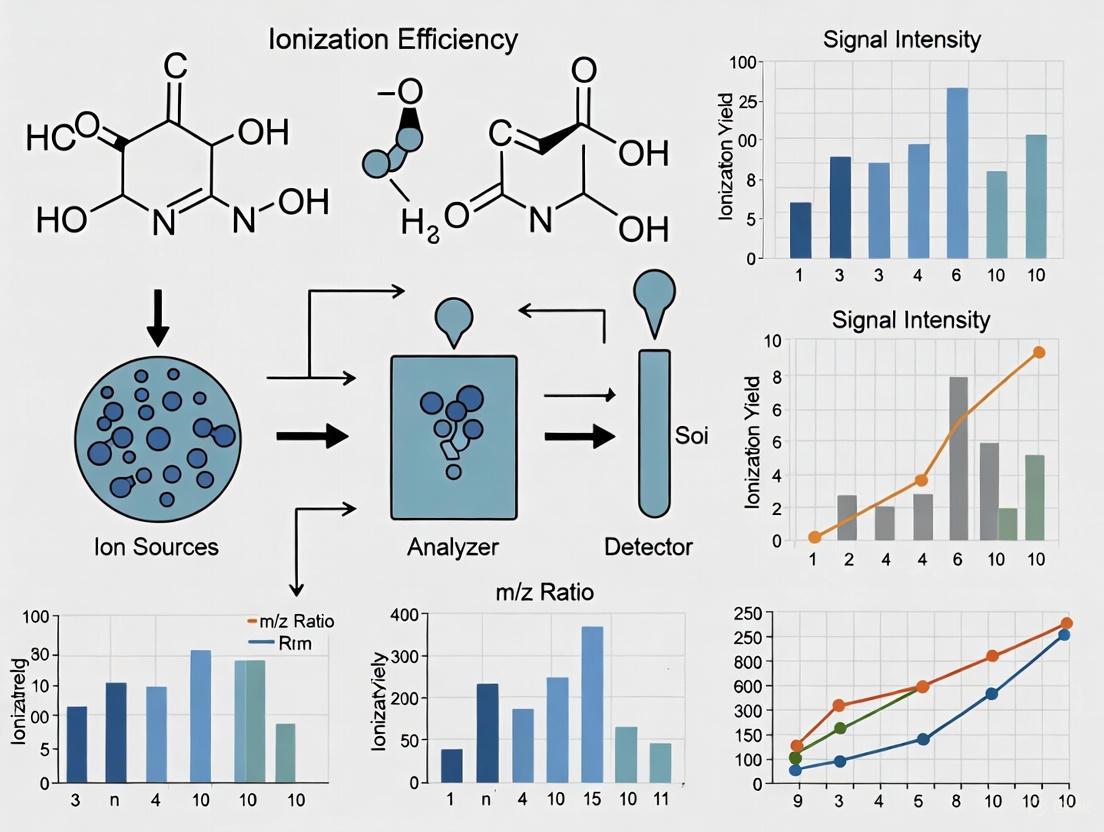
Ionization efficiency—the effectiveness of converting neutral analyte molecules into gas-phase ions—is a cornerstone parameter that directly dictates the sensitivity, quantitative accuracy, and overall success of mass spectrometric analyses.
Ionization Efficiency in Mass Spectrometry: A Comprehensive Guide for Biomedical Researchers
Abstract
Ionization efficiency—the effectiveness of converting neutral analyte molecules into gas-phase ions—is a cornerstone parameter that directly dictates the sensitivity, quantitative accuracy, and overall success of mass spectrometric analyses. This article provides a comprehensive exploration of ionization efficiency, from its fundamental physical principles and governing equations to its critical role in modern methodologies like LC-MS and TIMS. It offers researchers and drug development professionals a systematic framework for troubleshooting and optimizing ionization, utilizing advanced approaches such as Design of Experiments (DoE). Furthermore, it addresses the pivotal challenge of validation, covering the use of internal standards and comparative techniques to ensure reliable data across diverse biomedical applications, from metabolomics to proteomics.
The Fundamentals of Ionization Efficiency: Principles and Governing Equations
In mass spectrometry, ionization efficiency is the critical process that determines the success of all subsequent analysis. It fundamentally represents the effectiveness with which neutral analyte molecules in a sample are converted into gas-phase ions that can be manipulated and detected by the mass spectrometer [1]. This efficiency serves as the essential bridge between the sample introduction system and the mass analyzer, dictating the sensitivity, dynamic range, and ultimately the quality of the analytical data obtained. For researchers in pharmaceuticals and biomarker discovery, where samples are often complex and analytes present at trace concentrations, understanding and optimizing ionization efficiency is not merely beneficial—it is imperative for obtaining meaningful biological results [2] [3].
The importance of ionization efficiency extends beyond simple signal intensity. In electrospray ionization (ESI) studies of non-covalent protein-ligand complexes, for instance, the ionization process must be gentle enough to preserve solution-phase equilibrium concentrations while simultaneously providing sufficient ion yield for detection [4]. The efficiency of this transformation from neutral molecule to gas-phase ion is governed by a complex interplay of physicochemical properties of the analyte, the ionization technique employed, and numerous instrumental parameters that can be optimized [3]. This whitepaper explores the fundamental principles, measurement approaches, and optimization strategies for ionization efficiency, providing researchers with a comprehensive framework for maximizing this critical link between sample and signal.
Theoretical Foundations and Defining Principles
Quantitative Definition and Key Parameters
Ionization efficiency can be quantitatively defined by several interrelated parameters that provide a framework for its evaluation. In the context of electron ionization (EI), the sample ion current (I+) provides a measurable quantity representing the ionization rate, described by the equation:
I+ = βQiL[N]Ie
where:
- β represents the ion extraction efficiency
- Qi is the total ionizing cross-section
- L is the effective ionizing path length
- [N] is the concentration of sample molecules
- Ie is the ionizing current [5]
This relationship highlights that ionization efficiency depends not only on the inherent properties of the analyte (Qi) but also on instrumental factors that can be optimized. The ionization cross-section of an atom or molecule is a critical property that determines its probability of ionization under specific conditions and can be measured across different electron energies [1]. For molecular systems, the additivity rule postulated by Otvos and Stevenson allows approximation of molecular ionization cross-sections from atomic constituents, though this provides only a rough estimate accurate within a factor of two [1].
A more generalized definition applicable across ionization techniques conceptualizes ion utilization efficiency as the proportion of analyte molecules in solution that are successfully converted to gas-phase ions and transmitted through the mass spectrometer interface [6]. This holistic view encompasses not only the initial ionization event but also the subsequent transmission losses, providing a more complete picture of overall system performance for sensitive applications like biomarker detection [2].
Comparative Efficiencies Across Ionization Techniques
Table 1: Comparison of Ionization Efficiencies Across Common Mass Spectrometry Techniques
| Ionization Technique | Typical Efficiency Range | Optimal Application Domain | Key Influencing Factors |
|---|---|---|---|
| Electron Ionization (EI) | ~0.1% (1 in 1000 molecules ionized at 70 eV) [5] | Low MW organic compounds (<600 amu), volatile samples [5] | Electron energy (optimized at 70 eV), ionization cross-section, ionizing current [5] |
| Electrospray Ionization (ESI) | Highly compound-dependent; can be significantly enhanced with nanoESI [3] [6] | Polar molecules, proteins, non-covalent complexes, LC-MS coupling [7] [4] | Solvent composition, surface activity, gas flows, voltages, in-source fragmentation [7] [3] |
| Multi-Collector ICP-MS | Near 100% for most elements [1] | Elemental analysis, isotope ratio studies [1] | Element-specific, ionization potential |
| Atmospheric Pressure Chemical Ionization | Compound-dependent; often lower than ESI for polar compounds | Less polar small molecules, pharmaceutical compounds | Proton affinity, gas-phase reactions |
The wide variation in reported efficiency ranges underscores the technique- and application-dependent nature of ionization efficiency. The near 100% efficiency reported for Multi-Collector ICP-MS reflects the extremely high temperature plasma source that efficiently atomizes and ionizes most elements in the periodic table [1]. In contrast, the relatively low efficiency of EI (approximately 0.1%) is offset by its excellent reproducibility and extensive fragmentation libraries that facilitate compound identification [5]. For ESI, efficiency is highly compound-specific and heavily influenced by experimental conditions, with nanoelectrospray (nanoESI) demonstrating significantly improved ionization efficiency compared to conventional ESI due to smaller droplet formation and more efficient desolvation [6].
Measurement and Evaluation Methodologies
Experimental Approaches for Efficiency Quantification
Evaluating ionization efficiency requires carefully designed experimental strategies that correlate solution-phase analyte concentration with detected ion signal. The fundamental challenge lies in distinguishing between actual ionization efficiency and subsequent transmission losses through the instrument interface [6]. Two primary approaches have emerged for this assessment:
Targeted Standard Evaluation: This conventional approach uses large panels of metabolite or analyte standards to systematically measure response factors across different compound classes [3]. While comprehensive, this method is time-consuming and costly, requiring careful preparation and analysis of numerous standard solutions.
Non-Targeted Feature-Based Evaluation: This innovative approach uses dilution series of test samples (e.g., biofluids) and statistical analysis of all detected mass spectral features to compare instrumental setups without chemical identification [3]. This method offers practical advantages of speed and cost-effectiveness while still providing robust assessment of overall system performance.
For ESI-MS interfaces specifically, researchers have developed methods to measure the total gas-phase ion current transmitted through the interface and correlate it with the observed ion abundance in mass spectra [6]. This allows calculation of the ion utilization efficiency which encompasses both the initial ionization and subsequent transmission. Experimental results using this methodology have demonstrated that subambient pressure ionization with nanoelectrospray (SPIN) MS interface configurations exhibit superior ion utilization efficiency compared to conventional inlet capillary-based ESI-MS interfaces [6].
Statistical Design for Systematic Optimization
Beyond simple evaluation, Design of Experiments (DoE) approaches provide powerful statistical frameworks for systematically optimizing multiple ionization parameters simultaneously [7] [4]. Unlike traditional one-factor-at-a-time (OFAT) approaches, DoE efficiently explores complex parameter spaces and identifies interactions between factors that significantly influence ionization efficiency [7].
A representative DoE workflow for ESI optimization typically involves:
- Factor Screening: Identifying which of many potential parameters (e.g., gas temperatures, flow rates, voltages) significantly influence ionization efficiency
- Response Surface Methodology: Modeling the relationship between significant factors and ionization response to identify optimal regions
- Robustness Testing: Verifying that the identified optimal conditions perform consistently with minor expected variations [7]
This approach was successfully applied to optimize ESI conditions for supercritical fluid chromatography-mass spectrometry (SFC-MS) coupling, where eight different ESI factors were systematically evaluated using a geometric experimental design [7]. Similarly, DoE with inscribed central composite designs (CCI) has been employed to establish optimal ESI conditions for accurate determination of protein-ligand binding constants [4].
Diagram 1: DoE Optimization Workflow for ESI Parameters
Practical Optimization Strategies
Technique-Specific Optimization Parameters
Each ionization technique presents unique optimization parameters that directly impact ionization efficiency:
For Electron Ionization (EI):
- Filament current controls electron production through thermionic emission [5]
- Electron energy is typically optimized at 70 eV where the de Broglie wavelength of electrons matches typical organic bond lengths, maximizing energy transfer [5]
- Ionizing path length can be increased using weak magnetic fields to force electrons into helical paths [5]
- Ion extraction efficiency is optimized by adjusting repeller and acceleration voltages [5]
For Electrospray Ionization (ESI):
- Source gas parameters (drying gas temperature and flow, sheath gas settings) significantly influence droplet desolvation [7] [3]
- Voltage settings (capillary, nozzle, fragmentor) control ion formation, declustering, and transmission [7]
- Solvent composition and flow rate directly impact droplet formation and charge concentration [6] [4]
- Source geometry and emitter position relative to the inlet affect ion sampling efficiency [6]
In ESI-MS studies of non-covalent protein-ligand complexes, optimization must balance multiple competing objectives: maximizing ionization efficiency while minimizing complex dissociation during the ESI process and maintaining native solution-phase equilibrium concentrations [4]. This requires careful tuning of "soft" ionization conditions that gently transfer the complex into the gas phase without disrupting non-covalent interactions.
The Scientist's Toolkit: Essential Reagents and Materials
Table 2: Key Research Reagent Solutions for Ionization Efficiency Studies
| Reagent/Material | Function in Ionization Studies | Application Examples |
|---|---|---|
| Metabolite Standard Libraries | Provides known compounds for systematic evaluation of ionization response across chemical space [3] | Targeted evaluation of ESI efficiency for different compound classes [3] |
| Stable Isotope-Labeled Internal Standards | Corrects for variance in ionization efficiency due to matrix effects [2] | Quantitative proteomics and metabolomics [2] |
| Model Protein-Ligand Systems | Enable optimization of "soft" ionization conditions for non-covalent complexes [4] | ESI-MS studies of protein-ligand interactions (e.g., PvGK with GMP/GDP) [4] |
| Mobile Phase Additives | Modify solution chemistry to enhance ionization (e.g., ammonium acetate, formic acid) [7] [4] | LC-ESI-MS method development for small molecules and proteins [7] |
| Custom Etched ESI Emitters | Produce stable electrospray with improved ionization efficiency, particularly at low flow rates [6] | Nanoelectrospray MS applications requiring high sensitivity [6] |
Advanced Considerations in Ionization Efficiency
Technological Innovations and Emerging Trends
Recent technological developments continue to push the boundaries of ionization efficiency in mass spectrometry. Nanoelectrospray ionization (nanoESI) operates at nL/min flow rates, significantly improving ionization efficiency compared to conventional ESI through the production of smaller initial droplets with higher charge-to-volume ratios [6]. The Subambient Pressure Ionization with Nanoelectrospray (SPIN) interface removes the conventional inlet capillary, placing the ESI emitter directly in the first vacuum stage of the mass spectrometer, thereby reducing transmission losses and improving overall ion utilization efficiency [6].
ESI emitter arrays represent another innovation, functioning as "brighter" ion sources that increase total available ion current [6]. When coupled with advanced interface designs like the SPIN-MS, these emitter arrays demonstrate significantly improved ionization and transmission characteristics compared to single-emitter configurations [6]. For high-throughput screening applications, multi-capillary inlets arranged in hexagonal patterns have shown promise in increasing sampling efficiency from multiple ESI sources [6].
Beyond hardware innovations, data analysis approaches continue to evolve. Advanced feature evaluation strategies that combine intensity-based statistics with chemical interpretation provide more comprehensive assessment of ionization performance across diverse compound classes [3]. These approaches are particularly valuable in nontargeted analysis where chemical standards are unavailable for many detected features.
Addressing In-Source Processes and Artifacts
Ionization efficiency cannot be considered in isolation from in-source processes that may compromise data quality. In-source fragmentation represents a significant challenge, where excessive internal energy deposited during ionization leads to dissociation of labile compounds before mass analysis [3]. This not reduces the intensity of molecular ions but generates fragment ions that can be misinterpreted as separate compounds. The degree of in-source fragmentation varies significantly between analytes and must be carefully controlled through parameter optimization [3].
Ion suppression effects present another critical consideration, particularly in ESI analysis of complex mixtures [7]. When multiple analytes co-elute, competition for available charge and droplet surface area can significantly reduce ionization efficiency for less competitive compounds [7]. This matrix-dependent phenomenon underscores the importance of effective chromatographic separation and appropriate internal standards for quantitative work [2].
Diagram 2: Ionization Challenges in the ESI Process
Ionization efficiency represents far more than a simple conversion metric—it is the fundamental bridge between sample composition and detectable signal that dictates the success of mass spectrometric analysis. As mass spectrometry continues to expand into new application areas including clinical diagnostics, pharmaceutical development, and regulatory analysis, the demand for robust, efficient, and reproducible ionization methods will only intensify [2] [3]. The systematic approaches to evaluation and optimization outlined in this whitepaper provide researchers with a framework for maximizing this critical link in their analytical workflows. Through continued innovation in ionization sources, interface designs, and optimization methodologies, the field moves steadily toward the ultimate goal of comprehensive, unbiased detection of all analytes in complex samples—a goal that rests squarely on the foundation of ionization efficiency.
Ionization efficiency is a critical performance parameter in mass spectrometry (MS), defined as the ability of a technique to effectively convert analyte molecules in a sample into gaseous ions that can be detected and analyzed [8]. This parameter directly determines the sensitivity and detection limits of a mass spectrometry method, as it governs the number of ions available for detection and measurement [8]. Higher ionization efficiency yields a greater number of analyte ions, resulting in improved signal-to-noise ratios and enhanced capability for detecting trace-level compounds [8]. In the broader context of mass spectrometry research, understanding and optimizing ionization efficiency is fundamental across diverse applications, from drug development and proteomics to environmental analysis and clinical diagnostics.
The ionization process represents the foundational step in mass spectrometry, where neutral molecules are transformed into charged ions capable of being manipulated by electric and magnetic fields within the mass spectrometer [9] [10]. This process occurs in the ion source, where samples—whether solid, liquid, or gas—are converted into gaseous ions before being introduced to the mass analyzer [9]. The efficiency of this conversion process is influenced by multiple physical principles, primarily governed by the work function of ionization surfaces, the ionization potential of elements and molecules, and the theoretical framework described by the Saha-Langmuir equation.
Table 1: Key Parameters Governing Ionization Efficiency
| Parameter | Symbol | Definition | Role in Ionization Efficiency |
|---|---|---|---|
| Work Function | φ | Minimum energy needed to remove an electron from a solid surface | Determines surface's ability to donate/accept electrons during ionization |
| Ionization Potential/Energy | IE | Energy required to remove an electron from a gaseous atom/molecule | Indicates how easily an atom/molecule forms positive ions |
| Electron Affinity | EA | Energy change when an electron is added to a neutral atom/molecule | Indicates how easily an atom/molecule forms negative ions |
| Ionization Efficiency | α | Ratio of ionized particles to neutral particles | Direct measure of ionization effectiveness |
Theoretical Foundations
Work Function (φ)
The work function (φ) represents a fundamental surface property defined as the minimum energy required to remove an electron from the solid surface of a material to a point in the vacuum immediately outside the surface [11]. This parameter plays a crucial role in surface ionization techniques, where the ionization process occurs on hot metal surfaces such as rhenium, tantalum, or platinum filaments [12]. The work function value determines the surface's ability to either donate or accept electrons during the ionization process, thereby directly influencing the efficiency of ion formation.
In practical mass spectrometry applications, the work function of the ionization surface material must be carefully selected based on the specific analytes being investigated. For efficient positive ion formation, surfaces with high work functions are preferred as they more readily donate electrons to analyte molecules. Conversely, for negative ion formation, surfaces with lower work functions facilitate more efficient electron transfer from the surface to the analyte molecules [11]. Research has demonstrated that the composition of the ionization chamber itself can influence ionization efficiency, as different materials possess characteristic work function values that either enhance or diminish ion yields for specific applications [11].
Ionization Potential (IP) and Electron Affinity (EA)
Ionization potential (IP), also referred to as ionization energy, represents the minimum energy required to remove an electron from a gaseous atom or molecule, thereby converting it into a positive ion [12]. This fundamental atomic property varies significantly across different elements, with elements such as rubidium and strontium possessing low ionization potentials that facilitate ionization at lower temperatures, while elements like thorium and uranium with high ionization potentials require significantly higher temperatures for effective ionization [12].
Electron affinity (EA) represents the complementary parameter, defined as the energy change that occurs when an electron is added to a neutral atom or molecule in the gaseous state to form a negative ion [11]. The electron affinity values for common oxygen-containing molecules illustrate the range of this parameter, from -0.60 eV for CO₂ to 2.27 eV for NO₂ [11]. The relationship between the work function of the ionization surface and the electron affinity of the analyte molecule determines the efficiency of negative ion formation, with optimal conditions occurring when the work function is comparable to or lower than the electron affinity [11].
Table 2: Electron Affinity Values for Oxygen-Containing Molecules
| Molecule/Atom | Electron Affinity (eV) | Filament Temperature for O⁻ Formation (°C) |
|---|---|---|
| O₂ | 0.45 | 1548-1721 (depending on molecule) |
| CO₂ | -0.60 | 1548-1721 (depending on molecule) |
| CO | 1.33 | 1548-1721 (depending on molecule) |
| NO | 0.026 | 1548-1721 (depending on molecule) |
| NO₂ | 2.27 | 1548-1721 (depending on molecule) |
| O | 1.46 | Not Applicable |
The Saha-Langmuir Equation
The Saha-Langmuir equation provides the fundamental theoretical framework describing thermal surface ionization processes, establishing the quantitative relationship between temperature, surface properties, and analyte characteristics in determining ionization efficiency [12] [11]. This equation mathematically expresses the degree of ionization (α) for both positive and negative ion formation under thermal equilibrium conditions.
For positive ionization, the Saha-Langmuir equation is expressed as:
[ \alpha{+} = \frac{N{+}}{N{0}} = \frac{g{+}}{g_{0}} \exp\left(\frac{\phi - IP}{kT}\right) ]
For negative ionization, the equation takes the form:
[ \alpha{-} = \frac{N{-}}{N{0}} = \frac{g{-}}{g_{0}} \exp\left(\frac{EA - \phi}{kT}\right) ]
Where:
- (N{+}), (N{-}), and (N_{0}) represent the numbers of positive ions, negative ions, and neutral molecules, respectively
- (g{+}/g{0}) and (g{-}/g{0}) are the ratios of statistical weights of the ions and neutral molecules
- (\phi) is the work function of the surface material
- (IP) is the ionization potential of the analyte
- (EA) is the electron affinity of the analyte
- (k) is the Boltzmann constant
- (T) is the absolute temperature in Kelvin [11]
The exponential dependence of ionization efficiency on the difference between work function and ionization potential (or electron affinity for negative ions) explains the high sensitivity of thermal ionization processes to temperature optimization and surface selection. This theoretical framework guides experimental design in thermal ionization mass spectrometry (TIMS), enabling researchers to maximize ionization efficiency for specific target analytes through appropriate choice of filament materials and temperature profiles [12] [11].
Ionization Techniques and Their Efficiencies
Thermal Ionization Mass Spectrometry (TIMS)
Thermal Ionization Mass Spectrometry employs heated metal filaments to vaporize and ionize samples based on the principles described by the Saha-Langmuir equation [12]. The instrumental configuration consists of four main systems: an ion source with one or more metal filaments (typically rhenium, tantalum, or platinum), a beam collimator, a magnet for mass separation, and a detector, along with supporting vacuum systems, power supplies, and computer controls [12].
In TIMS operation, the sample is loaded as a solid compound directly onto the filament, sometimes with the addition of an activator to enhance ionization efficiency [12]. As the filament temperature increases, the sample evaporates and ionizes simultaneously, or alternatively, vapor molecules are ionized by contact with a separate ionization filament maintained at a significantly higher temperature [12]. The temperature dependence follows the Saha-Langmuir equation, with elements possessing low ionization potentials (such as Rb and Sr) ionizing at lower temperatures than those with high ionization potentials (such as Th and U) [12]. For some challenging elements like lead, the use of an activator is essential to achieve practical ionization efficiency, while for elements like osmium, the ionization potential favors the formation of negative ions (OsO₃⁻) [12].
Electron Ionization (EI) and Other Techniques
Electron Ionization represents a "hard" ionization technique that employs high-energy electrons (typically 70 eV) to bombard vaporized sample molecules, resulting in the ejection of electrons and formation of positive ions [9] [10]. This method typically produces significant fragmentation, generating numerous fragment ions that provide valuable structural information but may reduce the abundance of the molecular ion [9] [10]. EI operates with high ionization efficiency and sensitivity for organic compounds with molecular weights below 600 Da, finding applications in environmental, forensic, archaeological, and pharmaceutical analysis [9].
Alternative ionization techniques have been developed to address different analytical needs and sample types. Soft ionization techniques, including Electrospray Ionization (ESI) and Matrix-Assisted Laser Desorption/Ionization (MALDI), impart less energy to analyte molecules during the ionization process, resulting in minimal fragmentation and predominant molecular ion peaks [9]. These techniques are particularly valuable for analyzing large, thermally labile biomolecules such as proteins, peptides, and nucleotides [9]. Atmospheric Pressure Chemical Ionization (APCI) and Atmospheric Pressure Photo Ionization (APPI) represent additional soft ionization methods suitable for different compound classes, with APCI effective for polar and thermally stable non-polar compounds, and APPI particularly useful for weakly polar and non-polar compounds such as pesticides, steroids, and drug metabolites [9].
Table 3: Comparison of Ionization Techniques in Mass Spectrometry
| Ionization Technique | Ionization Type | Typical Analytes | Efficiency Characteristics | Key Applications |
|---|---|---|---|---|
| Thermal Ionization (TIMS) | Surface | Elements, Isotopes | Highly efficient for elements with low IP | Isotope ratio analysis, geochronology |
| Electron Ionization (EI) | Gas Phase (Hard) | Small organics (<600 Da) | High ionization efficiency, extensive fragmentation | Unknown identification, forensic analysis |
| Electrospray Ionization (ESI) | Soft | Peptides, proteins, nucleotides | High efficiency for large biomolecules, multiple charging | Proteomics, pharmaceutical analysis |
| MALDI | Soft | Large biomolecules, polymers | High efficiency for fragile molecules | Pathology, protein identification |
| ICP | Hard | Trace metals, non-metals | Highly efficient element ionization | Trace element analysis, clinical labs |
Experimental Protocols and Methodologies
Thermal Ionization Experimental Protocol
The investigation of negative ion formation from oxygen-containing molecules provides a detailed experimental framework for studying ionization efficiency [11]. This protocol examines O⁻ formation from simple gases (O₂, CO₂, CO, NO, and NO₂) by analyzing the dependence of O⁻ ion current intensity on filament temperature, identifying optimal temperatures ranging from 1548 to 1721°C for different gases [11].
Instrument Configuration:
- Ion source with spiral cathode (filament) made of MoRe alloy
- Ionization chamber constructed of tantalum positioned proximate to filament
- Vacuum system maintaining appropriate pressure for ion transmission
- Temperature measurement and control system for precise filament heating
- Electrical current detection system (picoammeter) for ion current measurement [11]
Experimental Procedure:
- The filament temperature is gradually increased while introducing the target gas
- The O⁻ ion current is monitored continuously as a function of temperature
- Temperature is calibrated using optical pyrometry or resistance measurements
- Ion current measurements are averaged from multiple consecutive readings (typically 100 measurements) to ensure statistical significance
- The optimal temperature for maximum O⁻ yield is identified for each gas compound
- The relationship between ion current intensity and temperature is analyzed according to the Saha-Langmuir equation [11]
Data Interpretation: The experimental data revealed distinct formation pathways for different gases. For NO₂, the process likely involves a two-step dissociation mechanism where molecular oxygen (O₂) forms in the initial step, subsequently dissociating into O⁻ and O atoms. In contrast, for CO, O⁻ formation occurs predominantly through electron capture followed by molecular dissociation [11]. These pathway differences manifest as variations in the temperature dependence of ion current intensity, with each gas exhibiting a characteristic temperature profile for optimal O⁻ formation [11].
Electrospray Ionization Efficiency Protocol
The evaluation of Electrospray Ionization efficiency presents distinct methodological considerations, focusing on the proportion of analyte molecules in solution that are successfully converted to gas phase ions and transmitted through the MS interface [6]. This protocol employs a systematic approach to quantify ionization and transmission efficiencies across different ESI-MS interface configurations.
Experimental Design:
- Preparation of standard peptide solutions (angiotensin I, angiotensin II, bradykinin, etc.) at defined concentrations
- Comparison of different interface configurations: single capillary inlet, multi-capillary inlet, and SPIN (Subambient Pressure Ionization with Nanoelectrospray) interface
- Use of tandem ion funnel interface with variable RF voltages and DC gradients
- Correlation of transmitted electric current with observed ion abundance in mass spectra [6]
Measurement Approach:
- The total gas phase ion current transmitted through the interface is measured using the low pressure ion funnel as a charge collector connected to a picoammeter
- The corresponding ion abundance is simultaneously measured in the mass spectrum as total ion current (TIC) or extracted ion current (EIC) for specific analytes
- Measurements are performed across different interface configurations and operating parameters
- The ion utilization efficiency is calculated as the proportion of analyte molecules converted to detectable gas phase ions [6]
Key Findings: Experimental results demonstrated that the overall ion utilization efficiency of SPIN-MS interface configurations exceeded that of conventional inlet capillary-based ESI-MS interfaces [6]. The highest transmitted ion current was achieved using the SPIN interface with an ESI emitter array combination, highlighting the importance of both ionization source brightness and interface transmission characteristics in determining overall MS sensitivity [6].
Visualization of Ionization Processes
Thermal Ionization Experimental Workflow
Saha-Langmuir Principle Relationships
Research Reagent Solutions for Ionization Efficiency Studies
Table 4: Essential Research Reagents and Materials for Ionization Efficiency Studies
| Reagent/Material | Specifications | Function in Ionization Research |
|---|---|---|
| MoRe Alloy Filament | High-temperature resistant | Electron emission source for thermal ionization studies |
| Tantalum Ionization Chamber | Work function: 4.25 eV | Alternative ionization surface for negative ion studies |
| Rhenium/Tantalum/Platinum Filaments | Various work functions | Sample vaporization and ionization surfaces for TIMS |
| Standard Peptide Mixtures | Angiotensin I/II, Bradykinin, Neurotensin | ESI ionization efficiency calibration standards |
| High-Purity Gases | O₂, CO₂, CO, NO, NO₂ (research grade) | Negative ion formation pathway studies |
| Matrix Materials | Organic acids (for MALDI) | Energy absorption and transfer in soft ionization |
| Reagent Gases | Methane, isobutane, ammonia (for CI) | Chemical ionization reaction mediators |
| Solvent Systems | 0.1% Formic acid in 10% acetonitrile/water | ESI mobile phase optimization studies |
| Fused Silica Emitters | OD: 150μm, ID: 10μm (etched tips) | Nanoelectrospray ionization source fabrication |
The fundamental physical principles of work function, ionization potential, and the Saha-Langmuir equation provide the theoretical foundation for understanding and optimizing ionization efficiency in mass spectrometry. The work function of ionization surfaces and the ionization potential or electron affinity of analytes collectively determine the thermodynamic feasibility of ion formation, while the Saha-Langmuir equation quantitatively describes the exponential dependence of ionization efficiency on the relationship between these parameters under specific temperature conditions.
Experimental methodologies for evaluating ionization efficiency encompass diverse approaches, from thermal ionization studies measuring ion current as a function of filament temperature to electrospray ionization investigations correlating transmitted ion current with mass spectral abundance. These protocols enable rigorous comparison of ionization techniques and interface configurations, guiding instrument selection and method development for specific analytical challenges.
In the broader context of mass spectrometry research, ionization efficiency remains a central consideration influencing instrument sensitivity, detection limits, and analytical applicability across diverse fields including pharmaceutical development, clinical analysis, environmental monitoring, and fundamental chemical research. The continuing refinement of ionization sources and the optimization of ionization conditions based on these fundamental principles promise enhanced analytical capabilities for addressing increasingly complex scientific questions in the future.
Ionization, the process of converting neutral atoms or molecules into charged ions, serves as the critical first step in mass spectrometric analysis, enabling the detection and characterization of chemical compounds by manipulating them with electric and magnetic fields [13]. The choice of ionization technique directly dictates the type of chemical information that can be obtained, influencing everything from molecular weight determination to structural elucidation. Ionization methods are broadly classified into two categories: hard ionization and soft ionization [13]. Hard ionization techniques, such as Electron Ionization (EI), impart high internal energy to analyte molecules, resulting in significant fragmentation that provides valuable structural fingerprints. In contrast, soft ionization methods, including Electrospray Ionization (ESI), Atmospheric Pressure Chemical Ionization (APCI), and various plasma-based techniques, transfer minimal internal energy, preferentially producing intact molecular ions with little fragmentation—a crucial capability for analyzing large, labile biomolecules [14] [15] [13].
Within the context of ionization efficiency research, the fundamental challenge lies in understanding and optimizing how effectively a given ionization method can convert neutral molecules of interest into detectable ions across the vast diversity of chemical space. This efficiency directly impacts key analytical figures of merit including sensitivity, limit of detection, and quantitative accuracy, particularly for analytes lacking reference standards [16]. Recent research focuses on expanding ionization capabilities to cover broader chemical spaces, reducing matrix effects that suppress ionization, and developing predictive models that can estimate ionization efficiency based on molecular characteristics [17] [16].
Core Ionization Techniques: Mechanisms and Characteristics
Electron Ionization (EI)
Mechanism: Electron Ionization operates by bombarding vaporized sample molecules with a high-energy beam of electrons (typically 70 eV) generated from a heated filament [13]. When these high-energy electrons collide with analyte molecules (M), they can eject an electron, generating a positively charged molecular ion radical (M⁺•) according to the equation: M + e⁻ → M⁺• + 2e⁻ [13]. The substantial energy transferred during this process typically exceeds chemical bond strengths, causing the molecular ions to undergo extensive fragmentation into smaller daughter ions, which provide characteristic patterns useful for structural identification [13] [18].
Applications and Limitations: EI is extensively used in gas chromatography-mass spectrometry (GC-MS) for analyzing small organic molecules, hydrocarbons, alcohols, and aromatic compounds [13]. Its major advantages include well-established, reproducible spectral libraries that facilitate compound identification, and the rich structural information provided by fragmentation patterns [14]. However, EI is unsuitable for large or thermally labile compounds like proteins, as the extensive fragmentation can completely destroy the molecular ion, eliminating molecular weight information [13]. A specific pitfall in certain applications is the potential for chemical ionization to inadvertently occur in the electron ionization chamber when analyzing high-concentration gases from electrochemical reactions, potentially scrambling mass-to-charge ratio distributions and misleading analysis [19].
Soft Ionization Techniques
Electrospray Ionization (ESI)
Mechanism: ESI generates ions directly from solution at atmospheric pressure by applying a high voltage (3-5 kV) to a liquid sample flowing through a metal capillary [13]. This creates a fine spray of charged droplets that shrink through solvent evaporation in a heated desolvation zone [13]. As droplet charge density increases, Coulombic explosions occur until gas-phase analyte ions are released, typically as protonated [M+H]⁺ or deprotonated [M-H]⁻ molecules, or as multiply charged species for large biomolecules [13].
Applications and Limitations: ESI excels for polar, non-volatile compounds including peptides, proteins, nucleic acids, and most pharmaceuticals, making it the dominant ionization source for liquid chromatography-mass spectrometry (LC-MS) [17] [15] [13]. Its soft nature preserves molecular integrity but produces limited structural fragmentation unless coupled with tandem MS [18]. Key limitations include pronounced sensitivity to sample contaminants (e.g., salts) and significant matrix effects where co-eluting compounds can suppress or enhance ionization, complicating quantification [17] [15].
Atmospheric Pressure Chemical Ionization (APCI)
Mechanism: APCI also operates at atmospheric pressure but vaporizes the LC effluent in a heated nebulizer before ionization [13]. The resulting gas-phase solvent and analyte molecules are then exposed to a corona discharge needle that generates primary reagent ions (e.g., H₃O⁺, N₂⁺, O₂⁺) from the solvent vapor [15] [13]. These reagent ions subsequently undergo ion-molecule reactions with analyte molecules through proton transfer, adduct formation, or charge exchange to produce analyte ions like [M+H]⁺ [15] [13].
Applications and Limitations: APCI is particularly effective for medium-to-low polarity compounds that are less amenable to ESI, including sterols, lipids, certain pharmaceuticals, and pesticides [17] [15]. It typically exhibits reduced matrix effects compared to ESI and is less susceptible to adduct formation [17]. However, its applicability is limited for thermally labile compounds that may decompose during the vaporization step [15].
Plasma-Based Ionization Techniques
Mechanism: Dielectric barrier discharge ionization (DBDI) and Flexible Microtube Plasma (FμTP) techniques create non-equilibrium plasma at room temperature using high-voltage alternating current between electrodes separated by a dielectric barrier, typically with noble gases like helium or argon [17]. The plasma contains energetic species (metastable atoms, electrons, ions) that ionize analyte molecules through mechanisms including Penning ionization, charge transfer, or proton transfer, producing [M]⁺• or [M+H]⁺ ions [17].
Applications and Limitations: These emerging techniques demonstrate remarkable versatility across polarity ranges, efficiently ionizing both polar and nonpolar compounds while exhibiting minimal matrix effects compared to ESI [17]. Recent studies show FμTP outperforming ESI for approximately 70% of pesticides tested and demonstrating negligible matrix effects for 76-86% of pesticides across different food matrices [17]. Tube Plasma Ionization (TPI), a related technique, has shown comparable performance to APCI for sterol analysis with superior sensitivity to ESI and robust performance in complex biological matrices [15]. Limitations include the ongoing need to understand fundamental ionization mechanisms, especially when using alternative discharge gases like argon [17].
Table 1: Comparison of Key Ionization Techniques in Mass Spectrometry
| Technique | Ionization Mechanism | Analyte Compatibility | Fragmentation Level | Key Applications |
|---|---|---|---|---|
| Electron Ionization (EI) | High-energy electron bombardment | Volatile, thermally stable small molecules | High (extensive fragmentation) | GC-MS of small organics, structural elucidation |
| Electrospray Ionization (ESI) | Charged droplet formation and Coulombic explosion | Polar and non-volatile compounds | Low (intact molecular ions) | LC-MS of biomolecules, pharmaceuticals, metabolites |
| Atmospheric Pressure Chemical Ionization (APCI) | Corona discharge and gas-phase ion-molecule reactions | Medium-to-low polarity compounds | Low to moderate | LC-MS of sterols, lipids, less polar pharmaceuticals |
| Plasma-Based (FμTP/TPI) | Plasma-induced ionization with discharge gases | Wide polarity range (polar to nonpolar) | Low (intact molecular ions) | Multiclass pesticide screening, sterol analysis |
Current Research Perspectives on Ionization Efficiency
Expanding the Accessible Chemical Space
A primary research focus involves developing ionization techniques capable of addressing the fundamental limitation that "no single method can detect or identify chemicals across the complete scope of the so-called chemical space" [17]. The accessible chemical space refers to the range of compounds that can be effectively ionized and detected by a given analytical method [17]. Plasma-based ionization sources like FμTP represent significant advancements here, demonstrating particularly broad coverage by efficiently ionizing diverse compound classes including ESI-amenable pesticides, traditionally challenging organochlorine contaminants, and sterols in complex biological matrices [17] [15]. This expanded coverage reduces reliance on multiple analytical techniques and enables more comprehensive nontargeted screening from single analyses [17].
Mitigating Matrix Effects and Improving Quantification
Matrix effects—where co-eluting compounds interfere with analyte ionization—represent a major challenge for quantitative analysis, particularly in ESI [17]. Research comparing ionization sources demonstrates that plasma-based techniques like FμTP exhibit significantly reduced matrix effects, with 76-86% of tested pesticides showing negligible matrix effects across different food matrices compared to only 35-67% for ESI [17]. Similarly, Tube Plasma Ionization (TPI) provided stable signals with minimal ion suppression compared to ESI when analyzing sterols in complex samples like human plasma, HepG2 cells, and liver tissue [15]. These characteristics make alternative ionization sources particularly valuable for applications requiring robust quantification in complex matrices.
Predictive Modeling of Ionization Efficiency
Recent research explores computational approaches to predict ionization efficiency (IE) based on molecular characteristics, addressing a fundamental challenge in non-targeted analysis where analytical standards are unavailable [16]. Two promising modeling approaches have emerged: structure-based models using molecular fingerprints, and fragmentation-based models using cumulative neutral losses from MS² spectra [16]. The molecular fingerprint model achieved a root-mean-square error (RMSE) of 0.72 logIE units, while the cumulative neutral losses approach, applicable to compounds with unknown structures, achieved a promising RMSE of 0.79 logIE units [16]. These predictive models facilitate more accurate concentration estimations for both identified and unidentified compounds in non-targeted analysis workflows.
Table 2: Recent Technical Advances in Ionization Techniques and Their Impact on Efficiency
| Advancement | Technical Principle | Impact on Ionization Efficiency | Demonstrated Applications |
|---|---|---|---|
| Flexible Microtube Plasma (FμTP) | Dielectric guided discharge with singular electrode architecture | Higher sensitivity for 70% of pesticides vs. ESI; negligible matrix effects for 76-86% of pesticides | Multiclass pesticide screening in food matrices; expansion of analyzable chemical space |
| Variable-Energy Electron Ionization | Electrostatic element between e-gun and ion chamber enables tunable electron energy | Avoids sensitivity loss at low energies; improved signal-to-noise ratios; lower detection limits | Enhanced molecular ion detection for compound confirmation; isomer differentiation |
| Liquid Electron Ionization (LEI) Interface | Nebulization and vaporization of LC effluent for EI compatibility | Provides EI structural information for LC-amenable compounds; low matrix effects | Analysis of medium-low-MW environmental pollutants and toxicological substances |
| Ionization Efficiency Prediction Models | Machine learning using molecular fingerprints or MS² neutral losses | Enables concentration estimation without analytical standards (RMSE: 0.72-0.79 logIE units) | Non-targeted analysis quantification for identified and unidentified compounds |
Experimental Methodologies for Ionization Technique Evaluation
Objective: Systematically evaluate and compare the analytical performance of different ionization sources for specific application areas.
Protocol for Sterol Analysis [15]:
- Instrumentation: Utilize an LC system (e.g., Agilent 1290 Infinity II) coupled to a mass spectrometer (e.g., Agilent 6470 LC/TQ) with interchangeable ion sources.
- Chromatography: Employ a heart-cutting 2D-LC system with a PFP column (1.7 µm, 2.1 × 30 mm) in the first dimension and a C18 column (1.7 µm, 2.1 × 100 mm) in the second dimension. Use a binary gradient of water and methanol/water (99/1, v/v) both with 5 mmol/L ammonium formate and 0.1% formic acid.
- Ion Sources: Compare commercial ESI and APCI sources against a lab-made Tube Plasma Ionization (TPI) source.
- Performance Metrics:
- Determine limits of quantification (LOQs) using serial dilutions of sterol standards.
- Assess signal stability through extended measurement series.
- Quantify ion suppression by comparing standards in pure solvent versus spiked matrix extracts.
- Application: Analyze complex biological matrices including human plasma, HepG2 cells, and liver tissue to demonstrate real-world applicability.
Key Findings: In sterol analysis, both TPI and APCI provided comparable LOQs and clearly outperformed ESI in sensitivity. ESI suffered from pronounced ion suppression, while TPI and APCI offered stable signals during extended measurements, highlighting their robustness for complex matrix applications [15].
Optimization of Interface Design
Objective: Improve the instrumental detectability of Liquid Electron Ionization (LEI) interfaces through hardware optimization.
Protocol for LEI Interface Optimization [18]:
- Interface Setup: Test different configurations of the vaporization micro-channel (VMC) using various capillary dimensions and materials (standard silica vs. deactivated silica).
- Analysis Conditions:
- Use nanoflow rates (400-600 nL/min) compatible with UHPLC/HPLC (with flow splitting).
- Set VMC temperature to 350°C after preliminary optimization.
- Employ helium makeup gas at 1.2 mL/min.
- Analytical Measurements:
- Perform Flow Injection Analysis (FIA) with a triple-quadrupole MS operating in selected ion monitoring (SIM) or multiple reaction monitoring (MRM) modes.
- Conduct LC-MS analyses with a Q-TOF instrument in full-scan mode (83-600 m/z).
- Evaluation Metrics: Determine instrumental limits of detection (LODs) in triplicate for each setup configuration using representative analytes (PAHs and pesticides).
Key Findings: Optimizing the VMC setup with a deactivated silica capillary and appropriate dimensions significantly improved instrumental detectability, achieving LOD values almost five times lower than previous configurations for analytes like chlorpyrifos, atrazine, and PAHs [18].
Essential Research Reagents and Materials
Table 3: Key Research Reagents and Materials for Ionization Research
| Reagent/Material | Specification | Function in Ionization Research |
|---|---|---|
| Discharge Gases | Helium (99.9999%), Argon (99.999%), Argon-Propane mixtures | Create plasma in DBDI and FμTP sources; influence ionization mechanisms and efficiency |
| LC-MS Solvents | Methanol, Acetonitrile, Water (all LC-MS grade) | Dissolve and separate analytes; impact ionization efficiency in ESI, APCI, and plasma techniques |
| Mobile Phase Additives | Formic Acid, Ammonium Formate (LC-MS grade) | Enhance protonation/deprotonation in ESI and APCI; improve chromatographic separation |
| Analytical Standards | Pesticide mixes, Sterol standards (purity ≥ 98%) | Benchmark ionization performance across compound classes and determine detection limits |
| Capillary Materials | Deactivated silica, Ceramic, Stainless steel | Construct vaporization interfaces; material inertness affects analyte transport and peak shape |
Emerging Trends and Future Directions
Alternative Discharge Gases and Mechanism Elucidation
With declining helium reserves and operational concerns in mass spectrometer vacuum systems, research increasingly focuses on alternative discharge gases like argon and argon-propane mixtures for plasma-based ionization [17]. Early results show similar limits of quantification for nearly 90% of pesticides in positive mode when using argon-based gases compared to helium [17]. However, the fundamental ionization mechanisms with these alternative gases remain "not yet fully elucidated," particularly for argon where metastable atoms lack sufficient energy to directly ionize nitrogen [17]. Future research needs to clarify these mechanisms, especially the roles of Ar⁺ and Ar₂⁺ ions and the influence of trace gas impurities on ionization processes.
Advanced Interface Design and Miniaturization
Continued innovation in interface design aims to improve ionization efficiency and operational practicality. Research on Liquid Electron Ionization interfaces demonstrates how optimized vaporization micro-channel configurations using deactivated silica capillaries can significantly enhance detectability [18]. Simultaneously, the development of miniaturized, field-deployable ionization systems like the transverse Ion-Molecule Reaction Region (t-IMR) for chemical ionization mass spectrometry shows promise for reducing wall effects and artificial background signals while maintaining sensitivity for ambient atmospheric measurements [20]. These advancements point toward future ionization systems that offer both improved performance and greater flexibility for diverse analytical scenarios.
The evolution of ionization techniques from conventional Electron Impact to sophisticated soft ionization methods represents a continuous pursuit to expand analytical capabilities in mass spectrometry. Current research emphasizes maximizing ionization efficiency across expanding chemical spaces while minimizing matrix effects that compromise quantitative accuracy. Techniques like plasma-based ionization and advanced interface designs demonstrate significant progress toward these goals, offering broader compound coverage and more robust performance in complex matrices. Future advancements will likely emerge from deeper mechanistic understanding, refined predictive models, and innovative engineering solutions that further enhance our ability to efficiently convert diverse analyte molecules into detectable ions across the entire spectrum of mass spectrometry applications.
Ionization Techniques Classification
Ionization Efficiency Research Focus
Ionization efficiency (IE) is a cornerstone concept in mass spectrometry (MS), fundamentally governing the sensitivity, accuracy, and quantitative capabilities of the technique. It is defined as the efficiency of generating gas-phase ions from neutral analyte molecules or pre-existing ions in the ion source [21]. Within the context of a broader thesis on its role in mass spectrometry research, understanding ionization efficiency is not merely an academic exercise but a practical necessity for developing robust methods, especially in complex fields like pharmaceutical development. The signal intensity for a given analyte is directly proportional to its ionization efficiency, which in turn is governed by a complex interplay of three core factors: the intrinsic elemental properties of the analyte, surface interactions and matrix effects during the ionization process, and the temperature of the system [1] [22] [23]. This whitepaper provides an in-depth technical examination of these governing factors, equipping researchers with the knowledge to optimize experimental protocols and interpret data accurately.
The Role of Elemental Properties
The innate chemical and physical characteristics of an element or molecule are the primary determinants of its ionization efficiency. These properties directly influence how readily a species can undergo ionization under a given set of conditions.
Ionization Potential and Cross-Section
A fundamental property is the ionization potential (IP), the minimum energy required to remove an electron from a gaseous atom or molecule. Elements with a low first ionization potential, such as the alkali metals, ionize with high efficiency, whereas elements with high ionization potentials (like noble gases) are more challenging [1]. In electron ionization (EI), the ionization cross-section is a key parameter, representing the probability that an incident electron will ionize a target atom or molecule. The maximum ionization cross-section for atoms typically occurs at electron energies between 40–60 eV [1]. For molecules, the total ionization cross-section can be roughly approximated using the additivity rule, which sums the cross-sections of constituent atoms, though this can deviate from experimental values by a factor of two or more [1].
The "W-value" in Dense Media
In condensed phases and dense gases, a crucial measure of ionization efficiency is the W-value, which is the average energy expended per electron-ion pair formed [1]. This value balances the energy used for ionization, excitation, and kinetic energy of sub-excitation electrons. The W-value is material-specific and generally decreases with increasing atomic number for noble gases, as shown in Table 1. A lower W-value indicates higher ionization efficiency, as less energy is "wasted" on non-ionizing processes [1].
Table 1: Average Energy per Electron-Ion Pair (W-value) and Ionization Potential for Noble Gases [1]
| Element | W-value (gas) [eV] | Ionization Potential (gas) [eV] | W-value (liquid) [eV] | Ionization Potential (liquid) [eV] |
|---|---|---|---|---|
| Helium (He) | 41.3 | 24.59 | - | - |
| Neon (Ne) | 29.2 | 21.56 | - | - |
| Argon (Ar) | 26.4 | 15.76 | 23.6 | 13.4 |
| Krypton (Kr) | 24.2 | 14.00 | 18.4 | 11.55 |
| Xenon (Xe) | 22.0 | 12.13 | 9.76 | 9.22 |
Molecular Properties in Soft Ionization
For soft ionization techniques like Electrospray Ionization (ESI), molecular properties such as gas-phase basicity (for positive mode), gas-phase acidity (for negative mode), and surface activity become critically important. In ESI, ions are formed via charged droplets, and molecules with high surface activity and basicity will more effectively compete for the limited charge available at the droplet surface, leading to higher ionization efficiency [23]. The ability of a molecule to stabilize charge, for instance through protonation sites or polar functional groups, is therefore a key determinant of its response in ESI-MS.
Surface Interactions and Matrix Effects
Ionization does not occur in isolation. The local environment of the analyte, including other chemical species and surfaces, can profoundly suppress or enhance ionization efficiency, a phenomenon collectively known as the matrix effect.
The Ion Suppression Phenomenon
Ion suppression is a major form of matrix effect in techniques like LC-ESI-MS, where co-eluting matrix components interfere with the ionization of the target analyte [23]. This can lead to reduced signal intensity, poor precision, and inaccurate quantification, potentially resulting in false negatives or false positives. The mechanism is technique-dependent. In ESI, which is particularly susceptible, proposed mechanisms include:
- Competition for Charge: Co-eluting compounds compete for the limited charge available on the ESI droplet surface [23].
- Altered Droplet Properties: Matrix components can increase the viscosity or surface tension of the droplets, hindering solvent evaporation and the release of gas-phase ions [23].
- Precipitation: Non-volatile materials can coprecipitate with the analyte or prevent droplets from reaching the critical radius required for ion emission [23].
In Atmospheric-Pressure Chemical Ionization (APCI), ion suppression is generally less severe because the analyte is vaporized before ionization. However, it can still occur through competition for charge from the corona discharge needle or via solid formation [23].
Experimental Protocol for Detecting Ion Suppression
Two common experimental protocols are used to validate the presence and extent of ion suppression [23]:
Post-Extraction Addition Method:
- Procedure: Prepare two sets of samples. The first is a blank matrix (e.g., plasma) extracted using the intended sample preparation protocol, which is then spiked with the analyte post-extraction. The second is the analyte in pure mobile phase at the same concentration.
- Analysis: Compare the MS response (peak area or height) of the post-spiked blank matrix to the response in pure mobile phase. A significantly lower response in the matrix indicates ion suppression.
Continuous Infusion Method:
- Procedure: Continuously infuse a standard solution of the analyte into the MS via a syringe pump connected to the LC column effluent.
- Analysis: Inject a blank matrix extract into the LC system. A drop in the constant baseline signal in the chromatogram indicates the retention time windows where ion suppression is occurring, providing a spatial profile of the interference.
The Influence of Temperature
Temperature is a critical and versatile parameter that affects ionization efficiency through both fundamental thermodynamic processes and practical instrumental control.
In high-temperature ionization sources like Inductively Coupled Plasma (ICP) and Knudsen cell mass spectrometry, temperature directly controls the population of ions. Higher temperatures provide the thermal energy required to overcome the ionization potential of elements, particularly those with high IPs that are difficult to analyze by thermal ionization mass spectrometry (TIMS) [1]. Furthermore, temperature influences the fragmentation pattern of molecules; partial ionization cross-sections depend on vibrational states, and the mass spectrum of an individual molecule can change with temperature [1].
Temperature-Controlled Electrospray Ionization (TC-ESI)
Temperature control in ESI is a powerful tool for investigating the thermodynamics and folding landscapes of biomolecules. By controlling the temperature of the spray solution, researchers can obtain a "snapshot" of a biomolecule's solution-phase structure [24]. Several specialized TC-ESI source designs exist, including:
- Cold-Spray Ionization (CSI): Operates at sub-ambient temperatures (as low as -50 °C) to stabilize non-covalent complexes and transient intermediate structures that would be disrupted at room temperature [24].
- Dual Heated-Blocks Source: Uses two temperature-controlled blocks to precisely heat the capillary and the nebulizing gas, allowing for stable operation across a wide temperature range (e.g., 20-80 °C) [24].
Heating the ESI source is also commonly used to assist droplet desolvation, which can improve ionization efficiency and signal stability, particularly for high-flow-rate applications.
Experimental Protocol for TC-ESI-MS of Biomolecular Folding
Objective: To determine the melting temperature (T~m~) and thermodynamics of a protein or oligonucleotide.
Methodology:
- Sample Preparation: Prepare a solution of the target biomolecule in a volatile buffer compatible with native MS (e.g., ammonium acetate).
- Temperature Ramp: Introduce the sample via the TC-ESI source and acquire mass spectra across a controlled temperature gradient (e.g., from 25 °C to 80 °C).
- Data Acquisition: For each temperature, record the mass spectrum, focusing on the charge state distribution (CSD). A compact, low-charge-state distribution is indicative of a folded structure, while an expanded, high-charge-state distribution indicates an unfolded structure.
- Data Analysis: Plot the relative abundance of a specific charge state (or the sum of folded-state charge states) versus temperature. The resulting sigmoidal curve can be fit to a thermodynamic model (e.g., a two-state unfolding model) to extract the T~m~, enthalpy (ΔH°), and free energy (ΔG°) of unfolding [24].
Advanced Topics and Future Directions
The field of ionization efficiency is being transformed by computational and instrumental advancements.
Machine Learning for IE Prediction
Predicting ionization efficiency based on molecular structure is a major goal. Machine learning (ML) models, particularly with active learning (AL) frameworks, are now being employed to predict ESI/IE with increasing accuracy [22]. These models use molecular descriptors to forecast IE, enabling the prioritization of chemicals in non-targeted screening and improving quantification accuracy when analytical standards are unavailable. A recent study showed that active learning could reduce the root mean square error (RMSE) in IE predictions by up to 0.3 log units and improve quantification fold error from 4.13× to 2.94× for natural products [22].
The Scientist's Toolkit: Essential Research Reagents and Materials
Table 2: Key Reagents and Materials for Ionization Efficiency Research
| Item | Function in IE Studies |
|---|---|
| Volatile Buffers (e.g., Ammonium Acetate) | Maintain biomolecule structure for native MS and TC-ESI without causing source contamination [24]. |
| LC-MS Grade Solvents | Minimize chemical noise and background interference, ensuring accurate IE measurement. |
| ESI Ionization Efficiency Scale Compounds | A set of reference compounds (e.g., esters, aromatic amines) with pre-defined logRIE values for instrument performance verification and cross-laboratory comparison [21]. |
| Stable Isotope-Labeled Internal Standards | Correct for variability in sample preparation and matrix-induced ion suppression, crucial for accurate quantification [25] [23]. |
| Appropriate Matrices for MALDI (e.g., CHCA, SA) | Absorb laser energy and facilitate soft ionization of the analyte; choice of matrix is critical for IE in MALDI [9]. |
Ionization efficiency is a multidimensional parameter central to the power and limitations of mass spectrometry. As this technical guide has detailed, IE is governed by a triad of factors: the immutable elemental properties of the analyte, the variable surface interactions and matrix effects from the sample environment, and the controllable parameter of temperature. A deep understanding of these factors allows researchers to select the appropriate ionization technique, optimize experimental conditions, develop robust quantitative methods, and correctly interpret complex data. Emerging technologies, particularly machine learning models for IE prediction and advanced temperature-controlled sources, are poised to further deepen our fundamental understanding and provide powerful new tools to tackle the next wave of analytical challenges in drug development and beyond.
Visual Summaries
Ionization Efficiency Governing Factors
Experimental Workflow for Ion Suppression Assessment
Ionization Sources in Action: Techniques and Their Efficiencies in Biomedical Analysis
Electrospray Ionization (ESI) has fundamentally redefined the capabilities of mass spectrometry (MS) by enabling the analysis of large, thermally labile biomolecules directly from liquid solutions. As a soft ionization technique, ESI efficiently produces gas-phase ions with minimal fragmentation, preserving non-covalent interactions and molecular integrity. Its unique capacity to generate multiply charged ions has extended the effective mass range of analyzers, facilitating the study of proteins, DNA, and other macromolecules. This whitepaper delves into the core mechanism of ESI, the factors governing its ionization efficiency, and its seamless compatibility with Liquid Chromatography (LC-MS), providing a technical guide framed within the broader context of ionization efficiency in mass spectrometry research. The discussion is supported by quantitative data, experimental protocols, and visualizations tailored for researchers and drug development professionals.
Electrospray Ionization (ESI) is an ionization technique that uses an electrical field to convert a liquid solution into a fine aerosol of charged droplets, ultimately leading to the formation of gas-phase ions for mass spectrometric analysis [26]. Its development, for which John B. Fenn was awarded the Nobel Prize in Chemistry in 2002, has been pivotal for the field of biomolecular analysis [27]. ESI is characterized as a "soft ionization" method because it imparts relatively little internal energy to the analyte, thereby overcoming the propensity of macromolecules like proteins to fragment upon ionization [26].
A key differentiator of ESI from other ionization processes (e.g., MALDI) is its ability to produce ions with multiple charges [26]. This multiple charging phenomenon effectively reduces the mass-to-charge ratio ((m/z)) of large biomolecules, bringing them within the detectable range of conventional mass analyzers. This has enabled the study of proteins and their associated polypeptide fragments in the kDa to MDa range [26] [28]. Furthermore, ESI allows for the retention of solution-phase information into the gas phase, making it invaluable for studying protein folding, non-covalent complexes, and other solution-state phenomena [28].
The ESI Mechanism: From Liquid Solution to Gas-Phase Ions
The mechanism of electrospray ionization is a multi-stage physical process that culminates in the release of analyte ions from a liquid phase into a gaseous phase. The process can be broken down into three distinct stages, as illustrated in the workflow below.
Stage 1: Dispersal and Droplet Formation
The process begins when a sample solution is pumped through a fine capillary or emitter needle to which a high voltage (typically 2.5–6.0 kV) is applied relative to a surrounding counter electrode [29] [27]. This strong electric field induces a charge accumulation at the liquid tip. When the electrostatic repulsion overcomes the surface tension of the liquid, it deforms into what is known as a Taylor cone, from which a fine jet of liquid erupts and disintegrates into a mist of highly charged droplets [26] [27]. The application of a nebulizing gas (e.g., nitrogen) can assist this process, enabling the use of higher sample flow rates [29].
Stage 2: Droplet Shrinking and Coulomb Fission
The charged droplets, propelled towards the mass spectrometer inlet, are exposed to a stream of heated drying gas (e.g., nitrogen) and a warm temperature in the ESI source [29] [27]. This environment promotes the rapid evaporation of the solvent. As the droplet size decreases, its charge density increases. This continues until the droplet reaches the Rayleigh limit, the point at which the electrostatic repulsion of the like charges equals the surface tension holding the droplet together [26]. At this critical point, the droplet becomes unstable and undergoes Coulomb fission, explosively discharging a portion of its mass and charge to form smaller, more stable progeny droplets [26]. This cycle of solvent evaporation and Coulomb fission repeats itself, progressively producing smaller and more highly charged droplets.
Stage 3: Production of Gas-Phase Ions
The final step is the actual release of gas-phase ions from the vastly shrunken, highly charged nanodroplets. Two primary models explain this final step, with the applicable model depending on the size and nature of the analyte:
- Charge Residue Model (CRM): This model, advocated by Dole, posits that the solvent evaporation and fission cycles continue until the droplet contains only a single analyte molecule. The charge the droplet carried is then transferred to the analyte upon final solvent evaporation [26] [28]. The CRM is generally considered the dominant mechanism for large, folded proteins [26].
- Ion Evaporation Model (IEM): Proposed by Thomson and Iribarne, this model suggests that for smaller ions, the electric field strength at the surface of a sufficiently small droplet becomes intense enough to directly desorb or "evaporate" solvated ions into the gas phase [26] [28]. The IEM is widely accepted as the mechanism for the liberation of small ions [26].
The ions observed are typically even-electron species, such as protonated [M+H]⁺ or deprotonated [M-H]⁻ molecules. For larger biomolecules, a distribution of multiply charged ions (e.g., [M+nH]ⁿ⁺) is common, creating a characteristic charge state envelope [26].
Ionization Efficiency in ESI: Factors and Quantitative Trends
Ionization efficiency is a central concept in mass spectrometry research, referring to the efficiency with which analyte molecules in solution are converted into detectable gas-phase ions. In ESI, this efficiency can vary by over a million-fold for different small molecules, profoundly impacting method sensitivity and quantitative accuracy [26]. The factors affecting ionization efficiency are multifaceted and can be categorized as relating to the analyte, the solvent, and the instrumental parameters.
Table 1: Key Factors Affecting ESI Ionization Efficiency
| Factor Category | Specific Parameter | Impact on Ionization Efficiency |
|---|---|---|
| Analyte Properties | Surface Activity | Compounds with higher surface activity are enriched in droplet surfaces, leading to significantly higher efficiency (can be >10³ times) [30]. |
| Basicity/Acidity (in solution) | Higher gas-phase basicity (for positive mode) or acidity (for negative mode) generally favors protonation/deprotonation, increasing efficiency [30]. | |
| Molecular Size & Structure | Large biomolecules (e.g., proteins) are efficiently ionized via CRM, while efficiency for small molecules is highly structure-dependent [26] [30]. | |
| Solvent & Solution | Solvent Composition | Volatile solvents (MeOH, ACN) mixed with water enhance droplet desolvation. Protic solvents are essential for ion formation [26] [31]. |
| pH Modifiers & Buffers | Volatile additives (e.g., formic acid, acetic acid, ammonium acetate) enhance conductivity and provide a proton source. Involatile salts (e.g., phosphate) cause precipitation and severe sensitivity loss [26] [31]. | |
| Conductivity & Additives | High conductivity can influence the initial droplet formation and charge capacity. Ion-pair reagents can be used but may suppress ionization and require careful flushing [31]. | |
| Instrumental Parameters | Flow Rate | Lower flow rates (nL/min) generate smaller initial droplets, leading to vastly improved ionization efficiency and reduced sample consumption [26] [32]. |
| Applied Voltage & Electric Field | Optimizing voltage is critical for stabilizing the Taylor cone and spray mode. Excessive voltage can cause electrical discharge [33] [27]. | |
| Source Temperature & Drying Gas | Elevated temperature and drying gas flow aid solvent evaporation, improving desolvation and ion yield. Excessive heat can degrade thermally labile analytes [29] [27]. |
Experimental Protocol: Investigating Spray Modes and Efficiency
Recent research has systematically investigated how spray modes, governed by electric field and solvent supply, affect ionization efficiency. The following protocol, adapted from a 2022 study, outlines a methodology for such an investigation [33].
Aim: To characterize the different spray modes in Paper Spray Ionization (a variant of ESI) and evaluate their impact on ionization efficiency and signal stability.
Materials and Reagents:
- Mass Spectrometer: LTQ Velos mass spectrometer (Thermo Scientific) or equivalent.
- Spray Substrate: Triangular papers (Whatman grade 40, 3 MM, 17) cut to isosceles triangles (30° apex, 10 mm height).
- Analytes: Test compounds such as Trimethoprim (10 μg/L) and Erythromycin (50 μg/L) in spray solvent.
- Spray Solvent: 1% formic acid in ethyl acetate (or other suitable volatile solvent).
- Equipment: Syringe pump for solvent delivery, high-voltage power supply, digital microscope (e.g., Dino-lite) for plume visualization.
Methodology:
- Substrate Preparation: Cut the paper into specified triangles. Clean by ultrasonication in methanol and allow to dry at room temperature.
- Sample Application: Apply the sample solution containing the analytes to the paper substrate.
- Instrument Setup: Hold the paper triangle with a copper clip connected to the high-voltage supply. Position the substrate in front of the MS inlet. Connect the solvent capillary from the syringe pump to continuously deliver solvent (if applicable).
- Data Acquisition: Use the Xcalibur software (or equivalent) to acquire data in full scan or Selected Reaction Monitoring (SRM) mode.
- Variable Manipulation and Imaging:
- Systematically increase the applied voltage (e.g., from 1,500 to 6,250 V in 250 V increments) while keeping other parameters constant.
- Use the digital microscope to record the spray plume from a side or top view for each voltage condition.
- Simultaneously, record the mass spectrometric signal intensity and stability for the target analytes.
- Data Analysis: Correlate the observed spray mode (see Section 3.2) with the corresponding signal intensity and relative standard deviation (RSD) to determine the most efficient and stable mode.
Correlation Between Spray Modes and Efficiency
The experimental protocol above allows for the direct observation of distinct electrospray modes, which are a key determinant of efficiency. The relationship between these modes and operational parameters is complex, as shown in the following dependency graph.
The study classified the spray plume into three primary modes [33]:
- Single Cone-Jet Mode: Appears at lower applied voltages, characterized by a single jet of charged droplets.
- Multi-Jet Mode: Occurs as voltage increases, featuring multiple emission jets and a broader droplet size distribution.
- Rim-Jet Mode: Achieved at high voltages, or with low solvent flow rates and thicker substrates, this mode exhibits a spray from the rim of the tip. It demonstrated the highest ionization efficiency and the lowest signal deviation (RSD) among the three modes [33].
The main parameter determining the transition between these modes is the charge density of the generated droplets, which is a function of the electric field and the solvent supply rate [33].
LC-MS Compatibility and Method Optimization
The direct coupling of Liquid Chromatography (LC) with ESI-MS is a cornerstone of modern analytical chemistry. However, achieving optimal performance requires careful consideration of mobile phase composition and LC parameters to ensure compatibility with the ESI process.
Mobile Phase Selection for ESI-MS
The core principle is to use only volatile components that can be easily evaporated and will not form precipitates that can clog the ion source or interfere with ionization [31].
Table 2: Compatible and Incompatible Mobile Phase Components for ESI-MS
| Component Type | Recommended (Volatile) | To Avoid (Involatile/Non-Compatible) | Function & Notes |
|---|---|---|---|
| Fundamental Solvents | Water, Methanol, Ethanol, Propanol, Acetonitrile* | Non-volatile buffers (e.g., phosphate), Ion-pair reagents (e.g., SDS) | Acetonitrile is not recommended for APCI in negative mode [31]. |
| pH Adjusters & Buffers | Formic Acid, Acetic Acid, Trifluoroacetic Acid (TFA), Aqueous Ammonia | Sodium hydroxide, Potassium phosphate, Tris buffer | Concentration should typically be ≤10 mM for buffers [31]. |
| Volatile Buffers | Ammonium Acetate, Ammonium Formate | Provide buffering capacity without leaving residues. | |
| Volatile Ion-Pair Reagents | Perfluorocarbonate (C2-C8, for bases), Dibutylamine, Triethylamine (TEA, for acids) | Use minimally and flush system thoroughly post-run [31]. |
Note: Acetonitrile is a fundamental solvent for ESI but should be replaced with methanol for negative ion mode APCI analysis [31].
The Scientist's Toolkit: Essential Research Reagents for ESI-MS
This table details key reagents and materials essential for developing and executing ESI-MS methods, particularly in a research and drug development context.
Table 3: Essential Research Reagent Solutions for ESI-MS
| Item | Function in ESI-MS | Technical Considerations |
|---|---|---|
| Volatile Solvents (HPLC Grade) | Mobile phase foundation; dissolves analytes, facilitates charge separation and droplet formation. | Use high-purity solvents to minimize chemical noise. Methanol and acetonitrile are most common for reversed-phase LC-MS [31]. |
| Volatile Acid/Base Modifiers | Modifies pH to promote analyte protonation (acid) or deprotonation (base), enhancing ion yield. | Formic acid (0.1%) and acetic acid are standard for positive mode. Ammonia is used for negative mode [31]. |
| Volatile Buffer Salts | Provides buffering capacity to control pH in the mobile phase, crucial for reproducible chromatographic separation of ionizable compounds. | Ammonium formate and ammonium acetate are standard. Use at low concentrations (e.g., 2-20 mM) [31]. |
| NanoESI Emitters | Capillaries with tip diameters of 1-3 μm for nano-electrospray, which operates at low nL/min flow rates. | Enable ultra-low flow rates, leading to superior ionization efficiency, reduced sample consumption, and better desolvation [26] [32]. Often coated with gold for conductivity. |
| Supercharging Reagents | Additives like sulfolane or m-nitrobenzyl alcohol that increase the surface tension of droplets, leading to higher protein charge states. | Used in protein analysis to "supercharge" molecules, which can improve protein unfolding in the gas phase and sequence coverage [32] [28]. |
Electrospray Ionization stands as a pillar of modern analytical science, whose mechanism elegantly bridges the liquid and gas phases. Understanding the factors that govern its ionization efficiency—from the intrinsic properties of the analyte and the composition of the solvent to the fine-tuning of instrumental spray modes—is paramount for developing robust and sensitive LC-MS methods. As research continues to push the boundaries of sensitivity and miniaturization, with innovations like nanoESI and femtoESI, the fundamental principles outlined in this whitepaper will continue to guide researchers in harnessing the full power of ESI for characterizing biomolecules, accelerating drug development, and solving complex analytical challenges.
Ionization efficiency represents a cornerstone parameter in mass spectrometry, fundamentally determining the sensitivity, precision, and ultimate utility of an analytical method. It is defined as the efficiency with which neutral atoms or molecules are converted into gas-phase ions that can be effectively manipulated and detected by the mass spectrometer. High ionization efficiency directly translates to lower limits of detection, improved signal-to-noise ratios, and enhanced capability for quantifying trace-level constituents in complex matrices. Within the broader context of elemental and isotopic analysis, two sophisticated techniques exemplify the pursuit of maximal ionization efficiency: Thermal Ionization Mass Spectrometry (TIMS) and optical techniques employing High-Efficiency Cavity Sources. TIMS achieves unparalleled precision in isotopic ratio measurements through controlled thermal vaporization and ionization from a heated filament surface. Meanwhile, cavity-enhanced spectroscopic methods provide exceptional sensitivity for detecting specific species by effectively creating an ultra-long absorption pathlength within a compact physical setup. This whitepaper provides an in-depth technical examination of these methodologies, their operational principles, experimental protocols, and their synergistic relationship in advancing the frontiers of analytical science.
Thermal Ionization Mass Spectrometry (TIMS)
Thermal Ionization Mass Spectrometry is a powerful technique renowned for producing highly precise measurements of isotopic ratios. The core principle involves vaporizing and ionizing a purified sample deposited on a high-work-function metal filament (such as Re, W, or Pt) by passing an electric current through it. Upon heating, atoms with low ionization potentials are efficiently converted to positive ions (via surface ionization), while atoms with high electron affinities can form negative ions. These ions are then accelerated, focused, and separated by their mass-to-charge ratio (m/z) in a magnetic sector mass analyzer before being detected, typically by a Faraday cup or secondary electron multiplier.
The global TIMS market is experiencing robust growth, driven by increasing demand across diverse applications. The market is characterized by a high degree of concentration amongst a few key players, with AMETEK (Nu Instruments), Thermo Fisher Scientific, and Isotopx Ltd. holding a significant portion of the market share [34]. The market size in 2025 is estimated at $250 million, projected to reach $400 million by 2033, exhibiting a Compound Annual Growth Rate (CAGR) of approximately 6% [34].
Table 1: Global TIMS Market Characteristics and Segmentation (2024-2033)
| Feature/Segment | Characteristics and Projections |
|---|---|
| Market Size (2025) | $250 Million [34] |
| Projected Market Size (2033) | $400 Million [34] |
| CAGR (2025-2033) | ~6% [34] |
| Leading Players | AMETEK (Nu Instruments), Thermo Fisher Scientific, Isotopx Ltd. [34] |
| Dominant Instrument Type | High-precision TIMS (≈70% market share) [34] |
| Key Application Segments | Environmental Sciences, Food Analysis, Medical, Industrial [34] |
Key Drivers, Challenges, and Trends
The growth of TIMS is propelled by several key factors, though it also faces distinct challenges. Continuous technological innovation ensures its relevance for the most demanding analytical applications.
Drivers: The primary forces propelling the TIMS market include stringent environmental regulations requiring high-precision isotopic analysis for pollution monitoring, a growing demand for food safety and authenticity verification, and continuous advancements in technology that improve sensitivity, automation, and data analysis capabilities. Furthermore, increasing research activities in various scientific fields are fueling the demand for TIMS systems [34].
Challenges and Restraints: Despite its capabilities, TIMS faces hurdles. The high capital cost of instrumentation can be a barrier to entry. Operating and maintaining TIMS systems requires specialized expertise and training. There is also competition from alternative mass spectrometry techniques, such as Inductively Coupled Plasma Mass Spectrometry (ICP-MS), though TIMS remains unparalleled for high-precision isotopic ratio measurements [34].
Recent Trends: The field is witnessing several significant trends aimed at enhancing performance and accessibility [34]:
- Increased Automation: Enhancing sample throughput and reducing operator intervention.
- Enhanced Software: Advanced data analysis software for improved data interpretation and quantification.
- Multi-Collector TIMS: Growth in systems that allow simultaneous measurement of multiple isotopes, increasing analytical efficiency.
- Increased Sensitivity: Ongoing advancements to facilitate the analysis of smaller samples and trace elements.
Fundamental Principles and Techniques
Cavity-based absorption spectroscopy represents a powerful optical approach for achieving ultra-high detection sensitivity for gas-phase species. The fundamental principle relies on using a high-finesse optical cavity, formed by two or more highly reflective mirrors, to achieve an effective absorption pathlength that can extend for kilometers within a compact physical instrument. This is based on the Beer-Lambert law, and the technique boasts unique advantages of being non-destructive, chemical-free, and highly selective, allowing for real-time, in-situ quantitative analysis of atmospheric trace gases without any sample preparation [35].
Several related techniques fall under this umbrella, each with specific operational nuances [35]:
- Cavity Ring-Down Spectroscopy (CRDS): Measures the rate of decay of light intensity leaking from the cavity rather than the direct attenuation of light. The ring-down time constant is inversely related to the sample's absorption coefficient, providing a highly accurate measurement that is immune to light source intensity fluctuations.
- Cavity-Enhanced Absorption Spectroscopy (CEAS): Also known as Integrated Cavity Output Spectroscopy (ICOS), this method measures the integrated intensity built up within the cavity. While potentially more susceptible to source noise, it can be simpler to implement.
- Cavity Attenuated Phase Shift Spectroscopy (CAPS): Measures the phase shift of amplitude-modulated light transmitted through the cavity, which is related to the absorption within the cavity.
These techniques play an extremely important role in atmospheric chemistry research, particularly for detecting reactive species with low concentrations, such as total peroxy radicals, formaldehyde, and reactive nitrogen compounds (e.g., NOx, HONO, peroxy nitrates, and alkyl nitrates) [35].
Application in Atmospheric Chemistry and Beyond
The application of cavity-based spectroscopy has significantly advanced our understanding of atmospheric processes. Its ability to quantitatively accurately measure key free radicals and intermediate components is crucial for studying atmospheric chemical mechanisms, improving atmospheric chemistry models, and formulating air pollution prevention strategies [35]. For instance, its high sensitivity and time resolution make it ideal for tracking the dynamics of short-lived oxidants that control the formation and removal of ozone and particulate matter in the atmosphere.
The following diagram illustrates the core logical relationship and workflow involved in a typical cavity-based absorption spectroscopy measurement.
Experimental Protocols and Methodologies
Sample Preparation and Loading for TIMS
Achieving high-precision results with TIMS necessitates meticulous sample preparation and loading to minimize isobaric interferences and maximize ionization efficiency.
Protocol 1: Purification and Filament Loading for Strontium Isotope Analysis
- Dissolution and Separation: Dissolve the solid sample (e.g., carbonate, silicate) in an appropriate acid (e.g., HNO₃ for carbonates, HF/HNO₃ for silicates). Pass the dissolved sample through ion-exchange chromatography columns (e.g., filled with Sr-specific resin like Sr Spec or Eichrom) to separate Sr from matrix elements such as Rb, Ca, and K, which cause isobaric interferences.
- Filament Preparation: Clean a high-purity rhenium (Re) filament in an ultrasonic bath with high-purity acetone or ethanol. For positive ion analysis, the filament is often degassed by heating it to a high temperature (e.g., 3.5 A for 1 hour) under high vacuum to remove any surface contaminants.
- Sample Deposition: Apply the purified sample solution (in a microliter volume) directly onto the center of the degassed Re filament. A tantalum (Ta) emitter or phosphoric acid (H₃PO₄) can be added to the sample solution to enhance and stabilize the Sr⁺ ion emission.
- Sample Drying: Gradually heat the filament with a low current (e.g., 0.8-1.2 A) in air or under a lamp to slowly evaporate the solvent, leaving a thin, uniform salt deposit. Avoid rapid heating to prevent sample spattering.
Instrument Tuning and Data Acquisition for TIMS
Once the sample is loaded into the TIMS source, the following protocol ensures optimal instrument performance.
Protocol 2: TIMS Instrument Tuning and Isotopic Ratio Measurement
- Vacuum Establishment: Place the loaded filament assembly into the source of the TIMS instrument and pump down to ultra-high vacuum (typically better than 10⁻⁷ mbar).
- Filament Heating and Ionization: Gradually increase the current to the sample filament to the point of ion emission (monitored by the total ion current). For Sr, this is typically around 1300-1500°C. Adjust the current to maximize and stabilize the signal of the analyte of interest (e.g., ⁸⁸Sr⁺).
- Ion Lens Optimization: Tune the voltages on the ion focus lenses and the acceleration voltage to maximize the ion beam transmission to the detector. This is often done automatically by modern instruments using software algorithms.
- Peak Centering and Magnet Scanning: Use the mass analyzer magnet to scan across the isotopic peaks of interest (e.g., ⁸⁴Sr, ⁸⁶Sr, ⁸⁷Sr, ⁸⁸Sr for Sr isotopes). Precisely center each peak in the designated Faraday cup.
- Data Collection: Acquire data in a dynamic multi-collection mode (if using a multi-collector instrument) by measuring the ion beams simultaneously for a predefined number of cycles (e.g., 100 cycles of 8-second integrations). This method averages out signal fluctuations and improves precision.
- Data Correction: Apply offline corrections to the raw data for instrumental mass fractionation (using the known ratio of a non-radiogenic isotope pair) and for any isobaric interferences (e.g., ⁸⁷Rb on ⁸⁷Sr).
Calibration and Measurement using Cavity-Based Spectroscopy
The protocol for deploying cavity-based spectroscopy for atmospheric trace gas monitoring is detailed below.
Protocol 3: Calibration and In-Situ Measurement of NO₂ using CEAS
- System Alignment and Characterization: Align the laser beam (e.g., a blue diode laser for NO₂ detection) to be coupled into the optical cavity. Measure the mirror reflectivity and the empty cavity ring-down time (τ₀) to determine the effective pathlength and the baseline loss of the system [35].
- Wavelength Calibration: Precisely calibrate the laser wavelength to the specific absorption line of the target molecule (e.g., NO₂ in the 450 nm region) using a certified reference gas or a wavelength meter.
- System Calibration: Introduce calibration gas standards with known concentrations of the target analyte into the cavity. Record the corresponding change in ring-down time (τ) or integrated intensity. Construct a calibration curve relating the measured parameter (1/τ - 1/τ₀) to gas concentration.
- In-Situ Sampling: Connect the inlet of the cavity cell to the ambient air sampling line. A particulate filter is typically used to prevent mirror contamination. The flow rate and pressure within the cavity are carefully controlled and stabilized.
- Data Acquisition and Processing: Continuously scan the laser wavelength across the absorption feature and record the ring-down events or cavity output intensity. The concentration of the target gas is calculated in real-time by fitting the measured spectrum to the known absorption cross-section of the molecule or by referencing the pre-established calibration curve [35].
The Scientist's Toolkit: Essential Research Reagents and Materials
Successful execution of the aforementioned experimental protocols requires a suite of specialized reagents and materials. The following table details key items essential for work in this field.
Table 2: Essential Research Reagents and Materials for TIMS and Cavity Spectroscopy
| Item Name | Function and Application |
|---|---|
| High-Purity Filaments (Re, W, Ta) | Serves as the heated surface for sample vaporization and ionization in TIMS. Different materials are chosen based on work function and sample compatibility [34]. |
| Ion-Exchange Resins (e.g., Sr Spec) | Used for chromatographic separation and purification of the target analyte from the sample matrix to eliminate isobaric interferences in TIMS. |
| High-Purity Acids & Solvents | Essential for sample dissolution, dilution, and cleaning procedures to prevent contamination with trace elements during TIMS sample prep. |
| Certified Isotopic Reference Materials | Used for calibrating the mass spectrometer, validating analytical methods, and correcting for instrumental mass bias in TIMS. |
| Highly Reflective Mirrors (R > 99.99%) | Form the core of the high-finesse optical cavity in CRDS/CEAS, determining the effective absorption pathlength and ultimate sensitivity [35]. |
| Wavelength-Calibrated Tunable Lasers | Provide the narrow-bandwidth, stable light source required to probe specific rotational-vibrational absorption lines of gas-phase molecules in cavity spectroscopy [35]. |
| Certified Calibration Gas Standards | Gaseous mixtures with precisely known concentrations of target analytes, used to calibrate the response of cavity-based spectroscopic instruments [35]. |
Synergistic Applications and Advanced Workflow
The combination of different analytical techniques often provides a more comprehensive understanding than any single method alone. The following diagram outlines a potential advanced workflow that integrates sample characterization, elemental analysis, and isotopic fingerprinting, highlighting the complementary roles of different mass spectrometric and spectroscopic approaches.
This integrated approach is powerful for complex problems. For instance, in environmental sciences, a key application area for TIMS, one could use CRDS to monitor real-time atmospheric NOx levels [35], while simultaneously collecting particulate matter filters. These filters could then be subjected to acid digestion, elemental separation, and analyzed by TIMS to determine the isotopic composition of lead or strontium, providing a fingerprint for pollutant source apportionment [34]. This synergy between real-time, highly sensitive spectroscopic monitoring and ultra-precise, offline isotopic analysis represents the cutting edge of modern analytical chemistry.
Ionization efficiency is a fundamental parameter in mass spectrometry (MS) that refers to the ability of an ion source to effectively convert neutral analyte molecules into gaseous ions for detection and analysis [8]. This efficiency directly determines the sensitivity and detection limits of an MS method, as it governs the number of ions available for measurement [8]. In the specific context of accelerator mass spectrometry (AMS), optimizing ionization efficiency is particularly crucial for the analysis of rare isotopes, where maximizing ion output improves measurement precision, efficiency, and reliability [36].
This technical guide examines ionization efficiency within cesium-sputter ion sources used for AMS, with specific focus on optimizing for challenging anions such as beryllium oxide (BeO⁻). We present experimental data, simulation methodologies, and practical protocols to enhance the performance of these ion sources for low-efficiency anions.
Cesium-Sputter Ion Source Fundamentals
Cesium-sputter ion sources, also called negative ion sources, are workhorses in AMS for producing negative ion beams from solid samples. Their operation relies on a two-step physical process:
A focused beam of Cs⁺ ions is accelerated toward a sample target (e.g., a metal cathode containing the material to be analyzed). Upon impact, this primary ion beam causes sputtering, ejecting atoms and molecules from the sample surface. A critical fraction of these sputtered particles are emitted as negative ions (anions), which are then extracted, focused, and injected into the AMS system [36] [37].
The formation of anions occurs predominantly through a neutral resonant ionization process. Sputtering produces overwhelmingly neutral products, and the adjacent, low-energy plasma facilitates electron capture. The efficiency of this electron capture increases dramatically as the inverse square of the difference between the cesium's ionization potential and the electron affinity of the sputtered atom, enabling highly efficient resonant ionization at very low energies [37].
The following diagram illustrates the key components and processes within a typical cesium-sputter ion source.
Figure 1: Components and processes within a cesium-sputter ion source. The source generates a Cs⁺ beam that sputters the sample, creating a plasma where neutral resonant ionization produces negative ions for extraction.
The Challenge of Low-Efficiency Anions: BeO⁻
While cesium-sputter sources efficiently produce anions from many elements, some molecular anions such as BeO⁻ present particular challenges due to their inherently low formation efficiency. This low efficiency stems from the fundamental physics of the resonant ionization process and the electronic structure of the BeO molecule.
The efficiency of negative ion formation via neutral resonant ionization is highly dependent on the electron affinity of the sputtered atom or molecule relative to the ionization potential of the cesium donor state [37]. For species with unfavorable electronic configurations, this energy matching is poor, leading to significantly reduced anion currents.
In AMS, the beryllium-10 (¹⁰Be) isotope is typically measured as the BeO⁻ molecule rather than the atomic Be⁻ due to its higher electron affinity and better stability. However, the formation efficiency of BeO⁻ remains low compared to other anions like C⁻. This makes optimization of the ion source parameters critical for achieving sufficient beam currents for precise ¹⁰Be measurements [36].
Optimization Strategies and Experimental Data
Optimizing a cesium-sputter ion source for low-efficiency anions like BeO⁻ requires a multi-faceted approach addressing both ion source geometry and operational parameters. Research combining simulation and experiment has identified several key factors.
Key Optimization Parameters
The following table summarizes the major parameters and their demonstrated effects on anion output, particularly for challenging species like BeO⁻.
Table 1: Key optimization parameters for cesium-sputter ion sources
| Parameter | Effect on Ionization Efficiency | Experimental Finding |
|---|---|---|
| Target Recess (Distance of sample from ionizer) | Alters Cs⁺ beam focus and energy distribution on sample surface. Affects plasma density and resonant ionization rate. | A 1 mm recess provided most stable ¹²C⁻ output. BeO⁻ current maximized at specific recesses (0-4 mm) depending on other parameters [36]. |
| Target-Ionizer Potential | Governs Cs⁺ impact energy, affecting sputter yield and plasma characteristics. | BeO⁻ output enhanced when potential adjusted between 4-11 kV in combination with other parameters [36]. |
| Cesium Beam Current | Higher currents increase sputter yield but cause space-charge beam expansion without proper focusing. | Currents ≥250 µA cause significant space-charge repulsion. Optimal current depends on specific geometry [36]. |
| Cesium Oven Temperature | Controls Cs vapor pressure and thus the intensity of the Cs⁺ ion beam. | At 115°C with 6 kV target potential and 1 mm recess, ¹²C⁻ output was most stable [36]. |
| Sample Surface Geometry | The "crater" or pit created by sputtering confines a small plasma crucial for ionization. | A 0.5 mm recess supported higher plasma density (modeled via Cs(7d) states), yielding 80 µA/mm² C⁻ current vs. 20 µA/mm² from 1 mm recess [37]. |
Integrated Optimization Results
Research demonstrates that the most significant improvements come from simultaneously optimizing multiple parameters. A multi-dimensional experimental study using ¹⁰Be standards examined the effects of varying cesium current, target-ionizer potential (4-11 kV), and target recess (0-4 mm) in combination [36].
The findings revealed that multiple combinations of these settings could produce enhanced currents. Specifically, this approach successfully generated ⁹Be²⁺ currents as high as 13.5 µA measured at the high-energy Faraday cup, surpassing previously observed levels and resulting in the most precise measurement of ¹⁰Be performed at the Lalonde AMS Laboratory to date [36].
The following workflow diagram outlines the logical process for optimizing a cesium-sputter ion source based on these findings.
Figure 2: Workflow for optimizing a cesium-sputter ion source. The process involves simulation, initial parameter setting, and systematic testing of geometric and electrical parameters to achieve stable, high anion current.
Experimental Protocols and Methodologies
This section provides detailed methodologies for key experiments cited in this guide, enabling replication and further investigation.
Simulation of Ion Source Electrodynamics
Objective: To model the electrodynamics within the HVEE SO-110C ion source and understand the space-charge effects that limit ionization efficiency [36].
Materials and Software:
- Lorentz-2E Ion Trajectory Simulation Software: (Integrated Engineering Software) used for simulating ion trajectories with space-charge interactions.
- Rijke Code: A custom-developed code that communicates with Lorentz-2E to automate sequences of simulations, data generation, and analysis.
- Workstation: Computer system capable of running computationally intensive finite-element analysis and particle trajectory simulations.
Methodology:
- Model Setup: Create a geometric model of the ion source in Lorentz-2E, including the extraction cone, target aperture, and a simple cratered sample model.
- Space-Charge Inclusion: Configure the software to incorporate the mutual space-charge interaction between the positively charged cesium ion beam and the sputtered negative ion beam.
- Parameter Variation: Use the Rijke code to run automated simulation sequences while varying:
- Electrode geometries (extraction cone, target aperture)
- Cesium ion current (from low to high, e.g., up to 250 µA and above)
- Target recess (axial translation of the sample)
- Target-ionizer potential difference
- Data Analysis: Extract and record output data on negative ion beam intensity, profile, and transmission efficiency for each parameter set.
Experimental Optimization of BeO⁻ Output
Objective: To experimentally determine the combination of ion source parameters that maximizes the ⁹Be²⁺ current for precise ¹⁰Be AMS measurements [36].
Materials:
- AMS Instrument: Equipped with a High Voltage Engineering Europa (HVEE) SO-110C or similar cesium-sputter ion source.
- Samples: ¹⁰Be standard of known concentration.
- Faraday Cups: For beam current measurement at the high-energy end of the AMS system.
Methodology:
- Initial Setup: Install the ¹⁰Be standard in the ion source target wheel.
- Parameter Ranges:
- Set cesium oven temperature to a standard operating point (e.g., ~115°C).
- Systematically vary the target recess from 0 mm to 4 mm in increments.
- At each recess setting, scan the target-ionizer potential from 4 kV to 11 kV.
- For each geometry-potential combination, test different cesium ion currents.
- Current Measurement: For each parameter combination, record the resulting ⁹Be²⁺ current measured at the high-energy Faraday cup.
- Stability Assessment: Monitor current stability over time for promising parameter sets, as stability is as crucial as peak current.
- Data Correlation: Correlate the highest and most stable output currents with the specific parameter combinations that produced them.
The Scientist's Toolkit: Research Reagent Solutions
Table 2: Essential materials and reagents for cesium-sputter ion source operation
| Item | Function / Application |
|---|---|
| Cesium (Cs) | Primary ion source material. Heated to produce vapor that is ionized to form the Cs⁺ beam used for sputtering. |
| Graphite Blanks | Sample matrix for AMS carbon isotope analysis (e.g., ¹⁴C). Used for initial source setup and optimization [36]. |
| ¹⁰Be Standards | Calibrated samples of known ¹⁰Be concentration, essential for tuning and optimizing ion source performance for BeO⁻ measurement [36]. |
| High-Purity Metal Cathodes | Sample holders (e.g., silver, copper) for incorporating sample material into the ion source target. |
| Integrated Engineering Software (IES) Lorentz-2E | Simulation software for modeling ion trajectories and space-charge effects within the ion source [36]. |
| Rijke Code | Custom software (communicates with Lorentz-2E) to automate simulation sequences and data analysis [36]. |
Optimizing cesium-sputter ion sources for low-efficiency anions like BeO⁻ requires a comprehensive approach grounded in the fundamental physics of neutral resonant ionization. Key strategies include carefully controlling the target recess to manage plasma density, optimizing the target-ionizer potential to enhance sputtering and ionization, and balancing cesium current to mitigate space-charge limitations.
The most significant performance gains are achieved through multi-dimensional optimization, where several parameters are varied systematically in concert. Experimental results demonstrate that this approach can elevate ⁹Be²⁺ currents to unprecedented levels (~13.5 µA), directly translating to improved precision in ¹⁰Be AMS measurements. By leveraging both advanced simulation tools and rigorous experimental validation, researchers can push the boundaries of ionization efficiency for the most challenging anions.
Ionization efficiency, defined as the ability of a mass spectrometry technique to effectively convert analyte molecules into gaseous ions for detection and analysis, is a fundamental parameter dictating the sensitivity and performance of MS methods [8]. It directly impacts the number of ions available for detection, thereby controlling signal-to-noise ratios and the lower limits of detection achievable in an experiment [8]. In practical terms, higher ionization efficiency translates to the ability to detect trace-level compounds, analyze smaller sample volumes, and obtain more reliable quantitative data—factors that are critical across advanced research domains.
This technical guide explores the pivotal role of ionization efficiency within three specialized fields: proteomics, metabolomics, and nuclear forensics. Each field faces unique analytical challenges that demand tailored strategies for maximizing ion yield. In proteomics and metabolomics, where samples are often complex biological mixtures, ionization efficiency determines coverage and depth. In nuclear forensics, where samples can be exceedingly rare and hazardous, it dictates the very feasibility of analysis. The following sections provide a detailed examination of application-specific challenges, innovative solutions, experimental protocols, and quantitative comparisons that highlight the central importance of ionization efficiency in cutting-edge mass spectrometry research.
Proteomics: Enhancing Ion Utilization for Comprehensive Protein Analysis
The Sensitivity Challenge in Proteomics
Liquid chromatography coupled with tandem mass spectrometry (LC-MS/MS) has become the gold standard in proteomics, enabling the identification and quantification of thousands of proteins from complex mixtures [38]. However, a significant challenge persists: the vast dynamic range of protein abundances in biological samples. Highly abundant proteins can mask the detection of low-abundance, yet biologically critical, signaling molecules and regulators. Overcoming this requires ionization sources and interface designs that maximize the transmission of gas-phase analyte ions from the ion source into the mass analyzer.
Innovative Interface Design: The SPIN-MS Platform
Conventional ESI-MS interfaces utilize a single inlet capillary, which can impose a significant bottleneck on ion transmission efficiency. A systematic study comparing different ESI-MS interface configurations revealed that the Subambient Pressure Ionization with Nanoelectrospray (SPIN)-MS interface demonstrates superior ion utilization efficiency [6]. In this design, the ESI emitter is placed directly within the first vacuum chamber of the mass spectrometer, adjacent to the entrance of an electrodynamic ion funnel. This configuration removes the limiting sampling inlet capillary, allowing for more efficient ion capture and transmission [6].
Table 1: Ion Utilization Efficiencies of Different ESI-MS Interface Configurations
| Interface Configuration | Key Feature | Relative Performance | Ion Utilization Efficiency |
|---|---|---|---|
| Single Capillary Inlet | Single emitter, single inlet capillary | Baseline | Lower |
| Multi-Capillary Inlet | Single emitter, multiple inlet capillaries | Improved current transmission | Moderate |
| SPIN / Single Emitter | Emitter in vacuum; no inlet capillary | Superior ion transmission | High |
| SPIN / Emitter Array | Emitter array in vacuum; no inlet capillary | Highest transmitted ion current | Highest |
Experimental Protocol: Evaluating ESI-MS Interface Efficiency
The following methodology can be used to assess the ion utilization efficiency of different ESI-MS interfaces [6]:
- Solution Preparation: Prepare a peptide mixture (e.g., angiotensin I, angiotensin II, bradykinin) at a concentration of 1 µM for each peptide in 0.1% formic acid in 10% acetonitrile and deionized water.
- Interface Configuration: Configure the mass spectrometer with the interfaces to be tested (e.g., single capillary inlet, multi-capillary inlet, SPIN).
- Sample Introduction: Infuse the peptide solution using a syringe pump at a nL/min flow rate (nanoESI) through a chemically etched fused silica emitter.
- Current Measurement: Measure the total transmitted gas-phase ion current through the high-pressure ion funnel using a picoammeter connected to the low-pressure ion funnel, which acts as a charge collector.
- MS Data Acquisition: Acquire mass spectra over a 200–1000 m/z range in positive ion mode. Sum spectra over 1 minute.
- Data Correlation: Correlate the measured electric current with the observed total ion current (TIC) and extracted ion current (EIC) for specific analytes in the mass spectrum to determine the overall ion utilization efficiency.
The Scientist's Toolkit: Proteomics & Metabolomics Reagents
Table 2: Essential Research Reagent Solutions for Multi-Omics
| Reagent / Material | Function | Application Context |
|---|---|---|
| Tandem Mass Tags (TMT) | Multiplexed quantification of peptides across samples. | Proteomics |
| LC-MS/MS Solvents | 0.1% Formic Acid, Acetonitrile; create pH gradient and aid ionization. | Proteomics & Metabolomics |
| Dicationic Reagent [C5(bpyr)2]F2 | Ion-pairing reagent to detect anionic metabolites in positive mode. | Metabolomics |
| Internal Standards | Isotope-labeled peptides/metabolites for accurate quantification. | Proteomics & Metabolomics |
Metabolomics: Expanding Molecular Coverage via Adduct Engineering
The Ionization Polarity Problem
Metabolomics faces a distinct ionization challenge: the structural diversity of metabolites means that some are readily ionized in positive mode (e.g., amines), while others are more efficiently detected in negative mode (e.g., organic acids, phosphorylated compounds) [39]. To achieve comprehensive coverage, researchers traditionally perform two separate MS experiments in both polarities, which is time-consuming and can be problematic with limited samples [39]. Furthermore, negative ionization mode often suffers from less robust performance due to an increased tendency for corona discharging [39].
Strategic Solution: Dicationic Reagents for Polarity Switching
A powerful strategy to overcome this limitation is the use of dicationic reagents in a Paired-Ion Electrospray Ionization (PIESI) approach. In a 2021 study, the reagent 1,5-pentanediyl-bis(1-butylpyrrolidinium) difluoride ([C5(bpyr)2]F2) was added to the electrospray solvent at 10 µM to enhance metabolomic coverage in the positive ionization mode [39]. The dicationic reagent [C5(bpyr)2]²⁺ binds to anionic metabolites (e.g., deprotonated fatty acids, glycerophosphates), forming positively charged adducts that can be detected in the positive ionization mode [39]. This method effectively brings a large class of otherwise "invisible" metabolites in positive mode into detectable range.
Experimental Protocol: IR-MALDESI MSI with a Dicationic Reagent
This protocol details the methodology for enhancing metabolite detection using a dicationic reagent in Infrared Matrix-Assisted Laser Desorption Electrospray Ionization (IR-MALDESI) [39]:
- Tissue Preparation: Cryosection biological tissues (e.g., rat liver, hen ovary) to a thickness of 10-20 µm and thaw-mount onto glass slides.
- Reagent Solution Preparation: Dope the electrospray solvent (50% MeOH/H2O, v/v) with 10 µM [C5(bpyr)2]F2.
- IR-MALDESI MSI Setup: Configure the IR-MALDESI source coupled to a high-resolution mass spectrometer (e.g., Orbitrap) for positive ionization mode.
- Data Acquisition: Perform MS imaging with a pulsed mid-infrared laser (2.97 µm) focused on the tissue section. The laser resonantly excites O-H bonds in endogenous water, desorbing neutral species which are then ionized by the electrospray plume containing the dicationic reagent.
- Data Analysis: Putatively identify adducted ions (e.g., [M + C5(bpyr)2]²⁺) based on accurate mass. Confirm identities with follow-up tandem mass spectrometry (MS/MS). Generate ion heat maps to visualize spatial distributions.
The application of this method to rat liver tissue sections demonstrated a 44% increase in molecular coverage, detecting 73 anionic metabolites as adducts in positive mode alongside 164 metabolites natively observed in positive mode [39].
Nuclear Forensics: Boosting Sensitivity for Ultra-Trace Actinide Analysis
The Problem of Extremely Poor Ionization Efficiency
Thermal Ionization Mass Spectrometry (TIMS) is considered the gold standard for obtaining high-precision isotopic measurements of nuclear materials, which is vital for assessing origin, intended use, and process history in nuclear forensics [40]. However, a critical limitation of TIMS for actinide analysis (e.g., Pu, Am) is its notoriously poor ionization efficiency, often less than tenths of a percent [40]. This means the vast majority of a precious, and potentially hazardous, sample is not utilized in the measurement, severely limiting the ability to analyze ultra-trace quantities.
Technological Advancement: Porous Ion Emitters
In response to this challenge, Porous Ion Emitter (PIE) thermal ion sources have been developed as a novel ion source technology. PIEs are designed to incorporate multiple strategies for enhancing ion yield into a single, simple-to-implement filament [40]. The porous structure increases the surface area for sample deposition and promotes thermal reduction chemistry that favors the formation of monoxide ions (e.g., PuO⁺) over elemental ions, the latter having a much higher work function of formation [40].
Experimental Protocol: TIMS with Porous Ion Emitters
The following refined methodology outlines the use of PIEs for the analysis of trace-level actinides [40]:
- Emitter Fabrication: Create the porous ion emitter substrate, for instance by sintering rhenium or other high-melting-point metal powders onto a conventional TIMS filament.
- Sample Loading and Conditioning: Deposit the actinide sample (e.g., plutonium in nitric acid solution) onto the PIE. Dry the sample under a heat lamp and condition the filament with a low current in a vacuum to remove volatile impurities.
- TIMS Analysis: Load the PIE into the TIMS instrument. Gradually increase the filament current to evaporate and ionize the sample. The ionization efficiency is monitored by the intensity of the actinide ion beam (e.g., PuO⁺).
- Data Collection and Fractionation Assessment: Collect isotopic ratio data. Simultaneously, monitor the instrumental mass fractionation behavior to ensure it is consistent and reproducible, a necessity for high-precision measurements.
Studies have shown that PIEs exhibit superior plutonium and americium ion yields compared to both direct filament loading and the resin bead technique, one of the most efficient traditional methods for actinide analysis [40]. Furthermore, initial investigations confirm that PIEs fractionate in a consistent, reproducible manner, validating their use for high-precision isotope ratio measurements [40].
Table 3: Comparison of Ionization Efficiencies in Nuclear Forensics
| Ion Source / Method | Typical Ionization Efficiency | Key Advantage | Limitation |
|---|---|---|---|
| Traditional Filament | < 0.1% (for Actinides) | Well-established methodology | Very poor sample utilization |
| Resin Bead Method | Higher than traditional filament | One of the most efficient traditional methods | Complex sample preparation |
| Porous Ion Emitter (PIE) | Superior to resin bead method | Simple implementation; combines multiple enhancement strategies; reproducible fractionation | Ongoing development for different element systems |
The pursuit of maximized ionization efficiency is a driving force in the advancement of mass spectrometry across diverse scientific fields. As demonstrated, the specific challenges in proteomics, metabolomics, and nuclear forensics have spurred the development of highly specialized solutions—from the vacuum-optimized SPIN interface and clever adduct-forming reagents to the surface-engineered Porous Ion Emitters. These innovations share a common goal: to convert a greater proportion of the precious sample into detectable gas-phase ions. The resulting improvements in sensitivity, coverage, and applicability directly empower researchers to push the boundaries of what is analyzable, whether it's a single cell's proteome, a complete metabolomic profile from a tiny tissue biopsy, or the definitive isotopic fingerprint of an ultra-trace nuclear forensic sample. As these technologies continue to mature and integrate with computational advancements, they will undoubtedly unlock new frontiers in analytical science.
Systematic Optimization and Troubleshooting for Maximum Ion Yield
In mass spectrometry (MS) research, ionization efficiency is a foundational concept that dictates the sensitivity and accuracy of an analysis. It refers to the effectiveness with which neutral analyte molecules are converted into gas-phase ions within the ion source, ready for mass analysis. A highly efficient ionization process directly translates to lower detection limits, improved signal-to-noise ratios, and more reliable quantification, which is critical in applications ranging from drug development to environmental analysis and metabolomics. The ionization process is governed by a complex interplay of numerous physicochemical factors, and its optimization has traditionally been approached via the one-variable-at-a-time (OVAT) method. This sequential strategy, where a single parameter is altered while others are held constant, is inherently flawed. It is time-consuming, ignores potential interactions between parameters, and carries a high risk of identifying a local optimum rather than the global best condition for the analysis.
This guide introduces Design of Experiments (DoE) as a superior, systematic framework for ion source optimization. DoE is a statistical methodology that allows for the simultaneous evaluation of multiple factors and their interactions through a carefully selected set of experiments. Its application in mass spectrometry, particularly for optimizing electrospray ionization (ESI) and other atmospheric pressure ionization sources, has been demonstrated to significantly improve analytical sensitivity and robustness compared to OVAT. For instance, a study focusing on the LC-MS/MS analysis of oxylipins used a DoE approach to achieve a two- to four-fold increase in signal-to-noise ratios for various compound classes, dramatically enhancing detection at trace levels [41]. By framing source optimization within the context of DoE, researchers and scientists can move beyond simplistic tuning and unlock the full potential of their mass spectrometric analyses.
The Limitations of OVAT and the Principles of DoE
The traditional OVAT approach fails to account for factor interactions, which are prevalent in complex systems like an ion source. For example, the optimal setting for a desolvation gas temperature may be different at high versus low nebulizer gas flow rates. In an OVAT protocol, this critical interaction would remain undetected, potentially leading to a suboptimal overall configuration. Furthermore, OVAT is inefficient, requiring a large number of experiments to explore a multi-dimensional parameter space, which consumes valuable time, samples, and resources.
DoE addresses these shortcomings by being founded on three core statistical principles:
- Randomization: The order of experimental runs is randomized to protect against unknown or uncontrollable sources of error, such as instrument drift or environmental fluctuations [42].
- Replication: Key experimental points (e.g., center points) are repeated to provide an estimate of pure experimental error, which is essential for assessing the significance of factor effects [42].
- Blocking: This technique is used to account for known sources of bias, such as performing experiments across different days or by different operators, thereby isolating the true effect of the factors being studied [42].
A full factorial design, which tests all possible combinations of factor levels, can fully characterize a system but becomes prohibitively large as the number of factors increases. The power of DoE lies in its ability to use fractional factorial designs and other efficient designs to explore the experimental space with a fraction of the runs, while still obtaining robust data on main effects and often the most critical interactions.
Key DoE Designs and Their Application to Source Optimization
Selecting the appropriate experimental design is a critical step in the DoE process. The choice depends on the primary goal of the study—whether it is to screen for important factors or to find an optimal response. The following table summarizes the most practical and widely used designs in mass spectrometry optimization.
Table 1: Common DoE Designs for Ion Source Optimization
| Design Type | Primary Goal | Key Characteristics | Typical Use Case in MS |
|---|---|---|---|
| Fractional Factorial (FFD) | Screening | Efficiently screens a large number of factors (e.g., 5-8) to identify the most influential ones. A resolution IV design allows estimation of main effects clear of two-factor interactions [41]. | Initial screening of 6-8 ion source parameters (e.g., temperatures, gas flows, voltages) to identify the 2-3 that have the greatest impact on signal intensity. |
| Central Composite (CCD) | Optimization | A response surface design that models curvature and identifies optimal conditions. Comprises factorial points, center points, and axial points [43]. | In-depth optimization of the critical parameters identified from screening to find their true optimal setpoints, including non-linear effects. |
| Box-Behnken (BBD) | Optimization | A response surface design that is often more efficient than CCD as it uses fewer points and avoids extreme (corner) conditions. All factors are tested at three levels [43]. | An alternative to CCD for optimizing 3-4 critical factors when the experimental region of interest is already known to be near the optimum. |
The workflow for a typical DoE-based optimization involves multiple stages. A study optimizing an ESI source for Supercritical Fluid Chromatography-Mass Spectrometry (SFC-MS) coupling employed a three-stage process: first, a screening design (e.g., Rechtschaffner) to evaluate factor influences and reduce parameter ranges; second, a more comprehensive design to identify optimal settings; and finally, a robustness test to verify the derived set point [7]. This structured approach ensured a robust and statistically-assessed ionization for all analytes investigated.
A Step-by-Step Protocol for DoE-Based ESI Optimization
The following protocol provides a detailed methodology for applying DoE to optimize an Electrospray Ionization (ESI) source, based on established practices in the literature [7] [41] [43].
Step 1: Define the Goal and Select the Response Variable
Clearly state the analytical objective. A typical goal is to maximize the signal intensity or the signal-to-noise ratio (S/N) for one or more target analytes. For multi-analyte methods, it is advisable to select a compound with poor ionization characteristics as the model, or to use a combined response metric. The response variable (e.g., peak area or height) must be measurable with good precision.
Step 2: Select the Factors and Their Levels
Identify the ion source parameters (factors) to be investigated. Common factors in ESI optimization include:
- Capillary Voltage: The high voltage applied to the capillary to generate the electrospray (typically 2-4 kV) [43].
- Nebulizer Gas Pressure/Pneumatic Nebulizer Gas Flow: Affects the formation of the initial aerosol (e.g., 10-50 psi or 70-90 L/h) [44] [43].
- Desolvation/Drying Gas Temperature and Flow Rate: Facilitates solvent evaporation from charged droplets (e.g., 200-400 °C and 4-12 L/min) [43].
- Sheath Gas Temperature and Flow Rate: Can enhance desolvation and ion transmission [7].
- Fragmentor/Nozzle Voltage: Can be optimized for declustering and in-source fragmentation [7].
Define the low (-1) and high (+1) levels for each factor based on instrument specifications, manufacturer recommendations, and prior experience.
Step 3: Choose the Experimental Design
- For Screening (e.g., >4 factors), start with a Fractional Factorial Design (FFD). A resolution IV design is recommended as it ensures main effects are not confounded with two-factor interactions [41].
- For Optimization of the vital few factors (e.g., 2-4), use a Response Surface Methodology (RSM) design like a Central Composite Design (CCD) or Box-Behnken Design (BBD). Include center points (typically 3-6) to estimate pure error and model curvature.
Step 4: Execute the Experiments and Analyze the Data
- Randomize the run order of all experiments to minimize the impact of uncontrolled variables.
- Perform the experiments and record the response for each run.
- Use statistical software (e.g., JMP, MODDE, Design-Expert) to perform Analysis of Variance (ANOVA). The software will generate a model showing the significance of each factor and its interactions (via p-values) and a regression equation.
- Validate the model by checking its goodness-of-fit (R², Q²) and analyzing residuals.
Step 5: Locate the Optimum and Verify
- Use response surface plots to visualize the relationship between the critical factors and the response. These plots will show a "hill" or "valley" representing the optimum region.
- The software can predict the exact factor settings that should yield the maximum (or minimum) response.
- Conduct a confirmation experiment at the predicted optimal settings to verify that the observed response matches the predicted value. This is a critical step to validate the entire process.
Table 2: Key Ion Source Parameters and Their Optimization Ranges in LC-ESI-MS
| Factor | Function | Typical Optimization Range | Significance |
|---|---|---|---|
| Capillary Voltage | Generates the strong electric field for electrospray | 2000 - 4000 V [43] | Critical for initial droplet charging and ion formation. |
| Nebulizer Gas Pressure/Flow | Aids in the formation of fine aerosol droplets | 10 - 50 psi [43] or 70 - 90 L/h [44] | Affects droplet size and stability of the spray. |
| Desolvation Temperature | Heats the gas to evaporate solvent from droplets | 200 - 400 °C [43] | Must be balanced to aid desolvation without thermal degradation. |
| Desolvation/Sheath Gas Flow | Transports solvent vapor away from the spray region | 4 - 12 L/min [43] | Higher flows improve desolvation but can cool the spray. |
| Fragmentor Voltage | Declusters solvent-adduct ions and can induce in-source fragmentation | User-defined range (e.g., 50 - 200 V) | Often the most influential factor; balances molecular ion vs. fragment signal [7]. |
The following diagram illustrates the logical workflow of a typical multi-stage DoE optimization process for an ion source:
The Scientist's Toolkit: Essential Reagents and Materials
Successful DoE optimization relies on consistent and high-quality materials. The following table details key research reagent solutions and their functions in the context of developing and optimizing an LC-MS method.
Table 3: Essential Research Reagent Solutions for LC-MS Method Development and Optimization
| Item | Function | Application Example |
|---|---|---|
| LC-MS Grade Solvents (Water, Acetonitrile, Methanol) | Provide high-purity mobile phase components to minimize chemical noise and background interference. | Used in mobile phase preparation for UHPLC separation of oxylipins [41] and amino acids [45]. |
| Volatile Additives (Formic Acid, Acetic Acid, Ammonium Acetate) | Modify mobile phase pH to enhance analyte ionization (protonation/deprotonation) and act as ion-pairing agents. | 0.1% formic acid used in amino acid analysis [45]; 20 mM ammonium acetate in SFC-ESI-MS [7]. |
| Tuning and Calibration Standard | A solution of known compounds used to calibrate mass accuracy and optimize instrument parameters. | ESI-L Low Concentration Tuning Mix used during ESI source optimization [43]. |
| Stable Isotope-Labeled Internal Standards | Account for matrix effects, correct for sample preparation losses, and monitor instrument performance. | Deuterated standards (PGE2-d4, LXA4-d5) used in the oxylipin DoE study [41]. |
| Analyte Standards | Pure compounds used to prepare calibration solutions and to measure the instrument response during optimization. | A mixture of 32 compounds used to optimize SFC-ESI-MS [7]; 17 amino acid standards for method development [45]. |
The transition from one-variable-at-a-time tuning to a systematic Design of Experiments approach represents a paradigm shift in mass spectrometry source optimization. DoE provides a statistically rigorous framework that not only identifies the true optimal operating conditions by accounting for complex factor interactions but also does so with greater efficiency and a lower consumption of resources. For researchers and drug development professionals, mastering DoE is no longer a niche skill but a core competency for developing robust, sensitive, and reliable LC-MS methods. By adopting the principles and protocols outlined in this guide, scientists can significantly enhance ionization efficiency, thereby pushing the boundaries of detection and quantification in their research, from biomarker discovery to pharmaceutical analysis.
Ionization efficiency is a fundamental performance characteristic in mass spectrometry (MS), referring to the ability of an ionization source to effectively convert analyte molecules in solution into gaseous ions that can be detected and analyzed [8]. This parameter directly determines the sensitivity and detection limits of a mass spectrometry method, as it impacts the number of ions available for detection and measurement [6] [8]. In the context of drug development and biomolecular analysis, where researchers often work with limited sample quantities and complex matrices, maximizing ionization efficiency is crucial for obtaining reliable analytical data.
The optimization of ionization efficiency is particularly important for electrospray ionization (ESI), one of the most widely used ionization techniques in pharmaceutical and biochemical analysis [46]. In ESI-MS, the overall sensitivity is determined by both the ionization efficiency in the ESI source and the ion transmission efficiency through the ESI-MS interface [6]. The process of generating gas-phase ions from solution-phase analytes is influenced by multiple interdependent parameters that researchers must systematically optimize for each analytical method and instrument platform.
This technical guide examines four critical parameters that significantly impact ionization efficiency in ESI-MS: capillary voltage, nebulizer gas, temperature, and gas flow rates. For each parameter, we provide quantitative optimization data, detailed experimental protocols, and practical recommendations tailored to the needs of researchers and drug development professionals. By understanding the fundamental relationships between these parameters and ionization efficiency, scientists can develop more sensitive and robust MS methods for characterizing pharmaceuticals, biomolecules, and their complexes.
Critical Parameters and Their Impact on Ionization Efficiency
Capillary Voltage
Capillary voltage (also referred to as spray voltage or applied voltage) is the electrical potential applied between the ESI emitter and the mass spectrometer inlet. This parameter is fundamental to establishing a stable electrospray and generating charged droplets [47]. The voltage must be sufficient to overcome the surface tension of the liquid emerging from the capillary and form a Taylor cone, but not so high as to cause electrical discharge or excessive analyte fragmentation [47].
Recent research on capillary vibrating sharp-edge spray ionization (cVSSI) for native mass spectrometry of DNA triplex molecules demonstrated that applied voltage significantly impacts ion production of desired species versus adduct ions [48]. The study found that medium applied voltages (-900 to -1000 V) resulted in substantially better production of the desired triplex ions compared to higher voltages (-1100 to -1500 V) [48]. The data revealed that peak intensities for DNA triplex ions increased by approximately 70 to 260-fold at medium voltages compared to higher voltages, while the ratios of triplex to triplex-adduct ion abundances increased by approximately 6-fold at the lower voltage [48]. These findings highlight the importance of optimizing capillary voltage specifically for the analyte of interest and the analytical goals.
Table 1: Optimization of Capillary Voltage for Different Analytical Applications
| Voltage Range | Analytical Context | Observed Effect | Recommended Application |
|---|---|---|---|
| -900 to -1000 V | DNA triplex by cVSSI [48] | 70-260x increase in desired triplex ions; 6x improvement in Tri/Tri+ad ratio | Native MS of oligonucleotides |
| -1100 to -1500 V | DNA triplex by cVSSI [48] | Increased triplex adduct ion formation | Not recommended for native structures |
| Lower voltages | General ESI in negative mode [47] | Prevents electrical discharge | Negative ion mode ESI |
| Voltage adjustment | General ESI optimization [47] | Mitigates rim emission and corona discharge | Walk-up instruments with diverse samples |
Nebulizer Gas and Gas Flow Rates
The nebulizer gas (typically nitrogen) flows concentrically around the ESI capillary to assist in the formation of the initial spray and control droplet size [47] [46]. This pneumatic assistance is particularly important at higher flow rates where pure electrospray becomes unstable. The nebulizing gas constrains droplet growth at the capillary tip, allowing charge to accumulate and facilitating the formation of smaller droplets [46].
The optimization of nebulizer gas flow depends on several factors including mobile phase composition, flow rate, and analyte characteristics. In electrosonic spray ionization (ESSI), a variant of ESI that uses higher gas pressures to achieve supersonic flow, systematic studies have shown that nebulizer gas pressure significantly impacts the absolute intensity of protein ion signals [49]. However, the same studies found that gas pressure had minimal effect on charge state distributions when using neutral solutions at low flow rates (≤5 μL/min), suggesting that the nebulizer gas primarily affects droplet desolvation rather than protein conformation under these conditions [49].
Table 2: Nebulizer Gas and Desolvation Gas Optimization Parameters
| Parameter | Typical Range | Impact on Ionization | Optimization Considerations |
|---|---|---|---|
| Nebulizer Gas Pressure | 5-45 bar (ESSI) [49] | Affects absolute signal intensity; concentrates spray plume | Higher pressures may improve signal but excessive pressure can reduce response |
| Nebulizer Gas Flow Rate | ~1.5-12 L/min (at 5-45 bar) [49] | Constrains droplet size; improves charging efficiency | Scale with LC flow rate and mobile phase aqueous content |
| Desolvation Gas Temperature | 100-550°C [46] | Facilitates solvent evaporation from droplets | Thermally labile compounds may degrade at higher temperatures |
| Drying Gas Flow Rate | Instrument-dependent [46] | Removes solvent vapor; improves desolvation | Optimize based on mobile phase composition and flow rate |
Temperature Parameters
Temperature affects multiple processes in ESI, including droplet desolvation, analyte stability, and the transfer of ions into the mass spectrometer. Several temperature parameters require optimization: the heated capillary/inlet temperature, the desolvation gas temperature, and in some specialized systems, the spray solution temperature itself [24].
A systematic study of DNA triplex ionization using cVSSI examined the effect of mass spectrometer heated inlet transfer tube temperature on ion production [48]. The researchers found that triplex ion abundances reached maximum values at capillary inlet temperatures of 300-400°C, with significant decreases observed at higher temperatures (450°C) [48]. Specifically, ion abundances decreased by approximately 4 to 190-fold at 450°C compared to optimal temperatures, with the higher charge states being more severely affected [48]. The study concluded that the optimal capillary inlet temperature for production of large oligonucleotides was 300 to 350°C [48].
Temperature-controlled ESI (TC-ESI) sources represent a specialized approach where the temperature of the spray solution is precisely controlled to study biomolecular thermodynamics [24]. These systems can provide insights into folding, non-covalent interactions, and structural stability that complement data from other biophysical methods like circular dichroism (CD) and isothermal titration calorimetry (ITC) [24].
Table 3: Temperature Optimization Guidelines for Different Analytic Classes
| Temperature Zone | Optimal Range | Effect on Ionization | Analytical Considerations |
|---|---|---|---|
| Heated Inlet Capillary | 300-400°C (DNA triplex) [48] | Maximizes ion abundance; minimizes fragmentation | Higher temperatures may cause excessive in-source activation |
| Heated Inlet Capillary | 300-350°C (large oligonucleotides) [48] | Preserves native structure; reduces adduct formation | Lower temperatures recommended for non-covalent complexes |
| Desolvation Gas | 400-550°C (small molecules) [46] | Improves solvent evaporation; enhances ion release | Thermally labile compounds may degrade at higher settings |
| Spray Solution (TC-ESI) | Variable based on experiment [24] | Probes biomolecular stability and folding | Enables thermodynamic studies of native structures |
Experimental Protocols for Systematic Parameter Optimization
Statistical Design of Experiments Approach
A robust method for ESI source optimization employs Statistical Design of Experiments (DOE) in conjunction with Response Surface Methodology (RSM) [4]. This approach efficiently evaluates multiple parameters and their interactions, providing a systematic framework for identifying optimal conditions rather than relying on time-consuming one-factor-at-a-time approaches.
The protocol for protein-ligand binding studies using inscribed central composite designs (CCI) involves several key steps [4]:
- Factor Selection: Identify critical ESI source parameters to optimize (e.g., capillary voltage, nebulizer gas, temperature)
- Experimental Design: Create a CCI design that includes factorial, central, and star points, studying all factors at five levels
- Response Measurement: Acquire mass spectra and calculate the response metric (e.g., protein-ligand complex to free protein ratio)
- Data Analysis: Use RSM to establish the relationship between factors and responses, identifying optimal factor settings
- Validation: Verify predicted optimal conditions through experimental confirmation
This method was successfully applied to the complexes between Plasmodium vivax guanylate kinase (PvGK) and its ligands GMP and GDP, demonstrating that even structurally similar ligands may require different optimal ESI conditions for accurate binding constant determination [4].
Stepwise Parameter Optimization Protocol
For laboratories without access to specialized statistical software, a systematic stepwise approach can effectively optimize ESI parameters:
Capillary Voltage Optimization [48] [47]:
- Prepare a standard solution of the target analyte in the intended mobile phase composition
- Set initial voltage based on instrument recommendations (typically 3-4 kV for conventional ESI)
- Infuse the standard at the intended LC flow rate while monitoring total ion current (TIC) and analyte signal
- Adjust voltage in 100-200 V increments, noting the point of maximum stable signal
- For negative ion mode, use lower voltages to prevent electrical discharge [47]
- For native MS of biomolecules, test medium voltage ranges first (-900 to -1000 V) [48]
Nebulizer and Desolvation Gas Optimization [46]:
- Set the capillary voltage to the previously determined optimal value
- Begin with manufacturer-recommended gas flow rates and temperatures
- Inject the standard solution repeatedly, adjusting one parameter at a time
- For nebulizer gas, increase flow until signal stabilizes or begins to decrease
- For desolvation temperature, increase gradually while monitoring signal response and potential degradation
- Document optimal settings for specific analyte classes and mobile phase conditions
Temperature Optimization Protocol [48]:
- For inlet capillary temperature, conduct a systematic study across the available range (e.g., 250-450°C)
- Monitor both the desired analyte ions and potential fragments or adducts
- Identify the temperature that maximizes desired ions while minimizing fragments
- For large biomolecules, start at lower temperatures (250-300°C) and increase gradually [48]
- Note that different charge states may have different temperature optima [48]
Diagram 1: ESI Parameter Optimization Workflow. This workflow illustrates the systematic approach to optimizing key ESI parameters, showing the recommended sequence and iterative nature of the process.
The Scientist's Toolkit: Essential Research Reagents and Materials
Successful optimization of ionization efficiency requires not only proper parameter tuning but also appropriate selection of reagents and materials. The following table details essential items used in the experiments cited throughout this guide, along with their critical functions in ESI-MS analysis.
Table 4: Essential Research Reagents and Materials for ESI-MS Optimization
| Reagent/Material | Specifications | Function in ESI-MS | Experimental Context |
|---|---|---|---|
| DNA Oligonucleotides | (GAA)12 and (TTC)12 for 36mer Triplex; HPLC grade [48] | Model system for native MS optimization | cVSSI-MS of DNA triplex structures [48] |
| Ammonium Acetate Buffer | 1 M stock in nuclease-free water; 400 mM final concentration [48] | Volatile buffer for native MS; maintains biomolecular structure | DNA triplex preservation in native MS [48] |
| Fused Silica Capillaries | 150 μm o.d., 50 μm i.d. for sample delivery; various tip sizes [49] | ESI emitter for nanospray; consistent droplet formation | ESSI-MS protein studies [49] |
| Peptide Standards | Angiotensin I, Bradykinin, Neurotensin; 1 mg/mL stock in 0.1% FA [6] | Model analytes for sensitivity optimization | Ion transmission efficiency studies [6] |
| Mobile Phase Additives | 0.1% formic acid; 2 mM ammonium acetate; LC-MS grade solvents [46] | Promotes analyte protonation; reduces adduct formation | General LC-ESI-MS method development [46] |
| Plastic Vials | MS-compatible plastic instead of glass [47] | Prevents metal ion leaching and adduct formation | Reduction of sodium and potassium adducts [47] |
The optimization of capillary voltage, nebulizer gas, temperature, and gas flow rates represents a critical step in developing sensitive and robust ESI-MS methods for drug development and biomolecular analysis. The experimental data and protocols presented in this guide demonstrate that these parameters significantly impact ionization efficiency and must be systematically optimized for each analytical application.
Key findings from recent research indicate that medium applied voltages (-900 to -1000 V) and moderate inlet temperatures (300-350°C) provide optimal conditions for native MS analysis of DNA triplex structures, while statistical approaches like DOE and RSM offer efficient frameworks for multi-parameter optimization [48] [4]. The interdependence of these parameters necessitates a holistic optimization strategy rather than isolated adjustment of individual settings.
As mass spectrometry continues to evolve with new ionization sources, interface designs, and application areas, the fundamental principles of ionization efficiency optimization remain essential for researchers seeking to maximize analytical sensitivity and reliability. By applying the systematic approaches outlined in this guide, scientists and drug development professionals can enhance their MS methodologies to address increasingly challenging analytical problems in pharmaceutical and biochemical research.
Ionization efficiency—the effectiveness with which neutral analyte molecules are converted into gas-phase ions—is a foundational concept in mass spectrometry (MS) that directly determines the sensitivity, quantitative accuracy, and overall success of an analysis. This technical guide explores ionization efficiency through two specialized case studies representing distinct ionization paradigms: electrospray ionization (ESI) for complex biological molecules and Cs-sputter ion source optics for accelerator mass spectrometry. The ESI case focuses on optimizing sensitive detection of oxylipins, while the Cs-sputter case addresses ion optical limitations affecting beam current stability and intensity. Together, these examples demonstrate that systematic optimization tailored to specific analyte classes and instrument configurations is essential for maximizing ionization efficiency across MS applications.
Case Study 1: Optimizing ESI for Oxylipin Analysis
Analytical Challenge and Experimental Design
Oxylipins are diverse bioactive signaling lipids derived from polyunsaturated fatty acids that occur at very low concentrations in complex matrices, presenting significant challenges for achieving consistent and sensitive LC-MS/MS analysis. A 2025 study addressed this challenge by applying a Design of Experiments (DoE) approach to systematically investigate the ionization properties of multiple oxylipin species instead of relying on traditional trial-and-error optimization [50].
The research employed a structured two-phase methodology:
- Screening phase: Fractional factorial designs identified the most influential instrument parameters affecting signal intensity.
- Optimization phase: Central composite designs with response surface modeling determined optimal parameter settings for different oxylipin classes.
This systematic approach enabled researchers to uncover distinct ionization and fragmentation behaviors between polar and apolar oxylipins and establish class-specific optimal conditions [50].
DoE Workflow and Parameter Optimization
Table: Key ESI and MS/MS Parameters Optimized for Oxylipin Analysis
| Parameter Category | Specific Parameters | Impact on Ionization Efficiency |
|---|---|---|
| Interface Conditions | Interface temperature, Drying gas flow rates | Polar oxylipins (prostaglandins, lipoxins) benefited from lower temperatures |
| Collision Cell | CID gas pressure | Optimal pressure varied between polar (higher) and apolar (lower) oxylipins |
| Analyte-Specific Potentials | Entrance/exit potentials, Collision energies | Required individual adjustments for each oxylipin class |
| Mobile Phase | Solvent composition, Additives | Affected droplet formation and desolvation efficiency |
The experimental workflow followed a logical progression from initial screening to final validation, with iterative optimization at each stage.
Figure 1: DoE workflow for systematically optimizing ESI conditions for oxylipin analysis.
Class-Specific Optimization and Sensitivity Gains
The DoE approach revealed that oxylipins exhibit distinct ionization behaviors based on their physicochemical properties. Polar oxylipins including prostaglandins and lipoxins demonstrated optimal signal intensity at higher collision-induced dissociation (CID) gas pressures and lower interface temperatures. Conversely, more apolar oxylipins such as HETEs and HODEs responded better to alternative parameter combinations [50].
Despite modest improvements in lower limits of quantification (<1 pg on-column), the optimized method delivered substantial gains in signal-to-noise ratios:
- Two-fold increase for lipoxins and resolvins
- Three- to four-fold increase for leukotrienes and HETEs
These enhancements significantly improved detection capabilities at trace levels, demonstrating the value of systematic, class-specific parameter optimization rather than applying universal ESI conditions [50].
The Scientist's Toolkit: ESI-MS Research Reagent Solutions
Table: Essential Reagents and Materials for Oxylipin Analysis by ESI-MS
| Reagent/Material | Function in Analysis | Technical Considerations |
|---|---|---|
| High-Purity Solvents (MS-grade water, acetonitrile, methanol) | Mobile phase components; electrospray stability | Low metal ion content critical to reduce adduct formation [47] |
| Volatile Buffers/Additives (ammonium formate/acetate) | pH control and ion-pairing; promote analyte ionization | Concentration optimization essential to balance ionization efficiency and suppression |
| Oxylipin Standard Mixtures | Method development and quantification | Should cover diverse chemical classes (HETEs, HODEs, prostaglandins, etc.) |
| Plastic Vials | Sample storage and injection | Reduce metal ion leaching compared to glass [47] |
| Solid-Phase Extraction (SPE) cartridges | Sample cleanup and pre-concentration | Remove interfering salts and matrix components |
Case Study 2: Troubleshooting Cs-Sputter Source Optics
Cs-sputter negative ion sources are essential components in accelerator mass spectrometry (AMS), particularly for the analysis of isotopes like ^10^Be. However, significant performance variations have been observed between different source models and installations. For example, while the SO110-B and -C sources from High Voltage Engineering (HVE) typically produce 2-4 μA and 8-12 μA ^9^BeO− beam currents respectively under conservative settings, comparable systems at Lawrence Livermore National Laboratory consistently achieve 20-25 μA from identical sample materials [51].
This performance disparity pointed to fundamental ion optical efficiency issues rather than sample preparation problems. Research identified that ideal Cs-sputter ion source operation must meet three critical criteria for optimal performance:
- Sufficient Cs+ flux: Ionizer surface should produce >1.5 mA Cs+ beam flux before space charge limitations
- Precision targeting: Majority of Cs+ flux should consistently hit the sample area
- Efficient extraction: Negative ions must be fully extracted through the ionizer's center hole despite sample surface cratering [51]
Diagnostic Modeling and Identified Limitations
Using PBGUNS v5.2 ion optics modeling software, researchers performed two-step modeling of the Cs-sputter process:
- First: Simulated Cs+ ion generation and acceleration toward the sample target
- Second: Modeled negative ion sputtering and extraction from the sample surface [51]
The modeling revealed a critical limitation in the SO110-C source design: a weak extraction field at the sample surface. The electric field strength measured only ~5.5 V/mm at the middle point between the ionizer and sample, significantly lower than the ~21 V/mm achieved in the high-performance LLNL source. This deficiency resulted in inefficient negative ion extraction, particularly problematic for low-efficiency species like BeO− [51].
Table: Performance Comparison and Optimization Parameters for Cs-Sputter Sources
| Source Parameter | SO110-C (Original) | SO110-C (Optimized) | LLNL Reference |
|---|---|---|---|
| Typical ^9^BeO− Current | 8-12 μA | 18-22 μA | 20-25 μA |
| Electric Field Strength | ~5.5 V/mm | ~16 V/mm | ~21 V/mm |
| Target-Ionizer Voltage | 8.5 kV | 14 kV | 15-20 kV |
| Ionizer-Lab Ground Voltage | 26.5 kV | 21 kV | 20-25 kV |
| Extraction Efficiency | Low | High | Very High |
Implemented Solutions and Performance Improvements
The modeling results guided several effective modifications to overcome the extraction limitations:
- Increased voltage differential: Raising the target-ionizer voltage from 8.5 kV to 14 kV significantly strengthened the extraction field
- Ionizer geometry modification: Adjusting the ionizer configuration improved negative ion focus and transmission
- Operational parameter adjustment: Optimized the balance between Cs vapor flux and high voltage settings [51]
These interventions collectively increased the electric field strength to approximately 16 V/mm, nearly tripling the original value while remaining within the source design limits. The improved configuration boosted typical ^9^BeO− beam currents to 18-22 μA, dramatically enhancing measurement speed and sample material usage efficiency for low-concentration ^10^Be analyses [51].
Figure 2: Troubleshooting workflow for Cs-sputter source optics, identifying key issues and solutions.
Comparative Analysis: Fundamental Principles of Ionization Efficiency
Despite their different technical implementations, both case studies demonstrate that ionization efficiency depends on optimizing multiple interconnected parameters rather than adjusting single variables. The fundamental principles emerging from these studies include:
- Systematic optimization approaches (DoE in ESI, modeling in Cs-sputter) yield significantly better results than iterative single-parameter adjustments
- Analyte-specific responses necessitate customized conditions even within related compound classes
- Instrument geometry and ion optics fundamentally constrain maximum achievable efficiency
- Quantitative assessment through signal-to-noise ratios or beam current measurements is essential for evaluating optimization effectiveness
These principles form a conceptual framework for addressing ionization efficiency challenges across mass spectrometry techniques and applications.
These case studies demonstrate that maximizing ionization efficiency requires strategic, systematic approaches tailored to specific analytical challenges. For ESI-MS analysis of complex biological molecules like oxylipins, Design of Experiments methodology provides a powerful framework for uncovering optimal conditions that significantly enhance detection sensitivity. For Cs-sputter ion sources in AMS applications, targeted ion optical modeling identifies fundamental design limitations and guides effective modifications to boost beam current intensity and stability.
The demonstrated optimization strategies and troubleshooting methodologies provide actionable frameworks for researchers confronting similar ionization efficiency challenges. By applying these systematic approaches—whether through statistical experimental design for ESI parameters or ion optics modeling for source geometry—mass spectrometry practitioners can significantly enhance analytical sensitivity, reproducibility, and overall performance across diverse applications.
Ensuring Data Accuracy: Validation, Internal Standards, and Technique Comparison
In mass spectrometry (MS) research, ionization efficiency is a foundational concept, referring to the efficiency with which an analyte molecule is converted into a gas-phase ion detectable by the mass spectrometer. This efficiency is not an intrinsic property of the analyte alone but is influenced by its chemical structure, the sample matrix, and the ionization technique used. The central thesis is that variations in ionization efficiency, manifested through response factors and ion suppression effects, represent the most significant challenge to achieving accurate quantification. The signal intensity for a given analyte can be suppressed or enhanced by the co-presence of other compounds in the sample matrix. This phenomenon, alongside the inherent differences in how various chemical species ionize, directly compromises the fundamental assumption of quantification: that the measured signal intensity is consistently proportional to the analyte's concentration. Understanding, detecting, and mitigating these effects are therefore critical for researchers and drug development professionals relying on liquid chromatography–mass spectrometry (LC–MS) for decision-making.
The Core Challenge: Ion Suppression in LC-MS
Ion suppression is a specific type of matrix effect in LC–MS where co-eluting compounds reduce the ionization efficiency of the target analyte, leading to a loss in detector response and potentially causing false negatives or inaccurate quantification [23] [52]. This occurs in the ion source and affects even highly selective tandem mass spectrometry (MS/MS) methods because the interference happens before mass analysis [23]. The mechanisms differ between the two most common atmospheric-pressure ionization techniques:
- Electrospray Ionization (ESI) is highly susceptible to ion suppression. Proposed mechanisms include: Competition for charge in the electrospray droplet, where compounds with high surface activity or basicity outcompete the analyte for the limited available charge; Altered droplet properties, where high concentrations of interfering components increase the droplet's viscosity and surface tension, reducing solvent evaporation and ion release; and Interference from non-volatile salts, which can coprecipitate with the analyte or prevent droplets from reaching the critical radius needed for ion emission [23] [52].
- Atmospheric-Pressure Chemical Ionization (APCI) generally experiences less ion suppression than ESI because the analyte is vaporized before ionization, eliminating droplet-related competition. However, suppression can still occur due to gas-phase proton transfer reactions or the formation of solid precipitates [23].
Table 1: Key Characteristics of Ion Suppression in ESI and APCI
| Feature | Electrospray Ionization (ESI) | Atmospheric-Pressure Chemical Ionization (APCI) |
|---|---|---|
| Susceptibility | High | Lower |
| Primary Mechanism | Competition in the condensed (liquid) phase | Gas-phase reactions and vaporization efficiency |
| Key Influencing Factors | Analyte surface activity, basicity, presence of non-volatiles | Gas-phase basicity, volatility of analytes |
| Impact of Co-elution | Severe | Moderate |
The following diagram illustrates the core mechanisms of ion suppression in an ESI source, where co-eluting matrix components interfere with the efficient ionization of the target analyte.
Quantifying the Problem: Experimental Protocols for Detection
Method validation must include tests for ion suppression. The U.S. Food and Drug Administration's guidance for bioanalytical method validation underscores this necessity [23]. Two established experimental protocols are used to detect and characterize these effects.
Post-Column Infusion Assay
This comprehensive method maps the chromatographic regions where ion suppression occurs [23] [52].
Detailed Protocol:
- A solution containing the analyte of interest is continuously infused into the mobile phase flow at a constant rate after the analytical column using a syringe pump and a "tee" union.
- A blank sample extract (e.g., processed plasma without the analyte) is injected into the LC system and chromatographic separation proceeds under the intended method conditions.
- The mass spectrometer monitors the detector response of the infused analyte over time.
- A constant signal baseline is expected. A drop in this signal indicates the elution of matrix components that cause ion suppression.
Data Interpretation: The resulting chromatogram shows a "suppression profile" of the blank matrix. Any dip in the baseline corresponds to the retention time of suppressing species. This method is invaluable for determining if the analyte and internal standard elute in a "clean" region [23].
Post-Extraction Spike Assay
This method directly quantifies the absolute extent of signal loss caused by the sample matrix [23] [52].
Detailed Protocol:
- Prepare a neat solution of the analyte in mobile phase (A).
- Take a blank matrix extract (after sample preparation) and spike it with the same concentration of analyte (B).
- Analyze both samples and compare the peak areas (or heights).
- The percentage of ion suppression can be calculated as:
[1 - (B/A)] × 100%.
Data Interpretation: A significant difference between the response in the neat solution and the matrix indicates ion suppression. This protocol is less informative about the chromatographic location of the interference but directly measures its impact on signal intensity.
The workflow for these two key experiments is summarized below:
Beyond Suppression: The Pervasiveness of Response Factors
The challenge of variable ionization efficiency extends beyond dynamic suppression to the inherent differences in how compounds ionize, quantified as their response factor. In quantitative MS, the signal intensity is connected to concentration via a proportionality constant, which is the response factor. Different compounds have different response factors, meaning equimolar concentrations do not yield equimolar responses [53] [54].
This variation can be dramatic. Studies on aerosol speciation using an extractive electrospray ionization time-of-flight (EESI-TOF) mass spectrometer found that response factors for different compounds varied from 10³ to 10⁶ ion counts per second per parts per billion, a range of three orders of magnitude [55]. For ESI, the relative ionization efficiencies towards different compounds can vary by orders of magnitude depending on instrument settings and chemical properties [55]. This variability makes accurate quantification impossible without calibration, particularly in non-targeted analysis where analytical standards are unavailable for most detected features [22].
Table 2: Documented Ranges of Response Factor Variability Across Techniques
| Analytical Context | Reported Variation | Key Influencing Factors |
|---|---|---|
| EESI-TOF for Aerosols [55] | 10³ to 10⁶ cps ppb⁻¹ (3 orders of magnitude) | Molecular weight, oxygen content, volatility |
| ESI with Na⁺ Adducts [55] | Up to 4 orders of magnitude for a set of 19 standards | Instrument setting, ES solution, chemical structure |
| Non-Targeted Analysis [22] | Prediction error of 0.72-0.79 logIE units | Chemical structure, fragmentation pattern |
Strategies for Mitigation and Accurate Quantification
Several strategies can be employed to reduce or compensate for the effects of ion suppression and variable response factors.
Chromatographic and Sample Preparation Solutions
- Improved Chromatographic Separation: Modifying the LC method to shift the retention time of the analyte away from the region where matrix interferences elute is a primary solution. The post-column infusion assay is key to guiding this optimization [23] [52].
- Robust Sample Cleanup: Techniques such as solid-phase extraction or liquid-liquid extraction can effectively remove interfering species from the sample matrix before analysis. Protein precipitation alone is often insufficient, as many interfering species are not proteins [23] [52].
- Switching Ionization Mode: Changing from ESI to APCI, or from positive to negative ionization mode, can significantly alter the ionization environment and reduce suppression, as different compounds will be active in different modes [23].
Calibration Techniques to Compensate for Effects
When suppression cannot be fully eliminated, calibration strategies can compensate for its impact on accuracy and precision.
- Stable Isotope-Labeled Internal Standard: This is considered the gold standard. A stable isotope-labeled analog of the analyte is added to the sample as early as possible. The standard has nearly identical chemical and ionization properties to the analyte, so it experiences the same ion suppression. The analyte response is normalized to the internal standard response, effectively canceling out the variability [53] [52] [54].
- Matrix-Matched Calibration: Calibration standards are prepared in the same biological matrix as the samples. This requires a matrix that is free of the endogenous analyte [52].
- Standard Addition: The sample is split and spiked with known, varying amounts of the analyte. This method accounts for the specific matrix of each individual sample but is labor-intensive [52].
Emerging Machine Learning Approaches
Machine learning is being leveraged to predict ionization efficiency based on molecular structure or fragmentation data. This is particularly valuable for non-targeted analysis where standards are unavailable. Active learning approaches, which iteratively select new data points to improve model performance, have been shown to reduce prediction errors and improve quantification accuracy for natural products [22]. Another model uses cumulative neutral losses from MS/MS spectra to predict logIE, enabling concentration estimation even for analytes with unknown structures [16].
The Scientist's Toolkit: Essential Reagents and Materials
Table 3: Key Research Reagents and Materials for Addressing Quantification Challenges
| Item | Function and Importance |
|---|---|
| Stable Isotope-Labeled Internal Standards | The most effective way to compensate for ion suppression and variable recovery during sample preparation; behaves identically to the analyte [53] [52]. |
| High-Purity Analytical Standards | Certified pure standards are essential for constructing accurate calibration curves and determining analyte-specific response factors [54]. |
| Solid-Phase Extraction Cartridges | For selective sample cleanup to remove ion-suppressing matrix components prior to LC-MS analysis [52]. |
| Syringe Pump | Essential equipment for performing the post-column infusion experiment to map ion suppression [23] [52]. |
| Quality Mobile Phase & Additives | High-purity, LC-MS grade solvents and volatile additives minimize chemical noise and background interference. |
| Machine Learning Software Tools | Computational packages for predicting ionization efficiency, crucial for quantification in non-targeted analyses [22] [16]. |
In mass spectrometry-based quantification, the ionization process is inherently variable. Ionization efficiency—the ratio of ions produced to analyte molecules introduced—can be significantly affected by the chemical composition of the sample matrix, a phenomenon known as the matrix effect [56] [23]. Co-eluting compounds can suppress or enhance analyte ionization, leading to inaccurate quantification, particularly in complex biological matrices [23]. Internal standards (IS) serve as a critical tool for correcting these variations, ultimately ensuring the accuracy, precision, and reliability of quantitative results [56] [57].
The evolution of internal standardization spans from the use of deuterated analogs for pseudoquantification to the high-accuracy method of isotope dilution. In pseudoquantification, common with dried blood spot analysis, the internal standard is added after sample extraction and thus cannot correct for losses during the preparation itself [58]. In contrast, true isotope dilution mass spectrometry (IDMS), recognized as a primary method of higher metrological order, involves adding a known amount of an isotopically labeled standard before any sample preparation steps [58] [59]. This allows for the complete correction of analyte losses throughout the entire analytical process.
This guide details the principles, selection criteria, and practical applications of internal standards, with a specific focus on their role in normalizing the fluctuations in ionization efficiency that are a central challenge in quantitative mass spectrometry.
Types of Internal Standards and Their Properties
The choice of internal standard is paramount for successful quantification. The ideal IS should mimic the behavior of the target analyte as closely as possible throughout sample preparation, chromatographic separation, and ionization [57].
Table 1: Comparison of Internal Standard Types in Mass Spectrometry
| Standard Type | Description | Key Advantages | Common Applications |
|---|---|---|---|
| Stable Isotope-Labeled (SIL-IS) | Analyte where atoms (e.g., ²H, ¹³C, ¹⁵N) are replaced with heavy isotopes [56]. | Nearly identical chemical & physical properties; corrects for matrix effects & preparation losses [56] [57]. | Gold standard for bioanalysis, environmental, and pharmaceutical studies [56] [60]. |
| Structural Analogues | Compound with a similar chemical structure but different mass-to-charge ratio (m/z) [56]. | Useful when SIL-IS is unavailable; can compensate for instrument drift and some preparation variability [56]. | Pharmaceutical impurity profiling; theophylline (with caffeine IS) [56]. |
| Surrogate Compounds | Unrelated compound added to monitor extraction/processing efficiency [56]. | Helpful for correcting errors from sample handling in complex matrices [56]. | Environmental and food testing (e.g., pesticide analysis with triphenylphosphate IS) [56]. |
Stable Isotope-Labeled Internal Standards (SIL-IS)
Stable isotope-labeled internal standards are considered the gold standard for quantitative LC-MS and GC-MS workflows. Because they possess virtually identical chemical structures to the analytes, they exhibit nearly the same extraction recovery, chromatographic retention time, and ionization efficiency [56] [57]. When a co-eluting matrix component suppresses ionization, both the native analyte and its SIL-IS are affected to the same degree, allowing their response ratio to remain constant [57]. Key considerations for SIL-IS include:
- Mass Difference: A mass difference of 4–5 Da between the standard and the analyte is ideal to minimize mass spectrometric cross-talk [57].
- Isotope Selection: ²H-labeled standards can undergo deuterium-hydrogen exchange and may exhibit slightly different retention times due to the isotopic effect. Labels with ¹³C, ¹⁵N, or ¹⁷O are generally preferred as they avoid these issues [57].
- Purity: The isotopic purity of the standard must be verified to ensure it does not contain a significant amount of the native (unlabeled) analyte, which would cause interference [57].
The Isotope Dilution Mass Spectrometry (IDMS) Workflow
Isotope Dilution Mass Spectrometry is a definitive method that uses a stable isotope-labeled standard as an internal reference for highly accurate and precise quantification. The following diagram illustrates the core IDMS process.
Figure 1: The Isotope Dilution Mass Spectrometry (IDMS) Workflow. A known amount of an isotopically enriched standard (nB) is added to the sample containing an unknown amount of analyte (nA). The mixture is processed and analyzed by mass spectrometry to measure the resulting isotope ratio (RAB), which is used to calculate the original analyte quantity [58] [59].
The fundamental equation for IDMS, for an element or compound with two isotopes, is given by: [ nA = nB \times \frac{RB - R{AB}}{R{AB} - RA} \times \frac{1 + RA}{1 + RB} ] where (nA) and (nB) are the amounts of the analyte and the spike, (RA) and (RB) are the isotope amount ratios of the pure analyte and the pure spike, and (R{AB}) is the isotope ratio measured in the blended mixture [59]. For maximum precision, the optimal blend occurs when the measured ratio (R{AB}) is the geometric mean of (RA) and (RB) [59].
Internal Standards as a Tool to Combat Ionization Variability
Ionization suppression or enhancement is a major source of quantitative inaccuracy in LC-MS [23]. This matrix effect occurs when co-eluting compounds alter the ionization efficiency of the target analyte in the ion source.
Mechanisms of Ion Suppression
The mechanisms differ between the two most common ionization techniques:
- Electrospray Ionization (ESI): In ESI, ion suppression is often due to competition for limited charge available on the surface of the electrospray droplets. Compounds with high surface activity or basicity can out-compete the analyte for this charge. The presence of non-volatile materials can also impair droplet formation and solvent evaporation, reducing the number of gas-phase ions produced [23].
- Atmospheric-Pressure Chemical Ionization (APCI): APCI generally experiences less ion suppression than ESI because the analyte is vaporized before ionization. However, suppression can still occur through competition for charge from the corona discharge needle or through the formation of solid precipitates that incorporate the analyte [23].
A stable isotope-labeled internal standard, which co-elutes perfectly with the native analyte, will experience the same degree of ion suppression or enhancement. Consequently, the ratio of their signal responses remains constant, enabling accurate quantification even in the presence of severe matrix effects [57].
Detecting and Evaluating Matrix Effects
It is critical to validate the presence and extent of matrix effects during method development. Two common experimental protocols are:
- Post-Extraction Spiking: The response of an analyte spiked into a blank sample extract after preparation is compared to its response in a pure solvent. A lower signal in the matrix indicates ion suppression [23].
- Continuous Infusion: A solution of the analyte is continuously infused into the mass spectrometer while a blank sample extract is injected into the LC system. A drop in the baseline signal in the chromatogram reveals the regions where ion suppression occurs, providing a "profile" of the matrix effect [23].
Practical Implementation and Methodologies
Selection Criteria and Concentration Optimization
Choosing the right internal standard and its concentration is a foundational step.
- Selection Criteria: The IS should be chemically similar to the analyte, absent from the original sample, stable, and must be chromatographically separated from the analyte and other matrix components (typically with a resolution factor Rs > 1.5) [61] [57].
- Concentration Determination: The IS concentration must be set carefully. It is often matched to 1/3 to 1/2 of the upper limit of quantification (ULOQ) concentration, as this range is expected to cover the average peak concentration (Cmax) of many drugs [57]. The concentration must also be high enough to provide a good signal-to-noise ratio but low enough to avoid cross-interference with the analyte or saturation of the detector [57].
Timing of Internal Standard Addition
The point in the analytical workflow at which the internal standard is added determines which sources of variability it can correct for.
- Pre-Extraction Addition: Adding the IS at the beginning of sample preparation, before steps like liquid-liquid extraction or solid-phase extraction, allows it to correct for losses during sample preparation and for matrix effects [57]. This is the approach used in true isotope dilution and is essential for achieving the highest accuracy.
- Post-Extraction Addition: Adding the IS after sample preparation but before chromatographic separation can correct for variability in injection volume and instrumental drift, but it cannot account for losses during sample preparation [57]. This approach is sometimes used in pseudoquantification, such as in the analysis of dried blood spots where the standard is added with the extraction solvent [58].
Table 2: Key Research Reagent Solutions for Internal Standardization
| Reagent / Material | Function in Experiment |
|---|---|
| Stable Isotope-Labeled Standards (e.g., ¹³C₆-Phenylalanine) | Acts as the ideal internal standard, tracing the analyte through all steps to correct for preparation losses and ionization variability [58] [57]. |
| Structural Analogue Standards (e.g., Caffeine for Theophylline) | Serves as an internal standard when a stable isotope-labeled version is unavailable, correcting for instrument drift [56]. |
| Deuterated Solvents & Derivatization Reagents | Used in sample preparation without causing interference, allowing for consistent processing of samples and standards [62]. |
| Ionization Buffers (e.g., with easily ionized elements) | Added to all solutions to minimize the effect of easily ionized elements in the sample matrix on plasma-based detection (e.g., ICP-OES) [63]. |
| Isobaric Tagging Kits (e.g., iTRAQ, TMT) | Enable multiplexed relative quantification of proteins/peptides from different samples in a single MS analysis [62] [64]. |
Detailed Experimental Protocol: Isotope Dilution for Steroid Quantification via GC-MS/MS
The following protocol, adapted from current research, outlines a validated approach for quantifying endogenous steroids in human plasma using isotope dilution GC-MS/MS [60].
1. Principle: A known amount of a deuterated steroid internal standard is added to a plasma sample. After solid-phase extraction and derivatization, the sample is analyzed by GC-MS/MS. The analyte concentration is determined from the measured ratio of the native to the deuterated analyte, using a calibration curve.
2. Reagents and Materials:
- Authentic Standards: Pure reference standards for target steroids (e.g., pregnenolone, progesterone, cortisol).
- Stable Isotope-Labeled Internal Standards: Deuterated versions (e.g., [²H₄]-pregnenolone, [²H₈]-cortisol) for each target analyte.
- Solvents: High-purity methanol, water, ethyl acetate, and derivatization reagents.
- Solid-Phase Extraction (SPE) Cartridges: C18 or mixed-phase cartridges.
- Derivatization Reagent: N-Methyl-N-(trimethylsilyl)trifluoroacetamide (MSTFA) with 1% trimethylchlorosilane.
3. Procedure:
- Step 1: Sample Preparation. Add a fixed volume of the working internal standard solution (containing all deuterated steroids) to a precise aliquot (e.g., 500 µL) of human plasma.
- Step 2: Solid-Phase Extraction.
- Condition the SPE cartridge with methanol and water.
- Load the plasma sample.
- Wash with water and a water-methanol mixture to remove impurities.
- Elute steroids with a suitable organic solvent like ethyl acetate.
- Step 3: Derivatization. Evaporate the eluent to complete dryness under a gentle stream of nitrogen. Reconstitute the residue with the MSTFA derivatization reagent and heat (e.g., 60°C for 30 minutes) to form trimethylsilyl derivatives.
- Step 4: GC-MS/MS Analysis.
- Chromatography: Inject 1-2 µL of the derivatized sample onto a GC system equipped with a non-polar capillary column (e.g., DB-5MS). Use a temperature gradient (e.g., 150°C to 300°C at 15°C/min) to achieve separation.
- Mass Spectrometry: Operate the triple quadrupole MS in Multiple Reaction Monitoring (MRM) mode. For each steroid and its internal standard, monitor a specific precursor ion → product ion transition.
- Step 5: Quantification.
- Construct a calibration curve by analyzing processed plasma standards with known concentrations of native analytes and a fixed concentration of internal standards.
- For each analyte, plot the peak area ratio (analyte/IS) against the concentration ratio.
- Calculate the concentration in unknown samples from the calibration curve.
4. Method Validation: The method should be validated for linearity, selectivity, lower limit of quantification (LLOQ), matrix effects, carryover, and within- and between-run accuracy and precision, following guidelines from agencies like the EMA or FDA [60].
Internal standards are the cornerstone of reliable quantification in mass spectrometry, directly addressing the critical challenge of variable ionization efficiency. The progression from using deuterated analogs in pseudoquantification to the rigorous methodology of isotope dilution represents a path toward higher analytical accuracy and metrological traceability. Stable isotope-labeled internal standards, in particular, provide the most effective means to compensate for both the physical losses of analyte during sample preparation and the ionization fluctuations that occur during mass spectrometric analysis. As mass spectrometry continues to be a dominant technique in pharmaceutical, clinical, and environmental testing, the appropriate selection and application of internal standards remain fundamental to generating data that is both precise and accurate.
Ionization efficiency—the fundamental process of converting neutral atoms or molecules into gas-phase ions—is a pivotal parameter that dictates the sensitivity, precision, and overall capability of any mass spectrometric analysis. In mass spectrometry research, the choice of ionization technique directly influences the range of detectable analytes, the complexity of required sample preparation, and the ultimate quality of the analytical data. This whitepaper provides an in-depth technical evaluation of two critical pairs of ionization techniques: Multi-Collector Inductively Coupled Plasma Mass Spectrometry (MC-ICP-MS) versus Thermal Ionization Mass Spectrometry (TIMS) for inorganic and isotopic analysis, and Electrospray Ionization (ESI) versus Atmospheric Pressure Chemical Ionization (APCI) for organic molecule analysis. Understanding the distinct ionization mechanisms, advantages, and limitations of these techniques empowers researchers and drug development professionals to select the optimal methodology for their specific analytical challenges, thereby maximizing data quality and research efficiency.
Fundamental Ionization Mechanisms and Theoretical Frameworks
The ionization processes underlying MC-ICP-MS, TIMS, ESI, and APCI are fundamentally distinct, each with unique physical and chemical principles that determine their application scope.
MC-ICP-MS Ionization Principle
In MC-ICP-MS, the sample is typically introduced as an aerosol into an argon inductively coupled plasma, where it is exposed to extreme temperatures of approximately 6000-10,000 K. This high-energy environment causes the desolvation, vaporization, and ultimately, the ionization of sample atoms through a robust electron stripping process. The plasma generates a dense cloud of positively charged ions with an ionization efficiency that is remarkably high—approaching 100% for most elements in the periodic table [65]. This is a key advantage for analyzing elements with high first ionization potentials, such as Hf and Zr, which are difficult to ionize efficiently in TIMS. The resulting ions are then extracted from the atmospheric pressure plasma region into the high-vacuum mass spectrometer via a sophisticated interface of sampling and skimmer cones [65].
TIMS Ionization Principle
TIMS employs a completely different approach, relying on resistive heating of a purified sample deposited on a thin metal filament (typically Re, W, or Pt). When the filament is heated by an electric current to high temperatures (often exceeding 1000°C), the thermal energy causes the surface atoms to evaporate and subsequently ionize. This thermal ionization process is highly efficient for elements with low ionization potentials, such as Rb, Sr, and the lanthanides. A key characteristic of TIMS is that it is a surface ionization process that occurs in a high vacuum, producing a stable, virtually noise-free ion beam that is not plagued by the plasma-based instabilities inherent to MC-ICP-MS [66]. The ionization process is also highly selective, as the filament temperature can be carefully controlled to preferentially ionize the element of interest after chemical separation.
ESI Ionization Principle
ESI is a soft ionization technique that operates at atmospheric pressure and is ideal for the analysis of large, non-volatile, and thermally labile biomolecules. In ESI, a sample solution is pumped through a narrow capillary to which a high voltage (2.5-6 kV) is applied, creating a strong electrostatic field. This field disperses the liquid into a fine aerosol of charged droplets. As these droplets travel towards the mass spectrometer inlet, a desolvation gas (typically nitrogen) and heat facilitate solvent evaporation, causing the droplets to shrink and increase their surface charge density. Eventually, at the so-called Rayleigh limit, the Coulombic repulsion overcomes the surface tension, leading to droplet fission and the eventual release of gas-phase analyte ions—either pre-existing in solution or formed via proton transfer [29]. A notable feature of ESI is its tendency to produce multiply charged ions for macromolecules, effectively extending the mass range of analyzers.
APCI Ionization Principle
APCI, like ESI, is an atmospheric pressure ionization technique, but its mechanism more closely resembles traditional chemical ionization. In APCI, the sample solution is first vaporized in a heated nebulizer (typically at 350-550°C) to create a gas-phase aerosol. The resulting vapor is then directed past a corona discharge needle (maintained at a few kV), which creates a plasma of reactant ions (primarily H₃O⁺ from solvent vapors) [67] [68]. These reactant ions subsequently undergo gas-phase proton transfer reactions with analyte molecules that have a higher proton affinity than the solvent molecules. Since the sample is vaporized before ionization, APCI is generally suitable for low-to-medium polarity, thermally stable compounds with molecular weights typically below 1500 Da. The process typically results in singly charged ions, [M+H]⁺ or [M-H]⁻.
The following diagram illustrates the core logical relationship and primary application focus of these four ionization techniques.
Technical Comparison: MC-ICP-MS vs. TIMS
Performance Characteristics and Analytical Figures of Merit
Table 1: Comparative Analysis of MC-ICP-MS and TIMS Technical Parameters
| Parameter | MC-ICP-MS | TIMS |
|---|---|---|
| Ionization Source | Argon plasma (~6000-10000 K) | Resistive heating of filament |
| Ionization Efficiency | Near 100% for most elements; superior for high ionization potential elements (e.g., Hf, Zr) [65] | Highly efficient for elements with low ionization potentials (e.g., Rb, Sr, lanthanides) [66] |
| Typical Precision (External Reproducibility) | 0.01-0.05% RSD for most isotope ratios [69] | 0.001-0.005% RSD; superior for specific systems like Sr, Nd, Pb [66] [69] |
| Sample Throughput | High (20-30 samples/day) [66] [69] | Low to moderate (5-10 samples/day) [66] [69] |
| Sample Preparation | Less time-consuming, but chemical purification often still required [66] | Extensive chemical separation and purification required (can take days) [66] [69] |
| Sample Introduction | Solution aspiration, laser ablation (for spatially resolved analysis) [66] [65] | Direct loading of purified sample onto filament |
| Isobaric Interferences | More complex (doubly charged ions, oxides, argides) require chemical separation and/or collision cells [69] [65] | Fewer interferences due to selective ionization and prior chemical purification [66] |
| Mass Bias/ Fractionation | Larger and less stable, requires sophisticated correction using external standards [66] [65] | More predictable and stable, follows well-defined laws [66] |
| Running Costs | High (argon gas, high power consumption) [66] | Low (minimal gas consumption, lower power requirements) [66] |
| Ideal Applications | High-throughput screening, elements difficult to ionize by TIMS, in-situ analysis via laser ablation [66] [65] | Ultimate precision applications, reference material certification, fundamental isotope ratio measurements [66] [69] |
Experimental Protocol for High-Precision Isotope Ratio Measurement
A generalized methodology for conducting high-precision isotope ratio measurements using either MC-ICP-MS or TIMS is outlined below. Specific details will vary depending on the element of interest.
1. Sample Digestion and Dissolution:
- Procedure: Accurately weigh ~50-100 mg of a powdered rock, mineral, or other solid sample. Transfer to a sealed Teflon vessel (e.g., a Parr bomb). Add a suitable mixture of ultra-pure acids (e.g., HF-HNO₃ for silicates; aqua regia for sulfides). Heat the vessel in an oven at ~180-200°C for 48-72 hours to ensure complete dissolution. Cool and evaporate to incipient dryness. Re-dissolve the residue in a suitable dilute acid (e.g., 1-3% HNO₃) [65].
- Critical Notes: All procedures must be conducted in a clean lab environment (Class 100 or better) to minimize contamination. Use ultra-pure reagents (e.g., distilled HNO₃, HF) and high-purity water (18.2 MΩ·cm).
2. Chemical Separation and Purification:
- Procedure: Pass the sample solution through chromatographic columns packed with a specific ion-exchange resin (e.g., Eichrom Sr Spec, TRU Spec, or LN Spec resins). Elute the matrix elements and other interfering species with progressively stronger acids. Finally, collect the element of interest in a small volume of a specific acid. For isotope dilution, add an appropriate, precisely weighed amount of an isotopically enriched tracer (e.g., ⁸⁴Sr, ¹⁴⁹Sm, ¹⁷⁶Lu) before digestion [65].
- Critical Notes: Procedural blanks must be processed in parallel to correct for any background contribution. Total procedural blanks for elements like Pb should be in the low-picogram range.
3. Sample Loading and Instrumental Analysis:
- For TIMS:
- Mix the purified sample solution with a filament activator (e.g., phosphoric acid or silica gel). Carefully deposit this mixture onto a high-purity metal filament (Re or W). Dry the sample under a low-current lamp.
- Load the filament into the mass spectrometer source. Evacuate the source to high vacuum (<10⁻⁷ mbar). Gradually heat the filament to outgas the sample and then to the temperature required for optimal ion emission [66].
- For MC-ICP-MS:
- Dilute the purified sample to a concentration suitable for the instrument's dynamic range (typically 100-500 ppb for the analyte). Introduce the solution via a stable introduction system (e.g., a desolvating nebulizer like the Aridus or Apex) to enhance sensitivity and reduce oxide formation.
- Tune the instrument for maximum sensitivity and stability. Set the magnet to the appropriate mass range and configure the multi-collector array to simultaneously measure the required isotopes [65].
4. Data Reduction and Mass Bias Correction:
- For TIMS: Data is typically collected in blocks of cycles. The internal precision is calculated from the standard error of the mean of these cycles. External precision is determined from replicate analyses of standards. Mass fractionation is corrected using an exponential law and the known ratio of a non-radiogenic isotope pair (e.g., ⁸⁶Sr/⁸⁸Sr = 0.1194) [66].
- For MC-ICP-MS: The standard-sample bracketing method is often used, where the unknown is analyzed between measurements of a standard of known composition. Mass bias is corrected by normalizing the measured ratios of the standard to its accepted value. For elements without multiple stable isotopes (e.g., Lu), mass bias can be estimated by doping with an external element of similar mass (e.g., Yb) [65].
Technical Comparison: ESI vs. APCI
Performance Characteristics and Analytical Figures of Merit
Table 2: Comparative Analysis of ESI and APCI Technical Parameters
| Parameter | Electrospray Ionization (ESI) | Atmospheric Pressure Chemical Ionization (APCI) |
|---|---|---|
| Ionization Mechanism | Charge residue or ion evaporation from charged droplets [29] | Gas-phase proton transfer initiated by corona discharge [67] [68] |
| Analyte Polarity | Ideal for polar and ionic compounds, large biomolecules [29] | Suitable for low-to-medium polarity, relatively non-polar compounds [67] [68] |
| Molecular Weight Range | Very high (can exceed 100,000 Da via multiple charging) [29] | Medium (typically < 1,500 Da) [68] |
| Thermal Lability | Excellent for thermally labile compounds (no direct heating) [29] | Poor for thermally labile compounds (requires vaporization at 350-550°C) [67] |
| Typical Ions Formed | [M+H]⁺, [M+Na]⁺, [M+NH₄]⁺, [M-H]⁻, multiply charged ions [68] | Predominantly [M+H]⁺ or [M-H]⁻; singly charged [67] |
| Matrix Effects | Can be severe; ion suppression is a common issue [67] | Generally less susceptible to ion suppression than ESI [67] |
| LOD for Levonorgestrel | 0.25 ng/mL (in a cited LC-MS/MS method) [67] | 1.0 ng/mL (in a cited LC-MS/MS method) [67] |
| Liquid Chromatography Flow Rate | Compatible with low flows (nL/min to μL/min), ideal for nano-LC [70] | Requires higher flows (0.2-1.0 mL/min) for efficient vaporization [67] |
| Ideal Applications | Proteomics, metabolomics, pharmaceutical analysis of polar drugs, nucleic acids [29] [70] | Small molecule pharmaceuticals, lipids, steroids, non-polar contaminants [67] [68] |
Experimental Protocol for LC-MS/MS Analysis of Levonorgestrel
The following protocol, adapted from a published study, directly compares ESI and APCI sources for the quantification of a pharmaceutical compound [67].
1. Sample Preparation (Liquid-Liquid Extraction):
- Procedure: Piper 500 µL of human plasma into a 10 mL glass tube. Add 10 µL of the internal standard (IS) working solution (e.g., 200 ng/mL canrenone) and 100 µL of saturated sodium bicarbonate solution. Add 4 mL of cyclohexane extraction solvent. Vortex-mix the mixture thoroughly for 3 minutes. Centrifuge at 4000 rpm for 10 minutes to separate the phases. Transfer the upper organic layer to a new clean glass tube. Evaporate the organic layer to dryness under a steady stream of nitrogen at 40°C. Reconstitute the dry residue with 150 µL of mobile phase and vortex-mix for 1 minute. Centrifuge at 14,000 rpm for 10 minutes before injecting the supernatant into the LC-MS/MS system [67].
2. Liquid Chromatography Conditions:
- Column: Shim-pack VP-OSD C18 (150 mm × 2.0 mm, 4.6 µm) for ESI; similar column with 4.6 mm i.d. for APCI.
- Mobile Phase: Isocratic elution with Methanol and 0.01% formic acid (80:20, v/v).
- Flow Rate: 0.2 mL/min for ESI; 1.0 mL/min for APCI [67].
- Injection Volume: 10 µL.
3. Mass Spectrometry Conditions:
- Instrument: Triple quadrupole mass spectrometer.
- Source Parameters for ESI: Ion spray voltage: 4.0 kV; Vaporizer temperature: 240°C; Capillary temperature: 280°C; Sheath gas pressure: 10 psi [67].
- Source Parameters for APCI: Vaporization temperature: 270°C; Capillary temperature: 250°C; Sheath gas pressure: 20 psi; APCI heater temperature: 350°C [67].
- Detection: Multiple Reaction Monitoring (MRM) mode. For Levonorgestrel (ESI): m/z 313 → 245 (quantifier) and 313 → 217 (qualifier). For the Internal Standard (ESI): m/z 341 → 107. The specific transitions and collision energies must be optimized for each instrument.
4. Data Analysis:
- Construct a calibration curve by plotting the peak area ratio (analyte/IS) against the nominal concentration of the calibration standards (e.g., 0.25-50 ng/mL for levonorgestrel). Use weighted (1/x²) least squares regression. Determine the concentration of quality control (QC) samples and unknown study samples from the calibration curve. Assess precision (%RSD) and accuracy (% deviation from nominal) to validate the method [67].
The workflow for making a choice between ESI and APCI, based on the nature of the analyte, is summarized in the following diagram.
Essential Research Reagents and Materials
A successful mass spectrometric analysis relies on high-purity reagents and well-characterized materials to ensure accuracy and prevent contamination.
Table 3: Key Research Reagent Solutions and Materials
| Reagent/Material | Function/Application | Technical Notes |
|---|---|---|
| High-Purity Acids (HNO₃, HF, HCl) | Sample digestion and purification for ICP-MS/TIMS. | Must be sub-boiling distilled (e.g., in a Teflon still) to achieve ultra-low blank levels, especially for trace element analysis [65]. |
| Isotopic Tracers (e.g., ⁹¹Zr, ¹⁴⁹Sm, ²³³U) | Isotope Dilution Mass Spectrometry (IDMS). | Used for highly precise and accurate quantification. Must be calibrated against certified reference materials [65]. |
| Ion-Exchange Resins (e.g., AG 50W-X8, TRU Spec, LN Spec) | Chemical separation of analytes from matrix. | Different resins are selective for different element groups. Column procedures must be optimized for recovery and purity [65]. |
| HPLC-Grade Solvents (Methanol, Acetonitrile, Water) | Mobile phase for LC-ESI/APCI-MS. | Low UV cutoff, high purity, and minimal additives are critical to reduce background noise and adduct formation [67]. |
| Volatile Buffers (Ammonium Formate, Ammonium Acetate) | LC Mobile phase modifiers. | Aid in chromatographic separation and can enhance ionization efficiency. Must be volatile to prevent source contamination [67] [68]. |
| Internal Standards (e.g., Canrenone, Isotope-Labeled Analogs) | Normalization for sample prep and ionization variance. | Should be added at the beginning of sample preparation. Stable isotope-labeled IS (e.g., ²H, ¹³C) are ideal for ESI/APCI-MS [67]. |
The selection between MC-ICP-MS and TIMS, or between ESI and APCI, is not a matter of identifying a universally superior technique, but rather of matching the technical capabilities of each method to the specific analytical question and sample properties. For isotopic analysis, TIMS remains the gold standard for achieving the highest possible precision on samples that can be efficiently ionized thermally, while MC-ICP-MS offers superior versatility, throughput, and capability for a wider range of elements, particularly those with high ionization potentials. In the organic analysis domain, ESI is unparalleled for the study of large, polar, and thermally labile biomolecules, whereas APCI demonstrates distinct advantages for smaller, less polar, and thermally stable molecules. A profound understanding of ionization efficiency and its governing principles allows scientists to make informed decisions that optimize resource allocation, enhance data quality, and accelerate discovery in fields ranging from geochronology and nuclear forensics to drug metabolism studies and clinical diagnostics. The ongoing development of hybrid instruments and ambient ionization techniques promises to further blur the lines between these categories, offering researchers an ever-more-powerful toolkit for chemical analysis.
Ionization efficiency (IE) is a fundamental parameter in mass spectrometry (MS) that refers to the ability of an ion source to effectively convert analyte molecules in a sample into gaseous ions that can be detected and analyzed [8]. This critical parameter largely determines the sensitivity and detection limits of an MS method, as it directly impacts the number of analyte ions generated and available for detection [8] [6]. Higher ionization efficiency leads to a greater number of analyte ions, resulting in improved signal-to-noise ratios and lower detection limits—attributes particularly crucial for the analysis of trace-level compounds in complex samples such as biological matrices [8]. In the broader context of mass spectrometry research, understanding, measuring, and optimizing ionization efficiency is essential for developing robust analytical methods, comparing instrument performance across platforms, and ensuring reliable quantification, especially for applications like drug development where precision and accuracy are paramount.
The ionization process in electrospray ionization (ESI), the dominant ion source for liquid chromatography-mass spectrometry (LC-MS) applications, involves multiple complex mechanisms where a liquid flow is led through a needle to which high voltage is applied, resulting in charged droplets that ultimately produce ionized molecules through charge-transfer reactions [71]. Several theoretical models assist in understanding ESI response differences: the charge residual model (CRM) for large molecules like intact proteins; the ion evaporation model (IEM) for small ions; the equilibrium partition model (EPM) considering equilibrium between ions in the droplet interior and surface; and the chain ejection model (CEM) for large multiply charged polymers [71]. The efficiency of these processes collectively determines the overall ionization efficiency observed in practical applications.
Key Metrics and Definitions for Ionization Efficiency
Fundamental Efficiency Metrics
When benchmarking ionization performance, researchers should employ several standardized metrics to ensure meaningful comparisons. These metrics can be broadly categorized into fundamental ionization efficiency measures and practical system efficiency measures.
Table 1: Key Metrics for Benchmarking Ionization Efficiency
| Metric Category | Specific Metric | Definition | Application Context |
|---|---|---|---|
| Fundamental Ionization Efficiency | Ion Utilization Efficiency | Proportion of analyte molecules in solution converted to gas phase ions and transmitted through the MS interface [6] | Overall system performance evaluation |
| Ionization Efficiency (LogIE) | Compound-specific response factor; often predicted from molecular structure or fragmentation patterns [16] | Method development and quantification | |
| Transmission Efficiency | Proportion of generated ions that successfully reach the detector [6] | Interface and instrument design evaluation | |
| Practical System Performance | Sensitivity | Signal intensity per unit concentration or mass | Method comparison and validation |
| Limit of Detection (LOD) | Lowest concentration producing a detectable signal | Application feasibility assessment | |
| Signal-to-Noise Ratio | Ratio of analyte signal to background noise | Method robustness evaluation | |
| Technical Coefficient of Variation (CV) | Precision of repeated measurements [72] | System reliability assessment |
Advanced Quantitative Approaches
Beyond basic metrics, researchers are developing sophisticated approaches to quantify and predict ionization efficiency. Recent advances include structure-based prediction models that use molecular fingerprints to predict logIE values with a root-mean-square error (RMSE) of 0.72 logIE units for test sets [16]. This approach is particularly valuable for non-targeted analysis where analytical standards are unavailable. Additionally, models based on cumulative neutral losses from fragmentation spectra (MS2) show promising results (RMSE of 0.79 logIE units) for predicting IE even for analytes with unknown structures [16]. These predictive metrics enable more accurate quantification in the absence of reference standards and facilitate cross-platform comparisons by normalizing for compound-specific ionization characteristics.
Experimental Protocols for Measuring Ionization Efficiency
Protocol 1: Direct Ion Utilization Efficiency Measurement
This protocol provides a method to evaluate the overall ion utilization efficiency of an ESI-MS interface by measuring total gas phase ion current transmitted through the interface and correlating it with observed ion abundance in mass spectra [6].
Materials and Reagents:
- Standard peptide mixtures (e.g., angiotensin I, angiotensin II, bradykinin, fibrinopeptide A) at known concentrations (1 μM to 100 nM) in 0.1% formic acid in 10% acetonitrile/water [6]
- Mass spectrometer with modified interface capable of current measurement (e.g., orthogonal TOF with tandem ion funnel interface) [6]
- Nanoelectrospray emitters (chemically etched fused silica capillaries, O.D. 150 μm, I.D. 10 μm) [6]
- Syringe pump for solution infusion
- Picoammeter (e.g., Keithley Model 6485) for current measurements [6]
Procedure:
- Prepare standard peptide solutions at appropriate concentrations (typically 1 μM for initial measurements) in 0.1% formic acid in 10% acetonitrile/water.
- Infuse solutions using a syringe pump at controlled flow rates (nL/min to μL/min range).
- Position the ESI emitter appropriately for the interface configuration being tested (typically ~2 mm from inlet for capillary interfaces).
- Apply ESI voltage optimized for the specific emitter and flow rate.
- Measure the transmitted gas phase ion current using the low pressure ion funnel as a charge collector connected to a picoammeter.
- Simultaneously acquire mass spectra over the appropriate m/z range (e.g., 200-1000 for peptides).
- Calculate the total ion current (TIC) and extracted ion current (EIC) for specific analytes from mass spectral data.
- Correlate the electric current measurements with observed ion abundance in mass spectra to determine ion utilization efficiency.
- Repeat measurements across different interface configurations, flow rates, and instrument parameters as needed for comparison.
Data Analysis: Ion utilization efficiency is determined by comparing the measured electric current (representing total charged particles) with the observed analyte ion intensity in the mass spectrum (representing successfully detected ions). The ratio of these values provides a quantitative measure of how efficiently analyte molecules are converted to detectable ions [6].
Protocol 2: Systematic Evaluation of Ion Suppression Effects
This protocol systematically characterizes ion suppression phenomena using well-defined analyte mixtures at different flow rates, which significantly impact ionization efficiency particularly in nanoESI [73].
Materials and Reagents:
- Equimolar mixture of maltotetraose (hydrophilic oligosaccharide, weak ionizability) and neurotensin (easily protonated peptide) at 10⁻⁵ mol/L [73]
- Highly aqueous solutions for ESI-MS (e.g., 10 mM ammonium acetate and methanol) [73]
- Capillary electrophoresis system with ESI-MS coupling (e.g., CESI 8000 Plus) or nanoLC-MS system
- Mass spectrometer (e.g., Thermo LTQ or Q Exactive)
Procedure:
- Prepare equimolar mixtures of contrastingly ionizable compounds (e.g., maltotetraose and neurotensin) at 10⁻⁵ mol/L concentration.
- Infuse mixtures at flow rates ranging from ultra-low (10 nL/min) to conventional nanoESI flow rates (>300 nL/min).
- For each flow rate, acquire mass spectra using consistent instrument parameters.
- Measure signal intensities for each analyte across all charge states.
- Calculate signal intensity ratios between weakly ionizable and strongly ionizable compounds (e.g., maltotetraose/neurotensin ratio).
- Plot normalized signal intensities (counts per mole) as a function of flow rate for all analytes.
- Identify the flow rate where ion suppression becomes negligible (evidenced by convergence of normalized signals).
Data Analysis: Ion suppression is quantified by calculating the signal intensity ratio between weakly and strongly ionizable compounds across different flow rates. Lower flow rates typically show higher ratios, indicating reduced ion suppression. The flow rate at which normalized signal intensities saturate indicates optimal conditions for minimizing ion competition effects [73].
Diagram 1: Ion Efficiency Measurement Workflow
Factors Influencing Ionization Efficiency and Comparability
Physicochemical Parameters Affecting Ionization Efficiency
Multiple physicochemical parameters significantly influence ionization efficiency in electrospray ionization, creating challenges for cross-platform comparability. Systematic studies have identified key molecular properties that correlate with ESI response.
Table 2: Physicochemical Parameters Affecting ESI Response
| Parameter | Impact on Ionization Efficiency | Experimental Evidence |
|---|---|---|
| Molecular Volume | Strong positive correlation with ESI response; larger molecules generally show higher response [71] | QSPR modeling identified topological descriptor SPAN (related to molecular size) as key predictor [71] |
| Surface Activity | Surface-active compounds concentrate at droplet surface, improving ionization probability [71] | Equilibrium partition model explains enhanced response for surfactants [71] |
| Hydrophobicity (Log P) | Moderate correlation; increased hydrophobicity generally improves response [71] | Acylation of amino acids with increasing chain length increased response predictably [71] |
| Ionizability (pKa) | Moderate correlation; compounds with favorable protonation sites show better response [71] | Amino acids with basic side chains (e.g., Lys, Arg) show superior response to acidic ones [71] |
| Flow Rate | Exponential improvement in ionization efficiency with decreasing flow rates; significant reduction in ion suppression below 20 nL/min [73] | 18-fold sensitivity improvement for peptides comparing 10 nL/min to hundreds of nL/min; normalized signals converge at ~20 nL/min [73] |
Technological Factors Affecting Cross-Platform Comparability
Beyond molecular properties, technological factors significantly impact ionization efficiency and create challenges for cross-platform comparability in mass spectrometry.
Interface Design: The configuration of the ESI-MS interface dramatically affects ion transmission efficiency. Conventional inlet capillary interfaces typically exhibit lower ion utilization efficiency compared to specialized designs like the Subambient Pressure Ionization with Nanoelectrospray (SPIN) interface, which places the ESI emitter directly in the first vacuum stage [6]. Experimental results indicate that SPIN interface configurations exceed the ion utilization efficiency of inlet capillary-based configurations [6].
Ionization Techniques: The choice of ionization technique significantly impacts ionization efficiency for different analyte classes. Electron ionization (EI), a "hard" ionization method, typically results in extensive fragmentation that can reduce the number of intact molecular ions, while electrospray ionization (ESI), a "soft" technique, often produces intact molecular ions with higher efficiency for certain compound classes like polar or non-volatile molecules [8].
Sample Introduction Methods: Platform-specific sample introduction methods create substantial comparability challenges. As demonstrated in comparative studies of plasma proteomics, extensive sample preparation methods like high-resolution isoelectric focusing (HiRIEF) LC-MS/MS with tandem mass tag (TMT) labeling and pre-fractionation provide complementary proteome coverage compared to affinity-based methods like Olink proximity extension assays, with each platform detecting distinct protein subsets based on abundance and physicochemical properties [72].
Diagram 2: Ionization Efficiency Factor Relationships
Standardization Approaches for Cross-Platform Comparability
Reference Materials and Standardized Protocols
Achieving meaningful cross-platform comparability requires implementation of standardized reference materials and experimental protocols. The following approaches facilitate reliable benchmarking:
System Suitability Standards: Utilize well-characterized peptide mixtures (e.g., angiotensin I, angiotensin II, bradykinin, fibrinopeptide A) at defined concentrations to assess instrument performance across platforms [6]. These standards should span relevant concentration ranges (e.g., 100 nM to 1 μM) and physicochemical properties to evaluate system response across different analyte classes.
Contrasting Analyte Mixtures: Employ equimolar mixtures of compounds with contrasting ionization characteristics (e.g., maltotetraose as a weakly ionizable oligosaccharide and neurotensin as an easily protonated peptide) to quantitatively assess ion suppression effects across different flow rates and interface configurations [73].
Standardized Data Acquisition Parameters: Implement consistent MS acquisition parameters including mass range, resolution, and accumulation times to minimize instrument-specific variability. For comparative studies, fixed instrument parameters should include polarity, capillary temperature, spray voltage, and mass range tailored to the analyte class [73].
Quantitative Framework for Cross-Platform Benchmarking
A robust quantitative framework enables meaningful comparison of ionization efficiency across different MS platforms:
Ion Utilization Efficiency Metric: Adopt the ion utilization efficiency metric defined as the proportion of analyte molecules in solution that are converted to gas phase ions and transmitted through the interface [6]. This can be quantified by correlating transmitted gas phase ion current (measured electrically) with observed ion abundance in mass spectra.
Normalized Signal Intensities: Calculate normalized signal intensities (counts per mole) to account for concentration differences and enable direct comparison of ionization efficiency across compounds and platforms [73]. This approach is particularly valuable for assessing compound-dependent ionization effects.
Technical Precision Metrics: Employ technical coefficients of variation (CV) across replicate measurements to assess platform precision. High-precision platforms typically demonstrate median CVs below 10% for proteomic applications [72].
Essential Research Reagents and Materials
Table 3: Research Reagent Solutions for Ionization Efficiency Studies
| Reagent Category | Specific Examples | Function in IE Studies | Key Characteristics |
|---|---|---|---|
| Standard Peptide Mixtures | Angiotensin I/II, Bradykinin, Fibrinopeptide A, Neurotensin [6] [73] | System performance qualification and ion transmission assessment | Well-characterized ionization properties; cover relevant m/z range |
| Contrasting Analyte Pairs | Maltotetraose (weakly ionizable) + Neurotensin (easily ionizable) [73] | Ion suppression assessment and flow rate optimization | Differ significantly in surface activity and proton affinity |
| Derivatization Reagents | Acid anhydrides (acetic, propionic, butyric, hexanoic), PEG-based labels [71] | Systematic modification of physicochemical properties | Predictably alter hydrophobicity, molecular volume, and surface activity |
| Mobile Phase Additives | Formic acid, acetic acid, ammonium salts, acetonitrile, methanol [71] | Optimization of solution conditions for ionization | Affect pH, surface tension, and droplet formation processes |
| Reference Proteins | Therapeutic mAbs (e.g., Humira/adalimumab) [73] | Intact protein analysis and IE assessment | Relevant to biopharmaceutical applications; complex charge state distributions |
Benchmarking ionization efficiency and achieving cross-platform comparability require a multifaceted approach incorporating standardized metrics, well-controlled experimental protocols, and appropriate reference materials. The ionization efficiency of a mass spectrometry system is determined by complex interactions between molecular properties, technological factors, and solution conditions, all of which must be systematically characterized for meaningful performance comparisons. By implementing the metrics, protocols, and standardization approaches outlined in this technical guide, researchers can advance method development, improve quantitative accuracy, and enable reliable cross-platform comparisons—ultimately enhancing the reliability and reproducibility of mass spectrometry analyses in drug development and biological research.
Conclusion
Ionization efficiency is not merely a technical detail but a fundamental driver of performance in mass spectrometry, with profound implications for sensitivity and reliability in biomedical research. A deep understanding of its foundational principles, combined with the strategic application of modern ionization techniques and systematic optimization methods like DoE, empowers scientists to push the limits of detection. The critical final step of validation, using appropriate internal standards, ensures that quantitative data is robust and meaningful. Future advancements will likely focus on developing even more efficient and universal ionization sources, refining standardized protocols for cross-laboratory comparability, and creating novel internal standards to fully unlock the quantitative potential of MS in drug discovery, clinical diagnostics, and systems biology.
References
- 1. Ionization Efficiency - an overview | ScienceDirect Topics [https://www.sciencedirect.com/topics/engineering/ionization-efficiency]
- 2. Tutorial: best practices and considerations for mass ... [https://www.nature.com/articles/s41596-021-00566-6]
- 3. Towards Unbiased Evaluation of Ionization Performance in ... [https://pmc.ncbi.nlm.nih.gov/articles/PMC9144264/]
- 4. Optimization of Electrospray Ionization by Statistical Design of ... [https://pmc.ncbi.nlm.nih.gov/articles/PMC4972871/]
- 5. Electron ionization - Wikipedia [https://en.wikipedia.org/wiki/Electron_ionization]
- 6. On the Ionization and Ion Transmission Efficiencies of ... [https://pmc.ncbi.nlm.nih.gov/articles/PMC4276539/]
- 7. Design of Experiment Strategy for an Electrospray ... [https://www.chromatographyonline.com/view/design-experiment-strategy-electrospray-ionization-optimization-supercritical-fluid-chromatography-m]
- 8. Ionization Efficiency - (Organic Chemistry) [https://fiveable.me/key-terms/organic-chem/ionization-efficiency]
- 9. A Beginner's Guide to Mass Spectrometry [https://www.acdlabs.com/blog/a-beginners-guide-to-mass-spectrometry-types-of-ionization-techniques/]
- 10. Introduction to Mass Spectrometry | UArizona Department of ... [https://cbc.arizona.edu/education/mass-spectrometry-tutorial/introduction-mass-spectrometry]
- 11. Negative Ion Formation by the Thermal Surface Ionization ... [https://pmc.ncbi.nlm.nih.gov/articles/PMC12155879/]
- 12. Thermal ionization mass spectrometry [https://link.springer.com/rwe/10.1007/1-4020-4496-8_319]
- 13. Ionization in Mass Spectrometry: 5 Essential Types (Soft vs ... [https://pharmacores.com/ionization-in-mass-spectrometry/]
- 14. A New Outlook on Soft Ionization for GC–MS [https://www.spectroscopyonline.com/view/new-outlook-soft-ionization-gc-ms]
- 15. Sterol analysis in cancer cells using atmospheric pressure ... [https://pmc.ncbi.nlm.nih.gov/articles/PMC12596357/]
- 16. Ionization Efficiency Prediction of Electrospray ... [https://chemrxiv.org/engage/chemrxiv/article-details/684981141a8f9bdab58bf64c]
- 17. Efficient and Wide Chemical-Space Ionization of Organic ... [https://pmc.ncbi.nlm.nih.gov/articles/PMC12489893/]
- 18. Optimizing Liquid Electron Ionization Interface to Boost LC ... [https://www.mdpi.com/2297-8739/12/5/105]
- 19. Interesting signals from (electro)chemical mass ... [https://chemrxiv.org/engage/chemrxiv/article-details/67cefb1481d2151a02dca4f1]
- 20. Laboratory and Field Characterization of an Atmospheric ... [https://egusphere.copernicus.org/preprints/2025/egusphere-2025-3709/]
- 21. Towards the electrospray ionization mass spectrometry ... [https://pubmed.ncbi.nlm.nih.gov/18183635/]
- 22. Active Learning Improves Ionization Efficiency Predictions and ... [https://pmc.ncbi.nlm.nih.gov/articles/PMC12224155/]
- 23. Ion Suppression: A Major Concern in Mass Spectrometry [https://www.chromatographyonline.com/view/ion-suppression-major-concern-mass-spectrometry]
- 24. Temperature‐Controlled Electrospray Ionization [https://pmc.ncbi.nlm.nih.gov/articles/PMC9298390/]
- 25. Quantitative mass spectrometry: an overview - PMC [https://pmc.ncbi.nlm.nih.gov/articles/PMC5031646/]
- 26. Electrospray ionization [https://en.wikipedia.org/wiki/Electrospray_ionization]
- 27. Electrospray Ionization (ESI) in LC-MS [https://www.metwarebio.com/electrospray-ionization-esi-lc-ms-analysis/]
- 28. Electrospray Ionization [https://www.creative-proteomics.com/support/electrospray-ionization.htm]
- 29. Electrospray Ionisation Mass Spectrometry: Principles and ... [https://pmc.ncbi.nlm.nih.gov/articles/PMC1853331/]
- 30. 30 Years of research on ESI/MS response [https://www.sciencedirect.com/science/article/pii/S000326702031179X]
- 31. Mobile phases compatible for LCMS [https://www.shimadzu.com/an/service-support/technical-support/analysis-basics/basics_of_lcms/compatible_for_lcms.html]
- 32. development and characterization of electrospray ionization ... [https://scholars.unh.edu/dissertation/2793/]
- 33. Characterization of Spray Modes and Factors Affecting the ... [https://pmc.ncbi.nlm.nih.gov/articles/PMC9024139/]
- 34. Thermal Ionisation Mass Spectrometer Unlocking Growth ... [https://www.archivemarketresearch.com/reports/thermal-ionisation-mass-spectrometer-481276]
- 35. Development and Application of Cavity-based Absorption ... [https://link.springer.com/article/10.1007/s00376-024-4209-4]
- 36. of a Cesium- Optimization Use in Accelerator... Sputter Ion Source for [https://ruor.uottawa.ca/items/1e9b38ec-9718-4d9e-89a6-1e440bb35b63]
- 37. formation in Anion by neutral resonant ionization sputter ion sources [https://pubmed.ncbi.nlm.nih.gov/26931912/]
- 38. Integrating Proteomics with Metabolomics: A Multi-Omics ... [https://www.metwarebio.com/integrating-proteomics-with-metabolomics-a-multi-omics-strategy-for-systems-biology/]
- 39. Enhancing Metabolomic Coverage in Positive Ionization ... [https://pmc.ncbi.nlm.nih.gov/articles/PMC8708802/]
- 40. Improved sample utilization in thermal ionization mass ... [https://trace.tennessee.edu/utk_graddiss/4442/]
- 41. Species-specific optimization of oxylipin ionization in LC–MS [https://link.springer.com/article/10.1007/s00216-025-05759-6]
- 42. Optimizing Mass Spectrometry Analyses: A Tailored Review ... [https://pmc.ncbi.nlm.nih.gov/articles/PMC4841694/]
- 43. Optimization of the Electrospray Ionization Source with ... [https://www.spectroscopyonline.com/view/optimization-electrospray-ionization-esi-source-use-design-experiments-doe-approach-lc-ms-ms-determi]
- 44. 如何优化离子源参数? - 知识概念 [https://lab.jgvogel.cn/c/2024-08-08/1430895.shtml]
- 45. 超高效液相色谱-高分辨质谱法测定中华绒螯蟹中游离氨基酸 [https://pmc.ncbi.nlm.nih.gov/articles/PMC9520373/]
- 46. LC–MS Sensitivity: Practical Strategies to Boost Your ... [https://www.chromatographyonline.com/view/lc-ms-sensitivity-practical-strategies-boost-your-signal-and-lower-your-noise]
- 47. 10 Great Tips for Electrospray Ionization LC–MS [https://www.chromatographyonline.com/view/the-lcgc-blog-10-great-tips-for-electrospray-ionization-lc-ms]
- 48. Optimization of Capillary Vibrating Sharp-Edge Spray ... [https://pmc.ncbi.nlm.nih.gov/articles/PMC11983206/]
- 49. The Role of Nebulizer Gas Flow in Electrosonic Spray ... [https://link.springer.com/article/10.1007/s13361-011-0124-x]
- 50. Species-specific optimization of oxylipin ionization in LC-MS [https://pubmed.ncbi.nlm.nih.gov/39891659/]
- 51. Optimization modeling of a Cs-sputter ion source for AMS ... [https://www.sciencedirect.com/science/article/abs/pii/S0168583X24000533]
- 52. Ion suppression in liquid chromatography–mass ... [https://en.wikipedia.org/wiki/Ion_suppression_in_liquid_chromatography%E2%80%93mass_spectrometry]
- 53. Achieve Accurate Quantification in Mass Spectrometry [https://www.creative-proteomics.com/resource/how-achieve-accurate-quantification-mas-spectrometry.htm]
- 54. Quantitative Mass Spectrometry: Part I [https://www.spectroscopyonline.com/view/quantitative-mass-spectrometry-part-i]
- 55. Constraining the response factors of an extractive electrospray ... [https://amt.copernicus.org/articles/14/6955/2021/]
- 56. The Role of Internal Standards In Mass Spectrometry [https://scioninstruments.com/us/blog/the-role-of-internal-standards-in-mass-spectrometry/]
- 57. Internal Standards in LC−MS Bioanalysis [https://dmpkservice.wuxiapptec.com/articles/404-internal-standards-in-lc-ms-bioanalysis-which-when-and-how/]
- 58. Isotope Dilution Mass Spectroscopy - an overview [https://www.sciencedirect.com/topics/chemistry/isotope-dilution-mass-spectroscopy]
- 59. Isotope dilution [https://en.wikipedia.org/wiki/Isotope_dilution]
- 60. Applied Clinical Tandem Mass Spectrometry-Based ... [https://pmc.ncbi.nlm.nih.gov/articles/PMC9953102/]
- 61. Internal Standard vs. External Standard Methods in ... [https://www.alfa-chemistry.com/resources/internal-standard-vs-external-standard-methods-in-chromatographic-quantification-a-comprehensive-protocol-guide.html]
- 62. Quantification of Cell-Penetrating Peptide Associated with Polymeric... [https://pubmed.ncbi.nlm.nih.gov/27629919/]
- 63. Key Points to Remember When Using Internal Standards ... [https://www.spectroscopyonline.com/view/key-points-to-remember-when-using-internal-standards-for-sample-analysis-by-icp-oes]
- 64. Metal labeling for accurate multiplexed peptide quantification via... [https://link.springer.com/article/10.1007/s00216-012-6686-z]
- 65. Multicollector-Inductively Coupled Plasma Mass ... [https://serc.carleton.edu/research_education/geochemsheets/techniques/MCICPMS.html]
- 66. TIMS or MC-ICP-MS – which do I need? [https://www.isotopx.com/tims-or-mc-icp-ms-which-do-i-need]
- 67. Comparison of ESI– and APCI–LC–MS/MS methods [https://pmc.ncbi.nlm.nih.gov/articles/PMC5762935/]
- 68. Comparison of Electrospray Ionization and Atmospheric ... [https://pmc.ncbi.nlm.nih.gov/articles/PMC4383307/]
- 69. ICP-MS vs TIMS in Measuring Isotope Ratios for Geochronology [https://eureka.patsnap.com/report-icp-ms-vs-tims-in-measuring-isotope-ratios-for-geochronology]
- 70. Advancements and Emerging Techniques in Mass ... [https://www.chromatographyonline.com/view/advancements-and-emerging-techniques-in-mass-spectrometry-a-comprehensive-review]
- 71. Physicochemical Parameters Affecting the Electrospray ... [https://pmc.ncbi.nlm.nih.gov/articles/PMC5588090/]
- 72. Comparative evaluation of Olink Explore 3072 and mass ... [https://www.nature.com/articles/s42004-025-01753-2]
- 73. Ionization Efficiency, Ion Suppression and Detection ... [https://sciex.com/tech-notes/ce/ionization-efficiency-ion-suppression-and-detection-sensitivity]