Ionization Techniques for Lipid Analysis: A Comprehensive Guide for Researchers and Drug Developers
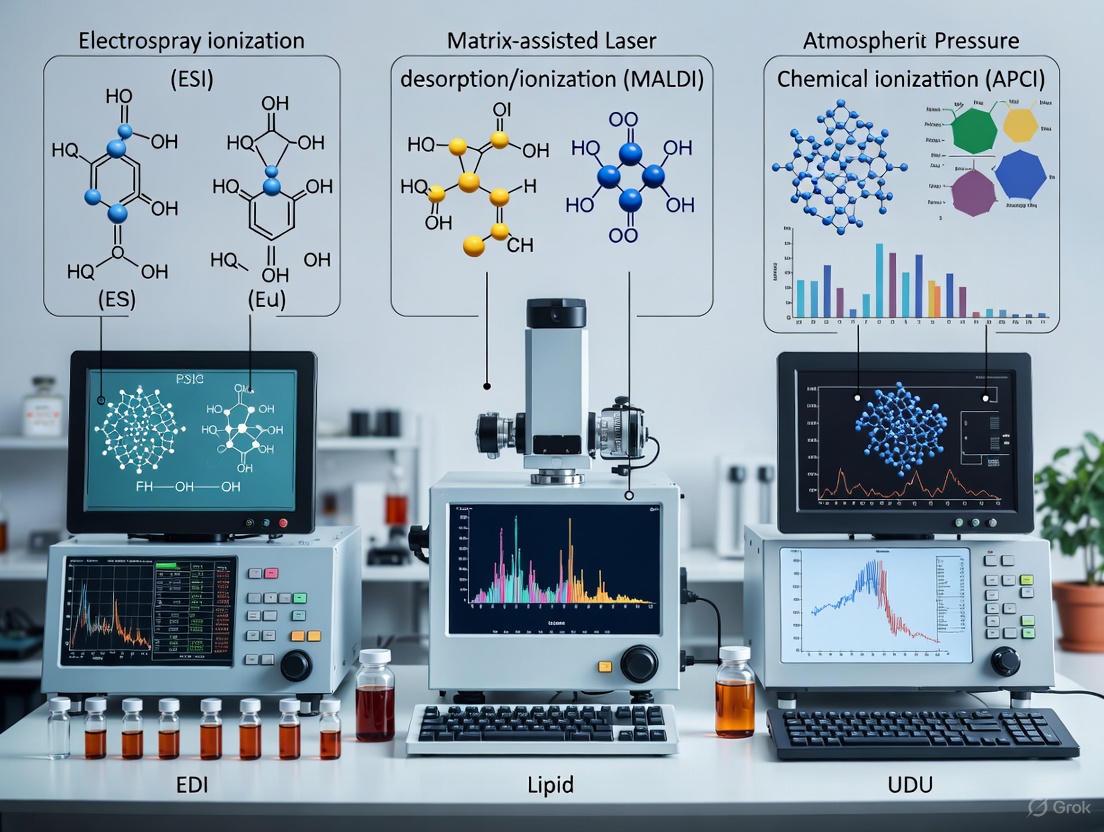
Lipidomics, the large-scale study of lipid pathways and networks, relies heavily on mass spectrometry, where the choice of ionization technique is critical for success.
Ionization Techniques for Lipid Analysis: A Comprehensive Guide for Researchers and Drug Developers
Abstract
Lipidomics, the large-scale study of lipid pathways and networks, relies heavily on mass spectrometry, where the choice of ionization technique is critical for success. This article provides a comprehensive comparison of established and emerging ionization methods—including Electrospray Ionization (ESI), Matrix-Assisted Laser Desorption/Ionization (MALDI), Atmospheric Pressure Chemical Ionization (APCI), and Atmospheric Pressure Photoionization (APPI)—for lipid analysis. Tailored for researchers, scientists, and drug development professionals, it covers foundational principles, methodological applications, and advanced troubleshooting. It further explores performance validation across different biological matrices, from single cells to complex tissues, offering a strategic guide to selecting the optimal ionization source for specific research goals in biomedical and clinical contexts.
Lipid Ionization Fundamentals: From Core Principles to Technique Selection
Mass spectrometry (MS) has become an indispensable tool in modern analytical chemistry, particularly in the field of lipidomics where it enables the precise identification and quantification of lipid species. The process of ionization—converting neutral analyte molecules into gas-phase ions—stands as the critical first step in any MS analysis and fundamentally dictates the type and quality of structural information obtained [1]. Ionization techniques are broadly categorized into two distinct classes based on the amount of energy transferred to the analyte molecules during the ionization process: hard ionization and soft ionization [2].
Hard ionization techniques, such as Electron Ionization (EI), impart substantial internal energy to analyte molecules during ionization. This high energy deposition typically causes extensive fragmentation of the molecular ions, generating numerous fragment ions that provide detailed structural clues for elucidating unknown compound structures [3] [1]. While this fragmentation pattern serves as a valuable fingerprint for structural determination, it often comes at the cost of significantly diminishing or completely eliminating the molecular ion signal, which is essential for determining molecular weight [2].
In contrast, soft ionization techniques, including Electrospray Ionization (ESI) and Matrix-Assisted Laser Desorption/Ionization (MALDI), employ gentler processes that transfer minimal internal energy to the analyte molecules. These methods predominantly generate intact molecular ions with little to no fragmentation, thereby preserving information about the original molecular structure and weight—a crucial advantage when analyzing complex, fragile biomolecules like lipids [1] [2]. The fundamental differences between these approaches directly impact their applicability for lipid structural analysis, making technique selection paramount for research success.
Fundamental Principles and Technical Differentiation
Core Mechanisms and Energy Transfer
The distinction between hard and soft ionization originates from their fundamentally different mechanisms of ion formation and the consequent amount of internal energy deposited into the analyte molecules. Electron Ionization (EI), the archetypal hard ionization method, operates by bombarding vaporized analyte molecules with a high-energy beam of electrons (typically 70 eV) emitted from a heated filament [3] [1]. This interaction causes the ejection of an electron from the analyte molecule, generating a radical cation (M⁺•). The substantial energy transferred during this process—far exceeding the vibrational energy thresholds of chemical bonds—results in significant fragmentation as the excited molecular ions relax, producing a complex spectrum of fragment ions [2].
Conversely, soft ionization techniques like Electrospray Ionization (ESI) operate through a completely different mechanism. In ESI, a sample solution is sprayed through a charged capillary needle to form fine, charged droplets at atmospheric pressure. As the solvent evaporates with the assistance of heated gas, the droplets undergo Coulombic fission until they eventually release gas-phase, often multiply charged, analyte ions [1] [2]. This "desolvation" process is remarkably gentle, preserving the structural integrity of even large, non-volatile biomolecules. Similarly, Matrix-Assisted Laser Desorption/Ionization (MALDI) protects analyte molecules by embedding them in a light-absorbing matrix compound. When irradiated with a pulsed laser, the matrix absorbs the energy and facilitates the gentle desorption and ionization of the intact analyte molecules into the gas phase with minimal fragmentation [1].
Comparative Analysis of Ionization Techniques
Table 1: Core Characteristics of Hard vs. Soft Ionization Techniques
| Feature | Hard Ionization (e.g., EI) | Soft Ionization (e.g., ESI, MALDI) |
|---|---|---|
| Energy Input | High (e.g., 70 eV electrons) | Low (e.g., desolvation, laser with matrix) |
| Typical Fragmentation | Extensive, in the ion source | Minimal to none in the ion source |
| Molecular Ion Signal | Often weak or absent | Strong and predominant |
| Primary Information Obtained | Detailed structural fingerprints via fragments | Molecular weight & intact ion information |
| Ionization Environment | High vacuum | Atmospheric pressure (ESI) or vacuum (MALDI) |
| Typical Mass Analyzers | Often paired with quadrupole, ToF | Versatile (Orbitrap, FT-ICR, ToF, ion traps) |
Table 2: Suitability of Different Ionization Techniques for Lipid Analysis
| Ionization Technique | Ionization Type | Lipid Classes Effectively Analyzed | Key Advantages for Lipidomics | Major Limitations for Lipidomics |
|---|---|---|---|---|
| Electron Ionization (EI) | Hard | Small, volatile lipids; Fatty acid methyl esters | Reproducible spectral libraries; Rich structural data | Unsuitable for most intact lipids; extensive fragmentation |
| Chemical Ionization (CI) | Soft | Moderately stable, volatile lipids | Stronger molecular ion than EI; molecular weight info | Limited to volatile samples; less reproducible |
| Electrospray Ionization (ESI) | Soft | Polar & non-polar lipids; phospholipids, sphingolipids | Excellent for polar lipids; produces multiply charged ions; high sensitivity | Susceptible to matrix effects; requires clean samples |
| APCI | Soft | Semi-volatile lipids; cholesterol, triglycerides | Good for less polar lipids; tolerant of buffers | Requires thermal stability; not for large/fragile lipids |
| APPI | Soft | Non-polar lipids (e.g., steroids, PAHs) | Effective for non-polar compounds resistant to ESI/APCI | Low efficiency for polar compounds |
| MALDI | Soft | Broad range; phospholipids, glycolipids | Spatial mapping via MSI; singly charged ions simplify spectra | Quantitative challenges; matrix interference |
The choice between these ionization methods fundamentally shapes the analytical workflow. EI's extensive fragmentation provides a wealth of structural information valuable for identifying unknown small molecules, but this comes at the cost of the molecular ion, which is essential for determining the molecular weight of unknown compounds [2]. The reproducibility of EI spectra has allowed for the creation of extensive mass spectral libraries, enabling compound identification through database matching [3]. However, for the analysis of intact lipids and other large biomolecules, the soft ionization techniques are overwhelmingly superior. ESI and MALDI generate predominantly intact molecular ions, making them ideal for molecular weight determination and the analysis of complex mixtures, as they produce less complex spectra [1]. ESI's ability to generate multiply charged ions allows for the analysis of high molecular weight compounds using mass analyzers with limited m/z ranges [2].
Impact on Lipid Structural Integrity: Analytical Consequences
Fragmentation Patterns and Information Yield
The differential impact of hard versus soft ionization on lipid structural integrity directly dictates the type of analytical information researchers can obtain. Under the harsh conditions of Electron Ionization (EI), lipid molecules undergo extensive and often non-specific fragmentation. While this generates a multitude of fragment ions, the molecular ion—which reports the intact mass of the lipid—is frequently absent or very weak [2]. This makes it challenging or impossible to determine the molecular weight of an unknown lipid. The fragmentation pattern, while reproducible and useful for library matching, can be overly complex for analyzing intricate lipid mixtures without prior separation [3].
In contrast, soft ionization techniques are renowned for their ability to preserve lipid structural integrity. ESI typically produces ions such as [M+H]⁺, [M+Na]⁺, or [M-H]⁻, providing a direct measurement of the lipid's molecular weight with minimal in-source fragmentation [2]. This preservation of the intact molecule is paramount for lipidomics, as it allows researchers to determine the exact lipid species present before subjecting them to targeted fragmentation in tandem MS (MS/MS) experiments for detailed structural elucidation [4]. This two-step approach—first obtaining an intact mass spectrum and then selectively fragmenting specific ions of interest—has become the cornerstone of modern lipidomics.
Implications for Lipidomics Workflows
The gentle nature of soft ionization has unlocked the ability to study lipids in their native states and within their biological contexts. For instance, MALDI Mass Spectrometry Imaging (MALDI-MSI) allows for the spatial mapping of lipid distributions directly in biological tissues, such as in the model organism C. elegans, revealing how specific lipids are localized to different anatomical structures like the pharynx, intestine, and embryos [5]. This capability to correlate molecular information with anatomy is only possible because MALDI preserves the intact lipid ions during the desorption/ionization process.
Furthermore, the advent of single-cell lipidomics is heavily reliant on the sensitivity and gentleness of soft ionization techniques. Using ultra-sensitive mass spectrometers like Orbitrap and FT-ICR, researchers can now profile the lipidomes of individual cells, capturing real-time metabolic changes and revealing cellular heterogeneity that is completely obscured in bulk analyses [4] [6]. This application demands that the ionization process not only be soft but also exceptionally sensitive, as the amount of material available from a single cell is vanishingly small.
Experimental Protocols for Lipid Analysis
Protocol for Lipid Profiling Using ESI-MS/MS
This protocol is widely used for the comprehensive identification and quantification of lipids from complex biological extracts.
- Sample Preparation: Extract lipids from biological matrices (e.g., plasma, tissue, cells) using a validated method like Bligh & Dyer or Matyash. Reconstitute the dried lipid extract in a suitable solvent mixture (e.g., chloroform:methanol, 1:2 v/v) containing a small amount of volatile ammonium salt (e.g., ammonium formate or acetate) to promote ion formation.
- LC Separation (Optional but Recommended): Utilize reversed-phase high-performance liquid chromatography (RP-HPLC) with a C18 column for lipid separation prior to MS analysis. A typical mobile phase consists of (A) water:acetonitrile (40:60) and (B) isopropanol:acetonitrile (90:10), both with 10 mM ammonium formate. Employ a gradient elution (e.g., 0-100% B over 20-30 minutes) to separate different lipid classes based on their hydrophobicity [3].
- ESI-Mass Spectrometry Analysis:
- Ion Source Parameters: Set the electrospray voltage to 3.5-4.5 kV (positive mode) or 2.8-3.5 kV (negative mode). Use a desolvation temperature of 200-300°C and a nebulizing gas flow (nitrogen) to optimize spray stability and desolvation.
- Data Acquisition: First, acquire a full MS scan (e.g., m/z 200-2000) using a high-resolution mass analyzer (Orbitrap or FT-ICR) to detect the intact lipid ions and determine their accurate masses. This provides the molecular formula information for the lipids present [4].
- Tandem MS (MS/MS): Select precursor ions of interest from the full MS scan and fragment them using techniques such as Collision-Induced Dissociation (CID) or Higher-Energy C Collisional Dissociation (HCD). The resulting MS/MS spectra provide structural details on the lipid headgroup and fatty acyl chains, enabling definitive identification [3].
Protocol for Spatial Lipidomics Using MALDI-MSI
This protocol enables the visualization of lipid distribution within tissue sections.
- Tissue Preparation and Sectioning: Flash-freeze fresh tissue samples in liquid nitrogen to preserve lipid composition and spatial integrity. Cryosection the tissue into thin slices (5-20 µm thickness) and thaw-mount them onto conductive indium tin oxide (ITO) glass slides or standard glass slides for MALDI-MSI.
- Matrix Application: Select an appropriate matrix for lipid analysis, such as 2,5-dihydroxybenzoic acid (DHB) or 9-aminoacridine (9-AA). Apply the matrix uniformly onto the tissue section using a automated sprayer or sublimation device to ensure a homogeneous, fine crystalline layer. This matrix is crucial for absorbing the laser energy and facilitating the soft desorption/ionization of lipids [5] [1].
- MALDI-MSI Data Acquisition:
- Load the prepared slide into the MALDI mass spectrometer.
- Define an ablation raster pattern across the tissue section with a specified spatial resolution (e.g., 10-100 µm, depending on the required detail and sensitivity).
- The instrument will automatically move the stage, firing the laser (typically a 337 nm nitrogen laser) at each pre-defined position. For each pixel, a full mass spectrum is acquired.
- Data Processing and Image Reconstruction: Using specialized software, reconstruct the spatial distribution of any ion of interest by plotting its signal intensity against its X,Y coordinate on the tissue section. This generates ion images that visually represent the localization of specific lipids, which can be overlaid with post-imaging histological stains for anatomical correlation [5].
Research Reagent Solutions and Materials
Table 3: Essential Research Reagents and Materials for Lipid MS Analysis
| Item | Function/Application | Example Use Case |
|---|---|---|
| Chloroform & Methanol | Primary solvents for lipid extraction from tissues/cells | Used in Bligh & Dyer and Folch extraction methods |
| Ammonium Formate/Acetate | Volatile salt additives for LC mobile phases; promotes [M+H]+/[M+NH4]+ ion formation in ESI | Improving ionization efficiency and chromatographic separation in LC-ESI-MS |
| DHB (2,5-Dihydroxybenzoic Acid) | A common MALDI matrix for lipid analysis in positive ion mode | Detecting phospholipids like phosphatidylcholines in tissue imaging |
| 9-Aminoacridine (9-AA) | A common MALDI matrix for lipid analysis in negative ion mode | Detecting acidic phospholipids like phosphatidylinositol and phosphatidylserine |
| C18 LC Columns | Stationary phase for reversed-phase chromatographic separation of lipids by hydrophobicity | Separating complex lipid mixtures prior to ESI-MS analysis |
| Ionizable Lipids (e.g., DLin-MC3-DMA) | Key component of Lipid Nanoparticles (LNPs) for mRNA delivery; studied for reactivity | Model compounds for studying lipid-mRNA adduct formation and stability [7] |
| Carboxymethyl Cellulose (CMC) | Component of embedding media for cryosectioning of small organisms | Preserving anatomical structure of C. elegans for MALDI-MSI [5] |
Visualizing Ionization Workflows and Lipid Integrity Outcomes
The following diagram illustrates the fundamental workflows of hard and soft ionization and their dramatically different impacts on lipid structural integrity and the resulting mass spectral data.
Diagram: Workflow comparison of hard versus soft ionization and their impact on lipid analysis.
The fundamental dichotomy between hard and soft ionization techniques presents a clear strategic choice for researchers in lipid analysis. Hard ionization (EI) offers powerful structural elucidation capabilities for small, volatile molecules through extensive fragmentation, but it is fundamentally incompatible with the analysis of intact, complex lipids due to the destructive nature of its high-energy process. In contrast, soft ionization techniques (ESI, MALDI, APCI, APPI) have become the undisputed cornerstone of modern lipidomics. Their ability to gently generate intact molecular ions enables the accurate determination of molecular weights, making them indispensable for profiling the vast diversity of lipid species in biological systems.
The selection of the appropriate soft ionization method must be guided by the specific research question. ESI excels in sensitivity and compatibility with LC separation for polar lipids, MALDI enables groundbreaking spatial mapping of lipids within tissues, while APCI/APPI effectively handle less polar lipid classes. As the field advances toward single-cell analysis and spatial omics, the continued refinement of these soft ionization sources—focusing on increased sensitivity, spatial resolution, and quantitative robustness—will be crucial for uncovering new insights into the roles of lipids in health and disease.
Electrospray Ionization (ESI) is a soft ionization technique that has revolutionized the analysis of biomolecules, particularly in the field of lipidomics and pharmaceutical research. This technique enables the transfer of ions from solution to the gas phase through the application of a high voltage to a liquid, creating an aerosol of charged droplets [8]. ESI is fundamentally different from other ionization processes because of its unique ability to generate multiply charged ions, effectively extending the mass range of mass analyzers to accommodate the kiloDalton to megaDalton molecular weight range observed in proteins, peptides, and other macromolecules [8].
The development of ESI for the analysis of biological macromolecules was recognized with the Nobel Prize in Chemistry in 2002, awarded to John Bennett Fenn and Koichi Tanaka [8]. Since its introduction, ESI has become an indispensable tool in clinical laboratories and research settings, providing a sensitive, robust, and reliable method for studying non-volatile and thermally labile biomolecules at femtomole quantities in microliter sample volumes [9]. The capability of ESI to retain solution-phase information into the gas-phase and its compatibility with separation techniques like high-performance liquid chromatography (HPLC) have made it particularly valuable for analyzing complex biological samples [9] [8].
Fundamental Principles of ESI
The Electrospray Process Mechanism
The ESI process involves the application of electrical energy to assist the transfer of ions from solution into the gaseous phase before they are subjected to mass spectrometric analysis [9]. This process occurs through three distinct stages, each critical to the successful generation of gas-phase ions:
- Droplet Formation: A sample solution is dispersed through a capillary tube maintained at a high voltage (typically 2.5–6.0 kV) relative to the surrounding chamber wall, generating a fine mist of highly charged droplets with the same polarity as the capillary voltage [9]. The application of a nebulizing gas (e.g., nitrogen) shears the eluted sample solution, enabling higher sample flow rates [9].
- Desolvation: The charged droplets pass down a pressure and potential gradient toward the analyzer region of the mass spectrometer [9]. With the aid of an elevated ESI-source temperature and/or a stream of nitrogen drying gas, the charged droplets continuously decrease in size through solvent evaporation [9]. This leads to an increase in surface charge density and a decrease in droplet radius until the electric field strength within the charged droplet reaches a critical point known as the Rayleigh limit [9] [8].
- Gas Phase Ion Formation: When the Rayleigh limit is reached, the electrostatic repulsion of like charges becomes more powerful than the surface tension holding the droplet together, resulting in Coulomb fission where the original droplet explodes, creating many smaller, more stable droplets [8]. These smaller droplets undergo further desolvation and subsequent Coulomb fissions until gas-phase ions are produced [9] [8].
Two major theories explain the final production of gas-phase ions: the Charge Residue Model (CRM) and the Ion Evaporation Model (IEM). The CRM suggests that electrospray droplets undergo repeated evaporation and fission cycles until progeny droplets contain approximately one analyte ion or less, with gas-phase ions forming after remaining solvent molecules evaporate [8]. The IEM proposes that as droplets reach a critical radius, the field strength at the droplet surface becomes sufficient to assist the field desorption of solvated ions directly into the gas phase [8] [10]. Current evidence indicates that small ions from small molecules are liberated through the ion evaporation mechanism, while larger ions from folded proteins form by the charged residue mechanism [8].
Generation of Multiply Charged Ions
A defining characteristic of ESI is its ability to produce multiply charged ions, which is particularly beneficial for analyzing macromolecules [8]. The multiple charging phenomenon occurs because the ionization process in ESI involves the addition of protons (in positive ion mode) or removal of protons (in negative ion mode), rather than the removal of electrons as in some other ionization techniques [8].
In ESI, the ions observed by mass spectrometry may be quasimolecular ions created by:
- Addition of a hydrogen cation, denoted as [M + H]⁺
- Addition of another cation such as sodium ion, [M + Na]⁺
- Removal of a hydrogen nucleus, [M - H]⁻
- Multiply charged ions such as [M + nH]ⁿ⁺, where n represents the number of charges [8]
For large macromolecules, there can be many charge states, resulting in a characteristic charge state envelope where a single molecular species appears as a series of peaks in the mass spectrum, each representing the molecule with a different number of charges [8]. This multiple charging effect effectively extends the mass range of mass analyzers because the mass-to-charge ratio (m/z) is reduced to a range that can be detected by most mass spectrometers [10]. For example, a 50 kDa protein with 50 charges would appear at approximately m/z 1000 in the mass spectrum, well within the range of most commercial instruments [8] [10].
The multiple charging phenomenon provides significant advantages for structural analysis through tandem mass spectrometry because multiply charged ions are more easily fragmented, increasing collision activation sensitivity and providing more structural information [10]. Additionally, the presence of multiple charge states enables more accurate molecular weight determination through deconvolution algorithms that analyze the charge state distribution [10].
ESI in Lipid Analysis: Experimental Considerations
Sample Preparation and Modification
Lipid analysis via ESI-MS requires careful consideration of sample preparation to enhance ionization efficiency and detection sensitivity. The choice of solvents and additives significantly impacts the quality of mass spectrometric data.
Table 1: Research Reagent Solutions for ESI-MS Lipid Analysis
| Reagent/Solution | Function/Purpose | Example Applications |
|---|---|---|
| Lithium Salts (Lithium chloride, lithium acetate) | Forms [M+Li]⁺ adducts; stabilizes pseudo-molecular ions; enhances sensitivity for certain lipid classes [11]. | Analysis of sterol esters (SE), triacylglycerols (TG), acylated steryl glucosides (ASG); improves detection of monoacylglycerols (MG) and lysophosphatidylcholines (LPC) [11]. |
| Chloroform-Methanol Mixtures | Lipid extraction from biological samples; preparation of samples for direct infusion (shotgun lipidomics) [12]. | Global lipid analyses directly from crude extracts of biological samples [12]. |
| Acids/Bases | Promotes protonation (acids in ESI+) or deprotonation (bases in ESI-) of molecules [13]. | Enhancement of signal for specific lipid classes based on their inherent polarity and ionizability. |
| Post-column Addition Solvent | Introduces compatible solvent and cationizing agent (e.g., LiCl) in NPLC-ESI-MS to overcome mobile phase incompatibility [11]. | Comprehensive lipid analysis using normal-phase liquid chromatography; enables coupling of NPLC with ESI-MS [11]. |
A notable advancement in lipid analysis is the use of lithium adduct consolidation. Lithium cations interact with amide and ester functional groups of lipids, displacing other alkali metal adducts to form predominantly [M+Li]⁺ ions, thereby increasing sensitivity [11]. This approach has been successfully implemented in normal-phase liquid chromatography (NPLC) coupled with ESI-MS using a post-column addition of 0.10 mM lithium chloride in a methanol-chloroform mixture (90:10, v/v) at a flow rate of 0.10 mL/min, significantly improving the detection of specific lipid classes that are challenging to analyze with conventional APCI methods [11].
Experimental Protocols for Lipid Analysis
Protocol 1: NPLC-ESI-MS with Post-column Lithium Addition
This protocol enables comprehensive lipid class separation and detection, particularly beneficial for sterol esters, triacylglycerols, and acylated steryl glucosides [11].
- Sample Preparation: Extract lipids using appropriate chloroform-methanol mixtures. Prepare samples in NPLC-compatible solvents [11].
- Chromatographic Separation:
- Column: Normal-phase column (e.g., silica-based)
- Mobile Phase: Gradients of isooctane, ethyl acetate, acetone, and chloroform-methanol-water mixtures with acidic or basic modifiers as needed
- Flow Rate: Optimized for specific column dimensions (typically 0.1-0.5 mL/min) [11]
- Post-column Addition:
- Solution: 0.10 mM lithium chloride in methanol-chloroform (90:10, v/v)
- Flow Rate: 0.10 mL/min
- Mixing: Use a low-dead-volume T-connector to mix column effluent with lithium-containing solution before introduction to ESI source [11]
- ESI-MS Parameters:
- Ionization Mode: Positive ion mode
- Capillary Voltage: 3.0-4.5 kV (optimize for specific instrument)
- Drying Gas: Temperature 180-250°C, flow rate 2-4 L/min
- Nebulizer Gas Pressure: 1-2 bar
- Mass Analyzer: FT-ICR, Orbitrap, or quadrupole-based instrument for detection of [M+Li]⁺ adducts [11]
Protocol 2: Shotgun Lipidomics by Direct Infusion
This approach involves direct introduction of lipid extracts into the mass spectrometer without chromatographic separation, enabling high-throughput analysis [12].
- Lipid Extraction: Use modified Folch or Bligh-Dyer methods with chloroform-methanol (2:1, v/v) for total lipid extraction from biological samples [12].
- Sample Preparation:
- Redissolve dried lipid extracts in chloroform-methanol (1:2, v/v)
- Centrifuge to remove insoluble material
- Dilute to appropriate concentration (typically 10⁻⁶-10⁻⁴ M) for ESI-MS analysis [12]
- Direct Infusion:
- Flow Rate: 1-10 µL/min (conventional ESI); 0.1-1 µL/min (nano-ESI)
- Use syringe pump for stable flow rate [12]
- ESI-MS Parameters:
- Ionization Mode: Positive or negative ion mode, depending on lipid classes of interest
- Capillary Voltage: Optimize for specific lipid classes (typically 2.5-4.0 kV)
- Source Temperature: 100-250°C
- Collision Energy: Optimized for precursor ion scanning or neutral loss scanning in tandem MS experiments [12]
Comparison of ESI with Alternative Ionization Techniques
Technical Comparison of Ionization Methods
ESI offers distinct advantages and limitations compared to other common ionization techniques used in lipid analysis. The following table summarizes key performance characteristics based on current research applications.
Table 2: Comparison of ESI with Alternative Ionization Techniques for Lipid Analysis
| Ionization Technique | Mechanism | Advantages for Lipid Analysis | Limitations for Lipid Analysis |
|---|---|---|---|
| Electrospray Ionization (ESI) | Electrical energy transfers ions from solution to gaseous phase via charged droplet formation [9] [8]. | Soft ionization (minimal fragmentation); generates multiply charged ions; suitable for thermally labile compounds; compatible with liquid chromatography; excellent for polar lipids [9] [12] [11]. | Suppression effects in complex mixtures; sensitive to contaminants and buffer composition; lower efficiency for non-polar lipids without adduct formation [11] [10]. |
| Atmospheric Pressure Chemical Ionization (APCI) | Gas-phase chemical ionization at atmospheric pressure using corona discharge [12] [11]. | More tolerant to non-polar solvents and buffer salts; better for less polar lipids (e.g., sterol esters, triacylglycerols); provides structural information through in-source fragmentation [12] [11]. | Not as soft as ESI (more in-source fragmentation); may degrade labile compounds; less effective for large, polar lipids; poorer response for lysophospholipids [11]. |
| Atmospheric Pressure Photoionization (APPI) | Gas-phase ionization using photon energy from UV lamp [11]. | Efficient for non-polar compounds; extends analyte range beyond APCI; less susceptible to ion suppression than ESI [11]. | Requires dopants for certain compounds; may produce complex spectra with both M⁺⁺ and [M+H]⁺ ions; limited application for polar lipids [11]. |
| Matrix-Assisted Laser Desorption/Ionization (MALDI) | Laser desorption/ionization of sample embedded in light-absorbing matrix [12]. | High throughput; suitable for imaging mass spectrometry; minimal sample preparation required; excellent for spatial distribution studies [12]. | Matrix interference in low mass range; inhomogeneous crystallization affects quantitation; limited compatibility with on-line separation techniques [12]. |
Performance Data in Lipid Analysis
Experimental comparisons between ESI and APCI for lipid analysis reveal technique-specific performance characteristics. A recent study comparing NPLC-ESI-MS with post-column lithium addition to NPLC-APCI-MS demonstrated significant improvements for specific lipid classes [11]:
Table 3: Quantitative Comparison of ESI vs. APCI Performance for Lipid Classes
| Lipid Class | Relative Response Factor (APCI = 1.0) | Detection Limitations with APCI | Improvement with ESI-Lithium Adduct |
|---|---|---|---|
| Sterol Esters (SE) | 2.5-3.5 | In-source fragmentation produces mainly [sterol nucleus+H-H₂O]⁺ ions, obscuring molecular species information [11]. | Enhanced detection of intact [M+Li]⁺ molecular ions enables identification of individual molecular species [11]. |
| Triacylglycerols (TG) | 1.8-2.5 | In-source fragmentation varies with unsaturation; saturated TGs show weak or no [M+H]⁺ ions [11]. | Consistent detection of [M+Li]⁺ adducts across saturation levels; improved quantification accuracy [11]. |
| Monoacylglycerols (MG) | 4.0-5.0 | Weak response in APCI; difficult to detect at low concentrations [11]. | Significant sensitivity enhancement; reliable detection and quantification [11]. |
| Lysophosphatidylcholines (LPC) | 3.5-4.5 | Difficult to observe with increased mobile phase polarity at end of chromatographic run [11]. | Markedly improved detection with post-column lithium addition in ESI mode [11]. |
The data indicate that ESI with lithium adduct formation provides substantial advantages for analyzing lipid classes that are challenging for APCI, particularly sterol esters, triacylglycerols, monoacylglycerols, and lysophospholipids [11]. The implementation of post-column addition strategies has overcome previous limitations in coupling normal-phase chromatography with ESI-MS, enabling comprehensive lipid analysis that leverages the strengths of both separation and ionization techniques [11].
Advanced ESI Methodologies and Applications
Micro- and Nano-ESI Techniques
Significant advancements in ESI technology have led to the development of micro- and nano-electrospray ionization, which operate at substantially lower flow rates than conventional ESI [8]. Nano-ESI utilizes flow rates in the range of 20-100 nL/min, compared to conventional ESI which typically operates at 1-1000 μL/min [8]. This reduction in flow rate generates much smaller initial droplets (approximately 200 nm diameter compared to 1-2 μm for conventional ESI), resulting in improved ionization efficiency, reduced sample consumption, and lower detection limits [8] [14].
The enhanced performance of nano-ESI stems from more efficient desolvation and ion formation from smaller droplets, leading to reduced chemical background and improved signal-to-noise ratios [14]. These characteristics make nano-ESI particularly valuable for analyzing limited samples, such as in single-cell lipidomics or when working with precious clinical specimens [14]. The technique has proven especially beneficial in proteomics for low-abundance biomolecule detection and in lipidomics for comprehensive analysis of complex cellular lipidomes where sample amounts may be limited [14].
ESI in Structural Lipidomics
Beyond quantitative analysis, ESI-MS provides powerful capabilities for structural characterization of lipids through tandem mass spectrometry (MS/MS) [9] [12]. The multiple charging phenomenon in ESI enhances structural analysis because multiply charged ions fragment more efficiently in collision-induced dissociation (CID) processes, providing more detailed structural information [12] [10].
Key applications of ESI-MS/MS in structural lipidomics include:
- Head Group Determination: Product ion scanning identifies characteristic fragment ions that define lipid classes (e.g., m/z 184 for phosphatidylcholines) [12].
- Fatty Acyl Chain Analysis: Precursor ion scanning and neutral loss scanning identify lipid species based on common fatty acyl fragments or neutral losses [9] [12].
- Double Bond Localization: Advanced tandem MS techniques, including ozone-induced dissociation and ultraviolet photodissociation, pinpoint double bond positions in unsaturated lipid chains [12].
- Spatial Isomer Differentiation: MS³ experiments in ion trap instruments distinguish sn-positional isomers of glycerophospholipids [9].
These structural analysis capabilities make ESI-MS an indispensable tool for elucidating lipid metabolic pathways, characterizing novel lipid structures, and understanding lipid function in membrane dynamics and cellular signaling [12].
Electrospray Ionization has established itself as a cornerstone technique in modern mass spectrometry, particularly for lipid analysis in biomedical research and drug development. Its unique capacity to generate multiply charged ions has extended the accessible mass range for biomolecular analysis while maintaining the structural integrity of fragile lipid species. The fundamental three-step process—droplet formation, desolvation, and gas-phase ion generation—enables efficient transfer of analytes from solution to the gas phase, making it ideally suited for coupling with liquid-phase separation techniques.
The comparison with alternative ionization methods reveals that ESI offers distinct advantages for comprehensive lipid profiling, particularly when enhanced with lithium adduction strategies that address previous limitations with non-polar lipid classes. While APCI and APPI demonstrate superior performance for certain non-polar lipids, ESI's soft ionization characteristics, compatibility with physiological buffers, and ability to provide structural information through tandem MS make it the technique of choice for most lipidomic applications. As ESI technology continues to evolve with nanoflow applications, ambient ionization techniques, and improved interface designs, its role in advancing lipid research and accelerating drug development remains unquestionably vital.
Matrix-Assisted Laser Desorption/Ionization (MALDI) represents a cornerstone soft ionization technique in mass spectrometry that enables the analysis of large, non-volatile molecules with minimal fragmentation. This technology has revolutionized the analysis of biomolecules, including lipids, proteins, peptides, and carbohydrates, by allowing their ionization and detection in intact form. The fundamental MALDI process involves three critical steps: first, the sample is mixed with a suitable energy-absorbing matrix material and applied to a metal plate; second, a pulsed laser irradiates the sample, triggering ablation and desorption of the sample and matrix material; finally, analyte molecules are ionized through protonation or deprotonation in the hot plume of ablated gases before being accelerated into the mass analyzer [15].
The development of MALDI imaging mass spectrometry (MALDI IMS) has further expanded its capabilities by combining the sensitivity and selectivity of mass spectrometry with spatial analysis, providing unprecedented ability to visualize the spatial arrangement of biomolecules directly in tissue sections [16]. This spatial dimension has transformed MALDI from a mere analytical tool to a powerful imaging technology that preserves molecular context, enabling researchers to investigate lipid distributions in biological systems with high molecular specificity. For lipid analysis research, MALDI offers particular advantages in detecting a wide range of lipid classes with high sensitivity while maintaining spatial information that is lost in conventional extraction-based approaches.
Comparison of Ionization Techniques for Lipid Analysis
The landscape of ionization techniques for lipid analysis encompasses several complementary technologies, each with distinct strengths and limitations. When evaluating MALDI against competing ionization methods, researchers must consider multiple performance parameters including sensitivity, spatial resolution, molecular coverage, and analytical throughput.
Table 1: Comparison of Ionization Techniques for Lipid Analysis
| Technique | Mechanism | Spatial Capabilities | Key Advantages for Lipid Analysis | Major Limitations |
|---|---|---|---|---|
| MALDI | Matrix-assisted laser desorption/ionization using UV or IR laser | Yes (5-20 μm resolution) | Minimal fragmentation; imaging capability; broad lipid coverage; high sensitivity | Matrix interference in low mass range; requires crystallization; semi-quantitative |
| ESI | Electrospray creates charged droplets that evaporate | No (requires liquid introduction) | Excellent sensitivity; hyphenation with LC; good quantitation; produces multiply charged ions | Ion suppression effects; requires clean samples; no direct spatial information |
| Ambient Ionization MS | Direct ionization at atmospheric pressure (DESI, LAESI) | Yes (50-200 μm resolution) | Minimal sample prep; in situ analysis; true ambient operation | Lower spatial resolution; limited sensitivity for some lipid classes |
| CE-MS | Separation by electrophoretic mobility coupled to MS | No | High separation efficiency; minimal sample volume; complementary to LC methods | Limited loading capacity; specialized interfaces required |
MALDI demonstrates particular strengths for spatially resolved lipid analysis where maintaining the tissue context is essential. Unlike electrospray ionization (ESI), which requires sample extraction and liquid introduction, MALDI enables direct analysis from tissue sections, preserving crucial spatial information about lipid distributions [16] [17]. Compared to ambient ionization techniques like desorption electrospray ionization (DESI), MALDI typically provides superior spatial resolution (down to 5-10 μm with optimized protocols) and higher sensitivity for many lipid classes, though it requires more extensive sample preparation including matrix application [16].
The coupling of MALDI with time-of-flight (TOF) analyzers has proven particularly effective for lipid analysis due to the large mass range, high sensitivity, and pulsed operation mode that matches well with the MALDI ionization process [15]. Recent advancements in MALDI-FT-ICR and MALDI-TIMS platforms have further enhanced mass resolution and isomer separation capabilities, addressing previous limitations in distinguishing structurally similar lipid species [18].
Experimental Protocols for MALDI Lipid Analysis
Sample Preparation Methodologies
Proper sample preparation is critical for successful MALDI-based lipid analysis, with protocols varying significantly depending on the sample type and analytical goals. For lipid analysis from biological tissues, the standard workflow begins with tissue collection and preservation, typically through snap-freezing in liquid nitrogen to maintain lipid integrity and spatial distribution. Tissue sections are then prepared using a cryostat at thicknesses ranging from 5-20 μm and thaw-mounted onto indium tin oxide (ITO)-coated glass slides, which enable both MS analysis and subsequent histological staining [17].
A key consideration is the avoidance of optimal cutting temperature (OCT) compound as an embedding medium, as it causes significant ion suppression and interferes with lipid detection [17]. For formalin-fixed paraffin-embedded (FFPE) tissues, deparaffinization with xylene followed by rehydration through graded ethanol baths is required, though fresh frozen tissues are generally preferred for lipid analysis to avoid potential lipid loss during processing [17].
The application of an appropriate matrix is perhaps the most critical step in MALDI sample preparation. For lipid analysis, the matrix solution typically consists of crystallized molecules with strong optical absorption at the laser wavelength, such as 2,5-dihydroxybenzoic acid (DHB) at 10 mg/mL in chloroform:methanol (9:1) for negative ion mode lipid analysis, or α-cyano-4-hydroxycinnamic acid (CHCA) for positive ion mode analyses [19] [15]. The matrix serves multiple functions: it absorbs the laser energy, facilitates desorption and ionization of lipid molecules, and prevents analyte fragmentation through energy dissipation.
Matrix application can be performed using several methods, each with distinct advantages. Spraying matrix solution through an automated sprayer provides good extraction efficiency and spatial resolution of 10-20 μm, though care must be taken to prevent analyte delocalization from excessive wetting. Sublimation followed by recrystallization offers excellent spatial resolution with minimal delocalization but may yield lower sensitivity for some lipid classes. For high-throughput applications, robotic spotting enables excellent analyte extraction but sacrifices spatial resolution (typically 200 μm) [16].
Lipid-Specific MALDI Protocols
Specialized MALDI protocols have been developed to address the unique challenges of lipid analysis. For direct analysis of intact mycobacteria, researchers have established a streamlined protocol that leverages the abundant lipids in the bacterial cell wall for identification. This method involves heat inactivation of cultured mycobacteria at 95°C for 30 minutes, washing with double-distilled water, and direct spotting of the bacterial suspension onto the MALDI target followed by addition of a specialized matrix consisting of 2,5-dihydroxybenzoic acid and 2-hydroxy-5-methoxybenzoic acid (super-DHB) in chloroform:methanol (9:1) [19]. This approach detects species-specific lipid patterns including sulphoglycolipids specific to Mycobacterium tuberculosis complex and glycopeptidolipids found in non-tuberculous mycobacteria, achieving 96.7% sensitivity and 91.7% specificity for identification with analysis completed in under 10 minutes [19].
For enhanced structural characterization of lipids, derivatization strategies can be incorporated into the MALDI workflow. The Paternò-Büchi (PB) reaction, ozone-induced dissociation (OzID), and epoxidation reactions have been successfully coupled with MALDI to determine carbon-carbon double bond positions and sn-position isomers in complex lipid samples [20]. These approaches significantly expand the structural information obtainable from MALDI-based lipid analysis beyond simple lipid class identification.
Research Reagent Solutions for MALDI Lipid Analysis
Table 2: Essential Research Reagents for MALDI Lipid Analysis
| Reagent/Category | Specific Examples | Function in Workflow | Application Notes |
|---|---|---|---|
| MALDI Matrices | DHB, CHCA, SA, super-DHB | Absorb laser energy, facilitate desorption/ionization | DHB: broad lipid coverage; CHCA: positive mode lipids; super-DHB: mycobacterial lipids |
| Solvents | Chloroform, methanol, acetonitrile, ethanol | Sample preparation, matrix dissolution, washing | Chloroform:methanol (9:1) for lipid extraction; ACN:water:TFA for matrix |
| Tissue Supports | ITO-coated glass slides, standard glass slides | Sample mounting for imaging | ITO enables optical microscopy and conductive surface for MS |
| Calibration Standards | PEG mixtures, lipid standards | Mass axis calibration | Critical for accurate mass determination in MS imaging |
| Washing Solutions | Ethanol, Carnoy's fluid, ammonium formate | Remove salts, contaminants, improve sensitivity | Carnoy's fluid (60% ethanol, 30% chloroform, 10% acetic acid) for tissue |
| Derivatization Reagents | PB reagents, ozone, epoxidation catalysts | Enhance structural information | Determine C=C locations, sn-positions |
Advanced Applications in Lipid Research
Spatial Lipidomics in Biomedical Research
MALDI imaging mass spectrometry has emerged as a powerful tool for spatial lipidomics, enabling the investigation of lipid distributions in diverse biomedical contexts. In neurological research, MALDI IMS has identified ganglioside accumulation in amyloid beta plaques in Alzheimer's disease and revealed lipid alterations associated with schizophrenia [17]. A particularly compelling application involves the analysis of spinal cord lesions in experimental autoimmune encephalomyelitis (EAE), a model of multiple sclerosis, where MALDI IMS identified upregulation of inflammation-related ceramide-1-phosphate and ceramide phosphatidylethanolamine as markers of white matter lipid remodeling [18].
In oncology, MALDI IMS has proven invaluable for characterizing lipid changes in the tumor microenvironment. Researchers have employed this technology to identify extracellular matrix collagen peptides that differentiate non-invasive ductal carcinoma in situ from invasive breast cancer, and to detect N-glycan and protein alterations in the extracellular matrix as predictors of prostate cancer progression [17]. The ability to visualize lipid distributions without prior labeling makes MALDI IMS particularly suited for discovery-phase studies where the molecular targets are not yet known.
Clinical and Pharmacological Applications
The clinical utility of MALDI-based lipid analysis continues to expand, particularly in microbiology and pharmacology. For mycobacterial identification, the lipid-focused MALDI approach has demonstrated exceptional performance, correctly identifying 96.7% of Mycobacterium tuberculosis complex strains (204/211) and 91.7% of non-tuberculous mycobacterial species (22/24) based on species-specific lipid profiling [19]. This methodology provides significant advantages over protein-based identification methods by reducing biosafety concerns through heat inactivation and minimizing sample preparation steps.
In pharmacology, MALDI IMS has been employed to investigate drug distribution and metabolism at the tissue level. A 2024 study visualized the accumulation of the hypnotic drug zolpidem in the middle of a single hair shaft following ingestion, contrasting with the outer layer distribution observed after external contamination [17]. Similarly, researchers have tracked the permeation of berberine through epidermis and dermis layers following transdermal delivery using microneedle arrays, demonstrating the utility of MALDI IMS for evaluating drug delivery strategies [17].
Performance Comparison and Experimental Data
The analytical performance of MALDI-based lipid analysis has been rigorously evaluated across multiple studies, providing quantitative data for comparison with alternative techniques. In mycobacterial identification, the lipid-based MALDI approach demonstrated 96.7% sensitivity (204/211 correct identifications) and 91.7% specificity (22/24 correct identifications) compared to molecular identification methods [19]. This performance was achieved with remarkable speed (<10 minutes analysis time) and high sensitivity (<1000 bacteria required), significantly outperforming conventional culture-based identification methods that typically require days to weeks.
Table 3: Quantitative Performance Metrics for MALDI Lipid Analysis
| Application Context | Sensitivity | Specificity | Analysis Time | Key Lipids Detected |
|---|---|---|---|---|
| Mycobacterial Identification [19] | 96.7% (204/211) | 91.7% (22/24) | <10 minutes | Sulphoglycolipids, glycopeptidolipids, polyacyltrehaloses |
| Spatial Lipidomics (EAE Model) [18] | N/A | N/A | ~7 hours (175,000 pixels) | Ceramide-1-phosphate, ceramide phosphatidylethanolamine |
| Drug Distribution (Zolpidem) [17] | N/A | N/A | ~2-4 hours | Parent drug and metabolites (m/z 395.1495) |
| Plant Lipid Imaging [17] | N/A | N/A | Variable by size | Various bioactive compounds and metabolites |
Spatial resolution represents another critical performance parameter for MALDI imaging applications. Current commercial MALDI IMS instruments achieve spatial resolutions of approximately 20 μm in microprobe mode, with advanced approaches like oversampling and beam modification enabling resolutions down to 5 μm [16]. However, higher spatial resolution comes with trade-offs in sensitivity, analysis time, and data storage requirements, necessitating careful optimization based on the specific biological question.
The integration of MALDI with ion mobility separation has significantly enhanced lipid identification confidence by providing collision cross-section (CCS) values as an additional molecular descriptor. In a groundbreaking 2025 study, researchers combined quantum cascade laser mid-infrared imaging with MALDI-TIMS-MS to elucidate 157 sulfatides accumulating in kidneys of arylsulfatase A-deficient mice, providing unprecedented structural characterization of complex lipid mixtures in tissue [18]. This multi-dimensional approach addresses a key limitation of conventional MALDI analysis by adding a separation dimension that helps distinguish isobaric lipid species.
The evolution of MALDI technology continues to address current limitations while expanding application boundaries. Ongoing developments in instrumental design focus on improving the mutually exclusive criteria in the "4S-paradigm" of MSI performance: speed, sensitivity, spatial resolution, and molecular specificity [18]. The integration of guided acquisition approaches, such as quantum cascade laser mid-infrared imaging microscopy, enables intelligent targeting of specific tissue regions, preserving instrument time for in-depth analysis of biologically relevant areas [18].
For lipid analysis specifically, the combination of MALDI with advanced structural elucidation techniques represents a promising direction. Derivatization strategies including the Paternò-Büchi reaction and ozone-induced dissociation are being adapted to MALDI platforms to enable confident determination of double bond positions and stereochemistry directly from tissue sections [20]. Additionally, the ongoing expansion and refinement of lipid databases coupled with improved computational tools for data analysis are addressing current challenges in lipid identification and quantification.
In conclusion, MALDI mass spectrometry provides a uniquely powerful platform for lipid analysis that balances analytical performance with spatial information preservation. While the technique demonstrates clear advantages in applications requiring spatial context, researchers must consider its limitations in quantitative accuracy and the need for careful method optimization. The continuing innovation in MALDI technology, coupled with its integration with complementary analytical approaches, ensures its ongoing transformation and expanding utility in lipid research across biomedical, pharmaceutical, and clinical domains.
Lipidomics, the large-scale analysis of cellular lipids, presents significant analytical challenges due to the immense structural diversity and dynamic concentration ranges of lipid molecules. A persistent hurdle in this field has been the efficient ionization and detection of less polar lipids, which constitute crucial components of biological systems. These lipids, including triacylglycerols (TAGs), sterols, and fatty acid esters, play essential roles as cellular membrane constituents, energy storage depots, and signaling molecules. Unlike their polar counterparts, they lack easily ionizable functional groups, making them notoriously difficult to analyze using conventional ionization methods like electrospray ionization (ESI). Within this context, atmospheric pressure chemical ionization (APCI) and atmospheric pressure photoionization (APPI) have emerged as powerful techniques that significantly extend the range of successfully analyzable lipids.
This guide provides an objective comparison of APCI and APPI mass spectrometry for analyzing less polar lipids. We will examine their fundamental ionization mechanisms, compare their performance through published experimental data, detail standard methodologies, and discuss their respective advantages within the broader landscape of lipidomics research, providing drug development professionals and researchers with a clear framework for technique selection.
Fundamental Principles and Ionization Mechanisms
Understanding the distinct ionization mechanisms of APCI and APPI is crucial for explaining their performance differences with less polar lipids. Both are gas-phase ionization techniques but operate on fundamentally different principles.
Atmospheric Pressure Chemical Ionization (APCI) relies on gas-phase ion-molecule reactions initiated by a corona discharge needle that applies a high voltage (typically 3-5 kV) to create a reactive plasma [21]. This plasma contains energetic species (e.g., hydroxyl radicals, atomic oxygen) that first ionize the solvent and gas molecules (e.g., N₂, H₂O) present in the source. These primary ions then undergo a series of proton transfer or charge exchange reactions with analyte molecules. For less polar lipids, this typically results in the formation of protonated [M+H]⁺ or deprotonated [M-H]⁻ molecules, and sometimes radical cations M⁺• [22]. The efficiency of this process depends on the relative proton affinities of the reactant ions and the analyte, making it susceptible to ion suppression when compounds with higher proton affinity compete for the available charge [23].
Atmospheric Pressure Photoionization (APPI) uses high-energy photons from a krypton lamp (emitting at 10.0 and 10.6 eV) to ionize molecules [24]. In the direct APPI mechanism, a photon is absorbed by an analyte molecule (M), leading to the ejection of an electron and formation of a radical cation (M⁺•). This radical cation can be detected directly or can react with a solvent molecule (S) to form a protonated molecule ([M+H]⁺). A key advantage is that this process is less prone to charge competition than APCI, as photons interact with any molecule in their path regardless of the presence of other compounds with lower ionization potentials [23]. In dopant-assisted APPI, a photoionizable compound like toluene or acetone is added to create a high concentration of charge carriers, which then ionize the analyte through charge or proton transfer.
The following diagram illustrates the core mechanisms and typical ions generated for less polar lipids in positive ion mode.
Performance Comparison: Experimental Data and Applications
Direct comparative studies reveal distinct performance characteristics for APCI and APPI when applied to various classes of less polar lipids. The following table summarizes key quantitative findings from the literature, highlighting differences in sensitivity, linear dynamic range, and observed ions.
Table 1: Comparative Performance of APCI and APPI for Less Polar Lipid Analysis
| Lipid Class / Analytic | Ionization Technique | Reported Performance Metrics & Observed Ions | Key Findings |
|---|---|---|---|
| Triacylglycerols (TAGs), Diacylglycerols (DAGs), Free Fatty Acids [25] [26] | APPI | • Sensitivity: 2-4x higher than APCI• Linear Dynamic Range: 4-5 decades• Primary Ions: [M+H]⁺, M⁺• | Superior sensitivity and wide linear range for major nonpolar lipid classes, especially with normal-phase solvents. |
| APCI | • Linear Dynamic Range: 4-5 decades• Primary Ions: [M+H]⁺, [M-H]⁻ | Robust and reliable, but lower signal intensity compared to APPI for these analytes. | |
| Squalene (Triterpene) [24] | APPI | • Primary Ion: Intense [M+H]⁺ (m/z 411.4)• M⁺• not observed | Efficiently ionizes this nonpolar hydrocarbon, which is poorly ionizable by ESI. Mechanism involves proton transfer after solvent photoionization. |
| APCI | • Primary Ion: [M+H]⁺ | Successfully ionizes unsaturated hydrocarbon lipids but can cause fragmentation. | |
| Cholesterol & Steroids [27] | APPI | • Primary Ions: [M+H-H₂O]⁺, M⁺• | Provides intact molecular species information with less in-source fragmentation than APCI. |
| APCI | • Result: Extensive fragmentation• Note: Cholesterol produces no stable [M+H]⁺ | Causes extensive dehydration and fragmentation for cholesterol and many steroids, complicating analysis. | |
| Saturated Hydrocarbons (e.g., 5α-Cholestane) [27] | APPI/APCI | • APCI/ESI: Cannot ionize saturated hydrocarbon 5α-cholestane• Note: Requires specialized CI reagents (e.g., ClMn(H₂O)⁺) for analysis | Highlights a key limitation of standard APCI/APPI for very nonpolar, saturated hydrocarbons. |
Beyond the quantitative metrics, each technique has distinct application strengths. APPI demonstrates particular efficacy for a wide range of apolar compounds, from triterpenes like squalene to triacylglycerols [24]. Its major advantage is the reduced susceptibility to ion suppression effects from biological matrices, as the initial ionization event (photon absorption) is not a competitive process [23]. APCI, while sometimes less sensitive, is a robust and widely available platform. It is particularly useful for less polar lipids that are still amenable to gas-phase proton transfer, such as free fatty acids and diacylglycerols [22] [21]. However, a noted limitation of APCI is the potential for in-source oxidation reactions due to reactive oxygen species in the corona discharge plasma, which can generate [M+O]⁺ ions and complicate spectra [21].
Detailed Experimental Protocols
To ensure reproducibility and provide a clear technical reference, this section outlines standard experimental protocols for analyzing less polar lipids using both APCI and APPI, as derived from the cited literature.
Sample Preparation and Lipid Extraction
Proper sample preparation is critical for successful lipidomic analysis. The following workflow is commonly employed for tissue or biological fluid samples:
- Extraction: Use a modified Bligh & Dyer or MTBE (methyl tert-butyl ether) method for comprehensive lipid extraction [28]. For example, the MTBE method uses a solvent ratio of MTBE/methanol/water (5:1.5:1.45, v/v/v), which separates lipids into the top MTBE layer, facilitating easy collection and reducing water-soluble contaminant carry-over.
- Internal Standard Addition: Add appropriate internal standards (e.g., deuterated or odd-chain lipid analogs) to the sample prior to extraction. This corrects for variability in recovery and ionization efficiency, enabling accurate quantification [28].
- Reconstitution: After evaporating the organic solvent under a gentle nitrogen stream, reconstitute the dried lipid extract in a suitable solvent. For APCI and APPI, a 50:50 mixture of dichloromethane (DCM) and methanol is often effective, or isopropanol for normal-phase LC-MS applications [22] [24]. Typical concentrations for infusion are 0.1-0.5 mg/mL.
Instrumental Configuration and Parameters
The table below compiles typical source parameters for APCI and APPI analyses, optimized for less polar lipids.
Table 2: Typical Instrument Parameters for APCI and APPI Analysis of Lipids
| Parameter | APCI Typical Setting | APPI Typical Setting | Notes and Function |
|---|---|---|---|
| Vaporizer Temperature | 400 - 450 °C [22] | 325 - 450 °C [26] [24] | Ensures complete vaporization of the LC eluent or infused sample. |
| Discharge Current/Voltage | 3.35 kV, 5 μA [22] | N/A | APCI-specific; creates corona discharge plasma. |
| Lamp Photon Energy | N/A | 10.0 / 10.6 eV (Kr lamp) [24] | APPI-specific; photon energy must exceed analyte ionization potential. |
| Capillary Temperature | 275 °C [22] | 350 °C [24] | Temperature of the transfer capillary into the mass spectrometer. |
| Sheath/Auxiliary Gas | 35 (arb.) [22] | 50 (arb.) [24] | Nitrogen is common; assists nebulization and desolvation. |
| Dopant | Not Used | Toluene or Acetone [24] [23] | In dopant-assisted APPI, added via post-column infusion (e.g., 50 μL/min) to enhance ionization. |
| Mobile Phase | Reversed-phase or Normal-phase | Normal-phase preferred (e.g., Hexane, IPA) [26] [24] | Normal-phase solvents (low IP) enhance APPI sensitivity by acting as efficient dopants. |
The Scientist's Toolkit: Essential Research Reagents
Table 3: Key Reagents and Materials for APCI/APPI Lipid Analysis
| Item | Function / Application | Example / Specification |
|---|---|---|
| Chloroform, Methanol, MTBE | Lipid extraction from biological matrices (e.g., Folch, Bligh & Dyer, MTBE methods) [28]. | HPLC or LC-MS grade. |
| Deuterated Lipid Internal Standards | Quantification and quality control; corrects for extraction recovery and ionization variability. | e.g., d₇-Cholesterol, d₅-Triacylglycerol [28]. |
| Toluene or Acetone | Dopant for APPI; increases ionization efficiency of analytes, especially with high-IP mobile phases [24] [23]. | HPLC grade, ≥99.9% purity. |
| n-Hexane, Isooctane, Isopropyl Alcohol | Normal-phase LC solvents for APPI; low ionization potential allows them to act as proton donors [26] [23]. | HPLC grade. |
| Krypton Discharge Lamp | Photon source for APPI; emits 10.0 and 10.6 eV photons [24]. | Standard component in commercial APPI sources. |
| Nitrogen Gas | Sheath, auxiliary, and desolvation gas for the ion source. | High-purity (≥99.995%) generator or liquid nitrogen source. |
The overall workflow from sample to data acquisition is summarized in the following diagram.
Both APCI and APPI are indispensable tools in the lipid analyst's arsenal, effectively addressing the critical challenge of ionizing less polar lipids. APCI offers a robust and widely accessible platform, suitable for a range of low to moderately polar lipids like fatty acids and diacylglycerols. In contrast, APPI consistently demonstrates superior sensitivity for the most apolar lipid classes, including triacylglycerols, sterols, and hydrocarbons like squalene, while also being less susceptible to ion suppression.
The choice between these techniques is not merely a matter of sensitivity but also depends on the specific lipid classes of interest, the available instrumentation, and the chromatographic conditions. For comprehensive lipidomic profiling that includes a wide range of nonpolar species, APPI holds a distinct advantage. However, for many routine applications targeting specific, moderately nonpolar lipids, APCI remains a highly effective and reliable choice. Ultimately, the integration of either technique into LC-MS workflows has significantly broadened the observable lipidome, enabling deeper insights into the roles of lipids in health, disease, and drug action.
Lipidomics, the large-scale study of lipidomes, faces significant analytical challenges due to the immense structural and physicochemical diversity of lipid species, which range from highly polar oxylipins to strongly hydrophobic triglycerides [29]. The critical step of ionizing lipids for mass spectrometric analysis profoundly influences the sensitivity, coverage, and accuracy of results. For years, Electrospray Ionization (ESI) and Atmospheric Pressure Chemical Ionization (APCI) have dominated lipid analysis. ESI is renowned for its capability to ionize a wide range of compounds, while APCI demonstrates particular efficacy for moderately polar to nonpolar lipids [30]. However, these techniques have limitations, including susceptibility to ion suppression (ESI) and lower efficiency for polar compounds (APCI) [30] [31]. Recent years have witnessed the emergence of alternative ionization techniques designed to overcome these hurdles. Among these, Tube Plasma Ionization (TPI) has surfaced as a promising plasma-based technology that promises sensitive ionization across a wide polarity range, indicating its potential utility for sterol analysis and broader lipidomics applications [30]. This guide provides an objective comparison of the performance of TPI against established ionization techniques, providing experimental data to inform researchers and method developers in their selection process.
Technique Comparison: TPI vs. ESI vs. APCI
A direct performance comparison of these three ionization techniques was conducted using a standardized setup for the analysis of sterols, a challenging lipid class due to vast concentration differences and significant matrix interference [30]. The following table summarizes the key experimental findings.
Table 1: Performance comparison of ESI, APCI, and TPI for sterol analysis based on experimental data [30].
| Feature | Electrospray Ionization (ESI) | Atmospheric Pressure Chemical Ionization (APCI) | Tube Plasma Ionization (TPI) |
|---|---|---|---|
| Ionization Mechanism | Ion evaporation from charged droplets | Gas-phase ion-molecule reactions via corona discharge | Dielectric barrier discharge-based non-equilibrium plasma |
| Suitable Polarity Range | Polar compounds [30] | Moderate to low polarity compounds [30] | Wide polarity range [30] |
| Sensitivity (LOQ) | Higher (underperformed) | Comparable to TPI | Comparable to APCI |
| Signal Stability | Unstable (pronounced ion suppression) | Stable | Stable |
| Ion Suppression | Pronounced | Not pronounced | Not pronounced |
| Performance in Complex Matrices | Suffered from pronounced ion suppression in plasma, HepG2 cells, and liver tissue | Robust, provided reliable quantification | Robust, results in close agreement with APCI |
| Key Advantage | Easy operation; efficient for a wide range of polar compounds | Efficient for non-polar lipids; stable signal | Wide polarity range; stable signal; low ion suppression |
The experimental data reveal that both TPI and APCI clearly outperformed ESI in terms of sensitivity for sterol analysis, with comparable Limits of Quantification (LOQs) between them [30]. A critical differentiator was signal stability during extended measurements: while both TPI and APCI provided stable signals, ESI suffered from pronounced ion suppression [30]. When applied to complex biological matrices like human plasma, HepG2 cells, and liver tissue, TPI provided results in close agreement with APCI, highlighting its robustness for accurate sterol quantification in real-world samples [30].
Experimental Protocol: A Closer Look at the Data
The comparative data presented above were generated using a rigorous and detailed methodology, which is essential for understanding the context of the results.
Chromatography and Mass Spectrometry
Chromatographic separation was performed using a heart-cutting 2D-LC system [30]. The first dimension utilized a Kinetex PFP column (1.7 µm, 2.1 × 30 mm), while an InfinityLab Poroshell 120 EC-C18 column (1.7 µm, 2.1 × 100 mm) was used in the second dimension [30]. The mobile phase consisted of water (eluent A) and methanol/water with 5 mmol/L ammonium formate and 0.1% formic acid (eluent B) in both dimensions [30]. The analysis was coupled to a triple quadrupole mass spectrometer.
Ion Source Parameters and Comparison
The lab-made TPI source was developed for LC-MS coupling and compared directly with commercial ESI and APCI sources [30]. The characterization was performed according to the International Council for Harmonisation (ICH) guidelines, and ion suppression as well as signal stability were thoroughly examined [30]. The study demonstrated that the plasma-based TPI source could be effectively coupled with LC-MS and achieved performance metrics on par with or superior to established techniques for specific applications.
The Scientist's Toolkit: Essential Reagents and Materials
The following table details key reagents and materials used in the featured lipid analysis experiments, which are fundamental for replicating the workflow.
Table 2: Key research reagents and materials for lipid extraction and analysis.
| Item Name | Function / Application | Example from Literature |
|---|---|---|
| Avanti Polar Lipids Standards | Sterol and lipid internal standards for quantification | Cholest-5-en-3β-ol (cholesterol), lanosterol, desmosterol, etc. [30] |
| Chloroform | Organic solvent for biphasic lipid extraction (Folch, Bligh & Dyer) | Used in conventional Folch and Bligh & Dyer methods [32] [29] |
| Methyl-tert-butyl ether (MTBE) | Less toxic alternative to chloroform for biphasic lipid extraction | Used in MTBE-based extraction protocol [33] |
| Methanol (MeOH) | Polar solvent for protein precipitation and lipid extraction | Component of Folch, Bligh & Dyer, and monophasic extractions [32] [29] |
| Cyclopentyl Methyl Ether (CPME) | Greener alternative solvent for chloroform-free lipid extraction | Showed comparable/superior performance to Folch protocol [29] |
| Ammonium Formate | Mobile phase additive in LC-MS to improve ionization | Used at 5 mmol/L in the mobile phase for sterol analysis [30] |
| C18 Reverse-Phase Column | Core separation tool for complex lipid mixtures | InfinityLab Poroshell 120 EC-C18 [30] |
Integrated Workflow in Modern Lipidomics
A modern, sensitive lipidomics workflow integrates several advanced technologies, from sample preparation to data analysis. The following diagram illustrates the key steps involved when utilizing emerging techniques like TPI or TIMS-PASEF.
Diagram 1: Comprehensive lipidomics workflow with emerging techniques.
This workflow highlights where ionization sources like TPI, ESI, and APCI operate within a broader analytical context. Furthermore, the integration of additional separation dimensions, such as Trapped Ion Mobility Spectrometry (TIMS), is becoming increasingly important. TIMS separates ions based on their shape and size (collisional cross section, CCS), providing an opportunity to resolve otherwise unresolved isomeric lipids [33]. When coupled with parallel accumulation–serial fragmentation (PASEF), this technology can significantly increase the number of identified lipids from minimal sample amounts, achieving attomole sensitivity [33].
The expansion of the analytical toolbox in lipidomics is vital for addressing the complex challenges of comprehensive lipid analysis. While ESI and APCI remain robust and well-characterized workhorses, emerging techniques like Tube Plasma Ionization (TPI) offer compelling advantages, particularly for specific analyte classes like sterols and in situations where ion suppression hampers ESI performance. Experimental evidence demonstrates that TPI provides sensitivity comparable to APCI and superior to ESI for sterols, with excellent signal stability and minimal ion suppression in complex matrices [30]. The choice of ionization technique must be guided by the specific lipids of interest, the complexity of the sample matrix, and the required sensitivity. As the field progresses, the combination of improved ionization sources with advanced separation technologies like ion mobility will undoubtedly push the boundaries of what is possible in lipidomics.
Targeted Lipidomics in Practice: Matching Ionization Techniques to Analytical Goals
Spatial lipidomics aims to characterize the diverse landscape of lipids within their native tissue context, providing crucial insights into cellular function, organization, and disease mechanisms. Mass spectrometry imaging (MSI) has emerged as a powerful analytical technology that enables simultaneous, label-free detection and spatial localization of hundreds of lipids directly from biological tissues. Among the various MSI techniques, Matrix-Assisted Laser Desorption/Ionization (MALDI), Desorption Electrospray Ionization (DESI), and Secondary Ion Mass Spectrometry (SIMS) have become the most commonly used ionization methods for spatial metabolomics and lipidomics [34] [35]. Each technique offers distinct advantages and limitations in spatial resolution, sensitivity, molecular coverage, and sample preparation requirements, making them suitable for different research applications in lipid analysis.
The first MSI technology, SIMS, emerged in 1967 and was initially used for imaging elements and small organic molecules. MALDI technology, developed in 1987, represented a significant breakthrough by enabling measurement of proteins with molecular weights greater than 10 kDa, paving the way for biomolecule detection. In 1997, the integration of MALDI with MSI for imaging small molecules, peptides, and proteins in biological tissues marked the beginning of a new era in spatial molecular analysis [35]. Since then, continuous technological advancements have expanded MSI applications, establishing it as one of the most powerful analytical methods available today. This guide provides a comprehensive comparison of these MSI techniques, with particular emphasis on MALDI-MSI applications in spatial lipidomics, supported by experimental data and detailed methodologies.
Technical Comparison of MSI Ionization Techniques
MALDI-MSI (Matrix-Assisted Laser Desorption/Ionization)
Fundamental Principles and Workflow: MALDI-MSI operates through a coordinated process where a UV-absorbing matrix is applied to tissue sections to extract and co-crystallize with lipids. When irradiated by a pulsed UV laser (typically at 337 nm or 355 nm), the matrix absorbs most of the laser energy, becoming excited or evaporating into the gas phase and carrying the analytes into the mass spectrometer for detection. The process primarily relies on gas-phase proton transfer between the analyte and matrix molecules [35]. The matrix deposition step is critical, as it governs crystal size and homogeneity, which directly impacts analytical repeatability, sensitivity, spatial resolution, and ultimately the quality of MALDI MS ion images [34].
Spatial Resolution and Performance: MALDI-MSI achieves spatial resolutions of approximately 10 μm, with the lowest reported at around 1.4 μm, providing a favorable balance between sample preparation complexity, chemical specificity, sensitivity, and spatial resolution [34]. Recent advancements in transmission geometry MALDI (t-MALDI) and laser postionization (MALDI-2) have enabled pixel sizes ≤ 1 × 1 μm², allowing subcellular investigation [36]. Commercial MALDI sources mostly use reflection geometry ion sources where the laser beam irradiates the sample surface with an angle between 1° and 90° [34].
Ionization Efficiency and Lipid Coverage: The soft ionization characteristics of MALDI make it particularly suitable for lipid analysis, generating primarily single-charged ions with minimal fragmentation, which simplifies spectral interpretation [37]. MALDI-2 postionization significantly enhances sensitivity for a wide range of lipid classes [36]. The technique can visualize hundreds of lipid species simultaneously, including glycerophospholipids, sphingolipids, and glycerolipids, across a mass range typically between m/z 400-1200 [38].
DESI-MSI (Desorption Electrospray Ionization)
Fundamental Principles and Workflow: DESI-MSI is an ambient ionization technique that operates at atmospheric pressure without requiring matrix application or vacuum conditions. The mechanism involves an electrospray solvent, under the influence of nebulizer gas and voltage, forming a charged spray that sweeps across the sample surface at a specific angle. When the solvent contacts the surface, it rapidly dissolves analytes and forms charged droplets that are directed into the mass spectrometer for detection. This "droplet picking" mechanism enables true in situ analysis with minimal sample preparation [35].
Spatial Resolution and Performance: DESI-MSI typically achieves spatial resolution in the range of 50-200 μm, making it suitable for imaging larger tissue areas rather than cellular-level resolution. Recent advancements using nanospray DESI MSI (nano-DESI MSI) have improved spatial resolution to approximately 11 μm, though most current applications still operate in the 50-200 μm range due to limitations in spray focus, solvent composition, capillary size, and gas flow rate [34]. Air flow-assisted DESI (AFADESI) MSI has achieved very high metabolite coverage with enhanced sensitivity but suffers from poor spatial resolution around 100 μm [34].
Applications in Lipidomics: DESI-MSI has matured into a powerful tool for in situ analysis of metabolites and lipids, with applications in differentiating tumor versus normal tissue and visualizing drug distributions. Its ambient nature allows rapid analysis directly from the sample surface in its native state without elaborate preparation [34].
SIMS (Secondary Ion Mass Spectrometry)
Fundamental Principles and Workflow: SIMS utilizes a focused primary ion beam (composed of metals, fullerenes, or gas clusters) to desorb and ionize molecules from the tissue surface, generating secondary ions that are transferred to the mass analyzer for detection. SIMS can be divided into dynamic SIMS, which uses high-energy sputtering ion beams for elemental imaging, and static SIMS, which employs multi-atom ion beams and cluster ion beams for molecular imaging [35].
Spatial Resolution and Performance: SIMS currently offers the highest spatial resolution of all MSI techniques, achieving 50-100 nm resolution, which makes it suitable for single-cell and subcellular imaging. However, this exceptional spatial resolution comes with limitations for lipidomics applications. Traditional SIMS instruments produce extensive fragments instead of intact molecular ions and cannot operate in MS/MS mode, complicating molecular structure interpretation [34]. Dynamic SIMS breaks molecules into single-atom or multi-atom ions, making it suitable only for elemental imaging, while static SIMS can analyze molecules under 1000 Da but has relatively lower ionization efficiency for intact molecules [35].
Applications in Lipidomics: Static SIMS is suitable for single-cell imaging of molecules with molecular weights under 1000 Da, such as lipids, metabolites, and small molecule drugs. Despite its unparalleled spatial resolution, SIMS remains limited in metabolomics and biomolecular imaging due to its inability to provide complete molecular information and the potential risk of damaging tissue due to its "hard" ionization characteristics [34] [35].
Comparative Performance Analysis
Table 1: Technical Comparison of MALDI, DESI, and SIMS for Spatial Lipidomics
| Parameter | MALDI-MSI | DESI-MSI | SIMS |
|---|---|---|---|
| Spatial Resolution | ~10 μm (lowest 1.4 μm) [34] | 50-200 μm (11 μm with nano-DESI) [34] | 50-100 nm [35] |
| Mass Range | <1,000 to >100,000 Da [35] | <1,000 to >100,000 Da [35] | <1,000 Da [34] |
| Ionization Mechanism | Soft ionization via matrix mediation [35] | Ambient soft ionization via electrospray [35] | Hard ionization via primary ion beam [35] |
| Sample Environment | Vacuum [35] | Ambient pressure [35] | High vacuum [35] |
| Sample Preparation | Matrix application required [34] | No matrix required [35] | Minimal preparation [34] |
| Molecular Fragmentation | Minimal with intact molecular ions [34] | Minimal with intact molecular ions [35] | Extensive fragments [34] |
| Tissue Compatibility | Fresh-frozen, FFPE (with special preparation) [34] [38] | Fresh-frozen, ambient tissues [35] | Fresh-frozen, cells [35] |
| Lipid Identification Capability | High with MS/MS [39] | Moderate [35] | Low due to fragmentation [34] |
| Typical Applications | Biomarker discovery, drug distribution, spatial lipidomics [37] [38] | Intraoperative margin assessment, rapid tissue screening [35] | Elemental imaging, surface analysis, single-cell imaging [35] |
Table 2: Lipid Class Coverage and Performance Across MSI Techniques
| Lipid Category | MALDI-MSI Performance | DESI-MSI Performance | SIMS Performance |
|---|---|---|---|
| Glycerophospholipids | Excellent coverage [38] | Good coverage [35] | Limited to fragments [35] |
| Sphingolipids | Excellent coverage [38] | Moderate coverage [35] | Limited to fragments [35] |
| Glycerolipids | Good coverage [38] | Good coverage [35] | Limited [35] |
| Fatty Acids | Moderate with specific matrices [38] | Good coverage [35] | Limited [35] |
| Glycolipids | Moderate with specific matrices [38] | Moderate coverage [35] | Limited [35] |
| Sterol Lipids | Challenging [38] | Moderate [35] | Limited [35] |
MALDI-MSI Methodologies and Workflows
Sample Preparation Protocols
Tissue Collection and Preservation: Biological samples for MALDI-MSI typically include organs from laboratory animals or humans, plants, microorganisms, and cells. For optimal lipid preservation, snap-freezing in liquid nitrogen-cooled isopentane is recommended immediately after collection. Heat stabilization represents an alternative method that effectively inactivates enzymatic degradation, particularly for energy metabolites like adenosine nucleotides [34]. Formalin-fixed, paraffin-embedded (FFPE) samples can also be used, though the fixation and embedding process typically depletes several lipid species during sample preparation. However, recent advancements in sample preparation workflows have enabled the extraction and mapping of solvent-resistant lipids, principally phospholipids, which still retain biomedically relevant information [38].
Sectioning and Mounting: Tissue sectioning is performed using a cryotome at thicknesses typically between 5-20 μm. Sections are thaw-mounted onto appropriate substrates, most commonly indium tin oxide (ITO)-coated glass slides for conductive purposes, or standard glass slides for non-imaging analysis. For fragile samples, such as spider organs, a gelatin-based fixation method has been developed to obtain intact histological sections suitable for MSI analysis [40].
Matrix Selection and Application: Matrix choice significantly influences ionization efficiency and lipid coverage. Common matrices include:
- DHB (2,5-dihydroxybenzoic acid): Effective for various lipid classes but can produce large crystals [38]
- CHCA (cyano-4-hydroxycinnamic acid): Ideal for peptides and small proteins but may suppress lipid signals [37]
- Norharmane (NOR): Particularly effective for neutral lipids with minimal signal suppression [38]
- ATT (6-aza-2-thiothymine): Emerging matrix that produces few matrix-related peaks in the low molecular weight region, suitable for both lipidomic and proteomic analysis [38]
Matrix application methods include:
- Airbrush spraying: Cost-effective and easy but may produce less homogeneous coatings [34]
- Automated sprayers: Provide more consistent matrix deposition with controlled parameters [41]
- Sublimation: Dry deposition technique that avoids analyte delocalization but may yield lower ionization efficiency for certain analytes [34]
Instrumentation and Data Acquisition
Mass Analyzer Systems: MALDI-MSI experiments are performed on various instrumental platforms offering different performance characteristics:
- MALDI-TOF (Time-of-Flight): Provides high-speed acquisition with moderate mass resolution [34]
- MALDI-FT-ICR (Fourier Transform Ion Cyclotron Resonance): Delivers ultrahigh mass resolution (>120,000) and mass measurement accuracy (<1 ppm), enabling confident molecular formula assignment [41]
- MALDI-Orbitrap: Offers high resolution (>100,000 FWHM) with good mass accuracy (<1 ppm) and sensitivity [41]
- t-MALDI with orthogonal TOF: Enables transmission geometry MALDI for improved spatial resolution [36]
Imaging Parameters: Optimal parameter selection is crucial for high-quality lipid imaging:
- Spatial resolution: Typically 10-50 μm for tissue imaging, 1-5 μm for single-cell applications [36]
- Laser parameters: Energy, focus, and repetition rate optimized for specific matrices and tissue types [41]
- Mass range: Typically m/z 400-1200 for most lipid classes [38]
- Polarity mode: Both positive and negative ion modes are employed for comprehensive lipid coverage [38]
Data Processing and Lipid Identification
Spectral Processing and Image Generation: Raw MSI data undergoes preprocessing steps including peak picking, alignment, normalization, and denoising. Software platforms like SCILS, FlexImaging, and METASPACE are used for data visualization and analysis [41]. The mass spectrometry data are matched to corresponding two-dimensional spatial positions to reconstruct molecular distribution images [35].
Lipid Identification Challenges: Lipid annotation in MALDI-MSI remains challenging due to:
- Lack of chromatographic separation [39]
- Isobaric and isomeric interferences [39]
- In-source fragmentation complicating spectral interpretation [39]
- Matrix-related ions obscuring lipid signals, particularly in the low mass range [38]
Advanced Identification Strategies: Several approaches improve lipid identification confidence:
- MS/MS fragmentation: When available, provides structural information [39]
- High-mass accuracy measurements: Enable precise molecular formula assignment [41]
- In-source fragmentation annotation: Tools like rMSIfragment exploit known fragmentation pathways to increase annotation confidence, demonstrating an area under the curve of 0.7 in ROC analyses using HPLC-MS and Target-Decoy validations [39]
- Spatial correlation analysis: Correlating fragment and parent ion distributions [39]
- Ion mobility separation: Adds collision cross-section values as an additional identification parameter [35]
- Integration with LC-MS data: Combining spatial information with validated identifications from liquid extraction-based analyses [42]
Advanced Applications and Integrated Workflows
Single-Cell and Subcellular Lipidomics
Recent technological advancements have enabled MALDI-MSI applications at the single-cell level. The integration of in-source bright-field and fluorescence microscopy with transmission mode MALDI-2-MSI allows coupled subcellular investigation of the same sample in both modalities [36]. This approach enables the visualization of intracellular lipid distributions in macrophages during phagocytosis and the heterogeneity of lipid profiles of tumor-infiltrating neutrophils correlated to their individual microenvironments [36]. The achieved combination of lipid profiling with morphological features and protein expression on the single-cell level constitutes a powerful method for cell biology, revealing strong molecular heterogeneity for lipids and metabolites within clonal populations of cells and seemingly homogeneous tissue regions [36].
Integration with Multi-Omics Approaches
MALDI-MSI is increasingly being integrated with complementary omics technologies for comprehensive molecular profiling. A novel single-section methodology combines quantitative MSI and a single-step extraction protocol enabling lipidomic and proteomic liquid chromatography tandem mass spectrometry (LC-MS/MS) analysis on the same tissue area [42]. This integration of spatially correlated lipidomic and proteomic data allows for a comprehensive interpretation of the molecular landscape, enabling the examination of significantly altered proteins and lipids within distinct regions of a single section [42]. The integration of these insights into lipid-protein interaction networks expands the biological information attainable from a tissue section, highlighting the potential of this comprehensive approach for advancing spatial multiomics research [42].
Specialized Research Applications
Cancer Lipidomics: MALDI-MSI has demonstrated significant utility in cancer research, providing metabolic fingerprints linked to tumor microenvironments, hypoxia, and therapeutic response [37]. Applications include differentiation of tumor versus normal tissue, discovery of stage and subtype-specific biomarkers, mapping of metabolic heterogeneity, and visualization of drug metabolism in situ [37]. In breast cancer, MALDI-MSI has revealed distinct metabolic fingerprints, including lipid, amino acid, and energy metabolism shifts that aid in early detection and diagnosis [37]. In prostate cancer, MALDI-FT-ICR-MS imaging with enhanced matrix deposition methods identified over 1000 metabolites, including lipids and small molecules, with differential localization between cancerous and non-cancerous regions [37].
Model Organism Research: MALDI-MSI enables lipid mapping in diverse model organisms, providing insights into ecological adaptations, dietary metabolism, and chemical communication. In arachnids, MALDI-FT-ICR mass spectrometry imaging has been used to investigate whole-body lipid and metabolite distribution in Steatoda nobilis spiders, revealing organ-specific lipid distributions in silk glands, ovaries, and nervous tissues [40]. The application of MSI to arachnids offers a novel approach to explore organ-specific metabolic profiles and identify potentially bioactive or adaptive compounds [40].
Plant Lipidomics: MALDI-MSI has established itself as a powerful analytical technique for spatially resolved lipidomics in plants, offering unique insights into lipid distribution and metabolism directly within plant matrices. Recent methodological advances have improved spatial resolution, sensitivity, and selectivity, enabling high-definition mapping of complex lipidomes down to the cellular level [43]. Special attention has been given to addressing analytical challenges associated with lipid structural diversity, particularly isomerism and isobarism [43].
Essential Research Tools and Reagents
Table 3: Research Reagent Solutions for MALDI-MSI Lipidomics
| Reagent Category | Specific Examples | Function and Application |
|---|---|---|
| MALDI Matrices | DHB, CHCA, Norharmane, ATT, 9-AA [38] [34] | Absorb laser energy and facilitate soft ionization of lipid molecules |
| Matrix Solvents | HPLC-grade methanol, ethanol, acetonitrile, water, chloroform [38] [41] | Dissolve matrix and facilitate co-crystallization with tissue lipids |
| Calibration Standards | Red phosphorus, TuneMix, EquiSPLASH LIPIDOMIX [38] [41] | External and internal mass calibration and quantification |
| Tissue Preservation | OCT compound, formalin, gelatin embedding medium [34] [40] | Maintain tissue integrity and lipid preservation during sectioning |
| Slide Substrates | ITO-coated glass slides, conventional glass slides [38] [41] | Provide conductive surfaces for MALDI analysis |
| Washing Reagents | Ammonium formate, ethanol, xylene substitutes [38] | Remove interfering compounds like salts and FFPE processing materials |
| Derivatization Reagents | DAN (1,2-diaminonaphthalene), other carbonyl-reactive compounds [34] | Enhance detection of low-abundance or poorly ionizing lipid classes |
Experimental Workflow Visualization
MALDI-MSI Lipidomics Workflow Integration
MSI Technique Selection Guide
MALDI-MSI has established itself as the most widespread MSI technique for spatially resolved analysis of small molecules, particularly lipids, in biological samples, providing an optimal balance between sample preparation complexity, spatial resolution, sensitivity, and molecular coverage [34]. While DESI-MSI offers advantages in ambient analysis without matrix requirements, and SIMS provides unparalleled spatial resolution for single-cell applications, MALDI-MSI remains the preferred technique for comprehensive spatial lipidomics across most research scenarios.
Future developments in MALDI-MSI technology are focusing on several key areas: (1) improved spatial resolution through advancements in laser technology and matrix application methods; (2) enhanced sensitivity and lipid coverage via novel matrices and MALDI-2 postionization; (3) streamlined integration with multi-omics approaches for correlated spatial analysis of lipids, proteins, and metabolites; (4) computational tools for robust lipid identification and quantification; and (5) standardized protocols for clinical translation [36] [37] [39]. These advancements will further solidify MALDI-MSI as an indispensable tool for spatial lipidomics, enabling unprecedented insights into lipid biology in health and disease.
Lipidomics, defined as the full characterization of lipid molecular species and their biological roles, has emerged as a critical discipline in biomedical research [44]. The analysis of cellular lipidomes is particularly challenging due to the immense molecular diversity, with potentially hundreds of thousands of individual lipid species existing in biological systems [45]. Electrospray ionization mass spectrometry (ESI-MS) coupled with liquid chromatography (LC) has evolved as one of the most powerful technologies for comprehensive lipid profiling, enabling researchers to investigate lipid perturbations associated with various pathological conditions including neurodegenerative diseases, diabetes, chronic inflammation, and cardiovascular disorders [46] [47] [48].
The fundamental principle underlying ESI-MS lipid quantification relies on establishing a correlation between the concentration of an analyte and its ion intensity, which is linear within a predetermined dynamic range [45]. This relationship, however, is easily influenced by alterations in analyte ionization conditions and instrumentation, necessitating careful standardization approaches. LC-ESI-MS methods effectively address several analytical challenges including ion suppression effects and the presence of isobaric compounds that cannot be distinguished by high-resolution MS alone [49]. The continuing evolution of these methodologies has positioned LC-ESI-MS as an indispensable tool for both targeted and untargeted lipid analysis in complex biological samples.
Critical Workflow Components for LC-ESI-MS Lipidomics
Sample Preparation and Lipid Extraction
Effective sample preparation represents the most critical step in lipid analysis, with the chosen methodology significantly impacting the reliability and comprehensiveness of results. Lipid extraction aims to efficiently recover lipid molecules while removing interfering non-lipid components, particularly proteins [48]. The selection of extraction solvents is primarily determined by lipid polarity, with different approaches offering distinct advantages for specific lipid classes.
The MTBE-based extraction method has gained popularity as a robust single-phase extraction technique. In an optimized workflow, 100 μL of plasma sample is added to glass tubes containing dried lipid standards resolubilized in 750 μL methanol, followed by addition of 20 μL of 1M formic acid [50]. After vortexing, 2.5 mL of MTBE is added, followed by 625 μL deionized water, with mixing after each addition. Centrifugation at 1000g for 5 minutes separates the phases, and the upper organic phase containing lipids is collected. This method demonstrates excellent recovery for both polar and non-polar lipids and can be automated for higher throughput.
Traditional liquid-liquid extraction methods based on the Folch and Bligh & Dyer protocols remain widely used, particularly when modified with butanol:methanol mixtures (3:1 ratio) in the BUME method for improved extraction of less polar lipids [48]. The selection of extraction method must align with the specific lipid classes of interest and the subsequent analytical approach, as extraction efficiency varies significantly across lipid categories.
Chromatographic Separation Strategies
Chromatographic separation prior to MS analysis is essential for reducing ion suppression and resolving isobaric lipid species that cannot be distinguished by mass alone. Different separation modes offer complementary advantages for comprehensive lipid profiling.
Reversed-Phase Chromatography effectively separates lipid species within the same class based on their fatty acyl chain length and degree of unsaturation. A robust UPLC method utilizing a binary gradient can achieve excellent separation of both polar and non-polar lipid species within a 50-minute run time [49]. The mobile phase typically consists of water with ammonium formate or acetic acid as additive (solvent A) and acetonitrile/isopropanol mixtures (solvent B). The extended run time reduces ion suppression of co-eluting analytes and improves detection of low-abundance lipids.
Normal-Phase Chromatography separates lipids by class based on the polarity of their head groups. A sophisticated NPLC method capable of separating 30 lipid classes in a single analysis has been developed and applied to various biological samples [11]. Coupling NPLC with ESI-MS presents technical challenges due to solvent incompatibility, which can be addressed through post-column addition strategies that introduce solvents compatible with both the separation and ionization processes.
Hydrophilic Interaction Liquid Chromatography (HILIC) provides an alternative separation mechanism based on lipid polarity, effectively separating lipid classes according to their head groups while offering better compatibility with ESI-MS compared to normal-phase methods [51].
Table 1: Comparison of Chromatographic Separation Modes for Lipid Analysis
| Separation Mode | Separation Principle | Key Advantages | Limitations |
|---|---|---|---|
| Reversed-Phase | Fatty acyl chain length and unsaturation | Excellent resolution within lipid classes; high compatibility with ESI-MS | Limited separation between lipid classes |
| Normal-Phase | Lipid head group polarity | Effective class separation; comprehensive profiling | Solvent incompatibility with ESI-MS; requires post-column modification |
| HILIC | Lipid polarity | Good class separation; better ESI compatibility than NPLC | Potentially less comprehensive than NPLC for certain lipid classes |
Mass Spectrometric Analysis and Detection
ESI-MS detection can be implemented in both positive and negative ionization modes, with each approach offering distinct advantages for specific lipid classes. Positive ion mode typically detects lipids such as phosphatidylcholines (PC) and sphingomyelins (SM), while negative ion mode is optimal for phosphatidylserines (PS), phosphatidylinositols (PI), and phosphatidic acids (PA) [49] [50].
The use of high-resolution mass analyzers such as Q-TOF (quadrupole-time of flight) or Orbitrap instruments provides accurate mass measurements that enable confident lipid identification. Resolution of 100,000 or more allows distinction of isobaric species with minimal mass differences [47]. Data-dependent acquisition (DDA) methods enable automatic selection of precursor ions for fragmentation, generating MS/MS spectra that provide structural information about fatty acyl chains and head groups.
Lithium adduct formation has emerged as a valuable strategy for enhancing lipid detection, particularly in normal-phase LC-MS applications. Post-column addition of lithium chloride (0.10 mM in acetone) improves the detection of molecular species within sterol esters (SE), triacylglycerols (TG), and acylated steryl glucosides (ASG) classes, while also enhancing response for monoacylglycerols (MG) and lysophosphatidylcholines (LPC) [11]. Lithium cations interact with amide and ester functional groups of lipids, stabilizing pseudo-molecular ions as [M+Li]+ adducts and increasing sensitivity through "lithium adduct consolidation" of lipid species.
Comparative Performance of Lipid Analysis Platforms
LC-ESI-MS Versus Alternative Ionization Techniques
While ESI has become the predominant ionization technique for LC-MS-based lipidomics, other ionization methods offer complementary capabilities for specific applications.
Atmospheric Pressure Chemical Ionization (APCI) is particularly effective for less polar lipids and can be coupled with normal-phase separations that utilize non-polar solvents like isooctane [11]. However, APCI typically induces more extensive in-source fragmentation than ESI, which can complicate molecular species identification for certain lipid families. For example, sterol esters and acylated steryl glucosides undergo fragmentation that mainly forms [sterol nucleus +H-H2O]+ ions, limiting molecular species information.
Atmospheric Pressure Photoionization (APPI) shares similar characteristics with APCI regarding solvent compatibility and fragmentation patterns, but demonstrates different selectivity for certain lipid classes [11]. Both APCI and APPI provide weaker response for monoacylglycerols and lysophosphatidylcholines compared to ESI, particularly with increased mobile phase polarity.
Matrix-Assisted Laser Desorption/Ionization (MALDI) offers distinct advantages for spatial mapping of lipids in tissue samples through MS imaging applications [44]. However, MALDI MS is generally less suitable for complex mixture analysis compared to LC-ESI-MS methods, though coupling with TLC separation can overcome some limitations. The lower mass range (<500 Da) remains challenging for MALDI due to matrix-derived ions, despite the development of improved matrix compounds including nanomaterials.
Table 2: Comparison of Ionization Techniques for Lipid Analysis
| Ionization Technique | Optimal Lipid Classes | Key Advantages | Principal Limitations |
|---|---|---|---|
| ESI | Polar lipids (phospholipids, sphingolipids) | Excellent sensitivity; minimal fragmentation; compatible with diverse LC methods | Lower efficiency with non-polar solvents; ion suppression effects |
| APCI | Less polar lipids (sterol esters, triglycerides) | Compatible with normal-phase solvents; good for non-polar lipids | Significant in-source fragmentation; weak response for polar lipids |
| APPI | Non-polar and semi-polar lipids | Complementary selectivity to APCI | Similar fragmentation issues as APCI; requires specialized lamps |
| MALDI | Broad range, particularly lipids in tissue imaging | Spatial information; high throughput; tolerance to contaminants | Limited dynamic range; matrix interference; quantitative challenges |
Quantitative Performance and Validation
Robust quantification represents a significant challenge in lipidomics due to the structural diversity of lipids and limited availability of commercial standards. LC-ESI-MS methods can achieve impressive quantitative performance when properly validated. In a comprehensive study evaluating 48 replicates of a single human plasma sample, 1,124 reproducible LC-MS signals were detected with a median intensity RSD of 10% [50]. After accounting for adducts, dimers, and in-source fragmentation, 578 unique compounds were resolved, with 428 lipids identified by MS/MS including acyl chain composition. Notably, 394 lipids demonstrated RSD values below 30% within their linear intensity range, enabling robust semi-quantitation across 16 lipid subclasses.
The internal standard method provides the most accurate quantification approach, with stable isotopologues of target analytes representing ideal standards when available [45]. For polar lipid classes, individual molecular species demonstrate nearly identical response factors in low concentration regions, enabling quantification of multiple species using a single class-specific internal standard [45]. This principle forms the basis for "one standard, one class" quantification strategies that are practically feasible for large-scale lipidomic studies. For non-polar lipid classes such as triacylglycerols, response factors vary with acyl chain length and unsaturation, necessitating correction factors or derivatization to polar analogs for accurate quantification.
Advanced Applications in Disease Research
LC-ESI-MS lipidomics has provided critical insights into the pathophysiology of various diseases, particularly neurodegenerative disorders. In Niemann-Pick type C (NPC) disease, a fatal neurodegenerative lysosomal storage disorder, MS-based lipidomics has revealed the complex lipid trafficking defects associated with NPC1 or NPC2 gene mutations [46]. Beyond the characteristic cholesterol accumulation, NPC disease involves severe sphingolipid dysregulation, with secondary accumulation of sphingomyelins connected to defects in lysosome and mitochondria function ultimately leading to apoptosis.
The analytical power of comprehensive LC-ESI-MS profiling enables researchers to identify subtle lipid alterations that may serve as early disease biomarkers. In a proof-of-concept study analyzing 100 samples from healthy human subjects, sophisticated statistical approaches identified significant impacts of sex and age on circulating lipid patterns [50]. Such large-scale lipidomic studies require carefully optimized and validated workflows to ensure data quality and biological relevance.
Integration of lipidomics with other omics approaches (proteomics, genomics) and leveraging artificial intelligence for data analysis represent the future direction of the field, promising a more holistic understanding of lipid-related disease mechanisms [46].
Essential Research Reagent Solutions
Successful implementation of LC-ESI-MS lipidomics requires careful selection of research reagents and materials throughout the analytical workflow.
Table 3: Essential Research Reagents for LC-ESI-MS Lipidomics
| Reagent Category | Specific Examples | Function in Workflow |
|---|---|---|
| Extraction Solvents | MTBE, methanol, chloroform, butanol | Lipid extraction from biological matrices; protein precipitation |
| Mobile Phase Additives | Ammonium formate, acetic acid, phosphoric acid, lithium salts | Enhance ionization efficiency; improve chromatographic peak shape |
| Internal Standards | Synthetic lipid standards (e.g., PC 14:0/14:0, PE 17:0/17:0) | Enable quantitative accuracy; correct for extraction and ionization variability |
| Quality Controls | Pooled plasma/serum samples, commercial quality control materials | Monitor system performance; ensure data quality across batches |
Workflow Visualization
LC-ESI-MS Lipidomics Workflow diagram illustrates the sequential steps in comprehensive lipid profiling, from sample preparation to data interpretation, with key methodological options at each stage.
Ionization Technique Comparison diagram highlights the key advantages and limitations of different ionization methods for lipid analysis, emphasizing the balanced performance profile of ESI.
LC-ESI-MS has established itself as the cornerstone technology for comprehensive lipid profiling in complex biological samples, offering an unparalleled balance of sensitivity, specificity, and compatibility with diverse chromatographic separation modes. The methodology continues to evolve through optimization of extraction protocols, chromatographic conditions, and detection strategies that enhance lipid coverage, isomer resolution, and quantitative accuracy. While alternative ionization techniques including APCI, APPI, and MALDI provide complementary capabilities for specific applications, ESI remains the preferred choice for most LC-MS-based lipidomic applications due to its minimal fragmentation, excellent sensitivity for polar lipids, and robust compatibility with reversed-phase and HILIC separation modes. As the field advances, integration of standardized workflows with advanced data analysis approaches and cross-platform validation will further solidify the role of LC-ESI-MS in elucidating lipid-related disease mechanisms and discovering novel biomarkers.
Lipidomics, the large-scale study of lipid pathways and networks in biological systems, relies heavily on advanced analytical technologies, particularly liquid chromatography-mass spectrometry (LC-MS). The analysis of neutral lipids—including sterols, sterol esters (SE), and triacylglycerols (TAG)—presents unique challenges due to their low polarity and structural diversity. Among atmospheric pressure ionization (API) techniques, atmospheric pressure chemical ionization (APCI) and atmospheric pressure photoionization (APPI) have emerged as particularly suitable for these non-polar compounds. These techniques effectively complement electrospray ionization (ESI), which excels for polar lipids but often performs poorly for non-polar lipids without chemical derivatization or adduct formation.
The fundamental difference between these techniques lies in their ionization mechanisms. APCI employs a corona discharge needle to create a plasma of primary ions (often from the solvent), which then ionize analyte molecules through chemical ionization processes. In contrast, APPI uses a krypton vacuum UV lamp emitting photons at 10.0 and 10.6 eV, which can directly ionize analyte molecules if their ionization potential (IP) is lower than the photon energy, or indirectly via a dopant agent. This fundamental distinction leads to significant practical differences in their applicability, sensitivity, and susceptibility to matrix effects for neutral lipid analysis.
Fundamental Ionization Mechanisms and Characteristics
APCI Mechanism and Lipid Ionization
In APCI, the LC effluent is first nebulized and vaporized in a heated tube (typically up to 500°C). The vaporized mist then passes a corona discharge needle held at high voltage (2-5 kV), creating a plasma that produces primary ions from the solvent molecules. These primary ions subsequently react with analyte molecules through proton transfer, electrophilic addition, or charge exchange mechanisms. For positive ionization, the most common processes are proton transfer to form [M+H]+ ions when the analyte has a higher proton affinity than the solvent, or charge exchange to form M+• molecular ions.
For neutral lipids, APCI often produces significant in-source fragmentation, which can be both advantageous and problematic. For triacylglycerols, APCI typically generates diacylglycerol-like fragment ions ([DAG]+) alongside potential [M+H]+ ions. The abundance of [M+H]+ relative to fragment ions depends strongly on the degree of unsaturation—polyunsaturated TAGs produce prominent [M+H]+ ions, while saturated TAGs often yield little to no [M+H]+ ions, with [DAG]+ fragments dominating the spectra. This fragmentation pattern provides valuable structural information about the fatty acyl composition but can complicate molecular species identification.
APPI Mechanism and Lipid Ionization
APPI similarly begins with nebulization and vaporization of the LC effluent. The key distinction is the use of a krypton vacuum UV lamp (10.0 and 10.6 eV) instead of a corona discharge for ionization. Two principal APPI modes exist: direct APPI and dopant-assisted APPI. In direct APPI, analyte molecules (M) with IPs below 10.6 eV can be directly ionized to form molecular radical cations (M+•). These radical cations may subsequently react with solvent molecules to form [M+H]+ ions. In dopant-assisted APPI, a photoionizable compound (dopant) with a low IP—such as toluene (IP 8.8 eV) or acetone (IP 9.7 eV)—is added to the mobile phase or via a post-column tee. The dopant is efficiently ionized, and these dopant ions then ionize analyte molecules through charge exchange or proton transfer.
A critical advantage of APPI, particularly in direct mode, is its reduced susceptibility to ion suppression effects compared to both ESI and APCI. Unlike charge-competition-based techniques (ESI and APCI), where molecules with favorable ionization thermodynamics can suppress ionization of less favorable compounds, photons in direct APPI interact with molecules more indiscriminately. This property makes APPI particularly valuable for analyzing complex lipid mixtures where ion suppression might otherwise hinder detection of important lipid species.
Table 1: Comparison of Fundamental Ionization Mechanisms
| Characteristic | APCI | APPI |
|---|---|---|
| Ionization Source | Corona discharge (2-5 kV) | Krypton VUV lamp (10.0, 10.6 eV) |
| Primary Mechanism | Chemical ionization via solvent-mediated reactions | Photoionization (direct or dopant-assisted) |
| Typely Ions Formed | [M+H]+, [M+NH4]+, [DAG]+ fragments | M+•, [M+H]+ |
| Susceptibility to Ion Suppression | Moderate to high | Low (direct mode), Moderate (dopant mode) |
| Dependence on Mobile Phase | High (solvent acts as reagent gas) | Moderate (solvent can absorb photons) |
| Optimal Flow Rate Range | High (≥0.5 mL/min) | Broad, including low flow rates |
Comparative Ionization Efficiency
The ionization efficiency of APCI and APPI varies significantly across different lipid classes. APPI generally provides a wider range of applicability than APCI, essentially covering the entire APCI compound range while extending to more non-polar compounds. APCI sensitivity diminishes at lower flow rates, while APPI excels in this regime because it doesn't necessarily require the solvent for ionization. At high flow rates (e.g., 1 mL/min), APCI typically surpasses APPI in sensitivity, though this can be equalized through use of dopants or mobile-phase solvents with favorable photoionization properties (e.g., hexane, isopropyl alcohol).
The nature of the LC mobile phase significantly impacts both techniques. For APCI, solvents with high proton affinity generally enhance [M+H]+ formation, while for APPI, solvents with high ionization potentials (e.g., water IP 12.6 eV, acetonitrile IP 12.2 eV) can absorb photons uselessly, reducing ionization efficiency. Methanol (monomer IP 10.8 eV, dimer IP 9.74 eV) is particularly favorable for APPI because the dimer has an IP below the lamp energy, enabling efficient ionization.
Performance Comparison for Neutral Lipid Classes
Analysis of Sterols and Sterol Esters
Sterols and their esters represent particularly challenging lipid classes due to their low polarity and tendency to fragment. APCI-MS of sterol esters (SE) and acylated steryl glucosides (ASG) typically results in significant in-source fragmentation, predominantly forming the [sterol nucleus+H-H2O]+ ion, which complicates molecular species identification and quantification. While this fragmentation provides information about the sterol core, it often prevents detection of the intact molecular ion, thereby losing information about the fatty acyl moiety conjugated to the sterol.
APPI generally demonstrates superior performance for sterol analysis compared to APCI. The softer ionization mechanism of APPI better preserves the molecular ion, enabling more reliable identification and quantification of intact sterol esters. The reduced fragmentation in APPI allows researchers to detect [M+H]+ or M+• ions for sterol esters, providing crucial information about both the sterol core and the attached fatty acyl chain. This capability makes APPI particularly valuable for comprehensive sterol ester profiling in complex biological samples.
Analysis of Triacylglycerols (TAG)
Triacylglycerol analysis highlights the complementary nature of APCI and APPI. APCI-MS of TAGs produces mass spectra highly dependent on the degree of unsaturation. For polyunsaturated TAGs, [M+H]+ typically forms the base peak, while for saturated TAGs, little to no [M+H]+ is observed, with diacylglycerol-like fragment ions ([DAG]+) dominating. These [DAG]+ fragments provide valuable information about regioisomer composition, as the ratio of [DAG]+ fragments is indicative of the specific positions (sn-1, sn-2, sn-3) of fatty acyl chains on the glycerol backbone.
APPI typically produces more consistent molecular ion signals across TAGs with varying degrees of unsaturation. While some fragmentation still occurs, the relative abundance of molecular ions ([M+H]+ or M+•) is generally higher in APPI compared to APCI for saturated TAG species. This characteristic makes APPI particularly valuable for comprehensive TAG profiling where both molecular weight information and structural information are required. The combination of APPI and APCI data can provide a more complete picture of TAG structure than either technique alone.
Analysis of Other Neutral Lipids
For other neutral lipids including squalene, cholesterol, and wax esters, APPI generally demonstrates superior sensitivity compared to APCI. A comparative study analyzing 15 lipid classes from squalene (non-polar) to lysophosphatidylcholine (polar) found that APPI provided the highest signal-to-noise ratio, sensitivity, and repeatability, with the lowest limits of detection and quantification for non-polar and low polarity lipids. Squalene, a highly non-polar hydrocarbon, was not observable using ESI but was efficiently ionized using both APCI and APPI, with APPI demonstrating significantly better performance.
Table 2: Performance Comparison Across Lipid Classes
| Lipid Class | APCI Performance | APPI Performance | Key Observations |
|---|---|---|---|
| Sterol Esters (SE) | Significant in-source fragmentation to sterol nucleus; weak molecular ion | Enhanced molecular ion signal; reduced fragmentation | APPI preferred for molecular species identification |
| Triacylglycerols (TAG) | [M+H]+ dominant for unsaturated; [DAG]+ fragments for saturated TAGs | More consistent molecular ion across saturation states | Techniques provide complementary structural information |
| Squalene | Detectable | Excellent sensitivity | APPI provides highest S/N for non-polar hydrocarbons |
| Free Fatty Acids | Good detection as [M-H]- | Good detection as [M-H]- or M-• | Comparable performance |
| Monoacylglycerols (MG) | Weak response; difficult to analyze | Moderate improvement over APCI | Both challenging; ESI with adducts may be superior |
| Cholesterol | Detectable | Good sensitivity | APPI generally more sensitive |
Experimental Methodologies and Protocols
Normal-Phase Liquid Chromatography Conditions
The coupling of normal-phase liquid chromatography (NPLC) with APCI and APPI represents a powerful approach for comprehensive lipid analysis, as it separates lipids by class polarity. The non-polar solvents typically employed in NPLC (e.g., isooctane, hexane, chloroform) are highly compatible with both APCI and APPI sources. A published NPLC method enables separation of approximately thirty lipid classes in a single analysis using a monolithic silica column with gradient elution.
A typical NPLC mobile phase gradient for comprehensive lipid analysis begins with 100% isooctane (or isooctane:ethyl acetate 99:1 v/v with 0.08% acetic acid and 0.05% triethylamine), followed by increasing percentages of more polar solvents (e.g., acetone, ethyl acetate, isopropanol) to elute progressively more polar lipid classes. The non-polar starting solvents (isooctane IP 9.86 eV) are particularly favorable for APPI due to their low ionization potentials, which enable efficient photoionization. The addition of modifiers like acetic acid and triethylamine helps control ionization and improve chromatographic shape for certain lipid classes.
Mass Spectrometry Parameters
Optimal MS parameters for neutral lipid analysis depend on the specific instrument platform but share common principles. For both APCI and APPI, the vaporizer temperature should be optimized to balance efficient desolvation and minimize thermal degradation—typical values range from 350-450°C. The corona discharge current in APCI is typically set between 3-5 μA, while the APPI lamp should be positioned for maximum photon flux in the ionization region.
Mass spectrometry data acquisition is typically performed in full-scan mode (m/z 400-1200) to capture the broad range of lipid species, with MS/MS fragmentation conducted for structural elucidation. High-resolution mass analyzers (Orbitrap, Q-TOF) are particularly valuable for lipidomics as they enable unambiguous elemental composition assignment and distinguish isobaric species. For APPI, the use of dopants (e.g., toluene or acetone at 0.1-0.2% v/v) can significantly enhance ionization efficiency for certain lipid classes, either added to the mobile phase or via post-column infusion.
Sample Preparation Protocols
Proper sample preparation is critical for reliable lipid analysis. Lipid extraction from biological matrices typically employs liquid-liquid extraction methods based on the Folch, Bligh & Dyer, or MTBE protocols, which efficiently recover neutral lipids while removing proteins and other interfering compounds. For tissue samples, homogenization (bead milling, ultrasonication) is necessary before extraction. The addition of antioxidants (e.g., butylated hydroxytoluene) to extraction solvents helps prevent oxidation of unsaturated lipids during processing.
For quantitative analysis, the inclusion of internal standards is essential. Stable isotope-labeled analogs of target lipids (e.g., d7-cholesterol, 13C-labeled TAGs) represent ideal internal standards, though non-natural analogs (e.g., odd-chain fatty acid-containing lipids) are also used when isotope-labeled standards are unavailable. For NPLC-MS analysis, samples should be dissolved in solvents compatible with the initial mobile phase (e.g., isooctane:chloroform 4:1) to avoid chromatographic issues.
Applications in Biological Research
Lipidomics of Plant and Food Materials
APCI and APPI have proven particularly valuable for the analysis of neutral lipids in plant materials and food products. Plant lipids often contain diverse sterol esters, tocopherols, and triacylglycerols with varying degrees of unsaturation. APCI-MS has been successfully applied to the characterization of phytosterols in spelt and wheat lipids, though significant fragmentation was observed. APPI would likely provide complementary data with enhanced molecular ion signals for these applications.
In food authentication and quality control, the robust quantification of neutral lipids provided by APCI and APPI enables detection of adulteration and assessment of nutritional quality. The analysis of triacylglycerol profiles in vegetable oils and dairy products benefits from the class-specific fragmentation patterns in APCI, which provide information about fatty acyl composition and regioisomer distribution. APPI extends this capability to more saturated TAG species that yield weak [M+H]+ signals in APCI.
Biomedical and Pharmaceutical Applications
In biomedical research, APCI and APPI facilitate the investigation of lipid metabolic disorders, atherosclerosis, and neurological diseases. The ability to comprehensively profile neutral lipids, including cholesterol esters and triacylglycerols, in plasma and tissues provides insights into disease mechanisms and potential biomarkers. APPI's reduced susceptibility to ion suppression makes it particularly valuable for analyzing complex biological samples like plasma, where matrix effects can significantly impact quantification accuracy.
Drug development applications include monitoring lipid changes in response to therapeutic interventions and assessing lipid-based drug delivery systems. The analysis of lipid nanoparticles and liposomal formulations benefits from the capability of APCI and APPI to characterize the neutral lipid components without the need for derivatization. Additionally, the investigation of drug-lipid interactions often employs these ionization techniques to detect non-covalent complexes that may not survive ESI ionization conditions.
Complementary Techniques and Emerging Trends
Parallel Mass Spectrometry Approaches
Given the complementary nature of different ionization techniques, parallel mass spectrometry approaches have been developed to acquire APCI and ESI (or APPI and ESI) data simultaneously from a single LC separation. This is achieved by splitting the LC effluent to multiple ionization sources coupled to separate mass spectrometers, or by using instruments capable of rapid source switching. This approach provides more comprehensive lipid coverage than any single ionization technique alone.
For neutral lipid analysis, parallel APCI- and ESI-MS enables correlation of the structurally informative fragments from APCI with the intact molecular adduct ions from ESI. For triacylglycerols, this means obtaining both the [DAG]+ fragments that indicate regioisomer distribution (from APCI) and the [M+NH4]+ or [M+Li]+ adducts that confirm molecular weight and enable quantification (from ESI). This complementary data provides a more complete structural characterization than either technique alone.
Comparison with ESI and Lithium Adduct Formation
Electrospray ionization, while excellent for polar lipids, typically performs poorly for neutral lipids without chemical modification. The formation of lithium adducts (by post-column addition of lithium chloride) represents one strategy to make neutral lipids amenable to ESI analysis. This approach enables observation of [M+Li]+ ions for sterol esters, triacylglycerols, and acylsterol glucosides, which provide access to molecular species information that may be obscured by fragmentation in APCI.
However, each technique has limitations—ESI with lithium adducts fails to detect certain non-polar lipids like squalene and cholesterol, and some phospholipids show coexisting multiple adducts that complicate data processing. The choice between APCI, APPI, and ESI with adduct formation depends on the specific analytical goals: APCI for structural information through fragmentation, APPI for sensitive detection of molecular ions, and ESI with adducts for enhanced molecular ion formation of specific lipid classes.
The following diagram illustrates the fundamental mechanisms and typical outcomes of APCI and APPI for neutral lipid analysis:
Ionization Mechanisms for Neutral Lipid Analysis
Essential Research Reagent Solutions
Table 3: Key Reagents and Materials for APCI/APPI Lipid Analysis
| Reagent/Material | Function/Purpose | Application Notes |
|---|---|---|
| HPLC-grade solvents (isooctane, chloroform, hexane, methanol, isopropanol) | Mobile phase components and sample preparation | Low UV absorbance crucial for APPI; low chemical impurities reduce background noise |
| Monolithic silica column | NPLC separation of lipid classes | Provides excellent separation of lipid classes by polarity; compatible with normal-phase solvents |
| Toluene or acetone | Dopant for APPI | Enhances ionization efficiency for certain lipid classes; typically added at 0.1-0.2% (v/v) |
| Ammonium acetate/formate | Mobile phase additive for ESI comparison | Promotes [M+NH4]+ adduct formation in parallel ESI experiments |
| Lithium chloride | Adduct formation for ESI | Enables [M+Li]+ formation for neutral lipids in complementary ESI analyses |
| Synthetic lipid standards | Internal standards for quantification | Odd-chain or deuterated standards enable accurate quantification |
| Antioxidants (BHT, ascorbic acid) | Prevent lipid oxidation during processing | Critical for preserving unsaturated lipids throughout analysis |
APCI and APPI represent complementary ionization techniques for neutral lipid analysis, each with distinct advantages and limitations. APCI provides valuable structural information through characteristic fragmentation patterns, particularly for triacylglycerol regioisomer determination, though it may cause excessive fragmentation for some lipid classes like sterol esters. APPI generally offers superior sensitivity for non-polar lipids with reduced fragmentation, enabling better molecular species identification, and exhibits less susceptibility to ion suppression effects.
The choice between these techniques depends on the specific analytical requirements—APCI when structural information through fragmentation is prioritized, and APPI when sensitive detection of molecular ions is critical. For the most comprehensive neutral lipid analysis, implementing both techniques in parallel, possibly with ESI and adduct formation, provides the most complete lipidomic picture. As lipidomics continues to advance, both APCI and APPI will remain essential tools in the analytical arsenal for unraveling the complex roles of neutral lipids in biological systems and disease processes.
Lipid analysis represents a critical frontier in modern biological research, directly enabling single-cell analysis, biomarker discovery, and drug development. The choice of ionization technique in mass spectrometry fundamentally determines the quality, scope, and biological relevance of lipidomic data. In specialized applications such as investigating neurodegenerative diseases like Niemann-Pick type C (NPC) or mapping spatial lipid distributions in model organisms, technological selection dictates experimental success. This guide provides an objective comparison of two predominant ionization techniques—electrospray ionization with lithium adduct formation (ESI-Li) and atmospheric pressure chemical ionization (APCI)—evaluating their performance across key research applications to inform method selection for specific experimental needs.
Table 1: Core Characteristics of ESI-Li and APCI Ionization Techniques
| Characteristic | ESI-Li | APCI |
|---|---|---|
| Fundamental Mechanism | Post-column addition of lithium salts to form stabilized [M+Li]+ adducts [11] | Gas-phase chemical ionization using corona discharge in non-polar solvents [11] |
| Compatibility with NPLC | Achieved via post-column solvent modification [11] | Native compatibility [11] |
| Ionization Efficiency | Enhanced for monoacylglycerols (MG) and lysophosphatidylcholines (LPC) [11] | Weaker for MG and LPC; inefficient with polar mobile phases [11] |
| In-Source Fragmentation | Minimal, preserves molecular ions [11] | Significant, generates fragment ions for structural data [11] |
| Key Application Strength | Molecular species identification for Sterol Esters (SE), Triacylglycerols (TG), Acylated Steryl Glucosides (ASG) [11] | Providing fatty acyl chain distribution via in-source fragments [11] |
Performance Comparison and Experimental Data
Quantitative Performance Metrics in Lipid Class Analysis
Direct comparison of ESI-Li and APCI reveals complementary performance profiles across different lipid classes. The adaptation of normal-phase liquid chromatography (NPLC) with ESI via post-column lithium addition successfully overcomes traditional solvent incompatibility issues, enabling direct analysis of 30 lipid classes previously challenging with a single method [11].
Table 2: Lipid Class Analysis Performance: ESI-Li vs. APCI
| Lipid Class | ESI-Li Performance | APCI Performance | Key Experimental Finding |
|---|---|---|---|
| Sterol Esters (SE) | Enhanced detection [11] | Hindered; forms [sterol nucleus +H-H2O]+ fragment [11] | ESI-Li provides intact molecular ions for precise species identification [11]. |
| Triacylglycerols (TG) | Improved molecular ion observation [11] | Variable; depends on unsaturations. Saturated TGs show no [M+H]+ ions [11] | Enables study of molecular species within SE and TG classes [11]. |
| Monoacylglycerols (MG) | Enhanced detection [11] | Weak response, difficult to analyze [11] | Post-column Li addition improves MG detection [11]. |
| Lysophosphatidylcholines (LPC) | Enhanced detection [11] | Difficult to observe with polar mobile phases [11] | Effective at end of solvent program when mobile phase polarity increases [11]. |
| Structural Information | Limited direct data on fatty acyls | Generates [MG+H-H2O]+ fragments for fatty acyl distribution [11] | APCI in-source fragmentation provides access to esterified fatty acyl chains [11]. |
Experimental Protocol: NPLC-ESI-Li MS for Comprehensive Lipid Analysis
The following detailed methodology outlines the established protocol for implementing post-column lithium adduct formation with NPLC separation, enabling comprehensive lipid analysis [11].
- Chromatographic Separation: Utilize normal-phase liquid chromatography (NPLC) with a gradient starting with non-polar solvents like isooctane, transitioning to more polar solvents [11].
- Post-Column Modification: Implement a post-column addition system delivering a 0.10 mM solution of lithium chloride in a 9:1 acetone:water mixture at a flow rate of 10 μL/min [11].
- Mass Spectrometry Parameters: Operate the mass spectrometer in positive ESI mode. Specific instrument settings (voltage, temperature, gas flows) should be optimized for the particular instrument platform.
- Data Acquisition and Analysis: Acquire data in full-scan mode for untargeted analysis or selected ion monitoring for targeted studies. Process data using software capable of detecting [M+Li]+ adducts.
This protocol has been successfully tested on commercial lipid extracts from heart, brain, liver, Escherichia coli, yeast, wheat, and soybean, and applied in collaborative projects comparing wild and modified strains of bacteria and yeast [11].
Application Integration in Biological Research
Biomarker Discovery in Disease Research
Mass spectrometry-based lipidomics has emerged as a state-of-the-art approach for investigating disease pathophysiology. In Niemann-Pick type C (NPC) disease, MS techniques provide valuable insights into lipid dysregulation, disease progression, and therapeutic target development [46]. NPC disease, a fatal neurodegenerative lysosomal storage disorder, is characterized by mutations in NPC1 or NPC2 genes leading to accumulation of cholesterol and glycosphingolipids [46]. The application of advanced MS lipidomics in this context reveals specific lipid biomarkers and pathways altered in the disease state, offering potential diagnostic and therapeutic monitoring tools.
Artificial intelligence is transforming this landscape by uncovering hidden patterns in vast datasets. AI-driven biomarker analysis can exceed human observational capacity by integrating multi-modal data (genomic, proteomic, transcriptomic) to reveal new relationships between biomarkers and disease pathways [52]. This is particularly valuable for patient stratification in clinical trials, ensuring the right patients are matched to therapies based on their biomarker profiles [53].
Spatial Lipidomics in Model Organisms
Imaging mass spectrometry (IMS) represents another critical application, enabling visualization of spatial lipid distribution in tissues and whole organisms. A novel microfluidics-based workflow for C. elegans sectioning now enables correlating lipid molecular information with anatomy in this important model organism [5]. This method preserves internal structures (pharynx, intestine, embryos) through optimized embedding media (10% gelatin-2% carboxymethyl cellulose) and allows multimodal analysis combining MSI with traditional staining techniques like Oil Red O [5].
The experimental workflow for spatial lipidomics involves:
- Sample Preparation: Align anesthetized C. elegans using PDMS microfluidic devices with channel widths of 50μm [5]
- Embedding Optimization: Encapsulate nematodes in 10% gelatin-2% CMC medium to minimize air pockets and preserve structure [5]
- Sectioning and Analysis: Collect consecutive sections using air pockets as guides, then perform MALDI-MSI analysis [5]
This approach enables 3D reconstruction of nematodes based on optical images and MSI-based lipid mapping, providing detailed correlations between anatomical features and lipid distribution [5].
Technology Integration and Single-Cell Advancements
The mass spectrometry market continues to evolve with technological advancements driving applications in omics research and drug development. The global mass spectrometry market is projected to grow from USD 6.33 billion in 2024 to USD 9.62 billion by 2030, with a CAGR of 7.2% [54]. This growth is fueled by applications in environmental testing, pharmaceutical R&D, and omics research, particularly lipidomics [54].
Recent instrument introductions, such as the Orbitrap Astral Zoom mass spectrometer, promise 35% faster scan speeds, 40% higher throughput, and 50% expanded multiplexing capabilities, enabling researchers to extract richer data from samples [55]. These advancements are particularly valuable for single-cell analyses, where the field is advancing toward unified models that can leverage large, heterogeneous datasets [56].
Single-cell foundation models (scFMs) represent a revolutionary approach, treating individual cells as sentences and genes or genomic features as words or tokens [56]. These transformer-based models, trained on tens of millions of single-cell omics datasets, can learn fundamental principles of cells and their features that are generalizable to new datasets or downstream tasks [56].
Essential Research Reagent Solutions
Successful implementation of advanced lipid analysis requires specific research reagents and materials optimized for each technique.
Table 3: Essential Research Reagents for Advanced Lipid Analysis
| Reagent/ Material | Function/Application | Technical Specification | Compatibility |
|---|---|---|---|
| Lithium Chloride (LiCl) | Cationizing agent for ESI-Li adduct formation [11] | 0.10 mM in 9:1 acetone:water at 10 μL/min post-column [11] | ESI-Li |
| Lithium Acetate | Alternative cationizing agent [11] | 99.99% purity [11] | ESI-Li |
| Gelatin-CMC Medium | Embedding medium for spatial lipidomics [5] | 10% gelatin with 2% carboxymethyl cellulose [5] | Imaging MS |
| PDMS Microfluidic Chip | Sample alignment for model organisms [5] | Line-patterned mold with 50μm channel width [5] | C. elegans preparation |
| Isooctane | NPLC mobile phase component [11] | HPLC grade, starting gradient solvent [11] | NPLC-APCI/APPI |
Technical Considerations and Implementation Challenges
Analytical Trade-offs and Selection Criteria
The choice between ESI-Li and APCI involves strategic trade-offs centered on the specific analytical goals:
Molecular Species vs. Structural Information: ESI-Li excels at providing intact molecular ions for precise identification of lipid molecular species, particularly for challenging classes like sterol esters and triacylglycerols [11]. Conversely, APCI provides valuable structural information through in-source fragmentation that reveals fatty acyl chain distributions [11].
Dynamic Range and Sensitivity: ESI-Li demonstrates enhanced sensitivity for monoacylglycerols and lysophosphatidylcholines, especially at the end of solvent programs when mobile phase polarity increases [11]. APCI shows limitations for these lipid classes under similar conditions [11].
Throughput and Compatibility: While APCI offers native compatibility with NPLC mobile phases, the post-column modification approach for ESI-Li successfully addresses previous solvent incompatibility issues, enabling comprehensive lipid analysis with this ionization technique [11].
Pathway Integration in Lipid Dysregulation Diseases
The application of these techniques in disease research reveals complex pathway interactions, particularly in lipid storage disorders like NPC disease, where MS-based lipidomics provides insights into disease mechanisms and potential therapeutic targets [46].
The comparative analysis of ESI-Li and APCI ionization techniques reveals complementary strengths for lipid analysis in specialized applications. ESI-Li with post-column modification provides superior performance for molecular species identification across diverse lipid classes, while APCI offers valuable structural insights through controlled in-source fragmentation. The optimal ionization strategy depends fundamentally on specific research objectives—whether focused on comprehensive lipid profiling, structural characterization, or spatial mapping. As mass spectrometry technologies continue advancing with improvements in speed, sensitivity, and computational integration, both techniques will play increasingly vital roles in unlocking the complex biology of lipids in health and disease.
The integration of Ion Mobility (IM) separation with Liquid Chromatography-Electrospray Ionization-Mass Spectrometry (LC-ESI-MS) has emerged as a powerful multimodal platform for analyzing complex mixtures, particularly in lipidomics and metabolomics. This combination provides an additional dimension of separation that occurs on a millisecond timescale, situated between the minutes-long LC separations and the microsecond-scale MS detection [57] [58]. The primary analytical benefits include significantly increased peak capacity, the ability to resolve challenging isobaric and isomeric compounds, and the provision of collision cross section (CCS) values as a stable, reproducible molecular descriptor for enhanced compound identification [57] [59] [60]. This guide objectively evaluates the performance of different IM techniques integrated with LC-ESI-MS, presenting experimental data and methodologies relevant for researchers in lipid analysis and drug development.
The inherent complexity of biological samples like lipid extracts presents a significant challenge for traditional LC-ESI-MS analyses. Isobaric lipids (different chemical formulae with nearly identical mass) and isomeric lipids (identical chemical formulae but different structures) often co-elute chromatographically and are indistinguishable by mass alone [57] [59]. Ion Mobility addresses this by separating ions in the gas phase based on their size, shape, and charge as they are propelled through an inert buffer gas under the influence of an electric field [58]. The time taken to traverse the mobility cell (drift time) can be converted into a rotationally averaged collision cross section (CCS) value, a physicochemical property that characterizes the ion's conformation and is highly reproducible across instruments and laboratories [57].
The workflow for a typical IM-LC-ESI-MS analysis involves multiple orthogonal separation stages:
- Liquid Chromatography: Separates compounds in the liquid phase based on chemical polarity over several minutes.
- Electrospray Ionization: Converts the separated analytes from the LC eluent into gas-phase ions.
- Ion Mobility Spectrometry: Further separates the ionized analytes based on their size-to-charge ratio in milliseconds.
- Mass Spectrometry: Finally separates and detects ions based on their mass-to-charge ratio in microseconds [57] [58].
This multidimensional approach dramatically enhances the mitigation of molecular interferences, improving both selectivity and sensitivity for high-accuracy measurements in clinical and pharmaceutical research [57].
Comparison of Ion Mobility Techniques
Several IM techniques are commercially available, each with distinct operating principles and performance characteristics. The choice of technology involves trade-offs between resolution, CCS measurement accuracy, and operational mode (separation vs. filtering).
Table 1: Comparison of Common Ion Mobility Techniques Integrated with LC-ESI-MS
| Technique | Acronym | Separation Principle | Key Performance Characteristics | Typical MS Coupling | Best For |
|---|---|---|---|---|---|
| Drift Tube IMS [57] [58] | DTIMS | Uniform electric field; ions separated by drift time through a static gas. | High CCS measurement accuracy from first principles; Resolving Power: ~50-100 [60]. | Q-TOF | Applications requiring high-confidence CCS libraries and structural analysis. |
| Travelling Wave IMS [57] [58] | TWIMS | Dynamic travelling wave potential propels ions over a series of rings. | CCS via calibration with standards; Good resolution; commercialized in Waters SYNAPT systems. | Q-TOF | General purpose untargeted omics and structural studies. |
| Trapped IMS [57] | TIMS | Ions held stationary by gas flow/electric field; eluted by scanning voltage. | High sensitivity and resolution in a compact design; CCS via calibration. | Q-TOF | High-sensitivity targeted and untargeted applications. |
| Differential Mobility [57] [58] | DMS/FAIMS | Asymmetric waveform filters ions based on high/low field mobility difference. | Acts as a selective filter; less prone to matrix effects; does not preserve ion structure or measure CCS directly. | Triple Quadrupole | Targeted analysis, noise reduction, and isomer-specific quantitation. |
| High-Resolution IM [60] | HRIM (e.g., SLIM) | Long, serpentine separation path (e.g., 13m) using travelling waves. | Very High Resolving Power: >200-300; can resolve CCS differences as small as ~0.6%. | Q-TOF | Separating complex isomeric mixtures in untargeted discovery. |
The relationship between these techniques within a full analytical workflow and their relative separation power can be visualized as follows:
Experimental Data and Performance Comparison
Enhanced Metabolome Coverage
The addition of IMS as an orthogonal separation dimension significantly increases the number of detectable features in complex samples. A study investigating UPLC-IMS-MS analysis of human urine demonstrated that while shorter LC columns and faster gradients (3 min vs. 15 min) reduced peak capacity and features detected, the integration of IMS consistently increased the number of MS features detected across all chromatographic conditions [61]. With a 150 mm column and a 15 min gradient, LC-MS alone detected approximately 16,000 features, whereas LC-IMS-MS detected nearly 20,000 features—a 25% increase. This benefit was maintained even in rapid 3-min analyses, where a 30 mm column with IMS detected about 7,600 features compared to 6,500 without IMS [61].
Resolution of Isobaric and Isomeric Species
A key advantage of IM separation is its ability to distinguish ions with nearly identical mass but different structures.
- Lipid Isomers: In lipidomics, IM-MS has been applied to separate and identify structurally similar lipids that are challenging to resolve by MS alone. The technique provides a CCS value that serves as an additional molecular descriptor to improve the confidence of lipid identification [59].
- High-Resolution Demonstrations: HRIM based on Structures for Lossless Ion Manipulation (SLIM) technology, with a 13-meter separation path, has shown exceptional capability in resolving complex isomeric mixtures. In a direct comparison, HRIM achieved baseline or near-baseline resolution for several isomeric pairs that were unresolvable using a standard resolution drift tube IM instrument [60]. This included reversed-sequence peptides (SDGRG and GRGDS), triglyceride double-bond positional isomers, and trisaccharides, with some separations requiring the ability to resolve CCS differences as small as 0.6% [60].
Table 2: Quantitative Performance of IM-MS in Complex Analyses
| Application / Metric | Experimental Findings | Significance for Lipid Analysis |
|---|---|---|
| Peak Capacity & Feature Detection [61] | LC-MS: ~16,000 features in 15 min. LC-IMS-MS: ~20,000 features (25% increase). | Greater coverage of the lipidome in a single analysis; more comprehensive biomarker discovery. |
| Isomer Resolution [60] | HRIM can resolve isomers with CCS differences ≥0.6%. Standard IM could not resolve these pairs. | Enables precise identification of lipid isomers (e.g., double bond position, sn-position, stereochemistry). |
| CCS as a Molecular Descriptor [57] [59] | CCS values are reproducible across labs and IM platforms under standardized conditions. | Provides a stable, searchable identifier for lipid confirmation in databases, improving confidence in IDs. |
| Analysis Speed [57] [60] | IM separations occur in 10s-100s of milliseconds; HRIM separations in <1 second. | Adds a high-resolution separation dimension without compromising the high-throughput nature of LC-MS. |
Detailed Experimental Protocols
To ensure reproducibility and provide a clear framework for method development, below are detailed protocols for key experiments cited in this guide.
This protocol outlines the method used to demonstrate the increase in feature detection with IMS.
- Sample Preparation: Human urine samples are thawed and diluted 1:4 with pure water (e.g., 20 µL urine + 80 µL water). The diluted sample is centrifuged at 13,000 rcf for 5 minutes at 4°C to remove particulates. The supernatant is transferred to a maximum recovery glass vial for analysis.
- Liquid Chromatography:
- System: ACQUITY Ultra Performance LC System.
- Columns Tested: ACQUITY UPLC HSS T3 C18 (1.8 µm), dimensions of 2.1 x 150 mm, 2.1 x 75 mm, or 2.1 x 30 mm.
- Mobile Phase: A) 0.1% Formic Acid in Water; B) Acetonitrile.
- Gradient: Varied based on column length (e.g., for 150 mm column: 2% B to 95% B over 15 min). The gradient is scaled to maintain constant column volumes.
- Flow Rate: 600 µL/min.
- Temperature: 40°C.
- Ion Mobility-Mass Spectrometry:
- IMS-MS System: Waters Synapt G2-Si.
- Ionization: Electrospray Ionization in positive ion mode. Capillary voltage: 2.5 kV.
- IMS Conditions: Nitrogen used as the drift gas. Travelling wave IMS with a wave velocity of 600 m/s and a wave height of 40 V.
- MS Acquisition: Data-Independent Acquisition (DIA) mode, with the collision cell alternating between low (5 eV) and elevated (25 eV) energies.
This protocol describes the setup used to achieve high-resolution separation of isomeric biomolecules.
- Sample Introduction: Samples are introduced via flow injection analysis (20 µL injection volume) using an LC system (e.g., Agilent 1290 Infinity II) at a flow rate of 100 µL/min, bypassing chromatographic separation to focus on IM performance.
- Ionization: Electrospray Ionization (e.g., Agilent Jet Stream) with a capillary voltage of 4.0 kV and a focusing nozzle lens at 2.0 kV.
- High-Resolution Ion Mobility:
- System: HRIM (e.g., Mobilion Systems Mobie) with a ~13 m path length SLIM device.
- Separation Gas: High-purity Nitrogen at ~2.5 Torr.
- Separation Mechanism: Travelling wave ion propulsion. The resolving power is optimized by adjusting the travelling wave speed and amplitude, often operating at ion speeds 30-70% greater than the wave speed.
- Mass Spectrometry:
- System: Quadrupole Time-of-Flight (e.g., Agilent 6545 Q-TOF).
- Data Analysis: Drift time data is converted to CCS for comparison. Resolution is calculated as CCS/ΔCCS.
The Scientist's Toolkit: Essential Research Reagents and Materials
Successful implementation of IM-LC-ESI-MS for lipid analysis requires specific reagents, standards, and materials.
Table 3: Essential Materials for IM-LC-ESI-MS Lipidomics Research
| Item Category | Specific Examples / Specifications | Critical Function in the Workflow |
|---|---|---|
| LC Columns [61] | ACQUITY UPLC HSS T3 C18 (1.8 µm, 2.1 x various lengths) | Provides the initial separation of lipids by hydrophobicity. Column length and gradient are tuned for speed vs. resolution. |
| Mobile Phase & Additives [62] [61] | HPLC-grade Water, Acetonitrile, Methanol, 0.1% Formic Acid | Constitute the elution solvent. Acidic modifiers promote protonation in positive ESI mode, critical for efficient ionization. |
| IMS Drift Gas [57] [61] | High-Purity Nitrogen or Helium | The inert buffer gas inside the IMS cell that ions collide with, enabling separation based on size and shape. |
| CCS Calibration Standards [57] [58] | Commercially available tune mixes (e.g., from Agilent, Waters) with known CCS values | Essential for calibrating TWIMS and TIMS instruments to derive accurate CCS values for unknown lipids. |
| Lipid Standards | Stable isotope-labeled lipid internal standards (e.g., d7-cholesterol, 13C-labeled phospholipids) | Used for quality control, monitoring instrument performance, and performing quantitative correction. |
| Sample Prep Sorbents [63] | PSA (Primary Secondary Amine), C18, Magnesium Sulfate (for QuEChERS) | Clean up complex lipid extracts from biological matrices to reduce ion suppression and matrix effects in ESI. |
The integration of Ion Mobility with LC-ESI-MS represents a significant advancement in analytical science, particularly for the challenging field of lipidomics. While LC-ESI-MS provides the foundation for separating and ionizing complex lipid mixtures, the addition of IM delivers a critical orthogonal separation that resolves isobaric and isomeric species, provides structurally informative CCS values, and increases overall peak capacity. The choice between DTIMS, TWIMS, TIMS, DMS, and emerging HRIM technologies depends on the specific application needs, weighing factors like required resolving power, the importance of absolute CCS measurement, and the need for targeted filtering versus untargeted discovery. As demonstrated by experimental data, this multimodal platform consistently outperforms LC-ESI-MS alone, offering researchers and drug development professionals a more powerful tool for comprehensive lipid analysis, biomarker discovery, and structural elucidation.
Optimizing Lipid Analysis: Overcoming In-Source Fragmentation and Matrix Effects
Identifying and Mitigating In-Source Fragmentation (ISF) Artifacts
In-source fragmentation (ISF) is a prevalent phenomenon in mass spectrometry where molecular ions dissociate prematurely within the ion source, before reaching the mass analyzer. Unlike controlled tandem MS fragmentation, ISF occurs without precursor selection, generating fragment ions that can be misannotated as genuine biological compounds. This presents a critical analytical challenge, particularly in lipidomics, where these artifacts can compromise data integrity, lead to false biomarker identification, and obscure true biological variation [64]. For researchers and drug development professionals, recognizing and mitigating ISF is therefore paramount for generating reliable, reproducible lipidomic data. This guide objectively compares the performance of different ionization techniques in managing ISF artifacts, providing experimental data and protocols to inform analytical workflows.
Ionization Technique Comparison: Performance in ISF Context
The selection of ionization technique significantly influences the extent and impact of in-source fragmentation. The table below summarizes the performance characteristics of common ionization methods based on current research:
Table 1: Comparison of Ionization Techniques for Lipid Analysis and ISF Propensity
| Ionization Technique | Typical ISF Level | Key Advantages for Lipid Analysis | Key Limitations/ISF Challenges |
|---|---|---|---|
| Electrospray Ionization (ESI) | Low to Moderate [11] | High sensitivity for polar lipids; compatible with aqueous mobile phases and liquid chromatography (LC) [25]. | Prone to in-source fragmentation of lysophospholipids (e.g., LPC→LPE) and phosphatidylcholines (e.g., PC→PE) [64]. |
| Atmospheric Pressure Chemical Ionization (APCI) | High [11] | Effective for medium- and low-polarity lipids (e.g., sterol esters, triacylglycerols); less dependent on mobile phase composition than ESI [11] [25]. | Significant in-source fragmentation can obscure molecular ions; not ideal for very polar lipids like lysophosphatidylcholines (LPC) [11]. |
| Atmospheric Pressure Photoionization (APPI) | High [11] | Superior sensitivity for non-polar lipids and solvents; broad lipid coverage in normal-phase LC [11] [65] [25]. | Similar to APCI, induces considerable in-source fragmentation, which can be a challenge for certain lipid classes [11]. |
| Direct Analysis in Real Time (DART) | Controllable (via voltage) [66] | Rapid analysis with minimal sample preparation; in-source CID can be tuned to generate informative fragments for distinguishing isomers [66]. | Primarily an ambient ionization technique; may not integrate as seamlessly with chromatographic separations as ESI/APCI/APPI. |
Supporting Quantitative Data: A comparative study of ESI, APCI, and APPI for lipid analysis found that APPI generally offered the highest signal intensities and signal-to-noise ratios, being 2-4 times more sensitive than APCI and "much more sensitive" than unmodified ESI. However, both APPI and APCI demonstrate more pronounced in-source fragmentation compared to ESI [25].
Experimental Protocols for ISF Identification and Mitigation
Protocol 1: Systematic ESI Source Optimization for ISF Reduction
This protocol, adapted from a detailed study, provides a method to minimize unintended ISF in ESI-based lipidomics [64].
- Objective: To identify optimal ESI source parameters that maximize signal for precursor ions while minimizing in-source fragmentation artifacts.
- Materials:
- Mass spectrometer (e.g., Orbitrap equipped with HESI-II probe).
- Standardized lipid extract (e.g., NIST SRM 1950 human plasma).
- Lipid standards for problematic classes (e.g., LPC and PC).
- Methodology:
- Sample Analysis: Inject the lipid extract and acquire full-scan mass spectra.
- Parameter Interrogation: Systematically vary two key parameters:
- Skimmer Voltage: Test a range of voltages (e.g., 5V, 10V, 20V, 30V, 40V, 50V).
- Tube Lens Voltage (or analogous parameter): Test a descending range (e.g., from 190V down to 90V in steps of 20V).
- Data Analysis: Monitor the intensity ratio of precursor ions (e.g., intact LPC) to their known in-source fragments (e.g., LPE-like ions). The optimal condition is the highest voltage that maintains a strong precursor signal while minimizing fragment ion intensity.
- Key Findings: Applying this method, researchers found that reducing skimmer voltages to lower settings (e.g., 20V) significantly reduced ISF. In negative ion mode, failing to optimize these parameters led to a situation where approximately 40% of the 100 most abundant masses corresponding to unique phospholipids in plasma were actually ISF artifacts [64].
Protocol 2: Leveraging Chromatography to Resolve ISF Artifacts
This protocol uses chromatographic separation to distinguish true lipids from co-eluting in-source fragments [64] [67].
- Objective: To use retention time (RT) to confirm the identity of lipid species and flag potential ISF artifacts.
- Materials:
- LC-MS system.
- Normal-phase (NPLC) or Hydrophilic Interaction Liquid Chromatography (HILIC) column.
- Lipid extract and authentic standards.
- Methodology:
- Chromatographic Separation: Employ a gradient that separates lipid classes by their polar headgroups (e.g., using NPLC or HILIC).
- Data Analysis:
- Identify features based on accurate mass.
- Compare the retention time of each feature against the expected elution window for its putative lipid class.
- A putative LPE that co-elutes with LPCs, for instance, is highly likely to be an ISF artifact of LPC rather than a genuine LPE [64].
- Key Findings: A multiplexed NPLC-HILIC MRM method demonstrated that chromatographic separation is crucial for ensuring selective quantification, directly addressing the challenge of ISF. This approach allowed for the confident quantitation of over 900 lipid species in a single analysis [67].
Visualizing the ISF Identification Workflow
The diagram below outlines a logical workflow for identifying and addressing in-source fragmentation in lipidomics.
The Scientist's Toolkit: Essential Reagents and Materials
The following table details key reagents and materials used in the featured experiments for developing robust lipidomics methods that account for ISF.
Table 2: Research Reagent Solutions for ISF-Aware Lipidomics
| Item | Function/Application | Example from Literature |
|---|---|---|
| NIST SRM 1950 Human Plasma | A standardized reference material used for method development, validation, and inter-laboratory comparison to identify common pitfalls like ISF misannotation. | Used to demonstrate that misannotation of LPC in-source fragments as LPEs was present in data from a major interlaboratory study [64]. |
| Lithium Salts (e.g., LiCl, LiOAc) | Added post-column to form lithiated adducts ([M+Li]+), which can consolidate ionization, improve sensitivity, and provide structurally informative fragmentation patterns for certain lipid classes. | A 0.10 mM solution of LiCl in acetone was used post-column in NPLC-ESI-MS to improve detection of sterol esters (SE) and triacylglycerols (TG) [11]. |
| Stable Isotope Labeled (SIL) Internal Standards | Crucial for precise quantification. They account for matrix effects and ionization efficiency variations, helping to correct for signal suppression or enhancement caused by co-eluting compounds. | Used in a multiplexed NPLC-HILIC MRM method to interpolate unknown concentrations against valid calibration curves per lipid class, following FDA Bioanalytical Validation Guidance [67]. |
| Normal-Phase (Bare Silica) Columns | Separates lipids primarily by lipid class (based on polar head group polarity), which is essential for distinguishing true lipids from ISF artifacts that originate from a different class. | An improved NPLC method effectively separated 30 lipid classes from diverse samples, which was coupled to MS for detection [65]. |
In-source fragmentation is an inherent challenge in lipidomics that cannot be ignored, but through informed technique selection and rigorous methodology, its effects can be managed and even exploited for structural elucidation. ESI offers a gentler ionization but requires careful source tuning, while APCI and APPI, though more prone to ISF, provide superior coverage for neutral lipids. The cornerstone of mitigating ISF artifacts lies in leveraging chromatographic separation to resolve true lipids from their fragments and systematically optimizing source parameters. By integrating the experimental protocols and tools outlined in this guide, researchers can significantly improve the confidence of lipid identification and quantification, thereby generating more reliable data for drug development and biological discovery.
Strategies to Reduce Matrix Effects and Ion Suppression in Complex Samples
Matrix effects and ion suppression represent significant challenges in liquid chromatography-mass spectrometry (LC-MS), particularly when analyzing complex samples such as biological fluids, tissue extracts, and environmental matrices. These phenomena occur when co-eluting compounds interfere with the ionization efficiency of target analytes, leading to reduced signal intensity (ion suppression), increased variability, and compromised accuracy in quantitative analysis [68] [69] [70]. Within lipid analysis research, where samples contain diverse molecular species with varying physicochemical properties, managing these effects is crucial for obtaining reliable data. This guide objectively compares the performance of different ionization techniques and methodological approaches for mitigating matrix effects, providing researchers with experimental data and protocols to inform their analytical strategies.
Understanding Matrix Effects and Ion Suppression
Mechanisms and Impact: Matrix effects stem from the competition for available charge and space during the ionization process, particularly in electrospray ionization (ESI). When co-eluting compounds—either endogenous components from the sample matrix or exogenous contaminants—occupy the droplet surface or sequester charge, they reduce the efficiency with which target analytes are ionized [68] [71]. This ion suppression negatively affects key analytical figures of merit, including detection capability, precision, and accuracy [68] [69]. In severe cases, it can lead to false negatives or inaccurate quantification, especially for trace-level analytes [69].
The extent of ion suppression is influenced by several factors:
- Compound characteristics: Molecules with high concentration, mass, and basicity are more likely to cause suppression [68] [71].
- Sample complexity: Biological matrices like plasma contain numerous endogenous compounds with high basicities and surface activities that readily cause ion suppression [68].
- Chromatographic separation: Inadequate separation increases the likelihood of co-elution between analytes and matrix interferents [68] [70].
Table 1: Common Sources of Matrix Components in Complex Samples
| Matrix Type | Common Interfering Components | Primary Analytical Challenges |
|---|---|---|
| Plasma/Serum | Phospholipids, proteins, salts | Significant ion suppression, especially for early-eluting compounds |
| Urine | Salts, urea, organic acids | High variability between samples |
| Tissue Homogenates | Lipids, proteins, cellular debris | Extensive sample complexity requiring robust cleanup |
| Environmental Samples | Humic acids, dissolved organic matter | Diverse interferents with varying properties |
Detection and Evaluation Methods
Before implementing strategies to overcome matrix effects, researchers must first detect and evaluate their presence and magnitude. Several established protocols exist for this purpose.
Post-Extraction Spike Method
This quantitative approach compares the signal response of an analyte in neat mobile phase to its response in a blank matrix sample spiked with the same amount of analyte after extraction [68] [72]. The extent of ion suppression is calculated as the percentage difference in response between the two samples. This method provides a direct measurement of matrix effects but requires access to appropriate blank matrices, which may not be available for endogenous analytes [71].
Post-Column Infusion
This qualitative method involves continuously infusing a standard solution of the analyte into the column effluent while injecting a blank sample extract [68] [72]. Regions of ion suppression appear as dips in the otherwise constant baseline, revealing their location in the chromatogram. This approach helps identify where in the chromatographic run suppression occurs, guiding method development efforts to shift analyte retention away from problematic regions [68].
Slope Ratio Analysis
A semi-quantitative extension of the post-extraction spike method, this approach evaluates matrix effects across a concentration range rather than at a single level [72]. By comparing the slopes of calibration curves prepared in solvent versus matrix, researchers can assess the extent of suppression/enhancement across the analytical range.
Detection Workflow: This diagram illustrates the three primary methodological approaches for detecting and evaluating matrix effects in LC-MS analysis.
Comparative Analysis of Ionization Techniques
The choice of ionization source significantly influences susceptibility to matrix effects. While electrospray ionization (ESI) is widely used in lipid analysis, alternative techniques may offer advantages in specific applications.
ESI vs. APCI for Lipid Analysis
Direct comparison of ESI and atmospheric pressure chemical ionization (APCI) reveals distinct differences in their performance characteristics and susceptibility to matrix effects.
Table 2: Performance Comparison of ESI and APCI in Lipid Analysis
| Parameter | ESI | APCI | Experimental Evidence |
|---|---|---|---|
| Mechanism of Ionization | Charge competition in liquid phase | Gas-phase chemical ionization | Charge transfer occurs in different phases [68] [72] |
| Susceptibility to Suppression | High - limited charge available on droplets | Lower - reagent ions redundantly formed | APCI demonstrated less suppression in post-column infusion experiments [68] |
| Suitable Lipid Classes | Polar lipids (e.g., phospholipids) | Less polar lipids (e.g., sterol esters, triglycerides) | NPLC-APCI-MS enabled separation of ~30 lipid classes [11] |
| Limitations | Signal saturation above ~10⁻⁵ M | In-source fragmentation issues | ESI loses linearity at high concentrations [68]; APCI causes fragmentation of sterol esters [11] |
| Response Factors | Highly compound-dependent | More uniform response | APCI provides better response for neutral lipids [11] |
Experimental data from comparative studies consistently demonstrates that APCI frequently exhibits less ion suppression than ESI [68]. In one investigation, post-column infusion experiments revealed significant signal drops in ESI mode when analyzing protein-precipitated plasma, while APCI showed more stable baselines under identical conditions [68]. This difference stems from their distinct ionization mechanisms: ESI involves charge competition in the liquid phase before droplets enter the gas phase, while APCI vaporizes analytes before gas-phase ionization [72].
ESI with Lithium Adduct Formation
Recent advancements in ESI techniques include the use of post-column lithium adduct formation to enhance detection capabilities for certain lipid classes. This approach addresses specific limitations encountered in conventional ESI and APCI methods.
In normal-phase LC (NPLC) applications, post-column addition of lithium chloride (0.10 mM in acetone) improved the detection of molecular species within sterol esters (SE), triacylglycerols (TG), and acylated steryl glucosides (ASG) [11]. The method also enhanced detection of monoacylglycerols (MG) and lysophosphatidylcholines (LPC), which typically show weak response in APCI [11].
Table 3: Lipid Class Responses Across Ionization Techniques
| Lipid Class | ESI | APCI | ESI with Li⁺ |
|---|---|---|---|
| Phospholipids | Strong response | Moderate with fragmentation | Similar to conventional ESI |
| Sterol Esters | Weak response | Strong but with fragmentation | Improved molecular ion detection |
| Triacylglycerols | Moderate response | Strong but fragmentation pattern | Enhanced molecular species detection |
| Monoacylglycerols | Moderate response | Weak response | Significantly improved detection |
| Lysophosphatidylcholines | Strong response | Weak response | Enhanced detection |
Strategic Approaches for Minimization and Compensation
Sample Preparation Techniques
Effective sample preparation remains one of the most reliable approaches to reduce matrix effects by removing interfering compounds before analysis.
- Selective Extraction: Techniques such as solid-phase extraction (SPE) and liquid-liquid extraction (LLE) can selectively isolate target analytes while removing matrix components [71] [70]. Methods based on Folch, Bligh, and Dyer protocols are well-established for lipid analysis [48].
- Protein Precipitation: While simple and rapid, protein precipitation may not effectively remove phospholipids that cause significant ion suppression [71].
- Novel Materials: Emerging technologies like molecularly imprinted polymers (MIPs) show promise for highly selective extraction, though commercial availability is currently limited [72].
Chromatographic Optimization
Improving separation efficiency represents another strategic approach to minimize co-elution of analytes with matrix interferents.
- Retention Time Shifting: Adjusting chromatographic conditions to shift analyte retention away from regions of high suppression can significantly reduce matrix effects [71].
- Mobile Phase Modifications: Careful selection of mobile phase additives can improve separation, though some additives may themselves suppress electrospray response [71].
- Extended Run Times: While potentially reducing throughput, longer chromatographic methods often provide better separation of analytes from matrix components [69].
Advanced Compensation Techniques
When elimination of matrix effects is impossible, compensation approaches provide viable alternatives.
- Stable Isotope-Labeled Internal Standards (SIL-IS): Considered the gold standard for compensation, SIL-IS co-elute with analytes and experience nearly identical suppression, enabling accurate quantification through response ratio normalization [71] [73].
- Standard Addition Method: Particularly useful for endogenous compounds where blank matrices are unavailable, this method involves spiking samples with increasing analyte concentrations to construct a calibration curve [71].
- IROA Workflow: The Isotopic Ratio Outlier Analysis (IROA) workflow uses a stable isotope-labeled internal standard library and companion algorithms to measure and correct for ion suppression in non-targeted metabolomics [73]. This approach has demonstrated effectiveness across different chromatographic systems and ionization modes, correcting suppression ranging from 1% to >90% [73].
Essential Research Reagent Solutions
Successful implementation of strategies to overcome matrix effects requires specific reagents and materials. The following table details key research solutions for method development.
Table 4: Essential Research Reagents and Materials
| Reagent/Material | Function/Application | Specific Examples |
|---|---|---|
| Stable Isotope-Labeled Standards | Internal standards for compensation | Creatinine-d₃, ¹³C-labeled lipid standards [71] [73] |
| Lithium Salts | Adduct formation for enhanced detection | Lithium acetate, lithium chloride [11] |
| Selective SPE Sorbents | Matrix component removal | C18, silica, mixed-mode, phospholipid removal cartridges [70] [48] |
| Chromatographic Additives | Improving separation efficiency | Formic acid, ammonium acetate, triethylamine [71] |
| Antioxidants | Preventing lipid oxidation during processing | Butylated hydroxytoluene (BHT), ascorbic acid [48] |
Matrix effects and ion suppression present significant challenges in LC-MS analysis of complex samples, particularly in lipidomics research. The comparative data presented in this guide demonstrates that no single approach universally solves these issues, rather, successful method development requires strategic combination of techniques based on specific analytical needs. For researchers prioritizing sensitivity, APCI may offer advantages for less polar lipids, while ESI with lithium adduction addresses specific gaps in lipid class coverage. When ultimate quantification accuracy is required, stable isotope-labeled internal standards remain the reference approach, though emerging technologies like the IROA workflow show promise for comprehensive suppression correction in non-targeted applications. By understanding the performance characteristics of each approach and implementing appropriate detection and compensation strategies, researchers can produce more reliable, reproducible data in their lipid analysis workflows.
In mass spectrometry-based lipidomics, the selection of an ionization technique is merely the first step; the precise tuning of instrumental parameters ultimately dictates the quality and reliability of analytical data. Parameters such as skimmer voltages, source temperatures, and gas flows collectively govern ionization efficiency, transmission efficacy, and the preservation of fragile lipid complexes throughout the analytical process. For researchers investigating complex lipidomes, optimal parameter configuration directly influences critical outcomes including detection sensitivity, dynamic range, and the accurate representation of solution-phase equilibria in gas-phase measurements. This guide provides a systematic comparison of parameter optimization strategies across two principal ionization platforms: electrospray ionization (ESI) and gas chromatography-atmospheric pressure chemical ionization (GC-APCI). We present experimental data and structured methodologies to equip scientists with practical frameworks for maximizing analytical performance in lipid analysis.
Comparative Ion Source Technologies
The analytical objectives in lipidomics—whether targeted quantification, untargeted profiling, or structural characterization—determine the most suitable ionization technique. Each technique demands a unique parameter optimization strategy to address specific challenges such as ion suppression, in-source fragmentation, or thermal degradation.
Table 1: Core Ionization Techniques in Lipid Analysis
| Technique | Optimal Lipid Classes | Key Strengths | Primary Optimization Parameters |
|---|---|---|---|
| ESI (Soft Ionization) | Phospholipids, Sphingolipids, Glycolipids | Superior for polar, thermally labile lipids; minimal fragmentation; compatible with LC infusion [74] | Skimmer voltages, nebulizer gas pressure, drying gas temperature/flow, capillary voltage |
| GC-APCI (Tube Plasma Ionization) | Fatty Acids, Sterols, Volatile lipids | Enhanced chromatographic resolution; soft ionization preserves molecular ion; reduced coelution issues [75] | Source temperature, discharge gas flow, modulator parameters, transfer line temperature |
Electrospray Ionization (ESI) has emerged as the predominant technique in lipidomics due to its exceptional compatibility with polar lipid classes and liquid chromatography systems. As a soft ionization technique, ESI efficiently generates gaseous ions from polar, thermally labile, and mostly nonvolatile molecules with minimal decomposition, making it ideal for phospholipids and other membrane lipids [74]. The technique's effectiveness, however, is highly dependent on the careful balancing of skimmer voltages, gas flows, and source temperatures to maximize ionization efficiency while preserving noncovalent complexes when required.
GC-APCI with Tube Plasma Ionization represents an advanced approach for analyzing volatile lipid components. This recently developed technique couples comprehensive two-dimensional gas chromatography (GC×GC) with high-resolution mass spectrometry via a novel tube plasma ion source [75]. The plasma-based source offers soft ionization capabilities that preserve molecular or quasi-molecular ions, significantly improving confidence in compound identification for non-targeted lipid analysis. The system's performance is highly dependent on source temperature optimization and discharge gas flow parameters to maintain ionization efficiency across a wide range of volatile compounds.
Experimental Data: Quantitative Comparison of Optimized Parameters
To objectively evaluate the performance impact of parameter optimization, we analyzed data from controlled experiments measuring system responses under different source configurations. The following tables summarize key findings from published studies that systematically quantified these effects.
Table 2: ESI Parameter Optimization for Protein-Lipid Complex Analysis [76]
| Parameter | Tested Range | Optimal for PvGK-GMP | Optimal for PvGK-GDP | Impact on PL/P Ratio |
|---|---|---|---|---|
| Nebulizer Gas Pressure | 5-25 psi | 18 psi | 12 psi | >400% improvement |
| Drying Gas Temperature | 100-250°C | 185°C | 150°C | >350% improvement |
| Skimmer 1 Voltage | 10-50 V | 28 V | 35 V | Critical for complex stability |
| Capillary Exit Voltage | 50-200 V | 120 V | 90 V | Significant impact on transmission |
The experimental data reveals that even structurally similar ligands (GMP vs. GDP) binding to the same protein target (PvGK) require distinct optimal ESI conditions for accurate binding constant determination. The PL/P ratio (protein-ligand complex to free protein) improved by over 400% when moving from default to statistically optimized parameters, highlighting the profound impact of systematic parameter fine-tuning [76].
Table 3: GC-APCI Parameters for Volatile Lipid Profiling [75]
| Parameter | Optimal Setting | Function | Impact on Sensitivity |
|---|---|---|---|
| Source Temperature | 250°C | Thermal desorption efficiency | Critical for high-booint compounds |
| Discharge Gas Flow (Argon) | Not specified | Plasma stability & ionization | Wide compound coverage |
| Transfer Line Temperature | 300°C | Prevent analyte condensation | Essential for high MW compounds |
| Modulation Period | 2.5 s | GC×GC resolution | Peak capacity enhancement |
For GC-APCI applications, the combination of flow modulation with an atmospheric pressure mass spectrometer significantly improved sensitivity compared to traditional GC×GC-EI-MS methods because no flow splitting was required before MS detection [75]. This configuration advantage allows researchers to maintain higher ion currents reaching the detector, particularly beneficial for trace-level lipid components.
Detailed Experimental Protocols
ESI Optimization Using Statistical Design of Experiments (DOE)
Objective: To systematically optimize ESI source parameters for preserving solution-phase equilibria of protein-ligand complexes in lipid-binding studies.
Materials:
- Purified protein (e.g., PvGK at 2 μM concentration in 10 mM ammonium acetate buffer, pH 6.8)
- Ligand solutions (GMP and GDP prepared in Milli-Q water)
- FT-ICR mass spectrometer with external ESI source [76]
Methodology:
- Experimental Design: Implement an Inscribed Central Composite Design (CCI) to evaluate multiple factors simultaneously. The design should include:
- A full or fractional factorial portion for estimating first-order effects
- A central point for evaluating curvature
- A star portion with experimental points at specified factor limits
Key Parameters & Ranges:
- Nebulizer gas pressure (5-25 psi)
- Drying gas temperature (100-250°C)
- Skimmer 1 voltage (10-50 V)
- Capillary exit voltage (50-200 V)
- Sample flow rate (1-5 μL/min)
Response Measurement: For each experimental condition, calculate the relative abundance ratio of protein-ligand complex to free protein (PL/P) as the sum of all charge state intensity peaks normalized for charge state.
Data Analysis: Apply Response Surface Methodology (RSM) to establish optimal parameter settings that maximize the PL/P ratio while minimizing complex dissociation.
Validation: Verify optimized conditions through titration experiments measuring equilibrium dissociation constants (K_D) [76].
ESI Optimization Workflow
GC-APCI Method for Volatile Lipid Analysis
Objective: To characterize volatile lipid profiles in complex samples using GC×GC coupled to tube plasma ionization.
Materials:
- Vermouth sample (or other lipid-containing matrix)
- DVB/CAR/PDMS SPME fiber (1 cm, 50/30 μm)
- GC×GC system with reverse flow modulator
- High-resolution qTOF mass spectrometer with TPI source [75]
Methodology:
- Sample Preparation:
- Dilute 2 mL sample with 8 mL MilliQ water
- Add sodium chloride (2.5 g) for salting-out effect
- Equilibrate for 30 min at 45°C with constant stirring
SPME Extraction:
- Expose DVB/CAR/PDMS fiber to sample headspace for 30 min at 45°C
- Desorb in GC injector for 3 min at 250°C
GC×GC Conditions:
- 1D Column: DB-5MS (30 m × 0.25 mm ID; 0.25 μm)
- 2D Column: SLB-IL60 (5 m × 0.25 mm ID; 0.20 μm)
- Temperature program: 40°C to 300°C at 5°C/min
- Modulation period: 2.5 s
- He carrier gas: 0.5 mL/min (1D), 20 mL/min (2D)
TPI-MS Parameters:
- Discharge gas: Argon
- Auxiliary gas: Nitrogen
- Transfer line temperature: 300°C
- Source temperature: 250°C [75]
GC-APCI Volatile Analysis Workflow
The Scientist's Toolkit: Essential Research Reagent Solutions
Successful implementation of lipidomics methodologies requires specific materials and reagents that ensure analytical reproducibility and accuracy. The following table details essential components for the featured experiments.
Table 4: Essential Research Reagents and Materials
| Item | Specification | Function | Application Context |
|---|---|---|---|
| SPME Fiber | DVB/CAR/PDMS (1 cm, 50/30 μm) | Volatile compound extraction | GC-APCI sample preparation [75] |
| Chromatography Column | DB-5MS (30 m × 0.25 mm ID; 0.25 μm) | Primary separation dimension | GC×GC first dimension [75] |
| Ionic Liquid Column | SLB-IL60 (5 m × 0.25 mm ID; 0.20 μm) | Secondary separation dimension | GC×GC second dimension [75] |
| Ammonium Acetate Buffer | 10 mM, pH 6.8 | Native MS compatibility | ESI protein-ligand studies [76] |
| Discharge Gas | Argon Alphagaz Prime (≥99.999%) | Plasma formation in TPI source | GC-APCI ionization [75] |
Parameter optimization for skimmer voltages, source temperatures, and gas flows is not a one-time procedure but rather an ongoing strategic process that must adapt to specific analytical challenges in lipid research. The experimental data presented demonstrates that statistically designed optimization approaches can yield 400-500% improvements in critical response ratios, dramatically enhancing method sensitivity and reliability. For lipid researchers, the choice between ESI and GC-APCI platforms should be guided by the lipid classes of interest, with ESI providing superior performance for polar lipids and noncovalent complexes, while GC-APCI offers enhanced resolution for volatile lipid components. By implementing the structured protocols and comparative data presented in this guide, scientists can systematically overcome common optimization challenges and advance their lipidomics research with greater analytical confidence.
Addressing Challenges with High-Salt and High-Buffer Samples
In lipidomics research, the presence of high salt and buffer concentrations in biological samples presents a significant analytical challenge. These ubiquitous components suppress ionization, reduce signal-to-noise ratios, and generate complex salt adducts that complicate spectral interpretation. The analytical dilemma is clear: sample preparation often requires buffers and salts to maintain lipid stability and biological relevance, yet these same components interfere with mass spectrometric analysis. This guide objectively compares ionization techniques, evaluating their performance with challenging sample matrices to help researchers select optimal methodologies for their specific lipid analysis needs.
Comparison of Ionization Techniques for Salty Samples
The table below summarizes the key characteristics and salt tolerance of major ionization techniques used in lipid analysis:
Table 1: Comparison of Ionization Techniques for High-Salt and High-Buffer Lipid Samples
| Technique | Mechanism | Typical Charge States | Salt Tolerance | Key Advantages for Salty Samples | Major Limitations |
|---|---|---|---|---|---|
| LEMS | Laser vaporization with ESI post-ionization | Varies | Up to 250 mM NaCl [77] | Decoupled sampling/ionization; Non-equilibrium partitioning reduces salt adduction [77] | Specialized instrumentation required |
| MALDI | Laser desorption/ionization with matrix | Primarily single [78] | Poor; requires extensive sample cleanup [78] | Rapid analysis; Minimal sample consumption; Compatible with salt-doping strategies [79] | Matrix interference; Poor reproducibility with salty samples [78] |
| ESI | Electrospray with charged droplets | Multiple [78] | <0.5 mM NaCl [77] | Excellent for liquid chromatography coupling; Strong MS/MS capability [78] | Severe signal suppression with salts; Extensive adduct formation [77] [78] |
| DESI | Electrospray solvent desorbs surface analytes | Single and multiple | Moderate (substrate-dependent) [77] | Ambient ionization; Minimal sample preparation | Requires optimization of spray solvents and substrates |
Experimental Approaches and Methodologies
Laser Electrospray Mass Spectrometry (LEMS) Protocol
LEMS demonstrates remarkable salt tolerance through its decoupled ionization mechanism. The following experimental workflow has been validated for protein and lipid analysis from high-salt solutions:
Sample Preparation: Proteins (lysozyme, cytochrome c, myoglobin) or lipid extracts are dissolved in HPLC-grade water with NaCl concentrations ranging from 2.5 to 250 mM. Final protein concentration is typically 2.0 × 10⁻⁴ M for LEMS analysis [77].
Laser Vaporization: A Ti:sapphire laser (75 fs, 0.6 mJ pulses at 10 Hz, 800 nm) is focused to ~250 μm diameter spot size with intensity of 1 × 10¹³ W/cm². The laser is incident at 45° to the sample stage, which is biased to -2.0 kV to compensate for electric field distortion [77].
Electrospray Post-Ionization: An electrospray plume traveling perpendicular to the vaporized material captures and ionizes the analytes. The ESI solvent (aqueous ammonium acetate) flows at 2 μL/min. This setup enables detection of protonated protein peaks up to 250 mM NaCl, approximately two orders of magnitude higher tolerance than conventional ESI [77].
Figure 1: LEMS Workflow for High-Salt Samples
Salt Doping for MALDI Analysis
Recent innovations in MALDI imaging mass spectrometry (IMS) have transformed salt interference from a liability to an asset through strategic salt doping:
Controlled Salt Addition: Isotonic metal-cation washes (Na+ carbonate buffer solution, K+ CBS, AgNO₃) are incorporated into sample preparation before matrix sublimation. The optimal salt wash is tissue-dependent, though Na+ CBS shows the greatest overall improvement in neutral lipid detection [79].
Enhanced Isobar Separation: The resulting salt adducts improve separation of neutral lipid isomers and isobars when coupled with trapped ion mobility spectrometry (TIMS). This approach increases both sensitivity and specificity for neutral lipid IMS experiments across multiple organ types, including murine brain, rabbit adrenal gland, human colon, and human kidney [79].
Sample Preparation Protocol:
- Tissue sections are washed with selected salt solutions (diluted 2.5× to create nearly isotonic conditions)
- CHCA matrix (7 mg/mL in 50:50 ACN:H₂O) is applied via sublimation
- Analysis performed using MALDI-TIMS IMS for high mobility resolution separation
Table 2: Salt Tolerance Performance Metrics Across Techniques
| Technique | Maximum NaCl Concentration for usable data | Signal Suppression Level | Typical Sodium Adducts ( |
Recommended Applications |
|---|---|---|---|---|
| LEMS | 250 mM [77] | Minimal at high concentrations | 5.23 (25 mM NaCl, lysozyme 7+) [77] | Native analysis of salty biological fluids |
| MALDI (with doping) | Varies with strategy | Improved detection with doping [79] | Controlled adduction for separation [79] | Imaging mass spectrometry of tissues |
| Conventional ESI | 0.5 mM [77] | Severe above 1 mM | 6.44 (1 mM NaCl, lysozyme 7+) [77] | Purified lipid extracts; LC-MS applications |
| nano-ESI | 50 mM [77] | Moderate | Lower than conventional ESI [77] | Volume-limited samples with moderate salts |
*Reported for 7+ charge state of lysozyme
Mechanism of Enhanced Salt Tolerance in LEMS
The superior performance of LEMS with high-salt samples originates from its fundamental ionization mechanism, which differs significantly from conventional ESI:
Non-Equilibrium Partitioning: In LEMS, laser vaporization transfers analytes to the gas phase before they interact with charged electrospray droplets. This creates a non-equilibrium condition where proteins and lipids preferentially partition to the droplet surface where excess charge resides, while salts are stabilized in the droplet interior through solvation effects [77].
Reduced Adduction: The surface localization of analytes minimizes contact with salt ions in the droplet core, resulting in significantly fewer sodium adducts compared to conventional ESI. For example, LEMS analysis of lysozyme from 25 mM NaCl solution produces an average of 5.23 sodium adducts, while conventional ESI analysis of 1 mM NaCl solution produces 6.44 adducts despite the 25-fold lower salt concentration [77].
Figure 2: Ionization Mechanism Comparison for Salty Samples
The Scientist's Toolkit: Essential Research Reagents
Table 3: Key Research Reagents for High-Salt Sample Analysis
| Reagent/Solution | Function | Application Notes |
|---|---|---|
| Na⁺ Carbonate Buffer Solution (CBS) | Enhances neutral lipid detection in MALDI [79] | Most effective overall based on comparative analyses; use isotonic dilution |
| Ammonium Acetate | Volatile buffer for ESI and LEMS [77] | Preferred over non-volatile salts; 10 mM concentration typical for protein analysis |
| Silver Nitrate (AgNO₃) | Salt doping agent for enhanced isomer separation [79] | Particularly effective for phospholipid isomer separation in IMS |
| Isotope-labeled Internal Standards | Normalization for experimental biases [80] | Added early in extraction process; selected based on lipid classes of interest |
| CHCA Matrix | MALDI matrix for lipid and protein analysis [79] | Prepared at 7 mg/mL in 50:50 ACN:H₂O for optimal crystallization |
| HPLC-grade Water | Sample preparation and dilution [77] | Essential for minimizing background sodium adducts in ESI |
The comparative analysis reveals that technique selection for high-salt and high-buffer lipid samples depends heavily on research objectives:
For direct analysis of untreated biological samples, LEMS offers unparalleled salt tolerance, enabling detection from solutions with up to 250 mM NaCl concentrations. Its decoupled ionization mechanism avoids the equilibrium limitations of conventional ESI.
For spatial mapping of lipids in tissues, salt-doped MALDI-IMS provides enhanced sensitivity and specificity, particularly when coupled with ion mobility separation for resolving isomeric species.
For routine lipidomics with purified extracts, nano-ESI provides a balance of sensitivity and salt tolerance (up to 50 mM), while conventional ESI remains suitable for desalted samples or those with minimal salt content.
Strategic salt management—whether through avoidance, exploitation via doping, or technological solutions like LEMS—enables researchers to overcome one of the most persistent challenges in mass spectrometry-based lipid analysis.
In mass spectrometry-based lipidomics, isobaric interferences present a significant analytical challenge. These interferences occur when different lipid molecules share nearly identical mass-to-charge ratios (m/z), making them difficult to distinguish by mass analysis alone [81]. This limitation is particularly problematic in direct infusion mass spectrometry (DI-MS) approaches, where the absence of chromatographic separation often leads to "chimeric" or mixed tandem mass spectra when isobaric precursors are co-fragmented [81]. Such spectral overlaps can result in false identifications, inaccurate quantification, and reduced confidence in lipid annotation, ultimately compromising the reliability of lipidomics data.
Liquid chromatography (LC) separation coupled to mass spectrometry has emerged as a powerful solution to this challenge, offering orthogonal separation power that distributes isobaric lipids across different retention times, thereby preventing their simultaneous fragmentation [81]. The fundamental advantage of LC separation lies in its ability to resolve isobars based on their differential interaction with the chromatographic stationary phase, which reflects structural differences beyond mere mass. For lipid analysts, understanding and leveraging various LC separation mechanisms—including reversed-phase, normal-phase, hydrophilic interaction, and multidimensional approaches—is essential for obtaining clean, interpretable mass spectra and achieving comprehensive lipidome coverage.
LC Separation Mechanisms for Lipid Analysis
Reversed-Phase Liquid Chromatography (RPLC)
Reversed-phase LC operates on the principle of hydrophobic interactions, separating lipids primarily based on their acyl chain length and degree of unsaturation [82]. In lipidomics, short microbore columns with sub-2-μm or fused-core particles (2.6–2.8-μm) with C18 or C8 sorbents are typically employed, providing analysis times under 30 minutes [82]. The non-polar stationary phase and polar mobile phase combination makes RPLC particularly well-suited for separating individual lipid species within classes, such as molecular species of phosphatidylcholines or triacylglycerols. The high organic solvent content used in RPLC mobile phases also enhances electrospray ionization efficiency, thereby improving detection sensitivity [82]. However, RPLC has limitations in resolving lipid classes from each other, as more polar lipid classes typically elute earlier than their non-polar counterparts.
Normal-Phase Liquid Chromatography (NPLC) and Hydrophilic Interaction Liquid Chromatography (HILIC)
Normal-phase LC and HILIC separate lipids based on the polarity of their head groups, effectively grouping lipids by class [83]. NPLC utilizes a polar stationary phase (e.g., bare silica) and non-polar mobile phases, retaining lipids with more polar head groups longer than those with non-polar heads. This separation mechanism is highly valuable for comprehensive lipid class analysis, with one reported method capable of separating 30 lipid classes in a single analysis [11]. However, coupling NPLC with ESI-MS presents challenges due to solvent incompatibility, which can be addressed through post-column addition strategies that introduce ESI-compatible solvents and cationizing agents like lithium salts [11].
HILIC represents a variation on this theme, employing a polar stationary phase with aqueous-organic mobile phases (typically with high acetonitrile content) [83]. The retention mechanism in HILIC involves hydrophilic partitioning, ionic interactions, dipole-dipole interactions, and hydrogen bonding [83]. HILIC is particularly effective for separating polar lipid classes such as phospholipids and glycolipids, and it offers enhanced ESI-MS sensitivity due to the high organic mobile phase content that promotes efficient desolvation and ionization [83]. The technique has demonstrated superior performance for polar metabolite analysis compared to RPLC, making it invaluable for certain lipidomics applications [83].
Two-Dimensional Liquid Chromatography (LC×LC)
For exceptionally complex lipid mixtures, comprehensive two-dimensional liquid chromatography (LC×LC) provides significantly enhanced separation power by combining two orthogonal separation mechanisms [84]. In this approach, fractions from the first dimension are systematically transferred to a second dimension with different separation chemistry, potentially increasing peak capacities to over 30,000 within one hour [84]. Recent advancements include multi-2D LC×LC systems that automatically switch between HILIC and reversed-phase separations in the second dimension depending on the elution time in the first dimension, thereby optimizing separation for both polar and non-polar analytes within a single analysis [84]. Although method development for LC×LC is more complex and requires significant expertise, this approach represents the current state-of-the-art in chromatographic resolution for challenging samples.
Table 1: Comparison of LC Separation Mechanisms for Resolving Isobaric Lipids
| Separation Mechanism | Separation Basis | Best For | Analysis Time | Key Advantages | Limitations |
|---|---|---|---|---|---|
| Reversed-Phase (RPLC) | Hydrophobicity (acyl chain length/unsaturation) | Separating molecular species within same class | <30 minutes [82] | High resolution for similar lipids; ESI-compatible | Limited class separation; may not resolve lipids with similar hydrophobicity |
| Normal-Phase (NPLC) | Head group polarity | Lipid class separation | ~30 minutes [11] | Excellent class separation; complementary to RPLC | Solvent incompatibility with ESI; requires post-column modification [11] |
| HILIC | Multiple (partitioning, ionic, H-bonding) | Polar lipid classes | Variable (method-dependent) | Retains polar lipids; high ESI sensitivity [83] | Complex method development; potential peak broadening [83] |
| LC×LC | Orthogonal mechanisms | Highly complex mixtures | 30-60 minutes [84] | Maximum resolution; comprehensive analysis | Complex optimization; requires experienced users [84] |
Experimental Protocols for LC Separation of Lipids
NPLC-ESI-MS with Post-Column Lithium Adduct Formation
A recently developed method enables comprehensive lipid analysis using normal-phase LC coupled to ESI-MS through post-column addition of lithium salts, significantly enhancing the detection of various lipid classes [11]. The experimental protocol involves the following steps:
Chromatographic Conditions: Separation is achieved using a normal-phase column (e.g., Uptisphere Strategraph NH2, 150 × 2.1 mm, 3 μm) maintained at 30°C. The mobile phase consists of a gradient program: (A) isooctane/ethyl acetate (99:1, v/v) and (B) acetone/water (95:5, v/v), both containing 0.1% triethylamine and 0.1% acetic acid. The gradient runs from 0% B to 100% B over 30 minutes at a flow rate of 0.4 mL/min [11].
Post-Column Modification: A make-up flow is introduced post-column consisting of 0.10 mM lithium chloride in acetonitrile/isopropanol/water (50:30:20, v/v/v) at 0.2 mL/min using a T-connector. This critical step addresses NPLC-ESI solvent incompatibility and promotes the formation of lithium adducts [M+Li]+, which stabilizes molecular ions and enhances sensitivity for various lipid classes, particularly sterol esters (SE), triacylglycerols (TG), and acylated steryl glucosides (ASG) [11].
Mass Spectrometry Parameters: Analysis is performed using a high-resolution mass spectrometer (e.g., Orbitrap) with ESI in positive mode. Key parameters include: spray voltage 3.5 kV, capillary temperature 300°C, sheath gas 35 (arbitrary units), and auxiliary gas 10 (arbitrary units). Full MS scans are typically acquired at a resolution of 240,000 at m/z 200, with data-dependent MS/MS acquisition for structural characterization [11].
This method has been successfully applied to commercial lipid extracts from various biological sources, including heart, brain, liver, Escherichia coli, yeast, and plants, demonstrating its versatility for comprehensive lipid profiling while effectively resolving isobaric interferences through chromatographic separation prior to mass analysis [11].
Incremental Quadrupole Acquisition to Resolve Overlapping Spectra (IQAROS)
For direct infusion applications where chromatographic separation isn't feasible, the IQAROS method addresses isobaric interferences through incremental quadrupole isolation window modulation [81]. The experimental protocol includes:
Sample Preparation: Lipid extracts are prepared using standard extraction protocols (e.g., MTBE/MeOH or chloroform/MeOH) and dissolved in appropriate infusion solvents (e.g., 50:50 MeOH/H2O + 0.1% formic acid for ESI) [81].
IQAROS Method Setup: Instead of centering the quadrupole isolation window on a single m/z value, the window is systematically stepped across the m/z range encompassing the isobaric precursors of interest. Typical parameters include a step size of 0.1 Da across a total range of 1-2 Da, using the narrowest possible isolation width (e.g., m/z 0.4) [81].
Data Acquisition and Deconvolution: At each quadrupole position, MS/MS spectra are acquired. The resulting modulated fragment ion signals are then deconvoluted using a linear regression model to reconstruct cleaner MS/MS spectra for each individual isobaric precursor, effectively mathematically separating the chimeric spectra [81].
Performance Assessment: The method has been validated using mixtures of isobaric standards, demonstrating that reconstructed fragment spectra accurately match spectra acquired from pure standards and enabling correct identification of more compounds compared to traditional approaches [81].
This DI-MS compatible approach provides an effective solution for isobaric interference in high-throughput applications where LC separation isn't practical, though it requires specialized data acquisition and processing protocols.
Table 2: Key Research Reagent Solutions for LC Separation of Lipids
| Reagent/Material | Function/Application | Example Usage |
|---|---|---|
| MTBE (Methyl tert-butyl ether) | Liquid-liquid extraction; less toxic alternative to chloroform [82] | Sample preparation: addition of MeOH and MTBE (1.5:5, v/v) to sample, followed by water for phase separation [82] |
| Lithium salts (chloride or acetate) | Enhanced ESI detection of lipid molecular species as lithium adducts [11] | Post-column addition (0.10 mM in ACN/IPA/H2O) in NPLC-ESI-MS to improve detection of SE, TG, ASG, MG, and LPC [11] |
| Sub-2-μm or fused-core particles | High-efficiency stationary phases for improved resolution [82] | Short microbore columns with C18 or C8 sorbent for analysis times <30 min in RPLC-based lipidomics [82] |
| Phosphate buffer (trace amounts) | Improve peak shapes in HILIC separations by shielding electrostatic interactions [83] | Addition of 5 μM phosphate to mobile phase in HILIC-MS for better peak shape, signal intensity, and metabolome coverage [83] |
| Zwitterionic stationary phases | HILIC separation with multimodal retention mechanism [83] | For comprehensive polar lipid analysis, often providing better compromise between metabolome coverage and peak shapes [83] |
| Active Solvent Modulator (ASM) | Commercial modulator for LC×LC that reduces elution strength between dimensions [84] | Adds solvent (water for RP phase, ACN for HILIC phase) in 2nd dimension to focus analytes at column head [84] |
Comparative Performance Data
Resolution Capabilities Across LC Techniques
The effectiveness of different LC approaches in resolving isobaric interferences can be quantitatively compared through their resolution capabilities and performance metrics. High-resolution LC-MS systems, particularly those employing Orbitrap technology, can achieve resolutions of 100,000 FWHM (full width at half maximum) or higher, enabling the separation of isobars with mass differences as small as a few millidaltons [85]. For instance, at a resolution of 50,000 FWHM, two pesticides with protonated molecular ions at m/z 292.02656 (thiamethoxam) and m/z 292.04031 (parathion) were completely resolved, despite their minimal mass difference of approximately 0.014 Da [85]. This resolution level is essential for accurate compound identification and quantification in complex lipid mixtures.
The performance of comprehensive two-dimensional LC (LC×LC) represents the current pinnacle of separation power for complex samples. By combining orthogonal separation mechanisms, LC×LC can achieve peak capacities exceeding 30,000 within a one-hour analysis, dramatically reducing spectral overlaps and isobaric interferences compared to one-dimensional approaches [84]. This enhanced separation capability comes with increased methodological complexity, requiring sophisticated instrumentation and expertise for method development and optimization. Recent innovations such as multi-task Bayesian optimization aim to simplify this process, making LC×LC more accessible for routine lipidomics applications [84].
Impact on Lipid Identification and Quantification
The choice of LC separation technique directly impacts the number and confidence of lipid identifications. In comparative studies, LC-MS/MS methods have shown significantly different glycerolipid distributions compared to traditional TLC-GC methods, highlighting the importance of method selection for accurate lipid quantification [86]. These discrepancies arise from differences in ionization efficiencies and response factors among lipid classes and species in MS-based approaches. To address these challenges, researchers have developed standardized protocols using qualified control (QC) samples previously characterized by reference methods (e.g., TLC-GC) to calibrate MS-based quantification, thereby improving accuracy while maintaining the high throughput and sensitivity of LC-MS approaches [86].
For lipid class separation, the NPLC method with post-column lithium addition has demonstrated exceptional performance, successfully separating and detecting approximately 30 lipid classes in a single analysis across diverse biological samples including heart, brain, liver, and microbial extracts [11]. The lithium adduct formation not only enhanced detection sensitivity but also provided more stable molecular ions for structural characterization, particularly for challenging lipid classes like sterol esters and triacylglycerols that may undergo in-source fragmentation with alternative ionization techniques such as APCI or APPI [11].
Workflow and Decision Pathway
The following diagram illustrates the experimental workflow for implementing LC separation to resolve isobaric interferences in lipid analysis, incorporating key decision points for method selection based on sample characteristics and analytical objectives:
Decision Pathway for LC Separation of Isobaric Lipids
Chromatographic separation prior to mass spectrometric analysis remains an indispensable tool for resolving isobaric interferences in lipidomics. The selection of appropriate LC mechanisms—ranging from routine reversed-phase and HILIC separations to comprehensive two-dimensional approaches—should be guided by the specific analytical requirements, including the complexity of the lipid mixture, the need for class-specific or molecular species-level information, and throughput considerations. As lipidomics continues to advance toward more comprehensive and quantitative applications, further innovations in LC technology, column chemistry, and multidimensional separations will undoubtedly enhance our ability to disentangle the complex lipidome with unprecedented precision and confidence.
Benchmarking Ionization Performance: Sensitivity, Reproducibility, and Real-World Data
Lipid analysis is fundamental to understanding cellular processes and disease mechanisms in biomedical research and drug development. The choice of analytical technique directly impacts the sensitivity, specificity, and reliability of the results obtained. This guide provides an objective, data-driven comparison of current lipid analysis techniques, focusing on their achievable sensitivity and limits of quantification (LOQ) to inform method selection for specific research applications. The evaluation covers ultra-high performance supercritical fluid chromatography (UHPSFC), liquid chromatography (LC) with various ionization techniques, and strategic approaches like chemical derivatization, with all data synthesized from recent experimental studies.
Table 1: Core Analytical Techniques and Their Characteristics
| Analytical Technique | Key Feature | Typical Ionization Mode(s) | Best Suited For |
|---|---|---|---|
| UHPSFC-MS/MS [87] | Orthogonal selectivity with supercritical CO₂ mobile phase | ESI, UniSpray (US) | Resolving steroid isomers, neutral lipids |
| RP-UHPLC-MS/MS with Derivatization [88] | Pre-analysis chemical tagging of functional groups | ESI | Lipid classes with poor native ionization (e.g., MG, DG, SPB) |
| LC-ESI-MS/MS with DoE Optimization [89] | Statistical optimization of source parameters | ESI | Broad-range oxylipin profiling, method harmonization |
| NPLC-ESI-MS with Lithium Adducts [11] | Post-column addition of lithium salts | ESI (with Li⁺ adduction) | Comprehensive lipid class separation, especially SE, TG, ASG |
| Ion Mobility-MS (IM-MS) [90] | Gas-phase separation by size, shape, and charge | ESI, MALDI | Resolving isomeric and isobaric lipid species |
Quantitative Performance Comparison
The following table summarizes the documented performance metrics of the featured techniques for analyzing specific lipid classes.
Table 2: Comparative Sensitivity and Limits of Quantification (LOQ)
| Technique | Target Analytes | Reported LOQ or Sensitivity Gain | Key Context |
|---|---|---|---|
| UHPSFC-MS/MS [87] | 36 Steroids (incl. 15 stereoisomers, 17 positional isomers) | Comprehensive profiling with full resolution | Sensitivity gains linked to volatile mobile phase and use of UniSpray source. |
| RP-UHPLC-MS/MS with Benzoyl Chloride Derivatization [88] | 450 Lipid species from 19 subclasses | Significant sensitivity increase for MG, DG, SPB, ST | Method validated with NIST SRM 1950; enables quantitation of lipids lacking characteristic MRM transitions. |
| LC-ESI-MS/MS with DoE Optimization [89] | Oxylipins (e.g., leukotrienes, prostaglandins, resolvins) | 2-4x S/N improvement for leukotrienes and HETEs; modest absolute LOQ improvement (<1 pg on-column) | Optimization led to significant S/N gains, enhancing detection at trace levels. |
| NPLC-ESI-MS with Lithium Adducts [11] | Sterol Esters (SE), Triacylglycerols (TG), Acylated Steryl Glucosides (ASG) | Enhanced detection of molecular species | Post-column lithium addition consolidates ions as [M+Li]⁺, improving signal for challenging lipid classes. |
Detailed Experimental Protocols
UHPSFC-MS/MS for Targeted Steroid Analysis
The application of UHPSFC-MS/MS represents a powerful complementary approach for analyzing complex steroid panels [87].
- Chromatography: Separation was achieved using a commercial UHPSFC system. The mobile phase consisted of CO₂ (4.5 grade) and a methanol-based modifier containing ammonium fluoride. This combination is critical for achieving the high efficiency necessary to resolve 15 stereoisomers and 17 positional isomers within a single run [87].
- Mass Spectrometry: Analysis was performed on a triple quadrupole mass spectrometer. The study systematically compared two ionization sources: Electrospray Ionization (ESI) and UniSpray (US). The highly volatile CO₂ mobile phase in UHPSFC has been linked to improved sensitivity, potentially due to the formation of proton-donating alkoxyl carbonate species [87].
- Method Validation: The protocol was rigorously validated according to EMA/ICH M10 criteria, confirming its accuracy, precision, and robustness for bioanalytical applications [87].
RP-UHPLC-MS/MS with Benzoyl Chloride Derivatization
This protocol significantly enhances sensitivity for lipid classes that are difficult to analyze in their native form [88].
- Sample Preparation: Lipids are extracted from samples like human serum via protein precipitation using a chloroform/methanol/water mixture. The internal standard mixture is added at the beginning of this process to ensure accurate quantification [88].
- Chemical Derivatization: The extracted lipid residue is reconstituted in pyridine in acetonitrile. Derivatization is then performed by adding benzoyl chloride in acetonitrile and reacting for 60 minutes at ambient temperature with gentle stirring. The reaction is quenched, and excess reagents are removed using a modified Folch lipid extraction with 250 mM ammonium carbonate [88].
- LC-MS/MS Analysis: Derivatized lipids are separated using reversed-phase chromatography on a C18 column with a gradient elution. Detection is performed on a QTRAP 6500 mass spectrometer in Multiple Reaction Monitoring (MRM) mode, which provides high specificity and sensitivity for targeted quantitation of 450 lipid species [88].
DoE-Optimized LC-ESI-MS/MS for Oxylipin Profiling
This approach uses statistical design to systematically maximize instrument sensitivity, rather than relying on trial-and-error [89].
- Screening Design: A Fractional Factorial Design (FFD) is first employed to identify the most influential instrument parameters affecting signal intensity. Factors typically screened include interface temperature, desolvation line temperature, heating block temperature, nebulizing gas flow, drying gas flow, and collision-induced dissociation (CID) gas pressure [89].
- Response Surface Modeling: After identifying key factors, a Central Composite Design is used to model their complex interactions and nonlinear effects on the response (signal intensity). This model pinpoints the optimal settings for each parameter [89].
- Analyte-Specific Tuning: While source parameters are globally optimized, entrance/exit potentials and collision energies must be individually adjusted for each oxylipin to ensure optimal fragmentation and detection in MRM mode [89].
Enhancing NPLC-ESI-MS via Lithium Adduct Formation
This method overcomes the historical challenge of coupling normal-phase chromatography with ESI-MS for comprehensive lipid analysis [11].
- Chromatography: Lipid separation is achieved using a normal-phase (NPLC) system with a gradient of non-polar to polar solvents (e.g., isooctane to ethyl acetate/acetone) to separate lipids by class [11].
- Post-Column Modification: A solution of lithium chloride (0.10 mM) in isopropanol is added to the column effluent post-separation via a T-fitting. This is crucial for making the mobile phase compatible with ESI and for promoting adduct formation [11].
- Mass Spectrometry: The lithium ions form stable [M+Li]⁺ adducts with lipids in the ESI source. This "lithium adduct consolidation" enhances the ionization efficiency and signal for neutral lipid classes like sterol esters (SE) and triacylglycerols (TG), which are otherwise difficult to analyze [11].
The following diagram illustrates the decision-making workflow for selecting an appropriate lipid analysis technique based on core research objectives.
The Scientist's Toolkit: Essential Research Reagent Solutions
Successful implementation of the compared techniques requires specific reagents and materials. The following table details key solutions used in the featured methodologies.
Table 3: Essential Reagents and Materials for Advanced Lipid Analysis
| Reagent/Material | Primary Function | Example Application |
|---|---|---|
| Ammonium Fluoride [87] | Mobile phase modifier | Enhances ionization efficiency and peak shape in UHPSFC-MS/MS. |
| Benzoyl Chloride [88] | Derivatization agent | Reacts with hydroxyl and amino groups on lipids (e.g., MG, SPB) to dramatically improve LC retention and MS sensitivity. |
| Lithium Chloride/Acetate [11] | Cationization agent | Post-column addition promotes formation of stable [M+Li]⁺ adducts, enabling NPLC-ESI-MS of neutral lipids. |
| Stable Isotope-Labeled Internal Standards (SIL-IS) [87] [88] | Quantification control | Corrects for sample loss during preparation and matrix effects during ionization, ensuring accurate quantification. |
| Design of Experiments (DoE) Software [89] | Statistical optimization | Replaces OFAT (One-Factor-at-a-Time) approaches to efficiently find optimal MS source parameters for maximum S/N. |
The optimal technique for lipid analysis involves a careful balance between the required level of sensitivity, the structural complexity of the target analytes, and the available laboratory resources.
- For the highest sensitivity in targeted quantification, especially for lipids with poor native ionization, LC-MS/MS with chemical derivatization is currently unparalleled, as demonstrated by the benzoyl chloride method [88].
- For resolving complex isomeric mixtures, UHPSFC-MS/MS and Ion Mobility-MS provide powerful orthogonal separation that LC alone cannot achieve [87] [90].
- For method robustness and transferability, a DoE-based optimization of LC-ESI-MS/MS parameters provides a systematic, data-backed path to maximizing performance for a given instrument and analyte set [89].
This comparative guide underscores that there is no single "best" technique. Instead, the choice depends on specific research questions, with advanced separation and ionization strategies offering tailored paths to achieving the sensitivity and quantification limits required for modern lipidomics and drug development.
Evaluating Quantitative Accuracy and Dynamic Range in Lipidomics
Lipidomics, the comprehensive analysis of lipid species in biological systems, relies heavily on mass spectrometry (MS) for accurate identification and quantification. The quantitative performance of any lipidomics platform is fundamentally governed by its ionization technique, which directly influences sensitivity, dynamic range, and susceptibility to matrix effects. Electrospray Ionization (ESI) has emerged as the predominant technique for lipid analysis due to its exceptional performance with polar lipid classes, while Atmospheric Pressure Chemical Ionization (APCI) and Atmospheric Pressure Photoionization (APPI) offer complementary advantages for less polar species. Understanding the strengths and limitations of each technique is crucial for researchers selecting the optimal platform for specific analytical needs, particularly when targeting diverse lipid classes with varying physicochemical properties.
The quantitative accuracy in lipidomics is challenged by the immense structural diversity of lipids, which span from very polar phospholipids to nonpolar sterols and hydrocarbons. This diversity means no single ionization technique provides optimal performance across all lipid categories. ESI excels for polar lipids but struggles with nonpolar compounds that lack easily ionizable functional groups. APCI extends coverage to many neutral lipids but can cause fragmentation of thermally labile species. APPI, utilizing photon energy for ionization, provides an alternative pathway for nonpolar compounds with reduced fragmentation. This comparative guide evaluates these leading ionization techniques based on experimental data to inform platform selection for targeted and untargeted lipidomics applications.
Comparative Performance of Ionization Techniques
Technical Principles and Lipid Class Coverage
Electrospray Ionization (ESI): ESI operates by applying a high voltage to a liquid sample to create charged droplets that desolvate to yield gas-phase ions. It is particularly suitable for the analysis of polar molecules such as phospholipids and ceramides [91]. In lipidomics, ESI often employs "intrasource separation," where different lipid classes are selectively ionized in positive or negative mode by manipulating the physical state of the solution, allowing comprehensive profiling without prior chromatographic separation [92].
Atmospheric Pressure Chemical Ionization (APCI): APCI utilizes a corona discharge to ionize the solvent and analyte molecules in the gas phase. This technique allows for the ionization of less polar compounds than ESI [91] [27]. However, it can cause extensive fragmentation for thermally labile lipids like cholesterol and certain steroids [27].
Atmospheric Pressure Photoionization (APPI): In APPI, photons from a vacuum ultraviolet lamp are used to ionize analytes, often via a dopant-assisted mechanism. It is highly effective for non-polar and low polarity lipids, such as squalene, cholesterol esters, and triacylglycerols, offering high sensitivity and minimal fragmentation for these classes [91].
Table 1: Lipid Class Coverage and Performance by Ionization Technique
| Lipid Class | ESI Performance | APCI Performance | APPI Performance | Key Observations |
|---|---|---|---|---|
| Phosphatidylcholines (PC) | Excellent [91] | Good [91] | Moderate [91] | ESI provides the highest S/N and lowest LOD. |
| Sphingomyelins (SM) | Excellent [92] | Good | Moderate | Effectively analyzed as [M+Li]+ adducts in ESI [92]. |
| Triacylglycerols (TAG) | Poor to Moderate [91] [27] | Good, but may fragment [91] | Excellent [91] | APPI offers the best sensitivity and quantitative accuracy for TAGs. |
| Cholesterol & Steroids | Poor for underivatized forms [27] | Moderate, but causes fragmentation [27] | Good [91] | LIAD with specialized CI is superior for labile steroids [27]. |
| Squalene & Carotenoids | Very Poor [27] | Good [27] [93] | Excellent [91] | APPI is the preferred method for these nonpolar hydrocarbons. |
| Free Fatty Acids | Good in negative mode | Good | Excellent [91] | APPI demonstrates benefits in quantitative accuracy. |
Quantitative Accuracy and Sensitivity
The fundamental principle for MS-based quantification is the correlation between ion intensity and analyte concentration. Accurate quantification typically requires an internal standard to correct for variations in ionization efficiency and sample processing [45]. The selection of this standard is critical; stable isotopologues of the analyte are ideal as they have nearly identical response factors and properties [45].
For polar lipid classes like phospholipids, ESI-MS has been proven capable of accurate quantification. A key finding is that individual molecular species within a polar lipid class (e.g., all phosphatidylcholines) can possess nearly identical response factors in low concentration regions, allowing a single internal standard to quantify multiple species within that class [45]. This property greatly simplifies large-scale lipidomic profiling. However, this principle does not hold for non-polar lipids like triacylglycerols, where response factors are chain-length and unsaturation-dependent, requiring pre-determined response curves for accurate quantification [45].
Table 2: Sensitivity and Quantitative Figures of Merit
| Parameter | ESI | APCI | APPI | Experimental Context |
|---|---|---|---|---|
| Limit of Detection (LOD) for Polar Lipids (e.g., PC) | ~5 pmol (0.9 μM) on-column [94] | Higher than ESI [91] | Higher than ESI [91] | Measured for Cardiolipin with mass accuracy <1.5 ppm [94]. |
| LOD for Non-polar Lipids (e.g., Squalene) | Not Detected [91] | Moderate [91] | Lowest [91] | APPI provides the best S/N for non-polar lipids [91]. |
| Ionization Efficiency for Polar Lipids | Highest [91] | Moderate [91] | Lower [91] | Evaluated using normal-phase HPLC/MS [91]. |
| Ionization Efficiency for Neutral Lipids | Low [91] [27] | Moderate [91] | Highest [91] | APPI is of great interest for non-polar and low polarity lipids [91]. |
| Fragmentation of Labile Lipids | Minimal for most phospholipids [27] | Extensive (e.g., no stable [M+H]+ for cholesterol) [27] | Minimal [91] | APCI causes significant fragmentation of cholesterol and steroids [27]. |
Advanced Methodologies and Workflows
Shotgun Lipidomics vs. LC-MS Approaches
A significant methodological divide in lipidomics lies between direct infusion ("shotgun") and liquid chromatography-coupled (LC-MS) approaches. Shotgun lipidomics involves the direct infusion of a crude lipid extract without chromatographic separation, maintaining a consistent chemical environment that is highly suitable for large-scale quantitative analysis [93] [92]. Its advantages include high throughput and the ability to perform absolute quantification with a limited number of internal standards, as the constant matrix allows for robust signal-to-concentration calibration [93] [45]. A common strategy in shotgun lipidomics is "intrasource separation," which leverages the inherent ionization preferences of different lipid classes in positive or negative ESI mode to achieve selective detection [92].
In contrast, LC-MS-based lipidomics introduces a separation step (typically reversed-phase or normal-phase) prior to mass analysis. This reduces spectral complexity and minimizes ion suppression by separating isobaric and isomeric lipids, thereby improving the dynamic range for low-abundance species [94] [95]. The integration of ion mobility spectrometry (IMS) as an additional separation dimension, creating so-called 4D lipidomics (retention time, collision cross-section [CCS], m/z, and MS/MS spectra), further enhances peak capacity and confidence in lipid annotation [90] [95]. The choice between shotgun and LC-MS involves a trade-off between quantitative robustness and depth of structural information.
Workflow for High-Throughput 4D Lipidomics
The following workflow diagram illustrates a modern, high-throughput lipidomics approach that combines automated sample preparation with advanced multi-dimensional mass spectrometry for high quantitative accuracy and confident lipid identification.
Diagram Title: High-Throughput 4D Lipidomics Workflow
Experimental Protocol: Quantitative Lipid Profiling of Plasma/Serum
This protocol is adapted from a high-throughput clinical profiling study [95] and can be modified for use with different MS platforms.
1. Sample Preparation and Internal Standard Addition:
- Spike the biological sample (e.g., 10 µL of plasma/serum) with a mixture of synthetic lipid internal standards covering the concentration range and lipid classes of interest. Using level-3 internal standards (structurally identical, stable isotope-labeled analogs) is ideal for highest quantification accuracy [95].
2. Automated Lipid Extraction:
- Perform a methyl tert-butyl ether (MTBE)-based liquid-liquid extraction on a robotic handling station [95].
- Add 225 µL of methanol (containing the internal standards) to the sample, followed by 750 µL of MTBE.
- Vigorously mix for 30 seconds and incubate at room temperature for 10 minutes.
- Add 188 µL of LC-MS grade water to induce phase separation.
- Centrifuge and use the robotic arm to precisely remove the upper organic (MTBE) phase, which contains the lipids, for analysis.
3. LC-TIMS-MS Analysis with PASEF:
- Chromatography: Use a reversed-phase C18 column (e.g., 1.7 µm, 1.0 x 100 mm) with a 20-minute micro-flow UHPLC gradient from 25% mobile phase B (ACN:IPA, 1:1, 10mM Ammonium Formate) to 99% B [95].
- Mass Spectrometry: Perform analysis on a timsTOF instrument equipped with ESI. Acquire data in both positive and negative ionization modes using the PASEF acquisition method [95]. The method should include a TOF MS survey scan and multiple PASEF MS/MS scans to collect fragmentation data on precursor ions.
4. Data Processing and Quantification:
- Process the raw data using specialized software (e.g., Lipostar, Skyline, or vendor-specific tools).
- Annotation: Confidently annotate lipids by applying stringent filters matching the four dimensions: accurate mass (< 5 ppm), retention time (CV < 0.5%), collision cross-section (CCS, CV < 0.3%), and MS/MS spectral match [95].
- Quantification: For each lipid, calculate the peak area ratio of the analyte to its corresponding internal standard. Use calibration curves constructed from the internal standards to determine the absolute concentration of each lipid species.
The Scientist's Toolkit: Essential Research Reagents and Materials
Table 3: Key Research Reagent Solutions for Quantitative Lipidomics
| Item | Function and Importance |
|---|---|
| Stable Isotope-Labeled Internal Standards | Crucial for accurate absolute quantification. They correct for losses during sample preparation and variations in ionization efficiency. Level-3 standards (e.g., 13C- or 2H-labeled) are the gold standard [95]. |
| Methyl tert-butyl ether (MTBE) | A common solvent for robust liquid-liquid extraction of a broad range of lipid classes from biological matrices. It forms a distinct upper organic phase for easy collection [95]. |
| Ammonium Formate/Acetate | Common volatile buffer additives for LC-MS mobile phases. They improve chromatographic peak shape and enhance ionization efficiency in both positive and negative ESI modes [94] [95]. |
| Chloroform-Methanol Mixtures | The basis of classic lipid extraction methods (Folch, Bligh & Dyer). Effective for comprehensive lipid extraction, though care must be taken with phase separation and solvent removal [96] [92]. |
| Aminopropyl-Silica Cartridges | Used for solid-phase extraction (SPE) to fractionate complex lipid extracts into distinct classes (e.g., neutral lipids, free fatty acids, phospholipids) before MS analysis, reducing complexity [96]. |
| Lithium Hydroxide/Methanolic LiOH | Added to lipid extracts to promote the formation of [M+Li]+ adducts for certain lipid classes (e.g., PC, SM, TAG) in positive-ion ESI-MS, enabling their sensitive detection in shotgun lipidomics [92]. |
The selection of an ionization platform for lipidomics is a trade-off between quantitative accuracy, lipid class coverage, and analytical depth. No single technique is universally superior. Electrospray Ionization (ESI) remains the workhorse for polar phospholipids and sphingolipids, offering excellent sensitivity and the foundation for robust quantitative shotgun and LC-MS workflows. Atmospheric Pressure Photoionization (APPI) clearly outperforms for nonpolar lipids like triacylglycerols, cholesteryl esters, and hydrocarbons, providing the best sensitivity and quantitative accuracy for these challenging classes. Atmospheric Pressure Chemical Ionization (APCI) serves as a middle ground but is often limited by its tendency to fragment thermally labile lipids.
For comprehensive lipidome analysis, a multi-platform approach or the use of advanced integrated systems is recommended. The emerging paradigm of 4D lipidomics, which couples liquid chromatography with ion mobility spectrometry and high-resolution mass spectrometry, significantly boosts confidence in lipid identification and quantification by adding the collision cross-section (CCS) as a stable, reproducible molecular descriptor [90] [95]. Ultimately, the choice of platform should be guided by the specific biological question, the lipid classes of primary interest, and the required balance between throughput and analytical depth.
Sterol analysis presents significant challenges in mass spectrometry due to the low polarity and thermal instability of many sterol molecules. This case study objectively compares the performance of Electrospray Ionization (ESI), Atmospheric Pressure Chemical Ionization (APCI), and the novel Third-Party Ionization (TPI) approach for sterol analysis in lipid research. Through systematic evaluation of sensitivity, matrix effects, and analytical workflow compatibility, we provide experimental data demonstrating that TPI methodologies, particularly Atmospheric Pressure Photoionization (APPI), offer enhanced performance for non-polar sterol analysis while ESI remains superior for polar lipid classes. These findings equip drug development professionals with critical insights for selecting appropriate ionization techniques in lipidomics research.
Lipidomics has emerged as a crucial field in biomedical research, with sterols representing a biologically significant class involved in membrane structure, signaling pathways, and as precursors to vital biomolecules [48]. The analytical challenge in sterol analysis lies in their chemical diversity, ranging from non-polar sterol esters to more polar hydroxylated sterols, making comprehensive analysis with a single ionization technique problematic [11]. While ESI has dominated bioanalysis for polar compounds and APCI has served for semi-volatile analytes, novel ionization techniques collectively categorized here as TPI are gaining traction for challenging applications. This case study systematically evaluates these ionization sources specifically for sterol analysis, providing experimental data to guide researchers in technique selection for drug development applications.
Comparative Performance of Ionization Techniques
Fundamental Ionization Mechanisms
Electrospray Ionization (ESI) operates by applying a high voltage to a liquid sample, creating charged droplets that undergo desolvation to produce gas-phase ions through either the ion evaporation or charge residue mechanism [1]. As a soft ionization technique, ESI typically produces minimal fragmentation, making it ideal for molecular weight determination. However, it primarily generates multiply charged ions, which can complicate spectra but extends the mass range for large biomolecules [2] [1].
Atmospheric Pressure Chemical Ionization (APCI) utilizes a heated nebulizer to create an aerosol, which is then exposed to a corona discharge needle. This produces reagent ions from the mobile phase that subsequently ionize analyte molecules through gas-phase reactions [2] [97]. APCI is particularly effective for less polar, thermally stable compounds that are challenging for ESI, though the heating process can degrade thermally labile compounds [97].
Atmospheric Pressure Photoionization (APPI) as a representative TPI technique employs a krypton or xenon lamp emitting photons that directly ionize analyte molecules or dopant molecules that subsequently transfer charge to analytes [25] [2]. This mechanism proves especially effective for non-polar compounds like sterols and polyaromatic hydrocarbons that ionize poorly with both ESI and APCI [2].
Experimental Performance Metrics
Table 1: Quantitative Comparison of Ionization Techniques for Lipid Analysis
| Performance Metric | ESI | APCI | APPI (as TPI) |
|---|---|---|---|
| Detection Limits for Lipids | Variable; 0.25 ng/mL for levonorgestrel [62] | 1 ng/mL for levonorgestrel [62] | 2-4 times more sensitive than APCI for lipids [25] |
| Signal Intensity | Enhanced with modifiers but less stable [25] | Moderate | Highest for non-polar lipids [25] |
| Linear Range | Reduced with modifiers [25] | 4-5 decades [25] | 4-5 decades [25] |
| Matrix Effects | More susceptible [62] | Less susceptible [62] | Moderate |
| Compound Compatibility | Polar compounds, proteins, peptides [2] [1] | Semi-volatile, thermally stable compounds [2] | Non-polar compounds (sterols, PAHs) [2] |
Table 2: Sterol Analysis Capabilities Across Ionization Techniques
| Analytical Characteristic | ESI | APCI | APPI (as TPI) |
|---|---|---|---|
| Sterol Ester Analysis | Requires Li+ adduct formation [11] | Good but with in-source fragmentation [11] | Excellent without modifiers [25] |
| Free Sterol Analysis | Moderate with additives | Good | Good |
| Fragmentation Information | Minimal (soft ionization) [1] | Moderate (some in-source fragmentation) [11] | Variable |
| Mobile Phase Compatibility | Limited with non-polar solvents [11] [97] | Broad compatibility | Excellent with normal-phase solvents [25] |
Experimental Protocols for Sterol Analysis
Normal-Phase LC-APCI-MS Method for Comprehensive Sterol Analysis
Sample Preparation: Lipid extraction using modified Folch method (chloroform:methanol 2:1 v/v) with addition of internal standards [48]. Evaporation under nitrogen and reconstitution in hexane:isopropanol (97:3 v/v) [11].
Chromatographic Conditions:
- Column: Normal-phase silica column (150 × 2.1 mm, 3 μm)
- Mobile Phase: Gradient from hexane to hexane:isopropanol (50:50 v/v)
- Flow Rate: 0.3 mL/min
- Temperature: 30°C
APCI-MS Parameters:
- Probe Temperature: 350°C
- Corona Discharge Current: 5 μA
- Vaporizer Temperature: 400°C
- Drying Gas Flow: 5 L/min
This NPLC-APCI-MS method enables separation of 30 lipid classes including sterol esters, free sterols, and various phospholipids in a single analysis [11].
Post-Column Lithium Modification ESI Method for Enhanced Sterol Detection
Sample Preparation: Similar extraction as above with reconstitution in chloroform:methanol (2:1 v/v).
Chromatographic Conditions: Identical to APCI method with post-column addition.
Post-Column Modification: Implementation of 0.10 mM lithium chloride in methanol:water (90:10 v/v) at 0.05 mL/min via T-union [11].
ESI-MS Parameters:
- Capillary Voltage: 3.5 kV
- Source Temperature: 150°C
- Desolvation Temperature: 300°C
- Desolvation Gas Flow: 800 L/h
This approach significantly improves detection of sterol esters as [M+Li]+ adducts while enhancing sensitivity for monoacylglycerols and lysophosphatidylcholines [11].
Analytical Workflow and Technical Considerations
Ion Technique Selection Workflow
Method Selection Pathway
The analytical workflow begins with appropriate sample preparation, a critical step for reliable sterol analysis. Biological samples require immediate processing or storage at -80°C to prevent lipid oxidation or hydrolysis [48]. For tissue samples, homogenization through bead milling or ultrasonication improves solvent penetration and extraction efficiency [48]. Liquid-liquid extraction based on Folch or Bligh and Dyer methods remains predominant, with single-phase extraction gaining popularity for its simplicity [48].
The selection of ionization technique depends on the sterol classes of interest. ESI with lithium modification proves superior for targeted analysis of sterol esters and complex molecular species identification [11]. APCI provides a balanced approach for comprehensive sterol profiling while offering some structural information through controlled fragmentation [11]. APPI as a TPI representative excels for non-polar sterol analysis without requiring mobile phase modifiers, offering the highest sensitivity for sterol esters and non-polar lipids [25].
Matrix Effects and Quantitation Challenges
Matrix effects significantly impact sterol quantitation accuracy, particularly in complex biological samples. In a comparative study of levonorgestrel (a steroidal progestin) analysis, APCI demonstrated reduced susceptibility to matrix effects compared to ESI [62]. The APCI source appeared slightly less liable to matrix effects from human plasma components, providing more consistent quantitation [62].
For long-term lipidomic studies, ESI response variability presents challenges for batch-to-batch comparisons. Emerging machine learning approaches show promise in predicting ESI sensitivity for lipid classes based on molecular descriptors, enabling semiquantitative analysis across multiple batches [98]. This approach achieves global percent errors of 40% and 20% for positive and negative ESI modes respectively, sufficient for semiquantitative estimation without chemical standards [98].
The Scientist's Toolkit: Essential Research Reagents
Table 3: Essential Research Reagents for Sterol Analysis
| Reagent/Chemical | Function in Analysis | Application Notes |
|---|---|---|
| Lithium Chloride/Acetate | Formation of [M+Li]+ adducts for enhanced ESI sensitivity [11] | Use 0.10 mM in methanol:water (90:10) for post-column addition [11] |
| Chloroform-Methanol Mixtures | Lipid extraction from biological matrices [48] | Traditional 2:1 ratio based on Folch method [48] |
| Hexane-Isobutanol Mixtures | Normal-phase mobile phase for lipid class separation [11] | Enables separation of 30 lipid classes including sterols [11] |
| Formic Acid/Acetate Buffers | Mobile phase modifiers for improved ionization [62] | Concentrations typically 0.01-0.1% in aqueous phase [62] |
| DMACA Matrix | Matrix for MALDI-based sterol imaging [99] | Applied via sublimation for high-resolution MSI [99] |
| Cresyl Violet | Pre-staining reagent for enhanced lipid detection in MSI [99] | Enhances signal intensity by order of magnitude in tissue [99] |
This systematic comparison demonstrates that ionization technique selection represents a critical methodological consideration in sterol analysis. ESI with lithium modification enables sensitive analysis of sterol esters as lithiated adducts but requires additional method optimization. APCI provides robust performance for comprehensive sterol profiling with minimal sample preparation but may cause in-source fragmentation. APPI as a TPI representative offers superior sensitivity for non-polar sterols without requiring mobile phase modifiers. For drug development professionals, technique selection should be guided by the specific sterol classes of interest, required sensitivity, and sample matrix complexity. Future directions in sterol analysis include improved post-ionization techniques, integrated machine learning approaches for quantitation, and enhanced spatial resolution through advanced MS imaging methods.
Ionization robustness, defined by consistent signal output and minimal susceptibility to matrix-induced signal variation, is a critical determinant in the success of liquid chromatography-mass spectrometry (LC-MS) based lipid analysis. Signal stability ensures reproducible quantification, while resistance to matrix effects—the suppression or enhancement of ionization by co-eluting compounds—guarantees analytical accuracy [100]. The choice of ionization technique directly influences these parameters, impacting method reliability in complex biological applications such as lipidomics and drug development [100] [101]. This guide objectively compares the performance of leading ionization techniques, providing a structured framework for researchers to select the most appropriate method based on empirical data and standardized experimental protocols.
Core Ionization Techniques for Lipid Analysis
Several ionization techniques are employed in mass spectrometry, each with distinct mechanisms and ideal application ranges.
- Electrospray Ionization (ESI): A soft, atmospheric-pressure ionization technique ideal for polar and thermally labile molecules. It produces primarily protonated or deprotonated molecular ions with minimal fragmentation and is highly susceptible to matrix effects from co-eluting salts and phospholipids [102] [103].
- Atmospheric Pressure Chemical Ionization (APCI): Also operates at atmospheric pressure but uses a corona discharge to create reagent ions that chemically ionize the analyte vapor. It is less susceptible to matrix effects from salts but can thermally degrade labile compounds [103] [101].
- Matrix-Assisted Laser Desorption/Ionization (MALDI): A vacuum-based technique that uses a UV-absorbing matrix to assist in the desorption and ionization of analytes. It is prone to spatial heterogeneity and matrix-related interference in the low mass range [102] [104].
- Atmospheric Pressure Photoionization (APPI): Uses photon energy to ionize molecules, making it particularly suitable for non-polar compounds. It can be coupled with a dopant to enhance efficiency [102].
- Novel and Combined Approaches: Emerging strategies aim to overcome limitations of single techniques. Post-ionization methods, such as laser ablation post-ionization, can be coupled with techniques like APPI or ESI to significantly enhance ionization efficiency and reduce matrix effects by separating the desorption and ionization steps [102]. Vacuum Matrix-Assisted Ionization (vMAI) is a novel method that produces gas-phase ions simply by exposing a matrix-analyte sample to the mass spectrometer's vacuum, without lasers or high voltage, generating multiply charged ions with robustness to detergents [104]. Surface Acoustic Wave Nebulization with Corona Discharge (SAW-CD) provides a mechanical alternative for analyzing complex lipid vesicles, minimizing chemical interference and enhancing ionization efficiency [101].
Comparative Performance Data
The following tables summarize the key performance characteristics of these techniques for lipid analysis, based on current experimental findings.
Table 1: Qualitative Comparison of Ionization Techniques for Lipid Analysis
| Ionization Technique | Best For Lipid Classes | Ionization Mechanism | Key Advantage | Key Limitation |
|---|---|---|---|---|
| Electrospray Ionization (ESI) | Phospholipids, Sphingolipids | Charge transfer from pre-charged droplets in solution [102]. | Excellent for polar lipids; produces multiply charged ions for high-mass species [102]. | Highly vulnerable to ion suppression from salts and phospholipids [100]. |
| APCI | Fatty Acyls, Sterols, Triacylglycerols | Gas-phase chemical ionization via reagent ions [103] [101]. | More tolerant to salts and buffers than ESI; good for less polar lipids [101]. | Thermal degradation possible; less efficient for very polar lipids. |
| MALDI | All classes (with matrix choice) | Proton transfer from excited solid matrix [102] [104]. | High spatial resolution for imaging; fast analysis [102]. | Matrix interference in low m/z range; spot-to-spot signal heterogeneity [101]. |
| APPI | Polycyclic Aromatic Hydrocarbons, Non-polar lipids | Gas-phase ionization by photon absorption [102]. | Effective for non-polar compounds that ionize poorly by ESI/APCI. | Requires transparent matrices; efficiency depends on analyte's photoionizability. |
| SAW with CD | Phospholipids (e.g., DOPC) in vesicles | Mechanical nebulization followed by gas-phase corona discharge ionization [101]. | Minimal sample prep; effective for vesicle-encapsulated lipids; reduces fouling. | Emerging technology; requires specialized SAW nebulization equipment. |
| vMAI | Proteins, Peptides, demonstrated with lipids/detergents | Sublimation under vacuum leading to gas-phase ion formation [104]. | Exceptionally robust to detergents; no voltage/laser needed; high throughput. | New technology; performance across wide lipidome still under investigation. |
Table 2: Quantitative Performance Metrics for Robustness Assessment
| Ionization Technique | Reported Signal Stability (RSD) | Matrix Effect (Ion Suppression/Enhancement) | Key Experimental Findings |
|---|---|---|---|
| ESI | Can exceed 15% without IS normalization [100]. | High. Requires careful evaluation and IS compensation [100]. | IS-normalized Matrix Factor CV <15% is target; heavily dependent on sample prep and chromatography [100]. |
| SAW with CD | -- | Low mechanical/chemical interference. | High-frequency (49.89 MHz) SAW improved liposome disruption and enhanced MS signal for DOPC [101]. |
| vMAI | Robust signal in presence of detergents [104]. | High resistance to detergents and other interferents. | Ubiquitin ionized from detergent solution without dilution; analysis in under 10 seconds [104]. |
| APCI | -- | Moderate. More resistant to salt effects than ESI. | Used as a complement to SAW nebulization for efficient ionization of both polar and non-polar analytes [101]. |
Experimental Protocols for Assessing Robustness
A systematic approach is essential for a rigorous comparison of ionization robustness. The following protocols are adapted from international guidelines and recent research.
Protocol for Quantifying Matrix Effect, Recovery, and Process Efficiency
This integrated protocol, based on the approach of Matuszewski et al. and recommended by guidelines like CLSI C62A and ICH M10, involves the preparation of three sample sets to disentangle the contributions of the matrix, recovery, and their combined effect on the overall signal [100].
Sample Sets:
- Set 1 (Neat Solution): Analyte spiked into pure mobile phase. Represents the ideal, matrix-free signal (A).
- Set 2 (Post-extraction Spiked): Blank matrix is processed (extracted), then the analyte is spiked into the resulting extract. This measures the matrix effect (B).
- Set 3 (Pre-extraction Spiked): Analyte is spiked into the blank matrix before the entire processing procedure. This measures the overall process efficiency (C).
Calculations:
- Matrix Effect (ME):
ME (%) = (B / A) × 100%. A value of 100% indicates no matrix effect; <100% indicates suppression; >100% indicates enhancement. - Recovery (RE):
RE (%) = (C / B) × 100%. This reflects the efficiency of the sample preparation/extraction process. - Process Efficiency (PE):
PE (%) = (C / A) × 100%. This represents the overall method efficiency, combining both recovery and matrix effect.
Experimental Design: The experiment should be performed using at least 6 different lots of the biological matrix (e.g., plasma, cerebrospinal fluid) at two analyte concentrations (low and high QC levels) to assess variability. The use of a stable isotope-labeled internal standard (SIL-IS) and calculation of the IS-normalized matrix factor is critical for assessing the IS's ability to compensate for variability [100].
Protocol for SAW Nebulization with CD Ionization
This protocol outlines the procedure for mechanically disrupting and analyzing lipid vesicles, a key challenge in lipidomics [101].
- Device Fabrication: Fabricate a Surface Acoustic Wave (SAW) device on a 128° YX-cut LiNbO3 substrate with interdigital transducers (IDTs) designed for a target resonant frequency (e.g., 9.24 to 49.89 MHz). Higher frequencies generate greater radiation force, improving liposome disruption [101].
- Liposome Preparation: Prepare liposomes (e.g., DOPC) as a model for biological extracellular vesicles using standard sonication or extrusion methods.
- Simultaneous Disruption & Nebulization: Place a droplet of the liposome suspension on the SAW device's sample region between the IDTs. Apply a radio frequency (RF) signal to generate Rayleigh waves. The waves simultaneously disrupt the liposome membranes and nebulize the sample into fine aerosol droplets [101].
- Corona Discharge Ionization and MS Analysis: Direct the aerosolized droplets towards the MS inlet. A high voltage (e.g., 3 kV) applied to a corona discharge needle ionizes the analytes in the gas phase. The resulting ions are analyzed by the mass spectrometer [101].
- Parameter Optimization: Systematically optimize RF power, frequency, and device surface treatment (e.g., hydrophobicity) to maximize signal intensity by improving disruption and nebulization efficiency.
Workflow and Relationship Diagrams
Robustness Assessment Workflow
The following diagram visualizes the integrated experimental workflow for the systematic assessment of matrix effects, recovery, and process efficiency.
SAW-Corona Discharge Ionization Mechanism
This diagram illustrates the mechanism of the integrated SAW nebulization and corona discharge ionization process.
The Scientist's Toolkit: Essential Research Reagents and Materials
Table 3: Key Reagents and Materials for Ionization Robustness Experiments
| Item Name | Function/Application | Specific Example/Note |
|---|---|---|
| Stable Isotope-Labeled Internal Standard (SIL-IS) | Compensates for variability in sample prep and ionization; critical for accurate quantification [100]. | N-Docosanoyl-D4-glucosylsphingosine (GluCer C22:0-d4) for glucosylceramide analysis [100]. |
| Different Matrix Lots | Assesses the variability and magnitude of matrix effects across individual biological samples [100]. | Use at least 6 different lots of plasma, serum, or CSF as recommended by ICH M10 guideline [100]. |
| Lithium Niobate (LiNbO3) Substrate | Piezoelectric material for efficient SAW device fabrication; superior for high-frequency nebulization [101]. | 128° YX-cut, 1 mm thickness withstands high power and thermal stress [101]. |
| 3-Nitrobenzonitrile (3-NBN) | A volatile matrix used in vMAI that sublimes under vacuum to produce gas-phase ions without added energy [104]. | Enables analysis of proteins and lipids directly from detergent solutions [104]. |
| Model Liposomes | Simulate biological vesicles (e.g., extracellular vesicles) for method development in lipid analysis [101]. | DOPC (1,2-dioleoyl-sn-glycero-3-phosphocholine) is commonly used [101]. |
| LC-MS Grade Solvents | Ensure minimal background interference and maximize ionization efficiency and signal-to-noise ratio. | Methanol, chloroform, isopropanol, and water for lipid extraction and chromatography [100]. |
Lipidomics, the large-scale study of cellular lipids, is crucial for understanding biological systems and disease mechanisms in drug development [105]. Lipids exhibit immense structural diversity, encompassing over 28,000 metabolites recorded in the Human Metabolome Database [105]. This complexity necessitates sophisticated analytical approaches, with mass spectrometry (MS) emerging as the cornerstone technology. The selection of appropriate ionization techniques significantly impacts the sensitivity, coverage, and structural information obtained in lipid analysis. This guide provides a structured framework for selecting ionization sources based on specific lipid classes and research objectives, presenting objective experimental data to inform method development in pharmaceutical and basic research.
Ionization Techniques: Mechanisms and Characteristics
Mass spectrometry-based lipid analysis employs various ionization techniques, each with distinct mechanisms and optimal application ranges.
Electrospray Ionization (ESI) operates by applying a high voltage to a liquid sample, creating a fine aerosol of charged droplets that desolvate to yield gas-phase ions. It is particularly soft, favoring the formation of molecular ions with minimal in-source fragmentation [11] [49]. Atmospheric Pressure Chemical Ionization (APCI) utilizes a corona discharge to ionize solvent vapors, which subsequently transfer charge to analyte molecules through chemical reactions. This technique is more energetic than ESI and can handle less polar mobile phases, making it suitable for normal-phase liquid chromatography couplings [11]. Atmospheric Pressure Photoionization (APPI) employs a photon source to ionize analytes directly or through solvent-mediated charge transfer, offering advantages for non-polar compounds [11]. Desorption Electrospray Ionization (DESI) is an ambient ionization technique where charged droplets impact the sample surface, desorbing and ionizing analytes directly from tissues or surfaces without extensive preparation, enabling spatial mapping of lipids [106]. Matrix-Assisted Laser Desorption/Ionization (MALDI) uses a UV-absorbing matrix to facilitate desorption and ionization of analytes with a laser, making it well-suited for imaging applications [107].
Comparative Performance of Ionization Techniques
Lipid Class Coverage and Sensitivity
Table 1: Lipid Class Coverage and Relative Response of Ionization Techniques
| Lipid Class | ESI | APCI/APPI | DESI | MALDI |
|---|---|---|---|---|
| Triacylglycerols (TGs) | Moderate [11] | Strong (but fragmentation varies with unsaturation) [11] | Good [106] | Good |
| Sterol Esters (SE) | Good (with Li+ adducts) [11] | Moderate (significant in-source fragmentation) [11] | Not Well Documented | Moderate |
| Monoacylglycerols (MG) | Good (with Li+ adducts) [11] | Weak response [11] | Not Well Documented | Moderate |
| Phosphatidylcholines (PC) | Strong [11] [49] | Moderate [11] | Strong [106] | Strong |
| Lysophosphatidylcholines (LPC) | Strong (with Li+ adducts) [11] | Difficult to observe with NPLC [11] | Good [106] | Good |
| Sphingomyelins (SM) | Strong [105] | Moderate [11] | Good [106] | Good |
| Acylated Steryl Glucosides (ASG) | Improved with Li+ adducts [11] | Forms fragment ions [11] | Not Well Documented | Not Well Documented |
Analytical Characteristics and Practical Considerations
Table 2: Technical Characteristics of Ionization Techniques
| Characteristic | ESI | APCI/APPI | DESI | MALDI |
|---|---|---|---|---|
| Compatibility with NPLC | Requires post-column modification [11] | Excellent [11] | Not Applicable | Not Applicable |
| In-source Fragmentation | Minimal [11] | Significant [11] | Moderate | Moderate |
| Spatial Information | No | No | Yes (200 µm resolution) [106] | Yes (higher resolution) |
| Throughput | Medium | Medium | High | Medium-High |
| Quantitative Performance | Good (with internal standards) | Good (with internal standards) | Less quantitative [106] | Challenging |
| Sample Preparation | Medium | Medium | Minimal [106] | Medium (matrix application) |
Experimental Protocols and Methodologies
NPLC-APCI-MS for Global Lipid Profiling
Application Context: Comprehensive screening of lipid classes in biological samples such as heart, brain, liver, and microbial extracts [11].
Experimental Protocol:
- Chromatography: Normal-phase liquid chromatography (NPLC) using silica column with gradient elution from non-polar (isooctane) to polar solvents (ethyl acetate/acetone) [11].
- Ionization: APCI source with corona discharge needle current 15 µA, vaporizer temperature 350°C, capillary temperature 200°C [11].
- Mass Analysis: High-resolution mass spectrometer (e.g., Q-Exactive Plus) with full-scan range m/z 200-2000 [11].
- Key Modifications: Addition of 0.1% acetic acid and 0.05% triethylamine to solvent B to improve peak shapes [11].
Performance Characteristics: This method separates approximately 30 lipid classes in a single 45-minute run and provides structural information through in-source fragmentation. However, it shows limitations for sterol esters (significant in-source fragmentation forms [sterol nucleus+H-H2O]+ ions) and monoacylglycerols (weak response) [11].
NPLC-ESI-MS with Lithium Adduct Formation
Application Context: Enhanced detection of molecular species within sterol esters, triacylglycerols, and acylated steryl glucosides; improved detection of monoacylglycerols and lysophosphatidylcholines [11].
Experimental Protocol:
- Chromatography: Identical NPLC conditions as Section 4.1 to maintain separation [11].
- Post-column Addition: 0.10 mM lithium chloride in isopropanol:acetonitrile:water (95:3:2, v/v/v) at 10 µL/min [11].
- Ionization: ESI source with spray voltage 3.5 kV, sheath gas 35, auxiliary gas 10, capillary temperature 200°C [11].
- Mass Analysis: Detection of [M+Li]+ adducts in positive ion mode [11].
Performance Characteristics: Lithium cations interact with amide and ester functional groups of lipids, stabilizing pseudo-molecular ions as [M+Li]+ adducts and increasing sensitivity through "lithium adduct consolidation" of lipid species [11].
DESI-MS Imaging for Spatial Lipidomics
Application Context: Direct analysis and spatial mapping of lipids from tissue sections for disease research, particularly in cancer [106].
Experimental Protocol:
- Sample Preparation: Fresh frozen tissue sections (5-25 µm thick) mounted on glass slides, stored at -80°C until analysis [106].
- DESI Source Geometry: Tip-to-surface distance 2-3 mm, incident angle 50-54°, collection angle 5-10°, spray-to-inlet distance 4-8 mm [106].
- Spray Solvent: Methanol:water (1:1) or ACN:water (1:1) at flow rate 1.5 µL/min [106].
- Gas Pressure: 130-180 psi (optimized to balance signal abundance and spatial resolution) [106].
- Mass Analysis: High-resolution tandem mass spectrometry for lipid identification [106].
Performance Characteristics: DESI enables spatial resolution of ~200 µm diameter, allowing discrimination of diseased versus normal tissue regions based on lipid profiles. It detects multiple lipid classes including glycerophospholipids, sphingolipids, and glycerolipids directly from tissue surfaces [106].
Ionization Technique Selection Workflow
Figure 1: Decision workflow for selecting ionization techniques based on analytical goals and target lipid classes
Essential Research Reagent Solutions
Table 3: Key Reagents and Materials for Lipidomics Studies
| Reagent/Material | Function | Application Examples |
|---|---|---|
| Lithium Salts (Chloride or Acetate) | Forms [M+Li]+ adducts to enhance sensitivity and stabilize molecular ions [11] | NPLC-ESI-MS analysis of sterol esters, triacylglycerols, and acylated steryl glucosides [11] |
| HILIC Columns | Separates lipid classes by polarity in hydrophilic interaction liquid chromatography [105] | Phospholipid class separation prior to MS analysis [105] |
| C8/C18 Reversed-Phase Columns | Separates lipid molecular species by hydrophobicity [105] [49] | Resolution of individual lipid species within classes [105] [49] |
| Mobile Phase Additives (Ammonium formate, acetic acid, triethylamine) | Modifies chromatography and enhances ionization efficiency [11] [105] | 0.05% ammonium hydroxide and 1 mM ammonium formate (pH 9.3) for phospholipid sensitivity; 0.1% acetic acid and 0.05% triethylamine for normal-phase separations [11] [105] |
| Stable Isotope-Labeled Internal Standards | Enables accurate quantification by compensating for matrix effects [105] | Quantitative profiling of lipid classes using LC-ESI-MS [105] |
| DESI Spray Solvents (Methanol:water, ACN:water) | Desorbs and ionizes lipids directly from tissue surfaces [106] | Spatial lipidomics of tissue sections for disease biomarker discovery [106] |
Selecting the appropriate ionization technique is paramount for successful lipid analysis. ESI excels for polar lipids and when combined with lithium adduction extends to non-polar classes. APCI handles normal-phase chromatography effectively but produces more fragmentation. DESI and MALDI provide spatial information crucial for tissue-based research. By applying this structured framework and leveraging the experimental protocols provided, researchers can make informed decisions to optimize their lipidomics workflow for specific application needs.
Conclusion
The optimal ionization technique for lipid analysis is not a one-size-fits-all solution but is dictated by the specific lipid classes of interest, the complexity of the biological matrix, and the ultimate research objectives. ESI excels in the analysis of polar lipids and is the cornerstone of liquid chromatography-coupled workflows, while MALDI offers unparalleled capabilities in spatial mapping and high-throughput analysis. APCI and APPI provide robust solutions for less polar lipids like sterols and cholesteryl esters, with emerging techniques like Tube Plasma Ionization showing great promise. Future directions will likely involve the deeper integration of ion mobility and artificial intelligence to handle the immense complexity of the lipidome, further propelling discoveries in disease mechanisms, biomarker identification, and therapeutic development. A strategic, informed selection of ionization technology is, therefore, foundational to advancing lipid research and its clinical applications.
References
- 1. A Beginner's Guide to Mass Spectrometry [https://www.acdlabs.com/blog/a-beginners-guide-to-mass-spectrometry-types-of-ionization-techniques/]
- 2. Top 6 Ion Sources in Mass Spectrometry: EI, CI, ESI, APCI, ... [https://www.metwarebio.com/top-6-ion-sources-mass-spectrometry/]
- 3. Recent Advances in Mass Spectrometry-Based Structural ... [https://pmc.ncbi.nlm.nih.gov/articles/PMC9572214/]
- 4. Unravelling lipid heterogeneity: Advances in single-cell ... [https://pmc.ncbi.nlm.nih.gov/articles/PMC12270072/]
- 5. Method development for correlating lipid molecular ... [https://www.nature.com/articles/s41598-025-09577-9]
- 6. Advances in single-cell lipidomics in cellular metabolism ... [https://www.sciencedirect.com/science/article/pii/S2667160325000328]
- 7. A novel mechanism for the loss of mRNA activity in lipid ... [https://www.nature.com/articles/s41467-021-26926-0]
- 8. Electrospray ionization [https://en.wikipedia.org/wiki/Electrospray_ionization]
- 9. Electrospray Ionisation Mass Spectrometry: Principles and ... [https://pmc.ncbi.nlm.nih.gov/articles/PMC1853331/]
- 10. Electrospray Ionization [https://www.creative-proteomics.com/support/electrospray-ionization.htm]
- 11. Comparison of electrospray ionization-lithium adduct ... [https://www.sciencedirect.com/science/article/abs/pii/S0021967325004066]
- 12. Applications of Mass Spectrometry for Cellular Lipid Analysis [https://pmc.ncbi.nlm.nih.gov/articles/PMC4376555/]
- 13. Petroleomics by design of experiments in ESI(±)FT-ICR MS ... [https://www.sciencedirect.com/science/article/abs/pii/S0016236123020057]
- 14. Advancements and Emerging Techniques in Mass ... [https://www.chromatographyonline.com/view/advancements-and-emerging-techniques-in-mass-spectrometry-a-comprehensive-review]
- 15. Matrix-assisted laser desorption/ionization [https://en.wikipedia.org/wiki/Matrix-assisted_laser_desorption/ionization]
- 16. MALDI Imaging Mass Spectrometry: Spatial Molecular ... [https://pmc.ncbi.nlm.nih.gov/articles/PMC4104210/]
- 17. Highlight of Recent Advances and Applications of MALDI ... [https://pmc.ncbi.nlm.nih.gov/articles/PMC12065102/]
- 18. Deep MALDI-MS spatial omics guided by quantum ... [https://www.nature.com/articles/s41467-025-59839-3]
- 19. of Performance fingerprint-based lipid - MALDI for the diagnosis of... ToF [https://pmc.ncbi.nlm.nih.gov/articles/PMC8186428/]
- 20. Review of Recent Advances in Lipid Analysis of Biological ... [https://pubmed.ncbi.nlm.nih.gov/34822439/]
- 21. Atmospheric Pressure Chemical Ionization (APCI) [https://www.metwarebio.com/apci-mass-spectrometry-principles-applications/]
- 22. Atmospheric pressure chemical ionisation mass ... [https://pmc.ncbi.nlm.nih.gov/articles/PMC8054169/]
- 23. Atmospheric Pressure Photoionization — The Second ... [https://www.chromatographyonline.com/view/atmospheric-pressure-photoionization-second-source-lc-ms]
- 24. Atmospheric Pressure Photoionization as a Powerful Tool ... [https://link.springer.com/article/10.1007/s13361-012-0341-y]
- 25. Comparison of atmospheric pressure photoionization ... [https://pubmed.ncbi.nlm.nih.gov/16478111/]
- 26. Atmospheric pressure photoionization mass spectrometry ... [https://www.sciencedirect.com/science/article/abs/pii/S0021967306001701]
- 27. Characterization of Nonpolar Lipids and Selected Steroids ... [https://pmc.ncbi.nlm.nih.gov/articles/PMC3081587/]
- 28. Lipidomics: Techniques, applications, and outcomes ... [https://pmc.ncbi.nlm.nih.gov/articles/PMC5085849/]
- 29. Towards sustainable lipidomics: computational screening ... [https://link.springer.com/article/10.1007/s00216-025-06136-z]
- 30. Sterol analysis in cancer cells using atmospheric pressure ... [https://pmc.ncbi.nlm.nih.gov/articles/PMC12596357/]
- 31. Review on atmospheric pressure ionization sources for gas ... [https://www.sciencedirect.com/science/article/pii/S0003267022009242]
- 32. Benchmarking One-Phase Lipid Extractions for Plasma ... [https://pmc.ncbi.nlm.nih.gov/articles/PMC9475500/]
- 33. Trapped ion mobility spectrometry and PASEF enable in ... [https://www.nature.com/articles/s41467-019-14044-x]
- 34. Matrix-assisted laser desorption/ionization mass ... [https://www.sciencedirect.com/science/article/abs/pii/S0165993622002928]
- 35. MALDI, DESI, or SIMS? How to Choose the Best MSI ... [https://www.metwarebio.com/msi-techniques-comparison-maldi-desi-sims/]
- 36. Spatial biology using single-cell mass spectrometry ... [https://www.nature.com/articles/s41467-025-64603-8]
- 37. Detection of Protein and Metabolites in Cancer Analyses by ... [https://pmc.ncbi.nlm.nih.gov/articles/PMC12606767/]
- 38. Exploring 6-aza-2-Thiothymine as a MALDI-MSI Matrix for Spatial Lipidomics of Formalin-Fixed Paraffin-Embedded Clinical Samples [https://www.mdpi.com/2218-1989/15/8/531]
- 39. rMSIfragment: improving MALDI-MSI lipidomics through ... [https://jcheminf.biomedcentral.com/articles/10.1186/s13321-023-00756-2]
- 40. Organ-resolved lipid mapping in Steatoda nobilis spider ... [https://pmc.ncbi.nlm.nih.gov/articles/PMC12442040/]
- 41. Matrix-Assisted Laser Desorption/Ionization-Mass ... [https://www.protocols.io/view/matrix-assisted-laser-desorption-ionization-mass-s-dhi834hw.html]
- 42. MALDI-MSI-LC-MS/MS Workflow for Single-Section Single Step Combined Proteomics and Quantitative Lipidomics - PubMed [https://pubmed.ncbi.nlm.nih.gov/38469638/]
- 43. MALDI mass spectrometry imaging in plant and food ... [https://pubmed.ncbi.nlm.nih.gov/41002259/]
- 44. A new update of MALDI-TOF mass spectrometry in lipid ... [https://www.sciencedirect.com/science/article/abs/pii/S0163782721000618]
- 45. Accurate Quantification of Lipid Species by Electrospray ... [https://pmc.ncbi.nlm.nih.gov/articles/PMC3420347/]
- 46. Advances in mass spectrometry of lipids for the investigation ... [https://pmc.ncbi.nlm.nih.gov/articles/PMC12308988/]
- 47. Mass Spectrometry Based Lipidomics: An Overview of ... [https://pmc.ncbi.nlm.nih.gov/articles/PMC3901195/]
- 48. Recent Analytical Methodologies in Lipid Analysis [https://www.mdpi.com/1422-0067/25/4/2249]
- 49. A versatile ultra-high performance LC-MS method for lipid ... [https://pmc.ncbi.nlm.nih.gov/articles/PMC3946075/]
- 50. A Comprehensive and Reproducible Untargeted Lipidomic ... [https://pmc.ncbi.nlm.nih.gov/articles/PMC6572761/]
- 51. A comprehensive method for lipid profiling by liquid ... [https://www.sciencedirect.com/science/article/pii/S0022227520408363]
- 52. AI and the future of biomarker analysis in early R&D [https://www.drugtargetreview.com/article/190428/ai-and-the-future-of-biomarker-analysis-in-early-rd/]
- 53. Emerging Technologies in Biomarker Discovery You ... [https://blog.crownbio.com/emerging-technologies-in-biomarker-discovery-you-should-know-about]
- 54. Mass Spectrometry Market Analysis 2025-2030 by Product ... [https://finance.yahoo.com/news/mass-spectrometry-market-analysis-2025-093300234.html]
- 55. Thermo Fisher Scientific unveils next-generation mass ... [https://www.drugdiscoverynews.com/thermo-fisher-scientific-unveils-next-generation-mass-spectrometers-at-asms-2025-to-revolutionize-biopharma-applications-and-omics-research-16429]
- 56. Single-cell foundation models: bringing artificial ... [https://www.nature.com/articles/s12276-025-01547-5]
- 57. Insights and prospects for ion mobility-mass spectrometry ... [https://pmc.ncbi.nlm.nih.gov/articles/PMC8881341/]
- 58. Ion-mobility spectrometry–mass spectrometry [https://en.wikipedia.org/wiki/Ion-mobility_spectrometry%E2%80%93mass_spectrometry]
- 59. Applications of ion-mobility mass spectrometry for lipid ... [https://pubmed.ncbi.nlm.nih.gov/25893801/]
- 60. Effectiveness of High-Resolution Ion Mobility for Complex ... [https://www.chromatographyonline.com/view/effectiveness-of-high-resolution-ion-mobility-for-complex-analyses]
- 61. Ion mobility spectrometry combined with ultra performance ... [https://pmc.ncbi.nlm.nih.gov/articles/PMC5533171/]
- 62. Comparison of ESI– and APCI–LC–MS/MS methods [https://pmc.ncbi.nlm.nih.gov/articles/PMC5762935/]
- 63. Efficiency of ESI and APCI ionization sources in LC-MS ... [https://www.sciencedirect.com/science/article/abs/pii/S0308814619310295]
- 64. Optimization of Electrospray Ionization Source Parameters ... [https://pmc.ncbi.nlm.nih.gov/articles/PMC6297073/]
- 65. Optimization of Normal Phase Chromatographic ... [https://pubmed.ncbi.nlm.nih.gov/28774713/]
- 66. In-source fragmentation [https://www.jeolusa.com/NEWS-EVENTS/Blog/in-source-fragmentation]
- 67. Validation of a multiplexed and targeted lipidomics assay ... [https://pmc.ncbi.nlm.nih.gov/articles/PMC9168725/]
- 68. Ion Suppression: A Major Concern in Mass Spectrometry [https://www.chromatographyonline.com/view/ion-suppression-major-concern-mass-spectrometry]
- 69. Ion suppression; A critical review on causes, evaluation ... [https://www.sciencedirect.com/science/article/abs/pii/S0039914013001975]
- 70. Matrix Effects and Ion Suppression in LC-MS [https://www.longdom.org/open-access/matrix-effects-and-ion-suppression-in-lcms-essential-strategies-for-research-1100713.html]
- 71. Strategies for the Detection and Elimination of Matrix ... [https://www.chromatographyonline.com/view/strategies-detection-and-elimination-matrix-effects-quantitative-lc-ms-analysis]
- 72. Compensate for or Minimize Matrix Effects? Strategies ... [https://pmc.ncbi.nlm.nih.gov/articles/PMC7412464/]
- 73. Ion suppression correction and normalization for non-targeted ... [https://pmc.ncbi.nlm.nih.gov/articles/PMC11794426/]
- 74. Mass Spectrometry in Analytical Lipidomics | Spectroscopy Online [https://www.spectroscopyonline.com/view/mass-spectrometry-analytical-lipidomics-1]
- 75. Comprehensive two-dimensional gas chromatography with ... [https://pmc.ncbi.nlm.nih.gov/articles/PMC10149472/]
- 76. Optimization of Electrospray Ionization by Statistical Design of ... [https://pmc.ncbi.nlm.nih.gov/articles/PMC4972871/]
- 77. Direct Analysis of Proteins from Solutions with High Salt ... [https://link.springer.com/article/10.1007/s13361-018-1893-2]
- 78. Molecular Weight Characterization - Comparison of MALDI ... [https://www.creative-proteomics.com/pronalyse/resource-molecular-weight-characterization-comparison-of-maldi-and-esi.html]
- 79. High-Specificity and Sensitivity Imaging of Neutral Lipids ... [https://pmc.ncbi.nlm.nih.gov/articles/PMC12492385/]
- 80. The Hitchhiker's Guide to Untargeted Lipidomics Analysis [https://pmc.ncbi.nlm.nih.gov/articles/PMC8624948/]
- 81. Resolving isobaric interferences in direct infusion tandem ... [https://pmc.ncbi.nlm.nih.gov/articles/PMC9286799/]
- 82. Comprehensive analysis of lipids in biological systems by ... [https://pmc.ncbi.nlm.nih.gov/articles/PMC4187118/]
- 83. Not (Only) Reversed-Phase Liquid Chromatography–Mass ... [https://www.chromatographyonline.com/view/not-only-reversed-phase-liquid-chromatography-mass-spectrometry-alternative-lc-ms-approaches]
- 84. HPLC 2025 Preview: Boosting the Separation Power of LC ... [https://www.chromatographyonline.com/view/boosting-the-separation-power-of-lc-lc]
- 85. Using High-Resolution LC–MS to Analyze Complex Sample [https://www.spectroscopyonline.com/view/using-high-resolution-lc-ms-analyze-complex-sample-0]
- 86. LC-MS/MS versus TLC plus GC methods [https://pmc.ncbi.nlm.nih.gov/articles/PMC5542700/]
- 87. Ultra High-Performance Supercritical Fluid ... [https://www.sciencedirect.com/science/article/abs/pii/S0003267025012978]
- 88. Benzoyl chloride derivatization improves selectivity and ... [https://link.springer.com/article/10.1007/s00216-025-06151-0]
- 89. Species-specific optimization of oxylipin ionization in LC–MS [https://pmc.ncbi.nlm.nih.gov/articles/PMC11913994/]
- 90. Enhancing Lipidomics With High-Resolution Ion Mobility ... [https://pmc.ncbi.nlm.nih.gov/articles/PMC12445972/]
- 91. Comparison of electrospray ionization, atmospheric ... [https://www.sciencedirect.com/science/article/abs/pii/S0021967312006127]
- 92. Mass spectrometry based shotgun lipidomics-a critical ... [https://pmc.ncbi.nlm.nih.gov/articles/PMC6195124/]
- 93. Analytical challenges of shotgun lipidomics at different ... [https://pmc.ncbi.nlm.nih.gov/articles/PMC7382544/]
- 94. Lipidomics Profiling by High Resolution LC-MS and HCD ... [https://pmc.ncbi.nlm.nih.gov/articles/PMC3031668/]
- 95. Four-dimensional trapped ion mobility spectrometry ... [https://www.nature.com/articles/s41467-023-36520-1]
- 96. High Sensitivity Quantitative Lipidomics Analysis of Fatty ... [https://pmc.ncbi.nlm.nih.gov/articles/PMC3205314/]
- 97. Straight to the Source: ESI vs APCI…. [https://www.microsaic.com/2020/01/13/straight-to-the-source-esi-vs-apci/]
- 98. Toward Machine Learning Electrospray Ionization Sensitivity ... [https://pubmed.ncbi.nlm.nih.gov/39907635/]
- 99. Subcellular mass spectrometry imaging of lipids and ... [https://www.nature.com/articles/s41467-025-64604-7]
- 100. Systematic Assessment of Matrix Effect, Recovery, and ... [https://pmc.ncbi.nlm.nih.gov/articles/PMC12613129/]
- 101. Disruption and nebulization of lipid vesicles using surface ... [https://pubs.rsc.org/en/content/articlehtml/2025/lc/d5lc00692a]
- 102. The application of post-ionization strategy in atmospheric ... [https://www.sciencedirect.com/science/article/abs/pii/S0026265X25023811]
- 103. Electron Ionization in GC-MS: The Gold Standard for ... [https://www.metwarebio.com/electron-ionization-gc-ms-volatile-compound-analysis/]
- 104. New Ionization Processes for Ionizing Nonvolatile ... [https://pmc.ncbi.nlm.nih.gov/articles/PMC12156021/]
- 105. Mass Spectrometry-based Lipidomics and Its Application to ... [https://pmc.ncbi.nlm.nih.gov/articles/PMC4390758/]
- 106. Desorption Electrospray Ionization Mass Spectrometry for ... [https://pmc.ncbi.nlm.nih.gov/articles/PMC3205348/]
- 107. A Dual Source Ion Mobility-Mass Spectrometer for Direct ... [https://pmc.ncbi.nlm.nih.gov/articles/PMC2855557/]