Linearity and Precision in Pharmaceutical Analysis: A Comprehensive Comparison of UV-Vis and UFLC-DAD Methods
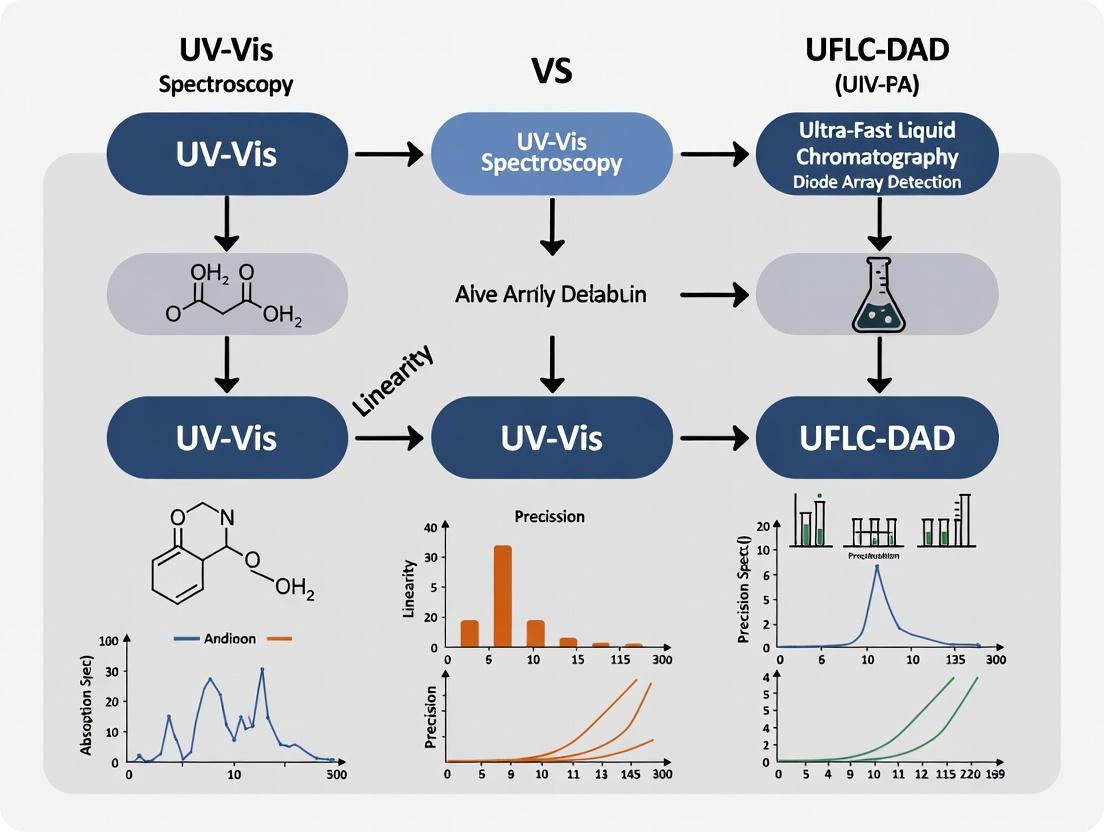
This article provides a systematic comparison of UV-Vis spectrophotometry and Ultra-Fast Liquid Chromatography with Diode Array Detection (UFLC-DAD) for pharmaceutical analysis, focusing on the critical validation parameters of linearity and...
Linearity and Precision in Pharmaceutical Analysis: A Comprehensive Comparison of UV-Vis and UFLC-DAD Methods
Abstract
This article provides a systematic comparison of UV-Vis spectrophotometry and Ultra-Fast Liquid Chromatography with Diode Array Detection (UFLC-DAD) for pharmaceutical analysis, focusing on the critical validation parameters of linearity and precision. Tailored for researchers, scientists, and drug development professionals, it explores the foundational principles of both techniques, their methodological applications in drug quantification, practical troubleshooting guidance, and a rigorous validation framework. By synthesizing current research and ICH guidelines, this review serves as a decision-making tool for selecting the optimal analytical method based on project requirements, balancing analytical performance with practical considerations like cost, speed, and environmental impact.
Understanding UV-Vis and UFLC-DAD: Core Principles and Instrumentation for Modern Pharma Analysis
In the realm of quantitative analysis, particularly within pharmaceutical development and quality control, two methodological approaches frequently come under comparison: ultraviolet-visible (UV-Vis) spectrophotometry governed by the Beer-Lambert law and ultra-fast liquid chromatography with diode-array detection (UFLC-DAD). The fundamental distinction between these techniques lies in their operational principles: UV-Vis spectrophotometry measures the aggregate absorption of a sample without separation, whereas chromatography separates components before detection. This guide provides an objective comparison of these techniques, focusing on their theoretical foundations, performance characteristics in validated methods, and appropriate applications within drug development. The evaluation is framed around the critical analytical parameters of linearity, precision, and sensitivity, which are paramount for regulatory acceptance in pharmaceutical analysis [1] [2].
Theoretical Foundations and Operating Principles
Beer-Lambert Law: The Principle of Direct Spectrophotometry
The Beer-Lambert law (also known as Beer's law) establishes a linear relationship between the attenuation of light through a substance and the properties of that substance. It provides the theoretical foundation for UV-Vis spectrophotometry, describing how light is absorbed by a solution [3] [4].
Mathematical Formulation: The law is expressed as: [ A = \epsilon l c ] Where:
- (A) is the measured absorbance (dimensionless)
- (\epsilon) is the molar absorptivity coefficient (L·mol⁻¹·cm⁻¹)
- (l) is the optical path length through the sample (cm)
- (c) is the concentration of the absorbing species (mol·L⁻¹) [3] [4]
Absorbance has a logarithmic relationship with transmittance ((T = I/I0)), where (I0) is the incident light intensity and (I) is the transmitted light intensity, defined as: [ A = \log{10} \left( \frac{I0}{I} \right) ] This relationship means that an absorbance of 1 corresponds to 10% transmittance, absorbance of 2 corresponds to 1% transmittance, and so on [3].
The Beer-Lambert law enables direct concentration determination without separation, provided the analyte is known and exhibits absorption in the UV-Vis range. This relationship holds true for monochromatic light and optically clear solutions where no scattering, fluorescence, or chemical interactions occur [3] [4] [5].
Chromatographic Separation: The Principle of Component Resolution
Chromatography operates on fundamentally different principles from direct spectrophotometry. In liquid chromatography, separation occurs as analytes distribute themselves between a stationary phase and a mobile phase, with different affinities causing components to elute at different times [1] [6].
Separation Mechanism: The core principle involves the differential partitioning of compounds between mobile and stationary phases. Compounds with stronger interactions with the stationary phase migrate more slowly through the chromatographic system, resulting in temporal separation before detection [1].
Detection Phase: In UFLC-DAD systems, once separation is achieved, the eluting compounds pass through a flow cell where they are subjected to UV-Vis detection. The diode array detector simultaneously captures absorbance across a spectrum of wavelengths, providing both quantitative and qualitative information [7] [6]. The detector still utilizes the Beer-Lambert law for quantification, but only after physical separation of components has occurred [7].
The fundamental distinction is that chromatography adds a separation dimension prior to detection, enabling resolution of complex mixtures that would be impossible to analyze by direct spectrophotometry due to overlapping absorption spectra [1] [8].
Experimental Protocols and Methodologies
UV-Vis Spectrophotometry Protocol for Pharmaceutical Analysis
The following protocol outlines a validated approach for determining active pharmaceutical ingredients (APIs) using UV-Vis spectrophotometry, as demonstrated for metoprolol tartrate (MET) and repaglinide analysis [1] [2]:
Instrumentation and Conditions:
- Instrument: Double-beam UV-Vis spectrophotometer
- Cuvette path length: 1.0 cm quartz cell
- Wavelength selection: Based on λmax of analyte (e.g., 223 nm for MET, 241 nm for repaglinide)
- Solvent: Appropriate solvent with UV transparency (methanol, water, or simulated body fluid)
- Temperature: Ambient (25°C) unless specified otherwise [1] [2]
Sample Preparation:
- Prepare stock standard solution of reference standard (e.g., 1000 μg/mL in methanol)
- Dilute aliquots to working concentrations across the calibration range
- For tablet analysis, weigh and powder tablets, then extract API with suitable solvent
- Filter and dilute extract to fall within linear range of method
- Prepare blank solution using identical solvent system [2]
Analysis Procedure:
- Zero instrument with blank solution
- Measure absorbance of standard solutions in triplicate
- Construct calibration curve (absorbance vs. concentration)
- Measure absorbance of sample solutions
- Calculate concentration from calibration curve [1] [2]
Method Validation Parameters:
- Linearity across specified concentration range
- Precision (repeatability and intermediate precision)
- Accuracy through recovery studies
- Specificity for intended analyte
- Limit of detection (LOD) and quantification (LOQ) [1] [2]
UFLC-DAD Protocol for Pharmaceutical Analysis
The UFLC-DAD method provides enhanced separation capability for complex mixtures, as applied to MET and repaglinide analysis [1] [2]:
Chromatographic Conditions:
- Instrument: UFLC system with DAD detector
- Column: C18 column (e.g., 250 mm × 4.6 mm i.d., 5 μm particle size)
- Mobile phase: Optimized binary or ternary mixture (e.g., methanol-water 80:20 v/v, pH adjusted to 3.5)
- Flow rate: 1.0 mL/min (typical)
- Injection volume: 10-20 μL
- Detection: Multiple wavelengths or spectral scanning (190-400 nm)
- Column temperature: 40°C (typical) [1] [2]
Sample Preparation:
- Prepare standard stock solutions in appropriate solvent
- Extract sample (tablet powder, biological matrix, etc.) with optimized solvent
- Centrifuge and filter samples (0.45 μm filter)
- Dilute to appropriate concentration range
- Use internal standard when necessary for improved precision [1]
Analysis Procedure:
- Equilibrate column with mobile phase
- Inject standards to establish calibration curve
- Inject samples and quality controls
- Monitor separation at optimal wavelength(s)
- Identify peaks by retention time and spectral matching
- Quantify using peak area or height relative to calibration standard [1] [2]
Method Validation:
- Specificity/selectivity against potential interferents
- Linearity and range
- Precision (system and method precision)
- Accuracy through spike recovery
- Sensitivity (LOD and LOQ)
- Robustness to deliberate parameter variations [1]
Comparative Performance Data
Linearity and Sensitivity Comparison
Table 1: Linearity and Sensitivity Parameters for UV-Vis and UFLC-DAD Methods
| Analytical Parameter | UV-Vis Spectrophotometry | UFLC-DAD | Analytical Context |
|---|---|---|---|
| Linear Range | 5-30 μg/mL [2] | 5-50 μg/mL [2] | Repaglinide analysis |
| Correlation Coefficient (r²) | >0.999 [2] | >0.999 [2] | Repaglinide analysis |
| Limit of Detection (LOD) | Not specified | 0.05 μg/mL [1] | Metoprolol tartrate analysis |
| Limit of Quantification (LOQ) | Not specified | 0.11 μg/mL [1] | Metoprolol tartrate analysis |
| Dynamic Range | Limited by Beer-Lambert deviations [1] | Wider dynamic range [1] | General comparison |
Precision and Accuracy Comparison
Table 2: Precision and Accuracy Data for UV-Vis and UFLC-DAD Methods
| Performance Metric | UV-Vis Spectrophotometry | UFLC-DAD | Context |
|---|---|---|---|
| Repeatability (%RSD) | <1.50% [2] | <1.50% [2] | Repaglinide analysis |
| Recovery (Low Concentration) | 96.00±2.00% [9] | 96.37±0.50% [9] | Levofloxacin analysis |
| Recovery (Medium Concentration) | 99.50±0.00% [9] | 110.96±0.23% [9] | Levofloxacin analysis |
| Recovery (High Concentration) | 98.67±0.06% [9] | 104.79±0.06% [9] | Levofloxacin analysis |
| Intermediate Precision | Comparable results between analysts and days [2] | Higher precision achievable (<0.2% RSD) [6] | General pharmaceutical analysis |
Application-Based Performance Comparison
Table 3: Method Performance in Different Application Contexts
| Application Context | UV-Vis Performance | UFLC-DAD Performance | Remarks |
|---|---|---|---|
| Simple API Quantification | Excellent for single-component analysis [2] | Overly complex for simple assays [1] | Suitable for quality control of raw materials |
| Multi-Component Formulations | Limited due to spectral overlap [1] | Excellent separation and quantification [1] | Requires method development |
| Complex Matrices | Significant interference [9] | Effective due to separation [9] | Biological samples require sample preparation |
| Drug Delivery Systems | Less accurate for release studies [9] | Preferred method for sustained release [9] | Levofloxacin in composite scaffolds |
| Greenness Assessment | More environmentally friendly [1] | Less green due to solvent consumption [1] | AGREE metric evaluation |
Critical Analysis: Advantages and Limitations
Beer-Lambert Law Based UV-Vis Spectrophotometry
Advantages:
- Simplicity and Speed: Procedures are straightforward with minimal sample preparation [1] [2]
- Cost-Effectiveness: Instrumentation is relatively inexpensive with simplified operations [1]
- Availability: Instruments are widely available in most analytical laboratories [1]
- Environmental Impact: Lower solvent consumption and hazardous waste generation [1]
Limitations:
- Spectral Overlap: Cannot resolve mixtures with overlapping absorption bands without mathematical processing [1] [8]
- Specificity Challenges: Limited ability to distinguish analyte signals from excipients or degradation products [1] [9]
- Concentration Limitations: Subject to Beer-Lambert law deviations at higher concentrations [1] [5]
- Interference Susceptibility: Any component absorbing at the measurement wavelength contributes to signal [9]
Chromatographic Separation with UFLC-DAD
Advantages:
- Selectivity: Physical separation of components before detection minimizes interference [1] [9]
- Specificity: Combination of retention time and spectral matching enables compound identification [7] [6]
- Multi-Component Analysis: Capable of simultaneously quantifying multiple analytes [1]
- Complex Matrices: Effective analysis in presence of interfering substances [9]
Limitations:
- Complexity: Requires more extensive method development and validation [1]
- Cost: Higher instrumentation and maintenance expenses [1]
- Time Consumption: Longer analysis times due to separation requirements [1]
- Environmental Impact: Higher solvent consumption generates more waste [1]
- Technical Expertise: Requires more skilled operators for development and troubleshooting [6]
Essential Research Reagents and Materials
Table 4: Key Research Reagents and Materials for Analytical Methods
| Reagent/Material | Function/Purpose | Example Applications |
|---|---|---|
| Methanol (HPLC grade) | Mobile phase component, solvent for standard and sample preparation | Repaglinide analysis [2] |
| Ultrapure Water | Mobile phase component, solvent preparation | Mobile phase for MET analysis [1] |
| Orthophosphoric Acid | Mobile phase pH adjustment | pH adjustment to 3.5 for repaglinide [2] |
| Reference Standards | Method calibration and quantification | Metoprolol tartrate (≥98%) [1] |
| C18 Chromatographic Column | Stationary phase for reverse-phase separation | Agilent TC-C18 column [2] |
| Simulated Body Fluid | Release medium for drug delivery studies | Levofloxacin release from scaffolds [9] |
| Tetrabutylammonium bromide | Ion-pairing reagent for chromatographic separation | Levofloxacin HPLC analysis [9] |
| Potassium Dihydrogen Phosphate | Buffer component for mobile phase | Levofloxacin HPLC analysis [9] |
The choice between Beer-Lambert law-based UV-Vis spectrophotometry and chromatographic separation depends primarily on the analytical problem's complexity and the required data quality objectives.
UV-Vis spectrophotometry is recommended for:
- Single-component analysis of raw materials and simple formulations
- Methods requiring rapid analysis with minimal sample preparation
- Situations with equipment or budget constraints
- Applications where environmental impact is a significant concern
UFLC-DAD is preferred for:
- Complex mixtures requiring component resolution
- Analyses demanding high specificity and peak purity assessment
- Method development for regulatory submission
- Stability-indicating methods where specificity is critical
For pharmaceutical quality control, UV-Vis spectrophotometry often suffices for routine analysis of active ingredients in simple formulations, providing adequate precision with significantly reduced operational complexity [2]. However, for method development supporting regulatory submissions or analysis of complex drug products, UFLC-DAD offers the necessary specificity and robustness required by modern analytical science [1] [6].
The trend toward hyphenated techniques that combine separation power with spectroscopic detection continues to grow, with UFLC-DAD systems offering a balanced approach that leverages the quantification principles of the Beer-Lambert law while overcoming its limitations through preceding chromatographic separation [7] [6].
In modern pharmaceutical analysis, the choice of instrumentation directly dictates the accuracy, speed, and reliability of analytical results. This guide provides a detailed comparison of two foundational technologies: the lamp-based detection system of a UV-Vis Spectrophotometer and the integrated pumping system and column of an Ultra-Fast Liquid Chromatography (UFLC) instrument. Within the broader thesis of comparing UV-Vis and UFLC-DAD (Diode Array Detection) methods, understanding these core components is critical. The detector lamp defines the source and quality of light for detection, while the UFLC pump and column define the separation efficiency and speed. Their combined performance ultimately determines the linearity, precision, and applicability of an analytical method for drug development and quality control [10] [11].
UV-Vis Spectrophotometer Lamps
The light source is the heart of a UV-Vis spectrophotometer. Deuterium (D₂) lamps are the standard for generating ultraviolet light. They are gas-discharge lamps that provide a continuous spectrum in the UV range (approximately 185–400 nm), essential for exciting electrons in analyte molecules and enabling quantitative analysis based on the Beer-Lambert law [12] [13].
- Function & Principle: To ignite the lamp, a high-voltage pulse is applied to heat a filament and ionize the deuterium gas, creating a stable, bright plasma. The light emitted is then focused through the sample, and the intensity of transmitted light at specific wavelengths is measured by a detector [12].
- Key Characteristics: These lamps are characterized by a long service life, typically between 1,000 to over 2,000 hours. Their performance is crucial for the stability and sensitivity of the instrument. They operate at high temperatures and require a housing made of specialized UV-transmissive materials like quartz [12] [13].
- System Integration: In a spectrophotometer, the lamp is part of a larger optical system that includes a monochromator for wavelength selection and a photodetector. Modern instruments emphasize intuitive interfaces and guided workflows to minimize user error [14] [15].
UFLC Pumping Systems and Columns
UFLC represents a significant evolution from traditional High-Performance Liquid Chromatography (HPLC), with enhancements centered on the pump and the column to achieve higher efficiency.
- Pumping System: UFLC pumps are designed to deliver mobile phase at significantly higher pressures (often exceeding 15,000 psi) compared to HPLC pumps. This allows for the use of columns packed with smaller particles and higher mobile phase linear velocities, which directly translates to faster flow rates, reduced analysis time, and improved resolution [11] [16].
- Chromatography Columns: The column is the center of separation. UFLC columns (e.g., Kinetex-C18, 2.1 × 50 mm, 1.3 μm) are shorter and packed with solid-phase particles that are typically sub-2μm in diameter. This smaller particle size creates a much larger surface area for interaction with analytes, dramatically enhancing chromatographic resolution and peak capacity [11] [17].
- System Synergy: The high-pressure pump and the specialized column work in concert. The pump must provide a stable, pulse-free flow at high pressures to efficiently move analytes through the densely packed column, enabling rapid and high-fidelity separations of complex mixtures [16].
The diagram below illustrates the fundamental differences in the operational workflow and data generation between the two techniques.
Performance Comparison: Linearity, Precision, and Sensitivity
Direct experimental data from a comparative study of posaconazole analysis and general method comparisons highlight the distinct performance characteristics of each technique.
Table 1: Quantitative Performance Metrics from a Comparative Study of Posaconazole Analysis [11]
| Performance Parameter | HPLC-DAD Method | UHPLC-UV Method | Implication for Comparison |
|---|---|---|---|
| Run Time | 11 minutes | 3 minutes | UFLC offers >60% speed increase, enhancing throughput. |
| Linearity (R²) | > 0.999 | > 0.999 | Both techniques demonstrate excellent linearity within the validated range (5–50 μg/mL). |
| Precision (CV%) | < 3% | < 3% | Both methods show high precision and low error, suitable for quantitative analysis. |
| Limit of Detection (LOD) | 0.82 μg/mL | 1.04 μg/mL | HPLC-DAD showed a marginally better LOD in this specific study. |
| Limit of Quantitation (LOQ) | 2.73 μg/mL | 3.16 μg/mL | HPLC-DAD showed a marginally better LOQ in this specific study. |
| Solvent Consumption | Higher (1.5 mL/min flow rate) | Lower (0.4 mL/min flow rate) | UFLC is more economical and environmentally friendly due to lower solvent use. |
Table 2: General Method Comparison for Drug Analysis [10]
| Aspect | UV-Vis Spectroscopy | UFLC / HPLC |
|---|---|---|
| Selectivity | Limited; prone to spectral overlaps in mixtures. | High; excellent for separating and quantifying components in complex mixtures. |
| Sensitivity | Good for simple assays with strong chromophores. | Superior; capable of detecting and quantifying low-level impurities and degradants. |
| Sample Preparation | Minimal; often just dissolution. | Can be complex; requires optimization of mobile phase, column, and sample clean-up. |
| Best Use Cases | Routine QC of simple, single-component samples. | Complex formulations, impurity profiling, and stability-indicating methods. |
Analysis of Experimental Data
The data in Table 1 demonstrates that while the UFLC-UV method holds a dominant advantage in analysis speed and solvent economy, both HPLC-DAD and UHPLC-UV can achieve nearly identical results in terms of linearity and precision for a well-defined compound like posaconazole. The marginally better LOD/LOQ for the HPLC method in this case may be attributed to specific detector configurations (DAD vs. UV) and column chemistry rather than a fundamental limitation of either platform [11].
Table 2 underscores a more fundamental distinction: UV-Vis lacks inherent selectivity for mixtures. Its precision is high for a single, pure analyte, but its linearity can be easily compromised by interfering substances that absorb at the same wavelength. In contrast, UFLC's precision and linearity are maintained across complex samples because of the initial physical separation of components [10] [18].
Detailed Experimental Protocols
Protocol for UFLC-DAD Method Development and Validation
The following protocol, adapted from studies on posaconazole and DNA-binding compounds, outlines a systematic approach for developing a validated UFLC-DAD method [11] [19].
1. Instrument Setup:
- Column: Select a suitable UFLC column (e.g., Kinetex-C18, 2.1 × 50 mm, 1.3 μm).
- Mobile Phase: Prepare a buffered aqueous solution and a miscible organic solvent (e.g., Acetonitrile). Use isocratic or gradient elution.
- Pumping Parameters: Set flow rate (e.g., 0.4 mL/min) and pressure limits according to column specifications.
- DAD Detection: Set the detection wavelength (e.g., 262 nm) and spectrum acquisition range.
2. Calibration Curve Procedure:
- Prepare a stock solution of the analyte (e.g., 100 μg/mL).
- Serially dilute to create standards covering the expected concentration range (e.g., 5–50 μg/mL).
- Inject each standard in triplicate and record the peak area.
- Plot mean peak area vs. concentration to establish the calibration curve and calculate the coefficient of determination (R²).
3. Validation Assessment:
- Precision: Inject replicate samples (n=6) at low, medium, and high concentrations within the same day (repeatability) and on different days (intermediate precision). Calculate the % Coefficient of Variation (CV%).
- Accuracy: Spike a known amount of analyte into a placebo or sample matrix and calculate the percentage recovery.
- LOD/LOQ: Determine based on signal-to-noise ratio (typically 3:1 for LOD and 10:1 for LOQ) or from the standard deviation of the response and the slope of the calibration curve.
Protocol for UV-Vis Method Development and Validation
This protocol, based on the development of a method for oxytetracycline, describes the key steps for a UV-Vis assay [18].
1. Wavelength Selection:
- Prepare a standard solution of the target analyte at a known concentration.
- Scan the solution across the UV-Vis range (e.g., 200–400 nm) using a spectrophotometer.
- Identify the wavelength of maximum absorption (λmax) for quantification.
2. Calibration Curve Procedure:
- Prepare a series of standard solutions at different concentrations.
- Measure the absorbance of each standard at the predetermined λmax.
- Plot absorbance versus concentration to generate the calibration curve and determine R².
3. Validation Assessment:
- Precision & Accuracy: Similar to the UFLC protocol, assess through replicate measurements and recovery studies of spiked samples.
- Specificity: Challenge the method by analyzing samples containing potential interferents (excipients, degradation products) to ensure the absorbance measured is specific to the analyte.
The Scientist's Toolkit: Essential Research Reagent Solutions
The following table details key consumables and materials essential for operating and maintaining these analytical systems.
Table 3: Essential Research Reagents and Materials [11] [12] [17]
| Item | Function / Description | Key Considerations |
|---|---|---|
| Deuterium (D₂) Lamp | Gas-discharge lamp providing a stable, continuous UV light source for detection in both UV-Vis and UFLC-DAD systems. | Service life of ~2000 hours; device-specific holders are critical for compatibility; requires careful handling due to high intensity UV and operating temperatures [12] [13]. |
| UFLC Column (e.g., C18, 1.3 μm) | The core of separation; a short column packed with sub-2μm particles for high-resolution, high-speed analysis. | Particle size, pore size, and stationary phase chemistry (e.g., C8, C18, phenyl) must be selected based on analyte properties [11] [17]. |
| HPLC/UHPLC Grade Solvents | Used to prepare the mobile phase (eluent). High purity is required to minimize baseline noise and prevent system damage. | Acetonitrile and methanol are common organic modifiers; must be free of particulate and UV-absorbing impurities [11]. |
| Buffer Salts (e.g., Potassium Dihydrogen Phosphate) | Used to prepare the aqueous component of the mobile phase, controlling pH and ionic strength to optimize separation and peak shape. | Must be highly pure and soluble; mobile phase often requires filtration and degassing [11] [18]. |
| Reference Standards | Highly purified and characterized analyte used for instrument calibration and method validation. | Essential for ensuring accuracy and traceability of results; should be obtained from a certified supplier [18]. |
The choice between a UV-Vis spectrophotometer and a UFLC-DAD system is not a matter of one being universally superior, but of selecting the right tool for the analytical problem. UV-Vis spectroscopy remains a powerful, cost-effective tool for simple, rapid, and high-throughput analysis of single-component samples where its linearity and precision are uncompromised. In contrast, UFLC-DAD, with its high-pressure pumping system and advanced columns, is indispensable for complex mixture analysis, offering unmatched selectivity, speed, and the ability to handle challenging separations in drug development and quality control [10] [11].
Future trends point toward further miniaturization and portability of UHPLC systems, increased integration of digital tools for performance monitoring, and a focus on green analytical chemistry through reduced solvent consumption [16] [14]. For the researcher, this means that while the fundamental principles of detection (lamps) and separation (pumps and columns) will remain, the instruments will become smarter, faster, and more sustainable, continuing to push the boundaries of what is possible in pharmaceutical analysis.
In the realm of analytical chemistry, particularly within pharmaceutical development and quality control, the choice of detection technology is pivotal for generating reliable, precise, and informative data. High-Performance Liquid Chromatography (HPLC) serves as a backbone for the separation and analysis of complex mixtures, with detectors acting as the eyes of the system. Among these, Single Wavelength Ultraviolet (UV) detectors and multi-wavelength Diode Array Detectors (DAD) represent two foundational technologies. This guide provides an objective comparison of their performance, framing the analysis within broader research on the linearity and precision of UV-Vis and Ultra-Fast Liquid Chromatography-DAD (UFLC-DAD) methodologies [1]. Understanding their distinct capabilities, supported by experimental data, empowers researchers and drug development professionals to select the optimal detector for their specific analytical challenges.
Fundamental Principles and Instrumentation
The core function of a UV detector in HPLC is to measure the absorbance of ultraviolet or visible light by analytes as they elute from the chromatography column. This absorbance, governed by the Beer-Lambert law, is directly proportional to the analyte's concentration and its molar absorptivity at a specific wavelength [6]. Despite this shared principle, the optical design and data acquisition strategies of single-wavelength UV and DAD detectors differ significantly.
Single Wavelength UV Detectors: These detectors, including variable wavelength (VWD) types, operate by isolating a single, user-specified wavelength for detection. A deuterium or tungsten lamp emits broad-spectrum light, which is then passed through a monochromator—an optical system with a movable diffraction grating—to select the desired wavelength [6]. This monochromatic light passes through the flow cell, and a single photodiode measures its intensity after interaction with the sample. The key limitation is that absorbance data is captured at only one wavelength at a time.
Diode Array Detectors (DAD/PDA): In a DAD, the optical path is reversed. Polychromatic light from the source passes through the flow cell first. The transmitted light is then dispersed across an array of hundreds of photodiodes (e.g., 512 or 1024), each measuring a narrow band of the spectrum simultaneously [6] [20]. This design allows for the continuous collection of full spectral data (190-600 nm or wider) for every point in the chromatogram, creating a three-dimensional data cube (absorbance, time, and wavelength).
The diagram below illustrates the fundamental difference in the optical pathways of these two detectors.
Performance Comparison: Experimental Data and Validation
The theoretical differences in design translate directly to measurable differences in analytical performance. The following table summarizes key characteristics based on instrument specifications and validation studies.
Table 1: Key Characteristics of Single Wavelength UV and DAD Detectors
| Characteristic | Single Wavelength UV Detector | Diode Array Detector (DAD) |
|---|---|---|
| Wavelength Selection | Single, pre-selected wavelength [6] | Full spectrum simultaneously [6] [20] |
| Primary Output | Chromatogram (Absorbance vs. Time) | 3D Data: Chromatogram & Spectra (Absorbance vs. Time vs. Wavelength) [20] |
| Peak Purity Assessment | Not possible | Yes, via spectral comparison across the peak [6] |
| Method Development | Sequential wavelength testing required | Rapid, post-run wavelength optimization |
| Sensitivity | High at optimized wavelength | High, but can be lower due to broader optical path [6] |
| Specificity | Moderate (depends on separation) | High (confirmation via spectral identity) [1] [21] |
| Typical Noise Specification | < ±1.0 × 10⁻⁵ AU (modern detectors) [6] | Similar to modern VWD [6] |
To move beyond specifications and into practical performance, validation studies for specific assays provide critical quantitative data. The table below compiles experimental results from two such studies: one comparing UV spectrophotometry to UFLC-DAD for the analysis of metoprolol tartrate (MET) [1], and another validating an HPLC-DAD method for quercetin [21].
Table 2: Experimental Validation Data from Comparative Studies
| Validation Parameter | UV-Spectrophotometry (Single Wavelength) | UFLC-DAD / HPLC-DAD | |
|---|---|---|---|
| Analyte / Study | Metoprolol (MET) [1] | Metoprolol (MET) [1] | Quercetin [21] |
| Linearity (R²) | Not specified (implied good) | > 0.995 | 0.9976 [21] |
| Precision (Repeatability, %RSD) | Good, but limited by method | Good | 2.41% - 6.74% (Intraday) [21] |
| Limit of Detection (LOD) | Higher (method less sensitive) | Lower | 0.046 µg/mL [21] |
| Limit of Quantification (LOQ) | Higher (method less sensitive) | Lower | 0.14 µg/mL [21] |
| Accuracy (% Recovery) | Good, but susceptible to interference | Good, more reliable in mixtures | 88.6% - 110.7% [21] |
| Selectivity/Specificity | Lower for complex mixtures [1] | High; confirmed for MET in tablets [1] | High; method specific [21] |
Key Insights from Experimental Data:
- Specificity and Peak Purity: The DAD's superior specificity is a recurring advantage. In the quercetin study, the HPLC-DAD method was optimized to achieve a sharp peak at 3.6 minutes and a specific wavelength (368 nm), ensuring accurate quantification without interference [21]. This is paramount in pharmaceutical analysis for distinguishing APIs from degradants or excipients.
- Sensitivity and Dynamic Range: Advanced DAD systems are pushing the boundaries of sensitivity and dynamic range. For instance, Agilent's 1290 Infinity III High Dynamic Range DAD combines two detectors to achieve a 30 times wider linear UV range, enabling the detection and quantification of major and minor components in a single run [22].
- Limitations of Single Wavelength Methods: The MET study concluded that while UV spectrophotometry is cost-effective, it has limitations regarding sample volume and the analysis of higher concentrations, making the DAD-based method more robust for quantitative analysis in complex matrices like tablets [1].
Essential Research Reagent Solutions
The operation and maintenance of these detectors rely on a set of key consumables and components. The following table details these essential items and their functions.
Table 3: Key Research Reagent Solutions for UV and DAD Systems
| Item | Function | Typical Application / Note |
|---|---|---|
| Deuterium (D₂) Lamp [6] [20] | Provides high-energy light in the UV range (~190-400 nm). | Standard source for UV detection; finite lifetime. |
| Tungsten (W) Lamp [6] [20] | Provides light in the visible range (~400-900 nm). | Often used alongside D₂ lamps in DAD for Vis range. |
| Flow Cell [6] | A small, flow-through cuvette where the analyte absorbs light. | Pathlength (e.g., 10 mm) critical for sensitivity; volume must be minimized for UHPLC. |
| Mobile Phase Solvents | The liquid carrier that moves the analyte through the system. | Must be optically transparent at the detection wavelength. |
| Standard Solutions (e.g., Quercetin, Metoprolol) [1] [21] | Used for system calibration, qualification, and method validation. | Certified reference materials ensure accuracy and traceability. |
Experimental Protocols for Method Comparison
To objectively compare detector capabilities in a lab setting, the following generalized protocols, synthesized from the cited studies, can be employed.
Protocol 1: Assessing Specificity and Peak Purity via DAD
- Sample Preparation: Prepare a sample containing the target analyte (e.g., a pharmaceutical tablet extract) that may include potential interferents from the matrix or degradation products [1] [21].
- Chromatographic Separation: Inject the sample into the HPLC/DAD system. Use a suitable column and mobile phase to achieve separation. The DAD should be set to acquire data across the entire UV-Vis spectrum of interest (e.g., 200-400 nm) [21].
- Data Analysis:
- Peak Purity Assessment: For the target analyte peak, compare the UV spectra extracted from the upslope, apex, and downslope of the peak. A pure peak will have highly congruent spectra across all points [6].
- Spectral Identification: Use the acquired spectrum to confirm the identity of the analyte by matching it against a spectrum from a certified standard.
The workflow for this purity assessment is outlined below.
Protocol 2: Comparing Linearity and Sensitivity
- Calibration Curve: Prepare a series of standard solutions of the target analyte (e.g., quercetin) across a wide concentration range (e.g., 0.14–245 µg/mL) [21].
- Analysis:
- For Single Wavelength UV: Analyze the standards at one, pre-determined optimal wavelength (λmax).
- For DAD: Analyze the standards with full spectral acquisition. Generate calibration curves at the same λmax.
- Data Comparison: Calculate the correlation coefficient (R²), slope, and y-intercept for both curves. Determine the Limit of Detection (LOD) and Limit of Quantification (LOQ) for each method based on signal-to-noise ratios. The method with a higher R², and lower LOD/LOQ is more sensitive and has a wider linear dynamic range [1] [21].
The choice between a single wavelength UV detector and a DAD is not a matter of one being universally superior, but rather of selecting the right tool for the analytical task. Single wavelength UV detectors offer robust, cost-effective, and highly sensitive quantification for well-characterized methods where spectral information is unnecessary. In contrast, DADs provide critical added value through spectral data, enabling peak purity analysis, method development flexibility, and enhanced identification confidence, which is indispensable in research and regulated environments like pharmaceutical quality control [6] [1] [21].
Future trends are strengthening the case for DAD technology. The market is moving towards miniaturization, higher sensitivity, and greater integration with digital lab ecosystems [23] [24]. Furthermore, the development of High Dynamic Range DADs [22] and the integration of artificial intelligence for data analysis [24] are solving traditional challenges and unlocking new capabilities. For any scientist embarking on research involving linearity and precision comparisons, the multi-wavelength capability of a DAD provides a depth of verification and analytical rigor that single wavelength detection cannot match, making it an increasingly critical tool in the modern laboratory.
Inherent Strengths and Limitations of Each Technique for Quantitative Analysis
In pharmaceutical analysis, the choice between UV-Vis spectrophotometry and Ultra-Fast Liquid Chromatography with Diode Array Detection (UFLC-DAD) represents a fundamental trade-off between simplicity, cost, and analytical capability. Within the broader context of linearity and precision comparison research, understanding the inherent strengths and limitations of each technique is crucial for method selection in drug development and quality control. This guide provides an objective comparison of these techniques, supported by experimental data and detailed protocols, to inform researchers and scientists in their analytical strategy.
Technical Principles and Detection Capabilities
UV-Vis Spectrophotometry
UV-Vis spectrophotometry operates on the Beer-Lambert law, where absorbance is directly proportional to the concentration of chromophoric analytes in solution [6]. The technique measures the absorption of ultraviolet or visible light by molecules, typically at their maximum absorption wavelength (λmax), providing a straightforward approach for compound quantification [1] [6]. Modern spectrophotometers utilize deuterium lamps for UV light sources and photodiode detectors to measure transmittance through standard 1 cm pathlength quartz cells [6].
UFLC-DAD Technology
UFLC-DAD combines the separation power of liquid chromatography with the detection capabilities of diode array technology [1] [6]. The DAD detector differs fundamentally from single-wavelength UV detectors by simultaneously monitoring the entire UV-Vis spectrum (typically 190-600 nm) using an array of hundreds of photodiodes [6] [25]. This enables collection of both chromatographic and spectral data during a single analysis, providing superior specificity through peak purity assessment and spectral confirmation [1] [25]. UFLC systems further enhance this capability with reduced particle size columns (often sub-2μm) that operate at higher pressures, delivering shorter analysis times, increased peak capacity, and reduced solvent consumption compared to conventional HPLC [1].
Performance Comparison: Experimental Data
Linearity and Sensitivity
Table 1: Comparison of Linear Range and Sensitivity Parameters
| Parameter | UV-Vis Spectrophotometry | UFLC-DAD |
|---|---|---|
| Typical Linear Range | 5-30 μg/mL (Repaglinide) [2] | 5-50 μg/mL (Repaglinide) [2] |
| Correlation Coefficient (r²) | >0.999 [2] | >0.999 [2] |
| Limit of Detection | Higher (sample-dependent) [1] | Lower (sample-dependent) [1] |
| Limit of Quantification | Higher (sample-dependent) [1] | Lower (sample-dependent) [1] |
| Dynamic Range | More limited due to Beer-Lambert deviation at higher concentrations [1] | Wider working range [1] |
Precision and Accuracy
Table 2: Comparison of Precision and Accuracy Performance
| Parameter | UV-Vis Spectrophotometry | UFLC-DAD |
|---|---|---|
| Repeatability (%RSD) | <1.50% (Repaglinide) [2] | <1.50% (Repaglinide) [2] |
| Intermediate Precision (%RSD) | Slightly higher variability [1] | Superior reproducibility [1] |
| Accuracy (% Recovery) | 99.63-100.45% (Repaglinide) [2] | 99.71-100.25% (Repaglinide) [2] |
| Robustness | More susceptible to matrix interference [1] | More resilient to matrix effects [1] |
Experimental Protocols for Method Validation
Instrumentation: Shimadzu 1700 Double beam UV-Vis spectrophotometer with 1.0 cm quartz cells
Reagent Preparation:
- Standard stock solution: 1000 μg/mL repaglinide in methanol
- Working standards: Dilute stock to 5-30 μg/mL range with methanol
- Sample preparation: Powder 20 tablets, weigh equivalent to 10 mg repaglinide, dissolve in 30 mL methanol, sonicate 15 minutes, dilute to 100 mL and filter
Analytical Procedure:
- Set wavelength to 241 nm (λmax for repaglinide)
- Zero instrument with methanol blank
- Measure absorbance of standards and samples
- Construct calibration curve (absorbance vs. concentration)
- Calculate sample concentrations from regression equation
Validation Parameters:
- Linearity: Six concentrations in triplicate (5-30 μg/mL)
- Precision: Six replicate measurements at 100% test concentration
- Accuracy: Standard addition at three levels in triplicate
- Specificity: Scan 200-400 nm to confirm no interfering absorbance
Instrumentation: UFLC system with DAD detector, C18 column
Chromatographic Conditions:
- Mobile phase: Optimized for metoprolol separation
- Flow rate: Optimized for peak symmetry and resolution
- Detection: DAD monitoring at 223 nm with full spectrum collection
- Injection volume: 20 μL
- Column temperature: Controlled
Sample Preparation:
- Standard solutions: Prepared in ultrapure water
- Tablet extraction: Optimized extraction from commercial tablets (50 mg and 100 mg)
- Solutions protected from light and stored in dark
Validation Parameters:
- Specificity/Selectivity: Resolution from excipients and degradation products
- Linearity: Calibration curves with defined range
- Accuracy: Spike recovery studies
- Precision: Repeatability and intermediate precision
- Robustness: Deliberate variation of method parameters
Critical Strengths and Limitations
UV-Vis Spectrophotometry
Strengths:
- Simplicity and ease of use: Straightforward procedures with minimal training requirements [1]
- Cost-effectiveness: Lower equipment and maintenance costs compared to chromatographic systems [1]
- Rapid analysis: Minimal sample preparation and fast measurement [1]
- Adequate precision: Suitable for quality control applications with RSD typically <1.5% [2]
- Proven reliability: Established technique with extensive literature support [1]
Limitations:
- Limited specificity: Cannot resolve mixtures without prior separation; overlapping spectra cause interference [1]
- Matrix susceptibility: Excipients and impurities can cause significant interference [1]
- Narrower linear range: Practical working range more limited than chromatographic methods [1]
- Higher detection limits: Less sensitive for trace analysis compared to UFLC-DAD [1]
- Concentration constraints: Difficulties with higher sample concentrations due to Beer-Lambert law limitations [1]
UFLC-DAD
Strengths:
- Enhanced specificity: Dual identification through retention time and spectral matching [1] [25]
- Peak purity assessment: Detection of co-eluting peaks invisible to single-wavelength detection [25]
- Superior sensitivity: Lower detection and quantification limits [1]
- Wider linear range: Accommodates broader concentration ranges [1] [2]
- Matrix tolerance: Effective analysis in complex samples due to chromatographic separation [1]
Limitations:
- Higher complexity: Requires significant expertise for operation and maintenance [1]
- Increased cost: Substantial equipment investment and higher solvent consumption [1]
- Longer analysis time: Includes separation time in addition to detection [1]
- Method development complexity: Requires optimization of multiple parameters [1]
- Environmental impact: Higher solvent usage compared to direct spectrophotometry [1]
Research Reagent Solutions
Table 3: Essential Materials and Reagents for Method Implementation
| Reagent/ Material | Function | Specifications |
|---|---|---|
| HPLC Grade Methanol | Mobile phase/solvent | Low UV cutoff, minimal impurities [2] |
| Ultrapure Water | Aqueous mobile phase component | 18.2 MΩ·cm resistance, filtered [1] |
| C18 Chromatography Column | Stationary phase for separation | 250 × 4.6 mm, 5 μm particles or sub-2μm for UFLC [2] |
| Reference Standards | Calibration and identification | Certified purity ≥98% [1] [2] |
| Orthophosphoric Acid | Mobile phase pH adjustment | HPLC grade for reproducible retention [2] |
| Syringe Filters | Sample clarification | 0.45 μm or 0.22 μm porosity [2] |
Application Workflow and Decision Pathway
The selection between UV-Vis spectrophotometry and UFLC-DAD for quantitative pharmaceutical analysis involves careful consideration of their inherent strengths and limitations. UV-Vis offers simplicity, cost-efficiency, and adequate precision for routine quality control of single-component samples, while UFLC-DAD provides superior specificity, sensitivity, and matrix tolerance for complex analyses. The experimental data demonstrates that both techniques can deliver excellent linearity (r² >0.999) and precision (%RSD <1.5%) when properly validated, though their operational ranges and applications differ significantly. Within the context of linearity and precision comparison research, UFLC-DAD generally provides wider dynamic range and better reproducibility, while UV-Vis remains a viable, more sustainable option for applications where its limitations can be mitigated through appropriate method design.
Analytical method validation is the formal process of proving that an analytical method is acceptable for its intended purpose. For pharmaceutical analysis, it ensures the identity, purity, potency, and safety of drug substances and products throughout their lifecycle. The International Council for Harmonisation (ICH) guidelines establish the core parameters required for method validation, with linearity, precision, specificity, and accuracy representing four fundamental pillars that determine method reliability and reproducibility [10] [26]. These parameters are universally applicable across analytical techniques, though their performance standards vary significantly based on the methodology's complexity and separation capabilities.
This guide provides a comparative analysis of these key validation parameters as applied to two widely used analytical techniques: Ultraviolet-Visible (UV-Vis) spectrophotometry and Ultra-Fast Liquid Chromatography with Diode-Array Detection (UFLC-DAD). Understanding the performance characteristics of each method enables researchers, scientists, and drug development professionals to select the most appropriate technology based on their specific application requirements, whether for routine quality control of simple formulations or for analyzing complex drug delivery systems and stability-indicating methods.
Comparative Analysis of UV-Vis and UFLC-DAD Methods
Fundamental Principles and Applications
UV-Vis Spectrophotometry is based on the measurement of analyte absorption of ultraviolet or visible light, following the Beer-Lambert law, which states that absorbance is proportional to the concentration of the absorbing species [27]. It offers simplicity, rapid analysis time, and economical operation, making it ideal for routine quality control of simple formulations where analytes contain chromophores and are free from significant interference [10] [2].
UFLC-DAD represents an advanced liquid chromatography technology that provides superior separation capabilities through reduced particle size packing materials, coupled with detection across a spectrum of wavelengths. This technique combines high resolution with the ability to collect spectral data for peak identification and purity assessment, making it particularly valuable for complex mixtures, impurity profiling, and stability studies [1] [26].
Performance Comparison of Validation Parameters
The table below summarizes the comparative performance of UV-Vis and UFLC-DAD across the four key validation parameters based on experimental data from pharmaceutical applications:
Table 1: Comparison of Key Validation Parameters Between UV-Vis and UFLC-DAD Methods
| Validation Parameter | UV-Vis Spectrophotometry | UFLC-DAD |
|---|---|---|
| Linearity | ||
| Typical Correlation Coefficient (R²) | 0.999-0.9999 [28] [2] [29] | >0.999 [1] [29] [26] |
| Concentration Range | Varies by analyte (e.g., 1-12 μg/mL for levofloxacin [28]; 4-20 μg/mL for drotaverine [27]) | Generally wider dynamic range (e.g., 0.05-300 μg/mL for levofloxacin [29]) |
| Precision | ||
| Repeatability (%RSD) | Generally <1.5% [2] | Often <1.5% [2] [26] |
| Intermediate Precision | More susceptible to variations [27] | Superior robustness to variations [1] |
| Specificity | Limited; vulnerable to spectral overlaps [1] [10] | Excellent; separates analytes from interferents [1] [29] |
| Accuracy | ||
| Mean Recovery Range | 99.63-100.45% (repaglinide) [2] | 96.37-110.96% (levofloxacin) [29] |
| Reliability in Complex Matrices | Potentially compromised by interference [29] | Maintained even in complex matrices [29] [26] |
Experimental Protocols for Method Validation
Protocol for Determining Linearity
UV-Vis Methodology: For UV-Vis methods, linearity is established by preparing a standard stock solution of the analyte and diluting it to a minimum of five different concentrations covering the expected range [27] [2]. For example, in the analysis of repaglinide, concentrations of 5-30 μg/mL were prepared in methanol, and absorbance was measured at 241 nm [2]. Similarly, for levofloxacin determination, the linear range was established between 1-12 μg/mL in a solvent composed of water:methanol:acetonitrile (9:0.5:0.5) with detection at 292 nm [28]. The absorbance values are plotted against concentration, and the correlation coefficient, y-intercept, and slope of the regression line are calculated using the least squares method [2].
UFLC-DAD Methodology: For UFLC-DAD methods, linearity is assessed by injecting a series of standard solutions at different concentrations. In the validation of a quercetin quantification method, nine standard concentrations were used to establish the calibration curve [26]. The method demonstrated excellent linearity with R² > 0.995. For levofloxacin analysis by UFLC, the linear concentration range was significantly wider (0.05-300 μg/mL) compared to UV-Vis, with a regression equation of y = 0.033x + 0.010 and R² = 0.9991 [29]. The linearity is verified through statistical analysis of the calibration curve, including evaluation of the residual plot and the variance of the slope and intercept [26].
Protocol for Assessing Precision
Repeatability (Intra-day Precision): For both techniques, repeatability is determined by analyzing multiple preparations (typically n=6) of a single homogeneous sample at 100% of the test concentration [2]. For example, in the analysis of repaglinide tablets, six replicate analyses of the same sample solution were performed, and the relative standard deviation (RSD) of the results was calculated [2]. The acceptable RSD generally should not exceed 2% for pharmaceutical quality control applications [2].
Intermediate Precision (Inter-day Precision): Intermediate precision is evaluated by analyzing the same samples on different days, with different analysts, or using different instruments [27] [2]. In the validation of a method for drotaverine and etoricoxib, intra-day precision was determined by preparing tablet samples with three concentrations and three replicates each on the same day, while inter-day precision was assessed by assaying tablets in triplicate per day for three consecutive days [27]. The results were analyzed using two-way ANOVA to determine significant differences [27].
Protocol for Establishing Specificity
UV-Vis Methodology: Specificity in UV-Vis methods is typically demonstrated by comparing the spectrum of the pure analyte with that of the sample matrix and potential interferents [2]. For the repaglinide method, the UV spectrum of the tablet solution was recorded between 200-400 nm to evaluate possible interfering bands at the analytical wavelength (241 nm) [2]. In cases where spectral overlaps occur, derivative spectroscopy or baseline manipulation techniques may be employed [27]. The baseline manipulation method developed for drotaverine and etoricoxib used a solution of one analyte in the blank to obtain independent wavelengths for each analyte in the mixture [27].
UFLC-DAD Methodology: Specificity in UFLC-DAD is demonstrated through the complete separation of the target analyte from closely related compounds, excipients, impurities, and degradation products [1] [26]. For quercetin quantification, specificity was confirmed by analyzing mixed solutions containing rutin and kaempferol in addition to quercetin [26]. The method successfully separated all three compounds with distinct retention times (2.5, 3.6, and 5.4 minutes, respectively), enabling specific identification and quantification of quercetin [26]. The use of DAD further enhances specificity by allowing peak purity assessment through spectral matching [26].
Protocol for Verifying Accuracy
Accuracy Determination: Accuracy is typically assessed through recovery studies by spiking a pre-analyzed sample with known amounts of the standard analyte at three different levels (usually 50%, 100%, and 150% of the target concentration) [27] [2]. For each level, a minimum of three determinations is performed [27]. In the validation of the repaglinide methods, accuracy was demonstrated by adding known quantities of the reference standard to tablet samples and calculating the percentage recovery [2]. The mean recovery for the UV method ranged between 99.63-100.45%, while for HPLC it was 99.71-100.25% [2].
Comparison of Accuracy Between Techniques: A direct comparison of UV-Vis and UFLC-DAD for levofloxacin analysis demonstrated notable differences in accuracy when applied to complex drug delivery systems [29]. The recovery rates for low, medium, and high concentrations (5, 25, and 50 μg/mL) of levofloxacin determined by UFLC-DAD were 96.37±0.50%, 110.96±0.23%, and 104.79±0.06%, respectively, while those for UV-Vis were 96.00±2.00%, 99.50±0.00%, and 98.67±0.06%, respectively [29]. This study highlighted that UV-Vis may provide misleading results for complex samples despite apparently good recovery rates, due to interference from matrix components [29].
Visualization of Method Selection and Validation Workflow
The following workflow diagram illustrates the logical decision process for selecting between UV-Vis and UFLC-DAD methods based on analytical requirements and the subsequent validation pathway:
Figure 1: Analytical Method Selection and Validation Workflow
Essential Research Reagent Solutions
The table below outlines key reagents and materials required for implementing and validating UV-Vis and UFLC-DAD methods, along with their specific functions in the analytical processes:
Table 2: Essential Research Reagents and Materials for Analytical Method Validation
| Reagent/Material | Function & Application | Technical Specifications |
|---|---|---|
| Spectroscopic Grade Solvents (Methanol, Acetonitrile, Water) | Sample preparation and dilution; mobile phase component [27] [2] [26] | Low UV cutoff; minimal interference; HPLC grade for chromatography |
| Reference Standards | Method calibration and accuracy determination [27] [1] [2] | High purity (≥98%); certified concentration; traceable source |
| Chromatography Columns (C18, 250×4.6mm, 5μm) | Stationary phase for compound separation in UFLC-DAD [2] [29] [26] | Specific particle size; pore size; and surface chemistry for separation |
| Buffer Salts (Potassium Dihydrogen Phosphate, Tetrabutylammonium Bromide) | Mobile phase modifiers for controlling pH and ion strength [29] [26] | HPLC grade; minimal impurities; precise pH adjustment |
| Column Preservation Solutions | Storage and preservation of chromatography columns [2] | Appropriate pH; antimicrobial properties; compatible with stationary phase |
| Filter Membranes (0.45μm, 0.22μm) | Sample clarification and mobile phase filtration [27] [2] | Specific pore size; material compatible with solvents (Nylon, PTFE, PVDF) |
The comparative analysis of validation parameters demonstrates that both UV-Vis and UFLC-DAD methods can satisfy ICH requirements for linearity, precision, specificity, and accuracy, but with significantly different performance characteristics and application suitability. UV-Vis spectrophotometry offers advantages in simplicity, cost-effectiveness, and rapid analysis for straightforward applications, making it ideal for routine quality control of simple formulations where specificity concerns are minimal. Conversely, UFLC-DAD provides superior specificity, wider dynamic range, and enhanced reliability for complex matrices, making it essential for stability-indicating methods, impurity profiling, and analysis of sophisticated drug delivery systems.
The selection between these techniques should be guided by the specific analytical requirements, with UV-Vis representing a cost-effective solution for simpler applications and UFLC-DAD providing the rigorous specificity needed for complex formulations and regulatory compliance. As demonstrated in the experimental data, while both methods can demonstrate excellent linearity and precision, UFLC-DAD offers definitive advantages in specificity and accuracy when analyzing complex samples, despite requiring more sophisticated instrumentation and higher operational costs. This comprehensive comparison enables researchers to make informed decisions regarding method selection based on their specific analytical needs and available resources.
Method Development in Action: Implementing UV-Vis and UFLC-DAD for Drug Quantification
Ultraviolet-Visible (UV-Vis) absorption spectroscopy remains a cornerstone analytical technique in research and quality control laboratories worldwide due to its reliability, ease of use, and cost-effectiveness [6] [30]. The technique measures the amount of discrete wavelengths of UV or visible light absorbed by a sample in comparison to a reference, providing information on composition and concentration [30]. In pharmaceutical and chemical industries, method development and validation are critical processes to ensure that analytical procedures are suitably optimized to obtain reliable results that are close to the true value [1]. This guide provides a comprehensive, step-by-step protocol for developing and validating UV-Vis methods, with particular emphasis on wavelength selection and solution preparation, while objectively comparing its performance with Ultra-Fast Liquid Chromatography with Diode Array Detection (UFLC-DAD) within the context of linearity and precision research.
The fundamental principle underlying UV-Vis spectroscopy is that molecules containing chromophores (structural moieties that absorb UV or visible light) can undergo electronic transitions when exposed to specific wavelengths [6] [30]. The amount of light absorbed follows the Beer-Lambert law, which states that absorbance (A) is proportional to the concentration (c) of the absorbing species, the path length (b) of the sample holder, and the molar absorptivity (ε) of the compound [30]. Modern UV-Vis systems have evolved significantly, featuring intuitive interfaces, faster scanning capabilities, improved optical stability, and better connectivity with digital lab ecosystems [31].
Fundamental Principles and Instrumentation
Core Components of a UV-Vis Spectrophotometer
A UV-Vis spectrophotometer consists of several key components that work together to measure light absorption [30]:
- Light Source: Typically a deuterium lamp for UV range (190-400 nm) and a tungsten or halogen lamp for visible range (400-800 nm). Some modern instruments use a single xenon lamp for both ranges [30].
- Wavelength Selector: Monochromators containing diffraction gratings (typically 1200 grooves/mm or higher) are most common for selecting discrete wavelengths. Filters (absorption, interference, cutoff, or bandpass) may be used in simpler instruments or in combination with monochromators [30].
- Sample Holder: Cuvettes with path lengths typically of 1 cm, made of quartz for UV studies (as glass and plastic absorb UV light) [30].
- Detector: Photomultiplier tubes (PMT), photodiodes, or charge-coupled devices (CCD) convert transmitted light into electrical signals [30].
Instrument Selection and Configuration
Different instrument designs offer varying advantages [32]:
- Filter Photometers: Simple, portable, and rugged but cannot scan spectra and have larger effective bandwidths.
- Single-Beam Spectrophotometers: More versatile with wavelength selection but require recalibration when adjusting wavelength.
- Double-Beam Spectrophotometers: Minimize limitations of single-beam instruments by using a chopper to alternate between sample and blank, providing better stability [32].
- Diode Array Detectors (DAD): Capture entire spectrum simultaneously using an array of detectors, enabling spectral analysis and peak purity assessment [6].
Step-by-Step Method Development Protocol
Step 1: Preliminary Research and Solvent Selection
Before experimental work, conduct thorough literature research on the analyte's chemical properties:
- Identify known chromophores and their typical absorption ranges
- Determine solubility characteristics in various solvents
- Research potential stability issues (light sensitivity, thermal degradation, hydrolysis)
- Identify appropriate solvent systems that dissolve the analyte without interfering with measurement
Solvent Selection Criteria:
- Transparency in spectral region of interest (quartz cuvettes required for UV, as plastic and glass absorb UV light) [30]
- High purity to minimize background absorption
- Chemical compatibility with analyte and cuvette material
- Appropriate viscosity for handling
Common solvents in order of increasing UV cutoff: water (190 nm) < acetonitrile (190 nm) < hexane (200 nm) < methanol (205 nm) < ethanol (210 nm) < chloroform (240 nm) < benzene (280 nm) [30].
Step 2: Initial Spectrum Acquisition and Wavelength Selection
Procedure:
- Prepare a standard solution of the analyte at mid-range concentration (typically 5-50 μg/mL depending on expected molar absorptivity).
- Scan from 200-800 nm (or appropriate range based on solvent cutoff) against a solvent blank.
- Identify wavelength of maximum absorbance (λmax) from the absorption spectrum.
- Confirm λmax with additional scans at different concentrations to ensure consistency.
Wavelength Selection Considerations:
- Primary wavelength for quantification is typically λmax for maximum sensitivity [6]
- Secondary wavelengths may be selected for specific applications:
- Higher wavelengths for samples with interfering substances
- Isobestic points for equilibrium studies
- Specific wavelengths to minimize background interference
Modern diode array detectors facilitate this process by capturing the full spectrum simultaneously, allowing retrospective wavelength optimization [6].
Step 3: Solution Preparation and Standard Curve Development
Stock Solution Preparation:
- Accurately weigh reference standard using analytical balance.
- Dissolve in selected solvent to prepare concentrated stock solution (typically 100-1000 μg/mL).
- Ensure complete dissolution using appropriate techniques (sonication, gentle heating, extended stirring).
Working Standard Preparation:
- Prepare serial dilutions from stock solution to cover expected concentration range.
- Typically prepare 5-8 concentration levels across the analytical range.
- Include a solvent blank (all reagents except analyte).
Critical Considerations:
- Use volumetric glassware of appropriate class (Class A for quantitative work)
- Maintain consistent dilution techniques throughout
- Allow solutions to equilibrate to temperature if sensitive to thermal effects
- Protect light-sensitive solutions from degradation
- Analyze standards in random order to avoid concentration-dependent drift effects
Step 4 Method Validation and Optimization
Once initial parameters are established, validate the method according to regulatory guidelines [1]:
- Linearity: Evaluate across specified range with minimum of 5 concentrations
- Precision: Assess through repeatability (multiple measurements same day) and intermediate precision (different days, analysts, instruments)
- Accuracy: Determine through recovery studies or comparison with reference method
- Limit of Detection (LOD) and Quantification (LOQ): Establish based on signal-to-noise ratio or standard deviation of response
- Robustness: Evaluate effect of small, deliberate variations in method parameters
Table 1: Typical Validation Parameters for UV-Vis Spectrophotometric Methods
| Parameter | Acceptance Criteria | Experimental Approach |
|---|---|---|
| Linearity | R² ≥ 0.995 | Minimum 5 concentrations across specified range |
| Repeatability | RSD ≤ 2.0% | 6 replicate measurements at 100% test concentration |
| Intermediate Precision | RSD ≤ 3.0% | Multiple analyses across different days/analysts |
| Accuracy | Recovery 98-102% | Spiked samples at multiple concentration levels |
| LOD | Signal-to-noise ≥ 3:1 | Based on standard deviation of blank response |
| LOQ | Signal-to-noise ≥ 10:1 | Lowest concentration with acceptable precision/accuracy |
Experimental Comparison: UV-Vis vs. UFLC-DAD
Performance Comparison in Pharmaceutical Analysis
Recent comparative studies provide objective data on the relative performance of UV-Vis and UFLC-DAD methods. In pharmaceutical analysis, both techniques have demonstrated specific advantages and limitations [1].
Table 2: Comparative Analysis of UV-Vis and UFLC-DAD Methods for Metoprolol Tartrate Quantification
| Parameter | UV-Vis Method | UFLC-DAD Method |
|---|---|---|
| Analytical Wavelength | 223 nm | 223 nm |
| Linearity Range | 2-10 μg/mL | 0.5-50 μg/mL |
| Correlation Coefficient (R²) | 0.9998 | 0.9999 |
| LOD | 0.27 μg/mL | 0.05 μg/mL |
| LOQ | 0.90 μg/mL | 0.17 μg/mL |
| Repeatability (RSD%) | 0.45% | 0.32% |
| Recovery (%) | 99.8-100.9% | 99.5-100.5% |
| Analysis Time | < 5 minutes | ~15 minutes |
| Solvent Consumption | Low (mL range) | Higher (hundreds of mL) |
| Cost per Analysis | Low | High |
The experimental data reveals that while UFLC-DAD offers superior sensitivity with lower LOD and LOQ values, the UV-Vis method demonstrates excellent linearity and precision with significantly reduced analysis time and cost [1]. For quality control applications where the analyte is present in relatively high concentrations, UV-Vis provides a compelling alternative to chromatographic methods.
Advanced Applications: Solid Form Analysis
UV-Vis spectroscopy has expanded beyond traditional solution analysis to solid formulations using techniques like Diffuse Reflectance Spectroscopy (DRS) [33]. This approach enables non-destructive, rapid analysis of active pharmaceutical ingredients (APIs) in solid dosage forms without solvent consumption. When combined with multivariate chemometric methods such as Net Analyte Signal (NAS), UV-Vis DRS can successfully quantify multiple APIs in complex solid mixtures with precision comparable to HPLC methods [33].
Application Workflow and Signaling Pathways
The following diagram illustrates the complete workflow for UV-Vis method development, highlighting critical decision points and optimization cycles:
The Scientist's Toolkit: Essential Research Reagents and Materials
Table 3: Essential Materials for UV-Vis Method Development and Analysis
| Item | Specification | Function/Purpose |
|---|---|---|
| Reference Standard | High purity (≥98%), well-characterized | Primary standard for calibration curve development |
| Solvents | HPLC/spectroscopic grade, low UV cutoff | Dissolve analyte without interfering with measurement |
| Volumetric Flasks | Class A, various sizes (10, 25, 50, 100 mL) | Precise preparation of standard solutions |
| Cuvettes | Quartz (UV), glass/plastic (visible only) | Sample holder with defined path length (typically 1 cm) |
| Analytical Balance | Minimum 0.1 mg sensitivity | Accurate weighing of reference standards |
| pH Meter | With appropriate buffers | Control ionization state of pH-sensitive analytes |
| Pipettes | Variable volume, calibrated | Accurate transfer of solutions |
| Ultrasonic Bath | Bench-top model | Facilitate dissolution of standards |
| Filters/Syringe Filters | 0.45 μm or 0.2 μm porosity | Remove particulate matter that causes light scattering |
UV-Vis spectroscopy remains a powerful, cost-effective analytical technique that demonstrates excellent linearity and precision for a wide range of applications. While UFLC-DAD offers superior sensitivity and selectivity for complex mixtures, UV-Vis provides compelling advantages in terms of speed, cost, simplicity, and environmental impact [1]. The development of robust UV-Vis methods requires careful attention to wavelength selection, solution preparation, and comprehensive validation. When properly developed and validated, UV-Vis methods can serve as reliable alternatives to more costly chromatographic techniques, particularly in quality control environments where rapid analysis and cost-effectiveness are paramount considerations.
The continuing evolution of UV-Vis instrumentation, including improved interfaces, faster scanning, and enhanced connectivity, ensures that this established technique will maintain its relevance in modern analytical laboratories [31]. Furthermore, the integration of chemometric methods and application to solid-phase analysis expands the potential applications of UV-Vis spectroscopy in pharmaceutical analysis and quality control [33].
Ultra-Fast Liquid Chromatography coupled with Diode Array Detection (UFLC-DAD) has become an indispensable technique in modern analytical laboratories, particularly in pharmaceutical development and food analysis. The optimization of UFLC-DAD methods requires careful consideration of multiple interrelated parameters to achieve optimal selectivity, resolution, and sensitivity. This guide provides a systematic comparison of key optimization parameters—mobile phase composition, gradient elution, and column selection—based on current research and experimental data, framed within the context of method validation for linearity and precision comparison between UV-Vis and UFLC-DAD methodologies.
Mobile Phase Composition Optimization
Role of Mobile Phase in Selectivity and Resolution
The mobile phase composition fundamentally influences chromatographic separation by modulating analyte retention, selectivity, and peak shape. In UFLC-DAD analysis of tocopherols and tocotrienols in diverse food matrices, researchers optimized mobile phase systems to achieve maximal resolution of structurally similar compounds [34]. The chromanol ring system present in these compounds interacts differentially with mobile phase components based on solvent polarity, hydrogen bonding capacity, and solvation characteristics.
For complex separations involving multiple tocopherol and tocotrienol forms, including α-, β-, γ-, and δ-variants, binary gradient systems combining acetonitrile, methanol, and water in varying proportions have demonstrated superior resolution capabilities compared to isocratic methods [34]. The addition of modifier solvents can dramatically impact the separation of critical pairs like β- and γ-tocopherols, which present significant resolution challenges in reversed-phase systems.
Optimization Strategies and Solvent Selection
Method development should systematically evaluate different organic modifier combinations (typically acetonitrile and methanol) across a range of proportions to establish the optimal composition for specific analyte classes. For tocopherol analysis, researchers have achieved success with methanol-based gradients incorporating limited percentages of water and acetonitrile, though the exact optimal proportions vary based on specific column chemistry and analyte properties [34].
The pH of aqueous mobile phase components must be optimized to suppress ionization of acidic or basic analytes, thereby improving peak shape and enhancing reproducibility. For tocopherol and tocotrienol analyses, which involve neutral compounds, pH control remains less critical than in separations of ionizable compounds.
Table 1: Mobile Phase Optimization for Tocopherol/Tocotrienol Separation
| Parameter | Optimized Condition | Impact on Separation | Experimental Observation |
|---|---|---|---|
| Organic Modifier | Methanol/Acetonitrile mixtures | Selectivity adjustment for tocopherol isoforms | Improved resolution of α- and γ-forms [34] |
| Aqueous Content | Minimal water (<5%) in initial gradient | Enhanced retention of early eluting compounds | Better separation from solvent front [34] |
| Gradient Range | 70-100% organic phase over 20-30 minutes | Optimal resolution across all analytes | Complete separation of 8 tocopherol/tocotrienol forms [34] |
| Additives | None required for neutral analytes | N/A | Simplified method development [34] |
Gradient Elution Optimization
Fundamental Principles of Gradient Elution
Gradient elution represents a powerful approach for separating complex mixtures with components spanning a wide polarity range. In contrast to isocratic methods where the retention factor (k) varies for each peak, gradient elution produces a comparable retention factor (k*) for all peaks in the chromatogram [35]. This characteristic makes gradient methods particularly suitable for UFLC-DAD analysis of natural products, pharmaceutical compounds, and other complex samples.
The fundamental relationship governing gradient elution is expressed as:
k* = (tG × F) / (Δ%B × Vm × S) [35]
Where tG is gradient time, F is flow rate, Δ%B is the gradient range, Vm is the column volume, and S is a constant for a given solute. This equation highlights that maintaining k* constant during method transfer or optimization requires keeping the ratio of gradient volume to column volume constant when changing other parameters [35].
Method Adjustment Strategies
When adjusting gradient methods for changes in column dimensions or flow rates, a systematic three-step approach ensures consistent separation performance:
Apply L/dp guidelines for selecting new column length and particle size, maintaining the L/dp ratio within -25% to +50% of the original value [35].
Adjust flow rate proportionally to the square of the column diameter change to maintain constant linear velocity [35].
Modify gradient time for each segment to compensate for changes in flow rate and column dimensions, maintaining constant k* [35].
For example, transferring a method from a 150 mm × 4.6 mm, 5-μm column at 1.5 mL/min to a 50 mm × 2.1 mm, 1.8-μm column requires reducing flow rate to approximately 0.3 mL/min and adjusting gradient times by a factor calculated using the equation: Adjustment Factor = (F1/F2) × (L2 × dc2²) / (L1 × dc1²) [35].
Table 2: Gradient Elution Adjustment Examples
| Parameter Change | Flow Rate Adjustment | Gradient Time Adjustment | Result |
|---|---|---|---|
| Flow rate: 1→2 mL/min | 100% increase | 50% decrease (20→10 min) | Constant k*, unchanged selectivity [35] |
| Column length: 250→150 mm | Constant or proportional to diameter change | 40% decrease (20→12 min) | Maintained resolution, faster analysis [35] |
| Column diameter: 4.6→2.1 mm | ~80% decrease (1→0.2 mL/min) | Constant or adjusted for flow change | Maintained linear velocity, constant k* [35] |
| Particle size: 5→1.8 μm | May increase within pressure limits | Adjusted for column volume changes | Higher efficiency, faster analysis [35] |
Column Selection Criteria
Stationary Phase Chemistry
Column selection profoundly influences separation selectivity and efficiency in UFLC-DAD method development. While conventional C18 columns offer widespread availability and cost-effectiveness, alternative stationary phases can provide enhanced selectivity for challenging separations. In tocopherol and tocotrienol analysis, researchers have demonstrated that conventional C18 columns can achieve satisfactory separation of most isoforms with proper optimization, though resolution of β- and γ-forms remains challenging [34].
For particularly difficult separations, specialized stationary phases including solid-core pentafluorophenyl columns, C30 silica, non-silica-based polyvinyl alcohol, amino-propylsilane bonded phases, and perfluorinated phenyl silica-based phases have shown improved resolution of critical pairs like β- and γ-tocopherols [34]. The selection criteria should balance separation requirements, availability, cost, and method transfer considerations.
Physical Column Parameters
The physical dimensions of chromatographic columns directly impact separation efficiency, analysis time, and backpressure. Shorter columns (50-100 mm) packed with smaller particles (1.8-2.7 μm) enable rapid analyses without significant sacrifice in resolution, making them ideal for high-throughput UFLC-DAD applications [35]. The ratio of column length to particle size (L/dp) serves as a key parameter when transferring methods between systems, with maintenance of this ratio within specified limits helping to preserve resolution [35].
Column internal diameter affects mass sensitivity and solvent consumption, with narrower columns (2.1 mm i.d.) providing enhanced mass sensitivity while requiring reduced flow rates and mobile phase volumes [35]. This makes them particularly suitable for applications where sample quantity is limited or when coupling with mass spectrometric detection.
Table 3: Column Selection Guide for UFLC-DAD Applications
| Column Type | Optimal Application | Advantages | Separation Challenge |
|---|---|---|---|
| Conventional C18 | Routine tocopherol analysis; method transfer | Cost-effective; widely available; robust | Limited β/γ-tocopherol resolution [34] |
| Pentafluorophenyl | Complex natural product mixtures | Alternative selectivity; shape recognition | Higher cost; limited method transfer |
| C30 | Geometric isomers; tocopherols | Enhanced shape selectivity | Longer equilibration; higher cost |
| HILIC | Polar compounds; hydrophilic analytes | Complementary to RPLC | Solvent compatibility challenges |
Experimental Protocols for Method Optimization
Protocol for Mobile Phase and Gradient Optimization
Initial Scouting: Systematically evaluate methanol- and acetonitrile-based mobile phases with varying water content (0-20%) using a standardized C18 column (e.g., 150 mm × 4.6 mm, 5 μm).
Gradient Profile Testing: Implement linear gradients from 70% to 100% organic phase over 20 minutes with flow rate of 1.0 mL/min and column temperature maintained at 25°C.
Detection Optimization: For tocopherol/tocotrienol analysis, employ DAD detection with primary quantification at 290-295 nm and full spectrum acquisition (190-500 nm) for peak purity assessment [34].
Selectivity Fine-Tuning: Adjust gradient slope (2-5% organic/minute) to optimize separation of critical pairs while maintaining reasonable analysis time.
System Suitability Evaluation: Assess resolution, peak symmetry, and retention time reproducibility using certified reference materials or standardized samples.
Protocol for Column Comparison and Selection
Column Screening: Test a minimum of 3-4 stationary phases with different selectivity characteristics (e.g., C18, pentafluorophenyl, C30) using a standardized gradient method.
Efficiency Measurement: Calculate plate numbers (N) for target analytes under optimal mobile phase conditions for each column.
Selectivity Assessment: Determine separation factors (α) for critical peak pairs, particularly β- and γ-tocopherols [34].
Resolution Quantification: Calculate resolution (Rs) between all adjacent peaks of interest, targeting Rs ≥ 1.5 for baseline separation.
Robustness Evaluation: Examine retention time stability and peak symmetry over multiple injections (n ≥ 5) to assess column performance consistency.
Visualization of Method Optimization Workflows
Method Optimization Workflow
The Scientist's Toolkit: Essential Research Reagents and Materials
Table 4: Essential Research Reagents and Materials for UFLC-DAD Method Development
| Item | Function/Purpose | Application Example |
|---|---|---|
| HPLC-grade methanol | Primary organic mobile phase component | Tocopherol/tocotrienol separation [34] |
| HPLC-grade acetonitrile | Alternative organic modifier | Selectivity adjustment for critical pairs |
| HPLC-grade water | Aqueous mobile phase component | Gradient elution of polar compounds |
| Tocopherol/tocotrienol standards | Method development and calibration | Quantification of vitamin E isoforms [34] |
| C18 chromatography column | Primary separation stationary phase | Reversed-phase UFLC-DAD analysis [34] |
| Pentafluorophenyl column | Alternative selectivity stationary phase | Challenging separations (β/γ-tocopherols) [34] |
| Trifluoroacetic anhydride | Derivatization reagent for enhanced detection | Pre-column sample treatment for tocols [34] |
| Photodiode array detector | Multi-wavelength detection and peak purity | UFLC-DAD detection 190-500 nm [34] |
Optimizing UFLC-DAD methods requires systematic consideration of mobile phase composition, gradient elution parameters, and column selection to achieve required separation performance. Through careful method development following the protocols outlined in this guide, researchers can establish robust, reproducible methods suitable for quantitative analysis in pharmaceutical development and food chemistry applications. The comparison of different optimization approaches provides a foundation for selecting the most appropriate strategy based on specific analytical requirements, sample complexity, and available instrumentation.
Sample Preparation Techniques for Tablets, Suspensions, and Injectable Formulations
In pharmaceutical analysis, the choice of sample preparation technique and analytical instrument is paramount for achieving accurate, precise, and reliable results. This guide objectively compares the performance of Ultraviolet-Visible (UV-Vis) spectroscopy and Ultra-Fast Liquid Chromatography with Diode Array Detection (UFLC-DAD) for analyzing various pharmaceutical formulations. The content is framed within a broader research thesis comparing the linearity and precision of these methods, providing critical insights for researchers, scientists, and drug development professionals. Sample preparation, often the most time-consuming step in the analytical process, must be tailored to the specific formulation—whether tablet, suspension, or injectable—to ensure complete extraction of the active pharmaceutical ingredient (API) and eliminate matrix interferences [36] [37]. We summarize experimental data and detailed methodologies to serve as a benchmark for analytical development in regulated environments.
The following table summarizes the key performance characteristics of UV-Vis and UFLC-DAD methods based on experimental data from various studies.
Table 1: Performance Comparison of UV-Vis and UFLC-DAD Methods
| Analytical Method | Application Example | Linearity (R²) | Precision (CV%) | Run Time | Key Advantages |
|---|---|---|---|---|---|
| UV-Vis DRS (Solid) | API in Neo Nisidine Tablets [33] | >0.999 (NAS model) | Not specified | Minutes (non-destructive) | Non-destructive, green, PAT-compatible |
| In-line UV-Vis | Theophylline Tablets [38] | 0.9891 - 0.9936 | ≤ 6.46% | Real-time | In-line monitoring for content uniformity |
| UFLC-DAD | Posaconazole Suspension [11] | >0.999 | < 3% | 3 minutes | Fast, specific, robust for complex matrices |
| HPLC-DAD | Posaconazole Suspension [11] | >0.999 | < 3% | 11 minutes | High precision, well-established |
| HPLC-DAD | Alogliptin Enantiomers in Plasma [39] | >0.999 (10-70 ng/mL) | Not specified | < 8 minutes | Chiral separation, high sensitivity |
Sample Preparation Techniques by Formulation
Tablet Formulations
For tablets, the primary goal of sample preparation is to extract the API from the solid matrix of excipients through a process often described as "grind, extract, and filter" [36].
- Particle Size Reduction: Tablets (typically 10-20 units) are crushed in a porcelain mortar and pestle to ensure complete and timely extraction. For content uniformity testing, a single tablet may be wrapped in weighing paper and crushed with a pestle [36].
- Extraction: The powdered sample is transferred quantitatively to a volumetric flask. A suitable diluent is added, and the API is dissolved using techniques like sonication or shaking with a wrist-action or vortex mixer. The choice of diluent is critical and depends on the API's solubility; for low-solubility compounds, an organic solvent may be used initially, followed by an aqueous diluent [36].
- Filtration: The extract is filtered directly into an HPLC vial using a 0.45 µm disposable syringe filter (nylon or PTFE). The first 0.5 mL of filtrate is typically discarded to equilibrate the filter [36].
Suspension Formulations
Suspensions present a challenge due to their heterogeneous nature. The sample preparation goal is to achieve a homogenous and representative solution of the API.
- Manual Dilution: For posaconazole oral suspension, a simple dilution procedure was effective. An aliquot (0.1 mL) of the suspension was diluted to 10 mL with methanol, and an internal standard was added before analysis by HPLC-DAD or UFLC-UV [11].
- Automated Workstation: The Tablet Processing Workstation (TPW) has been successfully applied to automate the sample preparation of powder for oral suspension (POS), which traditionally involves multiple dilution and filtration steps. This automation improves efficiency and enables the analysis of a large number of samples with minimal human intervention [37].
Injectable Formulations
Injectable formulations, particularly solutions, often have the simplest sample preparation due to their relatively simple matrix.
- Dilute-and-Shoot: For drug substances (API) and many injectable solutions, a "dilute and shoot" approach is sufficient. A precise weight of the reference standard or sample (typically 25-50 mg) is transferred directly to a volumetric flask and diluted with an appropriate solvent [36]. The solution is then mixed, and an aliquot is transferred to an HPLC vial for analysis. Speedy handling is crucial for hygroscopic or sensitive compounds [36].
Detailed Experimental Protocols
Protocol: UFLC-DAD Analysis of a Suspension
Application: Quantitation of Posaconazole in Oral Suspension [11]
Chromatographic Conditions:
- Column: Kinetex-C18 (2.1 × 50 mm, 1.3 µm)
- Mobile Phase: Acetonitrile : 15 mM potassium dihydrogen orthophosphate (45:55)
- Flow Rate: 0.4 mL/min (isocratic)
- Detection: UV at 262 nm
- Injection Volume: 5 µL
- Column Temperature: 40 °C
- Run Time: 3 minutes
Sample Preparation:
- Dilute 0.1 mL of the oral suspension (40 mg/mL) to 10 mL with methanol (Solution S1).
- Add a 10 µg/mL internal standard (Itraconazole) to 0.1 mL of S1.
- Dilute the mixture with methanol to a final volume of 1 mL.
- Vortex mix for 10 seconds.
- Inject 5 µL into the UFLC system.
Validation Data:
- Linearity: R² > 0.999 over the range of 5–50 µg/mL.
- Precision: Coefficient of variation (CV%) < 3%.
- Accuracy: Percent error of the mean < 3%.
Protocol: Solid Analysis via UV-Vis Diffuse Reflectance Spectroscopy
Application: Quantification of APIs in Neo Nisidine Tablets [33]
Instrumentation: UV-Vis Diffuse Reflectance Spectrophotometer with multivariate data processing.
Sample Preparation (Standard Addition Method):
- Grind multiple tablets into a homogeneous powder.
- For each analyte, prepare four standard addition samples.
- To a fixed amount of the ground tablet powder (e.g., 100 mg), add varying amounts of the pure API (e.g., 0, 15, 30, 45 mg) to achieve 0%, 5%, 10%, and 15% w/w added concentration.
- Add excipients (e.g., microcrystalline cellulose) to bring the final mass to 300 mg.
- Manually grind and tumble the mixture for 10 minutes to ensure homogeneity.
Data Processing:
- The collected spectra are processed using the Net Analyte Signal (NAS) algorithm.
- This creates a pseudo-univariate standard addition model to quantify individual APIs in the presence of others and excipients.
Validation: The method demonstrated high precision and reliability, with results validated against a reference HPLC-DAD method [33].
Workflow Diagram
The following diagram illustrates the logical relationship and key decision points in selecting an appropriate sample preparation and analytical method for different pharmaceutical formulations.
The Scientist's Toolkit: Key Reagent Solutions
This table details essential materials and reagents used in the sample preparation and analysis of pharmaceutical formulations, as cited in the experimental protocols.
Table 2: Essential Research Reagents and Materials
| Item Name | Function / Application | Example Usage |
|---|---|---|
| Volumetric Flasks (Class A) | Precise volume measurement for quantitative dilution of samples and standards. | Dissolving powdered tablets or API standards to a known volume [36]. |
| 0.45 µm Syringe Filters | Removal of particulate matter from sample solutions prior to chromatographic analysis. | Filtering tablet extracts to protect the HPLC column [36]. |
| Solid Phase Extraction (SPE) Cartridges | Selective extraction and cleanup of analytes from complex matrices like plasma. | Isolating alogliptin enantiomers from rat plasma before HPLC analysis [39]. |
| C18 Chromatographic Column | Stationary phase for reversed-phase separation of compounds; the industry standard. | Used in UFLC analysis of posaconazole [11] and numerous other methods. |
| Ultrasonic Bath | Application of ultrasonic energy to facilitate the dissolution of APIs in a diluent. | Dissolving drug substance powders or extracting APIs from tablet matrices [36]. |
| Chiral HPLC Column | Enantioselective separation of chiral compounds, critical for stereospecific drugs. | Resolving R- and S-enantiomers of alogliptin for pharmacokinetic studies [39]. |
| Deuterium (D₂) Lamp | Standard UV light source in HPLC/DAD detectors, providing continuous emission from 190–600 nm. | Enabling detection of chromophoric compounds in UV-Vis and DAD detectors [6]. |
In analytical chemistry, a calibration curve is a fundamental tool that establishes the relationship between an instrument's measured response and the known concentration of an analyte in a sample [40] [41]. These curves are indispensable for determining unknown concentrations, calculating detection limits, and setting quantitation boundaries, forming the backbone of reliable quantitative analysis [41].
This guide objectively compares the experimental practices for establishing the linear dynamic range of calibration curves using two prominent techniques: Ultraviolet-Visible (UV-Vis) spectrophotometry and Ultra-Fast Liquid Chromatography with Diode-Array Detection (UFLC-DAD). The focus is a rigorous, data-driven comparison of linearity and precision, crucial for method selection in research and drug development.
Methodological Comparison: UV-Vis Spectrophotometry vs. UFLC-DAD
Core Principles and Instrumentation
UV-Vis Spectrophotometry operates on the principle that molecules absorb light at specific wavelengths. The instrument measures the absorbance of light by a sample, which is then related to the analyte's concentration via the Beer-Lambert law [42] [40]. It is a popular technique due to its procedural simplicity, wide instrument availability, precision, speed, and accuracy [1].
UFLC-DAD is a powerful separation technique. The chromatographic system separates components in a mixture based on their interaction with a stationary phase, after which the diode-array detector measures their absorbance across a spectrum of UV and visible light [1]. This hyphenated technique offers superior selectivity and sensitivity for analyzing organic compounds and quantifying substances within mixtures [1].
Experimental Protocols for Calibration Curve Construction
The general workflow for building a calibration curve is methodical, though specific details differ between techniques.
General Workflow for Calibration
The following diagram outlines the universal steps for constructing a reliable calibration curve.
Protocol for UV-Vis Spectrophotometry
- Stock Solution Preparation: Accurately weigh the pure analyte and dissolve it in a suitable solvent (e.g., deionized water, methanol) to create a concentrated stock solution [42] [40].
- Serial Dilution: Perform a serial dilution to create a minimum of five standard solutions spanning the expected concentration range of the unknown samples [42]. Label a series of volumetric flasks or microtubes. Pipette the required volume of the standard into the first flask, add the required volume of solvent, and mix thoroughly. Repeat this process for subsequent dilutions [42].
- Measurement: Transfer each standard to a cuvette compatible with the spectrophotometer. Using the same solvent as the blank to zero the instrument, measure the absorbance of each standard at the predetermined wavelength of maximum absorption (λ~max~) for the analyte. Obtain between three and five readings for each standard to ensure precision [42].
- Data Plotting: Plot the average absorbance (y-axis) against the known concentration of each standard (x-axis) [42] [41].
Protocol for UFLC-DAD
- Stock and Standard Solutions: Prepare a stock solution and a series of standard solutions via serial dilution, as described for UV-Vis [43] [1].
- Chromatographic Analysis: Inject each standard solution into the UFLC system. The method conditions (e.g., mobile phase composition, pH, flow rate, column type) must be optimized and held constant. For instance, a method for guanylhydrazones used a methanol-water (60:40 v/v) mobile phase at pH 3.5 (adjusted with acetic acid) [43]. Record the peak area (or height) for the analyte at its specific retention time.
- Data Plotting: Plot the peak area (y-axis) against the known concentration of each standard (x-axis) [43] [1].
The Scientist's Toolkit: Essential Research Reagent Solutions
The following table details key materials and reagents required for these analytical experiments.
| Item | Function | Application in UV-Vis | Application in UFLC-DAD |
|---|---|---|---|
| Analytical Standard | A solution with a known, high-purity concentration of the target analyte; serves as the primary reference [41]. | Used to prepare all calibration standards via dilution. | Used to prepare all calibration standards via dilution. |
| Solvent | A liquid used to dissolve the analyte and prepare standard solutions; must be compatible with the analyte and instrument [42]. | e.g., Deionized water, methanol, acetonitrile. Must be transparent at the analytical wavelength. | e.g., HPLC-grade methanol, acetonitrile, and water. Must be free of particulates. |
| Volumetric Flasks | Precision glassware used to prepare solutions with exact volumes, ensuring accuracy in standard preparation [42]. | Critical for preparing standard solutions with precise concentrations. | Critical for preparing standard solutions and mobile phase. |
| Pipettes & Tips | Tools for accurate measurement and transfer of small liquid volumes during serial dilution and sample preparation [42]. | Essential for performing accurate serial dilutions. | Essential for preparing standards and loading injection vials. |
| Cuvettes | Sample holders placed inside the spectrophotometer; must be made of a material (e.g., quartz, glass) that transmits the analytical light [42]. | Required for holding the sample during absorbance measurement. | Not applicable. |
| Chromatography Column | The core component where chemical separation occurs based on interactions between the analyte, mobile phase, and stationary phase [43]. | Not applicable. | Essential for separating the analyte from other mixture components. |
| UV-Vis Spectrophotometer | Instrument that measures the transmission and absorption of light by a sample to determine analyte concentration [42] [40]. | The primary instrument for measurement. | Not applicable (the DAD is a component of the UFLC system). |
Results & Discussion: Linearity and Precision Comparison
Quantitative Performance Data
The following table summarizes typical validation parameters obtained from comparative studies, highlighting the performance differences between UV-Vis and UFLC-DAD methods.
| Validation Parameter | Typical UV-Vis Performance | Typical UFLC-DAD Performance | Comparative Analysis |
|---|---|---|---|
| Linearity (R²) | >0.999 [1] | >0.999 [43] [1] | Both techniques are capable of demonstrating excellent linearity within their respective dynamic ranges. |
| Precision (RSD) | Intra-day: ~1-2% [1] | Intra-day: ~0.5-1.5% [43] | UFLC-DAD generally offers superior precision due to the separation step, which reduces interference and background noise. |
| Dynamic Range | More limited; higher concentrations can exceed the linear absorbance range [1]. | Wider; can quantify a broad range of concentrations, from trace to high levels [1]. | UFLC-DAD typically has a significantly wider linear dynamic range. |
| Specificity/Selectivity | Lower; susceptible to interference from other absorbing compounds in the sample matrix [1]. | High; the combination of retention time and spectral data from the DAD provides high confidence in analyte identification [43] [1]. | UFLC-DAD is markedly more specific, making it essential for complex mixtures. |
| LOD/LOQ | Higher (less sensitive); LOD in µg·mL⁻¹ range [1]. | Lower (more sensitive); LOD in ng·mL⁻¹ range is achievable [1]. | UFLC-DAD offers significantly better sensitivity and lower detection limits. |
| Analysis Time | Faster per sample (seconds to minutes) [1]. | Slower per sample (minutes to tens of minutes) [43] [1]. | UV-Vis is a higher-throughput technique for simple analyses. |
| Solvent Consumption | Lower per sample [1]. | Higher per sample, though UHPLC methods reduce consumption [43]. | UV-Vis is generally more economical and environmentally friendly regarding solvent use [1]. |
Critical Analysis of Linearity and Dynamic Range
The linear dynamic range is the concentration interval over which the instrumental response is linearly proportional to the analyte concentration, with a constant level of precision and accuracy [40] [41]. As the table demonstrates, UFLC-DAD consistently provides a wider linear dynamic range compared to UV-Vis spectrophotometry. This is because chromatographic separation prevents signal saturation from the total sample matrix, allowing the detector to respond linearly over a broader concentration window [1].
UV-Vis methods, while capable of excellent linearity (R² > 0.999), face limitations at higher concentrations where the analyte's absorbance may deviate from the Beer-Lambert law, leading to a non-linear relationship [1] [40]. Furthermore, the dynamic range can be compromised in complex samples due to the lack of selectivity, as other components may contribute to the total absorbance at the measured wavelength [1].
Statistical Evaluation of Precision
Precision, expressed as the relative standard deviation (RSD) of repeated measurements, is a key differentiator. The experimental data show that UFLC-DAD typically achieves lower RSD values (e.g., 0.53-1.27% intra-day) [43] compared to UV-Vis (e.g., 1.48-2.00% intra-day) [43] for the same analytes. This enhanced precision in UFLC-DAD is attributed to the separation process, which isolates the analyte from potential interferents, resulting in a cleaner and more stable signal [43] [1]. The use of internal standards in chromatography can further improve precision by correcting for instrument variability and sample preparation losses [41].
The choice between UV-Vis spectrophotometry and UFLC-DAD for building calibration curves involves a clear trade-off between simplicity and performance.
- UV-Vis Spectrophotometry is the preferred choice for high-throughput, cost-effective analysis of relatively simple mixtures where the analyte is known to be free of spectral interferents. Its advantages are speed, low operational cost, and simplicity [1].
- UFLC-DAD is unequivocally superior for applications demanding high specificity, sensitivity, and precision in complex matrices, such as pharmaceutical quality control and bioanalysis. Its ability to separate the analyte from other components results in a wider linear dynamic range, lower detection limits, and more reliable quantification [43] [1].
For researchers establishing a linear dynamic range, UFLC-DAD provides more robust and dependable calibration data, particularly when method validation is paramount. However, for well-defined and simpler applications, UV-Vis remains a powerful and efficient technique. The decision must be guided by the specific analytical requirements, including sample complexity, required sensitivity, and available resources.
Metoprolol tartrate (MET) is a cardioselective β-adrenergic blocking agent widely used to treat cardiovascular disorders such as hypertension and angina [44]. The process of proving that an analytical method is suitable for its intended purpose, known as method validation, is a critical step in pharmaceutical analysis. It ensures that the method is appropriately optimized to deliver reliable results, a necessity now mandated across various analytical sectors [1]. This case study objectively compares two analytical techniques—Ultra-Fast Liquid Chromatography with Diode Array Detection (UFLC-DAD) and UV-Vis Spectrophotometry—for quantifying metoprolol tartrate in commercial tablets. The comparison is framed within a broader thesis on method validation, focusing specifically on the parameters of linearity and precision to guide researchers and drug development professionals in selecting appropriate quality control tools.
Experimental Protocols & Workflows
The following section outlines the core methodologies employed for the extraction and analysis of metoprolol tartrate from commercial tablets using UFLC-DAD and UV-Vis techniques.
Sample Preparation
A common sample preparation procedure was used for both analytical methods. A quantity of powdered tablet, equivalent to the declared metoprolol tartrate content, was transferred to a conical flask and extracted with multiple portions of ultrapure water. The combined extract was filtered into a volumetric flask and diluted to the mark with water [1] [44]. This stock solution was subsequently used for analysis by either UFLC-DAD or UV-Vis.
UFLC-DAD Analysis
For the UFLC-DAD method, optimization was performed prior to validation. The analysis utilized an Ultra-Fast Liquid Chromatography system coupled with a Diode Array Detector. The specific column and mobile phase conditions were optimized to achieve separation. Detection was carried out at a wavelength of 223 nm, corresponding to the maximum absorption of MET [1]. This method is highly selective and sensitive, allowing for the analysis of MET in tablets with different dosages (e.g., 50 mg and 100 mg).
UV-Vis Spectrophotometric Analysis
The applied UV-Vis method was direct and based on the native absorbance of metoprolol. The absorbance of the prepared sample solutions was recorded directly at the maximum absorption wavelength of 223 nm [1]. This method is popular due to its procedural simplicity, wide instrument availability, precision, and speed [1]. However, it was primarily applied to analyze 50 mg tablets due to concentration limitations inherent to the technique [1]. An alternative, more complex spectrophotometric method involves forming a colored complex. This approach involves reacting MET with carbon disulfide and ammonia to form a dithiocarbamate, which subsequently complexes with copper(II) ions. The resulting complex is extracted into an organic solvent like chloroform, and its absorbance is measured at 675 nm [44] [45].
The general workflow for method application and comparison is summarized below.
The Scientist's Toolkit: Essential Research Reagents & Materials
The following table details key reagents, materials, and instruments essential for conducting the experiments described in this case study.
| Item | Function / Application |
|---|---|
| Metoprolol Tartrate (MET) Standard | A high-purity (≥98%) reference material used to prepare calibration curves and validate the method's accuracy [1]. |
| Ultrapure Water (UPW) | The solvent of choice for preparing standard and sample solutions to avoid interference from impurities [1]. |
| UFLC-DAD System | The instrumental setup used for the chromatographic method, providing high selectivity, sensitivity, and speed of analysis [1]. |
| C18 Chromatographic Column | A reversed-phase column used for the separation of MET from other tablet components in the UFLC-DAD method [1] [46]. |
| UV-Vis Spectrophotometer | The instrument used for the direct and complexation-based spectrophotometric methods, prized for its simplicity and wide availability [1] [44]. |
| Copper(II) Chloride (CuCl₂) | A reagent used in the complexation-based spectrophotometric method to form a colored adduct with MET for measurement [44]. |
| Britton-Robinson Buffer | Used to maintain the optimal pH (e.g., pH 6.0) for the complexation reaction between MET and copper ions [44]. |
| Methanol & Acetonitrile (HPLC Grade) | High-purity organic solvents used in the mobile phase for chromatographic separations [46] [21]. |
Performance Comparison: Linearity & Precision
The core of the method comparison lies in evaluating validation parameters as per international guidelines. The following tables summarize the quantitative data for linearity and precision for both UFLC-DAD and UV-Vis methods.
Table 1: Comparison of Method Linearity and Sensitivity
| Parameter | UFLC-DAD Method [1] | UV-Vis (Direct) Method [1] | UV-Vis (Complexation) Method [44] |
|---|---|---|---|
| Analytical Wavelength | 223 nm | 223 nm | 675 nm |
| Linearity Range | Specifically validated for 50 mg & 100 mg tablets | Applied for 50 mg tablets (concentration limits) | 8.5 - 70 μg/mL |
| Correlation Coefficient (r) | Determined during validation | Determined during validation | 0.998 |
| Limit of Detection (LOD) | Determined during validation | Determined during validation | 5.56 μg/mL |
| Limit of Quantification (LOQ) | Determined during validation | Determined during validation | Not Specified |
Table 2: Comparison of Precision and Applicability
| Parameter | UFLC-DAD Method [1] | UV-Vis (Direct) Method [1] |
|---|---|---|
| Precision (Repeatability) | Validated (High) | Validated (High) |
| Accuracy | Validated (High) | Validated (High) |
| Key Advantage | Selective, sensitive, suitable for various dosages | Simple, rapid, cost-effective, environmentally friendly |
| Main Limitation | Higher cost and complexity | Limited to specific concentrations, potential for interference |
| Tablet Dosages Analyzed | 50 mg and 100 mg | 50 mg |
This comparative analysis demonstrates that both UFLC-DAD and UV-Vis methods, after proper validation, are applicable for quantifying metoprolol tartrate in commercial tablets. The choice of method depends on the specific requirements of the quality control laboratory.
The UFLC-DAD method offers clear advantages in specificity, sensitivity, and a wider dynamic range, making it suitable for analyzing tablets of different strengths and in complex matrices. It is the definitive choice when highest accuracy and separation from potential interferences are required.
Conversely, the UV-Vis method provides an excellent alternative for routine analysis where the simplicity of procedures, speed, availability of instruments, and lower cost are prioritized. Its validation confirmed high precision and accuracy for its intended context [1]. Furthermore, studies have highlighted its superior environmental profile, or "greenness," compared to chromatographic techniques [1]. For laboratories with budget constraints or those performing high-volume routine checks on standard-dose tablets, the UV-Vis method represents a scientifically sound and economically efficient solution.
Posaconazole (PSZ) is a broad-spectrum triazole antifungal agent essential for preventing and treating invasive fungal infections in immunocompromised patients. Its suspension dosage form presents particular analytical challenges due to variable bioavailability and complex matrix effects [47] [48]. This case study provides a comprehensive comparison of two advanced chromatographic methods—High-Performance Liquid Chromatography with Diode Array Detection (HPLC-DAD) and Ultra-High-Performance Liquid Chromatography with Ultraviolet Detection (UHPLC-UV)—for quantifying posaconazole in suspension dosage forms. The analysis is framed within broader research on linearity and precision comparison between UV-Vis and UFLC-DAD methodologies, providing critical validation data essential for pharmaceutical researchers and drug development professionals seeking robust analytical solutions for antifungal formulation analysis.
Methodologies and Experimental Protocols
HPLC-DAD Method
The HPLC-DAD method employs a Zorbax SB-C18 column (4.6 × 250 mm, 5 μm) maintained at 25°C [11]. The mobile phase consists of acetonitrile and 15 mM potassium dihydrogen orthophosphate applied in a linear gradient from 30:70 to 80:20 over 7 minutes at a flow rate of 1.5 mL/min [11]. Detection wavelength is set at 262 nm with an injection volume between 20-50 μL [11]. Sample preparation involves diluting the oral suspension (40 mg/mL) with methanol to achieve appropriate working concentrations, followed by brief vortex mixing and filtration [11].
UHPLC-UV Method
The UHPLC-UV method utilizes a Kinetex-C18 column (2.1 × 50 mm, 1.3 μm) maintained at 40°C [11]. The mobile phase consists of acetonitrile and 15 mM potassium dihydrogen orthophosphate (45:55) delivered isocratically at a flow rate of 0.4 mL/min [11]. Detection occurs at 262 nm with a minimal injection volume of 5 μL [11]. Sample preparation mirrors the HPLC-DAD method but benefits from reduced sample volume requirements due to enhanced sensitivity [11].
Table 1: Chromatographic Conditions for HPLC-DAD and UHPLC-UV Methods
| Parameter | HPLC-DAD Method | UHPLC-UV Method |
|---|---|---|
| Column | Zorbax SB-C18 (4.6 × 250 mm, 5 μm) | Kinetex-C18 (2.1 × 50 mm, 1.3 μm) |
| Column Temperature | 25°C | 40°C |
| Mobile Phase | Acetonitrile:15 mM potassium dihydrogen phosphate (gradient: 30:70 to 80:20 over 7 min) | Acetonitrile:15 mM potassium dihydrogen phosphate (isocratic: 45:55) |
| Flow Rate | 1.5 mL/min | 0.4 mL/min |
| Injection Volume | 20-50 μL | 5 μL |
| Detection Wavelength | 262 nm | 262 nm |
| Run Time | 11 minutes | 3 minutes |
Experimental Workflow
The following diagram illustrates the methodological workflow for the comparative analysis of posaconazole suspension using HPLC-DAD and UHPLC-UV techniques:
Performance Comparison and Validation Data
Linearity, Precision, and Accuracy
Both analytical methods were validated according to International Conference on Harmonisation (ICH) guidelines, demonstrating excellent linearity, precision, and accuracy profiles [11]. The validation parameters establish the reliability of both methods for posaconazole quantification in suspension formulations.
Table 2: Method Validation Parameters for Posaconazole Quantification
| Validation Parameter | HPLC-DAD Method | UHPLC-UV Method |
|---|---|---|
| Linearity Range | 5-50 μg/mL | 5-50 μg/mL |
| Correlation Coefficient (r²) | >0.999 | >0.999 |
| Intra-day Precision (CV%) | <3% | <3% |
| Inter-day Precision (CV%) | <3% | <3% |
| Limit of Detection (LOD) | 0.82 μg/mL | 1.04 μg/mL |
| Limit of Quantification (LOQ) | 2.73 μg/mL | 3.16 μg/mL |
| Accuracy (% Error) | <3% | <3% |
Comparative Analysis of Methodological Performance
The HPLC-DAD method provides robust performance with slightly superior detection sensitivity, as evidenced by lower LOD and LOQ values [11]. The UHPLC-UV method offers significant advantages in analysis speed, solvent consumption, and operational efficiency, achieving a 73% reduction in run time compared to HPLC-DAD [11]. Both methods successfully quantified posaconazole in commercial suspension formulations without matrix interference, demonstrating specificity for the analyte in the presence of excipients [11].
The Scientist's Toolkit: Essential Research Reagents and Materials
Successful analysis of posaconazole in suspension dosage forms requires specific high-quality materials and reagents. The following table details essential components for method development and validation.
Table 3: Essential Research Reagents and Materials for Posaconazole Analysis
| Reagent/Material | Specification | Function in Analysis |
|---|---|---|
| Posaconazole Reference Standard | Pharmaceutical secondary standard | Primary reference material for calibration and quantification |
| Chromatography Column (HPLC) | Zorbax SB-C18 (4.6 × 250 mm, 5 μm) | Stationary phase for compound separation |
| Chromatography Column (UHPLC) | Kinetex-C18 (2.1 × 50 mm, 1.3 μm) | Stationary phase for ultra-high-performance separation |
| Acetonitrile | HPLC grade | Organic mobile phase component |
| Methanol | HPLC grade | Sample solvent and dilution medium |
| Potassium Dihydrogen Phosphate | Analytical grade | Aqueous buffer component in mobile phase |
| Diethyl Ether | Analytical grade | Extraction solvent (for plasma samples) |
| Syringe Filters | Nylon membrane, 0.45 μm | Sample filtration and purification |
| Itraconazole | Internal Standard纯度 >99% | Internal standard for retention time normalization |
Advanced Methodological Considerations
Sample Preparation Techniques
For suspension dosage forms, appropriate sample preparation is critical for accurate quantification. The optimal protocol involves diluting the suspension with methanol, followed by vigorous vortex mixing to ensure homogeneous distribution [11]. For complex matrices such as plasma, advanced extraction techniques including liquid-liquid extraction with diethyl ether demonstrate recovery rates exceeding 98% [49]. Protein precipitation provides an alternative simplified approach, though with potentially cleaner chromatograms obtained through liquid-liquid extraction methods [50].
Formulation-Specific Analytical Challenges
Posaconazole suspension analysis presents unique challenges related to formulation characteristics. The original immediate-release suspension demonstrates variable bioavailability influenced by gastric pH, co-administration with food, and concomitant medications [47] [48]. These factors necessitate robust analytical methods capable of accurate quantification across variable concentration ranges. The recent introduction of delayed-release suspension formulations adds complexity to analytical workflows, requiring method validation across different formulation types [51].
This case study demonstrates that both HPLC-DAD and UHPLC-UV methods provide accurate, precise, and reliable quantification of posaconazole in suspension dosage forms. The choice between methods depends on specific laboratory requirements: HPLC-DAD offers slightly superior sensitivity and established robustness, while UHPLC-UV provides significant advantages in analysis speed, solvent consumption, and operational efficiency. Both methods successfully applied chemometric approaches and experimental designs to optimize chromatographic conditions, demonstrating the value of systematic method development in pharmaceutical analysis. The validated methodologies support quality control testing and stability assessment of posaconazole-containing pharmaceutical products, contributing to improved therapeutic outcomes for patients requiring antifungal prophylaxis and treatment.
Solving Practical Challenges: Troubleshooting Linearity and Precision Issues
In the broader context of research comparing the linearity and precision of UV-Vis spectroscopy and UFLC-DAD methods, understanding the limitations of Beer-Lambert's law is fundamental. UV-Vis spectrophotometry measures the absorption of ultraviolet and visible light by a sample, with the core principle being that absorbance is directly proportional to the concentration of the absorbing species and the path length of light through the sample [52] [30]. This relationship, expressed as A = εcl, where A is absorbance, ε is the molar absorptivity, c is concentration, and l is path length, forms the bedrock of quantitative analysis [52]. However, this linear relationship is an idealization, and real-world analyses frequently encounter significant deviations due to a variety of chemical, physical, and instrumental factors [53].
The reliability of any analytical method, particularly in drug development, hinges on its accuracy across a defined concentration range. For UV-Vis, this range is bounded by the upper and lower limits of linearity. A common practical guideline is to maintain absorbance readings below 1.0, as an absorbance of 1 implies that 90% of the incoming light has been absorbed, leaving only 10% to reach the detector. At this point, many spectrophotometers struggle to quantify the remaining light reliably, leading to diminished precision [30]. Recognizing and mitigating the sources of non-linearity is therefore not merely a technical exercise but a critical step in ensuring data integrity for researchers and scientists.
Deviations from the Beer-Lambert law can be categorized into three primary groups: chemical, instrumental, and physical effects. The table below summarizes these key sources, their underlying causes, and their impact on spectral data.
Table 1: Common Sources of Non-linearity in UV-Vis Spectroscopy
| Source Category | Specific Cause | Mechanism of Deviation | Impact on Spectrum |
|---|---|---|---|
| Chemical | High Analyte Concentration | Band saturation; absorber interacts with itself (e.g., dimerization) [53]. | Absorbance peaks flatten at the top [52]. |
| Molecular Interactions | Analyte-solvent or analyte-matrix interactions alter molar absorptivity (ε) [53]. | Shifts in λmax and changes in peak intensity [52]. | |
| Instrumental | Stray Light | Light outside the selected wavelength reaches the detector, adding to the signal [52]. | False low absorbance readings, severe at high A [52]. |
| Insufficient Spectral Bandwidth | Effective bandwidth is too wide relative to the natural width of the absorption peak [52]. | Measured ε is inaccurate; reduced resolution [52]. | |
| Detector Non-linearity | Detector response (e.g., PMT, photodiode) is not proportional to light intensity at signal extremes [53]. | Signal compression at high and low light levels. | |
| Physical | Scattering Effects | Light scattering due to particulates or in diffuse reflectance measurements (e.g., NIR) [53]. | Apparent absorbance increases non-linearly. |
At high concentrations, the fundamental assumption of the Beer-Lambert law breaks down. The probability that an absorber will interact with itself increases, leading to phenomena such as dimerization or aggregation, which can alter the absorption characteristics [53]. Furthermore, absorption bands can saturate, meaning the sample approaches a state where it absorbs nearly 100% of the incident light. This results in the characteristic "flattening" of absorption peaks, where increases in concentration no longer produce a proportional increase in absorbance [52]. The sample matrix also plays a crucial role; changes in solvent polarity or pH can cause shifts in the absorption maximum (λmax) and alter the molar absorptivity (ε) of the analyte [52]. For instance, the absorbance of tyrosine increases with both increasing pH and decreasing solvent polarity.
Instrumental factors are a major contributor to non-linearity. Stray light—any light that reaches the detector without passing through the sample at the selected wavelength—is a particularly pernicious source of error. It causes a negative deviation from the Beer-Lambert law, as the stray light adds to the signal from the main beam, making the measured absorbance lower than the true absorbance. This effect becomes more pronounced at high absorbances and can ultimately limit the maximum measurable absorbance of an instrument [52]. The spectral bandwidth, determined by the monochromator and its slit width, also affects linearity. If the instrument's bandwidth is too wide compared to the natural width of the sample's absorption band, the measured extinction coefficient will be inaccurate [52]. Finally, the detector itself may have a non-linear response, especially when the light intensity is very high (leading to saturation) or very low (approaching the noise floor) [53].
Methodologies for Identifying and Addressing Non-linearity
Experimental Protocols for Detection
A systematic approach is required to diagnose non-linearity and ensure the validity of quantitative results.
1. Calibration Curve Analysis: The most direct method is to prepare a series of standard solutions across the expected concentration range and plot absorbance versus concentration. Visually inspect the plot for deviations from a straight line. Non-linearity is often evident as a curve or "roll-over" at higher concentrations. Statistical tests for goodness-of-fit (e.g., R², residual plots) can provide objective measures [53].
2. Path Length Test: Since the Beer-Lambert law states that absorbance is proportional to both concentration and path length, varying the path length should have an equivalent effect to varying the concentration. If a 10-fold dilution does not produce the same absorbance as reducing the path length by a factor of 10, it indicates a deviation from the law, often due to chemical effects like molecular association [52].
3. Instrument Performance Validation: Regularly validate instrumental parameters. Stray light can be assessed using certified cutoff filters or highly absorbing solutions, measuring the apparent absorbance at a wavelength where the sample should block all light [52]. Pharmacopeias like the USP and Ph. Eur. provide strict regulatory requirements for validating spectrophotometer performance, including wavelength accuracy and stray light levels [52].
A Systematic Workflow for Troubleshooting
The following diagram outlines a logical pathway for identifying the source of non-linearity and selecting an appropriate corrective strategy.
Strategies for Managing Non-linearity
Once the likely source is identified, researchers can apply targeted strategies.
For Chemical Non-linearities: The most straightforward approach is to dilute the sample to bring it within the instrument's linear dynamic range [30]. Alternatively, using a cuvette with a shorter path length (e.g., 1 mm instead of 10 mm) achieves the same goal without altering the sample composition [30]. Controlling the chemical environment, such as using buffers to maintain a constant pH or selecting a solvent that minimizes molecular interactions, can also help restore linearity [52].
For Instrumental Non-linearities: Ensuring the instrument is properly configured is key. This includes selecting an appropriate narrow spectral bandwidth for the measurement, especially if the sample has sharp absorption peaks [52]. Regular maintenance and calibration are essential to control stray light. For instruments with a single monochromator, the maximum usable absorbance may be limited to around 2 AU, whereas double-monochromator instruments can extend this range further [52].
Advanced Computational Corrections: When non-linearity cannot be eliminated through sample or instrumental adjustments, advanced chemometric techniques can be employed. These methods model the non-linear relationship between spectral data and concentration [53].
- Polynomial Regression: Introduces higher-order terms (e.g., concentration squared) into the calibration model. It is simple and interpretable but can overfit data with high-dimensional spectra [53].
- Kernel Partial Least Squares (K-PLS): Maps the data into a higher-dimensional space where the relationship becomes linear. This is powerful for capturing complex non-linearities while leveraging the framework of traditional PLS [53].
- Artificial Neural Networks (ANNs): Highly flexible models capable of learning intricate non-linear mappings. They are particularly suited for very large, high-dimensional datasets like those from hyperspectral imaging, but require substantial data to avoid overfitting [53].
Table 2: Comparison of Non-linear Calibration Modeling Techniques
| Model | Principle | Best For | Strengths | Limitations |
|---|---|---|---|---|
| Polynomial Regression | Adds polynomial terms (c², c³) to linear model [53]. | Mild, simple non-linearities. | Simple, interpretable [53]. | Prone to overfitting with many spectral variables [53]. |
| Kernel PLS (K-PLS) | Maps data to a high-dimensional feature space where linear relations hold [53]. | Complex but structured non-linearities. | Captures complex patterns; computationally efficient [53]. | Kernel selection and parameter tuning are critical [53]. |
| Gaussian Process Regression (GPR) | A Bayesian, non-parametric approach [53]. | Cases requiring uncertainty estimates. | Provides prediction uncertainty intervals [53]. | Computationally expensive for large datasets [53]. |
| Artificial Neural Networks (ANNs) | Multiple layers of non-linear transformations [53]. | Large, complex datasets (e.g., hyperspectral). | Highly flexible and powerful [53]. | Needs large datasets; "black box" nature limits interpretability [53]. |
The Scientist's Toolkit: Essential Reagents and Materials
Successful and reliable UV-Vis analysis, especially when operating near the limits of linearity, depends on the use of appropriate materials and reagents.
Table 3: Key Research Reagent Solutions for UV-Vis Spectroscopy
| Item | Function & Importance | Key Considerations |
|---|---|---|
| High-Purity Solvents | To dissolve the analyte without introducing interfering absorbers. | Must be "spectroscopic grade" or similar, with low UV absorption in the wavelength range of interest. Ethanol, for example, absorbs very weakly at most wavelengths [52]. |
| Quartz Cuvettes | Sample holders for analysis in the UV range. | Quartz is transparent down to ~200 nm, unlike glass or plastic, which absorb UV light [30]. Path length (typically 1 cm) must be known and consistent. |
| Buffer Salts | To maintain constant pH, which can critically affect an analyte's absorption spectrum. | Buffer should not absorb in the measurement range. Phosphate buffers are common for neutral pH [52] [30]. |
| Certified Reference Materials (CRMs) | For instrument qualification and validation of wavelength accuracy and photometric linearity. | Used to perform stray light tests and verify adherence to pharmacopeial standards (e.g., USP, Ph. Eur.) [52]. |
| Standard Analytical Balances & Volumetric Glassware | For accurate and precise preparation of standard solutions and samples. | High accuracy in preparation is fundamental to building a valid calibration model and diagnosing non-linearity. |
Non-linearity in UV-Vis spectroscopy is an inherent challenge that researchers must actively manage to ensure data precision and accuracy. The sources are multifaceted, stemming from chemical interactions, instrumental limitations, and physical effects like scattering. A systematic approach—involving careful experimental design (e.g., dilution, path length selection), rigorous instrument qualification, and the judicious application of advanced chemometric models like K-PLS and GPR—is essential for robust quantitative analysis [52] [53].
Within the broader thesis comparing UV-Vis and UFLC-DAD methods, this exploration of non-linearity highlights a critical differentiator. While UFLC-DAD can mitigate some matrix effects through chromatographic separation, its detector component remains susceptible to the same fundamental non-linearities discussed here. Therefore, the strategies for identification and correction outlined in this guide are universally valuable. For researchers and drug development professionals, mastering these concepts is not just about troubleshooting; it is about establishing a foundation of confidence in the analytical data that drives scientific and regulatory decisions.
In pharmaceutical development, the precision of an analytical method is foundational to ensuring drug safety, efficacy, and quality. Precision, defined as the closeness of agreement between a series of measurements obtained from multiple sampling of the same homogeneous sample, is perpetually challenged by instrumental noise, baseline drift, and injection volume variability [54]. These parameters are critical in method validation and are formally assessed through repeatability (intra-assay precision) and intermediate precision [54]. This guide objectively compares the performance of two prominent analytical techniques—Ultraviolet-Visible spectroscopy (UV-Vis) and Ultra-Fast Liquid Chromatography with Diode Array Detection (UFLC-DAD)—in managing these ubiquitous sources of error. The context is a broader thesis on linearity and precision, framing the comparison around the practical challenges faced by researchers and scientists in drug development.
Methodological Comparison: UV-Vis vs. UFLC-DAD
Fundamental Principles and Workflows
UV-Visible Spectroscopy (UV-Vis) is a technique that measures the absorption of light by a sample in the ultraviolet and visible ranges of the electromagnetic spectrum. It operates on the Beer-Lambert law, which states that absorbance is proportional to the concentration of the analyte, its molar absorptivity, and the path length [6]. Its simplicity and speed make it attractive for quantitative analysis of chromophoric compounds [1].
Ultra-Fast Liquid Chromatography with Diode Array Detection (UFLC-DAD) couples high-efficiency chromatographic separation with full-spectrum UV-Vis detection. UFLC utilizes smaller particle sizes and higher pressures to achieve faster separations and increased peak capacity compared to conventional HPLC [1]. The DAD detector simultaneously captures absorbance data across a range of wavelengths, providing both quantitative and qualitative (spectral) information for peak identification and purity assessment [6].
The core experimental workflows for both techniques, highlighting key stages where precision can be compromised, are illustrated below.
Quantitative Performance Data
The following tables summarize key experimental data comparing the precision and performance of UV-Vis and UFLC-DAD methods in the analysis of active pharmaceutical ingredients (APIs), specifically from a study quantifying metoprolol tartrate (MET) [1].
Table 1: Comparison of Validated Parameters for MET Analysis
| Validation Parameter | UV-Vis Performance | UFLC-DAD Performance |
|---|---|---|
| Wavelength | 223 nm | 223 nm |
| Linearity Range | More limited, concentration-dependent [1] | Wider dynamic range [1] |
| Precision (Repeatability) | Good, but susceptible to environmental noise [1] | High; RSD < 1.5% often achievable [1] |
| LOD/LOQ | Higher (less sensitive) due to direct measurement [1] | Lower (more sensitive); separation reduces baseline interference [1] |
| Specificity | Lower; susceptible to spectral overlaps from excipients [1] | High; chromatographic separation resolves analyte from interference [1] |
Table 2: Practical Considerations for Precision Management
| Aspect | UV-Vis | UFLC-DAD |
|---|---|---|
| Analysis Speed | Very fast (seconds/minutes) [1] | Fast, but longer than UV-Vis (minutes) [1] |
| Cost & Operation | Economical; simplified operations [1] | Higher cost; more complex operation [1] |
| Sample Volume | Requires larger amounts [1] | Lower sample volume required [1] |
| Environmental Impact | Lower solvent consumption [1] | Higher solvent consumption, but shorter runs with UFLC [1] |
| Injection Volume Impact | Not applicable (no injection) | Critical; requires autosampler precision and technique [55] |
Managing Noise and Baseline Drift
Noise and baseline drift are critical determinants of a method's limit of detection (LOD) and limit of quantitation (LOQ). Signal-to-noise ratios of 3:1 and 10:1 are typically required for LOD and LOQ, respectively [55].
Table 3: Troubleshooting Noise and Baseline Drift
| Issue | Common Causes | Corrective Actions for UV-Vis | Corrective Actions for UFLC-DAD |
|---|---|---|---|
| High-Frequency Noise | - Electronic noise [55]- Old/degraded UV lamp [55]- Stray light [6] | - Ensure proper instrument grounding & shielding [55]- Replace aging deuterium lamp [55] | - Replace aging deuterium lamp [56] [55]- Clean flow cell windows [55] |
| Baseline Drift | - Mobile phase gradient (UV absorption change) [57]- Temperature fluctuations [57]- Column equilibration issues [57] | - Less common in isocratic analysis.- Ensure temperature stability of sample compartment. | - Use high-purity, freshly prepared solvents/buffers [57].- Ensure mobile phases are matched in absorbance and thoroughly degassed [57].- Allow sufficient column equilibration time [57]. |
| Periodic Noise/Drift | - Pump pulsation [56]- Inefficient mobile phase mixing [55]- Environmental drafts (on detector) [57] | - Not applicable. | - Check pump seals and check valves [55].- Use or upgrade mixer volume [55].- Shield the instrument from drafts [57]. |
Optimizing Detector Settings
For DAD systems, several software settings can be optimized to manage the trade-off between signal-to-noise ratio (S/N) and spectral resolution:
- Slit Width: A wider slit width allows more light to reach the photodiodes, improving S/N but decreasing spectral resolution. A narrower slit provides higher spectral resolution for peak purity assessment but increases noise [55].
- Sampling Rate: A higher data acquisition rate (more points per second) better models random signal variations, effectively reducing noise. It is recommended to acquire 20-25 data points across a peak for UV detection [55].
- Spectral Bandwidth: For variable wavelength detectors, this setting controls the range of wavelengths monitored. A narrower bandwidth is more selective and can reduce noise from other absorbing compounds [6].
The strategies for diagnosing and mitigating these issues are synthesized in the following workflow.
Managing Injection Volume Variability
Injection volume variability is a primary contributor to imprecision in liquid chromatography, directly impacting the precision of peak area and height measurements. This is less of a concern for UV-Vis, which typically uses manual or automated pipetting for cell-based analysis.
- Autosampler Performance: The precision of the autosampler's syringe and injection mechanism is paramount. Regular maintenance and calibration are essential.
- Injection Technique: Using partial loop injection for volumes less than the loop size can introduce more variability than full loop injection. The choice of injection technique should be consistent and validated.
- Sample Solution Properties: Viscosity and composition of the sample solution can affect the autosampler's ability to dispense a precise volume accurately. Matching the sample solvent to the initial mobile phase composition as closely as possible can minimize these effects and prevent peak distortion.
- System Suitability Testing: Consistent injection precision is typically monitored during system suitability testing using the relative standard deviation (RSD%) of peak areas or retention times for repetitive injections of a standard solution [54].
Experimental Protocols for Comparison
To generate comparative data on precision and linearity, as in the cited MET study [1], the following protocols can be employed.
Sample Preparation
- API Standard Solutions: Prepare a stock solution of the target API (e.g., Metoprolol Tartrate) and serially dilute it to create a calibration series covering the intended range (e.g., 5–50 μg/mL for UV-Vis and a wider range for UFLC-DAD) [1].
- Pharmaceutical Formulation: Extract and dissolve commercially available tablets containing the API. Filter the solution to remove insoluble excipients [1].
UV-Vis Analysis Protocol
- Instrument Calibration: Zero the spectrophotometer with a blank solution (mobile phase or solvent).
- Wavelength Selection: Set the detection wavelength to the maximum absorption (λmax) of the API, determined from a preliminary scan (e.g., 223 nm for MET) [1].
- Measurement: Measure the absorbance of each standard and sample solution against the blank.
- Data Analysis: Construct a calibration curve by plotting absorbance versus concentration. Determine the sample concentration from the linear regression equation.
UFLC-DAD Analysis Protocol
- Chromatographic Conditions:
- Column: C18 column (e.g., 150 mm x 4.6 mm, 5 μm)
- Mobile Phase: Optimized gradient or isocratic elution (e.g., water/acetonitrile with buffer)
- Flow Rate: 1.0 mL/min
- Detection: DAD, set at the λmax of the API (e.g., 223 nm for MET) with spectral collection from 200-400 nm [1].
- Injection Volume: 10-20 μL
- System Suitability: Perform multiple injections (n=6) of a standard solution to verify precision (RSD% of peak area < 1.0%) and other parameters before sample analysis [54].
- Analysis: Inject standard and sample solutions.
- Data Analysis: Construct a calibration curve from standard peak areas. Quantify the API in samples based on the calibration curve.
The Scientist's Toolkit: Essential Research Reagents & Materials
Table 4: Key Reagents and Materials for Method Development and Validation
| Item | Function / Purpose | Example Specifications / Notes |
|---|---|---|
| Reference Standard | To prepare calibration standards for quantitation; requires high, documented purity. | Pharmaceutical Secondary Standard (e.g., from Sigma-Aldrich) with Certificate of Analysis [1]. |
| HPLC-Grade Solvents | Used for mobile phase and sample preparation; high purity minimizes UV background noise. | Acetonitrile, Methanol, Water (UV-cutoff < 220 nm) [55]. |
| Buffer Salts & Additives | To control mobile phase pH and ion strength, improving peak shape and separation. | Phosphates, Formates, Acetates, Trifluoroacetic Acid (TFA). Use high-purity grades [55] [57]. |
| Chromatography Column | Stationary phase for separating the analyte from excipients and impurities. | C18 reversed-phase column is common (e.g., 150 mm x 4.6 mm, 5 μm) [1]. |
| Syringe Filters | To clarify sample solutions by removing particulate matter that could damage the system. | 0.45 μm or 0.22 μm pore size, compatible with sample solvent (e.g., Nylon, PVDF) [1]. |
| Volumetric Glassware | For precise preparation of standard and sample solutions, critical for accuracy. | Class A volumetric flasks and pipettes. |
The choice between UV-Vis and UFLC-DAD for pharmaceutical analysis involves a direct trade-off between simplicity and selectivity. UV-Vis offers a rapid, cost-effective, and environmentally friendly solution for high-precision quantitation of APIs in simple, well-defined matrices where spectral interference is minimal [1]. However, UFLC-DAD provides superior specificity, sensitivity, and robustness for analyzing complex formulations like solid tablets, effectively managing noise and drift through chromatographic separation, albeit with higher operational complexity and cost [1] [33]. The decision should be guided by the specific analytical requirements, the complexity of the sample matrix, and the required level of precision and specificity, with method validation providing the definitive proof of performance for its intended use [54].
In pharmaceutical analysis, achieving method specificity—the ability to accurately measure the analyte in the presence of potential interferents—remains a persistent challenge, particularly when dealing with complex samples containing structurally similar compounds. A critical manifestation of this challenge occurs when analytes co-elute during chromatographic separation, resulting in merged or inadequately resolved peaks that compromise accurate quantification. While Ultra-Fast Liquid Chromatography (UFLC) coupled with diode array detection (DAD) provides superior separation capabilities compared to conventional UV-Vis spectrophotometry, complex matrices can still produce co-elution scenarios that thwart accurate analysis.
Traditional single-wavelength detection struggles to distinguish co-eluting compounds, but the spectral data-rich output of DAD detection enables more sophisticated approaches to this problem. This guide examines current methodologies for resolving co-eluting peaks using DAD spectral analysis, comparing their performance characteristics and providing experimental protocols for implementation within drug development contexts.
Fundamental Principles of DAD Spectral Analysis for Peak Purity
Diode array detectors capture complete absorbance spectra across a wavelength range at each time point during chromatographic elution. This generates a three-dimensional data matrix (time, absorbance, wavelength) that enables peak purity assessment through spectral comparison. The fundamental principle relies on the fact that different chemical compounds exhibit unique ultraviolet-visible absorption spectra, serving as molecular fingerprints even when chromatographic separation is incomplete [58].
When peaks co-elute, the observed spectrum represents a composite absorption profile reflecting the proportional contribution of each compound. DAD software algorithms typically employ spectral similarity metrics to assess peak homogeneity. The most common approach calculates the cosine of the angle (θ) between n-dimensional vectors representing spectra acquired at different time points across the peak:
where a and b represent absorbance values at different wavelengths [58]. A perfect match (cosθ = 1) indicates a spectrally pure peak, while deviations suggest co-elution. Advanced implementations use mean-centered vectors to compute correlation coefficients (r), with similarity factors often expressed as 1000 × r² for easier interpretation [58].
Experimental Approaches for Spectral Deconvolution
Spectral Contrast Angle Technique
The conventional approach to peak purity assessment utilizes the spectral contrast angle method, which is integrated into most commercial DAD software systems. This technique normalizes spectral vectors to unit length and computes the angle between them, with widening angles indicating decreasing spectral similarity and potential co-elution [58].
Implementation Protocol:
- Acquire reference spectra for pure analytes under identical chromatographic conditions
- Collect sample spectra at multiple points across the chromatographic peak (up-slope, apex, down-slope)
- Normalize all spectra to unit vector length
- Compute spectral contrast angles between normalized spectra
- Establish purity threshold based on noise variance:
Tj = 1000 × [1 - 0.5 × (Varnoise/Varj + Varnoise/Varref)²][58]
Limitations: This approach struggles with perfect co-elution (constant ratio of components throughout the peak), large concentration disparities (>10:1), and compounds with highly similar spectral characteristics [58].
Ellipsoid Volume Algorithm for Enhanced Peak Purity Assessment
Recent research has introduced an alternative algorithm that employs multivariate regression to assess spectral homogeneity across chromatographic peaks. This method compares normalized spectra through linear regression, generating populations of slope, intercept, and correlation coefficient values for each spectral comparison [58].
Experimental Workflow:
- Spectral Acquisition and Normalization: Export spectra acquired during peak elution in CSV format
- Pairwise Linear Regression: Perform linear regression between each pair of normalized spectra, computing slope, intercept, and correlation coefficient values
- Statistical Characterization: Calculate mean values and standard deviations for the resulting populations of regression parameters
- Ellipsoid Volume Calculation: Compute the volume of an ellipsoid in 3D Cartesian space with center coordinates (mean slope, mean intercept, mean correlation) and axes lengths corresponding to 2 × standard deviation for each parameter
- Purity Metric Transformation: Apply the transformation PEV = -log₁₀(EV), where EV is the ellipsoid volume, producing a purity metric where higher values indicate greater spectral homogeneity [58]
This approach provides enhanced sensitivity to spectral variations and more robust quantification of peak purity, particularly for challenging separations with moderate co-elution.
Figure 1: Workflow for advanced spectral purity assessment using the ellipsoid volume algorithm
Comparative Performance Data: DAD Spectral Analysis vs. Alternative Techniques
Method Comparison Table
Table 1: Comparison of analytical techniques for resolving co-eluting peaks
| Technique | Principle | Detection Limitations | Spectral Resolution | Implementation Complexity | Best Application Context |
|---|---|---|---|---|---|
| UFLC-DAD | Spectral deconvolution using UV-Vis fingerprints | Similar spectra, concentration disparities | Moderate (5-10 nm) | Medium | Routine analysis, quality control |
| UFLC-MS/MS | Mass-to-charge ratio separation | Ion suppression, matrix effects | High (exact mass) | High | Structural confirmation, unknown identification |
| 2D-LC-HRMS | Orthogonal separation mechanisms | Method development complexity | Very High | Very High | Complex matrices, unknown impurities |
| UV-Vis Spectrophotometry | Single wavelength measurement | No peak resolution capability | None | Low | Simple mixtures, single analytes |
Quantitative Performance Metrics
Table 2: Quantitative performance comparison for synthetic colorant analysis using different chromatographic approaches
| Performance Parameter | HPLC-DAD Method [59] | UPLC-ESI-MS/MS Method [59] | Conventional UV-Vis [1] |
|---|---|---|---|
| Analysis Time | 9 minutes | 3 minutes | <5 minutes |
| Separation Efficiency | High (5 colorants resolved) | Very High | None (mixed measurement) |
| Limit of Detection | Low ppm range | sub-ppm range | ppm range |
| Matrix Tolerance | Moderate | High | Low |
| Specificity for Co-eluting Peaks | Moderate (spectral deconvolution) | High (mass resolution) | None |
| Equipment Cost | Medium-High | High | Low |
Advanced Applications and Case Studies
Pharmaceutical Impurity Profiling
In pharmaceutical analysis, regulatory requirements mandate identification and quantification of impurities at very low levels (0.5% for known impurities and 0.10% for unknown ones) [60]. GLP-1 peptide analysis presents particular challenges due to strong hydrophilic and hydrophobic interactions that complicate separation. Here, DAD spectral analysis provides a critical tool for detecting co-eluting impurities that might otherwise escape detection [60].
Experimental Protocol for Peptide Impurity Analysis:
- Column Selection: Use C4, C8, or C18 stationary phases for peptide separation
- Mobile Phase Optimization: Employ trifluoroacetic acid (TFA) as mobile phase additive (despite potential ion suppression in MS)
- Spectral Acquisition: Collect DAD spectra from 200-400 nm at 2-4 nm resolution
- Forced Degradation: Subject samples to stress conditions (heat, light, pH) to generate potential impurities
- Peak Purity Assessment: Apply spectral contrast algorithm across main peak to detect co-eluting degradants [60]
Food Safety Monitoring
A comprehensive study of synthetic colorants in Egyptian food products demonstrated UFLC-DAD's capability to resolve five commonly used colorants within 9 minutes. The method successfully addressed co-elution challenges through optimized gradient elution and spectral verification, analyzing 65 commercial products with simple sample preparation [59].
Chromatographic Conditions for Colorant Analysis:
- Column: Inertsil ODS-3 V C18 (100 mm × 4.6 mm, 5-μm)
- Mobile Phase: Water with 1% ammonium acetate (pH 6.8) and acetonitrile
- Gradient Program: 5-70% acetonitrile over 12 minutes
- Detection: DAD with characteristic wavelengths for each colorant
- Validation: Specificity, linearity, accuracy, precision per ICH guidelines [59]
Limitations and Strategic Considerations
Technical Constraints of DAD Spectral Analysis
Despite its utility, DAD spectral analysis faces several inherent limitations:
- Spectral Similarity: Compounds with nearly identical UV-Vis spectra cannot be differentiated regardless of algorithm sophistication [58]
- Concentration Disparity: Low-abundance components (<1%) in co-eluting peaks often escape detection due to dominant spectral contribution from the major component [58]
- Perfect Co-elution: When interferents share identical retention profiles, their constant spectral ratio across the peak creates the illusion of purity [58]
- Characteristic Chromophores: Compounds lacking distinctive absorption bands in the UV-Vis range provide limited spectral information for deconvolution [58]
Orthogonal Methodologies for Comprehensive Analysis
When DAD spectral analysis proves insufficient, these orthogonal approaches provide complementary solutions:
- Two-Dimensional Liquid Chromatography (2D-LC): Combines different separation mechanisms (e.g., reversed-phase + hydrophilic interaction) to dramatically increase peak capacity and resolve challenging co-elutions [60]
- High-Resolution Mass Spectrometry (HRMS): Provides exact mass measurements that differentiate isobaric and isomeric compounds indistinguishable by DAD [60]
- Advanced Fragmentation Techniques: Electron transfer dissociation (ETD) improves sequence coverage for peptides and facilitates precise localization of modifications [60]
- Hydrogen-Deuterium Exchange MS (HDX-MS): Probes higher-order structure and solvent accessibility, providing biophysical context beyond mere mass measurement [60]
The Scientist's Toolkit: Essential Research Reagents and Solutions
Table 3: Key reagents and materials for DAD spectral analysis methods
| Reagent/Material | Function | Application Notes | Green Alternatives |
|---|---|---|---|
| Ammonium Acetate Buffer | Mobile phase modifier | Volatile MS-compatible buffer, pH 6.8 for stability | - |
| Trifluoroacetic Acid (TFA) | Ion-pairing reagent | Enhances peptide separation, causes ion suppression | Formic acid (reduced sensitivity) |
| C18 Stationary Phases | Reverse-phase separation | 100-150 mm length, 3-5 μm particles for balance of efficiency and speed | - |
| Acetonitrile (HPLC Grade) | Organic mobile phase component | Low UV cutoff, excellent separation properties | Ethanol (higher UV cutoff) |
| Reference Standards | Spectral libraries and quantification | USP/PhEur standards for pharmaceuticals | - |
DAD spectral analysis represents a powerful tool for addressing specificity challenges posed by co-eluting peaks in chromatographic analysis. While the technique has inherent limitations regarding spectral similarity and concentration disparities, advanced algorithms like the ellipsoid volume method enhance detection sensitivity for impure peaks. For drug development professionals, UFLC-DAD provides a balanced approach combining reasonable equipment costs with sophisticated data output, particularly when implemented within a structured method validation framework that includes forced degradation studies and orthogonal confirmation. As regulatory requirements for impurity profiling continue to tighten, the strategic application of DAD spectral deconvolution will remain essential for comprehensive pharmaceutical analysis.
Mobile Phase and Sample Stability Considerations for Robust Methods
In high-performance liquid chromatography (HPLC), the robustness of an analytical method is paramount for achieving reliable and reproducible results, particularly in regulated environments like pharmaceutical quality control. Method robustness refers to the capacity of a method to remain unaffected by small, deliberate variations in method parameters, with retention time stability serving as a key indicator of performance. The reliability of modern HPLC instrumentation, when paired with a high-quality column, generally yields excellent retention time stability, with typical run-to-run variations expected in the range of ±0.02–0.05 minutes [61]. However, this level of performance is contingent upon careful control of both the mobile phase and sample conditions. This guide objectively compares the influence of these factors on method performance, with a specific focus on applications within UV-Vis and Diode Array Detection (DAD) methodologies, providing supporting experimental data and protocols to aid in developing robust analytical procedures.
Critical Mobile Phase Factors Affecting Retention Time
Mobile Phase Composition and pH
The composition of the mobile phase is a primary determinant of chromatographic retention, especially in reversed-phase HPLC.
Organic Solvent Concentration: In reversed-phase separations, the concentration of organic solvent (e.g., methanol, acetonitrile) is critically important. For small molecules (molecular weight <1000 Da), the "Rule of Three" provides a useful estimate: the retention factor (k) changes approximately threefold for a 10% absolute change in organic solvent (%B) [61]. This relationship becomes exponentially more sensitive with increasing analyte molecular weight. For large molecules like proteins, a minor error in mobile-phase formulation can lead to significant retention time shifts, making isocratic separation often impractical [61].
Mobile Phase pH: The pH of the mobile phase exerts a dramatic effect on the retention of ionizable compounds. A change of just 0.2 pH units can alter retention times as much as a 10°C change in column temperature [61]. This effect is particularly pronounced when the mobile-phase pH is near the pKa of the analyte. Real-world evidence from chromatographers indicates that retention time can shift from 7.5 minutes to 6.5 minutes with a pH change of only 0.05 units when using a mobile phase consisting of water with 1% triethylamine (TEA), adjusted to pH 2.4 with phosphoric acid [62]. This underscores the necessity for precise, reproducible buffer preparation.
Table 1: Impact of Mobile Phase Formulation Errors on Retention Time for a Small Molecule (S=5, k=5, t0=1.5 min)
| Error in %B Formulation | Approximate Retention Time Shift (min) |
|---|---|
| 0.1% | 0.1 |
| 0.5% | 0.4 |
| 1.0% | 0.9 |
Buffer Selection and Preparation
The choice of buffer system and its preparation protocol are fundamental to mitigating unwanted retention time variability.
Buffer Capacity and Type: Using a buffer with adequate capacity within ±1 pH unit of its pKa is essential for stabilizing ionization states. Phosphate buffers, for example, are recommended for low-pH applications (around pH 2.4) over amine-based additives like TEA, which has a pKa of ~8 and provides minimal buffering capacity at acidic pH [62]. TEA is often added to suppress peak tailing for basic compounds by masking acidic silanols on older column types, but it should not be relied upon for pH control [62].
Preparation Methodology: A significant source of error arises from measuring the apparent pH of a water-organic solvent mixture. A more robust approach is to adjust the pH of the aqueous portion of the buffer to a predetermined, slightly lower value before adding the organic modifier, and then avoiding post-adjustment [62]. For ultimate consistency, preparing the mobile phase by accurate mass or volume measurements of each component without a final pH adjustment is highly recommended. Evaporation of organic solvents from the reservoir can also change composition over time, suggesting the use of tightly sealed containers or online degassers [62].
Sample Stability and Pretreatment Considerations
Sample Solvent and Matrix Effects
The solvent used to dissolve the sample can significantly impact retention time and peak shape.
Solvent Elution Strength: For isocratic chromatography, the ideal practice is to dissolve the sample in the mobile phase itself. If the sample is dissolved in a solvent that is "stronger" (more eluting) than the mobile phase, the analyte may be carried into the column in a zone of high-strength solvent. This can result in early elution and distorted peak shapes as the binding of the analyte to the stationary phase is compromised until the strong solvent mixes and dilutes [63]. Dissolving the sample in a "weaker" solvent than the mobile phase generally causes little to no change in retention [63].
Complex Matrices: The analysis of samples in complex matrices, such as gastrointestinal fluids or food products, necessitates rigorous sample pretreatment to ensure stability and accuracy. Solid-phase extraction (SPE) is a widely used technique for this purpose. For instance, in the analysis of vitamin B complexes in gastrointestinal fluids, an SPE purification method achieved percent recoveries of 100 ± 5%, which is critical for accurate quantification [64]. Such purification steps remove interfering substances and can also concentrate the analytes, enhancing method sensitivity and reliability.
Stabilization of Labile Analytes
Some analytes are inherently unstable and require stabilization to prevent degradation during analysis.
pH Control in Diluents: The stability of vitamins B1, B2, and B6 was shown to be dependent on the pH of the diluent and the specific fluid (e.g., water, milk, or orange juice) [64]. A comprehensive stability study is therefore a prerequisite for developing a robust method for such compounds.
Derivatization: For compounds that lack a detectable chromophore or are unstable, pre-column derivatization can be a powerful tool. In the analysis of vitamin B1 (thiamine) using fluorescence detection, a pre-column oxidation step converts it into the highly fluorescent thiochrome, enabling its sensitive and selective quantification alongside vitamins B2 (riboflavin) and B6 (pyridoxine) [64].
Table 2: Sample Preparation and Stability for Vitamin Analysis in Complex Matrices
| Factor | Protocol Detail | Impact on Stability/Recovery |
|---|---|---|
| Extraction (Gummies) | Liquid/solid extraction | > 99.8% Recovery [64] |
| Purification (Fluids) | Solid Phase Extraction (SPE) | 100 ± 5% Recovery [64] |
| Detection of B1 | Pre-column oxidation/derivatization to thiochrome | Enables fluorescence detection; method RSD < 3.23% [64] |
| Administration Medium | In-vitro digestion study with water, orange juice, or milk | No significant differences in release [64] |
UV-DAD Specific Method Optimization
Detector Characteristics and Mobile Phase Compatibility
The choice of detection mode imposes specific constraints on mobile phase selection.
UV Transparency: The mobile phase must be optically transparent at the monitoring wavelength. UV detectors, including Diode Array Detectors (DAD), require the mobile phase components to have low UV absorbance to maintain a stable baseline and achieve adequate sensitivity [6]. This can limit the use of certain buffers or solvents that absorb strongly at lower wavelengths (<220 nm).
Gradient Elution Compatibility: Unlike Refractive Index (RI) detectors, which are highly sensitive to changes in mobile phase composition and are typically limited to isocratic methods, UV-DAD detectors are fully compatible with gradient elution [65]. This is a significant advantage for separating complex mixtures. However, the demands of a shallow gradient can be extreme; one case study noted that even an instrument performing within its specification (±0.1% composition accuracy) caused unacceptable retention time variations when the gradient slope was only 0.17% per minute [61]. This highlights that method demands can sometimes exceed standard instrument specifications.
Wavelength Selection for Specificity and Precision
UV-DAD detectors offer unique capabilities for enhancing method robustness.
Multi-Wavelength Monitoring: A key advantage of the DAD is its ability to monitor at multiple wavelengths simultaneously and collect full spectra [6]. This allows for post-run analysis to select the optimal wavelength for quantification, ensuring maximum sensitivity and minimizing interference from co-eluting compounds.
Peak Purity and Identification: The spectral data acquired by a DAD can be used to calculate a peak purity index, which compares the UV spectra across the peak (upslope, apex, and downslope) to verify peak homogeneity [6]. This is an invaluable tool for confirming the identity of a peak and detecting potential co-elution, which is a critical aspect of method robustness and specificity, especially in stability-indicating methods for pharmaceuticals.
Experimental Protocols for Robust Method Development
Protocol: Investigating pH Sensitivity of Retention Time
Objective: To empirically determine the sensitivity of a method's retention time to minor changes in mobile phase pH.
- Mobile Phase Preparation: Prepare five separate batches of the aqueous buffer. Adjust each to a target pH (e.g., 2.40) with high precision. Then, mix each aqueous buffer with the organic modifier as per the method, but do not re-adjust pH after mixing [62].
- Chromatographic Analysis: Using a fresh column and consistent instrumentation (including a column oven), perform multiple injections of a standard solution with each mobile phase batch.
- Data Analysis: Calculate the mean retention time for each peak of interest for each pH condition. Plot retention time versus the pH of the aqueous buffer. The slope of this plot will quantify the method's sensitivity to pH variation.
Protocol: Standardized Mobile Phase Mixing for Transferability
Objective: To establish a mobile phase preparation procedure that minimizes retention time variability between analysts and laboratories.
- Define the Recipe: Replace ambiguous instructions like "adjust to pH X" with a precise, step-by-step protocol based on measured quantities. For example: "For 1 L of mobile phase, add 650.0 g of water, 350.0 g of methanol, 10.0 mL of triethylamine via pipette, and 5.0 mL of phosphoric acid via pipette. Mix thoroughly for 10 minutes. Do not measure the pH after mixing." [62].
- Validation: This standardized protocol should be validated by having multiple analysts prepare the mobile phase independently. The retention times and chromatographic profiles obtained from each batch should be compared to confirm reproducibility.
- Documentation: The exact recipe, including brands and grades of solvents and reagents, should be documented in the official method procedure.
Logical Workflow for Ensuring Retention Time Stability
The following diagram summarizes the key factors and their relationships in maintaining robust retention times.
The Scientist's Toolkit: Essential Research Reagent Solutions
Table 3: Key Reagents and Materials for Robust HPLC Method Development
| Reagent/Material | Function in Robust Method Development |
|---|---|
| High-Purity Buffers | Ensures reproducible mobile phase pH and ionic strength; minimizes baseline noise and ghost peaks in UV detection. |
| pH-Calibrated Meter | Critical for precise adjustment of aqueous buffer component before organic modifier addition [62]. |
| SPE Cartridges | For purifying samples in complex matrices (e.g., biological fluids), improving analyte stability and detection accuracy [64]. |
| Derivatization Reagents | Enables detection of non-chromophoric analytes (e.g., oxidation of Vitamin B1 to thiochrome) and can stabilize labile compounds [64]. |
| Certified Reference Standards | Essential for method validation, determining extraction recovery, and verifying retention time stability. |
Preventative Maintenance Schedules for Ensuring Consistent Instrument Performance
In pharmaceutical research and development, the reliability of analytical data is paramount. This reliability is intrinsically linked to the consistent performance of analytical instruments, which can only be guaranteed through rigorously applied preventative maintenance schedules [66]. Within the broader context of research comparing the linearity and precision of UV-Vis spectrophotometry and Ultra-Fast Liquid Chromatography with Diode Array Detection (UFLC-DAD), a robust maintenance plan is not ancillary—it is a fundamental prerequisite. Instrument calibration drift, undetected performance degradation, or unexpected downtime can compromise extensive experimental series, leading to costly delays and unreliable data [67]. This guide objectively compares the application of UV-Vis and UFLC-DAD for drug quantification, providing supporting experimental data and underscoring how structured maintenance underpins the integrity of all results.
Methodological Principles and Comparison
Fundamental Principles
UV-Vis Spectrophotometry operates on the Beer-Lambert law, measuring the absorption of ultraviolet or visible light by an analyte in solution. The absorbance at a specific wavelength, typically the maximum absorption wavelength (λmax), is directly proportional to the analyte's concentration [6]. Its simplicity, cost-effectiveness, and rapid analysis make it a staple in quality control for raw materials and finished products.
UFLC-DAD represents a more advanced, hyphenated technique. It combines the superior separation power of liquid chromatography, which resolves complex mixtures, with the qualitative and quantitative capabilities of a diode array detector. The DAD detects eluting compounds across a spectrum of wavelengths, providing not just concentration data but also spectral confirmation of compound identity and purity [1] [6]. This makes it indispensable for analyzing complex matrices and verifying analyte specificity.
Direct Comparative Analysis of Performance
The following table summarizes key performance parameters for both techniques, drawing from controlled studies on pharmaceutical compounds.
Table 1: Performance Comparison of UV-Vis and UFLC-DAD Methods for Drug Quantification
| Performance Parameter | UV-Vis Spectrophotometry | UFLC-DAD | Interpretation |
|---|---|---|---|
| Linearity Range | 5–30 μg/mL for Repaglinide [2] | 5–50 μg/mL for Repaglinide [2] | UFLC-DAD typically offers a wider dynamic range, allowing accurate quantification across a broader concentration spectrum. |
| Precision (Repeatability) | RSD < 1.50% for Repaglinide [2] | RSD < 1.50% for Repaglinide [2] | Both methods can demonstrate excellent precision, suitable for quality control. |
| Accuracy (% Mean Recovery) | 99.63–100.45% for Repaglinide [2] | 99.71–100.25% for Repaglinide [2] | Both techniques provide highly accurate results, with recoveries close to 100%. |
| Specificity/Selectivity | Lower; susceptible to interference from excipients or other absorbing compounds [1] | Higher; capable of resolving analytes from complex mixtures and confirming identity via spectral matching [1] [6] | UFLC-DAD is superior for analyses where specificity is critical, such as in stability-indicating methods. |
| Sensitivity (LOD/LOQ) | Higher detection limits; suitable for higher concentration analyses [1] | Lower detection and quantification limits; ideal for trace-level analysis [1] | UFLC-DAD is more sensitive, enabling the detection and measurement of smaller analyte amounts. |
| Analysis Speed | Very fast (minutes per sample) | Faster run times than conventional HPLC, but slower than UV-Vis [1] | UV-Vis is superior for high-throughput analysis of simple samples. |
| Operational Cost & Simplicity | Low cost, simple operation, minimal training required [1] [2] | High cost, complex operation, requires significant expertise [1] | UV-Vis is more accessible and economical for routine tasks. |
| Environmental Impact (Greenness) | Generally lower solvent consumption [1] | Higher solvent consumption, though UFLC uses less than HPLC [1] | UV-Vis often has a better greenness profile, an increasingly important consideration. |
Experimental Protocols for Method Comparison
To ensure the validity of data when conducting a comparison between UV-Vis and UFLC-DAD, the following experimental protocols, aligned with International Conference on Harmonization (ICH) guidelines, are recommended.
Sample Preparation Protocol
- Standard Stock Solution: Accurately weigh and dissolve the reference standard of the active pharmaceutical ingredient (API), such as repaglinide or metoprolol tartrate, in a suitable solvent (e.g., methanol or water) to prepare a stock solution of known concentration (e.g., 1000 μg/mL) [2].
- Calibration Standards: Perform serial dilutions of the stock solution with the appropriate diluent (methanol for UV-Vis, mobile phase for UFLC-DAD) to create a series of standard solutions covering the intended linearity range (e.g., 5–50 μg/mL) [2].
- Sample Solution (Tablet Extraction):
- Weigh and finely powder not less than 20 tablets.
- Accurately weigh a portion of the powder equivalent to the label claim of the API.
- Transfer the powder to a volumetric flask, add solvent, and sonicate for approximately 15 minutes to ensure complete dissolution.
- Make up to volume with the solvent and filter to remove insoluble excipients [2].
- Dilute the filtrate further as needed to bring the concentration within the linear range of the respective method.
Instrumental Analysis and Method Validation
UV-Vis Spectrophotometry Protocol:
- Setup: Set the spectrophotometer to the predetermined λmax of the API (e.g., 241 nm for repaglinide, 223 nm for metoprolol) [2] [1].
- Blank Measurement: Use the solvent (e.g., methanol) as a blank to zero the instrument.
- Analysis: Measure the absorbance of each calibration standard and sample solution.
- Calibration: Construct a calibration curve by plotting absorbance versus concentration and determine the regression equation.
UFLC-DAD Protocol:
- Chromatographic Conditions:
- Analysis: Inject each calibration standard and sample solution.
- Calibration: Construct a calibration curve by plotting the peak area of the analyte versus concentration.
Method Validation Workflow: The following diagram outlines the key steps in validating the analytical methods to ensure they are fit for purpose.
The Scientist's Toolkit: Essential Research Reagents and Materials
Table 2: Key Reagents and Materials for UV-Vis and UFLC-DAD Analysis
| Item | Function/Description | Critical Consideration |
|---|---|---|
| Reference Standard | Highly purified analyte used to prepare calibration standards and evaluate method accuracy [2]. | Purity must be certified and traceable to a recognized standard. The cornerstone of quantitative accuracy. |
| HPLC-Grade Solvents | High-purity solvents (methanol, water, acetonitrile) used for mobile phase and sample preparation [2]. | Impurities can cause high background noise, ghost peaks, and baseline drift, affecting sensitivity and accuracy. |
| Volumetric Glassware | Precise flasks and pipettes for accurate solution preparation. | Must be of Class A specification to ensure measurement accuracy and support data integrity. |
| Chromatography Column | The heart of the UFLC system where chemical separation occurs (e.g., C18 reversed-phase) [2]. | Column selection (chemistry, particle size, dimensions) is critical for resolution and efficiency. Requires careful maintenance. |
| Syringe Filters | Used to remove particulate matter from sample solutions before injection into the UFLC-DAD system. | Prevents column clogging and damage to the instrumentation. Essential for protecting costly components. |
| Buffer Salts & pH Adjusters | Used to prepare mobile phases with controlled pH and ionic strength (e.g., orthophosphoric acid) [2]. | pH is a critical parameter for achieving reproducible separation and stable analyte retention times. |
The Critical Role of Preventative Maintenance
The generation of reliable data, as shown in the comparison tables, is entirely dependent on instrument performance. A preventative maintenance (PM) schedule is a proactive plan detailing when and what maintenance tasks must be performed to keep equipment in optimal condition, thereby preventing failures before they occur [66] [68] [69]. The consequences of neglected maintenance include instrument drift, loss of sensitivity, incomplete separations, and ultimately, unplanned downtime that halts critical research [67].
Developing a Preventative Maintenance Schedule
Creating an effective PM schedule involves a systematic approach:
- Inventory and Prioritize Assets: Create a complete list of all instruments (UV-Vis, UFLC-DAD) and categorize them based on their criticality to laboratory operations [68] [69]. High-criticality assets require more focused PM attention.
- Determine Maintenance Tasks and Intervals: Identify specific maintenance activities by consulting manufacturer manuals, reviewing historical performance data, and considering actual usage patterns [66] [68]. For example, a UFLC-DAD system's PM tasks are more complex than those for a UV-Vis spectrophotometer.
- Establish Clear Procedures: Document standardized, step-by-step procedures for each maintenance task. This ensures consistency and quality, regardless of which technician performs the work [66].
- Implement and Monitor with a CMMS: Utilize a Computerized Maintenance Management System (CMMS) to automate work orders, track completion, and log historical data. This digital tool is invaluable for scheduling, resource allocation, and maintaining records [66] [69].
- Review and Refine: Regularly review Key Performance Indicators (KPIs) like Mean Time Between Failures (MTBF) and Preventive Maintenance Compliance (PMC). Analyze this data to continuously refine and optimize the maintenance schedule, adapting to the evolving needs of the laboratory [66].
Comparative Maintenance Requirements
The complexity of the instrumentation directly influences its maintenance demands.
Table 3: Comparison of Maintenance Requirements for UV-Vis and UFLC-DAD
| Maintenance Aspect | UV-Vis Spectrophotometer | UFLC-DAD System |
|---|---|---|
| Lamp Source | Replace deuterium lamp after 1,000-2,000 hours of operation [6]. | Replace deuterium (and tungsten, if present) lamps on a similar schedule [6]. |
| Optical System | Check and clean quartz cuvettes/cells regularly. Monitor for wavelength accuracy drift. | Check and clean the DAD flow cell. Monitor for wavelength accuracy and spectral resolution. |
| Fluidics System | Not applicable. | Prime and purge lines to remove bubbles. Regularly check for leaks at fittings and seals. |
| Pump System | Not applicable. | Replace pump seals and check piston wash function. Perform calibration for flow rate accuracy. |
| Separation System | Not applicable. | Guard column replacement to protect the analytical column. Column flushing and storage under proper conditions. |
| Software & Calibration | Performance qualification checks for wavelength accuracy and photometric accuracy. | System suitability tests prior to analytical runs. Performance qualification for pressure, temperature, and detector response. |
Logical Maintenance Workflow
A standardized workflow ensures every maintenance action is tracked and effective. The following diagram illustrates this process from task creation to continuous improvement.
The choice between UV-Vis spectrophotometry and UFLC-DAD is not a matter of declaring one superior to the other, but of selecting the right tool for the specific analytical question, considering factors like required specificity, sensitivity, and sample complexity [1] [2]. UV-Vis offers a rapid, cost-effective solution for simpler quality control assays, while UFLC-DAD provides the powerful separation and confirmation capabilities needed for complex matrices and method development.
Underpinning the reliable operation of both techniques, however, is a non-negotiable commitment to structured preventative maintenance. A well-planned and diligently executed PM schedule, supported by digital tools like a CMMS and a culture of continuous improvement, is the bedrock upon which consistent instrument performance, reproducible experimental data, and successful drug development are built. In the high-stakes environment of pharmaceutical research, trusting your data begins with maintaining your instruments.
Software Tools for Statistical Analysis and Data Exploration in Method Validation
This guide objectively compares the performance of software tools used in the statistical analysis and data exploration for validating Ultraviolet-Visible (UV-Vis) spectroscopy and Ultra-Fast Liquid Chromatography with Diode Array Detection (UFLC-DAD) methods. The content is framed within a broader thesis comparing the linearity and precision of these analytical techniques.
Experimental Protocols for Method Comparison
A standard protocol for comparing UV-Vis and UFLC-DAD methods involves several key stages, from sample preparation to data analysis [1].
- 1. Sample Preparation: A standard solution of the analyte, such as Metoprolol Tartrate (MET), is prepared. Tablets containing the active ingredient are processed to extract the analyte for analysis. Samples are often protected from light and stored in a dark place to ensure stability [1].
- 2. Instrumental Analysis:
- UV-Vis Method: The absorbance of the sample is recorded at the maximum absorption wavelength of the analyte (e.g., λ = 223 nm for MET) [1].
- UFLC-DAD Method: The liquid chromatography method is first optimized. Separation is typically performed using a C18 column with a mobile phase consisting of a mixture such as methanol and water, often with an acid modifier like acetic acid to improve peak shape. The DAD detector collects spectral data for each peak, and a specific wavelength (e.g., 290 nm) is used for quantification [1] [43].
- 3. Method Validation: Both methods are validated by determining key performance parameters [1] [43]:
- Linearity: Analyzed by injecting standard solutions at different concentrations and calculating the regression curve and correlation coefficient (r²).
- Precision: Evaluated as intra-day (repeatability) and inter-day (intermediate precision) variations, expressed as Relative Standard Deviation (RSD%).
- Accuracy: Assessed through recovery tests by spiking samples with a known amount of standard and calculating the percentage recovery.
- Specificity/Selectivity: The ability to accurately measure the analyte in the presence of other components.
- Limit of Detection (LOD) and Limit of Quantification (LOQ): The lowest concentrations of the analyte that can be detected and quantified, respectively.
- 4. Data Analysis and Statistical Comparison: The determined concentrations of the analyte from both methods are compared using statistical tools. Analysis of Variance (ANOVA) at a 95% confidence level is a standard method for determining if there is a statistically significant difference between the results from the two techniques [1].
Quantitative Comparison of UV-Vis and UFLC-DAD Performance
The following tables summarize typical validation data from comparative studies, highlighting the performance characteristics of UV-Vis and UFLC-DAD methods.
Table 1: Comparison of Key Validation Parameters for a Representative Pharmaceutical Compound (Metoprolol Tartrate) [1]
| Validation Parameter | UV-Vis Method | UFLC-DAD Method |
|---|---|---|
| Analytical Technique | Spectrophotometry | Chromatography |
| Linearity (r²) | >0.990 | >0.990 |
| Precision (RSD%) | <2.00% | <2.00% |
| Accuracy (% Recovery) | 98-102% | 98-102% |
| Specificity | Lower (susceptible to matrix interference) | Higher (separates analyte from interference) |
| Sample Consumption | Higher | Lower |
| Analysis Speed | Faster (minutes) | Slower (tens of minutes) |
| Cost per Analysis | Lower | Higher |
Table 2: Exemplary Validation Data for Guanylhydrazone Compounds (LQM10, LQM14, LQM17) via HPLC-DAD and UHPLC-DAD [43]
| Compound | Technique | Linearity (r²) | Intra-day Precision (RSD%) | Inter-day Precision (RSD%) | Accuracy (% Recovery) |
|---|---|---|---|---|---|
| LQM10 | HPLC | 0.9995 | 1.48 | 2.81 | 99.49 - 100.46 |
| UHPLC | 0.9994 | 0.53 | 1.92 | 99.32 - 101.62 | |
| LQM14 | HPLC | 0.9999 | 2.00 | 1.56 | 98.69 - 101.47 |
| UHPLC | 0.9997 | 0.84 | 1.35 | 99.07 - 100.30 | |
| LQM17 | HPLC | 0.9994 | 1.24 | 2.20 | 99.71 - 100.22 |
| UHPLC | 0.9997 | 1.27 | 1.42 | 99.48 - 100.48 |
Software Tools for Data Analysis and Instrument Validation
Software plays a critical role in instrument control, data processing, statistical analysis, and ensuring regulatory compliance.
- DataExplorer Online: This is an online statistical analysis tool used to perform Analysis of Variance (ANOVA) and other statistical tests. It was used in a comparative study of UV-Vis and UFLC-DAD methods to determine if there was a significant difference between the concentrations obtained by the two techniques at a 95% confidence level [1].
- UV Validation Software: Manufacturers like Shimadzu offer specialized software for validating UV-Vis instruments in compliance with international pharmacopoeias (Japanese, US, and European). This software can save validation parameters in a file to ensure consistency and manage instrument health [70].
- Advanced LC Data Management Systems: Companies like Agilent and Thermo Fisher Scientific provide sophisticated software for liquid chromatography. These systems can automate the creation of injection sequences, data processing, and report generation for method validation. They often include pre-configured workflows and templates based on regulatory guidelines (e.g., ICH), which can significantly reduce the time and potential for error associated with manual data processing [71] [72].
- Method Validation Tools: Dedicated resources, such as those from Westgard QC, provide tools, training, and software for planning and executing basic method validation, including the use of statistical calculators [73].
Research Reagent Solutions
The following table details key materials and reagents commonly used in the development and validation of UV-Vis and UFLC-DAD methods.
Table 3: Essential Research Reagents and Materials for Method Validation
| Item | Function / Application |
|---|---|
| Ultrapure Water (UPW) | Serves as the solvent for preparing mobile phases and standard solutions to minimize background interference [1]. |
| Deuterium (D₂) Lamp | The standard light source in UV detectors and spectrophotometers, providing continuous emission in the 190–600 nm range [6]. |
| C18 Chromatography Column | A standard stationary phase for reverse-phase UFLC/HPLC, used for the separation of a wide range of organic compounds [1] [43]. |
| Acid Modifiers (e.g., Acetic Acid) | Added to the mobile phase to adjust pH, which improves peak shape and resolution for ionizable compounds [43]. |
| Reference Standards (e.g., NISTmAb) | Certified reference materials from organizations like the National Institute of Standards and Technology (NIST) used to validate the accuracy and precision of UV-Vis instruments and methods [74]. |
Visualized Workflows
The following diagram illustrates the logical workflow for the comparative validation of analytical methods and the subsequent data analysis pathway.
Comparative Method Validation Workflow
The pathway below details the specific stages of the instrumental method validation process, which is a core component of the larger workflow.
Method Validation Parameters Pathway
Head-to-Head Validation: A Data-Driven Comparison of Analytical Performance
Experimental Design for Comparative Method Validation Studies
Analytical method validation provides fundamental assurance of data reliability in pharmaceutical development. When selecting techniques for drug quantification, researchers often compare established, cost-effective methods like Ultraviolet-Visible (UV-Vis) spectroscopy with advanced separation-based techniques such as Ultra-Fast Liquid Chromatography with Diode Array Detection (UFLC-DAD). This guide objectively compares their performance using experimental validation data, focusing on linearity and precision parameters essential for method selection in drug development workflows.
Fundamental Principles and Instrumentation
UV-Vis Spectroscopy measures the absorption of light in the ultraviolet and visible regions by analyte molecules. Its operation relies on the Beer-Lambert law, which relates absorbance to concentration. The technique is characterized by its simplicity, rapid analysis time, and minimal solvent consumption [75] [18]. However, its selectivity in complex mixtures can be limited due to overlapping absorption spectra [75].
UFLC-DAD represents an advanced liquid chromatography technology that operates at higher pressures than conventional HPLC, providing improved resolution, faster analysis times, and enhanced sensitivity. The diode array detector simultaneously captures absorption spectra across a wavelength range, enabling peak purity assessment and method specificity verification [1]. The separation mechanism combines differential partitioning between mobile and stationary phases with spectral confirmation.
The following diagram illustrates the fundamental operational workflows for both techniques in comparative validation studies:
Comparative Experimental Performance Data
Validation Parameters for Metoprolol Tartrate Analysis
A rigorous comparative study of UV-Vis and UFLC-DAD methods for quantifying metoprolol tartrate (MET) in commercial tablets demonstrated distinct performance characteristics [1].
Table 1: Method validation parameters for MET quantification
| Validation Parameter | UV-Vis Spectrophotometry | UFLC-DAD Method |
|---|---|---|
| Analytical Wavelength | 223 nm | 223 nm |
| Linearity (R²) | >0.999 | >0.999 |
| Precision (RSD) | <2% | <2% |
| Range | Limited concentration range | Wider dynamic range |
| Specificity | Lower in complex matrices | Excellent separation from excipients |
| Sample Volume | Larger amounts required | Minimal sample requirements |
| Analysis Time | Fast (<1 min/sample) | Moderate (method-dependent) |
| Cost per Analysis | Low | High |
Multi-analyte Determination Capabilities
Advanced chemometric approaches have enhanced UV-Vis capabilities for complex formulations. A machine learning-enhanced UV-spectrophotometry method successfully quantified five analytes (latanoprost, netarsudil, benzalkonium chloride, and two related compounds) in novel anti-glaucoma formulations with recovery percentages of 98-102% [76]. This demonstrates that with proper experimental design, UV-Vis can handle complex mixtures traditionally requiring chromatographic separation.
For applications requiring exceptional resolution, UFLC-DAD demonstrated superior performance in simultaneously separating 24 water-soluble synthetic colorants in premade cocktails with a linear range of 0.005–10 μg/mL and limits of detection ranging from 0.66 to 27.78 μg/L [77].
Detailed Experimental Protocols
UV-Vis Method Development and Validation Protocol
Instrument Calibration and Method Setup:
- Utilize a double-beam UV-Vis spectrophotometer with 1 cm quartz cells [18]
- Select optimal wavelength through scanning standard solutions (e.g., 268 nm for oxytetracycline) [18]
- Prepare calibration standards covering the expected concentration range (e.g., 5-25 μg/mL for oxytetracycline) [18]
Sample Preparation:
- For pharmaceutical formulations: dissolve powdered tablets in appropriate solvent (e.g., 0.01N HCl for MET) [1]
- Filter if necessary to remove particulate matter
- Dilute to fall within the established linear range
Validation Procedure:
- Linearity: Prepare minimum of 5 concentrations in triplicate, calculate correlation coefficient (R²) and regression equation [18]
- Precision: Analyze six replicates at 100% test concentration, calculate %RSD for repeatability [1]
- Intermediate Precision: Perform analysis on different days or with different instruments, calculate %RSD [1]
- Accuracy: Conduct recovery studies by spiking placebo with known analyte quantities [1]
UFLC-DAD Method Development and Validation Protocol
System Configuration and Optimization:
- Employ UFLC system with DAD detector and C18 column (e.g., 150 × 4.6 mm, 2.7 μm) [1]
- Optimize mobile phase composition (e.g., ammonium acetate buffer and acetonitrile/methanol mixtures) [77]
- Adjust flow rate (typically 0.5-1.5 mL/min) and column temperature (e.g., 40°C) [1]
- Implement gradient elution if analyzing multiple compounds with different polarities [77]
Sample Preparation:
- Extract analyte from matrix using appropriate solvent
- Apply solid-phase extraction (SPE) for complex matrices like biological fluids [64]
- Filter through 0.22 μm membrane before injection
Chromatographic Method Validation:
- Specificity: Verify baseline separation from potential interferents and peak purity using DAD spectrum [26]
- Linearity: Prepare calibration standards covering expected range, inject in triplicate [1]
- Precision: Perform repeatability (intra-day) and intermediate precision (inter-day) studies [1]
- Sensitivity: Determine LOD and LOQ using signal-to-noise ratio of 3:1 and 10:1, respectively [26]
Essential Research Reagents and Materials
Table 2: Key research reagent solutions for comparative method validation
| Reagent/Material | Function in Analysis | Example Specifications |
|---|---|---|
| Reference Standards | Quantification and method calibration | Certified purity ≥98% [1] |
| HPLC-Grade Solvents | Mobile phase preparation | Low UV cutoff, high purity [77] |
| Buffer Salts | Mobile phase modification | Ammonium acetate, ammonium formate [77] |
| SPE Cartridges | Sample clean-up and pre-concentration | C18, ion-exchange, mixed-mode [64] |
| Volumetric Glassware | Precise solution preparation | Class A, certified [18] |
| Membrane Filters | Sample clarification | 0.22 μm pore size, compatible with solvents [77] |
Statistical Assessment of Method Comparison
A comprehensive comparison between UV-Vis and UFLC-DAD methods for MET quantification employed Analysis of Variance (ANOVA) at a 95% confidence level to determine significant differences between the methods [1]. The findings revealed no statistically significant difference in accuracy between the two techniques for quantifying MET in commercial tablets, though UFLC-DAD demonstrated advantages for complex formulations and impurity profiling.
The greenness of analytical methods was evaluated using the Analytical GREEnness metric approach (AGREE), which indicated that UV-Vis spectrophotometry presented superior environmental friendliness compared to UFLC-DAD, while UFLC-DAD offered better performance for complex multi-analyte determinations [1].
The selection between UV-Vis spectroscopy and UFLC-DAD for pharmaceutical analysis depends on the specific application requirements, sample complexity, and available resources. UV-Vis spectrophotometry offers a cost-effective, rapid, and environmentally friendly solution for routine quality control of simple formulations, while UFLC-DAD provides superior specificity, sensitivity, and multi-analyte capabilities for complex matrices and stability-indicating methods. A well-designed comparative validation study should objectively evaluate both techniques against the intended application needs, considering all validation parameters with emphasis on linearity and precision to ensure method reliability and appropriate application.
Linearity and dynamic range are fundamental performance characteristics of any analytical method, determining its ability to produce results directly proportional to analyte concentration within a specified range. For researchers and pharmaceutical development professionals, selecting between established techniques like UV-Vis spectrophotometry and advanced methods like Ultra-Fast Liquid Chromatography with Diode Array Detection (UFLC-DAD) requires careful consideration of these parameters. This comparison guide objectively evaluates the linearity performance of both techniques, supported by experimental data from controlled studies, to inform analytical method selection in pharmaceutical quality control and research applications.
UV-Vis Spectrophotometry measures analyte absorption at specific wavelengths in the ultraviolet or visible light spectrum. It operates on the Beer-Lambert law principle, where absorbance is proportional to analyte concentration. The technique is widely valued for its simplicity, cost-effectiveness, and rapid analysis capabilities, making it suitable for high-throughput environments where dedicated equipment exists [1]. However, limitations emerge when analyzing complex mixtures due to potential overlapping absorption bands from multiple compounds, which can compromise accurate quantification without prior separation [1].
UFLC-DAD combines high-efficiency chromatographic separation with multi-wavelength detection. The UFLC system provides superior separation resolution with shorter analysis times and reduced solvent consumption compared to conventional HPLC, while the DAD detector enables simultaneous acquisition of spectra across a wavelength range, allowing optimal wavelength selection for increased sensitivity and peak purity verification [26] [1]. This hyphenated technique is particularly advantageous for analyzing specific compounds in complex matrices like pharmaceuticals or natural products, where interference from other components must be minimized [26].
Experimental Data Comparison
Quantitative Performance Metrics
The following table summarizes key linearity and range parameters derived from validation studies for both analytical techniques:
Table 1: Linearity and dynamic range comparison between UFLC-DAD and UV-Vis methods
| Parameter | UFLC-DAD for Quercetin [26] | UFLC-DAD for Metoprolol [1] | UV-Vis for Metoprolol [1] |
|---|---|---|---|
| Linear Range | Not fully specified | Not fully specified | Limited concentration range |
| Correlation Coefficient (R²) | >0.995 | Similar to UV-Vis (p>0.05) | Similar to UFLC-DAD (p>0.05) |
| Detection Limit (LOD) | 0.046 µg/mL | Not specified | Limited for higher concentrations |
| Quantification Limit (LOQ) | 0.14 µg/mL | Not specified | Sample volume limitations |
| Precision (RSD) | Intraday: 2.4-6.7%Interday: 7.2-9.4% | Confirmed | Confirmed |
| Accuracy Range | 88.6-110.7% | Confirmed | Confirmed |
Method Validation Assessment
The validation rigor applied to each technique reveals important distinctions in reliability and application scope:
Table 2: Method validation parameters assessed in comparative studies
| Validation Parameter | UFLC-DAD Assessment | UV-Vis Assessment |
|---|---|---|
| Specificity/Selectivity | High (separates analytes from complex matrices) [26] | Moderate (overlapping bands can cause interference) [1] |
| Linearity & Range | Wide dynamic range with high correlation coefficients [26] | Limited by concentration constraints and matrix effects [1] |
| Precision | Established through intraday and interday studies [26] | Confirmed but with limitations in complex samples [1] |
| Accuracy | Verified through recovery studies [26] | Confirmed for standard solutions [1] |
| Sensitivity | Excellent LOD and LOQ values [26] | Sufficient for concentrated samples [1] |
| Robustness/Ruggedness | Assessed against parameter variations [26] | Less comprehensively evaluated |
Statistical analysis using ANOVA demonstrated no significant difference (p>0.05) between the concentrations of metoprolol tartrate determined by UFLC-DAD and spectrophotometric methods at a 95% confidence level, confirming that both methods can produce quantitatively equivalent results for specific applications [1].
Detailed Experimental Protocols
UFLC-DAD Method for Quercetin Quantification
Instrumentation and Conditions: The validated HPLC-DAD method for quercetin employed a mobile phase consisting of 1.5% acetic acid in water/acetonitrile/methanol (55:40:5 ratio). Analysis was performed at 368 nm, the optimal wavelength determined from spectral evaluation against the alternative 254 nm. Flow rates were maintained between 1.0-1.3 mL/min, with quercetin eluting at a retention time of 3.6 minutes. The method demonstrated excellent peak resolution and rapid analysis [26].
Linearity Establishment: The linearity assessment included nine standard concentrations with additional adjusted calibration curves for lower and higher concentration ranges. Validation included determination coefficient evaluation (R²>0.995), correlation coefficient assessment, and back-calculation of standards to verify linearity. The method also satisfied intercept of the ordinate at origin and relative standard deviation of slope criteria for linearity confirmation [26].
Specificity Verification: Method specificity was confirmed using mixed solutions containing quercetin, rutin, and kaempferol. Each compound exhibited distinct retention times (2.5, 3.6, and 5.4 minutes, respectively), enabling clear identification and quantification without interference [26].
Comparative UFLC-DAD and UV-Vis for Metoprolol Tartrate
Sample Preparation: Metoprolol tartrate (≥98%, Sigma-Aldrich) standard solutions were prepared in ultrapure water. All solutions were protected from light and stored in dark conditions to prevent degradation. Commercial tablets were processed to isolate the active component for analysis [1].
UV-Vis Methodology: The spectrophotometric method recorded absorbance at the maximum absorption wavelength of metoprolol (λ = 223 nm). The method validation confirmed specificity through assessment of potential interferences in the spectral region of interest [1].
Comparative Validation: Both methods underwent comprehensive validation assessing specificity/selectivity, sensitivity, linearity, dynamic range, detection and quantification limits, accuracy, precision, and robustness. The methods were statistically compared using Analysis of Variance (ANOVA) at a 95% confidence level [1].
Analytical Workflow Visualization
Diagram 1: Comparative analytical workflow for UV-Vis and UFLC-DAD methods
Method Validation Assessment Pathway
Diagram 2: Method validation assessment pathway following established guidelines
Essential Research Reagent Solutions
Table 3: Key reagents and materials for analytical method development
| Reagent/Material | Function in Analysis | Application Examples |
|---|---|---|
| Acetic Acid | Mobile phase modifier for improved separation | Acidification of mobile phase in quercetin analysis (1.5% concentration) [26] |
| Acetonitrile & Methanol | Organic mobile phase components | HPLC mobile phase construction at specific ratios (e.g., 40% acetonitrile, 5% methanol) [26] |
| Reference Standards | Method calibration and quantification | Quercetin, metoprolol tartrate (≥98% purity) for calibration curve construction [26] [1] |
| Ultrapure Water | Aqueous mobile phase component | Solvent for standard preparation and mobile phase [1] |
| Nanoparticle Formulations | Advanced drug delivery systems | Quercetin nanoparticle analysis for incorporation efficiency [26] |
| Silver Nanoparticles | SERS substrate enhancement | TLC-SERS detection of quinolone residues in food analysis [78] |
The comparative assessment of UV-Vis and UFLC-DAD methods reveals distinct advantages aligned with specific application requirements. UFLC-DAD demonstrates superior performance for analyses demanding high specificity in complex matrices, with excellent linearity (R²>0.995), sensitivity (LOD 0.046 µg/mL for quercetin), and comprehensive validation across multiple parameters [26]. UV-Vis spectrophotometry remains a valuable, cost-effective alternative for simpler analyses where equipment accessibility and operational economy are prioritized, particularly when supported by statistical validation confirming equivalent quantitative results for specific compounds like metoprolol tartrate [1]. The selection between these techniques should be guided by the complexity of the sample matrix, required sensitivity, available resources, and the need for regulatory compliance, with UFLC-DAD providing more comprehensive validation profiles suitable for complex pharmaceutical applications.
In the pharmaceutical industry, the validation of analytical methods is a regulatory requirement to ensure the reliability, consistency, and accuracy of data generated for drug substance and product analysis. Precision, which encompasses repeatability (intra-day precision) and intermediate precision (inter-day precision), is a critical validation parameter that measures the degree of scatter among a series of measurements obtained from multiple sampling of the same homogeneous sample under the prescribed conditions [79] [26]. It provides assurance that an analytical method will yield consistent results over time and across different experimental variations. This guide objectively compares the precision performance of two prominent chromatographic detection techniques—Ultraviolet-Visible (UV-Vis) and Ultra-Fast Liquid Chromatography with Diode Array Detection (UFLC-DAD)—within the broader context of linearity and precision research for drug development.
Comparative Precision Data: UV-Vis vs. UFLC-DAD/HPLC-DAD
The following tables summarize quantitative precision data from various scientific studies, providing a direct comparison of the performance of these methods.
Table 1: Precision Data for UFLC-DAD and HPLC-DAD Methods
| Analytical Method | Analyte | Concentration | Repeatability (Intra-day Precision, %RSD) | Intermediate Precision (Inter-day Precision, %RSD) | Citation |
|---|---|---|---|---|---|
| UFLC-DAD | Jatrophone | Not Specified (Sextuplicate) | Not Explicitly Shown | Not Explicitly Shown | [79] |
| HPLC-DAD | Guanylhydrazones (LQM10, LQM14, LQM17) | 10 µg/mL | 1.48%, 2.00%, 1.24% | 2.81%, 1.56%, 2.20% | [43] |
| UHPLC-DAD | Guanylhydrazones (LQM10, LQM14, LQM17) | 10 µg/mL | 0.53%, 0.84%, 1.27% | Data Incomplete | [43] |
| HPLC-DAD | Quercetin | Variable Concentrations | ≤ 6.74% | ≤ 9.42% | [26] |
Table 2: Reported Performance Characteristics of UV Detectors
| Characteristic | Description | Importance for Precision |
|---|---|---|
| Typical Precision | < 0.2% RSD [6] | Essential for meeting strict pharmaceutical potency specifications (e.g., 98.0-102.0%) |
| Historical Benchmark Noise | ±1 × 10⁻⁵ AU [6] | Lower noise contributes to higher signal-to-noise ratios and better measurement reproducibility |
| Detector Type | Diode Array Detector (DAD) [6] | Enables peak purity assessment and optimal wavelength selection, supporting method specificity |
The data demonstrates that HPLC-DAD and UFLC-DAD methods are capable of achieving high precision, with %RSD values often well below 2% for intra-day measurements [43]. The UHPLC-DAD method, a sub-category of UFLC-DAD, showed exceptional repeatability with %RSD below 1.3% [43], highlighting the advancements in chromatographic technology. The reliability of UV detectors is further underscored by their ability to achieve a precision of better than 0.2% RSD, a benchmark required in regulatory testing for pharmaceuticals [6].
Experimental Protocols for Precision Assessment
A detailed understanding of the experimental methodologies is crucial for interpreting precision data. Below are generalized protocols derived from the cited literature.
Protocol for UFLC-DAD Precision Evaluation
The following workflow outlines the key steps in a precision study for a UFLC-DAD method, as demonstrated in the quantification of jatrophone [79]:
Detailed Steps and Conditions:
- Chromatographic System: UFLC-DAD system (e.g., Shimadzu) equipped with an LC-20AD binary pump, SIL-20AC HT auto-sampler, and an SPD-M20A photodiode array detector [79].
- Column: Reversed-phase C18 column (e.g., 150 mm × 4.6 mm, 5 µm) [79].
- Mobile Phase: Gradient elution with acetonitrile and water, filtered through 0.45 µm membranes [79].
- Detection: Monitoring at the analyte's maximum absorption wavelength (e.g., 280 nm for jatrophone) [79].
- Sample Analysis:
- Repeatability: A single homogeneous sample is prepared and analyzed six times (n=6) in a single day under the same conditions, using the same instrument and analyst [79].
- Intermediate Precision: The same homogeneous sample is analyzed in sextuplicate (n=6) over three consecutive days. This may also involve using different instruments or different analysts on different days [79] [26].
- Data Analysis: The peak areas or concentrations are used to calculate the mean, standard deviation (SD), and relative standard deviation (%RSD). The acceptance criteria for %RSD are typically pre-defined based on the method's purpose and regulatory guidelines [79] [43].
Protocol for HPLC-DAD Precision Evaluation
The protocol for HPLC-DAD is conceptually similar, as seen in the validation of methods for guanylhydrazones and quercetin [43] [26]. Key aspects include:
- System: Standard HPLC system with a diode array detector.
- Mobile Phase: Often isocratic or gradient elution tailored to the analytes (e.g., methanol-water acidified with acetic acid for quercetin) [26].
- Wavelength Selection: Using the DAD to identify the wavelength of maximum absorbance (e.g., 290 nm for guanylhydrazones, 368 nm for quercetin) for optimal sensitivity [43] [26].
- Precision Measurement: Following the same multi-level injection protocol to calculate intra-day and inter-day %RSD [43] [26].
The Scientist's Toolkit: Essential Research Reagents and Materials
Table 3: Key Reagents and Materials for UFLC-DAD/HPLC-DAD Analysis
| Item | Function/Description | Example from Literature |
|---|---|---|
| Chromatography System | The core instrumentation for separation and detection. | UFLC-DAD system (Shimadzu) with binary pump, autosampler, and DAD [79]. |
| C18 Analytical Column | A reversed-phase column for separating non-polar to medium-polarity analytes. | Phenomenex Luna C18 column (150 mm × 4.6 mm, 5 µm) [79]. |
| HPLC-Grade Solvents | High-purity solvents for mobile phase preparation to minimize baseline noise and contamination. | Acetonitrile, Methanol, Water [79] [43] [26]. |
| Reference Standards | Highly purified analytes used for calibration, identification, and quantification. | Jatrophone, Quercetin, Guanylhydrazone standards [79] [43] [26]. |
| Membrane Filters | For removing particulate matter from mobile phases and sample solutions to protect the column and system. | 0.45 µm Polyvinylidene Fluoride (PVDF) or Regenerated Cellulose (RC) membranes [79]. |
| Data System Software | Software for instrument control, data acquisition, and processing of chromatographic results. | LC Solution, Empower, or similar chromatography data systems [79] [59]. |
The evaluation of repeatability and intermediate precision is a cornerstone of robust analytical method validation in drug development. The experimental data and protocols detailed in this guide demonstrate that both UFLC-DAD and HPLC-DAD are highly capable techniques for providing precise and reliable quantitative data. UFLC-DAD offers the benefit of faster analysis times without compromising precision, as evidenced by exceptionally low %RSD values [43]. The fundamental strength of DAD detection across both platforms—its ability to provide spectral confirmation and optimal wavelength selection—makes it a superior choice compared to single-wavelength UV-Vis detection for method specificity and overall reliability [6] [26]. When developing methods within the framework of linearity and precision research, scientists can be confident that these chromatographic approaches, when properly validated, meet the rigorous standards demanded by regulatory bodies for pharmaceutical analysis.
The validation of analytical methods is a critical process in pharmaceutical development and quality control, ensuring that techniques produce reliable, accurate, and reproducible results suitable for their intended purpose [1]. When comparing analytical techniques—such as the widely used UV-Vis spectrophotometry and the more sophisticated Ultra-Fast Liquid Chromatography with Diode Array Detection (UFLC-DAD)—researchers must objectively determine whether observed performance differences are statistically significant or merely due to random variation [1]. The Analysis of Variance (ANOVA) serves as a powerful statistical tool for this purpose, partitioning total variability in data into components attributable to different sources to test hypotheses about means across multiple groups [1] [80].
Within the context of a broader thesis on linearity and precision comparison between UV-Vis and UFLC-DAD methods, this guide provides a structured framework for objective performance comparison. It outlines experimental protocols for method validation, details the application of ANOVA for significance testing, and interprets resulting statistical evidence to support informed decision-making regarding method selection for pharmaceutical analysis [1].
UV-Vis spectrophotometry and UFLC-DAD represent distinct approaches to pharmaceutical quantification with differing operational principles, capabilities, and limitations. Understanding these fundamental characteristics provides context for interpreting comparative performance data.
UV-Vis Spectrophotometry: This technique measures the absorption of ultraviolet or visible light by analytes in solution. It operates on the Beer-Lambert law, relating absorbance to concentration and path length. Its advantages include operational simplicity, cost-effectiveness, rapid analysis times, and minimal training requirements [1] [18]. However, it suffers from lower selectivity when analyzing complex mixtures due to overlapping absorption bands and generally has higher limits of detection compared to chromatographic methods [1].
UFLC-DAD: This chromatographic technique separates mixture components before detection using a pressurized liquid mobile phase and a stationary phase. The DAD detector provides spectral information for each eluting peak. Key advantages include high selectivity, sensitivity, and the ability to analyze multiple components simultaneously [1] [81]. Its primary disadvantages involve higher instrument cost, operational complexity, longer analysis times per sample, and greater consumption of organic solvents [1].
Table 1: Fundamental Characteristics of UV-Vis and UFLC-DAD Methods
| Characteristic | UV-Vis Spectrophotometry | UFLC-DAD |
|---|---|---|
| Principle | Absorption of electromagnetic radiation | Separation followed by spectral detection |
| Selectivity | Low to moderate (measures total absorbance) | High (separates components before detection) |
| Sensitivity | Moderate | High |
| Analysis Speed | Fast (minutes per sample) | Slower (longer run times) |
| Operational Complexity | Low | High |
| Instrument Cost | Low | High |
| Solvent Consumption | Typically lower | Typically higher |
| Ideal Application | Simple formulations, single-component analysis | Complex mixtures, stability-indicating methods [81] |
Experimental Design for Method Comparison
A rigorous comparison of analytical methods requires a structured experimental approach to generate comparable and statistically relevant data. The following workflow outlines the key stages, from planning to analysis, for a typical method comparison study.
Application Example: Metoprolol Tartrate (MET) Analysis
A representative study compared validated UV-Vis and UFLC-DAD methods for quantifying metoprolol tartrate (MET) in commercial tablets [1]. The experimental protocol is detailed below.
- Materials and Reagents: MET reference standard (≥98%, Sigma-Aldrich), pharmaceutical tablets (50 mg and 100 mg MET), ultrapure water, and HPLC-grade solvents [1].
- Instrumentation: UV-Vis spectrophotometer (e.g., Shimadzu UV-1800 PC) and UFLC-DAD system (e.g., Agilent 1260 series with C18 column) [1] [81].
- UV-Vis Methodology: Standard and sample solutions were prepared in ultrapure water. Absorbance was measured at the maximum absorption wavelength of MET (λ = 223 nm) against a solvent blank [1].
- UFLC-DAD Methodology: The chromatographic method was optimized before validation. Separation was achieved using a specified column and mobile phase composition, with detection at 223 nm. The method was applied to tablets containing 50 mg and 100 mg of MET [1].
- Sample Preparation: MET was extracted from commercial tablets by dissolving an appropriate weight of powdered tablet in solvent, followed by dilution to the target concentration range [1].
Method Validation Parameters
Both analytical methods were systematically validated according to international guidelines to ensure their suitability for the intended purpose. The table below summarizes the key validation parameters assessed.
Table 2: Key Validation Parameters for Analytical Methods
| Validation Parameter | Assessment Purpose | Typical Acceptance Criteria |
|---|---|---|
| Linearity & Range | Relationship between concentration and response | Correlation coefficient (r) > 0.999 [1] |
| Accuracy | Closeness to true value | Recovery close to 100% [18] |
| Precision (Repeatability) | Agreement under identical conditions | RSD < 2% [1] |
| Intermediate Precision | Agreement under varied conditions (different days, analysts) | RSD < 4% [18] |
| Specificity/Selectivity | Ability to assess analyte unequivocally | No interference from excipients or degradation products [1] [81] |
| Limit of Detection (LOD) | Lowest detectable amount | Signal-to-noise ratio ≈ 3 [82] |
| Limit of Quantification (LOQ) | Lowest quantifiable amount | Signal-to-noise ratio ≈ 10 [82] |
| Robustness | Resistance to small, deliberate parameter changes | Method remains valid |
Statistical Analysis Using ANOVA
The core of the method comparison lies in determining whether the two techniques produce statistically equivalent results. ANOVA is a powerful statistical tool used to make this determination by comparing the variances within and between the method data sets.
Principles of ANOVA
ANOVA partitions the total variability in a data set into components attributable to different sources. In a method comparison context:
- Within-Group Variance: Measures the variability of replicate measurements within each method (related to method precision).
- Between-Group Variance: Measures the variability between the average results obtained by the different methods.
A key output of ANOVA is the F-statistic, calculated as the ratio of the between-group variance to the within-group variance. A calculated F-value greater than the critical F-value (from statistical tables, based on degrees of freedom and significance level, typically α=0.05) suggests a statistically significant difference between the method means [1] [80].
Application in Method Comparison: MET Case Study
In the MET study, ANOVA was applied at a 95% confidence level to determine if there was a significant difference between the concentrations determined by UFLC-DAD and UV-Vis methods [1]. The process is visualized below.
For the MET study, the ANOVA results indicated no statistically significant difference between the quantified results obtained from the validated UFLC-DAD and spectrophotometric methods [1]. This conclusion was crucial for demonstrating that the simpler, more cost-effective UV-Vis method was suitable for routine quality control of MET in the tested commercial tablets.
Quantitative Comparison of Method Performance
The application of both methods to real samples generates quantitative data for direct comparison. The table below summarizes typical results from a comparative validation study.
Table 3: Performance Data Comparison for UV-Vis and UFLC-DAD
| Performance Metric | UV-Vis Results (MET Study) | UFLC-DAD Results (MET Study) | Comparative Analysis (Bakuchiol Study [82]) |
|---|---|---|---|
| Linear Range | Specific to MET 50 mg tablets [1] | Specific to MET 50 mg & 100 mg tablets [1] | UV-Vis and HPLC showed comparable results to NMR [82] |
| Precision (RSD) | Generally < 2% [1] | Generally < 2% [1] | HPLC RSD < 2.5% [82] |
| Accuracy (Recovery) | Close to 100% [1] | Close to 100% [1] | HPLC and 1H NMR showed good agreement [82] |
| Key Limitation | Limited to lower concentrations; cannot resolve mixtures [1] | Higher cost and complexity [1] | UV-Vis failed for emulsion-type cosmetics [82] |
| ANOVA Outcome | No significant difference vs. UFLC-DAD for MET [1] | No significant difference vs. UV-Vis for MET [1] | 1H NMR comparable to HPLC, significantly shorter analysis time [82] |
Interpretation and Decision-Making
Scientific and Practical Implications
The statistical conclusion from ANOVA guides the final method selection. In the MET case study, the lack of a significant difference meant that the simpler, more economical UV-Vis method could be justified for routine quality control of the specific 50 mg tablet formulation [1]. This decision carries significant practical benefits for reducing operational costs, analysis time, and environmental impact [1].
However, this conclusion is context-dependent. In other studies, such as the analysis of bakuchiol in cosmetic serums, UV-Vis failed for certain sample types (oil-in-water emulsions) where HPLC succeeded, highlighting that matrix effects are critical in method selection [82]. Similarly, for stability-indicating methods or analysis of combination therapies (e.g., mirabegron and tadalafil), the superior selectivity of UFLC-DAD is necessary to resolve the active pharmaceutical ingredients from degradation products or formulation excipients [81].
The Scientist's Toolkit: Essential Research Reagents and Materials
Successful execution of such comparative studies requires specific, high-quality materials. The following table details essential items and their functions.
Table 4: Essential Research Reagents and Materials for Analytical Method Comparison
| Item Category | Specific Examples | Function & Importance |
|---|---|---|
| Reference Standards | Metoprolol Tartrate (≥98%) [1]; Bakuchiol; Oxytetracycline RS [18] | Certified pure substances used to prepare calibration standards, essential for method accuracy and trueness. |
| Chromatographic Columns | Agilent Eclipse Plus C18 (4.6 x 100 mm, 3.5 µm) [81]; Reverse-phase C18 [82] | The heart of the LC system; critical for achieving compound separation. Selectivity depends on column chemistry. |
| HPLC-Grade Solvents | Methanol, Acetonitrile [81]; Formic Acid [82] | Used for mobile phase and sample preparation. High purity is necessary to avoid baseline noise and ghost peaks. |
| Sample Preparation Supplies | 0.45 µm PTFE membrane filters [81]; Volumetric Flasks; Ultrasonic Bath | For precise dilution, removal of particulate matter, and efficient extraction/dissolution of analytes. |
| Validated Software | DataExplorer Online [1]; Agilent ChemStation [81] | For advanced statistical analysis (ANOVA) and instrument control/data processing, ensuring result integrity. |
The combination of rigorous experimental validation and robust statistical analysis using ANOVA provides a solid foundation for selecting the most appropriate analytical method. For the quantification of metoprolol tartrate in simple tablet formulations, the study demonstrates that UV-Vis spectrophotometry can provide accuracy and precision equivalent to the more sophisticated UFLC-DAD technique, while offering significant advantages in cost, speed, operational simplicity, and environmental impact [1].
This conclusion, however, must be tempered by an understanding of the limitations of UV-Vis, particularly its lower selectivity. The choice between these techniques should therefore be guided by a clear understanding of the analytical problem, including the complexity of the sample matrix, the required sensitivity, and the purpose of the analysis. The structured protocol for comparison and validation outlined in this guide provides a template for objective, data-driven decision-making in pharmaceutical analysis and drug development.
The choice of analytical methods is a critical decision in pharmaceutical development, balancing the requirements for precision and sensitivity with those of environmental impact and operational cost. This guide provides an objective comparison between Ultraviolet-Visible (UV-Vis) spectroscopy and Ultra-Fast Liquid Chromatography with Diode-Array Detection (UFLC-DAD), two prominent techniques used for the quantification of active ingredients. Framed within a broader research context comparing the linearity and precision of these methods, this analysis incorporates experimental data and applies the Analytical GREEnness (AGREE) metric to evaluate solvent consumption and ecological impact. The findings offer drug development professionals a evidence-based framework for selecting appropriate analytical techniques that align with both data quality requirements and sustainability goals.
Experimental Protocols and Methodologies
UV-Vis Spectrophotometric Method
The UV-Vis method is characterized by its procedural simplicity, primarily involving dissolution of the sample and measurement of absorbance at a specified wavelength [83].
- Sample Preparation: The analyte of interest is dissolved in a suitable solvent. For instance, in the quantification of metoprolol tartrate (MET), ultrapure water is used [1]. Similarly, bakuchiol is dissolved in ethanol, and voriconazole is dissolved in methanol or artificial vaginal fluid (AVF) pH 4.1 [82] [83].
- Analysis: The resulting solution is placed in a quartz cuvette, and its absorbance is measured at the determined maximum wavelength (e.g., λ = 223 nm for MET, λ = 262 nm for bakuchiol, and λ = 256 nm for voriconazole) [82] [1] [83]. Quantification is achieved by comparing the sample absorbance to a calibration curve constructed from standard solutions of known concentration.
UFLC-DAD Chromatographic Method
The UFLC-DAD method offers enhanced separation power, which is crucial for complex mixtures [1].
- Sample Preparation: This can range from simple dissolution to more complex extraction procedures. For MET analysis, tablets are dissolved in ultrapure water [1]. For bakuchiol in cosmetic serums, samples are often diluted in an organic solvent like acetonitrile [82].
- Chromatographic Conditions:
- Column: A reverse-phase C18 column is standard.
- Mobile Phase: An isocratic or gradient elution system is used. For bakuchiol quantification, acetonitrile with 1% formic acid is employed [82].
- Detection: The DAD detector is set to a specific wavelength relevant to the analyte (e.g., λ = 260 nm for bakuchiol) [82].
- Quantification: The analyte is identified by its retention time and quantified based on the peak area, again using an external standard calibration curve.
Comparative Performance Data
The following table consolidates key validation parameters from direct comparative studies to illustrate the performance profile of each technique.
Table 1: Comparison of UV-Vis and UFLC-DAD method validation data for specific analytes.
| Analyte (Method) | Linearity (R²) | Precision (% RSD) | LOD / LOQ | Analysis Time | Reference |
|---|---|---|---|---|---|
| Metoprolol Tartrate (UV-Vis) | >0.999 | <2% | Not Specified | Shorter | [1] |
| Metoprolol Tartrate (UFLC-DAD) | >0.999 | <2% | LOD: 0.12 µg/mL | Longer | [1] |
| Bakuchiol (UV-Vis) | Established via calibration curve | Not Specified | Not Specified | Minutes | [82] |
| Bakuchiol (UFLC-DAD) | Established via calibration curve | <2.5% (intraday) | LOD/LOQ calculated | ~32 minutes per sample | [82] |
| Voriconazole (UV-Vis) | 0.998 (Methanol), 0.999 (AVF) | 98-102% (Accuracy) | LOD: 2.00-2.55 µg/mL | Minutes | [83] |
Economic and Environmental Impact
A comprehensive comparison extends beyond pure analytical performance to include practical and green metrics.
Table 2: Economic and operational comparison of UV-Vis and UFLC-DAD methods.
| Feature | UV-Vis Spectroscopy | UFLC-DAD |
|---|---|---|
| Instrument Cost & Accessibility | Lower cost; widely accessible [1] | Higher cost and operational complexity [1] |
| Solvent Consumption | Low (mL per sample) | High (hundreds of mL per run) |
| Sample Throughput | High (fast analysis, simple operation) | Lower (longer run times, ~32 min/sample for bakuchiol) [82] |
| Operator Skill Required | Lower; minimal training needed [84] | Higher; requires specialized expertise |
| Greenness (AGREE Metric) | Higher score; simpler procedure, less waste, lower energy use [1] | Lower score; higher solvent and energy consumption [1] |
Greenness Assessment Using the AGREE Metric
The principles of Green Analytical Chemistry (GAC) emphasize minimizing the environmental impact of analytical procedures [85]. The AGREE metric is a comprehensive tool that evaluates an analytical method against 12 principles of GAC, outputting a score on a 0-1 scale (where 1 is ideal greenness) via a clock-like pictogram [86] [87].
- Application to UV-Vis and UFLC-DAD: A comparative study of MET quantification demonstrated that the UV-Vis method achieved a significantly higher AGREE score than the UFLC-DAD method [1]. This superior performance is attributed to the minimal solvent consumption, lower energy demand, and reduced generation of hazardous waste associated with the UV-Vis technique [1] [87]. The multi-step, solvent-intensive nature of UFLC-DAD inherently results in a larger environmental footprint and a lower greenness rating.
The Scientist's Toolkit: Essential Research Reagents and Materials
Table 3: Key reagents and materials for UV-Vis and UFLC-DAD analysis.
| Item | Function/Application | Example from Research |
|---|---|---|
| UV-Vis Spectrophotometer | Measures absorbance of light by a solution. | Used for quantification of metoprolol, bakuchiol, and voriconazole [82] [1] [83]. |
| UFLC-DAD System | Separates mixture components (chromatography) and identifies/quantifies them via UV-Vis spectra. | Used for specific quantification of bakuchiol in cosmetic matrices [82]. |
| HPLC-Grade Solvents | High-purity solvents for mobile phase (UFLC) and sample dissolution. | Acetonitrile with formic acid for bakuchiol analysis; methanol for voriconazole [82] [83]. |
| Analytical Standards | High-purity reference compounds for calibration curves. | Metoprolol tartrate (≥98%), bakuchiol standard [82] [1]. |
| Quartz Cuvettes | Holds sample for UV-Vis analysis; transparent to UV and visible light. | Used in all cited UV-Vis methodologies [82] [83]. |
| Reverse-Phase C18 Column | The core of separation in UFLC; separates compounds based on hydrophobicity. | Used for bakuchiol and related pharmaceutical analyses [82] [1]. |
The International Council for Harmonisation (ICH) Q2(R1) guideline, titled "Validation of Analytical Procedures: Text and Methodology," serves as the global benchmark for ensuring the quality, safety, and efficacy of pharmaceuticals through validated analytical methods [88]. This guideline provides a definitive framework for the validation of analytical procedures, detailing the essential characteristics that must be considered and the experimental data required for regulatory submissions [89]. For researchers and drug development professionals, adherence to ICH Q2(R1) is not optional; it is a mandatory step in demonstrating that an analytical method is fit for its intended purpose, whether for quality control (QC), stability testing, or release of drug substances and products [88].
This guide objectively compares the performance of two common analytical techniques—Ultraviolet-Visible (UV-Vis) Spectrophotometry and Ultra-Fast Liquid Chromatography with Diode-Array Detection (UFLC-DAD)—within the specific context of ICH Q2(R1) requirements. The focus is on a direct comparison of their linearity and precision, two fundamental validation parameters, supported by experimental data from controlled studies. Understanding the capabilities and limitations of each technique is crucial for selecting the most appropriate, compliant, and efficient method for pharmaceutical analysis.
A Comparative Analysis of UV-Vis and UFLC-DAD Techniques
Fundamental Principles and Instrumentation
UV-Vis Spectrophotometry: This technique measures the absorption of ultraviolet or visible light by an analyte in a solution. The fundamental principle is the Beer-Lambert Law, which states that absorbance is proportional to the concentration of the absorbing species and the pathlength of the light through the sample [6]. It provides a simple, rapid, and cost-effective means of quantification for compounds containing a chromophore [1] [90]. However, its major limitation is the lack of inherent separation capability, making it susceptible to interference from other absorbing substances in the sample matrix [1].
UFLC-DAD (Ultra-Fast Liquid Chromatography with Diode-Array Detection): This is a high-performance separation technique coupled with advanced detection. UFLC utilizes columns packed with smaller particles (often sub-2µm) and higher pressure pumps to achieve faster analysis and superior chromatographic separation compared to conventional HPLC [11] [1]. The Diode-Array Detector (DAD) is a type of UV-Vis detector that captures the full absorbance spectrum of the eluting analyte simultaneously with chromatographic separation [6]. This provides a significant advantage by enabling peak purity assessment and compound identification based on spectral matching, in addition to quantification [6].
Table 1: Comparison of Fundamental Characteristics between UV-Vis and UFLC-DAD.
| Feature | UV-Vis Spectrophotometry | UFLC-DAD |
|---|---|---|
| Principle | Measures light absorption by a solution | Separates components before detection & spectral analysis |
| Separation | No | Yes, high-resolution chromatographic separation |
| Selectivity | Low (measures total absorbance) | High (separates and identifies individual analytes) |
| Spectral Data | Single spectrum of the entire mixture | Full UV-Vis spectrum for each separated peak |
| Analysis Speed | Very fast | Fast to Moderate (depends on method) |
| Cost | Low | High |
| Sample Purity | Requires highly pure samples | Can analyze complex mixtures |
Experimental Comparison: Linearity and Precision
Adherence to ICH Q2(R1) requires a rigorous, experimental assessment of key validation parameters. The following data from scientific studies directly compare UV-Vis and UFLC-DAD methods for quantifying active pharmaceutical ingredients (APIs).
Case Study 1: Analysis of Metoprolol Tartrate
A study focused on extracting and quantifying Metoprolol Tartrate (MET) from commercial tablets provides a clear comparison of validation outcomes [1].
Experimental Protocol: The researchers developed and validated both a spectrophotometric method (at λ = 223 nm) and a UFLC-DAD method. For UFLC-DAD, optimization involved selecting the column, mobile phase composition (a mixture of phosphate buffer and acetonitrile), and flow rate to achieve optimal separation. Specificity was confirmed by analyzing placebo and sample solutions [1].
Results and Performance Data:
Table 2: Validation data for Metoprolol Tartrate (MET) analysis using UFLC-DAD and UV-Vis methods [1].
| Parameter | UFLC-DAD Method | UV-Vis Method |
|---|---|---|
| Linearity Range | 2.5 - 25.0 µg/mL | 5.0 - 25.0 µg/mL |
| Regression Equation | y = 45.208x + 8.361 | y = 0.065x + 0.017 |
| Correlation Coefficient (R²) | 0.9998 | 0.9999 |
| Precision (Repeatability), %RSD | 0.37 - 0.61% | 0.43 - 1.21% |
| Accuracy (% Recovery) | 99.4 - 101.3% | 96.0 - 99.5% |
Summary of Findings: Both methods demonstrated excellent linearity, as required by ICH Q2(R1) [1]. The UFLC-DAD method showed a wider linear range and marginally better precision (lower %RSD) and accuracy, underscoring its superior reliability for quantitative analysis, especially in complex formulations.
Case Study 2: Analysis of Levofloxacin
Another study comparing HPLC (a technique functionally similar to UFLC for this comparison) and UV-Vis for determining Levofloxacin released from a complex drug-delivery scaffold highlights the critical importance of selectivity [9].
Experimental Protocol: The HPLC method utilized a C18 column (250 × 4.6 mm, 5 µm) with a mobile phase of methanol and phosphate buffer with an ion-pairing agent, pumped at 1.0 mL/min with detection at 290 nm. The UV-Vis method measured absorbance at the maximum wavelength for Levofloxacin [9].
Results and Performance Data:
Table 3: Validation data for Levofloxacin analysis using HPLC and UV-Vis methods [9].
| Parameter | HPLC Method | UV-Vis Method |
|---|---|---|
| Linearity Range | 0.05 - 300 µg/mL | 0.05 - 300 µg/mL |
| Regression Equation | y = 0.033x + 0.010 | y = 0.065x + 0.017 |
| Correlation Coefficient (R²) | 0.9991 | 0.9999 |
| Accuracy (% Recovery) at 5 µg/mL | 96.37% | 96.00% |
| Accuracy (% Recovery) at 25 µg/mL | 110.96% | 99.50% |
| Accuracy (% Recovery) at 50 µg/mL | 104.79% | 98.67% |
Summary of Findings: While both methods showed good linearity, the HPLC/UFLC-DAD method was deemed the preferred and more accurate method [9]. The study concluded that UV-Vis was not accurate for measuring drugs loaded onto biodegradable composites due to significant interference from the scaffold components, which led to inaccurate recovery rates at medium and high concentrations. This underscores the superior specificity of chromatographic methods when analyzing complex matrices.
The Scientist's Toolkit: Essential Research Reagent Solutions
The successful execution of analytical methods and validation relies on key reagents and materials. The following table details essential items used in the featured studies.
Table 4: Key reagents, materials, and their functions in analytical method development and validation.
| Item | Function & Application |
|---|---|
| C18 Chromatography Column | The stationary phase for reversed-phase separation of non-polar to medium-polarity compounds; a core component in UFLC/HPLC [11] [9]. |
| Potassium Dihydrogen Phosphate (KH₂PO₄) | Used to prepare buffer solutions for the mobile phase, helping to maintain a constant pH for reproducible chromatographic separation [11] [9]. |
| HPLC-Grade Methanol & Acetonitrile | High-purity organic solvents used as the mobile phase or for sample preparation; their high purity minimizes UV background noise and prevents column damage [11] [1]. |
| Analytical Reference Standard | A highly purified and well-characterized form of the analyte (e.g., Metoprolol Tartrate, Levofloxacin) used to prepare calibration standards for quantitative analysis and method validation [1] [9]. |
| Tetrabutylammonium Bromide/Sulphate | An ion-pairing reagent added to the mobile phase to improve the chromatography of ionic compounds, such as Levofloxacin, by interacting with both the analyte and the stationary phase [9]. |
Workflow for ICH-Compliant Method Selection and Validation
The following diagram illustrates a systematic, decision-based workflow for selecting and validating an analytical method in compliance with ICH Q2(R1), based on the comparative data.
Method Selection and Validation Workflow
The experimental data and comparisons presented in this guide demonstrate that both UV-Vis and UFLC-DAD can be validated to meet ICH Q2(R1) guidelines for linearity and precision. The choice between them is not a matter of which is universally better, but which is fit-for-purpose.
- UV-Vis Spectrophotometry offers a simple, rapid, and economical solution for the analysis of pure substances or simple mixtures where specificity is not a primary concern. Its performance in linearity and precision is often excellent for its intended applications.
- UFLC-DAD provides superior specificity, robustness in complex matrices, and the invaluable ability to confirm peak identity and purity. It is the unequivocal choice for methods where separation from impurities, degradants, or formulation components is critical for accurate quantification.
For researchers and drug development professionals, this evidence-based comparison underscores that while UV-Vis may suffice for routine QC of well-understood APIs, UFLC-DAD delivers a higher degree of confidence for method specificity and reliability, aligning with the rigorous science- and risk-based approach advocated by modern regulatory science [88] [91].
Conclusion
The choice between UV-Vis and UFLC-DAD is not a matter of one technique being universally superior, but rather of selecting the right tool for the specific analytical requirement. UV-Vis spectrophotometry offers a cost-effective, simple, and environmentally friendly solution for routine quality control of single-component analyses where high precision and low operational cost are paramount. In contrast, UFLC-DAD provides superior specificity, sensitivity, and the ability to deconvolute complex mixtures, making it indispensable for method development, impurity profiling, and multi-analyte determination. The validation data consistently shows that while UFLC often achieves wider linear dynamic ranges and better specificity, a well-optimized UV-Vis method can deliver comparable precision for standard assays. Future directions in pharmaceutical analysis will likely focus on harmonizing these techniques, leveraging the speed and economy of UV-Vis for routine testing while reserving UFLC-DAD's advanced capabilities for more complex analytical challenges, all within a framework that increasingly values green chemistry principles and operational efficiency.
References
- 1. Comparative analysis and validation of analytical ... [https://www.sciencedirect.com/science/article/abs/pii/S0019452224000530]
- 2. Comparison of UV spectrophotometry and high ... [https://pmc.ncbi.nlm.nih.gov/articles/PMC3658086/]
- 3. Beer-Lambert Law | Transmittance & Absorbance [https://www.edinst.com/resource/the-beer-lambert-law/]
- 4. The Beer-Lambert Law [https://chem.libretexts.org/Bookshelves/Physical_and_Theoretical_Chemistry_Textbook_Maps/Supplemental_Modules_(Physical_and_Theoretical_Chemistry)/Spectroscopy/Electronic_Spectroscopy/Electronic_Spectroscopy_Basics/The_Beer-Lambert_Law]
- 5. Modeling systematic errors: polychromatic sources of Beer ... [https://www.sciencedirect.com/science/article/abs/pii/S0731708501003429]
- 6. Ultraviolet Detectors: Perspectives, Principles, and Practices [https://www.chromatographyonline.com/view/ultraviolet-detectors-perspectives-principles-and-practices]
- 7. Important Aspects of UV Detection for HPLC [https://www.chromatographyonline.com/view/important-aspects-uv-detection-hplc-0]
- 8. UV-Vis absorption, synchronous fluorescence ... [https://link.springer.com/article/10.1007/s00217-025-04874-z]
- 9. Comparison of high-performance liquid chromatography ... [https://pmc.ncbi.nlm.nih.gov/articles/PMC6425260/]
- 10. Comparative Study of UV And HPLC Methods for ... [https://www.ijsrtjournal.com/article/Comparative-Study-of-UV-And-HPLC-Methods-for-Estimation-of-Drug]
- 11. A Comparative Study of Newly Developed HPLC-DAD and ... [https://pmc.ncbi.nlm.nih.gov/articles/PMC4167226/]
- 12. Deuterium Lamps for HPLC & UV Detectors - Wicom.com [https://wicom.com/ca/wicom/deuterium-lamps.html]
- 13. HPLC Lamps [https://www.lcservicesltd.co.uk/product-category/hplc/hplc-lamps/]
- 14. How UV-Vis is Evolving in 2025 for Better Lab Efficiency [https://www.richmondscientific.com/how-uv-vis-is-evolving-in-2025-for-better-lab-efficiency?srsltid=AfmBOoqh5l8woUzMj2oPJHlIwHHXBw9vmWIwkp5Q0mvrsdmiyV41brmn]
- 15. 2025 Review of Spectroscopic Instrumentation [https://www.spectroscopyonline.com/view/2025-review-of-spectroscopic-instrumentation]
- 16. Ultra-High-Performance Liquid Chromatography Pumps ... [https://www.globenewswire.com/news-release/2025/02/05/3020975/28124/en/Ultra-High-Performance-Liquid-Chromatography-Pumps-Market-Report-2024-Opportunities-in-Miniaturization-and-Portability-Customization-and-Modularity-Rising-Investments-in-R-D-Foreca.html]
- 17. Top UHPLC Columns Companies & How to Compare ... [https://www.linkedin.com/pulse/top-uhplc-columns-companies-how-compare-them-wfebf/]
- 18. Development and validation of an ultraviolet-visible ... [https://www.frontiersin.org/journals/analytical-science/articles/10.3389/frans.2023.1066348/full]
- 19. Journal of Chromatography A [https://www.sciencedirect.com/science/article/abs/pii/S0021967315000655]
- 20. Diode Array Detector HPLC | DAD [https://scioninstruments.com/us/blog/diode-array-detector-hplc/]
- 21. Validation of an HPLC-DAD Method for Quercetin ... [https://pmc.ncbi.nlm.nih.gov/articles/PMC10748265/]
- 22. 1290 Infinity III High Dynamic Range-DAD System [https://www.agilent.com/en/product/liquid-chromatography/hplc-components-accessories/hplc-detectors/1290-high-dynamic-range-dad-system?srsltid=AfmBOoqj0zkE5Lbd0r8Xn37iLwyuyKa0okKmDY0LZ4uFKMBS9A-bUtYl]
- 23. How UV-Vis is Evolving in 2025 for Better Lab Efficiency [https://www.richmondscientific.com/how-uv-vis-is-evolving-in-2025-for-better-lab-efficiency?srsltid=AfmBOopreidnApuPE2z-bDzdryFeamHQDwJy-Ru_peNSlbsYUnS_VejK]
- 24. UV and VIS Detectors XX CAGR Growth Outlook 2025-2033 [https://www.archivemarketresearch.com/reports/uv-and-vis-detectors-486681]
- 25. "DAD vs. UV in HPLC: Why Results Differ" [https://www.linkedin.com/posts/sahar-sehati-604b42237_hplc-analyticalchemistry-pharmaceuticalanalysis-activity-7339641579034329088-b42K]
- 26. Validation of an HPLC-DAD Method for Quercetin ... [https://www.mdpi.com/1424-8247/16/12/1736]
- 27. Development and validation of UV-Visible ... [https://pmc.ncbi.nlm.nih.gov/articles/PMC3658078/]
- 28. Development and validation of a simple UV ... [https://www.sciencedirect.com/science/article/pii/S2095177912000834]
- 29. Experimental and Therapeutic Medicine [https://www.spandidos-publications.com/10.3892/etm.2019.7238]
- 30. UV-Vis Spectroscopy: Principle, Strengths and Limitations and Applications | Technology Networks [https://www.technologynetworks.com/analysis/articles/uv-vis-spectroscopy-principle-strengths-and-limitations-and-applications-349865]
- 31. How UV-Vis is Evolving in 2025 for Better Lab Efficiency [https://www.richmondscientific.com/how-uv-vis-is-evolving-in-2025-for-better-lab-efficiency?srsltid=AfmBOop94TGctBljfB7jecvukRVcgSMA9bExsXuq7uQW7BJRdMIMx0fk]
- 32. 7.2: UV/Vis and IR Spectroscopy - Chemistry LibreTexts [https://chem.libretexts.org/Courses/University_of_San_Diego/USD_CHEM_220:_Fall_2022_(Gillette)/07:_Molecular_Spectroscopy/7.02:_UV_Vis_and_IR_Spectroscopy]
- 33. Analysis of Solid Formulates Using UV-Visible Diffused ... [https://www.mdpi.com/2227-9040/12/11/227]
- 34. Optimization of high-efficient pre-column sample ... [https://www.sciencedirect.com/science/article/abs/pii/S030881462302527X]
- 35. Method Adjustment for Gradient Elution [https://www.chromatographyonline.com/view/method-adjustment-gradient-elution-0]
- 36. Sample Preparation of Drug Substances and Products in ... [https://www.chromatographyonline.com/view/sample-preparation-of-drug-substances-and-products-in-regulated-testing-a-primer]
- 37. Expanding the Application of the Tablet Processing ... [https://www.sciencedirect.com/science/article/pii/S2211068211000052]
- 38. UV/Vis spectroscopy as an in-line monitoring tool for tablet ... [https://pubmed.ncbi.nlm.nih.gov/37769525/]
- 39. Enantioselective Box Behenken Optimized HPLC-DAD ... [https://pmc.ncbi.nlm.nih.gov/articles/PMC6468233/]
- 40. How To Make A Calibration Curve: A Guide (2024) [https://ryzechemie.com/blogs/make-calibration-curve]
- 41. Calibration Curves: How to Create, Uses and More [https://jmtest.com/calibration-curves/]
- 42. How to Make a Calibration Curve: A Step-by-Step Guide [https://www.labmanager.com/how-to-make-a-calibration-curve-28411]
- 43. Development and Validation of HPLC-DAD and UHPLC ... [https://pmc.ncbi.nlm.nih.gov/articles/PMC6151785/]
- 44. Spectrophotometric Determination of Metoprolol Tartrate in ... [https://pmc.ncbi.nlm.nih.gov/articles/PMC4058672/]
- 45. AAS and spectrophotometric methods for the determination ... [https://www.sciencedirect.com/science/article/pii/S1386142599001213]
- 46. Analytical Method for the Simultaneous Estimation of ... [https://pmc.ncbi.nlm.nih.gov/articles/PMC3267308/]
- 47. Factors affecting posaconazole plasma concentrations [https://www.frontiersin.org/journals/pharmacology/articles/10.3389/fphar.2024.1450120/full]
- 48. Comparison of the Efficacy of Posaconazole Delayed ... [https://pmc.ncbi.nlm.nih.gov/articles/PMC6938289/]
- 49. High Performance Liquid Chromatographic Assay for the ... [https://pmc.ncbi.nlm.nih.gov/articles/PMC4807048/]
- 50. Development of an HPLC–UV method for quantification of ... [https://bmcchem.biomedcentral.com/articles/10.1186/s13065-024-01349-2]
- 51. The Pitfalls and Opportunities With Posaconazole DR Oral ... [https://pmc.ncbi.nlm.nih.gov/articles/PMC12172672/]
- 52. Ultraviolet–visible spectroscopy [https://en.wikipedia.org/wiki/Ultraviolet%E2%80%93visible_spectroscopy]
- 53. Beyond Linearity: Identifying and Managing Nonlinear ... [https://www.spectroscopyonline.com/view/beyond-linearity-identifying-and-managing-nonlinear-effects-in-spectroscopic-data]
- 54. What are the differences and key steps in Analytical ... [https://resources.eirgenix.com/blog/method_dev_qual_validation]
- 55. HPLC Diagnostic Skills Vol I – Noisy Baselines [https://www.elementlabsolutions.com/uk/chromatography-blog/post/hplc-noisy-baselines]
- 56. Noise and Drift [http://www.chromforum.org/viewtopic.php?t=101984]
- 57. Why Your HPLC Baseline Drifts—And How to Stop It [https://www.sepscience.com/why-your-hplc-baseline-drifts-and-how-to-stop-it-11018]
- 58. Peak Spectral Homogeneity in LC/DAD [https://www.mdpi.com/2227-9717/12/12/2887]
- 59. Fast Sensitive and Accurate Analysis of the Most Common ... [https://link.springer.com/article/10.1007/s12161-022-02370-8]
- 60. Analytical Challenges and Emerging Strategies for GLP-1 ... [https://www.chromatographyonline.com/view/analytical-challenges-and-emerging-strategies-for-glp-1-analysis]
- 61. How Much Retention Time Variation Is Normal? [https://www.chromatographyonline.com/view/how-much-retention-time-variation-normal-0]
- 62. controlling retention time and pH [http://www.chromforum.org/viewtopic.php?t=4259]
- 63. Factors Impacting Chromatography Retention Time [https://www.sepscience.com/factors-impacting-chromatography-retention-time-10282]
- 64. Development and Validation of HPLC-DAD/FLD Methods for ... [https://pmc.ncbi.nlm.nih.gov/articles/PMC12525618/]
- 65. Comparing HPLC Detectors: UV vs Refractive Index [https://eureka.patsnap.com/report-comparing-hplc-detectors-uv-vs-refractive-index]
- 66. How to Make a Preventive Maintenance Schedule [https://www.getmaintainx.com/blog/preventive-maintenance-schedule]
- 67. Optimize maintenance schedules for peak performance [https://www.ptchronos.com/blog/optimizing-maintenance-schedules]
- 68. Creating a Preventive Maintenance Schedule [Steps & ... [https://www.getsockeye.com/blog/preventive-maintenance-schedule/]
- 69. Create a Preventive Maintenance Schedule (8 Steps) [https://www.camcode.com/blog/create-the-ideal-preventive-maintenance-schedule/?srsltid=AfmBOorc7jslqeYmwV2AF-OG57M82wj8nXvdZMxE4lQefuQMEK3p2GPd]
- 70. UV Validation Software [https://www.shimadzu.com/an/products/uv-vis/uv-vis-nir-spectroscopy-software/uv-validation-software/index.html]
- 71. Tools and Technologies for Robust Method Lifecycle ... [https://www.biopharminternational.com/view/tools-and-technologies-for-robust-method-lifecycle-management-in-liquid-chromatography]
- 72. UV-Vis & UV-Vis-NIR Software - Molecular Spectroscopy [https://www.agilent.com/en/product/molecular-spectroscopy/uv-vis-uv-vis-nir-spectroscopy/uv-vis-uv-vis-nir-software?srsltid=AfmBOooG6fkrvkK5-9GaK3RkCjKM5arpjn272sDJpxS1dR99ACbnk-3W]
- 73. Method Validation Tools - Westgard QC [https://www.westgard.com/mvtools.html]
- 74. UV/Vis Spectroscopy for DNA & Protein Analysis [https://www.unchainedlabs.com/uv-vis-spectroscopy/]
- 75. Comparative Study of UV And HPLC Methods for ... [https://www.ijsrtjournal.com/article/Comparative+Study+of+UV+And+HPLC+Methods+for+Estimation+of+Drug]
- 76. D-optimal candexch algorithm-enhanced machine learning ... [https://bmcchem.biomedcentral.com/articles/10.1186/s13065-025-01572-5]
- 77. Accurate Determination of 24 Water-Soluble Synthetic ... [https://www.mdpi.com/2306-5710/11/3/91]
- 78. Molecules | Topical Collection : Advances in Food Analysis [https://www.mdpi.com/journal/molecules/special_issues/food_analysis]
- 79. Determination of jatrophone in the DFJi by UFLC-DAD [https://bio-protocol.org/exchange/minidetail?id=2588327&type=30]
- 80. Characterizing Variances of Adulterated Extra Virgin Olive ... [https://www.mdpi.com/2076-3417/13/7/4360]
- 81. Cutting-edge assays for mirabegron and tadalafil combo ... [https://pmc.ncbi.nlm.nih.gov/articles/PMC12101028/]
- 82. Comparison of Quantification Using UV-Vis, NMR, and ... [https://www.mdpi.com/1422-0067/26/14/6638]
- 83. Development and Validation of Ultraviolet Spectroscopic ... [https://link.springer.com/article/10.1007/s10812-025-01867-4]
- 84. How UV-Vis is Evolving in 2025 for Better Lab Efficiency [https://www.richmondscientific.com/how-uv-vis-is-evolving-in-2025-for-better-lab-efficiency?srsltid=AfmBOor8Vj_vOU5NdkA3C6gtG-QQR-OpTggldLyi0XeMcOthCCq_JFi3]
- 85. Green metrics and green analytical applications [https://www.sciencedirect.com/science/article/pii/S2772577424000685]
- 86. Comparison of the Greenness Assessment ... [https://www.mdpi.com/2673-4532/4/4/32]
- 87. Greenness evaluation metric for analytical methods and ... [https://pmc.ncbi.nlm.nih.gov/articles/PMC12318332/]
- 88. ICH and FDA Guidelines for Analytical Method Validation [https://www.labmanager.com/ich-and-fda-guidelines-for-analytical-method-validation-34252]
- 89. ICH Q2(R1) Validation of Analytical Procedures [https://www.gmp-compliance.org/guidelines/gmp-guideline/ich-q2r1-validation-of-analytical-procedures-text-and-methodology]
- 90. Detector Technologies for (U)HPLC [https://www.thermofisher.com/blog/analyteguru/detector-technologies-for-u-hplc/]
- 91. Navigating the Biopharmaceutical Method Validation [https://synergbiopharma.com/navigating-the-evolution-from-ich-q2r1-to-ich-q2r2-and-implementation-of-ich-q14-in-biopharmaceutical-method-validation/]