Mastering HPLC Robustness Testing: A Complete Guide to Parameters, Protocols, and Regulatory Compliance
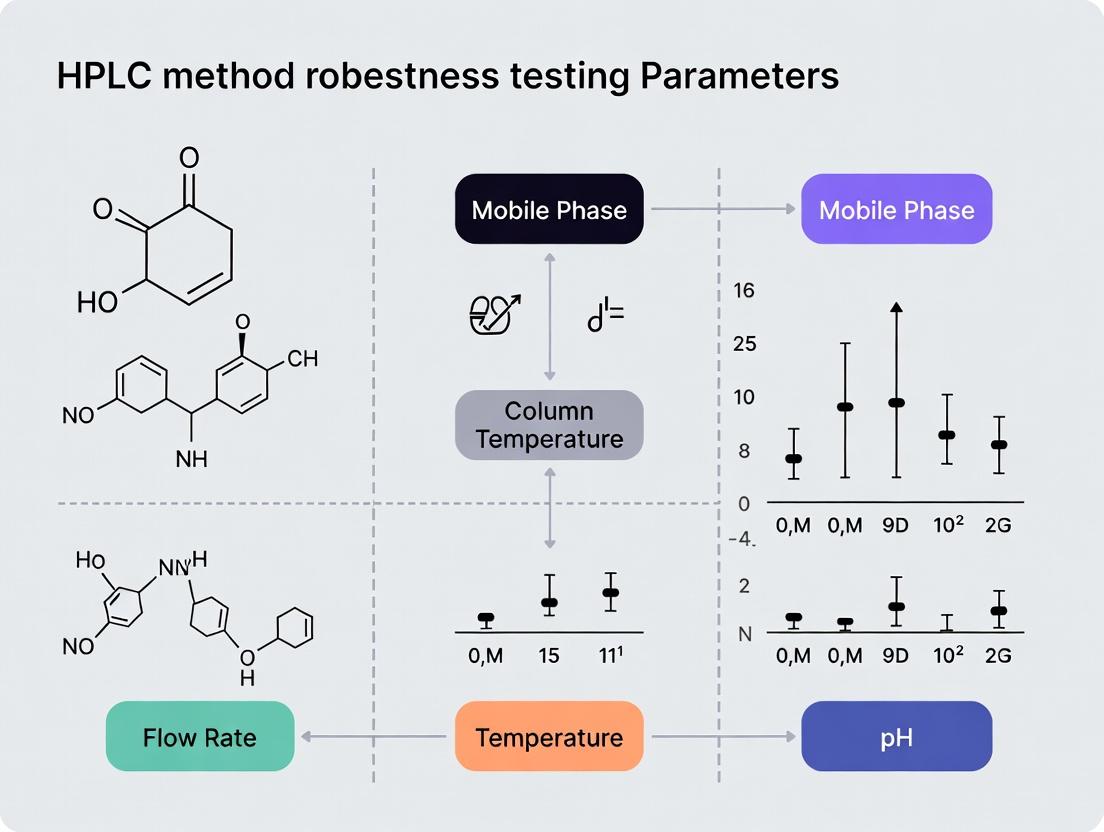
This comprehensive guide provides drug development scientists and analytical researchers with a complete framework for HPLC method robustness testing.
Mastering HPLC Robustness Testing: A Complete Guide to Parameters, Protocols, and Regulatory Compliance
Abstract
This comprehensive guide provides drug development scientists and analytical researchers with a complete framework for HPLC method robustness testing. Covering foundational principles from ICH Q2(R2) and USP <1225>, it details practical methodologies for parameter selection and experimental design. The article explores systematic troubleshooting of robustness failures, optimization strategies, and the critical link between robustness data and full method validation. Readers will gain actionable knowledge to design, execute, and interpret robustness studies that ensure reliable, transferable, and regulatory-compliant HPLC methods for pharmaceutical analysis.
The Science of HPLC Robustness: Core Principles and Regulatory Definitions
Welcome to the HPLC Robustness Technical Support Center. This resource is framed within ongoing research on HPLC method robustness testing parameters and provides practical troubleshooting for common experimental challenges, grounded in the regulatory perspectives of ICH Q2(R2) and USP.
FAQs & Troubleshooting Guides
Q1: During robustness testing per ICH Q2(R2), a deliberate change in column temperature causes a critical peak pair to co-elute. What is the immediate corrective action and how should this be documented for the method validation report? A: Immediately stop the sequence and revert to the nominal method conditions. To address this, you must propose a system suitability test (SST) criterion for resolution between this critical pair. Document the failure and the proposed control strategy (the new SST) in the robustness study report. The method's operational range for temperature should be narrowed, and the final method description must include the mandatory SST to ensure robustness.
Q2: After changing the brand of C18 column as part of robustness testing (USP <621>), we observe peak tailing for the active pharmaceutical ingredient (API). The L7 column classification parameters are identical. What are the likely causes and steps to resolve? A: While USP L7 classification covers general ligand type, it does not fully account for differences in silica purity, bonding chemistry, endcapping, and metal activity. First, verify the method's pH and consider adding a mobile phase modifier like triethylamine (0.1%) to mitigate silanol interactions. If unresolved, you may need to specify a more detailed column description (e.g., base-deactivated silica) in the method to ensure robustness across vendors.
Q3: A robustness study shows that a ±0.1% variation in organic modifier concentration (e.g., acetonitrile) leads to a >2% change in API retention time, exceeding our acceptance criteria. Does this mean the method is not robust? A: Not necessarily. This sensitivity indicates a critical parameter that must be tightly controlled during routine use. The method can still be considered robust if you implement procedural controls (e.g., precise volumetric preparation vs. mixing) and specify the acceptable adjustment limits per USP <621>. This finding must be highlighted in the validation report, stating that the organic modifier concentration is a critical method parameter.
Q4: How should we handle the evaluation of sample stability in the autosampler during robustness testing if it's not explicitly mentioned in ICH Q2(R2)? A: ICH Q2(R2) includes "sample stability" as a validation parameter. While robustness testing often focuses on operational parameters, autosampler stability is a key part of method robustness for routine use. Design a bracketing experiment within your robustness study or as a separate study, testing stability at the nominal and extreme temperatures (e.g., controlled vs. ambient) your method might encounter. Include this data in your overall validation package.
Data Presentation: Key Robustness Parameters & Regulatory Expectations
Table 1: Comparison of ICH Q2(R2) and USP <1210> Perspectives on HPLC Robustness Testing
| Parameter | ICH Q2(R2) Focus | USP <1210> / <621> Focus | Typical Acceptance Criteria |
|---|---|---|---|
| Primary Objective | To identify critical quality attributes (CQAs) of the method and establish a control strategy. | To demonstrate method reliability during normal usage and propose allowable adjustments. | No significant adverse effect on system suitability or analysis results. |
| Study Design | Planned, deliberate variations of method parameters (e.g., DOE). Often part of development. | Can be planned or unplanned (as part of verification). Defines allowed adjustments for method suitability. | |
| Key Variables Tested | pH, organic modifier ratio, column temperature, flow rate, column characteristics (lot, brand). | Explicitly lists adjustable (e.g., flow rate, pH) and non-adjustable (e.g., column type) conditions in <621>. | Resolution ≥ 2.0, tailing factor ≤ 2.0, RSD of RT ≤ 2.0%, etc. |
| Outcome | Establishes method robustness and defines controls (e.g., SST, fixed parameters). | Establishes system suitability tests and permissible adjustments to meet SST. |
Table 2: Example Quantitative Results from a DOE Robustness Study (Acid Analysis Method)
| Altered Parameter (Nominal ± Δ) | Retention Time Shift (%) | Peak Area RSD (%) | Resolution (Critical Pair) | Tailing Factor |
|---|---|---|---|---|
| Flow Rate (1.0 ± 0.1 mL/min) | -9.8 to +10.2 | 0.5 | 4.5 (Pass) | 1.1 |
| Column Temp (30 ± 2 °C) | -1.5 to +1.7 | 0.3 | 3.8 (Pass) | 1.1 |
| Mobile Phase pH (2.5 ± 0.1) | -4.2 to +5.1 | 0.8 | 1.8 (Fail) | 1.4 |
| Organic % (65 ± 1%) | -3.1 to +3.3 | 0.6 | 4.1 (Pass) | 1.1 |
| Wavelength (254 ± 2 nm) | 0.0 | 2.1 | N/A | N/A |
Experimental Protocols
Protocol 1: Design of Experiments (DOE) for Assessing Robustness of an HPLC Method This protocol is central to thesis research on systematically quantifying parameter effects.
- Define Critical Parameters: Select 4-6 factors for evaluation (e.g., pH, %Organic, Flow Rate, Temperature, Wavelength, Column Lot).
- Define Ranges: Set a practical range for each factor (e.g., nominal pH ± 0.1 units).
- Select DOE Model: Use a fractional factorial or Plackett-Burman design for screening.
- Prepare Solutions: Prepare a standard solution containing all analytes at specification level.
- Execute Runs: Perform HPLC analysis according to the experimental design matrix. Randomize run order.
- Analyze Responses: Measure key outputs (retention time, area, resolution, tailing) for each run.
- Statistical Analysis: Use ANOVA to identify parameters significantly affecting responses. Derive regression models if applicable.
- Define Control Strategy: Classify parameters as critical (must be controlled) or non-critical. Establish SST limits.
Protocol 2: Evaluating Column Robustness per USP Guidelines
- Column Selection: Select at least three columns from different lots or vendors that meet the primary method description (e.g., USP L7).
- Method Execution: Run the full method, including system suitability, on each column using the same standard and reagent preparations.
- Data Comparison: Compare retention times, peak symmetry, resolution, and efficiency across columns.
- Resolution Assessment: If all columns pass SST, the method is robust. If one fails, refine the column description (e.g., specify pore size, carbon load, endcapping) and retest.
- Documentation: Specify the successful columns and detailed description in the final method.
Mandatory Visualization
HPLC Method Robustness Assessment Workflow
USP Logic for Handling Method Parameter Changes
The Scientist's Toolkit: Research Reagent Solutions
Table 3: Essential Materials for HPLC Robustness Studies
| Item | Function in Robustness Testing |
|---|---|
| pH Buffer Standards | To accurately and reproducibly adjust mobile phase pH across experiments. Critical for testing pH sensitivity. |
| HPLC-Grade Solvents (Multiple Lots) | To assess the impact of solvent purity and lot-to-lot variability on baseline noise and retention. |
| Columns from Multiple Lots/Vendors | The primary tool for testing column robustness. Must share the classified description (e.g., L1, L7). |
| Certified Reference Standards | Provides the unchanging benchmark to attribute observed variations solely to method parameters. |
| System Suitability Test Mixture | A well-characterized mixture to confirm chromatography system performance before each robustness run. |
Why Robustness Testing is Non-Negotiable for Method Lifecycle Management
Robustness testing is a critical component of High-Performance Liquid Chromatography (HPLC) method validation within the pharmaceutical method lifecycle. It systematically evaluates a method's reliability when small, deliberate changes to operational parameters are introduced. This testing, conducted early in development, identifies critical method parameters, defines system suitability limits, and provides a risk assessment for method transfer and long-term use, ensuring regulatory compliance and data integrity throughout a drug product's lifecycle.
Troubleshooting Guides & FAQs
Q1: During robustness testing, we observe a significant shift in retention time when the pH of the mobile phase buffer is varied by ±0.1 units. What is the cause and how can we mitigate this? A: This sensitivity indicates the analyte's ionization state is critically dependent on pH near the buffer's pKa. For ionizable compounds, the log D (distribution coefficient) changes sharply with pH, altering hydrophobicity and interaction with the stationary phase.
- Mitigation: Redesign the method using a buffer with a pKa at least 1 unit away from the target pH to maximize buffering capacity. Consider a different pH region where the analyte is fully ionized or non-ionized for more consistent retention.
Q2: Peak splitting appears when column temperature is decreased by 5°C during robustness experiments. What does this signify? A: Peak splitting at lower temperatures often indicates slow kinetics of analyte interaction with the stationary phase, leading to conformational isomers or partial separation of tautomers. It can also reveal insufficiently equilibrated columns.
- Mitigation: 1) Increase the method's standard operating temperature to ensure it is above the "kinetic threshold." 2) If using a different column chemistry (e.g., C18 vs. phenyl), test robustness across a wider temperature range during method scouting. 3) Ensure adequate column conditioning time.
Q3: How do I justify the ranges chosen for testing parameters like flow rate or gradient time in a robustness study? A: Ranges should reflect the expected operational variability in a regulated QC laboratory. Justification is based on:
- Equipment Capability: The tolerances of HPLC pumps (±1-2% flow) and column ovens (±1-2°C).
- Practical Adjustments: Typical variations during mobile phase preparation (e.g., ±0.05 pH units, ±1% organic solvent composition).
- Scientific Rationale: Ranges should be small but meaningful. A common approach is to test a range of ±10% for flow rate or ±2% absolute for organic composition in the mobile phase.
Q4: Our robustness test shows critical failure (loss of resolution) when the column batch is changed. What are the next steps? A: This is a common and critical finding. Steps include:
- Characterize the Columns: Obtain manufacturer test certificates for both old and new columns (lot-to-lot data on carbon load, end-capping, porosity).
- Adjust Method Parameters: Slightly adjust the organic gradient slope or temperature to re-achieve resolution on the new column. The robustness data provides a guide for safe adjustment.
- Update Method Documentation: Formalize the adjusted condition as the primary method and document the acceptable column characterization parameters (e.g., L-51 classification) in the method procedure.
Q5: What is the key difference between robustness testing and method verification? A: Robustness is an investigative study conducted during method development/validation to probe method weaknesses and establish permissible limits for operational parameters. Method verification is a confirmation exercise, performed by a receiving laboratory (like a QC lab), to demonstrate they can successfully execute the already validated method as written under their specific conditions.
Key Robustness Testing Parameters & Typical Ranges
The following table summarizes common HPLC parameters investigated in robustness testing within method lifecycle management, based on current industry practice and ICH Q2(R2) guidance.
| Parameter | Typical Variation Tested | Common Impact on Chromatography | Acceptability Criterion |
|---|---|---|---|
| Mobile Phase pH | ±0.1 to ±0.2 units | Retention time shift, peak shape | RT shift < ±2%; resolution > 2.0 |
| Organic Solvent % | ±1 to ±2% (absolute) | Retention time shift, resolution change | All peaks elute; critical pair resolution > 2.0 |
| Column Temperature | ±2 to ±5°C | Retention time, selectivity | RT shift < ±2%; resolution maintained |
| Flow Rate | ±5 to ±10% | Retention time, backpressure | RT shift proportional to flow; resolution maintained |
| Wavelength (UV/Vis) | ±2 to ±5 nm (if near max) | Peak area response | Area response change < ±5% |
| Different Column Lot/Brand | Equivalent L- classification | Retention, selectivity, peak shape | All system suitability criteria met |
Experimental Protocol for an HPLC Robustness Study
Objective: To evaluate the robustness of an HPLC method for the assay of Active Pharmaceutical Ingredient (API) in a tablet formulation by deliberately varying critical chromatographic parameters.
1. Design of Experiments (DoE):
- Approach: Use a Plackett-Burman or fractional factorial design for screening >5 parameters. For ≤5 critical parameters, a full one-factor-at-a-time (OFAT) design is acceptable.
- Parameters & Ranges: Select from the table above. Example set: pH (-0.1, nominal, +0.1), Organic % (-1%, nominal, +1%), Temperature (-3°C, nominal, +3°C), Flow Rate (-0.1 mL/min, nominal, +0.1 mL/min).
2. Sample Preparation:
- Prepare a single, homogeneous batch of standard solution (e.g., API at 100% of target concentration) and sample solution (extracted placebo spiked with API at 100%).
- Aliquot and store appropriately for the duration of the study.
3. Chromatographic Execution:
- Perform runs in a randomized order to minimize systematic bias.
- For each parameter variation, inject the standard and sample solutions in duplicate.
- Always include system suitability injections (e.g., 5 replicate injections of standard at nominal conditions) at the start and end of the sequence.
4. Data Analysis:
- Measured Responses: Record retention time (tR), peak area, tailing factor (Tf), and resolution (Rs) between critical pair.
- Evaluation: Compare responses at varied conditions to those at nominal conditions. Use statistical tools (e.g., ANOVA, Pareto charts) for DoE data to identify influential parameters.
- Conclusion: Establish acceptance limits for each parameter variation. Any parameter causing failure of system suitability criteria is deemed "critical" and must be tightly controlled in the final method.
The Scientist's Toolkit: Key Research Reagent Solutions
| Item | Function in Robustness Testing |
|---|---|
| pH-Stable Buffer Salts (e.g., Potassium phosphate, ammonium formate) | Provides consistent ionic strength and pH control in aqueous mobile phase; critical for testing pH robustness. |
| HPLC-Grade Organic Solvents (e.g., Acetonitrile, Methanol) | Primary modifiers in reversed-phase chromatography; purity is essential for consistent baseline and peak shape. |
| Characterized HPLC Columns (Multiple lots of same brand/specification) | Core separation medium; testing different lots/brands assesses method's resilience to stationary phase variability. |
| Stable Reference Standard | High-purity analyte used to prepare standards for assessing system performance across all varied conditions. |
| Placebo Matrix | Excipient mixture without API, used to prepare sample solutions and assess specificity/interference during parameter changes. |
| System Suitability Test (SST) Solution | A mixture of API and key impurities/degradants used to verify column performance (resolution, plate count) before robustness runs. |
Diagrams
HPLC Method Lifecycle with Robustness Feedback
Effect Chain in Robustness Testing
Troubleshooting Guides & FAQs
Q1: Our HPLC assay fails System Suitability Testing (SST) after a mobile phase batch change. What should we check? A1: This indicates a potential robustness issue. First, verify the new mobile phase preparation protocol meticulously. Check the pH (±0.1 units), buffer concentration (±2-5%), and organic modifier ratio (±1-2% absolute). Use the following protocol to isolate the variable:
- Prepare a fresh batch of the original mobile phase.
- Run the SST with the old and new mobile phases on the same instrument, same column, same day.
- If the old passes and the new fails, the issue is with the new preparation. Re-check weights, volumetric glassware, and water source purity.
- If both fail, the issue may be column degradation or instrument drift.
Q2: Our method passes in our lab but fails during transfer to a QC lab. Is this a ruggedness or robustness problem? A2: This is a classic ruggedness failure—the method's performance is sensitive to inter-laboratory variations. Key factors to troubleshoot:
- Analyst Technique: Standardize procedures for sample prep (e.g., sonication time, filtration).
- Instrument Variations: Calibrate delay volume, detector wavelength accuracy, and column oven temperature across instruments.
- Environmental Conditions: Note lab temperature/humidity differences; these can affect volatile mobile phases (e.g., THF).
- Reagent/Column Source: Enforce specifications for reagents and column brand/lot in the method.
Q3: During robustness testing, which parameters are most critical to test, and what is a standard experimental design? A3: The critical parameters depend on the method, but common ones are listed in the table below. A standard approach is a Plackett-Burman or Fractional Factorial Design. Experimental Protocol for a Robustness Test (One-Factor-At-A-Time Example for a Critical Pair Resolution):
- Define the Normal Condition (NC): e.g., Column Temp: 30°C, Flow Rate: 1.0 mL/min, pH: 2.70.
- Deliberately vary one parameter at a time to its extreme (e.g., Column Temp: 28°C and 32°C).
- Keep all other parameters at NC.
- Inject the system suitability sample (or a sample spiked with critical pair analytes) at each condition.
- Record resolution, tailing factor, and retention time of the critical pair.
- Repeat for each parameter (Flow: 0.95 & 1.05 mL/min; pH: 2.65 & 2.75).
- The method is robust if all SST criteria are met at all tested conditions.
Q4: How do I distinguish between a system suitability failure and a true method/ruggedness failure? A4: Follow this diagnostic workflow:
Diagram Title: SST Failure Diagnostic Decision Tree
Key Terminology & Quantitative Comparison
Table 1: Comparative Overview of Key HPLC Method Validation Terms
| Aspect | Robustness | Ruggedness | System Suitability |
|---|---|---|---|
| Core Definition | Measure of method reliability to deliberate, small parameter changes under controlled conditions. | Measure of method reproducibility when performed under real-world variations (labs, analysts, instruments). | A set of pass/fail criteria to ensure the specific system/analysis is functioning correctly at the time of testing. |
| Primary Goal | Identify critical method parameters; establish method tolerances. | Demonstrate method transferability and reliability across normal operational environments. | Verify system performance before and during sample analysis. |
| Testing Context | Part of method development/validation, often in a single lab. | Part of method transfer and ongoing quality control across multiple sites. | Part of routine analytical run, performed daily/before each sequence. |
| Typical Variables | pH, temperature, flow rate, mobile phase composition, wavelength. | Analyst, instrument brand/model, column lot/supplier, lab environment, reagent supplier. | Plate count (N), tailing factor (T), resolution (Rs), relative standard deviation (RSD) of replicate injections. |
| Acceptance Criteria | All critical method attributes (e.g., resolution, tailing) remain within pre-defined specifications. | Statistical equivalence (e.g., t-test, F-test) of results between laboratories/conditions. | Pre-defined, method-specific numeric ranges (e.g., RSD < 2.0%, Rs > 1.5). |
| Relation to Thesis | Core study focus: Systematic evaluation of parameter effects to define a robust method design space. | Applied outcome: A robust method is a prerequisite for successful ruggedness in method transfer. | Quality gate: SST parameters are often chosen based on robustness/ruggedness study results. |
The Scientist's Toolkit: Essential Reagents & Materials for Robustness Testing
| Item | Function in Robustness/Ruggedness Studies |
|---|---|
| Certified Reference Standards | High-purity analytes to ensure observed variability is due to method parameters, not sample quality. |
| pH Buffers (Certified/CRM) | To accurately and reproducibly vary mobile phase pH within narrow tolerances (±0.05 units). |
| HPLC-Grade Solvents & Water | Minimize baseline noise and ghost peaks that could interfere with precision measurements at method limits. |
| Columns from Multiple Lots/Brands | To test method ruggedness against column variability, a major source of inter-lab failure. |
| Retention Time Marker Solution | A non-interfering compound (e.g., uracil) to accurately measure system delay volume changes across instruments. |
| Instrument Qualification Kits | To decouple method variability from instrument performance (e.g., flow rate accuracy, temperature, wavelength calibration). |
Technical Support Center: HPLC Method Robustness Testing
FAQs & Troubleshooting Guides
Q1: During robustness testing per ICH Q14, we observe a significant shift in retention time when the column temperature is varied within the defined permissible range. What are the primary causes and corrective actions?
A: This indicates that the analytical procedure is overly sensitive to temperature fluctuations. Key causes and actions include:
- Cause: Inadequate buffering capacity of the mobile phase, leading to pH sensitivity.
- Action: Increase buffer concentration (e.g., from 10 mM to 25 mM phosphate) to improve pH control. Ensure the buffer pKa is within ±1.0 unit of the desired mobile phase pH.
- Cause: Thermodynamically unstable analyte interactions with the stationary phase.
- Action: Consider switching to a different column chemistry (e.g., from C18 to phenyl-hexyl) that may offer more predictable enthalpy-driven retention.
- Protocol: To diagnose, execute a 2-factor design: Temperature (±2°C from nominal) and Buffer Concentration (±5 mM from nominal). Monitor retention time and peak area.
Q2: How do I define the "permissible range" for a method parameter during robustness testing as required by the Analytical Procedure Lifecycle (APLC)?
A: The permissible range is not the same as the normal operating range. It is a wider range, established experimentally, within which the method remains valid and meets all ATP criteria. It is defined through systematic robustness studies.
- Protocol: Use a Plackett-Burman or Fractional Factorial Design for screening. For a gradient HPLC method, test 6-8 parameters (e.g., pH ±0.2, %Organic in initial composition ±2%, gradient time ±2%, flow rate ±10%, column temp ±3°C, wavelength ±3nm, buffer conc. ±10%). The output (e.g., retention time, resolution, peak asymmetry) is statistically analyzed to identify critical parameters.
Q3: Our peak asymmetry fails system suitability when the mobile phase pH is at the lower limit of the robustness study. How should this be addressed and documented for regulatory submission?
A: This identifies a Critical Method Parameter (CMP). The response must be linked to the ATP.
- Action: Tighten the control limit for the mobile phase pH in the method documentation. The permissible range is the range tested, but the specified operating range (the range you instruct the analyst to use) must be narrower, ensuring the asymmetry factor remains within ATP limits (typically 0.8-1.5).
- Documentation: In the method validation report, present the data table and state: "The parameter 'mobile phase pH' was identified as critical for peak asymmetry. The permissible range is X to Y, but the specified operating range is narrowed to A to B to ensure consistent system suitability."
Quantitative Data Summary
Table 1: Example Robustness Study Results for an HPLC Assay Method (Nominal Conditions: pH 3.1, 45°C, 1.0 mL/min)
| Parameter Tested | Low Level (-) | High Level (+) | Effect on Retention Time (min) | Effect on Resolution (Rs) | Critical? |
|---|---|---|---|---|---|
| pH of Buffer | 3.0 | 3.2 | +0.42 | -0.35 | Yes |
| Column Temp. | 43°C | 47°C | -0.21 | +0.10 | No |
| Flow Rate | 0.9 mL/min | 1.1 mL/min | -0.95 / +1.05 | -0.20 | Yes (for RT) |
| %Acetonitrile (initial) | 22% | 26% | -0.60 | -0.80 | Yes |
Table 2: Research Reagent Solutions for HPLC Robustness Studies
| Item | Function in Robustness Testing |
|---|---|
| pH Standard Solutions (pH 2.0, 4.0, 7.0, 10.0) | For precise calibration of pH meters before mobile phase preparation, a key controlled variable. |
| High-Purity HPLC Grade Water (≥18.2 MΩ·cm) | Ensures baseline reproducibility and eliminates ghost peaks from ionic/organic contaminants. |
| Certified Reference Standard (CRS) of API and Known Impurities | Provides unambiguous identification and accurate quantification for calculating robustness effects on resolution and accuracy. |
| Columns from Multiple Production Lots | Assessing column-to-column variability is a mandatory element of a robustness study under ICH Q14/APLC. |
| Stability-Indicating Stress Samples (e.g., heat, acid degraded) | Verifies that the method remains specific and resolution is maintained under all robustness test conditions. |
Experimental Protocols
Protocol 1: Plackett-Burman Screening Design for Robustness
- Define ATP Criteria: Set acceptance limits for key outputs (Resolution > 2.0, %RSD of area < 2.0, tailing factor 0.8-1.5).
- Select Factors: Choose 7 method parameters (e.g., A: pH, B: %Organic, C: Gradient Time, D: Temperature, E: Flow Rate, F: Wavelength, G: Buffer Conc.).
- Set Levels: Define a high (+) and low (-) level for each (e.g., pH: 3.0 (-), 3.2 (+)).
- Execute Runs: Perform the 8 experimental runs per the standard Plackett-Burman design matrix.
- Analyze: Calculate the main effect of each parameter on each response. Rank effects using a Half-Normal Probability Plot or by comparing effect magnitude to a predefined critical limit (e.g., effect on RT > 0.5 min is significant).
Protocol 2: Detailed Study of a Critical Parameter (e.g., pH)
- Prepare Mobile Phases: Prepare 5 separate mobile phases spanning the potential permissible range (e.g., pH 2.8, 3.0, 3.1 (nominal), 3.2, 3.4).
- System Suitability: Inject system suitability mixture (API + critical pair impurity) 6 times with the nominal pH mobile phase to establish baseline performance.
- Sequential Analysis: Using fresh columns for each condition, analyze the suitability mixture in triplicate at each pH level. Randomize the order of pH testing.
- Measure Responses: Record k` (retention factor), Rs, As (asymmetry), and plate number (N) for the main peak.
- Establish Range: Plot each response versus pH. The permissible range is the span of pH where all responses remain within ATP criteria.
Visualizations
Analytical Procedure Lifecycle with Robustness
HPLC Robustness Testing Workflow
Welcome to the HPLC Method Technical Support Center. This resource is framed within a research thesis investigating robustness testing parameters for HPLC methods. The stability of Critical Quality Attributes (CQAs) is fundamental to ensuring method reliability, regulatory compliance, and data integrity throughout a drug product's lifecycle.
FAQs and Troubleshooting Guides
Q1: My analyte peak area is decreasing consistently over sequential injections. What could be the cause? A: This typically indicates an instability in the detection or sample preparation CQAs.
- Primary Suspects: Photodegradation of the analyte in the autosampler, adsorption to vial/sample loop surfaces, or degradation under the diluent conditions.
- Troubleshooting Protocol:
- Prepare a fresh standard solution, store it in amber vials, and keep it in the autosampler at a controlled temperature (e.g., 4°C). Reinject over the sequence.
- Conduct a solution stability experiment: Analyze the same standard at time = 0, 2, 4, 8, 12, and 24 hours.
- If the decrease persists, test a different vial type (e.g., low-adsorption, polypropylene).
- Quantify the loss per hour. A change of >2% per 24h typically requires mitigation.
Q2: I am observing a continuous increase in backpressure. Which system CQA is failing? A: This points to instability in the chromatographic system itself, affecting the system suitability CQA.
- Primary Suspects: Column blockage, mobile phase precipitation (especially in buffer/organic mixtures), or guard column exhaustion.
- Troubleshooting Protocol:
- Disconnect the column and connect in its place a union. If pressure remains high, the issue is in the system tubing, frits, or mixer—flush with appropriate solvents.
- If pressure normalizes without the column, reverse-flush the column according to the manufacturer's instructions.
- Check mobile phase preparation: Ensure buffers are filtered (0.45 µm or 0.22 µm) and that the organic/aqueous mixture is compatible (risk of salt precipitation).
- Replace the guard column if in use.
Q3: The retention time of my main peak is drifting. What parameters should I investigate? A: This directly impacts the identification CQA. Drift suggests inadequate control of the separation conditions.
- Primary Suspects: Unstable column temperature, mobile phase composition change (evaporation, degradation), or column degradation.
- Troubleshooting Protocol:
- Verify column oven temperature calibration using an independent probe.
- Prepare a fresh, standardized mobile phase. Ensure the HPLC system's proportioning valves are functioning correctly (monitor baseline at low UV).
- Inject a standard at the beginning and end of a sequence. A retention time shift >2% is often considered a failure threshold.
- If the issue continues, test the column with a manufacturer's test mix to assess its health.
Q4: Peak tailing has suddenly increased for my active pharmaceutical ingredient (API). What does this mean? A: This indicates a failure in the peak shape CQA, which affects resolution and quantitation accuracy.
- Primary Suspects: Column voiding, development of active sites on the stationary phase, or mismatch between sample solvent and mobile phase.
- Troubleshooting Protocol:
- Inject a neutral, well-behaved compound (e.g., uracil or caffeine). If tailing is universal, the column is likely degraded.
- Check the column efficiency (plate count) and asymmetry factor against the method specification (e.g., asymmetry factor should be 0.8-1.5).
- Ensure the sample solvent is not stronger than the initial mobile phase condition.
- Consider regenerating or replacing the column.
The following table summarizes the primary CQAs of an HPLC method, their purpose, and quantitative stability criteria derived from regulatory guidance (ICH Q2(R1)) and industry practice.
Table 1: Critical Quality Attributes of an HPLC Method and Stability Criteria
| CQA Category | Specific Attribute | Purpose / Impact | Typical Stability Acceptance Criterion |
|---|---|---|---|
| Separation | Retention Time (tR) | Compound identification, system suitability. | RSD ≤ 1% for replicate injections; drift < 2% over sequence. |
| Retention Factor (k) | Measures relative retention; indicates stationary phase health. | Variation within ± 0.2 from validated value. | |
| Resolution (Rs) | Measures separation between two peaks. Critical for purity. | Rs ≥ 2.0 (for critical pairs), variation within ± 0.2. | |
| Tailing / Asymmetry Factor (As) | Measures peak shape; affects integration accuracy. | As between 0.8 and 1.5 (or per method spec). | |
| Detection | Peak Area / Height | Directly used for quantitation (accuracy, precision). | RSD ≤ 2.0% for standard replicates (depends on level). |
| Signal-to-Noise Ratio (S/N) | Assesses method sensitivity and detection limit. | S/N ≥ 10 for quantification (LOQ). | |
| System Performance | Theoretical Plates (N) | Measures column efficiency. | Decrease not > 20% from fresh column test. |
| Pressure | Indicates system and column health. | Gradual increase is normal; sudden spikes indicate issues. |
Key Experimental Protocols for CQA Stability Assessment
Protocol 1: Forced Degradation (Stress Testing) of the Analytical Method
Objective: To verify the stability-indicating capability of the method by ensuring resolution between the API and its degradation products. Methodology:
- Stress Conditions: Expose the API to acid (e.g., 0.1M HCl, 70°C, 1h), base (e.g., 0.1M NaOH, 70°C, 1h), oxidation (e.g., 3% H2O2, RT, 1h), heat (e.g., 105°C, 24h), and photolysis (e.g., 1.2 million lux hours).
- Analysis: Prepare samples from each stress condition at appropriate concentrations and analyze using the HPLC method.
- Data Analysis: Assess peak purity (via PDA detector) and confirm baseline resolution (Rs > 2.0) between the main peak and all degradation peaks. The main peak's mass balance (total assay of related substances + main peak) should be 98-102%.
Protocol 2: Robustness Testing via Design of Experiments (DoE)
Objective: To systematically evaluate the impact of small, deliberate variations in method parameters on the CQAs. Methodology:
- Define Factors & Ranges: Select key parameters (e.g., column temp ±2°C, flow rate ±0.1 mL/min, pH of buffer ±0.1, organic % ±2%). Use a fractional factorial design (e.g., Plackett-Burman or full factorial).
- Experimental Runs: Execute the HPLC method for a standard mixture under all conditions defined by the DoE matrix.
- Measure Responses: Record the CQAs: tR, Rs, As, plate count, and peak area.
- Statistical Analysis: Use multiple linear regression to create models for each CQA. Identify which parameters have a statistically significant (p < 0.05) effect. Establish system suitability limits that account for this variation.
Visualizing CQA Relationships and Experimental Workflow
Diagram 1: Factors Affecting HPLC CQA Stability
Diagram 2: DoE Workflow for Robustness Testing
The Scientist's Toolkit: Key Research Reagent Solutions
Table 2: Essential Materials for HPLC Method Development & Stability Studies
| Item | Function & Importance in CQA Stability |
|---|---|
| HPLC-Grade Solvents (Acetonitrile, Methanol) | High purity minimizes UV background noise (affects S/N CQA) and prevents column contamination. |
| Ultra-Pure Water (18.2 MΩ·cm) | Prevents microbial growth and particulate contamination that can alter backpressure and retention. |
| Buffer Salts (e.g., Potassium Phosphate, Ammonium Acetate) | Control mobile phase pH, which is critical for reproducible retention (tR CQA) of ionizable compounds. |
| pH Standard Buffers (pH 4.01, 7.00, 10.01) | For accurate calibration of the pH meter used in mobile phase preparation. |
| System Suitability Standard Mix | A known mixture of compounds to verify resolution, plate count, and asymmetry CQAs before sample runs. |
| Certified Reference Standards | High-purity analyte for accurate calibration, ensuring the peak area CQA reflects true concentration. |
| Low-Adsorption/HPLC Vials & Caps | Minimize sample loss due to adsorption, preserving the peak area CQA, especially for low-concentration samples. |
| In-Line Filters (0.5 µm) & Guard Columns | Protect the analytical column from particulates and matrix components, stabilizing pressure and column lifetime. |
| Column Regeneration/Storage Kits | Appropriate solvents (e.g., high-grade water/organic) to maintain column performance between runs. |
Building Your Robustness Protocol: A Step-by-Step Guide to Design and Analysis
Technical Support Center
Troubleshooting Guides & FAQs
Q1: During robustness testing, my peak retention time shifts significantly with minor flow rate changes. What is the likely cause and how can I resolve it? A: This indicates that the method is highly sensitive to flow rate, often due to operating near a criticality threshold. First, verify that your HPLC pump is properly calibrated. The primary resolution is to adjust the method's nominal flow rate to a more robust region. For example, if testing at 0.9, 1.0, and 1.1 mL/min causes large shifts, consider re-developing the method to center at 1.2 mL/min where proportional changes have less impact. Ensure all system volumes (dwell volume, tubing ID) are appropriate for the scale.
Q2: My method shows unacceptable peak tailing when the mobile phase pH is varied by ±0.1 units during robustness studies. What should I do? A: This is a classic sign of operating at a pKa boundary. The analyte's ionization state is changing dramatically with small pH shifts. You have two main options:
- Buffering Capacity: Increase the concentration of your buffer (e.g., from 10 mM to 25-50 mM phosphate or formate) to improve pH control. Ensure the buffer pKa is within ±1.0 unit of the target pH.
- pH Re-design: Move the operational pH of the method further from the analyte's pKa (typically >1.5 pH units away) to a region where ionization is stable.
Q3: How do I systematically determine which HPLC parameters are "critical" for my specific method? A: A risk-based approach via Design of Experiments (DoE) is the industry standard. Do not test parameters one-at-a-time. Instead, use a fractional factorial or Plackett-Burman screening design to test multiple parameters simultaneously. Criticality is statistically determined by evaluating the magnitude of effect on Critical Quality Attributes (CQAs) like retention time, resolution, and peak area.
Protocol: Plackett-Burman Screening DoE for Critical Parameter Identification
- Define Factors & Ranges: List potential critical method parameters (e.g., flow rate (±5%), column temp (±2°C), pH (±0.1), % organic in gradient (±2%), wavelength (±2 nm)). Set realistic ranges based on anticipated operational variability.
- Design Experiment: Use statistical software (e.g., JMP, Minitab, Design-Expert) to generate a Plackett-Burman design matrix. This creates an efficient set of experimental runs.
- Execution: Run the HPLC method according to each experimental condition in random order.
- Response Measurement: For each run, record CQAs: retention time of main peak, resolution from closest eluting peak, peak area, tailing factor.
- Statistical Analysis: Perform ANOVA or multiple linear regression. Parameters showing a statistically significant (p-value < 0.05) and practically meaningful effect on any CQA are deemed Critical Method Parameters (CMPs).
Q4: Column temperature showed a large effect on resolution in my study. How do I set a robust control strategy? A: Column temperature is often a critical parameter. Your control strategy should be based on the experimental data.
- If resolution decreases with increasing temperature, set the nominal method temperature at the lower end of your operable range (e.g., 35°C ± 2°C instead of 40°C ± 2°C).
- Mandate the use of a properly functioning column oven for all analyses.
- Specify an allowable operating range (e.g., ±2°C) in the method document that is supported by your robustness data, ensuring CQAs remain within acceptance criteria across this range.
Q5: What is the recommended sequence for performing robustness testing within an HPLC method validation lifecycle? A: Robustness testing should be performed after method optimization and before (or concurrently with) formal validation. The findings inform the method's final operating conditions and system suitability test (SST) limits.
Title: HPLC Robustness Testing Workflow in Method Lifecycle
Table 1: Statistical Effects of Parameter Variations on Critical Quality Attributes (CQAs). A positive effect indicates the CQA increases with an increase in the parameter. Effects larger than the critical T-value are significant (p<0.05).
| Parameter (Tested Range) | Effect on Retention Time (min) | Effect on Resolution | Effect on Peak Area (%) | Critical? (Y/N) |
|---|---|---|---|---|
| Flow Rate (0.95 - 1.05 mL/min) | -2.31* | +0.15 | -1.2 | Y |
| pH of Aqueous Phase (2.9 - 3.1) | +0.45 | -1.85* | +0.8 | Y |
| Column Temp (38 - 42 °C) | -0.18 | -0.22 | +0.3 | N |
| %B Start (28 - 32%) | +1.92* | -0.45 | +1.5 | Y |
| Wavelength (248 - 252 nm) | 0.00 | 0.00 | +0.1 | N |
| Buffer Conc. (24 - 26 mM) | +0.07 | +0.10 | +0.2 | N |
*Statistically significant effect.
The Scientist's Toolkit: Key Reagent & Material Solutions
Table 2: Essential Materials for HPLC Robustness Studies
| Item | Function & Rationale |
|---|---|
| HPLC-Grade Buffers & Salts (e.g., Potassium phosphate, ammonium formate) | Provide consistent ionic strength and pH control. Purity minimizes background noise and column contamination. |
| HPLC-Grade Organic Solvents (e.g., Acetonitrile, Methanol) | Low UV absorbance and particulate matter ensure baselines stability and column longevity during subtle parameter changes. |
| pH Meter with NIST-Traceable Buffers | Essential for accurate, reproducible mobile phase pH preparation—a primary source of variability. |
| Certified Reference Standard | High-purity analyte is required to distinguish method variability from sample instability. |
| Characterized HPLC Column (from a single lot) | Using one column lot during testing isolates method variability from column-to-column variability. |
| Thermostatted Column Oven | Provides precise and stable temperature control, a common critical parameter. |
| Statistical Software Package (e.g., JMP, Minitab) | Required for designing efficient DoE studies and performing rigorous statistical analysis of the data. |
Technical Support Center: Troubleshooting & FAQs
Frequently Asked Questions
Q1: When developing an HPLC method for robustness testing, should I use a Full Factorial, Fractional Factorial, or Plackett-Burman design?
A: For initial robustness screening of an HPLC method, a Plackett-Burman (PB) design is highly efficient for evaluating 4 to 11 factors with only 12 to 24 runs, identifying critical parameters. For a more detailed study of 5-8 key parameters (e.g., pH, temperature, flow rate, gradient slope) and their potential two-factor interactions, a Resolution IV or V Fractional Factorial design is recommended. Full factorial is often prohibitively large for robustness studies with >4 factors.
Q2: My Plackett-Burman design analysis shows a factor with a low p-value (>0.05) but a large standardized effect magnitude. Should I consider it significant?
A: In robustness testing, practical significance is as important as statistical significance. A factor with a large effect magnitude—even if slightly above the common p=0.05 threshold—can be practically important for method performance. Examine the effect plot and compare the effect size to your predefined acceptance criteria (e.g., %RSD of peak area). It is prudent to investigate and potentially control such a factor.
Q3: How do I handle a significant two-factor interaction discovered in a Fractional Factorial design that confounds my main effect interpretation?
A: If a critical two-factor interaction (e.g., column temperature × organic solvent percentage) is aliased with a main effect in a Resolution III design, you must de-alias them. This typically requires adding more experimental runs (a "fold-over" design) to break the confounding. For robust HPLC methods, planning a Resolution IV or V design from the start avoids this issue for important interactions.
Q4: What is the minimum number of center points I should include in my DoE for HPLC robustness, and why?
A: Include at least 3-5 center point replicates. They serve three key functions: 1) Estimating pure experimental error, 2) Checking for curvature in the response (indicating a potential optimum within the design space), and 3) Monitoring process stability during the experimental run sequence.
Q5: My DoE results show that buffer pH is a critical factor for peak asymmetry. How should I define the method's operable range for this parameter?
A: The operable range is not simply the tested range. Use prediction plots or contour plots from your model to identify the range within which all critical quality attributes (peak asymmetry, resolution, retention time) remain within acceptance criteria. Add a safety margin (e.g., ±0.2 pH units) to this modeled range to establish the final, documented operable range in the method protocol.
Troubleshooting Guides
Issue: High Pure Error from Center Points in HPLC DoE
- Symptoms: Large variance in responses (e.g., retention time, peak area) between identical center point runs.
- Likely Causes & Solutions:
- Instrumental Drift: Sequence runs in randomized order to detect drift. Include system suitability checks before and after the DoE run block.
- Column Instability: Ensure the HPLC column is properly conditioned and dedicated to a similar mobile phase. Use a fresh column or one with known performance.
- Mobile Phase Preparation Variability: Prepare mobile phases in large, single batches for the entire DoE study to minimize preparation error. Document preparation precisely.
Issue: Lack of Fit in DoE Model for Robustness Data
- Symptoms: Significant "Lack of Fit" p-value in ANOVA.
- Likely Causes & Solutions:
- Missing Important Interaction: Your model may be missing a significant interaction term. Use a higher resolution design or augment with runs to estimate interactions.
- Factor Range Too Wide: The linear model may be insufficient over a very wide range. Consider adding axial points to fit a quadratic model or narrow the tested range for a robustness study.
- Outliers: Identify and investigate potential outlier runs using standardized residual plots.
Issue: Inability to Separate Critical Factors from Noise
- Symptoms: Normal or Half-Normal plots of effects show a "straight line" with no clear outliers.
- Likely Causes & Solutions:
- Factor Ranges Too Narrow: The operational variations tested are smaller than the inherent method noise. Re-design with wider, but still realistic, ranges (e.g., ±0.2 pH units instead of ±0.05).
- Response Measurement Error Too High: Improve the precision of your response measurement (e.g., use higher integration algorithms, more precise pipetting for sample prep).
- Insufficient Replication: Increase the number of replicates, particularly at center points, to better estimate error.
Data Presentation
Table 1: Comparison of Common Screening DoE Designs for HPLC Robustness Testing
| Design Type | Factors | Minimum Runs | Key Strength | Key Limitation | Best Use in HPLC Robustness |
|---|---|---|---|---|---|
| Full Factorial | k | 2^k | Estimates all main effects and interactions. | Runs grow exponentially. | Small studies (≤4 factors). |
| Fractional Factorial (Res V) | k | 2^(k-1) | Estimates main effects and 2FI clearly. | Higher run count than Res III/IV. | Detailed study of 5-7 critical factors. |
| Fractional Factorial (Res IV) | k | 2^(k-1) | Estimates main effects clear of 2FI. | 2FI are aliased with each other. | Screening 5-8 factors where 2FI are possible. |
| Fractional Factorial (Res III) | k | 2^(k-2) | Very efficient. | Main effects aliased with 2FI. | Use with caution, only when 2FI are unlikely. |
| Plackett-Burman | N-1 | N (12, 20, 24...) | Extremely efficient for many factors. | Main effects aliased with 2FI. | Initial screening of 5-11 factors. |
Table 2: Example Factors and Ranges for an HPLC Method Robustness DoE (Analyte Purity Assay)
| Factor Name | Low Level (-1) | High Level (+1) | Center Point (0) | Justification |
|---|---|---|---|---|
| Column Temperature (°C) | 35 | 45 | 40 | Manufacturer's recommended range. |
| Flow Rate (mL/min) | 0.9 | 1.1 | 1.0 | Nominal from development. |
| Buffer pH | 2.65 | 2.75 | 2.70 | pKa of analyte ± 0.05. |
| % Organic (Start) | 22 | 26 | 24 | Based on retention window. |
| Gradient Slope (Δ%/min) | -0.8 | -1.2 | -1.0 | Nominal from development. |
| Wavelength (nm) | 258 | 262 | 260 | Based on UV maxima. |
Experimental Protocols
Protocol 1: Executing a Plackett-Burman Screening Design for HPLC Robustness
Objective: To screen 7 critical method parameters (factors) for their effect on Critical Quality Attributes (CQAs) in 12 experimental runs.
Materials: (See Scientist's Toolkit) Procedure:
- Design Generation: Use statistical software (e.g., JMP, Minitab, Design-Expert) to generate a 12-run Plackett-Burman design for 7 factors.
- Randomization: Randomize the run order provided by the software to minimize bias from instrumental drift.
- Center Points: Augment the design with 3-5 additional center point runs (all factors at midpoint). Randomize these into the sequence.
- Sample Preparation: Prepare a single, homogeneous batch of standard solution at target concentration. Aliquot for each run.
- Experimental Execution: Follow the randomized sequence. For each run, adjust the HPLC instrument parameters as specified by the design matrix. Inject the standard solution.
- Data Collection: Record CQAs for the main peak: Retention Time (RT), Peak Area, Tailing Factor (As), and Resolution from closest eluting impurity (Rs).
- Analysis: Input responses into software. Analyze using a linear model (main effects only). Generate Half-Normal plots and Pareto charts of standardized effects to identify significant factors.
Protocol 2: Follow-up Resolution V Fractional Factorial Design
Objective: To characterize main effects and two-factor interactions (2FI) of 4 critical factors identified in the PB screening.
Procedure:
- Design Generation: Generate a 16-run (2^(4-1)) Fractional Factorial design with Resolution V.
- Replication & Center Points: Include 3-5 center points. Consider replicating a few corner points to improve error estimation.
- Execution & Analysis: Follow steps 2-7 from Protocol 1. Analyze using a model including main effects and all 2FI. Use ANOVA to identify significant terms. Generate contour plots for critical response surfaces.
Mandatory Visualization
HPLC Robustness DoE Decision Workflow
DoE Resolution & Effect Aliasing Guide
The Scientist's Toolkit: Research Reagent Solutions
Table 3: Essential Materials for HPLC Method Robustness DoE
| Item | Function in the Experiment | Example/Specification |
|---|---|---|
| HPLC Column | Stationary phase for separation. Critical factor itself. | C18, 150 x 4.6 mm, 3.5 μm. From a single, specified lot. |
| Buffer Salts | For preparing mobile phase with precise pH. | Potassium dihydrogen phosphate, Sodium acetate. HPLC grade. |
| pH Meter & Buffer | To accurately adjust and measure mobile phase pH. | Calibrated meter with ±0.01 accuracy. Certified reference buffers. |
| Organic Solvents | Mobile phase components. | Acetonitrile or Methanol, HPLC gradient grade, low UV cutoff. |
| Reference Standard | The analyte used to measure system responses. | Certified reference material (CRM) with high purity (>99%). |
| Volumetric Glassware | Precise preparation of mobile phases and standards. | Class A volumetric flasks and pipettes. |
| In-line Degasser | Removes dissolved gases to prevent baseline noise and drift. | Integral part of modern HPLC systems. |
| Data Acquisition Software | Records chromatograms and integrates peaks. | ChemStation, Empower, Chromeleon. Consistent integration method applied. |
| Statistical Software | Generates DoE layouts and analyzes response data. | JMP, Minitab, Design-Expert, or R with appropriate packages. |
Troubleshooting Guides & FAQs
Q1: During robustness testing, my system suitability fails when I deliberately vary the flow rate. What is the most likely cause and how can I resolve it?
A: This often indicates an insufficiently robust method or that the initial flow rate is too close to a critical system performance limit. First, ensure your pump is well-maintained and calibrated. The issue may stem from changes in backpressure or retention time, affecting resolution of critical pairs. Re-evaluate your acceptable range based on the impact on key parameters like retention factor (k), tailing factor (T), and resolution (Rs). If the failure is due to a loss of resolution, you may need to adjust your initial method conditions (e.g., mobile phase composition) to provide a greater buffer from the edge of failure before setting your final ± limits.
Q2: How do I justify a wider variation range for column temperature compared to mobile phase pH?
A: Justification is based on the observed impact on Critical Quality Attributes (CQAs). Column temperature often has a predictable, linear effect on retention time and less impact on selectivity for many methods, allowing for wider ranges (e.g., ±5°C). Mobile phase pH, however, can have a dramatic, non-linear impact on the ionization state of analytes, selectivity, and peak shape, necessitating tighter control (e.g., ±0.2 units). Your robustness data table must show that varying temperature within your proposed range meets all system suitability criteria, while pH variation beyond the narrow range causes failures, thus justifying the difference.
Q3: What is the standard sequence for testing multiple varied parameters in an HPLC robustness study?
A: The recommended protocol is a structured, matrix-based approach such as a Plackett-Burman or Fractional Factorial design. This allows for the efficient screening of multiple factors (e.g., 7-8 parameters) with a minimal number of experimental runs. Do not test all possible combinations one at a time, as this is inefficient. The standard workflow is: 1) Identify Critical Method Parameters (CMPs) via risk assessment. 2) Select an experimental design. 3) Set deliberate variation ranges (± limits) for each CMP. 4) Execute the experimental runs in randomized order. 5) Evaluate the effect of each variation on CQAs. 6) Statistically justify the final acceptable ranges.
Q4: My analysis of robustness data shows a significant effect from varying organic solvent %B, but the effect is within acceptance. Can I still claim the method is robust?
A: Yes. A "significant" statistical effect does not automatically equate to a "practical" or "critical" effect. Robustness is demonstrated by showing that deliberate variations, which have a measurable statistical effect, do not cause the CQAs to fall outside their predefined acceptance criteria. Your justification should state: "While statistical analysis (e.g., ANOVA, effect plot) indicated that %B is a significant factor, the magnitude of its effect on all CQAs (Resolution, tailing factor, etc.) remained within the acceptable limits defined in the method specification. Therefore, the proposed operating range of ±2% absolute is justified and the method is considered robust over this range."
Key Quantitative Data from Robustness Testing
Table 1: Example Deliberate Variation Ranges & Justification for an HPLC Assay Method
| Parameter | Nominal Value | Deliberate Variation Range (±) | Key Impacted CQA | Justification for Range Width |
|---|---|---|---|---|
| Flow Rate | 1.0 mL/min | ±0.1 mL/min | Retention Time, Pressure | >±0.1 mL/min caused Rt shifts >2% and Rs <1.5 for critical pair. |
| Column Temp. | 30°C | ±3.0°C | Retention Time, Efficiency | Variation had linear, predictable effect; all CQAs passed up to ±3°C. |
| %B Organic | 65% | ±2.0% (abs) | Resolution, Selectivity | >±2.0% caused co-elution (Rs<1.5). Range provides buffer without failure. |
| pH of Buffer | 3.0 | ±0.2 | Peak Shape, Retention | >±0.2 caused severe tailing (T>2.0) and Rt shifts >5%. Tight control required. |
| Wavelength | 254 nm | ±3 nm | Area Count, S/N | Detector specification ±3 nm; variation showed <1% area change in tested range. |
| Injection Vol. | 10 µL | ±2 µL | Linearity, Precision | No significant impact on CQAs within instrument and loop capacity. |
Table 2: Research Reagent Solutions & Essential Materials
| Item | Function in Robustness Testing |
|---|---|
| HPLC-Grade Organic Solvents (ACN, MeOH) | Mobile phase component; variations test method selectivity and retention robustness. |
| Buffer Salts (e.g., Potassium Phosphate) | Controls mobile phase pH; critical for ionizable analytes. Testing pH variation is essential. |
| pH Standard Buffers (pH 2.0, 4.0, 7.0, 10.0) | For accurate calibration of pH meter before preparing mobile phases. |
| Certified Reference Standard | To prepare system suitability and test samples with known purity. |
| HPLC Column (Specified Type & Lot) | The primary variable; testing column-to-column and lot-to-lot variation is part of robustness. |
| Secondary HPLC Column (Similar Chemistry) | Used to demonstrate method specificity and robustness to column changes. |
| Vial Inserts with Minimal Volume | Ensure accurate and precise low-volume injections when testing injection volume variation. |
Experimental Protocols
Protocol 1: Executing a Plackett-Burman Design for Robustness Screening
- Define Factors & Levels: Select 5-7 Critical Method Parameters (CMPs). Define a High (+) and Low (-) level for each (e.g., Flow Rate: +0.1 mL/min, -0.1 mL/min).
- Generate Design Matrix: Use statistical software to generate a Plackett-Burman design matrix for N experiments (e.g., 12 runs for 7 factors). This matrix assigns each factor to a High or Low level for each run.
- Randomize Runs: Randomize the order of the N experimental runs to avoid systematic bias.
- Prepare Mobile Phases & Standards: Prepare mobile phases and standard solutions corresponding to the exact conditions for each run as per the matrix.
- Sequential Analysis: Perform the HPLC analysis in the randomized order, ensuring system equilibration at the new conditions for each run.
- Data Collection: Record all CQAs: retention time, plate count, tailing factor, resolution of critical pair, and area repeatability.
- Statistical Analysis: Input CQA results into statistical software. Calculate the main effect of each parameter on each CQA. Identify parameters with significant effects that approach failure limits.
Protocol 2: Determining the Edge of Failure for a Critical Parameter
- Select Parameter: Choose one parameter suspected to be critical (e.g., pH of aqueous buffer).
- Define Extremes: Set a testing range wider than the expected acceptable range (e.g., nominal pH 3.0, test from 2.6 to 3.4).
- Hold Other Parameters Constant: Keep all other conditions at their nominal, optimized values.
- Stepwise Variation: Prepare mobile phases at incremental steps (e.g., pH 2.6, 2.8, 3.0, 3.2, 3.4). Analyze the system suitability test mixture in triplicate at each step.
- Plot & Identify Failure: Plot CQAs (e.g., Resolution) against the varied parameter. Identify the point where a CQA falls below the acceptance criterion (e.g., Rs < 1.5).
- Set Operational Range: Define the deliberate variation range (± limit) with a sufficient safety margin (e.g., if failure occurred at pH 3.5, set the upper limit at pH 3.2).
Visualizations
Title: HPLC Method Robustness Testing Workflow
Title: Decision Logic for Justifying a Variation Range
FAQs & Troubleshooting Guide
Q1: During sample preparation for my robustness testing study, I observe poor recovery of my active pharmaceutical ingredient (API). What could be the cause? A1: Poor recovery often stems from incomplete dissolution, adsorption to vial/glassware, or degradation during preparation. Ensure the solvent matches the mobile phase's initial composition to prevent precipitation. Use silanized glassware or low-adsorption vials for hydrophobic compounds. For unstable compounds, prepare samples fresh, under controlled temperature, and with possible antioxidant/acidification. Validate the sample preparation method (e.g., sonication time, vortexing) as part of robustness testing.
Q2: My chromatogram shows peak splitting during the data acquisition phase of a robustness test. How do I troubleshoot this? A2: Peak splitting in HPLC typically indicates a problem at the column inlet. First, check for a void or channel in the column packing—this is a common cause. Second, ensure there is no mismatch between the sample solvent and the mobile phase; the sample solvent should be weaker than or equal in strength to the mobile phase. Third, verify that the guard column is not spent and that all connections before the column are tight and properly made to avoid laminar flow disturbances.
Q3: When performing deliberate, small changes to flow rate as per robustness parameters, I notice a significant shift in retention time. Is this normal? A3: A proportional shift in retention time with flow rate change is expected (t_R ∝ 1/flow rate). However, a significant or non-linear deviation may indicate inadequate column temperature control or a partially obstructed frit causing pressure fluctuations. Ensure the column oven is equilibrated and functioning. Monitor system pressure for stability. This finding is critical to document in robustness testing as it defines the acceptable operational range for the method.
Q4: I am seeing high baseline noise and drifting during a long sequence of robustness test injections. What steps should I take? A4: High noise and drift suggest system instability. First, condition the column thoroughly with the mobile phase. Second, ensure all solvents are degassed and of HPLC-grade. Third, check for a leaking seal in the pump (pressure fluctuations) or a dirty/aging UV lamp. Perform a blank run to see if the issue is mobile phase-related. For robustness testing, a stable baseline is paramount; this issue must be resolved before acquiring definitive data.
Q5: How do I handle an out-of-specification (OOS) result during the data acquisition phase of a robustness test? A5: An OOS result during a deliberately modified parameter (e.g., pH ±0.1, temperature ±2°C) is a key finding, not a failure. It defines the boundary of the method's robustness. Document it meticulously. Ensure the OOS is not due to an analytical error by reviewing system suitability data, sample preparation logs, and instrument performance. Repeat the specific experimental run to confirm. The result will be used to establish the method's control limits.
Experimental Protocols for Key Robustness Experiments
Protocol 1: Evaluating the Impact of Mobile Phase pH Variation Objective: To determine the sensitivity of the HPLC method to small changes in mobile phase buffer pH.
- Prepare the standard mobile phase buffer (e.g., Phosphate, 50 mM) at the nominal pH (e.g., 3.0).
- Adjust separate buffer aliquots to pH values of nominal -0.2, -0.1, +0.1, and +0.2 units using dilute phosphoric acid or sodium hydroxide.
- Prepare mobile phases using each buffer and the designated organic modifier (e.g., Acetonitrile).
- Using a single standard solution and a fixed set of other conditions (flow rate, column, temperature), run the method with each mobile phase.
- Record retention times, peak areas, asymmetry, and resolution for the API and key impurities.
- Plot the responses versus pH to identify trends and critical thresholds.
Protocol 2: Testing Column Temperature Robustness Objective: To assess the effect of column temperature fluctuations on method performance.
- Set the column oven to the nominal temperature (e.g., 30°C) and allow the system to equilibrate.
- Inject the system suitability standard and record chromatographic parameters.
- Repeat the injection at deliberately altered temperatures (e.g., 25°C, 28°C, 32°C, 35°C), allowing for full equilibration at each new temperature.
- Maintain all other parameters constant (mobile phase, flow rate, etc.).
- Calculate the relative retention time changes and monitor for any changes in selectivity, peak shape, or theoretical plates.
Data Presentation
Table 1: Impact of Deliberate pH Variation on Key Chromatographic Parameters
| Parameter Changed | pH Value | API t_R (min) | Peak Asymmetry | Resolution (API/Imp-1) | % Area Change |
|---|---|---|---|---|---|
| Nominal | 3.00 | 10.22 | 1.12 | 4.55 | (Ref) |
| Low (-0.2) | 2.80 | 11.05 | 1.35 | 3.98 | -0.8% |
| Low (-0.1) | 2.90 | 10.58 | 1.20 | 4.25 | -0.3% |
| High (+0.1) | 3.10 | 9.91 | 1.08 | 4.60 | +0.5% |
| High (+0.2) | 3.20 | 9.60 | 1.05 | 4.65 | +0.9% |
Table 2: Effect of Flow Rate Variation on System Suitability
| Flow Rate (mL/min) | Pressure (psi) | API t_R (min) | Theoretical Plates (N) | Injection Repeatability (%RSD, n=3) |
|---|---|---|---|---|
| 0.95 (-5%) | 1850 | 12.85 | 12500 | 0.52 |
| 1.00 (Nominal) | 1950 | 12.20 | 12200 | 0.48 |
| 1.05 (+5%) | 2050 | 11.62 | 11950 | 0.55 |
Mandatory Visualizations
HPLC Sample & Data Acquisition Workflow
Robustness Test Parameter Feedback Loop
The Scientist's Toolkit: Research Reagent Solutions
| Item | Function in HPLC Robustness Testing |
|---|---|
| HPLC-Grade Solvents (Acetonitrile, Methanol) | High-purity solvents ensure low UV background noise and consistent chromatographic performance. Critical for reproducibility. |
| Buffer Salts (e.g., Potassium Phosphate, Ammonium Acetate) | Used to prepare mobile phase buffers at precise pH and ionic strength. Purity is essential to prevent column damage and baseline shifts. |
| pH Meter & Standard Buffers | For accurate adjustment of mobile phase pH, a key variable in robustness testing. Regular calibration is mandatory. |
| Silanized HPLC Vials/Inserts | Minimize adsorption of analytes, especially proteins or hydrophobic compounds, to container walls, improving recovery. |
| Certified Reference Standards | Precisely characterized API and impurity standards are necessary for accurate identification, quantification, and system suitability tests. |
| Guard Column (matching analytical column chemistry) | Protects the expensive analytical column from particulate matter and strongly retained contaminants, extending its life during multiple robustness runs. |
| In-line Degasser or Degassing Unit | Removes dissolved air from mobile phases to prevent baseline noise, drift, and pump cavitation, ensuring stable data acquisition. |
| 0.22 µm Nylon or PTFE Syringe Filters | For critical filtration of samples to remove particulates that could clog the HPLC system or column frits. |
Technical Support Center
Troubleshooting Guides & FAQs
Q1: After running a Plackett-Burman design for robustness screening of my HPLC method, my ANOVA shows a significant effect for a factor (e.g., pH), but the normal probability plot of residuals shows a non-linear pattern. What does this mean and how should I proceed? A: A non-linear pattern in the normal probability plot of residuals indicates a violation of the ANOVA assumption that the residuals are normally distributed. This can lead to incorrect conclusions about factor significance. First, check for outliers in your response data (e.g., retention time, peak area). Consider transforming your response variable (e.g., log transformation). If the pattern persists, it may suggest an important factor or interaction is missing from the model. Re-examine your experimental runs for consistency. A non-parametric test or a different modeling approach may be required.
Q2: When performing ANOVA for a central composite design (CCD) in robustness testing, how do I handle a lack-of-fit test that is significant (p < 0.05)? A: A significant lack-of-fit test suggests your model (often a quadratic model for CCD) does not adequately fit the data. The variation around the model is larger than the pure error (often estimated from replicated center points). Action Plan: 1) Verify you have sufficient replicated center points (5-6 is standard). 2) Check for the presence of a higher-order effect not captured by the quadratic model, potentially requiring a more complex design. 3) Investigate the possibility of an influential outlier or a systematic experimental error during certain runs. 4) Ensure all relevant factors and their interactions are included in the model.
Q3: In my graphical analysis (e.g., Pareto chart of effects, main effects plot), what constitutes a "practically significant" effect versus a "statistically significant" one in HPLC robustness? A: Statistical significance (p < 0.05) indicates the effect is unlikely due to random noise. Practical significance is determined by you, the scientist, based on pre-defined acceptance criteria (e.g., ΔRetention Time < ±2%). An effect can be statistically significant but so small it has no impact on method performance, making it practically irrelevant. Always compare the magnitude of the effect from the main effects plot against your predefined, method-specific critical limits (e.g., system suitability criteria). A factor is only considered a robustness threat if its effect is both statistically and practically significant.
Experimental Protocol: ANOVA for a Plackett-Burman Screening Design in Robustness Testing
- Design Execution: Execute the pre-defined Plackett-Burman experimental runs (e.g., 12-run design for 11 factors) in randomized order. Include at least 3 replicated center point runs to estimate pure error.
- Response Measurement: For each run, record the critical HPLC responses: Retention Time (RT) of the active analyte, Peak Area, Tailing Factor, and Resolution from closest eluting peak.
- Data Preparation: Tabulate the data with factors (coded levels: -1 for low, +1 for high, 0 for center) and measured responses.
- Model Fitting: Fit a linear regression model for each response (Y) against all factors (X₁, X₂...). Use standard software (e.g., Minitab, JMP, Design-Expert).
- ANOVA & Diagnostics: Perform ANOVA. Critically review: a) Model significance (p-value of ANOVA), b) R² (adjusted) value, c) Lack-of-fit test (should be non-significant), d) Normal probability plot of residuals.
- Effect Calculation & Plotting: Calculate the standardized effect for each factor. Generate a Pareto Chart of Standardized Effects and a Normal Probability Plot of Effects to identify significant factors.
- Interpretation: Identify factors where the absolute effect exceeds the statistically significant threshold (t-value) and the practical critical limit.
Data Presentation
Table 1: Summary of Significant Effects from a Hypothetical HPLC Robustness Study (Plackett-Burman Design for 8 Factors)
| Response Variable | Significant Factor (p < 0.05) | Effect Size | Practical Limit | Practically Significant? |
|---|---|---|---|---|
| Main Peak Retention Time | Mobile Phase pH | +0.42 min | ±0.3 min | Yes |
| Main Peak Retention Time | Column Temperature | -0.15 min | ±0.3 min | No |
| Main Peak Area | Flow Rate | -1250 AU | ±1500 AU | No |
| Tailing Factor | Buffer Concentration | +0.08 | ±0.1 | No |
| Resolution from Impurity A | % Organic (Start) | +0.25 | ±0.2 | Yes |
Table 2: Key Research Reagent Solutions for HPLC Robustness Experiments
| Item | Function in Robustness Testing |
|---|---|
| Reference Standard | High-purity analyte used to prepare solutions for evaluating precision, accuracy, and as a system suitability control. |
| Stressed Samples (Forced Degradation) | Samples exposed to acid, base, oxidation, heat, or light to generate known impurities, critical for testing method specificity under varied conditions. |
| Multi-Source/ Lot Columns | Different batches or brands of the same column chemistry to assess the method's sensitivity to column variability. |
| Buffer Solutions at Varied pH (±0.2 units) | Prepared to the extremes of the allowable range to test the method's robustness to minor pH fluctuations. |
| Mobile Phases from Different Reagent Batches | Prepared from different lots of solvents and salts to evaluate the impact of reagent quality variability. |
Mandatory Visualizations
Title: Decision Workflow for Interpreting HPLC Robustness Test Results
Title: Logical Pathway from Parameter Change to Method Control
Diagnosing and Fixing Robustness Failures: Practical Troubleshooting Strategies
Technical Support Center
Troubleshooting Guide & FAQs
Q1: During robustness testing, a small, deliberate change in Mobile Phase pH causes a dramatic shift in analyte retention time, far beyond the expected range. What does this "excessive effect" signal, and how should we proceed?
A: This is a critical failure signal indicating that the method is operating near a "cliff edge" in the pH-solubility or ionization profile of the analyte. The method lacks robustness for the pH parameter. You must investigate the pKa of your analyte(s) relative to the operational pH. The protocol is:
- Diagnostic Experiment: Perform a scouting run by varying pH in increments of 0.2 units over a wider range (e.g., ±1.0 unit from the nominal method pH). Plot retention factor (k) vs. pH.
- Analysis: Identify the inflection point (pKa). If the method pH is within ±0.5 units of the pKa, the method is highly sensitive.
- Action: Modify the method to operate at a pH at least 1.0 unit away from the pKa, or consider using a buffering system with higher capacity. If this compromises selectivity, a complete method re-development may be necessary.
Q2: An intentional ±10% change in Organic Solvent Composition (%B) leads to complete loss of resolution or elution of a critical pair. What is the root cause and solution?
A: This excessive effect signals that the method is operating at a critical solvent strength where selectivity changes abruptly, often due to competing interactions (e.g., hydrogen bonding, dipole-dipole). The gradient may be too shallow in a critical region.
- Protocol: Perform a segmented gradient robustness test. Hold the initial and final %B constant from the original method, but create variations (e.g., ±2% absolute) in the %B at the segment just before the critical pair elutes. Monitor resolution (Rs) of the pair.
- Data Analysis: Tabulate Rs against the modified segment composition.
Q3: Minor variations in Column Oven Temperature (±5°C) cause unacceptable changes in selectivity for ionizable compounds. Why does this happen, and how can it be fixed?
A: Temperature affects both thermodynamic equilibria (e.g., ionization constant, pKa) and kinetic parameters. An excessive effect here often combines with pH sensitivity.
- Protocol: Conduct a coupled pH-Temperature study. Use a Design of Experiments (DoE) approach: vary pH (±0.2) and Temperature (±5°C) in a factorial design. Measure k and Rs for critical peaks.
- Solution: If interaction between pH and Temp is significant, you must define a very narrow operational range for both or introduce a compensatory control, such as adjusting buffer concentration to better control pH at different temperatures.
Table 1: Example Data from pH Scouting Experiment for a Weak Acid (pKa ~4.5)
| Mobile Phase pH | Retention Time (min) Analyte A | Retention Factor (k) | Resolution from Peak B |
|---|---|---|---|
| 3.5 | 8.2 | 4.1 | 5.2 |
| 3.7 | 9.1 | 4.6 | 4.8 |
| 3.9 (Nominal) | 10.5 | 5.3 | 3.5 (Acceptable) |
| 4.1 | 15.2 | 8.6 | 1.2 (Critical Failure) |
| 4.3 | 21.8 | 12.9 | 0.5 (Co-elution) |
Table 2: DoE Results for Temperature/pH Interaction on Resolution
| Experiment Run | Temperature (°C) | pH | Resolution (Critical Pair) |
|---|---|---|---|
| 1 | 35 (-) | 3.8 (-) | 4.1 |
| 2 | 45 (+) | 3.8 (-) | 3.8 |
| 3 | 35 (-) | 4.0 (+) | 1.5 |
| 4 (Nominal) | 40 (0) | 3.9 (0) | 2.9 |
| 5 | 45 (+) | 4.0 (+) | 1.1 (Failure) |
Experimental Protocol: Systematic Robustness Test for Critical Parameters
Objective: To quantify the effect of minor, deliberate variations in HPLC operational parameters and identify parameters with an "excessive effect."
Materials: See "The Scientist's Toolkit" below. Method:
- Define Variations: Based on ICH Q2(R1) guidelines, define a normal operating range (NOR) and a tested robustness range (e.g., ±0.1 pH units, ±2% absolute organic, ±3°C).
- Design Matrix: Use a Plackett-Burman or fractional factorial design to efficiently test multiple parameters.
- Execution: Perform the HPLC runs in randomized order to avoid bias.
- Response Monitoring: Record for each run: retention times, retention factors (k), tailing factor, plate count, and resolution (Rs) between all critical peak pairs.
- Data Analysis: Calculate effects (Δ) for each parameter on each response. An "excessive effect" is signaled when Δ exceeds a pre-defined critical threshold (e.g., ΔRs > 1.0, or a >10% change in k for a ±1% change in organic solvent).
Visualization: Logical Pathway for Investigating Excessive Effects
The Scientist's Toolkit: Research Reagent Solutions
| Item | Function in Robustness Investigation |
|---|---|
| pH Scouting Buffers | A series of matched, premixed mobile phases at specific pH intervals (e.g., pH 2.0, 3.0, 4.0, 5.0, 6.0) to efficiently map analyte retention vs. pH. |
| HPLC Column Thermostat | Precise (±0.1°C) control of column temperature for studying thermodynamic parameters and identifying temperature-sensitive interactions. |
| Modular/UTPLC System | A chromatographic system capable of generating highly reproducible, low-dispersion gradients essential for detecting subtle changes in selectivity. |
| QbD/DoE Software | Statistical software (e.g., JMP, Design-Expert) to create efficient experimental designs and calculate parameter effects and interactions. |
| Chemical Standards (pKa Markers) | A set of compounds with known pKa values, used to verify the true pH of the mobile phase in the column under actual operating conditions. |
| High-Purity Buffering Salts & Modifiers | MS-grade or better ammonium formate/acetate, phosphates, TFA, etc., to ensure reproducibility and avoid detector interference during sensitive studies. |
Root Cause Analysis for Common Robustness Issues (e.g., Peak Splitting, Retention Time Shifts)
Troubleshooting Guides & FAQs
Q1: During my robustness testing, I observe sudden peak splitting. What are the most likely causes and how can I diagnose them? A: Peak splitting in HPLC often indicates a problem at the column inlet or with the sample solvent. Within robustness testing, it highlights sensitivity to method parameters.
- Primary Cause: A void or crater at the head of the column caused by stationary phase collapse, contaminated frit, or improper column packing.
- Diagnostic Protocol:
- Check System Pressure: Compare to baseline. Often normal unless frit is blocked.
- Perform a Blank Run: Inject the mobile phase. If splitting appears, the issue is in the system/column.
- Reverse the Column: Temporarily reconnect the column backwards and inject a standard. If the peak shape improves, the problem is at the original inlet.
- Replace/Repair the Inlet: Replace the inlet frit or the guard column. If the problem persists, the column bed is damaged, and the column must be replaced.
Q2: My method shows significant retention time (RT) shifts when I perform deliberate, small variations to mobile phase pH or organic composition as part of a robustness study. How should I investigate? A: RT instability under small parameter changes indicates low method robustness, often due to inadequate buffering or secondary interactions.
- Primary Cause: Inadequate buffering capacity relative to the mobile phase composition and analyte pKa.
- Diagnostic Protocol:
- Quantify the Shift: Measure RT shift (ΔRT) per 0.1 pH unit or 1% organic solvent change. A robust method should have ΔRT < 2% for these variations.
- Verify Buffer Capacity: Ensure buffer concentration is ≥ 25 mM and the operating pH is within pKa ± 1.0. Use a pH probe calibrated in the organic/aqueous mixture.
- Check Column Temperature Control: Ensure the column oven is calibrated and equilibrated. Fluctuations > ±1°C can cause RT drift.
- Analyze for Secondary Interactions: For ionizable compounds, use a charged surface hybrid (CSH) or shield column to mitigate silanol interactions, which are highly sensitive to pH/organic changes.
Q3: I experience baseline noise and drift during long sequence runs in my robustness testing. What is the root cause? A: This typically points to instrumental or environmental instability under the tested conditions.
- Primary Cause: Incomplete mobile phase degassing (causing bubble formation), solvent evaporative composition change, or temperature fluctuations.
- Diagnostic Protocol:
- Monitor Pressure Trace: High-frequency noise indicates bubbles (check degasser, tighten fittings). Low-frequency drift suggests temperature or composition change.
- Seal the Solvent Reservoirs: Use solvent bottle lids with inlet filters. This prevents evaporation and absorption of atmospheric CO₂ (which affects pH).
- Conduct an Isocratic Test: Run the mobile phase isocratically for 30 minutes with no injection. A stable baseline confirms the pump and detector. A drifting baseline implicates the mobile phase or temperature.
Table 1: Impact of Key Parameter Variations on Robustness Indicators
| Parameter Deliberately Varied | Expected Impact on RT (Acceptable Range) | Expected Impact on Peak Area (Acceptable Range) | Primary Root Cause if Out of Spec |
|---|---|---|---|
| Mobile Phase pH (±0.2 units) | ΔRT < 2% | RSD < 2% | Inadequate buffer capacity; analyte pKa near operating pH. |
| Organic % (±2% absolute) | ΔRT < 5% | RSD < 3% | Insufficient elution strength; secondary interactions. |
| Column Temperature (±3°C) | ΔRT < 3% | RSD < 1% | Poor temperature control; enthalpic contribution to retention. |
| Flow Rate (±5%) | RT change inversely proportional; Area RSD < 1% | RSD < 1% | Pump precision; system dwell volume effects. |
| Buffer Concentration (±10%) | ΔRT < 1% | RSD < 1% | Generally robust unless concentration is too low (<10mM). |
Table 2: Common Symptoms, Root Causes, and Corrective Actions
| Symptom | Likely Root Cause | Immediate Diagnostic Step | Corrective Action for Robustness |
|---|---|---|---|
| Peak Splitting/Doubling | Column inlet void/damage; Sample solvent stronger than MP. | Reverse column & inject. | Specify stricter column lot testing; Control sample solvent strength. |
| Progressive RT Shift | Mobile phase evaporation/pH change; Column degradation. | Run a fresh MP from a sealed bottle. | Specify sealed reservoirs; Define column washing/storage protocol. |
| Peak Tailing (Sudden) | Column contamination; Blocked frit. | Check system pressure history. | Specify guard column use; Define sample cleanup/filtration criteria. |
| Peak Fronting | Column overloading; Sample solvent weaker than MP. | Halve the injection volume. | Define a precise upper limit for injection volume/load. |
Experimental Protocols
Protocol 1: Systematic Robustness Test for pH Sensitivity Objective: Quantify method sensitivity to small changes in mobile phase pH.
- Prepare three identical mobile phase batches targeting the nominal pH (e.g., 3.00). Adjust accurately to pH 2.90, 3.00, and 3.10 using standardized acid/base.
- Equilibrate the HPLC system with each mobile phase for ≥ 15 column volumes.
- Inject the system suitability standard in triplicate for each condition.
- Measure: RT, peak area, asymmetry factor, and plates for the main analyte.
- Analysis: Plot RT vs. pH. The slope indicates sensitivity. A robust method will have a shallow slope within the tested range.
Protocol 2: Column Performance Verification Test Objective: Diagnose column-related peak shape issues (splitting, tailing).
- Install the suspect column.
- Test 1 - Tailing Assessment: Inject a basic probe (e.g., amitriptyline) under standard conditions. Measure asymmetry factor (As). As > 1.5 indicates active silanols.
- Test 2 - Inlet Integrity Assessment: Reverse the column in the holder.
- Re-equilibrate and inject the same probe.
- Compare peak shape (As, plates) from the forward and reverse orientations. Improvement in reverse mode confirms inlet damage.
Diagrams
Title: Peak Splitting Root Cause Analysis Workflow
Title: HPLC Robustness Test Parameters & Outputs
The Scientist's Toolkit: Essential Research Reagents & Materials
| Item | Function in Robustness Testing |
|---|---|
| Certified pH Buffer Solutions | For accurate calibration of pH meters before adjusting mobile phase pH. Critical for reproducibility. |
| Low-UV Grade Solvents (ACN, MeOH) | Minimize baseline noise and drift, especially in gradient runs at low wavelengths. |
| Volumetric Flasks & Class A Pipettes | Ensure precise preparation of mobile phase and standards, reducing introduction of unintended variables. |
| In-line Degasser or Helium Sparging Kit | Removes dissolved gases to prevent baseline noise and pump inaccuracy. |
| Column Thermostat (Oven) | Provides precise, stable temperature control (±0.5°C), a critical robustness parameter. |
| Guard Column (with appropriate chemistry) | Protects the expensive analytical column from contaminants, preserving peak shape and RT. |
| Charged Surface Hybrid (CSH) or Shielded C18 Column | Specifically reduces secondary silanol interactions for basic analytes, improving robustness to pH changes. |
| 0.22 μm Nylon & PVDF Filters | For filtering mobile phases (nylon) and samples (PVDF for organics) to prevent frit blockage. |
Technical Support Center: HPLC Robustness Troubleshooting
Troubleshooting Guides & FAQs
FAQ 1: Why do my target analytes show unacceptable peak tailing or fronting after switching to a new buffer stock? Answer: This is commonly due to incorrect buffer pH or ionic strength, which alters analyte ionization and interaction with the stationary phase. First, verify the pH of the mobile phase with a freshly calibrated pH meter at your method temperature. Next, ensure the buffer concentration is prepared accurately by weight. Even a ±5 mM change can impact peak shape for ionizable compounds. A systematic approach is outlined in Protocol 1.
FAQ 2: How can I reduce run time without losing critical resolution between two closely eluting peaks? Answer: Optimizing the gradient profile is the primary lever. A sharper increase in organic modifier concentration can shorten run times, but may co-elute peaks. Consider a segmented gradient or adjusting the initial %B. The impact of gradient slope (Δ%B/min) on resolution can be modeled; see Table 1 for quantitative effects. Use Protocol 2 for a structured optimization.
FAQ 3: My separation selectivity changes when I use a different brand of acetonitrile. What should I do? Answer: Variations in organic modifier purity (e.g., levels of water, acidic/basic impurities) can alter selectivity, especially for polar compounds. First, standardize your source to a high-purity HPLC-grade solvent. If the issue persists, minor adjustments to buffer strength (±10%) can often compensate for selectivity shifts by modifying the solvation environment. Refer to the "Scientist's Toolkit" for recommended specifications.
FAQ 4: During robustness testing, my peak order reverses for two critical pairs. Which parameter is most likely responsible? Answer: A reversal in elution order is a strong indicator of a change in selectivity, most sensitive to the type and proportion of organic modifier (e.g., MeOH vs. ACN) or pH. Buffer strength variations typically affect retention time but not order. To troubleshoot, fix the gradient and buffer strength, then perform a scouting run with a different organic solvent (Protocol 3) to diagnose.
FAQ 5: How do I know if my buffer strength is optimal for method robustness? Answer: An optimal buffer provides sufficient capacity to maintain pH when samples are injected, ensuring consistent retention. A general rule is to use a minimum of 10 mM buffer for a pH range within ±1.0 of its pKa. Conduct a robustness test by varying buffer strength ±20% while monitoring capacity factor (k') and resolution (Rs). See Table 2 for acceptance criteria.
Experimental Protocols
Protocol 1: Systematic Investigation of Buffer Strength and pH on Peak Shape
- Prepare your buffer at three concentrations: 80%, 100%, and 120% of the target (e.g., 20 mM, 25 mM, 30 mM).
- For each concentration, adjust the pH to three levels: -0.2, 0, and +0.2 pH units from the target value. Use a calibrated pH meter with temperature compensation.
- Keep the column temperature, flow rate, and gradient profile constant.
- Inject the standard solution in triplicate for each of the 9 conditions.
- Record the asymmetry factor (As) for the main analyte peaks at 10% peak height. Plot As vs. pH for each buffer strength to identify the robust operational region.
Protocol 2: Gradient Profile Optimization for Speed and Resolution
- Start with your original gradient (e.g., 20-80% B in 20 min).
- Design two new gradients: a steeper gradient (20-80% B in 15 min) and a shallower gradient for the critical pair segment (e.g., hold at 45% B for 2 min, then ramp).
- Perform runs with each gradient, keeping other parameters identical.
- Measure the resolution (Rs) between all peak pairs and the total run time.
- Calculate the resolution per minute metric. Use Table 1 to decide if the trade-off is acceptable for your method's goals.
Protocol 3: Organic Modifier Scouting for Selectivity Issues
- Select three different organic modifiers: Acetonitrile (ACN), Methanol (MeOH), and a mixture (e.g., 80:20 ACN:MeOH).
- Prepare mobile phases with each modifier, keeping the buffer type, strength, and pH constant.
- Adjust the gradient time to achieve a similar final elutropic strength (use solvent strength calculators).
- Run the separation with each modifier.
- Observe changes in selectivity (peak order) and resolution. This map helps identify the most robust modifier for your specific separation.
Table 1: Impact of Gradient Slope Change on Key Separation Metrics
| Gradient Slope (Δ%B/min) | Run Time (min) | Resolution (Critical Pair) | Plate Count (N) | Peak Capacity |
|---|---|---|---|---|
| 2.5 (Shallow) | 24.0 | 2.5 | 18500 | 125 |
| 3.0 (Original) | 20.0 | 2.1 | 18000 | 115 |
| 4.0 (Steep) | 15.0 | 1.6 | 17500 | 98 |
Table 2: Robustness Test Results for Buffer Strength Variation (±20%)
| Parameter Changed | Level | Retention Time (RT) %RSD | Tailing Factor (Mean) | Resolution (Rs) |
|---|---|---|---|---|
| Buffer Strength | -20% | 2.8% | 1.15 | 1.95 |
| Buffer Strength | Nominal | 0.9% | 1.08 | 2.10 |
| Buffer Strength | +20% | 1.5% | 1.10 | 2.05 |
| Acceptance Criteria | < 2.0% | 0.9 - 1.3 | > 1.5 |
Visualizations
Diagram 1: HPLC Robustness Parameter Interaction Map
Diagram 2: Method Robustness Troubleshooting Workflow
The Scientist's Toolkit: Research Reagent Solutions
| Item | Specification/Example | Function in Robustness Studies |
|---|---|---|
| Buffer Salts | Potassium Phosphate, Ammonium Acetate, Sodium Phosphate | Provides controlled ionic strength and pH to maintain consistent analyte ionization and interaction with the stationary phase. |
| pH Standard Solutions | NIST-traceable pH 4.01, 7.00, 10.01 buffers at 25°C | Essential for accurate daily calibration of the pH meter, ensuring mobile phase pH is a controlled variable. |
| HPLC-Grade Organic Modifiers | Acetonitrile (≥99.9%), Methanol (≥99.9%), low UV absorbance | High-purity solvents minimize baseline noise and artifacts. Different modifiers (ACN vs. MeOH) are scouted for selectivity control. |
| Silanophilic Activity Suppressor | Triethylamine (TEA) for basic compounds, Alkyl sulfonates for acidic compounds | Added in small amounts (e.g., 0.1%) to mobile phase to mask active silanol sites on silica-based columns, improving peak shape. |
| Column Equilibration Solution | Mobile phase A or Isocratic hold solution | Used for systematic column re-equilibration between robustness test runs to ensure consistent starting conditions. |
| System Suitability Standard | Mixture of all analytes at specification level | Injected at the start and end of robustness test sequences to monitor system performance and detect drift. |
Technical Support Center
Troubleshooting Guides & FAQs
Q1: Our assay shows poor peak shape (tailing factor > 2.0) for the active pharmaceutical ingredient (API) when we slightly adjust mobile phase pH within the robustness range. What is the primary cause and solution?
A: Peak tailing under pH variation often indicates inadequate buffering capacity or an operating pH too close to the analyte's pKa. Ensure the buffer concentration is at least 20 mM and the experimental pH is at least ±1.0 unit away from the pKa of the analyte. Prepare a fresh buffer solution and verify pH after organic mixer addition.
Q2: During robustness testing, a minor change in column temperature (±3°C) causes a critical pair of degradation products to co-elute (resolution < 1.5). How can we resolve this?
A: Co-elution sensitive to temperature suggests an enthalpy-controlled separation. Optimize the gradient profile to increase selectivity. Implement a detailed design of experiments (DoE) modeling temperature and gradient time. Often, a slight reduction in gradient slope (e.g., from 1.0% B/min to 0.8% B/min) significantly improves robustness.
Q3: When we switch to a different column from the same manufacturer (same stationary phase designation), we observe a significant shift in retention time for a key degradation product, risking misidentification. What steps should we take?
A: Column-to-column variability, even within specifications, can impact selectivity for challenging separations. This is a critical robustness failure. Implement secondary column characterization tests (e.g., hydrophobic subtraction model parameters) in your method validation. The solution is to tighten the system suitability test (SST) criteria for relative retention times of critical pairs and specify a "qualified column batch" list in the method.
Q4: How do we systematically investigate and document the root cause of robustness failures for a regulatory submission as part of a thesis on robustness parameters?
A: Follow a structured investigation protocol:
- Hypothesis: Define the failure (e.g., resolution < 1.5 between Peak A & B when factor X is varied).
- DoE: Use a fractional factorial design (e.g., Plackett-Burman) to screen all potential method parameters (pH, temperature, gradient time, flow rate, buffer concentration, column age).
- Analysis: Statistically identify significant effects and interactions using ANOVA.
- Modeling: Use response surface methodology (RSM) for critical factors to map the "robust zone."
- Control: Define adjusted control limits (method operable design region - MODR) and update the SST protocol.
Q5: The signal-to-noise ratio for a late-eluting, minor degradation product falls below 10 during robustness tests with a new instrument. Is this an instrument or method issue?
A: This is likely a method robustness issue related to instrumental dwell volume (gradient delay volume) differences. A higher dwell volume on the new system causes a shift in the effective gradient start, compressing later eluting peaks and reducing their height/integrity. Characterize both instruments' dwell volumes. The robust solution is to incorporate an isocratic hold at the initial mobile phase composition for at least one dwell volume period at the start of the gradient in the method itself.
Table 1: Robustness Testing Results for Critical Method Parameters (HPLC-UV)
| Parameter | Nominal Value | Tested Range | Impact on API Retention Time (k') | Impact on Critical Resolution (Rs) | Acceptable Range (MODR) |
|---|---|---|---|---|---|
| Mobile Phase pH | 3.10 | ±0.10 units | ±0.15 min | ±0.8 (Failure) | ±0.05 units |
| Column Temp. | 40°C | ±3°C | ±0.10 min | ±0.7 (Failure) | ±2.0°C |
| %B at Start | 15% | ±2% | ±1.2 min | ±0.3 | ±3% |
| Flow Rate | 1.0 mL/min | ±0.1 mL/min | ±0.8 min | ±0.2 | ±0.15 mL/min |
| Gradient Time | 25.0 min | ±2.0 min | ±1.5 min | ±0.5 | ±2.5 min |
| Buffer Conc. | 25 mM | ±5 mM | ±0.05 min | ±0.1 | ±10 mM |
Table 2: System Suitability Test (SST) Limits Before and After Robustness Optimization
| SST Criteria | Original Method Limits | Optimized & Robust Method Limits |
|---|---|---|
| Resolution (Critical Pair) | Rs ≥ 1.8 | Rs ≥ 2.5 |
| Tailing Factor (API) | T ≤ 2.0 | T ≤ 1.8 |
| Column Efficiency (API) | N ≥ 5000 | N ≥ 6000 |
| Retention Time (API) | RSD ≤ 2% (n=6) | RSD ≤ 1% (n=6) |
| S/N (Minor Degradant) | ≥ 10 | ≥ 15 |
Detailed Experimental Protocols
Protocol 1: DoE for Robustness Screening (Plackett-Burman Design)
- Objective: Identify high-impact factors on critical resolution (Rs) and retention time (k').
- Factors & Levels: Select 7 factors (e.g., pH, temperature, %B start, gradient time, flow rate, buffer concentration, column lot) at High (+) and Low (-) levels around nominal.
- Design: Execute a 12-run Plackett-Burman matrix.
- Procedure: Prepare mobile phases and samples as per method. Perform runs in randomized order to avoid bias.
- Analysis: Calculate main effects for each response. Use half-normal probability plots or Pareto charts to identify statistically significant factors (p < 0.05).
Protocol 2: Response Surface Methodology (RSM) to Define MODR
- Objective: Model the relationship between two critical factors (e.g., pH and Temperature) and map the "sweet spot" for resolution.
- Design: A Central Composite Design (CCD) with 5 levels per factor (13 runs total).
- Procedure: Set up experiments according to the CCD matrix. Analyze samples, recording Rs for the critical pair.
- Modeling: Fit data to a quadratic polynomial model (e.g., Rs = β0 + β1pH + β2Temp + β11pH² + β22Temp² + β12pHTemp).
- Visualization: Generate a contour plot of Rs vs. pH and Temp. The MODR is defined as the region where Rs ≥ 2.0.
Visualizations
The Scientist's Toolkit
Table 3: Essential Research Reagent Solutions for Robustness Studies
| Item | Function in Robustness Testing |
|---|---|
| pH-Stable Buffer Salts (e.g., Potassium Phosphate, Ammonium Formate) | Provides consistent ionic strength and pH control; critical for reproducibility of ionization states. |
| HPLC-Grade Water & Organic Solvents (Acetonitrile, Methanol) | Minimizes baseline noise and ghost peaks; ensures consistent elution strength. |
| Reference Standard Columns (Multiple lots of specified phase) | For testing column-to-column variability and defining column equivalence limits. |
| Stressed Sample Solutions (Forced degradation samples: acid, base, oxid, thermal) | Provides a challenging test mixture containing API and key degradants to stress method selectivity. |
| System Suitability Test Mixture | A well-characterized mix of API and relevant impurities to verify system performance daily. |
| Dwell Volume Measurement Kit (e.g., 0.1% acetone solution) | Characterizes instrument-specific gradient delay volume, a key variable in transfer. |
| Data Analysis Software (with DoE & Statistical Modeling capability) | For designing robustness tests and analyzing significant factors and interactions. |
Establishing System Suitability Test (SST) Limits from Robustness Data
Technical Support Center & FAQs
Q1: How many robustness experiments are needed to set statistically valid SST limits? A: A minimum of 6-10 independent experimental runs is recommended to calculate preliminary SST limits (e.g., for %RSD of retention time). This provides a reasonable estimate of variability. For final method validation, data from 20-30 runs, incorporating inter-day, inter-operator, and inter-instrument variations, is often used to set definitive, statistically sound limits (e.g., mean ± 3σ).
Q2: Our robustness study showed a significant impact of column temperature on tailing factor. How should this be reflected in SST limits? A: The SST limit for the tailing factor should be set wider than the optimal value observed during method development. Calculate the mean tailing factor from all robustness runs (including those at the extreme temperatures tested) and add a safety margin (e.g., +3 standard deviations). The limit should ensure the system passes SST even under normal, controlled variations of the parameter.
Q3: Can we use data from a Design of Experiments (DoE) robustness study directly for SST limit setting? A: Yes, DoE data is ideal. Pool the results from all experimental points in the DoE matrix (e.g., 8 runs for a 2^3 fractional factorial). Calculate the overall mean and standard deviation for each SST parameter (peak area, resolution, etc.) from this pooled data. This captures the method's performance across the defined "multidimensional" robustness space.
Q4: What is the standard statistical approach for converting robustness data into an SST limit for a quantitative parameter like peak area? A: The common approach is to use the mean and standard deviation (σ). The SST limit is often set as the mean ± 3σ, which encompasses 99.7% of expected results under normal operating conditions (assuming a normal distribution). For %RSD limits, calculate the RSD from all robustness runs and set the SST limit slightly higher (e.g., the 95% confidence upper bound).
Q5: How do we handle SST limits for parameters like resolution or peak asymmetry when robustness data shows they are highly robust? A: Even if robust, set the limit based on the worst-case observed during the study, plus a margin. For example, if the minimum resolution in all robustness runs was 5.2, set the SST limit to "NLT 4.5" (Not Less Than). This provides a clear failure point well below the proven operating range, ensuring detection of true system failure.
Q6: Should we adjust SST limits after transferring the method to a quality control (QC) laboratory? A: Potentially, yes. Initial limits are set from robustness data generated in the R&D setting. After method transfer, compile system suitability data from the first 20-30 routine QC runs. Re-evaluate the limits; they may be tightened (if performance is very consistent) or, rarely, widened based on the long-term, multi-operator variability of the receiving lab.
Table 1: Common HPLC SST Parameters and Proposed Limit-Setting from Robustness Data
| SST Parameter | Typical Target | Data Source for Limits | Proposed Statistical Rule | Example Limit |
|---|---|---|---|---|
| Retention Time (RT) Reproducibility | Consistent RT | RT from all robustness runs | Mean RT ± 3σ (as %RSD) | %RSD ≤ 2.0% |
| Peak Area Reproducibility | Consistent response | Area from replicate injections in robustness runs | Calculate overall %RSD, set upper bound | %RSD ≤ 2.0% |
| Tailing Factor (As) | Symmetric peak | As values from all robustness conditions | Mean As + 3σ (or 95% UCL) | As ≤ 2.0 |
| Theoretical Plates (N) | Column efficiency | N from all robustness runs | Set lower limit based on minimum observed | N ≥ 10000 |
| Resolution (Rs) | Separation | Minimum Rs from robustness DoE runs | Set lower limit with safety margin below min | Rs ≥ 2.5 |
| Signal-to-Noise (S/N) | Detectability | S/N at low-level conditions in robustness | Set lower limit well above reporting level | S/N ≥ 10 |
Table 2: Example Data Pooling from a Robustness DoE (2^3 Full Factorial)
| Experiment Run | Factor: pH | Factor: %B | Factor: Temp (°C) | Result: Resolution (Rs) | Result: Tailing Factor |
|---|---|---|---|---|---|
| 1 | -1 (Low) | -1 (Low) | -1 (Low) | 4.8 | 1.15 |
| 2 | +1 (High) | -1 | -1 | 4.5 | 1.22 |
| 3 | -1 | +1 (High) | -1 | 5.1 | 1.08 |
| 4 | +1 | +1 | -1 | 4.9 | 1.18 |
| 5 | -1 | -1 | +1 (High) | 4.7 | 1.12 |
| 6 | +1 | -1 | +1 | 4.3 | 1.25 |
| 7 | -1 | +1 | +1 | 5.0 | 1.10 |
| 8 | +1 | +1 | +1 | 4.6 | 1.20 |
| Pooled Statistics | --- | --- | --- | Min = 4.3, Mean = 4.74, σ = 0.28 | Max = 1.25, Mean = 1.16, σ = 0.06 |
| Proposed SST Limit | --- | --- | --- | Rs ≥ 3.5 (Min - margin) | Tailing ≤ 1.4 (Mean + 4σ) |
Experimental Protocols
Protocol 1: Conducting a DoE-Based Robustness Test for SST Limit Establishment
- Define Critical Parameters: Select 3-5 critical method parameters (e.g., mobile phase pH (±0.2 units), organic composition (±2% absolute), column temperature (±5°C), flow rate (±10%)).
- Design Experiment: Use a fractional factorial design (e.g., 2^(4-1) resolution IV) to minimize runs while maintaining interpretability. Include center point replicates.
- Execute Runs: Randomize the order of all experimental conditions. Perform a minimum of two replicate injections per condition.
- Analyze Responses: Measure all relevant SST parameters (RT, area, tailing, plates, resolution) for a key analyte peak in each chromatogram.
- Pool and Analyze Data: Statistically analyze the data (e.g., ANOVA, Pareto charts) to identify influential parameters. Pool all data for each response variable irrespective of condition.
- Calculate SST Limits: For each SST parameter, calculate descriptive statistics (mean, standard deviation, min, max) from the pooled dataset. Set limits using predefined rules (e.g., mean ± 3σ, or minimum observed value minus a safety margin for resolution).
Protocol 2: Ongoing Verification and Adjustment of SST Limits
- Initial Validation: Establish provisional SST limits using the robustness study data (Protocol 1).
- Routine Data Collection: Record all SST results from every analytical batch during method use in QC/R&D.
- Periodic Review: After accumulating 20-30 new SST data points, perform a statistical process control (SPC) analysis. Calculate control charts (e.g., X-bar and R charts) for key SST parameters.
- Limit Re-evaluation: Compare the original limits with the process capability (e.g., 6σ spread) of the new routine data. If the routine variability is consistently less than the original robustness-based limits, consider tightening the limits to better monitor system performance. Limits are rarely widened without a documented, justified change control.
Mandatory Visualizations
Title: Workflow for Setting SST Limits from Robustness Data
Title: Mapping Robustness Data to Specific SST Criteria
The Scientist's Toolkit: Research Reagent Solutions
Table 3: Essential Materials for HPLC Robustness & SST Studies
| Item | Function in Robustness/SST Studies |
|---|---|
| HPLC Column from Reputable Supplier | The primary source of variability. Using a single, well-specified column lot for robustness is key. Testing 2-3 different lots is recommended for final limit setting. |
| Reference Standard of Analyte (High Purity) | Provides the consistent signal for measuring RT, area, tailing, and resolution. Essential for all experiments. |
| Buffer Salts & pH Standards (Certified) | For precise preparation of mobile phase buffers to test pH robustness. pH meters must be calibrated. |
| HPLC-Grade Organic Solvents (e.g., Acetonitrile, Methanol) | Minimize baseline noise and variability. Different solvent lots/brands can affect retention and peak shape. |
| System Suitability Test Mix | A solution containing the analyte and related compounds (degradants, impurities) to simultaneously measure efficiency, tailing, and resolution in one injection. |
| Design of Experiments (DoE) Software | (e.g., JMP, Minitab, MODDE) Used to create an efficient experimental design, randomize runs, and perform statistical analysis of the robustness data. |
| Chromatography Data System (CDS) with SPC Capability | Software (e.g., Empower, Chromeleon) to automatically compile SST results and track them over time for ongoing limit evaluation. |
From Robustness to Validation: Ensuring Regulatory Compliance and Method Transfer
Troubleshooting Guides & FAQs
FAQ 1: Why is my tailing factor consistently exceeding the acceptance criteria (>2.0) during robustness testing when I modify pH?
- Answer: This is a common issue when the pH of the mobile phase is near the pKa of the analyte. Small, deliberate variations in pH during a robustness study can cause significant changes in ionization, leading to peak tailing. The data from your robustness study is not just a pass/fail metric; it quantitatively defines the safe operating range. If tailing exceeds 2.0 at ±0.2 pH units from nominal, your validated method should specify a tighter control limit (e.g., ±0.1 pH units).
FAQ 2: My system suitability test passes during validation but fails randomly during routine use. How can robustness data help?
- Answer: Random failure often points to an uncontrolled parameter. Your robustness study data should be used to set system suitability acceptance criteria, not just method parameters. For example, if robustness data shows that column temperature is highly sensitive (±2°C causes a >5% change in retention time), then your system suitability test should include a tighter retention time RSD criterion to detect oven malfunctions before they cause assay failure.
FAQ 3: How do I justify wider acceptance criteria for a dissolution method based on robustness testing?
- Answer: A well-designed robustness study provides empirical data on the method's noise floor. If varying parameters like deaeration time, pump speed, or filter type within realistic lab extremes causes a predictable, quantifiable variation (e.g., ±3% in dissolution results), you can statistically bridge this to set scientifically justified, wider acceptance criteria for the validation (e.g., Q+10% instead of Q+5%) that account for normal methodological noise.
FAQ 4: A new column from a different vendor fails the method. Did my robustness study fail to assess this?
- Answer: Column lot/source is a critical robustness variable. Your study should have included different columns (e.g., C18 from 3 vendors, with different lot numbers) as a deliberate factor. The resulting data table of plate count, tailing factor, and resolution allows you to set explicit, data-driven acceptance criteria for new columns (e.g., "L1 column efficiency must be ≥ 85% of the reference column value").
Data Presentation: Robustness Study on a Sample HPLC Assay Method
Table 1: Effects of Deliberate Parameter Variations on Key Chromatographic Outcomes
| Parameter (Nominal Value) | Variation Level | Retention Time (k') Change | Peak Asymmetry | Resolution (Rs) | Comment |
|---|---|---|---|---|---|
| Mobile Phase pH (2.70) | +0.2 units | +0.15 | 1.7 -> 2.3 | 4.5 -> 3.8 | Critical Parameter |
| -0.2 units | -0.18 | 1.7 -> 1.5 | 4.5 -> 5.1 | ||
| Column Temp. (30°C) | +2°C | -0.10 | 1.7 -> 1.6 | 4.5 -> 4.3 | Non-critical |
| -2°C | +0.12 | 1.7 -> 1.8 | 4.5 -> 4.6 | ||
| Flow Rate (1.0 mL/min) | +5% | -0.20 | 1.7 -> 1.7 | 4.5 -> 4.4 | Non-critical |
| -5% | +0.22 | 1.7 -> 1.7 | 4.5 -> 4.5 | ||
| Organic % (65%) | +2% Abs | -0.50 | 1.7 -> 1.6 | 4.5 -> 3.9 | Critical Parameter |
| -2% Abs | +0.55 | 1.7 -> 1.8 | 4.5 -> 5.2 |
Table 2: Derived Validation Acceptance Criteria from Robustness Data
| System Suitability Parameter | Traditional Criteria | Data-Justified Criteria (from Robustness Study) | Rationale |
|---|---|---|---|
| Peak Asymmetry (Tailing) | ≤ 2.0 | ≤ 2.2 | Worst-case from pH variation was 2.3. A 2.2 limit provides safety margin. |
| Resolution (Rs) | > 2.0 | > 3.5 | Lowest observed Rs was 3.8. Setting criteria at 3.5 ensures robustness. |
| Retention Time (RSD) | ≤ 1.0% NMT | ≤ 2.0% NMT | Variations caused up to 5% shift. A 2.0% RSD limit controls for critical parameter drift. |
Experimental Protocols
Protocol 1: Design and Execution of a Plackett-Burman Screening Study for HPLC Robustness
- Objective: Identify critical method parameters (CMPs) from a list of 7-11 potential variables (e.g., pH, temperature, flow rate, gradient time, wavelength, buffer concentration, column age, supplier) using a minimal number of experimental runs.
- Design: Select a 12-run Plackett-Burman design matrix. Each parameter is set at a "high" (+1) and "low" (-1) level around the nominal value (e.g., pH: Nominal 2.7, Low: 2.5, High: 2.9).
- Execution: Prepare mobile phases and standards according to the matrix for each run. Inject the system suitability standard.
- Analysis: Record critical quality attributes (CQAs): retention time, peak area, plate count, tailing factor, resolution. Use statistical analysis (e.g., Pareto chart, half-normal plot) to rank parameter effects on each CQA.
- Output: A ranked list of parameters for subsequent, more detailed, full-factorial DoE studies.
Protocol 2: Full Factorial DoE for Quantifying Parameter Effects and Interactions
- Objective: For the 2-3 CMPs identified in Protocol 1, precisely model their effect and interactions on CQAs to set acceptance criteria.
- Design: Use a 2^3 full factorial design (8 runs) plus 3-5 center point replicates. Levels are set to the proposed operational ranges (e.g., pH: 2.6, 2.7, 2.8).
- Execution: Execute runs in randomized order to avoid bias. Use a single, qualified HPLC system and column lot to isolate the effect of the varied parameters.
- Analysis: Perform multiple linear regression to generate a predictive model for each CQA (e.g., Resolution = β0 + β1pH + β2Organic% + β12pHOrganic%). Use contour plots to visualize the design space where all CQAs pass.
- Output: Mathematical models that define the "method operable design region" (MODR). Validation acceptance criteria are set with boundaries inside this MODR.
Visualizations
Title: The Robustness-Validation Bridge Workflow
Title: Decision Logic for Setting Acceptance Criteria
The Scientist's Toolkit: Research Reagent Solutions
Table 3: Essential Materials for HPLC Robustness Studies
| Item | Function in Robustness Testing |
|---|---|
| pH Buffer Solutions (Certified) | Provides highly accurate and traceable pH standards for mobile phase preparation, crucial for testing the critical parameter of pH. |
| HPLC Column from Multiple Lots/Vendors | To deliberately test the method's sensitivity to column chemistry variability, a key robustness factor. |
| Digital Thermometer (NIST Traceable) | For independent verification of column oven temperature setpoints during temperature variation studies. |
| Certified Volumetric Glassware (Class A) | Ensures precise and accurate preparation of mobile phase variations (±% organic, buffer concentration). |
| Stable Reference Standard | A well-characterized analyte standard is essential for generating consistent, comparable CQA data across all experimental runs. |
| Robustness-Specific Software | Statistical software (e.g., JMP, Design-Expert, Minitab) for designing DoE matrices and analyzing the resulting multivariate data. |
Technical Support Center: HPLC Method Robustness & Transfer Troubleshooting
This support center provides guidance for issues encountered during High-Performance Liquid Chromatography (HPLC) method robustness testing and subsequent transfer to quality control (QC) or other laboratory environments. The content is framed within ongoing research into critical robustness parameters for robust analytical method lifecycle management.
Frequently Asked Questions (FAQs) & Troubleshooting Guides
Q1: During method transfer, we observe a consistent shift in retention time for the active pharmaceutical ingredient (API). The system suitability passes at the receiving lab, but the retention time is outside the ±2% range agreed in the transfer protocol. What could be the cause? A: This is a classic symptom of a robustness parameter that was not adequately challenged during development. The most likely cause is sensitivity to minor variations in mobile phase pH or organic solvent composition.
- Troubleshooting Steps:
- Verify Mobile Phase Preparation: Ensure both labs use the same grade of buffers, the same pH meter calibration protocol, and identical procedures for adjusting pH. A 0.05 pH unit shift can cause significant retention time changes for ionizable compounds.
- Check Column Temperature: Confirm the column oven temperature is identical and properly calibrated in both labs. Temperature sensitivity, if not identified in robustness testing, will cause this issue.
- Review Robustness Data: Re-examine the original method robustness study data. If the experimental design did not include varying pH (±0.2 units) and column temperature (±2°C), these critical factors may be unidentified.
- Solution: Perform a targeted robustness experiment at the receiving lab, varying pH and temperature within small, realistic ranges. Use the results to define a modified system suitability criterion (e.g., ±3% RT) or to tighten the mobile phase preparation SOP.
Q2: After a successful transfer, we see a significant increase in peak tailing for a degradation product during long-term QC use. The method was robust during the pre-transfer verification. A: Increased tailing often points to column-related issues or specific interactions not captured in short-term robustness studies.
- Troubleshooting Steps:
- Column Health Check: Install a new column from the same manufacturer and lot (if possible). If tailing improves, the issue is column degradation. Different labs may have different handling practices.
- Analyze Mobile Phase pH Drift: If the mobile phase is stored or used over multiple days, its pH may drift, affecting the ionization state of acidic/basic analytes and causing peak shape issues.
- Evaluate Sample Solvent: Ensure the sample solvent strength does not exceed the mobile phase strength at the time of injection—a factor sometimes overlooked in transfer.
- Solution: Implement a column performance tracking system (e.g., monitoring plate number and tailing factor over time). Update the robustness study to include a parameter for "mobile phase shelf life" and "column lot variability" if not already included.
Q3: Our method transfer failed because the receiving lab could not achieve the required resolution (Rs > 2.0) between two critical pairs. The developing lab consistently achieves Rs = 2.2. A: Failure to meet resolution criteria indicates a method operating at the edge of its operable range. Robustness testing should have identified this as a high-risk parameter.
- Troubleshooting Steps:
- Deconstruct the Resolution: Determine which parameter (N, α, or k) is different. Calculate efficiency (N), selectivity (α), and retention (k) from both labs' chromatograms.
- Investigate Gradient Delays: A key difference between HPLC systems is the dwell volume (gradient delay volume). A mismatch can drastically alter selectivity (α) for gradient methods.
- Review Robustness Study Scope: Was gradient time or flow rate varied in the robustness study? These factors directly compensate for dwell volume differences.
- Solution: Characterize the dwell volume of both the sending and receiving lab's HPLC systems. Use modeling software or a practical test to adjust the gradient program (e.g., initial hold time or gradient slope) to achieve equivalent separation. Update the transfer protocol with system-specific gradient settings.
Q4: How do we determine which parameters to include in a robustness study to ensure a smoother method transfer? A: Robustness testing should be risk-based, informed by method development knowledge and intended use.
- Standard Protocol for a Robustness Study (ICH Q2(R1) Framework):
- Define Critical Method Attributes (CMAs): These are the key outcomes (e.g., resolution, tailing factor, retention time, %RSD of area).
- Identify Critical Method Parameters (CMPs): These are the variables likely to influence CMAs (e.g., pH, %Organic, flow rate, column temperature, wavelength, buffer concentration).
- Select an Experimental Design: A Plackett-Burman or fractional factorial design is common for screening 6-8 parameters efficiently.
- Set Testing Ranges: Define a normal operating range (NOR) from the method setting and a proven acceptable range (PAR) tested in robustness. Example ranges:
- Execute & Analyze: Run the experimental design, analyze the data (using ANOVA or graphical analysis), and identify parameters with significant effects on CMAs.
- Document PARs: The proven acceptable ranges for each parameter become the cornerstone of the method transfer protocol and operational controls.
Data Presentation: Example Robustness Study Results for an API Assay Method
Table 1: Summary of Robustness Testing Effects on Critical Method Attributes
| Varied Parameter (Test Range) | Retention Time %RSD | Peak Area %RSD | Resolution (Critical Pair) | Tailing Factor | Conclusion / PAR |
|---|---|---|---|---|---|
| Flow Rate (±0.1 mL/min) | 2.1% | 0.8% | -0.15 | +0.05 | No significant impact. PAR: ±0.2 mL/min. |
| Column Temp. (±3°C) | 1.8% | 1.2% | -0.05 | No change | No significant impact. PAR: ±4°C. |
| Mobile Phase pH (±0.2) | 8.5% | 1.5% | -0.45 | +0.30 | CRITICAL IMPACT. PAR tightly controlled at ±0.05. |
| %Organic (±2%) | 6.2% | 1.0% | -0.25 | +0.10 | Significant impact. PAR: ±1.5%. |
| Wavelength (±3 nm) | No change | 2.5% | No change | No change | Affects sensitivity only. PAR: ±5 nm. |
Experimental Protocols
Protocol 1: Execution of a Plackett-Burman Screening Design for Robustness
- Objective: To screen 7 method parameters for their effects on 4 critical attributes with minimal runs (e.g., 12 experiments).
- Materials: HPLC system, reference standard, placebo, column, mobile phase components.
- Procedure: a. List the 7 parameters (e.g., P1: pH, P2: %B, P3: Flow, P4: Temp, P5: Wavelength, P6: Buffer Conc., P7: Column Lot). b. Assign each parameter a high (+) and low (-) level (e.g., pH: +0.2 and -0.2 from nominal). c. Generate a standard 12-run Plackett-Burman design matrix. d. Prepare mobile phases and samples according to the matrix for each run. e. Inject standards and samples in duplicate per run. f. Record CMA data (RT, Area, Resolution, Tailing).
- Analysis: Use statistical software to perform regression analysis or calculate main effects. Plot effects to identify parameters whose variation significantly shifts CMA values outside pre-set limits.
Protocol 2: Dwell Volume Determination for Gradient Method Transfer
- Objective: To measure the instrumental dwell volume of an HPLC system.
- Materials: HPLC with UV detector, 0.1% acetone in water, water, weak and strong mobile phases (e.g., 5% and 95% Acetonitrile).
- Procedure: a. Set detector to 265 nm (acetone UV cut-off). b. Install a zero-dead-volume union in place of the column. c. Prime system with 100% water. d. Set a gradient from 0% B to 100% B over 20 minutes at 1 mL/min. e. At time = 0, inject 20 µL of 0.1% acetone solution. f. Start the gradient and data acquisition. Record the chromatogram.
- Analysis: The acetone produces a step-profile. Dwell Volume (mL) = (Retention time of the step midpoint, min) * (Flow Rate, mL/min). Compare this volume between sending and receiving units.
Mandatory Visualizations
Title: Robustness Testing Informs Method Transfer Protocol Workflow
Title: How Critical Method Parameters Affect Attributes & Transfer
The Scientist's Toolkit: Key Research Reagent Solutions
Table 2: Essential Materials for HPLC Robustness & Transfer Studies
| Item / Reagent Solution | Function in Robustness/Transfer |
|---|---|
| Pharmaceutical Grade Reference Standard | Provides the definitive API for quantitation; essential for system suitability and calibration across labs. |
| Validated Placebo/Excipient Blend | Mimics the drug product matrix without API; critical for assessing specificity, interference, and accuracy. |
| Certified Buffer Salts & pH Standards | Ensures reproducible mobile phase pH, a frequently critical parameter. Traceable pH calibration is non-negotiable. |
| HPLC Columns from Multiple Lots | Used in robustness testing to evaluate column lot variability—a major source of transfer failure. |
| Forced Degradation Samples | Stressed samples (acid, base, oxid, heat, light) verify method specificity for stability-indicating assays during transfer. |
| System Suitability Test (SST) Mix | A ready-to-use solution containing key analytes and degradants to quickly verify resolution, efficiency, and repeatability. |
| Dwell Volume Test Solution (e.g., Acetone) | Used to characterize HPLC system geometry for accurate gradient method transfer between different instruments. |
Technical Support Center: HPLC Method Robustness Testing
Frequently Asked Questions (FAQs)
Q1: What constitutes a robustness test for an HPLC method according to current FDA/EMA guidelines? A: Robustness testing evaluates the method's reliability when small, deliberate variations in method parameters are made. It is a required component of method validation. Per ICH Q2(R2), robustness should be assessed during method development and provides an indication of the method's suitability and reliability during normal usage. Key parameters include flow rate, column temperature, mobile phase pH, organic composition, and column lot/brand.
Q2: How do I define the "Design Space" for robustness testing, and how is it documented for regulators? A: The Design Space is the multidimensional combination and interaction of input variables proven to provide assurance of quality. For an HPLC method, it is defined by experimentally varying critical method parameters (CMPs). Documentation for FDA/EMA must explicitly link robustness study results to the established Design Space, showing that the method remains valid within the defined ranges. A typical report includes:
- Statement of the experimental design (e.g., fractional factorial).
- Table of parameter variations tested.
- Statistical analysis (e.g., Pareto charts, effects plots) of the impact on critical quality attributes (CQAs) like resolution, tailing factor, and retention time.
- A clear definition of the acceptable operational ranges.
Q3: During robustness testing, I observed a significant shift in retention time with a new column lot. How should this be reported and addressed? A: This is a common issue. Your report must:
- Document the finding quantitatively, comparing system suitability results (e.g., k prime, resolution) between the old and new column lots.
- Investigate root cause: Specify the experiments run, such as testing with a third column lot or analyzing column certificates (e.g., ligand density, pore size).
- Propose and validate a solution. This may involve adjusting the organic phase gradient or temperature within the pre-defined Design Space. The updated method conditions must be re-validated for specificity and precision.
- Update the method protocol to include tighter column specifications (e.g., specific brand, bonding chemistry, L-number) or a system suitability test with a control sample to ensure performance before use.
Q4: What is the expected format for reporting robustness study data to the FDA or EMA? A: Regulators expect a standalone, detailed report within the method validation section of a submission (e.g., CTD section 3.2.S.4.3). It should not be buried in development reports. The format must include:
- Objective and Scope.
- Experimental Design with justification.
- Detailed Materials and Methods.
- Results in Structured Tables (see below).
- Statistical Analysis and Interpretation.
- Conclusion stating the method is robust over the specified ranges.
Troubleshooting Guides
Issue: Poor Peak Resolution When Varying Mobile Phase pH (±0.2 units) Symptoms: Co-elution of peaks, failure of system suitability for resolution. Investigation Steps:
- Verify the pH measurement procedure and buffer preparation.
- Check the pKa of the analytes—small pH variations near the pKa cause large retention shifts.
- Perform a short study to map resolution versus pH around the target value. Solution: If the method is not robust across the ±0.2 range, you must:
- Narrow the acceptable pH operating range in the method (if validation supports it).
- Document this change and its justification thoroughly, including all supporting chromatographic data.
- Update the method with more precise buffer preparation instructions.
Issue: System Suitability Test (SST) Failure After Changing Instrument Symptoms: SST parameters (e.g., plate count, tailing) out of specification when the validated method is transferred to a different HPLC system. Investigation Steps:
- Compare the extra-column volume (dwell volume, tubing ID) of the original and new system.
- Check detector sampling rate and response time settings.
- Replicate the exact column and mobile phase conditions. Solution: Document the instrument discrepancy. You may need to adjust the method's gradient delay time or specify the instrument model (or equivalent specifications like dwell volume) in the method protocol. Minor re-validation (e.g., precision, robustness) on the new system type is required and must be reported.
Data Presentation: Robustness Testing Results
Table 1: Experimental Design and Variations for Robustness Testing
| Parameter | Nominal Value | Tested Range | Impact on Key CQA (Resolution) | Within Spec? (Y/N) |
|---|---|---|---|---|
| Flow Rate | 1.0 mL/min | ±0.1 mL/min | Change < 0.1 min in Rt; Res > 2.0 | Y |
| Column Temp. | 30°C | ±2°C | Change < 0.15 min in Rt; Res > 1.8 | Y |
| Organic % (B) | 65% | ±2% | Significant Rt shift; Res falls to 1.5 at 63% | N (at lower limit) |
| Mobile Phase pH | 3.0 | ±0.1 | Minor Rt shift; Res > 2.0 | Y |
| Column Lot | Lot X | Lot Y, Lot Z | Res > 1.9 with Lot Y; Res 1.7 with Lot Z | N (for Lot Z) |
Table 2: Summary of System Suitability Results Across Robustness Conditions
| Tested Condition | Retention Time (min) ± RSD% | Plate Count (N) | Tailing Factor | Resolution (Critical Pair) |
|---|---|---|---|---|
| Nominal Conditions | 5.22 ± 0.3% | 12500 | 1.1 | 2.2 |
| Flow Rate (0.9 mL/min) | 5.81 ± 0.4% | 12200 | 1.1 | 2.1 |
| Organic % @ 63% | 4.95 ± 0.5% | 11800 | 1.2 | 1.5 |
| New Column Lot (Y) | 5.18 ± 0.6% | 11000 | 1.3 | 1.9 |
Experimental Protocols
Protocol 1: Fractional Factorial Design for Robustness Testing Objective: To assess the effect of minor variations in five critical HPLC parameters. Method:
- Select Critical Parameters (Factors): Flow Rate (A), Temperature (B), %Organic (C), pH (D), Column Lot (E).
- Define Ranges: Based on probable normal fluctuations (e.g., ±0.1 mL/min, ±2°C).
- Design Experiment: Use a 2^(5-1) fractional factorial design (16 experiments) to efficiently screen main effects.
- Prepare Samples: A single, homogeneous batch of standard solution at target concentration.
- Run Experiments: Randomize the order of experimental conditions to avoid bias.
- Measure Responses (CQAs): Record retention time, peak area, plate count, tailing factor, and resolution for the critical pair.
- Statistical Analysis: Use ANOVA or effects plots to identify parameters with a statistically significant (p < 0.05) effect on CQAs.
Protocol 2: Investigation of Column Lot Variability Objective: To determine the root cause of retention time shift between column lots and establish corrective actions. Method:
- Acquire Columns: Obtain 3 different lots from the same manufacturer with certificate of analysis.
- Characterize: Note key specifications: ligand density, carbon load, endcapping, pore size.
- Perform Isocratic Scouting: Run a simple isocratic method (e.g., 50:50 organic:aqueous) with a test mix. Compare retention factors (k').
- Run the Validated Method: Execute the full gradient method on each column using system suitability test solution.
- Analyze Data: Compare chromatographic profiles. If a specific lot fails, correlate the failure to a CoA specification difference.
- Establish Acceptable Range: From the data, propose updated acceptance criteria for future column purchases (e.g., carbon load: 17.5% ± 0.5%).
Visualizations
HPLC Robustness Testing Workflow
Relationship in Robustness Testing
The Scientist's Toolkit: Research Reagent Solutions
Table 3: Essential Materials for HPLC Robustness Testing
| Item | Function in Robustness Testing |
|---|---|
| Pharmaceutical Grade Reference Standard | Provides the definitive analyte for evaluating chromatographic performance (retention time, peak shape) under varied conditions. |
| Validated HPLC Column (Multiple Lots) | The stationary phase; testing multiple lots is critical to assess method robustness to column variability. |
| HPLC-Grade Solvents & Buffers | Ensure reproducibility of mobile phase preparation; variations in purity or pH can invalidate robustness results. |
| System Suitability Test (SST) Mix | A solution containing the analyte(s) and key impurities/degradants to verify resolution, efficiency, and reproducibility before each robustness experiment set. |
| Certified Volumetric Glassware & pH Meter | Essential for accurate and precise preparation of mobile phases and sample solutions, a foundational requirement for reliable data. |
| Design of Experiment (DoE) Software | Facilitates the planning of efficient fractional factorial experiments and the statistical analysis of the resulting data to identify significant effects. |
Leveraging Robustness for Systematic Improvement and Lifecycle Management
A robust HPLC method is foundational to consistent analytical data throughout a drug's lifecycle. This support center provides targeted guidance to troubleshoot common robustness testing challenges, ensuring your methods are transferable and reliable.
Troubleshooting Guides & FAQs
Q1: During robustness testing of my gradient elution method, I observe significant retention time shifts when the flow rate is varied slightly. What is the cause and how can I resolve it?
A: This indicates low robustness to flow rate variability, often due to a steep gradient or insufficient column equilibration between runs. To resolve:
- Flatten the gradient: Reduce the rate of organic solvent increase per minute (e.g., from 2% B/min to 1% B/min).
- Extend equilibration: Ensure the column is re-equilibrated to initial conditions for at least 10 column volumes.
- Protocol: To test the fix, execute a 9-experiment design varying Flow Rate (±0.05 mL/min), Gradient Time (±1 min), and Initial %B (±2%). Monitor the retention time of the critical peak.
Q2: My peak resolution fails the acceptance criterion when column temperature is varied within the robustness study. How should I improve method robustness?
A: Temperature sensitivity often points to a separation that is critically dependent on enthalpy. Improvement strategies include:
- Optimize mobile phase pH: Small pH adjustments (e.g., ±0.1 units) can dramatically alter selectivity for ionizable compounds. Use buffers with sufficient capacity.
- Consider an alternative organic modifier: Replacing acetonitrile with methanol can change selectivity and temperature dependence.
- Protocol: Perform a central composite design (CCD) experiment focusing on Temperature (±3°C) and pH (±0.1). Measure resolution between the critical pair. The goal is to find an operational region where resolution remains >2.0 across all conditions.
Q3: How do I define appropriate ranges for varying parameters in a robustness test?
A: Ranges should reflect expected, reasonable operational variances in a qualified laboratory. Typical "worst-case" variations are:
Table 1: Typical Variations for HPLC Robustness Testing Parameters
| Parameter | Typical Variation Range |
|---|---|
| Flow Rate | ± 0.05 - 0.1 mL/min |
| Column Temperature | ± 2 - 3 °C |
| Mobile Phase pH | ± 0.1 - 0.2 units |
| Wavelength Detection | ± 2 - 3 nm |
| Gradient Time | ± 1 - 2% of total time |
| Injection Volume | ± 5 - 10% (for larger volumes) |
Q4: The system suitability test (SST) passes during development but fails intermittently during long sequence runs in the robustness study. What could be the issue?
A: This suggests cumulative system effects. Key areas to investigate:
- Mobile Phase Stability: Ensure mobile phase pH and composition are stable over the intended run time (e.g., 72 hours). Prepare fresh buffers.
- Column Degradation: Some stationary phases degrade under specific pH/temperature combinations. Consult the column manufacturer's pH-temperature stability chart.
- Protocol: Design a "longevity" robustness test. Perform 72 consecutive injections of the SST sample under nominal conditions, bracketed every 10 injections with injections under a robustness condition (e.g., low temperature). Plot peak area, retention time, and plate number versus injection number to identify trends.
The Scientist's Toolkit: Key Research Reagent Solutions
Table 2: Essential Materials for HPLC Robustness Studies
| Item | Function in Robustness Testing |
|---|---|
| pH-Stable, LC-MS Grade Buffers (e.g., Ammonium formate/acetate) | Provides consistent ionic strength and pH control; essential for testing pH robustness. |
| High-Purity, LC-MS Grade Solvents (Water, Acetonitrile, Methanol) | Minimizes baseline noise and ghost peaks, ensuring observed variances are due to parameters, not impurities. |
| Certified Reference Standards | Provides known purity and stability to attribute changes in response to method parameters, not analyte degradation. |
| Columns from Multiple Lots/Batches | Testing with 2-3 different column lots is critical to assess robustness against stationary phase variability. |
| In-House or Vendor-Prepared Mobile Phases | Used to test the robustness of the method to preparation differences between analysts or labs. |
Experimental Protocols for Cited Experiments
Protocol: Central Composite Design (CCD) for Robustness Optimization
- Define Critical Parameters: Select 2-3 critical method parameters (e.g., Temperature, %B at start of gradient).
- Set Ranges: Use ranges from Table 1.
- Design Experiments: Use software (e.g., JMP, Minitab) to generate a CCD with center points (typically 9-13 total runs).
- Execute: Run the experiments in randomized order.
- Analyze: Model the response (e.g., Resolution, Retention Time) as a function of the parameters. Identify the "design space" where all critical quality attributes pass.
Protocol: 9-Experiment Robustness Screening (Fractional Factorial)
- Select Parameters: Choose 3-5 parameters of interest (e.g., Flow Rate, Temperature, pH, Wavelength, Gradient Time).
- Assign High/Low Levels: Set to nominal ± the variation in Table 1.
- Design: Use a fractional factorial design (e.g., a Plackett-Burman or a 2^(k-1) design) requiring only 8 experiments + 1 center point.
- Run & Analyze: Perform experiments. Calculate the main effect of each parameter on each response to identify the most influential factors.
Method Robustness Lifecycle Workflow Diagram
Robustness Parameter Impact Analysis Diagram
Technical Support Center: Troubleshooting & FAQs
FAQ 1: How can I diagnose and fix a sudden loss of MS signal sensitivity?
- Answer: A sudden drop in sensitivity is often linked to contamination or source maintenance issues. First, check the ion source. Clean the capillary and cone/orifice according to the manufacturer's protocol. Inspect and replace the sample introduction system components: a clogged nebulizer needle or a worn chromatographic column can drastically reduce signal. Verify mobile phase freshness and instrument calibration using a reference standard. In our robustness testing, a >20% deviation in response factor for the quality control (QC) sample triggered this diagnostic path.
FAQ 2: What are the most common causes of poor chromatographic peak shape in bioanalytical methods, and how are they resolved?
- Answer: Peak tailing or broadening typically indicates undesirable interactions or secondary equilibria. For basic compounds, tailing is often due to free silanols on the stationary phase. Solutions include:
- Using a low-pH mobile phase (e.g., pH 3.0) to protonate silanols.
- Switching to a dedicated charged surface hybrid or end-capped column.
- Adding a competing base like triethylamine (0.1-0.5%) to the mobile phase. Fronting can indicate column overload or channeling; dilute the sample or ensure column health. In robustness parameter studies, peak asymmetry factor (As) outside 0.8-1.2 required intervention.
FAQ 3: How should I investigate significant retention time shifts during a validation or study run?
- Answer: Retention time (tR) instability compromises peak integration and identification. Systematically investigate:
- Mobile Phase: Verify composition, pH, and preparation consistency. Use fresh buffers (<48 hrs for volatile buffers).
- Column Temperature: Ensure the column oven is calibrated and functioning.
- Flow Rate: Confirm pump performance and check for leaks.
- Column Degradation: Test with a standard mixture; if shift persists, column may be degraded. Our thesis research defined a robustness threshold: a tR shift > ±2% from the nominal value under deliberate, small parameter variations (e.g., ±0.1 pH, ±2°C, ±5% organic modifier) flags the method as sensitive to that parameter.
FAQ 4: What steps should be taken when internal standard (IS) response is highly variable?
- Answer: High IS variability invalidates the normalization principle. Causes and fixes:
- Ion Suppression/Enhancement: Check co-eluting matrix components. Improve sample clean-up or chromatographic separation.
- IS Instability: Prepare fresh IS stock and spiking solution. Ensure it is added at a consistent volume pre-extraction.
- Pipetting Error: Calibrate pipettes used for IS addition.
- MS Source Contamination: As per FAQ 1, clean the source. The protocol requires IS response in study samples to have a CV < 5%; higher values necessitate re-injection or investigation.
Experimental Protocol: Systematic Robustness Test via Plackett-Burman Design This protocol is used to screen the influence of multiple method parameters.
- Select Critical Parameters (Factors): Choose 5-7 parameters (e.g., pH, column temperature, flow rate, gradient time, % organic at start, buffer concentration).
- Define Normal and Test Ranges: Set the nominal value and a small, realistic deviation (e.g., pH: 3.0 ± 0.1; Temp: 30°C ± 2°C).
- Experimental Design: Use a Plackett-Burman design matrix (e.g., for 7 factors, use an 8-run design) to create a set of experimental conditions where each factor is varied between its high (+) and low (-) level.
- Execution: Analyze a system suitability sample and QC samples in replicates under each set of conditions from the design.
- Response Monitoring: Record key responses: tR, peak area, As, plate number (N), and resolution (Rs).
- Data Analysis: Use statistical analysis (e.g., Pareto charts, half-normal plots) to identify which factors have a significant effect (p < 0.05) on the responses. Factors with significant effects are considered critical for method robustness.
Quantitative Data Summary: Robustness Test Outcomes for Hypothetical Drug 'X'
Table 1: Effect of Parameter Variations on Key Chromatographic Responses
| Varied Parameter | Test Range | Retention Time Shift (%) | Peak Area Change (%) | Asymmetry Factor Change |
|---|---|---|---|---|
| Mobile Phase pH | 3.0 ± 0.1 | +1.2 | -3.5 | 1.1 to 1.3 |
| Column Temp. | 30°C ± 2°C | -0.8 | +1.1 | No significant change |
| Flow Rate | 0.3 mL/min ± 5% | ±4.1* | -2.0 | No significant change |
| % Organic (Start) | 5% ± 1% | ±2.8* | +1.8 | No significant change |
*Identified as a critical robustness parameter requiring control in the method SOP.
Table 2: Acceptability Criteria for Robustness Testing (Based on ICH Q2(R2))
| Response Metric | Acceptance Criterion for Robustness |
|---|---|
| Retention Time | RSD ≤ 2% across all deliberate variations |
| Peak Area | RSD ≤ 5% for QC samples across all variations |
| Resolution (Rs) | Rs between critical pair ≥ 2.0 in all variations |
| Tailing Factor (As) | 0.8 ≤ As ≤ 1.5 in all variations |
Title: HPLC-MS Method Robustness Troubleshooting Workflow
Title: Plackett-Burman Design for Robustness Screening
The Scientist's Toolkit: Key Research Reagent Solutions
Table 3: Essential Materials for HPLC-MS Robustness Testing & Bioanalysis
| Item | Function & Relevance to Robustness |
|---|---|
| Stable Isotope-Labeled Internal Standards (SIL-IS) | Corrects for variability in extraction and ionization; essential for achieving precise and accurate bioanalytical data. |
| Mass Spectrometry-Grade Solvents & Water | Minimizes background noise and ion suppression, ensuring consistent baseline and detector response. |
| High-Purity (>99.9%) Volatile Buffers (e.g., Ammonium Formate/Acetate) | Provides consistent pH control and mobile phase ionic strength; critical for reproducible retention times. |
| Characterized LC Column Lot | Using columns from a single, well-defined lot during validation reduces variability in selectivity and efficiency. |
| System Suitability Test (SST) Mix | A standard containing the analyte and key impurities/challenges to verify column performance and MS response daily. |
| Biological Matrix Quality Controls (e.g., pooled human plasma) | Used to prepare calibration standards and QCs to accurately assess matrix effects and method performance in the study matrix. |
| Column Regeneration & Cleaning Solvents (e.g., 95/5 Water/IPA) | Maintains column performance over hundreds of injections, a key factor in long-term method robustness. |
Conclusion
HPLC method robustness testing is not a standalone check-box exercise but the cornerstone of a reliable, transferable, and compliant analytical procedure. A well-executed robustness study, grounded in risk-based parameter selection and sound statistical design, proactively identifies method vulnerabilities, guides optimization, and provides a scientific basis for validation acceptance criteria. The resulting data is invaluable for seamless method transfer between laboratories and instruments, reducing regulatory submission risks. As regulatory paradigms evolve towards the Analytical Procedure Lifecycle (ICH Q14), robustness understanding becomes even more critical for post-approval changes and continuous improvement. By mastering the principles and practices outlined, scientists can develop HPLC methods that deliver consistent, high-quality data—the essential foundation for confident decision-making in drug development and clinical research.