Navigating ICH, FDA, and USP Validation Guidelines: A Strategic Comparison for Drug Development
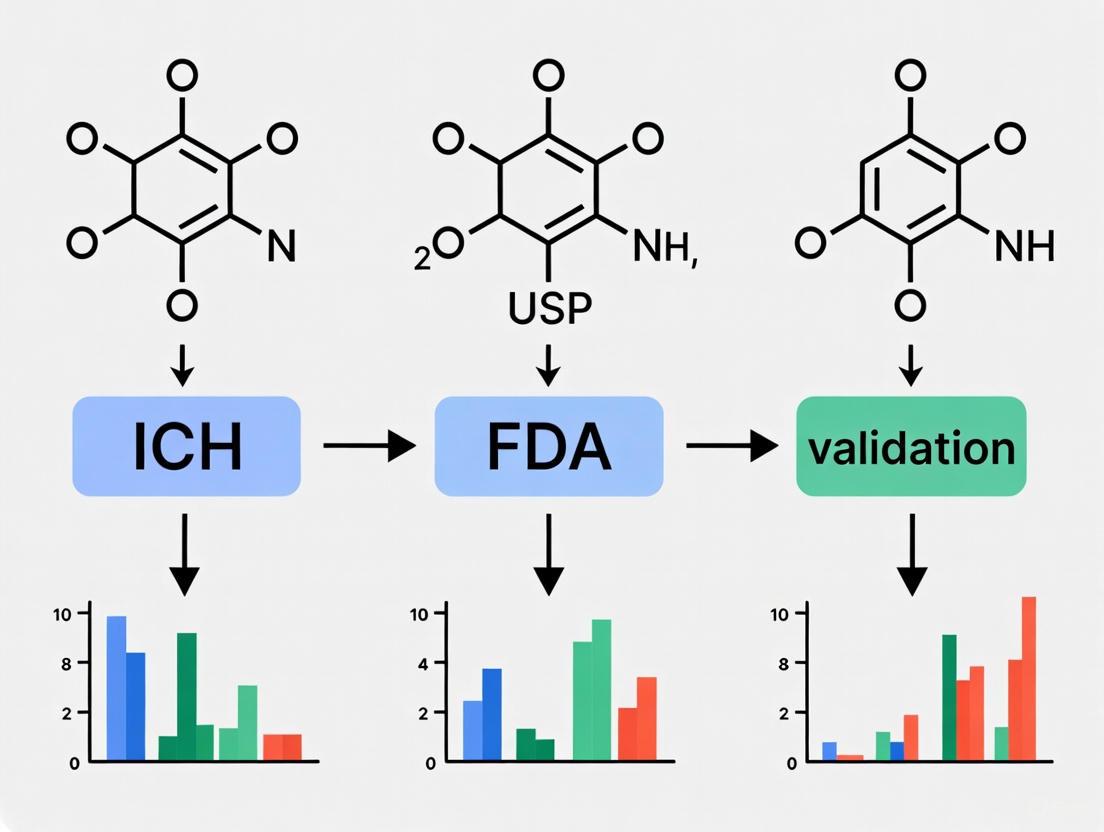
This article provides a comprehensive comparison of validation guidelines from the International Council for Harmonisation (ICH), the U.S.
Navigating ICH, FDA, and USP Validation Guidelines: A Strategic Comparison for Drug Development
Abstract
This article provides a comprehensive comparison of validation guidelines from the International Council for Harmonisation (ICH), the U.S. Food and Drug Administration (FDA), and the United States Pharmacopeia (USP). Tailored for researchers, scientists, and drug development professionals, it demystifies the distinct roles, scopes, and applications of these frameworks in ensuring drug quality, safety, and efficacy. The content spans from foundational principles and methodological applications to troubleshooting common challenges and conducting a direct comparative analysis. By synthesizing the latest regulatory updates, including ICH Q2(R2) and Q14, this guide aims to equip professionals with the knowledge to streamline compliance, enhance analytical robustness, and successfully navigate the global regulatory landscape.
Demystifying ICH, FDA, and USP: Core Principles and Global Roles in Pharmaceutical Validation
In the global pharmaceutical landscape, the International Council for Harmonisation (ICH), the U.S. Food and Drug Administration (FDA), and the United States Pharmacopeia (USP) are three pivotal organizations that establish guidelines and standards to ensure drug quality, safety, and efficacy. While their roles are complementary and often interconnected, each body has a distinct function, scope, and philosophical approach to analytical method validation. The ICH provides internationally harmonized guidelines adopted by regulatory authorities across the United States, Europe, Japan, and other regions to streamline global drug development [1]. The FDA is the United States' national regulatory agency responsible for protecting public health by ensuring the safety and efficacy of human and veterinary drugs, biological products, and medical devices [2] [3]. The USP is an independent, scientific nonprofit organization that establishes public quality standards for medicines, dietary supplements, and food ingredients [2]. These standards, published in the United States Pharmacopeia-National Formulary (USP-NF), are enforceable by the FDA and used in over 140 countries [2] [4]. Understanding the comparative roles and requirements of these bodies is fundamental for regulatory compliance and successful drug development.
Comparative Analysis of Guidelines
The guidelines issued by ICH, FDA, and USP, while aligned in their ultimate goal of protecting public health, exhibit key philosophical and practical differences in their approach to analytical method validation.
Philosophical Foundations and Scope
The core philosophies governing the validation approaches of these bodies differ significantly, particularly between ICH and USP.
Table 1: Foundational Philosophies and Scope
| Feature | ICH | FDA | USP |
|---|---|---|---|
| Core Philosophy | Risk-based, product lifecycle-oriented [5] [1] | Compliance and safety-focused, enforces ICH and USP standards [4] [6] | Prescriptive, provides specific testing procedures and acceptance criteria [5] |
| Primary Scope | Global harmonization for drug development and manufacturing [1] | National (US) regulatory oversight and enforcement [2] | Public quality standards for drug substances and products [2] |
| Validation Perspective | Continuous lifecycle management, from development through post-approval [4] [1] | Emphasizes reproducibility and data integrity for regulatory submissions [4] | Focused on discrete testing phases and compendial verification [5] |
| Regulatory Flexibility | High, encourages science- and risk-based justifications [5] [1] | Adopts ICH guidelines but maintains its own compliance focus [6] [1] | Low, mandates adherence to specified procedures and criteria [5] |
Validation Parameters and Requirements
A detailed comparison of specific validation parameters reveals nuances in terminology, emphasis, and requirements.
Table 2: Comparison of Key Analytical Method Validation Parameters
| Validation Parameter | ICH Guideline | USP Chapter | Key Comparisons |
|---|---|---|---|
| Accuracy | Closeness of test results to the true value [7] | Closeness of test results obtained to the true value [8] | Conceptual alignment between ICH and USP [8]. |
| Precision | Includes Repeatability, Intermediate Precision, and Reproducibility [8] | Encompasses repeatability and reproducibility, often termed "Ruggedness" for inter-laboratory studies [8] | ICH provides a more structured breakdown of precision levels [8]. |
| Specificity | Ability to assess analyte unequivocally in presence of potential interferants [8] | Ability to measure the analyte free from interference [8] | USP also uses the term "Selectivity" to characterize this ability [8]. |
| Linearity & Range | Linearity is the ability to obtain proportional results to analyte concentration. Range is the interval where linearity, accuracy, and precision are demonstrated [7] [8] | Defined similarly to ICH [8] | Conceptual alignment between ICH and USP [8]. |
| Limit of Detection (LOD) | The lowest amount of analyte that can be detected [8] | The lowest amount of analyte in a sample that can be detected [8] | Conceptual alignment between ICH and USP [8]. |
| Limit of Quantitation (LOQ) | The lowest amount of analyte that can be quantified with accuracy and precision [8] | The lowest amount of analyte in a sample that can be quantified [8] | Conceptual alignment between ICH and USP [8]. |
| Robustness | Measured as part of method development, reliability under small, deliberate variations [1] [8] | Capacity to remain unaffected by small, deliberate variations in method parameters [8] | ICH considers it part of precision, while USP treats it as a distinct element [8]. |
| System Suitability | Integrated as part of the method validation and ongoing verification [8] | Defined in a separate general chapter <621> and required before analysis [8] | A key procedural difference; USP handles it separately from validation parameters [8]. |
Experimental Protocols and Methodologies
Adhering to structured experimental protocols is critical for generating defensible validation data acceptable to all three bodies.
Protocol Design and Lifecycle Management
The modern validation protocol has evolved from a one-time exercise to a comprehensive lifecycle management system.
- Define the Analytical Target Profile (ATP): Before development begins, a prospective ATP summarizing the method's intended purpose and required performance criteria (e.g., target precision, accuracy) should be established. This is a core concept introduced in ICH Q14 [1].
- Develop a Science- and Risk-Based Protocol: The validation protocol should be designed based on the ATP and a risk assessment (per ICH Q9). It must specify all parameters, experimental designs, acceptance criteria, and a justification for their selection, aligning with both ICH's flexible principles and USP's specific requirements where applicable [1].
- Execution and Data Analysis: Experiments for parameters like accuracy, precision, and linearity must be executed as per the protocol. ICH recommends specific statistical treatments, such as confidence interval calculations and outlier detection using tests like Grubbs' test, while USP allows for more flexibility in some cases, permitting Dixon's Q-test alongside scientific judgment [5].
- Ongoing Lifecycle Management: Post-validation, the method enters a continuous monitoring phase. ICH Q12 and the FDA expect a robust change management system where any modifications are evaluated through a science- and risk-based assessment. This may require partial revalidation, the scope of which is determined by the nature of the change [4] [1].
Statistical Methodologies for Acceptance Criteria
Setting statistically sound acceptance criteria is a critical differentiator between the guidelines.
- ICH: Employs a more flexible, inferential statistical approach. It recommends using confidence intervals (typically 95%) for parameters like precision to establish method capability limits, accounting for variability and uncertainty. This aligns with its risk-based philosophy, requiring stronger evidence for decisions like outlier exclusion [5].
- USP: Often utilizes more prescriptive acceptance criteria, sometimes incorporating confidence intervals (frequently at 90%) directly into the acceptance rules themselves. This provides clear pass/fail outcomes but offers less flexibility [5].
Diagram 1: Analytical Method Validation Lifecycle Workflow.
Essential Research Reagent Solutions
The following materials and reagents are fundamental for conducting the experiments required for analytical method validation per ICH, FDA, and USP guidelines.
Table 4: Key Research Reagent Solutions for Method Validation
| Reagent/Material | Function in Validation | Application Example |
|---|---|---|
| Drug Substance (API) Reference Standard | Serves as the primary benchmark for identifying and quantifying the analyte; its certified purity and identity are foundational for all quantitative measurements. | Used to prepare standard solutions for constructing linearity curves and determining accuracy and precision [7]. |
| Placebo/Matrix Formulation | A representative sample containing all inactive components of the drug product except the active ingredient. Critical for demonstrating the method's specificity. | Used in spike-and-recovery studies to prove the method can accurately measure the API without interference from the formulation matrix [7] [8]. |
| Forced Degradation Samples | Samples of the drug substance or product that have been intentionally stressed (e.g., with heat, light, acid, base, oxidant) to generate potential impurities and degradation products. | Essential for validating specificity, demonstrating the method's ability to separate and quantify the analyte in the presence of degradation products [8]. |
| Chromatographic Columns & Reagents | Specific columns (e.g., C18, C8), high-purity solvents, and buffers are required as per the method conditions. Their quality and consistency are vital for robustness and system suitability. | Used in HPLC/UPLC methods to achieve the required resolution, tailing factor, and theoretical plates as defined in system suitability tests [8]. |
| Impurity/Related Compound Standards | Authentic samples of known and potential impurities in the drug substance. Used to confirm the method's ability to detect and quantify these species at low levels. | Used to establish LOD, LOQ, and linearity for individual impurities, and to confirm specificity by demonstrating resolution from the main analyte [8]. |
Strategic Implementation for Global Compliance
Navigating the requirements of ICH, FDA, and USP is essential for successful regulatory submissions in the U.S. and internationally. A strategic, integrated approach is necessary for global compliance.
- Foundation in ICH with USP Verification: Use the ICH Q2(R2) and Q14 guidelines as the primary framework for your validation lifecycle and risk-based strategy. Then, verify that the specific acceptance criteria and procedures align with any relevant USP monographs or general chapters (e.g., <1225>) that are legally enforceable by the FDA [6] [1].
- Documentation for Dual Compliance: Maintain thorough documentation that demonstrates both scientific understanding (per ICH's enhanced approach) and strict adherence to predefined, justified acceptance criteria. This documentation should be robust enough to satisfy FDA inspections and audits [5] [4].
- Leverage Harmonization: Recognize that the FDA is a key member of ICH and actively adopts its guidelines. Therefore, a validation package that is fully compliant with the latest ICH standards is a direct path to meeting FDA requirements for submissions like NDAs and ANDAs [1].
- Plan for Post-Approval Changes: Implement a change management system based on ICH Q12 principles from the outset. Understanding the impact of changes and having a pre-defined control strategy facilitates smoother post-approval modifications under both ICH and FDA frameworks, whereas USP changes may require compendial updating processes [5] [1].
In conclusion, the ICH provides the global, science-driven strategic framework for validation, the USP provides many of the specific, prescriptive tactical standards, and the FDA acts as the regulatory authority that integrates and enforces both. A successful validation strategy for researchers and drug development professionals requires a deep understanding of how these bodies compare, contrast, and ultimately converge to ensure medicine quality and patient safety.
The International Council for Harmonisation (ICH) is a global initiative that brings regulatory authorities and the pharmaceutical industry together to harmonize scientific and technical requirements for drug development and registration. Its mission is to ensure that safe, effective, and high-quality medicines are developed and registered in the most resource-efficient manner [9]. Before ICH, pharmaceutical companies faced significant challenges in navigating divergent regulatory requirements across different regions and countries, which often led to unnecessary duplication of clinical trials, increased costs, and delays in making new therapies available to patients [9]. ICH addresses these challenges through the development of internationally harmonized guidelines, which streamline the drug development process and facilitate global drug registration.
This guide provides a comparative analysis of ICH against other major regulatory frameworks—the U.S. Food and Drug Administration (FDA) and the U.S. Pharmacopeia (USP). It is designed to assist researchers, scientists, and drug development professionals in understanding the distinct philosophies, applications, and compliance strategies of each framework, enabling informed decision-making for global drug development projects.
Comparative Analysis of ICH, FDA, and USP Frameworks
Philosophical Foundations and Regulatory Approaches
The ICH, FDA, and USP frameworks are guided by distinct philosophical foundations that shape their regulatory approaches.
- ICH: Embraces a risk-based, product lifecycle approach that encourages tailoring validation efforts based on the method's intended use and its potential impact on product quality and patient safety. This approach provides regulatory flexibility and emphasizes continuous verification from development through commercial manufacturing [5].
- FDA: Similar to ICH, the FDA emphasizes a risk-based approach and lifecycle management for analytical procedures. The FDA's focus is strongly oriented toward compliance, safety, and reproducibility, ensuring methods are reliable in real-world applications with a strong emphasis on data integrity and audit-ready documentation [4].
- USP: Follows a more prescriptive path with specific acceptance criteria and detailed procedures for validation parameters. USP standards are procedure-focused and provide clear, standardized testing protocols and compliance pathways with less room for interpretation based on risk assessment [5] [4].
Scope and Application in Drug Development
The scope of these guidelines varies significantly, particularly in how they view the drug development process.
- ICH: Takes a comprehensive product lifecycle perspective that spans from early development through commercial manufacturing and eventual discontinuation. ICH's approach requires ongoing process monitoring and evaluation based on accumulated knowledge rather than one-time testing events [5].
- FDA: Focuses on lifecycle validation and risk management, with expectations for transparent data documentation and electronic records. The FDA emphasizes that methods must demonstrate scientific reliability and reproducibility across different scientists and instruments [4].
- USP: Primarily centers on discrete testing phases and standardized analytical procedures. USP validation is typically compartmentalized into distinct testing events with clearly defined acceptance criteria, focusing on verifying performance at predetermined intervals [5].
Key Validation Parameters and Technical Requirements
While ICH, FDA, and USP cover similar core validation parameters, their specific requirements and emphases differ. The table below summarizes these key differences:
Table 1: Comparison of Analytical Method Validation Parameters
| Validation Parameter | ICH Approach | USP/FDA Approach |
|---|---|---|
| Specificity | Emphasizes demonstration of non-interference [5] | Requires specific chromatographic resolution tests [5] |
| Robustness | Integrated throughout method development [5] | Treated as a discrete validation element [5] |
| Precision | Differentiates repeatability, intermediate precision, and reproducibility [5] | Focuses on repeatability and reproducibility [5] |
| Stability Testing | Provides tiered approaches [5] | Prescribes fixed timepoints and conditions [5] |
| Documentation | Proportional to risk level [5] | Standardized templates regardless of risk [5] |
Statistical Methods and Acceptance Criteria
The statistical methodologies for setting acceptance criteria represent another area of divergence between the frameworks.
- ICH: Recommends confidence interval calculations and formal outlier detection methods such as Grubbs' test at the α = 0.05 level. ICH emphasizes using statistical intervals to establish method capability limits based on validation data, particularly in precision studies [5].
- USP: Employs different confidence intervals (often 90% for certain applications) and provides more flexible outlier detection methods, allowing Dixon's Q-test alongside visual inspection techniques. USP's approach tends to incorporate confidence intervals more directly into acceptance criteria [5].
Regional Adoption and Regulatory Status
The regulatory adoption and implementation of these frameworks vary by region:
- ICH: Guidelines are implemented globally by regulatory authorities in ICH member regions (EU, US, Japan, Canada, Switzerland, and others). The European Medicines Agency (EMA) announced an effective date of July 23, 2025 for the updated ICH E6(R3) Good Clinical Practice guideline [10]. The FDA has participated in ICH as a Founding Member since 1990 and implements all ICH Guidelines as FDA Guidance [9].
- FDA: Requirements are specific to the United States market, though they often influence global standards. The FDA has issued draft guidance aligning with ICH E6(R3) as part of its steps to modernize clinical trials [10] [3].
- USP: Standards are officially recognized in the United States but also have significant international influence, particularly in markets that follow US regulatory precedents [5].
Experimental Protocols and Validation Workflows
ICH Lifecycle Approach to Analytical Procedure Validation
The ICH guideline Q14 formalizes a comprehensive lifecycle approach to analytical procedure development and validation. This methodology consists of three key stages:
Table 2: ICH Analytical Procedure Lifecycle Stages
| Stage | Key Activities | Deliverables |
|---|---|---|
| Procedure Design & Development | Establishing objectives, risk profiles, intended use [4] | Target Analytical Profile (ATP), risk assessment |
| Method Validation | Demonstrating accuracy, precision, specificity, linearity, robustness [4] | Validation protocol, report with statistical analysis |
| Ongoing Performance Verification | Continuous monitoring, change management [4] | Performance trends, periodic review reports |
The following workflow diagram illustrates the ICH analytical procedure lifecycle:
Comparative Experimental Protocol: Precision Testing
To illustrate the practical differences in validation approaches, consider the experimental design for precision testing:
ICH Precision Protocol:
- Objective: Demonstrate method precision across repeatability, intermediate precision, and reproducibility.
- Experimental Design:
- Repeatability: Multiple injections of a homogeneous sample by the same analyst using the same instrument on the same day.
- Intermediate Precision: Multiple injections by different analysts using different instruments on different days.
- Reproducibility: Testing across multiple laboratories (for standardization purposes).
- Statistical Analysis: Calculation of %RSD with 95% confidence intervals for each precision level. Acceptance criteria are based on method capability and product variability [5].
USP Precision Protocol:
- Objective: Verify method precision through repeatability and reproducibility.
- Experimental Design:
- Repeatability: A minimum of 6 determinations at 100% of test concentration.
- Reproducibility: Testing performed across multiple laboratories (collaborative studies).
- Statistical Analysis: Calculation of %RSD with comparison to predefined acceptance criteria, often using fixed numerical values specified in monographs [5].
Essential Research Reagent Solutions
Successful implementation of validation studies requires specific reagents and materials. The following table details essential research reagent solutions for method validation studies:
Table 3: Essential Research Reagents for Validation Studies
| Reagent/Material | Function in Validation | Application Notes |
|---|---|---|
| System Suitability Standards | Verify chromatographic system performance before validation runs | Critical for both ICH and USP approaches; composition should match analytical targets |
| Reference Standards | Quantify analytes and establish method accuracy | Certified purity standards are essential for both frameworks |
| Placebo/Blank Matrix | Establish method specificity and demonstrate lack of interference | Required for ICH specificity demonstration and USP resolution tests |
| Forced Degradation Samples | Demonstrate stability-indicating capability and specificity | Stressed samples (acid, base, oxidation, heat, light) per ICH stability protocols |
| Quality Control Samples | Evaluate precision, accuracy, and intermediate precision | Prepared at multiple concentration levels (low, medium, high) for precision studies |
Strategic Implementation and Compliance Considerations
Change Management and Post-Approval Modifications
The approaches to change management and post-approval modifications differ significantly between the frameworks:
- ICH: Employs a risk-based methodology that categorizes changes as minor, moderate, or critical based on product quality implications. ICH requires detailed risk assessments with scientific justifications and allows more flexibility in determining assessment scope [5].
- USP: Follows a more prescriptive approach with fixed testing regimens for specific change types. USP emphasizes meeting predefined criteria with less emphasis on customized evaluation approaches [5].
Cross-Border Compliance Strategies
For pharmaceutical companies targeting international markets, developing effective cross-border compliance strategies is essential:
- Understand Regional Dominance: ICH validation approaches are primarily recognized in EU regions, while USP standards dominate in the US/Americas regulatory landscape [5].
- Implement Documentation Systems: Maintain documentation systems that satisfy both frameworks while avoiding redundant paperwork. ICH emphasizes risk-based documentation, while USP mandates more prescriptive documentation templates [5].
- Leverage Harmonization Opportunities: Utilize ICH's harmonized guidelines to reduce unnecessary duplication of clinical testing and animal studies without compromising safety and effectiveness [9].
Emerging Trends and Future Directions
The regulatory landscape continues to evolve with several notable trends:
- Digital Transformation: ICH E6(R3) introduces "media-neutral" language to facilitate electronic records, eConsent, and remote/decentralized trials [11].
- Quality by Design: ICH formalizes a proactive risk-based Quality by Design approach, building on E6(R2)'s emphasis on risk-based monitoring [11].
- Advanced Analytics: Increasing adoption of AI-driven data analysis to expedite verification and real-time monitoring instead of batch reviews [4].
The International Council for Harmonisation represents a crucial global initiative that has significantly advanced the efficiency and effectiveness of pharmaceutical development and regulation worldwide. Through its collaborative model involving regulators and industry experts, ICH has successfully harmonized technical requirements that ensure safe, effective, and high-quality medicines while reducing unnecessary duplication of efforts.
When compared with the FDA and USP frameworks, ICH's distinctive risk-based, lifecycle approach provides greater flexibility and scientific rigor, while USP offers more prescriptive, standardized pathways. The FDA aligns closely with ICH principles while maintaining its specific focus on compliance and patient safety. For drug development professionals, understanding these distinctions is essential for designing efficient global development strategies, ensuring regulatory compliance, and ultimately bringing innovative therapies to patients worldwide in the most resource-efficient manner.
As the regulatory landscape continues to evolve with advancements in digital health technologies, novel clinical trial designs, and increasingly globalized drug development, ICH's role in promoting international harmonization will remain critically important for the pharmaceutical industry and public health.
In the global pharmaceutical landscape, the United States regulatory environment presents distinct requirements that manufacturers must navigate for market approval and ongoing compliance. The U.S. Food and Drug Administration (FDA) serves as the primary regulatory authority, enforcing requirements based on current Good Manufacturing Practices (cGMP). Unlike internationally harmonized guidelines, U.S.-specific requirements carry the force of law, with the FDA conducting routine inspections and having authority to issue warnings, seizures, or injunctions for non-compliance [5] [12].
The U.S. framework incorporates both legally binding regulations and recognized standards, primarily those published in the United States Pharmacopeia (USP). While USP standards are technically voluntary, they are extensively referenced in FDA regulations and expectations, making them de facto requirements for pharmaceutical manufacturers marketing products in the United States [2]. This creates a unique regulatory ecosystem where manufacturers must simultaneously comply with FDA's enforcement priorities and detailed USP compendial standards.
Understanding the distinct aspects of U.S. requirements is particularly crucial when contrasted with the International Council for Harmonisation (ICH) guidelines, which provide globally harmonized scientific and technical standards. While ICH guidelines (including Q7 for APIs and Q9 for Quality Risk Management) have been adopted by the FDA, their implementation in the U.S. context incorporates specific FDA interpretations and emphasis that differentiate them from other regions [4].
Comparative Analysis: FDA, ICH, and USP Validation Approaches
Philosophical Foundations and Regulatory Emphasis
The FDA, ICH, and USP approaches to validation share common goals of ensuring product quality and patient safety but differ significantly in their philosophical foundations and regulatory emphasis.
FDA's Enforcement-Focused Approach: The FDA emphasizes compliance, reproducibility, and data integrity throughout the product lifecycle [4]. Its approach is fundamentally risk-based but with strong enforcement authority, including the power to conduct inspections, issue Form 483 observations, and initiate regulatory actions against non-compliant manufacturers [13]. The FDA's current focus includes rigorous data integrity requirements aligned with 21 CFR Part 11 for electronic records, continuous process verification, and quality metrics [13].
ICH's Science-Based Harmonization: ICH guidelines (including Q8-Q12 series) promote a science-based, risk-oriented framework that encourages flexibility and innovation [5] [14]. ICH Q2(R2) on analytical procedure validation provides definitions and methodologies intended to bridge differences between various compendia and regulatory documents globally [15]. Unlike FDA requirements, ICH guidelines represent scientific consensus rather than enforceable regulations, though they are adopted by regulatory authorities including the FDA [12].
USP's Prescriptive Standards: USP follows a more prescriptive path, outlining specific acceptance criteria and detailed procedures for validation parameters [5]. USP General Chapter <1225> "Validation of Compendial Procedures" provides detailed validation frameworks with specific methodological requirements, particularly for compendial methods [12]. While USP standards are technically not regulations, their extensive incorporation by reference in FDA regulations gives them significant legal force in the U.S. market [2].
Key Differences in Validation Parameters and Requirements
The approaches diverge notably in their specific technical requirements for analytical method validation, particularly in acceptance criteria, statistical treatment, and documentation expectations.
Table 1: Comparison of Key Validation Parameters Across Frameworks
| Validation Parameter | FDA Approach | ICH Approach | USP Approach |
|---|---|---|---|
| Precision Evaluation | Focuses on repeatability and reproducibility with emphasis on real-world variability [4] | Differentiates repeatability, intermediate precision, and reproducibility [5] | Focuses on repeatability and reproducibility with specific acceptance criteria [12] |
| Linearity Assessment | Requires demonstration across specified range with statistical analysis [15] | At least 5 concentration levels covering 80-120% of expected range [14] | Similar to ICH but often with predefined acceptance criteria for correlation coefficient [12] |
| Specificity/Specificity | Must demonstrate analyte identification in presence of potentially interfering compounds [15] | Emphasizes demonstration of non-interference [5] | Requires specific tests such as chromatographic resolution between analytes [5] |
| Robustness Testing | Evaluated during method development and validation [4] | Integrated throughout development lifecycle [5] | Treated as discrete validation element with prescribed experimental designs [5] |
| Documentation Standards | Extensive requirements for data integrity, audit trails, and electronic records (21 CFR Part 11) [13] | Documentation proportional to risk level [5] | Standardized templates regardless of risk; detailed compendial requirements [5] |
Table 2: Statistical Methods and Acceptance Criteria Comparison
| Statistical Aspect | FDA Expectations | ICH Recommendations | USP Requirements |
|---|---|---|---|
| Acceptance Criteria Setting | Based on product performance requirements and process capability [4] | Risk-based approach considering intended method use [5] | Often prescriptive with fixed numerical limits [14] |
| Outlier Detection | Scientific justification with statistical support [4] | Grubbs' test recommended at α = 0.05 level [5] | Flexible methods including Dixon's Q-test and visual inspection [5] |
| Confidence Intervals | Often 95% confidence intervals for precision and accuracy [5] | Typically 95% confidence intervals [5] | Often employs 90% intervals for certain applications [5] |
| System Suitability | Required before, during, and after analytical runs [12] | Recommended as part of routine method control [14] | Mandatory prerequisite with specific acceptance criteria [14] |
Experimental Protocols and Methodologies
Analytical Method Validation Protocol Structure
A comprehensive analytical method validation suitable for FDA submissions must address specific protocol requirements that satisfy both scientific and regulatory expectations. The experimental design should demonstrate method reliability throughout its lifecycle, from initial development through routine use.
Protocol Development and Pre-validation: Before initiating formal validation, manufacturers must establish a detailed validation protocol defining objective, methodology, and acceptance criteria. The FDA emphasizes robust method development with demonstrated understanding of critical method parameters [4]. System suitability testing must be established as a mandatory prerequisite, unlike the more flexible ICH approach where it's recommended as part of routine method control [14]. For HPLC methods, this typically includes parameters such as plate count, tailing factor, resolution, and repeatability, with specific acceptance criteria justified based on method purpose [16].
Forced Degradation Studies: The FDA expects forced degradation (stress testing) studies to demonstrate method specificity and stability-indicating properties [14]. These studies should include exposure to various stress conditions such as acid, base, oxidation, thermal, and photolytic conditions. Unlike the ICH approach which provides general principles, FDA expectations align more with detailed requirements similar to ANVISA, including specific stress conditions and targeted degradation levels (typically 10-30% degradation) to demonstrate method selectivity [14].
Lifecycle Approach to Process Validation
The FDA's 2011 Process Validation Guidance establishes a three-stage lifecycle approach that has become fundamental to U.S. regulatory requirements. This approach represents a significant shift from traditional point-in-time validation to continuous verification throughout the product lifecycle.
Table 3: FDA Process Validation Lifecycle Stages
| Stage | FDA Requirements | Documentation Expectations | Statistical Requirements |
|---|---|---|---|
| Stage 1: Process Design | Comprehensive understanding based on scientific knowledge and risk management [13] | Design space characterization; critical process parameter identification [4] | Design of Experiments (DoE); multivariate analysis [13] |
| Stage 2: Process Qualification | Demonstrated reproducible manufacturing meeting predefined specifications [13] | Protocol-driven execution; deviation investigation; final report [13] | Statistical process control; confidence intervals for critical quality attributes [4] |
| Stage 3: Continued Process Verification | Ongoing monitoring ensuring maintained statistical control [13] | Continuous data collection; trend analysis; annual product reviews [13] | Statistical quality control charts; process capability indices (Cpk/Ppk) [13] |
The following workflow illustrates the integrated nature of the FDA's validation lifecycle approach:
Stage 1: Process Design The initial stage focuses on building process understanding through systematic studies, including identification of Critical Process Parameters (CPPs) and their relationship to Critical Quality Attributes (CQAs). The FDA expects manufacturers to employ Quality by Design (QbD) principles, utilizing structured experimentation such as Design of Experiments (DoE) and risk assessment tools [4]. The output includes a design space within which adjustments can be made without regulatory oversight, provided proper change management systems are implemented.
Stage 2: Process Qualification This stage demonstrates that the manufacturing process, as designed, can consistently reproduce commercial product. The FDA requires written qualification protocols covering installation qualification (IQ), operational qualification (OQ), and performance qualification (PQ) [13]. For equipment and utilities, this follows traditional IQ/OQ/PQ methodology, while process performance qualification (PPQ) requires manufacturing commercial batches under routine conditions with intensified sampling and testing. Successful PPQ batches must meet all predetermined acceptance criteria before commercial distribution.
Stage 3: Continued Process Verification The FDA mandates ongoing assurance that the process remains in a state of control throughout the product lifecycle [13]. This requires establishing a comprehensive monitoring program that collects and analyzes process data, employing statistical process control (SPC) methods to detect trends or deviations from the validated state. Significant trends must be investigated through the CAPA (Corrective and Preventive Action) system, potentially triggering process improvements or revalidation activities.
The Scientist's Toolkit: Essential Research Reagent Solutions
Successful implementation of FDA-compliant validation requires specific materials and reagents that meet rigorous quality standards. The following table details essential solutions and their functions in pharmaceutical validation studies.
Table 4: Essential Research Reagent Solutions for FDA-Compliant Validation
| Reagent/Material | Function in Validation | Quality Standards | Application Examples |
|---|---|---|---|
| System Suitability Standards | Verify chromatographic system performance before, during, and after analytical runs [12] | USP-grade reference standards with certified purity and identity [16] | HPLC/GC system suitability testing; plate count, tailing factor, and resolution measurements |
| Forced Degradation Reagents | Establish method specificity through intentional sample degradation [14] | ACS-grade or higher acids, bases, oxidizing agents [14] | Acid/base hydrolysis (0.1N HCl/NaOH); oxidative stress (0.3% H₂O₂; 0.05M metal ions) |
| Matrix Components | Evaluate method selectivity in presence of sample components [14] | Well-characterized excipients; synthetic or natural matrix materials | Placebo interference studies; specificity demonstration for assay and impurity methods |
| Reference Standards | Quantify analyte and qualify impurities; establish calibration curves [16] | USP compendial standards; well-characterized working standards | Method calibration; calculation of accuracy and precision; assignment of impurity levels |
| Mobile Phase Components | Create reproducible chromatographic conditions [16] | HPLC-grade solvents; buffer salts with controlled lot-to-lot variability | Method robustness testing; deliberate variations in pH, mobile phase composition |
Successful navigation of U.S. regulatory requirements demands a strategic approach that recognizes the complementary yet distinct roles of FDA regulations and USP standards. Manufacturers targeting the U.S. market must recognize that FDA requirements carry legal enforceability, with inspection outcomes directly impacting market authorization. The FDA's emphasis on data integrity, continuous verification, and quality metrics requires robust quality systems capable of generating defensible data throughout the product lifecycle.
The integration of ICH's scientific principles with FDA's enforcement priorities and USP's technical standards creates a comprehensive framework for pharmaceutical quality in the U.S. market. While significant harmonization exists between these frameworks, the unique aspects of U.S. requirements – particularly regarding documentation practices, statistical approaches, and lifecycle management – demand specific attention during method development and validation activities. Manufacturers who successfully implement integrated quality systems addressing all three frameworks position themselves for sustainable market access and regulatory success.
In the pharmaceutical industry, ensuring drug quality, identity, strength, and purity is paramount for patient safety and product efficacy. The United States Pharmacopeia (USP) provides a comprehensive set of public compendial standards that form the foundation for drug testing and quality assurance in the United States and many international markets [17]. Established in 1820, USP is an independent, non-profit organization that develops both written standards (monographs and general chapters) and physical reference standards, which are officially recognized by the U.S. Food and Drug Administration (FDA) [17]. These standards are crucial for regulatory compliance, as they provide validated methods for testing drug substances, products, and dietary supplements.
The regulatory landscape for analytical procedures is primarily shaped by three key bodies: the USP, the FDA, and the International Council for Harmonisation (ICH). While the FDA's validation approach emphasizes compliance, safety, and reproducibility from a regulatory perspective, the ICH guidelines (notably Q2(R2) and Q14) promote a global, harmonized, and science-based lifecycle management system for analytical procedures [4] [1]. In contrast, USP standards provide the specific, technical testing protocols and acceptance criteria used in laboratories to demonstrate quality and identity [4]. This guide objectively compares these frameworks, focusing on their application in drug development and quality control, supported by experimental data and procedural workflows.
Comparative Analysis of USP, ICH, and FDA Guidelines
Philosophical Foundations and Regulatory Focus
The guidelines from USP, ICH, and FDA, while complementary, are founded on distinct philosophical approaches and serve different primary functions in the validation ecosystem.
USP Approach: The USP follows a prescriptive and procedural path, providing detailed, standardized testing methods and fixed acceptance criteria for specific analytical procedures [5]. Its standards, such as those found in General Chapter
<1225>"Validation of Compendial Procedures" and<1226>"Verification of Compendial Procedures," are designed to ensure consistency and reproducibility across different laboratories and products [18]. The focus is on providing a clear, compliance-focused pathway for testing drugs against established public standards. The use of USP Reference Standards—official physical standards—is often mandated in these monographs to ensure the accuracy and reproducibility of tests, forming a critical part of the drug quality control infrastructure [17].ICH Approach: ICH embraces a risk-based and lifecycle-oriented methodology [5]. Its recent guidelines, ICH Q2(R2) on validation and ICH Q14 on analytical procedure development, emphasize a scientific, flexible approach where validation efforts are proportional to the procedure's intended use and its potential impact on product quality and patient safety [1]. A key modern element introduced in ICH Q14 is the Analytical Target Profile (ATP), a prospective summary of the method's required performance characteristics, which guides development and validation from the outset [1]. This approach views validation not as a one-time event, but as a continuous process throughout the method's lifecycle.
FDA Approach: The FDA acts as the regulatory enforcer, focusing on compliance, safety, and data integrity [4]. It strongly emphasizes that methods must be scientifically reliable, reproducible, and defensible in real-world applications [4]. The FDA has increasingly focused on product-specific method verification, even for compendial USP methods, as noted in recent inspections where regulators spent considerable time reviewing the verification of USP monographs [18]. The FDA adopts ICH guidelines, making compliance with ICH Q2(R2) and Q14 a direct path to meeting FDA requirements for submissions like New Drug Applications (NDAs) and Abbreviated New Drug Applications (ANDAs) [1].
Key Differences in Validation Parameters and Requirements
While all three frameworks address core validation parameters like accuracy, precision, and specificity, their requirements and emphases differ significantly. The table below summarizes the key distinctions between the ICH and USP approaches, which represent the two primary technical frameworks.
Table 1: Key Differences Between ICH and USP Validation Approaches
| Aspect | ICH Approach | USP Approach |
|---|---|---|
| Core Philosophy | Risk-based, flexible, and lifecycle-oriented [5] | Prescriptive, standardized, and procedural [5] |
| Scope of Validation | Product lifecycle perspective with continuous verification [5] | Focused on distinct testing phases and compendial methods [5] |
| Statistical Methods | Uses tolerance intervals based on method capability; allows more scientific judgment [5] | Often employs fixed numerical values and more traditional statistical methods [5] |
| Documentation | Documentation is proportional to risk level [5] | Requires standardized templates and detailed documentation [5] |
| Stability Testing | Provides tiered approaches for different climate zones [5] | Typically follows product-specific schedules and room temperature conditions [5] |
| Regulatory Landscape | Globally harmonized; recognized in EU, Japan, and the US via FDA adoption [1] | Primarily dominates the US/Americas regulatory landscape [5] |
| Change Management | More flexible, science-based change management post-approval [5] | More rigid process for post-approval modifications to methods [5] |
These differences manifest practically in how methods are developed and validated. For instance, under ICH, the robustness of a method is integrated throughout its development, whereas USP often treats it as a discrete validation element [5]. Furthermore, ICH differentiates between repeatability, intermediate precision, and reproducibility for precision testing, while USP focuses more on repeatability and reproducibility [5].
Experimental Protocols and Data Presentation
Method Verification of a Compendial Procedure (USP)
A core activity in quality control laboratories is verifying that a compendial method (e.g., a USP monograph) is suitable for use under actual laboratory conditions, for a specific drug product. This is a regulatory expectation reinforced by the FDA [18].
Protocol: Product-Specific Verification of a USP Monograph for Assay
- Objective: To verify that the official USP monograph method for Assay is suitable for the quantitative determination of the active pharmaceutical ingredient (API) in a specific finished drug product at your facility.
- Methodology:
- Preparation: Obtain the relevant USP Reference Standard for the API [17].
- Accuracy: Spike a placebo of the drug product with known quantities of the API (e.g., at 50%, 100%, and 150% of the target concentration). Analyze these samples and calculate the percentage recovery of the API. Acceptance criteria are typically set at 98.0-102.0% recovery [1].
- Precision (Repeatability): Prepare and analyze six independent sample preparations of the drug product at 100% of the test concentration by a single analyst on the same day. Calculate the relative standard deviation (RSD) of the results. The RSD should typically be not more than 2.0% for the assay of a drug product [1].
- Specificity: Demonstrate that the method can unequivocally quantify the API in the presence of excipients and known impurities. This is often shown by analyzing the placebo and confirming it causes no interference at the retention time of the API.
- Linearity and Range: Prepare and analyze standard solutions of the API at a minimum of five concentration levels, e.g., 50%, 75%, 100%, 125%, and 150% of the test concentration. Plot the response versus concentration and calculate the correlation coefficient, which should typically be not less than 0.999 [1].
Table 2: Example Data Table for USP Method Verification (Assay)
| Validation Parameter | Experimental Design | Acceptance Criteria | Result Obtained |
|---|---|---|---|
| Accuracy (% Recovery) | 3 levels, 3 preparations each | 98.0% - 102.0% | 99.5%, 100.2%, 101.0% |
| Precision (% RSD) | 6 sample preparations | NMT 2.0% | 0.8% |
| Specificity | Placebo interference | No interference observed | Confirmed |
| Linearity (Correlation Coefficient, r²) | 5 concentration levels | NLT 0.999 | 0.9995 |
Lifecycle Management of a Non-Compendial Procedure (ICH Q2/Q14)
For a novel, in-house developed method, the enhanced approach outlined in ICH Q14 and validated per ICH Q2(R2) is applicable. This involves a more holistic, lifecycle management strategy.
Protocol: Lifecycle Approach for an In-House HPLC Method for Impurity Quantification
- Objective: To develop and validate a stability-indicating HPLC method for the quantification of a specified degradation product in a new drug substance using the ICH lifecycle approach.
- Methodology:
- Define the Analytical Target Profile (ATP): Before development, define the ATP: "The method must be capable of quantifying the specified impurity at a level of 0.1% with an accuracy of 95-105% and a precision of RSD NMT 10.0%."
- Risk-Based Development: Use Quality by Design (QbD) principles and risk assessment (ICH Q9) to identify critical method parameters (e.g., mobile phase pH, column temperature, gradient profile) and their optimal ranges through Design of Experiments (DoE).
- Robustness Testing: Deliberately introduce small, deliberate variations in the identified critical parameters (as defined in the DoE study) to demonstrate the method's reliability.
- Validation: Perform a full validation per ICH Q2(R2), including specificity (stressing the sample), accuracy, precision (repeatability and intermediate precision), LOD/LOQ, linearity, and range. The acceptance criteria are derived from the ATP.
- Ongoing Performance Monitoring: Once implemented, the method's performance is continuously monitored through system suitability tests and control charts to ensure it remains in a state of control throughout its lifecycle.
Table 3: Example Data Table for ICH-Based Method Validation (Impurity Quantification at 0.1%)
| Validation Parameter | Experimental Design | Acceptance Criteria | Result Obtained |
|---|---|---|---|
| Accuracy (% Recovery) | 3 levels across the range (0.05%-0.15%) | 95.0% - 105.0% | 98.5%, 99.1%, 101.5% |
| Precision (Repeatability, % RSD) | 6 preparations at 0.1% | NMT 10.0% | 3.5% |
| Intermediate Precision (% RSD) | Different analyst, day, instrument | NMT 15.0% | 4.8% |
| LOQ (% of target) | Signal-to-noise ratio 10:1 | NMT 0.05% | 0.03% |
| Linearity (r²) | From LOQ to 0.2% | NLT 0.990 | 0.997 |
Workflow Visualization and Research Toolkit
USP Compendial Method Verification Workflow
The following diagram illustrates the standard operational workflow for verifying a USP compendial method for a specific product, a critical process for regulatory compliance.
ICH Analytical Procedure Lifecycle Workflow
The ICH Q2(R2)/Q14 framework promotes a holistic, science-based lifecycle management for analytical procedures, as visualized below.
The Scientist's Toolkit: Essential Research Reagents and Materials
Table 4: Essential Materials for Pharmaceutical Analytical Validation
| Item | Function and Importance |
|---|---|
| USP Reference Standards | Officially certified physical standards used to calibrate systems and validate compendial test methods. They are essential for achieving accurate and reproducible results that are compliant with USP monographs [17]. |
| High-Purity Analytical Standards | High-purity chemical substances (e.g., API, impurity markers) used for developing and validating non-compendial (in-house) methods. Their purity is critical for establishing accurate calibration curves and method specificity. |
| Placebo/Excipient Blends | Mixtures of all inactive ingredients in a drug product. They are used in accuracy/recovery studies and specificity testing to demonstrate that the method can distinguish the analyte from the formulation matrix. |
| Certified Reference Materials (CRMs) | Reference materials characterized by a metrologically valid procedure, accompanied by a certificate stating the property values and their uncertainties. Used for higher-tier method validation and calibration. |
| System Suitability Test (SST) Solutions | Standardized test mixtures used to verify that the chromatographic or other analytical system is performing adequately at the time of the test, as required by USP general chapters before any analysis is performed. |
The choice between relying solely on USP standards or adopting the broader ICH lifecycle approach is not mutually exclusive. In practice, a robust quality system integrates both. USP's public compendial standards provide a critical, standardized foundation for testing drug quality and identity, ensuring consistency and regulatory predictability [2]. The recent increased FDA focus on product-specific verification of even compendial methods underscores the need for rigorous application of these standards [18].
Conversely, the ICH's risk-based, lifecycle framework (Q2(R2)/Q14) offers a modern, scientifically rigorous model for developing and controlling analytical procedures, especially for new chemical entities and complex biologics where compendial methods may not yet exist [1]. It provides the flexibility and deep process understanding needed for efficient post-approval change management.
For drug development professionals, the strategic advantage lies in understanding the distinct roles and requirements of each guideline. USP standards ensure compliance with specific quality tests, while ICH guidelines provide a comprehensive framework for assuring analytical procedure performance throughout a product's lifecycle. A successful global regulatory strategy harmonizes the prescriptive clarity of USP with the scientific, risk-based philosophy of ICH, ultimately leading to more efficient development, stronger quality control, and safer medicines for patients.
The Interplay and Hierarchy Between ICH, FDA, and USP Guidelines
The development and manufacture of pharmaceuticals require strict adherence to quality standards to ensure patient safety and product efficacy. Three major organizations—ICH, FDA, and USP—provide complementary yet distinct guidelines that form a comprehensive regulatory ecosystem. The International Council for Harmonisation (ICH) works to harmonize technical requirements for pharmaceuticals across regions including the European Union, Japan, and the United States. The U.S. Food and Drug Administration (FDA) is the federal agency responsible for protecting public health by ensuring the safety and efficacy of drugs and biologics. The United States Pharmacopeia (USP) is an independent, scientific organization that develops quality standards for medicines, dietary supplements, and food ingredients [19] [20].
Understanding the hierarchy and interplay between these organizations is crucial for pharmaceutical professionals navigating global development and compliance strategies. While these frameworks share the common goal of protecting public health, their approaches, scope, and legal authority differ significantly, creating a multi-layered system where guidelines often intersect and complement one another.
Historical Development and Legal Authority
The historical context of each organization reveals how their distinct roles evolved within the pharmaceutical regulatory landscape. USP has the longest history, established in 1820 by a group of physicians concerned about the dangers of poor-quality medicines in America. The first edition of USP standards was published on December 15, 1820, marking a turning point in public health by creating consistent guidelines for medicinal substances [21]. USP's role was formalized with the Pure Food and Drug Act of 1906, which recognized USP standards as official for strength, quality, and purity, making them legally enforceable [19] [21].
The FDA's regulatory authority over drugs began with the creation of the Drug Laboratory in 1902 within the Bureau of Chemistry, which later evolved into the FDA's drug regulatory function [22]. The 1906 Act gave the Bureau (FDA's predecessor) authority to enforce drug standards, including those established by USP. Subsequent tragedies, including the 1937 Elixir Sulfanilamide incident that killed over 100 people, led to strengthened regulations requiring pre-market safety testing [21].
ICH emerged much later, founded in 1990 to address the growing need for international harmonization of regulatory requirements. The increasing globalization of drug development created challenges for pharmaceutical companies facing differing technical requirements across regions, leading to redundant testing and development delays. ICH provided a platform for regulatory authorities and industry representatives to develop unified guidelines [20].
Philosophical Approaches and Scope
Comparative Analysis of Fundamental Approaches
The philosophical foundations of ICH, FDA, and USP guidelines reveal fundamental differences in their approaches to quality assurance and regulatory oversight:
ICH's Risk-Based Lifecycle Approach: ICH embraces a flexible, risk-based methodology that encourages manufacturers to assess each validation parameter based on the method's intended use and potential impact on product quality and patient safety. This approach provides regulatory flexibility, allowing validation efforts to be tailored proportionally to actual risk. ICH adopts a comprehensive product lifecycle perspective with continuous verification from development through commercial manufacturing [5].
USP's Prescriptive Standards: USP follows a more prescriptive path with specific acceptance criteria and detailed procedures for validation parameters. This approach offers less room for interpretation but ensures consistency across products and manufacturers. USP focuses more on discrete testing phases with clearly defined acceptance criteria rather than continuous lifecycle verification [5].
FDA's Hybrid Approach: The FDA incorporates elements of both frameworks, recognizing USP standards as enforceable requirements while increasingly adopting ICH's risk-based principles. FDA guidelines often focus on total product lifecycle regulation with requirements spanning from investigational new drug applications through post-market surveillance [22].
Documentation and Compliance Focus
The philosophical differences extend to documentation practices and compliance strategies:
ICH Documentation: Emphasizes risk-proportional documentation with flexibility in format and detail level based on the assessed risk [5].
USP Documentation: Requires standardized templates and comprehensive documentation regardless of risk level, providing clearer compliance pathways with less emphasis on scientific judgment [5].
FDA Expectations: Focuses on application-specific data and comprehensive submission packages that demonstrate product quality throughout development and manufacturing [22].
Analytical Method Validation: Parameters and Requirements
Comparative Validation Parameters
Analytical method validation represents a critical area where ICH, FDA, and USP requirements intersect and diverge. The table below summarizes key differences in validation parameters:
| Validation Parameter | ICH Approach | USP Approach | FDA Expectations |
|---|---|---|---|
| Specificity | Emphasizes demonstration of non-interference | Requires specific chromatographic resolution tests | Aligns with ICH but references USP for specific techniques |
| Robustness | Integrated throughout method development | Treated as discrete validation element | Expects demonstrated method robustness under varied conditions |
| Precision | Differentiates repeatability, intermediate precision, and reproducibility | Focuses on repeatability and reproducibility | Consistent with ICH approach with emphasis on statistical rigor |
| Accuracy | Based on product variability and method capability | Often specifies fixed numerical values in monographs | Requires justification of acceptance criteria based on product impact |
| Stability Testing | Provides tiered approaches with trend analysis | Prescribes fixed timepoints and conditions | References both ICH and USP with focus on product-specific needs |
Statistical Methods and Acceptance Criteria
The organizations employ different statistical methodologies for setting acceptance criteria:
ICH Guidelines: Typically recommend 95% confidence intervals for precision and accuracy assessments, using tolerance intervals based on method capability and product variability [5].
USP Standards: Often employ 90% confidence intervals for certain applications and frequently specify fixed numerical values in monographs, leaving less room for interpretation [5].
FDA Preferences: Generally align with ICH's statistical rigor but may reference USP's prescriptive approaches for specific product types, emphasizing scientifically justified limits [16].
For outlier detection, ICH Q2(R1) recommends using Grubbs' test for anomaly detection at the α = 0.05 level, while USP <1225> provides more flexible methods including Dixon's Q-test alongside visual inspection techniques [5].
Experimental Protocols and Methodologies
HPLC Method Validation Protocol
High-performance liquid chromatography (HPLC) method validation provides a practical illustration of how ICH, FDA, and USP guidelines converge in application. The following protocol represents a harmonized approach suitable for global regulatory submissions:
System Suitability Testing: Conduct according to USP <621> requirements, including measurement of retention factor, peak asymmetry, theoretical plates, and resolution between specific peaks. The FDA requires system suitability verification before, during, and after analysis [16].
Specificity/Discrimination: Demonstrate using ICH Q2(R1) approach by injecting blank, placebo, standard, and sample solutions to prove non-interference from excipients or degradation products. For USP compliance, include forced degradation studies under acid, base, oxidative, thermal, and photolytic conditions [5].
Linearity and Range: Prepare minimum five concentrations across the specified range (typically 50-150% of target concentration). ICH recommends visual inspection of plot residuals and calculation of correlation coefficient, y-intercept, and slope using statistical software [5].
Accuracy/Recovery: Conduct using spiked placebo with triplicate preparations at three concentration levels (50%, 100%, 150%). Calculate percentage recovery and confidence intervals per ICH guidelines while meeting USP precision requirements [5].
Precision: Execute per ICH Q2(R1) requirements including repeatability (six determinations at 100%), intermediate precision (different days, analysts, equipment), and reproducibility (for method transfer) [5].
Research Reagent Solutions
The following table details essential reagents and materials for pharmaceutical validation studies:
| Reagent/Material | Function in Validation | Regulatory Considerations |
|---|---|---|
| USP Reference Standards | Physical comparators for identity, purity, and quantitative testing | Must be obtained from USP and properly qualified; traceability documentation required [21] |
| HPLC Grade Solvents | Mobile phase preparation for chromatographic methods | Must meet USP <661> and <1058> requirements with appropriate documentation [19] |
| System Suitability Standards | Verification of chromatographic system performance prior to analysis | Must be prepared according to USP monographs with established acceptance criteria [16] |
| Certified Impurities | Specificity and forced degradation studies | Should be qualified per ICH Q3 and Q6 guidelines with proper structural confirmation [5] |
| Quality Control Samples | Accuracy, precision, and robustness assessment | Should represent actual product composition and be stable throughout validation [5] |
Regulatory Hierarchy and Implementation Strategies
Relationship Diagram
The following diagram illustrates the hierarchical relationships and primary interactions between ICH, FDA, and USP:
Regulatory Framework Relationships
Cross-Border Compliance Strategies
For pharmaceutical companies targeting global markets, developing integrated compliance strategies is essential:
Market-Specific Implementation: ICH validation approaches are primarily recognized in EU regions, while USP standards dominate in the US/Americas regulatory landscape. A comprehensive strategy should identify all target markets and prioritize requirements accordingly [5].
Unified Validation Protocols: Create master validation protocols that satisfy the core requirements of all three frameworks, with region-specific appendices addressing unique requirements. ICH's risk-based approach provides flexibility while USP offers prescriptive compliance pathways [5].
Documentation Management: Implement a risk-proportional documentation system that satisfies ICH's flexibility while meeting USP's standardization requirements. This includes maintaining comprehensive data for submission packages that demonstrate product quality throughout development and manufacturing [5].
Change Control Procedures: Establish tiered change management processes that align with ICH's risk-based categorization while satisfying USP's prescriptive testing requirements and FDA's post-approval change protocols [5].
The interplay between ICH, FDA, and USP guidelines creates a comprehensive, multi-layered regulatory framework for pharmaceutical development and quality assurance. While ICH provides a scientifically-driven, risk-based framework for global harmonization, USP establishes detailed, prescriptive standards for quality testing, and the FDA serves as the enforcing regulatory authority in the United States that recognizes and incorporates elements of both. Understanding this hierarchy and the distinct roles of each organization enables pharmaceutical professionals to develop efficient, compliant strategies that satisfy both domestic and international regulatory requirements while ensuring the quality, safety, and efficacy of pharmaceutical products for patients worldwide.
From Theory to Practice: Implementing Analytical Procedures Under ICH, FDA, and USP Frameworks
The pharmaceutical industry is undergoing a significant transformation in how analytical procedures are developed, validated, and maintained. The traditional approach—treating validation as a one-time checklist activity—is rapidly giving way to a more comprehensive lifecycle management model that emphasizes continuous verification and scientific understanding [4]. This evolution is largely driven by updated regulatory guidelines, including the new ICH Q14 on analytical procedure development and the revised ICH Q2(R2) on validation methodology, which together provide a modernized framework for ensuring analytical procedures remain fit-for-purpose throughout their operational life [1].
The fundamental shift moves the industry from a prescriptive compliance mindset to a science- and risk-based approach where quality is built into methods from the beginning rather than simply tested at the end [1]. This transition is crucial for addressing recurring challenges such as out-of-specification (OOS) results that often stem from poorly developed procedures rushed through validation [23]. By embracing the holistic analytical procedure lifecycle, organizations can not only meet regulatory requirements but also build more efficient, reliable, and trustworthy analytical procedures that reduce operational failures and enhance patient safety [4].
Regulatory Framework Comparison: ICH, FDA, and USP
The Evolving Regulatory Landscape
The foundation of analytical validation rests on a complex framework of guidelines and regulations from multiple international bodies. The International Council for Harmonisation (ICH), U.S. Food and Drug Administration (FDA), and United States Pharmacopeia (USP) each provide distinct but complementary guidance that collectively shapes modern analytical lifecycle management [4] [1].
- ICH Guidelines: ICH Q2(R2) "Validation of Analytical Procedures" and ICH Q14 "Analytical Procedure Development" together establish a harmonized global standard for the industry. While Q2(R2) focuses on validation methodology, Q14 addresses the crucial development phase, creating a comprehensive framework [1].
- FDA Regulations: The FDA adopts and implements ICH guidelines, making them enforceable requirements for regulatory submissions. The foundational FDA regulation, 21 CFR 211.194(a), states that "the suitability of all testing methods used shall be verified under actual conditions of use" [24] [23].
- USP Standards: USP General Chapter <1220> "The Analytical Procedure Lifecycle" provides a practical implementation framework that organizes the process into three distinct stages: Procedure Design and Development, Procedure Performance Qualification, and Continued Procedure Performance Verification [24] [23].
Comparative Analysis of Regulatory Approaches
Table 1: Comparison of Key Regulatory Frameworks for Analytical Procedure Lifecycle
| Aspect | ICH Guidelines | FDA Requirements | USP Standards |
|---|---|---|---|
| Primary Focus | Global harmonization and scientific approach [1] | Compliance and patient safety [4] | Technical standards and practical implementation [4] |
| Key Documents | Q2(R2) Validation, Q14 Development [1] | 21 CFR 211.194(a), Guidance for Industry [24] [23] | <1220> Lifecycle, <1225> Validation [23] |
| Lifecycle Approach | Split between Q2(R2) and Q14 [24] | Embedded in guidance adopting ICH standards [1] | Unified in <1220> with three-stage model [24] |
| Core Methodology | Science- and risk-based validation [1] | Verification under actual conditions of use [24] | ATP-driven design and qualification [23] |
| Strategic Advantage | Global acceptance and streamlined submissions [1] | Regulatory compliance for market access [4] | Practical implementation framework [24] |
A significant challenge in the current regulatory landscape is the separation of lifecycle concepts between ICH Q2(R2) and Q14, which contrasts with USP's unified approach in <1220> [24]. This separation has drawn criticism from industry experts who note that despite initial intentions, the ICH expert working group failed to combine both documents into a single, simplified approach [23].
The Analytical Procedure Lifecycle: A Three-Stage Model
Stage 1: Procedure Design and Development
The first stage of the analytical procedure lifecycle establishes the scientific foundation for method performance. The Analytical Target Profile (ATP) serves as the cornerstone of this stage, providing a prospective summary of the procedure's intended purpose and required performance characteristics [24] [1]. The ATP defines what the method needs to achieve, typically stating: "The test method must be able to quantify the active substance X in the presence of Y1, Y2,... over the range from A% to B% of the target concentration in the dosage form, with a precision of less than C% RSD, and an accuracy of less than D% error" [24].
During this stage, a systematic, quality-by-design (QbD) approach is applied to identify critical method parameters and establish a methodological design space [23]. This involves using risk assessment tools and experimental design to understand the relationship between method inputs and outputs, thereby building robustness into the procedure before validation begins [1]. ICH Q14 encourages an "enhanced approach" to development that facilitates more flexible post-approval changes through better scientific understanding [1].
Stage 2: Procedure Performance Qualification
Stage 2 corresponds to the traditional validation process but with important enhancements informed by the development work conducted in Stage 1. The qualification demonstrates that the procedure meets ATP requirements under actual conditions of use [24]. According to ICH Q2(R2), this involves evaluating multiple performance characteristics appropriate to the method's intended use [1].
Table 2: Core Validation Parameters and Their Definitions
| Validation Parameter | Definition | Typical Assessment Approach |
|---|---|---|
| Accuracy | Closeness of test results to the true value [1] | Analysis of samples with known concentrations (standard materials or spiked placebo) [1] |
| Precision | Degree of agreement among individual test results when applied repeatedly to multiple samplings [1] | Repeatability (intra-assay), intermediate precision (inter-day, inter-analyst), reproducibility (inter-laboratory) [1] |
| Specificity | Ability to assess analyte unequivocally in presence of expected components [1] | Testing against impurities, degradation products, or matrix components [1] |
| Linearity & Range | Ability to obtain results proportional to analyte concentration over specified range [1] | Analysis of samples across claimed range with acceptable precision, accuracy, and linearity [1] |
| LOD & LOQ | Lowest amount detectable (LOD) or quantifiable with accuracy and precision (LOQ) [1] | Signal-to-noise ratio or standard deviation of response and slope [1] |
| Robustness | Capacity to remain unaffected by small, deliberate variations in method parameters [1] | Deliberate variation of parameters (pH, temperature, flow rate) [1] |
Stage 3: Continued Procedure Performance Verification
The final stage represents the most significant shift from traditional approaches, emphasizing ongoing monitoring of method performance throughout its operational life [4] [24]. This stage involves continuously verifying that the procedure remains in a state of control during routine use, typically through trend analysis of system suitability tests, quality control sample results, and other performance indicators [23].
A key advantage of proper lifecycle implementation is that changes made within the established design space (defined during Stage 1) can be managed through the pharmaceutical quality system without requiring regulatory submissions [23]. This regulatory flexibility enables continuous improvement while maintaining compliance, representing a significant operational advantage for organizations that fully embrace the enhanced approach [1].
Diagram 1: The Three-Stage Analytical Procedure Lifecycle according to USP <1220> and ICH Q14. The cyclical nature enables continuous improvement with regulatory flexibility for changes within the established design space.
Experimental Design for Method Comparison Studies
Comparison of Methods Experiment Protocol
A critical component of analytical procedure validation is the comparison of methods experiment, which estimates systematic error between a new test method and a reference or comparative method [25]. Proper experimental design is essential for obtaining reliable data to support method validation.
Sample Selection and Size: A minimum of 40 different patient specimens should be tested, selected to cover the entire working range of the method and represent the spectrum of diseases expected in routine application [25]. Specimen quality and range distribution are more important than sheer quantity, with 20 carefully selected specimens often providing better information than 100 random specimens [25].
Experimental Duration: The comparison should span multiple analytical runs on different days (minimum 5 days) to minimize systematic errors that might occur in a single run [25]. Extending the study over a longer period, such as 20 days, with fewer specimens per day provides more robust data [25].
Reference Method Considerations: When possible, a reference method with documented correctness should be used as the comparative method [25]. If using a routine method, additional experiments (recovery and interference studies) may be needed to interpret large discrepancies [25].
Sample Analysis Approach: While single measurements are common practice, duplicate measurements provide a validity check by identifying problems from sample mix-ups, transposition errors, and other mistakes [25]. Without duplicates, discrepant results should be identified during data collection and repeated while specimens remain available [25].
Data Analysis and Statistical Approaches
The comparison of methods experiment requires both graphical and statistical analysis to properly estimate systematic error [25].
Graphical Analysis: Difference plots (test result minus comparative result versus comparative result) or comparison plots (test result versus comparative result) provide visual impressions of analytic errors and help identify discrepant results [25].
Statistical Calculations: For data covering a wide analytical range, linear regression statistics (slope, y-intercept, standard deviation about the regression line) allow estimation of systematic error at medical decision concentrations [25]. For narrow concentration ranges, the average difference (bias) between methods with standard deviation of differences is more appropriate [25].
Correlation Considerations: The correlation coefficient (r) is mainly useful for assessing whether the data range is wide enough to provide reliable estimates of slope and intercept [25]. Values of 0.99 or larger generally indicate adequate range for linear regression analysis [25].
Essential Research Reagents and Solutions
Table 3: Key Research Reagent Solutions for Analytical Procedure Validation
| Reagent/Solution | Function in Validation | Application Examples |
|---|---|---|
| Reference Standards | Provides known concentration for accuracy assessment [1] | Drug substance and impurity quantification [1] |
| Placebo Formulations | Evaluates specificity against matrix components [1] | Specificity testing for drug products [1] |
| Forced Degradation Samples | Demonstrates stability-indicating capability and specificity [23] | Stress testing (acid, base, oxidation, thermal, photolytic) [23] |
| System Suitability Solutions | Verifies chromatographic system performance before validation [23] | Resolution, tailing factor, and precision verification [23] |
| Quality Control Samples | Monitors ongoing method performance during validation [23] | Precision and accuracy assessment across validation runs [1] |
Implementation Challenges and Strategic Advantages
Common Implementation Challenges
Despite clear regulatory guidance and demonstrated benefits, organizations face several challenges when implementing the analytical procedure lifecycle approach:
Regulatory Coordination: Simultaneous alignment with FDA, ICH, and USP requirements creates complexity, particularly given the separate treatment of lifecycle concepts in ICH Q2(R2) and Q14 compared to USP's unified <1220> approach [4] [24].
Resource Intensity: Comprehensive lifecycle management requires significant investment in development activities, continuous monitoring, and personnel training, making it one of the most resource-intensive aspects of drug development [4].
Cultural Transformation: Shifting from a compliance-focused "check-the-box" mentality to a science-based, risk-informed approach requires fundamental changes in organizational culture and mindset [4] [23].
Data Management: The larger volume of data generated throughout the method lifecycle presents challenges in data governance, integrity, and analysis [4].
Strategic Advantages and Future Directions
When properly implemented, the analytical procedure lifecycle approach delivers significant strategic advantages:
Reduced OOS Results: Robust method development and continuous monitoring significantly decrease out-of-specification results by addressing root causes rather than symptoms [23].
Regulatory Flexibility: The enhanced approach enables more efficient post-approval changes through established design spaces and change management protocols [1].
Faster Product Launches: Harmonized validation approaches reduce regulatory hurdles and duplication of work across global markets [4].
Continuous Improvement: Ongoing performance verification creates opportunities for method optimization and knowledge management throughout the procedure's life [24].
The future of analytical validation will likely be characterized by increased automation, real-time monitoring, and greater harmonization of global frameworks [4]. Organizations that embrace validation as an enabler of safe innovation rather than a regulatory obligation will gain significant competitive advantage in the evolving pharmaceutical landscape [4].
The transition from traditional validation to a comprehensive analytical procedure lifecycle approach represents a fundamental evolution in pharmaceutical quality systems. By integrating ICH Q14's development principles with ICH Q2(R2)'s validation methodology and USP <1220>'s implementation framework, organizations can build more robust, reliable, and maintainable analytical procedures that reduce operational failures and enhance patient safety.
The three-stage lifecycle model—encompassing procedure design, performance qualification, and ongoing verification—creates a systematic framework for building quality into methods from conception through retirement. While implementation challenges exist, the strategic advantages of reduced OOS results, regulatory flexibility, and faster product launches make lifecycle management an essential competency for modern pharmaceutical organizations.
As the industry continues to evolve, embracing the analytical procedure lifecycle will be crucial for maintaining regulatory compliance, achieving operational excellence, and ultimately ensuring the quality, safety, and efficacy of medicinal products for patients worldwide.
In the highly regulated pharmaceutical industry, the validation of analytical methods is a cornerstone for ensuring drug safety, efficacy, and quality. Regulatory bodies worldwide, including the International Council for Harmonisation (ICH), the US Food and Drug Administration (FDA), and the United States Pharmacopeia (USP), provide guidelines that mandate the demonstration of a method's suitability for its intended purpose through a set of core validation parameters [4] [5]. These parameters—including accuracy, precision, specificity, and others—form a collective toolkit for scientists to prove their methods are reliable, reproducible, and robust.
Understanding these parameters is critical, as a method's failure can have significant consequences, potentially halting the development of a life-saving therapy [4]. Furthermore, the regulatory landscape is not monolithic; a comparative understanding of ICH, FDA, and USP requirements is essential for global drug development [5]. This guide provides a detailed, comparative explanation of these core validation parameters, framing them within the broader context of ICH, FDA, and USP validation guidelines to equip researchers and drug development professionals with the knowledge needed for successful method implementation and regulatory compliance.
While harmonized in their ultimate goal of ensuring public health, the approaches of the ICH, FDA, and USP to analytical method validation possess distinct philosophical and practical differences [5].
The ICH guidelines, particularly Q2(R1), embrace a risk-based and scientific approach. They provide a flexible framework that encourages manufacturers to apply scientific judgment and tailor validation efforts based on the method's intended use and its potential impact on product quality and patient safety [5]. The ICH perspective is increasingly aligned with a lifecycle approach, emphasizing continuous method verification rather than viewing validation as a one-time event [4].
The FDA's requirements align closely with ICH principles but place a strong emphasis on compliance, data integrity, and reproducibility in real-world applications [4]. The FDA expects transparent data and robust, audit-ready systems, stressing that methods must be defensible under scrutiny [4].
In contrast, USP chapters, such as <1225>, often follow a more prescriptive and standardized path. The USP provides detailed procedures and specific acceptance criteria, offering a clear compliance pathway with less room for interpretation compared to ICH [5]. Its standards are technical and lab-focused, defining the minimum requirements for validation parameters.
The table below summarizes the core validation parameters as typically defined across these frameworks:
Table 1: Core Analytical Method Validation Parameters and Definitions
| Validation Parameter | Core Definition and Objective |
|---|---|
| Accuracy | The closeness of agreement between a measured value and a true or accepted reference value. It measures the correctness of the results [26]. |
| Precision | The closeness of agreement between a series of measurements obtained from multiple sampling of the same homogeneous sample. It measures the reproducibility of the results [4]. |
| Specificity | The ability to assess unequivocally the analyte in the presence of components that may be expected to be present, such as impurities, degradants, or matrix components [5]. |
| Linearity | The ability of the method to obtain test results that are directly proportional to the concentration of the analyte in a defined range. |
| Range | The interval between the upper and lower concentrations of analyte for which it has been demonstrated that the method has a suitable level of precision, accuracy, and linearity. |
| Robustness | A measure of the method's capacity to remain unaffected by small, deliberate variations in procedural parameters, indicating its reliability during normal usage [5]. |
Table 2: Comparative Approaches of ICH, FDA, and USP to Validation
| Aspect | ICH Approach | USP Approach | FDA Emphasis |
|---|---|---|---|
| Philosophy | Risk-based, flexible, science-driven [5]. | Prescriptive, standardized, procedure-focused [5]. | Risk-based, focused on real-world reproducibility and data integrity [4]. |
| Scope | Product lifecycle with continuous verification [4] [5]. | Focused, discrete testing phases [5]. | Lifecycle thinking with an emphasis on ongoing performance [4]. |
| Documentation | Flexible, proportional to risk [5]. | Standardized templates and formats [5]. | Requires transparent, audit-ready rationale and data [4]. |
| Specificity | Emphasizes demonstration of non-interference [5]. | Requires specific tests (e.g., chromatographic resolution) [5]. | Expects demonstration of method reliability for its intended use [4]. |
| Robustness | Often integrated throughout method development [5]. | Typically treated as a discrete validation element [5]. | Implicitly required for a method to be considered reliable. |
In-Depth Explanation of Core Validation Parameters
Accuracy
Accuracy is a fundamental parameter that quantifies the correctness of an analytical method. It represents the closeness of agreement between the measured value obtained by the method and the value that is accepted as either a conventional true value or an accepted reference value [26]. In pharmaceutical analysis, this is typically expressed as the percentage of recovery of a known, spiked amount of the analyte in a sample (such as a drug substance or product), or as the difference (bias) between the mean result and the accepted true value.
The following diagram illustrates the fundamental relationship between accuracy and precision:
Methodology for Determining Accuracy: Accuracy is usually established by spiking a placebo or blank matrix with known concentrations of the analyte across a specified range (e.g., at 50%, 100%, and 150% of the target concentration). For drug substance analysis, this may involve comparing results against a standard of known purity. A minimum of nine determinations over at least three concentration levels is standard practice. The results are calculated as percent recovery, and the mean recovery across the levels is reported. Acceptance criteria are method-specific but are often set around 98.0% - 102.0% recovery for the drug substance.
Precision
Precision measures the reproducibility of an analytical method under defined conditions. It is expressed as the closeness of agreement between a series of measurements from multiple samplings of the same homogeneous sample [4]. Unlike accuracy, precision does not imply closeness to a true value, but rather the scatter of the data around its own mean. Precision is investigated at three levels:
- Repeatability: Precision under the same operating conditions over a short interval (intra-assay precision), usually performed by one analyst using the same equipment on the same day.
- Intermediate Precision: Precision within-laboratory variations, such as different days, different analysts, or different equipment.
- Reproducibility: Precision between different laboratories, which is assessed during method transfer or collaborative studies.
Table 3: Experimental Protocol for Precision Studies
| Precision Level | Experimental Design | Typical Acceptance Criteria (e.g., for HPLC Assay) |
|---|---|---|
| Repeatability | A minimum of 6 determinations at 100% of the test concentration or a minimum of 9 determinations covering the specification range (e.g., 3 concentrations/3 replicates each). | Relative Standard Deviation (RSD) ≤ 1.0% for drug substance. |
| Intermediate Precision | Two analysts or two days, performing the repeatability study. The combined data from both sets is evaluated. | RSD of the combined data should meet repeatability criteria, or a suitable statistical test (e.g., F-test, t-test) shows no significant difference. |
The relationship between precision and its subtypes can be visualized as follows:
Specificity and Selectivity
In chromatography, Specificity and Selectivity are often used interchangeably, though a distinction is sometimes made. Specificity is the ultimate guarantee that a method measures only the intended analyte. It is the ability to unequivocally assess the analyte in the presence of potential interferents like impurities, degradants, or matrix components [5]. Selectivity refers to the method's ability to separate and resolve multiple analytes from each other.
Methodology for Demonstrating Specificity: For identity tests, specificity ensures the method can discriminate between compounds of closely related structure. For assay and impurity tests, it is demonstrated by resolving the analyte peak from all other potential peaks. Common experimental approaches include:
- Forced Degradation Studies: Stressing the drug substance or product with acid, base, oxidation, heat, and light to generate degradants. The method should be able to resolve the main analyte peak from all degradation peaks, demonstrating "peak homogeneity" and proving no co-elution.
- Spiking Experiments: Adding known impurities or placebo components to the analyte and showing that the method can separate and quantify them without interference.
A robust specificity study provides evidence that the method is stability-indicating.
Linearity and Range
Linearity defines the ability of a method to produce test results that are directly, or by a well-defined mathematical transformation, proportional to the concentration of the analyte in samples within a given range. It is established by plotting a signal response against analyte concentration and evaluating the goodness of fit of the data to a regression line, typically using the correlation coefficient, y-intercept, and slope of the regression line.
Range is the interval between the upper and lower concentrations of analyte for which it has been demonstrated that the method has a suitable level of precision, accuracy, and linearity. The specified range is typically derived from the linearity study and must encompass the entire specification window.
Methodology: A series of solutions (e.g., 5 to 8) across the claimed range (e.g., 50% to 150% of the assay concentration) is prepared and analyzed. The data is subjected to linear regression analysis.
Robustness
Robustness is a measure of a method's capacity to remain unaffected by small, deliberate variations in procedural parameters. It provides an indication of the method's reliability during normal usage and helps identify critical parameters that need to be controlled in the method procedure [5]. Examples of variations include changes in pH of the mobile phase, column temperature, flow rate, or wavelength in HPLC.
Methodology: An experimental design (e.g., a Plackett-Burman or fractional factorial design) is used to systematically vary several parameters simultaneously within a realistic range. The results (e.g., resolution, tailing factor, capacity factor) are monitored to see if they remain within acceptance criteria. This study is often performed during method development but is formally documented as part of validation.
The Scientist's Toolkit: Essential Research Reagents and Materials
The successful execution of validation studies relies on a set of high-quality, well-characterized materials. The following table details key reagents and their critical functions in method validation.
Table 4: Essential Research Reagents and Materials for Analytical Validation
| Reagent / Material | Critical Function in Validation |
|---|---|
| Analytical Reference Standard | A substance of established quality and purity used as a benchmark for quantitative and qualitative analysis. Its purity is crucial for accurate calculation of recovery, potency, and impurity levels. |
| Drug Substance (Active Pharmaceutical Ingredient, API) | The core material under investigation. Used in accuracy (recovery), precision, and specificity studies to demonstrate method performance on the actual analyte. |
| Placebo/Formulation Matrix | The composition of the drug product without the active ingredient. Essential for specificity testing to prove no interference from excipients, and for accuracy studies by spiking known amounts of API into it. |
| Known Impurity Standards | Isolated and characterized impurities and degradants. Used in specificity/selectivity studies to demonstrate resolution from the main analyte and to establish the detection and quantification limits for impurities. |
| HPLC/UPLC Grade Solvents | High-purity solvents for mobile phase and sample preparation. Essential for achieving low baseline noise, good peak shape, and reproducible chromatography, directly impacting precision and sensitivity. |
| Chromatographic Column | The specific column (make, model, and chemistry) is a critical system suitability parameter. Robustness studies often evaluate the impact of different columns from the same manufacturer or between lots. |
Advanced Concepts: Statistical Evaluation and Acceptance Criteria
Setting statistically sound acceptance criteria is paramount. Both ICH and USP provide guidance, though their statistical methodologies can differ. ICH typically emphasizes the use of confidence intervals and a more flexible, science-based justification for limits [5]. For instance, precision data might be evaluated using a 95% confidence interval around the observed Relative Standard Deviation (RSD). USP, conversely, often specifies fixed numerical values in its monographs, providing a clear but less flexible pass/fail criterion [5].
Outlier Detection: The handling of anomalous data points also differs. ICH Q2(R1) formally recommends statistical tests like Grubbs' test for outlier detection at a defined significance level (α=0.05) before excluding any data [5]. USP <1225> offers more flexibility, allowing for both statistical tests like Dixon's Q-test and scientific judgment based on the analyst's knowledge of the method and system [5].
The interplay between some key metrics, particularly in a binary classification context (e.g., pass/fail, detect/not detect), can be understood through the confusion matrix and its derived metrics. While this is foundational in machine learning for evaluating model performance [27] [28] [29], the concepts of True/False Positives/Negatives provide a useful framework for understanding diagnostic test performance in analytical science.
From this framework, key metrics are derived:
- Accuracy = (TP + TN) / (TP + TN + FP + FN). It measures the overall correctness [27] [28].
- Precision = TP / (TP + FP). It answers: "When the test predicts positive, how often is it correct?" [27] [29].
- Recall (Sensitivity) = TP / (TP + FN). It answers: "Of all actual positives, how many did the test find?" [27] [28].
- Specificity = TN / (TN + FP). It answers: "Of all actual negatives, how many did the test correctly rule out?" [28] [30].
There is often a trade-off between precision and recall (sensitivity). Increasing a method's sensitivity to find all positive samples (high recall) may lead to more false alarms (lower precision). Conversely, making a method very strict to avoid false positives (high precision) might cause it to miss some true positives (lower recall) [29]. The choice of optimizing for precision or recall depends on the clinical or quality decision the test supports.
A deep and practical understanding of core validation parameters—accuracy, precision, specificity, linearity, range, and robustness—is non-negotiable for ensuring the quality and safety of pharmaceutical products. These parameters are not merely checklist items but are interconnected components of a holistic strategy to demonstrate that an analytical procedure is fit for purpose.
Navigating the nuanced differences between the ICH's science- and risk-based lifecycle approach, the USP's prescriptive and standardized protocols, and the FDA's focus on real-world reproducibility and data integrity is a critical skill for global drug development professionals [4] [5]. Success in this arena requires not only meticulous experimental execution and statistical evaluation but also strategic planning from the earliest stages of method development. By integrating these principles and understanding the comparative regulatory landscape, scientists can robustly validate analytical methods, build a culture of quality, and ultimately deliver reliable data that protects patient health and accelerates the delivery of new therapies to the market.
In the pharmaceutical industry, demonstrating the reproducibility of analytical methods and ensuring uncompromising data integrity are foundational to regulatory success. The U.S. Food and Drug Administration (FDA) emphasizes these principles, often working within frameworks established by the International Council for Harmonisation (ICH) while referencing the technical standards of the U.S. Pharmacopeia (USP). This guide objectively compares the expectations of these key regulatory bodies, providing a clear roadmap for researchers, scientists, and drug development professionals.
Philosophical Foundations: A Comparison of Regulatory Approaches
The FDA, ICH, and USP offer complementary but distinct guidance on analytical method validation. Understanding their unique perspectives is crucial for developing a compliant validation strategy.
The table below summarizes the core philosophies and focuses of each body:
| Feature | FDA | ICH | USP |
|---|---|---|---|
| Primary Focus | Compliance, patient safety, and real-world reproducibility [4] [31] | Global harmonization and science-based lifecycle management [4] [5] [1] | Technical standards and compendial procedures [4] [5] |
| Overall Philosophy | Risk-based and focused on defendable, audit-ready data [4] [32] | Risk-based, product lifecycle approach [5] [1] | Prescriptive, with specific acceptance criteria [5] |
| Key Guidance/Documents | Application Integrity Policy (AIP), CGMP principles [32] | ICH Q2(R2), Q14, Q9 [1] | USP General Chapters <1225>, <1226> [33] [34] |
| View on Reproducibility | Must be demonstrated across scientists, instruments, and time [4] | Formally broken into Repeatability, Intermediate Precision, and Reproducibility [35] | Often discussed as "Ruggedness"; degree of reproducibility under varied conditions [35] |
A key difference lies in the lifecycle approach. The FDA, through its adoption of modern ICH guidelines (Q2(R2) and Q14), now emphasizes that validation is not a one-time event but a continuous process spanning from method development through commercial use [4] [1]. In contrast, USP traditionally focuses more on the discrete testing phases and verification of compendial methods [5] [34].
Validation Parameters: Deconstructing Reproducibility and Reliability
Reproducibility is not a single parameter but a composite of several performance characteristics that together ensure a method is reliable.
Core Validation Parameters & Requirements
All three bodies evaluate a core set of parameters, but with nuanced differences in terminology and emphasis.
| Parameter | FDA & ICH Perspective | USP Perspective | Experimental Protocol Summary |
|---|---|---|---|
| Accuracy | Closeness of test results to the true value [1] [35]. | Also defined as closeness to the true value [35]. | Method: Analyze a sample of known concentration (e.g., standard) or spike a placebo with a known amount of analyte [1]. Assessment: Compare measured value against accepted true value. |
| Precision | Closeness of agreement between a series of measurements [1] [35]. Categorized into:• Repeatability: Same operating conditions over short time [35].• Intermediate Precision: Variations within one lab (different days, analysts, equipment) [35].• Reproducibility: Results between different labs [35]. | Also includes repeatability and reproducibility. Ruggedness is the degree of reproducibility under varied conditions (labs, analysts, etc.) and is expressed as %RSD [35]. | Method: Repeatedly analyze multiple samplings of a homogeneous sample [1] [35]. Repeatability: 6 replicates at 100% test concentration or 9 determinations covering specified range [35].Intermediate Precision: Incorporate deliberate variations in the analysis conditions. |
| Specificity | Ability to assess the analyte unequivocally in the presence of potential interferents (impurities, matrix) [1]. | Ability to measure the analyte free from interference. Uses term "Selectivity" to characterize ability to differentiate substances [35]. | Method: Compare assay results for a sample containing added interferents (impurities, degradation products, placebo) against a pure sample without additions. Assess for any bias [35]. |
| Linearity & Range | Linearity: Ability to obtain results proportional to analyte concentration [1] [35]. Range: Interval between upper and lower concentration levels where linearity, accuracy, and precision are demonstrated [1]. | Definitions align with ICH [35]. Specifies typical ranges for different tests (e.g., 80-120% of test conc. for assay) [35]. | Method: Prepare and analyze samples at a minimum of 5 concentration levels across the claimed range [35]. Assessment: Plot response vs. concentration and evaluate using statistical measures (e.g., correlation coefficient, slope). |
| LOD & LOQ | LOD: Lowest amount detected, but not quantitated (S/N ~3:1) [35]. LOQ: Lowest amount quantitated with accuracy and precision (S/N ~10:1) [35]. | Definitions and typical estimation methods (e.g., Signal-to-Noise Ratio) align with ICH [35]. | Method: Based on visual evaluation or signal-to-noise ratio. Prepare samples at low analyte concentrations and measure S/N. LOD is typically 3:1 S/N; LOQ is 10:1 S/N [35]. |
| Robustness | Capacity to remain unaffected by small, deliberate variations in method parameters (e.g., pH, temperature, flow rate) [1]. ICH integrates it throughout development [5]. | Treated as a discrete validation element [5]. Measures capacity to remain unaffected by small variations [35]. | Method: Deliberately introduce small changes to method parameters (e.g., ±0.2 pH, ±5°C temperature). Assessment: Compare results (e.g., resolution, tailing factor) under normal and varied conditions. |
The Scientist's Toolkit: Essential Reagents & Materials
The following materials are critical for executing the validation protocols described above.
| Item Category | Specific Examples | Function in Validation |
|---|---|---|
| Reference Standards | Drug Substance (API) Standard, Known Impurity Standards, Placebo | Serves as the benchmark for "true value" in accuracy, linearity, and specificity testing. Impurity standards are crucial for specificity/forced degradation studies [1] [35]. |
| Chromatographic Columns | C18, C8, Phenyl, HILIC | Essential for chromatographic method development and validation. Used to demonstrate specificity (resolution) and robustness (column-to-column consistency) [33] [35]. |
| System Suitability Test (SST) Solutions | Resolution Mixture, Tailing Factor Check Solution | Verifies that the chromatographic system is performing adequately at the start of a run. Monitors parameters like plate count, tailing factor, and resolution, which are critical for reproducibility [35]. |
| High-Purity Solvents & Reagents | HPLC-Grade Acetonitrile/Methanol, Ultrapure Water, Buffer Salts | Ensure minimal background interference, which is vital for achieving low LOD/LOQ, clean baselines, and accurate quantification [33]. |
The Data Integrity Mandate: ALCOA+ and Beyond
For the FDA, data integrity is the non-negotiable foundation upon which reproducibility and all validation data are built. The FDA's perspective is heavily guided by the ALCOA+ principles, which require data to be [36] [32]:
- Attributable: Who acquired the data or performed an action?
- Legible: Can it be read and understood long-term?
- Contemporaneous: Was it recorded at the time of the activity?
- Original: Is it the first record or a verified copy?
- Accurate: Is it free from errors?
- Complete: Does it include all data?
- Consistent: Are sequences of data and changes documented?
- Enduring: Is it recorded in permanent media?
- Available: Is it accessible for review and inspection over its lifetime?
The FDA's Application Integrity Policy (AIP) outlines the severe consequences for submitting unreliable data, which can include rejection of submissions and requirement for a new application [32]. Recent warning letters and testing lab rejections highlight the FDA's increased focus on data integrity in premarket submissions [32].
Experimental Protocol for a Robust Data Integrity Assessment
Objective: To verify that the electronic data system (e.g., Chromatography Data System) used in method validation complies with ALCOA+ principles. Method:
- User Access & Attributability: Create test accounts for different analysts. Document the process for granting, reviewing, and revoking system access privileges. Perform traceability tests to ensure all data actions are linked to a specific user [36].
- Audit Trail Functionality: Deliberately make a minor, invalid change to a processed data sequence (e.g., alter an integration parameter). Verify that the system's audit trail automatically records the what, when, who, and why of the change without overwriting the original data [36] [32].
- Data Security & Backup: Review system procedures for data backup and recovery. Confirm that electronic records are backed up and retrievable for the required retention period in their original format [36].
Implementation Workflow: From Development to Regulatory Submission
The following diagram illustrates the integrated, lifecycle-based workflow for analytical procedure validation, reflecting modern FDA and ICH expectations.
Key Takeaways for the Drug Development Professional
- Embrace the Lifecycle Model: Modern FDA thinking, via ICH Q2(R2) and Q14, requires a continuous, science-based approach to validation, moving beyond a one-time "check-box" exercise [4] [1].
- Reproducibility is Multi-faceted: For the FDA, demonstrating reproducibility means proving method reliability through rigorous intermediate precision (within-lab variations) and, when necessary, reproducibility (between-lab) studies [4] [35].
- Data Integrity is Foundational, Not Optional: Adherence to ALCOA+ principles is mandatory. Robust procedures for audit trails, access controls, and data management are critical to prevent regulatory actions, including rejection of submission data [36] [32].
- Understand the Guideline Roles: Use ICH guidelines for the scientific and risk-based framework, USP for specific compendial procedures and acceptance criteria, and FDA guidance for compliance expectations and enforcement priorities [5] [31].
Leveraging USP Monographs and General Chapters for Compliance
For researchers and drug development professionals, navigating the landscape of regulatory guidelines is fundamental to ensuring product quality and compliance. The United States Pharmacopeia (USP), International Council for Harmonisation (ICH), and the U.S. Food and Drug Administration (FDA) provide overlapping but distinct frameworks for analytical method validation [5] [4]. This guide provides a structured comparison of these approaches, supported by experimental data and protocols, to inform strategic compliance planning.
Philosophical Foundations and Regulatory Roles
Understanding the distinct purposes and philosophical underpinnings of each organization is critical to applying their guidelines effectively.
USP (United States Pharmacopeia): USP is an official compendia that provides public quality standards for medicines, active pharmaceutical ingredients (APIs), and excipients marketed in the U.S. [37]. Its monographs define specific tests, procedures, and acceptance criteria for identity, strength, quality, and purity [37]. USP standards are often characterized as prescriptive, offering detailed, standardized procedures and acceptance criteria [5].
ICH (International Council for Harmonisation): ICH guidelines aim to harmonize technical requirements across regions (the EU, Japan, the U.S., and others). ICH Q2(R1) for analytical validation promotes a risk-based, lifecycle approach, encouraging flexibility and scientific judgment tailored to the method's intended use and potential impact on product quality and patient safety [5] [4].
FDA (U.S. Food and Drug Administration): The FDA is the U.S. regulatory authority that enforces compliance with standards, including USP monographs and ICH guidelines [38]. Its focus is on ensuring that methods are reliable, reproducible, and scientifically sound for regulatory decision-making [4] [38].
The following table summarizes the core differences in their validation approaches:
| Aspect | USP | ICH | FDA |
|---|---|---|---|
| Core Philosophy | Prescriptive, procedural [5] | Risk-based, flexible, lifecycle-oriented [5] [4] | Enforcement-focused, emphasizes reproducibility and data integrity [4] |
| Primary Role | Sets public quality standards and test methods [37] | Harmonizes scientific and technical requirements internationally [5] | Regulatory authority; ensures compliance and patient safety [38] |
| Documentation | Standardized templates [5] | Proportional to risk level [5] | Requires audit-ready data and transparent rationale [4] |
| Global Applicability | Dominant in the U.S., used in over 140 countries [37] | Recognized globally (EU, Japan, etc.) [5] | Authority for the U.S. market [38] |
Comparative Analysis of Validation Parameters and Requirements
While USP and ICH validate the same fundamental parameters, their requirements and focus can differ. The following experimental data illustrates a typical comparison for a high-performance liquid chromatography (HPLC) method for assay and impurity determination.
Table 2: Experimental Data from a Comparative Method Validation Study for an API
| Validation Parameter | USP <1225> Requirements & Typical Experimental Outcome | ICH Q2(R1) Requirements & Typical Experimental Outcome | Supporting Experimental Data |
|---|---|---|---|
| Accuracy (Assay) | Recovery: 98.0-102.0% | Recovery: 98.0-102.0% | Result: Mean recovery = 100.2% (n=9)Condition: Spiked at 50%, 100%, 150% of target concentration |
| Precision (Repeatability) | RSD ≤ 1.0% for assay | RSD ≤ 1.0% for assay | Result: RSD = 0.5% (n=6)Condition: Six independent preparations of 100% target concentration |
| Specificity | No interference from excipients, impurities, or degradants. | Resolution from closest eluting impurity ≥ 2.0. Demonstrated via forced degradation. | Result: Resolution from main peak = 3.8. No co-elution observed in stressed samples.Condition: Forced degradation (acid, base, oxidative, thermal, photolytic) |
| Linearity (Assay) | R² ≥ 0.998 | R² ≥ 0.998 | Result: R² = 0.9998Condition: Range 50-150% of target concentration (5 points) |
| Robustness | Evaluated as a discrete parameter, often with a Plackett-Burman design. | Integrated throughout development; deliberate, small changes in parameters (e.g., pH, temperature) are tested. | Result: Method robust for ±0.1 pH units and ±2°C column temperature variation.Condition: Deliberate variations in mobile phase pH, column temperature, and flow rate. |
Detailed Experimental Protocol: Forced Degradation for Specificity
A core experiment to demonstrate that an analytical method is "stability-indicating" involves forced degradation studies [38].
1. Objective: To demonstrate the method's ability to accurately measure the active ingredient and its degradants without interference.
2. Materials and Reagents:
- Drug substance (API) and drug product (formulated dosage form).
- Reference standards for the API and known impurities.
- HPLC system with diode array detector (DAD).
- Appropriate reagents for stress conditions: 0.1M HCl, 0.1M NaOH, 3% H₂O₂, etc.
3. Procedure:
- Sample Preparation: Expose the API and drug product to various stress conditions.
- Acidic Hydrolysis: Treat with 0.1M HCl at 60°C for 1-7 days.
- Basic Hydrolysis: Treat with 0.1M NaOH at 60°C for 1-7 days.
- Oxidative Degradation: Treat with 3% H₂O₂ at room temperature for 24 hours.
- Thermal Degradation: Expose solid sample to 70°C for 1-2 weeks.
- Photolytic Degradation: Expose to UV and visible light per ICH Q1B conditions.
- Analysis: Analyze stressed samples alongside untreated controls and blank solutions using the proposed HPLC method. Assess for peak purity of the main peak using the DAD and check for resolution from any degradation peaks.
4. Acceptance Criteria: The method should demonstrate that the analyte peak is pure and free from interference from degradation products, impurities, or excipients. A mass balance of 98-102% is often targeted to ensure all degradants are accounted for [38].
Strategic Workflow for Compliance
Navigating the requirements of USP, ICH, and FDA involves a multi-stage process that integrates prescriptive standards with risk-based lifecycle management. The following workflow diagrams the strategic approach for achieving and maintaining compliance.
Figure 1: Strategic Compliance Workflow Integrating USP, ICH, and FDA Requirements.
Figure 2: The Interdependent Roles of USP, ICH, and FDA in Analytical Validation.
The Scientist's Toolkit: Essential Reagents and Materials for Analytical Validation
A successful validation study requires high-quality materials and reagents. The following table details key solutions and their functions.
Table 3: Key Research Reagent Solutions for Analytical Method Validation
| Item | Function / Purpose in Validation |
|---|---|
| Drug Substance & Drug Product Reference Standards | Serves as the primary benchmark for identifying the analyte and for quantifying its amount and potency. Must be of certified purity and quality [39]. |
| Impurity & Degradation Product Reference Standards | Used to validate specificity, accuracy, and linearity for impurities. Critical for confirming the method can detect and quantify known impurities without interference [39]. |
| High-Purity Solvents & Mobile Phase Components | Essential for preparing the mobile phase and sample solutions. Consistency and purity are vital for achieving reproducible chromatographic performance and baseline stability. |
| System Suitability Test Solutions | A mixture of key analytes used to verify that the chromatographic system is adequate for the intended analysis before the run proceeds. Often includes the API and critical impurities to check parameters like resolution, tailing factor, and theoretical plates [39]. |
Success in regulatory compliance hinges on strategically leveraging the distinct yet complementary roles of USP, ICH, and FDA guidelines. USP monographs provide the foundational, prescriptive standards for quality [37]. ICH guidelines offer a flexible, risk-based framework for building a scientific validation package that meets global expectations [5]. FDA requirements enforce the practical implementation, demanding reproducibility and data integrity [4] [38]. By understanding their philosophical differences and integrating their requirements throughout the analytical lifecycle—from initial development to continuous monitoring—drug development professionals can create robust, defensible, and compliant analytical methods that ensure patient safety and product quality.
In the landscape of pharmaceutical development, the selection and validation of analytical methods are critical for ensuring drug safety, efficacy, and quality. The "fit-for-purpose" strategy has emerged as a rational framework for aligning method validation rigor with the specific stage of drug development and the intended use of the resulting data [40] [41]. This approach provides a flexible yet scientifically sound pathway for method qualification, particularly during early research and exploratory phases where full validation may be premature or resource-prohibitive.
This case study objectively compares the validation guidelines issued by the International Council for Harmonisation (ICH), the U.S. Food and Drug Administration (FDA), and the U.S. Pharmacopeia (USP), framing the comparison within a practical fit-for-purpose context. The core of the fit-for-purpose philosophy is that the extent of validation should be commensurate with the context of use (COU) and the associated risk to decision-making [41]. For instance, a method supporting early candidate screening requires a different validation profile than one used for quality control of a commercial drug product. The following sections will dissect the philosophical and practical differences between the major guidelines, present experimental data, and provide a structured approach to applying a fit-for-purpose strategy.
Comparative Analysis of ICH, FDA, and USP Validation Guidelines
Philosophical Foundations and Regulatory Scope
The underlying philosophies of ICH, FDA, and USP guidelines shape their approach to method validation, influencing how a fit-for-purpose strategy is applied.
ICH Guidelines adopt a risk-based, product lifecycle approach that encourages tailoring validation efforts based on the method's intended use and its potential impact on product quality and patient safety [5] [4]. ICH Q8(R2), Q9, and Q10 guidelines emphasize building quality into the product design and process, with validation being a continuous activity rather than a one-time event [42] [4]. This perspective provides regulatory flexibility and aligns naturally with a fit-for-purpose mindset, where validation is proportional to the stage of development and the criticality of the decisions the data will support.
FDA Guidelines focus strongly on compliance, safety, and reproducibility [4] [31]. The FDA expects analytical methods to demonstrate scientific reliability and defendability in real-world applications [4]. While the FDA acknowledges fit-for-purpose approaches, especially for biomarker methods in early development [41], its overall emphasis is on ensuring that data submitted for regulatory decisions is generated from thoroughly validated methods.
USP Guidelines typically follow a more prescriptive path, outlining specific acceptance criteria and detailed procedures for validation parameters in chapters such as <1225> [5] [4]. This approach ensures a high degree of consistency but offers less room for interpretation based on risk assessment. The USP's focus is often on providing standardized, technically rigorous methods suitable for quality control and compendial applications.
Table 1: Foundational Philosophies of Key Validation Guidelines
| Guideline | Primary Philosophy | Regulatory Flexibility | Core Focus |
|---|---|---|---|
| ICH | Risk-based, Lifecycle Approach | High | Product and process understanding, science-based development |
| FDA | Compliance and Reproducibility | Medium | Patient safety, data integrity, and real-world reliability |
| USP | Prescriptive and Standardized | Low | Technical standards, compendial methods, and consistency |
Analytical Method Validation Parameters
While ICH, FDA, and USP address similar core validation parameters, their requirements and expectations differ in key areas, as detailed in Table 2.
Precision and Accuracy: ICH differentiates between repeatability, intermediate precision, and reproducibility, encouraging a nuanced understanding of method variability [5]. USP also focuses on precision but often with a focus on meeting predefined, fixed numerical criteria. For accuracy, the Société Française des Sciences et Techniques Pharmaceutiques (SFSTP) advocates for an "accuracy profile" that visualizes total error (bias + precision) against pre-defined acceptance limits, a concept aligned with fit-for-purpose principles [40].
Specificity and Robustness: ICH emphasizes demonstrating non-interference for specificity, while USP may require specific chromatographic resolution tests [5]. For robustness, ICH integrates this parameter throughout the method development lifecycle, whereas USP often treats it as a discrete validation element [5].
Statistical Approaches: A key difference lies in statistical methodologies. ICH Q2(R1) recommends confidence interval calculations and advocates for the use of statistical tests like Grubbs' test for outlier detection at the α = 0.05 level [5]. USP <1225> offers more flexibility, allowing Dixon's Q-test alongside scientific judgment for investigating potential outliers [5].
Table 2: Comparison of Key Validation Parameters and Requirements
| Validation Parameter | ICH Approach | USP/FDA Approach | Fit-for-Purpose Application |
|---|---|---|---|
| Precision | Differentiates repeatability, intermediate precision, reproducibility [5] | Focuses on repeatability and reproducibility with fixed criteria [5] | Level of rigor can be tiered based on the consequence of variability on the COU. |
| Accuracy | May utilize accuracy profiles and total error concepts [40] | Specific acceptance criteria (e.g., % recovery) often prescribed | For definitive quantitative assays, ±25% bias may be acceptable in early development [40]. |
| Specificity | Emphasizes demonstration of non-interference [5] | May require specific tests (e.g., chromatographic resolution) [5] | Can be simplified for early methods if potential interferences are known and controlled. |
| Robustness | Integrated throughout method development [5] | Treated as a discrete validation element [5] | Can be assessed informally during development for exploratory methods. |
| Outlier Detection | Recommends Grubbs' test (α=0.05) [5] | Permits Dixon's Q-test and scientific judgment [5] | A predefined statistical and scientific approach is needed, even for exploratory work. |
Experimental Validation: Protocols and Data
Applying a fit-for-purpose strategy requires practical experimentation to demonstrate method capability. The following section outlines a hypothetical case study validating a ligand-binding assay for a protein biomarker, designed to support preclinical pharmacodynamic (PD) studies.
Experimental Protocol: Tiered Validation of a Biomarker Assay
1. Context of Use (COU) Definition: The assay is intended to measure relative changes in a target protein biomarker in mouse plasma samples to establish proof-of-mechanism for a novel oncology drug in a preclinical model. The data will not be used for regulatory submission but will inform internal decision-making on dose selection for subsequent studies [41].
2. Assay Classification: Based on the AAPS Ligand Binding Assay Bioanalytical Focus Group classification, the method is a relative quantitative assay because it uses a recombinant protein as a calibrator that is not fully representative of the endogenous biomarker [40].
3. Fit-for-Purpose Validation Plan: The validation will focus on parameters critical for interpreting relative changes in concentration.
- Precision and Accuracy: Intra- and inter-assay precision (CV%) and accuracy (% bias) will be assessed using quality control (QC) samples at low, medium, and high concentrations. Based on fit-for-purpose principles, acceptance criteria are set at ±25% for accuracy and ≤25% for precision (≤30% at the LLOQ), which is less stringent than the ±15%/20% criteria used for fully validated bioanalytical methods [40].
- Parallelism: This is critical for relative quantitative assays. Serial dilutions of a sample with high endogenous levels of the biomarker will be evaluated to demonstrate that the measured concentration is proportional to the dilution factor, confirming that the recombinant standard and endogenous biomarker behave similarly in the assay [40] [41].
- Stability: A short-term stability assessment of the biomarker in mouse plasma will be conducted under conditions mimicking sample handling (e.g., 4 hours at room temperature, one freeze-thaw cycle).
- Sensitivity: The lower limit of quantitation (LLOQ) will be defined as the lowest concentration where both precision and accuracy meet the ±25%/30% criteria and the signal is distinguishable from blank [40].
Data Presentation and Analysis
The results from the tiered validation experiment are summarized in Table 3. The data demonstrates that the method performs adequately for its intended COU, supporting the use of relative changes in biomarker concentration for decision-making in the preclinical study.
Table 3: Experimental Validation Data for a Relative Quantitative Biomarker Assay
| Validation Parameter | QC Level (Concentration) | Result | Fit-for-Purpose Acceptance Criterion | Status |
|---|---|---|---|---|
| Intra-assay Precision (CV%) | Low (10 ng/mL) | 8.5% | ≤25% | Pass |
| Medium (100 ng/mL) | 6.2% | ≤25% | Pass | |
| High (500 ng/mL) | 5.1% | ≤25% | Pass | |
| Intra-assay Accuracy (% Bias) | Low (10 ng/mL) | +10.2% | ±25% | Pass |
| Medium (100 ng/mL) | -5.5% | ±25% | Pass | |
| High (500 ng/mL) | +3.8% | ±25% | Pass | |
| Inter-assay Precision (CV%, n=3 runs) | Low (10 ng/mL) | 18.3% | ≤25% | Pass |
| Medium (100 ng/mL) | 12.1% | ≤25% | Pass | |
| High (500 ng/mL) | 9.7% | ≤25% | Pass | |
| Parallelism (% Recovery of Expected) | 2-fold Dilution | 95% | 80-120% | Pass |
| 4-fold Dilution | 102% | 80-120% | Pass | |
| 8-fold Dilution | 88% | 80-120% | Pass | |
| LLOQ | 5 ng/mL | CV=22%, Bias=-12% | CV≤30%, Bias±30% | Pass |
| Freeze-Thaw Stability (% Nominal) | 1 Cycle | 92% | ≥80% | Pass |
Visualization of the Fit-for-Purpose Validation Lifecycle
The following workflow diagrams, generated using Graphviz, illustrate the logical process of applying a fit-for-purpose strategy and its position within the broader method lifecycle.
Fit-for-Purpose Validation Workflow
Diagram Title: Fit-for-Purpose Validation Workflow
Analytical Procedure Lifecycle
Diagram Title: Analytical Procedure Lifecycle
The Scientist's Toolkit: Essential Reagents and Materials
The successful development and validation of a fit-for-purpose method depend on critical reagents and materials. The following table details key components for a typical immunoassay.
Table 4: Essential Research Reagent Solutions for Immunoassay Development
| Reagent/Material | Function & Description | Criticality for Fit-for-Purpose |
|---|---|---|
| Reference Standard | A characterized substance used to prepare calibration standards. For biomarkers, this is often recombinant protein. | High. The lack of an authentic standard is a common reason for using a qualified, fit-for-purpose assay over a fully validated one [43]. |
| Quality Control (QC) Samples | Samples with known analyte concentrations used to monitor assay performance during validation and sample analysis. | High. For biomarkers, using endogenous QCs instead of recombinant material for stability testing is recommended [41]. |
| Capture and Detection Antibodies | Bind specifically to the target analyte to facilitate its detection and quantification. | High. Specificity and affinity are paramount and should be characterized early, even for exploratory assays. |
| Assay Diluent & Matrix | The buffer and biological matrix (e.g., plasma, serum) used to dilute standards and samples. | High. Matrix selection and qualification are vital, as matrix effects can significantly impact accuracy and precision [41]. |
| Signal Detection System | The components (e.g., enzyme-substrate, chemiluminescent) that generate a measurable signal proportional to the analyte. | Medium. The choice impacts sensitivity and dynamic range, which must be suitable for the COU. |
This case study demonstrates that a fit-for-purpose strategy is not a shortcut but a scientifically-principled approach to method validation that optimizes resource allocation and accelerates drug development. The comparison of ICH, FDA, and USP guidelines reveals a spectrum of philosophies, from ICH's flexible, risk-based lifecycle model to USP's more prescriptive standards. The experimental data illustrates how a tiered validation protocol, guided by a clear Context of Use, can deliver reliable data for informed decision-making in early-stage research without the burden of full validation.
The choice of guideline and the application of a fit-for-purpose strategy are not mutually exclusive. A robust strategy involves understanding the core requirements of the relevant regulatory guidelines and applying them judiciously based on the stage of development. By integrating the principles of Quality by Design (QbD) and risk management, scientists can develop and validate methods that are not only compliant but also efficient and precisely tailored to the needs of the project, ultimately ensuring that resources are focused where they have the greatest impact on product quality and patient safety.
Overcoming Common Hurdles and Optimizing Your Validation Strategy
For researchers and drug development professionals, navigating the requirements for analytical method and process validation is a fundamental task. The global regulatory landscape is governed primarily by three major bodies: the International Council for Harmonisation (ICH), the United States Food and Drug Administration (US FDA), and the United States Pharmacopeia (USP). Each provides essential, yet distinct, guidelines that ensure pharmaceuticals are safe, effective, and of high quality. Operating within this framework presents significant contemporary challenges, including achieving global coordination among differing standards, managing increasing data overload, and keeping pace with rapidly evolving technologies.
Understanding the nuances between the ICH, FDA, and USP approaches is not merely an academic exercise; it is a critical compliance function. This guide provides a detailed, objective comparison of these guidelines, focusing on their application in analytical method validation to help professionals make informed decisions and develop robust, globally compliant validation strategies.
Philosophical Foundations and Regulatory Scope
The guidelines from ICH, US FDA, and USP are rooted in different philosophical approaches, which directly influence their implementation. The core difference lies in the contrast between a risk-based, lifecycle approach and a more prescriptive, tested-phase model.
- ICH: Embraces a risk-based methodology and a comprehensive product lifecycle perspective. It encourages you to tailor validation efforts based on the method's intended use and its potential impact on product quality and patient safety. The focus is on a continuous verification process from development through commercial manufacturing [5].
- USP: Follows a more prescriptive path, outlining specific acceptance criteria and detailed procedures for validation parameters. It typically focuses on discrete testing phases with clearly defined acceptance criteria, offering less room for interpretation but ensuring consistency [5].
- US FDA: The FDA's vision, particularly looking towards 2025, emphasizes a shift from static to continuous validation. Its guidance promotes a lifecycle approach (Process Design, Process Qualification, and Continued Process Verification) and underscores the importance of digitalization and data integrity, expecting validation to be risk-based, continuous, and digitally traceable [13].
Table 1: Core Philosophical Approaches of ICH, USP, and FDA
| Aspect | ICH | USP | US FDA |
|---|---|---|---|
| Primary Philosophy | Risk-based, lifecycle-oriented | Prescriptive, criteria-focused | Lifecycle-based, with continuous verification |
| Validation Scope | Entire product lifecycle (development to discontinuation) | Focused analytical testing phases | Process Design, Qualification, and Continued Process Verification (CPV) |
| Key Emphasis | Scientific judgment and continuous improvement | Standardized procedures and compliance | Data integrity and ongoing process control |
| Regulatory Flexibility | High, allows for tailored approaches | Low, provides minimum requirements | Moderate, focused on risk-based outcomes |
Comparative Analysis of Validation Parameters
While ICH, USP, and FDA cover similar fundamental validation parameters, the specific requirements and emphases can differ. These differences are crucial for designing validation protocols that satisfy multiple regulatory agencies simultaneously.
Analytical Method Validation Parameters
A side-by-side comparison reveals key distinctions in how common validation parameters are treated. The ICH Q2(R1) guideline and the USP general chapter <1225> are the primary documents for this comparison, with the FDA often aligning with these principles while emphasizing a lifecycle model [5] [44].
Table 2: Comparison of Key Analytical Method Validation Parameters
| Parameter | ICH Approach | USP Approach | FDA Alignment |
|---|---|---|---|
| Specificity | Emphasizes demonstration of non-interference [5] | Requires specific tests (e.g., chromatographic resolution) [5] | Consistent with ICH lifecycle concepts [45] |
| Robustness | Integrated throughout method development [5] | Treated as a discrete validation element [5] | Expected as part of method understanding |
| Precision | Differentiates repeatability, intermediate precision, and reproducibility [44] | Focuses on repeatability and reproducibility [5] | Aligns with ICH definitions |
| Stability Testing | Provides tiered approaches [5] | Prescribes fixed timepoints and conditions [5] | Follows ICH Q1A-Q1F climate zones [5] |
| Documentation | Proportional to risk level [5] | Requires standardized templates [5] | Emphasizes data integrity and ALCOA+ principles [13] |
Statistical Methods and Acceptance Criteria
The approaches to statistics and setting acceptance criteria also highlight the philosophical divide between the guidelines:
- ICH often recommends the use of confidence intervals and statistical tolerance intervals based on method capability and product variability, providing a more flexible, statistically robust foundation [5].
- USP frequently incorporates confidence intervals more directly into fixed acceptance criteria and can employ simpler statistical methods, leading to clearer pass/fail decisions but with less flexibility [5].
- Outlier Detection: ICH Q2(R1) recommends using Grubbs' test for outlier detection at a defined significance level (α = 0.05) before excluding data points. In contrast, USP <1225> provides more flexible methods, allowing Dixon's Q-test alongside visual inspection techniques, permitting scientific judgment alongside statistical tests [5].
The Scientist's Toolkit: Essential Research Reagent Solutions
Validation activities rely on a suite of critical reagents and materials. The following table details key solutions and their functions in method validation, particularly for techniques like HPLC.
Table 3: Key Research Reagent Solutions for Analytical Method Validation
| Reagent/Material | Function in Validation | Application Example |
|---|---|---|
| Reference Standards | Serves as the benchmark for quantifying the analyte and determining method accuracy and linearity. | USP reference standards used in assay determination to verify method accuracy against a known quantity [44]. |
| System Suitability Solutions | Verifies that the chromatographic system is performing adequately at the time of the test, assessing parameters like resolution and precision. | A mixture of the analyte and known related compounds to demonstrate specificity and resolution as per USP requirements [44]. |
| High-Purity Solvents & Reagents | Ensure that impurities in reagents do not interfere with the detection and quantification of the analyte, supporting specificity. | HPLC-grade acetonitrile and methanol used in mobile phase preparation to avoid ghost peaks and baseline noise. |
| Impurity Standards | Used to establish the quantitation limit (LOQ) and detection limit (LOD) and to demonstrate specificity in the presence of potential impurities. | Forced degradation studies to prove the stability-indicating nature of an assay by resolving degradation products from the main peak [44]. |
Experimental Protocols for Method Validation
The following workflow provides a generalized experimental protocol for validating an analytical procedure, such as an HPLC assay, synthesizing requirements from ICH, USP, and FDA guidelines.
Detailed Methodologies for Key Experiments:
Specificity/Specificity Protocol: Prepare and analyze the following solutions using the proposed method: (a) placebo (without analyte), (b) analyte reference standard, (c) samples spiked with potential impurities and degradation products (generated via stress conditions like acid/base, oxidative, thermal, and photolytic exposure). The method must demonstrate that the analyte peak is pure and unaffected by other components and that all potential impurities are baseline resolved [44].
Accuracy/Recovery Experiment: Prepare a placebo blend in triplicate, spiked with known quantities of the analyte at three concentration levels (e.g., 80%, 100%, and 120% of the target concentration). Analyze these samples and calculate the percentage recovery of the analyte. The mean recovery value and confidence intervals at each level should meet predefined acceptance criteria, typically 98-102% for the drug substance [44].
Intermediate Precision Study: To demonstrate precision under variations, have a second analyst perform the analysis on a different day, using a different instrument from the same model. The analyst should prepare fresh samples and standards. The results from the original (repeatability) and the second set (intermediate precision) are compared using a statistical test like an F-test (variances) and a t-test (means). The RSD for the combined data should meet the acceptance criteria [44].
Visualizing the Validation Lifecycle
The following diagram contrasts the overarching lifecycle approaches described by ICH and USP, which fundamentally shape validation strategies.
Navigating Future Challenges
The validation landscape is rapidly evolving, presenting professionals with three critical challenges that are directly informed by the differences in regulatory guidelines.
The Global Coordination Imperative
A primary challenge is harmonizing validation strategies to satisfy ICH, USP, and FDA requirements simultaneously for global market access. ICH validation approaches are primarily recognized in EU regions, while USP standards dominate in the US/Americas [5]. This necessitates careful cross-border compliance strategies.
- Strategy: Develop a core validation protocol based on the most comprehensive framework (often ICH) and create regional annexes to address specific USP monograph requirements or FDA expectations for continuous verification. Documentation practices should be designed to satisfy both ICH's risk-proportional flexibility and USP's standardization [5].
Taming Data Overload through Digitalization
The shift towards continuous validation and ongoing monitoring, championed by the FDA and ICH, generates vast amounts of data, leading to potential overload [13].
- Strategy: Implement Digital Validation Platforms (DVPs) like ValGenesis or Kneat Gx to automate document control, manage workflows, and integrate validation data with Laboratory Information Management Systems (LIMS) and Quality Management Systems (QMS) [13]. Adherence to FDA's Data Integrity Guidance and ALCOA+ principles (Attributable, Legible, Contemporaneous, Original, and Accurate) is non-negotiable for ensuring data integrity and managing this data deluge [13].
Adapting to Evolving Technologies
Regulatory expectations are expanding to cover novel technologies, such as AI-driven manufacturing systems and digital twins, which require new validation paradigms [13].
- Strategy: Proactively build expertise in Computer System Validation (CSV) following GAMP 5 frameworks. For AI/ML-based systems, focus on validating algorithm reliability, model drift detection, and data training integrity, anticipating guidelines like FDA's emerging Good Machine Learning Practice (GMLP) [13]. The industry is moving towards Paperless, Predictive, and Green Validation initiatives, making technological adaptability a core competency for validation scientists [13].
The pharmaceutical manufacturing landscape is governed by a framework of regulatory guidelines designed to ensure product quality, safety, and efficacy. The International Council for Harmonisation (ICH), U.S. Food and Drug Administration (FDA), and United States Pharmacopeia (USP) each provide complementary guidance for validation activities [16]. Among these, ICH Q9 ("Quality Risk Management") establishes a fundamental paradigm: a systematic, risk-based approach to quality management throughout the product lifecycle [46]. This guideline provides principles and tools for proactive risk assessment that can be applied to pharmaceutical development, manufacturing, distribution, and inspection processes [46] [47].
Rather than mandating specific outcomes, ICH Q9 provides a structured framework and a common language for assessing risk, enabling manufacturers to make science-based decisions that prioritize patient safety [48]. This approach represents a significant shift from traditional reactive quality control toward preventative quality assurance, allowing companies to focus resources on areas of highest risk and potentially streamline validation activities without compromising quality [47]. The integration of ICH Q9 principles creates a more efficient pathway for validating processes, methods, and controls while meeting the expectations of multiple regulatory bodies.
Comparative Analysis of ICH, FDA, and USP Validation Approaches
A clear understanding of how different regulatory guidelines intersect and diverge is crucial for developing efficient validation strategies. The following table summarizes key aspects of ICH, FDA, and USP approaches, particularly where they relate to risk-based principles.
Table 1: Comparison of Key Guidelines Relevant to Pharmaceutical Validation
| Aspect | ICH Guidelines | FDA CGMP Regulations | USP Standards |
|---|---|---|---|
| Primary Focus | Harmonized global technical requirements; Q9 provides Quality Risk Management principles [46] | Enforcement of Current Good Manufacturing Practices for US market [49] | Public compendial standards for drug quality, identity, purity, and strength [16] |
| Validation Philosophy | Science and risk-based lifecycle approach [50] | "No minimum number of batches" for process validation; emphasis on scientific rationale [49] | Validation based on predefined acceptance criteria and standardized methods [16] |
| Risk Management | Explicit framework (Risk Assessment, Control, Communication, Review) [48] | Implicit in CGMP; requires "control of procedures" to prevent contamination [49] | Implied through method validation requirements and general chapters |
| Toolkit Emphasis | FMEA, FTA, HAZOP, HACCP [48] | Process control, equipment logs, sampling plans [49] | Validated analytical procedures, reference standards |
While ICH Q9 establishes the overarching risk management framework, FDA regulations implement these principles with specific requirements. For instance, the FDA explicitly states that CGMP regulations do not require three successful validation batches, moving away from a formulaic approach toward one based on scientific evidence and process understanding [49]. Similarly, USP focuses on providing the definitive standards and validated methods against which product quality is measured [16]. The most effective validation strategies seamlessly integrate all three perspectives, using ICH Q9's risk-based approach to prioritize activities and design studies that satisfy both FDA expectations and USP standards.
Core Principles of ICH Q9 and the Quality Risk Management Process
The ICH Q9 guideline defines a systematic process for quality risk management consisting of four core components: Risk Assessment, Risk Control, Risk Communication, and Risk Review [48]. This process encourages a proactive culture of predicting and preventing quality issues rather than merely detecting them after they occur [47].
The Four-Stage QRM Process
The risk management workflow is a continuous cycle that integrates risk assessment into all stages of the product lifecycle. The following diagram illustrates the logical flow and iterative nature of this process.
Key Risk Management Tools
ICH Q9 suggests several structured tools that can be deployed at various stages of the QRM process [48]. The selection of a specific tool depends on the context and complexity of the risk being assessed.
Table 2: Common Quality Risk Management Tools and Their Applications
| Tool | Type | Primary Function | Common Validation Applications |
|---|---|---|---|
| FMEA(Failure Mode and Effects Analysis) | Inductive | Identifies potential failure modes, their causes and effects, and prioritizes based on severity, occurrence, and detection [47] [48] | Process validation, equipment qualification, computer system validation |
| FTA(Fault Tree Analysis) | Deductive | Analyzes a specific undesirable event and identifies all potential causal chains leading to that event [48] | Investigating root causes of validation failures or product defects |
| HAZOP(Hazard and Operability Study) | Inductive | Systematically identifies potential deviations from design intent and their hazardous consequences [48] | Facility design, equipment qualification, utility system validation |
| HACCP(Hazard Analysis and Critical Control Points) | Inductive | Identifies, evaluates, and controls critical points in a process where loss of control could lead to an unacceptable risk [48] | Manufacturing process validation, especially for sterile products |
Experimental Data and Case Studies Demonstrating Q9 Implementation
Case Study: Media Fill Investigation Using Risk-Based Tools
A practical example of ICH Q9 principles in action comes from an FDA case study where a firm experienced multiple media fill failures [49]. The initial investigation using conventional microbiological techniques failed to identify the contaminant. Applying a systematic, risk-based approach, the firm expanded its investigation.
Experimental Protocol:
- Risk Identification: Media fill simulations using Tryptic Soy Broth (TSB) prepared by 0.2μm filtration consistently showed contamination.
- Risk Analysis: Standard cultural methods (blood agar, TSA) were unsuccessful. The firm employed 16S rRNA gene sequencing, a more advanced technique.
- Risk Control: The contaminant was identified as Acholeplasma laidlawii, a cell-wall deficient organism small enough (0.2-0.3μm) to penetrate the 0.2μm sterilizing filter. Studies confirmed its presence in the non-sterile TSB powder source.
- Corrective Action: The firm implemented a 0.1μm filtration step for media preparation and planned to switch to sterile, irradiated TSB [49].
This case demonstrates how a science-based, risk-driven investigation can identify unconventional root causes that would remain hidden in a traditional approach, leading to more robust process controls.
Case Study: Managing High Reject Rates in Transdermal Patch Manufacturing
Another example highlights the risk-based approach to process validation and yield calculation. For specialized products like transdermal patches, manufacturing processes naturally generate higher in-process material reject rates compared to conventional oral solid dosage forms [49].
Risk-Based Assessment Protocol:
- Baseline Establishment: The normal, validated waste profile is established during process validation, accounting for inherent process steps (roll splicing, line start-ups/stoppages, roll-stock changes).
- Ongoing Monitoring: Batch-to-batch consistency in waste amounts is monitored as a key process performance indicator.
- Deviation Investigation: Waste exceeding the normal, validated range triggers a risk assessment to determine the root cause (e.g., increased component defects, process drift) [49].
- Impact Assessment: The consequences of the deviation on final product quality are evaluated based on the understanding of Critical Quality Attributes.
This approach acknowledges that not all rejections indicate a process failure. By establishing a scientifically justified, risk-based baseline for expected waste, manufacturers can focus investigation resources on statistically significant deviations, thereby streamlining the ongoing process verification stage of validation.
The Scientist's Toolkit: Essential Reagents and Materials for Risk-Based Studies
Implementing a risk-based validation strategy requires not only methodological expertise but also specific, high-quality materials. The following table details key reagents and their functions in studies designed to identify and control risks.
Table 3: Essential Research Reagents and Materials for Risk-Based Validation Studies
| Reagent/Material | Function in Risk-Based Studies | Critical Quality Attributes | Application Example |
|---|---|---|---|
| Tryptic Soy Broth (TSB) | Microbial growth medium for process simulation studies (media fills) to validate aseptic processes [49] | Sterility, growth promotion properties, filterability | Aseptic process validation; investigation of microbiological contamination risks |
| Selective Culture Media(e.g., Blood Agar, PPLO) | Isolation and identification of specific microbial contaminants during deviation investigations [49] | Selectivity, specificity, sensitivity | Environmental monitoring, root cause analysis of contamination events |
| Chemical Reference Standards | Qualified standards for analytical method validation and verification to ensure reliable data for risk decisions [16] | Purity, identity, stability, potency | HPLC/UC method validation, specification setting, comparative studies |
| Process Analytical Technology (PAT) Tools | In-line, on-line, or at-line sensors for real-time monitoring of Critical Process Parameters [50] | Accuracy, precision, robustness, reliability | Real-time release testing, continuous process verification, design space validation |
| 0.1μm & 0.2μm Filters | Sterilizing-grade filters for media and solution preparation; retention testing for unusual microorganisms [49] | Pore size rating, integrity, capacity, compatibility | Media preparation, solution sterilization, challenge studies for filter validation |
The integration of ICH Q9's risk-based principles offers a powerful framework for streamlining validation activities without compromising quality. By moving from a reactive, checklist-based mentality to a proactive, science-driven approach, pharmaceutical manufacturers can focus resources on areas of highest risk to the patient. This methodology aligns with modern regulatory expectations from the FDA and ICH, which emphasize process understanding and control over fixed formulas like three validation batches [49]. The successful implementation of ICH Q9 not only enhances regulatory compliance but also fosters a culture of continuous improvement, ultimately leading to more robust manufacturing processes, greater operational efficiency, and strengthened assurance of patient safety.
Navigating Differences in Acceptance Criteria and Documentation Expectations
For researchers and drug development professionals, navigating the distinct validation pathways of the International Council for Harmonisation (ICH), the United States Pharmacopeia (USP), and the Food and Drug Administration (FDA) is critical for regulatory compliance. These frameworks differ fundamentally in their philosophical approach, with ICH advocating a risk-based, lifecycle-oriented process and USP providing more prescriptive, criteria-focused standards, while the FDA emphasizes overall compliance and reproducibility within a risk-based framework [5] [4].
The table below summarizes the core differences in their approaches to acceptance criteria and documentation.
| Aspect | ICH Guidelines | USP Standards | FDA Expectations |
|---|---|---|---|
| Core Philosophy | Risk-based, product lifecycle approach [5] | Prescriptive path with specific acceptance criteria [5] | Risk-based, focusing on compliance, safety, and reproducibility [4] |
| Acceptance Criteria | Established using statistical confidence intervals; flexible based on method capability and risk [5] | Often fixed numerical values specified in monographs; less room for interpretation [5] | Demonstrable reliability and reproducibility; defendable scientific rationale [4] |
| Documentation Style | Flexible, proportional to risk; emphasizes scientific justification [5] | Standardized templates; thorough documentation often required regardless of risk [5] | Audit-ready; emphasizes data integrity and transparent record-keeping [4] |
| Scope & Focus | Continuous verification throughout the product lifecycle [5] | Focused on discrete testing phases and analytical procedures [5] | Lifecycle approach, aligning with ICH Q14 for procedure development [4] |
| Statistical Methods | Recommends tolerance intervals and confidence intervals (e.g., 95%) [5] | May use different intervals (e.g., 90%); traditional methods like 6-sigma [5] | Expects scientifically sound statistical justification |
| Outlier Handling | Formal statistical tests like Grubbs' test (α=0.05) [5] | Flexible; allows Dixon's Q-test and scientific judgment [5] | Requires defined procedures for investigating out-of-specification (OOS) results |
| Regulatory Landscape | Primarily recognized in EU and other international regions [5] | Dominates the US and Americas regulatory landscape [5] | U.S. regulatory authority; expectations harmonized with ICH for global submission [4] |
Experimental Protocols for Method Validation
A robust analytical method validation must demonstrate that the procedure is suitable for its intended use. The following protocols detail the core experiments required under ICH, USP, and FDA frameworks.
1. Protocol for Accuracy/Recovery
- Objective: To measure the closeness of agreement between the value found and the value accepted as a true or conventional reference.
- Methodology: Spike a known amount of the analyte into a placebo or a blank matrix at multiple concentrations (e.g., 50%, 100%, 150% of the target concentration). Analyze these samples and calculate the percentage recovery of the analyte.
- Data Analysis: Report the mean percentage recovery and the relative standard deviation (RSD) for each concentration level. The acceptance criteria are typically based on the intended use of the method, often requiring recoveries within 98-102% for drug substance assays.
2. Protocol for Precision
- Objective: To assess the degree of scatter between a series of measurements from multiple sampling of the same homogeneous sample.
- Methodology:
- Repeatability: Have one analyst analyze multiple aliquots (at least 6) of a homogeneous sample on the same day with the same equipment.
- Intermediate Precision: Have different analysts on different days using different instruments analyze the same sample.
- Data Analysis: Calculate the RSD for the set of measurements. Acceptance criteria for repeatability are often an RSD of ≤1-2% for drug substance assays, with slightly wider limits for intermediate precision.
3. Protocol for Specificity
- Objective: To reliably assess the analyte in the presence of potential impurities, degradants, or matrix components.
- Methodology: Inject individually solutions of the pure analyte, placebo/formulation blanks, and samples of the analyte subjected to stress conditions (e.g., heat, light, acid/base hydrolysis). For chromatographic methods, this demonstrates resolution and non-interference.
- Data Analysis: The chromatogram of the analyte sample should be free of interfering peaks, and the peak purity should be confirmed (e.g., using a diode array detector). The method should demonstrate non-interference from all potential sources.
Validation Pathway Comparison
The following diagram illustrates the high-level validation pathways for ICH and USP, highlighting the contrast between a continuous lifecycle and a discrete testing model.
The Scientist's Toolkit: Key Research Reagent Solutions
Successful method validation relies on high-quality materials and reagents. The following table details essential items and their functions in the validation process.
| Reagent/Material | Function in Validation |
|---|---|
| Reference Standard | A highly characterized substance of known purity used to prepare the system suitability and calibration standards, serving as the primary benchmark for quantitative analysis. |
| Placebo Formulation | The drug product formulation without the active ingredient; used in specificity experiments to demonstrate the absence of interfering peaks from excipients. |
| Chromatographic Columns | The stationary phase for HPLC/UPLC analyses; critical for achieving the required resolution, peak shape, and reproducibility specified in the method. |
| Mass Spectrometry-Grade Solvents | High-purity solvents used in mobile phase preparation to minimize baseline noise, reduce ion suppression, and ensure consistent instrument performance. |
| Stressed Samples (Forced Degradation) | Samples of the drug substance or product intentionally degraded under stress conditions (e.g., heat, acid, base) to validate the stability-indicating property of the method. |
For drug development professionals, the choice between ICH, USP, and FDA validation approaches is not mutually exclusive. A successful global strategy involves understanding their unique emphases. ICH's risk-based, lifecycle management offers flexibility and is ideal for holistic product development and international dossiers. In contrast, USP's prescriptive standards provide clear, consistent compliance pathways for the U.S. market. The FDA expects a risk-based framework that integrates lifecycle thinking with a strong emphasis on data integrity and demonstrable reproducibility [5] [4]. Ultimately, crafting a validation strategy that synthesizes these elements—leveraging ICH's scientific rationale, USP's specific criteria, and the FDA's focus on audit-ready evidence—is key to ensuring regulatory success and bringing safe, effective medicines to market.
Best Practices for Audit-Ready Data Integrity and Robustness Testing
In the modern pharmaceutical landscape, audit-ready data integrity and robustness testing are not isolated compliance tasks but are foundational to product quality and patient safety. Robustness testing, a key element of analytical method validation, demonstrates that a method remains unaffected by small, deliberate variations in method parameters, proving its reliability during normal usage. Simultaneously, data integrity ensures that the entire data lifecycle supporting this validation is complete, consistent, and accurate.
Regulatory expectations in 2025 have significantly elevated, with a pronounced shift from detecting isolated data errors to assessing systemic quality culture [51]. Frameworks from the International Council for Harmonisation (ICH), the U.S. Food and Drug Administration (FDA), and the U.S. Pharmacopeia (USP) provide complementary yet distinct guidance. A holistic understanding of these standards is paramount for researchers, scientists, and drug development professionals to navigate inspections successfully and build trustworthy, high-quality products.
Comparative Analysis of ICH, FDA, and USP Frameworks
While ICH, FDA, and USP guidelines share the common goal of ensuring data quality and product safety, their philosophical approaches and specific requirements differ, particularly in validation lifecycles, acceptance criteria, and documentation.
Philosophical Foundations and Regulatory Focus
The core divergence lies between risk-based and prescriptive approaches.
- ICH: Embraces a risk-based, product lifecycle approach. It encourages tailoring validation efforts and documentation based on the method's intended use and its potential impact on product quality and patient safety [5]. This offers greater regulatory flexibility and is oriented toward global harmonization.
- USP: Follows a more prescriptive path, outlining specific acceptance criteria and detailed procedures for validation parameters [5]. This ensures high consistency but may not always be proportional to scientific risk. USP standards are dominant in the U.S. and Americas region [5].
- FDA: The FDA's validation expectations align with a risk-based approach that emphasizes "scientific reliability, reproducibility and defendability" [4]. The FDA focuses on the entire data lifecycle and has shifted towards evaluating the systemic quality culture of an organization, with a strong emphasis on data governance rather than just technical compliance [51] [52].
Table 1: Core Philosophical Differences Between ICH, FDA, and USP Guidelines
| Aspect | ICH Approach | FDA Approach | USP Approach |
|---|---|---|---|
| Foundation | Risk-Based, Lifecycle-Oriented | Risk-Based, Focus on Reproducibility & Culture | Prescriptive, Standardized Procedures |
| Regulatory Scope | Global Harmonization | U.S. Compliance & Safety | U.S. & Americas Technical Standards |
| Flexibility | High (Science and Risk-Based) | Moderate (Emphasis on Defense and Transparency) | Low (Fixed Criteria and Procedures) |
| Key Emphasis | Continuous Verification | Data Integrity & Governance | Discrete Testing Phases |
Key Validation Parameters and Statistical Approaches
All frameworks address core validation parameters like accuracy, precision, and specificity, but their application and statistical interpretation vary.
- ICH: Recommends using confidence intervals to establish method capability and integrates robustness throughout the method development process [5]. For outlier detection, ICH Q2(R1) recommends tests like Grubbs' test at the α = 0.05 level, requiring strong statistical justification for excluding data [5].
- USP: Often incorporates confidence intervals directly into acceptance criteria and provides more flexible outlier detection methods, allowing Dixon's Q-test alongside scientific judgment [5]. It tends to treat robustness as a more discrete validation element [5].
- FDA: Expects methods to demonstrate reliability in "real-world applications" through reproducibility across different scientists and instruments [4]. The agency is increasingly using AI tools for predictive oversight, making statistical defensibility and data transparency critical [51].
Table 2: Comparison of Validation Parameter Emphasis
| Validation Parameter | ICH Perspective | USP Perspective |
|---|---|---|
| Robustness | Integrated throughout development | Treated as a discrete validation element |
| Precision | Differentiates repeatability, intermediate precision, and reproducibility | Focuses on repeatability and reproducibility |
| Outlier Detection | Formal statistical tests (e.g., Grubbs' test) required | Statistical tests and scientific judgment permitted |
| Acceptance Criteria | Tolerance intervals based on method capability | Often fixed numerical values in monographs |
Foundational Principles of Data Integrity
A robust data integrity program is the bedrock of all audit-ready validation activities. The universally recognized ALCOA+ principles form the baseline, now mandated in the EU's revised Chapter 4 rather than being merely best practice [51].
The ALCOA+ Framework
- Attributable: Data must clearly show who created, modified, or deleted it. This requires robust user management and electronic signatures [52].
- Legible: Data must remain readable and accessible throughout its entire retention period, which requires careful planning for data migration and system obsolescence [52].
- Contemporaneous: Data must be recorded at the time the activity is performed, preventing memory-based errors [52].
- Original: The original record or a certified copy must be preserved. Companies must define what constitutes an "original" within their specific technology ecosystem [52].
- Accurate: Data must be correct, truthful, and complete, verified through automated checks and monitoring [52].
- Complete: All data, including any repeats or reanalysis, must be present. Unexplained gaps are a major red flag for regulators [52].
- Consistent: Data should follow a logical sequence, with timestamps and dates that are in the correct sequence, and any deviations must be investigated [52].
- Enduring: Data must be securely stored and available for the entire required retention period, which can span decades [52].
- Available: Data must be readily accessible for review and inspection upon request [52].
The Critical Role of Audit Trails
A comprehensive audit trail review is a regulatory expectation per EU GMP Annex 11 and FDA 21 CFR Part 11, serving as a frontline defense against hidden data integrity issues [53]. It is a digital log that records the "who, what, when, and why" of all GMP-relevant data actions.
Best Practices for Audit Trail Review:
- Risk-Based Frequency: Critical systems (e.g., those impacting batch release) should be reviewed before each batch release. Lower-risk systems can be reviewed at defined periodic intervals (e.g., monthly, quarterly) as justified in an SOP [53].
- Comprehensive Scope: The review must cover all GMP-relevant computerized systems, including LIMS, CDS, MES, and manufacturing equipment [53].
- Independent Review: The reviewer must be trained and independent of the data generation process to avoid conflicts of interest [53].
- Documentation: All review activities, findings, and any subsequent CAPAs must be thoroughly documented within the quality management system [53].
Diagram 1: Relationship between data integrity, ALCOA+, audit trails, and robustness testing in achieving regulatory readiness.
Experimental Protocols for Robustness Testing
Robustness testing is an investigative process to identify critical method parameters that could affect results if varied within a realistic range.
Protocol Design and Workflow
A systematic approach to robustness testing ensures all potential variables are considered.
Diagram 2: Robustness testing workflow.
Step 1: Parameter Identification
- Identify all method parameters that could potentially influence the analytical result. Common examples include:
- Chromatographic: pH of mobile phase, buffer concentration, column temperature, flow rate, wavelength, and gradient profile.
- Sample Preparation: extraction time, solvent composition, sonication power, and filtration type.
Step 2: Define Experimental Ranges
- Set a "normal" level for each parameter (the nominal method condition).
- Define "high" and "low" levels that represent small, deliberate, but realistic variations (e.g., flow rate ±0.1 mL/min, temperature ±2°C). The ranges should be wider than expected during normal method operation to probe the method's edges.
Step 3: Experimental Execution (DOE)
- Utilize a Design of Experiments (DOE) approach, such as a Plackett-Burman or fractional factorial design, to efficiently study multiple parameters simultaneously with a reduced number of experimental runs. This is more efficient and statistically sound than the one-factor-at-a-time approach.
- For each experimental run, analyze a system suitability sample and a fortified sample to monitor the impact on key performance indicators (e.g., retention time, resolution, tailing factor, assay result).
Step 4: Data Analysis
- Use statistical analysis (e.g., analysis of variance - ANOVA) to determine which parameters have a statistically significant effect on the method outcomes.
- Parameters that cause results to fall outside pre-defined acceptance criteria are deemed "critical" and require tight control in the method procedure.
Step 5: Documentation and Control
- Document the entire study, including the experimental design, raw data, statistical analysis, and conclusions.
- The final method procedure should include explicit controls and tolerances for the identified critical parameters to ensure ongoing robustness.
The Scientist's Toolkit: Essential Reagents and Solutions
Table 3: Key Research Reagent Solutions for Robustness Testing
| Reagent/Solution | Function in Robustness Testing |
|---|---|
| System Suitability Standard | Verifies that the chromatographic system is operating correctly under varied conditions. |
| Stressed/Degraded Sample | Helps demonstrate method specificity and ensures the analyte can be separated from impurities under all tested parameter variations. |
| Mobile Phase Buffers | Used to deliberately vary pH and ionic strength to assess the method's sensitivity to these critical parameters. |
| Reference Standards | Provides the benchmark for accuracy and quantification when method parameters are altered. |
| Column Conditioning Solutions | Used to confirm that the analytical column returns to its original state after testing extreme conditions. |
Implementing a Holistic Data Integrity Strategy
Building a Culture of Data Integrity
Regulators now emphasize systemic quality culture and management responsibility [51]. Senior management is explicitly accountable for system performance and data integrity, as reinforced by the latest EU GMP Chapter 4 and Annex 11 updates [51]. Building a supportive environment involves:
- Executive Support: Ensuring executive management understands, supports, and resources data integrity controls effectively [54].
- Training and Culture: Moving beyond procedural training to foster a culture that values data integrity over expedience, rewarding ethical behavior [52].
Risk-Based Data Governance
A holistic data integrity strategy is founded on a risk-based data governance framework [55]. This involves:
- Data Lifecycle Management: Maintaining data and associated metadata from generation through processing, use, retention, and archiving [51].
- System Classification: Classifying computerized systems by criticality to product quality and patient safety. Systems influencing batch release require the highest level of scrutiny and control, including validated audit trails [53].
- Vendor and CMO Oversight: Increased regulatory scrutiny requires robust qualification, clear quality agreements, and ongoing oversight of Contract Manufacturing Organizations (CMOs) and technology vendors to ensure their data integrity practices are adequate [51] [54].
Achieving and maintaining audit-ready status requires the seamless integration of robust scientific practice and uncompromising data integrity. The risk-based, lifecycle approach championed by ICH and FDA, combined with the technical rigor of USP, creates a powerful framework. Success is measured not merely by passing inspections but by building a resilient system where data is reliably accurate, methods are demonstrably robust, and the organizational culture prioritizes integrity at every stage. By adopting these best practices, drug development professionals can ensure regulatory compliance, protect patient safety, and accelerate the delivery of high-quality medicines to the market.
The convergence of artificial intelligence (AI) and advanced manufacturing technologies is fundamentally reshaping pharmaceutical development and validation. Regulatory frameworks from the International Council for Harmonisation (ICH), the U.S. Food and Drug Administration (FDA), and the U.S. Pharmacopeia (USP) are evolving to ensure that validation practices keep pace with this innovation while safeguarding product quality and patient safety. This guide provides an objective comparison of these validation guidelines, focusing on their application to AI-driven and advanced manufacturing processes. The core challenge lies in adopting a forward-looking, lifecycle-oriented approach that can accommodate continuous technological improvement without compromising regulatory compliance. The shift is from traditional, static validation models to dynamic, data-rich, and scientifically rigorous frameworks that support innovation as a strategic advantage [4] [56].
Comparative Analysis of ICH, FDA, and USP Validation Guidelines
The following table summarizes the key philosophical and practical differences between the ICH, FDA, and USP approaches to method validation, which form the basis for adapting to new technologies.
Table 1: Core Comparison of ICH, FDA, and USP Validation Guidelines
| Aspect | ICH Guidelines | FDA Guidelines | USP Standards |
|---|---|---|---|
| Primary Philosophy | Risk-based, product lifecycle approach [5] | Compliance, safety, and reproducibility-focused [4] | Prescriptive, standardized procedures with specific criteria [5] |
| Core Focus | Continuous verification and understanding [4] | Demonstrating reliability and defendability in real-world applications [4] | Discrete testing phases and meeting predefined acceptance criteria [5] |
| Approach to AI & Advanced Tech | Lifecycle management and science-based development [4] | Emphasis on data integrity (ALCOA+), electronic records (21 CFR Part 11), and robust data governance [56] | Provides technical standards for lab-based methods; adapting to new tech via specific monographs and chapters [4] |
| Documentation Practice | Flexible, proportional to risk level [5] | Requires audit-ready data integrity and transparent rationale [4] | Standardized templates and detailed procedures [5] |
| Regional Applicability | Globally harmonized (e.g., EU, Japan, US) [5] | United States / Americas [5] | Primarily United States, with international influence [5] |
Foundational Experimental Validation Protocols
Before integrating AI or advanced manufacturing elements, establishing foundational method performance is critical. The experimental plan below outlines the core protocols required for initial validation, which can later be enhanced with advanced technologies.
Core Experimental Workflow for Method Validation
The following diagram illustrates the standard workflow for planning and executing a method validation study, a process that can be augmented with AI and automation.
Detailed Experimental Methodologies
The workflow in Section 3.1 is executed through the following specific experimental protocols. These methodologies generate the foundational data required for regulatory acceptance.
Precision Evaluation
- Objective: To quantify the random error (closeness of agreement between a series of measurements).
- Protocol: Analyze multiple replicates (n≥20) of a homogeneous sample in a single run for repeatability. For intermediate precision, analyze the same sample over multiple days, using different analysts and instruments where applicable. Calculate the standard deviation (SD) and percent coefficient of variation (%CV) for each data set [57].
- Data Presentation: The observed %CV is compared against a pre-defined allowable %CV based on the method's performance requirements.
Accuracy/Recovery Assessment
- Objective: To quantify the systematic error (closeness of agreement between the measured value and a known reference value).
- Protocol: Spike a known amount of analyte into a placebo or blank matrix at multiple concentrations across the method's range. Analyze these samples and calculate the percentage recovery of the known amount. Alternatively, compare results to a reference standard method [57].
- Data Presentation: The mean percent recovery at each level is reported and compared to pre-defined acceptance limits (e.g., 95-105%).
Specificity/Selectivity Testing
- Objective: To demonstrate that the method can accurately measure the analyte in the presence of potential interferents (e.g., excipients, degradants, matrix components).
- Protocol: Chromatographic methods: Analyze blank matrix, placebo, stressed samples (e.g., exposed to heat, light, acid/base), and samples with potential interferents. Demonstrate that the analyte peak is pure and free from co-elution [5].
- Data Presentation: Chromatograms are visually inspected and evaluated for resolution. Peak purity tools may be used.
Linearity and Range Determination
- Objective: To establish that the method provides results that are directly proportional to the concentration of the analyte over a specified range.
- Protocol: Prepare and analyze a minimum of 5 concentrations spanning the expected range from the lower to upper limit. Plot the measured response against the theoretical concentration and perform linear regression analysis [57].
- Data Presentation: The correlation coefficient (r), y-intercept, slope, and residual sum of squares are calculated. The range is validated as the interval over which linearity, accuracy, and precision are all acceptable.
Integrating AI and Advanced Manufacturing into the Validation Lifecycle
Advanced technologies introduce new capabilities and complexities into the validation paradigm. The following table compares how traditional practices are enhanced by these innovations.
Table 2: Traditional vs. Technology-Enhanced Validation Practices
| Validation Activity | Traditional Approach | Enhanced with AI & Advanced Manufacturing |
|---|---|---|
| Process Monitoring | Periodic offline testing and three-batch validation [56]. | Continuous Process Verification (CPV) using Process Analytical Technology (PAT) and IoT sensors for real-time data streams, enabling proactive adjustments [56]. |
| Data Integrity & Management | Manual transcription and paper-based records, prone to human error [56]. | Automated Data Collection via systems compliant with 21 CFR Part 11 and ALCOA+ principles, with blockchain for enhanced traceability and integrity [56]. |
| Change Management | Document-intensive, sequential process with lengthy regulatory reviews [5]. | Risk-Based and Predictive Management using AI/ML to model the impact of changes, supporting faster implementation and regulatory submissions [5] [56]. |
| Cleaning Validation | Post-cleaning swab testing with fixed limits and schedules. | Real-Time Monitoring and automated cleaning systems, with analytics to scientifically justify residue limits and optimize cleaning cycles [56]. |
AI-Enhanced Validation Lifecycle
The integration of AI and advanced manufacturing promotes a dynamic, data-driven validation lifecycle, as shown in the following workflow.
The Scientist's Toolkit: Essential Research Reagent Solutions
Implementing future-proofed validation strategies requires a suite of tools and technologies. The following table details key solutions and their functions.
Table 3: Essential Research Reagent Solutions for Modern Method Validation
| Tool / Solution | Primary Function | Application in Validation |
|---|---|---|
| Validation Management Software | Digital protocol management, execution, and data tracking. | Replaces paper-based systems, ensures data integrity (ALCOA+), and streamlines audit processes [56]. |
| Process Analytical Technology (PAT) | In-line or on-line sensors for real-time quality attribute measurement. | Enables Continuous Process Verification (CPV) and real-time release in advanced manufacturing [56]. |
| AI/ML Data Analysis Platforms | Automated statistical analysis, pattern recognition, and anomaly detection. | Accelerates data review from validation studies, identifies trends, and predicts method failure modes [58] [56]. |
| Electronic Lab Notebook (ELN) | Secure, electronic recording of experimental data and observations. | Ensures data are attributable, legible, contemporaneous, original, and accurate (ALCOA) [56]. |
| Reference Standards & Materials | Highly characterized substances with certified purity and concentration. | Provide the known "truth" for accuracy, linearity, and specificity experiments during method validation [57]. |
| Data Governance & Observability Platforms | Provide a unified view of data health, lineage, and quality across systems. | Facilitates proactive data validation, monitors for inconsistencies, and supports data integrity compliance [58]. |
The future of pharmaceutical validation is not merely about adhering to a fixed set of rules from ICH, FDA, or USP. It is about building a flexible, knowledge-rich system that leverages AI and advanced manufacturing to ensure perpetual product quality. By understanding the comparative philosophies of the major regulatory frameworks and integrating modern tools and data strategies, organizations can transform validation from a compliance cost center into a strategic asset. This future-proofed approach enables faster adoption of innovations, more efficient regulatory submissions, and ultimately, the reliable delivery of advanced therapies to patients [4] [56].
Head-to-Head Analysis: A Direct Comparison of ICH, FDA, and USP Requirements
This guide provides a detailed comparison of three pivotal regulatory and standards-setting bodies in the pharmaceutical industry: the International Council for Harmonisation (ICH), the United States Food and Drug Administration (US FDA), and the United States Pharmacopeia (USP). Focusing on their roles in analytical method validation, this article outlines their jurisdictional authority, legal status, development processes, and core philosophical approaches to help professionals navigate the global regulatory landscape.
Analytical method validation is a critical pillar in drug development and manufacturing, ensuring that analytical procedures consistently produce reliable, accurate, and reproducible results. This process is fundamental to proving the identity, strength, quality, purity, and potency of drug products, thereby safeguarding patient safety [4].
Three major organizations shape the validation standards for pharmaceuticals, each with a distinct role and focus. The ICH facilitates international harmonization of technical requirements. The US FDA is a U.S. government regulatory agency that enforces laws and approves new drugs. The USP is an independent, scientific nonprofit organization that establishes public quality standards for medicines and other articles [4] [16]. Understanding their interplay is essential for global drug development and compliance.
The table below summarizes the key differences in jurisdiction, legal status, and development process for the ICH, US FDA, and USP.
| Feature | ICH (International Council for Harmonisation) | US FDA (U.S. Food and Drug Administration) | USP (U.S. Pharmacopeia) |
|---|---|---|---|
| Jurisdictional Scope & Primary Region | Global (International harmonization, primarily recognized in EU regions) [5] | National (United States of America) with significant international influence [16] | National (United States) with global influence through adoption and reference [4] |
| Legal Status & Authority | Guidelines (Lack direct legal force but represent a consensus-based framework for member regulators) [4] | Regulations & Law (A federal regulatory agency with direct legal authority to enforce compliance) [4] [16] | Official Compendia & Standards (Recognized as official in the U.S. Federal Food, Drug, and Cosmetic Act; standards are legally enforceable) [4] |
| Core Philosophical Approach | Risk-based, product lifecycle-oriented, and flexible, emphasizing scientific judgment [5] [4] | Compliance and safety-focused, emphasizing reproducibility, data integrity, and defensible results [4] | Prescriptive and procedural, providing specific, standardized testing criteria and detailed acceptance criteria [5] |
| Primary Focus & Objective | Harmonization of technical requirements for pharmaceuticals to reduce duplication in drug development [4] [16] | Protection of public health through the evaluation and approval of drugs, and enforcement of laws and regulations [4] | Establishment of public quality standards for medicines, dietary supplements, and food ingredients [4] |
| Governance & Development Process | Collaborative process among regulatory authorities and pharmaceutical industry experts from founding regions (EU, U.S., Japan) and beyond [4] | Federal rulemaking process (e.g., public notice, comment, final ruling); guidance documents are issued by the agency [4] | Stakeholder-driven, open process involving volunteer experts, public comment, and revision cycles [4] |
| Key Validation Guidance/Document | ICH Q2(R1) - Validation of Analytical Procedures: Text and Methodology [5] | FDA Guidance for Industry - Analytical Procedures and Methods Validation for Drugs and Biologics [16] | USP General Chapter <1225> - Validation of Compendial Procedures [5] [4] |
Philosophical Foundations and Validation Approaches
The frameworks differ not just in structure, but in their fundamental philosophy, which dictates how validation is planned and executed.
ICH: A Risk-Based Lifecycle Approach
ICH guidelines, such as Q2(R1) for method validation and the more recent ICH Q14 for analytical procedure development, advocate for a risk-based, lifecycle approach [5] [4]. This means validation is not a one-time event but an ongoing process integrated from initial procedure design through to post-approval monitoring. It offers regulatory flexibility, allowing companies to tailor validation efforts based on the method's intended use and its potential impact on product quality and patient safety [5]. This approach requires continuous verification and is adaptive, relying on scientific judgment.
USP: A Prescriptive Standards Approach
In contrast, USP standards, particularly those found in general chapters like <1225> Validation of Compendial Procedures, are inherently more prescriptive [5]. They provide detailed, standardized testing procedures with specific acceptance criteria. This ensures a high degree of consistency and reproducibility across different laboratories but offers less room for interpretation. The focus is on meeting predefined, fixed criteria as outlined in monographs, which can sometimes lead to validation efforts that exceed what is scientifically necessary for low-risk applications [5].
FDA: A Compliance and Reproducibility Focus
The FDA's approach bridges the regulatory and standard-setting worlds. While it recognizes and enforces USP standards, its own guidance documents emphasize compliance, safety, and reproducibility [4]. The FDA expects methods to be scientifically sound and reliably reproducible in a regulated environment, with a strong emphasis on data integrity and audit-ready documentation [4]. Its perspective is that of a regulator assessing the evidence to ensure product quality and public health protection.
Experimental Protocol: The Comparison of Methods Experiment
A cornerstone of analytical method validation, particularly when introducing a new method (test method) or demonstrating equivalence to a standard, is the "Comparison of Methods" experiment. Its primary purpose is to estimate inaccuracy or systematic error between the new method and a comparative method using real patient specimens [25].
Detailed Methodology
The following protocol outlines the key steps and considerations for conducting a robust comparison of methods study, drawing from established best practices.
Experimental Design and Setup
- Selection of Comparative Method: The choice is critical. An ideal comparative method is a reference method with well-documented correctness. If a routine method is used, large, medically unacceptable differences may require additional experiments (e.g., recovery, interference) to identify which method is inaccurate [25].
- Number and Selection of Patient Specimens:
- A minimum of 40 different patient specimens is recommended.
- Quality over pure quantity is paramount. Specimens should be carefully selected to cover the entire working range of the method and represent the spectrum of diseases expected in routine use.
- If assessing method specificity (e.g., due to a different chemical principle), larger numbers of specimens (100 to 200) are recommended [25].
- Replication and Timeframe:
- While single measurements are common, duplicate measurements on different sample aliquots in different runs or orders are ideal. This provides a check for sample mix-ups, transposition errors, and confirms whether large differences are repeatable.
- The study should be conducted over a minimum of 5 days, and ideally extended over a longer period (e.g., 20 days) to incorporate routine source variation and minimize bias from a single run [25].
- Specimen Stability and Handling: Specimens should be analyzed by both methods within two hours of each other, unless stability data indicates otherwise. Handling procedures (e.g., refrigeration, freezing, serum separation) must be defined and systematized beforehand to ensure differences are due to analytical error and not specimen degradation [25].
Data Analysis and Statistical Evaluation
- Graphical Inspection: The first step in analysis is to graph the data.
- For methods expected to show 1:1 agreement, a difference plot (test result minus comparative result on the y-axis vs. comparative result on the x-axis) is used. Data should scatter around the line of zero difference. This helps visually identify constant or proportional systematic errors and potential outliers for re-testing [25].
- For methods not expected to agree 1:1 (e.g., different enzyme conditions), a comparison plot (test result vs. comparative result) is used. A visual line of best fit shows the general relationship and helps identify discrepant results [25].
- Statistical Calculations:
- For a Wide Analytical Range (e.g., glucose, cholesterol): Linear regression statistics (slope, y-intercept, standard error of the estimate - sy/x) are preferred. They allow estimation of systematic error (SE) at specific medical decision concentrations (Xc) and reveal the constant (y-intercept) and/or proportional (slope) nature of the error.
- Calculate: Yc = a + bXc
- Systematic Error (SE) = Yc - Xc [25]
- For a Narrow Analytical Range (e.g., sodium, calcium): The average difference (bias) between the two methods, typically calculated via a paired t-test, is a more suitable estimate of systematic error. The standard deviation of the differences and a t-value are also key outputs [25].
- Correlation Coefficient (r): This statistic is more useful for assessing if the data range is wide enough to provide reliable regression estimates (r ≥ 0.99) than for judging method acceptability [25].
- For a Wide Analytical Range (e.g., glucose, cholesterol): Linear regression statistics (slope, y-intercept, standard error of the estimate - sy/x) are preferred. They allow estimation of systematic error (SE) at specific medical decision concentrations (Xc) and reveal the constant (y-intercept) and/or proportional (slope) nature of the error.
The Scientist's Toolkit: Key Reagents and Materials
The following table details essential materials and solutions used in a typical method validation study, particularly for chromatographic assays like HPLC.
| Item | Function / Purpose |
|---|---|
| Reference Standard | A highly characterized substance of known purity and identity used to prepare solutions for accuracy, precision, linearity, and specificity testing. It serves as the benchmark for quantification. |
| Test Samples (Drug Substance/Product) | The actual material under investigation, used to demonstrate that the method performs as expected with the intended sample matrix. |
| Placebo/Blank Matrix | The formulation or biological matrix without the active ingredient. It is critical for specificity experiments to demonstrate no interference from excipients or matrix components at the retention time of the analyte. |
| Forced Degradation Samples | Samples of the drug substance or product that have been intentionally stressed (e.g., with heat, light, acid, base, oxidant) to generate degradation products. Used to prove the stability-indicating property of the method by demonstrating specificity and resolution from the main analyte. |
| Chromatographic Columns & Supplies | Specific columns (e.g., C18), mobile phase solvents, and buffers are essential system components. Their selection and quality directly impact critical method attributes like resolution, peak shape, and reproducibility. |
| System Suitability Standards | A reference preparation chromatographed to verify that the analytical system is performing adequately at the time of testing. It ensures the integrity of the data generated. Parameters like plate count, tailing factor, and %RSD of replicate injections are monitored. |
The ICH, FDA, and USP frameworks, while distinct, are deeply interconnected in practice. A successful global regulatory strategy requires understanding their nuances. The FDA enforces U.S. law, which includes recognizing USP standards as official, while simultaneously issuing its own guidance documents that often align with ICH's harmonized principles [4].
Navigating these guidelines is not about choosing one over the others, but about integrating them effectively. For instance, a company might use the ICH Q2(R1) lifecycle and risk-based framework to design its validation program, execute it using the detailed parameters and acceptance criteria from USP <1225>, and compile the data to meet the FDA's expectations for reproducibility and data integrity for a New Drug Application (NDA) [5] [4]. Mastery of this comparative landscape enables researchers and drug development professionals to build more efficient, compliant, and scientifically robust validation strategies, ultimately accelerating the delivery of safe and effective medicines to the global market.
For researchers and drug development professionals, navigating the landscape of analytical method guidelines is fundamental to ensuring regulatory compliance and product quality. The guidelines from the International Council for Harmonisation (ICH), the U.S. Food and Drug Administration (FDA), and the U.S. Pharmacopeia (USP) form a cohesive, yet distinct, framework. Understanding their individual scope and strategic applicability is key to a successful development pathway.
This guide provides a structured comparison of these guidelines, supported by experimental data and practical workflows for implementation.
Understanding the Guidelines and Their Roles
The ICH, FDA, and USP are not competing entities but function in a complementary hierarchy. The ICH provides the overarching, internationally harmonized framework for method validation. The FDA, as a regulatory authority and ICH member, adopts and enforces these principles, adding specific requirements for drug applications. The USP provides the public, enforceable compendial standards that help demonstrate compliance with the other two [1] [2].
The table below clarifies the primary focus, regulatory standing, and core scope of each.
| Aspect | ICH | U.S. FDA | USP |
|---|---|---|---|
| Primary Role | International harmonization of technical requirements for drug approval [1] | National regulatory authority; protects public health by ensuring drug safety/efficacy [1] | Independent, scientific organization that sets public quality standards [2] |
| Key Documents | ICH Q2(R2) Validation of Analytical Procedures, ICH Q14 Analytical Procedure Development [1] | Adopts ICH Q2(R2)/Q14; issues Product-Specific Guidances (PSGs) for generics [59] [1] | USP General Chapters <1225> Validation of Compendial Procedures, <621> Chromatography |
| Regulatory Standing | Once adopted by members, becomes a regional regulatory requirement [1] | Legal authority; requirements are mandatory for market approval in the US [1] | Recognized as official compendium in U.S. Federal Law (Food, Drug & Cosmetic Act); standards are legally enforceable [2] |
| Scope & Applicability | Broad principles for method validation & development; applies to New Drug Applications (NDAs), ANDAs in ICH regions [1] | Specific regulatory expectations for all drug applications (NDAs, ANDAs); uses PSGs to define bioequivalence study requirements for generic drugs [59] [1] | Specific testing criteria and methods for drug substances, products, and excipients; defines "compendial" methods [2] |
| Applicable Product Lifecycle Stage | Early development through post-approval changes (lifecycle approach) [1] | Pre-market submission and post-market oversight [59] | Quality control and release testing throughout product lifecycle [2] |
Comparative Analysis of Validation Parameters
While all three frameworks aim to ensure method reliability, their approach and detail can differ. ICH Q2(R2) serves as the foundational document defining the core validation parameters, which are then referenced and built upon by both FDA and USP.
The following table compares the specific validation parameter definitions, highlighting subtle differences in focus and detail.
| Validation Parameter | ICH Q2(R2) Perspective [1] | USP <1225> Perspective | FDA Alignment & Emphasis [1] [33] |
|---|---|---|---|
| Accuracy | Closeness of agreement between accepted reference value and measured value [1] | Measured by spiking a placebo with known analyte amounts [33] | Follows ICH; critical for demonstrating method reliability in submission data [33] |
| Precision | Comprises repeatability (intra-assay), intermediate precision (inter-day, analyst), and reproducibility (inter-lab) [1] | Categorized similarly to ICH [33] | Expects all three levels; intermediate precision is crucial for tech transfer [33] |
| Specificity | Ability to assess analyte unequivocally in presence of potential interferents (impurities, matrix) [1] | Includes chromatographic purity testing to ensure no co-elution [33] | Heavily scrutinized for stability-indicating methods and methods for complex matrices [33] |
| Linearity & Range | Linearity: ability to obtain results proportional to analyte concentration. Range: interval where linearity, accuracy, and precision are demonstrated [1] | Linearity demonstrated via serial dilutions across specified range [33] | Requires demonstration across the claimed range; range must be justified [33] |
| LOD & LOQ | LOD: lowest detectable amount. LOQ: lowest quantifiable amount with acceptable accuracy/precision [1] | Defines LOQ as having precision of ≤±%RSD and accuracy of 80-120% [33] | Follows ICH/USP definitions; critical for impurity methods [33] |
| Robustness | Measure of method capacity to remain unaffected by small, deliberate variations in parameters [1] | Assessed by varying parameters like flow rate, pH, column temperature [33] | A key focus in pre-approval inspections; insufficient robustness is a common cause of deficiencies [33] |
Protocol for a Comparative Validation Study
To empirically illustrate the application of these guidelines, the following protocol outlines a head-to-head validation of a simple HPLC-UV method for assay of a drug substance, compliant with all three frameworks.
1. Objective: To validate an HPLC-UV method for the assay of "Example API" in its drug substance form according to ICH Q2(R2), FDA, and USP standards.
2. Experimental Design and Methodology:
- Analytical Technique: Reversed-Phase HPLC with UV detection.
- Materials: The Scientist's Toolkit
Reagent/Material Function in Experiment Example API Reference Standard Provides the known, high-purity analyte for method calibration and as a benchmark for accuracy. Drug Substance Sample The test article containing the Example API, used to demonstrate method performance on a real sample. HPLC-Grade Methanol & Water Used to prepare the mobile phase and sample solutions, ensuring minimal interference and baseline noise. Phosphoric Acid Used to adjust the pH of the aqueous mobile phase to control retention and peak shape. Placebo Mixture (excipients) A blend of all inactive ingredients, used in specificity and accuracy experiments to prove the method measures only the API. - System Suitability Test (SST): Established per USP <621> to ensure the chromatographic system is adequate before validation runs. Parameters include plate count, tailing factor, and %RSD of replicate injections [33].
- Validation Parameters & Experiments: The core validation will be executed as per the workflow below, which integrates ICH Q2(R2) parameters with USP and FDA expectations.
3. Data Analysis and Acceptance Criteria:
- Linearity: Plot peak area vs. concentration. Calculate correlation coefficient (r² > 0.998), y-intercept, and slope.
- Accuracy & Precision: Calculate %Recovery for accuracy (should be 98.0-102.0%). Calculate %RSD for repeatability (≤2.0%) and intermediate precision (comparison of means and RSD between analysts/days).
- Specificity: Chromatograms must show no interference from placebo at the retention time of the API.
Decision Framework: Selecting the Right Guideline
The following decision chart provides a strategic pathway for determining which guidelines to prioritize at various stages of the drug development lifecycle. This framework emphasizes the modern, integrated approach advocated by regulators.
Key Strategic Insights:
- For Innovative Drugs (NDAs): The primary roadmap is ICH Q14 for development and ICH Q2(R2) for validation, which together form the "modernized, science- and risk-based approach" expected by the FDA [1]. The validation report becomes a critical part of the submission.
- For Generic Drugs (ANDAs): In addition to ICH Q2(R2), it is mandatory to consult the FDA's Product-Specific Guidances (PSGs). These documents specify the exact bioequivalence study designs (in vivo, in vitro) required for approval of a specific generic product [59].
- For Routine Quality Control: Once a product is approved, USP monographs and general chapters become the daily reference. Using a USP method typically satisfies FDA requirements for compendial testing, as USP standards are legally enforceable [2].
The guidelines from ICH, FDA, and USP are not a matter of choice but of strategic integration. ICH Q2(R2) and Q14 provide the global, scientific foundation for method validation and development. The FDA adopts these principles and adds specific, enforceable requirements for market authorization, particularly through PSGs for generics. The USP provides the detailed, public standards that ensure consistent quality control and regulatory predictability.
A successful regulatory strategy involves applying the correct guideline at the appropriate stage of the product lifecycle, using a science- and risk-based approach to build quality into the analytical procedure from its inception.
Analytical method validation is a critical pillar of pharmaceutical quality assurance, ensuring that the tests used to assess drug quality are reliable, reproducible, and scientifically sound. For decades, International Council for Harmonisation (ICH) Q2(R1) has served as the global benchmark for validating analytical procedures. However, with significant advancements in analytical science and the increasing complexity of pharmaceutical products, particularly biologics, regulatory expectations have evolved [60].
The recent publication of ICH Q2(R2) in 2023, alongside the new ICH Q14 guideline on Analytical Procedure Development, marks a substantial shift in the regulatory landscape for analytical methods [61] [60]. Concurrently, the U.S. Food and Drug Administration (FDA) has enhanced its inspectional approaches, employing advanced tools and focusing on lifecycle management and data integrity [62]. This guide provides a detailed, objective comparison of the current ICH Q2(R2) framework and FDA expectations, offering drug development professionals a clear roadmap for compliance and operational excellence in analytical method validation.
Understanding the formal scope of each guideline is the first step in aligning your validation strategies with regulatory expectations.
ICH Q2(R2) provides a detailed discussion of the elements to consider when validating analytical procedures for registration applications within ICH member regions [63]. It applies to new or revised procedures used for the release and stability testing of commercial drug substances and products, including both chemical and biological/biotechnological entities [63]. The guideline has also broadened its scope to include analytical procedures used in clinical studies and provides more explicit guidance for a wider range of techniques, from traditional chromatography to advanced methods like LC-MS, NMR, and multivariate procedures [61] [64].
While the FDA acknowledges and utilizes ICH guidelines, its enforcement activities in 2025 reveal a more integrated focus. FDA inspections scrutinize the entire product lifecycle, often using post-market signals—such as complaint spikes—to trace issues back to deficiencies in the analytical method or the underlying design controls [62]. The FDA's approach is holistic, viewing analytical method validation not as an isolated activity, but as an integral part of the Quality System Regulation (QSR) and the overall control strategy for both drugs and medical devices [62].
Table 1: Key Scope and Applicability of ICH Q2(R2) and FDA Expectations
| Feature | ICH Q2(R2) | FDA Focus in 2025 |
|---|---|---|
| Primary Scope | Analytical procedures for registration applications (drug substances & products) [63] | Overall quality system; method validation as part of QSR and product lifecycle [62] |
| Product Coverage | Chemical & biological/biotechnological drugs [63] | Drugs and medical devices (under QSR) [62] |
| Technique Coverage | Broadened to include UV, IR, NIR, MS, LC-MS, ELISA, qPCR, multivariate [64] | Technique-agnostic; focuses on data integrity and performance of the chosen method |
| Lifecycle Stage | Development through commercial; now explicitly includes clinical studies [64] | Pre-market through post-market; connects method performance to real-world product performance [62] |
Core Validation Parameters: A Detailed Comparison
The core of method validation lies in assessing specific performance characteristics. ICH Q2(R2) provides an updated framework for these parameters, while the FDA expects robust, data-driven evidence that these parameters are met.
Specificity and Selectivity
ICH Q2(R2) introduces a valuable distinction, incorporating the concept of selectivity alongside specificity. It acknowledges that while specificity—the ability to assess the analyte unequivocally in the presence of other components—is ideal, it is not always achievable for all techniques. Selectivity refers to the ability to measure the analyte in the presence of other components that might be expected to be present [64]. The guideline also allows for "technology inherent justification," where specificity can be predicted based on technical parameters (e.g., resolution in MS, chemical shifts in NMR), potentially reducing the need for additional experimental studies [64].
The FDA's expectation is that the method can accurately and reliably distinguish the analyte from interfering components. For methods where specificity is claimed, the FDA would expect rigorous scientific evidence, which could now include the justifications permitted under Q2(R2). The FDA often reviews this data in the context of design controls, ensuring that the method is suitable for detecting product and process-related impurities [62].
Linearity, Range, and Response
A significant update in ICH Q2(R2) is the replacement of the "Linearity" section with a more comprehensive "Response" section. This change accommodates both linear and non-linear calibration models, which are common in techniques like immunoassays, cell-based assays, and with non-linear detectors [64].
- Linear Response: The guideline advances recommendations by incorporating residual plot analysis alongside traditional metrics like the correlation coefficient, providing a better assessment of model fit [64].
- Non-linear Response: It highlights the importance of evaluating model suitability through non-linear regression analysis, such as the coefficient of determination [64].
- Range: The distinctions between "reportable range" (analyte concentration in the sample) and "working range" (analyte concentration in the test solution) are clarified. New specific recommendations are provided for assays, dissolution testing, and purity testing [64].
The FDA expects that the chosen model—linear or non-linear—is scientifically justified and adequately demonstrates suitability over the claimed range. The range should be established to encompass the entire specification range, and the FDA would expect the validation data to prove that the method provides accurate results at the specification limits.
Accuracy and Precision
ICH Q2(R2) retains the option for independent assessment of accuracy (bias) and precision but expands recommendations for a combined assessment [64]. A key advancement is the emphasis on measurement uncertainty. The guideline sets an expectation for estimating suitable confidence intervals (or justified alternative statistical intervals) for accuracy and precision, which should be compatible with the acceptance criteria [64]. This represents a new addition compared to Q2(R1).
The FDA, particularly in current inspections, places immense importance on the rigor of accuracy and precision studies. Deficiencies in these areas are frequently cited on Form 483s. The FDA expects that the number of replicates and concentration levels used in validation adequately represent the variability the method will see in routine use. The trend toward using statistical intervals aligns with the FDA's data-driven approach, providing a more robust estimate of method performance.
Detection and Quantitation Limits
In ICH Q2(R2), the "detection limit and quantitation limit" are now conceptually framed as the "lower range limit" [64]. A new criterion links this to impurity testing: the lower range limit must meet or fall below the reporting threshold. Furthermore, the guideline allows for justifications to omit confirmatory evaluation if the lower range limit substantially exceeds the reporting limit [64].
The FDA expects that the limits are established using scientifically sound methodology and are sufficiently sensitive to detect and quantify impurities at levels that could impact product quality, safety, and efficacy. The method must be proven to be capable of reliably detecting and quantifying impurities at or below the specified thresholds.
Table 2: Key Updates in ICH Q2(R2) Validation Parameters
| Validation Parameter | Key Update in ICH Q2(R2) | Practical Implication |
|---|---|---|
| Specificity/Selectivity | Introduction of "selectivity"; allows "technology inherent justification" [64] | Reduces need for extensive testing for some advanced techniques; requires scientific rationale |
| Linearity | Replaced with "Response"; covers both linear and non-linear models [64] | Enables validation of a wider array of analytical techniques (e.g., immunoassays) |
| Range | Clarifies "reportable range" vs. "working range"; provides new criteria for assay, dissolution, purity [64] | Provides clearer, more precise guidance for setting and validating the range |
| Accuracy & Precision | Recommends combined assessment; emphasizes estimation of confidence intervals [64] | Provides a more robust, statistical understanding of method performance and uncertainty |
| Detection/Quantitation Limit | Termed "lower range limit"; linked to reporting threshold [64] | Aligns method sensitivity directly with quality standards and specifications |
The Lifecycle Approach: Integrating ICH Q14 and FDA Oversight
A paradigm shift introduced by ICH Q2(R2) and Q14 is the formal adoption of an analytical procedure lifecycle model, moving away from treating validation as a one-time event [61] [60]. This lifecycle approach is fully aligned with the FDA's increasing focus on continued method performance and its use of post-market data to audit pre-market decisions [62].
The following diagram illustrates the interconnected stages of the analytical procedure lifecycle, integrating the roles of ICH Q14 and Q2(R2).
This lifecycle model fosters a proactive, knowledge-driven culture. ICH Q14 encourages an enhanced approach to development, which includes defining an Analytical Target Profile (ATP)—a prospective summary of the analytical procedure's required performance characteristics [65]. The ATP, which is central to Quality by Design (QbD) principles, directly informs the validation studies performed under ICH Q2(R2) [61].
The FDA's activities in 2025 actively reinforce this lifecycle model. Inspectors are "connecting dots," using post-market signals like complaints and adverse events to trace failures back to inadequate method design or validation [62]. For instance, a spike in complaints about product performance may lead the FDA to scrutinize whether the analytical methods used for release were sufficiently robust and specific, potentially citing deficiencies in design controls (21 CFR 820.30) if links to inadequate method inputs are found [62]. This makes ongoing method performance verification, as envisioned in the lifecycle model, critical for both compliance and product quality.
Analytical Procedure Development and Control Strategy
The control of an analytical procedure is a shared focus, but the frameworks differ in their specifics.
- ICH Q14/Q2(R2) Control Strategy: ICH Q14 provides guidance on establishing an analytical procedure control strategy to ensure the procedure performs as expected during routine use [65]. This includes defining Established Conditions (ECs)—the variables that are critical to ensuring procedure performance [66]. The control strategy is informed by knowledge gained during development and validation.
- FDA Oversight of the Control Strategy: The FDA expects that all elements of the control strategy, including analytical procedures, are maintained in a state of control. A major focus in 2025 is CAPA (Corrective and Preventive Action) systems. Inadequate root cause analysis or lack of effectiveness checks for analytical method-related CAPAs is a leading citation and a tipping point for escalation to warning letters [62]. The FDA also emphasizes robust supplier oversight (21 CFR 820.50), holding sponsors accountable for the performance of contract laboratories and manufacturers [62].
Practical Implementation and Regulatory Preparedness
The Scientist's Toolkit: Essential Elements for Validation
Successfully implementing a Q2(R2)-compliant and FDA-aligned validation strategy requires a set of essential tools and approaches.
Table 3: The Scientist's Toolkit for Modern Method Validation
| Tool/Element | Function & Relevance | Guideline Reference |
|---|---|---|
| Analytical Target Profile (ATP) | A quality-focused summary defining the procedure's required performance; guides development and validation. | ICH Q14 [65] [61] |
| Risk Assessment Tools (e.g., FMEA) | Proactively identifies and mitigates potential failures in method execution; justifies validation scope. | ICH Q2(R2)/Q14 [60] |
| Quality by Design (QbD) | A systematic approach to development that begins with predefined objectives. | ICH Q8/Q14 [65] [61] |
| Statistical Analysis Software | Enables advanced data analysis, including residual plots, confidence intervals, and non-linear regression. | ICH Q2(R2) [64] |
| Robust Documentation System | Ensures data integrity, traceability, and facilitates regulatory audits and submissions. | ICH Q2(R2) [61] |
| System Suitability Testing (SST) | Explicitly recommended in Q2(R2) as a routine tool for ongoing method performance verification. | ICH Q2(R2) [60] |
Strategic Recommendations for Compliance
To navigate the evolving expectations, pharmaceutical companies should adopt the following strategies:
- Adopt a Lifecycle Mindset: Shift from a one-time validation checklist to a holistic, knowledge-managed approach spanning method development, validation, and ongoing monitoring [61] [60].
- Implement Enhanced Development Practices: Embrace the enhanced approach in ICH Q14 by defining an ATP early and using risk assessment and QbD principles to build robustness into methods from the start [65] [61].
- Strengthen Statistical Rigor: Incorporate the updated statistical recommendations of Q2(R2), such as using residual plots for linearity and confidence intervals for accuracy and precision, to provide a deeper, more defensible dataset [64].
- Prepare for Increased FDA Scrutiny: Conduct internal audits focusing on the connectivity between CAPA, complaint handling, design controls, and analytical method performance to ensure resilience during FDA inspections [62].
- Invest in Training and Continuous Improvement: Leverage the official ICH training materials released in July 2025 to ensure staff are proficient in Q2(R2) and Q14 [66]. Foster a culture of continuous improvement for analytical procedures.
The landscape of analytical method validation is evolving towards a more integrated, scientific, and lifecycle-based paradigm. ICH Q2(R2) provides the updated technical framework, with significant advancements in scope, terminology, and statistical rigor, while ICH Q14 establishes the foundation for robust analytical procedure development. In parallel, the FDA's enforcement strategy in 2025 demonstrates a more connected and data-driven agency that expects this lifecycle approach to be operational and effective.
While ICH Q2(R2) and FDA expectations are highly aligned in their core principles, the FDA acts as the enforcing body that validates the implementation of these principles throughout the product's life. The most successful organizations will be those that seamlessly integrate ICH Q2(R2)'s modernized validation parameters with ICH Q14's development principles, all while maintaining the rigorous, system-wide quality mindset that the FDA demands. This synergistic compliance is not merely a regulatory necessity but a strategic imperative for ensuring the consistent quality, safety, and efficacy of pharmaceutical products.
The Role of USP Standards in FDA Regulatory Activities and Submissions
The United States Pharmacopeia (USP) plays a foundational role in the American pharmaceutical regulatory landscape, establishing public standards for the identity, strength, quality, and purity of medicines. These standards, published in the United States Pharmacopeia–National Formulary (USP–NF), are legally recognized by the Federal Food, Drug, and Cosmetic (FD&C) Act, making compliance with applicable monographs a regulatory requirement for drugs marketed in the United States [67]. The U.S. Food and Drug Administration (FDA) enforces these standards as part of its mission to ensure that drugs are safe and effective. For researchers and drug development professionals, understanding the interplay between USP standards and FDA regulatory activities is not merely academic; it is a critical component of successful product development, regulatory submission, and lifecycle management. This synergy provides a predictable framework that guides everything from analytical method validation to the assessment of product performance, ultimately streamlining the path to market and ensuring consistent product quality [2].
The Legal and Regulatory Foundation of USP Standards
Statutory Recognition and Enforcement
The authority of USP standards is rooted in U.S. law. The FD&C Act defines the USP and NF as the "official compendia," and their standards are embedded in the act's adulteration and misbranding provisions [67]. This legal integration creates a direct regulatory mandate for drug manufacturers. Specifically, the law states that a drug with a name recognized in USP–NF is deemed adulterated if it fails to meet the compendial standards for identity, and misbranded if it fails to meet the standards for strength, quality, or purity, unless the label clearly indicates all the ways in which the drug differs from the compendial standards [67]. This framework applies to both brand-name and generic drugs, as well as biologics, which are regulated as a subset of drugs under the FD&C Act and the Public Health Service Act [67]. The FDA's responsibility is to enforce these provisions, while USP's role is to develop and revise the standards through a public, science-based process [68].
The Scope of USP Standards in the Product Lifecycle
USP standards provide a comprehensive framework that supports the entire drug product lifecycle, as illustrated below.
This diagram shows how USP's standards, from monographs to general chapters, integrate into and support each stage of the drug lifecycle, with FDA providing regulatory oversight from submission through post-market surveillance [2] [67]. Key areas where USP standards directly impact regulatory activities include:
- Nomenclature: USP is instrumental in designating the established names for drugs. Under the FD&C Act, a drug's label must bear the compendial name, which is often coordinated by USP through the United States Adopted Names (USAN) Council [67]. This standardization is crucial for accurate electronic health records and preventing medication errors, with USP nomenclature now integrated into the National Library of Medicine's RxNorm vocabulary [69].
- Product Performance: USP develops standardized tests to evaluate how a drug product performs in vitro, which is a critical proxy for its in vivo behavior. This includes tests for dissolution, drug release, and aerodynamic particle size distribution for inhaled products [70]. Standardized performance tests provide regulators with consistent and reliable data to assess product quality and consistency.
- Compendial Verification: For certain products, particularly dietary supplements, manufacturers can choose to participate in the USP Verification Program. This voluntary, independent verification allows products to display the USP Verified Mark, indicating to consumers and regulators that the product has been tested and found to contain the ingredients in the declared potency and amount, without harmful levels of contaminants, and will break down in the body within a specified time [71].
Comparative Analysis of Validation Guidelines: USP, FDA, and ICH
A critical area for pharmaceutical scientists is the validation of analytical methods. While USP, FDA, and the International Council for Harmonisation (ICH) all provide guidance on this topic, their perspectives and requirements exhibit both convergence and nuanced differences. The following table synthesizes the key parameters for HPLC method validation as guided by these organizations.
Table: Comparison of HPLC Method Validation Parameters from USP, FDA, and ICH
| Validation Parameter | USP General Chapter <1225> | FDA Guidance for Industry | ICH Guideline Q2(R1) |
|---|---|---|---|
| Accuracy | Measures the closeness of test results to the true value. | Closeness of test results to the true value. | Closeness of agreement between the conventional true value and the mean result. |
| Precision | Includes repeatability (intra-assay) and intermediate precision (inter-day, inter-analyst, inter-equipment). | Repeatability and reproducibility. | Repeatability, intermediate precision, and reproducibility. |
| Specificity | Ability to assess the analyte unequivocally in the presence of potential impurities, degradants, or matrix components. | Ability to measure analyte in presence of components that may be expected to be present. | Ability to assess unequivocally the analyte in the presence of components that may be expected to be present. |
| Linearity | Ability to obtain test results proportional to analyte concentration. | Test results are proportional to analyte concentration. | Ability to obtain results directly proportional to concentration. |
| Range | Interval between upper and lower concentration with suitable precision, accuracy, and linearity. | Interval from upper to lower concentration with suitable precision, accuracy, and linearity. | Interval from upper to lower concentration with suitable precision, accuracy, and linearity. |
| Detection Limit (LOD) | Lowest amount of analyte that can be detected. | Lowest amount of analyte that can be detected. | Lowest amount of analyte that can be detected, but not necessarily quantified. |
| Quantitation Limit (LOQ) | Lowest amount of analyte that can be quantified. | Lowest amount of analyte that can be quantified. | Lowest amount of analyte that can be quantified with acceptable precision and accuracy. |
| Robustness | Capacity to remain unaffected by small, deliberate variations in method parameters. | Reliability of an analysis with deliberate variations. | Measurement of capacity to remain unaffected by small, deliberate variations in method parameters. |
Source: Adapted from a comparative analysis of validation requirements [16].
The table demonstrates a high degree of harmonization on the core parameters of analytical method validation. However, for a pharmaceutical company, the practical approach is one of integration and compliance with all three sets of guidelines. While ICH Q2(R1) provides an internationally recognized framework, and FDA expects compliance with its guidance as part of the application review, the USP General Chapter <1225> provides the detailed, practical methodologies and acceptance criteria that are legally enforceable under the FD&C Act [67] [16]. This layered guidance system ensures that methods are scientifically sound, internationally harmonized, and compliant with U.S. regulatory law.
Experimental Protocols and Case Studies in Compendial Testing
Detailed Methodology: The Performance Verification Test (PVT) for Dissolution Apparatus
Dissolution testing is a critical quality control procedure to ensure oral solid dosage forms release the active ingredient as intended. The reliability of this test is entirely dependent on the proper functioning of the dissolution apparatus. USP General Chapter <711> Dissolution mandates the Performance Verification Test (PVT) to qualify the dissolution apparatus itself [72].
Objective: To verify that the entire dissolution test assembly (Apparatus 1 - baskets or Apparatus 2 - paddles) is performing satisfactorily by demonstrating acceptable accuracy and precision using a standardized reference material.
Materials and Reagents:
- Dissolution Performance Verification Standard (DPVS) – Prednisone Tablets: A calibrated, non-disintegrating tablet reference material with known performance characteristics [72].
- Dissolution Medium: Deaerated water.
- Apparatus: Fully calibrated dissolution test station (bath, vessels, shafts, paddles/baskets) and a validated HPLC system with UV detection for analysis.
- Chemicals: USP Prednisone RS (Reference Standard) for calibration.
Experimental Workflow:
Acceptance Criteria: The test results are evaluated by calculating the geometric mean (GM) and coefficient of variation (%CV) for the 12 individual vessel results. The GM is a measure of accuracy (closeness to the expected value of the reference standard), and the %CV is a measure of precision (agreement between the vessels). The specific acceptance ranges are provided in USP <711> and the DPVS certificate. Results outside the criteria indicate improper apparatus operation, deviation from the procedure, or an analytical error, requiring investigation before the equipment can be used for product testing [72].
The Scientist's Toolkit: Essential Reagents and Materials for Compendial Testing
Table: Key Research Reagent Solutions for USP-Compliant Testing
| Item / Solution | Function in Compendial Testing |
|---|---|
| USP Reference Standards (RS) | Highly characterized substances used to calibrate instruments and validate analytical methods. They are the benchmark for determining the identity, strength, quality, and purity of drug substances and products [72]. |
| Dissolution Performance Verification Standard (DPVS) | A specialized, non-disintegrating reference tablet used specifically for the PVT to qualify the performance of dissolution Apparatus 1 and 2, ensuring the reliability of dissolution data [72]. |
| Reagents and Solutions per USP <611> / <631> | Standardized solutions and indicators for classical compendial tests, such as identification tests, limit tests for impurities, and titrimetric assays. |
| Extraction Solvents for USP <88> | A defined suite of solvents (Saline, PEG, etc.) used to test the biological reactivity of plastics and polymers used in packaging, medical devices, and filter systems to ensure they are safe for patient contact [68]. |
| Chromatographic Mobile Phases | Solvent systems prepared to exacting specifications in USP monographs and general chapters (e.g., <621> Chromatography) to ensure the reproducibility and reliability of HPLC and GC analyses. |
Emerging Trends: Agile Standards Development and Digital Integration
The pharmaceutical industry is rapidly evolving with advanced therapies and digital health technologies. USP has responded by creating more agile and transparent processes for standards development. The Emerging Standards program, launched in 2023, is an iterative approach where potential standards are shared with the scientific community early in their development [73]. This allows researchers and manufacturers to browse, test, and provide feedback on emerging standards, giving them greater visibility and predictability. This is particularly valuable for novel drug delivery systems such as microneedles, dermal patches, and stents, where compendial expectations are still being defined [70] [73].
Furthermore, USP is actively working to integrate its standards into modern Health IT Systems. A key initiative is the collaboration with the National Library of Medicine to integrate USP Compendial Nomenclature into the RxNorm vocabulary [69]. This ensures that the official, established drug names required on product labels are accurately preserved in electronic health records, e-prescribing platforms, and other digital tools, thereby reducing medication errors and enhancing patient safety. This digital integration underscores the ongoing relevance of USP standards in a technologically advanced healthcare ecosystem.
The role of USP standards in FDA regulatory activities is both foundational and dynamic. They provide the legally recognized, scientifically rigorous benchmarks that ensure drug quality from development through commercial manufacturing. For the pharmaceutical scientist, a deep understanding of these standards—from analytical method validation and product performance testing to the utilization of reference materials—is indispensable for designing robust experiments, generating reliable data, and successfully navigating the regulatory submission process. The collaborative relationship between FDA and USP creates a system of regulatory predictability that safeguards public health while fostering innovation, ensuring that quality remains a constant in an ever-changing scientific landscape [2].
Strategic Takeaways for Building a Unified, Globally Compliant Validation Protocol
For pharmaceutical researchers and drug development professionals, navigating the complex landscape of analytical method validation presents a significant challenge in global drug development. Companies must comply with multiple regulatory frameworks, including the International Council for Harmonisation (ICH), the U.S. Food and Drug Administration (FDA), and the United States Pharmacopeia (USP), each with its own perspectives and requirements [4]. The absence of a unified protocol can lead to redundant testing, regulatory delays, and increased development costs.
This guide provides a strategic comparison of these three key frameworks—ICH, FDA, and USP—to empower scientists to build efficient, globally compliant validation protocols. By understanding the distinct focuses and harmonized elements of each guideline, organizations can develop a robust, risk-based validation strategy that streamlines regulatory submissions across international markets. The recent modernization of ICH guidelines toward a lifecycle approach further underscores the importance of flexible, scientifically-driven validation practices [1].
Comparative Analysis of Regulatory Frameworks
Philosophical Approaches and Regulatory Focus
The ICH, FDA, and USP guidelines share the common goal of ensuring reliable analytical data but differ fundamentally in their philosophical approaches and primary focus areas.
ICH Q2(R2) adopts a risk-based methodology with a product lifecycle perspective that spans from development through commercial manufacturing [5]. This approach provides regulatory flexibility, allowing validation efforts to be tailored proportionally to the method's intended use and potential impact on product quality and patient safety [5]. The recently updated ICH Q2(R2) guideline, together with ICH Q14 on analytical procedure development, emphasizes a science- and risk-based approach and introduces the Analytical Target Profile (ATP) as a prospective summary of a method's intended purpose [1]. This represents a shift from prescriptive validation to a continuous lifecycle management model.
FDA guidance emphasizes compliance and reproducibility, requiring that methods demonstrate reliability in real-world applications [4]. The FDA focuses heavily on defensible data integrity, transparent approaches to data, and electronic records [4]. While adopting ICH guidelines, the FDA expands upon them with specific requirements for method robustness and detailed documentation practices suitable for New Drug Applications (NDAs) and Abbreviated New Drug Applications (ANDAs) [1] [6].
USP <1225> follows a more prescriptive path with specific acceptance criteria and detailed procedures for validation parameters [5]. As the official compendia in the United States, USP provides technical standards for laboratory-based methods with clearly defined categories and testing requirements [4] [6]. This approach ensures consistency but may require validation efforts that exceed what's scientifically necessary for low-risk applications [5].
Table 1: Philosophical Approaches of Each Regulatory Framework
| Framework | Primary Focus | Core Philosophy | Regulatory Flexibility |
|---|---|---|---|
| ICH Q2(R2) | Global harmonization and product lifecycle | Risk-based, scientific judgment | High - Allows tailored approaches based on risk |
| FDA | Compliance and real-world reproducibility | Enforcement-oriented, data integrity focus | Moderate - Follows ICH but with specific additions |
| USP <1225> | Technical standards and compendial procedures | Prescriptive, standardized testing | Low - Specific criteria with limited interpretation |
Validation Parameters and Requirements
While ICH, FDA, and USP address similar validation parameters, their specific requirements and emphasis differ significantly. Understanding these distinctions is crucial for designing comprehensive validation protocols.
All three frameworks require assessment of accuracy, precision, specificity, linearity, range, detection limit (LOD), quantitation limit (LOQ), and robustness [1] [6] [74]. However, the implementation and acceptance criteria may vary. ICH differentiates precision into repeatability, intermediate precision, and reproducibility, while USP focuses more on repeatability and reproducibility [5]. The FDA places particular emphasis on method robustness, requiring evaluation under varying conditions including different equipment, analysts, and reagent lots [6].
For specificity assessment, ICH emphasizes demonstration of non-interference, while USP often requires specific chromatographic resolution tests [5]. USP <1225> categorizes analytical procedures into four distinct types with different validation requirements: Category I (Identification), Category II (Quantitative tests for impurities), Category III (Limit tests), and Category IV (Assays) [74]. This categorization dictates which parameters must be validated for each procedure type.
Table 2: Validation Parameter Requirements Across Frameworks
| Validation Parameter | ICH Q2(R2) | FDA | USP <1225> |
|---|---|---|---|
| Accuracy | Required | Required + expanded documentation | Required based on category |
| Precision | Repeatability, intermediate precision, reproducibility | Repeatability, intermediate precision | Focus on repeatability and reproducibility |
| Specificity | Demonstration of non-interference | Required with impurity profiling | Specific chromatographic resolution tests |
| Linearity & Range | Required with statistical evaluation | Required | Required based on category |
| LOD/LOQ | Defined approaches | Required | Required for impurity methods |
| Robustness | Integrated throughout development | Highly emphasized with variability assessment | Treated as discrete validation element |
Building a Unified Validation Protocol: Strategic Implementation
Lifecycle Approach to Method Validation
Modern validation practices have evolved from a one-time exercise to a comprehensive lifecycle approach that spans method development, validation, and ongoing performance verification [4]. This paradigm shift, formalized in ICH Q14 and Q2(R2), emphasizes continuous verification throughout all product stages rather than treating validation as a single milestone [1].
The diagram below illustrates this integrated validation lifecycle:
Figure 1: Analytical Procedure Validation Lifecycle
The lifecycle begins with defining an Analytical Target Profile (ATP), a prospective summary of the method's intended purpose and desired performance characteristics [1]. This foundational step ensures quality is built into the method from the outset rather than merely testing for it at the validation stage.
Practical Implementation Framework
Implementing a unified validation protocol requires a systematic approach that incorporates elements from all three frameworks while maintaining regulatory compliance.
Step 1: Define the Analytical Target Profile (ATP) Before starting development, clearly define the method's purpose, target acceptance criteria, and required performance characteristics based on ICH Q14 principles [1]. The ATP should specify the analyte, expected concentrations, and required accuracy and precision levels.
Step 2: Conduct Risk Assessments Apply quality risk management principles per ICH Q9 to identify potential sources of variability during method development [1]. This assessment informs robustness studies and helps define a suitable control strategy that addresses both FDA and ICH expectations.
Step 3: Develop a Comprehensive Validation Protocol Create a detailed protocol outlining validation parameters, acceptance criteria, and experimental design based on the ATP and risk assessment [1]. For global compliance, the protocol should incorporate:
- ICH's risk-based approach for parameter selection
- FDA's emphasis on robustness and reproducibility
- USP's categorical requirements for different procedure types
Step 4: Execute Validation Studies with Global Requirements Conduct validation studies addressing parameters required by all frameworks, with particular attention to:
- Accuracy: Demonstrate through spike recovery studies using placebo or known standards [1]
- Precision: Include repeatability, intermediate precision, and reproducibility elements [5]
- Specificity: Conduct stress studies to demonstrate separation from impurities and degradants [1]
- Robustness: Evaluate method resilience to deliberate variations in parameters [6]
Step 5: Implement Lifecycle Management Establish procedures for continuous method performance monitoring through system suitability testing and quality control samples [1]. Develop a robust change control system for managing post-approval modifications through scientific rationale and risk assessment rather than extensive regulatory filings [1].
The Scientist's Toolkit: Essential Components for Validation
Successful implementation of a unified validation protocol requires specific components and methodologies. The table below outlines essential elements for building a compliant validation framework.
Table 3: Essential Research Reagent Solutions for Method Validation
| Tool/Component | Function in Validation | Regulatory Considerations |
|---|---|---|
| Qualified Reference Standards | Establish accuracy and method calibration | USP <1225> requires qualification; FDA emphasizes traceability |
| System Suitability Test Materials | Verify chromatographic system performance | Required by USP <621>; FDA expects pre-defined acceptance criteria |
| Forced Degradation Samples | Demonstrate specificity and stability-indicating properties | ICH Q1A requires stress testing; FDA expects comprehensive degradation studies |
| Placebo/Matrix Blanks | Establish specificity and detect interference | USP <1225> requires placebo testing; FDA expects matrix effect evaluation |
| Quality Control Samples | Monitor ongoing method performance | Required by FDA for data integrity; USP recommends for continuous verification |
Strategic Diagram: Unified Validation Decision Pathway
The following diagram provides a strategic pathway for developing validation protocols that satisfy ICH, FDA, and USP requirements simultaneously:
Figure 2: Unified Validation Protocol Development Pathway
Building a unified validation protocol that strategically incorporates ICH, FDA, and USP requirements provides significant advantages for global drug development. By understanding the philosophical differences between these frameworks—ICH's risk-based lifecycle approach, FDA's compliance and reproducibility focus, and USP's prescriptive technical standards—organizations can develop efficient protocols that satisfy multiple regulatory authorities simultaneously.
The most successful validation strategies will embrace the modernized ICH Q2(R2) and Q14 guidelines while incorporating specific FDA requirements for robustness and data integrity, along with USP's categorical approach for different analytical procedures. This integrated approach transforms validation from a regulatory obligation into a strategic advantage that accelerates global market access while ensuring product quality and patient safety.
As regulatory frameworks continue to evolve toward greater harmonization, organizations that implement these unified validation protocols will be better positioned to navigate the complex global landscape, reduce development costs, and bring innovative medicines to patients faster without compromising quality or compliance.
Conclusion
Successfully navigating the landscape of ICH, FDA, and USP validation guidelines is not merely a regulatory obligation but a strategic advantage in drug development. The key takeaway is the critical shift towards a science- and risk-based lifecycle approach, as championed by the latest ICH Q2(R2) and Q14 guidelines. While the FDA enforces compliance for the U.S. market and USP provides the technical standards, ICH offers the foundational framework for global harmonization. The future points towards greater integration of digital tools, AI, and real-time monitoring, demanding that professionals remain agile. By understanding the distinct yet interconnected roles of these bodies, development teams can build more robust, efficient, and defensible validation strategies, ultimately accelerating the delivery of safe and effective medicines to patients worldwide.
References
- 1. ICH and FDA Guidelines for Analytical Method Validation [https://www.labmanager.com/ich-and-fda-guidelines-for-analytical-method-validation-34252]
- 2. Quality and Regulatory Predictability: Shaping USP ... [https://www.fda.gov/drugs/news-events-human-drugs/quality-and-regulatory-predictability-shaping-usp-standards-12112025]
- 3. Newly Added Guidance Documents [https://www.fda.gov/drugs/guidances-drugs/newly-added-guidance-documents]
- 4. Lifecycle & Validation of Analytical Procedures: FDA, ICH and ... [https://webinarwaves.com/blog/lifecycle-validation-of-analytical-procedures-fda-ich-and-usp]
- 5. 10 Key Differences in ICH Vs USP Validation Approaches [https://altabrisagroup.com/ich-vs-usp-validation-approach/]
- 6. 3 Key Regulatory Guidelines for Method Validation [https://altabrisagroup.com/regulatory-guidelines-for-method-validation/]
- 7. Analytical Method Validation: Key Parameters for ... [https://www.linkedin.com/posts/tonmoy-sarker-tomal_analytical-method-validation-updates-2025-activity-7375894681567760384-8JR5]
- 8. Analytical Method Validation as per ICH vs USP [https://www.slideshare.net/slideshow/analytical-method-validation-as-per-ich-vs-usp/75959730]
- 9. International Regulatory Harmonization [https://www.fda.gov/drugs/cder-international-program/international-regulatory-harmonization]
- 10. ICH Releases final Version of E6(R3) GCP Guidelines [https://about.citiprogram.org/blog/ich-releases-final-version-of-e6r3-good-clinical-practice-guideline/]
- 11. ICH E6(R3) Explained: A Guide to the 2025 GCP Update [https://intuitionlabs.ai/articles/ich-e6-r3-gcp-guidelines-2025]
- 12. A Review: Comparison of ICH Guidelines on Analytical ... [https://www.linkedin.com/pulse/review-comparison-ich-guidelines-analytical-method-usp-shaikh-wzfjc]
- 13. The Future of US FDA Pharmaceutical Validation Services ... [https://confiancapharmazon.com/future-us-fda-pharmaceutical-validation-services-2025/]
- 14. ICH And ANVISA Method Validation Guidelines [https://pharmaguru.co/ich-and-anvisa-method-validation-guidelines/]
- 15. What are the differences and key steps in Analytical ... [https://resources.eirgenix.com/blog/method_dev_qual_validation]
- 16. Comparison Bet. US FDA, USP & ICH Guidelines [https://www.scribd.com/document/126334777/Comparison-Bet-US-FDA-USP-ICH-Guidelines]
- 17. United States Pharmacopeia (USP) Reference Standards [https://www.sigmaaldrich.com/US/en/campaigns/usp-reference-standards?srsltid=AfmBOoqHYJdV9maZlpjsIyefxUH2LwgzNYmLZGmVugQbqP6QNq3IemL3]
- 18. FDA Hyper Focused on Validations and Verifications [https://certified-laboratories.com/blog/fda-hyper-focused-on-validations-and-verifications/]
- 19. A history of the United States Pharmacopeia (USP) [https://csanalytical.com/history-of-the-united-states-pharmacopeia-usp/]
- 20. ICH Guidance Documents [https://www.fda.gov/science-research/clinical-trials-and-human-subject-protection/ich-guidance-documents]
- 21. Building trust for over 200 years: A timeline of USP [https://www.usp.org/200-anniversary/usp-timeline]
- 22. A Brief History of the Center for Drug Evaluation and ... [https://www.fda.gov/about-fda/fda-history-exhibits/brief-history-center-drug-evaluation-and-research]
- 23. Quo Vadis Analytical Procedure Development and ... [https://www.spectroscopyonline.com/view/quo-vadis-analytical-procedure-development-and-validation]
- 24. What Did ICH Q14 Miss On Analytical Method Validation [https://www.bioprocessonline.com/doc/what-did-ich-q-miss-on-analytical-method-validation-0001]
- 25. The Comparison of Methods Experiment [https://www.westgard.com/lessons/basic-method-validation/lesson23.html]
- 26. Data Accuracy in 2025: Ensure Reliable, Quality Data [https://atlan.com/data-accuracy-101-guide/]
- 27. Classification: Accuracy, recall, precision, and related metrics [https://developers.google.com/machine-learning/crash-course/classification/accuracy-precision-recall]
- 28. Evaluation Metrics in Machine Learning [https://www.geeksforgeeks.org/machine-learning/metrics-for-machine-learning-model/]
- 29. Accuracy vs. Precision vs. Recall in Machine Learning [https://encord.com/blog/classification-metrics-accuracy-precision-recall/]
- 30. ML model evaluation metrics (Accuracy, Precision, Recall, ... [https://medium.com/@data.science.enthusiast/ml-model-evaluation-metrics-accuracy-precision-recall-specificity-f1-score-and-negative-9f3f9d103173]
- 31. Comparing Method Validation Guidelines: What You Need ... [https://www.linkedin.com/pulse/comparing-method-validation-guidelines-what-you-need-know-pharcell-z5zrf]
- 32. FDA/Food, Drug & Device Advisory | Addressing Data ... [https://www.alston.com/en/insights/publications/2025/04/data-integrity-challenges-medical-devices]
- 33. The Hidden Risks in Analytical Method Validation [https://pharmuni.com/2025/05/16/the-hidden-risks-in-analytical-method-validation/]
- 34. Method Verification Versus Method Validation [https://www.linkedin.com/pulse/method-verification-versus-validation-pharcell-9xlzf]
- 35. USFDA ICH Differences | PPTX Validation [https://www.slideshare.net/slideshow/ich-usfda-validation-differences/64258452]
- 36. Data Integrity in Regulatory Submissions: Best Practices for ... [https://aayutechnologies.com/blog/data-integrity-in-regulatory-submissions/]
- 37. What is a USP Monograph [https://www.usp.org/about/public-policy/overview-of-monographs]
- 38. Questions and Answers on Current Good Manufacturing ... [https://www.fda.gov/drugs/guidances-drugs/questions-and-answers-current-good-manufacturing-practice-requirements-laboratory-controls]
- 39. FAQs: Organic Impurities [https://www.usp.org/frequently-asked-questions/organic-impurities]
- 40. Fit-for-purpose biomarker method validation for application ... [https://pmc.ncbi.nlm.nih.gov/articles/PMC2990602/]
- 41. Best practices for the development and fit-for-purpose ... [https://aapsopen.springeropen.com/articles/10.1186/s41120-021-00050-1]
- 42. Q8, Q9, & Q10 Questions and Answers -- Appendix [https://www.fda.gov/regulatory-information/search-fda-guidance-documents/q8-q9-q10-questions-and-answers-appendix-qas-training-sessions-q8-q9-q10-points-consider]
- 43. Get Clinical Research Answers Faster with Fit-for-Purpose ... [https://www.worldwide.com/blog/2017/09/get-clinical-research-answers-faster-fit-purpose-bioanalytical-method-validation/]
- 44. A COMPARISON OF ICH Vs PHARMACOPOEIA Vs FDA [https://www.pharmatutor.org/articles/validation-of-analytical-process-comparision-of-ich-pharmacopoeia-fda]
- 45. E24-16: Analytical Method Validation and Lifecyle Management – FDA, ICH and USP Expectations - Eastern Analytical Symposium [https://eas.org/e23-analytical-method-validation-and-lifecyle-management-fda-ich-and-usp-expectations/]
- 46. ICH Q9 Quality risk management - Scientific guideline [https://www.ema.europa.eu/en/ich-q9-quality-risk-management-scientific-guideline]
- 47. 2 Major Shifts in ICH Q9 You Should Know [https://zamann-pharma.com/2025/01/06/2-major-shifts-in-ich-q9-you-should-know/]
- 48. Implementing ICH Q9 for GMP quality risk management ... [https://www.eurofins.com/assurance/resources/articles/implementing-ich-q9-for-gmp-quality-risk-management-compliance/]
- 49. Questions and Answers on Current Good Manufacturing ... [https://www.fda.gov/drugs/guidances-drugs/questions-and-answers-current-good-manufacturing-practice-regulations-production-and-process]
- 50. Best Practices for the Development, Scale-up, and Post ... [https://pmc.ncbi.nlm.nih.gov/articles/PMC4037495/]
- 51. How Mature Are Your Data Integrity Practices? New FDA ... [https://www.propharmagroup.com/thought-leadership/how-mature-is-your-data-integrity-new-fda-and-eu-regulatory-focus-areas]
- 52. Best Practices for Data Integrity in Clinical Trials [https://gmppros.com/pharma-compliance/]
- 53. Audit trail review: ensuring data integrity, GMP compliance [https://billeveast.com/audit-trail-review-gmp-compliance/]
- 54. GxP Best Practices Part 2: Early Stage Tips For Data Integrity [https://compliancearchitects.com/early-stage-data-integrity/]
- 55. Data Integrity and the ICH Q7 Guidance - Part II [https://www.gmp-compliance.org/gmp-news/data-integrity-and-the-ich-q7-guidance-part-ii]
- 56. How to be prepared for Pharmaceutical Validation in 2025 [https://www.gillsprocess.com/blog-1/2024/12/11/how-to-be-prepared-for-pharmaceutical-validation-in-2025]
- 57. The Experimental Plan for Method Validation [https://www.westgard.com/lessons/basic-method-validation/lesson21.html]
- 58. Data Validation Essential Practices for Accuracy [https://www.decube.io/post/data-validation-essential-practices-for-accuracy]
- 59. Product-Specific Guidances for Generic Drug Development [https://www.fda.gov/drugs/guidances-drugs/upcoming-product-specific-guidances-generic-drug-product-development]
- 60. Recent Advances in Analytical Method Validation as per ICH ... [https://www.ijpsjournal.com/article/Recent+Advances+in+Analytical+Method+Validation+as+per+ICH+Q2R2+A+Comparative+Review+with+ICH+Q2R1]
- 61. Navigating the Biopharmaceutical Method Validation [https://synergbiopharma.com/navigating-the-evolution-from-ich-q2r1-to-ich-q2r2-and-implementation-of-ich-q14-in-biopharmaceutical-method-validation/]
- 62. FDA medical device inspections in 2025: What we're ... [https://www.hoganlovells.com/en/publications/fda-medical-device-inspections-in-2025]
- 63. ICH Q2(R2) Validation of analytical procedures [https://www.ema.europa.eu/en/ich-q2r2-validation-analytical-procedures-scientific-guideline]
- 64. Advancements and knowledge gaps in ICH Q2(R2) [https://www.europeanpharmaceuticalreview.com/article/228989/advancements-and-knowledge-gaps-in-ich-q2r2/]
- 65. What You Need to Know About ICH Q14 and ICH Q2(R2), ... [https://premier-research.com/perspectives/what-you-need-to-know-about-ich-q14-and-ich-q2r2-part-1/]
- 66. ICH publishes Training Materials on Q2(R2) and Q14 [https://www.gmp-compliance.org/gmp-news/ich-publishes-training-materials-on-q2r2-and-q14]
- 67. Legal Recognition – Standards Categories [https://www.usp.org/about/legal-recognition/standard-categories]
- 68. Understanding USP , FDA and NSF – Filtersource.com [https://help.filtersource.com/hc/en-us/articles/115005487068-Understanding-USP-FDA-and-NSF]
- 69. USP Healthcare Information & Technology [https://www.usp.org/healthcare-quality-safety/healthinfotech]
- 70. Product and substance performance [https://www.usp.org/our-science/product-and-substance-performance]
- 71. What is USP & What Does USP Verified Mean? | Nature Made [https://www.naturemade.com/pages/what-is-united-states-pharmacopeia]
- 72. Performance Verification Test (PVT) [https://www.usp.org/small-molecules/pvt]
- 73. About USP Emerging Standards [https://emergingstandards.usp.org/about]
- 74. Considerations for Method Validation [https://www.pharmtech.com/view/considerations-for-method-validation]