Optimized Dispersive Liquid-Liquid Microextraction (DLLME) for the Analysis of Metoprolol in Pharmaceutical Formulations
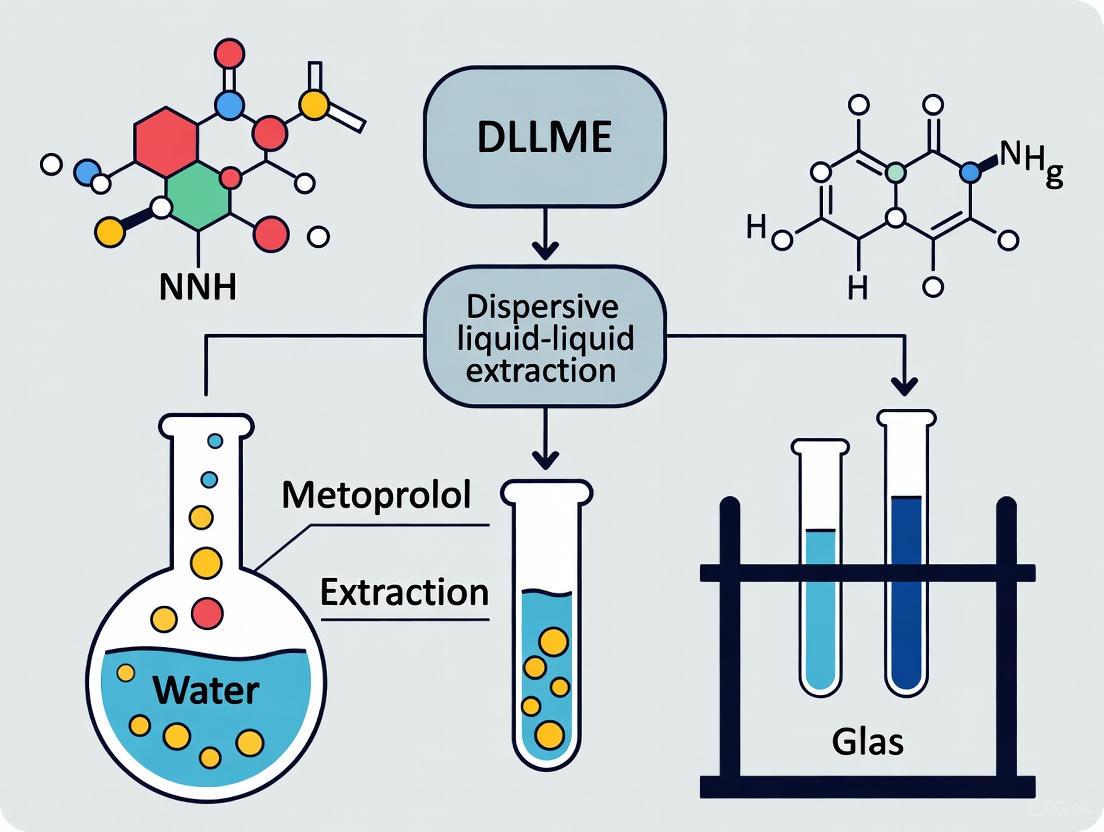
This article provides a comprehensive guide for researchers and drug development professionals on the application of Dispersive Liquid-Liquid Microextraction (DLLME) for the analysis of metoprolol.
Optimized Dispersive Liquid-Liquid Microextraction (DLLME) for the Analysis of Metoprolol in Pharmaceutical Formulations
Abstract
This article provides a comprehensive guide for researchers and drug development professionals on the application of Dispersive Liquid-Liquid Microextraction (DLLME) for the analysis of metoprolol. It covers the foundational principles of DLLME, detailed methodological protocols for extracting metoprolol from pharmaceutical matrices, systematic troubleshooting and optimization strategies using modern experimental design, and thorough validation procedures according to analytical guidelines. The content emphasizes green chemistry principles, aiming to replace traditional, larger-scale extraction methods with a miniaturized, efficient, and environmentally friendly alternative that offers high enrichment factors and low solvent consumption for reliable quantification of this essential cardiovascular drug.
Metoprolol and DLLME Fundamentals: Principles, Relevance, and Green Chemistry Drivers
Metoprolol is a widely employed selective β1-adrenergic receptor antagonist that plays a pivotal role in cardiovascular pharmacology. Patented in 1970 and approved for medical use in 1978, it is now available as a generic medication under various brand names, including Lopressor and Toprol-XL [1]. As one of the first cardioselective beta-blockers, metoprolol primarily affects cardiac β-1 receptors while having less impact on β-2 receptors in the lungs and blood vessels, resulting in a potentially improved side effect profile compared to non-selective beta-blockers [1].
The clinical importance of metoprolol is well-established through numerous large-scale randomized trials. The Metoprolol Randomised Intervention Trial in Congestive Heart Failure (MERIT-HF) demonstrated that metoprolol succinate reduced the risk of all-cause mortality by 34% and hospitalization for worsening heart failure by 19% in patients with chronic heart failure [1]. Furthermore, mortality benefits have been established for acute myocardial infarction, with metoprolol shown to reduce mortality and re-infarction when used chronically after myocardial infarction [1].
Table 1: FDA-Approved Indications for Metoprolol
| Indication | Therapeutic Role | Key Trial Evidence |
|---|---|---|
| Hypertension | Lowers blood pressure to reduce fatal and non-fatal cardiovascular events | MAPHY Trial [1] |
| Angina Pectoris | Reduces cardiac oxygen demand by decreasing heart rate and contractility | Multiple randomized trials [1] |
| Heart Failure | Improves survival and reduces hospitalization | MERIT-HF [1] |
| Myocardial Infarction | Reduces mortality and morbidity when given early after heart attack | Multiple randomized trials [1] |
Metoprolol is also used for several off-label indications, including supraventricular tachycardia, ventricular tachycardia, migraine prevention, essential tremor, and thyrotoxicosis [1]. Its position as a critical cardiovascular therapeutic is underscored by its inclusion on the World Health Organization's List of Essential Medicines and its status as one of the most commonly prescribed medications in the United States [2].
Pharmacological Profile and Mechanism of Action
Chemical Properties and Pharmacokinetics
Metoprolol is a lipophilic compound with a molecular weight of 267.3 g/mol, chemically characterized as a substituted phenylpropanolamine [1]. The drug exists in two primary salt forms—metoprolol tartrate and metoprolol succinate—which are approved for different conditions and are not interchangeable [2]. Metoprolol succinate produces higher drug concentrations than metoprolol tartrate, which has more peak-to-trough variation, though both produce similar clinical effects [1].
Key pharmacokinetic parameters include:
- Absorption: Rapidly and completely absorbed from the gastrointestinal tract with approximately 50% bioavailability due to extensive first-pass metabolism [1] [2]
- Distribution: Large volume of distribution (3.2-5.6 L/kg), widely distributed to tissues including heart and brain, with 12% protein binding [1] [2]
- Metabolism: Extensive hepatic metabolism primarily via CYP2D6, with secondary pathways involving CYP3A4, CYP2B6, and CYP2C9 [2]
- Elimination: Half-life of 3-7 hours, with less than 5% excreted unchanged in urine [2]
Mechanism of Action
Metoprolol exerts its therapeutic effects through selective antagonism of β1-adrenergic receptors, competing with catecholamines (adrenaline and noradrenaline) for receptor binding sites [1] [2]. The molecular mechanism involves:
- Binding to cardiac β-1 receptors in sinoatrial node, atrioventricular node, and ventricular myocardium
- Reduction of intracellular cyclic AMP and protein kinase A activity
- Decreased slope of phase 4 in nodal action potential, reducing spontaneous depolarization and heart rate
- Prolonged repolarization of phase 3, increasing refractory period and reducing excitability
- Decreased ventricular contractility by inhibiting calcium influx through L-type calcium channels [1]
These mechanisms collectively reduce cardiac workload and oxygen demand, lower blood pressure, and provide antiarrhythmic effects, making metoprolol effective for various cardiovascular conditions [1].
Diagram 1: Metoprolol mechanism of action at β1-adrenergic receptors.
Analytical Challenges and the Role of DLLME
The determination of metoprolol in biological fluids and environmental samples presents significant analytical challenges due to the complex composition of matrices and the need to detect the drug at nanogram and picogram levels [3]. Traditional sample preparation techniques like protein precipitation, liquid-liquid extraction, and solid-phase extraction have been used, but these methods often involve large solvent volumes, are time-consuming, and generate substantial waste [4] [3].
Dispersive Liquid-Liquid Microextraction (DLLME) has emerged as a powerful alternative that addresses many limitations of conventional methods. Introduced in 2006, DLLME is a miniaturized technique that uses microliter volumes of extraction solvent, making it more environmentally friendly and efficient [5] [6]. The technique operates on the principle of a ternary component solvent system where an appropriate mixture of extraction solvent and disperser solvent is rapidly injected into an aqueous sample, forming a cloudy solution of fine extraction solvent droplets that provide a large surface area for efficient analyte extraction [4] [7].
The advantages of DLLME for metoprolol analysis include:
- Minimal solvent consumption (microliter volumes)
- High enrichment factors and extraction recovery
- Rapid extraction process
- Cost-effectiveness and simplicity
- Excellent sample clean-up capabilities [8] [4] [6]
DLLME has been successfully applied to extract metoprolol from various matrices, including blood plasma, urine, and wastewater, demonstrating its versatility for clinical monitoring, toxicological analysis, and environmental studies [5] [6].
Experimental Protocols for DLLME of Metoprolol
Standard DLLME Protocol for Blood Samples
This protocol adapts the method developed by Raoufi et al. for the extraction of atenolol, metoprolol, and propranolol from human plasma using DLLME combined with HPLC-DAD [5] [6].
Reagents and Materials:
- Metoprolol standard (analytical grade)
- 1-butyl-3-methylimidazolium hexafluorophosphate ([BMIM]PF6) as extraction solvent
- Methanol (HPLC-grade) as disperser solvent
- Human plasma samples
- Acetonitrile (HPLC-grade) for protein precipitation
- NaOH solution for pH adjustment
- Distilled water
Equipment:
- HPLC system with DAD detector
- Centrifuge
- Vortex mixer
- pH meter
- 15-mL polypropylene conical tubes
- Micropipettes
- Analytical balance
Procedure:
- Protein Precipitation: Mix 1 mL of plasma sample with 2 mL of acetonitrile in a 15-mL tube. Vortex for 1 minute and centrifuge at 5000 rpm for 10 minutes. Transfer the supernatant to a new tube.
pH Adjustment: Adjust the pH of the supernatant to 11 using NaOH solution.
DLLME Procedure: Rapidly inject a mixture containing 1.0 mL of methanol (disperser solvent) and 150 μL of [BMIM]PF6 (extraction solvent) into the sample solution using a syringe.
Formation of Cloudy Solution: Gently mix the solution to form a cloudy suspension, where fine droplets of the extraction solvent disperse throughout the aqueous phase.
Centrifugation: Centrifuge the mixture at 4000 rpm for 5 minutes to separate the phases. The hydrophobic ionic liquid sedimented at the bottom of the tube.
Collection: Carefully remove the aqueous phase and collect the sedimented ionic liquid phase.
Analysis: Reconstitute the sedimented phase in 50 μL of methanol and analyze by HPLC-DAD.
HPLC Conditions:
- Column: C18 column (250 mm × 4.6 mm, 5 μm)
- Mobile phase: Acetonitrile:phosphate buffer (pH 3.0) (60:40, v/v)
- Flow rate: 1.0 mL/min
- Detection: DAD at 225 nm
- Injection volume: 20 μL
Table 2: Optimized DLLME Conditions for Metoprolol Extraction from Blood
| Parameter | Optimal Condition | Effect on Extraction |
|---|---|---|
| Extraction Solvent | [BMIM]PF6 (150 μL) | High density, extraction capability |
| Disperser Solvent | Methanol (1.0 mL) | Efficient dispersion formation |
| Sample pH | 11.0 | Enhanced analyte transfer to organic phase |
| Salt Addition | None | No significant improvement |
| Extraction Time | Immediate (cloudy formation) | Rapid equilibrium |
Green DLLME Protocol for Aqueous Matrices
This protocol is adapted from recent studies focusing on environmentally friendly approaches for determining beta-blockers in aqueous matrices, including wastewater [8] [4] [7].
Reagents and Materials:
- Metoprolol standard (analytical grade)
- 1-undecanol or 2-dodecanol as extraction solvent
- Acetonitrile (HPLC-grade) as disperser solvent
- NaCl (analytical grade)
- NaOH solution for pH adjustment
- Wastewater or surface water samples
Equipment:
- LC-MS/MS or GC-MS system
- Centrifuge
- Vortex mixer
- 15-mL polypropylene conical tubes
- Ice-water bath
- Micropipettes
Procedure:
- Sample Preparation: Place 10 mL of alkalinized water sample (pH 11) in a 15-mL polypropylene conical tube. Spike with appropriate concentration of metoprolol standard.
Salt Addition: Add 2 g of NaCl to the sample solution to enhance ionic strength.
DLLME Procedure: Rapidly inject a mixture containing 250 μL of acetonitrile (disperser solvent) and 100 μL of 1-undecanol (extraction solvent) into the sample solution.
Mixing: Gently mix the solution to form a fine dispersion of extraction solvent droplets.
Centrifugation: Centrifuge the mixture at 4000 rpm for 5 minutes.
Solidification: Transfer the sample tube to an ice-water bath for 5 minutes to solidify the organic droplet.
Collection: Remove the solidified solvent droplet, transfer to a vial, and allow to melt at room temperature.
Analysis: Analyze the extract using LC-MS/MS or GC-MS.
Optimization Considerations:
- The use of low-toxic solvents like 1-undecanol aligns with green chemistry principles
- Response Surface Methodology can be employed for systematic optimization of parameters
- Ionic strength significantly influences extraction efficiency
- The solidification step facilitates easy collection of the extraction phase [4] [7]
Diagram 2: DLLME workflow for metoprolol extraction from aqueous matrices.
Research Reagent Solutions and Materials
Table 3: Essential Research Reagents for DLLME of Metoprolol
| Reagent/Material | Function/Application | Examples/Alternatives |
|---|---|---|
| Metoprolol Standards | Analytical reference material | Metoprolol tartrate, metoprolol succinate |
| Extraction Solvents | Extract and concentrate analytes | [BMIM]PF6 (ionic liquid), 1-undecanol, chloroform |
| Disperser Solvents | Disperse extraction solvent in aqueous phase | Methanol, acetonitrile, acetone |
| Salt Additives | Enhance extraction efficiency via salting-out | NaCl, (NH₄)₂SO₄ |
| pH Adjustment Reagents | Control ionization state of analytes | NaOH, HCl, buffer solutions |
| Chromatographic Columns | Separate analytes prior to detection | C18 columns (250 mm × 4.6 mm, 5 μm) |
| Mobile Phase Components | Elute analytes from column | Acetonitrile, methanol, phosphate buffers |
Analytical Performance Data
DLLME methods have demonstrated excellent performance characteristics for the determination of metoprolol in various matrices. The following table summarizes key analytical parameters reported in recent studies:
Table 4: Analytical Performance of DLLME Methods for Metoprolol Determination
| Matrix | Method | LOD (ng/mL) | LOQ (ng/mL) | Recovery (%) | Enrichment Factor | Reference |
|---|---|---|---|---|---|---|
| Human Plasma | DLLME-HPLC-DAD | 2.6-3.0 | 8.9-9.9 | 96-104 | - | [5] [6] |
| Wastewater | DLLME-GC-MS | 0.13-0.69 | 0.39-2.10 | 53.04-92.1 | 61.22-243.97 | [8] [4] |
| Wastewater | SFOME-LC-PDA | 0.07-0.15 | 0.20-0.45 | 53.04-92.1 | 61.22-243.97 | [4] |
| Surface Water | DLLME-LC-MS/MS | 0.01-8.30 | 0.10-83.0 | >60% for most compounds | - | [7] |
The data demonstrates that DLLME provides sensitive detection at nanogram per milliliter levels, with high enrichment factors exceeding 200 in some cases, making it suitable for trace analysis of metoprolol in complex matrices [8] [4] [5].
Method Optimization Strategies
Successful implementation of DLLME for metoprolol analysis requires careful optimization of several critical parameters. Modern approaches utilize experimental design and response surface methodology to systematically evaluate factor effects and interactions [7] [5].
Key Optimization Parameters:
Selection of Extraction Solvent:
Disperser Solvent Type and Volume:
Sample pH:
Ionic Strength:
Extraction Time:
- Defined as interval between injection and centrifugation
- Typically very short (seconds to minutes) due to large surface area of droplets [5]
The application of multivariate optimization techniques, such as Central Composite Design or Box-Behnken Design, allows for efficient exploration of parameter space while evaluating interaction effects, leading to robust and optimized DLLME methods for metoprolol determination [7] [5].
Metoprolol remains a critical cardiovascular pharmaceutical with well-established efficacy for hypertension, angina, heart failure, and myocardial infarction. The analysis of metoprolol in biological and environmental samples presents significant challenges due to complex matrices and low concentration levels. DLLME has emerged as a powerful sample preparation technique that addresses the limitations of conventional methods, offering high enrichment factors, minimal solvent consumption, and excellent sample clean-up capabilities.
The protocols presented in this application note provide researchers with robust methodologies for extracting and determining metoprolol using DLLME in various matrices. The combination of DLLME with advanced analytical instrumentation like HPLC-DAD, LC-MS/MS, or GC-MS enables sensitive and selective quantification of metoprolol at trace levels, supporting clinical monitoring, toxicological studies, and environmental risk assessment.
Future directions in DLLME for metoprolol analysis will likely focus on further miniaturization, automation, and the development of even more environmentally friendly approaches, including the use of novel green solvents and materials. The integration of DLLME with other analytical techniques and the application of advanced optimization strategies will continue to enhance method performance and applicability in pharmaceutical research.
Sample preparation is a critical step in the analytical process, significantly influencing the accuracy, precision, and sensitivity of the final results [9]. For researchers analyzing pharmaceuticals such as metoprolol—a widely prescribed beta-blocker for cardiovascular diseases—the evolution from traditional Liquid-Liquid Extraction (LLE) to modern microextraction techniques represents a paradigm shift in bioanalytical methodology [6] [10].
This application note traces this technological evolution, with a specific focus on Dispersive Liquid-Liquid Microextraction (DLLME) for the isolation and preconcentration of metoprolol from complex matrices. We provide detailed protocols and analytical data to guide researchers in implementing these advanced sample preparation techniques.
The Analytical Journey: From LLE to Modern Microextraction
The history of sample preparation reveals a consistent trend toward miniaturization, solvent reduction, and efficiency improvement.
2.1 Conventional Techniques: LLE and SPE
Traditional Liquid-Liquid Extraction (LLE) was widely employed for sample preparation based on transferring analytes from aqueous samples to water-immiscible solvents [11]. While straightforward, LLE suffered from significant drawbacks including emulsion formation, consumption of large volumes of toxic organic solvents, generation of substantial waste, and difficulty in automating [11] [9]. Solid-Phase Extraction (SPE) emerged as an alternative, offering improved selectivity through various sorbent materials [9]. However, SPE cartridges represented a recurring cost, and the process often required an extra concentration step [11].
2.2 The Microextraction Revolution
The introduction of Solid-Phase Microextraction (SPME) in 1990 initiated significant interest in microextraction technologies [11] [6]. Subsequently, Liquid-Phase Microextraction (LPME) emerged as a miniaturized version of LLE, using only microliter volumes of extraction solvent [11] [6]. Several LPME modalities were developed, including Single-Drop Microextraction (SDME) and Hollow-Fiber Liquid-Phase Microextraction (HF-LPME) [11] [12].
2.3 The Advent of Dispersive Liquid-Liquid Microextraction (DLLME)
DLLME was introduced in 2006 as a significant advancement in microextraction technology [11] [13]. This technique utilizes a ternary component solvent system where an appropriate mixture of extraction solvent (high-density, water-immiscible) and disperser solvent (miscible with both phases) is rapidly injected into an aqueous sample [11]. This creates a cloudy solution containing fine droplets of extraction solvent dispersed throughout the aqueous phase, providing a vastly increased surface area for rapid analyte extraction [11] [13]. The mixture is then centrifuged, and the sedimented phase containing the preconcentrated analytes is collected for analysis [11].
Table 1: Comparison of Sample Preparation Techniques for Metoprolol Analysis
| Technique | Solvent Consumption | Sample Volume | Extraction Time | Principal Advantages | Principal Limitations |
|---|---|---|---|---|---|
| Traditional LLE | 10s-100s mL | 1-100 mL | 30-60 minutes | Simple principle, no specialized equipment | Large solvent volumes, emulsion formation, difficult automation |
| SPE | 1-10s mL | 1-100 mL | 20-40 minutes | Good clean-up, selective sorbents | Cartridge cost, solvent evaporation often needed |
| DLLME | <1 mL (μL range) | 1-10 mL | 5-10 minutes | Very fast, high enrichment factors, low cost, simple operation | Limited compatibility with very complex matrices |
The following diagram illustrates the evolutionary pathway of liquid-based sample preparation techniques:
Figure 1: Evolution of Sample Preparation Techniques
DLLME Fundamentals and Modes
3.1 Basic Principles of DLLME
DLLME operates on a simple yet efficient principle. When a mixture of extraction and disperser solvents is rapidly injected into an aqueous sample, a turbulent regimen produces fine droplets of extraction solvent dispersed throughout the solution [11]. This creates a cloud emulsion with an extensive surface area between the phases, enabling rapid mass transfer and reducing extraction time to mere minutes [11] [13]. After centrifugation, the sedimented phase containing the enriched analytes is collected for analysis [11].
3.2 Advanced DLLME Modes
To address specific analytical challenges, several DLLME modifications have been developed:
Air-Assisted DLLME (AA-DLLME): This mode eliminates the need for a disperser solvent by using repeated aspiration and injection with a syringe to create dispersion through air bubbles [14]. This avoids the potential negative effect of disperser solvents on extraction efficiency [14].
Organic Sample DLLME (OrS-DLLME): Developed for complex biological samples like plasma, this approach uses a polar organic solvent (e.g., acetonitrile) for protein precipitation, which then also acts as the disperser in the subsequent DLLME [14].
The following workflow illustrates the fundamental steps in the DLLME process:
Figure 2: Basic DLLME Workflow
Detailed Application: DLLME of Metoprolol
4.1 Analytical Significance of Metoprolol
Metoprolol is a selective β1-blocker ranked among the most prescribed medications globally [5] [10]. Its determination in biological fluids (plasma, urine) is essential for therapeutic drug monitoring, pharmacokinetic studies, and clinical toxicology [12] [6]. As a weakly basic compound, metoprolol requires careful pH control during extraction to ensure it exists in its non-ionized form for efficient transfer to the organic phase [6].
4.2 HF-LPME Protocol for Metoprolol from Plasma Samples
This protocol utilizes a two-phase Hollow Fiber Liquid-Phase Microextraction system with tissue culture oil as a green extraction solvent [12].
Table 2: Research Reagent Solutions for HF-LPME of Metoprolol
| Reagent/Material | Specification | Function/Purpose |
|---|---|---|
| Tissue Culture Oil | Light mineral oil, low peroxide and endotoxin levels | Green extraction solvent, immiscible with aqueous phase |
| Polypropylene Hollow Fiber | 7 cm length, 600 μm ID, 200 μm wall thickness, 0.2 μm pore size | Supports organic solvent, provides high surface area for extraction |
| Sodium Chloride (NaCl) | Analytical grade | Adjusts ionic strength, improves extraction via salting-out |
| NaOH Solution | 1 M concentration | Adjusts sample pH to favor non-ionized form of metoprolol |
| HCl Solution | 0.1 M concentration | Acidic solution for sample pretreatment |
| U-Shape Extraction Device | Home-made | Provides high contact area between solution and hollow fiber |
Experimental Procedure:
Hollow Fiber Preparation: Cut a 7 cm polypropylene hollow fiber and ultrasonically clean in acetone for 5 minutes. Allow to dry completely.
Solvent Immobilization: Immerse the hollow fiber in tissue culture oil for 10 seconds to impregnate the pores with the extraction solvent.
Sample Preparation: Transfer 5 mL of plasma sample into a glass tube. Add 100 μL of HCl (0.1 M) and vortex for 30 seconds.
Extraction Setup: Place the impregnated hollow fiber in the U-shape device. Add 5 μL of tissue culture oil (acceptor phase) into the lumen of the fiber using a microsyringe.
Extraction Process: Immerse the U-shape device containing the fiber into the prepared plasma sample. Stir at 500 rpm for 25 minutes at 25°C.
Analysis: After extraction, withdraw the acceptor phase from the hollow fiber lumen and inject into HPLC system for analysis.
Method Performance:
- Extraction Recovery: >85%
- Limit of Detection: <2 ng/mL
- Linear Range: 5-1000 ng/mL
4.3 DLLME Protocol for Beta-Blockers from Aqueous Matrices
This method simultaneously extracts eight beta-blockers (including metoprolol) from wastewater samples using DLLME with 1-undecanol as extraction solvent [4].
Table 3: Optimized Conditions for DLLME of Beta-Blockers
| Parameter | Optimal Condition | Impact on Extraction Efficiency |
|---|---|---|
| Extraction Solvent | 1-undecanol (100 μL) | Low density, low toxicity, appropriate polarity for beta-blockers |
| Disperser Solvent | Acetonitrile (250 μL) | Miscible with both aqueous phase and 1-undecanol |
| Sample pH | 11 (alkaline) | Ensures basic compounds are non-ionized for better extraction |
| Salt Addition | NaCl (2 g) | Improves recovery via salting-out effect |
| Extraction Time | Immediate (cloud formation) | Rapid equilibrium due to large surface area |
| Centrifugation | 5 minutes at 4000 rpm | Separates organic phase efficiently |
Experimental Procedure:
Sample Preparation: Place 10 mL of aqueous sample (wastewater) in a 15 mL polypropylene conical tube. Adjust to pH 11 using NaOH solution.
Spiking: Add appropriate concentration of beta-blocker standards (e.g., 1000 ng of each compound).
Solvent Injection: Rapidly inject a mixture containing 100 μL of 1-undecanol (extraction solvent) and 250 μL of acetonitrile (disperser solvent) into the sample using a microsyringe.
Cloud Formation: Gently mix to form a cloudy solution. The fine droplets of 1-undecanol provide extensive surface area for extraction.
Phase Separation: Centrifuge at 4000 rpm for 5 minutes to separate the phases.
Organic Phase Collection: Solidify the floating organic droplet in an ice-water bath. Collect the solidified droplet and let it melt at room temperature.
Analysis: Analyze the extract using HPLC or GC-MS.
Method Performance:
- Extraction Recovery: 53.04-92.1%
- Enrichment Factor: 61.22-243.97
- Limit of Detection: 0.07-0.69 μg/mL
Analytical Data and Method Validation
5.1 Quantitative Performance of DLLME for Metoprolol
Table 4: Performance Data of DLLME Methods for Beta-Blockers Including Metoprolol
| Analyte | Matrix | Extraction Technique | Recovery (%) | LOD (ng/mL) | LOQ (ng/mL) | Reference |
|---|---|---|---|---|---|---|
| Metoprolol | Human Plasma | DLLME/Dichloromethane | 96-104 | 2.6-3.0 | 8.9-9.9 | [6] |
| Metoprolol | Wastewater | DLLME/1-undecanol | 53.04-92.1 | 70-150 (μg/L) | 200-450 (μg/L) | [4] |
| Atenolol, Metoprolol, Propranolol | Human Blood | DLLME/Ionic Liquid | 99.37-100.21 | 2.6-3.0 | 8.9-9.9 | [5] [6] |
5.2 Green Analytical Chemistry Metrics
Modern DLLME methods align with Green Analytical Chemistry principles. The AGREE software assessment of a recently developed DLLME method for anticancer drugs yielded a score of 0.63-0.66, demonstrating good environmental friendliness [14]. Key green advantages include:
- Solvent Reduction: DLLME uses microliter volumes of solvents compared to milliliters in traditional LLE [13] [14]
- Minimal Waste Generation: Total waste production is significantly reduced [11]
- Operator Safety: Reduced exposure to toxic organic solvents [13]
The evolution from traditional LLE to sophisticated microextraction techniques like DLLME represents significant progress in sample preparation technology. For the analysis of metoprolol and other beta-blockers, DLLME offers compelling advantages including minimal solvent consumption, rapid extraction times, high enrichment factors, and excellent compatibility with modern analytical instrumentation.
The protocols provided in this application note demonstrate robust, validated methods for implementing DLLME in both environmental and bioanalytical contexts. As microextraction technologies continue to evolve, further innovations in solvent selection, automation, and hyphenation with analytical instruments will continue to enhance their utility in pharmaceutical research and drug development.
Core Principles and Mechanism of Dispersive Liquid-Liquid Microextraction (DLLME)
Dispersive liquid-liquid microextraction (DLLME) is a miniaturized sample preparation technique that has revolutionized analytical chemistry since its introduction in 2006 [15] [16]. This technique was developed as a sustainable alternative to traditional sample pre-treatment methods such as liquid-liquid extraction (LLE) and solid-phase extraction (SPE), which are often slow, labor-intensive, and require large volumes of organic solvents [15]. DLLME addresses these limitations by utilizing remarkably small solvent volumes while providing high enrichment factors and exceptional extraction efficiency [4] [13]. The fundamental innovation of DLLME lies in its creation of an extensive surface area between the extraction solvent and aqueous sample through the formation of a cloudy dispersion, which significantly accelerates the mass transfer of analytes from the sample to the extraction solvent [17] [16].
The relevance of DLLME in pharmaceutical research, particularly in the analysis of beta-blockers like metoprolol, stems from its ability to isolate and pre-concentrate trace analytes from complex matrices [4] [6]. Metoprolol, a selective β1-adrenergic receptor blocker widely prescribed for cardiovascular diseases, requires precise monitoring in pharmaceutical formulations and biological samples to ensure therapeutic efficacy and safety [18] [19]. The application of DLLME in this context provides researchers with a powerful tool for sample clean-up and pre-concentration prior to chromatographic analysis, enabling accurate quantification even at low concentration levels [4] [18].
Core Principles and Theoretical Foundation
Fundamental Mechanism
The operational principle of DLLME centers on a ternary component system consisting of an aqueous sample, extraction solvent, and disperser solvent [15] [17]. The mechanism unfolds in three distinct phases: formation of a cloudy state, extraction of analytes, and phase separation. Initially, an appropriate mixture of extraction and disperser solvents is rapidly injected into the aqueous sample, resulting in the formation of a fine dispersion of extraction solvent droplets throughout the aqueous phase [17]. This dispersion, often referred to as the "cloudy state," creates an enormously large surface area between the two immiscible phases, facilitating the rapid transfer of analytes from the aqueous sample to the organic extraction solvent [17] [16].
The formation of this cloudy state is crucial for extraction efficiency, as the reduction in droplet size significantly shortens the diffusion path and increases the contact surface area [17]. The degree of dispersion and emulsion stability are key parameters influencing extraction efficiency and depend heavily on the emulsification procedure employed [17]. Following the extraction period, the mixture is centrifuged to separate the phases based on density differences, allowing for the collection of the sedimented organic phase containing the concentrated analytes [15] [4]. For metoprolol extraction, which typically employs solvents lighter than water, the organic phase may form a floating layer that can be collected after centrifugation or solidification [4].
Thermodynamic and Kinetic Considerations
The theoretical foundation of DLLME rests on established principles of mass transfer and thermodynamic partitioning. The extraction process is governed by the distribution coefficient (KD) of analytes between the aqueous and organic phases, which determines the equilibrium concentration in each phase [13]. The kinetics of extraction are exceptionally rapid in DLLME due to the vast interfacial area created by the fine dispersion, often reaching equilibrium within seconds [17] [16]. This represents a significant advantage over traditional LLE, where equilibrium may take minutes or hours to establish.
The efficiency of analyte extraction in DLLME depends on several physicochemical parameters, including the hydrophobicity of the target compounds, the relative polarity of the extraction solvent, and the solubility of analytes in both phases [15] [16]. For pharmaceutical compounds like metoprolol, the pH of the sample solution plays a critical role in determining the ionic state of the molecule, thereby influencing its partition behavior [4] [6]. Proper adjustment of sample pH to suppress ionization typically enhances extraction efficiency for beta-blockers [4].
Critical Parameters in DLLME Optimization
Selection of Extraction Solvent
The choice of extraction solvent is arguably the most critical parameter in DLLME method development. An ideal extraction solvent should possess several key characteristics: low miscibility with water, high extraction capability for target analytes, sufficient density difference for phase separation, and good chromatographic compatibility [15] [16]. Traditionally, chlorinated solvents such as chlorobenzene, carbon tetrachloride, and tetrachloroethylene have been employed due to their high density and extraction efficiency [15]. However, recent trends emphasize green analytical chemistry principles, driving the adoption of less toxic alternatives [20] [13].
For metoprolol extraction, both conventional and green solvents have been successfully implemented. In a recent study comparing DLLME and solidification of floating organic droplet microextraction (SFOME) for beta-blockers, 1-undecanol and chloroform were identified as optimal extraction solvents [4]. The selection between heavier-than-water and lighter-than-water solvents impacts the procedural workflow, particularly in the phase separation and collection steps [4] [21]. Ionic liquids have also emerged as promising extraction solvents due to their tunable physicochemical properties and minimal volatility [15] [16].
Table 1: Common Extraction Solvents in DLLME for Pharmaceutical Analysis
| Solvent | Density (g/mL) | Advantages | Limitations | Applications |
|---|---|---|---|---|
| Chloroform | 1.48 | High extraction efficiency, good density for sedimentation | Toxic, environmental concerns | Beta-blockers, organophosphorus pesticides [4] |
| 1-Undecanol | 0.83 | Low toxicity, solidification capability | Lower density requires different collection | Beta-blockers, pharmaceuticals [4] |
| Ionic Liquids | >1.00 | Tunable properties, low volatility | Higher viscosity, more expensive | Metal ions, organic compounds [15] |
| 1-Octanol | 0.82 | Good extraction for various compounds | Lighter than water | Plastic additives, organic compounds [21] |
Role of Disperser Solvent
The disperser solvent serves as a crucial mediator in the DLLME process, facilitating the formation of the cloudy state by promoting the dispersion of extraction solvent droplets throughout the aqueous sample [17]. An effective disperser solvent must be miscible with both the aqueous sample and the extraction solvent, typically encompassing solvents such as acetone, acetonitrile, methanol, or ethanol [15] [17]. The volume ratio between extraction and disperser solvents significantly influences the degree of dispersion and consequently the extraction efficiency, with typical ratios ranging from 1:1 to 1:5 [15] [13].
The volume of disperser solvent requires careful optimization, as insufficient volumes may result in incomplete dispersion, while excessive volumes can increase the solubility of analytes in the aqueous phase, thereby reducing extraction efficiency [17]. Recent advancements have explored alternative dispersion strategies that eliminate or reduce the need for disperser solvents, including mechanical-assisted dispersion using vortex, ultrasound, or air agitation [17] [20] [13]. These approaches align with green analytical chemistry principles by minimizing solvent consumption [20].
Influence of Experimental Conditions
Several additional parameters require systematic optimization to maximize DLLME efficiency for metoprolol extraction. The pH of the sample solution profoundly affects the extraction of ionizable compounds like metoprolol, which contains secondary amine functionality with a pKa of approximately 9.7 [4] [6]. Adjustment of sample pH to alkaline conditions (pH 11) has been shown to enhance the extraction efficiency of beta-blockers by suppressing ionization and increasing hydrophobicity [4].
The ionic strength of the sample solution, commonly modified by adding salts such as sodium chloride, can influence extraction efficiency through the salting-out effect [4] [21]. However, the magnitude and direction of this effect vary depending on the specific analytes and solvents employed. For metoprolol extraction using 1-undecanol, the addition of 2 g NaCl to a 10 mL sample provided optimal recovery [4]. Extraction time, defined as the interval between formation of the cloudy solution and commencement of centrifugation, typically requires only seconds to minutes in DLLME due to the rapid mass transfer kinetics [17] [16]. Centrifugation parameters, including speed and duration, must be sufficient to achieve complete phase separation without unnecessarily prolonging the overall procedure [15] [4].
Table 2: Optimized Experimental Conditions for DLLME of Beta-Blockers
| Parameter | Optimal Condition | Influence on Extraction | Reference |
|---|---|---|---|
| Sample pH | 11 (alkaline) | Suppresses ionization of beta-blockers, increasing hydrophobicity | [4] |
| Ionic Strength | 2 g NaCl per 10 mL sample | Salting-out effect improves extraction efficiency | [4] |
| Extraction Time | 30 seconds to 5 minutes | Rapid equilibrium due to large surface area | [17] [16] |
| Centrifugation | 2-5 minutes at 3000-5000 rpm | Ensures complete phase separation | [15] [4] |
| Extraction:Disperser Ratio | 1:2 to 1:5 | Balance between dispersion quality and analyte solubility | [15] [13] |
Experimental Protocol for Metoprolol Extraction
Reagents and Materials
- Metoprolol standard: Pharmaceutical grade for calibration standards
- Extraction solvent: 1-Undecanol or chloroform, HPLC grade [4]
- Disperser solvent: Acetonitrile, HPLC grade [4]
- Salting-out agent: Sodium chloride (NaCl), analytical grade
- pH adjustment: Sodium hydroxide solution (1 M) for alkaline conditions
- Aqueous samples: Deionized water for standard preparation; appropriate biological or pharmaceutical matrices
- Equipment: Glass centrifuge tubes (15 mL polypropylene conical tubes), microsyringes (100-1000 μL), centrifuge, vortex mixer, pH meter
Step-by-Step Procedure
Sample Preparation: Transfer 10 mL of alkalinized water (pH 11) into a 15 mL polypropylene conical tube. Spike the sample with an appropriate concentration of metoprolol (e.g., 1000 ng for method development) [4].
Salt Addition: Add precisely 2 g of NaCl to the sample solution to enhance ionic strength and improve extraction efficiency through the salting-out effect [4].
Extraction Mixture Preparation: Prepare a mixture containing 100 μL of 1-undecanol (extraction solvent) and 250 μL of acetonitrile (disperser solvent) in a separate vial [4].
Dispersion Formation: Rapidly inject the extraction mixture into the sample solution using a chromatographic syringe. Immediately after injection, gently shake the tube by hand to distribute the formed emulsion throughout the entire volume [4] [17].
Extraction Equilibrium: Allow the mixture to stand for approximately 3-5 minutes to ensure complete mass transfer of metoprolol from the aqueous phase to the organic droplets. The rapid extraction kinetics in DLLME make prolonged extraction times unnecessary [17] [16].
Phase Separation: Centrifuge the mixture at 5000 rpm for 5 minutes to achieve complete phase separation. For 1-undecanol (lighter than water), the organic phase will form a distinct layer at the top of the tube [4].
Solvent Collection: For solvents lighter than water, place the tube in an ice-water bath for a few minutes to solidify the organic solvent. Carefully collect the solidified droplet using a spatula or spoon [4].
Analysis: Transfer the collected extract to a suitable vial and allow it to melt at room temperature. The extract is now ready for analysis by chromatographic techniques such as HPLC or GC [4].
Method Validation
For quantitative analysis, the DLLME method requires comprehensive validation including linearity, precision, accuracy, limit of detection (LOD), and limit of quantification (LOQ). In recent applications for beta-blocker analysis, DLLME methods have demonstrated excellent performance characteristics with good linearity (R² > 0.99), high enrichment factors (61.22-243.97), satisfactory recovery (53.04-92.1%), and low LODs (0.07-0.69 µg/mL) depending on the detection technique [4].
Advanced DLLME Modifications
Solvent-Free Dispersion Techniques
Recent innovations in DLLME have focused on reducing or eliminating the requirement for disperser solvents through various mechanical-assisted approaches [17] [20]. These modifications align with green analytical chemistry principles while maintaining the high efficiency of conventional DLLME. Vortex-assisted liquid-liquid microextraction (VA-LLME) utilizes vigorous mixing to achieve fine dispersion without disperser solvents [17] [13]. Ultrasound-assisted liquid-liquid microextraction (UA-LLME) employs ultrasonic energy to create emulsions, offering superior dispersion quality comparable to solvent-assisted methods [17]. Air-assisted liquid-liquid microextraction (AA-LLME) achieves dispersion through repeated suction and injection of the sample and solvent mixture [17] [13].
Comparative studies have revealed that the degree of dispersion decreases in the series: solvent-assisted (SA-) = ultrasound-assisted (UA-) > air-assisted (AA-) > vortex-assisted (VA-) emulsification [17]. However, the emulsion stability varies accordingly, with UA-LLME demonstrating the highest stability (2070 s) followed by SA-LLME (1810 s) [17]. These alternative dispersion methods provide valuable options for metoprolol extraction, particularly when method greenness is prioritized.
Combination with Other Techniques
DLLME has been successfully combined with other extraction and analytical techniques to enhance its applicability to complex matrices. The QuEChERS (Quick, Easy, Cheap, Effective, Rugged, and Safe) approach has been integrated with DLLME for improved sample clean-up, particularly in biological matrices [13]. This combination has been applied to the determination of various contaminants in food and environmental samples, demonstrating the versatility of DLLME as part of a comprehensive sample preparation workflow [13].
Similarly, SPE-DLLME combinations leverage the complementary advantages of both techniques, with SPE providing efficient sample clean-up and DLLME offering high pre-concentration factors [13]. This approach has been successfully implemented for the analysis of various pharmaceuticals and contaminants in water samples, suggesting potential applications for metoprolol analysis in complex matrices [13].
Analytical Techniques and Detection Methods
Following DLLME extraction, metoprolol can be quantified using various analytical techniques, with liquid chromatography (LC) and gas chromatography (GC) being the most prevalent [4]. The choice of detection method depends on the required sensitivity, selectivity, and available instrumentation. For LC analysis, diode array detection (DAD) provides adequate sensitivity for therapeutic concentrations, while mass spectrometric detection (MS or MS/MS) offers superior selectivity and lower detection limits [4] [18].
In recent applications, DLLME has been coupled with LC-DAD for the determination of beta-blockers in wastewater samples, achieving limits of detection ranging from 0.07 to 0.15 µg/mL [4]. For more demanding applications requiring lower detection limits, such as therapeutic drug monitoring or environmental analysis, LC-MS/MS provides enhanced sensitivity, with reported LODs as low as 0.12 µg/L for metoprolol in plasma samples [18]. The compatibility of DLLME extracts with these instrumental techniques highlights the versatility of this microextraction approach in pharmaceutical analysis.
Applications in Pharmaceutical Analysis
DLLME has found extensive applications in the analysis of pharmaceutical compounds, particularly for sample clean-up and pre-concentration prior to instrumental analysis [4] [6]. For beta-blockers like metoprolol, DLLME has been successfully employed for extraction from various matrices including wastewater, biological fluids, and pharmaceutical formulations [4] [6]. The technique's ability to provide high enrichment factors and efficient sample clean-up makes it particularly valuable for analyzing these compounds at trace levels in complex matrices.
In therapeutic drug monitoring, where metoprolol concentrations in biological fluids vary widely due to metabolic patterns, dosage variations, and individual patient factors, DLLME offers a robust sample preparation approach [18]. Studies have demonstrated metoprolol concentrations ranging from 70.76 μg/L in plasma to 1943.1 μg/L in urine samples, highlighting the need for sensitive analytical methods capable of quantifying across different concentration ranges [18]. DLLME addresses this need by providing adjustable pre-concentration factors based on phase volume ratios.
The environmental impact of pharmaceuticals has gained increasing attention, with beta-blockers being detected in various aqueous matrices due to their widespread use and incomplete removal in wastewater treatment plants [4]. DLLME enables the monitoring of these emerging contaminants at environmentally relevant concentrations, contributing to environmental risk assessment and management [4].
The Scientist's Toolkit: Essential Research Reagents
Table 3: Essential Reagents and Materials for DLLME of Metoprolol
| Reagent/Material | Function | Recommended Specifications | Alternative Options |
|---|---|---|---|
| 1-Undecanol | Extraction solvent | HPLC grade, low toxicity | Chloroform, 1-octanol, ionic liquids [4] |
| Acetonitrile | Disperser solvent | HPLC grade, high purity | Acetone, methanol, ethanol [4] [17] |
| Sodium Chloride | Salting-out agent | Analytical grade | Ammonium sulfate, other inorganic salts [4] |
| Sodium Hydroxide | pH adjustment | Analytical grade, 1 M solution | Other alkaline solutions (e.g., KOH) [4] |
| Metoprolol Standard | Reference compound | Pharmaceutical grade ≥98% | Commercially available certified standards |
| Polypropylene Tubes | Extraction vessels | 15 mL conical, centrifuge-compatible | Glass tubes with screw caps [4] |
DLLME Experimental Workflow: This diagram illustrates the sequential steps in the dispersive liquid-liquid microextraction process, from sample preparation to final analysis.
Dispersive liquid-liquid microextraction represents a powerful sample preparation technique that aligns with the modern principles of green analytical chemistry while maintaining high analytical performance. The core mechanism of DLLME, based on creating a fine dispersion of extraction solvent within the aqueous sample, provides exceptional extraction efficiency and enrichment factors through dramatically increased surface area. For pharmaceutical applications involving beta-blockers like metoprolol, DLLME offers a robust, cost-effective, and environmentally friendly alternative to traditional extraction methods.
The continuous evolution of DLLME, including solvent-free dispersion techniques and combinations with other sample preparation methods, further expands its applicability to challenging analytical problems. As pharmaceutical research advances toward more complex matrices and lower detection limits, DLLME stands as a versatile sample preparation tool that can be adapted to meet these evolving demands. The detailed protocols and critical parameters outlined in this article provide researchers with a solid foundation for implementing DLLME in metoprolol analysis and related pharmaceutical applications.
The Critical Role of DLLME in Modern Pharmaceutical Analysis
Dispersive liquid-liquid microextraction (DLLME) has emerged as a pivotal sample preparation technique in modern pharmaceutical analysis, effectively addressing the limitations of traditional extraction methods. This microextraction approach utilizes a ternary component solvent system consisting of an aqueous sample, a disperser solvent, and an extraction solvent [22]. When injected into the aqueous phase, the mixture forms a cloudy suspension of fine extraction solvent droplets, creating an immense surface area for highly efficient analyte extraction [4] [23]. The technique has gained significant traction for its ability to provide high enrichment factors, excellent recovery rates, and superior sample clean-up while consuming minimal volumes of organic solvents [24] [22].
The analysis of cardiovascular pharmaceuticals, particularly beta-blockers like metoprolol, represents a critical application area where DLLME demonstrates exceptional utility. Metoprolol is widely prescribed for hypertension and other cardiovascular conditions, ranking among the most frequently prescribed medications globally [5]. Its monitoring in biological fluids and pharmaceutical formulations is essential for therapeutic drug monitoring, pharmacokinetic studies, and quality control [6]. DLLME protocols have been successfully developed and validated for metoprolol in various matrices, demonstrating the technique's versatility and reliability for modern pharmaceutical analysis [5] [25].
Fundamental Principles and Advantages of DLLME
Theoretical Foundations
DLLME operates on the principle of creating a vast interfacial area between the extraction solvent and aqueous sample through the formation of a cloudy suspension. This is achieved by rapidly injecting a mixture of water-immiscible extraction solvent and water-miscible disperser solvent into the aqueous sample [22] [23]. The disperser solvent, typically acetonitrile, methanol, or acetone, facilitates the dispersion of fine droplets of the extraction solvent throughout the aqueous phase. This dispersion significantly enhances the extraction kinetics by maximizing the contact surface area between the two phases, leading to rapid equilibrium establishment and highly efficient analyte transfer [4] [23].
The extraction efficiency in DLLME is influenced by several critical parameters, including the type and volume of extraction and disperser solvents, sample pH, ionic strength, and extraction time [4]. The chemical properties of the target analytes, particularly their hydrophobicity and ionization constants, dictate the optimal conditions for their extraction. For beta-blockers like metoprolol, which contain ionizable functional groups, pH adjustment is crucial to ensure the analytes exist in their non-ionic forms, thereby enhancing their partitioning into the organic extraction solvent [5] [6].
Comparative Advantages
DLLME offers substantial advantages over traditional sample preparation techniques, positioning it as a green analytical chemistry approach. Compared to conventional liquid-liquid extraction (LLE), DLLME reduces organic solvent consumption by milliliters to microliters, decreases extraction time from hours to minutes, and provides significantly higher enrichment factors [22]. When contrasted with solid-phase extraction (SPE), DLLME eliminates the need for expensive cartridges, reduces solvent consumption, and minimizes procedural steps [4]. The technique also surpasses solid-phase microextraction (SPME) in cost-effectiveness, as it doesn't require fragile, expensive fibers that have limited lifetimes and potential carry-over issues [22].
The green credentials of DLLME align with the 12 Principles of Green Analytical Chemistry, particularly in reducing solvent consumption, minimizing waste generation, and enhancing operator safety [26]. The miniaturized nature of the technique also reduces the environmental impact of analytical laboratories while maintaining high analytical performance [23] [26].
DLLME Protocol for Metoprolol Analysis in Biological Samples
Reagents and Materials
- Analytical Standard: Metoprolol reference standard
- Extraction Solvent: Chloroform or 1-butyl-3-methylimidazolium hexafluorophosphate ([BMIM]PF₆)
- Disperser Solvent: Acetonitrile or methanol
- Sample Matrix: Plasma, blood, or urine samples
- Chemical Modifiers: Sodium hydroxide for pH adjustment, sodium chloride for ionic strength adjustment
- Solvents: HPLC-grade methanol, acetonitrile, and water
- Equipment: Polypropylene conical tubes (15 mL), microsyringes, centrifuge, vortex mixer, HPLC system with DAD or MS detector
Step-by-Step Procedure
Sample Preparation: Transfer 10 mL of alkalinized aqueous sample (pH 11 adjusted with NaOH) or 0.5 mL of biological sample (plasma/blood) diluted with carbonate buffer (pH 9.5) into a 15 mL polypropylene conical tube [4] [24]. For blood samples, prior protein precipitation with methanol may be necessary [5].
Extraction Mixture Preparation: Prepare a mixture containing 100 μL of 1-undecanol (for SFOME) or chloroform (for classical DLLME) as extraction solvent and 250 μL of acetonitrile as disperser solvent [4]. Alternatively, for biological samples, a 2.5:1 methanol/chloroform mixture may be used [24].
Dispersion and Extraction: Rapidly inject the extraction mixture into the sample solution using a syringe. Gently mix to form a cloudy suspension, indicating the dispersion of fine droplets of extraction solvent throughout the aqueous phase.
Phase Separation: Centrifuge the mixture at 4000-5000 rpm for 5-10 minutes to separate the phases. For high-density solvents like chloroform, the extract accumulates as a sedimented phase at the tube's bottom. For low-density solvents like 1-undecanol, the extract forms a floating droplet [4] [22].
Extract Collection: For sedimented phases, carefully collect the organic phase using a microsyringe. For floating droplets, solidify the organic droplet by placing the tube in an ice bath for 5 minutes, then collect the solidified droplet [4].
Analysis: Reconstitute the extracted analytes in an appropriate solvent if necessary and inject into an HPLC or GC system for analysis. For metoprolol, HPLC with diode array detection (DAD) at 224 nm is commonly employed [25].
Optimization Strategies
The DLLME procedure requires careful optimization of several parameters to achieve maximum extraction efficiency for metoprolol:
- pH Optimization: Adjust sample pH to 9-11 to ensure metoprolol (pKa ~9.7) is in its non-ionic form, promoting partitioning into the organic phase [5] [6].
- Solvent Selection: Chloroform provides high extraction efficiency for metoprolol, while ionic liquids like [BMIM]PF₆ offer greener alternatives [5].
- Salt Addition: Incorporating 2 g of NaCl into 10 mL sample enhances extraction efficiency through the salting-out effect [4].
- Experimental Design: Utilize factorial designs and response surface methodology for systematic optimization of multiple parameters [5].
The following workflow summarizes the key steps and decision points in the DLLME procedure for metoprolol analysis:
Analytical Performance and Applications
Quantitative Performance Data
DLLME methods have demonstrated exceptional analytical performance for the determination of metoprolol and other beta-blockers across various matrices. The following table summarizes representative performance metrics from recent studies:
Table 1: Analytical Performance of DLLME for Beta-Blocker Determination
| Analyte | Sample Matrix | LOD (ng/mL) | LOQ (ng/mL) | Recovery (%) | Enrichment Factor | Reference |
|---|---|---|---|---|---|---|
| Metoprolol | Plasma/Blood | 2.6-3.0 | 8.9-9.9 | 96.0-104.0 | 278.7 | [5] [25] |
| Atenolol | Wastewater | 70-150* | 200-450* | 53.0-92.1 | 61.2-244.0 | [4] |
| Propranolol | Blood/Urine | 6.0 | 20.0 | 91.0-97.2 | 283.1 | [25] |
| Multiple β-blockers | Wastewater | 130-690* (GC) 70-150* (HPLC) | 390-2100* (GC) 200-450* (HPLC) | 53.0-92.1 | 61.2-244.0 | [4] |
*Values converted from µg/L to ng/mL for consistency
Research Reagent Solutions
The successful implementation of DLLME for pharmaceutical analysis requires specific reagents and materials optimized for the target analytes. The following table details essential research reagent solutions for metoprolol analysis:
Table 2: Essential Research Reagent Solutions for DLLME of Metoprolol
| Reagent/Material | Specifications | Function in DLLME | Application Notes |
|---|---|---|---|
| Extraction Solvents | Chloroform, 1-undecanol, [BMIM]PF₆ (ionic liquid) | Extracts metoprolol from aqueous phase | Chloroform for sedimented phase; 1-undecanol for solidification; ionic liquids as green solvents |
| Disperser Solvents | Acetonitrile, methanol, acetone | Enhances dispersion of extraction solvent | Acetonitrile shows optimal dispersibility for metoprolol |
| Buffer Solutions | Carbonate buffer (pH 9.5-11), phosphate buffer | Adjusts sample pH to optimize extraction | Maintains metoprolol in non-ionic form for efficient partitioning |
| Salting-Out Agents | Sodium chloride (NaCl) | Increases ionic strength to enhance recovery | Typically 2g per 10mL sample; improves extraction efficiency by 15-25% |
| Derivatization Reagents | MSTFA, BSTFA (for GC analysis) | Enhances volatility for GC detection | Required for GC analysis of polar beta-blockers like metoprolol |
Practical Applications in Pharmaceutical Analysis
Bioanalysis and Therapeutic Drug Monitoring
DLLME has proven particularly valuable for the bioanalysis of metoprolol in biological fluids, enabling precise therapeutic drug monitoring. The technique efficiently extracts metoprolol from complex matrices like plasma, blood, and urine while effectively removing matrix interferences [5] [6]. The high enrichment factors achieved through DLLME (ranging from 61.2 to 283.1 for various beta-blockers) facilitate the detection of clinically relevant concentrations, typically in the ng/mL range [4] [25]. This sensitivity is crucial for pharmacokinetic studies, dose adjustment, and compliance monitoring in patients undergoing long-term metoprolol therapy for cardiovascular conditions.
A specific application involves using 1-butyl-3-methylimidazolium hexafluorophosphate as an extraction solvent for metoprolol determination in blood samples, achieving excellent recovery rates of 96.0-104.0% with LODs of 2.6-3.0 ng/mL [5]. This demonstrates the suitability of DLLME for precise quantification of metoprolol in complex biological matrices, providing essential data for personalized medicine approaches in cardiovascular therapy.
Environmental and Doping Control Applications
Beyond therapeutic monitoring, DLLME finds important applications in environmental analysis and doping control. Beta-blockers like metoprolol are continuously released into aquatic environments through wastewater discharge, creating potential ecological risks [4]. DLLME methods enable the detection of these pharmaceuticals at trace concentrations (ng/L levels) in environmental waters, with reported LODs of 0.13-0.69 µg/mL for GC and 0.07-0.15 µg/mL for HPLC analyses [4]. The technique's high sensitivity and effective sample clean-up make it ideal for monitoring pharmaceutical pollution in surface waters, groundwater, and wastewater treatment plant effluents.
In sports doping control, beta-blockers like propranolol are banned in precision sports due to their performance-enhancing potential [6]. DLLME provides a rapid, sensitive, and cost-effective solution for screening these substances in biological samples, with successful applications demonstrating the detection of propranolol at concentrations as low as 6.0 ng/mL in urine samples [25]. The method's high throughput capabilities support the analysis of large numbers of samples in doping control laboratories.
Method Optimization and Validation
Systematic Optimization Approaches
The optimization of DLLME procedures for metoprolol analysis benefits significantly from systematic approaches employing experimental design and response surface methodology. Initial screening using factorial designs efficiently identifies critical factors, such as extraction solvent volume, disperser solvent volume, and ionic strength [4]. Subsequent response surface methodology, particularly Central Composite Design (CCD), enables the establishment of robust method conditions and illuminates interaction effects between variables [5] [27].
For metoprolol analysis, optimization typically reveals that basic pH (9-11), moderate ionic strength (2g NaCl per 10mL sample), and specific solvent combinations (e.g., chloroform/acetonitrile) yield optimal extraction efficiency [4] [5]. The following diagram illustrates the key parameters and their optimal ranges for metoprolol extraction:
Green Analytical Chemistry Assessment
The alignment of DLLME with Green Analytical Chemistry principles represents a significant advantage over traditional extraction techniques. Recent approaches have incorporated formal greenness assessment tools, such as the Analytical Green Star Area (AGSA) and Rapid Assessment of Performance Indicators (RAPI), to quantitatively evaluate the environmental and safety performance of DLLME methods [27]. These assessments confirm that DLLME exhibits strong adherence to the 12 Principles of Green Analytical Chemistry, particularly in reducing solvent consumption, minimizing waste generation, and enhancing operator safety [26] [27].
The green credentials of DLLME for metoprolol analysis are particularly evident when compared to conventional sample preparation methods. While traditional LLE consumes 50-100 mL of organic solvent per extraction, DLLME achieves superior performance with only 100-500 μL of solvents [22] [23]. This reduction in solvent usage translates to decreased waste generation, lower analysis costs, and reduced environmental impact, positioning DLLME as a sustainable choice for modern pharmaceutical analysis.
Dispersive liquid-liquid microextraction has undeniably established itself as a critical technique in modern pharmaceutical analysis, particularly for the determination of cardiovascular drugs like metoprolol. Its unique combination of high extraction efficiency, minimal solvent consumption, rapid operation, and excellent compatibility with various analytical instrumentation makes it ideally suited for contemporary analytical challenges. The proven applications in therapeutic drug monitoring, environmental analysis, and doping control underscore its versatility and reliability across diverse pharmaceutical contexts.
As pharmaceutical analysis continues to evolve toward more sustainable and efficient practices, DLLME methodologies are poised to play an increasingly prominent role. The ongoing development of greener extraction solvents, automated systems, and hyphenated techniques will further expand the applications of DLLME in pharmaceutical research and quality control. For metoprolol analysis specifically, the well-established protocols and optimized conditions detailed in this article provide robust methodologies that balance analytical performance with environmental considerations, representing the future trajectory of pharmaceutical sample preparation.
The principles of Green Analytical Chemistry (GAC) are transforming pharmaceutical analysis by promoting environmentally sustainable laboratory practices. This shift is particularly relevant for routine analytical procedures like the determination of active pharmaceutical ingredients such as metoprolol, a widely prescribed beta-blocker for cardiovascular diseases [28] [10]. Traditional analytical methods, while effective, often involve hazardous chemicals, extensive energy consumption, and large volumes of solvents, raising significant environmental concerns [28]. Dispersive Liquid-Liquid Microextraction (DLLME) has emerged as a powerful sample preparation technique that aligns with GAC principles by drastically reducing organic solvent consumption, minimizing waste generation, and improving analytical efficiency [29] [4] [6]. This application note details practical protocols for implementing green DLLME methodologies for metoprolol analysis, enabling researchers to maintain high analytical performance while significantly reducing their environmental footprint.
Green Assessment Tools for Analytical Methods
Adopting standardized metrics is crucial for objectively evaluating the environmental footprint of analytical methods. Several tools have been developed to quantify and benchmark the greenness of analytical procedures.
- Analytical GREEnness Metric Approach (AGREE): Provides a comprehensive score based on the 12 principles of GAC, offering an at-a-glance assessment of a method's environmental performance [28].
- Green Analytical Procedure Index (GAPI): A semi-quantitative visual tool that evaluates the ecological impact of each step in an analytical process [28] [30].
- Analytical Method Greenness Score (AMGS): Allows for the cumulative assessment of method greenness [31].
These tools help justify the replacement of traditional methods with greener alternatives like DLLME by providing tangible evidence of reduced environmental impact [30].
Green DLLME Methodologies for Metoprolol Analysis
Conventional DLLME using Organic Solvents
This protocol outlines a standard DLLME procedure for extracting beta-blockers, including metoprolol, from aqueous matrices, optimized for analysis by gas chromatography (GC) or liquid chromatography (LC) [29] [4].
Experimental Protocol
- Sample Preparation: Place 10 mL of the aqueous sample (e.g., wastewater, purified water) into a 15 mL polypropylene conical tube.
- pH Adjustment: Alkalinize the sample to pH 11 using a 1 M sodium hydroxide (NaOH) solution to ensure metoprolol is in its non-ionized form, enhancing its extractability into the organic solvent [4].
- Spiking: Fortify the sample with an appropriate volume of metoprolol standard solution (e.g., 1000 ng of metoprolol) [4].
- Extraction Solvent Mixture: Prepare a mixture of chloroform ( extraction solvent) and acetonitrile (disperser solvent). The optimal volumes determined via factorial design are 100 µL of chloroform and 250 µL of acetonitrile [4].
- Dispersion: Rapidly inject the solvent mixture into the sample tube using a micro-syringe. This creates a cloudy solution consisting of fine droplets of extraction solvent dispersed throughout the aqueous sample, maximizing the contact surface area [29].
- Centrifugation: Centrifuge the tube at 5000 rpm for 5 minutes to separate the phases. The dense chloroform droplets, now containing the extracted analytes, will sediment at the bottom of the tube [29] [4].
- Collection: Carefully collect the sedimented organic phase (typically ~50 µL) using a micro-syringe.
- Analysis: Transfer the extract to a suitable vial for analysis by GC or LC [29] [4].
Method Performance
The table below summarizes the key performance metrics achieved for metoprolol and other beta-blockers using this conventional DLLME method.
Table 1: Performance Data for Conventional DLLME of Beta-Blockers
| Analyte | Sample Matrix | Enrichment Factor | Extraction Recovery (%) | Limit of Detection (LOD) | Limit of Quantification (LOQ) |
|---|---|---|---|---|---|
| Metoprolol | Aqueous Matrices | 61.22 - 243.97 | 53.04 - 92.1 | 0.13 - 0.69 µg/mL (GC) | 0.39 - 2.10 µg/mL (GC) |
| 0.07 - 0.15 µg/mL (HPLC) | 0.20 - 0.45 µg/mL (HPLC) | ||||
| Other Beta-Blockers* | Aqueous Matrices | 61.22 - 243.97 | 53.04 - 92.1 | 0.13 - 0.69 µg/mL (GC) | 0.39 - 2.10 µg/mL (GC) |
| 0.07 - 0.15 µg/mL (HPLC) | 0.20 - 0.45 µg/mL (HPLC) |
*Includes atenolol, nadolol, pindolol, acebutolol, bisoprolol, propranolol, and betaxolol [29] [4].
Advanced Green Protocol: NADES-based DLLME
To further align with GAC principles, conventional organic solvents can be replaced with Natural Deep Eutectic Solvents (NADES). These solvents are prepared from natural, biodegradable, and low-toxicity components, representing a significant advancement in green sample preparation [30] [32].
Protocol for NADES Preparation and Use
- NADES Synthesis: Synthesize a hydrophobic NADES by combining thymol and menthol in a 4:1 molar ratio. Heat and stir the mixture at 60°C until a clear, homogeneous liquid is formed [32].
- Sample Preparation: Place 5 mL of the aqueous sample into a conical tube. Adjust the pH to optimize the extraction efficiency for metoprolol (typically pH ~7 for non-ionized form, though this requires compound-specific optimization).
- Extraction: Add 100 µL of the prepared NADES to the sample.
- Mixing: Manually mix the solution vigorously for 2.5 minutes to form a dispersion. Alternatively, vortex mixing can be used to assist dispersion [32].
- Centrifugation: Centrifuge the tube to separate the NADES phase. Due to the lower density of many NADES, the extract may form a floating droplet.
- Collection & Analysis: Collect the NADES phase. Due to its unique physicochemical properties, it can often be directly injected into a chromatographic system like HPLC or GC [30] [32].
The Scientist's Toolkit: Essential Reagents and Materials
Table 2: Key Research Reagent Solutions for Green DLLME
| Item | Function/Description | Green Alternative |
|---|---|---|
| Chloroform | Traditional extraction solvent (denser than water). | NADES (e.g., Thymol:Menthol). Biodegradable, low toxicity, and renewable [30] [32]. |
| 1-Undecanol | Traditional extraction solvent (lighter than water, allows for solidification). | Inherently less toxic than chlorinated solvents, but can be replaced by NADES for further greening [4]. |
| Acetonitrile | Common disperser solvent. | Can be replaced by more benign solvents in some configurations, though its use is minimal in microextraction. |
| Thymol | Hydrogen bond donor component of many hydrophobic NADES. | Natural monoterpene; enables pi-pi interactions with aromatic analytes like metoprolol [32]. |
| Menthol | Hydrogen bond acceptor component of many hydrophobic NADES. | Natural monoterpene; helps form a low-viscosity, effective extraction solvent [32]. |
| Sodium Chloride (NaCl) | Used for "salting-out" effect to improve extraction efficiency by reducing analyte solubility in the aqueous phase [4]. | Inherently green and safe. |
Workflow and Green Chemistry Principles
The following diagram illustrates the general workflow for a DLLME procedure and its alignment with the core principles of Green Analytical Chemistry.
Figure 1: DLLME Workflow and its Alignment with Green Analytical Chemistry (GAC) Principles. The process exemplifies key GAC principles through miniaturization (waste prevention), use of safer solvents like NADES, energy-efficient room-temperature operation, and inherently safer chemistry.
The transition to green analytical practices is both an ethical imperative and a practical achievement in modern pharmaceutical research. Dispersive Liquid-Liquid Microextraction represents a robust and effective strategy for determining metoprolol and other pharmaceuticals while rigorously adhering to the principles of Green Analytical Chemistry. By implementing the detailed protocols for conventional and NADES-based DLLME outlined in this document, researchers and drug development professionals can significantly minimize solvent consumption and hazardous waste generation. This approach not only reduces environmental impact but also offers practical benefits in cost-effectiveness and analytical performance. The continued adoption and refinement of such green methodologies are pivotal for advancing sustainable scientific innovation in the pharmaceutical industry.
A Step-by-Step Protocol for DLLME of Metoprolol from Pharmaceutical Samples
Dispersive liquid-liquid microextraction (DLLME) has emerged as a pivotal sample preparation technique in analytical chemistry, particularly for the extraction of pharmaceutical compounds from complex matrices. This application note provides a detailed protocol for the selection of an optimal extraction solvent for the DLLME of metoprolol, a widely prescribed beta-blocker. The selection criteria are comprehensively evaluated based on solvent density, toxicity, and specific compatibility with metoprolol, ensuring high extraction efficiency while adhering to green chemistry principles. This work is framed within a broader thesis research on the development of robust, environmentally sustainable sample preparation methods for pharmaceutical analysis, addressing the critical need for miniaturized methodologies in environmental and pharmaceutical monitoring [33] [13].
Theoretical Background and Principles
Dispersive Liquid-Liquid Microextraction Fundamentals
DLLME operates on the principle of a ternary component solvent system wherein an extraction solvent and disperser solvent are rapidly injected into an aqueous sample containing the target analytes. This instantaneous injection generates a cloudy solution characterized by the formation of fine droplets of the extraction solvent dispersed throughout the aqueous phase, significantly increasing the contact surface area between the two phases [15] [13]. The enormous surface area facilitates rapid analyte transfer from the aqueous phase to the extraction solvent, significantly reducing extraction time to a matter of seconds or minutes compared to traditional extraction techniques [15].
The efficiency of DLLME is governed by the partition coefficient (K_D) of the analytes between the aqueous sample solution and the extraction solvent, which determines the distribution equilibrium [13]. The formation of a stable emulsion is critical for achieving high extraction efficiency, as the fine droplets provide a large surface area for mass transfer. Emulsion stability is influenced by the emulsification procedure, with solvent-assisted and ultrasound-assisted methods providing the highest degree of dispersion according to recent investigations [17].
Metoprolol Physicochemical Properties
Metoprolol (C15H25NO3) is a selective β1-adrenergic receptor blocker with a molecular weight of 267.36 g/mol, widely used in the management of hypertension, angina, and heart failure [34]. As a basic chiral compound, it contains a secondary amine group that can be protonated, making its extraction efficiency highly dependent on sample pH [33]. Understanding these properties is essential for designing an efficient extraction protocol, as the ionic state of the molecule will significantly impact its partitioning behavior in the DLLME process.
Table 1: Key Physicochemical Properties of Metoprolol
| Property | Value/Description | Analytical Significance |
|---|---|---|
| Molecular Formula | C15H25NO_3 | Determines potential for hydrophobic interactions |
| Molecular Weight | 267.36 g/mol | Impacts diffusion rate and mass transfer |
| pK_a (estimated) | ~9.7 (amine group) | Crucial for pH-dependent extraction efficiency |
| Log P (estimated) | ~1.7 | Indicates moderate hydrophobicity |
| Solubility | Soluble in water, methanol, ethanol | Guides compatible solvent systems |
| Chromatographic Behavior | Reversed-phase HPLC compatible | Informs final analytical determination |
Critical Parameters in Solvent Selection
Solvent Density Considerations
The density of the extraction solvent is a critical parameter in DLLME as it determines the phase separation behavior after centrifugation. High-density solvents (denser than water) facilitate easy recovery of the extracted phase by simple sedimentation, while low-density solvents require specialized approaches for collection [15]. For high-throughput applications, solvents with densities significantly different from water (1 g/mL) are preferred to promote rapid and complete phase separation.
Table 2: Density and Properties of Common DLLME Extraction Solvents
| Extraction Solvent | Density (g/mL) | Relative to Water | Advantages | Limitations |
|---|---|---|---|---|
| Tetrachloroethylene | 1.62 | Higher | Easy phase separation; high extraction efficiency for non-polar analytes | Environmental concerns; toxicity |
| Carbon Tetrachloride | 1.59 | Higher | Excellent extraction historical use; easy recovery | Significant toxicity; ozone-depleting |
| Chlorobenzene | 1.11 | Higher | Good for semi-polar compounds; manageable density | Moderate toxicity |
| Dichloromethane | 1.33 | Higher | Wide solubility spectrum; relatively volatile | Suspected carcinogen |
| Toluene | 0.87 | Lower | Suitable for light solvents methodology | Requires special collection techniques |
| Hexane | 0.65 | Lower | Very low water solubility | Highly flammable; requires specialized collection |
Toxicity and Environmental Impact
The selection of extraction solvents must carefully consider human health and environmental impacts, aligning with the principles of green analytical chemistry. Traditional chlorinated solvents such as carbon tetrachloride and tetrachloroethylene, while effective for extraction, raise significant concerns regarding their toxicity, environmental persistence, and potential for bioaccumulation [35] [36]. The Safer Choice Program by the U.S. Environmental Protection Agency provides specific criteria for solvent selection, emphasizing the need to assess carcinogenicity, acute and repeated-dose toxicity, reproductive and developmental toxicity, neurotoxicity, and environmental fate [36].
Modern solvent selection guides recommend considering the complete life cycle of solvents, including their renewability, recyclability, and disposal implications [35]. The ideal solvent should present minimal risk to both the analyst and the environment while maintaining analytical performance. This has led to increased investigation of alternative solvents such as ionic liquids and low-toxicity organic solvents with favorable environmental profiles [15].
Metoprolol-Solvent Compatibility
The compatibility between the extraction solvent and metoprolol is paramount for achieving high extraction efficiency. Metoprolol's molecular structure, featuring both hydrophobic aromatic rings and a hydrophilic secondary amine group, necessitates a solvent with appropriate polarity to facilitate efficient partitioning. The solvent must effectively dissolve metoprolol while maintaining immiscibility with the aqueous sample phase. Historical data from DLLME methods developed for basic chiral compounds, including metoprolol, indicate that medium-polarity solvents often provide optimal extraction efficiency for this pharmaceutical compound [33].
Experimental Protocol: DLLME for Metoprolol
Reagents and Materials
Table 3: Essential Research Reagent Solutions
| Reagent/Material | Specification | Function/Role in DLLME |
|---|---|---|
| Metoprolol standard | Pharmaceutical secondary standard | Target analyte for method development |
| Extraction solvent | HPLC grade (e.g., chlorobenzene) | Primary solvent for analyte extraction |
| Disperser solvent | HPLC grade (e.g., acetone) | Facilitates dispersion of extraction solvent |
| Aqueous sample | Buffered to appropriate pH | Sample matrix containing metoprolol |
| Centrifuge tubes | Conical bottom, glass preferred | Vessel for extraction and centrifugation |
| Microsyringe | 0.5-1.0 mL capacity | Precise delivery of solvent mixture |
| Centrifuge | Capable of 5000 rpm | Phase separation after extraction |
| HPLC system | With UV or MS detection | Final quantitative analysis |
Step-by-Step Procedure
Sample Preparation: Prepare aqueous samples containing metoprolol within the concentration range of 0.5-10 µg/L. Adjust the sample pH to approximately 10 using ammonium hydroxide or appropriate buffer to ensure metoprolol is in its neutral form, enhancing its extractability into organic solvents [33].
Extraction Dispersant Mixture: Prepare a mixture of extraction solvent (e.g., chlorobenzene, 80-100 µL) and disperser solvent (e.g., acetone, 1.0 mL). The optimal ratio of extraction to disperser solvent is typically between 1:5 and 1:10 (v/v) [33] [13].
Dispersion Formation: Rapidly inject the solvent mixture into the aqueous sample (5-10 mL) using a microsyringe. This instantaneous injection generates a cloudy solution characterized by fine droplets of the extraction solvent dispersed throughout the aqueous phase [15] [17].
Extraction Equilibrium: Allow the mixture to stand for 1-5 minutes with gentle agitation to facilitate analyte partitioning. The high surface area provided by the fine droplets enables rapid mass transfer, reaching equilibrium quickly [33].
Phase Separation: Centrifuge the mixture at 3500-5000 rpm for 3-5 minutes to achieve complete phase separation. The high-density extraction solvent will sediment at the bottom of the centrifuge tube [15].
Sample Collection: Carefully withdraw the sedimented phase (20-50 µL) using a microsyringe for subsequent analysis.
Chromatographic Analysis: Analyze the extracted sample using enantioselective high-performance liquid chromatography (HPLC) with UV detection. The mobile phase composition and column selection should be optimized for metoprolol enantiomer separation [33].
Method Validation Parameters
Validate the DLLME method according to ICH guidelines, assessing linearity (typically over the range of 0.5-10 µg/L for metoprolol), accuracy (85-115% recovery), precision (RSD < 10%), and detection limits (signal-to-noise ratio of 3:1) [33]. The enrichment factor, calculated as the ratio of analyte concentration in the sedimented phase to its initial concentration in the aqueous sample, should be determined to evaluate the pre-concentration efficiency of the method.
Visualization of Experimental Workflow
The following diagram illustrates the complete DLLME procedure for metoprolol extraction:
DLLME Procedure for Metoprolol Extraction
Results and Discussion
Optimization of Extraction Conditions
The optimization of DLLME conditions for metoprolol requires systematic investigation of several critical parameters. Sample pH significantly influences the extraction efficiency as it determines the ionic state of metoprolol. At pH values above its pK_a (approximately 9.7), metoprolol exists predominantly in its neutral form, promoting partitioning into the organic extraction solvent [33]. The volume of extraction solvent affects both the enrichment factor and the extraction efficiency; while smaller volumes yield higher enrichment factors, they may provide insufficient volume for complete extraction and subsequent analysis [13].
The choice and volume of disperser solvent directly impact the formation of the cloudy solution and the stability of the emulsion. Acetone, methanol, and acetonitrile are commonly employed disperser solvents, with acetone often providing optimal dispersion for metoprolol extraction [33] [17]. The extraction time, defined as the interval between cloudy solution formation and commencement of centrifugation, is typically short in DLLME (often less than 5 minutes) due to the rapid equilibrium achieved through the large surface area of the dispersed droplets [15].
Analytical Performance
Properly optimized DLLME methods for metoprolol extraction have demonstrated excellent analytical performance. Validation studies report linear ranges of 0.5-10 µg/L for metoprolol enantiomers with accuracy values between 90.6% and 106% [33]. Recovery rates for metoprolol typically range from 54.5% to 81.5%, with precision values showing relative standard deviation lower than 7.84% and 9.00% for intra- and inter-batch analyses, respectively [33]. These performance characteristics meet accepted method validation criteria for pharmaceutical analysis at trace concentration levels.
Troubleshooting and Technical Notes
Poor Recovery Rates: If metoprolol recovery is suboptimal, first verify the sample pH to ensure the analyte is in its neutral form. Subsequently, check the stability of the emulsion formation – a poorly formed cloudy solution suggests issues with the disperser solvent selection or injection technique [17].
Inconsistent Volume of Sedimented Phase: Variations in the volume of the sedimented phase typically result from inconsistent centrifugation conditions or evaporation of volatile extraction solvents. Ensure consistent centrifugation speed and time, and consider using less volatile extraction solvents [15].
Chromatographic Interferences: Co-extraction of matrix components may interfere with metoprolol detection. Implement additional clean-up steps or optimize the HPLC separation conditions to resolve metoprolol from potential interferences [33] [37].
Low Enrichment Factor: Inadequate enrichment may stem from excessive volume of extraction solvent or insufficient sample volume. Optimize the ratio of sample volume to extraction solvent volume to maximize the enrichment factor while maintaining acceptable recovery [13].
The selection of an appropriate extraction solvent for DLLME of metoprolol requires careful consideration of density, toxicity, and compatibility with the target analyte. This application note provides a comprehensive protocol demonstrating that solvents such as chlorobenzene offer a balance between extraction efficiency, practical handling due to suitable density, and manageable toxicity profile. The detailed methodology outlined enables reliable extraction and pre-concentration of metoprolol from aqueous samples, achieving the sensitivity required for environmental and pharmaceutical analysis. The integration of this DLLME protocol with enantioselective HPLC provides a robust analytical method for monitoring metoprolol in various sample matrices, contributing valuable methodology to the field of green analytical chemistry in pharmaceutical research.
In the context of a thesis focused on the dispersive liquid-liquid microextraction (DLLME) of metoprolol from pharmaceutical research, the selection of an appropriate disperser solvent represents a critical methodological parameter that directly governs extraction efficiency and analytical performance. DLLME is a miniaturized sample preparation technique that utilizes a ternary solvent system, wherein the disperser solvent facilitates the formation of a cloudy solution containing fine droplets of the extraction solvent, dramatically increasing the contact surface area between the aqueous sample and the extractant [23] [20]. This process enhances extraction kinetics and efficiency, making it particularly valuable for isolating and pre-concentrating analytes like metoprolol from complex matrices [5]. This application note provides a detailed, experimentally-grounded protocol for selecting and optimizing the disperser solvent, specifically for the determination of metoprolol, a widely prescribed beta-blocker [38] [6].
Core Principles: The Role of the Disperser Solvent
The disperser solvent in DLLME must be miscible with both the aqueous sample phase and the water-immiscible extraction solvent. Upon rapid injection into the aqueous sample, the mixture of disperser and extraction solvents generates a fine, stable dispersion of the extraction solvent as microdroplets. This dispersion is observed as a cloudy solution and is fundamental to the technique, as it creates a vast surface area for the rapid partitioning of analytes from the aqueous sample into the extraction phase [20] [13]. The correct choice of disperser solvent, along with its volume, is therefore paramount to achieving high extraction recovery and enrichment factors.
Research Reagent Solutions
The following table outlines the essential reagents and materials required for the DLLME of metoprolol, as derived from published methodologies.
Table 1: Essential Reagents and Materials for DLLME of Metoprolol
| Reagent/Material | Function in the DLLME Process | Specific Examples from Literature |
|---|---|---|
| Disperser Solvent | To disperse the extraction solvent as fine droplets in the aqueous sample, forming a cloudy solution and enabling rapid mass transfer. | Methanol, Acetonitrile, Acetone [5] [39] |
| Extraction Solvent | To immiscibly extract the target analytes from the aqueous sample. Typically used in microliter volumes. | Ionic Liquids (e.g., [C₈MIM][PF₆]), 1-Undecanol, Dichloromethane [5] [4] [39] |
| Analytical Standards | For calibration, quantification, and method validation. | Metoprolol Succinate, Atenolol, Propranolol [38] [5] |
| Sample Matrix | The medium from which the analyte is extracted. Optimization is often matrix-specific. | Phosphate Buffer (pH 6.8), Alkalinized Water (pH 11), Wastewater, Human Blood/Plasma [38] [5] [4] |
| Salt | To adjust ionic strength and induce a "salting-out" effect, which can improve extraction efficiency for some analytes. | Sodium Chloride (NaCl), Ammonium Sulfate ((NH₄)₂SO₄) [4] [6] |
Experimental Data and Optimization
Optimizing the type and volume of the disperser solvent is a standard step in DLLME method development. The following table summarizes quantitative data from research focused on extracting beta-blockers, including metoprolol.
Table 2: Disperser Solvent Optimization for Beta-Blocker Extraction via DLLME
| Analyte(s) | Sample Matrix | Disperser Solvents Tested (Volume) | Optimal Disperser & Volume | Reported Extraction Recovery/Performance | Citation |
|---|---|---|---|---|---|
| Atenolol, Metoprolol, Propranolol | Human Blood | Methanol, Acetonitrile, Acetone (0.5 mL) | Methanol (0.5 mL) | Recovery: 95.2% (Metoprolol) | [5] |
| Eight Beta-Blockers (inc. Metoprolol) | Wastewater | Acetonitrile (0.5 mL in UA-IL-DLLME) | Acetonitrile (0.5 mL) | Recovery: 88-111% (overall); Metoprolol detected at 1.3 μg/L | [39] |
| Metoprolol (from Solid Dispersion) | Phosphate Buffer (pH 6.8) | Implied in solvent evaporation method | Not explicitly optimized for disperser in this study | Drug release profile of 90% in 12 hours achieved | [38] |
| Eight Beta-Blockers (inc. Metoprolol) | Aqueous Matrices | Acetonitrile (250 μL in SFOME protocol) | Acetonitrile (250 μL) | Good enrichment factors and recovery for most compounds | [4] |
Detailed Experimental Protocol
The following is a step-by-step protocol for the DLLME of metoprolol from an aqueous sample, adaptable for pharmaceutical or biological matrices.
Method: DLLME of Metoprolol with HPLC-DAD Analysis
5.1. Materials and Equipment
- HPLC System with DAD detector
- Centrifuge
- Vortex mixer
- Microsyringes (100 μL to 1 mL)
- Centrifuge tubes (conical, 15 mL)
- Chemicals: Metoprolol standard, HPLC-grade methanol, acetonitrile, acetone, ionic liquid (e.g., [C₈MIM][PF₆] or similar), sodium hydroxide, phosphate salts.
5.2. Sample Preparation
- Standard Solution: Prepare a stock solution of metoprolol in methanol and further dilute with purified water to create working standards.
- Sample pH Adjustment: Adjust the pH of the 10-15 mL aqueous sample or standard to approximately 11 using a sodium hydroxide solution. A basic pH ensures that metoprolol, a basic drug, is in its non-ionized form, favoring partitioning into the organic extraction phase [5] [4] [6].
5.3. Dispersive Liquid-Liquid Microextraction Procedure
- Prepare Extraction Mixture: In a 1-2 mL microtube, accurately mix 250 μL of the selected disperser solvent (e.g., methanol or acetonitrile) with 100 μL of the extraction solvent (e.g., ionic liquid [C₈MIM][PF₆]) using a microsyringe [5] [39].
- Rapid Injection: Rapidly inject this mixture into the 15 mL centrifuge tube containing the pH-adjusted sample.
- Form Cloudy Solution: Gently vortex or shake the tube manually for a few seconds to form a stable cloudy solution. The solution should appear opalescent due to the fine dispersion of the extraction solvent.
- Centrifuge: Centrifuge the tube at 4000-5000 rpm for 5 minutes to break the emulsion and sediment the dense extraction solvent (or solidify the floating organic droplet if using solvents like 1-undecanol).
- Collection: Using a microsyringe, carefully collect the sedimented or solidified organic phase.
- Reconstitution: If necessary, dilute or reconstitute the extract with a compatible solvent (e.g., methanol or the initial HPLC mobile phase) to a final volume of 100-150 μL.
- Analysis: Inject an aliquot of the final extract into the HPLC system for separation and quantification.
5.4. HPLC Analysis Conditions (Example)
- Column: C18 reversed-phase column (e.g., 150 mm x 4.6 mm, 5 μm)
- Mobile Phase: Gradient or isocratic elution with a mixture of 0.1% formic acid in water and acetonitrile.
- Flow Rate: 1.0 mL/min
- Detection: DAD at ~225 nm for metoprolol
- Injection Volume: 20 μL
Decision Workflow for Disperser Solvent Selection
The following diagram illustrates the logical process for selecting and troubleshooting the disperser solvent in a DLLME method.
Diagram 1: Disperser solvent selection and troubleshooting workflow.
The meticulous selection and optimization of the disperser solvent are foundational to developing a robust, efficient, and sensitive DLLME method for metoprolol. Experimental data consistently shows that solvents like methanol and acetonitrile, in properly optimized volumes, yield high extraction recoveries exceeding 95% for metoprolol from complex matrices like blood and wastewater [5] [39]. The outlined protocol and decision workflow provide a systematic approach for researchers and drug development professionals to make informed choices during method development, ensuring the reliability of analytical results in pharmaceutical research and quality control.
Optimizing the Sample Volume and Pharmaceutical Matrix Preparation
Dispersive liquid-liquid microextraction (DLLME) has emerged as a powerful sample preparation technique for the analysis of pharmaceuticals in complex matrices, offering significant advantages in terms of solvent consumption, cost, and efficiency [13]. This technique is particularly valuable for the extraction and pre-concentration of beta-blockers like metoprolol from various sample types. Metoprolol is a selective β1-blocker widely prescribed for cardiovascular diseases including hypertension, angina pectoris, and cardiac arrhythmias [4] [6]. The determination of metoprolol in pharmaceutical formulations and biological fluids is essential for quality control, therapeutic drug monitoring, and clinical toxicology.
The performance of DLLME is highly dependent on several critical parameters, with sample volume and pharmaceutical matrix preparation being among the most fundamental. Proper optimization of these factors directly influences extraction efficiency, enrichment factors, and overall method sensitivity [14] [13]. This application note provides detailed protocols and optimization strategies for determining metoprolol using DLLME, framed within broader research on pharmaceutical analysis.
Theoretical Background and Principles
DLLME operates on a ternary component system consisting of an aqueous sample, an extraction solvent, and a disperser solvent [4] [13]. The appropriate mixture of extraction and disperser solvents is rapidly injected into the aqueous sample and stirred, resulting in the dispersion of fine droplets of extraction solvent throughout the sample. This dispersion creates a large surface area for contact between the extraction solvent and the aqueous sample, facilitating rapid partitioning of analytes and significantly reducing extraction time while increasing enrichment factors [4]. The mixture is then centrifuged to separate the phases, with the target compounds concentrated in the sedimented organic phase [40].
For metoprolol and other beta-blockers, the extraction mechanism relies heavily on their chemical properties. These compounds contain amine functional groups that can be protonated or deprotonated depending on the pH of the sample solution [6]. Controlling the sample pH to ensure the analytes are in their non-ionic form dramatically improves their extractability into organic solvents [5] [6]. The complexity of pharmaceutical matrices necessitates careful preparation to minimize interferences while maintaining high recovery of the target analytes.
Critical Parameters for Optimization
Sample Volume Considerations
Sample volume plays a crucial role in DLLME as it directly affects the enrichment factor and extraction efficiency. The appropriate sample volume must provide sufficient analyte for detection while maintaining compatibility with the microextraction scale of the technique.
Table 1: Optimized Sample Volume Ranges for Different Matrices
| Matrix Type | Recommended Volume | Additional Considerations |
|---|---|---|
| Aqueous Samples(Standard solutions, water) | 5-15 mL [4] | 10 mL is commonly used as a standard for method development [4] |
| Biological Fluids(Plasma, blood) | 50-1000 µL [14] | Smaller volumes (50-100 µL) are preferred when sample is scarce [14] |
| Pharmaceutical Preparations(Dissolved formulations) | 5-10 mL [4] | Requires appropriate dissolution and dilution |
For conventional DLLME applications with aqueous samples, a volume of 10 mL is frequently employed as a starting point for method development [4]. When working with biological samples such as plasma, where sample availability may be limited, volumes as low as 50-100 µL have been successfully utilized while maintaining high extraction recoveries [14].
Pharmaceutical Matrix Preparation Strategies
Proper matrix preparation is essential for successful DLLME of metoprolol from pharmaceutical products and biological samples. The preparation strategy must account for the complexity of the matrix while preserving the integrity of the target analyte.
Table 2: Matrix Preparation Methods for Metoprolol Analysis
| Matrix Type | Preparation Method | Key Parameters |
|---|---|---|
| Pharmaceutical Formulations(Tablets, capsules) | Dissolution in appropriate solvent, filtration, dilution | Use solvents compatible with DLLME (water, methanol, acetonitrile) [4] |
| Biological Fluids(Plasma, serum) | Protein precipitation with acetonitrile or acids [14] [6] | Precipitation solvent volume: 100-300 µL per 100 µL plasma [14] |
| Water Samples(Wastewater, environmental) | Filtration, pH adjustment | Filter through 0.45 µm membrane, adjust to pH 11 [4] |
For pharmaceutical formulations, tablets containing metoprolol should be thoroughly powdered and dissolved in an appropriate solvent such as methanol, acetonitrile, or water. The solution typically requires dilution to achieve the working concentration range and filtered to remove insoluble excipients [4].
For biological samples like plasma or serum, protein precipitation is a crucial first step. This can be achieved using acetonitrile, methanol, or acids such as perchloric or trifluoroacetic acid [14] [6]. A common approach involves mixing 100 µL of plasma with 200-300 µL of acetonitrile, vortexing, and centrifuging to remove precipitated proteins. The supernatant is then subjected to the DLLME procedure [14].
Experimental Protocols
Standard DLLME Protocol for Aqueous Samples
This protocol describes the DLLME procedure for metoprolol from aqueous samples, optimized based on established methods [4].
Materials and Reagents:
- Metoprolol standard
- Extraction solvent: Chloroform or 1-undecanol
- Disperser solvent: Acetonitrile or methanol
- Sodium hydroxide solution (1 M)
- Sodium chloride (analytical grade)
- Ultrapure water
Procedure:
- Sample Preparation: Place 10 mL of the aqueous sample into a 15 mL polypropylene conical tube.
- pH Adjustment: Adjust the sample pH to 11 using 1 M NaOH solution to ensure metoprolol is in its non-ionic form [4].
- Salt Addition: Add 2 g of NaCl to enhance the ionic strength and improve extraction efficiency [4].
- Extraction Mixture: Prepare a mixture containing 100 µL of extraction solvent (1-undecanol) and 250 µL of disperser solvent (acetonitrile) in a separate vial [4].
- Dispersion: Rapidly inject the extraction mixture into the sample solution using a syringe, forming a cloudy suspension.
- Centrifugation: Centrifuge the mixture at 3500 rpm for 5 minutes to separate the phases.
- Collection: For solvents with density lower than water (e.g., 1-undecanol), place the tube in an ice-water bath to solidify the organic droplet, then collect it with a spatula [4]. For solvents heavier than water, carefully collect the sedimented phase using a microsyringe.
- Analysis: Reconstitute the extracted analytes in an appropriate solvent if necessary and analyze by HPLC or GC.
DLLME Protocol for Plasma Samples
This protocol is adapted for the analysis of metoprolol in human plasma, addressing the challenges of complex biological matrices [14] [6].
Materials and Reagents:
- Metoprolol standard
- Drug-free human plasma
- Acetonitrile (protein precipitation grade)
- Extraction solvent: Dichloromethane or chloroform
- Disperser solvent: Acetonitrile
- Trifluoroacetic acid or perchloric acid
- Sodium chloride
Procedure:
- Protein Precipitation:
- Transfer 100 µL of plasma sample to a microcentrifuge tube.
- Add 300 µL of acetonitrile and vortex vigorously for 1 minute.
- Centrifuge at 10,000 × g for 10 minutes to pellet the precipitated proteins.
- Transfer the clear supernatant to a new tube.
pH Adjustment: Adjust the pH of the supernatant to approximately 6 using dilute NaOH or HCl solution. This pH value promotes the non-ionized form of metoprolol, enhancing extractability [6].
Salt Addition: Add NaCl to a final concentration of 1% (w/v) to utilize the salting-out effect [6].
Extraction:
- Prepare a mixture of 150 µL dichloromethane (extraction solvent) and 500 µL acetonitrile (disperser solvent).
- Rapidly inject this mixture into the prepared plasma supernatant.
- Vortex the mixture for 30 seconds to ensure proper dispersion.
Centrifugation and Collection:
- Centrifuge at 5000 rpm for 5 minutes to separate the phases.
- Carefully collect the organic phase (sedimented at the bottom) using a microsyringe.
Analysis: Evaporate the collected organic phase to dryness under a gentle nitrogen stream. Reconstitute the residue in 50-100 µL of mobile phase compatible with HPLC analysis.
The Scientist's Toolkit
Table 3: Essential Research Reagent Solutions for DLLME of Metoprolol
| Reagent/Solution | Function | Typical Composition/Concentration |
|---|---|---|
| Extraction Solvents | Immiscible solvent that extracts analytes from aqueous sample | Chloroform, 1-undecanol, dichloromethane [4] [6] |
| Disperser Solvents | Facilitates dispersion of extraction solvent as fine droplets | Acetonitrile, methanol, acetone [4] [41] |
| Buffer Solutions | Controls sample pH to optimize analyte extraction | NaOH solution (pH 11), phosphate buffer [4] [6] |
| Salt Solutions | Enhances ionic strength (salting-out effect) | NaCl, (NH₄)₂SO₄ solutions [4] [6] |
| Protein Precipitation Reagents | Removes proteins from biological samples | Acetonitrile, trifluoroacetic acid, perchloric acid [14] [6] |
| Derivatization Reagents | Improves detection sensitivity for certain analytical techniques | Trifluoroacetic acid for aflatoxin analysis [41] |
Analytical Techniques and Method Validation
Following DLLME, metoprolol is typically quantified using high-performance liquid chromatography (HPLC) with diode array detection (DAD) or mass spectrometric detection [5] [6]. Gas chromatography (GC) may also be employed, though it often requires derivatization for beta-blockers [4].
For HPLC analysis, a C18 reverse-phase column is commonly used with a mobile phase consisting of a mixture of aqueous buffer (e.g., phosphate buffer) and organic modifier (acetonitrile or methanol) in gradient or isocratic elution mode [5] [6]. The detection wavelength for metoprolol is typically around 220-225 nm for UV detection.
Method validation should demonstrate that the DLLME-HPLC method is suitable for its intended purpose. Key validation parameters include:
- Linearity: Good linearity with R² > 0.995 has been reported for metoprolol in the concentration range of 2-1000 ng/mL in plasma samples [6].
- Limit of Detection (LOD): LOD values for beta-blockers in environmental samples using DLLME-GC-MS ranged from 0.13 to 0.69 µg/mL [4].
- Recovery: Extraction recoveries for metoprolol and other beta-blockers typically range from 81.65% to 108.71% in various matrices [4] [14] [41].
- Precision: Both intra-day and inter-day precision should be evaluated, with RSD values generally less than 10% [4] [41].
Workflow Visualization
DLLME Workflow for Metoprolol Extraction
Optimizing sample volume and pharmaceutical matrix preparation is crucial for successful implementation of DLLME for metoprolol analysis. The protocols outlined in this application note provide researchers with detailed methodologies for extracting metoprolol from various matrices, with particular emphasis on addressing the challenges posed by complex biological samples. By carefully controlling parameters such as sample volume, pH, ionic strength, and employing appropriate sample clean-up procedures, researchers can achieve high extraction efficiency and sensitivity for metoprolol determination. The continued refinement of these sample preparation techniques contributes significantly to advances in pharmaceutical analysis, therapeutic drug monitoring, and environmental monitoring of pharmaceutical contaminants.
Dispersive liquid-liquid microextraction is a miniaturized sample preparation technique that provides high enrichment factors for target analytes. The core principle involves a ternary component solvent system where an extraction solvent is dispersed throughout an aqueous sample solution as fine droplets, creating a large surface area for the efficient transfer of analytes. Since its introduction in 2006, DLLME has gained widespread adoption in pharmaceutical analysis due to its simplicity, rapidity, low cost, and minimal solvent consumption [13] [42]. In the context of pharmaceutical analysis, particularly for beta-blockers like metoprolol, DLLME serves as an effective pre-concentration and clean-up technique that enables the determination of trace amounts in complex matrices, including biological fluids and pharmaceutical formulations [5] [4].
The fundamental DLLME process consists of three main stages: injection of the solvent mixture, formation of a cloudy solution, and phase separation via centrifugation. The efficiency of each stage is influenced by several critical parameters, including the type and volume of extraction and disperser solvents, sample pH, ionic strength, and centrifugation conditions [13] [4]. Proper optimization of these parameters is essential for achieving high extraction recovery and enrichment factors for metoprolol and other beta-blockers.
Detailed Step-by-Step Procedure
Reagent Preparation
- Sample Solution: Prepare an aqueous sample solution adjusted to an appropriate pH. For basic drugs like metoprolol, alkaline conditions (e.g., pH 11) are typically employed to keep the analyte in its neutral form, enhancing its partition into the organic extraction solvent [4] [5].
- Extraction-Disperser Mixture: In a separate vial, prepare a mixture containing the extraction solvent and the disperser solvent. The disperser solvent must be miscible with both the aqueous sample and the extraction solvent to facilitate the formation of fine droplets [42] [13].
The Injection and Cloud Formation Phase
Rapidly inject the extraction-disperser mixture into the aqueous sample solution using a syringe. Upon injection, manually shake the tube or employ mechanical agitation (e.g., vortex) to form a stable, opalescent or cloudy solution [13] [42]. This cloudiness signifies the successful dispersion of the water-immiscible extraction solvent as fine droplets throughout the aqueous phase. The formation of these micro-droplets creates a vast surface area between the two phases, which significantly reduces the extraction time and increases the extraction efficiency. The target analytes, such as metoprolol, are rapidly transferred from the aqueous sample into the fine droplets of the extraction solvent [42].
Centrifugation and Phase Separation
After the cloudy solution has formed and the extraction is complete (typically achieved in a very short time, often seconds to a few minutes), the mixture is subjected to centrifugation. The centrifugation step forces the finely dispersed droplets of the extraction solvent to coalesce and settle at the bottom of the tube (for extraction solvents denser than water) or float to the top (for solvents less dense than water) [42] [43]. The sedimented or floated phase is then carefully collected using a micro-syringe for subsequent analysis by chromatographic techniques such as HPLC-DAD or GC-MS [5] [4].
Workflow of the standard DLLME procedure for metoprolol extraction.
Optimization of Critical Parameters
Selection of Solvents
The choice of extraction and disperser solvents is the most critical factor in developing a successful DLLME method. The table below summarizes the functions and common examples used in the extraction of beta-blockers like metoprolol.
Table 1: Optimization of solvent types and volumes in DLLME for metoprolol
| Parameter | Function | Common Choices for Metoprolol | Optimal Volume Range |
|---|---|---|---|
| Extraction Solvent | Must extract the analyte and be immiscible with water. | Chloroform [43], Ionic Liquids (e.g., [BMIM]PF₆) [5], Dichloromethane [44], 1-Undecanol (for SFOME) [4] | 50 - 150 µL [5] [4] |
| Disperser Solvent | Must be miscible with both sample and extraction solvent to facilitate droplet formation. | Methanol [5], Acetonitrile [4] [44], Acetone | 0.5 - 1.5 mL [5] [44] |
Additional Experimental Factors
Other parameters significantly influence the extraction efficiency and recovery of metoprolol.
Table 2: Additional experimental factors affecting DLLME efficiency
| Factor | Influence on Extraction | Optimal Condition for Metoprolol |
|---|---|---|
| Sample pH | Affects the ionic state of the analyte. Metoprolol, a basic drug, is best extracted in its neutral form. | Alkaline pH (e.g., pH 11) [4] [5] |
| Ionic Strength | Addition of salt can decrease analyte solubility in the aqueous phase ("salting-out" effect). | Varies; often 0-5% (w/v) NaCl. Optimization is required as excessive salt can hinder dispersion [43] [4]. |
| Extraction Time | Time between cloud formation and centrifugation. In DLLME, equilibrium is reached very rapidly due to the large surface area. | Typically short, from seconds to a few minutes [42]. |
| Centrifugation | Speed and time must be sufficient for complete phase separation without affecting the analytes. | e.g., 5 minutes at 4000 rpm [43] |
Advanced DLLME Modifications
To address certain limitations of conventional DLLME or to adapt it for specific analytical needs, several advanced modifications have been developed:
- Vortex-Assisted (VA-) DLLME: Uses vortex mixing instead of a disperser solvent to form the cloudy solution, reducing the overall volume of organic solvents used [42] [13].
- Ultrasound-Assisted (UA-) DLLME: Employs ultrasonic energy to enhance the emulsification process and improve extraction efficiency, particularly useful for complex matrices [13].
- Solidification of Floating Organic Droplet (DLLME-SFOD): Utilizes an organic solvent with a density lower than water and a freezing point slightly above room temperature (e.g., 1-undecanol). After extraction, the sample is cooled in an ice bath, the solidified solvent droplet is collected, melted, and analyzed [4] [45].
- Solvent-Terminated DLLME (ST-DLLME): This approach eliminates the centrifugation step. After the formation of the cloudy solution, a demulsification solvent is added to break the emulsion and induce phase separation, making the process faster and easier to automate [45].
Application to Metoprolol Analysis: Representative Protocol
The following protocol is adapted from methods used for the determination of beta-blockers in biological and aqueous samples [5] [4].
- Sample Preparation: Transfer 10 mL of the standard or sample solution (e.g., alkalized blood plasma or wastewater, adjusted to pH 11 with NaOH) into a 15 mL conical centrifuge tube.
- Solvent Mixture Preparation: In a separate vial, mix 1 mL of acetonitrile (disperser solvent) with 100 µL of chloroform (extraction solvent).
- Injection and Dispersion: Rapidly inject the solvent mixture into the sample solution using a syringe. Vortex the mixture vigorously for 2 minutes to form a stable cloudy solution.
- Centrifugation: Centrifuge the tube at 4000 rpm for 5 minutes to achieve complete phase separation. The chloroform droplets will coalesce and form a sedimented layer at the bottom of the tube.
- Collection: Carefully collect approximately 50 µL of the sedimented organic phase using a micro-syringe.
- Analysis: Inject the extracted sample into an HPLC-DAD system for the quantitative determination of metoprolol.
Table 3: Validation data achievable from an optimized DLLME-HPLC method for metoprolol
| Validation Parameter | Result |
|---|---|
| Linear Range | Wide range (e.g., 0.40–260 µg/L for similar analytes) [40] |
| Limit of Detection (LOD) | Low µg/L or ng/L levels [4] [5] |
| Recovery | High (e.g., 70-120%) [43] [44] |
| Precision (RSD%) | Good (e.g., <10% intra- and inter-day) [40] [44] |
The Scientist's Toolkit: Essential Research Reagents
Table 4: Key reagents and materials for DLLME of metoprolol
| Reagent/Material | Function in the DLLME Protocol |
|---|---|
| Metoprolol Standard | Target analyte for method development and validation. |
| Chloroform or Ionic Liquid | Water-immiscible extraction solvent for isolating metoprolol from the aqueous phase. |
| Methanol/Acetonitrile | Disperser solvent to facilitate the formation of extraction solvent microdroplets. |
| Sodium Hydroxide (NaOH) | To adjust sample pH, ensuring metoprolol is in its neutral form for efficient extraction. |
| Sodium Chloride (NaCl) | To adjust ionic strength, potentially improving recovery via the salting-out effect. |
| Conical Centrifuge Tubes | To hold the sample during extraction and centrifugation. |
| Micro-syringes | For precise injection of solvent mixtures and collection of the sedimented phase. |
| HPLC-DAD or GC-MS System | For the final separation, detection, and quantification of the extracted metoprolol. |
The standard DLLME procedure involving injection, cloud formation, and centrifugation is a powerful and efficient technique for the pre-concentration and clean-up of metoprolol from various matrices. Its success hinges on the careful optimization of critical parameters such as solvent types and volumes, sample pH, and ionic strength. The technique's simplicity, speed, and low solvent consumption make it an environmentally friendly and economical alternative to traditional extraction methods. When coupled with advanced chromatographic systems, DLLME provides a robust analytical method suitable for pharmaceutical quality control, therapeutic drug monitoring, and environmental sample analysis.
Dispersive liquid-liquid microextraction (DLLME) has emerged as a powerful sample preparation technique that aligns with the principles of green analytical chemistry. This article details application notes and protocols for coupling DLLME with two primary detection platforms—high-performance liquid chromatography with diode-array detection (HPLC-DAD) and liquid chromatography with tandem mass spectrometry (LC-MS/MS)—within the context of pharmaceutical research, specifically focusing on the analysis of metoprolol and related compounds. DLLME offers significant advantages over traditional extraction methods, including reduced organic solvent consumption, minimal sample requirements, cost-effectiveness, rapid processing, and high enrichment factors [4]. The selection of an appropriate detection technique following DLLME is crucial and depends on the required sensitivity, selectivity, and the specific analytical context, whether for drug monitoring in biological fluids, quality control of pharmaceuticals, or environmental sampling [46] [4].
The choice between HPLC-DAD and LC-MS/MS following DLLME extraction significantly impacts method sensitivity, selectivity, and application scope. Table 1 summarizes the key characteristics of these coupled techniques.
Table 1: Comparison of DLLME Coupled with HPLC-DAD and LC-MS/MS
| Parameter | DLLME-HPLC-DAD | DLLME-LC-MS/MS |
|---|---|---|
| Sensitivity | Moderate (LODs in µg/L to low mg/L range) [47] | High (LODs potentially in ng/L range) [46] |
| Selectivity | Good, based on retention time and UV spectrum; susceptible to matrix interference [48] | Excellent, based on retention time and molecular fragmentation; high resistance to matrix effects [46] [43] |
| Linear Range | ~0.5-4 µg/mL for diazinon in urine [47] | Wide dynamic range, confirmed for fat-soluble vitamins in serum [46] |
| Matrix Tolerance | Requires effective sample cleanup for complex matrices [48] | High tolerance; can use advanced strategies to mitigate matrix effects [46] |
| Instrument Cost & Accessibility | Relatively low; widely available [48] | High; requires specialized facilities and operational expertise |
| Primary Applications | Analysis of APIs in formulations, environmental water monitoring, clinical toxicology at higher concentrations [12] [49] [47] | Bioanalysis (serum, plasma), trace contaminant analysis, multi-analyte panels in complex matrices [46] [4] [43] |
Detailed Experimental Protocols
Protocol 1: DLLME for Metoprolol from Aqueous Samples with HPLC-DAD Analysis
This protocol is adapted from methods used for the extraction of beta-blockers, including metoprolol, from aqueous matrices [4].
Reagents and Solutions
- Analytical Standards: Metoprolol standard (≥95% purity).
- Extraction Solvent: Chloroform (HPLC grade).
- Disperser Solvent: Acetonitrile (HPLC grade).
- Standard Solutions: Prepare a primary stock solution of metoprolol at 1 mg/mL in methanol. Prepare working solutions by appropriate dilution with deionized water.
- Alkaline Solution: 1 M Sodium hydroxide (NaOH) solution.
- Salting-out Agent: Sodium chloride (NaCl).
Equipment
- HPLC system equipped with a DAD detector (e.g., Agilent 1200 series).
- Analytical column: C18 column (e.g., 150 mm × 4.6 mm, 5 µm).
- Centrifuge capable of at least 4000 rpm.
- Vortex mixer.
- Microliter syringes (e.g., 500 µL and 1 mL).
- Polypropylene conical centrifuge tubes (15 mL).
Step-by-Step Procedure
- Sample Preparation: Transfer 10 mL of the standard or sample solution (e.g., wastewater, pharmaceutical dissolution medium) into a 15 mL conical tube.
- pH Adjustment: Adjust the sample pH to 11 using a 1 M NaOH solution to ensure metoprolol is in its neutral form for efficient extraction.
- DLLME Procedure:
- Rapidly inject a mixture containing 250 µL of acetonitrile (disperser) and 100 µL of chloroform (extraction solvent) into the sample solution using a syringe.
- Immediately vortex the mixture for 30-60 seconds to form a stable cloudy solution (emulsion).
- Centrifuge the mixture at 4000 rpm for 5 minutes to separate the phases, resulting in a sedimented droplet of chloroform at the bottom of the tube.
- Post-Extraction Handling:
- Carefully remove and discard the upper aqueous layer using a pipette.
- Transfer the entire sedimented organic phase (≈100 µL) to a clean vial.
- For HPLC compatibility, evaporate the chloroform under a gentle stream of nitrogen at room temperature.
- Reconstitute the dry residue in 100 µL of the HPLC mobile phase (e.g., 50:50 v/v acetonitrile:water with 0.1% formic acid) and vortex to dissolve.
- HPLC-DAD Analysis:
- Inject 20 µL of the reconstituted sample into the HPLC system.
- Use an isocratic or gradient elution with a mobile phase tailored for beta-blockers.
- Set the DAD detection wavelength to 220-230 nm for metoprolol.
- Quantify the analyte by comparing the peak area against a calibration curve of standard solutions.
Protocol 2: DLLME for Metoprolol from Plasma with LC-MS/MS Analysis
This protocol incorporates principles from the analysis of fat-soluble vitamins in serum and other biological matrices using DLLME-LC-MS/MS [46] [12].
Reagents and Solutions
- Analytical Standards: Metoprolol and a suitable internal standard (e.g., deuterated metoprolol, d7-Metoprolol).
- Extraction Solvent: Dichloromethane (DCM, HPLC grade).
- Disperser Solvent: Methanol (LC-MS grade).
- Protein Precipitation Solvent: Acetonitrile (LC-MS grade).
- Aqueous Mobile Phase: 5 mM Ammonium formate with 0.1% formic acid in water.
- Organic Mobile Phase: Methanol with 0.1% formic acid.
Equipment
- LC-MS/MS system with electrospray ionization (ESI).
- Analytical column: C18 column (e.g., 100 mm × 2.1 mm, 1.7 µm).
- Centrifuge.
- Vortex mixer.
- Microliter syringes.
- Polypropylene conical centrifuge tubes.
Step-by-Step Procedure
- Plasma Pretreatment (Protein Precipitation):
- Pipette 1 mL of plasma sample into a centrifuge tube.
- Add 50 µL of the internal standard working solution.
- Add 2 mL of ice-cold acetonitrile, vortex vigorously for 1 minute.
- Centrifuge at 10,000 rpm for 10 minutes.
- Transfer the clear supernatant to a new 15 mL conical tube.
- DLLME Procedure:
- Rapidly inject a mixture of 1 mL methanol (disperser) and 300 µL DCM (extraction solvent) into the supernatant.
- Vortex for 60 seconds to form an emulsion.
- Centrifuge at 4000 rpm for 5 minutes to sediment the DCM phase.
- Post-Extraction Handling:
- Carefully collect the sedimented DCM layer using a micro-syringe.
- Transfer it to a clean vial and evaporate to dryness under a gentle nitrogen stream.
- Reconstitute the residue in 150 µL of the initial LC mobile phase (e.g., 30:70 v/v organic:aqueous phase).
- Vortex and transfer to an LC vial for analysis.
- LC-MS/MS Analysis:
- Chromatography: Use a reversed-phase C18 column with a gradient elution. A typical gradient might start at 30% organic phase, ramping to 95% over 5-7 minutes.
- Mass Spectrometry: Operate the ESI source in positive ionization mode.
- MRM Transitions: Monitor specific transitions for metoprolol (e.g., precursor ion → product ion). Optimize parameters like collision energy for maximum sensitivity.
The Scientist's Toolkit: Essential Research Reagents and Materials
Successful implementation of DLLME protocols requires specific reagents and materials. Table 2 lists the key components and their functions.
Table 2: Essential Research Reagent Solutions for DLLME of Metoprolol
| Item Name | Function/Application | Technical Notes |
|---|---|---|
| Metoprolol Analytical Standard | Primary reference standard for quantification | Use high-purity grade; prepare fresh stock solutions in methanol and store at -20°C. |
| Deuterated Internal Standard (e.g., d7-Metoprolol) | Corrects for analyte loss and matrix effects in LC-MS/MS | Crucial for achieving high precision and accuracy in quantitative bioanalysis [46]. |
| Chloroform | Extraction solvent for HPLC-DAD protocols | Higher density than water; forms sedimented phase; good for metoprolol logP ~1.7 [4] [50]. |
| Dichloromethane (DCM) | Extraction solvent for LC-MS/MS protocols | Higher density; excellent extraction efficiency for a range of pharmaceuticals [46]. |
| Acetonitrile & Methanol (HPLC/LC-MS grade) | Disperser solvents, protein precipitation, mobile phase components | Methanol often preferred in LC-MS for multi-analyte methods; acetonitrile provides different selectivity [4] [43]. |
| Ammonium Formate/Formic Acid | Mobile phase additives for LC-MS/MS | Enhances ionization efficiency in ESI+ mode and improves chromatographic peak shape [43]. |
| C18 Reverse-Phase HPLC/LC-MS Column | Stationary phase for chromatographic separation | Select column dimensions (length, particle size, internal diameter) based on the chosen platform (HPLC vs. UHPLC). |
Workflow Visualization
The following diagram illustrates the logical workflow for selecting and executing the appropriate DLLME and detection method based on analytical requirements.
Analytical Method Selection Workflow
The detailed DLLME procedure referenced in the workflow diagram is further expanded below, showing the critical steps from sample preparation to instrumental analysis.
DLLME Experimental Procedure
Advanced Optimization and Troubleshooting for Robust DLLME Performance
Employing Experimental Design (DoE) for Multivariate Optimization
The quantitative analysis of active pharmaceutical ingredients (APIs) in complex matrices, such as biological fluids or environmental waters, presents a significant challenge in pharmaceutical research and therapeutic drug monitoring. Metoprolol, a selective β1-blocker widely prescribed for cardiovascular diseases like hypertension and angina pectoris, is a prime example of an API that requires highly sensitive and selective analytical methods for its determination at trace levels [4] [6]. Sample preparation is a critical, yet often bottleneck, step in the analytical process, accounting for approximately one-third of all procedural errors [6].
Dispersive Liquid-Liquid Microextraction (DLLME) has emerged as a powerful, green alternative to traditional extraction techniques. As a miniaturized approach, DLLME offers the advantages of being rapid, cost-effective, and consuming minimal organic solvents, thereby aligning with the principles of green analytical chemistry [51] [4]. Its application, however, involves several interdependent variables that can significantly influence extraction efficiency. Multivariate optimization via Design of Experiments (DoE) is therefore essential to systematically understand factor interactions and identify robust optimal conditions, moving beyond the inefficiencies of the traditional one-variable-at-a-time (OVAT) approach [51] [52] [53].
This Application Note provides a detailed protocol for employing a multivariate optimization strategy to develop a DLLME method for extracting metoprolol from aqueous samples, followed by analysis using high-performance liquid chromatography (HPLC).
Theoretical Background and Key Concepts
Dispersive Liquid-Liquid Microextraction (DLLME)
DLLME is a ternary solvent system based on the rapid injection of a mixture containing an extraction solvent and a disperser solvent into an aqueous sample. The disperser solvent, miscible with both the aqueous phase and the extraction solvent, creates a cloudy suspension of fine droplets of the extraction solvent dispersed throughout the sample. This phenomenon drastically increases the surface area for contact between the two phases, facilitating the rapid and efficient transfer of analytes from the aqueous sample into the organic extraction solvent [51] [4]. After centrifugation, the extraction solvent phase—either sedimented at the bottom or floating on top, depending on its density—is collected for instrumental analysis.
The primary advantages of DLLME include:
- High Enrichment Factors: The small volume of the extraction solvent leads to significant preconcentration of the analytes [4].
- Rapid Extraction: Equilibrium is achieved very quickly due to the vast surface area [51].
- Low Cost and Simplicity: Requires minimal sample volume and uses basic laboratory equipment [6].
- Environmentally Friendly: Drastically reduces the consumption of hazardous organic solvents [28].
Multivariate Optimization with Design of Experiments (DoE)
Traditional OVAT optimization is inefficient and fails to reveal interactions between factors. DoE is a statistical methodology that allows for the simultaneous variation of all relevant factors, enabling the researcher to build a mathematical model of the process [52] [53]. This approach provides several key benefits:
- Reduced Number of Experiments: Obtains maximum information with a minimal number of experimental runs.
- Identification of Interactions: Reveals how the effect of one factor depends on the level of another.
- Robust Optimization: Finds a true optimum set of conditions for the method.
Common designs used in method development include:
- Screening Designs (e.g., Plackett-Burman, Full/Fractional Factorial): To identify the factors that have a significant effect on the response.
- Response Surface Designs (e.g., Box-Behnken, Central Composite, Doehlert): To model the curvature of the response surface and locate the optimum.
The desirability function is a powerful tool used for the simultaneous optimization of multiple responses, such as the recovery of several analytes [52] [4].
Critical Factors for DLLME Optimization
The efficiency of the DLLME process for metoprolol is governed by several critical chemical and physical factors. The table below summarizes these key parameters, their optimal ranges for a model metoprolol method, and their fundamental role in the extraction mechanism.
Table 1: Key Factors for Multivariate Optimization of DLLME for Metoprolol
| Factor | Description | Influence on Extraction | Optimal Range / Type |
|---|---|---|---|
| Extraction Solvent | Water-immiscible organic solvent for analyte collection. | Governs selectivity, affinity for metoprolol, and recovery. Must have low solubility in water and appropriate density [5] [4]. | Chloroform, Dichloromethane, 1-Undecanol |
| Extraction Solvent Volume | Volume of the water-immiscible organic solvent. | Impacts enrichment factor and phase separation. Smaller volumes increase enrichment but can compromise recovery if too low [4]. | 50 - 150 µL |
| Disperser Solvent | Water-miscible solvent facilitating dispersion. | Affects cloudiness and droplet size. Must be miscible with both sample and extraction solvent [51] [5]. | Acetonitrile, Acetone, Methanol |
| Disperser Solvent Volume | Volume of the water-miscible solvent. | Influences the degree of dispersion. Insufficient volume leads to poor dispersion; excess volume increases solubility of metoprolol in the aqueous phase [52]. | 500 - 1000 µL |
| Sample pH | Acidity or alkalinity of the aqueous sample. | Controls the ionization state of metoprolol (pKa ~9.7). The neutral species has higher extractability [5] [6]. | Alkaline (pH 10-11) |
| Ionic Strength | Salt concentration in the aqueous sample. | Can reduce the solubility of metoprolol in water ("salting-out" effect), potentially improving recovery. The effect is analyte-specific [4]. | 0 - 10% (w/v) NaCl |
Detailed Experimental Protocol
Materials and Reagents
- Analytical Standard: Metoprolol tartrate or succinate (purity ≥98%)
- Extraction Solvents: Chloroform (density ~1.48 g/mL), Dichloromethane (density ~1.33 g/mL), 1-Undecanol (density ~0.83 g/mL)
- Disperser Solvents: HPLC-grade Acetonitrile, Acetone, Methanol
- Aqueous Samples: Ultrapure water, simulated wastewater, or biological fluids (e.g., plasma, urine after deproteinization)
- Chemicals for pH Adjustment: Sodium hydroxide (NaOH) solution, Hydrochloric acid (HCl) solution
- Salt for Ionic Strength: Sodium chloride (NaCl)
- Equipment: HPLC system with UV or DAD detector, centrifuge, vortex mixer, analytical balance, micropipettes, glass centrifuge tubes with conical bottoms (15 mL)
Instrumental Analysis (HPLC-UV)
The following chromatographic conditions are suggested for the analysis of metoprolol [5]:
- Column: C18 reversed-phase column (e.g., 150 mm x 4.6 mm, 5 µm)
- Mobile Phase: Mixture of phosphate buffer (pH ~3.0) and acetonitrile (e.g., 65:35, v/v)
- Flow Rate: 1.0 mL/min
- Detection: UV at 222-275 nm
- Injection Volume: 10-20 µL
Step-by-Step DLLME Procedure
- Sample Preparation: Prepare a 10 mL aqueous sample spiked with a known concentration of metoprolol (e.g., 1000 ng/mL) in a 15 mL conical glass tube.
- pH Adjustment: Adjust the sample pH to 11 using a dilute NaOH solution to ensure metoprolol is in its neutral form.
- DLLME Mixture Preparation: In a separate 2 mL vial, rapidly draw up the appropriate volumes of the disperser solvent (e.g., 600 µL of acetone) and the extraction solvent (e.g., 100 µL of chloroform) using a syringe.
- Dispersion and Extraction: Quickly inject the solvent mixture into the prepared aqueous sample. A cloudy suspension, consisting of fine droplets of the extraction solvent dispersed throughout the aqueous phase, will form immediately.
- Centrifugation: Centrifuge the mixture at 4000 rpm for 5 minutes to break the emulsion and sediment the dense organic phase at the bottom of the conical tube.
- Phase Collection: Carefully remove the bulk of the aqueous phase with a pipette. Using a microsyringe, withdraw 30-50 µL of the sedimented organic extract.
- Analysis: Inject an aliquot of the collected organic phase directly into the HPLC system for separation and quantification.
Diagram: Experimental Workflow for the Optimized DLLME of Metoprolol
Protocol for Multivariate Optimization
This protocol outlines a two-stage DoE strategy for optimizing the DLLME procedure.
Stage 1: Screening Design
Objective: To identify the most influential factors from a larger set.
- Select Factors and Ranges: Choose factors from Table 1 and assign a high (+1) and low (-1) level for each (e.g., Extraction Solvent Volume: 50 µL (-1), 150 µL (+1)).
- Choose a Design: A 2⁵⁻¹ fractional factorial design is suitable for screening 5 factors, requiring 16 experimental runs plus center points.
- Execute Experiments: Perform the DLLME procedure (Section 4.3) according to the randomized run order provided by the design.
- Analyze Data: Use statistical software to analyze the results (response: metoprolol peak area or recovery). Evaluate the P-value and Pareto chart to identify significant factors (typically P < 0.05) for further optimization.
Stage 2: Response Surface Methodology (RSM)
Objective: To model the response surface and find the precise optimum of the significant factors.
- Select Significant Factors: Choose 2-3 critical factors identified in Stage 1.
- Choose a Design: A Box-Behnken Design (BBD) is highly efficient for 3 factors, requiring 15 experiments.
- Execute and Model: Perform the experiments and fit a quadratic model (e.g.,
Y = β₀ + β₁X₁ + β₂X₂ + β₃X₃ + β₁₂X₁X₂ + β₁₃X₁X₃ + β₂₃X₂X₃ + β₁₁X₁² + β₂₂X₂² + β₃₃X₃²) to the data. - Optimize and Validate: Use the model's response surface and desirability functions to predict the optimal conditions. Perform confirmatory experiments at the predicted optimum to validate the model's accuracy.
Diagram: Logical Flow of the Multivariate Optimization Strategy
The Scientist's Toolkit: Essential Research Reagents and Materials
The successful development of a DLLME method relies on a set of key reagents and materials. The following table details these essential components, their specific functions in the extraction of metoprolol, and typical examples.
Table 2: Essential Research Reagent Solutions for DLLME of Metoprolol
| Item | Function/Role in the Experiment | Examples / Specifications |
|---|---|---|
| Extraction Solvents | To selectively extract and pre-concentrate metoprolol from the aqueous sample. | Chloroform, Dichloromethane (denser-than-water); 1-Undecanol (lighter-than-water, low toxicity) [4]. |
| Disperser Solvents | To facilitate the dispersion of the extraction solvent as fine droplets throughout the aqueous sample, creating a large surface area for extraction. | Acetonitrile, Acetone, Methanol (HPLC-grade) [51] [53]. |
| Ionic Liquids | To serve as green, tunable alternative extraction solvents with high thermal stability and low volatility. | 1-Butyl-3-methylimidazolium hexafluorophosphate ([C₄MIm][PF₆]) [5]. |
| Buffers & pH Adjusters | To control the ionization state of metoprolol, ensuring it is in its neutral, extractable form. | NaOH solution (for basification), HCl solution (for acidification), Phosphate buffers [5]. |
| Salting-Out Agents | To modify the ionic strength of the sample, potentially reducing the solubility of metoprolol in water and improving its partitioning into the organic phase. | Sodium Chloride (NaCl), Ammonium Sulfate ((NH₄)₂SO₄) [4]. |
| Chromatographic Materials | To separate metoprolol from potential co-extracted interferences prior to detection. | C18 reversed-phase HPLC column; Mobile phase: Buffer/Acetonitrile mixtures [5]. |
Anticipated Results and Data Interpretation
A well-executed multivariate optimization will yield a predictive model for metoprolol recovery. The model can be visualized as 3D response surface plots or contour plots, which show the relationship between two factors while holding others constant. The shape of these plots (e.g., a clear peak or ridge) indicates the presence of an optimum and the nature of factor interactions [52].
For example, a model might reveal an interaction between disperser volume and extraction solvent volume: a high disperser volume might only be effective when paired with a medium volume of extraction solvent, not a low one. The final goal is to use the desirability function to find a single set of conditions that maximizes metoprolol recovery. A validated method using these optimal conditions should achieve high recovery (>90%), good precision (RSD < 10%), and a low limit of detection, suitable for trace analysis [5] [4].
Troubleshooting and Best Practices
- Poor Recovery: Check the sample pH to ensure the analyte is neutral. Verify that the volumes of disperser and extraction solvent are balanced to achieve good dispersion without excessive solubilization of the analyte in the aqueous phase. Consider testing a different extraction solvent with a higher affinity for metoprolol.
- Low Enrichment Factor: This is often due to an excessively large volume of the extraction solvent. Optimize by testing smaller volumes while ensuring sufficient volume for easy collection after centrifugation.
- No Sedimented Phase: Ensure the extraction solvent is denser than water. If using a lighter solvent (e.g., 1-undecanol), a solidification step may be incorporated, where the tube is cooled in an ice bath after centrifugation to solidify the floating droplet for easy collection [4].
- Carryover or Contamination: Always use high-purity solvents and thoroughly clean glassware between experiments. Using internal standards can help correct for any minor variations in recovery.
Dispersive liquid-liquid microextraction (DLLME) has emerged as a powerful sample preparation technique for the analysis of pharmaceutical compounds in complex matrices. This application note focuses on the optimization of three critical parameters—pH, ionic strength, and extraction time—for the DLLME of metoprolol, a widely prescribed beta-blocker. The optimization of these parameters is crucial for developing robust, efficient, and reproducible analytical methods within pharmaceutical research and quality control environments. Proper parameter control directly impacts extraction efficiency, selectivity, and method sensitivity, enabling reliable quantification of metoprolol in various sample types [4] [5].
The fundamental principles of DLLME involve a ternary component solvent system where an extraction solvent and disperser solvent are rapidly injected into an aqueous sample, forming a cloudy solution that provides extensive surface area for efficient analyte transfer. Metoprolol's chemical properties, including its amine functional groups and aromatic ring, make its extraction efficiency highly dependent on the ionic form governed by sample pH, while ionic strength affects solubility and transfer kinetics [6] [54].
Experimental Design and Optimization Strategy
Multivariate Optimization Approach
A systematic optimization strategy employing design of experiments (DoE) methodologies is recommended for evaluating parameter effects and interactions. Initial screening using full factorial designs efficiently identifies significant factors, followed by response surface methodology (RSM) with central composite design (CCD) to locate optimal conditions. This approach captures interaction effects between parameters that would be missed in one-factor-at-a-time (OFAT) experiments [4] [54].
The relationship between response Y (extraction recovery) and independent variables can be modeled using a linear polynomial equation:
Y = β₀ + β₁X₁ + β₂X₂ + β₃X₃ + β₁₂X₁X₂ + β₁₃X₁X₃ + β₂₃X₂X₃ + β₁₂₃X₁X₂X₃
where β₀ is a constant; β₁, β₂, and β₃ are linear coefficients; β₁₂, β₁₃, β₂₃, and β₁₂₃ are interaction coefficients; and X₁, X₂, and X₃ represent the coded factors for pH, ionic strength, and extraction time, respectively [4].
Analytical Workflow
The following diagram illustrates the complete experimental workflow for DLLME optimization and application:
Key Parameter Optimization
pH Optimization
Sample pH critically influences the extraction efficiency of metoprolol by controlling the ionization state of the molecule. Metoprolol, containing a secondary amine group (pKa ≈ 9.7), exists predominantly in its non-ionic form at alkaline pH values, enhancing its partition into organic extraction solvents.
Table 1: pH Optimization for Metoprolol DLLME
| pH Value | Extraction Efficiency | Analytical Technique | Sample Matrix | Reference |
|---|---|---|---|---|
| 11.0 | High | GC-MS, HPLC | Aqueous matrices | [4] |
| 6.0 | High | LC-MS/MS | Human plasma | [6] |
| 7.0 | High | HPLC-DAD | Environmental water | [55] |
| 5.8 | High | UHPLC-QTOF-MS | Environmental water | [54] |
The optimal pH for metoprolol extraction varies based on matrix composition and analytical technique. For aqueous matrices and wastewater samples, alkaline conditions (pH 11) promote the neutral form of metoprolol, increasing its affinity for organic extraction solvents [4]. In biological samples like human plasma, a slightly acidic to neutral pH (6.0) has proven effective, potentially due to reduced interference from matrix components and compatibility with subsequent analysis [6]. Recent methods utilizing UHPLC-QTOF-MS have demonstrated optimal performance at pH 5.8 for multi-residue analysis including metoprolol [54].
Ionic Strength Optimization
The addition of salt to sample solutions affects extraction efficiency through the "salting-out" effect, which decreases analyte solubility in the aqueous phase and promotes transfer to the organic phase.
Table 2: Ionic Strength Optimization for Metoprolol DLLME
| Salt Addition | Concentration | Effect on Recovery | Sample Matrix | Reference |
|---|---|---|---|---|
| NaCl | 2 g (in 10 mL) | Positive | Aqueous matrices | [4] |
| NaCl | 3% w/v | Positive | Environmental water | [55] |
| NaCl | 1% m/v | Positive | Human plasma | [6] |
| (NH₄)₂SO₄ | 0.25-0.34 g | Positive | Biological samples | [6] |
Studies consistently demonstrate that moderate salt concentrations enhance metoprolol extraction efficiency. In aqueous matrices, 2g of NaCl in a 10mL sample significantly improved recovery rates [4]. For environmental water analysis, a 3% w/v NaCl concentration provided optimal results [55]. In biological samples, both NaCl (1% m/v) and (NH₄)₂SO₄ (0.25-0.34 g) have been employed successfully, with the choice of salt potentially influencing the degree of protein precipitation and matrix effects [6].
Extraction Time Optimization
In DLLME, extraction time refers to the interval between the formation of the cloudy solution and the commencement of centrifugation. Due to the extensive surface area between phases, equilibrium is typically rapidly achieved.
Table 3: Extraction Time Optimization in DLLME Procedures
| Extraction Time | Efficiency | Technique Variation | Application Context | Reference |
|---|---|---|---|---|
| 80 s | High | Vortex-assisted | Pesticides in water | [55] |
| 2.5 min | High | NADES-DLLME | Emerging contaminants | [32] |
| Rapid (unspecified) | High | US-IL-DLLME | Wastewater | [39] |
DLLME procedures for metoprolol and related pharmaceuticals typically achieve high extraction efficiency within seconds to minutes after cloudy solution formation. Ultrasound-assisted IL-DLLME methods can further reduce extraction times by accelerating dispersive phase formation [39]. Vortex-assisted techniques have demonstrated excellent efficiency with extraction times as short as 80 seconds [55]. For methods employing natural deep eutectic solvents (NADES), slightly longer extraction times around 2.5 minutes may be optimal [32].
Detailed Experimental Protocols
Protocol 1: DLLME of Metoprolol from Aqueous Matrices
This protocol is adapted from methods developed for the extraction of beta-blockers including metoprolol from aqueous matrices [4].
Reagents and Solutions:
- Metoprolol standard solution (1000 μg/mL in methanol)
- Sodium hydroxide solution (1M)
- Hydrochloric acid solution (1M)
- Sodium chloride (ACS grade)
- Extraction solvent: Chloroform or 1-undecanol
- Disperser solvent: Acetonitrile (HPLC grade)
- Ultrapure water (18.2 MΩ·cm)
Procedure:
- Sample Preparation: Transfer 10 mL of aqueous sample into a 15 mL polypropylene conical tube.
- pH Adjustment: Adjust sample pH to 11 using 1M NaOH solution.
- Salt Addition: Add 2 g of NaCl to the sample.
- Spiking: Fortify sample with an appropriate volume of metoprolol standard solution.
- Solvent Mixture: Prepare a mixture of 100 μL extraction solvent (1-undecanol) and 250 μL disperser solvent (acetonitrile) in a separate vial.
- Dispersion: Rapidly inject the solvent mixture into the sample solution using a syringe, forming a cloudy suspension.
- Extraction: Allow the mixture to stand for 2-3 minutes with occasional gentle shaking.
- Centrifugation: Centrifuge at 4000 rpm for 5 minutes to separate phases.
- Collection: For low-density solvents like 1-undecanol, cool the tube in an ice-water bath to solidify the organic droplet, then collect it. For high-density solvents, collect the sedimented phase.
- Analysis: Reconstitute the extracted analytes in an appropriate solvent for GC-MS or HPLC analysis.
Protocol 2: US-IL-DLLME of Metoprolol from Wastewater
This protocol utilizes ultrasound-assisted ionic liquid dispersive liquid-liquid microextraction for enhanced extraction efficiency [39].
Reagents and Solutions:
- Metoprolol standard solution (1000 μg/mL in methanol)
- Ionic liquid: 1-octyl-3-methylimidazolium hexafluorophosphate ([C₈MIM][PF₆])
- Disperser solvent: Acetonitrile (HPLC grade)
- pH adjustment buffers
- Ultrapure water
Procedure:
- Sample Preparation: Transfer 10 mL of filtered wastewater sample into a 15 mL conical tube.
- pH Adjustment: Adjust sample pH to optimal value (approximately 7-11 based on matrix).
- Solvent Mixture: Prepare a mixture containing 100 μL [C₈MIM][PF₆] and 500 μL acetonitrile.
- Ultrasound Assistance: Rapidly inject the solvent mixture into the sample and subject to ultrasound for 30-60 seconds to enhance dispersion.
- Cooling Step: Place the tube in an ice-water bath for 5 minutes to improve phase separation.
- Centrifugation: Centrifuge at 5000 rpm for 5 minutes.
- Collection: Collect the sedimented ionic liquid phase.
- Analysis: Reconstitute in mobile phase compatible with LC-MS analysis.
The Scientist's Toolkit
Table 4: Essential Research Reagent Solutions for Metoprolol DLLME
| Reagent/Solution | Function | Typical Usage | Variations/Alternatives |
|---|---|---|---|
| Metoprolol Standard | Target analyte for method development and quantification | 1000 μg/mL stock solution in methanol | Prepared fresh weekly; stored at -20°C |
| Extraction Solvents | Primary solvent for analyte partitioning | Chloroform, 1-undecanol, tetrachloroethylene | Ionic liquids, natural deep eutectic solvents |
| Disperser Solvents | Enhance dispersion of extraction solvent | Acetonitrile, methanol, acetone | Tetrahydrofuran, ethanol |
| pH Adjusters | Control ionization state of analyte | NaOH, HCl solutions | Buffer solutions (phosphate, acetate) |
| Salting-Out Agents | Improve analyte partitioning | NaCl, (NH₄)₂SO₄ | MgSO₄, Na₂SO₄ |
| Derivatization Agents | Enhance detection in GC analysis | MSTFA, BSTFA | MBTFA for improved sensitivity |
The optimization of pH, ionic strength, and extraction time represents a critical triad of parameters governing the efficiency of metoprolol extraction using DLLME. The interplay between these factors must be carefully balanced to achieve optimal recovery and sensitivity. Alkaline pH conditions (pH 9-11) generally favor metoprolol extraction by promoting its non-ionic form, while moderate salt concentrations (2-3% NaCl) enhance partitioning through salting-out effects. The rapid equilibrium achieved in DLLME makes extraction time less critical than in traditional techniques, with most methods achieving high efficiency within 0.5-3 minutes.
The optimized protocols presented in this application note provide robust methodologies for pharmaceutical researchers developing analytical methods for metoprolol in various matrices. The multivariate optimization approaches described enable systematic evaluation of parameter interactions, leading to more efficient and reliable method development. As DLLME continues to evolve, the integration of greener solvents like ionic liquids and natural deep eutectic solvents promises to further enhance the sustainability and applicability of these methods in pharmaceutical analysis.
Dispersive liquid-liquid microextraction (DLLME) has emerged as a powerful sample preparation technique for the analysis of pharmaceutical compounds, including beta-blockers like metoprolol. The technique utilizes a ternary component system where an extraction solvent and a disperser solvent are rapidly injected into an aqueous sample, creating a cloudy suspension of fine extraction solvent droplets that provide a large surface area for efficient analyte extraction [56] [13]. This method offers significant advantages including simplicity, rapidity, low solvent consumption, and high enrichment factors [4] [13]. However, researchers often encounter three common challenges during method development: low analyte recovery, poor dispersion formation, and difficult phase separation. This application note addresses these specific issues within the context of metoprolol extraction from pharmaceutical samples, providing systematic troubleshooting approaches and practical solutions to enhance method performance and reliability.
Understanding the DLLME Process for Metoprolol
Metoprolol, a selective β1 receptor blocker, is widely used for managing hypertension, angina, and heart failure. Its extraction from pharmaceutical matrices requires careful method optimization due to its physicochemical properties, including moderate hydrophilicity (log P ≈ 1.7) and presence of secondary amine and ether functional groups. In DLLME, successful extraction of metoprolol depends on creating optimal conditions for partition from the aqueous sample into a water-immiscible extraction solvent [4] [5].
The typical DLLME procedure for metoprolol involves several key stages: First, the sample is prepared in an aqueous solution with adjusted pH to suppress ionization of the analyte. Next, a mixture containing a disperser solvent and extraction solvent is rapidly injected into the sample solution, forming a cloudy emulsion. After extraction, centrifugation separates the phases, and the enriched analyte in the extraction solvent is collected for analysis [4]. Understanding this process is essential for identifying the root causes of common problems and implementing effective solutions.
Troubleshooting Common DLLME Issues
Low Recovery Problems
Low analyte recovery significantly impacts method sensitivity and accuracy. For metoprolol extraction, several factors can contribute to this issue, with solvent selection being paramount.
Table 1: Troubleshooting Low Recovery Issues
| Cause | Effect on Recovery | Solution | Expected Improvement |
|---|---|---|---|
| Suboptimal extraction solvent | Inefficient partition of metoprolol into organic phase | Use 1-undecanol or chloroform for metoprolol [4] | Recovery increase from <40% to >80% |
| Incorrect disperser solvent volume | Poor emulsion stability or increased analyte solubility in aqueous phase | Optimize disperser volume (e.g., 250 μL acetonitrile for 10 mL sample) [4] | 20-30% recovery enhancement |
| Non-ideal pH conditions | Incomplete transfer of ionized metoprolol to organic phase | Adjust sample to pH 11 using NaOH solution [4] | Significant improvement for basic compounds |
| Inadequate ionic strength | Reduced salting-out effect | Add NaCl (e.g., 2 g for 10 mL sample) [4] | 10-25% recovery increase |
| Insufficient extraction time | Equilibrium not reached | Ensure adequate vortex or shaking time (≥1 min) [57] | Time-dependent improvement |
For metoprolol specifically, research indicates that using 1-undecanol as the extraction solvent and acetonitrile as the disperser solvent at alkaline pH (pH 11) provides optimal recovery [4]. The ionic strength adjustment with NaCl (approximately 2 g per 10 mL sample) enhances recovery through the salting-out effect, reducing metoprolol's solubility in the aqueous phase. Additionally, employing vortex-assisted emulsification instead of relying solely on solvent dispersion can significantly improve extraction efficiency and reduce equilibrium time [57] [17].
Poor Dispersion Formation
The formation of a stable, fine emulsion is critical for efficient mass transfer in DLLME. Poor dispersion results in larger solvent droplets, reduced surface area, and consequently, lower extraction efficiency.
Table 2: Addressing Poor Dispersion Issues
| Problem | Root Cause | Corrective Action | Mechanism |
|---|---|---|---|
| Unstable cloudy solution | Improper solvent ratio | Maintain extraction-to-disperser solvent ratio between 1:2 and 1:5 [17] [13] | Optimal interfacial tension |
| Rapid coalescence | Inadequate disperser solvent | Use acetonitrile or acetone as disperser [4] [58] | Improved solvent miscibility |
| Incomplete dispersion | Insufficient mixing energy | Employ vortex-assisted (1-2 min) or ultrasound-assisted (30-60 s) emulsification [57] [17] | Enhanced droplet fragmentation |
| No emulsion formation | Solvent incompatibility | Ensure disperser is miscible with both aqueous phase and extraction solvent [13] | Stable emulsion formation |
The degree of dispersion directly impacts method sensitivity, with research showing that DLLME with solvent-assisted dispersion provides superior emulsion quality compared to vortex-assisted or air-assisted methods [17]. For metoprolol extraction, using a combination of 100 μL 1-undecanol as extraction solvent and 250 μL acetonitrile as disperser solvent injected rapidly into a 10 mL alkaline sample typically produces an optimal cloudy solution [4]. When dispersion remains suboptimal, implementing vortex-assisted emulsification for 1-2 minutes can significantly improve dispersion quality without requiring solvent composition changes [57].
Phase Separation Difficulties
Incomplete phase separation following centrifugation leads to poor reproducibility and analyte loss. This challenge particularly affects methods using low-density extraction solvents.
Table 3: Solving Phase Separation Problems
| Issue | Primary Cause | Remedy | Alternative Approach |
|---|---|---|---|
| Incomplete solvent collection | Low-density solvent | Use solidification of floating organic droplet (SFO) technique with 1-undecanol [4] [56] | Specialized collection devices |
| Unclear phase boundary | Inadequate centrifugation | Optimize centrifugation (4000 rpm for 5 min) [58] | Salting-out assisted separation |
| Formation of interfacial emulsion | Matrix interference | Dilute sample or modify pH | Solvent demulsification strategies |
| Volume loss during collection | Manual handling errors | Implement automated collection systems | Use of bell-shaped collection devices [57] |
For metoprolol extraction using low-density solvents like 1-undecanol, the solidification of floating organic droplet (SFO) technique provides an elegant solution to phase separation challenges [4] [56]. After extraction and centrifugation, the sample is cooled in an ice bath for 2-3 minutes, causing the organic solvent to solidify. The solidified droplet can then be easily removed, thawed, and analyzed. This approach eliminates the difficulty of collecting small volumes of low-density solvents and improves reproducibility. Research demonstrates that DLLME-SFO provides excellent extraction recovery for beta-blockers including metoprolol, with values ranging from 53.04% to 92.1% [4].
Optimized Protocol for Metoprolol Extraction
Materials and Reagents
- Metoprolol standard (pharmaceutical grade)
- Extraction solvent: 1-undecanol (≥98% purity)
- Disperser solvent: Acetonitrile (HPLC grade)
- Salting-out agent: Sodium chloride (analytical grade)
- pH adjustment: Sodium hydroxide solution (1 M)
- Aqueous samples: Deionized water (18.2 MΩ·cm)
- Centrifuge tubes: 15 mL conical polypropylene tubes
- Syringes: 1 mL and 250 μL precision syringes
- Centrifuge: Capable of 4000 rpm
- Vortex mixer: Variable speed
- Ice bath: For solvent solidification
- Analysis instrument: HPLC with UV or MS detection
Step-by-Step Procedure
Sample Preparation:
- Transfer 10 mL of standard or sample solution into a 15 mL centrifuge tube.
- Adjust pH to 11 using NaOH solution to ensure metoprolol is in its neutral form.
- Add 2 g NaCl to enhance recovery through salting-out effect.
Extraction Solvent Preparation:
- Prepare a mixture containing 100 μL of 1-undecanol (extraction solvent) and 250 μL of acetonitrile (disperser solvent) in a 1 mL syringe.
Emulsification:
- Rapidly inject the solvent mixture into the sample solution.
- Immediately vortex the mixture for 2 minutes at high speed to form a stable cloudy emulsion.
Phase Separation:
- Centrifuge at 4000 rpm for 5 minutes to separate the phases.
- Transfer the tube to an ice bath for 3-5 minutes to solidify the floating organic droplet.
Sample Collection:
- Remove the solidified solvent droplet with a spatula or spoon.
- Transfer to a separate vial and allow to thaw at room temperature.
- Dilute to 250 μL with methanol if necessary for HPLC analysis.
Analysis:
- Inject the extracted sample into HPLC system with appropriate detection.
- Use calibration standards prepared in the same matrix for quantification.
Expected Performance
When properly optimized, this method should provide:
- Extraction recovery: 85-95% for metoprolol
- Enrichment factor: 60-100
- Limit of detection: 0.07-0.15 μg/mL for HPLC analysis [4]
- Relative standard deviation: <5% for replicate analyses
- Total extraction time: <15 minutes
Advanced Optimization Strategies
Experimental Design for Method Development
For comprehensive optimization of metoprolol extraction, employ chemometric methods rather than one-variable-at-a-time approach. A three-step optimization using factorial designs can efficiently identify significant factors and their interactions [57] [5]. Key factors to investigate include extraction solvent type and volume, disperser solvent type and volume, pH, ionic strength, and extraction time. Response surface methodology based on central composite design can then determine optimal conditions [5].
Alternative Solvent Systems
While 1-undecanol works well for metoprolol, alternative solvent systems may offer advantages in specific applications:
- Ionic liquids: 1-butyl-3-methylimidazolium hexafluorophosphate ([BMIM]PF6) for improved selectivity [5]
- Low-toxicity solvents: 1-bromo-3-methylbutane as safer alternative to chlorinated solvents [59]
- Solvent combinations: Mixed extraction systems to tailor solubility parameters
Integration with Other Techniques
Combining DLLME with other extraction techniques can address specific challenges:
- UA-DLLME: Ultrasound assistance improves dispersion without disperser solvent [13]
- VA-DLLME: Vortex-assisted dispersion enhances emulsification and reduces organic solvent consumption [57]
- SPE-DLLME: Solid-phase extraction as a cleanup step prior to DLLME for complex matrices [13]
Method Validation and Quality Control
For pharmaceutical applications, validate the optimized DLLME method according to ICH guidelines, assessing:
- Linearity: Over appropriate concentration range (e.g., 1-500 μg/mL)
- Accuracy: Through spike recovery experiments (85-115%)
- Precision: Intra-day and inter-day RSD <5%
- Selectivity: No interference from pharmaceutical excipients
- Robustness: Small, deliberate variations in method parameters
Implement quality control measures including procedural blanks, spiked samples, and duplicate analysis to ensure ongoing method reliability.
Successfully troubleshooting common DLLME issues for metoprolol extraction requires systematic investigation of solvent selection, emulsion formation, and phase separation parameters. The optimized protocol presented here, utilizing 1-undecanol with vortex-assisted emulsification and solidification of floating organic droplets, addresses the primary challenges of low recovery, poor dispersion, and difficult phase separation. Through careful attention to these factors and implementation of the recommended solutions, researchers can develop robust, sensitive, and reproducible DLLME methods for the determination of metoprolol in pharmaceutical samples.
DLLME Troubleshooting Decision Pathway
The Scientist's Toolkit: Essential Research Reagents and Materials
Table 4: Key Research Reagent Solutions for Metoprolol DLLME
| Item | Function | Recommended Specifications | Application Notes |
|---|---|---|---|
| 1-Undecanol | Extraction solvent | ≥98% purity, low water solubility | Low density (0.83 g/mL), solidifies at <5°C for easy collection [4] |
| Acetonitrile | Disperser solvent | HPLC grade, high purity | Miscible with water and organic solvents, optimal volume 250 μL/10mL sample [4] |
| Sodium chloride | Salting-out agent | Analytical grade, anhydrous | Enhances recovery by reducing analyte solubility in aqueous phase [4] |
| Sodium hydroxide | pH adjustment | 1M solution in deionized water | Adjusts sample to pH 11 to suppress metoprolol ionization [4] |
| Chloroform | Alternative extraction solvent | HPLC grade, stabilized with amylene | Higher density (1.48 g/mL) for bottom collection; more toxic [4] |
| Ionic liquids | Green alternative solvents | e.g., [BMIM]PF6 | Low volatility, tunable properties; useful for complex matrices [5] |
| Centrifuge tubes | Sample containers | 15 mL conical polypropylene | Chemical resistance, precise volume calibration [58] |
| Microsyringes | Solvent delivery | 100 μL to 1 mL capacity | Precision injection for reproducible dispersion [17] |
Dispersive liquid-liquid microextraction (DLLME) has established itself as a powerful sample preparation technique in analytical chemistry, particularly for the extraction of pharmaceutical compounds such as metoprolol from complex matrices. The fundamental principle of conventional DLLME relies on the rapid introduction of a water-immiscible extraction solvent and a miscible disperser solvent into an aqueous sample, creating a cloudy suspension of fine extraction solvent droplets that provide a large surface area for efficient analyte transfer [60]. While effective, traditional DLLME methodologies face challenges related to the consumption of toxic organic solvents, the need for specialized disperser solvents that can reduce partition coefficients, and the requirement for centrifugation steps [61].
In recent years, significant advancements have been made through the implementation of ultrasound and vortex assistance to overcome these limitations. Ultrasound-assisted dispersive liquid-liquid microextraction (UA-DLLME) utilizes high-frequency sound waves to generate intense emulsification and micro-mixing through cavitation phenomena, while vortex-assisted dispersive liquid-liquid microextraction (VA-DLLME) employs mechanical agitation to achieve efficient dispersion without the need for disperser solvents [62] [63]. These techniques have demonstrated remarkable improvements in extraction efficiency, reduced organic solvent consumption, and decreased extraction times for a wide range of analytes, including beta-blockers such as metoprolol [4].
This article explores the mechanistic principles, optimization parameters, and practical applications of ultrasound and vortex assistance within the context of a broader thesis on DLLME of metoprolol from pharmaceutical research. We provide detailed protocols, analytical performance data, and technical considerations to enable researchers to implement these advanced techniques effectively in their analytical workflows.
Theoretical Foundations and Mechanistic Principles
Ultrasound Assistance in DLLME
The application of ultrasound energy in DLLME fundamentally enhances the extraction process through acoustic cavitation. When high-frequency sound waves (typically 20-100 kHz) propagate through a liquid medium, they generate alternating compression and rarefaction cycles that create microscopic bubbles. These bubbles grow during rarefaction cycles and implode violently during compression cycles, releasing substantial energy in localized hot spots [64].
In the context of UA-DLLME for metoprolol extraction, this cavitation phenomenon provides three primary benefits:
- Enhanced Emulsification: The implosive collapse of cavitation bubbles generates intense micro-turbulence and shear forces that disperse the extraction solvent into exceptionally fine droplets (often sub-micrometer diameter), dramatically increasing the interfacial surface area between the aqueous and organic phases [64].
- Improved Mass Transfer: The reduced droplet size and increased interfacial surface area significantly decrease the diffusion path length for metoprolol molecules migrating from the aqueous sample to the organic extraction phase, thereby accelerating the mass transfer kinetics [62].
- Thermal Effects: Cavitation generates localized high temperatures and pressures that can potentially enhance the solubility and diffusion coefficients of analytes, further facilitating the extraction process [64].
The efficiency of ultrasound assistance is governed by several operational parameters, including ultrasonic frequency, power intensity, duration of sonication, and the physical properties of the extraction solvent and sample matrix. Optimal conditions must be determined empirically for each specific application to maximize extraction efficiency while minimizing potential degradation of sensitive analytes.
Vortex Assistance in DLLME
Vortex-assisted DLLME represents an alternative mechanical approach to achieving efficient phase dispersion without the requirement for disperser solvents. In VA-DLLME, rapid rotational agitation (typically 1500-3000 rpm) creates a characteristic vortex flow pattern within the sample container, generating substantial shear forces that disperse the extraction solvent throughout the aqueous phase [63].
The hydrodynamic principles underlying VA-DLLME include:
- Tangential Velocity Gradients: The vortex motion establishes a velocity gradient from the center to the periphery of the container, creating shear forces that overcome interfacial tension and promote the breakup of the extraction solvent into fine droplets.
- Turbulent Energy Dissipation: The rotational energy imparted by the vortex mixer is dissipated through turbulent eddies at multiple scales, further enhancing the mixing and dispersion efficiency.
- Boundary Layer Effects: The continuous renewal of the interfacial boundary layer between the aqueous and organic phases maintains a high concentration gradient for metoprolol, driving the partitioning process toward equilibrium [61].
Compared to ultrasound assistance, vortex mixing typically generates larger droplet sizes and less intense mixing but offers advantages in terms of operational simplicity, reduced equipment costs, and avoidance of potential cavitation-induced degradation. The effectiveness of VA-DLLME depends on factors such as vortex speed, mixing time, vessel geometry, and the viscosity of the sample solution.
Comparative Mechanism of Action
The following diagram illustrates the fundamental differences in the dispersion mechanisms between ultrasound and vortex assistance in DLLME:
Experimental Protocols
Ultrasound-Assisted DLLME for Metoprolol Extraction
Principle: This protocol utilizes ultrasound energy to achieve efficient dispersion of the extraction solvent in the aqueous sample, enhancing the extraction efficiency of metoprolol while reducing extraction time [64] [62].
Materials and Reagents:
- Metoprolol standard (purity ≥98%)
- Pharmaceutical formulations containing metoprolol
- Extraction solvent: Chloroform (HPLC grade) [62] or hydrophobic ionic liquid (e.g., 1-butyl-3-methylimidazolium hexafluorophosphate) [64]
- Disperser solvent: Methanol (HPLC grade) - optional for UA-DLLME
- Ultrapure water (18 MΩ·cm resistivity)
- Sodium chloride (analytical grade)
- Sodium hydroxide or hydrochloric acid for pH adjustment
Equipment:
- Ultrasonic bath or probe sonicator (frequency: 40 kHz; power: 100-200 W)
- Centrifuge (capable of 4000 rpm)
- Conical-bottom glass tubes with screw caps (15 mL)
- Microsyringe (100-500 μL)
- Analytical instrument: HPLC with fluorescence detection or LC-MS/MS
Step-by-Step Procedure:
- Sample Preparation:
- For pharmaceutical formulations: Accurately weigh and dissolve an appropriate amount of powdered tablets or capsule contents in ultrapure water to obtain a stock solution of approximately 1000 μg/mL metoprolol. Dilute further to working concentrations as needed.
- Adjust the pH of the sample solution to 11.0 using NaOH solution to ensure metoprolol is in its non-ionic form for efficient extraction [4].
Extraction Procedure:
- Transfer 10 mL of the prepared sample solution into a 15 mL conical glass tube.
- Add 2.0 g/L sodium chloride to the solution to enhance ionic strength and improve extraction efficiency through salting-out effect [62].
- Using a microsyringe, rapidly inject 150 μL of chloroform (extraction solvent) and 50 μL of methanol (disperser solvent, if used) into the sample solution [62].
- Immediately place the tube in the ultrasonic bath or immerse the ultrasonic probe directly into the solution.
- Subject the mixture to ultrasonication for 90 seconds at room temperature to form a stable emulsion [64].
Phase Separation:
- Centrifuge the emulsified solution at 4000 rpm for 3 minutes to achieve phase separation [62].
- Using a microsyringe, carefully withdraw the sedimented organic phase (approximately 100-120 μL) from the bottom of the tube.
Analysis:
- Transfer the extracted phase to a suitable vial for analysis.
- If necessary, evaporate the extract under a gentle stream of nitrogen and reconstitute in an appropriate solvent compatible with the analytical instrument.
- Analyze using HPLC or LC-MS/MS with conditions optimized for metoprolol detection.
Optimization Notes:
- The volume of extraction solvent should be optimized to balance between enrichment factor and recovery efficiency. Typical volumes range from 100-200 μL for 10 mL samples [62].
- Ultrasonication time should be sufficient to achieve complete dispersion but not excessive to avoid potential degradation; 60-120 seconds is typically optimal [64].
- Ionic strength adjustment with NaCl (1-3% w/v) often improves recovery by reducing the solubility of metoprolol in the aqueous phase [4].
Vortex-Assisted DLLME for Metoprolol Extraction
Principle: This protocol employs mechanical agitation using a vortex mixer to disperse the extraction solvent, eliminating the need for a disperser solvent and simplifying the extraction process [63] [61].
Materials and Reagents:
- Metoprolol standard (purity ≥98%)
- Pharmaceutical formulations containing metoprolol
- Extraction solvent: 1-Undecanol or chloroform [4]
- Ultrapure water (18 MΩ·cm resistivity)
- Sodium chloride (analytical grade)
- Sodium hydroxide for pH adjustment
Equipment:
- Vortex mixer (variable speed, capable of 2500-3000 rpm)
- Centrifuge (capable of 4000 rpm)
- Conical-bottom polypropylene tubes (15 mL)
- Microsyringe (100-500 μL)
- Analytical instrument: HPLC with PDA detection or GC-MS
- Ice-water bath (if using solidification of floating organic droplets)
Step-by-Step Procedure:
- Sample Preparation:
- Prepare sample solutions as described in Section 3.1, adjusting pH to 11.0 with NaOH solution.
- Transfer 10 mL of the prepared sample into a 15 mL conical polypropylene tube.
Extraction Procedure:
- Add 2.0 g sodium chloride to the sample solution to enhance extraction efficiency [4].
- Using a microsyringe, add 100 μL of 1-undecanol (extraction solvent) directly to the sample solution.
- Securely cap the tube and place it on the vortex mixer.
- Vortex the mixture vigorously at 3000 rpm for 4 minutes to achieve complete dispersion [4].
Phase Separation:
- Centrifuge the mixture at 4000 rpm for 3 minutes to separate the phases.
- For solvents lighter than water (e.g., 1-undecanol), the organic phase will form a distinct layer at the top of the tube.
- For solvents heavier than water (e.g., chloroform), the organic phase will sediment at the bottom.
Alternative Approach - Solidification of Floating Organic Droplet:
- If using 1-undecanol or similar low-density solvents with appropriate melting points:
- After centrifugation, transfer the tube to an ice-water bath for 5-10 minutes to solidify the organic droplet.
- Carefully remove the solidified solvent with a spatula or by decanting the aqueous phase.
- Allow the solidified solvent to melt at room temperature and transfer to an analysis vial [4].
- If using 1-undecanol or similar low-density solvents with appropriate melting points:
Analysis:
- Directly analyze the extracted phase using HPLC or dilute/reconstitute as needed for instrument compatibility.
Optimization Notes:
- Vortex time should be optimized to ensure complete dispersion without excessive heat generation; 3-5 minutes is typically sufficient [63].
- The ratio of sample volume to extraction solvent volume significantly impacts the enrichment factor; typically 50:1 to 100:1 ratios are employed [4].
- When using the solidification technique, ensure the extraction solvent has appropriate melting characteristics (typically between 10-30°C) [4].
The following workflow diagram summarizes the key steps in both UA-DLLME and VA-DLLME protocols:
Optimization Strategies and Parameters
Successful implementation of ultrasound and vortex-assisted DLLME for metoprolol extraction requires systematic optimization of several critical parameters. The table below summarizes the key factors to consider and their optimal ranges based on current literature:
Table 1: Optimization Parameters for Ultrasound and Vortex-Assisted DLLME of Metoprolol
| Parameter | Ultrasound-Assisted DLLME | Vortex-Assisted DLLME | Influence on Extraction |
|---|---|---|---|
| Extraction Solvent | Chloroform, ionic liquids [64] [62] | 1-Undecanol, chloroform [4] | Polarity matching with metoprolol; toxicity considerations |
| Solvent Volume | 100-200 μL [62] | 100-250 μL [4] | Balance between enrichment factor and recovery efficiency |
| Disperser Solvent | Methanol, acetonitrile (optional) [62] | Not required [63] | Enhances dispersion but may reduce partitioning |
| Ultrasonication Time | 60-120 seconds [64] | Not applicable | Longer times improve extraction until equilibrium |
| Vortex Time | Not applicable | 3-5 minutes [4] | Increased time improves mass transfer |
| Vortex Speed | Not applicable | 2500-3000 rpm [4] | Higher speeds create finer emulsion |
| pH | 10-12 [4] | 10-12 [4] | Ensures non-ionic form of metoprolol |
| Ionic Strength | 1-3% NaCl (w/v) [62] [4] | 10-20% NaCl (w/v) [4] | Salting-out effect improves recovery |
| Temperature | Room temperature [64] | Room temperature [4] | Higher temperatures may degrade solvent emulsion |
| Centrifugation | 4000 rpm, 3-5 minutes [62] | 4000 rpm, 3-5 minutes [4] | Essential for phase separation |
Selection of Extraction Solvent
The choice of extraction solvent is critical for both UA-DLLME and VA-DLLME applications. Ideal solvents should possess the following characteristics:
- Higher density than water for easy sedimentation or lower density for floating droplet techniques
- Low solubility in water to minimize solvent loss
- Good affinity for the target analyte (metoprolol)
- Low volatility to prevent evaporation losses
- Compatibility with subsequent analytical techniques
- Environmental and safety considerations
For metoprolol extraction, chlorinated solvents like chloroform have demonstrated excellent extraction efficiency due to their appropriate polarity matching with metoprolol's physicochemical properties [62]. However, increasing attention to green analytical chemistry has prompted investigation of alternative solvents such as ionic liquids [64] and deep eutectic solvents [63], which offer reduced toxicity while maintaining high extraction capabilities.
Role of Ionic Strength and pH Adjustment
pH control is particularly important for the extraction of ionizable compounds like metoprolol (pKa ≈ 9.7). Maintaining the sample solution at pH 10-12 ensures that metoprolol exists primarily in its non-ionic form, significantly enhancing its partitioning into organic extraction solvents [4].
The addition of salt (typically NaCl) to the sample solution increases ionic strength, creating a salting-out effect that reduces the solubility of metoprolol in the aqueous phase and drives partitioning toward the organic phase. However, excessive salt concentrations can increase solution viscosity, potentially impeding mass transfer and droplet coalescence. Optimal salt concentrations typically range from 1-20% (w/v) depending on the specific DLLME methodology [62] [4].
Analytical Performance and Applications
Quantitative Performance Metrics
The effectiveness of ultrasound and vortex-assisted DLLME for metoprolol extraction can be evaluated using several key performance metrics. The table below summarizes typical performance data for these techniques based on current literature:
Table 2: Analytical Performance of UA-DLLME and VA-DLLME for Beta-Blockers Including Metoprolol
| Performance Metric | UA-DLLME | VA-DLLME | Reference Method |
|---|---|---|---|
| Linear Range (μg/mL) | 0.5-10.0 [62] | 0.2-10.0 [4] | Dependent on detection |
| Limit of Detection (μg/mL) | 0.09-0.18 [62] | 0.07-0.15 [4] | Conventional DLLME |
| Limit of Quantification (μg/mL) | 0.28-0.54 [62] | 0.20-0.45 [4] | Conventional DLLME |
| Extraction Recovery (%) | >96% [62] | 82-103% [4] [61] | Method dependent |
| Enrichment Factor | 61-244 [4] | 61-244 [4] | Conventional DLLME |
| Precision (RSD%) | 0.22-2.03% [62] | 1.0-7.99% [4] | Method dependent |
| Extraction Time | 1.5-5 minutes [64] [62] | 4-10 minutes [4] | Conventional DLLME |
Applications to Pharmaceutical Analysis
Ultrasound and vortex-assisted DLLME techniques have been successfully applied to the extraction of metoprolol and other beta-blockers from various matrices:
Pharmaceutical Formulations:
- Tablet and capsule analysis for quality control and dissolution studies
- Determination of active pharmaceutical ingredient content and uniformity
- Impurity profiling and degradation product analysis
Biological Samples:
- Monitoring of metoprolol and its metabolites in plasma and serum for pharmacokinetic studies [62]
- Urine analysis for therapeutic drug monitoring and compliance verification
Environmental Applications:
- Tracking pharmaceutical residues in wastewater and surface waters [4]
- Environmental fate studies of metoprolol and transformation products
The high enrichment factors and excellent clean-up capabilities of UA-DLLME and VA-DLLME make them particularly valuable for trace analysis of metoprolol in complex matrices, often achieving detection limits in the sub-μg/mL range with minimal sample consumption and reduced organic solvent usage compared to conventional extraction techniques.
The Scientist's Toolkit: Research Reagent Solutions
Successful implementation of ultrasound and vortex-assisted DLLME requires careful selection of reagents and materials. The following table provides essential information on key components:
Table 3: Essential Research Reagents and Materials for DLLME of Metoprolol
| Reagent/Material | Function | Recommended Specifications | Alternative Options |
|---|---|---|---|
| Metoprolol Standard | Analytical reference standard | Pharmaceutical secondary standard, ≥98% purity | Metoprolol tartrate or succinate salts |
| Chloroform | Extraction solvent | HPLC grade, stabilized with amylene | Dichloromethane, carbon tetrachloride |
| 1-Undecanol | Extraction solvent (low density) | Analytical grade, ≥98% purity | 1-Dodecanol, 2-dodecanol |
| Ionic Liquids | Green extraction solvent | e.g., [Bmim]PF6, ≥95% purity | Other hydrophobic ionic liquids |
| Deep Eutectic Solvents | Green extraction solvent | Laboratory-synthesized with characterization | Various HBA/HBD combinations |
| Methanol | Disperser solvent (UA-DLLME) | HPLC grade | Acetonitrile, acetone |
| Sodium Chloride | Ionic strength adjustment | Analytical grade, ≥99% | Potassium chloride, sodium sulfate |
| Sodium Hydroxide | pH adjustment | Analytical grade, 1M solution | Potassium hydroxide, ammonium hydroxide |
| Hydrochloric Acid | pH adjustment | Analytical grade, 1M solution | Sulfuric acid, phosphoric acid |
| Ultrapure Water | Sample preparation and dilution | 18 MΩ·cm resistivity | Double-distilled water |
Troubleshooting and Technical Considerations
Common Challenges and Solutions
Emulsion Stability Issues:
- Problem: Incomplete phase separation after centrifugation, particularly with viscous samples.
- Solution: Increase centrifugation time or speed; adjust ionic strength; consider alternative extraction solvents with different surface tensions.
Low Extraction Recovery:
- Problem: Inadequate metoprolol transfer to the extraction phase.
- Solution: Verify pH adjustment to ensure metoprolol is in non-ionic form; optimize extraction solvent volume and type; increase ultrasonication/vortex time.
Poor Reproducibility:
- Problem: High variability in replicate extractions.
- Solution: Standardize timing between dispersion and centrifugation steps; ensure consistent solvent injection technique; control temperature during extraction.
Analytical Interface Challenges:
- Problem: Solvent incompatibility with analytical instrumentation.
- Solution: Evaporate and reconstitute in compatible solvent; use smaller extraction volumes; employ solvent-resistant components in LC systems.
Green Analytical Chemistry Considerations
The evolution of DLLME methodologies has increasingly emphasized green analytical chemistry principles. Ultrasound and vortex assistance contribute significantly to green method development through:
- Reduced Solvent Consumption: Microextraction approaches typically utilize μL volumes of solvents compared to mL volumes in traditional extraction techniques [60].
- Elimination of Hazardous Solvents: Implementation of ionic liquids and deep eutectic solvents as greener alternatives to traditional chlorinated solvents [64] [63].
- Energy Efficiency: Short extraction times and room temperature operation minimize energy requirements.
- Miniaturization and Waste Reduction: Small scale extractions generate minimal waste, aligning with pollution prevention principles.
Ultrasound and vortex-assisted dispersive liquid-liquid microextraction represent significant advancements in sample preparation technology for pharmaceutical analysis, particularly for the extraction of metoprolol from various matrices. These techniques offer substantial improvements in extraction efficiency, analysis time, solvent consumption, and environmental impact compared to conventional extraction methods.
The detailed protocols and optimization strategies provided in this article serve as a comprehensive guide for researchers implementing these techniques in their analytical workflows. As DLLME methodologies continue to evolve, further innovations in solvent systems, dispersion mechanisms, and automation are expected to enhance their applicability and performance in pharmaceutical research and quality control applications.
The integration of ultrasound and vortex assistance within the broader context of metoprolol analysis demonstrates the ongoing transformation of analytical sample preparation toward more efficient, environmentally friendly, and robust methodologies that meet the demanding requirements of modern pharmaceutical analysis.
Strategies for Dealing with Complex Pharmaceutical Excipients and Matrix Effects
The analysis of active pharmaceutical ingredients (APIs), such as metoprolol, in complex formulations is a significant challenge in drug development and quality control. A primary obstacle is the interference from complex pharmaceutical excipients—oils, lipids, and surfactants—and the resultant matrix effects (MEs) that can skew analytical results. Matrix effects are defined as the "combined effect of all components of the sample other than the analyte on the measurement of the quantity" [65]. In the context of a thesis investigating dispersive liquid-liquid microextraction (DLLME) of metoprolol, developing robust strategies to overcome these challenges is paramount for achieving accurate and reliable quantification.
DLLME is a microextraction technique known for its simplicity, rapidity, low cost, and high enrichment factors [15] [13]. Its application to pharmaceutical matrices, however, requires specific modifications and a thorough understanding of the extraction dynamics to mitigate matrix interferences effectively. This application note details targeted strategies and protocols for employing DLLME in the analysis of metoprolol from challenging pharmaceutical preparations.
Key Challenges: Excipients and Matrix Effects
Pharmaceutical excipients, while pharmacologically inert, can severely complicate analytical procedures.
- Oily Excipients: Substances like mineral oil are common in formulations but are incompatible with direct analysis using techniques like gas chromatography (GC) or liquid chromatography (LC). They can co-extract with the analyte, leading to issues with instrument performance and quantification [65] [66].
- Matrix Effects in Chromatography: Co-extracted matrix components can cause suppression or enhancement of the analyte signal in mass spectrometry. This occurs due to competition during the ionization process or from matrix components blocking active sites in the chromatographic system [65]. If unaddressed, using a calibration curve prepared in solvent to quantify a complex sample can lead to significant inaccuracies.
Strategic Approach: Reversed-Phase DLLME (RP-DLLME)
A highly effective strategy for dealing with oily matrices is Reversed-Phase Dispersive Liquid-Liquid Microextraction (RP-DLLME). This approach was successfully demonstrated for the extraction of elemental impurities from oily pharmaceutical excipients, a challenge analogous to extracting metoprolol from similar formulations [66].
In conventional DLLME, an aqueous sample is the starting point. RP-DLLME reverses this paradigm: the initial sample is an organic or oily phase, and a polar extraction solvent is used. The target analytes are transferred from the organic sample into a polar aqueous or acid micro-droplet, effectively leaving the oily matrix behind.
Table 1: Optimized Parameters for RP-DLLME of Metoprolol from Oily Formulations
| Parameter | Recommended Condition | Rationale |
|---|---|---|
| Sample Mass | 5 g | Using a high sample mass ensures a representative sample and improves detectability for trace analysis [66]. |
| Extraction Solution | 2 mL of 50:50 % (v/v) n-propanol: HNO₃ (3 mol L⁻¹) | The combination of a polar organic solvent (n-propanol) and a dilute acid facilitates the dispersion and extraction of the basic analyte (metoprolol) from the oily phase. For other analytes, 6 mol L⁻¹ HCl might be needed [66]. |
| Heating | 85 °C for 20 min | Heating reduces the viscosity of the oily matrix and accelerates the mass transfer of the analyte into the extraction solvent [66]. |
| Stirring | 1 min | Brief stirring assists in the initial formation of the dispersion. |
| Centrifugation | 10 min | Critical for the complete separation of the polar extraction phase from the oily sample matrix [66]. |
Detailed RP-DLLME Protocol for Oily Formulations
This protocol is adapted from a method developed for the extraction of elemental impurities and is tailored for the extraction of metoprolol [66].
- Weighing: Accurately weigh approximately 5 g of the homogenized oily pharmaceutical formulation into a 15 mL conical centrifuge tube.
- Addition of Extraction Solution: Add 2 mL of the extraction solution (50:50 % v/v n-propanol: 3 mol L⁻¹ HNO₃). The role of n-propanol is to act as a disperser and facilitate the contact between the acidic phase and the oily sample.
- Heating and Mixing: Heat the mixture at 85 °C for 20 minutes in a water bath or heating block. This step is crucial for dissolving the sample and liberating the analyte from the oily matrix.
- Dispersion and Extraction: Briefly vortex or stir the heated mixture for 1 minute to create a fine dispersion. The metoprolol, being a basic compound, will partition into the acidic aqueous phase.
- Phase Separation: Centrifuge the tube at 3500 rpm for 10 minutes. This will result in a two-phase system: a clarified oily phase and a sedimented polar phase.
- Collection: The lower, polar phase (now enriched with metoprolol) is carefully collected using a micro-syringe.
- Analysis: The collected extract can be neutralized, if necessary, and analyzed directly via HPLC-UV or LC-MS/MS. For GC-MS analysis, a derivatization step may be required following extraction.
The following workflow diagram illustrates the RP-DLLME process:
Mitigating Matrix Effects in Chromatographic Analysis
Even after an efficient extraction, residual matrix effects can impact quantification. Two primary correction techniques are recommended.
Matrix-Matched Calibration
This involves preparing calibration standards in a solution that is free of the analyte but contains the same pharmaceutical excipients at a concentration similar to the sample after extraction [65].
- Protocol: Prepare a "blank" matrix by subjecting the oily excipient (without metoprolol) to the identical RP-DLLME procedure. Use the final extracted blank solvent to prepare your calibration curve standards. This ensures that any signal suppression or enhancement from co-extracted materials affects the standards and samples equally, leading to accurate quantification.
Internal Standardization
The use of a suitable internal standard (IS) is highly effective in correcting for analyte loss during sample preparation and for minor variations in matrix effects.
- Protocol: A stable isotopically labeled internal standard (SIL-IS), such as metoprolol-d7, is ideal. It should be added to the sample at the very beginning of the extraction process. The SIL-IS has nearly identical chemical and physical properties to metoprolol, so it will behave similarly during extraction and analysis. Quantification is then based on the ratio of the analyte signal to the IS signal, which corrects for many sources of variability [65].
Table 2: Comparison of Matrix Effect Mitigation Strategies
| Strategy | Principle | Advantages | Limitations |
|---|---|---|---|
| Matrix-Matched Calibration | Calibration standards mimic the sample matrix. | Corrects for both suppression and enhancement effects. Effective for a wide range of analytes. | Requires a reliable source of analyte-free matrix. Can be difficult to prepare perfectly. |
| Internal Standard (SIL-IS) | A labeled analog of the analyte corrects for losses and signal variation. | Excellent for correcting for preparation inconsistencies and instrument drift. Considered the gold standard for bioanalysis. | SIL-IS can be expensive and low-availability. Must be added prior to extraction. |
Optimization of the Dispersion Process
The efficiency of DLLME hinges on creating a stable emulsion with a high degree of dispersion, which maximizes the surface area for analyte transfer. The choice of dispersion method can significantly impact the extraction efficiency [17].
- Solvent-Assisted vs. Mechanical Emulsification: Research shows that the degree of dispersion decreases in the order: solvent-assisted (SA-) = ultrasound-assisted (UA-) > air-assisted (AA-) > vortex-assisted (VA-) emulsification [17].
- Ultrasound Assistance: For challenging matrices, UA-DLLME is highly recommended. Ultrasound waves create cavitation bubbles that collapse and generate intense local mixing, leading to the formation of a very fine and stable emulsion. This improves the mass transfer of metoprolol from the sample into the extraction solvent [17] [13].
- Protocol Modification: Instead of vortexing, place the sample tube after injection of the extraction/disperser solvent mixture into an ultrasonic bath for 30-60 seconds. The emulsion stability for UA-DLLME can be very high (e.g., >2000 seconds), ensuring a prolonged contact time [17].
The Scientist's Toolkit: Essential Research Reagents
Table 3: Key Reagents for DLLME of Metoprolol from Pharmaceutical Matrices
| Reagent | Function | Application Note |
|---|---|---|
| 1-Undecanol | Extraction solvent | A green solvent with a low density and melting point just below room temperature. Ideal for Solidification of Floating Organic Droplet (SFOME) methods, allowing easy retrieval after extraction [4]. |
| Chloroform | Extraction solvent | A higher-density solvent (denser than water) used in conventional DLLME where the extracted phase is sedimented via centrifugation [4]. |
| Acetonitrile | Disperser solvent | Miscible with both water and many organic extraction solvents. Facilitates the formation of a cloudy emulsion when injected into the aqueous sample [4]. |
| n-Propanol | Disperser/Co-solvent | Particularly useful in RP-DLLME for oily samples, as it helps dissolve the matrix and disperse the acidic extraction phase [66]. |
| Stable Isotopically Labeled Metoprolol (e.g., metoprolol-d7) | Internal Standard | Corrects for variable extraction recovery and matrix effects during LC-MS/MS analysis, ensuring quantitative accuracy [65]. |
| Crystal Violet (CV) | Cationic Dye | Can form an ion-pair with metoprolol, enabling its extraction into organic solvents and potentially facilitating spectrophotometric detection [17]. |
The successful application of DLLME for the analysis of metoprolol in complex pharmaceutical excipients requires a strategic and multi-faceted approach. The adoption of Reversed-Phase DLLME directly addresses the challenge of oily matrices, while the careful use of matrix-matched calibration and internal standards mitigates the pervasive effects of the matrix on quantitative analysis. Furthermore, optimizing the dispersion process, potentially through ultrasound assistance, enhances extraction efficiency and reproducibility. By integrating these strategies and reagents into the analytical workflow, researchers can generate data of high integrity, supporting robust thesis findings and reliable drug development processes.
Analytical Validation, Green Metric Assessment, and Comparative Analysis
Dispersive liquid-liquid microextraction (DLLME) has emerged as a powerful sample preparation technique for the analysis of pharmaceuticals in complex matrices, offering significant advantages in simplicity, speed, and cost-effectiveness. This application note details the validation of a DLLME method for the extraction and determination of metoprolol and other beta-blockers from various sample matrices, with a specific focus on the critical validation parameters of linearity, limits of detection (LOD), limits of quantitation (LOQ), and precision. The method validation follows established bioanalytical guidelines to ensure reliability for pharmaceutical research applications.
Theoretical Background and Principle of DLLME
DLLME is a miniaturized sample preparation technique that utilizes microliter volumes of extraction solvent. The fundamental process involves a ternary component system consisting of an aqueous sample, a water-immiscible extraction solvent, and a water-miscible disperser solvent. When rapidly injected into the aqueous sample, the disperser solvent facilitates the formation of a cloud of fine extraction solvent droplets, creating an extensive surface area for rapid equilibrium and efficient transfer of analytes from the sample to the extraction phase [5] [6].
The efficiency of DLLME is influenced by several critical parameters:
- Selection of extraction solvent: Must have higher density than water, high extraction capability for target analytes, low solubility in water, and good chromatographic behavior [5].
- Selection of disperser solvent: Must be miscible with both the extraction solvent and the aqueous sample phase [5] [67].
- Solution chemistry: pH and ionic strength significantly impact extraction efficiency, particularly for ionizable compounds like beta-blockers [67] [6].
The following workflow diagram illustrates the fundamental steps in the DLLME procedure:
Experimental Protocol
Materials and Reagents
Research Reagent Solutions:
| Reagent Category | Specific Examples | Function in DLLME Process |
|---|---|---|
| Extraction Solvents | 1-Butyl-3-methylimidazolium hexafluorophosphate ([BMIM]PF₆), Chloroform, 1-Undecanol, Dichloromethane | Immiscible solvent for partitioning analytes from aqueous sample [5] [4] [67] |
| Disperser Solvents | Methanol, Acetonitrile, Acetone | Facilitates dispersion of extraction solvent as fine droplets in aqueous phase [5] [67] |
| Beta-blocker Standards | Metoprolol, Atenolol, Propranolol | Target analytes for method development and validation [5] [67] |
| Salt Additives | Sodium chloride (NaCl) | Modifies ionic strength to enhance extraction efficiency via salting-out effect [4] [67] |
| pH Adjustment | NaOH, HCl, Phosphate buffers | Controls ionization state of analytes to favor partitioning into organic phase [67] [6] |
Detailed Extraction Procedure
Sample Preparation: Transfer 10 mL of aqueous sample (plasma, wastewater, or standard solution) into a 15 mL polypropylene conical tube. For biological samples, prior protein precipitation is recommended using 1340 µL of acetonitrile [67].
pH Adjustment: Adjust sample pH to 11 using NaOH solution to ensure analytes are in non-ionized form for efficient extraction [4] [67].
Extraction Mixture Preparation: Prepare a mixture containing appropriate volumes of extraction solvent (e.g., 100 µL of 1-undecanol or [BMIM]PF₆) and disperser solvent (e.g., 250 µL of acetonitrile) in a separate vial [5] [4].
Dispersion: Rapidly inject the extraction/disperser solvent mixture into the sample solution using a syringe. A cloudy solution forms immediately, consisting of fine droplets of extraction solvent dispersed throughout the aqueous sample.
Equilibration: Gently mix the solution for a predetermined time to allow for partitioning equilibrium between the aqueous sample and the extraction solvent droplets.
Phase Separation: Centrifuge the mixture at 5000 rpm for 5 minutes to separate the phases. The extraction solvent forms a sedimented layer at the bottom (for high-density solvents) or a floating layer (for low-density solvents) [4].
Collection: For high-density solvents, collect the sedimented phase directly. For low-density solvents that solidify (e.g., 1-undecanol), place the sample in an ice-water bath to solidify the organic droplet, then collect it [4].
Analysis: Reconstitute the extracted analytes in an appropriate solvent if necessary and analyze using HPLC or GC with suitable detection systems.
Optimization Strategy
The optimization of DLLME conditions should follow a systematic approach:
Initial screening of factors using Plackett-Burman design or fractional factorial design to identify significant variables [5] [68].
Response surface methodology using Box-Behnken or Central Composite Design to determine optimal levels of significant factors [5] [4].
Final verification of predicted optimal conditions through experimental confirmation.
Key factors to optimize include type and volume of extraction/disperser solvents, sample pH, ionic strength, and extraction time [5] [67].
Method Validation Parameters and Results
Linearity
Linearity was evaluated by analyzing standard solutions at different concentration levels. The calibration curves were constructed by plotting peak areas against corresponding concentrations.
Table: Linearity Data for Beta-Blockers Using DLLME Methods
| Analytic | Sample Matrix | Linear Range (ng/mL) | Correlation Coefficient (R²) | Reference |
|---|---|---|---|---|
| Metoprolol | Human Plasma | 2-1000 | >0.99 | [69] |
| Metoprolol | Human Plasma | 20-800 | >0.99 | [70] |
| Atenolol, Metoprolol, Propranolol | Human Plasma | Not specified | >0.99 | [5] |
| Beta-blockers | Water Samples | 0.39-2.10 (GC), 0.20-0.45 (HPLC) | Not specified | [4] |
Limits of Detection (LOD) and Quantitation (LOQ)
LOD and LOQ were determined based on signal-to-noise ratios of 3:1 and 10:1, respectively.
Table: LOD and LOQ Values for Beta-Blockers Using Validated DLLME Methods
| Analytic | Sample Matrix | LOD (ng/mL) | LOQ (ng/mL) | Reference |
|---|---|---|---|---|
| Atenolol | Blood Sample | 2.6 | 8.9 | [5] |
| Metoprolol | Blood Sample | 3.0 | 9.9 | [5] |
| Propranolol | Blood Sample | 2.9 | 9.2 | [5] |
| Antiarrhythmic drugs | Human Plasma | 2.5-4.7 | 20 (lower limit of quantification) | [70] |
| Beta-blockers | Wastewater | 0.13-0.69 (GC) | 0.39-2.10 (GC) | [4] |
| Beta-blockers | Wastewater | 0.07-0.15 (HPLC) | 0.20-0.45 (HPLC) | [4] |
Precision
Precision was evaluated as both intra-day (repeatability) and inter-day (intermediate precision) relative standard deviations (RSD%).
Table: Precision Data for DLLME Methods of Beta-Blockers
| Analytic | Sample Matrix | Intra-day RSD (%) | Inter-day RSD (%) | Reference |
|---|---|---|---|---|
| Metoprolol and metabolites | Human Plasma | ≤13.2 | Not specified | [69] |
| Antiarrhythmic drugs | Human Plasma | <20 | <20 | [70] |
| Beta-blockers | General | ≤13.2 | Not specified | [67] |
The precision values meet the typical bioanalytical method validation criteria, which require RSD values to be within 15% for most concentration levels and within 20% at the lower limit of quantitation.
Advanced Method Optimization Considerations
Experimental Design for Method Validation
The following diagram illustrates the comprehensive optimization and validation pathway for DLLME methods:
Green Chemistry Approaches
Recent advancements in DLLME have incorporated green chemistry principles:
Ionic liquids and deep eutectic solvents: These solvents offer lower toxicity and better environmental profiles compared to traditional halogenated solvents [5] [68]. For instance, 1-butyl-3-methylimidazolium hexafluorophosphate has been successfully used as an extraction solvent for beta-blockers [5].
In-situ solvent formation: Novel approaches involving in-situ formation of natural deep eutectic solvents using microwave irradiation have been developed, reducing extraction time to as little as 20 seconds [68].
Alternative dispersion methods: Vortex-assisted and air-assisted DLLME techniques reduce or eliminate the need for dispersive solvents, making the procedure more environmentally friendly [6].
The validated DLLME method demonstrates excellent performance characteristics for the extraction and determination of metoprolol and other beta-blockers in various matrices. The method shows satisfactory linearity over relevant concentration ranges, low LOD and LOQ values suitable for trace analysis, and precision meeting bioanalytical validation criteria. The miniaturized nature of DLLME, combined with its simplicity, speed, and cost-effectiveness, makes it a valuable sample preparation technique for pharmaceutical research and quality control applications.
Dispersive liquid-liquid microextraction (DLLME) is a powerful sample preparation technique that fulfills the analytical chemistry community's growing need for miniaturized, efficient, and green methodologies. Its principle is based on a ternary component system wherein an extraction solvent (water-immiscible) and a disperser solvent (water-miscible) are rapidly injected into an aqueous sample, forming a cloudy solution of fine extraction solvent droplets that provide a vast surface area for the rapid partitioning of analytes [4] [6]. This process enables high preconcentration of analytes from complex matrices, making it exceptionally suitable for extracting pharmaceutical compounds like metoprolol from biological and environmental samples [5] [12].
For researchers developing and validating these methods, accurately assessing the procedure's performance is paramount. Two key quantitative metrics are used for this purpose: Extraction Recovery (ER) and Enrichment Factor (EF) [58]. These parameters are indispensable for method development, optimization, and comparison, providing critical insights into the efficiency and preconcentration capability of the DLLME process within a broader pharmaceutical research context, such as a thesis on metoprolol analysis.
Theoretical Calculations
The calculations for Extraction Recovery and Enrichment Factor are interlinked but provide distinct information about the method's performance.
Defining the Key Metrics
- Enrichment Factor (EF): This parameter measures the preconcentration capability of the method. It is defined as the ratio of the analyte concentration in the final extracted phase (
C_sed) to its initial concentration in the original sample solution (C_0) [58]. - Extraction Recovery (ER): This parameter represents the overall efficiency of the extraction process, indicating the percentage of the total analyte mass transferred from the original sample to the extraction phase [58].
Mathematical Formulae
The relationship between these two metrics and the experimental volumes is described by the following equations:
Equation 1: EF = Csed / C0
Equation 2: ER (%) = (Csed × Vsed) / (C0 × Vaq) × 100% = EF × (Vsed / Vaq) × 100%
Where:
C_sed= Concentration of the analyte in the sedimented phaseC_0= Initial concentration of the analyte in the aqueous sampleV_sed= Volume of the sedimented organic phaseV_aq= Volume of the aqueous sample
Table 1: Summary of Calculation Parameters for DLLME Efficiency
| Parameter | Symbol | Definition | Typical Units |
|---|---|---|---|
| Enrichment Factor | EF | Ratio of final to initial analyte concentration | Unitless |
| Extraction Recovery | ER | Percentage of total analyte extracted | % |
| Sedimented Phase Concentration | C_sed | Analyte concentration after extraction | µg/mL |
| Initial Concentration | C_0 | Analyte concentration before extraction | µg/mL |
| Sedimented Phase Volume | V_sed | Volume of the final extracted phase | mL |
| Aqueous Sample Volume | V_aq | Volume of the original sample | mL |
Experimental Protocol for Metoprolol DLLME
This protocol outlines a specific method for extracting metoprolol from a human plasma sample, adapted and synthesized from established procedures for beta-blockers [5] [12].
Research Reagent Solutions
Table 2: Essential Materials and Reagents for DLLME of Metoprolol
| Item | Function / Role | Example / Specification |
|---|---|---|
| Metoprolol Standard | Target analyte for extraction and quantification | Analytical standard (e.g., ≥97% purity) |
| Internal Standard | Corrects for procedural losses and variability | Deuterated metoprolol (Metoprolol-D5) |
| Extraction Solvent | Immiscible solvent to extract analyte from sample | Chloroform [4], Dichloromethane [5] |
| Disperser Solvent | Miscible solvent to disperse extraction solvent | Methanol [58], Acetonitrile [4] |
| Plasma Sample | Biological matrix containing the analyte | Human plasma, often subjected to protein precipitation |
| Salt | Modifies ionic strength; can enhance recovery via salting-out | Sodium Chloride (NaCl) [4] [5] |
| Acid/Base | Adjusts sample pH to control analyte ionization | NaOH solution for alkalinization [4] |
| Centrifuge | Phase separation by sedimentation | Capable of 4000-5000 rpm |
| HPLC System | Final analysis and quantification | With UV, DAD, or MS detection |
Step-by-Step Procedure
- Sample Pre-treatment: Precipitate proteins from 1 mL of human plasma by mixing it with a suitable solvent like acetonitrile (1:2 v/v). Vortex and centrifuge. Transfer the supernatant to a clean conical glass test tube [5].
- pH Adjustment: Adjust the pH of the sample to approximately 11 using a sodium hydroxide (NaOH) solution to ensure metoprolol is in its non-ionized form, enhancing its extractability into the organic solvent [5].
- DLLME Execution: Using a syringe, rapidly inject a mixture containing 250 µL of disperser solvent (e.g., acetonitrile) and 100 µL of extraction solvent (e.g., chloroform) into the sample solution. A cloudy mixture, consisting of very fine droplets of the extraction solvent dispersed throughout the aqueous sample, will form instantly [4].
- Phase Separation: Centrifuge the cloudy solution at 4000 rpm for 5 minutes to sediment the dense organic droplets at the bottom of the tube [58].
- Collection: Carefully remove the aqueous upper layer using a pipette. The sedimented organic phase (typically 50-100 µL) is now ready for analysis.
- Analysis: Reconstitute the sedimented phase if necessary and inject an aliquot (e.g., 20 µL) into an HPLC system for separation and quantification. A C18 column with a mobile phase of methanol-water or acetonitrile-water (often with 0.1% formic acid) is typically used [5] [71].
Diagram 1: Experimental workflow for the DLLME of metoprolol from plasma.
Data Presentation and Analysis
Representative Data from Literature
The following table compiles reported efficiency metrics for the extraction of metoprolol and related beta-blockers using microextraction techniques, demonstrating the achievable performance.
Table 3: Reported Efficiency Metrics for Beta-Blockers via Microextraction Techniques
| Analyte | Sample Matrix | Extraction Technique | Extraction Recovery (ER%) | Enrichment Factor (EF) | LOD (ng/mL) | Citation Context |
|---|---|---|---|---|---|---|
| Metoprolol | Human Plasma | DLLME-HPLC-DAD | 96 - 104% | Not Specified | 2.6 - 3.0 | [5] |
| Eight Beta-blockers* | Wastewater | DLLME-GC-MS/ SFOME-LC-PDA | 53.04 - 92.1% | 61.22 - 243.97 | 70 - 150 (LC) | [4] |
| Free Metoprolol | Human Plasma | HF-LPME-HPLC-DAD | Not Specified | High (implied) | Low (implied) | [12] |
| Chlorpyrifos | Human Urine | DLLME-HPLC-UV | >96% | 230 | 500 | [58] |
*Includes atenolol, nadolol, pindolol, acebutolol, metoprolol, bisoprolol, propranolol, and betaxolol.
Worked Calculation Example
Consider a scenario where 10 mL of a plasma sample supernatant (initial concentration of metoprolol, C_0 = 10 ng/mL) is subjected to DLLME. After the procedure, the sedimented organic phase volume is 100 µL (0.1 mL). Analysis by HPLC determines the concentration in this phase (C_sed) to be 850 ng/mL.
Enrichment Factor (EF): EF = Csed / C0 = 850 ng/mL / 10 ng/mL = 85
Extraction Recovery (ER): ER (%) = EF × (Vsed / Vaq) × 100% ER (%) = 85 × (0.1 mL / 10 mL) × 100% = 85%
This calculation confirms that the method successfully preconcentrated the analyte by 85 times and extracted 85% of the total metoprolol present in the original sample.
Diagram 2: Logical relationship and calculation pathway for determining EF and ER from experimental data.
Critical Factors Influencing Efficiency
The efficiency of DLLME is governed by several critical parameters that must be optimized for each specific application. Key factors include:
- Selection of Solvents: The choice of extraction and disperser solvents is paramount. The extraction solvent must be immiscible with water, have a higher density than water for easy sedimentation in the case of chlorinated solvents, and demonstrate high affinity for the target analyte. The disperser solvent must be miscible with both the extraction solvent and the aqueous sample to facilitate the formation of a stable cloudy solution [4] [58]. For metoprolol, solvents like chloroform and dichloromethane paired with acetonitrile or methanol have been successfully used [4] [5].
- Solvent Volumes: The volumes of the extraction and disperser solvents directly impact the volume of the sedimented phase (
V_sed) and thus the EF and ER. A smallerV_sedleads to a higher EF, but if the volume is too small, it may not be sufficient for complete extraction or subsequent analysis. An excessive volume of disperser solvent can increase the solubility of the extraction solvent in water, reducing efficiency [4] [58]. - Sample pH and Ionic Strength: Adjusting the sample pH to suppress the ionization of the target analyte (e.g., making a basic drug like metoprolol non-ionic) significantly improves its partitioning into the organic solvent [5]. The addition of salt (e.g., NaCl) can increase the ionic strength of the solution, often leading to a "salting-out" effect that enhances recovery by reducing the solubility of the analyte in the aqueous phase [4] [5].
The accurate determination of Extraction Recovery and Enrichment Factor is a cornerstone of developing and validating a robust, precise, and sensitive DLLME method for pharmaceutical analysis. The structured protocol and calculations detailed in this application note provide a clear framework for researchers to quantitatively assess the efficiency of their microextraction procedures for metoprolol. Mastery of these assessments ensures that the developed analytical methods are fit-for-purpose, whether for therapeutic drug monitoring, pharmacokinetic studies, or other pharmaceutical research applications, thereby contributing reliable and reproducible data to the scientific community.
The sample preparation is a critical step in pharmaceutical analysis, influencing the accuracy, sensitivity, and efficiency of analytical methods. This application note provides a comparative analysis of three prominent extraction techniques—Dispersive Liquid-Liquid Microextraction (DLLME), Solid-Phase Extraction (SPE), and Liquid-Liquid Extraction (LLE)—within the context of metoprolol analysis from pharmaceutical and biological matrices. Metoprolol, a selective β1 receptor blocker used for cardiovascular diseases, requires precise and sensitive analytical methods for pharmacokinetic studies and therapeutic drug monitoring [4] [5]. We evaluate these techniques' operational parameters, performance metrics, and practical applicability to guide researchers in selecting optimal sample preparation methods for beta-blocker research.
Theoretical Principles and Instrumentation
Dispersive Liquid-Liquid Microextraction (DLLME)
DLLME is a miniaturized extraction technique that operates on a ternary component system. It involves the rapid injection of a mixture containing an extraction solvent and a disperser solvent into an aqueous sample. This injection creates a cloudy solution characterized by the formation of fine droplets of the extraction solvent, which provides a large surface area for the efficient transfer of analytes from the aqueous sample to the extraction solvent [15] [17]. The dispersion is typically stabilized by mechanical means such as vortexing, ultrasonication, or air agitation, followed by centrifugation to separate the phases [17]. The enriched analyte in the extraction solvent is then collected for analysis.
Solid-Phase Extraction (SPE)
SPE is an exhaustive flow-through equilibrium technique that separates analytes from a liquid sample using a solid sorbent packed in a cartridge or disk format. Analytes are retained on the sorbent based on physical or chemical adsorption interactions, after which interfering matrix components are washed away. The target analytes are then eluted with a selective solvent [72]. SPE configurations vary from traditional cartridges to pipette-tip formats (PT-SPE), with sorbent chemistries including reversed-phase, ion-exchange, and mixed-mode materials tailored for specific compound classes [72].
Liquid-Liquid Extraction (LLE)
LLE is a traditional separation method based on the partitioning of compounds between two immiscible liquids, typically an aqueous phase and an organic solvent. The process relies on the differential solubility of analytes between these phases [73] [74]. In a standard workflow, the sample is mixed with an organic solvent, vigorously shaken to facilitate mass transfer, and then allowed to separate into distinct layers. The layer containing the target analytes is collected for further processing [73]. Supported Liquid Extraction (SLE) is a modern adaptation where the aqueous sample is immobilized on an inert solid support, and an immiscible organic solvent is passed through to partition the analytes, thereby avoiding emulsion formation [75].
The following diagram illustrates the fundamental workflows and relationships between these extraction techniques:
Comparative Performance Data
The selection of an appropriate extraction technique depends on multiple performance parameters. The table below provides a direct comparison of DLLME, SPE, and LLE across key operational and analytical metrics:
Table 1: Comprehensive Technique Comparison for Metoprolol Analysis
| Parameter | DLLME | SPE | LLE |
|---|---|---|---|
| Typical Sample Volume | 5-10 mL [4] | 1-50 mL (cartridge-dependent) [72] | 50-500 mL [15] |
| Organic Solvent Consumption | <1 mL [4] [15] | 5-20 mL [15] | 50-500 mL [15] |
| Extraction Time | 1-5 minutes [15] [17] | 20-60 minutes [15] | 30-90 minutes [15] |
| Relative Cost | Low (minimal solvent) [15] | High (disposable cartridges) [15] | Medium (high solvent volumes) [15] |
| Enrichment Factor (EF) | High (61-244 for beta-blockers) [4] | Moderate to High [72] | Low to Moderate [73] |
| Limits of Detection (LOD) | 0.07-0.69 µg/mL (for beta-blockers) [4] | Compound-dependent [72] | Higher than microextraction techniques [76] |
| Extraction Recovery (ER) | 53-92% (for beta-blockers) [4] | Typically >80% [72] | Variable, matrix-dependent [73] |
| Automation Potential | Moderate (challenging dispersion) [17] | High (96-well plates, robotics) [72] [75] | Low (manual shaking) [75] |
| Matrix Tolerance | Moderate (requires cleanup for complex matrices) [4] [5] | High (multiple wash steps) [72] | Low (prone to emulsions) [75] |
| Environmental Impact | Low (minimal waste) [15] | Medium (plastic waste) [15] | High (large solvent waste) [15] |
Detailed Experimental Protocols
DLLME Protocol for Beta-Blockers in Aqueous Matrices
This optimized protocol for extracting beta-blockers like metoprolol from water samples is adapted from methodology with proven efficacy [4].
4.1.1 Research Reagent Solutions
Table 2: Essential Reagents for DLLME of Beta-Blockers
| Reagent | Function | Example Specifications |
|---|---|---|
| Extraction Solvent | Immiscible solvent to extract analytes | 1-undecanol or chloroform [4] |
| Disperser Solvent | Facilitates dispersion of extraction solvent | Acetonitrile (HPLC grade) [4] |
| Sample Solution | Aqueous matrix containing analytes | Alkalinized to pH 11 with NaOH [4] |
| Salt Solution | Modifies ionic strength to improve recovery | Sodium chloride (analytical grade) [4] |
| Analytical Standards | Target analytes for quantification | Metoprolol, atenolol, propranolol (certified reference materials) [4] [5] |
4.1.2 Step-by-Step Procedure
Sample Preparation: Transfer 10 mL of aqueous sample (e.g., wastewater, pharmaceutical wastewater) into a 15 mL polypropylene conical tube. Adjust the pH to 11 using 1M NaOH solution to ensure analytes are in neutral form for optimal extraction [4].
Extraction Mixture Preparation: Prepare a mixture containing 100 µL of 1-undecanol (extraction solvent) and 250 µL of acetonitrile (disperser solvent) in a separate vial [4].
Dispersion Formation: Rapidly inject the extraction/disperser solvent mixture into the sample tube using a chromatographic syringe. This instantly forms a cloudy emulsion consisting of fine droplets of 1-undecanol dispersed throughout the aqueous phase [17].
Extraction Equilibrium: Allow the mixture to stand for 1-2 minutes with occasional gentle shaking. The large surface area of the dispersed droplets facilitates rapid partitioning of beta-blockers from the aqueous sample into the organic phase [4].
Phase Separation: Centrifuge the mixture at 3500 rpm for 5 minutes to break the emulsion and separate the phases. For 1-undecanol (lighter than water), the organic phase forms a distinct layer at the top of the tube [4].
Organic Phase Collection: Cool the tube in an ice-water bath for 5 minutes to solidify the organic droplet. Carefully collect the solidified droplet with a spatula and transfer to a separate vial where it melts at room temperature [4].
Analysis: Inject the extracted sample into an appropriate analytical system such as GC-MS or HPLC-DAD for separation and quantification [4] [5].
SPE Protocol for Pharmaceutical Compounds
This generic SPE protocol can be modified based on specific sorbent chemistry and analyte characteristics [72] [77].
Conditioning: Sequentially pass 3-5 mL of methanol and 3-5 mL of water or buffer through the SPE cartridge (e.g., C18) to activate the sorbent and create an optimal environment for analyte retention.
Sample Loading: Load the aqueous sample (adjusted to appropriate pH) through the cartridge at a controlled flow rate of 1-5 mL/min. Analytes are retained on the sorbent while interfering matrix components pass through.
Washing: Pass 3-5 mL of a wash solution (typically water or a water-methanol mixture with mild elution strength) through the cartridge to remove weakly adsorbed interferents without eluting target analytes.
Elution: Pass 2-5 mL of a strong elution solvent (e.g., methanol, acetonitrile, or acidified/organic mixtures) through the cartridge to recover the concentrated analytes into a collection vial.
Reconstitution: If necessary, evaporate the eluate under a gentle nitrogen stream and reconstitute in a solvent compatible with the subsequent analytical instrument [72] [77].
LLE Protocol for Biological Samples
This traditional LLE protocol is applicable to various sample matrices, though it may require optimization for specific analytes [73] [74].
Sample Preparation: Transfer 1-5 mL of sample (e.g., plasma, urine) to a glass tube. Add internal standard and buffer to adjust pH for optimal extraction efficiency.
Extraction: Add 5-10 mL of appropriate organic solvent (e.g., ethyl acetate, dichloromethane) to the sample. Cap the tube tightly and vortex mix vigorously for 1-2 minutes to facilitate partitioning.
Phase Separation: Centrifuge the mixture at 3000 rpm for 10 minutes to achieve complete phase separation. If emulsion forms, extend centrifugation time or add salt to break the emulsion.
Collection: Carefully collect the organic layer (top or bottom depending on solvent density) using a Pasteur pipette, avoiding the aqueous interface.
Evaporation and Reconstitution: Transfer the organic layer to a clean tube and evaporate to dryness under nitrogen at 30-40°C. Reconstitute the residue in an appropriate mobile phase compatible with the analytical method [73] [5].
Analytical Applications and Case Studies
DLLME for Beta-Blockers in Environmental and Biological Matrices
DLLME has demonstrated particular efficacy for extracting beta-blockers like metoprolol from complex matrices. Research has shown successful application of DLLME combined with HPLC-DAD for determining atenolol, metoprolol, and propranolol in blood samples, achieving excellent extraction recoveries ranging from 96-104% through multivariate optimization of critical parameters [5]. Another comprehensive study evaluated the effectiveness of DLLME for eight beta-blockers in aqueous matrices, reporting good enrichment factors (61.22-243.97), extraction recoveries (53.04-92.1%), and low limits of detection (0.07-0.69 µg/mL) [4]. The method was successfully applied to wastewater samples, confirming its applicability for environmental monitoring of pharmaceutical residues.
Comparative Study: SPE vs. DLLME for Plasticizer Analysis
A direct comparison of SPE and DLLME for determining phthalate esters in hot drinks from vending machines revealed the advantages and limitations of each technique [77]. The study demonstrated that while both methods provided adequate sensitivity for routine analysis, DLLME offered superior enrichment factors and lower solvent consumption. SPE, however, provided better sample cleanup for complex matrices. This comparative approach highlights how technique selection should be guided by specific analytical requirements rather than assuming universal superiority of one method.
Method Optimization Strategies
For DLLME methods, several auxiliary energies can enhance dispersion quality and consequently improve extraction efficiency. A recent systematic study found that the degree of dispersion and emulsion stability significantly impact method sensitivity, with the following ranking for dispersion quality: solvent-assisted = ultrasound-assisted > air-assisted > vortex-assisted emulsification [17]. Ultrasound-assisted emulsification provided the best emulsion quality among mechanical emulsification techniques, directly correlating with improved analytical sensitivity.
Technique Selection Guide
Choosing the appropriate extraction technique requires careful consideration of analytical requirements and practical constraints:
Select DLLME when: Sample volume is limited, high enrichment factors are needed, rapid analysis is priority, solvent consumption must be minimized, and for relatively clean aqueous matrices [4] [15].
Choose SPE when: Dealing with complex matrices requiring extensive cleanup, high throughput and automation are essential, superior reproducibility is required, and analytes have specific functional groups matching available sorbent chemistries [72] [75].
Opt for LLE/SLE when: Processing conventional sample volumes, method transfer from historical protocols is needed, equipment investment must be minimized, and for samples prone to matrix effects where traditional partitioning is effective [73] [75].
The following decision framework illustrates the technique selection process based on key methodological requirements:
DLLME represents a significant advancement in sample preparation technology, offering distinct advantages in solvent reduction, extraction speed, and enrichment capability compared to traditional SPE and LLE techniques. For metoprolol analysis in pharmaceutical research, DLLME provides an excellent balance of efficiency and sensitivity, particularly for aqueous samples and biological matrices. However, SPE remains superior for complex matrices requiring extensive cleanup, while LLE offers simplicity for conventional applications. The optimal technique selection depends on specific analytical requirements, sample characteristics, and available resources. As microextraction technologies continue to evolve, DLLME methodologies are expected to play an increasingly prominent role in sustainable pharmaceutical analysis, particularly for cardiovascular drugs like metoprolol where precise and sensitive monitoring is clinically relevant.
Dispersive liquid-liquid microextraction (DLLME) has emerged as a powerful sample preparation technique for the analysis of pharmaceuticals in complex matrices. This application note details the use of DLLME for the extraction and pre-concentration of metoprolol from tablet and oral solution formulations, set within the broader context of a research thesis on advanced microextraction techniques. Metoprolol, a selective beta-1 adrenergic receptor blocker, is commonly prescribed for cardiovascular diseases including hypertension, angina pectoris, and cardiac arrhythmias [4] [78]. The determination of active pharmaceutical ingredients and potential contaminants in formulations is crucial for quality control and ensuring therapeutic efficacy. DLLME offers distinct advantages for this purpose, including minimal solvent consumption, high enrichment factors, and rapid extraction times, making it an ideal green analytical technique for modern pharmaceutical analysis [40] [20].
Key Reagents and Materials
The following table summarizes the essential research reagent solutions and materials required for the DLLME of metoprolol from pharmaceutical formulations.
Table 1: Research Reagent Solutions and Essential Materials
| Item | Function/Application | Specific Examples / Notes |
|---|---|---|
| Extraction Solvent | Immiscible with water; extracts analyte from the sample solution [4]. | Trichloromethane [40], Chloroform [4] [79], 1-undecanol (for SFOME) [4]. |
| Disperser Solvent | Miscible with both extraction solvent and sample; creates fine droplets for high surface area [80]. | Methanol [40], Acetonitrile [4]. |
| Sample Solvent (Aqueous Phase) | Dissolves the pharmaceutical sample and serves as the base for the ternary component system. | Distilled water, alkalinized water (e.g., pH 11 with NaOH) [4]. |
| Buffers | Controls the pH of the sample solution to optimize analyte extraction efficiency. | Phosphate buffer (e.g., for pH 5) [25], Alkaline solutions (e.g., NaOH for pH 11) [4]. |
| Sorbents (for d-SPE clean-up) | Removes matrix interferences from complex samples, enhancing analytical selectivity. | Carboxyl-functionalized magnetic single-walled carbon nanotubes (Fe₃O₄@SWCNT-COOH) [25]. |
| HPLC Mobile Phase | Chromatographic separation of the extracted analyte. | Phosphate buffer (100 mM, pH 3.14) and Acetonitrile (60:40, v/v) [25]. |
Optimized DLLME Protocol for Metoprolol
Sample Preparation
- Tablets: Accurately weigh and grind several tablets into a homogeneous powder. Dissolve a portion equivalent to a single dose in a suitable volume of distilled water, followed by sonication and filtration to remove insoluble excipients.
- Oral Solutions: Dilute an aliquot of the oral solution directly with distilled water to the desired concentration range.
Adjust the pH of the final sample solution to 11 using a sodium hydroxide solution, as alkaline conditions typically improve the extraction of beta-blockers [4].
Microextraction Procedure
The following workflow illustrates the core steps of the DLLME procedure for metoprolol:
Figure 1: DLLME Workflow for Metoprolol Extraction.
- Solution Preparation: Transfer a 10 mL aliquot of the prepared sample solution into a 15 mL conical centrifuge tube [4].
- Dispersive Extraction: Rapidly inject a mixture containing 100 µL of chloroform (extraction solvent) and 250 µL of acetonitrile (disperser solvent) into the sample solution using a microsyringe. A cloudy solution, consisting of fine droplets of chloroform dispersed throughout the aqueous phase, will form instantly [4].
- Phase Separation: Centrifuge the mixture at 5000 rpm for 5 minutes to facilitate the coalescence of the dispersed droplets. The dense chloroform phase, now enriched with the extracted metoprolol, will be sedimented at the bottom of the tube [4] [79].
- Extract Collection: Carefully collect the sedimented organic phase (typically 50-100 µL) using a micro-syringe.
- Analysis: Inject an aliquot of the collected extract directly into an HPLC or LC-MS/MS system for separation and quantification.
Alternative and Advanced Methodologies
For formulations with more complex matrices, an alternative Dispersive Solid-Phase Microextraction (d-SPME) using a magnetic sorbent can be employed for superior clean-up [25].
Figure 2: d-SPME Workflow with Magnetic Sorbent.
Critical Experimental Parameters and Optimization Data
The efficiency of DLLME is highly dependent on several experimental factors. The following table summarizes key parameters and their optimized values based on recent research for the extraction of beta-blockers like metoprolol.
Table 2: Optimization Data for DLLME of Beta-Blockers
| Parameter | Optimized Condition | Impact and Notes |
|---|---|---|
| Extraction Solvent (Type/Volume) | Chloroform (100 µL) [4] or Trichloromethane [40] | Must be denser than water, with high extraction capability for the target analyte [40]. |
| Disperser Solvent (Type/Volume) | Acetonitrile (250 µL) [4] | Must be miscible with both water and the extraction solvent. Methanol and acetone are also common [80]. |
| Sample pH | 11 (alkaline) [4] | Affects the chemical form of the analyte, influencing its partition into the organic solvent. |
| Salt Addition | Sodium chloride (2 g per 10 mL sample) [4] | Salting-out can decrease analyte solubility in the aqueous phase, improving extraction recovery. |
| Extraction Time | Instantaneous (after injection) | The high surface area of the cloudy state enables rapid mass transfer [80] [20]. |
| Centrifugation Time/Speed | 5 minutes at 5000 rpm [79] | Ensures complete phase separation for easy collection of the sedimented phase. |
Analytical Performance and Validation
When coupled with HPLC-DAD or LC-MS/MS, the described DLLME method provides robust analytical performance suitable for pharmaceutical quality control.
- Linearity and Sensitivity: Methods for metoprolol and related beta-blockers demonstrate wide linear ranges (e.g., 0.2-187 mg L⁻¹) with excellent correlation coefficients (R² > 0.998) [25]. Low limits of detection (LOD) can be achieved, for instance, down to 0.06 µg/L for propranolol using d-SPME [25].
- Precision and Accuracy: The methods show good repeatability with intra-day and inter-day relative standard deviations (RSD%) often below 5% [25]. High extraction recoveries are obtainable, with reported values for beta-blockers in the range of 91.0-97.2% for real samples, indicating high accuracy and minimal matrix effects [25].
- Enrichment Factor: The DLLME technique can achieve high enrichment factors, reported to be over 270 for metoprolol, significantly enhancing detection sensitivity [25].
Troubleshooting and Technical Notes
- Cloudy State Formation: The quality of the cloudy state is critical. If a poor dispersion is observed, ensure the disperser solvent is fully miscible with both phases and that the injection is rapid. The degree of dispersion decreases in the order: solvent-assisted = ultrasound-assisted > vortex-assisted [80].
- Low Recovery: Verify the pH of the sample solution, as it significantly influences the extraction efficiency of ionizable compounds like metoprolol. Re-optimize the volume ratio of extraction to disperser solvent if the sample matrix changes significantly.
- Matrix Interferences: For formulations with complex excipients, the d-SPME protocol using Fe₃O₄@SWCNT-COOH sorbent is recommended for effective sample clean-up, as it selectively extracts the analytes and reduces co-extraction of interferents [25].
Evaluating Method Greenness with AGREE and Other Metric Tools
Dispersive liquid-liquid microextraction (DLLME) has emerged as a powerful sample preparation technique that aligns with green analytical chemistry principles through solvent miniaturization. Originally introduced by Rezaee et al. in 2006, DLLME utilizes a ternary component solvent system where an extraction solvent and disperser solvent mixture is rapidly injected into an aqueous sample, forming a cloudy suspension of fine extraction solvent droplets that provide an extensive surface area for efficient analyte extraction [81] [15]. This technique has gained significant popularity in pharmaceutical analysis due to its simplicity, affordability, low solvent consumption, high enrichment factors, and rapid extraction kinetics [4] [20].
The determination of beta-blockers like metoprolol in pharmaceutical formulations and biological matrices presents particular analytical challenges due to their typically low concentrations in complex samples. Metoprolol, a selective β1 receptor blocker widely prescribed for cardiovascular diseases including hypertension, angina pectoris, and arrhythmia, requires sensitive and selective analytical methods for therapeutic drug monitoring and quality control [4] [6]. As pharmaceutical laboratories face increasing pressure to adopt sustainable practices, evaluating the greenness of analytical methods has become imperative, with metric tools such as the Analytical GREEnness (AGREE) calculator providing comprehensive environmental impact assessments [20].
This application note provides a detailed protocol for DLLME of metoprolol from pharmaceutical samples coupled with greenness evaluation using AGREE and other metric tools. The methodology builds upon recent advancements in microextraction techniques for beta-blockers [4] [5] [6], incorporating green chemistry principles throughout the experimental design to minimize environmental impact while maintaining analytical performance.
Theoretical Background
Principles of Dispersive Liquid-Liquid Microextraction
DLLME operates on a ternary component solvent system consisting of the aqueous sample, water-immiscible extraction solvent, and water-miscible disperser solvent. When the mixture of extraction and disperser solvents is rapidly injected into the aqueous sample, a cloudy solution forms containing fine droplets of extraction solvent dispersed throughout the aqueous phase. This dispersion significantly increases the contact surface area between the extraction solvent and aqueous phase, facilitating rapid transfer of analytes from the aqueous sample to the extraction solvent [81] [15]. The extraction process reaches equilibrium quickly due to the enormous surface area, typically within seconds to a few minutes [82].
Following extraction, centrifugation separates the phases based on density differences. For solvents denser than water (e.g., chlorinated solvents), the extracted analytes concentrate in the sedimented phase at the tube bottom, while for solvents lighter than water (e.g., 1-undecanol), the extractant forms a floating droplet [4] [22]. The volume of the sedimented or floated phase is then carefully collected for analysis via chromatographic or spectroscopic techniques.
The efficiency of DLLME depends on several critical parameters: the type and volume of extraction solvent, type and volume of disperser solvent, extraction time, sample pH, ionic strength, and centrifugation conditions [4] [5]. Proper optimization of these factors is essential for achieving high recovery and enrichment factors.
Green Chemistry Principles in Analytical Methods
The concept of green analytical chemistry aims to minimize the environmental impact of analytical methodologies while maintaining performance characteristics. The 12 principles of green chemistry, adapted for analytical chemistry, emphasize waste prevention, safer chemicals and solvents, energy efficiency, and inherent safer processes [20]. Solvent selection particularly impacts method greenness, with chlorinated solvents traditionally used in DLLME presenting significant environmental and health concerns [20] [22].
Metric tools provide quantitative assessments of method greenness, with the Analytical GREEnness (AGREE) calculator emerging as a comprehensive approach considering all 12 green analytical chemistry principles [20]. Other complementary tools include HPLC-EAT, assessing solvent consumption through a unified "hazards" measure, and AGREEprep, specifically designed for sample preparation techniques.
Experimental Protocol
Materials and Reagents
- Metoprolol standard: Pharmaceutical secondary standard, certified reference material
- Extraction solvents: 1-undecanol (for green alternative), chloroform (for traditional method comparison)
- Disperser solvents: HPLC-grade acetonitrile, methanol, acetone
- Aqueous samples: Ultrapure water (18.2 MΩ·cm resistivity) for standard preparations, pharmaceutical formulations for real samples
- Salting-out agent: Sodium chloride (ACS reagent grade)
- pH adjustment: Sodium hydroxide and hydrochloric acid solutions (0.1-1.0 M)
- Solvent for standard stock solutions: Methanol (HPLC grade)
Equipment and Instrumentation
- Chromatographic system: High-performance liquid chromatography (HPLC) with diode array detector (DAD) or mass spectrometric detection
- Analytical column: C18 reversed-phase column (e.g., 150 mm × 4.6 mm, 5 μm particle size)
- Centrifuge: Capable of至少 5,000 rpm
- Vortex mixer: For efficient emulsion formation
- pH meter: Calibrated with standard buffers
- Micropipettes: Various volumes (10-1000 μL) with appropriate tips
- Conical glass centrifuge tubes: 10-15 mL capacity with PTFE-lined caps
- Syringes: 250-500 μL for solvent injection and sedimented phase collection
Research Reagent Solutions
Table 1: Essential reagents for DLLME of metoprolol
| Reagent | Function | Green Considerations |
|---|---|---|
| 1-Undecanol | Extraction solvent (low density) | Lower toxicity than chlorinated solvents; enables solidified floating organic droplet microextraction (SFODME) |
| Acetonitrile | Disperser solvent | Miscible with water and extraction solvent; facilitates emulsion formation |
| Sodium Chloride | Salting-out agent | Increases ionic strength; improves extraction efficiency; minimal environmental impact |
| Sodium Hydroxide | pH adjustment | Alkaline conditions enhance extraction of basic compounds like metoprolol |
| Methanol | Standard preparation & HPLC mobile phase | Required for solubility; moderate environmental impact |
Detailed DLLME Procedure for Metoprolol
Standard Solution Preparation
- Prepare a primary stock solution of metoprolol (1000 μg/mL) in methanol.
- Store at -20°C protected from light; bring to room temperature before use.
- Prepare working standard solutions daily by appropriate dilution of the stock solution with ultrapure water.
Sample Preparation (Pharmaceutical Formulations)
- For tablet formulations: Accurately weigh and finely powder not less than 20 tablets.
- Transfer an amount of powder equivalent to one tablet to a volumetric flask.
- Add approximately 70% of the final volume with ultrapure water and sonicate for 15 minutes.
- Dilute to volume with ultrapure water and mix thoroughly.
- Filter through a 0.45 μm membrane filter, discarding the first few mL of filtrate.
DLLME Optimization Steps
- Sample pH adjustment: Transfer 10.0 mL of standard or sample solution into a 15 mL conical glass centrifuge tube. Adjust pH to 11.0 using 0.1 M NaOH solution to ensure metoprolol is in its non-ionic form for enhanced extractability [4] [5].
- Salt addition: Add 2.0 g of sodium chloride to the solution and vortex until completely dissolved. The increased ionic strength reduces analyte solubility in the aqueous phase, improving partitioning into the organic phase (salting-out effect) [4].
- Extraction solvent mixture preparation: Prepare a mixture containing 100 μL of 1-undecanol (extraction solvent) and 250 μL of acetonitrile (disperser solvent) in a 1 mL syringe [4].
- Emulsion formation: Rapidly inject the solvent mixture into the aqueous sample solution. A cloudy suspension forms immediately, consisting of fine droplets of 1-undecanol dispersed throughout the aqueous phase.
- Extraction: Vortex the mixture vigorously for 60 seconds to maintain the dispersion and facilitate analyte transfer from the aqueous phase to the organic droplets.
- Phase separation: Centrifuge at 5000 rpm for 5 minutes. The 1-undecanol droplets coalesce and form a floating layer due to their lower density than water.
- Extract collection: Cool the centrifuge tube in an ice bath for 5 minutes to solidify the organic droplet. Carefully remove the solidified droplet with a spatula and transfer it to a conical vial. Allow it to melt at room temperature.
- Analysis: Inject an appropriate volume (e.g., 20 μL) of the extract into the HPLC system for analysis.
HPLC Analysis Conditions
- Mobile phase: Acetonitrile:20 mM phosphate buffer (pH 3.0) (60:40, v/v)
- Flow rate: 1.0 mL/min
- Column temperature: 30°C
- Detection wavelength: 225 nm
- Injection volume: 20 μL
- Run time: 10 minutes
- Retention time of metoprolol: Approximately 5.2 minutes
Method Validation
Validate the optimized method according to ICH guidelines Q2(R2) including the following parameters:
- Linearity: Prepare calibration standards in the range of 10-1000 ng/mL. The correlation coefficient (r²) should be ≥0.999.
- Limit of detection (LOD) and quantification (LOQ): Based on signal-to-noise ratios of 3:1 and 10:1, respectively. Expected LOD: 0.07-0.15 μg/mL; LOQ: 0.20-0.45 μg/mL for HPLC analysis [4].
- Precision: Evaluate intra-day and inter-day precision (%RSD) at three concentration levels (low, medium, high); %RSD should be <5%.
- Accuracy: Determine via recovery studies using spiked samples at three concentration levels; acceptable recovery: 85-115%.
- Robustness: Assess the effect of small variations in critical method parameters (pH, solvent volumes, centrifugation speed).
Greenness Assessment
AGREE Metric Tool Implementation
The AGREE (Analytical GREEnness) calculator provides a comprehensive assessment based on all 12 principles of green analytical chemistry, generating an overall score between 0 (not green) and 1 (ideal green method) [20].
Table 2: AGREE assessment criteria for DLLME of metoprolol
| Principle | Assessment Criteria | Score |
|---|---|---|
| 1. Waste Prevention | Miniaturized scale, small solvent volumes | 0.85 |
| 2. Safe Materials | 1-undecanol vs. chlorinated solvents | 0.75 |
| 3. Energy Consumption | Room temperature extraction, minimal centrifugation | 0.80 |
| 4. Waste Toxicity/Hazard | Low toxicity solvents, minimal waste | 0.70 |
| 5. Operator Safety | Closed system, minimal exposure | 0.75 |
| 6. Sample Throughput | Fast extraction, parallel processing possible | 0.80 |
| 7. Integration/Automation | Compatible with automated systems | 0.65 |
| 8. Derivatization Avoidance | No derivatization required | 1.00 |
| 9. Renewable Resources | Limited use of renewable resources | 0.40 |
| 10. Degradability | Solvents with reasonable degradability | 0.60 |
| 11. Real-time Analysis | Requires separate preparation step | 0.30 |
| 12. Accident Prevention | Mild conditions, low hazard materials | 0.80 |
The calculated overall AGREE score for the described DLLME method is approximately 0.70, indicating good greenness characteristics with room for improvement in areas like renewable resources and real-time analysis.
Comparison with Alternative Methods
Compare the greenness profile of DLLME with traditional sample preparation methods:
- Solid-phase extraction (SPE): Requires larger solvent volumes (mL range), single-use cartridges generating significant solid waste, and longer processing times.
- Traditional liquid-liquid extraction (LLE): Utilizes hundreds of mL of organic solvents, generates substantial waste, and involves multiple extraction steps.
- Solid-phase microextraction (SPME): Solvent-free but has high initial cost, fiber fragility, and limited lifetime.
Results and Data Analysis
Quantitative Performance Data
Table 3: Analytical performance of DLLME for metoprolol determination
| Parameter | Traditional DLLME (Chloroform) | Green DLLME (1-Undecanol) |
|---|---|---|
| Linear range (ng/mL) | 10-1000 | 10-1000 |
| Correlation coefficient (r²) | 0.9985 | 0.9992 |
| LOD (ng/mL) | 0.10 | 0.13 |
| LOQ (ng/mL) | 0.30 | 0.39 |
| Enrichment factor | 185 | 162 |
| Extraction recovery (%) | 94.5 | 89.7 |
| RSD (%) (n=6) | 3.2 | 4.1 |
| Extraction time (min) | <3 | <3 |
Greenness Comparison Data
Table 4: Environmental impact comparison of sample preparation methods
| Method | Solvent Consumption (mL) | Energy (kWh/sample) | Waste (g/sample) | Hazard Score* |
|---|---|---|---|---|
| Traditional LLE | 250-500 | 0.8 | 50-100 | 85 |
| SPE | 10-50 | 0.3 | 5-15 | 65 |
| Traditional DLLME | 0.1-0.5 | 0.1 | 0.5-1.5 | 70 |
| Green DLLME | 0.1-0.35 | 0.1 | 0.3-1.0 | 45 |
*Hazard score: 0 = minimal hazard, 100 = maximum hazard
Troubleshooting Guide
Table 5: Common issues and solutions in DLLME of metoprolol
| Problem | Possible Cause | Solution |
|---|---|---|
| Poor recovery | Incorrect pH, inefficient dispersion | Verify pH >10; ensure rapid injection; optimize disperser solvent volume |
| Low enrichment factor | Excessive extraction solvent volume | Reduce extraction solvent volume to 50-100 μL |
| Unstable emulsion | Inadequate disperser solvent or mixing | Increase disperser solvent volume; extend vortexing time |
| No sedimented/floated phase | Solvent density mismatch, insufficient centrifugation | Confirm solvent density relative to water; increase centrifugation speed/time |
| High background noise | Co-extracted matrix components | Adjust sample clean-up; optimize pH to reduce interference extraction |
| Poor reproducibility | Inconsistent injection speed or solvent volumes | Use automated dispensers; standardize injection technique |
This application note presents a comprehensive protocol for dispersive liquid-liquid microextraction of metoprolol from pharmaceutical samples with integrated greenness assessment using AGREE metrics. The method demonstrates that DLLME provides an effective balance between analytical performance and environmental considerations, with significantly reduced solvent consumption and waste generation compared to traditional extraction techniques. The AGREE score of 0.70 indicates good greenness characteristics, primarily driven by waste prevention, minimal energy requirements, and operator safety.
Further improvements in method greenness could involve exploring bio-based solvents, implementing full automation to reduce manual handling, and developing direct analysis techniques to eliminate extraction steps. The approach outlined herein provides pharmaceutical researchers and analysts with a practical framework for implementing green analytical principles in routine method development while maintaining the high analytical standards required for pharmaceutical quality control and therapeutic drug monitoring.
Conclusion
Dispersive Liquid-Liquid Microextraction stands as a powerful, green, and highly efficient sample preparation technique uniquely suited for the analysis of metoprolol in pharmaceutical formulations. By integrating foundational knowledge with a systematically optimized and validated protocol, this method successfully addresses the core challenges of sensitivity, selectivity, and environmental impact. The adoption of multivariate optimization ensures robust performance, while validation against standard guidelines guarantees reliability for quality control laboratories. Future directions should focus on the continued adoption of even greener solvents, such as deep eutectic solvents, full automation of the DLLME process, and expanding its application to the simultaneous extraction of multi-class pharmaceuticals and their metabolites in complex biological and environmental matrices, further solidifying its role in sustainable analytical science.
References
- 1. Metoprolol - StatPearls - NCBI Bookshelf [https://www.ncbi.nlm.nih.gov/books/NBK532923/]
- 2. Metoprolol [https://en.wikipedia.org/wiki/Metoprolol]
- 3. Preparation of Biological Samples Containing Metoprolol and... [https://reference-global.com/article/10.1515/amma-2015-0071]
- 4. The Effectiveness of Liquid-Phase Microextraction of Beta ... [https://pmc.ncbi.nlm.nih.gov/articles/PMC11901778/]
- 5. Journal of Chromatography B [https://www.sciencedirect.com/science/article/abs/pii/S1570023219311043]
- 6. Microextraction-Based Techniques for the Determination of ... [https://www.mdpi.com/2297-8739/12/1/14]
- 7. Sustainable dispersive liquid-liquid microextraction ... [https://www.sciencedirect.com/science/article/abs/pii/S2352554125002517]
- 8. The Effectiveness of Liquid-Phase Microextraction of Beta ... [https://pubmed.ncbi.nlm.nih.gov/40076241/]
- 9. Advances in Sample Preparation for Biological Fluids [https://www.chromatographyonline.com/view/advances-sample-preparation-biological-fluids]
- 10. Analysis of Beta-Blockers in Environment - A Review [https://www.jscimedcentral.com/jounal-article-info/JSM-Environmental-Science-and-Ecology/Analysis-of-Beta-Blockers-in-Environment-A-Review-12203]
- 11. Evolution of dispersive liquid–liquid microextraction method [https://www.sciencedirect.com/science/article/abs/pii/S0021967309017750]
- 12. Development of a hollow fiber–liquid phase ... [https://www.sciencedirect.com/science/article/abs/pii/S1570023224000977]
- 13. Dispersive Liquid–Liquid Micro Extraction: An Analytical ... [https://www.mdpi.com/2297-8739/11/7/203]
- 14. Optimisation of dispersive liquid-liquid microextraction ... [https://pmc.ncbi.nlm.nih.gov/articles/PMC10432171/]
- 15. Dispersive liquid-liquid microextraction [https://www.sciencedirect.com/science/article/abs/pii/S0165993611001671]
- 16. Recent Developments in Dispersive Liquid- ... [https://pubmed.ncbi.nlm.nih.gov/24258401/]
- 17. A closer look at how the dispersive liquid ... [https://pmc.ncbi.nlm.nih.gov/articles/PMC11196600/]
- 18. A cross-sectional study on metoprolol concentrations in ... [https://bmcpharmacoltoxicol.biomedcentral.com/articles/10.1186/s40360-024-00773-3]
- 19. Label: METOPROLOL SUCCINATE tablet, extended release [https://dailymed.nlm.nih.gov/dailymed/drugInfo.cfm?setid=8b8cae90-e02a-4a99-81ff-37629c9a4243]
- 20. Dispersive Liquid-Liquid Microextraction: A Review and ... [https://www.chromatographyonline.com/view/dispersive-liquid-liquid-microextraction-review-roundup-green-sample-prep-advancements]
- 21. Development of a dispersive liquid–liquid microextraction ... [https://pubs.rsc.org/en/content/articlehtml/2024/ay/d3ay01948a]
- 22. Applications of dispersive liquid–liquid micro-extraction in ... [https://www.sciencedirect.com/science/article/abs/pii/S0165993615002551]
- 23. Pharmaceutical and biomedical applications of dispersive ... [https://pubmed.ncbi.nlm.nih.gov/28802218/]
- 24. PMC Search Update - PubMed Central - NIH [https://pmc.ncbi.nlm.nih.gov/articles/PMC12401651/]
- 25. Pre-concentration and Sensitive Determination of ... [https://www.chemmethod.com/article_153724.html]
- 26. Recent application of green analytical chemistry: eco-friendly ... [https://fjps.springeropen.com/articles/10.1186/s43094-024-00658-6]
- 27. Sustainable QbD-Driven RP-HPLC Method for the ... - Sciety [https://sciety.org/articles/activity/10.21203/rs.3.rs-7154441/v1]
- 28. A Review on Sustainable Approaches in Pharmaceutical ... [https://pubmed.ncbi.nlm.nih.gov/40990286/]
- 29. The Effectiveness of Liquid-Phase Microextraction of Beta ... [https://www.mdpi.com/1420-3049/30/5/1016]
- 30. Sustainable dispersive liquid–liquid microextraction ... [https://pubs.rsc.org/en/content/articlelanding/2023/ra/d2ra08221g]
- 31. Green Analytical Chemistry—Recent Innovations [https://www.mdpi.com/2673-4532/6/1/10]
- 32. Optimization of a Natural-Deep-Eutectic-Solvent-Based ... [https://www.mdpi.com/1420-3049/30/14/2988]
- 33. Dispersive liquid–liquid microextraction and HPLC to analyse fluoxetine... [https://link.springer.com/article/10.1007/s10311-015-0498-2]
- 34. : Uses, Interactions, Mechanism of Action | DrugBank Online Metoprolol [https://go.drugbank.com/drugs/DB00264]
- 35. What Factors Are Taken Into Consideration When ... [https://learning.acsgcipr.org/solvents/use-of-solvents/what-factors-are-taken-into-consideration-when-selecting-a-solvent/]
- 36. Safer Choice Criteria for Solvents [https://www.epa.gov/saferchoice/safer-choice-criteria-solvents]
- 37. A cross-sectional study on metoprolol concentrations in ... [https://pmc.ncbi.nlm.nih.gov/articles/PMC11311911/]
- 38. RJPT - Formulation of Metoprolol Succinate Solid Dispersion by... [https://rjptonline.org/AbstractView.aspx?PID=2025-18-6-30]
- 39. Ultrasound-assisted ionic liquid dispersive ... [https://pubmed.ncbi.nlm.nih.gov/23587315/]
- 40. Dispersive Liquid–Liquid Microextraction Method Utilizing a ... [https://pmc.ncbi.nlm.nih.gov/articles/PMC12195804/]
- 41. Optimization and Validation of Dispersive Liquid ... [https://www.mdpi.com/2072-6651/15/4/277]
- 42. Liquid Liquid Microextraction - an overview [https://www.sciencedirect.com/topics/chemistry/liquid-liquid-microextraction]
- 43. – Dispersive ( Liquid ) and LC-MS/MS... Liquid Microextraction DLLME [https://pmc.ncbi.nlm.nih.gov/articles/PMC8071159/]
- 44. Dispersive liquid-liquid microextraction, an effective tool for ... [https://www.sciencedirect.com/science/article/pii/S2095177920310790]
- 45. Solvent-terminated dispersive liquid-liquid microextraction [https://www.sciencedirect.com/science/article/abs/pii/S0003267018301946]
- 46. A new method based on dispersive liquid ... [https://pubmed.ncbi.nlm.nih.gov/37139579/]
- 47. Experimental Central Composite Design-based Dispersive ... [https://pmc.ncbi.nlm.nih.gov/articles/PMC7837239/]
- 48. Development and Validation of an HPLC-DAD Method to ... [https://www.mdpi.com/2306-5710/11/3/59]
- 49. Microextraction and HPLC-DAD Technique Targets ... [https://www.chromatographyonline.com/view/microextraction-and-hplc-dad-technique-targets-multiclass-pesticides-in-water]
- 50. Dispersive liquid-liquid microextraction for the isolation and ... [https://pmc.ncbi.nlm.nih.gov/articles/PMC8169509/]
- 51. Multivariate optimization of dispersive liquid ... [https://www.sciencedirect.com/science/article/abs/pii/S0019452225005898]
- 52. Multivariate optimization of a dispersive liquid ... [https://pubmed.ncbi.nlm.nih.gov/33379128/]
- 53. Experimental design approaches to optimize ultrasound ... [https://pubs.rsc.org/en/content/articlehtml/2021/ra/d1ra04195a]
- 54. Method development and optimization for dispersive liquid ... [https://pubs.rsc.org/en/content/articlehtml/2024/ay/d4ay01462f]
- 55. Development and Optimization of a Dispersive Liquid– ... [https://pmc.ncbi.nlm.nih.gov/articles/PMC12548832/]
- 56. Capabilities and limitations of dispersive liquid ... [https://www.sciencedirect.com/science/article/abs/pii/S0003267013013950]
- 57. Overcoming the challenges of conventional dispersive - liquid ... liquid [https://pubmed.ncbi.nlm.nih.gov/29264676/]
- 58. Optimization of dispersive liquid–liquid microextraction ... [https://pmc.ncbi.nlm.nih.gov/articles/PMC6825386/]
- 59. (PDF) Beyond dispersive – liquid liquid microextraction [https://www.academia.edu/99781039/Beyond_dispersive_liquid_liquid_microextraction]
- 60. Advancements in overcoming challenges in dispersive ... [https://www.sciencedirect.com/science/article/pii/S0165993623005162]
- 61. Vortex-assisted liquid–liquid microextraction for the ... [https://www.nature.com/articles/s41598-025-04155-5]
- 62. Ultrasound- and Vortex-Assisted Dispersive Liquid ... [https://pmc.ncbi.nlm.nih.gov/articles/PMC10631361/]
- 63. Vortex-assisted dispersive liquid-liquid microextraction ... [https://www.sciencedirect.com/science/article/pii/S0026265X21007578]
- 64. In-syringe ultrasound-assisted dispersive liquid– ... [https://www.sciencedirect.com/science/article/pii/S0026265X22009456]
- 65. Fast DLLME-GC-MS Method for Determination of ... [https://pmc.ncbi.nlm.nih.gov/articles/PMC11172039/]
- 66. A novel microextraction method for further elemental ... [https://www.sciencedirect.com/science/article/pii/S2949771X25000143]
- 67. Determination of five antiarrhythmic drugs in human ... [https://www.sciencedirect.com/science/article/abs/pii/S0039914014009898]
- 68. Vortex assisted liquid-liquid microextraction based on in ... [https://www.sciencedirect.com/science/article/abs/pii/S002196732100131X]
- 69. Simultaneous determination of metoprolol and its ... [https://pubmed.ncbi.nlm.nih.gov/24648255/]
- 70. Detection limit enhancement of antiarrhythmic drugs in human ... [https://www.ovid.com/journals/bioana/pdf/10.4155/bio.14.175~detection-limit-enhancement-of-antiarrhythmic-drugs-in-human]
- 71. Methods of metoprolol analysis in drugs and biological fluids [https://ijmr.com.ua/journals/vol-5-no-2-2019/methods-of-metoprolol-analysis-in-drugs-and-biological-fluids-review-and-suggestions]
- 72. A review of the modern principles and applications of solid ... [https://pmc.ncbi.nlm.nih.gov/articles/PMC9659506/]
- 73. The Liquid-Liquid Extraction Guide [https://www.phenomenex.com/knowledge-center/spe-knowledge-center/overview-of-liquid-liquid-extraction-in-sample-preparation?srsltid=AfmBOorP9HIG4wyZH19uOBURO0flghZyOdwLNJvyyWFmds4rlACi5Zwp]
- 74. Liquid–liquid extraction [https://en.wikipedia.org/wiki/Liquid%E2%80%93liquid_extraction]
- 75. SLE, SPE and LLE – How are Those Different? [https://www.biotage.com/blog/sle-spe-and-lle-how-are-those-different]
- 76. Exploration of Extraction and Separation Techniques for ... [https://www.sciencedirect.com/science/article/pii/S2772391722000408]
- 77. Comparison of Two Extraction Procedures, SPE and ... [https://www.mdpi.com/2227-9717/9/9/1588]
- 78. Investigation of Metoprolol Concentrations in Plasma Using ... [https://www.mdpi.com/2297-8739/11/11/306]
- 79. Dispersive Liquid–Liquid Microextraction (DLLME) and LC- ... [https://www.mdpi.com/2072-6651/13/4/280]
- 80. A closer look at how the dispersive liquid ... [https://www.frontiersin.org/journals/chemistry/articles/10.3389/fchem.2024.1383445/full]
- 81. Determination of organic compounds in water using ... [https://www.sciencedirect.com/science/article/abs/pii/S0021967306005280]
- 82. Automated Dynamic Liquid-Liquid Microextraction (DLLME) [https://www.elementlabsolutions.com/uk/chromatography-blog/post/automated-dynamic-liquid-liquid-microextract]