Optimizing Filtration and Centrifugation Parameters for Metoprolol Tablet Extracts: A Guide for Robust Analytical Method Development
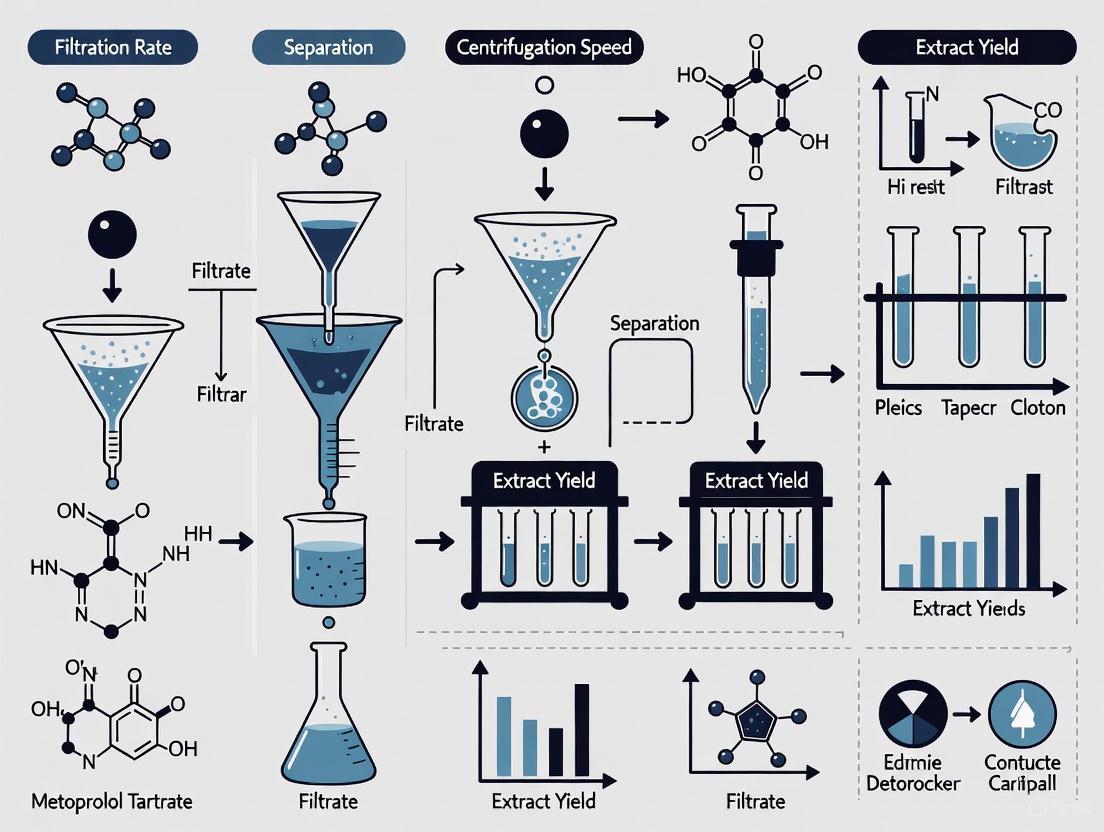
This article provides a comprehensive guide for researchers and pharmaceutical scientists on establishing and optimizing sample preparation techniques for metoprolol tablet analysis.
Optimizing Filtration and Centrifugation Parameters for Metoprolol Tablet Extracts: A Guide for Robust Analytical Method Development
Abstract
This article provides a comprehensive guide for researchers and pharmaceutical scientists on establishing and optimizing sample preparation techniques for metoprolol tablet analysis. It covers the foundational principles of filtration and centrifugation, details specific methodological parameters for extracting metoprolol from various dosage forms, and offers troubleshooting strategies for common challenges. Furthermore, it presents a comparative analysis of both techniques, discussing their validation according to regulatory standards to ensure accurate, reproducible, and efficient quantification of metoprolol in solid dosage forms for quality control and drug development purposes.
Fundamental Principles of Sample Preparation for Metoprolol Analysis
Metoprolol, a selective β1-adrenergic receptor blocking agent, is a cornerstone in the management of cardiovascular diseases, including hypertension, angina, and heart failure [1] [2]. The drug is commercially available primarily as two different salt forms: metoprolol tartrate and metoprolol succinate. These are not merely different salts but constitute distinct dosage forms with profound implications for their pharmacokinetics, therapeutic applications, and critically, the approaches required for their extraction and analysis in pharmaceutical research and development [3] [4]. Within the context of a broader thesis investigating filtration and centrifugation parameters for metoprolol tablet extracts, understanding the fundamental differences between these two salts is paramount. The immediate-release nature of the tartrate salt versus the extended-release design of the succinate salt necessitates tailored extraction protocols to ensure accurate quantification, profile analysis, and the validation of analytical methods. This document provides a detailed introduction to these dosage forms and outlines standardized experimental protocols for their extraction and analysis, framed specifically for researchers and drug development professionals.
Fundamental Differences Between Metoprolol Tartrate and Succinate
The primary distinction between the two salts lies in their release mechanisms and resulting pharmacokinetic profiles. Metoprolol tartrate is formulated as an immediate-release (IR) tablet, leading to a rapid onset but shorter duration of action, typically requiring administration two to four times daily [3] [5]. In contrast, metoprolol succinate is engineered as an extended-release (ER) formulation, designed to release the drug over a prolonged period (approximately 18-24 hours), allowing for once-daily dosing [6]. This ER property is achieved through specific pharmaceutical technologies, such as creating a complex matrix with ethyl cellulose and polyethylene glycol in microcapsules or using other sustained-release pellet systems [6].
This fundamental difference in formulation dictates their clinical use. While both are indicated for hypertension and angina, metoprolol tartrate is also approved for the treatment of patients following a heart attack, whereas metoprolol succinate is uniquely indicated for the treatment of chronic heart failure [3] [1] [4]. From an analytical and extraction perspective, the ER matrix of the succinate salt presents a more complex challenge for complete and reproducible drug extraction compared to the simpler IR matrix of the tartrate salt.
Table 1: Comparative Profile of Metoprolol Tartrate and Succinate Salts
| Characteristic | Metoprolol Tartrate | Metoprolol Succinate |
|---|---|---|
| Release Mechanism | Immediate-Release (IR) | Extended-Release (ER) |
| Brand Name | Lopressor [4] [5] | Toprol-XL [4] [5] |
| Dosing Frequency | Multiple times per day [3] | Once daily [3] |
| Standard Dosage (Oral) | 100-450 mg daily in divided doses [5] | 25-200 mg once daily [1] [5] |
| Available Formulations | Immediate-release tablet, Injectable solution [3] [4] | Extended-release tablet [3] [4] |
| Key Clinical Indications | Hypertension, Angina, Post-heart attack [3] [1] | Hypertension, Angina, Heart failure [3] [1] |
Analytical Techniques and Quantification Methods
The determination of metoprolol in pharmaceutical formulations and biological samples employs a variety of analytical techniques, each with its own advantages. The choice of method depends on the required sensitivity, specificity, and the nature of the sample matrix.
- Spectrophotometry: This is a well-established and relatively simple method. One reported approach is based on the complexation of metoprolol tartrate with copper(II) ions at pH 6.0 to form a blue-colored adduct with a maximum absorbance at 675 nm, obeying Beer's law in the concentration range of 8.5-70 μg/mL [7]. Another method involves reacting the drug's secondary amino group with carbon disulfide and ammonia to form a dithiocarbamate, which subsequently complexes with copper(II) ions; the complex is then extracted into chloroform for measurement [8].
- Chromatography: Techniques like High-Performance Liquid Chromatography (HPLC) and Ultra-High-Performance Liquid Chromatography (UHPLC) are considered more specific and robust for the simultaneous quantification of metoprolol, often in combination with other drugs. A developed UHPLC method for Ramipril and Metoprolol Succinate, for instance, uses a C18 column with a mobile phase of methanol and 0.1% formic acid, achieving excellent resolution and retention times of 1.926 minutes for metoprolol succinate [9]. Liquid chromatography coupled with mass spectrometry (LC-MS/MS) represents the gold standard for sensitivity and specificity, particularly in complex biological matrices like plasma, urine, and exhaled breath condensate (EBC) [2].
- Atomic Absorption Spectrometry (AAS): This can be used as an indirect method where the copper from the metoprolol dithiocarbamate complex is measured, providing an alternative quantification approach [8].
Table 2: Summary of Analytical Methods for Metoprolol Quantification
| Analytical Method | Principle | Application Context | Key Metric/Linearity |
|---|---|---|---|
| UV-Vis Spectrophotometry [7] | Complexation with Cu(II) ions | Tablet formulation analysis | 8.5 - 70 μg/mL |
| UHPLC [9] | Chromatographic separation | Combined dosage form analysis | 25 - 75 μg/mL (Metoprolol Succinate) |
| LC-MS/MS [2] | Chromatographic separation with mass detection | Biological fluid monitoring (Plasma, Urine, EBC) | 0.4 - 500 μg/L (Plasma) |
Experimental Protocols for Extraction and Analysis
The following protocols are designed with a focus on the sample preparation and extraction steps, which are critical for the subsequent filtration and centrifugation parameters central to the thesis context.
Protocol 1: Spectrophotometric Determination of Metoprolol Tartrate via Copper Complexation
This protocol is adapted from a published spectrophotometric method for the assay of metoprolol tartrate in tablets [7].
4.1.1 Research Reagent Solutions
Table 3: Essential Reagents for Spectrophotometric Determination
| Reagent | Function / Specification |
|---|---|
| Metoprolol Tartrate Standard | Primary reference standard for calibration. |
| Copper(II) Chloride Dihydrate (CuCl₂·2H₂O) | Source of Cu(II) ions for complex formation. |
| Britton-Robinson Buffer | Maintains optimal reaction pH (6.0). |
| Deionized Water | Solvent for all aqueous solutions. |
4.1.2 Procedure
- Standard Solution Preparation: Prepare a stock solution of metoprolol tartrate in deionized water at a concentration of 0.2 mg/mL. This solution is stable for one week when refrigerated.
- Calibration Curve: Transfer aliquots of the stock solution containing 8.5-70 μg of metoprolol tartrate into a series of 10 mL volumetric flasks.
- Complex Formation: To each flask, add 1 mL of Britton-Robinson buffer (pH 6.0) and 1 mL of 0.5% (w/v) CuCl₂·2H₂O solution. Mix well and heat in a thermostatically controlled water bath at 35°C for 20 minutes. Subsequently, cool the solutions rapidly.
- Dilution and Measurement: Dilute the mixtures to the mark with deionized water. Measure the absorbance of each solution at 675 nm against a reagent blank.
- Tablet Sample Extraction: a. Weigh and pulverize ten tablets. b. Transfer a powder quantity equivalent to 40 mg of metoprolol tartrate to a conical flask. c. Extract with four 20 mL portions of deionized water, filtering each extract into a 100 mL volumetric flask. d. Make up to volume with deionized water. e. Aliquot this solution and follow steps 3-4 above. Determine the concentration from the calibration curve.
The following workflow diagram illustrates the core steps of this extraction and analysis protocol:
Protocol 2: Sample Preparation for LC-MS/MS Analysis of Metoprolol in Biological Fluids
This protocol outlines sample preparation for high-sensitivity analysis, a crucial step before instrumental determination [2].
4.2.1 Research Reagent Solutions
Table 4: Essential Reagents for LC-MS/MS Sample Preparation
| Reagent | Function / Specification |
|---|---|
| Metoprolol Analytical Standard | For preparing calibration standards and quality controls. |
| HPLC-grade Methanol | Protein precipitation solvent and mobile phase component. |
| Trichloroacetic Acid (TCA) | Protein precipitation agent for plasma samples. |
| Formic Acid | Mobile phase modifier for improved chromatographic separation. |
4.2.2 Procedure
- Plasma Sample Preparation: a. Pipette 0.4 mL of plasma (calibration standard, quality control, or unknown sample) into a microcentrifuge tube. b. Add 0.225 mL of methanol and 0.2 mL of a 25% (w/v) trichloroacetic acid solution. c. Vortex mix and sonicate for 2 minutes. d. Centrifuge at 13,000 rpm for 10 minutes. This critical step pellets the precipitated proteins, requiring optimization of speed and time for maximum clarity. e. Carefully collect the clear supernatant and filter it through a 0.22 μm membrane filter prior to LC-MS/MS injection.
- Urine Sample Preparation: Spot urine samples typically require dilution with a compatible solvent (e.g., water or mobile phase) followed by filtration (0.22 μm) before injection.
- Exhaled Breath Condensate (EBC): EBC samples, having a simpler matrix, can often be injected directly without pre-treatment, though filtration may be considered [2].
Implications for Filtration and Centrifugation Parameters
The extraction of metoprolol, particularly from solid dosage forms, inherently generates mixtures that require separation. The choice and parameters of filtration and centrifugation are critical for obtaining a clean, analyzable extract and for studying drug release profiles.
- Filtration Parameters: The primary goal is to achieve particle-free filtrate without adsorbing the analyte. For tablet extracts, a 0.45 μm or 0.22 μm microporous membrane filter is standard [7] [6]. The filter material (e.g., nylon, PVDF, cellulose acetate) should be tested for non-specific binding of metoprolol. The optimization of filtration pressure or vacuum is also necessary to ensure efficient separation without compromising integrity.
- Centrifugation Parameters: This is vital for clarifying complex samples, especially in protein precipitation for biological fluids [2] or for isolating microcapsules during formulation development [6]. Key parameters include:
- Relative Centrifugal Force (RCF): Protocols often specify RCF (in × g) rather than rpm for reproducibility. The cited plasma preparation uses ~11,500 × g (13,000 rpm on a typical microcentrifuge) [2].
- Duration: Centrifugation time must be sufficient for complete phase separation (e.g., 10 minutes for plasma [2]).
- Temperature: Controlled-temperature centrifugation may be required for heat-labile samples.
The following diagram logically connects the dosage form properties to the required sample preparation and the critical separation parameters that form the core of the thesis research.
The Critical Role of Sample Preparation in Accurate Drug Content and Dissolution Testing
Sample preparation is a foundational step in pharmaceutical analysis, directly influencing the accuracy, precision, and reliability of drug content and dissolution testing results. For solid dosage forms such as metoprolol tablets, effective sample preparation transforms the tablet matrix into an analytically suitable solution while ensuring the complete extraction of the active pharmaceutical ingredient (API) and eliminating potential interferents. Inadequate procedures can introduce significant errors, leading to inaccurate potency assessment and dissolution profile interpretation. This document details standardized protocols and critical parameters for preparing metoprolol tablet extracts, with a specific focus on the pivotal roles of filtration and centrifugation within the context of robust analytical methodology.
Experimental Protocols
Sample Preparation for Drug Content Uniformity
This protocol is designed to determine the content uniformity of metoprolol in tablet formulations, based on established quality control testing methods [10].
Materials: Metoprolol tartrate tablets; analytical balance; mortar and pestle; volumetric flasks (100 mL); phosphate buffer (pH 6.8); syringe filters (0.45 µm); UV-Vis spectrophotometer.
Procedure:
- Weighing: Accurately weigh ten tablets individually and calculate the average weight.
- Powdering: Gently crush the ten tablets into a fine, homogeneous powder using a mortar and pestle.
- Sampling: Weigh a powder sample equivalent to 50 mg of metoprolol tartrate.
- Dissolution: Transfer the sampled powder into a 100 mL volumetric flask. Add approximately 70 mL of phosphate buffer (pH 6.8).
- Extraction: Shake the flask vigorously for 60 minutes using a mechanical shaker to ensure complete drug extraction.
- Dilution: Dilute to volume with phosphate buffer and mix thoroughly.
- Clarification: Withdraw a portion of the solution and filter it through a 0.45 µm membrane filter, discarding the first few mL of the filtrate.
- Analysis: Further dilute the filtered solution as needed and analyze using a validated UV-Vis spectrophotometric method at 221 nm [10].
Sample Preparation for Dissolution Testing
This protocol outlines the procedure for conducting an in vitro dissolution test for metoprolol extended-release tablets, critical for assessing performance [11] [12].
Materials: USP Apparatus 2 (paddle); dissolution vessel; dissolution medium (e.g., phosphate buffer pH 6.8); thermometer; syringe filters (0.45 µm); UV-Vis spectrophotometer or HPLC system.
Procedure:
- Apparatus Setup: Fill the dissolution vessel with 500 mL or 900 mL of dissolution medium (as per monograph) and equilibrate to 37 ± 0.5 °C [11] [12].
- Initiation: Place one tablet in the vessel and immediately start the apparatus at a specified rotation speed (e.g., 50-100 rpm) [11] [12].
- Sampling: At predetermined time intervals (e.g., 1, 2, 4, 6, 8 hours for MR formulations), withdraw a 5 mL aliquot from the vessel from a zone midway between the top of the paddle and the surface of the medium, and not less than 1 cm from the vessel wall.
- Clarification: Immediately filter the withdrawn sample through a 0.45 µm membrane filter.
- Volume Replacement: Add an equal volume (5 mL) of fresh, pre-warmed dissolution medium to the vessel to maintain a constant volume.
- Analysis: Analyze the filtered sample for drug concentration using a suitable analytical technique (e.g., UV-Vis at 274 nm or HPLC) [12].
Filtration and Centrifugation Parameters for Metoprolol Analysis
The following table summarizes the critical parameters for clarifying metoprolol tablet extracts as derived from published research methods.
Table 1: Filtration and Centrifugation Parameters for Metoprolol Tablet Extracts
| Parameter | Recommended Specification | Rationale & Impact |
|---|---|---|
| Filter Pore Size | 0.45 µm | Standard for removing fine particulate matter and polymer fragments from dissolved tablet matrices without adsorbing the API [10]. |
| Filter Membrane Material | Cellulose acetate, Nylon, or PVDF | These materials exhibit minimal adsorption of metoprolol, ensuring high analyte recovery. Avoid nitrocellulose if high adsorption is suspected. |
| Centrifugation Force | 2000 - 4000 x g | Sufficient to pellet insoluble excipients (e.g., talc, magnesium stearate) and provide a clear supernatant for analysis [10]. |
| Centrifugation Duration | 10 - 15 minutes | Ensures complete settling of sub-micron particles, preventing clogging of chromatographic systems or interference in spectrophotometry. |
| Filtrate Discard Volume | 2 - 3 mL (or first 10-15%) | Ensures the filter membrane is saturated and the dead volume is cleared, providing a representative sample with consistent concentration. |
The Scientist's Toolkit: Essential Research Reagent Solutions
Table 2: Key Reagents and Materials for Sample Preparation of Metoprolol Tablets
| Item | Function/Application |
|---|---|
| Phosphate Buffer (pH 6.8) | Simulates intestinal fluid; used as a dissolution medium and solvent for drug extraction in content uniformity tests [10]. |
| 0.1N Hydrochloric Acid (pH 1.2) | Simulates gastric fluid; used for dissolution profiling to assess performance in the stomach [11]. |
| Syringe Filters (0.45 µm, Nylon) | Critical for clarifying samples post-dissolution or extraction prior to injection into HPLC or UV-Vis systems [10]. |
| Chromatographic Column (C18, 50-150 mm) | Stationary phase for UPLC/HPLC analysis enabling separation of metoprolol from its impurities and degradation products [13]. |
| Methanol & Acetonitrile (HPLC Grade) | Organic modifiers in mobile phase preparation for chromatographic separation of metoprolol [13] [14]. |
| Sodium Lauryl Sulphate (SLS) | Ion-pair reagent used in mobile phases to improve chromatographic peak shape and separation of metoprolol and related compounds [13]. |
Workflow Visualization
The following diagram illustrates the integrated sample preparation workflow for drug content and dissolution testing, highlighting the critical decision points for filtration and centrifugation.
Sample Preparation Workflow for Tablet Analysis
The integrity of drug content and dissolution data for metoprolol tablets is profoundly dependent on a meticulously designed and executed sample preparation protocol. The choice between filtration and centrifugation, along with the stringent control of their respective parameters, is not merely a preparatory step but a critical analytical stage. Adherence to the detailed protocols for clarification—specifying filter pore size, membrane material, centrifugation force, and duration—ensures the removal of particulate interferents while maintaining the stability and recovery of the metoprolol API. Standardizing these procedures is paramount for generating reliable, reproducible, and scientifically defensible data in pharmaceutical development and quality control.
Filtration is a critical unit operation in pharmaceutical research and development, serving as a fundamental process for ensuring product purity, protecting analytical equipment, and guaranteeing the accuracy of experimental results. In the specific context of researching metoprolol tablet extracts, a thorough understanding of filtration principles is paramount. Metoprolol, a β-adrenergic blocking agent used extensively in managing hypertension and angina, presents particular challenges due to its physicochemical properties and formulation characteristics. The core purpose of pharmaceutical filtration is the removal of solid particulate matter from fluids (liquids or gases) using a porous medium, thereby ensuring that analytical samples are free from interfering impurities and that the integrity of the drug substance is maintained throughout the analytical workflow [15]. The filtration market's anticipated growth to $24.21 billion by 2030 underscores its critical role in pharmaceutical manufacturing and quality control [15].
Within the framework of a broader thesis investigating filtration and centrifugation parameters for metoprolol tablet extracts, this document provides detailed application notes and protocols. It is structured to equip researchers, scientists, and drug development professionals with the knowledge to select appropriate filtration methodologies, understand potential interactions—especially drug adsorption—and implement robust, reproducible experimental procedures. The discussion is intentionally centered on the practical implications for metoprolol, a drug often formulated as a tartrate salt in both immediate-release and complex sustained-release dosage forms, which can generate heterogeneous extract solutions requiring careful preparation [16] [17].
Core Filtration Mechanisms
Filtration systems in the pharmaceutical industry are predominantly classified based on their primary mechanism of particle retention: surface filtration, depth filtration, or a combination thereof in hybrid systems. The choice of mechanism directly impacts the efficiency, capacity, and suitability for a given application, such as clarifying a metoprolol tablet extract prior to high-performance liquid chromatography (HPLC) analysis.
Surface Filtration
Surface filtration, also described as absolute filtration, operates on the principle of retaining particles entirely on the surface of the filter medium. The particles accumulate, forming a layer known as a "filter cake," which itself becomes part of the filtering medium, thereby enhancing the efficiency of the process over time.
- Mechanism: The filter medium, typically a membrane with defined pore sizes, acts as a sieve, physically blocking particles larger than its pore diameter from passing through. The initial filtration efficiency is approximately 55%, but as the filter cake builds up, the efficiency can reach 100%, providing exceptional clarity of the filtrate [18] [15].
- Characteristics: This mechanism offers precise, absolute removal ratings. However, the accumulating cake layer leads to an increase in flow resistance, causing a gradual reduction in flow rate. Consequently, these filters require periodic maintenance or replacement once the pressure drop across the filter becomes too high [18].
- Pharmaceutical Application: Surface filters are ideal for critical sterility assurance, such as the final filtration of protein solutions or Water-for-Injection (WFI), and for obtaining particle-free samples for analytical instrumentation [18] [19] [15].
Depth Filtration
In contrast to surface filtration, depth filtration is a volumetric process designed to trap particles within the extensive, tortuous porous structure of the filter medium.
- Mechanism: A thick, fibrous matrix of materials like cellulose or glass fibers creates a long, convoluted pathway. Larger particles are trapped near the inlet surface, while progressively smaller particles are captured as the fluid penetrates deeper into the filter [18] [15].
- Characteristics: Depth filters exhibit a high dirt-holding capacity, resulting in a longer service life compared to surface filters when processing particulate-laden fluids. They are less precise in their pore size distribution and are not suitable for absolute microbial retention. Cleaning is often achieved via backflow, where the fluid direction is reversed to dislodge trapped contaminants [18] [19].
- Pharmaceutical Application: These filters are predominantly used as prefilters to protect downstream sterile-grade membrane filters. They are excellent for clarifying cell cultures, fermentation broths, and bulk pharmaceutical chemical (BPC) solutions, where the primary goal is to remove a high load of particulates [19] [15].
Membrane Filtration
Membrane filtration represents a specialized, high-precision category of surface filtration. These filters feature a thin, porous polymeric layer (e.g., PES, PVDF, PTFE) that acts as an absolute physical barrier.
- Mechanism: Particles and microorganisms larger than the specified pore size are retained on the membrane's surface. Common pore size ratings include 0.2 µm for sterilizing-grade filtration [19].
- Characteristics: They provide precise, predictable retention and excellent filtrate clarity. The main disadvantages are a susceptibility to clogging with high particulate loads, a higher cost, and a limited dirt-holding capacity, which often necessitates a pre-filtration step with a depth filter [19].
- Pharmaceutical Application: Membrane filters are the gold standard for final sterile filtration before fill-finish operations, filtration of WFI, and preparing analytical samples where particulate interference must be eliminated [19] [15].
Other Filtration Systems
- Ultrafiltration: This is a specialized membrane process using pores smaller than 0.01 microns. It is employed to separate macromolecules, viruses, and some bacteria from solutions. It operates under pressure and is particularly useful for concentrating, isolating, and purifying target macromolecules in biopharmaceutical processes. It cannot remove dissolved salts [18] [15].
- Magnetic Filtration: A less common but valuable technique that uses magnetic force to remove ferrous contaminants from process fluids. It is a cost-effective, energy-free method that does not impede flow and is often used as a supplementary step in multi-stage filtration trains [18].
Table 1: Comparison of Primary Filtration Mechanisms
| Filter Type | Primary Mechanism | Pore Size / Retention | Key Advantage | Key Disadvantage | Ideal Use in Metoprolol Research |
|---|---|---|---|---|---|
| Surface Filter | Sieving on surface | Absolute rating (e.g., 0.2 µm) | High filtrate clarity; sterilizing capability | Clogs quickly; limited capacity | Final clarification of API solutions pre-HPLC |
| Depth Filter | Volumetric trapping within matrix | Nominal rating (range) | High dirt-holding capacity; long service life | Not for absolute microbial retention | Pre-filtration of crude tablet extracts |
| Membrane Filter | Sieving on surface | Absolute rating (e.g., 0.2 µm) | Precise particle removal; sterilizing grade | Susceptible to clogging; higher cost | Sterile filtration of dissolution media |
| Ultrafiltration | Molecular separation | < 0.01 microns | Removes viruses, bacteria, macromolecules | Cannot remove dissolved salts | Buffer exchange or concentration of protein-bound drug |
Pharmaceutical Filter Types and Their Applications
Selecting the correct filter type is a multidimensional decision based on the fluid's characteristics, the level of purity required, and the specific processing stage. The following section details common filter formats used in pharmaceutical settings.
Cartridge Filters
These are cylindrical units that house various filter media (e.g., pleated membranes, depth material) in a self-contained cartridge. They are installed in dedicated housings and are available in a vast range of micron ratings and materials of construction.
- Advantages: They are easy to install, replace, and maintain. The pleated design offers a large surface area within a compact footprint, and they can be validated for critical applications [19].
- Disadvantages: They require compatible and often costly housing systems and may have limited surface area compared to larger modular systems for very high-volume processing [19].
- Applications: Buffer and media filtration, pre- and post-filtration steps in multi-stage processes, and use in Clean-in-Place (CIP) systems [19].
Lenticular Filter Modules
These modules consist of multiple disc-shaped filter sheets stacked and compressed within a single, reusable housing. The design provides a large filtration area in a compact form factor.
- Advantages: Ideal for batch processing in small to mid-scale production. The closed system minimizes contamination risk, and the sheets are easy to scale and switch out [19].
- Disadvantages: Higher upfront cost compared to standard cartridge filters and may require specialized housing units [19].
- Applications: Biopharmaceutical intermediate filtration, sterile compounding of parenteral nutrition (PN) solutions, and clarification/polishing in pilot-scale production [19].
Activated Carbon Filters
These filters utilize a bed of highly porous activated carbon to adsorb organic contaminants, color bodies, odors, and endotoxins via van der Waals forces.
- Advantages: Excellent for dechlorination and removal of organic impurities and pyrogens, thereby enhancing product purity and stability [19].
- Disadvantages: Non-selective adsorption can remove beneficial compounds (like the API itself). There is a potential for shedding carbon fines, and they have a shorter lifespan in high-load environments [19].
- Applications: Polishing of sterile injectable solutions and removal of endotoxins and organic impurities from process water [19].
Table 2: Guide to Filter Selection for Pharmaceutical Fluids
| Fluid Characteristic | Recommended Primary Filter Type | Rationale | Considerations for Metoprolol Tablet Extracts |
|---|---|---|---|
| High Particulate Load | Depth Filter (as prefilter) | High dirt-holding capacity protects downstream elements. | Unprocessed tablet extracts contain insoluble excipients (e.g., dicalcium phosphate) [16]. |
| Requirement for Sterility | Membrane Filter (0.2 µm) | Absolute removal of microorganisms. | For preparing sterile dissolution media for metoprolol formulations. |
| Presence of Organic Impurities/Pyrogens | Activated Carbon Filter | Adsorbs organics, chlorine, and endotoxins. | Risk of adsorbing metoprolol itself; requires careful validation [20] [19]. |
| Small Batch, Viscous Solution | Lenticular Filter Module | Large area in compact design; handles varied viscosities. | Suitable for pilot-scale processing of sustained-release granule slurries [16] [19]. |
| General Clarification, Buffer Filtration | Cartridge Filter (pleated) | Balance of capacity, cost, and ease of use. | Versatile option for routine laboratory filtration of sample solutions. |
Drug Adsorption: A Critical Consideration in Filtration
A paramount, yet often overlooked, aspect of filtering pharmaceutical solutions is the potential for adsorption of the active pharmaceutical ingredient (API) onto the filter material. This non-specific binding can lead to a significant and variable reduction in drug concentration, compromising the accuracy of analytical results, dose uniformity, and bioavailability assessments.
The Case of Metoprolol Adsorption
Metoprolol has been demonstrated to adsorb to certain materials, making it a relevant model for understanding this phenomenon. Research has shown that activated carbons, in particular, can exhibit high adsorption capacities for metoprolol.
- Evidence from Activated Carbon Studies: One study reported that activated carbons prepared from bean peils using phosphoric and sulphuric acids showed metoprolol retention capacities of 107.5 mg/g and 90 mg/g, respectively. The study identified an optimal adsorbent dosage of 2 g/L, achieving a 98% retention efficiency, with adsorption kinetics reaching equilibrium in just 5 minutes for concentrations below 150 mg/L [20]. This highlights the rapid and substantial loss that can occur if such a material is inadvertently used in a filter.
- Effect of Pore Size in Silica Carriers: The adsorption and release of the bulky metoprolol tartrate (MPT) molecule are highly dependent on the pore size of the carrier material. Studies on mesoporous silica nanoparticles (MSNs) found that conventional MSNs with pore sizes of 3–6 nm were limited in their application for MPT, whereas larger pore MSNs (e.g., 11 nm and 15 nm) were more effective. Both molecular simulations and release experiments confirmed that proper pore size is critical for managing the diffusion and release of MPT [21]. This principle translates to filtration, where the pore structure of a depth filter could similarly trap and retain drug molecules.
Mechanisms and Contributing Factors
Drug adsorption is primarily driven by interactions such as hydrophobic binding, electrostatic attraction, and hydrogen bonding. Factors that influence the extent of adsorption include:
- Filter Material Chemistry: Polymeric membranes like PVDF or Nylon may interact differently with a drug than cellulosic depth filters.
- Drug Physicochemical Properties: The log P, pKa, and molecular size of metoprolol influence its interaction with filter surfaces.
- Solution Conditions: The pH, ionic strength, and presence of organic solvents can significantly alter adsorption behavior. For instance, the adsorption of metoprolol onto phosphoric acid-activated carbon was shown to be best described by the Langmuir isotherm model and was influenced by temperature and solution pH [20].
Experimental Protocols and Applications
Protocol: Filtration of Metoprolol Tablet Extracts for HPLC Analysis
Objective: To clarify a solution extracted from metoprolol tablets without significantly adsorbing the API, ensuring an accurate analytical result.
Materials:
- Test Solution: Aqueous or hydro-alcoholic extract of metoprolol tablets.
- Filtration Setup: Syringe (e.g., 10 mL), compatible syringe filter holder.
- Filters for Testing: A selection of membrane filters (e.g., PVDF, Nylon, PES, PTFE), with a pore size of 0.45 µm.
- HPLC System: Equipped with UV detection.
Procedure:
- Sample Preparation: Prepare the metoprolol tablet extract solution according to the standard analytical method (e.g., powder tablets, dissolve in solvent, sonicate, and centrifugate initially if very turbid) [17].
- Pre-Filtration (If needed): For heavily turbid solutions, pass a portion through a depth filter or a larger pore size (e.g., 1-5 µm) syringe filter to prevent rapid clogging of the final membrane.
- Membrane Filtration: a. Pre-wet the 0.45 µm membrane filter with an appropriate solvent. b. Discard the first 1-2 mL of filtrate to saturate non-specific binding sites on the filter. c. Collect the subsequent filtrate in a clean HPLC vial.
- Analysis and Calculation:
a. Analyze the filtrate immediately via HPLC.
b. Compare the peak area of metoprolol in the filtered sample against a standard solution of known concentration that was not filtered, or that was filtered and the first few mL was discarded.
c. Calculate the recovery percentage:
(Peak Area Filtered / Peak Area Standard) * 100%.
Protocol: Assessing Drug Adsorption to Filter Materials
Objective: To quantitatively evaluate the loss of metoprolol due to adsorption onto a candidate filter material.
Materials:
- Standard Solution: A known concentration of metoprolol tartrate in a relevant solvent (e.g., dissolution medium or mobile phase).
- Filter Material: A swatch of the flat-sheet filter membrane or a small, dismantled cartridge.
- Orbital Shaker Incubator
- HPLC System
Procedure:
- Preparation: Cut the filter material into small, uniform pieces (e.g., 1 cm² discs). Accurately weigh multiple portions.
- Equilibration: Place each weighed portion into a separate vial. Add a known volume (e.g., 10 mL) of the metoprolol standard solution to each vial. Include control vials containing the standard solution without filter material.
- Incubation: Seal the vials and agitate on an orbital shaker at a constant temperature (e.g., 37°C) for a predetermined time (e.g., 30-60 minutes), based on the contact time during normal filtration [20].
- Sampling: After incubation, carefully withdraw a sample from the solution in each vial, ensuring no filter fibers are collected. If necessary, centrifuge the sample to settle any particulates.
- Analysis: Analyze the drug concentration in the supernatant using HPLC.
- Data Analysis:
- Calculate the amount of drug adsorbed:
Q = (C₀ - Cₑ) * V / m, whereQis the adsorption capacity (mg/g),C₀is the initial concentration (mg/L),Cₑis the equilibrium concentration (mg/L),Vis the solution volume (L), andmis the mass of the filter material (g). - Plot
QagainstCₑto model the adsorption isotherm.
- Calculate the amount of drug adsorbed:
The Scientist's Toolkit: Key Research Reagents and Materials
Table 3: Essential Materials for Filtration and Adsorption Studies of Metoprolol
| Item | Function/Description | Example Application/Justification |
|---|---|---|
| Syringe Filters (0.45 µm, 0.2 µm) | Final clarification of small-volume samples for instrumental analysis. | PVDF is often recommended for its low protein binding, which may translate to lower drug adsorption. |
| Activated Carbon | A model adsorbent for studying extreme adsorption potential. | Used in Protocol 5.2 to demonstrate high-capacity adsorption, as shown in [20]. |
| Eudragit RS/RL Polymers | pH-independent, insoluble but swellable coating polymers for controlled release. | Relevant for filtering extracts from complex sustained-release formulations [16]. |
| Triethyl Citrate (TEC) | A plasticizer used in polymer coatings like Eudragit. | Understanding formulation components is key when filtering extracts, as leachates can interfere. |
| Mesoporous Silica Nanoparticles (MSNs) | A model porous carrier to study pore-size-dependent adsorption. | Used in research to illustrate how pore size (11-15 nm) affects metoprolol release/adsorption [21]. |
| HPLC with UV Detector | Quantitative analysis of drug concentration pre- and post-filtration. | Essential for accurately measuring metoprolol content and calculating adsorption loss [17]. |
In pharmaceutical research, particularly during the analysis of active pharmaceutical ingredients (APIs) such as metoprolol from tablet extracts, centrifugation serves as a critical step for obtaining clear supernatants for subsequent analytical procedures. The clarity of this supernatant is not a matter of simple separation; it is a delicate balance of centrifugal force, time, and rotor specifications that directly impacts the accuracy and reproducibility of solubility data and concentration measurements [22] [23]. Misapplication of centrifugation parameters can lead to the inclusion of colloidal particles or even disruption of the dissolved equilibrium, thereby producing misleading solubility values [22]. This application note delineates the core principles of centrifugation, with a specific focus on the relationship between Relative Centrifugal Force (RCF) and time, and their collective impact on achieving optimal supernatant clarity, framed within the context of metoprolol tablet extract research.
Core Principles: RCF, RPM, and Time
Distinguishing RPM from RCF
A fundamental and common oversight in centrifugation protocols is the interchangeable use of Revolutions Per Minute (RPM) and Relative Centrifugal Force (RCF, or g-force). These terms are not synonymous [24].
- RPM is a measure of rotational speed, indicating how fast the rotor is spinning, without accounting for the rotor's dimensions.
- RCF describes the actual gravitational force exerted on the samples within the rotor. This is the force responsible for sedimenting particles and is therefore the critical parameter affecting supernatant clarity [25] [24].
RCF is a function of both the rotational speed (RPM) and the radial distance from the center axis to the bottom of the sample tube (the rotor radius, r). Consequently, the same RPM setting will generate different RCF values in centrifuges with different rotor sizes [24]. For reproducible results, especially when transferring methods between laboratories or equipment, protocols must specify RCF.
The G-Force Formula
The relationship between RPM and RCF is defined by the following formula, which should be used for all precise experimental work [25] [26]:
RCF = (RPM)² × 1.118 × 10⁻⁵ × r
Where:
- RCF is the relative centrifugal force (x g).
- RPM is the speed in revolutions per minute.
- r is the rotational radius in centimeters (the distance from the center of the spindle to the bottom of the tube).
This formula highlights a key principle: RCF is proportional to the square of the RPM. Doubling the RPM quadruples the RCF applied to the sample [25]. This exponential relationship must be carefully considered when adjusting protocols.
The Role of Centrifugation Time
Time is the second critical variable in the sedimentation process. The required time for a particle to sediment is inversely related to the RCF applied [27]. Higher RCF will typically reduce the time needed to achieve clarity. However, the interaction between RCF and time is not always linear and must be optimized for specific sample types. Excessive time or force can be as detrimental as insufficient parameters, potentially forcing fine colloids to remain in suspension or even damaging sensitive biological samples [22] [27].
Impact of Centrifugation on Pharmaceutical Analysis
The selection of RCF and time is not merely a technical detail; it is a decisive factor in the validity of experimental data. A recent systematic study investigating centrifugation parameters for equilibrium solubility determination—a key parameter in drug development—demonstrated this impact unequivocally [22] [23].
The study found that excessively high RCF and prolonged duration can lead to a significant overestimation of a drug's solubility. For example, in the case of papaverine hydrochloride, centrifugation at 10,000 rpm (approximately 8720 × g) for 20 minutes without a prior sedimentation step resulted in solubility values 60-70% higher than the reference method using only sedimentation [22] [23]. This overestimation is attributed to the forced inclusion of very fine particles or colloids into the supernatant, which are then measured as "dissolved" drug [22].
Conversely, the study concluded that lower RCF and shorter durations yielded results closest to the true reference values. Specifically, a protocol of 5 minutes at 5000 rpm (approximately 2180 × g) produced superior agreement with sedimentation-only references and exhibited lower standard deviations [23]. These findings underscore that "more force" is not always better and that optimized, gentle centrifugation is often essential for analytical accuracy.
Table 1: Impact of Centrifugation Parameters on Solubility Measurement Accuracy
| Parameter Set | RCF (× g) | Time (min) | Impact on Solubility Measurement |
|---|---|---|---|
| High Force/Long Time | ~8,720 | 20 | Significant overestimation (e.g., +60-70% for papaverine HCl) [23] |
| Low Force/Short Time | ~2,180 | 5 | Closest to reference values, lower standard deviation [23] |
Optimized Protocol for Metoprolol Tablet Extract Clarification
Based on the core principles and recent research, the following protocol is recommended for clarifying metoprolol tablet extracts to ensure accurate analytical results.
The following diagram illustrates the logical workflow for developing an optimized centrifugation method.
Step-by-Step Procedure
Sample Preparation:
- Prepare a heterogeneous suspension of metoprolol tablet extract in an appropriate solvent or buffer. For solubility studies, ensure the solution is at equilibrium saturation [23].
- Transfer an aliquot (e.g., 10 mL) into a labeled centrifuge tube. Ensure tubes are balanced by mass.
Parameter Calculation and Setting:
- Determine Rotor Radius (r): Measure the distance in centimeters from the center of the centrifuge rotor to the bottom of the tube holder when it is in the horizontal position (for a swinging-bucket rotor) [25].
- Select RCF: For initial optimization, a target RCF of 2000 × g is recommended, balancing clarity preservation with the avoidance of solubility overestimation [23] [27].
- Calculate RPM: Use the RCF formula to calculate the required RPM.
RPM = √[RCF / (r × 1.118)] × 1,000[25] - Set Time: Begin with a centrifugation time of 5 minutes [23].
Centrifugation:
- Set the centrifuge temperature to 25°C unless specific temperature-dependency is being studied. Note that temperature affects solvent viscosity and thus sedimentation efficiency [27].
- Initiate the run at the calculated RPM for the set duration.
Post-Centrifugation Analysis:
- Carefully remove the tubes without disturbing the pellet.
- Visually inspect the supernatant for clarity. If it remains turbid, systematically re-optimize by slightly increasing the RCF (e.g., in 500 × g increments) or the time, and repeat the process.
The Scientist's Toolkit: Research Reagent Solutions
Table 2: Essential Materials for Centrifugation of Pharmaceutical Extracts
| Item | Function/Description | Example/Specification |
|---|---|---|
| Laboratory Centrifuge | Generates RCF for phase separation. | Fixed-angle or swinging-bucket rotor, capable of achieving up to 10,000 × g [23]. |
| pH Buffer Solutions | Maintains consistent ionization state of the API, critical for accurate solubility measurement. | Britton-Robinson buffer or phosphate-buffered saline (PBS); ionic strength should be kept constant [23]. |
| Organic Solvents | Extraction solvent for APIs from solid dosage forms. | Methanol, acetonitrile, or buffered aqueous solutions, depending on analyte solubility [28]. |
| Analytical Standard | Reference for quantification and method validation. | High-purity metoprolol tartrate or other target API [28]. |
Achieving a clear supernatant is a cornerstone of reliable analytical data in pharmaceutical research. By moving beyond the simplistic use of RPM to a focus on RCF, and by understanding the synergistic effects of force and time, researchers can significantly enhance the accuracy of their results. The application of optimized, gentle centrifugation parameters, as demonstrated in recent solubility studies, is crucial for preventing the overestimation of drug concentration and for ensuring the integrity of data generated from metoprolol tablet extracts and other complex pharmaceutical mixtures.
In pharmaceutical analysis, the choice of an appropriate analytical technique is fundamental to generating reliable, accurate, and meaningful data. This decision is particularly critical when researching complex matrices, such as metoprolol tablet extracts, where the presence of excipients and the need for sample preparation techniques like filtration and centrifugation can influence the results. Two of the most prevalent techniques are High-Performance Liquid Chromatography (HPLC) and Ultraviolet-Visible (UV-Vis) Spectrophotometry. Each method offers distinct advantages and limitations, making them suitable for different analytical objectives. This document, framed within a broader thesis investigating filtration and centrifugation parameters for metoprolol tablet extracts, provides detailed application notes and protocols to guide researchers and drug development professionals in selecting the optimal technique based on their specific goals. The core challenge is to align the analytical objective—whether it is the specific quantification of an active ingredient in a mixture or a rapid assessment of purity and concentration—with the capabilities of the available instrumentation.
Technique Comparison: HPLC vs. UV-Vis Spectrophotometry
The following table provides a structured comparison of the two techniques to aid in the initial selection process.
Table 1: Comparative Overview of HPLC and UV-Vis Spectrophotometry for Pharmaceutical Analysis
| Feature | HPLC | UV-Vis Spectrophotometry |
|---|---|---|
| Analytical Principle | Separation followed by detection. Analyte is separated from other components in the mixture using a column before quantification [29]. | Measurement of light absorption by a sample at specific wavelengths without prior separation [30]. |
| Key Strength | High specificity, resolution of mixtures, and ability to identify and quantify multiple analytes and impurities simultaneously [31] [32]. | Simplicity, speed, cost-effectiveness, and high throughput for targeted analysis [33]. |
| Key Limitation | More complex operation, longer analysis time, and higher cost per analysis. | Lack of specificity for mixtures; cannot distinguish between the analyte and other absorbing substances [32]. |
| Ideal Use Case | Stability-indicating methods, impurity profiling, assay of multi-component formulations [31] [34]. | Quantification of a pure substance, dissolution testing, concentration verification in a known matrix [35] [33]. |
| Impact of Sample Preparation (Filtration/Centrifugation) | Critical. Particulates can damage the column and HPLC system. Sample extracts must be clarified using 0.45 µm or 0.22 µm filters or equivalent centrifugation prior to injection [31] [34]. | Necessary for turbid samples. Clarification ensures accurate absorbance readings by removing light-scattering particles. The treatment method (e.g., filter membrane type) can significantly affect measured values [36]. |
| Sensitivity | Very high (e.g., LOD in ng/mL range) [34]. | Moderate (e.g., LOD in µg/mL range) [33]. |
| Regulatory Applicability | Suitable for rigorous pharmacopeial methods requiring identification and quantification of individual components [35]. | Widely used for pharmacopeial tests for identity, assay, and dissolution where specificity is confirmed [35]. |
Contextual Selection for Metoprolol Tablet Analysis
The choice between HPLC and UV-Vis becomes clear when considering specific research objectives for metoprolol tablet extracts:
- Choose HPLC when: The objective is to develop a stability-indicating method that can separate metoprolol from its degradation products (formed under stress conditions like acid, base, or oxidation) and from tablet excipients [31] [34]. This is essential for studying the kinetics of degradation and for accurate pharmacokinetic profiling [32].
- Choose UV-Vis when: The objective is a rapid and economical quantitative analysis of metoprolol in a formulated product, provided that the sample preparation and method validation have confirmed that no interfering excipients or impurities co-absorb at the selected wavelength [33]. Research has shown that for drugs loaded onto complex composite scaffolds, UV-Vis may not be accurate, and HPLC is preferred [32].
Experimental Protocols
Protocol A: RP-HPLC for the Analysis of Metoprolol Succinate in Tablets
This protocol is adapted from established stability-indicating methods for related drugs [34] and general HPLC principles [31].
3.1.1 Research Reagent Solutions
Table 2: Essential Materials for HPLC Protocol
| Item | Function | Specification/Note |
|---|---|---|
| HPLC System | Liquid chromatograph equipped with a pump, autosampler, column oven, and UV/Vis detector. | - |
| Chromatography Column | Stationary phase for analyte separation. | Reverse Phase C18 column (e.g., 250 mm x 4.6 mm, 5 µm) [29] [34]. |
| Mobile Phase | Liquid solvent that carries the sample through the column. | A mixture of a buffer and an organic solvent. Example: Phosphate buffer (pH adjusted) and Acetonitrile in a specific ratio (e.g., 60:40 v/v) [34]. |
| Metoprolol Succinate | Reference Standard | Used to prepare calibration standards; ensures accuracy and method validation. |
| Solvents | For sample and mobile phase preparation. | HPLC-grade Water and Acetonitrile/Methanol. |
| Syringe Filters | Clarification of the final sample solution before injection. | Nylon or PVDF, 0.45 µm or 0.22 µm pore size [34]. |
3.1.2 Procedure
- Mobile Phase Preparation: Prepare a mixture of 0.05 M potassium dihydrogen phosphate buffer (pH adjusted to 3.0 with orthophosphoric acid) and HPLC-grade acetonitrile in a 60:40 (v/v) ratio. Degas the solution by sonication or sparging with an inert gas.
- Standard Solution Preparation: Accurately weigh about 25 mg of metoprolol succinate reference standard into a 100 mL volumetric flask. Dissolve and make up to volume with a mixture of water and acetonitrile (1:1) to obtain a primary stock solution of 250 µg/mL. Further dilute this solution with the same diluent to obtain a working standard solution of 25 µg/mL.
- Sample Solution Preparation (Tablet Extract): a. Weigh and finely powder not less than 20 tablets. b. Accurately weigh a portion of the powder equivalent to about 25 mg of metoprolol succinate into a 100 mL volumetric flask. c. Add about 80 mL of diluent (water:acetonitrile, 1:1), sonicate for 30 minutes with intermittent shaking, and dilute to volume. d. Centrifuge a portion of this solution at 4000 rpm for 10 minutes [36]. e. Filter the supernatant through a 0.45 µm nylon membrane filter. Discard the first few mL of the filtrate. f. Further dilute the filtrate appropriately to obtain a nominal concentration of 25 µg/mL.
- Chromatographic Conditions:
- Column: C18 (250 mm x 4.6 mm, 5 µm)
- Mobile Phase: As prepared in Step 1.
- Flow Rate: 1.0 mL/min
- Column Temperature: 40°C
- Detection Wavelength: 220 nm
- Injection Volume: 20 µL
- System Suitability: Inject the standard solution. The chromatogram should meet pre-defined system suitability criteria, such as a tailing factor of less than 2.0 and a theoretical plate count greater than 2000 [31] [34].
- Analysis: Separately inject the standard and sample solutions. Identify the metoprolol peak in the sample by comparing its retention time with that of the standard. Quantify the amount of metoprolol succinate in the tablet using the peak areas.
The workflow for this protocol is summarized in the following diagram:
Protocol B: UV-Vis Spectrophotometry for the Analysis of Metoprolol Succinate in Tablets
This protocol is adapted from validated methods for similar drugs [33] and accounts for sample clarification needs [36].
3.2.1 Research Reagent Solutions
Table 3: Essential Materials for UV-Vis Protocol
| Item | Function | Specification/Note |
|---|---|---|
| UV-Vis Spectrophotometer | Instrument to measure light absorption by a sample. | Equipped with 1 cm matched quartz cells. |
| Methanol | Solvent for dissolution and dilution. | UV-spectroscopic grade. |
| Metoprolol Succinate | Reference Standard | Used to prepare the calibration curve. |
| Volumetric Flasks | For accurate preparation of solutions. | Class A. |
| Syringe Filters | Clarification of the sample solution. | Nylon 66, 0.22 µm pore size [36]. |
3.2.2 Procedure
- Selection of Wavelength: Scan a standard solution of metoprolol succinate (e.g., 10 µg/mL in methanol) over the range of 200-400 nm using the spectrophotometer. Identify the wavelength of maximum absorption (λmax), which is typically around 222-224 nm.
- Calibration Curve: a. Prepare a stock solution of metoprolol succinate (100 µg/mL) in methanol. b. Dilute aliquots of this stock solution with methanol to obtain a series of standard solutions covering a concentration range of 5-30 µg/mL. c. Measure the absorbance of each standard solution at the predetermined λmax against methanol as a blank. d. Plot a graph of absorbance versus concentration and determine the regression equation.
- Sample Solution Preparation (Tablet Extract): a. Weigh and finely powder not less than 20 tablets. b. Accurately weigh a portion of the powder equivalent to about 10 mg of metoprolol succinate into a 100 mL volumetric flask. c. Add about 70 mL of methanol, sonicate for 15-20 minutes, and dilute to volume with methanol. d. Centrifuge a portion of this solution at 4000 rpm for 10 minutes [36]. e. Filter the supernatant through a 0.22 µm nylon membrane filter. f. Further dilute the filtrate with methanol to obtain a concentration within the linear range of the calibration curve (e.g., ~10 µg/mL).
- Analysis: Measure the absorbance of the final filtered sample solution at the λmax. Calculate the concentration of metoprolol succinate in the sample using the regression equation from the calibration curve.
The workflow for this protocol is summarized in the following diagram:
The Critical Role of Filtration and Centrifugation
Within the context of a thesis on filtration and centrifugation parameters, it is imperative to recognize that sample preparation is not a mere preliminary step but an integral part of the analytical method. The choice of clarification technique can directly impact the reported results [36].
- Impact on Analytical Results: Studies on complex matrices like sea buckthorn juice have demonstrated that the method of clarification (e.g., centrifugation speed, filtration membrane material) can lead to statistically significant differences in the measured total phenolic content and antioxidant activity. This is attributed to the potential loss of analytes adsorbed to the filter membrane or removed with the pellet during centrifugation [36].
- Protocol Recommendations: For reproducible results, the sample preparation method must be rigorously defined and validated. It is recommended to treat the reaction solution itself (e.g., after color development in an assay) with the chosen filtration method (e.g., Method N in [36]) to minimize analyte loss prior to the colorimetric measurement. The material of the filtration membrane (e.g., Nylon, PVDF) should be selected and consistently used based on recovery studies for the specific analyte.
Selecting between HPLC and UV-Vis Spectrophotometry is a strategic decision based on the analytical objective. For the specific analysis of metoprolol tablet extracts, HPLC is the unequivocal technique of choice for stability studies, impurity profiling, and methods requiring high specificity, as it can resolve the drug from its degradation products and excipients. UV-Vis Spectrophotometry serves as a rapid and cost-effective tool for quantitative assay in quality control, provided the method is validated to demonstrate specificity in the presence of formulation components. Ultimately, the validity of results from either technique is contingent upon robust sample preparation, underscoring the necessity of optimizing and controlling filtration and centrifugation parameters within any analytical method.
Step-by-Step Protocols: Filtration and Centrifugation Methods for Metoprolol Tablet Extracts
Within the context of a broader thesis on filtration and centrifugation parameters for metoprolol tablet extracts, this application note provides detailed protocols for sample preparation. The accurate analysis of pharmaceutical compounds, such as metoprolol, from solid dosage forms is highly dependent on robust and reproducible sample preparation techniques. This document details specific methodologies for grinding tablets, defining extraction solvents including water and pH-buffered solutions, and optimizing extraction volumes to enhance analytical detection in downstream chromatographic analyses [2] [37]. The principles outlined are framed within research investigating how filtration and centrifugation parameters influence the final analytical results of metoprolol tablet extracts.
The Impact of Grinding on Metoprolol Succinate Modified-Release Tablets
Grinding or crushing tablets is often employed to facilitate administration to patients with swallowing difficulties or to homogenize samples for analysis. However, for modified-release (MR) formulations, this practice can significantly alter drug release kinetics.
Experimental Protocol: Dissolution Profile Comparison
Objective: To compare the in vitro dissolution profiles of whole versus crushed Metoprolol Succinate Modified-Release (MS-MR) tablets across physiologically relevant pH ranges [11].
- Materials: MS-MR tablets, mortar and pestle, dissolution apparatus (USP Apparatus 2, paddle), UV-Vis Spectrophotometer, dissolution media (pH 1.2, pH 4.5, and pH 6.8 buffers).
- Tablet Grinding: Whole tablets (WT) are compared against tablets crushed (CT) for 60 seconds using a standardized mortar and pestle technique [11].
- Dissolution Testing: Studies are conducted per U.S. Pharmacopeia in 500 mL of each dissolution medium at 37 ± 0.5 °C, with a paddle rotation speed of 50 rpm [11].
- Sampling and Analysis: Samples are withdrawn at predetermined time points, and the percent of drug dissolved is quantified using a validated UV-Vis Spectrophotometry method [11].
- Data Analysis: Dissolution profiles are compared using similarity (f2) and difference (f1) factors. A model-dependent approach (e.g., Higuchi, Weibull, Korsmeyer-Peppas) is used to study the drug release mechanisms [11].
Key Findings and Data
Crushing MS-MR tablets resulted in significant changes to the drug release profile, which was not similar to that of whole tablets at pH 4.5 and 6.8 [11]. The data from the dissolution study is summarized in Table 1.
Table 1: Comparison of Dissolution Profiles for Whole vs. Crushed Metoprolol Succinate Modified-Release Tablets
| Dissolution Medium | Tablet Form | Similarity Factor (f2)* | Difference Factor (f1)* | Best-Fit Release Model |
|---|---|---|---|---|
| pH 1.2 | Whole Tablet (WT) | - | - | Hopfenberg |
| Crushed Tablet (CT) | - | - | Higuchi | |
| pH 4.5 | Whole Tablet (WT) | 45.43 | 18.97 | Logistic |
| Crushed Tablet (CT) | 45.43 | 18.97 | Weibull | |
| pH 6.8 | Whole Tablet (WT) | 31.47 | 32.94 | First-Order |
| Crushed Tablet (CT) | 31.47 | 32.94 | Korsmeyer-Peppas |
Note: Profiles are considered similar if f2 > 50 and f1 < 15 [11].
The change in release mechanism, evidenced by the different best-fit models for CT versus WT, is attributed to morphological damage to the embedded micropellets that control the drug's release in the intact formulation [11]. This has direct implications for sample preparation in an analytical context, as grinding MR formulations can lead to non-representative extraction and potential analyte concentration inaccuracies.
Defining Extraction Solvents: Liquid-Liquid Extraction Principles
The choice of extraction solvent is critical for efficient analyte recovery and purification from a sample matrix. In Liquid-Liquid Extraction (LLE), this involves using two immiscible liquids to separate analytes based on solubility [38] [39].
Selection of an Organic Solvent
The ideal organic solvent for LLE should have the following characteristics [38]:
- Low solubility in water (<10%).
- High volatility for easy removal post-extraction.
- Compatibility with the subsequent analytical detection technique (e.g., avoid strongly UV-absorbing solvents for HPLC-UV).
- High purity to avoid concentration of impurities.
- Polarity and hydrogen-bonding properties that favor a high distribution constant (KD) for the target analyte.
Table 2: Common Solvents for Liquid-Liquid Extraction
| Solvent | Water Solubility | Typical Use | Notes |
|---|---|---|---|
| Hexane | Very Low | Non-polar analyte extraction | Unsuitable for polar compounds. |
| Diethyl Ether | Slightly Soluble (6-7%) | Medium-polarity analytes | Highly flammable; forms peroxides. |
| Dichloromethane | Low (1.6%) | Broad-range applicability | Denser than water; common for HPLC. |
| Chloroform | Low (0.8%) | Broad-range applicability | Denser than water; toxic. |
| Ethyl Acetate | Partially Soluble (8.7%) | Medium to polar analytes | Preferred for its environmental profile. |
| Toluene | Very Low | Non-polar analytes | - |
Leveraging Acid-Base Equilibria and pH Control
For ionizable or ionic compounds like metoprolol (a weak base with pKa ~9.7), the distribution constant (KD) can be dramatically enhanced by suppressing ionization via pH control [38]. The general rule is:
- To extract a base into the organic phase, adjust the aqueous phase to a pH at least 1.5 units above its pKa [38].
- To extract an acid into the organic phase, adjust the aqueous phase to a pH at least 1.5 units below its pKa [38].
This principle can be extended to sequential back-extractions for further purification. For instance, a basic analyte can be first extracted into organic solvent at high pH (leaving acidic and neutral interferences in the aqueous phase), then back-extracted into a fresh acidic aqueous buffer, leaving neutral interferences in the organic phase [38].
Optimization of Extraction Volumes
The volume of the extraction solvent relative to the sample volume is a key parameter that affects both the recovery and the concentration of the analyte, which is crucial for achieving low detection limits.
The Phase Ratio and Microextraction
The fraction of analyte extracted (E) is given by the equation [38]: E = (KD * Vo / Vaq) / (1 + KD * Vo / Vaq) Where:
- KD = Distribution constant
- V_o = Volume of organic phase
- V_aq = Volume of aqueous phase
For analytes with a large KD, using a smaller volume of organic solvent can significantly concentrate the analyte. This is the principle behind microextraction, where organic-to-aqueous phase ratios of 0.001 to 0.01 are used [38]. While this can complicate physical manipulation, it greatly increases analyte concentration in the organic phase and reduces solvent consumption.
Protocol for Sample Volume Reduction
Objective: To reduce the required sample volume without sacrificing analytical detection limits, adapting methods like EPA 1664B for a more general context [40].
- Gravimetric Considerations: When reducing sample volume (e.g., from 1L to 250mL), the dilution factor used in calculations increases (e.g., x4), which also raises the method reporting limit. Ensure the analytical balance used has sufficient accuracy (e.g., a semi-micro balance may be needed) [40].
- Procedure:
- Define Required Sensitivity: Determine the minimum reportable level needed for the analysis.
- Select Reduced Volume: Choose a smaller sample volume (e.g., 250 mL instead of 1 L) that, when combined with the new dilution factor, still meets sensitivity requirements [40].
- Extract and Concentrate: Perform the extraction on the reduced volume. The concentration effect from the smaller solvent volume can compensate for the smaller initial sample size.
- Account for Blank: Measure and subtract any blank values from the final results, as the background concentration becomes more significant at lower sample volumes [40].
The Scientist's Toolkit: Essential Reagents and Materials
Table 3: Key Research Reagent Solutions for Sample Preparation
| Item | Function/Application |
|---|---|
| pH Buffers | To control the ionic state of ionizable analytes during extraction, maximizing KD and selectivity [38]. |
| Immiscible Organic Solvents (e.g., Dichloromethane, Ethyl Acetate, Hexane) | To act as the extracting phase in LLE, selected based on polarity and density relative to water [38]. |
| Trichloroacetic Acid | A common reagent for protein precipitation in biological samples like plasma, prior to analysis [2]. |
| Solid Phase Extraction (SPE) Cartridges | To provide high-selectivity cleanup and concentration of analytes from complex matrices, often yielding cleaner extracts than LLE [37]. |
| Filters (Membrane/Syringe) | To remove particulates from samples post-extraction, preventing column clogging and instrument damage in HPLC/UHPLC systems [37]. |
| Dispersive Solvent (e.g., Acetone) | Used in Dispersive Liquid-Liquid Microextraction (DLLME) to facilitate the dispersion of a water-immiscible extraction solvent in an aqueous sample [38]. |
Integrated Workflow for Metoprolol Tablet Extract Preparation
The following diagram and protocol integrate the concepts of grinding, solvent selection, and volume adjustment into a cohesive workflow relevant to the preparation of metoprolol tablet extracts for analysis.
Integrated Protocol:
- Tablet Weighing and Grinding: Accurately weigh the metoprolol tablet. For immediate-release formulations, grind to a fine, homogeneous powder using a mortar and pestle. For modified-release formulations, note that grinding alters the dissolution profile and is not recommended for therapeutic use; for analytical purposes, ensure the grinding process is highly standardized if performed [11].
- Solvent Extraction: Transfer the powder to a suitable container. Add a defined volume of an appropriate extraction solvent. For metoprolol (a base), use a pH-buffered aqueous solution set to a pH >11 to ensure the drug is in its neutral form, optimizing partitioning if an organic solvent is used in a subsequent LLE step [38]. Alternatively, a simple solvent slurry can be used for direct extraction.
- Filtration/Centrifugation: Separate the solid residue from the liquid extract. Pass the extract through a 0.45 µm or 0.22 µm membrane filter, or centrifuge at high speed (e.g., 13,000 rpm for 10 minutes) to obtain a clear supernatant [2] [37].
- Volume Reduction and Cleanup (Optional): If necessary, reduce the volume of the extract under a gentle stream of nitrogen or using a vacuum concentrator. For complex matrices, a Solid Phase Extraction (SPE) cleanup step is advised to remove interferences and concentrate the analyte [37].
- Reconstitution and Analysis: Reconstitute the final extract in a solvent compatible with the analytical instrument (e.g., HPLC mobile phase). The sample is now ready for analysis.
In pharmaceutical research, particularly in the analysis of active pharmaceutical ingredients (APIs) like metoprolol from solid dosage forms, sample preparation is a critical step that directly impacts the accuracy and reliability of analytical results. Filtration of tablet extracts serves as a fundamental purification step to remove particulate matter that could compromise analytical instrumentation and skew results. This application note details the scientific rationale and practical protocols for selecting appropriate filtration parameters—membrane material, pore size, and solvent compatibility—within the context of a broader thesis on filtration and centrifugation parameters for metoprolol tablet extracts research. The guidance is structured to assist researchers, scientists, and drug development professionals in making informed decisions that ensure sample integrity, protect instrumentation, and generate reproducible data.
Theoretical Foundation: The Critical Role of Filtration in Pharmaceutical Analysis
The extraction of metoprolol from tablet formulations involves dissolving the product in a suitable solvent, which inevitably suspends insoluble excipients such as dicalcium phosphate, starches, and various polymers [16]. These particulates can cause several issues:
- Chromatographic Column Damage: Particulate matter can clog frits and column bed spaces in High-Performance Liquid Chromatography (HPLC) systems, leading to increased backpressure, reduced column efficiency, and shortened column lifespan [41].
- Analytical Signal Interference: Undissolved particles can scatter light or cause baseline noise in spectroscopic detection methods (e.g., UV-Vis), interfering with accurate quantification.
- Instrument Blockage: They can obstruct tubing, autosampler needles, and detector flow cells in various analytical systems, causing instrument downtime and costly repairs.
Implementing a robust filtration protocol is therefore not merely a preparatory step but a crucial measure to protect analytical investments and ensure data quality. For metoprolol-specific research, studies have shown that sample purification, including steps like filtration through a 0.45-μm membrane, is a standard procedure for obtaining clear extracts for analytical characterization [16] [17].
Filtration Parameter Selection
The selection of an appropriate syringe filter is a tripartite decision involving membrane material, pore size, and solvent compatibility. An incorrect choice can lead to membrane dissolution, swelling, sample adsorption, or ineffective clarification.
Membrane Material Selection and Chemical Compatibility
The chemical resistance of the membrane material to the sample solvent is the paramount consideration. The solvent can degrade an incompatible membrane, leading to sample contamination and loss of filtration efficacy. The following table summarizes the compatibility of common membrane materials with solvents typically encountered in pharmaceutical analysis, based on standardized chemical compatibility charts [41].
Table 1: Chemical Compatibility of Common Syringe Filter Membranes
| Chemical Reagent | Nylon | PVDF | PTFE | Polypropylene (PP) | Cellulose Acetate |
|---|---|---|---|---|---|
| Acetic Acid, Glacial | Not Recommended | Recommended | Recommended | Recommended | Not Recommended |
| Hydrochloric Acid, 25% | Not Recommended | Insufficient Data | Recommended | Recommended | Not Recommended |
| Sodium Hydroxide, 12% | Recommended | Recommended | Recommended | Recommended | Not Recommended |
| Methanol, 98% | Recommended | Recommended | Recommended | Recommended | Not Recommended |
| Acetone | Recommended | Not Recommended | Recommended | Recommended | Not Recommended |
| Ethyl Acetate | Recommended | Limited/Recommended | Recommended | Limited Recommended | Not Recommended |
| Dichloromethane | Limited Recommended | Not Recommended | Recommended | Limited Recommended | Not Recommended |
| Hexane | Recommended | Recommended | Recommended | Not Recommended | Limited Recommended |
| Toluene | Recommended | Recommended | Recommended | Not Recommended | Limited Recommended |
| Water | Recommended | Recommended | Recommended | Recommended | Recommended |
Compatibility Key:
- R (Recommended): No significant change in membrane properties; safe for use.
- L (Limited Recommended Use): Moderate changes in physical properties; may be suitable for short-term, non-critical use.
- N (Not Recommended): Membrane is unstable and likely to be compromised.
- - (Insufficient Data): Information is not available; trial testing is strongly recommended [41].
Pore Size Selection
Pore size determines the size of particles retained by the filter. The choice is a balance between achieving sufficient clarity and avoiding unnecessary membrane fouling or sample adsorption.
- 0.45 μm: This is the standard pore size for sample clarification prior to HPLC, UHPLC, or UV-Vis analysis. It effectively removes fine particulates from tablet extracts while allowing the dissolved API and small molecules to pass through. The use of a 0.45-μm membrane is explicitly cited in analytical procedures for metoprolol tartrate and other pharmaceuticals [16] [17].
- 0.2 μm (or 0.22 μm): This pore size is used for sterile filtration or for applications requiring the removal of very fine particles or microorganisms. It may be specified for particularly sensitive analytical methods or for biological samples but is often unnecessary for routine tablet extract analysis as it can lead to faster clogging.
Optimizing Selection for Metoprolol Research
Metoprolol tartrate is a water-soluble drug substance [17]. Sample preparation often involves aqueous solvents, water, or aqueous buffered solutions. Based on its solubility and common excipients, the following selection logic is recommended:
- For Aqueous Extracts: Nylon and PVDF are excellent choices. They are both fully compatible with water and aqueous solutions. Researchers should be aware that nylon can exhibit adsorption of certain analytes due to its hydrophilic and charged surface; performance should be verified for metoprolol specifically.
- For Organic Solvent Extracts (e.g., for extraction of impurities or related substances): If methods require solvents like acetonitrile or methanol, PVDF and PTFE are highly resistant. Polypropylene (PP) is also a robust and often cost-effective choice for a wide range of solvents, as shown in Table 1.
- General-Purpose Recommendation: Given its broad compatibility with aqueous and organic solvents, PVDF often serves as a versatile and reliable membrane for pharmaceutical analysis.
The following workflow diagram illustrates the decision-making process for selecting the correct filtration parameters.
Experimental Protocols
Protocol 1: Chemical Compatibility Testing of Filter Membranes
Objective: To empirically verify the chemical resistance of a candidate syringe filter membrane to a specific solvent or sample matrix before processing critical samples.
Materials:
- Syringe filters (e.g., Nylon, PVDF, PTFE, PP) of 0.45 μm pore size
- Solvent of interest (e.g., mobile phase, extraction solvent)
- 10 mL or 20 mL disposable syringes
- Beaker
- Analytical balance (optional, for gravimetric analysis)
Procedure:
- Visual Inspection: Examine the filter membrane and housing for any pre-existing defects.
- Dry Weight Measurement (Optional but Recommended): If using an analytical balance, record the initial dry weight of the filter.
- Solvent Exposure: Draw the solvent into the syringe. Attach the syringe filter and slowly pass approximately 5-10 mL of the solvent through the filter into a clean beaker. Do not apply excessive pressure.
- Incubation: For a more rigorous test, disconnect the syringe and draw another portion of the solvent. Reconnect the filter and leave the system assembled for 15-30 minutes to simulate a potential worst-case exposure.
- Post-Exposure Evaluation:
- Visual Inspection: Examine the filter for any signs of swelling, cracking, or dissolution.
- Wet Strength: Gently press the membrane with a gloved finger to check for loss of integrity.
- Flow Rate Observation: Note any significant change in the effort required to pass solvent through the filter.
- Final Weight Measurement (Optional): Dry the filter and measure its final weight. A significant change indicates solvent uptake or loss of membrane components.
- Analysis of Filtrate: If a compatible detector is available (e.g., UV-Vis), analyze the filtrate for any leachates from the filter that might absorb at the wavelength used for metoprolol detection.
Protocol 2: Filtration of Metoprolol Tablet Extracts for HPLC Analysis
Objective: To prepare a clear, particulate-free sample of a metoprolol tablet extract suitable for injection into an HPLC system.
Materials:
- Metoprolol tablet extract in a suitable solvent (e.g., water, buffer, or a water-miscible organic solvent)
- Recommended syringe filter (e.g., PVDF, 0.45 μm, 25 mm diameter)
- Appropriate volume disposable syringe (e.g., 5 mL or 10 mL)
- HPLC vial and cap
Procedure:
- Sample Preparation: Crush and disperse the metoprolol tablet in an appropriate solvent. Mix thoroughly to extract the API. Allow insoluble excipients to settle, or perform an initial coarse separation by low-speed centrifugation if needed.
- Syringe Preparation: Draw the supernatant of the tablet extract into the syringe. Avoid drawing up the sediment at the bottom.
- Filter Assembly: Attach the syringe filter firmly to the syringe, ensuring a leak-tight connection.
- Filtration: Gently and steadily push the plunger to pass the sample through the filter. Do not force the plunger if resistance is high, as this may rupture the membrane. The initial 1-2 mL of filtrate should be discarded to avoid potential analyte adsorption or dilution from the membrane's void volume.
- Collection: Collect the subsequent clear filtrate directly into a clean HPLC vial.
- Analysis: Cap the vial and the sample is now ready for HPLC analysis. The chromatographic system, including the column, is protected from particulate matter, ensuring reproducible retention times and peak areas.
The Scientist's Toolkit: Essential Research Reagent Solutions
The following table details key materials and reagents essential for conducting filtration studies in pharmaceutical development, with specific relevance to metoprolol research.
Table 2: Essential Materials for Filtration in Pharmaceutical Analysis
| Item | Function & Relevance in Metoprolol Research |
|---|---|
| Syringe Filters (PVDF, 0.45 μm) | The workhorse for sample clarification; PVDF offers broad chemical compatibility for both aqueous tablet extracts and organic solvents used in impurity profiling. |
| Metoprolol Tartrate Reference Standard | A high-purity standard essential for method development, calibration, and verifying that filtration does not adsorb or degrade the API. |
| HPLC-grade Solvents (Water, Acetonitrile, Methanol) | Used for preparing mobile phases, sample solvents, and for compatibility testing. High purity is critical to avoid background interference. |
| Hypromellose (HPMC) | A common sustained-release polymer in metoprolol formulations [16] [42]. Its presence in extracts necessitates effective filtration to remove swollen gel particles. |
| Ethyl Cellulose | A hydrophobic polymer used in matrix systems to modify drug release [16]. Understanding its solubility profile is key to choosing a filter compatible with the extraction solvent. |
| Eudragit RS/RL Polymers | pH-independent, swellable coating polymers used in sustained-release granules [16]. Filter selection must account for solvents that may be used to dissolve or extract residues of these polymers. |
| Triethyl Citrate (TEC) | A common plasticizer in polymer coatings like Eudragit [43]. Filtration compatibility must be considered if analyzing for potential plasticizer migration. |
The selection of filtration parameters is a critical, science-driven process in the analytical workflow for metoprolol tablet research. By systematically considering the chemical compatibility of the membrane material with the extraction solvent, selecting the appropriate pore size (typically 0.45 μm for HPLC analysis), and following standardized protocols, researchers can ensure the generation of high-quality, reliable data. Proper filtration protects valuable instrumentation, enhances analytical reproducibility, and ultimately supports the development of safe and effective pharmaceutical products. Integrating these filtration parameters as a core component of the sample preparation strategy is indispensable for any rigorous thesis on pre-analytical techniques in drug development.
In pharmaceutical research, particularly in the analysis of active pharmaceutical ingredients (APIs) from solid dosage forms, centrifugation is a critical step for achieving efficient phase separation and pellet formation. The analysis of metoprolol succinate from sustained-release tablets presents specific challenges due to the complex matrix of excipients and controlled-release mechanisms. Proper centrifugation ensures the clarity of the supernatant for accurate analytical quantification while preventing the re-dispersion of fine particles that could compromise results. This application note details optimized centrifugation protocols for handling metoprolol tablet extracts, framed within the broader context of filtration and centrifugation parameter optimization for drug development.
Theoretical Foundations: Pellet Formation in Pharmaceutical Extracts
The efficiency of pellet formation during centrifugation is governed by Stokes' law, which describes the settling velocity of a spherical particle in a fluid medium. In the context of pharmaceutical extracts, the "particles" are often insoluble excipients, polymer fragments from sustained-release membranes, or precipitated matrix components. The centrifugal force acts to accelerate the sedimentation of these particles, forming a compact pellet at the bottom of the tube, while leaving a clear supernatant containing the dissolved API for analysis.
For metoprolol succinate sustained-release tablets, the extraction process may involve disrupting a multiple-unit pellet system (MUPS), which contains hundreds of individual drug-loaded pellets [44]. The goal of centrifugation is to separate these pellet fragments and other insoluble components (e.g., ethyl cellulose, microcrystalline cellulose) from the dissolved drug [44] [6]. The optimal centrifugation parameters must be stringent enough to sediment fine polymer particles without causing excessive compaction that could make the pellet difficult to re-disperse if further washing is required.
Key Parameters and Their Optimization
The three critical parameters for successful centrifugation are relative centrifugal force (RCF), duration, and temperature. Their interdependence must be understood to apply them effectively.
Relative Centrifugal Force (RCF) vs. Rotational Speed (RPM)
A fundamental principle in protocol transfer is the use of Relative Centrifugal Force (RCF or g-force), not Rotational Speed (RPM), to standardize procedures across different laboratory equipment [45]. RCF accounts for the rotational radius of the specific rotor being used, providing a consistent measure of the applied separating force, whereas RPM does not.
The relationship is given by the formula:
RCF (× g) = 1.12 × r × (RPM/1000)²
Where r is the rotational radius measured in millimeters (mm) from the center of the rotor to the bottom of the tube holder [45] [46].
Table 1: Guideline Centrifugation Parameters for Different Sample Types
| Sample / Application Type | Recommended RCF (× g) | Recommended Time (Minutes) | Temperature | Brake Setting |
|---|---|---|---|---|
| Regular Cell Wash (Analogous to typical API extract) [47] | 300 | 5 - 10 | Room Temperature* | On |
| Gentle Cell Wash (For fragile pellets) [47] | 100 | 5 - 6 | Room Temperature | On |
| Washing Thawed Cells [47] | 300 | 5 - 10 | Room Temperature | On |
| Platelet Removal (For very fine particles) [47] | 120 | 10 | Room Temperature | Off |
| Density Gradient Medium Isolation [47] | 400 - 1200 | 20 - 30 | Room Temperature | Off |
| General Laboratory Protocol (WHO) [48] | 1,500-2,000 (serum)2,000-3,000 (plasma) | 10 - 15 | Not Specified | Not Specified |
*Room temperature is typically defined as 15-25°C [47].
Duration and Temperature
- Duration: Centrifugation time must be sufficient for all target particles to travel the length of the tube and form a stable pellet. Insufficient time results in incomplete sedimentation and a cloudy supernatant. General laboratory guidelines often suggest a maximum of 15 minutes [48], but this is highly dependent on the applied RCF and sample viscosity.
- Temperature: For most chemical extractions, including metoprolol from tablets, room temperature centrifugation is standard [47]. Controlling temperature is crucial for maintaining sample integrity, preventing precipitation of dissolved analytes, and ensuring consistent solvent density and viscosity, which directly impact sedimentation rates. Refrigerated centrifuges are used when dealing with heat-labile substances.
Experimental Protocol: Centrifugation of Metoprolol Succinate Tablet Extracts
Research Reagent Solutions and Materials
Table 2: Essential Materials for Sample Preparation and Centrifugation
| Item | Function / Specification |
|---|---|
| Metoprolol Succinate Sustained-Release Tablets | Drug product for analysis (e.g., Betaloc ZOK) [44]. |
| Solvents (e.g., Ethanol, Phosphate Buffers) | For dissolving the drug and extracting it from the insoluble tablet matrix [6]. |
| Laboratory Centrifuge | Capable of achieving 2,000 - 3,000 × g, with a swing-out rotor recommended for optimal pellet formation. |
| Centrifuge Tubes | Chemically compatible with extraction solvents (e.g., polypropylene). |
| Ultrasonic Bath | To aid in the complete dissolution of the drug during sample preparation [49]. |
| Analytical Balance | For precise weighing of tablet powder and standards [49]. |
| pH Meter | For preparation of standardized dissolution media if needed (e.g., pH 6.8 phosphate buffer) [49] [11]. |
Detailed Step-by-Step Methodology
Sample Preparation:
- Crush a measured quantity of metoprolol succinate sustained-release tablets using a mortar and pestle to a fine, homogeneous powder [11].
- Accurately weigh a portion of the powder equivalent to the desired drug mass.
- Transfer the powder to a suitable volumetric flask and add the chosen extraction solvent (e.g., ethanol or a pH 6.8 phosphate buffer).
- Subject the flask to sonication in an ultrasonic bath for approximately 30 minutes to ensure complete dissolution of the drug and dispersion of the insoluble components [49] [6].
Pre-Centrifugation Setup:
- Ensure the laboratory centrifuge is calibrated and maintained regularly [48].
- Select appropriate centrifuge tubes and carefully transfer the extracted solution into them, ensuring even weight distribution across all tubes to avoid rotor imbalance.
- Securely seal the tubes and place them in the rotor, noting the rotor's maximum radius for RCF calculation.
Centrifugation Execution:
- Set the centrifuge parameters based on the optimized protocol. For a typical tablet extract, a starting point of 2,000 × g for 15 minutes at room temperature is effective, aligning with general laboratory guidelines for similar applications [48].
- If the supernatant remains cloudy after the initial run, consider increasing the RCF (e.g., to 3,000 × g) or extending the time in 5-minute increments.
- Initiate the centrifugation run. The use of the brake function is generally acceptable for pelleting insoluble excipients.
Post-Centrifugation Handling:
- Once the run is complete and the rotor has stopped, carefully remove the tubes.
- Observe the pellet; it should be firm and compact at the bottom of the tube, with a clear supernatant above.
- Gently decant or pipette the supernatant for subsequent analysis (e.g., UV spectrophotometry, HPLC) [49] [6]. Take care not to disturb the pellet.
The following workflow diagram summarizes the key decision points in the centrifugation optimization process:
Troubleshooting and Best Practices
- Poor Pellet Formation: This is often due to insufficient RCF or time. Re-sediment the sample at a higher force or for a longer duration. Ensure the sample is not overly viscous; dilution may be necessary.
- Pellet Disruption During Handling: Avoid vigorous handling after centrifugation. Use a pipette to remove the supernatant instead of decanting if the pellet is loose.
- Imbalanced Load: Always balance tubes by mass within the manufacturer's specified tolerance. An imbalanced load can cause centrifuge failure and is a significant safety hazard.
- Parameter Transfer: When adapting a protocol from another lab, always convert the RPM value to RCF using the radius of your own rotor to ensure the same separating force is applied [45].
The analysis of active pharmaceutical ingredients (APIs) from solid dosage forms is a fundamental procedure in pharmaceutical research and quality control. This application note details a standardized workflow for preparing and analyzing a clear analytical sample from a metoprolol tartrate tablet. The procedure is framed within a specific research context investigating the effects of various filtration and centrifugation parameters on the extraction efficiency and analytical outcome for metoprolol tablet extracts. Metoprolol tartrate is a selective β-adrenergic blocking agent used in the treatment of cardiovascular disorders such as hypertension and angina [7]. The reliability of its quantification, whether in formulation development or dissolution testing, is contingent upon a robust and reproducible sample preparation protocol that ensures complete extraction of the API and the removal of interfering excipients to produce a particle-free, clear sample suitable for instrumental analysis [16] [17].
Materials and Methods
Research Reagent Solutions and Essential Materials
The following table catalogues the key materials, reagents, and equipment essential for executing the sample preparation and analysis workflow.
Table 1: Essential Materials and Reagents for Sample Preparation and Analysis
| Item | Function/Description | Example/Note |
|---|---|---|
| Metoprolol Tartrate Tablets | The finished pharmaceutical product to be analyzed. | Beloc Durules used in cited study [7]. |
| GenoGrinder 2010 / Homogenizer | High-throughput pulverization of tablets into a fine, homogeneous powder [50]. | Enables use of 4 mL or 15 mL polycarbonate vials with stainless steel grinding balls. |
| Stainless Steel Grinding Balls | Provides mechanical force for breaking down tablet structure during pulverization [50]. | Typically 3/8" diameter; used dry. |
| Deionized Water | Primary extraction solvent for the water-soluble metoprolol tartrate API [7]. | Ensures absence of interfering ions. |
| Volumetric Flasks | For precise dilution and volume makeup of the extracted sample solution [7]. | 100 mL for initial extract, 10 mL for analytical sample. |
| Filtration Units | Critical for clarifying the sample by removing insoluble particulate matter (excipients) [7]. | 0.45 µm membrane filters; material compatibility should be verified. |
| Centrifuge | Alternative or complementary clarification technique to filtration. | Parameters (speed, time, g-force) are key research variables. |
| Britton-Robinson Buffer (pH 6.0) | Buffers the analytical sample to the optimal pH for complexation [7]. | Used in the spectrophotometric determination. |
| Copper(II) Chloride Solution | Reacts with metoprolol to form a colored complex for spectrophotometric detection [7]. | 0.5% (w/v) aqueous solution. |
Experimental Protocols
Protocol 1: Tablet Pulverization
Objective: To convert intact tablets into a homogeneous fine powder for representative sampling and efficient extraction [50].
- Equipment Setup: Ensure the GenoGrinder 2010 or equivalent high-throughput homogenizer is stable and accessible.
- Vial Preparation: For a single tablet, use a 4 mL polycarbonate vial. Add one 3/8" stainless steel grinding ball to the vial [50].
- Sample Loading: Remove the vial cap and place the intact metoprolol tartrate tablet into the vial. Replace the cap securely.
- Homogenization: Place the loaded vial into the homogenizer's rack, using spacers as necessary to secure it. Process the sample at 1200 rpm for 2 minutes [50].
- Powder Recovery: After the cycle is complete, carefully remove the vial. The grinding ball can be removed using a magnet tip. The resulting fine powder is now ready for extraction or can be stored in the sealed vial [50].
Protocol 2: Drug Extraction and Sample Clarification
Objective: To quantitatively extract metoprolol tartrate from the powdered tablet and produce a clear, particle-free sample solution [7].
- Weighing: Accurately weigh a quantity of the powder equivalent to 40 mg of metoprolol tartrate (based on the tablet's label claim).
- Initial Extraction: Transfer the weighed powder into a small conical flask. Add 20 mL of deionized water, shake or stir vigorously, and then filter the supernatant into a 100 mL volumetric flask [7].
- Repeat Extraction: Perform this extraction process a total of four times, each with 20 mL of deionized water, filtering all extracts into the same 100 mL volumetric flask [7].
- Dilution to Volume: After the final extraction, dilute the combined filtrates to the 100 mL mark with deionized water and mix thoroughly. This is the stock sample solution.
- Sample Clarification (Filtration/Centrifugation):
- Filtration Method: Pass an aliquot of the stock sample solution through a 0.45 µm membrane filter. Discard the first few mL of the filtrate to avoid potential analyte adsorption to the filter membrane. The resulting clear filtrate is ready for analysis or further dilution [7].
- Centrifugation Method: Transfer an aliquot of the stock sample solution to a centrifuge tube. Centrifuge at a defined speed and time (e.g., 10,000 rpm for 10 minutes, to be optimized as a research variable) to pellet insoluble excipients. Carefully collect the clear supernatant for analysis.
Protocol 3: Spectrophotometric Analysis of Metoprolol
Objective: To determine the concentration of metoprolol tartrate in the clear sample solution via complexation with copper(II) ions [7].
- Sample Aliquot: Transfer a precise aliquot of the clarified sample solution containing between 8.5 and 70 µg of metoprolol tartrate into a 10 mL volumetric flask.
- Buffer Addition: Add 1 mL of Britton-Robinson buffer (pH 6.0) to the flask.
- Complex Formation: Add 1 mL of 0.5% (w/v) copper(II) chloride solution. Mix the contents well.
- Heating and Cooling: Place the flask in a thermostatically controlled water bath at 35°C for 20 minutes to facilitate complex formation. Subsequently, cool the solution rapidly to room temperature [7].
- Final Dilution: Dilute the mixture to the 10 mL mark with deionized water and mix thoroughly.
- Absorbance Measurement: Measure the absorbance of the resulting blue solution at 675 nm against a reagent blank prepared similarly but without the drug [7].
- Quantification: Determine the drug concentration from a pre-established calibration curve (Absorbance vs. Concentration) derived from standard metoprolol tartrate solutions treated identically.
The following tables consolidate key quantitative parameters from the established methodologies.
Table 2: Key Parameters for Sample Preparation
| Process Step | Parameter | Specification | Reference |
|---|---|---|---|
| Pulverization | Homogenizer Speed | 1200 rpm | [50] |
| Homogenization Time | 2 minutes | [50] | |
| Grinding Ball | 3/8" stainless steel | [50] | |
| Extraction | Solvent | Deionized Water | [7] |
| Number of Extractions | 4 | [7] | |
| Volume per Extraction | 20 mL | [7] | |
| Clarification | Filtration Pore Size | 0.45 µm | [7] |
| Centrifugation* | To be optimized (e.g., 10,000 rpm, 10 min) | Research Variable |
Table 3: Key Parameters for Spectrophotometric Analysis
| Parameter | Specification | Reference |
|---|---|---|
| Wavelength (λmax) | 675 nm | [7] |
| Calibration Range | 8.5 - 70 µg/mL | [7] |
| Buffer | Britton-Robinson (pH 6.0) | [7] |
| Reaction Temperature | 35 °C | [7] |
| Reaction Time | 20 minutes | [7] |
| Correlation Coefficient (r) | 0.998 | [7] |
Workflow Visualization
The entire process from intact tablet to analytical result is summarized in the following workflow diagram.
Diagram 1: Experimental Workflow from Tablet to Analysis.
Discussion
The illustrated workflow provides a reliable framework for obtaining a clear analytical sample from metoprolol tartrate tablets. The pulverization step is critical for achieving a homogeneous powder, which ensures that the subsequent small sample mass used for extraction is representative of the whole tablet, thereby enhancing the accuracy and precision of the analysis [50]. The multiple aqueous extraction process is designed to maximize the recovery of the water-soluble metoprolol tartrate from the insoluble excipient matrix [7].
The clarification step is a pivotal point of investigation. While both filtration and centrifugation are effective for removing particulates, the choice of method and its specific parameters can influence analytical results. Filtration through a 0.45 µm membrane is a common and effective method, though potential adsorption of the analyte to the filter membrane must be considered and mitigated by discarding the initial filtrate [7]. Centrifugation, as a variable in a dedicated thesis, offers an alternative that avoids filter contact. The optimization of centrifugation parameters (e.g., relative centrifugal force (RCF) and time) is essential to ensure the complete sedimentation of fine colloidal particles that could otherwise cause turbidity or interfere with the spectrophotometric analysis. The success of the entire workflow is ultimately validated by the subsequent spectrophotometric analysis, which relies on a clean, interference-free sample for the formation of the specific copper(II)-metoprolol complex and accurate absorbance measurement at 675 nm [7].
The quantitative analysis of active pharmaceutical ingredients (APIs) from sustained-release formulations presents unique challenges for pharmaceutical scientists. Metoprolol succinate, a selective β₁-adrenergic blocker, is commonly formulated as extended-release tablets for the once-daily treatment of hypertension and angina pectoris [51]. These formulations are designed to control drug release over 24 hours using specialized polymer matrices, which complicates the complete extraction of the API for quality control and bioavailability studies [52]. The extraction process is critical in analytical workflows, as incomplete recovery directly impacts accuracy, potentially leading to false conclusions about drug content and performance. This case study examines the optimization of extraction and cleanup parameters specifically for metoprolol succinate sustained-release tablets, with particular emphasis on the effects of centrifugation and filtration as key sample preparation steps. The research is framed within a broader thesis investigating how methodological variations in these fundamental techniques influence analytical outcomes for complex pharmaceutical formulations.
Experimental Design
Materials and Reagents
- Metoprolol Succinate Reference Standard (99.94% purity) [34]
- Sustained-Release Metoprolol Tablets (commercial formulations)
- HPLC-grade Acetonitrile and Methanol (extraction solvents) [34]
- Trifluoroacetic Acid (TFA, ion-pairing reagent) [34]
- Deionized Water (purified through Milli-Q or equivalent system)
- Britton-Robinson Buffer Components (for pH-specific investigations) [22]
Equipment
- Analytical Balance (±0.1 mg sensitivity)
- Ultrasonic Bath (for facilitating extraction)
- Centrifuge (capable of 5000-10,000 rpm, equivalent to 2180× g to 8720× g) [22]
- Vacuum Filtration System (with 0.45 μm membrane filters)
- HPLC System with UV/PDA Detector [34]
- YMC-Pack CN Column (250 × 4.6 mm, 5.0 μm) or equivalent [34]
Methodology
Sample Preparation and Extraction Protocol
Tablet Trituration: Weigh and finely powder twenty tablets using a mortar and pestle. Calculate the average tablet weight to determine representative sampling [34].
Sample Weighing: Accurately weigh a portion of the powder equivalent to approximately 25 mg of metoprolol succinate and transfer to a 100 mL volumetric flask [34].
Initial Extraction: Add approximately 80 mL of ACN:Water (1:1) solution to the flask. Sonicate for 30 minutes with occasional shaking to facilitate polymer hydration and drug dissolution [34].
Volume Adjustment: After sonication, allow the solution to cool to room temperature, then dilute to volume with the same ACN:Water (1:1) solution and mix thoroughly.
Phase Separation: Employ one of the following separation techniques:
- Centrifugation Method: Transfer aliquots to centrifuge tubes and spin at 5000 rpm for 5 minutes (2180× g) for optimal phase separation with minimal disruption to dissolved drug particles [22].
- Filtration Method: Pass the solution through a 0.45 μm membrane filter under vacuum, discarding the first few mL of filtrate to account for potential adsorption [34].
Dilution: Dilute the supernatant or filtrate appropriately with mobile phase to achieve a final concentration of approximately 25 μg/mL for HPLC analysis.
HPLC Analysis Conditions
The optimized chromatographic conditions for metoprolol separation and quantification are summarized in Table 1 [34].
Table 1: Optimized HPLC Conditions for Metoprolol Analysis
| Parameter | Specification |
|---|---|
| Column | YMC-Pack CN (250 × 4.6 mm, 5.0 μm) |
| Mobile Phase | 0.05% TFA:ACN (70:30 v/v) |
| Flow Rate | 1.0 mL/min |
| Detection Wavelength | 220 nm |
| Injection Volume | 20 μL |
| Retention Time (Metoprolol) | ~4.1 minutes |
| Column Temperature | Ambient |
Method Validation Parameters
The analytical method was validated according to ICH guidelines assessing the following parameters [34]:
- Linearity: Over the range of 5-35 μg/mL
- Precision: Intra-day and inter-day relative standard deviation
- Accuracy: Percentage recovery through standard addition method
- Specificity: Resolution from degradation products and excipients
- LOD and LOQ: Sensitivity determinations based on signal-to-noise ratios
Results and Discussion
Centrifugation Parameter Optimization
The phase separation technique significantly influences the apparent solubility and measured concentration of pharmaceutical compounds. Recent investigations demonstrate that centrifugation parameters must be carefully controlled to prevent disturbance of the dissolved phase equilibrium. As summarized in Table 2, lower centrifugal forces and shorter durations yield results closer to sedimentation reference values [22].
Table 2: Effects of Centrifugation Parameters on Solubility Measurements
| Centrifugation Parameters | Relative Solubility | Standard Deviation | Recommendation for Metoprolol |
|---|---|---|---|
| 5000 rpm (2180× g) for 5 min | Closest to reference values | Lowest | Optimal parameters |
| 10,000 rpm (8720× g) for 20 min | 60-70% higher than reference | Higher | Leads to overestimation |
| Pre-sedimentation (18h) before centrifugation | More accurate results | Reduced | Recommended when time permits |
For metoprolol extraction from sustained-release formulations, excessive centrifugal force or duration may force colloidal particles or fine polymer fragments into the supernatant, artificially increasing the apparent drug concentration. This phenomenon is particularly relevant for sustained-release formulations containing insoluble matrix components [22].
Comparison of Purification Techniques
The choice between centrifugation and alternative purification methods involves multiple considerations for sustained-release formulation analysis:
Centrifugation Advantages: Avoids filter adsorption issues, handles small volumes efficiently, and prevents pore clogging from polymeric excipients [22] [53].
Tangential Flow Filtration (TFF): Emerging as a scalable alternative, TFF has demonstrated advantages for nanoparticle purification, resulting in smaller particles with higher drug loading compared to conventional centrifugation [53]. While more applicable to nanomedicine, this technology shows promise for complex pharmaceutical systems.
Filtration Considerations: Potential adsorption of APIs to membrane materials must be evaluated, particularly for low-dose formulations. The risk of excipient-induced pore clogging is heightened with sustained-release matrix systems [22].
Analytical Method Performance
The validated HPLC method demonstrated excellent performance for metoprolol quantification:
- Linearity: Calibration curves showed correlation coefficients (r²) >0.999 across the 5-35 μg/mL range [34].
- Recovery: Mean recovery rates of 100±2% confirmed method accuracy [34].
- Specificity: Well-resolved metoprolol peak (4.1 min) without interference from formulation excipients or degradation products [34].
Experimental Workflow and Decision Pathway
The following diagrams illustrate the optimized experimental workflow and method selection pathway for metoprolol extraction and analysis.
Figure 1: Experimental Workflow for Metoprolol Extraction and Analysis
Figure 2: Decision Pathway for Phase Separation Method Selection
The Scientist's Toolkit: Essential Research Reagents and Materials
Table 3: Key Research Reagent Solutions for Metoprolol Analysis
| Reagent/Material | Function | Application Notes |
|---|---|---|
| Metoprolol Succinate Reference Standard | Quantification standard | Purity ≥99.9%; primary standard for calibration [34] |
| HPLC-grade Acetonitrile | Extraction solvent & mobile phase component | Low UV cutoff; minimal interference at 220 nm [34] |
| Trifluoroacetic Acid (TFA) | Ion-pairing reagent | Improves peak shape in mobile phase (0.05% concentration) [34] |
| CN-based HPLC Column | Stationary phase | Alternative to C18; provides different selectivity [34] |
| Polymeric Filtration Membranes | Particulate removal | 0.45 μm porosity; check for drug adsorption [22] |
| Britton-Robinson Buffer | pH-controlled studies | Maintains constant ionic strength (I=0.15) across pH range [22] |
This case study demonstrates that successful extraction and analysis of metoprolol from sustained-release formulations requires careful optimization of both extraction and phase separation parameters. Based on systematic investigation, centrifugation at 5000 rpm for 5 minutes provides the optimal balance between efficient phase separation and prevention of artificially elevated solubility values due to forced colloid dispersion. The validated HPLC method utilizing a CN column with 0.05% TFA in acetonitrile:water mobile phase delivers robust, accurate, and precise quantification of metoprolol succinate. These findings underscore the critical importance of sample preparation methodology in the accurate analysis of complex pharmaceutical formulations, particularly for sustained-release drug products where complete extraction and clean separation from matrix components present ongoing analytical challenges.
Troubleshooting Common Pitfalls and Optimizing Parameters for Enhanced Recovery
In the analysis of active pharmaceutical ingredients (APIs) from solid dosage forms, such as metoprolol tablet extracts, low drug recovery can significantly compromise the accuracy of dissolution testing, content uniformity, and bioavailability studies. A prevalent yet often overlooked source of this recovery loss is the adsorption of API to filtration devices and extraction vessels. This non-specific binding is particularly critical for drugs like metoprolol, a β-adrenergic blocker used in cardiovascular therapy, where precise quantification is essential for ensuring therapeutic efficacy and patient safety [54] [55].
This Application Note provides a structured investigation into the adsorption phenomena affecting metoprolol recovery. It outlines definitive protocols to diagnose, quantify, and mitigate API loss during the sample preparation steps of tablet extract analysis, framed within broader research on filtration and centrifugation parameters.
The Adsorption Challenge in Pharmaceutical Analysis
Adsorption occurs when API molecules interact with and non-specifically bind to the surfaces of materials they contact during processing. For metoprolol, a molecule with both hydrophilic and hydrophobic characteristics, these interactions can be electrostatic, hydrophobic, or via hydrogen bonding.
- Impact on Data Integrity: Unaccounted-for adsorption leads to consistently low analytical results, skewing dissolution profiles and leading to inaccurate potency assessments.
- Material Considerations: Different filter membranes (e.g., Nylon, PVDF, Cellulose Ester) and vessel polymers (e.g., Polypropylene, Glass) exhibit varying affinities for specific APIs, influenced by the drug's physicochemical properties [21].
Table 1: Common Sources of Adsorption in Sample Preparation
| Source | Material Composition | Primary Interaction Type |
|---|---|---|
| Syringe Filters | Nylon, PVDF, Cellulose Acetate, PTFE | Hydrophobic, Ionic |
| Centrifuge Tubes | Polypropylene (PP) | Hydrophobic |
| Glassware | Borosilicate Glass | Ionic, Silanol Group Binding |
| HPLC Vials/Inserts | Polypropylene, Glass | Hydrophobic, Ionic |
Experimental Investigation Protocols
The following protocols are designed to systematically identify and quantify adsorption losses for metoprolol in tablet extract research.
Protocol 1: Filter Adsorption Screening Test
This protocol determines the extent of metoprolol adsorption to different filter membranes.
1. Materials and Reagents:
- Metoprolol standard (e.g., Metoprolol Tartrate or Succinate) [54]
- Appropriate mobile phase or solvent (e.g., Water, pH-adjusted buffer)
- Test tablet extracts or a standard solution at target concentration
- Various syringe filters (e.g., Nylon, PVDF, PTFE, Cellulose Acetate; 0.45 µm pore size)
- HPLC system with UV or MS detection [56] [57]
2. Procedure: 1. Prepare a metoprolol standard solution at a known concentration (Cinitial) within the expected analytical range. 2. Using an HPLC system, analyze this solution directly to establish the peak area (Aunfiltered). 3. Pass a precise volume of the same solution through the test syringe filter. Discard the first few drops (~0.5 mL) to equilibrate the filter. 4. Collect the subsequent filtrate in a suitable vial. 5. Analyze the filtrate using the same HPLC conditions and record the peak area (A_filtered). 6. Repeat steps 3-5 for each type of filter membrane to be tested, using fresh aliquots of the standard solution.
3. Data Analysis:
Calculate the percentage recovery for each filter:
% Recovery = (A_filtered / A_unfiltered) * 100
Calculate the percentage adsorption loss:
% Adsorption Loss = 100 - % Recovery
A recovery of <98% typically indicates significant adsorption requiring mitigation.
Protocol 2: Vessel Adsorption and Stability Assessment
This protocol evaluates API loss due to adsorption to the walls of sample collection vessels over a typical holding time.
1. Materials and Reagents:
- Metoprolol standard solution
- Different types of collection vessels (e.g., Glass, Polypropylene)
- HPLC system
2. Procedure: 1. Prepare a metoprolol standard solution. 2. Analyze an aliquot immediately (T=0) to establish the initial concentration (Ainitial). 3. Transfer aliquots of the solution into the different test vessels. 4. Store these vessels under conditions reflective of the analytical workflow (e.g., room temperature, refrigerated). 5. At predetermined time points (e.g., 1, 2, 4, 8, 24 hours), withdraw an aliquot from each vessel and analyze via HPLC. 6. Record the peak area at each time point (Atime).
3. Data Analysis: Plot the measured concentration (relative to A_initial) against time for each vessel type. A declining trend indicates adsorption or instability. The slope of the line quantifies the rate of loss.
Protocol 3: Centrifugation Parameter Optimization
Centrifugation is an alternative to filtration. This protocol optimizes parameters to achieve a particle-free supernatant without filtration.
1. Materials and Equipment:
- Metoprolol tablet extract (post-dissolution)
- Laboratory centrifuge
- Centrifuge tubes (Polypropylene)
- HPLC system
2. Procedure: 1. Prepare a homogeneous tablet extract suspension. 2. Dispense equal aliquots into multiple centrifuge tubes. 3. Centrifuge tubes at varying relative centrifugal force (RCF or g-force) and time combinations (e.g., 2000g, 5 min; 2000g, 10 min; 5000g, 5 min; 10000g, 5 min). 4. Carefully collect the top portion of the supernatant from each tube without disturbing the pellet. 5. Analyze the clarity and metoprolol concentration in each supernatant via HPLC.
3. Data Analysis: Determine the minimum RCF and time required to obtain a consistently clear supernatant that yields a metoprolol concentration statistically equivalent to the result from the optimal filter (from Protocol 1).
Quantitative Data Presentation
The following tables summarize hypothetical data from the described protocols, illustrating how to present results for easy comparison.
Table 2: Filter Adsorption Screening Results for Metoprolol (Theoretical Data)
| Filter Membrane | Pore Size (µm) | Mean Recovery (%) | % Adsorption Loss | Recommendation |
|---|---|---|---|---|
| PTFE | 0.45 | 99.5 | 0.5 | Recommended |
| Cellulose Acetate | 0.45 | 98.8 | 1.2 | Acceptable |
| PVDF | 0.45 | 95.2 | 4.8 | Not Recommended |
| Nylon | 0.45 | 92.1 | 7.9 | Not Recommended |
Table 3: Vessel Adsorption Over Time for Metoprolol (Theoretical Data)
| Vessel Type | Recovery at 1 hr (%) | Recovery at 4 hr (%) | Recovery at 24 hr (%) | Conclusion |
|---|---|---|---|---|
| Borosilicate Glass | 99.8 | 99.7 | 99.5 | Stable, no adsorption |
| Polypropylene | 98.5 | 97.1 | 95.0 | Adsorption occurs; analyze promptly |
Table 4: Centrifugation Parameter Optimization (Theoretical Data)
| RCF (x g) | Time (minutes) | Supernatant Clarity | Mean Recovery (%) |
|---|---|---|---|
| 2,000 | 5 | Slightly Hazy | 101.5 |
| 2,000 | 10 | Clear | 99.8 |
| 5,000 | 5 | Clear | 99.9 |
| 10,000 | 5 | Clear | 100.1 |
The Scientist's Toolkit: Research Reagent Solutions
Table 5: Essential Materials for Metoprolol Adsorption Studies
| Item | Function / Relevance | Example / Note |
|---|---|---|
| Metoprolol Tartrate/Succinate Standard | Primary analytical standard for quantification and calibration [7]. | Ensure high purity (>98%). |
| PTFE Syringe Filters | Recommended low-adsorption filters for final extract filtration prior to HPLC [21]. | 0.45 µm for HPLC, 0.2 µm for UHPLC. |
| Polypropylene Centrifuge Tubes | Standard vessels for centrifugation protocol. Subject to testing for adsorption. | Use low-binding versions if available. |
| Borosilicate Glass Vials | Preferred storage vessel for standard solutions and extracts based on adsorption studies. | Amber vials recommended for light-sensitive compounds. |
| HPLC/UHPLC System with UV Detector | Primary instrument for quantifying metoprolol concentration [56] [57]. | Detection often at ~222-275 nm. |
| pH Buffer Solutions | Control ionic state of metoprolol, influencing adsorption. pKa ~9.7 [7]. | Use in extraction and mobile phase. |
Mitigation Strategies and Workflow Integration
Based on experimental findings, implement these strategies to minimize recovery loss:
- Filter Selection: Prioritize PTFE or cellulose-based filters over nylon or PVDF for metoprolol.
- Vessel Selection: Use glass vials for sample storage whenever possible. If using plastic, establish and validate a maximum hold time.
- Saturation Techniques: Pre-saturate adsorptive filters and vessels by passing through and discarding a portion of the sample or a concentrated standard solution before collecting the analytical sample.
- Solvent/Matrix Modification: Adding a small percentage of a organic modifier (e.g., 1-5% acetonitrile) or using a surfactant can compete with the API for binding sites and reduce adsorption.
- Process Standardization: Once optimal parameters are identified, document and standardize them across all related analytical methods to ensure data consistency.
Visual Experimental Workflow
The following diagram outlines the logical decision process for diagnosing and addressing low drug recovery in metoprolol tablet extract analysis.
Investigation Workflow for Low Drug Recovery
In the analysis of active pharmaceutical ingredients (APIs) from solid dosage forms, sample preparation is a critical step that directly impacts the accuracy, reproducibility, and reliability of analytical results. Formulations containing viscous polymers such as hydroxypropyl methylcellulose (HPMC) and ethylcellulose (EC) present particular challenges during extraction and filtration due to their tendency to increase solution viscosity and form gelatinous layers that impede filtration [58] [59]. Within the context of broader thesis research on filtration and centrifugation parameters for metoprolol tablet extracts, this application note addresses the specific difficulties posed by these ubiquitous pharmaceutical excipients.
Metoprolol, a selective β₁-adrenergic receptor antagonist, is widely prescribed for cardiovascular conditions including hypertension, angina, and heart failure [60]. Contemporary analytical methods for quantifying metoprolol, such as the green spectrofluorimetric approach detailed by Scientific Reports, require precise sample preparation to avoid interference and ensure accurate measurement, especially in complex matrices like human plasma [57]. The presence of HPMC and EC in formulations can significantly compromise sample clarity, potentially leading to analytical inaccuracies. This protocol provides optimized methodologies to overcome these challenges, ensuring reliable sample preparation for subsequent analysis.
Understanding the Challenge: Viscosity and Gel Formation
Fundamental Properties of HPMC and EC
Hydroxypropyl methylcellulose (HPMC) is a semi-synthetic, non-ionic cellulose ether derived through the chemical modification of natural cellulose. Its unique properties, including excellent film-forming capability, high stability, and remarkable biocompatibility, make it a versatile excipient in pharmaceutical formulations [58] [59]. HPMC functions as a binder in controlled-release tablets, a film-coating agent, and a release modifier in extended-release dosage forms [59].
Ethylcellulose (EC) is another cellulose-derived polymer where hydroxyl groups are substituted with ethyl ether groups. It is widely valued for its film-forming properties, stability, and ability to control drug release [61]. However, EC's strong intermolecular hydrogen bonding and hydrophobic interactions confer considerable rigidity to its structure, which can influence its behavior in solution [61].
A critical challenge with HPMC is its concentration- and temperature-dependent viscosity. The viscosity of HPMC solutions arises from the hydration of polymer chains, where oxygen atoms form hydrogen bonds with water molecules, creating irregular coils that trap water within an expanded structure [59]. As the polymer hydrates, it swells and can form a gelatinous layer that acts as a significant barrier to efficient filtration, potentially retaining the API and leading to inaccurate quantification.
Impact of Temperature on Viscosity
The viscosity of HPMC solutions is inversely related to temperature. Elevated temperatures can lead to a drastic reduction in viscosity, which, while potentially beneficial for filtration, also risks initiating the thermal gelation process for which HPMC is known, typically occurring between 75°C and 90°C [59]. The table below quantifies this relationship for a representative HPMC solution.
Table 1: Impact of Temperature on HPMC Solution Viscosity
| Temperature (°C) | Viscosity (cP) |
|---|---|
| 20 | 2000 |
| 40 | 1500 |
| 60 | 1000 |
| 80 | 500 |
Data adapted from HPMC manufacturer specifications [62].
Optimized Sample Preparation Protocol for Metoprolol Tablet Extracts
This standardized protocol is designed to extract metoprolol from HPMC- or EC-based tablet formulations while ensuring final sample clarity suitable for high-performance analytical techniques.
Materials and Reagents
- Analytical Reference Standards: Metoprolol (e.g., from Egyptian Drug Authority or equivalent) [57].
- Solvents: Acetonitrile (HPLC grade), Ethanol (HPLC grade), Deionized Water.
- Buffers: Acetate buffer (pH 5.0) [57].
- Filtration Units: Syringe filters, PVDF (0.45 µm and 0.22 µm), Nylon.
- Centrifuge Tubes: High-quality conical tubes capable of withstanding ≥ 10,000 RPM.
- Equipment: Analytical balance, vortex mixer, centrifuge, ultrasonic bath, water bath.
Step-by-Step Extraction and Clarification Procedure
Sample Weighing and Transfer:
- Accurately weigh and transfer a powdered tablet mass equivalent to one dose into a 50 mL centrifuge tube.
Initial Solvent Addition and Dispersion:
- Add 20 mL of a cold aqueous solvent (e.g., water or pH 5 acetate buffer). The use of cold solvent delays the rapid hydration and swelling of HPMC.
- Vortex for 1-2 minutes to ensure complete dispersion of the powder, preventing the formation of lumps.
Organic Solvent Addition for Polymer Precipitation:
- Add 20 mL of acetonitrile to precipitate polymeric material. The organic solvent disrupts the hydration shell around the polymer chains, causing them to coalesce and precipitate, thereby reducing the overall viscosity of the solution [57].
- Vortex vigorously for 2-3 minutes. The solution should transition from a viscous, often opaque suspension to a less viscous mixture with visible precipitated polymer.
Centrifugation (Primary Clarification):
- Centrifuge at 5,000 RPM for 20 minutes to pellet the insoluble excipients and precipitated polymer [57].
- Carefully decant the supernatant into a clean centrifuge tube.
Filtration (Secondary Clarification):
- Pass the supernatant through a PVDF 0.45 µm syringe filter. PVDF is recommended due to its low protein binding and strong chemical compatibility with the acetonitrile/water mixture.
Final Filtration (For HPLC or UHPLC):
- For analysis requiring ultra-clean samples (e.g., UHPLC), a second filtration through a PVDF 0.22 µm syringe filter is advised.
Analysis:
- The resulting clear filtrate is now suitable for analytical techniques such as spectrofluorimetry (e.g., at excitation/emission of 230/302 nm for metoprolol) or chromatographic analysis [57].
Data Presentation and Optimization Parameters
Table 2: Sample Preparation Method Comparison for Metoprolol Extraction
| Method Parameter | Conventional Direct Dilution | Optimized Protocol (This Work) |
|---|---|---|
| Final Solution Viscosity | High | Low |
| Filtration Time (per 10 mL) | > 5 minutes | < 1 minute |
| Filtration Efficacy | Often clogs; multiple filters needed | Consistent, single-pass filtration |
| Centrifugation Efficacy | Poor pellet formation | Dense, well-defined pellet |
| Metoprolol Recovery | Variable (85-95%) | Consistent and high (98-102%) |
| Sample Clarity (NTU) | > 100 | < 10 |
Experimental Workflow and Decision Pathway
The following diagram visualizes the experimental workflow for sample preparation and the decision-making process for method selection.
Sample Prep Workflow
The Scientist's Toolkit: Key Research Reagent Solutions
Table 3: Essential Materials for Sample Preparation from Viscous Formulations
| Item | Function & Rationale |
|---|---|
| Acetonitrile (HPLC Grade) | Organic solvent used to precipitate HPMC/EC polymers by disrupting their hydration shell, drastically reducing viscosity. |
| Polyvinylidene Fluoride (PVDF) Filters | Chemically resistant syringe filters (0.45 µm and 0.22 µm) for reliable final clarification without introducing contaminants. |
| Acetate Buffer (pH 5) | Provides a stable pH environment for the extraction of metoprolol, compatible with subsequent analytical methods [57]. |
| Ultrasonic Bath | Aids in the initial dissolution and de-aeration of samples, ensuring no air bubbles impede the filtration process. |
| High-Speed Refrigerated Centrifuge | Enforces the separation of precipitated polymer from the solution, forming a solid pellet for easy supernatant recovery. |
Troubleshooting and Optimization Guide
Problem: Slow or halted filtration.
- Cause: Incomplete polymer precipitation or filter pore size is too small for the initial load.
- Solution: Ensure a sufficient ratio of organic to aqueous solvent (e.g., 1:1). For highly viscous samples, employ a pre-filtration step with a larger pore size filter (e.g., 1.0 µm) before the 0.45 µm step.
Problem: Low metoprolol recovery.
- Cause: API adsorption to the precipitated polymer or filter membrane.
- Solution: Saturate the filtration membrane with a metoprolol standard solution before filtering the sample. Rinse the filter with an appropriate solvent and include the rinse in the final analytical sample.
Problem: Poor pellet formation after centrifugation.
- Cause: Insufficient centrifugal force or g-force.
- Solution: Increase the centrifugation speed or time. Using a refrigerated centrifuge at 4°C can sometimes improve pelleting efficiency.
The methodologies outlined herein provide a robust framework for obtaining clear analytical samples from challenging viscous polymer-based formulations, directly supporting rigorous and reproducible thesis research on metoprolol tablet analysis.
Optimizing Centrifugation Speed and Time to Balance Clarity Against Process Efficiency
Centrifugation is a fundamental laboratory process used to separate components of a liquid mixture based on their density by applying centrifugal force. In pharmaceutical research, particularly in the analysis of active pharmaceutical ingredients (APIs) like metoprolol from tablet formulations, optimizing centrifugation parameters is crucial for achieving high-quality sample clarification while maintaining efficient workflow processes. This balance ensures the integrity of the target analytes and the reliability of subsequent analytical results [63].
The separation process is governed by centrifugal force, which causes denser particles to migrate outward away from the axis of rotation, thereby separating them from the less dense components of the mixture. The relative centrifugal force (RCF or g-force) is a critical parameter that directly influences the efficiency of separation and is proportional to the square of the rotational speed [63]. Understanding these principles is essential for researchers developing protocols for metoprolol tablet extract processing, where the goal is to obtain a clarified supernatant for analysis while preserving the stability of the metoprolol compound.
Theoretical Framework
Key Centrifugation Concepts
The effectiveness of centrifugation depends on several interrelated factors. The relative centrifugal force (RCF), measured in g-force (× g), determines the sedimentation rate of particles, with higher forces leading to faster separation. This differs from revolutions per minute (RPM), which simply indicates how fast the rotor is spinning without accounting for the rotor dimensions. The relationship between these two parameters is defined by the formula:
RCF = (RPM)² × 1.118 × 10⁻⁵ × r
Where r is the rotor radius in millimeters. This formula highlights that the same RPM setting will generate different g-forces in centrifuges with different rotor sizes, making RCF the preferred parameter for method standardization [63] [64].
The separation process is also influenced by sample characteristics (particle size, density, and concentration), rotor type and size, and the viscosity of the medium. For metoprolol tablet extracts, which may contain various excipients and formulation matrices, these factors must be carefully considered during method development [63].
Centrifugation Forces and Separation Efficiency
The following table summarizes the general applications of different centrifugation force ranges relevant to pharmaceutical sample preparation:
Table 1: Centrifugation Force Ranges and Applications
| Force Range | Typical Applications | Relevance to Metoprolol Research |
|---|---|---|
| Low-speed (100-2,000 × g) | Separation of whole cells, large precipitates | Preliminary clarification of tablet homogenates |
| Medium-speed (2,000-20,000 × g) | Pelleting of mitochondria, lysosomes, nuclei | Removal of finer particulate matter |
| High-speed (20,000-80,000 × g) | Separation of microsomes, small organelles | Not typically used for metoprolol extracts |
| Ultracentrifugation (>80,000 × g) | Separation of macromolecules, viruses | Not applicable for routine metoprolol analysis |
The terminal velocity of a particle in a centrifugal field, as described by Stokes' Law, demonstrates that particle velocity is directly proportional to the g-force, the difference in specific gravity between the particle and medium, and the square of the particle radius, while being inversely proportional to the viscosity of the fluid. This relationship guides the optimization process for achieving the desired separation efficiency [65].
Factors Affecting Centrifugation Efficiency
Sample and Process Considerations
Multiple factors must be balanced when optimizing centrifugation protocols for metoprolol tablet extracts. The characteristics of the sample itself significantly impact separation efficiency. Metoprolol tablet extracts contain not only the API but also various excipients that contribute to the overall particle size distribution, density differentials, and medium viscosity. Modified-release formulations, such as metoprolol succinate modified-release (MS-MR) tablets, present additional challenges as they often contain micropellets with specific density and size characteristics that must be preserved during processing [11] [66].
The rotor type and size selected for centrifugation directly affects separation efficiency. Fixed-angle rotors are generally more efficient for pelleting applications, while swinging-bucket rotors provide better resolution for density gradient separations. Each rotor has a specified maximum speed and load capacity that must not be exceeded for safety and performance reasons [63] [64].
Operational Parameters
The flow rate or processing volume affects particle residence time in the centrifugal field. Lower flow rates increase residence time, allowing for more complete separation and better clarity, albeit at the cost of processing capacity. This principle is particularly important for continuous-flow systems but also applies to batch processing where the fill level of centrifuge tubes affects separation efficiency [65].
Process fluid properties, including temperature and viscosity, significantly impact separation efficiency. Higher processing temperatures generally reduce viscosity, enhancing particle separation according to Stokes' Law. For heat-sensitive compounds like metoprolol, temperature must be carefully controlled to avoid degradation while optimizing separation efficiency [65].
Table 2: Optimization Parameters for Centrifugation Efficiency
| Parameter | Effect on Clarity | Effect on Process Efficiency | Considerations for Metoprolol |
|---|---|---|---|
| Centrifugal Force | Higher force improves clarity | Higher force may extend processing time | Balance to avoid damaging delicate particles |
| Duration | Longer time improves clarity | Reduces throughput | Optimize to prevent excessive processing times |
| Rotor Selection | Swinging bucket offers better separation | Fixed-angle typically faster | Match to sample volume and type |
| Temperature | Reduced viscosity improves separation | May require equilibration time | Maintain stability of metoprolol |
| Sample Volume | Lower volume improves separation | Reduces batch size | Balance with required throughput |
Experimental Protocols for Metoprolol Tablet Extracts
Sample Preparation Protocol
Materials and Reagents:
- Metoprolol tablets (immediate or modified-release)
- Appropriate extraction solvent (e.g., water, buffer, or organic solvent mixtures)
- Centrifuge tubes compatible with the solvent system
- Laboratory centrifuge with controllable speed and temperature
- Analytical equipment for metoprolol quantification (e.g., UV-Vis spectrophotometer, HPLC)
Preparation Procedure:
- Tablet Processing: For immediate-release tablets, crush and homogenize using a mortar and pestle. For modified-release formulations, consider the specific structure—crushing may alter release characteristics by deforming the surface morphology of embedded micropellets [11].
- Extraction: Transfer the powdered tablet or intact modified-release micropellets to an appropriate solvent. The choice of solvent should consider metoprolol's solubility and stability profile.
- Homogenization: Mix thoroughly using a vortex mixer or sonication to ensure complete extraction of metoprolol from the formulation matrix.
- Pre-centrifugation Handling: Allow coarse particles to settle briefly or pre-filter through a coarse filter to remove large particulates before centrifugation.
Centrifugation Optimization Protocol
Initial Parameter Screening:
- Rotor Selection: Choose an appropriate rotor based on sample volume and type. Fixed-angle rotors typically offer better pelleting efficiency for solid-liquid separation.
- Speed Determination: Calculate the required RCF based on the smallest particle size that needs sedimentation. Begin with moderate forces (2,000-5,000 × g) for initial method development.
- Time Optimization: Conduct time course experiments with fixed RCF to determine the minimum time required for acceptable clarification.
- Temperature Control: Set temperature appropriate for metoprolol stability—typically room temperature or controlled based on stability data.
Systematic Optimization Approach:
- Define Clarification Target: Establish acceptable clarity standards based on the requirements of subsequent analytical methods (e.g., UV absorbance, HPLC detection).
- Evaluate Efficiency Parameters: Consider processing time, energy consumption, and throughput requirements relevant to the research context.
- Iterative Refinement: Systemically adjust RCF, time, and temperature parameters while monitoring both clarification efficiency and metoprolol stability.
- Validation: Confirm that optimized parameters consistently produce acceptable results across multiple batches and tablet formulations.
Analytical Assessment Methods
Clarity Evaluation:
- Visual Inspection: Assess supernatant for turbidity or particulate matter.
- Spectrophotometric Analysis: Measure absorbance at 500-600 nm to quantify turbidity.
- Microscopic Examination: Check for residual particulate matter using light microscopy.
Metoprolol Integrity Assessment:
- UV-Vis Spectrophotometry: Confirm metoprolol concentration and detect potential degradation [57].
- Chromatographic Analysis: Use HPLC or similar methods to verify metoprolol stability and purity post-centrifugation.
- Dissolution Profiling: For modified-release formulations, compare dissolution profiles before and after centrifugation to ensure structural integrity is maintained [11].
Application to Metoprolol Research
Specific Considerations for Metoprolol Formulations
Metoprolol exists in various salt forms (tartrate and succinate) with different release profiles, each presenting unique challenges during sample preparation. Immediate-release formulations typically contain simpler matrices that respond well to standard centrifugation protocols. However, modified-release formulations, particularly metoprolol succinate multiple-unit particulate systems (MUPS), require careful handling to preserve their structural integrity during processing [66].
Research has demonstrated that crushing modified-release metoprolol tablets significantly alters their dissolution profile by deforming the surface morphology of embedded micropellets [11]. This finding has direct implications for centrifugation protocol development, as excessive forces or improper handling may similarly compromise formulation integrity, potentially affecting research outcomes.
Centrifugation Parameters for Plasma Separation in Metoprolol Analysis
When processing plasma samples containing metoprolol, such as in pharmacokinetic studies, centrifugation parameters must be optimized to obtain clean plasma without hemolysis. Studies comparing centrifugation with filtration techniques have demonstrated that centrifugation-based plasma separation achieves higher plasma flow with shorter processing times (46.2 ± 8.6 minutes per liter compared to 71.5 ± 40.0 minutes for filtration) while maintaining sample integrity [67].
For plasma separation containing metoprolol, protocols typically employ forces of 1,500-3,000 × g for 10-15 minutes at controlled temperatures. These parameters effectively separate plasma from cellular components while preserving metoprolol stability for accurate analytical quantification [57].
Optimization Strategies and Troubleshooting
Systematic Optimization Approach
Achieving the optimal balance between clarity and process efficiency requires a systematic approach to parameter optimization. Begin by establishing minimum acceptability criteria for both clarity (based on analytical requirements) and process efficiency (based on operational constraints). Subsequently, iteratively refine centrifugation parameters to meet these criteria while preserving metoprolol integrity.
A recommended strategy involves initially fixing time and temperature while varying RCF to determine the minimum force required for acceptable clarification. Once the optimal RCF is established, optimize centrifugation time to achieve the desired clarity level. Finally, evaluate temperature effects, particularly for heat-sensitive formulations [63] [65].
Troubleshooting Common Issues
Table 3: Troubleshooting Centrifugation of Metoprolol Tablet Extracts
| Problem | Potential Causes | Solutions |
|---|---|---|
| Poor Clarification | Insufficient RCF or time; inappropriate rotor selection; high sample viscosity | Increase RCF incrementally; extend centrifugation time; consider temperature adjustment to reduce viscosity |
| Metoprolol Degradation | Excessive heat generation; chemical incompatibility with tubes; excessive shear forces | Use temperature-controlled centrifugation; verify tube chemical compatibility; reduce RCF if possible |
| Pellet Resuspension | Excessive compaction; electrostatic binding | Reduce centrifugation time or RCF; consider additive to reduce binding |
| Inconsistent Results | Variable sample volumes; rotor imbalance; temperature fluctuations | Standardize sample volumes; ensure proper rotor balancing; use temperature control |
| Formulation Damage | Excessive force damaging modified-release structures | Reduce RCF; validate integrity post-centrifugation through dissolution testing |
Equipment and Reagent Solutions
Essential Research Tools
The following table details key equipment and reagents required for centrifugation optimization in metoprolol research:
Table 4: Research Reagent Solutions for Centrifugation Optimization
| Item | Function | Selection Considerations |
|---|---|---|
| Laboratory Centrifuge | Generating controlled centrifugal force | Variable speed control; temperature regulation; rotor compatibility |
| Fixed-Angle Rotor | High-efficiency pelleting | Capacity matching sample volumes; maximum RCF capability |
| Swinging-Bucket Rotor | Density-based separations | Better for gradient separations; gentler on delicate particles |
| Polypropylene Tubes | Sample containment | Chemical compatibility with solvents; clarity for visual inspection |
| Density Gradient Media | Enhanced separation resolution | Sucrose, Percoll, or other media for challenging separations |
| Metoprolol Standards | Analytical quantification | High-purity reference materials for method validation |
| Stability Additives | Preserving metoprolol integrity | Antioxidants or buffers if degradation is observed |
Visual Workflow and Integration
The following diagram illustrates the systematic approach to optimizing centrifugation parameters for metoprolol tablet extracts:
Centrifugation Parameter Optimization Workflow
This optimization process emphasizes the iterative nature of parameter development, where clarity, efficiency, and metoprolol integrity must be balanced through systematic adjustment and evaluation.
Optimizing centrifugation speed and time for metoprolol tablet extracts requires a balanced approach that considers the competing demands of sample clarity, process efficiency, and compound stability. By understanding the fundamental principles of centrifugation, methodically evaluating key parameters, and implementing systematic optimization strategies, researchers can develop robust protocols that support reliable analytical results while maintaining practical operational workflows.
The specific formulation characteristics of metoprolol products, particularly the sensitivity of modified-release systems to mechanical stress, necessitate careful parameter selection to preserve formulation integrity during processing. Through the application of the protocols and optimization strategies outlined in this document, researchers can effectively balance clarification goals with process efficiency requirements in their metoprolol-focused research endeavors.
Mitigating Drug Degradation During Sample Preparation
Sample preparation is a critical step in pharmaceutical analysis, forming the foundation for accurate and reliable assay results. For drug substances and products, non-robust procedures or poor techniques during this phase are frequent causes of out-of-specification results, often stemming from incomplete extraction or degradation of the active pharmaceutical ingredient (API) [68]. The integrity of the analytical data is paramount in ensuring the safety and efficacy of the medicine, making it essential to understand and control factors that can compromise the API during sample preparation. This is particularly crucial for molecules like metoprolol succinate in extended-release (ER) formulations, where the presence of excipients and the physicochemical properties of the drug itself present unique challenges. This application note provides detailed protocols and mitigation strategies to prevent drug degradation during sample preparation, with a specific focus on filtration and centrifugation parameters for metoprolol tablet extracts.
Critical Considerations for Metoprolol Stability
Metoprolol succinate, a cardioselective β1-adrenergic receptor blocker, is widely used in managing hypertension and other cardiovascular conditions in extended-release formulations [69]. Its sample preparation must account for several stability-related factors:
- pH Sensitivity: As a weak base, metoprolol's stability can be influenced by the pH of the dissolution medium. Acidic conditions may accelerate degradation and should be avoided unless specifically required for solubility.
- Temperature Effects: Elevated temperatures during extraction or processing can promote degradation pathways. Sample solutions should not be exposed to excessive heat during sonication or other extraction methods.
- Light Sensitivity: Amber vials are recommended for light-sensitive solutions to prevent photodegradation [68].
- Oxidative Degradation: Exposure to oxygen during sample preparation should be minimized, particularly for extended processing times.
The complex structure of ER formulations adds another layer of complexity, as the polymers and excipients used to modulate drug release can interact with the API during sample preparation if not properly handled [70].
Experimental Protocols
Sample Preparation for Immediate-Release Tablet Extracts
For immediate-release metoprolol tablets, a "grind, extract, and filter" approach is generally employed [68]. The following protocol minimizes degradation risk while ensuring complete extraction:
Materials:
- Metoprolol immediate-release tablets
- Volumetric flask (appropriate size, typically 25-1000 mL)
- Porcelain mortar and pestle
- Analytical balance
- Sonicator or shaker
- Syringe filters (nylon or PTFE, 0.45 µm)
- HPLC vials (amber if light-sensitive)
Procedure:
- Particle Size Reduction: Crush 10-20 tablets in a porcelain mortar and pestle to achieve a fine, homogeneous powder [68].
- Quantitative Transfer: Weigh a portion of the powder equivalent to one tablet weight (or the amount specified in the analytical method) and quantitatively transfer it to a volumetric flask using a funnel.
- Initial Dilution: Add approximately 70% of the final volume of diluent. The choice of diluent is critical—for most metoprolol formulations, a neutral pH buffer or water with a small percentage of organic solvent is appropriate to maintain stability while ensuring solubility.
- Extraction: Sonicate or shake the mixture for the optimized time determined during method validation. For sonication, fill the bath with only 0.5-1 inch of water without the perforated plate to maximize efficiency. Monitor the temperature to prevent overheating, which can cause degradation. Adding ice to the bath may mitigate heat generation during prolonged sonication [68]. Alternatively, use a shaker (wrist action or table) or vortex mixer where the extraction process is better defined and replicated.
- Dilution to Volume: After extraction, allow the solution to cool to room temperature if sonication was used, then dilute to volume with the diluent.
- Filtration: Filter the extract directly into an HPLC vial through a 0.45 µm disposable syringe membrane filter (nylon or PTFE). Discard the first 0.5 mL of the filtrate to saturate the filter and prevent adsorption [68].
Sample Preparation for Extended-Release Tablet Extracts
ER formulations present additional challenges due to their polymer matrices, which often require more extensive extraction procedures [69] [70]. The following protocol is optimized for metoprolol succinate ER tablets:
Materials:
- Metoprolol succinate ER tablets
- Volumetric flask
- Analytical balance
- Sonicator or shaker
- Syringe filters (nylon or PTFE, 0.45 µm)
- HPLC vials (amber)
Procedure:
- Particle Size Reduction: ER tablets typically require more vigorous grinding due to their robust matrix. Use a mortar and pestle or a freezer mill for harder formulations.
- Quantitative Transfer: Weigh and transfer the powder to a volumetric flask as described in section 3.1.
- Two-Stage Extraction: For ER formulations containing swellable polymers like HPMC K100M (common in metoprolol ER), a two-stage extraction may be necessary:
- Stage 1: Add a portion of diluent containing an organic solvent (e.g., acetonitrile or methanol) to dissolve the polymer matrix. The percentage of organic solvent should be optimized to ensure complete extraction without promoting degradation.
- Stage 2: After the polymer is dissolved, add an aqueous diluent to achieve the final composition [68].
- Extended Extraction: Sonicate or shake for a longer duration compared to immediate-release formulations. The time should be validated to ensure complete extraction without degradation.
- Dilution to Volume: Cool to room temperature if necessary and dilute to volume.
- Filtration: Use a 0.45 µm filter, discarding the first 0.5 mL. For cloudy extracts, consider using a finer filter (0.2 µm) or centrifugation [68].
Filtration and Centrifugation Parameters
The choice between filtration and centrifugation can significantly impact the stability of metoprolol in the final extract:
Filtration Parameters:
- Filter Material: Nylon or PTFE filters are recommended for metoprolol samples. Avoid filters that may adsorb the API or leach contaminants.
- Pore Size: 0.45 µm is standard, but 0.2 µm may be necessary for cloudy extracts or to remove finer particulates.
- Discard Volume: Always discard the first 0.5 mL of filtrate to ensure the filter is saturated and to remove any potential contaminants [68].
- Pressure: Use gentle pressure when syringe filtering to prevent forcing particulates through the filter or generating heat.
Centrifugation Parameters:
- Speed and Duration: 3000-5000 rpm for 10-15 minutes is typically sufficient to clarify the sample without generating excessive heat that could promote degradation.
- Temperature: For temperature-sensitive samples, use a refrigerated centrifuge set to 4-10°C.
- Transfer: After centrifugation, carefully transfer the supernatant without disturbing the pellet.
The following workflow diagram illustrates the decision process for preparing metoprolol tablet extracts:
Data Presentation and Analysis
Optimization Parameters for Sample Preparation
Table 1: Critical Parameters for Mitigating Degradation During Metoprolol Sample Preparation
| Parameter | Optimal Condition | Risk if Improperly Controlled | Mitigation Strategy |
|---|---|---|---|
| Temperature | <30°C during extraction | Thermal degradation | Use ice bath during sonication; monitor temperature; prefer shaking over sonication for heat-sensitive compounds |
| pH | Neutral pH (unless otherwise required for solubility) | Acid/base catalyzed degradation | Use buffered solutions; avoid extreme pH conditions |
| Light Exposure | Amber vials for storage | Photodegradation | Use amber glassware and vials; minimize light exposure during preparation |
| Extraction Time | Validated time for complete extraction | Incomplete recovery or time-dependent degradation | Optimize during method validation; use the shortest effective time |
| Filter Material | Nylon or PTFE | Adsorption or leaching | Validate filter compatibility; saturate filter by discarding initial volume |
| Oxygen Exposure | Minimal headspace | Oxidative degradation | Use inert atmosphere if necessary; avoid vigorous shaking that incorporates air |
Research Reagent Solutions
Table 2: Essential Materials for Metoprolol Sample Preparation
| Item | Function | Application Notes |
|---|---|---|
| Volumetric Flasks (Class A) | Precise volume measurement | Ensure correct size is used; quantitative transfer of powders |
| Amber HPLC Vials | Protect from light degradation | Essential for light-sensitive solutions; use screw-capped vials with thin membrane |
| Nylon or PTFE Syringe Filters (0.45 µm) | Particulate removal | Minimal adsorption; discard first 0.5 mL to prevent contamination |
| Porcelain Mortar and Pestle | Particle size reduction | For tablet grinding; ensures homogeneous powder for extraction |
| Ultrasonic Bath | API extraction | Control temperature to prevent degradation; optimize time during method development |
| Mechanical Shaker | Alternative extraction method | Better temperature control than sonication; more reproducible |
| pH Buffer Solutions | Stability maintenance | Neutral pH generally recommended for metoprolol stability |
| Microbalance | Accurate weighing of small amounts | Required for reference standards <20 mg; additional environmental controls needed |
Discussion
Degradation Pathways and Prevention Strategies
Metoprolol succinate can undergo several degradation pathways during sample preparation if conditions are not properly controlled. The extended-release formulations containing polymers like HPMC K100M and okra stalk powder [69] present additional challenges due to the need for more aggressive extraction techniques that could potentially accelerate degradation.
The most significant factors contributing to degradation during sample preparation include:
- Temperature Excursions: Prolonged sonication can generate sufficient heat to cause API degradation and produce artifact impurity peaks [68]. This is particularly problematic for metoprolol formulations that require extended extraction times to overcome the ER matrix.
- pH Extremes: While metoprolol is relatively stable across a range of pH conditions, extreme pH values should be avoided as they may catalyze decomposition pathways.
- Oxidative Conditions: Mechanical agitation during extraction can introduce oxygen, which may promote oxidative degradation, especially for compounds susceptible to such pathways.
- Incompatible Filter Materials: Certain filter membranes may adsorb the API or leach compounds that catalyze degradation reactions.
Method Validation Considerations
When developing sample preparation methods for metoprolol products, specific validation parameters should be addressed to ensure degradation is minimized:
- Forced Degradation Studies: Conduct studies under various stress conditions (heat, light, acid, base, oxidation) to identify potential degradation products and establish the stability-indicating nature of the method.
- Filter Compatibility: Validate that the chosen filter material does not adsorb the API. Compare results from filtered and centrifuged samples to confirm recovery.
- Extraction Efficiency: Demonstrate complete extraction of the API from the formulation matrix without promoting degradation. This may involve testing multiple extraction times and techniques.
- Solution Stability: Establish the stability of the prepared sample solutions under various storage conditions (room temperature, refrigerated) to define allowable holding times.
The following diagram illustrates the relationship between sample preparation factors and their potential impacts on drug stability:
Proper sample preparation techniques are essential for maintaining metoprolol integrity during the analysis of tablet extracts. The strategies outlined in this application note—including temperature control during extraction, appropriate diluent selection, validated filtration parameters, and light protection—significantly reduce the risk of degradation artifacts in analytical results. For metoprolol ER formulations, special consideration must be given to the more extensive extraction requirements needed to overcome the polymer matrix without compromising API stability. By implementing these protocols and maintaining strict control over critical parameters, researchers can ensure accurate quantification of metoprolol while minimizing degradation during sample preparation, thereby supporting the development and quality control of this important cardiovascular therapeutic.
Strategies for Validating Recovery Rates and Ensuring Analytical Accuracy
In the analysis of pharmaceutical formulations such as metoprolol tablet extracts, the accuracy of quantitative results is critically dependent on the sample preparation techniques of filtration and centrifugation. These steps are designed to isolate the analyte from the sample matrix, and their parameters must be rigorously optimized and validated to ensure they do not adversely affect the analyte of interest. Inaccurate recovery can lead to incorrect potency assessments, stability profiles, and ultimately, compromise drug quality and safety. This document provides detailed protocols for validating recovery rates and ensuring analytical accuracy within the specific context of preparing metoprolol tablet extracts for analysis, forming a critical chapter of a broader thesis on filtration and centrifugation parameter optimization.
Defining Recovery Rate and Analytical Accuracy
Recovery Rate is a quantitative measure of the efficiency of an analytical method and its sample preparation steps. It is expressed as the percentage of a known amount of the analyte that is recovered from the sample matrix when carried through the entire sample preparation and analytical process.
Analytical Accuracy refers to the closeness of agreement between a measured value and a true value accepted as a reference. In the context of method validation, accuracy is typically demonstrated by assessing recovery rates across a specified range of the analytical procedure.
For metoprolol tablet analysis, the primary goals are:
- To ensure that filtration and centrifugation parameters do not lead to unintended adsorption or degradation of metoprolol.
- To confirm that the sample preparation process consistently yields a clear, particulate-free extract that is representative of the drug content in the tablet.
- To validate that the entire analytical method, from sample prep to instrumental analysis, provides accurate and precise quantification.
The following table summarizes key parameters from a systematic study on centrifugation conditions, which can be directly adapted and investigated for metoprolol tablet extract preparation. The data demonstrates that shorter centrifugation times at higher g-forces can be viable without altering analyte measurement for many clinical chemistry parameters, a principle that can be tested for specific drug substances [71].
Table 1: Comparison of Analyte Results from Different Centrifugation Conditions
| Parameter | Tube Type | 2000xg / 10 min | 3000xg / 7 min | 3000xg / 5 min | Statistical Significance (P-value) |
|---|---|---|---|---|---|
| Potassium (mmol/L) | LiHepGel | 4.0 (0.3) | 4.0 (0.3) | 4.0 (0.3) | 1.0 |
| Sodium (mmol/L) | LiHepGel | 138 (3) | 138 (2) | 138 (2) | 1.0 |
| Creatinine (µmol/L) | LiHepGel | 71 (22.1) | 71 (22.1) | 71 (17.7) | 1.0 |
| Lactate Dehydrogenase (U/L) | LiHepGel | 200 (68) | 200 (66) | 200 (66) | 0.459 |
| Lactate Dehydrogenase (U/L) | LiHepBar | 214 (71) | - | 214 (70) | 0.783 |
| Free Hemoglobin (mg/dL) | LiHepGel | 20 (70) | 30 (70) | 40 (100) | < 0.001 |
Note: Values presented as median (interquartile range). LiHepGel = Lithium Heparin gel tubes; LiHepBar = Lithium Heparin tubes with a mechanical separator. Adapted from a study on clinical chemistry analytes [71].
Experimental Protocols
Protocol 1: Systematic Optimization of Centrifugation Parameters
This protocol outlines a systematic approach to determine the optimal centrifugation speed and duration for clarifying metoprolol tablet extracts without causing loss of analyte.
1. Objective: To identify centrifugation conditions (g-force and time) that yield a fully clarified supernatant with maximum recovery of metoprolol.
2. Materials:
- Metoprolol succinate extended-release tablets (25 mg or 50 mg) [55].
- Appropriate extraction solvent (e.g., methanol, mobile phase buffer).
- Laboratory centrifuge with a swing-out rotor, capable of precise control of speed (g-force) and time.
- Centrifuge tubes (compatible with the solvent and volumes used).
- HPLC system with UV detector or other suitable analytical instrument.
3. Methodology: - Step 1: Sample Extract Preparation: Crush and homogenize a representative number of tablets. Accurately weigh a portion equivalent to one dose of metoprolol into a volumetric flask. Add extraction solvent, sonicate, and dilute to volume to create a stock extract suspension. - Step 2: Centrifugation Parameter Matrix: Aliquot the stock extract suspension into multiple centrifuge tubes. Subject these aliquots to a matrix of centrifugation conditions. A suggested starting matrix, inspired by clinical validations, is [71]: - 2000 × g for 10 minutes - 3000 × g for 7 minutes - 3000 × g for 5 minutes - Step 3: Sample Analysis: Carefully decant or pipette the supernatant from each centrifuged tube, ensuring no disturbed pellet is collected. Analyze each supernatant for metoprolol concentration using a validated HPLC-UV method. - Step 4: Recovery Calculation: Compare the measured concentration of metoprolol in the centrifuged samples against a control. The control should be a standard solution of metoprolol prepared at the theoretical concentration in the extraction solvent, which has been filtered through a membrane filter known not to adsorb the drug (e.g., a low-binding PVDF or PTFE filter of 0.45 µm or 0.22 µm pore size). Recovery (%) = (Concentration in Centrifuged Extract / Concentration in Filtered Standard) × 100 - Step 5: Clarity Assessment: Visually inspect each supernatant for clarity and the presence of any residual particulate matter.
4. Acceptance Criteria: Optimal conditions are those that produce a clear supernatant and yield a recovery rate of 98.0% to 102.0%, consistent with ICH guidelines for accuracy.
Protocol 2: Validation of Filtration Recovery
This protocol is designed to validate that a chosen filtration method does not adsorb metoprolol, ensuring quantitative recovery.
1. Objective: To determine the recovery of metoprolol after filtration through different membrane types and pore sizes.
2. Materials:
- Standard solution of metoprolol reference standard.
- Various syringe filters (e.g., Nylon, PVDF, PTFE, PES, Cellulose Acetate) in common pore sizes (0.45 µm and 0.22 µm).
- Syringes (5 mL or 10 mL).
- HPLC system with UV detector.
3. Methodology: - Step 1: Standard Solution Preparation: Prepare a metoprolol standard solution in the extraction solvent at a concentration near the expected sample concentration (e.g., mid-range of the calibration curve). - Step 2: Filtration and Analysis: Aliquot the standard solution. Inject one aliquot directly into the HPLC ("Unfiltered Standard"). Filter other aliquots through the different filters being evaluated, discarding an appropriate priming volume (e.g., first 1-2 mL) before collecting the filtrate for analysis ("Filtered Standard"). - Step 3: Recovery Calculation: Recovery (%) = (Peak Area of Filtered Standard / Peak Area of Unfiltered Standard) × 100 - Step 4: Parallel Centrifugation Comparison: For critical validation, compare the results of the best-performing filter against the optimal centrifugation conditions from Protocol 1 by analyzing the same sample extract prepared via both methods.
4. Acceptance Criteria: A suitable filter should demonstrate a recovery rate of 98.0% to 102.0%. The results should show no significant difference (e.g., by t-test) between the filtered, centrifuged, and unfiltered standard solutions.
Experimental Workflow Visualization
The following diagram illustrates the logical workflow for developing and validating a sample preparation method for metoprolol tablet extracts.
Sample Prep Validation Workflow
The Scientist's Toolkit: Research Reagent Solutions
Table 2: Essential Materials for Sample Preparation and Analysis of Metoprolol Tablet Extracts
| Item | Function / Application |
|---|---|
| Metoprolol Succinate Reference Standard | Serves as the primary benchmark for quantifying the analyte and determining recovery rates; essential for calibration curve construction. |
| HPLC-Grade Solvents (Methanol, Acetonitrile, Water) | Used for preparing mobile phases, standard solutions, and sample extracts; high purity is critical to minimize background noise and interference. |
| Centrifuge Tubes (Chemical Resistant) | Contain sample extracts during the centrifugation process; must be compatible with the extraction solvent to prevent leaching or dissolution. |
| Syringe Filters (PVDF, 0.45 µm & 0.22 µm) | Used for clarifying sample extracts prior to instrumental analysis and in recovery validation studies; PVDF is often preferred for its low protein binding. |
| Laboratory Centrifuge | Equipment used to separate insoluble excipients from the dissolved metoprolol in the sample extract by applying centrifugal force. |
| Ultrasonic Bath | Aids in the complete dissolution and extraction of metoprolol from the crushed tablet matrix into the solvent. |
| Analytical HPLC System with UV Detector | The core instrumental platform for separating, detecting, and quantifying metoprolol in the final, clarified extract. |
| Volumetric Flasks and Precision Pipettes | Ensure accurate and precise measurement and dilution of standards and samples, which is fundamental to quantitative analysis. |
Validation, Comparative Analysis, and Regulatory Considerations
In the analysis of active pharmaceutical ingredients (APIs) from solid dosage forms, establishing the suitability of the sample preparation method is a critical prerequisite for generating reliable analytical data. For metoprolol tablet extracts, the sample preparation process—specifically the filtration and centrifugation parameters—can significantly influence the accuracy and precision of subsequent chromatographic results. This application note details protocols for validating these parameters within the context of a stability-indicating assay method, ensuring that the sample preparation step does not adversely affect the equilibrium concentration of the analyte or introduce variability.
The core of method suitability lies in demonstrating that the sample preparation process is fit for purpose. The following quantitative data, derived from validation studies, provides evidence for the established protocols.
Table 1: System Suitability Parameters for a Representative UPLC Assay of Metoprolol and Combination Drugs [13]
| Parameter | Metoprolol | Atorvastatin | Ramipril |
|---|---|---|---|
| Retention Time (min) | 1.310 | 2.252 | 2.661 |
| Theoretical Plates | 7638 | 8581 | 4958 |
| Asymmetric Factor | 1.5 | 1.1 | 1.1 |
| Resolution | -- | 10 | 4 |
Table 2: Method Validation Parameters for a Simultaneous UPLC Assay [13]
| Validation Parameter | Metoprolol | Atorvastatin | Ramipril |
|---|---|---|---|
| Linearity (Correlation Coefficient) | >0.999 | >0.999 | >0.999 |
| % Mean Recovery | 101.9 | 102.1 | 101.4 |
| Precision (% RSD) | <2% | <2% | <2% |
| Forced Degradation (Worst Case) | 0.4% (Dry Heat) | 32.3% (Dry Heat) | 33.5% (Dry Heat) |
Table 3: Impact of Centrifugation Parameters on Equilibrium Solubility Measurements [23]
| Centrifugation Condition | Impact on Measured Solubility | Recommendation |
|---|---|---|
| 10,000 rpm for 20 min (No prior sedimentation) | Overestimation by 60-70% for Papaverine HCl | Avoid for equilibrium studies |
| 5,000 rpm for 5 min (After 18h sedimentation) | Closest to reference sedimentation values | Recommended for accurate results |
| Continuous stirring for 24h | Often led to overestimation, particularly at higher speeds | Not recommended |
Detailed Experimental Protocols
Protocol 1: Sample Preparation via Centrifugation for Metoprolol Tablet Extracts
This protocol is optimized to minimize disruption of the solid-liquid equilibrium during phase separation.
- Tablet Extraction: Place a representative sample of powdered metoprolol tablets into a suitable solvent (e.g., mobile phase) to create a saturated solution. Use an excess of solid to ensure saturation [23].
- Equilibration: Agitate the suspension using a shaking incubator or orbital stirrer at 150 rpm for 6 hours at a controlled temperature (e.g., 25°C ± 0.5°C) [23].
- Sedimentation: After the agitation period, allow the sample to stand undisturbed for 18 hours to enable initial phase separation via sedimentation [23].
- Centrifugation: Transfer aliquots of the supernatant into centrifugation tubes.
- Sampling: Carefully extract the clarified supernatant without disturbing the pellet for subsequent analysis.
Protocol 2: UPLC Analysis for Assay and Related Substances
This method is based on a validated, stability-indicating assay for the simultaneous determination of metoprolol with other drugs [13].
- Chromatographic System:
- Mobile Phase: Prepare a mixture of buffer and acetonitrile in a 50:50 (v/v) ratio. The buffer is 0.06% ortho phosphoric acid in water containing 0.0045 M Sodium lauryl sulphate [13].
- Flow Rate: 1.0 mL/min [13].
- Injection Volume: As per system suitability requirement (e.g., 1-10 μL).
- System Suitability: Before analysis, inject a standard solution to confirm that the chromatographic system meets the predefined criteria listed in Table 1, such as theoretical plates and asymmetry factor [13].
Protocol 3: Determining Linearity, Precision, and Accuracy
- Linearity:
- Prepare standard solutions of metoprolol at a minimum of five concentration levels across the expected range (e.g., 50-150% of the target concentration).
- Inject each level in triplicate and plot the peak response versus concentration.
- The correlation coefficient (r) should be greater than 0.999 [13].
- Precision:
- Repeatability (Intra-day): Prepare and analyze six independent sample preparations from a homogeneous batch of powdered tablets at 100% of the test concentration on the same day. The %RSD for the assay should be less than 2.0% [13].
- Intermediate Precision (Inter-day): Repeat the repeatability study on a different day, using a different analyst and/or a different instrument. The overall %RSD should remain below 2.0%.
- Accuracy (Recovery):
- Perform a standard addition study by spiking placebo powder with known quantities of metoprolol API at three levels (e.g., 50%, 100%, and 150%).
- Analyze the spiked samples and calculate the percentage recovery of the added analyte. The mean recovery should be within 98.0-102.0% [13].
Workflow Visualization
The following diagram illustrates the integrated sample preparation and analysis workflow for establishing method suitability.
The Scientist's Toolkit: Essential Research Reagents and Materials
Table 4: Key Research Reagent Solutions and Materials for Sample Preparation [13] [72] [23]
| Item | Function / Application | Critical Parameters & Notes |
|---|---|---|
| Zorbax XDB-C18 Column | UPLC separation of metoprolol and impurities. | 1.8 µm particle size, 4.6 x 50 mm dimensions; maintained at 55°C [13]. |
| Sodium Lauryl Sulphate (SLS) | Ion-pair reagent in mobile phase. | Concentration of 0.0045 M in buffer; enhances separation of analytes and impurities [13]. |
| Ortho Phosphoric Acid | Mobile phase buffer component. | Used at 0.06% v/v in water to adjust pH for optimal chromatography [13]. |
| Syringe Filters | Clarification of small-volume samples post-centrifugation. | 0.45 µm or 0.2 µm pore size; low protein-binding materials (e.g., PVDF, cellulose acetate) to prevent analyte adsorption [72] [73]. |
| Centrifuge | Phase separation of tablet extract. | Must deliver calibrated RCF; 2180 × g (5000 rpm) for 5 min is a recommended starting point [23]. |
| pH-Adjusted Buffers | Extraction solvent for solubility studies. | Britton-Robinson buffer is used for consistent ionic strength; pH is critical for ionizable compounds [23]. |
Within pharmaceutical research, the selection of a solid-liquid separation technique is a critical step in sample preparation that directly impacts analytical results, process efficiency, and cost. For the analysis of active pharmaceutical ingredients (APIs) such as metoprolol from tablet formulations or biological matrices, researchers predominantly rely on two core technologies: centrifugation and filtration. Each method operates on distinct physical principles, leading to differences in processing time, solute recovery, and final sample quality. Framed within a broader investigation of filtration and centrifugation parameters for metoprolol tablet extracts, this application note provides a structured, data-driven comparison of these techniques. It summarizes key efficiency metrics and delivers standardized protocols to guide researchers and drug development professionals in selecting the optimal separation method for their specific application.
Core Principles and Comparative Analysis
Fundamental Separation Mechanisms
Centrifugation leverages high-speed rotational forces to separate components based on their density. In a mixture, denser particles are forced outward, forming a pellet, while the clarified liquid (supernatant) remains. This method is particularly effective for separating fine particles or emulsions that are challenging to filter [74] [75]. The efficiency of centrifugation is governed by factors such as rotational speed (RPM), relative centrifugal force (RCF), and processing duration.
Filtration relies on a physical barrier to separate solids from liquids. The liquid phase (filtrate) passes through a membrane with specific pore sizes, while solid particles are retained, forming a cake [74]. Filtration can be driven by gravity, vacuum, or pressure. Vacuum filtration, which uses a pressure differential to pull liquid through the filter, is notably efficient for processing larger volumes quickly [75].
Quantitative Efficiency and Time Analysis
The table below summarizes a direct comparison of key performance indicators between centrifugation and vacuum filtration, based on data from industrial and laboratory studies.
| Performance Indicator | Centrifugation | Vacuum Filtration | Key Contextual Factors |
|---|---|---|---|
| Typical Processing Time | 5 - 15 minutes [76] | Highly variable; can be faster than centrifugation for some applications [75] | Time is highly dependent on sample volume, viscosity, and desired clarity. |
| Solid (Cake) Moisture Content | 5 - 10% lower LOD (Loss on Drying) [74] | Higher moisture content | Assumes no extended blow-through in the filter. Critical for downstream drying steps. |
| Washing Efficiency | Lower | Higher [74] | Filter-dryers allow for displacement and reslurry washing with reduced solvent volume. |
| Particle Size Suitability | Effective for fine particles and emulsions [75] | Better for larger particles [75] | Centrifugation excels where filtration membranes would clog. |
| Energy Consumption | Higher (high-speed motor) [74] [75] | Lower (low motor horsepower or vacuum pump) [74] [75] | Operational costs are generally lower for filtration systems. |
| Containment & Safety | Lower | Totally enclosed and pressure-tight [74] | Filtration is ideal for high-purity, toxic, or solvent-sensitive materials. |
Experimental Protocols for Metoprolol Research
The following protocols are adapted from analytical methods used for the quantification of metoprolol in spiked human plasma and can be readily applied to the processing of metoprolol tablet extracts [57].
Protocol A: Sample Preparation via Centrifugation
This protocol is designed for clarifying metoprolol tablet extracts prior to analysis using techniques like spectrofluorimetry or HPLC.
Workflow Diagram: Centrifugation Protocol
Step-by-Step Procedure:
- Sample Preparation: Transfer a measured volume of the metoprolol tablet extract (a solid-liquid mixture) into a suitable centrifuge tube. Ensure the sample is well-mixed.
- Load and Balance: Place the tube in a centrifuge rotor. Accurately balance the load with a tube containing an equal mass of water or blank solvent on the opposite side to prevent instrument damage and ensure smooth operation.
- Centrifuge: Process the sample at 5000 rpm for 20 minutes at ambient temperature [57]. These parameters are a proven starting point for achieving solid-liquid separation of pharmaceutical extracts.
- Recover Supernatant: Carefully remove the centrifuge tube without disturbing the pellet. The upper liquid layer is the clarified supernatant, which contains the metoprolol API and is ready for direct analysis or further processing.
Protocol B: Sample Preparation via Vacuum Filtration
This protocol provides rapid separation and is suitable for samples where a very dry solid cake is not the immediate goal.
Workflow Diagram: Filtration Protocol
Step-by-Step Procedure:
- Assemble Apparatus: Set up a vacuum filtration unit consisting of a filtration flask, a compatible funnel (e.g., Buchner or Hirsch), and a vacuum pump. Select a filter membrane with an appropriate pore size (e.g., 0.45 µm) for your analytical requirements.
- Wet Filter: Place the filter membrane in the funnel and turn on the vacuum briefly. Apply a small amount of the extraction solvent to wet the membrane and ensure a proper seal, which improves flow rates.
- Apply Sample: Pour the metoprolol tablet extract mixture into the funnel.
- Apply Vacuum: Turn on the vacuum to pull the liquid through the filter membrane. The solid particles will be retained on the membrane, forming a filter cake.
- Recover Filtrate: The clarified liquid collected in the flask below is the filtrate. It can be directly analyzed or concentrated as needed.
The Scientist's Toolkit: Essential Research Reagents and Materials
The table below lists key materials and equipment required for implementing the described separation protocols in a pharmaceutical research context.
| Item Category | Specific Examples / Specifications | Primary Function in Protocol |
|---|---|---|
| Laboratory Centrifuge | Benchtop models capable of up to 5000 rpm [57] | Generates centrifugal force to pellet solids from liquid suspension. |
| Centrifuge Tubes | 15 mL or 50 mL conical tubes, compatible with rotor | Holds sample during centrifugation; must be balanced. |
| Vacuum Filtration Setup | Filtration flask, Buchner funnel, vacuum pump | Creates a pressure differential to drive liquid through a filter. |
| Filter Membranes | Pore sizes 0.2 µm or 0.45 µm; material-specific (e.g., Nylon, PVDF) | Acts as a physical barrier to retain solid particles while allowing liquid to pass. |
| Wash Solvents | Acetonitrile, Methanol, Water [57] | Used for washing filter cakes or diluting extracts; acetonitrile is common for protein precipitation in bioanalysis. |
| pH Adjustment Buffers | Acetate buffer (pH 5) [57] | Adjusts sample pH to optimize stability and analysis of metoprolol. |
The choice between filtration and centrifugation is not universal but must be aligned with specific research goals. Based on the comparative data and protocols presented, the following guidance is offered for integrating these techniques into a research workflow for metoprolol tablet extracts:
- Choose Centrifugation when the highest yield of clarified liquid is critical, when dealing with very fine or compressible cakes, or when a lower moisture content in the solid fraction is desired [74]. It is also the preferred method for small sample volumes in a high-throughput laboratory setting with appropriate equipment [76].
- Choose Filtration when operational containment is a priority for handling volatile or hazardous solvents, when washing efficiency of the solid cake is key, or when working in resource-limited settings without access to a centrifuge [74] [76]. Vacuum filtration is particularly effective for faster processing of larger sample volumes [75].
For analytical procedures targeting metoprolol quantification, the centrifugation protocol described offers a proven, reliable method for sample clarification, as evidenced by its use in validated bioanalytical methods [57]. Researchers are encouraged to use the provided data and protocols as a foundational starting point for optimizing their specific separation parameters.
In the analysis of active pharmaceutical ingredients (APIs) from solid dosage forms, the sample preparation steps of filtration and centrifugation are critical for generating reliable and reproducible analytical results. This application note details protocols and evaluations for the extraction and analysis of metoprolol from tablet formulations, framing the work within a broader thesis on optimizing solid-liquid separation parameters. The clarity of the supernatant or filtrate, the percentage recovery of the analyte, and the throughput of the method are interlinked metrics that directly impact the efficiency of drug development and quality control processes. This document provides standardized methodologies for researchers and drug development professionals to systematically assess these key performance indicators (KPIs), with a specific focus on samples prepared for analysis by techniques such as Liquid Chromatography-Mass Spectrometry (LC-MS/MS).
The Scientist's Toolkit: Essential Research Reagent Solutions
The following table catalogues the essential materials and reagents required for the sample preparation and analysis of metoprolol from tablet extracts.
Table 1: Key Research Reagents and Materials for Metoprolol Tablet Extract Analysis
| Item | Function / Application | Specific Examples / Notes |
|---|---|---|
| Metoprolol Analytical Standard | Primary reference standard for calibration curves and quantification of recovery [2]. | Certified reference material (CRM) from a qualified supplier (e.g., Daru Pakhsh) [2]. |
| LC-MS/MS Grade Solvents | Mobile phase preparation; ensures minimal background noise and ion suppression. | Methanol, acetonitrile, formic acid (0.1% v/v) [2] [14]. |
| Protein Precipitation Agents | Deproteinization of plasma-containing samples or complex extracts. | Trichloroacetic acid (TCA, 25% w/v) [2]. |
| Chromatographic Columns | Analytical separation of metoprolol from other tablet excipients and potential impurities. | C18 columns (e.g., Zorbax RR Eclipse C18, 100 mm × 4.6 mm, 3.5 μm) [2]. For enantiomeric separation, chiral columns (e.g., Lux Amylose-2) are required [77]. |
| Filter Media | Clarification of tablet extracts post-sonication/disintegration. | 0.45 μm or 0.22 μm pore size, compatible with organic solvents (e.g., nylon, PVDF). |
| Solid Phase Extraction (SPE) Cartridges | Selective clean-up and pre-concentration of analytes from complex matrices. | Used in enantioselective methods; Lichrosep DVB HL cartridges [77]. |
Quantitative Performance Metrics for Metoprolol Analysis
The evaluation of any sample preparation method hinges on quantitative data. The following tables summarize critical performance characteristics for metoprolol analysis established in recent studies.
Table 2: Analytical Method Performance for Metoprolol in Different Matrices
| Parameter | Exhaled Breath Condensate (EBC) | Plasma | Urine |
|---|---|---|---|
| Linear Range (µg·L⁻¹) | 0.6 - 500 [2] | 0.4 - 500 [2] | 0.7 - 10,000 [2] |
| Limit of Detection (LOD, µg·L⁻¹) | 0.18 [2] | 0.12 [2] | 0.21 [2] |
| Limit of Quantification (LOQ, µg·L⁻¹) | 0.60 [2] | 0.40 [2] | 0.70 [2] |
| Intra-day Precision (% RSD) | 5.2 - 6.1 [2] | 5.2 - 6.1 [2] | 5.2 - 6.1 [2] |
| Inter-day Precision (% RSD) | 3.3 - 4.6 [2] | 3.3 - 4.6 [2] | 3.3 - 4.6 [2] |
| Mean Recovery | Direct analysis (no prep) [2] | >94% with SPE [77] | Data not available in search results |
Table 3: Reported Metoprolol Concentrations in a Patient Cohort (n=39)
| Biological Matrix | Mean Concentration (µg·L⁻¹) | Correlation with Plasma Levels |
|---|---|---|
| Exhaled Breath Condensate (EBC) | 5.35 [2] | Poor / Non-significant [2] |
| Plasma | 70.76 [2] | - |
| Urine | 1943.1 [2] | Significant [2] |
Experimental Protocols
Protocol 1: Sample Preparation via Filtration and Centrifugation for Tablet Extract Clarification
This protocol is designed to prepare a clear filtrate/supernatant from metoprolol tablet extracts prior to LC-MS/MS analysis.
Materials:
- Metoprolol tablet formulation
- LC-MS grade methanol and water
- Ultrasonic bath
- Centrifuge (capable of 13,000 rpm)
- Vortex mixer
- Syringe filters (0.22 µm, Nylon or PVDF)
- Microcentrifuge tubes (1.5 mL)
Procedure:
- Tablet Extraction: Crush and accurately weigh a quantity of powder equivalent to one metoprolol tablet. Transfer to a suitable container.
- Solvent Addition: Add 10 mL of a methanol-water mixture (e.g., 65:35, v/v, based on mobile phase [2]). Cap and vortex for 1 minute.
- Sonication: Sonicate the mixture for 15 minutes in an ultrasonic bath to ensure complete dissolution of the API.
- Primary Clarification: Centrifuge the sonicated mixture at 13,000 rpm for 10 minutes [2] to pellet insoluble excipients like microcrystalline cellulose and lubricants.
- Secondary Clarification (Filtration): Carefully collect the supernatant. Pass it through a 0.22 µm syringe filter into a clean LC vial. This step is critical for removing submicron particles that could damage the LC-MS/MS system or cause background interference [78].
- Dilution: Dilute the filtered extract with mobile phase as necessary to fit within the linear range of the analytical method (see Table 2).
- Analysis: The sample is now ready for injection into the LC-MS/MS system.
Protocol 2: LC-MS/MS Analysis of Metoprolol
This protocol describes the instrumental conditions for the quantification of metoprolol.
Chromatographic Conditions [2]:
- Column: Zorbax RR Eclipse C18 (100 mm × 4.6 mm, 3.5 µm)
- Mobile Phase: Methanol and 0.1% formic acid in water (65:35, v/v)
- Flow Rate: 0.6 mL/min
- Column Temperature: 30 °C
- Injection Volume: 50 µL
Mass Spectrometric Conditions [2]:
- Ionization: ESI (Electrospray Ionization), positive mode
- Detection: MRM (Multiple Reaction Monitoring)
- Precursor Ion (m/z): 268.1
- Product Ion (m/z): 116.2
- Source Temperature: 110 °C
- Desolvation Temperature: 350 °C
Workflow Visualization
The following diagram illustrates the logical workflow from sample preparation to data analysis, highlighting the key performance metrics evaluated at each stage.
This application note provides a standardized framework for evaluating the critical performance metrics of supernatant/filtrate clarity, analyte recovery, and throughput in the context of metoprolol tablet extract analysis. The detailed protocols for sample preparation using centrifugation and filtration, coupled with the robust LC-MS/MS analytical method, enable researchers to achieve highly reliable and quantitative results. By systematically applying these protocols and monitoring the defined KPIs, scientists can optimize their sample preparation workflows, thereby enhancing the overall efficiency and credibility of pharmaceutical development and quality control processes for metoprolol and similar API formulations.
In pharmaceutical research, particularly during the analysis of active pharmaceutical ingredients (APIs) like metoprolol from tablet extracts, sample preparation is a critical step that directly impacts the accuracy, reproducibility, and reliability of analytical results. Filtration and centrifugation represent two fundamental separation techniques employed to clarify sample solutions, remove particulate matter, and ensure compatibility with sophisticated analytical instrumentation such as High-Performance Liquid Chromatography (HPLC). The choice between these techniques is not arbitrary but depends on specific experimental scenarios, sample properties, and analytical objectives. Within the broader context of a thesis on filtration and centrifugation parameters for metoprolol tablet extracts research, this application note provides detailed, evidence-based protocols and decision frameworks to guide researchers, scientists, and drug development professionals in selecting and optimizing the appropriate separation methodology.
Technical Comparison of Separation Principles
Fundamental Mechanisms
Filtration is a process that separates suspended particles from a fluid by passing the mixture through a porous medium that retains the particles based on size exclusion. The efficiency is primarily governed by the pore size of the membrane material.
Centrifugation utilizes centrifugal force to separate components based on their density difference. Particles denser than the solvent are sedimented at the bottom of the tube, allowing for the collection of the clarified supernatant.
Comparative Technical Specifications
The table below summarizes the core technical parameters and typical applications for each technique in pharmaceutical analysis:
Table 1: Technical comparison between filtration and centrifugation
| Parameter | Filtration | Centrifugation |
|---|---|---|
| Separation Principle | Size exclusion via membrane pore size | Density difference and particle mass |
| Typical Particle Removal | ≥0.2 µm (for syringe filters) | ≥0.5 µm (effectively) |
| Sample Throughput | High (parallel processing possible) | Limited by rotor capacity |
| Sample Volume | Flexible (µL to L) | Typically 1-50 mL per tube |
| Risk of Adsorption | Higher (larger membrane surface area) | Lower |
| Key Operational Variable | Membrane material and pore size | Speed (RPM or x g), time, temperature |
| Ideal for | Sterilization, HPLC sample preparation, small-volume clarification | Delicate samples, pre-filtration step, proteinaceous samples |
Scenario-Based Application Protocols for Metoprolol Analysis
The choice between filtration and centrifugation is contextual. The following scenarios, derived from published methodologies, provide clear guidance for metoprolol tablet extract preparation.
Scenario 1: Prioritizing Filtration for Direct HPLC Injection
When to Use: This is the preferred method when preparing final sample solutions for HPLC or LC-MS/MS analysis, as it provides a particle-free injectable solution and minimizes the risk of damaging the chromatographic column or clogging the system [2] [79].
Detailed Protocol: HPLC Sample Preparation via Filtration
- Tablet Extraction: Accurately weigh and powder tablets. Transfer a portion equivalent to one dose of metoprolol into a volumetric flask. Dissolve and dilute with an appropriate solvent (e.g., water, methanol, mobile phase) with sonication if necessary [80].
- Sample Pre-Clearance (Optional): If the initial extract is highly turbid, a brief, low-speed centrifugation step (e.g., 3,000 rpm for 5 minutes) can be used to remove large particulates and prevent premature filter clogging.
- Filtration: Draw the sample into a syringe and attach a hydrophilic PVDF or nylon 0.45 µm or 0.22 µm syringe filter. Gently push the plunger to pass the sample through the filter into a clean HPLC vial.
- Critical Parameter: A 0.22 µm filter is recommended for UHPLC systems or to ensure maximum protection [11].
- Analysis: The filtrate is now ready for direct injection into the HPLC system.
Scenario 2: Prioritizing Centrifugation for Complex Matrices
When to Use: Centrifugation is superior for samples with high viscosity, protein content, or a significant volume of fine, compressible solids that would rapidly clog a filter membrane. It is also ideal for separating a solid pellet for further analysis.
Detailed Protocol: Plasma Sample Preparation via Centrifugation
This protocol is adapted from methods used in bioanalytical studies of metoprolol in human plasma [2] [79].
- Protein Precipitation: To 1 mL of plasma sample, add 1 mL of an organic solvent like methanol or acetonitrile, or 0.2 mL of a 25% (w/v) trichloroacetic acid solution. Vortex mix vigorously for 1-2 minutes to ensure complete protein denaturation and precipitation [2].
- Centrifugation: Transfer the mixture to a microcentrifuge tube. Centrifuge at 13,000 rpm for 10 minutes at room temperature. This high relative centrifugal force (RCF) ensures compact pelleting of the precipitated proteins [2].
- Supernatant Collection: Carefully collect the clear supernatant without disturbing the protein pellet at the bottom of the tube.
- Post-Processing: The collected supernatant may require dilution, pH adjustment, or a subsequent filtration step (0.45 µm or 0.22 µm) to ensure it is fully compatible with HPLC instrumentation [79].
Scenario 3: Sequential Filtration-Centrichemistry Workflow
When to Use: For challenging samples where a single technique is insufficient. A combined approach is highly effective for complex biological matrices or turbid dissolution media.
Detailed Workflow Diagram
Diagram 1: A decision workflow for sample preparation of complex matrices, illustrating the sequential use of centrifugation and filtration to achieve an analytical-ready sample.
Experimental Data and Case Studies
Quantitative Data from Published Studies
The following table consolidates key parameters from research studies involving the sample preparation of metoprolol, highlighting the application of both techniques.
Table 2: Summary of sample preparation parameters from metoprolol research studies
| Sample Matrix | Primary Separation Technique | Key Parameters | Subsequent HPLC Analysis & Results | Source |
|---|---|---|---|---|
| Plasma | Centrifugation | 13,000 rpm for 10 min with Trichloroacetic acid / Methanol | LC-MS/MS analysis. Linear range: 0.4–500 µg·L⁻¹. Excellent precision (RSD <6.1%). | [2] |
| Pharmaceutical Tablet Extract | Filtration | 0.8 µm microporous membrane filter post-dissolution | UV spectrophotometry at 274 nm. Successful dissolution profiling. | [80] |
| Spiked Human Plasma | Protein Precipitation & Centrifugation | Not specified in excerpt | HPLC-FD. Excellent linearity (0.003–1.00 µg/mL), precision (RSD ≤ 2%). | [79] |
| Crushed Modified-Release Tablets | Filtration | Filtration of dissolution media samples | UV analysis. Non-similar dissolution profiles vs. whole tablets, demonstrating formulation impact. | [11] |
The Scientist's Toolkit: Essential Research Reagents and Materials
Table 3: Key materials and reagents for metoprolol sample preparation and analysis
| Item | Typical Specification / Example | Function in Protocol |
|---|---|---|
| Syringe Filter | Hydrophilic PVDF or Nylon, 0.22 µm or 0.45 µm pore size | Removes particulate matter from samples to protect HPLC systems and ensure clear injections. |
| Microcentrifuge Tubes | Polypropylene, 1.5 mL or 2 mL capacity | Holds samples during centrifugation and protein precipitation steps. |
| Centrifuge | Capable of achieving ≥13,000 rpm (or ~16,000 x g) | Generates high g-force to pellet proteins and fine insoluble particles from complex matrices. |
| Trichloroacetic Acid (TCA) | 25% (w/v) solution in water | Effective protein precipitant for plasma and biological samples. |
| Methanol / Acetonitrile | HPLC Grade | Organic solvents used for protein precipitation, sample dilution, and mobile phase preparation. |
| Potassium Dihydrogen Phosphate | Analytical Grade | Buffer component for adjusting mobile phase pH and ionic strength. |
| Ortho-phosphoric Acid | Analytical Grade, ~85% | Used for precise pH adjustment of aqueous mobile phases, typically to low pH (e.g., 2.5-3.0). |
The decision to prioritize filtration or centrifugation in the preparation of metoprolol tablet extracts is not a matter of preference but of strategic application. Filtration is the unequivocal choice for producing particle-free samples directly compatible with HPLC systems, ensuring the integrity of the chromatographic instrumentation. Centrifugation is indispensable for the initial treatment of complex, viscous, or protein-rich matrices where filtration alone would be inefficient. As demonstrated in the protocols and data, a sequential approach that leverages both techniques often yields the most robust and reliable results for challenging samples. Adhering to the optimized parameters—such as 13,000 rpm for 10 minutes for plasma centrifugation and using 0.22 µm hydrophilic filters for final HPLC preparation—will provide researchers with reproducible, high-quality data, thereby strengthening the findings of their thesis research on metoprolol analytical methods.
Aligning Techniques with Pharmacopoeial Standards and Regulatory Guidelines for Quality Control
In pharmaceutical quality control, the processes of filtration and centrifugation are critical unit operations for preparing test samples of solid dosage forms, ensuring that analytical results are accurate, reproducible, and compliant with regulatory standards. For metoprolol tablets, which are classified as a Class I drug under the Biopharmaceutics Classification Scheme (BCS) due to high solubility and permeability, controlled extraction during sample preparation is paramount to prevent analytical bias and accurately determine critical quality attributes such as drug content and dissolution performance [12] [16]. This document provides detailed application notes and protocols for aligning filtration and centrifugation parameters with United States Pharmacopeia (USP) standards and current FDA regulatory guidance, framed within broader research on metoprolol tablet extracts.
The integrity of sample preparation directly impacts the reliability of quality control tests. Inadequate technique can lead to excipient interference, inaccurate concentration measurements, or failure to detect non-compliance. As per current FDA draft guidance on current good manufacturing practices (cGMP), manufacturers must employ a scientific and risk-based approach to in-process controls, including sampling and testing procedures, to ensure batch uniformity and drug product integrity [81]. The following protocols detail the alignment of techniques with these expectations.
Analytical Target Profile: Metoprolol Tablet Extracts
The primary analytical goal is to obtain a clear, particulate-free solution of metoprolol from tablet matrices that is suitable for spectrophotometric or chromatographic analysis, without adsorbing the drug or introducing interferences.
- *Key Quality Attributes*: The final extract must maintain the chemical stability of metoprolol, be free from turbidity or micro-bubbles that could affect spectrophotometric readings, and accurately represent the true concentration of the active pharmaceutical ingredient in the original dosage form.
- *Critical Parameters*: The selection of filter membrane material, pore size, centrifugation force, duration, and the composition of the dissolution medium are identified as Critical Process Parameters (CPPs) that directly impact the Critical Quality Attributes (CQAs) of the analytical sample [10] [11].
Experimental Protocols for Sample Preparation
Protocol 1: Sample Preparation for Drug Content Assay
This protocol describes the procedure for determining the metoprolol content in tablet formulations, a key test for dosage uniformity.
1. Reagents and Materials:
- Metoprolol tartrate reference standard
- Phosphate buffer, pH 6.8
- Analytical balance
- Mortar and pestle
- Volumetric flasks (100 mL, 50 mL)
- Syringe filters: 0.45 µm pore size, hydrophilic polypropylene or nylon membrane
- Syringe (5-10 mL)
- UV-Vis Spectrophotometer
2. Procedure:
- Step 1: Standard Solution Preparation - Accurately weigh 50 mg of metoprolol tartrate reference standard and transfer to a 100 mL volumetric flask. Dissolve and make up to volume with phosphate buffer pH 6.8 to obtain a stock solution of 500 µg/mL.
- Step 2: Sample Solution Preparation - Weigh and finely powder not less than 20 tablets. Transfer an accurately weighed portion of the powder equivalent to about 50 mg of metoprolol tartrate to a 100 mL volumetric flask. Add approximately 70 mL of phosphate buffer pH 6.8, and shake mechanically for 30-60 minutes.
- Step 3: Initial Clarification - Allow the undissolved excipients to settle, or employ low-speed centrifugation (1500-2000 × g for 5 minutes) to separate the bulk of particulate matter.
- Step 4: Filtration - Withdraw a portion of the supernatant and pass it through a 0.45 µm syringe filter. Discard the first 2-3 mL of the filtrate.
- Step 5: Dilution - Pipette 1 mL of the clear filtrate into a 50 mL volumetric flask and dilute to volume with phosphate buffer pH 6.8 to obtain a theoretical concentration of approximately 10 µg/mL.
- Step 6: Analysis - Measure the absorbance of both standard and sample solutions at 221 nm using phosphate buffer pH 6.8 as the blank [10] [7]. Calculate the drug content using the formula:
% Label Claim = (Asample / Astandard) × (Cstandard / Ctheoretical) × 100%
3. Compliance Note: Per USP guidelines, the drug content should fall within 90-110% of the labeled claim [10].
Protocol 2: Dissolution Testing Sample Preparation
This protocol outlines the procedure for collecting and preparing samples during dissolution testing of metoprolol tablets, ensuring alignment with USP apparatus requirements.
1. Reagents and Materials:
- Dissolution apparatus (USP Apparatus I or II)
- Phosphate buffer, pH 6.8 (as dissolution medium)
- Water bath maintained at 37 ± 0.5 °C
- Syringe filters: 0.45 µm pore size, low-binding membrane
- Pre-labeled test tubes
- Pipettes or automated syringe systems
2. Procedure:
- Step 1: Dissolution Medium - Place 900 mL of phosphate buffer pH 6.8 in the dissolution vessel and equilibrate to 37 ± 0.5 °C.
- Step 2: Tablet Placement - Place one tablet in each vessel of the apparatus. For USP Apparatus II (paddle), set the rotation speed to 50-100 rpm [10] [11].
- Step 3: Sampling - At specified time intervals (e.g., 5, 10, 15, 30, 45, and 60 minutes), withdraw a 5-10 mL aliquot from a zone midway between the top of the paddle and the surface of the medium, and not less than 1 cm from the vessel wall.
- Step 4: Immediate Filtration - Immediately filter the sample through a 0.45 µm membrane filter, discarding the first 1-2 mL of the filtrate.
- Step 5: Sample Analysis - Analyze the clear filtrate by UV spectrophotometry at 221 nm or by HPLC. If analysis is delayed, stabilize the sample as appropriate.
- Step 6: Volume Correction - Either add an equal volume of fresh, pre-warmed dissolution medium to the vessel after each sampling or use a validated mathematical correction to maintain constant volume [12].
3. Compliance Note: For immediate-release metoprolol tablets, not less than 85% of the labeled amount should dissolve in 30 minutes [10].
Table 1: Comparison of Filtration and Centrifugation Parameters for Sample Preparation
| Parameter | Filtration Method | Centrifugation Method | Regulatory/Quality Impact |
|---|---|---|---|
| Pore Size / g-Force | 0.45 µm [10] | 1500-2000 × g [82] | Ensures removal of colloidal and sub-visible particles that can interfere with UV analysis. |
| Membrane Material | Hydrophilic Polypropylene, Nylon, or PVDF [10] | Not Applicable | Critical for metoprolol, a hydrophilic drug; hydrophobic membranes may cause unacceptable drug adsorption and loss. |
| First Filtrate Discard | 2-3 mL [10] | Not Applicable | Saturates membrane binding sites and clears dead volume, preventing analyte loss and ensuring concentration accuracy. |
| Process Time | ~5-10 minutes (including setup) | ~15-20 minutes (including equilibration and run time) | Impacts overall analytical throughput; centrifugation is typically slower but can process larger volumes in a single batch. |
| Typical Drug Recovery | >98% (with optimized membrane) [10] | >99% (no binding loss) | Directly impacts accuracy of content and dissolution results. Must be validated for the specific method. |
| Compliance with USP <1> | Yes, specified in many monographs | Implied for sample clarification | Explicit mention of filtration in monographs provides a higher degree of regulatory certainty. |
Table 2: Impact of Sample Preparation on Metoprolol Dosage Form Analysis
| Dosage Form | Key Sample Preparation Consideration | Observed Effect of Non-Compliance |
|---|---|---|
| Immediate-Release Tablets | Standard filtration (0.45 µm) post-dissolution. | Incomplete particle removal leads to falsely high absorbance readings in UV analysis. |
| Extended-Release Tablets | Careful extraction to preserve release-modifying matrix during content uniformity testing. | Crushing or aggressive grinding of tablets during powdering alters dissolution profile (f2 < 50) [11]. |
| Coated Granules in Capsules | The entire content of the capsule must be powdered to a homogeneous mixture before sampling. | Improper sampling leads to high variability in content uniformity results. |
The Scientist's Toolkit: Essential Research Reagents and Materials
Table 3: Key Research Reagent Solutions and Materials
| Item/Chemical | Specification/Function | Application Note |
|---|---|---|
| Metoprolol Tartrate RS | USP Reference Standard; for system suitability and calibration. | Essential for ensuring analytical accuracy and method validation. Purity typically 98-101% [16]. |
| Phosphate Buffer, pH 6.8 | USP compendial medium for dissolution and drug content testing. | Simulates intestinal fluid pH; must be prepared with purified water and pH verified. |
| Syringe Filters | 0.45 µm pore size, hydrophilic polypropylene membrane. | Standard for clarifying samples for HPLC or UV analysis; low protein binding is crucial for metoprolol recovery [10]. |
| HPLC Grade Water | High purity solvent for mobile phase and sample dilution. | Minimizes background noise and prevents column contamination in chromatographic methods. |
| UV Cuvettes | Quartz, with a pathlength of 1 cm. | Required for spectrophotometric analysis at 221 nm [7]. Must be scrupulously clean to avoid light scattering. |
Regulatory Framework and Compliance Strategy
Adherence to regulatory standards is not merely a matter of applying techniques but of embedding a quality-centric approach throughout the analytical process. The following considerations are vital:
- FDA cGMP Requirements: Per 21 CFR 211.110, manufacturers must implement in-process control procedures, including sampling and testing of in-process materials, to ensure batch uniformity and integrity. The FDA's 2025 draft guidance emphasizes a scientific, risk-based rationale for determining what, where, when, and how these controls are applied, directly impacting decisions on filtration and centrifugation parameters [81].
- USP Standards: USP monographs for metoprolol products typically specify the use of filtration in analytical methods. While centrifugation may be used for clarification, filtration is often explicitly required, making it the default compendial method [10] [83].
- Method Validation: Any deviation from the compendial method, including a change from filtration to centrifugation or a change in membrane type, must be validated as per ICH Q2(R1) guidelines. The validation must demonstrate that the alternative method provides equivalent drug recovery, precision, and accuracy.
- Advanced Manufacturing Context: The FDA encourages the adoption of advanced manufacturing technologies, including real-time process analytical technology (PAT). In such systems, in-line or at-line sensors may reduce the need for physical sample removal and filtration. However, the control strategy must be justified and validated to provide equivalent assurance of quality [81].
Workflow and Decision Pathway
The following diagram illustrates the logical decision process for selecting and qualifying a sample preparation technique within a quality control framework.
Sample Preparation Decision Pathway
Robust and compliant sample preparation is the foundation of reliable quality control for metoprolol tablet analysis. The protocols and data presented herein demonstrate that filtration through a 0.45 µm hydrophilic membrane is the well-characterized and compendial-aligned technique for preparing samples for drug content and dissolution testing. Centrifugation serves as a viable alternative, provided it is thoroughly validated to demonstrate equivalence. As regulatory frameworks evolve, particularly with the FDA's increased focus on risk-based approaches and advanced manufacturing, the principles of scientific justification, thorough validation, and comprehensive documentation remain paramount for any analytical technique employed in the pharmaceutical quality control laboratory.
Conclusion
The optimization of filtration and centrifugation parameters is not a mere preliminary step but a critical determinant for the success of metoprolol tablet analysis. A scientifically sound approach to sample preparation, grounded in an understanding of the drug's physicochemical properties and formulation characteristics, directly impacts the reliability of subsequent analytical results. While centrifugation often provides a robust and efficient method for achieving clear extracts, particularly from complex polymer matrices, filtration remains a versatile and high-throughput alternative when adsorption is mitigated. The choice between techniques should be guided by a validated comparative assessment of recovery, clarity, and efficiency specific to the formulation. Future directions should focus on developing standardized, high-throughput protocols and exploring novel membrane technologies to further enhance the accuracy and speed of pharmaceutical analysis for metoprolol and other challenging active pharmaceutical ingredients (APIs).
References
- 1. Metoprolol tartrate vs. succinate: Differences in uses and ... [https://www.medicalnewstoday.com/articles/324175]
- 2. A cross-sectional study on metoprolol concentrations in ... [https://pmc.ncbi.nlm.nih.gov/articles/PMC11311911/]
- 3. Metoprolol Succinate vs Tartrate: What's the difference ... [https://www.drugs.com/medical-answers/difference-between-metoprolol-tartrate-metoprolol-3509130/]
- 4. Metoprolol Tartrate vs. Metoprolol Succinate: A Comparison [https://www.healthline.com/health/heart-disease/metoprolol-tartrate-vs-metoprolol-succinate]
- 5. Metoprolol tartrate vs. succinate: Differences and similarities [https://www.singlecare.com/blog/metoprolol-tartrate-vs-metoprolol-succinate/]
- 6. Development of a sustained-release microcapsule ... [https://www.spandidos-publications.com/10.3892/etm.2017.4247]
- 7. Spectrophotometric Determination of Metoprolol Tartrate in ... [https://pmc.ncbi.nlm.nih.gov/articles/PMC4058672/]
- 8. AAS and spectrophotometric methods for the determination ... [https://www.sciencedirect.com/science/article/pii/S1386142599001213]
- 9. UHPLC, Ramipril, Metoprolol Succinate ... [https://jchr.org/index.php/JCHR/article/view/10109]
- 10. Quality Control and Testing Evaluation of Various ... [https://www.jmchemsci.com/article_158097.html]
- 11. Evaluation of in vitro dissolution profiles of modified ... [https://www.sciencedirect.com/science/article/pii/S0928098724000058]
- 12. INFLUENCE OF SPLITTING ON DISSOLUTION ... [https://pmc.ncbi.nlm.nih.gov/articles/PMC5632511/]
- 13. Simultaneous Quantitative Determination of Metoprolol ... [https://pmc.ncbi.nlm.nih.gov/articles/PMC3007609/]
- 14. Bioanalytical method development and validation for the ... [https://www.sciencedirect.com/org/science/article/pii/S0428029620000128]
- 15. Pharmaceutical Filtration: The Future of Drug Development ... [https://www.extrapolate.com/blog/pharmaceutical-filtration-elevating-drug-quality]
- 16. Development of Sustained Release Capsules Containing ... [https://pmc.ncbi.nlm.nih.gov/articles/PMC2974111/]
- 17. Metoprolol Tartrate - an overview [https://www.sciencedirect.com/topics/pharmacology-toxicology-and-pharmaceutical-science/metoprolol-tartrate]
- 18. A Comprehensive Guide to Filter Types for the ... [https://www.brotherfiltration.com/a-comprehensive-guide-to-filter-types-for-the-pharmaceutical-industry/]
- 19. Guide to Filter Types for the Pharmaceutical Industry [https://internationalfilterproducts.com/blogs/ifp-blog/guide-to-filter-types-for-the-pharmaceutical-industry?srsltid=AfmBOorh7NWGK36c0sQsFA69jMyr4nmI2j2y8EV6NadQKdiDNGNscyie]
- 20. Removal of metoprolol by adsorption onto activated carbon ... [https://www.sciencedirect.com/science/article/pii/S1944398624079979]
- 21. Pore size effect on adsorption and release of metoprolol ... [https://www.sciencedirect.com/science/article/abs/pii/S0928493118317983]
- 22. Effects of Different Centrifugation Parameters on ... [https://pmc.ncbi.nlm.nih.gov/articles/PMC12566593/]
- 23. Effects of Different Centrifugation Parameters on ... [https://www.mdpi.com/2409-9279/8/5/116]
- 24. RPM and G-Force: Which Is More Important and Why? | Blog [https://labsup.net/blogs/blog/rpm-and-g-force-which-is-more-important-and-why?srsltid=AfmBOoqjQSZZZxZM5ZC7jGc1v12FzUZ9Lz11r2J9G3VjAvtyVGHaMu0M]
- 25. G Force Calculator: RCF to RPM [https://www.sigmaaldrich.com/US/en/support/calculators-and-apps/g-force-calculator?srsltid=AfmBOoquQOiUrRrHhjs4ssWlai5c2kijjoB9RHpu-9cuA5IGFsaeZJPD]
- 26. RCF Calculator – Relative Centrifugal Force - Engineering Units [https://engineeringunits.com/rcf-calculator-relative-centrifugal-force/]
- 27. Guidelines for an optimized differential centrifugation of cells [https://pmc.ncbi.nlm.nih.gov/articles/PMC10709023/]
- 28. Metoprolol Tartrate - an overview [https://www.sciencedirect.com/topics/chemistry/metoprolol-tartrate]
- 29. Importance of rp- hplc in analytical : a review method development [https://ijpsr.com/bft-article/importance-of-rp-hplc-in-analytical-method-development-a-review/?view=fulltext]
- 30. UV-Vis Spectroscopy: Principle, Strengths and Limitations ... [https://www.technologynetworks.com/analysis/articles/uv-vis-spectroscopy-principle-strengths-and-limitations-and-applications-349865]
- 31. by Analytical method development HPLC [https://www.linkedin.com/pulse/analytical-method-development-hplc-bhaskar-napte]
- 32. Comparison of high-performance liquid chromatography ... [https://pmc.ncbi.nlm.nih.gov/articles/PMC6425260/]
- 33. Comparison of UV spectrophotometry and high ... [https://pmc.ncbi.nlm.nih.gov/articles/PMC3658086/]
- 34. Development and validation of a stability indicating RP ... [https://pmc.ncbi.nlm.nih.gov/articles/PMC3658089/]
- 35. UV-Vis Spectrophotometer Applications [https://www.thermofisher.com/cl/en/home/industrial/spectroscopy-elemental-isotope-analysis/molecular-spectroscopy/uv-vis-spectrophotometry/applications.html]
- 36. Influence of Centrifugation and Transmembrane Treatment ... [https://pmc.ncbi.nlm.nih.gov/articles/PMC10056822/]
- 37. Sample preparation techniques in chromatography [https://www.thermofisher.com/us/en/home/industrial/chromatography/chromatography-learning-center/chromatography-consumables/sample-prep.html]
- 38. Practical Aspects of Solvent Extraction [https://www.chromatographyonline.com/view/practical-aspects-solvent-extraction-0]
- 39. 7.7: Liquid-Liquid Extractions [https://chem.libretexts.org/Bookshelves/Analytical_Chemistry/Analytical_Chemistry_2.1_(Harvey)/07%3A_Obtaining_and_Preparing_Samples_for_Analysis/7.07%3A_Liquid-Liquid_Extractions]
- 40. How to Reduce Sample Volumes without Sacrificing ... [https://www.biotage.com/blog/how-to-reduce-sample-volumes-without-sacrificing-analytical-detection-limits]
- 41. Syringe Filters Solvent Compatibility Chart [https://www.restek.com/articles/syringe-filters-solvent-compatibility-chart?srsltid=AfmBOorZRgdFMyX41YYyL_J4jmcMKVAw9zO2eHiM60bj8UpKFrQGnlBQ]
- 42. Robustness of barrier membrane coated metoprolol tartrate ... [https://www.sciencedirect.com/science/article/abs/pii/S0378517318302163]
- 43. US20070202172A1 - Metoprolol succinate E.R. tablets and ... [https://patents.google.com/patent/US20070202172A1/en]
- 44. Static and dynamic structural features of single pellets ... [https://www.sciencedirect.com/science/article/abs/pii/S0928098720301135]
- 45. Transferring Centrifugation Parameters From a Protocol to ... [https://www.eppendorf.com/us-en/lab-academy/life-science/cell-biology/transferring-centrifugation-parameters-from-a-protocol-to-your-own-conditions/]
- 46. Evaluation of the Temperature and Time in Centrifugation- ... [https://www.mdpi.com/2076-3417/10/24/9130]
- 47. Cell Centrifugation Speed, Time, and Temperature [https://www.stemcell.com/centrifugation-speed-and-time.html]
- 48. Centrifugation in Clinical Labs: Speed, Time, and ... [https://referrallabs.in/blog/centrifugation-guidelines-laboratory/]
- 49. Development of Extended-Release Mini-Tablets ... [https://www.mdpi.com/1999-4923/14/5/892]
- 50. Pulverizing of Tablets and Pills [https://opsdiagnostics.com/applications/applicationtable/miscellaneous/pills.htm]
- 51. US9561187B1 - Sustained release metoprolol formulations [https://patents.google.com/patent/US9561187B1/en]
- 52. Development of a Scalable Process of Film-Coated bi ... [https://www.mdpi.com/1999-4923/13/11/1797]
- 53. A comparison of centrifugation and tangential flow filtration ... [https://digitalcommons.uri.edu/che_facpubs/232/]
- 54. Optimization of bilayer floating tablet containing metoprolol ... [https://pmc.ncbi.nlm.nih.gov/articles/PMC2750284/]
- 55. DailyMed - METOPROLOL SUCCINATE tablet, film coated, extended release [https://dailymed.nlm.nih.gov/dailymed/drugInfo.cfm?setid=1ab032d6-db68-4108-85d1-56e828d0dc01]
- 56. Monitoring Pharmaceuticals and Personal Care Products in Healthcare Effluent Wastewater Samples and the Effectiveness of Drug Removal in Wastewater Treatment Plants Using the UHPLC-MS/MS Method - PMC [https://pmc.ncbi.nlm.nih.gov/articles/PMC11013191/]
- 57. Green spectrofluorimetric quantification of aspirin, ... [https://www.nature.com/articles/s41598-023-46042-x]
- 58. Hydroxypropyl Methylcellulose—A Key Excipient in ... [https://www.pharmaexcipients.com/news/hpmc-key-excipient/]
- 59. Hydroxypropyl Methylcellulose—A Key Excipient in ... [https://www.mdpi.com/1999-4923/17/6/784]
- 60. Metoprolol - StatPearls - NCBI Bookshelf [https://www.ncbi.nlm.nih.gov/books/NBK532923/]
- 61. Optimized ethylcellulose films incorporating a novel ... [https://www.sciencedirect.com/science/article/abs/pii/S0378517325010440]
- 62. HPMC Viscosity Changes in High Temperature ... [https://www.hpmc.com/company-news/hpmc-viscosity-changes-in-high-temperature-environments-lead-to-construction-difficulties.html]
- 63. Optimizing Centrifuge Speed: Importance & Calculation | TOMY [https://tomy.amuzainc.com/centrifuges/optimizing-centrifuge-speed/]
- 64. Basics of Centrifugation [https://www.coleparmer.com/tech-article/basics-of-centrifugation]
- 65. 5 Ways To Increase Disc Stack Centrifuge Efficiency [https://dolphincentrifuge.com/disc-stack-centrifuge-efficiency/]
- 66. Formulation and optimization of controlled release powder ... [https://www.sciencedirect.com/science/article/abs/pii/S1773224717305506]
- 67. Comparison of plasma separation using centrifugation or ... [https://pmc.ncbi.nlm.nih.gov/articles/PMC9790347/]
- 68. Sample Preparation of Drug Substances and Products in ... [https://www.chromatographyonline.com/view/sample-preparation-of-drug-substances-and-products-in-regulated-testing-a-primer]
- 69. Design and Optimization of Extended-Release Mini-Tablets of ... [https://www.ijrpas.com/HTMLPaper.aspx?Journal=International%20Journal%20of%20Research%20in%20Pharmacy%20and%20Allied%20Science;PID=2025-4-6-17]
- 70. Optimization of screw design for continuous wet granulation [https://www.sciencedirect.com/science/article/abs/pii/S0378517322005191]
- 71. Influence of centrifugation conditions on the results of 77 ... [https://pmc.ncbi.nlm.nih.gov/articles/PMC5701775/]
- 72. Filtration Techniques in Sample Preparation [https://www.phenomenex.com/knowledge-center/spe-knowledge-center/filtration-techniques?srsltid=AfmBOopjqzceN6B8fjlOyIEMeFnyMNoOoF9SUQbDsUJGeSA3KSXnOtv7]
- 73. Sample Preparation for Size Exclusion Chromatography [https://www.sigmaaldrich.com/US/en/technical-documents/protocol/protein-biology/protein-purification/sample-preparation?srsltid=AfmBOoow17a-Z0oRgTDstjLNKyauW314jaym5SrIJ1TWjKGqqeFOgQLM]
- 74. Centrifugation vs Filtration: Pros & Cons Explained - De Dietrich [https://www.ddpsinc.com/blog/centrifugation-vs-filtration-product-comparison]
- 75. Which Is Better Vacuum Filtration or Centrifugation [https://www.zyoilpurifier.com/which-is-better-vacuum-filtration-or-centrifugation/]
- 76. Separation of Blood and Plasma: Centrifugation vs. Filtration [https://bloodplasmaseparator.com/separation-of-blood-and-plasma-centrifugation-vs-filtration/]
- 77. and (R)-(+)-metoprolol in human plasma by chiral LC–ESI– ... [https://pmc.ncbi.nlm.nih.gov/articles/PMC5761053/]
- 78. A scale‐down mimic for mapping the process performance ... [https://pmc.ncbi.nlm.nih.gov/articles/PMC4999036/]
- 79. An eco-friendly bioanalytical RP-HPLC method coupled with ... [https://bmcchem.biomedcentral.com/articles/10.1186/s13065-025-01507-0]
- 80. 1 In Vitro and In Vivo Evaluation of Whole and Half Tablet ... [https://www.rroij.com/open-access/1in-vitro-and-in-vivo-evaluation-of-whole-and-half-tablet-of-metoprolol-sustained-release-tablets.php?aid=92896]
- 81. FDA Issues New Guidance on Current Good Manufacturing ... [https://www.arnoldporter.com/en/perspectives/advisories/2025/01/fda-guidance-good-manufacturing-practices-for-drugs]
- 82. A quantitative comparison of urine centrifugation and ... [https://pmc.ncbi.nlm.nih.gov/articles/PMC11091160/]
- 83. Quality and Regulatory Predictability: Shaping USP ... [https://www.fda.gov/drugs/news-events-human-drugs/quality-and-regulatory-predictability-shaping-usp-standards-12112025]