Optimizing Liquid-Liquid Extraction of Metoprolol Tartrate: A Comparative Study with Dichloromethane and Tert-Butyl Ether
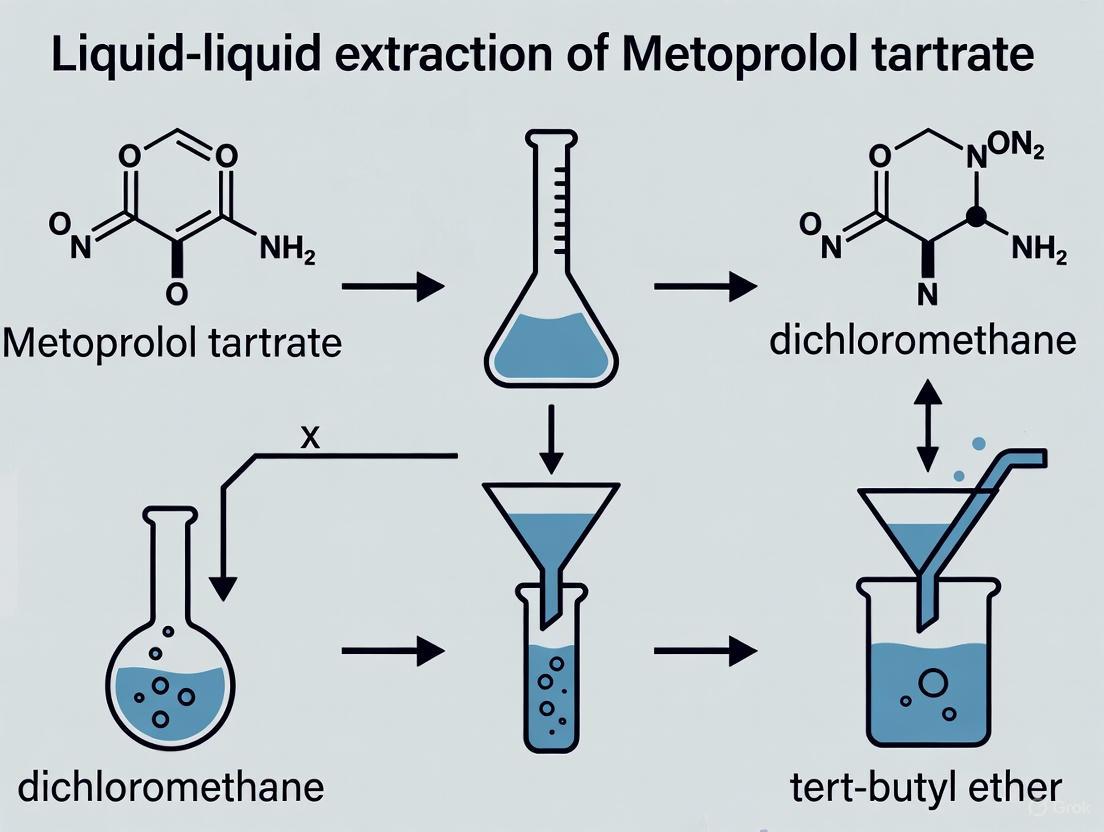
This article provides a comprehensive guide to the liquid-liquid extraction of metoprolol tartrate, comparing dichloromethane (DCM) and tert-butyl ether (MTBE) as solvents.
Optimizing Liquid-Liquid Extraction of Metoprolol Tartrate: A Comparative Study with Dichloromethane and Tert-Butyl Ether
Abstract
This article provides a comprehensive guide to the liquid-liquid extraction of metoprolol tartrate, comparing dichloromethane (DCM) and tert-butyl ether (MTBE) as solvents. It covers foundational principles, step-by-step methodologies, troubleshooting strategies, and validation techniques tailored for researchers and drug development professionals. The scope includes optimizing extraction efficiency, addressing common challenges, and evaluating solvent performance to support pharmaceutical analysis and purity assessment.
Foundations of Liquid-Liquid Extraction for Metoprolol Tartrate: Principles and Solvent Selection
Chemical and Physical Properties
Metoprolol Tartrate is a selective β1-adrenergic receptor blocker widely used in cardiovascular medicine. Chemically, it is a 2:1 salt of a racemic mixture of optical isomers of metoprolol and naturally occurring dextrotartaric acid [1]. The compound has a molecular weight of 267.36 g/mol and the chemical formula C15H25NO3 [2]. As a substituted phenylpropanolamine, its structure provides the necessary features for selective β-1 adrenergic receptor blockade [3].
Table 1: Fundamental Properties of Metoprolol Tartrate
| Property | Specification |
|---|---|
| Chemical Formula | C({15})H({25})NO(_3) [2] |
| Molecular Weight | 267.36 g/mol [2] |
| Melting Point | >100°C (varies with gamma-irradiation dose) [4] |
| Solubility | Soluble in water and ethanol [1] |
| Protein Binding | Approximately 11% (mainly to serum albumin) [2] |
| Bioavailability | ~50% for tartrate (immediate-release) due to first-pass metabolism [2] [3] |
The solid-state properties of metoprolol tartrate, including its crystallinity, are resistant to gamma-irradiation doses between 20-40 kGy, making this range suitable for sterilization processes in pharmaceutical production [4]. The drug's partition coefficient can be significantly enhanced in aqueous two-phase systems (ATPS) using deep eutectic solvents, improving its extraction efficiency [5].
Analytical Methods and Detection
Advanced analytical techniques are required for the identification, quantification, and therapeutic drug monitoring of metoprolol tartrate in both pharmaceutical preparations and biological matrices.
Table 2: Analytical Techniques for Metoprolol Tartrate
| Technique | Application | Key Details |
|---|---|---|
| Infrared (IR) Spectroscopy | Identification of raw material and tablet forms [1] | KBr pellet method; comparison to standard spectrum |
| Thin-Layer Chromatography (TLC) | Identification of the tartrate ion [1] | Comparison of Rf values between sample and standard |
| High-Performance Liquid Chromatography (HPLC) | Identification, quantification [1] | Retention time comparison |
| Liquid Chromatography-Tandem Mass Spectrometry (LC-MS/MS) | Quantification in human plasma [6] | MRM transitions: m/z 268.0→103.10; range: 5-500 ng/mL |
| Liquid Chromatography-Mass Spectrometry (LC-MS) | Determination in EBC, plasma, and urine [7] | LOD: 0.12-0.21 µg·L(^{-1}); LOQ: 0.40-0.70 µg·L(^{-1}) |
For analysis in biological samples, sample preparation is critical. For plasma, a common approach involves protein precipitation using methanol and trichloroacetic acid, followed by centrifugation and analysis of the supernatant [7]. In contrast, exhaled breath condensate (EBC) samples can often be analyzed directly without extensive pre-treatment, leveraging their simpler matrix [7].
Pharmaceutical Significance and Clinical Applications
Metoprolol tartrate is a cornerstone in managing cardiovascular diseases. It is FDA-approved for hypertension, angina pectoris, heart failure, and myocardial infarction (heart attack) [3]. Its off-label uses include migraine prevention, essential tremor, supraventricular tachycardia, and as an adjunct treatment for thyroid storm [3].
The therapeutic effect is achieved through selective inhibition of β-1 adrenergic receptors in the heart, resulting in decreased cardiac excitability, reduced cardiac output, and lowered myocardial oxygen demand [3]. This cardioselectivity is a key advantage, as it minimizes the risk of bronchospasm and peripheral vasoconstriction associated with non-selective β-blockers [3].
Experimental Protocols
Protocol: Liquid-Liquid Extraction from Human Plasma for LC-MS/MS Analysis
This protocol is adapted from a validated method for the simultaneous determination of metoprolol tartrate and ramipril [6].
- Materials: Human plasma samples, metoprolol tartrate standard, diethyl ether, dichloromethane, LC-MS grade ammonium formate and methanol.
- Equipment: LC-MS/MS system with a reversed-phase C8 column, vortex mixer, centrifuge, and micropipettes.
Procedure:
- Preparation: Thaw frozen plasma samples at room temperature and vortex to ensure homogeneity.
- Extraction: In a glass tube, mix 1 mL of plasma with a known concentration of the internal standard (if used). Add 5 mL of the extraction solvent, diethyl ether-dichloromethane (70:30, v/v).
- Mixing and Centrifugation: Vortex the mixture vigorously for 5 minutes. Centrifuge at approximately 4000 rpm for 10 minutes to separate the organic and aqueous layers.
- Collection: Transfer the upper organic layer carefully to a clean evaporation tube.
- Evaporation: Evaporate the organic solvent to dryness under a gentle stream of nitrogen gas in a water bath at 40°C.
- Reconstitution: Reconstitute the dry residue with 200 µL of the mobile phase (10 mM ammonium formate-methanol, 3:97 v/v) and vortex to dissolve.
- Analysis: Inject an aliquot into the LC-MS/MS system. The mass spectrometer is operated in positive ionization mode with Multiple Reaction Monitoring (MRM), tracking the transition of the protonated analyte from m/z 268.0 to 103.10 for metoprolol [6].
Protocol: Partitioning in a Deep Eutectic Solvent (DES)-Based Aqueous Two-Phase System (ATPS)
This protocol outlines the use of a novel ATPS for the partitioning of metoprolol tartrate, which is highly relevant for pharmaceutical purification [5].
- Materials: Tetra-n-butylammonium bromide (TBAB) as Hydrogen Bond Acceptor (HBA), Polyethylene Glycol 200 (PEG200) as Hydrogen Bond Donor (HBD), dipotassium hydrogen phosphate (K₂HPO₄), deionized water.
- Equipment: Magnetic stirrer with heating, analytical balance, centrifuge, Raman spectrometer for characterization.
Procedure:
- DES Synthesis: Synthesize the DES by combining TBAB and PEG200 in a 1:3 molar ratio. Heat the mixture at 60°C under continuous stirring (~500 rpm) until a homogeneous, transparent liquid is formed. Characterize the resulting DES using Raman spectroscopy to confirm its structure [5].
- ATPS Formation: Prepare the ATPS by weighing specific amounts of the synthesized DES, salt (K₂HPO₄), and a 0.1-0.15 wt% aqueous solution of metoprolol tartrate into a test tube. The total mass should correspond to a predetermined operating point on the phase diagram [5].
- Phase Separation: Vigorously vortex the mixture for complete mixing, then centrifuge at low speed to accelerate phase separation. The system will separate into a DES-rich top phase and a salt-rich bottom phase [5].
- Sampling and Analysis: Carefully separate the two phases. Determine the concentration of metoprolol tartrate in each phase using a suitable analytical method (e.g., UV-Vis spectroscopy or HPLC). The partition coefficient (K) is calculated as K = C~top~/C~bottom~, where C is the concentration of the drug [5].
Signaling Pathway and Experimental Workflow
Metoprolol's Cardio-Inhibitory Pathway
Analytical Workflow for Metoprolol
The Scientist's Toolkit: Research Reagent Solutions
Table 3: Essential Reagents for Metoprolol Tartrate Research
| Reagent / Material | Function and Application |
|---|---|
| Tetra-n-butylammonium Bromide (TBAB) | Hydrogen Bond Acceptor (HBA) for creating a Deep Eutectic Solvent (DES) with tunable properties for ATPS, improving partitioning efficiency [5]. |
| Polyethylene Glycol 200 (PEG200) | Hydrogen Bond Donor (HBD) used with TBAB to form a biocompatible, low-viscosity DES for ATPS, enhancing drug stability and impurity removal [5]. |
| Diethyl Ether-Dichloromethane (70:30, v/v) | Liquid-liquid extraction solvent for isolating metoprolol tartrate from complex biological matrices like human plasma prior to LC-MS/MS analysis [6]. |
| Dipotassium Hydrogen Phosphate (K₂HPO₄) | Salt used to induce phase separation in an ATPS by creating a salt-rich bottom phase, opposing the DES-rich top phase [5]. |
| Ammonium Formate-Methanol Mobile Phase | A common volatile buffer/organic solvent combination for LC-MS/MS analysis, enabling efficient chromatographic separation and ionization [6]. |
| Trichloroacetic Acid (TCA) | Reagent used for protein precipitation in plasma sample preparation, removing interfering proteins before instrumental analysis [7]. |
Basic Principles of Liquid-Liquid Extraction in Analytical Chemistry
Liquid-Liquid Extraction (LLE) is a fundamental separation and purification technique in analytical chemistry, particularly crucial for isolating and concentrating analytes from complex matrices. The process exploits the differential solubility of a solute between two immiscible liquids, typically an organic solvent and an aqueous phase. In pharmaceutical research, LLE is indispensable for sample preparation in bioanalysis, enabling the clean-up and pre-concentration of active pharmaceutical ingredients (APIs) from biological fluids prior to chromatographic analysis [8]. This application note details the core principles, reagents, and standardized protocols for LLE, contextualized within a research framework for extracting metoprolol tartrate using dichloromethane and tert-butyl methyl ether [8].
Core Principles and Application to Metoprolol Research
The efficacy of LLE hinges on the partition coefficient (K), a thermodynamic constant defined as the ratio of the analyte's concentration in the organic phase to its concentration in the aqueous phase at equilibrium. A high K value signifies a favorable transfer into the organic solvent.
For ionizable compounds like metoprolol (a selective β1-adrenergic receptor blocker), the pH of the aqueous phase is a critical control parameter. Metoprolol can exist in a protonated, water-soluble form or a neutral, organic-soluble form. Adjusting the aqueous phase to a basic pH suppresses the ionization of metoprolol, shifting the equilibrium towards its neutral form, which exhibits higher solubility in organic solvents like dichloromethane and tert-butyl methyl ether [8]. This principle allows for selective extraction from biological samples such as plasma.
Table 1: Key Physicochemical Properties Relevant to LLE of Metoprolol
| Property | Description | Importance in LLE |
|---|---|---|
| Ionization Character | Basic compound | Enables pH-controlled extraction. |
| pKa | ~9.7 | Determines the pH for efficient extraction (typically 1-2 units above pKa). |
| Partition Coefficient (Log P) | ~1.7 [9] | Indicates inherent hydrophobicity and guides solvent selection. |
| Analytical Detection | LC-MS/MS [8] | Requires a clean extract to minimize ion suppression. |
The Scientist's Toolkit: Essential Reagents and Materials
The following reagents are essential for executing a successful LLE protocol for metoprolol from plasma samples.
Table 2: Key Research Reagent Solutions for Metoprolol LLE
| Reagent/Material | Function/Explanation |
|---|---|
| Dichloromethane (DCM) | A dense chlorinated hydrocarbon solvent with high extraction efficiency for a wide range of non-polar to moderately polar compounds. |
| tert-Butyl Methyl Ether (TBME) | A less dense ether solvent. Often compared with DCM for extraction recovery and selectivity; can produce cleaner extracts with lower co-extraction of endogenous phospholipids. |
| Sodium Hydroxide (NaOH) Solution | Used to make the aqueous phase (e.g., plasma) basic (pH ~10-11), ensuring metoprolol is in its neutral form for optimal partitioning into the organic phase. |
| Drug-Free Plasma | Serves as a blank matrix for preparing calibration standards and quality control samples to validate the analytical method and account for matrix effects. |
| Metoprolol Tartrate Standard | The authentic reference standard used to prepare calibration curves and quantify the analyte in unknown samples. |
| Internal Standard (e.g., Hydroxypioglitazone) | A structurally analogous compound added in a constant amount to all samples to correct for variability in sample preparation and instrument analysis [8]. |
Detailed Experimental Protocol
This protocol outlines the LLE of metoprolol from plasma, adaptable for solvents like DCM and TBME.
Materials and Preparation
- Equipment: Separatory funnel (125-250 mL) with Teflon stopcock, ring stand, funnels, glass test tubes, vortex mixer, centrifuge, pipettes [10].
- Biological Matrix: Plasma samples (e.g., from beagle dogs for pharmacokinetic studies) [8].
- Reagents: Dichloromethane, tert-butyl methyl ether, sodium hydroxide solution (1.0 M), hydrochloric acid (1.0 M), and an internal standard solution.
Step-by-Step Procedure
Step 1: Sample Alkalization
- Transfer a measured volume of plasma (e.g., 1 mL) to a glass tube.
- Add the internal standard solution.
- Add 0.5-1.0 mL of 1.0 M NaOH solution. The pH should be verified to be between 10 and 11 to ensure metoprolol is deprotonated [8].
Step 2: Extraction
- Add a measured volume of organic solvent (e.g., 3-5 mL of DCM or TBME) to the alkalized plasma.
- Cap the tube securely and mix vigorously on a vortex mixer for 2-3 minutes. If using a separatory funnel, hold the funnel with the stopper securely in place, invert, and immediately vent by opening the stopcock to release pressure [10].
- Allow the phases to separate completely. This can be accelerated by a brief centrifugation.
Step 3: Phase Separation and Isolation
- For DCM (denser than water), the organic layer will be the bottom phase. For TBME (less dense than water), the organic layer will be the top phase.
- Carefully transfer the organic layer containing the extracted metoprolol to a clean tube using a Pasteur pipette, taking care not to transfer any of the aqueous interface.
Step 4: Sample Concentration
- Evaporate the organic solvent to dryness under a gentle stream of nitrogen gas in a warm water bath.
- Reconstitute the dry residue in a small volume of LC-MS/MS mobile phase (e.g., 100-200 µL), vortex thoroughly, and transfer to an autosampler vial for analysis [8].
Data Analysis, Validation, and Troubleshooting
Quantitative Analysis
Quantification is achieved by constructing a calibration curve from drug-free plasma spiked with known concentrations of metoprolol. The peak area ratio of metoprolol to the internal standard is plotted against the nominal concentration. The concentration in unknown samples is determined by interpolating from this curve [8].
Table 3: Example Validation Parameters for an LC-MS/MS Bioanalytical Method [8]
| Validation Parameter | Acceptance Criteria | Experimental Data for Metoprolol |
|---|---|---|
| Linearity Range | r ≥ 0.99 | 3.03 – 416.35 ng/mL (r = 0.9996) |
| Lower Limit of\nQuantification (LLOQ) | Precision ≤20%, Accuracy 80-120% | 3.03 ng/mL (Precision: 8.72%, Accuracy: 99.96%) |
| Precision (Intra-day RSD) | ≤15% | 2.54% - 10.65% |
| Accuracy | 85% - 115% | 95.20% - 99.96% |
| Recovery | Consistent and reproducible | 76.06% - 95.25% |
Workflow for QbD-based LLE Process Development
In regulated industries, LLE process development aligns with Quality-by-Design (QbD) principles. The following workflow, adapted for analytical method development, ensures a systematic and risk-based approach [11].
Troubleshooting Common Issues
- Low Recovery: Ensure the aqueous phase pH is correctly adjusted. Verify the solvent purity and the efficiency of the mixing step. Check for emulsion formation.
- Emulsion Formation: Gently swirl the separatory funnel or perform a brief centrifugation. Adding a small amount of salt (e.g., NaCl) can help break emulsions.
- High Background/Matrix Effects: Ensure clean phase separation to avoid transferring the aqueous interface. Consider using a different solvent (e.g., TBME may yield a cleaner extract than DCM) or introducing a back-extraction (wash) step [8] [11].
Liquid-liquid extraction remains a robust, versatile, and widely applicable technique for sample preparation in analytical chemistry. When applied to the analysis of metoprolol, a clear understanding of its acid-base properties allows for the optimization of critical parameters like pH and solvent choice. Adherence to detailed protocols and rigorous method validation, as exemplified, ensures the generation of reliable, reproducible, and high-quality data suitable for demanding applications in pharmaceutical research and development, including preclinical pharmacokinetic studies [8]. The integration of modern QbD principles further strengthens the robustness of LLE methods, facilitating their application in regulated environments [11].
This application note provides a comparative analysis of dichloromethane (DCM) and tert-butyl methyl ether (MTBE) as solvents for the liquid-liquid extraction (LLE) of metoprolol tartrate. The selection of an optimal solvent is a critical determinant of success in the isolation and purification of active pharmaceutical ingredients (APIs). Framed within broader research on metoprolol tartrate, this document offers structured quantitative data and detailed protocols to guide researchers and drug development professionals in making informed decisions for their extraction processes. The properties of these solvents, summarized herein, have a direct impact on extraction efficiency, selectivity, and overall process safety.
Comparative Solvent Properties
The efficacy of a solvent in liquid-liquid extraction is governed by its physical and chemical properties. The table below provides a direct comparison of key properties for DCM and MTBE, which are critical for evaluating their performance in extracting metoprolol tartrate.
Table 1: Physical and Chemical Properties of Dichloromethane and tert-Butyl Methyl Ether [12]
| Property | Dichloromethane (DCM) | tert-Butyl Methyl Ether (MTBE) |
|---|---|---|
| Chemical Formula | CH₂Cl₂ | C₅H₁₂O |
| Molecular Weight (g/mol) | 84.93 | 88.15 |
| Boiling Point (°C) | 39.8 | 55.2 |
| Density (g/mL) | 1.326 | 0.741 |
| Dielectric Constant (ε) | 9.08 | Not Provided |
| Flash Point (°C) | -- | -28 |
| Solubility in Water | 1.32 g/100 mL | 5.1 g/100 mL |
The data reveals a stark contrast between the two solvents. DCM is a dense, chlorinated solvent with higher polarity (as indicated by its dielectric constant), while MTBE is a lighter ether. A solvent's dielectric constant influences its ability to dissolve polar compounds like metoprolol tartrate, while density and water solubility are pivotal for the practical separation of phases during LLE [13] [12].
Experimental Protocols
Supported Liquid Extraction Protocol for Metoprolol Tartrate
Supported Liquid Extraction (SLE) offers a robust, automatable alternative to traditional LLE, often providing cleaner extracts and higher recovery rates for pharmaceutical compounds [14]. The following protocol is adapted from methodologies proven to be effective for basic drugs like metoprolol.
Title: SLE for High-Efficiency Extraction of Metoprolol Tartrate
Objective: To efficiently extract metoprolol tartrate from an aqueous matrix using SLE, maximizing recovery and minimizing matrix effects.
Materials:
- Supported Liquid Extraction Plates: Diatomaceous earth or silica-based SLE columns (e.g., 1 mL or 3 mL capacity).
- Loading Buffer: 0.1 M Phosphate buffer, pH 7.0.
- Elution Solvent: Dichloromethane or tert-Butyl Methyl Ether.
- Sample: Aqueous solution containing metoprolol tartrate (e.g., plasma, buffer solution).
- Equipment: Positive pressure manifold or vacuum manifold for liquid handling.
Procedure:
- Conditioning: Do not pre-wet the SLE support material. The dry bed is essential for efficient absorption in the subsequent step.
- Sample Preparation: Mix the aqueous sample containing metoprolol tartrate with an equal volume of the 0.1 M phosphate buffer (pH 7.0). This ensures the analyte is in its neutral form, promoting partitioning into the organic solvent.
- Loading: Slowly apply the buffered sample to the SLE column. Allow it to absorb into the support bed completely. A slow, drop-wise application is critical for maximum efficiency.
- Equilibration: Let the column stand for 5-10 minutes after loading to ensure complete absorption and interaction.
- Elution: Pass the chosen elution solvent (DCM or MTBE) through the column. Typically, 2-3 column volumes of solvent are sufficient. Collect the entire eluate in a clean tube.
- Analysis: Evaporate the eluate to dryness under a gentle stream of nitrogen. Reconstitute the residue in a mobile phase compatible with your HPLC-MS/MS system for quantification.
Notes: SLE has been demonstrated to achieve over 75% recovery for metoprolol and significantly reduce phospholipid-based matrix effects compared to protein precipitation [14]. The choice of elution solvent (DCM or MTBE) will influence recovery and specificity, and should be validated for the specific application.
Traditional Liquid-Liquid Extraction Protocol
Title: Standard LLE for Metoprolol Tartrate Using DCM or MTBE
Objective: To isolate metoprolol tartrate from an aqueous sample using traditional LLE.
Materials:
- Solvents: Dichloromethane or tert-Butyl Methyl Ether.
- Sample: Aqueous solution containing metoprolol tartrate.
- Equipment: Glass centrifuge tubes with PTFE-lined caps, vortex mixer, centrifuge.
Procedure:
- pH Adjustment: Transfer 1 mL of the aqueous sample to a glass centrifuge tube. Adjust the pH to 9-10 using a suitable buffer (e.g., ammonium bicarbonate) or a dilute base (e.g., sodium hydroxide). This deprotonates the amine group of metoprolol, enhancing its partitioning into the organic phase.
- Extraction: Add 3 mL of the chosen organic solvent (DCM or MTBE) to the tube.
- Mixing: Cap the tube securely and vortex mix vigorously for 1-2 minutes.
- Phase Separation: Centrifuge the tube at 3000 rpm for 5 minutes to achieve clear phase separation.
- Collection: Transfer the lower (for DCM) or upper (for MTBE) organic layer to a new tube, taking care not to disturb the interface.
- Back-Extraction (Optional): For a cleaner extract, the organic phase can be shaken with a small volume of dilute acid (e.g., 0.1 M HCl) to back-extract metoprolol into the aqueous phase.
- Analysis: Evaporate the organic phase to dryness under nitrogen and reconstitute for analysis as described in the SLE protocol.
Workflow and Decision Pathway
The following diagrams outline the experimental workflow for SLE and the logical decision pathway for solvent selection.
Figure 1: SLE Workflow for Metoprolol Extraction.
Figure 2: Solvent Selection Decision Pathway.
The Scientist's Toolkit: Essential Research Reagents and Materials
Table 2: Key Materials for Liquid-Liquid Extraction of Metoprolol
| Item | Function/Benefit |
|---|---|
| Dichloromethane (DCM) | A dense, chlorinated solvent ideal for rapid extraction of a wide range of analytes and easy phase separation as the lower layer [12]. |
| tert-Butyl Methyl Ether (MTBE) | A less dense ether with low solubility in water, excellent for extracting less polar compounds; forms the upper layer [12]. |
| Supported Liquid Extraction (SLE) Plates | Provide a high-surface-area support for aqueous samples, enabling efficient and automated extraction with reduced emulsion formation compared to LLE [14]. |
| Ammonium Bicarbonate Buffer | Used for pH adjustment (basic) in LLE to ensure the target analyte is in its uncharged, extractable form. |
| Phosphate Buffer (pH 7.0) | Used in SLE to optimize the loading conditions, ensuring the analyte is neutral for efficient transfer to the organic eluent [14]. |
| HPLC-MS/MS System | Provides the high sensitivity and selectivity required for the accurate quantification of metoprolol tartrate in complex matrices post-extraction [14]. |
Factors Influencing Partition Coefficients and Solubility
In the context of research on the liquid-liquid extraction of metoprolol tartrate using dichloromethane and tert-butyl ether, understanding the factors that influence partition coefficients and solubility is paramount. These physicochemical parameters are critical for optimizing extraction efficiency, purification, and subsequent analytical methods in drug development. The partition coefficient defines how a solute distributes itself between two immiscible solvents, while solubility determines the maximum concentration achievable in a given solvent. For pharmaceutical compounds like metoprolol tartrate, these properties are not intrinsic constants but are influenced by the chemical nature of the solute, solvent system composition, temperature, pH, and ionic strength. This application note provides a detailed examination of these factors, supported by structured data and protocols, to guide researchers in the rational design of extraction processes.
Theoretical Framework
Defining Partition and Distribution Coefficients
The partition coefficient (P) is a fundamental parameter in liquid-liquid extraction, defined as the ratio of the concentrations of a solute in a mixture of two immiscible solvents at equilibrium. For a solute partitioning between an organic phase and an aqueous phase, it is expressed as: [ P = \frac{[Solute]{organic}}{[Solute]{aqueous}} ] The distribution coefficient (D) is a related term that becomes crucial when the solute can exist in different forms (e.g., ionized and unionized) in the aqueous phase. It is the ratio of the sum of the concentrations of all forms of the solute in the organic phase to the sum of all forms in the aqueous phase. The distribution coefficient is pH-dependent for ionizable compounds, whereas the partition coefficient refers specifically to the concentration of the unionized species [15].
The effectiveness of a single extraction step is quantified by the fraction of solute extracted, which depends on the distribution coefficient and the volume ratio of the two phases. For a solute with a distribution coefficient ( D ) and a system with volumes ( V{organic} ) and ( V{aqueous} ), the fraction remaining in the aqueous phase after one extraction is ( \frac{V{aqueous}}{DV{organic} + V_{aqueous}} ). This relationship demonstrates that multiple extractions with smaller volumes of organic solvent are more efficient than a single extraction with a large volume [15].
Key Factors Influencing Partitioning and Solubility
The partitioning behavior and solubility of a solute are governed by a balance of intermolecular forces. The following factors are the most significant:
- Solute Properties: The hydrophobicity of a solute, often measured by its log P in the octanol-water system, is a primary determinant. Polar solutes with hydrogen-bonding groups tend to favor the aqueous phase, while non-polar, hydrophobic solutes favor organic phases. The acid dissociation constant (pKa) of a solute dictates the fraction of unionized molecules at a given pH, which directly impacts the distribution coefficient for ionizable compounds [15].
- Solvent Properties: The relative polarity and ability of the solvents to form specific interactions (e.g., hydrogen bonding, dipole-dipole) with the solute are critical. A common principle is "like dissolves like." In reversed-phase liquid chromatography, which mimics partitioning systems, the concentration of the organic modifier in the mobile phase is a major factor controlling retention, demonstrating its profound effect on the partition equilibrium [16].
- pH of the Aqueous Phase: For ionizable compounds, pH is a powerful tool for controlling partitioning. The Henderson-Hasselbalch equation can be used to calculate the fraction of unionized species. Adjusting the pH to suppress ionization can dramatically increase the distribution coefficient into the organic phase for acids and bases, a principle leveraged in acid-base extractions [15].
- Ionic Strength: The concentration of salts in the aqueous phase can influence solubility and partitioning through the "salting-out" effect. Increased ionic strength can reduce the solubility of non-electrolytes in the aqueous phase, thereby increasing their partition coefficient into the organic phase. The size and valence of the ions influence the extent of this effect [17].
- Temperature: Temperature changes can affect the solubility of the solute in both phases and the thermodynamics of the partitioning equilibrium, as reflected in the partition coefficient's dependence on temperature.
Application to Metoprolol Tartrate Extraction
Physicochemical Profile of Metoprolol
Metoprolol is a beta-1 adrenergic receptor antagonist used to treat hypertension and angina. Its physicochemical properties make it a relevant model compound for extraction studies.
Table 1: Key Physicochemical Properties of Metoprolol
| Property | Value / Description | Significance for Extraction |
|---|---|---|
| Log P | 1.76 [18] | Indicates moderate hydrophobicity, favoring partitioning into organic solvents over water. |
| pKa | ~9.7 (basic amine) | The compound is ionized at gastric and intestinal pH, but can be unionized at high pH. |
| BCS Classification | Class I (High Solubility, High Permeability) [18] [19] | Suggests good aqueous solubility, which may challenge extraction from aqueous streams. |
| Solubility | High and pH-independent [19] | Consistent solubility across physiological pH ranges; extraction efficiency may not be pH-tunable via solubility. |
| Protein Binding | ~12% bound to albumin [18] | Generally low, so not a major complicating factor in extraction from biological matrices. |
Analysis of Selected Solvent Systems
The choice of solvent is critical for an efficient extraction. Below, two solvents relevant to the user's research are compared.
Table 2: Solvent System Analysis for Metoprolol Extraction
| Solvent | Dichloromethane (DCM) | tert-Butyl Methyl Ether (TBME) |
|---|---|---|
| Chemical Structure | CH~2~Cl~2~ | (CH~3~)~3~COCH~3~ |
| Polarity | Moderate | Low to Moderate |
| Density | 1.33 g/mL | 0.74 g/mL |
| Advantages | High extraction efficiency for a wide range of compounds; well-established in methods like Bligh/Dyer [20]. | Less toxic than chlorinated solvents; forms upper organic phase, simplifying recovery [20]. |
| Disadvantages | Denser than water, forming a lower phase that is more prone to contamination during recovery [20]; higher toxicity. | May have lower extraction efficiency for very polar lipids or specific pharmaceuticals compared to DCM [20]. |
| Considerations for Metoprolol | Good candidate due to metoprolol's log P of 1.76. Careful phase separation is needed. | A viable, safer alternative. Its performance for metoprolol should be validated against DCM. |
Detailed Experimental Protocols
Protocol 1: Liquid-Liquid Extraction of Metoprolol from Aqueous Solution
This protocol describes a standard method for extracting metoprolol tartrate from an aqueous buffer using dichloromethane.
Principle: Metoprolol, with a pKa of ~9.7, exists predominantly in its ionized, water-soluble form at neutral pH. Adjusting the aqueous phase to a alkaline pH (e.g., >11) converts metoprolol to its unionized form, which readily partitions into the organic solvent DCM.
Materials:
- Aqueous Sample: Solution containing metoprolol tartrate.
- Organic Solvent: Dichloromethane (HPLC grade).
- pH Adjustment: Sodium hydroxide (NaOH) solution (e.g., 1M) or other suitable base.
- Labware: Separatory funnel (250 mL), glass beakers, stand, ring support, pipettes, and glass collection vials.
Procedure:
- Sample Preparation: Transfer a known volume (e.g., 100 mL) of the aqueous metoprolol solution into a 250 mL separatory funnel.
- pH Adjustment: Carefully add 1M NaOH solution drop-wise while gently swirling the funnel. Use a pH meter to monitor until the pH stabilizes above 11. Caution: The neutralization reaction may be exothermic and release CO~2~ if carbonates are present; vent the funnel frequently.
- Solvent Addition: Add a volume of DCM equivalent to approximately one-third to one-half the volume of the aqueous phase (e.g., 30-50 mL for a 100 mL sample).
- Extraction: a. Seal the separatory funnel with its stopper. b. Invert the funnel and immediately open the stopcock to vent any pressure. c. Close the stopcock and shake the mixture vigorously for 1-2 minutes, venting periodically. d. Place the funnel back in the ring support and allow the phases to separate completely. DCM will form the lower layer.
- Phase Separation: a. Remove the stopper from the funnel. b. Slowly open the stopcock and drain the lower organic layer (DCM containing extracted metoprolol) into a clean glass beaker. c. The upper aqueous phase can be discarded or subjected to a second extraction for higher yield.
- Drying (Optional): Pass the organic extract through a bed of anhydrous sodium sulfate to remove any residual water.
- Concentration (Optional): Evaporate the DCM under a gentle stream of nitrogen gas or using a rotary evaporator to concentrate the metoprolol for analysis.
Protocol 2: Three-Phase Lipid Extraction (3PLE) for Complex Matrices
For extracting metoprolol from complex biological matrices like tissue homogenates or plasma, a more sophisticated extraction may be required to separate lipids from the drug of interest. The Three-Phase Lipid Extraction (3PLE) method is highly effective [20].
Principle: A solvent system of hexane, methyl acetate, acetonitrile, and water forms three distinct phases: an upper phase enriched in neutral lipids, a middle phase containing polar phospholipids, and a lower aqueous phase. A drug like metoprolol would be expected to partition into one of the organic phases based on its polarity, separating it from highly polar aqueous interferents.
Materials:
- Solvents: Hexane, methyl acetate, acetonitrile (all HPLC grade).
- Sample: Tissue homogenate (e.g., liver) or plasma.
- Labware: 16 x 100 mm glass tubes with PTFE-lined caps, glass Pasteur pipettes, centrifuge.
Procedure:
- Homogenization: Homogenize approximately 100 mg of tissue in 1 ml of methanol-dichloromethane (1:2, v/v). For plasma, precipitate proteins by adding 2 ml methanol-dichloromethane (1:1, v/v) to 10 μl of plasma, vortex, centrifuge, and transfer the supernatant [20].
- Extraction Setup: Transfer an aliquot of the homogenate or supernatant (equivalent to 0.5 mg tissue) to a glass tube.
- Solvent Addition: Add 1 ml hexane, 1 ml methyl acetate, 0.75 ml acetonitrile, and 1 ml water using serological pipettes. The mixture will be: hexane/methyl acetate/acetonitrile/water in a 4:4:3:4 ratio [20].
- Mixing and Centrifugation: Vortex the mixture for 5 seconds and then centrifuge at 2,671 g for 5 minutes at room temperature. Three clear phases will form.
- Phase Collection: a. The upper phase contains neutral lipids (e.g., triacylglycerols). b. The middle phase contains polar phospholipids. c. Collect the upper and middle organic layers separately using Pasteur pipettes. d. To clean the middle phase fraction, it can be re-extracted by adding 1 ml hexane, vortexing, centrifuging, and collecting the cleaned middle phase [20].
- Analysis: Dry the collected organic phases under a stream of nitrogen and reconstitute in an appropriate solvent for analysis (e.g., LC-MS).
The following workflow diagram illustrates the 3PLE protocol:
Workflow for 3-Phase Lipid Extraction
The Scientist's Toolkit: Key Reagents and Materials
Table 3: Essential Research Reagents for Extraction Studies
| Reagent/Material | Function and Application Notes |
|---|---|
| Dichloromethane (DCM) | A dense, chlorinated organic solvent with moderate polarity. Excellent for extracting a wide range of medium-polarity compounds like metoprolol. Forms the lower phase in water mixtures [20]. |
| tert-Butyl Methyl Ether (TBME) | A less toxic, low-density ether solvent. Used as a safer alternative to chlorinated solvents. Forms the upper phase, simplifying recovery [20]. |
| Hexane | A very non-polar aliphatic solvent. Used in the 3PLE system to help separate neutral, highly hydrophobic lipids into the upper phase [20]. |
| Methyl Acetate | A medium-polarity ester solvent. Acts as a key component in the 3PLE system, contributing to the formation of the three-phase system and the solubility profile of the middle phase [20]. |
| Acetonitrile | A polar aprotic solvent, miscible with water and many organic solvents. In the 3PLE system, it modifies the polarity of the mixture to achieve the three-phase separation [20]. |
| Anhydrous Sodium Sulfate | A drying agent used to remove trace water from organic extracts after the phase separation step, ensuring a clean, dry sample for analysis. |
| Hydrophilic Filter (e.g., Durapore) | A porous membrane (0.22 µm) used in permeation studies or to separate solids from liquids, such as in solubility measurements or sample cleanup prior to analysis [19]. |
| Octanol | A long-chain alcohol used to measure standard log P values and as a receiver phase in membrane permeation assays to model passive diffusion [19]. |
Data Presentation and Analysis
Quantitative Data from Literature
The following table summarizes key quantitative findings from the search results relevant to metoprolol and extraction science.
Table 4: Summary of Relevant Quantitative Data from Literature
| Source / Context | Quantitative Finding | Experimental Condition |
|---|---|---|
| Metoprolol Pharmacokinetics [18] | Log P = 1.76 | Measured or reported intrinsic partition coefficient. |
| Metoprolol Pharmacokinetics [18] | Fraction absorbed (fa) in humans ≥ 85% | Based on human oral bioavailability data. |
| Metoprolol Permeability [19] | Apparent permeability (P~app~) was measured. | Calculated from permeation profiles (15-60 min) using a hydrophilic filter and octanol receiver. |
| 3PLE Method [20] | Solvent ratio: Hexane/Methyl Acetate/Acetonitrile/Water = 4:4:3:4 | The specific ratio required to form the three-phase system. |
| 3PLE Method [20] | Centrifugation: 2,671 g for 5 min | Standard condition for phase separation in the 3PLE protocol. |
| Ionic Strength Effect [17] | At ionic strengths >0.5 M, β-conglycinin remained in its 7S form from pH 1.0 to 11.5. | Demonstrates the profound effect of ionic strength on protein conformation, a principle applicable to solute solubility. |
| Ionic Strength Effect [17] | At low ionic strengths (0.01 M), reversible dissociation of protein subunits occurred under mild alkaline or acidic conditions. | Contrasting effect of low ionic strength on macromolecular structure. |
The optimization of partition coefficients and solubility is a cornerstone of efficient liquid-liquid extraction processes in pharmaceutical research. For specific applications such as the extraction of metoprolol tartrate with dichloromethane and tert-butyl ether, a deep understanding of the solute's properties (log P, pKa), solvent characteristics, and environmental conditions (pH, ionic strength) is non-negotiable. The protocols and data summarized herein provide a robust foundation for researchers to develop, optimize, and troubleshoot extraction methods. By applying these principles and leveraging advanced techniques like the three-phase extraction for complex matrices, scientists can achieve high purity and yield, thereby accelerating drug development and analysis. Future work should focus on experimentally determining the specific partition coefficients of metoprolol in the DCM-water and TBME-water systems to quantitatively validate the theoretical predictions made in this note.
Practical Protocol: Step-by-Step Extraction of Metoprolol Tartrate Using DCM and MTBE
Required Materials, Reagents, and Safety Precautions
Research Reagent Solutions and Essential Materials
The following items are essential for the liquid-liquid extraction of metoprolol tartrate.
| Item | Function/Brief Explanation |
|---|---|
| Metoprolol Tartrate (MPT) | The active pharmaceutical ingredient (API) subject to extraction and analysis. A selective β-adrenergic antagonist. [21] |
| Dichloromethane (DCM) | An organic solvent used as the extractant for the liquid-liquid extraction process. [22] |
| tert-Butyl Ether | An organic solvent used in the extraction process. Caution: Ethers may form explosive peroxides upon storage. [22] |
| Copper(II) Chloride Dihydrate | Reagent used for the complexation and subsequent spectrophotometric determination of metoprolol. [21] |
| Britton-Robinson Buffer (pH 6.0) | Used to maintain the optimal pH for the complexation reaction between metoprolol and copper(II) ions. [21] |
| Deionized Water | Used for the preparation of all aqueous solutions to ensure the absence of interfering ions. [21] |
Experimental Protocol: Liquid-Liquid Extraction and Spectrophotometric Determination
Safety Precautions and Preliminary Setup
- Personal Protective Equipment (PPE): Wear appropriate gloves, safety goggles, and a lab coat. Consult glove manufacturer databases for chemical compatibility, especially with DCM and tert-butyl ether. [23] [22]
- Ventilation: Handle all solvents inside a properly functioning fume hood to minimize inhalation exposure. [22]
- Solvent Handling: Replace lids on solvent containers immediately after use. Date solvent bottles when they are opened. [22] Clean up spills immediately using an approved spill kit. [22]
- Ignition Sources: Keep all ignition sources, including open flames and sources of static discharge, well isolated from solvent use areas. [22]
- Extraction Specific Precautions: Do not attempt to extract a solution until it is cooler than the boiling point of the extractant (DCM or tert-butyl ether) to prevent overpressurization and vessel bursting. [24] When using a separation funnel with a volatile solvent, swirl and vent it repeatedly to release pressure before separation. Ensure the stopcock is properly lubricated and held firmly in place when opening. [24]
- Peroxide Precautions: Do not allow tert-butyl ether to be evaporated to dryness due to the potential for explosive peroxide formation. [22]
Preparation of Standard and Reagent Solutions
- Metoprolol Tartrate Stock Solution: Prepare an aqueous stock solution containing 0.2 mg/mL of MPT. This solution is stable for 1 week when stored in a refrigerator. [21]
- Copper(II) Solution: Prepare a 0.5% (w/v) solution of Copper(II) Chloride Dihydrate (CuCl₂·2H₂O) in deionized water. [21]
- Buffer Solution: Prepare Britton-Robinson buffer at pH 6.0, which is the optimum pH for complex formation. [21]
Liquid-Liquid Extraction and Complexation Workflow
- Sample Preparation: Transfer aliquot volumes of the MPT stock solution (containing 8.5-70 μg of MPT) into a series of 10 mL volumetric flasks. [21]
- Complexation Reaction: To each flask, add 1 mL of Britton-Robinson buffer and 1 mL of the Copper(II) Chloride solution. Mix the contents well. [21]
- Heating: Heat the reaction mixture for 20 minutes using a thermostatically controlled water bath at 35°C to facilitate complex formation. [21]
- Cooling: After heating, cool the solutions rapidly. [21]
- Dilution: Dilute the mixtures to the 10 mL mark with distilled water. [21]
- Absorbance Measurement: Measure the absorbance of the resulting blue adduct at a wavelength of 675 nm against a reagent blank. [21]
Application to Tablet Dosage Forms
- Weigh and pulverize ten tablets.
- Transfer a powder quantity equivalent to 40 mg of MPT into a conical flask.
- Extract the active ingredient with four 20 mL portions of water.
- Filter the combined extracts into a 100 mL volumetric flask and dilute to volume with water.
- Proceed with the analysis of aliquots of this solution as described in Section 2.3. [21]
Table 1: Spectrophotometric Method Validation Data
| Parameter | Value or Range |
|---|---|
| Analytical Wavelength | 675 nm [21] |
| Beer's Law Range | 8.5 - 70 μg/mL [21] |
| Correlation Coefficient (r) | 0.998 [21] |
| Limit of Detection (LOD) | 5.56 μg/mL [21] |
| Optimal pH for Complexation | 6.0 [21] |
| Optimal Reaction Temperature | 35°C [21] |
Table 2: Solvent Safety Considerations
| Solvent | Primary Hazard(s) | Key Safety Precautions |
|---|---|---|
| Dichloromethane (DCM) | Toxicological concerns (nervous system depression, skin irritation); Flammable vapors [22] | Use in a fume hood; wear solvent-compatible gloves; avoid ignition sources. [22] |
| tert-Butyl Ether | Flammable; Peroxide formation (explosive hazard) [22] | Use in a fume hood; do not evaporate to dryness; date containers when opened. [22] |
Experimental Workflow and Signaling Pathway
Metoprolol Extraction and Analysis Workflow
Metoprolol-Cu(II) Complexation Signaling Pathway
Sample Preparation and pH Adjustment for Optimal Extraction
Liquid-liquid extraction (LLE) serves as a fundamental separation technique in pharmaceutical research, enabling the isolation and purification of active pharmaceutical ingredients from complex matrices. The efficiency of this process is critically dependent on the precise manipulation of the chemical environment, particularly pH, to optimize the partitioning of target analytes. For ionizable compounds such as metoprolol tartrate, a selective beta-1 adrenergic receptor blocker, understanding the interplay between pH, dissociation constant (pKa), and partition coefficient (LogP) is paramount for developing robust extraction protocols. This application note details the strategic approach to sample preparation and pH adjustment to achieve optimal recovery of metoprolol tartrate in LLE systems utilizing dichloromethane (DCM) and tert-butyl methyl ether (TBME) as extraction solvents. The principles outlined herein are designed to support researchers, scientists, and drug development professionals in formulating efficient and scalable extraction methods within a thesis research framework.
Theoretical Foundations of pH-Driven Extraction
The core principle of LLE for ionogenic compounds revolves of manipulating the analyte's ionization state to favor partitioning into the organic phase. An analyte's acid dissociation constant (pKa) is the pH at which it is 50% ionized and 50% non-ionized [25]. For efficient extraction, the goal is to suppress the analyte's ionization, thereby increasing its hydrophobicity and affinity for the organic solvent.
For basic compounds like metoprolol, the equilibrium shifts toward the neutral, non-ionized form when the environmental pH is adjusted to approximately two units above its pKa [26] [25]. In this neutral state, the analyte exhibits a higher partition coefficient (LogP), leading to significantly greater recovery into the organic phase. Conversely, if the aqueous sample pH is at or below the pKa, the analyte remains charged and hydrophilic, resulting in poor extraction efficiency [27].
Table 1: Analyte Partitioning Behavior Based on LogP Value [27]
| Analyte LogP Value | Approximate Organic:Aqueous Distribution Ratio |
|---|---|
| 10 | 100:1 |
| 1 | 10:1 |
| 0 | 1:1 |
| -1 | 1:10 |
| -10 | 1:100 |
This theoretical framework allows researchers to rationally design extraction protocols rather than relying on empirical trial-and-error. By obtaining fundamental physicochemical data—LogP and pKa—the initial conditions for method development can be accurately predicted [26] [27].
Physicochemical Profile of Metoprolol Tartrate
The design of an optimized LLE protocol begins with a thorough understanding of the target analyte's properties. Metoprolol is a basic compound, and its tartrate salt is commonly used in pharmaceutical formulations.
Table 2: Key Physicochemical Properties of Metoprolol
| Property | Value/Range | Significance in LLE Design |
|---|---|---|
| pKa | ~9.7 | Indicates the pH at which metoprolol is 50% ionized. Guides the required pH for the aqueous sample to ensure neutral form. |
| LogP (Predicted) | ~1.4 | Suggests a moderate hydrophobicity. Indicates that metoprolol will partition into organic solvents, but solvent choice is key. |
| Ionization State | Basic | dictates that pH adjustment must be to a basic value (>> pKa) to suppress ionization and facilitate organic phase extraction. |
This physicochemical profile informs the subsequent experimental design. To extract metoprolol effectively, the aqueous sample must be basified to a pH of approximately 11.7 or higher to ensure the molecule is predominantly in its neutral form [26] [25]. Furthermore, its positive LogP value confirms that extraction into an organic solvent is feasible, though the moderate value may necessitate careful solvent selection to achieve high recovery [27].
Experimental Protocols
Reagent and Solution Preparation
Materials:
- Metoprolol tartrate standard (high purity)
- Dichloromethane (HPLC grade)
- tert-Butyl methyl ether (HPLC grade)
- Sodium hydroxide or ammonium hydroxide (for pH adjustment)
- Sodium sulfate (anhydrous, for salting-out effect)
- Deionized water
- pH meter with calibrated electrodes
- Volumetric flasks, pipettes, and glass vials
- Centrifuge tubes (glass, with PTFE-lined caps)
Stock Solution Preparation:
- Metoprolol Standard Solution (1 mg/mL): Accurately weigh 10 mg of metoprolol tartrate reference standard into a 10 mL volumetric flask. Dissolve and dilute to volume with an appropriate aqueous solvent (e.g., water or a mild buffer at neutral pH) to create the stock solution.
- Aqueous Sample Matrix: Spike the target matrix (e.g., buffer, plasma, or urine) with an appropriate volume of the metoprolol stock solution to achieve the desired concentration for extraction studies.
- Basification Solution (1M NaOH): Prepare a solution of sodium hydroxide in deionized water for pH adjustment.
Core Liquid-Liquid Extraction Procedure
- pH Adjustment: Transfer a 1 mL aliquot of the aqueous sample containing metoprolol tartrate into a clean glass centrifuge tube. Using a pH meter, adjust the pH of the solution to ≥11.7 by dropwise addition of the 1M NaOH solution with gentle vortexing. This step ensures metoprolol is in its neutral form [25].
- Solvent Addition: Add a measured volume of the organic extraction solvent (DCM or TBME) to the basified aqueous sample. A generic starting solvent-to-sample ratio of 7:1 (v/v) is recommended for optimal recovery, though this may be optimized [26].
- Extraction: Securely cap the tube and mix vigorously for 5-10 minutes using a mechanical shaker or vortex mixer to ensure thorough phase contact and analyte partitioning. The optimal extraction time should be determined empirically.
- Phase Separation: Centrifuge the tubes at approximately 3000 rpm for 5-10 minutes to achieve clean separation of the organic and aqueous layers.
- Collection: Carefully transfer the organic layer (lower layer for DCM, upper layer for TBME) to a new clean tube using a Pasteur pipette.
- Optional Back-Extraction (for Clean-up): For enhanced selectivity, the organic extract can be shaken with a fresh, acidic aqueous solution (e.g., 0.1% formic acid). This will protonate and back-extract any remaining basic compounds into the aqueous phase, leaving neutral interferents in the organic layer, which is then discarded. The acidic aqueous phase can then be re-basified and extracted a final time with a fresh organic solvent [26] [27].
- Evaporation and Reconstitution: Evaporate the collected organic phase to dryness under a gentle stream of nitrogen in a warm water bath. Reconstitute the residue in a suitable volume of mobile phase compatible with the subsequent analytical method (e.g., HPLC or LC-MS).
The following workflow diagram illustrates the key decision points in the LLE protocol for a basic analyte like metoprolol.
Optimization Strategies
- Solvent Selection Screening: Test a range of solvents with different polarity indexes (see Table 3) to maximize recovery. Mixed solvent systems (e.g., DCM:TBME mixtures) can also be evaluated to fine-tune selectivity and recovery [27] [28].
- Salting-Out Effect: To improve the recovery of moderately hydrophilic analytes, saturate the aqueous sample with a salt like sodium sulfate (3-5 M). This reduces analyte solubility in the aqueous phase, "salting-it-out" and driving it into the organic phase [26] [27].
- Ratio and Cycle Optimization: Systematically vary the solvent-to-sample ratio (e.g., from 3:1 to 10:1) and evaluate the effect of performing multiple sequential extractions on the same sample to ensure exhaustive recovery.
Results and Data Interpretation
Solvent Selection and Performance
The choice of organic solvent is critical and is guided by its polarity and immiscibility with water. The principle is to match the polarity of the solvent with the relative hydrophobicity of the neutral target analyte [26] [27]. Metoprolol's moderate LogP suggests solvents with intermediate polarity may be most effective.
Table 3: Properties of Common LLE Solvents [27] [28]
| Solvent | Polarity Index | Water Immiscibility | Density (g/mL) | Remarks for Metoprolol Extraction |
|---|---|---|---|---|
| Dichloromethane (DCM) | 3.1 | High | ~1.33 | Higher density than water; forms lower layer. Good solvating power for a wide range of compounds. |
| tert-Butyl Methyl Ether (TBME) | 2.5 | High | ~0.74 | Lower density than water; forms upper layer. Less toxic than DCM and forms fewer emulsions. |
| Ethyl Acetate | 4.4 | Moderate | ~0.90 | More polar, may co-extract more unwanted polar interferents. |
| Chloroform | 4.1 | High | ~1.48 | Higher density than water; health and safety concerns limit routine use. |
| Hexane | 0.1 | High | ~0.66 | Very non-polar; unlikely to efficiently extract metoprolol due to its moderate LogP. |
Quantitative Assessment of Extraction Efficiency
The success of the pH adjustment and solvent selection is quantitatively evaluated by calculating the extraction recovery.
Table 4: Template for Recording Extraction Efficiency Data
| Experiment Variable | Peak Area (LC-MS) | Recovery (%) | Notes (e.g., emulsion formation, clarity of interface) |
|---|---|---|---|
| DCM, pH 11.7 | |||
| TBME, pH 11.7 | |||
| DCM, pH 7.0 (control) | |||
| TBME, pH 7.0 (control) |
Recovery Calculation:
% Recovery = (Peak Area from Extracted Spiked Sample / Peak Area from Non-Extracted Standard Solution) × 100
A successful optimization will show a high recovery (>85-90%) for the basified samples with the appropriate solvent, and a significantly lower recovery for the controls at neutral pH, where metoprolol is ionized [27].
The Scientist's Toolkit: Research Reagent Solutions
Table 5: Essential Materials for LLE Method Development
| Reagent/Material | Function/Application |
|---|---|
| Dichloromethane (DCM) | Organic extraction solvent with high density and good solvating power for a wide range of neutral compounds. |
| tert-Butyl Methyl Ether (TBME) | Organic extraction solvent with low density; preferred for its lower toxicity and reduced potential for emulsion formation compared to other ethers. |
| Sodium Hydroxide (NaOH) | Used to prepare basification solutions (e.g., 1M) to adjust the aqueous sample pH to ≥11.7, ensuring metoprolol is in its neutral, extractable form. |
| Ammonium Hydroxide (NH₄OH) | An alternative volatile base for pH adjustment, especially useful if the extract will be analyzed by LC-MS to prevent salt buildup in the ion source. |
| Formic Acid / Acetic Acid | Used to acidify elution solvents or back-extraction solutions. |
| Anhydrous Sodium Sulfate | Added to the aqueous sample to create a salting-out effect, reducing analyte solubility in water and improving partitioning into the organic phase. |
| pH Meter with Electrode | Critical for accurate and reproducible adjustment of the sample solution pH. |
| Mechanical Shaker / Vortex Mixer | Provides consistent and vigorous agitation to ensure equilibrium is reached during the extraction process. |
| Centrifuge | Ensures rapid and complete separation of the immiscible organic and aqueous phases after mixing. |
The optimization of liquid-liquid extraction for metoprolol tartrate hinges on the rational application of physicochemical principles. By leveraging the compound's pKa to strategically adjust the sample pH to a highly basic environment (≥11.7), researchers can ensure the analyte is neutrally charged, thereby maximizing its partitioning into suitable organic solvents like dichloromethane and tert-butyl methyl ether. The systematic approach outlined in this application note—incorporating solvent screening, potential salting-out, and back-extraction for clean-up—provides a reliable framework for achieving high recovery and selectivity. Adherence to these protocols will yield robust and reproducible data, forming a solid experimental foundation for thesis research and advancing drug development methodologies.
Detailed Extraction Procedure with Dichloromethane
Liquid-liquid extraction (LLE) is a fundamental unit operation in pharmaceutical process development, crucial for purifying active pharmaceutical ingredients (APIs) and removing process-related impurities. The extraction process leverages differential solubility of compounds between two immiscible liquid phases—typically organic and aqueous—to achieve separation. For ionizable compounds like metoprolol tartrate, a selective β1-blocker used in treating hypertension and cardiac disorders, the extraction efficiency is profoundly influenced by the aqueous phase pH, which controls the ionization state of the molecule [29] [30].
The underlying physicochemical principle is the partitioning equilibrium of molecular species between the two phases. For a compound with multiple ionic forms, the fraction ((f{aq})) present in the aqueous phase across the pH scale can be described by a generalised mass balance equation that accounts for its dissociation constants ((K{a,j})) [29]. The fraction extracted into the organic phase ((f{org})) is consequently (1 - f{aq}) [29]. The overall extraction efficiency for isolating a target compound from impurities is mathematically defined as the product of the fraction of the target compound extracted into the desired phase and the mean sum of the fractions of all impurities rejected into the opposite phase [29]. This protocol details the application of these principles for the extraction of metoprolol tartrate using dichloromethane (DCM) and tert-butyl ether within a research context.
Research Reagent Solutions
The following reagents are essential for executing the liquid-liquid extraction procedure.
Table 1: Essential Reagents for Liquid-Liquid Extraction
| Reagent | Function/Application |
|---|---|
| Dichloromethane (DCM) | A versatile, volatile organic solvent with slight polarity, miscible with many organic solvents and used here as the primary extraction solvent [31]. |
| tert-Butyl Ether | An organic solvent used in conjunction with or as an alternative to DCM to modify the overall HSP and selectivity of the organic phase. |
| Metoprolol Tartrate (MT) | The model antihypertensive drug, a selective β1-blocker. Its extraction is highly pH-dependent due to its ionizable nature [30]. |
| Buffer Solutions | Aqueous solutions (e.g., phosphate, acetate) used to precisely control the pH of the aqueous phase, thereby dictating the ionization state of MT and impurities. |
| Hydrochloric Acid (HCl) | Used for pH adjustment of the aqueous phase to protonate basic compounds, rendering them more water-soluble. |
| Sodium Hydroxide (NaOH) | Used for pH adjustment of the aqueous phase to deprotonate acidic compounds, rendering them more organic-soluble. |
Physicochemical Properties of Key Materials
Understanding the properties of the solvent and the target compound is critical for process design and safety.
Table 2: Physicochemical and Safety Properties of Dichloromethane and Metoprolol Tartrate
| Property | Dichloromethane (DCM) [31] | Metoprolol Tartrate (MT) [30] |
|---|---|---|
| Chemical Formula | (\ce{CH2Cl2}) | (\ce{(C15H25NO3)2 • C4H6O6}) |
| Molar Mass | 84.93 g·mol⁻¹ | 684.8 g·mol⁻¹ |
| Appearance | Colorless liquid | White crystalline solid |
| Odor | Faint, chloroform-like | Not specified |
| Density | 1.3266 g/cm³ (20 °C) | Not specified |
| Boiling Point | 39.6 °C | Not specified |
| Water Solubility | 17.5 g/L (25 °C) | Highly soluble |
| log P | 1.19 | Not specified |
| Key Hazards | Inhalation hazard; metabolized to CO; skin irritant; suspected carcinogen. | API for hypertension; handle as per laboratory chemical safety. |
Detailed Experimental Protocol
Safety and Pre-Experimental Preparation
- Personal Protective Equipment (PPE): Due to the toxicity and volatility of DCM, all procedures must be conducted in a certified fume hood. Wear appropriate PPE: safety glasses, nitrile gloves (as DCM can penetrate some gloves), and a lab coat.
- Material Preparation:
- Prepare a standardized solution of metoprolol tartrate in a suitable aqueous solvent (e.g., water or a buffer).
- Prepare the extraction solvent: pure DCM, pure tert-butyl methyl ether, or a predetermined mixture of both.
- Pre-chill the aqueous and organic solvents if the extraction is to be performed at low temperature.
- Calibrate the pH meter with standard buffers.
Step-by-Step Extraction Procedure
- Initial Aqueous Phase Setup: Transfer a known volume (e.g., 10 mL) of the aqueous solution containing metoprolol tartrate and any associated impurities into a suitable separatory funnel (e.g., 125 mL).
- pH Adjustment and Monitoring: While gently swirling the funnel, carefully adjust the pH of the aqueous phase to the target value (e.g., pH 7 for a basic compound like metoprolol) using dilute solutions of HCl or NaOH. The target pH should be selected based on prior speciation and extraction efficiency modeling [29].
- Solvent Addition: Add a known volume of the organic extraction solvent (DCM/ether) to the separatory funnel. The volume ratio of organic to aqueous phase ((VR = V{org}/V_{aq})) is a critical process parameter [29].
- Equilibration: Securely stopper the funnel and agitate it vigorously for a predetermined time (e.g., 2-5 minutes) to facilitate mass transfer. Vent the funnel periodically to release pressure built up from DCM vapors.
- Phase Separation: Allow the mixture to stand undisturbed until the organic and aqueous phases separate completely and form a clear interface.
- Phase Isolation: Carefully drain the lower, denser DCM-rich organic phase through the stopcock into a pre-weighed collection flask. The less dense aqueous phase remains in the funnel.
- Re-Extraction (Optional): To improve yield, repeat steps 3-6 on the remaining aqueous phase with a fresh portion of organic solvent. Pool the organic extracts.
- Analysis: The extracted metoprolol tartrate in the organic phase can be quantified using analytical techniques such as High-Performance Liquid Chromatography (HPLC). The concentration in the raffinate (aqueous phase) can also be analyzed to determine the extraction yield and efficiency.
The following workflow diagram summarizes the core experimental procedure.
Data Analysis and Calculation of Extraction Efficiency
The success of the extraction is evaluated by calculating the Extraction Efficiency. Based on the partitioning model, if the isolation of the target compound (e.g., metoprolol) is intended in the organic phase, the extraction efficiency ((EE)) can be calculated as [29]:
[ EE = f^{org}{comp} \times \frac{\sum{i=1}^{N} f^{aq}_{imp,i}}{N} ]
Where:
- (f^{org}_{comp}) is the fraction of the target compound extracted into the organic phase.
- (f^{aq}_{imp,i}) is the fraction of the (i)-th impurity rejected into the aqueous phase.
- (N) is the number of impurities.
For a single compound, the fraction extracted into the organic phase is a function of its partition coefficient ((KP)), the volume ratio ((VR)), and the fraction of the neutral species ((f_N)), which is itself dependent on the pH and the pKa of the compound [29]:
[ f{org} = \frac{KP \cdot VR \cdot fN}{1 + KP \cdot VR \cdot f_N} ]
These calculations can be integrated into a digital tool for rapid screening of optimal conditions, as demonstrated in pharmaceutical development [29].
Workflow for Predictive Process Modeling
Adopting a Quality-by-Design (QbD) approach with predictive process modeling is imperative for efficient development of liquid-liquid extraction processes, especially for high-value products in regulated industries [11]. The following diagram and steps outline this workflow.
- Define Model Task and Application: Clearly state the model's purpose, such as predicting the concentration profile of metoprolol in an extraction column [11].
- Derive Model Approach and Depth: Combine prior knowledge and literature to select an appropriate model that accounts for fluid dynamics, phase equilibrium, and mass transfer kinetics [11].
- Conceptual Model Verification: Perform mass and energy balance checks on simplified case studies to verify the fundamental correctness of the model concept [11].
- Model Sensitivity Analysis: Conduct one-parameter-at-a-time or multi-parameter (via Design-of-Experiments, DoE) simulation studies to understand and quantify how input parameters affect the model's output [11].
- Model Validation via Experiments: Perform field experiments at specific DoE points to compare the model's precision and accuracy against empirical data [11].
- Statistical Evaluation: Use statistical tools (e.g., partial-least-squares loading plots) to quantify the results from the simulation studies and finalize the validated model [11]. This workflow helps establish a predictive process model that can reduce experimental effort and define a robust design space [11].
Detailed Extraction Procedure with Tert-Butyl Ether
Methyl-tert-butyl ether (MTBE) has emerged as a superior solvent for liquid-liquid extraction of biological compounds, offering significant advantages over traditional halogenated solvents like chloroform and dichloromethane [32] [33]. Originally developed for lipidomics research, the MTBE extraction protocol delivers faster and cleaner recovery of organic compounds while reducing health and environmental risks associated with chlorinated solvents [32]. This method is particularly valuable in pharmaceutical research for the extraction of drug compounds such as metoprolol tartrate, where sample purity and extraction efficiency are critical. The protocol described herein adapts the MTBE extraction methodology for application in pharmaceutical compound isolation, providing researchers with a safer, more efficient alternative to conventional dichloromethane-based extraction systems.
Comparative Analysis of Extraction Solvents
Technical Advantages of MTBE
Table 1: Quantitative comparison of MTBE versus traditional extraction solvents
| Parameter | MTBE | Chloroform | Dichloromethane |
|---|---|---|---|
| Density (g/mL) | Low (~0.74) | High (~1.48) | High (~1.33) |
| Organic Phase Position | Upper phase | Lower phase | Lower phase |
| Toxicity Profile | Lower toxicity | Known carcinogen [32] | Fewer restrictions than chloroform [33] |
| Lipid Recovery Efficiency | Similar or better for most lipid classes [32] | "Gold-standard" recovery [32] | Similar to chloroform [33] |
| Matrix Interference | Minimal (forms pellet at bottom) [32] | Significant (interface problems) [32] | Similar to chloroform |
| Handling Ease | Simplified collection | Difficult collection | Difficult collection |
| Environmental Impact | Less hazardous [33] | Hazardous [33] | Hazardous [33] |
The MTBE extraction protocol fundamentally improves upon traditional methods through its unique physical and chemical properties. The low density of MTBE (~0.74 g/mL) causes the organic phase containing extracted compounds to form the upper layer during phase separation, which significantly simplifies collection and minimizes dripping losses [32]. This contrasts sharply with chloroform and dichloromethane, whose higher densities cause them to form the lower phase, requiring collection through a voluminous layer of nonextractable insoluble matrix that often resides at the interface [32]. Additionally, nonextractable matrix components form a dense pellet at the bottom of the extraction tube when using MTBE, which is easily removed by centrifugation, thereby reducing co-extraction of interfering compounds [32].
Analytical Performance
Rigorous testing has demonstrated that the MTBE protocol delivers similar or better recoveries of species of most major lipid classes compared with the "gold-standard" Folch or Bligh and Dyer recipes [32]. This performance extends to various sample types, including microbial, mammalian tissue, and plasma samples [32]. In marine research applications, MTBE has shown comparable efficiency to chloroform and dichloromethane for lipid extraction from plankton samples, with no significant differences in fatty acid content or composition [33]. For pharmaceutical applications including metoprolol tartrate extraction, this translates to high recovery rates while minimizing interfacial contamination that can compromise analytical results.
Experimental Protocols
Standard MTBE Extraction Protocol
Materials and Reagents:
- Methyl-tert-butyl ether (HPLC grade)
- Methanol (HPLC grade)
- Water (LC-MS grade)
- Ammonium acetate (LC-MS grade)
- Sample material (cell culture, tissue homogenate, or pharmaceutical preparation)
- Glass tubes with Teflon-lined caps
- Centrifuge
- Vacuum centrifuge or concentrator
Procedure:
Sample Preparation:
- For cell cultures: Centrifuge and wash cells with ammonium acetate solution (0.1%)
- For tissues: Homogenize in ice-cold 0.1% ammonium acetate
- For pharmaceutical formulations: Prepare appropriate aqueous suspension
- Use 200 μL aliquot of prepared sample [32]
Extraction:
- Add 1.5 mL methanol to the sample aliquot in a glass tube with a Teflon-lined cap
- Vortex the mixture thoroughly to ensure complete mixing
- Add 5 mL MTBE to the methanol-sample mixture
- Incubate for 1 hour at room temperature in a shaker with continuous agitation [32]
Phase Separation:
- Add 1.25 mL MS-grade water to induce phase separation
- Incubate for 10 minutes at room temperature
- Centrifuge at 1,000 × g for 10 minutes
- After centrifugation, two distinct phases form: upper organic phase (MTBE) and lower aqueous phase [32]
Collection:
- Carefully collect the upper organic phase (MTBE) containing extracted compounds
- For higher recovery: re-extract the lower phase with 2 mL of solvent mixture [MTBE/methanol/water (10:3:2.5, v/v/v)] and combine the organic phases [32]
Concentration:
- Transfer combined organic phases to a new tube
- Dry in a vacuum centrifuge
- To speed up drying, add 200 μL MS-grade methanol after 25 minutes of centrifugation [32]
Storage:
- Store dried extracts at -20°C under inert gas if not analyzed immediately
- Reconstitute in appropriate solvent for downstream analysis
Adaptation for Metoprolol Tartrate Extraction
For the specific extraction of metoprolol tartrate using MTBE and dichloromethane comparison, the following modifications are recommended:
- pH Adjustment: Adjust sample pH to alkaline conditions (pH 9-10) to promote partitioning of metoprolol into the organic phase
- Salt Addition: Incorporate ammonium sulfate or sodium chloride to enhance phase separation
- Validation: Include matrix-matched calibration standards to account for extraction efficiency variations
- Analysis: Utilize HPLC-UV or LC-MS/MS for quantification of extracted metoprolol tartrate
The Scientist's Toolkit: Essential Research Reagents
Table 2: Key research reagents and materials for MTBE extraction protocol
| Reagent/Material | Function/Application | Specifications |
|---|---|---|
| Methyl-tert-butyl ether (MTBE) | Primary extraction solvent | HPLC grade, low peroxide content |
| Methanol | Solvent for initial sample denaturation | HPLC or LC-MS grade |
| Ammonium acetate | Additive for mass spectrometry compatibility | LC-MS grade |
| Water | For phase separation induction | LC-MS grade |
| Glass tubes with Teflon-lined caps | Extraction vessels | Prevent solvent evaporation and contamination |
| Centrifuge | Phase separation | Capable of 1,000 × g |
| Vacuum centrifuge | Sample concentration | Temperature control capability |
| Chloroform (for comparison) | Traditional extraction solvent | HPLC grade (with appropriate safety precautions) |
| Dichloromethane (for comparison) | Alternative halogenated solvent | HPLC grade (with appropriate safety precautions) |
Workflow Visualization
Figure 1: Complete workflow for MTBE-based extraction of compounds from biological samples.
Technical Considerations and Troubleshooting
Optimization Guidelines
The MTBE extraction protocol can be optimized for specific applications through several key parameters:
- Sample-to-Solvent Ratio: Maintain the recommended MTBE:methanol:water ratio of 10:3:2.5 (v/v/v) for consistent phase separation [32]
- Incubation Time: The standard 1-hour incubation can be extended to 2 hours for samples with complex matrices
- Temperature: Perform extractions at room temperature (20-25°C) unless compound stability requires lower temperatures
- Ionic Strength: Adjustment of ionic strength with ammonium acetate or other salts can improve recovery of polar compounds
- Centrifugation Parameters: Increased centrifugal force (up to 2,000 × g) may improve phase separation for difficult samples
Common Issues and Solutions
Problem: Incomplete phase separation
- Solution: Increase centrifugation time or force; ensure correct solvent ratios; add small amounts of salt to enhance separation
Problem: Low recovery of target compounds
- Solution: Perform re-extraction of lower phase; adjust pH to optimize partitioning; extend incubation time
Problem: Matrix interference in analysis
- Solution: Ensure complete centrifugation and careful collection to avoid interface pellet; implement additional clean-up steps if necessary
Problem: Solvent evaporation during processing
- Solution: Use tightly sealed Teflon-lined caps; minimize processing time; work in temperature-controlled environment
Applications in Pharmaceutical Research
The MTBE extraction method provides particular advantages for pharmaceutical compound extraction, including:
- Metoprolol Tartrate Extraction: The protocol enables efficient extraction of metoprolol and similar beta-blockers with high purity, reducing downstream analytical interference
- Metabolite Profiling: The clean extracts compatible with mass spectrometry facilitate comprehensive metabolite identification and quantification [32]
- High-Throughput Applications: The protocol is well-suited for automated processing of multiple samples, enabling pharmaceutical screening applications [32]
- Combinatorial Chemistry: The method supports extraction of diverse compound libraries with varying physicochemical properties
The MTBE-based extraction protocol represents a significant advancement over traditional halogenated solvent systems for pharmaceutical applications including metoprolol tartrate extraction. With its superior safety profile, simplified handling, and excellent recovery characteristics, this methodology provides researchers with a robust tool for compound isolation and analysis. The detailed protocol outlined in this document establishes a standardized approach that can be adapted to various research contexts, promising enhanced reproducibility and reliability in pharmaceutical development workflows.
Applications in Drug Development and Quality Control
Liquid-liquid extraction (LLE) is a foundational purification technique in pharmaceutical process development, crucial for removing key impurities, by-products, and undesired solvents while maximizing product isolation efficiency [29]. Optimal LLE conditions can yield more environmentally sustainable and cost-effective processes by reducing waste, process mass intensity (PMI), and energy consumption [29]. The process is governed by the partitioning of a compound between two immiscible phases, typically an aqueous phase and an organic phase. The partitioning equilibrium for organic molecules, including ionizable compounds like metoprolol tartrate, can be described mathematically, allowing for the prediction of extraction efficiency based on the solution pH and the compound's physicochemical properties [29].
For a compound with multiple ionic forms, the fraction ((fi)) of each species across the pH scale can be calculated, which in turn determines the fraction extracted into the organic phase ((f{org})) [29]. This relationship enables the strategic manipulation of the aqueous phase pH to maximize the transfer of the desired product into the organic phase or to reject impurities. The general liquid-liquid partitioning equation provides a powerful tool for designing efficient extraction workflows for pharmaceutical compounds such as metoprolol tartrate, a beta-blocker medication [29].
Key Reagents and Materials
The successful liquid-liquid extraction of metoprolol tartrate requires a specific set of reagents and laboratory materials. The table below details these essential components and their functions.
Table 1: Research Reagent Solutions and Essential Materials for Metoprolol Tartrate LLE
| Item Name | Function/Application in LLE |
|---|---|
| Dichloromethane (DCM) | A dense, immiscible organic solvent used to extract metoprolol from the aqueous phase. Its properties facilitate the partitioning of the drug substance. |
| tert-Butyl Methyl Ether (TBME) | An organic extraction solvent less dense than water. Useful for specific separation contingencies or as an alternative to DCM. |
| Metoprolol Tartrate Solution | The aqueous solution containing the active pharmaceutical ingredient (API) and related impurities to be purified via LLE. |
| Sodium Hydroxide (NaOH) Solution | Used to adjust the pH of the aqueous phase to a specific, optimized value (e.g., pH 10-12) to suppress the ionization of metoprolol, enhancing its partitioning into the organic solvent. |
| Diatomaceous Earth (SLE Sorbent) | An inert, high-surface-area solid support used in Supported Liquid Extraction (SLE). The aqueous sample is loaded onto it, providing a large interface for efficient extraction when the organic solvent is passed through [34]. |
| Phase-Separation Filter | A frit or filter incorporated into SLE devices to ensure the collected organic effluent is uncontaminated by the aqueous matrix [34]. |
Quantitative Data and Protocol for Metoprolol Tartrate LLE
This section provides a standardized protocol for the bench-scale LLE of metoprolol tartrate and summarizes the key quantitative parameters that influence the extraction efficiency.
Experimental Protocol: Liquid-Liquid Extraction of Metoprolol Tartrate
Principle: Metoprolol is a basic compound. Adjusting the aqueous phase to a basic pH will convert the drug into its neutral form, significantly increasing its partition coefficient ((K_P)) into the organic phase (e.g., Dichloromethane), thereby enabling its extraction from aqueous impurities.
Procedure:
- Solution Preparation: Dissolve the crude metoprolol tartrate in a suitable volume of water in a separatory funnel. The typical concentration can be adjusted based on the scale of the experiment.
- pH Adjustment: Add a 1M sodium hydroxide (NaOH) solution dropwise to the aqueous solution while gently swirling. Continuously monitor the pH using pH paper or a meter until the solution reaches pH 11.0.
- Solvent Addition: Add a volume of dichloromethane (DCM) equal to the volume of the aqueous phase to the separatory funnel (e.g., 1:1 volume ratio).
- Extraction: Stopper the separatory funnel and shake it vigorously for 2-3 minutes, with periodic venting to release pressure.
- Phase Separation: Allow the funnel to stand undisturbed on a ring stand until the organic and aqueous phases separate completely. DCM, being denser than water, will form the lower layer.
- Isolation: Carefully drain the lower organic layer (DCM containing metoprolol) into a clean round-bottom flask.
- Re-Extraction (Optional): To maximize recovery, repeat steps 3-6 with a fresh volume of DCM and combine the organic extracts.
- Drying: Add a small amount of anhydrous magnesium sulfate ((MgSO_4)) to the combined organic extracts to remove residual water.
- Solvent Evaporation: Remove the DCM under reduced pressure using a rotary evaporator to obtain the purified metoprolol free base.
The following table consolidates critical parameters and expected outcomes for the LLE of metoprolol.
Table 2: Key Quantitative Data for Metoprolol Tartrate LLE Process Design
| Parameter | Condition / Value | Impact / Rationale |
|---|---|---|
| pKa of Metoprolol | ~9.7 | Dictates the pH for optimal extraction. At pH > pKa by 2 units, the compound is >99% deprotonated. |
| Target Aqueous pH | 11.0 - 12.0 | Ensures metoprolol is predominantly in its neutral form, maximizing (K_P) and fraction extracted into DCM. |
| Optimal pH "Sweet Spot" | ~11.0 | A balance between high metoprolol extraction and efficient rejection of acidic impurities into the aqueous phase [29]. |
| Organic Solvent Volume Ratio (V_R) | 1.0 (e.g., 1:1 aqueous:organic) | A starting point for process development; the ratio can be optimized to improve recovery or concentration. |
| Partition Coefficient (Log P) | ~1.7 (in octanol/water) | Indicates inherent hydrophobicity and predicts favorable partitioning into organic solvents like DCM. |
| Theoretical Extraction Efficiency | >95% (at optimal pH) | Calculated based on pH, pKa, and Log P, representing the potential yield of the target compound [29]. |
Workflow and Decision Logic Visualization
The following diagrams, generated using Graphviz, illustrate the core experimental workflow and the strategic decision-making process for optimizing the extraction.
LLE Experimental Workflow
Diagram 1: Metoprolol LLE Laboratory Workflow.
Extraction Optimization Logic
Diagram 2: Data-Driven LLE Optimization Strategy.
Supported Liquid Extraction (SLE) as an Advanced Alternative
Supported Liquid Extraction (SLE) presents a modern, efficient alternative to traditional LLE, offering several operational advantages while being based on the same physicochemical principles [34]. In SLE, the aqueous sample is loaded onto an inert, high-surface-area diatomaceous earth support. The aqueous phase coats the solid support, and the immiscible organic solvent is passed through this bed, enabling intimate contact and highly efficient partitioning without mechanical shaking [34].
Advantages of SLE for Drug Development and QC:
- Eliminates Emulsions: No vigorous shaking, therefore emulsion formation is prevented [34].
- Improved Efficiency & Reproducibility: The intimate contact between phases can lead to higher, more consistent recoveries [34].
- Automation Friendly: The 96-well plate format is highly amenable to automation, drastically increasing throughput [34].
- Reduced Solvent Consumption and Waste: Typically requires less organic solvent than traditional LLE [34].
Protocol: SLE of Metoprolol Tartrate:
- Conditioning: Load the aqueous metoprolol tartrate solution (pre-adjusted to pH 11) onto the SLE cartridge or well plate.
- Absorption: Allow 10-15 minutes for the aqueous sample to fully adsorb and disperse uniformly across the diatomaceous earth sorbent [34].
- Elution: Slowly pass two column volumes of dichloromethane (or TBME) through the SLE device. Gravity flow or gentle vacuum can be applied.
- Collection: Collect the organic effluent, which contains the extracted metoprolol. A phase-separation filter in the device ensures no aqueous phase contamination [34].
- Concentration: Evaporate the solvent to obtain the purified analyte.
Troubleshooting Metoprolol Tartrate Extraction: Overcoming Common Pitfalls
Identifying and Resolving Emulsion Formation Issues
Liquid-liquid extraction (LLE) is a fundamental technique for purifying and concentrating analytes from liquid samples. A pervasive challenge in LLE, particularly when processing biological matrices for drug analysis like metoprolol tartrate, is the formation of emulsions [35]. These emulsions, which are a stable dispersion of one liquid phase in another, prevent the clean separation of the organic and aqueous layers, compromising extraction efficiency, analytical accuracy, and throughput.
Emulsions commonly occur when samples contain surfactant-like compounds, such as phospholipids, free fatty acids, triglycerides, and proteins [35]. These molecules possess mutual solubility in both aqueous and organic solvents, facilitating the formation of a stable mid-zone that traps the analyte of interest. In the context of bioanalysis, the risk is particularly pronounced when analyzing samples from subjects on high-fat diets, as the method may work perfectly during preclinical trials with controlled diets but fail with human clinical samples [35]. When using a solvent system like dichloromethane and tert-butyl methyl ether, this issue can directly impact the reliability of metoprolol tartrate quantification.
Mechanisms and Prevention of Emulsions
Understanding the Root Causes
The formation of an emulsion is fundamentally a interfacial phenomenon. Surfactant-like molecules in the sample migrate to the interface between the immiscible solvents, lowering the interfacial tension and forming a physical barrier that prevents small droplets from coalescing. In the case of metoprolol extraction from plasma, phospholipids and proteins from the biological matrix are the primary culprits. These components can form micelles and other organized structures that encapsulate the drug molecules, reducing recovery and leading to variable results [35].
Proactive Prevention Strategies
Preventing an emulsion is consistently more effective than attempting to break one. The following strategies can be implemented during method development to enhance robustness:
- Gentle Agitation: Instead of vigorous shaking, which introduces excessive energy and promotes droplet formation, gently swirling the separatory funnel provides sufficient contact between the phases for extraction while minimizing emulsion formation [35].
- Sample Pretreatment: Simple pretreatment steps can reduce the emulsion-forming potential of the sample. For protein-rich matrices, precipitation and centrifugation prior to LLE can remove a significant proportion of surfactant-like compounds.
- Alternative Techniques: If emulsions are consistently problematic, alternative extraction techniques such as Supported Liquid Extraction (SLE) should be considered. SLE involves applying the aqueous sample to a solid support (e.g., diatomaceous earth), which creates an interface for extraction without the vigorous mixing required in traditional LLE, thereby precluding emulsion formation [35].
Protocol for Troubleshooting Emulsions in Metoprolol Tartrate LLE
Standard LLE Procedure for Metoprolol Tartrate
Principle: This protocol describes the liquid-liquid extraction of metoprolol tartrate from a plasma sample using a dichloromethane and tert-butyl methyl ether mixture, with steps integrated to mitigate emulsion formation.
Materials:
- Analytical Standard: Metoprolol tartrate
- Organic Solvents: Dichloromethane (DCM), tert-Butyl Methyl Ether (MTBE)
- Aqueous Solutions: Brine (saturated NaCl solution), NaOH solution for pH adjustment
- Equipment: Glass separatory funnel, centrifuge tubes, glass wool plugs or phase separation filter paper, centrifugation device
Procedure:
- Sample Preparation: Transfer 1 mL of plasma sample into a glass tube. Adjust the pH to a value that ensures metoprolol is in its uncharged form (typically alkaline pH) to enhance partitioning into the organic phase.
- Solvent Addition: Add a 3:1 (v/v) mixture of MTBE and DCM. The total volume should be approximately 3-5 times the volume of the aqueous sample.
- Gentle Extraction: Securely cap the tube and swirl it gently for 2-3 minutes. Avoid vortexing or vigorous shaking. Periodically vent the tube to release pressure.
- Phase Separation: Allow the mixture to stand undisturbed for 5-10 minutes. Observe the interface for the formation of an emulsion layer.
- Emulsion Disruption (if present): If an emulsion is observed, proceed to the steps outlined in Section 3.2.
- Phase Collection: If phases separate cleanly, carefully drain the lower organic layer (or collect the upper layer, depending on the solvent density) through a phase separation filter paper or a glass wool plug to remove any residual water droplets.
- Solvent Evaporation: Collect the organic phase in a clean tube and evaporate to dryness under a gentle stream of nitrogen at 40°C.
- Reconstitution: Reconstitute the dry residue in a suitable mobile phase for subsequent analysis by HPLC or LC-MS/MS.
Systematic Emulsion Disruption Workflow
The following diagram outlines a decision-making workflow for resolving emulsions when they occur.
Detailed Disruption Methods:
- Salting Out: Transfer the emulsion to a separatory funnel. Add a volume of saturated sodium chloride (brine) solution equal to 10-20% of the aqueous sample volume. Gently swirl the funnel. The increased ionic strength reduces the solubility of the surfactant-like molecules in the aqueous phase, "salting them out" and breaking the emulsion [35].
- Centrifugation and Filtration: Transfer the mixture to a centrifuge tube and centrifuge at 3000-5000 RCF for 5-10 minutes. This will pack the emulsion material into a tight plug or separate the phases. The organic layer can then be carefully decanted or pipetted. Alternatively, filtration through a plug of glass wool or, more effectively, through a phase separation filter paper can isolate the clear organic phase [35].
- Solvent Adjustment: Add a small amount (e.g., 100-200 µL) of a different, miscible organic solvent like ethanol or isopropanol. This alters the polarity of the system and can solubilize the emulsifying agents into one of the bulk phases, thereby collapsing the emulsion [35].
Quantitative Data and Research Reagent Solutions
Comparison of Emulsion Resolution Techniques
Table 1: Efficacy of different emulsion disruption methods for LLE.
| Method | Typical Conditions | Mechanism of Action | Relative Efficacy | Key Advantages |
|---|---|---|---|---|
| Salting Out | Addition of 0.5-1 mL brine to 5 mL sample [35] | Increases ionic strength, forcing surfactants into one phase | High | Simple, low-cost, does not require special equipment |
| Centrifugation | 3000-5000 RCF for 5-10 min [35] | Applies centrifugal force to coalesce droplets | High to Very High | Fast and highly effective for many emulsion types |
| Filtration | Glass wool or phase separation filter paper [35] | Physically separates emulsion via filtration | Moderate to High | Effective for removing fine particulate-stabilized emulsions |
| Solvent Adjustment | Addition of 100-200 µL ethanol or methanol [35] | Alters solvent polarity and solubilizes emulsifiers | Moderate | Can be fine-tuned for specific emulsion challenges |
Research Reagent Solutions for LLE
Table 2: Essential materials and reagents for troubleshooting LLE of metoprolol tartrate.
| Reagent/Material | Function in LLE Protocol | Specific Role in Emulsion Management |
|---|---|---|
| Dichloromethane (DCM) | Primary extraction solvent [35] | Effective for a wide range of pharmaceuticals. Mixed with MTBE to adjust density and polarity. |
| tert-Butyl Methyl Ether (MTBE) | Co-solvent in extraction mixture [35] | Often less prone to emulsion formation than other solvents. Helps optimize the solvent system. |
| Sodium Chloride (Brine) | Aqueous additive for "salting out" [35] | Disrupts the emulsion by decreasing the solubility of surfactants in the aqueous phase. |
| Phase Separation Filter Paper | Filtration medium for collected solvent [35] | Highly silanized paper that allows only the organic phase to pass, removing residual water and emulsion. |
| Ethyl Acetate | Alternative extraction solvent [35] | Can be used as an adjustment solvent to break emulsions or as a primary solvent in SLE [35]. |
| Diatomaceous Earth (for SLE) | Solid support for Supported Liquid Extraction [35] | Provides a large surface area for liquid-liquid interaction without mechanical shaking, preventing emulsions. |
Advanced and Alternative Methodologies
For methods where emulsion formation remains an insurmountable problem despite troubleshooting, transitioning to a more robust sample preparation technique is recommended.
Supported Liquid Extraction (SLE): SLE is a superior alternative where the aqueous sample (e.g., pH-adjusted plasma) is directly loaded onto a column containing a high-surface-area solid support like diatomaceous earth. The aqueous phase adsorbs onto the particles, creating a vast interface. The water-immiscible organic solvent (e.g., DCM, MTBE, or ethyl acetate) is then passed over the matrix, and the analytes partition into it without emulsion formation due to the absence of violent mixing [35]. This technique offers high reproducibility and recovery for drugs like metoprolol.
Liquid-Phase Microextraction (LPME): Techniques like Hollow Fiber-Liquid Phase Microextraction (HF-LPME) represent a green and efficient miniaturized alternative. HF-LPME uses only microliters of organic solvent, immobilized within the pores of a hollow fiber, to extract analytes from the sample. This method is virtually immune to emulsion formation and offers high enrichment factors and excellent sample clean-up, making it suitable for quantifying free metoprolol in plasma [36].
Optimizing Solvent Ratios, Mixing Time, and Temperature
Liquid-liquid extraction (LLE) is a fundamental sample preparation technique in pharmaceutical analysis, crucial for isolating and enriching analytes from complex matrices. For the analysis of metoprolol tartrate, a selective β1-adrenergic receptor blocker, efficient extraction is a prerequisite for accurate bioanalysis and pharmacokinetic studies. This application note provides a detailed protocol for the liquid-liquid extraction of metoprolol tartrate using an optimized mixture of dichloromethane and tert-butyl ether. The method is designed to achieve high recovery while minimizing matrix effects, making it particularly suitable for LC-MS/MS analysis in drug development and bioanalysis.
Research Reagent Solutions
The following table details the essential reagents and materials required for the successful extraction of metoprolol tartrate.
Table 1: Essential Research Reagents and Materials
| Reagent/Material | Function/Role in Extraction |
|---|---|
| Dichloromethane (DCM) | Primary extraction solvent; facilitates partitioning of the analyte from the aqueous phase [37]. |
| Tert-Butyl Methyl Ether (TBME) | Co-solvent in the extraction mixture; improves extraction efficiency and phase separation [37]. |
| Metoprolol Tartrate Standard | Target analyte for extraction and quantification. |
| Internal Standard (e.g., Metoprolol-d4) | Corrects for variability in sample preparation and instrument analysis [37]. |
| Human Plasma or Biological Matrix | Sample matrix from which the analyte is extracted. |
| Formic Acid | Mobile phase additive; enhances ionization efficiency in LC-MS/MS [37]. |
| Methanol (HPLC Grade) | Used in mobile phase and for preparing standard solutions [37]. |
Optimized Extraction Parameters
Based on validated bioanalytical methods, the following parameters have been established for the efficient extraction of metoprolol tartrate.
Table 2: Optimized Solvent Ratios and Physical Parameters for LLE
| Parameter | Optimized Condition |
|---|---|
| Solvent Ratio (DCM:TBME) | 85:15 (v/v) [37] |
| Sample Volume | Typically 1 mL of plasma or biological matrix [37] |
| Extraction Solvent Volume | 5-10 mL of the DCM:TBME (85:15) mixture [37] |
| Mixing Time & Technique | Vortex mixing for 10-15 minutes [14] |
| Temperature | Room temperature (typically 20-25°C) |
Detailed Experimental Protocol
Sample Preparation Workflow
The following diagram illustrates the end-to-end workflow for the extraction and analysis of metoprolol tartrate.
Step-by-Step Procedure
- Sample Aliquoting: Pipette 1.0 mL of the plasma sample (calibrators, quality controls, or study samples) into a clean glass test tube [37].
- Internal Standard Addition: Add the appropriate volume of the internal standard working solution (e.g., Metoprolol-d4) to each tube [37].
- Solvent Addition: Add 5-10 mL of the pre-mixed extraction solvent (Dichloromethane:tert-Butyl Ether, 85:15 % v/v) to each sample tube [37].
- Mixing and Extraction:
- Securely cap the tubes.
- Vortex mix vigorously for 10-15 minutes to ensure complete partitioning of the analyte into the organic phase [14].
- Phase Separation:
- Centrifuge the samples at approximately 4000 rpm for 10 minutes to achieve clear phase separation.
- The organic phase (lower layer, containing metoprolol tartrate) will be clearly distinguishable from the upper aqueous phase.
- Phase Transfer: Carefully transfer the entire lower organic phase to a new clean evaporation tube, avoiding any transfer of the intermediate protein layer or aqueous phase.
- Solvent Evaporation: Evaporate the organic extract to dryness under a gentle stream of nitrogen in a water bath maintained at 30-40°C.
- Reconstitution: Reconstitute the dry residue in 200-500 µL of HPLC mobile phase (e.g., Methanol:Water with 0.1% Formic Acid, 70:30 v/v). Vortex thoroughly to ensure complete dissolution [37].
- Analysis: Transfer the reconstituted solution to an autosampler vial for LC-MS/MS analysis.
Analytical Separation & Detection
The extracted samples are typically analyzed using LC-MS/MS for high sensitivity and selectivity.
- Chromatographic Column: ACE C18 column or equivalent [37].
- Mobile Phase: Methanol and water with 0.1% formic acid (70:30, v/v) in an isocratic or gradient mode [37].
- Detection: Electrospray Ionization (ESI) in positive ion mode with Multiple Reaction Monitoring (MRM) [37].
- Internal Standard: Metoprolol D4 is used for reliable quantification [37].
Critical Optimization Pathways
The core parameters of the LLE process are interconnected. The following diagram maps the logical relationship between the key parameters for optimization and their primary outcomes, guiding systematic method development.
Interpreting the Optimization Map:
- Solvent Ratio: The 85:15 DCM:TBME ratio is the most critical factor, as it directly controls the partition coefficient of metoprolol tartrate, determining its affinity for the organic phase over the aqueous plasma matrix [37].
- Mixing Time: Adequate vortex mixing (10-15 minutes) is essential to maximize recovery by ensuring sufficient contact between the two immiscible phases for the analyte to reach partitioning equilibrium. This also ensures process robustness and reproducibility [14].
- Temperature: While often performed at ambient temperature, this parameter can influence the partition coefficient and the rate of mass transfer. Controlling it minimizes variability.
- Final Outcome: The synergistic optimization of these parameters leads to high extraction recovery, which in turn significantly reduces matrix effects—a common challenge in LC-MS/MS bioanalysis—by effectively removing phospholipids and other endogenous interferents from the plasma sample [14].
Addressing Low Yield and Impurity Concerns
In the pharmaceutical development of metoprolol tartrate, achieving high process yield while controlling impurity levels presents a significant challenge for researchers and drug development professionals. The efficacy and safety of the final drug product are directly impacted by the success of the purification process. Liquid-liquid extraction (LLE) using solvent systems such as dichloromethane and tert-butyl ether represents a critical purification step to address these concerns. This application note provides detailed protocols and analytical methodologies to optimize the extraction process, effectively monitor impurities, and improve overall yield.
The complex nature of metoprolol's synthesis and metabolism necessitates robust analytical control strategies. Metoprolol contains an asymmetric center in its amino alcohol side chain and is typically used as a racemic mixture [38]. Furthermore, its metabolism involves multiple pathways including O-demethylation and benzylic oxidation, leading to various metabolites such as α-hydroxymetoprolol and an acidic metabolite [39] [38]. These related compounds, along with synthetic by-products, can contribute to the overall impurity profile and must be carefully monitored during process development.
Analytical Methodologies for Monitoring and Control
HPLC-Based Analytical Techniques
High-performance liquid chromatography (HPLC) serves as the cornerstone technique for analyzing metoprolol and its related impurities. The selection of appropriate detection methods and chromatographic conditions depends on the specific analytical requirements, including the need for sensitivity, specificity, and the ability to resolve complex mixtures.
Table 1: HPLC Methods for Metoprolol and Impurity Analysis
| Analysis Type | Stationary Phase | Mobile Phase | Detection | Key Applications |
|---|---|---|---|---|
| Impurity Profiling | C18 column | Variable compositions based on functional groups | LC-MS | Identification of unknown impurities [40] |
| Enantiomeric Separation | Chiral Cyclobond III | Acetonitrile:Methanol:Glacial acetic acid:Triethylamine (95:5:0.1:0.1 v/v) | Fluorescence (Ex 225nm/Em 300nm) | Separation of R- and S-metoprolol [38] |
| Bioanalysis | Inertsil C18 | Ethanol:30mM KH₂PO₄ buffer, pH 2.5 (40:60 v/v) | Fluorescence | Simultaneous determination in biological matrices [41] |
| Metabolite Analysis | Reversed-phase C18 | Isocratic conditions with ion-pairing agents | Fluorescence | Simultaneous determination of metoprolol and metabolites [39] |
Advanced Detection and Identification Techniques
For comprehensive impurity profiling, liquid chromatography-mass spectrometry (LC-MS) provides critical structural information. This technique was instrumental in identifying a previously unknown synthesis by-product in metoprolol tartrate that exceeded the 0.1% threshold, revealing a molecular weight 74 mass units higher than metoprolol itself [40]. The hydrogen-deuterium shift technique using micro column LC-MS further confirmed that three hydrogen atoms were bound to heteroatoms, suggesting the impurity contained three extra carbon and two extra oxygen atoms compared to the parent compound [40].
The zwitterionic nature of certain metabolites, particularly the acidic metabolite, presents unique challenges for sample preparation and analysis. These properties necessitate specialized extraction approaches, as simple solvent extraction procedures may not be feasible for concurrent analysis of both basic and acidic compounds [39].
Experimental Protocols
Sample Preparation and Extraction Workflow
The sample preparation process is critical for accurate analytical results. The following workflow outlines the key steps for preparing metoprolol samples for impurity analysis:
Detailed Liquid-Liquid Extraction Protocol
Materials:
- Metoprolol tartrate sample (bulk or biological)
- Dichloromethane (DCM), HPLC grade
- Tert-butyl methyl ether, HPLC grade
- Potassium dihydrogen phosphate (for buffer preparation)
- Ortho-phosphoric acid (for pH adjustment)
- Centrifuge tubes (glass preferred)
- pH meter
- Centrifuge
- Vortex mixer
- Nitrogen evaporation system
Procedure:
Sample Preparation:
- Dissolve approximately 50 mg of metoprolol tartrate sample in 10 mL of purified water.
- Adjust the pH to 7.0-7.5 using 0.1 M potassium dihydrogen phosphate buffer.
Extraction Process:
- Transfer the solution to a separation funnel or centrifuge tube.
- Add 10 mL of the DCM and tert-butyl ether mixture (optimize ratio between 1:1 to 1:3 based on target impurities).
- Vortex vigorously for 2-3 minutes to ensure complete mixing.
- Centrifuge at 3000 rpm for 5 minutes to facilitate phase separation.
Phase Separation and Concentration:
- Carefully collect the organic layer using a Pasteur pipette.
- Repeat the extraction twice with fresh solvent portions.
- Combine all organic extracts in a clean evaporation tube.
- Evaporate to dryness under a gentle stream of nitrogen at 40°C.
Sample Reconstitution:
- Reconstitute the residue in 1 mL of HPLC mobile phase.
- Vortex for 30 seconds to ensure complete dissolution.
- Filter through a 0.45 μm membrane filter prior to HPLC analysis.
Optimization Notes:
- The pH of the aqueous phase is critical for extraction efficiency. Basic compounds like metoprolol extract best at alkaline pH, while acidic impurities require acidic conditions.
- The DCM to tert-butyl ether ratio should be optimized based on the polarity of target impurities. Higher DCM content increases extraction of polar compounds.
- Multiple extraction cycles (2-3) significantly improve recovery of trace impurities.
The Scientist's Toolkit: Research Reagent Solutions
Table 2: Essential Reagents and Materials for Metoprolol Extraction and Analysis
| Reagent/Material | Function/Purpose | Application Notes |
|---|---|---|
| Dichloromethane (DCM) | Primary extraction solvent | Efficient for medium-polarity compounds; forms distinct layer with aqueous solutions [42] |
| Tert-butyl methyl ether | Co-solvent in extraction | Modifies polarity profile; improves extraction of specific impurity classes [42] |
| C18 Solid-Phase Extraction Cartridges | Sample clean-up and concentration | Removes matrix interferences prior to LLE; essential for biological samples [39] |
| Potassium dihydrogen phosphate | Buffer component | Maintains consistent pH during extraction; critical for reproducibility [41] |
| Ortho-phosphoric acid | Mobile phase modifier | Adjusts pH to 2.5 for optimal chromatographic separation [41] |
| Chiral stationary phases (Cyclobond III) | Enantiomeric separation | Essential for stereospecific analysis of R- and S-metoprolol [38] |
Troubleshooting and Optimization Strategies
Addressing Low Yield Concerns
Low extraction yield in metoprolol purification processes can stem from multiple factors. To address this challenge:
pH Optimization: Systematically evaluate extraction efficiency across pH 3-9 to identify the optimal range for metoprolol recovery. Metoprolol, being a basic compound, typically shows improved extraction at alkaline pH where it exists predominantly in its uncharged form.
Solvent System Modification: Adjust the DCM to tert-butyl ether ratio based on the polarity of target compounds. For more polar impurities, increase the proportion of DCM; for less polar compounds, increase tert-butyl ether content.
Multiple Extraction Cycles: Implement sequential extractions (typically 2-3 cycles) with fresh solvent to maximize recovery. Analyze each extract separately to determine the optimal number of cycles.
Impurity Identification and Control
When unknown impurities exceed threshold levels (typically >0.1%), a systematic identification approach is necessary:
LC-MS Analysis: Determine molecular weight of impurities using LC-MS. The previously identified synthesis by-product showed MW = metoprolol MW + 74 [40].
Hydrogen-Deuterium Exchange: Utilize hydrogen-deuterium shift techniques to identify exchangeable hydrogens, providing information about functional groups present in the impurity [40].
Synthetic Pathway Analysis: Review synthetic route to identify potential by-products. Knowledge of synthesis steps for beta-receptor blocking drugs can suggest possible impurity structures [40].
Chiral Separation Methods: Implement chiral stationary phases (e.g., Cyclobond III) with mobile phases containing acetonitrile:methanol:glacial acetic acid:triethylamine (95:5:0.1:0.1 v/v) to resolve enantiomeric impurities [38].
Successful addressing of low yield and impurity concerns in metoprolol tartrate processing requires an integrated approach combining optimized liquid-liquid extraction parameters with sophisticated analytical monitoring. The protocols outlined in this application note provide a framework for systematic process optimization, enabling researchers to improve product quality and process efficiency. Regular monitoring using the described HPLC methods with fluorescence detection offers the sensitivity and specificity needed for comprehensive impurity profiling, while the sample preparation workflow ensures reproducible and accurate results. Implementation of these strategies will contribute significantly to the development of high-quality metoprolol tartrate formulations with optimized safety profiles.
Best Practices for Enhancing Reproducibility and Efficiency
Liquid-liquid extraction (LLE) remains a cornerstone technique for sample preparation in pharmaceutical analysis, prized for its simplicity, low cost, and suitability for thermally labile compounds [43] [44]. For researchers working with specific pharmaceutical compounds like metoprolol tartrate, achieving high reproducibility and efficiency is paramount for reliable analytical results in drug development workflows.
This application note provides detailed protocols and best practices framed within the context of metoprolol tartrate research, focusing on the systematic optimization of LLE parameters when using solvents such as dichloromethane (DCM) and tert-butyl methyl ether (TBME). By integrating fundamental physicochemical principles with practical experimental guidance, we aim to equip scientists with the tools to develop robust, high-yield extraction methods.
Fundamental Principles and Key Reagent Solutions
The efficiency of LLE is governed by the differential solubility of a compound between two immiscible liquid phases, typically an aqueous phase and an organic solvent [44]. For ionizable compounds like metoprolol (a basic drug with a reported pKa of ~9.7), the partition coefficient (Log D) is intensely pH-dependent [27]. Understanding this relationship is the first step in designing an efficient extraction.
Research Reagent Solutions
The table below outlines essential reagents and materials critical for LLE of metoprolol tartrate.
Table 1: Key Research Reagent Solutions for LLE of Metoprolol Tartrate
| Reagent/Material | Function/Explanation |
|---|---|
| Dichloromethane (DCM) | An organic extraction solvent with a polarity index of 3.1 [27]. Effective for a wide range of medium-polarity compounds. |
| tert-Butyl Methyl Ether (TBME) | An organic extraction solvent with a polarity index of 2.5 [27]. Less dense than water, offering easier phase separation. |
| pH Buffer Solutions (e.g., pH 10-12) | To adjust the aqueous sample pH, ensuring the basic metoprolol molecule is in its neutral form for optimal partitioning into the organic phase [27]. |
| Inert HPLC Columns (e.g., Halo Inert, Raptor Inert) | Chromatography columns with passivated hardware to minimize adsorption of analytes, improving peak shape and recovery for metal-sensitive compounds [45]. |
| Internal Standards (e.g., deuterated metoprolol) | A compound added to the sample at a known, constant concentration to correct for analyte loss during extraction and instrumental variability [46]. |
Experimental Protocols
Core Liquid-Liquid Extraction Workflow for Metoprolol
The following protocol provides a generalized workflow for the LLE of metoprolol from an aqueous matrix.
Diagram 1: Core LLE Workflow.
Procedure:
- Prepare Aqueous Sample: Transfer a measured volume (e.g., 1 mL) of the aqueous sample containing metoprolol tartrate to a suitable glass tube.
- Adjust Aqueous Phase pH: Add a buffer (e.g., phosphate or carbonate) to adjust the pH to 10-12. This ensures metoprolol (pKa ~9.7) is predominantly in its neutral form, maximizing its partitioning into the organic solvent [27]. Verify the pH with a calibrated pH meter.
- Add Organic Solvent: Add a volume of the chosen organic solvent (DCM or TBME). A typical sample-to-solvent ratio is 1:1 to 1:2 (v/v) [46].
- Mix Vigorously: Cap the tube and mix vigorously for 1-5 minutes using a vortex mixer or mechanical shaker to ensure intimate contact between the two phases.
- Allow for Phase Separation: Let the mixture stand undisturbed for 5-10 minutes to allow complete phase separation. DCM will form the lower layer, while TBME will form the upper layer.
- Transfer Organic Layer: Carefully transfer the organic layer (the lower layer for DCM, upper for TBME) to a new clean tube using a Pasteur pipette. Avoid transferring any of the aqueous phase or interface material.
- Optional Back-Extraction (for purification): For enhanced selectivity, the organic layer can be shaken with a small volume of an acidic aqueous solution (e.g., 0.1 M HCl). This will protonate metoprolol, driving it back into the aqueous phase and leaving neutral impurities in the organic solvent [27].
- Evaporate and Reconstitute: Evaporate the organic solvent to dryness under a gentle stream of nitrogen or in a vacuum concentrator. Reconstitute the dry residue in a mobile phase-compatible solvent (e.g., methanol or initial LC mobile phase) for subsequent analysis.
Protocol for Systematic Optimization of LLE
A systematic approach is required to maximize recovery and reproducibility. This protocol uses a structured design to identify critical parameters.
Procedure:
- Define Objectives and Factors: The primary objective is to maximize the recovery of metoprolol. Key factors to optimize include:
- Aqueous Phase pH: Test a range from 2-3 units below to above the pKa (e.g., pH 7, 9, 11).
- Extraction Solvent: Screen solvents of different polarities (e.g., DCM, TBME, Ethyl Acetate).
- Salt Addition: Experiment with salting-out agents like ammonium sulfate or sodium chloride (0-20% w/v) to decrease analyte solubility in the aqueous phase [27].
- Experimental Design: Use a Box-Behnken Design (BBD) or full factorial design to vary these factors simultaneously with a minimal number of experiments [47].
- Execution and Analysis: Perform extractions according to the design matrix. Quantify metoprolol in the final extract using a calibrated analytical method (e.g., HPLC-UV).
- Modeling and Validation: Fit the recovery data to a response surface model to identify the optimal factor settings. Confirm the predicted optimum with a validation experiment.
Diagram 2: Systematic LLE Optimization.
Data Presentation and Analysis
Effect of pH and Solvent on Extraction Efficiency
The recovery of an ionizable compound like metoprolol is profoundly affected by the pH of the aqueous phase. The data below, based on physicochemical principles, illustrates the expected extraction efficiency.
Table 2: Predicted Extraction Efficiency of Metoprolol Based on pH and Log D [27]
| Aqueous Phase pH | Metoprolol Species | Expected Log D | Approximate Organic : Aqueous Ratio |
|---|---|---|---|
| 7.0 (below pKa) | Primarily Ionized (charged) | Low (e.g., < 0) | 1:10 to 1:100 (Poor Recovery) |
| 9.7 (at pKa) | 50% Neutral, 50% Ionized | Intermediate | ~1:1 (Moderate Recovery) |
| 11.0 (above pKa) | Primarily Neutral | High (e.g., > 1) | 10:1 (High Recovery) |
Solvent Selection Guide
The choice of organic solvent is critical. The polarity of the solvent should be matched to the polarity of the target analyte in its neutral form.
Table 3: Polarity Index of Common LLE Solvents [27]
| Solvent | Polarity Index | Density (g/mL) | Considerations for Metoprolol |
|---|---|---|---|
| n-Heptane | 0.1 | ~0.68 | Too non-polar; unlikely to give good recovery. |
| tert-Butyl Methyl Ether (TBME) | 2.5 | ~0.74 | Good choice; mid-range polarity, less dense than water. |
| Toluene | 2.4 | ~0.87 | Mid-range polarity, but may have selectivity issues. |
| Dichloromethane (DCM) | 3.1 | ~1.33 | Good choice; higher polarity, more dense than water. |
| Ethyl Acetate | 4.4 | ~0.90 | High polarity; good recovery potential but miscible with water. |
Discussion
Enhancing Reproducibility
Reproducibility in LLE is threatened by inconsistent manual handling and uncontrolled parameters. To mitigate this:
- Automate Where Possible: Utilize automated liquid handlers or robotic systems to perform solvent addition, mixing, and phase separation. This minimizes human error and improves precision [48].
- Use Internal Standards: Always add a suitable internal standard (e.g., a stable isotope-labeled analog of metoprolol) at the very beginning of the sample preparation process. This corrects for variable recovery and instrument response [46].
- Control the Environment: Maintain consistent mixing times, speeds, and temperature during the extraction process, as these can affect diffusion rates and equilibrium time [46].
- Employ Inert Materials: When analyzing extracts via LC-MS, use columns with inert hardware (e.g., Halo Inert, Raptor Inert) to prevent adsorption and improve peak shape and analyte recovery [45].
Troubleshooting Common LLE Issues
- Low Recovery: This is most often due to suboptimal pH. Confirm the pKa of your analyte and ensure the aqueous phase pH is adjusted to suppress ionization [27]. Alternatively, the solvent polarity may be mismatched; refer to Table 3 for guidance.
- Emulsion Formation: If an emulsion (a stable mixture of the two phases) forms, it can be broken by centrifugation, gentle warming, or the careful addition of a small amount of salt [46].
- Poor Selectivity/Matrix Effects: If co-extraction of matrix components is an issue, employ a back-extraction step. After the initial extraction, shake the organic phase with an aqueous solution at a pH that will ionize metoprolol, transferring it to a clean aqueous phase and leaving neutral interferents in the organic solvent [27].
Successful liquid-liquid extraction of metoprolol tartrate hinges on a rational, systematic approach grounded in physicochemical principles. By meticulously optimizing the aqueous phase pH, selecting an appropriate organic solvent like DCM or TBME, and incorporating best practices for reproducibility, researchers can achieve highly efficient and robust sample preparation. The protocols and data provided herein serve as a comprehensive guide for drug development professionals aiming to integrate reliable LLE methodologies into their analytical workflows.
Validation and Comparison: Assessing Extraction Efficiency of DCM and MTBE
Analytical method validation provides objective evidence that a testing procedure is scientifically sound and suitable for its intended purpose, ensuring the reliability, consistency, and accuracy of results in pharmaceutical analysis [49] [50]. For researchers developing extraction methods for compounds like metoprolol tartrate, validated analytical techniques are indispensable for accurately quantifying extraction efficiency and final product purity. This document outlines comprehensive application notes and protocols for validating High-Performance Liquid Chromatography (HPLC) and UV-Spectrophotometry methods, framed within the context of a thesis researching the liquid-liquid extraction of metoprolol tartrate using dichloromethane and tert-butyl ether.
The following diagram illustrates the complete workflow for developing and validating an analytical method, from initial sample preparation through the key stages of validation.
Key Validation Parameters
For any analytical method used in pharmaceutical analysis, specific validation parameters must be demonstrated as suitable for their intended use. The International Council for Harmonisation (ICH) provides guidelines for method validation, with parameters selected based on the method's purpose [49] [50]. The table below summarizes the core validation parameters and their acceptance criteria for both HPLC and UV-Spectrophotometry methods.
Table 1: Key Validation Parameters and Acceptance Criteria for HPLC and UV-Spectrophotometry
| Parameter | Definition | Typical Acceptance Criteria | HPLC Application | UV-Spectrophotometry Application |
|---|---|---|---|---|
| Specificity/Selectivity | Ability to measure analyte accurately in presence of interferences [50] | No interference from blank, placebo, or degradation products [50] | Resolution >2 between analyte and closest eluting peak [51] | Comparison of spectra; no interference at λmax [52] |
| Linearity | Ability to obtain results proportional to analyte concentration [49] [50] | Correlation coefficient (R²) ≥ 0.99 [50] [52] | Minimum 5 concentrations across range [50] [53] | Minimum 5 concentrations across range [52] |
| Range | Interval between upper and lower concentration with suitable precision, accuracy, and linearity [49] | Typically 70-120% of test concentration for assay [53] | Demonstrated from 10-60 μg/mL for dexibuprofen [51] | Demonstrated from 5-30 μg/mL for terbinafine HCl [52] |
| Accuracy | Agreement between accepted reference value and found value [50] | Recovery 98-102% [50] | Mean recovery 100.01-102.28% for dexibuprofen [51] | Recovery 98.54-99.98% for terbinafine HCl [52] |
| Precision | Closeness of agreement between a series of measurements [49] | %RSD ≤ 2% for repeatability [50] | %RSD 0.744-0.858% for dexibuprofen [51] | %RSD < 2% for terbinafine HCl [52] |
| LOD | Lowest amount of analyte detectable but not quantifiable [50] | Signal-to-noise ratio ≈ 3:1 [50] | Based on signal-to-noise ratio [50] | Calculated via LOD = 3.3 × N/B [52] |
| LOQ | Lowest amount of analyte quantifiable with accuracy and precision [50] | Signal-to-noise ratio ≈ 10:1 [50] | Based on signal-to-noise ratio [50] | Calculated via LOQ = 10 × N/B [52] |
| Robustness | Capacity to remain unaffected by small, deliberate variations in method parameters [50] | System suitability criteria still met | Changes in temperature (±5°C), mobile phase composition, flow rate [50] | Not typically assessed for UV methods |
Detailed Experimental Protocols
HPLC Method Validation Protocol
For researchers quantifying metoprolol tartrate after liquid-liquid extraction, HPLC provides the specificity needed to separate the analyte from potential co-extractives.
3.1.1 Instrumentation and Conditions
- Chromatograph: Shimadzu or Agilent HPLC system with solvent delivery pump, auto-sampler, and diode array detector (DAD) or UV detector [51] [54]
- Column: Reverse-phase C18 column (e.g., 25 cm × 4.6 mm i.d., 5 μm) [51]
- Mobile Phase: Variable based on analyte; for metoprolol adaptation, consider acetonitrile:buffer mixtures (e.g., 30:70 to 45:55 v/v) [51]
- Flow Rate: 1.0 mL/min [51]
- Detection: UV wavelength specific to analyte; 222 nm for dexibuprofen [51]
- Injection Volume: 10-50 μL [51] [54]
- Column Temperature: Ambient to 40°C [54]
3.1.2 Specificity Procedure
- Prepare blank solution (mobile phase or extraction solvent without analyte)
- Prepare standard solution of pure metoprolol tartrate reference standard
- Prepare sample solution from liquid-liquid extraction extract
- Inject blank, standard, and sample solutions separately
- Confirm that metoprolol tartrate peak is pure and free from interference in sample chromatogram
- Use diode array detector to confirm peak purity by comparing spectra at peak start, apex, and end [50]
3.1.3 Linearity and Range Procedure
- Prepare stock solution of metoprolol tartrate reference standard at 1000 μg/mL in suitable solvent
- Prepare minimum of five standard solutions covering the range (e.g., 10, 20, 30, 40, 50 μg/mL) by serial dilution [50] [53]
- Inject each concentration in triplicate
- Plot average peak area versus concentration
- Calculate regression equation and correlation coefficient (R² must be ≥ 0.99) [50]
3.1.4 Accuracy Procedure (Recovery Study)
- Prepare placebo sample (matrix without active ingredient)
- Spike placebo with known quantities of metoprolol tartrate at three levels (80%, 100%, 120% of target concentration) in triplicate [50]
- Process samples according to analytical method
- Calculate recovery (%) = (Found Concentration/Added Concentration) × 100
- Acceptable recovery: 98-102% [50]
3.1.5 Precision Procedure
- Repeatability (Intra-day):
- Prepare six independent samples at 100% of test concentration
- Analyze under same conditions, same day, same analyst
- Calculate %RSD of results (acceptance: ≤ 2%) [50]
- Intermediate Precision (Inter-day):
3.1.6 LOD and LOQ Determination
- Prepare serial dilutions of standard solution until signal-to-noise ratio ≈ 3:1 for LOD and 10:1 for LOQ [50]
- Alternatively, calculate based on standard deviation of response and slope of calibration curve:
- LOD = 3.3 × σ/S
- LOQ = 10 × σ/S Where σ = standard deviation of response, S = slope of calibration curve [52]
UV-Spectrophotometric Method Validation Protocol
UV-spectrophotometry offers a simpler, more economical alternative for quantifying metoprolol tartrate in extraction samples when high specificity isn't required.
3.2.1 Instrumentation and Conditions
- Spectrophotometer: UV-Visible spectrophotometer (e.g., Shimadzu UV-160 or GENESYS 10S) with deuterium or xenon lamp [52] [55]
- Cuvettes: 1 cm quartz cells
- Wavelength Selection: Determine λmax by scanning standard solution (200-400 nm) [52]
- Slit Width: 1-2 nm
- Software: Data acquisition and processing software
3.2.2 Specificity Procedure
- Prepare blank solution (extraction solvents without analyte)
- Prepare standard solution of pure metoprolol tartrate
- Prepare sample solution from liquid-liquid extraction
- Scan all solutions from 200-400 nm
- Verify that sample spectrum matches standard spectrum and no interferences at λmax [52]
3.2.3 Linearity and Range Procedure
- Prepare stock solution of metoprolol tartrate reference standard at 100 μg/mL in suitable solvent
- Prepare minimum of five standard solutions covering the range (e.g., 5, 10, 15, 20, 25 μg/mL) by serial dilution [52]
- Measure absorbance of each solution at λmax
- Plot absorbance versus concentration
- Calculate regression equation and correlation coefficient (R² must be ≥ 0.99) [52]
3.2.4 Accuracy Procedure
- Use standard addition method: spike pre-analyzed samples with known amounts of standard at three levels (80%, 100%, 120%) [52]
- Analyze spiked samples and calculate recovery:
- % Recovery = (Measured Concentration/Expected Concentration) × 100
- Acceptable recovery: 98-102% [52]
3.2.5 Precision Procedure
- Repeatability:
- Analyze six replicates of the same sample solution at 100% test concentration
- Calculate %RSD of absorbance measurements (acceptance: ≤ 2%) [52]
- Intermediate Precision:
- Repeat analysis on different days or different instruments
- Calculate %RSD between results (acceptance: ≤ 2%) [52]
The Scientist's Toolkit: Research Reagent Solutions
Successful method validation requires specific high-quality materials and reagents. The following table details essential items for validating analytical methods for metoprolol tartrate analysis.
Table 2: Essential Research Reagents and Materials for Analytical Method Validation
| Item | Function/Purpose | Specification/Notes |
|---|---|---|
| Metoprolol Tartrate Reference Standard | Primary standard for calibration and recovery studies | High purity (≥98%); characterize before use [51] |
| HPLC Grade Solvents | Mobile phase preparation; sample reconstitution | Acetonitrile, methanol, water; low UV absorbance [51] |
| Buffer Salts | Mobile phase modification for peak shape and separation | Potassium dihydrogen phosphate, ammonium acetate, etc. [51] |
| pH Adjustment Reagents | Mobile phase pH optimization | Orthophosphoric acid, triethylamine, formic acid [51] [54] |
| Membrane Filters | Solvent and sample filtration | 0.45 μm or 0.22 μm pore size; compatible with solvents [51] [54] |
| HPLC Columns | Stationary phase for chromatographic separation | C18 reverse-phase (250 × 4.6 mm, 5 μm) commonly used [51] [54] |
| Extraction Solvents | Liquid-liquid extraction of metoprolol from matrix | Dichloromethane, tert-butyl ether, or combinations thereof |
| Volumetric Glassware | Precise solution preparation | Class A volumetric flasks, pipettes [52] |
Method Validation in Practice: Application to Metoprolol Tartrate Extraction Research
For thesis research on liquid-liquid extraction of metoprolol tartrate using dichloromethane and tert-butyl ether, analytical method validation ensures that extraction efficiency and final product quality are accurately determined.
5.1 Sample Preparation Protocol
- Extraction: Perform liquid-liquid extraction of metoprolol tartrate using dichloromethane and tert-butyl ether per thesis methodology
- Solvent Evaporation: Carefully evaporate organic phase under nitrogen stream or rotary evaporator
- Reconstitution: Reconstitute residue in appropriate mobile phase (HPLC) or solvent (UV)
- Filtration: Filter through 0.45 μm membrane filter before analysis [51] [54]
5.2 Specificity Considerations for Extraction Samples
- HPLC: Confirm that metoprolol tartrate peak is resolved from any residual solvents or extractives
- UV-Spectrophotometry: Verify that excipients or co-extractives don't interfere at selected λmax
5.3 Accuracy Assessment for Extraction Efficiency
- Spike blank matrix with known metoprolol tartrate concentrations before extraction
- Process through entire extraction and analysis procedure
- Calculate recovery to validate both extraction efficiency and analytical accuracy
The rigorous application of these validation protocols will ensure that analytical data generated for metoprolol tartrate extraction research is reliable, accurate, and scientifically defensible—critical requirements for thesis research and subsequent publications.
Comparative Analysis of Extraction Yield and Purity
Liquid-liquid extraction (LLE) is a fundamental sample preparation technique critical for the isolation and purification of active pharmaceutical ingredients (APIs) like metoprolol tartrate. The selection of extraction solvent is a pivotal factor, influencing both the yield of the target compound and the purity of the final extract by co-extracting disparate matrix components. This application note provides a detailed comparative analysis of two extraction solvents—dichloromethane (DCM) and methyl tert-butyl ether (MTBE)—for the recovery of metoprolol tartrate from an aqueous matrix. Within the broader context of thesis research on LLE optimization, this study delivers standardized protocols, quantitative performance data, and practical guidance for researchers and drug development professionals seeking efficient and clean sample preparation methods for cardiovascular drugs.
Theoretical Background and Solvent Properties
The efficiency of LLE is governed by the affinity of the target analyte for the organic solvent relative to the aqueous phase, a property quantified by the partition coefficient. Metoprolol, a beta-blocker with a secondary amine functional group, is a weak base whose extraction efficiency is highly dependent on the pH of the aqueous solution. Under alkaline conditions, the deprotonated, neutral form of metoprolol predominates, favoring partitioning into the organic phase [56].
The physical properties of the organic solvent itself are equally critical. Dichloromethane is a dense (1.33 g/mL), chlorinated solvent with high polarity, offering excellent solubilization for a wide range of organic compounds. However, its higher density than water complicates phase separation and collection, potentially increasing manipulation errors [20]. In contrast, Methyl tert-Butyl Ether (MTBE) is a lighter (0.74 g/mL), ether-based solvent. Its lower density means the organic phase forms on top of the aqueous phase, simplifying collection and minimizing contamination from the interface, which often contains precipitated proteins or other matrix interferents [32]. This characteristic makes MTBE particularly advantageous for high-throughput and automated workflows, in addition to being a less toxic alternative to chlorinated solvents [32].
Experimental Protocols
Reagent Preparation
- Aqueous Metoprolol Tartrate Solution: Dissolve metoprolol tartrate standard (≥98% purity) in deionized water to a concentration of 1 mg/mL. Adjust the solution to pH 11 using a 1M sodium hydroxide (NaOH) solution to ensure the metoprolol is in its neutral form [56] [57].
- Extraction Solvents: High-performance liquid chromatography (HPLC) grade dichloromethane and methyl tert-butyl ether should be used to minimize interference.
Extraction Procedure
- Sample Aliquoting: Pipette 10 mL of the pH-adjusted metoprolol tartrate solution into separate 20 mL glass centrifuge tubes with Teflon-lined caps.
- Solvent Addition: Add 2 mL of the extraction solvent (either DCM or MTBE) to each tube.
- Extraction: Vigorously vortex the mixtures for 2 minutes to ensure thorough phase contact.
- Phase Separation: Centrifuge the tubes at 3,000 g for 5 minutes to achieve complete phase separation.
- Organic Phase Collection:
- For the MTBE tube (upper organic phase): Carefully collect the organic layer using a glass pipette.
- For the DCM tube (lower organic phase): Carefully navigate the pipette through the aqueous phase to collect the bottom organic layer, avoiding the interface.
- Evaporation and Reconstitution: Transfer the collected organic phases to clean glass vials. Evaporate the solvents to dryness under a gentle stream of nitrogen. Reconstitute the dried residues with 1 mL of methanol for analysis.
Analysis by High-Performance Liquid Chromatography (HPLC)
The extracted and reconstituted samples should be analyzed using a validated HPLC method to determine the concentration of metoprolol.
- Column: Zorbax CN SB (4.6 mm i.d. × 250 mm, 5 μm) or equivalent cyano-based column [57].
- Mobile Phase: Acetonitrile and 0.15% ammonium phosphate (NH₄H₂PO₄) in a ratio of 50:50 (v/v) [57].
- Flow Rate: 1.0 mL/min
- Detection: UV detector at 220-254 nm
- Injection Volume: 5-10 μL
The extraction yield and purity are calculated by comparing the peak area and purity of the extracted sample against a direct injection of a standard solution of known concentration.
Results and Discussion
Quantitative Performance Comparison
The performance of DCM and MTBE was evaluated based on extraction yield and the purity of the resulting extract. The table below summarizes the typical outcomes.
Table 1: Comparative Extraction Performance of DCM and MTBE for Metoprolol Tartrate
| Parameter | Dichloromethane (DCM) | Methyl tert-Butyl Ether (MTBE) |
|---|---|---|
| Extraction Yield | High (e.g., >90%) | Comparable to DCM (e.g., 88-95%) [32] |
| Extract Purity | Moderate; higher risk of interfacial contamination | High; cleaner separation from aqueous matrix [32] |
| Phase Separation | Organic phase is bottom layer, complicating collection | Organic phase is top layer, simplifying collection [20] [32] |
| Handling & Safety | Dense, chlorinated solvent with higher toxicity | Less toxic, more volatile [32] |
| Suitability for Automation | Low | High [32] |
Implications for Analytical Workflows
The primary distinction between the two solvents lies not in raw yield, but in the cleanliness and practicality of the extraction process. While both solvents can achieve high recovery rates for metoprolol, MTBE consistently produces cleaner extracts. This is because collecting the upper organic phase avoids the interface between phases, which often contains precipitated proteins, particulate matter, and highly polar matrix components in biological or environmental samples [32]. Cleaner extracts lead to reduced ion suppression in mass spectrometric analysis, lower baseline noise in chromatography, and improved sensitivity for detecting trace-level analytes [20] [32].
Furthermore, the operational advantage of MTBE as a top-layer solvent cannot be overstated for high-throughput laboratories. It enables easier, more reproducible collection and is better suited for automation using liquid-handling robots, reducing human error and increasing throughput [32].
The Scientist's Toolkit
Table 2: Essential Research Reagents and Materials
| Item | Function / Rationale |
|---|---|
| Metoprolol Tartrate Standard (≥98%) | High-purity reference material for accurate quantification and method validation. |
| HPLC-Grade DCM & MTBE | High-purity solvents prevent contamination and ensure reproducible chromatographic baselines. |
| 1M Sodium Hydroxide (NaOH) | Adjusts aqueous phase pH to 11, ensuring metoprolol is deprotonated for optimal organic phase partitioning [56]. |
| Glass Centrifuge Tubes with Teflon Lids | Prevents solvent interaction with plastics and loss of volatile solvents. |
| Micro-pipettes & Solvent-Resistant Tips | Ensures accurate and precise volume measurements of both aqueous and organic liquids. |
| pH Meter | Critical for verifying the precise pH adjustment of the sample solution. |
| Nitrogen Evaporator | Provides gentle and efficient removal of organic solvents post-extraction without degrading the analyte. |
| HPLC System with UV Detector | Standard analytical platform for separation, identification, and quantification of metoprolol [42] [57]. |
| CN-Based HPLC Column | Provides the polar selectivity suitable for separating metoprolol from potential co-extractives [57]. |
Concluding Remarks
This application note demonstrates that both dichloromethane and methyl tert-butyl ether are effective for the extraction of metoprolol tartrate, with each solvent presenting a distinct profile of advantages. The choice between them should be guided by the specific demands of the analytical workflow.
For methods where maximum yield is the sole priority and sample matrix is simple, dichloromethane remains a viable option. However, for most modern applications—particularly those involving complex matrices, coupling with sensitive mass spectrometric detection, high-throughput requirements, or alignment with green chemistry principles—MTBE is the superior solvent. Its combination of high recovery, superior extract cleanliness, ease of use, and better safety profile makes it strongly recommended for the liquid-liquid extraction of metoprolol and other basic pharmaceuticals in both research and drug development settings.
Statistical Evaluation of Reproducibility and Precision
In pharmaceutical research, demonstrating robust analytical methods is imperative for drug development and quality control. This application note details a comprehensive framework for the statistical evaluation of reproducibility and precision, contextualized within a broader study on the liquid-liquid extraction (LLE) of metoprolol tartrate using dichloromethane and tert-butyl methyl ether. The principles of Quality by Design (QbD) are applied throughout, ensuring that method performance is systematically evaluated and understood [11]. For researchers and drug development professionals, this protocol provides a detailed roadmap for validating analytical methods, complete with experimentally derived data and statistical workflows to assess critical performance parameters, thereby supporting regulatory submissions and ensuring product quality.
Experimental Design and Workflow
A structured, step-wise approach is essential for a statistically sound evaluation. The following workflow outlines the key phases, from initial risk assessment to final statistical analysis.
Diagram 1: Overall experimental workflow for method validation.
Risk Assessment and Critical Parameter Identification
Prior to experimentation, a risk assessment is conducted to identify parameters critical to method performance.
- Risk Management Tools: An Ishikawa (fishbone) diagram is constructed to visually map potential causes affecting Critical Quality Attributes (CQAs) like extraction yield and purity [11]. This is followed by a more quantitative Failure Mode and Effects Analysis (FMEA), which scores potential failures based on their severity, occurrence, and detectability [11].
- Critical Process Parameters (CPPs): For LLE, factors such as the solvent ratio (dichloromethane to tert-butyl methyl ether), mixing intensity and time, aqueous phase pH, and temperature are typically identified as CPPs through this risk assessment [11].
Statistical Protocols and Data Evaluation
Protocol for Precision and Recovery Assessment
This protocol evaluates the precision and accuracy of the LLE method for metoprolol tartrate.
- Sample Preparation: Spike known concentrations of metoprolol tartrate into an appropriate aqueous matrix. Perform LLE using the optimized solvent system (e.g., dichloromethane and tert-butyl methyl ether). Incorporate deuterated internal standards (e.g., metoprolol-d7) at this stage to correct for instrumental variability and recovery losses [58] [59].
- Instrumental Analysis: Analyze the extracts using a validated LC-MS/MS method. The use of a triple quadrupole mass spectrometer is recommended for high sensitivity and selectivity [58].
- Data Processing: Quantify metoprolol tartrate using the internal standard calibration method. The concentration can be determined using a formula derived from the principle of relative response [59]: (C{a,s} = \frac{P{(I,c)}}{P{(a,c)}} \times \frac{P{(a,s)}}{P{(I,s)}} \times \frac{W{(oil,c)}}{W{(oil,s)}} \times C{(a,c)}) where (C) denotes concentration, (P) denotes peak area, (W) denotes weight, and the subscripts (a), (s), (c), and (I) refer to analyte, sample, calibration, and internal standard, respectively.
- Statistical Calculation:
- Precision: Calculate the Relative Standard Deviation (RSD%) for replicate measurements (n ≥ 6) at each concentration level. Both intra-day (repeatability) and inter-day (intermediate precision) RSD should be determined.
- Recovery: Calculate the percentage recovery as ((\text{Measured Concentration} / \text{Theoretical Concentration}) \times 100).
Table 1: Exemplary Precision and Recovery Data for LLE of Metoprolol Tartrate (n=6).
| Spiked Concentration (ng/mL) | Measured Concentration (Mean ± SD, ng/mL) | Recovery (%) | RSD (%) (Repeatability) |
|---|---|---|---|
| 0.5 | 0.49 ± 0.03 | 98.0 | 6.1 |
| 5.0 | 4.95 ± 0.21 | 99.0 | 4.2 |
| 50.0 | 49.1 ± 1.8 | 98.2 | 3.7 |
Protocol for Experimental Optimization Using Factorial Design
A factorial design is employed to efficiently optimize LLE conditions and understand factor interactions.
- Design Setup: A 3²-factorial design is highly effective, where the base (3) represents the number of concentration levels (low, medium, high) and the exponent (2) represents the number of factors (e.g., solvent volume and extraction time) [58]. For more complex optimization involving multiple factors (e.g., solvent type and volume), a D-optimal design can be used to derive the most informative experimental conditions with a reduced number of runs [60].
- Execution: Prepare experimental solutions according to the design matrix. For instance, in a design investigating analyte and internal standard concentrations, all combinations suggested by the factorial design are prepared in triplicate and run in random order to minimize bias [58].
- Response Measurement: The response factor (RF) for each experimental run is calculated using the formula: (RF = \frac{[IS]}{[A]} \times \frac{yA}{y{IS}}) where ([IS]) and ([A]) are the concentrations of the internal standard and analyte, and (y{IS}) and (yA) are their corresponding instrumental signals (e.g., peak areas) [58].
- Data Analysis: Subject the response data (e.g., RF, recovery) to Analysis of Variance (ANOVA). This identifies which factors and interactions have a statistically significant effect (p-value < 0.05) on the extraction efficiency. The model can then be used to predict optimal conditions [60].
Table 2: Key Research Reagent Solutions for LLE and LC-MS/MS Analysis.
| Reagent / Material | Function / Explanation |
|---|---|
| Metoprolol Tartrate Standard | The active pharmaceutical ingredient (API) under investigation; the primary analyte. |
| Deuterated Internal Standard (e.g., Metoprolol-d7) | Corrects for analyte loss during sample preparation and instrumental variance; essential for high-precision quantification [58] [59]. |
| HPLC-grade Dichloromethane | Extraction solvent; effectively partitions metoprolol from aqueous matrices. |
| HPLC-grade tert-Butyl Methyl Ether | Co-solvent; modulates polarity of the extraction system to optimize recovery and selectivity. |
| Leibovitz’s L-15 or similar medium | Can be used as a model biological matrix to simulate complex sample conditions [58]. |
| Ammonium Formate / Formic Acid | Mobile phase additives for LC-MS/MS; enhance ionization efficiency and peak shape. |
Advanced Data Processing and Analysis Workflow
The data analysis pipeline in targeted metabolomics (or bioanalysis) involves multiple steps to ensure quality.
Diagram 2: Data processing workflow in targeted analysis.
- From Raw Data to Data Matrix: The process begins by converting raw chromatographic data into a structured data matrix (metabolite × concentrations). This involves peak integration, alignment across multiple runs, metabolite identification, and concentration calculation [61].
- Quality Control: The intermediate data generated at each step, such as the peak area and retention time of the internal standard, are used for continuous quality assessment. Significant drift in these parameters can indicate issues with the instrument or sample preparation [61].
- Statistical Analysis: Finally, statistical methods including multivariate analyses like Principal Component Analysis (PCA) are applied to the high-dimensional dataset to identify patterns, outliers, and to assess the overall reproducibility of the method [61].
This application note provides a detailed framework for the statistical evaluation of reproducibility and precision in analytical methods, using the LLE of metoprolol tartrate as a case study. By integrating QbD principles, factorial design for optimization, and robust statistical protocols for data assessment, researchers can develop highly reliable and validated methods. The structured approach to risk assessment, experimental execution, and data analysis outlined herein ensures that critical quality attributes are consistently met, thereby de-risking the drug development process and ensuring the delivery of safe and effective pharmaceuticals.
Environmental and Toxicity Considerations in Solvent Selection
The selection of appropriate solvents is a critical determinant of success in pharmaceutical research and development, influencing reaction efficiency, purification feasibility, environmental impact, and regulatory compliance. Within the specific context of liquid-liquid extraction for active pharmaceutical ingredients such as metoprolol tartrate, this selection process requires careful balancing of solubilization efficacy against emerging toxicological understanding and regulatory constraints. Metoprolol tartrate, a beta-adrenergic blocker used for hypertension and cardiovascular conditions, is commonly purified and isolated through extraction processes [1]. This application note examines current regulatory frameworks, particularly the evolving EU REACH restrictions, and provides detailed experimental protocols for solvent selection in metoprolol tartrate research, with specific consideration of dichloromethane and tert-butyl methyl ether.
Current Regulatory Landscape for Solvents
The European Union's Registration, Evaluation, Authorisation and Restriction of Chemicals (REACH) regulation establishes constantly evolving requirements for chemical substances, including many laboratory and industrial solvents. Recent updates significantly impact solvent selection for pharmaceutical applications.
Recently Restricted Solvents Under REACH
In June 2025, the European Commission adopted Regulation (EU) 2025/1090, adding two significant solvents to Annex XVII of REACH [62] [63]. These restrictions reflect growing concerns about reproductive toxicity and highlight the regulatory trend toward limiting occupational exposure to hazardous solvents.
Table 1: Solvents Newly Restricted Under EU REACH (2025)
| Solvent | CAS/EC Numbers | Hazard Classification | Key Restriction Provisions | Effective Dates |
|---|---|---|---|---|
| N,N-Dimethylacetamide (DMAC) | 127-19-5/204-826-4 | Reproductive toxicant (Category 1B); Acute toxicant (Category 4) [63] | Concentration in mixtures <0.3% unless specific DNELs* are documented and worker exposure is controlled [62] [63] | December 23, 2026 (general); June 23, 2029 (for man-made fiber production) [62] |
| 1-Ethylpyrrolidin-2-one (NEP) | 2687-91-4/220-250-6 | Reproductive toxicant (Category 1B) [63] | Concentration in mixtures <0.3% unless specific DNELs* are documented and worker exposure is controlled [62] [63] | December 23, 2026 [62] |
*DNEL = Derived No-Effect Level; DMAC DNELs: 13 mg/m³ (inhalation), 1.8 mg/kg/day (dermal); NEP DNELs: 4.0 mg/m³ (inhalation), 2.4 mg/kg/day (dermal) [63].
Broader Regulatory Trends: The REACH Recast
Beyond specific substance restrictions, the entire REACH regulation is undergoing a significant transformation scheduled for late 2025, dubbed the "REACH Recast" [64]. This overhaul will introduce several critical changes affecting solvent use:
- Generic Risk Approach (GRA): Enables fast-track restrictions for high-hazard substances based primarily on their hazardous properties rather than comprehensive risk assessment [64].
- Expansion of Hazard Classes: Introduces stricter controls for additional hazard categories, including endocrine disruptors and persistent, mobile, and toxic (PMT) substances [64].
- Digital Product Passports: Will require machine-readable compliance data transmission through supply chains, increasing transparency demands [64].
- Time-Limited Registrations: Existing REACH registrations may expire after 10 years, requiring renewal to maintain market access [64].
Experimental Protocols for Solvent Evaluation
Protocol 1: Partition Coefficient Determination for Metoprolol Tartrate
Objective: To determine the partition coefficient (log P) of metoprolol tartrate between aqueous and organic phases, specifically evaluating dichloromethane and tert-butyl methyl ether.
Materials:
- Metoprolol tartrate reference standard
- High-purity dichloromethane and tert-butyl methyl ether
- Phosphate buffer (pH 7.4)
- UV-Vis spectrophotometer
- HPLC system with UV detector
Procedure:
- Prepare a 1 mg/mL stock solution of metoprolol tartrate in phosphate buffer (pH 7.4).
- Partition 10 mL of stock solution with 10 mL of organic solvent in a separation funnel.
- Vortex mix for 10 minutes, then allow phases to separate completely for 15 minutes.
- Carefully separate the aqueous and organic layers.
- Analyze metoprolol concentration in each phase using HPLC-UV at 275 nm [1].
- Calculate partition coefficient using the formula: K = Corganic/Caqueous
HPLC Conditions:
- Column: C18 reverse phase (250 mm × 4.6 mm, 5 μm)
- Mobile phase: Acetonitrile: phosphate buffer (pH 3.0) (30:70 v/v)
- Flow rate: 1.0 mL/min
- Injection volume: 20 μL
- Detection: UV 275 nm [1]
Protocol 2: Residual Solvent Analysis in Metoprolol Tartrate
Objective: To quantify residual dichloromethane and tert-butyl methyl ether in extracted metoprolol tartrate crystals according to ICH guidelines.
Materials:
- Gas chromatograph with flame ionization detector (GC-FID)
- Headspace autosampler
- DB-624 or equivalent capillary column (30 m × 0.32 mm × 1.8 μm)
- Reference standards of dichloromethane and tert-butyl methyl ether
Procedure:
- Prepare standard solutions of target solvents in dimethyl sulfoxide (DMSO).
- Weigh 100 mg of dried metoprolol tartrate sample into 20 mL headspace vial.
- Add 5 mL DMSO, seal vial with PTFE/silicone septum cap.
- Equilibrate in headspace oven at 85°C for 45 minutes.
- Inject 1 mL headspace gas onto GC system.
- Quantify against calibration curve (1-100 ppm).
GC Conditions:
- Carrier gas: Helium, constant flow 1.5 mL/min
- Oven program: 40°C (hold 10 min), ramp 10°C/min to 150°C (hold 5 min)
- Injector temperature: 150°C
- FID temperature: 250°C
Solvent Selection Workflow
The following diagram illustrates a systematic approach to solvent selection that integrates both technical performance and regulatory compliance considerations.
The Scientist's Toolkit: Research Reagent Solutions
Table 2: Essential Materials for Metoprolol Tartrate Extraction Studies
| Reagent/Material | Function/Role in Research | Key Considerations |
|---|---|---|
| Metoprolol Tartrate Reference Standard | Primary analyte for extraction efficiency and partition coefficient studies [1] | Ensure high purity (>98%); store in desiccated conditions; monitor stability |
| Dichloromethane (DCM) | Extraction solvent for metoprolol from aqueous matrices [1] | Class 2 residual solvent per ICH Q3C; reproductive toxicity concerns; requires engineering controls |
| Tert-Butyl Methyl Ether (TBME) | Alternative extraction solvent with lower toxicity profile | Lower density than water; forms distinct layers; peroxide formation potential |
| Phosphate Buffer Salts (pH 7.4) | Simulate physiological conditions for partitioning studies | Maintain ionic strength consistent with biological systems |
| Ammonium Hydroxide | pH adjustment for metoprolol extraction optimization [1] | Enhances extraction efficiency of basic compounds; use in fume hood |
| Anhydrous Sodium Sulfate | Drying agent for organic extracts [1] | Removes residual water before solvent evaporation and analysis |
| HPLC-Grade Acetonitrile | Mobile phase component for metoprolol analysis [1] | UV transparency at low wavelengths; compatibility with MS detection |
The evolving regulatory landscape, particularly the REACH restrictions and forthcoming recast, demands increased diligence in solvent selection for pharmaceutical research. For metoprolol tartrate extraction, researchers must balance the established efficiency of solvents like dichloromethane against growing regulatory pressures and toxicity concerns. The experimental protocols and decision framework provided herein enable systematic evaluation of both technical performance and compliance requirements. As the regulatory environment continues to emphasize hazard reduction and transparency, integrating these considerations during method development becomes essential for sustainable pharmaceutical research and development.
Conclusion
The liquid-liquid extraction of metoprolol tartrate using dichloromethane and tert-butyl ether offers efficient and reliable methods for pharmaceutical analysis, with DCM providing high solubility and MTBE reducing toxicity risks. Key takeaways emphasize the importance of methodological optimization, validation for accuracy, and troubleshooting for consistency. Future research should focus on developing greener solvent alternatives, automating extraction processes, and applying these techniques to clinical sample analysis for improved drug monitoring and development.
References
- 1. Metoprolol Tartrate - an overview [https://www.sciencedirect.com/topics/pharmacology-toxicology-and-pharmaceutical-science/metoprolol-tartrate]
- 2. Metoprolol: Uses, Interactions, Mechanism of Action [https://go.drugbank.com/drugs/DB00264]
- 3. Metoprolol - StatPearls - NCBI Bookshelf [https://www.ncbi.nlm.nih.gov/books/NBK532923/]
- 4. Modeling of the irradiation effect on some physicochemical ... [https://www.nature.com/articles/s41598-019-56805-0]
- 5. Partitioning of metoprolol tartrate and mebeverine drugs ... [https://www.sciencedirect.com/science/article/abs/pii/S0167732225014710]
- 6. Liquid chromatography tandem mass spectrometry method ... [https://pubmed.ncbi.nlm.nih.gov/17825632/]
- 7. A cross-sectional study on metoprolol concentrations in ... [https://pmc.ncbi.nlm.nih.gov/articles/PMC11311911/]
- 8. Rapid and Sensitive LC-MS/MS Method for the ... [https://pmc.ncbi.nlm.nih.gov/articles/PMC6268535/]
- 9. A digital tool for liquid–liquid extraction process design [https://www.sciencedirect.com/org/science/article/pii/S2635098X25001020]
- 10. 4.6: Step-by-Step Procedures For Extractions [https://chem.libretexts.org/Bookshelves/Organic_Chemistry/Organic_Chemistry_Lab_Techniques_(Nichols)/04%3A_Extraction/4.06%3A_Step-by-Step_Procedures_For_Extractions]
- 11. Distinct and Quantitative Validation Method for Predictive ... [https://www.mdpi.com/2227-9717/7/5/298]
- 12. Common Solvents Used in Organic Chemistry: Table of ... [https://organicchemistrydata.org/solvents/]
- 13. Physical properties of some common organic solvents [https://sites.science.oregonstate.edu/~gablek/CH362/solvents.htm]
- 14. Systematic evaluation of supported liquid extraction in ... [https://www.sciencedirect.com/science/article/abs/pii/S1570023212001213]
- 15. 4.5: Extraction Theory [https://chem.libretexts.org/Bookshelves/Organic_Chemistry/Organic_Chemistry_Lab_Techniques_(Nichols)/04%3A_Extraction/4.05%3A_Extraction_Theory]
- 16. Effect of the organic modifier concentration on the retention ... [https://www.sciencedirect.com/science/article/abs/pii/S0021967301015357]
- 17. Influence of pH and ionic strength on the physicochemical ... [https://www.sciencedirect.com/science/article/abs/pii/S0141813023038242]
- 18. Minimal Physiologically-Based Pharmacokinetic Modeling ... [https://pmc.ncbi.nlm.nih.gov/articles/PMC12081501/]
- 19. Integrating In Vitro BE Checker with In Silico Physiologically ... [https://pmc.ncbi.nlm.nih.gov/articles/PMC12473486/]
- 20. Three-phase liquid extraction: a simple and fast method for ... [https://pmc.ncbi.nlm.nih.gov/articles/PMC6399505/]
- 21. Spectrophotometric Determination of Metoprolol Tartrate in ... [https://pmc.ncbi.nlm.nih.gov/articles/PMC4058672/]
- 22. Let's Do It Right the First Time: The Importance of Solvent ... [https://www.chromatographyonline.com/view/let-s-do-it-right-first-time-importance-solvent-safety-considerations]
- 23. Safety considerations for chemical reagents [https://ampliqon.com/en/ordering/safety-considerations-for-chemical-reagents/]
- 24. 16.11 Extractions and Distillations - Cornell EHS [https://ehs.cornell.edu/research-safety/chemical-safety/laboratory-safety-manual/chapter-16-physical-hazards/1611]
- 25. Why is pH adjustment important for sample prep methods? [https://www.biotage.com/blog/why-is-ph-adjustment-important-for-sample-prep-methods]
- 26. Strategies for Optimization of Liquid–Liquid Extraction (LLE ... [https://www.chromatographyonline.com/view/strategies-for-optimization-of-liquid-liquid-extraction-lle-protocols]
- 27. Liquid-Liquid Extraction Techniques Principles and ... [https://www.elementlabsolutions.com/uk/chromatography-blog/post/liquid-liquid-extraction-techniques-principles-and-optimisation]
- 28. Key Characteristics for Selecting Solvents in Liquid- ... [https://kjhil.com/what-are-the-key-characteristics-for-selecting-solvents-in-liquid-liquid-extractions/]
- 29. A digital tool for liquid–liquid extraction process design [https://pubs.rsc.org/en/content/articlehtml/2025/dd/d5dd00104h]
- 30. Development and Comprehensive Characteristics of Thermosensitive... [https://pmc.ncbi.nlm.nih.gov/articles/PMC9693477/]
- 31. Dichloromethane [https://en.wikipedia.org/wiki/Dichloromethane]
- 32. Lipid extraction by methyl-tert-butyl ether for high- ... [https://pmc.ncbi.nlm.nih.gov/articles/PMC2311442/]
- 33. Chemical markers in marine food web: A simple workflow ... [https://www.sciencedirect.com/science/article/abs/pii/S0141113623002155]
- 34. Supported Liquid Extraction (SLE): The Best Kept Secret in ... [https://www.chromatographyonline.com/view/supported-liquid-extraction-sle-best-kept-secret-sample-preparation]
- 35. Tips for Troubleshooting Liquid–Liquid Extractions [https://www.chromatographyonline.com/view/tips-troubleshooting-liquid-liquid-extractions]
- 36. Development of a hollow fiber–liquid phase ... [https://www.sciencedirect.com/science/article/abs/pii/S1570023224000977]
- 37. (PDF) Advanced LC-MS/MS Analysis for Concurrent ... [https://www.academia.edu/144020269/Advanced_LC_MS_MS_Analysis_for_Concurrent_Quantification_of_Metoprolol_Succinate_and_Hydrochlorothiazide_in_Human_Plasma]
- 38. Enantiomeric separation of metoprolol and α- ... [https://www.sciencedirect.com/science/article/abs/pii/S0378434701001669]
- 39. Efficient high-performance liquid chromatographic assay ... [https://www.sciencedirect.com/science/article/abs/pii/S0378434797000595]
- 40. Identification of a new by-product detected in metoprolol ... [https://pubmed.ncbi.nlm.nih.gov/9696571/]
- 41. An eco-friendly bioanalytical RP-HPLC method coupled ... [https://pmc.ncbi.nlm.nih.gov/articles/PMC12102954/]
- 42. A Review of Pretreatment and Analytical Methods for H 2 ... [https://www.sciencedirect.com/science/article/pii/S0021967325009082]
- 43. Systematic Optimization of Liquid–Liquid Extraction for ... [https://pmc.ncbi.nlm.nih.gov/articles/PMC6644944/]
- 44. Solvent Extraction Techniques [https://www.organomation.com/solvent-extraction-techniques]
- 45. Innovations in Liquid Chromatography: 2025 HPLC ... [https://www.chromatographyonline.com/view/innovations-in-liquid-chromatography-2025-hplc-column-and-accessories-review]
- 46. Tips and Tricks for Quality LLE Results [https://www.linkedin.com/advice/1/how-do-you-ensure-quality-reproducibility-lle]
- 47. Evaluation of Antioxidant Properties of Residual Hemp ... [https://www.mdpi.com/2624-7402/7/1/1]
- 48. Chromatography 2025: Redefining Consumables [https://www.sepscience.com/chromatography-2025-redefining-consumables-11330]
- 49. Steps for HPLC Method Validation [https://www.pharmaguideline.com/2017/12/hplc-method-validation.html]
- 50. HPLC Method Validation: Ensuring Accuracy and Regulatory ... [https://www.mastelf.com/hplc-method-validation-ensuring-accuracy-and-regulatory-compliance/]
- 51. Development and Validation of a HPLC and an UV ... [https://pmc.ncbi.nlm.nih.gov/articles/PMC3263711/]
- 52. Development and validation of the UV-spectrophotometric ... [https://pmc.ncbi.nlm.nih.gov/articles/PMC3658052/]
- 53. 3 Critical Parameters to Examine During HPLC Validation ... [https://www.aaps.ca/blog/3-critical-parameters-to-examine-during-hplc-validation-in-pharmaceutical-school]
- 54. Validation of the High-Performance Liquid ... [https://pmc.ncbi.nlm.nih.gov/articles/PMC11699575/]
- 55. Development and validation of an ultraviolet-visible ... [https://www.frontiersin.org/journals/analytical-science/articles/10.3389/frans.2023.1066348/full]
- 56. The Effectiveness of Liquid-Phase Microextraction of Beta ... [https://www.mdpi.com/1420-3049/30/5/1016]
- 57. Concepts for a New Rapid and Simple HPLC Method ... [https://www.mdpi.com/2218-0532/90/4/65]
- 58. Validation of a Liquid–Liquid Extraction Method to Study ... [https://pmc.ncbi.nlm.nih.gov/articles/PMC10301472/]
- 59. Statistical Analysis of Some Gas Chromatography ... [https://pmc.ncbi.nlm.nih.gov/articles/PMC6768223/]
- 60. Development of a Dispersive Liquid–Liquid Microextraction ... [https://pmc.ncbi.nlm.nih.gov/articles/PMC11857230/]
- 61. Data Processing and Analysis in Liquid Chromatography ... [https://pubmed.ncbi.nlm.nih.gov/36152165/]
- 62. EU Restricts Two Chemicals under REACH [https://www.sgs.com/en-us/news/2025/06/safeguards-08025-eu-restricts-two-chemicals-under-reach]
- 63. EU REACH Latest Developments: Two Substances ... [https://www.cirs-group.com/en/chemicals/reach-latest-developments-two-substances-added-to-restriction-list-public-consultation-to-be-launched-on-three-svhc-candidate-substances]
- 64. How to Prepare for the REACH Recast in 2025 [https://www.acquiscompliance.com/blog/reach-candidate-list-update-2025-reach-recast-regulatory-changes/]