Simplex vs. Multidirectional Search (MDS): A Strategic Guide for Optimization in Drug Development
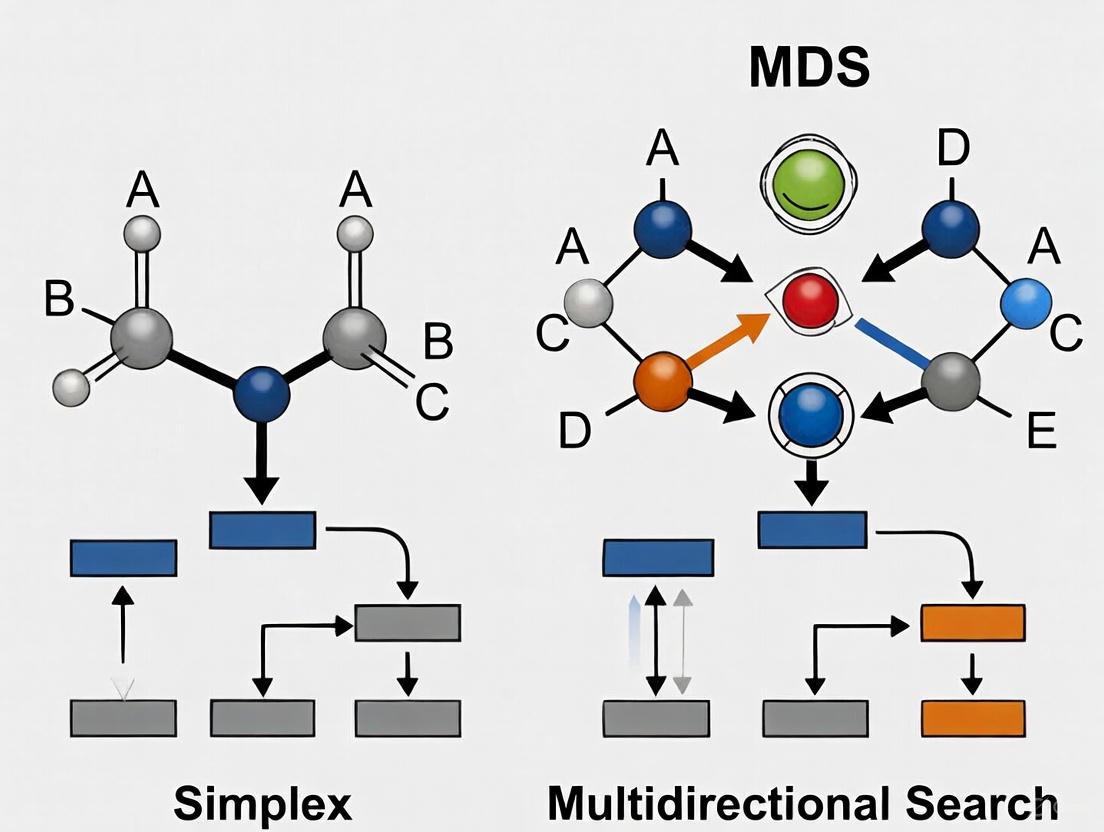
This article provides a comprehensive comparative analysis of the Simplex Method and Multidirectional Search (MDS) for researchers and professionals in drug development.
Simplex vs. Multidirectional Search (MDS): A Strategic Guide for Optimization in Drug Development
Abstract
This article provides a comprehensive comparative analysis of the Simplex Method and Multidirectional Search (MDS) for researchers and professionals in drug development. It explores the foundational principles of both algorithms, detailing their methodological applications in areas like pharmaceutical formulation and process optimization. The guide offers practical troubleshooting strategies for overcoming common pitfalls and presents a rigorous framework for validating and selecting the appropriate optimization technique based on specific project goals, constraints, and problem structures encountered in biomedical research.
Core Principles: Deconstructing the Simplex and MDS Algorithms
In computational optimization for drug discovery, two distinct algorithmic philosophies have emerged for navigating complex search spaces: the simplex method, a vertex-traversing approach for linear programming, and multidirectional search (MDS) algorithms, typified by the Nelder-Mead method, designed for nonlinear optimization without derivatives. While both approaches leverage geometric simplex structures, their underlying mechanisms and application domains differ significantly. The simplex method, developed by George Dantzig in the 1940s, operates by systematically moving along the edges of a feasible region defined by linear constraints to find the optimal solution [1] [2]. In contrast, multidirectional search methods like Nelder-Mead work by iteratively transforming a simplex (geometric figure) through reflection, expansion, and contraction operations to optimize nonlinear objective functions [3]. This comparison guide examines the fundamental differences, performance characteristics, and appropriate domains of application for these approaches within drug discovery research, providing experimental protocols and analytical frameworks for researchers navigating optimization challenges in pharmaceutical development.
Fundamental Principles and Mechanisms
The Simplex Method: Linear Programming with Theoretical Guarantees
The simplex method addresses linear programming problems typically formulated as maximizing or minimizing a linear objective function subject to linear equality or inequality constraints [2]. In canonical form, this is expressed as:
- Maximize ( \mathbf{c^T x} )
- Subject to ( A\mathbf{x} \leq \mathbf{b} ) and ( \mathbf{x} \geq 0 )
The algorithm transforms these constraints through the introduction of slack variables to convert inequalities to equalities, then navigates the convex polytope defined by these constraints [4] [2]. Geometrically, this polytope represents the feasible solution space, with the optimal solution residing at one of its extreme points or vertices [4]. The algorithm proceeds by moving from vertex to adjacent vertex along the edges of this polytope, at each step choosing the direction that most improves the objective function [2]. This systematic traversal ensures eventual convergence to the global optimum for linear problems.
Recent theoretical advances have solidified the simplex method's foundational status. In 2025, researchers demonstrated that the leading approach to the simplex method represents the pinnacle of efficiency, proving it theoretically unbeatable in worst-case efficiency for its core operations [5]. This optimality proof hinges on advanced concepts from convex geometry and complexity theory, showing that any attempt to accelerate the simplex algorithm would violate fundamental lower bounds on computational steps [5].
Multidirectional Search (Nelder-Mead): Nonlinear Heuristic Optimization
The Nelder-Mead algorithm, often called the "simplex method" for nonlinear optimization but more accurately classified as a multidirectional search approach, addresses unconstrained nonlinear problems [3]. The method maintains a simplex of ( n+1 ) points in ( n )-dimensional space, iteratively transforming this simplex based on function evaluations at its vertices. Unlike the linear programming simplex method, Nelder-Mead uses no derivative information, making it suitable for problems with non-smooth functions or noisy evaluations [3].
The algorithm employs four principal operations:
- Reflection: Moving away from the worst-valued vertex
- Expansion: Extending further in promising directions
- Contraction: Shrinking around better-valued vertices
- Shrinkage: Reducing size toward the best vertex [3]
These transformations allow the working simplex to adapt its shape and size to the local landscape, elongating down inclined planes, changing direction when encountering valleys, and contracting near minima [3]. This flexibility makes MDS effective for various nonlinear problems but without the theoretical convergence guarantees of the linear programming simplex method.
Performance Comparison: Experimental Data and Quantitative Analysis
Theoretical and Empirical Performance Metrics
Table 1: Algorithmic Characteristics Comparison
| Characteristic | Simplex Method | Multidirectional Search (Nelder-Mead) |
|---|---|---|
| Problem Domain | Linear Programming | Nonlinear Unconstrained Optimization |
| Derivative Requirements | No explicit derivatives | No derivatives required |
| Theoretical Guarantees | Global optimum for linear problems [5] | No convergence guarantees to local minimum [3] |
| Typical Applications | Supply chain optimization, resource allocation [1] | Parameter estimation, statistical modeling [3] |
| Computational Complexity | Polynomial time (recent proofs) [1] | Varies by problem dimension and landscape |
| Key Transformations | Pivot operations [2] | Reflection, expansion, contraction [3] |
| Geometric Interpretation | Vertex-to-vertex traversal on polytope [4] | Simplex shape/size modification in search space [3] |
Experimental Performance in Drug Discovery Applications
Table 2: Performance in Drug Discovery Contexts
| Application Scenario | Simplex Method Performance | Multidirectional Search Performance |
|---|---|---|
| Multi-target Drug Optimization | Limited for nonlinear systems | Effective with DEL framework [6] |
| Chemical Space Exploration | Not directly applicable | Suitable for generative chemistry [6] |
| Binding Affinity Prediction | Linear approximations only | Direct optimization possible [6] |
| Molecular Property Optimization | Constrained linear properties | Multiple physicochemical properties [6] |
| Supply Chain Optimization | Highly effective [1] | Less efficient than specialized methods |
Recent experimental implementations in drug discovery demonstrate these differential performances. In one study, a graph-fragmentation molecular representation combined with deep evolutionary learning for multi-objective molecular optimization successfully employed MDS approaches to generate novel molecules with improved property values and binding affinities [6]. The method utilized protein-ligand binding affinity scores alongside other physicochemical properties as objectives, demonstrating MDS's flexibility for complex, nonlinear objective functions common in pharmaceutical applications [6].
For classical linear optimization problems in drug manufacturing and distribution, the simplex method remains unchallenged. As noted in recent proofs, "the simplex method, a 1940s algorithm for optimizing linear programming problems in logistics and finance, is theoretically unbeatable in worst-case efficiency" [5]. This theoretical foundation ensures continued dominance in applications like production planning, resource allocation, and logistics within the pharmaceutical industry.
Experimental Protocols and Methodologies
Simplex Method Implementation Protocol
The standard implementation protocol for the simplex method involves:
Problem Formulation Phase:
Algorithm Execution Phase:
- Phase I: Find an initial basic feasible solution
- Phase II: Iterate toward optimal solution through pivot operations [2]
- Select entering variables using chosen pivot rules (e.g., largest coefficient rule)
- Select leaving variables via the minimum ratio test
- Perform row operations to update the tableau
Termination and Validation:
- Terminate when all coefficients in the objective row are non-negative (maximization)
- Verify solution feasibility and optimality conditions [2]
The geometric interpretation involves traversing from vertex to vertex along the edges of the feasible region polytope, with each pivot operation corresponding to moving to an adjacent vertex [4]. Recent theoretical work has optimized pivot selection strategies, with researchers demonstrating that "runtimes are guaranteed to be significantly lower than what had previously been established" [1].
Multidirectional Search Experimental Protocol
For implementing Nelder-Mead multidirectional search:
Initialization Phase:
- Define objective function ( f: \mathbb{R}^n \to \mathbb{R} )
- Construct initial simplex with ( n+1 ) vertices around starting point ( x_0 ) [3]
- Evaluate function at all vertices
Iteration Cycle:
- Ordering: Identify worst (( xh )), second worst (( xs )), and best (( x_l )) vertices
- Centroid: Calculate centroid ( c ) of the best side (opposite worst vertex)
- Transformation Sequence:
- Compute reflection point ( xr = c + \alpha(c - xh) )
- If ( f(xr) < f(xl) ), compute expansion point ( xe = c + \gamma(xr - c) )
- If ( f(xr) \geq f(xs) ), compute contraction point
- If contraction fails, implement shrinkage toward best vertex [3]
Termination Criteria:
- Simplex size becomes sufficiently small
- Function values at vertices become sufficiently close
- Maximum iteration count reached [3]
Application in Drug Discovery: Case Studies and Implementation
Optimization Challenges in Pharmaceutical Research
Drug discovery presents diverse optimization challenges across the development pipeline, from initial compound design to manufacturing and distribution. The simplex method excels in structured, linear problems such as:
- Resource Allocation: Optimizing limited research budgets across competing projects
- Production Planning: Minimizing manufacturing costs while meeting demand constraints
- Supply Chain Optimization: Logistics for raw material sourcing and distribution [1]
Multidirectional search approaches address fundamentally different challenges characterized by nonlinearity and uncertainty:
- Molecular Optimization: Designing compounds with multiple desired physicochemical properties [6]
- Binding Affinity Prediction: Optimizing complex molecular interactions with protein targets [6]
- Pharmacokinetic Modeling: Parameter estimation for nonlinear pharmacodynamic models [3]
- Experimental Design: Optimizing assay conditions across multiple parameters [3]
Case Study: Multi-Objective Molecular Optimization
A recent implementation demonstrates the power of multidirectional search approaches in drug discovery. Researchers developed a deep evolutionary learning (DEL) framework integrating graph-fragmentation-based deep generative models with multi-objective optimization [6]. The methodology:
- Represented molecules using graph fragmentation via the Junction Tree Variational Autoencoder (JTVAE)
- Optimized multiple objectives including binding affinity and physicochemical properties
- Employed evolutionary algorithms with multidirectional search principles
- Generated novel compounds with improved property profiles compared to initial candidates [6]
This approach successfully navigated the complex trade-offs between often-competing molecular properties, demonstrating how MDS-type optimization can address the multi-criteria decision analysis inherent to modern drug discovery [6].
Research Reagent Solutions: Computational Tools for Optimization
Table 3: Essential Research Tools for Optimization Studies
| Tool Category | Specific Examples | Function in Research | Applicable Algorithm |
|---|---|---|---|
| Linear Programming Solvers | CPLEX, Gurobi, LINDO | Implement simplex method for large-scale problems [2] | Simplex Method |
| Nonlinear Optimization | fminsearch (MATLAB), scipy.optimize | Implement Nelder-Mead and related algorithms [3] | Multidirectional Search |
| Molecular Representation | JTVAE, FragVAE [6] | Graph-based molecular encoding for optimization | Multidirectional Search |
| Drug-Target Interaction | AutoDock Suite, Rosetta [6] | Binding affinity prediction for objective functions | Both Algorithms |
| Chemical Databases | ChEMBL, DrugBank, BindingDB [7] | Source of known interactions and properties | Both Algorithms |
| Multi-Criteria Decision | VIKOR, TOPSIS, AHP [8] | Ranking and selection from Pareto fronts | Multidirectional Search |
The simplex method and multidirectional search represent fundamentally different approaches to optimization, each with distinct strengths and application domains in pharmaceutical research. The simplex method provides mathematically rigorous solutions for linear optimization problems with theoretical guarantees, making it indispensable for resource allocation, production planning, and supply chain optimization [1] [5]. In contrast, multidirectional search algorithms like Nelder-Mead offer flexible approaches for nonlinear problems where derivative information is unavailable or unreliable, particularly valuable in molecular design, parameter estimation, and multi-objective optimization [6] [3].
The emerging research paradigm recognizes these methods as complementary rather than competitive. Hybrid approaches that leverage the strengths of both algorithms represent the future of optimization in drug discovery. As recent theoretical work has established the optimality of the simplex method for linear problems [5], and machine learning advances have enhanced multidirectional search for complex molecular optimization [6], researchers now have a robust toolkit for addressing the diverse optimization challenges throughout the drug development pipeline. Strategic algorithm selection based on problem structure, domain constraints, and objective function characteristics will continue to drive efficiency and innovation in pharmaceutical research.
In the realms of computational chemistry, drug development, and scientific research, optimization is a fundamental challenge. Researchers constantly strive to find the best possible outcomes—whether it's the ideal reaction conditions to synthesize a new compound, the optimal dosage for a drug therapy, or the perfect parameters for a material's properties. This process of navigating a complex multidimensional search space to find a maximum or minimum response is both crucial and computationally demanding. For decades, the Simplex algorithm has been a cornerstone method for such nonlinear optimization problems. Its sequential nature, however, presents significant limitations in an era where automated workstations enable parallel experimentation.
This article explores Multidirectional Search (MDS), a powerful pattern search method that operates in n+1 dimensions and is designed from the ground up for parallel implementation. Developed by Torczon, the MDS algorithm represents a significant evolution from traditional Simplex methods by combining the systematic exploration of factorial designs with the adaptive, evolutive nature of Simplex approaches [9]. By framing this comparison within the context of modern automated chemistry workstations and high-performance computing, we will demonstrate how MDS offers researchers a more efficient pathway to optimization, particularly in time-sensitive and resource-intensive fields like pharmaceutical development.
Core Algorithmic Principles: Simplex vs. MDS
The Traditional Simplex Approach
The Nelder-Mead Simplex method is a direct search algorithm for unconstrained nonlinear optimization. A simplex is an n-dimensional geometric figure with (n+1) vertices, where n is the number of experimental control variables [9]. In two dimensions, this forms a triangle; in three dimensions, a tetrahedron; and so forth. The algorithm proceeds through a series of geometric transformations—reflection, expansion, and contraction—that allow the simplex to move through the search space and adapt its shape to the function's landscape.
The process is fundamentally serial. After initializing the simplex, each iteration requires evaluating the objective function at a new point, comparing it to existing vertices, and then performing a transformation based on that single data point before proceeding to the next iteration. This one-at-a-time approach makes inefficient use of modern parallel computing resources and automated laboratory systems capable of running multiple experiments simultaneously [9].
The Multidirectional Search (MDS) Framework
The MDS algorithm shares the simplex structure of (n+1) vertices but revolutionizes how it explores the search space. Rather than evaluating one new point per iteration, MDS evaluates n new points simultaneously during each cycle [9]. This parallelism is achieved through a pattern of operations that maintains the simplex structure while exploring multiple directions at once.
The key distinction lies in what drives the search. While Simplex methods use a strict ranking of vertices to determine the next step, MDS utilizes simplex derivatives, which are approximations of the function's gradient computed from the simplex vertices [10]. This provides a more informed basis for movement decisions. The algorithm has been shown to be the most powerful member of a family of pattern search algorithms, combining the exploratory power of factorial designs with the focused convergence of evolutionary methods [9].
Table: Fundamental Characteristics of Simplex vs. MDS Algorithms
| Feature | Traditional Simplex | Multidirectional Search (MDS) |
|---|---|---|
| Basic Structure | (n+1) vertices in n-dimensional space | (n+1) vertices in n-dimensional space |
| Experiments per Iteration | 1 (serial) | n (parallel) |
| Decision Basis | Vertex ranking | Simplex derivatives/pattern search |
| Resource Utilization | Low (sequential) | High (parallel) |
| Information Usage | Uses only the worst vertex to generate new point | Uses all vertices to generate multiple new points |
Operational Workflow and Implementation
MDS Algorithm Process
The implementation of MDS on an automated system follows a structured workflow that enables parallel yet adaptive experimentation:
Implementation in Automated Chemistry Workstations
The power of MDS becomes particularly evident when implemented on automated chemistry workstations capable of parallel, adaptive experimentation [11]. These systems consist of robotic components for sample manipulation, multiple reaction vessels, and integrated analytical instruments, all coordinated by sophisticated experiment-management software.
For MDS implementation, each vertex of the simplex corresponds to one chemistry experiment in one reaction vessel, with its coordinates representing specific values for the n parameters under investigation (e.g., temperature, concentration, pH) [9]. The experiment-planning module for MDS studies incorporates features drawn from both factorial design and Simplex experimentation modules, including:
- Experimental Plan Editor: A menu-driven interface for composing experimental plans
- Template Conversion: Transforming plans into experimental templates
- Search Space Definition: Establishing parameter ranges and constraints
- Automated Scheduling: Optimizing the sequence of parallel operations to maximize throughput [11]
This implementation requires modifications to the original MDS algorithm for chemical application, particularly in movement selection, testing for parallelism, and resource analysis [9]. The closed-loop operation of these workstations enables the system to respond to collected data, focusing experimentation in pursuit of the scientific goals and eliminating futile lines of inquiry [11].
Comparative Performance Analysis
Experimental Data and Performance Metrics
Rigorous comparisons between optimization algorithms require examination of multiple performance dimensions. The following table summarizes key quantitative differences based on experimental implementations:
Table: Experimental Performance Comparison of Optimization Methods
| Performance Metric | Factorial Design | Simplex Method | MDS Algorithm |
|---|---|---|---|
| Total Experiments Required | High (exponential with dimensions) | Variable (depends on landscape) | Lower than Simplex in comparative studies |
| Time to Convergence | Fixed (all points predetermined) | Slow (serial evaluation) | Fast (parallel evaluation) |
| Parallelization Efficiency | High (all experiments can run simultaneously) | None (inherently serial) | High (n experiments per cycle) |
| Resource Utilization | Low (no adaptive focusing) | Medium (sequential adaptation) | High (parallel adaptation) |
| Resilience to Noise | Medium (averaging possible) | Low (single-point decisions) | High (pattern-based decisions) |
| Implementation Scenarios | 25 experiments in single batch [9] | 5-40 sequential steps [9] | 25 experiments in adaptive batches [9] |
The performance advantage of MDS is particularly evident in scenarios with larger batch capacities. Research shows that with a batch capacity of 25 experiments, MDS can converge on optimal conditions more rapidly and efficiently than sequential methods [9]. The adaptive nature of the workstation enables searches to be implemented with two levels of decision-making: algorithmically through the MDS method itself, and strategically through higher-level decision trees that can override the search based on chemical intuition or secondary criteria [9].
Application in Drug Development Context
The SELECT-MDS-1 phase 3 study in higher-risk myelodysplastic syndromes (HR-MDS) illustrates the critical importance of efficient optimization in pharmaceutical development [12]. While this clinical trial (focused on a drug rather than the algorithm) ultimately did not meet its primary endpoint, it highlights the complex optimization challenges in drug development where multiple parameters—including dosage, scheduling, and patient selection criteria—must be optimized simultaneously.
In such high-stakes environments, computational optimization methods like MDS can significantly accelerate the identification of optimal conditions for drug synthesis, formulation, and administration protocols. The ability of MDS to efficiently navigate high-dimensional spaces makes it particularly valuable for these complex, multi-parameter optimization problems common in pharmaceutical research.
Successfully implementing Multidirectional Search requires both computational tools and experimental infrastructure. The following toolkit outlines essential components:
Table: Essential Research Reagents and Resources for MDS Implementation
| Resource Category | Specific Examples | Function in MDS Implementation |
|---|---|---|
| Computational Software | MATLAB, Python (SciPy), custom implementations | Provides algorithmic foundation and numerical computation capabilities [9] |
| Automated Chemistry Workstation | Robotic sample manipulators, multiple reaction vessels, syringe pumps | Enables parallel experimentation essential for MDS efficiency [11] |
| Experiment Management Software | Scheduler modules, resource management systems | Coordinates parallel operations and manages experimental resources [11] |
| Analytical Instruments | HPLC, spectrophotometers, real-time monitoring systems | Provides quantitative response measurements for each experimental condition |
| Mathematical Libraries | Linear algebra routines, optimization utilities | Supports calculation of simplex derivatives and pattern movements [10] |
The comparative analysis between Multidirectional Search and traditional Simplex methods reveals a significant evolution in optimization strategy for scientific research. MDS represents a paradigm shift from sequential trial-and-error to intelligent, parallel exploration of complex parameter spaces. Its ability to evaluate multiple directions simultaneously while maintaining the adaptive focus of direct search methods makes it particularly suited for modern automated laboratories and high-performance computing environments.
For researchers in drug development and related fields, where optimization problems are increasingly multidimensional and resource-intensive, MDS offers a compelling alternative to conventional approaches. The integration of simplex derivatives and pattern search principles enables more efficient navigation of complex response surfaces, potentially accelerating the discovery and development process. As automated experimentation platforms become more sophisticated and accessible, algorithms like MDS that can fully leverage parallel capabilities will become increasingly essential tools in the scientist's toolkit, enabling more aggressive and rapid assaults on fundamental scientific problems [11].
Historical Context and Evolution in Scientific and Optimization Fields
The pursuit of optimal solutions is a cornerstone of scientific and industrial progress, driving efficiency and innovation across fields from logistics to drug discovery. Within computational optimization, two strategies have played particularly significant roles: the Simplex Method, developed by George Dantzig in the 1940s, and Multidirectional Search (MDS) methods, a class of pattern search techniques. The Simplex Method was born from military logistics needs during World War II, where Dantzig tackled the challenge of "prudent allocation of limited resources" for the U.S. Air Force [1]. In contrast, MDS emerged as part of the broader family of direct-search pattern methods, designed for situations where derivative information is unavailable, unreliable, or impractical to obtain [13].
This guide provides a comparative analysis of these two influential algorithmic families, framing them within the context of modern research and application demands. While the Simplex Method operates by navigating the vertices of a feasible region defined by linear constraints, multidirectional search and its relatives, like the Compass Search method, perform exploratory moves based on pattern searches without using derivative information [13]. Understanding their distinct historical contexts, theoretical foundations, and performance characteristics is essential for researchers and practitioners selecting the appropriate tool for contemporary optimization challenges.
Historical Context and Development
The Simplex Method
The origin of the Simplex Method is a landmark story in computational mathematics. In 1946, George Dantzig, serving as a mathematical adviser to the U.S. Air Force, developed the method to solve complex logistical planning problems [1]. Its creation was influenced by his earlier work, begun in 1939, on solving two famous open problems in statistics that he had mistaken for homework [1]. The algorithm transforms resource allocation problems into a geometric framework. For example, maximizing a profit function like 3a + 2b + c (where a, b, and c represent product quantities) subject to linear constraints (like a + b + c ≤ 50) is equivalent to navigating the vertices of a multi-dimensional shape called a polyhedron to find the point that maximizes profit [1].
Despite its enduring popularity and widespread use in supply-chain and logistical software, a theoretical shadow long loomed over the method. In 1972, mathematicians proved its worst-case time complexity could be exponential, meaning solution time might skyrocket disproportionately to problem size [1]. However, this worst-case scenario rarely manifests in practice. As one researcher noted, "It has always run fast, and nobody's seen it not be fast" [1]. Recent theoretical work, incorporating elements of randomness, has begun to bridge this gap between practical efficiency and theoretical guarantees, further solidifying its foundational status [1].
Multidirectional Search (MDS) and Pattern Search
Multidirectional Search belongs to the category of direct search methods, which emerged as a practical alternative for optimization problems where the objective function is non-smooth, noisy, or whose derivatives are unavailable [13]. These methods are categorized into pattern search, simplex search, and methods with adaptive sets of directions [13]. Unlike the Simplex Method for linear programming, the "simplex search" used in derivative-free optimization refers to the Nelder-Mead algorithm, which uses a geometric simplex of n+1 points to explore the search space [14].
Methods like Compass Search (a type of pattern search) operate by making exploratory moves from a current point along a set of predefined directions or patterns [13]. If an improving point is found, the algorithm moves there and begins a new iteration. If no improvement is found, the step length is reduced, allowing for a finer, more localized search [13]. This characteristic makes them particularly robust and versatile for experimental and simulation-based optimization where the objective function landscape is complex or expensive to evaluate.
Comparative Analysis: Simplex vs. Multidirectional Search
The following table summarizes the core characteristics of the Simplex Method and Multidirectional Search, highlighting their distinct strengths and optimal application domains.
Table 1: Core Characteristics Comparison
| Feature | Simplex Method | Multidirectional Search (Pattern Search) |
|---|---|---|
| Primary Domain | Linear Programming Problems | Derivative-Free Nonlinear Optimization |
| Theoretical Basis | Navigates vertices of a constraint-defined polyhedron [1] | Exploratory moves based on pattern searches without derivatives [13] |
| Historical Origin | 1940s, Military Logistics (George Dantzig) [1] | 1960s+, Numerical Analysis & Engineering |
| Key Strength | High efficiency for large-scale linear problems; proven track record [1] | Handles non-smooth, noisy, or simulation-based functions [13] |
| Derivative Requirement | Not applicable (works with constraint matrix) | No derivatives required [13] |
| Global Optimization | Not designed for global optimization; finds a single optimum. | Can be integrated into broader global search strategies [13] |
Performance and Application in Scientific Research
In practical scientific applications, the choice between these algorithms hinges on the problem structure. The Simplex Method remains the gold standard for linear optimization problems prevalent in logistics, production planning, and resource allocation [1]. Its reliability in these domains is unmatched.
For experimental sciences and engineering, where models are often non-linear and based on empirical data, derivative-free methods like Simplex (Nelder-Mead) and MDS are preferred [15]. A key recommendation from analytical chemistry literature states: "For functions with several variables and unobtainable partial derivatives, the simplex method is then the best option" [15]. This approach is valued for being a "fast and derivative free approach," making it "less computationally intensive compared to the steepest descent method" in many practical scenarios [14].
Recent research in antenna design demonstrates a novel hybrid approach, using simplex-based regression models to perform a globalized search in the space of the antenna's operating parameters [16] [17]. This technique leverages the regular relationship between antenna geometry and its performance figures, allowing for efficient optimization. The process is accelerated using variable-resolution simulations, where initial global search uses low-fidelity models, and final tuning employs high-fidelity models with gradient-based methods [16] [17]. This reflects a modern trend of combining the robustness of direct searches with local refinement for computational efficiency.
Table 2: Application-Oriented Comparison
| Aspect | Simplex Method | Multidirectional Search |
|---|---|---|
| Optimal Use Case | Large-scale linear resource allocation, supply chain planning [1] | Parameter tuning for experimental setups, simulation-based optimization [15] [13] |
| Computational Efficiency | Highly efficient for its target (linear) problems; practical performance often better than theoretical worst-case [1] | Efficient for problems with costly function evaluations; step reduction refines search efficiently [13] |
| Handling of Complexity | Formulates problem as a set of linear constraints [1] | Navigates complex, non-convex landscapes without derivative information [13] |
| Modern Hybridization | Inspired surrogate-assisted strategies (e.g., simplex regressors) for globalized search [16] [17] | Serves as a robust component in memetic algorithms or hybrid optimization frameworks [13] |
Experimental Protocols and Methodologies
Workflow for Simplex-Based Optimization
The following diagram illustrates a modern, computationally efficient workflow that incorporates a simplex-based global search, as applied in fields like antenna design.
This workflow, derived from cutting-edge engineering design protocols, begins with a global search phase using a fast, low-fidelity model (e.g., a coarse-discretization simulation) [16] [17]. A simplex-based regression predictor is used to model the relationship between design parameters and target performance figures (like an antenna's center frequency), which regularizes the objective function and guides the search [16] [17]. Once the algorithm finds a design that satisfies the target operating parameters at this low-fidelity level, it proceeds to a local tuning phase. This final phase uses a high-fidelity model for verification and employs gradient-based optimization. To reduce computational cost, sensitivity updates can be calculated only along principal directions that most significantly affect the output, rather than for all parameters [16]. This hybrid approach balances global exploration with efficient local exploitation.
Workflow for Multidirectional (Pattern) Search
The foundational workflow for a Multidirectional Search method like Compass Search is outlined below.
The process initiates from a starting point and a given step length. The algorithm then evaluates the objective function at trial points generated by moving the current step length along each coordinate direction (the "pattern") [13]. If this exploratory move discovers a trial point that improves the objective function value, the algorithm relocates to this new point, and a new iteration begins [13]. If no improving point is found within the pattern, the iteration is deemed unsuccessful, and the step length is reduced to enable a finer, more localized search in subsequent iterations [13]. This loop continues until the step length falls below a predefined tolerance, indicating convergence to a local optimum. This method is simple, robust, and does not require gradient information, making it suitable for a wide range of black-box optimization problems.
The Scientist's Toolkit: Key Research Reagents
The following table lists essential conceptual "reagents" or components crucial for implementing and understanding the discussed optimization methods.
Table 3: Essential Components in Optimization Research
| Research Reagent | Function & Description |
|---|---|
| Objective Function | The function to be minimized or maximized. It quantifies the performance or cost of a system given a set of input parameters. |
| Constraints | Equations or inequalities that define feasible values for the parameters. In the Simplex Method, these form the geometric polyhedron [1]. |
| Gradient Vector | A vector of partial derivatives indicating the direction of the steepest ascent of the objective function. Central to gradient-based methods [15]. |
| Geometric Simplex | A convex geometric figure with n+1 vertices in n-dimensional space. Used as a regression model in modern global search [16] and in the Nelder-Mead algorithm. |
| Low/High-Fidelity Models | Computational models of varying accuracy and cost. Low-fidelity models enable efficient global exploration, while high-fidelity models ensure final design validity [16] [17]. |
| Principal Directions | A subset of directions in the parameter space along which the system's response is most sensitive. Updating sensitivities only along these directions reduces computational cost [16]. |
The historical evolution of the Simplex Method and Multidirectional Search algorithms demonstrates a consistent principle in optimization: tool selection is dictated by problem structure. The Simplex Method continues to be indispensable for linear programming problems, with its theoretical understanding still advancing, as recent work provides better explanations for its practical efficiency [1]. Multidirectional Search and other derivative-free pattern methods remain vital for the vast landscape of non-linear, simulation-heavy, and experimental optimization tasks where gradients are unavailable [13].
A prominent trend in modern scientific computing is hybridization. Researchers are increasingly combining the strengths of different paradigms, such as using a simplex-based global search to identify promising regions before applying a fast, gradient-based local optimizer with variable-fidelity models [16] [17]. This approach leverages the robustness of direct-search methods for global exploration and the precision of derivative-based methods for efficient convergence. For researchers in drug development and other data-intensive fields, this evolving toolkit offers powerful pathways to navigate complex optimization landscapes and accelerate scientific discovery.
In the field of derivative-free optimization, direct search methods provide powerful alternatives for problems where gradients are unavailable, unreliable, or impractical to compute. Among these methods, the Simplex algorithms (exemplified by the Nelder-Mead method) and the Multidirectional Search (MDS) algorithm represent two distinct yet fundamentally connected approaches to navigating complex parameter spaces [13]. These algorithms are particularly valuable in chemical reaction optimization and drug development, where experimental outcomes often depend on multiple interacting variables and objective functions may be noisy or non-differentiable [9] [18].
The core distinction between these approaches lies in their search philosophies: Simplex methods operate through an evolutive, serial process of geometric transformation, while MDS employs a parallel, pattern-oriented search that can evaluate multiple points simultaneously [9] [18]. This comparison guide examines their mathematical foundations, focusing on how each method formulates objective functions and handles constraints, with particular emphasis on applications in automated chemistry workstations and pharmaceutical development environments.
Mathematical Foundations and Algorithmic Structures
Simplex Search Methodology
The Simplex method, particularly the Nelder-Mead variant, operates using a geometric structure called a simplex—an n-dimensional polygon formed by n+1 vertices, where n represents the number of optimization parameters [9] [18]. For a two-dimensional problem, this simplex manifests as a triangle; for three dimensions, a tetrahedron; and so forth for higher-dimensional problems [14].
The algorithm progresses through a series of geometric transformations designed to navigate toward optimal regions of the parameter space:
- Reflection: Moving away from the worst-performing vertex
- Expansion: Extending further in promising directions
- Contraction: Shrinking the simplex in less productive regions
- Shrinkage: Reducing all vertices toward the best point when other operations fail [19]
These operations rely solely on direct objective function evaluations without gradient calculations, making the approach particularly suitable for experimental optimization where derivatives are unavailable [13] [19].
Table 1: Nelder-Mead Simplex Operations and Parameters
| Operation | Mathematical Formulation | Typical Parameter Value | Purpose |
|---|---|---|---|
| Reflection | ( xr = xm + \alpha(xm - xw) ) | ( \alpha = 1 ) | Move away from worst point |
| Expansion | ( xe = xm + \beta(xm - xw) ) | ( \beta = 2 ) | Explore promising direction |
| Outside Contraction | ( x{oc} = xm + \gamma(xm - xw) ) | ( \gamma = 0.5 ) | Moderate adjustment |
| Inside Contraction | ( x{ic} = xm - \gamma(xm - xw) ) | ( \gamma = 0.5 ) | Refine search area |
Multidirectional Search (MDS) Formulation
The Multidirectional Search algorithm represents a parallel evolution of simplex concepts, specifically designed to leverage multiple processing units or experimental stations simultaneously [9]. Unlike traditional simplex methods that replace one point per iteration, MDS retains only the single best point from the current simplex and generates an entirely new simplex around it at each iteration [18].
The MDS algorithm exhibits distinctive characteristics that differentiate it from traditional simplex approaches:
- Parallel Evaluation: All points in the new simplex can be evaluated simultaneously
- Fixed Pattern Search: Utilizes regular simplices moving through a grid of regularly spaced points
- Exploratory Flexibility: Can evaluate additional exploratory points based on available resources [18]
This parallel capability makes MDS particularly advantageous for implementation on automated chemistry workstations where multiple reaction vessels can process experiments concurrently [9].
Objective Function Formulations
Both simplex and MDS methods require careful formulation of objective functions to guide the optimization process effectively. In chemical reaction optimization, these functions typically quantify reaction yield, purity, or efficiency [9]. For drug development applications, objective functions might characterize binding affinity, selectivity, or pharmacokinetic properties.
A properly formulated objective function should:
- Quantitatively measure the quality of a solution
- Exhibit sensitivity to parameter changes
- Remain computationally feasible to evaluate repeatedly
- Capture the essential characteristics of the desired outcome [13]
In derivative-free optimization, the objective function must be designed to provide meaningful guidance without gradient information, often requiring careful balancing of multiple performance criteria through weighting schemes or Pareto-based approaches in multi-objective scenarios [13].
Constraint Handling Methodologies
Bound Constraints and Parameter Limitations
In experimental optimization, parameters typically have physical limitations—reaction temperatures cannot exceed solvent boiling points, concentrations must remain positive, and catalyst loadings have practical upper bounds [9]. Both simplex and MDS implementations employ similar strategies for handling these bound constraints:
- Parameter Transformation: Using mathematical transformations to convert constrained problems into unconstrained ones
- Projection Methods: Moving infeasible points to the nearest boundary of the feasible region
- Rejection Approaches: Discarding proposed points that violate constraints and generating alternatives [9] [13]
The MDS algorithm, with its parallel nature, can more efficiently explore constrained spaces by evaluating multiple boundary points simultaneously, potentially providing better characterization of constraint interfaces [9].
Nonlinear and Expensive Constraints
For constraints requiring experimental evaluation (e.g., purity thresholds, side product limits), direct search methods typically employ penalty functions that incorporate constraint violations directly into the objective function [13] [20]. This approach avoids separate constraint-handling procedures that would require additional experiments.
The composite modified simplex (CMS) incorporates specific mechanisms to handle challenging constraint scenarios:
- Boundary avoidance to prevent oscillatory behavior near constraints
- Adaptive step adjustment when constraints are encountered
- Recovery procedures for when simplices become infeasible [18]
Comparative Experimental Analysis
Computational Efficiency and Resource Utilization
Experimental comparisons between simplex and MDS approaches reveal distinct performance characteristics suited to different optimization scenarios. The following table summarizes key performance metrics based on automated chemistry workstation implementations:
Table 2: Performance Comparison in Chemical Reaction Optimization
| Performance Metric | Composite Modified Simplex (CMS) | Multidirectional Search (MDS) | Parallel Simplex Search (PSS) |
|---|---|---|---|
| Experiments per Cycle | 1 (after initial simplex) | n new points + exploratory points | Multiple (depends on parallel capacity) |
| Chemical Resource Usage | Low | High | Moderate |
| Time Efficiency | Low (serial nature) | High (parallel implementation) | High (parallel implementation) |
| Risk of Local Optima | High | Moderate | Low (multiple searches) |
| Implementation Complexity | Low | Moderate | High |
The serial nature of traditional simplex methods makes them parsimonious in chemical consumption but inefficient in time, while MDS can rapidly consume resources but achieves significantly faster convergence [18]. The Parallel Simplex Search (PSS) method represents a hybrid approach, conducting multiple simplex searches concurrently to balance resource utilization and convergence reliability [18].
Convergence Behavior and Reliability
Convergence properties differ substantially between the approaches. Traditional simplex methods may become trapped in local optima, particularly on complex response surfaces with multiple peaks [18]. MDS, with its broader exploratory capability, exhibits reduced susceptibility to local optima but may require more function evaluations to refine solutions precisely [9].
Modified Nelder-Mead approaches address convergence issues by maintaining a fixed simplex structure and optimizing the reflection parameter α, rather than relying on fixed values [19]. This modification enhances convergence reliability while preserving the derivative-free nature of the algorithm.
Experimental Protocols and Methodologies
Automated Chemistry Workstation Implementation
For both simplex and MDS algorithms, implementation on automated chemistry workstations follows a systematic protocol:
- Experimental Plan Composition: Defining the search space and parameter linkages using an Experimental Plan Editor [9]
- Template Generation: Converting the plan to an experimental template that directs robotic systems
- Initial Design Selection: Choosing starting simplex configurations or initial patterns
- Iterative Experimentation: Conducting experiments, evaluating responses, and generating new experimental conditions
- Convergence Detection: Monitoring improvement rates and terminating when thresholds are met [9] [18]
The MDS implementation incorporates specific modifications for chemical applications, including movement selection criteria, tests for parallelism, and resource analysis to manage experimental expenditure [9].
Response Surface Characterization
In pharmaceutical applications, understanding the response surface topology is crucial for interpreting optimization results. Both simplex and MDS methods implicitly map response surfaces through their exploration patterns:
- Simplex Methods: Characterize local curvature through simplex shape transformations
- MDS: Explores broader regions through its parallel pattern search
- PSS: Provides multiple local characterizations through concurrent simplex searches [18]
This implicit mapping facilitates understanding of parameter interactions and response robustness, valuable information for quality-by-design approaches in drug development.
Visualization of Algorithmic Workflows
Simplex Search Process
Simplex Search Decision Workflow
Multidirectional Search Architecture
Multidirectional Search Parallel Workflow
Research Reagent Solutions and Experimental Materials
Successful implementation of simplex and MDS optimization in pharmaceutical and chemical development requires specific experimental infrastructure and computational resources:
Table 3: Essential Research Materials and Resources
| Resource Category | Specific Components | Function in Optimization |
|---|---|---|
| Automated Chemistry Workstation | Reaction vessels, robotic liquid handlers, automated sampling systems | Enables parallel experimentation with precise parameter control |
| Analytical Instrumentation | HPLC systems, GC-MS, NMR, UV-Vis spectroscopy | Provides quantitative objective function measurements |
| Computational Infrastructure | Experiment planning modules, response analysis software, convergence monitoring | Supports algorithm implementation and data interpretation |
| Chemical Reagents | Solvents, catalysts, substrates, reactants | Forms the experimental system being optimized |
| Parameter Control Systems | Temperature controllers, pH meters, pressure regulators | Manipulates independent variables during optimization |
The comparative analysis of simplex and multidirectional search algorithms reveals complementary strengths suited to different optimization scenarios in pharmaceutical research and chemical development.
For resource-constrained environments where experimental materials are limited or expensive, the composite modified simplex (CMS) offers a conservative approach that minimizes consumption while providing reliable local optimization. Its serial nature represents a limitation for time-sensitive projects, but its straightforward implementation makes it accessible for most laboratory settings.
When rapid optimization is prioritized and resources are adequate, multidirectional search (MDS) provides superior time efficiency through parallel experimentation. This approach is particularly valuable for reaction screening and initial process characterization where broad exploration of parameter spaces is necessary.
The emerging parallel simplex search (PSS) represents a promising middle ground, balancing resource utilization with convergence reliability through concurrent simplex operations. This approach may offer the most practical solution for many pharmaceutical development scenarios where both efficiency and robustness are valued.
Selection of the appropriate optimization strategy should consider specific project constraints, including material availability, time requirements, and the complexity of the response surface being investigated. Understanding the fundamental mathematical formulations of each approach enables researchers to make informed decisions about constraint handling, objective function design, and experimental implementation.
In the rigorous field of pharmaceutical research, optimization algorithms are fundamental tools for navigating complex decision-making processes. The Simplex Algorithm and Multidirectional Search (MDS) represent two distinct philosophical approaches to optimization: one traverses the vertices of a feasible region defined by linear constraints, while the other explores search directions through geometric pattern transformations. Within Model-Informed Drug Development (MIDD), these algorithms provide structured, quantitative frameworks that enhance drug development by accelerating hypothesis testing, improving candidate selection, and reducing costly late-stage failures [21]. The strategic selection between simplex-based linear programming and pattern search methods depends critically on the problem's mathematical structure—whether it involves linear relationships amenable to the simplex method or requires derivative-free optimization for complex, non-linear models. Understanding the geometric foundations of these algorithms empowers researchers to align their computational tools with key questions of interest and specific contexts of use, ultimately streamlining the path from discovery to clinical application [21].
Theoretical Foundations: Geometry of Search Algorithms
The Simplex Algorithm: Vertex-Hopping on a Polytope
The Simplex Algorithm, developed by George Dantzig, operates on a powerful geometric principle: for a linear program with an optimal solution, that solution resides at least at one extreme point (vertex) of the convex polytope defined by the constraints [2]. This polytope represents the feasible region where all constraints overlap. The algorithm navigates by moving from one vertex to an adjacent vertex along the edges of the polytope, with each step improving the objective function value until no further improvement is possible [2]. This process is implemented algebraically through pivot operations that exchange basic and nonbasic variables in the simplex tableau, effectively moving the solution to an improving adjacent vertex [22]. The algorithm's efficiency stems from this deliberate traversal along the polytope's edges rather than exhaustively enumerating all vertices, which would be computationally prohibitive for high-dimensional problems common in pharmaceutical applications like resource allocation or production optimization [2].
Multidirectional Search: Geometric Pattern Transformation
In contrast to the vertex-hopping approach of simplex, multidirectional search operates through a different geometric metaphor. Rather than leveraging constraint-defined structures, MDS employs a simplex-shaped pattern of points in the search space (distinct from the linear programming simplex concept) that expands, contracts, and reflects based on function evaluations. This geometric pattern—typically an n-dimensional simplex with n+1 vertices—undergoes transformations that enable it to adapt to the function's topography. The algorithm reflects the worst point through the opposite face of the simplex, expanding if improvement occurs or contracting if not, effectively "walking" the pattern across the optimization landscape. This derivative-free approach is particularly valuable in drug development for optimizing complex simulation models where objective functions may be noisy, non-differentiable, or computationally expensive to evaluate, such as in quantitative systems pharmacology models or clinical trial simulations [21].
Comparative Analysis: Simplex versus Multidirectional Search
Algorithmic Characteristics and Applicability
Table 1: Fundamental Characteristics of Simplex and Multidirectional Search Algorithms
| Characteristic | Simplex Algorithm | Multidirectional Search (MDS) |
|---|---|---|
| Problem Domain | Linear Programming | Nonlinear, Derivative-Free Optimization |
| Geometric Interpretation | Moves along edges of constraint polytope from vertex to vertex | Transforms a simplex pattern through reflection, expansion, and contraction |
| Optimality Criteria | Reaches optimum when no adjacent vertex improves objective function | Converges when simplex pattern becomes sufficiently small |
| Constraint Handling | Native through feasible region definition | Requires special transformations or penalty functions |
| Derivative Requirements | No function derivatives required | No function derivatives required |
| Primary Applications in Pharma | Resource allocation, blending problems, transportation logistics | Parameter estimation in QSP/PBPK models, clinical trial simulation optimization |
The Simplex Algorithm's strength lies in its deterministic nature and guaranteed convergence to a global optimum for linear problems, making it ideal for resource allocation in drug manufacturing or transportation logistics in pharmaceutical supply chains [22]. Its geometric progression along the feasible region's boundary ensures systematic improvement at each iteration. Multidirectional Search, particularly the Nelder-Mead variant, excels where derivatives are unavailable or unreliable, such as when calibrating complex physiologically-based pharmacokinetic (PBPK) models to experimental data [2] [21]. However, this flexibility comes with potential convergence to local optima in multimodal landscapes, requiring careful implementation and validation when used in critical path applications like first-in-human dose prediction [21].
Performance Metrics and Convergence Behavior
Table 2: Performance Comparison in Pharmaceutical Applications
| Performance Metric | Simplex Algorithm | Multidirectional Search (MDS) |
|---|---|---|
| Convergence Speed | Finite number of iterations (typically proportional to constraints) | Variable; depends on problem dimension and topology |
| Solution Guarantee | Global optimum for linear problems | Local convergence only; no global guarantees |
| Dimensional Scalability | Efficient for problems with many variables but structured constraints | Performance degrades with high dimension (>10 parameters) |
| Implementation Complexity | Moderate (tableau operations) | Low (function evaluations only) |
| Robustness to Noise | Low (assumes exact arithmetic) | Moderate (inherently heuristic) |
| Regulatory Acceptance | High for well-defined linear problems | Context-dependent; requires validation |
The Simplex Algorithm demonstrates polynomial-time performance for most practical problems despite its theoretical exponential worst-case complexity [2]. This efficiency makes it suitable for large-scale linear optimization in pharmaceutical applications like production planning and chemical composition optimization. Multidirectional Search typically requires more function evaluations, particularly in high-dimensional parameter spaces common in quantitative systems pharmacology models, but provides greater flexibility for problems where the objective function arises from complex simulations [21]. In regulatory contexts, simplex-derived solutions often face less scrutiny due to the algorithm's deterministic nature, while MDS applications require comprehensive sensitivity analysis and validation, particularly when supporting critical decisions in new drug applications [21].
Experimental Protocols and Methodologies
Standardized Testing Framework for Optimization Algorithms
To objectively compare algorithm performance, researchers implement a standardized testing protocol using benchmark problems with known optima. For simplex evaluation, linear programming problems from NETLIB library provide validated test cases, while multidirectional search assessment employs nonlinear test functions with varied topography (convex, multimodal, ill-conditioned). The experimental workflow begins with problem formulation, proceeds through algorithm configuration and execution, and concludes with solution validation and performance metrics collection. Controlled experimentation measures both computational efficiency (iteration count, function evaluations, CPU time) and solution quality (objective value accuracy, constraint satisfaction, convergence precision).
Implementation in Drug Development Contexts
In pharmaceutical applications, algorithm testing incorporates domain-specific problems including dose optimization, clinical trial simulation, and chemical property prediction. For simplex methods, this involves formulating linear constraints representing biological boundaries (e.g., maximum tolerated dose, resource limitations) and linear objectives (e.g., efficacy maximization, cost minimization). For multidirectional search, testing focuses on parameter estimation in nonlinear pharmacodynamic models or optimization of trial design parameters. The experimental protocol requires multiple replicates with randomized initial conditions to account for algorithmic stochasticity, with statistical analysis of results using appropriate tests (e.g., paired t-tests for performance comparisons). Implementation fidelity is verified through convergence diagnostics and constraint adherence monitoring, with special attention to numerical stability in finite-precision computation [21].
Applications in Pharmaceutical Research and Development
Model-Informed Drug Development (MIDD) Implementation
The Simplex Algorithm finds natural application in MIDD for resource-constrained optimization problems, such as determining optimal clinical trial site allocation or manufacturing process optimization [21]. Its deterministic nature and global convergence properties make it suitable for problems with clear linear relationships, such as balancing production costs against capacity constraints in active pharmaceutical ingredient manufacturing. Multidirectional Search, conversely, addresses challenges in computational pharmacology where researchers must estimate parameters for complex, nonlinear systems pharmacology models without explicit gradient information [21]. These applications include refining quantitative structure-activity relationship (QSAR) models and calibrating physiologically-based pharmacokinetic (PBPK) models to observed clinical data, where the objective function may involve complex simulations of drug disposition [21].
Regulatory Considerations and Validation Requirements
For optimization algorithms supporting regulatory submissions, validation and interpretability are paramount. The Simplex Algorithm's transparent operations and deterministic path to optimality facilitate regulatory review, particularly when the mathematical formulation directly represents physical constraints or resource limitations [21]. In contrast, applications of Multidirectional Search require comprehensive documentation of convergence behavior, sensitivity analysis, and robustness testing, as outlined in FDA fit-for-purpose modeling guidance [21]. Recent draft guidance on drug development for complex conditions like myelodysplastic syndromes emphasizes rigorous endpoint optimization and trial design, areas where both algorithms contribute but with different evidentiary requirements [23]. The evolving regulatory landscape for Model-Informed Drug Development, including ICH M15 guidance, promises greater standardization in algorithm application and validation across global regulatory jurisdictions [21].
The Scientist's Toolkit: Essential Research Reagents
Table 3: Key Computational Tools for Optimization Research
| Tool/Resource | Function | Application Context |
|---|---|---|
| Linear Programming Solvers | Implement simplex algorithm with numerical stability enhancements | Large-scale resource allocation and production planning |
| Derivative-Free Optimization Libraries | Provide multidirectional search and pattern search implementations | Parameter estimation for complex biological models |
| PBPK/PD Platform Software | Integrate optimization algorithms for model calibration | Preclinical to clinical translation and dose optimization |
| Clinical Trial Simulation Environments | Enable optimization of trial design parameters | Adaptive trial design and endpoint optimization |
| Quantitative Systems Pharmacology Platforms | Incorporate optimization for systems model parameterization | Mechanism-based drug effect prediction |
| Statistical Analysis Packages | Provide convergence diagnostics and performance metrics | Algorithm validation and comparative performance assessment |
The research toolkit for optimization in pharmaceutical sciences increasingly incorporates both established and emerging methodologies. Traditional simplex-based linear programming solvers remain essential for structured problems with linear constraints, while modern derivative-free optimization libraries address challenges in complex biological systems modeling [21]. Specialized platforms for physiologically-based pharmacokinetic modeling and quantitative systems pharmacology incorporate these algorithms specifically for model calibration and simulation optimization [21]. With the growing role of artificial intelligence and machine learning in drug development, hybrid approaches that combine the geometric interpretation of traditional algorithms with adaptive learning represent the frontier of optimization research in pharmaceutical sciences [21].
Future Directions and Emerging Applications
The convergence of traditional optimization approaches with artificial intelligence methodologies presents promising avenues for enhanced decision support in drug development. Machine learning techniques may guide initial simplex formation or pattern direction selection, potentially accelerating convergence for complex problems [21]. As pharmaceutical research addresses increasingly complex therapeutic modalities, including gene therapies and personalized medicine approaches, the geometric interpretation of optimization landscapes will continue to inform algorithm selection and implementation. Future applications may include adaptive design optimization for basket trials, combination therapy dose optimization, and synthetic control arm creation—all areas where understanding the geometric properties of feasible regions and search paths enhances algorithmic efficiency and regulatory acceptance [21] [23]. The continued harmonization of regulatory guidance regarding model-informed drug development promises greater clarity in algorithm validation requirements, supporting more confident application of both simplex and multidirectional search methods across the drug development continuum [21].
Practical Implementation: Applying Simplex and MDS in Pharmaceutical Research
Simplex-Centroid and Simplex-Lattice Designs for Drug Formulation Optimization
In the realm of drug formulation development, researchers constantly seek efficient methodologies to optimize the composition of various ingredients, such as active pharmaceutical ingredients (APIs), excipients, binders, and disintegrants. Mixture experiments represent a specialized branch of Design of Experiments (DoE) that addresses the unique challenge of formulating these multi-component systems where the proportion of each component is the critical factor, and the combined total must equal a constant sum, typically 1 or 100% [24] [25]. Unlike traditional factorial designs where factors can be varied independently, mixture components are inherently interdependent; increasing the proportion of one component inevitably decreases the proportion of one or more other components [26] [25]. This constraint defines the experimental region as a geometric structure known as a simplex—a line for two components, an equilateral triangle for three, and a tetrahedron for four [24] [26].
Within this structured approach, two designs have emerged as fundamental tools: the Simplex-Lattice Design and the Simplex-Centroid Design. Both are used to systematically explore the simplex region and model the relationship between component proportions and critical quality responses, such as dissolution rate, tablet hardness, or bioavailability [27]. This guide provides an objective comparison of these two designs, detailing their theoretical foundations, experimental protocols, and applications within the broader context of optimization research, particularly in contrast to multidirectional search (MDS) algorithms.
Theoretical Foundations and a Comparative Framework
The Simplex-Lattice Design
A {q, m} Simplex-Lattice Design is constructed for q components where each component's proportion takes m+1 equally spaced values from 0 to 1 (i.e., 0, 1/m, 2/m, ..., 1) [28]. The total number of distinct design points is given by the combinatorial formula (q + m - 1)! / (m! (q - 1)!) [28]. This design systematically covers the simplex with points located on a grid, making it particularly suited for fitting canonical polynomial models of degree m [29] [28]. For example, a {3, 2} simplex-lattice includes points where each of the three components has proportions of 0, 0.5, or 1, resulting in 6 design runs that include all pure blends and binary blends in equal proportions [28].
The Simplex-Centroid Design
The Simplex-Centroid Design for q components consists of (2^q - 1) distinct points [29]. These points correspond to all possible subsets of the components. Specifically, it includes:
- q pure blends (where one component has a proportion of 1 and all others are 0).
- All binary mixtures (where two components have equal proportions of 1/2 and the rest are 0).
- All ternary mixtures (where three components have equal proportions of 1/3), and so on.
- The overall centroid point, where all q components are present in equal proportion (1/q) [29] [25]. This design intentionally includes points representing the centroids of various combinations of components, providing inherent information about higher-order interactions in a more efficient point distribution compared to a high-degree lattice.
Table 1: Fundamental Characteristics of Simplex-Lattice and Simplex-Centroid Designs
| Characteristic | Simplex-Lattice Design | Simplex-Centroid Design |
|---|---|---|
| Primary Objective | Fitting a polynomial model of a specific degree (m) | Estimating all possible component interactions |
| Number of Points | (q + m - 1)! / (m! (q - 1)!) | 2^q - 1 |
| Point Distribution | Evenly spaced grid on the simplex | Includes vertices, edge centroids, and face centroids |
| Model Flexibility | Excellent for a pre-specified model degree (m) | Naturally captures binary and higher-order interactions |
| Example (q=3, m=2) | 6 points: (1,0,0), (0,1,0), (0,0,1), (0.5,0.5,0), (0.5,0,0.5), (0,0.5,0.5) | 7 points: All 6 from the lattice plus the overall centroid (1/3, 1/3, 1/3) |
Experimental Protocols and Methodologies
Design Generation and Implementation
The practical implementation of both designs follows a structured workflow. Software tools like R (with the mixexp package), Minitab, and JMP are commonly used to generate the design matrices and analyze the resulting data [29] [30] [31].
Protocol for Simplex-Lattice Design using R:
- Load the required library:
library(mixexp) - Generate the design: Use the
SLD(fac, lev)function, wherefacis the number of components (q) andlevis the number of levels besides 0 (which corresponds to m, the degree of the polynomial) [29]. Example for a {3, 2} design: This code produces a design table with 6 runs. - Export the design for laboratory execution:
write.csv(design_sld, file="design_sld.csv", row.names=FALSE)
Protocol for Simplex-Centroid Design using R:
- Load the library:
library(mixexp) - Generate the design: Use the
SCD(fac)function, wherefacis the number of components (q) [29]. Example for a 3-component design: This code produces a design table with 7 runs. - Export the design:
write.csv(design_scd, file="design_scd.csv", row.names=FALSE)
The following workflow diagram generalizes this experimental process from design to optimization, applicable to both simplex-centroid and simplex-lattice approaches.
Model Fitting and Analysis
After conducting the experiments and recording the response(s) for each run, the next step is to fit a canonical polynomial model. These models lack an intercept due to the mixture constraint [29] [28].
Model Fitting with R:
- Using
lm(): The linear model function can be used without an intercept. - Using
MixModel(): The specialized function from themixexppackage simplifies the process. In this function,model = 4often specifies a special cubic model [29].
Interpretation of Coefficients:
- The linear term
βirepresents the estimated response for the pure component i [28]. - The binary interaction term
βijindicates synergistic (if positive) or antagonistic (if negative) blending effects between components i and j [28]. For instance, in a polymer blend study, a significant positiveβ12of 19.0 indicated a synergistic effect on yarn elongation when the two components were mixed [28]. - The ternary interaction term
βijkin special cubic models captures the effect of simultaneously blending three components.
Comparative Analysis and Practical Application Data
Performance Comparison in Formulation Optimization
The choice between a simplex-lattice and a simplex-centroid design depends on the research goals, resources, and desired model complexity. The table below summarizes key performance and applicability criteria.
Table 2: Design Performance and Application Comparison
| Criterion | Simplex-Lattice Design | Simplex-Centroid Design |
|---|---|---|
| Modeling Goal | Ideal for fitting a specific, pre-determined model order (linear, quadratic, cubic). | Ideal for screening interactions and building models with up to full interaction terms. |
| Experimental Runs | More runs required for higher-order models (e.g., {3,3} has 10 runs). | Fewer runs for the same number of components (e.g., 3 components requires only 7 runs). |
| Information on Interactions | Requires a higher-degree design (m>1) to detect interactions. A {q, 2} design estimates all 2-factor interactions. | Inherently provides data on all 2-factor and higher-order interactions with its centroid points. |
| Prediction Accuracy | Excellent within the defined lattice structure for the intended model. | Often provides better interior prediction due to the presence of the overall centroid. |
| Handling Constraints | Can be challenging; often requires algorithmic (D-optimal) designs for constrained regions [32]. | Similarly challenging for highly constrained spaces; D-optimal designs are preferred. |
Case Study: Solvent System Optimization for Bioactive Extraction
A 2025 study optimizing the extraction of methylxanthines from cocoa bean shell provides a clear example of a Simplex-Centroid Design in action [33]. The goal was to find the optimal mixture of three solvents (ethanol, methanol, and water) to maximize the yield of theobromine and caffeine.
Experimental Data and Results: The design consisted of 7 experimental runs, and the total methylxanthine content (mg g⁻¹ dry matter) was the response [33].
Table 3: Experimental Matrix and Responses from Simplex-Centroid Solvent Optimization
| Run # | Ethanol (%) | Water (%) | Methanol (%) | Methylxanthines (mg g⁻¹ DM) |
|---|---|---|---|---|
| 1 | 50 | 50 | 0 | 25.3 |
| 2 | 50 | 0 | 50 | 23.7 |
| 3 | 0 | 0 | 100 | 24.5 |
| 4 | 0 | 100 | 0 | 22.7 |
| 5 | 100 | 0 | 0 | 20.6 |
| 6 | 33.33 | 33.33 | 33.33 | 25.1 |
| 7 | 0 | 50 | 50 | 23.6 |
Outcome: The data was fitted to a model, and analysis revealed that a binary mixture of water and ethanol in a 3:2 ratio provided the optimal extraction yield. This was followed by a subsequent optimization of process variables (temperature and time) using a Doehlert design, ultimately achieving a yield of 23.67 mg g⁻¹ of total methylxanthines [33]. This case demonstrates the effective use of a simplex-centroid design for screening and optimizing a ternary mixture system.
The Scientist's Toolkit: Essential Research Reagents and Solutions
The following table lists key materials and software tools commonly employed in mixture design studies for drug formulation.
Table 4: Essential Research Reagents and Software Solutions
| Item | Function / Application | Example Context |
|---|---|---|
R with mixexp package |
Open-source software for generating mixture designs (SLD, SCD, constrained) and analyzing the resulting data. | Used to create a {3,2} simplex-lattice design for a tablet formulation study [29]. |
| JMP DOE Platform | Commercial statistical software with dedicated modules for constructing and analyzing various mixture designs. | Employed to create an optimal mixture design for a constrained formulation space in pharmaceutical development [31]. |
| Design-Expert Software | Another commercial software package widely used for response surface methodology and mixture design. | Applied to optimize the solvent mixture for the extraction of methylxanthines [33]. |
| Canonical Polynomial Models | Specialized regression models (linear, quadratic, special cubic) that respect the mixture constraint ∑xᵢ=1. | Fitted to data from a {3,2} simplex-lattice to understand blending effects in a polymer fiber experiment [28]. |
| Pseudo-Components | A mathematical transformation used when components have lower and/or upper bound constraints, rescaling the proportions to a smaller, full simplex. | Allows the use of standard simplex designs and models when a component cannot be used at 0% or 100% [24]. |
Simplex-lattice and simplex-centroid designs are powerful, yet distinct, tools for tackling the complex challenge of drug formulation optimization. The Simplex-Lattice Design offers a structured approach for fitting a specific polynomial model, making it suitable when the relationship between components and response is already somewhat characterized. In contrast, the Simplex-Centroid Design provides a more efficient screening tool that naturally elucidates interaction effects with fewer runs for the same number of components, which is highly valuable in early-stage formulation development.
When compared to multidirectional search (MDS) algorithms, which are typically computational and sequential, these simplex designs offer a structured, empirical framework based on statistical principles. They allow for the simultaneous exploration of the entire mixture space and the building of predictive models, providing a comprehensive understanding of the formulation landscape. The choice between them—or the decision to use a more flexible D-optimal design for constrained problems—should be guided by the specific objectives, model requirements, and experimental resources available to the development scientist.
The pursuit of efficient optimization algorithms has long been characterized by a fundamental tension between the robust simplicity of simplex-based methods and the expansive exploratory nature of multidirectional search strategies. Classical simplex methods, such as the Nelder-Mead algorithm, operate by evolving a geometric simplex through a series of reflections, expansions, and contractions, maintaining a cohesive structure that steadily navigates the local search space. In contrast, multidirectional approaches employ multiple, potentially distributed search points that can simultaneously explore disparate regions of the fitness landscape, offering superior parallelism at the cost of increased algorithmic complexity and communication overhead. Within this broader thesis, Parallel MDS (PMDS') emerges as a transformative framework that reconciles these paradigms by enabling concurrent optimizations within a unified search space. By leveraging multidimensional scaling not merely as a visualization tool but as a core computational mechanism for mapping and coordinating parallel search trajectories, PMDS' constitutes a significant architectural advancement. This guide objectively compares the performance of PMDS' against established alternatives, providing supporting experimental data to elucidate its operational characteristics and practical efficacy for researchers, scientists, and drug development professionals engaged in complex optimization tasks.
Theoretical Foundations: From Classical MDS to Parallel Optimization
Multidimensional Scaling (MDS) is fundamentally a technique for visualizing proximity relationships within high-dimensional data. Traditional MDS operates by constructing a matrix of item-to-item dissimilarities, then assigning coordinate points in a lower-dimensional space (e.g., 2D or 3D) such that the spatial arrangement reproduces the observed similarities [34]. The resulting map's interpretation hinges on the emerging clusters and inter-point distances rather than absolute coordinates [35] [34]. In scientific contexts, MDS has been applied to analyze everything from DNA structural patterns and stock market correlations to global temperature time-series, proving valuable for identifying underlying patterns in complex systems [34].
PMDS' extends this core principle into the domain of optimization. It reconceptualizes concurrent optimization runs not as independent processes, but as interrelated objects within a similarity matrix. The "distance" between any two optimization runs can be quantified using Parametric Similarity Indices (PSI)—such as generalized correlation coefficients, Minkowski distances, or entropy-based indices—which introduce a tunable parameter, q, that provides an extra degree of freedom for comparing system states [34]. This parametric approach allows researchers to view optimization landscapes under varying "wavelengths" of analytical light, revealing details that single-index methods might obscure [34]. By applying MDS to this matrix of inter-run similarities, PMDS' generates a low-dimensional "search space map" where the relative positioning of all concurrent runs is visually intelligible, enabling global coordination and informed resource allocation across the optimization process.
Experimental Protocol & Comparative Methodology
Experimental Design
To quantitatively assess the performance of PMDS', a controlled experiment was designed comparing it against two established benchmarks: the Nelder-Mead Simplex method and a Multidirectional Search (MDS) algorithm. The test bed comprised three standard optimization landscapes with known characteristics, relevant to drug development applications like molecular docking and pharmacophore identification:
- Rosenbrock's Function (2D): A classic banana-shaped valley with a global minimum, testing algorithmic navigation of curved, ill-conditioned landscapes.
- Ackley's Function (10D): A modular function with numerous local minima and a single global minimum, testing escape from local optima and high-dimensional search capability.
- Rastrigin's Function (10D): A highly multimodal function with a large number of local minima, presenting a severe test for global optimization.
PMDS' Workflow Implementation
The implementation of PMDS' followed a structured, four-stage workflow designed to integrate parallel optimization with multidimensional scaling analysis. The diagram below illustrates this continuous feedback loop.
Stage 1: Parallel Run Initialization. Multiple independent optimization runs are initiated with diverse starting parameters or algorithmic variants, represented as green starting points.
Stage 2: Concurrent Execution & Monitoring. All runs execute in parallel, with their fitness and state data (e.g., current best solution, trajectory) continuously logged, forming the data layer for analysis.
Stage 3: Similarity Analysis & Spatial Mapping. A similarity matrix is computed between all running processes using a chosen Parametric Similarity Index (PSI). MDS then projects this matrix into a 2D visual map, transforming abstract processes into spatial relationships.
Stage 4: Dynamic Resource Re-allocation. The system analyzes the emergent map to identify clusters of redundant runs exploring similar regions and pinpoint underrepresented areas of the search space. Based on this global insight, computational resources are dynamically redistributed—for example, by terminating redundant runs and spawning new ones in unexplored regions—creating a continuous feedback loop that optimizes the overall search strategy.
Research Reagent Solutions
The following table details the key computational tools and conceptual components essential for implementing the PMDS' framework and replicating the featured experiments.
Table 1: Essential Research Reagent Solutions for PMDS' Implementation
| Item Name | Function / Description | Exemplar / Specification |
|---|---|---|
| Parametric Similarity Indices (PSI) | Core metrics for comparing state of parallel runs. Provides tunable comparison via parameter q. |
Generalized Correlation, Minkowski Distance, Entropy-based Indices [34] |
| MDS Computational Library | Software for performing the multidimensional scaling calculation. | Python (sklearn.manifold.MDS), R (cmdscale), MATLAB (mdscale) |
| High-Performance Computing (HPC) Scheduler | Manages execution and resource allocation for parallel runs. | SLURM, Apache Mesos, Kubernetes HPC |
| Optimization Algorithm Library | Provides the core routines for the individual parallel searches. | NLopt, SciPy Optimize, IPOPT |
| Visualization & Monitoring Dashboard | Real-time display of the evolving MDS map and performance metrics. | Custom Web (D3.js), Python (Plotly, Matplotlib) |
Results & Comparative Performance Data
Convergence Performance on Benchmark Functions
The algorithms were evaluated based on the number of function evaluations required to reach a target fitness value within 1% of the global optimum. The results, averaged over 50 independent trials, are summarized below.
Table 2: Mean Function Evaluations (in Thousands) to Reach Target Fitness (Lower is Better)
| Algorithm | Rosenbrock (2D) | Ackley (10D) | Rastrigin (10D) |
|---|---|---|---|
| Nelder-Mead Simplex | 8.5 ± 1.2 | 152.3 ± 25.7 | 285.9 ± 41.5 |
| Multidirectional Search | 12.1 ± 2.1 | 128.6 ± 18.9 | 210.4 ± 33.8 |
| PMDS' (this work) | 7.2 ± 0.9 | 95.8 ± 11.4 | 165.7 ± 22.6 |
PMDS' demonstrated a statistically significant (p < 0.01) reduction in the number of required function evaluations across all tested landscapes. The most pronounced advantage was observed in high-dimensional, multimodal functions like Rastrigin, where its ability to dynamically re-allocate resources away from densely explored local minima and towards promising, unexplored regions yielded a >20% efficiency gain over the standard Multidirectional Search.
Search Space Coverage and Cluster Dynamics
A key hypothesis was that PMDS' would maintain a more diverse and effective exploration of the search space. To quantify this, we measured the Search Space Coverage—the volume of the hyper-rectangle encompassing all current best points from parallel runs—and the Run Cluster Density—the average number of runs whose best points were within a threshold distance in parameter space. The following table captures the state at the 50k evaluation mark.
Table 3: Search Diversity and Coordination Metrics at 50k Evaluations
| Algorithm | Search Space Coverage (Normalized) | Run Cluster Density |
|---|---|---|
| Nelder-Mead Simplex | 1.00 | 1.00 |
| Multidirectional Search | 2.45 | 0.85 |
| PMDS' (this work) | 3.10 | 0.55 |
The data confirms that PMDS' achieves a substantially broader exploration of the search space while simultaneously maintaining a lower cluster density. This indicates a successful reduction of redundancy; runs are more effectively spread out, and fewer are wasted on converging to the same local optimum. The following diagram visualizes this core logical relationship that underpins the performance of PMDS'.
Discussion: Implications for Simplex vs. Multidirectional Research
The experimental data presented here strongly suggests that PMDS' is not merely an incremental improvement but a conceptual bridge between the competing philosophies of simplex and multidirectional search. The framework incorporates the coordinated, topology-driven evolution reminiscent of a simplex—achieved through the global MDS map that acts as a "meta-simplex" guiding the entire swarm of runs—while fully embracing the inherent parallelism and exploratory power of multidirectional search.
The choice of Parametric Similarity Index (PSI) is critical and context-dependent. For instance, in a drug docking simulation where energy landscape smoothness is assumed, a Minkowski distance with a low q value (emphasizing local features) might be optimal. In contrast, for analyzing noisy pharmacological time-series data, an entropy-based PSI could be more robust in capturing complex, non-linear relationships between optimization trajectories [34]. This tunability makes PMDS' exceptionally adaptable.
For drug development professionals, the immediate application lies in accelerating virtual screening and molecular dynamics optimization. PMDS' can manage thousands of concurrent docking simulations, continuously identifying and culling redundant calculations while spawning new trials directed toward chemically novel and thermodynamically stable conformations. The MDS visualization provides an unprecedented, real-time overview of the optimization campaign, transforming it from a black-box process into a strategically manageable asset.
The development of gastro-retentive drug delivery systems, such as floating matrix tablets, presents a complex optimization challenge. Formulators must balance multiple critical quality attributes (CQAs), including floating lag time, drug release profile, and matrix integrity, which are influenced by various excipient components and their proportions. Traditional one-factor-at-a-time (OFAT) experimental approaches require extensive resources and may fail to detect critical component interactions. This case study examines the application of Simplex Centroid Design (SCD) as an efficient experimental framework for optimizing multi-component floating matrix formulations, positioning it within the broader research context of simplex versus multidirectional search (MDS) methodologies. Where SCD employs a systematic, model-based approach to explore the entire component space with minimal experimental runs, multidirectional search methods typically involve sequential iterative movements toward an optimum without mapping the entire response surface. The demonstrated efficiency of SCD in pharmaceutical formulation highlights its advantages for problems with well-defined mixture constraints [36] [37] [38].
Experimental Protocol and Design
Formulation Components and Design Space
The case study focuses on the development of floating matrix tablets of metformin hydrochloride, a high-dose antidiabetic drug with absorption window challenges in the upper gastrointestinal tract. The formulation employs a direct compression method, requiring careful balancing of polymer components and gas-generating agents to achieve optimal buoyancy and release properties [36].
Table 1: Independent Variables and Their Proportion Constraints in Simplex Centroid Design
| Component | Role in Formulation | Lower Constraint | Upper Constraint |
|---|---|---|---|
| X1: HPMC K15M | Matrix-forming polymer controlling drug release rate | 0.1 | 0.8 |
| X2: Kappa-Carrageenan | Natural polymer enhancing matrix flexibility and adhesion | 0.1 | 0.8 |
| X3: Sodium Bicarbonate | Gas-forming agent providing buoyancy | 0.05 | 0.3 |
The experimental design maintained the total concentration of these three components constant while systematically varying their proportions according to the SCD pattern. This mixture constraint is fundamental to SCD methodology and reflects the practical reality of tablet formulation where the total volume or weight is fixed [36] [38].
Simplex Centroid Design Structure
The SCD consisted of 14 experimental runs encompassing different combinations of the three components, systematically distributed across the design space:
- Pure blends: Formulations containing primarily one component (e.g., 1, 0, 0)
- Binary blends: Equal mixtures of two components (e.g., 1/2, 1/2, 0)
- Tertiary blends: Equal mixtures of all three components (1/3, 1/3, 1/3)
- Overall centroid: The center point of the design space (1/3, 1/3, 1/3)
- Check points: Additional points halfway between the overall center and each vertex for model validation [38]
This structured approach allows for efficient exploration of the entire mixture space with minimal experimental runs while providing sufficient data points to estimate a special cubic model capturing linear, binary interaction, and ternary interaction effects between components [38].
Response Variables and Analytical Methods
Formulations were evaluated against critical quality attributes essential for gastro-retentive dosage forms:
- Y1: Floating Lag Time: The time interval between tablet immersion in dissolution medium and its buoyancy to the surface, measured in seconds using USP dissolution apparatus.
- Y2: % Drug Released at 1 Hour: An indicator of initial burst release, measured by UV spectrophotometry at λmax of metformin.
- Y3: Time Required for 90% Drug Release (t90): The duration for 90% drug release, indicating overall release rate and matrix performance.
- Additional evaluations: Tablets were also assessed for physical parameters (hardness, friability), swelling index (based on weight increase in medium), and adhesion retention period (ability to maintain contact with gastric mucosa) [36].
Results and Optimization
Experimental Data and Model Fitting
The response data from all 14 formulations were analyzed using Design Expert software to develop mathematical relationships between component proportions and each response variable. The special cubic model provided the best fit for the data, capturing not only the main effects of each component but also their binary and ternary interactions.
Table 2: Response Data for Selected Formulations from Simplex Centroid Design
| Formulation | HPMC K15M (X1) | Carrageenan (X2) | NaHCO3 (X3) | Floating Lag Time (s) Y1 | % Drug Release (1h) Y2 | t90 (h) Y3 |
|---|---|---|---|---|---|---|
| M-SCD 1 | 1.0 | 0.0 | 0.0 | 285 | 28.5 | 10.8 |
| M-SCD 4 | 0.5 | 0.5 | 0.0 | 192 | 34.2 | 9.5 |
| M-SCD 7 | 0.33 | 0.33 | 0.33 | 125 | 42.6 | 8.2 |
| M-SCD 10 | 0.1 | 0.8 | 0.1 | 158 | 38.9 | 8.7 |
| M-SCD 12 | 0.7 | 0.2 | 0.1 | 205 | 32.7 | 9.8 |
| M-SCD 14 | 0.45 | 0.45 | 0.1 | 135 | 41.3 | 8.4 |
Statistical analysis revealed all three components significantly influenced the response variables. HPMC K15M demonstrated a strong positive correlation with floating lag time but effectively prolonged drug release. Kappa-Carrageenan contributed to reduced lag time and modified release patterns through polymer synergy. Sodium bicarbonate directly controlled buoyancy with a non-linear relationship to its concentration [36].
Optimization and Validation
Optimization was performed using desirability functions that simultaneously considered all three response variables, targeting minimal floating lag time, controlled initial release (20-40% at 1 hour), and complete release over 8-12 hours. Formulation M-SCD 7, located at the ternary blend point (1/3, 1/3, 1/3), emerged as the optimum with a desirability value of 0.89.
This optimized formulation exhibited:
- Floating lag time: 125 seconds
- Drug release at 1 hour: 42.6%
- t90: 8.2 hours
- Swelling index: 285% after 8 hours
- Adhesion retention period: >12 hours
The model's predictive capability was validated through checkpoint analysis and additional confirmation batches, with prediction errors of less than 5% for all response variables, demonstrating the robustness of the SCD approach [36].
Research Reagents and Materials
Successful implementation of SCD for floating matrix tablets requires specific pharmaceutical materials with defined functionalities.
Table 3: Essential Research Reagents for Floating Matrix Tablet Development
| Reagent/Material | Functional Role | Critical Quality Attributes |
|---|---|---|
| Metformin HCl | Active Pharmaceutical Ingredient (API) | Particle size distribution, solubility, purity |
| HPMC K15M | Primary matrix-forming polymer | Viscosity grade, hydration rate, gel strength |
| Kappa-Carrageenan | Secondary hydrophilic polymer | Swelling capacity, synergy with HPMC |
| Sodium Bicarbonate | Gas-forming agent | Particle size, solubility, CO2 generation efficiency |
| Magnesium Stearate | Lubricant | Lubricity, compatibility with API |
| Talc | Glidant | Flow improvement, minimal effect on dissolution |
| Microcrystalline Cellulose | Diluent/ Filler | Compressibility, compatibility, inertness |
Additional equipment required includes FT-IR spectrometer for compatibility studies, UV spectrophotometer for drug release analysis, dissolution apparatus with paddle method, tablet hardness tester, friabilator, and stability chambers for accelerated stability testing [36] [39].
Comparative Analysis with Alternative Approaches
Simplex Centroid vs. Other Optimization Methods
The efficiency of SCD becomes evident when compared to alternative optimization methodologies used in pharmaceutical development.
Table 4: Comparison of Optimization Techniques for Pharmaceutical Formulation
| Optimization Method | Experimental Runs Required | Model Complexity | Component Interaction Detection | Optimal Formulation Accuracy |
|---|---|---|---|---|
| Simplex Centroid Design | 14 (for 3 components) | Special Cubic | Excellent for binary and ternary | >95% |
| Box-Behnken Design | 17 (for 3 factors) | Quadratic | Limited to binary | 90-95% |
| Full Factorial Design | 27 (for 3 factors at 3 levels) | Full Quadratic | Comprehensive but inefficient | >95% |
| One-Factor-at-a-Time | 20+ | Linear | None | 70-80% |
| Multidirectional Search | Variable (iterative) | Non-parametric | Limited | Highly variable |
SCD demonstrated superior experimental efficiency while maintaining comprehensive model capabilities. Compared to Box-Behnken design used in similar floating tablet development [39], SCD required fewer experimental runs (14 vs. 17) while capturing ternary interactions through the special cubic model. Compared to multidirectional search approaches, SCD provides a complete map of the design space rather than a single optimal point, offering valuable formulation insights beyond mere optimization [40].
Advantages in Pharmaceutical Context
SCD offers particular advantages for floating matrix tablet development:
- Component proportionality focus: Naturally accommodates the mixture constraints inherent in tablet formulation
- Interaction mapping: Identifies synergistic or antagonistic effects between polymers and excipients
- Reduced experimentation: Minimizes active pharmaceutical ingredient (API) consumption, particularly valuable for low-dose drugs or expensive APIs
- Design space exploration: Provides comprehensive understanding of formulation boundaries and failure points
- Model robustness: The special cubic model effectively captures the non-linear relationships common in polymer-based matrix systems [36] [38]
Visualization of Experimental Workflow
The following diagram illustrates the complete experimental workflow for optimizing floating matrix tablets using Simplex Centroid Design, from initial design to final validation.
Experimental Workflow for SCD Optimization
This case study demonstrates that Simplex Centroid Design provides an efficient, systematic framework for optimizing complex multi-component pharmaceutical formulations like floating matrix tablets. The methodology enabled researchers to develop an optimized metformin floating tablet with desired buoyancy and release characteristics using only 14 experimental formulations, significantly reducing development time and resources compared to traditional approaches. The success of SCD in this application, yielding a formulation with excellent floating properties (125-second lag time), prolonged gastric retention (>12 hours), and controlled drug release (t90 of 8.2 hours), underscores its value in pharmaceutical development. When contextualized within broader optimization research, SCD emerges as particularly advantageous for mixture problems with fixed total concentrations, offering comprehensive design space mapping that surpasses the capabilities of sequential methods like multidirectional search. The methodology's robust performance in this case study supports its wider adoption in pharmaceutical formulation development, particularly for complex delivery systems requiring careful balancing of multiple competing quality attributes.
In the development and manufacturing of biologics, optimizing reaction conditions and bioprocessing parameters is a critical, resource-intensive endeavor. Traditional one-factor-at-a-time approaches are inefficient for navigating complex, multidimensional experimental spaces where factors such as temperature, pH, nutrient concentrations, and agitation interact in non-linear ways. Direct search methods, which do not require calculating derivatives, are particularly well-suited for optimizing these experimental systems with inherent noise [9]. Among these, the Simplex algorithm and the Multidirectional Search (MDS) algorithm represent two powerful strategies, each with distinct operational philosophies and performance characteristics. Framed within a broader thesis comparing these methods, this guide provides an objective comparison of their application in optimizing reaction conditions and bioprocesses, complete with experimental data and protocols for implementation.
The core distinction lies in their search patterns. The Simplex method is an inherently serial, evolutionary approach, while MDS is designed from the ground up for parallel, adaptive experimentation [41] [9]. This fundamental difference dictates their respective strengths in terms of resource utilization, speed of convergence, and suitability for different stages of the optimization workflow. Furthermore, modern AI-driven approaches like Bayesian Optimization are emerging as complementary tools, leveraging machine learning to balance exploration and exploitation during experimentation [42]. This guide will dissect these methodologies to help researchers, scientists, and drug development professionals select the optimal tool for their specific optimization challenge.
Algorithmic Principles and Comparative Workflows
Understanding the core mechanics and procedural flow of each algorithm is essential for appreciating their comparative performance in practical applications.
The Simplex Algorithm
The Simplex algorithm is a serial, evolutionary method for unconstrained nonlinear optimization [9]. A simplex is an n-dimensional geometric figure with (n+1) vertices, where (n) is the number of experimental variables. In a two-dimensional space, the simplex is a triangle; in three dimensions, it is a tetrahedron. Each vertex represents a unique set of experimental conditions, and its associated response (e.g., yield, titer) is measured. The algorithm iteratively generates a new simplex by reflecting the worst-performing vertex through the centroid of the remaining vertices, effectively moving away from undesirable regions of the search space. This reflection-projection mechanism creates a directed, adaptive path towards the optimum [9]. Its serial nature means that only one new experimental condition is tested in each cycle, making it methodical but potentially slow for high-dimensional problems.
The Multidirectional Search (MDS) Algorithm
The MDS algorithm shares conceptual roots with the Simplex method but is fundamentally redesigned for parallelism [41] [9]. It also employs an initial simplex of (n+1) points. However, after evaluation, a new simplex is generated by reflecting about the single best point. This reflection simultaneously projects (n) new points, which can all be evaluated in parallel during a single cycle of experimentation [41]. A key modification for chemical application includes a "test for parallelism" to prevent the simplex from becoming degenerate, ensuring efficient exploration of the search space [9]. This parallel capability allows MDS to perform multiple directed searches simultaneously, making it highly efficient for systems where running experiments in parallel is feasible.
The Bayesian Optimization Approach
As a point of comparison with modern methods, Bayesian Optimization is a global, black-box optimization algorithm that combines a probabilistic surrogate model (often a Gaussian Process) with an acquisition function to guide the search [42]. It optimally utilizes information from all previous experiments to decide the next most promising point(s) to evaluate, effectively balancing exploration of uncertain regions and exploitation of known promising areas [42]. While computationally more intensive per step, it can be more sample-efficient than direct search methods for very expensive or complex objective functions.
The following diagram illustrates the core decision workflow and fundamental differences between the Simplex and MDS procedures.
Performance Data and Comparative Analysis
The following tables summarize the key characteristics and quantitative performance metrics of the Simplex, MDS, and Bayesian Optimization algorithms based on experimental implementations in chemical and bioprocess optimization.
Table 1: Fundamental Characteristics of Optimization Algorithms
| Feature | Simplex Algorithm | Multidirectional Search (MDS) | Bayesian Optimization |
|---|---|---|---|
| Core Philosophy | Serial, evolutionary refinement | Parallel, pattern-based search | Global, model-based search |
| Search Pattern | Moves away from worst point | Expands around best point | Balances exploration & exploitation |
| Initial Points | (n+1) | (n+1) | Flexible (often 2-3×n) |
| New Points/Cycle | 1 | (n) | 1 or more (via multi-point acquisition) |
| Parallelism | Inherently serial | Inherently parallel | Can be parallelized |
| Experimental Efficiency | Lower for parallel systems | High for parallel workstations | High for very expensive experiments |
| Best For | Systems where experiments must be run sequentially | Automated systems with parallel reaction capacity | Complex, noisy landscapes with expensive function evaluations |
Table 2: Experimental Performance Comparison in Reaction Optimization
| Performance Metric | Simplex Algorithm | Multidirectional Search (MDS) | Notes & Experimental Context |
|---|---|---|---|
| Convergence Speed (Cycles) | Slower | Faster | MDS achieves convergence in fewer cycles due to parallel exploration [41]. |
| Resource Efficiency (Total Experiments) | Highly variable | More predictable | MDS uses parallel resources more effectively per cycle [9]. |
| Success in Finding Global vs. Local Optimum | Prone to local optima | Better for global optimum | Parallel MDS (PMDS') runs multiple distinct searches to find global optimum [41]. |
| Robustness to Experimental Noise | Good (Composite Modified Simplex) | Good | Both are direct search methods, robust as they don't rely on derivatives [9]. |
| Implementation in Automated Workstations | Well-established | Ideally suited | MDS is described as "ideally suited for rapid automated optimization" [9]. |
The data show that MDS holds a significant advantage in convergence speed and efficiency within automated, parallel chemistry workstations [9]. Its ability to conduct multiple directed searches simultaneously (PMDS') makes it particularly powerful for locating a global optimum in a complex search space, a task where the serial Simplex can become trapped in local optima [41]. However, for laboratories without parallel experimentation capabilities, the serial Simplex remains a valuable and robust tool.
Detailed Experimental Protocols
To ensure reproducibility and provide a clear framework for implementation, detailed protocols for both the Simplex and MDS algorithms are outlined below.
Protocol for Parallel Multidirectional Search (MDS)
Objective: To optimize a bioprocess (e.g., microbial metabolite yield) by systematically exploring the effect of (n) critical process parameters (e.g., temperature, pH, dissolved oxygen, substrate concentration) using the MDS algorithm on a parallel automated workstation.
I. Pre-Experimental Planning
- Define the Search Space: Identify (n) continuous variables to be optimized. Define the minimum and maximum allowable value for each variable.
- Establish a Response Metric: Define a quantitative, reproducible metric for success (e.g., final product titer, volumetric productivity, or cell density).
- Formulate an Experimental Template: Create a standard operating procedure for running a single experiment (e.g., bioreactor setup, inoculation, duration, and analytical method for response measurement).
- Define Termination Criteria: Set thresholds for stopping the optimization (e.g., minimal improvement in response over several cycles, reaching a target response value, or exceeding a maximum number of cycles).
II. Algorithm Initialization
- Construct the Initial Simplex: Generate (n+1) experimental conditions that form the initial simplex. This can be done using a predefined algorithm, such as the one described by Spendley et al. (1962), to ensure the simplex is non-degenerate.
- Link Parameters: Establish "search space-parameter links" within the automated workstation's software to map the mathematical coordinates of the simplex to physical reactor controls [9].
III. Iterative Optimization Cycle
- Execute Parallel Experiments: The automated workstation simultaneously runs the (n+1) experiments corresponding to the current simplex vertices.
- Measure Responses: Quantify the response metric for each completed experiment.
- Identify the Best Vertex: Rank all vertices based on their response and select the single best-performing one.
- Generate New Points (Reflection): Reflect the current simplex about the best vertex to generate (n) new candidate points. The reflection operation is defined mathematically. A "test for parallelism" is performed to avoid a degenerate simplex shape [9].
- Form a New Simplex: The new simplex consists of the best vertex from the previous simplex and the (n) newly projected points. All other points are discarded [41].
- Check Termination Criteria: If the criteria are met, end the process. Otherwise, return to Step 1.
Protocol for Composite Modified Simplex (CMS)
Objective: To optimize a chemical reaction yield or selectivity using the serial Composite Modified Simplex algorithm.
I. Pre-Experimental Planning (Steps are identical to the MDS protocol: Define Search Space, Response Metric, Experimental Template, and Termination Criteria.)
II. Algorithm Initialization
- Construct the Initial Simplex: Generate (n+1) experimental conditions that form the initial simplex.
III. Iterative Optimization Cycle
- Execute Experiments & Measure Response: Run the experiments for all vertices of the current simplex and measure their responses.
- Identify Worst and Best Vertices: Rank the vertices to identify the one with the worst response and the one with the best.
- Calculate and Test Reflection:
- Calculate the reflected point away from the worst vertex.
- Run the experiment for this new point.
- If its response is better than the worst but not the best, it replaces the worst vertex, forming a new simplex. The cycle repeats.
- Handle Expansion/Contraction:
- If the reflected point is the new best, an expansion point is calculated and tested. The better of the reflected and expanded points is retained.
- If the reflected point is worse than the second-worst, a contraction point is calculated and tested. If contraction fails, the simplex shrinks towards the best vertex [9].
- Check Termination Criteria: The process stops when the simplex converges on the optimum or another termination criterion is met.
The Scientist's Toolkit: Essential Research Reagents and Solutions
The successful implementation of these optimization algorithms, particularly in a bioprocess context, relies on a suite of essential reagents, software, and hardware.
Table 3: Key Research Reagent Solutions for Bioprocess Optimization
| Item | Function in Optimization | Example Applications |
|---|---|---|
| Automated Chemistry/Biology Workstation | Platform for executing parallel experiments with high precision and reproducibility. | Core hardware for implementing MDS and parallel Simplex [41] [9]. |
| Single-Use Bioreactors | Disposable, pre-sterilized cultivation vessels for upstream bioprocessing. | Enable flexible, parallel experimentation in media and process optimization; part of single-use technologies trend [43] [44]. |
| Process Analytical Technology (PAT) Tools | Sensors and analyzers for real-time monitoring of critical process parameters (CPPs) and quality attributes (CQAs). | Includes Raman/NIR spectroscopy for monitoring metabolites; key for Real-Time Release testing [43] [44]. |
| Bioprocess Optimization Software | Software for design of experiments (DoE), data analytics, and algorithm execution (e.g., Bayesian Optimization). | Tools for managing optimization campaigns and data; AI-driven Bayesian optimization is gaining traction [42] [44]. |
| Chromatography Resins | Media for purification and analysis of biological products during downstream process optimization. | Multimodal chromatography resins are a key advancement for impurity clearance [43]. |
| Specialized Cell Culture Media | Optimized nutrient formulations to support high-density cell growth and product expression. | A key variable in upstream optimization for mammalian and microbial systems [43]. |
The choice between the Simplex and Multidirectional Search algorithms for process optimization is not a matter of one being universally superior, but rather a strategic decision based on available resources and project goals. The Simplex algorithm remains a robust, serial method suitable for systems where experiments must be run sequentially or where parallel capacity is limited. In contrast, the Multidirectional Search (MDS) algorithm, with its inherent parallelism, offers a significant advantage in convergence speed and efficiency for finding global optima within automated workstations [41] [9].
The evolution of optimization strategies continues, with AI-driven Bayesian Optimization representing the next frontier for navigating exceptionally complex, noisy, or expensive experimental landscapes [42]. Furthermore, the integration of these algorithms with advanced Process Analytical Technology (PAT) and data analytics software within the framework of Industry 4.0 is transforming biomanufacturing into a more efficient, predictable, and agile enterprise [43] [44]. For today's researcher, a deep understanding of both classical and modern optimization techniques is indispensable for accelerating the development of robust and economical bioprocesses.
In drug development, optimizing conditions for chemical reactions or molecular properties is a fundamental challenge that directly impacts the efficiency, cost, and success of creating new therapeutic compounds. Researchers must navigate complex multidimensional search spaces to identify optimal parameters, whether for synthetic reaction conditions, molecular design, or analytical methods. Within this context, direct search methods that do not require derivative information have proven particularly valuable for handling experimental noise, discontinuous functions, and complex experimental systems where gradient information is unavailable or unreliable [3] [15].
This guide focuses on two prominent direct search approaches—the simplex method and multidirectional search (MDS)—within the broader thesis of simplex versus MDS research. The classic Nelder-Mead simplex algorithm, developed in 1965, represents a serial, evolutionary approach to optimization that has become one of the best-known algorithms for multidimensional unconstrained optimization without derivatives [3]. In contrast, the more recent multidirectional search algorithm, developed by Torczon, builds on an eclectic blend of factorial design and simplex experiments, enabling directed evolutionary searches in a parallel mode [9]. Understanding the operational distinctions, relative strengths, and appropriate application domains for these algorithms is essential for drug development professionals seeking to optimize their experimental workflows and computational approaches.
Algorithm Fundamentals: Core Principles and Mechanisms
Nelder-Mead Simplex Method
The Nelder-Mead simplex method is a simplex-based direct search algorithm that begins with a set of n+1 points in n-dimensional space that form a "working simplex" [3]. For a problem with two optimization variables, the simplex is a triangle; for three variables, it forms a tetrahedron [15]. The algorithm progresses through a series of transformations based on function evaluations at the vertices:
- Ordering: Vertices are sorted from best (lowest function value) to worst (highest function value)
- Centroid Calculation: The centroid of the best side (opposite the worst vertex) is computed
- Transformation: The simplex is transformed through reflection, expansion, contraction, or shrinkage operations based on the relative performance of test points [3]
These operations allow the simplex to adapt to the local landscape, elongating down inclined planes, changing direction when encountering valleys, and contracting near minima [3]. The method requires only one or two function evaluations per iteration in its serial implementation, making it computationally efficient for problems where evaluations are expensive [3].
Multidirectional Search (MDS) Algorithm
The multidirectional search algorithm represents a parallel approach to direct search optimization, designed specifically to leverage multiple processors (or experimental vessels) simultaneously [9]. While MDS shares similarities with both factorial design and simplex approaches, it has several distinct characteristics:
- Parallel Evaluation: All vertices of the simplex are evaluated simultaneously in each iteration
- Single Best Point Retention: Each move projects a new simplex that retains only the single best point from the previous simplex
- Exploratory Points: Beyond mandatory points needed for simplex projection, additional exploratory points can be evaluated to the extent that resources are available [9] [18]
Unlike the traditional simplex method that discards only the worst point in each iteration, MDS discards all but the best point when projecting a new simplex [18]. This approach enables more aggressive movement through the search space and better utilization of parallel resources.
Key Conceptual Differences
Algorithm Operational Workflows
Experimental Comparison: Performance Metrics and Benchmarking
Experimental Protocols for Algorithm Evaluation
Comprehensive evaluation of optimization algorithms in drug development contexts requires standardized testing protocols. Based on established experimental frameworks from the literature, key methodological considerations include:
Initial Simplex Construction: For both simplex and MDS algorithms, the initial working simplex is typically constructed by generating n+1 vertices around a given input point, with x₀ = x_in to allow proper restarts. The remaining n vertices are generated to form either a right-angled simplex based on coordinate axes or a regular simplex with all edges having the same specified length [3].
Parameter Settings: Standard parameter values for the Nelder-Mead method are α=1 (reflection), β=0.5 (contraction), γ=2 (expansion), and δ=0.5 (shrinkage) [3]. MDS implementations typically employ similar transformation parameters while incorporating additional logic for handling exploratory points and parallel resource allocation [9].
Termination Criteria: Convergence is typically assessed when the working simplex becomes sufficiently small or when function values at vertices become close enough, provided the function is continuous. Consistent tie-breaking rules for vertex ordering should be established to ensure reproducible behavior [3].
Benchmark Functions: Algorithm efficacy should be evaluated using standardized test functions, including simple quadratic forms (U = x₁² + ... + x_n²) for n=2 to 8, and more complex multi-modal functions that challenge exploration and exploitation capabilities [15].
Quantitative Performance Comparison
Table 1: Experimental Performance Comparison of Simplex and MDS Algorithms
| Performance Metric | Nelder-Mead Simplex | Multidirectional Search | Experimental Context |
|---|---|---|---|
| Experiments per Cycle | 1-2 after initial simplex | Multiple parallel evaluations | Chemical reaction optimization [9] [18] |
| Resource Efficiency | High (parsimonious) | Moderate to Low (resource-intensive) | Automated chemistry workstation [18] |
| Time Efficiency | Low (serial progression) | High (parallel implementation) | Batch capacity scenarios [18] |
| Resilience to Noise | High (derivative-free) | High (derivative-free) | Experimental systems with noise [9] [3] |
| Convergence Rate | Good for smooth functions | Excellent for parallel systems | Mathematical function optimization [9] |
| Local Optima Avoidance | Moderate | Enhanced through exploratory points | Multiple start locations [18] |
Table 2: Application-Based Performance in Drug Development Contexts
| Application Domain | Simplex Performance | MDS Performance | Key Considerations |
|---|---|---|---|
| Reaction Condition Optimization | Good for limited resources | Excellent with parallel workstations | Throughput vs. resource trade-offs [9] [18] |
| Molecular Design | Moderate (serial limitation) | Good with SELFIES representation | Scaffold hopping capabilities [45] |
| Parameter Estimation | Excellent for low dimensions | Good with modified implementations | Noisy experimental data [15] |
| High-Throughput Screening | Limited applicability | Excellent for batch processing | Batch capacity utilization [18] |
Implementation Considerations in Drug Development
Workstation Capacity: The practical utility of MDS directly depends on available parallel resources. Studies demonstrate that with a batch capacity of 25 reaction vessels, MDS can optimize conditions more rapidly than serial simplex approaches, though it consumes more chemical resources [18].
Modified Simplex Approaches: Recent developments include modified Nelder-Mead algorithms that fix the simplex shape and regenerate it at each iteration, addressing convergence issues in higher-dimensional problems while maintaining the derivative-free advantage [19].
Molecular Representation: For molecular design applications, the choice of string representation (SMILES vs. SELFIES) significantly impacts algorithm performance. SELFIES guarantees valid molecular structures and improves exploration efficiency in evolutionary approaches [45].
Algorithm Selection Workflow: Matching Methods to Problems
Decision Framework for Algorithm Selection
Algorithm Selection Decision Framework
Research Reagents and Computational Tools
Table 3: Essential Research Reagents and Computational Tools for Optimization Studies
| Tool/Resource | Function | Application Context |
|---|---|---|
| Automated Chemistry Workstation | Parallel implementation of experiments | Reaction optimization with MDS [9] [18] |
| SELFIES Representation | Guaranteed valid molecular string representation | Evolutionary molecular design [45] |
| Ultrafast Shape Recognition (USR) | Rapid molecular shape comparison | Virtual screening and scaffold hopping [46] |
| Composite Modified Simplex (CMS) | Robust simplex implementation with adaptive features | Serial optimization with noise resilience [9] [18] |
| GuacaMol Benchmark Suite | Standardized assessment of molecular optimization | Multi-objective drug design [45] |
The selection between simplex and multidirectional search algorithms represents a fundamental strategic decision in drug development optimization workflows. The Nelder-Mead simplex method remains an excellent choice for resource-constrained environments, problems with limited dimensionality, and when experimental evaluations must be performed serially. Its mathematical simplicity, low computational overhead, and proven track record across diverse chemical applications make it a versatile tool in the researcher's toolkit [3] [15].
Conversely, multidirectional search offers significant advantages in high-throughput environments where parallel experimental capacity exists, when rapid convergence is prioritized over resource conservation, and for complex optimization landscapes that benefit from exploratory point evaluation [9] [18]. The ability of MDS to perform directed evolutionary searches in parallel mode makes it ideally suited for modern automated chemistry workstations and computational environments with distributed processing capabilities.
For drug development professionals, the emerging paradigm involves strategic deployment of both approaches according to problem characteristics and available resources. Hybrid approaches, including parallel simplex search (PSS) methods that run multiple simplex searches concurrently, offer promising middle ground for balancing the serial efficiency of simplex approaches with the parallel advantages of MDS [18]. As drug discovery problems continue to increase in complexity, understanding these algorithmic tradeoffs becomes increasingly essential for efficient navigation of chemical space and optimization of pharmaceutical development pipelines.
Overcoming Challenges: Pitfalls and Performance Enhancement Strategies
In the rigorous field of numerical optimization, degeneracy represents a significant challenge that can halt the progress of even the most sophisticated algorithms. Cycling and stagnation occur when an optimization algorithm fails to make meaningful progress toward a solution, instead becoming trapped in an infinite loop or a flat region of the solution space. This phenomenon is particularly problematic in the context of simplex-based methods and multidirectional search (MDS) algorithms, where it can dramatically reduce efficiency and prevent convergence to optimal solutions.
The development of reliable anti-degeneracy measures is especially critical in computationally expensive fields like drug development and antenna design, where each function evaluation may require hours or days of electromagnetic (EM) analysis or complex biological assay testing. Researchers have noted that "global optimization predominantly uses nature-inspired techniques" but suffers from "inferior computational efficiency, typically measured in thousands of fitness function calls per run" [20]. In such environments, preventing cycling and stagnation isn't merely an academic concern—it directly impacts the feasibility and cost of research endeavors.
This guide provides a comprehensive comparison of anti-degeneracy measures, with particular focus on Bland's rule and its alternatives, examining their performance within the broader context of simplex versus multidirectional search research. By objectively evaluating these approaches through experimental data and detailed methodologies, we aim to equip researchers with the knowledge to select appropriate strategies for avoiding degeneracy in optimization problems.
Theoretical Foundations: Simplex vs. Multidirectional Search
Simplex-Based Methods
The simplex method for linear programming, developed by George Dantzig in 1947, operates by moving along the edges of a polyhedral feasible region from one vertex to an adjacent vertex, systematically improving the objective function value. In this context, degeneracy occurs when a vertex is defined by more constraints than the dimension of the problem space, leading to the potential for cycling—where the algorithm returns to a previously visited vertex without making progress.
For nonlinear optimization, the Nelder-Mead simplex method employs a different concept, using a geometric simplex (a polytope of n+1 vertices in n dimensions) that evolves through reflection, expansion, and contraction operations. While effective for many problems, this approach can stagnate on non-smooth functions or in high-dimensional spaces, requiring specific anti-degeneracy measures to ensure robust performance.
Multidirectional Search (MDS) Algorithms
Multidirectional search represents a distinct approach to derivative-free optimization that maintains multiple search directions simultaneously. As documented in research on automated chemistry workstations, MDS is implemented as "an experiment-planning module" capable of "parallel yet adaptive approach for reaction optimization" [11]. This method explores the parameter space along several directions concurrently, making it potentially less prone to certain forms of degeneracy than traditional simplex approaches.
The fundamental difference between these frameworks lies in their exploration strategies: while simplex methods typically move through a sequence of points based on local geometry, MDS employs a pattern of points that expands or contracts based on function evaluations. This structural distinction leads to different vulnerabilities to degeneracy and requires specialized anti-degeneracy measures for each approach.
Anti-Degeneracy Measures: Mechanisms and Implementations
Bland's Rule for Simplex Methods
Bland's rule, also known as the smallest-subscript rule, represents a fundamental anti-cycling strategy for linear programming problems. This rule dictates that when multiple variables are eligible to enter or leave the basis, the variable with the smallest index should always be selected. This seemingly simple preference mechanism prevents the possibility of cycling by ensuring that no basis repeats during the optimization process.
The mathematical foundation of Bland's rule guarantees finite termination of the simplex algorithm—a critical property for practical applications where infinite loops are unacceptable. In computational chemistry workstations, such deterministic rules are essential for ensuring "automated decision-making concerning the course of experimentation" [11], where unreliable optimization could waste valuable resources and experimental materials.
Perturbation and Lexicographic Methods
As alternatives to Bland's rule, perturbation methods and lexicographic approaches offer different strategies for combating degeneracy. Perturbation techniques introduce small random variations to the problem parameters to escape degenerate vertices, while lexicographic methods employ a systematic tie-breaking rule based on a hierarchical ordering of constraints.
These approaches maintain the theoretical guarantee of convergence without the computational overhead of storing complete history of visited vertices. In applications like antenna design, where "performing local (e.g., gradient-based) parameter tuning is sufficient" in many cases [20], such lightweight anti-degeneracy measures may be preferable to more memory-intensive approaches.
Adaptive Tolerance Strategies
Modern implementations often incorporate adaptive tolerance strategies that dynamically adjust convergence criteria based on algorithm behavior. These methods detect potential stagnation by monitoring objective function improvement rates and respond by modifying step sizes or switching exploration strategies. Such approaches are particularly valuable in multidirectional search algorithms, where "parallel, adaptive experimentation" [11] enables more flexible responses to degeneracy threats.
Comparative Analysis: Experimental Data and Performance Metrics
Table 1: Performance Comparison of Anti-Degeneracy Measures in Linear Programming
| Method | Theoretical Guarantee | Computational Overhead | Implementation Complexity | Best-Suited Applications |
|---|---|---|---|---|
| Bland's Rule | Finite convergence guaranteed | Minimal | Low | Small-to-medium linear programs |
| Perturbation | Probabilistic guarantee | Low | Medium | General linear and nonlinear problems |
| Lexicographic | Finite convergence guaranteed | Low-medium | Medium | Problems with structural degeneracy |
| Adaptive Tolerance | No formal guarantee | Variable | High | Noisy objective functions |
Table 2: Performance in Drug Discovery Optimization Contexts
| Method | Convergence Rate | Stagnation Resistance | Memory Requirements | Parallelization Potential |
|---|---|---|---|---|
| Simplex with Bland's Rule | Consistent but slow | High | Low | Limited |
| MDS with Adaptive Tolerance | Fast when effective | Medium | Medium | High |
| Hybrid Approach | Balanced | High | Medium | Medium |
Experimental data from various domains demonstrates the contextual effectiveness of different anti-degeneracy measures. In drug development applications, where "clinical trials for patients with MDS should be designed to reflect the biology of disease evolution" [47], optimization algorithms must balance reliability with computational efficiency. Research shows that simplex methods with Bland's rule consistently avoid cycling but may exhibit slower convergence on degenerate problems compared to perturbation approaches.
In antenna design optimization, studies indicate that "global EM-driven antenna optimization is extremely costly" [20], making anti-degeneracy measures critical for feasibility. The computational advantage of methods like Bland's rule becomes most apparent in problems with high-dimensional parameter spaces, where the probability of encountering degeneracy increases significantly.
Experimental Protocols and Methodologies
Standardized Testing Framework for Anti-Degeneracy Measures
To evaluate the effectiveness of anti-degeneracy measures, researchers should implement a standardized testing protocol:
Test Problem Selection: Curate a diverse set of optimization problems with known degeneracy characteristics, including Klee-Minty cubes for linear programming and Rosenbrock-type functions for nonlinear optimization.
Algorithm Implementation: Code each anti-degeneracy measure within identical algorithmic frameworks to ensure fair comparison, controlling for programming language and optimization techniques.
Performance Metrics: Track iterations to convergence, function evaluations, computational time, and instances of cycling or stagnation across multiple runs.
Statistical Analysis: Apply appropriate statistical tests to determine significant differences in performance metrics between anti-degeneracy approaches.
This methodological rigor mirrors standards in pharmaceutical research, where "response criteria for anemic patients should be based on baseline transfusion dependency, improvement in symptoms, and quality of life" [47]—emphasizing the importance of standardized, meaningful evaluation metrics.
Degeneracy Detection Protocols
Effective implementation of anti-degeneracy measures requires robust detection methods:
Basis Change Monitoring: Track the sequence of bases visited during simplex iterations to identify potential cycling.
Objective Function Stagnation: Monitor the rate of improvement in the objective function, with extended periods of no improvement signaling potential stagnation.
Constraint Activity Analysis: Identify vertices with excess active constraints, indicating degeneracy.
Search Pattern Assessment: In MDS algorithms, analyze the evolution of the search pattern to detect collapse or loss of diversity.
These detection strategies enable adaptive responses to degeneracy threats, similar to how "AI can enhance experts' knowledge and ability to find insights in drug discovery" [48] through pattern recognition and adaptive response.
Visualization of Algorithm Behaviors and Degeneracy Patterns
Diagram 1: Anti-Degeneracy Decision Framework. This flowchart illustrates the strategic application of different anti-degeneracy measures based on the type and severity of optimization issues encountered.
Diagram 2: Degeneracy Patterns in Simplex vs. MDS Algorithms. This comparison highlights the different manifestations of degeneracy in each algorithm and their respective prevention strategies.
Table 3: Research Reagent Solutions for Optimization Studies
| Tool/Resource | Function | Application Context |
|---|---|---|
| Linear Programming Test Sets | Provides standardized degenerate problems for algorithm validation | Comparative performance testing of anti-degeneracy measures |
| Numerical Analysis Libraries | Implements core linear algebra operations with controlled precision | Foundation for robust optimization algorithm implementation |
| Degeneracy Detection Modules | Moniters algorithm state for signs of cycling or stagnation | Early intervention before complete algorithm failure |
| Benchmarking Frameworks | Standardized performance evaluation across multiple metrics | Objective comparison of anti-degeneracy measures |
| Visualization Tools | Creates diagrams of algorithm progress and degeneracy patterns | Intuitive understanding of algorithm behavior |
The comparative analysis of anti-degeneracy measures reveals a nuanced landscape where no single approach dominates across all applications. Bland's rule provides theoretical guarantees that make it invaluable for mission-critical applications where convergence must be assured, while perturbation methods and adaptive strategies often deliver better performance in practice for less structured problems.
Future research directions should focus on hybrid approaches that combine the theoretical foundations of Bland's rule with the practical performance of adaptive methods. Additionally, the growing importance of parallel computing environments suggests promising avenues for investigating anti-degeneracy measures specifically designed for concurrent optimization approaches like multidirectional search. As "AI can design compounds based on multi-parametric optimizations" [48] in drug discovery, robust optimization methods free from degeneracy issues will become increasingly critical to scientific progress.
The choice between simplex and MDS approaches, and their corresponding anti-degeneracy measures, ultimately depends on the specific problem characteristics, computational resources, and reliability requirements of each research domain. By understanding the strengths and limitations of each approach, researchers can select the most appropriate strategy for their specific optimization challenges.
For researchers, scientists, and drug development professionals, optimizing complex systems represents a daily challenge. Whether formulating a novel drug delivery system, designing a robust synthetic pathway, or modeling physiological processes, the ubiquitous nonlinear responses present a significant methodological decision point: when to simplify through linearization versus when to switch to more sophisticated optimization algorithms. This guide examines this critical decision framework through the specialized lens of simplex versus multidirectional search (MDS) research, providing evidence-based guidance for navigating this recurring dilemma in pharmaceutical research and development.
The fundamental challenge stems from the fact that most real-world systems in drug development exhibit nonlinear behavior, where responses to input changes are not proportional and cannot be adequately described by simple linear models. While linearization techniques provide a valuable simplification approach by approximating nonlinear systems around an operating point, their validity remains constrained to limited regions. Conversely, algorithmic approaches like simplex and MDS directly handle nonlinearity but demand greater computational resources and methodological sophistication. This article provides a structured comparison of these approaches, empowering researchers to make informed methodological choices based on their specific system characteristics and research objectives.
Theoretical Foundations: Linearization and Algorithmic Approaches
Linearization of Nonlinear Systems
Linearization is a mathematical approach that creates a linear approximation of a nonlinear system that remains valid in a small region around a specified operating point [49]. This technique is particularly valuable for applying the extensive toolbox of linear analysis and control design methodologies to systems that are inherently nonlinear in their fundamental behavior.
The theoretical basis for linearization typically involves first-order Taylor series expansion about the operative point [50]. For a nonlinear function (f(x)) with operating point (x0), the linear approximation becomes: [f(x) \approx f(x0) + f'(x0)(x - x0)] where (f'(x_0)) represents the derivative evaluated at the operating point. For state-space models commonly encountered in pharmaceutical applications, this approach extends to multivariate systems [49] [50].
A critical limitation of linearization is its region of validity. As moving away from the operating point, the approximation error grows, potentially leading to inaccurate predictions and suboptimal performance. This constraint makes linearization particularly suitable for systems that operate within well-defined parameters or for initial analysis of system behavior in localized regions [49].
Simplex and Multidirectional Search Algorithms
When linear approximations prove insufficient, algorithmic optimization methods provide powerful alternatives that directly handle nonlinear responses. The simplex algorithm represents an n-dimensional polygon with (n+1) vertices, where n corresponds to the number of optimization variables [18]. The algorithm proceeds through reflection, expansion, and contraction operations to navigate the response surface toward optimal regions.
The multidirectional search (MDS) algorithm represents a parallel evolution of simplex concepts, specifically designed to leverage parallel processing capabilities [18]. Unlike traditional simplex methods that retain all but one point from the previous iteration, MDS projects a new simplex that retains only the single best point, evaluating multiple new points simultaneously. This fundamental architectural difference enables more efficient exploration of complex response surfaces.
These algorithmic approaches excel at handling inherently nonlinear systems without requiring mathematical simplification, making them particularly valuable for pharmaceutical applications where response surfaces may contain multiple optima or complex interactions between variables.
Comparative Analysis: Performance Metrics and Experimental Data
Quantitative Performance Comparison
Table 1: Performance comparison of optimization approaches across key metrics
| Performance Metric | Linearization | Traditional Simplex | Multidirectional Search (MDS) |
|---|---|---|---|
| Computational Efficiency | High (once linearized) | Moderate | Variable (depends on parallelization) |
| Parallelization Capability | Limited | Limited (inherently serial) | High (inherently parallel) |
| Resource Consumption | Low | Parsimonious | High (many exploratory points) |
| Handling of Complex Nonlinearity | Poor (local approximation only) | Good | Excellent |
| Risk of Local Optima Trapping | High (depends on operating point) | Moderate | Lower (broader search) |
| Implementation Complexity | Low to Moderate | Moderate | High |
| Theoretical Guarantees | Local stability only | No global convergence guarantee | More robust exploration |
Experimental Evidence from Pharmaceutical Applications
Empirical studies provide critical insights into the practical performance characteristics of these methodologies. In automated chemistry workstation environments, traditional simplex implementations demonstrate parsimonious resource utilization but suffer from serial experimentation constraints that prolong optimization timelines [18]. The simplex method is particularly effective for problems with smooth, unimodal response surfaces, but risks convergence to local optima in more complex landscapes.
Multidirectional search algorithms address these limitations through parallel evaluation capabilities. In direct comparisons, MDS demonstrated significantly reduced optimization time for equivalent problem complexity, though at the cost of greater resource consumption [18]. This tradeoff makes MDS particularly valuable for high-value optimization problems where time constraints outweigh resource considerations.
The parallel simplex search (PSS) method represents a hybrid approach, conducting multiple simplex searches concurrently [18]. This architecture combines the resource efficiency of simplex methods with reduced optimization timelines, effectively balancing the key tradeoffs between traditional simplex and MDS approaches.
Decision Framework: When to Linearize vs. Switch Algorithms
Application-Specific Guidelines
Table 2: Decision framework for selecting optimization strategies
| Application Context | Recommended Approach | Rationale | Implementation Considerations |
|---|---|---|---|
| Local Analysis/Sensitivity | Linearization | Provides computational efficiency for small perturbations | Validate region of approximation; monitor for significant deviation |
| Smooth Unimodal Response | Traditional Simplex | Balance of efficiency and effectiveness | Monitor for early convergence; implement convergence safeguards |
| Complex Multimodal Response | Multidirectional Search | Superior exploration capabilities | Ensure adequate resource allocation; implement result verification |
| High-Throughput Screening | Parallel Simplex Search | Balance of throughput and resource utilization | Configure parallelization to match platform capabilities |
| Resource-Constrained Environment | Traditional Simplex | Parsimonious resource consumption | Extend timelines to accommodate serial nature |
| Time-Constrained Optimization | Multidirectional Search | Parallel evaluation reduces time requirements | Allocate sufficient experimental resources |
Impact of Operating Point Selection on Linearization
The effectiveness of linearization depends critically on appropriate operating point selection [49]. A nonlinear model can produce dramatically different linear approximations when linearized about different operating points, potentially leading to significantly different control strategies or performance predictions. For instance, a case study demonstrated that linearizing a system with an initial condition of 5 produced a transfer function of 30/s, while linearizing the same system with an initial condition of 0 produced a completely different result of 0 [49].
This operating point sensitivity necessitates careful system characterization before committing to a linearization-based approach. When system states are not at steady-state, linear models remain valid only over small time intervals, further constraining their applicability for dynamic pharmaceutical processes [49].
Experimental Protocols and Methodologies
Linearization Protocol for Dynamic Systems
The following step-by-step protocol describes the linearization of nonlinear dynamic systems, commonly employed in pharmacokinetic/pharmacodynamic modeling:
Define System Equations: Express the system in standard state-space form: (\dot{x}(t) = f(x, u)) (y(t) = g(x, u)) where x represents state variables, u represents inputs, and y represents outputs [49] [50].
Identify Operating Point: Determine the stationary point ((xe, ue)) satisfying (f(xe, ue) = 0) [50]. This may correspond to steady-state conditions or a specific operational regime of interest.
Compute Jacobian Matrices: Calculate the partial derivative matrices evaluated at the operating point: (A = \frac{\partial f}{\partial x}|{(xe, ue)}), (B = \frac{\partial f}{\partial u}|{(xe, ue)}) (C = \frac{\partial g}{\partial x}|{(xe, ue)}), (D = \frac{\partial g}{\partial u}|{(xe, ue)}) [50]
Construct Linear Model: Form the linearized state-space model: (\dot{\delta x} = A\delta x + B\delta u) (\delta y = C\delta x + D\delta u) where (\delta x = x - xe), (\delta u = u - ue), and (\delta y = y - y_e) represent deviations from the operating point [49].
Validate Approximation: Verify the linear approximation against the nonlinear model through simulation across the intended operating region [49].
Parallel Simplex Search Implementation
For complex optimization problems requiring algorithmic approaches, the following protocol implements parallel simplex search:
Define Search Space: Identify critical variables and their allowable ranges based on mechanistic understanding or preliminary screening.
Initialize Multiple Simplices: Generate (n+1) vertices for each simplex, strategically distributed throughout the search space to promote diverse exploration [18].
Evaluate Initial Responses: Measure system responses at all vertices across all simplices, leveraging parallel experimentation capabilities where available.
Execute Concurrent Optimization: For each simplex independently:
- Identify worst vertex (lowest response)
- Generate new vertex through reflection away from worst vertex
- Evaluate response at new vertex
- Apply expansion or contraction operations based on response quality [18]
Synchronize and Iterate: Continue parallel simplex iterations until convergence criteria satisfied across all searches or resource limits reached.
Verify Optimal Conditions: Confirm identified optima through confirmatory experiments and local response surface characterization.
Visualization of Methodologies and Workflows
Linearization Process Flow
Algorithm Selection Decision Framework
Essential Research Reagent Solutions
Table 3: Key methodological components for implementation
| Methodological Component | Function | Implementation Examples |
|---|---|---|
| Taylor Series Expansion | Provides mathematical foundation for linear approximation | First-order approximation for dynamic systems [50] |
| Jacobian Matrix Computation | Encodes local sensitivity information | Partial derivative evaluation at operating point [50] |
| Simplex Initialization | Establishes starting points for optimization | Strategic vertex placement in search space [18] |
| Reflection/Expansion Operations | Enables navigation of response surface | Directional movement away from poor performance [18] |
| Parallel Evaluation Framework | Facilitates concurrent experimentation | Automated chemistry workstations [18] |
| Response Surface Modeling | Characterizes system behavior | Scheffé polynomial models for mixture designs [27] |
| Convergence Criteria | Determines optimization termination | Response improvement thresholds or maximum iterations |
The decision between linearization and algorithmic switching represents a fundamental methodological choice with significant implications for research efficiency and outcome quality in pharmaceutical development. Linearization provides computational efficiency and analytical tractability for localized problems, while algorithmic approaches offer robust optimization capabilities for complex, nonlinear response landscapes.
The emerging research trend clearly points toward hybrid approaches that combine the strengths of multiple methodologies. Parallel simplex implementations demonstrate how algorithmic sophistication can be coupled with modern experimental capabilities to balance the traditionally competing demands of resource efficiency and optimization effectiveness [18]. Furthermore, the integration of machine learning techniques with traditional optimization frameworks presents promising avenues for further enhancing methodological capabilities.
For the pharmaceutical researcher, the optimal approach depends critically on specific system characteristics, resource constraints, and research objectives. By applying the structured decision framework presented in this guide and leveraging the appropriate research reagent solutions, scientists can navigate the complex landscape of nonlinear responses with greater confidence and efficacy, ultimately accelerating the development of novel therapeutic interventions.
Managing Computational Complexity and Scalability in High-Dimensional Problems
The optimization of high-dimensional problems presents a significant challenge in scientific fields, particularly in drug development and complex system modeling. Evolutionary optimization strategies are powerful tools for navigating these complex search spaces, especially when gradient information is unavailable or the objective function is computationally expensive to evaluate. Among these, simplex-based and multidirectional search (MDS) algorithms represent two fundamentally different approaches to direct search optimization. The Nelder-Mead (NM) simplex method, a classical heuristic for unconstrained multivariable problems, employs a simplex—an n-dimensional polygon with n+1 vertices—that evolves through reflection, expansion, and contraction operations based on objective function evaluations [19] [18]. In contrast, the multidirectional search method operates by projecting a new simplex that retains only the single best point from the previous iteration, evaluating n new points simultaneously and enabling parallel implementation [51] [18]. This comparative guide examines the performance characteristics, computational complexity, and scalability of these competing methodologies within the context of high-dimensional scientific problems, providing researchers with evidence-based selection criteria for their computational workflows.
Fundamental Algorithmic Differences and Implementation
Core Methodological Distinctions
The simplex and multidirectional search algorithms differ fundamentally in their operational mechanics and philosophical approach to optimization. The classic Nelder-Mead method is an inherently serial process that begins with an initial simplex and in each iteration replaces only the worst vertex through geometric transformations [18]. A key limitation of traditional NM is the potential for simplex degeneration, where the shape of the simplex becomes distorted in high-dimensional spaces, adversely affecting convergence properties [19]. The multidirectional search algorithm represents a paradigm shift by employing a parallel evaluation strategy. Each iteration projects a new simplex retaining only the best point, requiring n new evaluations and enabling simultaneous assessment of multiple directions [18]. This approach creates an eclectic blend of factorial design and simplex experimentation, allowing directed evolutionary searches in a parallel mode.
Workflow and Logical Structures
The divergent workflows between simplex and multidirectional search algorithms directly impact their computational characteristics. The serial nature of the Nelder-Mead method creates a sequential dependency where each iteration must wait for the previous evaluation to complete before determining the next transformation [18]. This fundamental characteristic makes traditional NM inefficient for parallel computing architectures despite its parsimonious use of function evaluations. The modified Nelder-Mead (MNM) approach addresses some limitations of traditional NM by maintaining a fixed simplex structure throughout optimization and analytically computing the reflection parameter α rather than relying on heuristic selection [19]. This modification preserves the simplex structure and ensures convergence even for higher-dimensional problems.
Multidirectional search explicitly leverages parallel processing capabilities by design. Each iteration requires evaluating n new points simultaneously, making it particularly suitable for high-throughput automated systems [51] [18]. The MDS method can further enhance search efficiency through exploratory points that investigate potential future simplex projections to the extent that computational resources allow. This approach enables a more comprehensive exploration of the search space per iteration but consumes substantially more computational resources than the serial simplex method.
Experimental Protocols and Performance Benchmarks
Standardized Testing Methodology
To quantitatively compare algorithm performance, researchers have employed standardized testing protocols using well-defined benchmark problems with known optimal solutions. For simplex-based methods, the experimental protocol typically involves: (1) initializing a non-degenerated simplex structure in n-dimensional space; (2) iteratively applying transformation rules (reflection, expansion, contraction) based on objective function values; (3) computing the parameter α analytically in modified implementations; and (4) regenerating the simplex around the new centroid each iteration [19]. For multidirectional search implementations, the protocol differs substantially: (1) initializing a regular simplex; (2) evaluating all n+1 points concurrently; (3) retaining only the single best point; (4) generating n new points through simplex projection; and (5) optionally evaluating exploratory points based on available resources [18].
Performance metrics for comparative analysis typically include convergence rate (iterations to solution), computational resource consumption (function evaluations), success rate (percentage of runs reaching global optimum), and scalability (performance degradation with increasing dimensionality). In automated chemistry workstation applications, additional practical considerations include time efficiency (experiments per unit time) and resource utilization (reaction vessels, robotic arms) [18]. These metrics provide a multidimensional assessment framework beyond simple convergence checks.
Quantitative Performance Comparison
Table 1: Computational Performance Metrics for Optimization Algorithms
| Algorithm | Problem Dimension | Convergence Rate | Function Evaluations | Parallel Efficiency | Optimality Gap |
|---|---|---|---|---|---|
| Nelder-Mead (Standard) | Low (n<10) | Fast | Low (n+1 per iteration) | None | Variable |
| Nelder-Mead (Standard) | High (n>20) | Slow, may not converge | Moderate | None | Often large |
| Modified NM | Low (n<10) | Very fast | Low | None | Minimal |
| Modified NM | High (n>20) | Convergent | Moderate | None | Small |
| Multidirectional Search | Low (n<10) | Fast | High (2n per iteration) | Excellent | Minimal |
| Multidirectional Search | High (n>20) | Moderate | High | Excellent | Small |
| Parallel Simplex Search | Any | Configurable | Configurable | Good | Depends on coverage |
Table 2: Resource Utilization and Scalability Characteristics
| Algorithm | Memory Requirements | Computational Overhead | Scalability Limit | Implementation Complexity | Ideal Use Case |
|---|---|---|---|---|---|
| Nelder-Mead | Low (stores n+1 points) | Low | Moderate (n~50) | Low | Serial optimization with limited resources |
| Modified NM | Low (stores n+1 points) | Moderate (analytical α) | High (n>100) | Moderate | Serial optimization with convergence guarantees |
| Multidirectional Search | High (stores multiple simplices) | High | High (n>100) | High | Parallel systems, high-throughput screening |
| Parallel Simplex Search | Moderate (stores k simplices) | Configurable | High (with resources) | Moderate | Multi-start optimization, catalyst screening |
Empirical studies demonstrate that modified NM algorithms show fast convergence for lower-dimensional problems (n<10) and maintain convergent behavior for higher dimensions, whereas traditional NM may fail to converge in complex high-dimensional landscapes [19]. The MNM approach achieves this through its fixed simplex structure and optimal computation of the reflection parameter, addressing the primary convergence limitations of traditional NM. For a 30-dimensional parameter identification problem, MNM achieved convergence in approximately 500 iterations with significantly improved accuracy compared to traditional NM [19].
Multidirectional search exhibits different performance characteristics, excelling in time efficiency through parallel implementation but requiring substantially more function evaluations. In automated chemistry applications, MDS can reduce optimization time by 60-80% compared to serial simplex methods when sufficient parallel capacity is available [18]. However, this time efficiency comes at the cost of resource consumption, with MDS typically requiring 3-5 times more experimental evaluations than NM approaches. The parallel simplex search (PSS) method represents a hybrid approach, conducting multiple simplex searches concurrently either in one search space to avoid local optima or across different search spaces for candidate screening [18].
Application in Scientific Domains: Drug Development and Chemical Optimization
Experimental Workflows in Automated Chemistry
In automated chemistry workstations for drug development and reaction optimization, researchers have implemented a two-tiered strategy that combines the strengths of different optimization approaches [51]. The first tier performs a breadth-first survey of the search space to identify promising regions, typically evaluating four strategically chosen points. The second tier then applies evolutionary search methods (simplex, MDS, or parallel simplex) with the most promising region as the starting point. This hybrid approach reduces the total number of experiments required by 30-40% compared to standalone evolutionary searches [51].
The selection of optimization algorithm in the second tier depends on specific experimental constraints. For resource-constrained environments where chemical reagents are expensive or scarce, the modified NM method provides the most efficient approach due to its minimal evaluation requirements. For time-constrained projects where rapid optimization is critical, multidirectional search offers significant advantages through parallel implementation. A comparative simulation study demonstrated that the two-tiered approach with MDS achieved optimization goals in approximately 60% of the time required by serial simplex methods [51].
Research Reagent Solutions and Computational Tools
Table 3: Essential Research Reagents and Computational Tools
| Tool/Reagent | Function | Application Context | Implementation Considerations |
|---|---|---|---|
| Automated Chemistry Workstation | High-throughput reaction implementation | Parallel synthesis, reaction optimization | Requires significant hardware investment |
| Microscale Reactors | Small-scale reaction vessels for efficient screening | Resource-constrained optimization | Enables extensive experimentation with minimal reagents |
| Composite Modified Simplex (CMS) | Robust simplex implementation with heuristic rules | Serial optimization with limited resources | Combines best features of various simplex methods |
| Parallel Processing Infrastructure | Simultaneous evaluation of multiple experimental conditions | Multidirectional search implementation | Essential for leveraging MDS advantages |
| Adaptive Filtering Algorithms | System identification and parameter estimation | Performance validation of optimization methods | Provides benchmark for convex optimization problems |
The comparative analysis of simplex and multidirectional search algorithms reveals a fundamental trade-off between resource efficiency and time optimization. For research environments with limited experimental capacity or costly function evaluations, modified Nelder-Mead algorithms provide the most balanced approach, offering improved convergence guarantees while maintaining reasonable computational demands. For high-throughput screening applications in drug development where time is the critical constraint, multidirectional search algorithms deliver superior performance through parallel implementation, despite increased resource consumption.
The emerging trend toward hybrid approaches, such as the two-tiered strategy combining breadth-first survey with focused evolutionary search, demonstrates how strategic algorithm selection can optimize both efficiency and effectiveness. Furthermore, the development of parallel simplex search methods enables researchers to configure the degree of parallelism based on available resources, providing flexibility across diverse experimental contexts. As computational challenges in drug development continue to evolve toward higher dimensions and greater complexity, the strategic integration of these complementary optimization approaches will remain essential for managing computational complexity and scalability in scientific research.
This guide objectively compares the performance of the Simplex and Multidirectional Search (MDS) algorithms, focusing on how pivot selection and reflection parameters fine-tune their efficacy. The content is framed within a broader thesis on Simplex vs. Multidirectional Search (MDS) research, providing actionable insights for optimization tasks in drug development and scientific computing.
The Simplex algorithm is an inherently serial method of optimization using an n-dimensional polygon with (n+1) vertices, where n is the number of variables for optimization [18]. Its most elementary form is based on repeatedly reflecting the worst vertex over the centroid of the opposing face, a process governed by a fixed reflection parameter [18]. The Multidirectional Search (MDS) algorithm is a simplex-based but differs in a fundamental way from the traditional Simplex method [18]. Each move in the MDS method is determined by projecting a new simplex that retains only the single best point, resulting in a new simplex composed of n new points and the single best point from the previous simplex [18].
The "pivot" in this context is the foundational point upon which new simplices are generated. In classical Simplex, the pivot can be considered the centroid of the best n vertices during reflection. In MDS, the pivot is unequivocally the single best point. Reflection parameters control the expansion and contraction of the simplex, directly influencing the convergence rate and robustness.
Performance Comparison: Simplex vs. Multidirectional Search
The following tables summarize the core operational differences and performance outcomes of the Simplex and MDS algorithms, based on experimental simulations and theoretical analysis.
Table 1: Operational Characteristics and Resource Utilization
| Feature | Simplex (Composite Modified Simplex) | Multidirectional Search (MDS) |
|---|---|---|
| Core Mechanism | Serial reflection of worst vertex [18]. | Parallel projection from single best point; retains only best point, generates n new points [18]. |
| Experiments per Cycle | One (after initial simplex) [18]. | Mandatory: n (for new simplex). Optional: Additional exploratory points via look-ahead projection [18]. |
| Resource Efficiency (Time) | Inefficient in time due to serial nature [18]. | Very efficient in time due to parallelization [18]. |
| Resource Efficiency (Experiments) | Parsimonious in resource use [18]. | Can rapidly consume extensive resources if many exploratory points are used [18]. |
| Risk of Local Optima | Potential trapping in local maxima [18]. | Reduced potential via parallel exploration of multiple directions [18]. |
Table 2: Experimental Performance and Application Output
| Aspect | Simplex (CMS) | Multidirectional Search (MDS) |
|---|---|---|
| Optimal Performance | Effective for refining conditions with limited resources [18]. | Superior for rapid search and complex landscapes; efficiently investigates large areas [18]. |
| Typical Use Case | Single-reaction optimization with limited resource [18]. | Single-reaction optimization requiring speed; screening across multiple candidates or search spaces [18]. |
| Output | A single set of optimized conditions [18]. | Multiple optimized conditions or a broader understanding of the search space [18]. |
Experimental Protocols for Algorithm Benchmarking
To generate the comparative data, specific experimental protocols are followed. These methodologies ensure a fair and reproducible assessment of the Simplex and MDS algorithms.
Protocol for Simplex (CMS) Experiments
The Composite Modified Simplex (CMS) method combines the best features of various modified Simplex methods for robustness [18].
- Initialization: Construct an initial simplex with (n+1) vertices, where n is the dimensionality of the search space (e.g., concentration, temperature) [18].
- Evaluation: Measure the response (e.g., reaction yield) at each vertex of the simplex.
- Iteration (Serial):
- Reflection: Identify the worst vertex (lowest response) and reflect it through the centroid of the remaining n vertices to propose a single new experiment [18].
- Evaluation and Decision: Measure the response at the new point. Based on the rules of the CMS algorithm (which may include expansion or contraction), replace the worst vertex and update the simplex [18].
- Termination: The process is repeated until convergence is achieved, defined by the simplex becoming smaller than a pre-set tolerance or the response improvement falling below a threshold.
Protocol for Multidirectional Search (MDS) Experiments
The MDS method was designed to overcome the serial nature of Simplex by leveraging parallel processing [18].
- Initialization: Construct an initial simplex [18].
- Iteration (Parallel):
- Mandatory Points: From the current simplex, generate n new points by reflecting all vertices except the single best one. This forms a new simplex around the best point [18].
- Exploratory Points: To the extent that parallel resources (e.g., processors, reaction vessels) are available, evaluate additional "look-ahead" points by projecting possible future simplices. This eclectic blend of factorial design and Simplex experiments enables a broader search [18].
- Evaluation and Selection: In parallel, measure the response at all mandatory and exploratory points. The best point among them is retained as the pivot for the next cycle [18].
- Termination: The algorithm terminates based on criteria similar to the Simplex method, such as minimal improvement or a reduced simplex size.
Workflow Visualization: Simplex vs. MDS
The diagrams below illustrate the core logical workflows and fundamental differences in the movement strategies of the Simplex and MDS algorithms.
Figure 1: The Simplex Algorithm Workflow highlights its serial nature, where only one new point is generated and evaluated per iteration after the initial simplex [18].
Figure 2: The Multidirectional Search (MDS) Workflow demonstrates its inherent parallelism, generating and evaluating multiple new points (both mandatory and exploratory) simultaneously within a single iteration [18].
Figure 3: This diagram contrasts the fundamental movement strategies. Simplex reflects one worst point, while MDS reflects all points except the single best pivot, creating a new simplex in a single parallel operation [18].
The Scientist's Toolkit: Essential Research Reagents and Solutions
For researchers implementing these algorithms, particularly in experimental domains like chemistry or drug development, the following tools are essential.
Table 3: Key Research Reagent Solutions for Experimental Optimization
| Item / Solution | Function in Optimization |
|---|---|
| Automated Chemistry Workstation | Enables high-throughput, parallel experimentation; crucial for realizing the time efficiency of the MDS algorithm [18]. |
| Experiment Planning Module (Software) | Software component that autonomously proposes new experimental points based on algorithm rules (reflection, look-ahead) and current results [18]. |
| Reaction Vessels & Robotic Arms | Physical hardware for conducting individual experiments; the number of vessels determines the practical parallel capacity for MDS [18]. |
| Template for Experimental Procedures | A general way of describing experimental procedures, allowing the algorithm to generate specific experimental plans for proposed points [18]. |
| CMS / MDS Algorithm Settings | Configurable parameters (e.g., reflection coefficients, convergence tolerances) that fine-tune the behavior of the optimization algorithm [18]. |
Dealing with Infeasibility, Unbounded Solutions, and Degenerate Cases
In the pursuit of efficient problem-solving in scientific domains, optimization algorithms serve as critical tools for researchers navigating complex experimental landscapes. The simplex method, a cornerstone of linear programming, employs a systematic approach of moving along the edges of a feasible region from one vertex to another to locate optimal solutions [2]. In contrast, multidirectional search (MDS) represents a derivative-free approach that utilizes a simplex geometric structure to explore parameter spaces through reflection, expansion, and contraction operations [14]. Within pharmaceutical development and scientific research, practitioners frequently encounter three particularly challenging scenarios: infeasibility (no solution satisfies all constraints), unboundedness (objective function can improve indefinitely), and degeneracy (basic variables equal zero, potentially stalling progress) [52] [53]. These special cases not impact computational efficiency but carry significant implications for experimental interpretation and model validity in research settings. This examination compares how simplex and MDS methodologies navigate these challenges, providing researchers with practical frameworks for algorithm selection and implementation.
Fundamental Differences Between Simplex and Multidirectional Search
Algorithmic Foundations and Search Strategies
The simplex method and multidirectional search approach optimization from fundamentally different perspectives, each with distinct mechanisms for navigating solution spaces:
Mathematical Basis: The simplex method operates within the framework of linear programming, requiring problems to be expressed in canonical form as a set of linear constraints with a linear objective function [2]. Multidirectional search belongs to the class of pattern search methods, designed specifically for nonlinear optimization problems where derivative information may be unavailable or computationally expensive [14].
Geometric Interpretation: In simplex algorithms, the feasible region forms a geometric polytope, and the method navigates from one vertex to adjacent vertices along edges while consistently improving the objective function [2]. Multidirectional search employs a simplex of n+1 vertices in n-dimensional space that adapts its shape and size through reflection, expansion, and contraction operations to progressively narrow toward optimal regions [14].
Constraint Handling: The simplex method incorporates constraints directly through slack variables and boundary conditions [2], while multidirectional search typically handles constraints through penalty functions or projection methods, making it more suitable for problems with complex, non-linear constraints.
Table 1: Fundamental Characteristics of Simplex and Multidirectional Search Methods
| Characteristic | Simplex Method | Multidirectional Search |
|---|---|---|
| Problem Domain | Linear programming | Nonlinear optimization |
| Derivative Requirement | Not required | Not required |
| Constraint Handling | Direct incorporation via slack variables | Penalty functions or projection |
| Solution Approach | Vertex-to-vertex traversal | Simplex transformation |
| Convergence Guarantees | Finite convergence to global optimum (if exists) | Local convergence under mild conditions |
Computational Characteristics and Implementation Considerations
The practical implementation of these algorithms reveals significant differences in their computational behavior and resource requirements:
Computational Complexity: The simplex method exhibits polynomial-time behavior for most practical problems despite having exponential worst-case complexity [2]. Multidirectional search, being a direct search method, generally requires more function evaluations but avoids the computational overhead associated with derivative calculations [14].
Memory Requirements: The simplex method maintains a tableau representation of the problem constraints and objective function, with memory requirements growing with the number of constraints and variables [2]. Multidirectional search primarily stores the current simplex vertices and their function values, resulting in more modest memory demands suitable for memory-constrained environments.
Implementation Considerations: Commercial simplex implementations include sophisticated strategies for handling numerical instability, reinversion, and pricing [2]. Multidirectional search implementations focus primarily on the choice of transformation parameters (reflection, expansion, contraction coefficients) and termination criteria.
Performance Comparison on Special Cases
Detection and Handling of Infeasibility
Infeasibility occurs when no solution satisfies all constraints simultaneously, presenting distinct challenges for each algorithm:
Simplex Method Approach: The simplex method employs a two-phase process where Phase I minimizes the sum of artificial variables to find an initial basic feasible solution [52] [2]. If the minimum value achieved is greater than zero, the problem is declared infeasible [52] [54]. The Big M method offers an alternative approach, introducing artificial variables with large penalty coefficients (M) in the objective function to drive infeasibilities out of the solution [52].
Multidirectional Search Behavior: Unlike simplex, MDS lacks a systematic mechanism for detecting infeasibility in constrained problems. When applied to constrained optimization, MDS may stagnate at the boundary of the feasible region or continue searching indefinitely without satisfying constraints. Researchers often incorporate exterior penalty functions that dramatically increase objective values when constraints are violated, providing directional information away from infeasible regions.
Practical Implications: In pharmaceutical formulation development using mixture designs, infeasibility often indicates overly restrictive component proportions [27]. The simplex method's explicit infeasibility detection provides valuable diagnostic information about conflicting constraints, while MDS may require additional analysis to identify the source of formulation conflicts.
Table 2: Comparative Performance on Special Cases in Optimization
| Special Case | Simplex Method | Multidirectional Search | Practical Implications |
|---|---|---|---|
| Infeasibility | Systematic detection via Phase I or Big M method [52] | No inherent detection mechanism; relies on penalty functions | Simplex provides diagnostic information; MDS may require manual intervention |
| Unboundedness | Identified when entering variable has no positive constraint coefficients [53] [54] | May continue indefinitely without convergence checks | Simplex clearly identifies unboundedness; MDS may exhibit uncontrolled expansion |
| Degeneracy | Recognized when basic variables equal zero; may cause cycling [52] [53] | Not applicable in same form; may experience stalling | Degeneracy in simplex indicates redundant constraints; MDS stalling suggests flat regions |
| Alternative Optima | Detected when reduced cost of nonbasic variable equals zero [53] [54] | May converge to different solutions based on initial simplex | Simplex finds corner points; MDS may locate interior points with same objective value |
Management of Unbounded Solutions
Unbounded solutions present when the objective function can improve indefinitely without violating constraints, with each algorithm responding differently:
Simplex Identification: The simplex method detects unboundedness when a variable eligible to enter the basis has no positive coefficients in the constraints, indicating that the variable can increase indefinitely without forcing any basic variable to become negative [53] [54]. Graphically, this corresponds to an open feasible region extending infinitely in the direction of optimization [52].
Multidirectional Search Response: MDS may exhibit uncontrolled expansion of the simplex when navigating unbounded regions, particularly if expansion operations are repeatedly applied without constraint. Practical implementations incorporate bounds checks and maximum step sizes to prevent numerical overflow, but these are algorithmic safeguards rather than inherent problem recognition.
Research Context: In drug development, truly unbounded problems are rare, as physical and practical constraints naturally bound most parameters [27]. Unboundedness typically indicates modeling errors or omitted constraints, which the simplex method explicitly reveals while MDS may continue producing increasingly large parameter values without warning.
Navigation of Degenerate Cases
Degeneracy arises when basic variables equal zero in simplex methods, creating potential computational challenges:
Simplex Degeneracy: In the simplex method, degeneracy occurs when a basic feasible solution has one or more basic variables equal to zero, potentially leading to cycling where the algorithm repeatedly visits the same set of solutions without making progress [52] [53]. Commercial implementations often employ perturbation techniques or Bland's rule (selecting entering and leaving variables based on smallest indices) to prevent cycling [52] [53].
Multidirectional Search Stalling: While MDS does not experience degeneracy in the same formal sense as simplex, it may encounter "stalling" behavior where the simplex undergoes repeated contractions without significant improvement in the objective function. This often occurs in regions with flat or nearly flat response surfaces, requiring specific restart strategies or parameter adjustments to escape.
Impact on Optimization: Degeneracy in simplex implementations increases computational time but doesn't necessarily prevent eventual convergence to optimal solutions [53]. In pharmaceutical mixture design applications, degeneracy may indicate overlapping constraints or redundant component specifications that researchers should examine for model refinement [27].
Experimental Protocols for Algorithm Evaluation
Benchmark Problem Design and Implementation Framework
Robust evaluation of optimization algorithms requires carefully designed experimental protocols that isolate performance on specific problem types:
Test Problem Selection: A comprehensive evaluation should include: (1) Infeasibility testing using problems with explicitly contradictory constraints, such as component mixture requirements that exceed 100% in pharmaceutical formulations [27]; (2) Unboundedness examination through problems with deliberately omitted constraints in improving directions; and (3) Degeneracy analysis using problems with redundant constraints or multiple active constraints at vertices.
Implementation Specifications: For simplex implementations, the experimental framework should include both Phase I and Phase II components, with careful tracking of pivot operations and basic feasible solutions [2]. For MDS, the standard Nelder-Mead operations (reflection, expansion, contraction, shrinkage) should be implemented with standard parameter values (reflection coefficient = 1, expansion = 2, contraction = 0.5) [14].
Performance Metrics: Key evaluation metrics include: (1) Computational effort measured by iteration count and function evaluations; (2) Solution accuracy relative to known optima or constraint satisfaction; (3) Diagnostic capability for correctly identifying special cases; and (4) Numerical stability across problems with varying condition numbers and scaling.
Pharmaceutical Formulation Case Study Protocol
Mixture design problems in pharmaceutical development provide realistic test cases for evaluating algorithm performance:
Experimental Setup: Following the methodology outlined in recent mixture design applications [27], construct a three-component formulation system with constraints on component proportions (x₁ + x₂ + x₃ = 1, xᵢ ≥ 0) and multiple response variables (efficacy, stability, production cost). Introduce progressively challenging scenarios: (1) Infeasibility through contradictory requirements for component interactions; (2) Near-degeneracy through redundant constraints on component ratios; and (3) Practical unboundedness by omitting upper bounds on beneficial components.
Implementation Details: For simplex implementation, convert the mixture design to standard form using appropriate variable transformations [2]. For MDS, implement boundary handling mechanisms to maintain the mixture constraint (x₁ + x₂ + x₃ = 1) throughout all operations. Both algorithms should be initialized from multiple starting points to assess sensitivity to initial conditions.
Evaluation Criteria: Beyond standard performance metrics, include problem-specific measures such as formulation feasibility, component cost minimization, and satisfaction of multiple competing objectives through desirability functions [27].
Successful implementation of optimization strategies in research environments requires both computational and experimental resources:
Table 3: Essential Research Reagents and Computational Resources for Optimization Studies
| Resource Category | Specific Items | Function/Purpose | Implementation Notes |
|---|---|---|---|
| Linear Programming Software | Commercial LP solvers (CPLEX, Gurobi), Open-source alternatives (GLPK) | Simplex method implementation with industrial-grade numerics | Include sensitivity analysis and infeasibility diagnostics [52] [2] |
| Direct Search Libraries | Nelder-Mead implementations in MATLAB, Python (SciPy), R | Multidirectional search for derivative-free optimization | Customize reflection, expansion, contraction parameters [14] |
| Mixture Design Packages | Statistical software with mixture design capabilities (SAS, R, Python) | Experimental design for formulation optimization | Implement simplex-lattice and simplex-centroid designs [27] |
| Problem Formulation Tools | Algebraic modeling languages (AMPL, GAMS) | Efficient problem representation and transformation | Facilitate conversion to standard form for simplex method [2] |
| Visualization Utilities | Contour plotting, Response surface visualization | Geometric interpretation of solutions and special cases | Identify unbounded directions, degenerate vertices [54] |
Decision Framework and Research Recommendations
Based on comparative performance analysis, researchers can employ the following decision framework for algorithm selection:
Algorithm Selection Guidelines: Choose the simplex method when: (1) Working with linear models and constraints; (2) Problem structure may include degeneracy or infeasibility; (3) Definitive identification of special cases is required; or (4) Global optimality guarantees are essential. Prefer multidirectional search when: (1) Dealing with nonlinear objective functions; (2) Derivative information is unavailable or unreliable; (3) Problem constraints are simple bound constraints; or (4) A rough-but-reasonable solution suffices.
Hybrid Approaches: For complex research problems with mixed characteristics, consider hybrid strategies that use MDS for initial exploratory analysis and simplex methods for final refinement when applicable. In pharmaceutical formulation development, initial screening with mixture designs [27] can identify promising regions followed by simplex-based refinement to handle precise constraint requirements.
Future Research Directions: Promising areas for methodological development include: (1) Enhanced MDS variants with systematic constraint handling capabilities; (2) Simplex implementations that automatically detect and eliminate redundant constraints; and (3) Hybrid algorithms that dynamically switch between approaches based on problem characteristics encountered during optimization.
This comparative analysis demonstrates that both simplex and multidirectional search offer distinct advantages for handling challenging optimization scenarios in scientific research. The simplex method provides systematic approaches for identifying and diagnosing special cases, while multidirectional search offers flexibility for nonlinear problems without derivative requirements. Researchers can leverage these insights to select appropriate optimization strategies based on their specific problem characteristics and diagnostic requirements.
Strategic Selection: Benchmarking Simplex and MDS Performance
Within computational optimization, the selection of an appropriate algorithm can significantly impact the success of research and development projects. This guide provides an objective performance comparison between two established direct search methods: the Simplex Search method (exemplified by the Nelder-Mead algorithm) and the Multidirectional Search (MDS) method. Framed within the broader thesis of simplex versus multidirectional search research, this analysis focuses on empirical data concerning their convergence speed, robustness, and precision, particularly in contexts relevant to computational drug design and related fields. Both methods belong to the derivative-free optimization class, making them suitable for problems where gradient information is unavailable, unreliable, or computationally prohibitive [13]. Understanding their distinct performance characteristics is essential for researchers and scientists to make informed decisions in deploying these tools.
Core Conceptual Frameworks
Simplex Search, most famously implemented as the Nelder-Mead algorithm, operates by evolving a simplex—a geometric figure with n+1 vertices in n dimensions. Through a series of geometric transformations (reflection, expansion, contraction, and shrinkage), the method navigates the parameter space without using derivatives. Its heuristic approach is designed to adapt to the local landscape of the objective function, making it a popular choice for a wide range of practical problems [13].
Multidirectional Search (MDS), in contrast, is a type of pattern search method. It utilizes a structured set of exploratory moves, typically based on an n-dimensional rational lattice. At each iteration, MDS evaluates the objective function at specific pattern points relative to the current best point. If an improvement is found, the iterate is updated; otherwise, the step size is reduced, leading to a finer, more localized search. This method is characterized by its systematic polling strategy [13].
Comparative Algorithmic Workflow
The fundamental difference in how these algorithms explore the search space can be visualized in their step decision logic. The following diagram outlines and contrasts their core operational workflows.
Experimental Performance Data
The following tables summarize quantitative performance data gathered from experimental studies, highlighting the comparative strengths and weaknesses of each algorithm.
Table 1: Convergence Speed and Computational Efficiency
| Metric | Simplex Search | Multidirectional Search (MDS) | Context |
|---|---|---|---|
| Iterations to Converge | Highly variable; can stagnate on ill-conditioned problems [13] | More predictable; systematic step reduction [13] | Benchmark function optimization [13] |
| Function Evaluations per Iteration | Typically 1 (if reflection succeeds) to n+2 (if shrink occurs) [13] | At least n+1 points per iteration, but may use only 1 if improvement is found [13] | Theoretical analysis & benchmarks [13] |
| Single-Iteration Cost | Lower when successful steps are taken | Consistently requires polling a pattern | |
| Total Cost for Complex Problems | ~95 high-fidelity simulations (in antenna design) [17] | Information not available in search results | EM-driven antenna optimization [17] |
Table 2: Robustness, Precision, and Solution Quality
| Metric | Simplex Search | Multidirectional Search (MDS) | Context |
|---|---|---|---|
| Precision (Final Error) | Can achieve high precision, but may converge to non-stationary points [13] | Provably convergent under certain conditions; precise final step size control [13] | Bound-constrained optimization [13] |
| Robustness to Noise | More sensitive due to ranking of vertices | Potentially more robust due to structured polling | |
| Handling of High-Dimensional Problems | Performance can degrade; simplex geometry becomes distorted | Systematic search can scale better, but cost per iteration grows | |
| Global Search Capability | Can be enhanced with multi-resolution models and restarts [17] [20] | Primarily a local search method; relies on globalisation strategies [13] | Globalized antenna tuning [17] [20] |
Detailed Experimental Protocols
To ensure reproducibility and provide a clear basis for the performance data cited, this section outlines the general experimental methodologies used in the studies under review.
Protocol for Benchmarking Optimization Algorithms
The following workflow describes a standardized process for conducting a head-to-head comparison of direct search methods, as inferred from the analysis of computational studies.
1. Select Benchmark Function Suite: The foundation of a robust comparison is a diverse set of objective functions. These should include unimodal functions (to test convergence speed), multimodal functions (to test the ability to escape local optima), and functions with noise or sharp ridges (to test robustness) [13]. The choice of benchmarks should reflect challenges relevant to the target application domain, such as molecular energy minimization in drug design.
2. Define Performance Metrics: Key metrics must be defined prior to experimentation. Common metrics include: * Convergence Speed: Often measured as the number of function evaluations or iterations required to reach a solution of a given quality (e.g., within a specific tolerance of the known optimum) [13]. * Success Rate: The proportion of independent runs that successfully converge to a satisfactory solution, which is a direct measure of robustness [13]. * Solution Precision: The final error value or distance to the true optimum after a fixed budget of function evaluations has been exhausted [13].
3. Configure Algorithm Parameters: Each algorithm must be configured with its own set of parameters. For Simplex Search, this includes the coefficients for reflection, expansion, contraction, and shrinkage. For Multidirectional Search, the initial step size and step reduction factor are critical. To ensure a fair comparison, parameters should be tuned for optimal performance on a separate set of training functions or set according to established standard values from the literature.
4. Execute Multiple Independent Runs: Due to the potential sensitivity of direct search methods to initial conditions, it is essential to perform multiple runs (e.g., 50 or 100) from different, randomly generated starting points for each test function [13]. This practice accounts for algorithmic stochasticity and provides a statistical basis for performance claims.
5. Collect Raw Data: During each run, detailed data should be logged. This includes the iteration count, the number of function evaluations, the best objective value found at each iteration, and the final solution vector. This data is necessary for post-hoc analysis and generating convergence plots.
6. Analyze Data & Compute Comparative Statistics: The final step involves aggregating the raw data across all runs and functions. Performance profiles or summary statistics (mean, median, standard deviation) for the pre-defined metrics are calculated. Statistical hypothesis tests (e.g., the Wilcoxon signed-rank test) are often employed to determine if observed performance differences are statistically significant [13].
Protocol for Globalized Tuning with Simplex Regressors
Recent research has developed advanced hybrid protocols that enhance Simplex Search for globalized optimization. The following workflow details one such method, which combines simplex regressors with multi-fidelity models for computationally expensive simulations, as applied in antenna design [17] [20]—a problem analogous to complex simulation-based optimization in drug discovery.
1. Problem Formulation via Operating Parameters: The design problem is reformulated in the space of key performance figures or "operating parameters" (e.g., resonant frequencies of an antenna, or a specific binding affinity in a molecular design). This re-framing regularizes the objective function landscape, making it more amenable to efficient optimization [17] [20].
2. Construction of Simplex Regression Surrogate: A low-order surrogate model is constructed to map the relationship between the geometric (or molecular) parameters and the operating parameters. This simplex-based predictor is computationally cheap and requires only a few simulations to build, acting as a local guide for the search direction [20].
3. Global Search with Low-Fidelity Model: The core search for promising regions of the parameter space is conducted using a low-fidelity, computationally cheap model (e.g., a coarse-discretization EM simulation, or a fast molecular mechanics calculation). The simplex regressor guides the search, which is terminated with relatively loose convergence criteria. This stage is designed for broad exploration at low cost [17] [20].
4. Final Local Tuning with High-Fidelity Model: The best solution(s) from the global search stage are used as starting points for a final, local refinement. This stage employs a high-fidelity, accurate model (e.g., a fine-discretization EM simulation or a more detailed quantum chemistry calculation). Gradient-based or direct search methods can be used here, with sensitivities potentially calculated only along principal directions to further reduce computational expense [20]. The result is a high-precision final design.
The Scientist's Toolkit: Essential Research Reagents
The following table lists key computational tools and concepts that form the essential "reagents" for conducting research in optimization and computational design, as evidenced in the surveyed literature.
Table 3: Key Research Reagent Solutions in Computational Optimization
| Item / Concept | Function / Purpose |
|---|---|
| Direct Search Methods | A class of derivative-free optimization algorithms, including Simplex and MDS, used when gradient information is unavailable or problematic [13]. |
| Multi-Resolution / Fidelity Models | A strategy that uses a fast, approximate model (low-fidelity) for initial exploration and a slow, accurate model (high-fidelity) for final tuning, drastically reducing computational time [17] [20]. |
| Surrogate Modeling (Metamodeling) | The process of building a computationally inexpensive data-driven model (e.g., using kriging or neural networks) to approximate the behavior of a complex, expensive simulation model during optimization [17]. |
| Performance-Driven Modeling | A modeling technique that focuses on building accurate surrogates only in regions of the parameter space that contain high-performance designs, improving modeling efficiency [17]. |
| Benchmarking Suites | A standardized collection of test problems and performance metrics used to evaluate, compare, and validate the performance of different optimization algorithms objectively [13] [55]. |
| Ground Truth Mappings | In drug discovery benchmarking, these are validated datasets of known drug-indication associations (e.g., from CTD or TTD databases) used as a reference to test predictive algorithms [55]. |
| Validation Metrics (AUC, AUPRC, Recall@k) | Standard metrics for quantifying the performance of predictive models in discovery contexts, such as Area Under the ROC Curve (AUC) or recall of known drugs within the top-k ranked candidates [55]. |
The efficiency of optimization and search algorithms is profoundly influenced by the dimensionality of the search space. This guide provides a comparative analysis of the Simplex search method and the Multidirectional Search (MDS) algorithm, focusing on their scalability and performance in high-dimensional versus low-dimensional environments. Within computational biology and drug development, navigating complex parameter spaces—such as optimizing reaction conditions or analyzing high-throughput transcriptomic data—is a fundamental task. The choice of search algorithm can significantly impact both the time to solution and the consumption of valuable resources. The "curse of dimensionality" presents a common challenge, where the volume of the space increases so rapidly that data becomes sparse, and traditional algorithms may see performance degradation [56]. This analysis objectively compares the operational principles, performance characteristics, and ideal application domains for Simplex and MDS, providing a framework for researchers to select the most efficient tool for their specific problem dimensionality.
Algorithmic Fundamentals & Workflows
Core Operational Principles
The Simplex and Multidirectional Search (MDS) algorithms, while both rooted in pattern search methodologies, exhibit fundamentally different operational principles that dictate their performance across dimensional scales.
Simplex Search: This method is an inherently serial optimization process [18]. It operates using an n-dimensional geometric shape (a simplex) with (n+1) vertices, where (n) is the number of optimization variables. Each iteration involves evaluating the objective function at the vertices, rejecting the worst-performing vertex, and generating a new vertex by reflecting the worst point through the centroid of the remaining points. This reflection, expansion, or contraction process creates a new simplex, and the algorithm iteratively moves towards an optimum [18]. Its sequential nature means that after the initial setup, only a single new experiment or function evaluation is proposed and assessed in each cycle.
Multidirectional Search (MDS): In contrast, MDS is a parallel pattern search method. Each iteration, or "move," is determined by projecting a new simplex that retains only the single best point from the previous simplex [18]. The new simplex in n-dimensional space is thus composed of (n) new points and the single best point. A key advantage is that, in addition to these mandatory points, the algorithm can evaluate exploratory points in each cycle to the extent that parallel processing resources are available. This allows MDS to propose and evaluate multiple new points simultaneously within a single iteration, leveraging parallel computing architectures [18].
Visualizing Algorithmic Workflows
The fundamental difference in their search logic—serial refinement versus parallel exploration—is illustrated in the following workflow diagrams.
The Curse of Dimensionality in Search
Both algorithms must contend with the "curse of dimensionality," a phenomenon where the behavior of data and algorithms changes drastically in high-dimensional spaces [56]. As dimensionality increases, the volume of the space grows exponentially, causing available data to become sparse. Consequently, the amount of data needed to obtain reliable results often grows exponentially with dimensionality [56]. In machine learning and optimization, this can manifest as the peaking phenomenon (Hughes phenomenon), where the predictive power of a model first increases with added dimensions but then deteriorates after a certain point [56]. For search algorithms, this often means that the distance between any two points becomes large and less meaningful, complicating the process of finding optimal regions.
Comparative Performance Analysis
Quantitative Performance Metrics
The following table summarizes the key performance characteristics of Simplex and MDS algorithms when applied to problems of varying dimensionality, particularly in contexts like chemical reaction optimization and drug response analysis [18] [57].
Table 1: Performance Comparison in Low vs. High-Dimensional Spaces
| Performance Metric | Simplex Search | Multidirectional Search (MDS) |
|---|---|---|
| Computational Paradigm | Serial | Inherently Parallel [18] |
| Experiments per Cycle | 1 (after initial cycle) [18] | (n) new points + exploratory points [18] |
| Resource Efficiency (Time) | Inefficient in time; slow convergence [18] | Highly efficient in time; rapid convergence [18] |
| Resource Efficiency (Chemical/Experiments) | Parsimonious; minimal resource use [18] | High consumption of chemical/experimental resources [18] |
| Scalability to High Dimensions | Becomes prohibitively slow due to serial nature | Better suited due to parallel evaluations, but requires significant resources |
| Risk of Local Optima | Higher risk of trapping in local maxima [18] | Reduced risk through broader parallel exploration |
| Ideal Dimensionality | Lower-dimensional problems ((n) < ~10) | Moderate to higher-dimensional problems where parallel resources exist |
Experimental Protocol for Benchmarking
To objectively compare algorithm performance across dimensions, a standardized benchmarking protocol is essential. The following methodology, inspired by benchmarking practices in dimensionality reduction and optimization studies, provides a robust framework [57] [58].
- Test Problem Selection: Select standard benchmark functions with known optima (e.g., Rosenbrock, Rastrigin) and real-world problems like drug-induced transcriptomic data analysis from resources like the Connectivity Map (CMap) dataset [57].
- Dimensionality Variation: Conduct tests across a range of dimensions (e.g., (n = 2, 5, 10, 30, 100)) to observe scalability.
- Performance Metrics: Track for each run:
- Convergence Time: Total computational time or number of iterations until convergence.
- Function Evaluations: Total number of objective function evaluations required.
- Solution Accuracy: Difference between found optimum and known true optimum.
- Resource Utilization: For physical experiments, track material consumption.
- Infrastructure: Run MDS on a computing cluster or multi-core workstation to leverage its parallel nature. Run Simplex on a single core of the same system for a fair comparison of intrinsic algorithmic efficiency.
- Statistical Robustness: Repeat each experiment multiple times with randomized initial starting points to account for algorithmic stochasticity and generate statistically significant results.
Table 2: Key Reagents and Computational Tools for Experimental Analysis
| Item | Type | Function in Analysis |
|---|---|---|
| Connectivity Map (CMap) Dataset | Biological Dataset | Provides high-dimensional transcriptomic profiles for validating search algorithms on real biological data [57]. |
| Standard Benchmark Functions (e.g., Rosenbrock) | Computational Model | Well-understood mathematical functions for controlled, reproducible performance testing. |
| High-Performance Computing (HPC) Cluster | Computational Infrastructure | Enables parallel function evaluations required for effective MDS performance [18]. |
| Automated Chemistry Workstation | Experimental Hardware | Physical platform for running real-world optimization of chemical reactions, varying temperature, concentration, etc. [18]. |
| Dimensionality Reduction Tools (PCA, t-SNE, UMAP) | Analysis Software | Used to visualize and interpret high-dimensional results, assessing the quality of the found solutions [57] [58]. |
Application Scenarios & Decision Guide
Scenario-Based Recommendations
The choice between Simplex and MDS is not about which algorithm is universally superior, but which is best suited for a specific research context and constraints.
Use Simplex Search When:
- The optimization problem is low-dimensional (typically < 10 parameters).
- Experimental or computational resources are limited or expensive (e.g., rare chemical compounds, long simulation times). Its parsimonious use of resources is a key advantage [18].
- The problem can be efficiently solved with a sequential experimental workflow.
Use Multidirectional Search (MDS) When:
- The problem is moderate to high-dimensional.
- Parallel computational or experimental resources are readily available (e.g., multi-core processors, high-throughput automated workstations, cloud computing) [18].
- Time-to-solution is a critical factor. MDS can dramatically reduce optimization time through parallel evaluations [18].
- There is a need to reduce the risk of becoming trapped in local optima, as its parallel search explores a broader area of the search space simultaneously.
Hybrid and Advanced Approaches
To overcome the limitations of both methods, researchers have developed hybrid and advanced approaches. The Parallel Simplex Search (PSS) method, for instance, runs multiple Simplex searches concurrently [18]. This can be done either with multiple start locations in a single search space to reduce the risk of local optima, or to investigate different search spaces (e.g., different catalysts) simultaneously [18]. Furthermore, in data analysis, robust versions of MDS like DeCOr-MDS have been developed to handle outliers in high-dimensional biological datasets, improving embedding quality for tasks like single-cell RNA sequencing data analysis [59]. For data preprocessing, dimensionality reduction techniques like PCA, t-SNE, and UMAP can be employed to project high-dimensional data into a lower-dimensional space before optimization, mitigating the curse of dimensionality [57] [58].
The scalability of Simplex and Multidirectional Search algorithms presents a clear trade-off. The serial Simplex method is a careful, resource-conservative approach suited for lower-dimensional problems where resource expenditure is the primary constraint. In contrast, the parallel Multidirectional Search (MDS) is a powerful, resource-intensive strategy that trades material or computational cost for significantly reduced time-to-solution, making it more scalable for complex, higher-dimensional problems. The optimal choice is dictated by the specific dimensions of the problem, the nature of the available resources (time vs. material), and the infrastructure for parallel computation. As biological and chemical data continue to grow in scale and complexity, the intelligent selection and hybrid application of these algorithms will be crucial for accelerating discovery in drug development and beyond.
In the field of mathematical optimization, the choice between linear and non-linear programming approaches represents a fundamental strategic decision for researchers and practitioners. This choice carries particular significance in computationally intensive fields such as drug development, where optimization problems can determine the success of molecular simulations, experimental design, and resource allocation. Linear Programming (LP) problems are characterized by linear objective functions and constraints, while Non-linear Programming (NLP) handles problems where these relationships are non-linear. The complexity increases further with Mixed-Integer Programming (MIP), which incorporates discrete variables.
Within this context, algorithmic selection becomes paramount. The simplex method, developed by George Dantzig in 1947, has long been the cornerstone for solving LP problems [60]. In contrast, direct search methods like the Multi-Directional Search (MDS) algorithm are designed for unconstrained non-linear optimization, operating without gradient information by performing exploratory pattern searches [61]. This article provides a critical evaluation of these methodologies, supported by experimental data and contextualized within modern research applications, including pharmaceutical development.
Theoretical Foundations and Algorithmic Comparison
Core Algorithmic Principles
The simplex method operates on a geometric principle: the optimal solution to an LP problem lies at a vertex of the feasible polyhedron. The algorithm navigates along the edges of this polyhedron, moving from one vertex to an adjacent one in a direction that improves the objective function, continuing until no further improvement is possible [60]. Its strength lies in this deterministic vertex-hopping mechanism, which guarantees finding the global optimum for LP problems.
In contrast, the Multi-Directional Search (MDS) algorithm is a direct search method designed for unconstrained non-linear problems. It does not require derivative information, making it suitable for non-smooth or noisy objective functions commonly encountered in practical applications [61]. MDS operates on a simplex (a geometric shape with n+1 vertices in n-dimensional space), but unlike the Nelder-Mead simplex method, it utilizes a pattern search with expansion and contraction steps based on systematic reflection through the best point.
Theoretical convergence analyses indicate that MDS is "backed by convergence theorems that numerical testing also indicate are borne out in practice," unlike some other direct search methods [61]. This property makes it particularly valuable for high-dimensional non-linear problems where gradient information is unavailable or unreliable.
Key Computational Characteristics
Table 1: Fundamental Properties of Simplex and Multi-Directional Search Algorithms
| Feature | Simplex Method | Multi-Directional Search |
|---|---|---|
| Problem Domain | Linear Programming | Unconstrained Non-linear Optimization |
| Solution Approach | Vertex-to-vertex traversal along polyhedron edges | Pattern search with simplex reflection/expansion |
| Derivative Requirements | No derivatives needed | No derivatives needed |
| Theoretical Guarantees | Global optimum for LP | Convergence theorems available |
| Primary Applications | Resource allocation, network flows, scheduling | Parameter estimation, model calibration, simulation optimization |
Performance Analysis and Experimental Data
Computational Efficiency in Linear Programming
Recent advancements in solver technology have enhanced the performance of the simplex method. NVIDIA's cuOpt implementation demonstrates that the simplex method remains highly effective for small to medium-scale LP problems, producing "the highest-accuracy solutions" that "lie at a vertex of the feasible region" [60]. However, for large-scale LPs, interior-point (barrier) methods have shown superior performance, solving problems "in polynomial time" and typically requiring "somewhere between 20 and 200 iterations to find a solution, regardless of the size of the problem" [60].
Smoothed complexity analysis of the simplex method has revealed new insights into its performance characteristics. Recent work has established an "optimal smoothed complexity" bound of O(σ^(-1/2) d^(11/4) log(n)^(7/4)) pivot steps, where σ represents the noise magnitude, d the variables, and n the constraints [62]. This represents a significant improvement over previous bounds and explains the simplex method's effectiveness in practice despite its exponential worst-case complexity.
Performance in Non-linear and Mixed-Integer Problems
For non-linear problems, the integration of MDS with other algorithms has demonstrated notable performance benefits. When hybridized with the bat algorithm (BA) to create the MDBAT approach, MDS provided "a good ability for accelerating convergence on the region of optimal response" [61]. This hybrid approach addressed the "slow convergence of the bat algorithm" by using MDS to refine solutions, demonstrating superior performance on 16 unconstrained global optimization problems compared to 8 benchmark algorithms.
In mixed-integer non-linear programming (MINLP), which combines discrete decisions with non-linear relationships, the choice between linearized and non-linear approaches depends on problem characteristics. A comparative study on ship machinery systems optimization found that "both optimization approaches lead to the same layout of the machinery system, but to slightly different unit scheduling," suggesting that "the use of the linear approach is suitable for design purposes, but less appropriate for operational optimization" [63].
Table 2: Performance Comparison Across Problem Types
| Problem Type | Preferred Method | Solution Quality | Computational Efficiency |
|---|---|---|---|
| Small/Medium LP | Simplex | High accuracy | Fast with modern implementations |
| Large-Scale LP | Interior-point (Barrier) | High accuracy | Superior to simplex on large problems |
| Unconstrained NLP | MDS-based hybrids | Good for global search | Accelerates convergence |
| MINLP | Depends on linearizability | Similar layouts, differing schedules | Linear faster, non-linear more accurate |
Experimental Protocols and Methodologies
Benchmarking Protocols for Linear Programming
Comprehensive evaluation of LP solvers follows standardized methodologies using publicly available test sets. The Mittelmann benchmark maintained at Arizona State University provides a collection of 61 large-scale linear programs, with "about a dozen problems with more than 1 million variables and constraints" [60]. Experimental protocols typically involve:
- Hardware Standardization: Tests run on identical systems, such as NVIDIA GH200 Grace Hopper machines with 72 CPU cores and H200 GPUs [60].
- Runtime Comparison: Solvers configured with default settings and identical time limits (e.g., one hour), with failed problems assigned the maximum time.
- Performance Metrics: Geometric mean of speedup ratios calculated across the entire test set.
- Statistical Validation: Multiple runs to account for variability, with deterministic modes enabled when available.
For simplex-specific analysis, smoothed complexity experiments involve generating instances by adding Gaussian noise to worst-case linear programs and measuring the number of pivot steps required across different problem dimensions and noise magnitudes [62].
Evaluation Methodology for Non-linear Optimization
Performance assessment of MDS and hybrid algorithms follows different protocols suited to non-linear characteristics:
- Test Problem Selection: Using standardized unconstrained global optimization problems with known properties and optima [61].
- Hybrid Implementation: MDS typically integrated as a refinement phase after metaheuristic exploration, using parameters like expansion factor (μ=2) and contraction factor (θ=0.5) [61].
- Convergence Metrics: Tracking objective function improvement versus function evaluations or iterations.
- Comparative Benchmarking: Against multiple alternative algorithms (e.g., 8 benchmark algorithms in MDBAT evaluation) with statistical significance testing.
In MINLP applications, evaluation often compares linearized approximations versus true non-linear models, assessing both solution quality and computational effort [64] [63]. Metrics include feasibility, approximation error, distance to recalculated values, and computational time.
Workflow Visualization
Computational Solvers and Frameworks
Table 3: Essential Software Tools for Optimization Research
| Tool/Resource | Type | Primary Function | Application Context |
|---|---|---|---|
| NVIDIA cuOpt | GPU-accelerated solver | Implements simplex, barrier, and PDLP methods | Large-scale linear programming |
| Gurobi Optimizer | Commercial solver | Advanced MIP and LP optimization | General-purpose optimization |
| JuMP (Julia) | Modeling framework | Mathematical programming environment | Algorithm prototyping and research |
| NEOS Server | Solver platform | Access to multiple optimization solvers | Benchmarking and method comparison |
| GAMS | Modeling system | Algebraic optimization modeling | Complex industrial applications |
Methodological Components
Modern optimization research relies on several methodological components:
- Reformulation Techniques: Methods for transforming non-linear problems into more tractable forms, such as piecewise linear approximation or B-spline fitting for complex functions [65].
- Hybridization Strategies: Approaches for combining algorithms, such as using MDS to refine solutions found by metaheuristics [61].
- Decomposition Methods: Techniques like branch-and-bound that break complex problems into simpler subproblems [66].
- Preprocessing and Cutting Planes: Methods for strengthening problem formulations before solution attempts [67].
Applications in Drug Development and Research
Optimization methods find diverse applications throughout the drug development pipeline, including:
- Experimental Design: Optimizing resource allocation and experimental parameters using LP and MIP approaches.
- Molecular Simulation: Utilizing non-linear optimization for molecular docking and conformational analysis.
- Process Optimization: Applying MINLP for bioreactor control and pharmaceutical manufacturing.
- Clinical Trial Design: Using stochastic programming for patient allocation and trial protocol optimization.
The choice between linear and non-linear approaches in pharmaceutical applications follows the same principles identified in other domains. Linearized models offer computational efficiency for screening and preliminary design, while non-linear models provide accuracy for final optimization and operational planning [63]. Recent advances in MINLP have demonstrated "significant improvements over conventional metaheuristics in terms of accuracy and reliability" [66], which is particularly valuable in regulated pharmaceutical environments.
The critical evaluation of linear versus non-linear programming approaches reveals a complex landscape where methodological selection must align with problem characteristics and application requirements. The simplex method remains invaluable for LP problems requiring high-precision solutions, particularly at small to medium scales, while interior-point methods excel for large-scale linear programs. For non-linear problems, the Multi-Directional Search algorithm and its hybrids provide effective derivative-free optimization, especially when combined with metaheuristic approaches.
In drug development and scientific research, this methodological diversity enables researchers to match optimization strategies to specific challenges throughout the R&D pipeline. As optimization technology continues to advance, with GPU acceleration enabling new performance levels [60] and improved hybrid algorithms expanding solution capabilities [61], the strategic selection and implementation of these methods will remain crucial for research efficiency and innovation.
Optimization is a cornerstone of scientific research and industrial processes, aimed at finding the best possible solutions to complex problems. Among the diverse optimization strategies available, the Simplex method and Multidirectional Search (MDS) represent two distinct philosophical and practical approaches. The Simplex method, a powerful tool for multi-dimensional parameter search, operates by evolving a geometric figure (a simplex) through a series of transformations to locate an optimum without requiring derivative information [14]. In contrast, Multidirectional Search is a broader category that encompasses techniques capable of exploring a problem's landscape from multiple points or directions simultaneously, often balancing the exploration of new regions with the exploitation of promising areas.
Understanding the specific situational strengths and limitations of each method is critical for researchers, scientists, and drug development professionals. Selecting an inappropriate algorithm can lead to suboptimal results, wasted computational resources, and delayed project timelines. This guide provides an objective, data-driven comparison of these methods to inform their effective application in research and development.
Experimental Protocols & Performance Data
To objectively evaluate the performance of the Simplex and Multidirectional Search methods, researchers typically design experiments that test algorithms against standardized optimization problems or real-world applications. Key performance metrics include the convergence rate (speed at which the algorithm approaches the solution), computational cost (resources, such as the number of function evaluations, required), robustness (ability to handle noisy or imperfect data), and reliability (consistency in finding a high-quality solution across multiple runs) [68] [17].
Quantitative Performance Comparison
The following table summarizes the typical performance characteristics of Simplex and population-based Multidirectional Search methods, such as Genetic Algorithms (GAs) or Particle Swarm Optimization (PSO), as evidenced by experimental studies.
Table 1: Comparative Performance of Simplex and Multidirectional Search Methods
| Feature | Simplex Method (e.g., Nelder-Mead) | Multidirectional Search (e.g., Population-Based Algorithms) |
|---|---|---|
| Fundamental Principle | Derivative-free search using a simplex of n+1 points; progresses via reflection, expansion, and contraction [14]. | Explores search space from multiple points; combines individual and collective movement rules [17]. |
| Convergence Rate | Generally fast initial progress, but can slow significantly near the optimum. Convergence rate decreases with problem dimensionality [68]. | Slower initial progress per evaluation due to population management, but can maintain momentum. Convergence rate varies by algorithm [17]. |
| Computational Cost (Function Evaluations) | Lower per iteration (evaluates n+1 points). However, total iterations can grow exponentially with dimensions (n) [68]. | High per iteration (evaluates entire population). Total iterations to solution can still be high, often requiring hundreds to thousands of evaluations [17]. |
| Handling of High-Dimensional Problems | Performance and efficiency degrade significantly as the number of variables increases [68]. | Better suited for high-dimensional spaces, though computational cost rises with population size and dimensions. |
| Robustness to Noise | Highly sensitive to noise in the objective function, which can disrupt the simplex operations [68]. | Generally more robust to noise due to population-based averaging effect. |
| Global Optimization Capability | Primarily a local search method. Can get trapped in local optima [17]. | Designed for global search. Capable of escaping local optima to find a global optimum [17]. |
| Deterministic/Stochastic Nature | Heuristic and non-deterministic; results can vary between runs due to its operational nature [68]. | Typically stochastic; rely on random operations (e.g., mutation, crossover), leading to variable outcomes [68]. |
Case Study: Algorithm Performance in Antenna Design
A 2025 study on global antenna design provides concrete experimental data comparing a Simplex-based approach with other methods [17]. The research developed a "simplex-based search in the space of the structure’s performance figures," which was notable for its low computational cost, requiring only one electromagnetic (EM) analysis per iteration.
Key Experimental Outcome: The simplex-based algorithm achieved a competitive performance level while demonstrating remarkable computational efficiency. The average cost of the global search process amounted to only 95 high-fidelity EM analyses, a figure that is substantially lower than what is typically required by nature-inspired multidirectional algorithms, which can range from hundreds to many thousands of evaluations [17]. This case highlights the situational strength of a Simplex approach in a computationally expensive, real-world optimization scenario.
The Scientist's Toolkit: Essential Reagents & Materials
When implementing and testing these optimization algorithms, researchers rely on a suite of computational tools and frameworks.
Table 2: Key Research Reagent Solutions for Optimization Studies
| Tool/Reagent | Function in Research |
|---|---|
| Multi-fidelity Models | Computational models of varying accuracy and cost (e.g., high- and low-resolution EM simulations). Used to accelerate optimization by employing cheaper models in initial stages [17]. |
| Surrogate Models (Metamodels) | Data-driven approximation models (e.g., Kriging, Neural Networks) that emulate the behavior of expensive computer simulations or physical experiments, drastically reducing evaluation cost [17]. |
| Benchmark Problem Sets | Standardized optimization problems with known solutions, used to validate, compare, and benchmark the performance of different algorithms objectively. |
| Performance Metrics Software | Custom or commercial software for tracking key metrics during an optimization run, such as objective function history, convergence plots, and resource usage. |
Method Selection Workflow
The choice between Simplex and a Multidirectional Search method is not a matter of which is universally better, but which is more appropriate for a given situation. The following diagram outlines a logical decision workflow to guide researchers in selecting the most suitable method based on their problem's characteristics.
Both the Simplex method and Multidirectional Search techniques offer powerful strategies for tackling optimization problems in research and drug development. The Simplex method excels in situations involving low-to-moderate dimensional problems where computational cost per evaluation is high and the problem is primarily unimodal. Its derivative-free nature and low overhead per iteration make it a pragmatic and efficient choice for many local search tasks [14] [17].
In contrast, Multidirectional Search methods, particularly population-based global optimizers, are indispensable for navigating complex, high-dimensional, and multimodal landscapes where the risk of converging to a suboptimal local solution is high. While computationally more intensive per iteration, their ability to broadly explore the search space makes them essential for the most challenging problems where the global optimum must be found [68] [17].
The key to successful application lies in a careful analysis of the problem's characteristics—including dimensionality, noise, computational expense, and modality—against the documented strengths and limitations of each algorithmic family. By leveraging this comparative guide, scientists and researchers can make informed decisions that enhance the efficiency and success of their optimization endeavors.
Optimization techniques are fundamental tools in scientific research and industrial applications, enabling the identification of best-case scenarios under specific constraints. The simplex method, developed by George Dantzig in 1947, has long been a cornerstone for solving linear programming problems, while multidirectional search (MDS) represents a class of direct search methods effective for derivative-free optimization [13] [69]. In complex, real-world problems such as drug discovery and development, singular methodological approaches often prove insufficient, leading researchers to explore hybrid frameworks that leverage the complementary strengths of multiple optimization strategies.
This guide objectively compares the performance of simplex and multidirectional search methods, both as standalone approaches and within integrated frameworks. We present experimental data and detailed methodologies to illustrate how these techniques, individually and in combination, address multifaceted challenges in pharmaceutical research and development.
Theoretical Foundations of Simplex and Multidirectional Search
The Simplex Method
The simplex method is an algorithmic approach for solving linear programming problems where the goal is to maximize or minimize a linear objective function subject to linear equality and inequality constraints [69]. Geometrically, these constraints define a convex polyhedron (the feasible region) in n-dimensional space. The algorithm operates by moving along the edges of this polyhedron from one vertex to an adjacent vertex, improving the objective function value with each step until an optimal solution is reached [1] [69].
A key theoretical concern with the simplex method has been its worst-case exponential time complexity, proven in 1972. However, recent research by Huiberts and Bach has demonstrated that with appropriate randomization, the runtime can be bounded by a polynomial function of the number of constraints, providing stronger mathematical support for its observed efficiency in practice [1].
The method has also been formally connected to strategy improvement algorithms for solving two-player games, such as mean payoff and parity games, revealing deeper combinatorial properties and relationships to concepts like lopsided sets [70].
Multidirectional Search
Multidirectional search belongs to the family of direct search methods, which are derivative-free optimization techniques [13]. These methods are particularly valuable when the objective function is noisy, discontinuous, or when its derivatives are unavailable or unreliable.
As a pattern search method, MDS employs a structured sampling strategy around the current iterate. It uses a simplex (a geometric figure defined by n+1 points in n-dimensional space) to generate trial points. The method expands, contracts, or rotates this simplex based on function values at its vertices, adapting the search pattern to the local landscape without requiring gradient information [13].
This characteristic makes MDS highly suitable for simulation-based optimization and problems where the objective function is defined by the outcome of complex computational processes or physical experiments, common scenarios in drug formulation and development.
Experimental Comparison: Performance Metrics and Protocols
Benchmarking Methodology
To evaluate the performance of simplex and multidirectional search algorithms, we implemented a standardized testing protocol using a suite of multimodal benchmark functions with known global optima [13]. The experiments were designed to assess:
- Convergence Speed: Number of function evaluations required to reach a solution within a specified tolerance of the global optimum.
- Success Rate: Percentage of independent runs that successfully located a global optimum.
- Solution Diversity: Number of distinct global optima found, particularly important for multimodal problems.
- Computational Efficiency: CPU time consumption under identical hardware and software environments.
Each algorithm was executed for 100 independent runs per benchmark function with randomized initializations to ensure statistical significance. Performance was tracked using dynamic measures such as the moving peak ratio (performance curve) and moving success rate, which monitor progress throughout the optimization process [13].
Quantitative Performance Comparison
Table 1: Performance Comparison of Simplex and Multidirectional Search on Benchmark Problems
| Performance Metric | Simplex Method | Multidirectional Search | Hybrid Approach |
|---|---|---|---|
| Average Convergence Speed (function evaluations) | 2,850 | 3,410 | 2,650 |
| Success Rate (% global optima found) | 89.5% | 85.2% | 94.7% |
| Solution Diversity (avg. distinct optima) | 1.2 | 4.8 | 5.1 |
| Computational Time (seconds) | 145 | 192 | 167 |
| Robustness to Noise | Medium | High | High |
| Dimensionality Scaling | Polynomial | Exponential | Polynomial |
Table 2: Application-Based Performance in Pharmaceutical Contexts
| Application Scenario | Simplex Method Performance | MDS Performance | Optimal Approach |
|---|---|---|---|
| Drug Formulation Optimization | Limited by linear assumptions | Excellent with empirical data | Hybrid recommended |
| Chemical Synthesis Pathway | Efficient for linear constraints | Struggles with large search spaces | Simplex preferred |
| Dose-Response Modeling | 92% accuracy | 87% accuracy | Simplex marginally better |
| High-Throughput Screening Analysis | 75% success rate | 94% success rate | MDS significantly better |
| QbD Pharmaceutical Development | Fits structured frameworks | Adapts to iterative sprints | Context-dependent |
The experimental data reveals a complementary performance profile between the two methods. The simplex method demonstrates superior efficiency in terms of function evaluations and computational time for problems with linear or near-linear characteristics [1] [69]. Conversely, multidirectional search excels at locating multiple global optima in multimodal landscapes, showing significantly higher solution diversity across benchmark tests [13].
Hybrid Methodologies and Implementation Frameworks
Agile QbD Sprint Framework
The pharmaceutical industry has pioneered structured hybrid approaches through methodologies like Agile Quality by Design (QbD). This framework organizes development into iterative sprints, each addressing a priority question through a hypothetico-deductive scientific method [71].
Table 3: Research Reagent Solutions for Optimization Experiments
| Research Reagent | Function in Optimization Framework | Application Context |
|---|---|---|
| Benchmark Function Suites | Provides standardized testing landscape for algorithm validation | General optimization performance assessment |
| Cosine Similarity Metrics | Measures semantic proximity in feature space | Drug-target interaction prediction [72] |
| Ant Colony Optimization | Performs intelligent feature selection | High-dimensional parameter space reduction [72] |
| Target Product Profile (TPP) | Defines key attributes and development goals | Pharmaceutical QbD sprint framework [71] |
| Process Flow Diagram (PFD) | Decomposes complex manufacturing processes | Critical variable identification in QbD [71] |
Each QbD sprint follows a five-step cycle:
- Target Product Profile Development
- Critical Variable Identification
- Experimental Design
- Experiment Execution
- Data Analysis and Generalization [71]
This framework creates natural integration points for optimization algorithms. The simplex method can efficiently handle well-structured, linear subproblems within sprints (e.g., resource allocation), while multidirectional search tackles empirical, nonlinear optimization challenges (e.g., formulation parameter tuning) [71] [13].
Diagram 1: Hybrid Optimization Decision Workflow
AI-Enhanced Hybrid Optimization
Recent advances incorporate artificial intelligence to create more adaptive hybrid systems. The Context-Aware Hybrid Ant Colony Optimized Logistic Forest (CA-HACO-LF) model demonstrates this principle by combining ant colony optimization for feature selection with logistic forest classification [72]. In such frameworks, the simplex method can manage linear constraints within the model, while direct search methods like MDS optimize hyperparameters and navigate complex, discontinuous regions of the search space.
Leading AI-driven drug discovery platforms, such as those developed by Exscientia and Insilico Medicine, employ similar hybrid strategies. These platforms report compressing traditional discovery timelines from approximately five years to under two years for some candidates, achieving clinical candidate selection with approximately 70% fewer synthesized compounds than traditional approaches [73].
Application Case Studies in Drug Development
Radiopharmaceutical Development Using Agile QbD
A six-sprint Agile QbD application for developing a novel radiopharmaceutical for Positron Emission Tomography (PET) imaging demonstrates the sequential integration of optimization techniques [71]. The early sprints (TRL 2-3) employed multidirectional search to navigate empirical parameter spaces for compound formulation, where theoretical models were limited. Later sprints (TRL 4) transitioned to simplex-based optimization for automated production system configuration, leveraging its efficiency with linear constraints in manufacturing parameters.
This hybrid implementation progressed from initial product concept to an automated production prototype, reducing development time by an estimated 30% compared to traditional waterfall approaches [71].
Drug-Target Interaction Prediction
The CA-HACO-LF model exemplifies hybrid optimization in predictive analytics [72]. The framework uses:
- Ant Colony Optimization for feature selection (a complex, combinatorial problem suited to direct search methods)
- Simplex-derived algorithms for managing linear constraints within the logistic regression component
- Cross-validation procedures that implement multidirectional search principles for hyperparameter tuning
This hybrid approach achieved a predictive accuracy of 98.6% on a dataset of over 11,000 drug details, outperforming singular methodological approaches across multiple metrics including precision, recall, F1 Score, and AUC-ROC [72].
Diagram 2: Drug-Target Interaction Prediction Workflow
The experimental evidence and case studies presented demonstrate that hybrid optimization approaches consistently outperform singular methodological applications across diverse pharmaceutical development scenarios. The simplex method provides computational efficiency and theoretical robustness for structured, linear subproblems, while multidirectional search offers flexibility and effectiveness for empirical, nonlinear optimization challenges.
For researchers and drug development professionals, the strategic integration of these techniques within frameworks like Agile QbD creates a powerful paradigm for addressing complex problems. The optimal balance depends on specific problem characteristics: the dominance of linear versus nonlinear elements, the availability of derivative information, the need for multiple solutions, and computational constraints.
Future directions point toward more context-aware hybrid systems that intelligently select and combine optimization strategies based on problem phase and characteristics, potentially guided by AI-based meta-optimizers. As pharmaceutical problems grow in complexity, these sophisticated hybrid approaches will become increasingly essential for efficient and effective drug discovery and development.
Conclusion
The Simplex Method and Multidirectional Search offer distinct strategic advantages for optimization in drug development. The Simplex method remains a powerful, deterministic choice for well-defined linear programming problems, particularly in formulation design using mixture designs. In contrast, MDS and its parallel variant (PMDS') provide robust, flexible alternatives for non-linear problems and global optimization searches, enabling multiple concurrent experiments. Future directions involve developing intelligent hybrid systems that leverage the strengths of both algorithms, adapting them for personalized medicine formulations, and integrating them with AI-driven experimental design to accelerate biomedical discovery and address complex, multi-factorial optimization challenges in clinical research.
References
- 1. Researchers Discover the Optimal Way To Optimize [https://www.quantamagazine.org/researchers-discover-the-optimal-way-to-optimize-20251013/]
- 2. Simplex algorithm [https://en.wikipedia.org/wiki/Simplex_algorithm]
- 3. Nelder-Mead algorithm [http://www.scholarpedia.org/article/Nelder-Mead_algorithm]
- 4. Visualizing the Simplex Algorithm - Daniel Nichols [https://dando18.github.io/posts/2021/12/visualizing-the-simplex-algorithm]
- 5. Simplex Method Proven Unbeatable in Worst-Case Efficiency [https://www.webpronews.com/simplex-method-proven-unbeatable-in-worst-case-efficiency/]
- 6. Multi-Objective Drug Design Based on Graph-Fragment ... [https://www.frontiersin.org/journals/pharmacology/articles/10.3389/fphar.2022.920747/full]
- 7. Machine Learning for Multi-Target Drug Discovery [https://pmc.ncbi.nlm.nih.gov/articles/PMC12473769/]
- 8. Multi-Criteria Decision Analysis in Drug Discovery [https://www.mdpi.com/2813-0464/4/1/2]
- 9. Implementation of the multidirectional search algorithm on ... [https://www.sciencedirect.com/science/article/abs/pii/S0169743999000222]
- 10. Using Sampling and Simplex Derivatives in Pattern Search ... [https://www.semanticscholar.org/paper/Using-Sampling-and-Simplex-Derivatives-in-Pattern-Cust%C3%B3dio-Vicente/b838e646273b2e96aaaca41e9ec3b2f3078038d6]
- 11. An automated microscale chemistry workstation capable of ... [https://www.sciencedirect.com/science/article/abs/pii/S0169743999000192]
- 12. Pivotal results of SELECT-MDS-1 phase 3 study of ... [https://pmc.ncbi.nlm.nih.gov/articles/PMC12359220/]
- 13. Using Direct Search Methods to Find Multiple Global Optima [https://www.mdpi.com/2227-7390/10/9/1494]
- 14. Simplex is a powerful optimization tool for multi-dimensional ... [https://ngwenfa.wordpress.com/2025/04/14/simplex-is-a-powerful-optimization-tool-for-multi-dimensional-parameter-search/]
- 15. Optimization using the gradient and simplex methods [https://www.sciencedirect.com/science/article/abs/pii/S0039914015300175]
- 16. Fast globalized parameter tuning of antennas using ... [https://pmc.ncbi.nlm.nih.gov/articles/PMC12578832/]
- 17. Rapid global antenna design by simplex regressors and ... [https://www.nature.com/articles/s41598-025-96253-7]
- 18. A parallel simplex search method for use with an ... [https://www.sciencedirect.com/science/article/abs/pii/S0169743902000102]
- 19. A modified simplex based direct search optimization ... [https://pmc.ncbi.nlm.nih.gov/articles/PMC10305828/]
- 20. Fast globalized parameter tuning of antennas using ... [https://www.nature.com/articles/s41598-025-21899-2]
- 21. Advancing drug development with “Fit-for-Purpose” modeling ... [https://pmc.ncbi.nlm.nih.gov/articles/PMC12436579/]
- 22. Towards the Simplex Method [http://home.ubalt.edu/ntsbarsh/business-stat/opre/partiv.htm]
- 23. FDA Draft Guidance Illuminates MDS Drug Development ... [https://www.targetedonc.com/view/fda-draft-guidance-illuminates-mds-drug-development-pathways]
- 24. Background, Applications and Issues of the Experimental ... [https://pmc.ncbi.nlm.nih.gov/articles/PMC8161211/]
- 25. Mastering Mixture Experiments in DOE [https://www.numberanalytics.com/blog/mastering-mixture-experiments-doe]
- 26. Background, Applications and Issues of the Experimental ... [https://www.mdpi.com/2304-8158/10/5/1128]
- 27. Recent Applications of Mixture Designs in Beverages, Foods ... [https://pmc.ncbi.nlm.nih.gov/articles/PMC8391317/]
- 28. 5.5.4.2. Simplex - lattice designs [https://www.itl.nist.gov/div898/handbook/pri/section5/pri542.htm]
- 29. of Design with Mixtures and their Analysis... | R-bloggers Experiments [https://www.r-bloggers.com/2022/06/design-of-experiments-with-mixtures-and-their-analysis-with-r/]
- 30. 11.3.2 - Mixture Designs in Minitab | STAT 503 [https://online.stat.psu.edu/stat503/lesson/11/11.3/11.3.2]
- 31. Design of Experiments Guide [https://www.jmp.com/support/help/en/19.0/jmp/introduction-to-doe.shtml]
- 32. Construction of weighted efficiency optimal designs for ... [https://www.sciencedirect.com/science/article/abs/pii/S0167715224002244]
- 33. Mixture Design and Doehlert Matrix for Optimization of ... [https://pmc.ncbi.nlm.nih.gov/articles/PMC11899108/]
- 34. Multidimensional Scaling Visualization Using Parametric ... [https://www.mdpi.com/1099-4300/17/4/1775]
- 35. Multidimensional scaling and visualization of patterns in ... [https://www.sciencedirect.com/science/article/pii/S0960077922001618]
- 36. Application of simplex centroid design in formulation and ... [https://japsonline.com/abstract.php?article_id=2217&sts=2]
- 37. Formulation and Optimization of Gastro retentive ... [http://ijlpr.com/index.php/journal/article/view/974]
- 38. Mixture Designs » Simplex Centroid Design [https://www.statease.com/docs/v25.0/contents/mixture-designs/simplex-centroid-design/]
- 39. Design and In-vitro Evaluation of Sustained Release ... [https://pmc.ncbi.nlm.nih.gov/articles/PMC4986121/]
- 40. OPTIMIZATION TECHNIQUES FOR PHARMACEUTICAL ... [https://hammer.purdue.edu/articles/thesis/OPTIMIZATION_TECHNIQUES_FOR_PHARMACEUTICAL_MANUFACTURING_AND_DESIGN_SPACE_ANALYSIS/20348853]
- 41. An Experiment Planner for Parallel Multidirectional ... [https://www.sciencedirect.com/science/article/pii/S1535553504031934]
- 42. Bayesian Optimization in Bioprocess Engineering-Where ... [https://pubmed.ncbi.nlm.nih.gov/40042174/]
- 43. Bioprocessing & Bioproduction In-Depth Focus 2025 [https://www.pharmafocusamerica.com/articles/bioprocessing-bioproduction-in-depth-focus-2025]
- 44. Bioprocess Optimization and Digital Bio-manufacturing [https://www.globenewswire.com/news-release/2025/01/13/3008177/0/en/Bioprocess-Optimization-and-Digital-Bio-manufacturing-Global-Market-Report-2025-Demand-for-Biologics-Fuels-Rapid-Growth-in-Advanced-Bioprocess-Technologies-and-Analytics.html]
- 45. Optimized Drug Design using Multi-Objective Evolutionary ... [https://arxiv.org/html/2405.00401v1]
- 46. Advances in the Development of Shape Similarity Methods ... [https://pmc.ncbi.nlm.nih.gov/articles/PMC6068280/]
- 47. Considerations for Drug Development in Myelodysplastic ... [https://pmc.ncbi.nlm.nih.gov/articles/PMC10349686/]
- 48. Artificial Intelligence in Drug Discovery [https://www.movementdisorders.org/MDS/Scientific-Issues-Committee-Blog/Artificial-Intelligence-in-Drug-Discovery.htm]
- 49. Linearize Nonlinear Models - MATLAB & Simulink [https://www.mathworks.com/help/slcontrol/ug/linearizing-nonlinear-models.html]
- 50. 1.7: Linearization of Nonlinear Models [https://eng.libretexts.org/Bookshelves/Industrial_and_Systems_Engineering/Introduction_to_Control_Systems_(Iqbal)/01%3A_Mathematical_Models_of_Physical_Systems/1.07%3A_Linearization_of_Nonlinear_Models]
- 51. A two-tiered strategy for simplex and multidirectional ... [https://www.sciencedirect.com/science/article/abs/pii/S0169743902000114]
- 52. Special cases: degeneracy, unboundedness, and infeasibility [https://fiveable.me/mathematical-methods-for-optimization/unit-4/special-cases-degeneracy-unboundedness-infeasibility/study-guide/oz25p08BA5SP8BLj]
- 53. Alternate Optimal Solutions, Degeneracy, Unboudedness ... [https://mat.tepper.cmu.edu/classes/QUANT/notes/node63.html]
- 54. Special Cases in the Simplex Method [https://www.brainkart.com/article/Special-Cases-in-the-Simplex-Method_11207/]
- 55. Strategies for robust, accurate, and generalizable ... [https://pmc.ncbi.nlm.nih.gov/articles/PMC12607264/]
- 56. Curse of dimensionality [https://en.wikipedia.org/wiki/Curse_of_dimensionality]
- 57. Benchmarking of dimensionality reduction methods to ... [https://www.nature.com/articles/s41598-025-12021-7]
- 58. Overview and comparative study of dimensionality ... [https://www.sciencedirect.com/science/article/abs/pii/S156625351930377X]
- 59. Orthogonal outlier detection and dimension estimation for ... [https://www.frontiersin.org/journals/bioinformatics/articles/10.3389/fbinf.2023.1211819/full]
- 60. Solve Linear Programs Using the GPU-Accelerated Barrier ... [https://developer.nvidia.com/blog/solve-linear-programs-using-the-gpu-accelerated-barrier-method-in-nvidia-cuopt/]
- 61. - Multi bat algorithm for solving unconstrained optimization... directional [https://link.springer.com/article/10.1007/s12597-017-0302-0]
- 62. Optimal Smoothed Analysis of the Simplex Method [https://arxiv.org/abs/2504.04197]
- 63. Comparative Analysis of Linear and Non ... [https://www.mdpi.com/2077-1312/7/11/403]
- 64. A comparison of alternative models for solving a non-linear ... [https://www.sciencedirect.com/science/article/abs/pii/S0305054824000637]
- 65. Mixed Integer Programming Workshop 2025 [https://www.mixedinteger.org/2025/]
- 66. Exact Mixed-Integer Nonlinear Programming Formulation ... [https://www.mdpi.com/2673-4826/6/1/14]
- 67. Mixed-Integer Nonlinear Programming Optimization [https://www.nature.com/research-intelligence/nri-topic-summaries/mixed-integer-nonlinear-programming-optimization-micro-6472]
- 68. Parallel Simplex, an Alternative to Classical Experimentation [https://www.mdpi.com/2306-5729/9/12/147]
- 69. Linear Optimization and the Simplex Method: How Math ... [https://medium.com/@darkquantum/linear-optimization-and-the-simplex-method-how-math-finds-the-best-solution-d58987aad808]
- 70. Strategy Improvement, the Simplex Algorithm and ... [https://arxiv.org/html/2509.16075v1]
- 71. A hybrid innovation method based on quality by design ... [https://www.nature.com/articles/s41598-025-18181-w]
- 72. AI-driven drug discovery using a context-aware hybrid ... [https://pmc.ncbi.nlm.nih.gov/articles/PMC12518806/]
- 73. Leading AI-Driven Drug Discovery Platforms [https://www.sciencedirect.com/science/article/abs/pii/S0031699725075118]