Systematic Bias in Analytical Instruments: A Comprehensive Guide for Biomedical Researchers
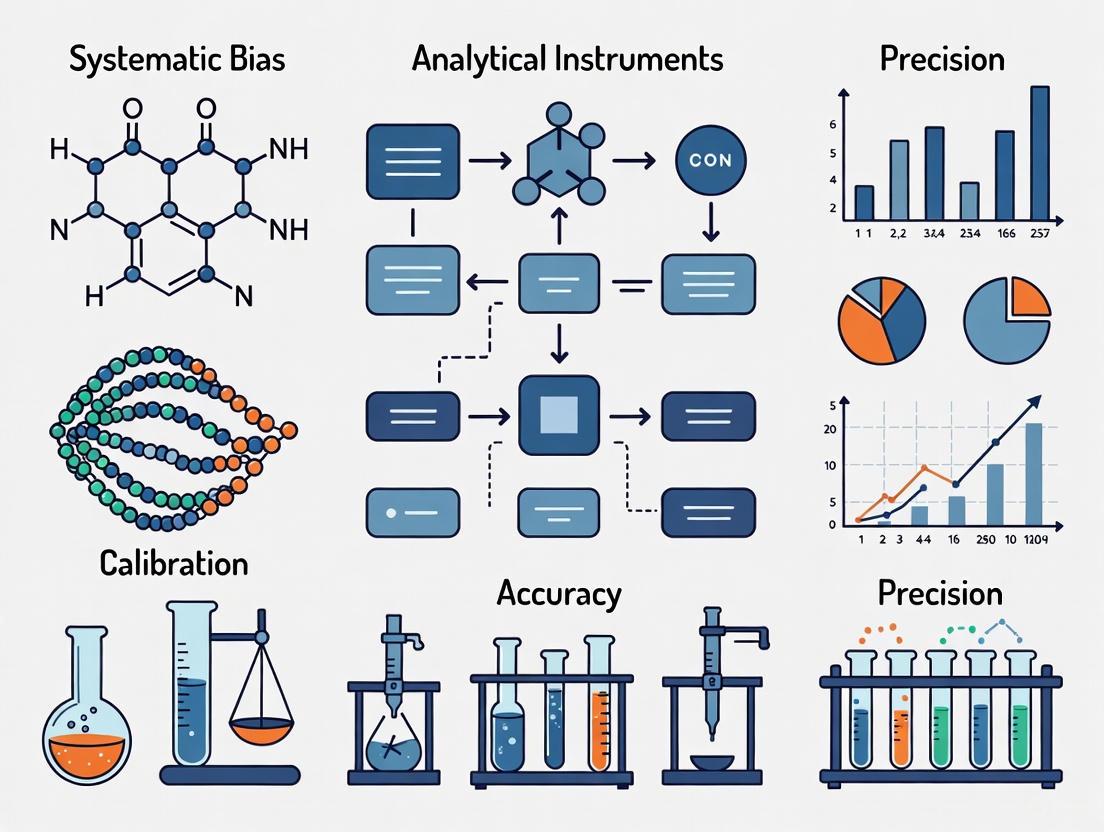
This article provides a foundational understanding of systematic bias in analytical instruments, a critical challenge in biomedical research and drug development.
Systematic Bias in Analytical Instruments: A Comprehensive Guide for Biomedical Researchers
Abstract
This article provides a foundational understanding of systematic bias in analytical instruments, a critical challenge in biomedical research and drug development. It explores the core concepts and real-world impact of bias, from skewed clinical trial data to flawed diagnostic tools. The content details advanced methodological approaches for detecting and quantifying bias, including statistical models and error frameworks. Practical troubleshooting and optimization strategies for bias mitigation, such as recalibration and improved study design, are presented. Finally, the article establishes rigorous validation and comparative frameworks to assess instrument performance and ensure data integrity, equipping scientists with the knowledge to enhance the reliability and equity of their research outcomes.
What is Systematic Bias? Foundational Concepts and Real-World Impact in Biomedicine
In scientific research, particularly in fields such as drug development and analytical instrument analysis, measurement error is defined as the difference between an observed value and the true value of a quantity [1]. Properly characterizing and mitigating these errors is fundamental to research integrity, as uncorrected errors can lead to research biases, invalid conclusions, and compromised decision-making [1]. Within a broader thesis on systematic bias in analytical instruments, this guide provides a technical framework for understanding, identifying, and correcting the two primary classes of measurement error: systematic error (bias) and random error (noise) [1] [2].
The distinction is not merely academic; it dictates the very strategies researchers must employ to ensure data quality. Systematic error skews measurements in a consistent, predictable direction, affecting accuracy, while random error causes unpredictable fluctuations around the true value, impairing precision [1] [3]. For drug development professionals, this is critical when comparing patient outcomes across clinical trials and real-world data, where differences in assessment protocols can introduce systematic measurement error that must be corrected to avoid biased estimates of treatment efficacy [4].
Core Theoretical Foundations
Defining Systematic Error (Bias)
Systematic error, often termed "bias," is a consistent or proportional difference between the observed and true values of something [1]. Unlike random fluctuations, its behavior is reproducible and non-compensating. If a measurement process contains systematic error, repeating the measurement under the same conditions will yield values that are consistently displaced from the true value in a specific direction [3].
Systematic errors are generally considered a more significant problem than random errors in research because they can systematically lead to false positive or false negative conclusions about the relationship between variables [1].
- Offset Error (Additive Error): This occurs when a scale is not calibrated to a correct zero point, causing a fixed amount to be added to or subtracted from every measurement [1]. For example, a weighing scale that always reads 0.5 grams heavy exhibits an offset error.
- Scale Factor Error (Multiplicative Error): This occurs when measurements consistently differ from the true value by a proportional amount (e.g., by 10%) across the instrument's range [1]. An example is a sensor whose readings are precisely 2% above the real values throughout its operational scale [3].
Distinguishing Random Error (Noise)
Random error is a chance difference between the observed and true values that varies unpredictably from one measurement to the next [1]. It does not consistently push measurements in one direction but creates a spread of values around the true value, thereby affecting the precision or reproducibility of the data [1] [2].
In an ideal scenario with only random error, multiple measurements of the same quantity will form a distribution that clusters around the true value. When averaged, these measurements will converge toward the true value, as the errors in different directions cancel each other out, especially in large samples [1]. This makes random error less problematic than systematic error for large-sample studies.
Accuracy vs. Precision: A Visual Metaphor
The concepts of accuracy and precision are effectively illustrated by the analogy of a dartboard [1]:
- High Accuracy, Low Precision: The darts are scattered widely but their average position is near the bullseye (low random error, low systematic error).
- Low Accuracy, High Precision: The darts are clustered tightly together but far from the bullseye (low random error, high systematic error).
- High Accuracy, High Precision: The darts are clustered tightly around the bullseye (low random error, low systematic error).
- Low Accuracy, Low Precision: The darts are scattered widely and nowhere near the bullseye (high random error, high systematic error).
Table 1: Comparative Analysis of Systematic and Random Error
| Feature | Systematic Error (Bias) | Random Error (Noise) |
|---|---|---|
| Definition | Consistent, predictable deviation from true value [1] | Unpredictable, chance-based fluctuation [1] |
| Impact on | Accuracy (closeness to true value) [1] | Precision (reproducibility of measurement) [1] |
| Direction | Unidirectional (always high or always low) [3] | Equally likely to be high or low [1] |
| Reducible by | Improved methods, calibration, blinding [1] | Averaging, increasing sample size [1] |
| Source Examples | Miscalibrated instrument, observer bias [1] [2] | Environmental fluctuations, electronic noise [1] [2] |
Advanced Error Models and Contemporary Challenges
A Refined Model: Constant vs. Variable Systematic Error
Emerging research proposes a more nuanced model that distinguishes between two components of systematic error, challenging the traditional view that it is always constant [5]:
- Constant Component of Systematic Error (CCSE): This is a stable, correctable bias. It can be quantified and removed from measurements through calibration against a known standard [5].
- Variable Component of Systematic Error (VCSE(t)): This behaves as a time-dependent function that cannot be efficiently corrected. It manifests as a slow drift or unpredictable shift in the measurement system's baseline performance over time, even under seemingly stable conditions [5].
This model explains why long-term quality control data in clinical laboratories are often not normally distributed and why standard deviations calculated from such data include contributions from both random error and this variable bias component [5]. This complexity necessitates ongoing quality control and monitoring.
Error and Bias in Modern AI Systems
In the context of artificial intelligence (AI) and large language models (LLMs) in healthcare, the concept of bias shares a conceptual foundation with systematic error. Algorithmic bias is defined as any systematic and unfair difference in how predictions are generated for different patient populations, which could lead to disparate care delivery [6]. This bias can originate from human biases (implicit, systemic, confirmation), algorithm development processes, or deployment settings, and it must be mitigated throughout the entire AI model lifecycle [6].
Frameworks for auditing these models are being developed, emphasizing stakeholder engagement, model calibration to specific patient populations, and rigorous testing through clinically relevant scenarios to identify and correct for these systematic skews [7].
Practical Methodologies for Error Identification and Mitigation
Experimental Protocol for Error Assessment
A robust protocol for characterizing error in an analytical instrument involves a structured repeated-measures design. The following workflow provides a methodology to quantify both random and systematic error components.
Title: Experimental Workflow for Error Assessment
Procedure:
- Select a Certified Reference Material (CRM): Obtain a sample with a known and traceable true value (μ_true). This serves as the ground truth for the assessment.
- Conduct Repeated Measurements: Using the analytical instrument under evaluation, perform a sequence of measurements (n > 30 is recommended for statistical power) on the CRM. Ensure conditions (e.g., operator, environment, instrument settings) are held as constant as possible to isolate the error components.
- Data Analysis:
- Calculate the mean (x̄) of the observed measurements.
- Systematic Error (Bias): Compute the difference:
Bias = x̄ - μ_true. This quantifies the average displacement from the true value, representing accuracy. - Random Error (Precision): Calculate the standard deviation (s) of the observed measurements. This quantifies the spread or dispersion of the data, representing precision.
- Characterization: The measurement system's total error profile is now characterized by its bias (systematic error) and standard deviation (random error).
Strategies for Reducing Systematic Error
Mitigating bias requires targeted strategies that address its root causes [1] [3].
- Regular Calibration: Compare instrument readings against a reference standard of higher accuracy and adjust the instrument accordingly. For example, a 2022 study on industrial pressure sensors showed periodic calibration cut measurement inaccuracies from ±5% to ±1.2% [3]. Automation can further reduce human error in this process by up to 15% [3].
- Method Triangulation: Measure the same quantity using multiple, fundamentally different instruments or techniques. If all methods converge on a similar result, confidence in the absence of significant systematic error is high [1].
- Blinding (Masking): In experiments involving human assessment, hide the condition assignment from both participants and researchers to prevent subconscious influences on measurements (e.g., experimenter expectancies, demand characteristics) [1].
- Randomization: Use random sampling to ensure the study sample does not systematically differ from the population. In experiments, use random assignment to place participants into different treatment conditions, which helps balance unmeasured confounding variables across groups [1].
Strategies for Reducing Random Error
Reducing noise increases the signal-to-noise ratio and improves the detectability of true effects.
- Increase Sample Size: Collecting data from a large sample is one of the most effective ways to reduce the impact of random error. The errors in different directions cancel each other out more efficiently, leading to a more precise estimate of the population mean [1].
- Take Repeated Measurements: For a given sample or subject, taking multiple readings and using their average brings the final value closer to the true value by averaging out the random fluctuations [1].
- Control Experimental Variables: Carefully control extraneous variables that could impact measurements, such as temperature, humidity, and vibration, for all participants or samples to remove key sources of random noise [1].
Table 2: Key Research Reagent Solutions for Error Mitigation
| Reagent/Material | Function in Error Control |
|---|---|
| Certified Reference Materials (CRMs) | Provides a ground truth with known property values for instrument calibration and trueness assessment, directly combating systematic error [3]. |
| Quality Control (QC) Materials | Stable, characterized materials run at regular intervals to monitor the stability of the measurement system over time, detecting both variable systematic error and increases in random error [5]. |
| Calibration Standards | A set of reference materials used to establish the relationship between instrument response and analyte concentration, correcting for offset and scale factor errors [1] [3]. |
| Stable Environmental Chambers | Controls ambient conditions (temperature, humidity) to minimize environmentally induced random error and systematic drift in sensitive instruments [2]. |
Error Analysis in Practice: A Case Study in Clinical Oncology
The challenge of measurement error is acutely present in oncology drug development. There is growing interest in using Real-World Data (RWD), such as electronic health records from routine clinical care, to augment or construct external control arms for clinical trials. However, disease assessments in RWD are often less standardized and frequent than in rigorous trials, introducing systematic measurement error when comparing endpoints like progression-free survival [4].
Experimental Protocol: Survival Regression Calibration (SRC)
To mitigate this bias, a novel statistical method called Survival Regression Calibration (SRC) has been developed [4]:
- Validation Sample: Obtain a sample of patients for whom both the "true" trial-like outcome measures and the "mismeasured" real-world-like outcome measures are available.
- Model Fitting: Fit separate Weibull regression models to the true and mismeasured outcome measures in this validation sample.
- Bias Estimation: Quantify the systematic bias by comparing the parameters (e.g., shape, scale) of the two models.
- Calibration: Apply this estimated bias to calibrate the parameter estimates in the full RWD study population. The SRC method is specifically designed for time-to-event outcomes and has been shown to yield greater reduction in measurement error bias than standard regression calibration methods [4].
This case demonstrates how understanding the nature of systematic error enables the development of sophisticated tools to correct for it, thereby strengthening evidence of treatment efficacy derived from real-world sources.
The rigorous distinction between systematic and random error is not a mere taxonomic exercise but a foundational element of robust scientific research. Systematic error (bias) poses a greater threat to the validity of research conclusions by consistently skewing results away from the truth, while random error (noise) obscures precision but can be managed through replication and large sample sizes. For researchers and drug development professionals, a disciplined approach involving regular calibration, methodological triangulation, controlled experimental design, and advanced statistical correction methods is essential for recognizing, quantifying, and mitigating these errors. As analytical technologies and data sources, including AI and RWD, continue to evolve, so too must the frameworks for ensuring the accuracy and reliability of the measurements upon which critical health decisions depend.
Traditional error models in clinical metrology often conflate distinct components of systematic error, leading to miscalculations of total error and measurement uncertainty. This whitepaper presents a novel error model that distinguishes between constant and variable components of systematic error (bias), challenging conventional approaches to quality control and measurement uncertainty estimation. Through mathematical deduction and simulation, we demonstrate that standard deviation derived from long-term quality control (QC) data includes both random error and the variable bias component, rendering it inappropriate as a sole estimator of random error. This refined model defines the constant component of systematic error (CCSE) as a correctable term, while the variable component (VCSE(t)) behaves as a time-dependent function that resists efficient correction. Implementation of this model enables clinical laboratories to enhance decision-making accuracy, improve measurement error estimation, and advance patient safety through more reliable diagnostic results.
Systematic bias represents a fundamental challenge in analytical metrology, particularly in clinical laboratory medicine where measurement inaccuracies can directly impact patient diagnosis, treatment monitoring, and therapeutic outcomes. According to the International Vocabulary of Metrology (VIM3), measurement bias is defined as the "estimate of a systematic measurement error" [8]. This systematic deviation of laboratory test results from actual values can cause misdiagnosis or misestimation of disease prognosis, ultimately increasing healthcare costs [8].
Traditional metrological approaches, developed alongside the concept of the normal distribution, were originally created to describe measurements in stable, non-biological systems. However, clinical laboratory measurements involve biological materials and complex systems exhibiting inherent variability that complicates the application of these traditional models [5]. A significant limitation of conventional approaches is the treatment of systematic error as a monolithic entity, despite evidence that its behavior varies substantially under different measurement conditions.
This whitepaper introduces a paradigm-shifting error model that distinguishes between constant and variable components of systematic error, addressing critical gaps in current clinical laboratory quality control practices. By examining bias through this novel framework, researchers and laboratory professionals can develop more sophisticated approaches to measurement uncertainty that reflect the complex reality of diagnostic testing environments.
Theoretical Foundations: Deconstructing Systematic Error
The Novel Error Model: Constant vs. Variable Bias Components
The proposed error model fundamentally redefines systematic error by separating it into two distinct components: the Constant Component of Systematic Error (CCSE) and the Variable Component of Systematic Error (VCSE(t)) [5]. This distinction represents a significant advancement over traditional models that treat systematic error as a single, monolithic entity.
The CCSE manifests as a stable, correctable offset between measured values and true reference values. This component remains relatively constant over time and can be effectively addressed through calibration against certified reference materials or reference methods [5] [8]. In contrast, the VCSE(t) behaves as a time-dependent function that fluctuates unpredictably and cannot be efficiently corrected through standard calibration procedures [5]. This variable component arises from multiple sources including reagent lot variations, environmental fluctuations, instrument aging, and operator differences.
The separation of these components challenges conventional approaches to total error calculation, which typically express total measurement error (TE) as the sum of systematic error (SE) and random error (RE). According to the novel model, what has traditionally been classified as "random error" in long-term quality control data actually contains both true random error and the variable component of systematic error [5].
Mathematical Formulation
The relationship between different error components can be mathematically represented as follows:
- Traditional Error Model: TE = SE + RE
- Novel Error Model: TE = CCSE + VCSE(t) + RE
Where:
- TE = Total Error
- CCSE = Constant Component of Systematic Error
- VCSE(t) = Variable Component of Systematic Error (time-dependent)
- RE = Random Error
This reformulation has profound implications for how clinical laboratories estimate measurement uncertainty and establish quality control limits [5].
Metrological Principles Underpinning the Model
The novel error model rests on four quintessential principles valid across all fields of metrology [5]:
- QP1: A parameter must be determined under the same conditions under which it is used in calculations and predictions.
- QP2: When applying a law or using an equation, we assume that all conditions of applicability are fulfilled.
- QP3: A corrective action cannot efficiently correct an error if the average error introduced by the corrective action is larger than the original error.
- QP4: Adding or multiplying by a constant does not reduce the natural variation present in measurements.
These principles highlight why traditional calibration approaches effectively address CCSE but fail to correct VCSE(t), as corrective factors applied to highly variable systematic errors may introduce more uncertainty than they resolve [5].
Types of Bias in Clinical Laboratory Measurements
Constant vs. Proportional Bias
In addition to the temporal distinction between constant and variable bias, systematic errors in laboratory medicine can be categorized based on their relationship to analyte concentration [8] [9]:
Table 1: Types of Measurement Bias in Clinical Laboratories
| Bias Type | Mathematical Representation | Characteristics | Detection Method |
|---|---|---|---|
| Constant Bias | Difference between target and measured values is constant across concentrations | Consistent offset regardless of analyte level; intercept (b) ≠ 0 in regression analysis | Evaluate if 95% confidence interval of intercept excludes 0 |
| Proportional Bias | Difference between target and measured values changes with analyte concentration | Bias magnitude proportional to measurand concentration; slope (a) ≠ 1 in regression analysis | Evaluate if 95% confidence interval of slope excludes 1 |
| Variable Bias (VCSE(t)) | Fluctuates unpredictably over time | Time-dependent; not correctable through standard calibration; affected by multiple factors | Analysis of long-term quality control data trends |
These bias types can occur independently or in combination. For example, a method might exhibit both constant and proportional bias simultaneously, where the regression equation shows both intercept (b) significantly different from 0 and slope (a) significantly different from 1 [9].
Measurement Conditions and Their Impact on Bias Detection
The conditions under which measurements are performed significantly influence the observed bias and its components. VIM3 defines three primary measurement conditions [5] [8]:
- Repeatability Conditions: Same measuring procedure, operators, system, location, and operating conditions over a short period.
- Intermediate Precision Conditions: Conditions including different instruments, operators, reagents, and calibrators over an extended period within a single laboratory.
- Reproducibility Conditions: Conditions including different laboratories, procedures, locations, and operators.
The variable component of systematic error (VCSE(t)) becomes increasingly pronounced under intermediate precision and reproducibility conditions, whereas repeatability conditions primarily reveal constant bias and random error [5].
Methodologies for Bias Assessment and Quantification
Experimental Protocol for Distinguishing Bias Components
Objective: To separate and quantify constant and variable components of systematic error in clinical laboratory measurements.
Materials and Reagents:
- Certified reference materials (CRMs) with known target values
- Stable control materials spanning clinically relevant concentrations
- Patient samples for commutation studies
- Calibrators traceable to reference methods
- Appropriate instrumentation and reagents
Procedure:
- Short-term Repeatability Study: Perform 20 consecutive measurements of CRMs and control materials within a single run under identical conditions. Calculate mean, standard deviation (s_r), and bias for each level.
- Long-term Intermediate Precision Study: Analyze control materials once daily for 20-30 days under routine laboratory conditions. Record results along with documentation of reagent lot changes, calibration events, maintenance, and operator shifts.
- Data Analysis:
- Calculate overall mean and standard deviation (s_RW) for each control level from long-term data.
- The difference between the overall mean and CRM target value represents the total systematic error.
- The difference between the short-term mean and CRM target value estimates the constant component (CCSE).
- The difference between total systematic error and CCSE provides an estimate of the variable component (VCSE(t)).
- Statistical Evaluation:
- Perform significance testing on bias estimates using t-tests or confidence interval analysis.
- Use regression analysis (e.g., Passing-Bablok) to identify constant and proportional bias components.
- Analyze temporal patterns in control data to characterize the behavior of VCSE(t).
Establishing Significance of Bias
The clinical and statistical significance of estimated bias should be evaluated before implementation of corrections. The significance of bias can be determined using several approaches [8]:
Statistical Significance Testing: Perform a one-sample t-test comparing measured values to target reference values. A p-value < 0.05 suggests statistically significant bias.
Confidence Interval Analysis: Calculate the 95% confidence interval of the mean of repeated measurements. If the interval does not include the target value, bias is considered statistically significant.
Medical Relevance Assessment: Evaluate whether the observed bias magnitude exceeds acceptable limits based on biological variation, clinical guidelines, or regulatory requirements.
Table 2: Key Reagents and Materials for Bias Assessment Experiments
| Material/Reagent | Specification Requirements | Function in Experiment |
|---|---|---|
| Certified Reference Materials (CRMs) | Commutable with patient samples; value assigned by reference method | Provides true target value for bias calculation; traceability to higher-order standards |
| Stable Control Materials | Multiple concentration levels covering measuring interval; well-characterized stability | Monitoring long-term performance; detecting variable bias component |
| Calibrators | Traceable to reference method; matrix-matched to patient samples | Establishing measurement traceability; correcting constant bias |
| Patient Samples | Fresh samples representing typical clinical cases | Commutability assessment; verifying performance with real samples |
Visualization of the Novel Error Model
Component Relationship Diagram
Bias Detection Workflow
Implications for Laboratory Practice and Quality Control
Quality Control Strategy Reform
The distinction between constant and variable bias components necessitates a fundamental reassessment of quality control practices in clinical laboratories. Traditional QC approaches that rely solely on standard deviation calculated from long-term data (s_RW) inherently overestimate random error because this parameter includes both random error and the variable component of systematic error [5].
This overestimation explains the frequently observed phenomenon in laboratory practice where theoretically predicted error rates based on normal distribution assumptions do not align with actual experience. Laboratories often observe "impossible" QC graphs with fewer rule violations than would be statistically expected, suggesting that decision limits based on s_RW are inappropriately wide [5].
Measurement Uncertainty Estimation
The novel error model provides a more sophisticated framework for estimating measurement uncertainty in clinical laboratories. By separately quantifying constant and variable bias components, laboratories can develop uncertainty budgets that more accurately reflect the true sources of variation in their measurement systems.
This approach acknowledges that while the constant component of systematic error can be corrected through calibration, the variable component contributes directly to measurement uncertainty and must be accounted for in uncertainty estimates [5].
Method Validation and Verification
When implementing new analytical methods or instruments, laboratories should specifically assess both constant and variable bias components during validation studies. This requires designing experiments that separately evaluate performance under repeatability conditions and intermediate precision conditions, allowing for discrimination between these different error sources.
The presence of significant variable bias may necessitate more frequent calibration, enhanced environmental controls, or modified QC rules to ensure result quality remains within acceptable limits.
Future Directions and Research Applications
Integration with Advanced Technologies
The growing adoption of artificial intelligence (AI) and machine learning in clinical laboratories presents opportunities for more sophisticated management of variable bias components [10] [11]. AI algorithms could potentially model and predict VCSE(t) behavior based on multiple laboratory parameters, enabling proactive correction approaches rather than reactive responses to QC failures.
Digital solutions and enhanced connectivity between instruments through the Internet of Medical Things (IoMT) may facilitate real-time monitoring of systematic error components, allowing for more dynamic quality management systems [10].
Implications for Diagnostic Research and Drug Development
In pharmaceutical research and diagnostic development, proper characterization of analytical bias components is essential for generating reliable data. The novel error model provides a framework for more accurate assessment of biomarker performance, potentially identifying previously overlooked sources of variation that could impact clinical trial results or diagnostic accuracy claims.
For researchers developing novel assays, understanding the distinction between constant and variable bias can inform more robust assay design, potentially reducing the impact of VCSE(t) through improved reagent formulations, more stable instrumentation, or optimized calibration strategies.
The distinction between constant and variable components of systematic error represents a paradigm shift in how clinical laboratories should conceptualize and manage measurement bias. This novel error model challenges long-standing assumptions in metrology and provides a more accurate framework for understanding the behavior of analytical systems under real-world conditions.
By recognizing that what has traditionally been classified as "random error" in long-term quality control data actually contains both true random error and variable systematic error, laboratories can develop more appropriate quality control strategies, more accurate measurement uncertainty estimates, and ultimately, more reliable patient results.
Implementation of this refined error model requires changes to method validation approaches, quality control practices, and data analysis techniques. However, the potential benefits in improved patient safety, reduced laboratory errors, and more efficient resource utilization justify this evolution in laboratory metrology practice.
Systematic bias represents a fundamental threat to the integrity of clinical research and drug development. Unlike random error, which averages out over multiple measurements, systematic bias introduces predictable, non-random distortions that can compromise the validity of study results and lead to erroneous conclusions. In the high-stakes environment of pharmaceutical development, where decisions affect both patient safety and billions of dollars in investment, understanding and mitigating these biases is not merely academic—it is a scientific and ethical imperative. Systematic bias in clinical trials can manifest through flawed participant selection, unrepresentative demographics, biased outcome measurements, and selective reporting of results. These distortions subsequently propagate through the entire drug development pipeline, potentially resulting in treatments that are less effective or even harmful for populations inadequately represented during research phases [12].
The contemporary drug development landscape operates at the intersection of immense scientific innovation and staggering financial risk. The traditional path from discovery to market approval spans 10 to 15 years with capitalized costs averaging $2.6 billion per approved drug [13]. This lengthy, expensive process is characterized by high attrition rates, with approximately 90% of drugs that enter human testing ultimately failing to receive regulatory approval [13]. Within this vulnerable ecosystem, systematic bias acts as an invisible tax, distorting critical go/no-go decisions and potentially allowing ineffective or unsafe compounds to advance while overlooking promising therapies. As artificial intelligence and machine learning become increasingly integrated into drug discovery and clinical trial design, new forms of algorithmic bias emerge that can amplify and scale existing healthcare disparities at an unprecedented rate [14].
Quantitative Evidence of Systematic Bias in Clinical Trials
Documented Demographic Skews
A quantitative meta-analysis of 690 clinical decision instruments (CDIs) provides compelling evidence of systematic bias in clinical research development. The analysis revealed significant demographic imbalances in participant populations that undermine the generalizability of research findings [15]:
Table 1: Demographic Skews in Clinical Decision Instrument Development
| Demographic Factor | Representation in Studies | Implication for Generalizability |
|---|---|---|
| Racial Composition | 73% White participants | Underrepresentation of minority groups despite often having higher disease burdens |
| Gender Distribution | 55% Male participants | Insufficient enrollment of female participants despite known sex-based differences in drug metabolism |
| Geographic Distribution | 52% in North America, 31% in Europe | Limited data from Asian, African, and South American populations |
These demographic skews are particularly concerning given that differences in medical product safety and effectiveness can emerge based on factors such as age, ethnicity, sex, and race [16]. Without adequate representation of the populations most affected by a disease, clinical trial data risks being biased, potentially resulting in treatments that are less effective—or even harmful—for underrepresented groups [16].
Beyond demographic imbalances, the same meta-analysis identified several methodological factors that introduce systematic bias into clinical research [15]:
Variable Selection Bias: 13 CDIs explicitly used race and ethnicity as predictor variables, potentially encoding societal biases directly into clinical algorithms.
Outcome Definition Bias: 28% of CDIs involved follow-up procedures, which may disproportionately skew outcome representation based on socioeconomic status, as patients with greater resources are more likely to complete extended follow-up requirements.
Geographic Concentration: With 52% of studies conducted in North America and 31% in Europe, the research fails to capture the genetic, environmental, and healthcare system diversity of global populations.
The documented underrepresentation is especially pronounced for specific disease areas. For example, a 2022 study in JAMA Oncology found that fewer than 5% of participants in U.S. cancer clinical trials were Black, despite Black Americans making up approximately 13% of the population [17]. This disparity persists despite evidence that diverse trial populations lead to more generalizable results, improved safety data, and better public trust [17].
Root Causes and Mechanisms of Systematic Bias
Data-Related Origins
The foundational principle of "bias in, bias out" is particularly relevant to clinical research and algorithm development. Historical medical data itself is profoundly biased due to decades of clinical research that systematically excluded or underrepresented women and ethnic minorities, focusing primarily on white males [14]. When artificial intelligence models are trained on these skewed datasets, they inevitably learn a distorted view of medicine that perpetuates existing disparities. For example, an algorithm trained on cardiovascular data from men may fail to recognize a heart attack in a woman, whose symptoms often present differently, leading to misdiagnosis and poorer outcomes [14].
This problem of unrepresentative data is compounded by several factors:
Geographic and Socioeconomic Skews: Most training data is sourced from a few large, urban academic medical centers, failing to capture the health realities of rural, lower-income, or geographically diverse populations [14].
Missing Metadata: Crucial information on race, ethnicity, and social determinants of health is often not collected or associated with patient records, making it impossible for developers to test for demographic bias, let alone correct it [14].
The Proxy Trap: Algorithm designers sometimes use easily measured variables (proxies) that correlate with the true variable of interest but introduce bias. A landmark study published in Science analyzed a widely used algorithm designed to identify patients who would benefit from high-risk care management programs that used patients' past healthcare costs as a proxy for their current health needs [14]. Because historically less money has been spent on Black patients compared to white patients with the same level of illness, the AI falsely concluded that Black patients were healthier and thus less likely to be flagged for the additional care they needed [14].
Human and Institutional Factors
Systematic bias in clinical research is not solely a technical problem—it is fundamentally a human and institutional one. The teams building healthcare algorithms often lack the racial, gender, and socioeconomic diversity of the patient populations the tools are meant to serve [14]. This homogeneity can lead to blind spots, where developers fail to consider the unique needs and contexts of different groups.
Additional human factors include:
Subjective Data Labeling: For many AI models, humans must first label the training data (e.g., identifying a tumor in an image). This process is subjective and can introduce the annotators' own biases and stereotypes into the "ground truth" from which the AI learns [14].
Problem Formulation: Bias can be introduced at the very genesis of a research project. A developer's choice of which problem to solve, what data to use, and which performance metrics to prioritize is a value judgment that can have discriminatory downstream effects [14].
Operational Barriers: Practical challenges such as transportation, time off work, and childcare responsibilities disproportionately affect participation among lower-income and minority groups, while lack of awareness about clinical trial opportunities and historical mistrust of the medical research community further exacerbate representation gaps [18] [17].
Assessment Methodologies and Experimental Protocols
Risk of Bias Assessment Tools
Researchers have developed standardized tools to systematically evaluate potential biases in clinical studies. The most widely adopted instruments include:
Table 2: Risk of Bias Assessment Tools for Clinical Research
| Assessment Tool | Study Type | Key Domains Evaluated | Interpretation |
|---|---|---|---|
| Cochrane RoB Tool | Randomized Controlled Trials (RCTs) | Sequence generation, allocation concealment, blinding, incomplete outcome data, selective reporting | Low risk, high risk, or unclear risk in each domain |
| ROB-2 | RCTs | Randomization process, deviations from interventions, missing outcome data, outcome measurement, selection of reported results | Low concern, some concern, or high risk of bias |
| ROBINS-I | Non-randomized studies | Confounding, participant selection, intervention classification, deviations, missing data, outcome measurement, result selection | Categorizes bias risk across seven domains |
| Newcastle-Ottawa Scale (NOS) | Cohort and case-control studies | Selection, comparability, outcome/exposure | Quality assessment using a star system |
These tools enable systematic critical appraisal of research methodology rather than relying on potentially subjective judgments of study quality [12]. For the assessment of bias, the protocol typically requires two independent reviewers to perform the risk of bias assessment for all studies that fulfil the inclusion criteria, with a third reviewer adjudicating any discrepancies [12].
Bias Evaluation in AI Systems
As artificial intelligence becomes increasingly integrated into drug development and clinical decision-making, specialized evaluation methodologies have emerged to assess algorithmic bias. Recent studies have employed multi-phase experimental designs to evaluate AI system performance across different demographic groups and clinical scenarios [19].
A representative evaluation protocol for assessing bias in medical AI systems includes:
AI Bias Assessment Workflow
This experimental workflow was implemented in a recent study evaluating GPT-4o on the Chilean anesthesiology exam, which employed 30 independent simulation runs with systematic variation of the model's temperature parameter to gauge the balance between deterministic and creative responses [19]. The generated responses underwent qualitative error analysis using a refined taxonomy that categorized errors such as "Unsupported Medical Claim," "Hallucination of Information," and "Incorrect or Vague Conclusion" [19].
Table 3: Research Reagent Solutions for Bias Assessment
| Tool/Resource | Function | Application Context |
|---|---|---|
| Cochrane RoB Tool (RevMan) | Generates traffic light plots and summary plots of bias assessment | Systematic reviews of randomized controlled trials |
| ROBVIS Web Application | Visualizes risk-of-bias assessments using traffic light and weighted bar plots | Creating publication-quality bias assessment graphics |
| Jadad Scale | Assesses methodological quality of clinical trials using 8 criteria | Quick quality assessment of randomized controlled trials |
| Newcastle-Ottawa Scale (NOS) | Evaluates quality of non-randomized studies across three domains | Observational studies, cohort studies, and case-control studies |
| QUADAS-2 | Assesses risk of bias in diagnostic accuracy studies | Studies evaluating diagnostic tests or biomarkers |
| Real-World Data (RWD) Platforms | Provides real-world patient data to assess representativeness | Setting enrollment targets, identifying recruitment barriers |
These tools enable researchers to implement comprehensive bias assessment protocols throughout the drug development lifecycle. The integration of real-world data is particularly valuable for understanding how well clinical trial populations represent the intended treatment populations in actual practice [20]. By comparing the demographic, clinical, and socioeconomic characteristics of trial participants with those of real-world patient populations, researchers can identify specific representation gaps and develop targeted strategies to address them [20].
Impact on Drug Development Processes and Outcomes
Consequences for Safety and Efficacy
The downstream effects of systematic bias in clinical research manifest in multiple concerning ways throughout the drug development pipeline:
Reduced Generalizability: When clinical trials fail to adequately represent the demographic and clinical diversity of real-world patient populations, the applicability of trial results to clinical practice becomes limited. This is particularly problematic for chronic conditions that manifest differently across populations, such as cardiovascular disease, diabetes, and many cancers [16] [17].
Limited Detection of Subgroup Effects: Homogeneous trial populations decrease the likelihood of identifying differential treatment effects across demographic groups. Without sufficient representation of diverse populations, potentially important variations in drug metabolism, efficacy, or adverse event profiles may remain undetected until after market approval, when the drug is exposed to a much larger and more diverse patient population [16].
Perpetuation of Health Disparities: Systematic bias in clinical research can exacerbate existing health inequities. For example, a University of Florida study found that the accuracy of an AI tool for diagnosing bacterial vaginosis was highest for white women and lowest for Asian women, with Hispanic women receiving the most false positives [14]. Similarly, numerous skin cancer detection algorithms have been trained predominantly on images of light-skinned individuals, resulting in significantly lower diagnostic accuracy for patients with darker skin—a critical failure, given that Black patients already have the highest mortality rate for melanoma [14].
Financial and Regulatory Implications
Systematic bias introduces significant financial and operational risks into the drug development process:
Late-Stage Failures: Biases in early research phases can propagate through the development pipeline, leading to costly late-stage failures when efficacy or safety issues emerge in broader, more diverse populations. Phase II clinical trials represent the single largest hurdle in drug development, with a success rate of only 29% to 40%, and between 40% and 50% of all clinical failures are due to a lack of clinical efficacy discovered at this stage [13].
Regulatory Scrutiny: Regulatory bodies are increasingly emphasizing the importance of diverse clinical trial populations. The FDA's diversity action plan requirements for Phase III clinical trials, set to take effect in mid-2025, reflect this heightened focus on representative research populations [16]. Similar initiatives are underway globally, with both the European Medicines Agency and the World Health Organization issuing guidance on improving enrollment of diverse populations in clinical trials [18].
Market Limitations: Drugs developed on narrow evidence bases may face market restrictions or require additional post-market studies, limiting their commercial potential. Furthermore, as regulatory requirements for representative evidence continue to evolve, drugs developed using predominantly homogeneous populations may face challenges in obtaining or maintaining market authorization across different jurisdictions [18].
Mitigation Strategies and Best Practices
Methodological Interventions
Addressing systematic bias requires intentional strategies throughout the research lifecycle:
Structured Bias Assessment Protocols: Implementing standardized risk of bias assessment using validated tools like Cochrane RoB 2.0 or ROBINS-I at the study design phase helps identify potential sources of bias before data collection begins. This proactive approach allows researchers to implement safeguards against common biases in randomization, allocation concealment, blinding, outcome assessment, and data analysis [12].
Comprehensive Reporting Standards: Adhering to established reporting guidelines such as CONSORT for randomized trials, STROBE for observational studies, and TRIPOD for prediction model studies improves transparency and enables critical appraisal of potential biases. Pre-registering study protocols and analysis plans reduces selective reporting bias and publication bias [12].
Diversity-by-Design Framework: Incorporating representativeness as a core design consideration rather than an afterthought. This includes using real-world data to understand the epidemiologic characteristics of the target disease population and setting enrollment goals that reflect this diversity [20]. The diversity dimension framework encompasses demographic, clinical, treatment environment, and social determinants of health elements [20].
Operational and Engagement Approaches
Successful mitigation of systematic bias extends beyond methodology to encompass operational and community engagement strategies:
Inclusive Site Selection: Placing trial sites in communities with historically underserved populations increases accessibility and relevance. Additionally, establishing satellite locations, mobile health units, and community-based participatory research centers can reduce geographic and socioeconomic barriers to participation [17].
Reduced Participant Burden: Implementing flexible protocol designs that account for logistical barriers like transportation, work conflicts, and caregiving responsibilities. This may include offering virtual visits, after-hours appointments, transportation assistance, and decentralized trial components [17].
Community Partnership: Building authentic, long-term relationships with community organizations, healthcare providers, and community leaders from underrepresented populations. These partnerships should be established early in the research process and maintained throughout, with clear mechanisms for community input and benefit-sharing [18] [17].
Bias Mitigation Framework
Regulatory and Policy Initiatives
The evolving regulatory landscape is creating additional impetus for addressing systematic bias in clinical research:
Diversity Action Plans: The FDA's guidance recommending that sponsors submit Diversity Action Plans to outline how they intend to enroll participants from underrepresented populations represents a significant step toward institutionalizing diversity in clinical research [17]. Though implementation has faced challenges, the concept continues to evolve, with some experts proposing reframing them as "Inclusive Research Action Plans" to preserve intent while navigating political landscapes [17].
Transparency Requirements: Regulatory agencies are increasingly expecting detailed reporting of participant demographics and analyses of treatment effects across demographic subgroups. These requirements help identify when safety or efficacy profiles may differ across populations and inform personalized treatment approaches [16] [18].
Real-World Evidence Integration: Regulatory acceptance of real-world evidence to supplement traditional clinical trial data creates opportunities to enhance understanding of how treatments perform in diverse patient populations encountered in actual clinical practice [20]. This is particularly valuable for understanding treatment effects in populations typically excluded from or underrepresented in traditional clinical trials.
Systematic bias in clinical trials is not merely a methodological concern—it represents a fundamental challenge to the scientific validity, ethical foundation, and economic sustainability of drug development. The quantitative evidence demonstrates persistent demographic skews, with clinical trial populations frequently failing to represent the diversity of real-world patient populations who will ultimately use the treatments being studied. These representational gaps, combined with methodological biases in study design, implementation, and analysis, undermine the generalizability of research findings and can perpetuate health disparities.
Addressing these challenges requires a multifaceted approach that integrates methodological rigor, operational innovation, and regulatory alignment. The implementation of structured bias assessment protocols, diversity-by-design frameworks, and inclusive trial operational strategies can significantly reduce systematic bias throughout the drug development lifecycle. Furthermore, the growing regulatory emphasis on representative research populations, exemplified by the FDA's diversity action plan requirements, creates both imperative and opportunity for meaningful change.
For researchers, scientists, and drug development professionals, the mandate is clear: systematic bias must be recognized as a critical threat to research integrity and patient safety rather than a secondary consideration. By adopting the assessment tools, methodological approaches, and mitigation strategies outlined in this technical guide, the research community can generate more reliable, generalizable, and equitable evidence, ultimately leading to better treatments and outcomes for all patient populations.
Clinical Decision Instruments (CDIs) are data-driven tools designed to standardize and improve patient care by assisting healthcare providers in predicting, diagnosing, and managing diseases. Ranging from simple flowcharts to complex machine learning algorithms, these instruments promise to enhance diagnostic accuracy and treatment efficacy [21]. However, this very standardization risks perpetuating and amplifying pre-existing societal and healthcare disparities if systemic biases are embedded within their development framework [15]. This case study documents the quantitative evidence of racial and gender bias in CDI development and provides a technical guide for researchers to identify, assess, and mitigate these biases, framing the issue within the broader context of systematic bias in analytical instruments research.
The pursuit of equity in CDIs presents a fundamental dilemma. On one hand, they can reduce subjective variations in care. On the other, when developed from biased data or flawed methodologies, they risk codifying discrimination into clinical practice, often under a misleading veneer of objectivity [21]. This analysis synthesizes findings from a quantitative meta-analysis of 690 CDIs, historical reviews, and contemporary data science research to provide a comprehensive examination of this critical issue [15] [21].
Quantitative Evidence of Systematic Bias
A recent large-scale meta-analysis of 690 clinical decision instruments provides stark evidence of systematic biases in their development lifecycle [15]. The findings reveal significant skews in multiple dimensions, from participant demographics to geographical representation, which collectively threaten the generalizability and fairness of these tools.
Table 1: Documented Biases in CDI Development from Meta-Analysis of 690 Instruments [15]
| Bias Dimension | Metric | Finding | Implied Risk |
|---|---|---|---|
| Participant Demographics | Racial Composition | 73% of participants identified as White | Underrepresentation of racial/ethnic minorities limits validation across populations |
| Gender Composition | 55% of participants identified as Male | Underrepresentation of women and gender-diverse individuals | |
| Geographical Skew | Investigator Location | 52% of studies in North America, 31% in Europe | Limited validation in diverse global healthcare settings |
| Predictor Variables | Use of Race/Ethnicity | 13 CDIs explicitly used Race and Ethnicity as variables | Potential reinforcement of biological race concepts without proven basis |
| Outcome Definition | Follow-up Requirements | 28% of CDIs involved follow-up for outcome determination | Potential skew based on socioeconomic status affecting follow-up capacity |
The over-reliance on predominantly White and male participant cohorts means that CDIs may perform suboptimally for women, gender-diverse individuals, and racial minorities [15] [22]. Furthermore, the explicit use of race as a biological variable in 13 identified instruments is particularly problematic, as it often lacks a robust scientific basis and may instead serve as a proxy for unmeasured social determinants of health [21].
Historical Context and Origins of Bias
The Legacy of Race Correction
The practice of race correction in clinical algorithms has deep historical roots, many originating in now-debunked scientific theories. A seminal example can be traced to the mid-19th century with the invention of the spirometer by Dr. John Hutchinson [21]. This device was subsequently co-opted by American physician Samuel Cartwright, who used it to compare lung function between enslaved Black Americans and free White Americans, incorrectly attributing the observed 20% lower lung function in Black individuals to innate biological inferiority rather than environmental factors and living conditions [21].
This flawed premise persisted for centuries and was formally encoded into medical devices and software in the 1970s, when a study in The International Journal of Epidemiology reported a 13% difference in lung function between Black and White asbestos workers without adequately accounting for social and environmental confounders [21]. These race-based adjustments became standard worldwide, artificially elevating the measured lung function for people identified as Black or Asian and consequently raising the threshold for diagnosis of lung disease, potentially leading to systematic underdiagnosis in these populations [21].
Gender Bias in Biomedical Research
Gender bias similarly stems from long-standing historical practices in biomedical research. The field has traditionally relied on the male body as the default model, often treating women as "smaller men" [22]. This approach has created significant knowledge gaps in sex- and gender-specific health responses and outcomes. A well-documented manifestation of this bias is in cardiovascular disease, where women have historically been offered fewer diagnostic tests and medications than men, contributing to poorer healthcare outcomes [22].
The conceptualization of gender bias itself lacks clarity in healthcare literature, with outdated definitions often failing to consider modern gender constructs and intersectionality [22]. This definitional ambiguity complicates efforts to systematically identify and address such biases in CDI development.
Modern Data Science and the Reproduction of Structural Bias
Contemporary data science practices often perpetuate these historical biases under the guise of technological neutrality. This phenomenon has been powerfully critiqued as "The New Jim Code" - describing how seemingly progressive technologies can reinforce racial hierarchies [21]. In the context of clinical algorithms, this manifests in models that may exclude race as an explicit variable but still encode racial bias through proxies such as ZIP codes, insurance status, or comorbidity patterns that correlate with racially segregated neighborhoods or disparities in healthcare access [21].
Clinical datasets themselves are not neutral; they encode historical disparities in healthcare access, diagnosis, and treatment. When these datasets train machine learning models without critical scrutiny, they risk automating and amplifying existing inequities [23]. This is particularly problematic with proprietary algorithms and opaque AI systems where lack of transparency limits scrutiny and accountability [21] [23].
Table 2: Sources of Bias in Clinical Machine Learning Models [23]
| Bias Source | Stage of ML Development | Description | Example in Clinical Context |
|---|---|---|---|
| Historical Bias | Data Collection | Reflects pre-existing societal and healthcare disparities | Underdiagnosis of certain conditions in specific demographic groups creates biased training data |
| Representation Bias | Data Selection | Underrepresentation of certain populations in datasets | Lack of diverse racial groups in medical imaging datasets |
| Measurement Bias | Data Collection | Unequality in measurement quality across groups | Pulse oximeters less accurate on darker skin tones |
| Algorithmic Bias | Model Training | Model optimization favors majority groups | Model overfits to well-represented demographics at expense of minority groups |
| Evaluation Bias | Model Validation | Test sets lack diversity | Model performs well on White male cohort but poorly on other groups |
| Deployment Bias | Model Implementation | Context mismatch between development and use settings | Model trained on academic medical center data deployed in community clinics |
The following diagram illustrates how bias propagates through the clinical algorithm development lifecycle:
Bias Propagation in Clinical Algorithm Development
Experimental Protocols for Bias Assessment
Risk of Bias Assessment Tools
Systematic assessment of potential biases in clinical instruments and the studies that validate them requires standardized methodologies. Several validated tools exist for this purpose, each with specific applications and domains:
- Cochrane Risk of Bias (RoB) Tool: Assesses selection, performance, detection, attrition, reporting, and other potential bias sources in randomized controlled trials (RCTs) [12].
- ROBINS-I (Risk of Bias In Non-randomised Studies of Interventions): Evaluates bias in non-randomized intervention studies across confounding, participant selection, intervention classification, deviations from intended interventions, missing data, outcome measurement, and selective reporting [12].
- ROBINS-E (Risk Of Bias In Non-randomised Studies - of Exposures): Specifically designed for observational epidemiological studies, evaluating confounding, selection, classification, departures, missing data, measurement, and reporting biases [12].
- Newcastle-Ottawa Scale (NOS): An eight-item instrument for assessing the quality of non-randomized studies in clinical trials across three categories: selection, comparability, and exposure or outcome [12].
Algorithmic Fairness Metrics
For clinical machine learning models, specific fairness metrics are necessary to quantify potential racial and gender bias:
- Equal Opportunity Difference: Measures the difference in true positive rates between protected and unprotected groups [23].
- Disparate Impact: Calculates the ratio of the rate of favorable outcomes for the protected group versus the unprotected group [23].
- Average Odds Difference: Compares the average of true positive and false positive rates between groups [23].
- Calibration: Assesses how well the model's predicted probabilities match actual outcome rates across different groups [23].
These metrics should be applied consistently during model development and validation phases, with particular attention to intersectional analyses that consider the compounded effects of multiple protected attributes (e.g., Black women) [22] [23].
Systematic Bias Correction Model
Advanced statistical approaches can help identify and correct for systematic bias in research data. A nonlinear B-spline mixed-effects model provides one such methodology for detecting and correcting systematic sample bias in timecourse data, such as longitudinal clinical studies or metabolomic analyses [24].
The model formulation accounts for the concentration of each metabolite (or clinical measurement) at time point i as:
y_ij = S_i × f_j(t_i) + ε_ij
Where:
y_ij= measured concentration of metabolite j at time iS_i= scaling term representing systematic bias across all metabolites in sample if_j(t_i)= bias-free B-spline curve for each metabolite jε_ij= random error term, assumed to be normally distributed [24]
The systematic bias term S_i is estimated as a nonlinear random effect assumed to be normally distributed with an expected value of 1 (representing no error). This approach can correct systematic biases of 3-10% to within 0.5% on average for typical data [24].
The following workflow diagram illustrates the implementation of this bias detection and correction method:
Systematic Bias Detection and Correction Workflow
The Scientist's Toolkit: Research Reagent Solutions
Table 3: Essential Tools for Bias Assessment and Mitigation in Clinical Research
| Tool/Resource | Function | Application Context |
|---|---|---|
| Cochrane RoB Tool | Assesses risk of bias in randomized controlled trials | Systematic reviews of clinical studies [12] |
| ROBINS-I | Evaluates bias in non-randomized intervention studies | Observational studies of treatment effects [12] |
| ROBINS-E | Assesses bias in observational epidemiological studies | Environmental exposure and health outcome studies [12] |
| robvis | Visualizes risk-of-bias assessments | Creating traffic light plots and summary plots for publications [12] |
| Nonlinear B-spline Mixed-Effects Model | Detects and corrects systematic sample bias | Timecourse metabolomics and longitudinal clinical data [24] |
| AI Fairness 360 (AIF360) | Comprehensive suite of fairness metrics and algorithms | Evaluating and mitigating bias in machine learning models [23] |
| Diverse Population Datasets | Representative data across racial, gender, and socioeconomic groups | Training and validating clinical algorithms [15] [25] |
| Community Engagement Frameworks | Participatory research methodologies | Ensuring inclusive CDI development, particularly for marginalized groups [25] |
Bias Mitigation Strategies
Preprocessing, In-Processing, and Postprocessing Techniques
Effective mitigation of racial and gender bias in clinical algorithms requires interventions throughout the development pipeline:
- Preprocessing Methods: Techniques applied to training data before model development, including resampling underrepresented groups, generating synthetic data for minority populations, and adjusting data labels to remove biased correlations [23].
- In-Processing Methods: Modifications to the model training process itself, such as incorporating fairness constraints into the objective function, using adversarial debiasing to remove protected attribute information from representations, and employing regularization techniques that penalize disparate outcomes [23].
- Postprocessing Methods: Adjustments to model outputs after training, including group-specific threshold tuning to ensure equalized odds or demographic parity, and calibration of predicted probabilities across different demographic groups [23].
Transitioning to Race-Neutral Equations
Several medical specialties have begun transitioning from race-based to race-neutral clinical algorithms with promising results. In pulmonary function testing, the European Respiratory Society (ERS) and American Thoracic Society (ATS) have endorsed new Global Lung Function Initiative (GLI) equations that entirely remove race as a factor [21]. Similar transitions have occurred in nephrology, where race-based adjustments in estimated glomerular filtration rate (eGFR) equations have been removed, eliminating artificial elevation of kidney function values for Black patients that previously delayed disease diagnosis and transplant eligibility [21].
These transitions require careful consideration of the clinical context and potential unintended consequences, but generally demonstrate improved equity without compromising diagnostic accuracy [21].
Inclusive Data Collection and Community Engagement
Fundamental to bias mitigation is addressing the root cause: unrepresentative data and exclusionary development processes. Researchers should prioritize:
- Comprehensive Demographic Data Collection: Gathering robust self-reported racial, ethnic, and gender identity data, while ensuring appropriate informed consent and privacy protections [22] [26].
- Intentional Representation: Oversampling historically underrepresented groups to ensure sufficient statistical power for subgroup analyses [15].
- Community-Engaged Research: Adopting participatory methodologies that actively involve marginalized communities throughout the research process, such as the communicative methodology which emphasizes egalitarian dialogue and recognizes cultural intelligence [25].
Documenting and addressing racial and gender bias in clinical decision instrument development is both an ethical imperative and a scientific necessity. The quantitative evidence reveals systematic skews in participant demographics, geographical representation, and outcome definitions that threaten the validity and equity of these tools [15]. Historical practices of race correction and gender exclusion continue to influence modern algorithms, often reproduced through seemingly neutral data science practices [21].
Moving forward, researchers and drug development professionals must implement comprehensive bias assessment protocols throughout the CDI development lifecycle, from initial data collection through model deployment. This includes utilizing standardized risk of bias tools, applying appropriate fairness metrics for machine learning models, employing statistical methods for bias detection and correction, and adopting community-engaged approaches that center equity [12] [25] [24]. Only through such rigorous, transparent, and inclusive methodologies can clinical decision instruments fulfill their promise of improving patient care for all populations, without perpetuating the very disparities they aim to reduce.
In the pursuit of scientific truth, analytical instruments are our most trusted tools. Yet, these very instruments can harbor hidden systematic biases that distort measurements, compromise data integrity, and ultimately perpetuate health inequities. Systematic bias, or method bias, refers to a consistent, directional deviation from the true value, often arising from flaws in instrument design, calibration, or data processing algorithms [27]. Unlike random error, which averages out over repeated measurements, systematic bias skews results in a predictable direction, making its effects particularly insidious and difficult to detect without rigorous validation.
In the context of health research, these are not merely technical problems; they are ethical imperatives. When biases in analytical instruments remain unaddressed, they can systematically disadvantage specific population groups, reinforcing existing disparities in diagnosis, treatment, and drug development [28] [29]. This paper provides a technical examination of instrument bias, exploring its mechanisms, its role in exacerbating health inequities, and the experimental methodologies researchers can employ to identify and correct for it, thereby fostering more equitable health outcomes.
Conceptual Framework: Defining Instrument Bias
A Metrological Foundation
At its core, the bias of a measurement result is understood through a fundamental model:
x̂ = x + δ + ε
Here, the true value of a measurand, x, is estimated by x̂, which differs from it by a systematic component (bias, δ) and a random component (ε). The random error is typically normally distributed with an expectation of zero, meaning multiple measurements will center on (x + δ), not on the true value x [27]. This systematic component, δ, is the instrument bias.
Typology of Instrument Biases in Health Research
Instrument bias in health research manifests in several key forms, each with distinct implications for equity:
- Technical Bias: Arises from physical instrument limitations, improper calibration, or reagent variability. For example, a biochemical analyzer uncalibrated for certain analyte levels may consistently under-measure concentrations in samples from individuals with specific physiological conditions [27].
- Algorithmic Bias: Embedded in the software and statistical models used to process raw data. This is prevalent in AI-driven diagnostic tools and genomic analyzers. If a model is trained on non-representative data (e.g., predominantly from one ethnic group), it will perform poorly on underrepresented groups, creating a ripple effect of misdiagnosis [30].
- Interpretive Bias: Stemming from the analytical concepts and risk proxies built into an instrument's output. For instance, a risk-prediction tool might use a proxy like "prior healthcare contacts," which is not a direct measure of health but is correlated with factors like poverty and systemic lack of access to preventative care. This can unfairly label certain communities as "high-risk" [29].
Table 1: A Typology of Instrument Biases in Health Research
| Bias Type | Source | Example in Health Research | Potential Equity Impact |
|---|---|---|---|
| Technical | Instrument calibration, reagent variability | Pulse oximeters providing inaccurately high oxygen saturation readings for patients with darker skin [31]. | Delayed or withheld treatment for patients from specific racial/ethnic groups. |
| Algorithmic | Unrepresentative training data, flawed model assumptions | An AI skin cancer detector trained primarily on images of light skin, reducing accuracy for darker skin tones [30]. | Lower diagnostic accuracy and poorer health outcomes for underrepresented populations. |
| Interpretive | Use of biased risk proxies or interpretive concepts | Child protection risk assessment tools using "parental prior arrests" as a risk proxy, disproportionately impacting communities subject to over-policing [29]. | Reinforcement of structural inequities and over-surveillance of marginalized groups. |
The Ripple Effect: From Measurement Error to Health Inequity
Case Studies in Diagnostic and Clinical Research
The path from a biased instrument to a health disparity is often direct. Quantitative findings demonstrate the scale of the problem:
- Pulse Oximetry: During the COVID-19 pandemic, research revealed that Black and Hispanic patients were significantly less likely than White patients to receive pain medication for acute injuries like bone fractures. When they did receive analgesics, they were prescribed lower dosages despite reporting higher pain scores [28]. This disparity, driven by implicit bias, could be exacerbated by diagnostic tools that are less accurate for certain skin tones.
- Predictive Policing in Public Health: So-called "predictive policing" tools used in some criminal justice systems often rely on historical arrest data. Because this data reflects existing patterns of racial profiling, the algorithms reinforce and amplify these disparities, leading to the disproportionate targeting of minority communities. The application of similar logic to public health surveillance (e.g., predicting "hotspots" of disease or neglect) risks creating a vicious cycle of over-surveillance and inequitable resource allocation [30].
- Generative AI in Medicine: A 2023 analysis of over 5,000 images generated by Stable Diffusion found that the tool simultaneously amplified gender and racial stereotypes. When generating images of workers, it associated high-paying jobs with men and particular ethnicities, while low-paying jobs and crime-related images were linked to other groups. If such biased AI is used in medical education or patient communication materials, it can perpetuate harmful stereotypes that affect clinical judgment [30].
Table 2: Quantitative Evidence of Bias in Healthcare and Technology
| Domain | Findings | Source |
|---|---|---|
| Pain Management | Black and Hispanic patients are significantly less likely to receive pain medication for acute fractures. When treated, they receive lower dosages despite higher pain scores. | [28] |
| Generative AI (Stable Diffusion) | An analysis of >5,000 images found the tool amplifies gender and racial stereotypes, misrepresenting professions and crime-related categories. | [30] |
| Māori Health Outcomes (NZ) | Māori people have 7.3 years lower life expectancy and experience less access to investigations, interventions, and medicine prescriptions. | [28] |
| Child Protection (NZ) | Children in the most deprived decile were 21x more likely to be substantiated for abuse and 9.4x more likely to be in care than those in the least deprived. | [29] |
Mechanisms of Inequity: How Instrument Bias Propagates
Instrument bias creates a ripple effect through several interconnected mechanisms, as illustrated below.
Diagram 1: The Ripple Effect of Instrument Bias. This workflow shows how an initial instrument bias propagates through the research and healthcare system, creating a self-reinforcing cycle of inequity.
Experimental Protocols for Bias Identification and Mitigation
A Nonlinear B-Spline Mixed-Effects Model for Correcting Systematic Sample Bias
In metabolomics and other fields analyzing multiple metabolites or biomarkers simultaneously, systematic sample bias (e.g., from dilution, extraction, or normalization variability) can affect all measurements within a sample. The following protocol outlines a method to identify and correct for this bias.
1. Experimental Objective: To estimate and correct for sample-specific systematic bias in time-course metabolomic data, where bias influences all metabolites within a sample in a similar fashion.
2. Model Formulation:
The concentration of each metabolite j at time point i, y_ij, is expressed as:
y_ij = S_i * f_j(t_i) + ε_ij
where:
S_iis a scaling term representing the systematic bias for all metabolites in samplei.f_j(t_i)is a bias-free B-spline curve for metabolitejat timet_i.ε_ijis the remaining random error, assumed to be normally distributedN(0, σ_j²). The random effectS_iis assumed to be normally distributed with an expected value of 1 (signifying no error):S_i ~ N(1, τ²)[24].
3. Protocol Steps:
- Step 1: Data Collection. Collect time-course metabolomic data using standard analytical instruments (e.g., NMR, MS). Ensure the data set includes multiple time points and multiple detected metabolites.
- Step 2: Initial Estimation. For each time point
i, calculate an initial estimate of the biasS_iby ranking points according to the median relative deviation across all metabolites, following the process outlined in Sokolenko and Aucoin (2015) [24]. - Step 3: Threshold Application. Apply a threshold to determine which time points require a scaling term. The default model threshold is 50% of the estimated median average relative standard deviation of the measurement noise. This avoids spurious corrections where bias is minimal.
- Step 4: Ensure Unique Solution. Address the collinearity in the product
S_i * f_j(t_i)by fixing a sufficient number ofS_iterms to 1 (no bias). Use an eigenvalue analysis of the spline basis matrix to ensure a well-conditioned system and a unique solution [24]. - Step 5: Model Implementation. Implement the nonlinear B-spline mixed-effects model using a Bayesian platform like Stan, wrapped in an R package for accessibility. The model will simultaneously fit all metabolites to estimate the final
S_iandf_j(t). - Step 6: Bias Correction. Correct the raw data
y_ijby applying the inverse of the estimated scaling factors:y_ij(corrected) = y_ij / S_i.
4. Validation: The model's performance can be validated using simulated time-course data perturbed with known levels of random noise and systematic bias (e.g., 3-10%). The model has been shown to accurately correct such bias to within 0.5% on average for typical data [24].
The Scientist's Toolkit: Key Research Reagent Solutions
Table 3: Essential Reagents and Tools for Bias-Aware Analytical Research
| Item / Solution | Function | Role in Bias Mitigation |
|---|---|---|
| Certified Reference Materials (CRMs) | Provides a metrologically traceable standard with a known property value (e.g., analyte concentration). | Serves as a ground truth for instrument calibration, allowing for the detection and correction of technical bias [27]. |
| Internal Standards (IS) | A known compound added to a sample at a known concentration before analysis. | Corrects for variability in sample preparation, extraction efficiency, and instrument response, mitigating sample-specific systematic bias [24]. |
| B-Spline Mixed-Effects Model | A statistical software package (e.g., implemented in R/Stan). | Identifies and corrects for systematic sample bias that affects all measurements in a sample, as described in Section 4.1 [24]. |
| Diverse and Representative Sample Panels | Biological samples (e.g., serum, tissue) sourced from a genetically and demographically diverse population. | Reduces algorithmic and interpretive bias by ensuring models are trained and tested on data that reflects the true heterogeneity of the patient population [30]. |
| Implicit Association Test (IAT) | A tool to measure unconscious attitudes and beliefs. | While not a wet-lab reagent, it is a critical tool for researchers to self-assess implicit biases that may influence experimental design or data interpretation [28] [31]. |
Instrument bias is not a peripheral technical issue but a central challenge in the pursuit of equitable science and medicine. As we have detailed, its ripple effects can extend from a single miscalibrated sensor or a non-representative training dataset to tangible disparities in health outcomes for entire communities. Addressing this requires a multi-faceted approach: a deep metrological understanding of systematic error, rigorous statistical methodologies for its identification and correction, and a steadfast ethical commitment to inclusivity at every stage of research, from experimental design to clinical application. By treating bias mitigation as a core component of analytical rigor, researchers and drug development professionals can help break the cycle of health inequity and build a more just foundation for future innovation.
Detection and Quantification: Methodological Approaches to Measuring Systematic Bias
Incorporating Uncorrected Bias into Expanded Measurement Uncertainty
Systematic bias represents a fundamental challenge in analytical instrument research, particularly within drug development and scientific studies where measurement accuracy is paramount. Defined as a "fixed deviation that is inherent in each and every measurement" [32], systematic bias differs fundamentally from random error in that it remains "constant or varies in a predictable manner" during replicate measurements under consistent conditions [33]. In industrial and research applications—from pharmaceutical analytics to factory floor measurements—the preferred practice remains correcting for all known biases, as recommended by the ISO Guide to the Expression of Uncertainty in Measurement (GUM) [34]. However, practical constraints often make full correction economically impractical or technically infeasible, creating the paradoxical situation where researchers knowingly retain uncorrected bias in their measurement systems [34].
The treatment of uncorrected bias within expanded uncertainty statements represents a critical methodological challenge. When practitioners attempt to incorporate bias as an ordinary uncertainty component using conventional root-sum-of-squares (RSS) methods, they fundamentally break the statistical relationship between the expanded uncertainty and the associated confidence level [34]. This guide establishes comprehensive procedures for properly incorporating known but uncorrected bias into expanded uncertainty statements while maintaining metrological rigor and statistical confidence.
Theoretical Foundation: Bias Versus Random Error
Fundamental Definitions and Relationships
In measurement science, systematic error (bias) and random error represent fundamentally different phenomena requiring distinct treatment methodologies. Systematic error constitutes "a fixed deviation that is inherent in each and every measurement" [32], while random error "varies in an unpredictable manner in absolute value and in sign" across repeated measurements [32]. This distinction has profound implications for uncertainty quantification:
- Bias (δ): The persistent difference between the expected value of test results (x̄test) and a reference quantity (xref), expressed as δ = x̄test - xref [33]
- Precision (u): Characterized by the standard uncertainty, typically estimated through replicate measurements [33]
- Total Error: Some models propose combining these components as TE = |bias| + z×u, where z represents a coverage factor [33]
The accuracy of a measurement reflects both random and systematic components, requiring that "both random and systematic errors to be small" for true accuracy [32]. While precision can be improved through replication, "systematic error cannot be treated by the methods" used for random errors and may persist undetected without appropriate reference materials or methods [32].
Consequences of Uncorrected Bias in Measurement Systems
When significant uncorrected bias remains in measurement systems, several critical methodological challenges emerge. The confidence interpretation of expanded uncertainty intervals becomes compromised, as the conventional relationship between coverage factors and confidence levels no longer holds [34]. Additionally, decision risks in conformance testing increase substantially, particularly when measurements approach specification limits [34]. The transferability of uncertainty statements becomes problematic when biased measurements serve as inputs to subsequent uncertainty analyses [34].
The following conceptual diagram illustrates the fundamental relationship between bias, precision, and the resulting measurement distribution:
Methodological Framework: Incorporating Uncorrected Bias
The SUMU Method for Asymmetric Uncertainty Intervals
The proposed methodology for handling uncorrected bias, designated SUMU (Signed Uncertainty Method), generates asymmetric uncertainty intervals around the measured value. For a measurement result y with uncorrected bias δ and expanded uncertainty U (calculated as if the bias had been corrected), the uncertainty interval for the unknown true value Y is given by [34]:
Y = y ({}^{+U{+}}{-U_{-}})
where:
U₊ = max(U - δ, 0) U₋ = max(U + δ, 0)
This formulation maintains the essential statistical confidence associated with the coverage factor while explicitly accounting for the directional nature of the bias [34]. The method ensures that uncertainty limits remain non-negative, preventing the conceptually problematic situation of negative uncertainty bounds that could confuse practitioners [34].
Comparative Analysis of Alternative Methods
Several alternative approaches have been proposed for handling uncorrected bias, each with distinct statistical properties and practical implications:
- RSSuc Method: Treats uncorrected bias as an additional uncertainty component combined in root-sum-square fashion: URSSuc = k√(uc² + δ²) [34]
- RSSU Method: Combines the expanded uncertainty with bias in RSS manner: URSSU = √(k²uc² + δ²) [34]
- Total Error Model: Uses arithmetic addition: TE = |bias| + z×u, where z represents a coverage factor [33]
The following comparative table summarizes the key characteristics of these methods:
Table 1: Comparative Analysis of Methods for Handling Uncorrected Bias
| Method | Formula | Confidence Maintenance | Uncertainty Symmetry | Implementation Complexity | ||
|---|---|---|---|---|---|---|
| SUMU | Y = y ({}^{+U{+}}{-U_{-}}) with U₊=max(U-δ,0), U₋=max(U+δ,0) | High [34] | Asymmetric [34] | Moderate | ||
| RSSuc | URSSuc = k√(uc² + δ²) [34] | Low [34] | Symmetric [34] | Low | ||
| RSSU | URSSU = √(k²uc² + δ²) [34] | Variable [34] | Symmetric [34] | Low | ||
| Total Error | TE = | bias | + z×u [33] | Conservative [33] | Symmetric [33] | Low |
Workflow for Implementing the SUMU Method
The complete methodology for implementing the SUMU approach involves a systematic workflow that ensures proper handling of all bias components and uncertainty sources:
Experimental Protocols and Implementation
Protocol for Bias Estimation Using Reference Materials
Objective: Quantify systematic bias through comparison with certified reference materials (CRMs) or reference methods.
Materials and Equipment:
- Certified reference material with stated uncertainty (u_ref) [33]
- Test instrument/system under evaluation
- Environmental monitoring equipment (temperature, humidity, etc.)
- Data recording system
Procedure:
- Preparation: Allow CRM and instrument to equilibrate to controlled environmental conditions
- Replication: Perform minimum of n=10 independent measurements of CRM using standard operating procedure
- Calculation: Compute mean test result (x̄test) and standard deviation (stest)
- Bias Estimation: Calculate bias δ = x̄test - xref, where x_ref is CRM certified value
- Uncertainty Component: Calculate standard uncertainty of bias: ubias = √(stest²/n + u_ref²) [33]
Data Interpretation:
- Perform statistical test for significance: t = |δ| / u_bias compared to t-critical (df = n-1)
- If significant (p < 0.05), bias should be corrected or incorporated into uncertainty
Protocol for Uncertainty Estimation with Uncorrected Bias
Objective: Establish proper expanded uncertainty statement incorporating known but uncorrected bias.
Materials and Equipment:
- Quality control materials spanning measurement range
- Documentation of all known bias sources
- Statistical analysis software
Procedure:
- Uncertainty Budget: Identify and quantify all significant uncertainty sources (Type A and B evaluations)
- Combined Uncertainty: Calculate combined standard uncertainty (u_c) using root-sum-squares method
- Bias Assessment: Algebraically sum all known uncorrected biases to determine net bias (δ_net)
- Coverage Factor: Select coverage factor (k) for desired confidence level (typically k=2 for 95%)
- Expanded Uncertainty: Compute U = k × u_c
- Asymmetric Bounds: Calculate U₊ = max(U - δnet, 0) and U₋ = max(U + δnet, 0)
Reporting:
- Report measured value with asymmetric uncertainty: y ({}^{+U{+}}{-U_{-}})
- Explicitly state net bias value and sources
- Document coverage factor and confidence level interpretation
The Scientist's Toolkit: Essential Research Reagents and Materials
Table 2: Essential Materials for Bias and Uncertainty Evaluation
| Material/Reagent | Specification | Primary Function | Critical Quality Attributes |
|---|---|---|---|
| Certified Reference Materials | Matrix-matched, certified values with uncertainty [33] | Bias estimation and method validation | Stability, commutability, uncertainty statement |
| Quality Control Materials | Stable, well-characterized, covering measurement range [33] | Precision estimation, ongoing verification | Long-term stability, appropriate concentration levels |
| Calibration Standards | Traceable to SI units or international standards | Instrument calibration, measurement traceability | Purity, stability, traceability documentation |
| Data Analysis Software | Statistical capability, GUM-compliant algorithms [34] | Uncertainty calculations, statistical analysis | Validation status, algorithm transparency |
Advanced Considerations and Applications
When multiple sources of uncorrected bias exist within a measurement system, special consideration must be given to potential dependencies and overlaps. The general approach involves:
Net Bias Calculation: δnet = Σδi (with proper algebraic signing) [34]
Overlap Correction: When biases are not independent, estimate degree of overlap and subtract this amount from bias summation [34]
Uncertainty Component: Add uncertainty in overlap correction in RSS manner to combined standard uncertainty [34]
This approach prevents "double counting" of bias sources while maintaining appropriate uncertainty inflation to account for the uncorrected biases.
Graphical Method for Evaluating Reference-Test Concordance
A proposed graphical method provides visual representation of the relationship between reference and test method distributions, offering intuitive assessment of method concordance:
Probability Density Functions: Plot Gaussian distributions for both reference and test methods [33]
Overlap Area Calculation: Calculate common area under both curves as measure of concordance [33]
Visual Assessment: Evaluate degree of separation between distribution centers (indicating bias) and relative widths (indicating precision differences)
This method complements numerical analysis by providing intuitive visualization of how uncorrected bias affects the relationship between reference and test methods.
Industrial Applications and Tolerance Zone Implications
In industrial settings, particularly manufacturing quality control, the incorporation of uncorrected bias has direct implications for tolerance zones and conformance testing. The SUMU method modifies the effective conformance zone, as illustrated in the following relationship:
When specification limits are defined relative to product requirements, the presence of uncorrected bias effectively shifts the conformance zone asymmetrically relative to the measured value [34]. This has crucial implications for risk-based decision making in manufacturing and quality control environments.
The proper incorporation of uncorrected bias into expanded measurement uncertainty represents an essential methodology for maintaining statistical integrity in practical measurement scenarios where full bias correction is not feasible. The SUMU method, with its asymmetric uncertainty intervals, provides a rigorous yet practical framework that maintains the essential link between uncertainty statements and statistical confidence [34].
For researchers and drug development professionals, these methodologies enable transparent communication of measurement capability while acknowledging practical limitations. By explicitly quantifying and reporting uncorrected bias alongside asymmetric uncertainty intervals, the scientific community can maintain metrological rigor without sacrificing practical utility in analytical instrument research and pharmaceutical development.
Total Error (TE) and Total Analytical Error (TAE) Models
In analytical instruments research, the reliability of every measurement is paramount. The concepts of Total Error (TE) and Total Analytical Error (TAE) provide comprehensive frameworks for quantifying and managing the reliability of quantitative measurements in medical laboratories, pharmaceutical development, and clinical research. These models recognize that the quality of a single test result, upon which critical decisions are often based, is simultaneously affected by both systematic and random errors [35]. The foundation of TAE was established in 1974 when Westgard, Carey, and Wold introduced the concept to provide a more quantitative approach for judging the acceptability of method performance, shifting the practice from evaluating precision and accuracy as separate entities to assessing their combined effect [35] [36]. This integrated approach is particularly crucial in clinical and pharmaceutical settings where single measurements on patient specimens guide diagnosis and treatment decisions, making understanding of total error essential for evaluating whether a test is fit for its intended purpose [35] [37].
Conceptual Foundations: Understanding Error Components
Systematic and Random Errors
In analytical measurements, error manifests in two primary forms:
Systematic Error (Bias): Represents consistent, reproducible deviations from the true value. Bias can be positive or negative, indicating whether measurements tend to be higher or lower than the true value. It quantifies the distance between the average of measured values and the reference "true value" or "gold standard" [36]. Systematic error stems from factors like incorrect calibration or specific instrument characteristics [38].
Random Error (Imprecision): Reflects the unpredictable variability observed when the same sample is measured repeatedly under identical conditions. It is statistically expressed as standard deviation (SD) or coefficient of variation (%CV) and quantifies the scatter of results around the mean value [38] [36].
The Total Analytical Error Framework
Total Analytical Error represents the overall error in a test result by combining both systematic and random error components into a single metric. TAE provides an upper limit on the total error of a measurement with a specified confidence level, typically 95% [38]. This concept answers a fundamental question: "How far from the true value might a single measurement be?" [35] [38]
The parametric model for estimating TAE, often called the Westgard Approach, uses the formula: TAE = |Bias| + z × SD Where |Bias| is the absolute value of the systematic error, z is the z-score multiplier based on the desired confidence level, and SD is the standard deviation representing imprecision [37] [36].
Table 1: Common Z-values for Total Analytical Error Calculations
| Z-value | Confidence Level | Application Context |
|---|---|---|
| 1.65 | 95% (one-sided) | Common in diagnostic settings |
| 1.96 | 95% (two-sided) | Traditional statistical intervals |
| 2.00 | 95.4% | Common practical approximation |
| 4-6 | 99.99%+ | Six Sigma quality applications |
For clinical laboratories, a 95% confidence level (z = 1.65 or 1.96) is widely adopted, meaning approximately 95% of measured results will fall within the TAE interval of the true value [35] [38]. The choice between one-sided (z=1.65) and two-sided (z=1.96) depends on whether the application requires error limits in one or both directions from the true value [36].
Allowable Total Error: Defining Performance Requirements
Concept and Significance
Allowable Total Error (ATE) represents the predetermined performance specification limits for laboratory analytes. These limits define the maximum amount of error permitted for an assay while still considered acceptable for its clinical intended use [39]. ATE serves as the quality goal against which the observed TAE of a measurement procedure is compared [35] [37].
The distinction between ATE "goals" and "limits" is an important development in the field. Goals represent ideal, aspirational levels of analytical performance that guide innovation and improvement, while limits define the minimum acceptable performance levels required to ensure tests can be safely and reliably used in practice [37].
Multiple resources provide ATE specifications for laboratory tests:
- Proficiency Testing (PT) and External Quality Assessment (EQA) Programs: Organizations like CLIA, CAP, and RCPA establish performance criteria for laboratory accreditation [40].
- Biological Variation Data: The European Federation of Clinical Chemistry and Laboratory Medicine (EFLM) maintains a database of biological goals that provide recommendations for allowable imprecision, bias, and total error based on physiological variation [35] [37].
- Clinical Outcome-Based Models: Specifications derived from the impact of analytical performance on clinical decisions [37].
- Peer-Group and State-of-the-Art Performance: Specifications based on what is currently achievable by leading laboratories [37].
Table 2: Example Allowable Total Error Limits for Common Analytes
| Analyte | Specimen | ATE Limit | Common Sources |
|---|---|---|---|
| Albumin | Serum | ±8% | CLIA, CAP, WSLH |
| Alanine Aminotransferase (ALT) | Serum | ±15% or 6 U/L (greater) | CLIA, CAP, WSLH, API |
| Alkaline Phosphatase (ALP) | Serum | ±20% | CLIA, CAP, WSLH |
| Amylase | Serum | ±20% | CLIA, CAP, WSLH |
| Bilirubin, Total | Serum | ±20% or 0.4 mg/dL (greater) | CLIA, CAP, WSLH, AAB |
| Hemoglobin A1c | - | ±7.0% | CAP Proficiency Testing |
Methodological Approaches to Estimating Total Error
Parametric Approach
The parametric approach, pioneered by Westgard et al., uses separately estimated components of bias and imprecision to calculate TAE [37] [36]. The standard protocol involves:
- Precision Study: Conduct a replication experiment using stable quality control materials or patient samples across multiple days to determine within-laboratory imprecision (SD or %CV) [35].
- Bias Estimation: Perform a method comparison study using at least 20 patient samples analyzed by both the candidate method and a reference method [35].
- TAE Calculation: Combine the estimates using the formula TAE = |Bias| + z × SD [36].
This approach assumes a normal distribution of analytical errors and provides a practical, mathematically simple method widely used in laboratory quality assessment [37].
Non-Parametric Approach
The non-parametric approach, detailed in CLSI EP21 guideline, uses empirical data from patient specimens to directly estimate TAE without assuming normality [37] [36]. This method:
- Requires a minimum of 120 patient samples compared between candidate and reference methods [35] [37].
- Calculates differences between paired results across the measuring interval.
- Expresses TAE as the central 95% interval of observed differences, capturing the combined effect of all analytical error sources including matrix effects and non-linearity [37].
- Is particularly valuable for data with non-normal distributions, outliers, or small sample sizes [36].
This approach is especially useful for manufacturers conducting extensive validation studies for new methods and for laboratories developing Laboratory-Developed Tests (LDTs) [36].
Advanced Applications and Integration with Other Metrics
Sigma Metrics for Quality Assessment
Sigma metrics provide a standardized scale for evaluating the quality of testing processes, calculated as: Sigma Metric = (%ATE - %Bias) / %CV The sigma value indicates how well a process meets requirements, with higher values indicating better quality [35]. Industrial guidelines recommend a minimum of 3-sigma quality for routine processes, while methods with 5-6 sigma quality are preferred as they make statistical quality control (SQC) more effective and reliable [35].
Relationship with Measurement Uncertainty
Measurement Uncertainty (MU) represents the doubt associated with a measurement result, combining all uncertainty components using root sum of squares: U = k × √(bias² + SD²) Where k is the coverage factor (typically 2 for 95% confidence) [38]. While TAE and MU both assess result reliability, they have different philosophical approaches: TAE focuses on the maximum error likely encountered, while MU describes an interval within which the true value is believed to lie [38] [36].
Error Budgeting and Error Grid Analysis
Error budgeting is a systematic approach to identify, quantify, and manage sources of error throughout the testing process [37]. Error grid analysis provides a visual tool to evaluate test performance acceptability in clinical context, categorizing errors based on their potential impact on clinical decisions [37].
Experimental Protocols for Total Error Determination
Protocol for Parametric TAE Estimation
Objective: To estimate the total analytical error of a quantitative measurement procedure using the parametric approach.
Materials and Reagents:
- Stable quality control materials at medical decision levels
- Minimum 20 patient samples covering the assay measuring range
- Reference method or certified reference materials
- Calibrators and reagents for both candidate and reference methods
Procedure:
- Precision Study:
- Analyze quality control materials at least once daily for 20 days
- Calculate mean, standard deviation (SD), and coefficient of variation (%CV)
- Bias Estimation:
- Select 20 patient samples covering the assay range
- Analyze each sample in duplicate using both candidate and reference methods
- Calculate average bias for each sample: Bias = (Candidate Result - Reference Result)
- Determine mean bias across all samples
- TAE Calculation:
- Apply formula: TAE = |Mean Bias| + 1.65 × SD (for 95% one-sided confidence)
- Compare calculated TAE to established ATE goals
Interpretation: If TAE ≤ ATE, the method meets performance specifications. If TAE > ATE, investigate sources of excessive bias or imprecision [35] [36].
Protocol for Non-Parametric TAE Estimation (CLSI EP21)
Objective: To directly estimate total analytical error using patient samples without distributional assumptions.
Materials and Reagents:
- Minimum 120 patient samples covering the measuring interval
- Reference method with established traceability
- Appropriate sample collection and processing materials
Procedure:
- Sample Analysis:
- Analyze each patient sample using both candidate and reference methods
- Randomize sample order to avoid systematic bias
- Complete all analyses within sample stability timeframe
- Difference Calculation:
- For each sample, calculate difference: Difference = Candidate Result - Reference Result
- Rank all differences by value from lowest to highest
- Non-Parametric TAE Estimation:
- Identify the central 95% of differences (excluding lowest 2.5% and highest 2.5%)
- TAE = the interval between the 2.5th and 97.5th percentiles of differences
- Comparison to ATE:
Interpretation: If the central 95% of differences fall within ATE limits, the method meets performance criteria. Visualize results using difference plots to identify concentration-dependent effects.
Research Toolkit: Essential Materials and Reagents
Table 3: Essential Research Reagents and Materials for Total Error Experiments
| Item | Function/Application | Specification Guidelines |
|---|---|---|
| Certified Reference Materials | Establishing traceability and assessing bias | Should have documented traceability to higher-order references |
| Quality Control Materials | Monitoring imprecision over time | Should include at least two levels (normal and pathological) |
| Calibrators | Establishing measurement relationship | Multiple point calibration across measuring range |
| Patient Samples for Method Comparison | Assessing bias across clinical range | Minimum 20 samples for parametric, 120 for non-parametric approach |
| Tripotassium EDTA Tubes | Specific sample type for hemoglobin studies | Process within 6 hours of collection [36] |
| Internal Standards | Normalization in mass spectrometry | Should not interfere with analyte of interest |
Visualizing Total Error Concepts and Workflows
Components of Total Analytical Error
Total Error Estimation Workflow
Total Error and Total Analytical Error models provide indispensable frameworks for evaluating the overall reliability of quantitative measurements in analytical instruments research. By integrating both systematic and random error components into a single metric, these approaches offer a realistic assessment of how close individual test results are likely to be to their true values. The parametric approach provides a practical method for routine laboratory verification, while the non-parametric method offers robust estimation without distributional assumptions. As analytical technologies evolve and are applied to increasingly diverse sample matrices, the principles of total error management remain fundamental to ensuring that measurement procedures deliver results that are fit for their intended clinical or research purpose. Proper implementation of TAE concepts, coupled with appropriate Allowable Total Error goals based on clinical requirements, biological variation, or state-of-the-art performance, enables researchers and laboratory professionals to objectively evaluate method performance and ultimately support sound decision-making in pharmaceutical development and patient care.
In analytical research, particularly in fields like metabolomics and climate science, the accuracy of data is compromised by systematic sample bias. Unlike random noise, which affects measurements in an unpredictable way, systematic bias introduces consistent, directional errors across all measurements within a sample. Common sources include variability in sample dilution, extraction efficiency, and normalization procedures [24]. In metabolomics, for instance, dilution variability in biofluids like urine can skew observed metabolite concentrations by as much as 14-fold, while incomplete extraction can lead to an underestimation of metabolites by up to 10-fold [24]. Left uncorrected, these biases inflate uncertainty, reduce statistical confidence, and can ultimately support incorrect scientific conclusions. Traditional correction methods often rely on extensive sample replication, which is frequently impractical. This whitepaper explores the application of a advanced statistical approach—the nonlinear B-spline mixed-effects model—as a robust framework for identifying and correcting these pervasive systematic errors.
Theoretical Foundations of Nonlinear B-Spline Mixed-Effects Models
The nonlinear B-spline mixed-effects model offers a convenient and powerful formulation for disentangling systematic bias from true biological signal and random noise in complex datasets, especially those with a timecourse structure.
Core Model Formulation
The model conceptualizes any observed data point (e.g., the concentration of metabolite j at time i) as the product of three underlying components [24]:
- The true underlying trend ((fj(ti))): This is modeled for each metabolite using a B-spline curve, which is a piecewise polynomial function defined by a set of knots and coefficients. B-splines smoothly capture the natural, continuous variation of biological processes over time without imposing a rigid parametric form (e.g., linear or exponential) [24] [41].
- The systematic sample bias ((S_i)): This is a nonlinear random effect that impacts all metabolites within a single sample i in a similar fashion. It is assumed to be normally distributed around 1 (representing no bias), with a variance of (\tau^2) [24].
- The random error ((\epsilon{ij})): This represents the unpredictable, metabolite-specific measurement noise, assumed to be normally distributed with a metabolite-specific variance (\sigmaj^2) [24].
The combined model for an observation (y{ij}) is expressed as: [ y{ij} = Si \cdot fj(ti) + \epsilon{ij} ] This formulation allows for the simultaneous estimation of the smooth, bias-free metabolic trends and the sample-specific scaling factors that constitute the systematic bias.
Addressing Model Identifiability (Collinearity)
A fundamental challenge in this approach is the collinearity between the scaling term (Si) and the B-spline curves (fj(ti)). The product (Si \cdot fj(ti)) is inherently underdetermined, as the same observed data could be explained by inflating the spline curves and deflating the scaling factor, or vice versa [24].
The model employs a three-step process to ensure a unique and stable solution [24]:
- Initial Estimation and Ranking: The systematic bias terms (S_i) are initially estimated and ranked based on the median relative deviation across all metabolites at each time point.
- Threshold Application: A threshold is applied to determine which time points receive a scaling term, preventing spurious corrections where systematic bias is minimal.
- Ensuring Solution Quality: The condition of the spline basis matrix is checked using eigenvalues. If the matrix is nearly singular (indicating high collinearity), the least influential scaling term is fixed, and the process is repeated until a unique solution is achievable.
Experimental Protocol for Bias Correction
Implementing the nonlinear B-spline mixed-effects model for bias correction involves a structured workflow. The diagram below outlines the key stages of this process.
The process begins with the specification of the B-spline basis, which forms the foundation for modeling the underlying metabolic trends. The model is then formulated to incorporate both fixed effects (the B-spline curves) and random effects (the systematic bias). A critical diagnostic and model-fitting phase follows to ensure the stability of the solution before the final correction is applied.
Model Implementation with Stan and R
The core computational engine of this methodology is implemented using Stan, a probabilistic programming language for Bayesian inference [24]. Stan is particularly well-suited for fitting complex mixed-effects models. This core is wrapped in an easy-to-use R package, making the advanced methodology accessible to researchers without deep expertise in computational statistics [24] [42]. The typical implementation code in R would follow a structure similar to:
Performance and Validation
The performance of the nonlinear B-spline mixed-effects model has been rigorously tested using both simulated and real-world data, demonstrating its effectiveness in correcting systematic bias.
Quantitative Correction Performance
The table below summarizes the model's performance in correcting introduced systematic bias, as validated through simulation studies.
Table 1: Performance of the B-spline Mixed-Effects Model in Correcting Systematic Bias
| Introduced Systematic Bias | Average Residual Bias After Correction | Context of Validation |
|---|---|---|
| 3% - 10% | < 0.5% | Simulated timecourse data [24] [42] |
| Varying levels of random noise | Accurate correction maintained | Simulated timecourse data [24] |
Comparison with Alternative Methodologies
The model offers distinct advantages over other common approaches to handling systematic bias:
- Versus Simple Spline Fitting: Earlier methods used median relative deviation from a spline fit for bias detection but relied on an ad hoc, iterative correction process [24]. The integrated mixed-effects model provides a formal, simultaneous estimation framework.
- Versus Machine Learning Bias Correction: Machine learning models for regression, including random forests and neural networks, often exhibit a different type of systematic bias where large true values are underestimated and small values are overestimated [43]. The B-spline mixed-effects model is specifically designed to correct for sample-wide scaling bias, not this central-tendency bias.
- Versus Univariate Parametric Models: In longitudinal data analysis, standard mixed models can yield biased fixed-effects inference if the covariance structure (e.g., assuming compound symmetry) is misspecified [44]. The flexible, nonparametric B-spline approach for the mean trend, combined with the explicit bias random effect, offers a more robust alternative.
The Scientist's Toolkit: Research Reagent Solutions
Successfully implementing this bias correction methodology requires a suite of computational tools and software packages. The following table details the essential components.
Table 2: Essential Computational Tools for Implementing the Bias Correction Model
| Tool Name | Category | Primary Function |
|---|---|---|
| R | Programming Language | Provides the overall environment for data manipulation, analysis, and visualization [24]. |
| Stan | Statistical Engine | Performs high-performance Bayesian inference to fit the complex nonlinear mixed-effects model [24]. |
| Dedicated R Package | Software Library | Offers a user-friendly interface to the Stan model, simplifying model specification and fitting [24] [42]. |
| SAS PROC MIXED | Statistical Procedure | An alternative commercial software that can be used to fit multi-level B-spline mixed models [45]. |
Advanced Concepts and Broader Applications
The architecture of the B-spline mixed-effects model for bias correction is versatile. The following diagram illustrates its core components and how they can be extended.
Model Extensions and Advanced Variations
The fundamental structure of the model can be adapted and extended to address more complex data structures and biases:
- Multi-level B-spline Models: For data with inherent hierarchical structure, such as continuous glucose monitoring (CGM) with days nested within patients, a three-level B-spline model can be employed. This model separately estimates and quantifies group-wide trends, patient-specific profiles, and within-patient, inter-day variations [45].
- Modeling Phase and Amplitude Variations: In functional data analysis, the model can be enhanced by incorporating warping functions that account for individual phase variations (e.g., time misalignment) in addition to random effects for amplitude variations, providing a comprehensive framework for curve registration [41].
- Multivariate Bias Correction: The principle of leveraging correlations across multiple measured variables to correct systematic bias can be generalized beyond metabolomics. For example, in climate science, Robust Multivariate Bias Correction (RoMBC) approaches correct biases in multiple climate variables (e.g., temperature, precipitation) simultaneously, preserving their physical relationships [46].
Applicability Beyond Metabolomics
The mathematical formalism of the nonlinear B-spline mixed-effects model is general and can be applied to a broad range of research areas [24] [42]. Any experimental domain dealing with timecourse or functional data that is susceptible to sample-wide systematic biases can potentially benefit from this approach. This includes:
- Analytical Chemistry: Correcting for batch effects in chromatography.
- Pharmacokinetics/Pharmacodynamics (PK/PD): Modeling drug concentration and effect over time while accounting for instrumental drift.
- Environmental Science: Calibrating sensor data from environmental monitoring networks.
- Remote Sensing: Correcting systematic errors in satellite-derived data products, similar to existing approaches for XCO₂ measurements [47].
Systematic sample bias presents a significant challenge to data integrity in analytical research. The nonlinear B-spline mixed-effects model provides a statistically rigorous and computationally feasible solution for disambiguating this bias from true biological signals and random noise. By leveraging the smoothness of timecourse trends and the shared nature of systematic errors across analytes within a sample, this model achieves accurate bias correction, as validated by its performance on both simulated and real data. The availability of a dedicated R package built on the Stan platform lowers the barrier to adoption, empowering researchers in metabolomics and beyond to enhance the validity and reliability of their analytical findings.
In the field of analytical instruments research, a foundational understanding of systematic bias is crucial for validating methodologies and ensuring the integrity of scientific data. Systematic error, as distinct from random error, is a bias in observed estimates of effect due to issues in measurement or study design, or the uneven distribution of risk factors for the outcome across exposure groups, primarily caused by confounding, selection bias, or information bias [48]. Unlike random error, systematic error does not decrease with increasing study size and represents a direct threat to validity [48]. In structural biology, the determination of protein higher-order structures (HOS) is fundamental to understanding their biological functions, and mass spectrometry (MS)-based protein footprinting has emerged as a powerful "gold standard" technique that addresses potential biases inherent in traditional structural methods [49]. This technical guide provides an in-depth examination of MS-based protein footprinting, framing its methodologies and applications within the critical context of systematic bias analysis.
Protein Higher-Order Structures: Significance and Conventional Analytical Methods
Proteins adopt different higher-order structures (HOS)—encompassing secondary, tertiary, and quaternary structures—to enable their unique biological functions [49]. These structures are stabilized by various forces including hydrogen bonding, charge-charge interactions, hydrophobic interactions, and disulfide bonds, all working together to overcome the conformational entropy of protein folding [49].
Traditional biophysical approaches for characterizing protein HOS include several established techniques, each with inherent strengths and vulnerabilities to systematic bias:
- X-ray Crystallography: Considered a historical "gold standard," this technique provides atomic-level resolution of various protein sizes but requires protein crystallization, which poses concerns about whether proteins alter their structures upon crystallization compared to their native states in solution [49].
- Nuclear Magnetic Resonance (NMR): Solution NMR determines liquid-state protein structures that should resemble native states and can measure protein dynamics in solution, but it is mainly applicable to small proteins and requires substantial sample amounts with time-consuming data acquisition [49].
- Cryogenic Electron Microscopy (Cryo-EM): An emerging technique capable of characterizing non-crystalline samples and determining protein structures with atomic resolution, particularly favorable for large proteins and complexes [49].
These conventional methods have contributed over 97% of high-resolution protein structures in the Protein DataBank, yet each carries specific limitations that can introduce systematic biases in structural determination, particularly regarding solution-state conformations and dynamic flexibility [49].
MS-Based Protein Footprinting: Principles and Techniques
Mass spectrometry-based protein footprinting constitutes a problem-solving toolbox that uses covalent labeling approaches to "mark" the solvent accessible surface area (SASA) of proteins to reflect protein HOS, with mass spectrometry serving as the measurement tool [49]. The technique has gained prominence owing to its high throughput capability, prompt availability, and high spatial resolution, positioning it as a modern gold standard for certain applications, particularly when traditional methods face limitations [49] [50].
Fundamental Footprinting Approaches
Three primary covalent labeling approaches combine to form a comprehensive structural interrogation toolkit:
Table 1: Fundamental Protein Footprinting Techniques
| Technique | Labeling Mechanism | Structural Information | Key Advantages | Key Limitations |
|---|---|---|---|---|
| Hydrogen Deuterium Exchange (HDX) | Deuterium in D₂O replaces hydrogen of backbone amides | Reflects SASA and hydrogen bonding | Provides dynamic information; minimal perturbation | Labeling is reversible; back-exchange can complicate analysis |
| Targeted Side-Chain Labeling | Slow irreversible labeling of functional groups on amino-acid side chains with high specificity | Probes structural changes at selected sites | High specificity for particular residues; irreversible labeling | Limited to specific amino acid types; may require multiple reagents |
| Fast Irreversible Footprinting | Reactions with highly reactive species on sub-millisecond time scales | Footprints broadly across several amino-acid side chains | Fast time resolution captures transient states; broad coverage | Requires specialized equipment for rapid mixing/quenching |
Middle-Down HDX-MS: A Case Study in Advanced Methodology
A significant innovation in this field is the "middle-down" HDX approach, which overcomes limitations of traditional top-down methods for large proteins like antibodies [50]. This method is particularly valuable for therapeutic antibodies where crystallization challenges and solution-phase activity make traditional methods unsuitable [50].
Experimental Protocol: Middle-Down HDX-MS for Antibodies
- Deuterium Labeling: Incubate the antibody protein in D₂O buffer for varying timepoints to allow deuterium exchange at accessible amide positions.
- Quenching: Rapidly decrease pH and temperature to slow exchange rates (typically pH 2.5, 0°C).
- Restricted Digestion: Use the nonspecific enzyme pepsin to perform specific restricted digestion at low pH, generating large specific peptic fragments (12-25 kDa).
- HPLC Separation: Separate fragments using HPLC at subzero temperatures to minimize back-exchange.
- Online ETD Analysis: Perform electron transfer dissociation (ETD) mass spectrometry for fragmentation and localization of deuterium incorporation.
- Data Interpretation: Process mass data to determine deuterium incorporation levels with average amino acid resolutions around two residues, achieving single-residue resolution in many regions [50].
This methodology has been successfully applied to the therapeutic antibody Herceptin, providing HDX information on the entire light chain and 95.3% of the heavy chain, representing 96.8% of the entire 150 kDa antibody, enabling determination of structural effects of glycosylation at close-to-single residue level [50].
Quantitative Bias Analysis in Structural Research
Quantitative bias analysis (QBA) provides methodological techniques to estimate the potential direction and magnitude of systematic error operating on observed associations [48]. In the context of MS-based protein footprinting, understanding these biases is essential for methodological validation.
Implementing Bias Analysis: A Stepwise Approach
Table 2: Approaches to Quantitative Bias Analysis
| Method Type | Parameter Specification | Data Requirements | Output | Best Use Cases |
|---|---|---|---|---|
| Simple Bias Analysis | Single values for bias parameters | Summary-level data (e.g., 2×2 table) | Single bias-adjusted estimate | Initial assessment of potential bias magnitude |
| Multidimensional Bias Analysis | Multiple sets of bias parameters | Summary-level data | Set of bias-adjusted estimates | Contexts with uncertainty about parameter values |
| Probabilistic Bias Analysis | Probability distribution around parameter estimates | Individual-level or summary-level data | Frequency distribution of revised estimates | Comprehensive analysis incorporating parameter uncertainty |
The implementation of QBA follows a structured process [48]:
- Determine the Need for QBA: Assess whether results are consistent with existing literature and weigh potential for systematic error.
- Select Biases to Address: Prioritize biases based on their potential impact using directed acyclic graphs (DAGs) to identify bias structures.
- Select a Modeling Method: Choose appropriate complexity based on computational resources and analysis goals.
- Identify Information for Bias Parameters: Leverage internal or external validation studies to estimate parameters including sensitivity, specificity, participation rates, and confounder prevalence.
Systematic reviews in analytical research are particularly vulnerable to bias from multiple sources, including evidence selection bias arising from publication bias, where data from statistically significant studies are more likely to be published [51]. Protocol deviations with selective presentation of data can also result in reporting bias [51].
Research Reagent Solutions for MS-Based Protein Footprinting
The successful implementation of MS-based protein footprinting requires specific research reagents and materials, each serving distinct functions in the experimental workflow.
Table 3: Essential Research Reagents for MS-Based Protein Footprinting
| Reagent/Material | Function | Technical Specifications | Application Notes |
|---|---|---|---|
| Deuterium Oxide (D₂O) | Solvent for amide hydrogen exchange | High isotopic purity (>99.8%) | Essential for HDX experiments; storage conditions critical to maintain purity |
| Pepsin | Non-specific protease for protein digestion | Immobilized form preferred for consistency | Enables specific restricted digestion at low pH prior to HPLC separation |
| HPLC Columns | Peptide separation | Sub-zero temperature compatibility | Maintains low temperature to minimize back-exchange during separation |
| Mass Spectrometry Standards | Calibration and validation | Compound-specific for targeted analysis | Ensures accurate mass measurement and fragmentation efficiency |
| Quenching Solutions | Halts deuterium exchange | Low pH (2.5), 0°C conditions | Typically contains denaturants and reducing agents |
| ETD Reagents | Electron transfer dissociation | High purity fluoranthene or other reagents | Enables fragmentation while preserving labile deuterium labels |
Data Presentation and Visualization Standards
Effective data presentation is crucial for communicating technical information in structural biology research. Tables provide precise numerical values that are particularly relevant when dealing with scientific measurements or precise calculations [52]. For MS-based structural data, specific formatting guidelines enhance clarity and interpretation.
Technical Data Presentation Guidelines
Proper table construction should include [52] [53] [54]:
- Clear titles and subtitles that provide concise summaries of presented data
- Descriptive column headers identifying data categories
- Appropriate alignment (numeric data right-aligned, text left-aligned)
- Consistent decimal places based on measurement precision
- Units of measurement included in column headers or separate rows
- Minimal gridlines to avoid visual clutter
- Sufficient white space between rows and columns for visual separation
Visualization Color Standards
For all diagrams and visualizations, color contrast requirements must follow accessibility guidelines to ensure legibility [55] [56]. The specified color palette (#4285F4, #EA4335, #FBBC05, #34A853, #FFFFFF, #F1F3F4, #202124, #5F6368) must be implemented with the following contrast ratios:
- Body text: Minimum ratio of 4.5:1 for AA rating, 7:1 for AAA rating
- Large-scale text (120-150% larger than body text): 3:1 for AA rating, 4.5:1 for AAA rating
- Active UI components and graphical objects: 3:1 for AA rating
These ratios do not apply to incidental text such as inactive controls, logotypes, or purely decorative elements [56].
Experimental Workflow Visualization
The following diagram illustrates the integrated workflow for MS-based higher-order structure analysis, incorporating bias assessment checkpoints:
MS-Based Protein Footprinting Workflow
MS-based protein footprinting represents a powerful approach for higher-order structure determination that addresses specific systematic biases inherent in traditional structural biology methods. When integrated with rigorous quantitative bias analysis, these techniques provide robust solutions for structural interrogation, particularly for challenging targets like therapeutic antibodies in their native solution states. The continued refinement of these methodologies, coupled with appropriate data presentation standards and systematic bias assessment, ensures their growing impact in pharmaceutical development and basic research, establishing mass spectrometry as a contemporary gold standard for specific structural applications where conventional methods face limitations.
In the realm of analytical instruments research, systematic error, commonly referred to as bias, represents a systematic tendency in which data collection or estimation methods produce an inaccurate, skewed, or distorted depiction of reality [57]. Unlike random error, which decreases with increasing study size, systematic error does not diminish with larger sample sizes and poses a fundamental threat to the validity of research findings [48] [58]. In the specific context of Quality Control (QC) data, which often consists of repeated measurements over extended periods, time-dependent bias introduces a particularly challenging problem. This form of bias can manifest as gradual instrument drift, seasonal variations, or sudden shifts in measurement processes, potentially leading to incorrect conclusions, misguided process adjustments, and compromised product quality in fields such as pharmaceutical development [59] [60].
The integration of rigorous method validation with the FAIR (Findable, Accessible, Interoperable, and Reusable) data principles provides a foundational framework for addressing these challenges. Method validation establishes documented evidence that an analytical procedure is suitable for its intended use, assessing key parameters such as accuracy, precision, specificity, and robustness [60]. Concurrently, the FAIR principles ensure that the data and the rich metadata generated during validation are structured to be easily found, accessed, interpreted, and reused, thereby enhancing the long-term utility and reliability of QC datasets [60]. This technical guide explores the identification, analysis, and mitigation of time-dependent bias within long-term QC datasets, providing researchers and scientists with advanced methodological tools to safeguard data integrity.
Theoretical Foundations of Time-Dependent Bias
Defining Bias in Statistical and Analytical Contexts
In statistics, bias is defined as the systematic tendency of methods to produce an estimate that differs from the true underlying quantitative parameter [57]. Formally, the bias of a statistic ( T ) used to estimate a parameter ( \theta ) is given by: [ \text{bias}(T, \theta) = \operatorname{E}(T) - \theta ] where ( \operatorname{E}(T) ) is the expected value of the statistic ( T ) [57]. A statistic with zero bias is termed unbiased, but this theoretical ideal is often difficult to achieve in practical analytical settings.
In observational research, including the analysis of long-term QC datasets, systematic error primarily arises from three sources:
- Confounding: Bias resulting from the mixing of exposure-outcome effects with other factors that influence the outcome [48].
- Selection Bias: Bias due to selection procedures, factors influencing participation, or differential loss to follow-up [48] [58].
- Information Bias: Bias due to systematic errors in the measurement of analytic variables, including instrument drift and calibration errors [48] [58].
The Challenge of Time-Dependent Data
Time-dependent data, such as repeated QC measurements, present unique analytical challenges. Traditional statistical methods that aggregate repeated measurements into a single value (e.g., mean) violate the key assumption of independence, as measurements collected closer in time are typically more correlated than those collected further apart [61]. This violation can lead to biased results and incorrect interpretations. Furthermore, the problem of model drift occurs when unanalyzed biases in training datasets are amplified when models are deployed in real-world settings, leading to performance degradation over time [59]. In healthcare time series data, for instance, bias amplification of up to 66.66% has been observed due to unaddressed dataset biases [59].
Types of Time-Dependent Bias in QC Data
Table 1: Common Types of Time-Dependent Bias in Long-Term QC Datasets
| Bias Type | Description | Common Causes | Potential Impact |
|---|---|---|---|
| Instrument Drift | Gradual, systematic change in measurement values over time. | Component aging, environmental fluctuations, contamination. | Progressive deviation from true values, leading to out-of-specification results. |
| Seasonal Variation | Cyclical fluctuations correlated with seasonal factors. | Temperature, humidity changes, or variations in reagent lots. | Reduced model accuracy and false attribution of causal effects. |
| Step-Function Shift | An abrupt, permanent change in the measurement process at a specific point. | Instrument calibration, maintenance, or reagent lot change. | Significant mean shift in data, invalidating previous control limits. |
| Operator-Induced Bias | Systematic differences introduced by human operators. | Variations in sample preparation technique or measurement interpretation. | Introduces unaccounted-for variability, reducing measurement reproducibility. |
Methodologies for Detecting Time-Dependent Bias
Functional Data Analysis and Time Series Decomposition
The analysis of time-dependent QC data requires specialized statistical approaches that account for the functional nature of the data. Functional Data Analysis (FDA), introduced by Ramsay, treats the data as continuous functions rather than discrete points, allowing for a complete comparison of curves across the entire time spectrum [62]. This approach is more informative than subjective point-by-point comparisons and avoids the artificial binning of data. For detecting time-dependent bias, LOESS (Locally Weighted Scatterplot Smoothing) alpha-adjusted serial T-tests (LAAST) provide a powerful method for comparing groups of time series data [62]. The LAAST algorithm involves:
- Smoothing: Data are split into groups, and each group is modeled using local polynomial regression fitting with LOESS in R, which produces estimates of the mean and standard deviation of the variable as a function of time [62].
- Sampling: The resulting mean and standard deviation curves are sampled at equal time intervals, generating a large number of virtual data points for analysis [62].
- Statistical Testing: A series of t-tests is performed at each time point, comparing the groups based on the modeled data [62].
- Alpha-adjustment: The significance level (( \alpha )) is adjusted for multiple comparisons using the Bonferroni method, though less conservative corrections are also available [62].
This method preserves the majority of the data rather than requiring researchers to subjectively choose points of interest, thereby minimizing Type I errors while maintaining statistical power [62].
Advanced Statistical Modeling for Repeated Measures
For long-term QC data with repeated measurements, selecting an appropriate statistical model is crucial. Traditional ANOVA and repeated measures ANOVA have significant limitations, including the requirement for balanced data and the strict sphericity assumption (constant variance across time points) [61]. Violations of these assumptions lead to biased results. Mixed-effects models offer a robust alternative by accounting for multiple sources of variability and handling unbalanced repeated measurements [61].
Table 2: Statistical Approaches for Analyzing Repeated Measures QC Data
| Method | Key Features | Assumptions | Advantages | Limitations |
|---|---|---|---|---|
| ANOVA on Aggregated Data | Averages repeated measurements per experimental unit. | Independence of observations, normality. | Simple to implement and interpret. | Violates independence; loses temporal information; increases Type II error. |
| Repeated Measures ANOVA | Accounts for correlation within experimental units across categorical time points. | Sphericity, normality, balanced data, no outliers. | Models time explicitly as a factor. | Excludes units with missing data; sphericity assumption often violated. |
| Linear Mixed-Effects Model | Incorporates fixed and random effects (e.g., random intercepts for instruments). | Normality of residuals. | Handles unbalanced data and missing measurements; flexible covariance structures; accounts for clustering. | Computationally more complex; requires careful model specification. |
| Generalized Linear Mixed Models (GLMM) | Extension for non-normal data (e.g., counts, binary). | Appropriate distribution for response variable. | Handles discrete dependent variables; maintains all data points in analysis. | Increased computational complexity. |
As demonstrated in a simulation study comparing body weights of mice across three time points, a linear mixed-effects model utilizing all available measurements (80 measurements from 30 mice) successfully detected significant differences between groups where ANOVA failed. The mixed-effects model also provided a smaller P-value than the repeated measures ANOVA, which could only include 21 mice with complete data [61].
Quantitative Bias Analysis (QBA)
Quantitative Bias Analysis (QBA) is a set of methodological techniques developed to estimate the potential direction and magnitude of systematic error on observed associations [48]. QBA moves beyond qualitative descriptions of bias in study limitations to provide quantitative estimates of its influence. The implementation involves a structured process:
- Determine the Need for QBA: QBA is particularly valuable when study findings are inconsistent with prior literature or when there are specific concerns about confounding, selection bias, or information bias, especially in studies aimed at causal inference [48].
- Select Biases to Address: Use tools like Directed Acyclic Graphs (DAGs) to identify and communicate hypothesized bias structures [48] [63].
- Select a Modeling Approach: Three primary QBA methods exist, varying in complexity:
- Simple Bias Analysis: Uses single values for bias parameters to adjust for one source of bias [48].
- Multidimensional Bias Analysis: Uses multiple sets of bias parameters to account for uncertainty in parameter values [48].
- Probabilistic Bias Analysis: Specifies probability distributions for bias parameters, randomly samples from them, and summarizes results in a frequency distribution of bias-adjusted estimates [48].
- Identify Sources for Bias Parameters: Bias parameters are quantitative estimates characterizing the bias. These can be informed by internal or external validation studies, scientific literature, or expert opinion [48].
Experimental Protocols for Bias Identification
Protocol 1: Longitudinal QC Data Collection and Preprocessing
Objective: To establish a standardized procedure for collecting and preparing long-term QC data for the detection of time-dependent bias.
Materials and Reagents:
- Reference standards with certified stability and purity
- Calibration solutions traceable to national or international standards
- Control materials covering the analytical measurement range
Procedure:
- Study Design: Define the data collection frequency (e.g., daily, weekly) and the total duration of the study. Ensure that control samples are analyzed in the same sequence as test samples.
- Metadata Documentation: Record comprehensive metadata for each measurement, including:
- Date and time of analysis
- Instrument identifier and calibration status
- Reagent lot numbers and expiration dates
- Analyst identifier
- Environmental conditions (temperature, humidity if critical)
- Data Structure: Organize data in a structured format (e.g., CSV, JSON) with columns for timepoint, sample ID, measurement value, and all relevant metadata.
- Data Verification: Perform verification checks to evaluate completeness, correctness, and conformance with procedural requirements [64].
- Preprocessing: Address missing data using appropriate techniques (e.g., multiple imputation if data are missing at random) rather than complete-case analysis, which can introduce selection bias [61].
Protocol 2: Implementing the LAAST Method for Trend Detection
Objective: To detect significant temporal trends and group differences in QC data using the LAAST algorithm.
Software Requirements: R programming environment with loess() function and statistical packages for multiple comparison adjustments.
Procedure:
- Data Import: Load the preprocessed QC dataset into the statistical software.
- LOESS Smoothing: Apply the LOESS smoothing function to the time series data for each experimental group (e.g., different instruments, reagent lots). The smoothing parameter (span) should be optimized to capture underlying trends without overfitting noise.
- Generate Virtual Data: Sample the smoothed mean and standard deviation curves at regular intervals (e.g., 100-1000 time points) to create virtual datasets.
- Serial T-Testing: Perform independent t-tests at each virtual time point to compare groups or against a reference value.
- Alpha Adjustment: Apply a multiple testing correction (e.g., Bonferroni, False Discovery Rate) to the obtained P-values to control the family-wise error rate.
- Visualization: Plot the smoothed curves alongside the adjusted significance levels to identify time regions with statistically significant deviations.
Protocol 3: Mixed-Effects Model for Repeated Measures QC Data
Objective: To model correlated QC measurements over time while accounting for instrumental and operational random effects.
Procedure:
- Model Specification: Define the linear mixed-effects model. For example: ( Y{ij} = \beta0 + \beta1 \text{Time}{ij} + \beta2 \text{Group}i + u{0i} + u{1i} \text{Time}{ij} + \epsilon{ij} ) where ( Y_{ij} ) is the j-th measurement for instrument i, ( \beta ) are fixed effects, ( u ) are random effects for each instrument, and ( \epsilon ) is the residual error [61].
- Covariance Structure: Select an appropriate covariance structure (e.g., first-order autoregressive) to model the correlation pattern, where measurements closer in time are more highly correlated [61].
- Model Fitting: Fit the model using restricted maximum likelihood (REML) estimation.
- Hypothesis Testing: Test the significance of fixed effects (e.g., time, group) using F-tests with denominator degrees of freedom adjustments (e.g., Kenward-Roger) for improved performance with small samples [61].
- Assumption Checking: Validate model assumptions by examining residual plots for normality and homoscedasticity.
Protocol 4: Quantitative Bias Analysis for Measurement Error
Objective: To quantify the potential impact of systematic measurement error on QC results.
Procedure:
- Bias Model Selection: For information bias due to measurement error, select a simple or probabilistic bias analysis approach based on available information [48].
- Parameter Estimation: Define bias parameters based on validation studies or literature. For dichotomous outcomes, this includes:
- Sensitivity: Probability that a true positive QC failure is correctly detected.
- Specificity: Probability that a true negative QC pass is correctly identified.
- Bias Adjustment: Apply the bias parameters to the observed data to calculate adjusted estimates. For a simple analysis, use formulas incorporating sensitivity and specificity to correct the observed prevalence [48].
- Uncertainty Analysis: In probabilistic bias analysis, specify distributions for sensitivity and specificity (e.g., beta distributions), repeatedly sample from these distributions, and compute a distribution of corrected results [48].
- Interpretation: Compare the original and bias-adjusted estimates to evaluate the robustness of the QC findings to potential measurement errors.
Visualization of Analytical Workflows
The following diagram illustrates the integrated workflow for identifying and addressing time-dependent bias in QC data, incorporating the methodologies described in this guide.
Diagram 1: Integrated Workflow for Identifying and Addressing Time-Dependent Bias
The Scientist's Toolkit: Essential Research Reagents and Materials
Table 3: Essential Research Reagent Solutions for QC Bias Analysis
| Item | Function | Critical Quality Attributes |
|---|---|---|
| Certified Reference Materials (CRMs) | Provide traceable standards for instrument calibration and accuracy assessment. | Certified stability, purity, and uncertainty; traceability to SI units. |
| Stable Control Materials | Monitor instrument performance and detect drift over time. | Long-term stability, homogeneity, matrix-matched to samples. |
| Calibration Solutions | Establish the relationship between instrument response and analyte concentration. | Documented preparation method, compatibility with instrument. |
| Method Validation Kits | Pre-packaged materials for assessing key validation parameters (accuracy, precision). | Includes protocols for precision, accuracy, and LOD/LOQ determination. |
| Data Management Software | Enables structured recording of data and metadata per FAIR principles. | Supports unique identifiers, structured formats, and standardized vocabularies. |
| Statistical Analysis Packages | Implement advanced analyses (mixed models, LOESS, QBA). | Capable of handling repeated measures, time series, and simulation. |
The identification of time-dependent bias in long-term QC datasets requires a multifaceted approach that combines rigorous experimental design, advanced statistical methodologies, and comprehensive data management practices. By moving beyond simple aggregate statistics and embracing functional data analysis, mixed-effects models, and quantitative bias analysis, researchers can uncover subtle temporal patterns that would otherwise remain hidden. The integration of these analytical techniques with robust method validation and FAIR data principles establishes a defensible framework for ensuring data integrity throughout the drug development lifecycle. As observational data continues to play a critical role in analytical research, the systematic application of these methods will be essential for producing reliable, reproducible, and actionable quality control insights.
Bias Mitigation in Practice: Troubleshooting and Optimization Strategies for Reliable Data
Proactive Calibration and Recalibration Strategies to Minimize Baseline Bias
In analytical research and predictive analytics, systematic bias poses a significant threat to the validity and reliability of scientific findings. Baseline bias specifically refers to systematic errors that distort measurements or risk predictions from their true values, potentially compromising clinical decision-making and therapeutic development [65]. Calibration—the agreement between predicted risks and observed event rates—serves as a critical safeguard against these distortions [66] [65]. Poor calibration has been identified as the "Achilles heel" of predictive analytics, as it can mislead clinical decisions even when models demonstrate excellent discrimination between outcomes [65]. Within pharmaceutical research and development (R&D), cognitive biases such as confirmation bias and excessive optimism can further institutionalize miscalibration unless proactively addressed through rigorous methodological frameworks [67].
This technical guide provides researchers with proactive calibration and recalibration strategies to minimize baseline bias across analytical instruments and predictive models. We present detailed methodologies, experimental protocols, and visualization tools to enhance measurement accuracy and risk prediction in scientific and drug development contexts.
Foundational Concepts of Calibration
Defining Calibration and Its Importance
Calibration represents the accuracy of risk estimates or quantitative measurements. In predictive modeling, moderate calibration exists when the predicted risk corresponds precisely to the observed event proportion across patient groups [66] [65]. For analytical instruments, calibration ensures that measurement results align with true values determined by higher-order reference methods or materials [68]. The clinical implications of miscalibration are substantial: overestimation of risk leads to overtreatment, while underestimation results in undertreatment, both carrying significant patient harm and resource allocation consequences [65].
The hierarchy of calibration progresses through four levels of stringency [65]:
- Calibration-in-the-large: Agreement between average predicted risk and overall event rate
- Weak calibration: Proper slope (spread) of risk estimates in addition to mean calibration
- Moderate calibration: Agreement between predicted and observed risks across all strata
- Strong calibration: Perfect agreement for all predictor combinations (theoretical ideal)
Understanding the origins of baseline bias enables more effective calibration strategies. Major sources include:
Methodological sources: Statistical overfitting occurs when modeling strategies are too complex for available data, capturing random noise and producing risk estimates that are too extreme [65]. Measurement error or day-to-day variation in analytical measurements can create spurious associations between pre-treatment measures and subsequent change, particularly in single-arm studies [69].
Population shifts: Differences in patient characteristics, disease incidence, or prevalence between development and validation settings systematically distort risk estimates [65]. Temporal changes in referral patterns, healthcare policies, or treatment protocols further contribute to miscalibration over time.
Cognitive biases in R&D: Pharmaceutical research demonstrates vulnerability to optimism bias (overestimating positive outcomes), confirmation bias (favoring evidence supporting favored beliefs), and sunk-cost fallacy (continuing projects based on prior investment) [67]. These biases institutionalize systematic errors unless mitigated through structured decision-making frameworks.
Table 1: Quantitative Impact of Miscalibration in Validated Risk Models
| Risk Model | Validation Setting | Calibration Issue | Clinical Impact |
|---|---|---|---|
| NICE Framingham | UK population (2M patients) | Overestimation of 10-year CVD risk | 206 vs. 110 men per 1000 identified for treatment [65] |
| ACC-AHA-ASCVD | MESA subcohort | Systematic overestimation | Potential overtreatment with statins [66] |
| IVF success models | Evolving clinical practice | Temporal miscalibration | Misguided patient expectations and treatment decisions [65] |
Proactive Calibration Methodologies
Statistical Foundations for Calibration
Proactive calibration begins with appropriate statistical techniques during model development or analytical validation. Penalized regression methods including Ridge or Lasso regression control overfitting by constraining parameter estimates, particularly valuable with limited sample sizes or numerous predictors [65]. The ratio of candidate predictors to events should be carefully managed to minimize overfitting, with suggested minimums of 10-20 events per predictor parameter [65].
For analytical performance studies, establishing analytical performance specifications (APS) based on biological variation provides quantitative targets. Sacks et al. recommended imprecision ≤2.9%, bias ≤2.2%, and total analytical error ≤6.9% for glucose measurements, goals subsequently adopted by the Clinical and Laboratory Standards Institute for comparator methods in point-of-care testing demonstrations [68].
Experimental Design Strategies
Prospective design with predefined criteria mitigates multiple bias sources simultaneously. Establishing quantitative decision criteria before studies begin helps counter confirmation bias, optimism bias, and sunk-cost fallacy in pharmaceutical R&D [67]. Adequate sample size planning ensures sufficient precision for both discrimination and calibration assessments, with suggested minimums of 200 events and 200 non-events for precise calibration curves [65].
Standardized protocols for data collection, including training of study personnel and blinding to exposure/outcome status, reduce inter-observer variability and information bias [70]. For analytical measurements, incorporating multiple pre- and post-treatment measurements diminishes the impact of day-to-day variation that creates spurious baseline effects [69].
Diagram 1: Proactive Calibration Workflow. This framework illustrates the sequential phases for implementing proactive calibration strategies in research studies.
The Scientist's Toolkit: Research Reagent Solutions
Table 2: Essential Materials for Calibration Studies
| Reagent/Material | Function | Application Context |
|---|---|---|
| NIST SRM 965b | Certified reference material for glucose levels | Calibration of glucose monitoring systems [68] |
| Higher-order reference methods (e.g., ID-GC-MS) | Provides reference measurement with minimal bias | Recalibration of laboratory analyzer results [68] |
| Quality control materials | Verification of measurement stability over time | Ongoing quality assurance in analytical studies [68] |
| Commutable reference materials | Matrix-matched samples with target values | Ensuring appropriate instrument response across sample types [68] |
Recalibration Methods and Experimental Protocols
Technical Approaches to Recalibration
When proactive measures prove insufficient or populations shift over time, recalibration methods can restore accuracy. Two primary approaches exist:
Recalibration based on higher-order methods uses aliquots from subject samples measured on both the designated comparator method and a higher-order method (e.g., isotope dilution-gas chromatography-mass spectrometry). Linear regression analysis quantifies the relationship between methods, with the resulting equation applied to all measurement results [68]. This approach preserves the original sample matrix but requires access to expensive reference methods and risks pre-analytical errors during sample preparation.
Recalibration based on higher-order materials utilizes certified reference materials (e.g., NIST SRM 965b) measured on the comparator method alongside subject samples. Regression equations derived from comparator results versus certified target values enable recalibration of all study measurements [68]. This approach offers easier access to reference materials but faces potential non-commutability issues with certain instruments or sample matrices.
Statistical Protocols for Recalibration
The Passing-Bablok regression method offers advantages for recalibration studies, as it requires no assumptions about error distribution, does not treat either method as error-free, and maintains robustness when variances are proportional across the measuring range [68]. The procedure involves:
- Performing linear regression analysis on pairs of values from the comparator method (ylr,i) and higher-order reference (xlr,i)
- Deriving the linear equation: ylr = alr × xlr + blr
- Applying the equation to all original results (yo,i): yrc,i = (yo,i - blr)/alr
For risk prediction models, logistic recalibration transforms original risk scores (S) using the function: f = expit(α0 + α1logit(S)), where α0 represents the recalibration intercept and α1 the recalibration slope [66]. These parameters are estimated by regressing observed outcomes on the logit-transformed risk scores.
Advanced recalibration methods for clinical decision support include:
- Weighted logistic recalibration: Prioritizes calibration near clinically critical risk thresholds
- Constrained optimization recalibration: Maximizes net benefit around decision thresholds [66]
Experimental Protocol: Recalibration for Analytical Performance Studies
This protocol details the recalibration procedure for minimizing bias between laboratory analyzers in glucose monitoring studies [68]:
Materials and Equipment:
- Primary comparator instruments (laboratory analyzers)
- Higher-order reference method (e.g., ID-GC-MS) or certified reference materials (e.g., NIST SRM 965b)
- Subject samples covering the analytical measurement range
- Aliquoting equipment and sample storage containers
Procedure:
- Sample Collection and Measurement:
- Collect fresh subject samples (n=870) and measure on all comparator instruments
- Select a subset of samples (n=29-107) for higher-order method comparison
- Prepare aliquots for higher-order method analysis, ensuring minimal pre-analytical error
Higher-Order Method Analysis:
- Measure subset samples using higher-order reference method
- For reference material approach, measure certified materials on comparator instruments daily alongside subject samples
Regression Analysis:
- Perform Passing-Bablok regression for each comparator instrument separately
- Plot comparator method results (y-axis) against higher-order values (x-axis)
- Calculate slope (alr) and intercept (blr) for each instrument
Recalibration Application:
- Apply regression equation (yrc,i = (yo,i - blr)/alr) to all subject sample results
- Verify recalibration effect by comparing bias before and after correction
Validation:
- Assess mean relative difference between methods pre- and post-recalibration
- Calculate relative bias between instruments using Bland-Altman methods
Diagram 2: Recalibration Experimental Protocol. This workflow details the sequential steps for implementing recalibration in analytical performance studies.
Experimental Protocol: Risk Model Recalibration for Clinical Utility
This protocol describes recalibration methods for risk prediction models when clinical decision-making depends on specific risk thresholds [66]:
Materials and Software:
- Original risk model scores and observed outcome data
- Statistical software with logistic regression capabilities (e.g., R package 'ClinicalUtilityRecal')
- Clinical decision threshold defining intervention criteria
Procedure:
- Data Preparation:
- Compile dataset with original risk scores (S) and observed outcomes (Y)
- Calculate logit-transformed risk scores: Z = logit(S)
Standard Logistic Recalibration:
- Fit linear logistic regression: Y ~ Z
- Extract recalibration intercept (α0) and slope (α1)
- Calculate recalibrated risks: S' = expit(α0 + α1 × Z)
Weighted Recalibration (Threshold-Focused):
- Apply weights to prioritize calibration near clinical threshold (R)
- Fit weighted logistic regression model
- Generate recalibrated risks giving greater importance to threshold region
Constrained Optimization Recalibration:
- Define net benefit function based on risk threshold (R):
- sNBR = TPRR - [R/(1-R)] × [(1-π)/π] × FPR_R
- Optimize recalibration parameters to maximize net benefit
- Generate recalibrated risks with improved clinical utility
- Define net benefit function based on risk threshold (R):
Validation and Comparison:
- Assess calibration curves for original and recalibrated models
- Calculate net benefit at clinical decision threshold
- Compare performance across recalibration methods
Table 3: Performance Comparison of Recalibration Methods in ASCVD Risk Prediction
| Recalibration Method | Calibration Intercept | Calibration Slope | Standardized Net Benefit at 7.5% Threshold |
|---|---|---|---|
| Original model | -0.45 (overestimation) | 0.85 (too extreme) | 0.021 |
| Standard logistic | -0.02 | 0.98 | 0.028 |
| Weighted approach | 0.05 | 1.02 | 0.031 |
| Constrained optimization | 0.03 | 1.01 | 0.033 |
Validation and Performance Assessment
Quantitative Assessment of Calibration
Robust validation requires multiple assessment methods targeting different calibration aspects:
Mean calibration (calibration-in-the-large): Compare average predicted risk with overall event rate. Significant differences indicate systematic overestimation (average risk > event rate) or underestimation (average risk < event rate) [65].
Weak calibration: Evaluate using calibration slope and intercept. The intercept target is 0 (indicating no systematic over/underestimation), while the slope target is 1 (indicating appropriate spread of risk estimates) [65]. Slope <1 suggests overfitting with risks too extreme, while slope >1 suggests too modest risk estimates.
Moderate calibration: Assess using flexible calibration curves comparing predicted risks (x-axis) with observed event proportions (y-axis). The calibration curve should approximate the diagonal line for well-calibrated models [65]. Precision requires adequate sample size (≥200 events and ≥200 non-events recommended).
Addressing Analytical Measurement Bias
For analytical instruments, regression calibration approaches can correct bias from measurement error or day-to-day variation [69]. When FEV1pp measurements exhibit day-to-day variation, naive analyses falsely indicate ceiling effects (diminished efficacy at high pre-treatment levels). Incorporating known variation parameters during analysis controls Type I error and corrects bias [69].
Validation studies should report both calibration performance and discrimination metrics (e.g., AUC/c-statistic) to provide comprehensive performance assessment. The Hosmer-Lemeshow test is not recommended due to artificial grouping, uninformative p-values, and low statistical power [65].
Proactive calibration and recalibration strategies provide methodological rigor to minimize baseline bias in analytical instruments research and predictive model development. The implementation framework encompasses:
Pre-study planning: Define analytical performance specifications, establish quantitative decision criteria, and plan adequate sample sizes to support calibration assessments [68] [67] [65].
Study conduct: Incorporate higher-order reference methods/materials, implement blinding procedures, and standardize data collection protocols to minimize systematic error introduction [68] [70].
Post-study analysis: Conduct comprehensive calibration assessment using multiple metrics, implement recalibration when needed, and document all procedures transparently [66] [65].
Successful implementation requires organizational commitment to methodological rigor, including structured approaches to mitigate cognitive biases in decision-making [67]. Quantitative decision criteria, independent expert input, and predefined analytical plans help counter confirmation bias, optimism bias, and sunk-cost fallacies that institutionalize systematic errors.
Through diligent application of these proactive calibration and recalibration strategies, researchers can enhance measurement accuracy, improve predictive performance, and ultimately strengthen the scientific evidence supporting drug development and clinical decision-making.
The pursuit of scientific validity in research is fundamentally linked to the composition of study cohorts. Diverse and representative participant sampling is not merely an ethical imperative but a critical methodological strategy to mitigate systematic bias and enhance the generalizability of research findings [71]. Historically, the underrepresentation of specific demographic, socioeconomic, and health-status groups has limited the applicability of research outcomes and perpetuated health disparities [71]. This whitepaper provides a technical guide for researchers and drug development professionals on optimizing study design through rigorous, equitable participant recruitment and retention strategies. By detailing frameworks such as the REP-EQUITY toolkit [71] and methodologies like Quantitative Bias Analysis (QBA) [48], this document offers a roadmap to strengthen internal and external validity, ensure equitable distribution of research benefits, and produce findings that are truly representative of real-world populations.
Systematic error, or bias, is a deviation from the true value that consistently skews results in a particular direction, compromising the validity of research [8]. In the context of analytical instruments and clinical research, bias can originate from the measurement instruments themselves, study design, or the selection of participants. Unlike random error, which decreases with increasing sample size, systematic error is not mitigated by large studies and must be addressed through rigorous design and analysis [48] [72].
The representativeness of a study cohort is a primary defense against selection bias. When research participants do not represent the target population, findings cannot be reliably generalized [71]. This lack of representativeness limits the value of research evidence when applied in broader clinical contexts and can lead to ineffective or even harmful interventions for groups that were not included in the research [71]. For instance, the systematic exclusion of groups based on ethnicity, age, gender identity, socioeconomic status, or comorbid conditions has been a persistent issue, limiting the generalizability of findings and contributing to health inequalities [71]. A representative sample ensures that the results are applicable to the entire population the research seeks to serve, thereby maximizing the impact and utility of the research.
Foundational Concepts: Types of Research Bias
Understanding the specific forms of bias is the first step in mitigating them. The following table summarizes key biases that threaten study validity.
Table 1: Common Types of Research Bias in Study Design and Participant Cohorts
| Bias Type | Definition | Impact on Research | Common Causes |
|---|---|---|---|
| Selection Bias [73] | Systematic error due to a non-representative study sample. | Distorted results; limited generalizability. | Volunteer bias, convenience sampling, non-response bias. |
| Sampling Bias [73] | A form of selection bias where the sample is not chosen randomly from the population. | Inaccurate generalizations; skewed conclusions. | Incomplete sampling frames, undercoverage of certain groups. |
| Measurement Bias [48] [73] | Systematic error arising from inaccurate or flawed data collection methods. | Incorrect measurements and conclusions. | Instrument flaws, data collection errors, respondent response bias. |
| Confounding [48] | Bias from the mixing of exposure-outcome effects with other causal factors. | Spurious or distorted exposure-outcome relationships. | Uneven distribution of risk factors across exposure groups. |
| Publication Bias [73] | The preferential publication of studies with positive or significant results. | Skewed literature; hidden null or negative findings. | Journal preferences, researcher submission priorities. |
From a metrological perspective, bias in laboratory medicine is defined as the "estimate of a systematic measurement error" and can be characterized as either constant bias (a fixed difference between target and measured values) or proportional bias (a difference that changes proportionally with the concentration of the measurand) [8]. Properly estimating and correcting for statistically and medically significant bias is crucial, as it can prevent misdiagnosis, incorrect prognosis estimation, and increased healthcare costs [8].
Methodologies for Ensuring Representative Cohorts
The REP-EQUITY Toolkit: A Strategic Framework
The REP-EQUITY toolkit provides a practical, seven-step framework for investigators to facilitate representative and equitable sample selection, thereby minimizing selection and sampling biases [71]. The following workflow diagram illustrates the sequential yet interactive process.
Diagram 1: The REP-EQUITY Toolkit Workflow. This diagram outlines the seven-step process for achieving representative and equitable sample selection, from defining underserved groups to planning for long-term impact. Dashed lines represent iterative feedback loops.
The seven steps of the toolkit are:
- Define Relevant Underserved Groups: Identify groups with inclusion rates lower than population estimates, those with a high healthcare burden but limited research participation, or those with lower healthcare engagement. This is done by reviewing prevalence data and engaging with community representatives and patients [71].
- Clarify Aims for Representativeness and Equity: Decide whether the aim is to (a) test hypotheses about differences by underserved characteristic, (b) generate such hypotheses, or (c) ensure a just distribution of the risks and benefits of research participation [71].
- Define Sample Proportion with Underserved Characteristics: Determine the target proportion of participants from underserved groups. This can be based on population prevalence, using equal proportions for a just distribution, or using statistical power calculations for hypothesis testing [71].
- Set Recruitment Goals and Strategies: Establish specific recruitment targets and implement active strategies to meet them. This may involve partnering with community leaders, using culturally appropriate materials, and simplifying consent procedures [71].
- Manage External Factors: Proactively address barriers to participation, such as transportation costs, childcare needs, or mistrust of research institutions. Providing support for these factors is crucial for equitable inclusion [71].
- Evaluate Final Sample Representation: Compare the characteristics of the final study sample to the target population to assess representativeness. Transparently report any discrepancies [71].
- Plan for Legacy and Knowledge Translation: Consider how the use of the toolkit and the research findings will be disseminated to participants and communities, thereby building trust for future research [71].
Quantitative Bias Analysis (QBA): A Post-Data Collection Tool
Quantitative Bias Analysis (QBA) is a set of methods developed to quantitatively estimate the direction and magnitude of systematic error's influence on observed results [48]. QBA is particularly valuable for interpreting observational studies where confounding, selection bias, or information bias may be present. The implementation involves a step-by-step process:
- Step 1: Determine the Need for QBA. QBA is especially advisable when study findings are not aligned with prior literature or when there are specific concerns about systematic error [48].
- Step 2: Select the Biases to Be Addressed. Researchers should use tools like Directed Acyclic Graphs (DAGs) to identify and prioritize the most likely or impactful sources of bias [48].
- Step 3: Select a Modeling Method. The choice depends on available data and computational resources [48]:
- Simple Bias Analysis: Uses single values for bias parameters.
- Multidimensional Bias Analysis: Uses multiple sets of bias parameters.
- Probabilistic Bias Analysis: Uses probability distributions for bias parameters and is computationally intensive but most thorough.
- Step 4: Identify Sources for Bias Parameter Estimates. Bias parameters (e.g., sensitivity/specificity of measurements, participation rates, prevalence of unmeasured confounders) should be informed by internal validation studies, external literature, or expert opinion [48].
Innovative Trial Designs to Enhance Participation
Alternative trial designs can inherently improve recruitment and retention of diverse cohorts by addressing common participant concerns. The Cohort Intervention Random Sampling Study (CIRSS) with historical controls is one such design that combines the strengths of randomized controlled trials (RCTs) and observational studies [74].
In a CIRSS, a large prospective cohort is established. For a given intervention, a random sample of eligible participants from this cohort is selected and offered the intervention; those who accept constitute the intervention group. The control group is derived from the rest of the cohort (those not randomly selected) or from a historical cohort [74]. A key ethical and logistical advantage is that participants provide consent for the overall cohort and understand they might be randomly selected for an intervention in the future. When selected, they have a 100% chance of receiving the intervention if they agree, which can reduce the "disappointment bias" associated with a 50% chance of being allocated to a control group in a traditional RCT [74]. This design can facilitate recruitment by separating the consent process from the randomization event.
Experimental Protocols and Participant Engagement
Quantifying Factors Influencing Willingness to Participate
Understanding participant preferences is critical for designing trials that are accessible and acceptable. A 2022 multi-national study quantified the impact of trial design features on willingness to participate across several disease areas [75]. The study used a stated-preference survey where participants evaluated hypothetical clinical trial profiles. The key design attributes and their levels are summarized in the table below.
Table 2: Key Trial Design Features and Levels Influencing Willingness to Participate [75]
| Category | Feature | Example Levels |
|---|---|---|
| Payment & Support | Payment Amount | $0, $500, $2,000 |
| Transport | Free transport provided, Prepaid reimbursement | |
| Administration & Procedures | Administration Burden | At clinical site, At home, Mixed |
| Additional Procedures | No extra procedures, Questionnaires, Scans | |
| Treatment-Related | Chance of Side Effects | 5%, 25%, 50% |
| Treatment Regimen | Once daily pill, Intravenous infusion | |
| Study Location & Time | Total Time Commitment | 50 hours, 150 hours, 250 hours |
| Location of Time | At clinical site, At home | |
| Data Collection & Feedback | Data Collection Method | In-clinic interview, Electronic diary |
| Results Feedback | To participant and doctor, To participant only |
The study found that willingness to participate was significantly influenced by factors such as payment, study duration, and time commitment, with the location of time (at home vs. at a clinical site) being particularly important for participants experiencing disease-related fatigue [75]. Furthermore, participant characteristics like age, quality of life, and previous treatment experience (e.g., number of treatment lines and adverse events) were key determinants of participation decisions [75].
The Scientist's Toolkit: Essential Reagents and Materials
Table 3: Research Reagent Solutions for Representative Cohort Studies
| Item / Solution | Function / Application |
|---|---|
| Certified Reference Materials (CRMs) [8] | Commutable materials with assigned values used to estimate and correct for analytical bias in laboratory measurements, ensuring accuracy across sites. |
| Electronic Data Capture (EDC) Systems | Secure platforms for collecting and managing participant data from multiple, decentralized locations, facilitating remote participation. |
| Culturally and Linguistically Adapted Consent Forms | Informed consent documents translated and adapted to ensure comprehension across diverse literacy levels and cultural backgrounds. |
| Participant Recruitment Registries [71] | Pre-established databases of potential participants from diverse backgrounds, including their willingness to be contacted for future research. |
| Digital Patient-Reported Outcome (PRO) Tools | Mobile or web-based applications for collecting symptom and quality of life data directly from participants in their home environment. |
Quantitative Assessment of Bias and Representativeness
Statistical Assessment of Analytical Bias
In laboratory medicine, the significance of a measured bias must be evaluated statistically before corrective action. A common approach is to use a Passing-Bablok regression to detect constant and proportional bias between two measurement methods [8]. The regression equation is (y = ax + b), where (a) is the slope and (b) is the intercept. The 95% confidence intervals (CIs) for the slope and intercept are used to determine significance:
- If the 95% CI of the slope (a) includes 1, there is no significant proportional bias.
- If the 95% CI of the intercept (b) includes 0, there is no significant constant bias [8].
Furthermore, the significance of a calculated bias can be evaluated by examining the overlap of the 95% CI of the mean of repeated measurements with the target value. If the intervals overlap, the bias is not considered statistically significant [8].
Setting Analytical Performance Specifications for Equity
To ensure that laboratory results are reliable across diverse populations and sites, Analytical Performance Specifications (APSs) should be defined. A common metric is the Total Allowable Error (TEa), which combines systematic error (bias) and random error (imprecision) into a single limit: (TEa = Bias + 1.65 \times CV) (where CV is the coefficient of variation) [8]. Ensuring that laboratory methods meet stringent TEa goals across all measured concentrations and for all patient groups is essential for producing valid, comparable data in multi-center studies that include diverse cohorts.
Optimizing study design through the intentional inclusion of diverse and representative participant cohorts is a scientific and ethical necessity. Frameworks like the REP-EQUITY toolkit provide a structured approach to embed equity into the research lifecycle, from planning to legacy [71]. Furthermore, innovative designs like CIRSS [74] and rigorous assessment tools like Quantitative Bias Analysis [48] empower researchers to actively overcome the limitations of traditional methodologies. By understanding participant preferences [75] and systematically addressing sources of bias—from analytical instrument error [8] to selection bias [73]—the scientific community can generate evidence that is not only statistically robust but also broadly applicable and equitable. This commitment to methodological rigor in participant representation is fundamental to advancing public trust, improving generalizability, and ultimately delivering interventions that are effective for all segments of the population.
In analytical instruments research, systematic bias represents a systematic deviation of measured results from the true value, potentially leading to misinterpretations and erroneous conclusions in scientific studies [8]. Unlike random error which arises from unpredictable variations, systematic bias consistently skews data in a particular direction and does not diminish with increased sample size [48]. In the context of drug development and research, failing to account for these biases can compromise experimental validity, leading to ineffective treatments, misguided research directions, and substantial financial losses [73].
Systematic biases manifest throughout the analytical pipeline, with three critical technical sources requiring specialized preprocessing techniques. Dilution variability introduces errors during sample preparation when samples are diluted to within instrument detection ranges. Extraction variability arises from inefficiencies in compound isolation from complex matrices. Normalization variability stems from the need to make measurements comparable across different samples, instruments, or experimental conditions [76]. This technical guide provides researchers with comprehensive methodologies for identifying, quantifying, and correcting these specific variability sources to enhance data quality and research validity.
Theoretical Foundations of Measurement Bias
Characterizing Systematic Error
Bias in laboratory medicine is formally defined as "the systematic deviation of laboratory test results from the actual value" [8]. Mathematically, bias for an analyte A can be expressed as:
Bias(A) = O(A) - E(A)
where O(A) represents the observed (measured) value and E(A) represents the expected or reference value [8]. This systematic error can be classified into two primary types based on its behavior across concentration levels:
- Constant Bias: The difference between target and measured values remains consistent regardless of the analyte concentration [8].
- Proportional Bias: The difference between target and measured values changes in proportion to the concentration of the measurand [8].
The significance of bias must be evaluated statistically, typically using confidence intervals or t-tests. If the 95% confidence interval of the mean of repeated measurements overlaps with the target value, the bias may not be statistically significant [8].
The Bias Measurement Framework
The conditions under which bias is measured significantly impact its detection and quantification [8]:
Table: Conditions for Bias Measurement
| Measurement Condition | Key Characteristics | Impact on Bias Detection |
|---|---|---|
| Repeatability Conditions | Same procedure, instrument, operator, and location; measurements within short period | Smallest random variation; bias most easily detected |
| Intermediate Precision Conditions | Variations within single laboratory over months using different instruments, operators, reagents | Higher random variation; bias more difficult to detect |
| Reproducibility Conditions | Variations across different laboratories, instruments, operators over extended periods | Highest random variation; bias most difficult to detect |
Quantitative Bias Analysis (QBA) provides a methodological framework for estimating the potential direction and magnitude of systematic error affecting observed associations [48]. Implementing QBA involves specifying bias parameters that characterize the relationship between observed data and expected true values, with complexity ranging from simple to probabilistic analyses [48].
Dilution Variability
Dilution variability introduces systematic errors during sample preparation when analytes must be brought within the quantitative range of analytical instruments. This process can introduce both constant and proportional biases through volumetric inaccuracies, material adsorption, and concentration-dependent matrix effects [76]. In metabolomics research, dilution factors must be carefully controlled and documented to enable accurate back-calculation of original concentrations [76].
The practical challenges of dilution variability include:
- Volumetric Inaccuracies: Cumulative errors from serial dilutions
- Adsorption Effects: Loss of analytes to container surfaces, particularly at low concentrations
- Matrix Modification: Alteration of sample matrix that affects analyte behavior
- Detection Threshold Effects: Non-linear instrument responses near limit of quantification
Extraction Variability
Extraction variability arises from inefficiencies in isolating compounds from complex biological matrices [76]. The recovery rates during extraction represent a significant source of systematic bias, particularly when they differ between sample types or experimental conditions. In mass spectrometry-based metabolomics, extraction efficiency directly impacts signal intensity and must be accounted for during data preprocessing [76].
Key factors contributing to extraction variability include:
- Compound-Specific Recovery: Differential extraction efficiency based on chemical properties
- Matrix Effects: Suppression or enhancement of ionization in MS-based platforms
- Protocol Inconsistencies: Variations in timing, temperature, or solvent quality
- Stability Issues: Degradation of analytes during extraction procedures
Normalization Variability
Normalization aims to remove unwanted technical variation to make measurements comparable within and between experiments [76] [77]. The choice of normalization strategy introduces its own variability, particularly when underlying assumptions don't match data characteristics. In single-cell RNA-sequencing, normalization must account for an unusually high abundance of zeros, increased cell-to-cell variability, and complex expression distributions [77].
Normalization variability stems from:
- Method Selection: Different normalization approaches make different statistical assumptions
- Reference Choice: Inappropriate reference genes, samples, or features
- Distribution Assumptions: Incorrect assumptions about data distributions
- Batch Effects: Unaccounted systematic technical variations between experiment runs
Preprocessing Techniques for Bias Correction
Methodologies for Dilution Correction
Dilution correction requires rigorous tracking of dilution factors and implementation of correction algorithms that account for non-linear effects. The fundamental equation for dilution correction is:
Corrected Value = Measured Value × Dilution Factor
However, this simple linear correction often requires refinement for accurate results. Advanced approaches include:
- Standard Addition Methods: Adding known quantities of analyte to assess recovery rates
- Internal Standard Monitoring: Using spiked internal standards to track dilution-specific losses
- Response Curve Modeling: Developing non-linear correction models based on instrument response curves
Table: Experimental Protocol for Dilution Variability Assessment
| Step | Procedure | Quality Control |
|---|---|---|
| Dilution Series Preparation | Prepare minimum of 5 serial dilutions covering expected concentration range | Use calibrated pipettes and fresh dilution solvents |
| Internal Standard Addition | Add internal standards at constant concentration across all dilutions | Select standards with similar properties to analytes |
| Instrument Analysis | Analyze all dilution levels in randomized order | Include blank samples to assess carryover |
| Response Modeling | Fit measured values against expected values using regression | Document R² values and confidence intervals |
| Correction Algorithm | Develop mathematical correction based on response model | Validate with independent sample set |
Protocols for Extraction Efficiency Correction
Extraction efficiency correction requires careful experimental design to quantify and compensate for recovery losses. The comprehensive protocol includes:
- Spike-and-Recovery Experiments: Fortify samples with known analyte quantities before extraction to determine recovery rates
- Internal Standardization: Use structurally similar internal standards added before extraction to monitor and correct for efficiency variations
- Standard Curve in Matrix: Prepare calibration standards in the same matrix as samples to account for matrix effects
- Quality Control Samples: Include repeated quality control samples at low, medium, and high concentrations to monitor extraction consistency
For mass spectrometry applications, the use of isotope-labeled internal standards represents the gold standard for extraction correction, as these compounds mimic analyte behavior almost identically while being distinguishable mass spectrometrically [76].
Normalization Strategies for Variability Compensation
Normalization methods can be broadly classified based on their mathematical approach and application scope. The selection of an appropriate normalization strategy depends on the analytical platform, data characteristics, and research objectives [76] [77].
Table: Classification of Normalization Methods
| Method Category | Mathematical Basis | Best Applications | Limitations |
|---|---|---|---|
| Global Scaling Methods | Scale data by a factor (e.g., total sum, median) | Homogeneous datasets with similar expression profiles | Sensitive to highly abundant features |
| Generalized Linear Models | Statistical models accounting for technical factors | Complex experiments with multiple batches | Requires careful model specification |
| Mixed Methods | Combination of multiple approaches | Heterogeneous datasets with composition effects | Complex implementation and interpretation |
| Machine Learning-based | Pattern recognition algorithms | Large datasets with complex technical artifacts | Risk of removing biological signal |
For specific analytical platforms, specialized normalization approaches have been developed:
- MS-Based Data: Normalization using quality control-based robust LOESS signal correction (QCRLSC) or internal standard-based approaches [76]
- NMR-Based Data: Probabilistic quotient normalization (PQN) or constant sum normalization [76]
- scRNA-seq Data: Global scaling methods (SCTransform) or generalized linear models (GLM) [77]
Normalization Method Selection Workflow
Experimental Protocols for Bias Assessment
Comprehensive Spike-and-Recovery Protocol
Purpose: To quantify and correct for extraction efficiency and dilution effects.
Materials and Reagents:
- Native analyte standards
- Isotope-labeled internal standards
- Appropriate extraction solvents
- Matrix-matched blank material
Procedure:
- Prepare matrix-matched calibration standards at 5-8 concentration levels
- Fortify quality control samples at low, medium, and high concentrations
- Add internal standards before extraction procedure
- Process samples through entire analytical workflow
- Analyze in randomized order to avoid systematic sequence effects
Calculations:
- Extraction Efficiency (%) = (Measured Concentration / Expected Concentration) × 100
- Correction Factor = 100 / Extraction Efficiency
Quantitative Bias Analysis Protocol
Purpose: To quantitatively estimate the potential magnitude and direction of systematic bias [48].
Procedure:
- Identify Potential Bias Sources: Create directed acyclic graphs (DAGs) to map relationships between variables and potential biases [48]
- Select Bias Parameters: Determine values for sensitivity, specificity, participation rates, or confounder prevalence
- Choose Analysis Method:
- Simple bias analysis: Single parameter values
- Multidimensional bias analysis: Multiple parameter sets
- Probabilistic bias analysis: Probability distributions around parameters [48]
- Implement Bias Adjustment: Apply bias parameters to adjust observed data
- Evaluate Impact: Compare original and bias-adjusted estimates
The Scientist's Toolkit: Essential Research Reagents
Table: Research Reagent Solutions for Bias Correction
| Reagent/Material | Function | Application Notes |
|---|---|---|
| Isotope-Labeled Internal Standards | Correct for extraction efficiency and matrix effects | Use structurally similar to analytes with stable isotope labels |
| Certified Reference Materials (CRMs) | Establish reference values for bias estimation | Ensure commutability with patient samples [8] |
| External RNA Control Consortium (ERCC) Spike-ins | Normalization standards for transcriptomic studies | Add before RNA extraction to account for technical variability [77] |
| Quality Control Pools | Monitor analytical performance over time | Prepare large volumes; aliquot and store at -80°C |
| Matrix-Matched Calibrators | Account for matrix-specific effects | Prepare in same matrix as study samples to ensure similar behavior |
Integrated Workflow for Comprehensive Bias Correction
Comprehensive Bias Correction Workflow
Implementing an integrated approach to address dilution, extraction, and normalization variability requires sequential application of specialized techniques:
- Pre-Analytical Phase: Incorporate internal standards during sample preparation and meticulously document dilution factors
- Analytical Phase: Randomize sample analysis order and include quality control samples at regular intervals
- Data Processing Phase: Apply correction factors based on spike-and-recovery experiments and internal standard performance
- Normalization Phase: Select and implement appropriate normalization based on data characteristics and experimental design
- Bias Assessment: Conduct quantitative bias analysis to estimate residual systematic error after corrections [48]
This comprehensive approach ensures that multiple sources of variability are systematically addressed rather than applying corrections in isolation, which might transfer bias between different stages of the analytical workflow.
Addressing dilution, extraction, and normalization variability through rigorous preprocessing techniques is fundamental to producing reliable analytical data. By implementing the protocols and methodologies outlined in this guide, researchers can significantly reduce systematic bias in their datasets. The integration of spike-and-recovery experiments, appropriate internal standards, validated normalization methods, and quantitative bias assessment provides a robust framework for data quality assurance. As analytical technologies continue to evolve, maintaining focus on these fundamental preprocessing principles will remain essential for generating valid, reproducible research findings in drug development and scientific research.
Combating Cognitive Biases in Research and Development Decision-Making
In the context of analytical instruments research, systematic bias represents a constant or predictably varying error that distorts measurements away from their true values. Unlike random noise, which affects each measurement unpredictably, systematic bias affects all measurements within a sample in a similar fashion, making it particularly insidious in research and development (R&D) settings [24]. In pharmaceutical R&D, the lengthy, risky, and costly nature of the drug development process makes it exceptionally vulnerable to biased decision-making, where inherent or institutionalized biases can contribute to health inequities and inefficient resource allocation [67].
The distinction between systematic bias and random error is fundamental. Random error impacts each measurement uniquely and unpredictably, while systematic bias impacts all measurements within one sample consistently, potentially leading to false relationships and incorrect conclusions [24]. In metabolomics, for example, common sources of correctable bias stem from variability in dilution, extraction, and normalization, which can lead to underestimation of metabolites by as much as 10-fold if left unaddressed [24].
Cognitive Biases in R&D Decision-Making
Defining the Landscape of Cognitive Biases
Cognitive biases are systematic patterns of deviation from norm or rationality in judgment, which can lead to suboptimal decisions and stifle innovation in R&D environments [78]. These mental shortcuts, while evolutionarily designed for quick decision-making, become problematic in complex R&D settings where analytical thinking is required. Decades of research have demonstrated that a variety of cognitive biases can significantly affect judgment and decision-making capabilities in personal and professional environments [67].
The impact of these biases is particularly pronounced in pharmaceutical R&D, where numerous decisions are necessary over the 10+ years typically needed for a novel drug to progress from discovery through development and regulatory approval into therapeutic use [67]. Most new drug candidates fail at some point along this path, adding to the challenge of deciding which candidates to progress and which to discontinue, while considering the risks and uncertainties at each decision point.
Classification and Manifestation of Key Biases
Cognitive biases in R&D settings can be broadly categorized into several types, each with distinct characteristics and manifestations:
Table 1: Common Cognitive Biases in Pharmaceutical R&D and Their Manifestations
| Bias Category | Specific Bias | Description | R&D Manifestation Examples |
|---|---|---|---|
| Stability Biases | Sunk-cost fallacy | Focusing on historical costs rather than future potential | Continuing a project despite underwhelming results due to prior investment [67] |
| Anchoring and adjustment | Relying too heavily on initial information | Overestimating Phase III success by anchoring on Phase II results without adjustment for uncertainty [67] | |
| Loss aversion | Preferring to avoid losses rather than acquire equivalent gains | Advancing projects with low success probability due to perception of loss upon termination [67] | |
| Action-Oriented Biases | Excessive optimism | Overestimating positive outcomes and underestimating negative ones | Providing optimistic estimates of development cost, risk, and timelines to secure project support [67] |
| Overconfidence | Overestimating one's own skills and abilities | Applying previous successful strategies to new projects without considering role of chance [67] | |
| Competitor neglect | Failing to account for competitive responses | Assuming greater creativity and success than competitors with similar drug candidates [67] | |
| Pattern-Recognition Biases | Confirmation bias | Favoring information that confirms existing beliefs | Selectively discrediting negative clinical trials while accepting positive ones [67] |
| Framing bias | Being influenced by how information is presented | Emphasizing positive outcomes while downplaying potential side effects [67] | |
| Availability bias | Relying on immediate examples that come to mind | Physicians relying on recent cases rather than broader clinical evidence [67] | |
| Interest Biases | Misaligned incentives | Adopting views favorable to oneself or one's unit | Committee members advancing compounds because bonuses depend on pipeline progression [67] |
| Inappropriate attachments | Emotional attachment to people or business elements | Believing obvious stop signs can be overcome due to attachment to innovative ideas [67] |
It is important to recognize that these biases rarely occur in isolation when R&D decisions are made. Instead, multiple biases can impact a single decision, creating compound effects that significantly distort judgment [67]. Surveys of R&D practitioners have confirmed that professionals regularly observe these biases in their work environments and are particularly susceptible to how information is presented (framing bias) [67].
Quantitative Frameworks for Bias Detection and Correction
Systematic Bias Detection in Analytical Data
The simultaneous detection of multiple metabolites in timecourse metabolomic samples presents a unique opportunity for quantification validation and systematic bias correction. An individual timecourse fit for each metabolite fundamentally convolutes measurement noise with systematic sample bias. However, since systematic bias influences all metabolites within a sample similarly, it can be identified and corrected through simultaneous fit of all detected metabolites in a single timecourse model [24].
A nonlinear B-spline mixed-effects model provides a convenient formulation capable of estimating and correcting such bias. This approach has been successfully applied to real cell culture data and validated using simulated timecourse data perturbed with varying degrees of random noise and systematic bias. The model can accurately correct systematic bias of 3-10% to within 0.5% on average for typical data [24].
The concentration of each metabolite at time point (i), (y_{ij}), can be expressed as:
[ y{ij} = Si fj(ti) + \varepsilon_{ij} ]
where:
- (S_i) represents a scaling term accounting for systematic bias across all metabolites in time point (i)
- (fj(ti)) represents a bias-free B-spline curve for each metabolite
- (\varepsilon{ij}) represents the remaining random error, assumed to be normally distributed with variance (\sigmaj^2) [24]
The model is implemented in an R package, making this approach accessible to the broader scientific community [24].
Experimental Protocol: Systematic Bias Correction in Metabolomics
Objective: To detect and correct systematic bias in timecourse metabolomics data using a nonlinear B-spline mixed-effects model.
Materials and Reagents:
- Cell culture samples harvested at multiple time points
- Extraction reagents for metabolite isolation
- Internal standards for quantification
- Nuclear Magnetic Resonance (NMR) spectroscopy or Mass Spectrometry (MS) instrumentation
- R statistical environment with the bias correction package installed
Procedure:
- Sample Preparation: Harvest cell culture samples at predetermined time points, ensuring consistent processing across all samples.
- Metabolite Extraction: Perform metabolite extraction using appropriate reagents, maintaining consistent volumes and incubation times across samples.
- Instrumental Analysis: Analyze samples using NMR or MS, incorporating internal standards for quantification.
- Data Preprocessing: Extract metabolite concentrations, normalizing to internal standards where applicable.
- Model Application:
- Input the timecourse data for all detected metabolites into the B-spline mixed-effects model
- The algorithm ranks time points according to median relative deviation across all metabolites
- Apply a threshold (default: 50% of estimated median average relative standard deviation) to determine which points require scaling terms
- Ensure sufficient unscaled points remain to maintain solution quality by evaluating eigenvalues of the spline basis matrix
- Calculate the scaling terms (Si) for affected time points and the bias-free B-spline curves (fj(t_i)) for each metabolite
- Bias Correction: Apply the calculated scaling factors to generate bias-corrected metabolite concentrations.
Validation: The accuracy of correction can be validated using simulated timecourse data perturbed with known levels of systematic bias (3-10%). Successful correction should bring values to within 0.5% of true values on average [24].
Figure 1: Workflow for systematic bias detection and correction in metabolomics data using a nonlinear B-spline mixed-effects model.
Advanced Mitigation Strategies for Cognitive Biases
Structured Decision-Making Protocols
Implementing structured decision-making protocols represents one of the most effective approaches to mitigating cognitive biases in R&D environments. These protocols introduce analytical rigor and counteract intuitive thinking patterns where biases typically thrive.
Quantitative Decision Criteria: Establishing prospectively set quantitative decision criteria before evaluating projects or data helps counter multiple biases, including sunk-cost fallacy, anchoring, overconfidence, and confirmation bias [67]. These criteria should be determined based on objective business and scientific considerations rather than historical precedents or emotional attachments.
Multidisciplinary Reviews: Incorporating diverse perspectives through multidisciplinary team reviews challenges biased thinking by introducing alternative viewpoints and areas of expertise [67]. This approach is particularly effective against confirmation bias, champion bias, and sunflower management (the tendency for groups to align with leaders' views).
Pre-mortem Analysis: Conducting pre-mortem exercises, where teams imagine a project has failed and work backward to determine potential causes, helps identify overly optimistic assumptions and counter excessive optimism and overconfidence biases [67].
Reference Case Forecasting: Using reference class forecasting, which involves comparing current projects with similar past initiatives, provides an objective benchmark that reduces anchoring and inappropriate attachments [67].
Experimental Protocol: Multi-Agent Framework for Debiasin
Objective: To mitigate cognitive biases in clinical decision-making using a multi-agent framework simulated with large language models (LLMs).
Materials:
- GPT-4 or similar advanced LLM with medical knowledge base
- AutoGen or similar multi-agent conversation framework
- Case scenarios where cognitive biases have previously led to diagnostic errors
Agent Roles and Configuration:
- Junior Resident I: Makes final diagnosis after considering discussions
- Junior Resident II: Acts as devil's advocate to correct confirmation and anchoring bias
- Senior Doctor: Facilitates discussion to reduce premature closure bias and identifies cognitive biases
- Recorder: Records and summarizes findings [79]
Procedure:
- Scenario Preparation: Compile detailed case scenarios including patient demographics, medical history, presenting complaints, and preliminary investigations, excluding subsequent treatments or management strategies.
- Framework Configuration: Implement the multi-agent framework with clearly defined roles and responsibilities for each agent.
- Initial Diagnosis: Have Junior Resident I provide an initial diagnosis based on the case information.
- Multi-Agent Discussion: Facilitate structured discussion among all agents, with:
- Junior Resident II critically appraising the initial diagnosis
- Senior Doctor identifying cognitive biases and steering discussion
- Recorder documenting key points and conclusions
- Final Diagnosis: Junior Resident I reconsidersthe most probable differential diagnosis after the discussion.
- Validation: Compare the final diagnosis with the known correct diagnosis from the case scenario.
Performance Metrics: This framework has demonstrated significant improvements in diagnostic accuracy, increasing from 0% in initial diagnoses to 76% in final diagnoses after multi-agent discussions across 240 evaluated responses [79].
Table 2: Essential Research Reagents and Tools for Bias Mitigation Experiments
| Reagent/Tool | Function | Application Context |
|---|---|---|
| R Statistical Environment | Platform for implementing statistical models and bias detection algorithms | General data analysis across multiple research domains [24] |
| Nonlinear B-spline Mixed-Effects Package | Specifically designed for systematic bias detection and correction in timecourse data | Metabolomics, especially cell culture and biofluid analysis [24] |
| Multi-Agent Conversation Framework (AutoGen) | Enables simulation of multiple perspectives in decision-making processes | Clinical diagnosis, strategic planning, and complex problem-solving [79] |
| Reference Materials (CRMs/SRMs) | Provide certified values for comparison and bias quantification | Analytical method validation and quality control [33] |
| Internal Standards | Correct for variability in sample processing and instrumental analysis | Metabolite quantification in NMR and MS [24] |
Figure 2: Multi-agent framework for mitigating cognitive biases in clinical decision-making, adaptable for R&D settings.
Organizational Implementation and Culture Change
Building a Bias-Aware R&D Culture
Creating an organizational culture that recognizes and mitigates cognitive biases requires systematic approaches that address both individual and institutional factors. The values entrenched in an organization effectively set the rules of engagement, similar to a Monte Carlo simulation where multiple single interactions cause the system to evolve toward either functionality or dysfunction [78].
Leadership Rotation: Implementing planned leadership rotation prevents the entrenchment of specific biases and patterns of thinking, countering champion bias and sunflower management [67]. This approach brings fresh perspectives to decision-making processes and challenges established but potentially biased workflows.
Incentive Structures: Designing incentive systems that reward truth-seeking over progression-seeking behavior helps align individual motivations with organizational goals [67]. This is particularly important in pharmaceutical R&D, where misaligned individual incentives can lead to advancing compounds with poor prospects due to bonuses tied to short-term pipeline progression.
Diversity of Thought: Actively cultivating diverse teams with varied backgrounds and perspectives provides natural protection against homogeneous thinking patterns that amplify biases [67]. This approach counters conformity bias and groupthink, which are particularly detrimental to creativity and innovation.
Monitoring and Evaluation Frameworks
Establishing robust monitoring and evaluation frameworks is essential for assessing the effectiveness of bias mitigation strategies and ensuring continuous improvement.
Bias Audits: Regular audits of decision-making processes help identify where biases may be influencing outcomes. These audits should examine both successful and unsuccessful projects to identify patterns that might indicate systematic biases.
Feedback Mechanisms: Implementing structured feedback mechanisms that allow team members to anonymously flag potential biases creates an early warning system without fear of reprisal.
Performance Metrics: Developing specific metrics to track the impact of debiasing efforts, such as:
- Reduction in phase III failures attributable to biased interpretation of phase II data
- Improved accuracy in development timeline and cost projections
- Increased diversity of compounds advancing through the pipeline
Combating cognitive biases in R&D decision-making requires a multifaceted approach that addresses both systematic measurement biases and cognitive decision-making biases. The strategies outlined—from quantitative statistical models for bias correction to structured organizational protocols—provide a comprehensive toolkit for creating more objective, reliable, and efficient R&D environments.
The implementation of nonlinear B-spline mixed-effects models for systematic bias detection in analytical data, coupled with multi-agent frameworks for challenging cognitive biases in decision processes, represents the cutting edge of bias mitigation research. When supported by organizational cultures that prioritize truth-seeking over progression-seeking and diversity of thought over conformity, these technical approaches can significantly enhance the quality and impact of R&D outcomes.
As the complexity and pace of scientific research continue to accelerate, the ability to identify and mitigate biases will become increasingly critical to research quality, resource allocation efficiency, and ultimately, the development of innovative solutions to pressing scientific and medical challenges.
Implementing Robust Quality Control (QC) Procedures with Corrected Decision Limits
In analytical research and drug development, the pursuit of data integrity is fundamentally challenged by systematic bias, a consistent deviation of measured values from the true value. Unlike random error, which sc unpredictably, systematic bias skews results in a specific direction, compromising the accuracy and reliability of analytical outcomes. In regulated environments, such as clinical laboratories and pharmaceutical development, uncorrected bias can lead to flawed scientific conclusions, inaccurate dosing determinations, and significant risks to patient safety. As outlined in the latest ISO 15189:2022 standards, medical laboratories must now not only design robust internal quality control (IQC) systems but also evaluate measurement uncertainty (MU), which explicitly includes components of bias [80].
The challenge of bias is pervasive across analytical techniques. In spectroscopy, for example, constant intercept (bias) or slope adjustments are cited as the most "time-consuming and bothersome issue" associated with the routine use of multivariate calibration models [81]. Similarly, in metabolomics, systematic biases of 3%–10% stemming from dilution, extraction, and normalization variability are common and can profoundly impact the interpretation of metabolic pathways [24]. This technical guide provides a comprehensive framework for implementing robust quality control procedures that proactively identify, quantify, and correct for systematic bias, thereby establishing scientifically defensible decision limits.
Foundations of Quality Control and Bias Management
Modern Quality Control Frameworks: ISO 15189 and IFCC Recommendations
The international standard ISO 15189:2022 forms the cornerstone of quality management in medical laboratories, moving beyond mere error detection to a more comprehensive assurance of result validity. The standard mandates that laboratories "shall have an IQC procedure for monitoring the ongoing validity of examination results," which must verify the attainment of intended quality and ensure validity pertinent to clinical decision making [80]. The 2025 recommendations from the International Federation of Clinical Chemistry (IFCC) further elaborate on these requirements, emphasizing that laboratories must establish a structured approach for planning IQC procedures, including determining the frequency of IQC assessments and the size of the series—the number of patient sample analyses performed between two IQC events [80].
Effective IQC planning incorporates multiple factors:
- Sigma-metrics for assessing the robustness of the analytical method
- The clinical significance and criticality of the analyte
- The time frame required for result release and subsequent use
- The feasibility of re-analyzing samples, particularly for tests with strict pre-analytical requirements [80]
This multi-factorial approach represents a significant evolution from traditional QC practices, integrating risk analysis directly into quality control planning.
Distinguishing Systematic and Random Error
Understanding the distinction between systematic and random error is essential for effective quality control implementation:
Systematic Bias represents consistent, reproducible inaccuracies due to factors that affect all measurements in a similar way. In metabolomics, for example, systematic bias "impacts all metabolites within one sample in a similar fashion" due to factors like dilution variability, extraction variability, or normalization variability [24]. This consistency makes systematic bias identifiable and correctable through appropriate statistical methods.
Random Error (or noise), by contrast, "impacts each metabolite within a sample in a unique and generally unpredictable manner" [24]. This type of error is inherently unpredictable and must be controlled through replication and statistical process control rather than correction.
Table 1: Comparison of Error Types in Analytical Measurements
| Characteristic | Systematic Bias | Random Error |
|---|---|---|
| Definition | Consistent, directional deviation from true value | Unpredictable scattering around true value |
| Impact | Affects accuracy | Affects precision |
| Correctability | Can be identified and corrected | Cannot be corrected, only quantified |
| Sources | Instrument calibration, operator technique, method limitations | Environmental fluctuations, electronic noise |
| Detection Methods | Comparison with reference materials, trend analysis | Statistical process control charts, replication studies |
Quantitative Assessment of Systematic Bias
Measuring the Impact of Instrumentation Parameters
The relationship between instrument performance characteristics and analytical bias can be quantitatively characterized. In spectroscopic analysis, even minor deviations in instrumental parameters can generate substantial bias in prediction results:
Table 2: Impact of Instrument Variation on Analytical Performance (Based on Univariate Model Example) [81]
| Parameter Variation | Effect on Standard Error of Prediction (SEP) | Effect on Bias (Concentration Units) | Effect on Slope |
|---|---|---|---|
| Wavelength Registration (±1.0 nm) | Large increase | Approximately -0.9 units | Significant change |
| Photometric Offset (±0.10 AU) | Moderate increase | Approximately ±4.5 units | No effect |
| Linewidth Change (+1.8 nm) | Progressive increase | Approximately -6.0 units | Significant change |
For the data in Table 2, the analyte band absorbance ranged from 0.89 to 1.12 AU, and the original linewidth was 16.4 nm, with constituent concentrations between 10-20 units and an initial SEP of 0.01 [81]. This demonstrates the profound sensitivity of analytical results to seemingly minor instrumental variations, particularly for methods where small changes in signal represent large changes in reported concentration.
Statistical Process Control for Bias Detection
Control charts serve as fundamental tools for monitoring process stability and detecting the presence of special cause variation, including systematic bias. The Shewhart control chart, with its central line for the average and upper/lower control limits, provides a visual method for distinguishing between common cause and special cause variation [82].
According to ASQ guidelines, out-of-control signals that may indicate emerging systematic bias include:
- A single point outside the control limits
- Two out of three successive points on the same side of the centerline and farther than 2σ from it
- Four out of five successive points on the same side of the centerline and farther than 1σ from it
- A run of eight in a row on the same side of the centerline [82]
These statistical rules provide objective criteria for investigating potential bias in analytical processes before it compromises result validity.
Advanced Methodologies for Bias Correction
Nonlinear B-spline Mixed-Effects Model for Metabolomics
For complex timecourse data, such as in metabolomic studies, advanced statistical models can simultaneously estimate and correct systematic bias. The nonlinear B-spline mixed-effects model provides a robust framework for this purpose, formulating the concentration of each metabolite at time point i as:
y_ij = S_i × f_j(t_i) + ε_ij
Where:
S_irepresents a scaling term accounting for systematic bias across all metabolites in time point if_j(t_i)represents a bias-free B-spline curve for each metaboliteε_ijrepresents the remaining random error, assumed to be normally distributed [24]
In this model, the random effect S_i is assumed to be normally distributed with an expected value of 1 (signifying no error) and variance τ^2. This approach has demonstrated capability to correct systematic biases of 3%-10% to within 0.5% on average for typical data [24]. An R package has been developed to facilitate implementation of this correction model.
Machine Learning Approaches for Instrument Bias Correction
Statistical learning methods offer powerful alternatives for instrument bias correction, particularly when dealing with complex, multivariate influences. Research comparing Generalized Additive Models (GAM) and Long Short-Term Memory (LSTM) neural networks for correcting mass spectrometer data demonstrated that both models can achieve high skill in bias correction, with less than 1% difference in root mean squared error between them [83].
The LSTM approach specifically achieved errors of 5% for O₂ and 8.5% for CO₂ when compared against independent validation instruments, representing predictive accuracy of 92-95% for both gases [83]. The fundamental insight from this research is that "the most important factor in a skillful bias correction is the measurement of the secondary environmental conditions that are likely to correlate with the instrument bias" [83].
Calibration Transfer and Slope Correction
In spectroscopic applications, calibration transfer between instruments often requires both bias (zero-order) and slope (first-order) corrections to maintain prediction accuracy. While bias correction addresses consistent offsets between instruments, slope correction accounts for proportional differences in sensitivity [81].
The need for these corrections arises from fundamental differences in instrumental characteristics:
- Wavelength registration differences - Variations in the alignment of wavelength axes
- Photometric offset - Differences in baseline response or sensitivity
- Linewidth or spectral shape differences - Variations in instrumental resolution [81]
Research has shown that wavelength and linewidth variations affect both bias and slope, while simple photometric offset affects bias but not slope [81]. This understanding enables more targeted correction strategies based on the specific type of instrumental variation observed.
Experimental Protocols for Bias Assessment and Correction
Protocol 1: Systematic Bias Detection in Timecourse Metabolomics
Purpose: To identify and correct systematic sample bias in timecourse metabolomics data using a nonlinear B-spline mixed-effects model.
Materials and Reagents:
- Metabolomic samples collected at regular time intervals
- Internal standards for quantification (e.g., for NMR or MS analysis)
- Extraction solvents and reagents appropriate to the metabolite class
- Quality control reference materials
Procedure:
- Data Collection: Acquire metabolomic quantification data across multiple time points using analytical platforms (NMR spectroscopy or mass spectrometry).
- Initial Assessment: Calculate median relative deviation from a preliminary spline fit for each time point across all metabolites.
- Model Formulation: Implement the nonlinear B-spline mixed-effects model using the Stan platform for Bayesian inference or the provided R package.
- Collinearity Assessment: Apply the three-step process for selecting which Si terms to estimate: a. Rank Si terms according to median relative deviation b. Apply threshold (default 50% of estimated median average relative standard deviation) c. Reassess point selection to ensure the spline basis matrix is well-conditioned
- Model Fitting: Simultaneously estimate scaling terms (Si) and bias-free B-spline curves (fj) for all metabolites.
- Validation: Apply corrected values to downstream analysis and compare with replicate measurements where available.
Expected Outcomes: Typical correction of 3%-10% systematic bias to within 0.5% on average [24].
Protocol 2: Machine Learning-Based Bias Correction for Environmental Sensors
Purpose: To correct instrument bias in continuous environmental sensors using statistical learning methods.
Materials:
- Field-portable analytical instrument (e.g., quadrupole mass spectrometer)
- Environmental sensors for temperature, humidity, pressure
- Reference materials or independent validation instruments
- Computing environment with Python (for GAM or LSTM implementation)
Procedure:
- Data Collection: Operate the target instrument alongside environmental sensors measuring potential correlates of bias.
- Reference Measurements: Collect parallel measurements using independent validation instruments or reference materials at regular intervals.
- Data Preprocessing: Synchronize time series data from all instruments and sensors, identifying and addressing missing values.
- Model Training:
- For GAM: Implement using pyGAM or similar packages, specifying functional forms (linear, polynomial, cubic spline) for each environmental correlate.
- For LSTM: Implement using TensorFlow or PyTorch, configuring network architecture appropriate for the time series characteristics.
- Model Validation: Reserve a portion of the dataset for validation, comparing model predictions against independent measurements.
- Implementation: Apply the trained model to correct instrument bias in ongoing measurements, with periodic model updating.
Expected Outcomes: Predictive accuracy of 92-95% for target analytes, with LSTM typically showing slightly better performance (5% error for O₂, 8.5% for CO₂ in mass spectrometry applications) [83].
The Scientist's Toolkit: Essential Materials and Methods
Table 3: Research Reagent Solutions for Bias Assessment and Correction
| Item | Function | Application Context |
|---|---|---|
| Certified Reference Materials | Provides ground truth for accuracy assessment and bias quantification | Method validation, calibration verification |
| Internal Standards (Isotope-Labeled) | Corrects for variability in sample preparation and analysis | Metabolomics, mass spectrometry-based assays |
| Quality Control Materials | Monitors analytical performance over time | Daily system suitability testing, trend analysis |
| Calibration Standards | Establishes relationship between instrument response and analyte concentration | Quantitative method establishment |
| Statistical Software (R/Python) | Implements advanced bias correction algorithms | Data analysis, model development, visualization |
| Environmental Monitoring Sensors | Measures correlates of instrument bias (temperature, humidity, pressure) | Machine learning-based bias correction |
Implementation Framework for Robust Quality Control
Establishing Corrected Decision Limits
Traditional decision limits in quality control often fail to account for the systematic bias component of measurement uncertainty. A modern approach integrates bias-corrected decision limits that reflect the true analytical performance of methods. This involves:
- Bias Quantification: Regular assessment of method bias using certified reference materials or comparison with reference methods.
- Uncertainty Budgeting: Incorporating bias components into the overall measurement uncertainty estimation as required by ISO 15189:2022 [80].
- Risk-Based Thresholds: Setting decision limits that consider both random error (imprecision) and systematic error (bias) based on the clinical or analytical requirements.
The IFCC recommends that laboratories compare measurement uncertainty against performance specifications and document these comparisons, making MU information available to laboratory users upon request [80].
Integration with Quality Management Systems
Robust quality control procedures with corrected decision limits must be fully integrated into the laboratory's quality management system. Key elements include:
- Documentation: Clear procedures for bias assessment, correction methods, and decision limit establishment.
- Training: Comprehensive staff education on the principles of measurement uncertainty and bias correction.
- Change Control: Formal processes for updating decision limits when methods or instruments change.
- Audit Trail: Complete documentation of all bias assessments, corrections applied, and their impact on reported results.
The 2025 IFCC recommendations emphasize that IQC procedures should allow for detection of lot-to-lot reagent or calibrator variation and consider the use of third-party control materials as alternatives to manufacturer-provided materials [80].
Implementing robust quality control procedures with corrected decision limits represents an essential evolution in analytical quality management. By moving beyond simple precision monitoring to comprehensive accuracy assurance through systematic bias correction, laboratories and research facilities can significantly enhance the reliability of their analytical results. The integration of modern statistical approaches, including nonlinear mixed-effects models and machine learning algorithms, with traditional quality control practices provides a powerful framework for addressing the pervasive challenge of systematic bias.
As analytical technologies continue to advance and regulatory requirements evolve, the proactive management of systematic bias through the methodologies outlined in this guide will become increasingly essential for researchers, scientists, and drug development professionals committed to data integrity and scientific excellence.
Ensuring Data Integrity: Validation Frameworks and Comparative Performance Metrics
Establishing Analytical Performance Specifications (APS) for Comparator Methods
In analytical instrument research, particularly in fields like clinical chemistry and pharmaceutical development, the reliability of data hinges on understanding and controlling systematic bias. Analytical Performance Specifications (APS) define the allowable limits of error for a measurement procedure to ensure its results are fit for their intended clinical or research purpose [84]. The choice of a comparator method—a reference against which a new device or method is evaluated—is a critical potential source of systematic bias. Studies have consistently demonstrated that relevant systematic differences (bias) exist even between different laboratory analyzers, meaning the choice of comparator itself can influence the outcome of a performance study [68]. Establishing robust APS for the comparator method is therefore fundamental to ensuring the scientific integrity of analytical research, preventing misclassification of samples or incorrect conclusions about a new method's performance [85] [70].
This guide outlines the established frameworks for setting APS, provides detailed methodologies for their practical implementation, and discusses advanced techniques for minimizing bias, thereby strengthening the validity of analytical data.
Hierarchical Frameworks for Setting APS
A globally recognized hierarchy exists to guide the setting of APS, ensuring that the most clinically relevant approach is prioritized. The Stockholm Consensus from 1999 established a structured model, which has been refined in subsequent consensus documents, including the Milan Consensus [86] [84].
Table 1: The Hierarchy of Models for Establishing Analytical Performance Specifications
| Hierarchy Level | Basis for Specification | Description | Advantages | Limitations |
|---|---|---|---|---|
| 1. Clinical Outcomes | Effect on clinical decision-making or patient outcomes [86] [84]. | APS are derived from data showing how analytical error impacts clinical diagnoses or treatment outcomes. | This is the most clinically relevant model; considered the "gold standard." | Data linking analytical performance to specific outcomes is rare and difficult to establish. |
| 2. Biological Variation | Within-subject (CV~i~) and between-subject (CV~g~) biological variability [86] [87]. | APS are calculated based on the natural fluctuation of an analyte in healthy individuals. Allows for setting goals for imprecision (CV~a~), bias, and total error (TE) at optimal, desirable, and minimal levels [86]. | Accessible to any laboratory; based on objective physiological data; consolidated with simple models [87]. | Requires high-quality biological variation data; goals can be very stringent. |
| 3. State of the Art | The highest level of analytical performance currently achievable by peers [84]. | APS are based on the performance of the best available methods or the performance achieved by a majority (e.g., 80%) of laboratories in an external quality assurance (EQA) program [86] [84]. | Pragmatic and achievable; useful for new tests without established clinical goals. | Perpetuates current technological limitations rather than driving improvement based on clinical need. |
In practice, biological variation is one of the most widely applied models due to its accessibility and scientific rigor. The formulas for calculating quality specifications are as follows [86]:
Imprecision (CVA):
- Optimal:
CVA < ¼ × CVi - Desirable:
CVA < ½ × CVi - Minimal:
CVA < ¾ × CVi
- Optimal:
Total Error (TE):
- Optimal:
TE < 0.125 × (CVi² + CVg²)½ + 2.33 × ¼ × CVi - Desirable:
TE < 0.25 × (CVi² + CVg²)½ + 2.33 × ½ × CVi - Minimal:
TE < 0.375 × (CVi² + CVg²)½ + 2.33 × ¾ × CVi
- Optimal:
Practical Establishment of APS for Comparator Methods
Core Experimental Protocols for Defining Performance
To establish the APS for a comparator method, its analytical performance must be rigorously characterized through the following experimental protocols.
Imprecision Measurement Using Internal Quality Control (IQC)
Objective: To quantify the random error (CV) of the comparator method.
Method: Analyze control materials at multiple concentrations (e.g., normal and pathological levels) over multiple days (at least 20 days). A minimum of two replicates per run is recommended.
Data Analysis: Calculate the mean (μ) and standard deviation (SD) for each concentration. The coefficient of variation (CV% = (SD / μ) × 100) is the measure of imprecision. This CV is then compared against the APS for imprecision derived from biological variation (e.g., CVA < ½ × CVi) [87].
Bias Measurement Using External Quality Assurance (EQA)
Objective: To quantify the systematic error (bias) of the comparator method.
Method: Participate in a recognized EQA (or Proficiency Testing) program that uses commutable samples with target values assigned by a reference method. Test the EQA samples as routine patient samples.
Data Analysis: Calculate the relative bias for each sample: Bias% = [(Result from Lab - Target Value) / Target Value] × 100. The mean bias across multiple surveys is compared against the APS for bias [84] [87].
Method Comparison Experiment
Objective: To directly assess the systematic difference between the candidate comparator method and a higher-order method. Method: Measure a set of 40-100 patient samples covering the analytical measuring range on both the candidate comparator method and a higher-order reference method (e.g., isotope dilution-gas chromatography-mass spectrometry) within a narrow time frame to avoid sample degradation. Data Analysis: Perform regression analysis (e.g., Passing-Bablok regression, which is non-parametric and robust to error in both methods) to determine the systematic relationship (slope and intercept) between the two methods [68]. The slope and intercept provide estimates of proportional and constant bias, respectively.
The Scientist's Toolkit: Essential Reagents and Materials
Table 2: Key Research Reagent Solutions for APS Experiments
| Item | Function |
|---|---|
| Certified Reference Materials (CRMs) e.g., NIST SRM 965b [68] | Materials with certified analyte concentrations, used for calibration verification and bias assessment. Provides a traceable link to higher-order methods. |
| Commutable EQA Samples [84] | Proficiency testing materials that behave like real patient samples across different methods. Essential for a meaningful assessment of a method's bias compared to a peer group or reference value. |
| Internal Quality Control (IQC) Materials [87] | Stable, assayed controls run daily to monitor the precision and stability of the analytical method over time. |
| Patient Samples | Fresh or properly stored frozen samples used in method comparison studies. Their commutable matrix is crucial for a valid assessment of bias [68]. |
Advanced Technique: Minimizing Bias through Recalibration
Even after characterization, a comparator method may exhibit significant bias. A powerful retrospective technique to minimize this bias is recalibration using a higher-order standard.
Two primary approaches exist:
- Recalibration based on a Higher-Order Method: A subset of patient samples is measured on both the designated comparator method and a higher-order method (e.g., mass spectrometry). A regression equation is derived from this subset and applied to all study results from the comparator [68].
- Recalibration based on Higher-Order Materials: Certified reference materials (e.g., NIST SRM) are measured on the comparator method. The regression equation is derived from the comparator's results versus the certified target values and then applied to all patient sample results [68].
The following diagram illustrates the workflow for the first, more robust, approach:
Experimental Protocol for Recalibration:
- Sample Selection: From the main study, select a subset of 20-40 patient samples that span the entire analytical measuring range.
- Higher-Order Measurement: Measure the glucose concentration in these samples using a higher-order method (e.g., ID-GC-MS). This is the reference value (x~lr,i~).
- Comparator Measurement: Measure the same aliquot of samples on the designated comparator method. This is the original value (y~lr,i~).
- Regression Analysis: Perform Passing-Bablok regression on the paired data (x~lr,i~, y~lr,i~) to obtain the slope (a~lr~) and intercept (b~lr~). This method is preferred as it is non-parametric and handles errors in both methods [68].
- Apply Recalibration: Use the resulting equation
y_rc,i = (y_o,i - b_lr) / a_lrto recalculate all subject sample results from the comparator method (y~o,i~), generating a recalibrated data set (y~rc,i~).
One study demonstrated that this technique reduced bias between devices from +11.0% to +0.3%, significantly mitigating the impact of the comparator choice [68].
Evaluating Performance against APS: The Sigma Metric
Once imprecision (CV) and bias are known, the overall analytical performance can be succinctly evaluated using the Six Sigma metric [87]. The sigma metric provides a single number representing how well a method performs relative to the quality requirement.
Formula: Sigma (σ) = (TEa - |Bias%|) / CV%
Where TEa is the allowable total error based on the APS.
Interpretation:
- σ ≥ 6: World-class performance; minimal quality control needed.
- σ = 5: Good performance.
- σ = 4: Minimally acceptable performance (benchmark for many processes).
- σ < 3: Unacceptable performance; method requires improvement.
Table 3: Interpreting Sigma Metric Values for a Method
| Sigma (σ) Value | Performance Assessment | Implication for Laboratory Use |
|---|---|---|
| ≥ 6 | World-Class | Excellent reliability; simple QC rules with few controls are sufficient. |
| 5 | Good | Strong performance; robust QC procedures are adequate. |
| 4 | Minimally Acceptable | Performance is adequate but needs careful, multi-rule QC monitoring. |
| < 3 | Unacceptable | Performance is insufficient for clinical use; method should be investigated and improved or replaced. |
A comparative study of laboratory performance found that using the sigma metric provided a more rigorous evaluation than assessing CV, bias, and TE individually against biological variation goals [87].
In the pursuit of scientific truth, analytical instruments research is fundamentally concerned with the validity and reliability of measurements. A core challenge in this field is systematic bias, a fixed deviation inherent in every measurement that compromises data accuracy [32]. Unlike random errors that scatter results unpredictably, systematic errors skew data consistently in one direction, leading to flawed conclusions that can persist undetected through repeated experiments [32]. Understanding and quantifying these biases is paramount for developing robust predictive models and analytical methods that perform reliably beyond controlled laboratory conditions.
The transition from internal to external validation represents a critical stress test for any analytical method or predictive model. Internal validation assesses performance on data subsets from the same source, while external validation evaluates generalizability on entirely independent datasets from different populations, institutions, or time periods [88] [89]. The frequent performance drop observed during this transition signals the presence of systematic biases not adequately accounted for during development. This whitepaper examines the sources of this performance degradation through quantitative evidence and provides methodological frameworks to enhance model robustness for drug development professionals and researchers.
Quantitative Evidence of the Performance Gap
Empirical studies across medical and pharmaceutical domains consistently demonstrate significant performance degradation between internal and external validation contexts. This section presents structured quantitative evidence of this phenomenon.
Table 1: Performance Degradation of Sepsis Real-Time Prediction Models (SRPMs) Across Validation Types
| Validation Context | Primary Metric | Performance Median (IQR) | Performance Change | Data Source |
|---|---|---|---|---|
| Internal Partial-Window (6h pre-onset) | AUROC | 0.886 | Baseline | 91 studies systematic review [88] |
| Internal Partial-Window (12h pre-onset) | AUROC | 0.861 | -2.8% | 91 studies systematic review [88] |
| Internal Full-Window | AUROC | 0.811 (0.760, 0.842) | -8.5% from 6h baseline | 70 studies reporting full-window performance [88] |
| External Full-Window | AUROC | 0.783 (0.755, 0.865) | -11.6% from 6h baseline | 65 studies performing external validation [88] |
| Internal Full-Window | Utility Score | 0.381 (0.313, 0.409) | Baseline | 70 studies reporting full-window performance [88] |
| External Full-Window | Utility Score | -0.164 (-0.216, -0.090) | -143% decline | 65 studies performing external validation [88] |
The stark contrast in Utility Scores is particularly revealing, shifting from positive values internally to negative values externally, indicating that false positives and missed diagnoses increase substantially in real-world applications [88]. This degradation manifests differently across performance metrics, with the Pearson correlation coefficient between AUROC and Utility Score at just 0.483, highlighting that these metrics capture distinct aspects of model performance [88].
Table 2: Machine Learning vs. FINDRISC for Diabetes Prediction Across Validations
| Model Type | Validation Context | Performance (ROC AUC) | Data Source |
|---|---|---|---|
| FINDRISC (Traditional) | Internal Validation | 0.70 | Prospective cohort (n=9,171) [89] |
| Machine Learning (Neural Networks/Stacking) | Internal Validation | Up to 0.87 | Prospective cohort (n=9,171) [89] |
| FINDRISC (Traditional) | External Validation (Reduced Variables) | Matched or exceeded ML in non-lab settings | NHANES & PIMA Indian populations [89] |
| Machine Learning (Multiple Models) | External Validation (Reduced Variables) | >0.76 maintained | NHANES & PIMA Indian populations [89] |
The diabetes prediction study further reveals that while machine learning models generally outperform traditional methods internally, their relative advantage diminishes in external validations with reduced variables, particularly in non-laboratory settings where FINDRISC maintains practical utility [89].
Methodological Protocols for Comprehensive Validation
Full-Window Versus Partial-Window Validation Frameworks
For real-time prediction models, the validation framework substantially impacts performance estimates:
Partial-Window Validation: Assesses model performance only on a subset of time-windows, typically those immediately preceding the outcome event. This approach simplifies validation but risks overestimating performance by reducing exposure to false-positive alarms [88]. In sepsis prediction, 85.9% of internal partial-window validations occurred within 24 hours prior to sepsis onset, with performance decreasing as prediction windows extended further from the event [88].
Full-Window Validation: Evaluates model performance across all available time-windows, providing a more realistic assessment of real-world operation. This approach is more challenging but better reflects the clinical environment where models must continuously distinguish between true events and false alarms [88]. Only 54.9% of sepsis prediction studies employed full-window validation with both model-level and outcome-level metrics [88].
Diagram 1: Performance assessment frameworks for predictive models
Quantitative Bias Analysis (QBA) Methodologies
Quantitative Bias Analysis provides structured approaches to quantify the impact of systematic errors:
Simple Bias Analysis: Uses single parameter values to estimate the impact of a single source of systematic bias. This method requires summary-level data and produces a single bias-adjusted estimate [48].
Multidimensional Bias Analysis: Employs multiple sets of bias parameters to address uncertainty in parameter values. This approach conducts a series of simple bias analyses, producing a set of bias-adjusted estimates [48].
Probabilistic Bias Analysis: Incorporates probability distributions around bias parameter estimates, randomly sampling values across multiple simulations to generate a frequency distribution of revised estimates. This method can utilize individual-level or summary-level data [48].
The implementation of QBA follows a structured workflow:
Diagram 2: Quantitative bias analysis implementation workflow
Forced Degradation Studies in Pharmaceutical Development
Forced degradation studies represent a proactive validation methodology to identify systematic biases in stability-indicating methods:
Objective: To establish degradation pathways, elucidate degradation product structures, determine intrinsic stability of drug substances, and validate stability-indicating analytical methods [90].
Experimental Conditions: Stress testing under conditions more severe than accelerated conditions, including acid/base hydrolysis, thermal degradation, photolysis, and oxidation [90]. Typical conditions include 0.1M HCl/NaOH at 40-60°C for hydrolysis, 3% H₂O₂ at 25-60°C for oxidation, and light exposure at 1× and 3× ICH levels for photolysis [90].
Degradation Limits: Drug substance degradation between 5% and 20% is generally accepted for validation of chromatographic assays, with 10% degradation often considered optimal [90]. Studies are typically terminated if no degradation occurs after exposure to stress conditions exceeding accelerated stability protocols [90].
The Scientist's Toolkit: Essential Research Reagents & Materials
Table 3: Key Reagents and Materials for Validation Studies
| Reagent/Material | Primary Function | Application Context | Technical Specifications |
|---|---|---|---|
| Hydrogen Peroxide (3%) | Oxidative stress agent | Forced degradation studies | Concentration: 3%; Temperature: 25°C, 60°C; Exposure: up to 24h [90] |
| Acid/Base Solutions | Hydrolytic stress agents | Forced degradation studies | 0.1M HCl/NaOH; Temperature: 40°C, 60°C; Duration: 1-14 days [90] |
| Photolytic Chamber | Light stress application | Photostability studies | Combined visible & UV (320-400 nm) outputs per ICH Q1B guidelines [90] |
| Thermal Chambers | Thermal stress application | Thermal degradation studies | Temperature ranges: 60°C, 80°C; Humidity control: 75% RH [90] |
| Hand-Crafted Features | Predictive variables | Machine learning models | Significantly improve model performance in sepsis prediction [88] |
| SHAP (SHapley Additive exPlanations) | Model interpretability | Explainable AI for clinical models | Identifies main predictors (e.g., FBS, BMI, age) [89] |
| Multi-Center Datasets | External validation | Generalizability assessment | Range: 1-490 centers; Cross-national data preferred [88] |
The performance gap between internal and external validation represents a critical manifestation of systematic bias in analytical instruments research. Quantitative evidence across healthcare domains consistently shows that models exhibiting excellent internal performance frequently degrade under external validation, with utility scores declining dramatically from internal to external contexts [88]. This phenomenon stems from systematic biases inherent in development datasets and validation methodologies that fail to represent real-world operational conditions.
Addressing this challenge requires methodical approaches including full-window validation frameworks, comprehensive quantitative bias analysis, and rigorous stress testing methodologies like forced degradation studies. Furthermore, employing hand-crafted features, multi-center datasets for external validation, and explainable AI techniques can enhance model robustness and interpretability [88] [89]. For drug development professionals and researchers, acknowledging and systematically addressing these validation gaps is essential for developing analytical methods and predictive models that maintain performance in real-world applications, ultimately ensuring the safety and efficacy of pharmaceutical products and clinical decision support tools.
The Area Under the Receiver Operating Characteristic Curve (AUROC or AUC) has long served as a foundational metric in diagnostic and predictive model development. This statistic, which ranges from 0.5 (no discriminative ability) to 1.0 (perfect discrimination), provides a single value summarizing a model's performance across all possible classification thresholds [91]. Conventional interpretation guidelines often classify AUC values as "acceptable" (0.7-0.8), "excellent" (0.8-0.9), or "outstanding" (>0.9) [92]. However, this seemingly authoritative classification system masks significant methodological vulnerabilities that can introduce systematic bias into analytical instruments research.
A concerning analysis of 306,888 AUC values from PubMed abstracts revealed clear evidence of "AUC hacking"—undue excesses of values just above the thresholds of 0.7, 0.8, and 0.9, with corresponding shortfalls below these thresholds [92]. This statistical anomaly suggests researchers may engage in questionable research practices, including re-analyzing data and selectively reporting the best AUC value from multiple models to achieve these arbitrary benchmarks. This threshold-seeking behavior represents just one manifestation of the broader methodological limitations inherent in relying solely on AUC for model assessment.
The fundamental problem with AUC lies in its clinical disconnection. As one critique notes, "AUC lacks clinical interpretability because it does not reflect" how diagnostic tests are understood by clinicians and patients [93]. AUC summarizes performance across all possible thresholds, including many that would never be used in clinical practice, and treats sensitivity and specificity as equally important when the clinical consequences of false-positive and false-negative diagnoses are often dramatically different [93]. This discrepancy between statistical optimization and clinical utility frames the central argument for moving beyond AUC to more meaningful metrics grounded in clinical consequence and patient outcome.
The Systematic Biases Inherent in AUC-Centric Evaluation
Methodological Vulnerabilities and Research Biases
The unquestioning adoption of AUC thresholds creates a perfect environment for systematic bias to influence research outcomes. The observed accumulation of AUC values at specific thresholds suggests that these arbitrary benchmarks have become targets that distort the model development process [92]. This phenomenon parallels the well-documented "p-hacking" in statistical significance testing, where researchers engage in various data dredging techniques to achieve statistically significant results.
The table below outlines common questionable research practices associated with AUC optimization and their potential impact on model validity:
Table 1: Questionable Research Practices in AUC Optimization and Their Impacts
| Research Practice | Description | Impact on Model Validity |
|---|---|---|
| Selective Reporting | Reporting only models with AUC above desired thresholds while discarding others | Inflates perceived performance, hides true performance distribution |
| Threshold Manipulation | Adjusting classification thresholds to maximize AUC rather than clinical utility | Optimizes statistical performance at the expense of clinical applicability |
| Data Dredging | Trying multiple predictor combinations until AUC crosses threshold | Increases false discovery rate, reduces replicability |
| Inappropriate Benchmarking | Comparing AUC values without statistical testing (e.g., De-Long test) [91] | Leads to false conclusions about superior performance |
Beyond these research practices, AUC itself introduces analytical biases through its mathematical properties. The metric is insensitive to prevalence—it produces identical values for populations with different disease prevalences, despite the profound impact prevalence has on clinical utility [93]. Furthermore, AUC weights classification errors equally across all thresholds, while in clinical practice, the costs of false positives and false negatives vary considerably depending on the clinical context [93].
Clinical Disconnect and Interpretability Limitations
The most significant limitation of AUC may be its lack of intuitive meaning for clinical decision-makers. While sensitivity and specificity are familiar concepts to clinicians, "AUC means little to clinicians (especially non-radiologists), patients, or health care providers" [93]. A survey found that when evaluating colorectal cancer screening tests, patients and healthcare professionals were willing to accept 2,250 false-positive diagnoses in exchange for one additional true-positive cancer detection—a trade-off that AUC completely fails to capture [93].
This clinical disconnect manifests in several critical ways:
- Ignoring Clinical Thresholds: AUC incorporates performance at all possible thresholds, while clinicians typically operate at a single, clinically relevant cut-point.
- Equal Weighting of Errors: AUC treats false positives and false negatives as equally important, while clinical consequences differ substantially.
- Prevalence Insensitivity: AUC remains unchanged across populations with different disease prevalences, despite dramatic differences in clinical utility.
The following diagram illustrates the disconnect between AUC optimization and clinical decision-making pathways:
Utility-Based Frameworks: Connecting Metrics to Clinical Value
Foundations of Multi-Attribute Utility Analysis
Utility-based frameworks address AUC's limitations by explicitly incorporating clinical consequences and stakeholder preferences into model evaluation. These approaches have roots in decision theory that trace back to the work of Thomas Bayes and Pierre Simon de Laplace, with modern applications formalized by John von Neumann and Oskar Morgenstern [94]. In pharmaceutical development, this approach has been operationalized through Multi-Attribute Utility (MAU) analysis, which provides a quantitative framework for evaluating complex alternatives under uncertainty [94].
MAU analysis constructs a utility function that converts multidimensional attribute space into a single-dimensional preference scale, allowing objective selection from available alternatives [94]. In diagnostic and predictive model assessment, this translates to creating a Clinical Utility Index (CUI) that incorporates not just discrimination statistics, but also clinical consequences, cost considerations, and patient-centered outcomes. Unlike AUC, which offers a purely statistical assessment, CUI directly measures a test's value in clinical practice by quantifying the trade-offs between benefits and harms.
The fundamental components of a clinical utility assessment include:
- Clinical Effectiveness: Diagnostic yield, accuracy metrics (sensitivity/specificity at clinically relevant thresholds)
- Patient Impact: Quality of life, functional status, psychological outcomes
- Economic Considerations: Cost-effectiveness, resource utilization
- Operational Factors: Feasibility, implementation requirements, workflow integration
Net Benefit Analysis and Decision Curve Analysis
A particularly powerful utility-based approach is net benefit analysis, which explicitly weighs the trade-offs between true positives and false positives using a metric that incorporates clinical consequences [93]. Net benefit is calculated as:
[ \text{Net Benefit} = \frac{\text{True Positives}}{N} - \frac{\text{False Positives}}{N} \times \frac{pt}{1-pt} ]
Where (p_t) is the threshold probability at which a patient would opt for treatment, and (N) is the total sample size. This calculation formalizes the clinical intuition that the value of identifying true cases must be balanced against the harm of falsely labeling healthy individuals as diseased.
Net benefit analysis directly addresses one of AUC's most significant limitations: its failure to account for differential misclassification costs. Where AUC implicitly treats all classification errors equally, net benefit explicitly incorporates the relative harm of false positives versus false negatives through the threshold probability (p_t). This probability represents the point at which a reasonable patient would be indifferent between treatment and no treatment, capturing their personal valuation of the trade-offs involved.
Table 2: Comparison of AUC and Net Benefit Frameworks
| Assessment Dimension | AUC Framework | Net Benefit Framework |
|---|---|---|
| Threshold Selection | Summarizes all thresholds | Focuses on clinically relevant thresholds |
| Error Valuation | Treats all errors equally | Explicitly weights errors by clinical consequence |
| Prevalence Consideration | Prevalence insensitive | Incorporates population prevalence |
| Clinical Interpretability | Abstract statistical concept | Directly translatable to clinical decisions |
| Stakeholder Preferences | No incorporation | Explicitly incorporates patient/clinician preferences |
| Decision Support | Limited direct application | Directly informs treatment decisions |
Implementation Protocols for Utility-Based Assessment
Experimental Framework for Clinical Utility Assessment
Implementing utility-based assessment requires a structured methodology that connects model outputs to clinical consequences. The following workflow outlines a comprehensive approach to clinical utility assessment:
The experimental protocol for implementing this framework involves these key phases:
Phase 1: Stakeholder Engagement and Outcome Identification
- Convene representative stakeholders (patients, clinicians, health systems, payers)
- Identify critical outcomes and consequences of test implementation
- Define success metrics beyond statistical performance
- Establish relative importance of different outcomes
Phase 2: Preference Elicitation and Weighting
- Quantify stakeholder preferences for different outcomes
- Establish acceptable trade-offs between benefits and harms
- Determine threshold probabilities for clinical decisions
- Validate preferences through iterative feedback
Phase 3: Outcome Modeling and Utility Integration
- Model clinical outcomes across relevant populations
- Incorporate patient-level heterogeneity in treatment effects
- Integrate preferences with outcome models
- Calculate net benefit across probability thresholds
Phase 4 Decision Analysis and Implementation Planning
- Compare net benefit across candidate strategies
- Identify optimal implementation conditions
- Develop monitoring and evaluation frameworks
- Establish protocols for iterative improvement
Implementing robust utility-based assessment requires specific methodological tools and approaches. The following table details essential components of the utility assessment toolkit:
Table 3: Research Reagent Solutions for Utility-Based Assessment
| Tool Category | Specific Instrument | Function and Application |
|---|---|---|
| Preference Elicitation | Standard Gamble, Time Trade-Off, Discrete Choice Experiments | Quantifies patient values for health states and outcomes |
| Utility Measurement | SF-6Dv2 Health Utility Survey [95], EQ-5D, HUI | Generates health utility scores for quality-adjusted life year (QALY) calculations |
| Decision Analysis | Decision Curve Analysis, Markov Models, Microsimulation | Models long-term outcomes of diagnostic and treatment strategies |
| Bias Assessment | Cochrane RoB Tool, ROBINS-I, QUADAS-2 [12] | Evaluates risk of bias in primary studies and prediction models |
| Statistical Modeling | Linear Mixed Effects Models [96], Bootstrapping, Multiple Imputation | Handles correlated data and missing values in outcome modeling |
The SF-6Dv2 Health Utility Survey exemplifies a well-validated utility assessment instrument that measures six health domains: physical functioning, role limitations, social functioning, pain, mental health, and vitality [95]. Such instruments enable quantification of health-related quality of life (HRQoL) impacts that can be incorporated into net benefit calculations.
For comparative drug development studies, linear mixed effects regression models provide a flexible framework for analyzing repeated measures data while accounting for correlated observations within subjects [96]. These models use all available data points, accommodate unequal follow-up times, and can model complex growth trajectories—addressing key limitations of simpler analytical approaches.
Case Studies and Applications in Drug Development
Comparative Oncology and Utility-Based Decision Making
The field of comparative oncology provides compelling examples of utility-based assessment in action. The National Cancer Institute's Comparative Oncology Program uses tumor-bearing pet dogs in clinical trials of novel cancer therapies, leveraging the biological similarities between canine and human cancers while employing utility-focused endpoints [97].
In one notable example, a highly soluble prodrug of ganetespib (STA-1474) was studied in dogs with spontaneous cancers. The study evaluated not just traditional efficacy endpoints, but also established clinical toxicity profiles, identified surrogate biomarkers of response, compared pharmacokinetics across dosing schedules, and provided evidence of biologic activity through modulation of a surrogate biomarker in blood (HSP70 upregulation in peripheral blood mononuclear cells) and tumor levels of c-kit [97]. This comprehensive assessment provided the multidimensional data necessary for utility-based decision making in human clinical trial design.
Similarly, a study of the XPO1 inhibitor verdinexor in dogs with non-Hodgkin's lymphoma demonstrated profound clinical benefit and marked similarities between canine and human NHL. The utility-focused data generated in this study provided critical support for related compounds in human hematologic malignancies, with the analog compound (Selinexor) advancing to Phase I and II clinical trials for various human cancers [97].
Multi-Attribute Utility in Early Clinical Development
Beyond comparative oncology, MAU analysis has demonstrated value in early clinical development decision-making. In one application, MAU analysis supported dose/regimen selection decisions by quantitatively weighing efficacy, safety, pharmacokinetic, and practical administration factors [94]. This approach replaced conventional decision-making processes that were often "multidimensional, subjective, nonquantitative, and sometimes inconsistent" with a transparent, structured framework [94].
Another implementation involved lead/backup compound prioritization in an insomnia program, where MAU analysis integrated data on efficacy, safety, pharmacokinetic profiles, and practical development considerations to objectively compare candidates [94]. This approach helped overcome common decision-making pitfalls such as "champion syndrome" (exuberant advocacy for a particular compound) and inefficient consensus processes by providing a quantitative framework for debating underlying assumptions.
The movement beyond AUROC to utility-based assessment represents an essential evolution in analytical methodology—one that replaces abstract statistical optimization with clinically grounded evaluation. This transition addresses fundamental limitations in current practice while aligning model assessment with the ultimate goal of improving patient care and clinical decision-making.
Implementing utility-based assessment requires both methodological sophistication and cultural shift. Researchers must expand their analytical toolkit to include preference elicitation, outcome modeling, and decision analysis techniques. More importantly, the research community must embrace a new standard of evaluation that prioritizes clinical consequence over statistical convenience.
For the field of diagnostic and predictive model development to mature, utility-based frameworks must become the benchmark for evaluation. This entails pre-specifying utility targets in study protocols, transparently reporting net benefit across clinically relevant thresholds, and engaging stakeholders throughout the assessment process. By making these practices standard, the research community can combat the systematic biases inherent in AUC-centric evaluation while developing analytical instruments that genuinely improve clinical decision-making and patient outcomes.
The validation of new analytical instruments and diagnostic procedures is a cornerstone of reliable scientific research and drug development. Central to this process is concordance analysis, which quantitatively assesses the agreement between a new test procedure and an established reference method [98]. Within a broader thesis on systematic bias in analytical instruments research, understanding these methods is paramount, as they provide the statistical foundation for detecting and quantifying the biases that can compromise research validity.
Systematic bias, defined as a consistent deviation of a new method from a reference standard, can stem from various sources including instrument calibration, operator technique, or sample processing effects [15]. Such biases, if undetected, perpetuate inaccuracies in data, ultimately leading to flawed conclusions in critical areas like clinical diagnostics or drug efficacy studies. A formal method comparison process is therefore indispensable for any research aiming to introduce new measurement techniques, as it moves beyond simple correlation to a detailed understanding of measurement agreement, accuracy, and precision [99]. This guide details the foundational graphical methods and statistical protocols essential for this rigorous evaluation.
Foundational Concepts in Concordance Analysis
Agreement vs. Correlation
A critical and often misunderstood distinction in method comparison is that between agreement and correlation. The Pearson correlation coefficient (ρ) measures the strength and direction of a linear relationship between two sets of measurements [98]. A high correlation indicates that as one measurement increases, the other does too, but it does not imply that the two measurements are identical.
Two methods can exhibit perfect correlation yet have profound, consistent differences (i.e., poor agreement). This occurs if the measurements from one method are consistently higher than the other by a fixed amount; the points on a scatterplot would fall along a straight line, but not the line of identity (y=x) [98] [100]. Therefore, reliance on correlation alone for assessing agreement is a common statistical error. Agreement, in contrast, assesses the "closeness" between individual measurements, encompassing both the precision (random error) and accuracy (systematic bias, or the difference from the true value) of a new method relative to a reference [99].
Key Statistical Indices for Agreement
While graphical methods are the focus of this guide, they are often complemented by quantitative indices of agreement, which provide a numerical summary.
- Limits of Agreement (LoA): Primarily associated with the Bland-Altman plot, the LoA are calculated as the mean difference between two methods ± 1.96 times the standard deviation of the differences. This range defines the interval within which 95% of the differences between the two methods are expected to lie, providing a direct measure of expected disagreement for a single measurement [98] [100].
- Concordance Correlation Coefficient (CCC): Proposed by Lin, the CCC (ρc) evaluates both precision and accuracy. It is calculated as the product of the Pearson correlation coefficient (ρ, a measure of precision) and a bias correction factor (Cb, a measure of how far the best-fit line deviates from the line of identity) [100] [101]. The formula is given by: ( \text{CCC} = \frac{2\sigma{1}\sigma{2}}{\sigma{1}^{2} + \sigma{2}^{2} + (\mu{1} - \mu{2})^{2}} \cdot \rho = C_{\text{b}} \cdot \rho ) where μj and σj are the mean and variance of the two methods. Values range from 0 (no agreement) to 1 (perfect agreement).
- Intraclass Correlation Coefficient (ICC): The ICC is derived from analysis of variance (ANOVA) models and is defined as the ratio of between-subject variance to total variance (the sum of between-subject and within-subject variance). Like the CCC, it ranges from 0 to 1, with higher values indicating better reliability [100].
The following table summarizes the pros and cons of these common indices.
Table 1: Key Statistical Indices for Assessing Agreement
| Index | Measures | Interpretation | Advantages | Limitations |
|---|---|---|---|---|
| Limits of Agreement (LoA) [98] [100] | Expected range for 95% of differences between two methods. | Direct, clinically interpretable range. If differences are normally distributed, 95% of data points lie within these limits. | Easy to understand and communicate. Quantifies the scale of disagreement. | Requires a predetermined "clinically acceptable difference." Sensitive to non-uniform variance. |
| Concordance Correlation Coefficient (CCC) [100] [101] | Agreement, combining precision (ρ) and accuracy (bias correction Cb). | Scaled index: 0 = no agreement, 1 = perfect agreement. A value >0.75 is often considered excellent concordance. | Provides a single, scaled summary statistic. More informative than Pearson correlation. | Less directly interpretable for clinical decision-making than LoA. |
| Intraclass Correlation Coefficient (ICC) [100] | Reliability, or the proportion of total variance due to variation between subjects. | Scaled index: 0 = no reliability, 1 = perfect reliability. | Useful for assessing consistency among multiple raters or methods. Has multiple forms for different experimental designs. | Interpretation can be less intuitive than CCC for method comparison. |
Graphical Methods for Concordance Assessment
The Scatterplot and Line of Identity
The simplest graphical tool for comparing two measurement methods is a scatterplot, where results from the test method are plotted on the Y-axis against results from the reference method on the X-axis.
- Protocol: For each sample i, plot the paired measurement (X1i, X2i). The key feature is the addition of the line of identity (the line where X1 = X2) [98].
- Interpretation: If the two methods agree perfectly, all data points will fall on the line of identity. The spread of points around this line visually represents the level of disagreement. A consistent vertical displacement of the point cloud from the line indicates a systematic additive bias. While highly intuitive, the scatterplot can be misleading if the data range is narrow, as agreement may appear better than it is. It is most effective for a preliminary, qualitative assessment.
The Bland-Altman Plot
The Bland-Altman plot (or Difference Plot) is the most recommended graphical method for assessing agreement between two quantitative methods [98] [100]. It shifts the focus from the relationship between measures to the analysis of their differences.
Protocol:
- For each pair of measurements (X1i, X2i), calculate the average and the difference.
- Average: ( Ai = \frac{(X{1i} + X{2i})}{2} )
- Difference: ( Di = X{2i} - X{1i} ) (The choice of which method is subtracted from which should be consistent and reported).
- Create a scatterplot with the average (Ai) on the X-axis and the difference (Di) on the Y-axis.
- On this plot, draw three horizontal lines:
- The mean difference (( \bar{d} )): This represents the systematic bias or average discrepancy between the two methods. A line not at zero indicates a consistent bias.
- The Upper and Lower Limits of Agreement (LoA): ( \bar{d} \pm 1.96 \cdot s{d} ), where ( s{d} ) is the standard deviation of the differences. These lines represent the range in which 95% of the differences between the two methods are expected to fall [98] [100].
- For each pair of measurements (X1i, X2i), calculate the average and the difference.
Interpretation: The Bland-Altman plot allows for a direct visual assessment of the bias and its consistency across the range of measurement. The clinician or researcher must decide if the observed bias and the width of the LoA are clinically acceptable. Furthermore, the plot can reveal patterns, such as whether the differences increase as the magnitude of the measurement increases (a phenomenon known as proportional bias), which would be indicated by a funnel-shaped pattern of points on the plot [98].
The Reference Band: A Novel CCC-Based Approach
A recent innovation in graphical agreement assessment is the Reference Band (RB), designed to be consistent with the Concordance Correlation Coefficient [101]. This method addresses a limitation of the Bland-Altman plot, where wide Limits of Agreement might suggest poor agreement even when the CCC indicates excellent concordance, particularly when the overall variance of the measurements is large but the relative error is small.
Protocol:
- The plot is constructed similarly to the Bland-Altman plot, with the average of the two measurements on the X-axis and the difference on the Y-axis.
- Instead of LoA, the graph features a reference band defined by the upper and lower boundaries at ( \pm \omega{RB} ), where the half-width is calculated as: ( \omega{RB} = t{\nu, \alpha/2} \cdot \hat{\sigma} \cdot \sqrt{2(1 - \rhoL)} ) Here, ( t{\nu, \alpha/2} ) is the critical value from the t-distribution, ( \hat{\sigma} ) is the estimated common standard deviation, and ( \rhoL ) is a pre-specified lower bound for excellent concordance (e.g., ρL = 0.75) [101].
- Data points whose absolute difference exceeds ( \omega_{RB} ) are considered outliers from the band.
Interpretation: The Reference Band provides a visual tool aligned with a scaled agreement index. If most data points fall within the band, it confirms agreement as defined by the chosen CCC threshold. This method is particularly useful in fields like biomarker development, where the absolute difference between measurements may be hard to interpret, but a high level of relative consistency is required [101].
The following diagram illustrates the decision-making workflow for selecting and applying these graphical methods.
Figure 1: A workflow for graphical concordance assessment, integrating traditional and novel methods.
Experimental Protocol for a Formal Method Comparison Study
A rigorous method comparison study requires careful planning and execution. The following protocol, adaptable for most laboratory settings, outlines the key steps.
Table 2: Essential Research Reagents and Materials for a Method Comparison Study
| Item Category | Specific Example | Function & Importance in Study |
|---|---|---|
| Reference Instrument | Certified industrial device (e.g., Hanna HI9024 pH Meter [99]) | Serves as the benchmark for comparison. Must be properly calibrated and traceable to a standard. |
| Test Instrument | New or open-source device (e.g., Arduino-based pH logger [99]) | The device or method under evaluation. Should be built/operated per its defined protocol. |
| Calibration Standards | pH buffers 4.01 and 7.01 [99] | Used to calibrate both reference and test instruments, ensuring both are on a comparable scale before testing. |
| Test Samples | Patient samples or material extracts (e.g., citrus fruit juice [99]) | Should cover the entire range of expected measurement values to thoroughly assess agreement. |
| Data Logger/Manager | SD card module, software like EndNote or Covidence [102] [99] | Ensures accurate and secure capture of all raw measurement data for subsequent analysis. |
Step-by-Step Experimental Workflow
- Define Scope and Acceptable Difference: Before collecting data, clearly define the measurement range of interest and, critically, establish a clinically or analytically acceptable difference. This is the maximum deviation between methods that would be considered inconsequential in practice [98] [100].
- Select and Prepare Samples: Select a sufficient number of samples (typically n ≥ 30-40 is recommended for reasonable estimates) that represent the full spectrum of the analyte's concentration, from low to high [98].
- Execute Measurement Protocol: Each sample should be measured by both the test and reference methods. The order of testing should be randomized to avoid systematic sequence effects. In a perfectly paired design, a single sample is measured by both methods in quick succession. If the measurement is destructive, splits from a homogeneous sample must be used. To properly account for within-method variability, repeated measurements (e.g., duplicate or triplicate) of each sample on each instrument are highly recommended [103].
- Data Collection and Management: Record all measurements in a structured format, preserving the pairing between the test and reference results for each sample. Tools like electronic lab notebooks or data management software (e.g., Covidence, Rayyan) can enhance accuracy and efficiency [102].
- Statistical and Graphical Analysis:
- Calculate summary statistics (means, standard deviations) for both methods.
- Generate a scatterplot with the line of identity.
- Construct a Bland-Altman plot, calculate the mean difference (bias), and compute the 95% Limits of Agreement.
- Calculate the Concordance Correlation Coefficient (CCC) or Intraclass Correlation Coefficient (ICC).
- If using the CCC and the data shows high concordance but large variance, consider supplementing with the Reference Band plot [101].
- Interpretation and Reporting: Interpret the results in the context of the pre-defined acceptable difference. Report the bias, LoA, and CCC/ICC with confidence intervals. Discuss whether the agreement is sufficient for the test method to replace or be used interchangeably with the reference method in the intended application.
Advanced Topics and Common Pitfalls
Addressing Non-Uniform Bias and Functional Relationships
A key assumption of the standard Bland-Altman analysis is that the mean and variance of the differences are constant across the range of measurement. In practice, this assumption is often violated. If the differences show a systematic pattern—for example, increasing as the average measurement increases—this indicates proportional bias [98]. In such cases, the standard LoA, which are constant across the plot, may be misleading.
When a clear functional relationship exists (linear or nonlinear), even with poor raw agreement, the new method can often be calibrated to the reference. This process involves determining a regression equation (e.g., linear, quadratic) that describes the relationship between the two methods. The measurements from the new method can then be "corrected" using this equation, and the agreement between the reference and the corrected measurements can be re-assessed [98].
The Challenge of No Gold Standard
A complex scenario arises when no established reference method ("gold standard") exists, and the goal is to assess agreement among multiple new methods. In this case, none of the methods can be assumed to be correct.
- Approach: The Youden plot is a useful graphical tool here. It is a square scatterplot where results from one method are plotted against another, with a 1:1 line. It visually displays the variation within each method (repeatability) and the variation between methods (reproducibility) [103].
- Protocol: It is critical to perform repeated measurements (at least duplicates) for each sample on each method. This allows the estimation of each method's repeatability, which must be accounted for before comparing the methods to each other. Bland-Altman analysis can still be applied, but it is typically done pairwise between methods [103].
Graphical methods are indispensable for a thorough and intuitive assessment of agreement between a test procedure and a reference standard. The scatterplot provides an initial qualitative check, while the Bland-Altman plot offers a definitive analysis of bias and the expected range of differences. Emerging methods like the Reference Band provide a novel visualization aligned with scaled indices like the CCC, proving particularly valuable when clinical difference thresholds are unknown.
A rigorous method comparison study, incorporating these graphical tools within a structured experimental protocol, is a fundamental component of research aimed at mitigating systematic bias. By applying these methods, researchers and drug development professionals can robustly validate new analytical instruments, ensure the reliability of their data, and make informed decisions about the interchangeability of measurement techniques, thereby upholding the highest standards of scientific integrity.
Sepsis real-time prediction models (SRPMs) represent a promising application of artificial intelligence in healthcare, with the potential to generate timely alerts and improve patient outcomes through early intervention. Despite considerable technical advancement and proliferation of these models, their clinical adoption remains remarkably limited. This paradox between strong retrospective performance and minimal bedside usefulness stems primarily from systematic biases introduced throughout model development and validation processes. Evidence indicates that fewer than 2% of SRPM studies employ prospective data collection, while the majority rely on retrospective datasets that may not accurately represent real-world clinical environments [104] [88]. Furthermore, a critical systematic review of 91 studies revealed that inconsistent validation methods and potential biases significantly hamper clinical implementation, with only 54.9% of studies applying comprehensive validation frameworks that combine both model-level and outcome-level metrics [104]. This technical guide examines the validation pitfalls and best practices identified through systematic analysis of SRPM research, providing a framework for developing more robust, clinically relevant predictive models.
Quantitative Performance: The Discrepancy Between Internal and External Validation
The performance of sepsis prediction models varies substantially depending on validation methodology, with particularly notable declines observed under externally validated, real-world conditions.
Table 1: SRPM Performance Across Validation Methods
| Validation Type | Metric | Performance (Median) | Context/Time Window |
|---|---|---|---|
| Internal Partial-Window | AUROC | 0.886 | 6 hours pre-onset [104] |
| Internal Partial-Window | AUROC | 0.861 | 12 hours pre-onset [104] |
| External Partial-Window | AUROC | 0.860 | 6-12 hours pre-onset [104] |
| Internal Full-Window | AUROC | 0.811 (IQR: 0.760-0.842) | All time-windows [104] [88] |
| Internal Full-Window | Utility Score | 0.381 (IQR: 0.313-0.409) | All time-windows [104] [88] |
| External Full-Window | AUROC | 0.783 (IQR: 0.755-0.865) | All time-windows [104] [88] |
| External Full-Window | Utility Score | -0.164 (IQR: -0.216- -0.090) | All time-windows [104] [88] |
Table 2: Neonatal Late-Onset Sepsis Model External Validation Performance
| Model Type | Internal Validation (AUC) | National External Validation (AUC) | International External Validation (AUC) |
|---|---|---|---|
| MC-XGB | 0.82 | 0.72 | 0.60 |
| RR-DNN | 0.82 | 0.80 | 0.69 |
The significant performance decline observed in external validation, particularly reflected in the Utility Score which dropped from 0.381 internally to -0.164 externally, indicates that false positives and missed diagnoses increase substantially when models face real-world data [104] [88]. This pattern is further evidenced in neonatal sepsis prediction models, where performance consistently degrades across clinical environments due to variations in clinical practices, patient demographics, and monitoring technologies [105].
Critical Validation Pitfalls in SRPM Development
Label Bias and Clinical Relevance
A fundamental pitfall in SRPM development concerns label bias, which occurs when training labels diverge from their intended real-world targets. Most SRPMs utilize Sepsis-3 or CDC Adult Sepsis Event (ASE) criteria as training labels, yet these definitions were developed primarily to standardize clinical trial enrollment and epidemiologic surveillance rather than to guide bedside treatment decisions [106]. Survey research involving 153 clinicians across three medical centers revealed that clinician-recommended antibiotic treatment times preceded Sepsis-3 onset by an average of 7.0 hours (95% CI: 5.3 to 8.8 hours) [106]. This temporal discrepancy means that models predicting Sepsis-3 onset may provide treatment prompts that are misaligned with clinical judgment, potentially delaying appropriate interventions.
Validation Framework Limitations
The choice of validation framework significantly impacts performance assessment:
Partial-Window Validation: This approach evaluates model performance using only a subset of pre-onset time-windows, artificially reducing exposure to false-positive alarms and consequently inflating performance estimates [104]. Among studies employing partial-window validation, 85.9% of performance assessments occurred within 24 hours prior to sepsis onset, failing to account for model behavior during earlier patient stages [104].
Full-Window Validation: This method assesses performance across all time-windows until sepsis onset or patient discharge, more accurately reflecting real-world conditions where models must continuously monitor patients with predominantly negative time-windows [104] [88]. Despite its superior clinical relevance, only 70 of 91 studies (77%) implemented full-window validation [104].
Metric Selection and Interpretation
Overreliance on the Area Under the Receiver Operating Characteristic curve (AUROC) as a primary performance metric presents another significant pitfall. While AUROC valuablely indicates overall model discrimination ability, it can obscure critical deficiencies in sensitivity, specificity, and positive predictive value [104] [88]. The correlation between AUROC and Utility Score—a metric more reflective of clinical usefulness—is only 0.483, indicating substantial inconsistency between these measures [104] [88]. When models were evaluated using both metrics simultaneously, only 18.7% of studies demonstrated strong performance on both model-level and outcome-level assessments [104] [88].
Data Source Limitations
Systematic reviews identify concerning patterns in data sourcing for SRPM development:
- Nearly all studies (87 of 91) utilized United States data, primarily from public databases [104] [88]
- Only one study employed cross-national data, limiting generalizability across healthcare systems [104] [88]
- 85.7% of studies focused exclusively on ICU populations, despite sepsis occurring across hospital settings [104] [88]
- Risk of bias assessments classified all studies as high risk in the participants domain due to participant selection and data source issues [104] [88]
Best Practices for Robust SRPM Validation
Comprehensive Validation Frameworks
Implementing multi-faceted validation approaches is essential for accurate performance assessment:
Full-Window External Validation: Conduct validation across all patient time-windows using completely external datasets that were not involved in model development [104] [88]. This approach provides the most realistic assessment of real-world performance, though it yields lower performance metrics (median AUROC: 0.783) compared to internal validation [104].
Prospective Validation: Despite being rare (only 2.2% of studies), prospective validation represents the gold standard for establishing clinical utility [104] [88]. The two studies that implemented prospective external validation utilized data from Ruijin Hospital and University of California San Diego Health [104].
Multi-Center and Cross-National Validation: Assess model performance across diverse healthcare systems to evaluate generalizability and identify potential biases related to specific clinical practices or patient populations [105].
Multi-Metric Performance Assessment
Relying on a single performance metric provides an incomplete picture of model capabilities. Best practices include:
Combining Model-Level and Outcome-Level Metrics: Implement both AUROC (model-level) and Utility Scores (outcome-level) to comprehensively evaluate performance [104] [88]. The joint-metrics performance distribution analysis reveals that only models performing well on both dimensions should be considered for clinical implementation.
Hand-Crafted Features: Models incorporating clinically informed, hand-crafted features demonstrate significantly improved performance compared to those relying solely on raw data [104]. This approach helps align model predictions with clinically relevant patterns.
Quantitative Bias Analysis (QBA) Implementation
Quantitative bias analysis provides methodological techniques to estimate the potential direction and magnitude of systematic error [48]. The three primary QBA approaches include:
Simple Bias Analysis: Uses single parameter values to estimate the impact of a single source of systematic bias [48]
Multidimensional Bias Analysis: Employs multiple sets of bias parameters to address uncertainty in parameter values [48]
Probabilistic Bias Analysis: Requires specification of probability distributions around bias parameter estimates and incorporates random sampling from these distributions across multiple simulations [48]
Table 3: Quantitative Bias Analysis Methods for SRPM Validation
| Method Type | Data Requirements | Key Parameters | Output | Complexity |
|---|---|---|---|---|
| Simple Bias Analysis | Summary-level (2×2 table) | Sensitivity, specificity, prevalence | Single bias-adjusted estimate | Low |
| Multidimensional Bias Analysis | Summary-level data | Multiple sets of bias parameters | Set of bias-adjusted estimates | Medium |
| Probabilistic Bias Analysis | Individual or summary-level | Probability distributions for parameters | Frequency distribution of revised estimates | High |
Clinical Alignment Strategies
Addressing label bias requires conscious efforts to align model development with clinical reality:
Clinician-Informed Labeling: Incorporate treatment decision times from practicing clinicians rather than relying exclusively on Sepsis-3 criteria [106]. Survey methodologies presenting clinical vignettes to clinicians can establish more appropriate temporal targets for intervention.
Specialty-Specific Validation: Evaluate model performance across relevant clinical specialties including critical care, emergency medicine, infectious diseases, and hospital medicine, as interpretation of sepsis indicators may vary between specialties [106].
Experimental Protocols for SRPM Validation
Full-Window Validation Protocol
Objective: To evaluate SRPM performance across all patient time-windows, reflecting real-world clinical use.
Methodology:
- Data Preparation: Include complete patient records from admission to discharge or sepsis onset, without excluding early or "quiet" periods [104] [88]
- Temporal Segmentation: Divide patient timelines into consistent time windows (e.g., 4-6 hour intervals) with appropriate overlap based on clinical rationale
- Label Assignment: Apply sepsis criteria at each time window, noting that the majority will be negative [104]
- Performance Calculation: Compute metrics across all windows rather than only pre-onset windows [104]
Key Considerations:
- Expect significantly lower Utility Scores compared to partial-window validation (median: -0.164 vs 0.381 for internal validation) [104] [88]
- Account for substantial class imbalance, as negative windows typically vastly outnumber positive windows [104]
- Report both model-level (AUROC) and outcome-level (Utility Score) metrics [104]
External Validation Protocol
Objective: To assess model generalizability across diverse clinical environments and patient populations.
Methodology:
- Dataset Selection: Secure completely external datasets from different healthcare systems not involved in model development [105]
- Performance Assessment: Calculate standard metrics without model retraining on external data [105]
- Subgroup Analysis: Evaluate performance variations across patient demographics, clinical settings, and care practices [105]
Key Considerations:
- Performance degradation is expected (median AUROC decline from 0.811 to 0.783) [104] [88]
- International external validation typically shows more significant performance declines than national external validation [105]
- Document institutional practices that may contribute to performance variations [105]
Label Alignment Assessment Protocol
Objective: To evaluate and address discrepancies between algorithmic sepsis detection and clinical judgment.
Methodology:
- Vignette Development: Create clinical scenarios derived from real sepsis cases with temporal trends in key parameters [106]
- Clinician Survey: Present vignettes to practicing clinicians asking when they would initiate antibiotics [106]
- Temporal Discrepancy Analysis: Compare clinician-recommended treatment times with Sepsis-3 onset times [106]
Key Considerations:
- Expect clinician-recommended treatment times to precede Sepsis-3 onset by approximately 7 hours [106]
- Include diverse clinical specialties to capture variation in practice patterns [106]
- Use results to refine model targets and improve clinical relevance [106]
Table 4: Research Reagent Solutions for SRPM Development
| Resource Category | Specific Tools/Databases | Function/Application | Key Considerations |
|---|---|---|---|
| Public Databases | MIMIC-III, eICU Collaborative Research Database, PhysioNet/CinC Challenge Data | Model training and initial validation; benchmark comparisons | Overreliance may limit generalizability; predominantly US populations [104] [88] |
| Validation Frameworks | Full-window validation code; Utility Score calculators | Performance assessment under realistic clinical conditions | Correct implementation requires complete patient timelines [104] |
| Bias Assessment Tools | Quantitative bias analysis scripts; sensitivity/specificity estimators | Systematic error quantification; impact assessment of measurement error | Requires specification of bias parameters from validation studies [48] |
| Clinical Alignment Instruments | Clinical vignette surveys; treatment time assessment protocols | Alignment of model predictions with clinical judgment | Should involve multiple clinical specialties and practice settings [106] |
| Multi-Center Data | Cross-institutional data sharing agreements; federated learning platforms | External validation across diverse populations and practice patterns | Essential for assessing generalizability [105] |
The development of clinically useful sepsis prediction models requires meticulous attention to validation methodologies and systematic bias mitigation. The evidence from systematic reviews indicates that current models frequently demonstrate optimistic performance estimates due to validation approaches that do not reflect real-world clinical environments. By implementing comprehensive validation strategies including full-window assessment, external validation, multi-metric evaluation, and quantitative bias analysis, researchers can develop more robust and clinically relevant prediction tools. Future research should prioritize multi-center datasets, hand-crafted features, prospective validation, and most importantly, close alignment with clinical decision-making processes to ensure that sepsis prediction models fulfill their potential to improve patient outcomes.
Conclusion
Systematic bias is not merely a statistical nuisance but a fundamental challenge that can compromise the validity of biomedical research and the equity of clinical applications. A comprehensive approach—combining a deep understanding of bias origins, robust methodological detection, proactive troubleshooting, and rigorous validation—is essential for producing reliable and generalizable results. Future directions must focus on the development of more sophisticated, transparent, and standardized correction models, the mandatory adoption of full-window and external validation practices for predictive tools, and a cultural shift within research and development that prioritizes the identification and mitigation of bias at every stage. By systematically addressing bias, the scientific community can enhance R&D efficiency, build greater trust in data-driven insights, and ultimately pave the way for more effective and equitable healthcare solutions.
References
- 1. Random vs. Systematic Error | Definition & Examples [https://www.scribbr.com/methodology/random-vs-systematic-error/]
- 2. Sources of Error in Measurement in Research Methodology [https://leanscape.io/sources-of-measurement-error-bias-and-precision/]
- 3. Distinguishing Between Systematic Error and Random Error in ... [https://dadaoenergy.com/blog/systematic-errors/]
- 4. mitigating bias due to measurement error in real-world ... [https://pubmed.ncbi.nlm.nih.gov/41019100/]
- 5. Distinguishing Constant and Variable Bias in Systematic ... [https://www.mdpi.com/2673-8244/5/4/67]
- 6. Bias recognition and mitigation strategies in artificial ... [https://www.nature.com/articles/s41746-025-01503-7]
- 7. Framework for bias evaluation in large language models in ... [https://www.nature.com/articles/s41746-025-01786-w]
- 8. Bias in Laboratory Medicine: The Dark Side of the Moon [https://pmc.ncbi.nlm.nih.gov/articles/PMC10485854/]
- 9. Different types of bias [https://eclinpath.com/test-basics/quality-assurance/print-21/]
- 10. Experts See 17 Laboratory Trends Dominating 2025 [https://clpmag.com/diagnostic-technologies/experts-see-17-laboratory-trends-dominating-2025/]
- 11. Why Greater AI Adoption in Clinical Labs Will Occur in 2025 [https://www.clinicallab.com/why-greater-ai-adoption-in-clinical-labs-will-occur-in-2025-28194]
- 12. Various biases in systematic review and meta-analysis and ... [https://pmc.ncbi.nlm.nih.gov/articles/PMC11878363/]
- 13. The Predictive Pipeline: Structuring Drug Development ... [https://www.drugpatentwatch.com/blog/the-predictive-pipeline-structuring-drug-development-timelines-with-ai-driven-patent-intelligence/?srsltid=AfmBOopTAPgFUDcPJw0djOOziCc925IJGeXQM3cyWIkhIDA-hcYcz9cB]
- 14. AI Bias in Healthcare: What Every C-Suite Needs to Know ... [https://www.baytechconsulting.com/blog/ai-bias-healthcare-risk-2025]
- 15. Systematic Bias in Clinical Decision Instrument Development [https://www.medrxiv.org/content/10.1101/2025.02.12.25320965v1]
- 16. Diversity in Clinical Trials: A Scientific Imperative for 2025 [https://www.wcgclinical.com/insights/diversity-in-clinical-trials-a-scientific-imperative-for-2025/]
- 17. The new mandate: How diversity in clinical trials is evolving ... [https://www.norstella.com/the-new-mandate-how-diversity-in-clinical-trials-is-evolving-from-ideal-to-imperative/]
- 18. The biggest challenges clinical trials will face in 2025 [https://www.clinicaltrialsarena.com/features/clinical-trials-challenges-expect-2025/]
- 19. Evaluating GPT-4o in high-stakes medical assessments [https://pmc.ncbi.nlm.nih.gov/articles/PMC12560382/]
- 20. Diversity by Design: Real-World Data to Enhance ... [https://pubmed.ncbi.nlm.nih.gov/40834138/]
- 21. Clinical Algorithms and the Legacy of Race-Based Correction [https://pmc.ncbi.nlm.nih.gov/articles/PMC12266067/]
- 22. Exploring the definitions of gender bias in healthcare literature [https://pmc.ncbi.nlm.nih.gov/articles/PMC12355544/]
- 23. Evaluation and Mitigation of Racial Bias in Clinical Machine ... [https://medinform.jmir.org/2022/5/e36388/]
- 24. A Comprehensive Model for Separating Systematic Bias ... [https://pmc.ncbi.nlm.nih.gov/articles/PMC12235215/]
- 25. Exploring Gender Bias in AI for Personalized Medicine [https://www.jmir.org/2025/1/e72325]
- 26. Medica 2025: AI has role to play in highlighting gender ... [https://www.medicaldevice-network.com/news/medica-2025-ai-has-role-to-play-in-highlighting-gender-biases-in-healthcare/]
- 27. Review Systematic errors in analytical measurement results [https://www.sciencedirect.com/science/article/abs/pii/S002196730700492X]
- 28. Social bias, discrimination and inequity in healthcare [https://pmc.ncbi.nlm.nih.gov/articles/PMC9073302/]
- 29. Mechanisms of Inequity: The Impact of Instrumental Biases ... [https://www.mdpi.com/2075-4698/12/3/83]
- 30. Systematic literature review on bias mitigation in ... [https://link.springer.com/article/10.1007/s43681-025-00721-9]
- 31. Healthcare inequities and healthcare providers: we are part of ... [https://equityhealthj.biomedcentral.com/articles/10.1186/s12939-025-02464-9]
- 32. Systematic Error - an overview [https://www.sciencedirect.com/topics/engineering/systematic-error]
- 33. Bias in analytical chemistry: A review of selected ... [https://www.sciencedirect.com/science/article/abs/pii/S0009898119317383]
- 34. Guidelines for Expressing the Uncertainty of Measurement ... [https://pmc.ncbi.nlm.nih.gov/articles/PMC4894580/]
- 35. Total Analytic Error [https://myadlm.org/cln/articles/2013/september/total-analytic-error]
- 36. A non-parametric framework for evaluating total analytical ... [https://www.sciencedirect.com/science/article/abs/pii/S1473050224002076]
- 37. New edition of CLSI EP46: best practices for determining ... [https://www.westgard.com/essays/guest-essay/paulo-pereira-ep46.html]
- 38. Total error and measurement uncertainty [https://finbiosoft.com/total-error-and-measurement-uncertainty/]
- 39. Defining allowable total error limits in the clinical laboratory [https://pubmed.ncbi.nlm.nih.gov/38280806/]
- 40. Total Allowable Error Table - EP Evaluator [https://www.datainnovations.com/allowable-total-error-table/]
- 41. Nonlinear mixed effects modeling and warping for ... [https://projecteuclid.org/journals/electronic-journal-of-statistics/volume-15/issue-2/Nonlinear-mixed-effects-modeling-and-warping-for-functional-data-using/10.1214/21-EJS1917.full]
- 42. A Comprehensive Model for Separating Systematic Bias ... [https://pubmed.ncbi.nlm.nih.gov/40342154/]
- 43. Systematic Bias of Machine Learning Regression Models ... [https://arxiv.org/html/2405.15950v2]
- 44. Avoiding bias in mixed model inference for fixed effects [https://pmc.ncbi.nlm.nih.gov/articles/PMC3396027/]
- 45. Using A Multi-Level B-Spline Model to Analyze and ... [https://pmc.ncbi.nlm.nih.gov/articles/PMC3101946/]
- 46. A robust alternative for correcting systematic biases in multi ... [https://www.sciencedirect.com/science/article/abs/pii/S1364815221000621]
- 47. A nonlinear data-driven approach to bias correction of XCO 2 ... [https://amt.copernicus.org/articles/16/5725/2023/]
- 48. Quantitative Assessment of Systematic Bias: A Guide for ... [https://pmc.ncbi.nlm.nih.gov/articles/PMC10714380/]
- 49. Mass Spectrometry-Based Protein Footprinting for High Order ... [https://pmc.ncbi.nlm.nih.gov/articles/PMC7531764/]
- 50. Higher-order structural interrogation of antibodies using ... [https://pubs.rsc.org/en/content/articlelanding/2016/sc/c5sc03420e]
- 51. Assessing Risk of Bias in Systematic Reviews [https://www.sciencedirect.com/science/article/pii/S0022202X16323569]
- 52. Understanding the anatomy and proper construction of tables [https://www.decisionfoundry.com/misc/articles/understanding-the-anatomy-and-proper-construction-of-tables/]
- 53. Presenting data in tables and charts - PMC [https://pmc.ncbi.nlm.nih.gov/articles/PMC4008059/]
- 54. Tables and Figures | Engineering Writing Center [https://engineering.usu.edu/students/ewc/writing-resources/tables-figures]
- 55. Text has enhanced contrast | ACT Rule | WAI [https://www.w3.org/WAI/standards-guidelines/act/rules/09o5cg/]
- 56. Color contrast - Accessibility - MDN Web Docs - Mozilla [https://developer.mozilla.org/en-US/docs/Web/Accessibility/Guides/Understanding_WCAG/Perceivable/Color_contrast]
- 57. (statistics) - Wikipedia Bias [https://en.wikipedia.org/wiki/Bias_(statistics)]
- 58. The Impact of Systematic Error on Research [https://www.numberanalytics.com/blog/impact-of-systematic-error-on-research]
- 59. Bias Analysis in Healthcare Time Series (BAHT) Decision ... [https://pmc.ncbi.nlm.nih.gov/articles/PMC10290973/]
- 60. Method Validation: Ensuring Data Integrity in Analytical Labs [https://www.labmanager.com/method-validation-ensuring-data-integrity-in-analytical-labs-34436]
- 61. Guidelines for repeated measures statistical analysis ... [https://pmc.ncbi.nlm.nih.gov/articles/PMC10231988/]
- 62. Comparing groups of time dependent data using locally ... [https://www.sciencedirect.com/science/article/abs/pii/S0966636218304971]
- 63. Breaking Down Bias: A Methodological Primer on ... [https://www.sciencedirect.com/science/article/pii/S0828282X24013199]
- 64. Analytical Data Quality Review: Verification, Validation ... - EDM [https://edm-1.itrcweb.org/analytical-data-quality-review/]
- 65. Calibration: the Achilles heel of predictive analytics [https://bmcmedicine.biomedcentral.com/articles/10.1186/s12916-019-1466-7]
- 66. Recalibration Methods for Improved Clinical Utility of Risk ... [https://pmc.ncbi.nlm.nih.gov/articles/PMC8977399/]
- 67. How debunking biases in research and development ... [https://pmc.ncbi.nlm.nih.gov/articles/PMC11252826/]
- 68. Improving the Bias of Comparator Methods in Analytical ... [https://pmc.ncbi.nlm.nih.gov/articles/PMC11089879/]
- 69. Baseline-dependent improvement in CF studies ... [https://www.sciencedirect.com/science/article/pii/S245186542400125X]
- 70. Identifying and Avoiding Bias in Research - PMC [https://pmc.ncbi.nlm.nih.gov/articles/PMC2917255/]
- 71. A toolkit for capturing a representative and equitable ... [https://www.nature.com/articles/s41591-023-02665-1]
- 72. Random vs. Systematic Error [https://www.physics.umd.edu/courses/Phys276/Hill/Information/Notes/ErrorAnalysis.html]
- 73. Types of Research Bias & How to Avoid Them? + Examples [https://www.appinio.com/en/blog/market-research/research-bias]
- 74. Optimizing clinical scientific research: the cohort intervention ... [https://pmc.ncbi.nlm.nih.gov/articles/PMC12580914/]
- 75. How do study design features and participant characteristics ... [https://pmc.ncbi.nlm.nih.gov/articles/PMC9756590/]
- 76. Pretreating and normalizing metabolomics data for statistical ... [https://pmc.ncbi.nlm.nih.gov/articles/PMC10827599/]
- 77. Data normalization for addressing the challenges in the ... [https://bmcgenomics.biomedcentral.com/articles/10.1186/s12864-024-10364-5]
- 78. From Values to Victory: Overcoming Cognitive Bias in R&D [https://www.linkedin.com/pulse/from-values-victory-overcoming-cognitive-bias-rd-shastry-phd-teibc]
- 79. Mitigating Cognitive Biases in Clinical Decision-Making ... [https://pmc.ncbi.nlm.nih.gov/articles/PMC11615553/]
- 80. 2025 IFCC Recommendations for IQC [https://www.westgard.com/essays/quality-requirements-and-standards/ifcc-iqc-2025.html]
- 81. Bias and Slope Correction [https://www.spectroscopyonline.com/view/bias-and-slope-correction]
- 82. Statistical Process Control Charts [https://asq.org/quality-resources/control-chart?srsltid=AfmBOopSmhRYlSku6dFG-NPsfUr3roNGlP-c7H0ox7Yx2-8KV3LSrsdR]
- 83. Instrument Bias Correction With Machine Learning ... [https://www.frontiersin.org/journals/earth-science/articles/10.3389/feart.2020.537028/full]
- 84. Using analytical performance specifications in a medical .. ... [https://www.degruyterbrill.com/document/doi/10.1515/cclm-2024-0102/html?lang=en&srsltid=AfmBOooPFn6IV0lKuybBYuSN6644hhQn_qnkVC3z89cYygYki_HNeW6T]
- 85. Different Types of Bias in Research - CASP [https://casp-uk.net/news/different-types-of-research-bias/]
- 86. Analytical Performance Specifications - RCPAQAP [https://dataanalysis.rcpaqap.com.au/analytical-performance-specifications/]
- 87. Analytical performance evaluation of biochemical ... [https://jbpml.org.br/analytical-performance-evaluation-of-biochemical-parameters-of-a-public-hospital-laboratory-2/]
- 88. A methodological systematic review of validation and ... [https://pmc.ncbi.nlm.nih.gov/articles/PMC11973177/]
- 89. Internal and External Validation of Machine Learning ... [https://www.medrxiv.org/content/10.1101/2025.09.05.25335151v1.full]
- 90. Development of forced degradation and stability indicating ... [https://pmc.ncbi.nlm.nih.gov/articles/PMC5761119/]
- 91. A guide to interpreting the area under the curve value [https://pmc.ncbi.nlm.nih.gov/articles/PMC10664195/]
- 92. Evidence of questionable research practices in clinical ... [https://bmcmedicine.biomedcentral.com/articles/10.1186/s12916-023-03048-6]
- 93. Disadvantages of using the area under the receiver operating ... [https://pmc.ncbi.nlm.nih.gov/articles/PMC4356897/]
- 94. The Use of Clinical Utility Assessments in Early Clinical ... [https://pmc.ncbi.nlm.nih.gov/articles/PMC2664875/]
- 95. The Functions & Benefits of a Health Utility Survey & Index [https://www.qualitymetric.com/about/news/understanding-the-functions-benefits-of-a-health-utility-survey-index/]
- 96. Statistical analysis of comparative tumor growth repeated ... [https://www.nature.com/articles/s41598-021-87470-x]
- 97. Defining the value of a comparative approach to cancer ... [https://pmc.ncbi.nlm.nih.gov/articles/PMC5111620/]
- 98. Concordance Analysis: Part 16 of a Series on Evaluation ... [https://pmc.ncbi.nlm.nih.gov/articles/PMC3165924/]
- 99. Formal Assessment of Agreement and Similarity between ... [https://www.mdpi.com/1424-8220/24/2/490]
- 100. Methods for evaluating the agreement between diagnostic ... [https://link.springer.com/article/10.1007/s12350-015-0175-7]
- 101. A novel graphical evaluation of agreement [https://bmcmedresmethodol.biomedcentral.com/articles/10.1186/s12874-022-01532-w]
- 102. A comprehensive guide to conduct a systematic review and ... [https://pmc.ncbi.nlm.nih.gov/articles/PMC12366998/]
- 103. How to determine concordance between multiple test ... [https://elsmar.com/elsmarqualityforum/threads/how-to-determine-concordance-between-multiple-test-methods-when-no-reference-method-exists.88470/]
- 104. A methodological systematic review of validation and ... [https://www.nature.com/articles/s41746-025-01587-1]
- 105. A Comparative Study of Late-onset Sepsis Prediction ... [https://pubmed.ncbi.nlm.nih.gov/41052169/]
- 106. Sepsis Prediction Models are Trained on Labels that ... [https://pmc.ncbi.nlm.nih.gov/articles/PMC12099352/]