UV-Vis Spectroscopy for Reaction Kinetics: Advanced Monitoring in Pharmaceutical and Biomedical Research
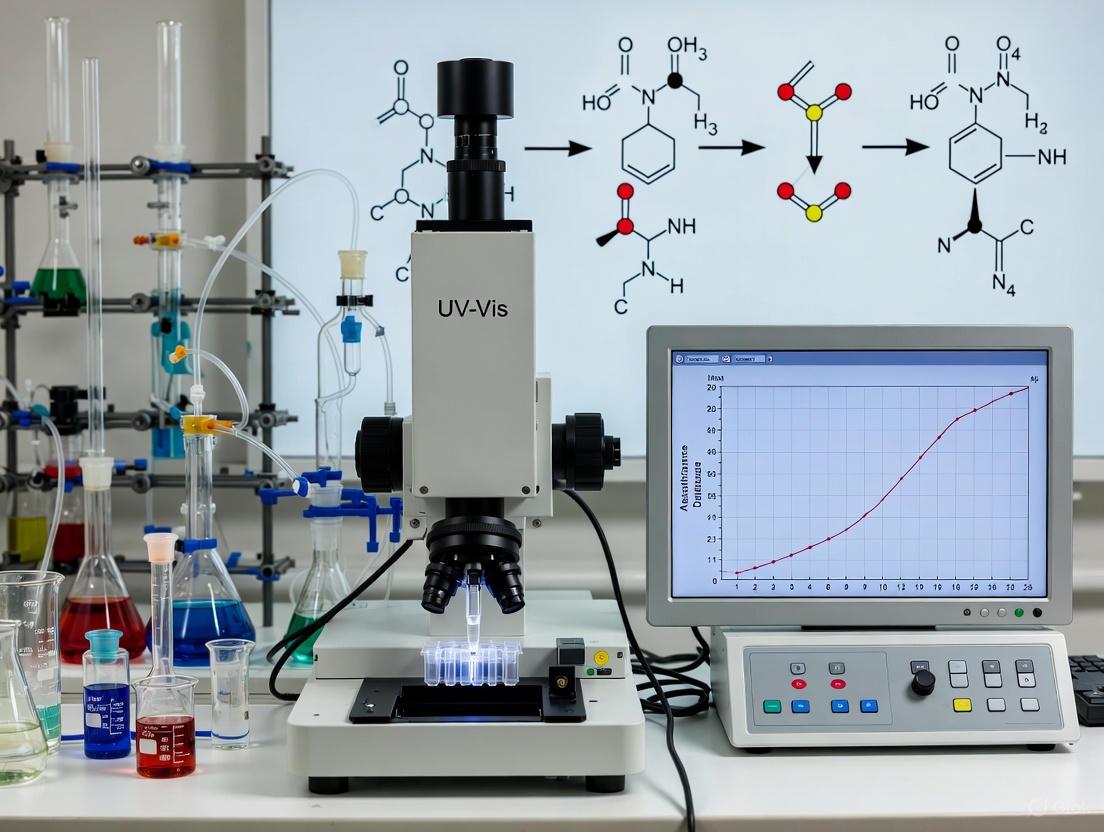
This comprehensive article explores UV-Vis spectroscopy as a powerful analytical technique for monitoring chemical reaction kinetics, tailored for researchers, scientists, and drug development professionals.
UV-Vis Spectroscopy for Reaction Kinetics: Advanced Monitoring in Pharmaceutical and Biomedical Research
Abstract
This comprehensive article explores UV-Vis spectroscopy as a powerful analytical technique for monitoring chemical reaction kinetics, tailored for researchers, scientists, and drug development professionals. Covering foundational principles to advanced applications, it examines how real-time spectral data provides crucial insights into reaction mechanisms, rates, and conditions. The content addresses methodological implementations across pharmaceutical and biomedical contexts, including in vitro release testing and enzymatic reaction monitoring, while providing troubleshooting guidance for common experimental challenges. Through validation protocols and comparative analysis with other techniques, the article demonstrates UV-Vis spectroscopy's growing capabilities for accelerating research and ensuring quality control in biochemical manufacturing and drug development.
Fundamental Principles: How UV-Vis Spectroscopy Reveals Reaction Mechanisms and Kinetics
The Direct Relationship Between Absorbance and Concentration
Theoretical Foundation: The Beer-Lambert Law
The fundamental principle underlying ultraviolet-visible (UV-Vis) spectroscopy for quantitative analysis is the Beer-Lambert Law (also known as Beer's Law). This law establishes a direct, linear relationship between the absorbance of a solution and the concentration of the absorbing species [1] [2].
The Beer-Lambert Law is mathematically expressed as:
A = εbc
Where:
- A is the Absorbance (a unitless quantity) [3].
- ε is the Molar Absorptivity (or extinction coefficient), a constant specific to the substance and wavelength, with units of L mol⁻¹ cm⁻¹ [1] [2].
- b is the Path Length, the distance the light travels through the solution, typically in centimeters (cm) [1].
- c is the Concentration of the absorbing species in the solution, with units of moles per liter (mol L⁻¹) [1].
This linear relationship is the cornerstone of quantitative analysis using UV-Vis spectroscopy. It allows for the determination of an unknown concentration by measuring its absorbance, provided the molar absorptivity and path length are known [2]. In practice, to ensure accuracy and account for instrument-specific variables, this relationship is most reliably applied through the construction of a calibration curve [4] [5].
Practical Application: The Calibration Curve
A calibration curve (or standard curve) is a graphical tool used to determine the concentration of an unknown sample by comparing it to a set of standard samples with known concentrations [4] [5]. This method is preferred over direct calculation using a published molar absorptivity value because it validates the linear relationship for your specific instrument and solution conditions and corrects for any deviations from the Beer-Lambert Law at higher concentrations [2].
Experimental Protocol: Constructing a Calibration Curve
The following step-by-step protocol details the process for creating a reliable calibration curve for reaction kinetics studies.
Step 1: Preparation of a Stock Solution Prepare a concentrated stock solution of the standard analyte by accurately weighing the solute and dissolving it in the appropriate solvent. Use a volumetric flask to ensure precise volume measurement [4]. The solvent must be compatible with the analyte and not absorb significantly in the wavelength range of interest [3].
Step 2: Preparation of Standard Solutions Prepare a series of at least five standard solutions spanning the expected concentration range of your unknown samples [1] [4]. A serial dilution is an efficient method for this preparation:
- Label a series of volumetric flasks or microtubes.
- Pipette an accurate volume of the stock solution into the first flask.
- Add the required volume of solvent to dilute to the mark and mix thoroughly.
- Pipette from this first dilution into the next flask and add solvent to create a more dilute solution.
- Repeat this process to create the entire series of known concentrations [4].
Step 3: Measurement of Absorbance
- Zero the Instrument: Using a cuvette filled only with the pure solvent (blank solution), zero the spectrophotometer to account for any absorbance from the solvent or cuvette [1] [3].
- Select Wavelength: Set the spectrophotometer to the wavelength of maximum absorbance (λ_max) for the analyte [4].
- Measure Standards: Transfer each standard solution to a clean cuvette and measure its absorbance at λ_max. Use the same cuvette (or matched set) for all measurements to maintain a constant path length. Obtain between three and five readings for each standard to assess reproducibility [4].
Step 4: Data Plotting and Analysis
- Plot the data with absorbance on the y-axis and concentration on the x-axis [4].
- Use statistical software to fit the data to a linear regression model, which gives the equation of the best-fit line: y = mx + b, where
mis the slope andbis the y-intercept [4] [5]. In the context of the Beer-Lambert Law, the slopemis equivalent toεb. - Calculate the coefficient of determination (R²) to evaluate the goodness of fit. An R² value typically ≥ 0.9 is considered acceptable for a reliable calibration, with values closer to 1.0 indicating a better fit [1] [4].
The workflow for this quantitative analysis is systematized in the following diagram:
Determining Unknown Concentration
Once the calibration curve is established, the concentration of an unknown sample from a reaction mixture can be determined as follows:
- Measure the absorbance of the unknown sample at the same wavelength (λ_max) and using the same conditions (solvent, cuvette, temperature) used for the standards [4].
- Use the linear equation from the calibration curve. Substitute the measured absorbance value for
yand solve for the concentrationx. - Alternatively, plot the absorbance value on the y-axis of the calibration curve graph, draw a horizontal line to the best-fit line, and then a vertical line down to the x-axis to read the concentration [2].
Table 1: Key parameters for a model calibration curve for Reaction Kinetics Monitoring.
| Parameter | Description | Exemplary Value for Kinetics |
|---|---|---|
| λ_max | Wavelength of maximum absorption for the analyte | 340 nm |
| Number of Standards | Minimum number of standard solutions for a robust curve | 5 [4] |
| Concentration Range | The range of standard concentrations bracketing the unknown | 0.5 µM – 10 µM |
| Path Length (b) | Standard cuvette path length | 1.0 cm [3] |
| R² (Coefficient of Determination) | Measure of linearity; closer to 1.0 is better | ≥ 0.99 [4] |
| Slope (m) | Equivalent to εb from the Beer-Lambert Law | 0.105 µM⁻¹ |
Application in Monitoring Chemical Reaction Kinetics
UV-Vis spectroscopy is a powerful technique for monitoring chemical reactions in real-time, as the formation or consumption of a reactant or product leads to measurable changes in absorbance [6]. The direct relationship between absorbance and concentration is the critical link that transforms spectral data into kinetic information.
Experimental Protocol for Monitoring Reaction Kinetics
Step 1: Establish Analytical Wavelength and Calibration Before initiating the reaction, identify the optimal wavelength for monitoring. This is typically the λ_max of the reactant or product whose concentration change is most convenient to track. Construct a calibration curve for this species as detailed in Section 2.1 [2].
Step 2: Initiate and Monitor the Reaction
- Prepare the reaction mixture in a suitable vessel, ensuring all components are at the correct starting conditions (e.g., temperature, pH).
- Transfer the reaction mixture to a cuvette placed in the spectrophotometer, which is thermostatted to maintain constant temperature.
- Initiate the reaction (e.g., by adding a catalyst or mixing two components directly in the cuvette) and immediately start recording the absorbance at the pre-determined analytical wavelength.
- Collect absorbance data at regular time intervals until the reaction is complete (i.e., until the absorbance value stabilizes) [6].
Step 3: Data Processing and Kinetic Analysis
- Convert the collected absorbance-time data into concentration-time data using the equation from your calibration curve (c = (A - b) / m).
- Plot concentration versus time to generate the kinetic profile of the reaction.
- Analyze this profile to determine the reaction order and calculate the rate constant by fitting the data to the appropriate kinetic model (e.g., zero-order, first-order, second-order) [6].
The logical flow from raw data to kinetic parameters is outlined below:
Table 2: Essential materials and reagents for UV-Vis based reaction monitoring.
| Item | Function/Justification |
|---|---|
| UV-Vis Spectrophotometer | Instrument to measure light absorption; cuvette-based systems are standard for kinetics [3]. |
| Quartz Cuvettes | Required for UV range analysis as quartz is transparent to UV light; glass and plastic cuvettes absorb UV [3]. |
| High-Precision Pipettes & Tips | Essential for accurate volumetric measurements during preparation of standard and reaction solutions [4]. |
| Volumetric Flasks | Used for precise preparation of stock and standard solutions to ensure concentration accuracy [1] [4]. |
| Stable, UV-Transparent Solvent | The solvent must dissolve the analyte and not interfere with its absorbance spectrum (e.g., water, acetonitrile, methanol) [3] [4]. |
| Temperature-Controlled Cuvette Holder | Maintains constant temperature during reaction monitoring, as reaction rates are temperature-dependent [6]. |
Critical Considerations and Troubleshooting
For researchers, awareness of the limitations and potential pitfalls of the technique is crucial for generating reliable data.
Table 3: Common issues and verification steps in quantitative UV-Vis analysis.
| Issue | Impact on Analysis | Verification & Solution |
|---|---|---|
| Deviation from Beer-Lambert Law | Non-linear response at high concentrations invalidates direct quantification [2]. | Verify linearity across your concentration range during calibration. If deviation occurs, dilute samples or use a shorter path length cuvette [3]. |
| Stray Light or Instrument Saturation | Absorbance readings become unreliable and non-linear, typically at A > 1 [3]. | Ensure measured absorbances are below 1.0 (ideally within 0.1–0.7). Dilute samples as necessary [3]. |
| Inappropriate Wavelength | Poor sensitivity or interference from other species in the reaction mixture. | Confirm λ_max by scanning a standard solution to obtain a full absorption spectrum, not just relying on literature values. |
| Poor Calibration Curve (Low R²) | Increased uncertainty in determining unknown concentrations [1]. | Repeat standard preparation, ensuring accurate pipetting and dilution techniques. Check instrument stability [1] [4]. |
| Chemical Changes | Photo-decomposition or reaction of the analyte during measurement. | Minimize exposure to the light source between measurements and perform kinetic runs quickly. |
Ultraviolet-visible (UV-Vis) spectroscopy is an indispensable analytical technique in modern chemical and biochemical research for monitoring reaction kinetics. This technique measures the amount of discrete wavelengths of UV or visible light that are absorbed by or transmitted through a sample in comparison to a reference or blank sample [3]. The measured absorbance is directly proportional to the concentration of a given reactant, product, or intermediate, making it a powerful tool for tracking chemical reactions in real time [6]. The development of in situ UV-Vis techniques now enables researchers to quantitatively characterize heterogeneous reactions in aqueous phases, providing essential insights into physicochemical processes that were previously challenging to monitor [7].
The fundamental principle underlying UV-Vis spectroscopy stems from the energy of light, which is inversely proportional to its wavelength [3]. Shorter wavelengths carry more energy, and a specific amount of energy is needed to promote electrons in a substance to a higher energy state, which we detect as absorption [3]. Electrons in different bonding environments require different energy inputs for promotion, meaning absorption occurs at different wavelengths for different substances [3]. This characteristic absorption allows researchers to identify and quantify specific chromophores and monitor their changes during chemical reactions.
Within the context of reaction kinetics, UV-Vis spectroscopy provides a non-invasive method to monitor the formation or loss of components as a chemical reaction progresses [6]. By applying Beer-Lambert's law, which establishes a linear relationship between absorbance and concentration, researchers can identify the order of a reaction and calculate the appropriate rate constant through UV-Vis analysis [6] [3]. Furthermore, the technique enables scientists to understand the impact of environmental factors on the observed reaction rate, providing crucial insights for optimizing reaction conditions in both research and industrial manufacturing settings [6].
Essential Instrumentation Components
Spectrophotometer Configuration and Selection
A UV-Vis spectrophotometer operates through a coordinated system of key components. The process begins with a light source that emits light across a wide range of wavelengths. Common configurations include a single xenon lamp for both UV and visible ranges, or a dual-lamp system employing a deuterium lamp for UV light (190-350 nm) and a tungsten-halogen lamp for visible light (350-900 nm) [3] [8]. The light then passes through a wavelength selection device, with monochromators being the most versatile option, utilizing diffraction gratings with groove frequencies typically around 1200 grooves per mm or higher to select specific wavelengths with adequate resolution [3]. The selected wavelength then passes through the sample, housed in either a cuvette or multi-well plate, before reaching the detector, which converts light into an electronic signal using technologies such as photomultiplier tubes (PMT), photodiodes, or charge-coupled devices (CCD) [3].
For reaction kinetics studies, researchers can choose between traditional cuvette-based systems and modern microplate readers, each offering distinct advantages. Cuvette-based systems like the Agilent Cary 300 provide high-performance detection with a working range of up to 6.0 Abs and features like Peltier temperature control crucial for kinetic studies [8]. Microplate readers such as the Multiskan SkyHigh Spectrophotometer enable higher throughput, reading a full 96-well plate in approximately 6 seconds, significantly accelerating data collection for multiple simultaneous kinetic measurements [9].
The following table compares key specifications of representative spectrophotometer models suitable for reaction kinetics research:
| Model Name | Wavelength Range | Sample Format Compatibility | Key Features for Kinetics | Measurement Speed |
|---|---|---|---|---|
| Multiskan SkyHigh | 200–1000 nm [9] | 6- to 384-well plates, cuvettes (on select models) [9] | Temperature incubation (ambient +2°C to 45°C), linear shaking [9] | 6 sec for 96-well plate [9] |
| SpectraMax M Series | UV and Visible range (specific range not provided) | 1-384-well plates, cuvettes [10] | Temperature control, PathCheck Sensor for automatic normalization to 1 cm pathlength [10] | Not specified in search results |
| BioTek Epoch 2 | Broad UV-Vis range (specific range not provided) | 6-384-well plates, cuvettes, Take3 microvolume plate [11] | Endpoint, kinetic, spectral scanning modes; incubation and shaking [11] | Not specified in search results |
| SmartReader UV-Vis | 200-1000 nm [12] | 96-well & 384-well plates, cuvettes [12] | Temperature control (ambient +5°C to 45°C), kinetic assays [12] | <6 seconds for 96-well plate (fast mode) [12] |
| Agilent Cary 300 | Up to 6.0 Abs, resolution of 0.24 nm [8] | Cuvettes (single-cell Peltier temperature control) [8] | Double beam, high-performance R928 photomultiplier tube [8] | Not specified in search results |
Cuvette and Multi-well Plate Selection Guide
The selection of appropriate sample containers is critical for successful UV-Vis spectroscopy experiments, particularly for reaction kinetics studies where path length, material compatibility, and temperature control significantly impact results.
Cuvettes are available in various materials suited for different wavelength ranges:
- UV Quartz: Transparent down to 190 nm, essential for UV spectroscopy [13]
- IR Quartz: Effective range of 220-2,500 nm [13]
- Optical Glass: Transmits light from 340-2,500 nm, suitable for visible range measurements [13]
- Pyrex Glass: Similar transmission range of 340-2,500 nm [13]
Specialized cuvette designs enhance experimental capabilities:
- Water Jacketed Cuvettes: Allow temperature control by circulating liquids around the sample chamber [13]
- Flow-Through Cells: Enable continuous monitoring of flowing samples [13]
- Anaerobic Cuvettes: Feature SEPTA screw caps for oxygen-sensitive studies [13]
- Tandem Cuvettes: Contain multiple chambers for simultaneous measurements [13]
Multi-well plates offer high-throughput capabilities for kinetic studies:
- Standard Formats: 96-well and 384-well plates are most common [9] [12]
- Material Considerations: Specialized plates are required for UV applications, as standard plastic and glass absorb UV light [3]
- Micro-Volume Plates: Systems like the Thermo Scientific µDrop Plate enable measurement of low sample volumes (as low as 0.5 μL in the SmartDrop Accessory Plate) [9] [12]
For quantitation, absorbance values should ideally be kept below 1 to remain within the dynamic range of the instrument, as an absorbance of 1 indicates 90% of incoming light has been absorbed, leaving little light for reliable detection [3]. Path length is another critical consideration, with 1 cm being standard, though shorter path lengths are necessary when sample availability is limited [3].
Research Reagent Solutions and Essential Materials
The following table outlines essential materials required for UV-Vis spectroscopy studies of reaction kinetics:
| Item Category | Specific Examples | Function in Kinetic Studies |
|---|---|---|
| Spectrophotometers | Multiskan SkyHigh, SpectraMax M Series, BioTek Epoch 2, Agilent Cary 300 | Precise absorbance measurement over time for kinetic analysis [9] [10] [11] |
| Cuvettes | UV Quartz Cuvettes, Water Jacketed Cuvettes, Flow-Through Cells, Anaerobic Cuvettes | Sample containment with appropriate optical properties and environmental control [13] |
| Multi-well Plates | 96-well plates, 384-well plates, µDrop Plates, SmartDrop Accessory Plate | High-throughput sample analysis for multiple simultaneous kinetic measurements [9] [12] |
| Validation Tools | SpectraTest ABS2 Absorbance Validation Plate, SpectraTest FL1 Fluorescence Validation Plate | Instrument performance verification for accurate kinetic data [10] |
| Software | SkanIt Software, SoftMax Pro GxP Software, Cary WinUV Software | Data acquisition, analysis, and compliance management for kinetic studies [9] [10] [8] |
| Accessories | StakMax Microplate Stacker, Cuvette Washers, Temperature Controllers | Automation, maintenance, and environmental control for prolonged kinetic experiments [10] [13] |
Experimental Protocols for Reaction Kinetics
Protocol 1: Monitoring Chemical Reaction Kinetics in Solution
This protocol describes a method for monitoring the kinetics of a chemical reaction using a UV-Vis spectrophotometer equipped with a cuvette port and temperature control, applicable for studying reactions such as the degradation of organic compounds or enzyme-catalyzed reactions [6] [8].
Materials and Reagents:
- UV-Vis spectrophotometer with cuvette port and temperature control (e.g., Agilent Cary 300 with Peltier accessory) [8]
- Quartz cuvettes (path length 1 cm) suitable for UV range if needed [13]
- Reaction components: reactants, solvents, catalysts/buffers
- Timer
- Pipettes and appropriate tips
Procedure:
- Instrument Setup and Blank Measurement:
- Turn on the spectrophotometer and allow the lamp to warm up for the recommended time (typically 15-30 minutes).
- Set the instrument to kinetic mode and configure the data acquisition software.
- Set the temperature control to the desired reaction temperature (e.g., 25°C, 37°C) [8].
- Place a cuvette containing the solvent or buffer (without reactants) in the sample holder to establish a blank reference and zero the instrument [3].
Wavelength Selection:
- Identify the optimal wavelength for monitoring the reaction by performing a spectral scan of the reactant or product of interest.
- Select a wavelength where the compound shows strong absorption and where there is a significant absorbance change during the reaction.
- Program this wavelength into the kinetic method.
Reaction Initiation and Data Collection:
- Pipette the appropriate volume of reaction components (except initiator) into a clean quartz cuvette.
- For temperature-sensitive reactions, pre-incubate the reaction mixture in the temperature-controlled cuvette holder for 2-5 minutes to reach equilibrium.
- Initiate the reaction by adding the final component (e.g., enzyme, catalyst, or second reactant), mix quickly but gently using a pipette or by capping and inverting the cuvette.
- Immediately place the cuvette in the spectrophotometer and start data collection.
- Record absorbance at appropriate time intervals (e.g., every 1-10 seconds depending on reaction speed) for the duration of the reaction.
Data Analysis:
- Export absorbance vs. time data to analysis software.
- Plot absorbance as a function of time to generate a kinetic curve.
- Convert absorbance to concentration using the molar absorptivity (ε) and path length (L) according to Beer-Lambert's law: A = ε × c × L [3].
- Determine the reaction order and calculate rate constants by fitting the concentration-time data to appropriate kinetic models.
Protocol 2: High-Throughput Kinetic Screening Using Multi-well Plates
This protocol leverages microplate readers for high-throughput kinetic analysis of multiple reactions simultaneously, ideal for applications such as enzyme kinetics studies, inhibitor screening, or monitoring chemical reaction progress under various conditions [9] [10].
Materials and Reagents:
- Microplate spectrophotometer with temperature control and shaking capability (e.g., Multiskan SkyHigh, SpectraMax M Series, BioTek Epoch 2) [9] [10] [11]
- Clear-bottom 96-well or 384-well microplates appropriate for UV-Vis measurements
- Multichannel pipettes or automated liquid handling system
- Reaction components
Procedure:
- Experimental Design and Plate Setup:
- Design the plate layout, assigning wells for different reaction conditions, controls, and blanks.
- Program the plate reader method with kinetic parameters: wavelength(s), measurement interval, total duration, temperature, and shaking parameters (speed, duration before readings) [9] [12].
- Pre-incubate the plate reader to the desired temperature (e.g., from ambient +5°C to 45°C) [12].
Reaction Preparation:
- Using multichannel pipettes, dispense buffers and reaction components into assigned wells according to the plate layout.
- Include control wells containing only solvent or buffer for background subtraction.
- For time-sensitive reactions, stagger additions or use automated dispensers if available.
Reaction Initiation and Kinetic Reading:
- Initiate reactions simultaneously across the plate by adding the final component using a multichannel pipette or via the plate reader's built-in dispenser if available.
- Quickly place the plate in the pre-equilibrated plate reader and start the kinetic reading protocol.
- The instrument will automatically shake the plate (if programmed), take measurements at defined intervals, and maintain constant temperature throughout the experiment [9] [12].
Data Processing and Analysis:
- The software typically generates absorbance vs. time curves for each well.
- Apply blank correction using control well data.
- Export data for analysis in specialized software.
- For enzyme kinetics, fit data to the Michaelis-Menten equation or other appropriate models to determine kinetic parameters (KM, Vmax) for each condition.
Considerations for High-Throughput Kinetics:
- Evaporation: For long experiments, use plates with seals or maintain humidity to prevent evaporation [8].
- Path Length Correction: Some advanced systems like the SpectraMax M Series with PathCheck Sensor technology automatically normalize absorbance readings to a 1 cm pathlength, eliminating the need for standard curves when comparing data across different well volumes [10].
- Measurement Speed: Consider the time required to read the entire plate, especially for fast reactions. Instruments like the Multiskan SkyHigh can read a full 96-well plate in 6 seconds, enabling faster sampling rates [9].
Advanced Applications in Kinetic Monitoring
In Situ Monitoring of Heterogeneous Reaction Kinetics
Advanced UV-Vis applications now enable quantitative monitoring of heterogeneous reactions, such as adsorption processes, through specialized approaches that combine traditional spectroscopy with computational methods. A recent innovative methodology couples in situ UV-Vis spectroscopy with a two-step algorithm strategy to quantitatively monitor heterogeneous reactions in a compact closed-loop system [7]. This approach is particularly valuable for studying processes like adsorption kinetics of organic compounds onto microparticles, which was challenging with conventional methods due to light scattering interference from particulate matter [7].
The advanced protocol involves:
- Simultaneous Measurement: Recording in situ UV-Vis total reflectance and total transmittance spectral kinetics of the suspension throughout the reaction process [7].
- Light Scattering Correction: Applying the Inverse Adding-Doubling (IAD) method to extract pure optical absorption properties from the scattering-dominated signals in heterogeneous systems [7].
- Spectral Deconvolution: Using Multivariate Curve Resolution-Alternating Least Squares (MCR-ALS) method to identify spectral profiles of chemical compositions and their corresponding abundance in the time-evolving UV-Vis absorption spectroscopic datasets [7].
- Theoretical Validation: Employing computational spectroscopic simulations to connect MCR-ALS solutions with chemical molecular structural evolution, enabling identification of intermediate species without prior reference spectra [7].
This integrated approach demonstrates significant potential for practical integration into automated experimental platforms as a versatile tool for probing aqueous chemical processes and beyond, significantly expanding the capabilities of UV-Vis spectroscopy beyond traditional homogeneous reaction monitoring [7].
Data Processing and Analysis Techniques
Proper data analysis is crucial for extracting meaningful kinetic information from UV-Vis spectroscopic data. The foundational principle for quantification is the Beer-Lambert law, which states that absorbance (A) is equal to the molar absorptivity (ε) multiplied by the path length (L) and concentration (c): A = ε × c × L [3]. This relationship enables the conversion of measured absorbance values into concentration data for kinetic analysis.
For heterogeneous systems or complex reactions with multiple absorbing species, advanced computational techniques are required. The MCR-ALS method decomposes spectroscopic datasets into a linear combination of a weighted set of pure spectral profiles, where the weight factor is proportional to their concentrations [7]. This approach is particularly valuable for resolving complex reaction mechanisms and identifying intermediate species that may not be isolable or characterizable through traditional means.
When implementing these advanced techniques, researchers should consider:
- Rotational Ambiguities: Evaluate solutions using methods like MCR-BANDS to ensure reliability [7].
- Light Scattering Effects: Account for scattering contributions in heterogeneous systems rather than ignoring them, as they can provide valuable information about the physical system [7].
- Validation: Where possible, correlate UV-Vis findings with complementary techniques to verify mechanistic interpretations.
The application of these advanced data processing methods expands the utility of UV-Vis spectroscopy beyond simple concentration measurements, enabling researchers to unravel complex reaction mechanisms and gain deeper insights into kinetic processes across diverse chemical and biological systems.
Ultraviolet-Visible (UV-Vis) spectroscopy is an indispensable analytical technique in chemical kinetics, enabling researchers to monitor reaction progress in real-time by measuring the concentration changes of reactants and products. The fundamental principle underpinning this method is the Beer-Lambert Law, which establishes a direct proportional relationship between the absorbance of light at a specific wavelength and the concentration of an absorbing species in solution [6]. This direct proportionality allows for the quantitative tracking of reactant depletion and product formation, providing the data necessary to determine reaction orders, calculate rate constants, and elucidate reaction mechanisms [6] [14]. Within pharmaceutical development and biochemical manufacturing, the ability to precisely monitor reactions and maintain optimal conditions is critical for ensuring product quality and optimizing output [6]. This application note details the protocols for employing UV-Vis spectroscopy to monitor reaction kinetics, complete with data analysis procedures and essential methodological considerations.
Fundamental Principles and Kinetic Methods
The integral method of kinetic analysis involves postulating a rate equation, integrating it, and manipulating it into a linear form. The concentration versus time data is then transformed according to this linearized equation. If the plot yields a straight line, the postulated reaction order is confirmed, and the rate constant can be determined from the slope [14]. This method is straightforward and recommended for testing specific mechanisms or simple rate expressions, especially when data is scattered and cannot reliably support the differential method [14].
Table 1: Linearized Forms for Common Reaction Orders
| Reaction Order | Rate Law | Integrated Form | Linear Plot | Slope |
|---|---|---|---|---|
| Zero Order | -d[A]/dt = k | [A]ₜ = [A]₀ - kt | [A] vs. t | -k |
| First Order | -d[A]/dt = k[A] | ln([A]₀/[A]ₜ) = kt | ln[A] vs. t | k |
| Second Order | -d[A]/dt = k[A]² | 1/[A]ₜ - 1/[A]₀ = kt | 1/[A] vs. t | k |
In contrast, the differential method deals directly with the differential rate equation. It requires determining the rate of reaction, -d[A]/dt, from the slope of a tangent line on a concentration versus time curve at various compositions. This rate is then tested against different rate expressions, for instance, by plotting ln(-d[A]/dt) against ln[A] to find the reaction order 'n' from the slope [14]. The differential method is powerful for building rate equations from data but requires accurate or large amounts of data [14].
Experimental Protocols
Protocol A: General Reaction Monitoring via UV-Vis Spectroscopy
This protocol outlines the general procedure for tracking a chemical reaction using a cuvette-based UV-Vis spectrophotometer.
I. Research Reagent Solutions Table 2: Essential Materials and Reagents
| Item | Function/Description |
|---|---|
| UV-Vis Spectrophotometer | Instrument for measuring light absorption across UV and visible wavelengths. |
| Cuvettes | Containers for holding liquid samples; must be UV-transparent (e.g., quartz). |
| Reactant Solutions | Prepared at known concentrations in a suitable solvent. |
| Thermostatted Cuvette Holder | Maintains constant reaction temperature for accurate kinetic studies. |
| Timer or Automated Sampler | Ensures precise timing for data point acquisition. |
II. Procedure
- Preparation: Dissolve the reactant in an appropriate solvent to a known initial concentration. Ensure the solvent does not absorb significantly at the wavelengths of interest.
- Baseline Correction: Place a cuvette containing only the solvent into the spectrophotometer and run a baseline correction.
- Initial Measurement: Transfer the reactant solution to a clean cuvette, place it in the thermostatted holder, and record the initial UV-Vis spectrum (e.g., from 250 to 350 nm).
- Initiate Reaction: Rapidly add a small, known volume of the second reactant (or catalyst) to the cuvette, mix thoroughly and quickly.
- Data Acquisition: Immediately begin collecting spectra at regular, pre-determined time intervals. The total data collection time should be sufficient to capture the reaction's progression to completion or near-completion.
- Data Export: After the reaction is complete, export the time-dependent absorbance data at the relevant wavelengths for analysis.
The workflow for this general procedure is outlined below.
Protocol B: Advanced Spectral Unmixing for Nucleoside Phosphorylation
This protocol describes a high-throughput, discontinuous assay for enzymatic nucleoside phosphorylation reactions, which improves upon single-wavelength methods by utilizing full spectral data [15].
I. Research Reagent Solutions Table 3: Specialized Reagents for Spectral Unmixing Assay
| Item | Function/Description |
|---|---|
| Nucleoside/Nucleobase Standards | Reference compounds for obtaining pure spectra of reactants and products. |
| NaOH Solution (100-500 mM) | Quenches the enzymatic reaction and creates alkaline condition for spectral shift. |
| 96-Well Plates (UV-Transparent) | Platform for high-throughput spectral measurement. |
| Plate Reader UV-Vis Spectrophotometer | Instrument capable of rapidly measuring spectra in multi-well plates. |
| Nucleoside Phosphorylase Enzyme | Enzyme catalyst for the phosphorolytic cleavage reaction. |
II. Procedure
- Run Enzymatic Reaction: Prepare the reaction mixture containing nucleoside substrate, buffer, phosphate, and water. Pre-incubate at the reaction temperature and initiate by adding the enzyme solution [15].
- Sample and Quench: At specific time points, draw a sample aliquot (e.g., 20-30 µL) and pipette it into an Eppendorf tube containing a predetermined volume of aqueous NaOH (e.g., 100 mM). The alkaline solution quenches the reaction and induces a pH-dependent spectral shift that enhances the differentiation between nucleoside and nucleobase spectra [15].
- Dilution and Transfer: Adjust volumes to achieve an appropriate final concentration of UV-active compounds. Transfer an aliquot (e.g., 200 µL) of the quenched and diluted sample to a well of a UV-transparent 96-well plate [15].
- Spectral Measurement: Record the UV-Vis spectrum (e.g., from 250 to 350 nm) for each sample well using the plate reader [15].
- Spectral Unmixing Analysis: Analyze the collected spectra using a spectral unmixing algorithm. The algorithm fits the reference spectra of the pure nucleoside and nucleobase to the experimental spectrum of the mixture to determine their precise ratio, using a least-squares minimization approach:
x = argminₓ((Yₖ - ∑ᵢ xᵢ Yᵢ)²), whereYₖis the experimental spectrum andYᵢare the reference spectra [15].
The logic of the spectral unmixing algorithm is as follows.
Data Analysis and Interpretation
After acquiring time-dependent absorbance data, the subsequent steps are critical for extracting kinetic parameters.
Step 1: Convert Absorbance to Concentration Using the Beer-Lambert law (A = εlc), convert the absorbance values at a specific wavelength to concentration. This requires knowing the molar absorptivity (ε) of the absorbing species at that wavelength. If the absorbing species is a product, the concentration [P] at time t is proportional to its absorbance.
Step 2: Apply Integral Method Assume a reaction order and transform the concentration-time data according to the linearized forms in Table 1.
- For a suspected first-order reaction, plot
ln[A]versust. A straight line indicates confirmation, and the slope equals-k. - For a suspected second-order reaction where rate depends on one reactant, plot
1/[A]versust. A straight line confirms the order, and the slope equalsk.
Step 3: Determine Rate Constant
Perform a linear regression on the successful plot. The slope of the best-fit line provides the value of the rate constant k, including its units, which are dependent on the reaction order (e.g., s⁻¹ for first-order, M⁻¹s⁻¹ for second-order).
Methodological Considerations
- Sampling and Dilution: For discontinuous assays, consistent and rapid sampling is crucial. The spectral unmixing protocol is robust to dilution and sample transfer inaccuracies because it considers spectral shape rather than absolute intensity [15].
- Environmental Factors: Temperature must be carefully controlled, as it significantly impacts the observed reaction rate. The reaction's progress should be independent of stirring speed if mixing is efficient; otherwise, mass transfer limitations can affect the results [6].
- Spectral Characteristics: The method requires that the reactant, product, or an intermediate have a distinct absorbance band in the UV-Vis region. The isosbestic point—a wavelength where the molar absorptivities of the reactant and product are equal—can be used to normalize data and correct for dilution errors [15].
- Advantages: UV-Vis spectroscopy is a relatively fast, low-cost, and easily automated technique compared to alternatives like HPLC, offering a 20-fold increase in speed and a 5-fold reduction in cost for high-throughput applications [15].
- Limitations: The primary limitation is that the species of interest must be UV-active. In complex mixtures with overlapping spectra, advanced techniques like spectral unmixing are necessary to deconvolute the contributions of individual components [15].
Determining Reaction Order and Calculating Rate Constants
In chemical and pharmaceutical research, determining reaction kinetics is fundamental for understanding reaction mechanisms, optimizing conditions, and ensuring quality control in manufacturing processes. UV-Visible absorption spectroscopy serves as a powerful technique for monitoring chemical reactions in real-time, providing critical data for determining reaction order and calculating rate constants [6]. The fundamental principle underpinning this method is the linear relationship between absorbance and concentration of reacting species, as described by the Beer-Lambert law. This relationship allows researchers to track concentration changes by measuring absorbance at specific wavelengths as reactions progress.
For researchers in drug development, kinetic parameters offer invaluable insights into reaction mechanisms and help ascertain ideal reaction conditions for biochemical manufacturing [6]. Unlike equilibrium-based methods that measure signals after reactions complete, kinetic methods monitor systems under dynamic conditions where reactant and product concentrations continuously change over time [16]. This approach enables the use of reactions that are slow to reach equilibrium and can allow determination of single species in mixtures when sufficient differences in reaction rates exist.
Theoretical Foundation
Fundamental Kinetic Principles
Reaction order defines the mathematical relationship between reactant concentrations and reaction rate. For a general reaction where a reactant A converts to products, the rate law is expressed as:
Rate = k[A]^n
Where k is the rate constant, [A] is the concentration of reactant A, and n is the reaction order. Determining n is essential for understanding reaction mechanism and predicting how concentration influences reaction speed.
UV-Vis spectroscopy enables reaction monitoring by measuring absorbance changes that directly correlate with concentration changes of reactants or products. The measured absorbance (A) relates to concentration through the Beer-Lambert law: A = εbc, where ε is the molar absorptivity, b is the path length, and c is the concentration [17]. When proper wavelength selection ensures that only one species absorbs significantly, or when absorbance contributions can be mathematically deconvoluted, concentration-time data can be derived directly from absorbance-time measurements.
Data Analysis Methods
Several analytical approaches can determine reaction order and calculate rate constants from spectroscopic data:
Integrated Rate Law Method: Experimental concentration-time data is fitted to integrated rate equations for zero-order, first-order, and second-order reactions. The equation yielding the best linear fit indicates the reaction order.
Initial Rates Method: The initial rate of reaction is measured at different starting concentrations. Plotting log(initial rate) versus log(initial concentration) yields a straight line whose slope equals the reaction order.
Half-life Method: For first-order reactions, half-life (t½) is constant and independent of initial concentration, where t½ = ln2/k.
The selection of analysis method depends on reaction characteristics, data quality, and required precision. Modern spectrophotometers often include software that automates these calculations, though understanding the fundamental principles remains essential for proper experimental design and data interpretation.
Experimental Design and Setup
Instrumentation and Equipment
Proper experimental setup is crucial for obtaining accurate kinetic data. Essential equipment includes:
UV-Vis Spectrophotometer: Capable of measuring absorbance at specific wavelengths over time. Modern instruments with thermostatted cell holders are preferred for maintaining constant temperature [18].
Cuvettes: Selection of appropriate cuvette material (quartz or glass) based on wavelength range. Quartz is essential for UV measurements below 300 nm.
Thermostatic Controller: Maintains constant temperature throughout the experiment, as temperature significantly impacts reaction rates [18].
Data Acquisition System: Computer interface for continuous absorbance monitoring and data recording.
For specialized applications, stopped-flow systems enable measurement of very fast reactions, while multicell holders facilitate parallel experiments under different conditions.
Wavelength Selection and Method Development
Selecting the optimal wavelength represents a critical step in experimental design:
- Identify wavelengths where the reactant, product, or intermediate exhibits significant absorbance changes
- Ensure the molar absorptivity provides sufficient sensitivity for expected concentration changes
- Avoid regions where solvents or other components interfere significantly
- Consider using an isosbestic point - a wavelength where absorbance remains constant throughout the reaction, indicating two species with identical molar absorptivities [17]
For the kinetic determination of biotin, researchers selected 348 nm to monitor the decrease in tri-iodide absorbance as the reaction progressed [18]. This wavelength provided optimal sensitivity with minimal interference from other reaction components.
Research Reagent Solutions and Essential Materials
Table 1: Essential Research Reagents and Materials for Kinetic UV-Vis Experiments
| Reagent/Material | Function/Application | Exemplary Specifications |
|---|---|---|
| UV-Vis Spectrophotometer | Absorbance measurement and kinetic data acquisition | Thermostatted cell compartment; multi-cell capability |
| Quartz Cuvettes | Sample containment with UV transparency | 1 cm path length; spectral range 190-2500 nm |
| Buffer Solutions | pH control and maintenance | Phosphate buffer (pH 4 used in biotin determination) [18] |
| Standard Solutions | Calibration and quantitative analysis | Prepared in distilled water; stability varies (biotin solutions stable 1 week at 4°C) [18] |
| Temperature Controller | Maintains constant reaction temperature | ±0.1°C precision (e.g., Shimadzu Thermostat T.C.C. Controller) [18] |
| Chemical Reagents | Reaction-specific components | e.g., tri-iodide, sodium azide for sulfur-containing compound analysis [18] |
Application Notes: Experimental Protocols
Protocol 1: Determining Pseudo-First-Order Rate Constants
This protocol outlines the procedure for determining pseudo-first-order rate constants when one reactant is in significant excess, simplifying the kinetic analysis.
Materials and Reagents:
- UV-Vis spectrophotometer with temperature control
- Reaction vessel or quartz cuvette
- Stock solutions of reactants
- Buffer solutions as needed
- Timer or automated data acquisition system
Procedure:
- Prepare a reaction mixture where the concentration of one reactant (B) is at least 10-fold greater than the other (A)
- Set spectrophotometer to monitor at wavelength where maximum absorbance change occurs
- Initiate reaction by adding limiting reactant A
- Record absorbance at regular time intervals
- Continue measurements until reaction completes or absorbance change becomes minimal
- Convert absorbance to concentration using Beer-Lambert law
- Plot ln[A] versus time
- Determine slope, which equals -k', where k' is the pseudo-first-order rate constant
- The true second-order rate constant k can be obtained from k' = k[B]
Data Analysis: For a reaction A + B → Products with [B] >> [A], the rate law simplifies to: -d[A]/dt = k'[A], where k' = k[B] Integration yields: ln[A] = ln[A]₀ - k't A plot of ln[A] versus time gives a straight line with slope = -k'
Protocol 2: Comprehensive Kinetic Analysis for Reaction Order Determination
This protocol provides a comprehensive approach for determining unknown reaction order and calculating the appropriate rate constant.
Materials and Reagents:
- UV-Vis spectrophotometer with multi-cell capability
- Multiple quartz cuvettes or automated cell changer
- Stock solutions at varying concentrations
- Temperature control system
- Data analysis software
Procedure:
- Prepare a series of reactions with different initial concentrations of the reactant of interest
- Set spectrophotometer to appropriate wavelength for monitoring
- Initiate reactions simultaneously or in rapid sequence
- Record absorbance at regular time intervals for all reactions
- Continue until sufficient data points are collected for each reaction
- Convert absorbance values to concentrations
- Analyze data using multiple methods:
A. Integrated Rate Law Method
- Test data against zero-order ([A] vs. time), first-order (ln[A] vs. time), and second-order (1/[A] vs. time) models
- Identify the model yielding the best linear correlation
B. Initial Rates Method
- Determine initial rate for each starting concentration from the slope of concentration vs. time at t→0
- Plot log(initial rate) vs. log(initial concentration)
- Determine slope, which equals the reaction order
C. Half-life Method (for first-order verification)
- Determine time required for concentration to reduce by half for different starting points
- Constant half-life indicates first-order kinetics
- Calculate rate constant from the appropriate equation based on determined reaction order
Data Interpretation:
- Correlation coefficient (r) values indicate best fit; values closest to 1.000 indicate the correct model [18]
- For biotin determination, correlation coefficients improved with reaction time, reaching r = 0.9999 after 14 minutes [18]
Protocol 3: Fixed-Time Method for Catalytic Reactions
This protocol adapts the fixed-time approach particularly useful for catalytic reactions, such as the determination of biotin based on its catalytic effect on the reaction between sodium azide and tri-iodide [18].
Materials and Reagents:
- UV-Vis spectrophotometer with temperature control
- Quartz cuvettes
- Biotin standard solutions (4-16 μg/mL working range)
- Phosphate buffer (pH 4)
- Sodium azide solution (1.0 M)
- Tri-iodide solution (0.001 M)
Procedure:
- Transfer aliquots of biotin working standard solution to 10 mL volumetric flasks
- Add 1 mL phosphate buffer (pH 4) followed by 1 mL sodium azide solution (1.0 M)
- Mix well and dilute to 8 mL with distilled water
- Let solutions stand for 3 minutes
- Add 1 mL tri-iodide solution (0.001 M) and adjust to volume with distilled water
- Quickly transfer to quartz cell within 40 seconds
- Place in spectrophotometer thermostatted at 25°C
- Record absorbance of remaining unreacted tri-iodide at 348 nm versus time for 14 minutes
- Perform blank experiment simultaneously
- Calculate difference in absorbance (ΔA = A₀ - A) and plot versus biotin concentration
Optimization Parameters:
- pH: Maximum ΔA observed at phosphate buffer pH 4 [18]
- Azide concentration: 1 mL of 1.0 M solution sufficient for maximum absorbance [18]
- Reaction time: 14 minutes provided optimal correlation (r = 0.9999) for biotin determination [18]
Data Analysis and Interpretation
Quantitative Treatment of Kinetic Data
Table 2: Characteristic Parameters for Different Reaction Orders
| Reaction Order | Rate Law | Integrated Equation | Linear Plot | Slope | Half-life |
|---|---|---|---|---|---|
| Zero-order | -d[A]/dt = k | [A] = [A]₀ - kt | [A] vs. time | -k | [A]₀/2k |
| First-order | -d[A]/dt = k[A] | ln[A] = ln[A]₀ - kt | ln[A] vs. time | -k | ln2/k |
| Second-order | -d[A]/dt = k[A]² | 1/[A] = 1/[A]₀ + kt | 1/[A] vs. time | k | 1/k[A]₀ |
For the catalytic determination of biotin, the fixed-time method at 14 minutes provided excellent correlation (r = 0.9999) across the concentration range of 4-16 μg/mL, with a regression equation of ΔA = -0.024 + 0.027C [18]. The method demonstrated high recovery (100.08 ± 0.76%) and successfully determined biotin in pharmaceutical preparations.
Environmental Factors and Optimization
Reaction rates are significantly influenced by environmental factors that must be controlled or accounted for:
- Temperature: Arrhenius equation describes the temperature dependence of rate constants (k = Ae^(-Ea/RT))
- pH: Particularly crucial for reactions involving acid-base equilibria; optimal pH should be determined experimentally [18]
- Ionic strength: Can affect reaction rates, especially for ionic reactants
- Solvent composition: Dielectric constant and polarity can influence reaction pathways and rates [16]
For the biotin determination method, phosphate buffer at pH 4 proved superior to acetate and citrate buffers at the same pH, demonstrating the importance of buffer selection beyond merely controlling pH [18].
Experimental Workflow and Data Analysis Pathways
Kinetic Analysis Workflow
Data Analysis Pathway
Advanced Applications in Pharmaceutical Research
Kinetic spectrophotometric methods find particular utility in pharmaceutical analysis, where they offer advantages for determining specific compounds in complex matrices. The catalytic kinetic spectrophotometric approach provides enhanced selectivity through measurement of absorbance evolution with time rather than single absorbance values [18]. This technique can minimize interference from colored or turbid backgrounds and other active compounds in commercial products.
For biotin determination, the method leveraged its catalytic effect on the reaction between sodium azide and tri-iodide, monitoring the decrease in tri-iodide absorbance at 348 nm [18]. The reaction mechanism involves initial oxidation of biotin by iodine, followed by reduction of the oxidized biotin by azide, regenerating the catalytic species. This cycle continues, significantly accelerating the azide-iodine reaction, which is immeasurably slow in the absence of catalysts.
Similar principles apply to determination of other sulfur-containing compounds like captopril, ethamsylate, carbocisteine, ethionamide, thioctic acid, penicillamine, glutathione, and tetramethylthiuram disulphide [18]. The approach demonstrates the versatility of kinetic methods for pharmaceutical compounds that may not possess strong chromophores but can participate in or catalyze reactions with measurable spectroscopic changes.
UV-Visible spectroscopy provides researchers and drug development professionals with a robust, accessible method for determining reaction orders and calculating rate constants. The technique combines theoretical rigor with practical applicability across diverse chemical systems. Through proper experimental design, careful method development, and appropriate data analysis, kinetic parameters can be extracted with high precision and accuracy.
The fixed-time method, initial rates approach, and comprehensive multi-model analysis offer flexible pathways for kinetic characterization suitable for different reaction types and data quality requirements. As demonstrated in the biotin determination case study, these methods can achieve excellent correlation (r = 0.9999) and high recovery rates, making them valuable for both fundamental research and quality control applications in pharmaceutical development.
Ultraviolet-visible (UV-Vis) spectroscopy is a cornerstone analytical technique in chemical reaction kinetics research, providing a rapid and sensitive method for monitoring reactant consumption or product formation in real-time. [3] For researchers and drug development professionals, understanding the profound effects of environmental parameters—specifically pH, temperature, and solvent conditions—is critical for optimizing reaction efficiency, selectivity, and yield in diverse applications ranging from bioconjugation to material synthesis. This application note provides a detailed experimental framework for systematically investigating these parameters, leveraging recent research to establish robust protocols. The principles of UV-Vis spectroscopy are ideally suited for such kinetic studies, as the amount of discrete wavelengths of UV or visible light absorbed by a sample is directly related to the concentration of specific analytes through the Beer-Lambert Law. [3] The energy of light, which is inversely proportional to its wavelength, promotes electrons in a substance to a higher energy state, and the specific energy required for this transition is unique to different bonding environments, making absorbance a powerful tool for identifying substances and monitoring their transformation. [3]
Experimental Protocols
Key Reagents and Instrumentation
The successful execution of these protocols requires careful preparation of reagents and familiarity with the instrumentation. The table below lists essential research reagent solutions and their functions.
Table 1: Research Reagent Solutions for Environmental Impact Studies
| Reagent/Material | Function/Explanation |
|---|---|
| Buffer Solutions (PBS, HEPES, MES, Borate) | Maintains a stable pH environment to isolate the effect of pH on reaction kinetics. [19] |
| DBCO Reagents (e.g., sulfo DBCO-amine) | A strained cyclooctyne alkyne that participates in copper-free, bioorthogonal SPAAC reactions. [19] |
| Azide Reagents (e.g., 3-azido-L-alanine, 1-azido-1-deoxy-β-D-glucopyranoside) | Reaction partners for DBCO; different structures allow study of electronic effects on kinetics. [19] |
| Quartz Cuvettes | Sample holders that are transparent to UV light, unlike plastic or glass, which absorb it. [3] |
| UV-Vis Spectrophotometer | Instrument that measures the absorption of discrete wavelengths of light by a sample. [3] |
A standard UV-Vis spectrophotometer comprises several key components: a light source (e.g., xenon, deuterium, or tungsten/halogen lamps), a wavelength selector (such as a monochromator with a diffraction grating), a sample compartment, and a detector (e.g., a photomultiplier tube or photodiode) to convert light intensity into an electronic signal. [3] For kinetic studies, the instrument is set to monitor the absorbance at a specific wavelength over time.
Protocol 1: Investigating Buffer and pH Effects on SPAAC Kinetics
This protocol is adapted from a 2025 study on strain-promoted alkyne–azide cycloaddition (SPAAC) reactions, a key bioorthogonal reaction in bioconjugation. [19]
Workflow Overview
The following diagram illustrates the experimental workflow for investigating the effects of buffer and pH on reaction kinetics:
Step-by-Step Procedure
- Solution Preparation: Prepare a series of common aqueous buffers (e.g., PBS, HEPES, MES, borate) and cell culture media (e.g., DMEM, RPMI). Adjust each buffer to a range of pH values (e.g., from 5 to 10) using dilute acid or base. Confirm the final pH of each solution using a calibrated pH meter. [19]
- Reagent Preparation: Dissolve the DBCO reagent (e.g., sulfo DBCO-amine) and the azide compound (e.g., 1-azido-1-deoxy-β-D-glucopyranoside) in the respective buffers to desired stock concentrations. Ensure the DBCO is soluble and stable in the chosen buffer.
- UV-Vis Setup: Using a quartz cuvette, acquire an initial UV-Vis spectrum of the DBCO solution in the chosen buffer to determine its maximum absorbance wavelength (λmax), which is typically around 308 nm for DBCO compounds. [19]
- Kinetic Measurement: Place the DBCO solution in the spectrophotometer thermostatted at the desired temperature (e.g., 25°C or 37°C). Initiate the reaction by rapidly adding a large excess of the azide solution. Immediately start monitoring the absorbance at λmax over time.
- Data Recording: Continue recording the absorbance until no further significant decrease is observed, indicating reaction completion.
- Data Analysis: The reaction is run under pseudo-first-order conditions due to the excess azide. Plot the natural logarithm of the DBCO concentration (calculated from absorbance using the Beer-Lambert law) versus time. The slope of the linear fit is the observed rate constant (kobs). Obtain the second-order rate constant (k2) using the equation: k2 = kobs / [azide]. [19]
Protocol 2: Investigating Temperature Effects and Determining Activation Energy
This protocol can be applied to a wide range of reactions, including Fenton oxidation and Maillard reactions. [20] [21]
Workflow Overview
The logical flow for determining activation energy is shown below:
Step-by-Step Procedure
- Temperature Series: Select a minimum of three, but preferably more, temperatures (e.g., 25°C, 37°C, 50°C, 60°C). Ensure the spectrophotometer's sample compartment is equipped with a reliable thermostat.
- Kinetic Runs: For each temperature in the series, perform the kinetic experiment as described in Protocol 1, keeping all other parameters (concentrations, pH, buffer) constant.
- Rate Constant Determination: Determine the second-order rate constant (k) at each temperature from the kinetic data.
- Arrhenius Plot: Create a plot of the natural logarithm of the rate constant (ln k) versus the inverse of the absolute temperature (1/T, in Kelvin).
- Activation Energy Calculation: Fit the data points with a linear regression. The slope of the resulting line is equal to -Ea / R, where R is the universal gas constant (8.314 J·mol⁻¹·K⁻¹). Therefore, the activation energy is calculated as: Ea = -slope × R. [20]
Data Presentation and Analysis
Quantitative Effects of Environmental Parameters
The following tables consolidate quantitative findings from recent research, providing a reference for expected trends and data presentation.
Table 2: Effect of Buffer Type and pH on SPAAC Reaction Rate Constants (k2, M⁻¹ s⁻¹) at 37°C [19]
| Buffer | pH 5 | pH 7 | pH 10 |
|---|---|---|---|
| PBS | 0.27 - 0.32 | 0.32 - 0.85 | 0.59 - 0.77 |
| HEPES | 0.55 - 1.22 | 1.22 (at pH 7) | 0.55 - 1.22 |
| Borate Buffer | 0.59 - 0.97 | 0.97 - 1.18 | 1.18 (at pH 10) |
| MES | 0.59 - 0.97 | 0.59 - 0.97 | 0.59 - 0.97 |
| DMEM | 0.59 - 0.97 | 0.59 - 0.97 | 0.59 - 0.97 |
| RPMI | 0.27 - 0.77 | 0.27 - 0.77 | 0.27 - 0.77 |
Table 3: Effect of Temperature on Apparent Rate Constant (kapp) and Activation Energy (Ea) in a Fenton Oxidation Reaction [20]
| Reaction System | Temperature (°C) | kapp (s⁻¹) | Activation Energy (Ea) |
|---|---|---|---|
| Fenton Oxidation of NBB | 20 | 0.0021 | 56.0 ± 7 kJ·mol⁻¹ |
| 30 | 0.0045 | ||
| 40 | 0.0095 |
Data Interpretation Guidelines
- Buffer and pH Analysis: As shown in Table 2, the reaction rate can be highly dependent on the chemical nature of the buffer, even at the same pH. For instance, HEPES buffer consistently facilitated faster SPAAC reactions than PBS at pH 7. [19] Generally, higher pH increases the reaction rate, likely by influencing the protonation state of the reactants or intermediates. Analyze your data by comparing k2 values across buffers and plotting k2 versus pH for each buffer system to visualize the trend.
- Temperature and Activation Energy Analysis: The data in Table 3 demonstrates the exponential increase of the reaction rate with temperature. The magnitude of the activation energy (Ea) provides insight into the reaction's sensitivity to temperature; a higher Ea means the rate is more strongly influenced by temperature changes. This is a critical parameter for optimizing industrial processes and understanding reaction mechanisms in physiological systems.
This application note provides a standardized framework for using UV-Vis spectroscopy to systematically investigate the critical environmental factors of pH, temperature, and solvent conditions on chemical reaction kinetics. The detailed protocols for studying SPAAC bioorthogonal reactions and determining activation energy, supported by clear data presentation templates, empower researchers to optimize reaction conditions efficiently. The quantitative findings demonstrate that careful selection of buffer and pH can alter reaction rates by over 300%, while temperature changes can exponentially accelerate kinetics. By integrating these protocols, scientists in drug development and chemical research can enhance the precision, efficiency, and sustainability of their processes, ultimately contributing to more robust and predictable outcomes in complex chemical and biological systems.
Practical Implementation: UV-Vis Methods for Pharmaceutical and Biomedical Analysis
Within the broader context of research on UV-Vis spectroscopy for monitoring chemical reaction kinetics, the application of this technique to In Vitro Release Testing (IVRT) represents a significant methodological advancement. IVRT is a critical quality control tool for semisolid formulations, and traditional methods can be time-consuming. This application note details a novel, rapid IVRT method that leverages kinetic monitoring via UV-Vis spectrophotometry, enabling the determination of drug release rates in a matter of minutes rather than hours. This approach aligns with the core principles of reaction kinetics, where the change in analyte concentration is monitored in real-time to determine rate constants, but is applied here to the specific challenge of formulation release profiling [22] [6].
Principle of the Method
The foundational principle of this kinetic IVRT method is the Higuchi model, which describes drug release from a semisolid matrix as being proportional to the square root of time. The method adapts this model for use with UV-Vis spectrophotometry by continuously measuring the increase in absorbance at a wavelength specific to the active pharmaceutical ingredient (API) as it is released from the formulation into a receptor medium.
The release rate is determined by plotting the cumulative absorbance against the square root of time (√t). The slope of the linear portion of this plot is directly proportional to the release rate of the drug. The direct proportionality of absorbance to concentration, as dictated by the Beer-Lambert law, allows for this continuous kinetic measurement without the need for discrete, manual sampling [22].
Experimental Protocol
Materials and Equipment
Table 1: Essential Research Reagent Solutions and Materials
| Item | Function/Brief Explanation |
|---|---|
| UV-Vis Spectrophotometer | Instrument for continuous kinetic monitoring of absorbance at a specific wavelength (e.g., 242 nm for hydrocortisone). |
| Quartz Cuvette | Acts as the release vessel and measurement cell; must be transparent to UV light and inert. |
| Methanol Receptor Solution | Dissolves the released drug, ensuring sink conditions and allowing for spectrophotometric detection. |
| Hydrocortisone Cream | Semisolid formulation under test (e.g., 0.5% and 1.0% strengths). |
| USP Traceable Reference Standard | Validates the specificity of the method and confirms the identity of the released analyte. |
| HPLC System | Used as an orthogonal analytical technique to demonstrate method specificity and membrane inertness. |
Detailed Kinetic IVRT Methodology
- Receptor Phase Preparation: Fill the quartz cuvette with a suitable receptor medium, such as methanol, which ensures sink conditions for the drug substance.
- Formulation Application: Apply a precise, small quantity of the semisolid formulation (e.g., hydrocortisone cream) to the receptor medium within the cuvette.
- Kinetic Data Acquisition: Immediately initiate kinetic mode on the UV-Vis spectrophotometer. Monitor the absorbance at the λ-max of the drug (e.g., 242 nm for hydrocortisone) continuously, with measurements taken at frequent intervals (e.g., every 15 seconds) for a short duration (e.g., 5 minutes) [22].
- Data Processing: For each experimental run, plot the recorded absorbance values against the square root of time (√t).
- Release Rate Calculation: Determine the slope of the linear region of the Absorbance vs. √t plot. This slope represents the release rate of the formulation.
Method Validation
The method should be validated according to regulatory guidance for ANDAs and USP General Chapter <1724>. Key validation elements include [22]:
- Linearity and Range: Demonstrated by a coefficient of determination (r²) of ≥0.97 for the Absorbance vs. √t plot over the assay duration.
- Precision and Reproducibility: Assessed through intra-run and inter-run experiments, with precision expressed as %CV required to be ≤15%.
- Discrimination: The method must be able to distinguish between different strengths of the same formulation (e.g., 0.5% vs. 1.0% hydrocortisone cream), confirmed by statistically different release rates at a 90% confidence interval.
- Specificity: Proven by confirming that the absorbance signal originates from the API, which can be supported by comparison with a USP reference standard and an orthogonal technique like HPLC.
Data and Results
The following table summarizes typical validation and experimental results obtained for hydrocortisone creams using this kinetic IVRT method.
Table 2: Summary of Validation Data and Release Rates for Hydrocortisone Creams
| Parameter | Validation Target / Result (Example for 1% Cream) |
|---|---|
| Analytical Wavelength | 242 nm |
| Measurement Interval & Duration | Every 15 s for 5 min |
| Linearity (r²) | ≥ 0.97 |
| Intra-run Precision (%CV) | ≤ 15% |
| Inter-run Precision (%CV) | ≤ 15% |
| Discrimination (0.5% vs 1.0%) | Statistically different release rates (90% CI) |
| Specificity | Confirmed via HPLC and USP standard |
Workflow and Data Analysis Visualization
The following diagram illustrates the integrated experimental workflow and data analysis process for the kinetic IVRT method.
High-Throughput Reaction Monitoring in Multi-well Plate Formats
High-Throughput Screening (HTS) has become an indispensable tool in modern chemical and pharmaceutical research, enabling the rapid evaluation of millions of compounds, molecules, or proteins for activity against biological targets [23]. The efficiency and scalability of HTS make it particularly valuable for optimizing molecular design, expression of functional proteins, and drug discovery pipelines [23]. Traditional approaches to reaction monitoring in multi-well formats have typically relied on single time-point measurements, which inevitably miss valuable kinetic information about intermediates, catalyst induction periods, and over-reaction phenomena [24]. However, recent methodological advances have enabled the collection of full time-course data for each well in high-throughput screens, facilitating detailed kinetic characterization earlier in the research and development process [24] [25].
The integration of UV-Visible (UV-Vis) spectroscopy with multi-well plate readers has proven particularly powerful for monitoring chemical reaction kinetics in HTS formats. UV-Vis spectroscopy measures the absorbance of light energy in the 200-800 nm range, which excites electrons from the ground state to the first singlet excited state of compounds [1]. According to the Beer-Lambert Law (A = εbc), absorbance (A) is directly proportional to the concentration (c) of the absorbing species, with molar absorptivity (ε) and path length (b) as constants [1]. This fundamental relationship enables researchers to quantitatively track reaction progress by monitoring changes in absorbance at specific wavelengths over time, providing rich kinetic data for hundreds of reactions in parallel.
This Application Note details integrated protocols for implementing high-throughput reaction monitoring in multi-well plate formats using UV-Vis spectroscopy, with particular emphasis on kinetic characterization and quantitative data analysis within the context of chemical reaction kinetics research.
Key Principles and Methodological Framework
High-Throughput Kinetic Characterization
The transition from single time-point analysis to comprehensive kinetic profiling represents a significant advancement in HTS capabilities. Traditional HTS approaches typically analyze reactions at a fixed endpoint (e.g., 18 hours), rendering valuable kinetic information invisible to researchers [24]. The implementation of high-throughput kinetics enables the collection of time-course data for each well, allowing for the simultaneous screening of reaction conditions and the extraction of detailed kinetic parameters [24]. This approach facilitates the construction of mechanistic models based on first principles kinetics, which consist of scale-independent parameters that enable virtual reaction optimization [24].
The kinetic profile of compounds and the interplay of structure-kinetic activity with pharmacokinetic/pharmacodynamic (PK/PD) properties have long been recognized as critical factors in drug discovery [25]. Technical challenges previously restricted detailed kinetic characterization to later stages of research projects, but recent advances in instrumentation, techniques, and data analysis have increased throughput sufficiently to enable earlier application in discovery pipelines [25].
UV-Vis Spectroscopy for Reaction Monitoring
UV-Vis spectroscopy provides both qualitative and quantitative information about compounds in solution [1]. The UV-vis region of the electromagnetic spectrum covers 1.5-6.2 eV, corresponding to a wavelength range of 200-800 nm [1]. When performing quantitative analysis, proper calibration with known concentrations of the compound in question is essential [1].
Table 1: Molar Absorptivity Values for Common Chromophores
| Chromophore Type | Transition | Typical λmax (nm) | Molar Absorptivity (ε) |
|---|---|---|---|
| Isolated carbonyl | n→π* | 290 | Small (10-100) |
| Isolated carbonyl | π→π* | 180 | Large (>10,000) |
| Conjugated diene | π→π* | 220-250 | 10,000-25,000 |
| Aromatic system | π→π* | 250-280 | 200-5,000 |
The probability of light absorption at a given wavelength depends on both the size of the chromophore and the transition probability, with strongly absorbing chromophores exhibiting molar absorptivities greater than 10,000, while weak absorption corresponds to ε values of 10-100 [26]. Conjugation generally shifts absorption maxima to longer wavelengths and increases absorption intensity, making it a major structural feature identifiable through this technique [26].
Experimental Protocols
High-Throughput Multi-well Plate-Based Protein Screening
The following protocol adapts a recently described Vesicle Nucleating peptide (VNp) technology that promotes high-yield vesicular export of functional proteins from Escherichia coli into the culture medium [23]. This system allows overnight expression, export, and assay of recombinant proteins in the same microplate well, producing protein of sufficient purity for direct use in plate-based enzymatic assays without additional purification steps [23].
Materials and Equipment
Table 2: Essential Research Reagent Solutions
| Item | Function/Application |
|---|---|
| Vesicle Nucleating peptide (VNp) tag | Facilitates export of recombinant proteins into extracellular membrane-bound vesicles |
| mNeongreen, MBP, or Sumo solubilization tags | Enhances protein solubility and stability |
| Anionic or zwitterionic detergents | Lyses vesicle membranes for protein access |
| Affinity purification resins | In-plate protein purification when required |
| E. coli expression strains | Host for recombinant protein expression |
| Multi-well plates (24, 96, or 384-well) | Platform for high-throughput culture and screening |
Procedure
Construct Design and Cloning: Fuse the amino-terminal VNp tag to your protein of interest. For optimal results, test combinations with solubilization tags (mNeongreen, MBP, Sumo). Monomeric globular proteins <85 kDa typically export most efficiently [23].
96-Well Plate Cold-Shock Transformation: Perform transformation directly in multi-well format using Support Protocol 1 as described in the literature [23].
Expression and Export Optimization: Screen different media, temperatures, induction levels, induction timing, and culture volumes to optimize exported protein production. Culture volumes typically range from 100 µL (96-well plates) to 2 mL (24-well plates) [23].
Vesicle Isolation: Centrifuge plates at appropriate speeds to separate vesicles from cells. Due to differences in size and mass, vesicles remain in the supernatant while cells form a pellet [23].
Protein Accessibility: Lyse vesicles by adding anionic or zwitterionic detergents, or use vesicle-packaged protein directly in assays [23].
Optional Affinity Purification: When purified protein is required, perform in-plate affinity purification following Support Protocol 2 [23].
Activity Assay: Conduct enzymatic or binding assays directly in the plate using Support Protocol 3 [23].
Figure 1: High-Throughput Protein Screening Workflow Using VNp Technology
High-Throughput Kinetic Monitoring of Chemical Reactions
This protocol describes the implementation of high-throughput kinetics for chemical reactions, enabling the collection of time-course data for comprehensive kinetic analysis [24].
Materials and Equipment
- Multi-well plate reader with UV-Vis spectroscopy capability and temperature control
- Appropriate multi-well plates (96-well or 384-well) compatible with UV-Vis measurements
- Automated liquid handling system or multichannel pipettes
- Reagents and catalysts for the reaction of interest (e.g., transition metal salts, TMSCl for aza-Michael reactions) [24]
- Solvents for reaction optimization
Procedure
Experimental Design: Define the screening matrix to include variations in catalyst concentrations, solvent systems, substrate ratios, and temperatures. For initial screening, 48-96 conditions are typical [24].
Reaction Setup: Using automated liquid handling or multichannel pipettes, dispense reaction components into wells according to the experimental design. Maintain consistent total volumes across wells.
Kinetic Data Collection: Program the plate reader to collect absorbance measurements at appropriate wavelengths at regular intervals throughout the reaction timecourse. For UV-Vis monitoring, select wavelengths corresponding to chromophores of reactants, products, or intermediates.
Temperature Control: Maintain consistent temperature across all wells, as kinetic parameters are temperature-dependent.
Data Processing: Convert absorbance measurements to concentration values using appropriate calibration curves and the Beer-Lambert Law [1].
Kinetic Analysis: Fit concentration-time data to appropriate kinetic models to extract rate constants and other parameters.
Model Validation: Use the kinetic model to predict reaction outcomes under different conditions and validate with additional experiments.
Figure 2: High-Throughput Chemical Reaction Kinetics Workflow
Quantitative Data Analysis and Results
Expected Yields and Performance Metrics
The VNp-based protein expression system typically yields between 200 mg and 3 g per liter of culture, translating to practical yields in multi-well formats as detailed in Table 3 [23]. These yields are sufficient for most enzymatic and binding assays without requiring concentration steps.
Table 3: Typical Protein Yields in Multi-well Plate Formats Using VNp Technology
| Plate Format | Working Volume | Typical Yield Range | Purification Level |
|---|---|---|---|
| 24-well | 0.5-2 mL | 0.2-3 mg | >80% pure |
| 96-well | 50-200 µL | 40-600 µg | >80% pure |
| 384-well | 10-50 µL | 16-240 µg | >80% pure |
For chemical reaction monitoring, the high-throughput kinetics approach has been demonstrated to successfully screen rates of 48 catalyst/solvent combinations and create mechanistic models within one week [24]. This represents a significant acceleration compared to traditional sequential kinetic analysis methods.
Data Summarization and Statistical Analysis
Quantitative data from high-throughput experiments should be summarized using appropriate statistical measures. For normally distributed data, the mean and standard deviation are appropriate measures of location and dispersion, respectively [27]. The mean provides statistical efficiency but is vulnerable to outliers, while the median offers robustness against outliers but does not utilize all data values [27].
The standard deviation is particularly useful as in many situations approximately 95% of observations fall within two standard deviations of the mean, forming a reference interval [27]. This property holds especially well for data following a normal distribution.
When constructing frequency tables for continuous data, bins should be carefully defined to ensure they are exhaustive (covering all values) and mutually exclusive (observations belong to one category only) [28]. To avoid ambiguity with continuous data, define bin boundaries to one more decimal place than the measurements [28].
Calibration and Quality Control
For quantitative UV-Vis spectroscopy, proper calibration is essential. Create a calibration curve using at least three concentrations, though five concentrations spaced relatively equally apart provides better accuracy [1]. The solutions should span from just above the estimated unknown concentration to about an order of magnitude lower than the highest concentration [1].
The correlation coefficient (R²) of an acceptable calibration should be 0.9 or better [1]. Consistently poor correlation may indicate issues with solution preparation or instrument problems such as deteriorating lamps [1].
Implementation Considerations
Technical Advantages and Limitations
The VNp-based protein expression system offers several advantages over traditional approaches: it allows expression, export, and assay in the same multi-well plate; exports folded, functional protein while insoluble inclusions remain in the cytosol; and provides enhanced reproducibility between experimental runs [23]. However, the technology works best with monomeric globular proteins under 85 kDa, though this is not an absolute limitation [23].
For UV-Vis spectroscopy in high-throughput reaction monitoring, the technique works optimally with liquids and solutions [1]. Suspensions of solid particles in liquid can scatter light more than absorb it, potentially skewing data [1]. While some UV-Vis instruments can analyze solid samples with diffraction apparatus, this capability is not common [1].
Troubleshooting and Optimization
When implementing high-throughput kinetic protocols, several factors require particular attention:
- Culture Volume Optimization: For protein expression in multi-well plates, test different culture volumes to ensure adequate aeration while maintaining sufficient yield [23].
- Expression Temperature: Screen different expression temperatures, as lower temperatures often enhance solubility but may reduce yield [23].
- Induction Parameters: Optimize inducer concentration and induction timing to balance protein yield and cell health [23].
- Reference Measurements: Always use a blank reference of the pure solvent at the beginning of UV-Vis analysis to zero the instrument [1].
- Path Length Consistency: Ensure consistent path length across wells when comparing absorbance values between samples.
The integration of high-throughput reaction monitoring in multi-well plate formats with UV-Vis spectroscopy provides researchers with powerful tools for accelerating chemical and biochemical research. The protocols detailed in this Application Note enable comprehensive kinetic characterization early in research and development pipelines, facilitating more informed decision-making and efficient optimization of reaction conditions and protein expression parameters.
By implementing these methodologies, researchers in drug discovery, protein engineering, and chemical synthesis can obtain rich kinetic data across hundreds of parallel reactions, leading to deeper mechanistic understanding and more robust process development. The continued advancement of high-throughput kinetics promises to further bridge the gap between initial screening and detailed mechanistic studies, ultimately accelerating the pace of scientific discovery and therapeutic development.
Within chemical reaction kinetics research, UV-Vis spectroscopy has emerged as a powerful tool for monitoring enzymatic reactions with high efficiency and precision. This application note details the implementation of a spectral unmixing-based assay for the kinetic analysis of nucleoside phosphorylase (NPase) reactions. This methodology enables researchers to overcome the limitations of traditional HPLC-based approaches by leveraging differences in the UV absorption spectra of nucleosides and their corresponding nucleobases under alkaline conditions. The presented protocols demonstrate significant advantages including a 20-fold reduction in data acquisition time and a 5-fold decrease in costs compared to state-of-the-art HPLC analyses, while maintaining comparable precision [15] [29]. This technique is particularly valuable for drug development professionals engaged in high-throughput screening of nucleoside analogues, which represent an important class of therapeutic agents.
Theoretical Background
Spectral Unmixing Principle
Spectral unmixing operates on the principle of linear combination of absorption spectra. When the pure spectra of individual components are known, any mixture spectrum can be generated through addition and multiplication of these reference spectra. Conversely, the experimental spectrum of a mixture can be deconvoluted to determine the ratio of its constituents [15]. For nucleoside phosphorylase reactions, this approach capitalizes on pH-dependent spectral shifts that occur when samples are diluted into alkaline solution, causing sufficient divergence between nucleoside and nucleobase spectra to allow precise discrimination [29].
The fundamental equation for spectral unmixing is:
[x = \text{argmin}x \left( \left( Yk - \sum{i=1}^M xi Y_i \right)^2 \right)]
where (x) represents the molar fractions of compounds, (Yk) is the experimentally determined spectrum for sample (k), and (Yi) are the reference spectra [15]. This fitting process enables determination of nucleoside/nucleobase ratios based on spectral shape rather than absolute intensity, making the method robust to dilution and sample transfer errors [15].
Nucleoside Phosphorylase Reactions
Nucleoside phosphorylases catalyze the reversible phosphorolytic cleavage of nucleosides into corresponding nucleobases and pentose-1-phosphates [15]. These enzymes are broadly applied in the synthesis of nucleoside analogs and pentose-1-phosphates, making their kinetic characterization essential for pharmaceutical development [15] [29]. The reversible nature of these reactions means that monitoring must account for both forward and reverse reactions, which can reach equilibrium depending on substrate concentrations and reaction conditions.
Figure 1: Nucleoside phosphorylase catalytic mechanism showing reversible reaction pathway
Experimental Protocols
Spectral Unmixing Assay for Nucleoside Phosphorylases
Reagent Preparation
- Enzyme Solution: Purify nucleoside phosphorylase (Py-NPase, EC 2.4.2.2 or Pu-NPase, EC 2.4.2.1) via Ni-NTA affinity chromatography. Desalt against 2 mM KH₂PO₄ buffer (pH 7.0) and store at 4°C [15]. Determine protein concentration by NanoDrop analysis (1 AU at 280 nm = 1 mg/mL) [15].
- Substrate Solution: Prepare 2 mM nucleoside substrate in appropriate reaction buffer [15].
- Alkaline Quenching Solution: Prepare 100-500 mM NaOH solution in deionized water, with concentration optimized for specific nucleoside-nucleobase pair (see Table 1) [15] [29].
- Reaction Buffer: 50 mM glycine-NaOH buffer, pH 9.0, containing 10 mM phosphate [15].
Enzymatic Reaction and Sampling
- Prepare reaction mixture containing nucleoside substrate (2 mM), phosphate (10 mM), and buffer components in a total volume of 500 μL [15].
- Pre-incubate reaction mixture to desired temperature before initiating reaction with enzyme addition (2-10 μL) [15].
- At appropriate time intervals, withdraw samples (20-30 μL depending on substrate type) and immediately transfer to Eppendorf tubes containing alkaline quenching solution (final volume 500 μL) [15].
- Mix briefly to ensure complete quenching and transfer 200 μL of diluted sample to UV-transparent 96-well plate [15].
Spectral Acquisition and Analysis
- Record UV-Vis spectra from 250-350 nm in 1 nm increments using a plate reader [15].
- Measure reference spectra of pure nucleoside and nucleobase under identical alkaline conditions [29].
- Apply spectral unmixing algorithm to deconvolute experimental spectra using reference spectra [15].
- Normalize spectra using isosbestic point to correct for dilution errors [29].
- Calculate nucleoside/nucleobase ratios from fitting parameters to determine reaction conversion [15].
Special Considerations for Unusual Products
Recent research has revealed that nucleoside phosphorylases can exhibit unexpected regioselectivity, such as the formation of N7-xanthosine (N7X) alongside the native N9-xanthosine (N9X) [30]. When working with xanthine or similar substrates, researchers should employ the following additional validation steps:
- Conduct HPLC analysis to confirm product identity when unusual spectral signatures are observed [30].
- Perform NMR spectroscopy to verify glycosylation site, particularly noting that N7-xanthosine displays significantly different H-8 and H-1' chemical shifts compared to N9-xanthosine [30].
- Monitor pH dependence of reactions, as N7-xanthosine formation is favored under alkaline conditions [30].
Research Reagent Solutions
Table 1: Essential research reagents for nucleoside phosphorylase assays
| Reagent | Function | Specifications | Application Notes |
|---|---|---|---|
| Nucleoside Phosphorylases | Enzyme catalyst | Py-NPase (EC 2.4.2.2) and Pu-NPase (EC 2.4.2.1), >90% purity | Purified via Ni-NTA affinity chromatography; store at 4°C in 2 mM KH₂PO₄ buffer [15] |
| Natural/Modified Nucleosides | Enzyme substrates | >95% chemical purity; available from Sigma Aldrich, TCI, or Carbosynth | Concentration typically 2 mM in reaction mixture; includes uridine, adenosine, guanosine, and analogs [15] |
| Alkaline Quenching Solution | Reaction termination & pH adjustment | 100-500 mM NaOH in deionized water | Concentration varies by substrate; critical for spectral differentiation [15] [29] |
| Glycine-NaOH Buffer | Reaction buffer | 50 mM, pH 9.0 (measured at 25°C) | Provides optimal pH for enzymatic activity [15] |
| Phosphate Source | Cosubstrate | 10 mM in final reaction mixture | Essential for phosphorolytic cleavage reaction [15] |
| Reference Compounds | Spectral unmixing standards | Pure nucleosides and corresponding nucleobases | Required for establishing reference spectra for each analyte pair [29] |
Data Analysis and Interpretation
Spectral Characteristics of Common Nucleosides
Table 2: Spectral properties of natural nucleosides and nucleobases under alkaline conditions
| Compound | λmax Nucleoside (nm) | λmax Nucleobase (nm) | Isosbestic Point (nm) | Optimal pH | Spectral Extension (nm) |
|---|---|---|---|---|---|
| Uridine | 262 | 281 | 271 | 13.0 | 310 |
| 2'-Deoxythymidine | 266 | 290 | 278 | 13.0 | 320 |
| 5-Fluorouridine | 269 | 281 | 282 | 13.3 | 325 |
| Cytidine | 271 | 281 | 271 | 13.7 | 310 |
| Adenosine | 259 | 268 | 267 | 13.0 | 310 |
| Guanosine | 264 | 273 | 279 | 13.0 | 310 |
| Inosine | 252 | 262 | 263 | 13.0 | 320 |
| Xanthosine derivatives* | 252-279 | 262-284 | 263-285 | 13.0-13.3 | 310-320 |
Note: Xanthosine derivatives may form unusual regioisomers including N7-xanthosine with redshifted absorption spectra [30]
Workflow Visualization
Figure 2: Experimental workflow for spectral unmixing-based monitoring of nucleoside phosphorylase reactions
Advanced Applications
Monitoring Unusual Reaction Outcomes
The spectral unmixing method has proven particularly valuable in identifying unexpected enzymatic products, such as the recent discovery of N7-xanthosine formation by nucleoside phosphorylases [30]. This unusual nucleoside exhibits several atypical properties:
- Redshifted absorption spectra compared to the free nucleobase, contrary to typical purine nucleosides [30]
- Higher pKa (approximately 8.5) compared to N9-xanthosine (pKa ≈ 5.3) [30]
- Unusually high equilibrium constant of phosphorolysis (approximately 0.5 at pH 10) [30]
These distinctive spectral signatures enable researchers to detect and quantify such unusual products without additional analytical methods, demonstrating the power of full-spectrum analysis over single-wavelength detection.
Enzyme Inhibition Studies
For inhibition analysis, recent advances enable precise estimation of inhibition constants with reduced experimental burden. The IC50-Based Optimal Approach (50-BOA) allows accurate determination of inhibition constants using a single inhibitor concentration greater than IC50, reducing the number of required experiments by >75% while maintaining precision [31]. This approach is particularly valuable for drug development applications where rapid inhibitor characterization is essential.
Troubleshooting Guide
Table 3: Common issues and solutions in spectral unmixing assays
| Problem | Potential Cause | Solution |
|---|---|---|
| Poor fitting quality | Incorrect reference spectra | Remeasure reference spectra under identical alkaline conditions |
| Non-linear calibration | Signal outside detection linear range | Dilute samples to ensure absorbance within instrument capacity [32] |
| Inconsistent results | Enzyme instability | Verify enzyme activity stability under assay conditions [32] |
| Unusual spectral signatures | Formation of atypical regioisomers | Validate product identity via HPLC and/or NMR [30] |
| No spectral separation | Incorrect pH for specific nucleoside pair | Adjust NaOH concentration according to established protocols [15] [29] |
The spectral unmixing-based assay for nucleoside phosphorylase reactions represents a significant advancement in enzymatic reaction monitoring, combining the precision of chromatographic methods with the speed and efficiency of spectroscopic techniques. This approach enables researchers to conduct detailed kinetic and thermodynamic studies at unprecedented scale, supporting drug discovery efforts targeting nucleoside-processing enzymes. The continued refinement of these methodologies, including adaptation for high-throughput screening and inhibitor characterization, promises to further accelerate research in this pharmacologically important field.
Hemoglobin Quantification Methods for Oxygen Carrier Development
The development of Hemoglobin-Based Oxygen Carriers (HBOCs) represents a critical frontier in addressing the limitations of donor blood, such as its short shelf life, need for cross-matching, and risk of supply shortages [33] [34]. Accurate quantification of hemoglobin (Hb) is a foundational requirement in HBOC research and development, directly impacting the assessment of critical parameters like drug loading, encapsulation efficiency, and yield [33]. Ultraviolet-Visible (UV-Vis) spectroscopy has emerged as a predominant technique for this purpose due to its widespread availability, rapid analysis time, and applicability for monitoring chemical reaction kinetics [33] [35]. This application note provides a detailed comparison of UV-Vis spectroscopy-based Hb quantification methods and standardized protocols for their implementation within the context of HBOC development.
Comparative Analysis of Hb Quantification Methods
Selecting an appropriate Hb quantification method is crucial, as the choice is often influenced by tradition rather than a thorough evaluation of available options [33]. Methods can be broadly categorized as non-specific (measuring general protein content) or Hb-specific (exploiting the unique spectroscopic properties of the heme group). A recent comparative study identified the sodium lauryl sulfate Hb (SLS-Hb) method as the preferred choice due to its specificity, ease of use, cost-effectiveness, and safety profile [33] [36].
Table 1: Comparison of UV-Vis Spectroscopy-Based Hemoglobin Quantification Methods
| Method | Principle | Detection Wavelength (nm) | Specificity for Hb | Key Advantages | Key Limitations |
|---|---|---|---|---|---|
| SLS-Hb [33] | Forms a stable chromophore with Hb in the presence of SLS | 550 & 700 (for turbidity correction) | High | High specificity, safety (cyanide-free), cost-effective, high accuracy & precision [33] | Potential interference from carrier components in HBOCs [33] |
| Cyanmethemoglobin (CN-Hb) [33] | Converts all Hb derivatives (except sulfhemoglobin) to CN-Hb | 540 | High | Well-established reference method; measures all Hb derivatives [33] | Use of highly toxic potassium cyanide reagents [33] |
| Soret Band Absorbance [33] | Direct measurement of Hb's intrinsic Soret (γ) band | ~414 (OxyHb) [37] | Moderate | Rapid, no reagents required; useful for kinetic studies [35] | Susceptible to interference from plasma fluorophores and sample turbidity [37] |
| BCA Assay [33] | Reduction of Cu²⁺ to Cu⁺ by proteins in alkaline medium | 562 | Low (General protein) | High sensitivity; compatible with detergents | Affected by non-Hb proteins in impure extracts; different response factor for Hb [33] |
| Bradford (Coomassie Blue) [33] | Dye-binding shift based on protein content | 595 | Low (General protein) | Rapid, simple procedure | Non-specific; vulnerable to interference from phospholipids and polymers [33] |
| Absorbance at 280 nm [33] | Aromatic amino acid absorption | 280 | Low (General protein) | Very fast, no preparation | Significant interference from nucleic acids and other UV-absorbing compounds [33] |
Table 2: Extinction Coefficients (ε) for Key Human Hemoglobin Redox Forms in PBS [38]
| Hb Redox Form | Abbreviation | Wavelength (λ max, nm) | Extinction Coefficient (ε, mM⁻¹cm⁻¹) |
|---|---|---|---|
| Oxyhemoglobin | HbFe²⁺O₂ | 415 (Soret), 542, 577 | 125.0 (415 nm) |
| Deoxyhemoglobin | HbFe²⁺ | 430 (Soret) | 116.0 (430 nm) |
| Methemoglobin | HbFe³⁺ | 406 (Soret), 500, 630 | 116.0 (406 nm) |
| Ferrylhemoglobin | HbFe⁴⁺=O | 419 (Soret), 545, 580 | 87.5 (419 nm) |
Detailed Experimental Protocols
Protocol: Hemoglobin Quantification via the SLS-Hb Method
The SLS-Hb method is recommended for its optimal balance of specificity, safety, and accuracy in the context of HBOC characterization [33].
Research Reagent Solutions
- SLS Reagent: Aqueous solution of sodium lauryl sulfate (≈2.0 g/L).
- Phosphate Buffer (pH 7.0-7.4): 100 mM potassium phosphate buffer.
- Hb Standard Stock Solution: Precisely quantified stroma-free human or bovine hemoglobin, serially diluted in buffer to create a standard curve (e.g., 0-2 mg/mL).
- Test Samples: HBOC formulations or extracted hemoglobin in an appropriate buffer.
Procedure
- Preparation: Allow all reagents and samples to reach room temperature.
- Standard Curve Setup: Pipette 100 µL of each Hb standard solution into a 96-well plate in triplicate.
- Sample Loading: Pipette 100 µL of each unknown HBOC sample (appropriately diluted) into the plate in triplicate.
- Reagent Addition: Add 250 µL of the SLS reagent to each well containing standard or sample.
- Mixing and Incubation: Seal the plate and mix thoroughly on a plate shaker for 30 seconds. Incubate for 1-5 minutes at room temperature.
- Spectroscopic Measurement: Using a microplate reader, measure the absorbance at 550 nm. For turbid samples (e.g., some HBOC formulations), a second measurement at 700 nm should be taken, and the value subtracted from the 550 nm reading.
- Data Analysis:
- Calculate the average absorbance for each standard and sample.
- Plot the standard curve (Average Absorbance vs. Hb Concentration) and perform linear regression.
- Use the regression equation to calculate the hemoglobin concentration in the unknown samples.
Protocol: Time-Course Oxygen Binding Analysis for HBOCs
This protocol describes a simple microplate-based method for monitoring the oxygen release kinetics of HBOCs, which is vital for assessing their functional efficacy [35].
Research Reagent Solutions
- Oxygen Scavenger Solution: Sodium dithionite (Na₂S₂O₄) dissolved in deoxygenated buffer (e.g., 50 mM Tris-HCl, pH 8.0).
- HBOC Sample: The hemoglobin-based formulation to be tested, in an appropriate buffer.
- Control: A solution of unmodified hemoglobin at a known concentration.
Procedure
- Sample Preparation: Dilute the HBOC sample and control hemoglobin to the same target heme concentration in a transparent 96-well plate.
- Baseline Measurement: Record the UV-Vis spectrum (e.g., 350-700 nm) of each well using a microplate reader.
- Initiation of Decxygenation: Quickly add a small, defined volume of the sodium dithionite solution to each well. Sodium dithionite acts as a reductant and an oxygen scavenger, consuming dissolved oxygen.
- Kinetic Monitoring: Immediately initiate repeated spectral scans over the Soret and Q-band regions (e.g., 390-450 nm and 500-600 nm) for a predetermined time (e.g., 30-60 minutes).
- Data Analysis:
- Monitor the spectral shifts associated with the transition from oxyhemoglobin (peaks at ~415 nm, 540 nm, 577 nm) to deoxyhemoglobin (peak at ~430 nm) [38].
- Plot the absorbance change at a key wavelength (e.g., 430 nm) versus time to generate an oxygen dissociation kinetic profile for the HBOC.
Diagram 1: Workflow for time-course oxygen binding analysis of HBOCs.
The Scientist's Toolkit: Essential Research Reagents
Table 3: Key Reagent Solutions for Hb Quantification and HBOC Analysis
| Research Reagent | Function / Role | Application Notes |
|---|---|---|
| Sodium Lauryl Sulfate (SLS) [33] | Denaturant and surfactant that forms a specific and stable chromophore with Hb. | Enables the safe and cyanide-free SLS-Hb quantification method. The reagent concentration must be optimized for different HBOC formulations. |
| Sodium Dithionite [35] | Reductant and oxygen scavenger. | Critical for deoxygenating Hb solutions in functional oxygen-binding assays and for studying reduction kinetics. |
| Potassium Cyanide (KCN) [33] | Forms the stable cyanmethemoglobin complex. | Highly toxic. Used in the reference CN-Hb method. Requires strict safety protocols and waste disposal procedures. |
| Polydopamine (PDA) Coating [34] | Protective surface coating for HBOCs. | Mitigates Hb toxicity, prevents tetramer dissociation, and provides antioxidant properties to minimize methemoglobin formation. |
| Hydrogen Peroxide (H₂O₂) | Oxidizing agent to induce Hb redox states. | Used in studies of Hb oxidative toxicity and to test the antioxidant capacity of novel HBOC formulations, such as PDA-coated particles [34]. |
| Drabkin's Reagent [38] | Contains KCN to convert Hb to cyanmethemoglobin. | The historical standard for clinical Hb measurement. Safety concerns limit its use in research settings where alternatives exist. |
Advanced Considerations for Method Selection
The optimal quantification method depends on the specific stage of HBOC development and the sample matrix. For crude Hb extracts, non-specific methods like BCA or Bradford may overestimate concentration due to the presence of other proteins, underscoring the need for specific methods like SLS-Hb or CN-Hb [33]. For final HBOC formulations, the carrier material itself (e.g., polymers, lipids) can cause light scattering and spectroscopic interference, necessitating a careful analysis of the full absorbance spectrum before selecting a method [33]. Turbidity correction, such as measuring absorbance at 700 nm, is often essential.
Furthermore, monitoring Hb's redox state (oxyHb, metHb, ferrylHb) is critical, as the presence of non-functional oxidized forms compromises the efficacy and safety of HBOCs [34] [38]. Using the correct, modern extinction coefficients is vital for accurately quantifying these species [38].
Diagram 2: Decision pathway for selecting an Hb quantification method in HBOC research.
Derivatization Strategies for Enhanced Detection in Biological Matrices
Ultraviolet-Visible (UV-Vis) spectroscopy is a cornerstone analytical technique for monitoring chemical reaction kinetics, prized for its operational simplicity and ability to automate kinetic measurements [39]. However, its application to biological matrices—such as plasma, skin, and brain homogenates—presents significant challenges. These complex samples often contain interfering compounds that obscure target analyte signals, while many molecules of pharmacological interest lack inherent chromophores necessary for direct spectrophotometric detection [40] [1].
Derivatization, the chemical alteration of an analyte to enhance its detectability, provides a powerful solution to these limitations. This process involves reacting the target compound with a specific reagent to produce a derivative with superior spectroscopic properties, thereby enabling accurate quantification in complex media [41]. This Application Note details practical derivatization strategies to overcome matrix effects and sensitivity constraints, enabling reliable kinetic monitoring in biologically relevant systems.
Theoretical Foundation and Key Concepts
Principles of UV-Vis Spectroscopy in Kinetic Studies
UV-Vis spectroscopy monitors reaction kinetics by measuring the absorbance of light energy as a function of time. The fundamental relationship is governed by the Beer-Lambert Law: A = εbc where A is absorbance (arbitrary units), ε is the molar absorptivity (M⁻¹cm⁻¹), b is the path length (cm), and c is the concentration (M) [1]. For kinetic studies, the change in absorbance at a specific wavelength is directly correlated to the change in concentration of a reactant or product.
The technique is particularly valuable for monitoring reactions where a chromophore is generated, destroyed, or undergoes a substantial structural change [42]. However, a primary limitation in heterogeneous systems or complex biological matrices is light scattering by particulate matter, which can distort absorbance readings and necessitate additional sample processing steps such as filtration or centrifugation [39].
The Role of Derivatization in Analytical Enhancement
Derivatization enhances detection by addressing specific analytical challenges common in biological matrices. Its primary functions include:
- Introducing a Chromophore: Converting non-absorbing analytes into derivatives that absorb strongly in the UV-Vis range.
- Shifting Absorption Wavelengths: Moving the analyte's absorption maximum to a longer wavelength to avoid interference from matrix components that often absorb at lower wavelengths.
- Improving Sensitivity and Selectivity: Increasing molar absorptivity for lower detection limits and creating unique spectral signatures to distinguish the analyte from background interference [41].
The following workflow outlines the decision-making process for implementing a derivatization strategy in kinetic studies:
Application Note: Derivatization of Rivastigmine for Kinetic Profiling
Background and Objective
Alzheimer's disease (AD) is often treated with rivastigmine (RV), an acetylcholinesterase inhibitor. Recent drug delivery research focuses on developing advanced systems like trilayer dissolving microneedles (TDMN) to improve RV delivery. Evaluating these systems requires accurate quantification of RV in biological matrices for ex vivo permeation profiles and in vivo studies. A validated derivatization method was developed to enable precise UV-Vis detection of RV in these complex media [40].
Protocol: Derivatization of Rivastigmine with Cobalt Thiocyanate
Reagent Preparation
- Rivastigmine stock solution: Prepare concentrations of 100 µg/mL and 2500 µg/mL in phosphate-buffered saline (PBS).
- Cobalt thiocyanate (CTC) reagent: Synthesize by combining equimolar amounts of cobalt nitrate and ammonium thiocyanate in aqueous solution.
- Note: All materials should be analytical grade.
Derivatization Procedure
- Sample Pretreatment: For tissue matrices (skin, brain), homogenize samples in PBS and centrifuge to obtain a clear supernatant.
- Reaction: Mix 1 mL of standard or processed sample with 1 mL of CTC reagent.
- Extraction: Add 2 mL of nitrobenzene to the mixture, then vortex vigorously for 2 minutes to extract the rivastigmine-CTC complex into the organic layer.
- Separation: Allow phases to separate completely, then collect the organic (nitrobenzene) layer for analysis.
- Analysis: Measure absorbance of the organic phase at the predetermined λmax (visible region).
The complete experimental workflow for this method is summarized below:
Method Validation and Kinetic Application
The method was validated according to ICH guidelines and demonstrated excellent performance characteristics summarized in Table 1.
Table 1: Validation Parameters for RV-CTC Derivative in Different Matrices
| Matrix | Linear Range (µg/mL) | Correlation Coefficient (R²) | LLOQ (µg/mL) | Precision (% RSD) | Accuracy (%) |
|---|---|---|---|---|---|
| PBS | 1.29 - 20.0 | 0.9999 | 1.29 | <2% | 95-105 |
| Rat Plasma | 0.67 - 20.0 | 0.9999 | 0.67 | <2% | 95-105 |
| Rat Skin | 0.67 - 20.0 | 0.9999 | 0.67 | <2% | 95-105 |
| Rat Brain | 0.89 - 20.0 | 0.9999 | 0.89 | <2% | 95-105 |
This validated method was successfully applied to quantify RV release from TDMN formulations, demonstrating controlled RV release and significantly higher bioavailability compared to oral administration. The derivatization approach enabled precise kinetic monitoring of RV permeation in ex vivo skin models and distribution in in vivo studies [40].
The Scientist's Toolkit: Essential Research Reagents
Table 2: Key Reagent Solutions for Derivatization-Enhanced UV-Vis Detection
| Reagent | Function | Application Notes |
|---|---|---|
| Cobalt Thiocyanate (CTC) | Derivatization reagent for amines | Forms colored complex with rivastigmine; enables shift to visible region detection [40] |
| Nitrobenzene | Extraction solvent | High extraction efficiency for CTC complexes; handle with appropriate precautions |
| Polyvinyl Pyrrolidone (PVP) | Polymer matrix | Used in trilayer dissolving microneedle formulation for controlled drug release [40] |
| Poly(ε-caprolactone) (PCL) | Rate-controlling membrane | Controls rivastigmine release in TDMN delivery system [40] |
| Dansyl Chloride | Fluorescent derivatization reagent | Labels phenolic hydroxyl groups; enhances detection sensitivity for parabens [43] |
| Immunomagnetic Nanoparticles | Pre-concentration of pathogens | Enables separation and enrichment of target analytes from complex biological samples [44] |
Advanced Derivatization Strategies for Different Analyte Classes
Derivatization of Phenolic Compounds (Parabens)
Parabens (esters of 4-hydroxybenzoic acid) are widely used preservatives in cosmetic and pharmaceutical products. Monitoring their metabolism in biological systems like human keratinocyte (HaCaT) cells requires enhanced detection strategies due to their low concentration and matrix interference.
Protocol: Dansyl Chloride Derivatization of Parabens
- Reaction: Mix 100 µL of standard or sample with 100 µL of 200 mM NaHCO₃ buffer (pH ~8.3).
- Derivatization: Add 50 µL of Dansyl-Cl reagent (0.5 mg/mL in acetone) to the mixture.
- Incubation: Heat at 60°C for 20 minutes to complete the derivatization reaction.
- Extraction: Add 20 µL of ethyl acetate, vortex, and collect the organic layer containing the derivatized parabens.
- Analysis: Monitor the formation of Dansyl-paraben derivatives [43].
This method significantly enhances detection sensitivity, enabling the identification of paraben metabolites—including hydroxylated parabens and 4-hydroxybenzoic acid—in complex cellular matrices, particularly after UV radiation exposure [43].
Automated Sample Preparation for Enhanced Detection
Automated systems represent the cutting edge of sample preparation for complex matrices. Recent advances include fully automated platforms that integrate immunomagnetic separation (IMS) and DNA extraction within microfluidic devices. These systems can process up to 1 mL of whole blood and concentrate the final eluent to 20 µL, obtaining purified DNA in less than 1 hour. When applied to pathogen detection, this automated pretreatment achieved a sensitivity of 1 CFU/mL for E. coli O157 in spiked whole blood—a 100-fold improvement over conventional PCR or qPCR alone [44].
Derivatization strategies provide powerful solutions to the fundamental challenges of applying UV-Vis spectroscopy to kinetic studies in biological matrices. The case studies presented herein demonstrate that appropriate chemical derivatization—such as the formation of rivastigmine-CTC complexes or Dansyl-paraben derivatives—enables precise, accurate, and sensitive quantification of target analytes in complex media including plasma, skin, brain, and cellular systems. When implemented according to the detailed protocols provided, these approaches facilitate reliable kinetic monitoring for drug release studies, metabolic investigations, and formulation development. As the field advances, increased automation and integration of derivatization steps with analytical platforms will further enhance the utility of UV-Vis spectroscopy for kinetic research in biologically relevant environments.
Advanced Techniques and Solutions for Common Experimental Challenges
Spectral Unmixing Algorithms for Multi-Component System Analysis
Spectral unmixing is a powerful data analysis technique that decomposes the composite spectrum of a mixture into its individual chemical components and their respective concentrations. In the context of UV-Vis spectroscopy for monitoring chemical reaction kinetics, this method enables researchers to track multiple analytes simultaneously as reactions progress, providing crucial insights into reaction pathways and mechanisms. The fundamental principle relies on the linear additive property of absorbance, where the total measured absorbance at any wavelength equals the sum of absorbances from all contributing species, as described by the Beer-Lambert Law [45]. This approach has transformed reaction monitoring by moving beyond single-wavelength detection to full-spectrum analysis, allowing for precise quantification of substrates, intermediates, and products even in complex multi-component systems without physical separation [15].
Theoretical Foundation
Mathematical Principles of Linear Unmixing
The mathematical foundation of spectral unmixing for multi-component systems builds upon the Beer-Lambert Law, which states that absorbance is directly proportional to the concentration of each component and the path length. For a mixture of N components, the total absorbance at any wavenumber (ν) is given by:
A(ν) = a₁(ν)bc₁ + a₂(ν)bc₂ + ... + aN(ν)bcN
Where A(ν) represents absorbance at wavenumber ν, aᵢ(ν) denotes the absorption coefficient of component i at wavenumber ν, b represents the optical path length, and cᵢ represents the concentration of component i [45].
In practical applications for reaction monitoring, this is implemented through a matrix-based approach where each measurement wavelength contributes an equation. For a two-component system measuring H₂S and SO₂ simultaneously, the equation at wavelength 225 nm takes the form:
A²²⁵(H₂S+SO₂) = A²²⁵H₂S + A²²⁵SO₂ = e²²⁵H₂SbcH₂S + e²²⁵SO₂bcSO₂
Where A' is the absorbance at wavelength ', e' is the molar absorptivity coefficient at wavelength ', c is concentration, and b is the path length [46]. Modern algorithms continuously solve a matrix of these equations sourced from all measurement wavelengths simultaneously to produce accurate quantitative analysis of multiple species [46].
Algorithm Implementation
The core algorithm for spectral unmixing relies on fitting reference spectra of pure components to experimental spectra of mixtures. This is typically achieved by solving the minimization problem:
x = argmin((Yₖ - ∑ᵢ xᵢYᵢ)²)
Where x represents the molar fractions of compounds for sample k in vector form [x₁, x₂, ..., x_M], Yₖ is the experimentally determined spectrum for sample k, and Yᵢ are the reference spectra of the pure compounds [15]. This approach effectively transforms spectral analysis into an inverse problem where constituent concentrations are determined from observed spectroscopic data [47].
Table 1: Key Algorithms for Spectral Unmixing in UV-Vis Spectroscopy
| Algorithm | Mathematical Approach | Typical Applications | Advantages |
|---|---|---|---|
| Classical Least Squares (CLS) | Linear regression using reference spectra | Multi-component systems with known pure components | Simple implementation, fast computation |
| Principal Component Analysis (PCA) | Dimensionality reduction before regression | Handling high-dimensional spectral data | Reduces noise, prevents overfitting [47] |
| Extreme Learning Machines (ELM) | Randomized single-hidden layer neural network | Complex non-linear spectral relationships | Fast learning, excellent generalization [47] |
| Support Vector Machine (SVM) | Statistical learning with kernel functions | Classification and regression of spectral data | Effective in high-dimensional spaces [48] |
Application to Nucleoside Phosphorylation Monitoring
Experimental Design and Setup
A recently developed assay demonstrates the power of spectral unmixing for monitoring enzymatic nucleoside phosphorylation reactions, which represent a crucial transformation in nucleoside analog synthesis and pentose-1-phosphate production [15]. This method enables researchers to determine nucleoside/nucleobase ratios in solution with high precision using a 96-well plate format, significantly advancing beyond traditional HPLC-based approaches.
The experimental workflow begins with appropriate dilution of a sample into aqueous alkaline solution, transfer to a multi-well plate, measurement of UV/Vis spectrum from 250 to 350 nm in steps of 1 nm, and subsequent in silico spectral unmixing [15]. The alkaline conditions are essential as they induce pH-dependent spectral shifts that enhance differentiation between nucleosides and their corresponding nucleobases. The entire process enables data collection in a high-throughput fashion and reduces costs compared to state-of-the-art HPLC analyses by approximately 5-fold while being 20-fold faster and offering comparable precision [15].
Spectral Unmixing Protocol
Materials and Reagents:
- Nucleosides and nucleobases (commercially available from Sigma Aldrich, TCI or Carbosynth)
- NaOH solutions prepared with deionized water (18.2 MΩ·cm)
- 50 mM glycine-NaOH buffer (pH 9.0) for enzymatic reactions
- Pyrimidine nucleoside phosphorylase (Py-NPase) and purine nucleoside phosphorylase (Pu-NPase) enzymes
- UV/Vis-transparent 96-well plates (e.g., UV-STAR F-Bottom #655801, Greiner Bio-One)
Step-by-Step Procedure:
Sample Preparation:
- Prepare stock solutions of nucleoside substrate, buffer, phosphate and water
- Pre-heat to reaction temperature before initiating reaction
- Start reaction by addition of enzyme solution (2-10 μL)
- Use typical reactions with 2 mM substrate and 10 mM phosphate in 50 mM glycine-NaOH buffer at pH 9.0 in total volume of 500 μL [15]
Sampling and Quenching:
- From reactions with 2 mM substrate, draw 30 μL (for pyrimidine substrates) or 20 μL (for purine substrates)
- Pipette into NaOH (generally 100 mM) in separate Eppendorf tube (final volume 500 μL)
- Quench enzyme reaction via brief shaking of sample tube [15]
- Transfer 200 μL of diluted sample to well of 96-well plate for measurement
Spectral Acquisition:
- Record spectra from 250 to 350 nm in steps of 1 nm on plate reader
- Maintain consistent measurement conditions across all samples
- For nucleoside/base systems, use specific upper limits for fitting (e.g., 310 nm for uridine, 320 nm for 5-methyluridine, 325 nm for 5-fluorouridine) [15]
Data Processing:
- Implement spectral unmixing algorithm using equation (1) as described in theoretical foundation
- Validate with reference spectra of pure nucleosides and bases
- Calculate conversion ratios from spectral contributions
Table 2: Characteristic Spectral Features of Natural Nucleosides and Bases for Unmixing
| Compound | λmax Nucleoside (nm) | λmax Base (nm) | Isosbestic Point (nm) | Upper Fitting Limit (nm) | Recommended NaOH Concentration |
|---|---|---|---|---|---|
| Uridine | 262 | 281 | 271 | 310 | 100 mM |
| 2'-Deoxythymidine | 266 | 290 | 277 | 320 | 100 mM |
| 5-Fluorouridine | 269 | 281 | 282 | 325 | 200 mM |
| Cytidine | 271 | 281 | 271 | 310 | 500 mM |
| Adenosine | 259 | 268 | 267 | 310 | 100 mM |
| Guanosine | 264 | 273 | 279 | 310 | 100 mM |
| Inosine | 252 | 262 | 263 | 320 | 100 mM |
The Scientist's Toolkit: Essential Research Reagents and Materials
Table 3: Key Research Reagent Solutions for Spectral Unmixing Experiments
| Reagent/Material | Function/Application | Specifications | Example Sources |
|---|---|---|---|
| Nucleosides/Nucleobases | Substrates for phosphorylation reactions | >95% purity, molecular biology grade | Sigma Aldrich, TCI, Carbosynth |
| Glycine-NaOH Buffer | Maintain optimal pH for enzymatic activity | 50 mM, pH 9.0 (at 25°C) | Prepared fresh from high-purity reagents |
| NaOH Solutions | Quenching agent and pH adjustment | 100-500 mM in deionized water | Carl Roth (highest available quality) |
| Nucleoside Phosphorylases | Enzymatic catalysis of phosphorylation | His6-tagged, purity >90% by SDS-PAGE | Purified from Bacillus thermoglucosidasius |
| UV-Transparent Plates | Spectral acquisition with minimal interference | 96-well, F-bottom design | Greiner Bio-One (UV-STAR #655801) |
| KH₂PO₄ Buffer | Desalting and storage of enzymes | 2 mM, pH 7.0 | Sterile-filtered, molecular biology grade |
Advanced Implementation Considerations
Data Preprocessing and Algorithm Selection
Successful implementation of spectral unmixing requires careful attention to data preprocessing and algorithm selection. For high-dimensional spectral data, dimensionality reduction techniques like Principal Component Analysis (PCA) are often applied before regression analysis to ensure convergence and improve model performance [47]. When implementing machine learning approaches such as Extreme Learning Machines (ELM), studies have demonstrated prediction inaccuracies of less than 1% for spectral data analysis, outperforming both multi-layer perceptron models and traditional numerical techniques [47].
The selection of appropriate reference spectra is critical for accurate unmixing. Reference spectra should be collected under identical experimental conditions (same solvent, pH, temperature) as the samples being analyzed. For reaction monitoring, this often requires establishing a library of reference spectra for all potential reactants, intermediates, and products under controlled conditions before initiating kinetic studies.
Validation and Quality Control
Robust validation protocols are essential for reliable spectral unmixing applications in kinetic studies. Method validation should include:
- Linearity Assessment: Verify linear response across expected concentration ranges for all components
- Limit of Detection/Quantification: Establish minimum detectable and quantifiable amounts for each analyte
- Precision Evaluation: Determine intra-day and inter-day reproducibility of unmixing results
- Recovery Studies: Spike known amounts of analytes into mixtures and verify recovery through unmixing
The spectral unmixing approach offers inherent robustness against certain experimental errors, as it considers spectral form rather than absolute intensity, making it tolerant to minor dilution and sample transfer variations [15].
Spectral unmixing algorithms represent a transformative approach for multi-component system analysis in chemical reaction kinetics research. By leveraging the full spectral information rather than single wavelength measurements, these methods enable precise, simultaneous quantification of multiple reaction components with minimal sample preparation and significantly reduced analysis time compared to traditional chromatographic methods. The application to nucleoside phosphorylation reactions demonstrates the practical utility for drug development professionals studying enzymatic transformations, with the potential for 20-fold faster analysis times and 5-fold cost reductions compared to HPLC methods [15]. As spectroscopic instrumentation and computational algorithms continue to advance, spectral unmixing approaches will play an increasingly vital role in accelerating kinetic studies and reaction optimization throughout pharmaceutical development.
Addressing Matrix Interference in Complex Biological Samples
Matrix interference in complex biological samples presents a significant challenge in UV-Vis spectroscopy, particularly for monitoring chemical reaction kinetics in pharmaceutical research. Endogenous compounds, proteins, lipids, and particulates can absorb or scatter light at analytical wavelengths, compromising data accuracy and kinetic parameter determination. This application note details protocols and methodologies to mitigate these effects, enabling reliable analytical results from serum, plasma, urine, and other biologically relevant matrices. The strategies outlined herein are framed within the broader context of a thesis on advancing UV-Vis spectroscopic techniques for precise kinetic monitoring in drug development.
Theoretical Foundations and Key Concepts
Nature of Matrix Interferences
Matrix interference in biological samples arises from several sources. Competitive chromophore absorption occurs when endogenous biomolecules absorb light at wavelengths overlapping with the target analyte, leading to artificially elevated absorbance readings. Light scattering from particulate matter or macromolecules introduces baseline drift and signal instability, while protein binding can alter the effective concentration and spectral properties of free analyte. These phenomena directly impact kinetic studies by obfuscating the true absorbance changes resulting from the chemical reaction of interest, thereby distorting calculated rate constants and reaction orders.
Derivative Spectrophotometry for Selectivity Enhancement
Derivative spectrophotometry provides a powerful mathematical approach to enhance selectivity in the presence of spectral overlaps. By converting zero-order absorbance spectra into first- or higher-order derivatives, this technique effectively eliminates baseline contributions from broad absorption bands and resolves overlapping peaks. The zero-crossing technique enables quantification of individual components in mixtures by measuring the derivative signal of one analyte at a wavelength where the interferent exhibits zero derivative. Research demonstrates this method's efficacy for simultaneous drug quantification, with one study achieving successful determination of metronidazole and sulfadimethoxine in veterinary medicines despite potential matrix effects [49].
Methodologies and Protocols
Sample Preparation Techniques
Proper sample preparation is paramount for minimizing matrix interference prior to UV-Vis analysis. The selected protocol varies significantly based on sample type and analytical goals.
Table 1: Sample Preparation Methods for Biological Matrices
| Method | Principle | Application | Considerations |
|---|---|---|---|
| Protein Precipitation | Organic solvents or acids denature and precipitate proteins | Serum, plasma samples | Simple, fast; may not remove all interferents |
| Solid-Phase Extraction (SPE) | Selective adsorption to chromatographic media | Complex samples requiring high purity | Effective for concentration and purification |
| Ultrafiltration | Size-based separation using membrane filters | Removing macromolecules | Maintains physiological conditions |
| Depletion of Abundant Proteins | Immunoaffinity removal of high-abundance proteins | Serum, plasma for low-abundance targets | Specialized kits required |
| Subcellular Fractionation | Density-based separation of organelles | Cellular and tissue samples | Reduces complexity |
For mass spectrometry analysis, which often complements UV-Vis studies, sample preparation involves additional steps including reduction and alkylation of cysteines to break disulfide bonds, followed by enzymatic digestion (typically with trypsin) to fragment proteins into more easily analyzable peptides [50]. Desalting and concentration steps are crucial to remove interfering salts and adjust analyte concentration to the detection limit of subsequent analytical techniques [51].
Protocol: Derivative Spectrophotometry for Binary Mixture Analysis
This protocol details the simultaneous determination of two components in a mixture using derivative spectrophotometry, adapted from published methodologies for pharmaceutical analysis [49].
Materials and Equipment
- UV-Vis spectrophotometer capable of derivative signal processing
- Analytical balance (precision ±0.0001 g)
- Reference standards of target analytes (high purity)
- Solvent (acetonitrile PA or other suitable solvent)
- Volumetric flasks (Class A)
- Micropipettes (variable volume)
- Ultrapure water system
Procedure
Standard Solution Preparation
- Prepare individual stock solutions of each analyte (Component A and Component B) at approximately 100 μg/mL in selected solvent.
- Prepare a series of mixed standard solutions covering the expected concentration range (e.g., 3.0-21.0 μg/mL for both components).
Spectral Acquisition
- Scan zero-order absorption spectra of all standard solutions and samples from 200-400 nm.
- Convert spectra to first-derivative spectra using appropriate software (typical Δλ = 4-8 nm).
Quantitative Determination
- For Component A (e.g., metronidazole): Measure zero-order absorbance at its maximum wavelength (e.g., 320 nm) [49].
- For Component B (e.g., sulfadimethoxine): Measure first-derivative amplitude at a wavelength where Component A shows zero-crossing (e.g., 266 nm) [49].
- Construct calibration curves for each component using peak measurements versus concentration.
Method Validation
- Linearity: Verify correlation coefficient (r) > 0.990 [49].
- Precision: Ensure relative standard deviation (RSD) < 1.9% for replicate measurements.
- Accuracy: Confirm recovery of 98.0-102.0% using spiked samples.
- LOD/LOQ: Determine limits of detection and quantification; acceptable values are typically 0.1-0.2 μg/mL and 0.5-0.7 μg/mL, respectively [49].
Data Analysis
The following diagram illustrates the complete workflow for the derivative spectrophotometry protocol:
Advanced Techniques and Applications
Solid-Phase Colorimetric Sensors
Recent advances in solid-state colorimetric sensors offer promising alternatives to liquid-based assays for mitigating matrix effects. These systems immobilize chromogenic probes on solid supports, providing several advantages for complex sample analysis:
- Enhanced selectivity through probe-analyte specific interactions
- Reduced matrix interference by physical separation
- Elimination of organic solvent waste
- Potential for field deployment and real-time monitoring
Research demonstrates the efficacy of probe-adhered porous polymer monoliths for detecting ultra-trace toxic mercury ions in environmental samples, with the solid-state sensory system offering exclusive ion selectivity and a rapid colorimetric response within 40 seconds [52]. Similar principles can be adapted for pharmaceutical analysis using tailored chromogenic probes specific to target functional groups or drug molecules.
Nanomaterial-Based Signal Enhancement
Gold nanoparticles (Au NPs) exhibit unique optical properties that can be leveraged to overcome matrix interference. Their localized surface plasmon resonance (LSPR) produces intense color changes responsive to environmental alterations, while their enzyme-mimicking activity (nanozyme behavior) enables catalytic signal amplification [53].
Table 2: Research Reagent Solutions for Matrix Interference Mitigation
| Reagent/Category | Function/Principle | Application Examples |
|---|---|---|
| Acetonitrile PA | Protein precipitation solvent | Sample cleanup prior to UV-Vis analysis [49] |
| Protease Inhibitor Cocktails | Prevent protein degradation | Preservation of sample integrity during storage |
| Tris(2-carboxyethyl)phosphine (TCEP) | Disulfide bond reduction | Mass spectrometry sample prep [50] |
| Iodoacetamide | Cysteine alkylation | Preventing reformation of disulfide bonds [50] |
| Trypsin | Proteolytic enzyme for protein digestion | Mass spectrometry sample preparation [50] |
| Chromogenic Probes (e.g., BTDA) | Selective analyte binding with color change | Solid-state sensors for metal ions [52] |
| Gold Nanoparticles | LSPR-based colorimetric detection | Signal amplification in complex matrices [53] |
| Porous Polymer Monoliths | Solid support for probe immobilization | Solid-state sensory systems [52] |
Effective management of matrix interference in complex biological samples requires a multifaceted approach combining appropriate sample preparation, advanced spectroscopic techniques, and innovative sensing platforms. The protocols and methodologies presented herein provide researchers with practical tools to obtain reliable kinetic data from UV-Vis spectroscopy, supporting robust drug development processes. As analytical technologies evolve, further advancements in nanomaterial-based sensors and computational signal processing promise even more effective strategies for overcoming the challenges posed by complex matrices.
Optimizing Wavelength Selection and Measurement Parameters
Ultraviolet-Visible (UV-Vis) spectroscopy is an indispensable analytical technique in chemical reaction kinetics research, enabling real-time monitoring of reactant consumption and product formation. For researchers and drug development professionals, precise wavelength selection and robust parameter configuration are critical for obtaining accurate, reproducible kinetic data. This application note provides a detailed framework for optimizing these parameters, grounded in the principles of UV-Vis spectroscopy and illustrated with a contemporary case study monitoring resorcinol-formaldehyde gelation. The protocols outlined herein ensure researchers can extract maximum information from kinetic experiments while avoiding common instrumentation pitfalls.
Theoretical Foundations of UV-Vis Spectroscopy
Principles of Light Absorption and Electronic Transitions
UV-Vis spectroscopy measures the absorption of discrete wavelengths of ultraviolet or visible light by a sample. The fundamental principle is that electrons in molecules can be promoted from ground state orbitals to excited state orbitals by absorbing light energy matching the exact energy difference between these orbitals [54]. This energy relationship is described by the equation:
E = hν
where E is energy, h is Planck's constant, and ν is the frequency of light [54]. The wavelength of absorption (λmax) is inversely proportional to the energy required for electronic transitions, providing specific information about molecular structure and concentration [3].
Different electronic transitions occur depending on molecular structure. Table 1 summarizes common transitions relevant to kinetic studies.
Table 1: Common Electronic Transitions in UV-Vis Spectroscopy
| Transition Type | Energy Requirement | Typical λmax Range | Chromophore Examples | Molar Absorptivity (ε) |
|---|---|---|---|---|
| σ → σ* | Very High | <200 nm (Far UV) | C-C, C-H, C-O single bonds | Varies |
| n → π* | Moderate | 250-400 nm | Carbonyl groups, Nitro compounds | 10-100 L mol⁻¹ cm⁻¹ |
| π → π* | High | 170-250 nm (isolated),200-500 nm (conjugated) | Alkenes, Alkynes, Aromatics,Conjugated systems | 1,000-25,000+ L mol⁻¹ cm⁻¹ |
The Influence of Conjugation on Absorption
Conjugation—the presence of alternating single and multiple bonds—significantly lowers the energy gap between π and π* orbitals, causing absorption at longer wavelengths (bathochromic shift) and often increasing absorption intensity [54] [26]. For example, while ethene (a single π bond) absorbs at 174 nm, conjugated hexatriene absorbs at 258 nm [54]. This principle is crucial for monitoring reactions involving the formation of conjugated intermediates or products, as their distinct spectral signatures facilitate kinetic tracking.
UV-Vis Instrumentation and Configuration
Core Spectrophotometer Components
Understanding instrument components is essential for optimizing measurement parameters. The key elements of a UV-Vis spectrophotometer are depicted in Figure 1 and detailed below.
Figure 1: Workflow of a UV-Vis spectrophotometer highlighting key components and signal path.
- Light Source: Provides broad-spectrum radiation. A combination of deuterium (UV range) and tungsten/halogen (visible range) lamps is common. High-intensity xenon lamps cover both ranges but are costlier and less stable [3].
- Wavelength Selector: Isolates specific wavelengths. Monochromators, particularly those with blazed holographic diffraction gratings (≥1200 grooves/mm), offer the best versatility and optical resolution [3].
- Sample Holder: Quartz cuvettes are mandatory for UV range analysis below 350 nm, as glass and plastic absorb strongly in this region [3].
- Detector: Converts transmitted light into an electrical signal. Photomultiplier Tubes (PMTs) offer high sensitivity for low-light detection, while photodiodes and Charge-Coupled Devices (CCDs) are robust for standard applications [3].
The Scientist's Toolkit: Essential Research Reagents and Materials
Table 2: Key Research Reagent Solutions and Materials for UV-Vis Kinetics
| Item | Function/Description | Application Notes |
|---|---|---|
| Quartz Cuvettes | Sample containment with high UV-vis transmission. | Essential for wavelengths <350 nm. Path length typically 1 cm [3]. |
| High-Purity Solvents | Solvent for reaction mixture; also used for blank/reference. | Must be transparent in measured wavelength range (e.g., water, acetonitrile, hexane). |
| Resorcinol | Reactant forming chromophoric intermediates. | Forms O-quinone methide (λmax ~500 nm) and derivatives (λmax 340-400 nm) during gelation [55]. |
| Formaldehyde | Co-reactant with resorcinol. | Participates in addition-condensation polymerization [55]. |
| Sodium Carbonate Catalyst | Base catalyst for resorcinol-formaldehyde reaction. | Concentration (R/C ratio) influences reaction kinetics and network structure [55]. |
| Buffer Solutions | Maintain constant pH during reaction. | Critical for pH-sensitive reaction kinetics. |
Optimizing Wavelength Selection
Strategic Approach to Selection
Effective kinetic monitoring requires tracking absorbance changes at wavelengths specific to the reacting species.
- Perform Preliminary Scans: Before initiating kinetics, obtain full spectra (e.g., 200-800 nm) of individual reactants, suspected intermediates, and the final product to identify their characteristic λmax values [55] [26].
- Identify Isobestic Points: Wavelengths where absorbance remains constant despite changing concentrations indicate two interconverting species with equal absorptivity. These points are useful for internal referencing.
- Select Analytic Wavelengths: Choose wavelengths that exhibit significant, monotonic changes during the reaction. For maximum sensitivity, the selected λmax should have a high molar absorptivity (ε) [26].
Case Study: Wavelength Selection in RF Gelation Monitoring
Recent research on resorcinol-formaldehyde (RF) gelation demonstrates strategic wavelength selection. The reaction, catalyzed by sodium carbonate, produces colored intermediates suitable for UV-vis monitoring [55]. Table 3 summarizes the key absorbance features and their chemical assignments.
Table 3: Key Absorbance Features in RF Gelation Kinetics [55]
| Absorbance Maximum (λmax) | Chemical Assignment | Spectral Change During Gelation | Utility in Kinetic Monitoring |
|---|---|---|---|
| 240-245 nm | Aromatic ring of resorcinol (shifting peak). | Intensity decreases and shifts to longer wavelengths. | Tracking reactant (resorcinol) consumption. |
| 340-400 nm | Resorcinol derivatives (e.g., addition products). | Intensity increases as intermediates form. | Monitoring early-stage reaction progression. |
| ~500 nm | O-Quinone methide intermediate. | Intensity increases, then may plateau or decrease. | Tracking key reactive intermediate formation. |
For quantitative kinetics, the study extracted absorbance-time data at specific wavelengths (460, 485, 510 nm) to precisely track the O-quinone methide intermediate, rather than using a single broad peak maximum [55]. The experimental workflow for such an investigation is shown in Figure 2.
Figure 2: Experimental workflow for a UV-Vis kinetic study, from setup to data analysis.
Establishing Robust Measurement Parameters
Protocol for In-Line Reaction Monitoring
The following protocol is adapted from the RF gelation study [55] and can be generalized for other reactions.
Part I: Initial Setup and Calibration
- Instrument Warm-up: Power on the UV-Vis spectrophotometer and light source at least 30 minutes before measurement to ensure stability.
- Blank Measurement: Fill a quartz cuvette with the solvent or reference buffer. Perform a baseline correction to set 100% transmittance (0 absorbance) across the desired wavelength range [3].
- Wavelength Parameter Configuration:
- Set the spectrometer to kinetic mode.
- Input the selected analytic wavelength(s) (e.g., 340, 500 nm for RF gelation).
- Set a data collection interval appropriate for the reaction speed (e.g., every 10-60 seconds for slow gelation).
Part II: Sample Preparation and Reaction Initiation
- Prepare Reaction Mixture: Following the specific synthesis protocol (e.g., for RF aerogels: dissolve resorcinol in water, add formaldehyde, then add sodium carbonate catalyst) [55].
- Initial Spectrum: Record a full UV-vis spectrum (e.g., 250-700 nm) of the homogeneous mixture before heating to identify the starting point.
- Initiate Reaction: Transfer the reaction mixture to a temperature-controlled environment (e.g., water bath or oven pre-heated to the target temperature, e.g., 40-80°C for RF gelation).
Part III: Data Collection and Analysis
- In-line Monitoring: Immerse the fiber-optic probe or place the sealed cuvette in the spectrometer. Begin collecting absorbance data at the predefined wavelengths and interval without stirring.
- Termination Point: Continue data collection until a clear endpoint is reached, such as the onset of permanent turbidity (a sharp increase in absorbance across wavelengths) or until absorbance changes plateau [55].
- Data Processing:
- Plot absorbance versus time for each wavelength.
- Determine key kinetic parameters, such as the turbidity time (t_turb) or the reaction half-life.
- If applicable, use the Beer-Lambert law (A = εlc) to convert absorbance to concentration for determining reaction order and rate constants [3].
Critical Parameters for Quantification
- Path Length: Standardize cuvette path length (typically 1.0 cm) for all experiments and calibration curves [3].
- Absorbance Range: Maintain absorbance values below 1.0 (within the instrument's dynamic range) for reliable quantitation. Achieve this by diluting the sample or using a shorter path length cuvette if necessary [3].
- Concentration Considerations: Ensure analyte concentration is sufficient for detection but does not cause excessive absorbance. Use the Beer-Lambert law to guide preparation.
- Bandwidth and Resolution: Use a moderate slit width (e.g., 1-2 nm) to balance light throughput (signal-to-noise ratio) and spectral resolution.
Optimizing wavelength selection and measurement parameters is fundamental to harnessing the full potential of UV-Vis spectroscopy in chemical reaction kinetics. By systematically identifying analyte-specific λmax values, configuring instrumentation to track these wavelengths with high sensitivity, and adhering to rigorous experimental protocols, researchers can generate high-quality, reproducible kinetic data. The application of these principles, as demonstrated in the monitoring of complex reactions like resorcinol-formaldehyde gelation, provides a powerful strategy for elucidating reaction mechanisms and optimizing synthesis conditions in both academic and industrial research.
Managing Sample Dilution and Transfer Errors Through Normalization
In the field of chemical reaction kinetics research, accurate monitoring of reactant and product concentrations is paramount. Ultraviolet-Visible (UV-Vis) spectroscopy serves as a powerful technique for real-time reaction monitoring due to its direct proportionality between absorbance and concentration [6]. However, inconsistent sample dilution and pipetting inaccuracies during discontinuous assays introduce significant experimental error, compromising data quality in kinetic studies.
Spectral normalization techniques provide a robust mathematical framework to mitigate these procedural artifacts. By focusing on the spectral shape rather than absolute intensity, these methods enable researchers to obtain precise concentration ratios even when absolute sample volumes vary [15]. This application note details protocols for implementing spectral unmixing and other normalization approaches to enhance data reliability in kinetic investigations of enzymatic and chemical reactions.
Key Normalization Methodologies
The fundamental principle underlying normalization is the application of mathematical transformations to spectral data, which minimizes the impact of intensity variations arising from dilution and transfer inconsistencies. The table below summarizes the primary normalization methods used in spectroscopic kinetic analysis.
Table 1: Common Spectral Normalization Methods for Kinetic Studies
| Method Name | Mathematical Formula | Primary Function | Advantages for Kinetic Studies |
|---|---|---|---|
| Maximum Value (Max) | ( R' = \frac{R}{\max(R)} ) [56] | Scales the entire spectrum by its maximum absorbance. | Simple to apply; effective for spectra with a clear, stable peak. |
| Min-Max Scaling (MinMax) | ( R' = \frac{R - \min(R)}{\max(R) - \min(R)} ) [56] | Scales spectral data to a fixed range [0, 1]. | Controls for overall intensity fluctuations; useful for comparative analysis. |
| Spectral Unmixing | ( x = \arg \min{x} \left( \left( Yk - \sum{i=1}^{M} xi Y_i \right)^2 \right) ) [15] | Deconvolutes a mixture spectrum into contributions from pure components. | Directly calculates molar ratios, making it robust to dilution errors [15]. |
| Standard Normal Variate (SNV) | ( R' = \frac{R - \text{mean}(R)}{\text{std}(R)} ) | Centers and scales spectra using their own mean and standard deviation. | Corrects for path length and light scattering effects; performs well with noisy data [56]. |
Application Protocol: Spectral Unmixing for Enzymatic Reaction Monitoring
This protocol details the application of spectral unmixing to monitor the phosphorolytic cleavage of a nucleoside, a reaction catalyzed by nucleoside phosphorylases, though the method is applicable to a wide range of reactions [15].
Research Reagent Solutions & Essential Materials
Table 2: Essential Materials and Reagents for the Protocol
| Item Name | Specification / Function | Notes |
|---|---|---|
| UV-Vis Spectrophotometer | Plate reader capable of measuring 250-350 nm [15]. | Must be compatible with 96-well plates. |
| Multi-Well Plates | UV-transparent 96-well plates (e.g., Greiner UV-STAR) [15]. | Ensures accurate UV wavelength transmission. |
| Nucleoside/Nucleobase Standards | High-purity compounds for reference spectra. | Sigma Aldrich, TCI, or Carbosynth are common sources [15]. |
| Basic Quenching Solution | 100-500 mM NaOH aqueous solution [15]. | Concentration depends on the compound; see Table 3. Quenches the reaction and establishes defined pH for stable spectra. |
| Glycine-NaOH Buffer | 50 mM, pH 9.0 [15]. | Reaction buffer. |
| Enzyme | Purified nucleoside phosphorylase (Py-NPase or Pu-NPase) [15]. | Desalted and stored in buffer at 4°C. |
Experimental Workflow
The following diagram outlines the complete experimental procedure from sample preparation to data analysis.
Detailed Procedural Steps
Reaction Initiation & Sampling:
- Prepare the reaction mixture containing nucleoside substrate (e.g., 2 mM) in glycine-NaOH buffer (50 mM, pH 9.0) and pre-incubate at the desired temperature [15].
- Initiate the reaction by adding the enzyme solution (e.g., 2-10 µL of Py-NPase or Pu-NPase).
- At predetermined time intervals, withdraw a precise aliquot (e.g., 20 µL for purines, 30 µL for pyrimidines) from the reaction mixture. The volume need not be perfectly accurate, but consistency is recommended.
Reaction Quenching & Dilution:
- Immediately transfer the aliquot into a pre-prepared Eppendorf tube containing a known volume of aqueous NaOH (e.g., 470-480 µL of 100 mM NaOH to achieve a final volume of 500 µL) [15]. The alkaline environment quenches the enzymatic reaction and provides a defined pH for spectral acquisition.
- The dilution factor can be adjusted based on initial substrate concentration, but the final concentration of UV-active compounds should be consistent. Vortex briefly to ensure complete mixing.
Spectroscopic Measurement:
- Transfer a portion (e.g., 200 µL) of the quenched and diluted sample into a well of a UV-transparent 96-well plate.
- Measure the UV-Vis spectrum from 250 nm to 350 nm using a plate reader. It is not recommended to store samples in the plate for extended periods due to potential solvent evaporation [15].
Data Analysis via Spectral Unmixing
The core of this normalization strategy is the spectral unmixing algorithm, which fits reference spectra to the experimental data.
- Obtain Reference Spectra: Prior to the kinetic experiment, acquire the UV-Vis spectra of pure nucleoside and pure nucleobase under the exact same conditions used for the quenched samples (i.e., dissolved in the same concentration of NaOH). This accounts for pH-dependent spectral shifts [15].
- Algorithm Execution: The algorithm operates by solving a least-squares minimization problem, expressed as: ( x = \arg \min{x} \left( \left( Yk - \sum{i=1}^{M} xi Yi \right)^2 \right) ) where ( Yk ) is the experimental spectrum of the mixture, ( Yi ) are the reference spectra, and ( xi ) are the molar fractions to be determined [15]. This calculation is robust to dilution errors because it relies on the relative contribution of each shape to the overall spectrum.
Critical Parameters and Optimization
The success of spectral unmixing depends on several factors, which are summarized for common nucleosides below.
Table 3: Key Spectral Parameters for Natural Nucleosides and Nucleobases
| Compound | λmax Nucleoside (nm) | λmax Base (nm) | Recommended NaOH Concentration | Upper Wavelength Limit (nm) |
|---|---|---|---|---|
| Uridine | 262 | 281 | 100 mM | 310 |
| 2’-Deoxythymidine | 266 | 290 | 100 mM | 320 |
| 5-Fluorouridine | 269 | 281 | 200 mM | 325 |
| Cytidine | 271 | 281 | 500 mM | 310 |
| Adenosine | 259 | 268 | 100 mM | 310 |
| Guanosine | 264 | 273 | 100 mM | 310 |
Validation and Comparative Performance
The spectral unmixing method has been rigorously validated against traditional techniques like High-Performance Liquid Chromatography (HPLC).
- Precision: The method demonstrates high precision in determining nucleoside/nucleobase ratios, comparable to HPLC analyses [15].
- Efficiency & Cost: This approach reduces costs by approximately 5-fold and increases analysis speed by about 20-fold compared to state-of-the-art HPLC methods, facilitating high-throughput experimentation [15].
- Robustness: By relying on spectral form rather than absolute intensity, the algorithm inherently corrects for errors introduced during sample dilution and transfer, a significant advantage over single-wavelength assays [15].
Spectral normalization, particularly through spectral unmixing algorithms, provides a powerful and robust solution for managing ubiquitous sample preparation errors in discontinuous kinetic assays. The detailed protocol outlined in this application note enables researchers in drug development and related fields to obtain highly reliable kinetic data with significantly improved throughput and reduced operational costs. By implementing these methodologies, scientists can enhance the accuracy and efficiency of reaction monitoring in UV-Vis spectroscopy-based kinetic studies.
Ensuring Sample Integrity and Preventing Degradation During Analysis
In the field of chemical reaction kinetics research, ultraviolet-visible (UV-Vis) spectroscopy serves as a foundational technique for monitoring reaction progress, quantifying analyte concentration, and determining kinetic parameters. The accuracy of these measurements is directly contingent upon the integrity of the samples analyzed. Sample integrity refers to the maintenance of a sample's chemical composition and physical properties from collection through analysis. In kinetic studies, where subtle concentration changes are measured over time, even minor degradation or alteration can profoundly skew results, leading to incorrect mechanistic conclusions or kinetic rate constants.
The challenge is particularly acute in pharmaceutical development, where researchers increasingly rely on UV-Vis spectroscopy to monitor reaction pathways and optimize synthetic routes for drug candidates. The implications of compromised sample integrity extend beyond academic interest to affect drug safety, process efficiency, and regulatory compliance. This application note details established protocols and methodologies to preserve sample integrity throughout UV-Vis analysis, with specific application to kinetic studies of chemical reactions.
Fundamental Principles of UV-Vis Spectroscopy and Integrity Challenges
UV-Vis spectroscopy measures the amount of discrete wavelengths of UV or visible light absorbed by or transmitted through a sample compared to a reference or blank sample [3]. The measured absorbance (A) follows the Beer-Lambert law (A = εlc, where ε is the molar absorptivity, l is the path length, and c is the concentration), forming the basis for quantitative analysis in kinetic studies [3].
Several intrinsic properties of the sample and measurement process can compromise integrity:
- Photodegradation: Extended exposure to the high-energy UV light source within the spectrophotometer can photosensitive compounds, breaking molecular bonds and altering absorption characteristics.
- Chemical Instability: Reactive species may continue to undergo transformation during analysis, especially when studying intermediates with short lifetimes.
- Matrix Effects: Components in the sample solvent can absorb radiation, scatter light, or interact chemically with analytes, obscuring or distorting the true analyte signal [57].
- Physical Changes: Formation of precipitates, air bubbles, or temperature-induced conformational changes can cause light scattering, leading to erroneously high absorbance readings [58].
Understanding these challenges informs the development of robust protocols to maintain sample integrity from preparation through data acquisition.
Material and Methodological Considerations
Research Reagent Solutions and Essential Materials
The foundation of reliable UV-Vis analysis begins with appropriate material selection. The table below catalogues essential materials and their functions in preserving sample integrity.
Table 1: Essential Research Reagent Solutions and Materials for UV-Vis Spectroscopy in Kinetic Studies
| Material/Reagent | Function in Maintaining Sample Integrity |
|---|---|
| High-Purity Solvents (HPLC-grade or spectrophotometric-grade) | Minimize background absorption from impurities that can distort absorbance readings, particularly at lower wavelengths [58] [57]. |
| Quartz Cuvettes | Provide transparency across UV and visible wavelengths; inertness prevents chemical interaction with samples [58] [3]. |
| Certified Reference Materials (CRMs) | Validate instrument accuracy and method precision by providing known absorbance values for calibration [58]. |
| Deuterium (D₂) and Tungsten-Halogen (WI) Lamps | Provide stable, high-intensity light sources for the UV and visible ranges, respectively; regular replacement prevents signal drift [59]. |
| Standard Calibration Solutions (e.g., holmium oxide filters) | Verify wavelength accuracy of the spectrophotometer, ensuring correct spectral assignment [58]. |
| Chemically Inert Filters (0.2 μm or 0.45 μm membrane filters) | Remove suspended particles from solutions to prevent light scattering in heterogeneous mixtures [57]. |
Instrument Calibration and Validation
Proper instrument calibration is a critical prerequisite for obtaining accurate kinetic data. Regular calibration verifies two key instrument parameters: wavelength accuracy and photometric accuracy.
- Wavelength Accuracy Check: Use certified reference materials like holmium oxide filters or didymium filters to verify the instrument's wavelength scale. Scan the filter and compare the observed peak wavelengths to certified values [58].
- Photometric Accuracy Validation: Validate absorbance readings using solutions with known absorbance values, such as potassium dichromate standards. This confirms the linearity of the detector response across the expected concentration range [58].
- Stray Light Check: Calibrate against potassium chloride (KCl) for the UV range and sodium nitrite (NaNO₂) for the visible range to identify and correct for stray light, which can cause significant errors, particularly at high absorbances [58].
- Baseline Correction: Before sample measurement, always run a blank sample containing only the solvent or buffer to correct for any background absorption from the solvent or cuvette [58] [3].
The following workflow diagram illustrates the recommended calibration and measurement process to ensure data reliability.
Experimental Protocols for Maintaining Sample Integrity
Protocol 1: Sample Preparation for Homogeneous Kinetic Studies
This protocol is designed for the analysis of homogeneous (single-phase) chemical reactions, where the primary integrity challenges are chemical degradation and matrix interference.
Materials:
- Analytical balance
- High-purity solvents (HPLC-grade or better)
- Quartz cuvettes (1 cm path length, certified)
- Volumetric flasks and pipettes
- Vortex mixer or sonicator
- Syringe filters (0.45 μm, PTFE)
Procedure:
- Solution Preparation: Weigh the analyte precisely using an analytical balance. Dissolve it in a high-purity solvent that is transparent in the spectral region of interest. The solvent's cutoff wavelength (e.g., ~205 nm for methanol, ~190 nm for water and acetonitrile) must be considered [57] [3].
- Concentration Optimization: Prepare samples at a concentration expected to yield an absorbance between 0.1 and 1.0 Absorbance Units (AU) at the analytical wavelength. This range minimizes detector saturation and ensures optimal signal-to-noise ratio while adhering to the linear range of the Beer-Lambert law [3].
- Homogenization: Mix the sample thoroughly using a vortex mixer or brief sonication to ensure a homogeneous solution, which is critical for reproducible absorbance readings [58].
- Particle Removal: For solutions prone to precipitation or dust contamination, filter the sample using a chemically compatible syringe filter (e.g., 0.45 μm PTFE) immediately before transferring to the cuvette [57].
- Cuvette Handling: Using gloves, fill a clean quartz cuvette, ensuring no air bubbles are trapped. Gently tap the cuvette to dislodge any bubbles, as they scatter light and cause measurement errors [58].
- Analysis Promptness: Place the cuvette in the spectrophotometer and initiate kinetic measurement immediately to minimize pre-analysis degradation.
Protocol 2: Handling Heterogeneous and Photosensitive Samples
This protocol addresses the significant challenges associated with monitoring heterogeneous reactions (e.g., solid catalysts in liquid media) or analyzing photosensitive compounds.
Materials:
- Magnetic stirrer or agitator
- Temperature-controlled sample holder
- Neutral density filters or attenuated light source
- Cuvettes with stirrer compartments (for heterogeneous mixtures)
Procedure:
- Agitation for Heterogeneous Systems: For reactions involving suspended solids (e.g., catalyst particles), maintain constant, gentle agitation within the sample compartment using a built-in magnetic stirrer. This ensures a representative sample is in the light path at all times and prevents settling [39].
- Minimizing Photodegradation:
- For photosensitive samples, reduce the intensity of the spectrophotometer's light source using neutral density filters if available.
- Alternatively, open the sample compartment shutter only during the brief data acquisition periods rather than leaving it open continuously.
- Temperature Control: For temperature-sensitive reactions, use a thermostatted cell holder to maintain a constant temperature, as fluctuations can affect both reaction kinetics and absorbance values [58].
- Data Acquisition Strategy: For highly photosensitive samples or fast kinetics, utilize the instrument's fastest acquisition mode to limit total light exposure. For slow, heterogeneous reactions, ensure the measurement interval is sufficient for the solution to mix fully between readings.
- Validation with Alternate Methods: Where possible, validate the kinetic profile obtained from a heterogeneous system using an alternative method, such as RGB analysis from digital images, which is less susceptible to error from light scattering by particles [39].
Protocol 3: Integrity Validation and Data Quality Assurance
This protocol outlines steps to verify that the measured absorbance data accurately reflects the true sample composition throughout the kinetic experiment.
Materials:
- Certified reference materials (CRMs)
- Backup aliquots of samples and reagents
- Second analytical technique (e.g., HPLC, smartphone RGB analysis) for cross-validation
Procedure:
- Pre- and Post-Analysis Spectra: For each sample, collect a full UV-Vis spectrum both at the beginning and the end of the kinetic experiment. A shift in the spectral baseline or the appearance of new peaks indicates potential sample degradation during the run.
- Replicate Measurements: Perform a minimum of three replicate measurements for each sample condition. High variability between replicates can indicate issues with sample stability or homogeneity.
- Standard Addition Recovery: Periodically validate method accuracy using the standard addition technique. Spike a known quantity of the analyte into a separate aliquot of the sample and measure the recovery. A recovery outside the 85-115% range suggests matrix interference or analyte instability.
- Cross-Validation: Compare kinetic results with those from a complementary analytical technique. For example, a 2022 study demonstrated that kinetic rate constants for the hydrolysis of 4-nitrophenyl acetate obtained via smartphone RGB analysis (0.01854 min⁻¹) were nearly identical to those from traditional UV-Vis spectroscopy (0.01848 min⁻¹), validating both methods [39].
- Control Samples: Include control samples (e.g., a non-reactive analyte in the same solvent matrix) in each experiment to distinguish instrument drift or solvent effects from genuine kinetic behavior.
Quantitative Data and Error Analysis
Understanding and quantifying potential sources of error is essential for interpreting kinetic data. The following table summarizes key integrity-compromising factors and their quantitative impact on measurement.
Table 2: Quantitative Impact of Common Integrity Issues on UV-Vis Measurements
| Integrity Issue | Potential Effect on Absorbance | Recommended Mitigation Strategy |
|---|---|---|
| Particle Scattering (in heterogeneous mixtures) | Can increase apparent absorbance non-linearly, leading to overestimation of concentration [39]. | Filtration or centrifugation prior to analysis; use of agitation with real-time correction methods [57] [39]. |
| Air Bubbles in Cuvette | Cause random, high-amplitude spikes in absorbance due to light scattering [58]. | Degas solvents; tap cuvette gently before measurement; inspect cuvette visually. |
| Cuvette Imperfections (scratches, smudges) | Increase light scattering, leading to a raised baseline and inflated absorbance readings [58] [59]. | Clean with lint-free tissues and ethanol; inspect and replace damaged cuvettes. |
| Solvent Impurities | Contribute to background noise, particularly below 250 nm, reducing the signal-to-noise ratio [58] [57]. | Use high-purity, spectrophotometric-grade solvents. |
| Sample Degradation (photochemical or thermal) | Causes a non-kinetic drift in absorbance over time, distorting the reaction profile. | Control temperature; minimize light exposure; use fresh samples. |
| Instrument Drift (lamp aging, ~2000-hour life) | Leads to a gradual decrease in signal intensity and sensitivity over weeks/months [59]. | Regular lamp replacement; validate with CRMs during each use. |
The relationship between sample preparation errors and their ultimate impact on data quality can be visualized as a risk pathway. The following diagram maps these cause-and-effect relationships, highlighting critical control points.
Ensuring sample integrity is not a single step but a comprehensive strategy that permeates the entire workflow of a UV-Vis kinetic experiment—from initial instrument calibration and careful sample preparation to vigilant data validation. The protocols outlined herein provide a robust framework for researchers in drug development and chemical synthesis to obtain kinetic data that truly reflects the chemical process under investigation, rather than artifacts of degradation or improper handling. By adopting these practices, scientists can enhance the reliability of their kinetic models, improve the reproducibility of their reactions, and accelerate the development of robust pharmaceutical processes.
Method Validation and Comparative Analysis with Alternative Techniques
Within the framework of research focused on monitoring chemical reaction kinetics, Ultraviolet-Visible (UV-Vis) spectroscopy serves as a pivotal analytical technique for quantifying reactant consumption or product formation in real-time. The reliability of the kinetic data—and consequently, the validity of derived parameters like rate constants and reaction orders—is entirely dependent on the thorough validation of the analytical method itself. This document outlines application notes and detailed protocols for validating the critical parameters of specificity, linearity, precision, and accuracy for UV-Vis spectroscopic methods, specifically contextualized for reaction kinetics studies [6].
Core Validation Parameters and Protocols
The following parameters are validated in accordance with international guidelines to ensure the method is fit for its intended purpose in a kinetic research setting [60].
Specificity
Definition: Specificity is the ability of the method to assess the analyte unequivocally in the presence of other components, such as reactants, intermediates, or solvents, that are expected to be present in the reaction mixture.
Protocol for Assessment:
- Preparation of Solutions:
- Analyte Standard: Prepare a standard solution of the target analyte (e.g., a key reactant) at a known concentration in the reaction solvent.
- Placebo/Blank Solution: Prepare a solution containing all other expected components of the reaction mixture (e.g., other reactants, catalyst, solvent) except for the target analyte.
- Sample Solution: Prepare a mixture simulating the reaction mixture at a specific point in time, containing all components including the analyte.
- Spectral Analysis:
- Acceptance Criterion: The method is considered specific if the absorbance spectrum of the sample solution at the wavelength used for quantification (λmax of the analyte) shows no significant contribution from the placebo components. The absorbance of the placebo solution at the analyte's λmax should be negligible (e.g., < 2% of the analyte's signal) [60].
Linearity
Definition: Linearity is the ability of the method to obtain test results that are directly proportional to the concentration of the analyte within a given range. This range must encompass the expected concentration changes during the kinetic reaction.
Protocol for Assessment:
- Preparation of Standard Solutions:
- Prepare a stock solution of the analyte at a concentration near the upper end of the expected range.
- From this stock, prepare a series of at least five standard solutions by serial dilution to cover the concentration range (e.g., 5-30 μg/mL) [60].
- Measurement:
- Measure the absorbance of each standard solution at the predetermined λmax.
- A cuvette with a 1 cm path length is standard [3].
- Calibration Curve and Data Analysis:
- Plot the average measured absorbance (y-axis) against the corresponding concentration (x-axis).
- Calculate the regression line using the least-squares method. The equation typically takes the form
y = mx + c, wheremis the slope andcis the y-intercept. - Calculate the correlation coefficient (r) or the coefficient of determination (r²).
Table 1: Exemplary Linearity Data for a Kinetic Reactant
| Concentration (μg/mL) | Absorbance (at λmax) | Linearity Parameter | Result |
|---|---|---|---|
| 5 | 0.201 | Range | 5 - 30 μg/mL |
| 10 | 0.372 | Regression Equation | Y = 0.0343X + 0.0294 |
| 15 | 0.548 | Correlation Coefficient (r) | 0.999 |
| 20 | 0.715 | Coefficient of Determination (r²) | 0.999 |
| 25 | 0.882 | ||
| 30 | 1.059 |
Acceptance Criterion: A correlation coefficient (r) of not less than 0.995 is typically required, demonstrating a strong linear relationship [60].
Precision
Definition: Precision expresses the closeness of agreement between a series of measurements obtained from multiple sampling of the same homogeneous sample under the prescribed conditions. It is investigated at repeatability (intra-day) and intermediate precision (inter-day) levels.
Protocol for Assessment:
- Repeatability (Intra-day Precision):
- Prepare a minimum of three concentrations (e.g., low, mid, and high) covering the linear range, each in triplicate.
- Analyze all samples three times within the same day by the same analyst using the same instrument.
- Intermediate Precision (Inter-day Precision):
- Repeat the procedure for repeatability on three different days or have a second analyst perform the analysis on the same system.
- Data Analysis:
- For each concentration level, calculate the mean concentration, standard deviation (SD), and percent relative standard deviation (% RSD).
- % RSD = (Standard Deviation / Mean) × 100%.
Table 2: Precision Data from a Validation Study
| Precision Level | Concentration (μg/mL) | Mean Concentration Found (μg/mL) | % RSD | Acceptance Criterion |
|---|---|---|---|---|
| Intra-day (n=3) | 10 | 9.98 | 0.85 | % RSD < 2% |
| 15 | 15.05 | 0.62 | ||
| 20 | 19.94 | 1.12 | ||
| Inter-day (n=3 over 3 days) | 10 | 10.03 | 1.35 | % RSD < 2% |
| 15 | 14.97 | 1.08 | ||
| 20 | 20.08 | 1.41 |
Acceptance Criterion: The % RSD for each concentration level should generally be less than 2%, indicating excellent precision [60].
Accuracy
Definition: Accuracy expresses the closeness of agreement between the value found and the value accepted as a true or reference value. It is typically established by spiking a placebo or pre-analyzed sample with known quantities of the analyte (recovery study).
Protocol for Assessment:
- Preparation of Spiked Samples:
- To a fixed amount of placebo (simulated reaction mixture without analyte) or a known commercial formulation, add known amounts of the analyte standard at three different levels: 80%, 100%, and 120% of the target test concentration [60].
- Analyze these spiked samples using the validated method.
- Data Analysis:
- Calculate the percentage recovery for each level using the formula:
- % Recovery = (Measured Concentration / Theoretical Concentration) × 100%
- Calculate the mean recovery across all levels.
- Calculate the percentage recovery for each level using the formula:
Table 3: Accuracy (Recovery) Data
| Spiking Level | Theoretical Concentration (μg/mL) | Measured Concentration (μg/mL) | % Recovery | Mean Recovery |
|---|---|---|---|---|
| 80% | 16.0 | 15.78 | 98.63 | 99.05% |
| 100% | 20.0 | 19.90 | 99.50 | |
| 120% | 24.0 | 23.84 | 99.33 |
Acceptance Criterion: The mean recovery should typically be within 98-102%, demonstrating high accuracy of the method [60].
Application in Reaction Kinetics Monitoring
Validating the above parameters is the prerequisite for reliably monitoring chemical reactions [6]. The fundamental principle applied is the Beer-Lambert Law, which states that absorbance (A) is proportional to concentration (c): A = εlc, where ε is the molar absorptivity and l is the path length [3]. By tracking absorbance at a specific wavelength over time, one can generate a concentration-time profile. The order of the reaction and its rate constant (k) can then be determined from this profile.
The workflow below illustrates the integrated process from method validation to kinetic analysis:
The Scientist's Toolkit: Essential Research Reagent Solutions
Table 4: Key Reagents and Materials for UV-Vis Based Kinetic Studies
| Reagent/Material | Function in the Experiment | Critical Specifications |
|---|---|---|
| High-Purity Analytic Standard | Serves as the reference material for method validation (linearity, accuracy) and calibration. | Certified purity (e.g., >98%); suitable for spectroscopic analysis [60]. |
| Spectroscopic-Grade Solvents | To dissolve analytes and prepare standards and samples without introducing interfering UV-Vis absorbance. | Low UV cut-off; minimal absorbance in the spectral range of interest [3]. |
| Quartz Cuvettes | Hold the sample solution for analysis in the spectrophotometer. | Quartz is transparent to UV light; standard 1 cm path length [3]. |
| Buffer Salts & Reagents | Maintain a constant pH throughout the kinetic reaction, which is critical for many chemical and biochemical reactions. | Analytical grade; must not absorb significantly at the analyte's λmax. |
| Certified Reference Material (CRM) | An independent, traceable standard used to verify the accuracy of the entire analytical method. | Independently certified for concentration/purity. |
Experimental Protocol: Validating a UV-Vis Method for a Kinetic Study
This protocol provides a step-by-step guide for validating the quantification of a hypothetical reactant, "Compound X".
A. Instrument and Material Setup
- Instrument: Double-beam UV-Vis spectrophotometer [61].
- Cuvettes: Matched quartz cuvettes with 1 cm path length [3].
- Stock Solution: Accurately weigh 10 mg of Compound X standard. Transfer to a 100 mL volumetric flask, dissolve, and dilute to volume with the appropriate solvent (e.g., water, buffer) to obtain a 100 μg/mL stock solution [60].
B. Specificity and Wavelength Selection
- Scan the absorbance of the stock solution (appropriately diluted) from 200-400 nm against a solvent blank.
- Identify the wavelength of maximum absorption (λmax) for Compound X.
- Scan a placebo solution (all reaction components except Compound X) at the same dilution. Confirm negligible absorbance at the chosen λmax.
C. Linearity and Calibration
- From the stock solution, prepare standard solutions at 5, 10, 15, 20, 25, and 30 μg/mL by serial dilution in volumetric flasks.
- Measure the absorbance of each standard at the predetermined λmax.
- Plot the calibration curve and determine the regression equation and r² value.
D. Precision and Accuracy
- Precision: Prepare three solutions of Compound X at 10, 15, and 20 μg/mL. Analyze each in triplicate within a day (repeatability) and over three days (inter-day precision). Calculate % RSD.
- Accuracy: Spike a known placebo matrix with Compound X at 80%, 100%, and 120% of a 20 μg/mL target. Analyze and calculate the percentage recovery.
E. Kinetic Analysis Workflow The diagram below details the steps for applying the validated method to a kinetic study:
Within chemical reaction kinetics research, the selection of an appropriate analytical technique is paramount for obtaining reliable data on reaction progress, intermediate formation, and final product concentration. Ultraviolet-visible (UV-Vis) spectroscopy and high-performance liquid chromatography (HPLC) represent two foundational techniques employed for this purpose, yet they offer distinct advantages, limitations, and application suitability. This assessment provides a detailed comparative analysis of UV-Vis and HPLC, framing their utility within the specific context of monitoring chemical reaction kinetics. The article includes structured experimental protocols, data on key performance parameters, and guidance for technique selection to support researchers and drug development professionals in making informed methodological decisions.
UV-Vis Spectroscopy measures the absorption of ultraviolet or visible light by a sample. The amount of absorbed light at a specific wavelength is directly proportional to the concentration of the absorbing species (analyte) in the solution, as described by the Beer-Lambert law [3]. This technique is particularly effective for characterizing chromophoric compounds and is widely used for quantitative concentration measurement [62].
High-Performance Liquid Chromatography (HPLC) separates the components of a mixture before their individual detection. The process involves pumping a liquid sample (in a solvent) at high pressure through a column packed with a stationary phase. Different components interact with this phase to varying degrees, leading to their separation over time as they elute from the column. A detector, often UV-Vis based, then identifies and quantifies each separated component [63] [64].
The table below summarizes the core characteristics of the two techniques for a direct comparison.
Table 1: Core Characteristics of UV-Vis Spectroscopy and HPLC
| Characteristic | UV-Vis Spectroscopy | High-Performance Liquid Chromatography (HPLC) |
|---|---|---|
| Basic Principle | Measures light absorption by chromophores [3] | Separates components in a mixture prior to detection [63] |
| Selectivity | Low; requires a distinct chromophore, prone to spectral overlap [62] | High; can resolve complex mixtures and distinguish between analytes with similar structures [64] [62] |
| Analysis Speed | Very fast (seconds to minutes) [62] | Moderate to slow (minutes to tens of minutes per sample) [65] |
| Sample Preparation | Minimal; often just dilution [62] | Can be extensive; may require filtration, extraction, or derivatization [63] |
| Cost | Lower initial investment, minimal consumable cost [65] [62] | High initial investment, significant ongoing costs for columns and solvents [62] |
| Primary Use Case | Ideal for simple, single-analyte reactions with strong chromophores; high-throughput screening [62] | Essential for complex mixtures, impurity profiling, and reactions with interfering species or isomers [66] [64] |
Quantitative Performance and Method Validation
A direct comparison study quantifying Levofloxacin demonstrated critical differences in performance. The regression equation for HPLC was y=0.033x + 0.010 (R² = 0.9991), while for UV-Vis it was y=0.065x + 0.017 (R² = 0.9999), indicating both techniques can achieve excellent linearity [66]. However, recovery rates at medium and high concentrations (25 and 50 µg/ml) revealed a significant advantage for HPLC, which showed recoveries of 110.96% and 104.79% respectively, compared to 99.50% and 98.67% for UV-Vis. The study concluded that HPLC is the preferred method for accurate quantification, especially in complex matrices like drug-delivery system release studies, where UV-Vis was deemed inaccurate due to impurity interference [66].
Another study on catechin quantification in tea extracts highlighted practical operational differences. The UV-Vis method required approximately 1 hour for total catechin analysis, whereas the HPLC method required about 28 hours for a full analysis, including sample preparation and run time [65]. This underscores UV-Vis's advantage in speed and throughput for appropriate applications.
Validation parameters for analytical methods are critical for regulatory compliance and ensuring data reliability. Key parameters are defined in the following table.
Table 2: Key Validation Parameters for Analytical Methods [62]
| Parameter | Definition | Importance |
|---|---|---|
| Specificity/Selectivity | The ability to accurately measure the analyte in the presence of other components. | Ensures the signal is from the analyte alone, not interferences. |
| Linearity & Range | The ability to produce results directly proportional to analyte concentration over a specified range. | Defines the usable concentration range for accurate quantification. |
| Accuracy | The closeness between the measured value and a true reference value. | Verifies that the method measures the correct value. |
| Precision | The agreement between a series of repeated measurements (repeatability, intermediate precision). | Ensures the method produces consistent results. |
| Limit of Detection (LOD) | The lowest concentration of an analyte that can be detected. | Determines the method's sensitivity for trace-level detection. |
| Limit of Quantitation (LOQ) | The lowest concentration of an analyte that can be quantified with acceptable accuracy and precision. | Defines the lower limit for reliable quantitative measurement. |
| Robustness | The capacity of a method to remain unaffected by small, deliberate variations in method parameters. | Indicates the method's reliability during normal use. |
Experimental Protocols for Reaction Monitoring
Protocol for In Situ UV-Vis Reaction Monitoring
This protocol is designed for real-time, in situ monitoring of a reaction using a UV-Vis spectrophotometer equipped with a dip probe [67].
I. Feasibility and Method Development
- Confirm Suitability: Ensure the reaction is appropriate for in situ monitoring (e.g., involves labile intermediates, is sensitive to air/moisture, or requires real-time endpoint determination) [67].
- Technique Selection: Confirm that the reactants, products, or key intermediates have distinct chromophores. Collect reference spectra of pure starting materials, expected products, and the solvent ex situ.
- Wavelength Selection: Identify a wavelength with significant absorbance change for the analyte of interest and minimal interference from other reaction components [66].
II. Equipment and Calibration
- Equipment: UV-Vis spectrophotometer with a dip probe (e.g., with quartz or sapphire tip for UV range), appropriate reactor, data acquisition software [3].
- Calibration: Prepare standard solutions of the primary analyte at known concentrations covering the expected range. Measure the absorbance and construct a calibration curve (Absorbance vs. Concentration) to establish the relationship [67].
III. Real-Time Monitoring Procedure
- Setup: Install the cleaned dip probe directly into the reactor, ensuring it is positioned in a high-shear zone to minimize probe fouling [67].
- Background Measurement: Collect a background spectrum with the probe in the solvent or reaction medium before reagents are added.
- Initiate Reaction: Add reagents to start the reaction.
- Data Acquisition: Begin continuous spectral collection. Set the acquisition frequency based on reaction kinetics (e.g., every few seconds for fast reactions, every minute for slower ones) [67].
- Data Analysis: In real-time, track the absorbance at the selected wavelength. Convert the absorbance to concentration using the pre-established calibration curve to generate a reaction profile (Concentration vs. Time).
IV. Validation
- Correlate the UV-Vis results with off-line primary techniques like HPLC or NMR at specific time points to validate the quantitative accuracy of the in situ method [67].
Protocol for HPLC-Based Reaction Monitoring
This protocol is for tracking reaction progress by withdrawing aliquots at timed intervals and analyzing them via HPLC.
I. Method Scouting and Optimization
- Column and Mobile Phase Selection: Based on analyte properties (polarity, charge), scout different columns (e.g., C18, phenyl-hexyl) and mobile phase compositions (e.g., buffer/acetonitrile or buffer/methanol gradients) to achieve baseline separation of all components of interest [63].
- Detection Wavelength: Use a diode-array detector (DAD) to identify the optimal wavelength for all analytes, typically by analyzing standard solutions [66].
II. Sample Preparation and Analysis
- Quenching: Withdraw a small aliquot from the reaction mixture at a predetermined time point. Immediately quench the reaction in the aliquot (e.g., by dilution in a cold solvent, pH adjustment, or solvent denaturation).
- Preparation: Dilute the aliquot with the HPLC mobile phase or a compatible solvent. Filter the sample through a 0.20 μm or 0.45 μm membrane filter to remove particulates that could damage the column [63] [65].
- HPLC Analysis: Inject the prepared sample onto the HPLC system. The method from Step I is used to separate and quantify the reaction components.
- Repetition: Repeat steps 1-3 for each desired time point throughout the reaction.
III. Data Processing
- Quantification: Use peak areas or heights from the chromatograms, referenced to calibration curves of authentic standards, to determine the concentration of each component at each time point [66].
- Kinetic Profiling: Plot the concentration of starting material and product(s) versus time to visualize the reaction kinetics and determine the endpoint.
Workflow and Decision Pathway
The following diagram illustrates the logical decision process for selecting between UV-Vis and HPLC for a given reaction monitoring application.
Essential Research Reagent Solutions
The following table details key materials and reagents essential for implementing the UV-Vis and HPLC protocols described in this article.
Table 3: Essential Research Reagents and Materials for Reaction Monitoring
| Item | Function/Application | Technical Notes |
|---|---|---|
| HPLC-Grade Solvents | Used as mobile phase and for sample preparation in HPLC. | High purity is critical to prevent baseline noise, ghost peaks, and column contamination [63]. |
| Buffers & Salts | Control pH and ionic strength of HPLC mobile phase; can be part of reaction medium. | Volatile salts (e.g., ammonium formate) are preferred for LC-MS compatibility. Must be filtered [63]. |
| Internal Standard | Added to samples in HPLC to correct for injection volume variability and sample loss. | Should be a stable compound that elutes near the analytes but is fully resolved (e.g., Ciprofloxacin for Levofloxacin assays) [66]. |
| Chromophoric Standards | Pure substances used to create calibration curves for UV-Vis and HPLC quantification. | Essential for both techniques to convert instrumental response (absorbance/peak area) to concentration [66] [65]. |
| Derivatization Agents | Chemically modify non-chromophoric analytes to introduce a chromophore for UV-Vis detection. | Expands the applicability of UV-Vis and HPLC-UV to a wider range of compounds [63]. Example: vanillin-H₂SO₄ for catechins [65]. |
| HPLC Column | The core of separation; contains the stationary phase that resolves mixture components. | Selection (C18, cyano, phenyl, etc.) is based on analyte properties. Requires careful handling and storage [63]. |
| Syringe Filters | Remove particulates from samples prior to HPLC injection to protect the column and system. | Typically 0.20 μm or 0.45 μm pore size, compatible with the sample solvent [63] [65]. |
UV-Vis spectroscopy and HPLC are complementary, not competing, techniques in the realm of reaction monitoring. UV-Vis offers unparalleled speed, simplicity, and cost-effectiveness for real-time, in situ monitoring of well-defined reactions where chromophoric species provide a clear signal. HPLC, while more time-consuming and resource-intensive, delivers superior selectivity, resolution, and accuracy for complex mixtures, stability-indicating assays, and impurity profiling. The choice between them must be guided by the specific requirements of the reaction system, the complexity of the matrix, the need for speciation, and the required level of quantitative rigor. A well-designed research plan may even leverage both techniques in tandem, using UV-Vis for rapid screening and kinetic trend analysis, and HPLC for definitive identification and precise quantification.
In chemical reaction kinetics and drug development research, the accurate quantification of reaction components is paramount. For studies involving hemoglobin (Hb), particularly in the development of Hb-based oxygen carriers (HBOCs), the choice of quantification assay directly impacts the reliability of kinetic data and subsequent conclusions [33]. Ultraviolet-Visible (UV-Vis) spectroscopy serves as a foundational technique for such analyses, offering a range of methodological approaches [3].
These methods can be broadly categorized into specific assays, which target the unique chromophoric properties of hemoglobin, and non-specific assays, which measure total protein content based on general chemical reactions [33]. The selection between these pathways is often influenced by tradition rather than a critical evaluation of their suitability for the research context. This application note provides a structured comparison of these methodologies, detailing their principles, protocols, and performance characteristics to guide researchers in selecting the optimal assay for kinetic studies.
Key Hb Quantification Methods: Principles and Data Comparison
The table below summarizes the core characteristics and performance data of the most common Hb quantification methods used in research settings.
Table 1: Comparison of Key Hemoglobin Quantification Methods
| Method Name | Assay Type | Principle of Detection | Wavelength (nm) | Key Performance Characteristics |
|---|---|---|---|---|
| SLS-Hemoglobin [33] | Specific | Interaction with sodium lauryl sulfate (SLS) forms a stable chromogen with Hb. | 539-700 (Multiple) | High specificity, ease of use, cost-effective, safe (cyanide-free), high accuracy and precision. |
| Cyanmethemoglobin [33] [68] | Specific | Conversion of all Hb derivatives (except sulfhemoglobin) to cyanmethemoglobin. | 540 | Internationally recognized reference method; requires handling of toxic cyanide reagents. |
| Soret Absorbance [33] | Specific | Direct measurement of the Soret (or γ) peak, a characteristic strong absorbance of heme. | ~414-415 | Direct and rapid; accuracy can be compromised by light scattering in complex matrices. |
| BCA Assay [33] | Non-Specific | Reduction of Cu²⁺ to Cu⁺ in alkaline medium by proteins; Cu⁺ complexes with BCA. | 562 | General protein assay; will detect contaminating proteins, leading to Hb overestimation. |
| Bradford (Coomassie Blue) [33] | Non-Specific | Shift in absorbance maximum of Coomassie G-250 dye from 465 nm to 595 nm upon protein binding. | 595 | General protein assay; subject to interference from detergents and alkaline buffers. |
| Absorbance at 280 nm [33] | Non-Specific | Absorption of UV light by aromatic amino acids (tryptophan, tyrosine) in proteins. | 280 | General protein assay; highly susceptible to interference from nucleic acids and other UV-absorbing compounds. |
Experimental Protocols for Key Hb Assays
SLS-Hemoglobin (SLS-Hb) Method
This protocol is adapted for a microplate procedure, ideal for high-throughput analysis of multiple kinetic samples [33].
Research Reagent Solutions:
- SDS Reagent: Aqueous solution containing 1.0-1.5% (w/v) sodium dodecyl sulfate (SDS).
- Hb Standards: Prepare a series of dilutions from a stock lyophilized Hb solution in the concentration range of 0–2 mg mL⁻¹ using deionized water (MQ).
- Blank: Deionized water (MQ).
Procedure:
- Sample Preparation: Prepare appropriate serial dilutions of your unknown Hb samples (e.g., from HBOC formulations or reaction mixtures) using MQ water. A typical dilution range is 25–700x, depending on the initial concentration [33].
- Plate Loading: In a transparent 96-well plate, load 25 µL of each Hb standard, unknown sample dilution, and blank in triplicate.
- Reagent Addition: Add 200 µL of the SDS reagent to each well using a multichannel pipette.
- Mixing and Incubation: Cover the plate and mix thoroughly on a plate shaker for 30 seconds. Incubate the plate at room temperature for a defined period (e.g., 1-5 minutes).
- Absorbance Measurement: Using a plate reader, record the absorbance spectrum in the 400–700 nm range or take a single measurement at the isosbestic point for the SLS-Hb complex (~539-550 nm and ~700 nm are sometimes used for a two-wavelength method to correct for turbidity) [33].
- Data Analysis: Generate a standard curve by plotting the average blank-corrected absorbance of the standards against their known concentrations. Use the linear regression equation of this curve to calculate the Hb concentration in your unknown samples.
Cyanmethemoglobin (CM) Method
This is the internationally recognized reference method for Hb quantification [68].
Research Reagent Solutions:
- Drabkin's Reagent: Contains potassium ferricyanide [K₃Fe(CN)₆], potassium cyanide (KCN), and sodium bicarbonate (NaHCO₃). Warning: Potassium cyanide is highly toxic and must be handled with extreme care under appropriate safety protocols.
- Hb Standards & Blank: As described in Protocol 3.1.
Procedure:
- Reaction Setup: Mix 25 µL of standard or unknown sample with 1 mL of Drabkin's reagent in a microcentrifuge tube or cuvette.
- Incubation: Allow the mixture to stand at room temperature for at least 10 minutes to ensure complete conversion of all Hb derivatives to cyanmethemoglobin.
- Absorbance Measurement: Transfer the solution to a cuvette and measure the absorbance at 540 nm against a blank prepared with MQ water and Drabkin's reagent.
- Data Analysis: Calculate the Hb concentration using the Beer-Lambert law with the known molar absorptivity of cyanmethemoglobin (ε ≈ 11.0 mM⁻¹cm⁻¹ at 540 nm) or by comparison to a standard curve.
Bicinchoninic Acid (BCA) Assay
This is a common general protein assay sometimes used for Hb quantification [33].
Research Reagent Solutions:
- BCA Working Reagent: Prepare by mixing Reagent A (sodium carbonate, sodium bicarbonate, BCA, sodium tartrate in 0.1 M NaOH) with Reagent B (4% cupric sulfate) in a 50:1 ratio.
- Hb Standards & Blank: As described in Protocol 3.1.
Procedure:
- Plate Loading: Load 25 µL of each standard and unknown sample into a 96-well plate.
- Reagent Addition: Add 200 µL of the BCA working reagent to each well.
- Incubation and Development: Cover the plate, mix for 30 seconds, and incubate at 37°C for 30 minutes.
- Absorbance Measurement: Measure the absorbance at 562 nm using a plate reader after the plate has cooled to room temperature.
- Data Analysis: Generate a standard curve from the Hb standards and interpolate the concentrations of the unknown samples. Note: This method will measure all proteins present in the sample.
Workflow Diagram for Method Selection
The following diagram illustrates the logical decision-making process for selecting an appropriate Hb quantification assay based on the research context and requirements.
The Scientist's Toolkit: Essential Research Reagents
Table 2: Key Reagents for Hb Quantification Experiments
| Reagent / Material | Function in Assay | Key Considerations |
|---|---|---|
| Sodium Dodecyl Sulfate (SDS) | Denatures Hb and forms a stable, specific complex for spectrophotometric detection. | Preferred for its safety profile compared to cyanide-based methods [33]. |
| Potassium Cyanide (KCN) | Component of Drabkin's reagent; forms stable cyanmethemoglobin complex. | Highly toxic. Requires strict safety protocols, specialized waste disposal, and is unsuitable for field use or teaching labs [33] [68]. |
| Bicinchoninic Acid (BCA) | Chelates Cu⁺ ions to form a purple-colored complex; the basis for the BCA protein assay. | Part of a general protein assay; will measure all proteins in a sample, not just Hb [33]. |
| Coomassie Brilliant Blue G-250 | Binds to basic and aromatic amino acid residues in proteins, causing a color shift. | Part of a general protein assay (Bradford). Protein-binding is dye-dependent and can be variable [33]. |
| Quartz Cuvettes / Microplates | Hold the sample for absorbance measurement in the spectrophotometer/plate reader. | Essential for UV range (e.g., A280); plastic and glass absorb strongly in the UV spectrum [3]. |
Discrimination Sensitivity Testing for Formulation Differentiation
The discrimination of closely related pharmaceutical formulations presents a significant challenge in drug development and quality control. This application note details a robust methodology using UV-Visible spectroscopy coupled with chemometric analysis to achieve perfect discrimination between structurally similar chemotherapeutic drugs. The protocol enables researchers to distinguish formulations with 100% sensitivity and specificity using partial least squares discriminant analysis, providing a rapid, non-destructive alternative to traditional chromatographic methods. This approach is particularly valuable for monitoring chemical reaction kinetics and ensuring formulation consistency during pharmaceutical development.
In pharmaceutical development, particularly for compounds with similar structural properties, discriminating between formulations is essential for ensuring product quality, patient safety, and regulatory compliance. Traditional chromatographic methods, while effective, are often time-consuming, require significant solvent use, and demand specialized operational expertise [69]. UV-Visible spectroscopy offers a compelling alternative when enhanced with multivariate chemometric analysis, transforming conventional spectral data into powerful discriminatory tools.
This technique is especially valuable within reaction kinetics studies, where real-time monitoring of reaction pathways and intermediates is crucial for understanding reaction mechanisms and optimizing conditions. The ability to rapidly differentiate between structurally similar compounds during kinetic profiling provides researchers with critical insights into reaction pathways and degradation products [6]. Recent research has demonstrated that UV-visible spectral fingerprinting combined with chemometric tools enables perfect classification of chemotherapeutic drugs belonging to the same structural family, achieving 100% sensitivity and specificity in clinical preparation samples [69].
Theoretical Background
UV-Visible Spectroscopy Fundamentals
UV-Visible spectroscopy measures the absorption of ultraviolet and visible light by molecules, resulting from electronic transitions between energy states. When photons of specific energy interact with chromophores in a molecule, they promote electrons to higher energy orbitals, creating characteristic absorption spectra [3]. The fundamental relationship governing quantitative analysis is the Beer-Lambert Law:
A = ε × c × l
Where A is absorbance, ε is the molar absorptivity coefficient (M⁻¹cm⁻¹), c is concentration (M), and l is path length (cm) [3] [70]. For discrimination testing, the entire spectral fingerprint rather than single wavelength measurements provides the richest dataset for multivariate analysis.
Chemometric Discrimination Strategies
Chemometrics applies mathematical and statistical methods to extract meaningful information from complex chemical data. For discrimination testing, two primary approaches are employed:
- Unsupervised Learning (e.g., Principal Component Analysis - PCA): Identifies natural clustering patterns in spectral data without prior knowledge of sample classes. PCA reduces data dimensionality while preserving variance, allowing visualization of sample groupings [69] [71].
- Supervised Learning (e.g., Partial Least Squares Discriminant Analysis - PLS-DA): Uses known class information to maximize separation between predefined groups and build predictive classification models [69]. PLS-DA is particularly effective for highly correlated variables common in spectroscopic data.
The selection of specific chromophores and their electronic transitions provides the theoretical basis for discrimination. Organic compounds with conjugated systems undergo π→π* transitions in the UV-Vis range, while transition metal complexes exhibit d-d transitions [70]. Similar compounds yield similar but distinct spectral fingerprints due to subtle structural differences affecting their electronic environments.
Experimental Protocol
Materials and Equipment
Table 1: Essential Research Reagent Solutions and Materials
| Item | Specification | Function/Application |
|---|---|---|
| UV-Vis Spectrophotometer | Double-beam with scanning capability (e.g., PerkinElmer Lambda 12) | Spectral data acquisition [69] |
| Cuvettes | Quartz, 1 cm path length | Optimal UV transmission; consistent path length [3] |
| Reference Standard | High-purity analytical standards | Method calibration and validation |
| Diluent | 0.9% sodium chloride or appropriate solvent | Sample preparation mimicking clinical use [69] |
| Chemometric Software | Unscrambler, MATLAB with PLS Toolbox | Multivariate data analysis [69] [71] |
Sample Preparation Protocol
- Standard Solution Preparation: Prepare stock solutions of reference standards in appropriate solvent (e.g., 0.9% sodium chloride for injectable drugs) [69].
- Calibration Set: Dilute stocks to create calibration samples spanning clinically relevant concentration ranges (e.g., 0.001-0.083 mg/mL for anthracyclines) with known class labels [69].
- Validation Set: Prepare independent sample sets using separate weighing sessions to validate model performance.
- Blank Preparation: Prepare solvent blank using identical diluent without analytes.
- Sample Loading: Transfer samples to quartz cuvettes, ensuring no air bubbles and clean external surfaces.
Instrumentation and Data Acquisition
- Instrument Calibration: Perform wavelength and absorbance calibration according to manufacturer specifications using certified reference materials.
- Spectral Parameters:
- Wavelength range: 200-800 nm (covering UV and visible regions)
- Spectral bandwidth: ≤2 nm for optimal resolution [70]
- Scan speed: Moderate to minimize noise while maintaining efficiency
- Data interval: 1 nm increments
- Reference Measurement: Collect spectrum of solvent blank for background subtraction.
- Sample Analysis: Acquire full spectra for all calibration and validation samples in randomized order to minimize systematic bias.
- Data Export: Export absorbance values at each wavelength for subsequent chemometric analysis.
Chemometric Analysis Procedure
Data Preprocessing:
- Arrange data in matrix format (samples × wavelengths)
- Apply smoothing (e.g., moving average filter with window of 5) to reduce high-frequency noise [71]
- Perform mean centering and normalization to enhance spectral differences
Exploratory Analysis:
- Perform PCA on preprocessed data to identify natural clustering and outliers
- Examine score plots for group separation and loading plots for influential wavelengths
Discrimination Model Development:
- Apply PLS-DA algorithm to build classification model
- Optimize number of latent variables using cross-validation to avoid overfitting
- Validate model using independent validation set not used in model training
Model Performance Assessment:
- Calculate sensitivity, specificity, and classification accuracy
- Generate confusion matrix to visualize classification results
- Establish classification thresholds based on predicted class probabilities
The experimental workflow from sample preparation to final discrimination model is illustrated below:
Data Analysis and Interpretation
Quantitative Performance Metrics
Table 2: Discrimination Performance of UV-Vis/Chemometric Methods for Various Applications
| Application Domain | Analytes | Sensitivity | Specificity | Chemometric Method | Reference |
|---|---|---|---|---|---|
| Chemotherapeutic Drugs | Doxorubicin, Daunorubicin, Epirubicin | 100% | 100% | PLS-DA | [69] |
| Antimalarial Formulations | Herbal Medicinal Products | 90-100% | 100% | SVM/PCA | [71] |
| Narcotic Drug Detection | Nine Narcotic Drugs | Not Specified | Not Specified | PLS-DA | [72] |
| Botanical Discrimination | Vicia Seeds | 100% (Validation) | 100% (Validation) | PLS-DA | [73] |
Critical Data Interpretation Aspects
Spectral Fingerprint Analysis: While similar compounds exhibit largely overlapping spectra, subtle differences in absorption intensity and slight wavelength shifts across the spectrum collectively create unique fingerprints that chemometric methods can detect [69].
Model Diagnostics:
- Examine explained variance in PCA to ensure sufficient data capture (typically >80% cumulative)
- Check for outliers in score plots that may indicate sample contamination or preparation errors
- Validate models with independent test sets to confirm predictive capability
Discrimination Power Assessment:
- Evaluate variable importance in projection (VIP) scores to identify wavelengths most critical for discrimination
- Assess classification confidence through predicted probability values
- Determine limit of discrimination by testing progressively similar formulations
The relationship between data structures and chemometric methods is visualized below:
Application in Reaction Kinetics
The discrimination sensitivity testing protocol has direct applications in chemical reaction kinetics monitoring:
Reaction Pathway Elucidation: By discriminating between structurally similar intermediates and products, researchers can track the progression of complex reactions and identify key pathway branches [6].
Kinetic Parameter Determination: The concentration-independent discrimination capability allows for monitoring reactant consumption and product formation even when exact concentrations are unknown.
Reaction Optimization: Rapid discrimination between desired and side products enables real-time adjustment of reaction conditions to maximize yield and purity.
Degradation Kinetics: Monitoring formulation stability under various conditions by discriminating between parent compound and degradation products.
Troubleshooting and Technical Notes
Spectral Quality Issues:
- Problem: Poor signal-to-noise ratio.
- Solution: Increase scan averaging, ensure proper sample concentration, verify instrumental alignment.
Inadequate Discrimination:
- Problem: Poor separation between classes in model.
- Solution: Expand spectral range, include additional wavelength regions, optimize preprocessing methods, increase sample diversity in training set.
Model Overfitting:
- Problem: Excellent calibration performance but poor prediction.
- Solution: Reduce number of latent variables, increase sample size, apply more rigorous cross-validation.
Non-Linear Responses:
The integration of UV-Visible spectroscopy with chemometric analysis provides a powerful, robust methodology for discrimination sensitivity testing of pharmaceutical formulations. This approach offers significant advantages in speed, cost-effectiveness, and non-destructive analysis compared to traditional chromatographic methods. The perfect discrimination achieved for structurally similar chemotherapeutic agents demonstrates the exceptional sensitivity of this technique, making it particularly valuable for reaction kinetics studies where differentiating between similar species is essential. With appropriate validation, this methodology can be implemented in quality control laboratories and research facilities to ensure formulation consistency and monitor reaction pathways with high confidence.
Ultraviolet-visible (UV-Vis) spectroscopy is an indispensable analytical technique in modern chemical and pharmaceutical research, providing a robust means to monitor reaction kinetics by measuring the absorption of discrete wavelengths of UV or visible light by a sample. This property is directly influenced by sample composition, enabling researchers to identify components and determine their concentrations throughout a reaction progression. The technique's foundation lies in the Beer-Lambert Law, which establishes that absorbance (A) is proportional to the concentration (c) of an absorbing species, path length (l), and its molar absorptivity (ε), expressed as ( A = \epsilon l c ) [74]. For researchers and drug development professionals, understanding the cost-benefit relationship of implementing UV-Vis spectroscopy—encompassing time investment, equipment selection, and reagent considerations—is crucial for optimizing laboratory efficiency and research outcomes.
The application of UV-Vis spectroscopy for monitoring chemical reactions is particularly valuable for determining kinetic parameters such as reaction order and rate constants. The measured absorbance is directly proportional to the concentration of a given reactant, product, or intermediate, allowing researchers to track the formation or loss of components as a reaction progresses in real-time [6]. This capability makes UV-Vis spectroscopy a productive technique for understanding reaction mechanisms and ascertaining ideal reaction conditions, ultimately saving time, effort, and investment in biochemical manufacturing and pharmaceutical development.
Market Context and Equipment Landscape
Current Market Trends and Growth Trajectory
The UV-Vis spectroscopy market demonstrates robust growth, reflecting the technique's expanding applications across various sectors. According to recent analyses, the UV spectroscopy market size was estimated at USD 21.52 billion in 2025 and is forecast to reach USD 27.62 billion by 2030, advancing at a compound annual growth rate (CAGR) of 5.12% over this period [75]. This growth is largely driven by continuous-manufacturing adoption in the pharmaceutical sector, where inline UV sensors enable real-time tracking of critical quality attributes, significantly reducing batch failures and downtime. The global in-line UV-Vis spectroscopy market, specifically valued at USD 469.80 million, is anticipated to reach USD 507.71 million by 2025, reflecting an even higher CAGR of 7.89% [76].
Several key trends are shaping the UV-Vis spectroscopy landscape. The expanding biologics pipeline, tighter FDA data-integrity rules issued in 2024, and rapid growth of point-of-care testing are widening the addressable base for compliant instruments [75]. Additionally, strong capital investment in analytical infrastructure, combined with advances in AI-enhanced spectral analytics, underpins steady volume growth across end-user segments. Competitive intensity remains moderate, with multinationals focusing on strategic acquisitions that extend capabilities in specialized areas like oligonucleotide synthesis and bioprocess filtration, while regional suppliers emphasize cost-advantaged manufacturing hubs in Asia-Pacific [75].
Equipment Segmentation and Cost Considerations
The UV-Vis spectroscopy market offers diverse instrument types catering to different application needs and budget constraints. Understanding this landscape is essential for making informed decisions about equipment acquisition and deployment.
Table 1: UV-Vis Spectroscopy Instrument Types, Market Share, and Growth Projections
| Instrument Type | Market Share (2024) | Projected CAGR to 2030 | Key Applications | Cost Considerations |
|---|---|---|---|---|
| Benchtop Spectrophotometers | 55.67% | - | Pharmaceutical QC, research laboratories | Higher initial investment (up to $85,000 for GMP-compliant systems) but superior photometric accuracy [75] |
| Portable/Hand-held Devices | - | 7.46% | POC diagnostics, on-site testing, raw material verification | Lower upfront costs, increasing performance capabilities [75] |
| Diode-Array Configurations | - | 7.76% | Peak-purity checks, forced-degradation profiling | Faster scanning capabilities, positioned to outpace other designs [75] |
| Dual-Beam Systems | 41.45% (revenue share) | - | Stability studies, long analytical runs | Valued for baseline stability, preferred for regulated environments [75] |
| In-line UV-Vis Systems | - | 7.89% (to 2025) | Continuous process monitoring, PAT | Includes installation/commissioning services; reduces manual sampling [76] |
From a cost perspective, benchtop units dominated sales with 55.67% of the UV spectroscopy market share in 2024, largely due to their superior photometric accuracy, robust qualification kits, and broad accessory ecosystems [75]. However, portable/hand-held devices are projected to expand at a remarkable 7.46% CAGR through 2030, fueled by applications in point-of-care diagnostics, on-site water testing, and raw-material verification in continuous-manufacturing suites. Technological advancements have significantly improved the optical layouts of portable instruments using micro-electromechanical mirrors and broadband frequency combs, achieving resolving power of up to 10 million—performance levels once limited to flagship benchtop instruments [75].
The technology segment shows dual-beam optics maintaining significant market presence with 41.45% revenue share in 2024, particularly admired for baseline stability during long analytical runs typical of stability studies [75]. Nonetheless, diode-array configurations logged a 7.76% CAGR and are positioned to outpace other designs through 2030, thanks to their ability to capture entire spectra in milliseconds—a capability that supports peak-purity checks and forced-degradation profiling essential for ICH Q1 guidelines [75].
Cost-Benefit Analysis Framework
Quantitative Cost-Benefit Assessment
A comprehensive cost-benefit analysis of UV-Vis spectroscopy implementation requires examining both direct and indirect factors across the equipment lifecycle. The following table summarizes key considerations for researchers and drug development professionals.
Table 2: Comprehensive Cost-Benefit Analysis of UV-Vis Spectroscopy Implementation
| Factor | Cost Considerations | Benefit Considerations | Impact Level |
|---|---|---|---|
| Equipment Acquisition | • Full GMP qualification packages can exceed $85,000 [75]• Higher import duties in emerging markets• Refurbished units require re-qualification expenses | • Real-time tracking of critical quality attributes cuts batch failures [75]• Reduced downtime in manufacturing• Inline monitoring improves yields | High |
| Operational Efficiency | • Training costs for specialized operators• Operator turnover >20% in some regions increases training needs [75] | • Direct measurement of antibody concentrations up to 300 mg/mL without dilution cuts assay time from hours to minutes [75]• AI algorithms can deliver results in under 30 minutes vs. 14-day traditional methods [75] | High |
| Regulatory Compliance | • 21 CFR Part 11 software adds to upfront costs• USP <857> traceability requirements increase expenses [75] | • Automated verification modules enable one-click audit trails [75]• Alignment with FDA's Quality by Design expectations | Medium-High |
| Maintenance & Support | • Service contracts add recurring costs• Probe fouling in bioprocesses requires maintenance | • Rugged, cleanroom-compatible UV probes push maintenance intervals beyond 6 months [75]• Durable sapphire and quartz probes extend maintenance intervals [76] | Medium |
| Time Savings | • Method development and validation require initial time investment | • Cloud-ready firmware reduces data-aggregation time [75]• High-throughput screening capabilities | High |
Application-Specific Cost-Benefit Considerations
The cost-benefit profile of UV-Vis spectroscopy varies significantly across different applications. In the pharmaceutical sector, where drug quality control and release testing commanded 46.43% of the UV spectroscopy market share in 2024, the benefits heavily outweigh the costs due to regulatory requirements and quality assurance needs [75]. The most rapidly expanding application is bioprocess monitoring, projected to grow at an 8.56% CAGR through 2030, mirroring the biopharmaceutical sector's transition to continuous operation [75]. In these applications, inline flow-cell probes track UV absorbance in critical process steps like Protein A chromatography and viral inactivation, giving manufacturers real-time levers to adjust feed streams and improve yields—delivering substantial financial returns that quickly offset equipment costs.
For environmental monitoring and water treatment applications, the expansion of miniaturized in-line UV-Vis sensors for on-site monitoring of wastewater and industrial effluents represents a cost-effective solution compared to traditional laboratory testing [76]. The initial equipment investment is balanced by reduced sampling costs, faster result availability, and continuous monitoring capabilities that help prevent regulatory compliance issues.
Experimental Protocols for Reaction Monitoring
Standard Protocol for Kinetic Reaction Monitoring
The following detailed protocol provides a methodology for monitoring chemical reaction kinetics using UV-Vis spectroscopy, with particular emphasis on time and resource considerations.
Objective: To monitor reaction kinetics and determine reaction order and rate constant through UV-Vis analysis. Principle: The measured absorbance is directly proportional to the concentration of a given reactant, product, or intermediate as a chemical reaction progresses [6].
Materials and Equipment:
- UV-Vis spectrophotometer (dual-beam recommended for stability during long analytical runs) [75]
- Quartz cuvettes (1 cm path length standard, required for UV light transmission) [3]
- Temperature-controlled cuvette holder (if studying temperature dependence)
- Micropipettes and appropriate tips
- Timer
- Required chemical reagents and solvents
Procedure:
- Preparation of Solutions:
- Prepare a stock solution of the reactant(s) at a concentration that yields an absorbance between 0.1 and 1.0 AU for reliable measurements [74].
- If studying environmental factors (pH, temperature, catalyst concentration), prepare appropriate buffer solutions or catalyst stocks.
- For each reaction condition, prepare a separate reaction mixture, ensuring precise concentrations.
Instrument Calibration and Blank Measurement:
- Turn on the UV-Vis spectrophotometer and allow it to warm up for the manufacturer-recommended time (typically 30 minutes).
- Set the wavelength to the maximum absorbance (λmax) of the reactant or product to be monitored.
- Using a cuvette filled with the solvent or buffer (without reactant), measure the blank and set the instrument to zero absorbance.
Data Collection:
- Initiate the reaction by adding the final component (e.g., catalyst, second reactant) to the reaction mixture and mix thoroughly.
- Immediately transfer an aliquot to the quartz cuvette and place it in the spectrometer.
- Begin collecting absorbance measurements at the predetermined wavelength at regular time intervals. For fast reactions, use a diode-array instrument capable of capturing entire spectra in milliseconds [75].
- Continue measurements until the reaction reaches completion (no significant change in absorbance) or for a predetermined duration.
Data Analysis:
- Convert absorbance values to concentration using the Beer-Lambert Law (( A = \epsilon l c )) if the molar absorptivity (ε) is known [74].
- Plot concentration versus time for reaction progress analysis.
- Determine reaction order by analyzing the linearity of plots (zero order: concentration vs. time; first order: ln(concentration) vs. time; second order: 1/concentration vs. time).
- Calculate the rate constant from the slope of the appropriate linear plot.
Time Considerations: A typical kinetic run requires 30-60 minutes for setup, followed by monitoring periods ranging from minutes to hours depending on reaction speed. Data analysis may require an additional 1-2 hours.
Advanced Protocol for Second-Order Reaction Kinetics
For more complex reaction systems, such as second-order reactions with two linearly independent concentration variables, advanced protocols have been developed that utilize time-dependent spectroscopic measurements and initial concentrations without requiring absorption coefficients of absorbing species [77].
Objective: Kinetic analysis of second-order reactions using UV-Vis spectroscopy without prior knowledge of molar absorptivity values. Principle: The method of "formal integration" combined with "singular value decomposition" (SVD) allows evaluation of reaction systems using only time-dependent spectroscopic data and initial concentrations [77].
Procedure:
- Experimental Setup:
- Follow the same solution preparation and instrument calibration steps as in the standard protocol.
- For reactions of the mechanism type A + B → C + D, prepare solutions with varying initial concentrations of A and B to facilitate determination of reaction orders.
Data Collection:
- Collect full spectra (rather than single wavelength measurements) at regular time intervals throughout the reaction progression.
- Ensure sufficient data points are collected, particularly during the initial rapid phase of the reaction.
Data Analysis Using Formal Integration and SVD:
- Apply the method of formal integration to convert the differential rate equations to integral equations.
- Use singular value decomposition (SVD) to analyze the spectral data matrix and extract concentration profiles without prior knowledge of molar absorptivities.
- Evaluate the reaction system using only time-dependent spectroscopic measuring values and initial concentrations [77].
Time and Resource Benefits: This advanced approach eliminates the need for extensive calibration curves and predetermined molar absorptivity values, potentially saving several hours of preliminary work. The ability to analyze complex systems without extinction coefficients represents a significant efficiency gain for research laboratories frequently investigating new compounds or reactions.
Research Reagent Solutions and Essential Materials
The following table details key reagents, materials, and equipment essential for implementing UV-Vis spectroscopy in reaction kinetics studies, with specific considerations for cost and time optimization.
Table 3: Essential Research Reagent Solutions for UV-Vis Reaction Kinetics Studies
| Item | Function | Cost & Time Considerations | Recommendations |
|---|---|---|---|
| Quartz Cuvettes | Sample holder; quartz is transparent to most UV light [3] | Higher cost than glass or plastic but essential for UV studies; reusable with proper cleaning | Invest in high-quality matched quartz cuvettes for accurate results; avoid plastic for UV work |
| Spectrophotometer Standards | Wavelength and photometric accuracy calibration [75] | Certified reference materials add cost but are essential for regulatory compliance | Use automated verification modules (e.g., CertiRef) for one-click audit trails [75] |
| HPLC-Grade Solvents | Dissolving samples; should not absorb in spectral region of interest | Higher purity solvents cost more but prevent interference | Alcohol and ether solvents are suitable for UV studies as they don't absorb above 160 nm [26] |
| Buffer Components | Maintaining pH for biologically relevant reactions | Inexpensive but crucial for reproducible kinetics | Ensure buffer components don't absorb at monitored wavelengths |
| Chemical Reagents | Reactants, catalysts, and standards for calibration | Varies widely; high-purity reagents recommended | For concentration measurements, prepare multiple standard solutions to create calibration curve [74] |
| Microvolume Accessories | Enable analysis of very small sample volumes [3] | Higher initial cost but reduces reagent consumption | Essential for precious or expensive biological samples |
Workflow Visualization and Decision Pathways
The following diagram illustrates the complete experimental workflow for monitoring reaction kinetics using UV-Vis spectroscopy, highlighting key decision points and optimization opportunities.
UV-Vis Kinetic Analysis Workflow
This workflow emphasizes critical decision points, particularly instrument selection based on reaction characteristics, which directly impacts both data quality and experimental costs. The pathway highlights how reaction rate should guide instrument choice: diode-array instruments for fast reactions (sub-minute timescales), dual-beam instruments for slower reactions requiring baseline stability, and portable devices for field applications [75].
The cost-benefit analysis of UV-Vis spectroscopy for monitoring chemical reaction kinetics reveals a technique with significant upfront investment but substantial long-term returns in research efficiency and data quality. The initial equipment costs, particularly for GMP-compliant systems, must be weighed against the time savings achieved through rapid analysis, reduced manual sampling, and real-time process monitoring capabilities. As the market continues to evolve toward more compact, portable formats and advanced diode-array systems, researchers can expect even greater flexibility and capability at potentially lower price points.
For drug development professionals, the regulatory compliance benefits of modern UV-Vis systems with embedded compliance software cannot be overstated. The integration of AI-enhanced spectral analytics and cloud-based data management represents the future of this technique, transforming UV-Vis spectroscopy from a simple analytical tool to an integral component of digital research ecosystems. As the pharmaceutical industry continues its transition toward continuous manufacturing processes, the demand for robust, in-line UV-Vis monitoring solutions will only increase, further enhancing the cost-benefit ratio for early adopters of these advanced spectroscopic technologies.
Conclusion
UV-Vis spectroscopy has evolved into a sophisticated, versatile tool for reaction kinetic monitoring that delivers significant advantages in speed, cost-efficiency, and analytical capability across pharmaceutical and biomedical research. The integration of advanced computational approaches like spectral unmixing, coupled with robust validation protocols, has expanded its applications from fundamental kinetic studies to complex biological matrices and quality control applications. Future directions point toward increased automation, enhanced computational integration for real-time data analysis, and broader adoption in high-throughput screening environments. As demonstrated through case studies in drug release testing, hemoglobin quantification, and enzymatic reaction monitoring, properly implemented UV-Vis methods can reduce analysis times from hours to minutes while maintaining precision comparable to more resource-intensive techniques like HPLC. These advancements position UV-Vis spectroscopy as an increasingly indispensable technology for accelerating drug development and biochemical research while ensuring rigorous quality assurance standards.
References
- 1. 4.4: UV-Visible Spectroscopy [https://chem.libretexts.org/Bookshelves/Analytical_Chemistry/Physical_Methods_in_Chemistry_and_Nano_Science_(Barron)/04%3A_Chemical_Speciation/4.04%3A_UV-Visible_Spectroscopy]
- 2. using UV-visible absorption spectra [https://www.chemguide.co.uk/analysis/uvvisible/analysis.html]
- 3. UV-Vis Spectroscopy: Principle, Strengths and Limitations ... [https://www.technologynetworks.com/analysis/articles/uv-vis-spectroscopy-principle-strengths-and-limitations-and-applications-349865]
- 4. How to Make a Calibration Curve: A Step-by-Step Guide [https://www.labmanager.com/how-to-make-a-calibration-curve-28411]
- 5. What Is a Calibration Curve in a Spectrophotometer? [https://www.hunterlab.com/blog/what-is-a-calibration-curve-in-a-spectrophotometer/]
- 6. Monitoring Reactions Through UV-Visible Spectroscopy [https://www.spectroscopyonline.com/view/monitoring-reactions-through-uv-visible-spectroscopy]
- 7. In Situ Quantitative Monitoring of Adsorption from Aqueous ... [https://pmc.ncbi.nlm.nih.gov/articles/PMC11348127/]
- 8. / UV | SIP - Shared... | University of Colorado Boulder Vis Spectroscopy [https://www.colorado.edu/lab/biochem-instruments/biochemical-biophysical-methods/uvvis-spectroscopy]
- 9. Multiskan SkyHigh Microplate Spectrophotometer [https://www.thermofisher.com/us/en/home/life-science/lab-equipment/microplate-instruments/plate-readers/models/multiskan-skyhigh.html]
- 10. SpectraMax M Series Multi-Mode Microplate Readers [https://www.moleculardevices.com/products/microplate-readers/multi-mode-readers/spectramax-m-series-readers]
- 11. BioTek Epoch 2 Microplate Spectrophotometer [https://www.agilent.com/en/product/microplate-instrumentation/microplate-readers/absorbance-microplate-readers/biotek-epoch-2-microplate-spectrophotometer-1623181?srsltid=AfmBOoqRXeem7HCMEpEW90ft9R6-OPxPNby2tYjahD7p5T4UaD3Hec-7]
- 12. SmartReader™ UV-Vis M.A.R. w/ Cuvette Port [https://www.azerscientific.com/smartreader-uv-vis-microplate-absorbance-reader-w-cuvette-port]
- 13. Spectrophotometer Cuvette [https://www.fireflysci.com/spectrophotometer-cuvettes?srsltid=AfmBOoo8TQDhWKGmtLw5P-Z_VQOLmf_4bO-S4DrtR1sRCVxCvV8W292d]
- 14. Integral method to analyze reaction kinetics | PDF [https://www.slideshare.net/slideshow/integral-method-to-analyze-reaction-kinetics/266451072]
- 15. A UV/Vis Spectroscopy-Based Assay for Monitoring of ... [https://pmc.ncbi.nlm.nih.gov/articles/PMC6789650/]
- 16. Kinetic Methods of Analysis with Potentiometric and ... [https://www.intechopen.com/chapters/40717]
- 17. 2.1.5: Spectrophotometry [https://chem.libretexts.org/Bookshelves/Physical_and_Theoretical_Chemistry_Textbook_Maps/Supplemental_Modules_(Physical_and_Theoretical_Chemistry)/Kinetics/02%3A_Reaction_Rates/2.01%3A_Experimental_Determination_of_Kinetics/2.1.05%3A_Spectrophotometry]
- 18. Kinetic Spectrophotometric Determination of Biotin in ... [https://pmc.ncbi.nlm.nih.gov/articles/PMC3614710/]
- 19. The effects of buffer, pH, and temperature upon SPAAC ... [https://pubs.rsc.org/en/content/articlehtml/2025/ob/d4ob01157k]
- 20. Kinetic Studies of Fenton Oxidation Reaction by UV-VIS ... [http://article.sapub.org/10.5923.j.jlce.20180605.01.html]
- 21. Effects of temperature and pH on the kinetics ... [https://www.sciencedirect.com/science/article/abs/pii/S0308814607009910]
- 22. Kinetic Monitoring of in vitro Release Testing Using UV-Vis ... [https://pubmed.ncbi.nlm.nih.gov/40602384/]
- 23. A High‐Throughput Multi Well Plate–Based Approach for ... [https://pmc.ncbi.nlm.nih.gov/articles/PMC12590519/]
- 24. High-Throughput Kinetics Protocol and Application to an ... [https://www.chemspeed.com/news/development-of-a-high-throughput-kinetics-protocol-and-application-to-an-aza-michael-reaction/]
- 25. High-throughput kinetics in drug discovery [https://www.sciencedirect.com/science/article/pii/S2472555224000327]
- 26. UV-Visible Spectroscopy [https://www2.chemistry.msu.edu/faculty/reusch/virttxtjml/spectrpy/uv-vis/spectrum.htm]
- 27. Summarising quantitative data [https://www.healthknowledge.org.uk/e-learning/statistical-methods/practitioners/summarising-quantitative-data]
- 28. 11 Summarising quantitative data | Scientific Research and ... [https://bookdown.org/pkaldunn/SRM-Textbook/SummariseQuantData.html]
- 29. Spectral Unmixing‐Based Reaction Monitoring of ... [https://pmc.ncbi.nlm.nih.gov/articles/PMC7540295/]
- 30. Nucleoside Phosphorylases make N7-xanthosine [https://www.nature.com/articles/s41467-024-47287-4]
- 31. Optimizing enzyme inhibition analysis: precise estimation ... [https://www.nature.com/articles/s41467-025-60468-z]
- 32. Basics of Enzymatic Assays for HTS - NCBI - NIH [https://www.ncbi.nlm.nih.gov/books/NBK92007/]
- 33. Comparative Evaluation of UV-Vis Spectroscopy-Based ... [https://pmc.ncbi.nlm.nih.gov/articles/PMC11430504/]
- 34. New insights for the development of successful oxygen ... [https://www.sciencedirect.com/science/article/abs/pii/S0141813023041727]
- 35. Development of Time-course Oxygen Binding Analysis ... [https://www.jstage.jst.go.jp/article/analsci/33/8/33_953/_article/-char/en]
- 36. Comparative Evaluation of UV-Vis Spectroscopy-Based ... [https://www.semanticscholar.org/paper/Comparative-Evaluation-of-UV-Vis-Spectroscopy-Based-Coll-Satue-Jansman/d6318fce56207d62c87437a7f9b37359aa7d9549]
- 37. Monitoring the solid-state VIS profiles of degrading ... [https://www.sciencedirect.com/science/article/abs/pii/S2468170923000437]
- 38. Determination of extinction coefficients of human ... [https://pmc.ncbi.nlm.nih.gov/articles/PMC5303181/]
- 39. Automated monitoring the kinetics of homogeneous and ... [https://www.nature.com/articles/s41598-022-20123-9]
- 40. Development and validation of UV–Vis spectrophotometric ... [https://www.sciencedirect.com/science/article/abs/pii/S2405830023001179]
- 41. Derivatization - Chemistry LibreTexts [https://chem.libretexts.org/Bookshelves/Analytical_Chemistry/Supplemental_Modules_(Analytical_Chemistry)/Analytical_Sciences_Digital_Library/Contextual_Modules/Sample_Preparation/06_Derivatization]
- 42. Reaction Kinetics using a Chemputable Framework for ... [https://pmc.ncbi.nlm.nih.gov/articles/PMC11497221/]
- 43. analysis of 4-hydroxybenzoates and their metabolites after ... [https://pmc.ncbi.nlm.nih.gov/articles/PMC5216334/]
- 44. Automated Sample Treatment System for Enhanced ... [https://link.springer.com/article/10.1007/s13206-025-00193-3]
- 45. Quantitative Analysis by Infrared Spectroscopy - T,C&A LAB [https://tcalab.alfa-chemistry.com/quantitative-analysis-by-infrared-spectroscopy-methods-and-procedures.html]
- 46. Concept: Multi-Component Analysis [https://aai.solutions/concepts/multi-component-analysis]
- 47. Quantitative Spectral Data Analysis Using Extreme ... [https://www.mdpi.com/1999-4893/14/1/18]
- 48. Spectral unmixing as a preprocessing step for SVM-based ... [https://www.nature.com/articles/s40494-025-02029-7]
- 49. Innovative UV derivative spectrophotometric method for ... [https://www.sciencedirect.com/science/article/pii/S0019452225000901]
- 50. Protein Sample Preparation for Mass Spectrometry [https://www.thermofisher.com/us/en/home/life-science/protein-biology/protein-biology-learning-center/protein-biology-resource-library/pierce-protein-methods/sample-preparation-mass-spectrometry.html]
- 51. Mass spectrometry-based proteomics as an emerging tool in ... [https://pmc.ncbi.nlm.nih.gov/articles/PMC10464495/]
- 52. Chromogenic probe adhered porous polymer monolith as ... [https://www.sciencedirect.com/science/article/abs/pii/S001393512302203X]
- 53. Chromogenic Mechanisms of Colorimetric Sensors Based on ... [https://pmc.ncbi.nlm.nih.gov/articles/PMC10452725/]
- 54. Introduction To UV-Vis Spectroscopy [https://www.masterorganicchemistry.com/2016/09/16/introduction-to-uv-vis-spectroscopy/]
- 55. In-line monitoring of resorcinol–formaldehyde gelation ... [https://pubs.rsc.org/en/content/articlehtml/2025/ra/d5ra03988f]
- 56. Evaluating Normalization Methods for Robust Spectral ... [https://pmc.ncbi.nlm.nih.gov/articles/PMC11763101/]
- 57. Spectroscopic Sample Preparation: Techniques for ... [https://www.metkon.com/spectroscopic-sample-preparation/]
- 58. Improve UV Visible Spectrophotometer Measurement ... [https://www.metashcorp.com/How-to-Improve-the-Measurement-Accuracy-of-UV-Visible-Spectrophotometer.html]
- 59. Maintenance of UV-VIS Spectrophotometer & PM Kit [https://nexusanalyticals.com/maintenance-of-uv-vis-spectrophotometer-pm-kit/]
- 60. Development and validation of the UV-spectrophotometric ... [https://pmc.ncbi.nlm.nih.gov/articles/PMC3658052/]
- 61. 7.2: UV/Vis and IR Spectroscopy [https://chem.libretexts.org/Courses/University_of_San_Diego/USD_CHEM_220%3A_Fall_2022_(Gillette)/07%3A_Molecular_Spectroscopy/7.02%3A_UV_Vis_and_IR_Spectroscopy]
- 62. Study of Comparative And UV Methods for Estimation of Drug HPLC [https://www.ijsrtjournal.com/article/Comparative+Study+of+UV+And+HPLC+Methods+for+Estimation+of+Drug]
- 63. HPLC Method Development Steps [https://www.thermofisher.com/us/en/home/industrial/chromatography/chromatography-learning-center/liquid-chromatography-information/hplc-method-development-steps.html]
- 64. The Essence of Modern HPLC: Advantages, Limitations ... [https://www.chromatographyonline.com/view/essence-modern-hplc-advantages-limitations-fundamentals-and-opportunities]
- 65. Study on Quantification of Total Catechins Using Comparative - UV ... Vis [https://www.orientjchem.org/vol37no1/comparative-study-on-quantification-of-total-catechins-using-uv-vis-spectrophotometric-method-and-high-performance-liquid-chromatography-techniques/]
- 66. of Comparison - high and... performance liquid chromatography [https://pmc.ncbi.nlm.nih.gov/articles/PMC6425260/]
- 67. Seven Essential Steps for In Situ Reaction Monitoring [https://www.spectroscopyonline.com/view/seven-essential-steps-situ-reaction-monitoring]
- 68. Methods and analyzers for hemoglobin measurement in ... [https://pmc.ncbi.nlm.nih.gov/articles/PMC6709845/]
- 69. Chemometric Analysis of UV-Visible Spectral Fingerprints for ... [https://pmc.ncbi.nlm.nih.gov/articles/PMC8121585/]
- 70. Ultraviolet–visible spectroscopy [https://en.wikipedia.org/wiki/Ultraviolet%E2%80%93visible_spectroscopy]
- 71. Ultraviolet-Visible Spectroscopy and Chemometric Strategy ... [https://pmc.ncbi.nlm.nih.gov/articles/PMC8253648/]
- 72. Discrimination of narcotic drugs in human urine based on ... [https://www.sciencedirect.com/science/article/abs/pii/S0731708519318783]
- 73. Using UV and FTIR spectroscopy for discrimination among ... [https://www.nature.com/articles/s41598-025-17113-y]
- 74. Using UV-visible Absorption Spectroscopy [https://chem.libretexts.org/Bookshelves/Physical_and_Theoretical_Chemistry_Textbook_Maps/Supplemental_Modules_(Physical_and_Theoretical_Chemistry)/Spectroscopy/Electronic_Spectroscopy/Electronic_Spectroscopy_Basics/Using_UV-visible_Absorption_Spectroscopy]
- 75. UV Spectroscopy Market Size & Share Analysis [https://www.mordorintelligence.com/industry-reports/uv-spectroscopy-market]
- 76. In-line UV-Vis Spectroscopy Market Size & Forecast to 2032 [https://www.researchandmarkets.com/report/ultraviolet-visible-spectrophotometry?srsltid=AfmBOooG8ilroFN8XO283-9RT7oJJKmoCUtIKkLeszN3RROqqr9lHOeq]
- 77. Kinetic analysis of second order reactions using UV-VIS ... [https://www.sciencedirect.com/science/article/abs/pii/003991409280250H]